
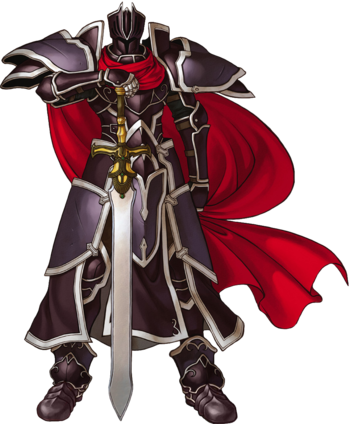
An enigmatic warrior, clad head to toe in armor black as night, which he is never seen without. Usually ridiculously powerful, he is feared by all who know of him. Wielding a sword, speaking in a low monotone or sinister growl, and looking totally badass while doing it, he is almost always a major antagonist. Commonly fills the role of The Dragon in fantasy stories. The Hero probably has a score to settle with him. The mystery surrounding his true identity is often a main plot point. Given his armor, he can show up and fight in The Tourney without betraying it. Sometimes there's nothing but the suit of armor. Sometimes, they're even a girl.
A Black Knight is usually found in settings in which a Knight in Shining Armor is also present. Frequently, they revel in combat. A common subversion is that they're not actually evil, but merely a Self-Proclaimed Knight.
The trope name comes from the black knights of feudal Europe, men who would paint their armor and shields black for a number of reasons. One reason to do this was because they had no liege, making them analogous to Rōnin Samurai. The black paint prevented the armor from rusting, which made life moderately easier for knights without a squire.note A more sinister motive for the paint was to disguise who it was they served. A knight could move freely and serve his lord's wishes without bringing him blame by painting over his coat of arms, one of the few ways to reliably identify someone in full armour and a helmet. This is Older Than Print, going back at least to Arthurian Legend. Note that, in its original usage, a Black Knight was not necessarily villainous, though he was dishonorable, which in the Middle Ages was barely a step up.
Note that, although being a black knight, this character is still a knight. This places them rather high among the list of potential candidates for Dark Is Not Evil, or at least a sympathetic form of villainy. While that can take a variety of forms, they rarely are the Knight in Shining Armor. More likely, they can be anything from a Knight in Sour Armor to a Noble Demon. This character very rarely is a total villain, but also only rarely The Hero. If they are villainous and end up fighting another bad guy, the chances that they are A Lighter Shade of Black in that situation are extremely high. They might also be the holy, chosen guardians of The Sacred Darkness or a Magic Knight who uses that power alongside their sword.
A Sub-Trope of Evil Wears Black. A Monster Knight has a high chance of being a Black Knight. If the Black Knight is in service to a female villain, then it may be a case of Dark Lady and Black Knight. Compare Tin Tyrant, which applies this trope to an Evil Overlord character by giving them a Scary Impractical Armor (though the armor itself may not be literally black). Contrast The Paladin.
Not to be confused with that Sonic the Hedgehog game, although it's also part of this trope. For the pinball tables by Steve Ritchie, click here. Or the hit single by Deep Purple (this one is called "Black Night"). And not necessarily The Dark Knight.
Examples:
- In Aura Battler Dunbine, Burn Burning became a black knight in the second half of the show after he failed his lord too many times. The OP turned it into a Paper-Thin Disguise for the audience, though.
- The Skull Knight of Berserk, is a wandering knight of unknown identity, wearing all-covering armor, sporting a dark-colored horse and cape, whose appearance and reputation strike fear into both humans and monsters. Also an example of the Dark Is Not Evil subtype, as he opposes the God Hand and has rescued the good guys from certain death several times.
- Guts himself is called "The Black Swordsman" and gains black armor later on in the series. Despite his time as "The Black Swordsman" when he was murdering every Apostle he saw and anyone in his way, Guts tends to subvert the standards (especially during the Golden Age) as he just looks scary and brooding: he's actually really socially awkward and just has the misfortune of looking intimidating. He also fits the example of the wandering Rōnin due to not having a leader anymore (due to said leader betraying him in horrifically heinous fashion during the Eclipse).
- The Black Knights of Code Geass. They're color coded to contrast with The Empire, which frequently uses Light Colors in their mecha and uniforms.
- Also deconstructed and subverted at the same time by Suzaku, since he turns into both the Big Bad's The Dragon (more than once) and he is more of the bruiser than Lelouch is.
- And the Gawain and again after it's rebuilt as the Shinkiro
 is a Black Knight(mare).
- Digimon LOVES this trope:
- The first example was arguably BlackWarGreymon, a dark version of WarGreymon. He was conflicted about his purpose in life which often brought him into conflict with the Digidestined, but it became ultimately clear than he was an honorable being.
- Beelzemon of the Seven Great Demon Lords is more of a dark knight decked out in biker clothing than Satan or Beelzebub. Its profile describes him as "cruel and merciless, yet exceedingly prideful" and that he never attacks the weak. The Fusion version has a more knight-like appearance.
- Koichi's Human spirit form, Löwemon, is an excellent example of this. He wore armor black as midnight and was (at the time at least) by far their strongest warrior, but he was as noble a hero as the rest of them, making him an example of The Sacred Darkness.
- DarkKnightmon from Digimon Fusion combines this trope with Magnificent Bastard and awesome theme music.
- Other digimon fit the Black Knight trope that haven't appeared in an anime include: ChaosGallantmon, a demonic version of Gallantmon, and Gaiomon, a samurai version of BlackWarGreymon.
- Fairy Tail: Erza Scarlet becomes one of these whenever she puts on her Black Wing or Purgatory Armors. While Erza is always the pinnacle of a Knight in Shining Armor in personality, she uses these armors in particular when she gets serious and more brutal about combat. The Purgatory Armor in particular stands out, as it's a full-suit of black and gray armor covered in Spikes of Villainy and she's hefting around a mace covered in spikes and blades.
- Her Edolas doppelganger Erza Knightwalker fits as well, as a Captain of the Edolas Military which controls the remaining magic of the world. She is determined to keep the magic of Edolas from dying, whether by stealing magic from Earthland or wiping out their former "gods" to gain infinite magic.
- Fate/Apocrypha has several as well. There's Saber of Black, the legendary Siegfried who visibly embodies the trope in his all-black armor that renders him totally invulnerable. In keeping with the Dark Is Not Evil elements of this trope, he is among the kindest members of his faction, and sacrifices his life by transplanting his heart into the body of a dying, sentient, homonculus
- There's also Rider of Black, an androgynous bishounen who wears all black armor with a white coat and accents to symbolize his heart of gold. Fitting, given his status as a paladin, specifically Astolfo, the twelfth paladin of Charlemagne.
- Rider of Red fills a similar role, acting as the counterpart to both Rider of Black and Saber of Black, in that he is Achilles, the invulnerable hero of legend. Like Rider of Black he is a Rider, possessing his chariot from life as a Noble Phantasm. Like Saber of Black, he is clad in all black armor and almost totally invulnerable, able to ignore any attacks from opponents who lack Divinity, and able to shrug off the attacks of those who do. He is also among the kindest of his faction, though like Saber of Black he has Blood Knight tendencies and something of a Heel Realization.
- Finally the Ur Example appears as Saber of Red, Mordred, bastard offspring of Artoria and Morgana Le Fey. In addition to Spikes of Villainy and the appearance of a Tin Tyrant, her armor's helmet makes her identity undecipherable to anyone, including her own master. Like the Mordred of legend she is obsessed with becoming king and being legitimized in the eyes of Artoria, with any talk of her gender, her father, or even the Round Table being a massive Berserk Button for her. Despite this she's also revealed to be something of a Jerk with a Heart of Gold and a "Well Done, Son" Guy, who bonds with her Master in a father/daughter relationship she never had with Artoria, and manages to Go Out with a Smile after dealing a fatal blow to Assassin of Red.
- In Fate/Zero, Berserker, AKA Lancelot, the Knight of the Lake, epitomizes this trope; he is over 6 feet tall, clad with heavy black armor from head to toe, has a black Battle Aura, and has two Noble Phantasms that firstly conceal his identity and Servant statistics from everyone, and secondly, allow him to wield ANY object that is conceptually a weapon, (from butter knives, to simple metal poles, to modern firearms and even F-15 Jet fighters) as a weapon, with master-level proficiency, even if he has not actually even held that specific weapon before. If that is not enough for you, he also has a final, third Noble Phantasm which is his fairy-made, no-longer-holy blood red sword, Arondight (the sword of the lake), an anti-unit type weapon that is said to be the counterpart of the legendary anti-fortress sword Excalibur, increases all Berserker's attributes by one rank and has special dragon-slaying properties, with the only downside being that it seals both of the aforementioned Noble Phantasms while it's activated.
- In The Five Star Stories, there's only one Black Knight at any one time & he's a sort of Legacy Character. The Black Knight is the person Artificial Human Est sees as the ideal pilot for the Humongous Mecha she's bonded to, Vatshu. When the current Black Knight dies, Est goes Walking the Earth looking for a new one. Most are free agents, though they usually seem to have an affinity for the kingdom of Colus.
- Macross Delta brings some of the trope's feudal roots into giant robots. The Windermere Aerial Knights initially attack in dark Valkyries with no identifying visuals. Once they reveal themselves, the machines light up in recognizable colors and symbols, complete with a coat of arms also adorning their shields.
- In Maoyu, the Black Knight is The Hero in disguise: He and the Demon Queen (disguised as a human scholar) are secretly Playing Both Sides to find a peaceful political solution to the human-demon war.
- Dark Knight/Prince Kaito from Murder Princess.
- My-Otome has a Black Knight among the Aswad, and he goes by the name of Rad (a.k.a. Reito).
- Ainz from Overlord (2012) disguises himself as one when acting as an adventurer to learn about the world he was put into. An interesting example, in that he is acting as a typical "good" knight, but he is closer to gray morality-wise. He is also actually a mage rather than a knight, but Ainz is powerful enough that even faking being a knight, he is on the level of the highest-ranking adventurers, if not stronger.
- One of the characters Princess Tutu rescued was a Black Knight.
- Ashram in Record of Lodoss War is a rare case of a Pretty Boy Black Knight.
- Sorta invoked and then subverted in The Rose of Versailles. There is a character that refers to himself as the "Black Knight", but said character mixes Just Like Robin Hood with being among the crew of the Duke of Orleans. We also find out his real name: Bernard Chatelet, and later he drops the mantle (after subjecting Andre to Eye Scream and being confronted by his pissed-off partner Ocar) and becomes an Intrepid Reporter instead.
- Racer X in Speed Racer, a feared and brooding international spy often seen thwarting evil schemes.
- The Black Knight (and/or Crimsom Knight) from the first episode of The Tower of Druaga is a parody of this kind of character.
- Played straight by Shadow Gilgamesh in the second season.
- Yu-Gi-Oh! GX gives us the Supreme King.
- Magic: The Gathering:
- The Black Knight card, a standby of Black decks for years. According to the flavor text, he's also a Blood Knight.
Battle doesn’t need a purpose; the battle is its own purpose. You don’t ask why a plague spreads or a field burns. Don’t ask why I fight.
- The Hand of Cruelty, a Black Samurai.
- The Knight of Infamy, a riff on the Black Knight.
"Your laws, like your bones, were made to be broken."
- The Knight of Malice from Dominaria is another riff on the Black Knight, with Red and Black and Evil All Over armour. Ironically enough he actually works really well fighting alongside the White Knight riff from the same set, Knight of Grace, because they buff each other's attack — and two 3/2 first strikers by turn three is a tricky proposition for many decks.
- The knights of Lochthwain from the Throne Of Eldraine set are an entire court of Black Knights, as they're the member of the five courts aligned with Black Mana, but they're a Dark Is Not Evil version: while knights of Lochthwain are known to be vain, haughty, and prone to holding grudges, their defining trait is that they're Determinators who never give up on a quest once begun until it's completed, or they die trying - and sometimes not even then.
- The Black Knight
- Midnighter from The Authority is like a more kill-happy Batman; he's one of the most feared fighters in the WildStorm universe, and dedicated to making 'a finer world' — even if he needs to kill for it. He's explicitly labelled a knight by Gaia Rothstein, who begs him to rescue her from an evil sorcerer holding her hostage, and rewards him in true fairytale fashion when he completes his quest. He even gets to slay a dragon!
- He later comes up against Captain Atom in Captain Atom: Armageddon, who's designed after the Knight In Shining Armour archetype and referred to as such — and definitely comes off as one in the Darker and Edgier Wildstorm universe. It does not end well for Midnighter.
- Batman's armor may be a lot less bulky than most, but he still fits (hence "the Dark Knight"). His Tangent Comics incarnation is a literal "dark knight", a cursed suit of armor that stands stalwart against evil.
- The Black Knight: Don Rosa drew a pair of Scrooge McDuck stories featuring a Black Knight actually called that. He was a master thief named Arpin Lusene (better known by his criminal alias, Le Chevalier Noir), modeled after the Gentleman Thief trope. He gets even worse when he actually gets a black suit of armour covered with a substance that destroys anything it touches. (He's very careful when putting it on.) After becoming impervious to harm, he walks right through every one of Scrooge's defenses to steal his money.
- Black Moon Chronicles: The Lords of Negation are Haahzeel's most elite knights clad in black armor and controlled by him through their rings. Wismerhill eventually becomes their leader, and has to go through a lengthy ritual that leaves him as some sort of half-human half-ascended being.
- Disney Comics have two Black Knights. One is the Phantom Blot, Mickey Mouse's murderous, sometimes megalomaniac supervillain foe covered completely in an inky black cloak.
- Garulfo first parodies, then lightly deconstructs the trope with a Black Knight who entered a tournament simply to satisfy his lust for combat, brutally curb-stomped all of his opponents, but gets sick of all of this violence when Garulfo treats him with respect and kindness regardless of his fighting exploits. The Knight then goes on to explain to the crowd how devastating it is to a personality to be stuck in such an archetype, and eventually decides to stop fighting and Walk the Earth peacefully. He even reveals his face, which the reader never sees.
- Marvel Comics: More than one character is named "The Black Knight". Some are heroes, some villains, and some vacillate between the two — it doesn't help that the Ebony Blade, their sword, is cursed.
- Mickey Mouse: One European storyline, the second part of a trilogy of stories set in a Medieval Fantasy world, concerns Mickey and Goofy trying to win a tournament where the prize is a magic MacGuffin they desperately need to save their friends hometown from a volcanic eruption. One of the contestants is the representative of an off-screen noble named Queen Hela, and is, you guessed it, a Black Knight. He quickly proves unbeatable, and it comes down to him and Goofy in the finals, where the contest, due to outside circumstances, ends up being a kind of game of skill Goofy had been playing with before the story began, which revolves around trying to keep a small metal pebble spinning on a rope as long as possible. Goofy wins when the jerky motions the game requires causes the Black Knight to break down after about an hour, and it's revealed he's actually a robot
- Captain Rochnan, commander of the Warrior Monks, in The Scorpion.
- Spawn: Lord Covenant, from the spin-off Spawn: The Dark Ages. An undead knight who's fiercely dedicated to protect his fief, he later use his powers to atone for his sins committed in life while also fights against the curse of the Hellspawn. The Medieval Spawn (a different character) may count too, although he is mostly a Knight in Shining Armor that just happens to be undead and have powers of darkness.
- Spider-Man had a one-shot foe called Knight in a super-villain duo called Knight and Fog. He had the power to transform into a large, metal humanoid with adamantium skin and a retractable sword coming out of his wrist. Like the characteristic black knight, he was simply a Punch-Clock Villain Professional Killer who gained no pleasure from killing, and followed his agreements to the letter.
- Wonder Woman has Ares. While able to take on a number of forms, he is typically seen decked out in black and blue Greek style armor, complete with horns and Spikes of Villainy.
- Monster X fills this role decently in The Bridge, working for the Big Bad but being a Noble Demon with chivalry styled honor code. Visually he's a bit of an inverse, having an inky black body, but ivory colored armor.
- Child of the Storm has Dane Whitman as heir to the Black Knight legacy. While a good (if somewhat cocky) guy, his sword is an Evil Weapon that inspires Blood Knight tendencies and it's implied that the main reason he's on the Excalibur squad is that Peter Wisdom wants to keep an eye on him.
- Parodied with Darkern Edgier from The (Edit) War for Ash's Freedom to not be Betrayed. Rather than being an imposing badass, he's a pretentious edgelord who's far too fixated on "fixing" Ash Ketchum.
- Fairy Without Wings brings Dark Blade. In more than just simply wearing the armor and Casting a Shadow, about the only thing this character doesn't bring to the table is that the liege they are working for is the only emperor in charge.
- The Lamenters in For Those We Cherish sport black Powered Armor, so painted in penance for their role in the Badab War.
- Matsuda in the Death Note Fanfic Low Light after becoming Kira's bodyguard and taking several levels in Badass.
- The Night Unfurls has Sir Kyril Sutherland. Strong, enigmatic, clad in dark grey, feared by many, and is knighted. What else?
- In Polish animated series Dreadfully Titled Movie, Marbas and his soldiers wear black suits of armor.
- Lord Spottlebottom is referred to as "the Black Knight" in the Animated Adaptation of The Smurfs and the Magic Flute, but he's simply Johan's jousting opponent, and after he's defeated he says that he should've taken up dancing.
- Subverted in Disney's The Sword in the Stone. Sir Bart, the knight wearing all black, was shown to be scary, but when it was spread and challenged that Wart (Arthur) had pulled the sword out and put it back; he was the most reasonable and vocal about giving him a chance to show everyone he could do it again.
- There are two films with Black Knight in the title, one from 1954 (The Black Knight) starring Alan Ladd, and another from 2001 (Black Knight), starring Martin Lawrence.
- Braveheart has William Wallace duel a character like this at one point, complete with a Dramatic Unmask.
- Highlander. Connor MacLeod's first sight of The Kurgan is when he rides up clad in dark, bone-like armour on a black horse which rears before Connor, who can only gasp "Mother of God!" at the sight of this terrifying figure.
- The Incredible Army of Brancaleone has a German knight dressed in black cloak and clothing that gets robbed by the protagonists in the opening. While he is a non-malevolent example, since he fights against bandits and pillagers that are raiding a village in his scene, he is pretty ruthless and sinister, returning during the climax to save the heroes when they are about to be executed by Saracen pirates... Only for him to exact their revenge on them for robbing his rightful inheritance.
- A Kid in King Arthur's Court reveals its master jouster Black Knight to be not just a good guy, but a girl!
- King Arthur: Legend of the Sword has a particularly creepy looking example in Vortigern's One-Winged Angel form. An eight foot tall shadowy warrior with a skull-faced helmet complete with horns and a flaming cape, wielding a double-bladed scythe as a weapon. His voice is a demonic growl and his eyes are shown glowing like burning embers. When taking this form Vortigern is shown as powerful enough to even go toe-to-toe with a warrior wielding Excalibur.
- Kingdom of Heaven features an enigmatic, nameless Knight Hospitaller who always wears the black robes and chainmail of his order.
- A Knight's Tale: Two of these end up coming into the story. One's the classic trope villain, and the other is the original King Incognito use.
- Navarre in Ladyhawke, a disgraced fugitive knight with black armour, a BFS, and a billowing black cape with scarlet lining, played by Rutger Hauer no less! He's actually the hero.
- The Lord of the Rings:
- Sauron, in the opening of The Fellowship of the Ring, wears a huge suit of armor, towering over the human and elf soldiers he battles, and sends scores of them flying with with each blow of his giant mace. In the books, he was more of a shadowy being; here, he is modeled after his former master Morgoth from The Silmarillion, who was described wearing dark armour.
- His Dragon the Witch-King of Angmar similarly wears spiky armor, although before The Return of the King he wears a simple black cloak like all the other Ringwraiths.
- Monty Python and the Holy Grail famously features a Black Knight, who ends up with all of his limbs chopped off, yet still lusting for bloodshed.
- The huge black-armoured warrior in the film adaptation of Solomon Kane is silent, mysterious and nigh on unstoppable. True to the trope, it turns out to be Solomon's horribly disfigured brother inside the armour.
- Star Wars:
- Darth Vader is a black knight In Space! who duels with a Laser Blade and proved popular enough to inspire a whole wave of emulators.
- His "successor" Kylo Ren in The Force Awakens is identified as the leader of the "Knights of Ren", wears mostly black, and carries a lightsaber with a crossguard for additional Black Knight cred. He even has his "steed": the custom-made and experimental TIE Silencer.
- Rinzler in TRON: Legacy is Clu's champion in the games and races. Clad in black, with a smooth black helmet obscuring his face, Rinzler is the only character Dual Wielding discs. He is extremely fast, agile, and durable. This makes sense, as he used to be Tron, the security program, before Clu enslaved him.
- A famous joke famously narrated by the late Italian comic actor Gigi Proietti has him having to narrate a story with an aesop at the end: he tells of a black knight who's challenged by a white knight in combat. The white knight is butchered, but his three sons come looking for the black knight to avenge their father and are slain. Each of the three sons has three sons, and the nine sons go looking for the black knight to avenge their fathers but the black knight easily dispatch them. Each of those sons has three sons, and all twenty-seven of them come looking for revenge but are slain, and so on. The Aesop? You don't fuck with the black knight!
- In The Black Company novels by Glen Cook, Croaker temporarily becomes a black knight by donning his Widowmaker armor to damage enemy morale.
- In R.S Belcher's The Brotherhood of the Wheel, there's a cult of serial killers known as the Zodiac Lodge. While trying to rescue a family from a branch of them, the Lodge discovers that Jimmie Aussapile is a "Templar". This leads to the Lodge Master coming out. Jimmie describes the hulking man as a "black knight" as the Lodge Master wears a black hood, black shirt and polarized shades as well as a black tabard with the "crosshairs" symbol which is the coat of arms for the Zodiac Lodge. The Lodge Master is also armoured with a hidden bullet-proof vest and was the only asshole to escape when the rest of these serial killers later got gunned down and grenaded.
- The Improfanfic Dark Heart High has Craig Maimsworth, Black Knight!...in training. He's not very good at it. He does wear heavy black armor though.
- The Warrior in Jet and Gold from the Dorian Hawkmoon trilogy has the appearance of one of these, but is actually fully on the good guys' side (if in an annoyingly enigmatic way).
- Gaynor the Damned is a straighter version of the trope who appears in many Michael Moorcock series (although his armour is not black but constantly changing in colour, due to the influence of Chaos).
- Several of the sullanciri from The Dragon Crown War have this vibe, most obviously Nefrai-kesh and a Rare Female Example with Malarkex.
- Lord Soth from the Dragonlance novels is a very good example of this trope being a fallen hero, undead (a Death Knight), the leader of a small army of undead and the second in command to Takhisis and Kitiara before being exiled to Ravenloft.
- Later stories introduce the Knights of Takhisis, a military order of Black Knights (living, for the most part).
- In The Drifting Lands novels by Joseph Brassey, there's Lord Azrael and the other Black Knight members of the Eternal Order, which is an evil mercenary cult whose elites are Magic Knight warriors in enchanted black armor. Each one is a Master Swordsman and are masters in channeling magic — they won't ever be as powerful as a normal sorcerer, but they have a huge advantage. The Eternal Order's magic doesn't use Magical Gesture or E = MC Hammer that a sorcerer must. Long-term use of this type of magic for augmenting themselves will eventually lead to the user becoming a Humanoid Abomination.
- The Elenium/The Tamuli:
- Sparhawk's enemies essentially see him as this, due partially to the black Pandion Knight armor, partially to the Pandion order's reputation for casual violence, and partially to being Anakha. Sparhawk, however, is an extremely heroic example of the trope.
- Martel fits the archetype better, being a dishonored former knight-turned mercenary.
- Eurico the Presbyter features a heroic example that still fits like a glove with the title character taking up a secret identity as a warrior clad in completely dark armor who strikes fear into the hearts of his enemies who regard him as a demon in human form (which is amusing considering he is a Catholic priest).
- Berserker in Fate/Zero, who is only known as "The Black Knight" since he is wearing the typical black armor. He is also clouded by a fog that obscures his identity and status. His identity is revealed later on to be Lancelot of the Lake, who wanted to descend into madness after the mess that he made in his lifetime as a knight.
- "Le Noir Faineant" (The Black Sluggard) of Ivanhoe. In this case it's not The Dragon but rather a Large Ham, and secretly King Richard the Lionhearted in disguise. As the king, Richard has no liege, so he is able to be a Black Knight on a technicality.
- Wilfred of Ivanhoe fights as the black knight "Desdichado" ('Unfortunate') in a tournament, and qualifies better as a black knight in a historical sense, being a knight who lost his liege over a matter of honour.
- In The Once and Future King, King Arthur states that it has always been his dream to dress up as a Black Knight and stand by a bridge, and challenge any knight who comes by to a joust. Later on, in The Ill-Made Knight, he is shown doing just that when Lancelot comes to King Arthur's Court.
- In A Practical Guide to Evil, Black Knight is one of the central Roles of the Dread Empire of Praes. The current Black Knight, Amadeus, transformed the Legions of Terror from an undisciplined barbarian horde to a well-oiled and equal-opportunity war machine, orchestrated the complete conquest of the Dread Empire's age-old enemy of Callow, kills heroes as easily as he takes out the trash, has a fearsome reputation as a Combat Pragmatist, and commands the personal loyalty of a group that even other Named refer to as The Calamities.
- In Howard Pyle's late-19th/early-20th Century versions of the Arthurian mythos, this is the default appearance of numerous opponents of the Knights of the Round Table during their adventures.
- The notorious bounty hunter Aloysius Knight in the Matthew Reilly novel Scarecrow goes by the call sign "Black Knight", and dresses appropriately. In accordance with the trope, his origin, identity and allegiances are unclear.
- A black knight appears fairly early in The Silver Chair as a mysterious woman's companion. The woman turns out to be the main villain (and is implied to be connected to the earlier villain Jadis the White Witch), while the knight turns out to be King Caspian's long-missing son Rilian.
- In A Song of Ice and Fire we get to hear of several Black Knights, called Mystery Knights, who remain masked until they are defeated; it is apparently all but law that whoever defeats a mystery knight in a tournament is the one who removes the helm. Indeed, it seems there was hardly a famous tourney in which there wasn't at least one participating. One of the most famous, never unmasked, was the Knight of the Laughing Tree, who competed at the great tourney at Harrenhal, made it a point to defeat three knights whose squires had bullied a young crannogman, became champion at the end of the second day, and then vanished before the third day began, leaving behind only the shield, emblazoned with a laughing heart tree. Hints in the story, and reader speculation, tend to imply that the Knight was Lyanna Stark, Lord Eddard's late sister; the crannogman was almost certainly Howland Reed, a bannerman to the Starks.
- In what is probably an aversion, while the Night's Watch always wears black, and there are indeed anointed knights serving among them, we have not yet seen one dressed in full plate, complete with face-concealing helm, who for some time is unable to be identified by a viewpoint character; given the relatively small size of the organization and that the Night's Watch isn't looked upon highly anymore, it seems we are unlikely to by series end.
- Perhaps the ultimate in-series example is Ser Gregor Clegane, Tywin Lannister's most notorious enforcer. He wears dark, unornamented armour, is absolutely gigantic, plays the role of The Dreaded/The Brute, and is a violent psychopath with a Hair-Trigger Temper. Whenever the Lannisters need to have some Rape, Pillage, and Burn done either on or off the record, he's their go-to man. Although, even "off the record" is rather more "but, we all know who this uniquely huge, 'mysterious' man mountain is and that he's here because you annoyed Tywin Lannister, right?" than strictly clandestine, however sigil-free and unidentifiable he and his troops may officially be.
- For the more honorable version of this trope, there's Gregor's younger brother Sandor Clegane, who ironically refuses to properly become a knight because his hateful brother is one, vehemently does not self-identify as one, and ditches the pageantry of it whenever possible; and when he can't get away without it, he deliberately subverts it (his snarling dog helm isn't just to own his identity as "the Hound" aka "the mad dog of the Cleganes" or to intimidate: it's also an insult to anybody who thinks pageantry is inherently a thing of noble beauty). He is one of the continent's most skilled swordsmen, wears plain, often blackened/ dulled/ treated armor (rust-protection as well as reflection-reducing "camo"), and can come off as a cold-hearted jerk to some/ most. However, he actively behaves as rather more honest and honorable than many of the actual knights in the series, as he commits to his duty as a bodyguard to Prince Joffrey to the best of his ability (until his PTSD gets the best of him), treats Sansa Stark with more respect than anyone else at King's Landing does, and intends to bring Arya Stark to safety, albeit not without some money for the trouble. By comparison to e.g. Ser Meryn Trant or Ser Loras Tyrell, this is almost shining knight territory.
- Time Warp Trio: The very first antagonist in the series, when the boys are sent back to King Arthur's court in "Knights of the Dinner Table".
- Averted in Through the Looking Glass, and What Alice Found There, which uses white and red chess set symbolism and characters. (As well as subverted.)
- Vermis I: The world of Vermis has no shortage of these, from enemies (Lost Paladin, the bridge knight), to friendly NPCs (Lonely Knight), to playable characters (Lost Old Glory, Miner Knight, Cursed Fool). Though, the grainy monochromatic illustrations often make it difficult to tell what color a given knight's armor actually is.
- In The Traitor Son Cycle, Hartmut Li Orguelleus the "Black Knight", a mercenary knight hired by the king of Galle to wage a guerilla war against Alba, is a towering man clad in pitch-black armor. The Black Knight is a religious fanatic who was a prominent slaver in Ifriqu'ya and despite his religion, he'll use any method to win including resorting to hermeticism from others (he's not a Magic Knight, he has no talent in sorcery though he does have a mighty fiery magic sword) and allying with dark powers. Hartmut is an amazing warrior who in Book 2 defeats Bad Tom, the best warrior in the Red Knight's company, and then almost kills an intervening Ranald Lachlan who's one of the King of Alba's elite bodyguard.
- Villains by Necessity: Blackmail. He rescues the protagonists from a dragon, and they nickname him this due to his armor. Unlike most examples, he never even speaks. By the end of the book he's been revealed to be a legendary paladin who was part of the team of heroes responsible for tipping the Balance Between Good and Evil to the light, and proves his Dark Is Not Evil credentials by sacrificing himself to keep the world from being consumed by the light.
- Played in its non-villainous incarnation by Sir Guy Losobal, the Black Knight of Christopher Stasheff's A Wizard in Rhyme series, who serves as an ally to the protagonist in most of the books. The reason he is a black knight is due to being the legitimate heir of the world's alternate Charlemagne. Should all of the Christian kingdoms fall to darkness, it is his duty to re-establish the empire; as such he serves no lord.
- Wraith Knight: Jacob Riverson and the other Wraith Knights were this by nature. They were all undead Magic Knight warriors who served as the King Below's generals. Jacob is a rare heroic version of this and a Dark Is Not Evil (theoretically) example. He is still a man in ice-covered black hooded armor, a being referred to as "Dark Lord", and a superhuman killing machine capable of taking on small armies.
- Game of Thrones:
- Sandor Clegane, in both appearance and effect. His armor is uniformly ominous black, and like the black knights of historical Europe, he no longer serves a master. Granted, he was never officially a knight, but still. It's particularly noticeable after Arya gets a White Stallion, while Sandor rides his dark courser.
- Despite not technically being a knight, Brienne is this in both appearance and effect, quite ironically like Sandor Clegane. Jaime has a suit of black armor forged for her in Season 4, and strictly speaking she no longer follows a master.
- Gregor Clegane wears a heavy suit of coal-black armour. A bit subverted in Season 2 when he drops the Shoulders of Doom and wears a Lannister cloak and helmet, but he goes back to full black armor when he appears in Season 4. After two seasons of wearing gold Kingsguard armor, Cersei does a dark redress and he goes back to black plate.
- The Goodies are contracted by the descendant of King Arthur to defend his castle while his family goes on holiday. A land developer tries to get his hands on the castle, but is stymied by our heroes. However as medieval law still applies in Camelot, he challenges the Goodies to a duel, appearing as Ye Black Knight. Hilarity Ensues.
- Kamen Rider Saber has Kamen Rider Calibur as a major villain. While the heroes are an order of knights with Elemental Powers, Calibur wields the powers of darkness and betrayed the order 15 years prior to the start of the series. There are actually three Caliburs over the course of the series, all of whom betrayed the order in succession but are revealed to be sympathetic Anti Villains; as their sword gives them visions of Bad Futures but they all carry the flaw of Poor Communication Kills and not trusting their fellow knights to help avert those futures: The first Calibur, seen in the backstory, foresaw a threat within the order and used underhanded methods to draw it out, making himself look like the villain in the process. The second one defeated the first, saw the same visions of corruption, and didn't know who he could trust; so he became the new Calibur and started attacking the order from the outside. Then after he's defeated, a third knight takes up the identity and deals with the visions by trying to De-power the other knights before their powers are misused.
- The Lord of the Rings: The Rings of Power: Sauron wears a spiked armor with a black cape, similar to the one he wears in the cinematic trilogy.
- One turns up in Merlin. It turns out to be none other than Arthur's uncle, summoned as a wraith by Nimueh.
- Parodied in the Pearl Bailey episode of The Muppet Show, with a Camelot-themed final number featuring a "mysterious" Black Knight.. played by Gonzo, enormous hooked nose and all.
Black Knight: The world shall forever wonder who I am!
Kermit: Though some may harbor suspicions. - A few have shown up in Super Sentai and Power Rangers:
- The first instance would be the aptly named "Dark Knight" in Kagaku Sentai Dynaman, a knight clad in black that alternates between attacking the Dynamen or the Jashinka Empire. In the end, he is revealed to be the exiled Prince Megiddo and assumes the Big Bad position.
- From Kyōryū Sentai Zyuranger, the Yamato Tribe's black knight. He's a flashback-only character, but he is important. He's the father of the Red and Green Rangers who tried to overthrow the Yamato King and failed, but was let off in exchange for giving his baby son Geki to the childless king. Not too long after, he once again attempted a revolt (using the loss of Geki to galvanize others), challenging the king to duel. The king spared him when he lost... but he then immediately got himself killed via Backstab Backfire. His last words to his older son Burai were "Avenge me". This was what lead to Burai and the other Zyurangers starting as enemies.
- There's another black knight, appearing in front of Geki and Dora Narcissus, who starts attacking Geki and delivering a solid Breaking Speech that Geki is too hung up on saving Burai at cost of the welfare of his other friends and the people of Earth, until Geki delivers a Shut Up, Hannibal! and defeats him... only to reveal that it's Goushi, who's trying to wake Geki up from his Heroic BSoD, just as planned.
- Zhang Liao from Gosei Sentai Dairanger. Clad in black armor too, and he is a member of the Dai tribe, one of the original five warriors, who turned traitor. He repents out of love for his son -- Ryou, the Red Ranger, but perishes after the spirits of his companions forgive him.
- Bull Black the Black Knight in Seijuu Sentai Gingaman/the Magna Defender in Power Rangers Lost Galaxy, an Aloof Ally who lost a family member and is out for vengeance against the villains, clashing with the Rangers in the process. Both eventually pass on their powers to the Red Ranger's brother (Hyuuga and Mike, respectively), who becomes a proper Sixth Ranger.
- An episode of Power Rangers Time Force had a black knight trying to open a small case containing the Battle Fire to gain its powers, but couldn't do so as it would only open to someone with a heart of justice, so he left it inside a cave to be watched by a fire-breathing dragon. Wes gains access to the Battle Fire after killing the dragon and then uses its powers to defeat the Black Knight.
- In Bakuryuu Sentai Abaranger, anyone who wears the Armor of Darkness becomes a Black Knight bent on destroying anything around them — and whoever defeats the wearer becomes the new wearer. (Power Rangers: Dino Thunder adapts its multiple wearers into a single character, Zeltrax.)
- Wolzard in Mahou Sentai Magiranger/Koragg the Knight Wolf in Power Rangers Mystic Force, The Dragon with a Hellish Horse but also has an honorable streak a mile wide, often rationalizing that the Rangers are Not Worth Killing. Really the Brainwashed and Crazy father of the entire team in Magiranger and of the Red Ranger in Mystic Force. Incidentally, his armor isn't black but purple.
- Gosei/Robo Knight in Tensou Sentai Goseiger/Power Rangers Megaforce, another Aloof Ally and a Knight Templar — like the Rangers, he wants to protect the Earth; unlike the Rangers he doesn't particularly care for its people. His armor is actually silver, but his attitude qualifies him for this trope.
- Kishiryu Sentai Ryusoulger/Power Rangers Dino Fury, featuring an order of knights, naturally has a Black Knight villain. Ryusoulger's version Gaisoulg, like in Abaranger, is a set of malevolent Animated Armor that possesses its hosts and continually seeks out fights for the sake of fighting (and like in Magiranger, it's purple). Void Knight in Dino Fury, however, is more noble; trying to revive a loved one but going to extreme measures to do so.
- Arthurian Legend:
- Older Than Print Ur-Example: The Black Knight(s).
- There's actually at least four. Arthur killed one, Sir Gareth got another, a third battled with Percival over a misunderstanding, and a fourth is the illegitimate grandson of King Arthur, who avenged his father after his wife killed him, and then teamed up with his half-brother to go on adventures.
- In some versions, the black knight is King Pellinore, whom Arthur fights early in his reign. Pellinore first unhorses Arthur with a lance before dismounting to beat him with a sword too; he actually breaks Arthur's sword in the process. Merlin rescues Arthur with magic and brings him to the Lady of the Lake, who gives him Excalibur and, more importantly, Excalibur's sheath, which has the magic property that no one wearing it may be cut. With it, Arthur is able to beat Pellinore, after which Pellinore joins the Round Table. In his day, Pellinore may have been the greatest knight at the Round Table; he never fought Lancelot or Galahad, but it is at least suggested that he might have been a match for either.
- The Green Knight from Sir Gawain and the Green Knight also appears to fit the trope, but with every instance of "black" changed to "green". Except that the Green Knight subverts it by turning out to be an pretty good guy that just wanted to test Gawain's honour.
- Lancelot had many aspects of a Black Knight, at least in that he didn't want to be recognized; he often would borrow other people's armor and weapons so that nobody could tell it was him while wandering around and performing heroic deeds/picking fights with random people. Black armor was one of his earliest disguises.
- Mordred is sometimes portrayed like this too, Depending on the Writer (usually in modern version, to emphasize the fact that he was a traitor; modern depictions tend to make him look evil for dramatic effect more than anything else).
- Older Than Print Ur-Example: The Black Knight(s).
- Actually averted in various medieval chivalry tales from middle Europe. Back then, Black was not necessarily the colour of evil, rather than (as mentioned above for Lancelot) the colour of mystery. In many-a-story, a Black knight was one who tried to hide his identity but was oftentimes good, a White knight was an elder, more experienced knight, who could provide his knowledge and wisdom, and a Green knight was a young and inexperienced knight, prone to make errors, and trying to prove his worth. The bad, slimy, backstabbing felon would be the Red one.
- Williams Electronics' Black Knight and Black Knight 2000, of course. Also it’s continuation by Stern, Black Knight: Sword of Rage.
- In Medieval Madness, the player must defeat five of them during multiball.
- This is one of the enemies in the "Knight of the Roses" table of Last Gladiators.
- In Golden Logres, he is one of the three Evil Knights that must be defeated.
- In The Gamer's Alliance, Wulgar and his successor Ulrik both wear black armor and act as foes of various heroes.
- In Chronopia, with its heavy influence from Warhammer Fantasy and how prevalent heavy, spiky plate armor is in the artwork and miniatures, almost everyone in Chronopia looks and acts like a black knight. But perhaps the most fitting are the Repulsar Knights and Nightwalkers of the Kingdom of the Firstborn and the Obsidian Guard of the elven noble house, House of the Obsidian Serpent. The Repulsar Knights are Individuals who are the most heavily armoured unit in the game and hit almost as hard with their Maiming Polearm, meanwhile the Nightwalkers are knife-throwing assassins and expert swordsmen in armor onky a shade weaker than that of a Repulsar Knight. While not necessarily evil, they are fanatically loyal to the One King and both will gladly carry out wetwork missions in his name. Meanwhile the Obsidian Guard are the personal enforcers of the sinister Duke Valimyr and wear enchanted black armor equal to that of a Nightwalker's and wield devastating two-handed runeswords.
- Dungeons & Dragons features the playable Blackguard prestige class, which is a kind of always-evil fighter with some divine magic spells. A possible (and often-used and recommended) background for a Blackguard is to be a fallen Paladin, as a fallen Paladin-Blackguard gets extra goodies in the form of empowered abilities.
- In some French sources, "Blackguard" is translated "Chevalier noir", which is the French for "Black Knight".
- The Paladin of Tyranny variant of the base Paladin would also fit here. The Paladin of Slaughter, not so much.
- Fifth edition has "Oathbreakers" instead of Blackguards, and has the Oath of Vengeance and Oath of Conquest for less heroic standard paladins. The Oath of Conquest in particular has a strongly Lawful Evil code, including charming decrees like "Douse the flame of hope".
- Exalted:
- First and Forsaken Lion, who is somewhere between Darth Vader and Megatron. He can't dismantle his armor because his terrible Neverborn masters welded it to his very soul.
- A number of Abyssals would also qualify, mainly the ones who take the title "deathknight" literally.
- Godforsaken: Blackguards are evil knights who serve dark entities or their own corrupt agendas and use high-quality equipment usually decorated with symbols depicting death, demons or evil gods. They are sometimes granted dark magic by their patrons.
- Pathfinder: Typical Hellknights are clad from head to toe in heavy plate armor painted entirely black, and typically adorned with spikes, horns, chains and other fearsome protrusions. Their harsh, entirely unsympathetic personalities and brutal, merciless enforcement of the law more than match their sense of fashion.
- Warhammer 40,000 has no shortage of soldiers in black Power Armor, from the genocidally zealous Black Templars to the heroic but shadowy warriors of the Raven Guard, but the ones who fit this trope best are the Chaos Space Marines of the Black Legion. Many are former Sons of Horus who had their colors and name deliberately changed to distance them from their defeat at the end of the Horus Heresy, while the rest are Chaos Marines from other legions who repainted their armor to show allegiance to their new master, Abaddon the Despoiler.
- Among the loyalists, those Space Marines who are sent to join the Death Watch paint their armor black as a gesture of brotherhood with their new chapter — save for their original chapter's markings on their right pauldron, both as a point of pride and so not to anger their armor's machine spirit. The exception are the so-called Black Shields who have chosen to completely sever themselves from their previous chapter, either because they are the last surviving member, or for darker reasons...
- Points to the Dark Angel's Ravenwing company, not just for their jetblack armor, but for their elite members actually being called Black Knights. For that matter, the entire Dark Angels during their legion era could count. Their colours were originally black rather than the current olive-green and after discovering their lost primarch Lion el' Johnson on Caliban, their culture shifted from Earth standard special operations forces to becoming a mystery cult and knight brotherhood due to Lion bringing large numbers of his brethren from Caliban's monster-hunting knightly orders.
- Not to mention that the setting literally has knights, the Imperial Knights who are the noble family rulers of Feudal Worlds. Of course, being the exaggerated world of Warhammer 40,000, the concept of knights having more fancy and elaborate armor and weapons than any mere peasant could dream of having translates to giant robot suits provided by the Adeptus Mechanicus. Some individual Imperial Knights leave their Houses to quest and fight as Freeblades but they remove any House heraldry from their suits and many fight anonymously under a pseudonym. One such knight, his Questoris-pattern Knight Paladin suit painted black, is "The Obsidian Knight". And then for the villainous example, there are the fallen Knights who have joined the forces of Chaos and get the usual spikes on their suits.
- Warhammer: There are lots of examples, but the term "Black Knight" itself is used for the undead Wight cavalry of the Vampire Counts army (who probably fitted the classic version of the trope more when they were alive). Beyond that, there are:
- Archaon, Lord of the End Times, is a particularly destructive example, and he has a retinue of less-powerful but still scary knights known as the Swords of Chaos. When one is leading the other, the only two possible solutions are to shoot the hell out of them from a distance, or feed them a constant stream of weak units so that they don't utterly maul your heavy hitters. In general, Warriors of Chaos from the same setting tend to have this aesthetic. In a clever subversion, they are the exact opposite of Knights. They are in fact human barbarian chieftains and warriors coming from a demonic Norse warrior society. Another subversion, they don't even have to be black. The colour of their armour varies according to their religious affiliations, varying from black to red to purple to green to blue. These colours actually symbolize which Chaos God they devote themselves to, with the colour Black suggesting that they worship the Chaos Gods as a pantheon.
- Chaos Knights are elite Chaos Warriors mounted on huge Hellish Horses. They're the mounted heavy cavalry of the forces of Chaos and, with their fanatical devotion to their god or gods, also serve as templars of the Chaos armies.
- There are also the Blood Dragons, a sect of honourable vampire warriors who wear blood-red armor and spend their free time traveling around challenging mighty beasts and warriors to battles and drinking their blood. Some are even known to park themselves on bridges or in narrow passes and challenge anyone who tries to pass.
- Dark Elf Cold One Knights are essentially the Elf version (and riding giant Velociraptor-esque dinosaurs, rather than horses). The Black Guard of Naggarond are similar, being an order of sinister black-armoured noble warriors in service to a very evil liege-lord.
- Zweihänder is heavily influenced by Warhammer Fantasy Roleplay. So there are the Fell Knights, these evil knights are the elite warriors that worship the Abyssal Princes and other gods of Chaos. Above the Fell Knights are the Dread Count which are the Magic Knight results from a Black Magic ritual that fuses a Fell Knight and a Havoc Conjurer into one massive armored sorcerous warrior.
- Virtuvian H.A.C.K.S.: The Knights of Asperity are a band of menacing knights with jet black steel armor, a skull for their heads, evil red eyes, and a notorious habit of mass slaughter and village burning. Their background story implies that they used to be the heroic Knights of Accord until they got defeated and corrupted into this current state.
- LEGO Space: The Blacktrons were the first faction to be officially designated as villains, with all-black spacesuits and face-concealing black visors.
- LEGO Castle have also had multiple waves of these, including at least one faction actually called Black Knights, although the Fright Knights and Vladek's Shadow Knights from the Knights Kingdom line are no slouches in this department (although usually there's some red in there for contrast).
- Robin with his Black Knight Mech from Nexo Knights is another heroic example. They even reference the Trope Codifier a few times.
- AdventureQuest Worlds:
- The special versions of Artix and Sepulchure Figures have black armor. and they show up in Gravelyn's Dream. Later the Doomblade takes control of Sepulchure, changing his armor from red to black. This makes it likely that Artix at some point will gain black armor.
- There is also a boss called The Black Knight, whose armor you can get your hands on.
- The Death Knight class, and quite a few armors allow a player to be one of these.
- Sir Roderick of Clan Grimreaver is the Big Bad of the Tournament of Heroes and definitely looks the part. He's not above backstabbing enemies in his bid for Princess Brittany's hand and King Alteon's throne, and ultimately has to be defeated by the Hero.
- Age of Conan: The Dark Templars are heavily armored warriors who can channel black magic provided by demons or dark gods.
- The Black Knight is The Heavy of Astalon: Tears of the Earth. A brutal Misanthrope Supreme who follows the will of the gorgons, he possesses powerful dark magic and a suit of armor that heals him when submerged in blood.
- Baldur's Gate:
- Sarevok, the Big Bad of the first game, wields a huge sword and is clad in spiked black armor with a horned full helm revealing only his glowing eyes. His mysterious connection with the protagonist is that he is the player's demonic half-brother. In the expansion for the second game he can join the player's party, though his Black Knight appearance is significantly toned down.
- In the Enhanced Edition, the D&D prestige class Blackguard was introduced as a kit (ie modification) of the Paladin class. The new party member Dorn Il-Khan makes use of this class kit.
- Beyond the Beyond: In the second half, the party is stalked by a mysterious knight clad in black armor. He eventually catches up to them and challenges them to a duel. Once the battle is over, the knight's identity is revealed as Annie's older brother Percy, who was thought to have been Left for Dead in an earlier attack. If you don't attack him during the battle, he'll (re)join the party. Otherwise, he dies.
- Black Knight Sword has this in a role reversal. You are a heroic Black Knight with an intelligent magical sword, who's off to battle the evil princess.
- BlazBlue:
- Hakumen plays this trope almost completely straight, except without actually having black armor (he's clad in white). He's mysterious, imposing, and one hell of a badass, to the point where most of the cast, who are pretty badass in their own right, do not want to mess with him.
- The trope name is also the epithet of Kagura Mutsuki. He doesn't actually wear armor of any kind and is one of the most unambiguously good characters. He does however dress primarily in black clothing and wields an extremely large blade as well being among the highest ranking officials in the series' resident government. And proving that Rank Scales with Asskicking, his fighting skills are also worth mentioning, so much that he can straight up beat the main character, noted to be a One-Man Army, without too much effort and hold his own against a Blood Knight known to the masses as a mass murder.
- Susanoo, introduced in the fourth game, also plays this trope straight and serves as the final villain of the series. His true identity is none other than Yuuki Terumi after he removed Hakumen from the armor and possessing it himself. Notably, this is what Terumi used to look like.
- Death Knight Cador from Brigandine wields a gigantic axe and shrouded in black armor and horned skull mask. He is a very imposing figure from the Esgares Empire, only one level from maximum level. Cador is actually the boyfriend of Halley, Leland, brought Back from the Dead and Brainwashed and Crazy by Bulnoil to further his plan. Grand Edition adds two more Death Knights: Gaheris and Olwen, made from two Esgares knights, MelTorefas and Eniede, and both of them also share similar imposing dark armor and skull mask (though Gaheris has dark red armor, Olwen has dark purple armor).
- Castle Crashers: The Necromancer, The Dragon to the Evil Wizard. Rather than the standard Evil Sorceror kind of necromancer, this one is a Black Magic Knight. He is clad in menacing black armor and fights much like a player character (whenever not summoning hordes of undead minions, of course). One DLC actually makes him a playable character. For PC and PS3 version however he's unlockable by clearing Industrial Castle in Insane Mode
- A black knight appears early on in Castlevania: Lords of Shadow. This knight is a soul-eating golem built out of the corpse of a former mute murderer, built to protect his creator's daughter. As such, despite his menacing appearance he's hardly evil, but you end up having to fight him anyway, after the protagonist kills his ward while under the influence of an evil mask.
- 1983 game Chivalry by Optimum Resource: The evil Black Knight has kidnapped the king and you must lead his 1-4 loyal retainers through a board of various events, until you eventually face the Black Knight in a Donkey Kong-like platformer.
- City of Heroes features a faction called the Black Knights, as part of the alternate universe Pretoria, and they look the part, wearing battle-scarred black armor and often carrying large swords. They're ostensibly heroic, seeking to keep evil spirits contained and eternally punished, but they're also very closed-minded and use darkness-based powers in addition to their weapons. One boss-level enemy, the Black Warden, despite still looking the part◊, forgoes weapons entirely, instead using dark blasts and control powers exclusively. Whether you're a Hero or Villain, you fight against them more than you fight alongside them.
- Of course, with City of Heroes' endless customization, you can make your own Black Knight character without any difficulty using the various medieval-themed armor pieces (including that of the Black Knight faction) and weapon sets (Broad Sword, Battle Axe, War Mace, or Titan Weapons)
- When you think about it, you are one in Conduit 2, seeing as the Destroyer Armor is all black and red armor covering you from head to toe. The concept art also depicts it with an energy sword that doesn't show up in the actual game. Also, the Mooks can Shout-Out "You're not my father! You're not my father!!"
- In Conquests of Camelot, King Arthur has to joust the Black Knight to save Sir Gawain. Well, he doesn't HAVE to.
- The Crystal of Kings has a black-clad chaos knight as The Dragon serving the Big Bad Nightspirit. He's even called "The Black Knight" in-game.
- Culdcept: Culdcept Revolt has the Black Knight card, which describes him thus: "Knight with an evil heart. Is ruthless to the weak. His armor is black as his heart and deflects his enemies' special techniques." He gets critical hits against enemies with 30 maximum health and less, plus enemies don't get their attack bonus against him.
- The Black Knight is the Big Bad of the Dark Castle series.
- And he's probably the strangest example on this page. He wear black armor, sure, but he's also a drunkard who attacks by throwing beer tankards while throwing up.
- Darklands: What the Raubritter (robber knights) function as. The graphics are too primitive to make out if they wear fancy black armour, but these bandit lords in plate armour are some of the most dangerous foes you face that aren't supernatural beings. Armed with a great sword, they can do a world of hurt to your front-line and if you don't have any potions to hurl at him or a gun to shoot him with, your best bet is to have one person parry his attacks while the others exhaust him by banging on his armoured carcass before finishing him off.
- Black Knights in Dark Souls usually serve as a sort of optional minibosses, being fast and very tough, especially at low levels, and being slightly off the main path. They are also all Animated Armor, their occupants having been burned alive when their lord Gwyn linked the flame.
- There is also Black Iron Tarkus, a heroic and silent example, who can be summoned to help you fight the Iron Golem at the end of Sen's Fortress. He's a super-badass who is well known for being able to solo the fight by himself.
- Dark Souls II introduces Sir Raime, the Fume Knight in the Old Iron King DLC. Formerly a loyal knight of King Vendrick, he was cast out from Drangleic for daring to criticize his king's actions and ultimately came in contact with Nadalia, the Bride of Ash. Becoming enraptured by her due to their shared suffering, he ultimately chose to become her eternal protector, and defeating him is required to retrieve the MacGuffin within the DLC.
- The Throne Defender, one half of the boss fight protecting the Throne of Want, is mostly clad in dark armour, to contrast him with the Throne Watcher's mostly white ensemble.
- Dark Souls III introduces Sir Vilhelm, a Darkwraith loyal to Sister Elfriede in the Ashes of Ariandel DLC. He uses a massive black sword in combat wreathed in dark flames and is Elfriede's Dragon, whose role is to slay those who dig too deeply into the world of Ariandel and discover its secrets. Also, he has one hell of a Badass Armfold.
- 'III also has Knight Slayer Tsorig, who combines Tarkus's armour with Raime's cartoonishly big sword. He'll invade you looking for a fight in the Catacombs of Carthus, and will give you the "My Thanks" gesture whether you win or lose, and will allow you to summon him if you defeat his invader form in the Demon Ruins in Smouldering Lake. Since the real Tsorig is also in Smouldering Lake and is unrelentingly hostile, a player with a taste for irony and the ability to clear out the basilisks can bring Tsorig to fight himself.
- Deception: A wide variety of these show up in the series in all manner of colours. When facing one of these, expect them to have heavy armour that reduces or even renders them immune to damage from many of your traps and they may have further abilities as well. The most deadly of these are the Hell Knights from Deception 3, who are nearly indestructible, can teleport and are masters of their devastating scythes.
- Devil May Cry: Nelo Angelo wears dark green armor, but otherwise fits this trope to a T. He's the toughest recurring opponent that Dante faces throughout the game, carries a BFS that rivals Dante's in size, and is clad in dark armor from head to toe. Not only that, but he's also Dante's long-lost twin brother, Vergil - albeit Brainwashed And Cracy by Mundus, to whom he is enslaved to.
- Diablo (1997): These are your final and toughest opponents, along with the undead mages and the fireball-throwing succubi, in the original game as you close in on the title archdemon in Hell. They are what happened to Lachdanan and his knights as a result of the Dying Curse placed upon them by their mad king Leoric, who Lachdanan himself was forced to slay.
- The Dark Knights in Disgaea: Hour of Darkness are Animated Armor suits with fire coming out of their heads, but the Executioners are the only ones that actually dress in black. Killing one allows you to make your own.
- Disgaea 5: Alliance of Vengeance has Demon General Bloodis, Void Dark's second in command of the Lost Army. He doesn't use a sword, though he doesn't need it when he can simply punch away multiple Overlords on his own! Turns out he's Goldion, Killia's mentor and adoptive father, and the actual father of Void Dark.
- Doom & Destiny: One of the playable characters, Johnny, has the option to transform into a Death Knight, a Knight in all black. Although his personality remains the same, and he shows no malice associated with the trope.
- Dota 2: Although more dark-purple than completely black, Abaddon has this look going for him, complete with spells based around death. Appropriately, Abaddon was a Death Knight in the original Warcraft III: Reign of Chaos map.
- In Dragon Age: Origins – Awakening, any character that wears the Armor of the Sentinel will look the part of a Black Knight. The flavor text implies that the armor itself may have somehow been tainted when its original wearer slew the Archdemon Dumat.
- In Dragon Project, Dark Gauvain serves as the Dark Burst Greatsword Behemoth, although his set makes you look like a Colonel Badass rather than an actual knight. As sinister as he looks Dark Gauvain, along with his Light Avatar, Light Airgetlam, is actually a Tragic Monster who is also the ghost of a loyal knight. He was betrayed by the Kingdom of Heiland after the latter promised to spare the life of his princess, even if it comes at his own death. Sadly, both were tragically executed, and this awful deed was swept under the rug, plunging the tragedy in obscurity. Needless to say, Gauvain is powered by the knight's hatred for Heiland and its betrayal, while Airgetlam is powered by the knight's love for his friends which is why he kidnapped and protected Sylvie for mistaking her as his princess. Then again, it was Sylvie's plan to be kidnapped, so that she can bring the ghostly knight to peace, with the help of the Hunter.
- Dragon's Lair: One of the most memorable scenes is the duel against the Black Knight, making it the oldest video game example. The Black Knight also appeared in the animated series.
- Dragon's Wake: The main villain is a knight in black armour that hounds the player character and seems determined to kill all dragons.
- In Drakan, these are the most dangerous non-dragon enemies in the first game. There's the Fire Knight and the superior Dark Knight, both are dual-wielding, magic-using heavily armored warriors that can easily kill Rynn with their attacks. And don't expect good armor to save her, their enchanted swords ignore armor protection — you're actually better off stashing any armor to keep it from getting damaged in the fight.
- The Black Knight In Dungeon Keeper is one of the few instances where they actually work for you. These are elite frontline units that have the 2nd highest health and 2nd highest hitting power among your standard evil troops.
- The Elder Scrolls:
- Throughout the series, the Player Character can be played as one if wearing a suit of dark ebony or Daedric armor.
- Boethiah, the Daedric Prince of Plots (as well a litany of high crimes including Murder and Treason), takes this appearance throughout the series. When in male or female form, Boethiah's usual appearance is of a caped warrior wearing all black. He is depicted with a massive battle axe in male form and a Cool Sword in female form. It is theorized that this may be the corrupted appearance of the Aedric deity Trinimac (now the Daedric Prince Malacath) who Boethiah swallowed and temporarily assumed his form. Additionally, the Ebony Mail is an artifact associated with Boethiah and is a suit of black armor, turning its wearer into one of these (at least aesthetically). In Skyrim, considering that the Ebony Mail's enchantments shroud its wearer in shadows to assist in sneaking and that acquiring the Mail requires sacrificing one of your followers to Boethiah, it's very likely that any Dragonborn wearing it will be a dishonorable, mysterious, and malevolent Black Knight in spirit as well as looks.
- Daggerfall describes Ebonarm, the Iliac Bay god of war, as one. He has an ebony blade fused to his right arm and is never seen without his suit of ebony armor.
- Skyrim's Dragonborn DLC adds the Ebony Warrior, a Redguard donning a full set of enchanted ebony armor, who appears when you turn level 80 and challenges you to a duel in the middle of nowhere. The devs also gave him a lot of immunities to your abilities, making him virtually uncheesable. He also has some of the most powerful spells, the two most annoying Thu'um shouts in the game, and some really high skills to boot, making him just about the hardest Optional Boss to fight in the game. The reward for beating him is his gearnote and some rare and useful, but otherwise findable, items, making beating him pretty much a Bragging Rights Award.
- EXTRAPOWER: Attack of Darkforce has Fist Master Biore, the enigmatic dark-armoured executive of Tarantula. Even the fight commandos subordinate to him tremble upon hearing his name. When he makes an appearance, even the player characters are unable to succeed against him and are forced to take a loss.
- Fallout 2 has secret agent Frank Horrigan, doing the dirty work for the Enclave. He comes with a suit of custom power armor too big for a Super Mutant and fully automatic plasma rifle.
- The Enclave soldiers as a whole wear black power armor with Rage Helms and often Shoulders of Doom.
- Fallout: New Vegas has Legate Lanius, whose armor isn't black but serves the same function. Part of his backstory is that he wears his helmet because most of his face was torn off in a fight with his own clan—when they decided that surrender was preferable to dying to a man, unless that's a lie made to serve as propaganda, he was born as a slave, and his face is actually intactnote and the mask simply bolsters his reputation.
- Final Fantasy:
- The recurring Dark Knight job, introduced partially in Final Fantasy II, and more properly in Final Fantasy III, fits this perfectly. They are usually strong damage dealers who are able to sacrifice their own health in order to deal damage, as well as drain health from enemies. They appear in almost all games in the series that use the job system. A recurring plot point for heroic Dark Knights is dealing with and subduing their dark side.
- While his armor isn't technically black, Garland of Final Fantasy fits every other bit of criteria.
- Final Fantasy II starts off with your party getting slaughtered by a group of Black Knights. There's also the Dark Knight, The Dragon to the Emperor and who turns out to be Leon, having been Brainwashed after being captured at the very beginning of the game.
- Golbez of Final Fantasy IV could not fit this trope any better. His theme song is titled "Golbez, Clad in Dark". He doesn't actually ever use a Sword, but prefer his magic instead. Though he's perfectly capable of picking up a sword in The After Years. Cecil, later a paladin, also fits this early in the game.
- Exdeath, the antagonist from Final Fantasy V, although like Golbez above he's presented in-story as a magic user (though he does have a sword and does use it in in-game battles). He also deviates a bit from this trope since his armor is actually light blue with gold trim.
- Final Fantasy XIV gives us the Dark Knight job. Dark Knights use huge greatswords and dark magic and match the general visual theme perfectly, but are also examples of Dark Is Not Evil. The player character is the always heroic Warrior of Light, and even the NPC ones are grumpy defenders of the weak. Hero with Bad Publicity applies heavily, both for using the forbidden dark arts and attacking the (not always known to the public) corrupt members of the clergy and nobility.
- The FFXIV expansion Shadowbringers takes this idea and expands greatly upon it. Upon arriving in the First, an alternate reality where the forces of Light have nearly destroyed the world, the Player Character is tasked with becoming the Warrior of Darkness, a savior that would bring salvation and break the veil of light that has plunged the world into Endless Daytime. Appropriately, the promotional material for the expansion features the Dark Knight job prominently.
- The Dark Lord from Final Fantasy Adventure. Interestingly, he shares his sprites with Final Fantasy III's dark knights.
- The Black Knight in Final Fantasy Crystal Chronicles. His identity is never revealed, strictly speaking, but the player can piece together the fact that he's the father of the boy who eventually kills him, unbeknownst to either of them. He's also The Berserker and an amnesiac.
- Odin, a recurring Summon throughout the series, fits the bill in terms of appearance and reputation; clad in dark and often demonic-looking armor, entering battle astride his black horse Sleipnir, and being one of the most powerful Summons in the series with his Signature Move, Zantetsuken.
- Fire Emblem:
- Shadow Dragon and the Blade of Light has Camus, leader of the Sable Ordernote of the Grustian army. An Anti-Villain who only fights the heroes out of loyalty to his kingdom, he is widely regarded as the most powerful warrior alive.
- Fire Emblem Gaiden and its remake, Echoes: Shadows of Valentia:
- Zeke, a knight who works for Emperor Rudolf but joins Alm's group after they save his girlfriend and partner Tatiana. He has black armor contrasting with his blond hair, is implied to be a Shell-Shocked Veteran, keeps his calm and noble behavior even when he's briefly Forced into Evil, and is quite badass. He is the Not Quite Dead Camus — but he has Trauma-Induced Amnesia after barely surviving said supposed death. He joins Alm's cause not just for Tatiana's sake, but because his liege and benefactor Rudolf told him to help "a boy with a mark in his arm", aka Alm. If he lives to the end of the game, his endings confirm that he recovers his Camus memories...
- Berkut, nephew to Emperor Rudolf and heir apparent to the throne of Rigel. He's a young, arrogant and very powerful paladin with black armor, Eerie Pale-Skinned Brunette looks and one Hell of a Right Makes Might mentality, which leads him to clash with Alm and his group constantly. And learning that Alm is the Hidden Back Up Prince, Rudolf's true son and The Chosen One leads him to complete insanity.
- Mystery of the Emblem has Sirius, a mysterious masked knight who is actually Camus once again, having returned to Archanea one last time to clean up some unfinished business.
- In Genealogy of the Holy War, the second generation of characters has Ares, the son of the first generation's legendary knight Eldigan. He sports black-ish armor with (in official art) a black cape, wields the demon blade Mystletainn, holds a grudge against Seliph, and starts out as a mercenary serving the enemy (and eventually defects). His lineage can be traced back to Hoðr, one of the Twelve Crusaders and also a heroic Black Knight.
- Path of Radiance and Radiant Dawn:
- The Black Knight happens to hit nearly every single characteristic associated with this trope. He looks badass, sounds badass, wields a huge sword, his literal Plot Armor, never at a disadvantage with normal bowmen, is always accompanied by ominous music, is the second-in-command to the two different Big Bads of both the game and its sequel, survives having an entire castle collapse upon him and is the catalyst for the hero's quest of vengeance. His identity is heavily implied through battle and text in Radiant Dawn, and is ultimately revealed a few chapters before his helmet comes off as General Zelgius.
- The Black Knight's compatriot General Bertram is also a classic Black Knight. Dressed all in black armor and riding astride a black horse, he speaks only in hisses, has a Mysterious Past that is only hinted at, is armed with the life-draining Runesword, and keeps his face concealed behind his visor. In the sequel he's revealed to be Princess (now Queen) Elincia's Uncle/Geoffrey and Bastian's mentor, Prince Renning, who had been Brainwashed and Crazy after being given a Psycho Serum by the Mad Scientist Izuka. Bastian keeps him locked away as he desperately searches for the cure, and he's ultimately saved by the Herons' Galdr of Rebirth.
- Fire Emblem: Awakening has Cherche's son Gerome, who gives himself an image of darkness in his black armor and has an aloof, stoic demeanor towards everyone. (In reality, Gerome is an awkward Ineffectual Loner who deeply misses his dead parents but emotionally distances from their younger selves.) On another note, this game introduces a class called "Dark Knight", which is a mounted unit that can wield swords and Anima tomes.
- Fire Emblem Fates:
- Corrin/The Avatar is a rare example of a Black Knight being the protagonist, at least if they choose to side with Nohr and promote into the Nohr Noble class. On top of getting a sweet suit of ebon armor, they also become a Magic Knight with the ability to use Tomes to cast spells. Rather unusually for a Black Knight, however, the Avatar in Conquest is exceptionally kind and heroic, being exceptionally compassionate and going out of their way to spare as many combatants as possible.
- Furthermore, Xander and Leo are also clad in ebon armor, and like a Nohrian-aligned Avatar, are just as heroic as any other Knight in Shining Armor. Additionally, Xander plays it more straight than most for wielding a BFS called Siegfried, while Leo is mainly a Magic Knight who's more proficient in casting spells with Brynhildr than fighting with swords. The Avatar's older Nohrian sister Camilla counts too, being a Magic Knight (called "Malig Knight") who rides an undead wyvern and is capable of using tomes in addition to axes (though she's more proficient in axes than tomes). She's arguably also a better fit personality-wise than her two brothers and the Avatar, since while she is deeply devoted to her family, Camilla has absolutely no problems killing anyone who threatens them since her family is really her only priority.
- Fire Emblem: Three Houses:
- The Death Knight is a grim reaper-themed knight clad in spiky black armor and a horned skull mask. He wields a scythe and is rumored to be responsible for kidnapping people in the dead of night. He acts as The Dragon to the Flame Emperor, who is a major antagonist in the Blue Lions route. He also has a close personal connection with Mercedes (being her younger brother, Emile) and singles out the main character, Byleth, as a worthy opponent. Of particular note is his public persona, Jeritza von Hrym, who wears a mask before the time skip, and whose identity as the Death Knight is compromised when Those Who Slither In The Dark order him to kidnap Flayn.
- Dimitri could count as one in the Blue Lions route after the 5 year time skip. He goes from an earnest, idealistic teenager to a bitter and vengeful Blood Knight. He speaks with a raspy snarl and will stop at nothing to rip Edelgard's head from her shoulders. The black armor he wears post-timeskip lends itself well to the Black Knight aesthetic.
- For Honor:
- The entire faction of Knights, so this is going to crop up. Conquerors are conscripted criminals who managed to rise above the rest of the rabble and belong to no knightly order, wear 11th century Crusades-era armour, and wield a flail and heavy shield. Lawbringers, on the other hand, despite their noble-sounding name, are medieval Judges who wear massive, heavy plate-armour based on Spanish designs, and carry halberds as their weapon, and are one of the more annoying classes to fight due to their grapple-heavy playstyle (being thrown off ledges to your unceremonious death is a not uncommon fate when fetching up against Lawbringers). Any Knight character can be made a literal Black Knight by unlocking the "Dark Iron" material in character customization that turns a Knight's armor black, and any Knight-even the Warden, the most stereotypical "heroic" Knight character-can fight as dishonourably as they want to win matches. Certain colour schemes also encourage this look.
- In the story mode however, there is Apollyon, the commander of the Blackstone Legion. A veteran Action Girl Social Darwinist who towers over most other characters in the game, wears a badass cape and black, skeletal-like armor, wields a BFS and has a unique fighting style, Apollyon seeks to keep the war between the Legions, Warborn and Chosen going forever in order to allow the "wolves" of each faction to rise up in an endless Forever War. Despite being killed by the Orochi at the climax of the story mode, Apollyon almost gets her wish, and the war continues for another six years before peace talks are even attempted by representatives of the three sides. Her second in command, Lawbringer Holden Cross, the player character Warden from the Knights chapter, and the Warden's Conqueror friend Stone also fit since they too wear the black armour and black and yellow livery of the Blackstone Legion but discard it for the brighter armour of the Iron Legions when they abandon Apollyon and form a resistance movement against her.
- Apollonia Vaar of Granblue Fantasy fits the role very well as an enigmatic knight with incredible strength and a mysterious connection to Lyria. With that said, she's actually part of an entire order of [Color] Knights, and just happens to have a very fitting color-coded armor suit and literal Red Baron, "Black Knight" cue the trope name.
- Black Knight Lord Zain from Half-Minute Hero serves as the number-two to Big Bad Evil Sorcerer Noire, and a powerful opponent to the Hero... powerful enough to blast him and the Time Goddess all the way across the continent after his first defeat.
- Hero of Sparta depicts the main villain, Hades as a Tin Tyrant and a demonic warrior inside a suit of black armor when fought as the last boss.
- Infinity Blade: A Dark Knight acts as The Dragon to Raidriar the God King. In the sequel, the protagonist Siris is able to obtain the Vile Armor set, which lets him fulfill this trope in appearance. In his past life as Ausar the Terrible, he also fulfilled this trope in spirit.
- One of the later enemy types you encounter in Iter Vehemens Ad Necem. There exist a few variants: rookies, veterans, and elites. You (or other monsters) can even get polymorphed into one. There are also dark knight templars in the Tomb of Xinroch.
- Death's Hand from Jade Empire is a Black Knight IN FANTASY CHINA.
- Kabuki Z have the boss of the castle, a knight in black armor wielding a lance taller than you.
- In King Arthur The Roleplaying Wargame regardless if you are of the Just or Tyrannical bent, King Arthur can hire vicious, amoral heroes and elite units that are black knights, such as the Warriors of the Wasteland.
- It is possible to both fight and dress as a Black Knight in Kingdom of Loathing. Wearing the outfit gives you a total boost of +21 to your Muscle.
- Meta Knight, particularly in his debut Kirby's Adventure, fits this quite well, though the black (or dark blue) comes from his skin.
- Revan of Knights of the Old Republic fits this trope almost perfectly, the only exception being that the player never actually faces him, which is explained in the big reveal when his identity is revealed to be the player himself.
- Knights of the Round: Largely subverted. King Arthur and his friends fight many evil knights but they tend to wear armour just as shiny as his (the final boss is all spiffed out in gold). The closest amongst bosses is the massive knight Balbar whose blue armour is darker than the norm and he carries a massive spiked warhammer and has barbarian furs over his plate armour. Otherwise there's the Buster S. variety of mook who wears black plate armor, horned great helm, shield and spiked mace and bears a strong resemblance to a Chaos Warrior.
- League of Legends: Darius, the Hand of Noxus, fits the bill. Clad from neck to toe in black and grey armor, wielding a giant battle-axe, the right-hand general of Grand General Swain is practically a walking example of the trope.
- Mordekaiser is an Animated Armor version. His default appearance is a hulking mass of dark armour carrying a gigantic mace and lit by a Sickly Green Glow, that being the ghost within the very heavy shell. Fittingly enough, Darius is one of the few Noxian characters he seems to have any measure of respect for.
- The Legend of Dragoon features the Black Monster, a mysterious shadowy figure in black armor who burned down the protagonist's hometown; naturally, said protagonist has sworn revenge. It's later revealed that the Black Monster is in fact Rose, the woman who taught Dart how to use his Dragoon powers.
- Most of the human enemies in Legend (1998) are black-clad chaos knights, serving the demonic main villain. They're a lot more competent than the game's recurring beast-people enemies.
- Legend of Legaia: Rauss of Legaia II: Duel Saga is this and a Blood Knight — clad in ebon armor, he returns from the dead via ancient magic for the chance to fight the heroes and his former master, Kazan.
- The Legend of Zelda:
- Iron Knuckles are The Dreaded among the enemies who aren't bosses (except for Rebonack in Zelda II: The Adventure of Link), but usually are minibosses. The only difference is that, with some exceptions, they don't wear black armor; a regular Iron Knuckle's armor is silvery. There's a fight against a seeminlgly-ordinary Iron Knuckle (except with gold armor) in the Spirit Temple near the end of The Legend of Zelda: Ocarina of Time, as a personal servant to the Dual Boss of the dungeon, Twinrova. He is revealed upon defeat to be... a girl — and more specifically, Nabooru, who had been kidnapped by Twinrova.
- In many games, The Darknuts are portrayed in this fashion, though they do come in different colors. They excel at swordfight and have a high defense. Unlike the Iron Knuckles, Darknuts inflict less damage with their attacks but are much faster and more agile, and those traits increase when you get rid of their armor. They aren't important in the plot, but the strongest variants do appear as minibosses, like in the Temple of Time from The Legend of Zelda: Twilight Princess or a duo of Mighty Darknuts in Hyrule Castle from The Legend of Zelda: The Wind Waker, and their difficulty makes them very imposing when you have to fight multiple ones later on. A confrontation with three or four at once even serves as the aforementioned games' strongest optional fights, awaiting in the respective Multi-Mook Melee dungeons. Ganondorf seems to be inspired by this trope in the latter game, since he has similar armor and a similar sword to the Darknuts, although he is first and foremost an evil king rather than a knight.
- The Legend of Zelda: The Minish Cap: A single black Darknut appears as the first Mini-Boss of Hyrule Castle, and is even named the Black Knight by its figurine; defeating it unleashes multiple Darknuts across the corners of the second-highest floor, protecting the respective entrances to various important rooms. A second one appears during the game's climax alongside two red-colored fellows, and they must all be defeated under a time limit to prevent a Non-Standard Game Over.
- The Dark Knights in Mabinogi.
- Maximo: Ghosts to Glory features a few Black Knights (Animated Armor variety) as enemies in the final few levels. They come complete with a resonant intonation of "No man shall pass." To add to the Shout-Out, they even fall to pieces when they're defeated.
- Max Payne 3 alludes to the idea with the Cracha Preto Hired Guns. The name is Portuguese for "black badge", and according to supplementary materials they used to be lawmen who blacked out their unit insignia before going on Vigilante Man sprees.
- Might and Magic VI has a category of enemy creatures that fits well here, being dark-armoured beings identified as knights in name. Even the weakest variant, the Death Knight, is relatively powerful, and the strongest, the Cuisinart (presumably named for their ability to slice and dice enemies) can be pretty darn scary at the level you're expected to start facing off with them, and not just because they have Fear as a special ability.
- In Mitsumete Knight, Wolfgario the Ravager, leader of the enemy army Valpha-Valaharian. Wearing full armor, and his identity being a mystery that's crucial for the plot? Check. Speaking with an imposing tone and looking and sounding badass and cool? Check. Wielding a sword? Check, and it's a BFS. Ridiculously powerful? Check, he's the strongest enemy in the whole game. Major antagonist who's not really evil? Check. The only single difference is that he wears red armor instead of black.
- While there's technically no knights in the Monster Hunter series, there are quite a few armor sets that you can craft for your Hunter that gives this appearance. Most notable of these being armors made of parts from the Fatalis line, Nergigante, Gore Magala, and vanilla Dalamadur.
- Mount & Blade:
- You can actually be a black knight, with some editing of the equipment list. A full set of black armour is on said list, but not marked as "sellable", meaning you won't find it unless you change the relevant flag. The black armour is the strongest and heaviest in the game, and you can wear it while riding the best horse in the game, an armoured charger, which is black.
- Black knights themselves used to roam the lands in older patches, but got removed because they kicked everyone's ass, even the kings' themselves. As having a king taken prisoner by a random black knight tended to throw the game seriously off balance, they had to be Dummied Out. The ''Native Expansion'' mod adds them to the game as a faction that will invade the game's map after a certain time (between 30 to 200 in-game days) to take over Calradia.
- In the original campaign Neverwinter Nights, the female Paladin Aribeth progressivly becomes one after her fiancé's unjust execution and is a boss in the later parts of the game. She appears again, after her death, as a ghost in the expansion pack Hordes of the Underdark, where the player can recruit her and make her shift back to becoming again a Paladin or remain a Blackguard.
- Nexus Clash: Revenants can gain powers that let them wear armor made of pure shadows and wield a runic greatsword that drains magic-using enemies. They're also an Implacable Man, with supernatural tracking abilities that let them relentlessly hunt their victims or avenge anyone who defeats them.
- Oswald the Shadow Knight from Odin Sphere goes without a helmet but otherwise has the "terrifying, pitiless butcher" part down pat — he's probably the most feared warrior in the world. At least at first — after a Heroic BSoD and discovering The Power of Love he lightens up a bit, but still wears the spiky black armour and wields the sword infused with the power of the underworld. As he's a playable character, he could be the poster boy for Dark Is Not Evil.
- Gares from the first Ogre Battle.
- Overlord I: Your character is clad in dark armour, encrusted in spikes, and probably wearing a red, green or black cape, if you went for the Corruption-heavy path as opposed to the Pragmatic Villainy low-Corruption option.
- Persona 5: The mysterious "Black Mask", who serves as The Heavy for the villains, wears black armor with dark blue highlights, and wields a sword. His true identity is Goro Akechi, the young detective who is previously shown with a Knight in Shining Armor visual motif in the Metaverse, along with the Persona of Robin Hood. In his Black Mask guise, his Persona changes to Loki, the trickster god.
- The Gatekeeper in Prince of Persia Classic, who replaces the Politician of the original.
- Jack in Radiata Stories can find and equip a black suit of armor which gives him this appearance, complete with Spikes of Villainy, Badass Cape, and a face-covering helmet.
- Record of Agarest War: You first meet him right at the beginning of the game when he easily beats the protagonist. The Dark Knight continues to be a grave threat to the heroes throughout the First Generation, and they only manage to beat him at the conclusion of said Generation. Later on, however, it is revealed that there are more of these black armored knights, who are actually called Gurgs. They are the highest ranking officers in the armies of darkness, and some of the most dangerous foes the heroes have to face throughout the remaining generations.
- Rocket Knight Adventures: Axel Gear is Sparkster's Evil Counterpart, and the leader of a squadron of Rocket Knights who have gone rogue.
- Prince Neidhart the Black from Romancing SaGa plays with this trope. He's The Stoic Prince of Rosalia who goes into battle wearing a full suit of ornate armor... and he's one of the good guys, despite his cold demeanor. However, he can have a What the Hell, Hero? moment by suddenly slaying the Dragon Knight, if you don't take steps to prevent it.
- RuneScape: Black Knights were the strongest enemy in the days of Classic. Now they are mostly threats to low to mid-level players. Players can choose to become this themselves by wearing Black-grade equipment, complete with Spikes of Villainy, but because it is not very useful equipment for higher-end players and does not scale with levels, the only reason to use it is either due to being a lower-level player or pure Rule of Cool. The Malevolent, Torva, and Obsidian armors are considerably more effective and also fit the mold of the Black Knight in regards to power, rarity, and fearsomeness.
- Played with in Sakura Wars (2019) with Lancelot, a member of the London Combat Revue's Knights of the Round Table. She fancies herself a dark knight, and her black Spiricle Armor is befitting of the motif. In battle, however, she tends to be quite Hot-Blooded. Outside of battle, she is quite friendly and personable.
- Shovel Knight's protagonist has a rival aptly-named Black Knight, who wears black armour and, like Shovel Knight, carries a shovel.
- Sly Cooper: Thieves in Time features a character of the trope name as the fourth chapter's villain. A towering machine in the guise of a man armed with technology unseen in his time, he conquered medieval-era England alongside an army of mechanical beasts. He's actually controlled by somebody. Exactly who that is, is quite the surprise.
- Sonic and the Black Knight:
- The titular Black Knight is King Arthur gone evil. Except not really, for he is but an illusion conjured by Merlin, Merlina's grandfather. Ironically enough, while it seems like he wears black, The Black Knight actually wears gold armor, albeit of a dark shade and thanks to lighting.
- Sir Lancelot also counts since he is a knight in black armor and because he's "played by" Shadow the Hedgehog.
- Merlina herself takes the physical appearance of a ghostly King Arthur during her boss battle, and her armor completely changes black once she Turns Red near the end.
- The Soul Series' Big Bad Nightmare is an animated suit of dark blue armour who is actually called the Azure Knight. Funnily enough, he's an evil version of the game's resident paladin Siegfried. Of course, before Soulcalibur III and again in Soulcalibur VI, Nightmare and Siegfried were the same person: the latter controlled by the former, while in Soulcalibur V Raphael Sorel was Nightmare's host, until Z.W.E.I. defeated him... which possibly freed and eventually resurrected Raphael.
- Yuber from the Suikoden series dresses in full black armour, is hinted to have a major role in the overall story and remains frustratingly enigmatic. He removes his armour for the third game (ironically so players wouldn't recognize him) but remains an enigma.
- A rare good example: Pesmerga, Yuber's opposite number, who fights on the heroes side but is no less of a Black Knight.
- Super Robot Wars Z: Straus wears a black bull-themed armor and he works for Sidereal, the antagonists in Tengoku-hen. She explains that the armour was Australis' idea, a symbol of majesty for the soldiers to rally behind. But now that Earth's been defeated, she can just faff off and do whatever.
- Unit One, aka Jason Chance, from Syphon Filter 2 wears black armor made of high impact kevlar which can withstand even explosions. His helmet is tinted black to hide his face.
- Tales of Phantasia has Mars, a minor villain at the beginning of the game who fits the trope's physical description well, also intent on unsealing Dhaos. He actually belongs to an entire order of knights clad in black, which wasn't all evil.
- TearRing Saga:
- Zeek the Dark Knight. Formerly a knight of Barge who was captured and enslaved by the Zoans during their conquest and eventually emotionally broken into serving among them, he eventually defects to your side. Except not. In reality he's a Fake Defector and actually a Zoan himself, albeit an Anti-Villain as he was really enslaved and tortured as a child because he was a Zoan. He's one of the game's best units and is a Lightning Bruiser.
- You also recruit Sun and Mintz, two members of the Canaan Black Knights, though Sun doesn't start out in the Black Knight class and has to promote from her mediocre Rook Knight class first. In addition, the two of them are about as far away from the typical Black Knight personality as you can get; Mintz is a Cool Old Guy Knight in Shining Armor while Sun is New Meat and a Genki Girl.
- The Darkshine Knight from Trials of Mana fits the trope perfectly, being The Dragon of one of the game's three potential Big Bads, the Dragon Emperor. He even has a literal Luke, I Am Your Father moment for bonus points!
- Ultima: The Runes of Virtue spin-offs feature the Black Knight as the antagonist.
- Undertale: Played with by Undyne. She wears menacing black armor with an incredibly creepy-looking helmet◊, and is accompanied by an incredibly sinister theme throughout her appearances. Compared to the antagonists you've had to face so far — the motherly Toriel who only opposed you "for your own good" and the bumbling Papyrus who couldn't find it in himself to kill a fly, much less a person — she comes off as a dread-inspiring Knight of Cerebus who is deadly serious in her mission to take the protagonist's SOUL even as her reasons for doing so and her very nature remain a mystery. The game is so intent on painting her as an inexorable, unstoppable force that for your first encounters with her, you cannot face her directly at all, only run from her as she hurls waves upon waves of projectiles at you. This continues until she finally unmasks herself. It turns out her true personality is a Hot-Blooded Large Ham and the cold and dispassionate demeanor is an (ultimately unsuccessful) attempt to remain stoic, serious and professional as befits the leader of the Royal Guard.
- Valkyria Chronicles II: Dirk Gassenarl is ridiculously powerful, rarely speaks in battle, and serves as The Dragon to Baldren Gassenarl. In a true Darth Vader-esque fashion, he's Avan's long lost brother, Leon Hardins — or what's left of his shattered psyche.
- Valkyria Chronicles III: The Calamity Ravens fit this trope in spirit, but their elites are actually clad in very tough armor that are painted black most of the time. They make V2 armor looks like cardboard pieces.
- The Witcher 3: Wild Hunt: The forces of the Wild Hunt all wear intimidating black armor and helms. This seems to be a deliberate intimidation tactic to weaken opponents' resolve, one made more effective since the Aen Elle are all very tall as well. Even worse, their helms seem to be enchanted to make their voices sound far deeper and more menacing — they sound fairly normal when their faces are uncovered, but sound like demons from the pits of hell when wearing their helms. It's small wonder that The Wild Hunt are The Dreaded.
- In World of Warcraft almost any Death Knight qualifies as a Black Knight, as does the fallen paladin in Stratholme, and almost all blood elf blood knights. The meme is best exemplified by Highlord Darion Mograine however. And... you know... the... um... Black Knight.
- And Arthas in the original War Craft III and the expansion.
- The World of Warcraft Black Knight deserves special mention for being every bit as persistent as the Monty Python and the Holy Grail Black Knight, only much deadlier. He first shows up as a human member of the Cult Of The Damned assassinating participants at an Argent Dawn tournament. You unmask him, defeat him and end up having to kill him. Unfortunately, he is resurrected as a Death Knight and serves as a boss in the Trial of the Champion. So you kill him again. Think you got him this time? Nope, his flayed skeleton rises back up for another run. Then you destroy that. Think it's finally over? Nope, you still have to kill his ghost. Only then are you rid of him for good.
- Leon of Yggdra Union, although he's not really mysterious. He is also recruitable in its prequel, Blaze Union.


- Dra+Koi: The dragonslayer is clad from head to foot in powerful black armor and never truly speaks because it's just a suit of armor to be wielded by the chosen hero whith this hero being the Protagonist. The Protagonist later becomes a Black Knight after defeating the armor.
- Fate/stay night: In the "Heaven's Feel" route, Saber is consumed by the Shadow and corrupted by Angra Mainyu into Saber Alter, a nihilistic, nigh-emotionless black knight who sees it as her duty to cut down her enemies without mercy and with the full extent of her power.
- War: 13th Day: Onyx. At least, we think that's his armor and not his skin. He also serves as a silent stalker.
Ambrosia: He was always there — either a step behind me or just within my line of vision. He never spoke. He simply observed and, sometimes, more than that.
- In Quest of Camelittle, the main villain is a Black Knight who calls himself "Big Bad." He's also served by four other Black Knights, named as the Sloth Knight, the Blast Knight, the Spike Knight, and the Assault Knight.
- Sam The Black Knight has a college student from Earth perform a Body Swap with an armored dark overlord in a Medieval European Fantasy world.
- Tales of the Questor: One arc has Quentyn traveling with a knight dressed in menacing black armor, with the narration stating that he expects his companion to leave him to die in the wilderness soon. Later it turns out that he's a squire wearing his deceased master's enchanted Powered Armor, who is guiding Q to a dragon to clear his name. And he comes back to help.
- In the Adventures of the Gummi Bears episode "Girl's Knight Out", King Gregor himself dresses up as a Black Knight as the final challenge for the Squire's Competition. The only one to not run away screaming from him is his own daughter, Princess Calla herself.
- Arthur! and the Square Knights of the Round Table: The Black Knight is a lackey to the witch Morgana le Fay, and always manages to ruin her evil schemes through his incompetent bungling.
- Classic Disney Shorts: "Knight for a Day", which stars Goofy, Goofy, and more Goofy, has the good Goofy jousting with a Black Knight named Sir Cumfrence.
- Family Guy parodies this in its "Mr. Saturday Knight" episode. Particularly memorable is the scene where the Black Knight shaves his beard while still wearing his helmet and cuts himself shaving like this.
- Generator Rex has a character called 'Black Knight', who did not wear armor until the final where she gains a dark armored look.
- Looney Tunes
- In "Knighty Knight Bugs", Bugs Bunny fights a Black Knight who turns out to be Yosemite Sam in armor.
- Another short, Knights Must Fall has him go up against another Black Knight named "Sir Pantsalot of Drop Seat Manor". In fact, at the start of the short we see several black knights lined up along with him.
- Miraculous Ladybug: Armand D'Argencourt, Adrien's fencing instructor, became the villainous Darkblade after being akumatized by Hawk Moth. He had the ability to turn anyone who he knighted into mindless knight underlings. In the French dub of the show the super villain is called "Chevalier Noir" wich literally means "Black Knight" in french.
- Scooby-Doo, Where Are You!: The Black Knight Ghost holds the honor of being the first villain in the entire series.
- The Simpsons: In one episode, Bart plays an MMORPG and his absurdly powerful, evil character is called the Shadow Knight.
- Shredder in Teenage Mutant Ninja Turtles (2003) fits the bill better than any other incarnation, being an armor-clad foe with a secret identity.
- Blackening the armour by varnishing it with linseed oil varnish and then burning the varnish is a good way of protecting it from rust. This trope is obviously very much Truth in Television.
- If a knight wanted to partake a tournament incognito, he would wear a black shield instead of his coat-of-arms.
- The knights of the Kingdom of France during the hundred years' war had their armor painted black. The English had theirs painted red at the same period.
- There were two historical figures actually known as "The Black Knight" with the traditional look of "clad in a dark armor", James Stewart, the Black Knight of Lorn who was more of a Sleazy Politician of sorts than this trope's more combat-focused role and Zawisza Czarny, a Polish knight who, contrary to this trope's meaning, was (and still is) actually considered one of the finest examples of chivalry conduct.
- Edward of Woodstock, Prince of Wales, son of Edward III of England, is known as The Black Prince and was renowned in life for his martial skills. It's thought that he earned this name by wearing black armor, but no one knows for sure; the name only appears well after his death.
- The Knights Hospitallers typically wore black or very dark armour on their campaigns. Given their rampant badassery, they were true Black Knights.
- 16th century reiters were mercenary cavalrymen, usually of German origin ("reiter" is German for "rider"), wearing a black heavy armour and armed with two pistols, a dagger, and a sword. They gained a reputation for being high quality and merciless warriors, being nicknamed "black riders" and "devil riders".
- The US Military Academy's football team is nicknamed the Black Knights. They have a long-standing Interservice Rivalry with the Naval Academy's Midshipmen, but - perhaps in keeping with the tendency for a black knight to be a villain and for the villain to lose - as of 2023 they trail the series 62–55.
