
finally, peace returns to hyrule. this ends the story.
another quest will start from here. press the start button.
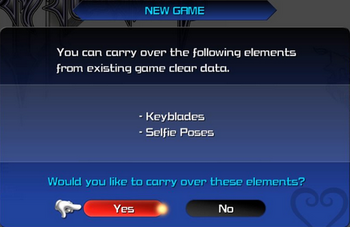
New Game+ is when a video game offers the player the option of starting a new game by accessing a previously finished game, allowing them to start with improved stats, new costumes, items won beforehand, or milestones that make things more convenient. There are several benefits for doing this:
- So the player has a shot at things like multiple pathways and Multiple Endings. Indeed, playing through the game twice or thrice may be the best way to power up so you can face the Bonus Dungeon. A more basic reason is getting over the initial "hump" of the First Town playthrough, where things are generally slower to get through because the player doesn't have all their moves yet the first time around.
- Similarly, some games lock their most exotic or experimental equipment behind New Game+, especially if they break the game or, inversely, don't work as well as the rest.
- It gives the player a chance to use the Bragging Rights Reward on something more significant than leftover Mooks, allowing them to see just how powerful it really is (or isn't). Such rewards are typically awarded at the very end of the game, and thus would otherwise see little actual use.
- Making the hopeless boss fight at the beginning of the game anything but, and getting a nice bonus reward for beating the Final Boss Preview. Plus, it is always nice when you don't have to grind yourself numb to make the character the badass hero that they are supposed to already be.
- Future playthroughs of the game can be made much more convenient, fun and memorable by starting with everything unlocked, rather than having to unlock certain skills first to get to the good stuff you forgot you didn't start the game with. This is especially true if they're Anti-Frustration Features like increased Stamina or a more diverse set of moves for combat and traversal.
- Catharsis. It's very satisfying to meet up with that boss who had you tearing out your hair last time and crush them like a bug on a windshield.
- New Game+ is also generally a good excuse to replay the game in a more convenient fashion, such as making different decisions in choice-based games, or turning on fun cheats like filters and invincibility that don't unlock until after the game has been beaten once.
- If a game lets the player carry over their previously unlocked cosmetics or equipment, they can replay the early hours with the look they prefer for their version of the characters.
- The simple pleasure of replaying a game you've fallen in love with, only now you know where everything is and can do everything efficiently.
Of course, no matter how many special skills and items you can bring over to a new game, the characters almost never are able to remember the game's plot and fix any mistakes they may have made, or they are told that "You Shouldn't Know This Already." You can also just pretend that New Game+ mode is playing a new game while averting the With This Herring trope since you start off this time with much better gear. On the flipside, the early game becomes a cakewalk unless the enemies are beefed up accordingly.
In some special instances, going through a New Game+ run is the key to fighting the True Final Boss, either by taking advantage of options that were not available the first time around or simply because NG+ makes certain changes to the narrative to allow for a fork unique to this run. Some instances will also start the game after the story's opening prologue and/or tutorials, so that the player can jump right back into the action straight away rather than go through stuff they already know or doesn't take advantage of their NG+ skills/equipment. Sometimes New Game+ will also allow the player to unlock new endings that aren't available on the first playthrough, or in normal gameplay in general; while this can be the "True Ending" (which sometimes, though not always, is also the Golden Ending) there is also a chance that it might be a Joke Ending.
This is named after the mode that is unlocked in Chrono Trigger, where the majority of the game's multiple endings can be attained in this mode. The original name translates roughly to "New Game with Strength". However, the concept itself dates back at least as far as the The Legend of Zelda series.
Subtrope of Macrogame and Post-End Game Content. It's very rare for this trope to be present alongside Playable Epilogue in the same game, but such cases do exist.
The combination of Peggy Sue and Sudden Game Interface has this as a popular plot in Fanfiction.
Warning, there may be spoilers.
Examples:
- AeternoBlade plays with this: If the heroine does not meet the required conditions, she is sent back to the beginning of the game without her memories of the previous cycle and loses all of her power-ups. If the right conditions are met, she keeps everything and opens the path to the true ending.
- Air Fortress has a second quest that immediately follows the first. After beating the first quest, you get a non-ending stating that the fortresses have all reactivated and you must go back and destroy them for good. The approach areas and fortresses are identical to those in the first quest; however, things are naturally more difficult this time around, and the destinations of most of the warp pipes are scrambled (radically altering your path through each fortress). Interestingly, the levels' and fortresses' colors are inverted as well.
- ANNO: Mutationem has New Game+ unlocked after finishing the story. In it, Ann retains all of her acquired weapons, items, Credits, and Skill Point upgrades. Enemies are also given more health and deal out more damage than in Normal Mode.
- Bloodstained: Ritual of the Night gives you the option of starting a New Game+ after obtaining the True Ending. You have the option of changing your difficulty on New Game+, and you can keep most items and Shards except for progression-related items (including most boss Shards, the Aqua Stream Shard, and the Aegis Plate) and the books you checked out from O.D. Your new save file is also emblazoned with a yellow number indicating the number of loops.
- Castlevania:
- Castlevania: Symphony of the Night has two Game Breakers only available in a second playthrough, the Duplicator and the Ring of Varda. The Duplicator, at the cost of a prohibitively expensive price tag and reduced stats, gives you unlimited usage of usable items and effectively ends all semblance of difficulty once you find a Pentagram. The Ring (and yes, it's that Ring) is an uncommon but not prohibitively rare drop that gives an absurd boost to all your stats (It boosts your overall attack higher than all except a few of the strongest weapons in the game), and you can equip two of them at once or combine one with the Duplicator to negate its stat penalty.
- Given the hundreds of Souls found in Castlevania: Aria of Sorrow and Castlevania: Dawn of Sorrow, a New Game+ was almost a necessity.
- Castlevania III: Dracula's Curse, a hard game on its own, allows you to play an even harder version of it after you—through some miracle of metaphysics—manage to actually beat it.
- Castlevania: Circle of the Moon has multiple New Game+ modes: Fighter (gives you increased damage with weapons but takes away spellcasting), Magician (reduces physical stats but gives access to all the spells at the beginning of the game), Shooter (increases subweapon damage and drop rate), and Thief (maxes out Luck).
- Castlevania: Order of Ecclesia gives you a boss medal for each boss you defeat without taking damage. It's also one of the few games in which the Completion Meter tracks the number of unique items you've obtained, so 100% requires getting every single boss medal. This is much easier with the New Game+ feature, allowing you to use powerful glyphs such as Nitesco from the beginning.
- Upon the completion of a full game of CrossCode, the player can begin anew with a great many options, based on how many achievements they've unlocked. Some of these are just a multiplier to experience or item drops. Some of them let Lea keep her level or items, and those result in the other characters reacting in appropriate fashion, such as Apollo pointing out that she's obviously cheating. He's entirely correct, but nobody believes him, because he's a gaming purist. And then there's the Sergei Hack, which results in everyone utterly convinced that there's something very wrong with Lea's character profile, but everyone's too terrified of her to do anything about it.
- Activision's sandbox Western game GUN has a secret New Game Plus mode that can only be accessed by returning to the game's starting area (which takes some effort, as it is in an out-of-the-way place with no obvious way to return there), wading into a river, and entering a cheat code. Doing so adds a new "GUN" selection to the Options screen, a debugger-esque menu that allows you to watch any of the game's cutscenes and play any of the storyline missions with your endgame stats and bonuses intact.
- The Legend of Zelda:
- The Legend of Zelda (NES) takes it the farthest. The developers flubbed the math and only used up half of the available cartridge space for the game, and so had room to make the second quest an almost entirely new game, with the overworld and actual dungeons rearranged. It's also harder, with Sword Beam-firing Stalfos, ways to permanently lose heart containers, and just generally more dev team sadism. You can also access this quest by just entering "ZELDA" in the name selection screen, which contributed to the origin of I Am Not Shazam for this series.
- Zelda II: The Adventure of Link is one of the earliest games to have a New Game Plus mode as it's commonly thought of today, allowing you to replay the game from the beginning with all of Link's accumulated experience; once you max out all of your attack, life, and magic levels, any additional level ups will give Link an extra life.
- The Legend of Zelda: Ocarina of Time: The Nintendo 3DS remake implements the Master Quest version of the game as an unlockable mode. In addition to having the dungeons altered, the entire world map is flipped as in the Wii version of Twilight Princess, and enemies do twice as much damage as before. The mode was originally added to a special GameCube release of the game, where it was not an example of the trope, as it was available from the start. (In that version, the world was not flipped and enemies did the same damage; the only change was in the dungeons.)
- The Legend of Zelda: Oracle Games have a variation on this:
- When you beat one of the games, you can input a long, in-depth code to the other version (if you have two Game Boys and a link cable you can just link them up to do so). This allowed you to begin the second game with 4 hearts instead of 3, and very commonly, characters would give you secret codes, which could be used in the first game for some extra sidequests. Not only that, but the second game you play actually acts as a continuation of the story, and includes a different final boss. You can also bring over all the rings you'd collected in the other game.
- There's also the "Hero's Secret" which is a more typical example. You start either game you played over, with all your rings from before, plus the extra heart even though you're starting at the beginning. For true 100% completion, you have to beat the games in one order, then use this secret and play both games again in the opposite order.
- The Legend of Zelda: The Wind Waker: The Second Quest features Link playing through the game in the blue outfit he starts the game in (at the point where you would get the green tunic, you get invisible clothes instead). Also, text that was previously in the "ancient" language is translated into English, revealing very interesting conversations (such as when the King of Red Lions boat is talking with Jabu, about Link, knowing he can't understand them). As a third bonus, Link starts the game with the Deluxe Picto Box, making the picture-taking sidequest easier to complete. Finally, the sunken treasure you can pinpoint after collecting and opening the Treasure Charts will be slightly further away from its original position, making their locations more difficult (this also applies to the Triforce Shards). Beware, though, as unlike most games, you can only replay this one once.
- The Legend of Zelda: Skyward Sword has Hero Mode, which carries over the treasures and bugs you've collected (allowing you to upgrade your equipment and potions sooner), changes some dialogue (mostly tutorial-related, or to avoid As You Know), allows you to skip all cutscenes from the start, and gives you the fully-upgraded Sword Beam from the beginning (which, when upgraded one more time after the Imprisoned is defeated for the second time, becomes instantaneous); however, you take double damage and enemies don't drop any hearts randomly.
- The Legend of Zelda: A Link Between Worlds also features Hero Mode. If you thought Nintendo Hard wasn't a thing anymore, just know that you take quadruple damage in this mode. Until you get the Blue Mail, a lot more attacks become strong enough to take you down in one or two hits.
- Luigi's Mansion has the Hidden Mansion mode, unlocked when the game is cleared for the first time. Here, the Poltergust 3000 (Luigi's ghost-sucking vacuum) will be more powerful and be capable of capturing ghosts more easily by depleting their HP faster (this also applies to the bosses); however, the ghosts will also hit much harder. The European/Australian version adds extra perks for a better incentive: More valuables dropped by Speedy Spirits and Gold Mice so the overall amount of money available is higher (this is necessary since the required amount for the Rank A tier is much higher in this version than in the American and Japanese ones, meaning that it's impossible to reach in the first playthrough), revamped boss battles, Boos with higher HP (or lower HP but being faster), fewer recovery hearts, and the whole mansion being mirrored, among other minor perks. The Hidden Mansion in the 3DS version of the game inherits some of these changes and adds others (relocated Speedy Spirits and most of Mario's possessions, more HP for the Portrait Ghosts and a Platinum tier for their paintings, almost all recovery hearts being replaced by Poison Mushrooms, etc.)
- Metroid:
- Metroid: After beating the game you get to keep all of Samus's power ups for future times playing through except for her Energy and Missile Tanks, which you have to find again. Still, it can allow you to finish the game much faster. In turn, if you beat the game in under three hours (or just get the password from someone else), you can play through the game without the Power Suit, with all the controls and power ups still working the same for an unarmored Samus. Just a one time thing for this game though, and only available in the NES versions of the game on top of that — the original Famicom version doesn't feature this, and when you do play as an unarmored Samus again in Metroid: Zero Mission, she's much weaker without it (here, the unarmored look is cosmetic more than anything).
- Super Metroid: Through a series of events which involve combining the spazer and plasma beams, it is possible to reset everything in the entire game, except for the items you have collected. From this point, the game can be saved over, and you can even play through the prologue again with all of your items. The only cost to doing this is losing all of your missiles - Samus is given a set amount to reinact the flashback scene during the prologue, and then they are taken away. However, because you can easily re-collect everything over and over, it's possible to end up with well over 250 Super Missiles, and so many energy tanks that the count graphic overlaps the other files on the file select!
- Metroid Prime 3: Corruption: While the game doesn't let you keep your high-end weaponry in its New Game+, it does keep all the logbook scans and credits earned intact, which makes getting 100% Completion possible via multiple playthroughs, instead of having to do it all in one shebang. In addition, a Harder Than Hard setting is unlocked, so if the second playthrough is played in that mode, the bosses will grant extra medals that will further help the unlock of bonus material.
- Metroid Prime Trilogy adds this ability to the first and second games, neither of which had a New Game Plus in their original Nintendo GameCube incarnations.
- Nobody Saves the World: Beating the game once lets you carry over all of your experience, Form grades, and collected power-ups into a new world layout. However, every enemy will scale to your level, all of the dungeons gain additional difficulty mods (such as One-Hit Kill for both you and the enemies, or disabling Mana Regen on your attacks), and the only way to progress through the main plot is by clearing the side dungeons, as they become the sole source of the star charges that unlock the legendary dungeons.
- Ōkami: You have completion percentages in various areas of the game (treasures found, animals fed, weapons obtained, brush or battle techniques learned, godly miracles performed, sidequests finished, etc.) and depending on how you did you unlock a large number of things for a new game plus, including "skins" for the character (a surprisingly large number of different forms, including one based on the realistic-looking initial concept for the game), an ultimate weapon, and the ability to start your new game with most of your old weapons, skills, money, etc.
- Ōkamiden continues the trend started with its predecessor. Upon starting a New Game +, you get a spell that allows you to take the appearance of the Final Boss, as well as said boss' weapon as a divine instrument.
- Prodigal: After defeating the Lighthouse boss, you can continue playing for a post-game quest, which also allows you to unlock new areas and characters you can marry. However, any new save files you start after this will give you access to most of these either from the beginning or from the start of Act 2, and you can access certain items earlier if you know where to look. You also have the option to increase the game's difficulty by breaking Altars to some of the Gods at the start of a new game, and you can skip straight to Act 2 if you only want to focus on the marriages and post-game quest.
- Rambo on NES has this unintentionally thanks to an odd glitch in which you can fall through the floor later in the game. You will return to the starting map and are forced to replay the game but you will keep all upgrades.
- In Rogue Legacy, defeating the final boss lets you keep all of your weapons, runes, and upgrades from your most recent playthrough, and you get a small bonus to the base amount of gold gained every time you clear it. However, instead of the wimpy mooks you fought at the beginning of the game, the most powerful variants of those enemies are now in every area of the castle, and they've all received huge level increases.
- Rogue Legacy 2: The enemies get more powerful with each New Game Plus loop you complete, and you can do this up to 100 times! On top of that, The true ending for the game isn't even possible to obtain until at least New Game +8 under normal circumstances.
- Shadow Complex carries over player level and their perks between playthroughs, meaning a player at Level 50 can benefit from having an extra 100 Health, a complete map with the collectibles visible (save for Insane mode), and unlimited Grenades, Foam, and Missiles. Collecting all of the Gold Bars will also permanently allow access to a secret room with golden versions of every weapon in the game for subsequent playthroughs; the remastered version also adds in a golden Omega Armor.
- Beating Shadow of the Colossus unlocks a Hard Mode, as well as Time Attack options. Successfully completing Time Attacks allows you to gain magical items in what is normally an item-less game. Your stats will also carry over, and you'll need to beat the game multiple times if you want to build up the strength to climb the shrine to the top.
- Shantae: Half-Genie Hero: Shantae can choose to start with her transformation dances already unlocked, in new games after beating the initial game.
- Sonic Frontiers brings this feature in for the Sonic's Birthday Bash update, which carries over all of Sonic's skills, upgrades, and Experience, but not items required for progression. On the plus side, said skills carried over includes Power Boost in Cyberspace stages as well as the almighty Spin Dash.
- Solatorobo: Red the Hunter's New Game+ lets you start over from the beginning of the first half with all of your Rings, Stat Blocks, P-Crystals, DAHAK forms, and your Trance in tact, while also giving you accessed to enhanced X variants of said forms (though not without a heavy price). On your third playthrough, you can unlock the Type-Omega, which gives Red the greater stat boosts of his X forms as well as instant access to all of the unique features of his other forms.
- Star Wars: The Force Unleashed presents you with the option to do this as soon as the credits have finished rolling, which is great news for completionists who want to fully upgrade all of their Force powers, see the alternate ending, play through the levels while wearing the costumes designed for each of them, find any hidden lightsaber hilts or crystals they may have missed (for customizing their lightsaber), or try to collect all of the Jedi Holocrons. Otherwise those hidden collectibles would be permanently lost since you cannot return to a level once you've completed it (or at least not the same version of it).
- In the original Tomb Raider series (with the exception of Chronicles and Angel of Darkness) the player could start a second run with all their weapons, flares and medipacks right after finishing a normal game, on the PSX versions they also unlock a level select option. The second series by crystal dynamics could also emulate a New Game+ option via unlockable cheats, the Reboot trilogy brings back a more standard form of New Game+. The 2024 remaster of the first three games adds a New Game+ option after beating a game once and they make the new run a lot harder with several changes:
- Health kits no longer appear and are replaced with ammo. Lara also doesn't begin a game with health kits. In the second game, collecting all three secret statues in a level will give Lara health kits instead of ammo or guns.
- Lara starts the game with all weapons.
- All enemies deal far more damage and have way more health. Traps also deal more damage.
- Save crystals from the first and third games are reinstated as the only way to save your progress. The first game can only be saved at the crystal's location while the third game lets you collect them and save whenever you want, which is how they worked originally.
- All friendly/neutral NPCs in the second and third games will automatically be hostile towards Lara.
- In the third game where Lara is captured and loses her weapons and supplies, they stay gone as they did in the original game.
- Devil May Cry: After completing a game once, players can continue on to the higher difficulty modes while keeping their weapons, upgrades and items. One exception is the first game's Easy Automatic mode, where only another Easy Automatic game could be played afterward. Devil May Cry 2, Devil May Cry 3: Dante's Awakening, Devil May Cry 4, DmC: Devil May Cry and Devil May Cry 5 still have New Game+ but do not suffer from the restrictive condition of the first game's Easy Automatic mode.
- Feeding Frenzy 2: Shipwreck Showdown: Beating the game lets you play through it again as the Final Boss.
- Ghostbusters (1984) on the Commodore 64 and Amstrad CPC. When you reach Zuul with more than starting money, you will get a "bank account number", which was a Password Save for the accumulated money. You receive the account number regardless of whether or not you succeed. Playing again with the money you earned was the only way to get the fourth car (which wasn't really worth it) or the third car and better equipment.
- Ghostrunner: After completing the game, you can start over with all of the upgrades and power-ups you have in the endgame. You can also activate the new difficulty setting that populates earlier levels with late-game enemies.
- God of War:
- The first game has unlockable costumes bringing different benefits (for example, dressing like a cow gave Kratos infinite magic, while dressing like a businessman gave him double experience).
- God of War II offers Bonus Play, in which players who have already beaten the game once can start over (on the same difficulty level as before, or on any lesser level) with all the spells, weapons, upgrades and bonus items they had previously collected, in addition to selectable costumes and special abilities which can be unlocked in additional game modes or by finding hidden items in the game proper. Also, doing this allows access to (and upgrading of) the already unbelievably overpowered Sword of Plot Advancement, the Blade of Olympus (yes, upgrading a weapon that just killed a goddess) to fire lasers with every swing, and suck out the souls of your enemies).
- God of War III has Godly Possessions, collectibles that hold cheat options which can only be activated on subsequent playthroughs. A standard New Game Plus would have been problematic for this one what with the staggering amount of Sequence Breaking that starting with all weapons would have led to. (And does.)
- The soft reboot has a more standard version added via a patch. As well as retaining all upgrades and loot from your initial playthrough, the game adds brand new gear to unlock.
- MADNESS: Project Nexus 2: Beating Arena Mode unlocks an Imprint, which grants you a bonus to all of your stats that increases every time you beat the mode. It also unlocks newer Origins, most of which are Purposely Overpowered.
- Mitsurugi Kamui Hikae features the ability to replay the game with all of the skills unlocked carried over in the next playthrough.
- The Quiet Man adds the ability to restore voice and sound to the game on the second playthrough as "The Quiet Man: Answered" (the game was, to represent the deafness of the protagonist, muted aside from low bassy noises to indicate punches)
- Rengoku:
- Enforced in the first game. After the 8th floor, it's just once again the 1st floor, with new boss dialogues. Clearing the new 8th floor shows the true ending.
- Clearing the last floor in the second game unlocks the second tower, but lets you challenge the Tower again many times, while keeping everything you have. But all enemies get their health and attack upscaled, with better weapon tiers.
- Splatterhouse (2010) features the ability to replay the entire Story Mode again with all of your skills unlocked or not after beating it as well as the Brutal difficulty.
- Versus Umbra: Clearing the game allows you to play Paradox mode, in which you gain additional Inventium as well as a higher level cap and keep all levels, perks, and items from the previous playthrough, but start over from the beginning with stronger enemies. After beating Paradox mode, you can begin it again.
- The mode is present within the Viewtiful Joe games, right down to the easy 'Kids' setting being unable to move on to more difficult settings after beating the game.
- The Wonderful 101 unlocks Hard Mode once you beat the game on Normal, and beating it on Very Easy or Easy doesn't get you anything. You get to keep everything you collected as you move onto the harder difficulties.
- Done in both Another Code games. The first game has it alter some of the messages Richard leaves to reveal more about the Edwards mansion as well as a post-credits Sequel Hook. The second game provides additional messages expounding on the history of Lake Juliet.
- Finishing Cherry Tree High Comedy Club by recruiting at least three members allows you to start a new game while retaining your repertoire levels and knowledge of the candidates' likes and dislikes, making it easier to shoot for the Golden Ending by recruiting all six of them.
- A New Game Plus in Hotel Dusk: Room 215 allows the text to be sped up, as well as an optional new puzzle that expands upon the ending if you figure it out. The dialogue between Hyde and Rachel also becomes noticeably flirtier, in contrast with their more sarcastic banter in the first playthrough.
- I Became a Dog: After beating the game, you can play it again from the start, but you retain your language level and collect more bugs after farting.
- Lux-Pain allows you to do this, giving you a higher starting rank and retaining part of your Relationship Values, which you need to max out in order to unlock all the archive scenes.
- New Game Plus was added to the PS4 release of Oxenfree, with the original PC, Mac, and Xbox One releases getting it as a free update. It features new plotlines and endings, most notably Michael, if saved, will become a prominent character. The game's ghosts, due to already existing in a "Groundhog Day" Loop, are also much kinder to the characters and explain that their actions in a first playthrough are due to a need to "stick to the script".
- After you acquire all of the normal endings in Shadow of Destiny, you unlock the ability to start with the "EX" Branch (which has two more endings). This branch is defined by the protagonist actually remembering the previous playthroughs, and being able to completely change the course of the plot (mostly by resolving it almost instantly).
- Completing Wandersong allows you to replay the game with developer commentary, as well as providing the player with a level select, so they can easily access previous acts.
- YU-NO allows you to start with all your items after achieving 100% completion, which is a mercy to players who want to see the extended heroine endings.
- In Zniw Adventure, after completing the game, the player has the option of starting a new playthrough while retaining all pebbles and encyclopedia entries found in the previous one.
- Astro Boy: Omega Factor actually worked this into the game's story: after a Downer Ending, the New Game Plus is combined with a Stage Select, as the Phoenix grants Astro the ability to travel through time and ensure a better ending.
- Beating Violent Storm on one credit unlocks the "Violent Round" mode, where you play the game all over again but with much more cruel enemy placement and Mortal Kombat style blood splatters from attacks.
- In Wangan Midnight Maximum Tune, after the player has completed Story Mode, fully tuning their car, they can go through Story Mode again with their fully-tuned vehicle, with perks varying from game to game:
- In Maximum Tune 2, from the second loop onwards each stage has unique titles for winning and for losing the stage. Additionally, the player can earn "engine overhauls" that slightly improve performance by clearing loops
- In Maximum Tune 3, if the player loses their Story Mode "undefeated" status, they can try again on the next loop. Clearing a loop undefeated is required to unlock the Wangan Midnight R soundtrack.
- From Maximum Tune 4 onwards, the player earns a new racing tachometer each time they clear a loop of Story Mode undefeated on the same car, with four different colors of racing meters available, the entire collection requiring clearing Story Mode undefeated four times. Losing at any point pushes all unlocks back by one loop. Soundtracks are also unlocked by clearing loops (1 loop for Maximum Tune 3 / 3DX / 3DX+, 2 for the 10 Outrun Mode soundtrack, 3 for Maximum Tune 1 / 2, 4 for Wangan Midnight R), but they do not require undefeated status.
- Completing a route in Duel Savior Destiny allows you to use the cleared character in battles during the next route until by the time you get to the very last route you've unlocked everyone.
- With Dragon Ball Xenoverse, you have to complete the main storyline once before the game even lets you create any new characters, but the items, money, special attacks, and mission progress you've earned are shared between all the characters in your saved data. This makes future playthroughs much easier, since your starting characters will immediately have access to all the good gear and attacks that your first character had to earn the hard way.
- Dragon Ball Xenoverse 2 lets you make multiple characters from the very beginning, but in exchange you'll have to play through the story mode for each character separately. Gear and attacks are still shared between characters, though, which is especially useful since after clearing the main plot you can obtain an Experience Booster item that makes power-leveling your new character that much easier.
- Black had an interesting kind of New Game+. Complete the game on any difficulty to unlock "Silver Weapons" on that difficulty, giving you infinite ammo and unlocking the next difficulty. Also, if you manage to find every secondary objective item and explode every explodable thing in the hardest setting, you unlock on all difficulties: Infinite ammo, and the M16A2 assault rifle with unlimited underbarrel grenade launcher.
- BioShock gets a New Game+ feature added through the Challenge Rooms DLC, which allows you to replay the game again with all of your plasmids, tonics, and upgrades from importing your save file. However, playing New Game+ will not allow you to earn Trophies or Achievements at all. So if you missed any during your first run, you have to replay an older save to unlock (assuming you have multiple saves to begin with). Originally, the Challenge Rooms DLC ($9.99 USD) was exclusive to only PlayStation 3, but as of the BioShock: Ultimate Rapture Edition re-release of BioShock and its sequel, the Challenge Rooms became available for the Xbox 360 version as well specifically through this compilation. The only difference the PlayStation 3 that the version's of the DLC has over the Xbox 360 is that it has extra Trophies. The Challenge Rooms DLC would later become bundled with its remastered version as part of BioShock: The Collection.
- The Borderlands series allows you to complete a second playthrough with the same levels, equipment, and stats, with many more enemies and all levels ramped up.
- Borderlands: The fun part is that you can switch between the two playthroughs at any time, meaning that by the end of the second playthrough, you can kill the toughest enemies in the first with a pistol shot to the foot. You'll also be much more likely to face Badass (or in this case, Badmutha) versions of enemies in Playthrough 2, as well as facing more (and tougher) enemies. After playthrough two is completed, the game is ramped up a second time giving access to better quality rewards but without adding another playthrough option or resetting the quests already completed, which makes all those double-powered up versions of one-time only quest rewards lost forever (better save those side quests until after the end fight).
- Borderlands 2 follows in the footsteps of its predecessor with True Vault Hunter Mode, a second playthrough unlocked after beating the game on Normal Mode that scales up to level 50. A DLC was later released for Ultimate Vault Hunter Mode, which as well as featuring the standard ramped-up difficulty and increased drop-rate of better loot, increased the level cap further turned Loot Midgets into Legendary Loot Midgets, who are likely to drop Legendaries, E-tech relics, and the new Pearlescent items, and allows raid bosses to drop Seraph Crystals for purchasing Seraph weapons. UVHM can also be freely reset, removing the issue of Permanently Missable Content that plagued the first game. Finally, UVHM also allows max-level players to unlock Overpower Levels, which scale the world and items up to 10 levels higher than the player.
- Borderlands: The Pre-Sequel! uses the same True Vault Hunter Mode as 2. This time around, it's justified in-story as Athena retelling the story to Tiny Tina, who wasn't there for the initial telling of the story and asks her to make it sound more difficult. DLC reintroduces Ultimate Vault Hunter Mode, although the framing story is the same as TVHM, and there are some slight differences from 2; the difficulty increase isn't quite as great, and there are no OP Levels, Legendary Loot Midgets, or Pearlescent or Seraph items.
- In Borderlands 3, aside from TVHM you can also activate "Mayhem Mode", which boosts the difficulty based on a ranking from 1 to 10 but also dramatically increases drop rate (as well as certain Mayhem Mode-exclusive weapons). You also get to carry over the Eridian upgrades you collected in the normal playthrough, letting you crack open Eridian crystals and decipher Eridian Texts that you were constantly passing by.
- Bulletstorm has this in the Full Clip Edition; completing the single-player campaign unlocks Overkill Mode, which does away with the three-weapon limit and gives you every weapon in the game from the start. If that's not enough, performing every skillshot for a given weapon gives you unlimited ammo for that weapon in this mode.
- Call of Duty games starting with Call of Duty 4 do this, after a fashion, in multiplayer.
- Once a player reaches the maximum level, they can "Prestige," which makes the player restart at level one. Later games made this a true plus, with Titles, Emblems, and extra custom class slots that could only be unlocked by Prestiging. They also added extra challenges that would only appear after a Prestige to make leveling back up faster.
- Call of Duty: Black Ops II, after the campaign is finished, allows the player to give themselves any weapon when replaying a level — even a 2025 weapon for a 1980s level, which the game will award you with an achievement for.
- Black Ops 2 and Black Ops 3 both include the "Prestige Master" Level, which is the highest the player can progress to. In 2, this merely unlocks all content (previously you would use tokens to unlock items, of which there wasn't enough per prestige to unlock everything); however in 3 there is an added benefit — the ability to rank up Prestige Master even further to level 1000! Keep in mind that the standard prestige is 55 levels, Prestige Master is equivalent to completing 19 more prestiges!
- In Crysis 2, when you start a new game with a profile that's completed a playthrough, you start with all the gun attachments you found before, such as the sniper scope and the under-barrel Gauss Gun attachment for the SCAR rifle.
- E.Y.E: Divine Cybermancy has a strange case of this. The Mysterious oracle asks a variety of questions as to whether you're dreaming, hallucinating, or imagining, and later lampshades that another "journey" may be necessary for you to get the answers you need then tells you that sometimes the same thing can happen again. His questions and philosophy are reinforced as you enter a portal that would lead you back to the start of the game, giving you another opportunity to go for another ending. Each time you restart your journey, you get to keep all of your weapons, stats, and research. Completing the three main endings is necessary to get each of the Gate psi-abilities.
- F.E.A.R. 2: Project Origin allows you to keep reflex boosters you've collected in subsequent playthroughs. Collect them all and from the second level onwards you can stay in Bullet Time twice as long as the game expects you to. Intel is also kept between playthroughs.
- Postal 2 did one better: beating the game once unlocked both a cheat menu and "Enhanced Mode", which gave the player such bonuses as exploding sniper bullets and the ability to piss napalm.
- Resistance 3, after being completed the first time, allows the player to keep weapon upgrades gained from killing enemies for subsequent playthroughs.
- Wolfenstein adds a cheat menu to the game once you finish it once. The cheat commands include options that add Veil powers or unlock weapons instantly at the start of the game. By definition, this is an optional New Game Plus.
- Wolfenstein: The New Order also has a NG+ as well. Upon completing the game, you can import all of the perks and weapon upgrades you've gained over the course of the game. In order to do this, you must select from the chapter listing rather than selecting New Game. If you do that latter, then you restart with all of your goodies gone.
- The eroge Brave Soul has a very developed version, where each game completion allows you to alter the difficulty and unlocks more options for bringing stuff over from the first game. As the game has nine endings, this is done to increase replayability. In addition, one girl is only available.
- Completing Fire Emblem Warriors: Three Hopes (a spinoff of the below-mentioned Fire Emblem: Three Houses) lets you keep all of your characters' levels, learned skills, support ranks, items, and camp upgrades. Subsequent playthroughs open up new items in the Renown Shop, including exclusive weapons and accessories, as well as three Secret Characters (with the fourth requiring the completion of at least two different routes).
- Winning a game in the Diablo series opens up a higher difficulty levels for your now-experienced character. The gameplay doesn't change much, but the power of each enemy in the game does. In Normal difficulty of Diablo II, the low-level throwaway creatures in the starting areas die if you so much as breathe on them too hard; on Hell difficulty (the highest difficulty level), it's vice versa. In fact, it's entirely possible that a randomly spawned monster will be "triple-immune". There's also the Hardcore setting: regardless which difficulty level you use, if your character dies, he/she's dead for good. This is lampshaded in Diablo III. If you talk to Myriam, the mystic in Act I (which is only possible during new-game plus on the Reaper of Souls expansion), she will tell you that the world constantly plays out the same events over and over.
- No More Heroes lets you start over with all the items, weapons and techniques you learned the first time around, and has a whole bunch of new collectables lying around. You'll also unlock a new difficulty level (Bitter), which gives you the option to apply your knowledge and experience on the game for a more difficult second playthrough. No More Heroes 2: Desperate Struggle and No More Heroes III do the same as the original (minus the new collectables in the second game due to the absence of an overworld); and if you try to do the games on Bitter, you are going to need all your old upgrades. For the first boss.
- Transistor: A Profile that's replaying the game with everything gathered up to the end game, is marked with a + at the end.
- Ad Venture Capitalist: Restarting earns angel investors that multiply the profits of your businesses. You can keep gaining more angels with multiple restarts, allowing you to earn ridiculous, astronomic amounts of money.
- ALTER EGO (2018): You can start a new gameplay loop after reaching an ending. Starting a new loop resets all of your Books and bonuses gained from Es, but retains all of your achievement bonuses, allowing you to plow through early-game with your boosted EGO generation.
- Armory & Machine: After you finish the game, you get the chance to depart. It will reset your progress, but give you a 5% production bonus the next time you restart the game. Additionally, if you don't depart, you can fight additional bosses, each one giving you another 1% bonus.
- Cell to Singularity: Evolution Never Ends: Purchasing Singularity for the first time results in a simulation crash and game reset, allowing you to spent newly earned Metabits based on how much Entropy and Idea was cumulatively earned for special upgrades. Later on you can just reset for Metabits whenever you need to.
- In Clicker Heroes, you can "ascend" any time after unlocking Amenhotep's Ascension skill. Ascending resets your gold and level progression, but you gain Hero Souls and access to powerful Ancients, Mercenaries, and Relics that you retain on successive ascensions. Transcendence takes this a step further: you lose all your Hero Souls, Ancients, and Relics (and temporarily lose your Mercenaries too) but gain access to Outsiders that massively increase various in-game bonuses.
- Cookie Clicker gives you Heavenly Chips every time you soft-reset your safe file, which add a bonus to your Cookies per second rate in your new game based on how many cookies you had made before you reset.
- Upon ascending at level 9000 or 9001 in Anti-Idle: The Game, you can choose to start over at level 1 with all of your Feature progress intact. After five Ascensions, you're granted the option of a "Hard" Ascension, which wipes your Feature progress and makes certain Features more difficult. The "Impossible" Ascension, done after several Hard Ascensions, takes this to another step.
- Crush Crush gives you Prestige for every achievement and girl's relationship level you attain and soft-resetting the game speeds up all progress bars based on the amount of Prestige you've accumulated from all playthroughs. This is absolutely vital for leveling up each girl in a semi-reasonable amount of time.
- Disco Zoo: While the game has no formal end condition, collecting 10 animals in every pen of 10 regions enables the Time Machine, which resets the zoo's progress in exchange for unlocking a new Timeless animal. Timeless animals earn more coins and stay awake longer than even Mythical animals, and there's one in each region, so it'll take 12 resets to unlock them all.
- FE000000 has quite a few tiers of them.
- Firstly, once you have 3.403e38 stars, you can Prestige to lose all generators and the sacrifice multiplier, but all multipliers are improved.
- Slightly later, once you have 1.158e77 stars, you can perform an Infinity to gain enfinity points and spend them on infinity generators that produce infinity stars that multiply all normal generators by their amount^0.5 (their power can be upgraded, though), but you lose the sacrifice and prestige multipliers, all generators, and currently owned infinity stars.
- After a while, once you have 1.158e77 infinity points, you can perform an Eternity to gain eternity points and spend them on eternity generators that produce eternity stars that multiply normal and infinity generators as well as raise their multipliers exponentially, but you lose all things normally lost upon an infinity reset, infinity generators, normal and infinity challenge completions, and currently owned eternity stars (some of these are mitigated by eternity milestones).
- Much later, once you have 2.004e19278 eternity points, you can perform a Complexity to gain complexity points and spend them on complexity generators that produce complexity stars that make complexity challenges' rewards stronger (and you gain access to them if this is the first reset of this type), but you lose everything that's normally lost upon an eternity reset, eternity generators, eternity challenge completions, permanence upgrades, and chroma.
- Much later again, once you have 2.004e19728 complexity points, you can perform a Finality to gain finality points and spend them on finality generators that produce finality stars that multiply non-finality generators and finality shards to spend on upgrades, but you lose everything that's normally lost upon a complexity reset, complexity challenge completions, complexity achievements, powers, and galaxies (some of these are mitigated by finality milestones).
- In Hollywhoot, doing something awesome (like evolving a new parody character) will net you Golden Tickets, which you can exchange for prestigious awards once you rise to Prominence. You can then start over again from the beginning with a boost, so it feels like you're a director who's slowly improving your reputation and track record, which makes the process of achieving Hollywood success easier and easier.
- Exaggerated in Prestige Tree, where starting over is your very first action, exchanging your starting ten Points for one Prestige Point, and progression generally involves various forms of resetting the latest level of the Tech Tree to give permanent bonuses to the one before it.
- Simple Mult Idle: Once you get to 1e27 or so, you can prestige to add an exponent and stronger multiplier, making profits faster. Once you get to 1e300, you can reset those things as well for Infinity Points and permanent upgrades.
- Tangerine Tycoon allows you to perform a multiverse breach after buying a 5-D Tangerine, the most expensive building. This also awards you with a certain amount of uCoins which unlock perks that make your life in the next universe easier.
- Time Clickers heavily revolves around this mechanic. Doing a Time Warp resets your progress, but gives you special Time Cube currency that can be used towards upgrades such as improving your team's weapons, gold dropped when destroying blocks, starting at a higher wave on the next Time Warp, and the like.
- In Void Troopers, you can savescum to save the galaxy by resetting time to the beginning of the alien invasion, getting Time Orbs that you can use to unlock new technologies to make your space fleet stronger.
- Continuing a dynasty in King of the Castle, whether the previous King won or lost, involves beginning with the same statistics for each region from the end of the previous reign (apart from Defiance, which resets to 2 except, if appropriate, in the region whence the new King hails, in which it is 0). There may also be Dynasty Events continuing storylines from the previous reign, some of which pick up where the scheme that got the new King onto the throne left off. For example, the Barons of the March's Gunpowder scheme can end with the Palace being blown up with the King inside, and the new King must then re-build at the beginning of their reign; meanwhile, the Grandees of the South's Fervour scheme can end with the King drowning in beer after a brewery accident, and the brewer will be brought before the new King to potentially stand trial.
- The Front Mission DS remake allows you to New Game+ yourself into either easier or harder difficulties, as easy as 0.5x normal to as hard as 20.0x!
- Super Robot Wars has had this for a good while, mainly to start over with lots of money to begin with. However, some have extra difficulties, just so your money is always useful.
- The series also has a Special Mode, unlocked when you beat EX-Hard mode. It generally makes the game even easier than the series' New Game Pluses do, since you start out with at least one of every item and your units get more upgrade slots, but this also means it costs more money to get a unit's Full Upgrade Bonus. The Later OG games and the Z games have this partially, though with the latter the upgrade cost per bar is lowered making the total price closer to the original amount.
- Some games outright carry over upgrades, skills, kill counts and some other thing depending on the game. Most Nintendo portable games have this.
- A few even outright carry over level and UX carries over secret flags and unlocked secrets(!)
- Zoids vs. 2 (a.k.a. Zoids Battle Legends) allows you to restart the "Zoids Battle" mode with all your Zoids and cash. You can even choose another character and play against different opponents. It's also the only way to afford top-of-the-line Zoids and parts.
- Zone of the Enders: The 2nd Runner has unlockable New Game+ options along with new difficulty levels after completing the game. Players can chose whether or not to carry over Jethuty's sub-weapons and which form of Jethuty to start with in a new playthrough.
- Beating Cook, Serve, Delicious! unlocks a New Game+ mode on Extreme Difficulty which carries over your progress towards achievements, so you can get them in your new save without having to start over completely.
- Once you reach a high enough level in Billy vs. SNAKEMAN, you get the option of looping into a new Season, resetting you to the starting rank and level, but you keep most pickups that wouldn't directly cause Sequence Breaking (as well as a few that do), a chance to change your basic bloodline, and (the first, second, third, and tenth times you loop) unlock some additional content.
- This gets exaggerated when you hit the cap at Season 111, and receive the appropriately named "Enough Already" Trophy.
- Destiny has a variation of this; the player can return to any previously completed story mission and replay it at its base difficulty, which can result in a Level 30 character playing through a Difficulty 4 mission. Curb-stomp battles ensue.
- Dungeons & Dragons Online lets a capped(level 20) character reincarnate back to level 1 with some modest to moderate bonuses on second and subsequent lives. The character keeps the same name, gender, and server, but is otherwise treated as an entirely new character by the game, being allowed to choose a new race and class. When a character succeeds in leveling to the cap once for every class, they get another moderate buff.
- Final Fantasy XIV in 5.1 introduced a New Game + feature which lets you redo various storylines while retaining your current job level and equipment. There's already a level sync cap on all instanced content that is left intact, and you don't earn rewards for completing the quests a second time, but it's an excellent way to enjoy the story again if you'd rather not create another character for it.
- Kingdom of Loathing lets you "ascend" after beating the primary boss; and start over. Access to previous skills and items depend on what Self-Imposed Challenge one gets. There are special rewards for completing higher difficulties.
- MapleStory: The Friend Story spinoff has this, which, when started after completing all chapters, opens one hidden quest (which grants you a stat-related item upon completion) and one dialogue option (that changes the ending of the episode a bit) per episode. It's worth the while, because the extra content is quite humorous.
- Star Wars: The Old Republic introduced the "Legacy" system with game update 1.2. A player's legacy begins with completing the first "Chapter" of any class's storyline, at which point the player may decide on a server-unique last name which will be given to any and all other characters on the same server as that character. From this point a player begins to earn "Legacy Experience" towards "Legacy Levels" and may also unlock special abilities and emotes, as well as unlocking certain other bonuses, such as EXP bonuses or other convenience bonuses.
- Attaining level 50 with a certain race can Unlock that race, allowing a player to play as that race for classes which do not normally allow that race, such as making a Chiss Jedi. Attaining level 50 with a Human (which can be used for all classes in the current game) adds a small Presence buff for all characters.
- Completing chapter 2 of a class's storyline unlocks the class's buff ability (each class has a unique buff gained at level 1), this buff can now be used on any character within that Legacy.
- Completing Chapter 3 of a class's storyline (the final chapter for the class-unique storyline) unlocks a special ability which may be used whenever a player's Heroic Moment ability is active. These abilities are usually considered to be powerful or class defining. These moves are said to be learned from other members of the character's "Family", their Legacy.
- The superhero-themed Twilight Heroes lets you begin a new game+ through the aptly named Retcon.
- World of Warcraft added the Death Knight hero class in the second expansion, Wrath of the Lich King. To gain access to this class, you must have already played a normal character to at least level 55. Upon doing this, you may then create a Death Knight character, who starts at level 55 in a zone unique to the class, with a full suite of equipment. After you complete that starting zone, though, you enter into the same leveling cycle as everyone else, with the exception that you've skipped all of the classic content. Ambitious players may wish to go back and do some of that content anyway for Achievements.
- Unusual in that the reason had nothing to do with rewarding individual players - Death Knights were given a higher starting level both because of their origin story and because the developers wanted the new class to quickly have a presence in the end-game community (as content would now be created with them in mind). Being unlocked by leveling another character was just to prevent new players from skipping the beginning of the game.
- In addition, Wrath saw the addition of heirloom items, armor and weapons that you purchase at maximum level and mail to alts, which scale with them as they level and are on par with or superior to the best available equipment for the level. To a point, a character will frequently run into cases where an individual piece at or near their current level is superior, and once you got to 80, much of the gear you would be getting was superior. Mostly, it was a way to quickly grind a new character.
- Mario Party: The Top 100: Once the player completes Minigame Island, they unlock the ability to play through the mode again on Hard mode. In Hard mode, the player is required to come in first in each minigame in order to progress, and they can no longer use amiibo to avoid getting Game Over.
- Super Mario Party: Upon completing the mode Challenge Road, the player will not only receive the Passion Gem (one of the Plot Coupons necessary to clear the game), but also unlock a master variant of the mode; in it, the clear conditions of the minigames are more difficult, requiring a greater mastery than the one already necessary to complete the mode in its normal version.
- Ape Escape 2 had this. Pressing L1+Start on New Game after capturing all the monkeys and beating Specter, would start the game in New Game+. You played as Spike, the player character in the first game, started out with all the gadgets and a secret version of the Monkey Net accessed by pressing R1 on the net in the Gadget menu. You could also get things from the Gotcha Box that you would have to beat several levels before being able to receive in a normal game. (Such as the minigames.)
- The WiiWare and Steam versions of Cave Story have Curly Mode, which lets you play through the game as the main character's partner, Curly.
- When you beat Densetsu no Stafy 4, you unlock a new game mode where you recomplete levels you had played previously to collect Answer Cards, which are used to solve riddles given by Tobira Majin, unlocking more paths. This is to defeat Degil, who you fought as the final boss but who hadn't awoken her true power.
- Mirror Mode in Donkey Kong Country Returns, available after finishing the game and completing the bonus levels (including Golden Temple). When playing a level in this mode, all items you collected (puzzle pieces and KONG letters) remain as such, so your goal is to simply reach to the end. Easier said than done, however. Donkey Kong cannot be helped by Diddy or the inventory items, and he only has one HP. In Donkey Kong Country: Tropical Freeze, there's a similar mode simply called Hard Mode, which disables all checkpoints and still forbids inventory items, but allows you to play as any of the four venturing Kongs, still retains the collectible items gathered (in fact, it adds the blue-colored KONG letters), and no longer reverses the levels.
- In Ghosts 'n Goblins and its sequels, defeating the final boss of the first loop gives you the message "this room is an illusion" or something like that, and sends you back to the start with a higher difficulty. To reach the True Final Boss and ending, you must find a certain weapon along the way.
- Inverted in Tale of Tales' artpiece The Graveyard. You play an old woman who visits a graveyard. The full version of the game is exactly the same as the trial, except, every time you play she may die. The typical "new game" button shows up then, but if instead you prefer to quit the game, you'll find out there is no built-in option for that: you have to crash the game from the OS or reset the computer. If you do so, when you enter the game again, she will still be dead.
- If you got gold on every level in HarmoKnight, the game lets you play those same levels, but fast. (This is optional and only required for 100% Completion).
- From Jak II: Renegade onwards, Jak players can access Hero Mode as an unlockable extra, in which you go through the game with all your big fancy weapons and power upgrades. In The Lost Frontier, the only game to offer it as soon as you finish rather than shortly afterward, there is a special plane — the Jaguar — that can only be accessed in Hero Mode. Hilariously, unless you are a very dedicated grinder or have almost superhuman ability to streamline your purchases, you will likely be unable to afford the maximum upgrade to the Armageddon even after going through Hero Mode once.
- Kero Blaster: Omake Mode, which is unlocked by clearing Zangyou Mode and telling Mizutani that you weren't satisfied with your playthrough when he asks. He sends you back to the start of Normal Mode with all your weapons and the jetpack, but only a single heart (health can still be upgraded). Other than a few harmless, invincible creatures being added to the levels, the only major difference is that the final level lets you access Cat & Frog Inc.'s basement floor, replacing the normal final bosses with a Boss Rush initiated by Mizutani. There's one other addition; by using later items in earlier levels, it's possible to get past some barriers and discover three different "glitched" bonus levels, each of which houses an upgrade for the Kuro Blaster.
- Kid Icarus (1986): In the NES version only, pressing starts after the ending starts the game over but with Pit as powered up as he was at the end of the game after the end credits.
- Kirby:
- In the first Kirby's Dream Land, an "EXTRA GAME" opens up after you've beaten the game (actually, you can get to it at any time, but beating the game tells you the cheat code to activate it). It features harder enemies and massively ramped-up bosses, with not only more health, but much faster, more erratic attack patterns. Beating that lets you see an enemy reel.
- Kirby: Nightmare in Dream Land for the GBA (a remake of Kirby's Adventure) gives you one if you beat the original game 100% (which means finding all the hidden bonus switches), where Kirby has half his normal health. Beating THAT 100% unlocks a mode where you can play the game as Meta Knight.
- The Meta Knight campaign is also featured in Kirby Super Star Ultra after completing the Revenge of the King subgame, covering the original main subgames in the SNES version.
- Extra Mode is unlocked in Kirby's Return to Dream Land after you beat the normal mode for the first time. Here, there are much more enemies, bosses have new patterns, attacks, and different color schemes, and Kirby has half his normal health. Also, there's one additional boss fight. Beat that and you unlock the True Arena, a variant of the normal Arena where every boss is the EX version, healing items are much less effective, and there's a superboss near the end.
- Mega Man:
- The Mega Man Zero games have different versions of this (Hard Mode, Ultimate Mode).
- Mega Man Battle Network 4: Red Sun and Blue Moon is the only Battle Network game that has this feature, with enemies being upgraded until the capping point after the third playthrough. Doing this three times, at the very minimum, is required to access the Bonus Dungeon.
- In Mega Man Battle Network 2, if you get "99.9%" completion, you can use a special code that lets you start a new game using a hidden game file where enemies do 50% more damage and have 50% more HP. Beating the game results in getting the final chip on your main save file.
- The Classic series have a variation: you're not exactly starting over, but you can revisit any stage with all the weapons and upgrades you've collected. This is useful in Mega Man Powered Up, as you can unlock playable Robot Masters and different versions of Mega Man.
- Mega Man X7 and X8 introduces New Game+ for the X series. The former allows players to carry over Power-up Chip upgrades and keep X (with and without his Glide Armor) into a new playthrough. The latter varies by difficulty: Easy mode only allows Metals to be carried over, while Normal and Hard modes also allows Rare Metal upgrades to be carried over along with the ability to unlock each Maverick Hunter's Infinity+1 Armor without the use of a cheat code by meeting certain conditions. The Navigators (Alia, Layer, and Pallette) can also be unlocked as secret playable characters on New Game+ in X8.
- Mega Man ZX and Advent have variations on this: If you complete ZX with both Vent and Aile, any subsequent playthroughs will add the option to use Model X past the intro levels when before it would be permanently replaced with Model ZX, and if you complete Advent alongside obtaining all 24 boss medals on a playthrough all subsequent ones will allow Grey and Ashe to activate Model a.
- The classic Mega Man Spiritual Successor Mighty No. 9 includes two extra difficulty modes after reaching one of its stretch goals, "for those who want an even "Mightier challenge". The two extra difficulties, Hard and Hyper, makes enemies and bosses more faster and aggressive with their attacks, while the latter difficulty increases the damage players takes from enemies, removes support from Patch robots at checkpoints, and 1-Ups are no longer available.
- Each game in the Ratchet & Clank series has one.
- Players are presented with the option to begin a new game on the same save file, and are allowed to keep their ultra-powerful weapons and ammo. Considering how much currency the average player accumulates over the course of the average game (and subsequently spends on weapons and ammunition), this is the only feasible way for most players to get the first game's Infinity Plus One Gun, the RYNO.
- In the first game, there is the raceway glitch that lets you gather said wealth with no effort at all.
- Starting with the second game, Going Commando, the New Game Plus is called Challenge Mode, because the enemies get a massive power boost to match your stats at the end of the first game. Fortunately, you get to buy a whole new set of upgrades for your weapons to compensate. There's also the Bolt Multiplier, where you gain more Bolts as you kill enemies without taking damage.
- Shovel Knight has different takes on New Game+ depending on the campaign:
- Shovel of Hope and Plague of Shadows allow you to restart the game with all of your upgrades, but ramp up the difficulty to compensate: Shovel and Plague will take double damage, most healing items are replaced with weaker equivalents or bombs, and checkpoints are far less frequent.note They also get additional NPCs added to their starting towns to let then switch armor more easily.
- Specter of Torment retains the reduced healing opportunities and fewer checkpoints, but significantly ups the ante by combining Specter's Will and Darkness meters into one giant, continuous "Darkness/Will" bar that constantly drains over time. The meter can be restored by defeating enemies, digging up dirt piles, or touching checkpoints. This ends up adding a "risk-reward" facet to gameplay, where using curios also costs health, and taking damage also costs Darkness. And you better hurry, too!
- King of Cards puts a drastically different spin on its gameplay alongide less checkpoints and healing: King Knight can no longer upgrade his health from the initial four hearts, but heirloom usage is now tied to how much gold you have, now referred to as "Riches", meaning that a wealthy player can use them to a near-unlimited amount. In addition, killing enemies with heirlooms now causes a multiplier effect that increases how much gold they drop by up to five times the regular amount, but taking damage will reset the multiplier completely.
- Sonic the Hedgehog:
- The 2013 mobile remakes of Sonic the Hedgehog and Sonic the Hedgehog 2 saves the Chaos Emeralds you've collected, so you don't have to worry about collecting them all again in one go if you happen to fail the task on your initial playthrough, and you can revisit any of the Zones you've completed while attempting to collect the Chaos Emeralds you missed. Finishing the game also unlocks Tails and Knuckles as playable characters, complete with their full move-sets from Sonic 3 & Knuckles and a few new exclusive areas for them in some zones.
- In Sonic 3 & Knuckles, if you complete the game, you can go back to that save file and replay it with all the Emeralds you have picked up so far. If you got all the Emeralds, you can play as the Super/Hyper characters in any Zone.
- Sonic Mania follows a similar format, after beating the game you unlock the ability to replay any zone you want, with the option to start from Green Hill with all emeralds, or starting with all the characters already rescued in the Encore Mode DLC, there are also extra features for getting enough gold medals in the Blue Sphere bonus stages, such as the ability to enable the Super-Peel out move from Sonic CD or the insta-shield from Sonic 3 & Knuckles, as well as a debug mode and & Knuckles option, however you don't need a cleared game to enable these extra options.
- Spyro 2: Ripto's Rage! allowed you to play a new game with a permanent Super Fireball enhancement after beating the game with 100% and acquiring the enhancement in the very last level, saving, and starting a new game in a different save spot. Also occurs in the rebooted continuity of The Legend of Spyro: The Eternal Night in which completing certain tasks allows you to replay the game with access to the Dark Spyro ability which shortens the playtime considerably (amusingly, Spyro also appears in his "dark" form during the cut scenes).
- Super Mario Bros.:
- Super Mario Bros. allows you to play the game with all of the Goombas in the game being replaced with Buzzy Beetles, some of the bigger moving platforms being made smaller, and random bullet bills being added to tree levels that didn't have them originally. In the original NES version, this is accompanied by a level select, but in Super Mario All-Stars, they're treated as another set of worlds (given an asterisk to distinguish them), and so must be played through in order once again, though you can still flip back to any world in the original set on the same save file.
- In Super Mario Bros.: The Lost Levels, if you play through the main game without warping, you access the secret World 9, in which you only have one life and no continues to complete. Furthermore, each time you play through the game, you earn a star. Once you get eight stars, you go to Worlds A through D, at the end of which you finally find the Princess. The All-Stars version averts this, as you don't lose all your lives in World 9 and you can continue after a game over, and you go straight to Worlds A-D after the first loop (in fact, to replay the previous worlds, you need to choose them manually before resuming your playthrough).
- If you start another game on Super Mario Bros. 3 immediately after beating it once, the game starts with an inventory full of P-Wings, which gives you infinite flight for one level after activating it, then turns into a regular raccoon suit afterward.
- Super Mario Land: Beating the game once unlocks the harder mode. Beating the game again after this allows a stage select. But since the game has no saving whatsoever, both of them are of questionable use.
- In Super Mario Galaxy, if you get 120 stars, you're given the chance to play through the game again- as Luigi. Luigi jumps higher than Mario, but he has an annoying tendency to slide when he stops running. Get 120 stars again, and you'll unlock Grand Finale Galaxy, where you can get the 121st and final star (with both Luigi and Mario).
- Wife Quest: Beating the game unlocks Magic Mode, where Mia has increased magical abilties.
- Around the World in 80 Days: After beating all 81 levels, you can start a new journey back in day 1 with all the score and lives kept from previous journeys. However, with every new journey, the timer is more strict and there are now rocks the game calls "debris" that can't be matched and even if they fall to the bottom of the game board, they respawn. Journey 7 maxes out the debris at 13 at once, at least.
- The first two installments of the Dark Parables offer this. After completing the main game, the player can play it through a second time, without hints and with access to rooms they couldn't view on their first run. These second runs grant access to bonus material. From the third game on, the games have instead contained a bonus chapter which expands upon the main game's story, and unlocks the bonus material upon its completion.
- In Little Inferno, after the end of the game, you can keep playing with the fireplace, even though your house burned down. It is still possible to do the final combo, which still triggers the Playable Epilogue. In other words, you can restart the game with all catalogs unlocked from the start. It's justified in that the fireplace is still there, when you take a closer look at the space your house used to be in.
- You can start Magic Shop over from day 1 after beating day 25 to keep score, Grand Wizards, and have supposedly more impatient guests, but Rubies, unlocked artifacts, and potions don't carry over.
- If you replay Pony Island after beating it, Lucifer and Hopeless Spirit will call you out on doing this stuff again. And then there is Louie...
- Tower Of The Sorcerer lets you keep your stats (but not inventory) and play again against a tower where all enemies and powerups have been multiplied by 44. If you have reasonably good stats, this is more or less comparable to your first playthrough, although you may have a slight edge.
- The early online RTS NetStorm had this as a main gameplay mechanic. As you gained levels you received new units, but once you had all units you were given an option to restart. You'd lose everything gained from leveling, except now your weapons do 10% more damage.
- After you complete Heroes of Mana, the game sends you back to the beginning but with your equipment, profiles and glossary carried over which makes the game easier the more times you play through it.
- Wanderers of Sorceria: While every completed mission remains replayable, you can try them again with extra bonuses (like starting with half the unit upgrades) by finding journal pages in those missions.
- Space Channel 5 offers a unique variation of this trope: Almost a third of the game's content is automatically skipped on your first playthrough, and playing the game again in Extra Mode after beating it once grants you access to several hidden levels.
- Absented Age: Squarebound: In the postgame, the anchor in Mika's house allows the player to start a new game with carried over equipment mastery, skill trees, encyclopedias, inventory, storage, Driftworld Points, and high scores. The player can also choose to reset specific parts of their progress in exchange for Round Score.
- The Binding of Isaac: Rebirth:
- The game has the Victory Lap in Afterbirth+, which triggers when you defeat The Lamb at the end of Dark Room. You're given the option to begin a fresh seed and a fresh run of the game, but with your full arsenal from your last game as well as your stats, with the tradeoff being the game is now on the Hard difficulty, enemies deal a full heart of damage right out of the gate instead of starting with The Womb, and you can't get any more completion marks or achievements for that runnote . As long as you keep taking The Negative route and fighting The Lamb, you can keep doing Victory Laps and adding to your constantly bloating stats and inventory, which will make your character an outright Physical God after the second attempt.
- The Repentance DLC adds a rare active item called the R-Key. It can only be used once, but when you do, it sends you all the way back to Basement I with your build intact. Unlike a Victory Lap, though, you can still get completion marks after using the item. If you're able to somehow use the item more than oncenote , it's possible to get nearly every completion mark in a single run.
- Noita has this as a gameplay mechanic and secret. After obtaining the Sampo, enterprising Noitas can make their way to the Mountain Altar, located directly above the entrance to the starting Mines, and offer the Sampo to the Gods. If the Noita has obtained 5 or more Orbs of True Knowledgenote , considerably buffing the final boss, the Gods will reward the player with a loop of New Game+ mode. The world is completely regenerated, but the Noita takes triple damage from Poison and Curse, and double damage from everything else. Additionally, enemies are much more aggressive and tanky, and the final boss gains an exponential increase in health every time an Orb of True Knowledge is picked upnote . If your run is long enough, the boss's HP can reach into the quintillions, and if your wand isn't up to scratch, your run is either over, or you're going to be sitting there for a while. Most likely the former.
- In Sipho, after defeating Frakir and destroying the ecosystem, you move to a new Epoch. While you are reset to a form similar to how you started, you keep the zooids that were adapted, and stat-changing Mutations start effecting both you and your enemies.
- Abyss Crossing: After beating the game, the player can talk to Siro to rewind time. This resets everyone's levels, but equipment and consumables are carried over and the player can pick a different starting character. They also receive a unique Trinket depending on which character they beat the game as.
- Alpha Protocol has a New Game Plus mode that can only be unlocked by playing as a Recruit, where Mike starts off with no skill points in any category nor any points to assign. After which he can play as a Veteran, in which he starts with three points in every field, 21 more points to assign, and unique dialog pertaining to his increased badassedness.
- Assassin's Creed Origins and Assassin's Creed: Odyssey both feature a New Game Plus mode that allows you to retain your levels, skills and equipment. This is especially handy in Odyssey as its Choice-and-Consequence System can cause different outcomes in both the main story and sidequests, giving the game replay value.
- The Atelier Series games have New Game Plus, which is activated by loading a save file from after the ending cutscenes. You usually get to keep whatever equipment your characters were using, but everyone is returned to level one. Some games also have special content exclusive to New Game Plus:
- In Atelier Meruru, you can only see Gio's character events during NG+. Finishing his events will unlock him as a playable character, and he is necessary for some endings which makes them NG+ exclusive.
- In Atelier Escha & Logy, you can only carry over battle equipment (weapons, armor, and accessories) to New Game Plus. However, you will eventually unlock a research subject that gives you the adventure equipment (usable items such as bombs and medicine) from your last playthrough. Additionally, the true ending requires you to have finished the games as both Escha and Logy, making it only available during New Game Plus.
- Baldur's Gate: Dark Alliance and its sequel provide a similar feature in two different ways. First, in any game you may load characters from a different game, meaning you can load your end-game character at the very beginning of a new game, giving you access to awesomeness from the beginning and letting you level further than the normal game allows. The second way is that if you beat the game on certain modes it will provide you with new characters and also the Extreme difficulty level, which lets you use your end-game characters and has the same creatures as in the other difficulty setting but with levels high enough to challenge you. Level 25 rats, anyone?
- The original Baldur's Gate exported your character data (equipment and inventory included) immediately after the Big Bad goes down. You could then start the game all over again with your leveled-up character. It is fun to try but since you've probably already reached the level cap on the first play-through and the game is balanced so that with a right character build, you can insta-gib most starting enemies from the onset, you probably won't need it. That character export is actually intended for you to import in the sequel so you can start with your familiar character rather than having to create a new one.
- Bastion's NG+ mode lets you keep all of your experience points, weapons and weapon upgrades from your previous playthrough, as well as most of the Vigil rewards (you still have to redo Proving Ground challenges for them to count in your NG+). You can also restore some of the late-game buildings, such as the Shrine and the Vigil, at any time you want. This is also a rare example of the NG+ being justified in game, as the NG+ all but says outright that the Bastion's Restoration function failed to stop the circumstances leading to the Calamity, trapping the characters in an endless cycle of saving the world until things somehow go right or they use the Evacuation function.
- Battle Chasers: Nightwar: Characters lose all of their gear, but keep learned abilities and perk points. The characters who are found over the course of the first run are available as soon as you reach the Trauma Inn in Harm's Way. The general difficulty level is higher, and there is a new "Mythic" difficulty for dungeons.
- Bleeding Sun: After beating the game, the player can do another run with all their items and no random encounters, making it easier to get the other endings. Additionally, the game will make sure to increase the player's levels to an appropriate amount and make the mandatory enemies less tanky, making new runs even faster.
- Both Breath of Death VII and Cthulhu Saves the World unlocks additional game-modes after the first play-through. Both games has Score Attack, where you get points the lower your level are compared to a boss when you beat it, and Cthulhu adds Overkill (a single battle is enough to get you to level 40) and Highlander (only one character can be in play at any one time, but XP gains are massively raised) modes. The PC version also add an alternate campaign, Cthulhu's Angels.
- Breath of Fire: Dragon Quarter took this a step further with its Scenario Overlay system. You can restart, or return to your last savepoint at any time, losing party levels and story progress, but keeping money, equipped items, skills, and stored items. In fact, the game expects you to lose and restart multiple times, so it uses New Game Plus to make multiple playthroughs easier. The team who made this moved on to work on Dead Rising, which uses a similar mechanic.
- The original Boktai let you keep all your items, Frames, and Lens levels and is necessary to claim the Dark Gun and the Dark Emblem (which the latter is required for the Bonus Dungeon boss). Lunar Knights let you keep your items on a New Game Plus. Keeping your levels and stats is optional.
- Bravely Default and its sequel Bravely Second have this. As an interesting variation, the player gets to choose what to carry over; characters levels, unlocked jobs, job levels, money, inventory, journal entries, and progress towards restoring Norende/Fort-Lune. Additionally, in Second, this becomes a major plot point. At the end of Chapter 4, the moon is destroyed by Anne and the Ba'als are free to terrorize the world. Game Over, restart from the beginning... with all of your memories and powers intact. This allows you to win the Hopeless Boss Fight at the beginning of the game and continue with the plot.
- Chrono Trigger, as mentioned above, is the Trope Namer. You unlock New Game Plus mode by defeating the final boss, Lavos. You keep anything that's not a key item in the new game, as well as retain all of your levels and EXP. This means you can fight the final boss almost anytime, required to get the various endings. The DS version of Chrono Trigger also adds Superbosses that can only be fought in New Game Plus. It is interesting in how the gameplay loop changes after New Game+: The early game enemies are now a waste of time to fight, offering pittances in money and experience compared to what the party already has, and so the player can better appreciate their on-screen movements and patterns when trying to bypass these fights, letting the other half of its encounter system shine and avoiding common New Game+ pitfalls.
- In Chrono Cross, this is the only way to get all of the 40+ playable characters at once. Cross also gives you two extra items: one lets you switch Serge for another character in battle which you otherwise can't do, and one lets you speed up or slow down the game speed, which is a godsend. The North American version also added New Game Plus-only boss battles.
- In Dark Chronicle, if the player acquired any of the alternate clothes for the characters (which they wear in cutscenes), a new game can be started with any of the acquired clothes, so long as a game save that has them is present on the memory card. You can also save pictures into an album (found in Max's house from Chapter 2 onwards), which can be accessed in any save game where the album is in the inventory. If you save certain ideas and scoops into the album, you can invent and build things that you wouldn't have been able to until later chapters, like the Ridepod's best equipment, or some particularly powerful weapons for Max and Monica.
- Dark Scavenger allows you to start a new game with all of the items, allies, and weapons you got in your last playthrough.
- Dark Souls (and its Spiritual Successor Bloodborne and Elden Ring):
- The games all have enemies become noticeably more difficult in the first New Game Plus run with slight increases in difficulty afterwards, up until your 7th cycle where enemies stop getting buffed up. To make things slightly easier, New Game Plus allows characters to retain all of their equipment (barring key items), stats, and Souls/Blood Echoes, and in the first game bonfires retain their kindling level. In most games, at least three runs are required to obtain every achievement in the game. Depending on the game, NG+ can either just be a harder version of a regular new game (as is the case with Dark Souls I, Bloodborne and Elden Ring) or have changes that shake up the game a bit.
- New Game Plus in Dark Souls II doesn't just make enemies harder, it adds more in the form of NPC phantoms, sometimes in the middle of boss fights. A very large number of items (including special souls necessary for unique items) are only available from these phantoms or the New Game Plus versions of bosses and merchants. To compensate for this, the game adds the "bonfire intensity" mechanic: by using expendable items called bonfire ascetics, you can make it like a specific area is in New Game Plus: all bosses and other enemies that you killed too many times will respawn and most collectable items are restored, though changes to the map (like unlocking doors or opening shortcuts) aren't reset like if you did a full New Game Plus. However, this cannot be reversed and if you go into full New Game Plus that area will still be one level higher (i.e. an area you used one ascetic on will be bonfire intensity 2 in New Game, but intensity 3 in New Game Plus).
- Dark Souls III, while it doesn't have as many drastic changes in NG+ as II did, does replace certain items with upgraded forms of rings that you can't obtain otherwise, with the best versions only being obtainable on the second NG+ cycle or higher.
- Demon's Souls starts your character back at the beginning of the game after beating it, with all the stats, items, and equipment you had at the end. However, all the enemies are considerably tougher as well, in a game not known for being very forgiving in the first place. Going through the game more than once is actually necessary (barring the use of a glitch) to collect all the weapons and spells that exist in order to get some PlayStation 3 Trophies. Subsequent New Game Plus runthroughs, after the first, also increase the difficulty, but not as much as the first time. By your third playthrough, you'll notice enemies are not as tough, and by the fourth playthrough, you're likely to be breezing through the game.
- Deus Ex: Human Revolution did not have this feature at first. The Director's Cut Updated Re-release adds this feature.
- Dragon Age:
- Obtaining certain DLC achievements in Dragon Age: Origins rewarded you with powerful items, which were given not only to the character who obtained them but also to every new character you create for that account. Which made the supposedly dirt-poor, lowlife characters start the game with massively overpowered artifacts and tons of gold (once you reach the first vendor at Ostagar) in their backpacks. Another small benefit for subsequent play-throughs is that specializations only need to be unlocked once across your account, so the player character can learn any specialization upon reaching level 7, instead of having to find a trainer for the skill (Some of the trainers being being well through one of the main quests, or requiring rather repugnant moral choices to unlock).
- Dragon Age II mediated this a little: while the bonus starting items remain powerful, they all cost next to nothing at vendors and quickly grow obsolete, since all loot now scales with the character level.
- Dragon Age: Inquisition adds a sort-of New Game+ with the Golden Nug. With a post-game save, you can use the Golden Nug, allowing you to share schematics and unlocked customization options between playthroughs.
- Dyztopia: Post-Human RPG: After defeating the Final Boss, the player can create a save file that can only be used to start a new run, with only items carrying over. However, Asterisk seems to remember meeting Akira before, due to being the God of Cycles. Some of his later conversations will have additional facial expressions and lines, and his final shop has him hint at his motivations.
- In Elona, once your Relationship Values with one of your Monster Allies gets high enough, you can marry the ally (regardless of its species) and then "make a gene" with it (regardless of its sex or species). You can then "incarnate" the gene into a new adventurer, who will inherit copies of all the items you were holding in your inventory when the gene was made. The new character still has to do some Money Grinding, though, since each item you inherit requires buying an "heirship deed".
- Endless Frontier and its Japan-only sequel feature this after completing the games the first time. The former merely lets you replay the game again with all the non-story specific items, equipment, and gold as well as your combat records from your previous playthrough, but EXCEED also adds in a new dungeon and the ability to recruit Mark Hunter in a New Game+ playthrough. EXCEED also keeps track of how many times you cleared the game, with a gold star and a number next to your completed save file.
- Epic Battle Fantasy: The third game gives you options whether or not to carry over your weapons, weapon levels, skills, items and golds, EXP levels and having no level limit on NG+.
- Eternal Sonata has Encore Mode, which makes all enemies 1.5x as strong, though the amount of experience gained remains the same. You are, however, allowed to keep all Party Levels you have already gained (either Party Level 5 or Party Level 6 depending on whether you visited a certain optional dungeon) and also keep all music pieces from the game to listen to in the menu, as well as all Score Pieces from the Score Piece sidequest. Additionally, in the PS3 version, you get to keep all of the alternate character costumes that you've found. You also get to keep the Hero's Crest item that opens up the previously mentioned final dungeon. Finally, playing Encore Mode opens up a number of new sidequests by providing you access to a portal device that allows you to revisit all areas you've been to previously. (In the first playthrough, this device allows you to travel to a particular area to continue the plot, but the part of it that would allow you to travel back to other places is broken down).
- Etrian Odyssey III: The Drowned City allows you to start the plot over with your experienced guild, enabling you to pursue the Multiple Endings and their rewards however you choose, as well as unlock both the Shogun and Yggdroid (which are normally mutually exclusive). Subsequent games in the series retain the feature, and in them you can also choose exactly what out of your items, characters, and map you want to carry over to the next run.
- Evolution 2: Far Off Promise carries over appraisal item completion and adds two new features: The Tower of Despair getting basement floors that unlock at the same rate as the top ones, and a new sidequest mirroring the first game where you have to pay off a 300,000(!) dinale bill that was alluded to in The Stinger. Unlike most examples, you can only play through the New Game + once.
- Fake Happy End: A tile on the first floor gives the player access to New Game Plus, which allows them to start a new run with stats, map data, and items carried over. This also gives the player the option to skip the boss battle with Red.
- Familia: Although only Act I is out right now, this act has the option to return to the beginning of the game with all stats and gear. However, several bosses will be replaced by stronger versions.
- Final Fantasy:
- In the Origins version of Final Fantasy & Final Fantasy II you are allowed to keep your bestiary, item collection and art gallery progress across multiple playthrough. The only way to fully unlock the art gallery is by beating the game once in each difficulty level (Easy and Normal/Original); later remakes don't have an item counter and the art gallery is separated from in-game menus, however you're still allowed to keep your bestiary progress. A more traditional form of New Game+ happens in the Soul of Rebirth dungeon from the Dawn of Souls (and later) remakes of Final Fantasy II where the main cast would start with all of the stat upgrades, learned spells, and any items that were equipped to them in the main game.
- Final Fantasy X lets you keep you Al Bhed primers from previous playthroughs, if you go to the Al Bhed sphere as soon as you land in Spira. If you mastered the language in a previous playthrough, this makes early scenes easier to understand. It also lets you get the special item from Rin's quest earlier. Furthermore, the non-American released International version of the game contains a glitch in the end-game that allows the player to replay the last third of the story with all their new weapons, powers, and equipment. It is performed by beating a superboss and then glitching your way past an NPC that blocks the now-destroyed Al Bhed home. Accessing this normally restricted area sets off an Event Flag, and the game acts as if you're visiting there for the first time. Most players take great pleasure in killing That One Boss in one hit.
- Final Fantasy X-2 is the first game in the series to have an actual New Game Plus option. After playing through the game once, it saves after the cinematics. You can then use the New Game Plus option to starts a new game, being reset to level 1 but retaining all of the Dresspheres, Sphere Grids, Accessories, and completion percentage from the last playthrough. This is an essential part of obtaining the "Perfect Ending" (which requires 100% Completion) as there is a choice in the middle of the game that limits your game choices; one path allows you to go up to 100% completion, while the other only goes up to 99.2%.
- In Final Fantasy XIII-2 after completing the game and after the credits roll (or are skipped), you are returned to the Historia Crux, awarded CP and the Paradox Scope Fragment Skill, and are allowed to continue from right where you left off. If you want to play through older sections of the game, you can lock a gate leading to a time period, allowing you to play the section again with your high-level characters.
- In Lightning Returns: Final Fantasy XIII, the New Game+ option is unlocked after you beat the game once, along with hard mode. It is tied directly to Hard Mode and you cannot play Hard mode without using New Game Plus automatically with it. It ports over your Garbs, Weapons, Shields, Abilities, Stats, Gil and Items to your new save and unlocks the ability to upgrade weapons, shields and accessories. Also, New Game Plus is used if you run out of time and the world ends, to port all your stuff from the save in which the world ended, to a new save that starts from the Ark on day 1, after the tutorial.
- The International Version of Final Fantasy XII has 2 modes: New Game Plus and New Game Minus. New Game Plus is achieved simply by beating the main game, and while nothing carries over, all characters start at level 90, making the game substantially easier (though not as much as you think, as the game is extremely gear-dependent for damage and defense). New Game Minus is unlocked for completing Trial Mode, and puts all characters at level 1 and have them gain no experience. The completion requirements were removed from the PC, Xbox One and Switch versions of the game, allowing you to choose the New Game Plus/Minus modes from the start.
- Final Fantasy XV gained this after the 1.03 patch, allowing players who completed the game to play it again with all their previous progression, except for story progression and hunter ranks.
- Final Fantasy IV DS has a new game plus mode after you've completed the game, it also unlocks the Limit Break augment, which enables characters to surpass the usual damage cap. Unlike most of the other entries here, though, you can only play through the game three times on one save file, giving you a max of two New Game Pluses.
- Crisis Core: Final Fantasy VII has a New Game Plus as well. You can load up your completed save file, which lets you not only pick which difficulty you want to play on, but keep all of your Materia, stats, and levels. The only thing you don't get to keep is your special attacks, but with these stats you'd be killing grunts with single hits. And it makes the final fight with Genesis a total joke. The big reason to do this is the side mission against the goddess of the world, Minerva, who is a lot stronger than Genesis.
- Final Fantasy VII Remake has a "Chapter Select" mode that allows you to play through any of the game's chapters with all your endgame items, levels and equipment. This lets you tackle the (legitimately difficult) Hard mode by beating the chapters in any order, if there was a particular one you found easier than others.
- Fuga: Melodies of Steel actively encourages multiple New Game Plus runs, in order to level up the rest of the children, unlock all Link Events, discover new tactics and dialogue routes, upgrade the Taranis' facilities, and to reach the Golden Ending if you fail to do so the first time around. They even removed the Forced Tutorial from Chapter 1 and include a Turbo Mode as a bonus.
- Fullmetal Alchemist 2: Curse Of The Crimson Elixir has a New Game Plus option that allows you to play the Very Definitely Final Dungeon three different ways, as well as beat Scar.
- Fossil Fighters Champions lets you restart with all of your collected Dino Medals at their current level. However, this is balanced by the fact that your Rank and Energy levels drop back to level 1, meaning you will have a hard time getting the points needed to pay the high costs to use the attacks of your end-game Dino Medals.
- Golden Sun:
- With the use of either an extremely long password or linking both games together through a link cable, it is possible to keep all of your djinni, items, money, and stats from the first game when playing the sequel. This is the only way to complete Golden Sun: The Lost Age with 100% Completion, as certain items and djinn aren't available in the second game.
- Completing The Lost Age unlocks the game's Easy mode (you keep all acquired experience) and Hard mode (tougher bosses).
- Harry Potter and the Chamber of Secrets for Game Boy Color preserves Harry's, Ron's, and Hermione's level between playthroughs. The player's Folio Magi (wizard trading cards) collection is also kept. At least two playthroughs are required to complete the collection since only one of two decks is able to be chosen at the start.
- Hero King Quest: Peacemaker Prologue: After beating the game, the player is allowed to start a new playthrough at level 1, but with all of their equipment and items sold so that they start with more money. Gear sets will be available sooner and legendary-tier gear will be unlocked at the end of the game.
- The Icewind Dale series has "Heart of Fury" mode, which was designed for characters that have completed the original campaign. In this mode, enemy stats go through the roof. While it's possible to start Heart of Fury with level 1 characters, successful completion is another matter.
- In Infinite Space, your level and money will be carried over to your next run, but you have to hunt down the blueprints again. Also, some blueprints are only available if you have finished the game once.
- The PC version of Jade Empire has Jade Master mode, essentially allowing you to import the character you finished the game with back to the start with all his/her stats, styles and techniques retained- but back at level 1 for experience purposes. Weirdly, the initial "training" fight appears to be set up to ignore stats- so a trainee at your character's school can quite happily deal over 1000 damage with a single attack.
- Kingdom Hearts:
- Kingdom Hearts coded allows you to replay previous chapters with all of your commands, Keyblades, stat boosts from the Stat Matrix, and others. You also have access to game modifiers, such as capping the maximum HP to 1, toughening enemies up for an increased chance at rare drops, or changing the difficulty level at will.
- Kingdom Hearts 3D [Dream Drop Distance] allows you to carry over your Spirit companions from another save, though the only things they retain are their rank and affinity level. This effectively gives you access to virtually every command and ability in the game from the get-go if you're willing to grind a bit on the Water Barrel minigame. The hardest difficulty level "Critical Mode" also becomes available.
- Kingdom Hearts 0.2: Birth by Sleep -A fragmentary passage- allows you to carry over your completed objectives and wardrobe unlockables, which is also the only way to fulfill all of the game's objectives. As with Dream Drop Distance, you also unlock "Critical Mode", where you take double damage and your maximum HP and MP are halved.
- Kingdom Hearts III allows you to transfer all of your Keyblades and selfie poses from another save file, meaning that this time around, you don't have to do the minigames needed to acquire the optional Keyblades. However, the Keyblades are all reset to their base level, including the Ultima Weapon. As of Version 1.09, you also start the game with the six bonus abilities that are unlocked after the credits roll.
- New Game Plus is actively encouraged in Shadow Tower from FromSoftware. Equipment found, bought and won are truly unique - there's no duplicating of items. Considering the non-respawning monsters and very rare drops of many of the items you can get (such as the Armor of Fury from Star Vipers), you can only get much of the rare items by doing New Game Plus.
- Last Scenario lets you keep all your items and character levels if you have enough different Hex Tiles, leading to much entertainment as you curb-stomp the Nintendo Hard bosses that had you banging your head against a wall on the first playthrough.
- The Last Story traditionally does this as well, allowing you to carry over all collectibles, weapons and armor obtained during the adventure, as well as the level stats of them and the characters. But it also buffs the level and experience of bosses and big enemies, sometimes much higher than the characters' stats, so it won't make the game any easier (especially since the party members have a level Cap at 99 that can't be surpassed, while the bosses and big enemies can exceed that limit).note Some rare items, like the Particle of the Outsider, are more plentiful so you can upgrade your members' weaponry and armor more easily.
- The Legend of Heroes: Trails has New Game+ available in all games. Some games also have the ability to carry over completion data from earlier games in their given arc. It usually isn't possible to get 100% completion in one playthrough.
- Legend of Mana carries over all equipment, techniques, items, and Cactus Diary entries, but everything else has been reset, so you'll have to replay the necessary sub-missions in order to build your map. You also can choose harder difficulties, including Nightmare (enemies' levels are 30 levels higher) or No Future Mode (all enemies are Level 99!). You also get to keep any of the special locations you acquired for your home, like the Workshops and any pets you gained for the ranch.
- Lionheart: Legacy of the Crusader had a variety of this in which it is not neccesary to complete the game. At any point in the game, players can export their characters. These characters can then be used to create a new game; keeping their skills, attributes and perks but losing all items in their inventory.
- Lufia II: Rise of the Sinistrals offered a new feature when starting a game after beating it once called Retry where experience and gold gained was quadrupled(!), not only making the game far and far easier but allowed to beat some bosses you normally couldn't feasibly hope to beat. beating the game again gave you Gift mode where you could do the bonus dungeon with any set of characters you would choose. The DS remake, Lufia: Curse of the Sinistrals offers new items, new levels for the Ancient Cave as well as minor story additions and a new ending.
- Luminous Arc carries over your characters' levels, learned skills, Rico (currency) and Heart Levels. There's also a New Game Plus only dungeon unlocked, and Cecille stays in their improved form (meaning that you would have to start a fresh file if you didn't obtain their first form's maximum Heart Level).
- Luminous Arc 2 allows the player to go through the game again with all the items, equipment and levels they had at the end of their first playthrough, making it easier to reach whichever ending they didn't get the first time. Also, they can use any of the playable characters to participate in any battle (save for a few). Meaning it's possible to have Fatima and Josie go against themselves. Naturally, this has no bearing on the plot.
- Magi-Nation lets you carry over your Rings and Level.
- Each game in the Mass Effect series has this:
- Once you have won the game once, Mass Effect lets you start a new game with the same character, inventory, and experience, so you aren't forced to use a new character when playing on the newly-unlocked Hardcore difficulty. The game even increases the level cap from 50 to 60 for both old and new characters. Similarly, winning again on Hardcore unlocks the Insanity difficulty, with the same ability to play using an old character. Furthermore, some unlockable bonuses let you give a new character a bonus ability or weapon they cannot normally use — for example, giving assault rifle training to an Adept, or giving Singularity to a Soldier. A New Game Plus playthrough is also the only way that it's possible to reach the game's Absurdly High Level Cap, because even with all the achievements that grant bonus XP unlocked, it's impossible to rise above level 56 or so in a single playthrough, and the amount of XP required to get from level 59 to level 60 is greater than the amount needed to get from level 1 to level 45.
- The New Game Plus in Mass Effect 2 is, to many, of very questionable value. You keep your level, your weapons (including heavy weapons), armour pieces, and you receive 200,000 credits and 50,000 of each resource. Problem is, you don't keep your Paragon/Renegade levels, you don't keep any of your upgrades, and, since the game scales relative to the player's level, the game is significantly harder. The Paragon/Renegade checks are much higher, meaning it is nearly impossible to resolve the Miranda/Jack and Tali/Legion fights without being close to or at 100% of either level. Compare to starting a new game with a level 60 import from Mass Effect: you start at level five (out of thirty), already have a decent number of Paragon and Renegade points, have 350,000 credits, and 60,000 of each resource. Worst part? The 200,000 credits and 50,000 of each resource are available for all new games once the game is beaten. It's actually best for you to just play your Old Save Bonus again.
- Beating Mass Effect 3 allows you to start a New Game Plus using a previous save, which starts you off with your level, weapons, armor, and weapon mods you've obtained in that save, as well as increasing the weapon level cap from 5 to 10.
- Mass Effect: Andromeda keeps the theme going, the player starting a new game with Ryder still using all the weapons, armor and mods they acquired. It'll take two-and-a-bit New Game Pluses just to get Ryder to the full level cap (of 137), and max out all their abilities. Unfortunately, the game implements Level Scaling, making additional levels of questionable use at best.
- Mario & Luigi: Dream Team gives you Hard Mode after you beat the game. All enemies become stronger, the time window for pulling off Action Commands becomes smaller, and you can only hold up to 10 of each item.
- Marvel Ultimate Alliance: The game allows you to load characters from your other save files when you start a new game. Good thing, too, as you will have a hell of a time getting through hard mode with fresh characters. Costumes and unlocked characters are also retained between playthroughs, which is quite useful given that some can only be unlocked at the end of the game.
- Mother 3 has a strange form of New Game+ via a glitch, sometimes by copying your first save file into the other save slot, then starting a new playthrough over it, has the possibility of the previous data from the last game not being erased properly, you get to maintain Lucas' equipment for the duration of the prologue (leading to the comedic side-effect of seeing an younger Lucas dealing massive damage), and Salsa's equipment during his chapter, however if you unequip any of these items, they dissapear permanently, certain equipment also doesn't work properly, as weapons like the Real Bat don't give the PP boost that is supposed to give. There is, however a good side-effect, Kumatora and Lucas get to keep all of their learned PSI attacks throughout the whole game, even before Lucas actually learns any PSI abilities.
- Naufragar: Crimson: If the player completes enough sidequests and opens enough chests, they can start a new run and carry over stats and non-key items. However, not everything is carried over, such as AP, item capacity, and money capacity.
- Neverwinter Nights allows you to export your character at any time during the game, to be used in other modules. But you can also start a new game again in the main story using your leveled up character. The game does spawn tougher enemies in the early game if you use a character that isn't low level, but if you've reached a high enough level they aren't a real challenge.
- NieR:
- NieR's New Game Plus allows the players to understand the Shade's speech as well as hear Tyrann, the Shade possessing Kainé, and adds a great deal of cutscenes recontextualizing the various boss fights and story events, with the result of making the entire game a mix between Fridge Horror and You Bastard!. Oddly enough, any new playthrough starts shortly after the halfway point of the game and will result in one out of three endings set during and after the original one. Nier and Weiss will also comment upon receiving a particular weapon, the only non-optional weapon received during the second half's story, which they already have because of the New Game+.
- The 2021 Updated Re-release also adds a new boss fight during the main story, which changes drastically in its second half upon subsequent playthroughs, and a Golden Ending, obtainable through starting a brand new save file after deleting your previous one through the fourth possible ending.
- The New Game+ playthroughs in NieR: Automata lets you carry over all the experience, equipment and cash you earned as well as giving you a new playable character with each subsequent playthrough.
- Nocturne: Rebirth requires the player to either beat the weaker version of the Superboss at level 40 or less or beat their stronger version at any level. After that, they can talk to the Author Avatar to start a new run with reset levels and non-key items.
- In Odin Sphere, you can replay all of the character's stories (and the last one) after they've been completed. Considering how difficult it can be, it's probably a good idea to do this.
- Rabbiton's The Other series:
- The Other: Airi's Adventure: Getting the Sleep Walker class for Airi is only possible after beating the game once. It also makes getting the Golden Ending easier.
- The Other: Rosie's Road of Love: Gives the same bonuses that a Old Save Bonus from the Golden Ending files of The Other: Airi's Adventure gives:
- Have extra 300 G
- Have some recipes, fishing notes and a Glass Rod.
- Invite Jo as your party member.
- Once Pandora's Tower is completed (regardless of the ending triggered), it's possible to not only restart a new playthrough on the same file, but also choose from which part of the game to do so. The first option is the beginning, the second starts with the sixth tower, the third starts with the eleventh and the fourth and last starts with the finale (but since Elena is taken by force right after the completion of the 12th tower, it won't be possible to get a different, thus better, ending to that gotten in the first playthrough, so this last option is pointless unless the Golden Ending was already unlocked). In addition, Mavda will put into sale numerous new items, including gifts to keep increasing the affection with Elena, as well as a special key that can open all of those red doors in the towers that could never be opened in the first playthrough, giving access to rooms with unique treasures.
- Parasite Eve has new game plus in the form of EX Mode. EX Mode starts you off with the weapon and armor that you gave names to in your previous play through, which are extremely overpowered for the start of the game. The mode also has you racking up BP at each new day so you can power up your items even further. EX Mode also unlocks the Chrysler Building which is made up of 70 floors and 10 bosses, along with a super boss which gives the true ending if you beat it. You can beat the game in EX Mode as many times as you want and power up your gear to their capped levels.
- Frequently averted by Pokémon, though some games provide workarounds that allow you to invoke this trope:
- Pokémon Black 2 and White 2 feature a New Game+ option in the form of the Key System. This allows players to select "keys" which set which legendary golem is obtainable, if their game will have Black City or White Forest, and most notably, set the difficulty of their game. However, only certain keys are available in each game. Black 2 features Hard Mode, Black City, and the legendary golem Registeel, while White 2 features Easy Mode, White Forest, and the legendary golem Regice. Players can unlock the keys from a different version by linking with the other copy.
- The only way to preserve your collection of mons is to trade them into another copy of the game, and in Pokémon Black and White, you can't even do that until beating the first Gym in the new copy. However, there are some exploits that let a player create a New Game Plus style experience: 1) Use TMs in the old game to teach powerful moves to the new guys before trading them in. 2) Use Pokémon from the old game to mule items and Shop Fodder over to sell. Since the game gives you the Dragon trio's Orbs for free, you can send them across (assuming your Dragon trio has theirs already) and sell them for a cool P15,000. Full Restores also make a good store of value for transferring your endgame money, since they are the most expensive purchasable and tradable item at P3,000, and sell for P1,500. 3) Since they're traded, your new team will Level Grind faster, though this can be a problem early on, as their levels will outstrip your badge collection and cause disobedience.
- It is possible to do in the first generation, with the help of Pokémon Stadium or Pokemon Stadium 2, which allow you to store Pokemon on the console game and transfer them easily. However, second generation games have to wait until they've caught 150 species of Pokémon before taking transfers from different cartridges, and the console-based storage programs for all the later generations locked out the option completely. The more optimistic way of thinking would be that this was because Game Freak thought having an easy method of mass-transferring Pokémon within a generation would be too much of a Game-Breaker; the more cynical perspective would be that they wanted to force people to buy the game again if they wanted to replay without losing everything.
- A feature called Pokémon Bank got introduced in Gen 6 to allow people to store massive numbers of their Pokémon and carry them to different games, which can be used to enact this trope. You can't transfer items this way, though.
- QUESTER attempts to ensure that players don't start off too powerful in a new loop by mitigating and spacing out the effects. It records a list of all the Questers you discovered, then randomly selects one from each class to serve as your starting roster, with everyone reverted to the level they were when you first recruited them. You can also carry over up to sixty of your strongest weapons, but only start with up to three in your initial inventory. Completing a ten-day cycle automatically adds one of your past recruits and a new weapon from the retained list; you can also randomly find your retained weapons while digging through debris, incentivizing players to dig more often. You also retain your maximum Purification Fuel levels, enabling you to spend more time searching each day from the get-go, and monsters are made stronger.
- RealityMinds: After beating the main story, the player can start a new playthrough while carrying over accessories, equipment upgrades, skill tree progress, chain skill count, SP, and enemy glossary entries. The last part is important, since two enemies in the game are mutually exclusive in a single run.
- Recettear: An Item Shop's Tale has a variant in that you get to start each new loop with the same items and character levels whether or not you're able to make it all the way to the end of the game (five weeks in game time). You still start the game on Day 2, Recette's first official day at the shop, and have to go through all of the dungeons and meet all of the characters again.
- Resonance of Fate has two versions of New Game Plus: Play through the game again on the same difficulty with everything from the first playthrough (levels, guns, items, white hexes, etc.), or play on a higher difficulty level, where enemies have more HP, while retaining few things from the prior playthrough. You can continue to beat the game and access higher difficulty levels, up to a difficulty where enemies have 5 times as much health as the first playthrough.
- SaGa (RPG):
- The Wonderswan Color remake of the original The Final Fantasy Legend allows you to keep all of the registered monster transformations in the bestiary, really useful for those that want to register all the possible playable monsters, specially considering how convoluted the transformation system can get (however you need to overwrite your last save file).
- The DS version of Final Fantasy Legend II allows the player to carry over their registered monster encyclopedia entries, acquired player notes, their Destiny String levels, and all of the bosses unlocked in the Arena of the Dead, certain muses also appear out of order. The player can also re-buy any equipment that they left with the Purple Slime pawn shop owner, however late game gear will be ungodly expensive.
- Romancing SaGa: Your jewel reward for each quest in each future playthrough increases, you keep shop levels: Allowing you to buy high end gear early on if you can afford them. The times you talk to Schiele carry over; allowing you to fight Schirach later on, if you cleared the quest already, you only need to talk to her once in each future playthrough. If you cleared the ecology quests, you are given the option to fight the corrupted versions of the Elemental Lords, which drop unique equipment. 2 New characters become available if you fulfill the right conditions: For Darque, you have to defeat Scorn, clear the Assassin's Guild quest and meet Death all in the same playthrough. To get Aldora in her original body along with her legend, you need to have Aldora as Darque's dominant personality (Reach 50 INT) and clear her related quest, then defeat Saruin to unlock her. Purgatory is also unlocked in future playthroughs as well if you undertake Aldora's quest. New Game Plus also unlocks the ability to power up Saruin by offering the fatestones to him in the final dungeon located where you fought the minions for the last time.
- Sengoku Rance is a Strategy RPG/H-Game with detailed New Game+ options. Completing each of Sengoku Rance's main endings and accomplishing several bonus objectives unlocks a permanent bonus point pool for a save file. These bonus points can be spent for powerful items, special generals, and assorted goodies on future playthroughs.
- Shadow Hearts: Beating the game allows you to keep your Harmonixer forms from the very beginning....even the ultimately powerful Seraphic Radiance. The only problem is obtaining enough Sanity Points to use it.
- The Shin Megami Tensei series:
- Demi Kids (a Lighter and Softer Shin Megami Tensei game for Game Boy Advance) actually had three options available to you once you beat the game. The first let you go back in time to just before fighting the boss. The second was the New Game Plus mode, where you started from the beginning, but with all your demons, inventory, level, etcetera—however, your partner would be returned to its first stage, so doing this over and over again is the only way to see all its stages. Finally, the game offered you a Playable Epilogue, which not only brings all your friends back from the dead, but allows you to get muddafriggin' SATAN as one of your Mons.
- After you beat the game, Devil Survivor lets you start again from the beginning, with all of your demons, cracked skills, auction levels, and macca. You don't keep your character levels, but the Anti-Grinding is disabled, so you can get them back faster than you got them the first time.
- The sequel rewards your various achievements in the game by giving you "NG Points", which you can spend to permanently unlock carry-over options or bonus missions.
- Many people are unaware that the version of Persona 2 released in the USA (Eternal Punishment) was actually the second half of the game, and if you played through the first half (Innocent Sin), you could import your Tatsuya character to EP with his stats intact (not possible with anyone else for obvious plot reasons). His last name, if changed from its default (Suou) would also change for EP, along with changing his brother's last name to the one that you chose. However, since the PS1 version of Innocent Sin was never brought over, the feature was removed in the American version of Eternal Punishment.
- Persona 3 had a new game plus that is considered a Gamebreaker by fans of the Shin Megami Tensei series (which is normally considered much more difficult than other RPGs) by the virtue that the new game starts with the main character at the level he was in the final save, all his weapons, money, and a record of all the Personas that have been created.
- The Updated Re-release, Persona 3: FES, allows the player to import the main character's status (his non-combat skills, that is), any items gained from maxing out a social link, and a record of all personas registered in the compendium. Needless to say, this made maxing out social links the second time much easier, as well as saving a lot of time building up personal skills. Persona 3 Portable's New Game Plus also includes the option to choose which person you spend your dying moments with at the end, provided you maxed their Social Link and for the Female Protagonist, made it romantic.
- Persona 4's new game plus only allows the player to keep his money, characteristics, persona compendium, and the max social-link items, starting him at level 1 as always. This essentially renders Izanagi-no-Okami (the ultimate persona of the game) a useless novelty, since the player would STILL need to grind to level 91 to actually summon it. However, while you can't fuse high level Personas right off the bat because of your low level, the compendium has no such limits, so if you've got the cash (and if you've finished the game with a lot of money, you'll have enough) you can go ahead and summon that Trumpeter with immunity or better to everything you fused last game. (You still have to grind for Izanagi-no-Okami since you can't actually fuse him until NG+, however...and he can't be registered in the compendium anyway).
- Persona 5 keeps your social parameter stats, Persona compendium, cash, and equipment. You'll also unlock the ability to fuse a new Ultimate Persona, the option to fight a new Superboss, and endgame Level-Up at Intimacy 5 Confidant bonuses from any ally you spoke to on your last day in Tokyo.
- Digital Devil Saga lets you keep your mantra grids. So you might actually have a character with all mantras mastered...if you money grind like mad for 2 or 3 playthroughs. There are also extra bonuses in each game - In the first, you would then have the option to fight the Demi-fiend of Nocturne at the end of the game, while in the second, you unlock Hard Mode if you didn't get it as an Old Save Bonus. Hard Mode removes all learned mantras while allowing you to fight its ultimate boss, Satan.
- Shin Megami Tensei II allowed access to a bonus dungeon, Kongokai, in which you could get the ultimate weapons for each alignment and have a greater chance of fighting the Fiends.
- Shin Megami Tensei III: Nocturne eliminated the fusion level cap, carried over the Compendium and, if you had a 100% Compendium, the summoning discount. Also, beating the Grave Run and going to the first Burial Chamber in a New Game Plus would give the Demi-Fiend an extra Press Turn.
- Shin Megami Tensei: Strange Journey lets you start with your money, weapons, compendium, unlocks new apps and lifts the level cap for fusion. It also unlocks three new quests: A Boss Rush where you fight the seven major bosses and then, depending on alignment, Mastema, Pillar Zelenin, Soil Jimenez, and/or both forms of Mem Aleph; a quest for treasure that leads to fighting Alitat; and a follow-up to that quest where you fight the Gnostic Demiurge.
- Shin Megami Tensei IV grants you the choice of starting over with all Whispered moves, some apps, saved money, Compendium and items (no demons included) or starting fresh anew, as well as adding the Master difficulty level. Some quests are unlocked only in specific paths in a new playthrough
- This is done in Sonic Chronicles. You have to unlock all the characters again, but you can re-choose their stats and abilities they they would have earned up to the level they are at. The main point of this particular game is that you can take different dialogue choices, and use different characters without worrying about having the best party for each particular area.
- Star Ocean: Till the End of Time has a special, separate save that is made at the beginning of the game for battle trophies. When the player collects a certain number of battle trophies, they will unlock new rewards. Since this file exists as a separate save, the player can take on a boss multiple times, first to get one trophy, then resetting the game after the battle and fighting the boss again for another. During subsequent playthroughs, the player is allowed to carry over their battle trophies.
- Stella Glow: The player doesn't carry anything over except their money, but their ability to earn gold is increased, Anti-Grinding is lifted, and they gain triple the amount of free time, enough to max Affinity with all characters with plenty of time to spare. In contrast, the first playthrough barely gives enough time to max Affinity with up to 6 characters if you're diligent with your planning and you cannot get max Affinity with every Witch on a first playthrough (as maxing out Lisette and Mordimort is mutually exclusive).
- Suikoden IV and Suikoden V also have included the option of a New Game Plus, though SV's is more of a bonus. While Suikoden IV only lets you keep money and items in your inventory at the end of the game, Suikoden V let's you keep not only those, but Party SP (though oddly enough, not the personal SP of your characters, which is reset to 0), items in your storage, epic skills you've acquired, formations, the various skill manuals (which allow your party's combat and magic trainers to raise your skills to higher levels) and even allows you to run faster than normal when holding the Triangle or R2 buttons. The only downside is that neither game transfers over the equipment or runes your characters had currently equipped (everyone has their normal default equipment instead), which is quite obviously the best stuff you'd have. Also, weapons are all back at level 1.
- Summon Night Swordcraft Story 2 features a New Game+ system that basically carries over everything that won't break the game. You get to keep Craftknight rank, fishing points, money, you get some cool extras depending on what you did in-game, as well as an equip at the beginning that raises the amount of EXP you get. You don't get to keep your level for some reason(if you're taking advantage of the New Game+ system here to begin with, you really don't need to), but to make up for it, inside the Fire Fortress are 5 chests; these chests can store 5 weapons of your choice, as long as they weren't made with the Gem of Light. So basically, you can store your incredible elite weapons that can take down the final boss in 20 seconds for the future you to gush over, and proceed to murder the last 2/3 of the game with. Much exploitation then follows.
- The "Grade Shop" is a staple of the Tales Series. A player's performance in battle earns either positive or negative amounts of Grade, and a player's Grade total can be spent at a Grade Shop when starting a new game. These typically include bonuses a player can buy like increased experience gained, carrying over items, armor, and skills, as well as perks like more Grade and higher item capacity. A few of them also make the game more difficult, such as reducing experience earned. New Game Plus-only dungeons have become pretty common in the series as well.
- Tales of Symphonia's New Game Plus allows players to keep the previous game's Relationship Values, recipe ratings, techniques, etc., or raising/lowering grade and experience growth rates.
- On the second playthrough of Tales of the Abyss, each character gets a second Mystic Arte. A couple sidequests and dungeons also open up, and you have to play through at least twice to get one hundred percent completion (as there is one sidequest where you choose what reward you get, and two aren't found anywhere else).
- Tales of Berseria has a few Grade bonuses that change the level system a bit, such as changing what stats increase depending on which title the character has equipped. Also, the player can choose to carry over items like the venite and glacite which provide in-battle bonuses, and carry over items that allow the player to warp out of a dungeon or to a town at no cost, provided they found the items on the previous playthrough.
- Multiple variations in Titan Quest. Like Diablo, Titan Quest allows you to take the same character through three different, successive difficulty levels. In addition, the Expansion Pack adds a 'transfer stash' that allows you to transfer items between completely different characters. This can result in a melee character finding a good bow, placing it into the transfer area, and starting a new game as an archer character. Assuming the archer meets the items' requirements, he/she can then start out the game much more powerful than he/she could have had they been the player's first character.
- The Gray Garden:
- The RPG Maker game has a few minor bonuses on the second playthrough (aside from the Bonus Room), such as not having to collect any apples in Apple Park to proceed, a 666 ticket item in Froze's house that summons a passing demon to help in battle, a side area in the Evening Forest that was formerly blocked by plants will also unlock, a Mogeko there will give Yosafire the choice to get her party fully maxed out and receive rare Prosciutto equipment which makes an already fairly easy game into a total joke in terms of difficulty.
- In Wadanohara after clearing the three main endings you unlock a Bonus Room in the next playthrough, located in Wadanohara's room, it is very similar in format from the other games created by Deep-Sea Prisoner.
- Torchlight lets you start over after beating the Final Boss. The first re-start opens the infinite dungeon. Every re-start lets you improve one item and gives you one free fame level (skill point), plus the same storage that lets you pass items between characters works across the generations.
- Undertale inverts this: you can reset the game at any time, and the characters' Ripple-Effect-Proof Memory will result in dialogue changes up to whatever point you had reached, depending on your actions. Only by seeing the Golden Ending can you do a "True Reset" and not carry over this information.
- Vagrant Story allows the player to restart after beating the game; Ashley will have the same stats, weapons and armor he had at the end of the last playthrough, and is also given the ability to unseal the 'rood inverse' doors that were locked during the first run, allowing access to various bonus dungeons.
- Valkyrie Profile:
- Valkyrie Profile 2: Silmeria puts extra "crystals" on your title screen each time you beat the game. Each crystal makes the enemies slightly harder.
- Valkyrie Profile: Covenant of the Plume requires you to get all three endings to unlock the bonus dungeon. You also get to keep skills gained from granting Permadeath to your allies, as well as any of your endgame equipment, and equippable and usable skills, and you gain up to 2 additional skill slots for every character with each additional playthrough.
- A Very Long Rope to the Top of the Sky lets you do this after beating the Final Boss. It also gives you the opportunity to defeat the Final Boss at various points in the story for additional endings; Word of God says this was directly inspired by Chrono Trigger. However, one stipulation is that certain treasure chests (mainly those containing the rare crystals and Nightmare Dimension rewards) do not reset, so you can only ever have one copy of their contents. This is likely because four copies of the Luminous Armor would be a Game-Breaker. Sidequests don't reset either, so you can't farm the Superbosses or the pig arena for their special equipment.
- The Wild ARMs series:
- Possible in Wild ARMs 4. You can carry over items, including the [ROMs] you need as part of the quest to find the Superboss, which can also be obtained by using a save file from an earlier Wild Arms game.
- Possible in Wild ARMs 3 as long as you collect at least two EX File Key items during the course of the game. Only levels and gella (currency) are carried over, all items and abilities are lost.
- Wild ARMs XF: Beyond keeping your levels and equipment, you also get an experience multiplier for each playthrough. So you get double experience on your second playthrough, triple on your third, etc.
- The Witcher 3: Wild Hunt adds a New Game Plus as free DLC. Geralt starts with all the gear he acquired, apart from Gwent cards, bestiary entries, and plot relevant alchemical recipes. The initial equipment is scaled to his level, as are all the enemies in the game.
- In A Witch's Tale, the entire first playthrough is a dream brought on by Queen Alice to test Liddell. The New Game Plus is the real adventure, and contains story elements not seen in the first one.
- The World Ends with You has a version of New Game Plus that's even better than most: once you've beaten the final boss, you can jump to any chapter of the story at any point, even if you're in the middle of a different chapter, with your level, your items, your pins, your friendship levels, and so forth intact. They also let you skip through conversations at super-speed by holding down a button. Which is helpful, considering how talky most of the characters are. And since you can pick your partner at any time that you're not in battle and take Infinity Plus One Equipment that you only get at the end of the game into earlier chapters, WEWY 's New Game Plus takes Gameplay and Story Segregation to a whole new level. For example, you can play as Joshua in the first week, even though you don't meet him until the second week, or easily demolish bosses in Hopeless Boss Fights...only for the following cutscene to depict your characters as getting their behinds handed to them.
- Xenoblade Chronicles:
- Xenoblade Chronicles 1 allows you to carry over your party's level, all of their Artes will remain at the same level as when you cleared the game, your party's affinity level also remains intact, and you get to keep all of your skill trees at their current levels. You're also given The True Monado, which is the single most powerful weapon in the game. However, the game warns you that it's a one time only item. Meaning, if you clear the game again without having it equipped, or unless you opt to carry it over to your next game, it's gone for good. Also, a New Game+ file allows you to carry over a set number of equipment and earn additional affinity coins, but all heart-to-hearts, sidequests (including the rebuilding of Colony 6), and the in-game achievements will have to be redone.
- Xenoblade Chronicles 2 included this feature in an update patch. You carry over party levels, skill tree progress, all Blades except the generic tutorial Blade, Roc, Aegaeon, Nia, and Poppi's upgraded forms and their skill tree progress, items and money, area Development Level, Mercenary Ranks, Tiger! Tiger! score and levels, and Unique Monsters defeated. You can deploy any Blade on Merc Missions, even ones normally required to be on your team at all times. You also have access to unique skills, specials, and bonuses, the ability to decrease levels, and special shops that sell items limited in the regular game. Additionally, you can recruit several special Blades only available in NG+, including the Blades used by the Torna members and some of said group themselves. However, quests, skip travel points, heart-to-hearts, quest Merc Missions, and Rex's Master Blade ability don't carry over.
- X-Men Legends allows you to pick different "skins" for the characters after the first playthrough. Meaning you can have Wolverine in his yellow spandex, or even a human Beast. The pictures and in-level cutscenes will reflect any costume changes you make.
- Your Bizarre Adventure: When a character hits the level cap, they can Prestige and reset their levels and skill points, allowing them to play through the main story again while retaining their Stand and fighting style. This can be done up to three times, with the cap increasing each time. Furthermore, certain modes are locked behind certain Prestige levels (the Colosseum opens at Prestige 1, while the Metal Ball Run requires Prestige 2).
- Ex Zeus 2 allows you to purchase upgrades and power-ups for Minos and they carry over in subsequent playthroughs.
- The Gradius games have New Game Pluses in the form of multiple "loops"; after beating the game once, you start over again, with the game at a higher difficulty level.
- If the player completes Hydorah the surviving space-navy personnel are shown celebrating. Starting a new game thereafter provides the player with shields, doubling his hitpoints from one to two... but starting a new game right away changes the intro. Initially your commander gives an short inspiring speech as your fightercraft leaves the mothership. In a immediately-started new game he is disheveled and can't form an unslured, understandable sentence.
- If you meet certain conditions in Cave shoot-em-ups such as DoDonPachi or Ketsui, you are awarded with a second loop that's even harder, followed by a True Final Boss that makes that look like a cakewalk, or with very exceptional play, an Ura second loop which is even harder than the normal second loop.
- Raiden IV must be played through two loops to access the true final stage and boss. "Light" difficulty only allows you to play the first loop.
- Radiant Silvergun has Saturn Mode, which, given the superior hardware of the Saturn (as opposed to the ST-V original), adds in voice-acting, cutscenes, extra bosses and what have you. Relevant to the trope, though, is how it saves the levels of your weapons — Silvergun powers up your weapons depending on how many points you rack up with them, and higher levels are far more powerful — allowing you to start a new game with fully-powered weapons, making the game a bit more of a breeze. However, continues are not allowed.
- Star Fox Command limits you to one of the possible nine endings for the first playthrough. That's right, nine endings. The only thing that makes this sort of a New Game Plus however is the first level changing two times when the mode is completed several times.
- A staple of the Ace Combat series that allows you to keep aircraft and money/credits earned in previous missions when you start the campaign over on the same save state. Since there's no scaling to account for the ability to select late or endgame planes far earlier than normal, Game-Breaker potential is almost inevitable. This also unlocks Free Mission(s) — fly any mission in the game, any difficulty (that you unlocked), and if you're looking for that elusive "S" Rank or an Ace kill, it counts towards your campaign unlockables! (You only have to play the Campaign to buy/sell those unlockables, and to get the money for that).
- In Black & White 2, completing the game allows the player to start over while retaining access to all the building designs, miracle options, and other abilities that they accumulated during their first playthrough.
- Upon completion of Final Fantasy Crystal Chronicles: My Life as a King, you're given the choice to start a new game with information from your game clear file on one of three difficulty levels — Normal, Hard, or Very Hard. Whenever you build new houses in your new kingdom, many of the adventurers from your old game will move into them, starting over at level one, but retaining all of their equipment, skills, and behavior from their previous adventures.
- In the iOS/Android game Game Dev Story, after completing a 20-year campaign, you can start a new game with the same levels for the genres and game types that you had with your previous game, as well as points accrued toward game direction. Everything else (staff experience levels, consoles, etc.) has to be unlocked all over again, though, since you're starting over as a year-one studio.
- After completing one full life cycle from baby to high school graduation in Growing Up, you can play as the PC's child in the next run, keeping all the skills you unlocked in the previous generation. You still have to gather Attributes and Knowledge Points to learn and master them again, however.
- Harvest Moon:
- Harvest Moon: Tree of Tranquility lets your child grow up and leave to start a new farm on another island exactly identical to yours. Your child starts with the cash you have plus a 10k bonus, level 3 skill in all tools, and most portable goods (like furniture), but not livestock or the buildings themselves.
- Animal Parade has one as well, but you don't start over as your child (genetics would get hairy); instead your child goes and meets a new rancher on a new, identical island. But cash and items don't carry over; you start with full stamina, Goddess-level watering can and hoe, and one singular item from your old game. And the one singular item is only if you gave your child a gift before they left. If you didn't give them one, (you can probably read that as you didn't know you could) then there's no real link to the first game at all.
- In I Was a Teenage Exocolonist, starting over a new life carries over any information you've learned about your friends in your past life, but you have to encounter them again to unlock them on your friend list. The prologue gets an additional memory of a chosen favorite gift received on your fourth birthday, which serves as your starting gear besides the Sun Medallion, and of your dad regularly reading you a story of your choice, which gives you a bonus card. There's also a bonus scene with your childhood friend after picking them, which further builds on your stats depending on your choices.
- Kitty Powers' Matchmaker:
- After reaching Level 20 and helping Kitty Powers herself find a match, you start over at level 1 to build another dating agency, but keep all the upgrades you've bought.
- In Kitty Powers' Love Life, after reaching Level 20 and attempting to promote your Love Village into a Love Town, you're free to continue maintaining your current village. You can also start over with a new one with all the locations and upgrades unlocked.
- The Naval Ops (AKA Warship Gunner) series carries over created ship Designs, Blueprints (templates), R&D, Parts, and Funds whenever you clear the final mission, save your data, and then choose Continue instead of New Game at the main menu. All playthroughs after the first use a more difficult "Enemy Deployment 2" version of each mission, but in Training you can select which enemy deployment you wish to play against.
- Pocket Stables from the same developer also has a New Game + function. You can start the game with up to two items that you have unlocked in the past, and any unused Pedigree Paper you earned in the past is not erased (other items however gets wiped). However, unlike Game Dev Story, any training you have given your hired jockeys remain permanent so that if you do hire the same jockeys, you don't have to train them again. Likewise, in Pocket Arcade Story, you retain your player AI's training and fighting points, as well as your development points, but you don't get to keep the unlocked arcade machines.
- Dishonored 2 has a New Game+ added via a patch that lets you carry over collectibles and upgrades as well as use powers from both characters.
- The Hitman games from Silent Assassin and onwards had a variant where you could revisit missions that you have already beaten but are able to bring along weapons that you have collected from later missions. This not only opens up some new avenues for performing your hits but also is also one of the few ways to collect all of the weapons in Silent Assassin as you keep what you have on you when completing the mission, but can only carry one rifle, or certain melee weapons, at a time. Blood Money also keeps your upgrades if you revisit previous missions, allowing for things such as tearing through the tutorial and other early missions with dual silenced Silverballers.
- Metal Gear:
- In Metal Gear Solid, after completing the game, depending on which of the two story paths you chose, you could start over with one of two super-items: A bandana that grants unlimited ammo, or an optical camouflage suit that grants invisibility. Get both endings, and you can playthrough the game the third time in a tuxedo, plus keep both special items (and, for some reason, the color scheme on the Cyborg Ninja's armor will be different). The sequels only ramp this up further, often with even tougher requirements.
- Metal Gear Solid 2: Sons of Liberty starts you with a digital camera on the New Game Plus; similar to the camera Snake is given in the Tanker chapter. However, the digital camera allows you to save the images to your memory card instead. It also features, in addition to the stealth camo and bandana from the last game, a series of wigs that Raiden can wear to gain the same effects as the above, plus giving Super Not-Drowning Skills or infinite grip while hanging, acquired by holding up a certain number of guards and getting their dog tags. And, finally, in the Substance re-release, beating the game once, then beating it new game plus once gives both player characters sunglasses.
- Metal Gear Solid 3: Snake Eater gives you the Patriot rifle, which has an infinite ammo supply because the feeding mechanism is shaped like the infinity symbol, after you clear your first playthrough. It also features alternate conditions for getting some of the unlockables, such as acquiring one of every edible item, catching and keeping the Tsuchinoko, or shooting every toy frog in the game; extremely helpful as the only other way to unlock these are beating the game with no alerts, no deaths, no kills, under five hours, etc. One of the new unlockable items is the extremely gamebreaking EZ Gun, a tranquilizer pistol with a laser sight, a suppressor that never runs out, and somehow bumps the player's camo index all the way up to 80% whenever it's equipped. You can also start a new game with Ocelot's Single Action Army, assuming you picked the right gun in the duel at the very end.
- In Metal Gear Solid 4: Guns of the Patriots, as long as you load the save file for a cleared game you can use any item you've unlocked, although the stealth camo and infinite ammo headband can also be purchased (for 5 million DP each, 4 million on Sundays/Wednesdays, or 2.5 million in Act 5), and the Patriot requires that the player achieve the Big Boss Emblem (that or a password). Killing all the bosses non-lethally and collecting dolls after their fights also awards the player with a weapon powered by sunlight. There's also a host of new ammo and grenade types, different camouflage patterns, and even a series of masks with special effects.
- In Metal Gear Solid V: Ground Zeroes, one can unlock additional weaponry for missions by clearing them with a certain rank.
- Metal Gear Solid V: The Phantom Pain allow you to replay any mission with all of your technology and upgrades as much as you desire, though the GMP amount will be reduced everytime you replay one until it becomes zero. You also keep the highest rank you obtain on that mission, so once you clear a mission with an S-rank, you're free to use any and all of your rank-restricting items! Have fun!
- Dead Rising:
- Dead Rising lets you start a new game at any point, and Frank West keeps his level, skills learned, and whatever pictures were in his camera. You have to re-collect items, and you can't earn unlockables if you do this before getting an ending.
- Dead Rising 2's New Game Plus is similar to the first game's, as the only things that carry over is money, level, combo cards, and keys.
- Dead Space:
- Dead Space goes so far as to have "Round 1" marked on the save slot during your first playthrough, as well as awarding some nice bonuses for game completion that can be used in round 2. And believe us, ripping through the game's early enemies with a fully upgraded Line Gun is incredibly satisfying.
- Dead Space 2 lets you change the difficulty when you start your next round, allowing you to jump into Zealot difficulty with a full arsenal and a store full of extra ammo. Sadly, the bonuses for completing the game don't carry over.
- Dead Space 3 allows you to start over with your custom weapon from the previous playthrough, as well as opening up a lot more upgrade options.
- The Evil Within allows you to carry over all weapons, ammo, green gel and stats from your first playthrough, along with doubling all new green gel pickups to make upgrading even faster and enabling a chapter select option. The only catch is that you're locked in at or lower than whatever difficulty level you picked; if you cleared the game on Casual, you'll have to start over fresh on a harder difficulty to unlock New Game Plus for it.
- After beating Fatal Frame in Normal Mode and getting the canon ending you unlock Hard mode with a bonus ending. And you can reload all of your cleared games, including the Easy Mode ones. When you reload a cleared game you get to keep ALL power-ups, documents, items, and other stuff you collected in the previous game, including the bonus costumes.
- Haunting Ground: A second run of the game includes the ability to change Fiona's and Hewie's costume, see a few new cutscenes, unlock a new ending roughly a quarter of the way through the game and play Hard Mode.
- Ib: At the end of each run, the game prompts you to save, before starting the game over; reloading that same slot allows you to play and attain each ending on a loop, as well as learn the names of art exhibits and access the True Exhibit. These save files display the protagonists' face sprites with a small orange cross in the corner.
- Once you've completed Insanity for the first time, the second playthrough adds flashback scenes and monologues from the Big Bad, to further flesh out the backstory or add context to the plot. It's also the only way to get the second good ending.
- Killer7 gives players the chance to revisit any and all previous levels after beating them, with all the character upgrades the player has gained until that point. However, at the end of the game the player can no longer generate serum for character upgrades, so their levels are locked in place for individual level replays. Beating the game, however, unlocks killer8 mode, which lets you start over with an even higher difficulty level than before, as well as a new selectable player character, and beating that unlocks hopper7 mode, which allows you to play the first level with most of the enemies swapped with giant grasshoppers.
- The Last of Us, along with its sequel, allows you to restart the game with all your skill and weapon upgrades. In fact, doing this is necessary to obtain certain trophies in the game, since there aren't enough supplements or weapon parts to unlock all abilities and upgrade all weapons on one playthrough. Unusually for this trope, the difficulty settings for New Game+, denoted by a + at the end, are harder than their equivalents for a new game to accommodate for the fact that you'll be replaying with new skills and upgrades.
- Parasite Eve lets you keep your best weapon and armor, and all items kept in storage. The Bonus Dungeon is not accessible in the first playthrough; it only appears in EX Mode. Interestingly, Parasite Eve lets you keep the best weapon and armor if you named them at the end of the game. For those who didn't, it was quite the shock to lose the weapon you've spent the entire game building up. Likewise, all weapons, armors, and items that Wayne held onto you will also be carried over in your next new game plus the next time you spoke to him. This was practically one of the few ways to power up your equipment if you were planning to tackle the Chrysler Building.
- Parasite Eve 2 has you keep a percentage of your BP and EXP each playthrough so you could get the good items and spells from the start.
- Most Resident Evil games allow you to start with an extremely powerful gun once you unlock it, usually by clearing the game really fast, with a very high score. And of course, you get a closet that fills up with spiffy new outfits.
- Resident Evil (GameCube): Beating the game with both characters (using the Once Again option for the second character) unlocks 'One Dangerous Zombie' mode. Beating that in turn unlocks 'Invisible Enemy' mode.
- Resident Evil 2 has two playable characters; Claire and Leon. Each has two different scenarios, all stemming from which way the car at the start crashes. To begin with you can just play Claire A or Leon A, both of which show the character ending up on the left hand side of the crash. Beating Claire A gets you Leon B, while beating Leon A gets you Claire B, showing what the other character got up to during whatever A game you just beat. The game is also affected by what decisions you took in your A game, for instance, picking up a pouch that allows for extra items to be held means it's not there in the subsequent B game. The B games have different bosses, and a few more enemies here and there. Doing well in these and getting a top rank unlocks some new weapons to be found in chests, each with unlimited ammo. Furthermore, completing all of these (beating the game four times), unlocks The Fourth Survivor mode, a minigame where you guide an Umbrella agent named HUNK through the Raccoon City Precinct to the helipad on the roof. This isn't so much a New Game Plus, but rather a new mode, recycling old level data, but it's worth noting that doing well in this unlocks a new character, Tofu (which is literally a giant block of Tofu), who serves as something of a Hard Mode for this already hard bonus, as while Hunk is armed with several guns, Tofu just gets a combat knife and a couple of herbs.
- Resident Evil 4 allows weapons, items, ammunition, and current maximum life bar length to be, upon finishing the game, carried over to a new game. This process can be repeated ad nauseum, and can result in the player's inventory being literally filled with hundreds of rounds of ammunition and dozens of healing items from multiple playthroughs, along with loads of money to spend on new weapons and upgrades. The New Game+ is also available for the unlockable mode Separate Ways.
- Finishing Rule of Rose with the good ending unlocks the Four-Leaf Key, which unlocks the Four-Leaf Clover Room in the Airship segment, in the room Jennifer and Brown can try out a multitude of costumes (though some need special requirements to be unlocked). Each costume comes with a Master weapon, which are basically the strongest weapons in the game alongside the Rusty Sword/Knight Rapier, you're allowed to use the master weapon of a certain costume with different outfits (e.g. Default Jennifer with a Tennis Racket).
- Every game from Silent Hill series. In another playthrough, you can obtain extra weapons and different endings, which weren't possible to get in the first play. The first game downplays it a bit by bumping the difficulty up by one each time you beat the game, so by the third time (at most) that you play in Next Fear mode, you're locked into the hardest setting.
- The Doom II mod Total Chaos has a New Game Plus that can be accessed after completing the game once... but it's not how it usually works or is accessed. By inputting a code obtained from the credits into a keypad at the very beginning of the game, you get a warning that you're accessing New Game Plus. Continuing forces you to complete the entire game without your Voice with an Internet Connection, the fog is red, completely harmless item pickups and tutorials are converted into Schmuck Baits and the player is given a short grace period before they get chased by the Hunter, an Implacable Man that will always One-Hit Kill you.
- Danganronpa Another Episode: Ultra Despair Girls, much like its Visual Novel predecessors, allows you to replay each chapter after they are completed, keeping the skills, upgrades, and collectibles from the previous playthroughs, and allowing the player the opportunity to improve their scores for each chapter's challenges. This is especially useful as most items become Permanently Missable Content if you miss them the first time through.
- The Earth Defense Force games lets you carry over your stats and weapons you got from clearing the game, and you might need that if you plan on getting the stronger weapons on the hard difficulty.
- In both of the Max Payne games, completing on the game on the first difficulty level unlocks the second difficulty level, and so on and so forth. The second game even gets a different ending at the highest difficulty.note
- Plants vs. Zombies lets you run through the game again, once you beat Zomboss for the first time, keeping all the seeds you've collected so far - but with the price that Crazy Dave now picks three of your seeds every time, on the second play through. Also, subsequent playthroughs send more waves of zombies after you and a second playthrough, which is the only way to find the secret zombie and get the Cryptozombologist achievement.
- Conviction (SRPG): After beating the game once, the game will remember how many times the player cleared it and will allow them to choose a late-game item to bring into the next run.
- Digimon Survive features this: Once a playthrough is completed, you start the game from the beginning, with all Free Digimon recruited remaining, and all main characters retaining any evolutions they unlocked during that playthrough. This includes Aoi's Plutomon and Kaito's Boltboutamon forms from their respective routes. This is also outright required to access the Truthful route, as Ryo cannot be saved outside of NG+.
- Some Nippon Ichi games, such as Disgaea and Makai Kingdom, have "New Game Plus" options that allow players to keep all of the characters they've created up to that point, along with all of the awesome weapons they've collected. Almost a necessity, as these games are always rife with extra dungeons, Superbosses and multiple endings.
- In the Fire Emblem series:
- In Fire Emblem: Path of Radiance, from the second playthrough onwards, certain characters gain bands that increase the growth rates of one or two stats by a small amount. You can also set a different method for leveling up the characters, but it doesn't end up much different from the normal, random method. Playthroughs after that can unlock special characters to play in some trial maps.
- Fire Emblem: Radiant Dawn allows you to power up your characters if you load save data from Fire Emblem: Path of Radiance. Starting a new game via clear data also makes Pelleas and Lehran recruitable. This leads to new dialogue, but the units themselves are far from spectacular. Additionally, playing a second playthrough extends the backstory with the addition of new scenes and dialogues.
- In Fire Emblem: New Mystery of the Emblem, beating the game on Hard or higher expands the game's Job System, allowing any male character to access any standard male class. Beating the game on the Lunatic difficulty unlocks a special shop in future playthroughs that lets you buy up to three of most statboosting items.
- In Fire Emblem: Three Houses, after beating the game, you can start your second playthrough and onwards with your Renown intact. The state of the four saint statues remains intact, leaving you with any bonuses you got from them, and you can further spend Renown to buy back support ranks, weapon levels, and class mastery skills any unit learned in previous playthroughs.
- In Rebuild 2, you can start a new game and take up to five seasoned survivors from one city to another, complete with whatever equipment you give them. To do this the helicopter needs to be repaired and fueled.
- Rondo of Swords: After completing the game on either ending of either path, you will start a new game from Chapter 1 upon selecting the finished game's save file. But this time around, all equipment, money, Items, and Skills your men have learned throughout the old game will be carried over to the new game. Moreover, Serdic, Margus and Kay will have all the Skills you set them with from the last mission, and they, along with the allies you have recruited will start with 99 Skill Points.
- Soul Nomad & the World Eaters has this too, which is necessary to fight the Superbosses, and also an alternate storyline known as the Demon Path.
- Tears to Tiara 2 allows you to retain all the equipment and cor (currency) you had in the save file as well as all the skill books you have bought throughout the entire playthrough of that file.
- Danganronpa: The first game, Danganronpa: Trigger Happy Havoc has an analogous "School Mode" and Danganronpa 2: Goodbye Despair has a bonus post-game "Island Mode". You have 51 days to see all the characters' "Free Time Events" that you haven't seen in the main game; you can also assign characters to collect resources and build stuff, which rewards you with tickets to unlock bonus scenes. You can replay the Island/School Mode any number of times; the number of Free Time Events already seen is carried over, as are the characters' leveled-up skills at collecting resources. You can also replay the main game, keeping the player level, skills, presents, and Monocoins earned (and in 2, your collected Hidden Monokumas and even your virtual pet's last status at the end of the previous playthrough), allowing you the opportunity to improve your scores in the Class Trials.
- In Doki Doki Literature Club!, technically, you get one after Sayori kills herself, but, it's more like a New Game-, since the game has become horribly corrupted, and is falling apart at the seams... Also, to get the Golden Ending, which can be obtained by saving and reloading to see all of Sayori's, Natsuki's and Yuri's CGs before Sayori's suicide, you need to have completed the original game. But even then, you barely get to play the game as intended more than once. And, you also realize that this game is a Point of No Return game since all your saved data was deleted.
- In Ever17, multiple playthroughs is required to reach the true ending.
- In another Nasuverse VN, Fate/stay night, you have to finish the Fate route to unlock the Unlimited Blade Works route, and you have to complete UBW to unlock the Heaven's Feel route. Also, to unlock the final Tiger Dojo segment, you must discover all the Multiple Endings (including all the Bad ones where you die) from all routes. Also, getting all the final Tiger Dojo segments, in addition to all the endings, gets you (at least in the Updated Re-release) a hidden Golden Ending where Shirou and Saber finally reunite in Avalon.
- Fleuret Blanc allows you to do this after completing the game, giving you a second chance to finish all the conclusions and subplots. Techniques, items, and character bios are preserved. Points of interest are not, but the game will sometimes fudge things in your favor, allowing you to access pertinent events and conclusions sooner than you're supposed to. It also gives you the opportunity to fight the Final Boss as a normal member if you like.
- When you first start Kamaitachi no Yoru, you'll be railroaded into the mystery route. After completing it and restarting from the beginning, you'll find that many new choices have become available at various points in the game, allowing you to break off from the original story and enter several different routes.
- Love of Magic: Characters can be carried over from the end of Book III to a New Game Plus in Book I. The character starts with higher starting stats (although not as high as they were in the original game) and a decent amount of money, but all gems the character had are carried over. There are updated scenes and additional storylines available, as Owyn remembers some of what happened before.
- The first arc in Muv-Luv Alternative is an "in-universe" example of this trope, where Takeru wakes up at the exact same time and place he started the previous game at, only with the body and abilities he gained from the years of military experience he had in that game, as well as retaining his memories of the events of that game. This causes the game's first arc to be an accelerated version of the events of Unlimited in which Takeru liberally "cheats" with his experience and knowledge of the future... up until him using said knowledge to prevent one of the incidents that happened in the previous game causes some unforeseen consequences, at which point the timeline diverges and his remaining knowledge of the future becomes worthless.
- Nine Hours, Nine Persons, Nine Doors does this rather brilliantly by making new game+ part of the plot. Virtue's Last Reward does the same thing, and also adds the Flow system, which allows you to go to any scene you've already seen. This is necessary due to the increase in the number of choices the game has and the number of To Be Continued screens (called "Locks" on the Flow UI) the game has... the original game only had one of those (Ending B), whereas Virtue's Last Reward has somewhere in the double digits. Zero Time Dilemma has a similar system to Virtue's Last Reward in that there is a flowchart view from which all three teams' stories originate; the developer has stated that in order to mitigate spoilers, the player can access many of these story segments at any time. However, it takes it to an even greater extreme: The first action in the game is a coin toss that the player is guaranteed to get right, and a brief ending is seen where the players are freed but have no idea where they are or what they're doing at the facility. The game begins proper when the player redoes the toss and loses. After unlocking every scene and ending under the initial coin toss, that ending is expanded and becomes canon, effectively undoing the entire story via New Game Plus.
- A new character and his route open up after the first playthrough of Sweet Fuse: At Your Side.
- Time Hollow inverts the usual idea of New Game +. In a second playthrough, Ethan doesn't retain items, but if certain dialogue options are chosen during the prologue, he can recall his memories from the end of the first playthrough, enabling him to resolve the whole plot in about fifteen minutes.
- In Tsukihime, beating the game once is required to unlock the "Far Side of the Moon" routes. Before you can access Akiha, Hisui, and Kohaku's routes, which focus on the Tohno family history ("Far Side"), you first have to work your way through the Exposition of Nasuverse-style vampirism in the Arcueid and Ciel's storylines ("Near Side of the Moon").
- VA-11 HALL-A lets you carry over your cash and purchased items you obtained in your previous playthrough, meaning you don't have to worry about earning money for rent or getting items that keep Jill from getting distracted.
- Batman: Arkham Series:
- In Batman: Arkham City, any riddler trophies/riddles solved will be shared between both regular and New Game+. Also any upgrades will be carried over between the two modes. However, enemy configurations will be changed (meaning that you'll see tougher enemies sooner rather than later), enemies themselves get tougher and more aggressive. Also, you get no counter indicator. In other words, New Game+ is Nintendo Hard when compared to the regular game. Not to mention this New Game Plus can only be used on normal and hard difficulty, you can only have a single New Game+ per save file and can't start it over again and to get 100% Completion, you need to finish all other sidequests in both the main file and the New Game+.
- Batman: Arkham Origins makes a slight change; all gadgets need to be reacquired, but their upgrades still stay. Additionally, the game has a second NG+ called 'I am the Night' mode which is even harder, as you only have one life, but thankfully it doesn't have to be completed in one sitting- the game has autosaves that kick in at predetermined points so long as you don't die.
- Batman: Arkham Knight continues the tradition, and even adds to it. Now, you'll lose your fear takedown charge if you are seen in predator, and you get bonus points in combat; The latter can even be turned on in challenge maps, turning off counter icons but allowing higher scores.
- The bright side of NG+? You can use the big head mode and extra costumes without beating the story. However, Big head and Skins can be toggled in Knight without any limitations other than requiring a certain patch. This is also the case in the remaster of City.
- Driver: San Francisco features one after completing the main story which allows you to fully explore the entire city with your highest level of shift and abilities and carried over your vehicles, garages, willpower points, ability upgrades, etc.
- Horizon Zero Dawn does this with a twist: your New Game+ inventory can be determined at any time after completing the final story quest. As such, you can either go for New Game+ right away or complete The Frozen Wilds to get its gear to prepare for an Ultra Hard run. In New Game+ proper, the prologue as young Aloy is skipped, you can earn special Adept equipment, and the difficulty setting is locked.
- The Incredible Hulk: Ultimate Destruction has a New Game+ option. All your learned abilities carry over, as do unlocked costumes. Playing through again with the Joe Fixit skin (which makes the Hulk quip and snark constantly, but you probably won't unlock it until after the story) has the bonus of Joe/Hulk making comments during boss fights and such.
- No Man's Sky does this rather sneakily: Upon completing the game's goal of traveling to the centre of the galaxy, the game warps you to the edge of a new galaxy, with all your unlocks available, and your gear in need of repair. Furthermore, the AI in the new galaxy have far greater intelligence than before, and the planets you visit are mostly dangerous, upping the difficulty level. To top it off, this can be repeated again and again, visiting more and more galaxies with each playthrough.
- [PROTOTYPE] has a New Game+ mode. You can restart the story on any difficulty with all of your powers, tokens, side mission medals, and Web targets. You don't, however, get vehicle piloting skills until the relevant story mission.
- [PROTOTYPE 2] has the same New Game+ features as its predecessor.
- In Stacklands, all your discovered cards and Ideas (crafting recipes) are saved in Cardopedia and are carried over in the next run, making it easier to set up your village with the essential buildings early on.
- New Game+ in Starfield is actually an entirely separate universe, meaning that the actions you've performed in your previous playthrough still happened. Play New Game+ enough times and you'll come across the version of yourself from your first playthrough.
 And yes, it's possible to recruit yourself into your crew.
- It's not pointed out, but Terraria has an informal new game +. Due to characters and worlds being separate, it's possible to start a new world with an end level character capable of flattening all the easy mode, the pre-boss world, enemies there. Can also be done in reverse and start a new character in a hardmode world, possibly set up so nothing is unlocked before the world is forced into hardmode.
- Way of the Samurai allows you to start a new game with your old sword, complete with all of your upgrades and learned moves. Also, any moves that you have Alpha Blocked in the previous playthrough will be auto-blocked, making some of the early fights much, much easier, allowing you to acquire the main characters' unique swords. However, you can still break your sword if you stress it too much and the upgraded sword will be lost forever if you die, so one should still be careful.
- Starting a New Game Plus in Way of the Samurai 4 will retain your equipped weapons and moves you learn. If you get past the tutorial, or ignore it altogether, you can find the items and weapons you collected during your previous playthroughs at the storage in the dojo. Also, some of the decisions you took in the previous playthrough will influence your current. For example: Helping the British with opening a hospital in your previous playthrough will have the hospital be open from the start of your next. And the quest of opening it will be replaced with one where you need to keep it open.
- The Binding of Isaac: Afterbirth+ lets you do a "Victory Lap" after beating The Lamb. Doing so brings you back to the Basement 1 on a new seed, retaining almost all of the items obtained in the previous run. This can be done over and over, the difficulty increasing until the player has to do the victory laps as The Lost. Almost all achievements are disabled when doing a Victory Lap, and doing three victory laps and starting a fourth unlocks the Rerun option, where if you won your previous run (regardless of the final boss fought) you can replay it with the items obtained and difficulty equivalent to the first victory lap.
- Colossatron: Massive World Threat has the prestige which is obtained after destroying Ultimatum, the last country in the game. Gettingnote /upgradingnote the prestige makes you go back all the way to the start, with no gadgets along with each country having to be unlocked after destroying the previous ones. However, you do get to keep your cash, prisms, armor, and weapons. Survival challenges will also stay unlocked after doing so.
- Very cruel version in Namco High. Davesprite, as the resident Meta Guy, is well aware that he's in a video game. After you do his romantic route, he remembers that it happened and mentions it in future play-throughs.
- In Treasure Mountain!, the Super Seeker can explore the mountain repeatedly to fill the Trophy Room with duplicate trophies. The coins are also sneakier.
Non-video game examples:
- Assassination Classroom: this is used as a metaphor to explain how abusive Nagisa's mother is: Hiromi intends to control Nagisa's decisions so that he can follow the path through life that she had wanted for herself, but was unable to follow through with, without any regard for Nagisa's feelings on the matter, like an NPC in a game. Koro-sensei's advice to Nagisa is to discover his own game route.
- One interpretation of the end of the ending of The Big O is that Roger effectively gets this.
- Koro-Sensei Quest! ends with Nagisa accidentally invoking this by triggering his bug to save the main cast from a Collapsing Lair.
- Persona 4: The Golden Animation is basically Persona 4: The Animation on an NG+. Yu does any number of things that his P4TA self would not consider or be capable of doing, such as walking directly into the TV world, and using high-end Persona attacks before the first dungeon is even over.
- Ragna Crimson is a strange example— the protagonist, Ragna, is ordinarily a weak and not especially skilled fighter in a Crapsack World overrun by ultra powerful dragons and monsters, but he obtains the power to do so from his older self. Said older self already completeed his journey of defeating nearly every dragon, but he lost a lot of friends along the way along with his innocence. As such, he gifts his incredible power to young Ragna in the hopes that he could accomplish what he could not.
Fan Works
- Mentioned by name in Doing It Right This Time during a flashback in Chapter 3.
- Hermione Granger: The Witching Hour (Harry Potter, The Gamer): After reading her (life) final score, Hermione is presented with three options: New Game, New Game +, and Load Game. She tries the last one first since it'd allow her to change only some finicky details to avoid the tragic outcome that led to her death. The game doesn't let her since, presumably, she hasn't any Save Point. The second option, however, she can pick and it means that she will retain her current inventory and memories when restarting the game. What the first alternative entails is only implied, but it probably means a restart without her memories nor knowledge of the game's interface.
- Story Shuffle 2: Double Masters: "Faith of Light": Doing things differently is said to be "Half the fun of New Game Plus".
Films — Live-Action
- The The Dark Tower (2017) is both an adaptation of the first The Dark Tower novel and a direct sequel to the last one. Since Roland has the Horn of Eld from the start this time around, his adventure will play out differently.
- At the end of The Dark Tower, it's revealed that Roland has reached the tower many times, just before he's flung back in time to restart his quest again. However, this time he has the Horn of Eld and has learned to choose correctly when it comes to a Friend-or-Idol Decision. The final lines suggest he may reach the Golden Ending this time around.
- FFF-Rank Trashero plays around with this. The series begins with the protagonist Kang Han Soo defeating the Demon King as required of them, but failing the Secret Test of Character and being told to re-do their adventure from the beginning as punishment, taking away everything they earned from ten years of adventuring except their memories. This gets derailed when he stumbles onto a secret skill that lets him keep all of his skills even if his level resets and promptly spirals further out of control with each reset.
- The Prince Has No Pants: The space elves routinely throw entire species that they find annoying into the System, a massive gameworld from which there is no escape, but which periodically spits out rare materials for the elves as long as they keep throwing people in. No, the elves don't understand it either. When humans get thrown in, they discover that in fact this is the second time they've been in the System—their species was the first and only to ever escape at the dawn of the universe, long before the elves got control. The System implemented a New Game+ feature just in case they were crazy enough to come back. They were.
- Ubiquitous throughout modern games of the medium. After playing a Wizard Mode, the player's score and some of the game's state information is preserved, though progress toward the Wizard Mode is reset and the game continues. Sometimes there will be a bonus given after completing the wizard mode (such as the Victory Laps in Attack from Mars).
- Attack from Mars becomes significantly easier once you have cleared the Rule The Universe Wizard Mode once, which requires completing 6 objectives, including conquering Mars. The Conquer Mars achievement stays lit permanently for the rest of the game, meaning you only need to accomplish the other five much easier objectives to rule again.
- In Fish Tales, after making it through the entire multiball sequence and collecting at least one Super Jackpot, it cycles back to the beginning of the multiball sequence the next time multiball is started with the jackpot values (including the Super) doubled. The jackpot multiplier increases by one every time the sequence is completed, maxing at 6x.
- Winning Safe Cracker involves beating the computer opponent and entering the Vault, whereupon the player is rewarded with a collectible token. If you use one of these tokens (instead of a quarter) to start a new game, you can play "Assault On the Vault," which gives you 90 seconds and four balls to hit as many targets and shots as possible.
- In World Cup Soccer, if you manage to beat the Wizard Mode and start it again in the same game, Germany becomes much harder to beat.
- The main feature of the Legacy family of games, first seen in Risk Legacy. On those, the board and the rules are permanently changed by writing on the board, ripping cards or revealing new cards hidden in envelopes with instructions to be revealed after certain events and other modifications.
- Played for Laughs with Leon's 69th Playthrough, an animated parody of Resident Evil 2 (Remake) by Nuclear Productions which features the titular rookie cop after having played the game so many times he has all the bonus weapons like the Infinite Gatling Gun and Infinite Rocket Launcher and knows the entire game inside and out. He marches proudly in, guns down a crowd of zombies with a gatling gun (which he then drops, despite it having unlimited ammo), shoots a single licker 20 times with a rocket launcher for the hell of it, and even makes Mr. X run in terror. All while triumphant music plays and with an unflinching doofy shit-eating grin plastered on his face the entire time. There's no way he could have expected Nemesis to show up though...
