
A bonus that is added to, but separate from, a particular work. The practice of adding such a bonus to one's work has been around for a long, long time: Charles Dickens, for example, was a regular practitioner of it, back when he wrote his stories for newspapers and magazines.
If this extra material is another story in the universe, it generally doesn't interact with the primary plot of the work, and is seen as "stand-alone" material. Some times that extra material isn't even considered canon, though such additions can add depth and insight to the primary characters if the writer makes an effort to connect the "extra" to the main material.
Other kinds of extras are making-ofs, outtakes, deleted scenes, concept art, feelies, etc.
Nearly all types of media feature extras: artwork is popular for anime and manga, particularly holiday art (especially if the artists can draw the ladies in Sexy Santa Dresses); musicians regularly add "Hidden Tracks" to their records (though this practice has faded somewhat, as CD players generally play the entire disc, instead of discreet tracks); television producers create extra scenes to be shown over the credits or as online-only "webisodes"; movie producers sometimes create whole new short films, just to add as an "extra" on the DVD, although nowadays Picture Dramas also often fulfill that role; and comic books often feature "backup stories" that are only a handful of pages long. DVD Collector's Editions often come with a reproduction of a prop or another similar bit of memorabilia.
Some companies have earned scorn from their fans for releasing special editions of their games with 'exclusive bonus content', only to release it to the general player population a few months later.
"Omake" is the anime and manga fanspeak term. "Lagniappe" is a Louisiana Creole word commonly used by chefs that means "a little something extra" (like a baker's dozen).
Print Bonus and Side-Story Bonus Art are Sub Tropes.
Examples:
- Assassination Classroom: In 2016, Docomo released through dTV (their mobile streaming service) webisodes (titled as "Extracurricular Lessons") from events that wouldn't be adapted for the second anime season TV airing (due to many production's restrictions), which were originally available for their subscribers until it was announced that they would be getting a home media release in November 2016. Unfortunately, these remain only exclusive to Japan, as of September 2016.
- Attack on Titan:
- The official website
 releases Yonkoma with each episode broadcast... until the next week. Fortunately they've been archived.
- A properly animated omake exists, except 1. they don't follow the yonkoma plotline proper and 2. every episode ends with the Colossal Titan popping our heroes like pills for laughs.
- The official website
- Black Clover has a short omake section between the ending credits and the next episode preview, dubbed "Petit Clover" (or "Clover Clips" in the Funimation dub).
- Black Lagoon is somewhat well-known for having hilarious omakes, which are different for the anime and manga. These range from having the Blood Knight partially Axe-Crazy Revy turning into a Magical Girl who kills everyone because of Blue-and-Orange Morality, to a High School AU where the most hard-core criminals become students, teachers, and the faculty.
- Blue Seed has a regular "Omake Theatre" segment after the end of every other episode. These range from goofball jokes and sketches to brief but poignant character pieces. (Particularly outstanding is the segment that reveals that pink-jumpsuited gun-nut Kome once had a schoolgirl crush on a boy who never noticed her — a boy who is now one of her coworkers, for whom she still feels a strong but hidden affection.)
- Code Geass has quite a few:
- Some are serious (like Picture Dramas which fill in gaps in the backstory), but mostly they're comedic, like the Flash-animated and highly nonsensical Baba Theater included with the R2 DVDs. Even the Manga Spin Offs have been known to add the occasional omake pages, involving such characters as Lelouch, Clovis, and Bartley.
Young Clovis: You're the only one who understands me, Bartley.
- The Picture Drama associated with the last episode of Code Geass R2 actually extends the show's ending, showing what some might consider to be the true conclusion of the series.
- Some are serious (like Picture Dramas which fill in gaps in the backstory), but mostly they're comedic, like the Flash-animated and highly nonsensical Baba Theater included with the R2 DVDs. Even the Manga Spin Offs have been known to add the occasional omake pages, involving such characters as Lelouch, Clovis, and Bartley.
- The Dangers in My Heart has lots of short bonus chapters and illustrations, posted by Norio Sakurai on her Twitter account, which are later added to the series' volumes and fitted in between the main chapters. Some of them even serve as blueprints for later events in the story, such as the Valentine's Day Episode.
- Darker than Black has two omake chapters in the manga (one in which the secondary protagonist discovers that Hei is on good terms with the cops, and another consisting of rather hilarious four-panel comics), and the OVA similarly spoofs the main series.
- D.Gray-Man had super deformed versions of the characters acting out little omake at the end of later episodes. The characters were done in the style of the "talk pages" in between the chapters of the manga in the tankoubon.
- Most chapters of Delicious in Dungeon have their own bonus page or two giving some extra facts about the monsters the party have encountered, or just life in the dungeon in general.
- Fairy Tail has these at the end of most volumes. Included are special missions, a dating misunderstanding, a tour of the local girls' dormitory while searching for treasure, a High School AU, Happy's backstory, and others. The latest one details Lucy's adventure in invading Natsu's house instead of the other way around for once. Several have already been incorporated into the anime, and two of these have been adapted into full-length OVAs.
- Fullmetal Alchemist:
- Every volume comes with some truly side-splitting Yonkoma strips and assorted drawings by the author parodying the events of her own comic. For example, there's the ongoing drama of Roy Mustang in a 1970s Shoujo romance comic. Some of the four panel strips were adapted into the first anime including the rather well known line about a certain colonel and TINY MINI-SKIRTS.
- The author includes occasional bonus chapters, many of which were adapted into the first anime, including Jean Havoc and Armstrong's little sister, Ed vs Roy in an alchemy battle, and Izumi's backstory.
- Fushigi Yuugi's Pioneer DVDs contain a lot of omake, including raw commercials, artwork, music clips, a relationship chart, interviews and footnotes.
- There's a special omake known as "The Tale of the Forbidden Women's Hot Spring Resort", which parodies the Nyosei arc that the anime omitted.
- The second OVA had short, humorous segments after each "chapter" called "Fushigi Akugi" ("Bad Play"), which were generally three "bloopers" from scenes in that episode.
- At the end of every Future Diary volume, there is an Omake that explains certain things easy to miss in the main work, or reveals a little about other Future Diary holders.
- Higurashi: When They Cry manga volumes tend to have at least two omakes. The anime also has omakes of their own. The sound novels have bonuses too.
- Gundam SEED has some hilarious omakes in its Gundam SEED Character Theater. This first involves Yzak Jule's hilarious attempts to take Athrun down a peg or three by learning and mastering Athrun's secret of success. The other two involve Rey Za Burrel, Meyrin and Lunamaria Hawke, and Shinn Asuka's attempts, on Gilbert "Gil" Durandal's orders to destroy the successful formation of Kira and Athrun's friendship, and destroy Lacus' reputation. Both attempts fail hilariously. The latter ends up resulting in Shinn imitating Lacus at a concert, dressed in one of her dresses and shredding the stage with one of Impulse's swords as he sings "Quiet Night". It Makes Sense in Context.
- Harukanaru Toki no Naka de - Hachiyou Shou has versions of the next episode previews narrated by villains on earlier DVDs (normally, these are narrated by the members of the central cast), and the last one contains the Multiple Endings for the series.
- Hellsing has these at the end of most volumes. Generally they involve Super Deformed versions of the Valentine brothers or Seras giving commentary on the series thus far.
- Hunter x Hunter (2011) has the "Hunterpedia" segments between the end credits and the next episode preview in the Heavens Arena and Yorknew arcs. In the Greed Island arc, there's the "Greed Island Tutorial".
- Magic Knight Rayearth, like most CLAMP works, has an "omake" option on the extras menus of its North American DVD release. The omnibus editions of the manga have omakes between chapters. Not to mention all the artwork, often showing them Super-Deformed or wearing Pimped Out Dresses.
- The DVDs of Maria Watches Over Us' anime adaptation contain shorts with the characters in chibi-format, called Maria-sama ni wa Naisho ("Don't tell Maria-sama"), in which the makers poke mild fun at events in the series with the characters as Animated Actors.
- Mayoi Neko Overrun! has Mayoi Neko Neko Douga, 3 minute shorts that involve, in order, Nozomi dancing, Rock Paper Scissors matches, fanservice and surreal short sketches. Possibly the only thing weirder than the series itself.
- Each of the Miss Kobayashi's Dragon Maid DVDs where the characters swapped out the maid part of the title for random things (for example, Miss Kobayashi's Avocado Dragon).
- Naruto Shippuden:
- The anime has omake at the end of most episodes; they ranged from characters talking about the history of Konoha to downright silliness like Shikamaru and Asuma talking about changing the show's name to Shikamaru/Asuma Shippuden. The latter is particularly memorable when Naruto shows up indignantly in the end and is handed the script for future episodes, only to find that he's barely in any of them. (A subtle dig at the manga's and its titular character's lack of screentime for a long period.)
- The Shippuden Omakes have been dubbed into English in the DVDs, which doesn't happen that often. The Disney XD broadcast cuts them out (which is probably true for a lot of anime aired in countries with more commercial time per episode).
- Penguin Revolution ends each volume with an out-of-continuity short involving the characters - for example, at the end of a volume in which Ryo was injured shielding a producer, Yukari polls some of the other characters to find out if they would have done the same, getting humorous results from each. These shorts are then followed by an author's note in panel format - also usually humorous, but in one volume it is devoted to the recent death of the author's dog.
- Princess Princess is published with actual slipcovers. If you happen to take the slipcovers off, you find that there are omake printed on the covers of the books themselves. The mini comics are called "Prince Prince" and feature the main characters in an Alternate Universe as girls crossdressing as guys. (As opposed to the canon, where they are guys crossdressing as girls.)
- Psychic Squad
- The manga has a lot of extras in form of bonus art panels (often in color).
- There are usually two Lighter and Softer supplemental 4-panel strips before the beginning of each chapter. These 4-panel strips often break the fourth wall, but they are also apparently canonical, having some connections (even if weak) with the main story. In at least one case one of these side stories was actually a prelude to one of the main story's arcs.
- Reign of the Seven Spellblades: J.C. Staff created a series of omake shorts for the anime depicting chibi versions of the Sword Roses getting up to mischief, such as Katie walking in on Oliver and Chela sounding like they've resumed their argument from episode 8 over which sword style is the best, only to be corrected that they're actually talking about breakfast breads this time.
- Rosario + Vampire has a few extra pages at the ends of volumes, usually a collection of 4-Komas. One notable strip has Nekonome-sensei reading a fan mail asking how the girls' Magic Pants work.
- Shi ni Aruki has each volume end with a short bonus chapter detailing how Tokiko and Natsuki first met and became best friends, despite their polarizing personalities.
- Tengen Toppa Gurren Lagann:
- The anime has had a number of extra animated shorts and side episodes produced for release on DVD sets or bundled with other products, including 15 "Parallel Works" music videos, a 12-minute episode bundled with the DS game, a video manga called "Viral's Sweet Dream," and a director's cut version of episode 6.
- There's a Yonkoma in between every chapter of Tengen Toppa Gurren Lagann's Manga adaptation.
- To Heart:
- Played straight in both To Heart and To Heart: Remember My Memories, where six stand-alone omakes were made for each series. The To Heart omakes were more of slice of life themed, while the Remember My Memories omakes had a continuous plotline for the six omakes.
- An Early-Bird Cameo was featured in the sixth omake for To Heart: Remember My Memories with the appearance of Konomi Yuzuhara, the lead heroine in To Heart 2.
- Tokyo Ghoul features several in every volume, with a few of them making it into the anime as an after-credits joke. While almost all are of a humorous nature, those that aren't complete crack are often at least hinted to be canon. A noteworthy example of crack is Fractured Fairy Tale collection including Kaneki as Cinderella (with Tsukiyama as his prince), and Amon as Momotarō.
- Tsubasa -RESERVoir CHRoNiCLE- and ×××HOLiC share an omake Alternate Universe with a lot of the tropes associated with the Lyrical Nanoha franchise, particularly the relationship between Nanoha and Fate, with Nanoha either unaware of Fate's feelings, aware but not returning them, or Fate in full Psycho Lesbian mode, as well as Erio and Caro with Erio wanting to get away from Caro, whos is a Yandere in the omake.
- The pre-opening shorts in We Without Wings (We Without Wings) are not only out-of-continuity, they are out-of-genre.
- Yu-Gi-Oh!:
- At the start of the manga volumes, Kazuki Takahashi would have a small paragraph explaining either how he got started on the story itself (he wanted a shounen hero who never hits anyone, hence games), how a certain character was conceived (Kaiba started from him overhearing an arrogant card player and Marik from a fear of having a cellphone meant his publishers would annoy him in his free time), or random observations as the story progressed (noting his Art Evolution from the first manga). He would also occasionally include bonus games at the end of chapters, sometimes based on the games in question that the characters played (a mini-version of the Monster World Tabletop RPG, a monster-battle maze game based on the Player Killer Meikyuu Brothers, etc.), that the readers could photocopy and try out for themselves.
- In the GX manga, his student Naoyuki Kageyama would insert small Yonkomas about his life as a Mangaka student. (Like how he was thrust with doing the GX manga by a drunk Takahashi).
- Third season episodes of Zatch Bell! would end with a gag section where they switched two characters' hairstyles.
- Many comic books—and more-so graphic novels and trade paperbacks—include bonus material in the form of script pages and artwork such as sketches, layouts, character designs, etc. Sometimes they'll also come with a collectable trading card or poster, but that's sort-of a thing of the past.
- The Panini (UK & Ireland) trade paperback collection of Marvel's Dragon's Claws includes a single page Distant Finale set a year later. It was originally done for an unofficial project, then redrawn for inclusion in the Panini book. It's unclear whether or not it's really in continuity.
- Arguably, the "Freaky Friday" Flip story arc from Ultimate Spider-Man. In this story, Spider-Man and Wolverine switch bodies and try to live one day each other's lives. They barely last 3 hours. They are on the verge of beating the crap out of each other before Jean Grey steps in and sets things right. The issue starts with the author speaking directly to the audience, almost apologizing for the story. Having been accused of excessive padding in past story arcs, the author jokes that even he could not pad the story for more than two issues. The issue also pokes fun at some of the more mundane aspects of Spidey's powers which most people take for granted, especially Peter.
- The very first annual for The Amazing Spider-Man in 1964 had a humorous segment about how Stan Lee and Steve Ditko create a typical Spider-Man story.
- Detective Comics #347 had a rare after-story "what if" segment that showed what would have happened to Robin if the villain of the story had actually killed Batman. (This was in 1966. Who says Bats only got Darker and Edgier after the Adam West years?)
- During the 80's, several DC Comics titles would feature "backup stories" in the last five or six pages of each issue. Most notably, the Green Lantern series was backed up with Tales of the Green Lantern Corps, short one-shot stories that would feature the members of the Green Lantern corps who didn't interact with Earth all that often. All of these were canon, though, and now that the Green Lantern Corps have their own title, that character development is coming in handy. Oh, and that one story about how the Corps was going to die, written by Alan Moore? Turns out it was important...
- Star Wars Tales featured one-page strips in most issues starring editors Dave Land and Jeremy Barlow, numerous artists, writers and other personnel interacting with the characters. Featured responses to fan mail, Running Gags, Baby Darth Maul and the revelation that all of the strips are drawn by Jawas.
- The Buffy the Vampire Slayer Season 8/9 and Angel trade paperbacks contain extra artwork.
- The TPB for the four-issue M.O.D.O.K.: Head Games miniseries includes two old M.O.D.O.K.-focused one-shot tie-ins for Dark Reign and Fall of the Hulks.
- The last few pages of the first issue of Wonder Woman Historia: The Amazons have a breakdown of the six Amazon tribes, where each of the 30 original Amazons fall under, the respective Queens of each tribe, and explaining the details of each unique Amazon design.
- Advice and Trust: The thread in the Sufficient Velocity forums includes many comedic omakes written by the author and other fans. Whacky hijinks include Rei getting drunk and her friends trying to cover it up, Asuka singing awfully and Shinji praising her because he is the one who has to sleep with her, and Gendo seeing lizard people on the walls.
- Aeon Natum Engel has several Code: OMAKE chapters which are mostly crossovers with Nobody Dies. As of this writing, it ended with Creepy!Rei and Terrifying!Rei arguing with each other.
- The Child of Love: This story has two omakes. In one of them, Asuka berates the author for not updating his site. In the other, the pilots and their friends play at an arcade.
- Children of an Elder God: This story's original homepage included several omakes with crazy scenes (one of them written by the author of HERZ in which Kaji goes crazy after reading a "forbidden text"), and the newest homepage includes author's notes explaining some scenes or clarifying several homages, as well as an introduction to the Cthulhu Mythos.
- Evangelion 303: Grummancat's DeviantArt page includes tons of bonus material, including extra pictures, fanservice drawings, characters' profiles and additional explanations.
- HERZ: Every chapter included final notes that fleshed the world out. The author's website features a FAQ listing the different factions and their clashing ideologies.
- Higher Learning: The story included a bunch of omakes later were compiled in a single text archive. Several of the omakes were an arc story featuring the adventures of the missing Unit-04, but most of them were stand-alone comedic scenes (such like Gendo ordering dozens of burritos for Rei and her clones).
- Last Child of Krypton: The story has severall extra scenes. An omake features Pen Pen bathing with a bunch of ladies and revealing he was behind all.
- The One I Love Is...: The author includes several light-hearted, humorous omakes at the end of every chapter. They might be about anything, from Godzilla attacking Tokyo-3 to Shinji accidentally discovering his best friend's girlfriend is not a girl.
- The Second Try: Jimmy's website includes additional art and drawings and sketches of several scenes. The fourth chapter also has an omake.
- Superwomen of Eva 2: Lone Heir of Krypton: Nearly every chapter has extra scenes or omakes where the author explains some of his decisions, the characters break the fourth wall constantly, or someone -often Shinji- is the Butt-Monkey. Comedic omakes include Touji trying to blackmail Asuka (and then finding out it was a spectacularly bad idea), a chunk of kryptonite altering Asuka's behaviour in interesting ways, or an enraged Shinji attempting to cook Pen Pen.
- Stars Above has two side-stories called My Sunshine and Pioneer, and a series of Demon profiles for each of the Nine, written in the style of the Madoka website's Witch Cards.
- Fan fiction for Tolkien's Legendarium:
- The Games of the Gods, Book One, has a bonus chapter. Chapter 80 "The Extra Goodies" contains deleted and unused scenes.
- Home with the Fairies by I-Mushi has two sets of bonuses. The drabbles in the "HwtF Drabble Collection" ship Maddie with different characters, and include "A Study in Frustration: Erynion." Apart from that, I-Mushi has tumblr posts tagged "hwtf."
- Peppery Mints, author of How to Survive in Middle Earth When You're a Teenaged Girl, also wrote "Doodles In The Margin." These contain alternate events that fit not into the main story. The main story is already an Alternate Universe Fic, so these doodles are alternate universes of an alternate universe.
- Lothíriel by JunoMagic has "Drabbles about Lothíriel and Drabbles of Rohan."
- Bleach fanfic Chasing the Moon, its prequel and its companion fic have omakes at the end of almost every chapter.
- In chapter two of Celestia VS Cleverbot is the original conversation with Cleverbot in the format direct from the "Thoughts so far" button.
- Fate Revelation Online ends each chapter with a short skit styled after the Tiger Dojo in Fate/stay night, usually following a character's non-canon death. The first few were directly based off of the Tiger Dojo (when Shirou died) while later examples include Imouto Dojo (for Kirito) and Kotomine's Church for Bad Guys (for bad guys). While most are meant to give tell funny anecdotes and give some insight into character motivation, some do provide meaningful backstory.
- Here I Go Again has the author's notes, usually consisting of hints about the next chapter, Palpatine and Voldemort (who are entirely referred to in Terms of Endangerment like "Palpypie" and "Voldymuffin," even in their names) being bodily harmed, or someone leaving in a vehicle and being perused by another person in another vehicle. Also Starbucks cappuccinos.
- Professor Layton fanfic Bonds Left Unbroken has a side-story about Jun rescuing the Laytons' parents from Targent.
- Zelda's Honor: There are three appendices that cover Zelda fan theories and how they applied to the story plot. Also included is a complete index of characters found in the story and a complete listing of author notes for each chapter. Finally Dark Flame Wolf added five additional chapters that do nothing to the primary story but enrich certain characters or scenes from the Fan Fic.
- The One Piece Self-Insert Fic This Bites! has several, written by both the Cross-Brain and their fans.
- The Pieces Lie Where They Fell: A handful of omake chapters, some written by Anon e Mouse Jr. and featuring his self-insert character, who has the powers (and then some) of Kamen Rider Skull and was created for an as-yet unwritten story. They are non-canon to this story, but he writes them for fun anyway.
- The chapter 11 omake is an alternate take on a scene from the canon chapter 11, in which the self-insert tells the characters the truth about the "demon bunny named Angel" before quoting Tsukasa Kadoya to them and disappearing into another world.
- The chapter 24 omake is a more serious one, with the self-insert giving Night Blade some advice and his name:
"Call me Reel. Heir to the powers of Sokichi Narumi, the original Kamen Rider Skull."- A third omake, posted between chapters 25 and 26 and written by both Evilhumour and Anon e Mouse Jr. (but without his self-insert), focuses on Father Evergreen Road.
- The fourth omake, posted after the epilogue, features Night Blade becoming the new Alicorn of Love. Regrettably non-canon, but Anon e Mouse Jr. had fun writing it after Evilhumour suggested the idea.
- The fifth and final omake (and the last chapter of the story) is the third appearance of Anon e Mouse Jr.'s self-insert, this time non-canon to the character's previous appearances and involving a total plot derailment brought on when he uses his full power and most dangerous ability.
- The omakes continue in Picking Up the Pieces, with Reel making another appearance in an alternate take on that fic's chapter 11 and revealing his previous appearances had actually happened in dimensions that were nearly identical to the fic's canon. This time, he pays the Captains a visit and expresses his opinion of Internal Affairs, along with informing Violet Lulamoon of her being descended from a so-called enemy of the previous Bearers.
- Kitsune no Ken: Fist of the Fox has a collection of Gaiden chapters (posted on Fanfiction Dot Net as a separate story alongside the main tale) which are presented in non-chronological order and which in some cases introduce characters who don't appear in the main story but are still important to the story's overall plot. Some chapters take place prior to the start of the main story, some take place in between the story's various chapters or arcs, and some take place during the 15-year-long Time Skip before the Grand Finale.
- The God Squad is an odd one as its omakes are actually the opening of each chapter, where we get a random scene that almost never has anything to do with the story but concerns events elsewhere in the world.
- A Man of Iron:
- When writing Jon and Natasha's wedding in A Crack of Thunder, the author apparently had a typo where he says they finish the ceremony with a "kill" instead of a "kiss". While he fixed this, he then realized that such a thing wouldn't actually be out of place in Westeros, so he wrote a non-canon scene at the end of the relevant chapter where the wedding ends with them ceremoniously killing Lancel Lannister and desecrating his corpse.
- There's another one at the end of Chapter 48 of A Crack of Thunder, a non-canon scene which features Sansa, Arya, and Rickon meeting at the Inn at the Crossroads to discuss their respective Plot Relevant Age Ups, and Deadpool Breaking the Fourth Wall to reference Child of the Storm and The Last Son (regarding how DC isn't getting involved), as well as a number of regular reviewers (including Nimbus Llewelyn, who wrote Child Of The Storm).
- A Shield of Man ends numerous chapters with omakes that re-create scenes from The Simpsons with ASOIAF characters (usually with Jon or Robert in the role of Homer).
- Nimbus Llewelyn did an out-takes section for his first major series, the HP/LOTR 'Shadowsverse', calling it Snippets from the Shadows. Later, in Child of the Storm, he got sick of all the demands to know what Harry's animagus form would be, so announced in chapter 23 with great fanfare that he would reveal it... then wrote an Omake at the bottom where it turned out that Harry's animagus form was Captain Jack Harkness. Attached was the comment, "Yes, I lied. Get used to it."
- The Raven's Plan has the side story Conversations with the not so dead, a collection of scenes which are not plot relevant (and would thus slow down the main story) but which the author really wanted to write.
- A fan created a short chapter, officially placed in the chapter listing as an omake, detailing Arya's killing of Lothar and Black Walder to make the Frey Pies in the old timeline, in a way that explains their respective reactions to the Remembering.
- Another fan wrote not one but two original songs, one based on Arya's slaughter of the Freys in the original timeline and another based on House Tully's vengeance post-Remembering, which were then inserted into the canon by the story's author.
- My Huntsman Academia has hundreds of canon and non-canon sidestories that have been written by the author and devoted followers.
- In The Institute Saga's side stories, there are omakes based on the Goblet Of Fire and the Chicago Sentinels series.
- The New Adventures of Invader Zim has the spinoff anthology New Adventures: Mature Edition, which is composed of non-canon stories based on plot outlines suggested to the author by a friend that are simply incompatible in rating with the main series.
- A number of non-canon omake have been written for Nothing Is Sacred with the QM agreeing to answer one question for each one of sufficient quality. Said questions can't be used to acquire a mechanical benefit in the quest, such as the state of an opponent's board and hand, but can be used to acquire information on ongoing mysteries, like the presence of several Legendary Planet cards in Duelist Kingdom.
- Pixar always throws extras in. In addition to their cartoon shorts, they usually add some supplementary material related to the main movie.
- A Bug's Life featured a blooper reel during the credits. On popular request, they added ones to Toy Story 2 and Monsters, Inc. as well; on the latter, this is also available as a separate, selectable short on the DVD and Blu-Ray because it's only included in the full screen version of the film.
- The Ratatouille DVD has a short film featuring some fun facts about rats.
- The Incredibles featured a Clutch Cargo-esque cartoon featuring Mr. Incredible and his "sidekick".
- WALL•E has an entire second film for those who bought the 2-disc special edition, The Pixar Story
- The Turning Red Blu-Ray has six deleted scenes, three featurettes and a secret alternate ending.
- The 1999 release of Yellow Submarine features the "Hey Bulldog" segment which was not in the original 1968 release or 1987 home video edition.
- The DVD of the first Ringu movie features Sadako's cursed video as an omake. After the end of the video, the screen blurs and a close-up of Sadako's creepy eye displays, which might also be a terrifying to some.
- The American remake also included the cursed movie on the DVD, but with two extra scare-inducing factors: first, you couldn't pause, stop, or fast-forward through it, forcing you to watch the whole thing (unless you turned the TV off.) Second, after it's finished and it returns to the menu — it plays the sound of a phone ringing. Creepy as hell.
- The I Am Legend DVD has four cartoon shorts done in still-frame comic book style. The one by Orson Scott Card was scarier than the actual movie itself.
- FearNet.com broadcast a series of half-hour long films that were set in the same continuity as 30 Days of Night.
- Some films have connected online content that's so extensive it might as well be second films.
- Inglourious Basterds included the entire movie within a movie, Nation's Pride, directed by Eli Roth (aka Donny 'Bear Jew' Donowitz in the movie).
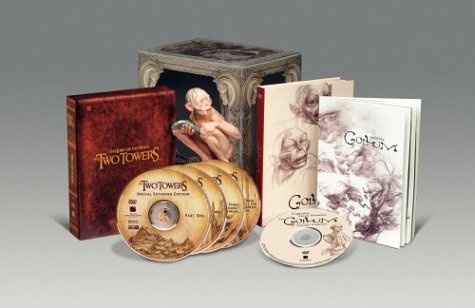
- The Lord of the Rings Extended Editions include more hours of bonus material than the running time of the actual (pretty darn long) movies. Depending on which EE you bought, you also got a figurine and an additional bonus DVD.
- Memento Limited Edition has two DVD's of probably the most intense DVD menus ever made, where you have to take a psychological test as the character in the movie to get to any feature in a very convoluted branching menu that unless you have a fan-made guide, you would have to guess and test 100s of combinations and take hours to navigate the menu to get to every feature. One big kicker is the main disc has random branching commentary where Christopher Nolan gives four different commentaries with differing interpretations of the end of the move, and the huge kicker is the second disc has an unadvertised feature of the entire movie in Chronological Order - taking most of the DVD space/time.
- The DVD of Monty Python and the Holy Grail tacks on additional footage during the scene where Sir Galahad arrives to the castle Anthrax.
- The Chroniclesof Riddick 2004 had special features that look into the backstory of the character's life, his weapons and training; background information on the Necromonger cult; the video diaries of the bounty hunter Toombs, which serves as a sort of prequel to the film; and a virtual guide to the universe with info on characters and settings.
- The DVD for the 2001 remake of Thir13en Ghosts includes a full set of biographical dossiers for the 12 ghosts used in the movie (narrated in Affably Evil fashion by good old Uncle Cyrus).
- Not many X-Men: First Class fans are aware that there are two rare featurettes which were only included on a very limited number of Blu-Rays: "Extraordinary Abilities" and "Magneto the Survivor." (The password to view both videos is xmfc.)
- Stephen King's short-story collection Night Shift includes two stories in the same continuity as 'Salem's Lot, one set a century before the events of the novel, and one a couple of years after.
- Every second chapter of Herman Melville's Moby-Dick, or The White Whale is old-style Bonus Material; they have nothing to do with the story of Ahab and the Pequod — they are informative essays about whales, whaling, and whaling ships.
- Tolkien's Legendarium:
- The appendices in The Lord of the Rings are somewhere around 10% the size of the rest of the "trilogy" put together.
- The Silmarillion also includes a "note on pronunciation", an "index of names" and "elements in Quenya and Sindarin" names. All are interesting, but the second one can be particularly useful when reading the book for the first time.
- As noted in the Trope Description, Charles Dickens regularly published his stories as serialized articles in newspapers and magazines. In addition to the primary story, he'd often include extra scenes, out-takes, where-are-they-now-style vignettes, and so on.
- Discworld
- The Illustrated Wee Free Men included, at the bit which reveals the toad was a lawyer who suffered a Forced Transformation after suing a fairy godmother for breach of promise, a transcript of the trial.
- The Waterstones hardback edition of Unseen Academicals includes a set of football cards, giving biographical details about the players in the big game.
- The Waterstones hardback edition of Snuff includes a bonus story about the wizards (and A.E. Pessimal) that was originally printed in The Times Educational Supplement.
- The Waterstones hardback and WH Smith paperback editions of The Science of Discworld IV: Judgement Day include an Omnian pamphlet entitled The World Not A Disc; a parody of the "flat Earth" arguments Jack and Ian mention in the text.
- The Waterstones hardback edition of Raising Steam includes a First Class ticket on the Hygenic Railway, with humourous terms of service etc. The WH Smith edition had a bonus story set on Roundworld (specifically Blackbury), that also featured an experimental steam engine.
- Nine extra chapters of Wet Goddess were dropped from the book due to being unrelated to the main storyline, but the author made them available online.
- As a tie in to the Doctor Who novel "Engines of War" George Mann wrote a Story Arc for Doctor Who Legacy, in which the War Doctor goes back in time after the events of the novel and rescues Cinder, knowing that the general Time Crash happening in Legacy would keep the Web of Time from shredding as a result. (Note that this doesn't affect the events of the novel — the events of Legacy will "snap back" to the regular timeline after the Time Crash plot is solved, and no one will remember a thing. Which doesn't stop the War Doctor from trying to save Cinder regardless.)
- Chocoholic Mysteries: Every book in the series contains at least half a dozen pages of chocolate trivia between the end of one chapter and the start of the next, all spaced out throughout the book.
- There Is No Epic Loot Here, Only Puns: There's canon omake, labeled such, such as "Shush little ones (canon omake)", fanfic, that was accepted by the original story's author, as canon.
- Done quite notoriously in the works by Sarah J. Maas as her works are often released with multiple editions, each one containing different "exclusive chapters". These chapters can be up to sixteen pages long and while intended as "fun" extra content for the die-hard fans, some contest that some of these chapters are essential reading to better understand the characters and plot. It requires fans to buy three to five separate copies of the same book or to look up a master list online to get the full story.
- Doctor Who:
- The season three boxed set contains a video that plays half a conversation (It's complicated) that took place in the episode Blink.
- We also have this out of character moment (But not really) where we get to see what The Doctor really said to Martha during his video tape in "Human Nature".
- Black Orchid is like a whole serial of this. The Doctor sings in the shower, companions play dress-up, everyone shoots the breeze and hangs out in the past mostly having a good time.
- The series five boxed set had a couple of bonus scenes linking episodes.
- The series six boxed set had the 'Night and the Doctor' set of mini-episodes.
- The official BBC website had "Pond Life", a set of Amy and Rory-focused mini-episodes. It also sometimes has preludes to the main episodes.
- Several complete scripts of episodes are available on the BBC site, often including missing scenes and comments from the writer that show intent or background.
- A few of the early seasons had "Doctor Who Confidential" episodes which gave behind-the-scenes info for each episode of the show.
- Friends was good at adding extra scenes that only had a peripheral connection to the primary plot of an episode over the end credits.
- Seinfeld did this a lot too.
- The number of television shows that offer "exclusive online content" on their network's websites is truly staggering. Common offerings include behind-the-scenes blogs; extended interviews with the actors, writers, or competitors; games; photo galleries; and unaired footage.
- From 2004 to 2008, Super Sentai would have a short scene at the end of every episode explaining aspects of the show, while running on Rule of Funny.
- Mockumentary-type shows like The Office and Parks and Recreation will have a short tag that relates to a B-plot, or a one-off gag in earlier in the show. For instance, if a small gag was someone complaining about their Dr Pepper being stolen out of the office fridge, expect to see whoever it was taking the Dr Pepper out of the fridge during the bonus material.
- Game of Thrones box sets have many of the standards bonus features such as deleted scenes, commentaries, etc. Perhaps the most interesting, however, is a series of lectures about the history, customs, and world that the series is set in, given by various characters. Also, since these talks are done in character, they're often full of unreliable narration, talking up past family glories, playing down past family atrocities, etc. When it comes to contentious, divisive subjects that multiple points of view talk about, the differences can be intriguing, and tell you a lot about the speaker.
- Schitt's Creek: The show produces a series of online video extras. This includes the web-only series Inside Schitt's Creek which consists of in-character interviews with the cast, often about events that occurred in that week's episode. The show also releases behind the scenes interviews and bloopers.
- Someday or One Day: A video was released to thank the fans for staying loyal (and watching legal broadcasts) after the Content Leak. Set after the ending, it depicts Zi Wei's 28th birthday, where he celebrates with Jun Jie and an older Yu Xuan (who may or may not be part of his imagination rather than the real thing).
- The 2012 re-issue of the discography of the science-fiction Death Metal band Timeghoul had the CD contained a digipak that had exclusive artwork as a completely wrap-around cover and a booklet containing lyrics and background notes on the band.
- Paul Robeson appended to his 1937 recording of "Sometimes I feel like a motherless child" a recitation without music of Langston Hughes' Sad Clown poem "Minstrel Man."
- Poets of the Fall's Temple of Thought Bonus Edition has three extra tracks. Two are new Unplugged Versions of prior tracks: love song "Temple of Thought" and Love Nostalgia Song "Skin." The third is a new song, Follow Your Heart anthem "Signs of Life," which shares a title with their first full album.
- When Korn released their "Greatest Hits Vol. 1" CD in 2004, a limited number came with a bonus 33-minute DVD, "Live At CBGB's".
- Several of the Calvin and Hobbes collections.
- Ape Escape 1 had a Ape-o-pedia containing a small amount of information on the monkeys you've caught. It also featured mini-games that are unlocked upon collecting enough Specter-coins. In the PSP version there were 2 extra minigames to earn.
- Ape Escape 2 and 3 had alot of extra stuff. You could go to a town-like hub world and purchase either cookies, extra lives, or for the sake of completion: The games soundtracks and cutscenes. In the 3rd one it had different skins for the RC Car and a survival mode (which had the player with a full stock of abilites and equipment, but started of with zero lives, going through levels and capturing enough monkeys to progress while trying to earn 1ups to make sure they didn't fail).
- Halo:
- Halo 2 and Halo 3 both had Collector's Editions with some extra stuff, but Halo 3's Legendary Edition came with even more and also had a model of Master Chief's helmet.
- The Limited Edition of Halo Wars included special in-game items, Halo 3's Mythic Map pack, and a graphic novel prequel.
- The Limited Edition of Halo: Reach gave you a bulky black case in which was a note from the 'owner' and a lengthy diary written by Dr. Catherine Halsey (the scientist who created both the Master Chief and Cortana), and filled to the brim with bits of news reports, notes, drawings, maps and some kind of ID cards or somesuch, all contained within a black bubblewrap seal. The Legendary Edition gave you that, plus a hand-painted statue of all of Noble Team.
- Continuing the tradition, Halo 4 was loaded with bonus features: Three multiplayer maps available prior to the game's launch date, early access to six specializations, a 90-minute extended series of Halo 4: Forward Unto Dawn, additional in-verse content that helps explain Forward Unto Dawn, two making-of featurettes, unique character and weapon skins, exclusive in-game emblems and LIVE Avatar props, and a "UNSC Infinity Briefing Packet" (which serves as an intro to the UNSC Infinity and contains a variety of documents providing background lore for Spartan Ops, including schematics for Spartan Armor), all contained within a ginormous metal box, itself available in a "forest black" or a silver color.
- To no one's surprise, Halo 5: Guardians had this as well. The Limited Edition included an animated adaptation of The Fall of Reach, a Guardian statue, and detailed dossiers on both Blue Team and Fireteam Osiris, with the Legendary Edition adding commemorative statues of Locke and Chief.
- The War Room tutorial segments in Advance Wars: Days of Ruin feature exaggerated, less-serious versions of the characters — including villains — who come to give you advice, and contain much of the game's humor.
- Another Day in The World Ends with You probably counts as an extended Omake with the characters cast in completely different roles with humorously tweaked personalities and even lets players meet some developer avatars, including character designer Tetsuya Nomura.
- It also has the rare distinction of being a canon version of an Omake-everything that happens in the Another Day chapter takes place in a parallel universe from the main game, and reading the Secret Reports will clue you in that one of the Joshuas and the Mr. Hanekoma on top of the rooftop are actually the versions from the regular universe, and that this is where Joshua spent his time in between getting blown away by Minamimoto and coming back for the ending!
- The Metal Gear games generally do this in their expanded re-releases. Metal Gear Solid 3: Snake Eater was the most notable contributor, featuring a 'Secret Theatre' with movies such as the humorous Metal Gear Raiden shorts, dedicated to humiliating him, and the Snake vs. Monkey minigame, which featured Snake and... a monkey. Sadly, most of these special features were left out in the HD re-release.
- MGS4's ginormous encyclopedia may have come close to toppling that though, at least in terms of effort put in by the contributors.
- This was released prior to Soulcalibur 4's Japanese release. In it, recurring character Cassandra explains the gameplay to new character Hilde.
- Warhammer Online had a collectors edition filled with this. It had a map, comic, miniature, and artwork book.
- Infocom text adventures nearly always came with "feelies" such as matchbook covers, calendars, etc. that contained important hints, copyright protection info or both.
- Freddy Pharkas, Frontier Pharmacist came with a "medical manual" that doubled as copyright protection and the solution to several pharmaceutical-related puzzles.
- EarthBound (1994) comes with the official Player's Guide - which causes the box to be a lot larger than an average SNES game.
- The Suffering provides an entertaining little documentary on haunted prisons as a little extra you don't even have to unlock!
- Deadly Premonition gives you the entire damn soundtrack upon completion.
- The collector's edition of Alan Wake gives you a bonus making of DVD, the soundtrack and an proper hardback book all detailing bits of Bright Falls' history.
- The collector's editions of Gears of War 1, 2 and 3 all contained making-of DVD's and art books.
- The collector's edition of The Elder Scrolls IV: Oblivion came with a fold out map of Cyrodiil; a bonus DVD filled with Concept Art, early renders and a substantial making-of; a 112 page 'Pocket Guide to the Empire' and a reproduction of a Septim, the in-game currency.
- Skyrim comes with a very nice linen fold out map of the region, but the collector's edition comes with the Art of Skyrim, a map, a making of DVD and a statue of Alduin, the Big Bad.
- The Sega CD port of The Ninja Warriors includes a weird bonus cinema scene in which Taito's in-house band Zuntata puts on a concert playing the first stage theme, which somehow becomes the inspiration for the game's plot. Oddly, this is voiced in English with Japanese subtitles, despite the Sega CD port being released in Japan only.
- Kingdom Hearts. Every game has bonus bosses and bonus endings. And then the re-releases add more.
- The initial run of The Legend of Zelda: Skyward Sword included a special 25th Anniversary CD with orchestral arrangements of the music from the series.
- SC2VN has two: An optional intro voiced by DayNine, and a developer commentary full of in-jokes that's available after you finish the game.
- The Realta Nua release of Fate/stay night adds in the "Tiger Dojo". If your poor decisions lead you to a painful and gruesome death, you have the option of a hilarious routine between Taiga and Ilya that gives advice on how to avoid that death. There are over 40 of these things written, and the Denser and Wackier nature means it’s suggested you complete the main game before watching them to avoid Mood Whiplash.
- Inverted for Katawa Shoujo — it's a Visual Novel based on a one-page omake from the doujin Schuppen Harnische by RAITA.
- Goodwill Heroes has one of the main characters updating his Twitter account via his cell phone every time a new page is uploaded.
- Housepets! printed editions come with bonus art and in one case a prose story.
- Megatokyo ends each chapter with an omake featuring the protagonists as completely different from their Canon selves. The Chapter 4 omake Grand Theft Colo: Otaku City, for example, shows Makoto, an Anthropomorphic Personification of the main Megatokyo server owned by ColoGuys, stolen by a Largo that looks more like a 70's pimp; Piroko, Piro's gaming avatar, is an Elegant Gothic Lolita Action Girl, Kimiko is a gun-toting Yakuza, Piro is an Ax-Crazy otaku, Miho is a Wrench Wench Cute Witch, and Erika and Yuki are cops who run a shady auction business.
- Darths & Droids provides multiple alternate universe versions of the same characters playing different movie-based games.
- Also the intermissions.
- Errant Story has had two varieties of Omake, first a sequence called "Fun With Familiars" featuring familiars Ellis and Rape-kun back in the old high-school days, and later, "Errant Commentary" featuring characters Bani and Sara at the end of each chapter.
- Girl Genius is generous with bonus material within the comic, such as A parody of Mary Sue fanfic; "Personal Trainer"; The "Revenge of the Weasel Queen" storyline; one-page bonuses like the "Spark Roast Coffee" ad and "Santa Klaus"; "Fairy Tale Theatre Break: Cinderella"; a "Holiday Hilarity Break";
- There's also Free Stuff, like wallpapers, gift tages, downloadable gift tags, and bookplates available on the website, but not incorporated into the comic.
- There's also Free Stuff
- Gunnerkrigg Court follows every chapter with a single bonus page. These may be (canon) short stories; description of (canon) background details by the secondary narrator; or book-ending, symbolism-dense Treatise pages. Furthermore, the gaps between the "books" have ten pages worth of bonus content each. The first involved some guest comics and letters between characters in-story, and the next two were devoted to the adventures of a pigeon named City Face.
- Lackadaisy has what are called "preview comics" which explain things like why Rocky has a hole in his ear and why Rocky refers to Calvin as "Freckle".
- Flipside has "Intermission" strips after each chapter.
- Coga Suro has a 'Coga Suro Review' at the end of the first chapter of Coga Suro 2, which looks to be a recurring feature. Appears to be heavily influenced by Lucky Star's 'Lucky Channel'.
- The El Goonish Shive: NP strips often serve this purpose. Sometimes forms short arcs. They are "not canon unless referred from it later".
- Sluggy Freelance whenever Pete Abrams wants to make the print volumes more appealing, encourage people to become registered "Defenders of the Nifty," celebrate a special occasion, or just provide some quick filler.
- Star Mares ends each issue with "Tales from the Mos Equus Cantina," two four-panel strips that are only semi-canon for the comic and serve as a dumping ground for gags that didn't fit.
- A Loonatic's Tale features exclusive stories, artwork, and creator commentary in the collection books.
- Nature of Nature's Art featured a primer on spiders as a companion to the third arc: a non-canonical, mostly humorous but educational super comic starring that story's protagonist, with a cameo appearance from the main characters from the second arc.
- Some Fuzzy Five strip commentaries are excerpts from in-universe material. The first occurs at strip #6, with OMSU and U: A Prospective Student�s Guide, Page 27
- Saturday Morning Breakfast Cereal features a "Votey", an extra panel with a subsequent gag related to the day's comic, which is shown by placing the cursor over a small red ball under the comic.
- For a fairly new website morphE has a bunch of side content on their tumblr page which has introduced future characters, hinted to backstory that has not come up yet and —-official art of the first slash-fic of the main male characters' shirts. It's that kind of fandom.
- His main comic being Bad Machinery (and before that Scary Go Round, and before that Bobbins, all three taking place in the same verse), author John Allison has also created a few recurring Spin Offs, such as the stand alone stories Murder She Writes and THAT (focusing on SGR's Ensemble Dark Horse Shelley Winters), Giant Days (focusing on SGR's other Ensemble Dark Horse Esther de Groot), New Bobbins (focusing on the past and present exploits of some of the characters from Bobbins and SGR), and various other side stories.
- The authors of Hell(p) produce a lot of bonus art on a regular basis, sometimes even of characters that are yet to appear in the actual story. There is a whole Tumblr and a deviantArt group dedicated to collecting all the bonus material they make. And then there's even more on the comic's Patreon. They also make smaller B-Side Comics on special occasions.
- Nebula has several canonical short stories from the POVs of different characters. "Nix" is about Pluto and his feelings before Ceres' attack on the planets, "Proco" is about Earth and how she found the comet that ran away from Jupiter, and "Lux" is about Sun and how he's struggling to deal with everything going on.
- Two types of bonus strips are available for fans of Dumbing of Age: Patreon only strips that focus on characters not involved in the current storyline (some of which are chosen by fans), and not-safe-for-work comics posted on Slipshine.
- Rainverse:
- Rain: Jocelyn intersperses bonus omake strips between her regular chapters under the title "Rain Delay". There's also some book only stuff.
- My Impossible Soulmate: Between chapters or breaks, Jocelyn sometimes releases gag-based/filler pages titled "Non-Canon Tangent Episodes".
- Economy Watch: David has always been interested in bonus material and plans to release archived videos and clips later in the future.
- Nobody Here: "Download" features a bunch of wallpapers, cursors and banners for readers to enjoy.
- Random Assault: As a reward for getting 100 likes on the Facebook page, the crew released a scrapped first segment of an unreleased version of episode 034, in which Alex, Mitch, Mela and Tony talk about comic books.
- Yu-Gi-Oh! The Abridged Series includes several videos not directly related to the actual abridgement, such as Christmas specials, bonus material of the villains' behind-the-scenes plotting, song parodies by the cast, an episode of Zorc and Pals, and more.
- Avatar: The Last Airbender has the chibi shorts that came with the second season DVD.
- One of the Futurama DVD sets gave us an episode of the Show Within a Show "Everybody Loves Hypnotoad". Hilarity ensues.
- An in-universe example is the Everybody Loves Hypnotoad DVD box set. As well as all 365 episodes, it has deleted scenes (identical to the rest of the show), a blooper reel (where the toad is shown upside down) and an audio commentary ("ALL GLORY TO THE HYPNOTOAD").
- The Venture Brothers Christmas Special falls in this category as it is rather shorter than a regular episode.
- The Walt Disney animation collection DVDs come with a lithograph.
- The 2003 TMNT series was supplemented by various types of bonus material during its run, including several one-minute shorts and character profiles, as well as "Mayhem From Mutant Island", a series of thirteen shorts which combined to make a full-length episode.
- Teen Titans had a half-length "Lost Episode."
- In a rare variation on this trope the orange VHS of the Ren & Stimpy episode Son of Stimpy featured a music video titled "Cat Hairballs" before the episode proper, which featured Stimpy licking and hwarfing up hairballs for Ren before eventually passing out and getting stamped on the butt.
- The ending credits of Evil Con Carne and The Grim Adventures of Billy & Mandy during their later seasons had additional scenes from the show's episode.
- The Powerpuff Girls (1998) complete series DVD features the animatics for two existing episodes, done when creator Craig McCracken was still at CalArts. It also has interstitials from Cartoon Network, a documentary with cast and crew, the Christmas episode and the 10th anniversary special The Powerpuff Girls Rule!
- WordGirl has several bonus skits every episode (much like many other PBS Kids shows since they lack commercial breaks). They include the "May I Have A Word?" fictional game show, "How To Act Like a Human" in which Toby's robots learn social skills, a bit where Mr. Huggyface does a dance and displays a certain emotion (with the help of the announcer), and "What's Your Favorite Word?" in which real kids talk about their favorite word (though animated into cartoon form).
- Nearly every SpongeBob SquarePants DVD (at least in the US/Canada) has at least one special feature. So many, we made a list.
