
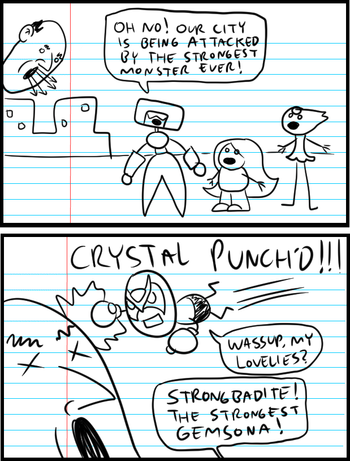
The original Mary Sue (she who gives that trope its name) was a Parody Sue of the standard Self-Insert Fic. In the most extreme cases, the insert character gains some degree of godlike power, or retains considerable knowledge of the series in which he's been inserted, or both, and uses them to adjust things to their liking. In rare instances, it might work well, especially if the people in the setting — heroes and villains — react accordingly to the new situation and the character that knows all the stuff he saw in the (anime/game/etc) and the situation changes in ways they can't anticipate.
However, equally common is the subversion, where the author applies This Loser Is You to themselves and ends up as The Ditz, The Fool, or in extreme cases a Butt-Monkey. Care must be taken to not still make themselves more important than anybody else. The main rule is to never put the character in a high-ranking story position, although they may be the narrator.
The Self-Insert Fic has two primary varieties: the Self as New Character, where the author simply opens the top of the story and drops a copy of themselves right in, with a few smiles thrown their way to acknowledge their presence and a few lines chipped in, and the Self as Existing Character, where the author finds himself forced to take over the life (and sometimes the body) of an existing Canon character, without necessarily being restrained to staying "in character" for their new role. See Emergency Impersonation, You Will Be Beethoven, or Possession Sue for different versions of the latter.
Note that self-insertion isn't a bad thing. It doesn't even mean that you're a bad writer. Lots of writers do it. After all, there's nothing wrong with a little Wish-Fulfillment. But if you expect other people to enjoy your story too, you're going to need to insert all the things that make you a real person, like your flaws. Just as not everybody loves and adores a person in real life, they're not all going to love and adore them in a fanfic, either. Self-insertion, complete with flaws and realistic reactions from everyone involved, is just as good a way to make an Original Character as any other; besides, if there's one character you can write without ever making them Out of Character, it's yourself! What was originally a self-insert can even adapt and evolve into a genuine Original Character, completely different from who you are.
The trouble is that many new writers don't think about that. They think only about ways in which their Author Avatar can be perfect, can hook up with their favourite character, force their beliefs on others, or ninja-kick their way to being the hero, rather than working on a realistic way they can enter the plot.
Played for Laughs this can become almost a different story entirely, which usually involves an average loser realizing that whatever fictional world may not be the best or safest place for them, and commenting on the implausible things going on.
See also Life Embellished, Author Avatar, Write Who You Know, Her Code Name Was "Mary Sue". Compare Media Transmigration and Trapped in TV Land, which is about fictional characters ending up in worlds based on in-universe fictional works, and to Reader-Insert Fic where it's the reader who gets inserted into the work instead of the author.
Examples:
Fan Work Examples (Sorted by Source Material)
- Naruto
- Played With in Dreaming of Sunshine — the Author Avatar is not godpowered and, in fact, attempts to change the timeline as little as possible. This is actually justified, as she is attempting to retain her advantage by not rendering her knowledge of future events useless. This is difficult, as she arrived many years before the worst of the shit starts to hit the fan. She has some skills beyond the norm, but those stem from being reborn with her memory intact, not from being an Uberninja.
- Dreaming of Sunshine has in fact been so positively received, it's created a boom in the Fanfic genre of self-insert via Reincarnation, especially in Naruto fandom. These other authors have thus far had varying degrees of success.
- In Déjà vu no Jutsu, the Author Avatar is an ninja orphan and surrogate older sister of Minato Namikaze. While she is more skilled due to her past-life as an American soldier, she was also weaker due to differences in power and self-neglect. Since she is born years before major events, she grows up and evolves into a different character. She reluctantly made friends with her and Minato's contemporaries, she's a living butterfly and she changes things for the better and for the worse.
- Catch Your Breath. The main character is ultimately a flawed, realistic character who has the good (or horrible) luck to be born into the Third Shinobi World War era—thirteen years before the Kannabi Bridge Arc. Her existence butterflies away several important plot points while raising new ones in their stead.
- Shinobi: The RPG. In this case, the protagonist is kind of hilariously overpowered, experiencing the world through Fallout: New Vegas game mechanics, getting elements as perks, and having early on maxed out Intelligence and chakra control, can pull new jutsu out his butt and gain exp for it. On the other hand, he suffers immensely from his choice to go in with minimal charisma, and ordinary training doesn't help him in any way — only quests, killing and inventing jutsu will do the job — so his peers view him as a Death Seeker and other people react to him like a terrifying combat monster with no human empathy. That's not even going into what happens when he fixes his charisma problem...
- Nine times out of ten, a new original senshi in any Sailor Moon fanfiction will be a self-insert, replete with godlike powers and total authority over everyone and everything — the girl is usually related to a canon character as well.
- In Zenith, Darkness, Reverie, the author admits to basing the protagonist and antagonist on herself. The teenaged, female protagonist acquires a Death Note. This should be a humorous, fangirl-esque tale, right?
No.
Kali can barely manage coherency in Part 2 due to Kira's intervention, veers into disturbingly serene sesquipedalian monologues frequently, and is psychologically shattered. Kira is amused. - In the Bleach fanfic Fanfictional Fugitive,
 the author directly admits that the main character is based on herself as much as possible. Then she starts to pretty much beat the entire shit out of her(self?) by both turning the character based on herself into a whiny, powerless, selfish and generally unlikable damsel in constant distress and making Fanfic!Myrthe experience an ongoing series of nasty events. And then lets her character react to these events in a way that does not flatter her character at all.
- In the Yu-Gi-Oh! GX fanfic, State of the Meta, the protagonist with a personality based off the author finds himself living in a variation of the world. It's noted that his presence within the world is causing the bariers between dimensions to weaken.
- Jared "Skysaber" Ornstead is known for his deliberately over-the-top self-insert character Skysaber, an interdimensional superspy-troubleshooter who was actually apotheosized into a literal god during the course of The Bet.
- His current (as of August 2007) project is a Type 2 Self Insert called My Gilded Life, in which he has found himself taking over the life of Gilderoy Lockhart right at the end of Harry Potter and the Philosopher's Stone; with his knowledge of the books he is deliberately and relentlessly running roughshod over canon.
- His current (as of August 2007) project is a Type 2 Self Insert called My Gilded Life,
- The authors of Undocumented Features started the project in the early 1990s as a self-insert fic for themselves and many of their friends, but as time has gone on, the focus has moved mostly off their avatars and onto other, newer characters (including some of their avatars' kids).
- Many other Eyrie Productions Unlimited projects also involve self-insert avatars, making it one of their signature details. However, even though their Neon Exodus Evangelion didn't include either of the two primary writers as insert characters, critics still accused the story's lead of being one or the other in disguise. (Arguably this protagonist, DJ Croft, is a Marty Stu. But he's not an avatar.)
- NXE manages to invert the Author Avatar trope with John Trussell. He was inserted in the story before he became one of the authors.
- Many other Eyrie Productions Unlimited projects also involve self-insert avatars, making it one of their signature details. However, even though their Neon Exodus Evangelion
- SIs are pretty common in Neon Genesis Evangelion fandom. Especially the female body swap kind... either a spare body of one of the show's main characters, or some OC with an even more fucked-up past than the series' own characters. Unfortunately, these are considered the good ones. New Perspective Evangelion by Dartz_IRL and I was a Teenage Dummy Plug by Foxboy. The second of these is usually regarded as the best of the sub-genre.
- The reason why this works so well is in canon there are a bunch of soulless bodies just hanging around in the depths of Terminal Dogma.
- Another example is Self Insert Evangelion, which was directly inspired by the two fics above, but without the female body swap. However, Alternate Universe elements are introduced to keep the SI from accurately predicting everything.
- Hybrid Theory by Blade and Epsilon deconstructs and satirizes the self-insert phenomenon while at the same time subverting the Massive Multiplayer Crossover.
- Gregg "Metroanime" Sharp also subverts the self-insert trope with his fictional counterpart "Grey," who becomes a cosmic Butt-Monkey doomed to endless futile struggle in an uncaring multiverse.
- Contrabardus a.k.a. Carrotglace has also played with Self Insertion, but usually with a somewhat more comedic take than Metroanime. See his stories The Spirit Within, Insertion, Insertion: Reflux! and Gaijin (though while that last one has comedic moments, it's also fairly dark overall).
- Possibly the most infamous example of the godlike insert is Darren "Twister" Steffler and his incomplete mid-1990s megaseries Twisted Path. Steffler's work started out rather crude but improved noticeably as he continued writing, although it never quite reached better than high average in quality. Nevertheless, Twisted Path was incredibly influential, prompting a number of other writers to create their own Self-Insert or pseudo-Self-Insert fics, many of which included Shout-Outs to Twisted Path or blatantly set themselves in the same multiverse.◊
- One such story was Bert Van Vliet's The Bubblegum Zone. a Bubblegum Crisis self-insert which later had an explicit crossover with Twisted Path in the latter series' fourth installment.
- Another is Ed Becerra's Legion's Quest, which carefully and skillfully walks the complicated line between playing a godlike Self-Insert straight, parodying it, and subverting it. It, too, crosses over explicitly with Twisted Path, in its own Bubblegum Crisis segment.
- Possibly the most notorious self-inserter of all was the one known only as "Oscar"; his Author Avatar was a 13-year-old Super Saiyan hermaphrodite who engaged in a sexual affair with Artemis from Sailor Moon... in his cat form. In later stories, Oscar became "involved" with Felicia from Darkstalkers and Lola Bunny. To top it all off, the real Oscar then mysteriously disappeared, and is now presumed dead. A link to an MST series of some of his work; linking to the actual stories would be NSFW.
- Dr. X of Suburban Senshi is a surprisingly well-done self-insert, even with his gobs of power that mix and match multiple canons. It's all in the writing (and the fun social commentary, upon which the series could stand alone).
- Not A Dirty Word by Michael Fetter is a rather... twisted, parody of the usual Type 2 self-insert, in which the male author finds himself stuck in the body of Kasumi Tendo of Ranma ½ — and finds he has to abide by her "rules of behavior." His efforts to find loopholes in those rules, and the repercussions his successes have on the established plot, are what really make this a fun story. Just, please, ignore the utterly cringeworthy prologue describing Jesus getting mad at the author and punishing him with the insert.
- Speaking of Ranma ½, fanfiction written in the mid-90's commonly featured Self-Insert Fic, but with amusing twists due to authors trying to avoid the pitfalls of this trope. The most common twist was usually the author being deposited in the fic wholesale, with no changes from their real self, and the story characters teaming up to heap gallons of pain on the author for the things they've "put them through".
- Tom Dyron is one of the more audacious, unbelievable examples readily available. His 13-chapter fic, Evangelion 2: The DELTA Invasion (EVANGELION 2!), is the most ridiculous mess ever seen. Tom, the character, is... look, just read it. MSTed in the link above; do not attempt to read it raw.
- David Gonterman's everything feature Gonterman himself (or an obvious Author Avatar) as the story's real hero. In the rare cases he isn't, it's because he made an obvious dream heroine, whose boyfriend will be suspiciously similar to him.
- One might consider this blanket statement to be nullified by Gonterman's insert in Planeswalker being the father of the main character... if it weren't for his lax attitudes about incest coming to the forefront of Sailor Moon: American Kitsune... yeah...
- Hikaru's Non-Redundant Self-Insertion Nadesico Fanfic, in which a character in the series inserts herself into a fictionalized account of oh dear I've gone cross-eyed. It's a lot easier to understand than it is to explain. Needless to say, this is Affectionate Parody of the genre.
- Crazyeight's Fourth Wall series is set in a fanfiction website that is a place in its own right, accessible to authors the way the Digital World of Digimon is accessible to the Digidestined, except they only need to log on to visit. The first in the series, The Wages of Fans is Fiction, is about an author who tries to replace the Digimon canon with his own fiction and the resulting revolt, with other authors leading the revolutionaries in person.
- The Mary Sue Experiments parodies (or maybe the word is deconstructs?) Self Inserts.
- Hundreds, possibly thousands of these came up over the years in the Bob and George forums among the fan authors. It would be impossible to list them all. Needless to say, some were good, some were bad, and some were just plain ugly.
- Oh! My Brother. An example of the good kind of self-insert fic. Christopher Angel manages to create a very readable and enjoyable series based off of Ah! My Goddess.
- The multi-universal crossover Sleeping with the Girls deconstructs the idea of a self-insert heavily. The idea is that every time the nameless self-insert falls asleep, he is teleported to the bed of one of eight girls from anime. The problems quickly build up, as a) most of these girls are Tsundere types, and do not react kindly to him; b) "comical" attacks like a Megaton Punch will kill the Self Insert and subject him to the Chunky Salsa Rule; c) he has to wake up as quickly as possible to avoid the aforementioned consequences of death at the hands of crazy girls, meaning that, by the end of the first volume, he has gone almost a week without sleep, is badly injured from a vast collection of wounds accumulated from a variety of sources, and the healing nanobots he picked up in his first world nearly boil him alive in his own sweat; and d) he has severely damaged the timeline of several worlds because of his actions, possibly dooming them.
- Boy Scouts ½ (readable here) is a Ranma ½ Elsewhere Fic that follows an original group of characters, many of whom are based on the creator of the series and some of his friends from Boy Scouts. Some of the other real people included in the stories also went on to write for the series, as well. Notable in that, while not always entirely successful, the creator of the series tries to avoid in-jokes and make the series somewhat accessible to any reader, even if they do not know the real people involved, or if they are not very familiar with the series that inspired it.
- Boy Scouts ½ takes things further by having a spin-off series called Perspectives, which began when the main author of Boy Scouts ½ gave three friends he had made on the internet brief cameos in Boy Scouts ½, part 11 and one of those friends then began authoring a series following those characters, making it a self-insertion spin-off of a self-insertion fic!
- Boy Scouts ½ takes things further by having a spin-off series called Perspectives,
- Twice in You Got HaruhiRolled! does superstarultra insert himself into the fic. On both times he is the villain, ruining the characters' lives For the Evulz.
- Very common in Fruits Basket fics. The character will usually be one of Tohru's long lost relatives or a twin of of the zodiac members (to explain why they turn into the same animal). If it's a girl, her love interest will most likely be Kyou.
- The One Piece fandom is full of fanfics about the cool new member of the Straw Hat crew. Variations include fics about a cool new pirate joining the Whitebeard/Red-Haired/Heart/Kid Pirates... you get the idea. These were so prevalent for a while that subversions and deconstructions of such stories became a sub-genre of their own, but since then, more talented authors have tried their hands at it:
- Sol Invictus by Toraffles is a play off of the reincarnation angle. The female protagonist is born as a female Luffy, possessing the knowledge of the manga from the beginning, and she resolves to change things. However, the fact that some other characters in that universe, though no other Straw Hats yet, were also gender-swapped creates unforeseen changes. Far from playing it straight, but a rather good story altogether. Last updated March of 2020.
- The second one is This Bites! by Xomniac, with assistance from CV12Hornet and The Patient One; the three of them collectively known as the Cross-Brain. Yes, the story has three authors behind it, and it says a lot both about their skill and the difficulty of the genre that This Bites! is the first SI fic to ever reach the fandom's top 10 stories. The basis is that a man called Jeremiah Cross, fanfic writer by trade and regular guy by nature, muses how cool it would be to be in One Piece, and promptly has his wish granted by a (Bastard) Random Omnipotent Being. With little to no combat capabilities (happens when you're a regular guy in a superhuman world!), he forms a partnership with a Baby Transponder Snail that ate the Noise-Noise Fruit, appropriately named Soundbite, and they join the Straw Hats as the communications officers shortly before they reach Loguetown. This story plays the genre straight, and its faithfulness to the Butterfly of Doom results in many changes, both good and bad. It stretched on for seven years before it went on hiatus when it hit the Time Skip, with the authors planning to write the second half once the source material is finished.
- Hot on the heels of This Bites! is Twelve Red Lines. The story follows Jones inexplicably entering the world of One Piece after a suicide attempt. Since she was wearing a necklace with the Straw Hat jolly roger on it, Luffy decided she belonged on his crew. After a while, Jones comes to realize she's a fictional character in a self insert fanfic being used as a coping mechanism by her author and decides to take a very Deadpool attitude to the whole thing. Fun fact, This Bites! and Twelve Red Lines had a crossover chapter together.
- Tell It to the Marines by Tsume Yuki also plays off the reincarnation angle, with the female protagonist Dracule Riskua born as the result of a one-night stand between Dracule Raowl (Mihawk's younger sister) and Red-Haired Shanks. She develops a dream to be the greatest Haki expert in the world, gaining training to that effect from her father and uncle, and at the age of nine, she leaves her home island with Shanks at her dying mother's request, and he naturally takes her to Dawn Island where she becomes Luffy's big sister. The fic began in October 2016 and was last updated in May 2019.
- The fanfic The New Math is set in the world of Magical Girl Lyrical Nanoha, and has the author plucked from our world and placed there by a mysterious entity. Said entity also records the adventures of the SI via forum postings.
- The Hetalia: Axis Powers fanfic Genderswapped Nations is revealed to be one in an author's note, where the author, Pandapika, admits that the story is based on a common fantasy she had of secretly being the gender bend of England.
- Chlorine Grown Roses's protagonist, Azusa Tachibana, is an arguable example, but her friend Akira Tomuson (a character made up by the author's editor and friend) is so similar to her creator that they share basically the same name.
- The main "protagonist" of the Precure Meet The Dream Traveler series shares the same name as the author's DeviantArt handle, "BlazeAkechi". Shadow Akechi can also be considered one as he acts virtually the same way. Both characters have OOC knowledge, both are made into major characters in every fic where they star, both are important to the plot, both hook up with specific characters, both force their beliefs onto a willing character set, and both effortlessly defeat anyone who challenges them while being lauded as heroes.
- Chaos Effect has become the definitive Original Series Yu-Gi-Oh! Self Insert Fanfic. At once playing it straight and subverting the genre, the SI here, Edwin Chaos, finds himself in the original Duel Monsters era and attempts to avoid altering canon only to rapidly finding himself unable to resist trying to make things better. The result is the Butterfly Effect in full force with many characters from the original series Taking a Level in Badass while the SI explores the dangers of power corruption. In less than 2 years the fanfic is the most followed and favorited Yu-Gi-Oh! fanfic focused on the original series.
- Yet Another My Hero Academia Self Insert Fic is a parody of this, according to the author it's partially meant to do for Self Insert fics, (and My Hero Academia fanfiction in general) what Scream did to the horror genre.

- A Better Class of Criminal features a self-insert becoming a Batman villain, without triumphing over the Caped Crusader in any meaningful way.
- Ruby Haze features a self-insert who finds himself in the early days of Sonic the Hedgehog (Archie Comics) with a Phantom Ruby fused to his body. The story focuses on him joining the Mercian Freedom Fighters while trying to understand the nature of his new powers.
- Ebony Dark'ness Dementia Raven Way, of My Immortal infamy, is a thinly-disguised self-insertion Black Hole Sue in an unrecognizably goth (and poorly written) Harry Potter universe. The author, Tara Gilesbie (or Gillespie, her spelling skills are notorious) only saw the movies, and only became aware of the books at around Chapter 15 or so ... not that she has any respect for the movies' canon either. The other characters occasionally slip up and call Enoby "Tara," thus giving away her nature as a self-insertion.
- As the documentary Ghostheads discusses, any Ghostbusters cosplay can and probably will have the nameplates with the wearer's own surname instead of Venkman or such, as the franchise makes clear that anyone with some training can become a Ghostbuster. It also allowed for the creation of real-life Ghostbusters files in all 50 states.
- Animorphs has a lot of fanfics with this premise. Said premise spawned two Gamebook spin-offs.
- When challenged to write a shameless self-insertion in the Harry Potter fandom, Sam Storyteller went the 'godlike powers and meta knowledge' route. The end result was a touching guardian angel style piece which may just have turned the genre on its head.
- The hero of The Takers is two-fisted action-adventure writer Josh Culhane. The book is written by action-adventure writer Jerry Ahern, who deliberately gives the character some of his own traits.
- The fandom for The Lord of the Rings has these stories about girls who fall into Middle-earth and meet their favorite characters. The girl comes from our world, because the author inserted herself. She falls in love with Legolas if her author likes the actor in the movies. Some authors insert their friends along with themselves. Some stories are not self-insertions because the character from our time is not the author.
- The Circles by Angmar and Elfhild (which has no characters from our time) is the inverse of a self-insertion. The authors take their pen names from two major characters in the story, Elfhild, a woman from Rohan, and the Witch-king of Angmar.
- The Games of the Gods brings Rachel from Australia to Middle-earth. Her author denies that Rachel is a self-insert. In a note above Book 1, Chapter 25 "Focus," Crimson Starlight acknowledges that Rachel "is based on my own humble personality" but has "some major differences," and that Rachel's opinions may not agree with the author's.
- Time Will Tell brings Jorryn from the United States to Middle-earth, but is not exactly a self-insertion. Above chapter 8/9 "Friends in Tuckborough", the author wrote, "I think I did put a lot of myself into Jo, but we are not exactly the same."
- Deconstructed in Another Life, a story about the creator/alter ego of an Original Character in a Harry Potter fic.
- Many Harry Potter fanfics feature an 'American exchange student' (in a British school), who happens to have a main character fall in love with them and be friends with everyone (even the Slytherins). No reason is ever given behind the exchange, nor do any Hogwarts students ever go over to America.
- A Song of Ice and Fire has several fanfics (particularly in AlternateHistory.com) about the author becoming a character in the books: for example, Oh God, am I the Mannis now?, where the author becomes Stannis Baratheon during the Siege of Storm's End. Other particularly notable examples include Greyjoy Alla Breve, Wearing Robert's Crown A Trident Is Forged and Gaemon the Dragon-Steel's Guide to Not Dying Horribly.
- Worm has a number of SI fics. Many of them run off one CYOA or another, where a ROB forces the writer to live through their CYOA build.
- Played amazingly well by authors in Co-op Mode, as many of the readers would attest that part of the story's charm is in how James is unfailingly a teenager in all senses of the word, fitting into the Worm-verse almost seamlessly, especially with the barest hints of about his home...
- Considering that in this story, James is unaware of his own existence as an Author Avatar (having no memories other than the ones he has since being born in the Worm-verse), there is little question.
- Played absolutely straight in Security! (Worm), where author Michael Allen begins writing a self insert fic about an overweight security guard at Winslow, only to find himself living it. The characterization is solid, and it's amazing how far a Badass Normal can go in this world with foreknowledge, two tape recorders, and sheer chutzpah.
- Played amazingly well by authors in Co-op Mode, as many of the readers would attest that part of the story's charm is in how James is unfailingly a teenager in all senses of the word, fitting into the Worm-verse almost seamlessly, especially with the barest hints of about his home...
- As Dreams Are Made On is this trope as applied to The Twilight Saga, the protagonist and narrator being a barely-fictionalized version of the author thrust into the life of Bella Swan.
- Not surprisingly, a fair amount of Star Trek fanfic follows this line, including any number of stories where, due to painfully contrived circumstances, Mr. Spock falls passionately in love with a woman who bears an astonishing resemblance to the author. The term "Mary Sue" actually comes from A Trekkie's Tale, a parody of these kinds of stories.
- iCarly: There is copious amounts of this usually by having a new transfer student that just happens to have the same name as the author joining the same school as the iCarly Power Trio. They also usually end up in a Love Triangle with them all.
- The Professional Wrestling internet fanbase loves this kind of fiction, often called "Dynasties," "Legacies," "Diaries," or just plain "Fantasy Booking."
- The whole concept of taking a wrestling company and shaping it as the author sees fit doesn't necessarily have to be Self-Insert Fic material, but when the story opens with Vince McMahon handing over control of the family business to a total stranger, the tone is irreversibly set. (And don't start on the number of women's wrestlers who get into romance...)
- In 85% of wrestling fanfic these days The Undertaker ALWAYS has a daughter in her early-twenties who, of course, falls in love with [insert name here but it's usually Randy Orton].
- Almost as common is a girl showing up as Matt and Jeff Hardy's long-lost sister (which will not necessarily stop her from sleeping with one or both of them) or a fourth member of The Shield (with Bodyguard Crush inevitably following).
- A famous, and often ridiculed, Marty Stu among Doctor Who fandom is Ben Chatham, a character who very strongly resembles his creator (the legendary Outpost Gallifrey/Gallifrey Base poster sparacus), sharing his manner of speech, his political viewpoints, even his taste in drink. Even the suggested actor for this character is an actor that the author has admitted to fancying. Needless to say, around 90% of characters in each story instantly fall for Chatham. A rather large percentage of other fanfics featuring an author-created companion for the Doctor could arguably fit in this trope quite comfortably as well.
- A good chunk of Supernatural Fan Fic contains self-inserts that are supposed to be the Winchesters' sister, who is either a long-lost relative or just always been there.
- Spoofed in this episode of Science Fiction Theater 1,000,000,000 (a fan fiction series based on Mystery Science Theater 3000) where the Author Avatar tries to play the role straight, but after probing by Crow and Servo, he then turns into a typical Marty Stu, even changing the series into "Freedom Fighter Theater 3000" for a time.
MAGIC VOICE: Warning! Unauthorized use of self insertion!
JIM: Cram it, you talking tin can!
MAGIC VOICE: You're out of line, mister— eep!
JIM: Hahahahahaha! I'm invincible! - The Odd Squad fanfic OSMU: Fanfiction Friction is a downplayed example. The author is a character in the story as both a self-insert in the form of an old man running a bookstore, and as himself in the form of the author of the fanfic. In both instances, however, he is not a major character.
- An xkcd story arc has a thinly veiled Author Avatar of Randall Munroe meeting and chilling with the cast of Firefly.
- There was a case of a DM adding himself in the background of the Inn the PCs were in as a joke. One of the PCs decide to kill the DM. The DM then decided to spend the next few minutes describing how all of existence was ending except for their characters as they had killed the person who created their entire world.
- Imperial Von Neuman is the story of a happy, reasonably well-adjusted person, who falls through the Warp to a Forge World in Warhammer 40,000.
- Tales from Somewhere: Morten, the first character in The Legend, was based on a character that the creator played in their Dungeons & Dragons group, as explained in this news post. Nandiel and Brem Ghdin are based on characters created by the other players, and chosen because the players based these characters' personalities on themselves.
- Kingdom Hearts is somewhat notorious for its terrible self-insert fictions, mostly starring young fifteen year olds who somehow get sucked into their television sets and get Keyblades.
- Deconstructed in Those Lacking Spines, which in one chapter, a long line of wannabe Keyblade bearers are waiting for their Keyblades, with the Original Character population getting so high that the introductory towns in the game are incredibly filled.
"There's sure a lot of people here," Tsuki tilted her head and bit her lip a bit. "I guess I was under the impression there was, um, only one Keybearer."
Yeah, you'd think so, wouldn't you? the creepy text said irritably. But in this world, the Keybearers apparently reproduce like little bunnies. - The amount of The Legend of Spyro fanfics starring teenagers with a horrible life being turned into dragons is disturbingly high.
- Parodied in The Infinite Loops. It's a common variant loop that both Spyro and Cynder can't stand, and the loops love to specifically point out how humans turned into dragons and attempting to be heroes wouldn't end well. (Spyro and Cynder specifically refer to having to keep an eye on them as babysitting them, because if they don't immediately get themselves killed, they usually end up breaking something and making the loop far harder on them.)
- A writer of Wing Commander fanfic wrote themselves in as being the off-screen love interest of the character Mariko "Spirit" Tanaka, who died in the Heaven's Gate mission series. The odd part (or more so than otherwise) was that the character and said love interest both died, when Spirit crashed into the starbase where her fiance was supposedly held prisoner by the Kilrathi.
- You can read it here. Draw your own conclusions.
- You can read it here.
- Mixed Bag Comics is a Sprite Comic using characters from, well, as many sprite-based games as possible. Some of these characters appear to act as if in their original continuities while others don't and yet more do so only partially, making the position of the self-insert seem less out-of-place than it would be otherwise. The web comic twists the trope even further in several ways:
- The Author Avatar and the narrator are two distinct characters who both play reality-bending parts in the story.
- Neither the author nor the narrator, despite being reality-benders, are the most powerful characters in the story; there are godlike programmers that are more powerful reality-benders than both the author and the narrator, and both have been trumped several times by regular characters as well.
- The author not a very important character, but he isn't so unimportant that he's just an occasional cameo. The author is pretty much on equal terms with the rest of the cast in terms of importance and shifts out of the focus of the comic as often as any of the other regulars.
- Final Fantasy VII fandom is a breeding place for this type of fanfiction. A good example would be Sephirothslave's Shinra High Soldier The main character is a blatant self-insert. There are few differences between the OC and its creator: it shares her name, appearance (with improvements in the bust area), likes and dislikes, preferences, fears, desires, opinions and some skills. The self insert allows Sephirothslave to enjoy the game universe, twist the characters to her own liking, "earn" a position as Commander of the Shinra Army, Sephiroth's love and the adoration or respect of everybody except a few who hate her (and are thus automatically evil). What few seem to notice however, is that she didn't only insert herself into her fanfictions, but also her real life friends (while not even bothering to change their family names), younger sister and even her band teacher. The massive ego-mania and canon defilement have earned her hundreds of negative reviews, the occasional sporking and the outrage of many fans of the game.
- A less Stu-ish example comes from ToyHammer with a direct self-insert (down to name, appearance and personality) in the form of Vincent, a friend of the main character (a reclusive artist named Michael).
- My Inner Life has the blatant self-insert of Jenna Silverblade. Hilariously, the author actually freely admits that Jenna is "herself" (or rather an alternate version of herself who lives in Hyrule when she sleeps) and gives a huge disclaimer at the beginning that because of this, she believes the fanfiction to be true to some degree.
- Manga of My Memories of Playing Touhou by Shino/Ponjiyuusu is example of Tropes Are Not Bad. Shino replaces playable character and acts as Psycho Lesbian Butt-Monkey. She repeats mistakes made by common Touhou Project players and get herself hilariously beaten by game bosses from PCB to UFO.
- This category of fanfiction is very common in Touhou. Average Joe In Bullet Hell is a semi-straight example, in which the traits of the author are passed to the protagonist, Ryan Randa.
- Common enough, in fact, that someone made a whole fan movie about the concept of "Gappy Stus", with lots and lots of deconstruction, called Diamond in the Rough (Touhou).
- Another example of this trope is be Mass Vexations, whose protagonist, Art, is actually a fan of Mass Effect, which he loses repeatedly and ends up trapped in, making him Genre Savvy to the point of Medium Awareness, justifying his status as a Point of Divergence in the Mass Effect universe even when he doesn't invoke it himself. While Art ends up in a relationship with a canon character, their relationship progresses at a realistic rate, only becoming official 20 chapters in to the fic's Mass Effect 2 version, more than two years after they met.
- Not even Team Fortress 2 is safe from this. The Adventures of Brody and Sniper, widely considered one of the worst TF2 fanfics ever written, is about a girl who is playing the game during a thunderstorm, causing Sniper to come out of the computer. He soon falls in love with the Sue, and follows her around during her daily life.
- The Tales archive is full of self-inserts; unlike other series, some of them are actually very good. New Reality and Two Worlds Combined for Tales of Symphonia and Fairy Tales and Brave Vesperia for Tales of Vesperia are some notable examples. Beware, though; they're all over 400k words.
- Done in the Devious Four Chronicles (a well known Super Mario World ROM hack series) with the characters of Hunter and SCORPION, villain versions of their respective authors about whom the entire plot is based. But then you had the works released a bit earlier when the group consisted of four different authors... which meant every game had literally four major characters that were Author Avatars of their authors. Leading to such 'interesting' situations as Randor Land 3, the game raocow played when each world had a different self insert character seemingly appear from nowhere to take a shot at Mario and co. You can see a great example of the result in this raocow video.
- Also done in the Fire Emblem fanfic Asleep. Done in a way that focuses on the main character without stealing the plot of the game; the fic is told from his point of view as he goes along with the story, he has to level up just like the other characters, Surprisingly Realistic Outcome occurs hard at some moments and the entity that sent him into the game also introduced a counterbalance to his presence, which consists of everything he ever hated about himself given its own body with all his powers, plus its own.
- An entire fanfic series, called The Family Series, is entirely nothing but self-insert fics. You can read it here. (Just a warning, the series isn't uploaded by chronological events so you probably will be missing out on certain events that haven't even been uploaded yet.)
- I'm My Own OC is Exactly What It Says on the Tin, in that the author is pretty much the "hero" of his fanfics. Most notorious among them is The Adventures of Ryan and Kirrie, a Lemon fic starring Ryan and the Lovable Sex Maniac Kirrie (for a given value of lovable) on their adventures through the Pokémon world.
- Very, very common in the Undertale community. Since we know virtually nothing about the humans who fell before the player character, it's quite easy to just project your own personality (or whatever personality you want) onto them. Of course, there's no shortage of fanfictions and comics that have an author stand-in fall into the Underground, with varying degrees of severity and subtlety. Some feature OCs that just so happen to have a lot in common with the author, while others are upfront in admitting it's a self-insert. Note that this isn't a bad thing — true, there's a lot of crap, but a lot of it is actually quite good. And one could argue that projecting yourself onto the protagonist and living their adventures is a huge part of the point the game is trying to make.
- A minor example is displayed in the Mega Man fangame Mega Man Rocks. Eric Ruth, the game's programmer/maker, befriends Mega Man, only to get kidnapped by Dr. Wily and forced to program his Robot Masters. Rescuing him is the goal of the game.
- A frequently seen plot device in Dragon Age fanfics is known as MGIT, which stands for "Modern Girl in Thedas." The basic premise is that someone from our real modern world - usually, though not always, an expy of the author - is somehow transplanted to the setting of one of the games (frequently Dragon Age: Inquisition), where she uses her meta knowledge of how the game world works to survive until she either finds a way home or gets romantically involved with the author's preferred Love Interest and ends up staying. These are often actually well-written stories.
- The author of the Video Game Shrines did this three times: once for the trio of Blizzard franchises (Diablo, Warcraft, and StarCraft), once for his take on strategy RPGs (Bahamut Lagoon and Fire Emblem), and once for his Pokémon plotline. He generally avoids the God-Mode Sue issue, as he makes moral mistakes and takes a beating in the Blizzard shrines and has straight-up lost the will to live in the sRPG storyline. A possible exception is the Pokémon storyline, where he is a stand-in for Red...but then again, he's Red.
- inserthedgehog, who wrote The Progenitor Chronicles, says that the main character is based on himself. While the fic focuses on him, he never overtakes the canon characters at what they do; in fact, his entire purpose is to be a regular layperson in contrast to the experienced and combat-versed canon leads. Accordingly, his encounters with B.O.W.s generally involve him struggling to evade and survive. His interactions with canon characters are also believable, especially his interaction with Claire Redfield - she has trouble trusting him, as he's a newcomer, after Neil betrayed her in the events of Resident Evil: Revelations 2.
- The New Man: An Adam Smasher SI has the self-insert take the form of a voice within the mind of Adam Smasher of the Cyberpunk series who inhabits him right before the climax of Cyberpunk: Edgerunners, with the intent of helping him avert his fate at the end of Cyberpunk 2077. While the fic is listed as a self-insert, the voice (given the name Uriel) is treated as a distinct character attempting to act as Smasher's conscience, pushing him into making decisions that he would never make on his own.
- The Most Evil Trainer, a Pokémon is a bit of a deconstruction on the trope: the main character had an entire life of friends and family that they left behind; unlike most such fanfics where such things are casually brushed saide in favor of adventure and Wish Fulfilment, here the story follows the SI's efforts to find a way home. While he does become a Pokémon trainer, and a very successful one given enough time, it's only because access to Legendary Pokémon, one of which the SI hopes can send him home, is restricted to elite trainers. This led to something of a Broken Base by readership, some of whom don't understand why anyone would want to leave the Pokémon world in favor of the real one. Make of that what you will.
- Super Smash Brothers: Guardians Arise!: A couple of the Guardians are self-insert characters provided to author PitFTW, who creates her own self-insert in Psyche.
- Sonichu: Initially the comic was about the titular fusion of Sonic and Pikachu with an Author Avatar as a side character, but very quickly Chris-Chan became the most important character.
- In the original (unpublished) Bittersweet Candy Bowl, Sue was this to Taeshi, the artist.
- Spinnerette has this going in the comment pages of the comic. The main cast consists almost entirely of frequent commenters, who are also the writers.
- Stand Still, Stay Silent has a forum board consisting entirely of this. They've mounted their own expedition.
- In Pony Pals: Dirk Strider Edition, a full version of the modified version of Detective Pony which Dirk made in Homestuck, Dirk himself is a character who appears about halfway through the book.
- Dan O'Brien of Cracked has these as a regular feature of his blog. However, they're the self insert of a drunken loser making dick jokes, hilariously out of place, and usually calling attention to logical inconsistencies within the story. Or just causing wacky drunken hijinx. Played for Laughs either way.
- Yognapped tosses a sadistically evil representation of the author into the Yogscast Minecraft Series to serve as the Big Bad. Subverted, as he gets brutally slain by the heroes at the end of the first story and later installments distance the resurrected character considerably as he suffers from a Villainous Breakdown.
- There's quite a few floating around revolving around Ordinary High-School Student getting sucked into the universe of RWBY, but one of the most prolific is RWBY: Reckoning, which has been regarded as well-constructed by reviewers.
- All of Thomperfan's fics on The Loud House are this trope, even rewriting canon for his romance with Leni.
- Neo's Happy Funtime Land by Neo The Saiyan Angel is an excellent parody of a Self Insert, in which the author rewrites an episode of Kim Possible and secretly tricks the animators and voice actors into producing it. The author describes herself as an "absolutely gorgeous person..." for a paragraph or two. Neo goes so far as to change a character's hair with the snap of her fingers, saying that she liked it better blond.
- New Tamaran: In Chapter 33, Robin and Starfire read a letter from the fic's author, Saberlord Oboeshoes, in which he explains why he loves the Teen Titans, how much them mean to him, and reminding them of what makes them heroes
- Donteatacowman's brief fic The Strange Self Insert sees the author dropped into Kim Possible to gush over Ron (but she preferred him evil) and tell Kim she's one-dimensional. Unsurprisingly, they decide to send her home as quickly as possible.
- In the Animaniacs fanfic A Horrible World of Plot Holes and Spelling Errors, the author inserted herself into the fic. Dot immediately recognized her as "that bitch who had me strangled to death by a drug addict on Christmas Eve". Since the fic was a parody of current fics, the Warners encountered no less than three self-insertss (two of which were hopelessly in love with Yakko), spelling errors galore, and a crazed fan of Dot. The Warners go to the author to see what was going on. She explained that it was a Parody Sue fic.
- Danny Phantom. Where to begin? There's tons of them out there. When you find one, expect that the Sue will be in love with Danny and have ghost powers for no explainable reason.
- Transformers. Oh Primus, where do we start... The classic example would be the infamous Trichess, which depicts the romance between the author (a human female telepath) and G1 Megatron (a Deception). Transformers: Armada has it the worst, with almost every OC being a self-insert of various degrees. Regularly played with and parodied in Insecticomics.
- On the other servo, a rare case of a decent self-insert fic is the Transformers: Prime-based Canonfodder.
- Who hasn't seen ones like this in X-Men: Evolution? Plenty to see, some not that bad, some terrible, you decide.
- My Little Pony: Friendship Is Magic, due to the high and notable levels of Longing for Fictionland in its fandom, has a lot of "human in Equestria" stories, and it can be guessed a lot of these are self-insert fics. Through the Eyes of Another Pony began as an attempt to pull off a self-insert character well, though the protagonist's characterization has since evolved away from simply being the authorial alter ego.
- The Royal is bad on the levels of My Immortal. During the author's note in the first chapter, she accidentally calls her character Katniss "Melissa."
- Take Care Bear, a fan addition to the Care Bears, is both the character's name and her author's forum name. Take Care Bear and Gentle Heart Lamb are friends because her author owns a Gentle Heart plush.
- With This Ring has the Author Avatar wake in space with an Orange Lantern Ring. He goes to Earth and becomes a founding member of the Team in Young Justice. There are two different timelines based on morality, one Paragon and one Renegade. Both take actions that change things for the better (a more cohesive and closer Team in Paragon or more powerful Team in Renegade) and worse (the Light has adapted to block Paragon!OL's scans and Renegade!OL gets the attention of Apokolips).
- Mr. Boop: A series in which the Author Avatar has married Betty Boop. Several other characters from various series also appear.
- Linkar-err, Psyweedle wrote himself in as The Webmaster in a fic he plagiarized from Doctor Who - sorry, came up with when he was 13.
- The Anti-Cliché and Mary-Sue Elimination Society is actually made up of (mostly) self-inserts to, ironically, combat other ones; however, the inserts actually work hard not to make themselves into Sues. Mostly through liberal usage of lampshades.
- The character of Peter Chung in Mike Wong's Conquest; his academic and ethnic backgrounds are similar to those of the author's, and when analysing Imperial technology, he even brings up some of the same points made on the main part of the site.
- The Massive Multiplayer Crossover fic, The World of the Creatures, provides an unusual example. It is openly and unashamedly a Self-Insert fic. However, author Patrick Murphy does many things to keep his avatar from becoming a Marty Stu. First of all, Murphy actually casts his real-life best friend as the main character instead of himself. Although he is in the story, he spends most of it locked away in a dungeon being agonizingly tortured. Secondly, the group of characters working to save Murphy were specifically chosen because they're the sort of characters who save people no matter who those people might be, or if they're not, they become that way through Character Development.
- The crossover fic, Cruel to Be Kind, Features the adventures of Alexander Harlow after he encounters a Clingy McGuffin called Lvios who is capable of travelling different dimensions. He proceeds to use it to explore different worlds from media and then make an empire at an alternate earth.
- Massive Multiplayer Crossover One Foot – Another Multiverse SI follows Poe after accidentally making a deal with Mephisto which leads to him being punted around the multiverse and he ruins everything due to his hilarious levels of stupidity and incompetence as he tries and fails to fix things.
- Cinders and Ashes: the Chronicles of Kamen Rider Dante has an In-Universe example as the protagonist, Hoshi, wrote his own self-insert fic in the form of Kamen Rider Dante. From there, it becomes a Zigzagging Trope as said Kamen Rider is transported to Hoshi's world and makes him the next Kamen Rider. This then becomes deconstructed twofold since Hoshi ends up putting his life on the line to fight characters from other forms of media and even has to deal with the revelation that he has deep rooted anger that, while it powers him up, also makes him a ticking timebomb.
- Massive Multiplayer Crossover The Loud House: Revamped has the author as the main character of the fic , referred to as J.D. Knudson.
- New Game, New life written by Adudefromthesea is an self-insert Fusion Fic about a young man who finds himself in the body of a teenager named Ōe Hiroshi and seeing floating boxes reporting his status in the 90s at the start of Ranma ½. Now in a new world, that is a mixture of Japanese media of all kinds he must try to survive.
- The vast majority of Planetary Annihilation fanfics (which are also Massively Multiplayer Crossovers) involve a person being self inserted into a commander chassis and then thrown across the multiverse. The trend was started in Commander (Drich), and has been repeated in Escalation Is The Name Of The Game, Faith in Superior Firepower, Reverse Engineering For Fun And Profit, When In Doubt, Blame the Eldar, Conquest in the Name of Advancement!, The Wandering, and The Two Commanders.
Canon and In-Universe Examples
- There's a picture floating around the Intertubes of director Mitsuo Fukuda and writer Chiaki Morosawa cosplaying as Kira and Lacus, respectively, from Mobile Suit Gundam SEED. When you watch the last third of Mobile Suit Gundam SEED Destiny, that image starts to take on somewhat sinister overtones. The fact that one, Fukuda thinks of ORB as his ideal Japan and two, he disliked the plot-fixing shenanigans the Super Robot Wars games did to Destiny lends a lot more credence to this idea.
- Singer and Nirvana frontman Kurt Cobain's widow Courtney Love pretty much admits that Princess Ai is a very loose and much more fantastical version of her life. That is, if the fact that the title character works as a singer, falls in love with a "sensitive musician" named Kent, and has a name that means "love" in Japanese or Chinese didn't tip you off.
- This is the actual power of Bleach's new post-timeskip villain Tsukishima. To those not affected, it's Invasion of the Body Snatchers-level disturbing to see their friends greet him as if they'd known him all their lives. Especially for Ichigo, when he learns that Tsukishima Marty Stu-ed himself into everything he has fought and suffered for.
- In The Rising of the Shield Hero, the malicious and power-hungry goddess Medea does this to every world she comes across, using her Reality Warping powers to subtly insert a "fragment" of herself to sow chaos and misery for her own sadistic amusement on top of eventually driving it to ruin so she can harvest its energy to make herself (slightly) more powerful. By the way, guess whose the fragment she placed in Melromarc. Yep, it's Malty.
- Blood Red Dragon: The story may have taken this to absolutely new heights... or lows. The entire story is based on a self-insert of Yoshiki Hayashi and a model, at least at the beginning.
- Teen Titans: When Marv Wolfman was writing The New Teen Titans, he gave Wonder Girl an older boyfriend (who was, apparently, one of her college instructors). The new boyfriend, named Terry Long, was breaking up with his wife who looked like an older version of Donna to marry the hotter, younger, super-powered version. He was also an insufferable jackass in his earlier appearances. For some reason, the artist, George Pérez, drew Mr Long to resemble Marv himself. Undeterred by fan Squick, Marv had Donna and Terry marry; afterwards, Terry developed into a nicer, more decent, more tolerable character.
- Once Wolfman had left the book, one later writer had Donna and Terry divorce, and then Wonder Woman writer John Byrne killed off both Terry and the son he'd had with Donna in about one page.
- T.H.U.N.D.E.R. Agents: The most important of the T.H.U.N.D.E.R. agents is Leonard Brown, AKA Dynamo, a studly hero who could tear apart tanks and had to deal with the attentions of several beautiful women, including the sexy villainess Iron Maiden. The name of his original writer? Len Brown. However, Dynamo differs from many self-insert characters in that he has concrete limitations on his powers, as he couldn't use his Thunderbelt for more than thirty minutes at a time. He also had the advantage of being drawn by Wally Wood. (Also, it turns out that the character wasn't named Leonard Brown when Len Brown created him: the editor renamed him for the lulz.)
- Foxtrot: A recurring Funny Background Event is for newspapers to feature headlines such as "CARTOOONIST TO ADDRESS UN", "CARTOONIST RECEIVES NOBEL PRIZE", "CARTOONIST TO DIRECT STAR TREK MOVIE", etc. The cartoonist is never named, but it's pretty obvious who it is.
- In My Huntsman Academia, the canon outtake, "The Best Huntsman! by Izuku Midoriya", reveals that Izuku used to write embarrassingly bad and obviously indulgent fanfic as a child. He'd have immense power and get praised by Toshinori constantly as the most amazing Huntsman ever to cope with his cripplingly poor self-esteem as a Broken Soul. Pyrrha, Weiss, and Nora come across it and either laugh at or are amused by it. In the non-canon sidestory, "Spectacular What?", they come across him writing another fanfic about a powerless kid who suddenly gains amazing new abilities that let him be a hero to his hometown. His teammates immediately accuse him of writing another self-insert fic before he shows them his notes and outlines. The story's title? "The Spectacular Spider-Man".
- In the Miraculous! Rewrite story "Anansi", Marc writes self-insert fics starring himself as the spider-themed hero Anansi and his crush as the deer-themed hero Lugh as they help Ladybug and Chat Noir defend Paris. When he gets akumatized into Anansi, his Reality Warper powers allow him to turn these fics into reality.
- Naru-Hina Chronicles Mini-sodes: Hinata has written a fanfic depicting her reunion with Naruto after he came back from his three years of training with Jiraiya to be much more romantic than how it actually happened. Much to her embarrassment, not only does Naruto find the fanfic, but he points out that they recall that reunion quite differently.
- Magic Gift of the Snowman: Landon inserts himself and Emery Elizabeth into his story as characters.
- In the Novelization of Turning Red, Mei and her friends write a collaborative fic where they are an all-girl pop group.
- One of the (two) screenwriters for the B-Movie Soultaker (which is best known for being featured on Mystery Science Theater 3000) also played the lead female in the movie. The plot? A rich girl and her ex-boyfriend get into a car accident and must outwit an angel of death, who was in love with her in a past life. Hmm...
- Charlie Kaufman wrote himself into the script of Adaptation., a movie "adapted" from the book The Orchid Thief. The movie is about him trying to adapt The Orchid Thief, and eventually writing himself into the script.
- The wild thing is that he manages to go the This Loser Is You route as well as the Sueish route by inventing a fictional twin brother Donald who is everything Charlie is not. He even goes so far as to list Donald Kaufman in the actual credits of the film alongside himself, meaning that he was the first fictional character to be nominated for an Academy Award.
- Basically the point of The Room (2003) is Johnny Wiseau telling the viewer how unappreciated he is and how much his life sucks, but in the most unintentionally hilarious way possible.
- From the liner notes to Peter Brooks' screenplay/stage version of the Mahabharata: Since Bhishma has renounced woman, Vyasa is asked into the story to sleep with two princesses. He does so, although the princesses shrink from him, since he is dirty and smells. (Vyasa is the in-universe poet who narrates the Mahabharata in this version.)
- Wes Craven's New Nightmare has the premise that the A Nightmare on Elm Street series has contained a demon who seeks out the darkest embodiment of human imagination, and ending the series has released the demon. Thus, Wes Craven has to make a new movie in order to re-seal it. However, this is downplayed in two ways: Wes only appears in one scene to explain all that while Heather Langenkamp, who played the original Final Girl Nancy, is the protagonist. In addition, Heather deliberately separated her movie incarnation from her real self.
- A Gun for George is a dark Deconstruction of this trope, following a down-on-his-luck pulp fiction writer who's books are blatant Self-Insert Fics about a Vigilante Man that resembles himself and kills anybody he views as evil. Not only is there a tragic reason for this, his brother was murdered by a gang, and he fantasizes about avenging him, but the protagonist is gradually beginning to lose his ability to differentiate fiction and reality. The ending heavily implies that he's about to stop writing about killing people and start doing it for real...
- Older Than Print: In The Divine Comedy, Dante is the author Dante Alighieri with some amount of Wish-Fulfillment: he gets to see his real-life enemies burn in hell, interact with famous people he admires, reunite with his real-life lost love Beatrice who turns out to have loved him so much that she set up this whole journey to save him, and ascend all the way up to Heaven to see God up close. That said, he's not as bad as most examples of this trope because he's not talked up as a paragon or really special at all (he faints frequently in Hell) and the books are more about the places he journeys through than his heroic deeds or specialness.
- Edmund Morris's 1999 biography Dutch: A Memoir of Ronald Reagan was a somewhat controversial case of Self Insert Non-Fic. Morris chose to insert a semi-fictional narrator named "Edmund Morris" into his biography of the 40th President.
- Richard Marcinko, former Navy SEAL, has written the Rogue Warrior series, a collection of anti-terrorism action novels with himself as the main protagonist. What is especially interesting is that the fictional Rogue Warrior books are written as sequels to the factual first book, entitled Rogue Warrior, which was Marcinko's autobiography. What is even more interesting is that his real life exploits (leader and founding member of both SEAL Team Six and Red Cell) make it almost impossible to draw a line between self-insertion and avatarhood. Fans and critics of the series argue over whether Marcinko's characterization in the fictional followup books is blatantly overpowered or whether he is, in fact, just that badass.
- FBI agent Joseph Pistone, better known as Donnie Brasco, wrote (or put his name on top of) several fiction novels following him going undercover yet again as Donnie Brasco to infiltrate some evil goings-on or another. These seem to be out of print.
- A rather blatant example, the post-apocalyptic novel Warday, by Whitley Strieber and James Kunetka, follows the authors as they travel the country five years after a nuclear war, making a study of postwar America. The characters only differ from the authors in that the characters have been through a nuclear war.
- Left Behind by Tim La Haye and Jerry B. Jenkins, is biblical Fan Fic where the two intrepid, studly, and irreproachable leads (Rayford Steele and Buck Williams) are transparent Marty Stus for the authors and their personal ideologies.
- Subverted by Geoffrey Chaucer when he includes himself as a character in The Canterbury Tales. He tells a tale so lame that he gets rudely interrupted by the host (who also makes fun of his nerdy appearance).
- Look at a picture of Laurell K. Hamilton and then read a description or look at a picture of the title character of the Anita Blake or Merry Gentry series. Yeah...
- Deconstructed in My Next Life as a Villainess: All Routes Lead to Doom!. The heroine is the Self as Existing Character variant, but instead of one of the heroes, she becomes the Self-Disposing Alpha Bitch of an otome game. This leads her to believe that she's doomed to the character's fate of being exiled or killed, even though the fact that her personality is so completely different that it starts driving the plot Off the Rails within the first week, which leads her to attempt various things to prevent that fate, derailing the plot even further. Moreover, she doesn't have perfect recall of the game's events, several times only remembering that certain character or events were important after the fact, and has not played through one of the routes as well as the secret route and has to rely on secondhand knowledge she got from a friend. Top it off with the fact that the point of insertion is years before the main events of the game, and by the time she reaches that point, she's already unwittingly charmed not just all the game's love interests, but also the rival characters, and soon after the original heroine, all the unaware of their advances.
- The same goes for Stephenie Meyer.
- Bella is never given a physical description in the text, but Meyer's description of Bella on her website sounds suspiciously familiar◊:
"very fair-skinned, with long, straight, dark brown hair and chocolate brown eyes. Her face is heart-shaped — a wide forehead with a widow's peak, large, wide-spaced eyes, prominent cheekbones, and then a thin nose and a narrow jaw with a pointed chin. Her lips are a little out of proportion, a bit too full for her jaw line. Her eyebrows are darker than her hair and more straight than they are arched. She's five foot four inches tall, slender but not at all muscular, and weighs about 115 pounds. She has stubby fingernails because she has a nervous habit of biting them."
- However, in the books, Bella is given so little physical description that she could be seen as a Self-Insert of the reader in general, likely done so that the reader can more easily empathize with her. Meyer flat out said that she "left out a detailed description of Bella in the book so that the reader could more easily step into her shoes."
- Bella is never given a physical description in the text, but Meyer's description of Bella on her website sounds suspiciously familiar
- Well known among sporking communities is the infamous and (sadly) unfinished NaNoWriMo entry Beansidhe's Wail. What's interesting about it is it's not a simple case of Wish-Fulfillment. The author is an Otherkin and shares almost all of her "life story" with the (incredibly unlikable) main character, Wynne. (Including the bit about
CatherineKathryn Howard.) - Halfway between fanfic and literature, in the Beekeeper's Apprentice we are introduced to Mary Russell. It is unrevealed whether her middle name is Sue, but Mary is a Sherlock Holmes fan who runs into the aging detective in Sussex (at a point after where the Conan Doyle stories end). Mary eventually gets a degree in theology and marries Holmes. She is of course written by an author who is a Sherlock Holmes fan with a degree in theology. However, the series is written by a professional author and you can buy it in bookstores.
- Clive Cussler writes himself into every one of his later Dirk Pitt Adventures, either overtly (with him stating his full name to Pitt at some point) or slightly more subtly (His initials, for example). He generally appears for the sole purpose of assisting the main characters in their adventures, who never manage to remember him, though they do find him familiar on occasion.
- Even when Cussler himself doesn't appear, he inserts himself another way sometimes. One example is Professor Beaty in Night Probe!, who bears a distinct resemblance to Cussler.
- Sometimes, if he doesn't appear, he'll give some extremely minor (as in, only mentioned once) character his name ("the notorious bandit 'Big Foot' Cussler") This isn't a self insert per se, but nothing beats the time Clive Cussler inserted Bruce Springsteen guitarist Nils Lofgren into a novel (not in his guitarist capacity though).
- In the Redwall Series, Gonff from Mossflower was supposedly based on the author, Brian Jacques. That the later book Doomwyte deals with Gonff's descendants probably has something to do with this.
- An example of a very good Self-Insert Fic is Charlotte Bronte's Jane Eyre. Like Jane, Charlotte was a governess to the children of Constantine Heger, a married man who she was "lonely" and "homesick for" when apart from him, and "attached to" when she was in his company. No crazy ladies in the attic at the Heger home, though. Jane's strong moral character and love for/ambivalence towards the rules set forth by God were also very much a part of Charlotte's personality. Self-Insert Fic can be cool!
- Christopher Paolini, author of the Inheritance Cycle has stated that his main character Eragon started out as a fantasy version of himself doing things the real Christopher could never do (i.e. being a Dragon Rider). However, he also says Eragon eventually developed into his own character and is no longer this.
- It's tough to say whether it's a good autobiography, but either way Rivella in 17th century proto-novel The Adventures of Rivella is the author, Delariviere Manley.
- J. K. Rowling has said that Hermione Granger is the closest to a Self-insert character in Harry Potter, being partially based off of her own childhood self.
- James Joyce's A Portrait of the Artist as a Young Man and Ulysses have a self-insertion character by the name of Stephen Daedalus. He isn't the most sympathetic character. Considering that Portrait is, more or less, Joyce's autobiography (as the title makes rather clear) or at least his telling of his coming-of-age story, and that Ulysses is its sequel, this makes sense. More interesting is that, although Stephen is quite clearly an Author Avatar, he shares more personality traits with Joyce's brother rather than James himself. Then again, this is according to the brother
- Philip K. Dick's VALIS has two self-inserts: "Phil Dick" and Horselover Fat. ("Horselover Fat" is a rough translation of "Philip Dick", from Greek and German for his first and last name respectively.)
- Radio Free Albemuth, more or less a first draft of VALIS, contains the same pair of self-inserts.
- Wayne D. Barlowe made himself the main character in his book Expedition.
- Peter S. Beagle has Joe Farrell, a rare example of this done well.
- Sammy-Jo Strauss doesn't even try to hide it in her self published book, From Reality to Fiction, considering the main character shares her name.
- Stephen King appears as himself in two volumes of The Dark Tower. He is by no means a sympathetic character, and is disliked by the ka-tet. He is also literally their creator.
- The villain of Those Who Trespass is suspiciously similar to author Bill O'Reilly. The hero also shares O'Reilly's background and the personality he claims to have in his nonfiction books, but is not as obviously meant to represent O'Reilly himself.
- Rhonin, a character appearing often in Warcraft novels written by Richard A. Knaak, is highly regarded as an insertion sue. His exploits ranging from saving the red dragon aspect from an orc warlock of greater power to going back in time to help win an ancient war (that had already been won, who knows why he felt the need to put himself in it) to banging Sylvanas' other sister that never existed until Knaak decided he needed some elf ass.
- The Riverworld series is based on the premis that everybody who has ever lived is ressurected by an unimaginably powerful alien race, to live out a sort of Afterlife on an alien planet. All places are linked by an ever-winding River, offering an excuse for any historical character to enter the story. In among famous Earth people on their eternal voyage is an obscure twentieth century science-fiction author called Peter Jairus Frigate. Frigate becomes a central character.
- The Interpretation of Murder: A murder mystery about a turn of the 20th Century New York detective, who enlists Freud's help to solve a murder and gets to hang around with Freud, Jung and Brill discussing psychology and Hamlet... written by a New York lawyer (Jed Rubenfeld) with an undergraduate degree in psychology who wrote his thesis on Hamlet. Still a great book though.
- The Greenwich Trilogy: written by three different authors, and each book stars the author who wrote it, and has the others as secondary characters. The first book was nominated for a Hugo Award in 1968, which definitely shows that this trope is not necessarily a bad thing.
- Henry Darger wrote himself into The Vivian Girls in the Realms of the Unreal multiple times, appearing as the heroic General Henry Darger, the villainous General Judas Darger, and Henry Darger, a war correspondent who chronicled the adventures of the Vivian Girls. He put his friends in as various heroic or evil leaders too, a practice known in F&SF writing as Tuckerism or Tuckerization.
- Zoey from The House of Night is a essentially a more perfect version of Kristen Cast. According to Wikipedia, they based the character on her so she would be easier to write. Yeah...
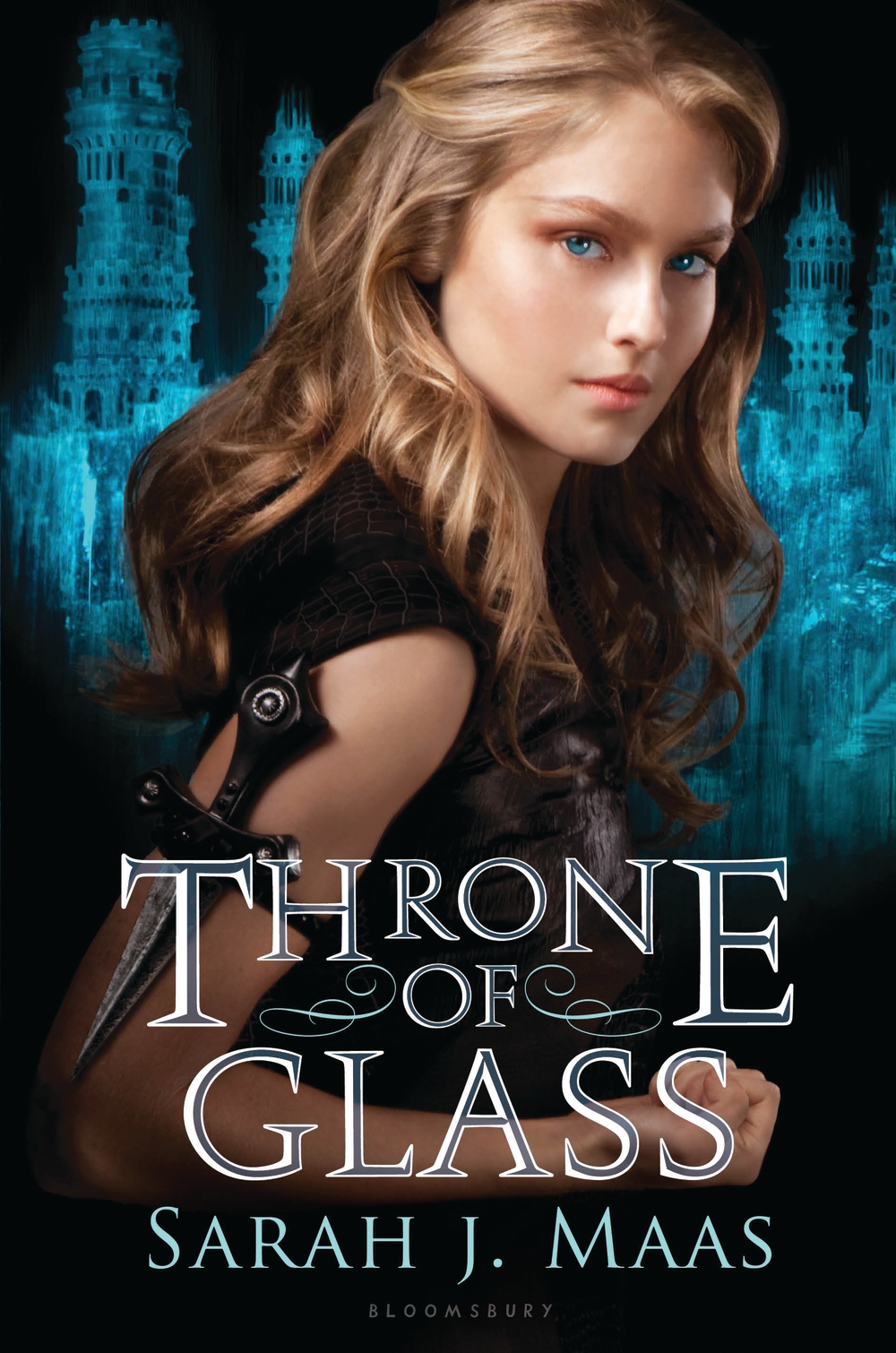
- Throne of Glass author Sarah J. Maas◊ bears an uncanny resemblance to the heroine of the series depicted on the book cover◊ of the hardcover version.
- In the first Heralds of Valdemar book, Talia is daydreaming about being a Herald that accompanied Vanyel at his final stand. Also, the character of Herald-Chronicler Myste is an Author Avatar of Mercedes Lackey.
- In a variant, The Travels of Marco Polo has a bit where Marco Polo inserts himself and his family into the history of the Battle of Xiangyang (which actually happened before his arrival into China), claiming to have been responsible for the Mongols' victory by teaching them how to build catapults.
- George Arthur Rose, the Englishman who becomes Pope in Frederick William Rolfe's Hadrian the Seventh, is an obvious stand-in for the author. Lampshaded by Peter Luke's 1968 theatrical adaptation, in which the entire plot is Rolfe's dream.
- In Tara Duncan, the title character shares some similarities with her author, Sophie Audouin-Mamikonian. Notably physically (both blond and dark-eyed) and also in terms of ancestry. The author is related to the Mamikonian family, which reigned on Armenia, but more than 12 centuries ago; and it's a Republic nowadays. Improved in the books, this detail becomes Tara being an imperial princess, and the direct heir to a throne.
- Thomas Lang, the main character of Hugh Laurie's The Gun Seller, is a 6'3'' Englishman who rides a motorcycle. In other words, it's Hugh Laurie.
- Sarah Pinsker's award-nominated novella, And Then There Were (N-One), carries this to the extreme - every character is an Alternate Self version of the author from a different timeline.
- Forest Kingdom: In-Universe, as revealed in the Hawk & Fisher spinoff series' book 2 (Winner Takes All), one minor character is a self-promoting mercenary named Joshua Kincaid who writes loads of over-the-top adventure stories about his own "incredibly heroic deeds", then publishes them as mass-market chapbooks under a pseudonym.


- No less a luminary than David Gerrold originally wrote the famous "The Trouble with Tribbles" episode of Star Trek to feature a young ensign that he saw as a self-surrogate, and did something similar in his novel The Galactic Whirlpool. The former was an attempt at literal self-insertion, since Gerrold, an amateur actor, wrote the character of Ensign Freeman in hopes of getting to play the role himself. The role instead went to Paul Baxley, William Shatner's stand-in (which is why O'Brien mistook Freeman for Kirk in Deep Space Nine: "Trials and Tribble-ations"). But Gerrold did get to appear as a background crewman in "Tribble-ations."
- The foreword to the Doctor Who 2009 Specials box set is, in fact, a short story by David Tennant wherein he goes back in time thirty years to tell his eight-year-old self that he will play the Doctor someday. In other words, it's a double-self-insert RPF. (And yes, it's adorably geeky.)
- The Torchwood episode "Adam" acts as a parody of this trope, where the Monster of the Week writes himself into Torchwood Three and alters everyone else's memory to think he'd been there for two years. He also rewrites their personalities - Tosh becomes his girlfriend, Owen becomes a shy geek with a crush on Tosh, and Ianto becomes a serial killer.
- Margaret Thatcher once wrote a skit for Yes, Minister, in which she played the part of the Prime Minister. The piece is actually quite amusing, and did air on the BBC.
- Melina Kanakaredes (Stella Bonasera) wrote a fifth season episode of CSI: NY and turned her character into a forensics MacGyver.
- Charlie Brooker likes to write in sneering, cynical Only Sane Man-type characters who resemble himself. In Nathan Barley the character of Dan Ashcroft qualified, and in Dead Set it was the Big Brother producer, Patrick.
- Although both of these are also clearly shown to be enormous bastards, so what this says about Brooker's opinion of himself is open to discussion.
- In the Buffy the Vampire Slayer episode "Superstar", Johnathan "Short Idiot" Levinson uses demonic powers to alter reality into a painfully-bad Self-Insert Fic, complete with the Scooby Gang following him around like stunned guppies. It even includes a bit of Twin Threesome Fantasy for good measure.
- The Big Bang Theory:
- Penny was introduced as a struggling actress who took a job at the Cheesecake Factory while waiting for her big break, and also wrote her own screenplay about a struggling actress who takes a job as a waitress while waiting for her big break. When Leonard, attempting to flirt, compliments her for drawing from her own experiences, she states it's different, because the fictional version is from a different state.
- Sheldon wrote a Star Trek fanfic when he was a kid, about how a little kid from Texas is taken away by Mr. Spock to join the crew of the Enterprise.
- Amy wrote a Little House on the Prairie fanfic about a young woman called Amelia in the 1800's and her Time-Travel Romance with a physicist from the future called Cooper.
- This is the basic gimmick of Secret Girlfriend. The main protagonist is you. He's never referred to by name and never says anything out loud, but all of his friends adore "you." All of the jokes (which you're basically supposed to insert) are hilarious. All of the girls want you and you end up with most of them. You would probably feel awesome if not for your two friends being total idiots and your ex-girlfriend being a Yandere.
- Ryan Murphy has a history of creating characters for him to function as Author Avatars, but he has finally come to this with The New Normal where the character of Ryan is a successful creator and showrunner of a teen musical show called 'Sing!', has a loving, hunky, manly boyfriend and the only character who hates him is a homophobe.
- The My Name Is Earl episode "Creative Writing" has the main cast writing self-insert stories. Most of them blatant self-inserts (complete with superpowers and ninja); one writes a soap opera, and another writes a musical number.
- Parodied extensively in the British comedy show Garth Marenghi's Darkplace. The show is based on the premise that Garth Marenghi wrote and starred in a 80s low-budget hospital-based horror show. Many jokes are based on the idea that Garth Marenghi not only wrote the series, but also plays the central role in the show. As such, his own character — Doctor Rick Dagless, M.D. — exhibits outrageously unrealistic traits.
- An in-universe example in Xena: Warrior Princess has Gabrielle writing about herself when Xena says she's tired of being written about. Gabrielle then turns herself into a self-insert. Whereupon Aphrodite enchants the scroll...
- Young Sheldon: In "Passion's Harvest and a Sheldocracy", inspired by Connie's romance novel, Mary writes her own, with the main character, Marie, obviously based on herself.
- Tom Petty's music video "Running Down A Dream" is technically a self-insert into Little Nemo. (And an homage, of course.)
- Self-Insert is a band that uses masks and heavy voice changing effects to make all of their music a kind of self-insert.
- 50 Cent: Bulletproof and its sequel 50 Cent: Blood on the Sand. According to The Other Wiki, when asked to do the voice for the main character of Grand Theft Auto: San Andreas, 50 Cent replied that he would only voice himself in a video game. So these little self-insert adventures were developed for him.
- Blue Archive: Sensei, the protagonist, has no actual appearance in-game, so many players have to design their own appearances for Sensei.
- This trope is literally invoked in the Kingdom Hearts series with the 100 Acre Wood. Thanks to the magical nature of the book (it sucks the reader from the "real" world into the story), restoring the Pages (and thereby reconstructing the world) and interacting with the characters, allows Sora to (inadvertently) rewrite the plot of Winnie the Pooh to include himself as a prominent character (replacing Christoper Robin). When you lock the world's keyhole, it even includes him on the cover with the rest of the characters.
- The franchise has also made a pair of deconstructions on both this premise and the two tropes most commonly used with them. Their names are Naminé and Xion.
- In-universe example: The fifth arc of Umineko: When They Cry is largely a Self-Insert Fic written by the main villains, one of whose Author Avatar hijacks the story from the usual protagonists and proceeds to wreak havoc on the plot and characters.
- Accidentally happened in Metal Gear Solid, when Shinkawa designed Otacon to look like Hideo Kojima, and Kojima ran with it and based Otacon's personality off his own as well. While Otacon is one of the most heroic characters and ends up having sex with Naomi, a character Kojima based on his ideal woman, the amount of abuse Kojima piled on him easily overwhelms all this and makes him look kind of pathetic.
- Hideo Kojima also appears as himself as a bonus agent in Metal Gear Solid: Peace Walker - while he has no skills in combat and poor ability in food tech, he's decent at R&D and has S-Rank skills in medicine and intel. Ground Zeroes also has a mission where the end goal is to rescue him.
- Metal Gear Solid V: The Phantom Pain encourages the player to view Venom Snake in this way. He's given the relatively clean slate of waking from a coma, he speaks very rarely in order for the player to project their own personality onto him, and the player is even given a character creation screen in order to design an alternative face for him, meaning that he can look like the player as well should they choose. The ending reveals that this was done deliberately, as he isn't the original Big Boss. He really is a stand-in for the player, and he even comes with a backstory of being a minor character who just happens to be great friends with Big Boss. Symbolically, his nature as a self-insert is meant to highlight the player's role in crafting Big Boss' legend, making him into the well-respected soldier he is by the time the original Metal Gear happened.
- Sakupen in Dadgame is probably a parody of this played for laughs (his power is really over the top, plus he runs away screaming when first engaged) which does not stop him from being atrociously hard.
- The Lord of the Rings: The Third Age's story is about a group of people who act like a shadow to the original Fellowship of the Ring. They go to the same places and witness simillar events in the movie. They even help the original team fight off Balrog and the monster army in Helm's Deep.
- The entire plot of Touhou Pocket Wars Evolution is that of the player (a slightly obsessed Touhou fan) going to Gensokyo.
- The Alien Crossfire expansion to Sid Meier's Alpha Centauri includes a faction editor. You can use it to add a pre-created faction into the game called the Firaxians with either Sid Meier or Brian Reynolds.
- In the XCOM: Enemy Unknown remake, entering Sid Meier's (or one of the members of the design team's) name as a soldier grants you a maxed-out soldier, although the game considers it a cheat and disables Achievements.
- The Sultry Argonian Bard (introduced in Skyrim) is a gender-flipped version of The Lusty Argonian Maid (introduced in Morrowind, over two hundred years earlier). The name of the female character is the same as the author's (the author of Maid at least bothered to slightly modify his name).
- The Visual Novel/strategy game Game of Thrones: Ascent, with the Player Character as a new Feudal Overlord in Westeros, who is sworn to one of the 9 great houses.
- The Citadel DLC of Mass Effect 3 includes a Self-Insert Fic written and narrated by Mordin Solus. Said fic is a frankly silly (considering Mordin's advanced science degrees) take on a Film Noir, pairing himself as hard-boiled detective and Aria T'Loak, the unofficial ruler of Omega Station, as the Femme Fatale.
- "Had broken Omega's one rule...in more ways than one."note
- In Saints Row IV, cyber-nerd Matt Miller's loyalty mission is to accompany him on what he describes as a top-notch virtual reality training scenario in which you help a vigilante defeat a nefarious villain. It quickly becomes clear that you've actually been dragged into his Nyte Blayde "expanded universe fiction", casting him as the titular vampire hunter's apprentice. Matt's Squee soon turns to dismay when Zinyak hijacks the simulation and turns his beloved hero against him. By the end of it all, the Boss has been converted into a fan of the show, and uses his/her authority as sole remaining world leader to bestow all rights to the franchise onto Matt.
- A number of Yu-Gi-Oh! video games boil down to this, as they would be a retelling of one part of the anime story but with your player character inserted into the role of protagonist and facing off against all the important opponents.
- Yu-Gi-Oh! The Sacred Cards: The player character goes through the Battle City tournament arc of the manga and anime and takes on both Yugi and Joey's roles in the plot, while said characters, while still around, are Demoted to Extra side characters.
- Yu-Gi-Oh! GX: Spirit Caller retells the first season and part of the second season with the player in the protagonist role, stopping shortly after the introduction of Aster and Zane.
- The Story Modes World Championship 2009 to 2011 adapt different arcs of Yu-Gi-Oh! 5Ds. 2009: Stardust Accelerator retells the first arc of 5D's up till the conclusion of the Fortune Cup. 2010: Reverse of Arcadia starts off in parallel with the Fortune Cup finals with the player as a spectator to that climactic event, but eventually intertwines with the Dark Signer arc. 2011: Over the Nexus double-subverts this by starting the player off as their own character in Crash Town with their own group of friends, but halfway through the WRGP arc they get involved with Team 5D's and enter the anime protagonist role.
- One lore entry in Destiny 2 is a delightfully terrible community play put on in the Tower by Marcus Ren and his Ghost, Didi. It’s a dramatization of the Taken War from the first game, but with your character written out and replaced by blatant Self-Inserts for Marcus and Didi. Zavala describes it as one of the most offensive things he’s ever seen, your Ghost is horrified by how he’s portrayed, and Shaxx wonders why the dialogue is weirdly sexual.
- Blossom Tales: The Sleeping King: A minor in-universe example. Consistent with the Story Within a Story Framing Device the game uses, you have the choice of naming the heroine after one of two grandchildren. Moreover, the heroine has few character traits of her own, thus allowing the children to imagine themselves in her place.
- Guild Wars 2 has an in-universe writer of romance novels named Snargle Goldclaw, whose works range from bizarre interspecies relationships to thinly-veiled Real-Person Fic to not-at-all-veiled Real-Person Fic. There's a Collection Sidequest to find all of his novels, and the reward for completing it is his newest work, Commander of Your Heart, which pairs the reader with... the Player Character.
- Undertale: Local Royal Scientist and otaku Alphys wanted to enact this with herself acting as the cool Mission Control for the Human Child, hoping to convince them to stay additionally out of fear that they'll kill Asgore to leave the Underground due to how the Barrier works. She even has her creation and best friend Mettaton play the local antagonist so Alphys can swoop in and save the Human. However, he gets sick of this and derails her plans during the CORE exploration for his own ideals.
- In the Omega Ending of BAD END THEATER, it is revealed that TRAGEDY, the theater's owner, wrote the story as a metaphor for her own failed love life, casting herself as the Maiden and her girlfriend as the Overlord. Given TRAGEDY's obsession with bad endings, it makes sense why she would cast herself as the unluckiest character in the story.
- One Basic Instructions strip reveals that Rick had crossed out Harry Potter's name in his first-edition copies of the series and wrote his own in its place.
- El Goonish Shive: Ashley writes embarrassing self-insert fetish fics in her spare time, oftentimes imagining herself as a powerful sorceress inflicting Karmic Transformations on misogynists and other jerks. One NP arc was about her trying to write a story without making it a self-insert... and failing miserably.
- In Housepets!, Grape inserts herself into fanfiction for the in-world Fictional Document Pridelands.
- Least I Could Do has Rayne Summers write a book, apparently with him as the protagonist, if the visual representation is supposed to be contextual. As a possible subversion to the standard tendencies of such a thing, the text of the book says "Though he began with the best of intentions, ultimate power did what is always had. It corrupts." in reference to his character as a joke to how he hates Apple Inc. Also, he apparently tries to conquer the world in it.
- Da Amazin OT Advenchr:
- All of the main characters, from the ROBLOX Off-Topic posters to the tOLPers, exist in real life.
- Even in Appisote 18, Liteslayer kills himself since Deine and him decide that they have to kill the creator of DAOA (Liteslayer) in order to stop it from �evolving�.
- Survival of the Fittest has had a fair number of self-inserts over the course of four versions. Usually they're not frowned upon, as long as they're treated realistically and don't stretch the Willing Suspension of Disbelief. And other times characters based off of people the handler knows show up too.
- Since the day the Draw Your Own Story comics began on the CivFanatics forums, most of the characters were more or less Sueish self-inserts (often represented by the user's avatar).
- Emily H The Viking Princess is possibly one; the author's screen name is "emilyh96".
- SCP Foundation
- SCP-423 is literally named "Self-Inserting Character," a non-corporeal entity named "Fred" who can add itself as a minor character into stories printed on paper. Normally the character plays a background role, never very important or causing changes to the story. However, it was noted that when placed inside its own SCP article, the only thing that changed was the addition of "ruggedly handsome" at several points.
- SCP-2786, "The Archetype", is an entity that goes through copies of fiction (ex. The Shining, House of Leaves, Amnesia: The Dark Descent) to resolve the conflicts sooner than originally. As far as he knows, he's just a dimension-hopping hero... until, by being in the SCP Foundation Mythos, he realizes his existence is fictional as he is trapped in his own article.
- SCP-423
- Karmi from Big Hero 6: The Series made a series of fics where she became Hiro (er, "Captain Cutie")'s girlfriend, and the show implied some of the fics were smutty in nature, with Hiro commenting that some of the things they did in her stories were impossible. The episode was titled "Fan Friction".
- The Simpsons: Marge practically inserted herself into her own novel, but she didn't stop there, she more or less inserted the entire residency of Springfield into the story. Initially she writes Homer's character as a noble, loving husband, but when the real Homer commits a brazen display of Jerkass-edness, Marge angrily rewrites his character to match. The real conflict comes when Marge has her protagonist fall for Ned Flanders' character, making everyone in Springfield suspect that Marge had fallen for Flanders. When Homer actually got around to reading it, he went after Flanders... not to kill him (unlike the novel), but to ask him for advice on how to be a better husband. As for the novel, it got terrible reviews but sold well enough for every person in town to have a copy of it and the Olsen twins even recorded a dramatic reading.
- Brainiac 5 of Legion of Super Heroes (2006) places himself into one of these where he dies in Superman's arms after saving his life.
- An episode of Samurai Jack had Aku tell fairy tales to the children of earth in hope of showing them his side of things and making them more obedient minions when they grow up. This eventually ended up with him turning every protagonist into himself (WITH GREAT FLAAAAAMING EYEBROWS!) and every antagonist into Jack.
- In the Futurama episode "Where No Fan Has Gone Before", the entity known as Melllvar has written a script for an episode of Star Trek: The Original Series, where he saves the crew of the Enterprise, and has Uhura tell him how attractive he is. He then holds the cast prisoner, and forces them to act it out.
Koenig: (as Chekov, monotone) Look, Keptin, it is Melllvar. I wope he will welp our vessel.
Mellvar: (angrily) "WESSEL"! You're not acting hard enough! - In the My Little Pony: Friendship Is Magic episode "Spike at Your Service", Rainbow Dash claims to be writing a novel about an "awesome Pegasus who's the best flyer ever and becomes the captain of the Wonderbolts!" Rarity is quick to point out that Dash may be basing the plotline on her own aspirations.
- This is most likely the purpose of the Enchanted Comic Book from Power Ponies: it lets (or rather forces) you to live out an adventure in the shoes of your favorite super hero. Either this or whoever created it is just a jackass.
- The bio for infamous and not entirely stable fan Raksha's Transformers character Nightracer is essentially a combination self-insert, having insane gun skills (that should single-handedly win the war from a distance) and Self-Insert Fic, described as being rabidly and blindly supportive of Megatron, while simultaneously dismissive of even those on her own team. The character has canon standing due to its exclusive toy and fictional use during the early "wild west" days of BotCon.
- The reboot of The Powerpuff Girls (1998) has Jared Shapiro, a.k.a. writer Jake Goldman. Jared only appears in episodes where Goldman is writing and in almost all episodes he appears in, he is Blossom's love interest.
- Debunked a bit, he wasn't the one who put himself in there, his friends just designed the character like him as a joke and nothing more. Everything else about the character is not based on him and he certainly wasn't the one who made the character Blossom's love interest.
- In the DuckTales (2017) episode "Friendship Hates Magic!", Launchpad shows Beakley a fan script he made for a hypothetical finale for Darkwing Duck, as the show was Cut Short before it aired. Said script features himself as a character who helps Darkwing out.note
- In the Steven Universe: Future episode "In Dreams", Steven tries to help Peridot fix the story of the Camp Pining Hearts reboot by collaborating with her to write their own version of the show, dreaming about it, and using his powers to project those dreams onto his TV. The first thing he does is add a new character... a buff adult version of himself named "Stefan" who's very popular and whose friends are always happy to accept his help.
- Happens in Arthur during the episode, "I'd Rather Read it Myself", when D.W. tries to impress the Tibble Twins by reading them a story. However, since she's unable to read, she ends up making up an entire story about B.W., "a princess, a genius, and a cool person who was too polite to brag." The story is mainly just a compilation of certain episodes that featured D.W. as the focal character, told in an exaggerated action-packed superhero manner. The Tibbles never seem to catch on, and are even enthralled by the story she tells to the point of begging her to let them borrow the book she pretends to read. Even when their grandmother reads the actual story in the book, they merely come to the conclusion that the book itself is magic, and tells a different story every time it's opened.
D.W.: These are the adventures of a smart, great, perfect girl named... B.W.
Tommy: Hey, that's close! If it was D.W., I'd think you were making this up! - Molly of Denali: In "Home Made Heroes," Molly and Tooey's comic characters are obviously self-inserts of themselves.
Meta Examples
- The fic Martian Manhunter turns the concept of the Self-Insert Fic on its ear, along with the Fusion Fic. Veronica Mars finds herself, along with her supporting cast and backstory, shoehorned into her favorite TV show, Buffy the Vampire Slayer. It plays out as a self-insert fic, and yet it isn't.
- Similarly, Ma Vie Et Roses by Scott Johnson and Scott Jamison subverts and plays with Self Insertion. In this Revolutionary Girl Utena fic, an anime fan finds himself shoved into a show he's barely even heard of. One of the authors, who was genuinely unfamiliar with the series at the time, wrote the actions of the pseudo-Author Avatar Skyler Sands, while the other wrote the rest of the fic around him. Acting out of true ignorance, Skyler manages to thread his way through the main action while still ranging far afield (such as ending up joining the Shadow Girls' avante-garde theatre group). Skyler is very Genre Savvy, which helps (but not enough), and eventually ends up speculating on the existence and motives of the "meta-Skyler" who put him in the story.
- Self-Extraction: a "charming little tale of the people who write themselves in, and the people who shoot them back out", written round-robin by a half-dozen or so authors. Initially played for laughs but gets more serious toward the incomplete ending.
- The Wild Horse Thesis has Ranma Saotome inserted via magic spell into the shoes of Shinji Ikari of Neon Genesis Evangelion by Gosunkugi in the hopes of getting rid of him. Unfortunately for the caster, Ranma uses his situation to his advantage, and proceeds to wreak havoc on Gendo's plans for to change the ending of the anime for the better. One of the better examples on this page, it was good enough to earn a place on the Fan Fic Recommendations listing.
- In the Mass Effect fanfic Project Gethinator, it's mentioned that Admiral Daro'Xen, who is Yandere for Shepard in a big way, has written quite a few self-insert Real Person Fics involving herself and Shepard. According to those who know of them, they're quite sick and depraved, second only to what Prazza did in Fornax's Forbidden Issue, and illustrate quite nicely how completely fucked up Admiral Xen is.
- Discussed in the TRON fanfic A whole new world where the game Tron 2.0 is presented as a creation of Encom employee Jet Bradley. Clu implies that the only reason for that game to exist is that Jet wanted to make a Self-Insert Fic with himself as the protagonist.
- Done in a cute manner in the Friendship is Magic Fanfic Cadance of Cloudsdale. As Princess Cadance tells a young Twilight Sparkle a bedtime story, the subject of her tale is a young princess who was taken in by her aunt princess after her kingdom disappeared, and is sad with her situation but is happy when she gets to foalsit a wonderful filly. Even as a filly, Twilight knows who the princess actually is.
- Hivefled has the young trolls posting to ConscriptionFiction.com, a site for really bad real-person fic about themselves and their teachers. Ganmed Lomust posts fic about his "Mayree Tseouh" hanging out with the Grand Highblood, and Lieutenant Gritch contributes to the round-robin fic his students write about killing him horribly; nobody's sure if he's trying to be funny or trying to make them stop.
- In the Steven Universe fanfic ''Peridot's Super Stupendous Fanfiction,' Peridot writes an Alternate Universe Fic of Camp Pining Hearts starring herself and various people she knows. Connie reads it and asks if it's supposed to be stupid.
- In the Skyhold Academy Yearbook series, I Must Be Going manages to be both this trope and an Intercontinuity Crossover. It's a crossover from the reader's point of view, being a merging of Dragon Age: Inquisition and The Princess Bride. However, it's a Story Within a Story, written and narrated by Varric Tethras; and to the people listening to him read it, it's a Self-Insert Fic because they're the ones in it.
- Twilight Sparkle's Secret Shipfic Folder: A game about Shipping fics. "Self-Insertion", referring to a this trope, where the flavor text is an example, and at the end, referrencing the possible narcissistic possibilities of their writer:
The rift shimmered like a glittering ocean, but Twilight's other self shone like a gorgeous, awe-inspiring star, causing Twilight Prime's breath to catch and her heart to stop. - Narcissism? Ha!
- In Ultra Fast Pony, Pinkie Pie writes a The Lord of the Rings fanfic in which "the brave and sexy Pinkie" joins the Fellowship of the Ring, and later winds up in a love triangle with Bill the pony and Shadowfax.
- Since TVTome Adventures is based off of an RP that took place on the TvTome forums, it makes sense that a lot of the characters are self-insertions. Perhaps the most notable is Kirbopher 15, who is based on Chris Niosi, the creator of the series. This character is notable because it was still an obvious self-insertion in the remake, while the other characters were adapted and have different voice actors.
- Emergence inverts the formula, with Team RWBY thrust into the real world.
- The aptly-titled animation, Self Insert by YouTube user hikaboom celebrates the Self-Insert Fic, the "Mary Sue" character archetype, and everything in between, in all its cheesy glory.
- The Irregular Webcomic! character Will Shakespeare, based loosely on the playwright, wrote himself into his Harry Potter fanfic. And later into his novelization of the The Lord of the Rings movies, as Willimir.
- minus. has a rather dark take on this trope starting in this strip, that also serves as a deconstruction of Trapped in TV Land. For some reason, minus brings a random boy into a book, and, like with most Self-Insert characters, the boy makes himself into a God Mode Stu, playing both the story's hero and villain like a violin without regard for the sake of the world. It's all fun and games until he realizes that he can't return to his own world, at which point he goes somersaulting over the Despair Event Horizon and is implied to destroy the world and everyone in it, including himself.
- The Girl Genius side story Fan Fiction has a character telling a Heterodyne Boys story to her younger siblings and modifying it to include a Mary Sue version of herself as the Heterodyne Boys' companion. At the end her mother tells her that she used to do the same thing when she was younger.
- The Call of Warr: "Undercover Soldier" is one for Gravesite. He plays the main character, who even shares his first name.
- Anna Leonowens (the "I" in The King and I) exaggerated her role and influence at the court of the king of Siam, though not to the extremes her erstwhile "biographers" did in the works based on her own.
- It's said that creating characters involves taking a part of your personality, exaggerating it, and letting it become its own person, so as to make a realistic character. If that is true, then most characters would at least be partly this.
