

Nameless One: What evil wizard are you talking about?
Low Threat Construct: Uh...the one that doesn't exist until you set the Rubikon Dungeon construct to *hard* difficulty level. Boy, will you be in trouble then.
Easy Mode Mockery is where the game radically changes when you play on easier difficulties. There are two ways to go about this:
The Serious Way: You cannot unlock extra gameplay modes or features on the easier difficulties. The game may also end early or not give you the best ending. This is to prevent you from just unlocking all the extras on the easiest levels and then ignoring the main game.
The Humiliating Way: The game turns ridiculous in one way or another on easy difficulties. For example, all the enemies turn Super-Deformed and your weapon becomes a broomstick.
Now a lot of these "mocking" endings are worth seeing at least once, and in a few cases (most notably Guitar Hero 2 and Rocks The 80s), you actually get rewards from the easiest difficulty you can't get any other way.
Has become somewhat of a Discredited Trope, as certain players (especially those with disabilities) generally don’t appreciate a game making fun of them for something that is entirely out of their control. The increasing number of game developers acknowledging that there are gamers who are unable to play on harder difficulty settings, along with the desire to appeal to more casual gamers, has reduced the number of recent examples.
Attempts to mitigate this trope vary from not having an easy difficulty altogether, giving various gameplay mechanics to ease the player before the inevitable Difficulty Spike, or instead of locking story or stage, just add score multipliers, or achievements and unlockable wearables exclusive to the completion of the harder difficulties.
Related to Idiosyncratic Difficulty Levels, where the names of the easy modes often contain taunts. Another related trope is Hints Are for Losers, which is when the game mocks or penalizes the player for trying to use hints. Compare No Fair Cheating, where making the game easier through cheats is discouraged. For some cases where Easy Mode Mockery is provided by other players, see "Stop Having Fun" Guys. Subtrope of Earn Your Fun.
Contrast Hard Mode Perks, where the game achieves the same result by rewarding you for choosing harder difficulties.
Games featuring a Story Difficulty Setting frequently avert or even invert this by framing the easiest setting as a perfectly valid way to enjoy the game, though this doesn't always mean this trope isn't present either.
May involve Achievement Mockery as well. Not to be confused with Completion Mockery, which makes fun of you regardless of the difficulty.
Examples:
- The Civilization series gives you a score at the end of the game that compares you to other world leaders. If you play on one of the easier difficulty levels, you are saddled with a horrible ranking like "Warren G. Harding" even if you beat the computer by a country mile. On the other hand, they save the mockery 'til the end, which avoids the problem of driving away newbies before they've become thoroughly hooked.
- In Galactic Civilizations II, a turn-based space strategy game, the AI of computer players is circumscribed on lower difficulties. As an example, on an easy setting, the AI will not react to your assembling an invasion fleet directly next to one of their planets. It will, however, pop up the diplomacy screen and tell you he knows what you're doing — it's simply that his generals are too stupid to take appropriate action.note In fact, the Yor, even Lean on the Fourth Wall a bit, by mentioning that their generals are "set" to an intelligence level below what's needed, and even name the needed setting.
- Samurai Jack: Battle Through Time: There is no reward for beating the game on the easiest difficulty, Jack. The medium difficulty "Samurai" unlocks costumes and missions and the hard "Master Samurai" difficulty unlocks "endless" survival missions and the extra-hard Master of Masters difficulty.
- Spider-Man:
- Spider-Man on the PlayStation has a Kid Mode (or the "Easy mode that's so easy it's no fun" mode). The Official New Zealand Playstation Magazine issue #40 page 102 gives this lovely gem:
Fight like a Baby — Kid Mode is a quick way to ruin the game. Avoid it. It bypasses several of the puzzles and trickier bits and it will even complete parts of the game for you.
Honest to god in the beginning of the game when you foil a bank robbery, the bank robbers set a bomb. After you take them out you have to solve the problem of how to keep the bomb from destroying the bank. On Easy, Spider-Man says "I need to put this bomb in a safe place". He really emphasized "safe". Guess where you're supposed to put the bomb. - Similarly, the Sega Genesis Spider-Man will stop you at certain points if you don't play on Nightmare, the highest difficulty.
- Spider-Man on the PlayStation has a Kid Mode (or the "Easy mode that's so easy it's no fun" mode). The Official New Zealand Playstation Magazine issue #40 page 102 gives this lovely gem:
- You can only get the best ending in Superman 64 by beating it on the hardest difficulty. Playing the game on Easy Mode will remove the (infamous) rings from the Ride stages, but in doing so, the game will end before the second-to-last action stage. Likewise, Normal mode will end before the last stage. However, by abusing the "Last Game" menu feature, it is possible to switch to a higher difficulty and continue from where you left off.
- After you die five or six times, Ninja Gaiden Black offers you the "Ninja Dog" difficulty, which forces you to wear a girly purple ribbon and mocks you in the opening cutscene if accepted. And Ayane will insult you throughout the game when she helps, as well as the aforementioned cutscene.
- Devil May Cry:
- In the original Devil May Cry, if you use a Vital Star or Yellow Orb anytime during the first three missions, or die three times, you are offered Easy Automatic Mode. Choosing this mode locks you into this difficulty, you cannot unlock anything other than New Game Plus, and even then you're stuck in the Easy Automatic difficulty on your subsequent playthroughs for that file. The only way to get out of it is to start an entirely new save file. You also miss out on fighting some monsters, as Shadows, Frosts, and Fetishes don't spawn in Easy Automatic Mode.
- The same thing happens in Devil May Cry 3: Dante's Awakening. Penny Arcade inevitably noticed this, and did a little mockery of their own.
 Easy mode is now selectable.
- Bayonetta and its sequel, from the same company, take this a little more seriously. Playing on Easy Mode (1st Climax in Bayo 2) will provide access to the Immortal Marionette, an accessory equipped to a separate slot from the rest of the accessories, which automatically and randomly triggers combo patterns. The only unlock for completing this difficulty is the ability to purchase the Immortal Marionette for use on higher difficulties (and in Bayo 2, the "handgun" weapons used in the tutorial). In Bayo 1, Easy Mode also doubled the base health and magic levels in exchange for preventing access to Broken Witch Hearts and Moon Pearls, forcing the player to fork over their money for the purchasable unlocks if they wanted to improve their stats.
- The Onimusha series offers Easy Mode after three deaths.
- Star Fox 64: If you take the "easy" route (going to Venom from Bolse instead of Area 6) and kill the Andross-bot at the end of the game, the Great Fox flies off into the cloudy sunset... which promptly morphs into Andross's cackling face.
- In the Demolition Man 3DO game, choosing Easy mode causes Sylvester Stallone to literally mock you, saying "You...suck!"
- The first X-Men (1993) game for the Sega Genesis ends halfway through on 'Amateur' Mode (the easiest difficulty level) with a closeup of Magneto's sneering face and the text, "Amateurs can never defeat me! Try being a hero!" scrolling by. Now remember that this was considered to be one of the hardest games released for that system.
- Contra series:
- Contra 4 not only ends at stage 7 on Easy mode but outright taunts you, telling you that you'll never see the ending on Easy. With that exact wording! You do, however, still get to unlock Challenge Mode. This is a good thing, because some of the challenges give you glimpses of the final stage, so you can practice a bit before you get to the real thing. Beating Normal mode in one shot is more than difficult enough without the added challenge of playing a level you've never seen before.
- Contra III: The Alien Wars will only let you fight the True Final Boss on the hardest setting. The Easy and Normal mode will stop after the Final Boss reveals it is Not Quite Dead and you get a message telling you to play on the next difficulty level and are promptly booted to Stage 1. However, you do get to retain all your weapons (including your stock of mega bombs), lives, and score from your previous playthrough when you restart on the next setting.
- In Orcs Must Die!, if you decide to play on the easiest difficulty, you will only be able to earn two skulls, the thing you use to upgrade your traps, for finishing a level, instead of a maximum of five on the harder difficulties.
- Castle of Illusion ends after you collect the third gem if you play on easy, with Mizrabel merely giving Minnie back to you. Subverted in that the game doesn't chastise you and instead encourages you to try Normal mode with the promise of "many new and exciting levels".
- In Lollipop Chainsaw, the image for the easiest difficulty setting is... a chicken.
- Get killed enough times in the Xbox 360 Live Arcade game The Dishwasher: Vampire Smile, and you'll unlock an easier mode, humiliatingly titled, "Pretty Princess Difficulty". Enemies rarely attack, have less health, and bleed hearts instead of blood. Some levels also feature pink hearts in the background, further emasculating and ridiculing the player. To add some context, this is a very violent and bloody game, presented only in black and white. The pink hearts are extremely noticeable.
- The first two levels of Shades of Doom are entitled "It's my turn daddy" and "Don't hurt me."
- In the PSN/XBLA game Capcom Arcade Cabinet, all the games have a "Casual Mode", which features extra lives and easier enemy placements, but you cannot earn Achievements/Trophies in this mode.
- The icon for easy mode in Deadpool is Deadpool's face with a pacifier and a tear streaming from one eye. At the same time, in a sly jab at both this trope and the online backlash against this trope in some communities, the actual name of the easy mode is "Genetically Superior".
- Carrie's Order Up! includes "Friendly Mode" that turns you from a One-Hit-Point Wonder to using the Sprint Meter as a form of Regenerating Health. Colliding with customers simply takes a bit away from your Sprint Meter and causes them to vanish in a puff of smoke. Leaving a customer waiting for their food for too long will still cost you a life, though. Of course, playing on this mode means your score isn't tracked and you can't complete challenges.
- Furi has Promenade Mode, which makes the game far easier but also prevents you from unlocking achievements or Furier difficulty. The game also straight-up tells you that this is not the intended difficulty of the game.
- Averted with Hades and God Mode, which gives you +20% Damage Reduction, increasing by +2% every time you die (capping at 80%). The description is completely neutral: "Instantly makes you tougher, more so whenever you die. Death is not a big deal in the underworld. Try this if you find you're struggling, want focus on the story, or any reason." It can also be turned on or off at will. Played straighter if you activate Hell Mode - in addition to stacking mandatory Pacts of Punishment on you, God Mode is locked out.
- Mighty Morphin' Power Rangers on the Sega CD will end on earlier levels when playing on lower difficulties. You can only play the entire game on hard mode. This is puzzling, to say the least, for a game seemingly aimed at the youngest of players.
- Some LucasArts adventure games, such as the Monkey Island series, offer a Lite mode which has fewer puzzles and shorter length. It's really not worth playing these, no matter how bad you are at adventure games, because you aren't getting the full experience: in this case, playing the Easy mode is its own punishment.
- Monkey Island 2: LeChuck's Revenge labels the two modes and gives each a subtitle; Easy mode is "I've never played an adventure game before, I'm scared", and if you choose this mode, most of the puzzles are solved for you, making for a very unsatisfying experience (In addition, the Lite mode was advertised on the back of the game box as being geared towards video game reviewers). The Curse of Monkey Island, by contrast, has regular (Being a Swashbuckling Pirate Adventure) and Mega Monkey (Being a Swashbuckling Pirate Adventure, But with More Puzzles) modes. Regular is a complete and satisfying game experience; Mega Monkey adds puzzles to the normal mode for people looking for a greater challenge.
- The third chapter of The Curse of Monkey Island has an Unexpected Gameplay Change in the form of real-time ship-to-ship combat. The game lets you choose between enjoying the full experience (hard mode) or letting Haggis help you (easy mode), and you can change this setting at any time. However, if you chose hard mode and try to change back to easy mode, Haggis will mock Guybrush for crawling back to him for help, and Guybrush has to beg Haggis for assistance.
- The little-heard-of Super Nintendo Entertainment System version of Bram Stoker's Dracula features this - if you beat it on Easy mode, the game ends with Harker allowing Dracula to escape. Only on Normal or Hard mode will you be able to continue past the 3rd or 4th stage.
- King's Quest VI: Heir Today, Gone Tomorrow has two possible routes to the endgame, a long one and a short one. Taking the short one locks you out of several sidequests and has a much more bittersweet denouement. Cassima even wistfully laments all the things Alexander didn't do because he took the short path.
- Both the NES version of Battletoads and the crossover Beat 'em Up Battletoads and Double Dragon, if you actually managed to beat them, will call you out for taking the easy way if you used the level skip cheat.
Dark Queen: At least we play fair, you cheating cowards! Try again without the warps!
- Among the myriad of side-scrolling brawlers released for Sega Genesis, Cyborg Justice is known as the stingy one. Players can experience the Arcade mode through 5 difficulties; however, "Relaxed" and "Easy" end the playthrough prematurely - at Level 3-3 and 4-3 respectively. Getting to the end is possible on "Normal" mode and above.
- Double Dragon II: The Revenge for the NES gives it to you on this one in the American version. Playing the game on the "Practice" setting only takes you to the third stage, while "Warrior" takes you through the whole game except for the final stage. Fighting the True Final Boss to see the ending can only be achieved by playing the game on "Supreme Master", the hardest of the difficulty settings.
- The Japan-only PC Engine version of Double Dragon II actually has Multiple Endings depending on the difficulty setting. The Easy mode ending is the bad ending where the final boss escapes during the last battle, while the Normal and Hard mode endings are a Segmented Ending. The Normal ending shows the final boss giving his dying speech, but only the Hard ending shows Marian returning to life.
- The Game Boy version of Double Dragon II, a Dolled-Up Installment of a Kunio-kun game, ends after the first four (of ten) stages when played on the Easy setting.
- If you select Easy on God Hand, Gene will mock you by saying, "What? You need me to hold your hand or something?" In the game itself, Easy mode restricts the in-game difficulty meter to the two lowest levels, so players will only earn low rewards on the enemies they kill.
- The Genesis version of Golden Axe has a Beginner mode consists of only three stages, ending the game with a battle against Death Adder Jr., a weaker version of the real Death Adder. Downplayed, in that after defeating the last boss in Beginner mode, the game encourages you to try Arcade mode, or return to Beginner mode to train more.
- In Kamen Rider for the Super Famicom, the game ends before the final level if you're playing it on easy mode.
- Kung Fu Chivalry's Easy mode ends after defeating the fourth boss, with the message "The game of easy level stops here. Choose a standard or advanced game to play."
- River City Girls Zero: Playing through the game on easy mode will have Sabu dismissing the heroes, calling them pathetic for choosing the easy route. He orders them to come back once he knows they can take him on and gives them a password that sends them back to a previous level, with the difficulty set on normal.
- In the first Sailor Moon (1993) game for the Super Famicom, a sidescroller released only in Japan and France, you can only complete the first two levels in easy mode before the game ends. However, a special version of the easy mode can be used to complete the full game...but you won't see the full version of the kiss scene.
- The easy mode of Mystical Fighter ends the game prematurely at the fifth stage. With this friendly message on a black screen:
CONGRATULATIONS!
BUT THIS IS NOT THE TRUE ENDING
FIND THE REAL DARKSIDE KABUKIMASTER - Shaq Fu: A Legend Reborn will outright tell you to have some self-respect in its easy difficulty selection.
- Playing on Charming difficulty in Shrek the Third heavily increases damage dealt to enemies while reducing damage taken just as much, but in order to even unlock the setting to use you have to pay a whopping 15,000 coins in the gift shop and you suffer a heavy coin reduction while it's active. It's also Prince Charming's favourite difficulty and the icon on the shop shows him with a goofy propeller hat on, implying you're about as weak as him for relying on it.
- Streets of Rage:
- Streets of Rage 3 on Easy difficulty in the International version will end after defeating Robot X on stage 5 (the game has 7 stages), who will say, "You play this game like a beginner." This is just plain mean, as the International version bumped up the difficulty, with Normal being the equivalent of Hard in the original Japanese version. In other words: you get punished for playing on Japanese Normal.
- Streets of Rage 4 allows you to use assist modifiers when starting a stage, such as giving yourself more lives or more stars, as a tradeoff for the game not allowing continues in the middle of a stage. However, doing so applies a divisor to your score at the end of the stage. Note that points in this game are also used for Unlockable Content.
- In the SNES version of Teenage Mutant Ninja Turtles: Turtles in Time, the ending on Easy or Normal mode merely consists of Splinter telling you to hone your skills more, followed by Shredder laughing at you before resulting in Game Over. In true Konami fashion at the time, you have to beat it on Hard mode to see the real ending.
- In the Game Boy Advance version of the first Teenage Mutant Ninja Turtles (2003) game, you wouldn't able to access the final stages that take place in the Foot Headquarters building and the Turtles' final battle with Shredder in the game if you play Easy Mode.
- In Yu-Gi-Oh!: Stairway to the Destined Duel, if you lose 5 times in a row, you unlock Mokuba as a duelist, and he's laughably easy. Your starter deck is usually pretty bad, so unless you buy the real-life cards or look the codes up on the internet and enter them, you will lose. A lot.
- Twisted Metal 2: When played on Easy, the game ends just after the first boss with a big stop sign featuring the message "No losers allowed beyond this point".
- Rock n' Roll Racing limits what planets you could race on (and thus what cars you have access to), depending on the difficulty setting. The last planet is only playable on the highest setting, and to make it more challenging, the tracks from it aren't available in the practice mode (where you can choose the planet you want to race on.)
- Fatal Racing:
- The number of laps on a race is difficulty-dependent. Girlie mode has this below 5 laps for all of the first two cups. Two problems come from this: first, the AI is NOT restricted by the acceleration and braking stats of the car they drive (which means the slowest car can pass you from 16th place on the first lap), and second, the 8th course of the first two cups is nigh-unwinnable on Girlie mode, and most of the other tracks are difficult to get decent placement on, requiring a near-perfect performance on all 8 tracks in championship mode to win. The final slap in the face? The third cup is only unlockable on Impossible or DEATH difficulties - by clearing BOTH cups before it on that difficulty!
- On Girlie mode you just have to pick a fast car and overtake everyone, much like a traditional arcade racer; damage is largely irrelevant. On Impossible and DEATH, due to races that last well over 15 laps and the lack of ways to actually outrace opponents when the track is not favourable to your chosen car, the only way to win some of these races is by having a better pitstop strategy, which also forces you to crank up the damage multiplier. In short, the easier difficulties do not prepare you for the real game in any way shape or form.
- WipEout 2097/XL: The first track on the slowest speed setting is actually difficult in a slow ship because you only have slightly over a minute to overtake 11 opponents.
- If you beat Rogue Trip using one of the unlockable vehicles (which are vastly more powerful than the regulars), the AAA representative, who usually gives you a code, tells you, "My grandma could win using a vehicle like that. Try again, this time without using a ringer!"
- Mario Kart:
- Super Mario Kart doesn't allow you to race in the Special Cup on 50cc. You have to play on at least 100cc to see it.
- Mario Kart 7:
- The top screen on the Nintendo 3DS shows Mario demonstrating how fast you'd expect to be going when you select a difficulty level. In 50cc mode, Mario drives really slowly. On top of this, the added beat to the music that plays when you have a big lead in a race doesn't play on the easy setting.
- All of the character unlocks are tied to 150cc and Mirror, the hardest difficulty levels.
- Mario Kart 8 Deluxe: Smart Steering disables the Ultra Mini-Turbo.
- In F-Zero: GP Legend, if you play through the Gold Cup in Grand Prix Mode on Novice difficulty, your last race will be at Red Canyon: Peak Jump. In Standard and Expert difficulty you will instead race in the much harder true final circuitnote , Illusion: Abyss Drop.
- Rage Racer mocks players who use automatic transmission by not having AT on new cars that are Grade 4 or higher; you can only use them in manual transmission.
- Jet Moto's Amateur (easy) difficulty doesn't allow you to unlock any content in season play, and the difficulty is automatically adjusted upwards each time you win a full season, requiring you to play on that difficulty to unlock the next set of tracks. The second game mocks you further with the message "No progression is possible when the difficulty level is less than your skill level".
- Combat Cars: The easy difficulty setting shows a man looking dumb.
- Sega's Indy 500 makes it literally impossible to get first place if you use automatic transmission rather than manual.
- In Akatsuki Blitzkampf Ausf. Achse, choosing the Easy Mode looks the player out of the chosen's character Story Path after the fifth match. Instead of anything similar to an ending, it finishes with a picture of Perfecti, Murakumo and Blitztank and a message that urges the player to play in Normal Mode instead.
- A full playthrough of ARMS's Grand Prix mode consists of 11 stages, with the two final stages being against boss characters Max Brass and Hedlok. Play on a difficulty of 3 or lower and the game ends at Max Brass, your character isn't rewarded with the Champion's Belt, and you do not get a credits scroll or ending image.
- In a related phenomenon, the tutorial for the easier control scheme in BlazBlue: Continuum Shift EXTEND is less the usual tutorial interspersed with insults from Rachel, and more insults from Rachel interspersed with a tutorial.
- The bootleg Famicom game Kart Fighter has No Ending unless you play on the highest difficulty.
- KILL la KILL - IF: You can't get S-ranks if you play Story mode on No-Star difficulty.
- The Game Boy version of the original Killer Instinct just rolls the credits after the fight against Fulgore on the easier difficulties, so you can't see the ending or even the final boss.
- The SNES version of Killer Instinct has 6 difficulty levels, each of them having a different ending text depending on the level you beat the game on: everything below 4 just earns you different degrees of mockery about the final boss being as much of a wuss as you are, 4 showing the actual character-specific endings and 6 revealing the code to play as the boss.
- The Nintendo 64 version of Killer Instinct Gold also features this. If you play through the game on Very Easy, you won't even get to the end boss; you instead get some saditty message about not being worthy, then the credits roll. At Easy, you fight him but will not get an ending after winning.
- Mortal Kombat 3:
- The difficulty selection on the PC includes "Wuss" in place of the easy option.
- In Ultimate Mortal Kombat 3 console games and Trilogy, your reward for winning is determined by your level.
- Also, selecting tournament difficulty has Shao Khan laughing evilly. Selecting the easiest/shortest tournament has him say "You make me laugh" in a condescending tone.
- Mortal Kombat II: The SNES version would have subverted this had the prototype been the final version. In this version, the game mocks you not for picking an easier difficulty but for turning the blood & gore off (an option that was removed altogether in the final product). Setting the game mode to "Bloody" generated a message reading "With blood for the true sportsman", and setting it to "Bloodless" generated one reading "No blood for the wimps". For the squeamish types, this toggle could influence the game's difficulty, but it would have been entirely in their heads... and that's assuming it even worked (in this prototype it did not; the game was always bloody regardless).
- In the One Must Fall fighting game, you have to set the difficulty to a particular level—or else the end boss of the story mode will mock you when you reach him and you can't complete the storyline. Or in Tournament Mode, the "unranked challengers" only appear if you're competing on a high enough difficulty (among other conditions). If you want to get all the secret upgrades for your bot, you need to be playing on either the second hardest or hardest difficulty.
- In Shrek: Fairy Tale Freakdown, selecting the difficulty uses Donkey's head as a cursor. If you select easy mode, he will stick his tongue out at you, and even on medium, he will not look impressed.
- Home versions of Street Fighter II will give you a "Try again on a harder level!" screen on beating the game if you set the difficulty below four stars.
- Super Smash Bros.
- In Super Smash Bros. for Nintendo 3DS and Wii U:
- When adjusting the Intensity setting for Classic Mode, a little diorama suggests the difficulty and rewards of the setting. On Intensity 0.0-0.9 Effortless in the 3DS version, the background is a barren plain, the spirit guarding a bag of gold coins looks sad and tiny, and Mario scratches his head while looking down at it. Even the sound made by switching down to that Intensity sounds pathetic! The Wii U version has the same puny spirit and a similar wimpy sound effect on those low intensities, but the diorama shows the entrance to a cave, peaceful waterfall sounds play instead of crackling flames, and the gold hoard barely covers the bottom of the screen. As further mockery, you have to pay coins to play on this Intensity.
- In a more serious example, you can only see all the forms of the game's True Final Boss if you play on 7.5 (3DS) or 8.0 (Wii U) or above, and cannot fight the boss at all if you're playing at 0.0-5.4 (3DS) or 0.0-5.0 (Wii U). Also inverted at 8.0 and up by preventing you from taking on the standard Final Boss in the 3DS version.
- In Super Smash Bros. Ultimate, the easier difficulties of the Classic mode difficulty mural show adorable light pictures of the cuter characters. Averted otherwise; besides the amount of coins and Spirit Points, there's no reason but pride if you want to go to Easy or Very Easy in World of Light to take on Ace or Legend ranked Spirits that are a bit too hard for the average player, or use an item to make a hard battle or the barrier on the Spirit Board more bearable since that's what they're there for.
- In Super Smash Bros. for Nintendo 3DS and Wii U:
- In Teenage Mutant Ninja Turtles: Tournament Fighters:
- In the NES version, if you beat Shredder in easy mode, Splinter won't congratulates the turtles but there's a message that's encourages you to challenge the normal mode next time. If you beat normal mode, Splinter does congratulates the turtles and have them celebrate their victory, but there's no staff roll and a message will shows up and encourages you to challenge the hard mode next time.
- In the Genesis version, if you beat Karai in easier and normal difficulty, you couldn't rescue Splinter but Karai taunts you by saying that you only succeeded in destroying her clone, and she's still waiting for your challenge, followed by her evil laugh before the staff roll. After that, the text appears says "Challenge Next Level!!" and you were booted back to the title screen of the game. To rescue Splinter and get the true ending, you need to beat the game at hardest difficulty.
- Xenophage Alien Bloodsport does not allow you to fight either boss on the easiest difficulty. The next one up only lets you fight the first boss, and you have to be playing on at least the middle difficulty to fight the second boss. Even on the easiest difficulty, the game is still pretty hard.
- Despite seeming like such obvious and iconic candidates, many 90's-era shooters subverted this, as apart from giving lower difficulties an embarrassing name, the player was otherwise not penalized or restricted in any way during gameplay:
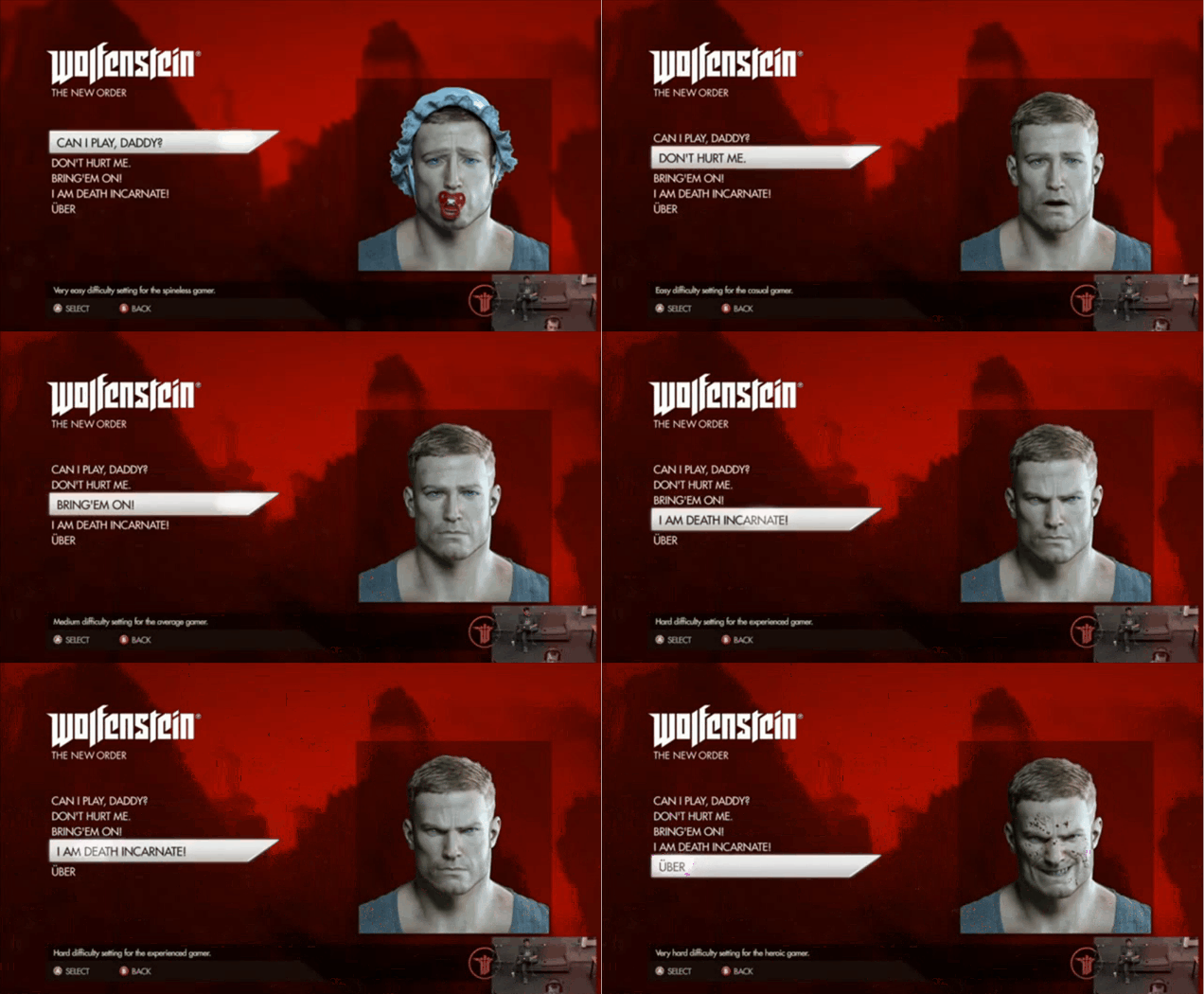
- Wolfenstein 3-D and its sequel showed the protagonist B.J. Blazkowicz's face next to the difficulty selector, with increasingly fierce expressions as the difficulties got harder. The easiest mode, "Can I play, Daddy?", shows him wearing a baby's bonnet and sucking a pacifier. The second easiest mode isn't much kinder: "Please don't hurt me." It shows him looking scared.
- Wolfenstein: The New Order brings this back in glorious HD.◊
- This mocking naming of difficulty levels continues through the Doom series ("I'm Too Young To Die" and "Hey, Not Too Rough") and Heretic ("Thou Needest a Wet Nurse" and "Yellowbellies-R-Us"). In Doom's source code, ITYTD is tagged as "sk_baby", further reinforcing the easy-mode mockery.
- The PS1 version of Doom just states it outright: "I'm Too Young to Die" is now named "I am a Wimp". On the other hand, in all versions of the game, the doubled ammo per-pickup you get on the easiest difficulty also applies while playing on Nightmare! difficulty.
- The SNES port of Doom actually plays it straight, since the only way to access the second and third episodes is to play on a highest difficulty. If you pick "I'm too young to die", you will get brutally murdered and chucked back to the title screen with no explanation at all after beating the boss of "Phobos Anomaly", and won't get to continue on to the later episodes until you run through it again on higher difficulties. Likewise, picking "Hurt Me Plenty" (the "default" setting) will kick you back to the title screen upon defeating the Cyberdemon in episode 2. The only way to access episode 3 is on the "Ultra-Violence" or "Nightmare!" difficulties.
- The trend goes onward with Brutal Doom and Project Brutality with the second easiest mode, "Can I Play Daddy?". Inverted with the easiest mode "Power Fantasy", because you'd only play that difficulty for, well... a power fantasy. Only babies play the next hardest difficulty because they're not tough enough to go any harder. Later updates play it straight by stating that the difficulty is made for "gaming journalists" (undoutably a Take That! at Polygon's infamous Doom (2016) video) and "the whinny (sic) kids from /vr/ that complains (sic) about BD making the game too hard".
- Rise of the Triad insults you for the two lowest difficulty settings. One of the possible names for the lowest one is "I am a chew toy" with a picture of a doll in a dog's mouth, while the second-lowest is "Will of iron, knees of jello," with a picture depicting a dollop of smelted iron on a cube of jello.
- As an homage to 90's shooters invoking this trope with their Idiosyncratic Difficulty Levels, Slayers X: Terminal Aftermath: Vengance of the Slayer calls its easy difficulty "Not a real gamer".
- Painkiller will disable levels unless you play on Trauma (the hardest) difficulty. Frustratingly, playing on Trauma disables the 5th chapter of the game because the game's semi-true ending takes place at the end of the 4th chapter. Not to mention Trauma changes the rules such that certain bonus objectives are impossible to achieve. You get the option of starting with all the bonuses from your last playthrough at the second hardest difficulty, but that's actually easier than starting over on the hardest. Whee.
- In addition, when selecting Daydream as the difficulty level at the start of the game, the game outright warns the player that Daydream is intended for beginners and thus extremely easy. And that the bonus tarot cards are disabled and can't be earned at all.
- Any difficulty not Trauma also (possibly intentionally) creates a Plot Hole in the ongoing story - it's not explained how you meet Eve, a character who helps the PC.
- Halo: Easy is the only difficulty that does not yield an achievement upon completion of the campaign.
- In Postal 2, the police meter goes down much slower in the easier difficulty levels, and you can't unlock Enhanced Mode if you play at a level below "Average". The very easiest difficulty level arms pretty much all characters with shovels instead of guns. Not exactly a punishment, although you do miss out on how the game is meant to be experienced. Also, since no one really has guns, finding ammo is nearly impossible.
- The easiest setting is called Liebermode (a shot at former Senator Joe Lieberman, one of the most vocal Moral Guardian crusaders against video games). In it, not only is everyone significantly less aggressive than they could be, just about every weapon people wield are tazers that quite literally do absolutely no damage when wielded by anyone other than the player.
- When you play Serious Sam HD on the "Tourist" setting, enemies explode into puffs of flowers instead of clouds of blood.
- You get double the health plus regeneration on the easiest mode. On the Xbox version of Serious Sam, it shows a picture of Sam dressed as a baby, fitting enough.
- The trend is continued in Serious Sam II, pacifier and all.
- TimeSplitters 2: The campaign missions are shortened on Easy difficulty, causing them to end about halfway through.
- PAYDAY: The Heist: You can only select easy mode on the first two levels. Originally, the last two heists (not including DLC levels) could only be accessed on Hard and above, but a patch enabled players to play those heists on at least Normal.
- PAYDAY 2 had pro jobs (heists that don't allow restarting if your team goes down) that weren't accessible on Normal (the easiest difficulty). These have since been removed, though there are numerous achievements that unlock extra weapon mods and masks that require you to be on a certain difficulty or above.
- In the PC game Shogo: Mobile Armor Division, the secret code to kill all enemies on the current level is "boyisuck".
- Rainbow Six: Vegas 2 has two forms of experience, regular experience towards your rank for unlocking outfits and camo, and ACES points towards unlocking weaponry. Experience has regular multipliers based on the difficulty, where on Normal, making kills or your teammates killing tagged enemies awards 5 experience, and teammates otherwise killing enemies on their own awards 3, and Realistic ups that to 10 and 5 respectively. ACES points don't get this sort of multiplier; a kill at extreme long range rewards 3 Sharpshooter points, a kill with a grenade awards 2 Assault points, killing with blind-fire awards 3 CQB points, etc., regardless of difficulty - except on Easy. There, everything is only worth one experience and, if it qualified as an ACES kill, one point.
- Shadow Warrior 2: Averted. Easy mode is portrayed as simply a different way to play the game.
This difficulty level is for people who don't feel like they need to prove anything to themselves or anyone else. Playing Shadow Warrior 2 on easy is perfectly fine, if by the end of an exhausting day all you need is to feel like a goddamn superhero.
- Metro: Last Light: Downplayed. The game can be played in Ranger mode (emphasizes survival horror) or Spartan mode (emphasizes action). Spartan mode isn't exactly easy, but it is less challenging than Ranger mode. Finishing the game in Ranger mode gets a gold Trophy or 50G, Finishing In Spartan mode gets a silver Trophy or 40G.
- The Musou Mode ending on the Novice and Easy difficulties of Dynasty Warriors 5 conclude as follows:
"These tales, long forgotten in the flows of time, are about the legends of which no one can recall..."
- Mario Party 2: Playing Mini-Game Coaster on Easy or Normal results in the player only being able to progress up to a certain point: World 3 on Easy and World 6 on Normal. In order to face the Baby Bowsers at the end of World 8, you have to play on Hard (you still have to clear the mode in all difficulty levels to reach 100% Completion).
- Azure Striker Gunvolt Series: Easy Mode always results in the player gaining a massive power up to give them a huge advantage over enemies, but triggering Anthem in a stage prevents you from gaining any Kudos.
- They Bleed Pixels has a Novice Mode that makes the game slightly less unforgiving. You'll still have a hard time beating it though, and it locks you out of the final level.
- Prinny 2: Dawn of Operation Panties, Dood! has an easy mode named "Baby Mode". During this mode, most bottomless pits are covered over by pink and yellow blocks with pictures of baby demons on them. Diapers are also added as a pickup item for healing you. In the Asagi Wars story mode, since Prinny Asagi's health is measured in TV ratings she doesn't gain the diapers healing item but instead only loses 12.5% of her viewers when she is hit in baby mode, as opposed to 25% on normal and 50% on hard mode, but the baby blocks are still present and she also carries a lot more ammo.
- The NES and Game Boy versions of The Lion King end early if you play them on "Cub" mode (as Scar puts it on the ending screen, "Well done, my little cub, but that was Easy"). The Game Boy version, being longer than the NES version in a twisted form of logic, ends at The Stampede on Cub mode; the NES version ends after the Elephant Graveyard.
- "Kids" difficulty in Viewtiful Joe unlocks nothing, and your power-ups in that mode don't transfer to the other difficulties. The one exception is the PlayStation 2 port of the original, which unlocks Dante from Devil May Cry on completion in any mode.
- The PS2 version also has an even easier difficulty level called "Sweet" (an outright Take That! against the player; "sweet" and "naive" are the same word in Japanese).
- In I Wanna Be the Guy, setting the difficulty to Medium (the easiest level) puts a pink ribbon in The Kid's hair. Also, the save points that aren't there in Hard mode have the word "Wuss" in place of "Save".
- Early versions had an Easy mode. It would kill you on the title screen to save you the trouble of playing the game.
- I Wanna Be The Fangame has certain areas you cannot reach on Medium, as you'll be blocked by a force field labeled "no ribbons".
- In I Wanna Be the Guy: Gaiden, setting the difficulty to Easy closes the game originally opened a Barbie game in your web browser, though it has been patched to a random choice of several links after the game turned into a redirect for the home page.
- In addition to naming its Easy Mode "Child's Play", the SNES title Plok not only gives you slower-moving enemies, but also cuts out many of the game's levels, including the Legacy Island world and the final Fleapit stages (ending the game instead on a screen challenging you to play on Normal).
- You could also destroy the normally indestructible rolling logs with your limbs on "Child's Play".
- Mega Man:
- In Mega Man X5 if you play on easy, you cannot get any parts from the bosses, because they are low-level bosses.
- Mega Man X8 stops you just before the final boss if you play on easy. Surprisingly, the game is rather subtle about it here. After all, Sigma NOT being the final boss is a major surprise.
- If you play on Easy in Mega Man ZX, you can unlock and fight Omega of Mega Man Zero 3 fame, but you won't receive the reward for defeating him, the OX module.
- In Mega Man Powered Up:
- The final battle with Dr. Wily ends after the first phase on Easy Mode, wherein Wily escapes cackling "Maybe next time!". It still gives an epilogue that assumes he was actually defeated, though.
- Collectibles scattered through the levels that add features to the game's Level Editor also do not spawn in Easy Mode.
- In Mega Man Legacy Collection 2, if Super Armour is enabled, a tiny icon appears in the top-left corner of the game screen to indicate it, making it easy to determine if videos or screenshots were taken with it enabled.
- In Mega Man X Legacy Collection and Mega Man X Legacy Collection 2, each game has an achievement for beating it that you could only earn if Rookie Hunter mode is not on (and once again, X8's Easy mode does not count), and X5 has an extra achievement for clearing Zero Stage 1 without the use of Dark Hold that, again, could not be earned with Rookie Hunter mode. On the other hand, Mega Man X6 has an achievement that actually requires Rookie Hunter mode to earn... and it's stupidly easy to get (just fall into a pit).
- In Mickey Mania, playing on Easy ends the game after the underground section of Mickey and the Beanstalk (or the Willie chase if you're playing Mickey's Wild Adventure)
- The Genesis version of Sparkster (not to be confused with the Super NES version, which is a different game) uses a surprisingly subtle form of this, skipping levels instead of ending them early; unfortunately, the very first skipped level contains one of the MacGuffins you need to unlock the true ending. (All the others are available in all difficulty levels, of course.) Oh, and having all seven MacGuffins gives you significant advantages against the final boss: namely a fast-charging rocket-pack and immunity to one of the first form's attacks.
- Speaking of the SNES Sparkster, it has this even at Normal Difficulty. Easy mode is labeled Digest (which is their way of saying "this mode is missing lots of stuff"), but there's really no excuse for Normal mode to not have the final boss in it unless they really wanted it to be a True Final Boss.
- The Disney Hercules computer game, when played on the Easy setting, ends on the Mount Olympus level with Hercules freeing Zeus. It ends with a nice little still image and the usual "now try a higher difficulty" message.
- The Disney Tarzan game inverts this. The game is entirely playable in Easy difficulty, and upon completion, Terk expressess genuine amazement at completing the game on that difficulty, and then encourages you to try again on the medium difficulty.
- The Genesis version of Toki has four difficulty levels. Easy mode only allows you to play up to level 8; after you beat that, the game ends with a screen full of hopping apes and the text "Congratulations...but true peace will not come until you play and defeat the harder modes". All other difficulty levels allow you to play the 9th and final level, as well as see the proper credit sequence.
- If one beats the Special Edition CD version of the original Earthworm Jim on Practice Mode, you do not get the "UR'E THE BEST" screen after beating the Queen, and the ending cutscene is gone. Instead, you see a still shot of the ending's location, with the voice of series creator Doug TenNapel saying "What a worm! Playing on practice, eh?" Feeling bad, he decides to explain (in a non-serious manner) everything (and he means EVERYTHING) he knows about worms.
- In Metroid: Zero Mission (the remake of the original NES Metroid for Game Boy Advance), there are eight different ending images that you can see showing Samus in various states of disarmament: from full Power Suit, to helmet removed, to armor removed and in the Zero Suit (blue jumpsuit), to various versions of armor removed and in short-shorts and a small top. On Normal and Hard modes, which image you see is determined by your completion time and item collection percentage. But if you play on Easy, you'll only ever get the image of Samus in full armor sitting atop a rock, regardless of your time or completion rating.note
- Tiny Toon Adventures: Buster Busts Loose! has the game skip parts of the levels, one whole level, and even the ending if you happen to play the easiest mode... And it's the only difficulty where you get passwords.
- Your moves are also altered: on the easiest mode your dash on its own will count as an attack, while in harder modes you have to do a dashing leap or slide to avoid damage.
- Castle of Illusion's "practice" mode offers heavily shortened, boss-less versions of the first three levels, and instead of fighting the big bad Mizrabel you buy her off with gems.
- "Lil' Kids" mode in ToeJam & Earl in Panic on Funkotron makes it impossible to die, but ends the game after level five, thus robbing players of the chance to collect the Funkopotamus' favourite things and get the good ending.
- Castlevania 64 ends after the Castle Center level if you play on the easiest difficulty setting.
- Hammerin' Hero unlocks "Apprentice" difficulty (the lowest setting) if you should get Game Over three times at any point in the game. Playing any level on Apprentice starts your hero off with a blue helmet, which allows him to absorb two extra hits before dying.
- Prehistorik Man, when played in Easy mode, ends on level 14 out of 23, right after the second boss.
- Monster Bash has three difficulty settings, each with a picture of the hero flexing his muscles next to them on the selection screen. The "Easy" setting, however, features him Flexing Those Non-Biceps.
- The Xbox Live Arcade title 'Splosion Man offers the player the chance to skip a level if they die too many times attempting it. A picture will come up on the screen stating that you can now select the "Way Of The Coward" option from the pause menu. Your punishment? You will wear a tutu in the next level.
- The sequel, Ms. 'Splosion Man will let you "Cheat on the Game", letting you skip to the next checkpoint if you die on one section of the level multiple times. That said, you will suffer the effects of "The Curse": Your score for the level goes to zero, your time for the level goes to 999:59:99, and worst of all Ms. Splosion Man suddenly gains a lot of weight in her rear and the background music changes to a pro-"Ba-Donk-A-Donk" song.
- Sylvester and Tweety in Cagey Capers takes the "fewer levels on easy mode" idea to the extreme—it has a difficulty slider, and the lower it's set, the fewer levels you can play, down to just the first level at anything below 11%. If you want the whole game, you'll have to set it to at least 81%.
- Super Mario Bros.:
- In Super Mario Galaxy 2, you can have the Cosmic Guide play a level for you if you die too many times in it. However, you get a bronze star rather than a genuine Power Star. They count toward your total star count, but if you have even one bronze star in your inventory, you can't unlock the final level. The Cosmic Guide will not work if you're playing as Luigi, however.
- In all New Super Mario Bros. games after the first and Super Mario 3D Land, if you use any Super Guides while playing, the stars on your save file sheet will stop glowing. In the case of 3D Land and NSMB Wii, your glowing stars will be removed if you are ever offered use of the easy mode. Simply dying too many times on one level makes your glowing stars lost forever after you see the block and save.
- Super Mario Bros.: The Lost Levels features a variation of this: If you use any warp zones (even the ones that send you back to an earlier level) while playing this game, then you cannot unlock World 9. If you beat Worlds 1-8 without warping and complete World 9, but use warp zones in Worlds A-D, then you will be locked out of World 9 the next time you play it.
- The 100 Mario Challenge in Super Mario Maker has Difficulty Levels. On Normal and Expert, you journey through sixteen courses and rescue Princess Peach. If you set it to Easy, however, you're essentially playing the 10 Mario Challenge (which features eight courses) with 90 additional lives and user-generated courses instead of sample courses. You even get the same "Your Princess Is in Another Castle!" scene with Toad and the subsequent "To Be Continued". While you can use amiibo to save yourself from playing through Easy mode to collect a randomly chosen Mystery Mushroom costume available only through this difficulty, only twelve of the twenty costumes have amiiboSpecifics.
- Jazz Jackrabbit 2 indulges in this a bit; once you've chosen your character, you choose the difficulty mode, with a corresponding picture of Jazz, Spaz, or Lori, making implications about who that difficulty mode is intended for. Normal mode is your chosen rabbit, no bells and whistles; hard mode gets a hulked-out, 'roided-up version; and easy mode gets a cute little melonheaded baby version.
- In Jurassic Park 2: The Chaos Continues for the SNES, you can only unlock the last 2 levels (which give you the true ending) if you play through the game on Hard.
- Used to a degree in The Impossible Game. While the game ordinarily plays high pace, energetic music while in regular play, it switches to a what can only be called a child's lullaby if you go into Practice Mode.
- The Lost Vikings 2 adds dialog to the normal screen of your vikings being revived if you die in the first level, telling you that since you're so utterly hopeless that you managed to die before the game has really even started yet that you're going to get some extra powers to help your sorry ass get through the game. That said, it's literally impossible to die on that particular stage unless you're actively trying to, so it's more like an Easter Egg: said powers make most of the game a lot easier.
- Bonk's Revenge ends after the first boss on Easy difficulty, and after the fourth boss on Medium.
- In Little Samson, Easy mode cuts out the final level.
- Distorted Travesty will mock you regardless of what difficulty you play on, but it will mock you even harder if you play on Easy mode.
- Playing Jumper Two on easy mode disables time trials, making secret stages unavailable, adds a green "easy mode activated" displayed on stage select screen and file loading screen and checkpoints that weren't tested well.
- Sonic the Hedgehog:
- Playing Sonic 1, Sonic 2 and Sonic 3 & Knuckles on easy mode in Sonic Jam gives you a heavily abridged version of them that only features one act per-zone, cutting off a large chunk of the game's content, such as the other acts, cutscenes, music and many of the bosses in the process. Wing Fortress Zone (and by extension, the cutscene between it and Death Egg Zone) is also absent in the easy difficulty for Sonic 2.
- Playing as Tails in the 2011 remake of Sonic CD will disable Achievements/Trophies.
- Playing as Tails (who shares Sonic's campaign) in Sonic 3 & Knuckles locks you out of Doomsday Zone by default, even if you collected all the Chaos and Super Emeraldsnote .
- In Sonic Frontiers, reaching the end of the game on Easy or Normal Mode (as you can switch difficulty at any time in the game up to the final boss) will skip the Bullet Hell part of the final battle with The End, which is quite extensive. It will just skip to the Quick Time Events. To get the full experience, you have to reach/beat the Supreme Titan on the hardest difficulty.
- Selecting Easy in The Angry Video Game Nerd Adventures turns the Nerd's Zapper pink. It doesn't affect the Nintendo Hard gameplay, just the player variables (lives, hit points, etc.), and the ending is the exact same on Easy, YOLO, and every difficulty in between.
- Skipping levels in 1001 Spikes is clearly designed just for beginners - Skipping any level locks off the end of the Ruins until you go back and complete it, and by proxy blocks off every level after that. No levels after 5-6 are skippable unless you buy a certain item.
- Donkey Kong Country 3: Dixie Kong's Double Trouble!: If you use cheat codes LIVESnote or ASAVEnote , you are labeled as a Cheatin' Chump upon beating the game.
- Donkey Kong Country Returns:
- If you buy items, Cranky Kong will make fun of you. Especially if you buy the Heart item which grants you more health as he'll start asking if "I should hold your hand too." Then again, he is Cranky Kong. Notably, he keeps his mouth shut if you buy the key that unlocks the extra level in a given world, the only item in the shop that doesn't make anything easier.
- If you die a lot in a given level, Professor Chops will give you the option to have the Super Guide (featuring Super Kong, a white CPU-controlled Palette Swap of Donkey Kong) beat the level for you. However, the computer purposely avoids collectible items that are out of the way, and you're unable to actually keep the items he does collect.
- Picking easy mode in re-releases of Cave Story will make the player character wear a yellow costume (as opposed to the normal Red). When this costume was first announced, many fans cried out a lot, when they did not realize that there were various difficulty modes for the game.
- A Hat in Time has Death Wish in the DLC, which is a collection of previous missions remixed to be Nintendo Hard. Die enough times to one, and you will be offered to play the level in Peace and Tranquility mode to lighten the difficulty...and you're not mocked or punished for it in the slightest. In fact, you're reassured. While the stamp for completion marks whether you did it normally or not, completing the challenge with Peace and Tranquility doesn't lock you out of progress in Death Wish or the rewards obtained from each challenge.
- Rugrats: Royal Ransom: Twofold with Baby Easy mode: there's less Funny Money to collect (to the point where it's impossible to buy everything in the shop), and you have to deal with the game essentially calling you a baby for not being able to handle the higher difficulties.
- In Will You Snail?, Squid, the game's fourth wall-breaking AI antagonist, will often mock the player for manually lowering the game's difficulty. Parodied in that all the difficulties are different variants of easy (Inifitely Easy, Extremely Easy, Very Easy, and Easy), with higher difficulties being "reserved for more intelligent species."
- In the SNES game Panel de Pon, the story mode ends at different points on each level. Easy mode ends after Thanatos's minions, Phoenix and Dragon. Medium ends after defeating Thanatos, but with a brief, unsatisfying ending. Only Hard and higher allow you to actually face the final boss and get an actual conclusion to the story. Tetris Attack, the version of the game released internationally, has an identical system.
- Furthermore, clearing Panel de Pon's story mode on Easy doesn't give you an ending, only a simple "Congratulations!" message, accompanied by Lip wishing you good luck on the next difficulty level. Idling at this screen will cause her to inform you that you won't be getting any special reward for finishing Easy mode, and you should just press Reset (in Tetris Attack, this isn't actually necessary—the localization lets you just push A to exit the ending screens). In Tetris Attack, if you idle even further, Yoshi will get annoyed and yell at you:
Yoshi: HEY! I'M NOT KIDDING! That's all, there isn't anymore. Press RESET!
- An added feature in Tetris Attack is an options menu that features a setting to have the game play itself, with several levels of skill. Trying to use this to complete any mode with an ending gets you a message telling you to play for real.
- In Pokémon Puzzle League for N64 (which was actually an unreleased in Japan sequel to Panel de Pon dolled up), Easy Mode stops you after Giovanni, Medium stops you after Bruno, Hard stops you after the second Gary. You get a cup at the end of Hard, but the true ending isn't seen until you beat the game on Very Hard or Super Hard and beat the game's real final boss, Mewtwo.
- Furthermore, clearing Panel de Pon's story mode on Easy doesn't give you an ending, only a simple "Congratulations!" message, accompanied by Lip wishing you good luck on the next difficulty level. Idling at this screen will cause her to inform you that you won't be getting any special reward for finishing Easy mode, and you should just press Reset (in Tetris Attack, this isn't actually necessary—the localization lets you just push A to exit the ending screens). In Tetris Attack, if you idle even further, Yoshi will get annoyed and yell at you:
- With the Puyo Puyo titles, there is the recurring Easy (sometimes called RunRun) course, which zigzags this trope. On one hand, these courses often offer a unique set of opponents to fight that aren't in the main course, but at the same time mocks you once they're completed. For example in the first arcade game and several ports of Puyo Puyo 2, the Dark Prince will mock you and coax you to play the main course to challenge him, while for Draco's course in Puyo Puyo Sun the credits are played so fast that you cannot read them. Even when you do play the main course however, the game actively encourages you to play at a higher difficulty, all for the sake of earning a "Thank you for playing" message.
- This also similarly applies to Kirby's Avalanche and Dr. Robotnik's Mean Bean Machine. For the former you are mocked by King Dedede in the Easy course, while the latter still tries to encourage you to play at a higher difficulty for a half-baked "congratulations" message.
- The DOS version of Volfied ends before the final level in easy mode.
- The Myst manual, after informing you how to use the help mechanic, (something never told to you in-game, and written outside the main text of the manual, by the way) tells you that Real men and women don't cheat
- At the beginning of Total Distortion, your government agent Mr. Red mocks you for setting the game's difficulty and/or danger level to the lowest 2 of 5 levels, as does your status screen after the game starts.
- After escaping The Secret Island of Dr. Quandary, the eponymous doctor taunts you if you were playing as B. Ginner, even drawing attention to the doll's Punny Name.
- Playing Dr. Mario (in the NES version, at least) on its lowest speed setting, in addition to the decrease in score, locks you out of the between-round intermission cutscenes.
- In Gruntz, the "Easy Mode" disables the timed trap-doors in the High Rollerz world... which makes some of the levels unwinnable (you are supposed to push overpowered enemies into them).
- If you play a castle in The Castles of Doctor Creep with Unlimited Lives set to On, or use the game's save function during a castle run, you are not allowed to enter your initials in the Best Times scoreboard.
- Super Puzzle Fighter II Turbo ends early on Easy Mode and tells you to try a harder mode (but the ending screen of Hard mode isn't that much of a better reward).
- Agarest Senki has a difficulty system that has an impact on a carryover to a New Game Plus. If you play on easy, you'll only be able to transfer a few things from the old game save to a new one in a different setting. On the other hand, finish the game on Hard lets you carry over everything from the old file to the new one on any setting.
- An incredibly minor example in two Fire Emblem games:
- New Mystery of the Emblem introduces Casual Mode, which disables Permadeath and allows Save Scumming. It also introduces Lunatic Mode, the second-hardest difficulty level in the game. Your reward for clearing Lunatic is, naturally, Lunatic+, the actual hardest. But if you clear Lunatic on Casual, you unlock Lunatic+ for Casual only. This is carried over in Awakening.
- The Japanese version of Fire Emblem: Radiant Dawn cuts out some of the dialogue when played on the easiest difficulty. The international release uses only a single script for all three difficulties, but for some reason, it's the shorter version. There is also an unintentional one in the American release: If you have an easy mode save on your memory card, then when you attempt to transfer data for the Old Save Bonus, the game will freeze. note This was fixed in the European/Australian version.
- Wargroove's campaign on easy mode will reduce given stars from 1-2, and when the penultimate level is completed, players will learn they won't have the needed amount of 100 stars to access the Epilogue chapter.
- Quitting a Skirmish in Age of Empires III and opting for an easier difficulty will make the NPCs comment on your weakness.
- Myth: the Fallen Lords and Myth II: Soul Blighter have rather epic descriptions of the various difficulty level. "Timid," the lowest difficulty setting, describes the game experience ahead as "You will grow tired of blunting your weapons on a poorly-led horde of mindless corpse-men; and once you have reduced them to so much sausage filler, the sweet taste of success will turn to ashes in your mouth."
- Caesar II has a number of provinces available to conquer. Eight of them were never historically conquered by the Romans in Real Life, but you have the opportunity to do so after you become Caesar. But only if you play on at least Normal difficulty.
- Pikmin 4: If you ever fail a night expedition, instead of simply retrying, you can "get help" in the form of your coworker Dingo, who beats the level for you in a blacked-out cutscene. While you still get the medicine you'd normally get for clearing the level, the level isn't considered as being cleared. In addition, you get no glow seeds for its completion; justified as the rest of the Rescue Corps noting that while he did complete the objective of protecting the Lumiknoll... he did so by just spamming a seemingly endless supply of bomb rocks everywhere as opposed to working alongside the Glow Pikmin, who equally ignored him in turn.
- On the first two Guitar Hero games, you earn no money in Easy Mode and cannot access the Store. The second game is particularly mean, as you aren't allowed to perform encores and cannot access the last set of songs, preventing you from playing them in Quickplay, and are told to try the harder difficulties on the loading screen. (This is rather frustrating when you realize you must complete Easy and five-star all the songs to unlock two of the guitars.) The third game, which is somewhat harder on all difficulties than its predecessors, removes these limitations.
- Rock Band, made by the same company that made the first two Guitar Hero games, returns to this trope in the solo modes, preventing you from unlocking the last sets of songs on the Easy career tour. The multiplayer Band World Tour mode takes this further: after a certain point, the Easy difficulty is locked out, forcing everyone to play at least on Medium.
- Rock Band 2 continues the tradition. If certain songs are in your setlist in tour mode, Easy difficulty is locked out. On some late single-song gigs, Easy and Medium difficulty get locked out, forcing everyone on Medium to jump to Hard.
- Going even earlier, Harmonix's first two games, Frequency and Amplitude, lock out certain songs depending on your difficulty level. The only way to unlock every song in the game is to beat in on the highest difficulty. This isn't so bad in Amplitude, but in Frequency, your hands would sooner liberate themselves from your arms and jump out the nearest window.
- Parappa The Rapper's spiritual sequel Um Jammer Lammy gave you an Easy mode, where the game ended after the Hell/Desert Island (depending on your locale) level, preventing you from playing the last song or seeing the ending.
- The original Parappa The Rapper ends after level 3 on Easy. It also doesn't allow you to save your progress.
- In DJMAX Portable 2, if the difficulty in the Options menu is set to Easy, you will not be able to level up after Level 30, unless you change the difficulty to Normal or Hard, you'll get fewer points, and you won't get as much EXP or Gold. You also can't unlock any songs for "8-Button Mode" play unless you bump up the difficulty.
- In DJMAX Fever, which plays almost exactly like DJMP2 but with different songs and missions, the level cap is removed and the scoring penalty is weaker; you only lose 5% of your points.
- In beatmania IIDX, using the Easy modifier to clear a song will mark your status for that song as "EASY CLEAR", although a non-Easy clear, Full Combo, or Perfect overrides it. Newer installments have an "Assist Clear" status that is even lower than Easy Clear, for using Assist mods (Auto-Scratchnote , Legacynote , 5-keynote , Assist Easynote , or any combination thereof), while earlier versions won't even count anything played on Auto Scratch and/or 5 Keys besides incrementing the song's play count. Even without the "Assist Clear" status, Assist mods other than Assist Easy remove playable notes from the chart, reducing the maximum score you can get on it.note In addition, clearing a song on Beginner difficulty will always be recorded as an Easy Clear regardless of modifiers used, will not record your score, and will not earn you any DJ Points.
- In pop'n music's Enjoy mode, the game hides the score display, and you can't use any modifiers, not even Hi-Speed.
- Guitar Rock Tour on Easy Mode ends with the characters musing about how their rise to stardom came way too easily.
- In Hatsune Miku: Project DIVA F, playing on the Easy difficulty prevents you from unlocking the Hard versions of songs, and some modules and items. Additionally, if you choose to use a help item, the rank shown will have a green heart beside it. Some help items go further and automatically give you the CHEAP/LOUSY rating regardless of performance, preventing you from unlocking new songs.
- Groove Coaster:
- Using the Safe or Super Safe item (Follow in the smartphone versions) will turn up to 10 or 20 Misses into Goods; however, the Goods you earn from these items will not earn any points. That said, because a major part of the scoring system revolves around getting a high maximum Chain and the point of these items is to preserve your Chain, the score penalty is unlikely to hinder you until you're trying to get an S++ rank (990,000 or more, out of 1 million).
- Using the Change item turns Slide notes into regular notes, but reduces their point values.
- In the SAGE 2022 demo of Scratchin' Melodii, selecting easy mode on a song shows you an icon of Melodii making a baby face at you and/or holding in their laughter, scrambles the lyrics to the songs beyond recognition, and since the only way to access easy mode is to enter quick play mode, disables the entire storyline.
- In Spin Rhythm XD, most songs use shortened versions for easier difficulties, with higher difficulty levels playing more and more of the song. Depending on the song, you may even need to play on XD Difficulty if you want to hear the full track.
- Arcaea:
- Partners with the Easy Life Meter make it easier to clear songs by reducing the penalty you get for missing notes. Naturally, they have lower parameters than other Partners, meaning less Fragment gains and less World Mode progress. You'll also get a green Clear icon and it won't count towards the number of songs you have cleared.
- Zigzagged with the Fracture version of Hikari. She has a special lifebar that starts off as an Easy meter, but turns into a Hard meter when it reaches 100%; that is, any amount of life remaining will result in completing the track, but dropping to 0% will result in a Game Over (non-Hard meters don't fail out at 0% but must be at 70% or higher to pass). In some cases it is easier to use a Partner with the standard meter, but either way, it will still be marked as an Easy clear. That said, Fracture Hikari also has one of the highest Step parameters in the game, making her a viable Partner for World Mode.
- Inverted with the Partner DORO*C, who subverts the lifebar by instead turning it into a score meter. If you get a AA rank (9,500,000 points out of 10,000,000), you clear the song. Despite the fact that it is generally harder to get a AA than to just clear a song, playing as her still nets you an Easy clear.
- Friday Night Funkin' Game Mods
- Mid-Fight Masses does not allow you to play on the track "Gospel" unless you picked Hard or Alt mode, even in Freeplay mode, which essentially locks you out of the True Final Boss unless you selected Hard mode.
- More in line with the trope, Friday Night Funkin' Lullaby has Pussy mode, which removes the songs' infamous gimmicks and Interface Screw.
- Baldur's Gate III: Playing the game on the Explorer difficulty, which is the easiest, bars the player from using the Multiclass feature. This is downplayed because levelling a character can already be a difficult experience and multiclassing can potentially ruin a character.
- Epic Battle Fantasy series:
- Epic Battle Fantasy 2 plays about with this: the difficulty selection screen recommends playing Easy "if you're a noob or don't have much time", whilst recommending Epic difficulty "if you have no life".
- Epic Battle Fantasy 4 and Epic Battle Fantasy 5 have Cheats, which make the game easier in various ways. With the exception of those marked with an asterisk, enabling a Cheat will bar the player from earning Medals which are exclusive to Epic difficulty.
- In Persona 3 Portable, the descriptions of the difficulty levels have subtle shades of this. Easy mode is passive-aggressively described as being for people who don't have time for tactical combat, as if the game is offended that you aren't playing it seriously. And the description for Normal difficulty implies if you aren't playing on at least that level you aren't enjoying the game at all.
- Kingdom Hearts:
- Save files set to Beginner Mode in Kingdom Hearts, Kingdom Hearts II, or Kingdom Hearts: Birth by Sleep cannot unlock the various secret ending videos. While the secret endings can be accessed on Standard Mode, the main requirement for doing so in this case involves getting 100% Completion, which has some intentionally absurd objectives. Starting with Birth by Sleep Final Mix, secret endings can be unlocked on Beginner Mode, but usually have extra requirements as consequence. BBSFM is also where the Standard Mode requirements stop being 100% Completion, making all associated unlocks significantly easier.
- Playing on Beginner Mode in Kingdom Hearts 3D [Dream Drop Distance] prevents the "Risky Winds" Forecast from happening. The bad part comes from the fact that Risky Winds make all Dream Eaters created there one grade higher than normal and increases the chance of making rare Dream Eaters.
- Kingdom Hearts III: Unlike previous series entries, you can see the secret ending if playing on Beginner Mode. However, the requirements are still the steepest on Beginner Mode since you have to find all 90 Lucky Emblems. Patch 1.0.9 adds a stronger example, as beating the game on Critical Mode is required to earn the Oblivion Keyblade, but it can be carried over to any other difficulty on New Game Plus.
- Tales of...
- Barbatos, the Superboss of the PS2 version of Tales of Destiny, if fought on the Simple difficulty, will immediately start the fight off with an upgraded version of his Genocide Braver called Cheap Eliminate, his quote for the attack being something that roughly translates to "You aren't qualified to fight me!". It covers the entire length of the screen in front of him, and is instant death for anyone who gets hit by it, save for those using certain invulnerability granting moves. He'll then use it immediately after every single attack he performs, but can be defeated if one can get close to him, where dodging it becomes a simple matter of dashing past him when he starts firing it and countering accordingly. The battle generally ends up becoming a solo job due to the AI being incapable of dodging the move consistently, however.
- In the Updated Re-release, he gains a new attack called Hell Heat that fires dozens of similarly powerful homing beams that he'll use in between every few Cheap Eliminates (And almost constantly at low HP). This will wipe out those who opted to dodge the former attack by simply jumping over it, but can still be negated by other means. His stats also got buffed so he doesn't go down nearly as quickly as in the original version.
- Fighting on Easy in Tales of Vesperia will get you zero GRADE, meaning no treats for New Game Plus.
- Barbatos, the Superboss of the PS2 version of Tales of Destiny, if fought on the Simple difficulty, will immediately start the fight off with an upgraded version of his Genocide Braver called Cheap Eliminate, his quote for the attack being something that roughly translates to "You aren't qualified to fight me!". It covers the entire length of the screen in front of him, and is instant death for anyone who gets hit by it, save for those using certain invulnerability granting moves. He'll then use it immediately after every single attack he performs, but can be defeated if one can get close to him, where dodging it becomes a simple matter of dashing past him when he starts firing it and countering accordingly. The battle generally ends up becoming a solo job due to the AI being incapable of dodging the move consistently, however.
- While Fallout 3 will not actively taunt you, you take a penalty to all experience earned in Easy and Very Easy mode (you gain a proportionate boost in Hard and Very Hard). The game doesn't shut off features per se, but it will be difficult to reach the level cap (and the nifty Perks found there) with the heavy XP nerf that playing on Very Easy entails.
- The Legend of Heroes: Trails to Azure: To obtain the Horror Buster achievement, you need to score over 4000 on the Horror Coaster minigame in Michelam Wonderland. However, on Easy mode the points earned is halved as well, making even the highest number of possible points lower than what is needed to obtain the achievement.
- Playing Easy mode in Valkyrie Profile cuts out a significant amount of content from the game, leaving out many dungeons and some items, and making it impossible to get the best ending (which is admittedly almost impossible to get without the guide anyway.) Ironically, this actually makes Easy mode harder than either Medium or Hard, since some of the content which Easy omits is extremely helpful for winning the game.
- Apart from the inability to get the best ending on easy, Valkyrie Profile is all over the place. Each of the game's dungeons only appears in certain difficulties, and only on some playthroughs, so playing easy mode, then normal, then hard will actually get you more content than just hard mode. Furthermore, hard mode is possibly the easiest, because new characters start at level 1, which is an advantage once you have items that improve their stats when they level up; you won't get those benefits if they join the party at level 30 in easy mode. Also because sometimes you need to level up characters for skill points in preparation for sending them to Valhalla, and it takes less XP with level 1's.
- Valkyrie Profile: Covenant of the Plume determines the path the game takes based on how many allies you sacrificed to essentially skip stages. Get through without sacrificing any and you get the best ending, and the only one that has some idealism. Get through by sacrificing some and the game takes a different path that, while cynical, isn't terrible. Sacrifice as many as you can in one chapter and the rest of the game is dark and depressing all the way and leads to the worst possible outcome.
- In Star Wars: The Force Unleashed, cheat codes disable certain unlockables, Achievements, and for difficulty-based game completion Achievements you must play on the same difficulty from beginning to end. (This is to prevent, for example, playing the last stage on Sith Lord after playing all previous missions on Sith Apprentice.)
- The second game's Xbox achievement picture for beating it on the lowest difficulty is Jar Jar Binks. Now that's just mean.
- The Lemony Narrator offers you a choice of difficulties at the beginning of Penny Arcade Adventures: On the Rain-slick Precipice of Darkness: Episode 2, and taunts you if you choose Easy.
- In Infinite Undiscovery the Seraphic Gate will not open if you finish the game on Easy mode.
- The first Boktai game has a couple of puzzles near the end which offer you their solutions... as long as you're okay with being immortalized as a "LOSER" on the nearby hint panel.
- In Septerra Core the master code to unlock cheat codes is "IMAREALWEENIE" and the cheat code to make enemies stop attacking you is "MAKETHEMSTOPMOMMIE".
- There's a few ways that World of Warcraft makes you go through different difficulty levels for raids:
- Higher item levels and stats for gear obtained through Normal and Heroic versions of dungeons and raids. There's even some text to tell people if you got a piece of gear from LFR or Heroic mode through each gear's tooltip.
- Some achievements can only be done on Heroic difficulty. Most if not all of the 5-man achievements must be done on that difficulty.
- A few bosses (Lady Sinestra in Bastion of Twilight and Ra-den in the Throne of Thunder) can only be accessed if you beat the rest of the raid on Heroic difficulty.
- In Digital Devil Saga, the door leading to Superboss Satan will not open if you play on Normal difficulty, as the characters are plainly too terrified to open it. In Hard Mode, you can go through, and you'll see why everyone was so scared.
- In Shin Megami Tensei IV, you can unlock Easy Mode by, essentially, debasing yourself. First you must die once, pay a rather large amount of your money to Charon to get revived, getting mocked by having died, die again, and watch as Charon's servants again all but laughs at you before one of them downloads Easy Mode into your Gauntlet.
- The Super Adventure Box mini-event in Guild Wars 2 originally referred to easy mode as "Infantile Mode". On this setting the levels are filled with smiling, buck-toothed clouds which fart rainbow bridges you can run across to skip all the jumping puzzles. (This was renamed to "Exploration Mode" in 2023.)
- In Dark Souls III, the description of the Simple Gem (used to grant Regenerating Mana through weapon enchantment) mocks players who rely on it as "victims of stunted development."
- In DC Universe Online, you can easily win against most bosses in solo content by using your Supercharge abilities to either heal yourself or deal massive damage, but doing so will prevent you from obtaining certain feats, which are required for progression.
- In BoxxyQuest: The Gathering Storm, If you opt to wear the Overpowered Crown, which buffs your defense to unreal levels, the protective status it gives you is labelled "CHEATING."
- Etrian Odyssey Nexus has an interesting twist on this trope where the punishment for picking the easiest difficulty, Picnic, locks you to that difficulty for the rest of the game. This is to stop players from using Picnic to cheese through a troublesome part of the game and then turn the difficulty back up afterwads.
- Undertale inverts this trope with the hidden Hard Mode, which replaces several of the normal first-level enemies with ridiculous variations seen nowhere else and ends abruptly after the first Boss Battle with a joke ending. This is because Hard Mode is entered by naming the Fallen Child "Frisk", which would make The Reveal at the very end completely nonsensical.
- The Rakenzarn games (Rakenzarn Tales, Rakenzarn Frontier Story) will lock you out of the secret endings completely on Novice mode. You can only earn one of them on Normal mode, so you have to play on Hard or Relentless to see all the endings.
- Disco Elysium employs a varation of this. The game openly encourages you to act out and choose the more provocative, strange, or humiliating dialogue options when talking to people, but if you defy this by consistently choosing the most inoffensive, matter-of-fact, dry dialogue options, the game will label you as a "Boring Cop".
- Starting a game on the very easy difficulty of the North American and European version of the Windows version of Ys: The Oath in Felghana unlocks the achievement "More Like Adol the Yellow."
- The Tenth Line: The easiest, Story Difficulty Setting: "I just want to see the story.", does not have post-game content:
Just the story. All enemy encounters are removed, and battles are greatly reduced in difficulty. Leveling up is not necessary. Post-game content is NOT available in this mode.
- LISA:
- After an angry fan ranted about the difficulty of LISA: The Joyful on Steam, an Easy Mode was patched in, hosted by Larry Stinz, who is in no way shape or form related to Terry Hintz. Said Easy Mode outright costs you 300 mags to activate and is found halfway through the game, hinting at its uselessness, and activating it locks you in a linear area and gives you a comically overpowered foam stick and a bunch of jerky, before having you "fight" Larry Stinz dressed as Buddy’s Boyfriend and a scarecrow version of Brad, before Larry Stinz gets bored and goes home, turning the scarecrow into a thumps up hand as the screen cuts to a The End screen.
- In the Updated Re-release, genuine easy modes were added to Joyful and Painful called Painless difficulty. Activating it is done by essentially taking Terry Hintz’s "Terroids", and the description mentions that Brad/Buddy feels somewhat ashamed resorting to them.
- Dragon Spirit: The New Legend for the NES gives you a much easier game if you lose in the prologue level, but it consists of five stages (out of twelve) and has a joke All Just a Dream ending.
- Gun Nac will not even show you an ending if you play the Novice setting. Instead, you get an image of an ugly guy saying "You haven't defeated me yet." In fact, he appears in all of the endings except for Expert.
- The Touhou Project games have a few instances of this.
- In Touhou Gensokyo ~ Lotus Land Story, if you play on Easy, you can't proceed to Stage 6. The Stage 5 boss retreats while telling you to come back when you're stronger, the player character can't catch up to her and you get the bad ending.
- Similar to the above example, in Touhou Koumakyou ~ the Embodiment of Scarlet Devil, if you beat the Stage 5 boss on Easy mode, she essentially mocks you(r character) for playing Easy mode. Your character then leaves. Bad End. No final boss for you.note
- More specific to the trope, some older Touhou games (Ten Desires and older) won't let you get the good ending and unlock the Extra Stage if you complete the game on Easy. In fact, Subterranean Animism has a bug that if you already have the Extra Stage unlocked and then complete the game on Easy, it will lock the stage right back up. Considering that the Extra Stage is somewhere between Hard and Lunatic in terms of difficulty, if you can only clear the game on Easy, you are probably not prepared for the Extra Stage anyway.
- Generally inverted in the difficulty selection screens, which often say that Lunatic difficulty is for people with no life or for weird people.
- Easy mode's description in Touhou Chireiden ~ Subterranean Animism is essentially "please train more so your friends won't make fun of you".
- While not an in-game element, the Touhou fan-created song "Stops at the Affected Area and Immediately Dissolves" (a remix of Reisen's boss theme) mocks Easy mode players.
- "Eh? SERIOUSLY? EASY MODO?" "How gross! The only ones that should be caught playing Easy Mode are elementary school students, right?" "HAHAHAHA!"
- The Touhou arcade game Sakura Fantastica outright calls easy mode "Kids Mode".
- Meritous: you can play the game in Wuss Mode, which makes things easier, but you won't get a proper ending.
- In Metal Slug 6, your game ends in the second-to last level if you play on easy mode.
- Played mostly straight in Novastorm, which has two difficulty levels ("Easy" and "Hard"). The only differences in the two are the number of enemies, the value of the coin pickups dropped by some enemies, and the special weak point locations on some bosses. This means that someone playing on hard and defeating ONLY the enemies that show up on Easy will still get stronger weapons faster than on Easy mode. Surprisingly enough, you don't take more damage on Hard for any given hit or scrape, so you have a choice between "weak weapons" and "more enemies". Of course, the high score board doesn't care what difficulty you play (or how many times you die...), so any real attempt at a high score needs to be made on Hard.
- The Wii version of Ghost Squad (2004) has an aiming cursor feature turned on by default, as opposed to the arcade versions, which don't have the feature to begin with (save for sniping and hand-to-hand missions). Turning it off will allow you to score more points.
- The Nintendo Hard arcade version of Gradius III has an Easy mode in which you only lose some of your powerups when you die, as opposed to the traditional Gradius way of losing all of them. However, you only get to play the first three stages.
- Gradius Rebirth's easy modes either weaken or remove normal enemy bullets, but cannot be used to access to the second loop.
- In the Wanted game, the easiest difficulty setting is labeled "Pussy."
- In the American PS1 port of RayStorm, if you change any of the stages' difficulty settings to lower than the default (which is equivalent to the Japanese version's Very Hard setting), or change your starting number of lives to higher than 5, the game switches from Combat Mode to Training Mode, in which you can only play the first four stages.
- In Alien Hominid, the easiest difficulty gives you a ridiculous amount of lives to complete only one third of the game. Upon completion, the game insults you and tells you to play on an actually challenging difficulty.
- Playing in "Trial Mode" on Castle of Shikigami III allows you to take more than three Hit Points of damage (being hit by enemies or bullets uses up one of your bombs instead), but the game ends after you defeat the third boss.
- Space Invaders Extreme 2 offers a Beginner difficulty level that yields infinite lives, but only lets you play the upper-path stages. You also cannot play Beginner stages in Stage Select or Ranking modes.
- The original Space Invaders Extreme marks scores achieved with the Paddle Controller with a "P" next to them, and you cannot use the paddle in Ranking or Versus modes. You can, however, do so in SIE 2, with the only penalty being a "P" in Ranking mode. Also, if you aren't using a paddle, and are in Versus mode on Nintendo WFC, you can exclude paddle players from being able to challenge you by selecting "Vs. Anyone (No paddle use)".
- Super R-Type gives an ending message on the lines of "Congratulations... and yet this was only training. You cannot know what your next encounter will bring" and then on the next screen, "Let's try the next difficulty level!"
- The arcade game Point Blank (1994) has 4 missions on its easiest, "Training" difficulty, as opposed to the normal 16. Also, the final bonus level won't be triggered. Point Blank DS tones this down with 4 levels on "training" difficulty versus 8 on others.
- Jamestown: Legend of the Lost Colony will only let you play the first three levels on Normal difficulty, requiring you to beat them on Difficult to unlock the fourth, and then beat all four on Legendary to unlock the fifth. There is no normal mode for level 4, or normal or difficult for level 5, even in the Gauntlet mode, which ends if you choose a difficulty too easy for that level.
- Some versions of Raiden 1 and 2 only allow you to play five stages on the lower difficulty settings.
- In Raiden IV's home port, clearing the Light mode and you're treated to an ending cutscene where the Airborne Aircraft Carrier you took off from gets attacked (to the tune of the happy ending theme). Then you're told to try Original mode and the game ends without going to the second loop.
- Thunder Force:
- In the Genesis port of Thunder Force II, a hidden options menu allows you to change the difficulty between Training, Normal, and Hard. Setting the difficulty on Training only allows you to play the stage you select, then you're taken back to the title screen.
- The Easier Than Easy difficulty level in Thunder Force VI is called "Kids" difficulty. Apparently, not wanting to play the game at the intended difficulty means that one is as mature as a child. Furthermore, clearing the game on this difficulty results in a bad ending.
- The SEGA AGES versions of Thunder Force AC and Thunder Force IV have an Arrange Mode where dying does not take away any of your weapons, but like VI's lowest difficulty, it is called "Kids" mode.
- CAVE's console ports in general disable achievements and at save high scores to a separate leaderboard (if they're saved at all) if you play on non-standard difficulty settings. (This occurs even if you raise the difficulty, since having more bullets shot at you can lead to higher scores by milking bullet cancelling/grazing bonuses.) Some games also won't allow you to face the True Final Boss on easier difficulties.
- If you beat the Mega Drive port of Zero Wing on Easy, you don't even get a proper ending. Instead, you're treated to watching a bunch of stubby eggplant-like alien things dancing to can-can music.
- Bullet Heaven 2 has Cheats, which make the game easier in various ways, but inflict a score penalty when turned on.
- Playing and beating the first stage in Smash TV on the SNES gives you the message "That was Easy! Now try Normal" before taking you to the high score screen.
- Crimzon Clover:
- The original doujin release disables Break Mode if you choose Simple Mode. Break Rate is also disabled, meaning you won't get the astronomical scores of the other two modes.
- Crimzon Clover: World Ignition introduces Novice difficulty alongside Arcade difficulty. You cannot play the Unlimited or Time Attack modes if you play on Novice.
- Cuphead has a large number of bosses with rather wicked attack patterns, and the game is Nintendo Hard by default. If you play on the "Simple" difficulty mode, you won't be able to collect the soul contracts of every boss, which is needed to see The Devil and and decide if you want to join him or fight him, which earns you the good ending. In other words, beating a boss on Simple is the same as not beating it at all.
- Devil Engine has randomly-chosen one-liners for the Hard (default) difficulty and Easy difficulty, with most of the Easy descriptions being mocking in tone ("For cowards", "Why don't you challenge yourself for once in your life?", etc.). Furthermore, Very Easy mode will append a bright purple EASY MODE text to the top left corner of the screen (whereas Hard and Expert do not display any difficulty indicator). Aside from the humilation elements, Easy has less enemies and bullets, which may seem like an obvious advantage but also makes it harder to score points, which are much-needed as you earn bombs and extra lives at point thresholds.
- Gunstar Super Heroes does this in a surprisingly subtle way. If you play the game on easy mode, the game progresses as normal, but the plot basically becomes a Saturday-Morning Cartoon, with characters robbed of all depth to become two-dimensional, one-liner-spewing heroes and villains instead. Conversely, playing on hard mode adds more complexity to the plot, with villains being given sympathetic motives, more details on the game's backstory being divulged and Mission Control character Yellow betraying the heroes to join her brother Green when he deposes General Gray and seizes control of the enemy organization.
- Robotron 64 prematurely ends after level 100 on Easy difficulty after a fight with a Disc-One Final Boss and tells the player to play Normal. The game must be played on Normal or Insane difficulty to play to level 200 and get the Golden Ending. Level 101 is titled "The War Continues".
- R-Type Delta has the Cerberus, a prototype ship built with Bydo technology that's significantly more powerful than the other ships. It's also the only ship to get a bad ending, as its Bydo parts cause it to be absorbed when it tries to escape the Bydo dimension at the end.
- If GG Aleste 3 is beaten on Normal Mode, you are treated to a shot of an injured Luna recovering in a hospital on a wheelchair and frowning at the player.
- The home ports of Akai Katana have a Novice toggle for Origin (Arcade in JP ver.) and Slash (Shin in JP ver.) modes, which mainly increase the amount of resources you gain from items so that it's easier to go into Guardian mode to defend yourself and make enemies fire fewer revenge bullets. However, scores gained in these modes are considerably lower, and since the thresholds for extra lives are not adjusted, it can be harder to gain extra lives.
- The Zero Fire: Toaplan Arcade Garage Vol. 3 port of the 2P arcade version of Hellfire (1989) allows the player to choose control schemes unique to this version, but since they make the game easier than the original arcade configuration, scores achieves with these settings can only rank into the "Arcade All-Mix" online leaderboards and not the regular "Arcade" leaderboard, which requires either the type A "ARCADE" or type B "SAFETY" settings.
- Project Sylpheed has a rather nonsensical version. You earn half the usual upgrade points on easy. This can actually make easy mode harder than normal due to the lessened ability to buy better weapons.
- FreeSpace makes some of the medals only available on harder difficulty settings. FreeSpace 2, however, does not.
- In Bar Oasis, you need to know your drink components. If you have to look up the recipe while gathering your drink components, the next screen will turn to Amateur mode. Your maximum profit will also be cut to $1/drink in Bar Oasis 1, $3/drink in Bar Oasis 1.5 and Bar Oasis 2. To ratchet up the mockery in Bar Oasis 2, if you decide to have your drink automatically made (after making an Excellent rated cocktail once), that drink will be rated "Decent", one step above "Sewage"
- You can't unlock a new disease type in Plague Inc. if you are playing on Casual Difficulty. In Evolved there is a "Pity Mode" option that allows you to do this, but its existence still suggests that you are supposed to beat a disease type on at least Normal Difficulty to make progress.
- Playing on Just For Fun mode in Viva Piñata: Trouble in Paradise makes catching piñatas much easier, starts you off with infinite coins and enemies like the sour piñatas, Ruffians and Professor Pester won't enter your garden, but it also renders several high-level piñatas like the Dragonache and Choclodocus completely unobtainable. If you want to catch any of those piñatas, you'll have to play the Standard mode instead and transfer them over to the Just For Fun garden. As the romance minigame is also removed, you cannot obtain wildcard piñatas and must also transfer them in from a Standard garden, and you can't transfer piñatas obtained in a Just For Fun garden to Standard gardens.
- In Stardew Valley, buying the Joja Corp. membership and changing the community center into a Joja warehouse might make fixing the town more straightforward than spending hours farming and gathering resources to fill the community center bundles, but all you get after doing so is a Joja Cola vending machine, one that is no different from the one in the saloon. You also don't get prizes for completing the individual bundles, and the friendship bonus that you would've gotten from completing the bulletin board is locked out.
- In Punch-Out!! (Wii), losing 100 times in single player mode unlocks the headgear, which protects your face from attacks, greatly reducing the damage you take from most attacks. However, it means you're as much of a loser as the game's resident French punching bag, Glass Joe.
- Playing on Easy level in the original NBA Street will eventually result in several quips from commentator Joe "The Show", including:
"Why you playin on Easy level? You better than that!"
"Change your difficulty level! You playing on Easy, son!"
"You got some game, playa! Why you still playing on Easy?" - Some older FIFA games offer to increase your difficulty if you build up a sizeable lead. Presumably the same applies if you go down by a few goals.
- In Tony Hawk's Pro Skater 2, getting a high score while using Kid Mode will get "Poseur" stamped over your skater's picture.
- Metal Gear:
- In Metal Gear Solid 4: Guns of the Patriots, the difficulty levels are all named after characters. In order to emulate the single most kickass and heroic character in the mythos, you have to beat it on The Boss Extreme difficulty. However, if you're not up to that standard and decide to play it on Easy Mode, you're stuck in name as Liquid - the first of the three cloned Snakes in the series to die. Strangely enough, there's also two Normal difficulties — Naked Normal and Solid Normal, which are just the Japanese Normal and Overseas Normal/Japanese Hard settings, respectively.
- If you die multiple times in a single mission in Metal Gear Solid V: The Phantom Pain, you are offered the option to don the Chicken Hat, which gives you a few mulligans in case you are spotted by an enemy, thereby making the mission a bit easier. However, doing so adds a penalty to your final score, and... well, it looks like something a fast food cashier would wear. And if you somehow manage to fail the mission and die TEN times while wearing THAT hat, you're "awarded" the Little Chick Hat, which makes you look like a newly hatched chicken, makes you completely invisible to enemies, and reduces your mission score to zero no matter what.
- MySQL specifies "--i-am-a-dummy" as a synonym for the "--safe-updates" option, which prevents you from running queries that can have unintended consequences on the data in a table. Specifically...
- Artifacts and Antiquity: If you're performing poorly, the game will start giving you more direct hints on where treasures are. However, the definition of "performing poorly" is getting two of your three playable characters killed. For a Zed_Technician game, where anything less than Everyone Lives means a bad ending, getting almost everyone killed guarantees the worst possible ending.
- Fatal Frame: In the first two installments, Mafuyu and Mayu respectively can only survive on the hardest difficulty. Play on any difficulty below that, and you get bleaker endings in which they die, rendering the heroine's efforts All for Nothing.
- Resident Evil:
- Resident Evil 0 has a Serious example. If you play on Easy, the game doesn't bother to give you a rank or a results screen at the end.
- There's something of a mild inversion in the Idiosyncratic Difficulty Levels of the Resident Evil remake, where the name of the difficulty level is even less mocking than plainly calling it "easy". The respective easy and normal modes are called "Hiking" and "Mountain Climbing", likening the easy difficulty to a leisurely, enjoyable experience. The HD rerelease adds an Easier Than Easy mode labelled "Walking" which is as easy as it sounds, and has the flavour text "You can relax and enjoy yourself" without a hint of derision.
- Resident Evil 2 has Easy & Normal difficulties. The former has you start with a load of spare ammo for your handgun, everything is less resilient, and an extra file that gives you a few hints to some of the early puzzles. However, you cannot access any of the unlockable content this way i.e. The infinite ammo weapons, the extra costumes or Hunk & Tofu. Rookie save files appear on the menu as white, Normals are Color-Coded for Your Convenience. You cannot change a save file's difficulty when changing scenarios. The Dual Shock re-release adds another Easier Than Easy mode called "Rookie" that starts you off with the unlockable weapons, but still denies you the other post-game rewards.
- Resident Evil 3: Nemesis has an easy mode that starts Jill off with infinite ink ribbons (basically unlimited saving), an assault rifle and extra magazine for it with about six hundred rounds total, and a case that has 3 first aid sprays inside. Playing on easy locks you out of some of the unlockables, and stalker monster Nemesis doesn't drop any items when you kill him.
- Resident Evil 4's Easy mode (found in the PC and European/Australian versions of the game), some areas containing key items are sealed off and the related doors are left unlocked, and some of the more difficult secondary bosses are removed; however, you don't get to unlock any new toys for use in Normal or Professional modes. This can be somewhat disconcerting to those who try Easy mode after Normal and Professional (e.g., to beat the game in every possible form), as one of the sealed off areas contains a piece of a composite treasure item (which is moved to a different location in the Easy version). Also, you have to wonder what kind of crazy architect designed a parapet that cuts off your access to the staircase - and in two different instances, no less.
- Resident Evil 5: Downplayed, but if anyone is being mocked, it's people who play on medium. The difficulty settings and associated flavour text are:
- AMATEUR: A mode for those who enjoy the journey.
- NORMAL: A mode for those who find reward through slight struggles.
- VETERAN: A mode for those who believe that challenge breeds excellence.
- Spooky's Jump Scare Mansion introduced options in the HD Renovation to disable specimens or jumpscares. If you disable both, you get a really lame ending where a rather unamused Spooky "congratulates" you for your achievement of... going through 1000 empty rooms. Granted, this is the only ending where your character actually escapes — since the endings proper have Spooky recruit you as either a ghost or a specimen odds are she felt you were just Not Worth Killing this time around.
Spooky: Congratulations, you've done... it. You can go home now. And if anything changes, uh, we'll... let you know. Bye.You escape the manor and tell everyone about its enormous empty basement, hollow corridors, and general lack of substance.No one believes you.But you live on...Somehow.
- Exaggerated in Advanced Education with Viktor Strobovski, which has "Puss Mode", which goes out of its way to mock you for playing on a difficulty where you cannot be killed.
- ZombiU's easy mode is titled "Chicken" and doesn't even register your score in the leaderboards.
- In Star Wars: Shadows of The Empire, you don't get to find out whether or not Dash died in the explosion of the Big Bad's space station if you just beat easy. You must beat it on medium difficulty at least. He lives. He jumped into hyperspace under cover of the fireball.
- If you die on Easy in 50 Cent: Blood on the Sand, a secret achievement called "Not Bulletproof" will be unlocked. The kicker? Unlocking that achievement will give you zero gamerscore points.
- Kid Icarus: Uprising:
- The Intensity level can be raised to higher than 2.0, which uses up your hearts and rewards you with more if you clear the chapter. Setting the Intensity to less than 2.0 uses up your hearts and doesn't give them back; continuously playing on <2.0 will eventually force you to play on 2.0 due to heart shortage.
- It also shows preview images for each intensity showing a Pit silhouette and a varying amount of monster silhouettes, similar to the Super Smash Bros. example above (from the same creator). On the lowest difficulty setting, only one monster silhouette appears... and it's running away waving a flag in surrender, with Pit chasing after it.
- Risk of Rain 2 describes Drizzle (easy) difficulty with "Weeping and gnashing is replaced by laughter and tickles." On normal and hard difficulties (Rainstorm and Monsoon, respectively), dying may cause the game to mock you by suggesting you play on Drizzle instead.
- Splatoon 2: In the Octo Expansion DLC, there's a Mercy Mode that allows you to skip a station after getting a game over on it twice. However, if you do this, the Mem Cakes you receive for beating the level will be colorless, not actually show you the associated memories, and won't count towards unlocking the Superboss. If you want to unlock all of the gear, you're going to have to go back and beat each station properly.
- Infinitode 2: You can play on easy mode that makes enemies weaker, but it reduces prizes for each game and disables the research tree as well as leaderboards.
- Body Harvest has two difficulty settings (Hero and Zero) but the easier one will end the game after the third level/time period. Considering these levels can take players a long time to get through, it becomes particularly enraging to find out you have to play through those three levels/time periods all over again to see the last two.
- Playing Minecraft's Survival mode on Peaceful difficulty will turn off all mobs that can possibly harm you, but this essentially locks you out of various late game things, like potion brewing or accessing The End, as these need items that only drop from those mobs.
- My Summer Car has a permadeath game mode that erases your save file if the player character dies. If you choose to start a game with permadeath turned off, you'll get an achievement named "I Am Coward".
- Virtue's Last Reward has two difficulty settings for the escape portions - Hard and easy. While playing on easy, your companions will drop less than subtle hints to you, often times in a straight out patronizing way. If you examine the same area over and over, or fail at puzzles, their comments will begin to turn from patronizing to straight out telling you how stupid you are. Fail at puzzles enough times, they'll straight out tell you the answer, and if you still fail after this, they'll give you a huge "reason you suck" speech, before solving it for you.
Phi: [Failing the first maze puzzle 5 times] You've gotta be kidding me...This is literally a kid's puzzle.
Sigma: S-Sorry...
Phi: Look, just stand in front of me and do exactly what I do. If you still can't do it after this...well maybe I'll just kill myself right now.- In the greater sense, however, the game inverts the trope by having hard mode be the obsolete difficulty option. It's supposed to be a balancing act of having easy mode get the funny dialogue while completing the levels on hard mode rewards the player with gold files containing extra lore. However, the passcodes for the safes, which the player has immediate access to, are the same on both difficulties. Meaning one can just play the level on easy, get the code, and go back and get the gold file right away.
- This, plus Hard Mode Perks, are a crucial element of the game show The Chase. Each round the contestants must answer a series of questions each worth £1,000 per question to determine the basic amount of money they can win from the Chase. However they can choose to either take a step closernote or farther from the bottomnote of the board and the Chaser (a member of the in-house team who must beat the players) can set the prizes for these two spaces. Those who take a step closer will win less money than they built up while those who go further can win much more money than they would've normally.
- To add a layer of Easy-Mode Mockery there is nothing stopping the Chaser from setting the prize for taking a step closer as either Zero (as in the player doesn't take any money to the final jackpot) or even a negative value where he gets through to the final round... but his teammates lose whatever money they won. While this is mainly to discourage players from taking the step closer entirely some players have chosen to play for the negative value, causing their team to root for the Chaser.
- An arguable case happens in the Dungeons & Dragons module "Tomb of Horrors." When the party faces off against and defeats the fake Acererak, the DM is told to describe a simulated earthquake, shaking the table, even, all the while counting down from 10. If the party stays, the collapse of the room they're in is shown to be an illusion, and play can continue as normal. If the party flees, it is explicitly written in the module that the DM is supposed then mock the players by saying something to the effect of "awwww...was that too hard?"
- Feral Fury, subtitles its Easy Mode as "Butterflies and Birthday Parties". Enemies spawn butterflies upon death, and the boss fights every 5 levels are replaced with a birthday party, giving you 3 loot items but screwing you out of 1000 Orbs (xp). It also locks out certain rooms on Easy.
- Weirdly enough, British GCSEs (exams done at age 16) come in two difficulties; foundation and higher, but you cannot get the higher grades on foundation (higher than C on the old system or 5 on the new one)
- We Bare Bears features an in-universe version in the episode "Tubin'". The river-rafting course the Bears stumble upon has two courses: the gentler "Baby Toucan" and the difficult "Angry Panther".
Ice Bear: Ice Bear would rather take Adult Toucan ride.
- Just Shapes & Beats: The Party difficulty in Playlist Mode prevents you from being booted back to the last checkpoint every time you die (you'll just respawn in place), but also prevents you from earning any Beat Points.
- Progressbar 95: Playing on Easy mode reduces points earned by 0.5x.
- Neopets: In Kass Basher, Easy Mode, which slows the falling speed of the Kass, turns your stick into a loaf of bread.
