Flight has always fascinated humanity. First came legends of Winged Humanoids and Floating Continents, witches flying on broomsticks, then eventually airships and actual airplanes. When the aircraft carrier was invented, its sheer awesome (and force projection) made the battleship a military relic.note Considering this, is it any surprise that people have wanted to combine the awesome of the airplane, aircraft carrier, zeppelin and floating continent into one?
Well, the result of this daydreaming is the Airborne Aircraft Carrier! This is a step above the simple boat most video games use to ferry the player around; it is a literal mobile floating fortress and airport, capable of raining Death from Above like few fictional Military Mashup Machines. At its most basic, it serves as a refueling station like an island in the sky; a carrier; add some guns to make it a combination battleship; and if you're into that sort of thing, robot transformations. A similar concept on a smaller scale is the usage of parasite aircraft piggybacking on larger ones, with latter being Drone Deployers— most of the Real Life examples are actually more like this than true "aircraft carriers".
As listed below, this one was attempted several times in real life. The best-known examples have been airships, which are also the only thing stable enough to link with the planes, not to mention have the lift and size necessary to house internal aircraft hangars, making them inherently suited for these sort of operations. Large airplanes (generally modified bombers, which have doors in the bottom that smaller planes can be launched through) have also been used. However, returning the aircraft to the mothership has proven too difficult in earlier tests of the concept for it to be considered practical, often resulting in the deaths of test pilots that tried and/or damage to both airplanes. And even when we managed to get the deployment and recovery issue figured out, storage turned out to be an even bigger challenge. The Goblin, for example, had to be ridiculously squat in order to fit inside a bomber plane, making it largely useless as a fighter. However, the Soviet Union got the idea to work,
 ◊ and became the only country to actually use parasite aircraft in combat.
If it's a Living Ship, it's probably also a Living Gasbag, since flapping wings would be awkward on something this size. Compare to The Battlestar, which is this with heavy armament of its own and IN SPACE! Occasionally part of a Standard Sci-Fi Fleet.
Examples
- The Dominus Liminis in Blue Exorcist used by Lucifer & the Illuminati
- The Arcus Prima, Messis, and assorted enemy vessels from Simoun.
- Kotetsu Jeeg: Orochi, a flying fortress shaped like the mythological beast. It has several serpent-like heads can move and attack independently.
- The Silvana from Last Exile and every other major battleship in the anime, including the Urbanus, although their use of vanships (airplane analogues) is more akin to battleships and cruisers before WWII carrying seaplane scouts - Silvana was specifically built for vanship operations and using them as part of its offense and defense. The ships powered by antimatter, which they find lying around on the beaches. This makes sense in context.
- The carrier in Macross Zero was a regular carrier made airborne by alien weirdness.
- In general, the Macross series featured many variations of this, from the original SDF-1 Macross itself (which was also huge enough to contain a whole city inside), the "Battle-class" section of the New Macross-class ships presented in Macross 7 and Macross Frontier, the more compact-sized "Macross Quarter-class" also from Frontier, and the "Macross Elysion-class" from Macross Delta. Oh, did we also mention that those are also massive Transforming Mecha?
- The Mazinger saga:
- Mazinger Z: Ghoul, a flying fortress commanded by Count Brocken. It had capability for housing a large number of troops Brocken's Iron Cross soldiers, dozens of combat jets and Mechanical Beasts, and it could mask itself from radar devices, fly at high altitude and spend several months airborne without needing landing.
- Great Mazinger: Mykeros and later Demonika, Mykene Empire's flying fortress. All of them were flying fortresses with formidable attack powress and capability to store several War Beasts.
- UFO Robo Grendizer: The Vegan Empire had a huge number of oval-shaped carriers to spearhead their inter-planetary conquest campaigns that were armed with missiles and laser beams and were used to store Saucer Beasts and Vega Beasts and mini-ufos. Some aircrafts belonging to several of the Co-Dragons were named, like Blaki's Motherburn, Minister Zuril's Warrior Mothership...
- Mazinkaiser: Ghoul, Mykeros and Demonika showed up in this series.
- The Gekko from Eureka Seven, as well as the military carriers like the Izumo and several other vessels. This is one of the few media in which doing so made sense beyond the Rule of Cool, because the surface has no oceans and the land is extremely craggy and prone to shifting and the planet releases convenient particles called trapar that keep them airborne, so they only need fuel to move forward. Curiously though, their speed is usually very low, only around one or two hundred kilometers. Even their small high speed ships go only 500 or so kilometers an hour.
- The Robot Romance Trilogy:
- Combattler V: Several of them: Graydon's was The Dragon Garuda's personal aircraft, and its specs included slave monster production, missiles from its top, levitation even underwater, an underside tractor beam, teleportation, a buzzsaw hidden in one of six wings, and a pink heat ray; Bromber, Warchamides' attack saucer it had capability to levitate even underwater, an underside tractor beam, yellow eye lasers, and missile launchers at the midsection; and Santomagma, Big Bad Empress Janera's warship used in the final episode. It was heavily armour-plated and its capabilities included tornadoes from its underside, spike missiles from the carapace, mouth flamethrower, freezing wind from front and side mouths, launch-able front and side heads, fangs strong enough to break a Made of Indestructium Humongous Mecha, and laser beam bolts from all four heads.
- Voltes V: Boazanian Flagships, Zeltan and Sugoshin Godor, all of them equipped with formidable weapons and even Deflector Shields.
- Daimos: Guranrol and Cobrard. Both could carry around combat troops and several Mecha Soldiers. The first was equipped with giant missiles and four giant blades that could be turned in giant spinning cutters. The second was equipped with four-headed cobras that fired green lasers and a turret shot tinier missiles.
- The Imperial Capital in Samurai 7, which is along the same lines as the above, except it doesn't transform.
- The two Banshee units from Sentou Yousei Yukikaze. It was specifically mentioned in the novels that they were assembled in low-Earth orbit and are never meant to land on the ground. Correspondingly, they are nigh-on gigantic, are powered by nuclear reactors to keep them flying indefinitely, and are shown to shrug off just about any attack short of a tactical nuclear warhead.
- The Dai-Gunten in Tengen Toppa Gurren Lagann.
- The Avalon in Code Geass and several other ships, most notably the Ikaruga which was initially a submarine.
- The Submarine and the Ikaruga are actually two separate ships, despite the common misconception. The Ikaruga, rather, is actually built from scratch with the Gawain's weapons tacked on.
- That said, the Ikaruga does have a submersible mode.
- Hey, the Damocles counts too! Even though it's shaped like a huge anchor. And is loaded to the brim with FLEIJA warheads.
- The Submarine and the Ikaruga are actually two separate ships, despite the common misconception. The Ikaruga, rather, is actually built from scratch with the Gawain's weapons tacked on.
- Gundam loves this trope, almost every Gundam show/manga features a Sky carrier, (Usually, but not limited to the 'Main' protagonist's ship) which often times doubles as a space ship, a sea ship, and in some cases, even a submarine. And is often times a fusion of Aircraft Carriers and Battleships (because Anime producers will never let the era of the battleship end).
- The Gaw and and Garuda class ships from the Mobile Suit Gundam. The White Base itself counts when operating on Earth.
- Same goes for the Argama in Zeta Gundam.
- And the Endra class in Mobile Suit Gundam ZZ.
- Gundam 00's Ptolemaios II is all of the above - in an early episode of season two it dives from orbit down into the ocean.
- The Iron Wing, from Final Fantasy: Legend of the Crystals.
- Strike Witches has one as the final opponent of the first season. More specifically, it is the Japanese aircraft carrier Akagi Neurofied by the Warlock.
- The Lost Millennium from Fractale have airships that carry smaller, faster airships.
- The Phoenix from Science Ninja Team Gatchaman was this in that it carried the vehicles from the entire team, including the leaders Jet/Prop plane.
- Mohiro Kitoh's manga Futago no Teikoku is set in a version of the 1930s where all warships are equipped with something called a Sky Container that allows them to fly. Flying aircraft carriers were inevitable.
- The Helicarriers, iconic headquarters of the spy organization S.H.I.E.L.D. in the Marvel Universe. They have an astounding tendency to crash in flames, something Director Maria Hill angrily comments on after one crash too many.
- The Aeromarine, belonging to SHIELD knock-off/parody organization HATE in Nextwave, probably counts as well, despite appearing to be an airborne submarine. In fact, dozens of submarines welded together. We've yet to determine whether this is cool or not, it could frankly go either way.
- The Gull Wing from Gold Digger is so enormous that it isn't able to actually land, and processes clouds for hydrogen to keep its engines running perpetually (presumably there are other types of generators to make the necessary energy expenditure feasible).
- In the G.I. Joe (IDW)/Transformers: Generation 2 crossover from the early nineties, Slice (a ninja working for Cobra) comments that the Ark (the Autobots' starship) is bigger than an aircraft carrier, but still flying.
- Come to think of it, does this count when the aircraft are the crew?
- In a weird sense, the triple changer Broadside. He changes into both an aircraft carrier and a fighter jet.
- Both the heroes and villains in the 1984 miniseries Crash Ryan had a gigantic prop-driven airplane that itself carried a large number of planes.
- Used by the Lord of Lightning in DC Comics 2010 Doc Savage series.
- The Imperial Prussian Luftwaffe airships in The Adventures of Luther Arkwright.
- Child of the Storm has the SHIELD Helicarrier, which true to form crashes in the Hudson Bay thanks to HYDRA (who actually intended for pieces of it to rain down on New York, something which only failed because the Winter Soldier sabotaged his sabotage), and only fails to sink thanks to the efforts of Rhodey and Namor.
- HYDRA's own helicarrier is a colossal Vibranium hulled and Destroyer armed behemoth called the Dreadnought. And it can teleport anywhere in the world. The head of HYDRA, Lucius Malfoy specifically invokes the Meaningful Name aspect, remarking that he's informed that the original Dreadnought rendered every battle ship in the world obsolete (which it did) and so has this one. It lives up to the rep by shrugging off just about everything thrown at it, from several hundred tons of burning, decomposing giant (believe it or not, it does actually make sense in context), to Mjolnir. Then Magneto happened.
- Britain, meanwhile, has the Valiant, which takes a while to get out of dry dock, but does so in time to make a Dynamic Entry over Hogwarts as a Declaration of Protection. It turns out to have the Dreadnought's vibranium armour, re-purposed and improved, thanks to which it's capable of going toe to toe with a planet-killing dragon. Jokes are made about it having the same name as another fictional helicarrier - in this case, one that's fictional in-universe too.
- The SHIELD Helicarrier makes an appearance in Chapter 23 (entitled “Look, Up in the Sky!”) of Origin Story, as SHIELD tries to enforce the “work for us or go to prison” provisions of the Metahuman Registration Act on Alex Harris. It doesn't work out to well for the Helicarrier.
- In the Discworld fics of A.A. Pessimal, the research witches Olga Romanoff and Irena Politek, the nearest thing Ankh-Morpork has to a combat air force in the event of elven incursions or Klatchian invasions, speculate on getting round the Lancre Problemnote by having a really large flying carpet up there that can act as a flying platform for broomsticks and conventional smaller carpets. The satellite flyers could leave the mother ship on missions then fly back and refuel on fresh magic.
- Indeed, this is done right at the birth of the Pegasus Service, in the tale Clowning Is A Serious Business. At this point, it has not been realised that attendent Feegle can craw-step a witch and her Pegasus anywhere in the Discworld within minutes of leaving Ankh-Morpork. Vetinari wants his two Pegasus pilots to make a series of impressive entrances over Überwald and convey his personal thoughts in the most spectacular way possible. As Ankh-Morpork and Klatch are in full agreement that war in Far Überwald is bad for everybody and could destabilise the whole Disc, a very large, fast, Klatchian flying carpet is used as what Olga Romanoff describes as "a flying horsebox" to get them there within a day.
- Indeed, this is done right at the birth of the Pegasus Service, in the tale Clowning Is A Serious Business.
- Children of an Elder God has the Scimitar, NERV's mobile command carrier, which is described as an aircraft carrier attached to a pair of zeppelin balloons, all heavily armoured and armed.
- The Institute Saga has The Avengers' Helicarrier, which gets an upgrade near the end of the first story. Another three are introduced near completion in the third story and are promptly stolen by Apocalypse.
- Castle in the Sky: The Goliath and the Tiger Moth. The Tiger Moth technically fits the trope better, as it relies solely on its smaller aircrafts for combat, whereas the Goliath is not shown to carry fighters, but fits the classic image of the trope better, as it has enough guns and infantry on board to invade a small country (or ancient airborne city state).
- The film adaptation of Genocidal Organ has the Flying Seaweed, a massive flying wing from which the Super Soldiers are airdropped from, which is large enough to carry two multi-engined helicopters named Flying Pig(s) to pick them up once they've achieved their objective.
- War of the Worlds: Goliath. Fully armed 1,500-foot airships like General Kushnirov's flagship the Leviathan and the Agamemnon are A.R.E.S.'s most powerful weapons. They can launch a squadron of jet-assisted triplanes from the top of the hull, commanded by the Red Baron himself!
- Godzilla: King of the Monsters (2019) has the USS Argo, a massive flying fortress that serves as a mobile headquarters for Monarch. She is capable of carrying a complement of multiple V-22 Ospreys that can be used to both deploy troops and conduct evacuations. In addition, she also boasts an impressive array of weapons, and while they may not be enough to kill any of the Kaiju, they still hurt enough to at least get their attention.
- Sky Captain and the World of Tomorrow. With the help of Gadgeteer Genius Dex, the British created a fleet of flying aircraft carriers kept aloft by helicopter-style propellers.
- The Marvel Cinematic Universe has a few examples:
- Captain America: The First Avenger features an odd example with the Valkyrie, a massive airplane with rear facing propellers on its wings built by the Red Skull and HYDRA. It turns out that each "propeller" is actually a detachable mini-fighter plane, with either jet engines or rockets keeping it aloft. Based on real-life designs, however — see below.
- The Avengers (2012) features the S.H.I.E.L.D. Helicarrier in all its glory. Captain America, fresh from the '40s, claims that nothing will surprise him. He's proven wrong when he sees it liftoff into the sky (and loses $10 in the process).
- Captain America: The Winter Soldier, shows that S.H.I.E.L.D. is trying to extend its reach by launching three new helicarriers that Tony Stark fitted with his repulsor technology after his experiences in The Avengers. But it turns out HYDRA designed them to eliminate all possible dissidents and the Cap had to destroy them.
- In Avengers: Age of Ultron, Nick Fury brings the old helicarrier out of retirement in time to evacuate the city Ultron levitated.
- Deadpool (2016) featured a Mythology Gag and Shout-Out to The Avengers with the climactic fight scene taking place on and around a derelict helicarrier. It never flew, and for legal reasons it couldn't be called a helicarrier — the agreement was that the concept of the Helicarrier itself was owned by Marvel Studios, but the general idea of a flying aircraft carrier was not.
- Avatar: The Way of Water features the Sea Dragon, a downplayed example of both "aircraft carrier" and "airborne" — it's a ground-effect plane (eg. it can only fly just above the water) that can deploy hydrofoils and spends most of its screentime in that mode, and that carries relatively small VTOL craft (and also boats and small one-man submarines).
- Older Than Television: Pulp Magazine superspy Operator 5 confronted an Airborne Aircraft Carrier in the 1930's. That Airborne Aircraft Carrier was merely a large platform supported by balloons.
- Phillip Reeve's Mortal Engines quartet features Airhaven, an entire town suspended from hot air balloons and gas cells, which serves as a hub for many air traders.
- '70s novel A Game of Titans pits the Real Life Soviet aircraft carrier Kiev against the USAF nuclear-powered airship Grand Eagle. The airship carries a contingent of Harriers. It also has cruise missiles and lasers.
- In Dale Brown novels, although at first only single-use submunition-bearing (semi)autonomous cruise missiles are demonstrated, books from Air Battle Force onward show modified transport planes and bombers carrying mini Unmanned Combat Aerial Vehicles and, yes, the things do rejoin with their motherships for refueling and rearming while both are in flight. This is something that many real aeronautical engineers are actually considering.
- Deconstructed (along with various other Gerry Anderson tropes) in the Doctor Who Past Doctor Adventures novel The Indestructible Man by Simon Messingham. SKYHOME is derided as a pollution-spewing technological white elephant that uses the power of a small country just to remain stable (it has a tendency to lurch at unpredictable moments, sending equipment everywhere) and is too expensive to break up, yet can't be allowed to degrade for fear it'll crash on everyone's head.
- Played a bit uniquely in Animorphs, where Tobias serves as the trope, carrying the other Animorphs in bug morph and then dropping them off someplace for a mission.
- The ekranoplan aircraft carrier from Charles Stross' "Missile Gap" technically counts. (Ekranoplans are ground-effect-vehicles, and thus fly only at very low altitudes.)
- In the Gotrek & Felix novels, the airship Spirit of Grungni can launch gyrocopters as scouts or attack craft.
- In Sonic the Hedgehog in Robotnik's Laboratory, Sonic and Tails revisit Wing Fortress from Sonic the Hedgehog 2. After making is self destruct the find that Robotnik is already in the middle of building a new one.
- Journey to Chaos: Prowling the skies of Tariatla is Flying Whale, an airship big enough to be a self-contained community. Captain Raguc can order it to swallow smaller ships or scramble ships of his own from its hangar.
- Cassandra, Inc., operates from a floating aircraft carrier in Dr. DOA. In this case, it's kept aloft by salvaged alien tech.
- Caprica features these in a virtual manner. In the show there is a "Virtual Reality" video game called New Cap City that is Grand Theft Auto meets Sin City in a historical sim. One of the more persistent threats in the game world are giant Zepplins that launch everything from early-model Vipers to Gyrocopters, all raining Death from Above. One might even go so far as to call them an Airship Galactica.
- Doctor Who: The UNIT carrier Valiant, introduced in "The Sound of Drums", is large enough for Air Force One to land on it — in comparison, real world aircraft carriers barely have enough clearance for their fighters to land safely, with carrier landings being described as "controlled crashes". It also mounts a giant laser cannon that helped UNIT fend off against the Sontarans. Also of note is that it was designed by Harold Saxon, a.k.a. The Master, who was able to get around any impracticalities due to being a Time Lord with knowledge of super-advanced alien technology. Sad to say, for all its awesomeness, it was not up to fending off a full-scale Dalek attack in "The Stolen Earth", and was destroyed.
- A pilot for a Nick Fury television series was filmed starring David Hasselhoff. It naturally included the Helicarrier.
- The X-303 (Prometheus) from Stargate SG-1 acted like this in the battle over Antarctica.
- Super Sentai:
- The Black Cross Castle from Himitsu Sentai Gorenger is a massive cross-shaped flying fortress that can carry smaller aircraft called Battlers. The Battlers themselves are also large enough to carry inside them a squad of four very small aircrafts called Condolers. Another massive fortress called the Navarone normally travels underground but can also fly, though mainly as a method of quickly retreating, and carries Condolers as well. In the second half of the show the Gorangers us an aircraft called the Varidorin that is able to carry both a tank and small airship inside it at once.
- The Biodragon from Choudenshi Bioman, a large aircraft which opens to launch Biojet 1 & 2, which form the BioRobo.
- This trope was extensively used in various Super Sentai from Battle Fever J to Choujuu Sentai Liveman. There was always a giant airship whose only purpose was to deliver the robots from the base to the battlefield in Stock Footage. Apparently, the robots after Liveman get better gas mileage, able to deploy from the base on their own.
- Ultraman Gaia features the Aerial Base as the heroes' headquarters, which serves both as a flying aircraft carrier and a battleship. According to the show's designers, the Aerial Base is an homage to Bioman's BioDragon and especially to Captain Scarlet's Cloudbase.
- Zen Studios' The Avengers Digital Pinball Table takes place on the SHIELD Helicarrier.
- Spectrum's Cloudbase from the original Captain Scarlet and the Mysterons, and Skybase from the CGI reboot Gerry Anderson's New Captain Scarlet. Almost certainly inspired Valiant from Doctor Who, mentioned above.
- An example appeared in an airshow in one episode of Thunderbirds — it is a giant aeroplane which could carry another.
- Have cropped up now and then in Warhammer 40,000 fluff, such as in the Gaunt's Ghosts book "The Guns of Tanith".
- Tyranid Harridans are a biological version, carrying large numbers of smaller gargoyles over long distances.
- Tau Manta Missile Destroyers are a Downplayed version of this, in that they are more like Airborn Amphibious Assault Carriers. Rather than launching aircraft, they deploy Hover Tanks, both in gunship and Awesome Personnel Carrier varieties, able to deploy an entire ground detachment in a low pass over the ground. Its heavy armaments additionally put it into the "Little Sibling Battlestar" subtype.
- Tyranid Harridans
- Dungeons & Dragons Magitek settings:
- Mystara has the Flying City of Serraine, a mobile airborne city-state with its own Magitek air force, the Top Ballista squadrons. Skygnome-built versions of WWI-era fighter planes launch from the airstrip mounted along the edge of the city, kept aloft by fantasy physics, tactically supported by winged centaurs and venom-clawed monkeys, and occasionally imperiled by gremlin saboteurs. Yep, Mystara is a weird freaking' place.
- Eberron has Argonth, a floating fortress, which has docking towers for airships and could potentially launch flying monster cavalry, so it probably counts.
- Crimson Skies, where Zeppelins were used as aircraft carriers in an alternate 1930's.
- Glory Days, the World War II supplement for the Brave New World, roleplaying game included "the Liberty", an airborne aircraft carrier that served as a mobile base for the superpowered Delta Squadron.
- Exalted, as a world more or less fueled by Rule of Cool, unsurprisingly has a few. The Titan-Class Aerial Citadels, which took the technical prowess and truly epic infrastructure of 300 perfection-powered demigods several centuries to create, were entire floating cities. More or less indestructible, fitted with massive magical lasers, a beam of death that could vaporize a metropolis instantly AND serving as a launching point for many, many Thousand Forged Dragons (which were superweapons in and of themselves), having one of the four that were created attack your country would be rather like the entirety of the United States military force taking on your house.
- While Leviathans: The Great War is mostly about flying World War 1 era battleships, cruisers, and destroyers fighting each other directly, some ships have the ability to launch squadrons of biplanes for additional tactical options.
- VSF miniatures game Aeronef has these, along with flying battleships, flying cruisers, flying destroyers, etc., etc. Basically, the discovery of various forms of anti-gravity in the mid-to-late Victorian era means that the world's navies basically take to the skies shortly thereafter. With the focus on flying ships, ordinary aviation gets a boost as well, leading to dirigibles ("'digs") and powered aircraft in service by the 1880s or thereabouts. Naturally, both "'nefs" (anti-grav ships) and digs include carriers. The "official" range of miniatures from Brigade Models has 5 carriers, which consist of a British 'nef, an American 'nef, a French 'dig, a Japanese 'nef and an Ottoman 'dig.
- Yu-Gi-Oh!: The Xyz Monster Phantom Fortress Enterblathnir was developed as the Mecha Phantom Beasts' flagship aircraft carrier, and now with an aircraft carrier to work from, allowing for a variety of missions, they can now be considered a proper fighting force. Its armed high-output engines that are the best of the best at collecting the quantum energy of the decoys.
- In BattleTech Technical Readout: Vehicle Annex, a Airship Fighter carrier capable of carrying approximately 6 Fighters was introduced.
- In the Ravnica setting of Magic: The Gathering, the Parhelion and Parhelion II serve this role. However, the aircraft it carries are angels
- The Ace Combat arcade-style flight simulator series has a long tradition of featuring various types of superweapons. One of said types being an airborne aircraft carrier. Although the In-Universe term is actually "Heavy Command Cruiser".
- The UI-4053 Sphyrna from Ace Combat 3: Electrosphere serves as the first example of this. Despite being deployed many decades after other examples below, the Sphyrna is a blimp and correspondingly, it is relatively tiny in comparison. That being said, it is just as hard to bring down, and while its small size doesn't seem to hold many aircraft, it holds two of the most important: the ultra-agile UI-4054, an Ace Custom for Dision, and the island-sinking X-49 Night Raven sought after the game's unwitting Tyke-Bomb, Rena. The damn thing is so tough, most of the game's routes make you fight it in more than one mission until you can finally bring it down for good.
- Before the Sphyrna was the Sky Fortress from Air Combat which is heavily armed, launches enemy aircraft at you and serves as the Final Boss. No hint of its existence is ever foreshadowed in the game aside from the name of the last mission which is "Air Fortress".
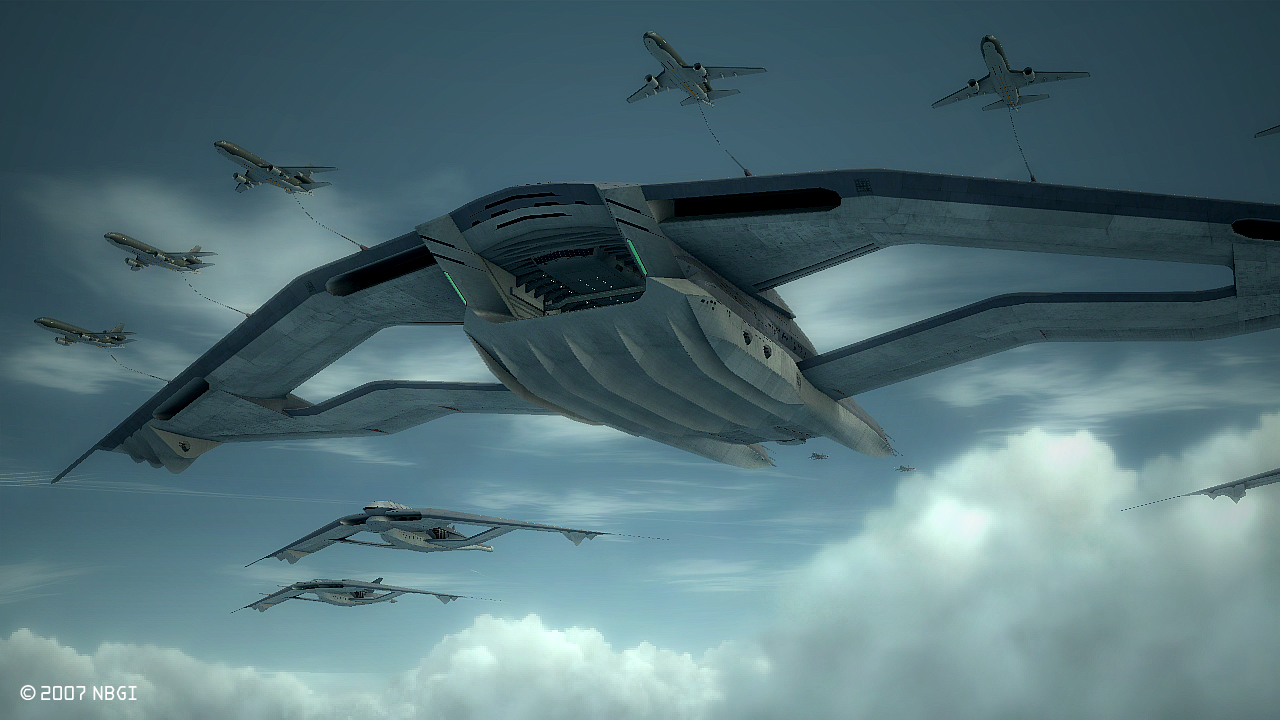
- Ace Combat 6: Fires of Liberation has the most triumphant example with Estovakia's P-1112 Aigaion, a jet propelled Airship with a Kilometer wingspan, which takes it a step further by having its own escort fleet of slightly smaller airships for both Anti-Air defense (Gyges) and Electronic Warfare (Kottos). At the start of the mission where you have to shoot it down, it's seen undergoing mid-air refuelling by no less than six tanker aircraft◊, each of which looks small enough to be sucked into Aigaion's humongous air intakes for its gigantic engine arrays. The Aigaion primarily operates as a carrier and is usually home to the enemy Ace Pilot squadron, Strigon team. In addition, she is also a flying missile launch complex, able to project her overwhelming firepower over very long distances utilizing the powerful Nimbus cruise missiles, in addition to an assortment of other missiles and guns for self defense. Of course, when push comes to shove, her Captain doesn't hesitate in spamming said cruise missiles on you, even at extreme close range.
- The Belkan XB-0 Hresvelgr from Ace Combat Zero is a super-massive bomber Airship. Although it was not yet able to carry and launch aircraft, the series mythology states that the technology used was eventually evolved and perfected over the course of two decades to create the Heavy Command Cruisers utilized by other countries such as the Aigaion, making the Hresvelgr a forerunner of sorts. To hammer the point home, the man who designed both aircraft, a Belkan ace from Zero, shows up as an enemy ace during the mission where you have to destroy the Aigaion in 6.
- Ace Combat X has the cousin to the Hresvelgr, the Gleipnir and its prototype, the Gandr. Still unable to carry aircraft like their cousin, they are able to compensate by having the ability to turn invisible. Their firepower is nothing to scoff at either, carrying devastatingly powerful Shockwave Ballistic Missiles that can instantly swat other aircraft out of the sky; the Gleipnir also carries the Shock Cannon, a cyclotronic particle accelerator that fires a meson blast to set off the same kind of explosion SWBMs cause, pulverizing everything that happens to be below the Gleipnir at the time.
- For varying definitions of "aircraft carrier", Ace Combat 5 has the Arkbird, a gigantic blended wing body spacecraft capable of short atmospheric flights. The Arkbird can launch UAVs for self-defence, but was originally built for peaceful purposes until the escalation of war saw it increasingly militarized.
- Ace Combat 7: Skies Unknown has the Arsenal Bird, a massive propeller driven flying wing. Under its fuselage it carries a whopping 80 Attack Drones into combat for use in swarming enemy fighter aircraft.
- The final mission of 7 also has the two Super Prototype Hugin and Munin UAVs which are able to deploy miniature UAVs to support them in battle.
- World of Warcraft has the Lensman Arms Race between the Alliance and Horde create massive flying battleships during the invasion of Northrend. While the Horde ship had a BFG at the front, the Alliance one had a rather underwhelming bomb bay. During the Cataclysm expansion, several of the Horde airships were destroyed, while the Alliance ones got upgraded repeatedly; by the time of Mists of Pandaria, at least one of them, the Skyfire, gets an overhaul and a flight deck capable of launching multiple squadrons of gyrocopters. During the introduction quests in Pandaria, this clearly pays off as said gyrocopters destroy yet another Horde gunship, leaving their forces stranded for awhile while Alliance brings in reinforcements.
- Wolfenstein (2009) sports a truly awesome example of this trope. The Nazis use a Zeppelin so incredibly huge, it carries not only airplanes but other Zeppelins, in addition to hordes of Nazis and their dimension-warping superweapon.
- The protagonist spends some time on a skyship such as this in Gauntlet Dark Legacy's Sky Dominion world.
- Sid Meier's Alpha Centauri has this disabled by default, but by switching a certain 0 to a 1 in the "alpha.txt" file, you can add the Carrier Deck to aircraft.
- Jak and Daxter series:
- In Jak 3, the Krimzon bots have a gigantic floating war factory that can pump out several full sized tanks and UAVs whenever needed.
- Jak and Daxter: The Lost Frontier also gives us the Phantom Blade and the ACS Behemoth, large airships capable of carrying and deploying smaller fighter craft.
- The go-anywhere Submarine from Xenogears. It starts out as a land-sub capable of traveling below the desert... then becomes able to sail underwater... and fly... and transform into a gigantic energy-cannon for a city-fortress turned Humongous Mecha. Rather than aircraft, it can launch giant robots (Gears).
- Too many shoot-'em-ups to count. Many are airborne aircraft carriers that transport your player ship(s) to the war zone, others are Boss Fights:
- All of the Raiden games, particularly in V where the main carrier is called the Bellwether. The second stage usually has a flying wing carrier as a boss.
- The Tetra in Radiant Silvergun.
- The Sword of Acala and the flying Fortress Misago in Ikaruga.
- In Sonic the Hedgehog, Dr. Eggman loves building these.
- The last level of Sonic the Hedgehog (8-bit), Sky Base Zone, is the franchise's first example of the trope.
- It started showing up in the 16-bit games with Sonic the Hedgehog 2's Wing Fortress Zone.
- Sonic 3 & Knuckles featured Flying Battery Zone as the second level of the expansion.
- The massive Egg Carrier from Sonic Adventure. It's also the first one whose abilities other than flying and being really big are shown. It's armed with missile launchers, a fleet of robotic jet fighters, laser cannons (tons of these damn things in Sky Deck), robot staff, transformation capabilities, and to top it all off, a Wave-Motion Gun. He has a second one in reserve, even.
- In Sonic Heroes, he really ups the ante with an entire fleet, with the flagship being at least as twice as big as the original Egg Carrier, and twice as armed.
- Altitude Limit Zone from the first Sonic Rush game would be an example if it had some actual structure and was more than a flying rail system. It still has plenty of aircraft, though.
- In Sonic the Hedgehog (2006), Eggman uses a redesign of Adventure's Egg Carrier. It's mostly seen in cutscenes, and there aren't any levels on board, although Sonic's final boss is fought on it.
- The opening of Sonic Unleashed features a whole fleet of these similar to the Heroes example, only they're in space. Sonic still has no trouble destroying them, despite the lack of air. The first boss, the Egg Cauldron, is a less exotic example.
- In Sonic Generations, another one of these is seen terrorizing Spagonia. If you're really skilled, you can even destroy it on foot.
- Sky Fortress Zone in Sonic the Hedgehog 4: Episode II is very heavily based on the aforementioned Wing Fortress Zone (acts 2 and 3) and the level immediately before it, Sky Chase Zone (act 1 and the boss). It also contains elements of Flying Battery Zone.
- Nearly all Zeppelins in the Crimson Skies series also serve as aircraft carriers, most notably Pandora, Nathan Zachary's flagship.
- And before Crimson Skies, there was Air Power: Battle in the Skies, an alternate universe flight sim where the player is one of four nobles trying to gain control of the empire after the death of the old emperor. The tools at the player's disposal are a fleet of combat zeppelins, including an aircraft carrier that serves as the player's flagship.
- True to its Independence Day homage roots, the Aeon's experimental saucer from Supreme Commander does both this and packs a core-based death beam. The downside is that it's rather fragile and relies a great deal on its flying complement to protect it and draw fire.
- Battlefield 2142 has Titans, flying bases that are the center of a certain gamemode. The goal is to bring the enemy Titan down either by missiles launched from silos on the ground, or by invading it and destroying vital elements. The Titans launch fighter craft and dropships from their decks.
- The Protoss in StarCraft have Carriers, which can maintain a fleet of Interceptor ships which are used to attack both ground and air units. The Carriers, however, break the pattern ever so slightly by only launching minuscule unmanned ships, visibly smaller than a single-man fighter.
- Then again, since a motorbike is longer than a fighter, and a tank is about half as long as a battlecruiser in-game, we should really not judge sizes by the unit models.
- For StarCraft 2, the Terrans were going to have an upgrade for the Starport called the Starbase, which was basically a permanently flying Starport that could still create all their air units. Sadly, the building was cut from the final build of the game.
- Terran Battlecruisers are often treated as this in the novels. In Heart of the Swarm, the Hyperion has "Tac Fighters"-small fighters that it constructs, and act similar to the Carriers' interceptors: fly out, shoot targets, return to base, and attack again. Unlike the interceptors, audio dialogue indicates they're manned.
- The Halberd from the Kirby series, which makes a return both as a stage and a plot element in Super Smash Bros. Brawl.
- The Scrin Planetary Assault Carrier from Command & Conquer: Tiberium Wars should count, though in its case its literally nothing more than an engine, a control system, and a long, narrow span connecting the two that is lines with dozens of drone fighters that swarm over anything they see. Powerful enough that it can challenge the other Tiberium Wars Game-Breaker, the GDI Mammoth Tank.
- It actually has a rather good attack of its own, but most people overlook it. The thing can create an Ion Storm around it, giving it an immediate-area attack field. The storm also buffs up any other Scrin aircraft around it. The Mammoth stands no chance.
- Most of the battleships from Super Robot Wars house small hordes of Humongous Mecha as well as a few fighters, and at least one is secretly a Transforming Mecha itself.
- Little-known game Project Nomads has you flying about in a small gravity-defying mass of land on which you can build hangars that, in turn, build and deploy small fighters. The fighters can be controlled by yourself or left to their own devices, but it's wiser to take control because otherwise they tend to charge headlong into massed defense fire.
- In Final Fantasy XII, the Bahamut as well as the heavy carrier class airships (such as the Leviathan) use these as well. The Bahamut deploys Valefor-class fighters as a means of offense against Resistance forces while the Mist cannon is charging, and heavy cruisers often deploy, among other things, Atomos-class transport ships, as well as the aforementioned Valefor-class on the Archadian side, unnamed fighters on the Resistance side.
- Final Fantasy XIII has the Lindblum, which is freaking huge, and the Palamecia which is even bigger.
- TownShip in Breath of Fire II supports a whole flying town.
- The Flying Krock from Donkey Kong Country 2: Diddy's Kong Quest, which is where Kaptain K. Rool is fought for the first time.
- In Blazing Angels 2, The Final Boss is Project-C, a shielded(!), World War II era(!!), Airborne Aircraft Carrier.
- The Great Fox in Star Fox is a rather moderately sized version of this, holding only about six vehicles at most. In one mission in Star Fox 64, you can even enter it for repairs. Some bosses are also able of launching smaller ships aswell as missiles, such as the Assault Carrier.
- Star Fox 64 also has the Saruzin, the flagship of Andross' fleet in Sector Y, which transports the Shogun Warlord mecha-suit into the boss battle. It continues moving until it reaches the center of the boss arena, then stop as serves as an obstacle/platform for the boss to stand on. Strangely, it has no offensive capabilities of its own.
- In Skies of Arcadia, Galcian's flagship the Hydra is one of these.
- Sci-fi flight sim Echelon has both flying aircraft carriers and the standard watery sort. The flying type is equipped with significant anti-aircraft defenses and is usually defended by flying destroyers as well. Somewhat interesting is that these ships fly at low altitudes, and several missions have them assist in the destruction of ground targets.
- In Just Cause 2, a floating club aptly named the Mile-High Club features loud music, strippers and a small runway with a private jet.
- Virtual-ON Oratorio Tangram has one as a battle stage; in the endings that do not belong to Fei-Yen and Angelan, the heroes are rescued by their fellow soldiers and carried back to the carrier for repair.
- Supreme Commander 2 has UEF's Experimental Mega Fortress - Airborne Aircraft Carrier with impressive damage output and more effective than a basic air factory.
- The first Supreme Commander features the Czar, a gigantic Flying Saucer with aircraft manufacturing capabilities. Naturally, it has a Wave-Motion Gun in the middle.
- Air Force Delta Strike features one that the player launches from in the opening mission.
- Despite being incredibly realistic in most respects, IL-2 Sturmovik still manages to work in an airborne aircraft carrier in a way, namely the Zveno parasite fighter. Which really existed (see the Real Life section for more).
- The final boss in SkyGunner is a massive floating battleship that also carries an enormous complement of fighters. It's about the same size as the city levels you fly in.
- To further emphasize on how Saints Row: The Third is even more batshit-insane than its predecessors, STAG uses a behemoth airship carrier called the Daedalus which in one ending proceeds to bomb the entire city just to root out a single gang. The airship is destroyed single-handedly by the protagonist.
- While not really sharing the look, Gohma Carriers from Asura's Wrath do carry smaller gohma that can't fly into space to fight.
- The final boss of U.N. Squadron is one of these, though it more resembles a flying battleship/dreadnought with a few plane launch hatches. Interestingly enough, the game also features a land-based traditional aircraft carrier, which runs on tank treads out in the desert.
- Exaggerated in Halo with the INF-101 Infinity, an absolutely massive warship introduced in Halo 4 that can carry up to ten frigates and deploy them in space battles. And is also carrying a crew of over 17,000, including over 6000 Marines and hundreds of the newly-created Spartan-IVs. Its introduction in the first Spartan Ops episode features it coming out of Slipspace and plowing through a Covenant warship's middle.
- The aerial city of Columbia is naturally one of these to its hordes of security barges and zeppelins in BioShock Infinite. It really shows this ability off in the 1980s attack on New York City.
- The Flying Battleship Balrog from Strider, a massive aircraft carrier that flies thanks to gravity control.
- Sins of a Solar Empire has several examples; the Sova and Percheron for TEC, the Halcyon and Aeria Hosts for the Advent, and the Skirata and Lasurak for the Vasari. Additionally, most capital ships can launch strike craft wings, effectively making them this trope.
- The Empire in the Panzer Dragoon series makes heavy use of airborne aircraft carriers, which are propelled by Lost Technology Anti-Gravity devices. The first boss of Panzer Dragoon Orta prominently features a modestly sized aircraft carrier, the Vermana, which is promptly shot out of the sky by Orta's dragon.
- In From the Depths, the Deepwater Guard fields a large number of Barracuda airships that deploy 8 autonomous fighters and are kept aloft with internal rotors. A number of other factions field similar designs, and the player is free to design their own.
- The Rising Tide expansion for Civilization: Beyond Earth adds the Aquilon, a hovering carrier unit that also mounts artillery cannons for fire support. As the ultimate unit of the Supremacy / Harmony hybrid affinity, it's a bizarre-looking merger of a Living Gasbag and machinery that developers have described as a "meat zeppelin".
- In XCOM2, the XCOM organization have one of those that was built from a stolen aliens supply barge; they use it as a mobile base against the alien occupation and launch the Skyranger from it.
- In Fallout 4, the Prydwen airship serves this function for the Brotherhood of Steel's Vertibirds.
- In Aero Fighters Assault for the N64 the heroes launch from a flying carrier called the Goliath. Landing on the ship is one bonus mission and defending from an enemy attack is a later one.
- In Front Mission: Gun Hazard, the various Base Carriers that player acquires throughout the game act as this for their Wanzer's. The most notable is the Capricorn, which has the ability to go into space and proves necessary for reaching the top of ATLAS.
- In Oddworld: Munch's Oddysee, Vykkers' Labs is a massive laboratory, military, and factory complex housed in a huge Flying Saucer -esque airship.
- In Vector Thrust, the ANGEL superweapon TDC-17 Pesanta is a massive delta-winged aircraft believed to use chemical weapons as a primary means of attack, but it carries plenty of drones to aid in precision targeting. Or disposable shields.
- In Sky Rogue, you take off from a carrier held up by four prominent thrusters at the start of every mission, and return to it to finish your mission after destroying all mission objectives. You can also land on it mid-mission to replenish special weapon ammo and to repair your Aero's hull, but any landings after the first one in each mission will cost you scrap.
- In Girl Genius, Baron Wulfenbach has a fleet of dirigible fortresses and assorted lighter-than-air craft as his mobile base of operations, including the enormous Castle Wulfenbach. Also, most airships have escape pods that are themselves miniature airships.
- Castle Wulfenbach is so large it's practically an Airborne Airborne Aircraft Carrier Carrier.
- Addictive Science: The Men in Black have a helicarrier, it crashes about as often as the inspiration.
- Some were seen in Alpha Shade.
- The Nazi dreadnought in Even Death May Die! qualifies, as a seemingly-impossible, armoured zeppelin.
- In one of Sluggy Freelance cross-dimension stories, humans have some of those, as seen here. Their usage is justified because the "zombies" cannot fly and staying in the air or space is the only real safe point to be, along with sheer practicality of a mobile base.
- The Lord Standish is a flying aircraft carrier in Avania, among several other flying capital ships.
- The Iron Vulture in Disney's TaleSpin.
- Seen in the Wartime Cartoon "Japoteurs" from the Fleischer Superman theatrical shorts, after a fashion. A giant bomber, larger that anything ever built, carried a number of small, one-man fighter planes aboard, launching then off the top of its fuselage.
- Cobra had two different Helicarriers in G.I. Joe: A Real American Hero. One was based off an unused design for the SHIELD Helicarrier from an abortive Nick Fury cartoon. It appeared in the first mini-series and in the opening animation of GI JOE: The Movie (possibly two different carriers as the one in the mini was captured). The second type appeared only in the opening animation for the second mini-series and subsequent episodes. It looked like a giant cobra insignia. It is destroyed by the end of the opening animation.
- The OSI from The Venture Bros. have a mobile fortress called the Hoverquarters which is very much like the SHIELD Hellicarrier making sense since the Venture's OSI is a parody of SHIELD.
- The OSI's opposite number SPHYNX, itself a parody of the aforementioned Cobra, had their own hovercarrier in the shape of, well, a sphynx. In an homage to the GI Joe opening mentioned above, the fortress is downed in a rather over the top battle that ended the organization's threat, only to be later adopted by Colonel Gathers when he went rogue and restarted SPHYNX as an alternative to OSI. Sky Pilot mentions the thing is like trying to fly a winnebago.
- In Storm Hawks, the title group uses a flying capital ship/aircraft carrier as their travelling home.
- The 60s Spider Man had an episode where Spidey fought a former World War I ace who had a flying aerodrome - and Fokkers that fired laser beams.
- The Kids Next Door have a craft called the Gihugeacarrier that went down while fending off a Teenager attack.
- Word of God says it's actually spelled G.I.H.O.O.J.A.C.A.R.R.I.E.R.
- The Saint Nazaire and its sistership Calisto from the CGI animated series Skyland. Each ship houses a group of 10 small fighter aircraft called Mosquitos. Their opponents, an organisation called The Sphere, also uses a weird kind of airborne aircraft carrier. It is a huge vertical mothership called The Monolith, which holds a large amount of fighter aircraft and troops. And if you think that's all, The Sphere's home base is a truly enormous cubic shaped flying fortress that even dwarfs The Monolith.
- The Magic School Bus once transformed into this.
- G3 (Galactic Guardian Group)'s headquarters in Sym-Bionic Titan.
- The Justice from the short lived Ring Raiders was not only an airborne aircraft carrier, but one that could travel through time.
- The New Adventures of Jonny Quest features Dragna's airship, the Dreadnought. His Mooks deploy from it encapsulated in electrically-charged glowing spheres.
- Broadside from Transformers: Generation 1 is an Autobot that can both turn into a jet and an aircraft carrier. However, not only is Broadside larger than most of the Autobots, both of his alt-modes are also unusually huge, and ironically, he's afraid of both heights and water.
- Angel Wars: The Seven has shades of this, even though it's more of a Cool Starship. The environments it flies through tend to look like blue skies with white clouds, and it carries other flying vessels inside it like Paladin's Fly-Cycle and Swift's Merk-7 Artillery Chariot.
- Zeppelins are the Ur-Example of this trope. During World War I, they developed this capability, carrying 1-2 aircraft at first, ranging from unarmed Hummingbirds to Gloucester Grebe fighters and Sopwith Camels. After war's end, developments continued studying ways to launch them and recover them in mid-air. Even blimp airborne aircraft carriers existed. Zeppelins are usually preferred, as they can better match the speed of the docking aircraft, have payloads in the hundreds of thousands of pounds and can store the planes inside internal aircraft hangars. However, the U.S. TC-series blimps of the interwar period carried one plane each. They were used to develop the capability for the Zeppelin USS Los Angeles, which led to the Akron and Macon as seen below, the greatest examples of this trope, carrying up to 5 Sparrowhawk fighters each.
- None other than The Hindenburg was also an Airborne Aircraft carrier, briefly, and the only civilian airship to be one. The airplane damaged its mooring to the airship by accident, and the system was uninstalled just before the airship's final flight.
- USS Macon and USS Akron, in the 1930s, are the instances that most readily come to mind when one thinks of a real life airborne aircraft carrier. Of course, they also had the dubious distinction of being the last new rigid Naval Zeppelins. They worked splendidly in concert with their aerial squadrons of Curtiss Sparrowhawk fighters. Both of them ended up being lost in storms out to sea in separate incidents, one due to ballast overcorrection and a damaged section that went unrepaired, the other due to a faulty altimeter, poor visibility and human error. With the Akron losing 73 of its crew; since one of the leading proponents of airships among the Naval brass happened to be aboard (and was among the dead), it's not hard to see how the Airborne Aircraft Carriers didn't catch on more.
- The concept comes up in modern circles every few years as a replacement for the aging and shrinking fleet of P-3 Orion maritime patrol aircraft. An airship would have significantly longer range and loiter time, and a significantly larger payload. The latest version includes proposals for UAVs that can be launched, recovered, and rearmed in flight, thus bringing things full circle from the Macon and Akron.
- The Ministry of Defence in the UK is preparing a demonstration with the world's largest aircraft, an optionally-manned hybrid airship/airplane called the Airlander 10. One of the proposals includes using its large cargo bay and long endurance to make it a "mothership" for medium-sized drone airplanes.
- A related concept to the true airborne aircraft carrier is the "parasite aircraft", in which one aircraft is launched in midair by another, but lands on the ground. This has actually been attempted in real life much more frequently. For example:
- In the late 1940s, the USAF experimented briefly with using a small, exceptionally ugly parasite fighter called the XF-85 Goblin to provide fighter escort to B-36 bombers. Each B-36 could carry one Goblin, which would launch to provide escort over the target, then return and hook back up with its parent bomber on the way home. However, the Goblin was judged to be inferior to the defending fighters it would encounter. This fact, together with the development of long-range jet fighters and of in-flight refueling, led to the cancellation of the XF-85 program.
- FICON (FIghter CONveyor) Project: Putting an F-84 fighter inside the bomb bay of a B-36 and using the former to deliver a tactical nuke. Shortly thereafter repurposed for reconnaissance, with a few GRB-36D refitted to carry the faster RF-84K, allowing the recon-fighter to conduct recon of sites too heavily-defended for a big lumbering converted bomber to approach. The RF-84 still had machine guns, so it could play a dual role protecting the mothership from enemy interceptors. Only a few operational flights were made before the U-2 came along and the B-36 became obsolete. Determined to be an idea that worked better in theory than in practice.
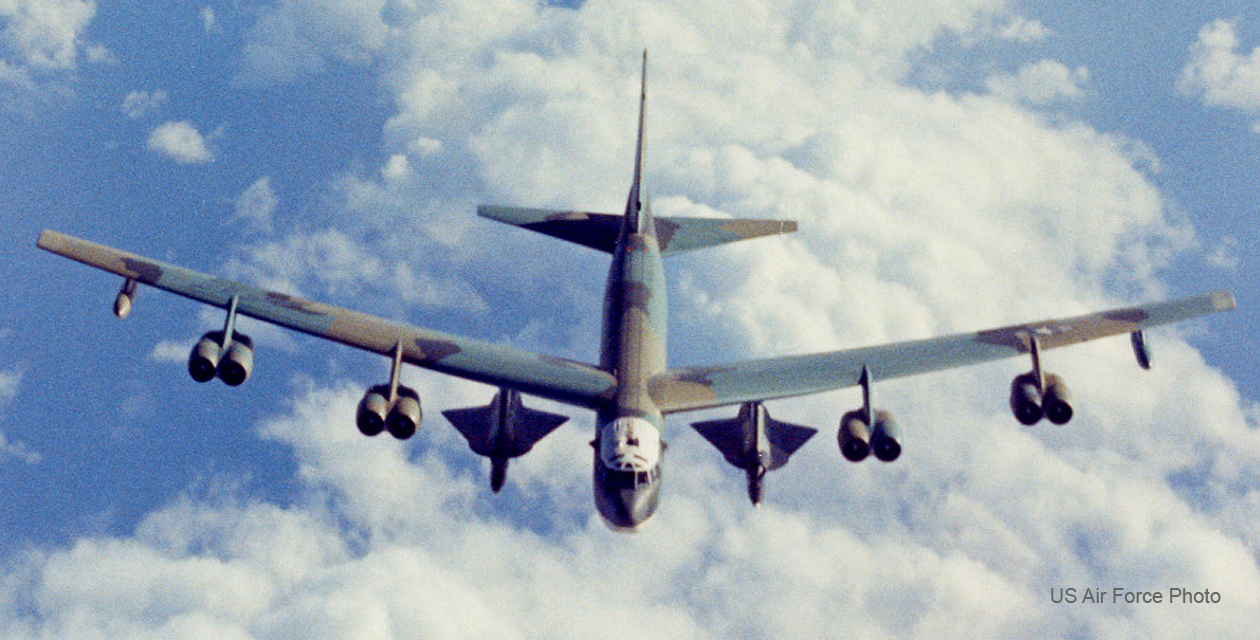
- Many of the early X Planes (the experimental rocket and jet planes that paved the way for supersonic flight and manned spaceflight for the Americans in the Cold War) were carried aloft by carrier planes such as the B-52 Stratofortress, and launched in mid-air.
- The B-52 would similarly be used later on to launch unmanned recon drones◊ which would fly out on a preprogrammed path, take pictures, and fly back to a rendezvous location where another plane trailing a net (usually a modified transport) would catch the drone in midair and reel it in.
- Similarly, there was a variant of the C-130 Hercules that could carry up to four drones on the wings and launch them in flight, controlling them remotely.
- SpaceShipOne, the privately built spacecraft that won the X-prize, and its successor SpaceShipTwo, are similarly launched from a jet mothership called "White Knight".
- Like the X-planes, OV-101 (Enterprise) was built for atmospheric testing of NASA's Space Shuttle orbiter. It was launched from a modified Boeing 747. This same 747 was later used to transport the Shuttle from its runway in California to its launch site in Florida.
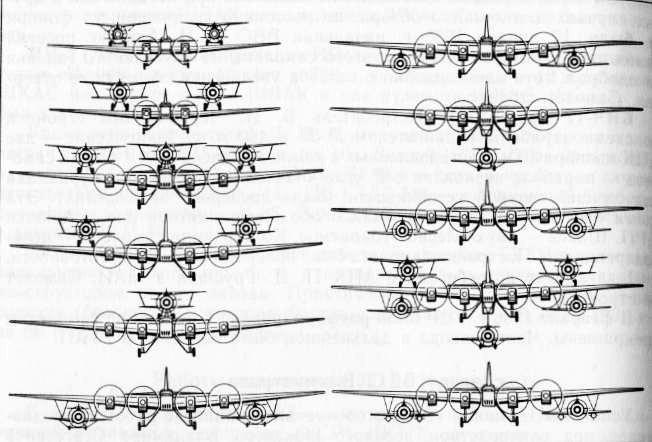
- The Soviets also conducted their own experiments in the 1930s called the Zveno Project, and unlike the other "parasite fighters" mentioned here they were actually used in battle. Tupolev heavy bombers TB-1 or TB-3 (slow, but with 2000 km range and 8 ton capacity) would carry 2-5 little fighters-bombers I-4, I-5, I-Z or I-16 (decent speed for late 1930s, but only 600-800 km range). See possible configurations.◊ Some configurations even allowed an I-Z or I-16 to dock under the mother craft after the mission. The most successful version was TB-3 with a pair of I-16 mounted under carrier's wings in place of bombs. See more photos. The interceptor variant was supposed to cut calling fighters time from "scramble and climb all the way up there" to "release bomb locks". The dive bomber variant had a long-range bomber carrying two fighters armed with bombs too heavy for them to take off on their own. These teams flew more than 30 missions, being among the most successful in Soviet aviation. The project ended in 1942 due to the wear of the involved machines and because newer models, such as the Pe-2, made them obsolete. You can fly the Zveno aircraft cluster in IL-2 Sturmovik.
- This project may have inspired Kh-20 cruise missile that was basically a slightly modified MiG-19 airframe with a nuclear warhead in place of the cockpit, designed to be launched from the huge Tu-95 Bear bomber. The concept was actually tested using modified MiG-19 fighters with pilots, qualifying the bomber for this trope.
- This project may have inspired Kh-20 cruise missile
- The Daimler-Benz Project C was a proposed plan from Nazi Germany for a massive bomber-like aircraft that would carry up to eight parasite fighters on the wings and fuselage that would be detached and launched in-flight. These jet or rocket propelled aircraft were at first conceptualized as fighters, but later iterations of these aircraft became human-guided bombs for targeting bridges, ships and bomber formations. While these bombs would have escape chutes underneath them, the likelihood of escaping alive was so low that they may as well be categorized as suicide aircraft. However, none of the Daimler-Benz Projects ever got off of the drawing board.
- Thanks to new technology, the concept is being looked at again, only this time the carried aircraft would be drones rather than traditional fighters.
- DARPA started investigating the idea in 2015 with surveillance drones.
- Amazon has filed a patent for an airship-based warehouse that launches delivery drones.
- The Lockheed CL-1201 is a concept for a ludicrously enormous (as in Ace Combat levels of enormously huge planes) nuclear-powered plane. It has a weight of 5,265 tons, wingspan of 1,120 feet (or 341 meters), length of 560 feet (171 meters), and a crew of over 800 people. It would be powered by four massive turbofans each with the diameter of a 747 fuselage, as well as 182 lift jets (meaning that it would be theoretically capable of VTOL). The concept proposes two uses for this massive plane: transporting a brigade-sized force to the frontlines (which would be transported to the ground via 747-sized transports that dock to the plane midair), or carrying 22 fighters on pylons on its wings as a flying aircraft carrier. While ultimately no more than a concept, the CL-1201 is one of the most radical (and biggest) aircraft designs ever proposed outside of fiction.
- A slightly more practical version was considered based on the 747, but it similarly never was seriously considered. Interestingly enough you can actually read the original proposal.
- A slightly more practical version was considered based on the 747,
- On October 21, 2019, at the Changchun Aviation Open Day, the Chinese Air Force unveiled plans to build a massive flying wing capable of hosting jet fighters on it.
- The General Atomics Sparrowhawk is a miniature drone that can be deployed from a standard full-sized Reaper drone to act as an "extra pair of eyes". Fittingly, it's named after the Curtiss Sparrowhawk, the fighter that operated from US Navy airships in the 1930s.
- A couple of examples can be found in the Secret Projects Forums, one of which is a Bartini design for what is essentially an aircraft-carrying ekranoplan (a type of ground-effect vehicle, technically classed as a ship but looking an awful lot like an airplane).
- The utterly insane Yakovlev VVP-6 was a Soviet concept for a monstrous 24-engine, six-rotor helicopter that could serve as mobile battery for surface-to-air missiles (though they probably ought to be considered air-to-air missiles in this case) or, alternatively, as an airborne launch platform for Yak-38 VTOL fighters. It was never built, but it was the closest thing ever concieved to a real-life Helicarrier.