

In the military, innovation has driven military conquest as someone found new ways to do something that was better than what came before. However, in Speculative Fiction, it seems that a lot of people have decided combining previous concepts into one über-machine is easier than coming up with something original.
Enter the Military Mashup Machine. In reality, some of these would be far more expensive than practical, with other existing military technologies being much easier to get the same results from, but if it looks cool, why not present it as worthwhile?
Its also worth noting that numerous militaries since the dawn of man have attempted to build them for the same reason. Most such projects meet their end on the drawing board thanks to the intervention of saner minds, but the occasional lovechild of General Ripper and The Engineer somehow manages to sneak into production. Usually these result in machines with predictably lackluster performance, but a handful have proven surprisingly effective.
While generally members of Speculative Fiction or Science Fiction, these can also show up in Steampunk as well. See Airborne Aircraft Carrier, The Battlestar, and Mobile Factory for specific Sub Tropes. See More Dakka for a similar philosophy applied to ranged weaponry.
Compare Mix-and-Match Weapon, similar principle applied to hand-held weapons. Contrast Franken-vehicle, which is literally made of other vehicles rather than combining their functions.
Examples:
- The mobile fortresses guarding Olympus in the adaptations of Appleseed. In Alpha a Land Battleship turns out to be the MacGuffin that Iris has been sent to destroy.
- Genesis Survivor Gaiarth: Siegfried was a truly immense one (coupled with a mobile war factory) as The Heavy's base of operations.
- Gundam has a slight love affair with these, which have featured from the beginning to the more recent Gundam SEED Destiny. Perhaps the most bizarre version was the Battleships of the Zanscare Empire's land forces, such as the Adrastea-class,
 ◊ which were essentially naval ships on enormous motorcycle wheels.
- The Gundam SEED spinoff Gundam SEED Astray shows that that universe's land battleships are amphibious; though designed specifically for land combat, they use an exotic "scale system" that works just as well on water as on land. Gundam SEED Destiny reverts to the relatively more conventional "giant tank" with tracked propulsion in the form of the Hannibal class.
- The Gundam SEED spinoff Gundam SEED Astray shows that that universe's land battleships are amphibious; though designed specifically for land combat, they use an exotic "scale system" that works just as well on water as on land. Gundam SEED Destiny reverts to the relatively more conventional "giant tank" with tracked propulsion in the form of the Hannibal class.
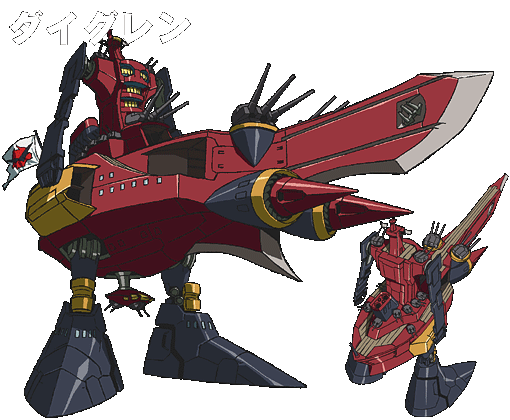
- Tengen Toppa Gurren Lagann goes typically overboard, by making the featured land battleship◊ a literal battleship on legs and a Humongous Mecha to boot (ironically, it requires special adjustments to cross water). General Guame's Dai-Gundo is more typical of this kind of thing. Ignore the phallic connotations of its design.
- Those special modifications include (and apparently consist entirely of) a Humongous Mecha-scaled kayak paddle and flippers. It's even seen paddling its feet like a duck.
- The humanoid designs are justified, as in the series, the human form is more conducive to spiral energy.
- The Rhinoceros-class ships in Super Robot Wars: Original Generation.
- Code Geass gives us several types of land bases, which are basically airships on the ground (until they perfect the float systems, anyway). The actual development of Knightmares themselves were stated to be a result of this, since the 1st and 2nd "Generations" were the result of cobbling together existing technology (Factspheres, Landspinners, emergency cockpits, legs, etc.) together For Science!. The 3d generation Ganymede was the first true unique advancement in the technology.
- My-Otome has these as well (and normally used as the launch platforms for the Otome's themselves), considering the planet where the story takes place is a Desert Planet. Heck even a civilian ferry travels on land.

- The titular Land Leviathan from Michael Moorcock's 1974 novel "The Land Leviathan".
- The original land battleship, from the story "The Land Ironclads," by H.G. Wells, is possibly the earliest example, predating actual tanks.
- Keith Laumer's Bolos: automated (and eventually artificially intelligent) land battleships of the Dinochrome Brigade (called "continental siege units" in early stories) which grew to have more firepower than the space battleships that transported them. (Their main guns are generally fusion lances with output measured in megatons per second.) The largest models are capable of defending or conquering an entire planet, solo, and they, rather than their commanders, are the de facto protagonists of the stories where they appear.
- The Fallen World has the Hammer of Eternity, a giant walker the size of a battleship and the artillery to match. It serves as the command ship for the Old World Armada, having several other giant walkers to act as a carrier battle group. They even have strike craft, which includes Bradley tanks.
- Legacy of the Aldenata:
- The Tiger IIIs from Watch on the Rhine are land battleships. The design of the Tiger III is never specified, but it is also known to be capable of shooting down spacecraft in low orbit as well as taking out swarms of Posleen.
- The SheVa unit "Bun-Bun" has added weapons and equipment to make it count as a land battleship, but it still isn't quite on the same level as the Tiger IIIs. Other SheVa units, however, are more akin to just really big mobile artillery pieces.
- Robert A. Heinlein's short novel If This Goes On— has the major land force of the USA be Land Battleships.
- Scott Westerfeld's Leviathan features Land Frigates, which are essentially actually German Battleships with legs.
- Spoofed in the Harry Harrison short story Navy Day. The US Army declares their waterbourne rivals obsolete after developing a technology that enables vehicles to drive on the ocean. Naval scientists work frantically while Congress debates whether to abolish the Navy once and for all — just as they are about to vote in favor the Admiral points to the battleship now 'sailing' down Constitution Avenue.
- Subverted in Harry Turtledove's World War series. The Race has "landcruisers" but they're just normal-sized tanks, the lizards hadn't really bothered to come up with many specialized words for their military technology since they'd fought only two wars in the past 100,000 years before invading earth.
- At the same time, they have the word "cruiser", which is a naval term, despite the Race hailing from a desert world with no oceans or any other major bodies of water. In fact, it's specifically mentioned that our battleships and aircraft carriers are a mystery to them. They also call their spacecraft "ships", and it's not just Translation Convention either. A Chinese woman who has studied their language wonders why "planes that never land" are called "ships". The Race obviously can't think of space travel in terms of Space Is an Ocean because they never had an age of sail.
- GoGoVoyager from GoGo Sentai Boukenger (aka the Battlefleet Megazord from Power Rangers Operation Overdrive) is basically a battleship with wheels (and a terrain-flattening roller), able to go from sea to land and leave a path of devastation. Did we mention it also separates into five assault vehicles AND combines again into a big horkin' robot?
- Ultimate Daizyujin/Ultrazord. Description Porn warning: Start with an oversized robot brachiosaurus on wheels. Split the tail into two BFGs, and put one on each front shoulder. Take a skyscraper-sized robot formed from a robot Tyrannosaurus rex, a robot mammoth/mastodon, a robot triceratops, a robot smilodon, and a robot pterosaur, and a robot aquatic dragon. Remove the chest armor and tail from the dragon, and retract its missile-launcher hands into the shoulders. Then tilt the feet around, split it at the middle, and put it on the humanoid robot as armor, making sure to tilt the head crest up. Put the brachiosaur's chestplate (which has several firing barrels) on the humanoid robot's chest, and put its front paws on the humanoid robot as gauntlets. Attach the dragon's tail to the and chestplate to the brachiosaurus in the appropriate spots. Then stand the humanoid robot in a bay in the brachiosaurus' back. Voila. The resulting machine can roll along at a good clip, and packs enough firepower to blow up even the devil.
- Warhammer 40,000:
- The Imperial Baneblade in is a tank the size of a large house and mounts no fewer than 11 separate weapons, ranging from heavy bolters (firing fully-automatic armor-piercing mass-reactive explosive gyrojet rounds) to laser cannons to ginormous conventional cannons. It's also the standard chassis for a whole family of super-heavy tanks, including variants like the Shadowsword Titan-killer, which sports a Volcano Cannon that's usually carried by the Titans it's designed to destroy. Larger Imperial land battleships include the Ordinatus (a tracked Wave-Motion Gun or other ridiculously huge device of pure, specialized death), Leviathan (mobile command centre, basically a Base on Wheels), and the Capitol Imperialis (a tracked castle packing a potent cannon while still having room for two companies of tanks).
- Chaos forces have daemonically possessed/traitorous versions of all the above, sporting screaming mouths the size of houses and bladed tentacles the size of trains.
- The Squats favored these sort of engines over Humongous Mecha, including the Cyclops, a rolling juggernaut that's approximately fifty percent Hellfury Cannon, and of course the Land Train. The aforementioned Leviathan was originally a Squat invention as well.
- The 40K novel Double Eagle had land-based aircraft carriers.
- Warhammer Fantasy has Marienburg's land ships.
- The OGRE, one of several classes of autonomous robotic moving fortresses from the game of the same name (and its successor, G.E.V.) from Steve Jackson Games. The concept is partially derived from Keith Laumer's Bolos, and partially from Steve Jackson's need to reduce the numbers of counters he had to put in each box. In the original game, a combined arms force consisting of powered armor infantry, tanks, artillery, and hovercraft, each of whom, in the game universe, fires nuclear weapons, opposes one unit — the Ogre. In the original scenario, where all the defenders have to do is prevent the Ogre from reaching a specific point on the gameboard, the Ogre usually wins.
- Dystopian Wars has Land Battleships large enough to mount Saint Paul's Cathedral on their backs, while also carrying various weapons that make them more than able to live up to their moniker.
- BattleTech has Mobile Structures, which are literally buildings built on huge tank treads. They're impossibly rare in the setting, since the technology needed to create them was largely lost at the collapse of the Star League and even the League never considered them to be actually useful. Sure, they had the armor and firepower to take on an entire battalion of mechs and could utterly destroy anything under their tracks but they were horrifically slow, insanely expensive, and impossible to transport offplanet, limiting them to purely defensive roles.
- GURPS Infinite Worlds: Britannica-6 features an eccentric variant; the Ice Dreadnought. Over-the-top engineering is something of a competitive sport for the lords of the Britannica-6 British Empire, and one particular piece of craziness is His Majesty’s Ice Ship Earthshaker, constructed to the order of the Duke-Governor of Greater Manitoba in response to the threat he perceives from the Russian colony in Alaska and propelled by the largest ski-track system yet built on any timeline. This does impress the Russians somewhat, but it mostly spends its time intimidating unruly Inuit.
- PlanetSide - The Sunderer (and its variants) are basically giant buses as large as a house, with massive spikes on front, tank cannons on top, and ball turrets on the sides. And they can carry MAX units. Oh, and they can use a EMP pulse on anything near them, making them minefield sweepers as well. Planetside 2 drops most of their armaments in exchange for the ability to anchor down and activate a spawning field, phase through base shields or deploy infrared jamming smoke, and move at a roaring speed off road which when combined with their excessive mass, makes them excellent at flipping over tanks.
- Haze - The Land Carrier is what its name suggests: rather than a Land Battleship, it's a rather useless land helicopter carrier which seemingly whiles away the hours by driving in circles.
- Metal Slug:
- Metal Slug 2 - The Big Shiee, the boss of mission four. It's literally a Yamato-class battleship with tank treads bolted on.
- Metal Slug 5 also has the boss of Mission four, which is a Land Submarine that can submerge itself in the desert.
- And it's called the Sandmarine.
- And it's called the Sandmarine.
- Metal Slug 2 - The Big Shiee,
- Supreme Commander - The Fatboy actually mounts battleship calibre guns on rotating turrets. And it has a landing pad on top. Taking it even farther are the Salem Class destroyers of the Cybran Nation which are actual warships which sprout spider legs when they reach land in order to render them amphibious. They are ships on legs!
- In the sequel, all of the Cybran ships can do that, with the right research.
- A recurring unit from the Command & Conquer games is the Mammoth Tank, a two-barreled behemoth with anti-aircraft rockets that's big enough to crush other tanks. It's a staple of the Global Defense Initative in the Tiberium series (though it's technically a walking battleship in Tiberian Sun), while the Soviets in the Red Alert series eventually rename it the Apocalypse tank. Even in Command & Conquer: Generals, the Chinese get a similar Overlord tank, which is big enough to support a bunker, gatling turret, or propaganda tower.
- In the Kane's Wrath expansion for Command & Conquer: Tiberium Wars, GDI also gains the MARV, which is an even bigger mobile treaded deathmobile with a triple barrel sonic cannon, 4 garrisonable infantry bunkers and the ability to consume entire Tiberium fields instantly.
- On another note, there's also the Juggernaut artillery walker, which is more or less a Battleship turret on legs.
- Command & Conquer: Red Alert 3 does one better, with amphibious battleships. Not a battleship-sized tank on treads, but a literal battleship on treads. Meanwhile, every faction's Mobile Construction Vehicle is unarmed, but are big enough that they can run over vehicles and infantry.
- Fortress Saga AFK has your hero Louis begin with a Steampunk bastion walking on 4 mechanized legs. It's powered by a sentient seed of the World Tree and for defense it has a massive cannon and several balconies for heroes to attack from. Later he can extend the fort's size or earn other forts such as the Sydney Opera House flying on Magitek rockets.
- See Supreme Commander's Salem-Class, above.
- The Marmota and Batomys from Valkyria Chronicles fits this trope to a T.
- Noitu Love 2 has one as its very first boss. Humorously, when defeated, it sinks despite being fought on a city street.
- Armored Core: For Answer hinges on destroying incredibly Humongous Mecha that are land (and sometimes air or water) battleships. The gigantic carrier-type beasts are oversized and difficult to control. They are, however, valuable in that they project an obscene amount of power into an area, and can move to another area relatively easily. They are also extraordinarily frightening to fight: when the ten-meter tall mech that you're piloting isn't as big as the smallest gun on the carrier, you know you're in trouble.
The corporations which deploy them appreciate that no one person can control them. As opposed to the Humongous Mecha such as the one piloted by the protagonist. - Tales of the Abyss gives us a literal land dreadnought, the Tartarus.
- Even better it can float in water, and goes on to be the party's first global transport. It's not amphibious though; as resident The Smart Guy Jade points out it's "just a landship that happens to float on water". It was never really meant to be used as a boat. In fact, by the time you get it, the Tartarus' propulsion systems are so mucked up that it can never travel on land again.
- In Chrome Hounds, there's the Tarakian Unidentified Weapon, "M-99 Super Patriot". It is literally a Modern-day Supertanker (you know, the giant, 5 mile long ocean going ship), loaded down with giant (triple barreled) cannons, flamethrowers, and lots and lots of gatling guns. It also is a mobile HQ for enemy forces- and launches a bottomless supply of enemy ACVs.
- U.N. Squadron - Land carriers are used for a few bosses.
- The Call to Power series has Leviathans, enormous, heavily armed with most weapons of that particular period in that game, but extremely slow moving. In game, the unit is more powerful in every combat statistic than every other unit, but can only move one square per turn, even on roads. Fusion tanks in the same series might also apply.
- The arcade game series Raiden is chock-full of these, to the extent that in the later games, even the Mooks are a good example of the "smaller" types.
- The Stage 4 boss in the original is a mobile Temple of Doom.
- Cocoon in Metal Gear Solid: Peace Walker is basically a battleship mounted on treads, complete with a hedgehog.
- The screen-filling supertank bosses (called "Think Tanks" in the manual) in Iron Tank.
- The final stage of Battle Garegga has a giant land-based aircraft carrier.
- Starcraft II has the Odin, a prototype Humongous Mecha that is practically indestructible and can tear apart entire bases single-handedly. Its impracticality is lampshaded by Raynor's engineers, who design the scaled-down Thor based on it.
- End of Nations features a massive battleship sized tank called the Panzer Hulk armed with more than a dozen cannons.
- Fallout 3: Broken Steel has the Enclave's Mobile Base Crawler, which is based on a space shuttle transport crawler.
- Fracture features the Dreadnought, a walking amphibious land battleship that the Pacificans are hoping will win them the war with one quick knock-out blow.
- March of War features the European Alliance's Siege Tank and the Shogun Empire's Akuma class Landship, dieselpunk land-battleships in the 1940s.
- The Giant Tank in Double Dragon Neon.
- The Kreon in Vanquish is a spider-legged land dreadnought.
- Halo 4 introduces the M510 Siegework/Ultra-Heavy Mobile Anti-Aircraft Weapons Platform, a.k.a. the Mammoth. It's a three-deck wheeled armored vehicle that features a magnetic accelerator cannon (usually the main gun of spacegoing warships) and crewed rocket turrets on the upper deck and a garage that can carry two Warthogs on the lower deck. It'll also carry a couple platoons of Marines.
- From the Depths: A popular design theme is to have a vehicle able to perform a number of roles. For example the submarine aircraft carrier or the flying boat or other hybrid designs.
- In Besiege your task is to create Siege Engines (well, more like medieval-looking machines) to complete ceratin tasks. Some of them will inevitably become this.
- Out of desperation, the Federation forces in Project Wingman deploy two of these against you late in the game. They're stated as being shelved prototypes, probably supplanted by the abundance of more versatile airships. Given that you can disable these with a well-placed railgun shot, it's not hard to see why.
- The carriers of Homeworld: Deserts of Kharak are massive mobile bases used to traverse the vast deserts of Kharak, and have the ability to create vehicles and deploy aircraft.
- G.I. Joe: A Real American Hero has had a number of these in toy form, although they rarely appeared in the cartoons. One of them, the General (The Other Wiki link) did receive the focus of an entire episode. Driven by the Russian guy no less. Go peristrokia.
- The Nazi wheel tank (War Wheels) from the Justice League episode "The Savage Time". These were taken from the old Blackhawk comics during that time.
- Skullus, one of the Evil Sorcerers from Thundarr the Barbarian, possesses a huge war machine◊ which runs the gamut from land battleship to Base on Wheels...er, treads.

- Truth in Television: there was such a school of thought in 1920s to 1930s advocating the use of powerful vehicles to serve as trench-breakers and infantry support. As the expected pace of warfare was restricted by both technological limitations and the speed of infantry, these largely concentrated on larger and more heavily armoured vehicles.
- Both the British and Germans considered building these during World War II. The Germans prototyped at least one, with several more designs in the works before the war's end prevented their construction. By contrast, the British eventually gave up on the concept due to it being more expensive than it would be worth.
- Anticipating WW2 would be a replay of WW1, Britain commissioned a short run of five truly monstrous 90-foot-long tanks - purely to dig trenches with, in order to spare the infantry. This tank carried a single Matilda II turret with the puny 2-pounder gun for defence, but most of its design was given over to excavating and earth-moving equipment and the power plant to operate it. After the assumption about WW2 being a new trench war was proven horribly wrong, the one surviving excavator tank was used to dig field defences and anti-tank ditches, in what was thought would the final defensive lines around London. No more were built after 1940.
- The Panzerkampfwagen VIII Maus AKA "Mouse". At 188 tons, it is the heaviest tank ever constructed. Yeah, they really built this monstrosity. Two prototypes were built; the V1 had a weighted mockup turret with no weaponry, while the V2 had a real turret and armament. Both were captured by Russian troops, but the V2 was gutted by internal explosions in the process. The turret from the V2 prototype survived reasonably intact, and was lifted off the ravaged V2 hull (using six captured 18-ton halftracks) and mated with the V1 hull. This hybrid vehicle was returned to Russia, and survives to this day on display◊ at the Kubinka tank museum. However, it ultimately proved to be a total failure. Sure, it had a BFG and was a fortress on wheels, but it broke windows on nearby buildings when it moved, and bogged down on anything except asphalt, cobblestone, or concrete.
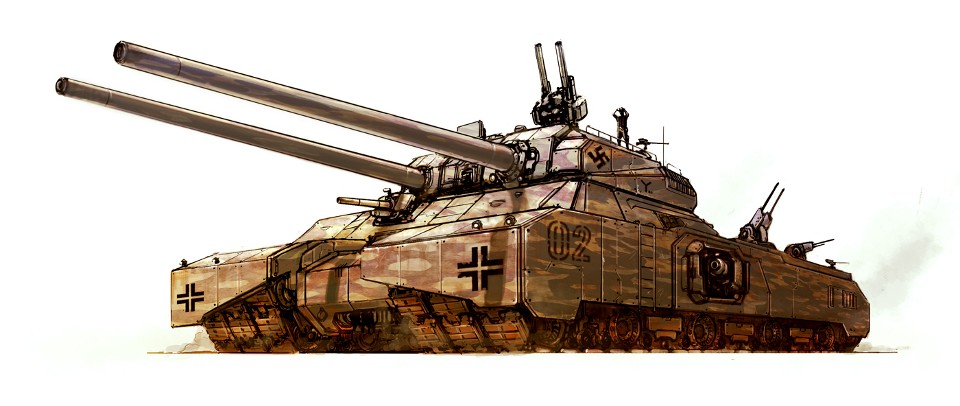
- One proposed German design featured a pair of battlecruiser cannon. It's none other than the Landkreuzer P. 1000 Ratte (Literally "Rat"; the fact that they called it "land cruiser" rather than "tank" is in and of itself telling). Wanna know what it would have looked like? Have fun.◊ Note the soldier standing on top for scale. Around the same time as the Ratte, they were also working on the Landkreuzer P. 1500 Monster, which would've been even bigger, with a Dora gun mounted on it. Fortunately for the Axis (and to a much lesser extent, the Allies), Albert Speer realized how idiotic both projects were (no matter how heavy the armor is, a "land cruiser" would inherently be a large, slow target that Allied air power could just keep dropping bombs on until the thing died) and canceled them.
- The Soviet T-35 probably qualifies - a veritable Games Workshop Tank with five turrets, but about as much use as you might expect. This one got into series, though soon canceled as obsolete: its huge size meant that the armor was critically thin, it was internally cramped, it proved impossible to coordinate between the turrets, and it was extremely prone to breakdowns due to having a suspension system that was no where close to being able to handle its weight. It was based on the Earlier British A1E1, which was about as successful. Nor was the t-35 the only offshoot, for the Russians also built the T-28 and T-100, the British built the Medium Mk I, and Medium Mk III, and even the Germans got in on the act with the Neubaufahrzeug, though having a greater presence of mind, cancelled the idea soon after.
- The Soviet T-28, nicknamed Postivaunu (Mail Bus) by Finns in the Winter War after they captured one that was full of letters to the Soviet troops. Formidable three-turreted monster, but an abysmal failure in practise.
- And then there's the IS-7 heavy tank, which there were only three made, but actually had an 130mm S-70 naval destroyer cannon as a main weapon, in addition to no less than 8 machine guns as secondaries, of which two fired 14.5 mm anti-tank rifle rounds. And although its gun was almost as good as the Maus's 128 mm, and the frontal armour was in many ways equivalent (similar thickness, greater angle - sufficient to deflect 128 mm shells) it subverted the trope by being smaller than and as heavy as Tiger II, and having a tested road speed of 60 KPH (i.e. as fast as a medium tank), courtesy of a 1050 HP diesel. A doctrine shift that banned all 50+ t tanks (which is upheld to this day, apparently) was the only thing between that beauty of a war machine and mass production.
- The IS-7, sadly, was cramped and had a very impractical layout, and the 50+ ton weight meant that old bridges in Russia's Far East would not be able to handle the weight. To the very pragmatic post-war Soviet tank corps, this beast was Awesome, but Impractical.
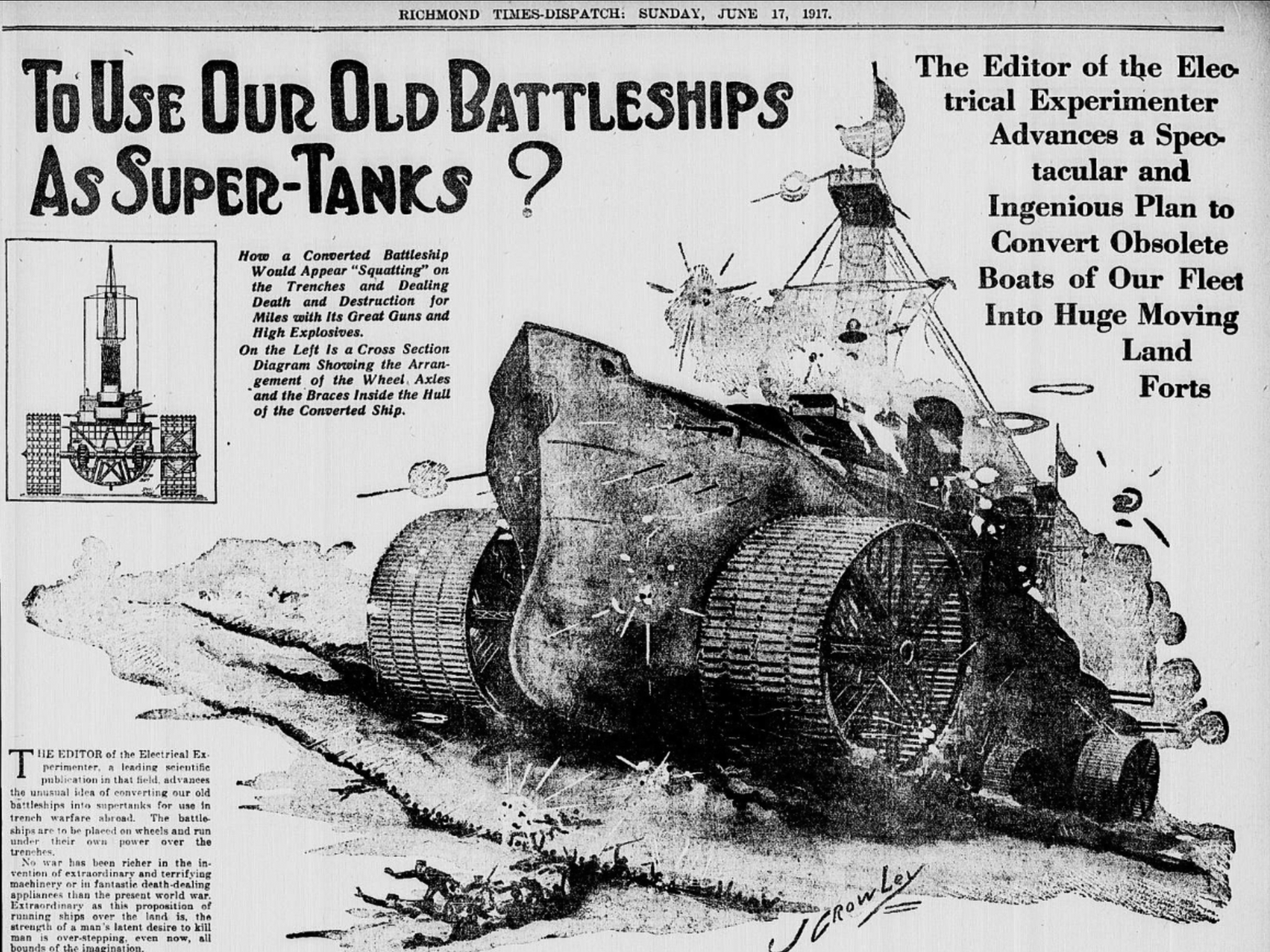
- Apparently the Americans also toyed with this idea, but in possibly the most outrageous ways possible: The idea they tossed around was to make use of their fleet of obsolete battleships by attaching wheels to them and driving them on land◊. It's not entirely clear if this idea was serious, or meant as a joke or commentary on the terrifying advances made in engines of war, but regardless, the lack of any additional material indicates it wasn't taken seriously by many, if any at all.
- The Panzerkampfwagen VIII Maus
- The tank itself was initially considered this, to the point that the first one not only were armed with naval guns, but they were originally developed and crewed by the Royal Navy (the British Army had decided the idea was impractical. Winston Churchill, then First Lord of the Admiralty, disagreed, and was proven right). This naval heritage is still evident in some of the terminology of tanks, like bow, hull, turret, and hatch. Bonus point for originally being called landships before the name tank, chosen for secrecy (they told everyone, including the factory workers that built the first batch, they were mobile water tank for use in desert warfare in Mesopotamia), settled in. The original concept for the landship was for a much larger vehicle, from 300 to 1000 tons. However, it was soon realized that such behemoths were impractical to build and that "landships" would be needed in large numbers, resulting in the infinitely more practical 28-ton Mark I tank.
- Modern advancements in remote operated weapon stations have actually allowed the return of the concept of having multiple turrets on a tank. Modern tanks such as the M1 or the Japanese Type 10 can now be equipped with the CROWS (Common Remote-Operated Weapon Stations), essentially a small remote controlled turret on top of the main turret that can house a number of weapons ranging from small machine guns to 40 mm grenade launchers (which are technically of a larger caliber than many early tank guns, even up to the early days of World War II).
- This trope is in fact more ancient than many people realize: impractically large siege towers have been a favorite arts and crafts project of invading military forces for millennia, in some cases constructed from the same boats an army arrived in. These were usually festooned with ballistae, catapults, and loopholes for archers, covered in whatever armor could be scrounged together from scrap metal and leather, and mounted on large skids or rollers. And, of course, when gunpowder was invented the first thing they did was start mounting cannons on the things. Lots and lots of cannons.

- The Area 88 manga features one of these, albeit on land: The land carrier moves on tracks, launches unmanned fighters, and hides itself by burrowing under the desert sand. Perhaps unsurprisingly, it is very difficult to cool.
- Gundam and its multiple continuities had several of these serving to launch both aerial and amphibious mobile suits.
- Macross:
- The UNS Daedalus from Super Dimension Fortress Macross is a submersible Humongous Mecha carrier.
- Macross Zero had the Auerstadt as the Anti-UN forces' home base, launching both variable fighters and transforming mini-sub OCTOS.
- The Tuatha de Danaan from Full Metal Panic!. Special note should be mentioned that it primarily carries mechs instead of aircraft. It should also be mentioned that it's also Ballistic Missile Submarine, and can also launch mechs in this fashion as well, instead of a catapult launch.
- The Dai-Gunkai of Tengen Toppa Gurren Lagann. Notable for being one of the few capable of creating its own ocean when it needs to travel over land (although that may be courtesy of its master, Adiane, who's shown as being capable of hydrokinesis in at least one supplementary video).
- The Killer Whale-class subs in Super Robot Wars: Original Generation. And if we add submersible flying space battleship, there's also the Hagane, Shirogane, and Kurogane.
- At one point, the team manager in Zoids: New Century brags that his already massive, snail-shaped Zoid carrier (overlapping somewhat with Land Battleship above) is capable of functioning underwater. Since it can launch flying Zoids, it pretty much counts.
- Super Atragon: Both the Ra and Liberty are submarine-battleships. The Ra carries and launches jet-powered sea planes.
- The Silvius from Last Exile Fam the Silver Wing. A aerial aircraft carrier that is capable of submerging for defense.
- In Gundam SEED, the majority of Zaft's navy seems to be comprised of Vosgulov-class submersible mobile suit carriers.
- Nextwave had a cross between an Airborne Aircraft Carrier...and a submarine.
- The Starsea Invaders series by G. Harry Stine has a US navy which has replaced its surface aircraft carrier fleet with cold fusion powered submarine aircraft carriers.
- A slightly more plausible variation is used in Debt of Honor, in which the converted ballistic missile submarine USS Tennessee is used as a refueling point for Comanche helicopters. The subs crew debate whether they could actually qualify as an aircraft carrier when one of these helicopters shoots down an anti-submarine helicopter.
Live-Action TV
- Honorable mention to the S.S.R.N. Seaview of Voyage to the Bottom of the Sea which carried one flying submarine.
- UFO (1970) has the Skydiver, an atomic submarine with a detachable fighter jet attached to its nose. The plane is launched while the whole assembly is still underwater and makes its way to the surface by its own power. Naturally, the plane has no way to land on water but has to find an airfield on land. It is never shown how it is re-attached to the sub after a mission.
- The USS Ticonderoga and NGR Poseidon in Rifts.
- The "arsenal subs" of Transhuman Space, though it helps that the aircraft are unmanned.
- There's one such canon vehicle in BattleTech, but it's extremely rare (only a few are still in existence in the modern era) and they're not considered especially useful aside from the fact that they can give a few aerospace fighters a place to launch from that's capable of hiding from retaliation attacks.
- Supreme Commander has the Atlantis-class submersible carrier for the UEF.
- Ace Combat 5: The Unsung War had a pair of these on the Yuktobanian side, although they were actually ballistic missile platforms that happened to be able to launch their own fighters for air defense. The first one, Scinfaxi, had a rear takeoff area for Harriers and F-35s, while the Hrimfaxi had unmanned aircraft in vertical launch tubes (it can even launch them while submerged!).
- Metal Gear Solid 2: Sons of Liberty gives us Arsenal Gear, a submersible Humongous Mecha carrier.
- Crimson Skies included a mission where a British submarine carrier, the HMS Barracuda, tries to attack and destroy their own base as well as destroy the Fortune Hunters and their zeppelin in order to hide evidence that they were planning an invasion of Hawaii.
- Sid Meier's Alpha Centauri has you being able to design a submersible aircraft carrier, but they're not really that effective. Their best use is as what amounts to a kind of nuclear-missile submarine (the game treats missiles of all kinds as aircraft, so carrier facilities would allow you to base missiles on the ship), and even that was only useful in multiplayer (The All-Seeing A.I. negated the stealthiness advantage of subs, and it's not clear the AI would have understood the second-strike-capability MAD logic of having boomers anyway).
- Ace Combat 7: Skies Unknown features the Alicorn in its DLC missions, which is a larger successor to the Scinfaxi-class from Ace Combat 5. Alicorn is essentially a submarine aircraft carrier battleship, with a pair of powerful railguns that can easily tear any other warship afloat apart, a durable hull that can withstand concentrated attack, a CATOBAR flight deck, capacity for up to thirty aircraft, and a whole mess of drones, missiles, and various smaller defensive guns. It also has an enormous 600mm L/128 railgun hidden under the flight deck with intercontinental range and the ability to deliver weapons of mass destruction.
- Truth in Television once again. Everyone from the United States to Japan has toyed with making these at one point. Japan actually deployed at least two dozen such subs of three different designs by the end of World War II, each carrying a single floatplane apiece for scouting purposes. And the behemoth I-400 class submarines were tasked with attacking the Panama Canal with three floatplanes apiece (being initially tasked with "doomsday" attacks on the American mainland using biological weapons that were never successfully developed). Before they could actually act on these orders, the war ended and they were seized by the United States. Rather than allow the technology to fall into Russian hands per war alliance treaties, the Navy chose to scuttle the subs instead. One of these subs became part of the plot for the Clive Cussler novel Black Wind, in which it actually was carrying biological weapons.
- The British attempt (HMS M2) ended predictably badly as adding screen doors to a submarine sounds. While on a training exercise they opened the hangar doors too soon, which of course let the water in. It was lost with all hands.
- Also after the war both the US and USSR toyed with the idea of Amphibious Assault Submarines with capabilities ranging from submersible landing-ships up to Landing Helicopter Docks. The Tuatha de Danaan from Full Metal Panic! is supposed to be a derivative of the Russian Typhoon class ballistic missile submarine, which is something that the Russians actually considered at the end of the Cold War.
- There was a proposal to make seaplane tender submarines in the 1950s for the P 6 M Sea Master, the only American jet seaplane, but they were ultimately scuttled in favor of ballistic missile submarines. The need for such a design was actually political rather than technical, as it was merely an excuse to have a strategic bomber controlled by the US Navy instead of the Air Force.
- In 1934, the French navy deployed a triple-mashup in the Surcouf a Submersible Carrier and Cruiser. The biggest sub ever made until nuclear ballistic missile subs, it was a submarine that carried 3 floatplane scout/fighters and had a single turret with 2 8-inch artillery guns, as well as the standard torpedo tubes of a submarine.
- Perhaps taking the concept from the other direction, the aquatic Zoids known as War Sharks are shown in the third anime series as being capable of swimming through the ground.
- Robert A. Heinlein's novel The Puppet Masters had amphibious submersibles deployed from a submarine carrier.
- The aliens in The Kraken Wakes drive their tanks from the deepest parts of the ocean up to the coast to attack humans.
- It doesn't come up in the average game of Warhammer 40,000, but the Chimera infantry fighting vehicle used by the Imperial Guard is fully amphibious. The Land Raider used by Space Marines is a bit too heavy for that, but is so well-armored (and fully-pressurized) that one battle between the Space Wolves and Tau took place five miles underwater, on the ocean floor.
- Rules for creating environmentally sealed tanks exist in BattleTech. There are a few canon tanks that are designed for operating underwater, but it's considered impractical to do so given that tanks are incredibly slow underwater. Mostly they're used for duty in contaminated environments.
- The Fatboy from Supreme Commander is also this. Ditto the Cybran Monkeylord spiderbot (which is more of a Humongous Mecha). Supreme Commander loves this trope, with many more amphibious tanks and mecha to choose from. The UEF Percival, the Cybran Wagner, Brick, and Megalith, the Seraphim Othuum and Ythotha, and the Aeon Galactic Colossus are all perfectly happy going scuba diving. And if you count amphibious hovertanks, you get to count the UEF Riptide, the Seraphim Fobo, and the Aeon Aurora, Ascendant, Asylum, and Blaze.
- Preceding the Fatboy were the "Crock" and "Triton" tanks of Total Annihilation, which also had hovercraft of its own.
- The Cybrans even have a battleship that sprouts legs and walks onto land.
- Metal Gear RAY. A giant, walking, swimming battletank, with an armor-piercing water cutter.
- The two Boss in Mook Clothing tanks in Raiden II's second stage, and the Stage 3 boss in most installments.
- Command & Conquer: Red Alert 3 makes extensive use of amphibious units, as a way to make the inclusion of sea combat less frustrating and complex.
- The Empire of the Rising Sun has the Tsunami Tank, the Allies have the Assault Destroyer, a destroyer that deploys treads to move on land, while the Soviet Stingray is a boat that sprouts legs and shoots electricity. The first two are actually more dangerous on land due to being able to crush infantry/vehicles, while the Stingray can only use it' Planarhockwave AoE attack in the water.
- Uprising adds the Grinder for the Soviets (road roller with spikes that "eats" its targets, although sometimes it can attack buildings at sea and sometimes it can't) and the Pacifier for the Allies (Hover Tank with twin gatlings in mobile form, a devastating artillery cannon in stationary form, although it can't deploy on water).
- The Edelweiss from Valkyria Chronicles. Of course, it took two days to prep the tank to do that, it was used to cross a relatively shallow spot of a river whose width could be measured in hundreds of yards (on the grounds that it was a lot safer than trying to cross the heavily fortified bridge), and nobody even brings up trying to do that again afterwards.
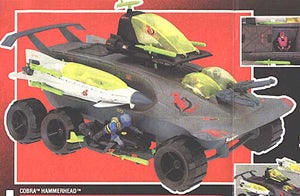
- On G.I. Joe: A Real American Hero, Cobra had a couple, the most notable being the Hammerhead,◊ which was not only a submersible tank, but also a submersible carrier for its own mini-fleet of smaller vehicles.
- "Katastrophe", the first Season Finale of SWAT Kats, had the Kats use one of these against the alliance of Dark Kat, Dr. Viper, and the Metallikats.
- Many amphibious tanks and armored personnel carriers do exist in Real Life. Unfortunately, they tend to be extremely unstable and unseaworthy, and tend to sink easily - with often fatal results.
- Truth in Television yet again; several sorts of amphibious tanks were designed, built and deployed in World War II. Likewise, a number of modern armored vehicles include amphibious capability, and most tanks can ford rivers using snorkels.
- A more extreme example is the German "Tauchpanzer" variant of the Panzer IV: a tank capable of driving under 15 meters of water.
- More extreme still was the gargantuan proposal Midgardsschlange for a 60,000 ton armoured, articulated train that could run on land, the bottom of the sea or even drill underground. It was designed by Nazi Germany in the 1930s and got to the vital asking for funding stage before the engineers involved were forced to go work on something sensible.
- The German Seeteufel design was an odd take on the "amphibious tank" concept, being practically a mini-submarine with tank threads. Proposed armament consisted of two torpedoes and a machine gun or a flamethrower. Not a practical design by any metric, but imagine the look on the Allied troops' faces when one of these would crawl up from a lake and start spouting flames at them.
- The P1000 Ratte and the P1500 monster previously mentioned under Land Battleship also would have had the ability to drive underwater up to a certain depth. This actually made sense for two reasons: both vehicles where designed partially using U-boat parts so adding more submarine features wasn't a terrific leap in cost; and vehicles so heavy couldn't use conventional bridges as they would crush them.
- Don't forget that the Japanese also used them, although theirs floated rather than driving submerged.
- The PT-76 is probably the most successful of modern amphibious tanks. Its biggest draws are in being cheap, lightweight, and armored enough to serve as an universal chassis for the whole lot of other Soviet vehicles, from self-propelled artillery to SAM launchers, adding more to its Military Mashup Machine status.
- A quite successful historical amphibious tank was the DD Sherman of WWII. The DD Sherman was a typical M4 Sherman medium tank with a collapsible skirt allowing it to float, and a drive modification operating a propeller providing it with propulsion while in the water (other tanks were similarly converted, but the Shermans were the most common). The main problem faced by the tanks was they were easily swamped and sunk during rough seas (as happened to several of the tanks deployed in the assault on Omaha Beach). However if managed properly, the tanks could prove devastatingly effective in support of amphibious operations (as occurred on the other beaches at Normandy). Other modifications for amphibious use, such as snorkels to allow operation while partially or even fully submerged, were also applied to the highly-adaptable Sherman.
- Remember that Maus we showed you on the Land Battleship section? It also counts as one of these. With air piped in through a snorkel, another Maus powering it from the beach, they were literally designed to go across rivers because bridges would just collapse with them on top. Once it goes across, it then helps the other Maus through the river.
- A more extreme example is the German "Tauchpanzer" variant of the Panzer IV
- The VF-0s in Macross Zero can, apparently, fly underwater. For short periods, at least. Ironically, this is the early version that runs on jet engines, as they hadn't got the alien fusion reactors working yet. There is an explicit shot of the intakes closing before it hits the surf, and it appears to be coasting.
- The Hammer Head Zoid can do this.
- To quote Marine Boy's theme, "Flying sub ahoy!"
- Gold Digger gave the villainous Night Flight an entire wing of these.
- From an old comic book.
- The Clone Wars comic books have starships that operate underwater, crewed by Mon Calamari, appearing during the battle of Kamino. As their commander said while piloting one of the damn things:
Commander Merai: What are they thinking, defending a water world with ships that can't submerge?
- Top Cow's Fathom comics had one of these in testing, based on a recovered fighter from the race the titular character was from. Semi-F-14ish with variable wings, but mounted with a forward sweep design.
- From Blake and Mortimer, the Swordfish from The Secret of the Swordfish can fly, go underwater, carry nuclear weapons (with power ranging from "one-shot a battleship" to "level a city") and a single one destroyed an entire naval fleet (battleships and aircraft carriers included).
Films — Animated
- Though not explicitly armed, the automated transports used by Syndrome in The Incredibles get to Nomanisan Island by air... then go under water to dock.
Films — Live-Action
- Sky Captain and the World of Tomorrow (2004) did this with submersible propeller planes.
- In the 1950's juvenile novels by Ivan Southall starring Australian Ace Pilot and aviation engineer Simon Black, we have the Firefly 2, a flying boat with rocket propulsion and VTOL helicopter rotors (Simon Black in Peril) and the Arion which is a ground-effect vehicle that's the subject of Simon Black at Sea. The confusion created by this trope is shown when the Arion is manned by Royal Australian Navy personnel when it's actually an aircraft; it threatens to capsize the moment it leaves the harbor until Simon takes the controls and shows them how it's done.
- The KingFisher in the Doctor Who novel The Indestructible Man, a Captain Ersatz of everything Gerry Anderson ever did.
- Edgar Rice Burroughs' Beyond Thirty (alternate title The Lost Continent): the protagonist is the captain of a Pan-American Navy "aero-sub" — a submarine capable of Anti-Gravity flight. Sadly, he doesn't have his vessel throughout most of the story, having been thrown overboard by a mutineer in the first chapter.
- The Puddle Jumpers from Stargate Atlantis take this to its illogical conclusion: submersible spacecraft.
- The "Delta Flyer" from Star Trek: Voyager, in similar fashion to the above mentioned "Puddle Jumpers", was modified in Season 5 Episode 9 "Thirty Days" to operate underwater. Making it a combination spacecraft/submersible. As with all shuttles in the Star Trek universe, it had atmospheric capability and space for multiple crew members, in effect making it a combination spacecraft/submersible/fighter/transport.
- The "SkyDiver" from UFO (1970) is a submarine whose entire front end is a JATO-boosted rocket plane called Sky One. At need, the SkyDiver floods its rear ballast tanks until its bow points upward, and Sky One can launch... from under water. (The word "SKYDIVER" on the side of the craft also separates. The jet is now labeled "SKY and the submarine DIVER.)
- The Flying Sub from Voyage to the Bottom of the Sea was the coolest thing on the show.
- Power Rangers Operation Overdrive has the Special Hydro-Aero Recon Craft, aka SHARC. Why you'd need your plane to drive on the surface of water is a good question, but it sure looks awesome doing it. (Presumably they used it because their Zords would be Awesome, but Impractical when not in combat.)
- Zyuden Sentai Kyoryuger has Plezuon. This is the category it best fits, but really, where can't it go? Based on a plesiosaur, it was born/made for underwater use, but it was refitted for space travel. Its first partner even has the Space Is an Ocean metaphor as part of his roll call phrase; the seas of the earth and the sea of stars belong to "the marine hero, Kyoryu Violet!" (Its humanoid transformation enables land combat, but that's sorta cheating.)
- A number of vehicles in the Rifts Underseas sourcebook.
- The system defence boats of Traveller are capable of flying in space and in atmosphere and can go underwater, at least in the GURPS version. It helps that the vehicle rules of GURPS practically invite people to design vehicles that fit this trope.
- And they were pure eeeeevil in 3rd edition. No RPG should have make the player draw a square root.
- In defence of GURPS Vehicles, it doesn't expect people to be doing this in the middle of a session of regular play. The ongoing design example from the book, incidentally, is more than worthy of inclusion on this page - a Flying Car (kept aloft by Imported Alien Phlebotinum and propelled by a jet engine, which can also give it a bit of extra speed on land) that's also a submarine, has military-grade electronics and is armed with concealed machine guns. James Bond, eat your heart out.
- Almost all scrolling shooters allow the player's air or spacecraft to fly underwater without consequence.
- Star Fox:
- The Landmaster is a tank with boosters which allow it to roll, hover, and generally be much more maneuverable than a regular tank.
- Although Star Fox 64 had a separate submarine for the underwater mission, Arwings and other starfighters in Star Fox Command can do this.
- Star Fox 2 also counts when fighting in the seas of Fortuna, but it's more like a jet fighter that turns into a submersible mecha that swims.
- Command & Conquer: Red Alert 3
- The Empire's Sea-Wing is a submersible ambush jet fighter. Note that it can only attack air units while in the water and surface targets while airborne.
- The Mecha/Jet Tengu is an amphibious mecha (that is, it hovers over water rather than floating in it) that transforms into an fighter jet.
- Uprising's Giga-Fortress is built as a ship capable or hitting air and surface targets (though not as well as the Shogun or Sea-Wing), but can lift off to become aerial artillery (that can't attack air but outranges all land-based Anti-Air).
- The Empire's Sea-Wing
- X-COM: Terror from the Deep, the second XCOM game, had the player fighting Unidentified Submersible Objects (ie, UFOs that could go underwater) with a small fleet of their own submarine-jets. However, neither side can fire weapons while in air, since those weapons are specifically designed to be used underwater (except Gauss weapons, but those can't be used either).
- Elite had the Moray Star Boat, because aquatic species need to get shot at by Space Pirates too.
- Possibly an unintentional example in the Tiny Bronco in Final Fantasy VII, a plane that, when its engines are crippled by gunfire, is used by the party as a boat.
- Stage 2-1 of Contra: Shattered Soldier features a submarine that transforms into a giant VTOL gunship.
- MechWarrior Living Legends's aerospace fighters work just as fine in water as it does in the air and space. The latter is explained by it being a fusion-rocket powered Space Plane, the former not so much.
- The planes of Sine Mora are prop-driven rather than jets, but can convert to underwater movement simply by flipping their wings (so the props face backwards instead of forwards) and seem to function just as well underwater as they do in the air.
- Mass Effect 2 and Mass Effect 3 make frequent use of Kodiak shuttles that are capable of both atmospheric and single-stage orbital operation. They even gained a pair of guns for limited ground support fire in ME 3. However, the Leviathan DLC for the third game revealed that, according to your shuttle pilot, Kodiaks are actually spec'd for almost a thousand different atmospheres, which explicitly includes going underwater. It briefly becomes a plot point in that DLC but is rendered moot when your Kodiak is shot down before its diving capabilities can be put to the test.
- G.I. Joe: A Real American Hero had the S.H.A.R.C. (Submersible High-speed Attack and Reconnaissance Craft.) The toy company intended it to be strictly a submarine, but in playtesting, kids started treating the toy as an aircraft. So now it's both.
- The New Adventures of He-Man had a vehicle capable of submersion, atomspheric flight and space flight called Astrosub.
- The triple-changer Broadside in Transformers: Generation 1 transforms into both an aircraft carrier and a jet.
- Dr. Claw's Cool Car in Inspector Gadget can turn into a jet or a submarine.
- The Soviet Union designed a flying submarine in the 1930s, but it was never actually built.
- The USA had a similar idea.
- The United Kingdom messed around a bit with a seaplane jet fighter, the Saunders-Roe SR.A/1, and the Americans similarly worked on the Convair F2Y Sea Dart, but both nations moved away from seaplane fighters once carrier-borne fighter jets became practical.
- At some point, most silly works will include efforts to make a flying tank. Sometimes this will be to just slap wings on that ever-so-aerodynamic thing, the main battle (or light) tank.
- That would include the A-Gears in Air Rivals, which are not so much an aircraft but a flying hovercraft tank that's capable to not only traverse land and aquatic terrains, but also latch itself onto edges of ravines and cliffs. To hammer the point home, one of the equippable armors had wings on it. Predictably though, its survivability drops down once it actually does take to the air, especially when pitted against other, more fighter-oriented Gears...
- The Soviets attempted to build a flying tank during World War II as an attempt to bring a tank very quickly into battle. Basically a tank with wings and tail strapped to it, it's more of a glider - a bomber would tow it into the air, then it would sail into the battle field, land, ditch its wings and tail, and start blasting away at the enemy. It was cancelled because they didn't have a towing plane with enough engine power to haul the hulking thing into the air fast enough.
- They eventually did succeed in building a flying tank during the Cold War; aka the Hind helicopter.
- Imperial tanks in Empire from the Ashes use a fully-functional gravitonic drive, and can hit Mach 2 in atmosphere. They are also heavily shielded, and capable of deploying more conventional tracks for increased stability and decreased power budget.
- Hovertanks in Schlock Mercenary are essentially small spacecraft with big guns mounted on the front end. But they are still called tanks.
- Toy Soldiers Cold War features one as a boss fight. It was based of the real life Antonov A-40; which was designed to be towed behind a plane and then let loose to glide to it's designation. A prototype was built and it didn't go much further than that.
- Put in the flying cars cheat into GTA 3 and the Rhino tank will fly, propelled by recoil from shooting backwards. It's easier to fly than the clipped-winged Dodo. Works in Vice City too, where it can fly higher than helicopters and planes.
- Humongous Mecha in most Real Robot settings seem to be mashups of your average infantry soldier and an armored tank or jet fighter.
- The Mobile Armours of Mobile Suit Gundam are often even straighter examples: Large non-humanoid units, built with the same technology as Mobile Suits, that acted as more specific machines like submarines, flying tanks, land battleships, and more.
- Don't forget the Magella Attack! It's a tank whose turret can detach and fly. A Cool Plane it's not- apparently a tiny plane with a gigantic tank cannon on the front isn't very practical.
- Zoids are the animal versions of the same principle.
- The Grandia Tank in Nadia is a triple threat: a tank on land, an airship, and a paddle-wheeled boat. It runs off steam with punch card controls!
- Code Geass has airships that are submersible, a Humongous Mecha that turns into a fighter jet-thingie, and another that turns into a stealth submarine as well as being a jet fighter. Extra points for the latter being the main character's personal unit.
- The titular Objects of Heavy Object are all-in-one mechanized units capable of land and sea combat with enough firepower to raze small countries. They can serve as artillery or employ precision attacks to eliminate a single person; they counter infantry, smaller mechanized units, naval vessels, and aircraft. Third generation models go even further by incorporating strategic assets such as space elevators and oil refineries into the Object.
- Blackhawk comics were in love with this trope. Along with the link to the flying submarine (above), there was an underground fighter planetornado-generating helicopter fortressesm combat kites, the obligatory flying aircraft carrier, helicopter pogo-sticks, flying tanks, and some sort of flying on-fire-spinny-thing. And these weren't even all of them! Blackhawk comics had more fuzzy-science-derived plot devices than Star Trek.
- Marvel has the S.H.I.E.L.D. Helicarrier,◊ which is Exactly What It Says on the Tin. Spoofed by Warren Ellis in Nextwave with theH.A.T.E. Aeromarinem◊ which is a bunch of submarines welded together and equipped with oversized rocket thrusters.
- G.I.Joe has the mashup machines; they tended to make a small appereance or two, then explode.


Films — Live-Action
- This was the central plot point of The Three Stooges In Orbit: a professor builds a vehicle that's a submarine with tank treads and rotor blades. When it's stolen, the military has problems figuring out who should stop it. It lands: 'Call the Army!' It takes off: 'Call the Air Force!' Eventually, it goes over the ocean, to the relief of the commander: 'Call the Navy!'
Professor Danforth: I don't know whether to call it a Sea-going Heli-tank, a Land-going Heli-sub, or an Airborne What-in-the-hell...
- Dale Brown's EB-52 Megafortress and other machines that fall into the Cool Plane category are essentially mash-ups of heavy bombers and fighters. Since in real-life the most difficult changes would involve changing some programming lines in a radar's software and adapting the bomb bay to carry an obscene amount air-to-air missiles, this concept just might become Truth in Television as well.
- Navy pinnaces in the Honor Harrington series are the bastard children of the space shuttle and the B-1R mentioned above, scaled up to the size of a 747. They are interplanetary space craft, Space Marine assault ships and fighter-bombers rolled into one.
- From the E. E. "Doc" Smith Space Opera First Lensman:
The vehicle, while slow, could go — literally — anywhere. It had a cigar-shaped body of magnalloy; it had big, soft, tough tires; it had cleated tracks; it had air- and water- propellers; it had folding wings; it had driving, braking, and steering jets. It could traverse the deserts of Mars, the oceans and swamps of Venus, the crevassed glaciers of Earth, the jagged, frigid surface of an iron asteroid, and the cratered, fluffy topography of the moon; if not with equal speed, at least with equal safety.
- Similar to the Lensman example above, the Perry Rhodan universe gives us the so-called 'Shift' — an amphibious, flight-capable, yet still tracked tank usually equipped with Deflector Shields and energy weapons that can operate and fight in pretty much any environment, including some of the more extreme alien ones.
- In The Course of Empire, the hastily cobbled together spaceships used in the fight against the Ekhat invasion of Earth are human missile submarines - with two rows of four tank turrets in place of most of the missile launchers - converted into spacecraft with Jao technology.
- In Star Trek, Federation ships appear to mix the functions of warship, science vessel, deep space exploration ship, and diplomatic vessel all into a single hullnote . This is epitomized in Star Trek: The Next Generation with the Galaxy class of starship (including, naturally, the flagship Enterprise), which is all of the above plus what is functionally a small town, complete with schools, recreation areas, and a bar. The Federation also seems to have an aversion to calling their ships "warships" despite the fact that they have more than sufficient shields and firepower to stand up to the dedicated warship designs used by other spacefaring civilizations. (This policy is reversed during the Dominion War.)
- Star Trek Into Darkness adds submersible to that last, though that might be just something in the altered timeline.
- In Star Trek Online, the Federation is the only faction with a dedicated science ship class at every level (Klingons have ships that can be variably modified to fit such a role and the Romulans can use their allied faction science ships until proper level).
- Some fans speculate that the Federation's dedication to making these ships defensive science ships rather than offensive war ships is why they make great warships. A science ship would be over sensored and calibrated to find any odd particle at trace levels at range. A federation vessel might not be a great war ship, but considering that the two biggest enemies both rely on cloak technology which require very precise conditions to remain hidden, a single small flaw could easily be picked up by a Starfleet Vessel... and ships under cloak cannot run shields without decloaking. The first ship to really give the Federation's Galaxy class trouble were the Dominion Attack Ships, which were dedicated war ships that didn't bother with cloaking.
- Star Trek Into Darkness adds submersible to that last, though that might be just something in the altered timeline.
- The Andromeda Ascendant takes large parts of The Battlestar, and adds troop transport, science vessel, mobile factory, diplomatic vessel, planet killer and star destroyernote to boot. All such Glorious Heritage-class heavy cruisers have such capabilities, and they're not even the heaviest class the Old Commonwealth was able to field, although probably the most versatile.
- The Metal Heroes series loved having giant spaceship/aircraft carrier fusions that would carry the protagonist's equipment (including flying motorcycles, and flying tanks that could often split into a jet fighter and a drilling machine), and transform into other modes, typically a Humongous Mecha and/or a big-ass laser gun used for anti-aircraft purposes.
- Warhammer 40,000:
- The Tau have the Manta Missile Destroyer, which (as the name implies) fire missiles, but that secondary to its other roles. It functions as a small starship, a super-heavy atmospheric flier, long range heavy fire support platform, and most prominently a rapid-deployment airborn assault and carrier for troops, tanks, and battlesuits.
- BattleTech has Land-Air Mechs that transform between mech and aerospace fighter modes. Notably, though, there was an in-universe attempt to turn the Scorpion mech, a four-legged Spider Tank, and turn it into a LAM. This was just as successful as one might expect and the project was canceled after it was determined that it was good for nothing beyond killing test pilots.
- In the Homeworld games, your mothership is a space factory/carrier, able to manufacture everything else in your fleet and house all of its smaller craft, while also able to maneuver(or even make hyperspace jumps) to any part of the battle area like any other ship. However in the original game, on its own, it's still fairly vulnerable.
- The Carrier-class ships from the first game also functioned as factory/carriers, but weren't able to build the larger ships (like Carriers) and were much faster and more maneuverable than the Mothership.
- In the Cataclysm expansion, it's possible to add "battleship" and "science lab" to the number of roles it fills. While still fairly vulnerable, it was much more capable of fending off fighters and small capital ships on its own. With a particular upgrade, they could even wipe out enemy fleets.
- In Homeworld 2, though, the Mothership went back to being vulnerable to pretty much anything, and another factory/carrier ship, the Shipyard, was added. It could build the largest ships in the game, which the regular Mothership couldn't, but was even slower and less maneuverable.
- In the ground-based prequel Homeworld: Deserts of Kharak carriers are factory/aircraft carriers on treads.
- Final Fantasy VIII features the main protagonists and antagonists using a mash-up of guns and swords. The user would load a cartridge into the "gun" part and "fire," which would cause the blade to vibrate and magnify damage.
- Real Life: There were real examples of Sword-Guns, though they weren't very popular. Commonly, they involved a knife/revolver combination.
- Of course, the rifle bayonet is a somewhat more successful example of a gun/edged weapon hybrid.
- While not edged, the powerhead (aka "shark stick" or "bang stick") uses a similar principle in a "jab with a stick" fashion.
- Parisian hoodlums who called themselves the "Apaches" had weapons that could be used as a dagger, a revolver, or a set of brass knuckles.
- Some upstanding gentlemen in the seventeenth century created cutlery pistols - as in a knife-pistol and a fork pistol.
- The 'gunblade' of Final Fantasy VIII is actually more akin to the vibroblade concept, which is quite popular.
- Starcraft's Terran siege tank, which switches from main battle tank to artillery platform.
- Then there's the Viking in Starcraft II, which switches from mecha to space superiority fighter.
- Command & Conquer: Red Alert 3 is pretty much in love with this trope, especially the gadget-heavy Empire. Between the examples listed and others, there are very few units that don't qualify. Even most buildings can be planted in the water, so long as the unit they produce can exist on water. The Empire don't even have an air factory, since every single flier they field transforms from a vehicle, ship, or infantry.
- The Allies have two Awesome Personnel Carriers: A hovercraft with a machine gun and torpedoes, and an IFV that starts equipped with missiles but changes its armament depending on the infantry loaded inside. And since Enemy Exchange Program is a big part of the game, there's a different gun for every infantry unit, including animals and heroes.
- The Giga-Fortress is the single most expensive unit in the game (costing more than twice as much as the Futuretank robot) a massive floating fortress that fires missiles and lasers at surface and air targets. It also transforms into a giant flying demon head that fires a devastating anti-surface laser that outranges defensive buildings.
- Inverted with the Sickle and Bullfrog, which use machine guns and flak cannons to attack ground and air targets exclusively and are made by the same manufacturer.
Speculation that [Kazminov Design Bureau] purposely designed this limitation to ensure that both its Sickles and its KDB-2 Bullfrogs get purchased in bulk is patently false. - To a lesser extent, the Sonic the Hedgehog titles. The easiest example being the Egg Carrier, having a runway on the front of it, robot construction rooms in the interior (complete with "training" areas), as well as a couple entire stages within it.
- Chrome Hounds. Yes, the titular Hounds are supposedly Humongous Mecha, they're more like tanks. And by that I mean, a hound is probably a wall of Artillery cannons, Battleship guns, hulking armor, machine guns that turn M1-Abrams into swiss cheese, on anything from humanoid bipeds to tanks. (Oh, and tanks/wheels tend to be a bit faster.) and the cockpits range from bridges of ships to jet-fighter cockpits.
- Metal Gear Solid 3: Snake Eater's Shagohod was a tank/hovercraft/ICBM launcher hybrid. With legs. They were just forelimbs, meaning it couldn't walk upright like the titular Metal Gear, so it compensated with a pair of Archimedes' screws. Have we mentioned it was rocket-boosted?
- Shin Megami Tensei: Strange Journey's unique model of dimensional-hopping warship model definitely counts. It has fabrication labs for weapons and technology development, outer weapons systems, plasma shields, hospital sectors, an AI navigator, and, oh, yes, rocket-boosted VTOL capabilities.
- Mass Effect 3: Reapers can fight planetside almost as well as they can fight in space, "standing" on their front tentacles and acting as a gigantic, mobile artillery platform. The only drawback is that it weakens their shields somewhat (though not nearly enough to make a difference), as they have to divert extra energy to the mass effect fields keeping them from falling over or collapsing under their own weight while in a gravity well. They also count as Mobile Factories, of a sort, as they can take in living or dead lifeforms and turn them into Husks, making them into Reaper ground troops.
- Command & Conquer: Tiberium Wars: The MARV. It's the biggest tank. How big is it? It can simply roll over Mammoth Tanks, which themselves are big enough to roll over regular tanks. It's also a Harvester, or more accurately, an entire rolling Refinery that auto-collects any Tiberium it rolls over, and with it's extremely large hitbox, could easily eat a third of a patch simply by driving in a straight line. Generally it's your enemy's tiberium that gets collected this way.
- Spacetrawler features the Purfin M-32, essentially a boat with all-terrain wheels, rockets, and wings.
Web Original
- Courtesy of The Onion: the Dragon Tank.
- Swiss Army tank by Glenn Jones.
- Homestar Runner: The Cheat Commandos short "2 Part Episode: Part 2" has the Topplegangers' "Ramshankle", a large swamp boat with jet fighter wings on the back and a tank turret awkwardly mounted on the front.
It's the Ramshankle, and you know dang well
It's made out of old vehicles that we couldn't sell!
- Some Transformers have multiple forms, resulting in things like this. Perhaps most well-known is the Decepticon Triple-Changer Blitzwing, whose alternate modes are a MiG-25 and a Type-74 tank. The most over-the-top, though, would have to be Sixshot, a Decepticon with six alternate modes who can take on entire teams of enemies single-handedly.
- Anything with Transforming Mecha really, when you basically have tanks that turn into mechs. Literally when you bring Combining Mecha into the equation.
- The SHIELD Helicarrier shows up in pretty much every Marvel Comics-based animated series. Ultimate Spider-Man (2012) takes it a step further by having it wrecked and rebuilt as the Tri-Carrier, which is able to split into the spacefaring Astro-Carrier, the submersible Aqua-Carrier, and the flying Dragon-Carrier.
- In TaleSpin, Don Carnage had the Iron Vulture, a massive flying carrier with rotors supporting it, able to launch and retrieve planes.
- The Hungarian "Big Wind" tank was a mashup of an old T-34 tank with two MiG-21 engines and firefighting hoses. This thing wasn't actually designed to fight as much as decontaminate irradiated vehicles, but when the First Gulf War rolled along and Saddam Hussein torched Kuwait's oil fields, a hybrid tank/fighter/fire truck combo shooting water at supersonic speeds was just what the doctors ordered to put the fires out.
- The original aircraft carrier was a working real-life example of this, attempting to combine an airbase with a ship.
- ...and while we're at it: the Airborne Aircraft Carrier in all its many incarnations.
- British carriers of World War I, many of which were conversions of warships already in service, tended towards a different hybrid status. HMS Vindictive, converted from a cruiser, carried five 7.5in guns; the former battleship HMS Furious, meanwhile, witnessed the first successful landing of an aircraft on a moving ship while still mounting a single 18in gun aft. The concept was revived (albeit briefly) in 1940, when lack of carriers and need for airborne protection led to suggestions that battleships under construction should be redesigned to carry ten fighters.
- HMS Furious was one even before it became an aircraft carrier. It was designed as a "light battlecruiser," with very light armor, shallow draft, and a very big gun on a single mount, to operate in shallow waters.
- Also worthy of mention are the M-class submarines, which began as a project to fit a 12in battleship gun on a submarine, and which ended up in one case as a submarine aircraft carrier.
- Partly to get around the Montreux Convention and partly because they just did things differently, the Soviet Union built four "aviation cruisers", essentially VTOL aircraft carriers with anti-shipping missiles built in. The VTOL aircraft, the Yak-38 "Forger" was spectacularly poor, and the much better Yak-41 didn't progress beyond the prototype stage because of the end of the Cold War. The current sole Russian carrier, the Admiral Kuznetsov, is also an example, albeit a full-length one with Su-33 fighters on, since it has vertical launchers for heavy anti-ship missiles hidden underneath the flight deck. The Russian Navy currently intends to strip those out and expand the hanger whenever they have the time and money to do a full refit. Its sister ship the Liaoning is currently the only aircraft carrier in the Chinese Navy, and is classified as a full carrier. Justified as it was not even 70% done by the end of the Cold War, and the newly-independent Ukraine sold it to China, who finished the construction minus the anti-ship missiles.
- Due to a shortage of carriers after the Battle of Midway, the Imperial Japanese navy converted the battleships Ise and Hyuga into carrier-battleships, removing the rear guns and installing flight decks. The design was not successful. The shortage of both planes and pilots by that point didn't help, but even if there had been enough to go around the fact that only seaplanes (inherently slower and less agile than conventional fighters due to the drag from their pontoons) could be properly operated would have still made them ineffective.
- Most of these belong in the Battlestar category.
- An Amphibious Assault Ship is probably as close as practical towards several mash-ups into a single ship, taking on the functions of aircraft carrier, troop transport/beach assault ship, command ship, and - when some earlier designs still had decent-sized gunsnote - bombardment ship.
- Probably no more of a mash-up than the LSTs ('Landing Ship Tank's) of WWII, which had to be good in both deep and shallow water.
- Many battleships carried seaplanes; today, many destroyers and cruisers carry helicopters, as did the Iowa class battleships when they were brought back into service in The '80s.
- Many battleships were built before radar was around, so the seaplanes served the scouting and spotting function. Now that we have radar, the seaplanes have been replaced by helicopters to serve in the ASW role.
- And then there were many attempts to carry planes on a submarine, including Japanese "Sen Toku" with 3 torpedo-bombers.
- The unlucky French submarine Surcouf. Although there were many other "submarine cruisers" and submarines with aircraft, the Surcouf combined both and took them to a new level- it was armed with two 203mm guns in a forward turret and 10 or 12 (accounts differ) torpedo tubes, and housed a scout seaplane in a hangar below decks to use the full range of those guns. It was also armed with a significant number of AA cannons and machine guns. However it never saw action: it was accidentally rammed by a US freighter off the coast of Cuba and sank with all hands.
- The Israeli Merkava is a mild example, armed as well as any other main battle tank in the field AND capable of doubling as an APC. Some are even equipped as ambulances. In practice, though, the Merkava's rear compartment is normally used to carry extra ammo for the main gun. On the other hand, it made adapting the Merkava chassis into a pure APC (something that would be virtually impossible with most modern main battle tanks) not only plausible but easy, resulting in the Namer (contraction of "Nagmash" (Hebrew for APC) and "Merkava"), the most heavily armored APC in current use.
- Successful real life example with the Russian MI-24 Hind helicopter, which was designed to combine the roles of a transport and attack helicopter. Basically, it's a flying Infantry Fighting Vehicle. However, serving as a transport made it bigger and less maneuverable than a pure attack helicopter. Though in terms of pure straight-line speed it's still the fastest attack helicopter to ever go beyond the prototype stage.
- RSRA X-Wing. (No, not that X-Wing.) It's a plane! It's a helicopter! It's a plane and a helicopter!
- See My Tank is Fight! for a look at flying tank ideas, among other Military Mashup Machine concepts from Real Life.
- Several countries experimented with flying tanks in World War II, some included in the book above.
- If any practical real-world aircraft could get away with calling itself a flying tank, the A-10 is it. Also, one even successfully shot down an Iraqi fighter with its Avenger rotary cannon during the Gulf War, even though not designed for air-to-air combat.
- A-10 is more of a flying tank destroyer, being specifically geared for the anti-tank role and essentially built around its cannon. It's Soviet counterpart, Sukhoi Su-25, is more of a Jack of All Trades, carrying only a marginally weaker GSh-30-2 cannon, but festooned with hardpoints and able to equip a surprising amount of armament, from bombs and unguided rocket pods to AA missiles for aerial combat.note
- Wouldn't be a complete article without mentioning the AC-130. With the weapons load including a 105mm howitzer it's is informally classified as a flying artillery platform. I mean just look at that thing.
- The AC-130 is cool, but similar attempt was done on at least two ME262, the Me262 A-1a/U4 variant, with 50mm Anti-tank cannon fitted on its nose. Consider WWII have light tanks with smaller cannons.
- Speaking of flying tank cannons, one attempt to increase the already-impressive ground-attack capabilities of the North American B-25 Mitchell medium bomber resulted in the B-25G and B-25H, which fired the same 75mm shell as a Sherman tank from a fix-mounted cannon in the nose.
- The Boulton Paul Defiant: a WWII RAF fighter/interceptor with a machine gun turret behind the cockpit and no forward armament.note The weight of the turret and gunner seriously impacted on the aircraft’s performance compared to other fighters, and it was still vulnerable to attack from beneath or dead ahead. Initially, the Defiant brought down quite a few rather surprised Luftwaffe pilots.note but once they knew what they were dealing with, they made mincemeat of it.note It proved a very successful night fighter, as it could shoot the German bombers from underneath, and provided the backbone of the RAF night fighter command before the advent of Bristol Beaufighter.
- Its a corvette! It's a heli carrier! It's a Landing ship! No it's a Littoral combat ship! Two such classes are currently in production for the US Navy: the Freedom class looks like a conventional ship, while the Independence class is a futuristic-looking trimaran.
- Flying Boats, being a fairly straightforward combination of a boat and an airplane. For decades, these planes were used as long range transports, bombers, and scouts, as they did not require a prepared runway to land and refuel, as long as there was a sizeable enough body of calm water to land on. Flying Boats which were unable to fly due to damage or being overloaded could often simply sail like a boat, using their engines to push them along and their rudder to steer, as happened with a Catalina flying boat that ended up taking on 56 shipwrecked sailors after the sinking of the USS Indianapolis. Various models are still in use to this day, although their popularity faded with the development of proper long-range land-based planes, and in particular Jet Liners such as the Boeing 767.
- The thing that dug the flying boats in wasn't the development of a jetliner — these still needed long paved runways — but the improvement in airport infrastructure. After WWII, with its ever-increasing speeds and number of planes, most significant airfields in the world acquired paved runways and observation radars, which finally allowed the safe and efficient usage of long-range airliners, and the developments in long-range bombers during the war had directly translated into airliner development. In fact, the second jet airliner in the world, the Soviet Tu-104, was essentially a civilian version of their first jet strategic bomber, Tu-16, and they later did the same trick with the turboprop Tu-95/114 combo.
- Overall the effect was that with the much longer ranges of the modern airliners, and the lots and lots of improved airfields around, the sturdy-but-tricky flying boats were simply not needed anymore. They were also fuel hogs, due to radically different hull forms needed to function well in the water and in the air. They still exist, but are more of a niche thing, used where their ability to land on the water is crucial, like in anti-submarine patrol, in Search and Rescue or as fire bombers, where it allows them to take on water quickly and efficiently. Still, even then most of them are actually equipped with conventional landing gear and are technically amphibious — this is largely because they can only land on calm water.note
- A much less conventional hybrid between a plane and a boat is the ground effect vehicle, also known as ekranoplanes. These often look like strange flying boats with short wings but rely on the ground effect principle, which basically means they ride on a cushion of air that forms between the wings and the ground (or the sea). While smaller ground effect vehicles are basically high speed hovercrafts, the larger are often solely relegated to the water and often function as high speed cargo haulers. It still isn't decided if they technically planes or ships, which is important as they could be considered the fastest ships or the heaviest airplanes.
- Behold the Caspian Sea Monster, the largest of the ekranoplans.
- Behold the Caspian Sea Monster
