
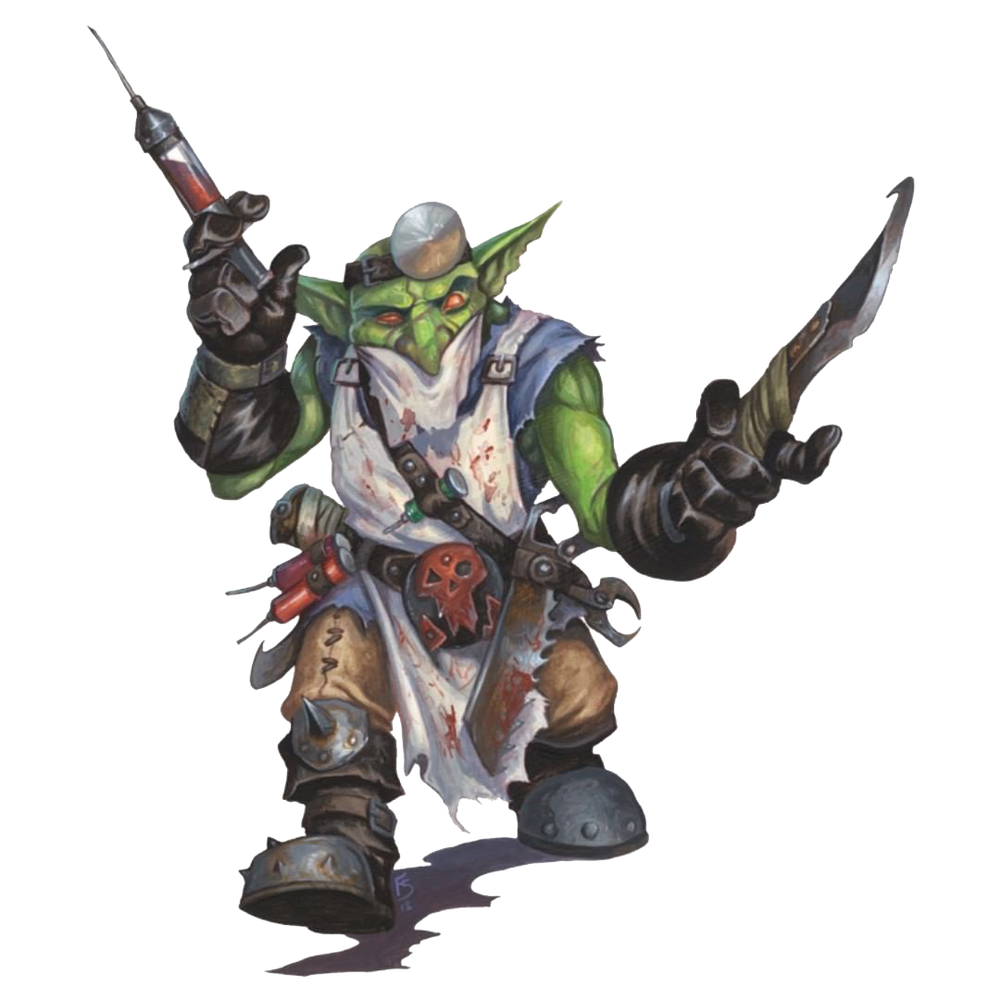
A Deadly Doctor, simply put, is someone who fights or kills with a medical motif. He uses his medical knowledge to injure, torture, or kill, and uses syringes, pills, or surgical instruments or medical techniques to achieve his goals. He may wear his lab coat into battle as a Badass Longcoat. Note that in Real Life this would generally be considered a gross violation of medical ethics.
Surely the ultimate example of the Morally Ambiguous Doctorate. One reason for this is due to all their training: while having advanced knowledge on the human body can be used to save people, it also gives all the knowledge on how to injure and kill people with minimal effort by knowing all the body's weak points. Some more sympathetic examples equate to the medical version of a Well-Intentioned Extremist, who may certainly have good (or at least sympathetic/understandable) intentions but ruthless medical ethics.
Unless, of course, he's good. Which there is a fairly good chance of, being able to heal as well as harm. A good doctor who is forced to fight has an odds-on chance of being shown using medical equipment as improvised weaponry, perhaps driving home their status as a non-combatant (if they were normally expected to fight, they would have a side-arm). Instant Sedation drugs often make an appearance; surgical tools aren't unknown, but may be Downplayed (hacking someone up with a scalpel, even in self-defence, looks creepier than may sit easily with being the good guy, although simply brandishing one might work). A good guy doctor might also simply affect scary doctor dialogue ("Let me tell you what this drug/instrument will do to you") to get out of a situation without hurting anyone.
Note that this trope is not "Any doctor who is a good fighter." That would be Combat Medic. Deadly Doctor refers specifically to doctors who apply their medical knowledge to their combat techniques.
Can overlap with Mad Doctor. May use a Healing Shiv, and may even turn them into proper weapons. Compare Depraved Dentist and Strapped to an Operating Table for cases where medical skill is used as a weapon against a target who isn't in a position to fight back. Contrast Martial Medic, a character who heals with knowledge they gained in the course of learning to injure people. While people do tend to die around him (not his fault, we assure you), The Doctor is not one of these.
Not to be confused with a doctor who's just dangerously bad at his job; see Mad Doctor, Back-Alley Doctor, many instances of Dr. Feelgood and Meatgrinder Surgery.
Examples:
- One of the earliest anime/manga examples is Black Jack, who was known not only as a superhuman surgeon but as a deadly marksman who could kill or, more commonly, incapacitate enemies by throwing scalpels.
- Retsu Unohana of Bleach. Before becoming the best healer of Soul Society, she was a brutal criminal who was sought out by Yamamoto because of her ruthlessness and skill in battle. She was the original Kenpachi and founder of Squad 11, an entire squad of blood knights. Her bankai ability allows her to heal her opponents so the fight can last for as long as she likes.
- Akiko Yosano of Bungo Stray Dogs, while she might not kill, can only use her ability, Thou Shalt Not Die, on patients who are on the brink of death. That means to treat injuries that are severe but not life threatening, she carries around a bag of weapons, including a cleaver that's as long as her arm.
- Dr. Muraki from Descendants of Darkness. In the first volume of the manga alone, he turns a dying girl into a vampire and controls her in order to kill people, captures a shinigami and tortures/basically tries to dissect him, and then faces off with Tsuzuki, known as the most powerful of the shinigami, breaking Tsuzuki's spine at one point and escaping at the end of the book. His skill and knowledge as a medical doctor assist him in his various evil endeavors.
- The manga, Eliminate Dangerous Doctors or EDD is basically this trope being hunted down by a secret agency (which itself may not be as well-intentioned as it may seem, making this a case of Black-and-Gray Morality with the unlucky only good doctor protagonist thrown into the situation).
- Gangsta.'s Dr. Theo will not hesitate to drop you with syringe of something should you threaten his offices or cute little apprentice.
- Palparepa, the Big Bad of GaoGaiGar FINAL, was a clinically white doctor with giant syringes sticking out the back of his mech. He uses them to upgrade himself by sticking his mech with them, a move named "Doping Cylinder". It's appropriate for a show where the villains' gimmick is super regeneration and The Hero is the "God of Destruction".
- Kuroudo Akabane aka. Dr. Jackal from Get Backers, who was once a medical doctor tasked with saving lives, but after letting a child die on his watch, decides that he's probably better off mutilating and killing people instead.
- Catherine from Gregory Horror Show. She is a nurse with a blood-taking fetish and a syringe as big as she is.
- Sanada Kazuki from Hajime no Ippo. Chick Magnet, genius, and mild-mannered heir to a not-so-mild fortune. He is the one-time national boxing champion and successor to the Hama school of fisticuffs. His style involves rapid calculation of body strength, stun duration, and vulnerable organs and nerve clusters, reforming
 ◊ him◊ into something of a Badass Bookworm in the ring.
- Higurashi: When They Cry has plenty of perfectly nice people infected with the Hate Plague and killing one another in various disturbing ways, but nurse Takano Miyo always seems to be the first to go. Still, further and further into the show, she seems just as creepy as the crazy person of the month if not more so. Then comes The Reveal, in which she engineered the whole thing and plans to slaughter the whole town and turn over the virus to military researchers who could use a squad of paranoid people willing to listen to lies and kill their friends... There's also Dr. Irie, or at least in his past. More sympathetic than Takano for sure, but in his past was a Well-Intentioned Extremist version of this trope.
- JoJo's Bizarre Adventure: Golden Wind has Cioccolata, a former doctor who became one specifically to torture and kill people. He intentionally limited the anaesthetic his patients received so he could kill them slowly and painfully and record it all to watch later. This gave him considerable knowledge of the human body that allows him to infect himself with the mold of his own Stand, Green Day, break himself apart to conceal himself, and reattach the severed parts without much issue. He also wears white clothing that resembles a doctor's clothing. While his Stand isn't really used in killing people as would suit this trope, Cioccolata himself is presented in the anime as the one who sliced Sorbet into 36 separate pieces from the feet up and preserved them in frames of gel, and almost certainly did so in a way that maximised the pain Sorbet felt and the length of his life, considering the agonized expression on his body and the fact that his partner Gelato choked on his own gag rather than have the same happen to him.
- Dr. Stanislav Sokurov in Marginal Prince. While in the first few episodes he only seems to be somewhat hammy and creepy (and crazy), it becomes clear over the course of the series that he's no ordinary doctor. Then the finale approaches and he goes to take out an entire beach of super-secret assassins. With, of course, a lab coat full of scalpels.
- Naruto:
- Kabuto, who uses the medical knowledge he picked up as a longtime mole to do incredible damage to others' bodies.
- Tsunade can use her knowledge of the human nervous system to flip around muscle coordination so that moving your left leg moves your right arm and vice versa.
- A little more subtle example earlier in the series is Haku, and thus, by extension, ninja that have ANBU training — though we don't see most of them really use it. He puts Zabuza into a fake death state with a thrown needle in order to trick Team 7. Later, in the bridge battle, he specifically only targets Sasuke in non-vital areas in an attempt to dissuade and not kill him. The obvious implication is that he could have gone for fatal shots from the start if he so chose.
- Nurse Witch Komugi is a medical-themed Magical Girl. She started as Komugi Nakahara, a deranged mutant nurse with a fetish for oversized medical equipment (especially needles) in the much darker anime The SoulTaker.
- One Piece has two notable examples.
- Tony Tony Chopper isn't particularly malicious, so he usually uses his medical knowledge to fight through consuming a special medicine he made for himself called the Rumble Ball that improves his shapeshifting abilities. After the Time Skip, he can use it to control himself in his Monster Point. He's also used his knowledge of anatomy to point out how to break a zombie's spine since it was already dead.
- And Doc Q of the Blackbeard Pirates. When we first meet him, he's giving away apples... some of which explode when bitten, and later learn that his nickname is "Death God". During the Paramount War, he wields a Sinister Scythe. All while being quite sickly himself.
- He dives deeper into this trope after the Time Skip: he has consumed the Sick-Sick Fruit, allowing him to create artificial diseases to infect his opponents with.
- Then there's Trafalgar Law, also known as "The Surgeon Of Death." Which is odd, to say the least, looking at him. He has the power of the Ope-Ope Fruit, which allows him to cut anyone or anything within a certain range and rearrange the pieces as he sees fit. People don't die when cut up this way, allowing him to extract organs, remove poison, and even attach new body parts without putting the person in question at risk. Smoker even compares the power to that of being placed on an operating table.
- It's worth noting that Law's Devil Fruit is unique because medical knowledge is actually required to be able to use it to its utmost potential. Law's exceptionally rich background in the medical field is very evident, as he uses his abilities granted by the Ope-Ope Fruit to remove bullets from his own torso, discharge electricity from his hands like defibrillators, and then there's his most devastating technique 'Gamma Knife', which uses a conjured blade of screeching gamma radiation to reduce his victim's internal organs to sludge, leaving no visible evidence of trauma on their bodies.
- One Monster of the Week of Phantom Quest Corp. is a doctor who made a Deal with the Devil so he can murder patients and harvest their organs for sale (magically concealing the evidence). He got some sort of demonically-possessed superpowers as part of the bargain as well, and tosses scalpels and manipulates a laser surgery machine telekinetically, or as the dub has it:
Lieutenant Karion: Psychokinesis?
Ayaka Kisaragi: Or just psycho! - Pokémon: The Series: Dr. Proctor from the Indigo saga, who fought Team Rocket armed with nothing but a lab coat full of scalpels.
- Dr. Shamal from Reborn! (2004) is a doctor/assassin who kills people by infecting them with terminal illnesses from his special mosquitoes.
- Rosario + Vampire has one of the hybrids posing as a nurse. She can control her victims with some kind of poison.
- Sailor Moon had two medically-themed monsters of the week: Pharmakon and Sailor Doctor. Both had a giant syringe replacing one arm.
- Faust VIII from Shaman King. He could use his medical knowledge to take down enemies and even survive falling out of a plane in a wheelchair without a parachute. Although considering he's a necromancer, it may be that his body is mostly dead anyway and he simply needed to locate any lost limbs after landing. That and he's on a lot of morphine.
- Soul Eater has two notable characters who fit this.
- Nygus. School nurse and she's also a commando and as a weapon can turn into a knife.
- Stein, for that matter. The best teacher in the academy and a dangerous man, he can use his knowledge of soul wavelengths to disrupt others' attacks and empower his own. He also has vast experience both in efficiently cutting things apart and suturing them back together to cleanly heal — and both of these skills are weaponizable.
- In Steam Detectives, the black-clad nurse Lang-Lang who serves Boy Criminal Le Bledd the same way the white-clad nurse Ling-Ling serves Boy Detective Narutaki, the hero of the series. Lang-Lang began trying to heal people, but decided it was easier to end their suffering by killing them; she likes the idea of preserving handsome young men/cute boys via taxidermy "so they stay young for ever!" Oh, and she is Ling-Ling's sister, though not an actual twin...
- The school nurse Ayukawa/Fonda Fontaine from Yu-Gi-Oh! GX is a pretty decent girl and an excellent healer, normally, but after she's turned into a Duel Ghoul in the first half of the third season, it's revealed she has a deck that caters to this theme, giving you life points while using cards that turn that gain into damage. Not surprisingly, her key card in that deck, Nurse Reficule the Fallen One, is a demonic nurse wrapped in bandages.
- Minoru "Doctor" Kamiya of YuYu Hakusho fights with hands that cut like scalpels, and insects with syringes that inject diseases into his victims.


- The DCU:
- The Mikado, a foe of The Question, was an emergency room physician who was disgusted by some of the deliberately inflicted injuries he saw in his ER. He donned a costume and used his medical expertise to inflict similar injuries on those responsible.
- The Crime Doctor, at least in his later appearances. (In the Golden Age, his gimmick was that he was a thrill-seeking thief, but took his Inconvenient Hippocratic Oath incredibly seriously, at one point leaving a prescription with a security guard he'd diagnosed with high blood pressure, and in his second appearance abandoning his escape because he needed to save Robin's life.)
- Dr. Moon, who considers himself an artist when it comes to pain. He's also a self-taught medical genius who uses his incredible talent to cause suffering rather than heal.
- Hush of the Batman comics evolves into this after he drops the gun-toting. The Scarecrow also counts, having been the head psychiatrist at Arkham.
- Hugo Strange, one of the few villains to successfully uncover Batman's true identity.
- Harleen Frances Quinzell was a psychiatric intern. She has a PhD.
- Even heroes with medical doctorates have been known to use their skills to incapacitate people as Dr. Mid-Nite from Justice Society of America.
- Wonder Woman Vol 1: While Dr. Poison prefers her victims strapped down, she's perfectly willing and able to kill with her medical and chemistry knowledge no matter what state she encounters her victims in.
- Marvel Universe:
- Angeline Kutter, The Surgeon General who fought Daredevil.
- Golden Age superhero, and later member of the X-Men, Doctor Nemesis.
- Angeline Kutter, The Surgeon General
- In Polish graphic novel "Żyjesz?" ("Alive?") a Plague Doctor stabs a tie-to-the-bed patient with the knife in the chest when he starts screaming. Another doctor gets killed by his fellow medic after being bitten by a contained boy. During the climax of the book, one more doctor is attacked by an armed lunatic and he just shoots him in the face with a pistol.
- It's should be noted that all the doctors in the book are mysterious and scary figures and we never see their faces.
- Ratchet, in the Transformers: Shattered Glass universe. Being in his care is more of a punishment than a treatment, as he tends to whimsically replace his patients' body parts with whatever he thinks would look better.
- In Violine, the doctor (no name given) uses his medical skills to restrain Violine (by putting her legs in casts, pretending they are broken), and later attempts to make her sick and bedridden to get her to go home. Eventually, he attempts to outright kill her with poison when all else fails. It is later revealed that he killed his father's parents as well.
- In The Butcher Bird, Vinci is most certainly one of these, making use of both his anatomical knowledge and his growing arsenal of self-created augmentations in a fight, alongside a Sinister Scythe.
- This trope is briefly referenced in Child of the Storm, speaking about Branwen Hufflepuff, ancestress of Helga, who was usually a very gentle and loving healer, but used her skills for the exact opposite when her daughter was assaulted, tortured, and killed by Frost Giants.
- Doctor Strange is, among other things, a qualified medical doctor (and actually uses those skills more often than his canon counterpart), and is also incredibly and creatively lethal when the mood takes him.
- Sinister is also a mix of this and Evilutionary Biologist, who regards the world as his petri dish and uses his advanced knowledge of human genetics to perform all sorts of monstrous acts.
- Doctor Reynolds a.k.a. the Void/the Parasite in the sequel's Smallville mini-arc proves to be this, combining science and magic to torture his victims and drain their life-energy.
- Though Dr. Watson is definitely a Martial Medic, he plays the Deadly Doctor trope frighteningly straight in the Deliver Us from Evil Series.
"If your master's actions destroy him whom I regard as-as the best and wisest man I have ever known-make no mistake that I shall hunt down, to a man, everyone who played a part in his destruction."
- Haku in the Naruto fanfic Hakumei. After apprenticing to a medic-nin for some years, his fighting style incorporates drugs and poisons, and while he doesn't like hurting people, he's ruthless when he has to be. His friends would say that he's the scariest member of their group.
- Winter War (a Bleach AU where Aizen won the war) has Ogidou, a former Fourth Division member who fights by reversing healing kidou. For example, one of his attacks reopens old wounds that have scarred over. The other members of La Résistance let him do it, but find it disturbing. Hinamori, who's part of the same small group of fighters, refuses to let him heal her, even though she acknowledges that he's competent.
- Yu-Gi-Oh: Tilting The Balance has Reston (real name Paul Arthur Eckhart), the Pillar of Death. Given that his name is one of the species of Ebola virus, it's a given he's not a particularly nice fellow. Before the villains recruited him, he was a Serial Killer, deliberately botching surgeries in ways that slowly killed the patients. His deck is designed to slowly torture his opponents (his favorite card is Dark Snake Syndrome). Gerald goes out of his way to kill him in their final duel.
- American Mary: After being raped by Dr. Grant, Mary has him kidnapped and then uses him to practice her body modification surgery.
- Dr. Albert Hirsch from The Bourne Series, responsible for creating and running of Treadstone/Blackbriar black ops projects where, via brainwashing, torture, and behavioral conditioning they turned volunteers into tools ready to kill on command.
- Cloud Atlas: Henry Goose, though Ewing eventually doubts that he was anything more than a murderous confidence trickster.
- Main villain of The Dead Pit is an undead former surgeon of a mental hospital who with his zombies seeks out to remove everyone's brains.
- The eponymous Dr. Giggles uses typical doctor's equipment to kill his victims. This includes such things as syringes, an otoscope, and a sphygmometer.
- Escape from L.A. gives us the Surgeon General, played by a wonderfully hammy Bruce Campbell.
- Fantasy Island (2020) has Dr. Torture, who dresses ins surgical scrubs, wields medical instruments as weapons, and uses his medical skills as both a Torture Technician and a devastating hand-to-hand combatant. But, then again, he is a construct formed as part of Melanie's revenge fantasy
- Ghostbusters (1984): Egon Spengler states that Ivo Shandor, also the architect behind that building, was one of these due to unnecessary surgeries.
- In Green for Danger, the murderer has to be one of the medical personnel present in the operating theatre when Higggins died. When the killer confronts Sister Bates in the emppty operating theatre, they dressed in a full set of surgical scrubs including cap, mask and gloves: completely obscuring their identity and even their sex. The killer is ultimately revealed to be Nurse Esther Sanson.
- Elle Driver disguised herself as a nurse in Kill Bill in order to carry out a hit on The Bride with a poison syringe, only to have her mission cancelled by Bill himself. Since Elle despises the Bride, she does not take it well. The scene was based on a similar one from Black Sunday – in that case, it was successful.
- In Man in the Attic, Slade is a pathologist who puts his medical training to deadly use as Jack the Ripper.
- Dr. Christian Szell in Marathon Man, who uses his skill as a dentist to be an extremely competent Torture Technician.
- In Pan's Labyrinth, the doctor who secretly helps the rebels is a non-combatant. However, at one point, he applies his medical knowledge to mercy-kill a captured rebel after being called to keep him alive for more torture.
- In Pathology, a group of residents in prestigious pathology residency program entertains itself with a secret after-hours game at the morgue of who can commit the perfect undetectable murder using their knowledge of medicine and forensic pathology.
- Predators has a doctor who landed with the other characters; no one knows what he's doing there, among rebels, mercs, Spetznaz, Israeli military, a prisoner convicted of many rapes, a Yakuza, etc. He's actually a poison-obsessed murderer.
- The Stitch class of psychics in Push are nominally healers (and damn good ones at that). They can completely heal bones and the like by laying their hands on a person. However, they can easily use their medical powers to break bones and stir up a person's insides as well. God forbid a malevolent Stitch gets their hands on you...
- Repo! The Genetic Opera has the Repo Men, trained medical professionals who mostly do their deadly work with scalpels and bloodproof surgical gowns, and the Genterns, who, while they don't kill people nearly as often, can be pretty damn sinister.
- Return to House on Haunted Hill has the ever-so-evil Dr. Vannacutt.
- One fight in Sherlock Holmes (2009) had Doctor Watson say "I'm a doctor" to the guy he has in a chokehold. He also looks better at fighting than Holmes is. Makes sense as Watson is a trained soldier, and Holmes only really gets amazing when he's had a chance to calm down and analyze his opponents carefully.
- Dr. Kaufman in Tomorrow Never Dies, a hitman who uses his forensic medicine expertise to cover his tracks.
- Transformers: Revenge of The Fallen features the Doctor, a tiny Decepticon surgeon charged with planting mind probes in victims.
- The evil medical staff abduct people, kill them and steal their organs in The X-Files: I Want to Believe.
- Dr. Peter Brown from Beat the Reaper. He used to be a hitman. Now he's in witness protection.
- Dr. Roberts is amongst Mr. Shaitana's collection of murderers in Cards on the Table. He killed Mr. Craddock by infecting his shaving brush with anthrax and injected bacteria into Mrs. Craddock when she came for her typhoid inoculations. He also kills Mr. Shaitana and Mrs. Lorrimer.
- There aren't Water Knights in Codex Alera; normally they're just the medics. Now, they're latently empathic medics, so they actually get a significant good feeling from reducing the pain and misery in their presence, meaning they're unlikely to use their powers as a weapon. But, remember, most of your body is water. Are you afraid yet?
- "Dr. Danco", who slices and dices his victims, in Dearly Devoted Dexter.
- In Doc Sidhe, Alastair explains that his world's equivalent of the Hippocratic Oath only applies to his patients — and the guys he shoots aren't patients until after he shoots them.
- In The Father Luke Wolfe Trilogy, Dr. Brandt scratches Father Wolfe's wrist with a nicotine-filled syringe as a "reminder" to give his son a passing grade. He also threatens that worse than nicotine would have been an empty syringe since a bubble of air in the bloodstream can jolt the heart into stopping. It turns out this is how he murdered his colleague earlier.
- In Aaron Allston's Galatea in 2-D, Medea was designed for this. She both designs the poison to use on Red and its antidote. And it is Roger, not Medea, who has scruples about it.
- Doc Dorden from Gaunt's Ghosts doesn't let being a pacifist stop him from knocking out unruly patients with precision artery-pinches "only an Imperial assassin or a brilliant medic could achieve".
- In The Golgotha Series, Golgotha has bad luck in this regard with their doctors. Their current doctor, Dr. Francis Tumblety, is a racist and sexist quack who is only tolerated because the town's previous two doctors turned out to be murderous monsters. His predecessor was a monster which turned people to stone and drank their memories, and the one before that was some sort of creature which had to be staked through the liver and buried under the railway tracks. And Dr. Tumblety ends up continuing the streak, as he turns out to be Jack the Ripper.
- The infamous Dr. Hannibal Lecter, created by Thomas Harris befits this incredulously. Other than application of his medical knowledge to terrorize and torture his victims, he also uses this to hunt, when it's not humans. Methods of torture inclusive of anaesthetization, and skull trepaning for death realization with the doctor in sight.
- The Heralds of Valdemar series once states that the same Healers who can stop the pain and put you together also know how to take you apart, so it's unwise to anger them.
- Implant by Paul F. Wilson provides Dr.Duncan Lathram. A disgruntled physician done wrong by the helms men of the medical profession. His vengeance is a harmful concoction embedded in the kakistocracy's bodies once they seek his face lifting and beautification surgeries.
- The nurse assassin from It.
- Joe Pickett: Dr. Eric Logue in Trophy Hunt. A former army surgeon, he was dishonorably discharged from the army and sent to a military prison for conducting unnecessary surgery on prisoners of war. Escaping, he travels the country posing as a ufologist; attacking and dissecting people while they are still alive.
- In "Melanie and Merrick", Nurse Katie Heller, who has Munchausen Syndrome by Proxy, uses her medical knowledge of medicines to kill off patients, sometimes even swapping their prescribed medicine with a deadly substance. Her ultimate plan to kill off the Elephant Man fails heavily, and her ass is kicked hard by the hospital's scrubber, Melanie Bell. Naturally, Katie is fired.
- Annie Wilkes in Stephen King's Misery.
- In the Sherlock Holmes short story "A Study in Emerald" by Neil Gaiman, the Great Detective remarks, concerning his deduced perpetrator of a brutal murder, "[I]t is my experience that when a Doctor goes to the bad, he is a fouler and darker creature than the worst cut-throat." Of course, the reader is more likely to agree with Dr. Watson on the rightness of his actions, making this a subversion.
- This quote is inspired by the actual Sherlock Holmes calling a doctor "who goes wrong" the "first of criminals" in "The Adventure of the Speckled Band". (Ironically the doctor in question, Grimesby Roylott, doesn't use his medical expertise so much as his knowledge of exotic animals and snakes; he gets away with murdering one of his stepdaughters because no one in England recognises the symptoms of the snake's poison or finds the spot where it bit her.)
- In the original canon story "The Adventure of the Dying Detective", the villain is a doctor who sends Holmes a package booby-trapped to infect him with a deadly disease. The trap fails, but Holmes lets him think it succeeded in order to lure him into gloating and admitting his guilt.
- In the world of The Paper Magician, Blood Magic allows you do to a lot of interesting things to human bodies. It can be used for healing. Most of the characters who do use it, though, are psychotic villains. The one of these psychotic villains who qualifies as Deadly Doctor is Lyra, a nurse before she began studying magic, a first-class evil bitch when we meet her.
- From Star Wars Legends:
- Ton Phanan from the X-Wing series, who was a doctor before cybernetics ate his future and he became a pilot-medic. At one point he cuts a man's throat using a laser scalpel and notes that anything in his medical kit can be weaponized.
Interrogating Colonel: Did you surrender this weapon to our guards before coming before me?
Phanan: What weapon, sir?
Interrogating Colonel: The laser scalpel.
Phanan: Not a weapon, sir. It's a tool of medicine. I wasn't asked to turn over my bandages, bacta treatments, disinfectant sprays, or tranquilizers either, but I can kill a man with any of them, under the right circumstances.- And Mij Gilamar, from the Republic Commando Series. His medical knowledge is considerable, but add to that the fact that he's the very definition of a Combat Medic, fully trained as a Mandalorian soldier, and you've got someone who can just as easily put you together as take you apart. Though normally a very kind, and even somewhat charming man, when asked about why he wears the Mandalorian color of vengeance on his armor, he has this to say:
Gilamar: I fell in love with a Mandalorian girl, married into the clans, and a hut'uun killed her. I know his name. I'll find him. And then I'll show him what it means to make a bad enemy of a Mandalorian with anatomical expertise and a scalpel.
- In Time Scout, Jack the Ripper is a rather well known physician.
- Vic and Frank: Necromancers: Frank, who is both a surgeon and serial killer.
- In The Zombie Knight, Fen Frederick. It hasn't been revealed how he fights, but he is a captain general of the Vanguard who, when he's not busy fighting wars, regularly performs life-saving surgeries on people any other doctor would consider hopeless.
- Skye's father in Agents of S.H.I.E.L.D.. He's a former volunteer for Doctors Without Borders, but after being violently separated from his wife and daughter by HYDRA, his willingness to go to any lengths to get his family back, combined with his experiments with a Psycho Serum has left him a little... unstable.
- Alta Mar: Rojas and Ayala, albeit for very different reasons.
- In American Horror Story: Asylum, it's revealed that Bloody Face's victims were killed with surgical precision. That's because Bloody Face is really Dr. Oliver Thredson. As a psychiatrist and licensed doctor, he would have had the surgical training necessary to commit his crimes.
- Subverted in Bakuryuu Sentai Abaranger. Dr. Yukito Sanjou/Abare Blue is a chiropractor who doesn't bring his expertise in battle, but when he actually does chiropracticing, it was extremely painful (though you'll feel better afterwards) that could make even battle-hardened veterans wince in pain. Then there's Dr. Mikoto Nakadai, who didn't quite bother bringing his medical expertise in battle or whatever, but considering his battle capabilities and his motivation... he's deadly on his own.
- A Monster of the Week in Charmed (1998) is Doctor Williamson, an infectious disease specialist who had treated Piper when she was sick a few episodes earlier. He's a good guy, but when he accidentally injects himself with Piper's blood, he also gets her powers. It turns out that mortal + powers = crazy. He goes on a killing spree and takes organs from people. Piper eventually has to kill him to stop him, which she finds very hard to do, as he is the first human she ever killed, and he tried to save her life.
- CSI's Doctor Jekyll uses surgical means to kill his victims, like the guy who gets an infected appendix sewn into him.
- Dexter:
- Dexter's first kill is of a homicidal nurse who overdoses patients in her care who she considers being in too much pain to keep living.
- For that matter, Dexter himself attended med-school before becoming a blood-spatter analyst. This explains his surgical killing style and familiarity with anatomy and pharmacology.
- The Farscape episode "DNA Mad Scientist" has a highly intelligent alien doctor who is always performing experiments on aliens to increase his powers.
- Killer Frost in The Flash (2014), as she's the Superpowered Evil Side of Dr. Caitlin Snow, the team's medic. In the episode "Killer Frost", she uses her anatomical knowledge to sever Barry's leg muscles so that she can escape him.
- Dr. Henry Morgan of Forever is faced with a fellow immortal, Adam, who is a psychopath bent on tormenting Henry, who has tortured to death several people and is likely to continue killing indiscriminately. If Henry kills him he'll simply reappear in the river, hale and hearty. Henry needs a way to neutralize him that he can't escape by killing himself. Henry solves this in "The Last Death of Henry Morgan" by injecting an air embolism into Adam's brainstem, inducing Locked-In Syndrome. Adam is conscious but unable to move, giving him no way to kill himself and no way to communicate with anyone to ask them to kill him. Given neither one of them ages, he could stay like that for years, even decades.
- Friday the 13th: The Series features two doctors who have cursed antiques (a scalpel and a Native American shamanic rattle) that can heal people... as long as they're first used to kill.
- One villain in Highlander is a slightly mentally unstable doctor who becomes fixated on Duncan after he witnesses evidence of Duncan's immortality. He'd been kidnapping and experimenting on other patients before that as well.
- More than one episode of Law & Order has featured doctors who killed patients deliberately (many more have featured doctors who killed by negligence).
- NCIS: Dr. Donald "Ducky" Mallard served in the Royal Army Medical Corps before becoming NCIS's Medical Examiner, and saw combat duty in Bosnia and Afghanistan. In the Season 12 episode "So It Goes", a gangster is threatening Ducky and his ex-girlfriend with a large switchblade; Ducky produces an antique scalpel and makes a small nick in the man's coat sleeve. The gangster laughs it off... then drops into a chair, dizzy and short of breath. Ducky calmly informs him that, thanks to a small nick in his brachial artery, he'll be dead in less than two minutes.
- In the crossover with Ninpuu Sentai Hurricaneger, Yukito did use his chiropractor knowledge to crush the monster of the movie's bones... unmorphed. (It's just a clone, though.)
- Malcolm Bright's father is the serial killer dubbed "the Surgeon" in Prodigal Son. Martin Whitly may be a serial killer, but he is a brilliant surgeon too.
- The Surgeon, a Serial Killer in Rizzoli & Isles.
- Star Trek:
- In the Star Trek: The Original Series episode "Mirror, Mirror", Dr. McCoy gets rather upset when he finds out what his evil counterparts does in the Mirror Universe.
- Same Mirror Universe, different series: in the Star Trek: Enterprise episode "In a Mirror, Darkly", we see Mirror Phlox smiling cheerfully... while torturing an alien.
- Vidiians in Star Trek: Voyager are an entire race of these, using their medical knowledge to steal organs to ensure their own survival. Their weapons double as medical devices.
- In Seska's reprogrammed version of Star Trek: Voyager, the holographic doctor loves to hurt people instead of healing them. He can inject you with acid instead of medicine.
- On the good side, whenever you see Starfleet doctors or nurses who have to fight, chances are good they'll use medical tools as improvised weapons: a hypospray of instant sedative or a laser scalpel are always good choices. In Star Trek: Strange New Worlds "The Broken Circle," M'Benga is revealed to always carry a few vials of a medication that somehow gives him and Nurse Chapel the strength, speed, and stamina to punch their way through dozens of Klingon Warriors.
- In the first episode of The Strain (TV series), Abraham Setrakian, though not a doctor, subdues two armed gang members by grabbing one's arm, using a pressure point to force him to his knees, and aiming a bread knife at his wrist, calmly informing them that by the time the second one manages to draw his gun, the first's radial artery will be sliced wide open and "you will bleed out before the 9-1-1 operator answers the phone."
- The Monster of the Week in the Supernatural episode "Time is On My Side" is a doctor who has managed to make himself immortal and takes other people's organs when his own give out.
- The X-Files:
- This trope makes up the plot of the episode "Sanguinarium".
- Evil doctors also make appearances in several Myth Arc episodes. They have no scruples about performing horrible experiments on people. Often, it's blurred whether it's aliens, the conspiracy, or both.
- In To Keep My Love Alive, the narrator has one husband from a sanitorium, who needed various medicinal drinks. Her drink, however, wasn't exactly curative.
- Dr. Plain from Dick Tracy.
- In the territory days, Dr. Sam Sheppard (who may or may not have inspired The Fugitive) became a wrestler in his later years, exploiting his extensive anatomical knowledge to great effect in the ring through the use of Pressure Points.
- Isaac Yankem, DDS, from early-1990s WWF, back when everybody had a second job.
- Kaiju Big Battel's resident surgeon and usual Big Bad Dr. Cube. He destroys by appointment.
- AEW now has Dr. Britt Baker D.M.D., who subverts Wrestling Doesn't Pay by being an actual dentist with a full-time practice.
- Eberron's House Jorasco focuses on healing (and, thanks to the power of their Dragonmark, has managed to severely cut down the temples' share of the magical healing market), meaning an adventuring Heir would have some aspects of this trope by default. The Jorasco prestige class added by the Dragonmarked sourcebook models a secret sect within Jorasco that turns their healing powers to the art of diseases (as in, causing them) and harm. Given that they have to be non-good, the best-case scenario is an Anti-Hero.
- The Medic in Feng Shui can be one of these quite easily, though most tend toward the Combat Medic archetype.
- The Doctor career archetype in Hunter: The Vigil.
- Surprisingly subverted by Yawgmoth in Magic: The Gathering. Despite being the Big Bad, he was a very skilled doctor and, even if his cure for phthisis wasn't seen well, it actually worked. Even when he started adding massive doses of Body Horror, his target was always to improve his patients, not to murder them.
- Pathfinder:
- Alchemist archetype Chirurgeon loses the ability to use poison in favor of healing their allies better, but they don't lose their ability to toss magic bombs at enemies (or the mutagen that turns them into combat monsters, literally).
- Third-Party supplement Spheres of Power features the Harmacist archetype for Scholar, which wields "Medical Malpractice" weapons and specializes in poisons and diseases.
- Warhammer 40,000:
- The Orks have "Mad Doks" or "Painboyz" to keep the lads on their feet during battles, and who occasionally put their bonesaws and "'Urty Syringes" to offensive use (the latter is an actual piece of wargear that does poisoned attacks). Since the specialists in question are mad scientist-esque physicians with an instinctive (if imprecise) grasp of medicine and an urge to "tinker," they count as Deadly Doks off the battlefield, too.
- Mad Dok Grotsnik, the most famous of all Painboyz, is also the deadliest of all. Far smarter than the average Ork, he's always in the Nobz' heads, or rather he puts remote detonated bombs inside their heads just in case they try anything funny.
- The main job of a Space Marine Apothecary is to keep their battle-brothers alive and collect the gene-seed of the dead, but since they're 8-foot-tall genetically enhanced Super Soldiers in Powered Armor, they can and will kick ass if necessary. Not to mention that using the gene-seed extractor on a living person is going to hurt.
- Haemonculi, the Dark Eldars' medical scientists (i.e. Torture Technicians), also tend to wear combat gear heavily inspired by labcoats and surgical scrubs. Sometimes that's made of Genuine Human Hide too.
- The Sisters Hospitaller of the Imperium. While their focus is primarily on medical support, they are also skilled at torture. The Ecclesiarchy sourcebook for Dark Heresy states that Inquisitors are taught to never trust medical care for imprisoned traitors or heretics to Hospitallers. No matter how much an Inquisitor may insist their captive needs to be kept alive for the moment, Hospitallers are so zealous that they are far too likely to "accidentally" lose the patient's life.
- The Orks have "Mad Doks" or "Painboyz" to keep the lads on their feet during battles, and who occasionally put their bonesaws and "'Urty Syringes" to offensive use (the latter is an actual piece of wargear that does poisoned attacks). Since the specialists in question are mad scientist-esque physicians with an instinctive (if imprecise) grasp of medicine and an urge to "tinker," they count as Deadly Doks off the battlefield, too.
- If you thought you least wanted a Cryxian necrosurgeon to get you in War Machine, wait until you meet the Cephalyx. Goodbye mind.
- Yu-Gi-Oh!:
- The demonic Nurse Reficule the Fallen One in the (used by a nurse character in the anime, as mentioned above) is this. Her effect turns any effect that restores Life Points into one that causes Effect Damage. (Basically, she does exactly the opposite of what a nurse is supposed to do. Given the fact that she's a Fallen Angel, it's no surprise.)
- Injection Fairy Lily looks friendlier, but is no less deadly. If the player pays 2,000 Life Points during a battle, her Attack Score rises by 3,000 points, making her strong enough to defeat even a Blue-Eyes White Dragon.
- The demonic Nurse Reficule the Fallen One
- A Way To Be Dead: Dr. Riley, The Protagonist of Roots of Insanity, is this to the survivors in this game, as his role in the game is to kill them along with the zombies.
- The Backstab Master in Arcanum is a doctor who fled the city after stabbing a man to death with a pen. Unsurprisingly, the training he gives you involves medical expertise on most vulnerable parts of human (elf, dwarf, etc.) body. What he does after training you is likewise no surprise.
- The Doctor from Assassin's Creed: Brotherhood is Exactly What It Says on the Tin. As the official description puts it:
"He has assassinated more patients than he has saved, poisoned more targets than he has cured. No one has ever seen the real face of the Doctor… and he uses his deadly Syringe to make sure it stays that way."
- Using her syringe-arm and medical expertise of various diseases in battle, Beatrix from Battleborn is quite the badass of a deadly doctor.
- Dr. Malus Thorm from Baldur's Gate III is a Mad Doctor who also happens to be a Shar worshipper (and undead). When he's not busy murdering his unlucky "patients", Thorm is able to use his surgical skills against other characters in battle, with devastating effects.
- The "Dr. Grossman" enemy model from BioShock, severely germophobic surgeons who scream about you being covered in filth and germs as they shoot you, rattle off medical jargon, and bark orders at a nonexistent nurse. Like all the other enemies in the game, they've all been driven quite insane due to overexposure to the local phlebotinum. And then there's their King Mook, Dr. Steinman, a plastic surgeon who also fancies himself a Mad Artist, using plastic surgery as his medium. His biggest inspiration and influence? Pablo Picasso.
Steinman: When Picasso became bored of painting people, he started representing them as cubes and other abstract forms. The world called him a genius! I've spent my entire surgical career creating the same tired shapes, over and over again: the upturned nose, the cleft chin, the ample bosom. Wouldn't it be wonderful if I could do with a knife what that old Spaniard did with a brush?
- Dr. Litchi Faye-Ling in BlazBlue is another aversion. She's clearly a doctor and dedicated healer, but she never uses her medical knowledge for combat, usually fighting with telekinesis, chi control, and martial arts... nor does she specifically target body parts for medical damage.
- Doc Mercy in Borderlands 2 is a twisted, psychotic bandit doctor. His powerful laser gun doesn't follow a medical motif, but he uses a hospital sign as a shield and throws grenades that hurt others while healing him. Somehow, unlike his good guy rival Dr. Zed, he actually has both a medical degree and a medical license.
- Bravely Default shows us a magical version of this: the first White Mage you fight (and steal the powers from) is a torture specialist who uses her healing powers to keep her torture victims alive long past the point where they would have died normally.
- Among the cast of twisted enemies in CarnEvil are deranged Monster Clown doctors (named "Dr. Klot") who attack with surgical saws, drills, and syringes. They appear during the final level, in which the Big Bad, Professor Ludwig von Tökkentäkker, instructs them to extract the player's brain and put it into the Great Ape, a gorilla with guns for hands. Dr. Klot's voice clips can be found here.
Dr. Klot: Your brain... in a giant ape! I'M A GENIUS!
- Dr. Vahzilok from City of Heroes, who uses his modern scientific equipment to conduct strange, forbidden experiments... on himself as well as others.
- Plenty of player characters as well, with the Pain Manipulation power set being very well suited for it thematically.
- In Darkest Dungeon, the Plague Doctor class is a university-trained doctor who can use her training to heal their allies in combat and while camping, but she is also a Mad Scientist whose strongest utility is in using her medical knowledge to concoct various drugs and poisons to strengthen her allies, stun enemies, and deal devastating Damage Over Time effects to enemies.
- Dead by Daylight has not one, but two of these.
- First is The Nurse. Once an impoverished young widow who took up a job at an asylum to make ends meet, she spent 20 years being physically and verbally abused before her mind eventually snapped, and she committed a mass slaughter of patients and staff. Now she exists in a nightmare dreamscape, spending all eternity slaughtering and sacrificing unfortunate victims for the Entity.
- Then there's the aptly named killer The Doctor. Unlike The Nurse, Herman Carter was one of these before he became a servant of the Entity. A psychopath working for an off-board CIA mind control program. People would beg and plead to not be sent to his office.
- One psychopath in Dead Rising 3 is a doctor who uses the zombie outbreaks as a way to harvest organs for a huge markup on the black market. Nick spends most of the fight drugged up from his injections and you have to turn them against him for the most damage. He also has one of the most disturbing deaths in the game.
- Defense of the Ancients:
- Zharvakko, the Witch Doctor. While he's a very potent healer, his primary means of helping the team is using the same knowledge to conjure stunning projectiles and drastically amplify the damage dealt to enemies.
- Dazzle, the Shadow Priest's descriptions say that there are very few spells his order of healers designed to harm — and even then not kill, but disable the foe. He can still unleash a lot of harm by inverting their properties.
- Dr. Redmoor of Dementium: The Ward, who also has traces of Mad Scientist.
- Demolish Fist has doctors of the Methuselah Corporation as recurring mooks, who will attack you with surgical knives and chainsaws while dressed in doctor's garbs.
- The medic class from Dirty Bomb are great combatants in their own right. Though they primarily use guns to kill, they also have defibrillators that can revive downed teammates and zap enemies.
- Etrian Odyssey:
- Etrian Odyssey: The Medics can be powerful front-line fighters, the exact opposite of their intended role as fragile healers. This requires very deliberate skill-tree setups but is surprisingly practical.
- Etrian Odyssey III: The Drowned City: Both of the healing classes, the Prince(ss) and the Monk, have fairly potent combat ability, especially the Monk, and especially once you unlock subclassing.
- Fallout:
- There is a perk (Living Anatomy) which gives you a bonus to medical skills, but also, due to your mastery of anatomy, raises your base damage against living opponents.
- Fallout 3: Your Father just, on a whim, decides to escape a secure vault, cross the wasteland from one side to the other with no companions (a feat replicated only by your stupidly powerful character) and no armament except a hunting rifle. He then proceeds to enter and leave a super-mutant infested building (unwounded!) and then a mind-control simulation pod before he calmly sacrifices himself in an attempt to wipe out the leader of the Enclave assault on the Capital Wasteland. He is a badass doctor like no other.
- Fear & Hunger: Termina: Daan, the doctor aboard the train, is a trained surgeon who can use his skills in battle. He starts with a scalpel, a weapon which he can wield with increased accuracy; he can "diagnose" the corpses of enemies to reveal their vulnerabilities; and he can medically analyze certain enemies during combat encounters to instantly expose their weak points.
- Fire Emblem Heroes features the Healing Hands, a pack of Divine Beasts from the realm of the World-Tree, Yggdrasill. Their designs are based on medical professionals (I.E. Ratatoskr's outfit resembles a nurse, Hræsvelgr has the outfit and tools of a surgeon, and Níðhöggr looks like a doctor), and are tasked by their father Læraðr to assassinate the Askran and Emblian royalty so that the two nations will resume their war against each other.
- Genshin Impact: The 2nd Fatui Harbinger is codenamed Il Dottore, "The Doctor". A disgraced scholar banished from Sumeru for his crimes, he is a deranged scientist with a wide range of interests and a total lack of ethics or morality. He is well-known for his extensive record of human experimentation, including young children, and very few of his test subjects seem to survive under his "care" in the long run. While he remains The Unfought for now, the prequel webcomics show a Dottore using a needle-like projectile weapon to murder a subordinate. What is known is that the Dendro Archon estimates his strength in battle to be equal to that of a god, making him a serious threat to the Traveler and the world in the future. For bonus, the lore from the Pale Flame artifact set reveals that he found his codename incredibly ironic, considering he received it immediately after being put on trial for various crimes, including murder.
- Guilty Gear:
- Faust is a 9-foot-tall doctor who wields a scalpel as big as he is. Bonus points in that he actually heals people as well as kick ass, and kicks ass in order to stop people from getting hurt in the first place.
- Doctor Baldhead from the first game was far less pleasant. After accidentally killing a patient, he went insane and became a serial killer, murdering under the delusion of healing. Then he learned it wasn't his fault and that someone purposely planned for the patient to die in his care. He hid his face under a paper bag, became The Atoner, and that's when he took on the Faust identity.
- The Combine in Half-Life 2 are a very interesting example. Though their physical appearances have very little medical influence, they do use a lot of medical jargon in reference to military operations. Enemies are referred to as "vectors", "contamination", or an "infestation", and soldiers undergo "containment" procedures to "coagulate" or "sterilise" them. This clinical language helps to reinforce their robotic, stoic behavior.
- Hatoful Boyfriend has Dr. Iwamine Shuu, the school doctor at St. PigeoNation's School. He's extremely shady, and there are rumors that he's a serial killer and that students who visit him can end up as meat in the cafeteria and quill pens in the gift shop. The rumors are more or less true. He is so deadly that if he finds you interesting, he may cut off your head to keep it preserved in a jar, and possibly also study your insides most intimately once he's done with your pretty head... and in one route, he outright tries to commit genocide.
- Keith Courage in Alpha Zones has the enemy Dr. Sting, who flies through the air and throws syringes.
- Both Big Bads of the Killing Floor series, Dr. Kevin Clamely (The Patriarch) and Dr. Hans Volter, engineered the hordes of monstrous specimens the player faces. Clamely in particular ran Horzine, the largest pharmaceutical company in the game's world, and Volter in particular puts medical (mal)practice into his combat style.
- Kirby: Planet Robobot introduces the Doctor ability for Kirby, which gives him the ability to throw large vitamins at his enemies, along with attacking/shielding with a giant clipboard and brewing randomized elemental potions he can unleash on the enemy.
- In Knights of the Old Republic, the Heal Force power is closely related to the Wound power. Every Jedi in both games can end up with both.
- League of Legends has three of these as optional skins for the ninjas: Nurse Akali, Surgeon Shen, and Kennen M.D..
- Dr. Mundo inverts this, as he's a hulking brute with no immediate indication of being a doctor beyond his name. In spite of this, he's actually quite brilliant in his line of work (that being a Serial Killer who experiments on his victims).
- Very easy to be one of these in the surgery simulator Life and Death.
- Healers in Makai Kingdom are usually Squishy Wizards who can't fight, since the stats are against them and they have to put all their points in Resilience to be competent at healing. However, the Syringe is both a Healing Shiv and a potent weapon that employs your Res stat to determine effect. Once your healer gets her hands on this weapon, they can quickly move from a back-row redundancy to a competent (if not top-tier) damage dealer. And they still can do healing.
- Mordin Solus from Mass Effect 2 averts the trope. He's an extremely skilled doctor as well as a complete badass, but he'd never kill anyone with medicine. Nonetheless, while people are thankful for his medicinal work, the fact that he takes lives as easily as he saves them utterly terrifies more than a few who know of him.
- Played with; the fact that he was part of the STG team that developed and deployed the second version of the genophage gnaws his conscience hard. He tries hard to justify his actions, but millions of unborn krogan children and the cultural and emotional heavy decay the krogan, as a race, suffer are a heavy burden to carry, as Maelon wisely points. And it's a major plot point on his character development.
"Have killed many people, Shepard. Many methods. Gunfire, knives, drugs, tech attacks. Once with farming equipment. But not with medicine."
"Many ways to help people. Sometimes cure patients. Sometimes execute dangerous individuals. Either way helps." - Played with; the fact that he was part of the STG team that developed and deployed the second version of the genophage gnaws his conscience hard. He tries hard to justify his actions, but millions of unborn krogan children and the cultural and emotional heavy decay the krogan, as a race, suffer are a heavy burden to carry, as Maelon wisely points. And it's a major plot point on his character development.
- Meddy from Mega Man Battle Network 5 Team ProtoMan is a nurse who throws bombs shaped like pills.
- And that doesn't cover the manga, as she knocks Tomahawk Man out of her way, then she picks up and throws Mega Man on the ground, and when he tries to talk Colonel into letting him go she stabs him in the butt with a giant syringe.
- And that doesn't cover the manga, as she knocks Tomahawk Man out of her way
- Murder in the Alps: Two of the murders committed in Deadly Snowstorm involve the victims being injected with an acidic substance. This indicates that the murderer has medical experience. The culprit turns out to be Christian Petersen's nurse Claudia Perret who's also a Nazi agent.
- Conversely, the Healer character class in NetHack, while having mostly magical healing abilities, begins with a scalpel as their melee weapon.
- But is also the best class available for pacifists.
- Speaking of which: all of the nurses in NetHack will try to kill you. Unless you remove all armor and weapons, in which case they will raise your maximum HP instead.
- Overwatch: Another aversion is Dr. Angela Ziegler a.k.a. Mercy, Overwatch's chief medical officer. Though her primary abilities involve healing, boosting, or resurrecting her teammates, she also carries a pistol should she need to dish out damage. She cannot use any of her "doctoring abilities" to harm her enemies.
- However, Mercy's Evil Counterpart is a straight example of this trope. Moira O'Deorain, formerly of Overwatch's Blackwatch division, uses the setting's healing technology (biotics) to suck the life out of her enemies. She is responsible for giving the wraith-like Reaper his abilities and now works for the terrorist organization Talon, where she can continue her experiments unfettered "by law, by morality, and by fear." Her character design is highly reminiscent of an evil witch, contrasting Mercy's angelic design.
- Ana Amari's biotic rifle is based on Mercy's healing tech, although Ziegler herself disapproved of her technology being used in such a way. The rifle is a dart gun that shoots multiple types of vials, including both healing and damage darts (in-game, the rifle either heals or harms depending on if it hits an ally or an enemy).
- Baptiste is an ex-Talon mercenary-turned-combat-medic with powerful healing, boosting, and invincibility tech, as well as pulse rifle. Although his time in Talon taught him how to be dangerous and effective, he has reformed and is trying to save lives.
- The third boss of Persona Q: Shadow of the Labyrinth is the Kind Doctor, a giant deformed surgeon that believes he's performing life-saving surgery, not attacking the heroes. He's backed up by two nurses that respectively buff his offenses and defenses. He is later revealed to be a manifestation of a deceased character's memory of the doctor who presided over the surgery in which they died.
- Kyoko Minazuki from the Rival Schools series, who serves as a school nurse when she's not cracking skulls.
- Anesthesia/Dr. Cutter from Rumble Roses.
- The demonic nurses in Silent Hill. The first game also had doctors.
- Skullgirls has Valentine, who dresses like a nurse and fights with medical equipment such as bonesaws, syringes, IV stands, and more.
- Slap City: Healers from the Princess Remedy series:
- Princess Remedy and her Princess Amelia variation from Princess Remedy In a World of Hurt: Their attack on a grabbed opponent has her repeatedly stabbing the victim with a syringe.
- Frallan and her Nuna variation from Princess Remedy In A Heap Of Trouble: They fight with scalpels to stab with, and medicine pills for ranged attacks.
- Traitor doctors in Space Station 13 can be this. They have access to all sorts of chemicals that can be used on their victims, perform "surgery" on them, unleash a deadly virus, or just leave them to die and lose the body.
- Super Smash Bros. Melee, Super Smash Bros. 4 and Super Smash Bros. Ultimate have Dr. Mario, who throws giant vitamin capsules as his standard special attack. One of his alternate costumes (the black one) is sometimes exaggerated as one of these in fanon.
- Evil doctors are among the enemy types in Sword of the Stars: The Pit.
- The Medic in Team Fortress 2 can be pretty deadly with the bone saw if you can get close enough. Or his syringe gun.
- He's got decent, self-regenerating health, a good running speed, has an alternate syringe gun that drains health, can heal at range, make his healing target and himself invulnerable, and has this as his alternate bonesaw. Even his backstory as a psychotic Mad Scientist fits the bill. And then there's his TFC equivalent, who was more or less a full combat class with the ability to heal people.
- To drive the point home, one of his melee weapons is a bust of Hippocrates' head with a "Do No Harm" plaque. Which he uses to beat people to death with.
- It explains a lot about his personality and style that he was trained in medicine in a time and place where the Hippocratic oath was downgraded to a Hippocratic suggestion. And an optional Hippocratic suggestion at that.
- He's got decent, self-regenerating health, a good running speed, has an alternate syringe gun that drains health, can heal at range, make his healing target and himself invulnerable, and has this
- Tenchu 3: Wrath of Heaven introduced a new character named Tesshu who operated as a doctor by day and vigilante assassin for hire by night, making extensive use of his medical knowledge to make him a more effective killer.
- Touhou Project's Eirin Yagokoro is a downplayed example of this: while she's very cold to most people and she's killed a number of people in the past (such as the lunar emissaries sent with her to retrieve Kaguya), currently she's a completely-legitimate doctor with no motive to perform anything worse than abusing her servant Reisen Udongein Inaba.
- In Town of Salem, the Plaguebearer's lore is that he was a doctor who became fascinated with the effects of the plague, and now seeks to infect the entire town.
- Viewtiful Joe has nurse Elite Mooks with giant needles or scalpels.
- Medic's Resonators in WildStar are useful for reconstructing and regenerating tissue and bone. They can also be super-charged to emit unsafe levels of radiation that can liquefy said tissue and bone. As Ish'mael the Bloodied said:
"I used to scream "Medic!" with hope rather than terror. I may be a pirate but in some way I feel like I've lost my innocence."
- Dr. Schabbs, the Episode 2 Final Boss in Wolfenstein 3-D. He wore a lab coat and was armed with a needle filled with the "poisonous corpsokinetic animation serum" he used to create his mutant zombie soldiers.
- Doctor Theolen Krastinov, The Butcher from World of Warcraft probably fits with his goggles and gloves. Of course, the medical implements he attacks you with are bloody meat cleavers.
- Yo-kai Watch:
- Dr. Maddiman. He was a hospital director that experimented on his patients when he was alive and now, as a yo-kai, uses his abandoned hospital as a front to steal hearts from unsuspecting victims. In his boss battle, he wields surgical scalpels in his left hand as makeshift claws, throws bottles of medicine to poison your entire team, and uses an IV drip attached to his exposed heart to heal himself.
- The third game in the series introduces Prof. Zero (known as Dr. E. Raser in western Wibble Wobble) and his Palette Swap Dr. Kagemura who was the son of Dr. Maddiman according to a sidequest. Both Yo-kai have a skill (though it's more evident in the latter, called Evil Medicine) which decreases the HP of their opponents gradually, and their Soultimates sprays poison on the opponents' field to cripple them when they move there.
- In the case of Cataclysm-era World of Warcraft design, healers are encouraged to do a certain amount of attacking (usually because it provides bonuses to their subsequent healing), on the theory that 24-7 healing with no variation can get incredibly boring and they're better off with a more varied toolkit that forced them to adapt to different boss fights the way damage-dealers do.
- Basically the defining character trait of Dr. Bob from Klay World.
- Dr. Emily Grey from the Chorus trilogy of Red vs. Blue is the primary medical officer of the Federal Army of Chorus, and she is quite unhinged. While she’s rarely shown in combat herself, there comes a point where the protagonists have to interrogate a captured space pirate for information and Grey does so offscreen whilst singing cheerfully to herself.
- In The Adventures of Dr. McNinja, Dr. McNinja, who fights in medical garb (but does so with standard ninja weapons). Played straight only once, when he had to defend himself with nothing but his stethoscope. It's broadly hinted that, while he is strong and stealthy because he's a ninja, what really makes him dangerous is his intimate knowledge of human anatomy.
- Dr. Zexion of Ansem Retort. Granted he doesn't fight with a medical motif, but he is a heartless killer, so he counts.
- Archipelago gives us Captain Snow, who once apparently practiced as a doctor. Morally questionable procedures cost him his license, and now, he uses his anatomical knowledge primarily for torture.
- Chainsawsuit: Dr. Murder murders people. 'Nuff said.
- The Law of Purple has Doctor Dross, a possibly sociopathic doctor with a Hitlerstache.
- Atrocity from Brennus. Her specialty is medical equipment.
- Doctor Locklear in the Doctor Locklear series. He uses his surgical knowledge to torture and then kill people accused of crimes who were released or ruled not guilty. He also used it to kill the night nurse checking on him in Good Doctor Locklear.
- SCP Foundation: SCP-049, "The Plague Doctor", believes that he's "curing" the Plague by killing people and turning them into zombies, unwilling to entertain any notion that the disease has not been a threat for a long time. At least, the Foundation assumes he's talking about the Plague...
- Dr. Alcia Gomez from Speedball XCOM Enemy Within is a therapist version of this trope. She uses her background in psychology and mental health to counter the Thin Men's attempts at psychological warfare... and to distract them.
- Dr. Insano of The Spoony Experiment has a Morally Ambiguous Doctorate, but his (unseen) nurse and tendency to carry around a stethoscope might put him in this category.
- Bonesaw from Worm is an expert in biology and surgery. She uses her talents to great avail, granting her fellow supervillains sub-dermal armor, making controllable zombies from dead heroes, and turning Grue into a room's worth of pure, agonized, nerve cells.
