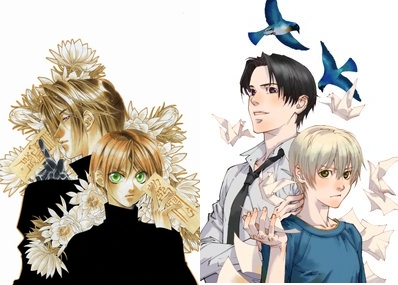
Asato Tsuzuki is a shinigami who has been working in the afterworld for 70 years (with a low wage), investigating cases related to unnatural deaths. Although he is very capable, he is constantly in trouble because of his laid-back and spacey attitude, and his inability to retain a partner. Things seems to improve when Tsuzuki is assigned to work with the new shinigami Hisoka Kurosaki, a teenager with a very serious attitude, in contrast with Tsuzuki's playfulness. Unfortunately, in their first case together they cross paths with the insane Doctor Kazutaka Muraki, a man who has gotten supernatural powers in very questionable ways. The doctor is involved in a lot of dirty business (including the death of Hisoka), and now wants Tsuzuki...
Descendants of Darkness (Yami no Matsuei in Japanese) is a manga by Yoko Matsushita which began in the shoujo magazine Hana to Yume in 1996. The manga went on hiatus in 2003, leaving the series unfinished until January 2010, in which volume 12 was released. The series is, however, resumed in 2011.
A 13-episode anime was produced by J.C. Staff in 2001. In the U.S., it was initially licensed by Central Park Media, and aired on the Sci Fi Channel's Ani-Monday block in 2008. It is currently licensed by Discotek Media, who have announced plans for a future DVD rerelease.
This series provide examples of:
- Affably Evil: Muraki is a polite doctor who approaches one in the most sympathetic manner when he is not raping, cursing and killing 13 year old boys or conducting human experiments to bring back his dead brother to life so that Muraki can be the one to kill him the second time.
- Almighty Janitor: Tsuzuki is stuck in a department where he won't do much damage, but is singlehandedly one of the most powerful shinigami in the Bureau.
- Art Evolution: The manga and characters — especially the male characters — start out damn pretty, then through the first eleven volumes became drop-dead gorgeous and sexy. In later chapters drawn during the 2010s, the art changed noticeably once more, possibly because of the author's health issues. Character designs have become distinctly blocky compared to her earlier artwork, but remain highly detailed nonetheless. Compare here
 ◊.
◊. - Ax-Crazy: Muraki.
- Badass in a Nice Suit: Tsuzuki and Tatsumi.
- Badass Longcoat: Tsuzuki in a rumpled black trench coat; Muraki in a flawless white one.
- Baddie Flattery: Muraki is always complimenting Tsuzuki when they scuffle, and it never fails to creep him out.
- The Beastmaster: Tsuzuki sort of takes up this role because his summons all take the forms of animals in the real world.
- Beleaguered Bureaucrat: Tsuzuki when he's at the office doing his desk job. Tatsumi sort of takes this position all the time.
- Big Eater: Tsuzuki has a very big sweet tooth, and spends all his money on food.
- Bloody Hallucinations of Guilt: After Hisoka has to kill Tsubaki at the end of the cruise murder mystery arc, he continues to see blood on his hands even though there is nothing there. His partner Tsuzuki comforts him.
- Bluff the Impostor: When Hisoka suspects that Tsuzuki is possessed by a demon, he proves it by asking Tsuzuki to go get food for the group and "reminding" him that the Chief hates sweets. In reality, the Chief has a notorious sweet tooth, so when Tsuzuki falls for it, Hisoka's suspicions are confirmed.
- Boke and Tsukkomi Routine: Tsuzuki and Hisoka. The rest of the bureaucrats create different dynamics that usually end up in the same comedic routine. And then there's Muraki.
- Boys' Love: Yes and no. Tsuzuki lampshades this in the first volume, joking that he would give Hisoka a goodnight kiss, but this isn't a Boys Love manga. Later on, in a plot arc that actually deals with homosexual relationships, Tsuzuki refers to homosexuality as 'icky' (But to be fair, he was masquerading as a priest at the time.), and he seems genuinely squicked by some lesbians in a different plot arc. Everything is officially kept on the Heterosexual Life-Partners level with a bit of Stupid Sexy Flanders, Freudian Excuse, and gratuitous amounts of
 squicky Mind Screw, but the art◊ speaks◊ differently◊.
 - Break the Cutie: Tsuzuki's whole life (and afterlife). Man does that guy have a sad story. To a lesser extent, Hisoka and the rest of the bureaucracy too.
- Bullying a Dragon: Tsuzuki's past.
- Cast Full of Pretty Boys: The average female character has the life expectancy of a particularly stupid gnat or falls off the face of the earth after only one or two appearances, and only one major character is not a bishonen.
- Celestial Bureaucracy: The Shokan Division.
- Cherry Blossoms
- Chivalrous Pervert: The Count for Tsuzuki. Hell, he even tried to marry Tsuzuki's Gender Flipped Counterpart in his fantasy book world.
- Chronic Hero Syndrome: Tsuzuki can't help but try to save everyone he meets, even though he's meant to bring souls to the afterlife when it's their time.
- Claimed by the Supernatural: At one point the retina of a famous violinist is marked with the seal of a devil who will claim his soul when he dies. The retina is transplanted to another person, who also becomes bound by the contract.
- The Comically Serious: Hisoka.
- Cool Mask: The Count's got a Phantom of the Opera kind of mask. Apparently, it's the source of his invisibility.
- Cosmic Entity: Konton/"Chaos". They claim to be eternal, indestructible, and exist in every world/dimension/time axis simultaneously.
- Crazy Jealous Guy: Muraki for Tsuzuki.
- Creepy Monotone: Muraki's got one.
- Crouching Moron, Hidden Badass: Tsuzuki.
- Dances and Balls: The cruise ship arc, when Hisoka dances with Tsubaki.
- A Day in the Limelight: Tatsumi gets one of these in the post Volume 11 chapters of the manga.
- Deadly Doctor: Muraki.
- Defrosting Ice King: Tatsumi, mostly thanks to Tsuzuki.
- Depraved Bisexual: Muraki.
- Distress Ball: This gets passed around a bit, but is often picked up by Tsuzuki. He really shouldn't get into as much trouble as he does because of his powers, but he tries to never hurt others so he gets hurt instead.
- Distressed Dude: Most often Tsuzuki, because of his need to help others and pacifism.
- Driven to Suicide: Tsuzuki, when he was alive, because he felt that his existence could only bring pain and suffering to those around him. He tries it again later. Hisoka hugs him out of it.
- Dude Looks Like a Lady: Hisoka's so pretty and slight that Terazuma even shapeshifts when he imagines that Hisoka's a flat-chested girl.
- Dysfunction Junction: Every main character's backstory appears to be based on child abuse, or some other severe trauma.
- Elemental Powers: The Shikigami (guardian spirits) can be divided into earth, fire, water and wind types.
- The Empath: Hisoka, with the irony being that expressing his own emotions comes with great difficulty.
- Expecting Someone Taller: Hisoka definitely didn't expect Kurikara, the famous and powerful King of Dragons, to be two heads shorter than himself.
- Facial Markings: Terazuma has symmetrical markings around his eyes, which are evidence of his parasitic-type shikigami.
- Fair Cop: Chizuru is a dead one.
- Faking the Dead: Hisoka dresses up as Hijiri and lets the demon possessing Tsuzuki butcher him to trick said demon into thinking that Hijiri is really dead. He gets better. Muraki also poisons himself with low dosages to be able to handle a paralysis serum a la Romeo and Juliet.
- Four Eyes, Zero Soul: Muraki. (Are you getting the gist of this guy's personality yet?)
- The Four Gods: The main proof of Tsuzuki's competence is that he can control them all.
- And then some: he actually controls 12 shiki in all, all the family of the main 4.
- Freudian Excuse: Muraki. Though it doesn't actually excuse much, make sense, or come up much, he's still got one.
- Friend to All Living Things: Tsuzuki.
- Friend to Psychos: Mibu Oriya, an old friend of Muraki. He covers up for Muraki, gives him a place to stay, and even disposes of the bodies sometimes.
- Gecko Ending: Muraki's mother and Saki. Completely different stories, between anime and manga, which changes Muraki's characterization quite a bit.
- Gender Flip:
 Word of God, as in the manga, it is directly stated that originally several of the characters were going to have opposite genders than what they wound up as!
 - Genre Shift / Out-of-Genre Experience / Breather Episode: The first three volumes can be pretty consistently placed in the supernatural detective/thriller genre, with liberal dosings of horror. Cue volumes 4 and 5, in which the main characters visit a hot spring and rescue a missing ice queen who went missing because she was KO'd by a badly-cooked muffin and have an epic inter-departmental archery contest. Oh, and then Tsuzuki is sucked into magical storybook land where he meets his genderswapped self. After a few volumes of these sorts of situations, the series goes right back into the horrific murders. A few volumes later, a magical shonen adventure plot starts up.
- Good Thing You Can Heal: Muraki to Hisoka in the first volume, after covering a room in his blood and torturing him at length. He even contemplates vivisecting Hisoka to test out how strong his regeneration abilities really are.
- Gorn: Thanks to the shinigami Healing Factor, the main characters get torn to pieces repeatedly and the results are splashed across the page in great detail. Some examples:
- When disguised as Hijiri, Hisoka gets hacked nearly in half and his eye is pulled out.
- The gruesome reveal of several murder victims on the cruise ship in volume 3 especially the dismembered corpse of Tsubaki's father
- In volume 4, a young Catholic schoolboy comes back as a rotting corpse (who proceeds to slurp out the organs of a priest).
- The Grim Reaper: The Shinigami.
- Hates Being Touched: Hisoka, no doubt as a result of several factors including his abusive family who shunned him because of his empathic abilities and the deal with Yatonokami, as well as his ability to read people's thoughts via the emotions triggered from them and also from being raped and murdered by Muraki.
- Healing Factor: All of the Shinigami, although they can be killed by hellfire, as shown by Tsuzuki's suicide attempt. Extreme in Hisoka's case.
- I Cannot Self-Terminate: Tsubaki-hime.
- I Have You Now, My Pretty: Muraki and Tsuzuki.
- And Muraki and Hisoka, technically.
- Incest Subtext: A shorter story in volume 2 of the manga has Tsuzuki ballroom dancing with a professional... and keeping pace with her. At one point he tells her that while her technique is flawless, she doesn't "share" the dance, and that he "can't teach her." In his words, "It means dancing as though you're in love with your partner... Dance like you want me!!!" A page before this, he stated it was his sister who taught him how to dance with such... um... passion.
- It's even foreshadowed and simultaneously lampshaded by Hisoka, who wonders what Tsuzuki's family was like.
- To make it even more suspect, it's heavily implied Tsuzuki falls in love with Hisae... because she reminds him of his sister. Later when Ruka appears in the manga, she looks very similar to Hisae...
- In Love with Your Carnage: Muraki with Tsuzuki and Hisoka.
- Innocent Flowergirl: Eileen. Before she was killed and her heart was harvested for Tsubaki, who went mad from the revelation when she found out.
- Intergenerational Friendship: Hijiri and Kazusa. And Tsuzuki and hisoka to a certain degree.
- Karma Houdini: Really, Muraki shouldn't be so free to do whatever he wants considering all of the atrocious acts he's done and all the people he's tortured and killed.
- Keet: Tsuzuki, when he randomly sprouts dog ears and a tail while being particularly goofy.
- Kids Are Cruel: Tsuzuki was mercilessly picked on (at times violently) by his peers when he was young.
- Lethal Chef: Tsuzuki, moreso in the manga than the anime.
- Lost Him in a Card Game: Tsuzuki loses his own body to Muraki in a game of poker, but Hisoka wins it back before we get to see anything scandalous.
- Love Before First Sight: Muraki, quickly and obsessively, for Tsuzuki.
- Mad Eye: Somewhat averted in Muraki, since he has an artificial eye, but it only adds to his air of insanity.
- Mad Scientist: Watari is a kind version of this trope, complete with Mad Scientist Laboratory and an interest in Gender Bender. Dr. Muraki, the insane evil version, is also fond of research labs and keeps the severed head of his dead brother alive in a clone tube.
- The Magic Poker Equation: When Tsuzuki plays Muraki in a game of poker, he loses with a flush to Muraki's full house. When Hisoka plays against Muraki, he beats Muraki's four of a kind with a royal flush.
- Mama Bear: Suzaku to Tsuzuki, in a particularly dramatic fashion in the Kyoto Arc.
- Manipulative Bastard: Muraki.
- Mark of the Supernatural: Wakaba has an orange right eye and a brown left eye, indicating her status as one of the four gate keepers of the shikigami realm.
- Mind Hive: Konton/"Chaos". It seems like there are several distinct voices, but they all refer to themselves as "we" and one entity.
- Morality Pet: In the later chapters of the manga, Ukyou Sakuraiji is the high school sweetheart and long time lady friend/fiancee to Muraki.
- Morally Ambiguous Doctorate: Dr. Muraki, and to a lesser extent, Dr. Satomi.
- Nigh-Invulnerability: Tsuzuki, even when he was still alive.
- Mystical White Hair: Muraki, and one author's note says that she considered giving him black hair but chose white because it was "more mysterious."
- No, Mr. Bond, I Expect You to Dine: Muraki forces Tsuzuki to have a fancy dinner with him while he keeps Hisoka as a hostage.
- Obfuscating Stupidity: Tsuzuki, to a certain extent. He doesn't really try to hide his abilities; he'd just rather eat cakes than show off.
- Ominous Latin Chanting: Occurs in the King of Swords arc.
- Omnidisciplinary Scientist: Watari is made of this. The manga shows him as being unbelievably proficient with hacking and decryption, involved in maintaining the computer-based reality where the series' summoned gods live, and good enough at chemistry for potion-based Mad Science (which could also be partly magical), and he's alluded to having done other things. His PhD? In Mechanical Engineering.
- One-Book Author: Yami Matsu is Matsushita Youko's only series so far, though she did publish an unrelated one-shot in a magazine once which was never released in tankobon form.
- Our Vampires Are Different
- Pinky Swear: Hijiri and Kazuza in the Devil's Trill arc.
- The Power of Friendship: Hisoka manages to pull Tsuzuki back from his suicidal Heroic BSoD.
- Rape as Backstory / Rape as Drama: Hisoka.
- Right-Hand Hottie: Grouchy old man Chief Konoe has hot secretary Seiichiro Tatsumi.
- Scary Shiny Glasses: Muraki, and Tatsumi sometimes.
- Tatsumi all the time, especially if you break budget.
- Though, interestingly, he takes off his glasses when he gets really pissed.
- Tatsumi all the time, especially if you break budget.
- Sealed Inside a Person-Shaped Can: The snake god Yatanokami, who was sealed into the Kurosaki bloodline by their ancestor Ren, and is currently inhabiting Hisoka's father Nagare.
- Serial Killer: Muraki.
- Shadow Walker: Seiichirou Tatsumi's power in Yami No Matsuei is manipulating shadows as a means of transport and as a weapon.
- Shower of Angst: Tsuzuki in the Devil's Trill arc.
- Shoot the Shaggy Dog: Double subverted with the ending to the Devil's Trill arc. The whole point of the story was to keep Hijiri and Kazusa safe from the Demon. The Devil shows up at the end and tries to kill Hijiri and Kazusa. Hijiri survives and the devil is vanquished... but Kazusa pulls a Heroic Sacrifice for Hijiri and dies anyway, rendering the whole arc pointless.
- Sidekick: Hisoka to Tsuzuki.
- Smug Snake: Muraki is much more slimy than he is charming once you look past his exterior. The dub takes this further by giving him a smugly superior sounding tone of voice.
- Sprouting Ears: Tsuzuki has this happen to him sometimes. They're dog ears.
- Stalker with a Crush: Muraki.
- Stepford Smiler: Tsuzuki appears cheerful and childish on the outside, but is in fact a huge woobie with many issues.
- Stoic Spectacles: Tatsumi.
- Suck My Rose: Muraki, and it only adds to his general creepiness.
- He brings a huge bundle of roses to Tsuzuki once and promises to return with "a million roses" next time.
- Tarot Motifs: Accompanying the murders in the cruise ship arc.
- "Well Done, Son" Guy: Muraki, in a way.
- Hisoka too, before the hatred for Nagare and Rui set in.
- What Beautiful Eyes!: Muraki constantly tells Tsuzuki that his purple eyes are beautiful. Tsuzuki, on the other hand, hates them because they remind him of his demon blood.
- You Are Not Alone: Hisoka delivers one of these to Tsuzuki when he's trying to kill himself out of despair.
- You Killed My Father. Prepare to Die: Kijin is determined to fight Kurikara and erase his existence from all of Gensoukai because he attacked and injured Souryuu, Kijin's father. Kurikara is actually innocent; Futsu, his right-hand sword, acted on its own. Not that anybody knows that.