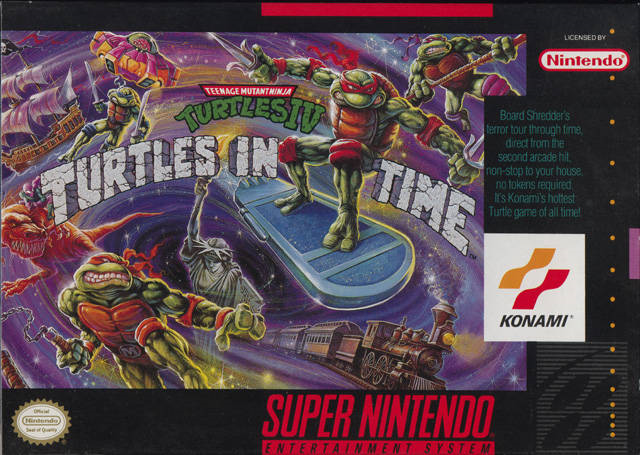
In the comfort of their sewer home, our four heroes, Leonardo, Michelangelo, Donatello, and Raphael, along with their wise Master Splinter, are watching their news reporter friend April O'Neil report from Liberty Island for the Channel 6 News. Out of nowhere, a humongous exosuit piloted by Krang snatches the Statue of Liberty, and the television broadcast is interrupted by none other than the Shredder, who survived the Technodrome's explosion at the end of the previous game. After being taunted by Shredder, the four brothers instantly leave their home to battle the forces of the Foot Clan, only for ole' Shred-Head to send them through a time warp. Deposited in the prehistoric past, the Turtles must fight their way back to the future—most stages henceforth taking place in a later time period—in order to defeat the Shredder and retrieve Lady Liberty.
Turtles in Time added some new features such as throwing Foot Soldiers into each other and—most famously—even at the camera. Due to hardware constraints, the Super NES conversion only allowed two player co-op (instead of four like the arcade version). However, it did add some material of its own, such as a versus mode, a new Technodrome stage, Mode-7 bonus rounds, further divergent character evolution (for instance, Raph became quick but defensively weak), and new bosses including Super Shredder from Teenage Mutant Ninja Turtles II: The Secret of the Ooze and fan favorites Rocksteady and Bebop.
Elements from the first arcade game and Turtles in Time were later used as the basis of a Sega Genesis game called The Hyperstone Heist. This game lacked the fancier effects of Turtles in Time, had a completely different plot, and new levels, though many parts of those levels were recycled from the two arcade games. A slightly altered version of the arcade game, with a new soundtrack and slightly different vocal work but nonetheless untouched graphics and gameplay to the original was also included as a unlockable in the PlayStation 2, Xbox and Nintendo GameCube versions of the 2005 game Teenage Mutant Ninja Turtles 3: Mutant Nightmare.
In 2009, a Video Game Remake developed and published by Ubisoft was released as a downloadable game for Xbox Live Arcade and PlayStation Network under the modified subtitle Turtles in Time Re-Shelled. It featured high-definition 3D graphics, improved audio quality which included re-recorded voice clips courtesy of the cast of the 4Kids animated series, leaderboards, and achievements. However, because it was based more on the arcade version than the SNES version, it excludes some of its more well-known content. Alas, the game was de-listed from both services in 2011 due to the license expiring, so those wishing to play that version if they haven't downloaded it already are out of luck.
In 2020 it got a home arcade release by Arcade 1Up, and in March 2022, the arcade game, its SNES port, and Hyperstone Heist for the Genesis were announced to be a part of Teenage Mutant Ninja Turtles: The Cowabunga Collection, which would be released for all platforms later that year. A spiritual sequel to the game titled Teenage Mutant Ninja Turtles: Shredder's Revenge was released in June of 2022, which has a similar gameplay style and "feel", down to using retraux pixel art graphics.
Note that "Turtles in Time" is not the subtitle of the film Teenage Mutant Ninja Turtles III, despite that film also being released around the same time as this game and also having a time-travel based plot. This is not helped by post-2009 Blu-rays, DVDs, and streaming services incorrectly using said subtitle for the film.
This game provides examples of:
- Absurdly Spacious Sewer: "Sewer Surfin.'"
- In Hyperstone Heist, the intro level combines this with Big Applesauce for the segment on the streets of New York.
- A Day in the Limelight: During the credits, each enemy is shown having their moment beating up the Turtles.
- Adapted Out: Cement Man is completely absent from the SNES version, with the boss of "Prehistoric Turtlesaurus" being Slash instead.
- Adaptational Badass:
- Most of the bosses are far more competent than the cartoon would have you believe. Bebop and Rocksteady are actually one of the later bosses in the SNES version when they're normally among the first bosses faced in other TMNT games. While they are still as clumsy as ever, they are also hard to beat.
- Human Baxter is the fourth boss in The Hyperstone Heist, whereas Fly Baxter is the first boss in Turtles in Time.
- Adaptational Villainy: The boss of "Alley Cat Blues" in both versions is Metalhead, who is supposed to have become an ally of the Turtles. Maybe the Foot Clan reprogrammed him?
- Adaptational Wimp:
- Leatherhead is the first boss in The Hyperstone Heist, whereas he was faced pretty late into the original game.
- Tokka and Rahzar, who in their movie appearance were too strong for the Turtles to beat in a direct fight, are just mid-game bosses in Turtles in Time. In the SNES version, they are weaker than in the arcade and encountered earlier, as minibosses.
- Adaptation Deviation: Strangely, the Rat King is piloting a Footski, originally a toy-exclusive vehicle that - as its name states - is meant to be used by members of The Foot (the original box art shows Rocksteady using it). Maybe he stole it from them?
- Adaptation Expansion: For example, compared to the arcade, where the Turtles are sent through time after "Sewer Surfin'", the SNES version has the Rat King boss fight and the level "Technodrome: Let's Kick Shell".
- Adapted Out: Bebop and Rocksteady make no appearance in the arcade game. Bebop is also absent from The Hyperstone Heist. Both appear in the SNES version of the game. Slash is also missing from the arcade.note
- American Kirby Is Hardcore:
- Compare the Japanese box◊ with the US one◊ (which is more like the original comics).
- Both versions of the game allowed you to switch between two different palettes for the Turtles: the bright and colourful "Animation" ("Anime" in the Japanese version) palette, that made them look like their 80s cartoon incarnations, and the darker, pupil-less "Comic" palette, which made them look somewhat closer to the original comic designs. However, the trope is averted since the "Animation"/"Anime" palette is used as the default in both versions.
- ''The Hyperstone Heist'' covers vary by region as well. Europe got the Lighter and Softer one (the same as the Turtles In Time cover), while the US version emulates the live action film's cover. The JP version is a hybrid between the two, featuring the pupil-less Turtles (like the comics) but brightly colored like the cartoon clashing against a billion Foot Soldiers while Shredder looms in the background.
- Compare the Japanese box
- Agony of the Feet: "My toes! My toes!" When one of the Turtles steps on the spike balls in the Sewer Surfin' stage, or falls victim to a flame on the ground from Rahzar or Super Shredder in the SNES version, they do a Pain-Powered Leap and hop on one foot for a bit, unable to attack.
- Amusing Injuries: Such as getting pancaked by something heavy.
- Anti-Frustration Features: The last battle in "Technodrome: Let's Kick Shell!" requires you to throw enemy Foot Clan robots at the screen to damage Shredder. During this boss fight, the timing window to throw the Foot Soldiers is noticeably increased.
- Artificial Brilliance: Subtle but the Foot Soldiers will try to surround and ambush the players, and if they happen to be a variant which has a medium range weapon (such as the White Foot Soldier or the Yellow Frisbee Soldier) they will actively try to kite the player attacking at (mostly) safe ranges.
- Artistic License – Paleontology: "Prehistoric Turtlesaurus" features dinosaurs that resemble typical theropods, as well as pterosaurs in the SNES version. It takes place in 250,000,000 B.C. in the Arcade version (in the early Triassic period, 20 million years before the first dinosaurs) and in 2,500,000,000 B.C. in the SNES version (where the hottest new trend in life on Earth was cells having a nucleus).
- Attract Mode: The arcade version notably features "Pizza Power" (from the "Coming Out of Our Shells" tour) as the intro theme.
- Balance, Power, Skill, Gimmick: Averting Standardized Leader, Michelangelo is Jack of All Stats. Raphael has short range but high attack speed. Donatello has long range but slow attack speed. Leonardo is the gimmick, having medium range and attack speed like Mike, but with a jump attack as his fourth move in his combo which leaves him open, and a back kick that gives him quicker protection from behind than the others.
- Battle in the Rain: "Skull and Crossbones" has a Boss Battle against Tokka and Rahzar set in a thunderstorm in the arcade version.
- BFG: Rock Soldiers carrying huge guns of varying features.
- Boss-Only Level: "Technodrome: The Final Shell-Shock" has no side-scrolling and consists of nothing aside from the final boss fight against Shredder/Super Shredder. Averted in Hyperstone Heist, which combines it with the Starbase, the last level before fighting Shredder, and adds the elevator from "Technodrome: Let's Kick Shell!".
- Boss Rush: The Hyperstone Heist version has one on the 4th level. The game even lampshades it (the stage is called The Gauntlet). You fight up to the first three previous bosses, including the boss you just beat in the previous level, Tatsu. Then it ends with a boss fight with Baxter Stockman in his human form.
- Camera Abuse: You can throw Foot Soldiers at the screen (in fact, the first Shredder battle in the SNES requires this!).
- Canon Immigrant:
- Tokka and Rahzar show up based on their movie appearance. Their animated versions were not introduced on the show until Season 7, the year following the game's release.
- Tatsu from the live-action movies appears as a boss in The Hyperstone Heist.
- Cast from Hit Points: The console ports of the game has the Turtles spend some health to use their special attacks.note On the other hand, this means that special attacks cannot be used while low on health.
- Climax Boss: The first Shredder fight in the SNES version of Turtles in Time. It's also a Puzzle Boss—which is rare for beat 'em ups.
- Color-Coded for Your Convenience: Super Shredder in the SNES version (as well as The Hyperstone Heist) throws three different types of projectiles, all color-coded. Red is a fire attack to the floor where he tries to burn your toes, blue is an icy anti-air that freezes you, and green is his insta-kill retromutagen attack.
- Color-Coded Multiplayer: Players are told apart from each other by the colors of their life bars, which depends on which Turtle they are controlling, For example, in a two-player game, the first player would be given a blue life bar if they controlled Leo while the second player would have a red life bar if they chose to play as Raph.
- Conservation of Ninjutsu: It's four Ninja Turtles versus 500 or so Foot Soldiers... yeah.
- Damn You, Muscle Memory!: In the SNES port, the Select button pauses the game, rather than the Start button as expected, and you can't change this in the Options menu.
- Disc-One Final Dungeon: The Technodrome in the SNES version of Turtles In Time. Given that it's the villains' base of operations and the final level of the previous arcade game, one would expect it to be the last level of the game on their first playthrough. Nope, Shredder sends the Turtles back in time right after he's defeated, kickstarting the second half of the game.
- Difficulty by Region: The European and Japanese versions of the game have extra pizzas in stages 4, 5 and 8, and the Bomb Pizza spinning attack lasts longer, making the stages easier.
- Dinosaurs Are Dragons: Turtles in Time has Foot Soldiers riding generic dinosaurs in the prehistoric stage, and they're capable of breathing fire.
- Disney Villain Death: Shredder falls to his death when defeated in the final battle.
- Do Not Adjust Your Set: Shredder in the intro of both games. Both games start off with the Splinter and the Turtles watching a broadcast by April. In Turtles In Time, Shredder appears on the TV after Krang steals the Statue of Liberty and does an Evil Laugh. In Hyperstone Heist he appears to show that New York disappearing was thanks to him shrinking it, and boast that he has the Hyperstone that he says it will allow him to conquer the world.
- Dual Boss: Tokka and Rahzar, at the end of the pirate ship level in the arcade, or as the mid-boss of the Technodrome level on the Super Nintendo. The SNES version adds Bebop and Rocksteady as the pirate ship boss.
- Easy-Mode Mockery:
- The SNES version of Turtles in Time only shows the proper ending if you beat the game on Hard mode. Otherwise Splinter will just tell you to try a harder difficulty.
- Downplayed in The Hyperstone Heist, where the difficulty only affects the end credits; Easy mode only has basic credits scrolling up on a black screen, Normal mode shows the Turtles on their Blimp in the background while Hard mode also shows the list of all characters after the credits.
- Elite Mooks: The stone soldiers, especially in the arcade. They can't be thrown and need double the effort to be beaten compared to the Foot Clan.
- Every 10,000 Points: Every 200 points, you get an extra life. This means you have to decide, for example, when you're surrounded by Foot Soldiers, whether you're going to quickly clear a lot of them at once with Metronomic Man Mashing (for 2 points each), or grab and throw them into the screen one at a time (for 3 points each), though that particular decision is only required in the SNES version (the arcade version doesn't let you throw enemies at will nor decide which throw it is, and the throws still only count as one point, while the Genesis version doesn't have the screen toss).
- Evil Is Bigger: Shredder is a giant in this game, with the Turtles only just coming over his waist.
- Evil Is Petty: Shredder stealing the Statue of Liberty, not to mention banishing them through time or shrinking down the entirety of New York City in Hyperstone Heist, isn't really given a reason why he does it nor seems to be part of a grander scheme, implying that all he's doing is intentionally trying to anger the Turtles so they march straight into his clutches.
- Excuse Plot: You'll likely forget all about the Statue of Liberty halfway through this game (or the entirety of Manhattan shrunk down to a miniature scale model size in Hyperstone Heist); not that it matters.
- The bigger question is why Shredder's solution to stopping the Turtles from re-claiming the Statue of Liberty is time travel.
- Failed Future Forecast: Considering how the game was made in 1992, the "Neon Night-Riders" bonus stage takes place in 2020 A.D., where there were futuristic skyscrapers, neon lights, new-age highways and hoverboards. In the Real Life 2020, however? Not so much, as cities and skyscrapers have not advanced into futuristic technology yet. As one GameSpot article says best, "it's funny to think that stage takes place in 2020. We could've had hoverboards. Instead, we got COVID."
- Fire/Ice Duo: In the SNES version, Tokka and Rahzar serve as the mid-bosses of Stage 4, "Technodrome: Let's Kick Shell!". Rahzar scorches the turtles with his fire breath, while Tokka freezes them with his ice breath.
- Foreshadowing:
- In The Hyperstone Heist, during Rocksteady's quick Final Speech, he says: "Remember! When I see you next time, I'll beat you." This is a hint about the boss rush stage that happens two levels later.
- Each stage intro lets you know which boss you'll be facing. The only exception is the Rat King in the SNES version.
- Flash of Pain: Konami's usual "seizure time" variant of this. Bosses on low health usually flicker in their alternate palettes. This is averted in the Re-Shelled version where the boss's portrait will flash instead.
- Floating in a Bubble: Krang's saucer can induce this on the Turtles. "Anyone got a pin?"
- Flunky Boss:
- Tatsu summons Foot Soldiers while taking dart shots at the Turtles. It doesn't matter how many of them the player kills, more will keep coming.
- Baxter Stockman in Hyperstone Heist. Rather than fighting in his mutant fly form, he is in his human form piloting a machine that drops Mousers. This is actually his only attack.
- The first fight with Shredder in the SNES version of Turtles in Time, which actually works in the players' favor since throwing Foot Soldiers at him is the only way to hurt him.
- Krang can summon robots in both versions while in his saucer, especially in the arcade version.
- Forgot About His Powers:
- Krang uses his robot body's ability to turn into a giant and steal the Statue of Liberty in the game's opening, and does attack the player as a giant in the first stage. But he fights normal-sized when the player does face him.
- The plot of Hyperstone Heist is kicked off by Shredder using the titular item to shrink New York. Naturally he doesn't use this very useful ability when the player fights him.
- Funny Background Event: In Re-Shelled, one of the Foot Soldiers in the Neon Night Riders segment struggles to get back onto their hoverboard, before failing and exploding.
- Gangplank Galleon: The "Skull and Crossbones" level.
- Giant Mook: Rock Soldiers, which can take a lot of as well as dish out a lot of damage.
- Grievous Harm with a Body: Attacking a Foot Soldier in a certain way allows you to whip them around to kill both them and any enemies that get too close. You can also throw Foot Soldiers into the screen, which happens to be the only way to damage the boss of the SNES 4th stage.
- Guide Dang It!: In the SNES version throwing Foot Soldiers on the camera is amusing... and mandatory to defeat Shredder during the first fight against him. The problem is that the game doesn't tell you how you do it, the manual is a bit unclear, and chances are that you've done it so far by accident. note
- Hard Levels, Easy Bosses: The only way to get good at the main stages is to practice, practice, practice. But as far as the bosses go, a lot of them are pushovers if you use the right strategies. This is taken up further in Hyperstone Heist where the game has fewer but longer levels, meaning the player has to go through longer periods of time without their health getting restored.
- Hurt Foot Hop: If you run over spikes (while riding your jetboard!), or get shot by a Rock Soldier wielding a machine gun, your character does the hurt foot hop while crying out "My toes! My toes!".
- In Case of Boss Fight, Break Glass: The SNES version gives you this in your first boss fight against Shredder, who's in a mechanical construct firing all sorts of weapons at you while his Foot Soldiers are distracting you (and the battle is shown from Shredder's point of view). While you can beat up the ninjas endlessly, the only way to beat Shredder is to throw said ninjas into the screen. The controls to throw the soldiers into the screen are more relaxed during this fight due to it being a requirement.
- Inexplicably Preserved Dungeon Meat: The Turtles can find perfectly good pizza lying on the sidewalk, or down in the sewer, and even Shredder keeps some lying around the Technodrome.
- In the Back: It's the only way to damage Slash, as he'll block any attack from the front.
- Leaning on the Fourth Wall: You can throw Foot Ninjas into the screen. It's the only way to attack Shredder in the SNES-exclusive boss fight for "Technodrome: Let's Kick Shell".
- Life Meter: Bosses on the SNES and Genesis versions have them, but not in the arcade version. (Of course, the playable characters have them in all versions!)
- Locomotive Level: "Bury My Shell At Wounded Knee" completely takes place on a train.
- Market-Based Title:
- The "IV" was added to the title of the SNES port outside Japan to maintain continuity with the previous NES games, since the first NES game was followed by two numbered sequels (Teenage Mutant Ninja Turtles II being a port of the first arcade game). Strangely, the European Hero Turtles release also had a Roman numeral IV, despite the fact that the third NES game (The Manhattan Project) was never released there.
- The Japanese version of Hyperstone Heist is called Return of the Shredder.
- Meaningless Lives: The Cowabunga Collection features an arcade-perfect port of the original game, meaning one merely has to press a button to provide as many lives as needed, rather than pumping an arcade cabinet full of quarters. The same is true of the version found in Teenage Mutant Ninja Turtles 3: Mutant Nightmare, itself a modified port of the arcade release.
- Metronomic Man Mashing: The side-to-side throw is a One-Hit Kill on Foot Soldiers (the guy being thrown, as well as those hit by him) and every enemy killed by it is worth 2 points, while normal kills only give you 1 and you get an extra life every 200 points.
- Mineral Macguffin: The titular Hyperstone. Shredder uses it to not only shrink down Manhattan and the Statue of Liberty, but also to attain his Super Shredder form.
- Monumental Theft: The Shredder steals the Statue of Liberty, the Turtles are after him to get it back. That's pretty much the plot, although it's only mentioned in a couple of cutscenes.
- My Rules Are Not Your Rules: Enemy mooks are able to pass through some stage hazards unharmed, like the laser beams in "Starbase: Where No Turtle Has Gone Before".
-
 Nintendo Hard: You better be playing with friends on the arcade version, or you'll be munching quarters fast. The SNES version not only rebalanced the game but toned down the enemy count and made enemies go down in one hit in "Sewer Surfin'", among many other changes. Meanwhile in the arcade they'll gang up on you super aggressively, even stun locking you to death if they get the opportunity, and the game is all too willing to blindside you if you don't know what's coming up.
 - One-Winged Angel: Super Shredder, which replaces regular Shredder as the final boss in the SNES conversion. Interestingly, he transforms just before you fight him, instead of transforming after defeating him in his regular form. In addition to super speed, a fiery ground wave, and an anti-air ice projectile, Super Shredder also possesses an instant kill anti-mutagen fireball which takes away one of your extra lives (that is, if you have only one hit point left and take one of these fireballs, you will lose a life but you will continue with a single hit point). On the hard difficulty, he uses his attacks so quickly you can jump right into the ice attack before it even starts, and have a split-second to jump when he uses the fire and mutagen attacks.
- Orcus on His Throne: While Shredder remains in the Technodrome for the entire game, Krang completely averts this and actively attacks the Turtles throughout, starting by appearing as a giant in Stage 1's background, then later being fought in stages 8 and 9 (the former in his exosuit, and the latter in a new saucer ship).
- Personal Space Invader: Mousers.
- Power-Up Food: Regular pizza in this game replenishes your Life Meter. A pizza with a bomb on the box causes the Turtle who touches it to shout "Pizza Power!" and go into a spin that can destroy every enemy he comes into contact with.
- Prehistoria: The "Prehistoric Turtlesaurus" level, where you fight through a volcanic region millions of years ago, and battle Slash (Cement Man in the arcade version) as its boss.
- The Present Day: The first part of the game and the final battle take place in the present day in the arcade and SNES versions. The final battle against Super Shredder is shown to take place in A.D. 1991 or 1992, respectively. Averted in Re-shelled, where 1991 was definitely not the "present day" anymore.
- Rake Take: The planks at "Skull and Crossbones", as well as part 2 of "A Mysterious Ghost Ship" in The Hyperstone Heist.
- Random Events Plot: Wafer-thin as the plot may be, the fact that it quickly goes from foiling a theft to an impromptu time travel trip is still pretty out of left field. The SNES version tops it off by having Shredder somehow be able to turn into Super Shredder without using mutagen. In Hyperstone Heist, Shredder explicitly states that he's using the Hyperstone to go Super.
- Rearrange the Song: In the Mutant Nightmare port, the "Skull and Crossbones" level remixes the "Streets" level theme from the 2003 TMNT video game.
- Reformulated Game: Of the port variety. The Hyperstone Heist starts out as a Turtles in Time port for the Sega Genesis, but drastically shifts in direction to be more like a remix of all the prior beat-em-up games despite keeping the same core gameplay, sans the screen-tossing throw.
- Re-Release Soundtrack: The version of Turtles in Time that can be unlocked in Teenage Mutant Ninja Turtles 3: Mutant Nightmare features a completely new soundtrack. The HD remake Re-Shelled also featured a brand new soundtrack.
- Revenge of the Sequel: The Japanese version of Hyperstone Heist is called Return of Shredder.
- Robo Cam: The boss of the Technodrome (the first time you visit it, anyway) in the SNES port has the camera placed behind Shredder as he pilots a robot. Much text can be seen on the robot's HUD.
- Secondary Adaptation: A 1991 Beat 'em Up game based on Teenage Mutant Ninja Turtles (1987), which is based on Teenage Mutant Ninja Turtles (Mirage). It was initially released as an arcade cabinet, with up to four simultaneous players. When it was released on the Super Nintendo Entertainment System console, some new features were added to make up for the fact that hardware constraints only allowed two player co-op, including a new Technodrome stage, and new bosses like Super Shredder (mutagen-infused from Teenage Mutant Ninja Turtles II: The Secret of the Ooze) and Rocksteady and Bebop.
- Sequel Escalation:
- TMNT games usually have Shredder kidnapping April O'Neil. Here, he steals the Statue of Liberty.
- The Hyperstone Heist starts off with Shredder shrinking Manhattan, alongside the Statue of Liberty, to claim for his own!
- Shared Life-Meter: Variant: Bebop and Rocksteady show separate health bars, but the fight's over when either one empties. The two start attacking each other and defeat themselves.
- Shout-Out: The name of the Wild West level, "Bury My Shell At Wounded Knee", is a reference to the 1970 Dee Brown book Bury My Heart At Wounded Knee.
- Ship Level: "Skull and Crossbones", which takes place on a Pirate Ship. In the Arcade version, Tokka and Rahzar are its bosses, whereas in the SNES version, you instead fight Bebop and Rocksteady.
- Sinister Silhouettes: At the beginning of each stage, one of the Turtles announces the name of the stage, in front of a silhouette of the Stage Boss.
- Stalked by the Bell: In the original arcade version of the game, if you go 5 minutes in a level without dying, a bomb will fall from the sky and instantly kill you, plus the timer is hidden. It'll also drop a bomb if you don't keep moving when Splinter tells you to go. Of course, you can disable these "Penalty Bombs" in the Cowabunga Collection rerelease.
- Suck E. Cheese's: In the manual, the Pizza Monsters are called Chunky Cheese Pizza Monsters.
- Temporary Online Content: Re-Shelled was delisted from XBLA and PSN in 2011 after Ubisoft's license expired.
- Time Travel: It's the premise! Though it really doesn't start until about half-way through the game.
- Title Scream: Each level's location is spoken.
- Throw the Mook at Them: The SNES version of the game features a boss battle like this, against Shredder, at the end of the Technodrome level. Shredder sits safely in the cockpit of a crab cannon, where the Turtles can't reach him. So they chuck his own soldiers at him, literally reducing them to cannon fodder.
- Unique Enemy: In the beginning of the Starbase level on the SNES version, there is a floor turret robot Mook. It's the only one of its kind in the entire level and game. In the arcade version, there are four of them working in pairs instead.
- Video Game Cruelty Potential: After Rahzar de-mutates following his defeat, you can attack him in his normal form. Doing so will cause him to make yelping sounds.
- Wutai: "Shredder's Hideout" in Hyperstone Heist.
- Xenomorph Xerox: Pizza Monsters resembling Xenomorphs appear in Turtles in Time and The Hyperstone Heist.
- Zeerust: The "Neon Night Riders" stage features vast sparkling cities and hoverboards. The year? 2020.