
 .
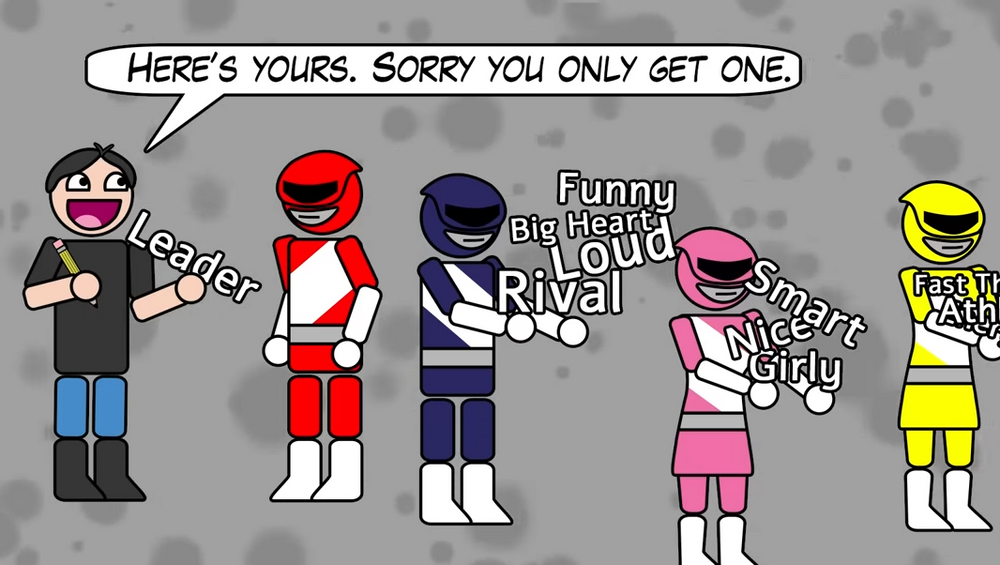
.Conflict drives stories. This is a central axiom of fiction. It's why the more conflicted and nuanced a character, relationship, or plot, the more involved the viewer will become. Characters themselves must have some conflict to overcome, be it internal or external, to engage a narrative. This is why when a story focuses on a group of heroes, it is the most dynamic of them that garner the most attention and love. Pity that's rarely The Leader.
Leaders in fiction tend to have two simultaneous burdens on them both in and out of the story: outside of the story they must be The Everyman as a reader's stand in; they can't be too distinctive without alienating some audience members after all. Inside the story they have to bear the qualities necessary to lead. So their temperament must be emotionally balanced, serious ,morally upright and rational to keep their teammates in check. Effectively, they don't have the ambiguity of the other heroes. You know that he's not going to fall to The Dark Side or lose, so his conflicts are less interesting than those not as protected by their morals or Plot Armor.
Those being led are under no such yoke. They're free to be a Rebellious Spirit with a Dark and Troubled Past, a carefree Cloudcuckoolander or any kind of character under the sun. Proof of concept: part of being The Lancer is an increased likelihood of making Ensemble Dark Horse. The Hero has no choice in the matter; if he wants his party to function, he has to become The Generic Guy.
In a long-running series or mythos, the Standardized Leader stands out most for not being able to change. And when we say change, we don't even mean his Character Development. Writers and designers may not even be able to change the Hero's look without backlash from fans who can only accept the original flavor. The Standardized Leader is trapped in time.
Happens quite a bit in High Fantasy and Science Fantasy series in general. The main hero shoulders the burden of being a paint-by-numbers Campbellian hero, generally a standard male protagonist who grows from a boy to a man to a Messianic Archetype. His companions' role in the plot is not so strictly defined, and are allowed to be quirky, flawed and hint at Hidden Depths. This trope is also particularly common in Role-Playing Games where the leader is meant to stand in for the player.
Averting this trope is not impossible. In fact some characters are Magnetic Heroes precisely because they're quirky and Hot-Blooded. Heck, some writers will see that second paragraph and think that any character capable of balancing that many variables would make for an Oscar role, making Mr. Ensemble Donut a delicious jelly filled donut thanks to Hidden Depths. He just happens to be a Nice Guy on top.
Compare Jack of All Stats and The Red Mage.
Examples:
- Shikamaru in Naruto seems to suffer a little from this after becoming the leader for a short while. When in his function as squad leader he makes an effort not to appear his usual lazy self, his position as The Smart Guy is filled by Neji and he continued his streak of being the only member of the cast to not receive a major injury. After the timeskip, he seems to have reverted back to his normal self but he still has a lot more boring outfit than anyone else in the Konoha 11, though he receives significant character development during his arc after the timeskip.
- Highschool of the Dead plays with this trope in regards to the main character Takashi. He worries that he’s got no real outstanding skills compared to the rest of the (useful) members of his team, yet given the flaky cohesion and variable sanity of the group, his ability to keep everyone on a leash is quite invaluable. The kicker is that while he may be the most centered of the group, he'’s not completely stable either and he knows it. He's very worried about that last part. Takashi's aware of how much the others rely on him and knows that if he were to lose it, it would have a domino effect on the team and get everyone killed.
- This is probably what crippled Seiya's popularity in Saint Seiya. Shiryu and Hyoga both get some focus at times and Ikki and Shun are practically Raoh and Toki as kids. Seiya gets the least amount of focus in terms of backgrounds, and even his quest to find his sister takes the back seat and is all but ignored for
nearly fourteen manga volumesthe entire manga, being only solved at the end on a borderline Ass Pull. - The nominal leader (the one wearing the goggles) in any Digimon series, especially Daisuke. They're usually the most courageous and have the least issues, though the later ones verge more on Idiot Hero. Though this is notably averted with Takato who is the drastic opposite in that he lacks any confidence at the beginning of the story, and does get a good part of development. Then there's Taiki who is far by a super genius compared to the rest of the previous ones.
- Voltron probably fills this trope most perfectly, as Keith is the standard reasonable and noble leader, while Lance was the hothead, Princess Allura was "the girl," Hunk was the "Gentle Giant," and Pidge was the "kid". He is the voice of reason amongst the varied personalities - he plays the role of the audience or writer that they can better empathize with.
- Lampshaded in Sket Dance, where even though it's acknowledged that the Sket-dan wouldn't be able to exist without Bossun's leadership, he's considered really boring compared to the other-members in-universe as well as out. (For example, when an artist wants to created a manga based on the Sket-dan, he completely ignores Bossun, and later Bossun is the only one of the three who doesn't win an award in his class.)
- Sasahara in Genshiken flirts with this trope during his tenure as club president. He's not as militant and flamboyant in his nerdiness as Madarame or as dedicated to his own special subgenre of nerdiness as Ohno or Tanaka, or as talented as Kosaka or Oguie, functioning instead as something of a peacemaker and diplomat among the group. Kugayama even lampshades this when he points out the irony that he attempts to spearhead the creation of a doujinshi (fan-comic) without even being able to draw. However, over the course of the series he discovers a bit of ambition and backbone and ultimately comes into his own as a character.
- Averted in Persona 4: The Animation, where unlike in the original Persona 4, Yu Narukami fits the "calm, badass, collected leader" image, but has his fair share of humorous quirks to keep things interesting. Also, like the rest of his team, Yu's got his own share of issues. Deep down, he's actually an insecure Broken Ace with a low self-opinion. He gets his strength from the bonds he shares with his friends and family, something he never had before coming to Inaba, and thus develops an intense fear of losing people he's close to.
- Averted with Ken Washio from Science Ninja Team Gatchaman, who has moments of Achilles in His Tent and over the course of the series almost becomes unhinged by the loss of his father and Heroic Sacrifice of his teammate Joe.
- On the flipside, his Battle of the Planets counterpart Mark plays this pretty straight.
- The Japan exclusive Transformers series zigzag this trope:
- Transformers: The★Headmasters averts this by having Chromedome as the Hot-Blooded main character, while Fortress becomes the Supreme Commander when Convoy (Optimus Prime) dies early in the series and Rodimus Convoy (Rodimus Prime) resigns his position after Cybertron is destroyed.
- Transformers: Super-God Masterforce starts with Metalhawk leading the Autobots as one of these. When Ginrai joins the cast and later proves himself to be the most powerful Autobot on the planet thanks to his various upgrades, Metalhawk cedes leadership to him due to his belief Ginrai makes a fine field leader while he himself is most useful as Mission Control.
- Transformers Victory has Star Saber, who practically screams this trope. He does have a few things that causes him to stand out, though. He's a Showy Invincible Hero for the most part (he's outright described as being a Super Robot by people who worked on the toy) and he notably adopted Jan Minakaze, a human child whose parents were killed by Decepticons. In one early episode, he takes the time to enroll Jan in school once the Autobots reach Earth and personally visits to speak to the headmistress. The headmistress wryly points out that signing the neccessary work might be a problem note , but he offers to have his signature reduced in size and sent to her later.
- Beast Wars II has Lio Convoy, who is this for the most part. He does, however, have an awkward relationship with his 'son' Lio Junior.
- Beast Wars Neo averts this with Big Convoy. Big Convoy starts out begrudgingly taking on his role as instructor to his Ragtag Bunch of Misfits (he only accepts because Vector Sigma, acting as its role as actual literal in-universe Word of God, directly orders him to). As time goes on, his recruits grow on him and he slowly loses his lone wolf tendencies, becoming a true instructor and leader.
- Ryoma Nagare in the anime version of Getter Robo falls pretty deep into this, being by far the most generic of the three Getter pilots. While Musashi is dripping with goofball charm and Hayato has a hint of introspective antihero edge, Ryoma is hard to define beyond simply "heroic." It's especially evident when one compares him to his counterpart in the Darker and Edgier manga, where he's anything but this trope.
- Delicious in Dungeon: Laios Touden is set up to be a standard fantasy protagonist, a human White Male Lead with a sword motivated to dive into the dungeon in order to rescue his lost sister. Then, he's almost immediately revealed to be the weirdest person in the cast, being obsessed with monsters to the point of wanting to eat them.
- This is an explicit feature of Cyclops, leader of the X-Men. The traits which make him, or anyone, a good leader are also the traits that make him the least fun at parties. To a certain extent, the two are mutually exclusive. Recent writers have given Cyclops a good deal of character development by embracing this trope.
- Used to great effect at times, however, for comedy; being a standardized leader makes him adept at playing The Comically Serious role. It also helps that, depending on the writer, he has a very dry sense of humour.
- Various events, especially the death of Jean and most recently Avengers vs. X-Men, have however lead to deconstructing this trope. As the only thing he had close to a personal life died, he basically threw himself into work 24/7, and as mutants plummeted in numbers and things got Darker and Edgier, he pushed the team into darker territory to keep everyone safe, resulting in some morally ambiguous decisions. He's now frequently compared to Magneto (who he gave a spot on the team to when he came asking for a Heel–Face Turn), due to his willingness to use extreme measures others would find appalling or a last resort.
- Cosmic Boy from the Legion of Super-Heroes is much more rule abiding and serious than his drama generating teammates, it's a large part of why he's usually the leader.
- Nightwing/Dick Grayson, possibly the default guy for leadership in the DC universe, subverts this astoundingly by being one of the most popular characters and having a far too jocular attitude to fit. It probably helps that he has a very long, detailed, and sometimes painful history of growing up as a sidekick, and whenever he works with Batman he seems fine with letting Bats take the lead.
- During the Wolfman/Perez New Teen Titans run, Dick was chosen by Raven to lead the team she assembled because he is just the default leader of any team of heroes due to his incredible charisma and cleverness in delegating roles.
- Nightwing is so universally accepted as a leader that when three different incarnations of the Teen Titans gathered together to fight a threat, they all took Dick's orders without hesitation or bickering over who should be in charge. Even the Titans that were never led by him.
- He was almost killed during Infinite Crisis because his death would send the most reverberations through the DCU due to all his friendships and relationships with the rest of the characters.
- In most groups he's a part of, Batman will be the leader or at least a leading member. He tends to skirt this trope by maintaining his cold demeanor but the lack of focus means that a lot of his depth is glossed over.
- For the DCU as a whole, Superman often takes this role, due to him essentially playing the role of role model to all other heroes. Over in the Marvel Universe, Captain America plays this role for mostly the same reasons; while the original Nick Fury was a slightly darker version of this (since, unlike Cap, he was more prone to doing unsavoury things, his black son (also named Nick Fury) is a world-class Jerkass who enjoys rubbing his power in people's faces, making him slightly more distinctive.
- Princess Sally Acorn from Sonic the Hedgehog (Archie Comics) is a rare example of a Standardized Leader who isn't the main protagonist. Less evident in earlier issues, where she was more The Finicky One, though as time passed, her Closer to Earth role eclipsed most of her defining flaws.
- Gold of the Metal Men. The other Metal Men all have very loud personalities (except for Copper, but she's new); Gold's personality seems limited to "being the leader, and all that that entails."
- In the New 52 version, he does have a unique personality: namely, he's a preening narcissist who thinks gold is obviously the best metal, and so appointed himself the leader.
- In The Authority, Jack Hawksmoor takes over as leader after Jenny Sparks dies, and proceeds to be several orders of magnitude less interesting than her. All the other characters have recognisable personalities, story arcs, and motivations. Jack just has his powers and a tendency to brood.
- APOLLO, the leader of the Golem Unit in Titanomachy, fits the typical leadership archetype. To further exemplify this, his Simulacrum body is described as being rather plain and practical compared to the more diverse members of his unit.
- X-Men Film Series: Played straight with Professor Charles Xavier in the original trilogy, where he doesn't really get to be more than The Mentor to the X-Men. It's averted with the First Class trilogy, where he's upgraded to the Hero Protagonist and becomes a Rounded Character.
- Duke from G.I. Joe: The Rise of Cobra, who comes off as rather flat compared to his more quirky teammates.
- Marvel Cinematic Universe: Steve Rogers / Captain America, The Leader of the Avengers is emotionally balanced, serious and morally upright. Unlike some other members of the team who face heavy internal conflicts, his arc mostly revolves around gaining experience in dealing with changing circumstances around him. The only chink in his armor involves his best friend Bucky, who like him is a man out of time.
- Animorphs:
- While Jake seems like this to his teammates having more obvious quirks, his inner conflicts resulting from his position and Shoot the Dog tendencies make him a subversion of this trope. This is especially brought to light when he orders his (Yeerk-infested) brother killed and starts committing war crimes against the Yeerks.
- Discussed as early as book 16 (of 54) — Cassie tries to convince Jake that he doesn't have to be like this 24/7, but he disagrees. If he admits that he's scared, then so can everyone else, at which point the whole team will be paralysed.
- Apollonius of Rhodes' Argonautica: Fresh-faced kid Jason, with no exploits to his name, is put in charge of an all-star team of established Greek heroes. He can't help but come across as bland in comparison.
- Tom Corbett, Space Cadet. Despite being the title character, a clean-cut all-American boy and The Smart Guy, his negligible personality is overwhelmed by those of his much more colorful and assertive teammates.
- Rand, the hero of The Wheel of Time, is a deconstruction of both this and The Chosen One, since for much of the later part of the series, aside from his comparatively bland personality outside of his friends, he was literally going insane as a result of all the pressure he was under. He did finally get better, though, and now acts more like a wise beyond his years holy warrior than anything.
- Rhodan, the eponymous character of the long running Perry Rhodan pulp space opera. Much was made of his leadership and decisiveness in the early years, but that eventually got old and now he's basically the reader's projection screen.
- Kill time or die trying: Brad from Part I is a fairly generic student who cements himself as the moral compass of WARP and eventually becomes club president.
- Jason Grace, from The Heroes of Olympus. Well, until he gets some serious Character Development in House of Hades.
- The Lord of the Rings: Neither Frodo nor Aragorn really fits the Standardized Leader type, but Frodo tends to be overshadowed by other members of the Fellowship.
- Jack of Lost was never without his own issues, but because he had to fulfill the role of Wasteland Elder, he never seemed to face his problems head-on and develop like his followers. Eventually, he does manage to subvert the trope, when after finally leaving the island, his personal demons follow him and escalate, and he slowly falls apart. The fandom seems to like him now.
- Star Trek:
- Star Trek: The Original Series, especially in the early episodes, frequently played up the idea that Kirk (or any Starfleet captain) was obliged to make sure the crew perceived him this way — seeing him as always unflappable and dependable, to ensure order aboard ship. According to the writer's bible, the reason Kirk plays so hard and gets into so many romantic entanglements when he's off the ship is to relieve the stress of maintaining this idealized image when on board.
- Several Star Trek: The Next Generation episodes show that Picard is also concerned with how the crew view him. When he needs life-saving surgery, he insists on doing it elsewhere, despite the fact that Dr. Pulaski, who is his ship's CMO, is the foremost expert on this particular procedure. The other doctors end up having her recalled anyway, when a complication arises during the surgery. When Picard hesitantly asks Pulaski about the crew, she calms him down, telling him that he's still the indestructible captain. However, unlike Kirk, Picard is much more experienced as captain (partly because he got his first command at an even younger age), so he comes off as a more wizened officer.
- Star Trek: Deep Space Nine: Sisko is the Inversion of this trope. The station is full of people with their own narratives, agendas, and personal baggage, most of whom aren't even under his command. A big part of his job is saying no to people when they're about to so something short-sighted or politically dangerous.
- The majority of earlier Super Sentai Red Rangers, up until the '90s, are basically this trope incarnate. This is probably because in most of the earlier series, the Sentai teams were an elite squad of a military organization, so the red ranger is more or less the squad captain who needs to be the stable pillar of the team. Later Sentai start to move away from this type of Red Ranger, with Hot-Blooded Rookie Red Rangers becoming the norm. The early team leaders of the American adaptation Power Rangers also fell under this trope.
- Tommy Oliver from Mighty Morphin' Power Rangers is a subversion of this trope. When he was first introduced and added to the team, he wasn't the leader and was given many personality quirks to put him in situations where he is unable to fight, due to the small amount of Green Ranger footage available. When Tommy became the White Ranger, he was promoted to leader and pretty much became this trope.
- Takeru Shiba from Samurai Sentai Shinkenger is somewhat of a subversion by the fact that he appears to try and keep up the trappings of a Standardized Leader but eventually slips more and more as his backstory is revealed. It becomes one of the centerpoints for the latter parts of the show. As Jayden, from Power Rangers Samurai is probably meant to be an Expy of Jason from Mighty Morphin, the aforementioned character arc has been removed, making him play this trope straight.
- Despite not being a single main protagonist (for there isn't one), Mike can fit this in The Young Ones. He's not standard in any way, but compared to the craziness of Neil, Rick, and Vyvyan, Mike seems much calmer and notably less funny (and by extension, popular). However, he leads the housemates into many of the main events and rather than acting as an audience surrogate, he acts as a set up for some of the jokes, without causing as many laughs himself. He is also involved in barely any of the slapstick violence compared to the other three, but he is usually in charge of what happens in the "story". A lot of people don't think much of Mike, but he provides a contrast that make the other three so funny.
- Despite all this, he does have a personality and gimmick; just not as memorable as the others. Many episodes highlight his role as The Barnum, such as turning Rick's bedroom into a roller-skating dance club or bribing his way through college, as well as his Casanova Wannabe status (one episode shows him cover his bedroom floor with panties, take out his inflatable sex doll, and put on a tape recorder of a woman swooning "oh Mike, oh Mike", revealing that despite his charm he's as big of a liar as Rick.
- Bioware games like the Baldur's Gate and Mass Effect franchises are notable for subverting this by allowing their protagonists to express plenty of personality through player-chosen responses; they may constantly be the Only Sane Man of their group, but there's plenty of room for them to also be goofy, hardass, flirty, sarcastic, etc.
- In Borderlands 2, Roland fulfills this role for the Crimson Raiders and the former Vault Hunters, as both the leader of the resistance and as the Straight Man to his companions.
- Lars Halford of Brütal Legend is an intentional example. A charismatic leader who lacks any skill other than leadership, it's only Eddie Riggs' talents as a Roadie that actually kicks his revolution into high gear. Also, his flaunting of his Big Good status to Big Bad Doviculus gets him killed automatically.
- Squall Leonheart of Final Fantasy VIII is ALWAYS picked as a leader for missions. It makes sense too, he's one of the top SeeDs in Balamb Garden and his seriousness and stoic nature also make him a perfect fit for being a leader as he takes his job very seriously and people would naturally follow his directives. Seeing as he starts the game off with a personality that's almost misanthropic, however, this trope also pisses him off to no end, though it still doesn't interfere with his ability to do a very good job as a leader (to the point where he can even sound comforting if he needs to be to keep morale up).
Squall: I've had it up to here with this leader thing...
- Isaac, the (first) protagonist of Golden Sun, fits this trope to a T. In the first game, it's apparent from the way people talk about you and ask for your advice that you're the Only Sane Man of the group, and when he gets his own lines in The Lost Age he comes off as, more or less, Scott Summers of the X-Men.
- Dave of Maniac Mansion is heading the mission to rescue Sandy from the Edisons, and that's literally all he brings to the table. He can carry loads of items, but so can all of his friends, and his friends also have unique skills which provide options for how to complete the game; Dave is utterly incapable of doing so by himself. He also doesn't have much personality compared to Bernard being a Dirty Coward, Jeff being the Surfer Dude, Razor being a female punk rocker, etc.
- Star Fox: Fox McCloud is serious, focused and nowhere as fun as the rest of his team, especially in 64, where most of his lines revolve around either directing his teammates or making observations about the ongoing mission. This is an example of why such a character is the leader: the Star Fox team are fighting against threats to all life, and they need to stay focused to do their jobs.
- Super Mario Bros.: While not an example of this in the main platformers since there's never any team to lead, Mario fulfills this role in the RPG spinoffs, which generally feature very quirky party members in contrast to his intentionally flat character seen across all media.
- Wonder-Red in The Wonderful 101, compared to his fellow Wonderful Ones. This isn't really a bad thing though; he's actually got his own set of quirks that make him endearing as well as one of the most involved and interesting backstories amongst the protagonists, making him an example of this trope done well.
- Sluggy Freelance: Torg and Riff actually call a starship leader out on being one of these, and point out that, in a story like Sluggy Freelance, he's pretty much cannon fodder. (Not as straightforward as you might think, though, since the dispute is also about who's the main character in the first place.)
- Weregeek: Mark, while far from leading the cast, is The Hero and protagonist. His only real trait is his burgeoning geekiness, and his naivety. The other members of the cast get way more personality.
- Everyday Heroes: Matt O'Morph, while not particularly powerful, is the team leader. This is mainly due to administrative competence, people skills, and seniority.
- Captain Planet and the Planeteers showcased this immensely. Even though Cap himself took over when the powers combined, Kwame was technically the unofficial leader of the crew when the mullet wasn't around. And as mentioned before, he suffered from lack of personality and had no depth whatsoever, compared to Wheeler, who while impulsive and had a "never say die" attitude, was apparently a little too gung-ho and non-level headed enough to be leader of the Planeteers. Kwame was basically there to be superior to Wheeler and... that's about it. He was not helped by the fact that he had very few lines in many late episodes, apart from Stock Footage. Levar Burton got popular and expensive, and they used him less and less, but his character was still there, following the others around like a ghost until it was time to call Cap.
- Challenge of the GoBots: Leader-1 was (obviously) the leader of the Guardian Gobots. He was also the most flat and uninteresting of the protagonists (of the three lead Guardians, Turbo was a bit of a Blood Knight while Scooter a Cowardly Lion), to the point where one had to assume that he was only the leader because his name was Leader-1. There's a reason why his nemesis Cy-Kill is much more popular.
- Futurama: Professor Farnsworth describes the leader of his first ever crew as a "dedicated young man with no characteristics".
- G.I. Joe: A Real American Hero: Duke, as the most "vanilla" of the initial line of toys and characters, became this by necessity. He wasn't as quirky as the likes of Shipwreck or Lifeline, nor was he as by-the-book as Beachhead, nor was he kept off the field by his rank like actual Joe commander General Hawk. The only thing that stood out about him was hints of a romance between him and Scarlett note .
- Loonatics Unleashed: Ace Bunny largely falls into this since his personality basically consists of making lazy wisecracks and occasionally quoting one of his predecessor's famous lines.
- M.A.S.K.: Matt Trakker leads the MASK team against the evil organization VENOM. His only traits seems to be that he's a levelheaded leader and a loving father.
- Mickey Mouse: Mickey is often this in many of his pairings with Donald and Goofy. While the former is hot-tempered and brash and the latter is The Ditz and jovial, Mickey is usually generically upstanding. Depending on the Writer, however, his good nature is exaggerated into making him an eccentric Pollyanna or an Extreme Doormat.
- Rainbow Rangers: Rosie Redd's only trait in the preview is "the Leader."
- Scooby-Doo: Fred from the original cartoon. Some of the later shows and movies try to remedy this, to the point where the Fred in one incarnation can seem like a totally different character from the Fred in another. Most notably averted in Scooby-Doo! Mystery Incorporated, which turns him into a world-class Cloudcuckoolander — with the same voice actor as in the original 1969 show, making it all the more jarring.
- Storm Hawks: Aerrow is relatively lacking in personality quirks compared to the rest of the titular team, often playing the Straight Man to Stork's paranoia, Junko's awkwardness, Finn's arrogance, and Piper's perfectionism, and he gets the least amount of episodes as the main lead. However, he also has the distinction of being the one who comes up with rather insane battle plans and being the one to pull off insane aerial stunts.
- Superfriends: Superman, leader of the Superfriends. He has all sorts of superpowers, to the point where nothing about him stands out particularly.
- Teenage Mutant Ninja Turtles: Leonardo is this in some incarnations of the show, most notably in the '80 cartoon. His 2003 incarnation, on the other hand, subverts this trope while his 2012 incarnation inverts the trope.
- That said, the crossovers between the 80s Turtles and 2012 Turtles show the advantages of being one of these: when 80s Leonardo gives orders, the other Turtles (even 2012s Raphael) follow without question since he sounds so confident and sure in his orders they can't help but follow. 2012 Leo is pretty annoyed by this.
- His Rise incarnation averts it outright. Rise Leo is Brilliant, but Lazy, has a tendency to joke around, and tends to push people's buttons just because he can...and isn't the leader in this version, with that spot instead going to Raph (who only took on the role because he's the oldest).
- Teen Titans: Robin has a weird relationship with this trope. If he's not the focal character of an episode, he'll usually play this trope very straight, but when he does take the spotlight, we get a pretty good look at his imperfections. In fact, Robin's major flaw is that he takes his job as the team's leader too seriously; he'll become so obsessed with defeating a villain (usually his Arch-Enemy Slade) that he'll do anything, no matter how reckless, to bring them down, and will often become shockingly insensitive to his friends' feelings in the process. He's also considered the "coolest" member his team by the alien princess, the cyborg, the shapeshifter, and the half-demon witch. The Aesop of the episode where we learned this was him learning that he doesn't have to be the best at everything, and he shouldn't take things personally. Word of God is that he was visually designed to be appealing to teenagers. For example, the big, clumsy feet represent how teenagers may feel about their changing bodies. He's also somewhat vain about his hair.
Robin: As much as I hate to admit it, he and I are kind of alike. But there's one big difference between me and Slade: he doesn't have any friends.
- Toxic Crusaders: The Toxic Avenger ("Toxie") is big, strong, ugly, and has a sort of spider-sense. All the other Crusaders are also big, strong, and ugly, plus they have quirky, unique, useful powers. It doesn't help that Toxie has almost no personality, and his action figure is incredibly boring compared to the lavish designs and arsenals of accessories that the other characters in the toyline got.
- Transformers:
- The Transformers: Optimus Prime is a shining example of a Standardized Leader who nevertheless avoids the "audience don't latch onto him" pitfall. Among other things, he often played the role of Supporting Leader or Reasonable Authority Figure in various characters' A Day in the Limelight episodes (e.g. one episode has him acknowledge the architect Grapple's designs for an energy-generating tower are brilliant, but he can't allow it to be built due to fear the Decepticons would misuse it... which happens when Grapple goes behind his back and builds it anyway). He also displayed a sense of humour and fun, even taking part in a basketball game with his fellow Autobots on one occasion. Another big reason for his enduring popularity is Peter Cullen, who took remembered advice given by his older brother Larry note and so came up with a voice that was firm and commanding, but still warm. There's a reason there are many anecdotes of kids growing up in the 80s who viewed Optimus as a father figure (and also why so many of those same kids reacted so badly when Optimus was killed in the Movie). note
- Rodimus Prime, Optimus Prime's successor in Season 3, is a subversion. Compared to Optimus, he was more impulsive and often second-guessed himself due to feeling overwhelmed with the responsibilities of leadership. While there were many fans who found him more interesting than Optimus due to these issues, there were just as many who disliked him for the same reason. note His second-in-command Ultra Magnus, on the other hand, was one of these.
- Beast Wars: Optimus Primal was able to avoid this trope, helped by a smaller cast that allowed writers to focus more on characterization than the original Transformers cartoon. note In addition to a dry wit, he was prone to Indy Ploy Batman Gambit-type plans with a hearty dose of Crazy Enough to Work. In his drastically changed self in the sequel series Beast Machines, he became a spiritual guru-type (though he sometimes got so worked up he'd cross the line into Well-Intentioned Extremist and The Fundamentalist).
- Transformers: Animated: This universe's version of Optimus Prime is much younger and less experienced than previous versions (with even his rank of Prime only being roughly equivalent to captain instead of supreme commander), and so is much more relaxed and able to get into antics. The actual Autobot supreme commander Ultra Magnus, however, was portrayed as one of these in his few appearances. The cartoon and ancillary material do mention that during the Great War, he was willing to do very unsavoury things to win (such as deliberately giving the Omega Sentinels intelligence roughly analogous to children so they'd be easier to control).
- Transformers: Prime: This version of Optimus Prime is a deconstruction. While Peter Cullen once again voices him, compared to the original G1 cartoon version this Optimus is much more serious. The other Autobots point out that having to be a pillar of strength throughout their millenia-long war has left him The Stoic, with only occasional glimpses of dry humour. He is noble and compassionate, yes, but this version of Optimus would never sit back and watch a soap opera or play basketball like his The Transformers counterpart.
- Young Justice:
- Aqualad is chosen as the group's leader because he is more thoughtful and less reckless than the rest of the team, and he has a sound grasp of group tactics and discipline. However, he's uncomfortable with the burden and considers himself merely a temporary leader until Robin can mature into the position.
- Dick has become Nightwing and taken over as leader after the timeskip, but his S1 fears of being too much like Batman are well founded. He takes desperate and often duplicitous measures while leading the team that end up fracturing the group with the secrets and lies heaped on top of one another.
