
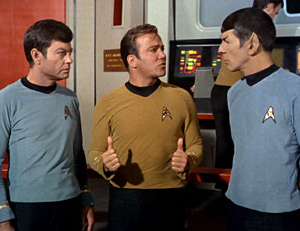
Scorpius: That was a television show, John. And he made Priceline commercials. But if you insist, then look to Kirk the way he really was: savage when he had to be.
"Captain's Log, stardate 8675309: Once again I find myself faced with an impossible dilemma. Do I save the planet Pupolon by rescuing the High Priestess, despite her Klingon captors doubtlessly waiting in ambush? Or do I ignore their plight and, by letting it be destroyed, obey the Prime Directive and get the Aesoptinum needed to protect The Federation? My friends and officers Spock and McCoy have been debating this at length, with no clear answer.
There has to be a better way..."
And they know it, too.
Rounding out the archetypal Freudian Trio with The Spock and The McCoy, The Kirk must balance these opposing personalities and be able to take their advice and choose between them (or literally, choose "between them") without being overcome either by emotion or dispassionate logic, representing what in Freudian psychology is called the ego.
Usually, The Kirk is The Captain or a similar leader who needs to be practical rather than emotional or distant. It's not impossible for a show to have The McCoy or The Spock as the leader, but they'll have to be far more ideologically flexible than they would otherwise.
They usually share a lot of the traits of the Reasonable Authority Figure, but depending on the slant of the series he might lapse into less than heroic decisions, or end up choosing one of his two friends over the other more often. That said, the burden of deciding what course of action to take can be heavy, while the task of bringing his friends around to accept said decision is complicated as well. At the least, he's mostly immune to Death by Pragmatism. Done well, both The Spock and The McCoy will simultaneously approve of the end result. With poor characterization, may become the Standardized Leader.
Examples
- Marika in Bodacious Space Pirates fits this role perfectly, with Chiaki taking the roll of The Spock.
- Lelouch as Zero is The Kirk in Code Geass.
- Hikaru in Magic Knight Rayearth fills this role. She's the closest thing to The Leader that the group has, with a cooler head than Umi and a more gung-ho attitude than Fuu. She's especially affected by the end of the first half and ends up taking one hell of a third option to fix the Pillar System at the end of Part II by applying the power to everyone.
- Mu La Flaga is The Kirk in Mobile Suit Gundam SEED, but interestingly it's Murrue, The McCoy, who fills the role of The Captain on the Archangel with Sergeant Rock Natarle, The Spock, as her second-in-command; he is more pragmatic and emotionally thicker-skinned than the idealistic and inexperienced Murrue, but more laid-back than Natarle and more capable of seeing past military regulations than she is. Mu's influence as a mediator between the two is felt most strongly in the first parts of the Archangel's journey, before Murrue gains confidence in herself as captain.
- Meowth of Team Rocket in Pokémon: The Series, although they're all pretty much on equal footing (early in the series, however, Meowth claimed to be the leader of the Trio and this may be why). Meowth typically subverts this by wholeheartedly agreeing with whichever one of his teammates happens to have the same ideas in mind he has.
- In Tamagotchi, Kuchipatchi fits this trope, he isn’t as smart as Mametchi, but he isn’t as selfish as Memetchi.
- The Night Unfurls:
- Prehistoric Park Reimagined: Main protagonist Drew Luczynski serves as the knowledgeable, yet also incredibly hotheaded and short-attention spanned, leader of the titular park's rescue team.
- The Avengers: Iron Man fits The Kirk, and Captain America fits The McCoy. Given that Thor is calculative and likes control, and that Banner (when he's not Hulk) is calm and logical, either one could be The Spock.
- In Galaxy Quest Jason Nesmith (Tim Allen) starts as an Expy for William Shatner, but through the story he becomes more like his universe character, Captain Peter Quincy Taggart. In doing so he becomes The Kirk and The Captain, as he leads the others in saving the day, both for the Thermians, and back home on Earth.
- The eponymous Hellboy in Hellboy is this, especially when contrasted with Abe Sapien (The Spock) and Liz (The McCoy).
- According to co-writer Roberto Orci, Star Trek (2009) maintains this trope, but swaps Kirk and McCoy:
"McCoy in a way represents for us, or represented for us, the extremes of The Kirk and The Spock. If Spock is extreme logic, ... extreme science, and Kirk is extreme emotion and intuition, here you have a very colorful doctor, essentially a very humanistic scientist. So he, in a way, is literally and figuratively a representation of two extremes that often served as the glue that held the trio together."
- Star Wars: Obi-Wan Kenobi displays elements of this trope in the Prequel Trilogy, alongside Anakin Skywalker's The McCoy with various members of the Jedi Council serving as The Spock. In the Original Trilogy Luke became The Kirk, but only in Return of the Jedi, because by that point he has learned controlled emotions. For example, Obi-wan told him that he has to kill his father in order to bring peace, but Luke gives a logical suggestion that maybe he can be saved because Vader didn't kill Luke, and if he was truly evil he would have killed him. His leadership skills have also improved over the last two movies.
- The titular character of Alice's Adventures in Wonderland is this in the original novel as well as many adaptations, compromising the strict rules of Victorian England with the sheer insanity of Wonderland. She's simultaneously a Cloudcuckoolander in the former setting, while the Only Sane Woman in the latter, which is especially poignant given that Wonderland is All Just a Dream for her.
- Ascendance of a Bookworm: Karstedt ends up in that position by default in regards to his childhood companions Ferdinand and Sylvester. Ferdinand grew up to become a person so coldly rational and result-oriented that he cares more about the results than other people's feelings, making him The Spock of the group without contest. Sylvester is a Manchild who can sometimes be too soft on his family members, and hence definitely the group's The McCoy. Karstedt, meanwhile, is just as likely to join Ferdinand in playing Cloudcuckoolander's Minder to Sylvester as he is to join Sylvester in scolding Ferdinand for being too hard on someone.
- Alyosha of The Brothers Karamazov, who, oddly enough, was played by William Shatner in the movie version.
- Harry Potter is very much this, with Ron as his McCoy and Hermione as The Spock. Initially played straight, but the dynamic is played with in later books.
- Meg in Little Women often takes this role in The Glorious War of Sisterly Rivalry between Jo and Amy.
- Nancy Drew is commonly written as being The Kirk between cousins Bess Marvin and George Fayne.
- Tom Corbett, Space Cadet: Tom is a classic Kirk, settling arguments between his two teammates almost every time they have to do anything, and almost always rightly.
- This trope is named for Captain James T. Kirk of Star Trek: The Original Series. Notably, the original Kirk took a lot of third options like the Kobayashi Maru, but other times these decisions were likely to make many races angry in the future, leading some to think it was a "dick move."
- And like The McCoy, there is a lot of Generation Xerox between the series, giving each their own Kirk.
- TNG had Jean-Luc Picard, albeit he was more philosophical and Spock-ish than Kirk at times. Will Riker resembled Kirk much more in personality, at least before he grew the beard.
- DS9 had Sisko act more like the entire Freudian Trio by himself.
- Voyager usually had Janeway deliberate this way, with The Doctor and Chakotay advocating the Emotional choice, and Tuvok and Seven the logical (and possibly Straw Vulcan) or efficient one.
- Enterprise of course had Archer, with T'Pol and Trip filling in The Spock and McCoy roles, respectively.
- And like The McCoy, there is a lot of Generation Xerox between the series, giving each their own Kirk.
- Jeffrey Sinclair and later John Sheridan has this same role in Babylon 5 as commanders of the eponymous space station, the Spin-Off show Crusade has the same character with Captain Gideon from Excalibur.
- Game of Thrones: Jorah and Barristan are often bickering, so Daenerys must strike a happy medium.
- Mac from It's Always Sunny in Philadelphia is constantly flip flopping between being as idiotic and delusional as Charlie or as comparatively rational as Dennis.
- In Smallville, Chloe Sullivan often fills this role between Lana and Clark.
- In Doctor Who, The Doctor'' has fallen into this trope so far, he can no longer be deduced as either an anti-hero or anti-villian. He will give his life (but has not been able to, yet) to save anyone, any race (minus the Daleks), and planet, or any specific cascade inspired by certain snake haired monsters of Greek mythology from an alien race known to exterminate any other race... You get the idea.
- Blake from Workaholics is the most kindhearted of the trio, but also the most naive and impressionable. As a result he can either side with the irrational and uncontrollable Adam or the more buttoned-down and reasonable Anders at any given moment.
- Believe it or not, Jack O'Neill of Stargate SG-1 wasn't really his quartet's Kirk; that honor fell to Samantha Carter and occasionally Daniel. Dr. Janet Fraiser is often The McCoy of the show as well.
- Which makes Carter a good fit for the new leader in Stargate Atlantis, replacing another Kirk figure, Dr. Weir. The leader of the main team, Sheppard, tends a bit toward The McCoy-ish in his thinking, though he does have the Kirk-ish role in picking the proper course of action out of McKay's stream-of-consciousness TV Genius-ness, Ronon's rashness, and Teyla's more McCoy-ish tendencies. McKay has pointed this out several times, most comically in "McKay and Mrs. Miller" when Sheppard first meets McKay's sister and says "I know exactly what you're doing...Kirk" in response to his being charming to her
- Mal in Firefly can be pretty emotional and amoral in his own right, but has the virtue (much as he'd deny it) of listening to his crew before making a decision, but being brave enough to take unpopular decisions regardless.
- Lee Adama in Battlestar Galactica (2003) usually brings the moral clarity to situations where other characters' judgement is blinded by prejudice or fear.
- From Blake's 7 we have Roj Blake himself.
- Carly in iCarly, the centre of the trio that includes The Spock like Freddie, and The McCoy-type Sam. In iDate Sam & Freddie where Samantha and Freddie start dating, she ends up having to solve all their fights, until the end where it becomes too much and she tells them if they can't stop fighting they shouldn't date at all.
- John Crichton from Farscape went from being The McCoy to The Kirk, while D'Argo and Aeryn started out more The Spock and became Kirk-ish as they went along. Pilot is probably the purest Kirk character on the show.
- Friends has one for each gender, Rachel, more level-headed than Cloud Cuckoolander Phoebe and Control Freak Monica, and Chandler, compared to the impulsive Brainless Beauty Joey and the nerdy Nervous Wreck Ross.
- On JAG, the role of the Kirk alternated between Harm and Mac.
- On spin-off yet more popular series NCIS, Special Agent Gibbs serves as the Kirk with Dr. Donald "Ducky" Mallard serving as the McCoy.
- President David Palmer and CTU Agent Jack Bauer rotate between being the Kirk in 24 with Tony Almeida, Bill Buchanan and Chloe O'Brian varying between as the McCoy and Spocks personas. Later on, younger brother President Wayne Palmer becomes The Kirk to Tom Lennox's Spock and Karen Hayes' McCoy and found their differing viewpoints useful in his decision-making process.
- Teen Wolf: Scott fits this trope. Scott displays leadership qualities and is the one who has the ability of bringing people together to work for a common effort.
- President Bartlett from The West Wing played The Kirk, usually with Leo/Toby as The Spock and CJ/Sam as The McCoy.
- Season 1 of The 100 has Chancellor Jaha as the Kirk inbetween Abby's McCoy and Kane's Spock. In Season 2, Clarke fills the role of the Kirk inbetween Lexa as the Spock and Abby still being The McCoy, though Clarke ends up agreeing with Lexa more often than not.
- According to Sheldon in The Big Bang Theory, Leonard is the Kirk and he is The Spock, it can be inferred that Penny is The McCoy.
- Quinn Mallory in Sliders acts as The Kirk in most episodes making a middle point position to Arturo's Spockish personality and Rembrandt's McCoy behavior.
- Yellowstone: Kayce Dutton fills this role, tough yet compassionate, balancing out Beth as The McCoy and Jamie as The Spock. In a more literal sense, he is the only Dutton who gets along with all the other Duttons, as well as the only Dutton every other Dutton likes.
- Gali often fills this role in BIONICLE. Although her True Companions are considerably more than a Freudian Trio, the two Toa she is most commonly seen interacting with are the emotionally distant Kopaka and Hot-Blooded Tahu.
- In the SEBEC path of the original Persona, The Boy with the Pierced Ear is faced with a series of choices. While his buddy Masao leaps to decisions driven by raw emotion, Kei Nanjo would rather do what is necessary regardless of how cruel it may appear. The choices he makes have far-reaching consequences.
- Robin (aka the Avatar) from Fire Emblem: Awakening is this for Chrom's McCoy and Lucina's Spock. Many of the game's big decisions (especially the ending) are made by the Avatar in the end.
- Bioware games often present you, the player character, with this position particularly in later games. For instance in Mass Effect you are faced with a situation where you can hold back, save human lives and strike at a more opportune moment. Or attack now, saving alien lives but potentially landing your allies in hot water.
- Nagi of Xenoblade Chronicles X is the Kirk to Vandham's McCoy and Chausson's Spock out of BLADE command.
- Shinrai: Broken Beyond Despair has Taiko play this role to Rie's McCoy and Raiko's Spock. Taiko tries to be The Spock with his insistence on pursuing the truth no matter how harsh it is, but he lets his emotions get the better of him after his best friend Kotoba is badly burned/killed, which leads him to erroneously accuse Kamen of the murders. He also admits that he respects Rie's faith in her friends.
- In The Order of the Stick, Haley and Roy take this role. V is The Spock; Elan and Durkon are The McCoy. Belkar is just there (except in combat, where he becomes another McCoy by trying to murder everything that moves).
- In The Book of Stories OCT, the Book is this, becoming the balance of Structure and Purpose, which is the literary equivalent of Logic and Emotion.
- Dreamscape: Kai (The Spock), Eleenin (The McCoy), and Drake (The Kirk); the three stoic human protectors of the planet.
- Drake is The Kirk/Ego because he'll often Take a Third Option for things, and provides backup for others.
- Ben himself from Ben 10: Alien Force is The Kirk alongside Gwen and Kevin, especially in the first season. Strangely, Gwen and Kevin barely fit as the The McCoy and The Spock respectively (both are intelligent and emotional) and can switch the roles depending on the situation. By Ultimate Alien it's hard to peg any of the three as any one of the archetypes, though Ben is definitely the The Spock in the season one finale since he decides Kevin has to be stopped by any means necessary and The McCoy Gwen is trying to save Kevin from himself.
- Mr. Bogus himself qualifies, as he most often provided the balance between his younger cousin Brattus and his best friend Tommy Anybody.
- Superman in Justice League/Justice League Unlimited has this role, albeit it was more moderate in the aspect of taking harsh decisions or having the last word (as the Justice League does not have a chain of command in itself and all members are equals). Even so, with Batman as The Spock and Wonder Woman as The McCoy, the dynamic is clearly there.
- The title character of Atomic Betty plays this role in the Freudian Trio that also includes X-5 and Sparky. As the leader of the team, Betty plays the reasonable middleman to the other two's frequent bickering, making the final decisions in the trio's adventures usually based on what Sparky and X-5 have suggested.
- Ready Jet Go!:
- While Sean and Sydney are polar opposites, Jet is one of the sole reasons why they hang together and the arrival of Jet pretty much brought them together. Jet is talented at acting, singing, and dancing, and is curious about everything, especially Earth. Jet is also kind and generous, and always has a positive attitude and great leadership skills.
- Dr. Skelley serves this role in the Freudian Trio with Bergs and Rafferty. While she, like them two, was nervous about Ellen Ochoa's visit in "Astronaut Ellen Ochoa", she was easily the most level-headed of them all and served as the middle point between the two.
- Mindy serves this role in her group with Lillian and Mitchell, as seen in "That's One Gigantic Pumpkin, Jet Propulsion!". Lillian and Mitchell are different in many ways, but Mindy brings them together (because she is Lillian's friend and Mitchell's implied crush) and easily balances them out.
