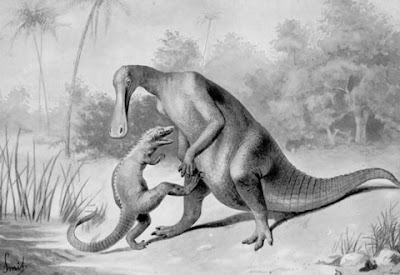
What could be more dangerous (or more awesome) than a T. rex? A T. rex that flies and breathes fire.
This is a good example of a trope that appears to be changing from one thing to another. Basically, some people just can't get over how similar some dinosaurs are to dragons.
Both are big lizardy things, right? They're already so similar, why not have all dinosaurs be fearsome carnivores? Because hey — big lizard things just have to eat meat, just like dragons! And if they ever meet with humans, they must messily devour them all! Just like dragons!
And while we're at it, why not associate dinosaurs with lava-spewing volcanoes? Or even give them the ability to breathe fire? It'd be a shame not to, right?
This is especially prevalent in pulp adventure novels, B-movies, and video games set in prehistoric worlds where Everything's Trying To Kill You.
There is a bit more justification for this confusion in Eastern media; the shared (Chinese character) word for "dinosaur" in Chinese, Korean, and Japanese is 恐龍.note which literally means "terrible dragon". It was originally coined by Japanese paleontologist Yokoyama Matajirō, based on the Ancient Greek origins of "dinosaur" in deinos (terrible) + sauros (lizard), and later adopted by other academics in China and Korea. "Dragon" was used in the translated name because it evoked the image of a large reptilian creature; an alternative, 恐蜥, meaning "terrible lizard", was also proposed, but didn't catch on.note
The Western origins of this trope are a bit more complicated. It may also have something to do with the popular notion that associates ancient times with loads and loads of flame-spewing volcanoes. There was a lot of volcanic activity during the Cretaceous, but it certainly was nowhere near as violent as depicted in fiction. The ancient past more or less resembled the modern world, so no more rivers of lava and hellfire raining down everywhere than it happens today. But take a look at early paleo-art and you'll not only see tons of lava, but also many dinosaurs who look suspiciously like dragons wandering in this hellish, primeval, pre-human landscape. Some art critics, like W. J. T. Mitchell, have wondered if the older "tripod stance" seen in early depictions of bipedal dinosaurs like Tyrannosaurus rex is meant to at least subconsciously bring to mind images of the Biblical "upright serpent". Speaking of, this trope probably has some relationship with the belief, held by both certain creationists and some cryptozoologists, that some dinosaurs survived the mass extinction and inspired the stories of dragons. One Kent Hovind goes so far as to say that some species "must" have breathed fire (because The Bible — or at least the King James Version — mentions dragons...even though it says nothing about those dragons breathing fire) and may still exist in some Lost World in The Amazon Rainforest or somewhere. Other creationists even think literal dragons and other mythical creatures actually existed and met humans (along with dinosaurs).
Part of the issue is what constitutes a "dragon" has changed with language and time.
Linguistically speaking, big reptiles such as crocodilians are dragons in a sense. If one showed a European or Asian Medieval passerby a crocodile or alligator, they would immediately identify it as a dragon. This is because the term "dragon" was once often used for crocodilians and large lizards. Even today, the Chinese Alligator's Mandarin name means "Earth Dragon" and the Hebrew word translated as "Dragon" is still used for crocodiles. This is one reason why many early tales of dragons that lack fantastical elements sound suspiciously like crocodile attacks and why references to crocodiles were often translated as "Dragons" in the English printings of The Bible. The fact these animals didn't live in areas of some dragon legends only fueled the myth as traits would get exaggerated in traveler tales, as they were for most foreign animals.
But as the Medieval era gave way to the Renaissance and early modern era in the West, dragons took on a more mythic proportion with larger size and uncanny nature. Meanwhile the animals once called dragons like monitor lizards and crocodiles, once seen as foreign, exotic and potentially monstrous animals seen on the ends of the earth; were gradually seen as more and more mundane. And so they received new names popularized to separate them from the myth. So if a crocodile, the largest and most powerful reptile on the planet can't be a dragon; their ancient dinosaur cousins filled the niche well.
The older version of the trope is gradually becoming more and more discredited as it filters into the pop-culture consciousness that dinosaurs, really, were just another kind of animal. The newer version comes at the issue from a different angle: now it's more like Dragons Are Dinosaurs. Quite a few anthropologists are now suggesting that many of the legends of fantastic beasts were based upon misinterpreted fossils. This may also tie into recent depictions of Feathered Dragons — as it's a well-established fact by now that some carnivorous dinosaurs were birdlike, feathered animals (in fact, it's currently understood that dinosaurs would be better described as proto-birds than as big lizards, to the point that modern biologists actually differentiate between "avian dinosaurs" and "non-avian dinosaurs" rather than between birds and dinosaurs), dragons associated with them may be given feathers of their own as a result.
In any case, look for fantasy worlds where wizards are finding dragon fossils and local legendary dragons who turn out to be surviving dinosaurs.
Dinosaurs are Dragons may be considered a subtrope of Prehistoric Monster, which talks about the pop-portraits of general prehistoric life. See also Our Dragons Are Different, Fiery Salamander, Here There Were Dragons, Giant Flyer, Reptiles Are Abhorrent, Terror-dactyl, and (naturally) Artistic License – Paleontology.
Note that this is not limited to dinosaurs, and can apply to other prehistoric reptiles such as pterosaurs. If they're ridden on, then their riders would count as a more terrestrial variant of Dragon Rider. Training, taming, and just otherwise working with draconic dinosaurs makes someone a variant of Dragon Tamer.
Examples:
- The fire-breathing theropod logo of New York's Dinosaur Bar-B-Que,
 although that may be a case of Fire-Breathing Diner instead.
- Delicious in Dungeon: In an Imagine Spot, a Velociraptor (with feathers), along with a Komodo dragon and a mušḫuššu, are depicted as being lesser varieties of dragon. The normal dragons also have very dinosaur-like anatomy, including one depicted with raptor-like sickle claws on its feet.
- Digimon is full of dinosaur mons which can breathe fire, primarily of the Tyrannosaurus rex variety. Many of these fill the role of The Hero's Bond Creature in any given series, when that role isn't filled by an actual dragon mon. Greymon and GeoGreymon are nearly perfect embodiments of this trope. It's justified in the case of Guilmon; he's an Ascended Fanboy's drawing come to life, was specifically based upon the aforementioned Greymon, and isn't particularly bright to begin with.
- An odd variation of the trope: the "dramon" family is a subset of mons possessing the "DNA" of a dragon ancestor mon and thus considered to be "true" dragons, and this grouping does include some obvious dinosaurs, Tyrannosaurus rex-based or otherwise. Not all "dramon" Digimon can breathe fire, but the trope applies in the sense of them being considered dragons. For example: Cannondramon, a Cyborg Digimon of this family, looks like a diplodocus with railguns strapped to its back.
- All cases are quite likely justified given the nature of Digimon as a whole: many are stated to be the product of accumulating data on one given subject from the internet given life, so in an in-universe sense, Digimon uses this trope because its users of this trope were specifically born of this trope's prevalence.
- Doraemon: Nobita and the Winged Braves have the gang fighting a prehistoric dinosaur monster awakened from an icy cavern, Phoenixia, who resembles a T. Rexpy but with wings and a toothy beak. And when Phoenixia gets accidentally hit by Doraemon's Evolution Light, it leads to an Evil Evolves moment causing it to develop draconic horns, golden scales, and the ability to breathe fire.
- Gantz: Although it's technically an alien, the T. rex from the Dinosaur Arc has the power to send fireballs through his mouth.
- Getter Robo: The Dinosaur Empire occasionally gave fire-breathing abilities to their Dinosaur-type Robeasts. They also gave them Missile Launchers and Death Rays, so some tinkering is to be expected.
- Miss Kobayashi's Dragon Maid: Kanna's dragon form has a body covering of fuzz with feathery wings, similar to modern portrayals of dinosaurs.
- In One Piece, the Wano Country Arc ultimately reveals that the Ancient Zoan Devil Fruit eaten by X Drakenote which allows him to turn into a Dinosaur is the Ryu Ryu no Mii, Model: Allosaurus (Dragon Dragon fruit, Model: Allosaurus). Apparently, the Ancient Dragon models allows you to turn into dinosaurs, as several top commanders of the Beast Pirates also have Dragon Fruit Models, such as King who can turn into a Pteranodon, Queen who turns into a Brachiosaur, and Page One who turns into a Spinosaurus. This is a reference to the fact that in Japanese the word for Dinosaur, Kyoryu (恐竜), contains the character, Ryu (竜), which means dragon. Ironically, this is not the case with the actual eastern dragon fruit eaten by Kaido, which is a Mythical Zoan Fruit, the Uo Uo no Mii, Model: Seiryu (Fish Fish Fruit, Model: Azure Dragon). The name being Fish instead of Dragon is most likely a reference to the famous legend of the Koi fish that swam up a waterfall and transformed into a dragon when it reached the top and passed through the Dragon Gate. This is especially true when you remember that the main method of entering the island of Wano itself is by using giant koi to travel up a massive waterfall.
- Serendipity the Pink Dragon: The original anime and the dub-title call Serendipity a dragon, but the English dub itself calls her a dinosaur. Never explained why.
- Yu-Gi-Oh!: Dragons are dinosaurs... sort of. Dinosaur Ryuzaki (Rex Raptor in the 4Kids version) has a Dinosaur-themed deck. However, his two strongest monsters, Serpent Night Dragon and Red-Eyes Black Dragon, are dragons. (And in his second duel with Jonouchi later, he adds Tyrant Dragon to his deck.) Possibly justified as dragons are not affected by the arbitrary dinosaur weakness, and Ryuzaki may even be exploiting the confusion here. This is likely because there were too few dinosaur cards at the time the character was created to make a full deck, so obviously the next best thing is dragons. One of his signature dinosaurs, Two-Headed King Rex, is a horned, two-headed dragon-like creature with a pair of wings. One of his other dinosaurs, Sword Dragon (Sword Arm Dragon) looks much more like a dinosaur, although very spiky and has a sword-like tail.
- Almost all of the Dinosaur-Type monsters in the various Yu-Gi-Oh! video games are shown breathing fire for their attacks.
- Ryuzaki specifically notes that the Serpent Night Dragon and the Red-Eyes Black Dragon are his special rare cards (he won the Serpent Night Dragon at a tournament), which makes them an acceptable exception to his dinosaur-themed deck. He's just showing off by having them — and ends up losing both anyway.
- Yu-Gi-Oh! GX: Jim "Crocodile" Cook's deck features Fossil Dragons, which are essentially walking fossilized dinosaur skeletons. He explains that this is a tribute to the above-mentioned "dragon bones" confusion. For the record, the Fossil Dragons in question are neither Dragon nor Dinosaur: they're Rock.
- Yu-Gi-Oh! ARC-V: While Odd-Eyes Pendulum Dragon and all of its forms are Dragon-Types, most of them resemble dinosaurs, due to their lack of wings and their primary way of locomotion, which is running.
- In the world of Beast Fables, wyverns are bird-based chimeras (animals that can temporarily shape-shift into Mix-and-Match Critters) that gain features from non-avian theropods, such as hands, teeth, and tails.
- Motu Patlu: The titular creature in "Baby Dinosaur" has little wings and can breathe fire.
- Cardfight!! Vanguard: There are a lot of dragons, but the Tachikaze clan, being prehistoric-themed, are the only clan with dinosaur-themed units. They have a unique race of robotic dinosaurs called the "Dinodragons" — which makes no reference to their most unique feature (the robotic parts) but instead bafflingly labels them as another kind of dragon. Furthermore, in the Seal Dragons Unleashed booster set, an archetype of similarly-named units was introduced, called the "Ancient Dragons", which are all just robotic dinosaurs with a distinctive colour scheme.
- Magic: The Gathering: Averted, since "Dinosaur" and "Dragon" are distinct creature types. However, Ixalan does reference this in its reprint of Dragonskull Summit, where it's stated that a planeswalker mistook the plane's native dinosaurs for dragons, and the name stuck in some groups.
- Yu-Gi-Oh! has many instances (and some subversions) of this trope.
- An early example is "Crawling Dragon #2," which is a Dinosaur-Type monster despite its lore describing it as a dragon. A near-identical card, Two-Headed King Rex, is also Dinosaur-type but more closely resembles a two-headed flying dragon than a Tyrannosaurus rex.
- "Jurrac" is a dedicated Dinosaur archetype that reeks of this trope, with most of its monsters breathing or otherwise manipulating fire in some way. It mostly works, by virtue of adding in some meteor/volcano symbolism.
- "Evol" monsters exploit this, with three tiers of monsters: weak Evoltiles, which are Reptile-types, are used to bring out stronger Evolsaurs, which are Dinosaurs, and they themselves are used to bring out Evolzars, which are Dragons. Essentially, as they evolve, they "advance" from ordinary reptile to dinosaur to dragon.
- "Dogoran, the Mad Flame Kaiju." A Dinosaur-Type monster has never looked so much like a dragon — unsurprising, given that it's a Not Zilla.
- Due to a misprint, "Two-Mouth Darkruler" was originally classified as a Dragon-Type, but is now a Dinosaur-Type. Hilariously, it has a counterpart called "Twin-Headed Thunder Dragon" (which, aside from a palette swap, looks exactly the same), which is made by fusing two "Thunder Dragon." To further complicate it, "Thunder Dragon" and "Twin-Headed Thunder Dragon" are Thunder-Type monsters, and as such are neither Dinosaurs nor Dragons.
- Bone: While the dragons come in all shapes and sizes, some look like dinosaurs with wings attached to them, most notably a T. rex, a stegosaur, and a sauropod.
- Chick Tracts: "There Go the Dinosaurs" states that dragons were renamed dinosaurs in 1841.
- Conan the Barbarian: In Red Nails, Conan encounters a monstrous reptile described as sporting a long neck, yellowed tusks, spikes along the neck, a serrated backbone and a spiked tail like a scorpion. While the original Weird Tales art pulls that off, the Marvel Comics adaptation of the story decided on a carnivorous stegosaurus instead!
- Demon Knights: Played with. The characters call the big lizardy creatures dragons, because it's the Dark Ages, but to the audience they're clearly dinosaurs with no draconic characteristics at all. Also worth noting that they make a distinction between "true dragons" (dinosaurs) and "heraldic dragons" (the fire-breathing flying ones, presumably. The only "heraldic dragons" we see are mechanical).
- Dinosaurs vs. Aliens: One of the alien invaders referred the dinosaurs as dragons after facing the consequences of their first attack. Considering how intelligent and powerful the dinosaurs are, the alien invader has every right to call them dragons.
- Red Sonja Annual 2 has Sonja accompanying an aging wizard named Verdius on an expedition to find dragons, who have been hunted to near extinction by humans. When they reach their destination, Sonja is surprised to find what are very obviously dinosaurs, or as the scholars in Sonja's universe calls them, "great lizards". Verdius states that they are descendants of dragons.
- Beast Wars Fan Series: You really can't blame the people in the Civil War times in calling Grimlock a "dragon", as very few people back then knew what a dinosaur was, and the T. rex wouldn't be discovered and described for at least another forty years. As for Sir William, he thinks that Grimlock and Dinobot are dragons because he's from the Middle Ages and dragons were all over the place back then.
- The Bridge: Averted and subverted. While Odo Island's folk regarded the Godzillasaur species as a legendary sea dragon in their folktales, Gojira, they are still seemingly mundane dinosaurs prior to any mutation. Dragons really did exist on Terra but they were essentially fae-folk equivalents of crocodilians, lizards, and snakes which were altered by the presence of mana. Equestrian dragons are also identified as something different than a dinosaur, enough Godzilla was not mistaken for a drake when he appeared.
- Godzilla: New Era, The prequel rewrite of Godzilla 2000, muddies the waters some. Godzilla Junior is thought to be an entirely mundane, if horrifically miraculous radiation mutation of a normal dinosaur by scientists. But a Shinto miko from Odo island believes the current Godzilla might possibly an incarnation of Seiryū, and multiple details hint she's right.
- Gospel of the Lost Gods: The Wards believe this until Romp sees a Dragon Skeleton and they connect the dots to what they've heard regarding the Targaryens.
- Jurassic World (The Geeky Zoologist):
- According to Claire Dearing, the Indominus is supposed to evoke a dragon.
- The motto of the Grey Guards who patrol the dinosaurs' islands is Cave Draconem, "beware of the dragons". The Slayers, InGen's team of seasoned dinosaur hunters, style themselves as dragonslayers and their emblem even depicts Saint George.
- Outlander: Played with. The reason why Sam doesn't immediately think he's in a fantasy world even after being attacked by a dragon is that there were giant lizards on Earth once upon a time.
- Point Me at the Skyrim: Lampshaded by Victoria Dallon when she gets transported to the Skyrim universe, where dragons are very real and very dangerous. When she sees a large reptilian skull mounted above Balgruuf's seat, Victoria has to remind herself that's not a dinosaur but a so-called fairy tale creature.
Dinosaur, was my first thought.
Dragon, was the one that stuck.
Fuck me. - Pokédex: Dragon-type Pokémon are noted to have been more common in the Mesozoic era.
- A Possible Encounter for a Phantom: The asteroid that caused the extinction of the dinosaurs forced the survivors to evolve into what are today known as dragons.
- Prehistoric Park Reimagined:
- Heavily invoked in how several dinosaurs and other prehistoric animals end up coincidentally named after dragons from various myths and media.
- Later played with in the form of a newly discovered In-Universe species of giant oceanic choristodere with physical appearances that greatly evoke the image of an oceanic dragon. Appropriately enough, they even get named 'dracosuchus' (which roughly translates to 'dragon crocodile').
- Finally, the Spinosaurus are described multiple times over the course of their debut mission in ways that heavily evoke the appearance of dragons.
- Prince Staghorn's Known World: Played with. While dragons here are descended from varanid lizards, making them closer to the marine reptiles known as the mosasaurs, certain dinosaur species can actually breathe fire, and more than a few species of dinosaurs have foregone feathered wings in favor of bat-like ones. However, most characters in the setting seem to know the difference between the two.
- Realistic Pokémon: Many of the Dragon-types are depicted as dinosaurs, including Haxorus (though it's already based on dinosaurs), Druddigon, and Reshiram.
- Fantasia may have a lot to do with the volcano subtrope. "Rite of Spring" begins with a seemingly endless field of lava-spewing volcanoes. A short and easily missed transition shows the progress of life on Earth and then suddenly cuts to an extended scene set during (allegedly) the late Cretaceous. Given that this is one of the most influential dinosaur film moments ever, perhaps many people missed the transition...
- In Pleasant Goat and Big Big Wolf - Mission Incredible: Adventures on the Dragon's Trail, all of the dragons mostly lack attributes that are associated with dinosaurs. However, the villain is a dragon named Tyranno-Rex, referencing the Tyrannosaurus rex.
- In The Ice Age Adventures of Buck Wild, the Lost World seen previously in Ice Age: Dawn of the Dinosaurs is revealed to be home to fire-breathing reptiles.
- Godzilla is either a dragon or a dinosaur depending on which fan you ask. Indeed, the fantastic nature of most Kaiju sways from one extreme to the other depending on the movie. The original film says that he's a sea-dwelling dinosaur (not too different from his current self) who was resurrected and mutated by the miracle of atomic mutation and he just happened to fit into the local dragon mythology, which is full of Virgin Sacrifice. His origin is given much more clearly in Godzilla vs. King Ghidorah which reveals he really is a mutated dinosaur that became a legendary figure. The confusion among English-speaking fans, at least, is probably due to the American dub of Godzilla Raids Again. In it, an educational film reel explained that dinosaurs, including Godzilla (there called Gigantis) and Anguirus, were created from pools of burning lava and sulfur, resulting in their being walking fire elementals of sorts.
- Jurassic World Dominion: Parodied. When the main characters encounter the Giganotosaurus during the forest fire, Ian manages to distract it by waving around one of the burning locusts on a piece of rebar before thrusting it into the dinosaur's mouth. The Giganotosaurus's resulting roars of pain briefly give the appearance of breathing fire before it can be dislodged.
- The Last Sharknado: It's About Time: The heroes travel to the time of the dinosaurs and tame a pterosaur as a mount. They take the creature with them when they time travel again. When they land in Camelot, the inhabitants mistake the Pterosaur for a dragon.
- Reign of Fire: The opening narration mentions that scientists found fossils that confirm that dragons were responsible for wiping out the dinosaurs. This doesn't state their relation to the dinosaurs, but may imply a distant relation.
- In the 1961 Lost World movie Valley Of The Dragons, the "dragons" are actually dinosaurs. Well, actually they're alligators and lizards.
- Bearing an Hourglass: Defied rather fatally when Gawain the Dragonslayer, prior to the events of the novel, dies at the jaws of an allosaur he thought was a dragon. In-universe, the two are very different species with different behavior patterns, and the allosaur's persistence caused Gawain to be crushed to death inside his own armor.
- Conan the Barbarian: In "Red Nails", Valeria and Conan are attacked by a non-sapient dragon that doesn't fly or breathe fire, and has no supernatural abilities of any kind. The narration describes the creature as resembling a carnivorous Stegosaurus, of all things.
- The Crocodile God plays with this for the story's Mythopoeia. With the pre-colonial Filipino belief that crocodiles were dragons, Haik (the titular crocodile-god) tells a story that refers to Asian dragons as "the crocodile's ancestors."
Haik: The old days were when the dragons still lived, the crocodile’s ancestors. They carried us across the water, so we did not need ships.
- The children's book Dazzle the Dinosaur features a fictional dinosaur called a "Dragonsaurus" as the antagonist, with the illustrations depicting a large theropod resembling a wingless western dragon.
- The creationist book Dinosaurs By Design theorizes that legends of dragons came about when humans saw dinosaurs.
- The Dinosaur Knights: Averted. Dinosaurs being an everyday sight on Paradise (being used as cattle and mounts), instead the term "dragon" is used for the larger pterosaurs.
- Dinotopia is an island populated by Intellectual Dinosaurs and shipwrecked humans. Those who escaped from the island in ancient times are the source of dragon myths around the world.
- Drenai: One character remembers "dragon" skeletons that he saw in a museum, while thinking that it was impossible for such animals to breathe fire without burning their own long throats. Given that we're dealing with quite low Low Fantasy here, it's implied that he saw just a mundane dinosaur fossil.
- Glory Road: The heroes encounter a dragon in the Medieval European Fantasy world they are in. The novel presents the dragon as a dinosaur which due to evolutionary traits (a high sulfur content in its body) had the ability to breathe fire.
- The Great Zoo of China: Quite literally. They're a dinosaur species that were hibernating deep underground during the extinction, which have been checking now and again to see if the world has become hot enough for them all to come out, which is the reason that so many ancient cultures had dragon myths despite being isolated from each other.
- The Iron Teeth: Drakes are huge, feathered lizard creatures that have been referred to as Saurans, suggesting a connection to feathered dinosaurs.
- Lafayette O'Leary: In The Time Bender, the dragon owned by the Giant Lod, who is threatening the kingdom of Artesia, turns out to be a dinosaur. In fact, there's two: a friendly Iguanodon, and a much more hostile T-Rex.
- The Lost Kingdom features the Congo cryptid Mokele-mbembe as a living sauropod dinosaur that can breathe fire. This is, sadly, not the most scientifically implausible thing featured in the book.
- Masters of the Universe: In the story He-Man and the Lost Dragon a Stegosaurus that Skeletor's minions released from a lost valley was initially mistaken for a dragon.
- The Magic Goes Away: Played with. As the world's finite reserves of Mana are used up, the magical great dragons die off and metamorphose into fossilized skeletons embedded in the rocks and stones of the mountains.
- One Nation, Under Jupiter has a bit where the protagonist, a citizen of a world where the Roman Empire didn't fall, visits a museum. While there, he sees an exhibit on dinosaurs which claims they were actually monsters from Roman mythology like hydras.
- The Stone Dance of the Chameleon: This trope comes into play in-universe. The world in which these books are set has all sorts of prehistoric flora and fauna around, including many kinds of dinosaurs. Among these dinosaurs are the huimur, a kind of ceratopsid that is usually used as pack animal. Giant versions of these animals are outfitted with towers similar to those on war elephants and flame pipes, and these are generally called dragons. Even so, the protagonist's father forbids him from using that word because he feels it to be barbarous.
- Redwall: At the end of High Rhulain, Captain Cuthbert kills a gigantic Stock Ness Monster called the Slothunog, and is referred to as a dragonslayer.
- Whom Gods Would Destroy: In an odd twist, dragons are the category of angels known as seraphim (a Hebrew word for fiery serpents), who are, themselves, derived from the extinction of the dinosaurs.
- Danger 5: The dinosaur Ilsa fights can breathe fire. She takes a swig of vodka and breathes fire right back at it.
- Dinosaur Prince is about a boy who grows up in a strange island and befriends a fire-breathing Brontosaurus. It turns out the island was created by alien invaders to grow superpowered dinosaurs for use as living weapons to conquer the world with. Naturally, Prince and his dino are often asked by outsiders to help battle the other monsters.
- Dragons: A Fantasy Made Real, a Discovery Channel Mockumentary, shows "genuine" dragons as a species of prehistoric creature that survived into modern times, and which possessed a variety of fire-breathing that had a plausible biological explanation. It doesn't say anything about them actually being dinosaurs, but their overall physiological structure is consistent with that of a dinosaur.
- Also averted, as the other species of dragon shown were more closely related to crocodiles than dinosaurs, being semi-aquatic and possessing a crocodile's false palate (a valve in the back of the throat), which keeps both water and fire from entering the dragons' lungs.
- Though not technically dinosaurs, this trope was invoked, perhaps unintentionally, with the rather draconic-looking pterosaurs in the prehistoric dragon segment. Also, the Cretaceous period is depicted as an ash-choked wasteland with a sparse covering of forests and mountains.
- Dragons or Dinosaurs: Creation or Evolution: The "experts" suggest that the legends of dragons were based upon dinosaurs.
- Friends: In "The one with the Secret Closet", Phoebe treats dinosaurs and dragons as interchangeable terms for the same thing.
Phoebe: How would you feel if you couldn't share your cooking? Or-or imagine how Ross would feel if he couldn't teach us about dragons?
Monica: Dinosaurs.
Phoebe: Po-tay-to, po-tah-to... - Land of the Lost (1974) features a gigantic, fire-breathing Dimetrodon called Torchy, whose diet includes raw coal that it finds exposed on the walls of a canyon.
- Land of the Lost (1991) has an episode where a medieval knight shows up, claiming to be The Dragonslayer. When he sees Scarface the Tyrannosaurus rex, he calls it "the king of all dragons". He and Kevin barely manage to escape.
- In The Late Late Show with Craig Ferguson during the email and tweets section sometimes the segment shows David Bowie Robots and a fire-breathing Triceratops.
- Power Rangers / Super Sentai:
- In Kyōryū Sentai Zyuranger / Mighty Morphin' Power Rangers, the Five-Man Band got mecha that were either dinosaurs or prehistoric animals we're fairly certain existed. The Sixth Ranger? Giant mechanical dragon. This goes further in Zyuranger, because these particular heroes are actually warriors who existed at the time of the dinosaurs and who were revived in the modern age, and their "designations" (i.e. their Ranger names and their mecha) are actually dinosaur gods that watch over and protect them.
Spoony I never really understood what the Green Ranger's Humongous Mecha was. He doesn't even fit into the whole dinosaur thing, he just yells "Dragonzord!" And I have no idea where dragons fit into the whole dinosaur thing.
- When PR started using Gosei Sentai Dairanger footage, the dinosaur (or not) Humongous Mecha were explicitly transformed into mythical creature Humongous Mecha — the Tyrannosaurus became a dragon.
Jason: Tyrannosaurus-Red Dragon Thunderzord power!
- Power Rangers: Dino Thunder has the White Ranger with what's clearly a pterosaur mecha — called the "Drago zord", if only because "Tupuxuarazord" kinda doesn't roll off the tongue.
- The literal translation of Kishiryu Sentai Ryusoulger is "Knight Dragon Squadron Dragon Soul Ranger" ("ryu" means "dragon" in Japanese) and their Humongous Mecha are dinosaurs instead of dragons. However, this probably is related to the fact that, as explained in the Real Life section below, the Japanese word for "dinosaur" incorporates "ryu" to begin with (it's "kyoryu"; meaning "fearsome dragon").
- In Kyōryū Sentai Zyuranger / Mighty Morphin' Power Rangers, the Five-Man Band got mecha that were either dinosaurs or prehistoric animals we're fairly certain existed. The Sixth Ranger? Giant mechanical dragon. This goes further in Zyuranger, because these particular heroes are actually warriors who existed at the time of the dinosaurs and who were revived in the modern age, and their "designations" (i.e. their Ranger names and their mecha) are actually dinosaur gods that watch over and protect them.
- Primeval has a time-displaced Dracorex getting caught in the Middle Ages before making another jump to 2009. Most of the plot of the episode revolves around convincing an equally-lost medieval knight that it's not a dragon and that he doesn't need to kill it. The existence of animals travelling through the time anomalies is heavily implied to be the origin of mythical creatures, and the Monster of the Week is many times deliberately designed to resemble those myths it "inspired". In this case, Dracorex is given a pair of "unfossilizable" dorsal membranes that look superficially like bat wings.
- Sir Arthur Conan Doyle's The Lost World:
- Season 2, episode 4 features a dinosaur that can breathe fire. Perhaps justified because the series takes place in a Lost World, not in prehistoric times, and it's established that life exists that is descended from prehistoric creatures but didn't exist in prehistoric times (such as lizard men).
- In a different episode, a medieval city calls on the heroes to slay a dragon, but they find that it is just a T. rex, though they realize the medieval citizens would not know that.
- Invoked in The Lost World (2001). When trying to convince others that he did indeed see Living Dinosaurs on the eponymous South American plateau, Prof. Challenger points to a previous Portuguese missionary expedition to that same region, whose sole survivor was "raving about dragons" on his return to civilization. The implication is that, since this expedition occurred before dinosaurs had been properly described, the missionary was simply reaching for the best word he knew to describe what he saw.
- Waterloo Road: The creationist antagonist in the second season holds this view, and uses it to sway several of the students (including a regular cast member who had been established as very impressionable) because dragons are cool.
- Norse Mythology's dragons are an interesting example. They are referred to as serpents (ormr) and generally assumed to be snake-like but at least one is said to have feathers, a distinctly dinosaurian (or pterosaurian) trait.
- Young Earth Creationists, chiefly from American Evangelical groups, are very adamant that legends of dragons were inspired by historic encounters with dinosaurs and pterosaurs. Needless to say, this is disputed by Hebrew scholars, theologians, paleontologists, historians, geologists, and every other voice on the matter.
- Kent "Dr Dino" Hovind claims that dinosaurs were dragons, breathed fire, rode on Noah's Ark and may still be alive in remote places (and was possibly the inspiration for the Waterloo Road example above).
- Though some others do claim dragon legends come from human and dinosaur co-existence (mainly young-earth creationists, as opposed to old-earth or progressive creationists, who are more likely to say that it was just the fossils that were the inspiration). It's just that hardly any make the much larger jump from "dragons are inspired by dinosaurs" to "dinosaurs breathed fire."
- Recent billboards for the Creation Museum have been using dinosaurs to attract children and parents to spend money at the venue. Among the dinosaur signs is a fire-breathing dragon.
- Another creationist, Duane T. Gish, suggested Parasaurolophus's crest enabled it to breathe fire in the book Dinosaurs by Design (pictured in the trope image) similar to how a bombardier beetle can shoot boiling chemicals from its abdomen, going on to suggest that the Biblical Leviathan was a Parasaurolophus. Anyone who bothered to actually read The Bible will quickly notice a Parasaurolophus looks absolutely nothing like the crocodilian or serpentine Leviathan (this is a particularly odd lapse from creationists who base their view on Biblical literalism note ).
- Kent "Dr Dino" Hovind claims that dinosaurs were dragons, breathed fire, rode on Noah's Ark and may still be alive in remote places (and was possibly the inspiration for the Waterloo Road example above).
- Close variant: As referenced above in The Crocodile God, precolonial Filipino folklore views crocodiles as dragons... of the sea-serpent variety, being an Asian country instead of European. Seeing as the Philippines is home to saltwater crocodiles who are notoriously aggressive and often prey on humans, one can see why "giant man-eating reptile" led to "dragon" for the ancient tribes.
- Alfred, Lord Tennyson: In the most famous section of In Memoriam A.H.H. dinosaurs are the primordial "dragons of the prime, / That tare each other in their slime..."
- When naturalist Chris Packham was on The BBC Radio 2 segment Tracks of My Years, the song he chose for his earliest memories was "Puff the Magic Dragon", explaining that as a kid he was fascinated by dinosaurs, and when he was very young, dragons were sort of the same thing.
- Castle Falkenstein is set in a parallel 19th century, replete with magic. Dragons are part of the political scene and are known to be the descendants of pterosaurs who survived the extinction of the dinosaurs by developing intelligence and magic.
- Discworld Roleplaying Game: "The Quest for Fruit" features a prehistoric ancestor of the common swamp dragon which looks a lot like a fire-breathing velociraptor.
- Dungeons & Dragons averts this. Dinosaurs are nothing more than animals, whereas most dragons are even smarter than humans on average (and would probably be very insulted by a comparison between them and dinos), though they're cool enough that they aren't listed in one appendix in the Monster Manual, where animals normally are, but instead under their own heading. Which makes D officially (and suitably) the most feared section of all creature books for D, what with dragons, demons, devils, dinosaurs, and Dire Beasts.
- Some of the dragon-related source books take an interesting approach to this issue by suggesting that dragons may be evolutionary descendants of dinosaurs, sixty-millions-years on. (This might be more plausible if Young Earth Creationists weren't absolutely right in most D&D worlds.)
- In the 4th Edition D&D books, herbivorous dinosaurs were renamed "behemoths", in an effort to avoid anachronisms. In the 4th edition Monster Manual, we have a "Bloodspike Behemoth" (a Stegosaurus), and a "Macetail Behemoth" (an Ankylosaurus). But the carnivorous dinos are now called "drakes". This might have been falling in line with the Eberron Campaign Setting's dinosaur conventions. In Eberron dinosaurs don't use the Latin names we use, instead they're given rather descriptive names like "fleshraker" and "swordtooth titan."
- Word of God has it that this was the case with the first miniature figure of a dragon ever used in a role-playing game: it was a plastic toy Stegosaurus that E. Gary Gygax heavily modified, adding wings, horns, and a dramatic paint job. That's why early depictions of red dragons◊ have stegosaur-style dorsal plates along their spines.
- Exalted:
- The Dragon Kings are actually sapient humanoid saurians — either raptors, ankylosaurs, pterosaurs or mosasaurs, depending on the specific breed.
- There is a kind of wild animal called an ox-dragon that is very clearly meant to be a ceraptosid, while pelagic dragons are huge plesiosaurs and sea dragons are mosasaurs.
- GURPS Dragons looks at all sorts of dragons for game purposes and includes stats for a couple of types of dinosaur, in case that's the option a GM wants to take.
- Old World of Darkness plays this straight in the mythos of Werewolf: The Apocalypse. One of the species of Changing Breeds are the Mokole. Nominally, they're weregators, except for the fact that, since they serve as Gaia's Memory, their War Form can be anything sufficiently lizardy drawn from earthly history. Most of them go for dinosaur mish-mashes, but there are Eastern variants that can become dragons.
- RuneQuest: Dinosaurs can be mutated descendants of dragonewts, themselves a species of neotenic dragons, who have let emotional imperfections drive them away from the path towards full dragonhood and trapped them permanently in flesh. The dinosaurs in RuneQuest are categorized as either original (it used to be a dragonewt) or normal (it's a descendant of dinosaurs). Originals are both sapient and always carnivorous, so adventurers could be attacked by man-eating brontosaurs.

- The Fantasia example was translated over into "real" life in 1966 when Disneyland added the animatronic Primeval World diorama to their Disneyland Railroad attraction. In the Diorama, a T. rex is depicted fighting a Stegosaurus in the midst of a volcanic landscape.
- Back to the Future: The Ride at Universal Studios stopped short of having its Tyrannosaurus rex breath fire — but had it looking very dragon-like and living in the heart of an active volcano. Because animals like to live inside volcanoes. This may have possibly been an homage to the Disney diorama noted above.
- Adventure Island: One of the Power-Up Mount dinosaurs has fire breath as his power.
- ARK: Survival Evolved: Downplayed. "Dino" is used by the player base as a catch-all term for any creature in the Arks, whether reptile, avian, mammal, fish, arthropod, or robot, but the in-game Dino Dossiers tentatively give draconic-looking fantastical creatures (the Dragon, wyverns, rock drakes, and managarmr) a separate genus, Draconis.
- Bubble Bobble: The cute bubble dragons are referred to as dinosaurs at the time the NES version first came out, not the later Virtual Console release). To be fair, they're too short and cute to tell at first glance.
- Chrono Trigger: The Tyranno boss, for some odd reason, breathes fire.
- Crash Bash: The dragons seen in the "Dragon Drop" minigame definitely invoke this trope. They look like Baby T except with bat-like ears, minuscule wings, and different colours. The 'T' in 'Baby T', as hinted by the trope name, stands for Tyrannosaurus rex. In fact, a low-res Baby T model was used as a placeholder while the dragons were being programmed into the game.
- Dark Souls has the "Dragons are Dinosaurs" version, at least visually. The two Undead Dragons found in the game have skulls/head that bear a striking resemblance◊ to a T. rex skull.
- Devil May Cry: Two puzzles require defeating fire-breathing dragons. Said dragons are T. rex skeletons that spit fireballs at you. (But then again, this is Devil May Cry.)
- Dinosaur King is an... interesting attempt to make a generic Mon game with actual animals. It's even weirder to see them change shape, breathe fire, and perform "electric tackles".
- Dinosaurs For Hire have a Monster in the Ice boss, a dinosaur escaping it's lab after being thawed out, and despite resembling a T. Rexpy this dinosaur can breath fire constantly as an attack.
- In Doodle God, one of the ways you can make a Dragon is by combining a Dinosaur with either the Air or Fire element.
- Dragon Age: Inquisition: You can encounter "phoenixes" and "deepstalkers", which look like feathered raptors and Compsognathus, respectively. The phoenixes can actually breathe fire.
- One dragon species in Dragon Creek resembles a T. rex with wings.
- In Dragon Spirit for the TurboGrafx-16, many land-based enemies are dinosaurs that spit fireballs at you.
- Dragon Quest:
- Dragon Quest VI: Axe-wielding, fire-breathing, winged, and crested tyrannosaurs can be found as enemies. One (Lizzie) can even be recruited.
- Eternal Fighter Zero: Misuzu Kamio can summon various fire-breathing (stuffed) dinosaurs with her "Gao Gao Fire" super. Sure, they're just stuffed animals, but still...
- EverQuest II: In the dungeons "Vasty Deep: The Abandoned Labs", the players discover a surprisingly anatomically accurate Tyrannosaurus rex floating in a giant test tube. They mistake it for a kind of dragon they don't recognize.
- EXTRAPOWER: Giant Fist: The pterosaurs of Magarda Volcano spit fire, naturally.
- Fate/Grand Order:
- Kijyo Kōyō is a Youkai who can take the form of a dinosaur that resembles a T. Rex. She breathes fire and is considered a dragon by skills and attacks that benefit or harm dragons. When asked about why she takes the form of a dinosaur, she recalls being impressed by a skeleton of a dragon god of the mountains, which might have been a dinosaur fossil.
- The paleontologist Mary Anning claims her Plesiosaurus is a dragon, and is attracted to Altria for being part-dragon, claiming she fits into her line of work.
- Final Fantasy:
- Final Fantasy VI had an infamous translation error where the Japanese word for "dinosaur" (kyoryu) was translated as "frightful dragon" — in a part of the game where the player's goal was to find dragons, causing much confusion.
- The sprites for the Brachiosaur and the Tyrannosaur were used (with similar colors even) for two actual dragons: Tyrannosaur? Earth Dragon. Brachiosaur? Gold Dragon.
- The Ice Dragon has the same sprite as the Vectaur, a small, vaguely dinosaur-like enemy that can be encountered in Kefka's tower.
- Final Fantasy XI: The Raptor enemies look more like medieval dragons than anything else, complete with vestigial membranous wings instead of arms.
- Final Fantasy XII somewhat rationalizes this by defining the dragon genus as an overarching term for most large reptiles, so including the more traditional wyrms and wyverns and the more historical theropods in the same evolutionary chain.
- Final Fantasy XIV: In Eorzea, dinosaurs evolved from dragons. As a result, dinosaurs are extremely prominent in the draconic homeland of Dravania.
- Final Fantasy VI had an infamous translation error where the Japanese word for "dinosaur" (kyoryu) was translated as "frightful dragon" — in a part of the game where the player's goal was to find dragons, causing much confusion.
- Fossil Fighters explicitly explains that the revived animals (which include more than just dinosaurs) gained superpowers as a side-effect of the cloning process, which is why that T. rex is breathing fire and that Dilophosaurus is shooting out gallons of water. The devs also admitted in an interview that they did this due to the Rule of Fun: "If we were to make it realistic, the only things the dinosaurs could do is either bite or stomp. That's why we gave each dinosaur attributes like fire or water, because we thought it would be fun to play if they breathed fire and stuff."
- Kingdom Hearts 3D [Dream Drop Distance]: The Tyranto Rex dream eater has multiple flame breath attacks and is a brightly colored Tyrannosaurus rex with some fancy markings.
- Kirby: The Ice Dragon boss resembles a small dinosaur.
- The Legend of Zelda: The Legend of Zelda: Ocarina of Time has King Dodongo, an "Infernal Dinosaur" who lives inside a volcano and breathes fire. By The Legend of Zelda: Twilight Princess, the dodongos — though still volcano-dwelling firebreathers — are redesigned to be more lizardlike. In Hyrule Warriors, King Dodongo is seen in the teaser incarnation, complete with a Rolling Attack. A rock remix of Ocarina of Time's "Dinosaur Boss Battle" plays either when you fight King Dodongo or when you're fighting against a boss enemy that happens to be a dragon (Volga included).
- Half-Minute Hero: Subverted. In the Princess 30, the princess learns that a Dragon Scale can cure her father, so she kills a dragon-like monster and gives the scale to him, but it doesn't work, and then it is explained the monster was a dinosaur, not a dragon.
- Hungry Dragon: T-Wreks is a cartoony theropod dinosaur resembling a three-fingered T. rex wearing a jetpack, and is capable of breathing fire.
- Little Big Adventure: Dinofly looks like a dragon, except he doesn't breathe fire.
- Lord of Gun have a fire-breathing pterodactyl as one of it's bosses.
- In MediEvil 2, the skeletal dinosaur boss breathes fire.
- Mega Man:
- Mega Man Star Force: One of the versions of the second game is "Fire Dinosaur". They changed it to "Fire Saurian" in the US release, probably thinking nobody would know what it meant, and if they did, they wouldn't care. They were right.
- Mega Man X5 has a Maverick boss named Mattrex/Burn Dinorex, a humanoid Tyrannosaurus Reploid with flame powers, including fire breath.
- Monster Hunter: For the most part, the setting's wyverns are simply that — purely draconic monsters with no particular links to dinosaurs. However, two particular families of wyverns, the Bird Wyverns and the Brute Wyverns, resemble real-life dinosaurs more than they do any actual dragon.
- Most Bird Wyverns are Feathered Dragons that resemble, well, birds — some to the point of being essentially actual birds with a few draconic characteristics. Several other such wyverns, though, are for all intents and purposes stereotypical, featherless raptorial dinosaurs. Later generations, however, mix these two categories with wyverns such as Maccao that strongly resemble real-life feathered dinosaurs.
- Brute Wyverns are powerfully built, flightless, bipedal creatures, most of which tend to use Tyrannosaurus rex and other bulky theropods as their base form. So far though, only one of them has a Breath Weapon. The Anjanath in World resembles a fire-breathing T. rex in every respect, with the addition of a noseridge and spinal fins it can flare when angry.
- Most Bird Wyverns are Feathered Dragons that resemble, well, birds — some to the point of being essentially actual birds with a few draconic characteristics. Several other such wyverns, though, are for all intents and purposes stereotypical, featherless raptorial dinosaurs. Later generations, however, mix these two categories with wyverns such as Maccao
- Monster in My Pocket: Tyrannosaurus rex breathes fire. Thanks to the wiki, it can be identified as "super-heated plasma from his mouth, known as atomic breath."
- Mother 3: The Dragos are simply regular dinosaurs. The one Drago that falls victim to the Pig Army's chimerization plot gains the ability to breathe fire. (Though from the looks of its sprite, it appears that they just shoved a flamethrower down its throat.)
- Ninja Commando have a boss in the Prehistoric Era, a dinosaur with draconic features, including frills, horns and the ability to breathe fire, though it was subverted shortly into the battle when you damage it's face and limbs and reveals it's robotic interior.
- The Cloud City boss in Ninja: Shadow of Darkness is a T-Rex with draconic wings and the ability to breath fireballs. Oddly enough, the game does have regular dragons as other bosses - throwing in a flying T-Rex is just overkill.
- Pokémon:
- The Dragon-type Haxorus line is based on dinosaurs, according to Word of God. More specifically, it was mainly based on herbivorous dinosaurs (from appearances, that includes ceratopsians and possibly some pachycephalosaurids), and lo and behold, it's stated to be a herbivore itself.
- In the first game, the Dragon type consisted exclusively of the Dratini-Dragonair-Dragonite line. Dragon-type trainer Lance's team thus needed some additions — including Aerodactyl, which is based on a pterosaur, but looks like a wyvern.
- It is possible to teach Dragon-type moves to most of the non-Dragon-type Pokémon based on bipedal dinosaurs, such as Tyranitar, Groudon, Rampardos and Archeops, as well as the aforementioned Aerodactyl. Also, almost all reptilian Pokémon are in the Dragon egg group.
- Iris's gym team in Pokémon Black and White was all Dragon-Types. Come the sequels, she still mainly uses dragons, but has a few dinosaur-like Pokémon thrown in too, much like Lance.
- Pokémon X and Y gives us Tyrunt (as well as its fully-evolved form of Tyrantrum), one of the game's fossil Pokemon, which is a Dragon-type T. rex.
- Pokémon Sun and Moon introduces Jangmo-o and its evolutions, Hakamo-o and Kommo-o, more Dragon-type Pokémon that are based on dinosaurs—in the case of the evolved forms, they're clearly theropods like the aforementioned Tyrunt and Tyrantrum.
- Pokémon Sword and Shield has a fossil called Fossilized Drake which appears to be a back half of a stegosaurus-like creature. Combining it with Fossilized Bird or Fossilized Fish gives you Dracozolt and Dracovish respectively, who are part Dragon-type.
- Pokémon Scarlet and Violet has the Paradox Pokémon Roaring Moon, Koraidon, Walking Wake, Gouging Fire and Raging Bolt who are all part Dragon-type, and all have either saurian postures or protofeathers in line with more modern dinosaur depictions. Of these, Roaring Moon actually inverts this trope as it's a full-on Western dragon that fills the ecological niche of a predatory dinosaur, while the other four are based directly on various dinosaurs (a vaguely T. Rexpy amalgamation, a Coelophysis, a Styracosaurus and a Brachiosaurus respectively).
- pop'n music has a character called Dino, who is a fire-breathing dinosaur.
- Portal Runner: Pteranodons in the Jurassic world shoot fireballs at you.
- Prehistoric Isle: The final boss of Prehistoric Isle in 1930 is a gigantic, fire-breathing Tyrannosaurus rex encountered at the bottom of a volcano.
- Primal Rage: Diablo is a fire-breathing Tyrannosaurus rex named Diablo. He's a God of Evil in the shape of a T. rex, so he at least has a justification for it. This applies to nearly all the monsters in the game. They are ancient gods known as the Draconians yet most of them resemble dinosaurs. Sauron and Diablo are Tyrannosaur monsters, Armadon is some sort of Ankylosaur/Triceratops/Stegosaur hybrid, and Talon is a Deinonychus god (Only Vertigo, Chaos, and Blizzard are not saurian in appearance with Vertigo being an inter-dimensional cobra goddess and Chaos and Blizzard being ape/yeti monsters respectively). However, they aren't dinosaurs. They just look like dinosaurs and were even stated to have caused the extinction of the actual dinosaurs in the game's storyline.
- Radical Rex: The title character breathes fire as his main weapon.
- Sands of Destruction: Rhi'a's personal quest has you freeing her ancestor from a curse that's keeping him a zombie. Naturally, this ancient dragon bears a striking resemblance to a T. rex, as do some of the Random Encounters around the Dragonkin Ruins of the current day. Rhi'a's grandfather appearing as a skeleton is also likely meant to bring fossils to mind.
- Scribblenauts: Summoning a Mosasaurus, Tylosaurus or Platecarpus produces a decidedly un-mosasaur-like sea serpent.
- 7th Dragon has various dragons that resemble dinosaurs, though to be fair there are also dragons that look like other animals.
- In The Sims 4, there is a large stuffed dinosaur named Drago and a large stuffed dragon named Dino. The Flavor Text for these items mentions that the children naming them mixed them up.
- Skylanders:
- Bash is classified as an Earth dragon. The fact that he's without wings and fire breath can be attributed to the fact that he's affiliated with Earth, but he also has an ankylosaur-like mace tail and ceratopsian-style frilled head; and he can even get a horned helmet that is explicitly modeled on a Triceratops.
- Dino-Rang is a dinosaur-man who gets rather peeved when he's mistaken for a dragon.
- Sonic the Hedgehog 2: Hidden Palace's T. rex badniks in the iOS version breathe fire at Sonic when he gets close.
- Space Station Silicon Valley had Borassic Park, where fire-breathing dinosaurs made an appearance. Unfortunately, they (and the other dinos in that level) were invincible obstacles, not robotic animals, and therefore you could not possess them.
- Spyro: Year of the Dragon features a character In-Universe mixing them up—when you rescue a Dragon Egg in Dino Mines, the Mayor tells you "That's the cutest dinosaur I ever saw!"
- Super Mario Bros.:
- Yoshi is referred to as a dragon and a dinosaur interchangeably in early Nintendo publications (in Super Mario World, the coins with Yoshi's head on them are called "Dragon Coins", and in the Japanese version, he signs his name as "Super Dragon Yoshi"), although Nintendo seems to have mastered the distinction now. He can't breathe fire or fly on his own, but occasional power-ups can give him those abilities. Yoshi's Final Smash in Super Smash Bros. Brawl puts him firmly in dragon territory — he grows wings, becomes invincible, and flies around the screen breathing fire. It's even called the "Super Dragon".
- Super Mario World, besides introducing Yoshi to the series, has it so that when Mario or Luigi stomps on a Dino-Rhino on Chocolate Island, it shrinks and becomes a Dino-Torch, which breathes fire upward. There is also the boss enemy Reznor, four fireball-spitting Triceratops spinning on a waterwheel.
- Everything on Dinosaur Land (the setting of World) is closer to a dragon than to a dinosaur. The Rex enemy doesn't look at all like a T. rex, but rather like a bipedal purple dragon.
- Bowser looks like a dinosaur... turtle... thing, but he also breathes fire and holds the princess hostage in a castle.
- Stardew Valley's Skull Cavern has fire-breathing dinosaurs called Pepper Rex.
- Star Fox Adventures: Tricky the sorta-Styracosaurus breathes fire and burrows underground.
- In Tales of Eternia, one can encounter dinosaurs. They're big green lizardy things with tiny arms and lots of teeth. Also, they breathe fire. Making it worse, elsewhere, one can find actual dragons, which are exactly like red Dinosaurs with tiny wings.
- Tales of Symphonia has a science academy which contains the assembled skeleton of a dragon on display. A nearby scholar indicates that it was a prehistoric creature that lived long ago. Nevertheless, many varieties of real, living dragons exist in the game, including both winged and non-winged varieties, some of which have even been domesticated for human use. Unfortunately for the scientists, they mostly live in places that they are unlikely to ever see.
- Teenage Mutant Ninja Turtles: Turtles in Time : The "Prehistoric Turtlesaurus" stage in the arcade version (and by extension in Re-Shelled) features fire-breathing dromaeosaurids, though in the SNES port they simply try to run you over.
- Time Soldiers have a T-Rex boss which, besides attempting to trample you underfoot, will also attack you by breathing fire.
- Time Slip have a couple of dinosaur-based bosses, notably a giant Terror-dactyl and a gigantic frilled dinosaur that looks closer to a dragon. Both of them are capable of breathing fire at you for some reason, though they're likely bio-weapons created by the Tirmatian aliens.
- Touhou Project: According to Morichika Rinnosuke in Touhou Kourindou ~ Curiosities of Lotus Asia, the world outside of Gensokyo has been re-naming dragon fossils as various types of dinosaurs. However, Rinnosuke is well-known for making up his own theories about the curiosities he collects.
- Turok averts this trope by having a Dinosaur with bionic enhancements; flamethrowers situated at the Tyrannosaur's head spit fire, making it look similar to a dragon.
- Warcraft: Mostly averted. There are several creatures that look like dinosaurs or other prehistoric reptiles, most notably devilsaurs (T. rex with some spines on their back), raptors, treshadons (plesiosaur-lookalikas) and stegodons (stegosaur-like creatures with a large horned head instead of a tiny one like the real things had). Most don't breathe fire, but many stegodon variants (called thunder lizards) shoot lightning out of their horn. A lot of these are also commonly found in areas with lots of lava.
- In World of Warcraft, dinosaurs are clearly labeled "beasts" instead of "dragonkin". Also, just to be fair, while few people know this, it is heavily implied in some tauren quests that the "thunder lizards" (lightning shooting stegodons) are not dinosaurs, but magical beasts (that Blizz just reused the model of for the stegodons) of a different sort.
- An NPC in Un'Goro Crater can be constantly heard shouting about dragons and his attempts to kill them. When you finally meet the man (Maxamillian of Northshire) it turns out the dragons are, well, dinosaurs.
- Played straight with the Salamanders, though. They're red-colored versions (though the Vizier Salamander is purple for some reason) of the green skinned, stegosaur-like Thunder Lizards that breathe fire and live around lava.
- Warlords Battlecry: Zig-zagged in III. While dinosaurs and dragons are clearly separate units (every race potentially has access to dragons, while dinos are Ssrathi melee units), the Dragonslayer class has a skill that grants bonus XP to both dragon and dinosaur units
- Xenoblade Chronicles 1 has fiery and electric dinosaurs called Deinos. Also, the Nopon call the winged, three-headed Telethia "dinobeast" but their English isn't the best.

- Angels with Scaly Wings is a perfect example of this trope, but also entirely justified. Many of the dragons resemble dinosaurs to some capacity because they're all descended from bioengineered creatures made to resemble dragons using prehistoric reptiles as the basis. They were originally intended as BioWeapon Beasts, but one of their creators realized they were sapient and killed her co-workers in order to set them free.
- DSBT InsaniT: ???'s Tyrannomon is a fire-breathing red T-rex.
- Gaming All-Stars (The Ultimate Crossover and Remastered): Diablo in “Modnation”, who doggedly attempts to kill Tag with giant fireball breath as he makes his way past him. Though as stated in the Video Games folder above, Diablo is not a dinosaur, but rather a demonic god that just so happens to resemble a T-Rex.
- Homestar Runner: A "Powered by the Cheat" animation shows a The Cheat-like dinosaur drinking out of a volcano and breathing fire at one point.
Coach Z Pterodactyl: The Cheatsaurus can do it again!
- Mésozoïque Alternatif: In this short, several dinosaurs, particularly Rex, survive past the end of the prehistoric age and into human history. In the Middle Ages, the dinosaurs are shown sleeping on (or in Rex's case, in) a massive pile of treasure, just like a dragon would... only for a group of knights to barge in with the intent of stealing said treasure. The other dinosaurs realize in horror that this is (almost) literally Bullying a Dragon, and sure enough, the knights' loud trumpet-playing, treasure theft, and fruitless attempts to slay Rex with a (relatively) tiny sword eventually lead to him losing his temper.
- Axe Cop: Wexter, Axe Cop's T. rex pet, breathes fire, though this may be justified by the sheer number of super-powers invented on the spot for anything and everything. There's a scene in The Ultimate Battle arc that lampshades this. Axe Cop explains that Wexter must be transformed into a dragon and, at Sockarang's protests ("He can already fly and breath fire!"), insists that there's a significant difference between dragons and flying, fire-breathing tyrannosaurs.
- In El Goonish Shive, George is asked if dragons are real and essentially claims this trope as the answer justifying it with the declaration that they were magic. Amusingly, he then claims that the reason pterodactyls are not dinosaurs is because they didn't fly with magic.
- The Inexplicable Adventures of Bob!: The fan-winged dragons evolved from Kuehneosaurus (a real-life lizard that lived in the Triassic and which had "wings" formed from overlong ribs which extended out from its body; it is believed to have used these to parachute from trees). The dragons destroyed their civilization in a war — wiping out the dinosaurs in the process — after which they became peaceful, pastoral creatures. Millions of years later, when human knights and hunters began "slaying" them, they revived their old technology and left Earth for the planet Butane in the Kuiper Belt.
- Dragon Cave: While most of the dragons are fully based on classical mythology (either Eastern or Western style), this is played straighter with the "wyverns", a sub-category of Western dragons whose have wings in the place of arms, giving the impression of a flying, magical velociraptor. There are also the inexplicable actual dinosaurs that very rarely show up, but those are shout-outs to Yoshi.
- In an interview with the Brazilian dubber for Jurassic World: Fallen Kingdom (namely, of Zia), she states that she cries a lot during "the scene where the little dragon stays behind". (shortly afterwards, the interviewer notices people who were watching it live started in the chat to mock her for falling into this trope)
- American Dragon: Jake Long: Jake's magic-hunting teacher Mr..(Or rather Prof.) Rotwood had the theory that dragons were evolutions of the dinosaurs. Being the American Dragon, Jake knew this was a bunch of hooey.
- DC Animated Universe: The subtler versions of this trope pop up a few times. Additionally, it's clear that all the animal-specific shapeshifters had a mixer and decided that Tyrannosaurus rex would be their go-to One-Winged Angel form.
- Doc McStuffins: Played with — when Stuffy (toy dragon) and Bronty (toy brontosaurus) meet, Doc says that they are like family and that they could be cousins. In a later installment, Bronty refers to Stuffy as "Cousin Stuffy."
- Dragons: Riders of Berk has an interesting inversion, having one dragon species, the Speed Stinger, as a bipedal runner that can neither breathe fire nor fly, and is a venomous velociraptor.
- The Dragon Tales book release Dinosaurs and Dragons takes this and plays it for all that it's worth. Max gets a dinosaur book and takes it to Dragon Land to show Ord, saying that he wishes he could find a dinosaur, but there aren't any back home. Then, while searching for Ord's ball, he and Ord find an egg and Max wonders if it could be a dinosaur egg, though Ord says it looks like a dragon egg to him. Then, the egg hatches and Max says that the creature that emerged from it is a dinosaur, saying that the bumps on its back look just like the ones on the Stegosaurus in his book. He then sees that Ord has ones just like that and realizes that Ord also looks kind of like a Stegosaurus. They find other similar features and Max begins to wonder if there's a way to test whether or not it's really a dinosaur. He thinks that if it's a dragon, it should be able to breathe fire, but when it only burps bubbles, Ord points out that he couldn't breathe fire when he was a baby either. Finally, the creature's mother shows it up. It is indeed, a dragon, and as she gives her son a hug, Max sees the wings on the baby's back and realizes that this is how you can tell a dragon from a dinosaur. When the mother mentions that she doesn't yet have a name for a baby, Max suggests naming him "Rex" after the Tyrannosaurus rex in his book, and the mother agrees. Max giggles "So he is a little bit of a dinosaur after all."
- The Flintstones has a dino/dragon who doubles as a lighter or an oven. ("It's a living...")
- Gargoyles probably deserves a mention here due to Greg Weisman's Shrug of God in response to the question, "What kind of animal are Gargoyles classified as?":
"Going by evolution, the gargoyles descended from a species that is often classified along with dinosaurs, without necessarily being dinosaurs." — from here.
- Gumby: Extremely evident, as Prickle claims to be a dragon in some episodes (and breathe fire), and insists he's a dinosaur in others. The inconsistency is so pronounced that there's a whole episode devoted to him proving he's a dinosaur so he can get into an ice cream parlor that doesn't allow dragons (because they melt the ice cream). Art Clokey's explanation was that he couldn't decide whether to make Prickle a dinosaur or a dragon, so he made him sometimes one and sometimes the other.
- Jane and the Dragon: According to Martin Bayton Dragon is actually a species of herbivorous dinosaur that evolved the ability to fly and breathe fire.
- Regular Show: Taken to the extreme in "Limousine Lunchtime", In order to win a new limo, Mordecai and Rigby must fight other limo drivers to the death, then they have to face a dinosaur, made out of limos, that breathes fire.
- Transformers:
- The Dinobots' trademark attack is fire breath; Slag (the Triceratops) actually has "Flamethrower" as his official assigned function. (Well, at least they're robots.) The ones in Transformers: Animated also breathe fire and are made from animatronic dinosaurs, but they aren't supposed to have it; it's something Megatron, who was working with an unwitting Sumdac, added so they would have weapons.
- Transformers Victory: Deathsaurus's alt mode is somewhere between a dragon and a giant chicken.
- Beast Wars: Megatron starts as a Tyrannosaurus, but thanks to the original Megatron's spark and a lava dunking gains a huge dragon form near the end of the series. The fact that he's a robot makes it a little easier to take, but considering they created their beast modes using scanned DNA, the dragon really comes out of nowhere, unless the G1 animated continuity episode: "A Decepticon Raider In King Aurthur's Court" is canon, then dragons really did exist in cartoon G1 Earth. Megatron's concept art had this and then some. Apparently the next stage in a mythological creatures upgrade involved giving him a second head. This design was later recycled into Robots in Disguise Megatron, who turned into a two-headed dragon. In a series where every animal was based on real-life DNA, this was a serious Bizarro Episode.
- Transformers: Prime: Played with. The Decepticons use Fossil Revival (from "cybernucleic acid") to revive Predacons, ancient Cybertronians who were wiped out in a cataclysm. Jack makes the T. rex comparison, but the first one created is a fire-breathing dragon. Turns out the first Predacon clones had a long vigil on Earth, inspiring a lot of human folklore.
Miko: So, what were Dinobots?
Bulkhead: Totally different.
- Xiaolin Showdown: Discussed, though at one point the T. rex swallows a fireball, spits it back out, and survives a gigantic explosion with no ill-effects.
- The Japanese word for dinosaur is kyoryu (恐竜), which means "fearsome dragon". It was coined in the late 19th century as a calque of the scientific name Dinosaurus. From Japanese, the word was borrowed to Chinese (kǒnglóng), Korean (gongnyong), and Vietnamese (khủng long). Related extinct reptiles get ryu in their names as well. Pterosaurs are yokuryu (翼竜, lit. "winged dragon"), ichthyosaurs are gyoryu (魚竜, lit. "fish dragon"), and plesiosaurs are kubinagaryu (首長竜, lit "long-necked dragon").
- Many dinosaur names include the Latin word for "dragon".
- The skull of the pachycephalosaur Dracorex hogwartsia is housed at the Children's Museum of Indianapolis. Its name, which means "Hogwarts' Dragon King", was voted on by fans of Harry Potter. Most visitors probably see past the name. Though Dracorex's head does look a lot like a horned dragon, so the name fits in this case. However, adept paleontologists will notice that the Dracorex's fossil has molars and incisors, rather than canines; it was a herbivore (and further research strongly suggests it's actually just the juvenile form of Pachycephalosaurus, which unfortunately would mean the name Dracorex would be discarded).
- Several Chinese dinosaurs have "long", the Mandarin word for "dragon", in their names, i.e. Dilong paradoxus, Guanlong wucaii, Mei long, Yinlong downsi, and Tianyulong confuciusi.
- Translations of dinosaur names into Chinese almost always include "long", in place of the "saurus" — for example, Tyrannosaurus rex is known as "Ba wang long" or "Bao long", meaning "tyrant king dragon" or "violent dragon".
- There's also an oviraptorosaur called Hagryphus ("Ha's gryphon") and Welsh prosauropod called... Pantydraco... (It's... not what it sounds like. It's derived from the Welsh valley "Pant-y-ffynon".)
- The name of the possible first real Polish dinosaur, Smok wawelski, is just the name of a monster from legend well known in Poland. Smok wawelski means "Dragon of Wawel". Wawel is a castle on a hill in Cracow, the former capital of Poland.
- Glaurung (a gliding reptile from the Permian) and Meraxes (a carcharodontosaurid theropod) are both named after individual dragons from fantasy literature (appearing in Tolkien's Legendarium and A Song of Ice and Fire respectively)
- Related to the Dragons Are Dinosaurs version of this trope (although nobody could mistake them for dragons): Homo floresiensis. H. floresiensis wasn't widespread enough to account for many myths of The Fair Folk.
- In the similar vein, the Neanderthals (Homo neanderthalensis) are likely to have been the basis of the various elf and troll myths, and perhaps the mythical Scandinavian jötunn and Finnish jatuli myths. Unlike H. floresiensis, the Neanderthals were quite widespread across Europe and into Western Asia, and had inhabited the area for at least 90-100,000 years before modern humans arrived.
- The skull of the pachycephalosaur Dracorex hogwartsia is housed at the Children's Museum of Indianapolis. Its name, which means "Hogwarts' Dragon King", was voted on by fans of Harry Potter. Most visitors probably see past the name. Though Dracorex's head
- Adrienne Mayor argues that fossil discoveries are the source for all the myths about giants, gryphons, and dragons in her books.
- The original Mediterranean legend of the Gryphon is rather different from the modern, highly symbolic Mix-and-Match Critter we're all familiar with. For one thing, it didn't have wings. Therefore, it's been suggested that it may have started out as an attempt to describe a Protoceratops skeleton, which are abundant in Iran, the Gobi Desert and Mongolia.
- In a related example, it is said that in ancient China, alchemists often ground dinosaur fossils into powders and used them in traditional herbal medicine, believing them to be dragon bones.
- Not just dinosaur fossils, any fossil seems to qualify for "dragon bone" status (Many of them are actually mammal fossils. iirc, the first Gigantopithecus specimens were discovered this way)
- The same happened in Europe. For example, a purported dragon skull conserved in a Swiss church for centuries actually belonged to a woolly rhinoceros.
- Also, has anybody ever wondered about the similarities between dromaeosaurs and the feathery half chicken/half reptile cockatrice and/or basilisk? Feathered dinosaur fossils may have been discovered earlier than people think...
- Many of the old, outdated reconstructions of dinosaurs, pterosaurs and other Mesozoic reptiles were made to resemble the traditional appearance of dragons. They often sported lizardlike heads with rows of spines running down their backs. Good examples include this (somewhat)◊ and the theropod in this picture,◊ who is also Groin Attacking his prey. Ironically, the more accurate later dinosaur reconstructions wound up reshaping the way dragons were envisioned, making them appear more dinosaur-like.
- Played with in one online list of the most likely creatures for dragons to be based on. While the highest-listed creatures on the list were pterosaurs, the rest were living reptiles (or, in one case, a living fish, and in another, an inanimate object). See it here[1]
- It's generally agreed at this point that the legendary cyclops — a giant with one eye in the middle of its forehead and very pronounced fangs that get forgotten in most modern depictions — was inspired by mammoth skulls. The tusks are the fangs and the central hole for the trunk could easily be mistaken for an eye socket. Dwarf elephants were once found on many islands in the Mediterranean, not coincidentally where cyclopses were believed to live.
- Similarly, the inspirations of the western unicorn are quite varied. Among more modern misidentified animals (the horns of narwhals, rhinoceros, antelope or goats/horses with genetic defects) one suggested explanation for the myth stipulates that the unicorn myths might have been started by the folkloric memory or the fossils of ancient Euroasian rhinoceros species such as Elasmotherium.
- The actual description of a unicorn as an elephant-like creature with legs like tree trunks actually is a quite accurate description of a rhinoceros. Unfortunately, this description was later interpreted to be something horse-like.
- Similarly, the inspirations of the western unicorn are quite varied. Among more modern misidentified animals (the horns of narwhals, rhinoceros, antelope or goats/horses with genetic defects) one suggested explanation for the myth stipulates that the unicorn myths might have been started by the folkloric memory or the fossils of ancient Euroasian rhinoceros species such as Elasmotherium
- Many sauropods are now believed to have had dragon-like spines down the back of their necks, though these animals are unlikely to have flown or breathed fire, and were herbivores.
- When the first Archaeopteryx fossil was found, it was mistaken for a dragon. Archaeopteryx is a genus of early bird that is transitional between feathered dinosaurs and modern birds.
- This recent discovery, which refers to the discovered species as a "Dragon Dinosaur".
- Yi qi, a recently discovered scansoriopterygid (a group of long-fingered arboreal theropods closely related to birds) dinosaur, which had membranes of skin stretched across its hands, and so likely resembled a tiny feathered wyvern. It was probably not capable of flying, and used its bat-like wings for gliding.
- Ambopteryx Longibrachium is a bat-winged feathered dinosaur of the same vein as Yi Qi that again, probably used its wings for gliding.
- Even non-dinosaur Archosaurs, the group of which dinosaurs belong but are not the only members of, are subject to this for naming.
- In July 1984, amateur paleontologist Kurt Wiedenroth discovered a fragmentary pterosaur skeleton in the loam pit of Engelbostel at the southern edge of the city of Hanover. Over the years, paleontologists couldn't decide whether the discovery was a species of Ornithocheirus or Lonchodectes. It wasn't until 2019 that they decided it's a new genus and should be given a new name. Finally in November 2019, the new genus is named Targaryendraco after House Targaryen, who are/were Dragon Riders in the A Song of Ice and Fire series.
- The Azhardarchidae family of pterosaurs is named after the dragon-like azhdar from Persian mythology. Its most famous member is Quetzalcoatlus, named after the Aztec Feathered Serpent god.
- Bakonydraco is a pterosaur from Hungary; it doesn't look very much like a dragon though.
- The Chinese word for pterosaur is 翼龙 (pinyin yì lóng, which translates to "winged dragon"), with one genus named Feilongus (from 飞龙, pinyin fēilóng, meaning "flying dragon").
- German zoologist Ernst Haeckel proposed common names for dinosaur groups that included tigerdrachen (Tiger dragon) for theropods, barendrachen (Bear dragon) for prosauropods, and panzerdachen (armored dragon) for armored dinosaurs such as ceratopsians and the thyreophoransnote .