

In fiction however, it is much more likely to be divided into neat little sections that correspond to various levels. In many cases, there will be a direction that evolution is moving toward, generally ending at Energy Beings or the Ultimate Life Form. The Evilutionary Biologist's end goal is to move humanity up to the next level.
Very frequently overlaps with Goal-Oriented Evolution, but the two should not be confused. The distinction is that Goal-Oriented Evolution simply implies that evolution is deliberately moving towards a certain goal. Evolutionary Levels is when evolution is subdivided into separate levels, with or without an eventual stopping point of evolutionary superiority.
When it's one animal, or evolution is more like a metamorphosis, that's Evolution Powerup. You can move forward and backwards along the various levels with the aid of a Devolution Device (any thing where you can only move backwards because forward won't work because evolution hasn't been decided yet, is likely doing that rare instance of averting Goal-Oriented Evolution).
Subtrope of Hollywood Evolution. See Intelligent Gerbil for the way animals always evolve into sentient humanoids. See A God Am I for one end result of sufficient hopping through Evolutionary Levels. See Ascend to a Higher Plane of Existence for another. For super power inheritance, see Lamarck Was Right and Superpowerful Genetics. For cases where one jumps levels through use of technology or magic, see Transhuman. And when each generation is on a higher "level" than the previous one, get ready for some Goo-Goo-Godlike action. For villains using this, see The Social Darwinist, Evilutionary Biologist, Evil Evolves and anyone who believes in Goal-Oriented Evolution. Sometimes, a creature may have LEGO Genetics to skip up the steps. Members of the higher evolutionary level will often end up fighting members of the lower level, resulting in a Clash of Evolutionary Levels. In some depictions this trope can be Truth in Television when outside events affecting evolutionary pressure cause evolutionary changes so quickly that the fossil record can't keep up.
The Ultimate Life Form is at the top of these levels.
Note that there is a legitimate evolutionary theory termed "punctuated equilibrium" which says that a species may remain unchanged, in an unchanging environment, for many generations, then experience a sudden, sometimes dramatic, change, triggered by a change in the environment. (For example, a species of deer may be perfectly suited to the island it has lived on for centuries, but when a volcano erupts next island over and the less hardy plants die off, those deer best able to switch to the remaining plants will be the ones to survive and reproduce, becoming a new species in a relatively short time.) The resulting new species are not "better" or "more advanced," only more adapted to the new environment than the previous species was. And it's still a gradual process that takes many generations, with no clear-cut division between where the older species ends and the new one begins.
This has a grain of truth with technological evolution (which is arguably where the idea comes from), with modern tools and techniques outperforming earlier ones in the same tasks. But more advanced tools also rely on the presence of modern materials, manufacturing technologies and related infrastructure — which all ultimately boil down to the entire pool of required knowledge (including that of the users) and resources — so they technically fit into a different environment than their predecessors. This can lead to older tools stealing the spotlight when those requirements are suddenly no longer met.
Examples:
- Black Jack: A mid 90s movie featured groups of people who had developed incredible and highly advanced abilities in a variety of fields, including athletics and art, used the "next stage" terminology. They developed extremely dangerous side-effects also, and it was eventually revealed that, apparently, limited exposure to chemicals found only in a remote desert migrated across the world and advanced certain individuals by accentuating their natural and pre-existing talents.
- Bleach:
- Hollows evolve as they get stronger by eating other spirits. First, you have a regular cannibal ghost. Then, that Hollow gets strong enough (usually by eating and/or merging with other Hollows) to become a Gillian, the first level in what's called the "Menos Grande" class. If that Gillian keeps a mind intact, it can keep eating to become a smaller but stronger Adjuchas. In extremely rare cases, this development can continue and result in the human-sized, insanely-powerful Vasto Lorde.
- Zanpakuto have three states. First is the sealed states which takes the form of a sword, usually a katana. Then there is the Shikai, in which the Zanpakuto's special powers are released and is achieved after the Shinigami learns the Zanpakuto's name. The third and final stage is the Bankai, which amplifies the powers granted in Shikai and is achieved by the Shinigami learning to materialize and subjugate the Zanpakuto's spirit. Some Bankai can reveal an even stronger form as seen in the final arc with Renji and Toshiro's Bankai. Byakuya also learned to enhance his Shikai to be more versatile after he temporarily lost his Bankai.
- Devilman Lady by Go Nagai: The reasoning behind humans suddenly transforming into monsters in the anime adaptation is that they are flukes in the first stages of humanity's next evolution and based on the transformee's talents and personality (e.g. a talented swimmer grows gills and scales, someone with severe A God Am I might become an angel, etc.) The main character is a frail young model that represses all 'inappropriate' feelings, thoughts, and urges. She transforms into a violent, muscular demon with no inhibitions.
- Digimon:
- Digimon have six levels in which they digivolve into: Fresh (Baby), In-Training (Baby II), Rookie (Child), Champion (Adult), Ultimate (Perfect), and Mega (Ultimate). In order to advance to the next stage, Digimon need to gather enough data and go through extensive training in order to have enough power to digivolve. The only exception are Digimon that are partnered to a Digidestined (Chosen Children) or a Digimon Tamer (which one they're called depends on the season), who have the power to artificially induce a digivolution to any stage that they and their partner Digimon have unlocked for a limited time with the help of their Digivices.
- In addition, depending on the season, digivolving to certain stages using the Digivice of a human partner may require additional prerequisites. For example, in the continuity of Adventure and Adventure 02, digivolving to Ultimate and Mega can only be done with a sufficient power source alongside the Digivice, such as the Crests in Adventure or Azulongmon's Data Core in Adventure 02. Without the extra power trinket, the Digimon can only go as far as Champion with the Digivice alone. note Digimon Tamers has something similar with Biomerge Digivolution, a unique transformation in which the human partner uses the Digivice to fuse with the partner Digimon. Biomerging is the only means partner Digimon have of achieving Mega level in the Tamers continuity and normally can only be done inside the Digital World, because everything in the Digital World is made of data, including the humans who travel there.
- Digimon Adventure 02 introduced "Armor Digivolution" in which a Digimon digivolved by bonding with a special Digi-Egg. Normal Armor level Digimon are roughly on par with Champion level, but golden Armor levels like Magnamon and Rapidmon have power equaling that of Ultimate or Mega level.
- Digimon Universe: App Monsters: The Appmon are assigned a Grade which follow a similar progression system to Digimon: Standard > Super > Ultimate > God.
- Digimon have six levels in which they digivolve into: Fresh (Baby), In-Training (Baby II), Rookie (Child), Champion (Adult), Ultimate (Perfect), and Mega (Ultimate). In order to advance to the next stage, Digimon need to gather enough data and go through extensive training in order to have enough power to digivolve. The only exception are Digimon that are partnered to a Digidestined (Chosen Children) or a Digimon Tamer (which one they're called depends on the season), who have the power to artificially induce a digivolution to any stage that they and their partner Digimon have unlocked for a limited time with the help of their Digivices.
- Dragon Ball Z of all things has a possible aversion, although it's likely just coincidence. When Majin Buu first appears, and hasn't yet revealed his true power, Vegeta mistakenly believes it's a case of Can't Catch Up, in which he was previously the strongest in the universe, but has fallen behind since his long hibernation. He states that Saiyans have "evolved" since Buu's time. By sheer dumb luck this happens to be correct, because Freeza did indeed eliminate the vast majority of the Saiyan gene pool, leaving only a few who were capable of becoming Super Saiyans.
- Elfen Lied: The Diclonius. Well, probably. Maybe. The conspicuously nameless government agency claims they're our evolutionary superiors, genetically programmed to take over the earth in cold-hearted genocide. The protagonists quickly find out that, at least, they're not cold-hearted at all.
- GaoGaiGar: Guy Shishio and his girlfriend Mikoto are transformed at the finale of the series into Evoluders, which is stated as the pinnacle of human evolution. As shown by Guy in the later OVAs, Evoluders are able to run as fast as a bullet train, are incredibly strong, can fly, and can survive in the vacuum of space thanks to a nifty green aura they can generate.
- Getter Robo: A major theme, since the energy that powers their Humongous Mecha is the spirit of evolution itself, or taken another way, the embodiment of life/survival itself.
- Gundam:
- Newtypes were originally written as the next stage of human evolution, through humans adapting themselves to living in space, but later series distance themselves from this concept.
- Lampshaded in Mobile Suit Gundam Narrative, where a villain points out that humans have only been living in space for a hundred years, and that is nowhere even close to enough time for evolution to have happened.
- Interestingly, in the original novelization of Mobile Suit Gundam, the man who coined the term "Newtype" didn't posit it as a biological evolution, but as a cultural evolution. Zeon Deikun noted that when humanity was restricted to living its entire life around a handful of defensible locations, it was tribal, but as the ability to safely travel to other places and interact with other people grew, larger and more advanced social structures developed. He then extrapolated that once mankind is no longer tied to a gravity well, there will be no limit on how far they can go, and therefore no limits to how large a community they can form - a new type of man that sees all of humanity as its brother.
- The finale of Gundam X explicitly debunks the notion; it is, however, set in an alternate universe to the majority of the series featuring Newtypes, and doesn't use the term "Newtype" in quite the same fashion as them, so whether this holds for the other series or not is questionable.
- This trope is humorously subverted in Mobile Suit Crossbone Gundam: when several people that believed rather heavily in Newtypes being the next stage of human evolution are shown Newtype monkeys, they don't take it well.
- Mobile Suit Gundam 00: The Innovatorsnote appear to play the trope straight, with the minor difference that the "evolution" was not entirely natural: it requires the person to be exposed to GN Particles, which do not occur naturally on Earth. By the series' Distant Finale, set 50 years after the conclusion, it is stated that fully 25% of humanity have become Innovators, with the implication that eventually the entire human race will have metamorphosed.
- Mobile Suit Gundam AGE: The X-Rounders are said to be an inversion of the concept. Rather than being more advanced, their powers come from tapping into more bestial, primitive areas of the brain that modern humans no longer use.
- Hunter × Hunter: The chimera ant queen transfers the "most worthy" DNA of whatever she eats to her progeny, resulting in every batch of eggs giving more powerful (and human-like, since humans are the best food) ants than the last, culminating in the King being the supreme being.
- My Hero Academia: Apparently, people with Quirks lack a joint in their pinkie toe. It's explained that this joint is vestigial in humans, and therefore anyone without it is part of a new stage in evolution.
- In Naruto, it is initially claimed that the Rinnegan is the evolutionary result of the Sharingan attempting to adapt being infected with Senju DNA, implying that it's possible for any Uchiha member to evolve their Sharingan this way, although they would need to wait until old age for it to happen. It is later revealed that the real Madara isn't quite up to date; not all Uchiha members are able to do what he did, as the only Uchiha who could sprout this kind of evolution are those reincarnated from Indra Otsutsuki, which happens randomly. If anything, the Sharingan should be the evolved form, as it came after the Rinnegan; the former first appeared in Indra, while the latter appeared in Indra's father, Hagoromo/the Sage of the Six Paths (as to why it happened, possibly to prevent a Tall Poppy Syndrome, since the Rinnegan is highly coveted). The Rinnegan in turn should be the evolved form of Rinne Sharingan, possessed by Hagoromo's mother, Kaguya. The phenomenon of Rinnegan acquired by select members of the Uchiha (and not passing it to their children) sounds a lot like atavism
 , not evolution.
- Stardust Memories Manga: Evolutionary levels are treated as being contagious on a mass scale — if a world has primitive life, and it's visited by humans, that primitive life will rapidly evolve to fill all evolutionary niches required in order to produce human-like creatures. Unfortunately, it may hit an evolutionary dead end during the attempt...
- Tengen Toppa Gurren Lagann: As a form of Goal-Oriented Evolution, the humanoid shape is considered the best for using "spiral energy" making humans themselves the top level.
- This Ugly Yet Beautiful World: Extended Definition basically rockets the organism in question to Ultimate Life Form status in an extreme form of survival instinct.
- Magic: The Gathering: The Slivers seem to be an insectile species that has evolved the ability to evolve faster and share genetics through some sort of psionic link, resulting in not just momentary changes to genotype but also phenotype when two different varieties are in proximity. In addition, some flavor text references Evolutionary Levels. The Ghostflame Sliver, for example, seems to be a reference to the common misunderstanding of the punctuated equilibrium theory, as they are "on the cusp of evolution", but it's most notable in the Sliver Overlord, which declares it the end of evolution. Then again, the Slivers evolve so quickly partially by devouring other life forms and adapting their advantageous genes to their offspring, grow rapidly to adulthood, are semi-sentient, act in concert, and are almost virus-like in their ability to infest, consume, and spread rapidly, so it might just be an intimation that the Slivers will kill everything on the planet, halting evolution permanently.
- Yu-Gi-Oh!: There are a number of monsters who require being sent to the graveyard and/or some other condition to summon stronger versions of themselves. The LV archetype is a well known example of this.
- DC Comics:
- Captain Comet is supposed to be the next stage of human evolution ("born a hundred thousand years before his time!") In the New 52, his "species" is called Neo Sapiens.
- Superman originally had this explanation for his powers, that the physical structures of Kryptonians were "millions of years advanced to our own," and real-life animals such as ants and grasshoppers can "already" accomplish the sort of feats he could pull off (though the Square-Cube Law went unmentioned). This was later changed to him being a Heavyworlder, and eventually to him being solar-powered. The idea was brought back, in a roundabout way, in Superman: Red Son, where it's revealed that the Superman of that universe is actually from the future, where billions of years of evolution and development have led to humans gaining his powers.
- Ultra-Humanite's very name suggests this trope. Unusually for an "advanced human", he's not physically frail at all. Rather, he combines Super-Intelligence with Super-Strength, as he has a superhumanly intelligent genius' brain in the body of a super-strong white gorilla. However, he had his brain transferred into that body, so he's closer to Grand Theft Me than Ultimate Life Form.
- Icon of Milestone Comics is an alien who used technology to become human when he crash-landed on Earth. This also gave him a bunch of powers he didn't have before, because apparently humans have the genetic potential to gain these powers and the tech took the liberty of making him a "genetically maximized" human.
- Marvel Comics:
- Fantastic Four: Galactus is sometimes said to target worlds at the "apex of their evolution" to devour. For evolution to have an "apex", it has to be a finite process with multiple levels, and a highest, "best" level.
- X-Men: The comics dub all mutants as Homo superior (or Homo sapiens superior), the "next step" in human evolution. A long-established but seldom-mentioned trait of Marvel's mutants is that they're a little tougher than a normal human of the same frame. E.g., In her solo comic, Dazzler mentions that one of the advantages of being a mutant is that she doesn't get tired as quickly as normal people, and the old Marvel-based Role-Playing Game gave all mutants + 1 level in the Endurance stat. One thing about mutants that's worth noting is that the X-factor responsible for mutations was not originally part of humanity's genetic makeup. The Celestials added it while they were playing god on Earth. Mutants are most definitely NOT the next stage in human evolution, but various characters — including some of the X-Men themselves, who should know better as they are aware of the Celestial origins — use terms like that and Homo superior regardless (the latter was actually coined by Magneto).
- Mutants themselves are classified based on power levels.
- The lowest level are called dregs. These are mutants who essentially have harmful or useless mutations. Mutants that have an altered body but no real superpowers are dregs.
- Betas and gammas are low-powered mutants whose abilities are still useful. You'll rarely find these on a team, but the school has several.
- Alphas are very powerful mutants, the kind you'd find on teams.
- Omega-level mutants are generally those who can manipulate matter on a molecular level and/or warp reality.
- A very few characters are occasionally called "beyond omega classification." These are among the most powerful and dangerous beings in the multiverse.
- A more modern-age interpretation is a little closer to real biology: the radical mutations present in mutants aren't always going to make them "superior"; in fact, it seems the vast, vast majority are, in fact, Blessed with Suck.
- One issue of Excalibur (Marvel Comics) (written by Chris Claremont) says that all mutants are just a bit more in every department. Nightcrawler, for example, heals from his broken leg a bit faster than a regular human would. Nightcrawler doesn't have healing powers, he's just That Awesome because he is a mutant.
- Mr. Immortal from Great Lakes Avengers is so evolved that he's not just "Homo superior", he's "Homo supreme".
- One of the subplots involving the Kree is that they are "unable to evolve" (which somehow doesn't stop them having their own mutants), which motivates the Supreme Intelligence to detonate a Nega-Bomb to further their "evolution" in Operation: Galactic Storm, suddenly turning the whole race into the "self-evolving" Ruul. (The whole thing is then Cosmic Retconned away by Genis-Vell.)
- In IDW Publishing's The Transformers Megaseries, the Machination’s Headmasters claim to be the next step in Cybertronian evolution, making normal Transformers like Hot Rod and Wheeljack surplus to requirements.
- Valiant Comics: Subverted. Harbingers have superpowers and are regarded by people who know they exist as the next step in human evolution. However, they are not actually physically different from the rest of the human race. Their powers derive from elevated levels of activity in their brains that give them psionic abilities. It is in fact possible for ordinary humans to manifest Harbinger powers through the use of brain-stimulating cybernetic "Psi-Borg" implants.
- 2001: A Space Odyssey: The series discusses the "evolution" of the Sufficiently Advanced Aliens who brought The Monolith to Earth. Read literally, it's an example of this trope, but is actually a case of a species reaching a point technologically where they can perform Brain Uploading into machine bodies and then finally turn themselves into Energy Beings — self-directed evolution rather than natural.
- Creature from the Black Lagoon: The titular creature as "the missing link" between man and fish, being a clawed, super strong, bipedal amphibious merman from the Paleozoic. In the third movie they even try to "evolve" him into near human, and educate him. This ends badly when the Creature observes one researcher murder another and try to pin the blame on it; showing it got smart enough to figure out what lying was.
- Interestingly, the Rita's rural riverboat captain is adamant the Creature is an aversion of this trope; saying it is "stronger than this force you call evolution". The so-called scientists dismiss his notions and insist this trope is true. Turns out, modern understanding of evolution and adaptation with the seemingly archaic Creature being perfectly suited to its habitat and thus not needing to change means the captain was actually more scientifically correct the whole time.
- Drones: The main characters convince a benevolent alien to evolve the human race so that two other alien races will be impressed and call off their attack. After a massive wave of light passes over them, the humans are confused that nothing seems to have changed, but it becomes apparent that everybody has become more insightful and compassionate. The invading aliens are impressed enough to call off the attacks.
- Evolution: The aliens started out evolving to fit the ecological niches they found themselves in, but were eventually shown as evolving along a fixed path, becoming dinosaur-like things and then primates for no reason. In addition, despite the rapid evolution that was the point of the film, there was no sense that the creatures were going through multiple generations particularly rapidly (there was also a cartoon series based on the movie that made the same mistakes, only more so). One interesting aversion, however, is that the final form achieved by the creatures when forced through rapid evolution was essentially a giant amoeba. It's explained that this is the most efficient form for its particular environment so it can be considered the best adapted even though it's one of the simplest.
- George of the Jungle 2: Used for a gag when an ape critically comments on humanity's supposed evolved status.
(George does something stupid)
Ape: And they say humans are "more evolved". - In Man of Steel, according to Faora, people with no sense of morality have "an evolutionary advantage" over those that have one, and "evolution always wins". Of course, this gets proven wrong when Superman triumphs over the villains with help from humans.
- Super Mario Bros. (1993): The entire plot is based on the idea of evolutionary levels. The brothers stumble on another dimension in which humans exist, but they evolved from dinosaurs instead of apes. When hit with a "de-evolution" gun, humans from our world turn into chimpanzees and the humans of the alternate world turn in to large, human-like dinosaurs. The rightful king of the other realm had been "de-evolved" into a fungus and is re-evolved into a human at the end. Also, Koopa uses a machine to "evolve" Spike and Iggy, which makes them extremely intelligent, or at least, improves their vocabulary.
- X-Men Film Series:
- Despite insistence from Magneto that they are "Homo superior", it's established that mutant powers are actually the result of a simple genetic carrier, "the mutant gene" (which somehow gives mutants powers which can break all the known laws of physics).
- All over the place in X-Men: First Class, usually invoked by Shaw, who explicitly claims mutants represent the next stage of evolution and that humans must be wiped out to allow their succession.
- Angel Fire: The discovery of evolutionary levels in fruit flies is presented as a Nobel-winning breakthrough rather than evolution-as-usual.
- Childhood's End follows most of humanity evolving beyond their corporeal forms into a mass consciousness and merging with a universal psychic gestalt (if this sounds familiar to anime fans, Hideaki Anno has cited the novel as a major inspiration for Neon Genesis Evangelion). The story also features the Overlords, alien creatures that are an evolutionary cul-de-sac of sorts, who are apparently unable to achieve this level of evolution for some reason.
- Conan the Barbarian: In general, the evolutionary ladder is treated as something humanity can move up and down on, with apes becoming people who can become apes again and then evolve back into a higher form. In "The Hyborian Age", the Back Story to the Conan mythos proper, the fall of Atlantis caused the Atlanteans to devolve back into unspeaking ape-people who eventually climbed back into humanity.
Among the forest-covered hills of the northwest exist wandering bands of ape-men, without human speech, or the knowledge of fire or the use of implements. They are the descendants of the Atlanteans, sunk back into the squalling chaos of jungle-bestiality from which ages ago their ancestors so laboriously crawled. To the southwest dwell scattered clans of degraded, cave-dwelling savages, whose speech is of the most primitive form, yet who still retain the name of Picts, which has come to mean merely a term designating men — themselves, to distinguish them from the true beasts with which they contend for life and food. It is their only link with their former stage.
- Discworld: In Carpe Jugulum, Lord Magpyr refers to fairies and Igor as evolutionary cul-de-sacs, although he was probably just being arrogant and mean, rather than making any thoughtful judgments on their place in the world.
- The Land That Time Forgot: In the Caspak trilogy, each individual begins as a tadpole-like creature and slowly evolves over its lifetime until it reaches its proper niche where it stops. The one exception are the humans at the peak of this ladder, some of whom have reproduced the normal way.
- Last and First Men: After leaving a dying Earth and settling on Venus, humanity goes through eighteen stages of evolution, each adapting to their unique environment. For example, the dwarf "Ninth Men" who are limited by size due to excessive gravitation, the flying "Sixth Men" who live a harsh existence competing their seal-like relatives, and the "Tenth to Seventeenth Men" whose sentience reemerges after the "Sixth Men" civilization crumbles into savagery.
- "The Man Who Evolved": The whole premise of Edmond Hamilton's 1931 short story. In the story, a man uses a modified form of radiation to evolve himself in minutes. In the end, he eventually evolves into protoplasm, since, for some reason, evolutionary levels apparently go in a cycle. Hamilton liked the idea that radiation caused evolution, since he took the implication to be that worlds without radioactive elements would have little to no evolution. "Devolution" takes another approach to the same problem: the highest form of life to ever exist is a kind of alien bacteria that forms a benevolent Hive Mind. All life on Earth is descended from some of that bacteria that was stranded here, but evolution has weakened rather than strengthened us, costing us our unity.
- Odd John: The titular character is one of a new species of supermen who happen to be born here and there around the world at roughly the same time. This story is apparently the origin of the term "Homo Superior" for such beings.
- Perdido Street Station: One theory for the Weavers' origins is that normal spiders were subjected to occult forces that bumped them up several Evolutionary Levels, from mindless bug-eaters to something akin to an Ultimate Life Form.
- She, by H. Rider Haggard: The climax has the title character take another bath in the life-giving flame, which takes away her youth. Her dying form is described as being like a monkey. Darwin's theories had only recently entered the public consciousness when the book was written and the whole story is about the fear of "devolving" since people were scared that it might work backwards at the time.
- Tomorrow Town: Parodied: one of the claims made by the futurists who have set up shop in Tomorrow Town is that they have evolved beyond their 1970s contemporaries, or 'yesterday men' as they are called. Like most things to do with their "futopia", they're quite, quite mistaken.
- Tunnels: In Spiral, the Styx are said to be on a higher evolutionary level than humanity.
- The War Against the Chtorr: It's stated that since Chtorran lifeforms have a billion-year evolutionary head start they have a massive advantage over Earth lifeforms.
- Babylon 5 implicitly suggests in its portrayal of the First Ones that the natural development of any sentient species that survives long enough is to "evolve" into super-powered energy beings. "The Deconstruction of Falling Stars", the final episode in order of internal chronology (a distant finale that for complicated off-screen reasons ended up as the last episode of the last-but-one season) shows that humanity will eventually do this.
- The Big Bang Theory: Sheldon fails biology forever because he believes that "[he] is farther down the evolutionary line" than the rest of humanity, and has smaller incisors and pinky toes than everyone else. Given that he explicitly does internet searches to find out anything about biology (like why his stomach might be hurting), he probably doesn't know half as much about biology or medicine as he thinks he does. Not that it would stop him believing that he's superior anyway.
- Doctor Who:
- "The Mutants" depicts a species that moves regularly up and down the scale of Evolutionary Levels in response to cyclic changes in their home planet's climate. In an aversion of fiction's usual human chauvinism, the Human Alien form is explicitly at the most "primitive" level in the scale, with Insectoid Aliens above them, and the top rung being, predictably, Energy Beings.
- "Gridlock": The Doctor suggests that the Macra have devolved since the last time he encountered them, as they used to be intelligent but are now mindless beasts, billions of years in the future.
- "The Doctor Falls": The Cybermen rapidly evolve through their various incarnations from the point of view of the protagonists, although from the perspective of the Cybermen this is happening across several generations (both are trapped on different levels of a spaceship caught in a black hole, so time is warped around them). As ever with this trope, this is NOT how evolution works in Real Life and these Cybermen should have neither the resources nor the vision to turn into their modern day versions just because a lot of time has passed, but it's what the show runs with regardless.
- Farscape: In "My Three Crichtons", an alien probe creates two clones of Crichton, one looks like a tall neanderthal, the other is bald with a large head that resembles the surface of a brain.
- The Gifted (2017): Mutants are referred to as "more evolved" than regular humans. In real evolutionary terms, that's nonsense, but a common theme in the X-Men stories.
- Heroes: The voiceovers at the start and end talk a lot about how the next stage of evolution comes about.
- Jekyll: The nasty team of goons after Dr. Jackman want him because he is "the next stage in human evolution". In this case, it is implied that the original Jekyll had hundreds of kids, becoming responsible for many if not all cases of identical twins and so forth.
- In Kamen Rider 555, the Orphenochs consider themselves "the next evolution of man and animal." The reason most Orphenoch victims turn to dust instead of new Orphenochs (their killing method and siring method are one and the same) is because most humans cannot survive such "rapid evolution." Pity full Orphenochs will actually not survive much longer; finding the Orphenoch King is the ultimate goal because only he can 'complete their evolution' and fix the greatly reduced lifespan an Orphenoch will otherwise have, at the cost of the Orphenoch's ability to resume human form. However, since the 'next evolution' thing is something only the villains' organization says, as opposed to a scientist character saying it in all seriousness, it may just be the bad guys thinking highly of themselves rather than writers who need to look up 'evolution' in a dictionary.
- Prey proposes that the next stage of human evolution is already here, living among us, preparing to replace us (the same way we "replaced" Neanderthals). The so-called Dominants (Homo dominant) are emotionless killers with enhanced strength, intelligence, and Psychic Powers, as well as the ability to breed incredibly fast (with every Half-Human Hybrid ending up as a Dominant) and a pathological desire to kill "less advanced" primates, including humans and monkeys. Their appearance is handwaved as vaguely related to long-term global warming, and that they first "evolved" somewhere in Mexico. It's estimated that there are about 200,000 Dominants in the world, living among us and preparing to rise up. Some factions are striving for peace, while others (on both sides) would rather fight it out.
- Stargate SG-1: All sentient species apparently evolve "towards" ascension. At the level right before evolutionary ascension, people will have all kinds of Psychic Powers, such as mind-reading, telepathy, healing powers and some kind of super-intelligence.
- Star Trek:
- Evolution may indeed work differently in the setting thanks to Ancient humanoids. In "Let That Be Your Last Battlefield", Spock explains:
"The actual theory is that all lifeforms evolved from the lower levels to the more advanced stages."
- Star Trek: The Next Generation:
- "Transfigurations" has an alien developing Healing Hands and other superpowers because his species was on the verge of an "evolutionary leap". Their government is terrified of this and has been killing anyone who shows signs of beginning to transform.
- "Genesis" has the crew "devolve" thanks to a "de-evolutionary virus". In addition to having the crew devolve to specific "levels", the Earth-species have their levels completely wrong. Riker turned into a neanderthal-like creature (neanderthals evolved from the same species we did and weren't our direct ancestorsnote ), Picard begins turning into what Data suggests is some kind of lemur-like creature (lemurs are their own branch of primates distinct from and not ancestral to monkeys) while Barclay turned into some sort of spider-thing. What takes the cake is what poor Spot turns into. She ends up turning into an iguana which then somehow manages to give birth to kittens. The episode's explanation is that the virus is activating "junk" DNA, the unused genes that have somehow accumulated throughout the millennia.
- In Star Trek: Voyager, the Ocampa are a humanoid race with Psychic Powers and oddly short lifespans. But they possess the potential to become Energy Beings if they develop their powers to a certain point.
- Evolution may indeed work differently in the setting thanks to Ancient humanoids
- Taken: In the final episode "Taken", the alien John reveals that Allie is the next step in the evolution of life itself.
- Time Trax: Humanity is depicted as being on the cusp of an evolutionary advance granting some (almost realistically) minor abilities such as greatly enhanced agility and the ability to "time stall" (nothing strange and extratemporal: the term refers to an ability to alter the way the brain processes sensory data giving the perception of time slowing down). An episode featured protagonist Darien Lambert meeting a young boy with enhanced athletic skills similar to what's described above. Darien wondered if this boy might be the "missing link" between the present humanity and future humanity. In the end, it turns out the boy is himself from the future, brought there by his father when he was very young. Future humans in general are stronger, faster, and smarter than present humans with a 30 beats-per-minute heartbeat and the ability to swim fast underwater for 20 minutes at a time. Interestingly, one episode seems to indicate that being present in the polluted present is slowly robbing future humans of their advantages.
- The Tomorrow People (1973): The entire premise revolved around "the next step in human evolution".
- In Chinese folklore, it's believed that animals on the path to enlightenment can become human along the way to better achieve it. Some do it by simple meditation, other more unscrupulous ones may attempt it by just devouring humans. Of course, this is spiritual rather than biological evolution, as it means they reincarnate as humans.
- Plumbing the Death Star: When discussing "How Did the Hutts Rise to Power?", Jackson mentions that they may have been a more monstrous and athletic species before years of wealth and luxury devolved them into the immobile, slug creatures that grace the Star Wars universe today.
- The Missing Link, who hails from Parts Unknown, has a green-and-blue painted face and a few unconnected tufts of hair. He never speaks beyond an occasional grunt or roar.
- Dungeons & Dragons:
- The Expanded Psionics Handbook describes thought slayers, a larger and stronger variant of the thought eater monster with some extra psionic powers, as having "fared far better on the evolutionary ladder" than their common kin.
- Forgotten Realms: Played With in Pages from the Mages: the spell "Evolve" changes a normal animal into an intelligent and more or less human-like form. In practice, the spell just permanently transforms the target halfway to its caster (presumed to be a human smart enough to use a 8-level spell), using a blood sample from the caster as a component.
- Marvel Comics: In the Marvel Superheroes Role-Playing Game, in the list of powers available to players, there's a "Hyper-Evolution" power that lets a hero shift up and down along their "evolutionary path", generally affording them the ability to "devolve" into cave-man form (temporarily lowering their intelligence to raise their strength) or "evolve" into frail but hyper-intelligent (and possibly psionic) "future" form. The write-up for the "Evolution" power in MSH even lampshades it: "This is comic book evolution, people, the kind where super-strong cavemen eventually evolve into giant brains with vestigial limbs."
- Mutants & Masterminds has a "super-evolution" power, with five "phases" its owner can shift between: a barely sapient mass of corrosive protoplasm, a strong feral caveman, a modern-day human, a physically atrophied big-headed genius, and a being of pure psychic energy. Suggestions are also given of putting dinosaurs somewhere in the middle, revealing exactly how serious the whole idea is.
- Warhammer 40,000: Psykers are considered by some to be the next step in human evolution, due to their supernatural powers, the fact that they only started appearing towards the end of the Dark Age of Technology (a few tens of millennia in the setting's past and our future) and are now being born with increasing frequency, and a few extra details such as increased white blood cell counts and stronger and more extensive lymphatic systems. The rest of the Imperium, which is fanatically devoted to the idea that the baseline human form is perfect in every way, finds this notion to be outright heretical. That said, given the highly unsettled nature of the Warp, having one's brain continually connected to it, with the high risk of inducing madness or horrible death not just on the Psyker, but on everyone else around them as well, could be argued to be a detriment to the standard evolutionary goal of surviving long enough to reproduce, which allows for the argument that psychic powers are actually an evolutionary step backwards.
- On the other hand, some Perpetuals seem to consider themselves the next stage of evolution as well. Given that the Primarchs were meant to be artificial Perpetuals (though only one actually fit the definition), it could be argued that they, along with Space Marines and possibly Custodes, are an evolved form of human too. Not to mention the Emperor himself, who is a Perpetual and a psyker, and the most powerful example of both groups.
- Star Monsters: A few Star Monsters have one or two possible evolutions once you diverge from the original one. The sole exception is Rok, who has three evolutions instead.
- Cereal Soup: The levels are based on life stages (Baby, Teen, Adult, and Elder) rather than evolution. However, they still function as levels as the four stages have varying stats, size, and even appearance, as each stage has different markings and even colors. On top of that, the decision to evolve (or in this case, grow) your character is completely optional and therefore can stay in each stage indefinitely.
- Command & Conquer: Kane believes Tiberium holds the key to the next stage of human evolution. However, this is closer to actual evolution; rather than just being more powerful, the Tiberium mutants in the series are more capable of surviving in the Tiberium-infested regions of the world (about 90% of it). Strangely, Nod still considers the mutants abominations.
- Dragon Quest IV has the "Secret of Evolution", a mysterious power which Psaro and his minions are after so that they can build an all-powerful monster army to subjugate the world. This research also extends to giving animals the ability to talk.
- In all Drakengard games the dragon you have under your control evolves once story reaches certain point. From visual aspect, the dragon generally gets bigger and nastier; from gameplay perspective it mainly means more shots at single lock-on and of course increased attack power. Angel(us) even has two forking, different final evolutions depending on which branch of story you take. In third installment, your dragon even devolves at certain point due to curse placed on him.
- Evolve: The monsters have these as a major part of the gameplay. They have three levels, with Stage 1 being weaker than the quartet of hunters, Stage 2 roughly equal, and Stage 3 much stronger. Besides the health bonus and extra abilities that come with evolution, the monsters grow larger and develop dorsal projections to show off their increased power.
- E.V.O.: Search for Eden: In each chapter, you start as a "basic" version of whatever the chapter is about (fish, amphibian, reptile, mammal), and you gain "evo points" by eating other animals, which you can then turn in to alter your body parts. Oh, and whenever you evolve a body part, you get the helpful message "Mysterious time stream evolves you." Also, occasionally (say, when you're a reptile or mammal and have to do a water stage), you'll get the message "Change in circumstances causes evolution," followed by your character's feet becoming fins. Even if you're a mammal, or a bird.
- Genetos: This game follows the evolution of the shmups genre from when Space Invaders first crawled out of the primordial soup of the arcade cabinets, to its modern Bullet Hell form. Each stage is a different evolutionary level, and your ship collects DNA and advances with it. This trailer illustrates it clearly.
- Halo : The Forerunners built their society around a pseudo-religious philosophy in which their species must uphold the "Mantle of Responsibility", a position of galactic guardianship which belongs to "those whose evolution is most complete". Whether this is an actual tenet of the title as specified by the Precursors or a means for the Forerunners to impose their will over "lesser" races while still claiming moral superiority is unknown.
- Mass Effect 3: The Catalyst claims that merging all organic and synthetic life is the "next step in organic evolution".
- Metal Gear Solid: Peace Walker: In the "Reptile Pod" briefing file, Huey says that the basic functions of the brain evolved "when our ancestors were still reptiles. ... Well, only at one stage of our evolution." Given that it's 1974 and Huey is not a biologist, it's reasonable that he would fall into this trope.
- Pokémon has over 800 different creatures in it, and the number of Pokémon without an "evolved" form decreases with every generation. Some Pokémon even have a forked path of evolution, most notably Eevee, which, as of Generation VI, has 8 choices for evolution.
- Reachin' Pichin: Pichin can evolve into different forms depending on what he feeds on over time.
- Shin Megami Tensei: This occasionally pops up. Not all demons will evolve, however, and those that do demand they have learned all of the moves they can and reached a certain level. Once they do, they will ask the summoner if they are allowed to evolve; in most cases, Mythology Gag is invoked as part of Shown Their Work (Setanta evolves into Cú Chulainn in Nocturne, for instance, and the Angel evolves into Archangel, who himself evolves into Power and so on until Cherub in IV). Older Persona games have the Mutation mechanic, randomly allowing certain Personae to evolve into secret ones in the same fashion.
- Spore: Similar to E.V.O. You go through five phases: From a cell, to a creature [fully customizable the creature in both phases, you can also choose its feeding (herbivore, carnivore, omnivore) and its behavior towards other species]; tribal phase, civilization to space with spaceships and a whole galaxy to explore.
- Super Robot Wars: Alfimi was created to be the "apex of human evolution".
- The Tiamat Sacrament: Az'uar can evolve after inhaling a certain number of runes, up to three times. His next dragon class is determined by the most inhaled rune at the time of evolution, and there are many classes based on the combinations of elements. The evolutions don't change his appearance, but they do increase his stats and give him additional skills.
- Vib-Ribbon: The main character will "evolve" from a rabbit to a fairy if she successfully clears enough obstacles in a row. If she misses a certain number of obstacles in a row, however, she will "devolve" into a frog, and then into a worm.
- Dorkly Originals parodies the usage of this trope in regards to Pokémon evolutions in if Pokemon Evolutions Were Realistic.
- Pokémon/Digimon Mon Wars: While the two Mons, Pokémon and Digimon, have had their stages of evolution, the former is revealed to be able to evolve further than the highest known forms!
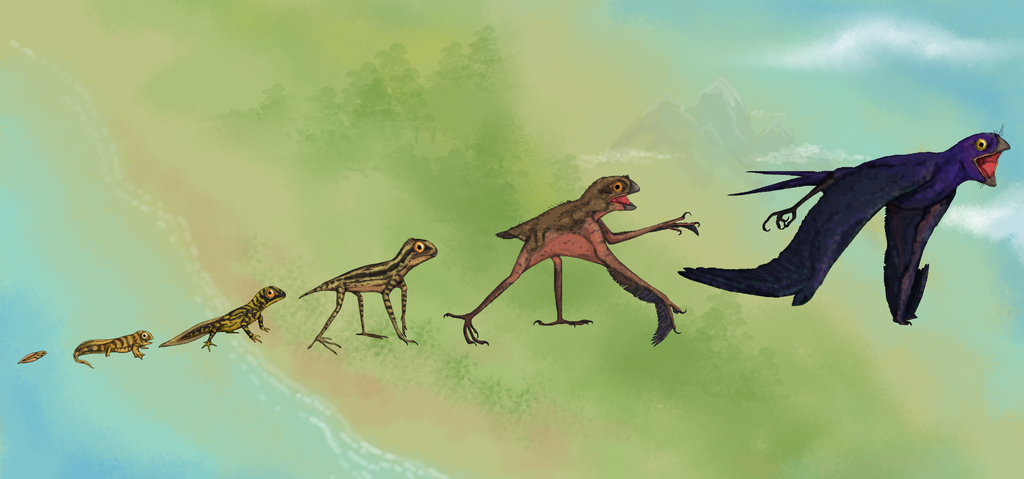
- Played with by the Ornimorphs from Serina, being evolved descendants of canaries with a peculiar life cycle that essentially re-enacts the entire history of the evolution of vertebrate life. Having descended from a group of birds that lay tiny-soft-shelled eggs and undergo an insect-like metamorphosis, the Ornimorphs begin life as frogspawn-like eggs laid in water, hatch as aquatic fish-like "tadpoles", grow legs and become an amphibian-like larval stage, become fully terrestrial and enter a reptile-like juvenile stage, become arboreal as it enters adolescence, develop gliding membranes as it matures, and finally becomes a feathered adult bird upon reaching sexual maturity, all within the lifespan of a single individual.
- Whateley Universe: At least, according to Dr. Braeburn's research, mutants are better in almost every way:
"For my particular investigation, it means that, by sapiens standards, mutant women seem both younger and more beautiful, on average. Mutant men are also more striking. It's not necessarily body-builder muscular, though that is a possibility. But even the skinny geeks often have a... presence, that makes them striking and compelling."
[...]
I haven't investigated, but anecdotal evidence is that mutants, as a group, are healthier, smarter, and more graceful. To scientifically prove that they're more beautiful as well? Sounds like a recipe for hatred to me."
- Ben 10: Ultimate Alien: The Ultimate forms are from the Ultimatrix's "Evolution" function which the Omnitrix lacked. All There in the Manual explained that the Ultimate forms are computer simulations of what the species would be like after millions of years of having to survive a programmed worst-case scenario. The actual DNA the Ultimatrix uses is temporarily changed to match the simulated DNA.
- Earthworm Jim: This was Bob the Goldfish's schtick. He tried various schemes to evolve himself into a higher form of life, in one instance using a contraption that stole "Evolutionary Energy" from other creatures, turning people into apes & Princess Whatshername into a ladybug & such. He evolved from a goldfish... into a goldfish. Despite the fact that Bob himself had claimed evolutionary superiority before, he was very unhappy with this outcome.
- Futurama: Parodied on a few occasions.
- In "The Deep South", the characters find the lost city of Atlanta, in which the human inhabitants have evolved into mermaids. When Bender points out that this should have taken millions of years, the mayor's daughter explains that the caffeine from the Coca-Cola bottling plant sped things up.
- In "A Clockwork Origin", the Professor accidentally creates evolving robots, who evolve much faster than organisms. Within a few days, they go from microscopic plankton-esque lifeforms to murderous trilobites to dinosaurs to cavemen to modern humans to Energy Beings.
- Looney Tunes short "Mad as a Mars Hare" ends with Marvin getting fed up and blasting Bugs with his "Space Time Gun", to "project you into the future, where you will be my obedient slave". Only it was in reverse and Bugs instead became a Neanderthal rabbit. So rabbits evolved from hulking muscular troglodytes and are destined to evolve into docile slaves?
- The Simpsons: An overly long couch gag sequence features the evolution of Homer. This starts with single-celled organisms, then goes from jellyfish to fish to lizard, rodent, monkey, ape... and finally to the modern Homo sapiens before showcasing several historical eras ending in modern Homer walking into his house. This showcases the supposed evolutionary levels misconception. And subverted for Rule of Funny; he meets Moe on the way who walks in the opposite direction... and devolves.
- Teacher's Pet: The title card for "Muutamorphosis" features Spot the dog morphing evolution-style into his upright-walking Scott persona.
- The Transformers, in the G1 continuity, are said to have slowly evolved over the eons (as stated in part two of Desertion of the Dinobots). Apparently giant robots can do that. This contradicts other parts of the show where the Transformers were stated to have been built as a slave race by the Quintessons. In other continuities they were created by Primus, their god, meaning that even Transfomers can argue about creationism vs. evolution...
