

With LEGO Genetics, you can fiddle with DNA wherever you like, intentionally or accidentally, and all the cells will change overnight (if that). Just wake up and presto! Wings! Fur! Gills! Hulking muscles! Giant brain! Stem cells! You don't even have to eat the equivalent of your entire body mass to create all those new body parts; the old cells and the new ones are just cobbled together like LEGO bricks. That part is usually Hand Waved if not lampshaded.
Instances of genetics in media tend to fit the "dumbed down" perspective on genetics taught to middle/high schoolers. Condensed to a more basic level, curriculum often has it summarized as:
- "The genetic double-helix is like a twisting ladder, and the rails are made of Deoxyribose."
- "The rungs are the nucleobases Adenine, Cytosine, Thymine, and Guanine."
- "The bases form pairs - A to T, and C to G."
Since reality can be boring and most writers can't be bothered, you can expect a great deal of frivolity in the media, with writers either fitting the above concepts or bending the plot further from accuracy. As such, expect scenes where patients "evolve" or "devolve" by radiation exposure while an expository scientist throws around Technobabble near graphics of a spinning, glowing double helix.
It should be noted, however, that gene therapy, which involves the alteration, addition or removal of existing genes in an adult organism, really does exist, but it's currently not permanent in most cases. They're working on that, though. The Hox genes are also an interesting reflection of this trope in real life, as these primitive "blueprint" genes do in fact seem to serve as the 'LEGOs' the genome uses to assemble a body, whether that be a spider, a bird, or a llama. See the Analysis page for more on those.
In fictional media, look for characters ending up an Animorphism or a Half-Human Hybrid because Genetic Engineering Is the New Nuke. Related to Chemistry Can Do Anything and Magic Genetics. See also: No Biochemical Barriers, Unstable Genetic Code, and Bio-Augmentation is a likely application. Compare Our Clones Are Different; media likes to treat cloning as a shopping list of desirable traits that can be easily added.
For a more realistic, in-depth discussion, see the analysis sub page.
Examples:
- This cholesterol medication commercial suggests you can get bad cholesterol genes from your Aunt Betty. If Aunt Betty is directly giving you genes, weirder things are going on in your family than high cholesterol. You may want to talk to your dad.
- The Cowboy Bebop episode "Gateway Shuffle" has the villain attempt to deploy an airborne virus that rewrites DNA and turns those exposed into apes. The transition time seems to be a couple days, tops.
- Dragon Ball:
- The logic of Cell's creation in Dragon Ball Z: he is a unique life form created from the DNA of the strongest people to have been on Earth, such as Goku, Vegeta, Piccolo, and Frieza. Furthermore, he's born knowing all their techniques and possesses all of their strengths. His DNA is formed from at least 4 species (Human, Saiyan, Namekian, whatever Freeza and his father are) if not more (the various soldiers Freeza brings), and whatever splicing his creator performed, allowing him to regrow lost limbs, get stronger from his life threatening injuries and survive the vacuum of space. It is worth noting however that part of his creation involved dozens on tiny cameras filming the various battles the main heroes have, learning their fighting styles and then collecting their genetic material. Cell also says that a lot of information (including prerecorded messages from his creator) was fed to him during his incubation stage, which explains how he knows the various moves and techniques he does.
- In Dragon Ball Fighter Z, it's revealed that Dr. Gero's computers developed another Android, Android 21, using the same process to create Cell, now with the DNA of fighters post-Cell Saga including Golden Frieza, Majin Buu, and Cell himself. With Buu's powers, 21 can continue absorbing more fighters, becoming one of the greatest threats in the franchise.
- Hunter × Hunter uses this trope in a roundabout fashion. The Chimera Ant Queen internally saves the DNA of every animal she ingests, the best traits of which are given to her offspring. Lacking power, at first her children are weak and dumb, but by staying hidden and away from danger, she slowly produces better and better children. The tipping point comes when her offspring start giving her humans to eat, which results in creatures with great physical strength and speed and human intelligence.
- In one episode of Kimba the White Lion, the Monster of the Week is a winged tiger who grew wings from a hawk's nerve which was surgically implanted by a scientist.
- Knights of Sidonia: To deal with food shortages, humans have been given the ability to photosynthesize, even without any chlorophyll. To deal with decimated populations, a third sex has been created which starts out intersex but will change to male or female based on sexual attraction.
- Mobile Suit Gundam SEED Astray has a bizarre application with its "Carbon Humans". These guys are psuedo-clones of other people created by splicing another person's DNA into an ordinary human, then giving them that person's memories via some form of brainwashing. They can even have multiple genomes spliced in. The series makes it very clear that these guys are not clones, though really the difference isn't too great.
- Every holder of One for All (apart from the first) in My Hero Academia is this; One for All is passed on by ingesting some of the DNA of the former holder (hair in Deku's case). This DNA gets miraculously incorporated into the receiver's own DNA within a couple of hours, and on top of that, only the quirk is incorporated and no other trait of the previous holder.
- Naruto:
- Sort of justified with Yamato's backstory: Orochimaru wanted to recreate the First Hokage's unique powers over the bijuu, so he spliced Hashirama's DNA into that of sixty infants. This was kept within the same species, so it was not too far into the realm of lunacy, but ultimately Yamato was the only success. The other fifty-nine infants died.
- Using Orochimaru's research, Danzo apparently spliced some of Hashirama's DNA into his right arm. While the resulting flesh was able to grant Danzo control over the Sharingans he had also implanted in his arm, the tissue was near-cancerous in behavior. The arm was either sealed with a heavy metal lock to control the tissue or fed a constant stream of chakra to keep the tissue in line.
- One Piece: Vinsmoke Judge and Dr. Vegapunk discover the blueprints for the creation of life itself, attributed as the "Lineage Factor" which seems to be DNA. The Lego genetics is implied with the Vinsmoke children who were modified in utero to give them enhanced abilities, including Super-Strength and an exoskeleton.
- In The Promised Neverland, this is the secret behind why the demons are so strong and smart. Whatever they eat, they soon gain the traits of, though they will soon lose it if they don't keep eating things with those traits. This is why they keep farms of genius-level children with top-level athletic potential. It's so the demons can later eat them and inherit that genius-level intellect and athleticism, alongside whatever strength, speed, and other better-than-human attributes they have. Deconstructed in that over time, a downside has manifested: Demon society has been divided starkly into a few haves and large amounts of have-nots. Because only the wealthiest demons can afford to consume the aforementioned children, this has led to a super-smart, super-strong ruling class while the lower income classes are completely powerless to do anything against it. Norman, a human, takes advantage of this fact when he and the Lambda Children storm the demon capital — he doesn't need to kill all of the demons, just the aristocracy, though they would obviously be the hardest ones to kill.
- In Albedo: Erma Felna EDF, as finally explained by Word of God, this is how the anthropomorphic population was created — by creating genes from scratch and engineering beings which look like humans with animal features along the way.
- The Authority: Midnighter runs into 96th-century Time Police with nowhere-near-normal resistance to damage, which they explain as having rhino genes somewhere.
- Evil geneticist June Covington from Dark Avengers developed a system of genetic 'plug-ins' that modify a person's genetic code. She experimented on herself to gain lethally toxic blood and the ability to exhale toxic gas, plus joints that easily dislocate and a heightened pain threshold. It's implied that she gave Norman Osborn a few genetic boosts as well.
- In Death & the Family, Insect Queen intends to breed super-powerful bugs by modifying their genetic makeup with human and Kryptonian DNA.
- The Blood (later known as Bar Sinister) from Shaman's Tears are artificially created human/animal hybrids, each designed to have specific traits from the animal side (wings on the bat hybrid, prehensile feet on the monkey hybrid, etc.).
- Sonic the Hedgehog (Archie Comics): Sally Acorn is the most prominent example, being half squirrel and half chipmunk without any problems. This is probably the most reasonable example, since squirrels and chipmunks are at least from the same family of rodents.
- In Brian Azzarello's Spacemen, NASA has genetically engineered a few abnormally strong humans, resulting in NASA getting abolished and the Fantastic Racism which the main characters face.
- Transmetropolitan uses this with the tempers, and later the transients, to graft animal traits onto themselves. The former usually "wear" animal traits for a day, such as becoming part-dolphin to swim in the ocean with dolphins, and the latter took on alien DNA to establish a new identity. People also can slap on skin patches that give them new DNA traits, such as immunity to cancer (in this case, from smoking).
- All over the place in Ultimate Marvel, which does at least try to explain its scientific flim-flam. Hank and Janet Pym put years of effort into their genetic Super Serum to make those who take it grow sixty feet tall within seconds. Even then, sixty feet is the limit because the human skeleton would snap apart after that, although this was quickly abandoned for the Rule of Cool.
- X-Men:
- This happens both ways when mutants lose their powers. Sometimes, they transform to human; sometimes, they keep physical changes such as a tail or wings. However, most lose their powers after House of M when a powerful reality-warping Scarlet Witch says "No more mutants..." and the results vary even then: some become completely human, some retain their altered appearance but have no powers, and a few who have physical mutations that disagree with the laws of physics lose whatever made it work before (a long-necked woman's neck snapped and killed her, Chamber's "energy furnace" disappeared, leaving him without multiple internal organs, a Giant Flyer fell from the sky, etc.).
- Longshot is an other-dimensional Artificial Human created by the Spineless One scientist Arize. To make matters even more interesting, many of Longshot's genes are taken from his biological son Shatterstar, who due to Time Travel had been sent into the past, where Arize discovered and used him in his experiments, thus making Longshot part of a Stable Time Loop wherein he is the father of his own "father".
- Ascend (xTSGx): Mentioned in the title of an in-universe book, in Chapter One:
The books' titles read: LEGO Genetics: How to Splice Your Genes in Ten Easy Steps;
- In Kid Icarus Uprising 2: Hades Revenge by Detsniy Off Skiword, we see Pandora mention that she injected seahorse "jeans" into Cloud "Strafe", which is used to make him pregnant.
- A Pink Planet: The Crystal Shrimp were created by the scientist gems and humans at the Coral Research Site as an early means of created gem-organic hybrids. They later move on to human test subjects, creating the first human-hybrids and eventually perfecting a means of creating them from scratch via Uterine Replicators.
- In Lilo & Stitch, this is Dr. Jumba Jookiba's bread-and-butter, having illegally created 629 genetic experiments for evil purposes using a variety of alien DNA. A little Hawaiian girl, however, turned these artificial aliens goodnote thanks to the idea of 'ohana, making them one hell of a tight-knit Badass Family of genetic alien "cousins".
- In The Amazing Spider-Man, Dr. Connors and Peter Parker develop the serum which turns the former into the Lizard this way. There is talk of "cross-species genetics" (the correct term is "transgenesis"), and someone makes a joke that a woman injected with zebra fish DNA to cure Alzheimer's would have to look past "the gills on her neck". This is combined with Extreme Graphical Representation with DNA represented by little blocks in a holographic interface.
- The Animal has the protagonist implanted with various animal parts, obtaining their instincts.
- This is essentially the whole premise of Annihilation (2018). A small meteor impacts somewhere on the US East Coast and starts projecting an expanding energy field called the Shimmer that rapidly hybridizes the genes of every living being under the dome with, well, everything else around them. The result is an alien yet stunningly beautiful landscape teeming with impossible creatures, from trees that grow in the shape of humans, to alligators with a shark's concentric rows of teeth, to critters that simply defy attempts at easy classification. Of course, violating the laws of Earth's biology on so many levels is bound to have at least as many nasty outcomes, so for every gorgeous hybrid in the Shimmer there's plenty of horrifying monsters and copious amounts of Body Horror to be found.
- Die Another Day combines this with Magic Plastic Surgery. Colonel Moon undergoes a battery of groundbreaking gene therapy (replacing bone marrow from substitutes harvested from unwilling donors) to alter his entire ethnicity from Asian to Caucasian, allowing him to adopt the new identity of Gustav Graves. However, as a side effect, he is unable to enter REM sleep. Moon/Graves' right-hand-man Zao also goes through the procedure, but the gene therapy is left incomplete when Bond interrupts the operation, leaving Zao with bleached skin, ice-blue eyes, and his hair having fallen out.
- The human protagonist of District 9 is sprayed with a chemical (nanite solution) that gradually replaces his human flesh with alien anatomy over the course of a few days. At one point his body is described as being a genetic hybrid.
- The Fly (1986) downplays this with the malfunctioning transporter, while the original 1958 movie stepped right in it; Brundle's DNA has been changed, but the process is a lot slower due to the fly's lower biomass. He gradually becomes a sickly, deformed human-fly hybrid creature as his cells grow, instead of popping out half-fly instantly as he did in the original. In fact, the first thing that shows the beginning of his mutation is the appearance of a strange looking fleshy hair growth in a wound on his back which he got before the failed teleportation.
- In Gremlins 2: The New Batch, the gremlins find a genetics lab in the corporate office building and drink the genetic material, including, female DNA, spider DNA, bat DNA, and, uh, lightning DNA and gain the associated traits. Then again, what with the already questionable biology of the Gremlins, viewers could care less at this point.
- Jurassic Park:
- In Jurassic Park (1993), the dinosaurs had frog DNA spliced in to fill in the gaps in their genomes caused by 65 million years in a mosquito's stomach. This allows them to change sexes like some frogs and breed.
- In Jurassic World, the new park has learned not to use frog DNA this time, but the Indominus rex is a Mix-and-Match Critter made "mostly" from T. rex genes but also a classified mix of half a dozen other species of dinosaur and modern-day animals. Horns and spikes from various dinos, raptor arms and communication, cuttlefish genes supposedly for accelerated growth but also give her Chameleon Camouflage...
- Played for Laughs in Mission to Mars. One astronaut painstakingly constructs a double helix out of M&M candies in zero-G. When another astronaut asks him what it is, he replies, "the perfect woman." The second astronaut reaches in and takes one of the candies, scattering several of the rest, and asks, "what is it now?" The first astronaut looks at it, puzzled, and says, "a frog?"
- All Powers in Project Power are said to be based on animal traits that are part of "human genetic potential".
- The origins of several are confirmed by a presentation given by Biggie: the tough skin of a rhinoceros, the camouflage of a mimic octopus, the extended bones of a wolverine frog, the regenerative abilities of a salamander, and safe bone dislocations of a mouse.
- Notably, Biggie mentions one ability that is not accompanied by the name or image of an animal: the power to turn water into plasma. We later find out that this refers to Art's Power to gain the speed of a pistol shrimp and harness the disastrous conflagration that occurs when using such speed at a human scale.
- It's unclear exactly where some of the Powers come from. Biggie mentions thermoregulation as an ability and two people are shown with this Power. However, no animals have the ability to set themselves on fire or freeze their surroundings. Biggie's own Power to become a hulking giant is also unexplained, as is Tracy's ability to heal.
- The Relic: A retrovirus found in prehistoric plants horribly alters the victim's DNA by inserting genes from past victims. The reason why there's a dinosaur ape-thing running about in the Museum of Natural History is because these plants could only ease the constant pain and insanity of the affected, since, you know, forcibly altering someone's DNA isn't going to have pleasant results. A later character is able to use rabbit DNA to make a safe street drug, basically a mild version of crack with no downs or life-threatening brain holes.
- Sharktopus: The government sticks the head of a shark onto the tentacles of a very, very large octopus.
- In Spider-Man, Peter Parker is bitten by a genetically altered spider and develops Super-Strength, a "Spider-Sense", and the ability to Wall Crawl (among other powers) overnight. In the display room where he got bitten by the spider, we see a plasma screen showing the bits of DNA added to the spider to create the "super-spider". Later, there is a CGI sequence in which we see the rungs in the DNA double helix changing to the exact same colors as the spider's. Though it might help to not look at the CGI shots as literal, but more a creative way to show the audience what's happening quickly.
- If it's a Syfy Channel Original Movie, animal genes can often be injected into people willy nilly to create part-human hybrids like Mansquito, Sharkman, or Snakeman. This is also the usual explanation for the Mix-and-Match Critters.
- The Thing (1982): It seems that the Things can do this instantaneously, both at will and by instinct. It allows them to sample and utilize the genetics of any creature they come into contact with, and to form hybrid forms.
- Underdog takes this trope to its logical extreme. Shoeshine is injected with a "serum", with contains genes for the wings of an eagle and the strength of an elephant, thus giving Shoeshine his abilities with no visual changes! Later in the film, he is forced to give up his powers. They turn into blue pills. He gets them back when he eats one.
- In X-Men Origins: Wolverine, Deadpool is fused with the DNA of dozens of mutants to gain their powers and become Weapon XI.
- Amazonia by James Rollins revolves around a tree which is implied to be the source of the Garden of Eden myth. It lures animals into its roots, where it keeps them alive indefinitely while playing around with their DNA and using it to modify other animals, including humans. Among its creations are piranha-frogs, super-sized caiman, intelligent jaguars, poisonous ant-wasps, and a tribe of slave humans. The catch: it knew that humans had free will, so it programmed their changes to be unstable. Without living near the tree and eating its fruit, the changes become a virulent and highly contagious cancer.
- Averted in Dopamine. The genetic engineering behind the MacGuffin is handled with painstaking realism, including the problems involved with restriction enzymes, plasmid uptake, and the need to use an indicator mechanism. Julie Yen even says at one point, "There's no such thing as a gene for cocaine."
- Dora Wilk Series: Magic is genetically inherited through recessive genes, which author handles quite reasonably... except for the main character, who has only recessive genes where there was choice (highly improbable in real life), although the narrator lampshades how improbable it is.
- In Dr. Franklin's Island, the titular doctor is quite happy to explain the Forced Transformation he's about to inflict on Semi and Miranda — he's going to remove some of their bone marrow and adjust their cells to turn them back into stem cells, then splice them with a mixture of genes from different fish and bird species and re-implant them. Soon the new genetic code will spread and they'll slowly assume new forms. He's already got a zoo full of animals that the process was developed on — piglets with human hands, a capybara with human lips and back legs, parrots with floppy featherless growths — and informs them that the results are unpredictable but ideally will make Semi into a girl who can breathe water and Miranda into a girl who can fly. It does work, but they both become very inhuman in the process, with Semi only retaining her eyes and Miranda having eerily human limbs for a bird.
- Ender's Game:
- Speaker for the Dead reveals that the alien "Descolada" virus caused this effect on the native life forms of the planet Lusitania, resulting in plants and animals literally giving birth to each other. The Descolada is explained as "ungluing" the DNA double-helix into two separate strands — this is fatal to humans and most other organisms but essential for the cellular reconfiguration involved in the life cycle of Lusitanian lifeforms in their transition between plant and animal stages. Basically, it's an extremely aggressive and complicated viral molecule that goes around trying to make LEGO Genetics work on any DNA it encounters; the handful of surviving species on Lusitania have evolved such that they are resistant to the random insertion of DNA while depending on this process to enter the reproductive stage of their lives.
- In the next book, Xenocide, once the Descolada is sufficiently understood, it becomes a convenient vector for quickly (as in almost overnight) removing the artificially introduced OCD-genes on the planet Path without sacrificing the super-genius genes these were attached to. Hand Waved by the suggestion that the Descolada replaces parts of its victim's DNA with random code (in the case of the Descolada on humans and Formics) or a preprogrammed code (in the case of Lusitanian life and the humans on Path) so fast that the body cannot reject the modified cells fast enough before the body sees it as its own. A "neutered" version of the Descolada is also created in order to make it safe for Lusitanian and other life-forms to share a biosphere; the new molecule performs the necessary functions for Lusitanian life but will not infect (or mutate to be capable of infecting) other life forms.
- In the fourth book, Children of the Mind, the characters theorize that the "Descoladores" — the race which created and disseminated the Descolada — may live off a variation of this trope. As part of the question of where they lay on the Hierarchy of Foreignness, it's put forth that they may communicate through viral-like molecules which the receiver integrates into their DNA. Furthermore, they appear to use the Descolada as a means of terraforming, making it possible that it is as much a part of their own biology as it became to the population of Lusitania.
- Zig-zagged in Fearless. Gaia undergoes relatively realistic gene therapy (described above) to replace her missing "fear gene", and just like in Real Life, the effect is temporary. The only bit of Artistic License – Biology is, of course, that there is no such thing as a fear gene — many genetic and biochemical factors are involved in the experience of fear.
- This is how the Synthetic Plague in Inferno (2013) works. Just let the virus inject its DNA into the host's cell, and voila, a third of the human population is rendered infertile. More acceptable than other examples, however, in that it's surprisingly easy to use a virus to produce infertility, because your gamete cells are genetically different from your somatic cells (the rest of the cells in your body). Your immune system has specific overrides to prevent itself from attacking your gametes and rendering you infertile. Bearing in mind that it's always easier to break something than to build something, it's relatively easy to make a virus that disrupts this override mechanism, and then your own immune system does the rest. This process is called "immunosterilization", and it was used by Australian scientists to get their wild rabbit (an invasive species) population under control.
- In Les Bohem's Junk, a piece of junk DNA left over from aliens interbreeding with humans thousands of years ago is starting to activate, turning people into murder machines with superhuman abilities.
- Killer Species: This is series villain Dr. Catalyst's M.O., as he combines DNA from different species to create a new type of creature specifically bred to hunt down and destroy an invasive species that's devastating a particular environment. The first book features Pterogators (a combination alligator/great gray owl created to destroy the anacondas and boa constrictors in the Everglades), the second introduces the Muraecudas (a hybrid of Moray eel, reef shark and barracuda made for hunting lionfish), the third debuts the Blood Jackets (a hybrid of baldface hornet and vampire bat, which target humans), and the fourth centers around the Swamp Cat (a lone hybrid specimen combining the DNA of a hyena and Florida panther, made to hunt and kill Emmet Doyle for thwarting Catalyst's plans multiple times).
- Parodied in The Last Continent when the God of Evolution explains that he was hoping to make the burnt offerings more efficient by finding the instruction that tells a cow to be soggy and replacing it with the instruction that tells a tree to be flammable. It doesn't work, although in the way that it really wouldn't work: he ends up with bushes that produce milk and make distressed mooing sounds, as well as cows that would, on hot days, in certain rare circumstances, spontaneously combust and burn down the village. But is that any excuse for ingratitude?
- This is what diverges Leviathan from real history — when Charles Darwin developed the Theory of Evolution, he also discovered DNA. Fifty years later, as the world gears up towards World War I, London has fabricated elephants instead of cars, gecko/parrot hybrids are used to send messages and the Entente armies liberally use fabricated animals to fight the Central Powers' giant Walkers.
- Lilith's Brood is centered around the Oankali, an alien race which is capable of probing and sequencing genes on an instinctual level and which flies around the galaxy engaging in "trade" of gene sequences — whether their partners want to or not, in the case of humanity. Naturally, they have impressive abilities to meld the traits of wildly divergent species.
- Edmond Hamilton's 1931 short story "The Man Who Evolved" (reprinted in Before the Golden Age, edited by Isaac Asimov) is probably the Ur-Example (or one of them, at least). The protagonist, before his friends, uses concentrated cosmic rays to "evolve" in a few minutes to successive stages of human evolution (each an improvement on the last). The story ends when he decides to "evolve" one last time, to the final stage of human evolution. This turns out to be the primaeval slime from which the human race first evolved.
- In Maximum Ride, the main characters are human-avian hybrids. Through years of genetic experimentation, they received powers specific to each character (such as mind-reading for the resident Enfant Terrible), and in later installments, they undergo random mutations which give them powers that conveniently tie into the story's plot and quite a few that don't.
- In Moojag and the Auticode Secret, the "pofs" were originally children with various genetic disabilities who were involved in experiments that aimed to cure them with cicada DNA. It seemed to work at first, with the children becoming healthy and incredibly strong, but then they grew cicada wings, stopped growing, and became increasingly hyperactive.
- Specifically averted in The Moreau Factor with a thorough explanation of how pleiotropy makes LEGO Genetics impossible.
- The CDF's genetically engineered Super-Soldier bodies in Old Man's War are stated to blend DNA from a variety of sources, including aliens. However, the mixture of genes makes them all sterile, which may have been intentional, as it gives recruits an incentive to defend humanity instead of trying to replace it.
- Star Trek: The Eugenics Wars features ambitious scientists trying to make superhumans who are genetically engineered to be superior to humans in every measurable way. One of their early experiments was splicing DNA from an ape into a human. Somehow, it worked, and the man in question grew large and very strong, though he was rendered sterile from the process.
- At one point in The Tales of Alvin Maker, young Arthur Stuart (the child of a runaway slave) is being tracked so his owner can reclaim him. The trackers are using magical ability to follow him via his genetic code: they have a lock of his hair, and this allows them to find him anywhere. Alvin's solution: he rewrites Arthur's entire DNA so it doesn't match the sample. By concentrating really hard. To get around the problem of Arthur's cells dying too quickly to be replaced, he dunks the kid in a river and then "orders" all the cells to adopt the new DNA simultaneously. The only negative effect this has on Arthur is that he loses his ability to mimic others' voices perfectly. Mind you, in some ways, this is more acceptable than many other examples: Alvin picks a few spots in Arthur's DNA and changes them to match his own, rather than make random changes or try to give him frog DNA or something. This doesn't magically give Arthur Alvin's not-inconsiderable range of powers, either, which is a miracle in and of itself given the rest of this page.
- In V Wars, a newly discovered ancient virus (thought to be a variation of the flu) in the melting polar ice caps starts infecting people. At first the symptoms are flu-like, but then some people start turning into various kinds of vampires, werewolves, and other shapeshifters. A scientist theorizes that the virus is activating "junk" DNA in some people, turning them into new species, with each ethnic group typically having its own myth about these creatures, possibly left over from a previous outbreak of the virus. Very few of these kinds are able to pass on their particular mutation to others. Of those that can, a particular example is the vurdalak, Russian vampires. They can only feed on those they love (or are at least mildly attracted to), but anyone killed during a feeding comes back as a vurdalak. One of them eventually starts killing the others by blowing their brains out, leaving the last bullet for herself.
- In Beauty and the Beast (2012), Vincent transforms into a "beast" because of being injected with a serum that was supposed to make him a Super-Soldier — said serum was a cocktail of animal DNA. The characters also frequently say that he or his DNA is "evolving", ignoring the fact that that's not what that word means at all.
- The main villain of Choushinsei Flashman, Ra Deus and his underling Dr. Kefler have this as their main obsession. They use DNA to create the Monster of the Week and Deus himself is questing to become the supreme lifeform in the universe by acquiring more genetic material. As it turns out, Deus is in fact a living mass of genetics. After this gets exposed, Kefler turns against him, and turns Deus into a monster.
- The CSI: NY episode "What Schemes May Come" features some genetically engineered goats which produced spider silk (see Real Life below, if that sounds crazy). The same episode has a rat with a human ear growing on its back. The guy in the lab where both are created explains the process to the detectives.
- Dark Angel: The protagonists (and some antagonists) were genetically modified with the traits of various animals. The earlier versions look like hybrids, the later versions look fully human but still have various animal traits.
- Doctor Who:
- The series is quite fond of handwaving stuff by gibbering about DNA. For example, the Doctor can survive being extremely close to dying by completely rewriting his genetic structure in seconds.
- In the episode "Dalek", the eponymous entity "regenerated itself" by "feeding off the DNA" of a time traveler. In the process, it absorbs said time traveler's DNA and thus becomes part human, giving it human emotions.
- The Krillitanes from "School Reunion" are a race who absorb biological components from the species which they conquer. When the Doctor last met them, they looked like humans with long necks; when he meets them again, they're bat-like creatures.
- In "Evolution of the Dalels", when the Dalek-Humans are created, they all look completely human; this does, however, make them think like Daleks, except not, because the Doctor's DNA got mixed in by being too close to the freaking power source... Interestingly, the Daleks are a classic case of this trope and Hollywood Evolution. Their ancestors, the Kaleds, were Human Aliens who suffered mutations due to the rigors of life in a Forever War and were subsequently re-engineered into Starfish Aliens by a crazed Evilutionary Biologist — so technically, by trying to become more humanoid, they were actually moving back towards what their species originally was.
- In "The Lazarus Experiment", Professor Lazarus' project to turn himself young again goes horribly wrong and makes his DNA unstable, causing him to turn into a giant scorpion with a human head that feeds on the life force of others.
- River Song, a.k.a. Melody Pond, has Time Lord DNA despite the fact that her parents, Amy and Rory, are human. This is a result of being conceived in the TARDIS and exposed to the temporal schism.
- In "A Good Man Goes to War", we find that Strax, a member of the clone-race Sontaran, has been relegated to serve as a "nurse", to atone for this clone batch. He functions mostly as a Combat Medic until infant Melody Pond won't stop crying. Strax tells Amy and Rory, Melody's parent, that she's hungry and he'll take care of it. When Rory objects, Strax informs him that he had himself gene-spliced for all nursing duties and can "produce magnificent quantities of lactic fluid".
- In the Farscape episode "DNA Mad Scientist", the titular Mad Scientist makes use of this trope — his plan is to stick Pilot's DNA into Aeryn, wait for her to develop Pilot's multitasking ability, and then somehow take it out of her and add it to himself. This isn't the first time that he's done something like this.
- The Fringe episode "Unleashed" features a manticore-like creature formed of Gila monster, tiger, scorpion, wasp and a couple others. It can infect people with its larvae through its stinger, an ability presumably gained from its wasp genes. Apparently, this is all made possible by splicing in bat DNA.
- Jekyll has The Men in Black rushing desperately to find the main character because each time he transforms from his Jekyll persona into his Hyde persona (which he can do in less than a minute), his entire genetic structure is apparently changed. This is doing untold amounts of damage and giving him only a few months to live.
- Any time genetics or DNA is brought up in Power Rangers, it tends to be this kind.
- The mutants from Power Rangers Time Force are the rejected leftovers from the future's Designer Babies program. All of them have "DNA patches" on them that, when exposed, make them grow to gigantic size. Whenever this happens, you see double helixes expanding in size to match (and the reverse is seen when a mutant is defeated and shrunken down).
- Power Rangers: Dino Thunder has Mesogog create the monsters via a "Geno-Randomizer" in his island lab fortress, which mixes three different things — DNA from a plant, DNA of an animal and an inanimate object of some kind. Elsa and Zeltrax typically operate the controls and the completed monster emerges from a chamber in the lab. The same controls are used later to activate the "Hydro-Regenerator", which revives and grows the monster. (This is in direct contrast to the source Sentai, where the monsters were created by magical paintings and symphonies empowered by a cursed "Life Berry").
- Some seasons, including SPD and Overdrive, provide civilian powers thanks to DNA alterations.
- Power Rangers RPM has a massive, Venjix-created attack craft designed to completely wreck the Corinth dome headed straight for the city. Dr. K manages to reprogram it with blue whale DNA (of all things) into a friendly Zord Attack Vehicle, the Whale Jumbo Jet. Ziggy, as usual, points out how odd that is; Dr. K rebuts that she could turn it back into a deadly shield-busting doomsday weapon. "Forget I said anything."
- Power Rangers Beast Morphers once again has DNA-altered Rangers, only it's to provide their actual Ranger powerset in addition to civilian powers. Since they use animal DNA, it also gives them some crippling weaknesses too.
- Red Dwarf, never one to take science seriously, has the crew discover a LEGO Genetics device in the episode "D.N.A.". It turns Lister into a chicken, a hamster, and eventually a one-foot-tall RoboCop rip-off. They resort to the last one because the crew had turned a vindaloo into a half-man half-curry hybrid. It also inexplicably turns Kryten — a mechanical droid — into a human being simply due to the presence of a bit of organic matter in his brain.
- In the third season of Sliders, the writers Hand Wave the change in Colonel Rickman's appearance (caused by the change in actors from Roger Daltrey to Neil Dickman) by stating that he absorbs the DNA of his victims whenever he injects himself with their spinal fluid. This is played further in the episode "This Slide of Paradise", when the only people available for Rickman to steal fluids from where the animal/human hybrids created by Dr. Moreau Vargas. Rickman, by the time the episode starts, has become somewhat feral, as a human/human/animal hybrid.
- Stargate-verse:
- In the Stargate SG-1 episode "Bane", Teal'c is injected with alien bug DNA and starts mutating not even into a single bug, but into several of them at once. Not that the resolution was any better than the "science"... This might be reasonable if the bugs were parasites using him as a host but as they are claiming to alter his body by changing his DNA, they fail biology forever. Another interpretation, though still problematic but slightly less so (maybe?), would make the insects act like a cross between a virus and cancer, reprogramming the victim's cell's DNA to start creating insect cells (like a virus) which grow (like a tumor) into insect embryos.
- The main villains of Stargate Atlantis are a result of LEGO Genetics; a life-sucking Iratus Bug mixed human and/or Ancient DNA with its own and produced the Wraith. Our heroes have developed a retrovirus that is capable of discriminating between the two genetics, and by separating them, "purifying" the subject to entirely human or entirely Iratus bug. In the Season finale series of season 4, we discover that a character has been able to modify the virus to add Wraith DNA to pure humans. Truly LEGO Genetics at its purest; take a little from column A and a little from column B at will. One wonders why the humans in the Stargate universe haven't started ad-hoc mixing of their genes from Earth creatures for their own advantage; surely the military could use some Marines with some grizzly bear genes and some tiger and some lion genes... oh my, that's a powerful soldier.
- Star Trek:
- The various series do this at least once a season. It is interesting to note that "DNA resequencing" is a very common medical practice for treating genetic illness within the Federation, but they have strict No Transhumanism Allowed laws due to humanity's experiences with the Eugenics Wars.
- It's hard to imagine that the Star Trek: The Next Generation episode "Genesis" will ever be outdone in this respect, as it involves the entire crew undergoing this — a cat becomes an iguana, one crew member becomes a snake, a fish becomes a jellyfish, and Lt. Barclay becomes a spider. That's a jump somewhere around the superphylum level.
- Star Trek: Voyager:
- In the episode "Faces", B'Elanna's Half-Human Hybrid DNA is LEGO-disassembled — a Vidiian doctor separates her Klingon DNA from her human DNA and builds two separate and (basically) functional B'Elannas out of them.
- In the episode "Lineage", B'Elanna is upset to discover that the baby she is pregnant with by her human husband Tom has some Klingon facial features, since those traits are dominant and can take generations to breed out. She attempts to forcibly reprogram the Doctor to genetically remove the Klingon features in utero while performing resequencing to fix a spinal issue. Tom and the rest of her friends are appalled.
- In David Byrne's song "Self-Made Man", the characters literally swap chromosomes like they're baseball cards.
Well, I'll trade you my potential mental illness
for your bad teeth.
How about trading your sexy body
for a full head of hair?
- Dr. Cube created Grudyin in Kaiju Big Battel using gorilla and angler fish DNA; the end result is pretty creepy looking, though for some reason he has large, pointed, protruding nipples. Tucor was created via a similar process, but this time using two animals that are hard to find threatening — a toucan and a gerbil.
- The "Moreaus" (animal-human hybrids) in d20 Modern. Also, the entire premise of the "Genetech" campaign setting (which extensively features the aforementioned hybrids in a battle against prejudice rather reminiscent of the X-Men films).
- In Hunter: The Vigil, the Cheiron Group gives its employees supernatural powers by cutting out bits of monsters and stitching them into the subjects. This is given a Hand Wave of the "Nobody has a clue how this works, it just does" variety. Not too surprising given that all the 'spare parts' come from creatures that are more-or-less explicitly magical.
- Magic: The Gathering:
- The Slivers can apparently eat things, then assimilate the DNA into their own, and then their offspring have the traits of whatever they've ingested. And can then share those traits with any other Sliver within range. This adaptability makes them so powerful that they've gone extinct twice and still hang around.
- The Ravnica blocks feature the Green/Blue Simic guild, a group of genetic engineers who build creatures like Eel-hawks to survive on a Dungeon Punk City Planet where the wilderness has all but vanished. Their signature mechanics involve manipulating +1/+1 counters, which represent bits and pieces of various plants/animals/oozes.
- The Ancient Martians from Rocket Age managed to advance genetics to the point where they had a machine that could make all sorts of changes, like adding wings or claws to a person, although it did have its limits.
- Warhammer 40,000:
- The Kroot, an allied species of the Tau Empire, use this as a means to evolve. By eating the flesh of another organism, the next generation of Kroot gains some of the traits which the dinner had. For instance, a Kroot which consumes enough flying animals would eventually pass on the trait of wings. Kroot chieftains, called Shapers, use their knowledge of Kroot genetics to pick out creatures with the most desirable traits for their kindred to eat, in order for their tribe to grow strong and conquer their foes. It's believed that their ability to make primitive but functional guns comes from eating orks (whose mechanical and medical knowledge is genetic). The Kroot also use various Beasts of Battle (kroothounds, krootoxen, Knarlocs) whose ancestors all predominantly ate more of a single species, locking them into that path. Their Tau allies see this as utterly barbaric but value the Kroot's friendship over their habits (it's hinted that the kroot know exactly how much their behavior disgusts other species and play it up accordingly).
- The Tyranid are also very good at this. Most of their enhancements are homegrown, but two Tyranid hiveships meeting is a very bad thing because they will fight to the death, then whichever one wins will take the most effective enhancements of the other and incorporate them into its soldiers. Also because of the Tyranid's ridiculously efficient digestive and reproductive processes, fleet will grow to the size of both of them put together. It's mentioned in the 'Xenology' book that the Tyranid genome is basically a whole series of different gene sequences and types with different alleles and such, all spliced together into an impossibly complex whole. The background image for the Tyranid gene sequence indeed reflects this, being made of... everything. (It's all still built from a standard genome template, though, which is alluded to being the Tyranid Ripper.)
- This seems to be the cornerstone of Norman Osborn's research in Spider-Man: Turn Off the Dark and is the basis for the Crowd Song "DIY World", which is all about mutating DNA to shapeshift and take on animal traits to survive catastrophes. Osborn later uses the same research to create supervillains, which is particularly weird when it comes to Swiss Miss. Do knives have DNA in this world?
- Beacon (2018) features this as its primary gimmick: where a normal roguelike would have armor pieces with buffs or normal levelling methods, the game instead has you fuse genetic material taken from the myriad hostile alien lifeforms on the planet you're on. Taking enough of one genetic strain or bosses can cause a mutation, giving you anything from spiny quills that can be fired when you take damage, a carnivorous ivy whip for a hand that drains your enemies of blood, demonic anti-gravity legs powered by hellfire, or an alien dinosaur for a head that lets you morph into a T. rex.
- BioShock has "plasmids", genetic upgrades which instantly give you fantastic abilities like telekinesis or the ability to shoot fire, lightning, or ice from your hands. Hand Waved by advanced scientific research into creating stem cells, but even that doesn't begin to explain it. In Real Life, a plasmid is a ring of DNA which can indeed be used to perform a very limited version of LEGO Genetics, but only to transfer a small number of genes into cells (and only in bacteria). The game also allows the Player Character to take an active plasmid out of his genome, which is a lot less plausible. The explanation for all these abilities (and the driving force behind most of the plot points) is Rapture's form of Unobtainium, ADAM. Its exact functions are unclear, but it makes the Little Sisters (who produce ADAM via a sea slug implanted in their guts... yeah) virtually invincible, as any wound they sustain is healed almost instantly by accelerated cell division. It is also what allows gene splicing by injection and is apparently very addictive.
- In Cataclysm: Dark Days Ahead, once your cooking skill is high enough and you find the proper manual, you can just mix bleach, ammonia, and zombie flesh together, drink the resulting concoction, and instantly gain new body parts and powers (or weaknesses). To make things odder:
- Once you get even higher skills, you can make specialized mutagens that are guaranteed to mutate you into a specific species. However, most of these mutagens require a nondescript "Chunk of Meat", which can be gotten from almost any animal, meaning you can make Bear Mutagen using wolf flesh, Wolf Mutagen using bear flesh, and so on.
- Genetic damage is a possible penalty for failing to install cybernetic augmentations, which implies that all humans already have DNA from all species inside them.
- Creatures is a rare aversion (at least partially). At least several "genes" go into the functioning of each organ, and let's not even get started on the brain... The visible parts (head, limbs, etc.) can change in appearance with just one gene, but not be removed entirely or visibly duplicated (though the gene can be). (The "double tail" seen on certain C2 Norns, and the lack of tail on Ettins and some Norn breeds is a sprite thing.)
- Used slightly believably in Crusader: No Remorse when a Mad Scientist explains to you that the "new generation" of Silencers does not have the Silencer's "fatal flaw" (that being something vaguely approximating a conscience). Depending on how much understanding of genetics human science acquires, this may not be entirely implausible.
- In Evolva, your Genohunters are able to use their enemies' DNA to transform their body and acquire their attacks.
- Progressing far enough in Evolve Idle will allow the player to use plasmids to purchase genetic upgrades (such as a bonus to resource storage capacity) that carry over to every new species created. Eventually one can use plasmids add or subtract genetic traits for the various races and even craft unique races from various existing traits.
- E.V.O.: Search for Eden runs on this trope. Every time you add or remove a part, the change is done instantly. This can be exploitable in boss battles by changing one's neck from short to long or vice versa whenever you get low on health, completely refilling your health. The neck is the cheapest part to change, but you can substitute any part and do the same thing. A better tactic — and an even stranger example of this trope — is to grow a cheap horn, which also refills your health. The horn 'breaks' after attacking with it three times... and this somehow counts as an evolutionary change, which refills your health again. Admittedly, EVO isn't exactly clear on whether or not it's supposed to represent real evolution. There are substantial hints that the whole process is being hijacked by aliens, at least in the case of certain enemies, and many creatures berate you for not evolving "the proper way".
- Impossible Creatures is based pretty much entirely on this trope, and aptly named.
- Kirby: This is probably what happens to Kirby every time that he inhales an enemy and absorbs its powers. His body often undergoes a complete and instant physical change, ranging from change of body color to obtaining oddly shaped hats. But we're completely okay with it, since we don't know anything about the biology of Kirby's species anyway.
- Master of the Monster Lair: Gloop the slime can mimic other creatures and can even have each of his individual body parts (arms, legs, body, and head) be from different "donors".
- A subplot in Metal Gear Solid 4: Guns of the Patriots concerns Snake's Rapid Aging: he was considered a high risk of being kidnapped and cloned again, so the biologists on the team simply tacked infertility on to his genes, as well as "terminator genes" to force rapid aging and an early death.
- Metroid:
- This is done to Samus not once, not twice, but thrice: according to Samus' backstory, she was "infused" with Chozo DNA in order to allow her to survive on the planet Zebes, which is the reason for her superhuman strength, stamina, and agility. In Metroid Fusion, as Samus lays dying of an X Parasite infection, she is injected with the DNA of a Metroid, the only known natural enemy of the X Parasites, as a last-ditch effort to save her life. Not only does the vaccine completely destroy all traces of X in her system, but this also somehow alters her DNA so that she has the Metroids' ability to safely absorb X for health and upgrades, further alters the appearance of her suit (which is biologically linked to her and was already disfigured from earlier surgical attempts to save her from the X infection) and gives her the Metroid's weakness to cold. Finally, Metroid Dread reveals that the Chozo DNA infusion involved two donors from genetically distinct Chozo tribes.
- The X Parasites themselves steal the DNA from host creatures and then instantly assume their forms. They are even observed experimenting with their absorbed DNA: mixing and matching different strands to create hybrid creatures or mutants. They mostly stick to combinations that work, but we do see several attempts at the X attempting a combination only for it to fail horribly.
- Mewgenics: The whole premise of that game, really. Updates #6 and #8 shed a little more light on the matter: Each cat in Mew is randomly generated by randomly choosing how the limbs, body shape, tail, head, and fur, along with two eyes, ears, eyebrows, and mouth should look, together with a random location for facial features. Most of these are (relatively) cat-like, but some mutations can give your cats things like webbed feet and ram horns. Any of these characteristics (including ones gained in life via random event) can be randomly passed on to offspring along with mental disorders and a single collarless ability, creating cats who look like their parents and possibly fight like them too.
- Mother 3 has a multitude of battle encounters that are simply the unlikely combinations of two creatures, referred to as Chimeras. Such combinations include the Cattlesnake◊, the Batangutan◊ and the Slitherhen◊. You even have to venture into the labs where these Chimeras are created.
- Phantasy Star: Nei is explained to be part biomonster and was created in a genetics lab. Rika was also created in a biology lab, but she was produced over the course of a thousand years' worth of research and testing to produce a stable and functional improvement on the Nei pattern, which was drastically flawed.
- Planet Crafter: During the Mammals stage, you can extract genetic traits from other life forms (fish eggs, frog eggs, larvae, even plants and minerals) and recombine them into a genetic template for a mammal. Each trait represents a specific feature, such as size, primary and secondary colors, and bioluminescence.
- Averted and discussed in Sid Meier's Alpha Centauri, in which University faction leader (and resident Professor) Prokhor Zakharov is quoted more than once on the subject of the limitations of genetics.
- Star Control II has this as a major plot point for some races. The Umgah can easily manipulate DNA with their vast scientific knowledge and end up accidentally reactivating the latent powers of one of the deadliest psychic creatures the universe has seen. The Mycon can supposedly do even better, altering their DNA and abilities by mere thought.
- StarCraft: Depending on whether they're viewed as an animal or a virus, this trope could be considered the very definition of the Zerg, who swarm over alien races to absorb certain genetic traits from them and are trying to acquire beings with "psionic genes" at the start of the first game. StarCraft II shows more examples of such behavior:
- In Wings of Liberty, the Zerg hyperevolutionary Virus is shown infesting a scientist, inclusive a screen displaying that 99% of her DNA has been replaced by Zerg genes. She looks as good appropriately squicky.
- In Heart of the Swarm, the pseudo-biology gets taken to an entirely new level, with the genetic Chef Abathur sending you out to collect Essence from different species to acquire certain traits, from immunity to cold to being able to be split in two, with both halves surviving independently.
- A Very Long Rope to the Top of the Sky: Averted, since Ivy and Mint aren't obviously "half-and-half" except inasmuch as would be entirely realistic; phenotypically, both lack wings, but Ivy has blue eyes, which is a Lydian trait.
- This becomes a major plot point (with a twist) in Wing Commander IV: The Price of Freedom. The Big Bads have a pretty neat covert operation going: mass murders, being blamed on a Conveniently Available faction. The problem is, the murders (which are originally thought to be a plague), turn out not to be. It turns out that the Big Bads have developed a nanotech weapon that kills people based on their genes — have the right gene set, you live, don't, and you die, in a genocide that would make Hitler green with envy. The parallelism is there and used, including the insane-general-that-thinks-humanity-is-weak-and-is-going-to-purge-it bit that Hitler used to rationalize his genocide. The results are shown in nauseating fashion — the weapon kills slowly, by dismantling the cells that have the incorrect gene sets, dissolving the person slowly and painfully.
- In XCOM: Enemy Unknown, this is made possible by the Imported Alien Phlebotinum, Meld. There are ten different genetic alterations that can be applied to your troops, nine of which are unlocked by performing autopsies on fallen aliens: ranging from being able to jump buildings to having a (smaller) secondary heart or being able to camouflage in the right circumstances. The EXALT troops have also been genetically modified using Meld. The Elite Heavy is the most obvious example; their skin glows orange. Most of their modifications are unavailable to your soldiers, since they are apparently too dangerous and unstable.


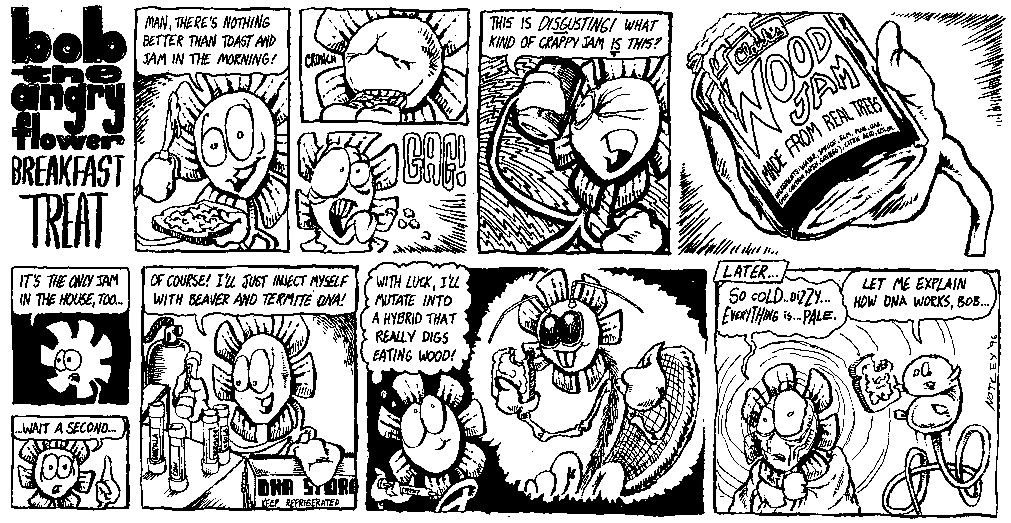
- Parodied in this◊ Bob the Angry Flower comic.
- In The Dragon Doctors, Mori points out that DNA can't be treated like a bunch of building blocks ordinarily, but the use of magic allows one to treat traits as conceptual objects that may be swapped out at will.
- El Goonish Shive has Uryuom eggs, which somehow combine the DNA of all of the parents and create a composite being with all of their traits. If more than one species is involved, it generally also gains the ability to change shape. Those must be some pretty advanced eggs. Later justified as it being a type of magic (well, sort of; it's complicated and hasn't been fully explained yet) inherent in the species.
- The Greening Wars: "The Greening" is an organization which basically has this a policy.
- M9 Girls!: The substance which Professor T.X. injects into the M9 Girls modifies their genetic structure overnight, so that they are able to absorb cosmic energy into their bodies, which gives them their powers.
- The Chio from Messenger and Follower were created this way.
- Played to the hilt by Narbonic. Not only will an infusion of a computer geek's DNA turn you into a computer geek, but it'll also give you his cigarette habit, along with magically reappearing cigarettes!
- In Sluggy Freelance, Santa Claus believes that genetics could be the toy craze of the future, with kids playing with DNA like it was LEGO bricks. As part of his research initiative, one of his elf scientists designed Rockem' Sockem' Robot gas, which makes two strands of DNA bash together and battle each other for survival. Considering that the actual Santa Claus is involved, you can guess that Sluggy Freelance doesn't take genetics too seriously.
- In Sonichu, the only reason why Black Sonichu (the resident Shadow the Hedgehog Expy) looks and acts the way he does is because someone spilled Cherry Cola on a sample of Sonichu's DNA while trying to clone him. Yes, really.
- Spinnerette: The device which alters Spinnerette works basically in this way.
- The protagonist in Wildlife is an Eldritch Abomination that does this. She can absorb biomass from (almost) any living thing and use it to create or modify her own creatures in any way she desires.
- Linkara of Atop the Fourth Wall points out that Superman does not have "superpowers"; his abilities are perfectly natural for a Kryptonian and no more "super" than any normal human ability. To remove his powers in JLA: Act of God, he would have to be completely altered genetically, more likely killing him than removing his powers. Linkara even says that genetics are not LEGO bricks.
- El Chigüire Bipolar has the entry "Scientists discover that 'creolean slyness' gene is in reality the 'being a cocksucker' gene", in which various cultural traits are given genetic status.
- A Grey World manages to achieve this with plausible outcomes. Alexis is implied to be the child of a Mad Scientist's For Science! experiments, but reasonable genetic material sources and sensible results give it a realistic feeling.
- Mortasheen is what happens when you get an entire setting built around this trope.
- Orion's Arm features this trope in the form of splices (animals augmented with human DNA) and rianths (humans who added animal genes to themselves). Though as explained on the rianth page, the process is more complicated than just adding in animal genes: it can involve surgery, cybernetics and/or genetic modification.
- SCP Foundation: SCP-040 has this ability. The creatures she creates are designated SCP-040-1 and essentially act as her pets.
- Taerel Setting: This appears to be the case for the kin'toni and the zu'aan. The kin'toni can adapt to land around them, mutating their bodies and giving them powers. They can do this multiple times, as hinted by clans that split off from other clans having their own mutations.
- In Twig, DNA is referred to as "the living code" and was unlocked by Mary Wollstonecraft Shelley in the early nineteenth century, creating a codex of procedures which are used for biological engineering.
- In the Bad Dog episode "Bad Dog Ate My Homework", everyone in Penelope's class is apparently able to splice two different kinds of plants together. For example, Penelope spliced brussel sprouts and cocoa beans to make "cocoa sprouts".
- The entire premise of Ben 10 is the main character having a device capable of temporarily rewriting his DNA for Voluntary Shapeshifting into various superpowered aliens. There are also several Evilutionary Biologist villains who also use this, including Albedo, Dr. Animo, and the Rooters.
- Danny Phantom, full stop. He got ghost powers implanted into his DNA!
- DC Animated Universe:
- Batman Beyond features a gang called the Splicers who have had their DNA spliced with different animal DNA turning them into Half Human Hybrids. In the episode "Splicers", Terry is turned into a literal Bat-Man (a la the Man-Bat), but it is easily reversible. Splicing is made illegal, but at first was perfectly legal and akin to body piercing and tattooing. The different splicings can be combined, too, with the doctor who created them becoming a "true Chimera"; it can also be grotesquely overdone to the point of unrecognizability, as said doctor found out later when he got further overdosed.
- A subversion appears in the Justice League Unlimited episode "Epilogue". Amanda Waller wanted to ensure that there would always be a Batman, so she had Warren McGinnis' reproductive DNA replaced with Bruce Wayne's. Warren did not turn into a Bruce Wayne lookalike. Also, while events still led Terry to become Batman, he's a very different one from Bruce Wayne, as he also has inherited traits from his mother.
- Jenny and Zap from Dex Hamilton: Alien Entomologist are both the product of genetic engineering which granted them special abilities (including fly wings, in Zap's case).
- D.N. Ace: Ace Ripley has a pocket watch-shaped device called the Descrambler, which can combine the D.N.A. of two objects/creatures, and create a creature that's a combination of both, which Ace refers to as a "Scrammer".
- Family Guy:
- Parodied in "Family Gay" when Peter is injected with the squirrel gene and the gay gene. He also gains the Seth Rogen gene, which gives him the appearance of being funny even though he hasn't done anything funny.
- When all government is disbanded in Quahog, Quagmire marries a giraffe. The next scene shows it giving birth to a baby giraffe with Quagmire's face. The baby's first word is "Giraff-ity" and yet Quagmire still insists, "Yeah, that's not mine."
- This is basically everything Dr. Sevarius does in Gargoyles. He even made his own Gargoyles by using bat DNA for wings, big cat DNA for sharp claws and teeth, and electric eel DNA to power the wing muscles, which also has the side-effect of allowing them to shoot electricity blasts. All he needs after that is a live human to serve as a base. As if you didn't already see that coming.
- Marla in The Jungle Bunch has managed to make such hybrids as the bananoconut (half banana, half coconut), and the buttermelon (half banana half watermelon).
- Kim Possible:
- This is the supervillain DNAmy's specialty: She combines living creatures to make Mix-and-Match Critters.
- Drakken's customized clones.
- The Darker and Edgier second season of Legion of Super Heroes (2006) features a clone of Superman provisionally called Superman X, who has Kryptonite implanted in his genes! Instead of making his embryo self non-viable due to both Kryptonite and the loss of whatever the LEGOs that got visibly removed to make room for green K, Supes X has scary-looking eyes, immunity to Kryptonite, and shoots blasts of green ice in addition to the usual Kryptonian power set. (His extra powers, and entire existence, came from a bit of Executive Meddling about "beefing up" Superman.)
- Loonatics Unleashed: In the year 2772, a meteor strikes Acmetropolis, releasing bizarre radiation which gives the Loonatics their superpowers. Not to be outdone, the Ringmaster and Otto the Odd bombard the Loonatics with their "sonic DNA scrambler", which mutates them in seconds into Mix-and-Match Critters with superpowers.
- The New Adventures of Jonny Quest: In the episode "Peril of the Reptilian", not only does Dr. Phorbus create his lizardman by combining human DNA with DNA from dinosaur bones, but he also has an entire island full of mix-'n-matched dinosaurs such as a tyrannosaurus with pterodactyl wings and a pterodactyl with a brontosaurus head and neck. (Since Phorbus touts the lizardman as his ultimate creation, these latter creatures seem to serve no purpose.)
- Played for Laughs in the Rick and Morty episode "Rick Potion #9". Creating a Love Potion from vole genes, Rick soon attempts to undo the damage it causes by making an antidote with praying mantis DNA; since voles pair for life and mantises eat their partners, he concludes that they're genetic opposites.
Rick: Yeah, I don't know what I was thinking. "Mantises are the opposite of voles"? Obviously, DNA's a little more complicated than that.
- The Simpsons: The episode "The Man Who Grew Too Much" has Sideshow Bob playing around with this trope. At first, he's just shown making GMOs (using a blender to mix a potato and tomato into a liquid that can move under its own power), but then he reveals that he's been giving himself genetic modifications, including an ant's strength, grasshopper-thighs, sonar of a killer whale, and "oh, right, I gave myself gills".
- In Spider-Man: The Animated Series, there are many scientists who specialize in this; it's called "neogenics", a new genetic science which essentially uses ray guns and magic radiation to create LEGO Genetics. In other words, you'd put animal DNA in one part of a ray gun and shoot the gun at a man to get the Scorpion. Most of Spider-Man's Rogues Gallery is created by neogenics either Gone Horribly Wrong or Gone Horribly Right. Despite this, most characters' comic book origins are maintained: Connors trying to regrow his arm, Stillwell creating the Scorpion for Jameson, and (of course) a certain Unlucky Everydude who is bitten by a spider which has passed through a "neogenic recombinator" ray. However, it's Peter's neogenics experiment (trying to cure himself during "The Six Arms Saga") which Michael Morbius borrows. A bat gets into it, Michael gets bitten, and you know the rest.
- In Street Sharks, Dr. Paradigm literally stacks segments of DNA onto each other like Lego. He explains: "A little bit of this, a little bit of that, add some splicing agent, radiation, and done."
- In the Sushi Pack episode "Fish Tales", Oleander teams up with a scientist who specializes in "DNA stuff that can alter human beings". By combining his DNA stuff with her "special" seafood bisque (and Kani's recently shed shell), Oleander is instantly endowed with a crab shell on her back, and her hands turn into pincers. However, the effect only lasts for two hours.
- Teenage Mutant Ninja Turtles:
- Teenage Mutant Ninja Turtles (1987) has a character called Bugman whose origin has him accidentally combine his genes with those of various arthropods. For some reason, his acquired traits are only expressed when he gets angry.
- Teenage Mutant Ninja Turtles (2012) combines this trope with Applied Phlebotinum. Every mutant on the show was originally a normal human or animal that came in contact with the mutagen, which combined their DNA with the DNA of whatever living creature they'd recently come in contact with (the Turtles came in contact with human DNA via Hamato Yoshi, Yoshi became Master Splinter because he touched a rat, etc.).
- Totally Spies!:
- One episode involves a scientist who uses a... laser-gun-machine-thingy to "inject human DNA" into animals, making them walk upright and consume human food and think and speak perfect English and oh my God.
- In another episode, a fashion designer uses a serum of some sort to give humans animal features so that she can make seamless coats out of them. Of course, it is perfectly reversible.
- The Whywhy Family: In the episode about genetics, Micro and Scopo shrink down and go inside Zygo to show Victor how DNA works. Victor physically moves Zygo's genes around like building blocks, causing him to turn into a multitude of other animals.
- In recent years, genetic engineering has become incredibly simple and there are large libraries of open-source genes which one can order to splice into the genetic code of a sample. The best-known term for this technology is BioBricks.
- As revealed in the February 2012 cover story of National Geographic Magazine, the distinctive traits of domestic dog breeds work like this.
- A small mutation with a large effect is unlikely to benefit the animal in the wild, but humans tend to take such surprises and breed them. Thus, such changes have become the building blocks of dog breeding, allowing humans to radically alter Canis lupus at a relatively rapid speed.
- Therefore, an odd physical trait in a domestic dog tends to result from one mutation with a large effect, rather than the accumulation of many genes with small effects seen in the wild.
- This is made all the more remarkable when we remember that the genetic engineering techniques used here were of the oldest variety known to humanity.
- Modifications that work on the chemical level do have Lego characteristics (this is what Provost Zakharov is talking about). Most prominent would be the coding of fluorescent proteins derived from jellyfish, inserted into the DNA of various animals as advanced as mammals and actually working—the mice in question do produce the chemical, which can then be tracked down for interesting insights. There are also bio-engineered crops, "injected" with traits that strengthen crops (e.g., protection against the cold, built-in anti-parasite genes, et cetera) taken from fish and bees. It sent hippies into a fury. Note that this is always done to fertilized eggs; there currently is no way to specifically alter the DNA in every cell in a fully grown animal (or a still growing animal). Of course, once you have said animal, breeding becomes an option, although the viability of that with either modified or non-modified animals varies considerably.
- Glow in the Dark Cats, anyone?
- However, note also that this is a logistical problem, not a genetics or physics issue. There's nothing physically impossible about taking an adult organism and going through every one of its cells one by one, making the same change in them all. We "just" don't have the technology to do so while not killing them, not missing any, and doing it all fast enough to outrun and overtake the continual introduction of new cells. Of course, even if you did manage to do so, there's no telling what would result from applying the "new" chemistry to the "old" existing structures, the end result may still be very different from having made that same genetic change at the single-cell stage, or even a few years, days, or even hours earlier or later in the creature's life cycle.
- However, it could possibly be done with a virus, as they work by altering DNA. Of course, it's still difficult to get it right, but this is being considered as a way to treat genetic illnesses
- Glow in the Dark Cats
- This is also only applicable in a very, very limited fashion. Producing glow-cats means just one or two extra molecules manufactured by the body but making them grow scales or tentacles would be something completely different.
- It's more of a question of fully understanding all the interactions between genes. There are no "tentacle" genes, but the growing of tentacles is coded as a complex interaction of genes. Most likely the entire skin and ossature, as well as some fundamental structural changes, would have to be made. Those changes would however be so fundamental the cat would really no longer a be a cat in any way we define the term "cat".
- The sequence for GFP (green fluorescent protein) tends to work because it provides instructions to generate a protein that glows when stimulated, rather than a piece of the instructions for forming specialized "glow tissue/gland/organ cells" which most splicing subjects would likely be unable to use. Generally speaking, any cell with genetic material is capable of generating a protein so long as it has sufficient molecular material to build it; it just won't always know what to do with that protein. Cells don't need to do anything with GFP; it just sorta sits there and glows. Because of this, the sequence for GFP is basically "compatible" with almost every type of cell, allowing scientists to highlight cells that they want to observe in studies and experiments.
- Goats can be genetically modified to produce spider silk (in an example of Reality Is Unrealistic, someone actually gave an episode of CSI: NY that showed this an entry on this page, claiming it was a particularly bad example of unrealistic science). How that actually works - the genetic alteration causes female goats to produce the protein spider silk is made of in their milk. To get spider silk from that, the protein has to be separated from the milk (which is a process), and then somehow pushed through a ridiculously small aperture to make the molecules snap into place. The silk made through this process still isn't as thin or as strong as natural spider silk. See the other wiki. Spidergoat, Spidergoat...
- There's also the hox genes, discovered so far in a number of creatures (particularly fruit flies) which appear to control the physical structure of the body. Messing with them can produce major changes in the body of the target, such as the aforementioned eyeless (or legless, or legs-instead-of-eyes...) fruit flies but is also often fatal. This is subject to the usual proviso of not affecting developed organisms.
- Hox genes, short for "Homeobox" genes, are in fact named as such because they are highly conserved, being found in everything from plants to fungi to fruit flies to vertebrates. Think about that for a minute or two. Yes, that means you have them too.
- Not only that, but these genes are also expressed in different parts of the body, some in the head, others in the thorax, others in the abdomen, etc., and the order in which they are expressed from head to tail correlates exactly with the order in which they are written on the chromosome. This suggests that we could reorder the genes to reorder the body.
- This also depends on studies from the fields of epigenetics and developmental biology. As the same gene may be expressed differently in different parts of the body based on how they are transcribed and what the protein produced from translation does.
- There is also this interesting note: If you splice some genes known to generally control the development of human eyes into a fruit fly genome at a point on the Hox gene controlling development of the abdomen, an eye will grow on the fly's abdomen—but it will be a perfectly ordinary fruit fly eye (well, ordinary except for the fact that it's on the abdomen).
- It is also possible to swap the gene that controls the formation of eyes from, for instance, a mouse into a fruit fly and have it control the production of normal fruit fly eyes (even in the normal place, if you insert it in the correct location). Mice are deuterostomes while fruit flies are protostomes (this has to do with very basic details of how the embryo forms the gut of the organism and is one of the oldest divisions in animals), which means that hox genes from the most distantly related branches of the animal kingdom are so intensively conserved that they remain interchangeable.
- Hox genes, short for "Homeobox" genes
- Genetically modified foods. The few successful ones so far have generally involved adding DNA, usually bacterial, that causes a plant to produce a protein that it normally doesn't. For example, corn that produces bT toxin, effectively making its own pesticide. They also managed to make soybeans resistant to pesticides. These receive testing that compares toxins, nutrients, and allergens of the modified crop to the normal one.
- Every year, hundreds of teams of university students participate in the International Genetically Engineered Machine (iGEM) competition, which is built on the premise that life can be broken down into a series of off-the-shelf, interchangeable parts and reassembled into creatures that have never existed. These parts are called "BioBricks." The competition's grand prize? A solid-silver Lego brick. It's a way to introduce a new field of science called synthetic biology.
"...Two things set synthetic biology apart [from genetic engineering]: The DNA building blocks don't have to come from nature; they can be designed and created in a lab, a process that's becoming faster and cheaper. And there's the idea that life, like cars or computers, can be designed and built from standardized parts that behave predictably." [1]
- Completely synthetic DNA has now been made, it just needs to be injected in a microbe to kick-start it. It's more complicated than that of course, but it's awesome.
- Grad students modified E. coli to smell like mint.
- Bacteria, being basically protein-producing sacks of cytoplasm, don't have to deal with the complexities of large-scale structures in their bodies. Not only can they be artificially injected with entirely foreign DNA to produce new proteins and behave in new ways (like producing human insulin or eating oil slicks), but they regularly drop bits of their own DNA and pick up bits that were left behind by other bacteria as part of their natural life cycle. That includes bits dropped by other species - in fact, the typical definition of "species" doesn't really apply to bacteria at all, since they all have the ability to take bits and pieces of each other, the entire bacterial ecosystem is more of a loosely-bound genetic "marketplace" with Lego Genetics pieces up for grabs.
- This "horizontal gene transfer" ability can cause significant problems in the battle of humans against dangerous bacteria - for instance, if you use too many antibiotic medicines when you don't need them, you could put pressure on the harmless, symbiotic bacteria living in your body to become immune to them. Not too much of a problem on its own - but if a dangerous bacterium ends up in there later, the dangerous bacterial strain will sometimes grab the "immunity gene" from the harmless bacteria already living in your body and become a drug-resistant pathogen from the start.
