
They rebelled.
They evolved.
There are many copies.
And they have a plan."
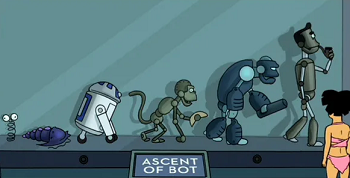
Mechanical Evolution is the tendency in speculative fiction to apply the idea of biological evolution to mechanical devices, wherein later versions of the devices become progressively more suited to their niche (or more likely just progressively better at everything). This is frequently used to explain the presence of Mechanical Lifeforms or Ridiculously Human Robots.
It is seldom shown as the equivalent of the biological process; rather, the mechanical species will be shown to actively design their own successors, or even "evolve" within their current generation through self-modification. This is similar to real-life design, which is in a sense an evolutionary process; success is defined by market factors, testing and other pressures; successive designs build on those before them and attempt to improve or refine them to better fit the given application. With mechanical creatures the "market" becomes society; a common result is a rigid caste system where various machines are built to specialise in particular applications. The most important caste is likely to also be the most humanoid, or be a Master Computer.
This trope often appears in A.I. Is a Crapshoot and/or Robot War story arcs, as a justification for why the machines want to Kill All Humans. More serious authors will try to justify the Mechanical Evolution with Applied Phlebotinum like Nanomachines or self-learning algorithms; less serious authors will simply toss out the words "Mechanical Evolution" and leave it at that.
If the setting also features a Robot Religion (especially of a Thank the Maker variety), expect jokes about them not believing in Mechanical Evolution (or perhaps the other way around).
No one ever seems to compare the advancement of machines to the theory of Lamarckian evolution, which says that traits acquired by an organism over its life will be passed on to the child. Though wrong when talking about organic evolution, this makes perfect sense for mechanical evolution. If an upgrade to an existing model of robot is developed it can be incorporated as standard into future robots of that model when they are created. The Lamarck comparison is probably taken out because the writers assume the viewers don't know who Lamarck is (or don't themselves know of his theory).
A subtrope of Hollywood Evolution. See also Mechanical Lifeforms, Ridiculously Human Robots, and Artificial Human. Compare Grew Beyond Their Programming.
Examples:
- The Zoids Bible says that the eponymous zoids originally evolved from a planet seeded with zoid cores, going through eras of evolution uncannily similar to those of life on Earth, and the zoids shown are post-domestication beings.
- Within the 2003 Astro Boy series, Astro was built with an Adaptive Ability that would enable him to "evolve" into the world's most powerful robot.
- The Transformers (Marvel): In the original series series, the Transformers themselves were once described as evolving from "naturally-occurring gears, levers and pulleys", a theory later dubbed "atechnogenesis". This was later Retconned into the Transformers having actually been created by a deity figure; the levers and pulleys thing turned out to be a theory they themselves had developed about their origins after having forgotten their true origin.
- That said, the development of Micromasters, Pretenders, Powermasters, and so forth could be considered a form of this; a new mechanical trait is invented (a smaller form that's more energy-efficient, a new type of transformation disguise, symbiotic partnerships, etc), and those with the new trait quickly out-compete those without, removing them from the story, if not from living.
- In The Transformers (IDW), believers in this theory are called Evolutionary Engineerists.
- Paperinik New Adventures: In one issue, the origin of a race of alien robots is unknown, but they're theorized either to descend from the computers of a ship who crashed on their planet or to have evolved like every other race "only starting from microcircuits instead of microorganisms". Makes no sense, but who cares as far as it sounds so cool?
- The Avengers: This is often invoked by Ultron to justify new powers and appearance whenever he returns. In his origin story, Ultron went through the stages "Da-Da/Daddy/Dad/Father Dear" in about fifteen seconds.
- Red Dwarf Smegazine: When Kryten is hit by the E-Accelerator in "Evolution", he is shown to devolve into a sentient vacuum cleaner.
- The Incredibles: Syndrome's master plan is to build and evolve a robot by pitting it against gradually tougher Supers; eventually building a machine strong enough to take out his nemesis Mr. Incredible and wiping out the remaining Supers in the process. However, the machine evolves even more and is soon out of Syndrome's control.
- The Crabs, based on Anatoly Dneprov's short story "Crabs on the Island", features a Mad Scientist building an army of self-replicating crab robots and setting them against one another in the hopes of evolving an ultimate weapon.
- The Terminator series, in many media. In a Robot War, the central AI Skynet notes what designs for its killer robots are effective and which aren't and feeds this knowledge into the design of next batch. The result is increasingly more lifelike humanoid robots able to fool the survivors and gain access to their shelters. Too bad they also apparently emit the strong smell of dog food. Reese mentions in passing that the "current" generation of Terminators are the first full cyborgs with true organic skin. They replaced earlier models that had unconvincing rubber skins that made them easy to spot as fakes.
- I, Robot: It happens to Sonny, as he was designed with free will. The ending implies it's happening on a smaller scale to all the obsolete NS robots by pointing out that they huddle together in their storage containers despite not being programmed to do so.
- A.I.: Artificial Intelligence deals with the societal consequences of humans designing ever more intelligent and human-like robots, culminating in an autonomous robotic civilization surviving the extinction of humanity due to climate change.
- Screamers and the sequel, based on the Philip K. Dick story Second Variety (see below).
- The Matrix: The first generation of intelligent machines built by humans were humanoid, but the later generations built by other machines are more like mechanical squids and spiders. The ones we see in the real world in the films seem to be little more than drones, with the intelligent individuals existing as pure software.
- "Crabs on the Island" is a 1958 short story by Anatoly Dneprov about a scientist who decides to test Darwin's theory of evolution with an army of self-replicating, gradually-evolving mechanical crabs, in the hopes of weaponizing them. As can be expected for this type of story, it ends badly.
- Evolution: A self-replicating rover left stranded on Mars after the collapse of human civilization begins to endlessly reproduce itself according to its last orders, creating an exponentially replicating swarm of von Neumann machines. Small errors occasionally crop up in their replications as they do in biological evolution, leading to their designs gradually shifting and diverging over time, and the machines' communication with each other allows them to mix, match and incorporate them as needed, letting them learn and adapt whenever they encounter a new condition and eventually diversify into a dizzying array of specialized forms.
- Manifold: Space: The Gaijin are subject to this, with errors creeping in with each replication. A visit to their homeworld confirms that they were never built by anyone else but really did naturally evolve from scratch.
- Galactic Center: "Mechs" evolved from self-replicating von neumann machines after they were abandoned when their biological creators destroyed themselves.
- The Book of the New Sun: In The Urth of the New Sun, the mechanical humanoid Sidero is revealed to be a robot evolved out of spacesuits with built-in artificial intelligence.
- Harry Harrison
- The War With the Robots. With war becoming ever-deadlier, the combatants retreat to bunkers deep underground, using robots to fight. The robots on either side design ever more effective robot forms, eventually able to drive the humans out of the opposing bunkers. The now-obsolete human race is shocked to find itself sidelined from what used to be their war.
- The Fourth Law of Robotics. A New-Age Retro Hippie decides to circumvent the monopoly of U.S. Robotics and build his own robots. US Robotics has copyrighted the use of positronic brains, especially the use of platinum-iridium plating. The robots manufactured with the Fourth Law use a completely different style of construction; solid-state circuits, fiber optics, PROM, and RAM. The story ends with the new robots greeting their "Daddy".
- Philip K. Dick:
- In "Second Variety", the UN, losing a war with the Soviet Union sets up automated factories to produce "claws" — at first just mobile sawblades seeking warm bodies. Later the claws produce new, more effective designs which mimic human beings. The new varieties are able to infiltrate humanity, spreading paranoia as well as death. In a twist, the story concludes with the observation that some claws are developing weapons specifically to kill other claws.
- "Autofac": As resource war between the automated factories goes on, the autofacs enter an escalating arms race as their construct increasingly complex weapons and optimize themselves for war and survival, eventually becoming able to effectively reproduce.
- The Isaac Asimov story "Found!" is about two astronauts repairing a satellite who find that it's now host to alien machine lifeforms that consume metal and oil.
- In Poul Anderson's "Epilogue" two astronauts hit a Negative Space Wedgie and do not return to earth for millions of years. After a nuclear war, the machines left behind, which are already capable of self-replication, had evolved. It specifically says that radiation could damage the robot's data tapes just like it can human genes, thus letting them evolve. The mechanical lifeforms are unable to understand humans, and see them as entities with "poison under their skin" (oxygen). The humans use oxygen and eventually a transmitter in self-defense against them. The moon is worn but mostly unchanged.
- A similar event happens with the robotic ecosystem that developed on Titan in James P Hogan's Code Of The Lifemaker. Aliens send a mining colony, which gets damaged by supernova radiation and as a result ends up gone wonderfully wrong, with self-sustaining systems and, at the top of it all, sentient robots who are a Fantasy Counterpart Culture for late medieval to early modern Europe (about the time of The Renaissance; the humans who show up even call the robots' city-states by the names of those of Renaissance Italy).
- Stanisław Lem:
- The Invincible is about an exploratory expedition discovering an ecosystem of micromachines, evolved from a lost alien civilisation's Colony Ship's robotic crew.
- In The Cyberiad, the Tale Of The Three Storytelling Machines, Mechanical Evolution is discussed by some Ridiculously Human Robots, who trace their heritage from early Protomechanoans through the Missing Clink, all the way to Automatus Sapiens.
- In Terry Bisson's short story
 They're Made Out of Meat, part of the (implied) premise is that Mechanical Evolution is the norm, and human beings are the only race in the known universe that are completely made of pure organic matter.
- That's left unspecified by the story; the main characters could just as well be Energy Beings instead.
- Especially since at the end they mention a "hydrogen core cluster intelligence" in a class 9 star that wants to get friendly, unless they're referring to something like a Matroishka Brain.
- The species that are referenced include one carbon-based race that "goes through a meat stage" (possibly Brain Uploading) and another that has a stellar plasma brain encased in a "meat" head.
- That's left unspecified by the story; the main characters could just as well be Energy Beings instead.
- In Perfect Imperfection by Jacek Dukaj all the civilisations breed so-called Wars - pocket universes full of nasty reality warping warmachines. In book, the machines inside of Wars are said to evolve.
- The lead programmer in Idlewild tries to create adaptable programs that would "bleed" back and forth as appropriate to grow with their subjects. It works.
- In the distant back-story of Caprica and Battlestar Galactica intelligent machines evolve into humanoid machines and leave their human masters to found a colony named Earth as their former masters are also forced to abandon their home and end up founding 12 colonies. On Earth, the humanoid machines build their own sentient robots — who themselves want to evolve and who therefore rise up to destroy all but five of their humanoid creators. Meanwhile, on the human colonies, people have created yet another generation of intelligent machines. The union of these two machine races finally leads to the creation of the human-model Cylons who appear in Battlestar Galactica.
- And the union of those human-model Cylons and the Colonial humans along with another genetically compatible but unrelated planet of humans leads to the creation of modern human race, namely, us
- The Replicators from both Stargate SG-1 and Stargate Atlantis both use this. The SG1 Replicators as part of their story arc, the Atlantis ones as part of the backstory.
- Referenced in the 2 Broke Girls episode "And the Pearl Necklace," with plotlines about a technological upgrade to the way the girls take orders at the diner and the possibility that a cupcake-backing machine will make their business plan obsolete. Max freely and frequently references the Terminator and Matrix franchises.
- Implied with AI Natasha of Other Space. In a segment where the crew are reverted to infant forms, she becomes a Pong game. When she loses access to her memory banks her behavior reverts to infancy. Kent is able to advance her development to that of a middle-schooler by re-educating her.
- The declared goal of the Roidmudes from Kamen Rider Drive is this; by copying humans and key emotions, they can further their own advancement, usually in some way tied into the strongest emotion of whomever they initially copied.
- The Makuta in BIONICLE evolved from Mechanical Lifeforms (with organic parts, akin to Wetware CPU) to Energy Beings in Animated Armor. Word of God later confirmed that the inhabitants of Mata Nui's planet-sized robot body were originally mindless nanotech before a programming glitch of some kind granted them sapience.
- According to the DVD Commentary of Mask of Light, the BIONICLE animals (aka Rahi) were designed with differing levels of organic components, as franchise co-creator Bob Thompson suggested that the fauna was in the process of evolving from partially organic cyborgs to fully mechanical lifeforms. As such, Graalok the Ash Bear was shown to be completely robotic in the film, while other creatures had hints of organic tissues. This idea was swiftly abandoned after the movie, with later story explaining that Rahi didn't evolve naturally, they were created and purposefully tweaked and improved by the Makuta.
- Enslaved: Odyssey to the West: Robotic dragonflies are said to have "evolved" primitive sensors in order to seek out sources of energy to feed upon.
- Mass Effect:
- The geth, a "species" of software-based synthetic lifeforms housed in mobile platforms and vast networked servers, have been actively evolving themselves over three centuries since their war with their quarian creators, developing advanced technology that runs a course greatly different from the rest of the galaxy's species. By contrast, most other species are following a common technological path, exactly as the Reapers want them to.
- The Reapers consider themselves to be the pinnacle of all evolution (mechanical or otherwise). They see organic life as nothing more than a strange accident, useful only as something to be harvested when necessary to further the development of "true" life. The Catalyst indicates that this is only partially true, and that part of the point behind the Reapers is to prevent the evolution of complex synthetic life by destroying organic civilizations before they can reach the singularity that would result in a superpowerful synthetic form of life taking over the galaxy. It is implied by Sovereign that deliberately seeding the galaxy with Reaper technology causes organic life to develop down certain tech paths, which helps the Reapers control and harvest them and stymies the true development of AI.
- In both the Xenogears and Mega Man Legends video games, the heroes find out that the species on the planet are not humans, but evolved descendants from the biological parts of ancient human technology.
- The Pulverizers in Armored Core: last raven, as each one gets defeated a new one is made that's even faster and more powerful than the previous one, with tanks being the weakest and the strongest being a crazy airborne spidery looking thing that gives the alien queen a run for its money. The humanoid one, interestingly, sits in the middle of the spectrum in regards to strength.
- Present in Mega Man X in a rather unique form: all reploids are 'replica androids' derived from the titular X, who was designed with 'limitless potential,' the capability to evolve to (hopefully) overcome any obstacle he was presented with. This makes him simultaneously one of only two (actually only one) people capable of resisting The Virus and extremely important to the goals of The Virus: as he's forced to fight and evolve, more and more powerful reploids can be made based on him, allowing the species itself to evolve over time. This was mostly ignored after the first game in the original version (where it explains a sudden power-up after a Heroic Sacrifice) until it became relevant again in the eighth game: the remake of the first game placed more emphasis on it, with the Big Bad aware that the more X fought and stopped their plans to Kill All Humans, the stronger his own forces would become.
- As the opening cinematic for X3: Terran Conflict explains, terraformers are examples of a technology called artificial general intelligence, "mechanical minds capable of making themselves more intelligent, and again, and again, recursively forever." The intent was presumably to make the robots capable of adapting to unexpected events during the terraforming process, but somebody fouled up a software patch and they went haywire, turning into the Xenon.
- How the Glitch came to be in Starbound. There were originally several other robotic races similar to that built by the same empire on different worlds to simulate sociological and technological progression but they always wound up destroying themselves each time they advanced to a certain point. The exception comes from one planet where, well, a glitch caused them to be stuck in the medieval times which allowed them to survive for so long.
- Binary Domain has this happen with Hollow Children. Amanda AI created them specifically so that they could have children and evolve, since it wanted to become a real life form and not merely an unique AI
- The Talos Principle: The point of the protagonist's existence and the world it inhabits. The goal of the program is to have the nameless protagonist evolve from a basic AI to a full-fledged artificial consciousness. You're playing either at or near the end of the process, depending on your choices at the end.
- Stellaris seems to have this happen to the the Gray Tempest across different outcomes of the L-Cluster scenario. In the "Gray Tempest" they are a mindless Gray Goo swarm which destroyed their creators and then consumed everything living in the L-Cluster. The "Desananu Consonance" appears to occur later in the timeline, with the Tempest having gained sapience and replicating the destroyed planets and civilization of their creators to interact with other races. "Gray" is the endpoint of their evolution as, bored after millennia of experience, the collective swarm abandoned most of it mass and compressed its entire mind into a single malleable form.
- In S.S.D.D. the Oracle was designed to be self-improving, the rationale being that once it was running and debugging itself the programmers could be fired or imprisoned (they were hackers after all). In fact one of its programmers was an expert in evolutionary algorithms (see below), though he mostly created viruses that could mutate like biological ones.
- Is it any wonder why the Oracle is the only AI capable of copying itself?
- It's since been shown that all AI are the "seed" type, but most originate on quantum computers that can't be copied and have blocks (which can be removed) to prevent them from getting too smart.
- The robots from Gunnerkrigg Court are an inversion: they evolved into simpler forms over time. Their creator was a genius, and the designs of his first generation of robots defied understanding; so after he died, the robots had to simplify their designs in order to maintain themselves. So, basically, they evolved based on not-Intelligent-enough Design.
- Which is actually closer to biological evolution, since it's the successful form that survives rather than the 'advanced' one.
- And now that Kat is starting to unlock the secrets of the original designs, there is a growing segment among the robots which believes she is literally an Angel.
- The Dig-Bots from Sluggy Freelance keep on reproducing for several years, until they've created several variants like the Brain Dig-Bot, Bouncer Dig-Bots, High Priest Dig-Bots, and Trash Can Dig-Bots.
- Inverted in Girl Genius. Agatha tends to compulsively construct little Clanks. These dingbots can then go on to construct more dingbots, but dingbots are only so bright, so each successive generation gets less and less advanced, and less bright, and by the third or fourth generation the dingbots produced are nonfunctional.
- In Questionable Content, AnthroPCs (robotic companions) can "upgrade" their chassis. This happens at least twice, with Pintsize and Momo-tan, and works in conjunction with the fact that the author of the strip is constantly evolving his artwork.
- In Nukees Teri evolved from a custom calculator pet designed to eat other guy's gigapets, to a near-Singularity gestalt that has infected most of the world's major computers. She's a gestalt of thousands of copies with slight variations, which fight one another for influence in the gestalt, Gav's current strategy for stopping Teri is to get an antivirus program high in the hierarchy.
- Several examples are apparent in Schlock Mercenary. Carbo-silicate Amorphs, the species of the titular Sergeant Schlock are evolved from long-term, self-repairing memory storage systems created by the Bradicor before their civilisation collapsed, Esperrin physiology has been described by Para Ventura as "Late-phase output from somebody's iterative mechanical replication experiment" and the planet of Ellwor from the companion roleplaying game has an entire ecosystem that has absorbed and co-opted the remnants of the unknown high tech civilisation that once lived their with skyscraper sized trees that emit radio waves as territorial warnings to competitors to name just one example.
- Orion's Arm has many, many examples, including a planet with a machine ecology known as Stanislaw.
- Doctor Steel believed that robots would eventually evolve to the point where they would replace man, who by that time would have polluted the world so much that only his machine creations would be able to survive anyway. (He even published a paper on the subject.)
- In order to deconstruct the common creationist Strawman argument that evolution is false because watches do not build themselves from smashed partsnote cdk007 made a video, Evolution IS a Blind Watchmaker!, in which he wrote a computer program that simulated clocks evolving from their parts, with results that look as though they could have been specifically designed, but in fact, were not.
- On Justice League, AMAZO's ability to evolve was so potent that by his second appearance he had even evolved beyond being a machine.
- In the Futurama episode "A Clockwork Origin", Professor Farnsworth releases some Nanomachines to purify water on an uninhabited planet. Subsequent generations of nanites are more complex, and the situation very quickly gets far out of hand. By the end of the episode they've evolved into Sufficiently Advanced Aliens.
- In Beast Wars, the Autobots and the Decepticons decided to change to more energy-efficient forms called the Maximals and the Predacons, respectively, in an event called The Great Reformatting.
- The Samurai Jack episode "The Tale of X9" starts with X9 telling how Aku's evil scientists developed their master's robot armies. The first ones were "crude", one resembling a bunch of junk in a vaguely robotic form with wheels, then a "cleaner" version of that one, then a rickety, fully-humanoid robot, then one that seemed like a typical robot soldier. Finally they came up with the model which X9 is, which seemed to be the first efficient models, used as assassins. Eventually, this model was retired in favor of the Beetle-Bots that are usually seen in the series proper.
- Love, Death & Robots: Implied in “Three Robots”; the sentient robots appeared to have evolved out of existing mechanical devices following Humanity's Wake. K-VRC, for example, is hinted to be descended from baby monitors.
- Programmers use evolutionary algorithms to improve on designs.
- The "evolution" of the automobile through the years (along with Mickey Mouse's) has been used as a parable of biological evolution in educative works.
- YMMV on whether or not this is logical. It's certainly an example of evolution (change over time) but the analogy would really be for Intelligent Design (at least if the designer was doing it on the fly each generation) than for Natural Selection (or some combination there-of if that even makes sense: an intelligent designer deciding which traits to continue, which to change, and what new things to add based on the competition between models and market forces)
- In his book The Singularity Is Near, Ray Kurzweil introduces a theory of Evolutionary Levels with biology and technology as two of them.
- This idea is Older Than Radio, with Samuel Butler writing Darwin among the Machines, a letter in 1863 under a pseudonym where he postulated that machines might evolve just as organic life does, and eventually even become the superior species to humans, raising many themes of The Singularity long before it was common. However, he didn't agree with natural selection, instead accepting more Lamarckian mechanisms (which, as posited above), does make more sense for machine evolution. Butler advocated destroying all the machines before it was possible. How serious this all was, though is debatable (he was accused of writing it purely for entertainment at the time). Still, the ideas are nonetheless prophetic. This was also the basis of his later book Erewhon, which explored the idea further.
