
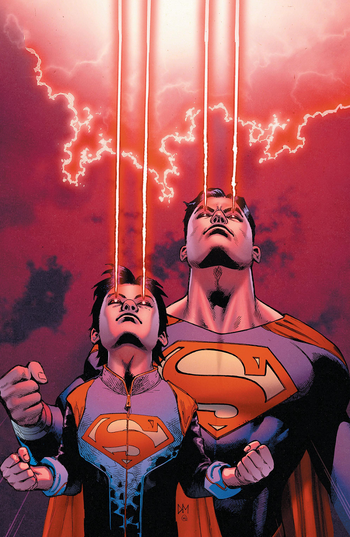
Jean Grey: Cyclops! Well, if we have children, they'll be mutants. They'll face the same problems we have all our lives.
Cyclops: I wouldn't have it any other way.
Having a superhero parent is like being Blessed with Suck. There's the bi-weekly kidnappings, frequent Parental Abandonment, being constantly lied to if your parent has a Secret Identity, being forced to lie to maintain your secret, and constant worry that your parent(s) or you will be killed by a vengeful supervillain. But look! You can fly!
Normally, heredity is a messy affair; it's often described as a game of chance. Thanks to Darwin, Mendel, Watson and Crick, it can be explained a good deal better, but much like A.I. Is a Crapshoot, what traits a child will inherit from each parent are mostly random. Not so with superpowers. Children of "supers" can have a limited number of things happen:
- Develop identical powers to their parent(s).
- Develop radically different (and usually insanely powerful) powers from the parent(s).
- Develop powers that are a twist on their parent's powers, or a combination, if both parents are supers (though this happens much less often than the above two).
- Inherit their parent's skills; see Lamarck Was Right.
- Inherit no powers or skills at all, then eventually manifest them.
- Inherit no powers or skills at all, for keeps this time; see Muggle Born of Mages.
- Inherit no powers or skills at all, but their children manifest them; see Recessive Super Genes.
Super-power inheritance tends to happen more often than could be ascribed to chance; a non-powered child of even a hero and a normal person is an exception. Super-powers seem to be "more dominant than dominant" (more common than genetics should allow).
If a parent's powers are caused by gene splicing, or from being born a mutant or part or full alien, then it gets interesting. Specific powers actually have a higher chance of not being inherited. In such cases, the child usually gets a completely different power, or at best one that's only tangentially related. This becomes much likelier if both parents have different powers. Only occasionally will they just have a combination of their parents' powers; this tends to happen if the parents' powers are very simple, or if the series was designed around the child, and the parents were brought in as part of the Back Story as a Secret Legacy. If this happens often enough, it may be revealed that all the powers of that family are just different expressions of the same gene as a Meta Origin. Often results in a Super Family Team.
If only one parent has powers, however, the child's powers are much more likely to be a straight copy of those, though often at a higher level. This may encourage the writers to give that power its own Meta Origin.
See also Genetic Engineering Is the New Nuke, Superior Successor, Lamarck Was Right, Genetic Memory, Magic Genetics, Bio-Augmentation. Compare Muggle Born of Mages and Sexually Transmitted Superpowers. Settings that avert or minimize this trope may use Randomly Gifted instead.
Examples
- Attack on Titan has the Ackerman family, who all gain superhuman physical ability in times of emotional distress. There's also an unusual case in which the superpower isn't so much an advantage as lacking a disadvantage; there is a power that can control people, but only works on particular bloodlines, with people sufficiently unrelated to those bloodlines to be immune being rare. Members of the Eldian race are the only ones that can become Titans and Titan Shifters.
- The Ackerman family is said to be a result of "Titan science", implying that they're human-Titan hybrids (despite Titans being human to begin with) in some way.
- Black Clover: Magic attributes are hereditary to an extent, especially among noble families. The Silva Family children all have magic related to liquids, whether it be Mercury, Mist, or Water. The Vermillion brothers both use Flame Magic, and brothers of the Vaude Family, Finral Roulacase and Langris, both have Spatial Magic.
- Bleach:
- Quincy powers are hereditary, leading to an clan-wide obsession with bloodlines.
- Ichigo and Karin can see ghosts, Yuzu can see faint outlines of them, and Ichigo eventually became a Shinigami with an extremely high amount of spirit energy. Why? Their father Isshin is a retired Shinigami, and has all the same powers Ichigo does, at a Captain's class. Ichigo also inherits hollow and Quincy powers from their mother's side that make his attempts to master his abilities very complicated.
- In Bobobo-bo Bo-bobo, Maitel is a 3rd cousin of Medusa. Naturally, this means he can turn people to stone too.
- Dragon Ball Z repeatedly shows that hybrids of humans and super-powerful aliens produce insanely powerful offspring. Lampshaded by Vegeta, when he notes that he trained intensely to unlock his Super form, while his hybrid kid can do it for fun. If a child is conceived after the father has unlocked said Super form, that child will be able to do so with essentially no effort, in a case of Lamarck Was Right. If the child was born beforehand, it's quite a bit more difficult. They're crazy powerful regardless, though. The only real exception to this out of ALL the half-saiyan children is Vegeta's daughter Bra, who he apparently chooses to dote on rather than train.
- Before any of that, this trope is Played for Drama in the Cell saga, where the Big Bad was created from the genes of most of the heroes. This gave him all of their strengths and their deadliest techniques.
- In the future, descendants of Vegeta and Goku don't even realize the significance of their Super forms other than noting their hair turns yellow.
- The author admitted he had no idea what to do with or even how to handle a female Super Saiyan so he just ignored Bra.
- Frieza and his father owe their devastating power to the fact that they are an unique mutant offshoot of their race. When Frieza decides to combine that devastating inherent power with actual training, the results prove to be dramatic.
- Before any of that, this trope is Played for Drama in the Cell saga, where the Big Bad was created from the genes of most of the heroes. This gave him all of their strengths and their deadliest techniques.
- In Hunter × Hunter, insane Nen-potential seems inherited just like insane physical potential.
- Joseph Joestar from JoJo's Bizarre Adventure could use his grandfather's sun channeling abilities from a very young age, although he had to train them for them to be effective against Pillar Men.
- Junji Ito's story "Layers of Fear" inverts and averts this in the worst way possible. Sisters Reimi and Narumi are both given a genetic curse that alters their physiology so that their bodies are composed of progressively older layers like a Matryoshka doll. Their deranged mother sees this as an opportunity to turn Reimi back into the little girl she cherished. When that fails, she decides that she must have the same condition as her daughters and tries to peel her own skin until she's young enough to give birth to little Reimi again. She doesn't.
- Type 1 was intentionally done by the Kings of Ancient Belka in Lyrical Nanoha. The modifications on their bodies were not only meant to turn them into Persons Of Mass Destruction, but to force the powers they gained unto their future descendants as well.
- My Hero Academia: Every Quirk (superpower) is hereditary, with a child having the potential to either inherit the power of one of their parents (Type 1 — example: Kyoka Jiro, who inherited her mother's Earphone Jack) or develop a whole new Quirk that is a combination of both powers (Type 3 — example: Katsuki Bakugo, who combined his mother's ability to secrete glycerin with his father's ability to sweat nitric acid into the power to sweat nitroglycerin), though how that combination goes can vary between siblings (example: Shoto Todoroki, who combines his father's fire quirk and related abilities with his mother's ice quirk and related abilities to use both together, versus Toya Todoroki, aka Dabi, who got his father's fire quirk but not his resistance to heat and his mother's resistance to cold but not her ice quirk). Being born without a Quirk is also possible (Type 6 — example: Our protagonist, Izuku Midoriya), but rarenote , and it's even rarer for someone to develop a Quirk completely different from their parents' through a genetic mutation (Type 2 — example: Eri, whose Rewind is explicitly stated to be completely different from any family member's quirks).
- A number of ninja clans in Naruto have special genetic powers referred to as "kekkei genkai", or "bloodline limit". These include eyes that can copy others' abilities, being able to manipulate and regrow your own bones, any Elemental Powers which are formed by combining any two of the basic five elemental affinities (for example, Water + Wind = Ice), etc. There are also abilities that seem like this, but are actually just well-kept clan secrets, such as the Nara clan's ability to manipulate shadows.
- However, genetic powers aren't always passed down. The best example of this is the First Hokage's wood release, which was entirely unique to his DNA, with none of his descendants inheriting it. Another partial example would be the Fourth Kazekage, since only his youngest son inherits his power of magnetism.
- Unlocking the Rinnegan, the ultimate form of the Sharingan, requires combining the genes of the Senju and the Uchiha clans, the respective descendants of the Sage of Six Path's two opposing sons. Madara Uchiha awakened his Rinnegan by stealing a small piece of Hashirama Senju's flesh and grafting it onto his own body. Sasuke Uchiha later also later gets the Rinnegan (but only in his left eye; the right remains a Mangekyo Sharingan) just in time for the last battles of the series.
- Subverted in +Anima. People with Anima power are believed to have Kim-un-Kur blood in their veins. In reality, children gain the ability to turn into animals they see during their near-death experiences.
- Implied with the title character in Project A-Ko. A-ko's parents appear to be Captain Ersatz versions of Superman and Wonder Woman, which would explain her extraordinary strength.
- In Ranma ½, the Musk Dynasty bore offspring through wild, powerful animals that had been thrown into the Spring of Drowned Girl, thus turning them into women. Their children would then inherit traits exhibited by, or closely related to, their mothers' natural form. Hence, Mint's superhuman scent, hearing, and speed (born from a wolf); Lime's grotesquely overpowered physical strength (born from a tiger); and Herb's ability to fly and discharge his ki in devastating streams (born from a dragon). One episode of the anime hinted that children of a cursed parent will inherit that parent's curse — but that episode was all one of Ranma's nightmares, so it's not canon.
- Weapons in Soul Eater come about in this way, thanks to the 'bloodline' of the original experiments. It's possible for a weapon to show up in a family that hadn't had one for a very long time, which we see is what happened with Soul Eater himself. For some reason, the Nakatsukasas had come to expect that the eldest child would inherit the Morph Weapon abilities. When this did not happen, things did not end well. Kid falls definitely into the 'will eventually inherit' category, as BREW so helpfully showed off.
- Tenchi Masaki of Tenchi Muyo! is slightly over one quarter Juraian (his father happens to be a descendant of his maternal grandfather). Juraian's are an alien race with a tendency to develop Jedi-like powers with training (the royal family being stronger as well). He's also the most powerful "Juraian" in existence; capable of manifesting three "lighthawk wings", one of the most powerful defensive/offensive attacks known. A typical Juraian space ship is capable of manifesting only one.
- OVA Tenchi is most likely disqualified from this as he's the avatar of his dimension's god. However, the one from Tenchi Universe more than qualifies as it's said that his own Juraian power was passed down from his mother, who was pretty damn powerful in her own right.
- While Tiger & Bunny's Word of God says that NEXT abilities aren't genetic, it's certainly telling that the two superheroes who were fathers (Wild Tiger and Mr. Legend) ended up having superpowered children (Kaede and Yuri Petrov).
- Marvel's Eternals avert this; they can breed with mortals, but the kids are just normal humans. This plays a part in Ikaris' tragic Back Story (here's a hint; he took the name Ikaris in honor of his late son).
- Eternals breeding with Eternals rarely produces offspring, but they are full Eternals — except for the Titanians, who originally only had half the power of the Earth Eternals, and whose current population are descended from both sides of the "family", resulting in wildly varying power levels and longevity. Then there's the Ritter twins, children of an Eternal and a Deviant (another offshoot of humanity with constant mutations); they appear as normal humans but can Fusion Dance into either one or two Eternal-powered beings, Depending on the Writer.
- Thanos wields far greater power than the average Titanian Eternal due to a mutation that also made him look like a Deviant. His mother tried to kill him when he was born since she (rightly) believed he would be a monster later in life, but his father spared him because he (also rightly) thought an Eternal/Deviant mutant had great potential.
- Family: The mafia have superpowers thanks to the 'bloodline', hence why they favor Sicilians marrying each other to not dilute it.
- The children of Fantastic Four members Reed and Susan Richards show two variations. Their daughter, Valeria, has been shown in a future timeline to have a more advanced version of Susan's invisibility powers (other alternate versions of Valeria have been shown with a variety of powers), whereas their son Franklin is sort of... intermittently omnipotent.
- Valeria is currently a super-genius; at three years old she was already Reed-class, and it's later confirmed that this is her power. Franklin is currently partially powered after the last time he pushed his omnipotence into overdrive, essentially recreating the multiverse with his family. At his maximum, he is potentially one of the most powerful beings in the entire multiverse; characters who can make Galactus sit up and beg were afraid of him for a while. When he has powers, there's usually a Restraining Bolt (imposed by him or others depending on the timeline) on them that limits him to helpful but not god-tier psychic abilities.
- Descendants of the The Flash universally inherit Super-Speed; The DCU's "meta-gene" was called in to explain this. Many other DC characters avoid this trope by having their successors or apprentices come with their own origins.
- This was played with when Flash Wally West fathered twins. Although both had powers based on speed, his son's ability was super-accelerated growth of muscle tissue, and his daughter could vibrate through objects. Then it got even weirder when their powers went berserk, and for a very brief time, they had what seemed to be time-based powers instead: he could turn into prehistoric animals and she could accelerate the flow of time. Now she has basic Super-Speed and he's unpowered.
- Another example of a superpowered lineage could be found in the DCU Manhunter series. Kate comes from a long line of metahumans. Her great grandfather Hugo Danner, grandfather Arnold "Iron" Munroe and father Walter Pratt were all superhuman. While Kate herself is not fully-superhuman, she is unusually strong and tough and it is implied that she is a borderline metahuman. Her son Ramsey inherits powers that easily exceed any of his ancestors. He is also an extremely rare fifth generation metahuman.
- The whole Force family is made up of superpowered individuals whose meta-genes tend to activate in strange ways not resembling other family members, and who have had activated meta-genes at least since the age of the Roman Empire. The family disapproves of flashy heroics and prefers to help the world in smaller or more subtle ways, such as working as a doctors for metahumans that normal doctors don't have the ability to treat and most of them live on the family farm in British Columbia. Some notable Forces and their powers are D.C. "Sparx" — Electrokinesis & Elemental Shapeshifter, "Tetrad" — Self-Duplication, Smith — Super-Strength, "Piston" — Chrome Champion, Anastasia — Touch Telepathy & Care-Bear Stare, Gale — Blow You Away, Doc — Aura Vision, Vein-o-Vision & X-Ray Vision and the matriarch of the family granny Iris, a Blind Seer.
- Gen¹³ and their Evil Counterpart team DV8 inherit powers from the genetic Super-Soldier project that produced Team 7 and other gen-actives. Generally, these powers have nothing to do with their parents' powers (except the time Burnout inherited his father's Mind Control powers for about a week).
- Gold Digger has Gina Diggers. Despite being the only daughter of Earth's most powerful aura mage and Jade's greatest warrior she has absolutely no talent for magic or fighting whatsoever. (Alternatively, given her certified super-genius action Omnidisciplinary Scientist status a case could be made for her being a type 2 who simply doesn't stand out quite so much due to already living in a World of Badass.)
- The Incredible Hulk: The Hulk's kids are an interesting case. His son, Skaar, inherited both his parents' power sets — giving him the power to control the earth in addition to the Hulk's powers. His twin brother Hiro-Kala only got the tectonic powers. His daughter Lyra, created via genetic engineering, got only a measure of the Hulk's superstrength; instead, she developed the ability to attune herself to gamma radiation — in combat, she can almost always position herself exactly where she needs to be. Unfortunately, thanks to deliberate tampering in her creation, the angrier Lyra gets, the weaker she gets.
- It's later revealed that Hiro-Kala is a Hulk as well, but has never hulked out. And his transformation is triggered by love. Also, his tectonic abilities are absurdly powerful by his race's standards.
- And it turns out all Gamma mutates are descended from a single common ancestor who had the latent genetic trigger that causes gamma radiation to grant superpowers as opposed to nasty radiation sickness.
- Not all; Bruce Banner's mentor, Professor Gregory Crawford, who discovered said genetic trigger while examining Bruce's blood, found a way to copy it through genetic manipulation, which he used to turn himself into the Gamma mutate Ravage. It's also suggested that the Red Hulk and Red She-Hulk didn't have the genetic marker themselves, and were only created and stabilized after significant genetic modification.
- Betty Ross (Red She-Hulk) has the genetic marker, as Modok had previously turned her into the gamma-mutate the Harpy to use her against the classic Green Hulk (her Red She-Hulk status being a result of combined gamma and cosmic ray exposure).
- Lampshaded in Invincible. Invincible's super-powered alien dad explicitly has genes that beat up and take over the genes of whatever he mates with, creating offspring that are almost identical to himself, powers included. Case in point, he also mates with a humanoid praying mantis girl and produces a child who looks perfectly human except for his purple skin. And even the purple skin vanishes with age, making him look fully human.
- Zigzagged in Jupiter's Legacy. Most children of superhumans inherit their powers, but Hutch; the son of superhero turned super-villain Skyfox, does not.
- The Justice League: Legacy arc has some kids from a bad future of the current roster of Justice League show up in the present. Aquaman and Wonder Woman's children inherited their full powersets, with Aquaman's daughter Eldoris having Mera's magic and hydrokinesis. Cyborg's son Cube is leagues more powerful from being integrated with mother box tech on the cellular level. Flash had three kids with Jessica Cruz, their eldest daughter inheriting his powers (and choosing a codename that's a pun on her mother's maiden name), while their fraternal twins were born with the ability to use any power of the lantern spectrum without a ring.
- Planetary: It is explained Century Babies all have extended lifespans in addition to their abilities. Their children will also inherit the extended lifespans, along with abilities of their own, as evidenced by Jakita Wagner and Anna Hark, but not William Leather(whose mother cheated on his father, a Century Baby).
- The comic PS238 both uses and subverts this trope. The premise of the comic is an elementary school for children with superpowers, many of which have heroes as parents. The main character, however, is a new student, the child of two of the most powerful heroes in the world, who has no powers whatsoever. (His parents are simply convinced that their son's powers have not yet manifested, as he will be as powerful as they are — as it turns out, he doesn't, but his clone is a vastly powerful Reality Warper.) As the story has developed, it is becoming increasingly clear that the character is the school's Badass Normal in training.
- This gets deconstructed later by "Big Bad" The Headmaster, an anti-metahuman Well-Intentioned Extremist, who considers superheroics a form of evolutionary mutation: Like all mutations, they want to spread, hence why "classical" superheroics are actually a form of courtship display meant to showcase the superpowers of the individuals involved. He argues that eventually, competition for mates, evolution of powers and crossbreeding of metahuman with metahuman will lead to the piling on of powers over several generations, creating more and more powerful superpowered children until eventually a Goo-Goo-Godlike scenario and the probable destruction of planet Earth. An alternative scenario shows up on planet Argos, where the Flying Brick power set became dominant and eventually led to a "cull" of all other metahuman powers. Argos is a permanent feudal society, with Flying Bricks as nobles and non-powered "Softies" as a permanently repressed underclass. The noble houses keep the Flying Brick powers stable through Arranged Marriages between houses.
- Blindside of the DCU's Relative Heroes apparently inherited the ability to turn invisible from the Golden Age hero the Invisible Hood, and Hood also passed his ability and hero name on to a confirmed great grandson. Blindside's status as twice orphaned means and the fact that his last name doesn't match up (both Hoods were Thurstons, Blindside's name is Tyson Gilford) means he has trouble confirming this.
- The main characters of Runaways tend to have superpowers corresponding to those of their parents. Many of these "powers" are magical or technological gifts.
- In Runaways, Molly Hayes initially appears to have not gotten the mutant gene despite her parents both having it. Early on in the story however, she is discovered to have super strength (while both parents had mind controlling powers, and her strength turns out to be psionic in nature). Karolina has exactly the same alien powers as her parents which her mother points out means that none of them can hurt each other. Chase is the son of two brilliant Mad Scientist Gadgeteer Genius types, but his abilities run more to minor cleverness, street smarts and punching things. Gert has a pair of travelling also mad scientists (but more biology based) for parents and though she is gifted with their intelligence, her power is actually something they engineered for her - being psychically linked with a bio-engineered Deinonychus (think Jurassic Park Raptor).
- In the case of The Savage Dragon, the main character's son Malcolm directly inherited full-power versions of both parents' powers, which isn't so surprising if you know that Dragon's powers run in his family's dynasty. His mother's electrical powers were given to her later in life, so they must have caused genetic changes, thanks to Golden Age villain Doctor Nirvana's experiment.
- This series has a ton of examples of this trope, as it's been running in real-time for nearly twenty years, leading to many second-generation characters appearing constantly.
- Spider-Girl: May "May Day" Parker is the daughter of Peter Parker, and not only did she inherit his powers (that didn't manifest till her teens) but also his sense of humor, fight banter, and his academic skills. However she's not exactly like him, as she got her mother's good looks and social skills.
- Superman:
- Before 2015, the Man of Steel had no canonical descendants for most of his story, though the issue was explored in many "imaginary" stories. Classically his children with a human wife have all his powers at half power level.
- The Generations storyline affirms this with halving occurring with each successive generation. One Elseworlds had one of Kal-El's Ancestors land on Earth and take over, with each successive generation being less powerful to the point that Kal-El himself had no powers and his father was barely superhuman.
- In 2015, Clark and Lois' son Jonathan Samuel Kent was introduced in canon.
- Other examples of his offspring include a child of Superman and Wonder Woman who ended up being an alternate version of the Phantom Stranger. In DC One Million, his offspring apparently retain their powers through successive generations and gain new ones by intermarrying with various species including a 5th dimensional being, forming a Superman Dynasty. Superman himself returns in this timeline after hundreds of thousands of years transformed by exotic energies and gaining the ability to bestow additional powers on his offspring. The Superman of the 853rd century, a direct descendant of Superman, is like our Superman on steroids.
- The aforementioned Generations storyline has an odd instance in Superman's son Joel Kent who would have had his powers had he not been exposed to Gold Kryptonite in the womb. Much to Joel's bitterness and dismay, his younger sister was not exposed and ended up being super-powerful.
- Hinted at in Whatever Happened to the Man of Tomorrow?. Superman officially died ten years before the story begins. While a reporter is talking to a now-married Lois Lane for an anniversary article on events, her baby boy is seen crawling around. After her husband comes home, the baby is playing by the fireplace with a piece of coal. The next frame shows the baby in the same place playing with a diamond. No, they did not find a body ten years before.
- In Kingdom Come, Brainiac's Daughter is Brainiac 5 and Supergirl's offspring, and she has inherited her mother's Kryptonian powers and her father's super-intelligence.
- In the New 52, Superboy was the clone of the future son of Superman and Lois Lane, Jon Lane Kent, who was raised by a metahuman hater called Harvest to be a Living Weapon — and both he and Superboy were, for whatever reason, massively powerful psychics, though they were hinted to have more classic physical superpowers too. No one had any particular idea as to why.
- Aura (Lindsay Wah) from Superboy and the Ravers is a second generation DCU metahuman. While her mom did use her powers to save people she always remained anonymous never taking on a superhero identity, and was murdered by her mutant hating husband when he learned she was a metahuman.
- The Wild C.A.T.s (WildStorm) are all descendants of the Kherubim and/or the Daemonites, super-powered alien races, and inherit their powers — since both races have a vast array of potential powers, the humans usually only get a random fraction of them.
- Wonder Woman Vol 1: Diana and Steve Trevor's daughter Lyta develops the same powerset as her mother and becomes a superhero under the name Fury.
- The X-Men had mixed up examples of 1 and 2:
- While Jean Grey (psionics) and Cyclops (Eye Beams — though from a family of energy manipulators) were the source of two (or three, depending on how you count) of the most powerful psychics in the multiverse — the word 'source' being used since 616!Jean has never been pregnant: Rachel Summers was from an alternate reality, Cable was the son of Scott and Maddie Pryor (Jean's clone), while Nate Grey (Cable's Age of Apocalypse counterpart and half-brother) was created whole from that universe's Scott and Jean's DNA. And not only are they ludicrously powerful psychics (depending on the state of Cable's techno-organic virus), with Nate being stated to have the raw power of Dark Phoenix at the tender age of 17, they also have a host of other powers:
- Rachel's capable of manipulating time (sending her mind through it and travelling through it)
- Cable's virus comes with a host of technopathic powers/physical enhancements, more limited temporal powers, and possibly teleport (it's ambiguous how much at full power is him and how much is tech)
- Nate Grey is a fully fledged Reality Warper directly compared to the above mentioned Franklin Richards, and at full potential, he's created entire realities and death is nothing more than a mild inconvenience.
- Magneto (with powers of magnetism — usually now interpreted as electromagnetism) fathered a speedster, a probability manipulator and (via Retcon) a magnetism user like him. That being said, at least one version of Wanda's origin had it that her "natural" mutant ability was some form of energy manipulation, like her father, but she "attuned" to the magical energies around Wundagore Mountain, resulting in her "Chaos Magic". (This was before Dr Strange said there was no such thing as Chaos Magic and then denied that he would ever make such a claim, OF COURSE Chaos Magic is real). And then a later retcon said Pietro and Wanda weren't really his children anyway, and are actually descended from a long line of Scarlet Witches.
- Wolverine's recent Retcon backstory posits that he is descended from two powered families, one with bone claws and one with a Healing Factor. Nightcrawler is likewise (supposedly) the child of an ages-old mutant clan with interdimensional powers, and Angel is implied to be from an angel-like mutant bloodline as well.
- Clan Akkaba are descendants of Apocalypse, and each member has inherited variations on his powers. The greater families, including the Slades, have a weaker version of Apocalypse's shape-shifting and longevity, and a minority also possess his grey skin. The 'Lesser' members have different and unique powers, such as Jack Starsmore, who can instead breathe fire. More rarely, shapeshifting members randomly gain additional mutations, such as Frederick Slade, who has pink hair, solid green eyes and teleportation, shared with his descendant Blink. Chamber's powers as a psychic furnace are pretty different to his ancestor Jack Starsmore, and very different from Apocalypse.
- In Young Avengers, on the other hand, the "brothers" Tommy and Billy apparently got the same powers as their "mother" Wanda (it's complicated) and uncle Quicksilver — Tommy has superhuman speed and Billy can manipulate reality by expressing a desire for it. Any powers from their "father" the Vision seem to be nonexistent, possibly because Wanda "gave birth" to them herself. Cassie Lang shares the same growth powers as her father Scott, however this was from her stealing Pym particles and not inheritance (her father's superpowers weren't genetic). While Patriot has no powers from birth, he does get superhuman strength from his grandfather (formerly one of the Captain Americas) via blood transfusion. Meanwhile, FF foe the Wizard is a Mad Scientist with no powers, but being around gravity-manipulating technology most of his life lets him have a daughter who controls gravity innately.
- Averted by Mystique and Sabertooth's son Graydon Creed, who is a baseline human born to two mutant parents. To say he has a complex about this (and the resultant abuse) would be a bit of an understatement.
- Quicksilver and the Inhuman princess Crystal's daughter Luna subverts this. The X-factor and Inhuman genes cancel each other out, leaving Luna an effectively baseline human. Her dad, driven crazy (well, crazier) by the loss of his powers thanks to M-day, exposed her to a heavy dose of Terrigen Mist to correct this "error". Thankfully, it worked. Luna survived (though she developed a bit of an addiction to the Mist) and gained empath powers.
- One of the consequences of M-day was that mutants could no longer have mutant offspring. They could still have children, but the children would be baseline humans.
- A possible future introduced Ruby Summers, daughter of Cyclops and Emma Frost. She has her father's eye beams and has also inherited her mother's "secondary mutation", only instead of diamond she turns to ruby, reflecting her father's ruby-quartz visor.
- In stark contrast to Graydon Creed mentioned above, Mystique's and Wolverine's future son Raze has both of his parents' power-sets.
- While Jean Grey (psionics) and Cyclops (Eye Beams — though from a family of energy manipulators) were the source of two (or three, depending on how you count) of the most powerful psychics in the multiverse — the word 'source' being used since 616!Jean has never been pregnant: Rachel Summers was from an alternate reality, Cable was the son of Scott and Maddie Pryor (Jean's clone), while Nate Grey (Cable's Age of Apocalypse counterpart and half-brother) was created whole from that universe's Scott and Jean's DNA. And not only are they ludicrously powerful psychics (depending on the state of Cable's techno-organic virus), with Nate being stated to have the raw power of Dark Phoenix at the tender age of 17, they also have a host of other powers:
- Zenith is a slight subversion; he does get his parents' powers, just not all of them, and they don't work all the time.
- Last Child of Krypton: In this crossover Yui Ikari finds Jor-El's rocket with a sample of his genetic material — in the rewrite it is a sample of Kal-El's DNA — and she modifies her unborn baby with kryptonian DNA. When Shinji grows up he develops Superman powers.
- Superwomen of Eva 2: Lone Heir of Krypton: It kicks off the entire plot. Long story short, baby Kal-El dies when his rocket crash-lands on Earth, and his DNA is used to fertilize one of the Kyoko's eggs when she got an in vitro fertilization. When Asuka was a teenager she started to develop kryptonian powers.
- Auric powers in We Are All Pokémon Trainers are normally conferred by genetics, though they can skip generations, as was the case with Dune.
- In Child of the Storm:
- Mutant and magical powers often function like this, though they can sometimes skip generations.
- The Clan Akkaba and the Clan Askani both usually had this, the former inheriting some variation on Apocalypse's powers, with some exceptions as with the possible example of Jono Starsmore (who was an Akkaba descendant in canon) and Illyana Rasputina a.k.a. Magik (a teleporting sorceress, which makes far more sense when it's revealed that Apocalypse was a mutant-mage hybrid and Doctor Strange's first, fallen, apprentice) and Piotr Rasputin a.k.a. Colossus. The latter, meanwhile, were pretty much all psychics of some form and more interested in bringing in new blood to improve their bloodlines, a semi Breeding Cult/Mystery Cult filed as "mostly harmless" (though if Sinister was actually one of them, that description could not be more wrong). Neither was particularly happy when powers weren't inherited - the Askani opted for exile, until their understanding of genetics caught up. The Akkaba were... less civilised.
- Alex Summers Senior is a powerful energy manipulating mutant, and while his son was a Muggle Born of Mages especially since his mother was Emma Frost, his grandson, Scott, has legendarily powerful Eye Beams and is implied to have inherited a latent version of his grandmother's diamond mutation, while Scott's clone-brother, Gambit, inherited a much more precise form of energy manipulation with very precise psionic control over it.
- The most dramatic case is the Grey family, which was originally an exiled offcut of one of the Askani bloodlines that seemed to dry up of all psychic potential, with - at most - a few limited psychic talents popping up every other century. Then, it produced an exceptionally powerful witch, and the generation after, the two (actually, three) most powerful psychics ever to exist: Jean and Harry (Jean is by far the stronger, Harry just happens to be the only person other than her twin and equal, Maddie who's even in the same weight class). In the same generation, it also produced an Alpha Class psychic cousin of Jean's called Tyler and Dudley Dursley a.k.a. the Beast/the Blob, an Alpha class mutant with psychically-derived Super-Strength, and it's implied that there are a couple of others in the family.
- More specifically, Harry slowly inherits his father's Royal Asgardian physiology, estimated to peak at 75% of his strength and durability in exchange for greater speed and mobility, and his mother's massive latent Psychic Powers as well as her inclination towards pyromancy.
- Diana inherits her Physical God level physique from her father, said father being Hercules. No one's entirely certain where the flight came from, though. Or the empathic abilities, come to that.
- Carol inherits the super soldier serum from Steve, though it needs a kick in the pants to wake up. As it turns out, her entire family has it.
- Clark Kent is Zig Zags this. While it seems like the House of El and other 'High Blood' houses have an inherent advantage, with Flying Brick powers under a yellow sun as opposed to 'just' Golden Age Superman powers, it's revealed to be a very minor example of Hybrid Power - there was a genetic lock and the most prominent families on Krypton were the ones that, where compatible, made diplomatic marriages with other species (in the House of El's case, Asgard), the unions replacing the genetic lock.
- Mutant and magical powers often function like this, though they can sometimes skip generations.
- Equestria Girls: Friendship Souls: How Quincies keep up with Soul Reapers who have centuries of experience on them. The purer their blood the faster their body instinctively learns and picks up techniques and skill at an accelerated pace when exposed to other Quincy. Best shown with Twilight instinctively learning Blut Arterie from sparring with Lemon Zest (and blowing a hole through her body in the process).
- Intelligence Factor: The Metagross chapter explains that a Progenitor gene is needed for a humanoid to enable Mega-evolution.
- The Snow Queen And The Ice Demon explains Elsa's cryokinesis by making her Loki's daughter, whose Jotun blood attuns him to ice.
- The sequel The Ice Demon and the Captain
 introduces Pietro and Wanda Maximoff, also descendents of Loki by their father Erik and possessed of latent powers. Erik and Pietro are also mentioned having inherited Elsa's Mystical White Hair.
- The sequel The Ice Demon and the Captain
- Cinder, Jaune, and Ruby are all prominent examples of this in Lords Among the Ashes.
- Cinder carries the Blood of Destruction, an inheritance passed down in her line since before they were cast from power by those who had placed them there.
- Jaune carries the Blood of War, a power cultivated in his line in an attempt to avoid the self-destructive nature of others without losing any of their might.
- Ruby carries the Blood of Death, a legacy bestowed upon her line for the sake of destroying the Grimm but which may lead to their own destruction in the end.
- Zig-zagged in My Huntsman Academia. Semblances are normally unique to the individual as a manifestation of their soul. But some families, like the Iidas and Todorokis, are predisposed to have particularly strong Auras (albeit, with a lack of a Semblance in the Iidas' case). The Schnee family's Glyphs are also a rare hereditary Semblance. Shouto also explicitly inherited Semblances from both his father and his mother and was specifically bred to be this way in hopes of surpassing Toshinori.
- born of hell('s kitchen) has 7-year-old Peter already able to use both his mother Jessica's Super-Strength and his father Matt's Super-Senses, with the implication he's going to grow much more powerful. Even the drawbacks — he briefly suffers Sensory Overload — are mentioned to be lessening.
- Early in Son of the Sannin, Jiraiya and Tsunade get married and she gives birth to twins, a boy named Hagane and a girl named Kaida. Kaida soon manifests Hashirama's Wood Release, which supposedly only appears if the individual has an exceptionally powerful chakra. Meanwhile, when Hagane starts his Elemental Ninjutsu training, he discovers that his affinity is Nature itself, meaning that he has equal control and power over the five basic Elemental Releases (most ninjas have only one, or at most two affinities), plus also can share chakra with his allies to give them a power boost. Jiraiya feels rather proud of himself when he learns it, thinking that his genes might have created a new Bloodline Limit.
- In Lavandula Somnambulist, Izuku's mother has the ability to emit a Knockout Gas from her exposed skin while his baby-daddy can breath fire. Both of these quirks manifest in the form of a Super-Breath that can knock people unconscious and can control them like sleepwalking puppets.
- Reflections in the Mirror: Chika is surprised that Yohane isn't a mage, given that her mother Hekiru is, with Kohaku explaining that having a mage parent only marginally increases the rather low chance of a child gaining magic. That said, the first chapter has Yohane finally awakening her powers, and in the second it's mentioned that her mother's family is famous for having a large amount of magic practitioners in her family, with Yohane being the sixth in a row.
- In Superman of 2499: The Great Confrontation, Alan Kent and Katherine De Ka'an are descendants of the first Superman and Supergirl, respectively, and have inherited the full Kryptonian powerset.
- In the fan novelization The Myth of Link & Zelda: Breath of the Wild, there's a consistency of children/descendants of powerful people tend to inherit the powers of their ancestry.
- For instance, Zelda is set to inherit her sealing power which is carried by the women of her family, as well as the powers of Din's Fire, Nayru's Love, and Farore's Wind. But her sealing power is more powerful, because she doesn't just have a sealing power, but the power of a massive spectral god-level powerful Owl Spirit.
- Yunobo of the New Champions inherited his grandfather, Daruk's power of Daruk's Protection, like in canon.
- Urbosa's daughter, whose existence is only implied in canon through the fact that Riju is her descendant, is actually seen as a very young baby. Link outright asks if this baby inherited Urbosa's Fury, the power to control lightning, to which Urbosa answers in the affirmative because she can sense her baby's fledgling lightning power. Riju herself has Urbosa's Fury too.
- Princess Lochlia of the Zora is this too. Her parents are Princess Mipha and Link. She inherited the power of Mipha's Grace from her mother, and the power of Flurry Rush from her father. Her own daughter, who she named Mipha, has Mipha's Grace, too.
- The Incredibles: Mr. Incredible, with his Super-Strength, and Elasti-Girl, with her elasticity, get married and have Dash, a Super Speeder and Violet, who has invisibility and force fields and Jack-Jack, who seems to have a full combo platter.
- The superpowers in Fast Color are genetic, hereditary, and apparently sex-linked, since only females (girls or women) have them.
- In Freaks (2018), Abnormals have Abnormal children with different, but generally stronger, powers. It's mentioned at one point that while Abnormals were forcibly relocated if possible, their children are killed, as they're just too powerful to control or contain. However, this policy has recently changed since the ADF now wish to capture an Abnormal child and raise it to be a weapon for the government. This makes the reveal that Chloe's grandfather has powers an even bigger deal, as it means that Chloe herself is a third-generation Abnormal, explaining the extent and potency of her own abilities.
- Hulk: Bruce Banner gets the same aftermarket add-ons as his father, which Banner Sr. spliced into himself in a failed attempt to make a Super-Soldier. It takes both gamma rays and Nanomachines to finish the job.
- A type 2 in Looper, though not exactly "super powerful" in the beginning.The resident Chekhov's Skill in the film, the mutant's telekinesis, is fairly common and doesn't really impress anyone. However, Sara has a notably stronger version of it, and her Cid — being her child and that of another mutant — has that power amplified.
- Necessary Evil seems to be reaching for both 4 and 5, with the brothers.
- In Push, children of psychics tend to inherit their parents' abilities, sometimes to a greater extent (although the reverse can be true as well). For example, Cassie is a watered-down version of her extremely powerful mother (a Watcher), while Nick is a more powerful Mover than his father was (at least once he has some practice). The Triad boss's sons have inherited his Bleeder ability (although his is more powerful), but his daughter is actually a pretty good Watcher (possibly, her mother was one as well).
- Sky High (2005) goes with the fifth option twice. After spending a long while thinking he would never develop powers, the main character inherits his father's Super-Strength and his mother's Flight powers separately (both were Die or Fly situations, the second a Suicidal "Gotcha!" using flight). The bus driver, and only other person on record to have super parents and not get powers, just exposed himself to toxic waste and grows 50 feet tall on demand. Nurse Spex also states that sometimes powers just aren't passed on at all (and in the cases of exposure to toxic waste, if their powers don't show up by the next day, they tend to just die).
- In Star Wars, Luke and Leia inherit their Force sensitivity from their father Anakin Skywalker (a.k.a. Darth Vader). Leia's son Ben Solo (a.k.a. Kylo Ren) is also Force sensitive, as is Palpatine's granddaughter, Rey.
- Up, Up and Away! involves a boy named Scott whose parents are Bronze Eagle and Warrior Woman. Bronze Eagle can fly, and Warrior Woman has super-strength as well as a super-fast motorcycle. His big brother, Silver Charge, has super-speed and electrical manipulation. His little sister has x-ray vision and Eye Beams. Even his grandparents on his father's side have super-strength/flight (grandfather, Steel Condor) and Voluntary Shapeshifting (grandmother, Informed Ability). Scott's problem is that he's quickly approaching his 14th Birthday, and he has yet to develop any ability. 14 is the cut-off for a super. If he doesn't get an ability by that time, than he's just a Muggle. To that end, he decides to fake having super-strength (by rigging a door to fly off its hinges) and flight (by throwing a ball at a tree and hiding). In the end, though, it's his normalcy (and immunity to aluminum foil) that ends up saving the day.
- Played With all over the place in We Can Be Heroes (2020) with the kids of the Heroics. A Cappella plays it the straightest (sharing her mom's Super-Scream powers), while the rest of the kids vary from having no powers to having different powers from their parents to going full Mage Born of Muggles.
- In X2: X-Men United; the mutant gene is said to be passed down from the father (but not explicitly stated to be located on the Y chromosome). Though given the tension of the scene, it seems likely that Pyro was simply exploiting Mr. Drake's ignorance to make him squirm.
- In The 39 Clues, the Cahills have a downplayed version. Each branch of the family has a different special quality (Lucians are leaders and schemers, Ekatrina are genius scientists, Tomas are gifted athletes, and Janus are great artists) due to their ancestors (siblings Luke, Katherine, Thomas, and Jane Cahill) each taking one-fourth of a serum (meant to cure the bubonic plague) which gives the imbiber all of those qualities. The fifth branch, the Madrigals, don't have any genetic special quality, since their ancestor Madeline Cahill was born after the serum's creator had died. They've still managed to produce such luminaries as Deng Xiopeng, William Shakespeare, and the protagonists, Amy and Dan Cahill.
- Ascendance of a Bookworm: Having powerful mages as parents greatly enhances the chances that a child will be a powerful mage themself, but is far from guaranteeing it.
- The protagonist herself is a commoner Devouring child, which means she is a Mage Born of Muggles. The setting is one with a Supernatural Elite, which means commoners are not expected to have magic at all.
- The lowest social status someone born in a noble family can have is being blue robe priest or shrine maiden in the temple. The bulk of them were sent there by their parents beacause they have a Mana level so low that they are not considered worth being taught to use their powers. Laynobles, the lowest strata of nobility, are considered the most likely to produce blue robe level mages, but blue robes from both mednobles and archnoble (the strata that includes the most powerful mages of the territory) families have been introduced.
- While a child's mana level is mostly influenced by the mother, two people with significantly different mana levels can't have children with each other at all, meaning neither side of the family can truly be given credit for a Mage Born of Muggles or Muggle Born of Mages situation.
- In the Chronicles of the Kencyrath series by P. C. Hodgell, the Highborn of the Kencyr can at times be so psionic that their powers blur the boundaries of reality. It's strongly hinted that their abilities are due to genes implanted from the even more powerful Arren-Ken, which occasionally manifest as felinoid body parts such as claws.
- Cobalt Blue: The children of both superheroes have abilities, but at only half the level of the originals. Naturally, America and Russia ensure that many children are born to them in different ways.
- Well-known and a bit of a plot point in Codex Alera, where powerful furycrafting abilities tend to run in families. Centuries worth of selective marriage among the nobility have led to the High Lords all being insanely dangerous, and the First Lord even more so.
- Both the ability to manifest Deryni powers and the Haldane potential (apparently a variant) are transmitted genetically; the trait is dominant, so only one parent needs to have the trait for an offspring to inherit it. Thus, so-called "half-breeds" are just as powerful as full-blooded Deryni. Deryni generally need to be taught to use their powers; carriers of the Haldane potential need no training, but must have the potential triggered by a outside action. This is usually done in a ritual, the specifics of which vary slightly from one generation to the next; certain heirloom objects are used, and new ones may be added.
- For the most part, Wizards in Discworld are created from the eighth son of an eighth son. However, every son of a Wizard is also a Wizard, and the eighth son of a Wizard is a Sourcerer. Wizards are forbidden to marry because of this.
- Dragonvarld: The Sethan woman with the dragon magic pass its abilities down to their children. For the boys it often drives them insane over time unfortunately, as they get lost in the telepathic communications dragons send which they're capable of seeing.
- In The Dresden Files, magic runs in families, usually matrilinearly. This is part of a villain's plot in White Night, when some of the White Court start killing off female magical practitioners too weak for the White Council to notice, on the logic that this will interfere with future generations of wizards and they can afford to wait.
- Invoked by the Bene Geserrit in Dune, whose breeding program aims to produce the Kwisatz Haderach, a person with prescience. As it turns out in the sequels, this is Gone Horribly Right, as said Kwisatz Haderach turns against them.
- In the prequels set during the Butlerian Jihad, the Sorceresses of Rossak wanted to produce more women with telekinetic abilities, but the same mutation that granted the ability also reduced the rate of successful childbirth.
- In The Elvenbane, powerful elvish spellcasters produce children who are powerful, weak casters produce weak children, and intermarriage between strong and weak produces a child of intermediate power. At least in the first book, it's never explained where powerful spellcasters came from in the first place, but their attempts to stay powerful through the generations have led to severe inbreeding. Human spellcasting is also inherited, but in defiance of the trope it's an indirect and imprecise pattern. note
- Lampshaded in a narrative comment on how the elves don't really understand human inheritance or fertility.
- Lashana, the title Elvenbane, plays this relatively straight. She was sired by one of the magically powerful elvenlords upon a human concubine whose Slave Collar was revealed to be containing tremendous Psychic Powers. Due to the synergistic effects elven and human magics have when wielded by the same individual, Shana's raw ability is... formidable.
- Zig-zagged in The Fifth Season with the Functional Magic of orogeny. People are born with the "curse" and it is heritable to an extent, which the Fulcrum encourages by enslaving every "feral" orogene and forcing powerful orogenes to have children together. However, orogenes can also be born to Muggle families and non-orogenes can be born to orogene parents, an uncontrollable element of randomness that infuriates the Fulcrum.
- In Stephen King's Firestarter, the young female protagonist inherits powers from both of her parents, squared — despite the fact that their superpowers were caused by an experimental drug, not genetic tinkering.
- The Forgotten Beasts of Eld: Sybel, her father, grandfather and great-grandfather were all able to do magic, indicating it's a hereditary ability (at least for some).
- In Harry Potter, it's quite common for a magical child to be born to two Muggle parents, which The Tales of Beedle the Bard explains as so-called "Muggle-borns" actually having wizarding ancestors somewhere in the family tree. Which seems to indicate that magic is a recessive trait. However, nearly every person with at least one magical parent is magic themself, and Squibs exist but are incredibly rare. This doesn't fit with a recessive allele, but a dominant one doesn't actually make more sense. Fan Wank abounds, naturally, most of which points out that this is magic we're talking about.
- Journey to Chaos:
- The Bladi Clan is made of humans with Blood Magic. That is, blood magic that is literally in their blood.
- The royal family of Ataidar has their Royalty Super Power passing their bloodline.
- Elves pass their Seed of Chaos parent to child. In this way, the seed mutates them in the womb.
- Played With in Knights of the Borrowed Dark where the titular Knights' powers are usually passed on from their parents (as with Denizen, Abigail, Darcie, Ed etc.) but don't manifest until age thirteen and very occasionally skip a child at random. However, some rare Knights spring up out of the blue (such as Simon and, it's implied, Grey), and it's speculated that they're genetic throwbacks or have a Knight who left the Order somewhere in their family tree.
- Important matter throughout the Kroniki Drugiego Kręgu series. No one knows why only boys are born with magic, or why some mages are insanely powerful, but others seem to have no talent at all. The ruling magical class (whose ancestors are said to have conquered their land with a sword and magic) is desperate to find out, because they are slowly dying out and their Super Breeding Program doesn’t give any results. There are hints it may be connected with a recessive, sex linked gene (that’s why magic seems to be passed on from the mother’s side and why there are so few female mages). Later the heroes discover that citizens of a neighbouring country (descendants of the original inhabitants) also have potential for magic, which goes against already established beliefs. In the end it turns out that the native inhabitants of the continent always carried magical genes and the invaders’ blood was only a catalyst that let this potential truly manifest. That’s why most mixed people are so powerful.
- When a character in the Lensman series has the last name "Kinnison", you can be sure they're going to kick ass. They may die in the process, but ass will be kicked in the meantime. Kimball Kinnison (the hero of Grey Lensman and Second-Stage Lensmen) eventually marries Clarissa MacDougall, a descendant of Virgil Samms, the eponymous First Lensman. Their kids are the Children of the Lens, and they're explicitly stated to be the most powerful minds in the Galaxy, exceeding even the Arisians who created the lenses. To give just one example, while son Christopher is given a Lens, his four sisters are not... instead, they realize they might be useful occasionally, create them out of thin air using sheer mind power, and then dissolve them again the same way until they're needed.
- Avoided in Charles Stross' The Merchant Princes Series — the single superpower is caused by a recessive gene, and the inheritance is consistent.
- Mistborn:
- Genetics plays a direct part in whether or not someone is born with Allomantic or Feruchemical powers. As a result, the Lord Ruler set up a deliberate program and laws to control the superhuman genetics, with only nobles being allowed to have Allomancy, and killing any of the "skaa" commoners who possess these powers (and going so far as to mandate the execution of any skaa woman whom a nobleman sleeps with) as well as genociding anyone with Feruchemy.
- Wax and Wayne, taking place a few hundred years later, has several running subplots about people trying to control the powers. One conspiracy found a way to use Blood Magic to steal the power—and they're only exposed because the heroes notice them kidnapping people for their breeding farm to ensure a stable population. Kelsier, despite disagreeing with basically everything about that plan, notes that it was inevitable that genetic magic would lead to a eugenics program, and maybe the god who invented the magic system should have thought of that. His plan is to democratize the power in a variety of ways, but unfortunately most of them are either impractical or not suitable for large-scale use.
- All of Harry Keogh's sons in the Necroscope series gain his talents in speaking with the dead, and have the capacity to learn how to use math-based teleport skills. It's implied Harry himself inherited at least his "Deadspeak" from his own mother. The Distant Finale of the series implies that all Espers eventually pass their abilities on to their descendants.
- Superpowers in The New Humans generally seem to be strongly hereditary. Exploiting this turns out to be the main purpose of the New Human Institute.
- Of Fire and Stars: People mostly inherit an ability to do magic genetically. Dennaleia inherited her ability from her maternal Zumordan ancestors.
- Several of the creators of the Old Kingdom invested their power in specific bloodlines. As such, the Abhorsens, royals, and Clayr all tend to manifest the appropriate powers as needed.
- The Perfect Run: The children of a Genome will inherit some variant of their power. The child of two Genomes will inherit a variant of one parent's power, influenced by the power of the other parent. For example, the daughter of a woman with the Green power to make plants grow and a man with the Yellow power to cut anything gains the Green power to create life from her blood; in other words, to make things grow by cutting herself.
- The entire premise of Rick Riordan's Percy Jackson and the Olympians series, about demigod children of the Greek gods who inherit their parents' powers. For example, the titular Percy has command and intimate knowledge of the sea, just like his father Poseidon.
- A version occurs in one of the Serendipity books when a pegasus mare mates with a mortal stallion. When she turns out pregnant, a wise old mare explains that the child could be born with either legacy. Turns out he's born with tiny, tiny wings, obviously unable to let him fly — but still the mother thinks perhaps they'll grow. However, by the time she must leave (for if she stays, she too will lose the ability to fly), the wings are as small as ever. She wings away into the clouds, trying to ignore the cries of her terrified child. But the series being full of magic and generally using happy endings (even with bittersweet overtones), the foal comes up after her, in those few minutes having sprouted (through willpower alone) wings large enough to carry him.
- In Shaman Blues, Wiktoria inherits her father's magical abilities, despite the fact that magic genes are recessive. Justified by the mother also having some supernatural in her blood.
- The Silerian Trilogy: The ability to do magic is often (though not always) inherited. Several magic user characters have either a parent or grandparent with the same ability.
- Spellster: Magical ability is usually hereditary, and spellsters have at least one parent who also had it in most cases. Hounds are also born from one spellster parent too, and though they can't do magic they have natural Anti-Magic as a result.
- In the Star Trek Novel 'Verse, as of The Fall, Benjamin Sisko is watching his daughter Rebecca very closely, ever alert for any possible sign that she's inherited powers or abilities from the wormhole aliens, due to Sisko himself being "part Prophet". The idea that she might have is disturbing to Sisko, to say the least. As of the Star Trek: Deep Space Nine Relaunch novel Original Sin it's very clear that she has.
- In the Star Wars Expanded Universe, Force Sensitivity is clearly heritable.
- It's kind of annoying how each new child of the Skywalker line is touted as having the Strongest Potential Ever. In I, Jedi Corran learns that the creation of illusions and permutations of the Jedi Mind Trick, ability to absorb and convert or channel energy, and the inability to use telekinesis unless currently channeling energy are all Halcyon family traits, and his grandfather was a Halcyon. Over time he manifests each trait. Jedi who are not Skywalker-descended can have non-Jedi siblings and relatives whose weak Force-Sensitivity manifests as things such as a bit of "luck" and accurate hunches.
- It seems like that if a Force-Sensitive is cloned, the clones will themselves be Force-Sensitive, as shown with Jorus C'baoth and Joruus C'baoth. Though the clone's origins are mysterious enough that it is entirely possible Palpatine created and discarded dozens of C'baoth clones before getting one with the original's power. The clone also makes a clone of Luke, but the Luuke clone might not have been a Force user.
- When Vader clones Starkiller, the clone retains the original's extremely strong abilities (the original could pull a Star Destroyer from the sky, while the clone can disintegrate anyone around him with a Force wave and super-charge a ship turret to blow up a Star Destroyer). Additionally, Vader's attempts resulted in dozens of failed clones who still exhibit powerful abilities.
- One of the drawbacks of cloning Force Users though (therefore why neither the Jedi nor the Sith do so to shore up their numbers) is that cloned Force Users tend to be mentally unstable.
- In Super Powereds, children of Supers tend to be Supers themselves. There are cased of kids of Supers being normal humans or kids of Supers being born Powered. In some cases, children's abilities can be similar to their parents', although it's demonstrated multiple times that no two powers are exactly alike. Siblings also tend to have generally similar abilities. For example, the twins Will and Jill Murray are a Gadgeteer Genius and a Technopath, respectively. Also, Angela and Shane Desoto have manifestation abilities (Angela can manifest and control objects made of Hard Light, while Shane can do something similar to shadow-based constructs). In addition, both the Desoto siblings have inherited their grandfather's abilities, although he can control both light and shadow (he's also the first costumed Hero, Captain Starlight). Chad Taylor's ability is nearly identical to his father's, and he even manages to replicate some of his father's tricks. On the other hand, Alice's flight (or Gravity Master) ability doesn't appear to have any relation to her father's transmutation or her mother's precognition. She was also born a Powered, not becoming a Super until a special procedure is invented to give a Powered control over his or her ability. It's eventually revealed that her primary ability is very similar to that of one of her uncles', who also happens to be a professor at her university. Hershel/Roy's ability is remotely similar to their father's, although not for reasons they initially think (they initially assume that, since Titan is a strongman, then this is why Roy has Super-Strength; however, Titan's true power is adaptation, and so is Hershel's, except, in the latter case, he manifests Roy as his stronger alter-ego. Roy's maximum strength is proportional to Hershel's, so Hershal actually has to work out in order for Roy to get stronger past a certain point.
- Sword of Truth: The "gift" that enables one to use magic is hereditary, but eons of wizards killing each other have led to it becoming rarer and rarer; by this point, most children of lower-powered wizards will not be wizards themselves. The powers of a Confessor and the Anti-Magic properties of the "pristinely ungifted", however, are guaranteed to be passed on to their children.
- Anne McCaffrey's Tower and the Hive series follows a large clan of Talents with Psychic Powers over numerous generations. It's indicated in Damia's Children that more powerful Talents usually but not always have more powerful children. Sometimes a powerful and a 'weak' talent can produce some truly remarkable results. This becomes a plot point in the later books, where some younger Talents resent the fact that 90% of the Primes in FT&T are from the same family, which ultimately stems from the fact that said family has been enthusiastically reproducing for two generations, while most of the other Primes in their generations weren't having children at all, ultimately resulting in there not being many Prime-eligible candidates outside the Gwyn-Raven-Lyon dynasty.
- In The Twilight Saga, Edward can read minds and Bella can create sort of psychic shields. Renesme got the exact opposite powers. She can project her thoughts into other people's minds and ignore psychic shields.
- Villains by Necessity: It turns out Sam inherited magical abilities from his birth father. This mostly manifests as just him always hitting something when he throws a dagger, but anti-magic wards also activate with him. It's said he could become a wizard, but Sam isn't sure about doing so.
- Generally averted in Villains' Code, where children of metahumans aren't necessarily going to become metas themselves. For example, Ivan's kids appear to be perfectly normal kids (then he finds out that his daughter has recently become a meta, although it's implied it has nothing to do with genetics). Helen's daughter hasn't inherited her (or any) ability, which makes sense, since Helen's ability isn't genetic. This trope might play straight with Beverly, whose father was able to get a magical artifact working, just like Beverly herself (although a different artifact). It's implied that their family has a latent ability to manipulate magic.
- Wearing the Cape: Mostly averted. Since supers are exclusively examples of Traumatic Superpower Awakening, Breakthroughs are not genetic. However, children of Breakthroughs have a statistically higher rate of becoming Breakthroughs themselves, including children born before they broke through. It's probably a psychological thing about how their parents raised them. It's also mentioned that there is no correlation whatsoever between the powers of a parent and the powers of a child. One of the heroes on the Young Sentinels team is specifically noted to be an exception, with air powers identical to that of his father.
- In The Wheel of Time series, channeling comes in two stripes: some have the ability, and can learn to use it, and a very few have the spark, and will use it at a certain age whether they mean to or not. The implication is that the spark is a recessive trait, and this is supported by its being more common in isolated populations, and the fact that it is becoming rarer in men, who have been culled of the ability for millennia.
- Inverted in the Wild Cards anthology series. Superpowers are caused by the Wild Card virus, which can be passed on by either parent, and is always passed on if both parents have it. However, only 1% of infected people become super powered "aces," regardless of how they were infected. This means the child of two aces is 9% likely to become a deformed mutant, and 90% likely to die a horrible death.
- One ace character must break off his engagement to his childhood sweetheart when he finds out she has the virus too — and he can't even tell her why.
- There is one case of an ace having a daughter with identical powers, but this is explained by saying he psychically manipulated her genetic structure in the womb. If there was a trope for Suspiciously Specific Superpowers, that guy would be the Trope Maker.
- The Psi Lords of Takis have inheritable powers, which is to be expected since they are the products of a Super Breeding Program specifically geared towards perpetuating their telepathic abilities into successive generations. The traits appear to be dominant, but can still breed out over generations. For example, Dr. Tachyon's grandson (by way of ordinary humans) Blaise exhibited stronger-than-normal mind control, but no other telepathic abilities, suggesting that Psi Lord powers are not all derived from a single gene.
- Worm falls somewhere between options 3 and 5. Children of parahumans don't inherit any powers when they're born, but they seem to be far more likely to have the potential to have a trigger event than normal, and the trigger can be far less traumatic. If they do get powers, they're almost always variants on their parents', as described in 3. At the time of the story, the third generation capes are just starting to appear. Naturally, some groups (notably Heartbreaker and the Fallen) have decided this is a good way to get more capes on their sides. Oddly, this doesn't appear to be to do with genetics, since adopted children also sometimes experience the effect. It's because the parahumans' passengers are seeking to reproduce, and a child spending a lot of time near a parahuman (and their passenger) lets the passenger copy itself over to the child.
- Xanth: Xanth is a kingdom where all native humans have magical powers, some more than others. A character must have a unusually powerful magical talent to be considered a Magician. The Xanth books follow Magician level characters who marry, have children, and then are relieved that their children have Magician level talent.
- In the Young Wizards series, wizardry is known to run in families, though it probably has more to do with inherited traits The Powers think make a good wizard more than any "wizardry gene" since the power has to be offered by them and accepted through the Wizards Oath. In Nita's family there's Dariane, her aunt and offscreen, her great-grandmother, all on her father's side.
- In The 4400, children of 4400s do not develop abilities unless one of their parents carries a unique mutation caused by a particular malfunctioning radiotherapy machine. The only offspring we see with abilities is Isabelle, who displays All Your Powers Combined, despite being the child of an empath and a telekinetic.
- Black Lightning (2018) gives us Jefferson Pierce, whose powers turn out to be the result of a vaccine he took as a child as part of a secret government agency's attempt at pacifying the black communities. However, the change was genetic in nature, which means his daughters end up developing powers as well. However, only his youngest Jennifer develops similar electric powers (not quite identical, though), while her sister Anissa has Super-Strength. It's eventually revealed that Jefferson had a dormant meta gene which was only activated by the vaccine. His great-uncle Gravedigger was one of the first metas.
- Buffyverse, the Master's bloodline, unique in origin among vampires has produced a number of particularly powerful and horrible Vamps, chief among those were the Whirlwind: a group of four most recurring vampire adversaries in both series consisted of Darla, Angelus, Drusilla and Spike. Each and every one of them can fight on par with the Slayer and had come close of killing her more times than most.
- The Flash (2014):
- Most of the superpowered characters got their powers from either the Particle Accelerator explosion or some other means, often related to "Dark Matter" which can be caused by a few other things besides a particle accelerator. However, the fourth and fifth seasons imply that this can carry on to their offspring, since Barry and Iris' daughter (and later son) from the future also has super speed.
- It's unknown if Gypsy got her powers from her father, or if they were both affected by whatever gave them powers on their Earth at the same time.
- An interesting case with Caitlin, as her father's alter-ego Icicle has the same powers as her own alter-ego Killer Frost. This is a result of Thomas Snow trying to cure his advanced ALS with an experimental cryogenic procedure, which he also performed on Caitlin, who had the ALS gene as well. Incidentally, Icicle considers Killer Frost, not Caitlin, to be his real daughter.
- Averted with Joslyn Jackam (Weather Witch). Unlike her father (Mark Mardon) and uncle (Clyde Mardon), she doesn't have any weather manipulation powers (or any powers at all), she simply uses a meta-tech staff to do the same.
- Heroes goes with the second of the four options; the children of heroes are almost certain to have powers of their own, but the child's powers are rarely related in any way to the parents'.
- While Matt seems to have the same powers as his father; Nikki, with super strength, and DL, with phasing powers, somehow manage to have a kid who can talk to machines.
- The whole reason Micah (the aforementioned technopath) even exists is that Linderman arranged for Niki and DL to meet, marry, and have children, so that he could then use Micah to (in a roundabout way) seat Nathan in the Oval Office.
- Nathan is the exception to this rule. He's the only one in the family who wasn't born with powers and instead got them from a Super Serum. He manages to keep both this and the fact he has a power at all a secret from many characters, eventually leading to him having some sort of Hitler-esque Fantastic Racism against people with abilities. He gets over it.
- Similar to Micah, Hiro's power (space/time manipulation) has nothing to do with his father's power (probability calculation) or his mother's power (Healing Hands). Ditto for Claire (Healing Factor), whose father can fly, and whose mother can produce fire. Incidentally, though, her mother's power is nearly identical to her mother's brother's power.
- Medium has variant 1, as all three of Allison Dubois' daughters inherited psychic powers. Her half-brother also has them, which raises as yet unanswered questions about whether any of their parents were psychic, too.
- Motherland: Fort Salem: Magic seems to be a hereditary ability, as the witch characters introduced thus far always mention having ancestors who were also witches. In fact most of them come from old witch families. At one point it's mentioned that a group of Bellweather-descended women who were targeted had "faint" witches' marks likely due to being born from intermarriage with civilians and that the women possibly didn't even know they were witches. Same for Vice President Silver's daughter Penelope when she turns out to be a witch; Alder says that Penelope's late mother must have been a witch from a line that went into hiding or lost contact with their heritage.
- Magic in Once Upon a Time can be genetic, but it seems to depend on the source of it. Witches are the only ones that definitively carry magic throughout generations, as shown with the Mills family, though the level of power can vary greatly. Cora was powerful, but not as powerful as either Zelena or Regina, and if Gothel is to be believed then Robin didn't inherit anywhere near the level of magic her mother possessed.
- On Painkiller Jane this is apparently the reason for the neuros' abilities, though the agency frankly admits they're not sure of the real cause. Jane is specifically stated not to be a neuro as well, so it's anyone's guess where she got her ability. It's implied she was injected with something just prior to being thrown out of a high-rise window. It's eventually revealed to be all a part of an experiment by the same corporation to create immortals. All the neuros they've been fighting are actually first-generation failures. Jane and the Chameleon represent the more successful second generation. As a bonus, they can't be chipped.
- Raising Dion: so far, the show featured two characters who had superpowered parents and thus were born with powers of their own: Dion and Brayden. Dion's powers at least partly overlap those of his father Mark (both had teleportation and invisibility as powers), but Dion is much stronger and has more diverse powers note . Brayden however somehow got Mind Control and telekinesis as powers, while his father Walter had Green Thumb powers instead.
- In Stargate SG-1, some humans inherit Ancient genes, though the only "super power" they provide is the ability to be recognized as a valid user by Ancient technology.
- Not really. In Stargate Atlantis it is said that many tech that requires the ATA gene can be controlled mentally by those who have the gene. Sheppard himself says about the puddlejumper that "a lot of fighter pilots would kill to fly this thing; it's like it reads your mind..." Cue the jumper displaying a sensor readout on the windshield and dispensing a life sign detector when he wonders about how they should find their target. Sheppard then mentions he's thinking about a nice turkey sandwich. "Worth a try."
- Also the ATA gene is completely artificial; it was created by the Ancients for the express purpose of having a genetic marker they knew would be unique to their species. Once the main characters re-discover the means of injecting people with this marker, passing it to more humans becomes trivial.
- Teyla has inherited some Wraith genes from her father, who was experimented on by a Wraith scientist. As a result, she can jack into the Wraith psychic network and even temporarily take control of Wraith (while also leaving her own body exposed to be controlled by a Wraith).
- Stargirl: Several children of superheroes or supervillains inherit their abilities. For example, Icycle's son Cameron is shown to have inherited his cold-based abilities (although he doesn't know that yet). And in Season 2 it's clear that Icycle himself inherited his abilities from his mother, who immigrated from Norway. Also, Brainwave's son Junior inherited his psychic abilities. Green Lantern's daughter Jade inherited her father's affinity for the ring. From a non-superpower perspective, Sportsmaster and Tigress's daughter Artemis has been brought up to be extremely athletic and short-tempered, just like her parents. Similarly, the Fiddler's son Isaac is a musician like his mother and father (although he plays a tuba rather than a violin). Averted with Dragon King's daughter Cindy, who was deliberately modified by her father to become Shiv. For a while, Courtney thought she was the original Starman's daughter, explaining her affinity for the Cosmic Staff. She later learns that her real father is a deadbeat, and her affinity has nothing to do with genetics.
- This is the case in Star Trek, most notably with Half-Human Hybrid individuals whose alien parents come from races with special abilities.
- Although Spock is half-Vulcan/half-human, it seems that Vulcan traits are extremely dominant, as it is constantly emphasized how his Vulcan physiology differs from humans. He possesses Vulcan anatomy, as well as their telepathic powers. In fact, the only time the physical aspect of his human ancestry comes up is in regards to his viability as a blood donor for his father.
- Deanna Troi is half-Betazoid/half-human. Betazoids are physically closer to humans than Vulcans are, but possess extensive empathic and telepathic abilities. Deanna seems to have inherited a watered-down version of these, being mainly empathic, but able to communicate telepathically with other telepaths. It comes up on the show that most Betazoid descendants with three-quarters human ancestry do not generally exhibit any psionic ability.
- In one very peculiar instance of non-genetic superpower inheritance depicted in the episode True Q, a young, seemingly human, woman born to two parents who were secretly members of the Q Continuum is herself a Q, complete with functional omnipotence that she is unaware of. To all available tests she seems to be human. But Q causes her to invoke her powers by triggering a warp core breach while she is in Engineering, leading her to instinctively use her powers to stop it. She subsequently uses her Q powers very easily.
- Q are extradimensional Energy Beings. The ones that look human are using A Form You Are Comfortable With. It's hinted that Amanda's parents suppressed her powers (Q can supress the powers of other Q) and made her believe she was human. She had the powers all along, she just didn't realize it.
- In Superman & Lois, Clark and Lois have fraternal twin sons Jonathan and Jordan (named after his two fathers Jonathan Kent and Jor-El). But only Jordan has thus far exhibited Kryptonian powers, initially coming in fits and starts at age 14. According to the hologram of Jor-El, Jordan would never be at the same level as Clark. But he appears to have been wrong, as by the end of the second season Jordan's powers are rapidly catching up to his father, to the extent that he can even fly into space! Whether or not Jonathan will also develop powers is unclear. In the Bizarro Universe, things are flipped and Jonathan has powers and Jordan does not.
- That's So Raven has Psychic Powers that skip a generation, making them most likely recessive.
- The sequel series Raven's Home complicates the issue with Raven's fraternal twin kids, Nia and Booker. While Nia gets skipped, like her grandmother before her, Booker inherits his mother's abilities.
- The Thundermans: Anyone who was born to superheroes or supervillains have superpowers that are varied and do not necessarily have to do with their parents' powers.
- Dungeons & Dragons and Pathfinder have Sorcerers, spellcasters with magic flowing in their veins, allowing them to cast spells spontaneously, usually a result of having some kind of magical ancestry. This isn't limited to Sorcerers, however; both games have other classes that are an example of this trope.
- Exalted's Dragon-Blooded work this way. For any given child of a Dragon-Blooded, case 1 (also Dragon-Blooded) or 6 (ordinary mortal) will be in effect. The odds are highest for the child of two Dragon-Blooded - particularly from families of Dragon-Blooded - and decrease if one of the parents is mortal. However, even if a child is mortal, they can still pass on the potential for Dragon-Blooded Exaltation, and it may show up anywhere down the family line.
- Similarly, the children of the Celestial Exalted also inherit diminished forms of the powers of their parents and can (in rare cases) pass those on to their own children.
- The whole point of the Slivers from Magic: The Gathering, with an additional step. They eat things, then assimilate the genes, then have kids, and their kids have the prey animal's advantages. Oh, and those advantages can be shared with any other Sliver in the area.
- Averted with planeswalkers. It's not unheard of for planeswalkers' children to be planeswalkers themselves, but in general the Spark is unpredictable and cannot be pinned down so simply as an inherited trait...much to the frustration of Yawgmoth, who was mad he couldn't surgically extract such a thing.
- Sentinels of the Multiverse:
- Legacy's powers are a type three with a twist. The powers are only inherited by the firstborn child, and they develop an additional ability on top of their predecessor's gifts — starting with Danger Sense during the American Revolution and compounding with each generation to the full Flying Brick set that Legacy III/Paul Parsons VIII has.
- Gabrielle Adin's family appears to have had a natural connection to the concept of luck, although Gabrielle herself seems to have inherited a much stronger connection than past generations have, to the point where it verges on literal magic. Unfortunately, Gabrielle — as the supervillain Kismet — uses these abilities for petty to moderate crime. (Her family, and thus Gabrielle, believed this was because of a talisman they had, but it turns out from Gabrielle's antics that it's little more than a Magic Feather.)
- Citizen Dawn was hoping for this when she chose Citizen Pain to father her child. Said child, Amanda Cohen/Expatriette, ended up a Muggle Born of Mages with an extremely understandable grudge against her mother, and Dawn hasn't tried again because, though she would never admit it, she's afraid that Amanda's lack of any powers beyond unrealistic hair colour was her genetic "fault".
- Warhammer 40,000:
- Space Marines are the genetic children of the superhuman Primarchs, inheriting their comprehensively superhuman biology... and a few other things. They are not "children" of the primarchs in the literal sense. They are born normal but then become Space Marines only through a regime of mental, physical and spiritual conditioning that includes the addition of artificial biological implants (extra heart, growth hormone generators, venom glands etc.). It is these implants that have their own genetic lineage, tracing back to the Primarchs. One of the implants is the gene-seed, containing "mental, physical, spiritual, martial, and fraternal characteristics" and being collected from any casualty so it can be used to create a new batch of artificial organs. It is said to contain genetic memory, which is why they wait until death to collect it.
- The Primarchs themselves were created by the Emperor using his own genetic material. They were practically demigods as a result. Each Primarch also embodied one aspect of the Emperor. The exception was Sanguinius, who supposedly embodied everything about the Emperor.
- Genestealers are a weird one. Their genetics are predictable in how a bloodline works and the abilities that are passed down, though the immediate generation after the first don't get any powers. Initially you have a genestealer infect its target. This new host becomes part of the group mind of the genestealers and becomes compelled to mate. The host looks normal, but the offspring will be bald and have slight bit of carapace and more than human speed and strength. This offspring later mates with other half-breeds to produce a full-blooded genestealer complete with 4 razor sharp claws and the ability to infect new hosts like its genestealer grandparent.
- Warhammer Fantasy, if you have a chaos-tainted parent then there's a good chance you'll be a disgusting mutant too. One reason why the Old World has so many Beastmen is that some of the mutant offspring who were left to die from exposure, were found by Beastmen and could breed true.
- In both Werewolf: The Apocalypse and Werewolf: The Forsaken games, being a werewolf is a hereditary thing, but that doesn't necessarily mean all children of werewolves will Change. The coupling between a Changed werewolf and the unchanged child of a werewolf (known as either Kinfolk or Wolf-Blooded, depending on the game line) has a greater chance of producing a werewolf; relations between two werewolves typically leads to bad things. First-generation children of werewolves typically have the greater chance of undergoing the First Change, but those further down the family tree may suddenly undergo the Change themselves.
- In the 20th Anniversary edition of Werewolf: The Apocalypse we are told that the only ones that really understood the rules of shapechanger genetics were the Were-Aurochs, who could guarantee that a pairing they arranged would produce changer children. Unfortunately the Werewolves killed them all several thousand years ago. Oops.
- Ace Attorney:
- Though not superheroes, Apollo and Trucy benefit from this. They both inherited this ability from their grandfather and mother. Interestingly, Apollo seems to be the only one who uses the power for anything more than poker.
- The ability to channel spirits runs in the Fey bloodline... sometimes. Despite being born first, Morgan Fey had far weaker powers than her younger sister Misty and after her daughters, Dahlia Hawthorne and Iris, were born without any powers, Morgan was reduced to being the head of the branch family, in service to the main family of her younger sister Misty. This understandably caused her a bit of stress. Morgan's daughter Pearl does have significant channeling powers, described as a prodigy, but is still outdone by Misty's daughter Maya as of Spirit of Justice. But it could be due to their age difference (10 years), as Pearl was able to channel spirits at will at the tender age of 8, while Maya, 18, could only channel her sister's soul and with a low chance of success. This even causes tension between Maya and Morgan as the later finds it unfair her daughter is not the heir of the Fey Clan despite being much stronger than the actual heir, Maya and will attempt to overthrow her. She might feel it is justified as she was herself deprived of her status as Head of the Clan in favor of her more gifted sister.
- Deconstructed in BlazBlue. The Yayoi family, one of the ruling families of the NOL, is focused on being the house with the best Ars Magus users. They would only have children with strong Ars Magus users, and when those became hard to come by the family started inbreeding. The house is still magically strong but it's a lot smaller and less powerful than it used to be, as genetic defects crippled the family bloodline. The current heir, Tsubaki, is quite powerful but a bit unstable sometimes and uses a weapon which will blind and eventually kill her. To add insult to injury, her best friend Noel is even more powerful despite her relatively low family (due to being a Murakumo), which is just another entry on the laundry list of things Tsubaki is envious of.
- The Dragon Age games imply that magical ability is transmitted genetically; Leandra Amell of Dragon Age II remarks that magic has always run in her family, and considering that her husband was a mage it's unsurprising she has at least one mage child. She's related to the family of the human mage PC from the first game, who had several mage siblings...all of whom were taken from their family by the Templars, one after the other.
- Fire Emblem:
- Fire Emblem: Genealogy of the Holy War has Holy Blood of the Twelve Crusaders, which allows their descendants to wield the legendary Holy Weapons and have better stat growths than average units. Holy Blood can be enriched by having intermediate family members enter an incestous relationship, which is forbidden for obvious reasons.
- Fire Emblem: The Binding Blade: Magic has at least some genetic component, as Niime and Hugh are from a long line of shamans, and it's a big reveal that Hugh got his anima magic from his mother, a mage. However, it's also somewhat random, as Lilina is a mage despite Hector having no magical capability. The prequel further muddies the waters: Nino, a mage, is implied to be Lugh and Raigh's mother despite Raigh being a shaman (though the reveal that she's probably Canas' niece fixes that problem) and all three of Hector's potential A-support partners are decidedly non-magical.
- The Paralogue children from Fire Emblem: Awakening inherit their parents skills via Lamarck Was Right. Players often have certain characters paired up or have them change classes before the paralogue stage so their kids have inherited devastating abilities and very high stats they normally wouldn't get in their starting class or gender (such as giving male characters Galeforce). Speaking of which, most the kids (with a few exceptions) are also in the same starting / Base classes as their mothers. If Nah and Yarne are any indication — Manakete and Taguel Shapeshifter abilities are directly genetic too.
- Similarly to Holy War, Fire Emblem: Three Houses has Crests, which grant special powers to those who hold them such as high aptitude for magic, enhanced strength, and other boons that give them an edge over others in addition to the ability to wield the legendary Heroes' Relics. Many of the nobility, who are descended from Fódlan's Ten Elites and Four Saints who fought during the War of Heroes, hail from families that bear Crests.
- First Encounter Assault Recon zig-zags this trope. While genetics are apparently at least some factor in psychic ability, the fetus must also gestate in the womb of a powerful psychic mother to reach its full potential. This is how the Point Man and Fettel were so powerful.
- Yunobo in The Legend of Zelda: Breath of the Wild inherited his Beehive Barrier powers from his ancestor Daruk.
- It turns out that the new-generation Sages in The Legend of Zelda: Tears of the Kingdom all have powers inherited from their ancestors, and that includes Yunobo (and Daruk, by extension). The only time the comparison comes forth is when Sonia and Zelda offer energies to Rauru to stop the advance of a swarm of Molduga; Zelda's aura is bigger than Sonia's. It is later noted that Zelda inherited both Rauru and Sonia's powers as princess of present-day Hyrule.
- In LISA, there are several characters who are able to shoot fireballs, levitate through the air, and perform similar incredible stunts. The developer has confirmed that genetics are the reason this is possible.
- LunarLux: Bella and her mother Thea are descended from the Ancients of Luna, giving them the ability to control Lux and sense the emotions of Murks.
- Metroid: Part of what makes Samus Aran such a high achiever is the Chozo blood she was infused with as a young child. And, thanks to Metroid Fusion, she also has the DNA of a metroid. You know, those monsters that are pretty much invincible to all but ice. And classified as WMDs.
- In Mortal Kombat 9, it is revealed that Johnny Cage is descended from superhuman Mediterranean warriors, resulting in his energy blasts. His daughter Cassie continues the bloodline. Interestingly though, in this timeline the only canonical time those powers have ever been used is protecting someone else from Shinnok. Everything else was just martial arts and Special Forces training.
- Pokémon has types 1 and 3. Baby Pokemon can inherit any move both their parents know, that they could get by Level Grinding. They can also inherit TM or HM moves, or certain moves that can only come from breeding, from their fathers. Thus, it's possible to have a level 1 baby slinging Frickin' Laser Beams around. Further, you can increase the chances that an offspring inherits its mother's Nature by giving her an Everstone. They can also inherit up to 3 IVs (Individual Values, the genes' equivalent in Pokémon) from their parents, the other IVs being set by Random Number Generator. In 4th Gen, equipping a parent with a Power item allow the child to inherit the IV linked to the Power item (example: equipping a Power Bracer on a parent will make the child inherit the Attack IV of this parent).
- South Park: The Fractured but Whole: The New Kid's social-network-friend-making superpower turns out to be inherited from their parents, who both have the same power though theirs are limited to a single social network each. The New Kid's power of Fartillery, on the other hand, is merely a side effect of a drug their parents had been secretly slipping them all their life in order to suppress their social network power so that the government won't find them, though the drugs clearly don't work, possibly because the Kid's power is just that strong.
- In Tekken, the maternal part of the Mishima bloodline gives Kazuya and Jin their Devil gene abilities. From Heihachi Mishima, every one of his descendants get at least a measure of his superhuman strength and endurance, including his half-Swedish son Lars.
- Touhou Project:
- Reimu Hakurei benefits from this so much it's not even funny. As a Hakurei, she gets superpowers related to boundaries and barriers that was given to her bloodline to maintain the Great Hakurei Barrier. It's thanks to this that Hard Work Hardly Works, while The Rival Marisa has to go a relative Charles Atlas Superpower route to catch up.
- There's also her rival miko, (well, other rival, at least) Sanae Kochiya, who is actually blood-related to the Goddess that she serves, and as such has innate divine magic.
- The Valkyria Chronicles series has Valkrur blood. In theory, any young woman with a sufficient concentration of Valkyrur ancestry can awaken as a Valkyria after a Traumatic Superpower Awakening; the issue is the Valkrur are long extinct, so while this could be just about anyone, the actual number of candidates is fairly small. By the fourth game, the series even addresses one bit of Fridge Logic about people having large concentrations of DNA that were last added to a gene pool centuries ago - a scant few got lucky 7's on the Superpower Lottery, but most are from remote villages or other isolated communities with generally low genetic diversity. Crymaria in particular is potentially the most powerful Valkyria featured, but her mental instability is heavily implied to be the result of inbreeding.
- This is lampshaded, like everything else, in Girl-chan in Paradise. Ken-Star is referred to repeatedly as having "thaaaaaaaaaat bloodline", but we never see what it does.
- RWBY:
- Mostly averted, as Semblances are manifestations of a person's Aura and soul. Since each person is unique, there's little chance that a parent will have the same Semblance as their children. The Schnee family is specifically noted to be an exception, with their glyphs being hereditary. The children got it from their mother; Weiss' father, who married into the family, does not have this Semblance.
- Word of God is that there are other families like the Schnees with hereditary Semblances (in fact this was mentioned before it was confirmed for the Schnees), but none have actually appeared.
- Though not a Semblance, Ruby's Silver Eyed Warrior abilities were inherited from her mother. Maria mentions that what little information she was able to gather made it seem like this was common; she inherited her own abilities from her father. Of course, that leads to the question of why such a powerful, inherited ability is so rare. She came to the conclusion that they were being hunted.
- Ozma and Salem (both magic users) had four daughters that could wield magic. Salem decided they didn't need to bother redeeming the non-magical modern humanity if they could just create a Master Race out of their own children. This is what caused their falling out.
- In El Goonish Shive:
- Aptitude for magic is inheritable and if one's lineage contained lots of powerful magic users one would be more likely to be able to gain access to powerful magic, with the child of two wizards guaranteed to also be a wizard. It would later be revealed that all wizards and people with inherited affinities are descended from Immortals through the Immortal-Human hybrids known as Elves.
- Tedd turned out to be something of an anomaly, not only does he not inherit any magical ability from his mother's lineage, he lacks even the baseline-human natural resistance to magic and spell craft. This has driven him to use his great intellect to develop Magitek for himself and other non-mages to be able to enjoy all the fun and useful aspects of magic. It later turns out that Tedd is a Seer, a rare type of wizard that differs from the norm. One particular way is that they have high magic resistance, and that resulted in a false negative that led to Tedd being falsely diagnosed as magically-impaired when it turns out he's actually the exact opposite.
- It's stated later that Seers, incredibly rare (one in seven million on average) humans with the ability to "see" magic and instantly learn new spells, have a genetic component to their powers, though the Will of Magic claims it isn't significant enough that people could reliably breed Seers. This is shown with Tedd and their half-sibling, both of whom are Seers despite their rarity.
- Everyday Heroes
- The original Mr. Mighty was the grandfather of the current Mr. Mighty. His wife is a normal human; one child is a mix of Options 1 and 2 (her Dad's powers, plus shoots force beams from her eyes), the other is Option 5 (no powers).
- Also, Dot Dash's son appears to be Option 5 as well.
- In Evil, Inc.., Captain Heroic and Miss Match's son, Oscar, appears to be an example of Option 5 (Though he's only five, that so that could change). He uses a suit of Powered Armor provided by his grandfather, Commander Heroic, to keep up with his peer group.
- Girl Genius uses genetics to pass down the "Spark" — a superhuman talent for and obsession with a particular branch of science or technology. Although as yet there's not that much data to go on, the Spark appears to have greater strength in successive generations, especially when combined across multiple ancestral lines. The greater your spark, the crazier you are. Maybe the inbreeding helps a little with the craziness, too.
- Seems to be a recurring theme in some of Tiffany Ross's GNIPs:
- In The Cyantian Chronicles "Elites" had ancestors who were genetically modified by a conquering alien race as pit fighters, as such they have a Healing Factor, Super-Strength, extended life-spans, and other powers depending on their species. The traits sometimes skip a generation though, it appears to be recessive.
- More recently are some of Exotica Genoworks' militia products, most notably the Siracs.
- Lexx of Alien Dice is supposedly part of a bloodline of "enhanced" Rishan, as such the Alien Dice Corporation is desperate to keep ahold of him and any relatives they can find. On one occasion they offer him freedom in exchange for sperm samples.
- The currently on hiatus comic PURE portrays a socially Darwinistic city-state where people without superpowers of some kind are euthanized at the age of 18 to keep them from contaminating the gene pool. Members of the de facto royal family tend to share powerful telekinetic, telepathic, and teleportation abilities.
- In The Cyantian Chronicles "Elites" had ancestors who were genetically modified by a conquering alien race as pit fighters, as such they have a Healing Factor, Super-Strength, extended life-spans, and other powers depending on their species. The traits sometimes skip a generation though, it appears to be recessive.
- The three sons of Luk River from Irregular Elis have powers like his father.
- In Juathuur, affinity to shift, shadow and shard magic is inheritable. People of other bloodlines can learn a few tricks, and that's it.
- Played With in Kong Tower, with half-siblings Aya and Steve, who's father is a Reality Warper who works on Toon Physics. Aya's mother is a Samurai with Shinto based magic powers, but Aya's "abilities" are essentially a more limited version of her father's, in the form of being Animesque. Steve's mother on the other hand is a psychic, giving Steve… Medium Awareness, which most people in-universe interpret as low level psychic and Reality Warping powers combined with being a functioning schizophrenic. Reference is also made to Superheroes who lack certain Required Secondary Powers dating others who have versions of the abilities they're missing in the hopes that their offspring would be more functional, but whether this would actually work has yet to be shown.
- In A Mad Tea-Party, Connie and Matilda, the two main characters, have inherited some but not all of their parents' genetically enhanced abilities.
- In Sarilho, Talents are said to have a genetic component and tend to manifest similarly within the same family.
- The Colmaton Universe tends towards a mix of type 2 and 5 and 6.
- Ranger has a Healing Factor like her genetic mother Medic Mouse, but lacks her distinctive Healing Hands and instead developed a suite of more offensively oriented powers such as energy projection and super strength.
- The second Voltage Vixen is an exception, having succeeded her mother, the first Voltage Vixen.
- Coriolis (weather control) and Ferric (Made of Iron, literally) are cousins and their great-grandfather looks younger than you'd expect someone exposed to nuclear tests in the 50s. But their other siblings and cousins seem to lack powers.
- Teragauss's two oldest kids have manifested powers radically different from his own magnetic control. His son Pooka turns intangible and invisible while daughter Merrow is hydrokinetic.
- How to Hero's superhero world features a few heroes with these and states that these are particularly common in legacy heroes.
- In the Whateley Universe, all of the above (well, really all but #3). Mutants are people who have manifested (usually around age 14) powers based on a 'meta-gene complex' in their DNA. For unknown reasons (since no one understands why some people with this complex become mutants and others do not), children of mutants are much more likely to also become mutants. At the Whateley Academy (a high school for mutant kids set in scenic Dunwich New Hampshire), there are currently kids who have powers utterly unrelated to their parents' powers. But there is one girl who looks just like her mother used to, and has an exact copy of her mother's powers, right down to the ability to manifest something that looks like a big ol' flaming sword. There are also two students who are the kids of one of the world's most notorious supervillains, and they have his trademark forelock horns (along with his unattractive facial features), but different powers.
- In American Dragon: Jake Long, the gene that gives you dragon powers is apparently recessive as it skips a generation. This means Jake, his sister, and his grandpa all have dragon powers while his mother doesn't.
- The most probable explanation is that males imprint the gene (turn it off before passing it along in a gamete). Jake and Haley were both lucky enough (25% chance of both inheriting it) to inherit the gene and since it came from their mother the gene was turned back on before being passed along.
- The most probable explanation is that males imprint the gene
- In Avatar: The Last Airbender, every descendant of the Fire Nation royal family is an extremely powerful bender or will be one. note Bending is stated to generally run in family lines, but there are also plenty of examples of benders whose parents never had the ability and children born of benders who don't inherit it.
- In The Legend of Korra, Aang (Avatar/Air Nomad) and Katara (Waterbender) have three kids: Kya (Waterbender), Bumi (Non-Bender who gains airbending from Harmonic Convergence later), and Tenzin (Airbender). Tenzin and his wife, Pema (Non-bender), have 4 children. All of them but the youngest are Airbenders, with the youngest being predicted to be another Airbender.
- To add to the confusion, there was also an episode with a pair of identical twins where one was an earthbender and the other was just a Muggle. The other set of identical twins in the franchise, Toph's grandsons Wei and Wing, are both earthbenders.
- Mako and Bolin are brothers, and Mako is a Firebender while Bolin is an Earthbender. This is the same distribution as their parents' races, with their father from the Earth Kingdom and their mother from the Fire Nation.
- Advanced bending talents, such as metalbending, also appear to be genetic. Toph created the talent, but both of her daughters and three of her five grandchildren are also metalbenders, with the remaining two being a non-bender and post-Convergence, an airbender; in-series, the probability of an earthbender having the knack for metalbending is one in a hundred, meaning that if it's not genetic Toph could have made an absolute fortune betting on ostrich horse races. Meanwhile, exiled crime boss Yakone, even after Aang removes his bending, supposedly passes his gift for bloodbending at times other than the full moon to his children, Tarrlok and Noatak/Amon, but since he trains them it could just be his tutelage rather than an intrinsic talent. And nobody knows what's up with lavabending; apart from a few Avatars, only Ghazan and Bolin use it, neither of them have any kids in the series, and whether Bolin being half-Fire Nation was a factor is never brought up because Ghazan's pre-Red Lotus backstory is a mystery.
- The three Avatars whose parents we really know anything about all had two bending parents as well. Kyoshi’s dad was an Earth Bender and her mom was a renegade Air Bender. Aang never knew his parents but they were both benders. According to Word of God, all Air Nomads were benders due to their spiritual enlightenment which was later made canon by The Rise of Kyoshi. Korra’s parents were both seen Water Bending in her show.
- Bending is actually a combination of genetic and spiritual factors. Legend of Korra reveals the first people to have Bending abilities received them from lion turtles, and they coexisted with people who never did (or relinquished their power prior to the lion turtles decreeing they’d no longer grant people bending abilities). Which element you can bend is genetic (if all your family have been firebenders, you're not going to be able to earthbend), but the ability to access that bending is spiritual. So theoretically, a long line of racially mixed non-benders could unexpectedly produce a child who could bend any element. The only limitation would be that no one but the Avatar can bend more than one. So in the case of identical twins, it would be a personality difference preventing one from bending. Word of God is that this is the reason Katara could waterbend, but Sokka couldn't.
- Kim Possible plays this to a lesser extreme: the eponymous character's father was a rocket scientist, her mother was a brain surgeon, her grandmother was a kung-fuing underwater-demolitioning aviatrix, her brothers are practically miniature mad scientists, so Kim Possible would be a world-saving She-Fu cheerleader.
Kim: I guess my genetics rock.
- Mighty Mouse: The New Adventures uses this in "The Bride of Mighty Mouse", which depicts an alternate future where Mighty Mouse and Pearl Pureheart are married and have an infant son who inherits his dad's powers.
- In the My Little Pony: Friendship Is Magic, Word of God that ponies of different types (earth ponies, unicorns, and pegasi) can interbreed. The Season 2 episode "Baby Cakes" confirmed when earth ponies Mr. and Mrs. Cake have twins who are a pegasus and a unicorn, which Mr. Cake explains by saying that he has unicorn ancestry, and Mrs. Cake has pegasus ancestry. "That makes sense, right?"
- In Steven Universe, Steven inherits his mother's gem, which means he also inherits her powers to heal, float, make shields, enter people's minds at will, and even to bring the dead back to life among many abilities.
- In Young Justice (2010), all metahumans are descended from Vandal Savage, a Cro-Magnon man whose genetics were altered by exposure to a mysterious glowing meteorite that granted him immortality.
