
Many video games have adjustable Difficulty Levels so as to provide more of a challenge to good players while allowing poor players the satisfaction of finishing and finding out how the story ends. Traditionally, they would just be called Easy, Medium, and Hard (or synonyms like Beginner, Intermediate and Expert). However, a recurring clever idea is to name them in a way reflecting of your game's style or plot. Another widespread trend is to make one of the difficulty settings a Title Drop, typically the hardest one. One frequent convention is naming the difficulty levels after increasingly badass figures, and (optionally) naming the lower difficulty levels after something insulting.
Of course, if you use more than one word, everyone will call them "Easy", "Medium" and "Hard", but it does help establish continuity and mise en scène.
Often overlaps with Easier Than Easy and Harder Than Hard (which are not about the name, but about the kind of challenge offered).
Only unusual examples should be added to this article.
See also Easy-Mode Mockery, where the idiosyncracy extends to your treatment in the gameplay. For comments on your gameplay, see Idiosyncratic Combo Levels.
Examples (listed in order from easiest to hardest):
- ANNO: Mutationem:
- Easy
- Normal
- Hell
- Bayonetta:
- Very Easy
- Easy
- Normal
- Hard
- Non-Stop Infinite Climax
- Bayonetta 2note :
- 1st Climax — Easy
- 2nd Climax — Normal
- 3rd Climax — Hard
- ∞ Climax — Harder Than Hard
- God of War: The hardest difficulty levels in each God of War game refer to Kratos' allegiance in each respective game.
- "Mortal" (I and II) / "Spartan" (III)
- "Hero" (I) / "Spartan" (II) / "God" (III)
- "Spartan" (I) / "God" (II) / "Titan" (III)
- "God" (I) / "Titan" (II) / "Chaos" (III)
- God of War (PS4) uses a different naming convention for its difficulty levels:
- "Give Me a Story"
- "Give Me a Balanced Experience"
- "Give Me a Challenge"
- "Give Me God of War"
- Killer7:
- "Normal": "Helpful hints and other features make the game proceed relatively smoothly."
- "Deadly": "In addition to limitations on hints, expect some extreme combat."
- "Bloodbath" (Killer8 mode): "A new personality will awaken." Enemies have greater health and deal much greater damage, making all but two of the Smiths a One-Hit-Point Wonder, and regular enemies' weak points can't be seen so blood for upgrades will be in short supply. Fortunately, you get a new persona with a Tommy gun and a ton of health.
- "Face the Swarm" (Hopper7 mode): "A horrific Heaven Smile has awakened." Regular enemies are replaced with "HopperMen", guys wearing grasshopper costumes who die in one shot no matter where you shoot them. Only the first level can be played.
- The Legend of Zelda:
- "Hero Mode" appears in The Wind Waker HD, Twilight Princess HD, Skyward Sword, A Link Between Worlds, and the remake of Link's Awakening.note Notably, in Skyward Sword and A Link Between Worlds it's only available after completing one normal playthrough.
- "Master Mode" is available through the Master Trials DLC in Breath of the Wild.note
- The Lord of the Rings: Aragorn's Quest:
- Hobbit
- Ranger
- King
- Messiah:
- Disciple
- Prophet
- Messiah
- The Metroid Prime series has:
- Casual Modenote
- Normal Modenote
- Veteran Modenote
- Hard Modenote /Hypermodenote
- Ōkamiden: This particular select is also a Scrappy Mechanic due to it looking like it's simply asking you if you want to see the tutorial, and the fact Old Hand means your ink will not regenerate.
- "Greenhorn"
- "Old Hand"
- Remember Me:
- Script Kiddie (This is a derisive term for a hacker who has no real skill and uses scripts or programs devised by others for their activities)
- Errorist Agent
- Memory Hunter
- Spider-Man 3
- Sidekick
- Hero
- Superhero
- Spider-Man (PS4) uses The Adjectival Superhero:
- Friendly Neighborhood
- Amazing
- Spectacular
- Ultimate
- Star Wars:
- The Star Wars games for the Super NES have three difficulties:
- Easy
- Brave
- Jedi
- Star Wars Jedi: Fallen Order:
- Story Mode
- Jedi Knight
- Jedi Master
- Jedi Grand Master
- Star Wars Jedi: Survivor keeps the difficulties of Fallen Order, but adds "Jedi Padawan" as its new Easy Mode while bumping up the other three. "Knight" is now Normal Mode, "Master" is Hard Mode, and Grand Master is Harder Than Hard.
- The Star Wars games for the Super NES have three difficulties:
- An Untitled Story
- Simple
- Regular
- Difficult
- Masterful
- Insanity (same as Masterful but everything kills you in one hit)
- A Valley Without Wind has two sets of difficulty levels, one for platforming, and another for combat.
- Combat:
- Featherweight
- Apprentice
- Adept
- Skilled
- Hero
- Master Hero
- The Chosen One
- Platforming:
- I Have No Desire to Be The Guy
- I'm Afraid Of Heights
- I Can Jump, Thank You
- I Get Mistaken for A Certain Plumber
- I Am Not The Guy, but I Am Close
- I Am Already The Guy
- Combat:
- 50 Cent: Bulletproof:
- Playa - Very Easy
- Hustla - Easy
- Thug - Normal
- Gangsta - Hard
- G Unit Soldier - Very hard.
- Alien Rampage:
- Like To Hide
- Shoot And Run
- Stand And Fight
- Just A Psycho
- Alley Cat
- "Kitten"
- "House Cat"
- "Tomcat"
- "Alley Cat"
- The flash game adaptation of Animator vs. Animation has four based on the potential names given to The Animation in the short film; uniquely, the difficulty level must be typed out on a keyboard in an Adobe Flash "convert to symbol"
 prompt:
- victim
- killer
- BEAST
- The Chosen One
- Crusader: No Remorse:
- "Mama's Boy"
- "Weekend Warrior"
- "Loose Cannon"
- "No Remorse" (original) / "No Regret" (sequel)
- D.O.G./Dune Runner:
- Hard
- Impossible
- Instant Death
- Helldivers, from easiest to hardest:
- Dive in the Park
- Very Easy
- Easy
- Medium
- Challenging
- Very Challenging
- Hard
- Very Hard
- Hard as Hell
- Suicide Mission
- Impossible
- Helldive
- An Exercise in Futility
- The Definition of Insanity
- The Inner Circle of Hell
- Helldivers II:
- The Matrix: Path of Neo
- "Novice" - "Easy"
- "Beginner" - "Medium"
- "Master" - "Hard"
- "The One Mode" - "Harder Than Hard"
- Paperboy was one of the earliest video games to use this trope - your delivery routes are:
- Easy Street
- Middle Road
- Hard Way
- Sword of the Samurai names its difficulty levels after Japanese swords of increasing length.
- Tanto — "for beginning players"
- Wakizashi — "for intermediate players"
- Katana — "for experienced players"
- No-Dachi — 'for master players"
- That Dam Level:
- Dam Hard
- Dam Harder
- Dam Harderer
- Damnation
- TAGAP:
- Casual (1) / Easy (2) / Hard (3) / Game Journalist (4)
- Normal (named "Harder" in 3)
- Hardcore! (named "Hard" in 4)
- INSANE! (appears only in 1)
- Necrophilissimo!
- Challenge Overdose (appears from 3 onwards)
- Arcania - Gothic 4:
- Normal
- Easy
- Hard
- Gothic
- Borderlands 2 and Borderlands: The Pre-Sequel!:
- Normal Mode
- True Vault Hunter Mode (New Game Plus)
- Ultimate Vault Hunter Mode (New Game Plus +)
- Crimson Alliance:
- Easy
- Normal
- Hard
- Immortal
- Ridonkulous!
- Deus Ex: Human Revolution and Deus Ex: Mankind Divided
- Tell Me A Story/Give Me A Story
- Give Me A Challenge
- Give Me Deus Ex
- I Never Asked For This (MD only)
- Dragalia Lost:
- The regular missions
- Beginner/Prelude
- Standard
- Expert
- Master
- Nightmare
- Omega 1-3
- Notte's Slumber Shot
- Sweet
- Sassy
- Molassey
- The regular missions
- The Elder Scrolls V: Skyrim:
- Novice
- Apprentice
- Adept
- Expert
- Master
- Legendary
- Fate:
- Page
- Adventurer
- Hero
- Legend
- Hardcore
- Grim Dawn
- Normal
- Veteran
- Elite
- Ultimate
- Jade Empire:
- "Student"
- "Master"
- "Great Master"
- "Jade Master"
- Kingdom Hearts:
- Beginner (first appeared in I Final Mix, where it was called "Final Mix: Beginner")
- Standard (called "Normal" in I and "Final Mix" in I Final Mix)
- Proud (called "Expert" in I and "Final Mix: Proud" in I Final Mix)
- Critical (first appeared in II Final Mix)
- Legend of Mana gives you the Forbidden Tome after beating the Mana Goddess for the first time, which lets you increase the game's difficulty.
- "Normal" (first playthrough)
- "Nightmare" (enemies are 20 levels higher than normal)
- "No Future" (all enemies are level 99)
- Mass Effect:
- In Mass Effect and Mass Effect 2:
- Casual
- Normal
- Veteran
- Hardcore
- Insanity
- Mass Effect 3 removes Veteran and adds Narrative below Casual. The multiplayer mode offers its own difficulty scale:
- Bronze
- Silver
- Gold
- Platinum
- The Combat Simulator in the Citadel DLC has its own difficulty settings. While some additional modifiers can be turned on and off freely, the difficulty of the enemies goes as follows (except for the Mirror Match):
- Foot Soldiers
- Elites
- Super Elites
- In Mass Effect and Mass Effect 2:
- Resonance of Fate has 10 difficulty levels with each more idiosyncratic than the one before.
- Normal
- Advance
- Hard
- Professional
- Hurt Me Plenty
- Ultimate
- Supremacy
- Legendary
- Mythology
- Zenith
- Star Ocean From 2 onwards:
- "Earth"
- "Galaxy"
- "Universe"
- "4D"(Till The End Of Time) / "Chaos" (The Last Hope onwards)
- Titan Quest:
- Normal
- Epic
- Legendary
- The Witcher 3: Wild Hunt:
- Just The Story! (easiest)
- Story and Sword! (normal)
- Blood and Broken Bones (hard)
- Death March (hardest)
- The World Ends with You only has a different name for its hardest difficulty, but each setting has a little one-liner to go along with it.
- "Easy: Face the Noise"
- "Normal: Erase the Noise"
- "Hard: Hush the Noise"
- "Ultimate: Crush the Noise"
- Card Shark has three difficulty modes:
- The Dilletante: "Enjoy the story without losing a drop of perspiration."
- The Gambler: "Looking for a challenge, are we?"
- The Con Artist: "Join a high-stakes world where only the elite will thrive. [Death is permanent in this mode]"
- The Curse of Monkey Island has Normal and Mega Monkey. The former is the simpler version of the game, while the latter has all of the puzzles and is described on the back cover of the game as having "more puzzley goodness".
- In Monkey Island 2: LeChuck's Revenge you could choose between "Monkey Island 2" ("I want it all! All the puzzles! All the work!") and "Monkey 2 Lite" ("I've never played an adventure game before. I'm scared."). This is also described as being the "optional easy mode for children and magazine reviewers" on the back cover of the game.
- Danganronpa: Both these difficulty settings can be set for Logic and Action. Danganronpa V3: Killing Harmony changes the labels to "Kind/Normal/Mean" but the differences remain the same.
- Gentle: Logic — Reduces number of Truth Bullets and possible Weak Points to pick through. Action — Simplifies minigames by removing certain mechanics.
- Kind: Baseline difficulty.
- Mean: Logic — Increases the number of Truth Bullets and possible Weak Points to pick through. Action — Increases obstacles and game speed and makes mistakes more punishing.
- Danganronpa Another Episode: Ultra Despair Girls:
- Genocide Mode: Super Ultra Pumper Genocide Jack Mode. For those who just want to enjoy the story. (Battery gauge quickly builds while playing as Komaru, thus the player can use the invincible Genocide Jack almost constantly.)
- Komaru Mode: Working Hard for a Normal Girl Mode (The "normal" difficulty that gives you a good supply of ammo pickups.)
- Despair Mode: Ultra Despair Mode (Offers none of the perks of the other difficulties.)
- Leather Goddesses of Phobos: Didn't affect game difficulty, just the text descriptions of the action.
- "Tame"
- "Suggestive"
- "Lewd"
- Master Detective Archives: Rain Code: When starting the game, Shinigami gives you the following difficulty options.
- "Lenient"
- "Mean"
- "Troublesome"
- "Adorable"
- After picking, she reveals that the choice was for how difficult she will be for you, and then admits the choice doesn't really matter since she embodies all 4 qualities at all times anyway.
- Overboard for the Playstation 3 had difficulty levels sounding like this:
- "Oohh!"
- "Ooohhh!"
- "OOOHHH!"
- Cyborg Justice:
- Double Dragon:
- The NES version of Double Dragon II: The Revenge have fancily-named difficulty levels that, in the English version, affected not only the strength of the enemies and the movement of traps, but also the length of the overall game.
- Practice (which lasts only three stages)
- Warrior (which has all the stages except the final one)
- Supreme Master (the only difficulty where the final stage, and the ending, can be seen)
- Double Dragon Neon has:
- Normal
- Dragon
- Double Dragon
- The NES version of Double Dragon II: The Revenge have fancily-named difficulty levels that, in the English version, affected not only the strength of the enemies and the movement of traps, but also the length of the overall game.
- MADNESS: Project Nexus 2:
- Tourist
- Normal
- Tough
- Madness
- Scott Pilgrim vs. The World: The Game:
- Average Joe
- Rough & Tough
- Supreme Master
- Shrek the Third: The Charming and Grimm difficulties have to be bought in the gift shop before they can be used, and have unique descriptions, names and pictures:
- Charming - "This bonus setting is Prince Charming's preferred difficulty - everyone is defeated with ease." Represented with a picture of Prince Charming wearing a goofy propeller hat and costs 15,000 coins.
- Easy
- Normal
- Hard
- Grimm - "The hardest difficulty ever seen in the kingdom! Expert players are in for a grueling experience but receive double the coin rewards!" Represented with a picture of Shrek dressed as a Grim Reaper and costs 1,500 coins.
- Streets of Rage:
- Teenage Mutant Ninja Turtles: Shredder's Revenge:
- "Chill" (Easy)
- "Okay" (Normal)
- "Gnarly" (Hard)
- Viewtiful Joe:
- Sweet (Updated Re-release and PS2 version only)
- "Kids" (Easy)
- "Adults" (Normal)
- "V-rated" (Hard)
- "Ultra-V-rated" (nigh impossible)
- Clubhouse Games: 51 Worldwide Classics:
- Normal
- Hard
- Amazing
- Impossible
- Killer Instinct (2013):
- Mortal Kombat:
- The PC port of Mortal Kombat 3 changed the two extremes of the scale (which was a straight difficulty selector in all other ports): Very Easy becomes "Wuss" and Very Hard is named "Yeah, Right!". There is also the system of towers, which only basically changes the number of fights required to clear the game. Vanilla MK3 has Novice (6 stages + bosses), Warrior (8 stages + bosses) and Master (10 stages + bosses).
- Ultimate MK3 adds a second Master tower, and changes the formula a bit by adding endurance matches before the bosses, like in the first game:
- Novice (5 stages + 1 endurance match + bosses)
- Warrior (6 stages + 1 endurance match + bosses)
- Master 1 (7 stages + 1 endurance match + bosses)
- Master 2 (7 stages + 2 endurance matches + bosses)
- Mortal Kombat Trilogy:
- Novice (5 stages + 1 endurance match + bosses)
- Warrior (6 stages + 1 endurance match + bosses)
- Master (7 stages + 1 endurance match + bosses)
- Champion (7 stages + 1 endurance match + Goro or Kintaro + another endurance match + Shao Kahn)
- Mortal Kombat 4 adds a fifth tower, Beginner, but goes back to naming both its final towers "Master" (with the second one even being called "Master II" in Gold). In addition, the Warrior and both Master towers all have the same length (7 stages before Shinnok, with Goro added in before him on the home ports); Novice has 5 regular stages and Beginner, 6.
- The Klassic Towers in Mortal Kombat 11 return to being classified by their lengths (except for Endless and Survivor), with difficulty being chosen separately:
- Novice (5 stages)
- Warrior (8 stages)
- Champion (12 stages)
- One Must Fall 2097:
- Standard CPU difficulties are:
- Punching Bag
- Rookie
- Veteran
- World Class
- Champion (first of the secret difficulty levels)
- Deadly
- Ultimate
- The tournament mode has:
- Aluminum - The perfect difficulty setting for new players
- Iron - Think you're ready to fight with the big boys?
- Steel - To survive, you need ball bearings of steel.
- Heavy Metal - Prepare to be rocked!
- Standard CPU difficulties are:
- Super Smash Bros. has the following for such modes as Classic (up until the fourth installment, which uses an Intensity difficulty slider, seen in the Kid Icarus: Uprising entry), Adventure, and Master Orders. Master Orders uses the Brawl difficulties.
- "Very Easy" (Melee) / "Easy" (Brawl)
- "Easy" (Melee) / "Normal" (Brawl)
- "Normal" (Melee) / "Hard" (Brawl)
- "Hard" (Melee) / "Very Hard" (Brawl)
- "Very Hard" (Melee) / "Intense" (Brawl)
- Them's Fightin' Herds can get pretty tongue-and-cheek:
- AI difficulty:
- Sleeptrot - "Easy. Be nice... it's my first time!"
- Greenhorn - "Medium. Or do you prefer medium rare? Either way let's turn up the heat!"
- Contendor - "Hard. That's Gotta Hurt!"
- Champion - "Very Hard. You're entering a world of pain."
- ?NSP?KBL? - "Insane. Welcome to die."
- Salt Mines Levels:
- Level 1: Feelin' Fine
- Level 2: Almost Anxious
- Level 3: Slightly Spookified
- Level 4: Getting Ghostly
- Level 5: Halfway Haunted
- Level 6: Quite Quiversome
- Level 7: Tremendously Terrifying
- Level 8: Notably Nightmarish
- Level 9: OHGODMAKEITSTOP
- Level 10: AAAAAAAAAAAAAA
- AI difficulty:
- Weaponlord:
- Adventurer
- Warrior
- Barbarian
- Warlord
- The Adventures of Square:
- "Totally Square"
- "Let's Rocktangle"
- "Ready to Rhombus"
- "Quadrilateral Damage"
- "CUBULAR!"
- Alien Trilogy:
- Acid Reign
- Raging Terror
- Xenomania
- Apocryph
- Comfort Zone
- Handful of Pain
- Heaps of Corpses
- Only Death Can Slow Me Down
- Immortal and Eternal Reaper
- Atomic Heart
- Peaceful Atom - "We are pleased to welcome you on an easy sightseeing tour of Facility 3826, comrade! Spectacular and dynamic battles with robots won't take too much effort or distract you from the narrative. Of course, you'll still have to fight, but only the plot will keep you on your toes." Demonstrated with an animation of a young boy watching TV, using a robot as a footstool.
- Local Malfunction - "Do you like to overcome difficulties? That's admirable! We'll leave you to it. This is no walk in the park. Some combat situations may seem difficult, and objectives will require know-how. But you can always be inspired by a sense of your own superiority after completing each stage. Just try to stay more alive than dead!" Demonstrated with an animation of the boy walking along a path as robots frolic to the sides.
- Armageddon - "Do you have a vivid imagination and dark thoughts? What can you do? That's just how it is. Buckle up: a real nightmare is in store, where you'll need experience, reaction speed, and the skills to properly manage your resources to survive. Save your bullets and always keep one in reserve... for yourself." Demonstrated by an animation of the young boy wrestling with a robot.
- BioShock
- Blood (1997):
- Still Kicking
- Pink on the Inside
- Lightly Broiled
- Well Done
- Extra Crispy
- Blood II: The Chosen
- Genocide
- Homicide
- Suicide
- Brothers in Arms: Hell's Highway:
- "Casual"
- "Veteran"
- "Authentic"
- The Call of Duty series most often has four settings in every game, with a few including an extra:
- Recruit* - "You will crush the enemy without effort." / "For players new to first person action games."
- Regular - "Your abilities in combat will be tested."
- Hardened - "Your skills will be strained."
- Veteran - "You will not survive."
- Call of Duty: Black Ops III has Realistic - "Brutally difficult and entirely unforgiving."
- Call of Duty: Infinite Warfare has two more:
- Specialist - "Manage your health and inventory in order to survive. Only Elite Specialists accept this challenge."
- #YOLO - "No checkpoints, no room for error, no mercy."
- Chop Goblins:
- Sightseeing: Explore the levels with no enemies or UI.
- Imp: You're new to PC shooters or just want a chill experience.
- Fiend: The intended balance for a first playthrough.
- Goblin: You've played this game before.
- Command & Conquer: Renegade
- "Recruit"
- "Soldier"
- "Commando"
- The Conduit, in keeping with its conspiracy/terror theme, uses the five levels of the Homeland Security Advisory System:
- Low
- Guarded
- Elevated
- High
- Severe
- Corridor 7: Alien Invasion:
- Corporal
- Lieutenant
- Captain
- Major
- Cruelty Squad:
- Power in Misery
- Flesh Automaton
- Divine Light
- Hope Eradicated
- Crysis has "Delta Force" difficulty, with an Easter Egg file name of Bauer for its most realistic, Harder Than Hard setting.
- Crysis 2 featured "Private", "Seargant", "Delta" and "Posthuman Warrior".
- Crysis Remastered also extends this to its graphical setting presets.
- Low
- Medium
- High
- Very High
- Can it run Crysis?note
- Damage Incorporated names its difficulties for military conflicts the US participated in during the 20th century, with higher difficulties corresponding to longer conflicts:
- Grenada
- Desert Storm
- Korea
- World War II
- Vietnam
- Darkest of Days: After the standard Easy and Normal is a difficulty labeled "With Chest Hair".
- Descent is pseudo-military:
- "Trainee" (Easier Than Easy)
- "Rookie"
- "Hotshot"
- "Ace"
- "Insane" (Harder Than Hard)
- Deadhunt
- Tourist
- Recruit
- Marine
- Hero
- Doom:
- Doom, Doom II and Final Doom: Early alpha builds of Doom called the easiest skill level "I Just Want to Kill" and the menu graphic filename M_JKILL was retained for skill 1 in the final version. The manual also had brief descriptions of what to expect.
- "I'm Too Young To Die": "An easy romp through the playground. Not many monsters here. This is good when you're learning the controls." The player takes halved damage and gets doubled ammo from every pickup, and monster spawns are at the lowest.
- "Hey, Not Too Rough": "This is good when you know how it works, but you still panic too much. Panic is a bad thing when you're surrounded by evil." Same spawns as ITYTD, but damage and ammo pickups are normalized.
- "Hurt Me Plenty": "The demons are out in force and they'll take great pleasure in hurting you as much as you let them." More monsters are placed in the maps.
- "Ultra-Violence": "So you think you're tough? Prove it!" Monsters are at their most numerous, including some monsters being replaced by higher-tier ones.
- The 2019 Unity ports added "Ultra-Violence+". Enemies move and attack faster, and extra enemies and pickups which normally only spawn when playing in co-op show up.
- v1.2 added "Nightmare!": "This is for those times where killing a guy once just isn't enough. If you're lucky, you'll wake up..." In addition to the highest concentration of monsters from UV, they move and attack faster and respawn after a random period; in return, though, you get doubled ammo with every pickup like in ITYTD. Picking it brings up a second prompt asking "Are you sure? This skill level isn't even remotely fair."
- Doom (2016) and Doom Eternal have these same difficulty levels, with the exception of "Hey, Not Too Rough". This is replaced with Ultra-Nightmare, which is Nightmare but turned into a Final Death Mode.
- Doom³
- Recruit ("Easy—Try not to shoot yourself in the foot")
- Marine ("Normal—You can hit a moving target...usually")
- Veteran ("Hard—Shoot first, ask questions later")
- Nightmare ("Nightmare—An unstoppable death machine")
- Doom 64
- "Be Gentle!" Like in the other classic Doom games, the player receives doubled ammo from pickups on this difficulty.
- "Bring it on!"
- "I Own Doom!"
- "Watch Me Die!"
- Chex Quest had their Doom versions renamed to fit the game.
- "Easy Does It"
- "Not So Sticky"
- "Gobs Of Goo"
- "Extreme Ooze"
- "Super Slimey!"
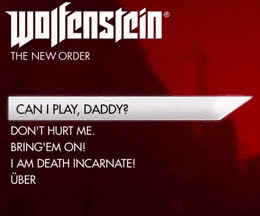
- The Samsara mod, which allows you to play as characters from other first-person shooters, gives each character their original game's difficulty levels, such as "Can I Play, Daddy?" or "Kindergarten".
- The Demonsteele mod has some extremely metal (literally) difficulty level names, one set each for its two player characters (respectively Jung Hae Lin and Sun Shihong):
- Return to Serenity/Resurrection ("You have ten life tokens. Pray for long life.")
- Never Say Die/Come and Get It ("You have eight life tokens. Pray for good health.")
- Take No Prisoners/Into the Battle ("You have six life tokens. Pray for vast courage.")
- Facing Hell/Seek & Destroy ("You have four life tokens. Pray for iron will.")
- Killing Machine/All Guns Blazing ("You have two life tokens. Pray for a quick death.")
- Angel of Death/Armageddon Machine ("Your prayers are in vain.")
- A blank space ("Abandon all hope, ye who enter here.")
- Grezzo 2: This blasphemous Game Mod of Doom has, as idiosyncratic difficulty levels, random insults in Italian:
- "Se'n tonto" ("You're dumb")
- "Se'n toro" ("You're bull")
- "Manga la merda" ("Eat shit")
- "Maglial' che casino" ("What a piggy-fucking mess")
- "Tu se'l più tonto" ("You're the dumbest")
- MassMouth 2:
- You fail it
- I have my dignity
- This is a knife
- Don't mess with me
- I'll eat your brain
- VSB-doom, a Game Mod for Doom which allows you to play as the cat-like alien Coeurl. Note the inversion from the usual fare—rather than go "from wuss to badass", the levels go "from strong to weak".
- Cougar
- Tomcat
- Pussycat
- Kitten
- Mouse
- The Blessed Engine, a Game Mod for Doom that turns it Nintendo Hard.
- Ultra-Violence
- Nightmare!
- Certain Death.
- No Chance
- !
- Zombies TC, a Game Mod for Doom, based on Night of the Living Dead (1968):
- Reporter
- Cop
- Coroner
- Undead
- Nightmare!
- Doom, Doom II and Final Doom: Early alpha builds of Doom called the easiest skill level "I Just Want to Kill" and the menu graphic filename M_JKILL was retained for skill 1 in the final version. The manual also had brief descriptions of what to expect.
- Duke Nukem 3D and Duke Nukem Forever:
- "Piece of Cake"
- "Let's Rock"
- "Come Get Some"
- "Damn, I'm Good" (Same as Come Get Some, but enemies respawn on this level unless their bodies/corpses are destroyed completely.)
- Duke Nukem: Time to Kill
- "Wussy"
- "Get Some"
- "Let's Go"
- "Death Wish"
- Duke Nukem: Land of the Babes has two:
- "Come Get Some"
- "Death Wish"
- DUSK note :
- Accessible?
- Go Easy?
- I Can Make It?
- Cero Miedo? (Spanish for "zero fear")
- Duskmare? (Makes you a One-Hit-Point Wonder)
- Far Cry:
- Far Cry tells you what to expect for each difficulty level:
- Easy: A peaceful tropical island stroll. Enjoy your vacation.
- Medium: You will be challenged, but adventure requires a little danger, right?
- Challenging: Your enemies are smarter, more accurate, and really pissed off. Good luck. You'll need it.
- Veteran: Serious jungle madness. We hope you have a high tolerance for pain.
- Realistic: You must be amazingly skilled or incredibly foolish. Forget paradise - this is hell.
- Far Cry 2, after the standard Easy and Normal difficulties:
- Hardcore
- Infamous
- Far Cry 3 once again tells you what to expect with its difficulties:
- Adventurer: An easier experience for those who are new to first person shooters.
- Survivor: A first person shooter experience for seasoned gamers.
- Warrior: A challenge that will require you to master all of your abilities.
- Master: Worse than malaria.
- Far Cry 4 and 5 go for standard difficulty level names, though an update for 5 featured the return of 2's Harder Than Hard "Infamous" difficulty.
- Far Cry 6 only has two, listed in the opposite order from usual:
- Action Mode: This is the classic Far Cry experience, recommended for most players. Enemies hit harder and health takes longer to recover. You will need strategy and creativity to survive.
- Story Mode: This is the Far Cry experience for players who focus on story and exploration. Engaging for any skill level. Take less damage and recover faster, so you can enjoy the action with less risk of death.
- Far Cry tells you what to expect for each difficulty level:
- Fashion Police Squad: The harder difficulty descriptions will also include Desmond looking more badass and well-dressed.
- I'm too young to dye - Desmond wears a shabby coat, and a fearful look.
- Fashion is my passion
- You reap what you sew
- Make sure it's haute couture
- GoldenEye (1997) and GoldenEye (2010)
- "Agent" (1997) / "Operative" (2010) (Easy)
- "Secret Agent" (1997) / Agent" (2010) (Normal)
- "00 Agent" (1997) / "007" (2010) (Hard)
- "007" (customizable difficulty level) (1997)
- "007 Classic" (no Regenerating Health and body armor pickups added to mimic the original gameplay) (2010)
- Half-Life: Echoes states "Select criteria for evaluation" when pesenting the difficulty selections, owing to its Framing Device as one of the G-Man's candidate evaluations:
- Relaxed (Easy)
- Standard (Normal)
- Stringent (Hard)
- Halo: The descriptions are different across a few games, though The Master Chief Collection settled on reusing those from Combat Evolved and Halo 2, which Call-Back to those from the Myth series:
- "Easy" - Your foes cower and fall before your unstoppable onslaught, yet final victory will leave you wanting more.
- "Normal" - Hordes of aliens vie to destroy you, but nerves of steel and a quick trigger finger give you a solid chance to prevail.
- "Heroic" - Your enemies are as numerous as they are ferocious; their attacks are devastating. Survival is not guaranteed.
- "Legendary" - You face opponents who have never known defeat, who laugh in alien tongues at your efforts to survive. This is suicide.
- "Mythic" or "LASO" ("Legendary All Skulls On") is a fan-made difficulty which requires turning on all of the various skulls that increase the difficulty of the game in addition to the normal hardships of Legendary difficulty:
- Level restarts on player death
- Player shields only regenerate upon hitting enemies with melee
- Enemies evade and throw grenades more often
- No motion tracker
- Reduced ammo
- Enemy resistances increased
- Double enemy health
- Every enemy is a King Mook
- Player cannot see what weapon they are holding
- Player has no reticle
- Halo Infinite: Multiplayer adds the ability to play against bots. These bots have difficulty levels which reference the hierarchy of UNSC forces:
- Recruit
- Marine
- ODST
- Spartan
- Hellbound, a Doom homage that proudly advertises itself as "the ultimate 90s FPS released in 2022", inevitably have these:
- Noob
- Normal
- Old School
- HELLMARE! note
- Heretic had Ye Olde Butcherede Englishe titles that are references to the Wolfenstein 3-D and Doom level names:
- "Thou needeth a wet-nurse"
- "Yellow-bellies R us"
- "Bringeth them oneth"
- "Thou Art A Smite-Meister"
- "The black plague possess thee"
- The sequels to Heretic, Hexen and Hexen 2, had difficulties named after the player's chosen class, depending upon whether the player was a Fighter, Cleric or Mage.
- Fighter: "Squire", "Knight", "Warrior", "Berserker", "Titan".
- Cleric: "Altar Boy", "Acolyte", "Priest", "Cardinal", "Pope".note
- Mage: "Apprentice", "Enchanter", "Sorcerer", "Warlock", "Archmage".
- Hexen 2 had four character types: Paladin, Crusader, Necromancer, and Assassin, with the Portal of Praevus expansion adding the Demoness as the fifth type.
- Paladin: "Apprentice", "Squire", "Adept", "Lord".
- Crusader: "Gallant", "Holy Avenger", "Divine Hero", "Legend".
- Necromancer: "Sorcerer", "Dark Servant", "Warlock", "Lich King".
- Assassin: "Rogue", "Cutthroat", "Executioner", "Widow Maker".
- Demoness: "Larva", "Spawn", "Fiend", "She Bitch".
- Ion Fury: Each level comes with a progressively bloodier picture of Shelly's face and a description.
- First Blood (Easy difficulty. Great for new players or those who just want to have fun.)
- Wanton Carnage (Normal difficulty. The intended experience for the average player.)
- Ultra Viscera (Hard difficulty. A highly challenging mode for veterans.)
- Maximum Fury (Hardcore mode. You die a lot and then uninstall the game. Not for first timers...)
- Incision, another retro-style shooter, gives us this gem:
- Barely Scratched
- Fearless in the Face of Death
- Overkill Through Overconfidence
- Asking For It
- Ken's Labyrinth has just two difficulty modes, "Don't touch me" (easy) and "OUCH!" (hard). The difference between the two modes, and what makes the names make sense, is that on easy mode, enemies generally don't use melee attacks (you can still run into them and take Collision Damage), while on hard mode, they will actively ram into you.
- Killing Floor:
- Beginner (KF1 only)
- Normal
- Hard
- Suicidal
- Hell on Earth
- Marathon:
- "Kindergarten"
- "Easy"
- "Normal"
- "Major Damage"
- "Total Carnage"
- "Vidmaster" (unofficial)
The Oath of the Vidmaster, from the Marathon Trilogy manual: "I pledge to punch all switches, to never shoot where I could use grenades, to admit the existence of no level except Total Carnage, to never use Caps Lock as my "run" key, and to never, ever, leave a single Bob alive."
- Medal of Honor: Vanguard:
- "Recruit"
- "Veteran"
- "Elite"
- Metal: Hellsinger:
- "Lamb"
- "Goat"
- "Beast"
- "Archdevil"
- Nerves of Steel:
- Green Recruit
- Trained Soldier
- Seasoned Veteran
- Killing Machine
- Nitemare 3D:
- "Be gentle!"
- "I'm tough!"
- "Let's party!"
- ORION: Prelude:
- Noob
- Easy
- Medium
- Hard
- Insane
- Redikulous
- Prehistoric - a highly customizable mode, where you can set your enemies' health and attack, change how many enemies you get, and change how many credits you are given or get over time.
- Fitting the Spaghetti Western theme, Outlaws goes "Good", "Bad" and "Ugly."
- Painkiller:
- "Daydream"
- "Insomnia"
- "Nightmare"
- "Trauma"
- PAYDAY:
- PAYDAY: The Heist
- Easy
- Normal
- Hard
- Overkill
- Overkill 145+ (reserved for players whose rep level is 145 or higher)
- PAYDAY 2note
- Normal
- Hard
- Very Hard
- Overkill
- Mayhem
- Death Wish
- Death Sentence (Formerly known as One Down before One Down became a modifier and the top difficulty was changed to allow players to go down more than once)
- PAYDAY 3:
- Normal
- Hard
- Very Hard
- Overkill
- PAYDAY: The Heist
- Perfect Dark: Bots in multiplayer mode also have various difficulty levels, ranging from Meatsims that almost always miss to Darksims that almost always hit, spawn near weapon spawn points, and can teleport when the player isn't looking. Zero adds "Dark Agent", and also gives each difficulty a short description:.
- "Agent" - For novices and new recruits.
- "Special Agent" (original) / "Secret Agent" (Zero) - Standard setting for moderately experienced agents.
- "Perfect Agent" - Expert setting for highly qualified agents.
- "Perfect Dark" (customizable like GoldenEye's 007 mode, original only) / "Dark Agent" (no Regenerating Health, no checkpoints (except for the tutorial level) and no body armor pickups, Zero only) - You're on your own now.
- PO'ed, an FPS for the 3DO (US version only):
- I like to watch (Easy)
- I'm over 30, I have arthritis in my fingers (Medium)
- I don't eat quiche (Hard)
- Postal 2 took this to a ridiculous level. The officially-recognized "A Week in Paradise" mod takes this even further by adding the bottom two.
- "Liebermode" (guns are replaced with shovels)
- "Hestonworld" (everyone has guns, including civilians)
- "Insane-o" (everyone has random weapons)
- "They Hate Me" (everyone with a weapon attacks the player)
- "Nightmare" (everyone has guns and attacks the player)
- "Really Fucking Hard" (same as Nightmare but with extra weapons from Insane-o—includes even more grenade types and high explosives, up to miniature nukes)
- Quake:
- Quake had more standard names than Doom, but differentiated them by having a Hub Level where you picked a path to physically select a difficulty. Also like with Doom, the manual gave short descriptions for them.
- Easy (leftmost path): "This is meant for little kids and grandmas."
- Medium (middle path): "Most people should start Quake at Medium skill."
- Hard (rightmost path): "Here at id, we play Hard skill, and we think you should too, once you're ready."
- Nightmare (take any portal, head for the Episode 4 start point, drop on the wooden beams and follow them to find a hidden lava portal): "This is so bad that the entry is hidden, so people won't wander in by accident. If you find it, don't say we didn't warn you."
- Quake III: Arena
- I Can Win
- Bring It On
- Hurt Me Plenty
- Hardcore
- Nightmarenote
- Quake IV was built on the engine powering Doom³ and uses a similar 4-tier difficulty menu, only it uses military ranks.
- "Private" - Try not to shoot yourself in the foot
- "Corporal" - You can hit a moving target...usually
- "Lieutenant" - Shoot first, ask questions later
- "General" - An unstoppable death machine
- Quake had more standard names than Doom, but differentiated them by having a Hub Level where you picked a path to physically select a difficulty. Also like with Doom, the manual gave short descriptions for them.
- Quantum of Solace: Difficulty level also carries over to achievements for completing the game.
- "New Recruit", which unlocks "Octopussy"
- "Field Operative", which unlocks "Tomorrow Never Dies"
- "Agent", which unlocks "You Only Live Twice"
- "007", which unlocks "The Name Is Bond, James Bond"
- Rise of the Triad has three lists of names for its four difficulties (with a picture to go with each name).
- First set:
- "I am a Chew Toy."
- "Will of Iron, Knees of Jell-O (TM)."note
- "I'm in my Element: Lead."
- "Two Words: Reaper Man."
- Second set:
- "The Enemy Will Devour Me."
- "Which Part is the Trigger?"
- "I Have Pet Names For My Grenades."
- "No One Shall Live."
- Third set:
- "Dig My Grave. Now."
- "I Think I Left the Stove On."
- "I'm a Freight Train O' Death."
- "They Call Me 'The Cleaner.'"
- Regardless of which list shows up, they're alternatively called "Easy", "Medium", "Hard", and "Crezzy Man" by the game.
- First set:
- Deathless Hyperion, as a retraux to old sci-fi FPS games:
- Intruder (Easier than easy)
- Scout (Decent and reasonable, just a scouting mission)
- Explorer (Hard, plenty of objectives to complete)
- Scavenger (Very Hard, you'll need to salvage 20000 credits to complete the game)
- Bounty Hunter (Just make it out alive!)
- Serious Sam:
- "Tourist"
- "Easy"
- "Medium"
- "Hard"
- "Serious"
- "Mental"
- Severed Steel:
- Cold Steel
- Tempered Steel
- Severed Steel
- Sharpened Steel
- Molten Steel
- Shadow Warrior (1997)
- "Tiny Grasshopper"
- "I Have No Fear"
- "Who Wants Wang"
- "No Pain No Gain"
- Shaw's Nightmare
- This Dream Is Easy
- Not So Scary
- Dews of God
- Ultra-Frightening
- SUPER NIGHTMARE!
- SiN (1998):
- "Rookie"
- "Officer"
- "HardCorps" (described in the manual as "not for the slow of mouse, weak of heart, or anyone else afraid of dying")
- Slayers X: Terminal Aftermath: Vengance of the Slayer:
- Not a real gamer
- Normal gamer
- I'm awesome
- Inzane
- Soldier of Fortune II
- Amateur: easy
- Gun for Hire: medium
- Consultant: hard
- Soldier of Fortune: nearly impossible
- Team Fortress 2 has the following difficulties for Mann vs. Machine missions:
- "Normal": As long as your team has some idea of what they're doing, they'll be fine. The robots are manageable and special varieties aren't bad.
- "Intermediate": A little trickier. Your strategy and teamwork will need to be better to deal with some of the tougher varieties.
- "Advanced": Good teamwork and communication are even more important. Robots become even nastier, and giant robots become much more common. You'll need to know what and when to upgrade.
- "Expert": You'll need the best teamwork, communication, items, strategy, and money management to stand a chance. Robots come in especially nasty varieties and often have permanent critical hits. Just about every wave has giant robots.
- "Nightmare" (only for Calignous Caper): Pain. Endless pain.
- Turbo Overkill has a bunch:
- Virgin Blood
- Regular Joe
- Street Cleaner
- Serve Me Pain
- Murder Machine
- ULTRAKILL has six difficulties split across three categories:
- Accessible:
- Harmless
- Lenient
- Hard:
- Standard
- Violent
- Very Hard:
- Brutal
- ULTRAKILL Must Die
- Accessible:
- UNLOVED:
- Sliver of Mercy: "For the weak and inexperienced." Enemies spawn at a low rate and have low health and damage, while the player gets 50% more from any armor, ammo and health pickups they collect, though Karma and Q are also lessened and the player can only acquire Rank 1 trinkets.
- No Hope: "If you can't fight them all, better bring someone along." Enemies' health and damage moderately increases, as do spawn rates, including for higher-tier enemies like the Faceless. Armor, ammo and health still grant 50% more, while Karma and Q is granted at a slightly higher rate, and you can find Rank 2 trinkets at a rare rate.
- Kill Em All: "You feel a constant, sharp pain and you want to inflict it on others." Enemies' health and damage increase noticeably further, and along with higher spawn rates you now have a chance of facing stronger "Rotten" versions of all enemies. Ammo, armor and health pickups are worth their normal amount now, but in return there's a moderate boost to Karma and Q earnings, as well as the rate at which you can find Rank 2 trinkets.
- Time To Die: "Let go of the fear of death." The health and damage of enemies, as well as their spawn rates and the chance of seeing Rotten versions, all gain a very large increase, but in return so do your earnings of Karma, Q, and Rank 2 trinkets.
- Beast Mode: "Pure insanity." An "endgame" difficulty, which boosts all of the above even further, including the possibility of finding Rotten enemies among hordes of other normal ones, but along with the player now having a chance of finding Demon Chests, whether pre-placed on the map or from collecting all three Card Pieces in one map, that will always grant a Rank 3 trinket or a ring.
- Unearthly: "You are already dead." Even further boosts, to the point enemies may start spawning in faster than an unprepared player can kill them, especially now that all enemies can use the Witch's summoning ability to bring in even more enemies. In return, Karma and Q earnings get a similar boost, and there is now a chance to find up to two randomly-placed Demon Chests on every map.
- Abyss: "The Abyss stares into you." The greatest challenge the game can offer - the game won't even let you pick this one until you're at or above level 150 - further increasing enemy health, damage and spawn rates, including the introduction of Abyss Wanderers that will give even further boosts to health and other new abilities to nearby enemies. Karma and Q rewards are even higher, and now, if you manage to actually kill all three Abyss Wanderers in a map, the last one will drop an Abyss Chest that contains a Rank 4 trinket.
- Unreal:
- The first Unreal had four difficulties, which had a short tooltip describing them:
- Easy: Tourist Mode.
- Normal: Ready for some action!
- Hard: Not for the faint of heart.
- Unreal: Death Wish.
- Unreal Tournament had bot skill levels with idiosyncratic names (which were reused for UT2003, UT2004, Championship and Championship 2) and snarky descriptions of what each difficulty entails.
- Novice (They won't hurt you... much)
- Average (They know how to kill)
- Experienced (Don't get cocky)
- Skilled (You think you're tough?)
- Adept (You'd better be good)
- Masterful (I hope you like to respawn)
- Inhuman (You are already dead)
- Godlike (I am the Alpha and the Omega)
- The PlayStation 2 port cut this down to four difficulty levels with an image of a competitor to demonstrate them.
- Novice: The competitor is a whimpering child.
- Skilled: The competitor is an adult, but still clearly out of his element.
- Master: The competitor now sports a Lantern Jaw of Justice and a smug smirk.
- Inhuman: The competitor's face is heavily scarred, gritting his teeth as lightning erupts from his glowing eyes.
- Unreal Tournament 3 uses a different set, with longer descriptions for them.
- Casual: Don't feel bad playing on casual. At least you might live long enough to make a difference.
- Normal: So, you feel average today. That's fine. Get some practice, then try something more difficult.
- Hard: That's more like it. Now get in there and do some damage!
- Insane: ARE YOU INSANE? GIVE UP NOW!
- The first Unreal had four difficulties, which had a short tooltip describing them:
- Viscerafest has a few lists of names for its five difficulties that are picked each time a new game menu is accessed. The set below happens to be themed after relationship statuses.
- Just Friends: Medium: For the mediocre individual who does not enjoy dying.
- Highschool Cruish: Hard: For those familiar with singleplayer arena shooters.
- Dating Hard: Brutal: For the shooter veterans who want a challenge.
- Getting Engaged: Extreme: For the FPS elite and those who can not swallow their pride and pick something easier.
- Just Married: Nighmare: For those who indulge in masochism.
- Vivisector: Beast Within:
- Inspection
- Therapy
- Surgery
- Vivisection
- The Wheel of Time has standard difficulty names, but each have a tooltip comparing said difficulty to a specific character.
- Easy: Wit Congar
- Normal: al'Lan Mandragoran
- Hard: Lews Therin Telamon
- Wolfenstein:
- Wolfenstein 3-D: With accompanying mugshots of the hero B.J. Blazkowicz.
- "Can I play, Daddy?" - B.J. is wearing a baby bonnet and pacifier.
- "Don't hurt me." - B.J. has a This Is Gonna Suck look on his face.
- "Bring 'em on!" - B.J. has a neutral expression.
- "I am Death incarnate!" - B.J. is sporting a menacing Slasher Smile, a Kubrick Stare, and glowing red eyes.
- Wolfenstein (2009) had a double instance, using the old difficulty levels but with a "normal" name for them in parenthesis:
- Can I Play, Daddy? (Easy)
- Don't Hurt Me (Normal)
- Bring 'Em On (Hard)
- I Am Death Incarnate! (Über)
- Wolfenstein: The New Order/Wolfenstein: The Old Blood: Updated version of the classic formula, this time with added descriptions.
- "Can I play, Daddy?": Very easy difficulty setting for the spineless gamer. - B.J. is wearing a baby bonnet and pacifier.
- "Don't hurt me.": Easy difficulty setting for the casual gamer. - B.J. has a This Is Gonna Suck look on his face.
- "Bring 'em on!": Normal difficulty setting for the average gamer. - B.J. has a neutral expression.
- "I am Death incarnate!": Hard difficulty setting for the experienced gamer. - B.J. has a Death Glare/Kubrick Stare.
- "Über": Very hard difficulty setting for the heroic gamer. - B.J. is sporting a menacing Slasher Smile, and is covered in blood splatter.
- "Mein Leben!": Only one life - game over if you die. (The Old Blood only) - B.J. is reduced to a blood-splattered skeleton.
- Wolfenstein II: The New Colossus, for the most part, retains the difficulties and descriptions from The Old Blood, with updated mugshots of B.J.:
- "Can I play, Daddy?": Very easy difficulty setting for the spineless gamer. - B.J. is still wearing a baby bonnet and pacifier.
- "Don't hurt me.": Easy difficulty setting for the novice gamer. - B.J. has a This Is Gonna Suck look on his face.
- "Bring 'em on!": Normal difficulty setting for the average gamer. - B.J. has a neutral expression.
- "Do or die!": Hard difficulty setting for the experienced gamer. - B.J. has a cocky smirk.
- "Call me Terror-Billy!": Very hard difficulty setting for the heroic gamer. - B.J. is grinning and covered in blood splatter.
- "I am death incarnate!": Ultra hard difficulty setting for the fearless gamer. - B.J. is sporting a menacing Slasher Smile, a Kubrick Stare, and is covered in blood splatter.
- "Mein leben": One life only - game over if you die. (unlocked once beaten on "I am death incarnate!) - B.J. is reduced to a blood-splattered skeleton.
- Wolfenstein 3-D: With accompanying mugshots of the hero B.J. Blazkowicz.
- Afro Samurai has two difficulties, with the second unlocked after a complete playthrough.
- "Number Two Headband"
- "Number One Headband"
- Astral Chain:
- Casual
- Standard
- Ultimate
- Berserk and the Band of the Hawk
- Easy
- Normal
- Hard
- Berserk
- Crescent Pale Mist:
- Darksiders II
- "Easy"
- "Normal"
- "Apocalyptic"
- Deadpool:
- Genetically Superior (easy)
- Veteran (normal)
- Ultra-Violence (hard)
- Devil May Cry
- Main Continuity:
- "Easy Automatic/Human" - Easy. Devil May Cry 2 is notable for not having this difficulty level.
- "Devil Hunter" - Normal.
- "Son of Sparda" - Hard.
- "Very Hard" - Unique to the Special Edition of Devil May Cry 3: Dante's Awakening, added by Capcom in order to make the difficulty modes consistent across regions. note
- "Must Die" - Prefixed by the playable character's name (though later games have this labeled only as "Dante Must Die"), this difficulty is notable for giving enemies their own Devil Trigger state.
- "Heaven or Hell" - Everyone, including you, dies in one hit.
- "Hell and Hell" - Only you die in one hit.
- "Legendary Dark Knight" - Available only to the Special Editions of Devil May Cry 4 and Devil May Cry 5 (and the original PC port of DMC4). It takes the "Son of Sparda" mode but fills the areas with loads of extra enemies.
- Unique to DmC: Devil May Cry:
- "Nephilim" - Hard. Enemies have more health and deal more damage. Because this mode is only present in DmC, this game's version of the "Son of Sparda" mode is equivalent to a Very Hard difficulty instead.
- "Gods Must Die" - Exclusive to the Definitive Edition. Similar to the "Must Die" difficulty, except enemies are always in Devil Trigger state. Items are also unusable.
- "Must Style" - Exclusive to the Definitive Edition. Dante/Vergil don't deal any damage to enemies unless the Stylish Rank is S or higher.
- Main Continuity:
- Diablo:
- "Normal"
- "Nightmare"
- "Hell"
- "Inferno" (III pre-2.0 only)
- Diablo III from 2.0 onwards:
- "Normal"
- "Hard"
- "Expert"
- "Master"
- "Torment" followed by a Roman numeral from I to XIII
- Dynasty Warriors
- "Novice"
- "Easy"
- "Normal"
- "Hard"
- "Chaos"
- The Force Unleashed
- Apprentice
- Sith Warrior
- Sith Lord
- Sith Master
- Killer is Dead:
- Easy
- Normal
- Hard
- Very Hard
- Nightmare (PC Version only) - Enemies can only be hurt or killed using dodge bursts and instant executions.
- In Minecraft Dungeons, there are 3 main difficulty levels and an "add-on" difficulty. Players start out on the first and easiest difficulty, but can unlock the proceeding difficulties by beating the Final Boss on each difficulty.
- Default
- Adventure
- Apocalypse
- Apocalypse Plus
- Muramasa: The Demon Blade:
- Muso - easy
- Shura - crushing even to the average gamer who's beaten Muso
- Shigurui - Shura, except One-Hit-Point Wonder
- Ninja Gaiden:
- "Ninja Dog" (I) / Acolyte (II)
- "Normal" (I) / "Warrior" (II)
- "Hard" (I) / "Mentor" (II)
- "Very Hard" (I only)
- "Master Ninja" (I and II)
- No More Heroes & No More Heroes 2: Desperate Struggle:
- Sweet: Perfect for beginners.
- Mild: Many strong men await you.
- Bitter: Extremely difficult.
- No More Heroes III:
- Berry Sweet
- Bitter
- Spicy
- Carolina Reaper
- Onechanbara:
- Casual
- Medium
- Hard
- Violent
- Berserk - You are constantly in an Enraged State/Dare Drive/Xtatic and will gradually lose health, and take double the damage.
- Ryse: Son of Rome:
- Recruit
- Soldier
- Centurion
- Legendary
- Samurai Jack: Battle Through Time:
- Jack
- Samurai
- Master Samurai
- Master of Masters
- Transformers: Devastation: In addition, the higher the difficulty, the better weapons you obtain.
- Scout
- Warrior
- Commander
- Magnus
- Prime
- The Wonderful 101 has descriptions along with accompanying pictures of Wonder-Red holding a controller and (presumably) playing the game.
- Very Easy: For those looking for an easy way out, that just want to get this over with already! - Will Wedgewood is lying down against a pillow, holding a slice of pizza in one hand with a grin.
- Easy: For those looking to take their time and have some fun. - Wonder-Red is lounging in his chair, holding a donut in one hand with a smile.
- Normal: For those who stick to the book and like it that way. (original) / For those expecting the Platinum standard. (Remastered) - Wonder-Red is sitting in his chair normally, with a neutral expression.
- Hard: For those looking to add a little spice to their life. - Wonder-Red is leaning forward in his chair with a scowl.
- 101% Hard: For those looking to see if they have what it takes to truly become a hero! - Wonder-Red is standing in front of his toppled chair in Unlimited Form.
- The House of the Dead: OVERKILL - Extended Cut
- Bitch
- Agent
- Motherf***er
- Sin and Punishment: Star Successor's difficulty descriptions:
- Easy - "You will be sheltered."
- Normal - "You will be tested."
- Hard - "You will be punished."
- Soldier Boyz
- Chump
- Punk
- Badass
- The pilot selection screen in Freelance mode in Brigador works as a disguised difficulty setting. There's a large number of pilots with various differences in starting difficulty, increase per sector (if any), and payout. Lore-wise the differences are explained as being part of pilot reputation - the enemy won't send a lot of forces to fight new pilots who may very well faceplant their mech three steps in, while hardened veterans or nobodies who over the course of a mission might prove that they're dangerous will face increasingly stronger opposition. The pilot bios do a good job of explaining what to expect, while also functioning as a source of worldbuilding and lore snippets.
- City of Heroes and City of Villains used to take this a step further. You can change your difficulty at special NPCs who, for a fee, will spread word about you, affecting your Reputation (heroes) / Notoriety (villains). This affects the missions you will receive.
- Heroic/Villainous (standard)
- Tenacious/Malicious (more enemies)
- Rugged/Vicious (harder enemies)
- Unyielding/Ruthless (both)
- Invincible/Relentless (standard sized spawns of even harder enemies).
- The difficulty system was altered for Going Rogue. Now you can separately set what level the foes should be compared to you (from -1 to +4), how many foes should spawn in missions (from x1 to x8), whether you want to fight Bosses as Lieutenants, and whether you want to fight Archvillains as Elite Bosses.
- Final Fantasy XIV may start out with Normal and Hard, but the difficulties after that get even more intimidating to describe their difficulty in spite of being classified under different encounters.
- Extreme (Harder version of Trial bosses)
- Savage (Harder version of Raids)
- Ultimate (A themed Boss Rush with no checkpoints)
- Global Agenda ranked its Player Versus Environment missions as Low, Medium, High, or Maximum security. Later patches first added a new level above maximum then removed the Low setting, leaving Artifact Difficulty Levels which are even more idiosyncratic. The current settings are:
- Medium Security
- High Security
- Maximum Security
- Ultra-Max Security
- World of Warcraft has difficulty levels for scenarios, dungeons, and raids (Note: this is in order with respect to the location only. Does not include time twisted difficulty)
- Raid Finder (raids only)
- Normal
- Heroic
- Mythic (dungeons and raids)
- Challenge mode (dungeons only)
- Adventure Story:
- Zero (Epic Battle Fantasy Collection exclusive)
- Easy
- Medium
- Hard
- Epic
- Extreme (Epic Battle Fantasy Collection exclusive)
- Alley Cat: Even though you can choose your difficulty at the start, you advance to the next every time you clear a level:
- Kitten (Easy)
- House Cat (Normal)
- Tomcat (Hard)
- Alley Cat (Very Hard)
- The Angry Video Game Nerd Adventures/The Angry Video Game Nerd II: ASSimilation:
- Easy
- Normal
- Old School
- Hard As Balls
- Fucking Impossible
- YOLO (Adventures only)
- Azure Striker Gunvolt Series doesn't have traditional difficulty levels, but instead gives you a setting for keeping Kudos - special points that are converted into Score at checkpoints.
- Gutless - Kudos are not lost when you take a hit
- Cautious - Kudos are lost after you take three hits
- Fearless - Kudos are lost after one hit
- Berenstain Bears' Camping Adventure:
- Bear Cub (Easy)
- Brown Bear (Medium, the default)
- Grizzly Bear (Hard)
- Bloodstained: Curse of the Moon:
- Casual
- Veteran
- Legend (2 only)
- Celeste mods use this difficulty system, popularized by The 2020 Celeste Spring Community Collab. Within these categories are "green", "yellow", and "red" to denote the relative difficulty (e.g. a "red Beginner" is considered hard by Beginner map standards, while a "green Intermediate" is harder than a "red Beginner" but easy compared to other Intermediate maps).
- Beginner
- Intermediate
- Advanced
- Expert
- Grandmaster
- Conker's Bad Fur Day: The CPU opponents in multiplayer modes could be set to one of the following:
- "Inbred"
- "Crap"
- "Normal"
- "Bastard"
- "Einstein"
- Craz'd!
- Beginner Mode
- Awesome Mode
- Distorted Travesty:
- Beginner
- Veteran
- Hardcore
- Distorted
- Night Terror (3rd game only)
- DuckTales: The Quest for Gold uses money puns:
- Easy Money
- Standard Wages
- Hard Earned Cash
- Ghosts 'n Goblins Resurrection
- Page
- Squire
- Knight
- Legend
- Iji
- Normal
- Hard
- Extreme
- Ultimortalnote
- reallyjoel's dad
- Kero Blaster:
- Zangyou Mode note (Hard Mode)
- Omake Mode (New Game Plus)
- Kirby:
- Kirby Star Allies has a system in place with The Ultimate Choice, much like with Kirby's Avalanche, where each difficulty level is represented by a level of spiciness. Kirby's expression changes from happy to determined, to shocked, to demonic, to soulless as he drenches his curry in Blazing Inferno Hellfire Sauce:
- Sweet Breeze
- Mild Stroll
- Zesty Expedition
- Spicy Adventure
- Sizzling Threat
- Fiery Showdown
- Infernal Crisis
- Soul Melter
- Soul Melter EX
- Kirby and the Forgotten Land:
- Spring Breeze Mode
- Wild Mode
- Kirby Star Allies has a system in place with The Ultimate Choice, much like with Kirby's Avalanche, where each difficulty level is represented by a level of spiciness. Kirby's expression changes from happy to determined, to shocked, to demonic, to soulless as he drenches his curry in Blazing Inferno Hellfire Sauce:
- Mega Man:
- Mega Man 9:
- "Normal"
- "Hero"
- "Super Hero"
- Mega Man 11:
- Newcomer
- Casual
- Normal
- Superhero
- Mega Man 9:
- Muri: Four difficulty levels, with the hardest being called "Muri", which in a Bilingual Bonus, roughly means "impossible" in Japanese.
- The TurboGrafx-16 port of Ninja Spirit:
- Phone version of Prince of Persia has:
- Spoiled Prince
- Mighty Warrior
- Legendary Hero
- Rabi-Ribi :
- Ratchet & Clank
- Ratchet: Deadlocked has difficulty names based around its "gladiator battle television show" theme. Each difficulty also has an amusing description.
- Couch Potato note
- Contestant note
- Gladiator note
- Hero note
- Exterminator note
- Ratchet & Clank: Rift Apart:
- Rookie Explorer
- Rookie Recruit
- Rebel Agent
- Resistance Leader
- Renegade Legend
- Ratchet: Deadlocked has difficulty names based around its "gladiator battle television show" theme. Each difficulty also has an amusing description.
- While they do have a few differences in special moves, the teams in Sonic Heroes are basically difficulty levels, with Team Rose being easy, Team Sonic being normal, Team Dark being hard, and Team Chaotix usually having some sort of odd mission.
- Taz: Wanted:
- Standard
- Advanced
- Expert
- Woah Dave!:
- "Easy"
- "Bonkers"
- Indie puzzle game Chromashift has normal level numbers, but a different description for each:
- Level 1: For Beginning Players
- Level 2: A Fairly Safe Bet
- Level 3: Not Too Hard
- Level 4: Getting Fairly Difficult
- Level 5: Yeah, Good Luck With That
- Crash Fever
- Easy
- Normal
- Hard
- Expert
- Legend
- Wizard
- Ultimate
- Spectre
- Omega
- Guilty Party has:
- Rookie (Easy)
- Detective (Medium)
- Super Sleuth (Hard)
- Kirby's Avalanche has difficulty levels named after degrees of food spiciness. note
- "Mild"
- "Medium"
- "Spicy"
- "Hot"
- "Cajun"
- Lemmings series:
- The original game:
- Fun
- Tricky
- Taxing
- Mayhem
- Oh No! More Lemmings:
- Tame
- Crazy
- Wild
- Wicked
- Havoc
- The original game:
- LIT (2009) has two difficulties: "Light" and "Dark". The difference is that "Dark" is essentially a Timed Mission where your light resources slowly dim over time.
- Puyo Puyo has two sets of levels, one for Versus play (curry spiciness, an allusion to curry being Arle and Carbuncle's Trademark Favorite Food), and one for Story mode in the Fever games (Japanese onomatopoieas).
- Versus:
- Sweet
- Mild
- Medium
- Spicy
- Very Spicy/Hot
- Story:
- RunRun (Easy/Tutorial)
- WakuWaku (Normal)
- HaraHara (Hard)
- Versus:
- Spin Doctor:
- Pre-Med
- Intern
- Resident
- Specialist
- Super Hexagon:
- Hexagon — Hard
- Hexagoner — Harder
- Hexagonest — Hardest
- Hyper Hexagon — Hardester
- Hyper Hexagoner — Hardestest
- Hyper Hexagonest — Hardestestest
- Tetris:
- Tetris: The Grand Master 2 PLUS:
- Normal
- Master
- T.A. Death
- Tetris: The Grand Master 3:
- Easy
- Master
- Shirase
- Tetris: The Grand Master 4:
- Konoha
- Master
- Rounds
- Tetris: The Grand Master ACE:
- Normal
- Hi-Speed
- Hi-Speed 2
- Another
- Another 2
- Tetris: The Grand Master 2 PLUS:
- Trash Panic:
- Sweets Course
- Maindish Course
- Hell Course
- Carmageddon: The original created some controversy with its lowest difficulty setting, while Carmageddon II: Carpocalypse Now took things even further. Carmageddon TDR 2000 made them less violent, then Reincarnation and Max Damage ramps it up again.
- "As easy as killing bunnies with axes" / "As easy as stamping on kittens" / "Sunday Driver" / "Pulping puppies with hammers"
- "Normal everyday carnage" / "Normal day-to-day depravity" / "Boy Racer" / "Normal rampant insanity"
- "As hard as French-kissing a cobra" / "As hard as fisting a Velociraptor" / "Speed Demon" / "Harder than rimming a rhino"
- Death Rally:
- Speed Makes me Dizzy
- I Live to Ride
- I Got Petrol in my Veins
- F-Zero Climax, in Survival mode:
- Tour
- Challenge
- Battle
- Violence
- FAST Racing League:
- Neutron
- Proton
- Ion
- FAST Racing Neo
- Subsonic
- Supersonic
- Hypersonic
- Forza, starting from Motorsport 5, has these difficulty settings:
- Tourist (introduced in Horizon 5)
- New Racer
- Average
- Above Average
- Highly Skilled
- Expert
- Pro
- Unbeatable
- Mario Kart : All games in the series use engine powers to donate difficulty level, with each affecting kart speed and AI aggressiveness, with lower engine powers resulting in lower speed, but easier handling.
- 50cc
- 100cc
- 150cc (There's also Mirror Mode, which is at this engine power, but with the courses flipped.)
- 200cc (Mario Kart 8 and Mario Kart 8 Deluxe Only)
- Re-Volt : Affects how the cars handle, as well as how accurate the game's collision detection is.
- Junior RC
- Console
- Arcade
- Simulation
- The original San Francisco Rush has audio Idiosyncratic Difficulties based on which car you picked. Each car handling class is accompanied by a car alarm which gets gradually more intense the more a class traded handling for speed, topping off with Extreme's "It's dangerous!" followed by screaming. The N64 port added a few special cars that has difficulty levels of "Ooooh, yeah!"
- WipEout normally has speed classes stand in for difficulty levels:
- Vector
- Venom
- Flash
- Rapier
- Phantom (hidden difficulty in earlier games)
- Wipeout HD has AI difficulty levels in addition to speed classes:
- Novice
- Skilled
- Elite
- Wipeout 2048 has completely different speed classes due to being a prequel to the rest of the series:
- D Class
- C Class
- B Class
- A Class
- A+ Class
- Smash Hit:
- Training
- Classic
- Mayhem
- Zigzagged in Commandos 2: Men of Courage, where the difficulty levels are Normal, Difficult and Realist (for Very Hard).
- Desperados 2: Cooper's Revenge has Vaquero (Cow Boy) for Normal and Pistolero (Gunslinger) for Hard.
- Haegemonia uses the usual names but each has a subtitle:
- Easy - Come on! You are better than that!!!
- Medium - Correct decision...
- Hard - Are you completely sure???
- Hearts of Iron
- Normal, no changes.
- Complicate the game a bit.
- Difficult.
- Let the AI cheat as much as possible.
- Hostile Waters
- Ensign
- Commander
- Admiral
- Kingdoms Reborn has seven difficulty levels, and each increases how many goods citizens consume. It starts off with the standard easy, normal, and hard, then goes into brutal, emperor, immortal, and deity.
- Bungie's post-Marathon, pre-Halo RTSes Myth: The Fallen Lords and Myth II: Soulblighter: The game had flavour text describing the difficulty levels.
- "Timid" ("You will grow tired blunting your weapons on a poorly-led horde of mindless corpse-men; and once you have reduced them to so much sausage filler, the sweet taste of success will turn to ashes in your mouth")
- "Simple" ("You will defy an army conscripted from the tombs of a thousand years; and when you are victorious, your very presence on the battlefield will cause the enemy to question the wisdom of opposing you.")
- "Normal" ("You will face an army led by creatures too horrifying to comprehend; but when you ultimately drive the Darkness back from whence it came, the bards will sing of your exploits for generations to come.")
- "Heroic" ("You will oppose an apparently infinite host of the undead that seems to grow stronger with each passing day; but if you win, lesser beings will tremble with fear at the mere mention of your name!")
- "Legendary" ("You will brave the army of a Commander who has never known defeat, and the piled dead will reach the heavens; but should you succeed, in an age not yet dawned you will be spoken of as a god!")
- Starcraft II:
- "Casual" is Easier Than Easy effectively. Opponents are largely passive, and it doesn't take much effort to defeat them.
- "Normal" has the opponent start on equal footing with you in terms of upgrades. The enemy attacks you with only a modest army. However, some achievements are not available on this mode.
- "Hard" gives your opponents more difficult compositions, starting with one category of upgrades researched in advanced, and using more advanced units in their armies. Almost all achievements are available to earn on this mode.
- "Brutal" gives your opponents the greatest advantages, starting them even further ahead of you on upgrades. They also have higher-tier units available before you can unlock the same units and some enemy units are replaced with mercenary equivalents. In addition, the AI has more advanced counter-play, priortizing your medics and repair units above your combat units and more effectively picking off key units.
- Supreme Commander: The bottom three describe the AI's behaviour.
- "Easy"
- "Normal"
- "Hard"
- "Swarm"
- "Tech"
- "Cheater"
- Arcaea:
- Past
- Present
- Future
- Beyond
- Before the Echo has the standard "Easy", "Medium", and "Hard", but above Hard is "Spasmodic". Additionally, each difficulty has a label:
Easy - For those musically challenged.
Medium - For those musically challenged, yet stubborn.
Hard - For those not musically challenged.
Spasmodic - For those socially challenged. - BEMANI games tend to do this a lot.
- DanceDanceRevolution, which is particularly notorious for changing its difficulty names. Currently there are typically five tiers of difficulty levels, three of which have changed names many times:
- "Easy" (1st to 2nd) / "Soft" (3rd) / "Beginner" (DDR Extreme to present)
- "Basic" (1st to 5th Mix, SuperNOVA to present) / "Light" (DDRMAX to DDR Extreme) / "Standard" (DDR USA)
- "Another" (1st to 3rd Mix) / "Trick" (4th to 5th Mix) / "Standard" (DDRMAX to DDR Extreme) / "Difficult" (DDR USA, SuperNOVA to present)
- "Maniac" (1st to 2nd and 4th to 5th Mix) / "Step Step Revolution" (3rd Mix) / "Heavy" (DDRMAX to DDR Extreme) / "Expert" (DDR USA, SuperNOVA to present)
- "Oni" (Japanese games prior to SuperNOVA) / "Challenge" (American games, SuperNOVA to present)
- Prior to Dance Dance Revolution 4th Mix, each difficulty rating had its own name. In the very first game, it's Simple (1), Average (2), Novice (3), Expert (4), Professional (5), Genuine (6), and Hero (7). From the Internet Ranking version onward, the labels were changed to Simple (1), Moderate (2), Ordinary (3), Superior (4), Marvelous (5), Genuine (6), and Paramount (7), with two more added: Exorbitant (8) and Catastrophic (9). Since the labels were removed before 10-footers were introduced, they have never been officially given a name (though Universe sort-of did by reusing the labels for courses, with the 10-footer being named "Apocalyptic"). The remake of 2nd Mix in Dance Dance Revolution X3 vs. 2nd Mix features two boss songs with the Expert charts rated "9" and "10" (in reality, they are both ten-footers, and the former is far harder than any nine-footers in the pre-DDRMAX era), but with the labels "Evolutionary" and "Revolutionary".
- beatmania IIDX
- "BEGINNER"
- "LIGHT7" (up to IIDX 11) / "NORMAL" (IIDX 12 onwards)
- "7KEYS" (up to IIDX 11) / "HYPER" (IIDX 12 onwards)
- "ANOTHER"
- In beatmania IIDX 15 DJ TROOPERS (PS2), they introduced "KURO (BLACK) ANOTHER", which make the original ANOTHER charts look like LIGHT7s by comparison. Some songs that are revived in later games have these charts added as ANOTHER charts (usually with a new set of charts for the previous difficulties of the revival), or as "LEGGENDARIA" charts, see below.
- beatmania IIDX 21 SPADA introduces the "†LEGGENDARIA" difficulty, similar to "KURO ANOTHER". New "harder than ANOTHER" charts from beatmania IIDX 22 PENDUAL onwards are labeled as '†' (note the lack of "LEGGENDARIA") difficulty.
- Popn Music:
- 5-Button (phased out beginning in Sunny Park)
- Enjoy (renamed "Easy" in fantasia, removed in Sunny Park)
- Easy (replaces 5-Button beginning in Sunny Park; this is somewhat distinct from fantasia's Easy mode)
- Normal
- Hyper
- EX
- Drum Mania, Guitar Freaks, and jubeat all currently use the names Basic, Advanced, Extreme.
- The former two games used to call them Normal, Real, and Expert Real in early installments.
- During the XG arc of Gitadora, the difficulty names were changed to Novice, Regular, and Expert, and add Master. Master was kept in future games, but the lower three levels were renamed back to Basic, Advanced, and Extreme.
- Keyboardmania had Light, Normal, and Real. Normal was renamed Light+ in 2nd Mix.
- Dance Mania X has Mild and Wild.
- REFLEC BEAT averts this for the most part, using the more traditional-sounding Basic, Medium, and Hard. However, some songs have a fourth chart, which are labeled as Special difficulty. Reflec Beat: The Reflesia of Eternity replaces Special with White Hard.
- Sound Voltex uses Novice, Advanced, Exhaust, Maximum, and Infinitenote / Gravitynote / Heavenlynote .
- BeatStream has Light, Medium, Beast (''Beatstream... get it?), and Nightmare.
- MÚSECA uses Green, Orange, and Red.
- DanceDanceRevolution, which is particularly notorious for changing its difficulty names. Currently there are typically five tiers of difficulty levels, three of which have changed names many times:
- CHUNITHM:
- Basic
- Advanced
- Expert
- Master
- World's End
- CROSS×BEATS uses them for its chart difficulties and Life Meter difficulties:
- Charts:
- Easy (crossbeats REV. only)
- Standard
- Hard
- Master
- Unlimited (crossbeats REV. only)
- Gauge:
- Normal
- Survival (crossbeats REV. only)
- Ultimate
- Charts:
- Dance Central does name the difficulty levels for songs, but not the difficulty level you choose to play, meaning that even the "easy" routine for an "Off the Hook" song is not going to be easy.
- Warmup
- Simple
- Moderate
- Tough
- Legit
- Hardcore
- Off The Hook
- DJMAX:
- Easy
- Normal
- Hard
- Maximum
- Super Crazy
- DJMax Technika: Technika 2 switches out to slightly more traditional naming conventions.
- "Lite Pattern (LP)" / "Star"
- "Popular Pattern (PP)" / "Normal"
- "Technical Pattern (TP)" / "Hard"
- "Special Pattern (SP)" / "Maximum"
- "Extra" (Technika 3 only)
- Elite Beat Agents:
- "Breezin'"
- "Cruisin'"
- "Sweatin'"
- "Hard Rock!"
- The original Guitar Hero games, made by Harmonix before Activision took the license from themnote , had idiosyncratic song difficulty levels in addition to the Easy/Medium/Hard/Expert chart difficulty:
- Opening Licks
- Axe Grinders (first game only) / Amp Warmers (II and Rocks the 80s)
- String Snappers (II and Rocks the 80s)
- Thrash and Burn (I and II)
- Return of the Shred
- Fret Burners (first game only) / Relentless Riffs (II and Rocks the 80s)
- Furious Fretwork (II and Rocks the 80s)
- Face Melters (I and II)
- KALPA:
- Thumb Mode:
- Normal
- Hard
- Hard+
- Abyss
- Multi-Finger Mode:
- S. Hard (previously Arcade)
- S. Hard+ (previoiusly Kalpa)
- Chaos
- Cosmos
- Thumb Mode:
- Many charts for Lunatic Rave 2, a beatmania IIDX clone, often have custom difficulty names set by their creators rather than the standard "Normal", "Hyper", and "Another" difficulties. Perhaps the best-known example is "FREEDOM DiVE↓", which has chards labeled "EARTH", "GALAXY", "UNIVERSE", and, most infamously, "FOUR DIMENSIONS".
- maimai:
- Easy
- Basic
- Advanced
- Expert
- Master
- Re:Master
- Osu! Tatakae! Ouendan's difficulty levels are commonly known to English-speakers as Easy, Normal, Hard, and Very Hard/Insane. They are actually called:
- "Kigaru" (Light-hearted Cheer, which in Elite Beat Agents was converted to "Breezin'")
- "Kakan" (Boldly Cheer, "Cruisin'" in EBA)
- "Gekiretsu" (Fervently Cheer, which became "Sweatin'")
- "Karei" (Gracefully Cheer, a.k.a. "Hard Rock!")
- osu!! allows players to use the standard difficulty names from its derivative games, but beatmap creators can come up with their own chart names, like the Lunatic Rave 2 example above.
- Paradigm Reboot:
- Detected (DET)
- Invaded (IVD)
- Massive (MSV)
- Power Gig: Rise of the SixString:
- Recruit
- Disciple
- Master
- Virtuoso
- Legend
- Pump It Up: Normal, Hard, Crazy (for single-pad charts); Freestyle, Nightmare (for double-pad charts)
- Beginning on Fiesta however, it is completely averted, as rgw difficulty levels are no longer given names, and are instead referred to in-game by their level number.
- RAVON:
- Enjoy
- Handzup
- Core
- Overnight
- Rhythm Heaven Megamix does this with its Gatekeeper challenges, with each gatekeeper representing a particular difficulty level.
- Saffron (yellow, easiest)
- Saltwater (blue, moderate)
- Paprika (red, hardest)
- The Rock Band series has a three-dimensional matrix of difficulties. Two of those dimensions are simply named: modes available (guitar, bass, drums and mic; 3 adds keys, Basicnote and Pronote modes for the instruments, and Vocal Harmoniesnote for the mic), chart difficulties available are Easy, Normal, Hard, and Expert, but the third dimension, the difficulty for a given song on a given instrument, follows this scale:
- Warmup
- Apprentice
- Solid
- Moderate
- Skilled (first game only)
- Challenging
- Blistering (first game only)
- Nightmare
- Impossible
- Sixtar Gate:
- Comet
- Nova
- Supernova
- Quasar
- Starlight (course-exclusive charts only)
- Tone Sphere:
- In UNiSON on the PS2, instead of selecting a difficulty, you pick a character to play as.
- Trill (Normal)
- Cela (Hard)
- Chilly (Very Hard)
- World Dai Star Yume No Stellarium:
- Normal
- Hard
- Extra
- Stella
- Olivier
- Beneath Apple Manor:
- A Pushover
- Too Easy
- Beginners Only
- A Safe Trip
- Average
- Some Challange
- Tricky
- Touch And Go
- Very Dangerous
- You're Nuts!!!
- Darkest Dungeon:
- Radiant
- Darkest
- Stygiannote
- Dungeons of Dredmor:
- Elves Just Want to Have Fun (Easy)
- Dwarvish Moderation - a practical approach to dungeoneering (Normal)
- Going Rogue - because losing is fun! (Hard)
- Elona:
- "Overdose" (Skill grinding progresses 20 times as fast)
- "Advancing" (No bonuses, no restrictions)
- "Natural" (Save Scumming is forbidden and players who do it incur a penalty)
- "No Future" (Natural, plus enemies getting stronger and more aggressive from the beginning)
- "Inferno" (Permanent Death mode)
- In Luck be a Landlord, apartment floors serve as levels. Each floor adds another layer of challenge over the floors below it, which can be higher rents, fewer tokens, or more Dud symbols that clutter up the reels without directly offering anything in return.
- One Way Heroics:
- Walk in the Park
- Afternoon Stroll
- Grueling Campaign
- Inhumane Odyssey
- A Touhou fangame, Riverbed Soul Saver, has difficulty names based off of periods of the Ice Age:
- Risk of Rain and its sequel have this for both static and scaling difficulty levels. The static difficulty modifiers are named after weather phenomena (Drizzle, Rainstorm, and Monsoon for easy, normal, and hard respectively), while the scaling difficulty meter starts at "Very Easy" and goes from there:
- Very Easy
- Easy
- Medium
- Hard
- Very Hard
- Insane
- Impossible
- I SEE YOU
- I'M COMING FOR YOU
- HAHAHAHA
- Sunless Skies lets you set the speed at which enemy shots travel. The settings are "Normal," "Measured," and "Stately."
- Brave Hero Yuusha: The "Hard" difficulty is called "Brave" in this game.
- Corruption of Laetitia:
- Playground
- Garden of Eden
- Hellish Yard
- Cthulhu Saves the World:
- Easy
- Medium
- Hard
- Insane (Not that uncommon in other games, but remember who the protagonist is...)
- Divinity: Original Sin and Original Sin II:
- Explorer Mode
- Classic Mode
- Tactician Mode
- The Dragon Age games:
- Casual
- Normal
- Hard
- Nightmare
- Dragon Age: Inquisition has different names for its multiplayer difficulties:
- Routine
- Threatening
- Perilous
- Nightmare
- Heartbreaker
- Empire of Sin:
- Associate
- Made
- Lieutenant
- Underboss
- Boss
- The Epic Battle Fantasy series names its Harder Than Hard difficulty Epic, and its Easier Than Easy difficulty Zero, for each main series game.
- Epic Battle Fantasy 2 adds some flavour text for each difficulty:
- Zero Difficulty: "Play this if you want to rush through the game super fast." (Epic Battle Fantasy Collection exclusive)
- Easy Difficulty: "Play this if you're a noob or don't have much time."
- Medium Difficulty: "Play this if playing for the first time, probably."
- Hard Difficulty: "Play this if you are too cool for the easier modes."
- Epic Difficulty: "Play this if you have no life."
- The Epic Battle Fantasy Collection also features three difficulties higher than Epic - these are labelled "Masochist Options", with flavour text warning "There are no medals for beating these. Only pain."
- Epic Battle Fantasy 3 does the same:
- Epic Battle Fantasy 4 and 5 also have Challenge options to increase the difficulty even further on top of the normal hardships of Epic mode, allowing for the fanmade ACE (All Challenges Epic) difficulty. Unlocking a boss achievement on Epic with all challenges turned on will also add a star icon to the achievement picture.
- Epic Battle Fantasy 2 adds some flavour text for each difficulty:
- Final Fantasy
- Final Fantasy XVI:
- Story Focused
- Action Focused
- Final Fantasy Mode
- The difficulty levels of the Duel Colosseum in Dissidia Final Fantasy take their names from the airships in the series:
- Airship (with enemies at levels 1-30)
- Falcon (30-60)
- Invincible (60-90)
- Lunar Whale (90-120)
- Blackjack (100-150)
- The Japanese rerelease features a Harder Than Hard level by adding on the Dreadnought.
- Final Fantasy Type-0:
- Theatrhythm Final Fantasy:
- Beginner Score (All-star Carnival only)
- Basic Score
- Expert Score
- Ultimate Score
- Transcendence Score (All-star Carnival only)
- Dissidia Final Fantasy NT's player rankings also determine the difficulty of single-player (mainly Gauntlet) mode battles:
- Bronze
- Silver
- Gold
- Platinum
- Mythril
- Adamant
- Diamond
- Crystal
- Nightmare
- Chaos
- Final Fantasy XVI:
- Five Nights at Fuckboy's (the original only):
- Night X
- Night XX
- Night XXX
- Five Nights at Fuckboy's 2
- Normal
- Proud
- Critical (sound familiar?)
- Hearts Like Clockwork
- Clockwork Lullaby
- Ambitious
- Meltdown
- Abstract Nonsense
- Kenshi does not have difficulty ranks per se, but has different starting situations that make your early game easier or harder and have a subjective difficulty ranking. More starting scenarios are also available as Game Mods. You are also offered a series of sliders to fine tune the game's actual difficulty, such as how fast you become hungry (faster makes the game harder on account of having to acquire more food), how quickly your body parts lose HP due to a wound (faster makes death more likely), and how much predator nests and bandit camps spawn around the world (more makes the world more dangerous).
- Nobodies (Easy): You start with a crew of 5 people, which makes your early game easier on account of simply not being alone and being able to do 5 times more work.
- Wandering Trader (Easy): You start with a backpack and a pack animal. Pack animals also double as very strong guard animals capable of inflicting much more damage than yourself in early game.
- Wanderer (Normal): You start out alone, in a lone town amid the wilderness, with a basic weapon, some clothes and some money to last you a day or two. This is the "officially standard" starting scenario.
- Son of a Captain (Normal): You start out as the descendant of an United Cities captain, which makes you an enemy of the Holy Nation but also a respected member of the United Cities. You have no money, but you do have a decent katana.
- Empire Citizen (Normal): You were an average joe until an United Cities nobleman felt like taking away your job and your house. You have no option but to leave and find another place where you can sustain yourself.
- Holy Nation Citizen (Normal): You're an average citizen of the Holy Nation, which will leave you alone as long as you don't miss Prayer Day and show obedience to the nation's priests and paladins. However, just living under the Holy Nation is holding you back from being successful, so you decide to venture out into the world.
- Guy with a Dog (Normal): You're a hungry drifter and suddenly found an abandoned puppy. Dogs eventually grow into fierce attackers capable of dealing great damage, but starting out hungry also makes the early game harder.
- Cannibal Hunter (Dodgy): You start in cannibal territory and must fend off a cannibal attack right after clicking "Begin".
- Hive Exile (Hard): You start as a Hive race character in the harsh wetlands, with no food or equipment, far away from Hiver-friendly civilizations, surrounded by the ridiculously aggressive and vicious Beaked Things that can kill even an entire crew of badasses.
- Slave (Hard): You start out enslaved by the Holy Nation, toiling hard to build a massive statue. To progress, you have to somehow liberate yourself and escape towards another foreign nation or meet the rebels up north from your starting point... but slavery is a respected institution in this game and the world is lurking with Slave Traders who will be more than happy to return you for a beating.
- Holy Sword (Hard): You start with a very powerful sword. But at the same time, you're a very wanted criminal with a multi-myriad bounty on your head and every single nation-state in the game world hates you.
- Rock Bottom (Very Hard): You start in the middle of a desert lurking with strong, ferocious predators, naked, hungry, with an arm missing.
- Freedom Seekers (Variable): You start out with a band of 6 people and a bunch of construction materials, ready to get out of the oppressive United Cities and settle into the freedom of the wilderness. The difficulty here depends on where you choose to settle, and how good you are at managing your extra personnel.
- Labyrinth of Refrain: Coven of Dusk:
- Gentle World
- Ordinary World
- Nightmare World
- Microprose's adaptation of Magic: The Gathering used wizard ones:
- Apprentice - start with 10 life, one color, enemies have X life
- Magician - start with 8 life, two colors, enemies have X+Y life
- Sorceror - start with 6 life, three colors, enemies have X+2Y life
- Wizard - start with 4 life, four colors, enemies have X+3Y life
- You could further adjust difficulty by choosing your color; red, green, and white were easier than black and blue, just because of the low life totals.
- Mary Skelter: Nightmares:
- Dream
- Normal
- Horror (renamed "Fear" in the remake and sequel)
- In New Horizons, there is 4 difficulty levels. From easiest to hardest: Landlubber, Mariner, Sea Dog, Swashbuckler. They mostly affect health and damage of enemies.
- Pathfinder: Kingmaker:
- Story mode
- Easy mode
- Normal mode
- Challenging mode
- Hard mode
- Unfair mode
- Sid Meier's Pirates!:
- "Apprentice"
- "Journeyman"
- "Adventurer"
- "Rogue"
- "Swashbuckler"
- Regions of Ruin:
- Shin Megami Tensei:
- Shin Megami Tensei IV
- Fellow
- Prentice
- Master
- Shin Megami Tensei IV: Apocalypse
- Paradise (DLC)
- Skirmish
- Conflict
- War
- Apocalypse (DLC)
- Devil Survivor 2 Record Breaker
- "Blessed"
- "Apocalypse"
- Shin Megami Tensei IV
- South Park: The Fractured but Whole does this twice: The skin tone slider for the character creator screen goes from Easy to Very Difficult, with your skin color getting darker as you slide it towards the latter. Cartman helpfully notes that this doesn't affect combat, just "every aspect of your life" (IE, how much money you make in-game as well as NPC reactions). The actual combat difficulty is ranked as:
- Casual
- Heroic
- Mastermind
- Diabolic (added later in a patch)
- Steven Universe:
- Attack the Light
- Normal
- Diamond
- Unleash the Light:
- Normal
- Hard
- Diamond
- Attack the Light
- Tales of Phantasia, Destiny 2, Symphonia, Rebirth and Abyss:
- "Simple"
- "Second"
- "Mania"
- "Unknown"
- Wasteland 3:
- Rookie
- Wastelander
- Ranger
- Supreme Jerk
- Weird and Unfortunate Things Are Happening: Dream-related titling, as seen here◊, from easiest to hardest:
- Daydream: "I just want to relax and enjoy the weird and unfortunate events."
- Lucid Dream: "I like how things have been so far. Don't want it super hard."
- Bad Dream: "I'd like a bit more challenge, please. That'd be cool."
- Nightmare: "Basically, I'm not happy unless I'm at a constant risk of death."
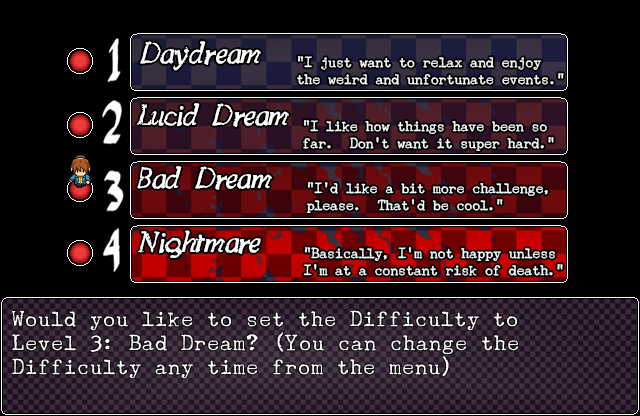
- Minecraft: When it's in pirate speak, LOLCats, or Shakespearean English.
- "Smooth Sailin'/Cake (Peaceful)"
- "Deckswabber/Meh (Easy)"
- "RegulARRRR/Cheezburger/Usual (Normal)"
- "True Pirate/Double Cheezburger (Hard)"
- "Aimless Sailing/HAX/Omnipotent (Creative)"
- "Swashbuckler/SIRVIVL/Mortal/Extra Hard (Survival)"
- "Captain/1 LIEF INSTED OF 9 (Hardcore)"
- Terraria has two different types of difficulty settings: player difficulty and world difficulty, each with their own labelling system.
- Player difficulty:
- Journey (Journey characters start with extra equipment. Can only be played on Journey worlds.)
- Classic / Softcore (Classic characters drop money on death.)
- Mediumcore (Mediumcore characters drop items on death.)
- Hardcore (Hardcore characters die for good.)
- World difficulty:
- Journey (Unearth your creativity)
- Classic / Normal (The Standard Terraria Experience)
- Expert (Far Greater Difficulty & Loot)
- Master (Brutally hard, for the truly brave)
- Legendarynote
- Player difficulty:
- Air Zonk:
- Sweet Mode (5 lives)
- Spicy Mode (3 lives)
- Bitter Mode (1 life)
- Alien Soldier has only two difficulty levels.
- Blazing Lazers has a difficulty selector that is only available via a secret code at the opening of the game.
- "Normal Dog"
- "Hard Human"
- "Super Mania"
- "God of the Game"
- BLUE REVOLVER:
- Normal
- Hyper
- Parallel
- Blue Wish Resurrection:
- Heaven
- Original
- Hell
- Accel, in which bullets accelerate as they move further. Changed into a setting in the options menu in Blue Wish Resurrection Plus
- Bullet Heaven 2:
- Normal
- Hard
- Heavenly
- Crimzon Clover:
- Simple — Simplified scoring system and no Break Mode.
- The arcade port swaps out Simple for Boost mode, which is a new mode altogether.
- Original
- Unlimited
- Simple — Simplified scoring system and no Break Mode.
- Cuphead: Simple fills in for Easy, shortening the battles but not yielding access to the last two bosses. Regular is the normal difficulty, granting access to all the levels and the ending. Expert Mode unlocks after completing the game, which serves as an equivalent to Turbo Mode from Devil May Cry, while also giving bosses a little more health and in some cases altering their attacks slightly.
- Dariusburst Another Chronicle and its Updated Re-release Another Chronicle EX have difficulty designators for each of their starting stages, with the latter three only available in ACEX:
- Dead Nation
- Braindead
- Normal
- Grim
- Morbid
- Undead
- Death Smiles Mega Black Label:
- Level 1
- Level 2
- Level 3
- Level 999
- DonPachi:
- DoDonPachi Dai Fukkatsu Black Label:
- Bomb Style - More bombs.
- Power Style - More firepower.
- Strong Style - Same bomb capacity as Bomb Style, most firepower, but hardest enemy patterns.
- DoDonPachi Saidai Oujou:
- Shot - Strong shot, weak laser.
- Laser - Weak shot, strong laser.
- Expert - Strong shot, strong laser, and most importantly, enemy patterns dramatically increase in difficulty.
- DoDonPachi Dai Fukkatsu Black Label:
- The NES conversion of Dragon Spirit doesn't have a conventional difficulty selection - instead the game makes the player go through a prologue that is essentially a recreation of the arcade version's final stage. If the player clears the prologue it proceeds through "Blue Dragon" mode, which is the normal difficulty level. However, if the player dies during the prologue, it instead starts "Gold Dragon" mode, in which the player has as a max health gauge and auto-fire, but the numbers of stages are reduced and the ending is different.
- Genetos:
- Beginner
- Standard User
- Programmer
- Hacker
- Creator
- All of the games in the Gundemonium Series have this in one form or another. The first two games adjust the limits of the Dynamic Difficulty.
- Gundemonium (Recollection)
- Novice
- Revised
- Unlimited
- Demonic
- GundeadliGne
- Novice
- Standard
- Advanced
- Demonic
- Hitogata Happa
- Euridice
- Nobilimente
- Allemande
- Doomsday
- Gundemonium (Recollection)
- Hellsinker has three axes of difficulty.
- Level (Stella range, stage select only):
- Unplugged
- Limited (Lv.1 minimum, Lv.6 maximum)
- Compressed (Lv.4 minimum, Lv.A maximum)
- Distorted (Lv.7 minimum, Lv.A maximum)
- Way of Life (Maximum number of lives);
- Drastic (5 lives)
- Moderately (6 lives)
- Prudently (7 lives)
- Bootleg Ghost (Auto-bomb behavior):
- Aspirant
- Solidstate
- Adept
- Level (Stella range, stage select only):
- Hyper Princess Pitch
- "Trainee"
- "Combat Lady"
- "Battle Princess"
- "War Queen"
- "Goddess of Explosions"
- "Reallyjoel's Mom"
- Jamestown: Legend of the Lost Colony:
- Normal
- Difficult
- Legendary
- Divine
- Judgement
- Jets'n'Guns:
- "Too Fat To Die"
- "Normal"
- "Hard"
- "Nightmare"
- "Total Mayhem"
- "Inhuman"
- "Mission: Impossible"
- Keio Flying Squadron:
- Monkey
- Human
- Super Human
- The Atari 2600 game Laser Blast:
- Cadet
- Lieutenant
- Captain
- Commander
- Loaded
- Players Are Fairies
- Players Are Boring
- Players Are Confident
- Players Are Brutal
- Players Are Loaded
- Mushihime Sama and its sequel:
- Original
- Maniac
- Ultra (in Mushihime-sama Futari Black Label, this is replaced by God)
- The Princess Remedy series:
- R-Type Final:
- "Baby"
- "Kid"
- "Human"
- "Bydo"
- "R-Typer"
- Raiden:
- Raiden Project:
- Captain (Easy)
- Major (Medium)
- Colonel (Hard)
- General (Harder Than Hard)
- Raiden IV:
- Practice (Easier Than Easy, the only bad thing is no Bullet Hell for you)
- Very Easy
- Easy
- Medium
- Original (arcade)
- Hard
- Very Hard
- Ultimate (Harder than Harder Than Hard)
- Raiden Project:
- Raptor: Call of the Shadows:
- Rookie — "This is the equivalent of easy."
- Veteran — "This is medium difficulty."
- Elite — "This is the hard level."
- River City Ransom EX:
- Shining Shooting Star, a Touhou fangame, uses the names of prominent stars, several of which were pole stars.
- Easy: Altair
- Normal: Vega
- Hard: Arcturus
- Lunatic: Sirius
- Extra: Polaris
- Space Megaforce: The bottom two difficulties, which cause enemies to fire back when destroyed, are selected by pressing left (as if selecting an easier difficulty).
- "Normal"
- "Hard"
- "Hyper"
- "Tricky"
- "Wild"
- Stargunner. Good luck beating the game even on the easiest difficulty.
- Ensign
- Captain
- Admiral
- Stellavanity:
- Easy
- Normal
- Arcade (previously Normal-Ex)
- Hard
- Nightmare
- Pandemonium
- Supercharged Robot Vulkaiser:
- Bullet Sponge
- Glory Hunter
- Legendary Hero
- Savior of the Universe
- Symphony, a music player vertical Shoot 'Em Up, uses sheet music loudness notation for its difficulty levels:
- Pianissimo
- Piano
- Mezzo-piano
- Mezzo-forte
- Forte
- Fortissimo
- The Touhou games, of which there are many, have the standard Easy, Normal, Hard, and Lunatic, and above that is the unlockable Extra Stage. In addition, in all games the difficulty level comes with a subtitle, with Easy usually being toted as "for Sunday gamers" and Lunatic/Extra generally being titled "for weird people" or "not suited for anyone". In the second Windows game, Perfect Cherry Blossom, an exclusive Phantasm stage served as the Harder Than Hard counterpart to the Extra Stage.
- Touhou Eiyashou ~ Imperishable Night, whose plot centers around a stolen full moon are named after specific phases of the moon:
- Easy: "Shingetsu", New Moon
- Normal: "Mikazuki", Third Day Moon (waxing crescent)
- Hard: "Uetsu Yumihari", Upper Bowstring Moon (waxing half-moon)
- Lunatic: "Matsuyoi", Waiting Evening (waxing gibbous, specifically the day just before a full moon)
- Extra: "Mangetsu", Full Moon note
- Touhou Kaeidzuka ~ Phantasmagoria of Flower View has difficulties named for different types of plants/flowers:
- Easy: Daruma Grass (Loropetalum chinese var. rubrum)
- Normal: Pheasant's-eye Narcissus (Narcissus poeticus)
- Hard: "Sazanka" Camellia (Camellia sasanqua)
- Lunatic: Red Spider Lily (Lycoris radiata), but it also known as the higanbana, where higan is the border of the afterlife in Japanese myth.
- Extra: Saigyou Ayakashi, the Eldritch Abomination tree sealed in the Netherworld.
- Easy: Daruma Grass
- Touhou Chireiden ~ Subterranean Animism also has its own naming scheme, based off of various mythological creatures that various characters are based off of:
- Easy: Fairy Class
- Normal: Kappa Class
- Hard: Tengu Class
- Lunatic: Oni God Class
- Extra: Idol Class
- Touhou Shinreibyou ~ Ten Desires has prayers for stuff that supposedly ranges from easy to impossible to achieve:
- Easy: Pray for health and long life
- Normal: Pray for traffic safety
- Hard: Pray for business prosperity
- Lunatic: Pray for IT data security
- Extra: Pray for protection from danmaku
- Touhou Kishinjou ~ Double Dealing Character has the difficulties named after gemstones:
- Easy: Emerald Level
- Normal: Aquamarine Level
- Hard: Ruby Level
- Lunatic: Hope Diamond Level
- Extra: Magnesium Level
- Touhou Kanjuden ~ Legacy of Lunatic Kingdom, like Imperishable Night, also names its difficulties after moon phases, but with the description describing mochi firmness instead:
- Easy: New Moon - easy to chew
- Normal: Crescent Moon - nice amount of firmness
- Hard: Half Moon - so firm it makes your jaw tired
- Lunatic: Full Moon - do not eat
- Extra: Dark Moon - some people like this
- Touhou Tenkuushou ~ Hidden Star in Four Seasons uses seasonal weathers:
- Easy: Spring Sprinkle
- Normal: Summer Shower
- Hard: Autumn Typhoon
- Lunatic: Winter Hibernation
- Extra: The Fifth Season
- Touhou Kikeijuu ~ Wily Beast and Weakest Creature patterns the difficult levels after animals:
- Easy: Lamb Level
- Normal: Shiba Level
- Hard: Saber-Toothed Tiger Level
- Lunatic: Dinosaur Level
- Extra: Cryptid Level
- Touhou Kouryuudou ~ Unconnected Marketeers names its difficulty settings after social classes, based on how easy life is for them:
- Easy: Nobility Level
- Normal: Commoner Level
- Hard: Vagrant Level
- Lunatic: Nihilist Monk Level
- Extra: Free Markets & Open Guilds Level
- Touhou Eiyashou ~ Imperishable Night, whose plot centers around a stolen full moon are named after specific phases of the moon:
- Vectorman
- Lame
- Wicked (1)/Cool (2)
- Insane (1)/Wicked (2)
- Ace Combat, from 04 on up, featured unlockable difficulty modes after beating it on Hard.
- Casual -Easy- (7 only)
- Expert
- Ace
- Aerobiz Supersonic featured:
- Glider
- Prop
- Jet
- Jumbo Jet
- Supersonic''
- The Idolmaster Shiny Festa, Platinum Stars and Starlight Stage all share a common set of difficulty levels:
- Debut
- Regular
- Pro
- Master
- Master+ (only in Starlight Stage for event songs)
- Love Nikki - Dress Up Queen:
- Maiden
- Princess
- The Oregon Trail: The 1978 version has five different difficulty levels for the shooting minigamenote :
- Shaky Knees
- Need More Practice
- Fair to Middlin'
- Good Shot
- Ace Marksman
- The Flash version of Organ Trail frames its difficulty levels as being the career the Player Character had before the Zombie Apocalypse happened. (The Director's Cut just uses normal Easy/Normal/Hard/Suicide labels.)
- Cop
- Clerk
- Lawyer
- Sid Meier's Railroad Tycoon:
- "Investor"
- "Financier"
- "Mogul"
- "Tycoon"
- Plague Inc. has four difficulties for both standard mode and cure mode, each with descriptions that describe how people would react to a plague:
- Casual
- Normal
- Brutal
- Mega Brutal
- Rimworld applies difficulty levels to its "storytellers", which create the random events that shape your colony and your civilization's history. The default difficulty levels, from easiest to hardest, are:
- Peaceful (easiest): No external threats, and your colonists get extra buffs; wildlife doesn't attack humans, weather is always fair, colonists are extra happy, and gathering resources has a bonus yield.
- Community Builder (easy): Minor threats to make the game slightly tense and more interesting. Most threats are enabled except human-eating predators and extreme weather, and you still have personal happiness and resource gathering buffs.
- Adventure Story (normal): Threats have slightly diminished scale, all threat kinds are enabled, and your colonists have minor buffs.
- Strive to Survive (hard): Standard difficulty setting with all difficulty sliders in neutral position and no advantages or disadvantages. That's Rimworld-ese for "hard", because Rimworld is Nintendo Hard.
- Blood and Dust (very hard): Now your colonists have de-buffs to happiness, harvesting yield, and disasters are 55% stronger.
- Losing is Fun (impossible): The Storyteller personally hates you, and will throw disaster after disaster at you until your colony is wiped out.
- Custom: For tinkering with the game's individual difficulty sliders, which control aspects such as threat scale, colonist mood buffs, or chances of suffering illness.
- RollerCoaster Tycoon 3 didn't have selectable difficulties but each scenario had three different objective sets of increasing difficulty:
- Apprentice
- Entrepreneur
- Tycoon
- Stampede (Atari 2600), from the manual:
- Sidekick
- Pilgrim
- Cowpoke
- Wrangler
- Top Hand
- Trail Boss
- Rancher
- Cattle Baron
- Vigilante 8:
- "Unleaded"
- "Super Unleaded"
- "High Octane"
- FIFA has traditionally had the levels Amateur (Easy), Professional (Medium) and World Class (hard), with other difficulty levels being added or removed throughout the series' history. As of FIFA 21, there are seven levels:
- Skate or Die: The CPU difficulty for your opponent is determined by the characters:
- Poseur Pete
- Aggro Eddie
- Lester
- Sid Meier's Covert Action:
- Local Disturbance
- National Threat
- Regional Conflict
- Global Crisis
- Gloomwood:
- "Crescent"
- "Half Moon"
- "Full Moon"
- "Blood Moon"
- Heat Signature only has Easy, Normal and Hard at first, but liberating stations opens up three more difficulties, with descriptions upon unlocking them:
- Manhunt:
- In the first game, "Fetish" and "Hardcore".
- In the second game, "Sane" and "Insane".
- Metal Gear
- In the Japanese and PAL versions of Metal Gear Solid 2: Sons of Liberty, the player is asked whether they played the first Metal Gear Solid or not and if they want a lot of action or not. The first three answers will start the game on the Tanker chapter, while the last two choices will skip to the Plant chapter.
- "I've cleared the previous game multiple times, so bring on the action!"
- "I managed to clear the previous game, but action isn't my strong point!"
- "I didn't clear the previous game myself, but I watched everything!"
- "I didn't clear the previous game, but bring on the action!"
- "I didn't clear the previous game, and action isn't my strong point!"
- Metal Gear Solid 4: Guns of the Patriots names its difficulty levels after the series characters.
- In the Japanese and PAL versions of Metal Gear Solid 2: Sons of Liberty, the player is asked whether they played the first Metal Gear Solid or not and if they want a lot of action or not. The first three answers will start the game on the Tanker chapter, while the last two choices will skip to the Plant chapter.
- Sniper Elite
- Rookie
- Cadet
- Marksman
- Sniper Elite
- Fear & Hunger: Termina has three of these.
- Easy(er) Mode halves the amount of damage enemies cause, improves loot drops, removes environmental traps, allows the player to utilize the God of Fear and Hunger's saving power three times per statue, and removes several more challenging enemies from the game.
- Fear & Hunger Mode is the game's "normal" mode. Environmental traps and more challenging enemies are present, and the God of Fear and Hunger's saving power can only be used once per statue.
- Masochism Mode doubles the amount of damage enemies cause and halves the amount of damage the player can deal. In addition, the mode automatically starts on Night 3, meaning the player cannot save the game by sleeping at a bed, and it is impossible to recruit other playable characters, who are all either moonscorched or dead. Several challenging unique enemies are present in this difficulty, as well as new environmental challenges.
- The Last of Us Part II provides a few more options than its predecessor, along with including a Permadeath mode:
- Very Light
- Light
- Moderate
- Hard
- Survivor
- Grounded
- Left 4 Dead and Left 4 Dead 2:
- Easy note
- Normal
- Advanced note
- Expert note
- The Long Dark:
- Pilgrim (Easy) - Wolves will avoid you rather than attack you, plentiful resources and a hardier player character ensure a relaxed experience with minimal danger, more focused on exploration than survival.
- Voyager (Medium) - wolves will chase and hunt the player and resources are slightly harder to come by.
- Stalker (Hard) - wolves and bears are more numerous and determined and resources are scarce, a more challenging survival experience.
- Interloper (Very Hard) - extremely aggressive bears and wolves will chase you relentlessly, less starting resources, no rifles or knives/hatchets spawn on the map and very few resources, this is hardcore street.
- Nosferatu: The Wrath of Malachi:
- Parasite Eve 2 has a few and each one gives bigger bonus multipliers at higher difficulties.
- "Replay Mode"note
- "Bounty Mode"note
- "Scavenger Mode"note
- "Nightmare Mode"note
- Resident Evil:
- Resident Evil:
- In the original Playstation game, your character is the difficulty select; Jill is “Easy” and Chris is “Hard,” although they are only directly labeled as such in the Japanese version. It’s the only game in the series to do this - later games with a character select, including the first game’s remake, have some differences between characters that can give a slight edge to one or the other but mostly keep them on the same footing. This has the unfortunate effect of people who played the remake before the Playstation game thinking the latter is either too easy or too hard because they don’t know how dramatically different the characters are in difficulty - made worse because subsequent releases had an entirely separate but more conventional difficulty select layered on top of that (which is, for the record, “Advanced,” “Standard,” and “Training” with a secret fourth difficulty activated by highlighting Advanced and holding right on the d-pad).
- In the Remake, difficulty is instead officially based on if you like "Hiking" or "Mountain Climbing,” with the Updated Re Release also including “Walking.” This only applies when you start a new save - “It’s “Easy,” “Normal,” and “Very Easy” on subsequent playthroughs, with the unlockable “Hard” mode not getting an outdoorsy analogy.
- Resident Evil 3: Nemesis: Picking a character for Mercenaries mode affects your difficulty.
- "Mikhail" (easy; has shotgun, magnum and rocket launcher)
- "Carlos" (normal; a customizable handgun and an assault rifle)
- "Nicholai" (standard handgun and knife)
- Resident Evil 4: The game also features a gun called Mathilda. For extra pun, the main character of The Professional is named Léon.
- "Easy"
- "Normal"
- "Professional"
- Resident Evil 2 (Remake):
- Assisted: Active aim assist, weaker zombies, higher ammo yields from crafting with gunpowder, and limited health regeneration (from Danger to Caution).
- Standard: The normal difficulty level. Zombies are of moderate strength, ammo yields are smaller, and no health regeneration or aim assist.
- Hardcore: Autosave is disabled after the introductory sequence. Saving at typewriters requires ink ribbons (just like in the older games). Zombies are more durable and stronger. Inventory expansion items are cut by half.
- Resident Evil:
- Fire Emblem:
- Easy (from The Sacred Stones to Radiant Dawn)
- Normal (from Genealogy of the Holy War onward)
- Clever (Genealogy of the Holy War only)
- Hard/Difficult (from The Binding Blade onward)
- Maniac (Japanese Path of Radiance, Radiant Dawn, and New Mystery of the Emblem only)
- Lunatic (from New Mystery of the Emblem to Heroes)
- Maddening (Three Houses and Engage)
- Lunatic Reverse (New Mystery of the Emblem only)
- Lunatic+ (Awakening only)
- Infernal (Heroes only)
- Abyssal (Heroes only)
- Gensou Shoujo Taisen, a Super Robot Wars-styled Touhou fangame has difficulties named after actual Super Robot Wars games;
- Easy: Alpha
- Normal: Alpha Gaiden
- Hard: F Final
- Lunatic: EX
- Ghost Recon: Advanced Warfighter
- "Realistic"
- "Ultra-Realistic"
- Ghost Recon: Advanced Warfighter 2:
- "Low Risk"
- "Guarded Risk"
- "Elevated Risk"
- Ghost Recon: Shadow Wars/Future Soldier:
- "Rookie" (SW)/"Recruit" (FS)
- "Veteran"
- "Elite"
- Shining Force II
- Normal
- Hard
- Super
- Ouch!
- Wildermyth's "Combat difficulty" options are named after authors and scale based on how Grimdark their stories' worlds are. From easiest to hardest:
- Expeditions: Rome are, fittingly for a game centering around The Roman Empire, named after the most well-known Roman emperors
- Augustus (Easy)
- Caesar (Normal)
- Pompeius (Hard)
- Crassus (Insane)
- Eat Lead: The Return of Matt Hazard and Matt Hazard: Blood Bath And Beyond:
- "Minimum Hazard" / "Wussy"
- "Major Hazard" / "Damn This is Hard"
- "Maximum Hazard" / "Fuck This Shit"
- Freedom Fighters (2003) has two different lists of difficulty levels, one on the main menu when you start a new game and a second one giving a description of it that is also listed when you go to load a saved game.
- "Demonstrator": A walk in the park
- "Rebel": Have a blast
- "Freedom Fighter": You got what it takes?
- "Revolutionary": Against all odds
- Ghostbusters: The Video Game:
- For the Realistic versions:
- Casual
- Experienced
- Professional
- For the Stylized versions:
- Rookie (Slimer)
- Buster (Librarian Ghost)
- Gozerian (Stay-Puft Marshmallow Man)
- For the Realistic versions:
- Kane & Lynch: Dead Men:
- "Aspirin"
- "Codeine"
- "Morphine"
- Kid Icarus: Uprising uses a difficulty slider from 0.0 to 9.0, with the difficulty fine-tunable to 0.1 increments. This scale would later be reused in Classic Mode of the fourth Super Smash Bros. (except starting from 1.0). In addition, each 1.0 increment has its own name:
- 0.0-0.9: Effortless
- 1.0-1.9: Easy
- 2.0-2.9: Standard
- 3.0-3.9: Tougher
- 4.0-4.9: Challenging
- 5.0-5.9: Heatin' Up
- 6.0-6.9: Extra Spicy
- 7.0-7.9: Infernal
- 8.0-8.9: White Hot
- 9.0: Nothing Harder!
- Max Payne:
- The Saboteur:
- Easy
- Medium
- Hard
- Fecking Hard
- Spec Ops: The Line:
- Walk on the Beach
- Combat Op
- Suicide Mission
- FUBARnote
- Vanquish:
- Casual Auto
- Casual
- Normal
- Hard
- God Hard
- Old-school Ravensoft TPS Take No Prisoners has four settings:
- Recruit
- Mercenary
- Commando
- Legionnaire
- WET:
- Cake Walk (easy)
- Hired Gun (normal)
- Fixer (hard)
- Femme Fatale (very hard)
- Golden Bullets (one-hit kills for everyone)
- The Battle Cats:
- Easy
- Normal
- Hard
- Veteran
- Expert
- Insane
- Deadly
- Merciless
- Bloons Tower Defense:
- Easy
- Medium
- Hard
- Impoppable
- CHIMPS (It actually uses the tower prices from Hard Difficulty and not Impoppable, but it also starts on Round 6 and ends on Round 100, does not allow any leaks, and it disables continues, incomes, monkey knowledges, powers and selling, making it live up to its description of "The true test of a BTD master")
- Sid Meier's Alpha Centauri:
- "Citizen"
- "Specialist"
- "Talent"
- "Librarian"
- "Thinker"
- "Transcend"
- Battle for Wesnoth has difficulty settings named marked by units of different levels and mostly named after them, customized per campaign:
- "Horseman (Beginner), Knight (Challenging)", "Fighter (Easy), Commander (Normal), Lord (Challenging)", "Spearman (Easy), Swordsman (Normal), Royal Guard (Challenging)" or "Peasant (Easy), Outlaw (Normal), Fugitive (Difficult)" - Human; also "Civilian (Beginner), Recruit (Easy), Soldier (Normal)"
- "Fighter (Beginner), Hero (Normal), Champion (Challenging)", "Fighter (Beginner), Lord (Normal), High Lord (Challenging)" "Soldier (Easy), Lord (Normal), High Lord (Hard)" - Elvish.
- "Fighter (Easy), Steelclad (Normal), Lord (Challenging)" - Dwarvish.
- "Grunt (Challenging), Warrior (Difficult), Warlord (Nightmare)" - Orcish.
- Sid Meier's Civilization
- Original series:
- "Settler" (IV and V)
- "Chieftain" (I to V, Revolution)
- "Warlord" (I to V, Revolution)
- "Noble" (IV)
- "Prince" (I, II and V) / Regent (III and IV)
- "King" (I, II, V and Revolution) / Monarch (III and IV)
- "Emperor" (I to V, Revolution)
- "Demigod" (III: Play the World, Conquests mode)
- "Immortal" (IV and V)
- "Deity" (II to V, Revolution)
- "Sid" (III: Play the World, Conquests mode)
- Sid Meier's Civilization: Beyond Earth
- "Sputnik"
- "Mercury"
- "Gemini"
- "Vostok"
- "Soyuz"
- "Apollo"
- Original series:
- Colonization:
- "Discoverer"
- "Explorer"
- "Conquistador"
- "Governor"
- "Viceroy"
- Galactic Civilizations: The individual races can be set to any of Fool, Dunce, Beginner, Sub-Normal, Normal, Bright, Intelligent, Gifted, Genius, Incredible, Godlike or Ultimate; Intelligent is the only one that's fair, with the earlier ones cheating in your favour and the later ones simply cheating. The game as a whole has the following difficulties:
- Cakewalk
- Easy
- Simple
- Beginner
- Normal
- Challenging
- Tough
- Painful
- Crippling
- Masochistic
- Obscene
- Suicidal
- Mario + Rabbids Sparks of Hope:
- Relaxed
- Average
- Demanding
- Master of Orion II provides pictures of hand gestures on the game setup screen to give the player an idea of what to expect:
- "Tutor" - a baby's hand reaching for an adult's
- "Easy" - An "OK" gesture
- "Average" - A thumbs-up
- "Hard" - A clenched fist
- "Impossible" - Hands clasped in prayer
- Old World:
- The Able
- The Just
- The Good
- The Strong
- The Noble
- The Glorious
- The Magnificent
- The Great
- Pendragon:
- Anecdotal
- Theatrical
- Melodramatic
- Dramatic
- Heroic
- Mythical
- Devastating
- Scorched Earth has AI skill and tactics levels, although there was no clear hierarchy of easiest to hardest beyond that Morons played like, well, morons, and the Cyborg had better aiming skills and virtually always hit whatever he aimed at.
- "Moron" (Shoots at random; randomly changes its aim following a miss.)
- "Tosser" (Shoots at random; adjusts aim following a miss, but not very well)
- "Lobber" (Tends to high, lobbing shots)
- "Chooser" (Picks a target, stays on it, corrects aim fairly effectively)
- "Shooter" (Picks a target, corrects aim very well)
- "Poolshark" (Tends to make bank, bounce and wrap shots)
- "Spoiler" (Takes out damaged opponents, steals kills, ruins your shot)
- "Cyborg" (Very good aiming, virtually always hits what it aimed at, always corrects effectively in the rare case of a miss)
- "Unknown" (One of the first eight types was chosen at random and clicking on the tank did not reveal which one it was.)
- Space Tanks (Similar to Scorched Earth, but in space)note
- please don't hurt me!
- child's play
- basic
- simple
- almost normal
- standard
- complex
- pretty difficult
- quite heavy
- super sophisticated
- incredibly awkward
- Sunrider Academy:
- Waifu Mode
- Helper Mode
- Normal Mode
- Hard Mode
- Space Whale Mode
- XCOM
- Enemy Unknown and Terror from The Deep
- Beginner
- Experienced
- Veteran
- Genius
- Superhuman
- Enemy Unknown 2012
- Easy
- Normal
- Classic
- Impossible
- XCOM 2
- Recruit
- Veteran
- Commander
- Legend
- Enemy Unknown and Terror from The Deep
Non-video game examples:
- In the comic strip FoxTrot, Roger Fox tries playing online poker with the usual disastrous results. The early warning signs were when the site he went to asked him to describe his level of gameplay between the three options:
- Expert
- Semi-Expert
- Fool who THINKS he's an expert, but is about to learn a cruel lesson
Roger: Expert!
- One StickManStickMan comic strip has a swordfight training robot that has difficulty settings including the following. note
- Expert
- Master
- Impossible
- Combine Harvester
- No Seriously, Give Up Now
- Monsters University: Before the final scaring exam, which involves scaring a mechanical dummy, Professor Knight mentions that its sensitivity level will gradually be raised from "Bedwetter" to "Heavy Sleeper".
- In skiing and snowboarding, the difficulty of trails is graded by color and shape. The following are the North American standards for labeling, with European and Japanese ones noted where applicable.
- Green circle: beginner trails. Typically wide open, well-groomed, and pretty flat, with a grade of less than 25%. "Bunny slopes" are green circles by default. (Same in Japan, but Europe uses a blue circle instead.)
- Blue square: intermediate trails. Typically well-groomed with a grade between 25-40%. (Europe and Japan use a red circle instead.)
- Black diamond: expert trails. Grade steeper than 40%, and may or may not be groomed, with some having moguls and/or deep powder. (Europe and Japan use a black circle instead.)
- Double black diamond: experts only. Often extremely steep, narrow, and containing dangerous obstacles.
- Orange oval: terrain park filled with ramps, half-pipes, rails, and boxes for stunts.
