
troperville

tools

toys

SubpagesImageLinks
Laconic
Main

main index

Narrative

Genre

Media

Topical Tropes

Other Categories

TV Tropes Org
random
Scrappy Mechanic

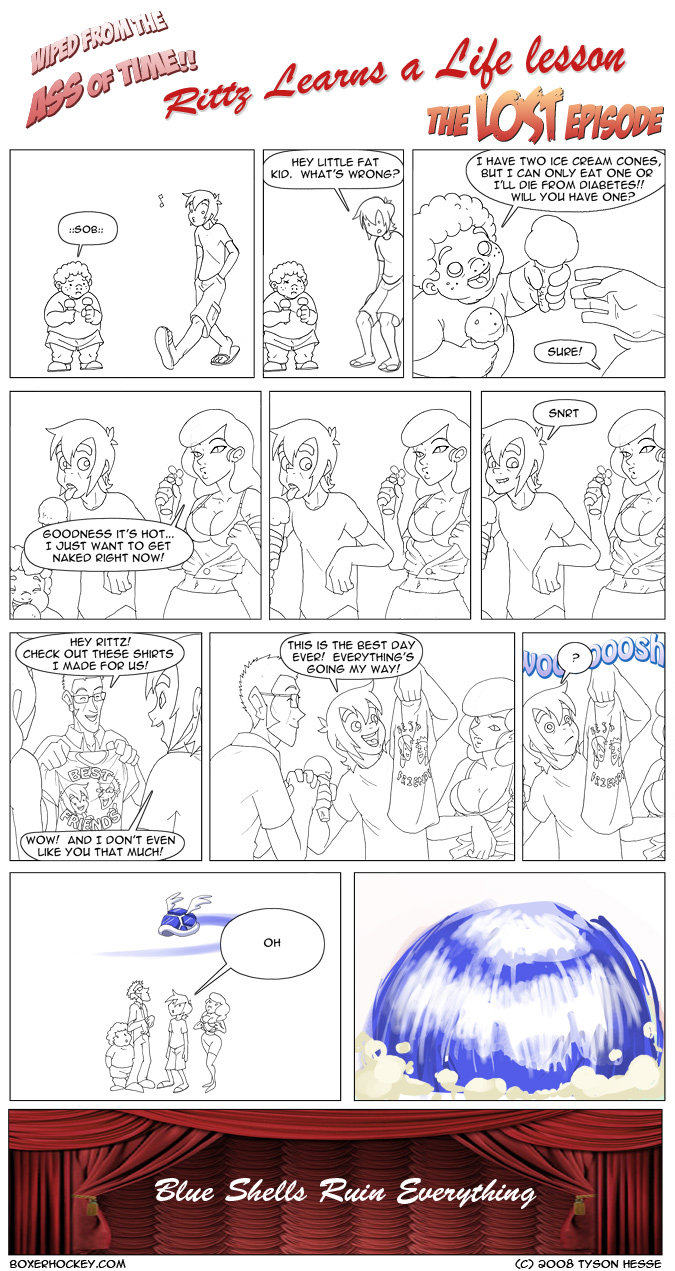
"Blue Shells Ruin Everything"

A sub trope for The Scrappy. It describes a game play mechanic in an otherwise fun/enjoyable game that generates a sizable hatedom. Perhaps it's out of character to the game, its quality is lower than the rest of the game, or it really exposes the problems in the game. Also related to Unexpected Gameplay Change and Gameplay Roulette. Gameplay tactics do not count unless it's the exploitation of glitches and hacks. Otherwise, that's just abuse of an otherwise fair and good mechanic that causes the game to be played in a way that it's not supposed to. That One Boss is only related to this if a boss villain's status under that trope is solely because of a Scrappy game play mechanic.

Compare to Disappointing Last Level. Despite appearances, this trope is not to be confused with a machinery technician who picks a lot of fights, nor is it about Slippy "The Load" Toad, who is merely a Scrappy who happens to be a Mechanic. Can also cross with Oddball in the Series where that one game that differentiates itself from the others in the series may stand out due to the Scrappy Mechanics it uses.

For a sometimes overlapping Sister Trope, see That One Rule.


Examples:

    open/close all folders 

    Action/Action Adventure 
  • Prototype had escort missions, which are already widely hated by pretty much everyone. It wasn't so bad early on, defending thermobaric tanks and such, but the escort mission immediately before Elizabeth Greene's boss fight would likely cause broken controllers. One pump vehicle pumping BloodTox veeeery slowly and wave upon wave Leader Hunter's who just sprint straight for it and smack it with AoE's until there's not even bolt left. Wonderful.
    • The racing side missions, where the player has to move through a variety of waypoints in order, under a particular par time. Fair enough on its own, but the mechanics of the player movement tend toward going very fast, but also being very imprecise. Moving through a tiny waypoint when you overshot your target because you were moving too quickly feels like Fake Difficulty.
  • The Legend of Zelda: Ocarina of Time:
    • Having to pause and go to the equipment screen to change between normal shoes and iron boots over and over and over in OOT's Water Temple, where you need to walk on the bottom in some places and float in others to complete it. (Thankfully, the remake and next games to have the Iron Boots has them as an item you can equip to one button for easy switching.)
  • When you travel back to the First Day in The Legend of Zelda: Majora's Mask, you lose the ammunition of your items, meaning that you'll have to collect bombs and arrows again when going to a dungeon.
  • Oracle Of Ages added a wonderful mechanic for the Mermaid Suit. You have to constantly tap the D-Pad in the direction you want to swim in, not hold the D-Pad as usual. This makes the sixth and seventh level bosses extremely annoying, thanks to both fights being fought underwater (the sixth boss is both under and above water).
  • Kinstones in The Legend Of Zelda The Minish Cap, for wasting one of the GBA's precious four buttons on a seldom-used function.
  • Wind Waker's sailing deserves special mention here; while it's essentially the same mechanic as Epona the horse, at least Hyrule Field has more visual diversity. Epona also didn't require you to play a song every time you wanted to change directions for max speed, and the Great Sea is much larger than Hyrule Field. Of course, a Broken Base has developed around this mechanic, as about as many fans who hated the mechanic also loved it.
  • From The Legend Of Zelda Twilight Princess: You found a silver rupee! That's worth a whopping 200 rupees... but your wallet is full, so let's put it back for now. Some may find it better than the alternative used in previous games where any found rupee would be erased if you tried collecting it with a full wallet, but they may think otherwise while searching for the last "unopened" chest in a dungeon.
  • Having to return to the central temple in The Legend of Zelda: Phantom Hourglass, and repeating the same levels after each new item is found, in a timed forced-stealth section with invincible baddies gets old real fast. Thankfully, near the end, the player gains the ability to kill the Phantoms. Hearing them die is worth all the trouble.
  • The Legend of Zelda: Spirit Tracks:
    • Despite being a lot more exciting and fun than the sailing in Phantom Hourglass, the train travel still ends up being this, mainly for two reasons: One, if you happen to die (which is gonna be the case quite frequently, given the number of attacking monsters and evil trains in the open fields) you're reseted to the starting-location. Two, somebody thought that it would be funny to complicate the fairly simple teleport mechanics from the previous games down to the point where they are barely of any use anymore. Why not just use the Spirit Flute for that, like in previous games? Oh boy...
    • Another despised aspect of Spirit Tracks are the Pirates. They are far more frequent than is reasonable, and are a severe threat. They lag the game, every shot they do after their first is 100% accurate, and if you have a passenger, you'll have to do a very long, drawn out fight scene, where death and/or failure, requiring a restart of the already Scrappy Escort Mission, is a very high possibility. Good news is, you can destroy the cannonballs they fire at you before they even make contact. Besides, you can always slow the train down while carrying a passenger so that you lessen the risk of multitasking to both fend off the pirates and follow the signs.
    • The Spirit Flute duets have a small hatedom due to the item's incredibly finicky and picky nature.
    • Passenger missions as well, at least when you're forced to go through enemy-infested sections of railroad tracks. Your passenger will get increasingly annoyed with you each time the train gets hit, and fighting to keep the ship from being blown up by pirates apparently isn't a valid excuse for not blowing your whistle when a sign tells you to...
  • Zelda II The Adventure Of Link: All experience goes back down to zero when you get lose all your lives and get a Game Over. 20 EXP away from a level up? Too bad, it's all a waste, should have gone to an easier area to grind that last bit. And those big EXP pick-ups you grabbed during this time? Oh, they're not coming back. And this isn't even taking into consideration the large number of enemies who steal EXP whenever they hit you. They can't drain levels from you, but if you've collected 200 EXP and are 100 away from a level, getting hit enough will force you down to 0/300 EXP to the next level. Basically, in order to level up efficiently, you have to make sure you're not anywhere near EXP drainers (and they're annoyingly common). Maybe even worse: after getting a Game Over any extra lives you've picked up (and there aren't too many of them) are Lost Forever. It also sets you back to Zelda's palace at the very start of the game, except once you get to the last dungeon.
  • Skyward Sword:
    • The Adventure Pouch. To elaborate, it's essentially a separate inventory where you can store up to 8 (with upgrades, up to 4 initially) items of your choosing. Except that said items are things that didn't even use up an inventory slot in previous games, like Shields and Bottles. By far the most irritating, however, is the way ammo expansions work. Rather than simply getting a bigger quiver/seed satchel/bomb bag that replaces your old one, you have to buy an extra quiver/bag/satchel and have it use up an inventory slot just to be able to carry even 10 extra bombs/arrows/seeds. Said inventory slot could be used for a bottle or even a shield. Oh, and in order to have a full life meter, you need to equip two 'life medals', meaning if you want it to look like you have 100% Completion, you'll need to use up two precious slots on those, effectively giving you only 6 slots to work with.
    • There's also treasure. When you pick up a new type of treasure, you get the usual animation of Link holding it up and a text box announcing what it is, followed by your tally of that item going up by one. All well and good, except that this aspect resets every time you start up the game; anything you haven't picked up in the current game session triggers the time-consuming cutscene all over again because, evidently, you are woefully incapable of remembering what a bird feather is between game sessions.
    • This game also inexplicably did away with adjustable text speed, uses a ridiculously slow speed as the default, and has more text-exposition than any other Zelda game, so be prepared to sit through many lines of tedious text, often text you've been force-read dozens of times already, every time you buy anything or talk to anyone for any other reason. Plot-relevant text is even slower. Holding down the A button speeds it up a tiny bit, but not nearly enough to prevent boring an average-speed reader to death.
    • And of course there's the harp, which often fails to accurately copy your hand gesture, leading to Link's hand vibrating wildly as you try futilely to mimic the unhelpful light pulses of the overly-long song.
  • In Act Raiser your god avatar has a set number of spells per level attempt. That's right, not per life, per level attempt- you don't get your magic back when you die. If you use all your magic against a boss but just fail to defeat it, then your only choices are to work out a way to beat it without magic or to lose all your lives and start the level from the beginning again. Although the unresponsive controls and mediocre collision detection were pretty bad problems, the magic issue stuck out as both clearly deliberate and plain mystifying.
    • Worse, you had to manually equip spells through a fairly terrible interface before going into the level, every single time.
  • Okami has the digging minigame. It is a timed event which requires you to dig by using your brush powers to remove certain obstacles while you escort a companion whose life mission it seems is to walk into every time reducing object possible. Add to this that on the Wii version, the brush controls only work half the time. Also, certain actions such as blowing your companion over gaps or shooting them up with water spouts only work if your timing is absolutely dead on, and even then he will tend to walk right off the edge you just popped him up on, making you start again. Thankfully, there's only two times it's necessary and they're the easiest ones.
  • Okamiden has its own, which is both simpler and far more pervasive: Ink doesn't regenerate. This will cause you an enormous amount of pain during certain boss fights, particularly King Fury.
  • The Information Gathering missions from the first Assassins Creed game, so much that the first order of business for Assassins Creed II was taking them out and replacing them with a more natural mission system.
  • The follower system in Assassins Creed Brotherhood and Assassins Creed Revelations have gotten a fair share of flack for making gameplay too easy.
  • Den Defense from Assassins Creed Revelations is an Unexpected Gameplay Change complete with a poor interface and zig-zagging difficulty. One of the first things confirmed for Assassins Creed III was that Den Defense would be cut.
  • Mega Man X:
    • Ride Chaser levels (X4 and X5 especially). Walls that block you come out of nowhere, the damn things aren't very responsive anyway, and maybe a second to respond to changing terrain, bottomless pits, and the aforementioned walls. Significantly less scrappy in X8, but still annoying.
    • The Ride Armor sequence in X5 (Mattrex's stage, part 2) could be avoided, and good thing, because it's built around the fact that the Ride Armor can withstand the lava (whereas the also-robotic main characters cannot). You take the Ride Armor (and its not-displayed health bar) deep into the lava itself, and if it gets destroyed, you die and go back to the beginning. The sequence ends with having to ditch the Ride Armor in the lava; you have to jump and eject yourself from the Ride Armor (hold "Up" and press the jump button) at the peak of that first jump. The slightest slip-up kills you and sends you back to the beginning. Considering that the route you can take to avoid this is a Shout Out to Mega Man 2, and this is the only level in X5 that the Ride Armor appears in, why is the Ride Armor here at all?
    • How about Zero's "nosedive" attack in X6 that's activated by pressing "up" and "attack" at the same time?
      • You can't mention that move without bringing up the fact that the "Up" button is used to grab ropes as well. If you're in the habit of holding "Up" when jumping along horizontal ropes situated over spike pits and whatnot, a single enemy in your path can make you accidentally trigger Zero's diving attack, sending you back to whatever obscenely-placed checkpoint you're forced back to.
      • Even worse, for the Anniversary Collection, the developers were planning on changing the controls for the attack to prevent the above issues from happening, but they were barred thanks to the existence of the Maverick Hunter X game; yes, because they were expecting to build a series out of it, and change the controls when they got to that game, the Anniversary Collection version of X6 got gypped out of having this particular scrappy mechanic taken out. WHAT?!
    • X5 had random Reploids in a few levels, who were meant to be hostages and could be rescued simply by touching them, as they reward you with an extra life and a (usually minor) health refill. This was their only use, and in a game where you get unlimited continues anyway, their helpfulness was a little questionable. Altogether, though, not too scrappy. X6 put sixteen of these hostage Reploids in each level, and some of them give you upgrades with no in-level indication of who gives what--or indeed, anything. That's... annoying. X6 also introduced these Goddamn Bats called Nightmares (the floating tentacled things that drop souls required to use the aforementioned upgrades on a character, in itself another Scrappy Mechanic). They can fly through walls, commonly appear in packs, can revive themselves if you don't pick up the souls they drop, and...oh yeah, they can possess and disfigure the hostage Reploids, sometimes even ones that are offscreen. Needless to say, any hostage that gets possessed and has to be destroyed never comes back, making any upgrades they may have had Lost Forever.
    • X6 flip-flopped a little on the subject of how easy it should be to thwart a Nightmare from possessing a hostage. On one hand, any hostage within range would draw the Nightmare's undivided attention, and you could shoot them in the back as they slowly flew toward the hostage if you were feeling that risky. On the other hand, some Nightmares are very cruelly placed, to the point where one Nightmare in particular is directly on top of a hostage Reploid. Yes, this means you could lose a Reploid before you can even see him.
    • The Nightmare System in X6 would cause changes to certain levels if you went there from a certain other level. The levels in X6 are aggravating enough, but certain Nightmare System changes could render them nigh-Unwinnable (good luck trying to get past the first avalanche section in Blizzard Wolfang's level with X/Zero copies attacking you constantly.)
    • X7 would have been bad enough even if its targeting system worked as intended.
    • Then we get the ranking system in the Mega Man Zero series. In Mega Man Zero 2 and 3, you HAVE to have at least an A rank in a stage to obtain a special weapon from the boss. To get high ranks, you must go through the stage quickly, taking little damage and defeating many enemies. Yes, all of those at once. Zero 4's special weapons depended on another factor unrelated to the ranking system and were therefore much easier to get, but the game then introduced, if anything, an even Scrappier Mechanic: item recipes. By putting together specific combinations of chips dropped by enemies, you could make powerups that let Zero double-jump, walk on spikes, charge up faster, etc. The problem is, you have no way of knowing whether or not any particular combination will actually do anything until you put them together, aside from a few recipes that can actually be received in the game. You'll just have to use trial and error for most of them, and doing that will use up those chips. Heaven help you if you tried that with one of the chips dropped by an enemy that only appears in one of the non-revisitable stages. And of course, there's no indication in the game of how many recipes there are either...or even how many chips you need for any of them (given that they can require anywhere from 2 to 4). Combine Guide Dang It, Trial-and-Error Gameplay, and potential Lost Forever and you have an incredibly frustrating gameplay mechanic.
  • Devil May Cry 4:
    • The Devil Bringer Nero uses annoys some fans of the series in that it is overpowered and that combat becomes more of a one-hit God Of War button pressing sequence rather than dishing out the combos... but the problem with Nero is that his move list is limited and thus to deal major damage you usually have to use the Devil Bringer.
    • While revving Nero's sword up to power up his strikes has no downside and revving it in time with his attacks automatically powers up the next attack instead of having to rev it 3 times, it's Scrappy Mechanic to a degree in case you're not a fan of hitting one of the shoulder buttons in time with every attack, especially since revved up attacks have different timing and thus require you learn both of them if you wish to master EX-Acting and MAX-Acting all attacks. If you don't, your variety of attacks will be a lot more limited, mostly because Nero can't get any new weapons like Dante can.
  • Some of the best equipment and rune words in Diablo II were restricted to players on the ladder, a harder version of the game on Battle.net with a finite amount of time to find the ladder-only items*. Players who wanted a slower-paced game, preferred single-player, or didn't have reliable Internet access were out of luck.
  • Diablo III
    • Many people dislike the fact that only ten auctions per account are allowed on the gold auction house — if you have alts or play AT ALL you will quickly exceed that limit, and combined with limited on character and joint character inventory it can be a pain. As a result, most gear you find is turned into Vendor Trash because it will take up too much space. That gear sells for so little, and giving it to the blacksmith to turn into items for him is pointless as most blacksmith items are terrible.
    • The Real-money auction house also gets a lot of grief, because it lets players substitute real-world money for competence at actually playing the game.
    • Prior to patch 1.0.8, the Guide Dang It nature of the Auction House: Since only adjustments to base stats were listed, you needed either pencil & paper or a third-party site to figure out whether the item you were considering would actually be an improvement.
    • Enrage timers were near-universally loathed by the fanbase. Ostensibly put in to discourage farming of elite mobs and bosses in higher difficulties, it makes killing said mobs and bosses impossible for under-geared players playing solo, as once the said timer activates, it's almost a guaranteed death. Fortunately, they were eliminated in a recent patch.
    • Blizzard's announcement that the game was online-only, even for single player, did not go over well.
  • Dynasty Warriors 6:
    • It introduced a new combat engine, Renbu (which means "Endless Dance"), which no longer limited attacks to a simple string of striking attacks as they could go on infinitely at any time (Including the newly implemented string of charge attacks). As your Renbu level increased, more attacks (striking and charge) are added to your attack string. However, the only way to increase your Renbu level is by constantly attacking enemies (raising your chain counter), but that's not the worst of it. Your Renbu gauge can decrease by either not raising (or starting) your chain counter (Making this very frustrating in escort missions) or by taking heavy damage from enemy attacks.
    • With the right abilities, renbu gague loss was mitigated. The real problem with renbu was that it was a fine idea on paper but not in play on higher difficulties. On higher difficulty levels, it's not uncommon for one of the fifteen or twenty mooks to hit you during a combo, breaking your momentum. Some characters could easily recover; but other characters' movesets (such as Dian Wei and Xiahou Dun) felt so uncomfortable to play with on higher difficulty settings that they were outright unusable.
    • The reception for this was so bad Renbu was removed completely from the Empires Expansion Pack in favor of upgrading the weapons themselves to give more elaborate combos. Simplifying of the upgrade system is common for the Empires side games in order to allow more focus on the kingdom management aspects, but this is the first time a core battlefield mechanic was completely excised between a numbered release and the expansion.
  • Bike riding in Tomb Raider: Legend gets a large hatedom for being the worst part of the game.
    • Likewise, the kayak in Tomb Raider 3. Vehicle sections are welcome most of the time, but the kayak handles just a little too realistically to be fun having to navigate lethal rapids and waterfalls full of deathtraps with. There were some points with the kayak where it was impossible to proceed without taking heavy damage from the traps and falls.
    • The tightrope walk sections in Tomb Raider Chronicles would count too. Lara can easily fall off if you fail to regain her balance and crossing is sometimes based on luck. Since Lara losing her balance is randomized, you could wind up spending more time readjusting than actual tightrope walking.
    • The poison mechanic in Tomb Raider III and The Last Revelation. Once you were poisoned, you'd gradually lose health and the only way to cure it was by using your vital health kits. What made this worse was most enemies that could poison you either traveled in groups or were hidden from view.
  • Super Metroid had an infamous Wall Jump, which required the player to roll-jump towards a wall and hit the opposite direction on the control pad, before pressing the jump button a millisecond later. This took hours to perfect and was needed to escape a certain area, and to collect all the powerups.
    • The Shinespark jump from Super Metroid allowed Samus to store energy from the Speed Booster and use it to make a super-jump. It was a difficult but manageable technique that wasn't used very much. Someone on the development team must have loved the jump and thought this was a shame, so it's used way too often in Zero Mission, which wouldn't be so bad if these jumps didn't require the player to stop the jump and re-store the energy. Admittedly, this is only for optional powerups, but 100% completionists will quickly learn to loathe the Shinespark.
  • Metroid Prime:
    • The first two games are good games, with just an unfortunate implementation of a Scavenger hunt toward the end. The first Prime game isn't all that bad, since you can collect the required artifacts throughout the game, with only one unavailable until the endgame (And even then, it's only located two rooms away from the spot where the endgame really starts). The second game is horrible: you must have the Dark Visor to begin acquiring the keys — a few also require the Light Suit, which is approximately 95% of the way through the game.
    • The third game has it too (GFS Valhalla and the Energy Cells). They just integrated it more skillfully with the main adventure, and you don't need all of the Cells to complete the game. In addition, a simple speed trick on the Valhalla allows you to skip two more cells in the Aurora Chamber; if you're just looking for bare-bones completion, you needn't go out of your way at all for Corruption's scavenger hunt.
    • It should be noted that while you can snag a few of Prime 2's artifacts as soon as you get the Dark Visor, about 2/3s of the way through the game, if you're going for a full logbook you can't get a single one before snagging the Light Suit and visiting the room in Dark Aether where the artifacts must eventually be taken at least once, or else you'll miss out on one Lore scan per artifact obtained for a total of nine.
    • Even Metroid hacks have been known to imitate the Prime series' scavenger hunts. Super Metroid Redesign sends you in search of twelve well-hidden Chozo guardians, some of which are inaccessible until the right conditions obtain. The worst is a tube in Maridia which, unlike all other tubes of that design, can't be broken by Power Bombs; instead, it breaks when you defeat Ridley (halfway across the planet).
  • While Metroid: Other M wisely stowed away with the idea of a third-act scavenger hunt, it introduced the Concentration-based health system. In every other Metroid game, enemies would drop health (and missile) boosts when you killed them, keeping you topped up on-the-go. Other M does away with this completely; the ONLY ways in other M to restore your health at all are through save stations (which function here as recharge rooms as well, similar to those in the Chozo Ruins and Mothership in Zero Mission), and through a new technique called Concentration. At any time, you can point your Wii remote upwards and hold A to replenish your missiles fully, but with health it's trickier: you can only restore health when you're so low that a few more hits will kill you, and to do it you need to perform the technique while standing still and unable to defend yourself for a few seconds. Now, where are you most likely to run your health low enough to be allowed to use this technique? In heated battles where the enemy won't exactly sit around while you're trying to heal. And even then, it only gives back 99 units of health at first - you can find upgrades that increase how much you can get back, but you need to go out of your way for them. It turns the entire game into a Nintendo Hard endurance test. Though, one supposed players should have expected something like this from the same development team that brought us such fair and reasonable entities as ALPHA-152.
    • Other M's "Pixel Hunts". There are several scenes where the player is locked and immobilized in a first-person viewpoint until they spot some background detail. Unfortunately, such details were almost all extremely difficult to notice, from a splotch of green blood in a grassy area to a brown caterpillar in a dark brown room. These moments killed the flow of the game and often became Guide Dang Its. Worse still, the final boss is one of these, and can kill Samus in a matter of seconds.
    • In a broad sense, the "Authorization" mechanic, in which, instead of losing all upgrades at the start, then gradually replacing them in upgrades as time goes on, Samus gets the use of various aspects of her suit "authorized" over the course of the game. So expect to be trudging through deadly lava for a good fifteen minutes, before Mission Control finally allows you the environmental protection of the Varia Suit that you already have. The mechanic so flew in the face of basic logic, that the idea that Samus and her commanding officer are in an abusive relationship seemed to be the only logical explanation.
  • Aerial levels in Drakengard are, sadly, half the game. They start off all right, but then the enemies gain homing attacks. Every last one of the enemies, that is. You have homing shots yourself (albeit weaker than non-homing) and a magic-attack "bomb," but in order to gain all the weapons, you have to clear several aerial missions without using the magic attack and under strict time limits. It doesn't help that you can't "hover" (this was fixed in Drakengard 2), making aiming a game of luck, and that you turn so very slowly.
  • Battle Toads:
    • The 2 player mode is cruel enough to force both players to restart a section if either one runs out of lives. Most of the time, the surviving player will be low on lives and be the one to run out next time. The Angry Video Game Nerd and Kyle Justin ranted about this long before reaching the eleventh stage, which has an out-and-out bug that makes it impossible in 2 player.
    • As if the game weren't hard enough already, you can't turn off the friendly fire in the game (though you could in later Battletoads games), making it extremely easy to punch/kick/headbutt your ally in co-op by accident. This really, really sucks in the descending level (level 2), where your toad will turn into a wrecking ball and instantly kill any enemy or friend who is even roughly parallel to him, simply because you pressed the attack button.
  • The combat sequences in Mirror's Edge have not made the game many friends.
  • No More Heroes:
    • It has Dark Side Mode, which is randomly activated by uncontrollable spinning slots that appear after killing enemies. Of course, it has a tendency to trigger after you've already finished killing all of the enemies in a room... and it cancels when you open doors/gates to proceed to the next one. Only one of these is stored for later use when the player chooses, as it instantly kills all enemies on screen... but because it awards extra money for not using it when you beat the level, it's even scrappier, as most players simply leave it and take the money.
    • The entry fees, and by extension, the job and assassination minigames in the first game also count, even if they are justified when you find out that Sylvia was a con artist and was manipulating almost every assassin in the game. The player basically has to grind large amounts of money to unlock the next rank match, and therefore advance the story, and the repetition was arguably the single-biggest complaint about the first game. People were glad when they ditched the whole concept in Desperate Struggle.
    • Desperate Struggle also readjusts the Dark Side Mode - now it comes up a lot more often, and even if your luck is bad, there's an extra, manually-activated version if you can avoid getting hit too often.
  • Comix Zone had the rather infamous quirk that hitting inanimate objects removed a tiny sliver of your health bar...then forced you to break things this way to progress.
  • Drill Dozer:
    • It is a fun little game about a small mech with a drill for arms. In certain circumstances, death will simply send you back to the start of the room with a little less health. If you lose a fight enough times, you're given the option to spend 50 "chips" to Continue. Otherwise, you're booted all the way back to the opening screen. Not even the menu, the cutscene you get when you boot up. And when you load your save, if you saved in a boss room, you have to sit through the entire pre-boss cutscene. Every. Single. Time.
    • There's also the Drill Missile. Inside are platforms with little electric orbs on them. Two different types, in fact; blue orbs that move at a steady pace, and pink ones, which move like they're on crack. There are also elevator platforms that flip over to reveal their electric underside. And it's timed. Fail the extremely precise timing challenge, and you get booted out and have to start the mission again. And you will.
  • Blast Corps has the Backlash, a dump truck. A clumsy drive combined with its unique method of building destruction(powersliding so its flatbed hits buildings) make every level where it's required a pain. It's also in the running for "most common vehicle in the game", and certainly has the most levels devoted to it.
  • Sadly a big part of the gameplay of Fragile Dreams: Farewell Ruins of the Moon falls into this: The weapon you use can break at any time, you have a very limited capacity to carry things with you and to see certain objects you have to come back to a save point. The battle system is kind of scrappy too; even if there are different kinds of weapons and each of them has a decent selection the player is limitated for the whole game to a single combo. This is the reason why the game is more an emotional experience than a gaming one and therefore the player should specially focus on its story, characters, art and symbolism.
  • Teenage Mutant Ninja Turtles: Turtles in Time the arcade version had throwing. In the SNES port that came later, you could choose a type of throw: rag doll slam or throwing the enemy at the screen. Throwing relies on Random Number God in the arcade version, which means you could not choose your type of throw. This makes you wonder why Konami thought it was a good idea at the time during the arcade release.
  • Castlevania:
    • Castlevania II: Simon's Quest had the day and night mechanic which many people hated, mostly because it made everything take twice as many hits, the towns unsafe and the slow-as-hell unskippable text box stating the obvious to pop up. There was also the grinding to get hearts and running back to town just to get an item.
    • Castlevania: Dawn of Sorrow's Magic Seals are a good example of how implementing a part of the system's capabilities isn't always a good idea. In order to finish off the boss, you have to draw a particular seal using the DS's stylus, or the boss regains a portion of their health. While simple at first, it gets frustrating as you're forced to use more complicated seals as well as less time to finish drawing the seals and most of the later bosses (Gergoth, Death and Abbadon in particular) are simply a nightmare to fight, particularly if you slip up. At least the bonus Julius mode didn't force this on the player again.
      • The worst offender is Magic Seal 4. Due to a glitch, it won't cancel when player makes a mistake or runs out of time (the only way to cancel is to stop drawing seal), yet making the seal unfinishable upon either happening. It may take a while before player notices what's wrong.
  • Lollipop Chainsaw: The Chainsaw Blaster's auto targeting takes a lot of flak for jerking the camera around where ever the closest zombie is near you. This is remedied though since you can go into options menu anytime to switch to manual aim (which works way better). Some of the mini games count too, and failing them will make you lose a life, ruining your no death run. The mini-game that practically everyone hates is Zombie Baseball, due to three reasons:
    • 1. It's a glorified escort mission that involves getting Nick around the baseball diamond three times. Nick goes somewhat at a snails pace and wastes time celebrating EVERY TIME he makes it to a base.
    • 2. Nick is pretty much a Glass Cannon and can only take about 4 or 5 hits at most.
    • 3. If you left the auto aim on, this section pretty much becomes a Luck-Based Mission. As mentioned earlier, the scrappyness is reduced somewhat since you can turn off auto aim anytime. Though many first time players did not know about manual or auto aim.

    Adventure 
  • The vegetable picking in Putt-Putt Enters the Race. First off, it's a puzzle designed like a gigantic maze. What makes it annoying is that some foods take ages just to get to, and once you make it to them, you have to retrace your steps, so that needlessly doubles the amount of time it takes. To make matters worse, you have to be right next to the vegetable in order to get it or get ready to be told you can't pick it over and over again. It doesn't help at all that the movements cannot be skipped at all, unlike the rest of the game.
  • Instead of the classic wrong-choices-mean-death approach, Time Hollow makes Game Overs possible with a health meter. It can only be refilled by wandering the game looking for "chrons" and watching an unskippable cutscene each time you find one. But you're unlikely to even need this, as you only lose health for "digging" in the wrong place, and most of the digging puzzles are very simple — making the whole thing pointless.

    Card Battle Game 

    Fighting 
  • Ringouts (knocking your opponent out of the arena and into an auto-DQ zone), or any other means of winning a round without actually zeroing out your opponent's health bar are pretty universally reviled. The Virtua Fighter and Soul Calibur series generally include ringouts on most if not all stages. Soul Calibur also heavily features juggling and several notably claustrophobic stages where accidental self-ringout is an actual possibility. Dead or Alive, on the other hand, put a more enjoyable spin on this, transforming most ringouts into events more to the order of 'you knocked him off the building and down through the flashy neon sign and into the pavement, but then you jump down after him and keep fighting down there.'
  • For a lot of people who would otherwise play Tekken, juggling is exactly this. A large section of the fandom who thought 2 or 3 was the best in the series often find any game past 4 bordering on unplayable. One word - walls. Getting trapped by Eddy or Christie in the corner of the map has been known to break controllers.
  • Super Smash Bros.:
    • Tripping in Brawl. Whenever a player breaks into a run, they may, by completely random chance, trip over and leave themselves vulnerable. The mechanic doesn't go away in Sudden Death. Even though tripping gives you invincibility frames, you could pretty much do the same thing but better with sidestepping.
    • For the Pokémon Trainer, the stamina mechanic which punishes you for trying to rely on one of the Mons by reducing your stats when you use one specific one for too long (and to a lesser degree how the current mon automatically switches when you get KOed). You can tell when this happens when your Pokemon starts to act tired in their idle animation and move around more sluggishly. This despite the fact that Sheik/Zelda never needed any handicap on multiple forms besides lacking an Down-B move.
    • For a large group of players (read: those who don't play in tournaments), this applies to every kind of "dashing" (except running) and "canceling" technique in Melee, the previous game. The fact that they were nearly completely removed in Brawl' was seen as a breath of fresh air for some of those who didn't base their playstyles on physics exploits nor intentional advanced techniques. On the other hand, their removal was a huge cause to the very Broken Base, especially since many already-nerfed characters were nerfed even more as a result.
    • Brawl's random multiplayer. You're pitted against 1-3 anonymous opponents, and when someone quits, they're taken over by a CPU. Without notifying you. Most annoyingly, this feature was even touted on the official website. Unless you know the AI well enough, you'll never know whether your match was spent entirely with living, breathing humans or that awesome finish you pulled off in the final moments of the match was against the CPU.
    • Brawl with its Final Smashes. If items are in play, there's a chance of a Smash Ball appearing and if you break it, you can unleash a super attack that will pretty much knock out enemies instantly. The main problem is that while you can dodge the super moves in some way, most of the time, you won't be able to (or worse if the level makes it hard to avoid it) and thus your opponent gets a free kill or two. What's also worse is "Pity" Final Smashes that occur when a player is severely lagging behind in points and respawns with a Final Smash already in standby. This is another reason causes Brawl's Broken Base.
  • In Tatsunoko Vs Capcom, when someone ragequits in an online match, it counts as a loss for the person who was still online, who likely would have been winning. And this even happens if the final hit was registered. What? WHAT?!?!
  • SmackDown vs. Raw:
    • Since the 2006 edition, gender restrictions have been placed (no more intergender matches). In SvR2K10, a new match type was introduced: Mixed Tag where it was the only way to have intergender matches. The problem with the match is that if a man and woman are legal in the ring one of them has a five count to make a tag or it's automatic DQ. Worse, and not just in this match but in any match, the men get disqualified for hitting the women even if it's by accident while the women, on the other hand, are allowed to attack them as much as they please (If countered, they'll win automatically be DQ). Unfortunate indeed, but this is a reflection of the current "rules" in the WWE, which is sort of the point of Smackdown vs Raw. Thanks to PG and other things men cannot hit women and the five count is an accurate reflection of tag rules, as it has to be girl on girl and thus if the others tag it means that you also tagged.
    • The grappling system in SVR2011, which removed the modifier for strong and weak grapples. Weak grapples could only be performed on non-groggy opponents, while heavy grapples were restricted to groggy opponents.
  • The older GameCube title Day of Reckoning 2 introduced a new "stamina" system that left your wrestler completely helpless and at the mercy of an opponent if they ran too much or used too many moves in succession. You could also run out of stamina if you got beat up too badly and while that normally only happens to characters with low stats, it makes comebacks difficult if it does. In one way it added more strategy to matches, but it also made it harder to beat opponents with higher stats.
  • Marvel Vs Capcom 3:
    • X-Factor is this for some. It's a power-up that can be activated by any character in the game once per fight that increases in power as more characters of your team die off. The reason some say it is this trope is that the strength and speed boost it gives your character is so big that it breaks the game. Every character gets access to easy 100% combos upon using it and can easily decimate entire teams after one mistake, completely overturning the momentum of a match. And that's not even getting into the fact that activating it cancels instantly from ANY move.
    • Even better; Ultimate Marvel vs. Capcom 3 now allows you to activate X-Factor midair.
    • One could also argue that the inclusion of ground/wallbounces and really common OTGs in order to make combos as long as inhumanely possible is detrimental to the overall fun level for whoever isn't the winner. MvC3 is decidedly not a game that's fun at all if you're losing, if only because you have to watch completely helplessly for upwards of 20–30 seconds of pummeling that you have absolutely no control during if you make a mistake.
    • The match-search system for online has become notorious for being utterly broken. In theory, setting "Player Rank" to "Same" should pair you against players similar in skill to you. In practice, nobody has any clue what formula the game uses, but it likes to pit Amateur (the second-lowest rank) against Lord (one of the highest) and other such blatantly-lopsided fights. Expect to get into a lot of fights you just can't win.
  • Counters (or holds as they're properly known as) in the Dead or Alive series, especially in 4 where they're believed to have degenerated the game into pure guessing.
  • Deadliest Warrior:
    • The stamina bar embodied this trope to the max, even heavily armored warriors like Knights and Spartans could have their blocking ability momentarily disabled or their arm broken due to their shield being punched but not to being shot by a Blunderbuss.
    • Even more so: one hit kills with ranged weapons.
  • The tests of strength in the Fire Pro Wrestling series, which become impossible for a player to win above level 5, and occur with increasing frequency in the higher difficulty levels. Generally agreed by fans to be the worst aspect of the game.

     First Person/Third Person Shooter 
  • Modern Warfare and any later Call of Duty:
    • Any game with Create-a-Class: Pick any weapon. Any weapon. Go on. Now pick any attachment. Now pick any set of perks. Now pick any killstreak reward. Chances are, no matter which ones you just picked, someone hates your guts now, and you're a total n00b.
    • The nigh-universally detested M203 grenade launcher, dubbed the "noob tube," has, since its inception, been deemed annoying and unfair by both casual players and "Stop Having Fun" Guys everywhere. That doesn't stop it from being used all the time, however.
    • The same can be said for the tactical knife, with marathon and lightweight equipped.
  • The buggy in Half-Life 2. All of the vehicles were difficult to control, but only the buggy had you picking your way over a winding coast road with it. The mounted gun, while not terrible, was much less powerful and satisfying than the airboat's rapid-fire death cannon.
  • Team Fortress 2 began to add alternate weapons to the mix well into its life cycle, which was a severe Base Breaker for quite some time. Since then, virtually every attempt that Valve made to change the game resulted in an outcry that it had been ruined from one or more groups of players.
    • One group considered the game to be extremely well-balanced the way it was, and so *any* inclusion of new weapons was challenged as a threat.
    • Random critical hits were apparently this for a time; when the devs first began adding community-made weapons to the game, damn near ever single one of them had "no random crits" as the first of their listed drawbacks. Even today people constantly complain about random critical hits on the forums.
    • When the first Medic achievements were finally released, there was an outcry because A) getting all the weapons required getting all of the achievements, B) many of those achievements were very counter-productive to your team's effort, and C) several of them required either a co-operative ally or enemy to perform. The result was that players were deliberately ignoring team goals to focus on individual ones, causing much gnashing of teeth. People quickly formed servers to set up the contrived scenarios required to get the achievements quickly, which were vulnerable to griefers and attracted hate for players not earning the guns "legitimately."
    • Valve, recognizing this, was generally better about releasing the weapons for new classes by lowering the achievement requirements and putting them in line with what the class was supposed to be doing. However, they would often time these releases to coincide with one of their "Free Weekends," which caused more moaning as new players would jump into games that were jammed with everyone playing the same class, conclude the game was boring, and quit.
    • Valve again changed the mechanic to a random drop system, to prevent everyone from jumping on the same class. This led people to complain that they were playing hours upon hours of games and unlocking nothing vs. people who jumped right in and were picking things up every 5 minutes.
    • Valve again changed the mechanic (are we sensing a theme?), that now the rate of drops is increased, but players can "craft" weapons and cosmetic rewards to build the weapons you want. However, there's still a random element even if you have all the "materials," which makes players crazy as they still just want the guns.
    • And now the "Mannconomy"/Polycount update adding gear sets that provide special bonus for wearing all the parts (the most hated being the sniper becoming immune to headshots) and allowing players to buy most of the equipment in the game, including the Bragging Rights Reward hats, has just started to open a fresh can of worms.
    • Also in the "Mannconomy" was the addition of crates and keys. With the random drop system, sometimes you will receive a crate instead of a weapon (or paint/name tag/hat). You need a key to get what's inside the crate, but these keys have to be BOUGHT WITH REAL MONEY! And when you do open the crate you may get a hat, or a very rare unusual hat... but more likely to get a regular weapon that could have been dropped instead of the crate to begin with! And you also run the risk of getting a weapon you already have, essentially wasting the money you spent to buy a key. Exhaustively depicted in this VGCats comic. This is all thankfully mitigated by making crates drop on a separate timer as your regular weapons, meaning you still get 11 free items a week regardless of how many crates you do and don't pay for.
      • Let's just say, anything regarding the Mann-items....even if it's aesthetic, some people have pointed out the Double Standard that this would not be tolerated in other games...because Team Fortress 2 is a free to play game.
    • The Manniversary update. Why? You know those items you bought with real money at the Mann store? Good news, they no longer have the untradeable penalty! The bad news, you can't use them for crafting. Scammers took note of this and started trading these useless items for craftable items. Very frustrating because Valve did not notify anybody before hand and unlike item qualities, you're only aware of their uncraftable nature by hovering your mouse over them. So the next time you enter a trade, please (PLEASE) double check the items the other side is offering so you don't become a victim.
  • Permanent death in the original Counter-Strike. Actually, the scrappy mechanic here would be per-round perma-death, combined with no training system or bots. CS requires a thorough familiarity with the guns, stages, and teammates in order to achieve anything like a lot of other shooters; in other shooters, this isn't so bad because you could learn while playing: death didn't permanently kick you out of the game, so as such, you could just pick up where you left off, and continue playing until you learned the map and character you were playing. In CS, this wasn't an option. Pick a class, pick a gun, pick a map. Now go survey the area, and when you get sniped in 5 seconds from 1000 yards away by someone in clan X, know that you are out of the game until the next round begins, however long that may be. When the next round starts, rinse, repeat. Over an hour long series of games, it would be quite possible (and not even unusual) for new people to only get maybe a minute of actual game play time in, due to regular players ruthlessly killing them, because said new people had no idea whatsoever how to proceed. Made worse when "Stop Having Fun" Guys would berate new and inexperienced players to learn the game, and get some skills. Thing is, you can't learn the game unless you play the game, and as just described, under most circumstance, that wasn't happening. If you weren't a) hosting a CS server/LAN game with friends, or b) taken into a clan that actually ran scrimmages and taught you how to play, the game was ridiculously difficult to learn, to the point where a majority of the people playing at all have been playing since the original Half-Life mod version, and many who try to jump in later decide it's not worth it.
  • Gears of War has had a few in each game, typically remedied in the following title. The first had general Artificial Stupidity on the part of AI squadmates, the inability to move while downed (meaning that your teammates had to rush into whatever location was dangerous enough for you to be downed in the first place), and the fact that going down while playing solo meant instant death. In the sequel, squadmates were given an AI upgrade and the ability to revive other characters (including the player). However, shotgun charges became epidemic in multiplayer, and so a "stopping power" mechanic was added that meant the game would resist the attempt to run straight into enemy fire. In both games, co-op campaign had several portions where Dom and Marcus separated, meaning that if either dropped, there was no one to revive him and it was a game over. This was fixed in the third installment by the introduction of Arcade Mode, where dead players respawn after 25 seconds as long as at least one human player is alive.
  • Swat 4 with the Unauthorized Use of Lethal Force penalty. This comes to bite in anything worse than normal since you are forced to keep perps alive and that means you got 4 options, the beanbag shotgun which has limited ammo and armored criminals takes a few more rounds before crying uncle. CS/Pepper rifle/Spray which while effective against unprotected mooks does jack against a mook with gas mask (and if they hit another player in multiplayer, they can only move at a crawl, even if they are wearing a gas mask (the advertised "half duration on peppers" doesn't really help that much) and flash and sting grenades which is not very useful when in huge rooms. And the most mooks don't graduate from the Imperial Stormtrooper Marksmanship Academy which means by the time you demand compliance, the enemy will either instantly shoot you first or fake it then shoot you.
  • The friendship system in Grand Theft Auto IV is best described with the following words: "HEY NIKO, IT'S ROMAN! LET'S GO BOWLING!" Rockstar North must have realized how annoying this system was too, as they made it optional in the first DLC pack, The Lost and Damned, and removed it altogether in The Ballad of Gay Tony.
    • FOR THE LAST TIME ROMAN, I DON'T WANT TO GO FUCKING BOWLING!!
    • PC users have an extra thorn in their sides with the lousy helicopter controls. It's very difficult to fly them well, and it gets even worse if required to enter aerial combat with them. On top of this, it is still possible (as always) for your friends to call you while flying.
    • Saints Row The Third seemed to believe that the friendship mechanic could be salvaged entirely if it dealt with side-missions rather than friends. As such, every time you are trying to go to one specific store or activity, just before you can get to it you are going to be called to go kill waves of police or gang members on the opposite side of the city.
  • The gun degradation in System Shock 2. In theory it helps enhance the survival horror feel of the game, since you have more than simply a lack of ammo to worry about, not to mention the rechargeable energy weapons would have effectively unlimited shots otherwise, and the effect could be alleviated with certain upgrades and a mixture of melee combat. In practice, it inspired so much aggravation that the game's creators gave you the option of toning it down in a patch.
  • The ability to be an Elite in Halo 2 and Halo 3. In 2 it made you a bigger target due to the larger hitbox. People complained. In 3, Bungie fixed it and gave them THE EXACT SAME HITBOX AS A SPARTAN. What happened? People! Fucking! Complained!
    • Exacerbated by the fact that the Elite design was changed to a slouched posture, meaning their heads were in front of their bodies instead of on top. This made them effectively immune to headshots from behind. Cue complaints. They resumed an upright posture in Halo: Reach and different gameplay properties to boot, which would have been even more unbalanced in a mixed population. So, playing as an Elite in multiplayer was restricted to a single 'Spartans vs Elites' playlist where teams swapped back and forth to keep it fair. That playlist ended up with the lowest population and the least attention from Bungie's matchmaking updates.
    • Killing a civilian in Halo: Reach instantly kills the player. Implementing this is understandable, but civilians LOVE to get in the way of your shots, and enemies holding them become very difficult to shoot. Bungie softened this by giving civilians lots of health, but they're still susceptible to headshots.
  • Advent Rising, on paper, had it all. "Halo-like" action, a story penned by Orson Scott Card and a (later quietly removed) million-dollar prize for a lucky on-line player. It should have sold like gangbusters. So what went wrong? Was it that the graphics were sub-par compared even to games from the last generation? Was it that the much-vaunted storyline turned out to be a solid block of well-tread cliches? No. No, something much simpler: the game's shooting controls didn't work. An 'innovation' packed into the controls was 'flick targeting', you thumb the right analogue in the direction of an enemy and would then automatically target that enemy, also automatically aligning the camera with that enemy. The problem here was that the right analogue, as is essentially industry standard, also operated the camera... and thus your movement facing. 'Flick-targeting' immediately proved to be wildly oversensitive - with no way to lower the sensitivity or shut it off - meaning that touching the right analogue for any reason - such as, for example, attempting to turn - would, if any enemy was at any range, FLIP your camera in the direction of that enemy, snapping your facing and movement control often 180 degrees. Constantly. Nonstop. No way to shut it off. 'Flick-targeting' killed the game and, in turn, its publisher Majesco, which once published Psychonauts and now publishes shovel-ware for the Wii.
  • The melee fatigue mechanic in Left 4 Dead 2. It was patched into VS and Survival mode in the first game in order to keep the balance in VS and prevent people from getting medals too easily in Survival. This was fine, but the sequel has it in all modes, including campaign mode. This was most likely done to encourage players to use melee weapons, but many still hate the mechanic when you have to get away from zombies and melee shoving is just faster, or worse, you don't have melee weapons with you. Adrenaline shots get rid of the fatigue for a bit, but many choose to save it for more important scenarios.
    • The respawn mechanic when playing as the infected in VS mode. The less players there are in the infected team, the more quickly you can get back to spawning. If there is a full team on the infected side, every death you suffer forces you to wait up to 30 seconds just to get back to playing plus the 10 seconds spent watching your zombie ragdoll upon death before that. Not only this annoys everyone since you are forced to watch the survivor team blaze through the map until your timer is finished, but if everyone on the zombie team gets killed at the same time, it gives the survivors just enough time to recover and press on.
  • The "Defend the X" missions in Onslaught. Just about everything else is good. It's just that they put in way too many of them into the game.
  • Unified Ammo in Deus Ex Invisible War — which made it so all weapons drew from the same ammo pool — attracted a huge amount of hate. It's appeared in other games before and since, but the hate for it in this case was probably partially because the wide variety of custom ammo types and ammo management was a major part of the first game.
  • The lack of a Hyperspace Arsenal in Duke Nukem Forever was just one of the many complaints against the game. Especially considering its predecessor's wide range of cool weapons.
  • Warhammer 40000 Space Marine multiplayer disables the text chat when one is dead and waiting for respawn. This despite the game being one of fast-paced action, when those moments are the only ones when you have, you know, time to type anything.
  • Kid Icarus Uprising is generally considered a solid multi-player game, but some features are considered these to different parts of the player base, while others are fine with it due to the fact that it simply makes the game different from other shooting games.
    • An example would be the fact that unlike other shooters, the shots you fire aren't instant and actually travel through the air, and home in on the opponent. Some weapons have more homing than others, and you can use powers to make the shots INVISIBLE and PASS THROUGH WALLS.
    • Others hate the weapon value system, forcing people to spend hours fusing weapons to do exactly what they want and nothing more, lest their weapon becomes more valuable and makes them a greater burden to their team when they lose. Others feel that the game is based much more on skill so a person with a higher value weapon is fine as long as they have the skill to match.

    General 
  • An internet example. It's happened to you before, where you accidentally roll your cursor over an ad and it expands to take up 95% of the screen. Almost always happens when you're reading what it covers. Or it starts making noise.
  • Likewise, any website that uses a # at the end of the URL or other foul cheatery to effectively disable your browser's "Back" button, requiring you either click-and-hold to manually select a previous site, quickly click and hope you outrun the Scrappy Mechanic, or close the browser window in disgust.
  • Ads on YouTube. Not only do they play the same ones over and over whenever you watch another video of the same series/genre, but the more annoying ads can't be skipped. Sometimes the ads even jam the video.
    • On some occasions, you may get stuck with ads on the side that make noise. You either need to deal with both at the same time, since most videos on Youtube have sound, or pause the videos until it's done. And some of these ads are ads for the main ad coming up. Thankfully, these main adds with sounds usually can be paused, though after awhile, the ad is changed.
    • It seems someone at Facebook thinks this is a fantastic idea...
    • Ads on streaming websites like Livestream are worse - in addition to the beginning 30-second ad whenever you start watching the stream, every two minutes afterward there'll be a small pop-up ad at the bottom of the screen. Or, even worse, they may replay the original ad again, causing you to miss anything that happens in the actual stream at that point.
    • Wikia's even worse with its over-reliance on ads, as they always come first - that is, they have top priority over the articles' content. Wikis hosted there are barely bearable with some browsers, but if you ever access a Wikia wiki with Internet Explorer, you're in for a world of pain.
  • Speaking of Youtube, its parent site Google is partially guilty of this when it comes to its "Google instant" feature, in that search results are automatically displayed as you type your keywords in the site's input box. The downside of this is that, in case you wished to just type in your keywords and then click on "I'm feeling lucky" in order to skip the search results (because you know it's the top result by this point anyway), tough luck - it's exactly what the feature prevents you to do. Thankfully, in case you need to use the "I'm feeling lucky" feature often, "Google instant" can be disabled in the options menu accessible from the search results.
  • Any game (looking at you, Evergrace II) where all the characters you play have a shared life bar. This leads to frustrating moments, especially if some of the characters you control are played by the computer!
  • Motion control on the PS3. Having to suddenly jerk the controller around runs counter to most gamers' instincts, and its detection is inconsistent and random, but first-party titles continue to shoehorn it in because it is a system feature and must be showcased.
    • Every console with motion sensing (PS2 with Eyetoy, PS3 with Sixaxis and the Wii's Remote to name some) seem to have developers who love to "utilize" it in an entirely half-assed way that's simply a less functional version of traditional controls than rely on it as their selling gimmick.
    • It's not just motion sensing. The analog buttons on the PS2 had the same issue, such as in MGS2 where pushing the look button hard in a locker caused you to bang Raiden's head into the locker door and alert the guards.
    • Flower did it well.
      • Also, games that use it in moderation and don't force it on you, like heavenly sword, are generally better thought of because it's not the thing about the game. Kai's level not included.
  • To some, Quick Time Events are a horrible implementation that interrupt the gameplay at the most inappropriate times just to activate a glorified cutscene. Yahtzee may have something to do with it, since it is one of his pet peeves.
  • Tank Controls are severely divided by two factions. On one side, those who believe tank controls are a challenging feature; and on the other, people who believe tank controls are a lumbering dinosaur that should be long obsolete thanks to much more refined controls. The latter hates them for feeling clunky and making the character act all sluggish especially when trying to escape the thing that's trying to kill them.
  • If you try to play the Blizzard Entertainment games Diablo III, StarCraft II or World of Warcraft in an internet cafe when the Internet at home is down, your Blizzard account will sometimes be locked due to different login sequence. You will have to answer the safety question or enter the serial number to unlock your account. This is made for safety reasons, but most other players find it extremely frustrating.
  • Shall I Repeat That? becomes a Scrappy Mechanic if the cursor defaults to "Yes, I do want to hear that again" after a long monologue conversation, as a player mashing the "A" button to skip the NPC's text as quickly as possible will accidentally make the NPC repeat himself/herself over and over and over again until they select "No, I don't want to hear that again". Kaepora Gaebora from The Legend of Zelda: Ocarina of Time is most notorious for this.
  • Somes forms require you to fill out your zip/postal code, yet some countries do not use them.
  • Friend Codes on Nintendo's consoles/games (Wii, 3DS, and any DS game with online play). Both people having to share a randomly generated combination of 12 numbers with each other before being allowed to play with each other kind of annoyed a lot of gamers... especially when they had to put in a new code for each and every game. Made slightly better with the 3DS, which shares one Friend Code for all games and the console itself. As of the Wii U, the friend codes are gone and replaced with adding your friend's usernames instead.
  • Anything in a game that costs actual money to acquire, particularly outside of MMORPG games, especially in app games.
  • Any game where the text scrolls slowly can get on the player's nerves pretty quickly, as it will take several seconds to get through each line of dialogue, unnecessarily wasting a lot of time. Examples include the aforementioned Legend of Zelda: Ocarina of Time (though the 3DS remake has much quicker text speed) and Xenogears. See also Scrolling Text.
  • Escort Missions
  • facebook sometimes blocks you from sending friend requests and private messaging to people who do not know you for a week for constantly sending friend requests to someone who may not know you. Emphasis on "may".

    MMORPG 
  • Player Versus Player in Final Fantasy XI, for several reasons:
    • Many matches of PvP turn into 1v1 matches, even though the game is based almost entirely on party play, turning most team matches into insane free-for-alls.
    • Many job combinations are horribly ill-suited for solo play in the first place. A Bard/anything will likely be turned into paste in one-on-one.
    • Swapping equipment has harsh penalties, and while it's to prevent players being untargetable, the game is almost bursting with players that swap equipment all the damn time in order to perform perfectly.
    • Very few players even have a large interest in PvP, and most of those people are on one server.
    • And due to the lack of interest in PvP, the classes are largely unbalanced. Paladins have a large inherent advantage against melees (especially PLD/RDM) and a skilled Red Mage can beat pretty much any class.
  • For a long time in City of Heroes, when a team completed a mission that multiple members had assigned, only the character whose mish had been selected by the team leader got completion credit from the contact. A minor thing, until you get to the Hollows and all the contacts are linear in the zone story arc, so every hero of the same approximate level is doing the same missions from the same contact. Nothing like a 4-man team hitting the same eight Outcast bases and securing their weapons in a row. Blessedly, the devs saw how painful this was and now everyone who has the mission available gets credit.
  • World of Warcraft:
    • A perfect example would be the Wrath Of The Lich King xpac's Heroic or Hard Mode system, which separated ALL raid content into Heroic/Regular varieties, giving each variety its own separate lockout, and then separating FURTHER into 10man/25man varieties, meaning each active raiding guild could hit all relevant raiding content four times per week, once 10, once 25, once 10 hm, once 25 hm. The exact same content slogged through four times each week. Raid rewards were based not only on individual boss-kill drops, but also on special tokens garnered per boss-kill - meaning in order to remain competitive, each raid was not so much allowed to hit this content four times per week as forced to. There are no words for how tedious and hated this system was, as it caused content to become old and tiresome four times as quickly and was, thankfully, phased out in the very next major content patch.
    • It didn't help that the raid in question is widely regarded as the game's worst ever, and was the only progression content for nearly six months. In fairness, though, it is likely much of the disdain for this raid is due to the lingering annoyance the above raid mechanic created.
    • Daze is another. If anything at any level hits you in the back, you can be dazed and get dismounted, and move at half your normal walking speed. Deadly when you're at the area's level and it lets a number of things jump you at once, but just intensely annoying when you're three times the level of the zone and are just trying to get somewhere.
    • Weapon skill. It added nothing to the game except ensuring that if you swapped weapon type after using the same one for a while you had to go grind enemies slowly until you could actually fight again. This might be excusable if there were any difference between say an axe and a mace, but for almost everyone (rogues need to have a dagger to backstab) there was no difference to what you actually did.
    • Pet Happiness and ammunition for Hunters. For the first, hunters had to feed their pet every once in awhile, or said pet would begin doing less damage, forcing the Hunter to dedicate a number of inventory spaces for food to serve this purpose; even worse was that certain pets(Gorillas and Tortoises, I'm looking at you) had exotic diets that required any players that owned them to go out of their way just to get food that their pets would actually eat. As for ammunition, hunters had to buy bullets to fire shots, pretty much their only worthwhile way of doing damage, meaning that they were the only class who had to constantly spend gold just to be able to fight anything. They also generally had to waste a bag slot on a specialized bag to hold said ammunition. This is another example of this trope that was eventually removed in Cataclysm.
    • Soul Shards for Warlocks. These items were needed for most of a Warlock's more important spells, and could only be obtained one at a time by channeling a certain spell on an enemy that granted XP or Honor Points as it died. Even worse, they didn't stack at all. Most warlocks had to dedicate an entire bag worth of space just to holding these, and some even more than that. Fortunately, this was yet another mechanic that was dropped in Cataclysm.
    • The original Paladin blessings were a ghastly example of busywork, as they lasted 5 minutes - shorter than many single fights. Combine this with the 40 person raids, and you can see how much fun Paladins used to have making sure that everyone was buffed with the blessing they wanted. Various attempts to make this system less annoying were tried (most notably, turning them into longer-lasting buffs that could be cast on an entire group) until eventually they just removed all but two types and made it work like everyone else's long-term buffs.
    • One of the most hated mechanics in the game would probably be the Deserter debuff. To get this, you have to either be totally inactive during a battleground, or manually leave before it's over. If you get this, it'll force you to wait 15 or 30 minutes (depending on what Blizzard feels like this patch) to queue for another one. This, in theory, will stop players from just leaving a battleground when they don't like how it's going and just requeuing for another one, or just hanging back and doing nothing to rack up honor points. In theory...because this is usually not how you get it. The usual cause will be a person in your battleground group, usually one of the less desirable types of players, reporting you as being AFK just because, or because your internet failed and you couldn't move. It results in you getting a debuff called Inactive. If you wait too long, you'll automatically get Deserter, even if you're still in the battleground. If you get to this point, there's no stopping it. Even if you meet the requirements to get rid of them (getting into a fight or some other kind of PVP action), you'll still be kicked out a lot of the time.
    • The old honor system. There was a limited amount of players who could get the higher titles, and honor decayed quickly. To get the top title you'd have to grind battlegrounds non-stop for months, and taking a break for even one day would set you back a lot.
    • Knockback effects have been the bane of many players. It causes your character to be flung in midair, interrupting your spellcast for casters and often knocking melee and ranged out of range. This is especially deadly when you're trying to, say, heal a character and that character dies because you were flung across the room from a knockback effect. One daily quest during Brewfest uses this mechanic and it's often irritating to do because the drills containing the dark iron dwarves randomly appear and throws your character halfway across the action. It requires a lot of luck and cooperation from other players to unlock a daily quest.
    • Tenacity in Wintergrasp earned ire on both sides of the fence. The faction with the fewest players in the battle would receive a scaling bonus buff, increasing health and damage done. It succeeded only in prolonging individual fights, as the overall battle relied heavily on point-capture mechanics. On servers with high population imbalances, every point could easily be captured and held by the dominant faction, regardless of Tenacity.
    • Hello Archaeology profession. Everyone hates you. Fortunately it's entirely optional. It was initially supposed to tie into a variety of side quests and player buffs based on reverence for particular titans associated with the ruins in question, but that got Dummied Out, leaving only the surface element behind.
  • The 'Old' Arena, in Billy Vs SNAKEMAN, had an interface cumbersome and fickle enough to qualify as Scrappy on those grounds alone, was difficult enough to qualify as Scrappy on those grounds alone, and had different enough expectations of skillset than the rest of the game to qualify as Scrappy on those grounds alone. Eventually, it was removed, and its name and most of its interaction with the rest of the game was welded onto another part of the game.
  • Kingdom Of Loathing:
    • The game had a "much-maligned, super-secret hidden interaction between + Monster Level and + Noncombat Chance" (as the creators themselves would later call it) that was added with NS13. Specifically, if you had a positive net + Noncombat Chance, then for every + 5 Monster Level you had, it would cancel out + 1% Noncombat Chance. Due to the considerable advantage one can gain with even a mere + 5% Noncombat Chance, this had the problematic side effect of making anything that gave + Monster Level not only useless, but an active detriment to the player in most scenarios. It was removed a year and a half later.
    • These days, though, ask a KOL player who's interested in speed about delay(), if you're looking for a rant. Delay() is a mechanic that briefly delays whatever plot/quest-appropriate outcome you need by a amount by a random number, to ensure that no matter how nice the Random Number Generator is being to you, it will never be that nice to you that you'll get the Macguffin on your first or second time in an area. Die-hard fans of speed running hate delay(), because there's no way of preventing your carefully planned out run through the game from random elements. Jick has said he doesn't like delay() either, and while he is phasing it out, it's taking a while. In the meantime, it's 5 in all areas.
    • "Ronin". In a Normal run after ascension (which the game heavily suggests you take), you cannot gain any outside help for 1,000 (previously 600) turns. In theory, this is to make the game more fun and challenging by making the player have to rebuild from scratch (with what they have in Hagnk's as a buffer) instead of just getting everything from their friends. In practice, having to do the early levels over without even being able to tap into the Clan meat generators, Flea Market, or Mall is just plain boring and takes forever (most players can only do about seventy turns a day). Players griping about how many turns of Ronin they have left are common sights in chat.
    • The Avatar of Boris remains a greatly popular challenge path... except for one problem: there's a hard cap on its skill points, since you stop gaining them at Level 15. This was meant to encourage multiple runs (you start with more points every run), but one must notice that later classes with their own skill trees (the Zombie Master and Avatar of Jarlsberg) don't have any such caps. (The Zombie Master gains points from "Hunter Brains", gained from special enemies, one of which spawns every other day without limit, and Jarlsberg gains skill points every level without end.)
  • Lusternia has a few:
    • The Sanity Meter gradually erodes when time is spent on The Astral Plane or inside Muud. Initially just causing amusingly nonsensical hallucinations, it rapidly worsens into full blown insanity, represented by approximately 50% of your commands being cancelled out or replaced with others. This wouldn't be so bad if Astral and Muud weren't the two best places to grind for high-levelled players outside of Aetherspace (which itself qualifies as a Scrappy Mechanic).
    • The Envoy system is also not great. The idea is to have representatives from each class liaise with the administration to preserve Competitive Balance. But most envoys are biased, and just try to ruin other classes skills and buff their own into the stratosphere. The few envoys who actually do preserve balance are so rare they're actually given increased status by the administration just for doing their job.
  • Runescape:
    • The way people are paired up in the Fist of Guthix minigame. Level 10s playing against level 100s is an all too common sight.
    • In dungeoneering, "You can't light a fire here." You do not know the reason why a fire cannot be lit there. You still drop the logs even if you cannot light a fire there. However, logs will not be dropped out of DG when you can't light a fire.
      • More infuriatingly, 'You can't drop items here'.
    • 'The iron is too impure and you fail to refine it'. Yeah, we can appreciate the need to keep iron from breaking the game, but damn is it annoying to mine or buy an inventory of iron and watch half to two thirds vanish just because the Random Number God hates you today. If you're relatively experienced, you know there's ways around this, but for a new player, it just feels like the game giving you a big middle finger.
    • In an effort to combat bot programs (And to frustrate legitimate players), Jagex changed the fight mechanics of Frost Dragons. Frost dragons used to be just like any other high level dragon: A melee attack, a magic attack and of course, dragonfire. Since these monsters are extremely profitable and frequently botted, they gave frost dragons a ranged attack... and the frost orb mechanic. While fighting frost dragons, at any time a small, difficult to see blue orb would spin around the dragon. Attacking while an orb was present would block all damage, and rebound any damage you would have done. This causes players to kill themselves very quickly if they don't pay attention 100% of the time. Needless to say, the only players who support this update are the players who never fought a frost dragon.
    • The Squeal of Fortune minigame, for a number of reasons both in-game and in real life. For starters, the developers apparently think that playing it is the first thing players will want to do when they log in, as the first thing one now sees upon doing so is an irritating popup that must be clicked on (starting the minigame) or dismissed before you are even allowed to move. Second, most of the common rewards are useless; while they do scale to your level, it's always stuff the player can get with little to no effort. Third, it's a fairly blatant cash-grab, as it entails the "ability" for free players to win items reserved for those with paid subscriptions, at which point a cheery "Give us five bucks a month to redeem this cool thing!" message will come up. Finally, and most importantly, it allows player to buy spins with real money. This was also known as 'real-world trading', something Jagex has railed against for the entire existence of the game. When asked if this made them hypocritical, the developers responded with, essentially, "Oh, it wasn't buying items with real money that was the problem, it was buying items with real money FROM OTHER PLAYERS." If it's possible for something that isn't a character to be a Creator's Pet, this minigame would probably qualify.
      • It gets worse; despite the intense hatred, Jagex continues to update the Squeal and prioritize Squeal updates over almost everything else. Hardly a week goes by where they aren't hyping the next Squeal update or talking about how cool the previous update was.
  • Mabinogi has the RNG problem, as for a current in-game event. In the event, Players usually "AFK" in-game to get tickets in half an hour they log in, and they are used to exchange for an item that uses the scrappy RNG to determine if you fail getting the item or not. Que to a person afking for a whole day and fail to get the top prize.
  • MapleStory has a pretty big one in the form of PVP. The main problem is that a number of classes tend to perform better in it, so players of other classes are sometimes nearly unable to win. This, combined with the facts that very few people play PVP anymore (to the point where it's empty on smaller worlds), and the fact that some very powerful rewards are available from PVP, make it so that even suggesting a round of PVP will get you some good snickers.
  • Lord of the Rings Online had Radiance, a raid-gating mechanism introduced with the first expansion pack. Raids in the base game allowed anyone to join, and encouraged diverse builds by having crafted, raid, and world-drop gear being relatively equivalent. In the expansion pack, you could only raid if you were wearing a specific armor set, acquired by playing the same 3- and 6-man instances many times over. This was somewhat OK when it gave you a 10% boost to health and damage, but this was removed to improve the viability of non-Radiance armor sets, which still weren't viable because you can't raid in them. Later raids required different armor with higher Radiance, but often with worse stats, meaning that to progress at all, you often had to spend a long time grinding instances in the hopes of getting an armor drop that was worse than what you were already wearing. The system was later removed, with the developers publicly making a mea culpa on the entire idea.

     Party/Casual Game 
  • Arkanoid. Golden bricks. In a game that's all about destroying every last brick, the game suddenly throws indestructible ones at you... usually in the most inconvenient place possible. Almost every level which has them consists of walls of the things caging in all of the breakable bricks, making it so that you have to get the ball into a tiny little opening and hope it doesn't just bounce back out. Sure is fun bouncing the ball around for five whole minutes accomplishing nothing. Playing 2-player? Watch your friend fall asleep from boredom.
  • Mario Party:
    • Chance Time, for its tendency to screw over more skilled players with forced redistribution of coins and stars. On that same note, among more skilled players, and especially "Stop Having Fun" Guys, luck/excessive chance is always the Scrappy (one of the few things where it's possible for them to agree with Scrubs on something). Chance time was removed at some point to cut back on the excessive luck.
      • On the opposite end of the spectrum, Bonus Stars. For a while, players who earned the most coins in mini-games would get one bonus star. Another star was given if a player also collected the most coins at one time during play. Those two bonus stars were usually won by one person since a skilled player who can win a lot of mini-games would also wind up getting another bonus star for having the most coins as well, making them win 2 extra stars and most likely win the game because of it. The series added other types of bonus stars in the mix in order to encourage more diverse playstyles and reduce the amount of players sweeping the bonus stars effortlessly.
    • "Rotating the Control Stick" minigames too, as seen above. Hard enough for many, they ended up causing various blisters, other painful side effects, damaged the sticks, and ended up eliminated from future Mario Party games.
    • The cheating AI in general. It gets worse as the series progresses to boot.
    • Bowser Time! in Mario Party 7. Every 4 turns, Bowser shows up to cause trouble such as taking a picture of the characters and forcing everyone to pay or temporarily destroying one of the orb shops and setting up his own buisiness where he would sell the first person a Golden Bowser Statue (which has absolutely no impact on the game) or a Koopa Kid orb (both of which get stolen immediately and regarding the latter, adds another Koopa Kid space on the board) to making some changes to the board's environment like destroying bridges either forcing players to take a different route or ending their turn as soon as they reach the bridge.
    • The original Mario Party had 2 boards where Toad and Bowser would at times switch places. A player could be near Toad only to have someone step on a Happening Space, and end up meeting Bowser instead, losing quite a number of coins. Wario's Battle Canyon and Peach's Birthday Cake were also more luck based than usual as the former causes players to be blasted out of cannons and land on another island, the problem is that it's difficult landing in just the right spot causing players to potentially land after Toad while the former forces the players to pay a lottery when they reach the board's only split path to determine whether they meet Toad or Bowser.
  • The hunger system in Minecraft when it was introduced in beta 1.8. Before this, food instantly restored your health. Once hunger was introduced, food no longer were instant heals (Potions of Healing covered that), but instead, food takes about 3 seconds to fully consume and they restore hunger points instead. Keeping your hunger full gives slow health regeneration but letting the meter fall too low prevents you from sprinting and letting it go fully empty will damage you and even outright kill you if playing on Hard difficulty. What makes it worse is doing too much physical stuff (running, mining, etc) will make you hungry more quickly and every piece of food has different amount of saturation, which determines how full you stay until the hunger meter starts to drop again. Naturally, you aren't told of this.
  • The entirely random terrain generation and explosive death-causing trap placements (and sometimes player positions) in any Worms game can screw players both skilled and unskilled. But mostly just the skilled players.
  • In some Tetris games (for example, Tetris DS) it is possible in single player for a player to keep a piece from locking in place by hammering at a rotation button. Yes, even the square. Tetris Worlds was the first to be criticized for it. The rational is that it helps beginners, but doesn't affect more competitive players.

    Platform Game 
  • Super Mario World and the New Super Mario Bros. series.
    • Those God forsaken block platforms/Trains/Snakes. You know, from Roy's Castle, Larry's Castle (Super Mario World), The Seventh Castle, The Second Tower of World 8 (New Super Mario Bros), Lemmy's Castle (NSMB Wii), various stages in NSMB2, 5-Tower, and 7-6 (NSMBU). They go pretty fast, through lots of dangerous obstacles, above bottomless pits and lava, and take the most convoluted paths imaginable as if the game designers felt extra malicious and wanted to punish the player. They're back in Super Mario Galaxy 2.
    • Coin trails in Super Mario World. You know, the ones directed by the D Pad and where you have to hit a P-Switch to turn into temporary blocks.
    • The one in the Ghost House just prior to Bowser's Castle is unbearably difficult. You need to direct the coin trail up to a ledge with a key to access the secret exit. Unfortunately, the ledge is far above the top of the screen, you need to direct the coin path to create steps leading up to it, and the hole at the ledge is only big enough for Small Mario, so if you're Big Mario, you better hope you have enough room to try to slide through, or you'll have to take the long, winding path back to the room and start all over again.
    • The P-Balloon from Super Mario World. Fact that Tubular uses it doesn't help things.
    • Mario/Luigi on the overworld map moves at a tortoise's pace in Super Mario World. It's not really noticeable if you're merely moving from one level to the next, but if you want the Top Secret Area and you're somewhere like Chocolate Island or Valley of Bowser where lives are easily lost, and you're not using the Star World, then you have to waste a fair number of minutes plodding all the way to the Top Secret Area, and then you have to plod all the way back; it's a vexingly slow and tedious process.
      • Contrast to Super Mario Bros. 3, where Mario/Luigi move at a fairly quick speed on the overworld map. When an NES game outclasses a SNES game in terms of overworld map walking speed, that's just embarrassing.
  • Super Mario Sunshine, Super Mario Galaxy and Super Mario Galaxy 2 all share a mechanic that causes you to lose a life when you fail a minigame. Losing a race against Il Piantissimo? It's lethal!
  • Super Mario Galaxy 2.
    • Fluzzard. Full stop. First of all, Waggle is in full effect - the bird is very annoying to control. Secondly, it is also something of a Replacement Scrappy, of both the Red Star and Manta (which, though sometimes just as irritating, was generally fun to use). Finally, one must wonder why exactly something that involves no platforming whatsoever is even included in a platformer.
    • Then there's the Comet Medals and Green Stars in the Fluzzard levels. You know those rings you went past? You have to go through them all, then catch the medal in mid air at high speed. One of said rings requires about a 90-degree sharp turn into a tunnel from the other side of the level. And Green Stars? They're extremely easy to miss even when Fluzzard is directed straight at them.
    • The worst part is that the Fluzzard levels are almost identical to the Fruit Pop Flight Challenge from The Legend Of Zelda Twilight Princess. However, the Fluzzard levels are outclassed by far by the minigame from a game that came out four years earlier. In the Zelda minigame, the game involves actual flight, more mobility, and works off of the Wii's pointer function instead of inaccurate waggle controls. Why they couldn't have simply copied the mechanics whole cloth and come out with a much less frustrating mechanic is anybody's guess.
    • The spring. In what just might be the worst Mario powerup ever, movement is very wobbly, you can't stand still while you're wearing it, and you have to have pinpoint precise timing in order to execute a high jump.
    • Also, when you get a game over in the original Galaxy, you're pretty much forced to go back to the start menu ("Would you like to save and quit the game?") and find your save file again when you die (possibly a form of Anti Poop Socking?). Every time. This gets pretty annoying and tedious after a while, and was luckily fixed in the sequel: here you just go back to the Hub Level, like it should be.
  • Super Mario Sunshine.
    • F.L.U.D.D. while useful in battle is not particularly liked since he replaced Mario's long jump. There's also the fact that any information he gives the player is not particularly useful as the player can figure things out themselves.
    • The red coin missions and blue coin locations drove just about everyone nuts simply due to the sheer number of them in the game.
    • The F.L.U.D.D.-less levels can be seen as this, special mentions goes to the ones in Sirena Beach's casino and Pianta Village's "Secret of the Village Underside" in the former, the only way into the level is to get triple 7's on both of the casino's slot machines and solve an irritating flip puzzle while the latter revolves around talking to Piantas to throw you and you must do this with perfect timing and positioning, otherwise the Piantas' aim will be off and throw Mario into the abysss.
  • The poisonous mushrooms in Luigi's Mansion shrink Luigi, disable his vacuum, and make him lose some coins. They don't make the game harder, just more annoying.
    • In the basement, one room has dirt piles which take a while to clean up and they return every time you come back into the room.
    • The Boo Ball is without a doubt the most useless item in the game. It doesn't help you or hurt you.
    • The further in the game you get, the Boos become more annoying to capture since their health is now in the triple digits and they can potentially escape into a room you can't enter yet.
  • Sonic the Hedgehog:
    • Mach Speed sections in Sonic the Hedgehog (2006), in which Sonic runs uncontrollably fast and has to veer around hundreds of obstacles, can't stop, and can easily get caught on scenery and die instantly because the controls are so loose and it's so difficult to see anything coming. To expand, a mere tapping of the stick will veer him way too far in the intended direction, he can't correct himself in midair after he jumps, and if he trips on something he'll lose all his rings and be unable to react, and in the process will likely careen head-on into another obstacle and die. It makes Sonic's levels the most annoying of the lot.
    • On the plus side, however, Sonic's death animations from when he runs into practically anything appears to be a hilarious, gravity defying break dance.
    • Hunting and fishing in Sonic Adventure (especially fishing), though the quality of these games is subjective to begin with.
    • Hunting was made more frustrating in Sonic Adventure 2, since the "radar" would now only show the pieces in order (meaning you could be standing right next to the last piece on the list, but if you didn't have the first two, you wouldn't know it), and the locations were randomized every time. The final stage for Knuckles could easily take over 30 minutes with a bad combination.
    • Also, you have the safes. Some can be opened by default but for many, you have to make them available via switches way up at the very top of the stage. And each switch opens up a different block of safes. And the hints don't always make it clear which safes you need. So good luck if an emerald is in a closed safe.
    • It's not as bad as the first game was, though, thanks to the developers fixing the digging mechanics; before, you had to twist your fingers into pretzels performing a complicated series of button presses just to dig, and you had to be flush against the diggable surface. in SA2, the dig property is assigned to a single button, and you can perform your dive attack to dig into the ground from up high, making things much easier to find buried emerald shards. There's also a bit of a trick with Security Hall that lets you open up vaults using your spiral uppercut attack, but that's more of a Guide Dang It than anything.
    • Sonic Adventure 2's Final Hazard, a boss fight with completely unexplained controls. Getting hit by anything blows you all the way to where you started, and you can switch between Sonic and Shadow, but only by flying past the boss, making it only marginally less difficult than actually hitting it in the first place. And if you do switch manually, you'll be missing however many rings you had before you switched, so unless you're suicidal you'll only switch when you're almost out of rings. And if you get hit before you switch out...well, hopefully you have an extra life.
    • Extra notes, the controls are not only unexplained, they're completely unwieldy. Unlike the rest of the game, you are floating in a 3D plane but some reason SEGA thought moving back and forth was more important than up and down making approaching the target often impossible.
    • Carnival Night Zone's Barrel of Doom, anyone? One funny thing is that Casino Paradise in Sonic Advance also features the barrels, but they do not work the same way they did in Sonic 3. If you played Advance before Sonic 3, you'll be even more screwed when you reach CNZ.
    • They also appear in Circus Park in Shadow the Hedgehog but they are completely automatic, which could screw you up even further.
    • In Sonic Heroes, the pinball sections of Casino Park can be very frustrating to navigate through, as your movement is very unpredictable. What's even more frustrating that there is a Timed Mission.
    • Also from Heroes, life meters for mooks. Although this added to the power characters' usefulness (they could one-shot regular Egg Pawns at level zero), and you could of course level up your speed and fly characters to deal out more damage, a portion of fans felt having to hit normal enemies multiple times to destroy them slowed things down too much (it's a Sonic game after all).
    • Thanks to the incompetence of the dev team, we have the "stop on a dime every time" no inertia physics engine of Sonic the Hedgehog 4. Among other things (like being able to continuously "walk" up slopes without slipping), the moment you let go of the D-Pad while in motion, you immediately come to a stop. While this could be a good thing, when trying to avoid flying into a pit, the problem is that it works even while you're in the air, meaning if you don't manually keep Sonic moving in the direction a spring or a jump takes him, he'll suddenly stop in midair and drop like a stone as if he just slammed into an Invisible Wall. Considering that almost all Sonic games in the past never had this issue, this can make the game nigh-unplayable for a multitude of Sonic fans, and is in fact one of the most complained-about parts of the game.
    • What really makes this bad is it robs you of the ability to curl into a ball and safely coast through levels, in addition to making it impossible to build up momentum on slopes to let the game treat you to a high speed section. You can hold down the D-pad while rolling to maintain some momentum, but having to do this all the time taxes the thumbs and can make the game physically painful to play.
    • It could be argued as an experiment at the time, but the "toll" system in Sonic Unleashed was the bane of many players, forcing gamers to run up and down the hub worlds and other missions to retrieve coins till they had enough to progress to the next level and complete the story. Obviously a tactic to prolonge the game's playtime, it was never used again after the negative feedback from fans.
  • Super Monkey Ball Banana Blitz:
    • Control scheme with which you tilt the Wiimote to tilt the game world is a Love It or Hate It affair, with some feeling it lacks the precision of an analog stick.
    • The design is a big part of the problem. They make it so if you hold the remote "flat" (so it's parallel to the ground), the ground is neutral. Tilt up, the ground tilts up. Tilt down, the ground tilts down. It's intuitive, but it's not natural. A moderate upward tilt should have been the neutral point. Or better yet, holding it like a NES controller, which Mercury Meltdown Revolution pulled off successfully. The lack of traditional option hurt as well.
  • Pixeljunk Eden, such a beautiful game, but:
  • Donkey Kong Country:
    • The animal tokens. The idea is that these golden tokens are found in hidden areas and rewarded for completing bonus levels, and collecting three of the same animal allows the player to play a bonus level to rack in some 1-ups. The main problem, however, is that collecting the third token forces the player to play the bonus level immediately, and upon its completion, sends the player back to the last known checkpoint. Not so bad if the token was won in a bonus level, but if the bonus game is activated in an actual level, the player would be sent all the way back to the halfway barrel, or even the very beginning of the level. Notorious offenders include the frog token next to the bonus barrel at the end of Trick Track Trek (forcing you to play half of the long, tedious level all over again) and the ostrich token in Coral Capers (which due to a programming error spawns you next to a coral wall which can leave you stuck if you swim any closer to it). Most players, not seeing 5 or 6 extra lives as worth this hassle, actively avoid the tokens and the effect they have on the flow of the game, and notably the rest of the Donkey Kong Country series did away with the tokens altogether.
    • Likewise, Winky the Frog. The animal was intended to be a cool mount that could move in an interesting way through levels - in practice, he had the misfortune of being too difficult to control. Due to the way the animal was coded, Winky was incredibly twitchy and could miss a platform or landing, sending either of the player characters sailing into a pit (especially in temple levels). Not only that, but it was downright impossible just to "walk" the mount, as the animal performed mini-hops that were jittery and time-consuming. His bonus level was also at odds with the way the character functioned (lots of platforms set up around a cave level). Winky was never used proper in a DKC game again - for comparison, Expresso the Ostrich (which was notoriously twitchy and sometimes moved so fast the screen couldn't catch up with her) was reworked and toned down for the sequel.
  • Donkey Kong Country Returns:
    • The Rocketbarrel. In the SNES Donkey Kong Country games, this is the sort of thing that would appear in one, maybe two levels. But, no, the designers of this game were in love with the thing and it's in more levels than Rambi! It's also got very awkward controls: you can't stop, turn around, or even slow down; all you can do is move up with the jump button (or stop pressing the jump button to descend). Also, touching just about anything kills you, as you are rendered a One Hit Point Wonder when in it. There exists a vertically-oriented version of the Rocketbarrel levels with much more freedom. You can freely steer left and right, and accelerate faster with the jump button. However, this variant only exists in two short levels, one of which is just the approach to the Final Boss.
    • Donkey Kong Country the original series had a few of these. One of them, was the rocket barrel. Yes, that thing brought back in Returns, except it was only in one level of the third game and worked entirely differently (yet was still as annoying). You controlled a rocket, with limited fuel. If it ran out, you died. You had to get through a narrow maze like level with plenty of walls and ceilings to slow down the vehicle, and in the GBA ones could be hurt or killed by the robot zinger enemies. And the controls were poorly coded.
  • Dash Galaxy In The Alien Asylum is full of these. First, your only weapon is a bomb, which you can only use on the world map because using it in a level causes "oxygen depleted"; you also need to find a detonator separate from the bomb in order to use it or..."oxygen depleted". Your control, what control? Most video game characters turn on a dime; not Dash. Meaning you run into enemies, knocking off your HP/time bar or fall into a chasm and..."oxygen depleted".
  • Crash Bandicoot 3: Warped has the fruit bazooka, which sucks most of the challenge out of the game. Too many enemies up ahead? No problem, just shoot them from a distance. In its defense, you don't get the launcher until you're 4/5ths through the standard game, and the gems may have been too tedious without it.
    • You wouldn't think the launcher would affect time trials since using it would slow you down, but you can shave precious time by running ahead of clock that initiates the time trial, and then aiming back and shooting it, which just becomes tedious to have to do every attempt.
    • The fruit bazooka in Crash Bandicoot The Wrath Of Cortex is worse than Warped's; it's just as overpowered, but it has some sort of lock-on thing which doesn't even work half the time, and the aiming is absolutely dreadful.
    • Coco, while opinions of the character itself vary, her playable appearances in the games tend to act as a weaker (ie. less fun) variant of Crash. In Warped she is limited to a few vehicle levels (the majority of which Crash himself can utilize in this or previous titles) her actual on foot 'platforming' being limited to walking (slowly) all of five steps to Pura and the level's exit. In Wrath Of Cortex she can play through whole levels, however she has a far more limited number of abilities and attacks compared to Crash, making her respective levels somewhat more tedious. It doesn't help that, unlike the fruit bazooka, you have to use her. Either way she sadly isn't giving Tails or Luigi a run for their money.

     Racing Game 
  • Wipeout:
    • Eliminator mode in the various games is almost universally imbalanced, requiring mostly luck to get the right weapons and not so much player skill. The weapons were balanced for regular racing, so many didn't even do damage or very little, and some were grossly overpowered in a game mode where you didn't have to bother with speed. Wip3out was the worst offender since almost nothing did any noticable damage except for Energy Drain and Plasma Bolt, both a one-hit kill. It got better in later titles, but then participating in this mode became required to beat the game.
    • Shooting a competing ship in the first Wipeout game would cause it to stall and you to crash into it. This was changed in the sequel so that shooting a ship would flip it up, enabling you to pass underneath. The frustration factor was cranked up again in the degraded sequel Wip3out which reduced the flip duration so you would probably collide with the target anyway unless you fired at point blank range. And on a killing blow the disintegrating ship would stay at ground level and grind to a halt, bringing you to a very frustrating stop if you were unable to move out of the way quickly. And there was the Force Wall weapon which covered half of the track ahead of you and bounced opponents backwards... in your face, catapulting you back at high speed. Add to this the chance to blow yourself up if the target deployed a last second Reflector and it becomes clear that using weapons on opponents you don't particularly care about (ie. everyone but the opponent in first place) was more likely to hurt you than to help you.
  • Initial D Arcade Stage 4 sets arbitrary "speed limits" on turns. If you go over this speed limit, depending on whether you're playing version 1.2 or 1.5, then either your steering will lock up, causing you to crash into the outer wall unless you execute a "brake cancel" technique, or you will oversteer like hell. And if you hit a wall or suffer said understeer, your acceleration is permanently gimped and can only be fixed with brake cancelling. Which is done on a straightaway. But that's not where the problems end. To get to the tuning shop, you have to eject your card three times. Not continue three times, you have to pick "NO" at the continue screen for it to count. This means that if you're playing several rounds in a row, then you'll be wasting chances to tune up your car if you continue each time—you have to spend about 2-3 minutes between sessions ejecting your card, putting it back in, and going through all the menus. These sorts of mechanics are contributing to the downfall of the IDAS scene.
  • Burnout: Revenge! gave us "Traffic Checking". The idea being that your car can shunt small vehicles that are stationary/going the same way you are, out of the way. The problem however was that this also gave you boost. Normally boost was rewarded for risky driving, but Traffic Checking had no risk attached to it, unless you couldn't tell the back of a car from the back of a bus. Naturally smart players would change their strategy from trying to stay in oncoming where possible, to driving going the right way and shunting cars about in the process.
  • Mario Kart:
    • The Blue Shells, Lightning Bolts and POWs. All of them all but undodgeable and all of them far too commonly occurring given their power (particularly in the Wii offering, due to the greater number of racers). This shifting baseline has caused what used to be items that occurred twice in a 4 race circuit to appearing in concurrent pickups. They can be mostly cut out in Mario Kart Wii by choosing the "strategic" item set, but only for local multiplayer—hence, to beat the Grand Prix, you will need to just bear up.
    • The weird thing is that most people assume that the mechanic that gave the trailing racers better items debuted in MK64. It didn't. It was actually a feature in Super Mario Kart, but only for the players since computers didn't use items at all. All 64 did was allow the computer racers to use items rather than their predictable and avoidable attacks. Oh, and as for Wii, Red Shells are a valid item drop for even first place, with Mushrooms being given to second place.
    • Note that anything can be avoided while using a Super Star (nearly impossible to get if blue shells are really a recurring problem for you), or going through one of the "boom tubes" (only in certain races), and POW blocks can be dodged by timing a jump just right (of course, the computer almost always does on 150cc) or (in an undocumented feature...) by shaking the wheel as if doing a stunt the moment before it hits, which is hard to control (which, again, the computer almost always manages on 150cc). Also, blue shells could be blocked in Super Mario 64 if you had a blue shell trailing behind you (generally only possible via the Boo or on the tracks that had boxes with guaranteed blue shells), or evaded in the DS and Wii outings, if you had either exact timing and used a mushroom or even more ridiculous timing when drift boosting which allowed you to outrun the explosion just as the Blue Shell reared up to dive down at you. On the Wii you could even dodge them by using the boost granted after a stunt which led to some extremely lucky players evading blue shells by doing a jump in a quater pipe.
    • The Lightning Cloud from Mario Kart Wii. You get an item that activates itself, that actually zaps YOU if there isn't anyone nearby, which there probably isn't in a 4-player VS game.
    • Mario Kart Wii's upping the racer count from 8 to 12 turned out to be quite the scrappy mechanic because it increases how often annoying items are used.
    • Bullet Bill is a big one: It turns you into a super fast giant torpedo that you DON'T EVEN HAVE TO STEER. Plus, anyone you hit bounces TWICE, guaranteeing that they are catapulted off the stage on smaller levels. You'll only get it when you're nearly dead last, so it's not an issue for guys in first and second place. However, tell that to the player in 5th place who just got passed because the game decided to reward the 12th place player for being worse at the game.
    • Or, you know, got knocked into 12th by being hit by a Blue Shell or two, a Bullet Bill, a zapping lightning cloud, or the track itself, or a combination of any of the above.
    • The Blue Shell is probably the most hated out of all these items because it punishes ONLY the first player, while POW Blocks and lightning hit many. In a close race, lightning hits everyone and causes its user to have an advantage; however, the racers jockeying for first won't shuffle their positions around. The Blue Shell seems designed entirely to make winning difficult. This is particularly noticeable in how it no longer moves along the ground, as it did in MK64, which allowed it to knock out people who weren't in first as well. Ironically, making the Blue shell LESS powerful (to the person who fired it) caused it to seem MORE unbalanced and unfair than other items.
    • The Blue Shell can be used to take out other racers, if you're in first place. Slam on the brakes at the right time and the explosion will hit a few other racers. If you're going to drop 5 or 6 places, may as well take someone with you.
    • Another aspect of the Blue Shell that can drive you crazy is that once it closes in on the leading racers (who haven't yet finished the race), it will fixate onto the leading racer of that specific moment. So if you get hit a half second after it locks on you and fall backward a few places, it will hit you anyway, meaning you'll likely fall even further back and give whoever replaced you for the lead a free pass.
    • The Rollcage Leader Missile didn't do this, but instead you got missiles that would lock on to buildings (instead of opponents) and bring them down on your own head.
    • In addition, if you throw a Blue Shell and then get into first before it locks on (a rare situation, but it happens, especially in one-on-one races), you can be hit by your own Blue Shell. Cue Heroic Blue Shell of Death.
    • In Mario Kart 7, the Blue Shell now takes the worst parts of the versions from the earlier games: it flies along the floor until it reaches the first place player, then flies up and blasts them to pieces. Unfortunately, both of these 'attacks' can really easily screw someone up; the players at the back due to them being in the middle of the track on a narrow course (guess where the Blue Shell travels, and you have about four seconds to move out the way or get obliterated) and for the person in the lead, it seems the impact of being hit is random, you fly to the side in some almost arbitary direction and likely fly off the track. If a Blue Shell gets fired on SNES Rainbow Road, someone racing will pay dearly for it.
    • And then there's the coin system in the SNES and GBA Mario Kart games. The more you get (up to 10 for best effect), the faster you go. Falling off the track, bumping into people, or being attacked makes you drop coins and you go slower. Have no coins? Just bumping anyone makes you spin out. Because of this, coins are also offered as an item, which is good to have if you are not good enough to pick up coins on the track, but this is more of an annoyance if you got enough coins or are looking for an item to defend yourself with. If that wasn't bad enough, for the GBA version, you had to collect a lot of coins in order to qualify for star grades at the end of a cup (along with your race times).
    • Mario Kart 7's version of the coin system is more forgiving; the only benefit to having them is a boost in top speed, and not having any will simply keep your kart performing normally. Additionally, you can only lose coins by falling off the track or being attacked by an item, and simply bumping into another kart will let you keep your coins. However, it turned the Lightning Bolt into one of the most hated items in the entire game, as it instantaneously makes every single other racer lose about 4 coins in addition to stopping, shrinking, and slowing them down.
    • Mario Kart 7, being like any other game in the series, can get crazy with items. There can be several races where you can go from 10 coins down to 2 due to being hit by several items in a row. Combine this with unlockables requiring coins to be unlocked is a nightmare waiting to happen.
  • Sonic & Sega All-Stars Racing allows the race leader to get Missiles, which act like the Red Shell in the Mario Kart Series (homing attack against the racer ahead). However, not only are the missiles far more precise, when the leader gets one, he can shoot it backwards and it will lock on the second racer! That means if you are trying to reach the leader, you'll have to focus on the hazards of the track, avoid the mines dropped by the leader and pray that, if he gets a missile, the next item box gives you a shield, a KO Glove, or another missile. Oh, the leader will also get Speed Shoes every now and then.

     Real Time Strategy 
  • MOBA games like League of Legends and Defense of the Ancients: All-Stars are full of mechanics that may or may not have originated as a bug or engine limitation. For one, a number of spells go through spell immunity for no reason other than the limited Warcraft 3 engine on which the original Dota is built. This flaw was faithfully ported to the standalone sequel and is frustrating to be on the receiving end of.
    • Runes in League of Legends. Runes are stat bonuses for your ingame champion, which you can buy in the cash shop. Luckily, you can only buy them for Influence Points which are gained by playing matches, not for real money. Unluckily, you will spend about 150 matches worth of IP on runes before you are anywhere near competitive, and they are neither weak enough to not be mandatory in ranked games nor strong enough to make you feel good when you finally max out your runepages (which themselves also cost tons of IP or real money beyond the first two while there are five roles in the game). In short, expect to dedicate the next couple of months grinding IP for runepages instead of buying actual champions with that IP. Hope you enjoy the free champions or have a fat wallet to buy them for real money.
    • Flash in League of Legends, which is basically a free short distance instant teleport on a long cooldown. Enjoy spending a minute setting up a perfect gank only for the target to just flash away while you realise you just wasted a minute and the enemy team cleared out your jungle in the meantime.
    • In Dota 2, there is a rune that spawns randomly in one of two spots every 2 minutes. This includes right at the start of the match. Guessing correctly and getting a free double damage or illusion rune before the game even starts is somewhat annoying for the enemy. On the other hand, proper teams tend to ward and prepare for the rune spawns, so acquiring the rune is less 'guessing' and more 'preparation'.

    Rhythm 
  • Guitar Hero III:
    • A Boss Battle mode, where periodically through the main career mode, the player will have to guitar-duel famous guitarists such as Tom Morello, Slash and the Devil. It's exactly what you'd expect to happen when incorporating Mario Kart-esque powerups into a Rhythm Game: The AI opponents play flawlessly, and depending on the player, the difficulty of the matches ranges from trivial to absolutely impossible, thanks to being almost completely dependent on getting the right powerups and using them at the right time, and if the AI can do the same to you. It should already be telling that the first guitar duel is said to be the hardest, simply because your opponent's notechart simply doesn't have enough consecutive notes for you to reliably defeat him with anything but a specific powerup. Later installments in the franchise have eased this mechanic by making the guitar duels less dependent on random chance, but the damage was already done in Guitar Hero III.
    • The Whammy Bar is annoying to players and observers alike. Not only is it required to max out points on some songs (darn that Star Power meter), but it ruins notes that were never meant to be whammied. That, and you have to take your hand off the strum bar to use it, so on shorter notes or staggered chords, it can be a nightmare.
  • The PS1 port of Dance Dance Revolution 1st Mix brings us Arrange Mode, which is essentially the same as normal mode, with one key difference: if you step on a panel when you aren't supposed to, instead of nothing happening, you instead get an "OUCH!!" judgment, which drains your Life Meter even moreso than a Miss. So if you have a crappy pad, or you like freestyling, or you step on panels when nothing's happening to keep the beat...
    • DDR X introduces shock arrows; if your foot is down when they reach the target zone, your combo breaks, your health takes a hit, and the whole chart goes invisible for about a second. Even worse is how they're placed: while mines in In The Groove / Pump It Up Pro // StepMania can be placed in one or two columns at a time if one wishes, shock arows ALWAYS fill all of the columns. This means you'll have to jump completely off the pad every time they come. And you'll be doing a LOT of said jumping, especially in "Horatio". They come back in X2, where every Challenge chart to contain them is EXACTLY THE SAME as Expert, only with the shock arrows replacing certain steps.
  • Minigames in the Patapon series. The main gameplay uses player-entered rhythm based musical sequences that call for a variety of attacks, and then every single minigame is a call-repeat rhythm game that uses a single button (or TWO for a minigame in Patapon 2). These minigames are sometimes the only way to get top level weapons.
  • Spinners in Osu! Tatakae! Ouendan and Elite Beat Agents are what set the dedicated players apart. Partway or at the very end of a song, you're meant to stop tapping beats and instead draw really fast circles on your DS screen while a timer counts down. Do well and you'll gain tons of bonus points - do poorly and you'll lose a sizable portion of your health meter. Towards the end of the harder difficulties, the spinners get so demanding that no matter how flawless a player's rhythm is, they'll live or die based solely on the dexterity of their wrist. Naturally, those who fail to meet the expectations of the later spinners will quickly grow to hate them since they alone make the final songs near-unbeatable or at least impossible to score a Perfect on, putting the higher ranks out of reach.
  • DJMAX Technika's unlock system. On completing certain missions in Platinum Crew mode, you'll unlock a song (or in the case of one mission, a course)...but you can only use that unlocked song or course 3 times before you have to unlock it again. Thankfully, this is being revised for Technika 2 where you gain unlocks by simply going onto the Platinum Crew website and purchasing the unlocks once using your in-game currency. The one flipside to this is that unlocks are fairly expensive, especially for the more difficult songs.
  • Beatmania IIDX 17 Sirius:
    • Backspin Scratches, in which you continously spin the turntable in one direction until the end of the note, then spin it the other way at the very end. It's awkward to keep spinning the turntable, and even moreso to spin it back at the end, especially if there are key notes between the start and the end of the scratching.
    • DJ Hero fans share your pain. Scratch up-up-up—up-up-up-up—up-up-up—up-up-up-up-up
  • Rock Band:
    • A bug in drumming called "squeezing", which is a scrappy for those anal about the scoring. If you hit the crash on a fill a little early, and then in the next split-second hit what would have been there if the fill wasn't in the way, you get the points for the hitting those notes. This means you have to memorize what to hit and finish fills a little awkwardly for extra points. Usually not enough to make a difference unless both players are doing perfect, but can cause a rift between Scrubs and "Stop Having Fun" Guys.
    • Drum fills in general are slightly controversial among Rock Band players, in that choosing not to trigger Overdrive can allow drummers to coast through parts of songs that might otherwise prove deviously hard. It does hurt your score to do this though, and it's basically a useless strategy in Rock Band 3, where no-fail mode does not disqualify.
  • Project Diva:
    • In the first game, scoring is greatly increased during a single section of each song called Chance time. A single perfect hit normally awards 500 points, with up to 250 points of combo bonus. In Chance Time, the combo bonus raises 20 times faster and caps 5000 points higher, meaning a single Chance Time commonly awards more points than the entire rest of the song, despite being less than twenty seconds long. This meant that unless you are gunning for a perfect score, 90% of the game is almost completely irrelevant.
    • It works in reverse, too. There are some songs that are scored so harshly that missing even one note in chance time pretty much guarantees a rank of STANDARD. Frustrating if you're trying to unlock the extra models.
    • The timing windows in both games in general are fairly harsh by typical Rhythm Game standards. This is compounded by any judgment below FINE (the second highest out of 5 possible note judgments) being a combo break; compare to IIDX where a GOOD (the 3rd highest out of 5 judgments) will maintain a combo, or Dance Dance Revolution where a GOOD (again, 3rd highest) will break a combo but the timing windows are looser. This wouldn't be much of a problem for those just wanting to beat songs, but you are required to hit a certain percentage of notes with combo-maintaining judgments to clear the song (80% in Diva 2nd, varying depending on difficulty level in Diva Arcade) on top of keeping your Life Meter above 0 during the song.
  • Theatrhythm Final Fantasy kicks the difficulty of the already stylus-burning Dark Notes up a notch on the higher levels. Remember the slide triggers with arrows on them? On the higher levels, they rotate. Many Bads will ensue.
  • jubeat saucer is infamous for its "song swap" system; every month through updates carried out via Konami's e-Amusement network, some songs are cut out while other songs are introduced or revived. This wouldn't be a problem if it weren't for the number of removed songs every month being disproportionately high in comparison to songs being added or brought back. So far this is the ONLY Bemani game to delete songs through online updates.

     Role Playing Games 
  • The item system in Parasite Eve 2. Unlike other RPGs were you can access all your items at any time, Parasite Eve 2 made it where only items attached to your armor is what you can access during a battle. So if you attached 4 healing items, used them all up in a fight and need to get more, you're out of luck. Attaching items to your armor didn't free up any space in your main inventory.
  • Final Fantasy XIII:
    • A lot of people are annoyed, as Transformation Is a Free Action, but your characters don't always know that. If you're making your first paradigm shift of the fight, all of your characters will strike a pose, one by one, while the fight rages on. Wanna be able to heal? Prepare for a rocket to the face while you switch!
    • Also, for the first and only time in the series, the whole party loses if your main character gets KOed. This means that boss fights and some regular encounters can be going entirely your way, until the enemies decide to focus entirely on said main character, so you'll lose the fight despite having two other characters at full health at your disposal.
    • There's also the chain gauge and stagger mechanic, where you need to attack the same enemy repeatedly (with multiple characters) in order to get it to the point where you can deal actual damage to it - a surprising number of enemies have ten times a reasonable number of hit points but also take ten times as much damage as normal when staggered. This wouldn't be so bad if you could control all of your party members and let them attack in sequence (as in FFX-2), but in this game you only get to control the party leader. (To be fair, the Paradigm system usually does a pretty good job of limiting your allies to the kinds of commands you want them to use - it's just the timing that you have no control over.)
    • The customization system earned a lot of ire for three particular reasons. The first is that money is exceptionally hard to farm until the near end of the game if not the postgame since weapon modification costs a ton of gil and a gemstone (which aren't easy to find, save Scarletite) to do. The second is that it's needlessly convoluted to ridiculous extremes. Of all the junk items that you can use to upgrade the weapons' multipliers, the best one you can use is the vibrant ooze which works consistently across all weapon types (and the average loot sells very poorly too). Thirdly, there is an untold factor that the stronger you get, the shorter the target times get. Which means that, unless you're fighting a oretoise monster, you shorten the time needed to five star a fight in order to get better materials. It's not unheard of to actually neglect the system all together and play it normally.
    • The Quake spell. It's the only offensive spell in the game that requires use of a consumable guage (TP), which is much better saved for other things like Libra. Not only that, it's the only way of dealing Earth elemental damage outside of summons. Not many enemies are weak to Earth, but the ones that are are often Demonic Spiders, such as Tonberries. And since elemental weaknesses are a big part of the Stagger machanic, which in turn is a huge part of dealing good damage, you can tell where this is going. It's clear the developers realised they'd done something wrong here, as XIII-2 removed the Earth element entirely.
  • Final Fantasy: The 4 Heroes of Light:
    • The battle system. You can control which action your characters take, but it's up to them to choose the target. Want to gang up on that Cowpel with both physical and magic attacks? Sorry, the physical attacks all go to the left-most, and the magic to the right-most enemy. Want your White Mage to heal your half-dead tank? They will only heal the one with the least HP, even if they have barely a scratch.
    • The Crown upgrade system. The only way to learn new abilities is upgrade the crowns with gems that are only dropped by monsters. And every level 2 upgrade costs one Amethyst (of which you can only get so many in the first half of the game) and level 3 upgrades require a Diamond (of which you'll never see one until the last third of gameplay). Oh, and if you upgrade a crown, only the character that did so benefits from it.
  • In the obscure GBC Action RPG Metal Walker, for maximum combat efficiency, you bounce your Walker off walls to make angled shots. In the final dungeon, however, the walls are electrified and damage you if you connect with them
  • Unlimited Saga based its entire gameplay around the "Reel System," essentially a slot machine you can rig. It's harder to rig than you might think, and sometimes you don't even get a "good" option. What's particularly awful is that luck is applied to Character Customization, and it's possible for bad luck to make your stats go down at level up.
  • Shadow Hearts: From The New World:
    • The Stock system. While this puts artificial limitations on how often you can combo, it's not all that bad, and the Double option (take two moves in one turn) can expediate combat. No, what makes it a Scrappy is that both sides have it. Combat strategies often fly out the window because every time an enemy gets a Stock, it will Double and KO one of your party members. Since you gain Stock by taking damage, if you Combo and don't KO them, you'll eat a Double on the next turn. Instead of strategizing, you're forced to watch their Stock bar like a hawk and aim Hard Hits or Hard-Hit-magic at them whenever it gets close to full. And Hard Hits cost you Stock as well. End result: the only time it's smart to Combo is in the Pit Fights.
    • Hilde's "Calories" system, the same game. In the last game, whether Joachim was himself, Golden Bat (Glass Cannon), Invisible (high Magic Defense) or Grand Papillion (superhero) depended on how many fights you were in. There were ways to manipulate this, so all it took was good timing. In From The New World, whether Hilde is Slim (magic-oriented), Curvy (physical-oriented), or Peach Bat (Glass Cannon) depends on her Calories, gained by absorbing them from enemies. The problem is that turning her from one form to another takes forever, since you need ten Calories of a given type to be in a specific form (Negative for Slim, Positive for Curvy), and the absorption attack works only once on a given enemy. And odds are good Hilde will get killed a lot while she's in the Peach Bat form. Forget her Masked forms - you need 100 Calories of a given type for that, which you can't really reach without expending rare, irreplaceable items or spending hours draining enemies. And all three forms have unique attacks, so you have to keep switching her.
  • Kingdom Hearts II
    • Demyx fight. It's an otherwise enjoyable little battle until you have a small amount of time to defeat some spawned enemies... And not doing it in time is an instant game over... And there's only two viable tactics which can take them out... Which might be completely unavailable to you if you've just used certain combat options.
      • What makes it really bad is that there's no real reason why you should lose the fight for not killing all the spawned enemies. They aren't threatening to kill you within the time limit, they just kind of hang around. But nope, not killing them all soon enough makes you lose arbitrarily.
    • In addition, the first game's Gummi ship sections were widely hated for being slow-paced and boring, which the developers thankfully fixed by revamping the Gummi sections entirely for the sequel. A less fortunate example is the Atlantica level, whose three-dimensional control scheme was so annoying that the developers decided to do something completely different with Atlantica in the sequel... by turning it into a rhythm game (which, thankfully, remains optional... in theory, seeing as you have to beat Atlantica to get the best ending and some extra gear).
    • The 3D control scheme was also featured partially in Neverland when you gain the power of flight, but you get it at the end and it's not neccessary to progress, perse. The fact that you can lock onto enemies, chests, and key items and automatically swim to their location made it moderately more tolerable. Then, in 358/2 Days, they bring the 3D mechanic back with messed up buttons but don't retain the lock-on shortcut - making fighting in mid-air incredibly irritating at best (and building a chain damn near impossible), considering how often flying enemies change their positions.
    • The stealth missions in Days, just the stealth missions. When following Pete, you have to ensure that he remains in your field of vision, while you avoid going into his (which are Color-Coded for Your Convenience). This would be fine if a) the camera didn't hate you with a vengeance and b) if your partner didn't stand aimlessly so that he could get caught. Also, when segments of this mechanic are implanted into Beast's Castle, it gets rather tedious when you have to avoid being caught by either Lumière or Cogsworth. What really puts the cherry on top of this massive disaster is that even if you try to glide over them, THEY STILL SEE YOU.
    • Most critics claim the Drop system in,Dream Drop Distance to be be this. The system was designed so that players could easily experience both stories at the same time by having one character 'drop' to the other when the Drop Gauge empties. The problem critics are complaining about this though is that it can drop during battles, including boss battles, forcing players out of important battles. This can be somewhat averted however by manually dropping with the other character or buying a consumable item that increases the drop gauge, so it's subjective.
    • How about something that lasts throughout the entire series? The party mechanic. They can either be good or just suck, mainly because they die a lot! Now in regular fights or boss battles, as long as you gave them good weapons and items to equip they can be tolerable and don't die as often. But it's much more noticeable in Kingdom Hearts II, where the boss fights specifically, are more dynamic, and use the reaction commands and strategies more often. That's when the party member AI is starting to get a little broken. You can heal them and they can back up, yes, until two seconds. not that there any consequences to the party members dying anyways. It's almost as if the Party mechanic is completely useless. Look at some boss battle footage (specifically Final Mix) You can make a counting game for this.
  • Fallout 3 and Fallout New Vegas give you the mercy of skipping spoken dialogue, under one condition: the camera must be fully, 100% centered on whoever is talking to you. Unfortunately, the camera pans at an excruciatingly slow pace, and it doesn't matter how much you try to point the crosshair at just the right part of a character's hitbox; the game will still spend an uncomfortable split second correcting it. There's is absolutely nothing, nothing you can do while the camera is panning, and if someone begins a conversation with you from an unknown location, expect up to 4 seconds of powerlessness while you are forced to listen to them.

    The worst are the reward tossing townspeople (the Megaton Settler in Fallout 3, the Freeside Kings in New Vegas) who give you the same needless compliments every time you return, often at completely random locations you cannot avoid, with almost entirely worthless junk. And you are forced to compliment these irritants. There are no other dialogue options. Ever. Yep, the game decides to throw out Videogame Cruelty Potential the one time nearly any gamer would use it.
  • Monster Hunter:
    • In the games, every time you use some type of recovery item, such as food rations or potions (pretty much anything except a Power Pill or Armor Pill), your character stops to do a vigorous flex which takes about an extra two seconds, even if you're battling a monster. During this time, you can't move, and you can't dodge. First-time players will have a hellish time picking out the right moment to use items, if such an opportunity even presents itself. Although you can use the Cooking armor skill to make this animation go by hilariously fast (along with the much longer animation for eating cooked meat or fish), there are many situations where you'll need a different armor skill to make things easier.
    • Also, using one-handed blades lets you consume potions without having to put away your weapon, although they barely do any damage comparing to other weapons and offer much less defense than spears.
    • The camera system of the same game can get really annoying, especially if you're a ranged hunter. Even if you aren't, you use the L button to snap the camera to wherever you're facing, and then the directional pad to manually scroll around in 360 degrees. Trying to find a small and fast monster? You risk a potentially strong hit with the D-pad, or have to squint to find it by camera-snapping.
    • Then there's the fact that the game treats training missions like normal quests. This means that every time you get beaten, it's going through 3-4 screens detailing your non-present loss of money, non-present loss of guild points, non-present quest reward, then "Would you like to save"? another loading screen and then back to the main training screen, to finally choose that training mission again, another loading screen and damn, we're finally back to try again! Sure, it's optional, and Monster Hunter is notoriously Nintendo Hard, but would it be so bad to just give the option to try the fight right again, if you're already raging for having been beaten one or two strikes before finally taking that monster down?
    • Training school quests. Side effects may include Pulling out your hair, or a broken PSP. The reason? If you die, you fail the mission. Beating one training of each monsters unlocks the Fatalis missions for 100% Completion. God help if you're playing the Unite version where you face G-rank Monsters for the G-rank Fatalis missions...
  • Shin Megami Tensei: Devil Survivor:
    • The level adds a significant yet invisible factor the battle. A monster with a higher level will take significantly less damage than a monster with exactly the same stats. Better yet, the BASE level of the monster makes a bigger difference than the experience level, and the more you stay with a monster the longer it takes to level it up, so your demons constantly end up being obsolete. The demons you fight against tend to be a higher level than the main character, and you can't fuse anything about your level. This is bearable for most of the game, except that most endgame demons are either worthless or unique (can only have one at a time) resulting in a nasty Difficulty Spike at the last day in everything except the Yuzu path.
    • Also the Escort Missions. Not only do you have escort mission after escort mission in the game, in some instances the people you're trying to escort will actually attack you. To make it worse if even one of those idiots dies it's a game over.
  • Players of Shin Megami Tensei 3: Nocturne despise a certain part of the Labyrinth of Amala. Unless you know how to traverse a certain floor in a certain kalpa properly, you will drop down onto a lower floor shrouded in red, HP-sapping gas. Thankfully the dungeon is optional, and once you beat a certain boss the gas goes away.
  • Final Fantasy XII: Treasure chests in the game are subject to a few Scrappy Mechanics of their own:
    • A treasure chest containing an Infinity Plus One Spear gets changed to a semi-useless item if you open one of several normal-looking treasure chests found much earlier in the game. A definite Player Punch for anyone who doesn't use walkthroughs or avoids reading walkthroughs until they get stuck.
    • Several treasure chests that can contain rare equipment (such as a Ribbon) have a much higher chance of not containing that cool piece of equipment. Many of them even have a chance of not even appearing! Thanks for the forced Save Scumming, Square!
    • Let's not overlook the fact that several good items are replaced with crap if you're not wearing the right accessory as you open the chest, too. You can have all the luck in the world, but don't have the Diamond Armlet on when you open that chest? Sucks to be you.
    • There's also a few chests where getting the ideal item requires you to NOT have the Diamond Armlet on, and will only contain crap if you do have it on. Hope you've done your research beforehand!
  • Neverwinter Nights 2: Mask of the Betrayer:
    • For some people, the Spirit Eater curse. Of course, playing properly (with proper alignment), it's easy to keep the bar full with only limited need to eat soul, and lowest hunger.
    • If you choose to be a villain with it however, your cravings will rapidly exceed the available supply of spirits. You can remedy this using Satiate, which often involves waiting 15-30 minutes REAL-TIME before you're allowed to use it.
    • Before patches, the Spirit Eater abilities shifted you either towards Lawful Good or Chaotic Evil, bad news for Chaotic Good, Lawful Evil, or True Neutral characters.
  • In many d20 and Dungeons & Dragons adaptations, player characters are often only permitted to open chests by forcing them or picking the lock, both all-or-nothing approaches that can take ages for a hard lock and a malevolent Random Number God.
  • In the Dragon Quest series, you can accidentally use up a turn by mistakenly selecting an item that has no use on the battlefield. This is especially bad in a boss fight. It actually takes a turn for the computer to tell you some smart-alec response.
  • In Wizardry: Tale of the Forsaken Land the magic leveling system certainly qualifies. You make spells via some combination of two or three monster materials, which randomly drop from appropriate enemies (Thief's Blood from various level Thieves, for example). Fair enough. You can also access a special merchant halfway through the game. Sell him at least one of any material, leave the dungeon, and every time you come back you can buy an infinite quantity of that item. Here's the problem. You need to go to town to fuse materials into spell stones. You need to go to the dungeon to find or buy the materials. It is not unusual for spells to have several dozen levels before they're maxed out with each level barely improving anything individually. You can hold, at most 60 items at a time and more likely about half that number. Run through halls past weak enemies to shop, Transfer Potion to town, repeat with frequent breaks to get more Transfer Potions. Did I mention this game is rather slow paced in general, so each run is taking several minutes? Have fun spending about half your total play time on spell grinding.
  • Romancing Sa Ga: Minstrel Song has a mechanic where events in game move on based on how many battles you fight (with them moving faster when you defeat stronger enemies). Sounds like an interesting idea in theory, except when you consider the painfully short window of opportunity between events, the fact that its hard to avoid encounters, the game punishes you for running, and many event bosses are far too powerful for you to handle with any sort of ease, easily wiping out your entire party. Also in one character's story this mechanic can make you miss the boat, trapping you on the island you start on, until a good three fourths through the game. At that which point the town on the island becomes infested with monsters, and the only real way to progress this is to beat a bunch of dinosaurs that will often and easily wipe you out. Not fun at all.
  • Mass Effect has a whole slaw of them - and the very codification of an Unpleasable Fanbase.
    • The Mako from the first game. Overly sensitive controls and a meaningless cross-hair (unless zoomed in) made it a nightmare to drive even in straight-aways; it handled like it had the density of styrofoam (prompting many to speculate Shepard never found out how to adjust the mass effect fields, so it perpetually weighed about eight pounds). The PC version had revamped (and programmable) controls, but it was still considered the worst part of the gameplay. It's particularly annoying on sidequest planets, where you had to desperately try to climb mountains with it instead of landing at the top with your Cool Ship. Plus, it steals your XP, supposedly to keep its armor and guns from becoming a Game Breaker - except that quickly became pointless, as while you can turn your party into two-legged tanks, you couldn't upgrade the Mako. By around level 30, your best course of action was usually to just step out of it and take out your foes with your Sniper Pistol. Heaven help you if you have a low engineering skill and try to repair the Mako. If you do, the Mako stops for 30 seconds (meaning you can't fire your weapons or move it) and repairs itself for never quite as much as you'd like, stealing 15 omnigel just to spite you. And the shield takes forever to recharge and only recharges via waiting - omnigel does nothing to it. Even more annoying - the cannon's elevation was pathetic. Are you trying to fire at an enemy at the bottom of a 20 degree slope? Don't bother.
    • The Inventory Management Puzzle. You'll rarely pick up ones better than what you already have. You can only carry 150 loose items (each of your characters can carry twenty) - afterwards they're wasted, even if you see one you like. You're going to be making lots of omnigel that you can't keep, because you can only carry 999 of it, and every one of the hundreds of items converts to 4.
    • Elevators were the SM in the original game, until fans complained when it was switched to a loading screen for the sequel. The cargo elevator on the Normandy takes a full minute to go down one goddamn floor.
      • Worth it for the humourous banter your squadmates sometimes have though.
    • In Mass Effect 2, planet scanning - schedule yourself for carpal tunnel surgery. You move a targeting reticle around to find mineral signatures, then blast a probe in to get the minerals. It's awful on the PC, and it's pretty mind-numbing on any other platform. And make sure to get Miranda's upgrade as soon as possible; it speeds up the targeting reticle substantially.
      Zero Punctuation: Off-roading around random planets is now replaced by scanning the surface from orbit, launching probes to extract resources, which is as interesting as it sounds and it sounds like this: BWUUUUAAAAAHHHHH.
    • The Mako was replaced by the (DLC-only) Hammerhead Hover Tank, which still gets insulted by some players for being a Replacement Scrappy. The game refuses to let you save when driving the tank (and you're only allowed to exit the vehicle when you arrive at your destination), and its levels seem like more of a arcade-based shoot-em-up. Nothing like having to restart a level because of a mistimed jump. The Overlord DLC partially addresses this, by having the Hammerhead "recover" to its last safe position, should you accidentally drive it off a cliff, into magma or whatever.
    • Door/system hacking, in all its formats from the first two games. The first iteration had you playing Simon Says endlessly, or spending your hard-earned omnigel to break the lock. The sequel forced you to play a mini-game where you scroll through code segments to find the exact copy of a specific one. Liara lampshades the scrappy mechanic in the second game's "Lair of the Shadow Broker" DLC when she explains that the security upgrade "made a lot of people very unhappy". The third game completely removed it, requiring characters to only pause for few seconds in front of a lock while fiddling with their multi-tools. Surprisingly, nobody complained much.
    • Whose bright idea was it to make the "skip dialog" button the same as the "select dialog" button?
    • The third game eliminated most of these issues, but introduced the Galaxy at War mechanic, which determines the strength of the War Assets you've collected and thus how good your ending is. Unless you raise your Galactic Readiness rating, your assets default to being worth half their actual value. And the only way to raise Galactic Readiness rating is to play multiplayer or a pair of iOS tie-ins, one of which isn't free. The two major complaints are that Readiness rating decays pretty quickly, and at launch players were forced to play multiplayer to get the "best" ending in which Shepard is shown alive, which had a requirement so high that there were literally not enough assets in the game to achieve it without raising Readiness. This despite Bioware's insistence pre-release that multiplayer would not be necessary to get the best result in the single player campaign.note  The outcry was such that with the release of the Extended Cut DLC, the threshold for getting that ending was lowered significantly, eliminating the need for multiplayer altogether.
  • Tales Of Legendia:
    • The puzzle booths receive a large hatedom.
    • This trope was Tales of the Tempest's greatest fail. The gameplay as a whole got criticism, but the battle system was particularly hated - terrible moving range, unfair attack range (from enemies only, of course), and possibly the dumbest AI in the history of video gaming (elaborating - computer-controlled allies couldn't possibly be any more random. Most times they will run to the opposite side of the battlefied for no reason whatsoever and stay there for a couple of seconds before returning).
  • Talesof Symphonia Dawn Of The New World:
    • It has a few annoyances regarding its battle system as well. One of note is that the Stun status effect is infuriatingly common, seemingly more so than any previous Tales game. You can more or less count on being dazed an average of once per battle, and more the longer the battle lasts. Additionally, the monster capture system is somewhat convoluted and the AI settings for most monsters are very sparse compared to the human characters. Monsters can't use items, either. But wait, you can just use your favorite characters from the first game, right? Problem solved! Except the Symphonia cast caps at level 50 and are basically useless for the Bonus Dungeons.
    • And from the same game, the Katz quests. They are not required to beat the game, but can get you a Disk One Nuke if you know what you're doing, and if you get unlucky you may need to do quite a few of these for access to the Twilight Palace (which contains some of the most overpowered items ever seen in a Tales Series game). The problem is that these quests obviously had zero effort put into them. The levels are higher than you're expected to be for that point of the game, which means you will likely have some trouble when you start out. The dialogue matches the characters as they were in the beginning of the game (which post-Character Development feels very out of place). They are Lost Forever if you don't do them all before the chapter you're in ends, at which point a bunch of new quests pop up to replace the old ones. And these quests repeat themselves from chapter to chapter. You are asked to do what is literally the exact same quest over again, for many of these quests, magnifying the above Character Development issues even further. There is one quest where the character development is actually taken into account...only to have that one repeated in the next chapter, too.
  • The Elder Scrolls IV Oblivion:
    • The strictly scaled leveling mechanic attracts a large degree of hatred, particularly since the way the leveling system works punishes the player for not being a munchkin, makes exploring at low levels fairly boring (Why go look for a new dungeon in hopes of a cool item when it will have the same exact useless loot guarded by the exact same enemies?) and leads to oddities like being the champion of the arena at level 1 thanks to the fact that skills increase independently from level-ups.
    • The stat mechanics are extremely wonky. If you want to increase your health, the best way to do it is to put on heavy armor and have a Mudcrab beat on you.
    • If you do not manage your stat growths efficiently, the enemies can actually grow faster then you!
    • It was blatantly visible in bandits wearing glass armor worth thousands of gold accosting the player for 100 gold.
    • The enemies' levels up with you, but your abilities, your spells, friendly NPCs, and many quest rewards don't, which obviously makes the game much harder as you level up. To clarify and make it even more annoying, many quest rewards do scale as you level- but only take into account the level at which you obtained it. It's entirely possible to complete a quest at level one and obtain a weapon little better than a butter knife, or complete the same quest twenty levels higher and obtain that same weapon in gamebreaker form. As many such rewards are unique, it leads to putting off those quests or encounters as long as possible in hopes of getting something that remains useful for longer than an hour.
    • Some quests teach you leveled spells as rewards instead. Unfortunately, the leveling of said spells wasn't particularly balanced. Do the quest at too low a level and you get something that's obsolete right out of the gate. Do the quest at too high a level, and casting the spell will cost more mana than your character actually has.
    • Though not as heavily reviled as the leveling system, there have been complaints about the minigames required for lockpicking and conversation, particularly in convincing an NPC via a sort of pie-graph based system. Yahtzee explicitly considers the latter to be a particular bugbear to the game's immersion.
  • Final Fantasy VIII:
    • It had the Junction System. You got a certain number of spells, and if you junctioned a spell to a given stat, the stat would increase. You could also junction to elemental and status resistance, or elemental attack. The elemental attack junction made things difficult because only a certain percentage of your attack was that elemental, so if I had (say) 20% Fire and my enemy took double damage from fire, I would only do 1.2 times the damage. (On the plus side, if my enemy absorbed fire, it would still do 60% damage.) Oh, and the spells don't always make sense; Raise gives + 30% defense to all elements. Stat junctions often make even less sense.
    • The random rule in Triple Triad was a real killer, unless you card-modded all your low-level cards as soon as you got them and only kept boss cards and unique cards, which made the rule only semi-annoying. The real killer in Triple Triad was that rules could spread from one region to another by mechanics so arcane it eventually took a decompiler for fans to determine how it worked. God help you if you manage to spread the hated Random around.
    • And that's not even getting into all the time you'll inevitably sink into drawing as much magic from every enemy you can and never using it in combat, junctioning every spell to your stats instead just to stay competitive, since the difficulty of each enemy encounter scales with your character levels.
  • Final Fantasy IX:
    • The Trance system, simply because it often wasted the entire gauge at the end of a random encounter. To top that off, the Trances themselves are extremely uneven, meaning Quina's is Mostly Useless while Zidane's turns him into a god. Because of the way the Trance gauge filled up, you can and frequently will go for hours of gameplay without hitting Trance mode (unless a story event maxes it for you, which is how it usually happens).
    • For example, an early portion of the game relies on Zidane activating Trance in the middle of a boss battle in order to make it remotely winnable. Said portion also has Random Encounters, which means it's incredibly easy to hit Trance just before the boss battle, necessitating a half hour of grinding to fill the Trance gauge back up.
    • Also particularly painful if you're dedicated to your job.
    • Tetra Master can probably also be counted. Particularly the first time you play the game and aren't expecting to have to win a couple of games to complete the storyline. Especially if you've never played it at all.
    • In Final Fantasy IX, HP is capped just below five digits, and for even the lowest-level characters, HP starts in the triple digits. There are lots of segments where the player has no access to characters with healing or revival spells/techniques, or segments where they do, but the area has an anti-magic field, or where the healing mage is technically available but "broken." Phoenix Downs, in this game, only restore single-digit HP.
    • When Garnet does become "broken" due to suffering several traumatic events in a row that resulted in the death of her mother and the destruction of her kingdom right after being made a queen, she becomes absolutely useless in battle. Because of Garnet's condition, she loses her ability to go into Trance and she has a random chance of skipping a turn if you try to make her do anything because she can't focus due to her issues. It also doesn't help that the other White Mage of the group goes missing. Luckily, you can still use Garnet's magic outside of battles without any troubles and she eventually gets better.
    • And being killed does not negate Zombie status- it will prevent you from reviving until it is removed, and Remedy won't work to remove it.
    • The stealing mechanics are bound to drive people up the wall if they want to snag rare items or powerful equipment early. Enemies can carry up to 4 items max, which range from common (easy to steal) to rare (hard to steal). Naturally, most bosses carry the best items and you could spend several minutes stealing over and over again just trying to get the item you want as the boss wears your party down. Even with the add-on ability that increases the success rate of stealing, it doesn't help too much.
  • Several of the implementation systems in Final Fantasy VI. The manual told you Terra's Morph lasted longer with every use, when it lasts longer with enemies killed but can be depleted. Mog's Dance and Gau's Rage make them uncontrollable, and Gau's Rages often make no sense. (A squirrel can open a hole in the ground? Okay. The mighty Intangir has a penchant for suicide? Fine. A housecat has the best physical attack in the game? Sure.) Sabin's Blitz is supposed to mimic a fighting game, but you don't flip the sequence, unlike a fighting game. Also, the rotating can be tough on a D-pad; it's used for four of the moves.) Relm's Sketch mimics a monster's ability, which would be good if monsters were weak against their own abilities in this game, or if not for the fact that monsters' stats (which she of course uses) suck and they have massive HP. Sketch is effective at one thing, though - introducing Game Breaking Bugs. It might give you thousands of copies of the game's best equipment, but it might also erase all your save files. But Cyan's Bushido is the worst; you have to let it charge to get access to stronger moves, and you can't do anything else while it's charging. Even if you use Quick so that you're not losing time by doing this, it's just tedious to use.
  • The Elder Scrolls II Daggerfall :
    • Jumping became a Scrappy Mechanic due to the buggy nature of wall collision detection near the seams. A badly placed jump can drop you into the Void. Fortunately this was fixed in the patch, that gave you a key press that took you back one step. You could use it to back your way out of the dungeon.
    • It gets worse on more modern computers where your jump can be more dramatic or less useful, hence inconsistent, due to the recalculated number of times the game does a collision check during movement (as a result, you'll also walk slower and enemies may not be able to move).
    • One specific kind of dungeon stairs is impossible to walk up like stairs and involves such dangerous jumping or dangerous climbing to navigate.
  • Shin Megami Tensei:
    • The main character being KO'd resulting in Game Over (Although being a brilliant example of Gameplay and Story Integration, since your demons are basically free to do what they want once you're dead and there's nothing to force them to fight anymore). Combine this rule with The Computer Is a Cheating Bastard with regard to critical hits and you have the potential for lots of tossed controllers because the game decided to punish you just for being unlucky.
    • Consider the fact that you don't actually control anyone in your party but the main character (except in the PSP version), and Persona 3 can be hair-pulling, eye-gouging, controller-throwingly infuriating on this front.
    • Especially considering that two elements of enemy have strictly OHKO attacks that both go from targeting one to multiple to all party members AND gain a higher chance of being effective as the game goes on. You can eventually develop Personas to make you immune to these attacks, but the first 3/4 of the game is spent in fear of a lucky shot taking out the protagonist and erasing a good chunk of progress with it. Combine this with the fact that the dungeon levels are randomly generated and thus give only random chances to go back to the save point until you get a special spell to do it whenever you like, and one cheap shot can take out an hour of grinding. Or, on an alternate path, there's a random chance of finding a special area with enemies that give huge rewards if you can kill them before they run, some of which are necessary to complete quests, and if you get that one spell while you're scrambling back to save, well...did we mention this is a Scrappy? Yeah, it's a Scrappy. Lotta controllers gnawed in half, there.
    • Hell even the aforementioned Golden Enemies themselves in Persona 3. If you see one, you could attempt shooting it with a bow or Aigis' gun in The Answer, but most players prefer to use shortswords, longswords, axes or gloves because they hit like a truck - hence having to unequip and re-equip weapons just for one stinking shadow is a real pain in the ass. The only other option you have is to sneak upon the bastard and pray to Vishnu that it doesn't see you and flee; once it starts running and it outruns you, there's no way in hell you're gonna catch it before it goes bye-bye. What's also infuriating is if you encounter one in a dead-end esque area with nowhere to run: IT DISAPPEARS STRAIGHT AWAY BEFORE YOU HAVE THE CHANCE TO REACT. Thankfully, Golden Shadows run towards you in the sequel.
    • Not only that, but the first fight of the game is the main character ALONE and OUTNUMBERED. The enemies are weak, but if one of those monsters happens to score a critical hit, you will die in the first five minutes of active gameplay... after about an hour or so of cutscenes, dialogue, and such, without access to a save point.
    • Persona 4 is significantly better about this, as party members can and will save your character from taking a mortal blow...but, only if you're about to be hit by a single target attack. If an attack hits everyone, you're still screwed. Also you can decide to take manual control over the whole party, or often times just the person with the best healing skills. The original Persona and Persona 2 are also significantly more lenient, as the main character dying doesn't end the game.
    • The main character dying in Digital Devil Saga also doesn't result in a game over, it just means one less press turn to use.
  • The farming in Rune Factory Frontier isn't that different from most Harvest Moon games, and the dungeoneering aspect of the game is fun as well. The Scrappy Mechanic of the game is managing Runeys, cute little nature spirits that determine whether your land will be prosperous or in ruins. Balancing their ecology requires hours of monotony, and ignoring them pretty much guarantees that your crops will take twice as long to grow.
  • Baldur's Gate:
  • Forced Evasion in Super Robot Taisen OG Saga: Endless Frontier:
    • If an enemy (only of certain types, primarily bosses and their minions although most endgame normal enemies seem to be able to do it as well) hits the ground after being juggled, they have a chance of ending the attack combo right there, with any remaining hits automatically "clunking" for zero damage. They may also have a chance of making a single counterattack. The problem comes from the fact that the enemy's weight may make hitting the ground unavoidable in the animation for certain attacks. Later game enemies also have a barrier you need to break before being able to deal any significant amount of damage to them, and the moment it breaks, the enemy is tossed high into the air regardless of their weight, screwing up the natural combo flow of whatever attack you're currently performing 95% of the time and making it that much more likely for the enemy to hit to ground. But then considering how ridiculous your combos can get, they had to give the enemies some help... not that the (usually incredibly heavy) bosses needed it.
    • You get the same ability in the sequel, however you can only dodge one attack from the foe only when near death and have 50% Frontier Gauge. So it is only good for 2 characters who are about to be KOed. And Warranty on Player Forced Evasion void when enemy performs overdrive.
  • The weapons in the original Dark Cloud — spending weeks tediously building up weapons for six different PCs, only to lose all that progress by having them break... especially sucky if you have just managed to clear several levels of a dungeon. This was thankfully fixed in the sequel, where broken weapons simply wouldn't hit, but could be fixed afterwards.
    • Even worse is that they don't stack, which means you can only take ten or twenty of them on any foray into a dungeon. Have fun going back to town every five new levels.
    • The sequel mitigated this somewhat by allowing you to hang onto broken weapons and repair them, and by having only two characters (though with two weapons each) to build up weapons for. Two new scrappy mechanics were introduced, though: a weapon's element was now determined by being the element with the highest stat, rather than chosen by the player; and Monica's monster transformations, which each had to be leveled up individually (in contrast to Steve the robot, which could be upgraded simply by buying, finding, or building new parts).
  • Ultima VII. The characters needed food to survive. However, instead of automatically eating, like in the previous games, they had to be manually fed whenever they got hungry. Combined with the clever but crude inventory system, feeding the party (not getting food, but putting it in their mouths) took up more game time than combat.
  • Roguelikes:
  • The Eye Of The Beholder games and the first Lands of Lore game contain tiles that spin you around when you stand on them and require compass watching. The former game series has complicated spin tiles that turn you based on the direction you entered the tile and the latter is nice enough to have your characters verbally react to the spin each time ("Woah!").
  • Final Fantasy II is basically made of Scrappy Mechanics, but let's see if we can't pin down some of the worst.
    • The level-up system. Namely, that it doesn't exist. What you have instead is Stat Grinding—the idea being that the more you use your various stats, the better they get—cast a lot of spells? Magic and MP go up. Get attacked a lot? HP and stamina rise! Sounds good...in theory. The practice is much different. Instead of having a gauge (Perform X physical attacks/deal X points of damage before next Strength boost or some such), stat boosts have a chance of being awarded after any given battle. And the chance is directly proportional to the length of the battle. Presumably designed to prevent rampant abuse and grinding low-level monsters indefinitely, but the end result is being punished for fighting battles efficiently. And the chances are still not that good—after fighting a dozen battles with Firion only attacking while the other party members idle in the desperate, futile hope of securing a STR boost for Firion—and never getting one—drastic actions are often taken, generally either starting to attack fellow party members or drop-kicking the gaming system. Or both.
    • Getting HP boosts. The odds of receiving a boost to HP seem directly proportional to the difference in HP at battle end as compared to battle start. So, if, say, Guy is knocked into the red, but then is healed out of it, it doesn't count towards boosting his HP. But, if he loses ALL his HP and has to be revived, that also seems to reset the odds of HP stat boost. The margin of error (or just bad luck) here is very unforgiving.
    • Fleeing monsters. Random encounters will run away from you. Remember what was said earlier about it being a good idea to artificially prolong the random encounters and/or fight yourself to increase the odds of stat boosts? Fleeing monsters simply wrecks that. At the least, it will shorten the fight. At the very worst, if all monsters flee before you can kill them (because either the back attack mechanic hates you or because you were attacking yourself), you get no rewards whatsoever.
    • Fleeing from monsters. The odds of being able to run from a random encounter successfully are based on your agility stat. Getting boosts to that are, basically, a crapshoot. Combine this with that game having poor world map design, a ludicrous encounter rate, and Beef Gates everywhere...
    • Inn price scaling. Wherever you go, the inn will cost the same, and that cost is based on how hurt you are. Seems fair. It also costs more to heal MP than it does HP. Still seems pretty fair...then, after about the midway point of the game, it turns out that almost the only way to grind HP and MP efficiently is to go from very high HP/MP to very low HP/MP as quickly as possible. This gets spendy, fast.
    • This Stat Grinding business? "The more you use it, the more powerful it gets?" It doesn't just apply to your characters' stats, but also their weapon skills. The more you use any of the multiple weapon types—bows, swords, staves, axes, etc—the more skilled your characters become. On one level, this makes sense—that someone who uses a sword often is capable of dealing more damage with one than someone who just picked up the same sword after a lifetime using bows is only logical. However, it works out that you either have a character using an out-dated weapon because there have been no upgrades in any class they're proficient in for ages and ages, or you get an incredible weapon...that is part of a class none of your characters are yet proficient in. Time to grind, yet some more!
    • And that's not all! You also get to grind your spells! Every spell you get starts at level 1, and you have to grind it on each character (with the exception of Crutch Character Minwu). Even late game spells like Flare, which you don't have access to until after your library of spells includes some that are already high-level, have to be ground to at least level 10 before they are of any use whatsoever.
    • Spells that are "on" or "off", like Protect, Shell, etc, generally have an abysmally low chance of connecting until they are high-level, and they only get to be high-level by being cast, futilely, over and over and over again.
    • Esuna will only start getting rid of the really BAD status effects after level seven or so. Maybe.
    • As you level your spells patiently, going from Fire 1 to 2 to 3 and so on, they cost more MP (a spell only ever costs as much MP as its level), become more powerful, and you lose all access to the lower-level but MP-cheaper versions of the spell. Prepare to burn double the MP strictly needed as you cast Blizzard 8 on Melee-Proof Mooks that would fall just as easily to Blizzard 4.
    • Yes, spells get more powerful, except for Life. Life never gets stronger, just costs more MP. Bah.Good thing the Life spelltome is available fairly early in the game and is relatively cheap, so you can just trash the spell and learn it again to reset the MP cost to 1.
    • Let's not forget the sadistic Monty Hall game that the game plays with you; in most dungeons, you will find a series of doors. Pick the right one, and you can proceed with your quest; pick a wrong one, and you'll not only end up in an empty dead-end room, you'll end up right in the middle of the room instead of by the door, and since you have no choice but to walk a few steps to the door and since the random encounter rate in these rooms is often pretty high, you'll end up getting attacked by monsters as you leave. Lovely.
  • Final Fantasy IV had two such mechanics that were thankfully acknowledged and fixed for the first time on the DS version:
    • The game only had one inventory with a limited number of slots, lumping together healing items, equipment, and key items. Inventory management was a pain and you either had to throw away items to make room or have the Fat Chocobo hold them for you. The DS version does not have an inventory capacity.
    • Healing magic, for whatever reason, would only ever restore a set amount of HP outside of battle. It could take several castings of Curaga or Curaja just to completely restore your party's HP. This was changed to be based on the caster's Spirit attribute outside of battle.
    • After Level 70, attribute bonuses were random, meaning that you could get a decent amount of stats for a level up, maybe one or two in a certain stat, or your attributes could even drop. This was changed in the DS version to be based on the game's new Augment Ability system, but good luck trying to figure that out without having looked at any guide prior.
      • Augments themselves have gotten a lot of flak, as they can render the game a complete joke if placed in the right positions (and reduce every character in the game to generic "build-your-own-guy"). This assumes, of course, you can find them in the first place.
  • Final Fantasy X:
    • You'd be hard-pressed to find anyone who has played the game who doesn't absolutely hate the chocobo riding minigame. Before you can race chocobos, you have to go through 3 levels of 'training'. The first level, you're given a 'wild' chocobo that doesn't run straight, and you have to get it across the Calm Lands within 13 seconds. The next three levels are the same deal, except your chocobo will run straight (in theory) and the trainer will throw UNAVOIDABLE BLITZBALLS at you, which can take up as much as 8 seconds. There is no way to tell if one is coming, because they seemingly just materialise in front of you, and in some cases will even * chase* you. Oh, and there are seagulls that fly at you for NO GODDAMN REASON that do the same thing. And the last level of training has the blitzballs explode for some reason into like 10 more blitzballs, which are literally impossible to avoid getting hit by. But that's not all! The final chocobo challenge is the race itself, which doesn't even count as a race because it relies on who got the best time instead of who crossed the finish line first. You can pick up balloons on the track that shave 3 seconds off your time for each one, but there are also more Goddamned seagulls that apparently are out for chocobo blood. Getting hit by a seagull adds 3 seconds to your time, plus about a second of paralysis. But we're still not done! In order to get an item for Tidus's ultimate weapon, you have to get a time lower than 0:00 when racing the chocobo trainer in the Calm Lands. That means getting 15+X balloons, where X is the number of birds that hit you. And, for extra hilarity, it's possible for birds to spawn too close for your rather clumsy chocobo to dodge, and this will usually hold you in place long enough for another bird to wallop you.
    • Monster catching. In order to complete the Monster Catching sidequest you need to catch 10 of every fiend in the game. The problem is that some of these monsters are so ridiculously rare that you could literally spend hours searching for one and not find it. The Tonberries are notorious; not least because one of which resides in the hardest area in the entire game; without spamming your Aeons or coming armed with weapons that can break the damage cap you're essentially screwed.
    • Dodging lightning bolts. Getting hit by lightning bolts is annoying when you first enter the Thunder Plains, but dodging them is completely necessary if you want the upgrade to Lulu's ultimate weapon. In order to get it, you have to dodge 200 of them consecutively. What makes this very difficult is that not only does dodging one of them freeze you in place for a second, the erratic timing makes possible to get hit right after recovering from the last bolt. Also, don't even think about leaving the area, as it will reset your count. Oh, and there are random encounters in the Thunder Plains, meaning that you could get hit after fighting. Trying to do this without equipment that has "No Encounters" on it? Good luck.
  • Besides being an incomplete game put on the shelves just before Xmas, Knights of the Old Republic 2 had several other points it was disliked for. On infamous example would be leading the dumbest person in the galaxy out of an underground military base. The follow mechanic was so badly scripted, it would take at least ten minutes to reach the exit, while continously going back, and occasionally talking to him a few more times, trying to get him to move.
  • Random Encounters in the original Tales of Phantasia. Granted, there was a little device that changed the frequency of random encounters appearing. But it was at the bottom of the Bonus Dungeon where upon entering your holy bottles would break giving you no chance to lower the encounter time until you finished that dungeon. Also, that dungeon was really long .. and by the time you actually finished that dungeon and got the gimmicky, you were at the end of the game and practically powerful enough to defeat the Big Bad without breaking a sweat.
  • Baten Kaitos:
    • You'd be hard pressed to find a member of the fandom who doesn't hate Eternal Wings' turn timer. At the start of the game, you have infinite time to make decisions on what magnus you want to use, but as you class up, a little timer starts appearing. If the timer runs out without you selecting a magnus, that character's turn is skipped. It starts at a reasonable thirty seconds, but eventually lowers to giving you seven seconds. Thankfully, the prequel replaced it with a much more sane system.
    • There's also the level up system, which is accessed through blue save points. To level up, you have to teleport to a church through blue flowers and reflect upon your experiences. In practice, this was not only time consuming, but it was possible at one point to trap yourself on the enemy airship, right before That One Boss, with no way of leveling up.
    • Item Crafting in Eternal Wings might be the worst implementation of item crafting in any game ever. To craft magnus, you insert the ingredients into a characters deck, enter battle, and use the ingredients in a certain order; doing so properly will cause the magnus crafted to appear in the loot screen after battle. What's wrong with this? What's right with this? You can only craft one magnus per battle (and considering the best magnus are made of other crafted magnus, that's a problem), it's entirely luck-based whether or not you get the magnus you need, and most, if not all, of the item combinations are never hinted at. At the very least there's a menu option that tells you combinations once you've found them, but that's small comfort after all that. The only way to efficiently do this is to go to an early game area, empty a character's deck, and put nothing but the magnus you need in.
    • Ultra Rare shots. Each character has two photographs that can be taken with the camera; a standard picture that sells for pocket lint, and an 'Ultra Rare' shot that Randomly Drops. Both shots are needed for 100% Completion. Getting the Ultra Rare requires endless grinding, praying that you'll get the Ultra Rare shot before the sun burns out. Even worse, there's two pictures that are only available in one boss fight, and one is an Ultra Rare.
  • Rare steals in Final Fantasy V. To begin with, the chance of getting a rare steal is less than 5% (5/128, to be exact), and this means repeatedly using the !Steal command over and over again, while the enemy is trying to kill you. Including against some bosses. Including some items that are Lost Forever if you don't rare steal them on your first chance. And you'd better hope they don't have a common steal, since you can only steal 1 item per enemy. As if this weren't enough, most players will rely heavily on the Thief's Gloves to assist in rare stealing - it's the only item that increases the steal rate. The problem with this is twofold: first, only Thieves can equip it (which completely flies in the face of the game's entire battle system concept, that of emphasizing versatility and multiclassing) and second, you only have one Thief's Gloves for the vast majority of the game. And the only way to get more is through - you guessed it - rare steals.
    • Rare drops are arguably even worse. Take those same 5/128 rare steal odds and tendency toward Lost Forever, and apply them to post-battle drops, where you only have one shot at them in the battle, and need to beat the enemy all over again for another chance at them.
  • Vagrant Story has the Risk meter, which causes the player's physical attacks to miss more, critical hit more often (this bit has never been observed), and increase damage and healing received the higher it goes. So chaining together more than 8 attacks is severely punishing, as that's when the Risk meter starts jumping by dozens, and if it maxes out, you basically turn what should be a 2-minute fight with even the most basic enemies into a 30-minute marathon because you can't ever land a hit or do proper damage. There are items and other strategies to help reduce Risk, however on one's first time run through one may very well die on even the first boss because one couldn't figure out how to manage the Risk meter.
  • Since one of Hyperdimension Neptunia's weak points is its gameplay, it would only be natural for this game to have a few shoddy mechanics. One of these would have to be the item system, which fell flat since it was restricted to battles only. What's worse is that even when you have a certain item skill's at maximum activation chance, it would still have a chance of not activating, basically leaving your characters in luck's hands.
    • The partnering system is no better. If the character at the front loses all her HP, the character who was backing her up won't switch places with her for some strange reason.
    • Switching characters and activating HDD requires attacks with button combinations that you are likely to forget since there are so many other possible combinations to boot.
    • Try to figure out how the shares work without consulting a guide; it's quite a trial.
    • Some of these issues were thankfully fixed in the series reboot; however, the Lazy Backup issue is still present, even with fifteen characters to choose from.

     Shoot 'Em Ups 
  • Raiden Fighters has the Micluses, little blue critters that spit out medals and then explode to give you a point bonus. Not too bad at first, if it weren't for the fact that nearly all Micli are hidden in nondescript locations or require obscure conditions.
  • In Mushihimesama Futari, bombing takes 1,500-2,000 from your counter/multiplier, and dying takes off 1/3 of your current total, so it's in your best interest to bomb if you're in danger. But in Futari Black Label, it's roughly the other way around; dying takes off 1,500-2,000 and bombing takes off about 6,000-8,000. So if you wanna cash that huge 30,000 multiplier in God mode, but dying appears to be inevitable (which for inexperienced players is most of the time)...
  • Want to score high in Ikaruga? Prepare to spend endless hours practicing and memorizing chains, giving yourself absolutely no freedom as to how to play.
    • Its Spiritual Predecessor Radiant Silvergun is worse. Not only can a chain consist of only one color, forcing you to leave roughly 2/3 of enemies intact and allowed to attack you, but while socirng in Ikaruga is completely optional, in Radiant Silvergun it's mandatory. Why? Because your points are used to level up your weapons, and if you can't score well, your weapons will be underpowered and you'll be unable to rapidly damage later bosses, which can lead to a very quick Game Over.
  • Parodius features a powerup roulette (called Blizzard in Europe),which is triggered by a random power capsule in the game.The mechanic wouldn't be so bad if it weren't for the existence of the !?/OH (MY GOD)! "powerup" on the power meter, which nullifies every powerup you have. Woe the players who raged when they hit that so-called "powerup".
  • Touhou:
    • Embodiment of Scarlet Devil's rank system, in which the longer you go without dying, the faster and denser the bullets get. Max-rank Patchouli is harder than the final boss.
    • Perfect Cherry Blossom and Imperishable Night have non-spellcard patterns highly resistant to bombing. Less bad in IN, since relatively few of these patterns are difficult, and a Last Spell* will still deal significant damage, but PCB has a number of very long, very difficult nonspells, and no way to deal with them other than toughing them out.
      • Scoring systems in Touhou games are generally a pain to figure out, but Imperishable Night in particular is pretty bad. To put it simply: Main body of stage? Don't focus, ever. Bosses? Don't un-focus, ever.
    • The Faith system in Mountain of Faith, where scoring high means no deaths, and exclusively deathbombing (and even then, only at certain points). This wouldn't be too annoying, but extra lives are only given upon reaching high scores, essentially forcing players into a scorerun (in a fandom where the number of players who play for score can be counted on one hand) if they want more lives.
    • The continue system introduced in this game in which continuing snaps you back to the beginning of the stage with a mere two lives, beside being incredibly frustrating to redo 4-5 minutes of gameplay, you also can only practice levels you've beaten making every difficult moment in the game a solid wall, and most Touhou players would be aiming for a continue-less run anyway without the momentum-killing snap-back.
    • The weather system in Scarlet Weather Rhapsody is generally okay, but Typhoon Weather eliminates hitstun and blocking for about 45 seconds. Spring Haze Weather prevents both players from using physical attacks. River Mist Weather moves the characters back and forth, screwing up tons of combos and attacks that require certain spacing. Amusingly enough, River Mist is representative of Komachi, the character who requires the most precise spacing to fight well, and whose in-canon power is defined as "manipulation of distance." Spring Haze was nerfed to near pointlessness in Hisoutensoku, though*.
    • Undefined Fantastic Object's UFO system is actually quite nice, but most of the UFOs change color periodically. It's not uncommon to need one more UFO in a sequence, then have it change color right before you get it, screwing up your whole plan. Trying to collect a quickly-moving token randomly floating around the screen in the short time frame that it's the correct color doesn't exactly mix well with Bullet Hell. To make things worse, it's the only way to gain lives or bombs.
  • Battle Garegga's rank system. Want to keep the last two stages possible? Don't power up and don't trigger special option formations! The rank scale for enemy aggressiveness is capped in the last two stages to playable levels, in a rare show of mercy by the developers. However, if you raise the rank to extremely high levels beforehand, there is no such cap, and you are treated to literally undodgeable patterns, especially on the Stage 4 boss and Stage 5 midbosses.
    • This is a trait seen in games programed by Shinobu Yagawa, resulting in a Broken Base (some love this, some don't). The association has rendered CAVE games with these traits black sheep.
  • Darius Gaiden's rank doesn't get as retarded as Garegga's, but its implementation is worse. Each of the 7 tiers of stages has a "default rank", which the game sets to when you collect a powerup on that tier. And once you raise the rank, there is no way to decrease it. Ideally, you want to stop powering up after the 4th stage. Wait, what's that? You lost a couple lives on the last stage and took a big hit in shot power? Too bad! Either deal with it or face a Difficulty Spike!
  • Dangun Feveron never shows your total score during gameplay; it's only shown at the end of each stage, as well as after getting a high score and ending your game, which wouldn't be as big of a problem if the lowest default high score of 1.2 million wasn't difficult to obtain for new players. This caused a huge problem at a recent shmup tournament where many players who couldn't get on the in-game high score table either manually calculated their scores by hand or simply didn't bother to submit scores.
  • Guwange has you collect coins to raise your score, while shooting enemies to keep the coin collection timer from running out (at which point your coin count drops to 0). And the chain timer is more lenient than DoDonPachi's, so chaining in this game shouldn't be as big of a pain in the ass, right? Well, here's where the game kicks you in the face: your coin count carries over between stages, meaning that in order to obtain a very good score, you need to keep your coin timer from resetting at all throughout the entire game. Have it reset halfway through the game? Time to Rage Quit!
  • Heavy Weapon for the PC. Your tank aims using the mouse cursor, that's fine. The problem is that it also moves towards the mouse cursor, making it annoying to dodge attacks while aiming. This makes facing enemies like Bulldozers (which move towards you and One-Hit Kill you if you brush against them) a complete pain. Thankfully, Pop Cap realized this mistake and made aiming and moving separate in the PS3 and Xbox360 releases.

    Simulation Game 
  • Naval Ops: Warship Gunner, the first game in the series, forced the player to travel to the edge of the map after completing mission objectives. While this rarely takes more than a few minutes, that can be a very long time when damaged and under fire.
  • Dwarf Fortress.:
    • The Dwarven Economy, not to put to fine a point on it, doesn't work. It's generally accepted that it's best to turn it off, and failing that never mint any coins. If nothing else, keeping track of all those little objects will slow your computer to a crawl. Removed from game.
    • Hospitals. Don't bother putting together a trauma team: your medical staff will take their sweet-ass time even if you assign no other duties and keep them strictly limited to their hospital area. The chief med is picking his ass, claiming he has 'No Job' when there are dwarves awaiting diagnoses. All dwarves will plunder thread and cloth many times over the inventory maximum you set for the zone, and will even go far from the stockpiles sitting ready in the area, to grab the most expensive dyed silks. Meanwhile the gypsum powder, splints and crutches, of which there may be plenty, still aren't getting filled to the maximum because thread and cloth have a stranglehold on the inventory space of the numerous planted containers. If surgery and crutches aren't broken enough, many beast sicknesses will break the rest of the procedure. And without that, only one doctor can work on one patient at a time, and each stage of a multi-part procedure still takes way too long for having the necessary equipment within 20 tiles.
    • The military system in and after 0.31 is extremely difficult to figure out, solely due to the interface, on top of all the bugs related to the military. DF being in such early development, however, gives hope to any and all scrappy mechanics players currently suffer from.
    • Strange moods. They are often beneficial to the player, but that all depends on the whim of the Random Number God: the dwarf may be possessed, in which case he will not receive any experience. They may request some material that isn't available at the site, which results in certain death unless a trader happens to bring said material. And of course, more often than not, the resulting artifact has no practical use.
  • The Commodore 64 game The America's Cup, included a game mechanic that was supposed to duplicate the real-life experience of rigging a sailboat. In practice, this meant wiggling the joystick from left and right until your hand was tired. Not only was this annoying, but a very good way of ruining your joystick. Some cynics suggest this might have been why the game came bundled with many C64s sold in the mid 80s.
  • Blazing Angels includes the infamous "Desert reconnaissance" level, which consists of flying around in a sandstorm looking at an all-yellow screen and listening to Morse code beeps to find the enemy. Maybe the idea was to provide a break from just flying around and shooting at things — but if you don't like flying around and shooting at things why are you playing this game?
  • Some of the disasters in SimCity can get this way, but even more so is when "Residents demand a stadium."
    • Traffic congestion. There is no way around it. You can put in boulevards three spaces across everywhere, put in mass transit systems, and you will still have huge traffic issues. The game computes traffic according to how much road there is. They keep releasing SimCity games as if sorting out traffic issues was the most interesting and enjoyable part of the game. Then they make it more complicated by only letting you put in one-way streets and highway onramps with specific conditions.
    • Bridges. In 3000 and SimCity 4 sometimes the game refused to put a bridge in unless the land surrounding the spot was perfect, and the game refused to auto-terraform the land around it, requiring you to micromanage the land around it.
    • Water structure placement in general in SimCity 4. Some, like beaches, have lenient enough parameters that they're not so bad. Others, like marinas, require you to waste thousands on pinpoint terraforming, and even if you somehow get it right a minor glitch may cause the structure to appear submerged.
    • Sim Tower has a requirement for reaching a 4 star rating: A VIP can randomly show up at any time, and in order for them to approve of your tower, they have to first be able to park in an open VIP parking space in the parking garage, then they had to stay in a clean hotel suite. To keep them cleaned, you have to put in a hotel service room, and the maids will do their job. The problem is: it's IMPOSSIBLE to remove these rooms after they've been placed (even the subway station, which takes up an entire level, can be destroyed and removed.) They serve no other purpose than to clean the rooms. You can increase your hotel's population and revenue far more with other room types you already have access to, rather than sticking with hotel rooms. At least the security guard stations (which also can't be removed) serve a purpose of protecting the tower against bomb attacks, which can destroy sections of multiple floors.
  • Each of the Nintendo DS editions of the Harvest Moon series have had at least one of these:
    • DS and DS Cute had the draconian penalties in friendship points for littering. You couldn't even throw stuff away on your own farm, with no one else around, without incurring a large loss of friendship points across the board. Even with villagers that technically weren't even in town at the time. There's also the frequently recurring animal care touch-screen mini-games that are virtually required to raise your livestock's love points and produce higher quality products in any sort of timely matter. The more animals you possessed, the more of a grind the mini-games became. DS Cute actually eased up on the frequency of the mini-games.
    • Island of Happiness had both the Weather/Crop system (where too much rain or sun could kill crops with no recourse from you) and the cooking system, where every recipe had to be bartered for from the town diner or cafe (or gained from the Harvest Goddess at the bottom of the mine). The experimentation and enhancement aspects of previous games' cooking mechanics were gone. The sequel, Sunshine Islands, retained both mechanics, but eased up on the harshness (there was more leeway in what conditions would kill crops and the diner and cafe were there from the game's start).
    • Grand Bazaar altered the series' tried and true storage system (One unit for tools & seeds, one for food, one for everything else, along with separate bins for building materials and animal feed) for an all-in-one unit that would quickly run short of space — especially if you were storing items to sell at the Bazaar. Also, if two of the same type items (say, gold ore) had a different quality ranking, each ranking got a separate storage slot, eating up the precious storage slots even faster. The game also got rid of the shipping bins, so you have to hold on items to sell them at the bazaar (again, eating up storage slots) or tediously sell them to Raul (usually at a loss for what you'd get for them at the bazaar).
    • The Tale of Two Towns restored the shipping bins and the more experimental cooking system, as well as expanding the all-in-one storage system. But then it went and altered the farm expansion/upgrade system: You could only order one farm expansion and one tool upgrade per month. (In Grand Bazaar, it was once a week, and in earlier games, you could order every available upgrade, one after the other as long as you had the required resources). And the tunnel expansion request would override them, so that you couldn't get any more farm expansion until that particular tunnel expansion was completed. You also couldn't simply jump between the farms to complete the requests two at a time: you can only move at the end of the month and the new requests wouldn't appear until the beginning of the next. Getting 100% upgrades on both farms, plus opening the mines and the mountain hot springs takes at least twelve in-game years.
    • A Wonderful Life had the animal barn. There was only one, and you couldn't buy any more. It had 8 slots for animals. In order to get milk from cows, they had to have given birth, requiring a free barn slot present at pregnancy to put the calf into. This meant you had to sell and rotate animals carefully to ensure you always had something producing something, but typically there'd always be some wasted slots that were either empty (awaiting future calves) or taken up by animals not producing anything (the calves). But the worst part was the goat. It produced milk for one year... and then nothing ever again. And you couldn't sell it. Essentially, you either had to let it waste one of your precious 8 barn slots, or... kill it.

    Sports Game 
  • Tony Hawk's Pro Skater:
    • The on-foot mechanics were widely reviled by fans and critics alike. Many will note that the first four games (no on-foot anything) happen to be the best reviewed of the series- games 5-9 on the other hand (which all feature the on-foot mechanics) have gotten middling to poor reviews.
    • On foot was made worse for Tony Hawk's American Wasteland, with the addition of Parkour. In theory a good idea, in practice a bailproof way to add another 500 points and at least another three numbers to your multiplier.
    • Tony Hawk's Underground allows you to drive cars. These vehicles had all the handling of a pinball in a table made of ice. Aside from the goals, use of them is redundant, as they reset back where they started in a level when you're done, meaning you can't even create a new combo line with them.
    • Tony Hawk's Underground 2 then gave us more vehicles—not cars, vehicles you can do tricks with, such as a motorized skateboard, a tricycle, a go-kart, and a bucking bull on wheels. They all had about four tricks, and most of them were so very anti-intuitive to use due to not being able to stop. The last three examples were implemented so poorly they were removed from the sequels.
    • Tony Hawk's Project 8 then gave us Nail the Trick, where the analogue sticks control your feet. It was an entirely alien control scheme that stuck around into Tony Hawk's Proving Ground, where it's only useful for the specific goals, and is otherwise unusable in a regular combo.
  • Mario Super Sluggers has the star power mechanic, where the pitcher and the batter can use special powers to gain an advantage, such as tossing the ball really fast or hitting the ball with the bat and splitting the ball in two to confuse outfielders. To get more star power points, up to 5 max, you have to make successful strikes or successfully hit the ball without the ball being caught for an out. However, Mario Kart rears its ugly head for this mechanic where the losing team will gain more star points, thus they can effectively spam their special moves over and over again until they can catch up.
  • NCAA Football has a despised system for making phone calls to recruits which basically spins a roulette wheel of topics, allowing you the option of pitching your school's merits on that topic or discrediting your rivals on that topic. It's obnoxious enough that you, the head coach, can't choose to pitch whatever you want. This can lead to the bizarre result that the coach of Stanford might never get to sell his school's academics or the coach of Miami can never sell the school's gorgeous campus. However the roulette wheel sometimes stops on topics that you know the player doesn't care about leaving you forced to try and pitch him anyway. This has been removed for NCAA 13.
  • NHL Hockey has the goaltender controls which tend to not allow the free range of motion necessary to replicate real life goalie positioning. The worst offender being the hug post command which can frequently make you hug the wrong post and get stuck to it until you release the trigger, which will give the opposing player plenty of time to score on a wide open net.
  • Besides the play mentioned above, Madden NFL has had a few:
    • The mobile version of Madden 12 has a mechanic that makes an open receiver on a go route virtually impossible to tackle if you're playing man coverage. It can be especially annoying if your opponent keeps throwing 80 touchdown passes.
    • Madden 06 had the infamous "QB cone". Basically, your quarterback had a vision cone extending outwards from their bodies, and they could only throw accurately to receivers in that cone. The size of the cone was determined by the QB's awareness stat: top-tier quarterbacks like Brett Favre, Peyton Manning, and Tom Brady had huge cones, whereas backups had tiny slivers. It was frustrating to use and in some ways counterproductive, since a smaller vision cone could be used to fake defenders off of a receiver you actually wanted to pass to. The feature was gone by Madden 08.
    • The QB cone made the game damn near unplayable on the PC version. Previous installments had the player aim with the mouse and throw by left clicking while using standard WSAD keys (and those directly around them) for moving the QB. However, once the vision cone was implemented, you still aimed with the mouse but needed to press a separate key on the leopard in order to actually throw the pass to that receiver. Trying to do that while moving your QB away from pressure seemingly required a 3rd hand. It's little wonder that the PC version of the game stopped being made shortly thereafter...

    Stealth Action 
  • From Metal Gear Solid 4: Guns of the Patriots, there's the psyche gauge (due to how fast it depletes) and the stress meter (due to how fast it rises), both odd cases considering how well the stamina gauge from MGS3 was handled.
  • Metal Gear Solid 3: Snake Eater, for many people, the CURE mechanic was highly annoying. The concept itself was alright; if Snake suffered a serious injury (broken limbs, burns, gunshot wounds, ect.) you would go into the CURE screen and select the appropriate items to heal your wound, or else face a lowered healthbar. This rapidly got annoying during the late game boss fights, who can usually do a serious injury to Snake in a single hit, forcing the player to constantly pause and go through the CURE screen if they wanted any chance in winning the fight.
    • So too is the camouflage system, as you needed to constantly pause the game to change camo colors in order to max out your Camo Index and maintain your stealth. As you travel through a range of environments, this becomes tedious after awhile. In a reversal to the stamina/psyche gauge issue, MGS4 fixed this with its Octocamo - just press a button to automatically blend in.
  • The sword gameplay in Metal Gear Solid 2 Sons Of Liberty. Especially annoying since it was introduced very late in the game, giving you about one minute to practice before an hour of shooting giant robots/cutscene and then final boss swordfight.

    Survival Horror 
  • Towards the latter half of Fatal Frame 3, a door is opened that releases miasma into the rest of the house. In order to dispel it (and be able to see things more clearly), you must light purifying candles. So now, you not only have to worry about random ghost encounters while you're running around this mansion of horrors and trying to progress the storyline, but you've also got to keep an eye on your candle level, because once that candle runs out, the entire setting will change to a grainy black-and-white and Reika Kuze will show up to relentlessly chase you down until you find another candle and top up your light. Those candles are: a) rare (there are only three or four of them in the game, though they respawn during each new Night), b) spread out from each other, and c) finish very quickly. Oh, and that house you're wandering around in? Is enormous (easily the largest of any single one of the Fatal Frame houses) and very easy to get lost in.

    Tabletop Games 
  • To a certain subset of board game players, dice get this reaction. Not a specific use of them, but dice full stop. A less extreme, and significantly more common, version of this being "dice are fine, the roll and move mechanic isn't."
    • One reason players of board games object to dice more than players of Tabletop RPGs do is that board gamers are traditionally supposed to roll dice where everyone can see them (thus, no computer dice), and the makers of the games rarely provide a safe place to roll them. "Roll and move" can get ambiguous if your dice have just knocked your piece off the board.
    • Some board games (Trouble comes to mind) try to get around the wild dice by packing them inside a small plastic dome not much bigger than the dice. You press down to "roll." This has its own problems; you can get a numb palm with a long game of one of these.
    • Others, like Candy Land and Sorry!, eschew dice for a deck of specially-printed cards. Still random, but for some reason, card randomness is less hated than dice randomness.
    • Many players also prefer games to be mostly or entirely choice-driven, thus placing an emphasis on skill versus luck. It's quite disconcerting to see a hardcore boardgamer overturn a table and stalk away after winning a game on the luck of a draw.
  • In chess, Tournament Play, for many years, the fifty move Draw rule counted. The rule was originally 50 moves without a capture or pawn movement and the game is a draw; note that this was not a Scrappy mechanic. Then it was found that certain positions were winnable in more than fifty moves, so the rules were patched. And then patched again. And then patched again. This changed every few years in the 80s, as more and more computer analysis was applied to chess, and more and more positions were thought winnable in more than 50 moves. Eventually, the result was sufficiently baroque that in 2001 it was decided to just leave it at 50 moves.
  • In the fourth edition of Warhammer 40000, Skimmers received a lot of hate because they were excessively hard to kill. The worst offenders were Eldar skimmers equipped with holo fields and spirit stones. Add in how most if not all Eldar players typically run three Falcons (or some other skimmer) with this setup, and you have something that made a lot of people angry. Thankfully, they lost a lot of their power in the fifth edition.
    • Continuing with that theme, the Tau had a strategy called "Fish of Fury" which was a complete Game Breaker under the 4th Edition skimmer rules. This involved taking two infantry squads with accompanying Hover Tank Awesome Personnel Carriers called Devilfish. The Devilfish benefited from the difficulty of killing skimmers and the armor of a light tank. By positioning the skimmers in front of the infantry, the skimmers blocked line-of-sight to the infantry squad, preventing them from being targeted. But in the Tau player's shooting phase, the Tau infantry could fire through the Devilfish representing it using its anti-grav engines to thrust upward and open the line of fire, only to drop back down when it came the enemy's turn to fire. This abuse of a poorly thought through mechanic was widely hated in tournament play.
    • In the fifth edition, the Annihilate mission has generated a huge hatedom from Imperial Guard players because the Guard's Troops rules are incompatible with the kill points rule, making this an extreme example of Failure Is the Only Option. For example, one Troops choice for an IG player is worth as many kill points as any other race's entire army in a 500-point game.
    • "Yeah, so one kill point for the Devilfish, and one for the Drones." IG players are preaching to a blue choir on that one. There's also the 'nid Biovore when the edition first came out. Every time you fire, your enemy gets a kill point. Fortunately, most of the kill point issues with these armies were resolved through updated books and FAQs.
    • The 5th edition wound allocation rules have a large hatedom as well because of the large number of Ork (Nob Bikers) and Eldar (Seer Council on Jet Bikes) players that have highly varied load outs on multiwound units so you have to pump out large numbers of wounds to kill a single model because wounds can be placed on individuals rather than inflicting full wound casualties. For example, it takes 10 wounds to kill a single nob biker. Both cases are units that are very hard to kill thanks to special rules and proper equipment.
    • Let's not forget the "pile in" mechanic added to 5th edition's assault rules. Previously there was a considerable amount of finesse in positioning you miniatures right which could allow a weaker squad to defeat a stronger one if you set up the assault right. Not any more...
  • The baby rule in the Pokemon TCG generated a lot of flak due to adding yet another variable of luck to an already chance-heavy game. Combine with some of the more powerful cards being baby Pokémon and there's trouble. Eliminated in future sets.
  • Magic: The Gathering has gotten its share of Scrappy Mechanics over its fifteen years. Some qualify for being confusing (Phasing, Banding, Licids), some for being overpowered (Affinity, "Free," Tempest's implementation of Shadow), some for being time-consuming or otherwise cumbersome (shuffling, Naya's "big matters" theme), and some for being just plain stupid (Radiance).
    • Infect is a notable case. According to head designer Mark Rosewater, a lot of people like it, but those who hate it really, really hate it. Common complaints include it's too powerful (though this is debatable), it's flavourless (having been implemented mainly as an aggro blitz mechanic which is completely at odds with Phyrexia's "slow and subtle" agenda), it's too insular (since infect cards don't have much place outside of an infect deck and vice versa), and it's pointless (damage being dealt via life loss or via poison counters is still damage, and has the exact same impact on gameplay).
    • Banding isn't by itself bad; it's when they started having effects that gave or removed banding. One creature is white, and requires green mana to activate its banding, a white ability! And of course there's Tolaria, which removes banding. But there was also may band with other legends, which only let that creature band with other legends that had the "may band with other legends" ability. And it wasted a land play for something that couldn't be tapped for mana! Yes, banding got far too complicated far too quickly.
      • Banding got phased out (no Magic pun intended) around the time cards started to get printed with reminder text for their abilities in earnest and printed rulebooks in every starter became a thing of the past. Which makes sense because while banding in and of itself wasn't that difficult an ability to apply once you grokked it, it was just complicated enough to explain to make the "reminder text" approach impractical given the limited space in each card's text box. (Creatures becoming less useful in numbers that would justify the use of banding as the number of ways to remove them from play individually or all at once without having to engage in explicit combat soared over time may also have had something to do with it.)
    • Transform is the new Scrappy Mechanic for Magic, as its cards are the first to have different backings. Said cards need to be able to flip over during play, making them incompatible with sleeves, but also must be sleeved or else count as marked cards (and are thus illegal in tournaments and any casual group with a shred of common sense). The solution is to print placeholder cards that garbage up booster packs, with Transform cards held in a pile off to the side. Since all the Transform cards had to be printed on the placeholder, they are few in number—meaning your opponent has a pretty good idea what deck you're running when he sees you have a pile of Transform cards off to the side.
  • Examples from Dungeons & Dragons:
    • Rolling to hit in 1st and 2nd edition Advanced Dungeons and Dragons. While the rules generally made it pretty easy to work out what you had to roll to accomplish something in almost any given situation, in almost every other case a low dice roll was a good thing. When rolling to hit, however, players had to roll high. Many people felt that assigning characters a number that was lower the better protected-they were was rather counter-intuitive. Expressing a character's skill in battle as the minimum roll needed to injure a person in full plate with a shield and a high dexterity (as opposed to, say, the minimum roll needed to injure a naked person) was arguably worse, however.
    • Word of God (Gary Gygax himself) said that he wished he hadn't included the rather cumbersome weapon type having bonuses against certain AC types (almost universally ignored mechanic), and that he only included psionics in 1st edition because a friend talked him into it. 1st edition had a LOT of Scrappy Mechanics. They were just flat ignored most of the time and most DM's made houserules instead.
    • Favored class/multiclass XP penalty rules from the 3rd edition. Notable for completely failing at what they were meant to do (a character that takes 1 level in 20 classes takes no hit under them, a character that takes 15 levels in one take and 5 in another DOES take a hit) and acting like a straitjacket on customization, further exotic base classes are rarely supported as favored classes, making them harder to use. Very few groups actually use them. Made worse by Humans being omni-class, whereas everyone else had a single favored class. And on top of this, prestige classes — which are generally more powerful than multiclassing anyway — don't take the penalty.
    • Levels limits for races other than humans. For low level games, utterly irrelevant as a balancing factor. For higher level games, OTOH, they put a giant brick wall in the way of the demihuman races being useful, because suddenly you *couldn't gain anymore levels.* To add insult to injury, the level limits also acted as further straightjackets on character design, since outside of the single favored class for a given race, they were often so low as to be punitive even in a low level game. Thankfully eliminated in 3e and later.
    • In a similar vein, level adjustments. They are almost never worth it.
    • The Savage Species ritual: the one that lets you sacrifice levels in XP cost (that is, a level 1 template costs 1000 XP, a level 2 template costs 3000, etc) to apply templates to your character. Kobolds are bad enough, but when you factor in that the character can drop from level 6 to level 5 and pick up the Necropolitan, Half-Celestial and Weretiger templates without much hassle, maintaining balance in a party becomes pretty much impossible.
    • Savage Species was an entire Scrappy Book of poorly-balanced concepts. It's one book almost no sensible DM will allow.
    • Grappling in 3rd edition was considered confusing and in any event, it generally wasn't worth versus hacking a creature to death.
      • However, the 3rd edition grappling rules were the very soul of clarity compared to the 1st edition unarmed combat (grappling/pummelling/overbearing) rules. It wasn't all that uncommon for the bad guys to kidnap, imprison, or otherwise de-equipify the party, only for the DM to suddenly announce that the party found a crate of daggers when one of the players pointed out "So I guess we'll be using the unarmed combat rules?"
    • Hit Point damage. While this is not normally a Scrappy Mechanic even when coupled with the usual Critical Existence Failure when player damage outputs are relatively low compared to enemy HP without specific and highly optimized builds but the same is not true of enemy damage output relative to your HP your options become 1: Bypass the broken mechanic by not doing HP damage, which not all classes can do, 2: Limit yourself to one of a select handful of builds, as otherwise the enemies will survive to get a turn and thus kill you. 3: Die.
    • In 4th edition you have a similar problem. Player damage output compared to enemy HP is still lower, and while enemies don't do much damage either. HP became a Scrappy Mechanic anyways, because you're likely to fall asleep long before the enemy has been ground down by HP damage and there are not any ways of bypassing the snoozefest.
      • Somewhat addressed by WotC in later books, most notably the Dungeon Master's Guide 2, which officially tweaks the rules for creating elite and solo monsters (in other words, exactly the toughest lumps of HP around) by no longer granting them better-than-average defenses for their type and trimming 20% off the HP totals of high-level solos on top of that. (Solo monsters in particular are generally intended to compensate for their lowered life expectancy under this approach by turning red once bloodied.)
  • 3rd edition's sister product, d20 Modern, had the Wealth Check system. In theory, this means that instead of nailing down all equipment in terms of absolute cost (which was guaranteed to fall victim of Technology Marches On as the high tech gadgets of 2002 like mobile internet and sub-notebook computers became commonplace by 2009), items have a "Wealth Check DC," which is the character's Wealth modifier (arrived upon via the player's Starting Occupation and rank in the Profession skill, then altered by some Feats) plus a d20 roll. In theory, this keeps item pricing from ever looking too ridiculous. In practice, it meant that a character's gear was essentially randomized, and that characters had to either requisition equipment on the honor system or with the GM present. In the end, most GMs ignored it because telling a player he can't play a sniper because he rolled a 2 on his Wealth check and now can't afford a sniper rifle.
    • The trouble was compounded in the way Wealth went up and down. If a product cost less than the player's unmodified check, it could be purchased at essentially no cost. If it was higher than the character's base check modifier, it had to be rolled for—and a success lowered the player's Wealth by 1. Wealth was gained by making Profession checks when leveling up, and could award a 0-4 bonus, depending on how well the roll went. This mean that the system gave a huge advantage to characters created above level one; they could roll to gain wealth during their offscreen levels, then buy equipment after their Wealth check rose to get items essentially for free, instead of losing Wealth to roll for those items at level 1.
    • The Wealth system was also broken wide open by the D20 Future splatbook. Among the things it added was a futuristic device that, while expensive, granted 1-3 Feats of the player's choice to that player. The existence of the Feat "Windfall" (+3 to Wealth checks, special caveat that it can be taken any number of times), meant that a character could repeatedly buy version of the device that contained multiple Windfalls until his Wealth modifier was so high he could buy anything.
  • Many Tabletop RPGs have you Grappling with Grappling Rules.
  • For Yu Gi Oh card game players: Missing The Timing. Basically, there are two general types of effects: Mandatory (where you have to activate it, regardless of what else is happening, at the time), and Optional (where you can choose to activate the effect or not). Thing is, rulings dictate that the Optional effect must be the last thing to happen, else it "misses the timing" and doesn't get to activate. This can be anything from activating in the middle of a card chain (and not being the last chain link to resolve), to being used as a cost to activate another card, to being tributed to summon another monster. You cannot believe the amount of otherwise-powerful cards that get thwarted simply because their effects say "you can do X", instead of "you do X".
    • To explain. If a card says "If", even if the effect if optional, you can use it any time after the event, because it grants the ability from that point on. But if the card says "When" then you are only granted the ability to do the optional effect at that specific time. The problem is that the timing rules can and will block you from activating the effect at that time, because something else needs to resolve first. Because the rules force something else to happen before you can use the effect the opportunity is gone, and you have thus missed the timing. What's so annoying is the name of the rule implies that you could have used the effect, and you missed the chance. However the opposite is usually true. There was no way to prevent the timing form being missed!
    • Inverted with Yu-Gi-Oh! video games, where this rule becomes a Scrappy Mechanic because it asks you if you want to use the effect if literally anything happens in the game.
    • Back when the game first began, part of the power of cards like the Trap Hole set (which destroyed monsters on summon) was that you could block a monster from using its effect. However, because they activate when a monster is summoned and only destroy it (rather than actively negating its summon attempt), the monster is technically on the field first (this is the reason why it is impossible to destroy Jinzo, a monster which prevents traps from working for as long it's on the field, on summon with Trap Hole), so for some reason it was decided that the player should be able to use the effect of their monster regardless of whether or not it's about to be destroyed. This can result in some ludicrously powerful optional effects happening at a time when the monster should have been dead and buried, and is extremely annoying.
    • For the record, that is called Priority. And as of March 19, 2011 (now etched in history as the Exceed Rule Patch), this is now abolished and the Trap Hole cards regain their power of eliminating big threat monsters like Judgment Dragon and Dark Armed Dragon.
    • There's also the "Harpie Rule", which only really affects the titular monsters, but is still fairly annoying. To wit, there are several monsters with effects that change their name to that of another monster, usually while it's face-up on the field. However, most all of the Harpie Lady monsters past the initial 2 don't specify where their effects treat their name as simply "Harpie Lady". As such, Konami has issued the ruling that these monsters are treated as having the name "Harpie Lady" for all intents and purposes, including deck construction. What does that mean? Well, you can only have three copies of a specific monster in your deck at any one time, so with the other Harpie Lady monsters being treated as "Harpie Lady" all the time, instead of being able to have three copies of each one of them, you can only have three of any combination of them (for instance, you can only have either one of the original Harpie Lady and two of Harpie Lady # 1, or two of Cyber Harpie Lady, and one of Harpie Lady # 3, but not three each of Harpie Lady, Cyber Harpie Lady, Harpie Lady # 1, and Harpie Lady # 3). This severely limits the potential of a Harpie Lady deck, even more so when you consider all of the awesome support they have.
  • Exalted had the Reactor/Perfect Spam/Lethality/Paranoia Combat/Overwhelming issue, which was a whole bunch of these. Elaborated: Reactor meant that with relentless stunting and mote regeneration Charms it was comparatively easy to come out of any given action with more motes of Essence and more Willpower than you started. These motes and WP were then spent to activate "paranoia combos", which were massive experience sinks containing every single No Sell power that could be accessed, including perfect defences. If you didn't activate your paranoia combo, you would die because of a preponderance of unpleasant "bad touch" effects, which would kill you, cut off your arms, turn you into a ferret, or otherwise make your life very difficult, not helped by the low health levels of these titan-killing god-kings, which ensured that even if there weren't any bad-touch effects in the oncoming attack, it would still deal quite a lot of harm if it got through your overpriced armour. Overwhelming damage and Essence Ping ensured that armour was largely unhelpful. Notably, the 2.5 errata tried to kill almost all of these; combos became free, mote regeneration was nerfed in the head, stunt regen was dropped to once per action, Essence ping was killed, Overwhelming became far weaker, and armour got cheaper. More abstractly, some players dislike Charms, believing them to be either annoying, too limiting, or overemphasised, and attunement motes in the 2.5 errata were liked by exactly nobody, but the lethality/paranoia issue was the most widely complained about and the source of many fixes.

     Turn-Based Strategy 
  • The promotion exams of Disgaea were terrible and exposed many of the game's balance problems. It requires the use of the student system to stand a chance in if you use healers. Moreover, if you wanted to utilize transmigration to any significant degree, you would be taking these exams very often. This system was wisely taken out in the second and third games, where any character with enough mana could transmigrate to a new class if they had enough mana to do so.
    • Speaking of Disgaea, the method of reaching the Land of Carnage in Disgaea 2 wasn't much better. It sounds fair enough in theory— Go to the Item World, get ambushed by one out of 16 possible pirate crews, beat their leader to get a map, (or alternately just steal it) rinse and repeat until you have all 16 at which point the Land of Carnage is unlocked. Problem being... Every single pirate is a random encounter, and some of them (Jolly Pirates, I'm looking at you) are so impossibly rare one will probably end up clearing multiple Item Worlds without even encountering a single one. Spending hours upon hours of going through random Item Worlds searching for that one last map, only to run into the Ambling Pirates over and over and over and over and over and over and over and over and over gets really annoying after a while.
  • The law system in Final Fantasy Tactics Advance generates a small hatedom. Some of the laws are really stupid and force you to have a specific class to prevent a Failure Is the Only Option scenario (we're looking at you "Damage to [race]" the worst law in the game). Others, like Holy, are really vague, even banning healing spells when it should only be spells with the Holy element on their description.
    • Most curative spells have been Holy-based in Final Fantasy since the dawn of time - that's why Revive Kills Zombie works. The Elementalist job has a couple of non-Holy healing techs (Earth Heal and White Flame), although the law banning Healing full stop can still scupper that. As for the Dmg2 series... well, that's what Ezel and his antilaws exist for. Failing that, Dmg2 only holds when you deliberately attack; you can still cause damage if you've got one of the Counter techs as your R-ability.
    • Each time you moved from one location to another, the laws would change. The changes were predictable, but the number of laws in effect increases to 2 and later 3 as the game progresses, so you had to carefully plan your movements so there weren't detrimental laws in effect when you arrived at a mission location.
    • The fact that laws often force you to read all the fine print on the laws (which are sometimes misleading), your abilities, and your weapons make it a Scrappy Mechanic for many players. It can be distracting when you are constantly asking yourself questions such as "Is my Paladin wielding a Greatsword or a Knightsword?", "Is using Mog Lance with a forbidden weapon equipped against the law?", "What status effect does Flame Whip cause again?", and "Oh crap! I forgot Copycat was against the law. What did that last enemy do on his turn?" Running around the map, trying to make sure that no unfavorable laws are in effect when you get to the next mission can be tedious and frustrating as well.
    • There's also the problem that Dmg2 laws don't actually mean what they say. A clever player may try to circumvent the laws by disposing of their foes without actually doing damage (i.e. the Assassin's Last Breath or Rockseal abilities). Said player will be "rewarded" for his creativity with a red card and a trip to the slammer.
    • The best parts about the Law system? A goodly chunk of AI units are immune. The AI isn't designed to know the laws very well, so instead most non-random fights involve computer units that can only be yellow-carded, a completely meaningless gesture. To be more clear, any enemy unit that is not a boss character will always follow the laws (Boss characters are immune to red cards due to a special ribbon they wear, which is mentioned in the game). Because of this and your ability to change laws (obtained 1/4 of the way into the game), you can make good scenarios that force the AI to hold back some abilities because the law said they can't do it. If you have a Beastmaster, you can control a monster and force it to break the law, having the judge penalize the monster, but not your Beastmaster, thus you can get a monster sent to jail!
    • The Knockback law from Final Fantasy Tactics A 2. Knockback means pushing a character a tile with an attack. Which means that you have to be very, very careful while doing regular attacks, where criticals push the enemy a tile away, and you have to plan when to use normal attacks. It is easily one of the most hated laws in the game, though it can be easily circumvented (of the major problem laws) because almost no abilities cause knockback - and most non-magic abilities cost no MP either, but being unable to use regular attacks unless the enemy is against a wall can be annoying at times.
    • The No Attacking Weaker Units law. Straightforward, you think - until you compare their team and your team and see precisely three units you could field. And they're all healers or buffers.
    • A2 also has invisible booby traps that trigger when you step on a tile, interrupt and end your entire turn when you trigger one, and for whatever reason, appear on many many maps without a Ranger (the trap-laying class) anywhere to be seen!
    • The worst in A2, though, has to be the criteria for determining a unit's success on a dispatch mission, purely because you're not told what it is. All the indication you get is whether the unit is jumping up and down or crouching. Then when you go to GameFAQs and discover it's got something to do with the character's statue and the mission-end awards, and people only have vague clues... augh.
    • And then there's the "No Missing" law. Even at 95% accuracy, Murphy's Law is just bound to strike you - 1 in 20 is a lot more than you'd think. The best part? It appears on a Clan Trial, in which breaking the law is instant failure. Unless you're vastly overleveled for that point in the game and can one-shot every enemy there, you will come to passionately loathe that law.
    • In A2, laws are ONLY for the player - but you get bonuses instead. Though getting the best ones involves doing optional sidequests.
    • Also from A2 is the mp system. Starting from 0 mp at the beginning of a fight and getting 10 mp per turn means that most spells above intro level one spells take at least 3 turns to get enough mp to cast (the next cheapest spells cost 22 mp, which means you can't do anything until you have 30 mp after 3 turns). This makes having a spellcaster extremely boring and full of waiting. Luckily, this can be circumvented by using Ethers, abilities that restore mana (Flintlockes and Cannoneers have these abilities), or Blood Price (Viera-only), but it's still a pain in the butt.
  • And then there's the original Final Fantasy Tactics, with its perma-death rule. If one of your characters is knocked out and not revived within 3-4 turns, you can say goodbye to all the time and effort you put into building them. (Well, there is a way for another character to obtain their abilities, but still.) Compounding this is the fact that there's no way to restart the battle or load from a save from within the game, so you're stuck with either having to write off whichever character bit it or reset the game and sit through the whole damn boot sequence again. Gah.
    • That's 3-4 turns for that character, which is actually generally plenty of time, unless that character happened to be the only character you had with access to a Raise spell, then it's a race against time as you try to kill everything before you lose your guy. No, the real Scrappy Mechanic in this game with death is the fact that the Raise spells, unlike every other healing spell in the game, has a chance to miss. Cast Raise on your dead guy every turn for 3 turns after he died and missed every time? Too bad, he's Lost Forever because of RNG.
      • It get's even worse if the said dead character is much faster than the rest of the team. If you think you're smart by buffing a single character speed so you can grind him without having to tell the rest of the team to "Wait" every 10 seconds, JUST WAIT UNTIL HE DIES. He's gonna become a crystal before you even have time to say "Oh cra..".
  • At least Tactics gives you a chance to revive downed characters. Not so in Fire Emblem, where your characters are gone forever the moment they hit 0HP. This one mechanic has probably caused more rage-resets than any other in gaming history.
    • Fire Emblem: Thracia 776, apart from being one of the hardest games in the series, suffers from a fair share of Scrappy Mechanics. To name a few:
      • The Dismounting feature is the most prominent. Intended as a Nerf for mounted units as it made them fight on foot using swords during indoor levels. However it only ended up hurting Lance Knights and Axe Knights who were forced to illogically use swords when they dismounted rather then the weapons they trained their entire lives with. Worst of all, the player army was left with no indoor Lance users apart from their Generals: Xavier and a promoted Dalsin, though both have a starting E rank in lances, which means they're better off using other weapons anyway. Keep in mind the final chapter took place indoors, and Lances were pretty much Vendor Trash.
      • Many players likes the Capturing System, claiming it added a new layer of depth to the series. It has one incredibly aggrivating problem, though. Units who can't fight are automatically captured. Normally this makes sense, after all, it saves you viewing an Overly Long Fighting Animation when you know how the fight's going to turn out, but it also means your healers will be captured if an enemy so much as touches them. Sure, you can get them back by killing the captor, but they still will have swiped the healer's entire inventory. Long story short, an enemy so much as touches your healer, you lose all their staves.
      • Status effects. In this game, they last for the entire chapter unless cured (and status healing staves are in VERY short supply). Especially annoying since Dark Mages are very common enemies, and the standard dark spell inflicts poison. Worse still, when you later recruit a Dark Mage of your own, his magic DOESN'T inflict poison!! Oh, and sleeping characters can be one-touch captured as above.
      • And finally, healing staves can miss. In a game where you're going to need all the healing you can get!
      • The reclass system created something of a Broken Base. Some think it adds an element of customisability to your army, while others think it misses the point of every character being unique.
      • The same is said of this is Shadow Dragon.
  • Super Robot Wars: Depends on game.
    • UX: Running out of EN causes your units to explode.
    • L: The lack of an item system (The improved PU system makes up for it some but doesn't cover healing)
    • K: The PU system; a solo unit had many more advantages compared to partnered ones.
    • O Gs/OGG: Parts of the twin system due to dealing with pre-paired enemies while requiring 110 morale/will for your units to do so.

    Web Tournaments 
  • The SaiMoe tournament has not one but two Scrappy Mechanics, and they make each other more Scrappy to boot. To sum it up:
    • First, the seeding is completely random. So you can end with 3 very popular girls in the first match while an entire divison may be full of jobbers and C-List Fodder. Or worse, a division with Jobbers, C List Fodder and some popular girl, who then gets a free pass to quarters. The thing, there's a nomination process and a classification round before the final bracket, so they could use proper seeding if they wanted to.
    • Second and worse, it's the rule to determine if a series is eligible to enter the contest or not. To summarize, at least 50% of your running time must have been between last year's July and the current year's June. In theory, it's to avoid having the same girls every year. However, in practice means girls from Twelve Episode Anime with closed endings get only one shot, while Long Runners with several seasons or seasons placed in the middle of the year can get many, many chances (Hayate the Combat Butler and Higurashi Nonaku Koro Ni in particular have been in FOUR years in a row), making the rule worthless. Worse, with the Random rule from above, the girls from said 12 ep anime might end paired off against a bunch of strong girls and lose in the first or second round, while the one who has been doing well for 2-3 years already gets some easy fights and lands on the final rounds again. Of course, this could be avoided by simply not letting girls who got to the Top 8 or have been in for 2 years in a row enter the next year, just for the sake of having some variety. But that would be too hard.
      • However, characters from Long Runners or shows with multiple seasons tend to fare worse than newcomers. Characters whose popularity doesn't significatly degrade with each year are rare, and the number of series they originate from is in the single digits.

     Game Shows 
  • The Price Is Right has "$X+1" and "$1" bids, where you bet $1 (hence the name) or $1 over another bid. If you're not last, Laser-Guided Karma would dictate that the next person bid $X+2 or $2.

    Sports 
  • The flick of fencing qualifies. Some background: the flick is an attack made by snapping the wrist so the blade whips and bends to strike the target with the tip. It takes advantage of the unrealistic flexibility of a fencing weapon, necessary for safety. Fencers can be roughly divided into three kinds. Historical fencers try to keep alive historical fighting styles and will use weapons and movements which are not allowed in the sport. Classical fencers follow the rules of the sport as they were originally designed, mimicking something which sort of, kind of approximates a duel. Sport fencers, or competitive fencers, are more than willing to break with tradition in order to gain an edge in a game which involves swords, regardless of whether it would make sense in a sword fight. Generally, historical and classical fencers hate flicks and sport fencers use them whenever they might be an advantage. Taken to extremes, you have Scrubs and "Stop Having Fun" Guys in each camp. Flicks became so extreme, the sport's governing bodies changed the timing of electric fencing to make the flick less practical, but it is still a viable, competitive tactic. And cause a classical fencer to rage.
    • Another aggravating part of the flick's viability comes from right-of-way rules. The person who starts an attack (in a normal lunge done by straightening the forearm just before moving) has right-of-way, meaning that if an opponent responds by trying to hit them first but gets hit too the attacker is the one who gains a point. This is based on the idea that doing nothing to defend yourself from a sword thrust qualifies as Too Dumb to Live and should not be rewarded. Flick attacks don't use this motion, being well, flicks, and only straighten their arm at the furthest extension of the downswing, if at all. However, right-of-way is usually granted to them the moment they begin the downswing. A possible interpretation of the rules would be that flick attacks do not generate right-of-way, or do so only at the furthest extension, since they don't use this motion. After all, the rationale for the rule is that one is being faced with serious injury or death if the blow isn't blocked. But a flick attack would be unlikely to cause any serious harm if it connected, and so the basis for the rule does not apply to it.
      • The flick is only possible because a foil and an epee are much less rigid than a smallsword and a rapier, respectively. A flick just wouldn't work with a real weapon. If foil right of way rules are supposed to resemble the logic of a sword fight, then flicks make no sense at all. If foil right of way rules are about a sport, then the FIE needs to make a ruling about priority. Right now, judges seem a little divided. And epee has no right of way rules at all, so the question isn't right-of-way, but should flicks even be in the game? Granted, epeeists are -much- more sparing than foilists in the use of the flick, mostly because the stiffness of the epee and the high chance of a time hit (no, not that or attack in preparation. Thanks for showing me your forearm, sucker!
  • Faking injury in football. The fact that the referee has got to stop the game, but not the clock (!) when a player calls for medical attention has made this a heavily relied upon tactic employed by any team that is happy with the current score. Generally reviled by the fans as it can make the game unwatchable, it's so wide-spread that it has become a prominent feature of the game.
    • American Football had a similar problem with fake injuries, until most organizations installed rules to nullify any advantage in time stoppage: On the NFL level, an injury time-out costs a full time-out (if it occurs in the last two minutes of a half), and if the injured team is out of time-outs, the game clock is automatically run forward ten seconds (but only if the opposing team wants the time run off). And the faking player must come off the field for at least one play. Also, two injuries with no timeouts remaining in the last two minutes of the same half results in a five-yard Delay of Game penalty.
    • Lacrosse has a rule in which if a player goes down long enough for the referee to stop play, that player must leave the field. Getting back up means you must have been faking it, and lacrosse refs don't put up with it the way Soccer refs do. Leaving the field temporarily isn't a terrible problem, though, as lacrosse has the fastest substitution system of any sport.
    • Still on lacrosse, the refs also have a very strict view on "unsportsmanslike conduct" or talking back to the ref, unlike refs in other sports.
  • The designated hitter has been a controversial mechanic since the early 1970s in baseball. The fact that the National League is forced to use this mechanic during Interleague games when they're the visiting team (and conversely, the American League has to send their pitchers up to bat when they're the visitors) doesn't exactly help things either. Mentioning the designated hitter and why it's controversial draws lots of flames, even if it's been in the league for almost 40 years.
  • "Icing the kicker" in American Football: A team calling "time out" right before an opponent's last-second field goal attempt. An even more controversial recent variant is flagging down an official so the time out can be called at the last possible split-second, so that the play is stopped as the kicker is actually going through the kick. The idea is that given more time to think about the impending kick, the kicker will psych himself out and miss. Fans and critics hate the maneuver due to breaking the dramatic flow of the game - bringing the game to a screeching halt at a crucial moment for a miniscule chance at making the kicker fail. The "last possible second" variant has also seen more instances of the kicker missing the aborted kick and nailing the re-kick than missing the re-kick.

    Real Life 
  • "Dealer Qualifying" rules in certain casino games based on Stud Poker. How it works: If the Dealer's hand is not strong enough, (i.e. below an Ace high with a king in Caribbean Stud), all players automatically win their ante bets and their play bets are returned to them. However, antes only pay even money, whilst Play Bets, if they beat the dealer, have increased payouts for better hands. the dealer qualification rule is the Casino's ticket out of paying these higher wins. (as opposed to determaining their mathamatical edge by simply altering the payouts). Some games, like Three Card Poker, compensate by paying bonuses on the ante bets as well even if the hand loses, but the bonus is still not as large as the bonus on a play bet.
  • Most languages have their share of Scrappy Mechanics, too; a particularly infamous one in English is the rule against split infinitives, which many English language guides no longer bother objecting to.
    • Tonal languages such as Mandarin or Cantonese, where words have different meaning depending on what tonal pattern is applied. This makes speech unintelligible in loud environments (even for native speakers) and whispering or lip reading is outright impossible.
    • 19th century educators loved being prescriptive, that is, establishing rules about how English should be written/spoken. Frequently they took these rules from Greek and Latin grammar for reasons that can only be described as snobby. Modern linguists tend to be more descriptive, tracking the way the language is actually used. Thus mechanics like the split infinitive prohibition (or the ban on ending sentences with prepositions) are slowly disappearing.
      • More specifically - The 'ban' (which is irrelevent for most purposes— outside of formal writing, you're doing it right as long as you can be understood) on split infinitives would apply if English had a Romance grammar. It doesn't. English grammar is Germanic, it's just that something like fifty percent of the vocabulary in English comes from Romance roots. The "rule" never existed, it was just invented by elitists who thought that English should have a Romance grammar because Latin was the "learned" language.
      • Even worse? The reason that Romance languages don't allow split infinitives is that you can't split infinitives. For example, while the infinitive "to jump" is two words in English, it's a single word (saltare) in Latin.
    • Another one: Irregular verbs. Most people can never remember "proved" versus "proven".
      • It's bad enough in English, whose verbs never take more than eight different forms , and in practice, you usually only have to memorize the infinitive, simple past, and past participe because the remaining tenses are regular or almost regular. Languages in which each verb has dozens of forms, on the other hand...
    • And a non-English one: nouns with grammatical genders. It's typically loosely (see below) based on natural gender, but inanimate objects and abstract concepts have arbitrary grammatical genders as well. The word "Auto" is masculine in Spanish, feminine in French and neuter in German, and means the same thing in all three languages ("Car"). The worst part is that grammatical gender is usually worthless (just look at English, which doesn't have it and is completely fine).
      • In addition, if you use the wrong gender on a noun, you'll most likely end up with more than one error. The potential mistakes vary between languages, but may or may not include the following: incorrectly inflected adjectives, incorrectly inflected determiners, incorrectly conjugated verbs, substituting the wrong pronoun for the noun, and using the wrong meaning of a noun (In French, the noun "tour" can be masculine or feminine, but changing the gender changes the meaning)
      • To non-native speakers, German genders can seem particularly arbitrary. Mark Twain's reaction on learning that a German tomcat was feminine and a German fishwife was neuter, was... not charitable.
      • Which is a case of either Critical Research Failure or Comically Missing the Point — only Mr. Clemens would know for certain — at least as far as the tomcat is concerned. The generic "cat" ("die Katze") is indeed female in German, but the tomcat ("der Kater") explicitly isn't.
      • True for cats. And dogs (where the generic word is masculine, but there's a specific word for a female dog). Played straighter with less common animals where there may not be a gender-specific word. Incidentally, despite not really having gendered nouns, English has this a little bit with some species where the common name technically refers to a specific sex ("cow").
    • Mutations in Celtic languages, where the first consonants in words change according to how they're used grammatically and on the noun's gender (which like noun gender in German, French, and other languages isn't self-evident). For example, in Welsh "daith" (journey) can become "taith" if it's following a preposition like "ar" (on). Needless to say, for people learning the language this makes looking words up in a dictionary far more difficult than you'd think.
    • Subject-verbal agreement in a foreign language can be tricky when it's absent in one's native language. It's even worse when the subject looks like it's in the singular, but is in the plural (or the other way round).
    • When you're bilingual, the fact that a word or phrase that exists in one of your languages may not exist in the other is deeply annoying.
  • Arabic has a pretty intuitive root system: two to four base letters (might be vowels depending on the diacritical marks) outfitted with affixes to reflect changes in grammar and meaning. The "standard root" (which I'll call the "root root" follows what is commonly transliterated as "F-3-L" (ف ع ل) which is used as placeholders for triple-root terms. It's not so much the changes in roots that are the Scrappy Mechanic as are the plurals. While English only requires generally adding an "s" and possibly some spelling changes Arabic requires adding and/or omitting long vowels/short vowels/suffixes that change depending on case/suffixes that change depending on gender/masculine nouns that have feminine endings and vice-versa/words that lose part of their root/plurals with different structures that are the same word but used in a different context (eg. "Trees" in general has a different word than "trees that you are specifically referring to"/ some other rules. And none of these rules are entirely consistent, meaning you can't reliably derive singulars from plurals or plurals from singulars...not to mention duals (thankfully, they're not used much or at all outside of the Qur'an).
    • If you ever plan on learning Arabic, be warned...
  • Regarding languages: There are actually two literary forms of Norwegian, Bokmål and Nynorsk, both of which are official languages in Norway. Bokmål is the most commonly used one (used by 85-90 % of the Norwegians), but all Norwegian pupils note  are forced to learn both variations (there's a debate going on about whether this system should be ended). Nynorsk is a Scrappy Mechanic to many Bokmål-using pupils because they feel it's unnecessary. If you can read Nynorsk, you can read Bokmål too, therefore using Nynorsk is pointless when you should be able to write the same thing in Bokmål and spend much less time. When writing Nynorsk, there's a lot to watch out for because even basic things like noun declension are different from Bokmål. Nynorsk has a few Scrappy Mechanics on its own:
    • Bokmål has three grammatical genders: masculine, feminine, and neuter. The catch is that Bokmål allows any feminine noun to be declined as a masculine noun. The frequency at which this happens varies between nouns note . Many feminine nouns are almost always used with masculine declension. In Nynorsk? Not so much. Almost all feminine nouns in Nynorsk require feminine declension. If you're an average Bokmål user, you'll most likely wonder where all those feminine forms came from.
    • The Bokmål 3rd person subject pronouns are "han", "hun", "den", and "det". "han" and "hun" mean "he" and "she" respectively, "den" means "it" and replaces a masculine or feminine noun, and "det" means "it" and replaces a neuter noun. The equivalent pronouns in Nynorsk are "han", "ho", and "det". What happened to "den"? Well, if you want to replace a masculine noun, you use "han". Similarly, use "ho" for a feminine noun. The problem is that "han" and "ho" can also mean "he" and "she" respectively, so to someone used to Bokmål, it looks like you're suddenly writing "he" about a car, "she" about a book etc. To add insult to injury, overusing the masculine gender (see above) will result in using the wrong pronoun.
  • Some think that death is a Scrappy Mechanic, seeing as how it not only permanently removes the person it happens to, but also dramatically affects everyone else.
  • Some people regard Sleep as this, as they feel they could accomplish more if they had the extra X amount of hours.
  • Farting. A perfectly normal function of the human body that everybody will hate you for if you let one rip.
  • For many children, school, as they feel it is a waste of 8 hours. It doesn't help that they will almost inevitably find at least one subject they hate and think will be completely unnecessary in the future.
  • The second law of thermodynamics. The one that means that the universe will continually trend towards extinction and there's nothing we can do about it.
  • Relativity. Everything in the universe is limited to the speed of light, which is agonizingly slow compared to how far away other stars and galaxies are. Even real-time communication becomes untenable if your recipient is more than a couple million miles away.
    • To be honest, the amount of energy needed to get a reasonable-sized spaceship up to even 10% of lightspeed is measured in hundreds of gigatons of TNT equivalent; relativistic effects don't make much difference in achievable energies. It's more reasonable to say that having distances in space be so damn big is the scrappy mechanic.
  • Parallel parking. It's practically required in cities but absolutely annoying to get it right if you don't do it frequently enough. It's also required to Watch the Paint Job of not only your car but the cars you're parking between.
  • Dodgeball in gym class - essentially free reign for your violent classmates to physically injure you, though in some schools they discourage this sort of playstyle (headshots disqualify the thrower rather than taking out the person who was hit, etc).
  • CAPTCHAS. Some of the stuff that has to be typed is sometimes borderline unreadable. Sure, you can always reset the picture until you get a readable one but even that can take a while.
    • At least you can have some fun by trying to interpret the commands of Inglip.
  • The Analysis button on TV Tropes. Found on EVERY SINGLE page, most of which don't actually have an analysis written. The only way to tell is if the button's border is slightly darker, which can be difficult to figure out and to notice.
  • Many people consider Daylight Savings to be a complete waste and screws up everyone's schedules since they must now remember to adjust their clocks and adhere to adjusted time.
  • Parking meters. Hope you brought some coins/loose change with you cause you will need them if you want to be able to park at a meter (some meters also accept credit/debit cards as an alternative).
  • Menstruation.

Porting DisasterError IndexScript Breaking
The ScrappyUnexpected Reactions To This IndexSmurfette Breakout
Replacement ScrappyScrappy IndexScrappy Weapon
Save ScummingVideo Game CultureScript Breaking
Sampled UpYMMVScrappy Weapon

random
TV Tropes by TV Tropes Foundation, LLC is licensed under a Creative Commons Attribution-NonCommercial-ShareAlike 3.0 Unported License.
Permissions beyond the scope of this license may be available from thestaff@tvtropes.org.
Privacy Policy
409675
2