
Hardly spoke to folks around him, didn't have too much to say
No one dared to ask his business, no one dared to make a slip
For the stranger there among them had a big iron on his hip
Big iron on his hip
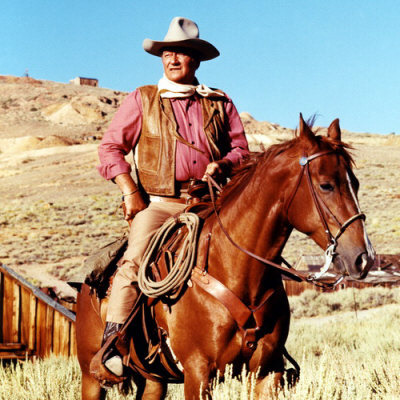
The Cowboy is the archetypical character of the Western, perhaps the quintessential American hero. (To those of other countries, the cowboy may as well be the archetype of Americans in general, because Americans Are Cowboys.) In the simplest terms, a "cowboy" is someone whose primary job is tending a herd of cattle on a ranch. In more general terms, it can be any character that has the appearance and mannerisms of a cowboy. Thus, the term "cowboy" is often used as an inclusive term for any Western characters, regardless of whether they are actually ranchers or not.
Subtypes include:
Working Cowboy: A cowboy who actually has a job herding cattle and spends the majority of his time doing that job. Working cowboys tend to have more worn clothing, scruffier appearances and stronger odors than other types of cowboys. Stories about working cowboys usually focus on the nitty-gritty of ranch work and the dangers of the trail, culminating in the Cattle Drive, with a herd of cattle being led across often hazardous terrain to market. A common plotline is for the working cowboy to be a nice fellow at heart, but have his rough appearance attract a woman because All Girls Want Bad Boys. Expect the parents to initially object, despite older ranch hands, perhaps even the foreman, vouching for the young cowboy's good nature.
The common possessions of a Working Cowboy include: a saddle, a saddle blanket, a rope, some saddle bags and whatever personals he can fit in them (including his hat), as well as a rifle and a six-shooter. If he has his own horse he is well off (relatively) for a cowhand.
Drifter Cowboy: Largely similar to the Working Cowboy, but he has no set ranch that he's attached to. He instead wanders semi-nomadically between ranches and towns, looking for work, staying when he finds it, and moving on once it dries up. Due to having no strong ties to his current workplace, he may be looked on with distrust and remain at a distance from other characters.
Rodeo Rider: This fellow is a working cowboy on the off-season, but whenever there's a rodeo, he's off to show off his riding and roping skills. Rodeo riders tend to be more boastful and concerned with winning trophies than other cowboys. Stories about rodeo riders often play up the difficulties their nomadic lifestyle causes with relationships.
Singing Cowboy: A cowboy who sings as his primary avocation. While it's true that some musical talent was always appreciated on the range, the singing cowboy was really a product of Hollywood. The standard formula for B-movies included at least one musical number, and a singing cowboy could slip one right in naturally while saving the ranch. "Saving the ranch" is the number one plotline for singing cowboy stories, closely followed by "clean up the lawless town." Top singing cowboys included Roy Rogers and Gene Autry, but even John Wayne was tested as one in an early movie! Now a Dead Horse Trope; nowadays if you see a singer in a cowboy hat, he's just a Country-Western musician.
Philosopher Cowboy: This is The Smart Guy who decides he prefers honest work amid the outdoors rather than the City Life. Plutarch was a big read for literate cowboys, along with the Bible, parts of Shakespeare and whatever small books would fit in a saddlebag. May be called upon to say a few words on portentous occasions. Can come very close to the Warrior Poet.
Lone Cowboy/Ranch Owner: This is the fellow who is running his own ranch often by himself on a rawhide (Cowboy shoestrings = rawhide) budget, perhaps aided by an old Indian friend or his young wife. Expect him to be the target of the Big Ranches who see him as easy prey. (He's the Cowboy equivalent of the Determined Homesteader.) Considered a good male love interest for Western-themed romance novels.
Dude Ranch Cowboy: Similar to the working cowboy, but whose job is to give "dudes" (tourists) a taste of The Theme Park Version of ranch life. Generally more careful of his appearance than the working cowboy, many in fiction being ruggedly handsome. Often has to rescue a tenderfoot who is Too Dumb to Live, and can be the Temporary Love Interest for a female character. More serious-minded cowboys may be embarrassed by having to work on a dude ranch.
Ram Ranch Cowboy: A Gay Cowboy, more often than not Manly Gay. He is likely to exhibit many traits associated with machoism and/or sexuality, such as a muscular physique, a large and pleasurable schlong, and a tendency to spend a considerable amount of time shirtless. Count on his partner to be just as masculine as he is, and when he's present, especially in Rule 34 works, expect him to not actually partake in any ranch work or gunslinging in favor of getting into sexual escapades.
Cowgirl: The Distaff Counterpart of the Cowboy. Generally a Plucky Girl in Western garb, who can ride and shoot as well as any man (except the protagonist), but who is seldom seen doing any of the filthier ranch chores. In fiction, almost always the love interest for the protagonist, or the young man the protagonist is helping this week. May be a plentiful source of titillation (though to be fair, cowboys can be that too.) and can overlap with Farmer's Daughter. Not to be confused with females who are a Little Bit Beastly and bovine-based, or the result of mixing Cute Monster Girl and Our Minotaurs Are Different. Of course, nothing's stopping you from making a cow-girl a cowgirl, or vice versa.
Geography plays an important role in determining cowboy characters.
On the plains, larger ranches based around the water holes are to be expected with a significant number of Working Cowboys, with a scattering of Rodeo Riders.
In the mountains expect smaller ranches, with the result of more Lone Cowboys and Philosopher Cowboys (they like smaller operations where their intellect can be appreciated), and the ranches are more open to a Drifter Cowboy.
In the deserts and badlands, expect cowboys to be closer to the Indians, with two or three characters referred to as Apache, or raised by Apache. A lot more emphasis is placed on water scarcity, similar to the mountains in character composition, but expect more outlaws, both as rustlers and among the legitimate Working Cowboys. This is a land for hard men, and if you do the work people don't ask questions.
Singing Cowboys might be anywhere, but are less likely in the Badlands, although they appear there too, sometimes as a way of showing the softer side of men.
In fiction, black cowboys are much less common than they were in Real Life. After The American Civil War, a lot of freed slaves came west to make a living away from their former masters and the new "sharecropping" paradigm. Only in relatively recent times, however, has it become customary for visual media to reflect this.
Similarly, in fiction, gay cowboys are relatively uncommon, despite the fact that historians agree that many cowboys were gay men who moved from cities to ranches in order to escape persecution. (Even though the rural areas associated with cowboys are expected to be more politically conservative, and therefore less accepting of open homosexuality).
Mexican and Mexican-American cowboys, called Vaqueros, tend to fare better in media presentations, known for their riding and roping skills. Vaqueros are in fact the precursors to what we consider cowboys. It's from them that we get the equipment and the word "rodeo" and many of the events included in it, after all. This used to be mixed with unfortunate negative stereotypes, however. Many early vaqueros were Amerindians who worked in missions in colonial New Spain. Vaquero was anglicized as "buckaroo," which became a term for cowboys in the Great Basin and California.
The Australian term for this profession is "Jackaroo", with "Jillaroo" for women (although there is a Rugby League team called the North Queensland Cowboys).
This character type often overlaps with:
- The Gunslinger: Most ranches were staffed by working cowboys, but usually at least a few were "good with a gun" despite not being professional gunfighters. All of them were expected to wield a gun if the ranch was attacked (known as "riding for the brand"), loyalty was highly prized, and drifter cowboys were often suspect for this reason. If a fight was expected the boss might go ahead and hire him some gunfighters.
- The Drifter: A fair amount of ranch work is seasonal, and a cowboy without a solid reputation often had to go where they needed extra hands, rather than hold down a steady position — and not a few had the wanderlust.
- Outlaw: The Evil Counterpart of the Cowboy is The Rustler, who uses the same skills to steal cattle and horses.
Compare the Cowboy Cop, who keeps the frontier attitude towards law enforcement; and the Space Cowboy, who is the Speculative Fiction version.
Also be aware that Cowboy, with a capital "C" has a very specific meaning when discussing Tombstone, Arizona and the shootout at the OK Corral. In Tombstone, the Cowboys were a violent gang of rustlers opposed by Wyatt Earp and Doc Holliday. This is an example of how the term can be misused, as Doc would be insulted to be called a "cowboy" or a "Cowboy."
Some say that the Cowboy is the third faction in the war between the Pirate and the Ninja, but the Cowboys work for a living, thank you kindly. Besides, they're more concerned with their traditional enemies: Indians, farmers, shepherds and rustlers.
Examples
- When Philip Morris decided to rebrand its Marlboro cigarettes from a hoity-toity "ladies' smoke" to a man's cigarette, they could think of no better symbol of rugged American manliness than the cowboy. This ad campaign was wildly successful, and the Marlboro Man ads ran for decades. And yes, "he" died of lung cancer.

- Being a Western, the manga Miriam has its share. Douglas and Miriam both work on a ranch, as do Douglas' friends Card and Joel.
- Ippei from Voltes V got his experience from being a cowboy. He even lived in a covered wagon as a kid.
- "Calico" Yorki of One Piece plays on the singing cowboy trope as the leader of a band of adventurous musical pirates.
- Yu-Gi-Oh!:
- Richie Merced from Yu-Gi-Oh! R uses a deck with this theme.
- The theme is also very prevalent in the Crashtown arc of Yu-Gi-Oh! 5Ds, tending to lean towards the outlaw side.
- Anpanman has a Western town in the desert, which is where the cowboy characters live and protect. These characters include Hamburger Kid, Yakisobapanman, and Croquette Kid, along with their horses (Pickles, White Sauce, and Ketchup, respectively). Outside of the Western town is Arinkokiddo, an ant cowboy with shrink and growth pistols that rides a grasshopper for his steed.
- Cowboy Andy from the Cowboy Bebop episode "Cowboy Funk" is a bounty hunter (called "Space Cowboys" In-Universe) with a cowboy theme, including using a horse for locomotion and carrying a six-shooter. This is really out of place in the 23rd century, and the crew of the Bebop at first refuse to believe Spike after he runs into him.
- Fairy Tail: Secondary characters Alzack Connell and Bisca Moulin dress up the part and use magic guns in battle. Bisca also used to play the Outlaw part prior to joining Fairy Tail, and even mentions to have migrated from the west.
- Astro City: The story "Confessions" features a cowboy-themed supervillain named "The Gunslinger", though interestingly he is half-American and half-Vietnamese, his father having been a soldier during the Vietnam War whose murder the Gunslinger is avenging by killing the corrupt unit who had killed him. In addition to the cowboy-themed outfit, he also has a pair of laser pistols and rocket cowboy boots.
- The DCU:
- Superman: Terra-Man, a villain, has a cowboy theme, but all of his equipment is actually extremely high-tech alien gear, and his (flying) horse has wings.
- Vigilante: Greg Saunders, the first Vigilante, is a singing cowboy-turned-masked crimefighter.
- The Life and Times of Scrooge McDuck: The titular Anti-Hero works as a regular Working Cowboy for a few years in his late teens under the alias "Buck Mcduck". While he's late to really cash in on the cowdriving industry in the middle west, he manages to Take a Level in Badass during his stay and decides to go north to begin creating his own wealth as his own boss as a result of this.
- Lobo Dell: The first black character who headlined his own (short-lived) series was Lobo (not to be confused with DC Comics' Lobo), a post-civil war cowboy who became a drifter.
- Love Everlasting: An assassin styled as a cowboy with six-shooters, a cowboy hat and jacket with fringes, shows up to kill main character Joan whenever she pushes back too hard against the current romance story she's living through.
- Lucky Luke: The eponymous hero fits the Rodeo Rider type (and being The Ace, he rides horses for whole minutes and ties up calves in seconds).
- Marvel Universe:
- Fantastic Four: In Fantastic Four #541, "Le Cowboy" of Le Heroes des Paris is a French appropriation of American stereotypes, in homage to The Wild West.
- Two-Gun Kid: The Two-Gun Kid stands out from the other Western characters Marvel has featured (the Rawhide Kid, Kid Colt, Gunhawk, etc.) in that he wears a mask and has a Secret Identity rather than merely a colorful nickname. He also has a far wider scope of adventures: he has time-traveled to the modern era twice and is a reserve Avenger. He was retconned as being the inspiration for the Angel (he tells Dr. Thomas Halloway, who he knew will become the Angel, about the coming age of superheroes). The Angel was among the first Golden Age Marvel characters, so the Two-Gun Kid is by extension the first masked hero and the foundation of the era of superheroes with secret identities. Since he's a lawyer by profession and takes on a cowboy persona to fight crime, he falls mostly into the category of the Philosopher Cowboy (though more likely to quote Jefferson or Washington than Plutarch or Aristotle).
- The titular character in The Black Wrangler dresses like one, complete with a Stetson cowboy hat, spurred boots, and a Scarf of Asskicking. She even carries a pair of revolvers.
- Houston from Pacific: World War II U.S. Navy Shipgirls dresses as a cowgirl, complete with stereotypical Southern accent, Hand Cannon revolver, and Texas-themed cowboy boots.
- No two men are more iconic as Cowboys than John Wayne and Clint Eastwood. Although they were never in a film together.note
- Brokeback Mountain is about a doomed romance between a working cowboy and a rodeo rider—though they both started as sheepherders.
- The Newton Boys: Joe and Jess Newton are ranch hands and horse tamers who usually wear cowboy hats and dusters and are content enough with their jobs that it takes Willis a while to convince them to join him robbing banks. They resume that lifestyle after the gang's dissolution.
- Several characters in The Magnificent Seven are gunslingers working as drifter cowboys at the start of the movie.
- The Toy Story films have Woody, and Toy Story 2 introduces his Distaff Counterpart Jessie, the Yodeling Cowgirl.
- Joe in A Town Like Alice
- Hud, being a film about a cattle ranch in the New Old West, has actual working cowboys who actually herd cattle.
- Roy Rogers was the archetypal singing cowboy, starting with Under Western Stars and going through over a hundred more B-Movies.
- Played With in River of Teeth. The setting is the Wild West and the main characters are cowboys in every sense except that they ride and herd hippos instead of horses or cattle, respectively. They are called "hoppers" within the story.
- Henry Wadsworth Longfellow's epic poem Evangeline contains an early example of this trope (being published in 1847 and being about the expulsion of the Acadians and its aftermath in the 18th century). As the eponymous character travels America in search of her lost love, she encounters her old village blacksmith, who has since become a herdsman in the prairies of west Louisiana:
Just where the woodlands met the flowery surf of the prairie,
Mounted upon his horse, with Spanish saddle and stirrups,
Sat a herdsman, arrayed in gaiters and doublet of deerskin.
Broad and brown was the face that from under the Spanish sombrero
Gazed on the peaceful scene, with the lordly look of its master.
Round about him were numberless herds of kine, that were grazing
Quietly in the meadows, and breathing the vapory freshness
That uprose from the river, and spread itself over the landscape.
- The Lone Ranger and The Rifleman are two early examples.
- Rick from The Walking Dead, despite being a modern day police officer, wears the hat, carries a revolver and even rides a horse for a while after the Zombie Apocalypse kicks off the plot.
- Many characters in Hell on Wheels are these.
- On Malcolm in the Middle Francis worked as a dude ranch cowboy for a while. One episode had Francis and Otto (the ranch's German owner) run afoul of a pair of working cowboys who kept tearing down the Grotto's fence to let their cattle through. At the end of the episode Francis asked if anybody had ever thought to install a gate, and it cuts to everybody involved celebrating happily.
- Iron King, an Ultraman ripoff from the 1970s, has a singing cowboy as one of the characters.
- Nickelodeon show, Hey Dude!, was set on a dude ranch.
- Horrible Histories had a musical number describing what the life of a working cowboy was actually like.
- One episode of Firefly has Mal meeting some cattle buyers. Who are also apparently cattle rustlers when they feel the urge. Cue gunfight at the corral ...
- The sixth season of My Kitchen Rules feature a working cowboy from Texas: Robert, who consistently brighten the mood of the table with stories of his past experience with bulls, cattles, and other animals.
- Have Gun – Will Travel often featured cowboys as guest characters. In one particularly memorable episode, Paladin (Richard Boone) befriends a lone cowboy who happens to be Native American—then accepts a fee from a big spread rancher to force the small rancher to sell his land. Paladin had spotted that metal deposits on the land were slowly poisoning the cattle, making the spread worthless for ranching.
- The main character of May I Please Enter? is, at the very least, dressed completely in cowboy-clothing and spends his time Walking the Earth, though whether or not he's a "real" cowboy is left ambiguous.
- James "Jim" West (Robert Conrad) in The Wild Wild West. And just about 50 per cent of the villains of the week and a good 80 per cent of the mooks with the occasional Bandito.
- There is an entire subgenre of "cowboy songs", many of which were created and sung by actual cowboys (some lost forever, now) while others have been made up from whole cloth in more recent times.
- This used to be a prominent theme in Country Music, from the 60's to the 90's, with most artists leaning into the aesthetic by wearing a cowboy hat. It faded out at Turn of the Millennium and it's almost unheard of in The New '10s post-"bro-country" genre shift. But notable entries include:
- Glen Campbell's "Rhinestone Cowboy" compares his attempts to become famous via his music to a rodeo rider.
- Many, many Garth Brooks songs, but the two most famous are probably "Rodeo," which tries to frame rodeo-ing as a kind of addiction, but sort of makes it sound like Don't Do This Cool Thing and "Beaches of Cheyenne," about a woman who commits Suicide by Sea when she gets word her cowboy lover has died after drawing the wrong bull at the rodeo.
- Toby Keith's "Should Have Been a Cowboy," which is Exactly What It Says on the Tin
- The Chicks' "Cowboy Take Me Away," about longing to be in the wild open with your cowboy lover.
- Waylon Jennings' "Mammas Don't Let Your Babies Grow Up to Be Cowboys," which does what "Rodeo" was trying to do.
- George Strait's Amarillo by Morning' is a song about the Rodeo Rider and his lifestyle. 'Everything that I've got is just what I've got on ... '
- Marty Robbins "El Paso" and "Big Iron," which provides the page quote.
- "Holding Out for a Hero" by Bonnie Tyler: In the music video there are outlaw cowboys dressed in black, and a good cowboy dressed in white, and all of them ride on horseback.
- Paula Cole's "Where Have All The Cowboys Gone?" a song about a woman stuck in an Awful Wedded Life, wondering where all the men are who embody this trope.
Where is my John Wayne?
Where is my prairie song?
Where is my happy ending?
Where have all the cowboys gone?
Where is my Marlboro Man?
Where is his shiny gun?
Where is my lonely ranger?
Where have all the cowboys gone?
- All of the characters in Eight Ball Deluxe. Justified as the game takes place in a cowboy bar.
- The Spiritual Successor, Sharkey's Shootout, has "Tex", complete with large black hat and bolo tie.
- As a Shout-Out to Eight Ball Deluxe, Cue Ball Wizard is full of them, complete with a cowboy wearing a white hat as the main opponent.
- El Texano, an evil cowboy in Lucha Libre Internacional/Universal Wrestling Association later revealed to be a Fallen Angel sent to Earth to rid it of El Santo. His son, El Texano Jr. continues the evil cowboy tradition by illegally whipping his opponents with bull ropes but not too sure about the other part.
- Stan Hansen is a trope codifier for cowboy gimmicks in the USA and Japan, particularly for a violent swinging clothesline which would come to be known as a lariat, or LARIOTO!
- Bob Orton Jr. was best known as the bodyguard of Roddy Piper and being the father of WWE Superstar, Randy Orton.
- CMLL has Yuca La Potranquita, a masked cowgirl from Mexico city and AAA's La Legión Extranjera employed Virginian cowgirl Lorelei Lee. Lee tends to turn anyone she tags with into a cowgirl/boy as well.
- Our Miss Brooks: Tex Barton, a stereotypical teenaged cowboy, is a Madison High School student in a few episodes i.e. "School T.V. Set", "Bargain Hats for Mother's Day," "Tex Barton Basketball Star."
- A Prairie Home Companion had the recurring "Lives of the Cowboys" skit, in which two modern-day cowboys engaged in Seinfeldian Conversation and the occasional unlikely adventure.
- The Six Shooter starred Jimmy Stewart as a drifter cowboy with superior shooting skills.
- Riders Radio Theater stars three Singing Cowboys.
- It's called "the Weird West", so of course you can expect to see pretty much every version of the Cowboy on the list in Deadlands... well, except for the Singing Cowboy; guys like that are likely to get mugged, shot, and then shot again for good measure.
- A common character type in the All Flesh Must Be Eaten supplement Fistful o' Zombies. The singing cowboys get their own gameworld.
- In the final scene of the original version of Journey into Imagination, one of the roles that Figment is shown as in the Film realm is a cowboy, representing the Western genre.
- The Link in The Legend of Zelda: Twilight Princess is a Working Cowboy who works on the Mayor's ranch herding goats.
- Cassidy of Brawlhalla is a Cowgirl sheriff.
- Some of these are around in Fallout: New Vegas, given its Western theme. It even includes a Singing Cowboy that you can hire for a casino looking for entertainment acts! The perk named 'Cowboy' works with the stereotypical weapons a cowpoke would use, too. Who needs assault or laser rifles when you can use a .45-70 lever-action?
- John Marston from Red Dead Redemption, a Working Cowboy who has his own ranch and maintains it along with his family. By the beginning of the game, he's forced back into The Gunslinger life and has to leave the ranch to save his family from a Gilded Cage.
- The Maid of Fairewell Heights: The Cowgirl variation. There's a Cowgirl costume when entering the landscape picture world in Artie's room.
- Disco Elysium manages to romanticize and deconstruct the concept simultaneously. Talk to Paledriver, and she will sing you a tragic ballad of a woman who loves a boiadero (the local equivalent), and waits for him while he drives cattle, and when he returns, she asks him to marry her. He promptly strangles her and heads off for the wild plains again. Paledriver then calls the woman a stupid girl, and claims that she should have known that nothing, even love, will ever tie down the heart of a boiadero.
- Celine Logan from Wrestle Quest is a sister of Brink Logan, has the cowgirl attitude, attire and accent to match. Not only that, but her moves names are based on things you’d expect from cowpoke.
- Cowboys are common in the wilder areas of Mars as depicted in Cwynhild's Loom.
- The Old Cowboy from Red Meat is the Ranch Owner type.
- Several of the characters in Zombie Ranch fit the working cowboy type — even if they're technically no longer wrangling cows.
- A cowboy appeared as a villain in the lonelygirl15 episode "The Cowboy". He did not appear again, most likely because the rights to the character are owned by Glenn Rubenstein.
- The Weather: "Snow" had a cowboy character venturing through the snow with their horse.
- Quickstrike from Beast Wars, a villainous metal scorpion/cobra hybrid has the personality if not the looks, with a generous helping of Redneck added to the mix.
- Cowboy Stackhouse from Jimmy Two-Shoes
- Molly of Denali: In "Culture Clash", Molly and Tooey dress like cowboys and talk with Southern accents to make Trini (who moved to Alaska from Texas) feel at home. This backfires.
- Mr. Benn: In "Cowboy", Mr. Benn was originally going to watch a cowboy film, but the queue outside the cinema was so dreadfully long, he decided instead to be a cowboy. You wouldn't expect this adventure would turn into a game of hide-and-seek with him and the Indians. The Indian team would seek Mr. Benn, and the cowboy team would seek one of the Indians, who turned out to be hiding at the top of their totem pole where no one else would think to look. If not for Mr. Benn's ingenuity, the cowboys would have lost that game, as they already had done so many times before.
- Applejack from My Little Pony: Friendship Is Magic lassos wayward critters, herds stampeding cattle, eagerly gets into fights, runs the family farm, enters into rodeos, and is almost never caught without her hat. The only thing she doesn't do is ride horses, for obvious reasons. Overall, she's probably the Working Cowgirl.
- Braeburn, her cousin, acts like a good old-fashioned eager cowpoke. Aside from being a farmer, what with the cows probably not appreciating getting poked.
- Simon in the Land of Chalk Drawings (2002): One of the residents of the Land Of Chalk Drawings is a cowboy.
- Shocker/Montana from The Spectacular Spider-Man, the cowboy thing obviously stemming from the Montana part of his character.
