
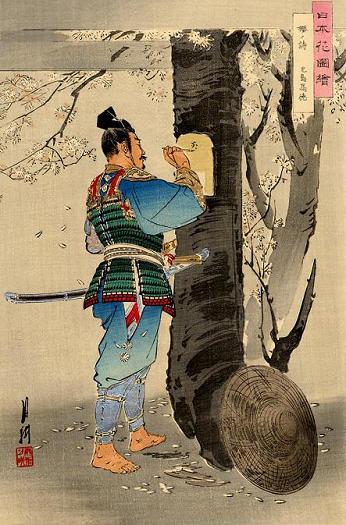
Print by Ogata Gekko.
In the ranks of death you'll find him;
His father's sword he hath girded on,
And his wild harp slung behind him.
Modern Western culture often tends to stereotype Warriors and Poets as belonging to distinct, different, and opposing groups (Elves Versus Dwarves + Sensitive Guy and Manly Man). Warriors are manly men who like hitting each other and other simple pleasures. Poets are culturally refined wimps.
Traditionally though, poetry and war are complementary pursuits. Poems sing of the glory found in battle. Honor and virtue are on display when men are facing deadly peril. Experiencing death and the horrors of war make a man contemplate the big questions of life. Often the war is being fought for some greater purpose or cause, such as liberty. Great generals devote their spare time to philosophy, wondering what it all means. Poetry (except free verse) is built on the optimal deployment of limited resources — words that fit together with other words, and with words that aren't there — not unlike the strategic decisions a soldier makes on the battlefield.
Note that this isn't only about poetry. This trope is about literature, music, writing epic sagas, philosophy... any sufficiently refined way of expression combined with warfare, fighting, or any kind of physical combat.
Thus singers, poets, and writers have gone off and joined the armed forces, looking for that glory and enlightenment. They are often welcomed by the other warriors who want someone who can express their feelings and experiences in poetry or song. Often because they themselves feel those things too deeply to be able to express them bluntly in plain words (unless they are drunk).
That's where this character comes in. He's fought in battle and is no slouch at war-making, but he thinks about the purpose behind all the bloodshed and philosophizes on the meaning of life and death. Since War Is Hell he tends to have a bit of a melancholy tone about it all. Perhaps his poems long for peace as only a man who has seen war can. However, since War Is Glorious he might write songs glorifying the battle he just witnessed. If he is a supporting character, expect other warriors in his Band of Brothers to be moved by his poetry and philosophical insights when he shares them.
If he's the lead, he might be a loner with his fellows being unable to understand his way of thinking. It might also be a way of showing his Love Interest that he's not just a bloodthirsty barbarian but actually a sensitive soul who is forced to do horrible things because of war or human nature (as he understands it).
Note: Do not mistake this for Cultured Badass. That trope is about a badass with "cultured" hobbies; this trope is about a mindset rather than hobbies. Essentially, a Cultured Badass can appreciate love poetry, but a Warrior-Poet will incorporate that poetry into their daily life and their thoughts about warfare. Additionally, a Cultured Badass can enjoy battle for the thrill and pleasure, but a Warrior-Poet will espouse something more mystical and/or spiritual from the fighting. Basically, just because you can write poetry doesn't mean you are a poet.
Compare Genius Bruiser, Badass Bookworm, and Cultured Warrior.
Example subpages:
Other examples:
- Warlock developed into this under the writing of Jim Starlin, becoming a sort of philosopher-hero.
- Robert Bearclaw, alias Ripclaw, from Image Comics' Cyberforce is both a Badass Native Wolverine Wannabe and an avid poet/poetry scholar.
- The titular character of Dramatus, a 1995 short-lived Mexican comic, is a tormented soul just back from the tomb who wields a sword and is also a vampire. When he gets angry, he becomes Ax-Crazy, ready to make a bloodbath out of his aggressors. But when his beautiful lover appears to calm him down and comfort him, he gets inspired enough to recite some improvised poetry just for her. He even says in his inner monologues during the story: "I am a poet".
- Major Sebastian Bludd from G.I. Joe: A Real American Hero (Marvel) is a ruthless mercenary frequently on Cobra's payroll. He's also very fond of poetry (albeit not so talented in this field), frequently writing cringe-worthy bad poems and rhymes. One of his earlier samples goes as follows:
Raise the glasses and sing the praises
Of our leader who nothing fazes;
Cobra Commander, he's my chum,
I trust him like I trust my gun. - Most of the traits that make up a Warrior-Poet also exist in Destruction of The Endless from The Sandman (1989). He abandoned his role as overseer of destruction to try his hand at being creative — like writing poetry and painting pictures... really, really badly.
- Wallace from Sin City is a soft-spoken, intelligent, and highly philosophical man... who can kill you in 90 different ways... after making the most polite warning you've ever heard.
- Superman — as Clark Kent, of course — is an accomplished writer as well as being a potent warrior; being an award-winning journalist, and a best-selling author. Lex Luthor, of all people, says that he "writes like a poet".
- Inverted with the title character of Thorgal, who started off as a skald (Viking bard), then got into the warrior biz (mostly against his will, which he will never let you forget).
- Transformers:
- The Transformers (IDW) reveals that before the war, Megatron used to write reams of poetry, much to the exasperation of his drinking buddies. Even after he went evil he still wrote poetry, eventually leading a half-crippled Impactor to spend what he thought was the last few minutes of his life writing a plea to Megs.
Impactor: Not more poetry.
- Sky-Byte shows up later, still obsessed with haikus.
- The Transformers: Shattered Glass counterpart of the cruel Decepticon tyrant Straxus is a legendary poet and playwright, and still a formidable fighter.
- The Transformers (IDW) reveals that before the war, Megatron used to write reams of poetry, much to the exasperation of his drinking buddies. Even after he went evil he still wrote poetry, eventually leading a half-crippled Impactor to spend what he thought was the last few minutes of his life writing a plea to Megs.
- The Ultimates: Ultimate Thor. He used to be arrogant and lust for battle (not unlike the mainstream version...), but after maturing (and experiencing Ragnarok), he's become much more philosophical and thoughtful. More commonly, he will talk his opponents to death rather than battle them directly; however, he has been known to face down alien armadas, the Hulk, a super man, and the entire team of Ultimates. Twice.
- V for Vendetta: V is a rather flamboyant example: superhuman speed and reflexes, check. Awesome hacking skills, check. Suicide-bombing-level of insanity, check. And when he's not fighting? Well, he just grows roses, writes songs, and reads so much he can quote Shakespeare, Goethe, or Pynchon by the book and generally behave as a Shakespearean anti-hero, emulating the speech of the playwright's characters to perfection.
- Watchmen: In a twisted, delusional, batshit crazy way? Just read Rorschach's journal...
- Wonder Woman (1987): Nol Lapp is a revolutionary and poet. The only piece of her poetry given to the reader is about getting revenge on the empire that enslaved her. Unfortunately for the reader, there's some translation betwixt the original poetry and what is on page as Lapp is not writing in any earth languages.
Once I was your slave
and knelt in chains for your favor,
but now I have returned
and I have molded my chains into an executioner's sword. - X-Men:
- James "Logan" Howlett, alias Wolverine, codifies this trope by possessing both the heart of a bestial berserker and the honorable soul of a samurai. Throughout a long life shrouded by overwhelming amounts of pain and loss, Logan chooses to use his considerable mutant/augmented gifts to protect/mentor his loved ones, while also defending those who fear (or even hate) the very existence of his mutant kind.
- The X-Men's Russian powerhouse-strongman, Colossus, not only has a deeply poetic soul that finds joy through painting, but he is a very capable warrior ready to sacrifice everything for the greater good of humanity.
- Parodied constantly in Calvin and Hobbes as Calvin treats all snowball fights as epic wars. One time, he gave a speech about the importance of craftsmanship while meticulously assembling a snowball from just the right kinds of snow (and signing it) before getting steamrolled by Suzie, who had used the time to amass a massive snowball arsenal. Another time, he actually consecrated his snowball before throwing it:
Oh lovely snowball, packed with care,
Smack a head that's unaware!
Then with freezing ice to spare,
Melt and soak through underwear!
Fly straight and true, hit hard and square!
This, oh snowball, is my prayer.
- Child of the Storm:
- Thor has matured into this (parenthood helped, for all that it provided a new source of stress), being much more wise and philosophical than he once was. However, he still loves a good fight.
- Steve is, well, Captain America. He's also an amateur artist of some talent, which he enjoys working on.
- While he rarely shows it, being more widely known for his manipulative brilliance and extraordinary magical abilities, Doctor Strange was originally a bard back when he was known as Taliesin, and a legendary one at that. Literally, in fact - Taliesin is a notable figure in Welsh Mythology, being to bards what Merlin was to wizards - serving as King Arthur's Court Bard and Physician. And when he's not being manipulative, or winding people up, he's also prone to philosophical musings, quoting everything from Doctor Who to William Shakespeare at the drop of a hat.
- RWBY: Second Generation:
- Verse is the embodiment of this. He goes into battle with both his sword and quill drawn, and his Semblance actively reflects this. Anything he writes with his quill is temporarily summoned via Hard Light, and his poetic mind allows him to come up with solutions on the fly.
- This also applies to Orion, but to a lesser extent. While primarily a combatant, his first introduction has him painting. This hasn't been seen since.
- Manolo from The Book of Life is a talented fighter in sword and bullfighting, but he is also a gifted musician who plays from his heart. His father in particular doesn't understand the musician part of Manolo.
- Horton, of Horton Hears a Who! (2008), is called a Warrior-Poet by his friend near the end of the movies.
- Twilight from Legend Of The Guardians The Owls Of Ga Hoole calls himself one after he is given the nickname "The Warrior" by the Echidna. In fact, like in the books, he's been known to sing heroically to cheer his friends on and frighten his foes.
- In Turning Red, Sun Yee is described as being, among other things, a poet and is said to have fended off bandits and protected her village with her giant red panda form.
- Dennis Hopper described Col. Kurtz as this in Apocalypse Now.
- The last lines of Braveheart: "They fought like warrior-poets. They fought like Scotsmen. And won their freedom."
- In Crouching Tiger, Hidden Dragon, Yu Shu Lien deduces from Jen Yu's calligraphy skills that she must be good with a sword as well. She is, but she's nowhere as good as Li Mu Bai, who later defeats her with a stick while quoting philosophy.
- The Nameless Warrior from The Dead Lands is fond of using long-winded Badass Boasts reminiscent of Shakespeare.
- Though not a literal example, Draco from Dragonheart is very learned, and a talented fighter.
- Mickey Rourke's character, Tool, in The Expendables is a Retired Badass who spends most of his time as an artist, both traditional and tattoo.
- Broken Sword, one of the three Zhao master assassins of the film Hero (2002), is a calligraphy artist and a poetic philosopher in addition to being deadly with a blade.
- Katsumoto from The Last Samurai is made of this trope. He is the titular samurai after all. They wrote as much poetry as death warrants.
- T.E. Lawrence the title character in Lawrence of Arabia (though he didn't write a whole lot of poetry).
- Captain America in the Marvel Cinematic Universe is the most thoughtful and introspective of The Avengers, not to mention being a talented artist before his induction into superheroism.
- The Proposition:
- The main villain from the film, Arthur Burns, despite being a violent and dangerous sociopath, has a wonderfully eloquent and deep outlook on life. He is just as capable of looking off into the sunset and quoting Burroughs as he is capable of torturing and murdering innocent people.
- The Proposition is full of such characters. Captain Stanley is a Shakespeare-quoting badass played by the mighty Ray Winstone, and Jellon Lamb is a bounty hunter of "no little education." Considering that Nick Cave wrote the screenplay, it's only natural that everyone around is going to be super-literate.
- Chris Kenner from Showdown in Little Tokyo is a cop who has immersed himself in Samurai culture. His half Asian partner Johnny Murata laughs when Kenner tells him he practices the art of Ikebana (flower arranging). Kenner tells him that a warrior must nurture his sensitive side or else leave it vulnerable to attack, and points out that many of the most powerful Samurai wrote poetry.
- Tony Curtis' character in Spartacus, Antoninus, begins as a "singer of songs" and he teaches songs to the other members of the slave army, but he turns out to be pretty handy with a sword as well.
- M. Bison in Street Fighter, when Guile is faking the dead, muses in a poetic fashion about the loss of a worthy enemy and how he wished it could have ended another way. Admittedly, that way involved Bison facing Guile in single combat and snapping his spine.
Bison: Ah, the road not taken...
- D'Artagnan gets the Musketeers to like him in The Three Musketeers by tossing out a one-liner.
D'Artagnan: I may not wear the tunic, but I believe I have the heart of a Musketeer.
Porthos: Warrior.
Aramis: Poet. - In Transformers (2007), Optimus Prime is a fierce warrior, but also takes some time to muse on how humans are not so different from Cybertronians.
- Underground: Marko is a drug-running Boisterous Bruiser during WW2 who also composes poetry for the Communist regime of Yugoslavia during Tito's reign. However, he wasn't nearly the patriotic hero he claims to have been.
- You Don't Mess with the Zohan:
- Adam Sandler's character, Zohan, is a crazily competent Mossad agent who decides to leave war behind and choose the Ambiguously Gay profession of hairstylist.
- Along similar lines but done seriously, Daniel Silva's series character Gabriel Allon is an Israeli spy and assassin who when on 10-Minute Retirement has the delicate profession of art restorer.
- The novelty song/comedy sketch Boot to the Head (Tae Kwan Leep) by The Frantics features a martial arts master trying to teach philosophy and mediation to his students. When Ed Gruberman makes it difficult, he shows him (and then the rest of the class) why he is the master.
- Much of the lasting appeal of slain rap icon Tupac Shakur is the question of whether he was, deep down, an intellectual or a thug.
- Celtic Folk Song "The Minstrel Boy"
 , about a minstrel boy that goes to fight in a war. He is even called a "warrior bard".
- "Soldier, Poet, King'' depicts Jesus as both a soldier with a BFS able to single-handedly destroy a city, and a sharp-witted poet.
Who carries a mighty sword
And he will tear your city down
Oh lei oh lai oh lord!
(...)
There will come a poet
Whose weapon is his word
And he will slay you with his tongue
Oh lei oh lai oh lord!
- Older Than Feudalism: Examples in The Bible:
- King David composes much of the Book of Psalms in his free time from giant slaying and country-rebuilding, as well as showing his repentance in his later year after inventing the Uriah Gambit and praying for his enemies' downfall. In fact, the only reason He Who Slew Hundreds of Thousands has an opportunity to become king is that the music he played could make you cry and the previous King had to hear him. He's also famous for dancing happily in the street once he brought The Ark of the Covenant into Jerusalem.
- Samson tried to get in on the action quite a bit earlier, in the midst of a riddle game. Readers of English translations in which the poem rhymes sometimes mistake that for Stylistic Suck, since in the context of the times, Hebrew poetry normally did not rhyme. The original Hebrew version of Samson's poetry doesn't actually rhyme, however. Opinions differ over whether it (or the translation) sucks anyway.
- The Irish hero Finn MacCool, known nowadays for having far too many pubs named after him, was an early example of this trope. He commanded a large group of heroes who were required to be masters of war and poetry as well.
- Väinämöinen in The Kalevala. Not only he is the mightiest poet ever, but his kantele is made from a jawbone of a giant pike.
- Tristan (or Tristran) was musically gifted, and also a knight of the Round Table.
- Odin from Norse Mythology is a deity of war and poetry. This is in contrast with Tyr, another God of war; and Braggi, another God of poetry; both of whom are not this trope. They can hold their own in war and words — just not to the point of being this trope. His name is even derived from the Norse word "Odr" (the "-inn" grammatically signifies a specific male) which means both "fury" and "poetry". This was also reflected in Norse society in general. See the Real Life section.
- Caprice Coleman's approach to promos is often poetic, enough so to make C&C Wrestle Factory partner Cedric Alexander follow him with an amen. And yes, he has sung of the glory their victories would bring. By no coincidence, he was trained by the Hardy boys and started out around the same time Jeff took up the Willow gimmick.
- Antonio Inoki had/has uncommon spiritual belief in regards to fighting, to say the least and in a more literal example than most, is an author of poetry.
- During her seven-year retirement from wrestling, Becky Lynch took performing arts courses in college and did classical theater. She also went to clown school during this time to hone her comedic skills.
- On WWECW, John Morrison started spewing really bizarre diatribes about spiritual paradise and wisdom after winning the ECW Championship.
- Hikaru Shida does Japanese theater aside from her wrestling career.
- Jesse "The Body" Ventura, as he had a beatnik gimmick.
- The Ultimate Warrior might be the single defining example for pro wrestling. Not only was the warrior part right in the name, but his promos consisted almost exclusively of topics such as life and death, legacy, gods, spirituality, the meaning of life, interplanetary travel, and even touches of String Theory. They were generally incomprehensible, but that's not the point.
- Willow The Wisp's gimmick, besides lots of laughing, involves poetically describing his current state of affairs.
- The title character of Cyrano de Bergerac, he in fact fights a duel while composing a poem about it. "And as I end the refrain, thrust home!"
- The title character of Shakespeare's Othello won over Desdemona with eloquent tales of his adventures, and his description of their courtship similarly wins over the Venetian senate, with the exception of Desdemona's father (as the Duke comments, "I think this tale would win my daughter too").
- RWBY:
- Once he starts opening up more, Lie Ren is revealed to be one of the more eloquent and introspective members of the heroes, with a greater knowledge of philosophical and spiritual aspects of Aura than his companions.
- Tyrian Callows might be a Laughing Mad, Ax-Crazy devotee of the series' Big Bad, but he is remarkably eloquent between his hysterical giggles, and he has a penchant for the theatrical.
- Kill Six Billion Demons: Omnicidal Maniac Jagganoth is a thoroughly dark take on the concept. Jagganoth's personal philosophy is based in real-world beliefs on the nature of suffering from Buddhism, and his desire to destroy the world is grounded in the desire to end the Vicious Cycle of a flawed Creation, and the suffering of those trapped within it. Jagganoth is an ascetic stoic, dabbles in debate, has a rather sizeable poetry collection and has even composed some pieces of his own. According to The Rant he wrote at least one treatise on the nature of death, and he is also one of the few people aware that the universe is stuck in a "Groundhog Day" Loop.
- Looking for Group:
- It features Krunch, a minotaur with a passion for history and knowledge. Of course the fact that he'll quite casually turn you into a bloody puddle with his mace means he's sometimes confused with his warrior brother. His treatment by his brethren also holds true to the trope. Despite being a badass most of the time he was generally the butt of jokes around his father.
- There's also Pella the dwarf warrior, who in one fight scene sings "The Rose" by Bette Midler while calmly hacking up enemies.
- Gravesite, from The Call of Warr, is the experienced captain of the M-Company, but he's also trying to write an action movie script.
- Sabaton History: The episode for "In Flanders Fields", based around Sabaton vocalist Joakim Brodén's hymn-like arrangement of the famous poem by John Mc Crae, discusses how writing poetry was a common pastime of soldiers during World War I.
- Avatar: The Last Airbender:
- Piandao is knowledgeable about many arts like calligraphy, painting, and landscaping, but apparently practices them because it helps to make him a better swordsman.
- It's a slow reveal, but beneath Iroh's patient, tea-loving, belly-laughing, Koan-spouting surface is a guy who could hand an army their asses on a platter — and does, several times. Remember: when Iroh was in prison, he wasn't pushing himself up — he was pushing the Fire Nation down.
- The Sequel Series, The Legend of Korra, gives us Zaheer; a calm, thoughtful, reflective man who patiently debates philosophy at length... and is also capable of tearing through the Dai Li in a matter of seconds. Unfortunately, his philosophy is spreading chaos and disorder by any means necessary. The fact that he never raises his voice is thus more disturbing than anything.
- Dinobot from Beast Wars was always more introspective about the war than any of the other Predacons. When he stole the golden disks he began philosophizing about the nature of fate vs free will. This continued until the episode which ended in his Heroic Sacrifice, where he was responsible for the rise of humanity via inspiring the primitive humanoids to defend themselves with the stone axe he created to defend himself at the very end. Also, not content with writing his own prose, Dinobot also ripped off a few bits of Hamlet for use in his dramatic death speech.
- In Ducktales 2017 Webby describes Unicorns (or as she calls them "Sword Horses") as being warrior poets.
- Goliath from Gargoyles is the strongest and largest of the Gargoyles. He's also a very deep thinker. One notable example of this is at the end of an Enemy Mine with Xanatos to save Xanato's lover Fox from the Eye of Odin. Xanatos has to give up scheming and straight-up asks Goliath for help when the chips are down. He claims that Goliath now knows his weakness. Goliath chides him for believing that love is a weakness.
- Parodied in The Simpsons "I Am Furious (Yellow)" episode when Groundskeeper Willie dukes it out with his Fighting Irish rival Groundskeeper Seamus:
Seamus: This is your doin', Willy! I'll turn your groin to puddin'!
Willie: Ach! Ya speak like a poet, but ya punch like one too! - Bow, The One Guy and Archer from She-Ra: Princess of Power, is a bard in his free time and loves playing his harp.
- An extremely literal example: While everyone in Visionaries have Voluntary Shapeshifting powers, some of them also have magic staves that contain a kind of unique, one-use battle genie. These spirits are released using, of all things, rhyming couplets. So when the Blood Knight wants to wreck a castle, he can summon a monster by holding up his staff and yelling:
By nature's hand, by craft, by art,
What once was one now fly apart!
