
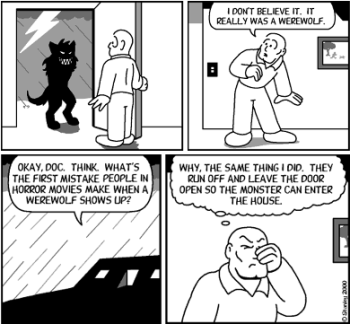
A condition afflicting many fictional characters, seen when one demonstrates by their behavior that they have never in their life ever seen the kind of story they're in, and thus have none of the reactions a typical audience member would have in the same situation. Worse, they are unable to learn from any experiences related to their genre.
Genre Blindness is what keeps the cast of Three's Company leaping to outrageous conclusions even after the hundredth stupid misunderstanding, instead of sitting down and talking things out. It makes Little Red Riding Hood go for walks alone in the woods after midnight without a flashlight or a weapon when there's an axe murderer and a Big Bad Wolf around. It makes the supergenius supervillains in James Bond movies stuff the hero into an elaborate melodramatic Death Trap from which he inevitably escapes instead of just shooting him.
Although genre blindness can be a legitimate flaw, it should be noted that it can be difficult for writers to create characters who are not genre blind without hanging a lampshade on it by saying something like "This is just like in the movies!", especially in genres which require suspense that can easily be undone by such comedic relief (such as horrors, thrillers, etc). Furthermore, some stories in some genres really couldn't function at all if the characters displayed an innate and complete understanding of what genre they were in and exactly how they should act at all times within a story in said genre if they want to avoid trouble. A certain amount of Genre Blindness can be required to provide the story with tension and drama, since if the character knows exactly what to do to avoid trouble and conflict in their particular story, they'll do it, and consequently have an easy, trouble-free life, and... why are we watching again? Finally, not all of a genre's classic tropes are in fact Truth in Television, but as far as the characters are concerned, This Is Reality, so their "blindness" may be the same as common sense. After all, people in real life don't usually live their lives as if everything they do or which happens to them conforms to a series of strict narrative conventions, so why would fictional characters? For example, in real life, a single cough usually does not herald a fatal disease, so It's Probably Nothing is probably rational despite being Genre Blind.
Ultimately, while it can be a problem if used too egregiously, sometimes you just have to shrug your shoulders and chalk it up to Willing Suspension of Disbelief.
Related:
- One of the more common forms of Genre Blindness is ignorance of Hanlon's Razor.
- Reality Is Unrealistic is what happens when real people come down with this.
- Contrast with Genre Savvy, and its extreme form, Contractual Genre Blindness.
- See also Culture Blind, a more specific form of ignorance in which the characters are inexplicably clueless about the normal things that happen in their society.
- Supertrope of Reality Show Genre Blindness, where contestants on a Reality Show don't seem to understand anything about how they work despite having sought an audition.
- Wrong Genre Savvy, for when the character has mistaken what type of story they're in.
Examples:
- A GEICO commercial has a group of slasher movie characters running from the villain. They suggest several places to hide which no real life person would try. One character suggests getting into a running car and is dismissed as crazy. Their eventual hiding place turns out to be where the villain is standing in plain sight, not even making a pretense at hiding. He actually rolls his eyes when he sees them.
Announcer: If you're a character in a horror movie, you make bad decisions. It's what you do.
- In Bloom Into You, Doujima is honestly surprised that the School Play that he and the rest of the student council are doing has a female lead with a girlfriend. Two or three of the main female characters have crushes on other girls, while two supporting characters, both adult women, are also in a relationship.
- A phenomenal example is seen in Dance in the Vampire Bund when the Student Council hole up in the campus chapel after dark when a discussion on how to deal with several students being transformed into hostile vampires run late... and the student council president, who has been violently abducted several nights before after back-talking the self-proclaimed Queen of the Vampires, starts knocking on the entrance asking to be let in. Only one bothers to protest the doors being thrown open immediately.
- Dragon Ball:
- When Goku, Bulma, Yamcha, Oolong and Puar infiltrate Pilaf's castle in the original Dragon Ball, they come across a bunch of arrows. The group decides to follow them until they reach a dead-end. A trap wall then closes behind the group, trapping them. The scene cuts to Pilaf who says, "I didn't think there even were people that stupid."
- Whenever the cast is dismissive towards a current threat because of their appearance. This happens in Dragon Ball Z with Frieza's final form, Androids 17 and 18 being teenagers, Cell's final transformation, Fat Buu, and finally Kid Buu. You would think they'd learn that appearances mean nothing in this series and it is often the most unassuming villains that are the most dangerous.
- In Fairy Tail, you'd think Carla would have told more than one person about her second deadly premonition, given the way the one about the S-Class exam turned out.
- In any series of Gundam, you frequently have a battle between a Gundam and a Mobile Armor. The vast majority of the winners will always be a Gundam and yet, there's still always someone in the franchise who can think they can win with a Mobile Armor.
- In Gurren Lagann, when the Anti-Spiral sends the Moon on a collision course with the Earth, Rossiu decides that it is impossible to stop it and attempts to escape with only a portion of the population, even if this meant leaving the rest to die. Reasonable in real life or a grittier series like Gundam, not so much in a superlatively Hot-Blooded series where kicking logic to the curb is not only possible with enough Heroic Willpower, but a regular occurrence. Sure enough, Simon (who he had betrayed and imprisoned in order to bring this plan into fruition) arrives and stops the collision by fighting the Anti-Spiral forces.
- If Miki from Hell Teacher Nube ever approaches you with an occult magazine, RUN. Despite having nearly killed herself (or her classmates) fifty times over while testing a local rumor or deliberately Tempting Fate just to see what would happen (which resulted, very early in the manga, in her turning into a half-youkai permanently,) she will try again. And again. And again.
- JoJo's Bizarre Adventure: Stardust Crusaders features a rather egregious example when the group is being assaulted in their dreams by a stand-wielding baby. Normally the group assumes that anything unusual happening is the result of an enemy stand, but suddenly everyone except Kakyoin decides that a stand-wielding baby is simply too farfetched an idea (when they'd already encountered a stand-wielding orangutan.)
- The Legend of Zelda (Akira Himekawa): In the adaptation of Majora's Mask, we have some soldiers being told Link, who has built up a reputation as an expert fighter, is visiting, and when they see that he's an Adorably Precocious Child, they assume he's harmless. One panel later, we find he humiliated them, and broke some of their swords.
- One Piece:
- The crew arrives at a town that welcomes pirates. Luffy, Sanji, and Usopp fall easily for this, while Zoro and Nami fake being drunk to find out what the town is up to.
- Also, when Luffy wakes up, he finds out that Zoro attacked the entire town (who are all actually bounty hunters wanting to kill them). Instead of wondering why his friend would do that, Luffy automatically believes the injured townsfolk and assumes Zoro ruthlessly attacked the "nice people" who gave them food.
- When France starts to undergo its revolution in The Rose of Versailles the Royals, Clergy, and Nobles who are clinging to power come off as this by trying to suppress the assembly and use deadly force on the representatives. It's Truth in Television.
- Sailor Moon: Present especially in the first season, where Usagi and her friends never seem to suspect any monster activity when weird things happen, despite them having been in such situations in every preceding episode.
- She's My Knight: Mogami is clueless about being the "prince" character in a Shoujo story, mentioning all the weird things that have been happening to her: finding stray kittens in the rain, rescuing girls from delinquents or yakuza, and preventing car accidents at the last minute. Pretty much all the other main characters are Genre Savvy, though Ichinose has a bit of a blind spot when it comes to himself.
- Keima of The World God Only Knows is normally incredibly, hilariously Genre Savvy. But the problem is, all his experience comes from galges, so when he runs into a situation that doesn't come up in them, he's at a loss. The best example is probably when he missed the Matchmaker Crush — twice, involving the same girl both times, no less (first time he was helping Chihiro with a boy, the second time she was helping him with Ayumi).
- Villainous and Jerkass characters in both Yu-Gi-Oh! and Yu-Gi-Oh! GX are quick to label monsters with low ATK/DEF points as "trash". Nevermind said monsters often have powerful effects or are integral part of a combo. Also the sheer number of times a character will attack heedlessly after their opponent simply lays a card face down.
- Almost anyone who uses the word "vigilante" in traditional comics. Most of the real-world problems with vigilantism are the Subverted Trope that the genre is built from: here the hero really is The Hero rather than a Knight Templar loose cannon, and Police Are Useless makes "interfering with the authorities" a pointless objection too. (Naturally some comics or some moments in them do allow a Surprisingly Realistic Outcome instead, but these may serve more as a momentary He Who Fights Monsters cautionary tale, or a token Strawman Has a Point.)
- Many characters in Dracula Lives! stories that are set in past centuries are ignorant to basic vampire weaknesses since many think vampires as nothing but legends. One man learns about them firsthand after stealing Dracula's journal and exploits this fact by selling the information to the villages on his menu.
- Green Lantern: For beings who have lived for millions of years, the Guardians of Oa are painfully genre blind. Some of their greatest hits include creating an army of conscienceless machines and acting surprised when they start committing genocide; inducting someone named Sinestro into the Green Lantern Corps and acting surprised when he goes evil; banishing Sinestro to a universe full of the Guardians' worst enemies and acting surprised when he comes back and starts killing Green Lanterns; trying to stop a Self-Fulfilling Prophecy and acting surprised when it is fulfilled; and firing Hal Jordan after he saved their lives for the umpteenth million time. But probably the most egregious example of blindness is the fact that the Guardians demand absolute obedience from the Green Lantern Corps, an organization made up exclusively of the most willful Determinators in the universe. It's gotten so bad at this point that the Guardians are set to become the Big Bad of the current Green Lantern arc. The only reason for this is if the Guardians were savvy they could turn every issue of Green Lantern into a Curb-Stomp Battle. As it is, Ganthet usually manages to be savvy enough that the Guardians get by... when they listen to him.
- Iznogoud: How long will it take for Iznogoud to understand that the problem in his quest for power is not Wa'at Alahf, but himself?
- 100 Bullets: Let's say that you're confronting a Corrupt Corporate Executive who's ruined your life by putting kiddie porn on your computer. You put a gun, given to you by a mysterious benefactor, to her head and explain why you're about to kill her, and she offers to give you and your kids enough money to start over on the condition that you give her the gun so she can use it to find out who your benefactor is. Do you accept this offer? If you say no, you are a smarter man than Lee Dolan.note
- Tales to Astonish had a metafictional story where a writer for that very magazine submits stories about the military fighting and eventually defeating a monster and attempting to keep it secret, then learns that the monsters he created actually existed and were defeated the same way as in his stories. This happens twice in a row. So what does the writer do? Ponder his typewriter and the slightly ominous circumstances under which he bought it? Not until he has written and submitted a third story, with a monster that is practically invincible and not defeated by the end, and been encouraged to go on a vacation, with predictable results.
- After being knocked out many times by being hit on the back of his head, you might have thought that Tintin would at least watch his back whenever he's sneaking up on a villain's lair or on the villains themselves.
- The characters of The Walking Dead have never seen zombie movies. Fine. But they still don't learn. Multiple characters die/are injured in the exact same zombie-attacking way. Zombies or no, the cop character never quite grasps the concept of "clear one room before going to next". In the TV show, however they have become considerably more savvy by the beginning of the third episode.
- One of the reasons that this series is considered one of the better zombie-themed pieces of literature is that there's an actual reason that most of them are acting stupidly: their behavior isn't consistent with low intellect so much as it's consistent with severe PTSD, including everything from panic attacks to physiological symptoms (short breath) to sudden bouts of suicidal depression. Rick himself is the only one that's not really affected — and he's also the only one not awake for the initial outbreak where 80% of the population was eaten. He hasn't had to deal with anything much beyond what he was trained to handle psychologically as a police officer in scale.
- In the comic the characters do learn from experience, they've worked out that they want to avoid firearms when possible before issue 1, and as time goes on they seek a fortified position, learn to set watches, train with polearms, regularly thin the dead population in their area to prevent buildup, and are rightfully suspicious of anyone claiming authority.
- Many a Fairy Tale hero. The most common mistakes they make is eating the Forbidden Fruit and pissing off the fairies. When there are aversions, they are usually accompanied by straight examples, with the story turning into a "Right Way/Wrong Way" approach to dealing with fairies. The heroes who play it straight usually get out of it alive owing to their companions and the magical thing that someone gave them, so perhaps that was just learning they were the heroes.
- The Three Aunts: Fully averted. The heroine makes a promise to her benefactors, keeps the promise, and lives happily ever after.
- Certain stories where the heroine wins wealth and treasure by being nice to a supernatural creature. The Wicked Stepmother finds out how it happened and sends her own daughter to get some of that... only they invariably leave out the "be nice" part and get nothing — or worse.
- Surprisingly, in Kyon: Big Damn Hero Tsuruya displayed this, accepting the explanation that Kyon healed quickly, for a cut disappearing in one night. A cut that required stitches, and disappeared without a trace. Tsuruya has previously shown (in canon, even) that she's aware that there's something weird and possibly supernatural going on with Haruhi and friends, and later in the story she mentions that she noticed Kyon vanish from her bed later the same night (he was teleported away and back). It's probably better to assume that she's faking.
- Mocked In-Universe when the protagonists of Calvin & Hobbes: The Series MST a zombie B-Movie.
- In Flam Gush, Lucilla just does not understand that Erik could not care less about her and that her Murder the Hypotenuse methods will not endear her to him.
- Sonic X: Dark Chaos:
- Maledict seems to be a cliché evil overlord Bond villain at first... until his real chessmaster nature starts showing; he didn't want to kill Sonic or Shadow because they are his sons and he knows just how powerful they are. By contrast, Allysion and most of the Angels are quite genre blind, with the notable exception of the very savvy Jesus.
- The Metarex are easily the most blatant example of this trope, unaware that they were being manipulated by Maledict the whole time despite tons of suspicious hints. They also confuse Tails for Tsali simply because both of them have two tails, with near-disastrous consequences.
- Princess of the Blacks:
- James Potter thinks Jen keeping him as her father (after using a magical ritual to remove Lily as her mother) means she still wants to reconcile with her family. In reality, Jen hates her entire family, and only kept him because switching mothers resulted in a more plausible explanation of her parentage than switching fathers, and she couldn't change both.
- Meanwhile, Dumbledore simply can't comprehend that all the actions he took to keep Jen from becoming a powerful dark witch insured she did, nor that Jen has no interest in being an Evil Overlord and is capable of acting without sinister motives.
- In Robb Returns, when Viserys Targaryen hears that the Company of the Rose (descended from the Northerners that chose exile over bending the knee to Aegon the Conqueror) is in Pentos, he seriously considers ordering them to fight for him, his argument being that, since they are from Westeros, they should obey the rightful king, i.e. him. Magister Mopatis has to tactfully point out that they are more likely to kill himnote .
- In Farce of the Three Kingdoms, Cao Song and his concubine hide from murderers in the bathroom, as they've never seen a horror movie. In fact, most characters who aren't Genre Savvy are comically genre blind.
- In The Beast That I Am, after Naru, Motoko, and Kaolla get completely obliterated, not to mention hospitalized by Jade, followed by getting called out by Haruka, Naru simply chooses to believe that they just need to wait a few days for Haruka to calm down, and they can return to business as usual.
- Discord's New Business: In Luna's chapter, Jet Set and Upper Crust — a pair of pony-supremacist nobles — take sadistic pleasure in gloating to their victims before brainwashing them. Luna takes an equal pleasure into lampshading their stupidity before getting away from them.
- Though this trope tends to protect every superhero's identity to some degree, Batman Beyond: Return of the Joker takes this to new extremes when the Joker sends his gang of Jokerz to attack Terry at a nightclub. In a world where everyone wonders who Batman's true identity is, nobody in the group pieces together that the young man with the same proportions and voice as Batman, who is a skilled martial artist and acrobat, and clever Combat Pragmatist, who The Joker wants taken out, just might be the Bat. Chucko even casually remarks that he can't understand why they've been sent after some "random" kid, but shrugs it off because it's at least fun.
- In Brave Merida spends way more time consorting with magical creatures in mysterious woods than any sensible Scottish girl reared on stories about The Fair Folk has any business doing.
- In Cinderella, the Grand Duke tells the king that his plot to find a wife for his son, Prince Charming, is the stuff that fairy tales are made of, and would not work in real life.
- The Pagemaster: As the characters approach a frightening mansion in the Horror section, Fantasy reads the names of the residents: "Dr. Jekyll...Mr. Hyde...(Beat)...Must be a duplex." Naturally Fantasy wouldn't know anything about the Horror genre.
- In Penguins of Madagascar, the North Wind get hit with this when they break into Dave's submarine to capture him. They confront him in the cockpit, and after a brief exchange of banter, Dave's octopus minions capture the team inside of five seconds.
- The Cy-bugs in Wreck-It Ralph. They are the only characters who don't seem to realize that they are in a video game. Unfortunately, this means that they do not know when to stop, so they actually pose a bigger threat than any of the Genre Savvy villains.
- More horror films than not in general that feature a group of teens/young adults will have all save for maybe one, usually ignored character fall into this. Dead Snow at least nods to this with a round of Conversational Troping on the Horror Tropes that pertain to their vacation in an isolated cabin in the woods. But there's a limit to how seriously they take it, and especially won't let it spoil their fun — but they do mobilize quickly at the first sign of zombies. The campers become more victim to bad luck, Wrong Genre Savvy, and This Is Reality than the classic horror deaths.
- Cabin In The Woods is an inversion of this, in which the characters are supposed to act in genre-blind ways, and are pushed in that direction when they don't. For example they all resolve to stay together, but are dosed with a gas that confuses them and leads them to split up.
- The delightfully cheesy '80s film American Dreamer features a housewife who gets bonked on the head and decides that she's the heroine of her favorite series of books, which feature the female, James Bond-esque Rebecca Ryan. She manages to live through several assassination plots through sheer luck, dragging along the only person who doesn't buy into her delusion. She's an odd combo of Genre Blind and Genre Savvy, because she seems to be aware of all her tropes but thinks of them as the way the world's supposed to work.
- Used and lampshaded in Arsenic and Old Lace where the main character is a critic who criticizes characters in a play for making the same sort of mistakes he's making in dealing with his criminally insane family; in one scene he describes the stupidity of an oblivious victim, even going so far as to suggest using the curtain cords as rope to tie him up.
- A particularly infuriating example is Lucio Fulci's The Beyond, in which the protagonist shoots zombies in the torso ineffectually and finally downs one with a head shot... and then continues to fire uselessly into their torsos for the remainder of the film. To put it into context, Fulci's horror movies are generally populated with characters who are juggling the Idiot Ball.
- In Burnt Offerings, the heroine forgets one of the most basic rules of real estate: if it seems too cheap, something is horribly wrong with the place. In real life, it's usually something like "the roof is a major rainstorm away from collapse, we're hoping the super-low price will distract you from the contract clearly stating it's being sold as-is." This, however, being a horror movie...
- A textbook example occurs in E.T. the Extra-Terrestrial at the climax of the movie. When Elliot explains to his friends that they have to help E.T. get safely to his ship, one of the kids asks, "Well, can't he just beam up?" to which Elliot replies, "This is reality, Greg!"
- Faust: Love of the Damned: Lt. Margolies, an honest cop who's been investigating The Hand (a syndicate responsible for satanic sacrifices), just walks straight into their headquarters after he sees his corrupt boss go there for a meeting with M. He probably didn't think that M was really the devil himself, but even leaving that aside it was an incredibly stupid move to just introduce himself and walk into their base of operations with no real plan or back-up whatsoever. Sure enough, he gets captured and brainwashed by the bad guys after spying on them for a bit.
- In Galaxy Quest, the main characters initially suffer Genre Blindness despite being actors in the genre; this is underscored by Guy's outraged query, "Did you guys ever watch the show?"
- In Iron Man 2 when the Hammer Drones begin flashing and beeping in an increasingly high pitch Pepper just stands there watching one with a confused look.
- Inverted in Last Action Hero. Hero Slater is entirely genre savvy about how his fictional world works, but struggles when transported to the real world because it doesn't work like an action movie.
- In Mulholland Dr., Betty, who finds the amnesiac Rita, convinces her to try investigating in order to find out her identity, "like in the movies". They have no idea what they're getting into.
- The heroes of the National Treasure movies have apparently never seen an Indiana Jones movie.
- The original Night of the Living Dead (1968) is notable for its exceptions and examples. It was the first film to feature zombies as mindless flesh-eating corpses, yet at least one character seems to be pretty Genre Savvy already. Most zombie rules are based on this film.
- In Now You See Me, Agent Rhodes continually takes on the Horsemen like regular criminals and keeps playing into their hands by refusing to think how a magician would. Or so everyone thinks, see Obfuscating Stupidity.
- Beyoncé's character from the movie Obsessed. When her husband is stalked by a Yandere, at first she's far angrier at her husband than she is at his stalker, even though he's very very adamant that it was not an affair, and that she was a stalker. Even with the extremely clear evidence that the woman is mentally unstable, she kicks him out of the house to spend the night alone somewhere.
- In Omen III: The Final Conflict, The Antichrist's plan fails due to a mix of You Can't Fight Fate and his complete ignorance of his own story. Damien pulls a Nice Job Breaking It, Herod thinking Jesus would be reincarnated only to be destroyed by the fully-adult Son of God in the end.
- Ofelia in Pan's Labyrinth, despite loving fairy tales and having been gravely warned not to eat anything, still eats two grapes from the table of a grotesque monster and then proceeds to get her fairy guides eaten and almost die herself.
- Pirates of the Caribbean: The Curse of the Black Pearl:
- Captain Barbossa retorts Elizabeth Swann's denial of ghost stories by showing her the true, undead forms of himself and his crew.
Barbossa: You best start believing in ghost stories, Miss Turner. You're in one!
- Also present when various characters expect the pirates to act honorably (Will's first swordfight with Jack, Elizabeth negotiating with Barbossa, etc.).
Barbossa: First, your return to shore was not part of our negotiations nor our agreement so I "must" do nothing. And secondly, you must be a pirate for the pirate's code to apply and you're not. And thirdly, the code is more what you'd call "guidelines" than actual rules. Welcome aboard the Black Pearl, Miss Turner.
[...]
Barbossa: Don't dare impugn me honor, boy! I agreed she go free, but it was you who failed to specify when or where.
[...]
Will: You cheated!
Jack: [points to self] Pirate.
[...]
Will: In a fair fight, I would have beaten you.
Jack: Then there's no incentive for me to fight fair, is there?
- Captain Barbossa retorts Elizabeth Swann's denial of ghost stories by showing her the true, undead forms of himself and his crew.
- Scary Movie parodies this when a character being chased by a killer is confronted with two signs pointing towards "Safety" and "Death" respectively. In classic horror movie fashion she chooses the wrong one and, unsurprisingly, is the first casualty of the film. In the sequel this is parodied, when one girl says: "Okay now, it's important that we don't split up." and the others ignore her and immediately split up and walk away.
- In The Secret of the Magic Gourd, the eponymous Magic Gourd asks Wang Bao how he wants his wish carried out, and the impatient (and perhaps not so bright) Wang Bao responds with "I don't care, just do it!".
- In The Sound of Music, Liesel's former boyfriend tells Captain Von Trapp "it's you we want, not [your family]". He presumably thinks that the German Navy will trust an anti-Nazi without having his family close by. Possibly justified as Rolfe may not fully understand how evil the Nazis he affiliated himself with really are.
- Space Battleship Yamato: After Captain Okita gives the order for the ship to prepare for warp, Doctor Sado stops a passer-by in the hallway to worriedly ask her what "Warp" is. Given that this is the first time humanity has ever used a warp engine, she might be forgiven for being uniformed. As it is, the passer-by herself only seems to be kind of sure that her explanationnote is correct. Also, Doctor Sado is very drunk.
- Star Wars:
- One Federation droid control ship, two Imperial Death Stars, and a First Order Starkiller Base later, the villains of the film series seemingly still haven't cottoned on to the idea that focusing most of your military strength into a single, centralized station with numerous, readily-exploitable weaknesses isn't the winning strategy it may appear to be. The baddies tend to have a supreme sense of arrogant superiority about them, but one would think they'd reevaluate their MO after the first time their ultimate super-weapon was destroyed by a Ragtag Bunch of Misfits, otherwise they haven't got that much to be smug about.
- However, the Disney-produced films manage to justify it, at least when it comes to the Death Stars: Death Star I only had one admittedly massive weakness...which was put in on purpose in an act of Rebel sabotage. The Death Star II therefore swiftly eliminated that weakness, and could well have been unstoppable had the Rebels destroyed it before it could be completed. As for the First Order, their whole thing is Empire revivalism: the chance to have their own version of the Empire's greatest weapon was too tempting to resist.
- "...will not condone a course of action that will lead us to war." Queen Amidala declares this as a war is coming straight to her backyard.
- In the Prequel Trilogy, Obi-Wan Kenobi demonstrates a surprising amount of Genre Blindness. He knows that there's an Ancient Conspiracy out there somewhere looking to plunge the Galaxy into darkness, he knows that Palpatine is an ambitious and slimy politician who used a crisis to seize an alarming amount of power, but he's so cynical about politics and politicians that he can't quite put two and two together. At worst, Obi-Wan figures that Palpatine is the Unwitting Pawn of the unknown Sithlord. The possibility that Palpatine is the Sithlord — and the possibility that this entire crisis has been deliberately and systematically engineered by him — doesn't enter Obi-Wan's head until it's too obvious to deny... and too late to do anything about it.
- To be fair, Darth Sidious was so powerful that he could suppress the ability of the Jedi to use the force and conceal his true identity, even when sitting face to face with Yoda. The Jedi knew the dark lord was out there, they just had no idea where. Add to the fact that Palpatine's fairly obvious duplicity could be dismissed as him merely being political, and he had the perfect disguise.
- Anakin Skywalker, who, throughout the prequels, gets played by Palpatine harder than that one game in Chuck E. Cheese's that doesn't work anymore. Somehow Anakin plays straight into his hands at every step, despite Palpatine's "manipulations" consisting of genius philosophy like "good is a point of view". Anakin apparently went through Jedi training completely without absorbing a morsel of knowledge, as he must consult Yoda as an adult Jedi Knight about dealing with his fear of loss, which is evidently a key element of the training he supposedly completed. Anakin sees Palpatine as a good friend and mentor despite his constant obvious attempts to turn him against the Jedi Order, convince him to go against his moral convictions and kill defenseless enemies, and leave his old master Obi-Wan behind to die. Then, Palpatine makes himself too easily indispensable to Anakin by telling him A STORY about a Sith who could keep others from dying, ensuring that Anakin will always stubbornly save his life, instead of asking for proof he can do what he says (which he can't).
- One Federation droid control ship, two Imperial Death Stars, and a First Order Starkiller Base later, the villains of the film series seemingly still haven't cottoned on to the idea that focusing most of your military strength into a single, centralized station with numerous, readily-exploitable weaknesses isn't the winning strategy it may appear to be. The baddies tend to have a supreme sense of arrogant superiority about them, but one would think they'd reevaluate their MO after the first time their ultimate super-weapon was destroyed by a Ragtag Bunch of Misfits, otherwise they haven't got that much to be smug about.
- Any "victim" character in The Strangers is so genre blind it's astounding they're not forced to wear dark sunglasses and follow a seeing-eye dog. The first death involves the husband's friend, Mike, walking into the house after the three killers have already pinned the protagonists down in a corner. The husband, James, has a shotgun pointed at the door to the room they're hiding in. Instead of turning off the deafeningly loud record player and calling out to the couple, Mike slowly... creeps... down... the hall... (BLAM!) It gets really horrid when Kristen, the wife, attempts to run across the backyard for a radio in the barn. Instead of carefully selecting her steps, she tumbles into a two foot deep trench and snaps her leg like a twig.
- Batman's Genre Blindness is lampshaded in The Dark Knight when he demands that the Joker let Rachel go while standing near the edge of a broken window high up in a skyscraper, holding her outside of it. Joker stares at him for a second and responds "Very poor choice of words" before literally letting go of her.
- In Time Bandits, the dwarves don't recognize Robin Hood when they see him. Kevin attempts to explain after they have lost all their treasure to the poor.
- In Timecrimes Hector has clearly never seen or read any stories about Time Travel, thus he's completely unable to wrap his head around the fact that "that man" is himself from an hour ago, and not some impostor. This is pretty consistent with how intelligent he's shown to be prior to this point.
- In Volcano, none of the characters seem to understand the signs of a volcanic eruption even as ash, firebombs and lava flows are literally exploding forth and blanketing the city. At first it's understandable that people might be confused by what's happening, but eventually the ignorance becomes so unbelievable that it seems the mere concept of a volcano or even lava is almost fantastical.
- The title character in Patrick Senecal's Aliss completely misses the fact that she's inhabiting an updated Alice's Adventures in Wonderland. When she actually speaks a line from Alice during the trial, she hasn't the slightest clue where it came from. By contrast, the Red Queen is fully Genre Savvy.
- As characters in a fantasy series where mind control magic and shapeshifters exist, the mages of Avalon: Web of Magic never consider that the aforementioned phenomena are causing their friends' strange behavior. No, they just assume that their friends are being Jerk Asses, never figuring out the "if something is weird, it's caused by magic" rule.
- The Bigtime series by Jennifer Estep takes place in a world where superheroes and supervillains are as common as dirt. The characters are unaware that if you have an Alliterative Name (95% of them seem to), odds are higher that that person is a superhero, and their superidentity is something that also starts with that letter. (Examples: Fiona Fine = Fiera, Sam Sloane = Striker.) Occasionally subverted with the Belluci family's "Johnny Angel" and Sean Newman = Mr. Sage. When characters are trying to figure out who a superhero's real identity is, they have to resort to other means. This leads to an interesting experience for the reader, who knows VERY early on who everyone really is long before the characters can.
- The Limper in Glen Cook's The Black Company fits this trope. Even after the Company: killed him twice, live through what seem at the end to be hundreds of attempts to kill them off, and sent the real Big Bad back into his hole in the ground, Limper still thinks he has a chance to kill them by following after them after they leave. Needless to say, he fails miserably, and he isn't even up against the company at the time, just the people who decided not to go with them.
- In Ex-Heroes, heroine Stealth is aiding other heroes battling the rise of a zombie virus in the world. As she sees a police officer bitten after refusing to shoot civilians in the head "because they're still human" and medical personnel trying to help the zombies attempting to bite them, Stealth realizes society is doomed as, despite all the evidence, people will refuse to accept the reality of the living dead.
Stealth: Arthur Conan Doyle wrote, "When you eliminate the impossible, whatever remains, however improbable, must be the truth." But there's a problem with that maxim: It assumes people can tell the difference between what is impossible and what they believe is impossible.
- Harry Potter:
- Most of the time the characters in the series manage to avoid this, except for the sixth book. While it is true that Harry is always mistaken about something important, most of the other characters refuse to believe that Big Bad Voldemort would recruit Draco Malfoy to the Death Eaters because they think that Voldemort has no use for a teenage boy, not fully trained as a wizard. The only one who does know can't say anything, because it would risk the life of the recruit.
- Another big example occurs in book five when Kreacher (already established to hate Harry, Sirius, and all their friends) tells Harry that Sirius is being held captive by Voldemort. Hermione even points out that Harry has a "saving people thing" which is clearly being exploited, but Harry insists on going anyway. It is, of course a trap, and Sirius dies as a result of Harry's Genre Blindness.
- The entire series is based off Voldemort's apparent unfamiliarity with the concept of the Self-Fulfilling Prophecy. He most likely would have won decades before the series began, if he'd just ignored the prediction of a witch most considered a whack job.
- Hollow Kingdom (2019): S.T. appears to be completely unaware of zombie fiction, as his initial reaction to Big Jim's eye falling out and his subsequent deterioration is to try keeping the household running as normally as possible while under the impression that Big Jim is merely sick. While S.T. is a crow, he's aware of many forms of media due to being raised by a human and has mentioned that Big Jim watches horror films.
- Everyone in the whole world who isn't a member of Tribulation Force, in the Left Behind series. Not one person on Earth seems to have ever seen The Omen or any other movie featuring The Antichrist; not one seems to recall any popular culture or '70s-style paranormal documentary that would tip one off to the true nature of a strangely charismatic world leader. One would assume that even the most hardcore agnostic or atheist would take one look at Nicolae Carpathia and say, "hey, this reminds me of that special I saw on History Channel", but... In the LB-verse, most people are staggeringly ignorant about the Bible, too.
- Not genre-blindness, but an example of how well the writers knew their source material: And then that lawless one will be revealed whom the Lord will slay with the breath of His mouth and bring to an end by the appearance of His coming; that is, the one whose coming is in accord with the activity of Satan, with all power and signs and false wonders, and with all the deception of wickedness for those who perish, because they did not receive the love of the truth so as to be saved. And for this reason God will send upon them a deluding influence so that they might believe what is false, in order that they all may be judged who did not believe the truth, but took pleasure in wickedness. — 2nd Thessalonians 2:8-12 ...In other words, people are deluded then because they didn't take advantage of the opportunity for salvation that is offered now. You have to assume that there are, as illustrated, people who figure that they can hedge their bets — and if you can assume it, you can rest assured that God has thought of it.
- Merton Of The Movies: Due to having No Sense of Humor, the title character is unable to spot that he's in a comedy. Both in the movies he's starring in and in his actual life.
- Catherine Morland in Northanger Abbey thinks she is in a Gothic horror story instead of the prosaic world she is in, making the trope Older Than Steam.
- Mother of Learning: A notable aversion of Functional Genre Savvy. In Zorian's world, time loop stories don't exist, so he has no basis for understanding what is happening to him. It takes him a couple loops before he is even confident that the loops are repeating. But he figures everything out, because after all, repetition is the mother of learning.
- In Elmore Leonard's Pronto, Tommy "The Zip" Bucks is a Italian-born mafioso who constantly fails to realize that US Marshal Raylan Givens is a Cowboy Cop who does not always play by the rules. Tommy is a ruthless killer who prides himself on his ability to walk up to a person in a crowded restaurant, shoot him dead and then walk away. Yet, until the very end, he cannot imagine that a US policeman would choose to just shoot him dead rather then arrest him and have him face trial. In contrast Nicky, Tommy's Butt-Monkey sidekick for most of the book, quickly realizes that Raylan is extremely deadly and should not be antagonized or threatened.
- In Replay, the protagonists have *two centuries* of subjective time to contemplate their situation, but never make the connection that their replays start such that they have to take a new approach each time. That is, repeats are timed for dramatic contrast.
- Despite having watched lots of movies and read tons of books Amesh, from the Secret of Ka, acts completely genre blind. Worse, he seems genre blind of his own country's myths.
- More than a few examples from A Song of Ice and Fire. In general, many characters just can't grasp that they're in a Darker and Edgier Deconstruction of the Standard Fantasy Setting.
- Robert Baratheon started his uprising on the belief he was The Hero of a chivalric romance, nobly rescuing his lady love Lyanna Stark from the vile kidnapper Rhaegar Targayen. Not only did he fail, as Lyanna died under mysterious circumstances, but he ended up stuck with a kingdom he didn't want and politically married to a woman he hated. To top it off, comments made by Eddard Stark and others imply Lyanna never loved him back in the first place and that she (possibly) was in love with Rhaegar instead.
- Petyr Baelish in his youth was another example. After drunkenly sleeping with foster-sister Catelyn Tully after a feast, he learns that she is betrothed to Brandon Stark and challenges him to a duel for Cat's hand. After all, in ballads the little hero always defeats the big bully and Cat loves him, right? Except he's a short, scrawny 15-year-old boy and Brandon is a 20-year-old expert swordsman. A Surprisingly Realistic Outcome occurs and he nearly dies. Also, Cat did genuinely love Brandon and the girl in Petyr's bed that night was actually Cat's younger sister Lysa. However, he took this lesson very much to heart, and as an adult one of his greatest talents is causing this trope in other people; he plays the part of a smart, but overconfident, Smug Snake so that people will miss the fact that he's actually a full-fledged Magnificent Bastard, and in the first book he convinces Ned Stark (see below,) that he is a Sarcastic Devotee when he is in fact a Devil in Plain Sight.
- Eddard "Ned" Stark, having subscribed to Honor Before Reason and fought straight-forward battles his whole life, was completely unprepared to deal with the back-stabbing politics of King's Landing.
- Young knight Tristifer Botley is reunited with his childhood sweetheart Asha Greyjoy. He's waited for this for years, and never looked at another woman. She brutally disabuses him of any notion that she's waited for him or is remotely interested in him anymore, and tells him to go find a whore.
- Cersei Lannister believes herself to be The Chessmaster. Problem is, while she is a decent Manipulative Bitch, she's definitely not a Magnificent one, and she has a nasty case of Pride, rampant paranoia, and extreme Black-and-White Insanity. To her, people are divided into 'fawning admirers' and 'enemies', and she will strive to destroy the latter, no matter their actual relation to the house or the long-term consequences of her plotting.
- Treasure Island: Crewing out a ship for a secret mission in search of buried treasure, the characters hire a one-legged, tattooed old sea-dog with a Bristol accent and a parrot. But then, Long John Silver is the one who made all these traits stock attributes of pirates in the first place. Jim Hawkins still might have known better since he was specifically warned by Billy Bones to beware of "a one-legged sea-faring man" — they just decide he couldn't possibly have meant this particular one-legged sea-faring man.
- In The True Princess and the Wandering Bridge, a fantasy novel by Aleksandra Yegorushkina, one of the characters learns that he's half-human, half-dragon and can shapeshift into a dragon, and he boasts of it to everyone around. In the middle of a dwarf settlement as well. Too bad he hasn't read much fantasy and doesn't know that dwarves are dragons' bitter enemies.
- None of the characters in The Twilight Saga appear to have ever heard of vampires beyond referencing a few pop culture vampire tropes or mythology.
- In C. S. Lewis's The Voyage of the Dawn Treader, the narrator observes that Eustace "had read none of the right books," and as a result does not recognize a dragon when he sees one and is generally poorly equipped for his first visit to the world of Narnia. This is distinctly in contrast to the Pevensies, particularly Peter and Edmund, who are much more Genre Savvy.
In General:
- Both of the two TV shows set in the Buffyverse have a distressingly high number of people walking alone at night, either to get home or with no stated or apparent reason.
- The monsters in Toku always seem to react to the hero gearing up his Finishing Move by running straight at him. You'd think they'd learn after a while.
By Series:
- In one episode of the fifth season of Angel, Spike saves a woman from vampires and chews her out for walking home alone at night. "Get a cab, you moron. And on the way, if a stranger offers you candy, don't get in the van!"
- On Babylon 5, at one point Captain Sheridan says that he doesn't believe in dreams and signs and portents ... in a show whose plot runs on dreams and signs and portents.
- The main characters of The Big Bang Theory, being humongous nerds, should probably have no problem with sidestepping their Genre Blindness, maybe realizing they are at least in a situation similar to a Three's Company-type sitcom... Sadly (and gladly...?) they never do. It works just fine, though, so no biggie.
- In the Taiwanese Cop Show Black And White they meet an undercover and ask him to find some information. The guy is already leaving when he turns around and declares "Please remind the chief that he promised to retire me after this case. I have promised my girlfriend that I'll marry her soon. My boy is already 5-years-old and still illegitimate..." This complete and utter lack of genre savvyness triggers cringing equivalent to watching someone take a head dive into a shark basin. And for good measure another cop explains that "He's the last surviving undercover in that group." It was just painful.
- In one episode of Buffy the Vampire Slayer, Xander and Giles make the mistake of enlisting Spike's help to look for rogue Slayer Faith at one point, and he just outright tells them he's now going to send her their way, asking if they've all forgotten he's an evil demon who hates them.
Xander: ...We're dumb.
- One episode of Charmed had the villain conjure up fairy tale monsters and traps. The sisters fall for almost every one, because they've never read (or even heard of) any of these stories, even Little Red Riding Hood.
- Chuck:
- Comically averted by Morgan Grimes, when his obsessive knowledge of bad Kung-Fu movies helps him realize Shaw faked a fight with several Ring agents and has actually been working with them. In fact Chuck and Morgan both show significant multiple-genre awareness throughout the series.
- Leads to a CMOF when Morgan points out an instance from Chuck.
Morgan: You dreamt Shaw was alive? Chuck, you saw him die. You checked for a pulse right?
Chuck: Well, he fell into a river.
Morgan: "He fell into a river"! Of course he's alive! Haven't you ever seen a John Carpenter movie? - Typically played straight with Sarah and Casey, who are often left confused by the antics and comments of their more genre-savvy partners. Sarah in particular suffers from this. Casey, at least, recognizes that you should never say things like "one last mission" and displays a much better grasp of popular culture.
- Aelita in one episode of Code Lyoko: Evolution. XANA makes a specter that resembles her mother and she buys it hook line and sinker. Note that this is the third time XANA has used a spectre to trick Aelita with her dead parents.
- Community:
- "Epidemiology", as fitting for a zombie parody.
Rich: I thought I was "special"!
- In "Horror Fiction in Seven Spooky Steps", an example of why getting rid of Genre Blindness isn't always a good thing is provided. After listening to Britta's cliched horror story, Abed objects to the fact that her characters make the classic 'mistakes' of horror movie protagonists and revises the story so that they act more Genre Savvy about the situation. Unfortunately he takes it too far, to the point where because his characters know exactly what to do to avoid being taken by surprise by an insane serial killer, there's no suspense or tension whatsoever, and the people listening are just bored and irritated.
- "Epidemiology", as fitting for a zombie parody.
- On COPS or any Reality Show featuring criminals running from the cops, as well as jail, routinely features suspects who are surprised that their attempts to run from the police are unsuccessful and resisting police officers doesn't go so well for them. This is likely caused by selective editing. It's less entertaining to have the suspects surrender quietly. Well, once in a while it's funny like in the example below where it's the guy's second time on the show, but that's funny precisely because it's a rare subversion of this. Presumably, if shows like Cops show chase scenes, then the kind of people who watch that show want to see chase scenes, or the producers think they do. So when suspected criminals don't run, it just gets edited out of the show. Unless Cops reports on the percentage of times suspects run even if they don't get filmed, or makes a point to show every single case they follow an officer along on, or something?
- The whole "To Catch a Predator" segments on Dateline. People, the second Chris Hansen shows up (instead of the jailbait you met over the internet), points out the camera, and asks you to take a seat, just ask where the cops are and turn yourself in rather than embarrass yourself further. At least one guy simply walked out of the house and laid down on the lawn with his hands behind his head, waiting for the cops. This would have been Genre Savvy on his part had it not been his second time on the show. On the other hand, genre savvy actually led to one guy's death. As soon as he saw Chris Hansen and company pulling into his driveway, he killed himself. Perhaps we should be grateful for the genre blindness.
- Doctor Who has plenty of these characters.
- Special mention must go to Davros, who has created Daleks with the exact same mentality, only to be imprisoned and/or exterminated by them at least three times now. He somehow manages to be surprised by this every time, despite himself not being a Dalek, and having programmed them to hate everything that isn't a Dalek.
- A number of characters in "Genesis of the Daleks" must surely count too. Despite the fact that Davros is Obviously Evil, Kaleds and Thals alike trust him unconditionally, which generally leads to their EX-TER-MI-NA-TION.
- The Tenth Doctor says "That's impossible" far too many times for someone who's seen what he has.
- "The Girl in the Fireplace" has a moment late in the episode where he forgets that he can't leave Reinette for "two minutes" after inviting her to come travelling with him because the Narnia Time of the time portals will kick in, with the result that when he comes back it's been years and she's just died. It overlaps with the Idiot Ball since he could have just taken her through the fireplace there and then.
- A bit character from "The Unicorn and the Wasp" goes out with the wonderfully genre-blind line:
Professor Peach: I say, what are you doing with that lead piping?
- "Turn Left": Donna Noble doesn't notice that the fortune teller she's talking to is Obviously Evil until it's too late.
- "The Stolen Earth": The Shadow Proclamation sort of knows who the Doctor is (Arbitrary Skepticism on the Shadow Architect's part regarding the existence of Time Lords aside), but they think that they can make him fight a war for them. Naturally, the second the Architect lets him go get his keys, he's gone.
- "Planet of the Dead": Lady Christina does not include invisible force fields as something she should watch out for when boldly rappelling down a deep shaft to recover a MacGuffin. Fortunately, the Doctor stops her just short of a messy death.
- "Amy's Choice":
- Rory happily sighs that nothing bad could ever happen in his idyllic life in Upper Leadworth. Even discounting the possibility that this could be a dream designed to torture him, he seems to have forgotten he's in a sci-fi series — and he says this after the Dream Lord has already made it clear there's a deadly danger in both worlds.
- Amy takes ten minutes to catch on that both dreams feel equally real.
- "The Hungry Earth":
- Ambrose refuses to believe any of what the Doctor is saying, even though she was just outside looking up at a giant forcefield.
- While preparing for the Silurians' imminent arrival, the Doctor waves off Elliot when he says he wants to go home and get his headphones, letting him wander off on his own while as yet unidentified and potentially hostile forces are about to emerge. The Oh, Crap! look on his face when he realizes he was the last one to see Elliot shows that he's aware of it.
- In an episode of Dollhouse, a recurring character in a hostage situation (and bomb vest) because of a psychotic kidnapper with multiple personalities refers to a previous good time as "a blast". He's blown up when the psycho points out "Who doesn’t love a pun?"
- Peter in Fringe takes this to a ridiculous extreme. The standard Fringe formula: person or people die bizarre, horrific death. Title sequence. Team shows up, Walter presents insane-sounding hypothesis on what happened. Peter insists that this is impossible, despite the fact that he works for Fringe Division and Walter has nearly always been correct. Remainder of episode proves that Walter is, in fact, correct. Pretty quickly, Peter is just lampshading how weird whatever is instead of doubting it. He stops entirely by the end of the series.
- Game of Thrones: Despite the fact that he is very astute in almost every other regard, Roose Bolton fails to realize that repeatedly taunting his psychopathic son about his uncertain position as heir and then dropping his guard around him is a very bad idea.
- A few chefs on Hell's Kitchen (USA) had actually served a dish that was not completely fresh for the competition's opening signature dish showcase, using something that is prepackaged or frozen. While one of the first chefs to do this, Rock, was able to bounce back and win his season (It helped that he owned up to his mistake), the other offenders got an imaginary Dunce Cap put on their heads along with a tongue-lashing from chef Gordon Ramsay (who threatened to kick a few of these people out), and none of them even made it to the halfway point of the show.
- Any chef who thinks they can manipulate/seduce their way through the competition, or otherwise pull one over Chef Ramsay, who really has no patience for any typical reality show baloney.
- Elise in Season One made the mistake of gloating her victory on the leftover challenge on live TV, not realizing her competition would happily throw her under the bus to get rid of her.
- Heroes:
- In the opener of Season 3, Mohinder Suresh, the resident scientist, tests an experimental Super-power giving serum on himself. That's something that's never gone wrong before. What's really bad is that he announces his plan to inject himself right in front of a living example of Blessed with Suck who points this out.
- This is topped by the end of Book 4. The surviving Petrellis and Matt have subdued and captured Sylar, the resident Axe-Crazy Manipulative Bastard with the powers of everybody he's ever killed. Good situation, right? So Why Don't You Just Shoot Him?... naturally, they don't. Instead, they brainwash him into thinking he's Nathan. Because even though previous attempts to control Sylar have failed disastrously, and Matt's powers are known not to be absolute, and you'll have to take on an emotionally stressful masquerade to maintain this, it can't possibly go wrong!
- Mark Gordon on Highway to Heaven is the sidekick of an angel for the entire series, but never seems to learn to trust Johnathan, an angel. This is a man who has seen the miracles of God — and he's taken part in them, but when an angel tells Mark it's going to rain, what does Mark do? He laughs in his face and tells him he's crazy.
- In House of Cards (US), Zoe Barnes starts to suspect that Underwood killed Russo, so if she even potentially thought it was true, especially because he is so powerful, a genre savvy thing to do would be to predict you are going to be disposed of and get a statement of sanity from several psychiatrists that you aren't suicidal and also write a letter/record a video with evidence of all communications with Underwood, copy it and leave it at several civil law notaries, with the instruction to mail it to news sources and the president in case of her death. And also to create a program which would mail all of those informations from several computers to major US and foreign news sources, Facebook, 4chan, YouTube, etc. That way Underwood couldn't simply cover it up as the babbling of an insane man. In real life, this is what people who know a lot do to protect themselves.
- Ik Mik Loreland: Mik has a serious blind spot whenever she finds herself in a situation reminiscent of a fairy tale.
- JAG: Discussed in "Déjà Vu". Harm is blindsided due to his own emotional baggage.
Harm: There's a lot of things you're blind to. But you don't realize it until it's too late.
- Katherine Reimer in Jekyll; when you're all alone with Mr. Superpowered Evil Side, who's explicitly warned you to make sure that the lights are never ever out when the good personality isn't firmly in control, anyone who's seen a single horror movie might want to think of some ways to disable the security system that don't involve drugging him and cutting off the power to the entire huge, soundproofed house...
- On The Joe Schmo Show, Matt Kennedy Gould, the original Joe Schmo who was the only person on the show unaware while it was happening that everything around him was scripted, was extremely genre blind about certain things. For example, the character Ashleigh, described as "The Rich Bitch", handed out friendship bracelets in the first episode, the purpose being to twist people around and make them think she was their friend so they'd be less expecting for her to stab them in the back. However, after the show, Matt admitted that he never did understand why she handed out those friendship bracelets.
- Justified lampshaded this when a corrupt cop wonders whether he should make a run for it. He is too proud to subject himself to the embarrassment of being chased down and then apprehended like all those idiots that are shown on TV. On the other hand he figures that the ones who get away are not shown on TV since audiences do not want to see the bad guys get away. While he ponders this, the heroes make their move and he gives up easily. He was Genre Savvy to know he was screwed from the very start and he was just hoping that the good guys would have the Idiot Ball this time.
- Kitchen Nightmares: Anyone underestimating Gordon (i.e. backtalking him, disregarding his advice, et cetera) counts, but the standout example has to be Amy of Amy's Baking Company. It's pretty clear she brought in Gordon to tell off the 'haters' — i.e. everyone who'd set foot in her restaurant that wasn't her or her husband Samy. Gordon Ramsay. The guy who's made a television career out of being brutally honest and cursing out people who aren't up to standards or try to get one over him. She thought that guy would be her Yes-Man! Suffice it to say, she was very wrong.
- On Maury, you'd think the people who are brought out to be ambushed with big secrets would guess ahead of time what was about to happen. This is particularly egregious on "cheating man" shows, when they put a suspected cheater in the green room with a sexy decoy to see if he makes a move. Naturally, the guy always takes the bait — if he'd ever seen the show, he'd know there was a camera taping his every move. Of course he might just figure that he might as well be hung for a thief as a liar, so...
- Merlin:
- Arthur has got himself a bad case. It's Probably Nothing and Let's Split Up, Gang! within five minutes of each other? He probably gets it from his dad, who lets wandering weirdos stay at Camelot far too often for someone who's as paranoid about magic as he is.
- When two people carrying ornate staffs show up at his castle, what does the magic-hating Uther do? He gives them a room.
- Arthur is also pretty genre-blind for missing the fact that Merlin is a sorcerer. For five entire seasons. Merlin has to tell him face-to-face! Although Arthur is a bit of a deconstruction in that he constantly curses his inability to see the truth, wonders how fit he is for command if he keeps making these decisions, and goes into Heroic BSoD in the series four finale when he feels that most of his people have died because of his Genre Blindness. But give him credit, he does turn into Good Is Not Dumb in series four, and honestly does suspect his uncle several times.
- Almost any character in Mighty Morphin' Power Rangers is afflicted with this, it would actually be quite a bit quicker to come up with a list of characters who aren't Genre Blind. This also goes for anytime they try and make a deal with a bad guy, to the point where when a bad guy keeps his word it is pretty difficult to argue it isn't an example of The Un-Twist. A few quick examples:
- When trying to track the movements of the mysterious Green Ranger, the rest of the Mighty Morphin Power Rangers immediately ask the new kid that dresses in green from head to toe if he has noticed anything unusual lately. He hasn't, though. False alarm, guys! The dressing in green part isn't so much the genre blindness (Less they were going to beat up everyone who wears something green) — it's the fact that said Green-wearing kid is also a known martial artist with something of a rivalry going with the Red Ranger.
- No matter the team, the Rangers also never seem to realize that if there's no explosion, the monster's not dead yet.
- Once Upon a Time:
- Among other things, Regina (The Evil Queen) actually believes that she can curse the entire fairy tale world to be trapped in a world without happy endings, and that she can finally end the fact that Being Evil Sucks and get her own happy ending. After she brings back her sleeping-curse-poisoned apple to get rid of Emma once and for all, she brags to Mr. Gold (Rumplestiltskin) that she's now won and made the curse even stronger. Gold clearly doubts this. He is right.
- Emma gets this when she ends up in the Enchanted Forest. She's "out of her element".
- Only Fools and Horses: Lennox has absolutely no clue whatsoever how to be an armed robber. Rodney in the same episode taking his cigarettes when he could have had the gun beside him is equally blind.
- An interesting example with the police in Orphan Black. They haven't yet made the mental leap to clones despite all the evidence of identical people involved in a murder, but they're smart enough to use the evidence they have well — to the point where they're closing in on Clone Club without really knowing what they're looking for. This trope is also Played for Laughs with Allison's friends and neighbors.
- One episode of The Outer Limits (1995), "The New Breed", begins with a scientist holding a press conference to announce that his new nanotechnological discoveries will allow him to "improve upon God's design." What series did he think that he was in!?!
- RuPaul's Drag Race:
- Queens who admit that they've never sewn before, despite the number of competitors who've been sent packing for not being able to make a decent outfit.
- Queens who claim they'll win even after being in the bottom two multiple times, because they can lip-sync their way to the crown. This has literally never worked; no winner has ever had to lip-sync for her life more than once on her winning season.
- Queens who act surprised when an eliminated contestant returns, and especially when they're indignant that the eliminated queen might win the season without having been there for all of it. This "twist" has been pulled multiple times and the returning queen not only never wins, she's usually eliminated again within an episode or two note .
- Queens who turn up thinking they're going to wipe the floor with their competitors and wow the judges at every turn, only to find out that being on the show is actually really difficult. The number of times eliminated competitors have said "this was so much harder than I thought it would be" should be a clue, and yet...
- The main characters in Scream, despite being horror movie and pop-culture buffs, with one guy being downright obsessed with horror movies, still get hunted down and murdered easily. In particular they always do Let's Split Up, Gang!, and it always works against them.
- Smallville:
- One episode has Clark go through a It's a Wonderful Plot experience. It takes him over a quarter of the episode to realize what is happening. Despite seeing all the alterations to reality, he keeps going all "What's wrong with you guys? Don't you remember me?"
- Combined with a dose of Wrong Genre Savvy, Clark often gets confused by normal superhero tropes. For example, when he catches a cold and gains super sneezes, it does not occur to him to weaponize them until the more Genre Savvy Chloe points it out.
- In "Prey", a lone girl walks at night in the streets of Metropolis. And decides to walk down a dark alley. Her death before the opening sequence is so predictable you don't need spoiler tags.
- Stargate: The characters in Stargate SG-1 and Stargate Atlantis are usually pretty Genre Savvy. But:
- The cultures encountered by SG-1 often appear blind to the obvious fact that the Stargates aren't of a make that could be credited to an ancient culture, and just consider it an old artifact. Some don't even realize that it is a sort of gate (even if just a symbolic one), despite it standing on a pedestal with stairs leading up to it.
- In Season 4 of Atlantis, Samantha Carter has two instances of genre blindness combined with Arbitrary Skepticism:
- The first where she is skeptical about Teyla's visions.
- The second where she is skeptical about John's time-travel story. Given her wacky adventures as a member of SG-1, and the mission reports from Atlantis that she would have read about, she really should have known better.
- Compare to Gen. Hammond in SG-1, who immediately gives some of Daniel's most outlandish claims his full attention. "The things I've heard while sitting in this chair..." Though Hammond has at least one instance himself, in the third season, when Daniel is hallucinating and Hammond and everyone else dismisses it as schizophrenia. By this point Daniel has already been presumed dead two or three times (and the entire team has come back from the dead at least once), they have dealt with bizarre alien viruses, the team has used Time Travel and negotiated a peace treaty with the help of Roswell greys... but if Daniel says he sees something no-one else can, he must be crazy! It didn't help Daniel thought he was going crazy, too.
- After the third or fourth time on Star Trek: The Original Series, you would think that the crew of the Enterprise would realize that if the crew is acting strange, they are being infected by space viruses/spores/controlled by aliens. And if Captain Kirk is acting strange he is either being possessed by a evil villain, acting on super secret orders, or a clone/android/manifestation of a split personality. Sheesh. Every single Star Trek show and movie suffers this. Guys, when something unusual happens or someone is acting strange, don't just ignore it or shrug it off.
- Averted in the episode "Mirror, Mirror", where Spock immediately notices that something's wrong with Kirk, McCoy, Scotty, and Uhura (because they're the evil alternate dimension counterparts of the originals), and has them tossed in the brig.
- Supernatural:
- They might have gotten better in later seasons but throughout Season 1, the boys were always fighting about if the problem of the week was supernatural or not. With the exception of "The Benders", where it was just human cannibals, you would have thought with their years of training they would know better than that. Possibly explained in-universe in that they presumably follow a lot of false leads looking for supernatural things, which aren't shown in episodes because they're boring.
- Guest characters also do this constantly, especially in the first season. This included the couple making out in the middle of the woods who hear strange noises. The boy gets out of the car to investigate and disappears, following which the girl gets out too.
- Not unlike the Angel example above, Dean actually points out the idiocy of a pair of teenagers in one episode.
Dean: I got a question for ya. You've seen a lot of horror movies, yeah?
Teen: I guess so.
Dean: Do me a favor. Next time you see one? Pay attention. When someone says a place is haunted? Don't go in!
- In Teen Wolf, there's at least one Horror Movie Stupidity Cliche in any given episode. The first episode takes the cake, though. Two teenagers — one of them asthmatic — search for the OTHER HALF OF A CORPSE. At night. In the woods.
- In the Torchwood episode "Countrycide", when the team split up to investigate the creepy village, they are assaulted by cannibals one-by-one.
- The Twilight Zone (1959):
- In "Walking Distance", Martin Sloan meets himself as an 11-year-boy but he does not realize that he has traveled back in time until a teenager tells him that his 1934 roadster is brand new.
- In "A Penny for Your Thoughts", Hector B. Poole spends half an episode reading people's minds before realizing that no, they're not talking out loud while somehow keeping their mouths closed.
- In The Walking Dead (2010), at first the characters don't realize the walkers behave in zombie-like fashion. This is explained by Word of God that George Romero's Night of the Living Dead (1968) series was never made, and zombies remained an obscure West Indian phenomenon.
- In Wipeout, you have to get through obstacle courses as fast as possible. Being obstacle courses, there will be traps. Despite this, there's a shocking number of contestants that are bum rushing through the qualifier and ignores even the most obvious traps like the sole, muddy panel by the ledge.
- In The X-Files Scully ought to have realized after a while that her persistent skepticism is misguided. Eventually, she did. It's a theory that her skepticism dropped as the show ran its course... she just kept contradicting Mulder to be contrary.
- Many professional wrestlers (and their referees!) suffer from complete Genre Blindness. Subverted by some promotions and wrestlers such as WWE wrestler Batista, whose defining character trait around the time of his Heel–Face Turn was being Genre Savvy. John Cena has also been conquering his genre blindness:
Jonathan Coachman: I've decided to give Umaga a very well-deserved night off.
John Cena: A night off? Like I haven't heard that one before. What does that mean, that he's showing up in five minutes? That he's gonna show up when I go to my car tonight? That he's gonna show up when I'm in the sho— You know what, just don't let him show up when I'm in the shower. I don't think any of us want that.
Spoony: I love how no-one in the wrestling program actually watches the wrestling program. - Once taken to a ridiculous extreme by Ring of Honor — which had a referee get knocked out during a match and count the pin that he saw when he was revived... completely missing the debut of a new faction, a three-way brawl, and multiple rule-breakings that happened all in the course of the same match while he was out, yet not questioning why the action was any different than when he'd woken up.
- Anyone who keeps attacking Hulk Hogan when he is hulking up. We all know he's eventually gonna point at them, block the next punch, knock them down, and do the big boot and leg drop.
- Anybody who attempts a hurricanrana, seated senton, monkey flip, or mounted punches on AJ Styles, The Undertaker, Michelle McCool, or any wrestler who has a powerbomb or Boston Crab type finisher. Also, anyone who wastes precious time by showboating or trash-talking in the middle of a match.
- NWA Light Heavyweight Champion Súper Nova successfully performed a hurricanrana on Styles Clash using challenger Eterno at IWRG Zona XXI by sitting up as Eterno tried to hook his arms, as Eterno's missteps upset his center of gravity enough for Súper Nova to take him down to the mat.
- "YOU CAN'T POWERBOMB KIDMAN!"
- This one has actually been subverted a few times. Dean Malenko did it at WCW Slamboree 99 in the three-way match for the WCW World Tag Team Titles
 where Raven and Perry Saturn d. the Champs Billy Kidman & Rey Misterio Jr. and Chris Benoit & Dean Malenko. Diamond Dallas Page, Chavo Guerrero Jr. and Shelton Benjamin have done it too.
- Jamie Noble averted it at WWE Vengeance, July 21, 2002, by giving Kidman a Tiger Driver bomb, which is a double-underhook sit-out powerbomb, meaning that Noble had hooked Kidman's arms (sort of like a full nelson except while standing in front of the guy instead of behind him) so he couldn't counter the move.
- This one has actually been subverted a few times. Dean Malenko did it at WCW Slamboree 99 in the three-way match for the WCW World Tag Team Titles
- Anybody who attempts a crossbody on Mark Henry, who will inevitably catch them and hit them with the World's Strongest Slam. Similarly, there seems to be a running gag of Angelina Love's opponents trying to crossbody her, only for her to catch them and slam them down.
- Anybody who tried to clothesline George "The Animal" Steele would find his arm turned temporarily into a snack.
- When Rob Van Dam throws a chair, don't catch it! You'd think after nearly 15 years wrestlers would catch onto this.
- Do not attempt a frog splash, elbow drop, or any other move that involves coming off the top rope/turnbuckle against Randy Orton without first making sure that he is fully incapacitated on the mat. He will get up and catch you in mid-air with the RKO. That includes shooting star presses, Bourne!
- This can get especially egregious when a face wrestler who has recently made a Heel–Face Turn completely fails to see his heel opponent's cheating tactics coming despite having used the same type of tactics himself when he was still a heel less than a month before.
- Spoofed during the Jerry Seinfeld-Tim Allen match on the Celebrity Deathmatch episode "Seinfeld's Last Stand." Jason Alexander, Julia Louis-Dreyfus and Michael Richards do a Heel Turn on Jerry for ending the show and announcers Nick Diamond and Johnny Gomez say, "We wrestling announcers are usually so perceptive."
- When Vince McMahon challenges CM Punk to a match, Punk happily accepts, saying Vince is a feeble, senile old man and beating him will be easy. Especially egregious because Punk is normally a savvy Fourth-Wall Observer, so he should have known that Vince is much more than that.
- Eric Bischoff imposed this on WCW's announcers, often not letting them in on what was going to happen at a given time. Bobby "The Brain" Heenan wrote in his autobiography Bobby the Brain: Wrestling's Bad Boy Tells All that Bischoff would tell the announcers to call the matches as if they were "shoots" (real.) Heenan said that they'd never seen a shoot and wouldn't recognize one if they saw one.
- Horace Hogan (yes, Hulk's nephew) faced Meng on the April 15, 1999 episode of Thunder. At one point, Horace gave Meng a sunset flip for a 2-count. He tried it again and Meng gave him the Tongan Death Grip for his troubles.
- Subverted at CHIKARA King of Trios 2012, Night 1, September 14, 2012. Team ROH (The Young Bucks [Matt & Nick Jackson — aka Generation Me] and Mike Bennett, w/Maria Kanellis) d. the Faces of Pain (Meng\The Barbarian\The Warlord) when Bennett pinned Meng with a sunset flip.
- During Booker T and Cody Rhodes' late 2011 feud, Cody kept attacking Booker from behind during his entrance. This happened for weeks and Booker never saw it coming.
- While Chavo Guerrero, Jamie Noble (see above) and Carlito are genre savvy wrestlers, they were utterly lost when it came to the Merrie Melodies type antics of Hornswoggle.
- The Glass Jaw Referee always stands too close or directly behind the wrestlers, leading to them getting hit.
- Anyone who tries a high-flying move against Samoa Joe without making sure he's distracted or groggy, meaning he'll just casually walk out of the way. One time, Christian tried it twice in the same match and failed both times.
- Everyone in Nebulous:
- On multiple occasions, the Professor will find the body of someone murdered in a ridiculously horrible, science fictional way (such as being force-fed a 'sun-segment' or having their lungs filled with honey and stung hundreds of times) and have absolutely no idea that this might be connected to the ridiculously rich entrepreneur who created a miniature sun or the Mad Scientist obsessed with genetically engineering giant hybrid bee-wasps called 'basps'.
- In the "Base under siege" parody story "Destiny of the Destinoyd", we get this:
Base personnel: You know, I can't wait to get back to Earth and see my wonderful wife. Retiring tomorrow, you know. Tomorrow, I'm going to start really living. Right then. Just let me put on my red top and go off down this darkened corridor. Goodbye.
Rory: [mumbling] Mm? Oh yeah. S'ya.
- In Batman: Arkham Origins armed guards will flock to investigate when they find a colleague whom Batman has knocked unconscious. They then makes comments such as "We'll find him quicker if we all split up!" and spread out throughout the room, allowing them to be picked off one by one.
- Bendy and the Ink Machine:
- Henry: When he arrives and discovers no one in the studio to greet him, he just decides to look around. When he sees Boris dissected, Bendy's cutout following him everywhere, and strange messages on the walls, his reaction isn't to run or call the police, but to start up the machine. At least by Chapter 3 he starts to wise up to the fetch-quest nature of the game he's in, guessing how he won't get the lever to leave the safehouse until he gives Boris something to eat.
- The "Tombstone Picnic" short in the reveal trailer has Bendy choosing to have a picnic in a graveyard. Cue a skeleton coming out from the grave.
- In Dead Island the threat of a nuke is the motivation to keep the survivors moving, which seems reasonable given the threat and the end of over half of zombie fiction. It's so effective two different characters make up the lie. One small problem: the Australian military responding to the pandemic doesn't actually have nukes. No one even wonders just how it would be possible. To be fair, the cast isn't made up of geniuses, just MacGyvers. A former sports star and a rapper are the last people that would know that, and the other two aren't soldiers, and considering Australia's tactical insignificance to anything remotely related to their jobs, it's unlikely they'd know that.
- The Elder Scrolls: The writer of the reoccuring in-universe book Wabbajack. Trying to summon Hermaeus Mora, Prince of Forbidden Knowledge? Risky, but fair enough. Taking a summoning short-cut from a sketchy stranger? Bad idea. Not realizing the significance of thunderstorms and using insane actions like shaving a cat as part of a summoning ritual? Shows a significant lack of basic daedrology knowledge essential to dealing with Daedric Princes. Not realizing he hadn't summoned Hermaeus Mora even after the Prince summoned looked nothing like how Mora usually appears and even explicitly called himself Sheogorath? Firmly in this trope; being driven insane, as the writer was, is one of the less horrible fates that can befall careless Daedra summoners.
- Fate/Grand Order: The event "Servant Summer Camp! ~Chaldea Thriller Night~" has a vacation suddenly turned into a horror movie scenario. Lancer Yu Mei-ren keeps getting herself killed because she's never watched a horror movie in her life, so she keeps making mistakes that the other characters avoid. For example, she decides to take a shower and gets slashed to death. She assumes a downed zombie is dead and approaches it, only for it to revive and kill her.
- Namie gets a fair bit of this in horror game From Next Door. She signs a tenancy agreement to a house that's suspiciously cheap for its size and location, and only starts to wonder if there's something wrong with the place after she moves in. She also doesn't seem to consider there might be a good reason the tatami room window was boarded up until after she's taken the boards down. And that's without mentioning her extreme Agent Scully tendencies.
- In The Godfather 2 Carmine Rosato abruptly offers a truce despite a reputation for not doing so. Most people think it Seems Legit. Obviously, it isn't. Michael even calls Dominic out on falling for it.
- This happens in the backstory of Going into the Unknown, a zombie-themed horror game. It turns out a young girl is the Patient Zero, and the resident doctor assumes she's crazy (despite being a zombie) when she tries attacking him, ordering the patient to be sent to a psychiatric ward instead. It was then she begins infecting the other patients.
- In an example pertaining not to the game's storyline but instead its marketing, the circumstances concerning Halo: Reach's early arrival. Microsoft did everything it could to try and make it successful and apparently decided it was more efficient to distribute it to select reviewers from Live instead of just mailing copies. Guess what happened.
- Haunting Starring Polterguy: The Sardinis fail to see that just moving to another house won't fix their problem. Even after they've been scared out of three of them in the same way that clearly points to a poltergeist, they just move to another house. Also, they never hire a ghostbuster or something like this.
- One Apocalyptic Log in Horizon Zero Dawn had a pre-apocalypse scientist noting with bitter amusement that despite a century and a half of science fiction warning them, humanity still managed to wipe itself out in a Robot War.
- In Kingdom Hearts: Birth by Sleep, Master Xehanort is often trusted by the heroes (particularly Terra) despite being so Obviously Evil it hurts.
- While Terra's trust is somewhat justified (Terra's master insists that dark magic is never good, despite several scenes where Terra only keeps himself or others alive because of it, while Xehanort by comparison is calm, patient, understanding, repentant, and informs Terra that darkness, used carefully and when necessary, isn't any worse than other magic), the real idiot here is his master Eraqus himself. Terra had no reason to suspect Xehanort's motives, since Xehanort was (apparently) a respected Keyblade Master. However, Xehanort had, in the past, informed Eraqus to his face that he'd blanket the multiverse in darkness if he could, for no other reason than because he didn't believe the lore that darkness was a super evil destructive force. And damn the consequences. Then he used darkness to deeply scar Eraqus' face, and left. When the game's story kicks off, he's briefly invited by to visit the apprentices before disappearing, and then Eraqus tells Terra to go FIND this guy.
- Riku actually has a pretty embarrassing moment of Genre Blindness in Kingdom Hearts. Toward the end of the game, Sora's Keyblade changes its allegiance to Riku because, technically, he was the one who was supposed to have it in the first place. But before fighting each other, Sora makes a speech about how he realizes that he doesn't need the Keyblade after all because all he needs are his friends. His friends make his heart strong. How does Riku respond? "Pfft. Your heart? What good will that weak little thing do for you?" Guess who the Keyblade decides to go back to immediately after Riku insults the power of the heart in KINGDOM HEARTS?
- Lampshaded by King Boo in Luigi's Mansion when he says, "Who honestly thinks mansions are won in contests? Talk about stupid. What do they feed you Mario Bros. anyways? Gullible soup?"
- In Mass Effect 3, The Illusive Man continuously warns his right-hand man, Kai Leng, to show respect to Commander Shepard's skills and how dangerous s/he is. Kai Leng stubbornly refuses and even takes being compared to Shepard in any way as an insult to him. This underestimation ends up being his undoing.
- Middle-earth: Shadow of War: Played for drama with Celebrimbor. He thought he could make a new Ring of Power, untouched by Sauron's evil. He never realized that there wasn't some abstract force that made the Ring evil, but Power, pure and simple.
- In Penumbra, Philip decides to travel to a remote location in Greenland that he heard about in some notes his father told him to destroy without reading, because apparently he has never read a horror novel before.
- In the Red Dead Redemption DLC Undead Nightmare, MacDougal says this utterly brilliant line in the midst of a zombie apocalypse. He gets killed by a zombified Nastas literally seconds after saying it.
MacDougal: Right, I'm going to wander down that lonely deserted street and get my bag.
- In Resident Evil 6, Helena's sister is infected with the C-Virus and has turned a clearly abnormal shade of green, covered with slime and general "I'm-no-longer-human"-indicative growths. So yeah, running up and hugging her is really intelligent given that you've already witnessed first-hand what the virus is capable of, because of course she isn't going to turn on you. That NEVER happens....
- For a Super Robot anime fan, Ryusei of Super Robot Wars sure is clueless about love. Not only does he have one person who wants to have sex with him, he has two — and he's in a Love Triangle. The numbskull has been on dates and he's still clueless. Being completely oblivious to the fact that the guy who thinks of you all as being nothing but samples is actually evil. That's being pretty genre blind.
- The Protectorate in Terra Invicta. Their basic premise is sympathetic: arrange a conditional surrender to the Alien Invasion to preserve Earth and avoid throwing away human lives in a war against a Higher-Tech Species able to cross interstellar space. However, the Protectorate continue to assume the aliens must be enlightened and well-intentioned even as they engage in alien abductions (which the Protectorate blame on xenophobic human factions far longer than is reasonable) and start manufacturing a war economy in the outer solar system. Contrast the Academy, whose similar initial optimism turns to reluctant war preparations as soon as they learn what the aliens have been doing on Earth and in the solar system.
- The final boss of Tomb Raider: Anniversary displays a shocking example of genre blindness. After the player wins the first phase of the boss battle, the Big Bad gets back up for round two, saying: "I can't die, you fool. Sooner or later, you're going to run out of bullets." Whoops. Looks like someone forgot what series this is... and the fact that Lara Croft is famously known for never, ever running out of bullets. Except for that one time.
- Uncharted:
- In Uncharted: Drake's Fortune, Nathan Drake, Elena Fisher and Victor Sullivan witness firsthand that the legend of El Dorado is largely twisting of reality over the ages, and that El Dorado is a big, golden coffin containing a mummy that turns people into ageless zombies. In the sequel, Among Thieves, Nathan and Elena are just as incredulous as Chloe Frazer at the suggestion that the Cintamani Stone could have some sort of supernatural or at least biologically enhancing property about it, often even saying "Do you really believe in this stuff?"
- They get better about it once they actually arrive in Shambhala, where they call Chloe out on her Arbitrary Skepticism.
Elena: We're standing in Shambhala and you're questioning what's possible?- Though Lazarevic is savvy in certain places, like when Nate tries to take one of his men hostage (which he solves by shooting the hostage himself), he really needs to learn that you never pull a "Not So Different" Remark on the hero when there's still monsters crawling about. Chances are they're right behind you and ready to beat you to death, thus sparing the hero from having to finish you himself.
- That's nothing compared to the earlier moment when he had Nate and co completely helpless, but didn't just kill them because he wanted Nate "to see Shambhala and die knowing that [Lazarevic has] taken it from him."
- Uncharted 4: Oh look, your paramilitary squad captured the heroes alive after they worked on solving the big puzzle involving the greatest pirate capital in the world! Now they claim that the next piece of the puzzle is that big, giant, golden cross standing on top of a scale. Sure, order one of your mooks to grab the crucifix, then listen to the stupid archaeologists ramble on about how it's technically not a symbol of Christianity without the guy stuck to it and more of a roman indication of your impending doom OH SH-
- In Uncharted: Drake's Fortune, Nathan Drake, Elena Fisher and Victor Sullivan witness firsthand that the legend of El Dorado is largely twisting of reality over the ages, and that El Dorado is a big, golden coffin containing a mummy that turns people into ageless zombies. In the sequel, Among Thieves, Nathan and Elena are just as incredulous as Chloe Frazer at the suggestion that the Cintamani Stone could have some sort of supernatural or at least biologically enhancing property about it, often even saying "Do you really believe in this stuff?"
- In World of Warcraft: Wrath of the Lich King, the titular character makes every Bond Villain mistake in the book. For almost every major blow your character deals to the Scourge, the Lich King makes some kind of appearance, many of them in person! Yet, except in one instance when he's provoked to an Unstoppable Rage, the most he does is pull you in, kill you, and then toss you aside without reanimating or corrupting you in any way, fully knowing you'll resurrect and come after him again later. (In fact, you can resurrect and then run right back to where he's still standing, and he'll pull a What the Hell, Hero? before doing it again.) Instead of killing you for real, he often makes a small speech, punishes a minion, or sends a Red Shirt lieutenant on you, before walking away. It was something criticized by many players, the writers falling into the cliche of making Arthas, formerly a terrifying badass, a pathetic Bond Villain.
- In the end, it's not Genre Blindness at all. He's smart, but covers it with a lot of Obfuscating Bond Villain Stupidity. The only reason he left the players alive as long as he did was that he wanted them to become stronger than he is. The entire fight is Arthas giving more and more to the battle, until he finally holds nothing back and fights with his full strength. If the players die, unfortunate, but still good minions. If they don't, he's found minions that surpass even his own immense power, which is what he wants, being a necromancer with near-unbreakable control over his resurrected minions, and the ability to trap souls in his blade. The raid can't actually slay him on its own — either you're weaker and he kills you, or you're stronger, and he kills you. Knowing that NPCs are next to useless compared to players, he begins his reanimation ritual, mocking the frozen Tirion while he and the crippled and restrained Bolvar watch helplessly. And, in the end, he only loses because Tirion's rescue subverts every boss battle trope that WoW has. When, in any other Final Boss Battle, does an NPC disarm and permanently paralyze the boss, turning him into a glorified training dummy? Arthas, with 10% HP remaining, can actually be struck by weak melee hits until death (which can take something like an hour, if Tirion is the only one doing it). Let's rephrase that: Arthas, the Big Bad of an entire expansion, dies because an NPC gets up off the ground after the party dies, and flipping solos him. Outside of a cutscene.
- SOON: Discussed and lampshaded by Atlas about the developers of the evil robots.
Atlas: What possessed them to put military-grade artificial bio-intelligence inside children's toys? Hadn't any of them seen Small Soldiers?!
- Bob and George:
- Rare, but when Dr. Wiley distracts Mega Man with "there's something behind you" — he forgets to run away.
- Mynd was this at first. Although he is a smart and dangerous villain, he is handicapped by not actually reading the comic itself. Here is a prime example, where he recognizes Proto Man as a truly competent fighter, yet could not resist announcing his plans to the audience. Thus, he is a victim of a Running Gag. When he finally attacked, he abruptly became savvy, heavily following the Evil Overlord List. In fact, there was supposed to be a series of comics before the attack where he finally sat down and went on an Archive Binge. Here are the comics showing this development.
- Rare, but when Dr. Wiley distracts Mega Man with "there's something behind you" — he forgets to run away.
- There is only one character in Books Don't Work Here who can't hear the narrator speak and ignores the 4th wall. It makes for some interesting conversations.
- Curse Quest: Hinted at for Capatin Walrus. He doesn't seem to know the difference between a witch and a sorceress, despite clearly living in a fantasy world.
- Lampshaded in El Goonish Shive: Sarah considers the reasons not to go through the isolated dark alley while unarmed but still decides to do it.
- The page image is from Freefall. The doctor (actually, a veterinarian) in the image survives, since he's not dealing with a werewolf, merely a genetically engineered uplifted wolf who needs his services.
- Furthia High: Kale's girlfriend Eve demonstrated this at the end of page 147. Possibly lampshaded by the way her last line is written.
- Rose from Homestuck is the most openly intellectual of the four main characters, but is the most Genre Blind of the four, often falling into enemy traps and being Too Dumb to Live on more than one occasion. Though it's a Deconstruction.
- The Order of the Stick:
- While most of the cast members are Genre Savvy, there are a few exceptions, particularly among the Azurites. In particular, Lord Shojo actually sits and strokes a white cat but no-one sees him as the cunning Chessmaster that he is until Haley figures it out. It helps that he pretends the cat in question is talking to him.
- Miko displays plenty of Genre Blindness, with her inability to grasp the real-world references that the rest of the cast use so liberally.
- Elan displays intentional Genre Blindness, in assuming that Nale must have been killed in Azure City's collapse. When Nale calls him out on how genre blind that is, Elan retorts that of course he thought Nale was dead, because "the hero always THINKS the bad guy is dead until he shows up again." This promptly leads to a near aneurysm on Nale's part, when he tries to puzzle through Elan's "logic". This overlaps with Contractual Genre Blindness because Elan might honestly have believed that Nale was dead...
- Elan in general displays a stunning mishmash of Genre Savvy, Genre Blindness, and Wrong Genre Savvy, which depending on the situation can make him anything from "oddly effective" to nuttier than squirrel poop. Elan also assumes that the two nameless guards staying behind to allow them to escape are dead, unaware that they took the spotlight for a while and had a significant bout of character development and becoming Heroes Of Another Story.
- Despite being practically the patron saint of savvy, Tarquin has one major weakness. He simply cannot, will not acknowledge that he isn't the Big Bad of the story. And lesser weaknesses, which are also exploited, all lay in the fact he's stuck in the past and cannot acknowledge the genre has moved on from the cliches of all; the moment the story starts moving into new territory, he's outright stranded.
- Justified with Jordie the Cleric in Our Little Adventure since he has no real-world adventuring experience. The other members of Julie's group do lampshade it when it pops up.
- Pibgorn Causes Geoff to be disarmed.
- Skin Horse has a fairly large cast with plenty of Genre Savvy characters, and when a side character tempts fate in the most obvious way possible, their response:
Phillips: My declaring how safe I am is perfectly safe.
Unity: Ooh, let's hang around and see how he—
Sweetheart: Just keep moving. - The man in this Subnormality strip thinks it a good idea to buy a newspaper with the headline "Local Man Devoured by Newspaper Box" from a newspaper box. No points awarded for guessing what happens next.
- In the fourth episode of the TV Tropes original webseries Echo Chamber, Tom is unaware of the nuances of "having a point" required for a dumbass to have a point.
- Daithi De Nogla is usually savvy enough when playing Garry's Mod, but in some cases, particularly in Murder, he trusts others far too easily. This results in him being literally backstabbed on a semi-regular basis.
- In Free Apple, a parody of King's Quest V: Absence Makes the Heart Go Yonder! and Point-and-Click Adventure Games in general, the protagonist is repeatedly fooled by a creepy old man (obviously some nefarious entity in diguise) that pretends to be an ordinary shopkeeper and first gives the protagonist a free apple with a skull on it (resulting in a typical Sierra death), and then a banana, also with a skull on it (with the same result).
- Jayuzumi:
- Some people in his videos do not realise that they are being trolled, thus making themselves even bigger targets.
- This video, entitled "Bad Violin Trolling", shows a player by the name of "cider dude" refusing to mute Jay and instead angrily ranting and vowing to report him, under the perfectly rational belief that a report to Microsoft would instantly go against him.
- Considering how being trapped in corners is such a widespread tactic in Call of Duty, the amount of people that fall for it is simply staggering. While Jay himself occasionally falls victim to it, he does have legitimate excuses (replying to online hate mail during a game, etcetera).
- In the Zelda parody The Legend of Neil, Ganon takes this to ludicrous levels. He insists on making sure "Link" progresses through each of the levels in order, rather than just tricking him into the last level at the very beginning where it would be impossible to win without the items he picked up along the way. Ganon also insists on having a map in every level (in case his minions get lost). It's practically his catchphrase "Link will never beat level ___", then when Neil beats that level, "Well he'll never beat level (number one higher than the last)!" His minion, Wizzrobe, is Genre Savvy enough to catch all of Ganon's mistakes, but unfortunately Ganon doesn't listen to a word he says.
- Marble Hornets: Jay. Fucking Jay. Jay, who thinks it's a good idea to go back into the building where he got attacked in the middle of the night where he's going to get attacked again. Jay, who seems surprised when he's attacked. Jay, who, when the person he had an appointment scheduled with doesn't show up, decides to go for a walk in the nearby creepy woods.
- When playing Minecraft, Strippin calls out his friend Benji for building a treehouse when he has a habit of falling to his death. The less savvy Benji insists that this would be a cool base, only to fall to his death almost immediately. Strippin just comments "I totally called that".
- You would have thought that The Nostalgia Critic would have learned not to tempt fate anymore. He even said early on that he should learn to keep his fucking mouth shut.
- The reporters from The Onion segment "Experts Agree Giant, Bioengineered Crabs Pose No Threat." They happily muse on how useful the superhuman strength and acidic spray of the crabs would be in construction and congratulate Doctor Lester Mordock for turning his life around after he was left disabled in a military accident and replaced his arm with a robot crab claw. When a scientist, depicted as Jeff Goldblum, warns that Nature Is Not a Toy, they dismiss him as a luddite and cheerfully discuss how one of the crabs can apparently solve Rubix cubes.
- During Duncan Jones and Sjin's Pixelmon playthrough, the two eventually decide to set up their own gym after having beaten the others. Sjin is horrified to realise that Duncan has built their gym out of wool... since every other gym in the series was made of wool and set alight (by them).
- American Dad!: You'd think after living with him as long as they did the Smiths would probably be Genre Savvy enough by now to know just how much of a sociopathic bastard Roger is to take precaution not falling for any of his lies and schemes. Especially true with Stan and Francine, both of whom have been regularly shown to be easily fooled by Roger's plans. The Smiths are the only people in-show who see through Roger's disguises, but they always seem to trust him more than they should in later per episode.
- Avatar: The Last Airbender:
- Sokka has had one or two moments of Genre Blindness. Most notable was in "The Boiling Rock", where he tries to talk to Suki while still wearing his guard disguise, and she sends him flying. Later, he does the same thing when he tries to talk to his father, though at least the second time he clarifies who he is before getting punched.
- And Zuko tends to be fairly Genre Blind throughout. No, the golden egg on the pedestal that they found in the ancient and seemingly abandoned temple fortress couldn't possibly be booby-trapped. Then here comes the flood of glue.
Zuko: It's some kind of mystical gem stone.
Aang: Well, don't touch it! ...I'm just very suspicious of giant glowing gems sitting on pedestals. - This is how Azula comes to grief. Of course you can trust the man who basically condemned your brother and has shown no scruples in his quest for power, there's no way he'll— oh, wait, he just had you Kicked Upstairs. Well, at least you have your servants who never seem to care about your Kick the Dog mo— nope, they just ran off.
- An episode of The Boondocks plays with this. Riley becomes a chocolate bar mogul while managing to be both Genre Blind and Genre Savvy. He achieves his success by emulating all of the methods used in a number of crime movies, primarily Scarface (1983). After Huey lampshades that none of the crimelords in the movies ever survived, Riley tells Huey that he doesn't want to hear any more downsides. Riley proceeds to fall straight into all the same tropes from the films, ending up in a shootout in the penthouse from Scarface, though he does survive by taking enough of Huey's Genre Savvy advice to wear a bulletproof vest.
- Count Duckula:
- Count Duckula isn't going to change. He's an aimless, wimpy vegetarian schlub, and he always will be an aimless, wimpy vegetarian schlub. Every time he appears to change for the better (worse?), it's because he's possessed, he ate/drank something he shouldn't have, it's not really him, etc., and it's only temporary. Igor never learns. Ever.
- Duckula's appearances and demeanor on Danger Mouse was more 50-50. Half of him is a traditional vampire (he even threatens DM with "I'll have your blood!" in one episode), while the other half is a showbiz-crazy egomaniac.
- Dungeons & Dragons (1983):
- The opening sequence of the animated series shows the main characters being excited to see a Dungeons & Dragons roller-coaster at an amusement park. This implies that (1) the Dungeons & Dragons role-playing game exists in their home dimension and (2) at least some of them are familiar with the game. Why is it, then, that not one of them seems to knows a thing about the world to which the ride transports them or how to negotiate the remedial plots in which they find themselves?
- The villain of the episode "Valley of the Unicorns" ends up trailing the heroes to the eponymous valley because he evidently didn't think to look for a Cave Behind the Falls that's rainbow-coloured.
- You'd think after the first dozen or so times, Timmy of The Fairly OddParents! would think for more than a few seconds before saying "I wish..." Occasionally he inverts it, and has been quite Genre Savvy at times. For example, in the second part of the Wishology special, he was able to convince Mr. Crocker to help him by simply saying he'd show Crocker his fairies.
- Derek Maza from Gargoyles has to be a lifetime achiever of this trope. He ignores Eliza's warnings, he buys everything that Xanatos says (the Genre Savvy master who CREATED the Xanatos Gambit trope) and became Talon due to his own stupidity. And again, not once does he blame Xanatos until the end. THEN he keeps FANG around, and doesn't assert that he's the leader of the Mutates. All in all...very Genre Blind.
- The eponymous character of Kaeloo can be this at times. For example, in the episode "Let's Play Magicians", she sees Mr. Cat, as a magician, stick several swords into Quack Quack and then saw him in half. Despite the fact that Mr. Cat spends almost all the episodes torturing Quack Quack, she thinks he is actually doing a magic trick and is shocked when she finds out it isn't a trick.
- Explained in Kim Possible by the Villain Traditions that most of the bad guys follow. These traditions include the villains "making their lame pun and leaving" the heroes in a Death Trap. Señor Senior Senior sticks closely to this, even telling Kim how to escape. Shego, on the other hand: "I prefer the direct approach, but you know Drakken..." Drakken does start getting better about it by Season 3, where he immediately launches the doomsday weapon sans countdown.
- How many Looney Tunes characters are going to purchase from the ACME Corporation, go after the same prey, and/or mess with the same people before they realize that nothing good comes out of it?
- A National Lampoon article from the mid 1970s tells of the Coyote filing a class action lawsuit against ACME for selling him inferior products.
- My Little Pony: Friendship Is Magic:
- Twilight Sparkle, the main character, has several moments of this, which has Fridge Logic, since you’d think she’d be Genre Savvy since she loves reading and she’s probably picked up a lot of things that happen in fiction.
- First, she insisted that "the future of Equestria does not rest on me making friends".'' Read the title again and take a guess how that pans out.
- This is the same Twilight Sparkle who, in a world of magic, refuses to believe in specific types of magic like curses or the "Pinkie Sense".
- It happens again in the "The Return of Harmony" two-parter when she fails to notice her friends suddenly acting the opposite of their elements, and assumed they just became jerks in the maze. Even the fact that they actually turned gray, something Spike even points out to Twilight, goes completely over her head.
- In "A Canterlot Wedding" It seems Twilight hasn’t heard of the concept of impersonation, because she comes to the conclusion that Cadence must have turned evil after witnessing several Out-Of-Character Alerts.
- Happens again in The Cutie Re-Mark Part 2 when she winds up in a timeline where Chrysalis reigns supreme and only a small resistance led by Zecora is all that stands against Ponykinds' complete subjugation. Chrysalis manages to locate Zecoras' hidden village after encountering that timelines' Rarity, Rainbow Dash, and Applejack and delivering an ultimatum to Zecora to surrender herself and that Chrysalis would spare the others. Twilight thought that Queen Chrysalis would honor her word, not thinking that Queen Chrysalis would possibly destroy the village and kill the other members of the resistance regardless of what Zecora chose.
- In fact, Queen Chrysalis has managed to attack Equestria at least four times now by using the exact same tactic: shapeshift into a loved one or someone Beneath Notice, get close to her foes, and either take them down or manipulate them for her own ends, and has only failed due to sheer dumb luck at least three of these times. None of the ponies seem to get it through their skulls that, since they live in a world where evil shapeshifters are common and an evil shapeshifter who wants to destroy them is at large, perhaps they shouldn't be so trusting of random suspicious strangers or perhaps they should be a little more concerned when a loved one is acting Out of Character or maybe they should take some steps (either magical or mundane) to prevent such things.
- She's not the only one. In "Keep Calm and Flutter On", Rainbow Dash insists the Mane Six come up with a backup plan in case the whole "befriending" business with Discord to have him do a Heel–Face Turn doesn't work out, and the other ponies agree with her, with Twilight settling for good old fashioned brainwashing. Once again, read the title of the show, and see how well Twilight's brainwashing plan works out.
- None of the Cutie Mark Crusaders, who are searching for their special talents, have realized that they live in a world which runs off Steven Ulysses Perhero. Scootaloo and Sweetie Belle have talents related to their names that they are mostly unaware of — riding a scooter and singing, respectivelynote .
- "Inspiration Manifestation": Spike apparently hasn't learned from the enchanted comic that was literally enchanted that something that sounds innocuous might be much more dangerous. Also, you would think that someone who has spent his whole life around a unicorn that specializes in magic and is an expert in spellbooks would know a tome of dark magic when he sees one.
- "The Hooffields and McColts": Neither Twilight, Fluttershy, or the McColts anticipate the "Trojan Cake" filled with hostile ponies… quite unlike a good part of the audience.
- None of the ponies in "The Mean 6" seem to notice or care that their friends are spontaneously acting Out of Character, chalking it up to bad moods or simple spats between friends that shouldn't need to be worried about, as if they aren't hanging out with a recently reformed ex-villain who still hasn't quite grasped that brainwashing isn't a good thing to do and as if they don't live in a world where evil shapeshifters, curses, corrupting artifacts, body swapping, and cloning spells are scarily common and literally every villain ever has employed brainwashing to some extent.
- It happens in the Grand Finale, when Grogar, who is actually Discord in disguise, fails to anticipate the possibility that the Villain Team-Up he arranged for Twilight to defeat was going to turn on him and take his powers. This is particularly bad since Discord was once a victim when he temporarily worked with Tirek and then betrayed him near the end.
- On one episode of Phineas and Ferb, Isabella is investigating a superhero for the Fireside Girl newspaper, swooning over him while simultaneously getting annoyed at her normal Love Interest, Phineas, for constantly disappearing. Guess who the superhero turns out to be. Genre Savvy Candace even calls her out on this.
- Scooby-Doo:
- The heroes not only have Genre Blindness, they seem to have inter-episode amnesia. How many times can you really think say "Let's split up to explore the haunted castle" and think it's a good plan? This actually is lampshaded in one episode of What's New, Scooby-Doo? Long story short, Fred realizes that they always split up the group the same way and decides to split it up a different way with Fred and Shaggy teaming up. Cue hijinks.
- Then again, whenever the gang is Genre Savvy and assumes the monster is fake, it turns out to be real (like the zombies in the first movie). Perhaps they're so Genre Savvy that they know that Genre Savviness makes the monsters actually become real, so they feign Genre Blindness.
- Fred must be particularly genre savvy in What's New, Scooby Doo? In another episode, half way through, Fred suggests that, instead of trying to figure out who's under the mask, they simply set up a trap, capture them, and deal with it later... One way or another, it didn't work out just right.
- One episode of A Pup Named Scooby-Doo has Red Herring wanting to add a sidecar onto his mom's motorcycle for her birthday without her finding out. So what does he do? He steals it, and then dresses up as a monster to scare people away. This is in spite of the fact that he lives in the same neighborhood as a detective agency who regularly deal with guys dressed up as monsters.
- Almost every villain-of-the-week in A Pup Named Scooby-Doo is suffering from this. In the original series, having so many people hiding their crimes by disguising themselves as monsters could be more excusable, since Scooby and the gang are constantly road tripping across the country, but all of the crimes in this show happen in one city. After reading in the local news about the 10th or 12th person to get caught using a monster disguise to hide their evil plans, you'd think more people would realize that it's not a very good idea.
- In one Treehouse of Horror episode on The Simpsons, while being chased by the wolf man Flanders, Homer instructs Marge to hide in the abandoned amusement park, Lisa to hide in the pet cemetery and Bart to hide in the spooky roller disco, while he goes skinny dipping in "the lake where the sexy teenagers were killed 100 years ago tonight." Most of the Treehouse of Horror episodes rely upon either this trope or the family's rampant stupidity or both to work, especially since many of them parody some sort of famous horror movie. One of the early ones has the family stay at a hotel parodying The Shining, with BLOOD gushing out of the elevator not long after they arrive, but the Simpsons don't take the opportunity to leave, and that's just a start.
- Star Wars Resistance: Tam Ryvora naïvely believes that the First Order, a faction which emulates and idolizes the evil Galactic Empire, is just another faction instead of the bad guys. She brushes off her friends and co-workers when they try to warn her about the FO's true nature after they begin to occupy the Colossus, claiming that they're making the platform more secure after the kidnapping of Colossus owner Captain Doza's daughter Torra by pirates — which the First Order arranged, and getting angry with Kaz when he tries to point out how oppressive the First Order is making the platform. At one point, she uses the fact that her grandfather used to work in an Imperial factory to defend herself, even after her boss Yeager points out in response that the Empire liked to prey on the vulnerable. In "Descent", it comes to a head when after finding out that Kaz and Yeager have been keeping her in the dark about their Resistance connections when stormtroopers come to arrest Team Fireball, she decides to side with the First Order, and refuses to listen to Yeager when he tries to tell her she's being manipulated and lied to.
- Teen Titans (2003): If Robin wasn't so good at improvising (and so well-trained), he would've been dead a long time ago. The boy simply has no concept that things may not be what they appear to be. He gave a frickin' communicator to a villainess who was masquerading as one of his own team, which was how the season's Big Bad and his Evil Minions almost defeated the Titans. There may be nothing wrong with giving a communicator to someone you think is a friend of yours and who you think might be in trouble soon... but there is after you just spent the whole episode fighting a shapeshifting villainess.
