
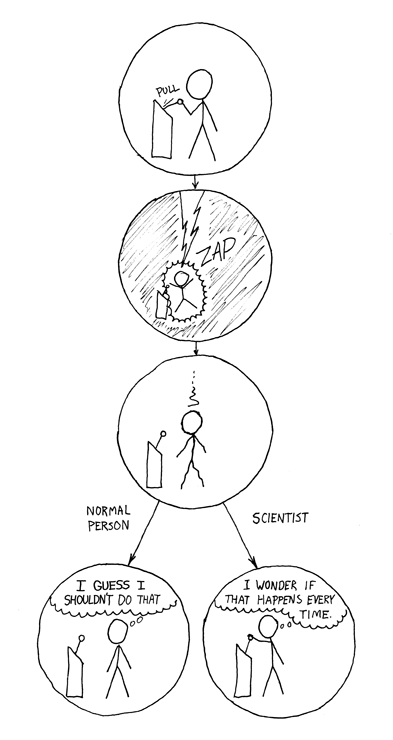
Some people learn by reading. Some people learn by observation. Some people learn off the telly. Then there are those who just have to grab the electric fence...
The human mind is an interesting thing. When we put our hand on a hot burner or put a penny in a light socket, what's left of us tends to not want to do that anymore. We learn from our mistakes.
Characters in a story usually begin their journey with little actual experience in the real world. Somewhere along the way, they figure out how to manage. There is usually something either said or implied that being in a constant life or death situation has forced them to find some way to survive. By default, they usually become damn good at it.
When the time for action has come, the time for preparation has passed. Sometimes your Training from Hell is not enough. Other times you have no training whatsoever. This is often how someone Took a Level in Badass. Some are so good at this that they have Awesomeness by Analysis, maybe to the point of being an Instant Expert. Maybe, somewhere along the line, they learned Mortal Kombat.
This is a staple of MacGyvering, in that the devices they make work because they have to. The Crazy-Prepared person is either this way because of past experience, or because they want to avoid the bruises associated with it. And this is implied with a person who has Seen It All — they have experienced it personally.
Truth in Television: want to learn German, live in Germany. Want to learn Japanese, go to Japan. Regularly communicating in the native language in order to pay for transportation, food, rent, etc. is more efficient than a couple hours several times a week in a classroom. If you're wrong, you don't get what you need. A mundane version of Die or Fly, in other words. That said, formal teaching is still useful to cover situations and areas that do not turn up every day, to spot errors or to correct bad habits. Both kinds of "hard work" drill in the knowledge. There is a good reason why a leader needs to know what it is like at ground zero.
In Video Games, especially RPGs, this is what they are trying to simulate with Experience Points, especially in the more complicated leveling methods where performing an action repeatedly gives you more points to allocate to that skill area.
See also the Sorting Algorithm of Evil. Compare/contrast Hard Work Hardly Works, The Only Way They Will Learn, Necessary Fail, Sink or Swim Mentor, Book Dumb, Wax On, Wax Off, and Well-Trained, but Inexperienced. This is almost always part of the background of a Uncertified Expert.
Examples
- Guts of Berserk has spent his entire life fighting from childhood on. While his training as a mercenary from childhood made him quite the badass against any human he met, the skills that he acquired in Demon Slaying were born out of pure experience, desperation, and survival instinct, his first experience being with Zodd, then with Wyald after Griffith's rescue, and then with a whole mess of monsters from hell out to eat him alive during the Eclipse.
- Due to the circumstances of the story, any training Ichigo Kurosaki of Bleach undergoes tends to be relatively short, from a few days to a month or two. Because of this, his real progress happens through the various life-or-death fights he finds himself taking part in. While he does get regular power-ups, he also becomes gradually more skilled as the story goes on.
- In A Certain Magical Index, Touma Kamijou has never received any formal training but has picked up street fighting skills from a lifetime of defending himself and others from bullies and street thugs. His various fights also help him pick up patterns and weaknesses in people's fighting styles and powers. However, he once got curb-stomped by Motoharu Tsuchimikado, who mocked him and said self-taught street fighting skills cannot compete with elite martial arts training.
- However, Touma goes through so many life-threatening situations that he outright gains a sense of precognition within fights which allows him to effectively parry anything he needs to with Imagine Breaker or dodge anything that it can't. He does briefly consider getting actual fight training but ultimately decides against it, feeling that part of what makes him special and separates him from the many, MANY incredible forces in the Indexverse, is that he has no actual training.
- A lot of the goofing off Taichi does in Digimon V-Tamer 01 is just that, but occasionally he'll try an experiment with seemingly no beneficial outcome that he later can build on. He keeps a lot of notes too.
- A foundation of Dragon Ball Z. Doing some Training from Hell so that My Kung-Fu Is Stronger Than Yours often leads into a Determinator moment. As Goku once said to Gohan, "Power comes when there is a reason. Create your reason."
- Soma Yukihira of Food Wars! lives and breathes this trope. Unlike many chefs of his generation, he doesn't have any extraordinary talents or specialties of his own, yet he has plenty of hands-on experience from working in a kitchen for over twelve years. Moreover, he's a quick learner and knows how to turn his mistakes to his advantage, and even take techniques he learns from cooking against or alongside his peers.
- Goblin Slayer: Goblin Slayer has five years worth of experience as an adventurer at the start of the series. He has already encountered numerous types of goblins, has studied their behavior, strengths and weaknesses, and he knows numerous ways how to deal with them effectively. The prequel series Year One shows the readers how he acquired the experience, knowledge and skills that we know he's already got in the present. For example, when he tells the guild's adventurers that he won't be able to take on a hundred of goblins in an open field in the present series, we get to see him almost dying dealing with 25 normal goblins in an open field in the prequel series.
- In Happy Yarou Wedding, Kazuki thinks he can wipe the floor with Yuuhi, but Yuuhi is quick to point out that he's never been in a real fist fight before. Yuuhi may not be trained in martial arts, but his experience gives him the edge over Kazuki.
- Yuu from Holyland does this most of the time fighting on the street. Sometimes he has to be manually taught by others, but mostly he figures it out by this. For example, he used what he learned fighting a judoka to know what to look out for against another grappler and started using more kicks after he found that he was damaging his hand from over-reliance on his fists.
- Lyrical Nanoha: Nanoha figured out her magical powers by trouncing the Monster of the Week after school, and crossing magic staves with Fate. Yuuno mentions that she naturally synchronizes better with Raising Heart than himself. Also the Intelligent Device runs training programs mentally to fill in the gaps. She's naturally powerful, which means that she can make up for her lack of skill via sheer brute force when she needs to, though she would pay for doing that too much in time.
- The two sisters in Maoyu, particularly the older one, understands about being poor with no food very well unlike those who haven't, such as the sons of the noblemen being taught by the Crimson Scholar. When one of them nonchalantly mentions how the nobles will take care of their people in times of trouble and famine, the older sister comments that they must have never starved before.
- Mirio Togata of My Hero Academia is a strong believer in the idea of learning from experiences, both good and bad, and credits this with the development of his own quirk. His experience and tutelage under the pro hero Sir Nighteye went a long way towards turning him from dead last among his peers to number one at U.A.
- Generally, most of the cast in Negima! Magister Negi Magi opt for Training from Hell (with the occasional Awesome by Analysis). The former private soldier Mana Tatsumiya, on the other hand, thanks to a youth spent in combat, can boast the skills and instincts above what the rest of the warrior-heavy class have managed, befitting a mercenary of her ability. Evangeline also counts, having learned to use magic and her vampiric abilities at age ten, then going from there.
Chachazero: Surviving for hundreds of years ain't just for show, you know.
- Jack Rakan. His general attitude tends to make people think that he's just naturally strong and talented, and has never had to really work for his wins. Nothing could be further from the truth: he was an ordinary boy who was in near-constant combat for over forty years, and he achieved his current power through sheer effort and practice. Negi realizes there's really not a whole lot that could catch Jack off-guard; since the guy has seen every trick in the book.
- After Negi's and Rakan's match, some of the fans started quarreling about who was better. A fight broke out. Onlookers started betting on the outcome. The draw had the highest stake.
- In Pokémon: The Series, Ash doesn't get anything right in the first story arc (Indigo league), often getting his badges after losing the first gym battle and having to help out the gym in some fashion later on. As the series progresses, he gradually gets sharper and more creative with his methods, both in training and battling his Pokémon ("Use Pikachu" and "If that doesn't work, use more Pikachu" won't solve all of his problems).
- Ironic as he kept using Pikachu on Team Rocket, despite them using something that's shockproof (which they've done since, what, the fifth time he faced them?) As Meowth pointed out in one episode, "You'd think he'd learn by now".
- Parodied in Ranma ½, where Genma wanted to teach Ranma the legendary Cat Fu martial arts style. Being unfamiliar with its methods, he decided to wrap Ranma in bacon and sausage and throw him into a bin filled with starving cats. Ranma learned nothing (at least at first) and in fact gained a case of ailurophobia because of it. It was later shown that he did learn Cat Fu but has to go into a psychotic break-down from his ailurophobia to reach it unconsciously.
- On a funny note, it didn't teach Genma anything, as he tried to "cure" Ranma's phobia by throwing him in the bin again (this time with sardines).
- In Reborn! (2004), the entire point of setting up Shoichi Irie as the main enemy of the Future Arc, and having the Vongola storm Merone Base was so that they would gain more strength in order to defeat the true Big Bad, Byakuran.
- In The Saga of Tanya the Evil, Tanya regularly cites experience as the best teacher, though with the caveat that the tuition fees are extremely high. Those that made it through the Training from Hell she delivered and their incredibly high-risk engagements quickly became a Badass Army.
- Samurai Champloo:
- Mugen has a bizarre fighting style. Jin (who is a classically trained samurai) even notes how his style is impractical, yet is one of the few men Jin could not kill easily. Mugen made mention that he grew up in very violent conditions, (living in a prison colony and being a prisoner himself) which forced him to figure out that style on his own. It works for him.
- In the final two-parter, the two face off against Kariya. Mugen goes first and Kariya notes that while his movement make his swordplay unpredictable it leaves too many openings that a trained swordsman can easily get through. Adding that Mugen needs to learn to adapt more in certain conditions. In the final battle he takes this to heart which allows him to off Umanosuke by using his scythe against him. Conversely, Jin faces off against another classically trained samurai who is better at the style than Jin himself. This leads to a breaking with the style in order to triumph.
- Done rather subtly in Slam Dunk. While protagonist Hanamichi Sakuragi grows a little with each match, his growth is mostly showcased at three specific points: first, in the practice match against Ryonan, he scores and puts Shohoku ahead on the scoreboard towards the end, but there's still some time left and Sendoh goes back and turns it around, resulting in a loss for Shohoku. Later, in the Kanagawa finals, even after scoring a dunk that puts Shohoku ahead by four points (pretty much securing their victory), he tells everyone to pull back and defend their basket because Sendoh could score again (showing that he learned from his mistake in the practice match). Lastly, in the Shohoku vs Sannoh match, the situation is reversed, Sawakita puts Sannoh ahead with ten seconds left, but Sakuragi doesn't give up and runs ahead for one last attack (in other words, he does the same as Sendoh did in the practice match), and sure enough, he ends up scoring a buzzer-beater that gives Shohoku the victory.
- Spirited Away uses this in the classic gentle Studio Ghibli way. Chihiro has to fend for herself. She has friends, but the story is about how she grows during the process.
- Vagabond is about how Miyamoto Musashi goes from a naturally gifted hothead to a true badass after he gains experience, being humbled before overcoming the challenge; when he's going to fight all of the remaining Yoshioka, he actually thanks them (silently and by himself with a silent prayer) for giving him the past year to learn, develop and grow.
- Green Arrow: In some versions of Green Arrow's origin, he develops his incredible archery skills as a result of being stranded on a desert island and having to learn how to use a bow in order to survive.
- The Punisher: The Punisher's archenemy Jigsaw as early as his second storyline is aware he's outgunned in a world of superheroes and thus tries to commit crimes that are out of the way and too low-level for most superheroes to notice. This is also why he and Rosalie Carbone don't partake in the trap to kill Castle that kicks off the events of The Punisher: Suicide Run, as they're aware it'll blow up in the others' faces.
- Spider-Man: Spider-Man relies on his spider powers, web-shooters, Spider-Sense, and environment to combat his foes.
- Ultimate Spider-Man: Peter's first encounter with the Kingpin has Peter, who has super-human strength, failing to physically injure the much larger Wilson Fisk. So the next time they square off, Peter goes for a different attack — call him fat. Repeatedly. He uses his enhanced agility and reflexes to dodge Fisk's attack, then webs him up and runs for it.
- X-23: X-23 demonstrates in Wolverines that she's learned from what happened when Daken and Elixir tried to fight Siphon during The Logan Legacy. The next time she has to deal with him she packs a shotgun.
- During the final battle with Sinister in issue 17, upon watching Sabretooth's frontal assault on Sinister being effortlessly defeated by a force field or energy blast, Laura's own attack is much more successful; she ambushes him instead and pins his foot to the catwalk he's standing on from below.
- X-Men: In Nothing Can Stop the Juggernaut!, the Juggernaut tells Spider-Man that he learned from all the times when he was beaten by getting his helmet yanked off, so he welded it on with a laser torch.
General
- Common in Peggy Sue Fix Fics, where characters go back in time with the benefit of having lived through future events and seen what works and what doesn't.
Individual works
Bleach- This Bites!: How does Chopper know how to throw scalpels so well? No, Kureha didn't teach him; he just examined all his memories of her throwing things at him, and replicating her technique.
- Vow of the King: A good deal of Ichigo's training, whether it's from Nemu, Tessai, or Eien-ō, consists of fighting them until he learns how to fight properly.
- In Dragon Knight
 , much of Xander's fighting ability comes from fighting. When he avoided fighting the women at the fort (due to still having the mentality one shouldn't hit women), he's forced to fight each of them and learn how to counter their fighting style on his own. Lastly, when he kills an infamous highwayman, Xander keeps his eye on the body until he hasn't moved for over a minute and his eyes gloss over, due to almost being killed once by an imp he merely mortally wounded.
- Fates of Ice and Fire (Fate/stay night & A Song of Ice and Fire): Even though Prince Oberyn Martell has never met Arya Stark before, he quickly sees through her magical disguise and warns his companion to wash her hands after she touched Arya's ball in case it was poisoned. He explains that he's faced assassins from the House of Black and White in the past, so he's familiar with some of their tricks.
- A Horse for the Force (Ranma ½ & Star Wars): Sees Ranma teaching Jedi how to fight by fighting them. Shaak Ti, who spars with him the most, is shown to be considerably more skilled than other knights despite being new to the rank. Her Force Sense in particular is far more honed due to her need to keep up with the much faster Ranma. Lastly, sparring against Ranma tends to teach Combat Pragmatism such as when Shaak Ti sparred with fellow knight Kit Fisto and won by punching him in the face then hitting his wrist to steal his lightsaber. As a result of both the spars and her adventures with Ranma, Shaak Ti is acknowledged as a Jedi Master after being a Knight for slightly over a year.
- The (Questionable) Burdens of Leadership of a Troll Emperor (Naruto & Stargate SG-1): Naruto and Xanna let their new subjects settle wherever they wished within their empire, resulting in most creating new towns of people from the same planet. They later spend years trying to break multiple factions of their ingrained misogyny and misandry before finally finding a solution. Centuries later when (peacefully) taking over Earth, Naruto and Xanna have learned from their biggest mistake last time and don't send people from the same culture all to the same region of their empire.
- Shadows over Meridian (Jackie Chan Adventures & W.I.T.C.H.): Jade uses her experience in defeating villains in her world to come up with a solid plan to defeat Elyon, the Guardians, and the Rebellion by destroying their reputation with the people.
- Fallout: Equestria (Fallout & My Little Pony: Friendship Is Magic: Alicorns combine this with a Hive Mind, meaning that any trick Littlepip uses Only Works Once. Even if she kills them, the others remember what happened and are prepared for it. Ultimately, after she kills both their Goddess and their employer, they give up trying to fight her. While they still hate Littlepip, they have officially reached the point where the most logical course of action is staying out of her way.
- Raised by Jägers: Agatha did her best to help with the Jaeger medical treatments growing up, but she didn't know what she was doing and had no teacher. Mamma Gkika couldn't teach her much, since she wasn't a doctor or a Spark. When she gets to TPU and has real medical classes, she discovers startling gaps in her knowledge and realizes that the only reason she never killed anyone was that Jaegers are Nigh-Invulnerable.
- Abraxas (Hrodvitnon):
- San notes that Vivienne may be inexperienced as a Titan, but she's a quick learner when she needs to be. When she and San are introduced to sparring with other Titans, Vivienne solves problems and works out what she needs to do via trial and error.
- Colonel Foster thinks that she didn't take the Monarch scientists seriously enough during the events of Godzilla: King of the Monsters (2019), events which saw a literal apocalypse because of the government and military's choice to launch the Oxygen Destroyer rather than listen to Monarch. As far as Foster is concerned, the events of King of the Monsters proved that the monster experts should always be taken seriously on the matters which they were founded to understand.
"The last time I didn't take a scientist seriously, the world almost ended."
- This trope is specifically the reason why Tejada and Tarkan are selected to be part of the torch-and-bury operation against Alan Jonah's paramilitary's artificial zombies. Tejada has accumulated extensive experience beating back the zombies, while Tarkan has past experience combating Jonah himself.
- Viridian: The Green Guide: Izuku is able to do first-aid on a cashier who got severe electrical burns in a Villain attack because Izuku had to treat his own burns from Bakugo beating him up in the past.
- Challenger: Ash beats the top ten students at a Pokemon prep school because his knowledge and skill come from dozens of pokemon battles against other trainers, including Gym Leaders who know how to counter their own weaknesses. By contrast, the knowledge and skill of the students come from reading books and battle simulators, which leads to many of them being unable to deal with unorthodox tactics or even dodging attacks.
- Pokémon Reset Bloodlines: Ash retains all of his memories after being sent back in time, and he's able to put his knowledge to good use to re-train his Pokémon.
- In the Kingdom's Service: Blake learned how to sneak around and hide while part of the White Fang and, unlike the VSS and ASF, had no fancy tech to help her. As a result, she's considerably stealthier and more observant than Ciel, who relies too much on her gadgets, both spotting and hiding from Ciel along with spotting the invisible person following Ciel.
- The ProfessionARC: Jaune learned how to be a Huntsman from an experienced Huntsman rather than in a combat school. As a result, he knows many tricks of the trade his fellow students at Beacon don't, such as the preferred tactics of Grimm packs (not to mention the difference between a pack of Grimm and a group). Notably, students still in training tend to look down on him for not attending an official school, whereas experienced Huntsman understand Jaune is more skilled than most students and doesn't have to be looked after as much. On the other hand, Jaune is shown to struggle with history as it neither helped him survive in the wild nor kill Grimm, and as such wasn't included in his education. He also has trouble fighting human opponents due to his focus on Grimm.
- Professor Arc: Student of Vacuo
- Jaune and Neo learn how to fight almost entirely from actually fighting, though Neo at least had some training before their sole semester at Vacuo. It shows in Jaune's teaching style where he "corrects" a student who's not blocking properly by letting her get hit by an opponent. Many of Jaune's practical lessons are about abusing loopholes, fighting dirty, and generally turning any situation to your advantage.
- Similarly, Ilia is almost entirely self-taught and quickly earns a reputation as a "thug" and "gutter fighter" for how brutally she fights, utilizing smokescreens and flashbangs along with "uglier" hits such as pulling hair, groin attacks, and strangling opponents. She more than most appreciates Jaune's teaching style, noting that while Ruby thinks her ponytail is pretty and a nice match for her partner Pyrrha's, Jaune thinks it's a nice handhold to use when smashing her head into the ground.
Unsorted
- In the backstory of Dungeons and Drow, Harry Potter is one of several apprentice wizards sent off to fight in a war and the only one to return (the rest having died or fled). He easily kills the Guildmaster and the five wizards with him once he does return as all of them were rich and/or nobility so never went to war and learned all the dirty tricks and unusual spells wizards in the army learn. Of course, it helps that the Guildmaster apparently bought his position rather than earning it.
- In the Worm x Bloodborne crossover Hunter, Taylor comes to learn to defeat Father Gascoigne this way. She learned how he moved, shot, and struck, dying and respawning several times until she finally killed him.
- Many Buffy the Vampire Slayer stories have one or more characters be well versed in various ancient languages and melee weaponry (such as Xander in Teal'c's Wish) by virtue of all the time spent poring over ancient texts for information and fighting demons respectively.
- A Brighter Dark, Corrin basically forced this on herself by purposefully putting herself into situations where she would have to fight for her life. As a result, she's much more powerful from the start than she is in the original game, being able to so far out-duel everyone she's had to go against besides her older brother, mainly because he was Taught By Much More Experience.
- In Xendra, pouring over ancient tomes allows Willow to test out of so many language classes at UCLA (including ones they don't even teach) that after her first year of college she already has a bachelor's degree in languages and linguistics. Likewise, Xander tests out of three different language classes and his day job at a construction company gives him a leg up on his business and management classes.
- Earlier in the story, Xander tries throwing a chakram at Angelus, who catches it easily. Xander later makes a chakram that has the blade on the inside then starts inscribing all his chakrams with crosses so any vampire that catches them will regret it.
- Harry Potter in The Havoc Side of the Force notes that everyone he does a job for tries to screw him over the first time. As a result, he's taken to setting up precautions to prevent and/or counteract such attempts. Though even before he grew wise to such tricks Harry made sure no one was stupid enough to try it a second time.
- All of Hari's associates in Itachi, Is That a Baby? have learned to dread Hari referring to anything as "Interesting" as anything he finds interesting tends to be of the "May you live in interesting times" variety.
- Infinity Train: Star Finder: Luna knows how to dodge every prank that Luan uses against her due to being her roommate. This is shown when she dodges a water balloon being tossed at her when she enters their bedroom, making it hit Lola instead.
- Ratatouille: Learning from the health inspector's surprise visit, the new restaurant has a dining area hidden from the humans that is accessible to Rémy's clan and they can honorably get food. Only Rémy, Colette and Linguini are seen in the kitchen which makes it easier to keep Rémy's participation hidden.
- Despite having "teaching machines" they could use, in Battlefield Earth the humans decided to just learn to fly jets through experience. And they do it well enough to actually pose a reasonable challenge to the Psychlos.
- Cast Away is a great demonstration of this. A pudgy Chuck Noland struggled for a while figuring out how to hunt for food, gather water, and build a fire. After a large Time Skip, you see him slimmed down and very efficient at all of those, in addition to making his own rope.
- The Dark Knight Trilogy:
- Batman Begins uses this entirely as its main story. Bruce went through the training, and when he came to form the mantle of "Batman", it was from picking up his mistakes. After getting a military combat suit, he found that he needed something to soften a fall, which leads to the glider-cape. After getting gassed by the Scarecrow, even though he was now inoculated against the effects, he was fully aware of what Crane was going to do. Alfred uses a Call-Back quote from Bruce's father: "Why do we fall? So we can learn to pick ourselves up."
- The Dark Knight continues with this, as Bruce found the original Batman suit not holding up to the demands he was putting into it. He commissioned a new suit that addressed various limitations he found, such as a limited range of motion including the inability to turn his head.
- Dungeons & Dragons: Honor Among Thieves: At the start of the film, Edgin and Holga escape from prison by grabbing Jarnathan — an aarakocra — and performing a Super Window Jump with him, forcing him to catch their fall unless he wants to go splat as well. Forge attempts this exact same maneuver at the end of the film, but discovers that the Absolution Council decided to have the window bricked shut by smacking face-first into the new wall.
- The Elite Squad (aka Tropa de Elite) combined this with Training from Hell: The latter half of a room-clearing obstacle course is actually a part of a real slum with real assault-rifle-toting criminals.
- Discussed and played straight in Fearless (2006). The former occurs when Huo Yuanjia and Tanaka are having tea and Tanaka asks Huo if he thinks there is an "Ultimate Fighting Style" that can't be defeated. Huo responds with a no saying that "It's more like there are people who are all at different skill levels and experience.". The played straight part starts from the beginning of the movie where we watch Huo go through years of training and several fights building up his skill making him the badass we see near the end of the movie.
- Jurassic World: It's made clear that Masrani learned from Hammond and InGen's mistakes — the park only has staff who are completely loyal to Masrani (avoiding spies like Nedry), a larger pool of staff is kept on hands at all times (to avoid one person having control over everything, again a problem with Nedry), and park security not only has plenty of equipment to work with (including multiple vehicles), but also packs lethal weapons, just in case they end up with a creature like The Big One who cannot be controlled. Their problems stem from the fact that the one person who they had to take on from the original park having a change in allegiances, and his creation being a Bioweapon Beast explicitly meant to be incredibly smart and able to endure military-grade weapons.
- Man of Steel: Since he lacks the formal training all Kryptonian soldiers undergo since birth, Superman had to rely on his own life experiences in how to control his powers. Even Jor-El said the only way to know how strong he had become was to keep pushing his limits. Zod might mock his Farm Boy upbringing, but in the end, Superman manages to be a credible threat to Zod’s forces and save Earth. What he lacks in formal training, he makes up with adaptability. Unfortunately, Zod gets a much better handle on things by the time he and Superman face off.
- Marvel Cinematic Universe:
- Tony Stark is constantly learning by trial-and-error and improving his suits by correcting old flaws. However, he sometimes relies on this trope a bit too much — he will often have his equipment Unfinished, Untested, Used Anyway and will generally not plan ahead:
- Iron Man: He forgoes the thorough safety inspection on his Mark II suit and as a result faces the "icing problem" during a test flight and nearly plummets to his death. He has solved the problem by the end of the film. This gives him the edge over the Big Bad who can't hit the broad side of a barn once his targeting computers are... "disabled".
- The Avengers: After the electrical discharges from Whiplash's weapons disabled his suit in Iron Man 2, Tony has upgraded his suit further to absorb excess electrical energy, which he can then channel into his repulsors. He uses this feature against Thor.
- A malfunctioning parachute was a major aspect of his own escape from the F-22 Raptors in Iron Man. By Spider-Man: Homecoming, we learn Tony has included a parachute and wingsuit in the Spider-Man suit he designed.
- Avengers: Infinity War: Learning from one's own mistakes is discussed by Loki and Thanos in The Teaser:
Loki: If you're going to Earth, you might want a guide. I do have a bit of experience in that arena.
Thanos: [unimpressed] If you consider failure experience.
Loki: I consider experience experience. - Spider-Man: No Way Home features a cross-continuity example: In The Amazing Spider-Man 2, Peter failed to prevent Gwen Stacy's death as she broke her neck in a fall. When MJ is in a similar situation in the film's finale; Peter makes sure to dive for her himself rather than using his webbing to break her fall.
- Tony Stark is constantly learning by trial-and-error and improving his suits by correcting old flaws. However, he sometimes relies on this trope a bit too much — he will often have his equipment Unfinished, Untested, Used Anyway and will generally not plan ahead:
- MonsterVerse:
- In Godzilla (2014), Ford Brody invokes this to convince the master sergeant handling the nuclear warhead to give him a ride on the freight train to San Francisco, bringing up his EOD experience: unlike the rest of the team, Ford has professional experience "put[ting his] fingers in a live bomb."
- In Godzilla: King of the Monsters, the eco-terrorists start out directly invading Monarch's outposts in person, gunning down anyone they encounter, and setting Mothra and Ghidorah loose manually. But after the second mission almost goes south when Monarch catch up to the terrorists and get very close to thwarting them, they instead choose to remotely hack into the next Monarch outpost in order to free Rodan.
- At the start of Pacific Rim, Raleigh loses his brother and is almost gets killed himself because he assumed a Kaiju was dead when it wasn't. Later, after taking down another Kaiju he says "let's check for a pulse", which is to say that he disembowels it with his energy cannon.
- Platoon has Charlie Sheen's character develop from a shell-shocked recruit fresh from basic training into a capable soldier... unfortunately.
- Implied in the movie Sahara (2005). Dirk and Al Mac Gyver a boat to explode (LongStory), with a quick explanation that despite them calling it "The Panama Maneuver," they were actually in Nicaragua. After the boat explodes, an amazed side character asks the duo how they got it to work right the first time. Dirk sheepishly admits that it didn't work the first time...
- At the end of the first act in Speed, Howard Payne hold's Jack's teammate, Harry, hostage as he tries to make his escape. Jack shoots Harry in the leg, surprising Howard and causing him to ditch Harry and flee while detonating a bomb to cover his tracks. Towards the end of the story, Harry gets another hostage and he learned from his previous encounter with Jack by strapping the hostage with bombs. He even taunts Jack by saying "I don't think shooting her is gonna work this time."
- Star Wars:
- Luke Skywalker's advancement in the Force can be attributed to this. Without the classic training of the monk-like Jedi, he learned by improvisation and sometimes hard lessons.
- Return of the Jedi: Chronologically, Darth Vader shows this during his fight against Luke. In Revenge of the Sith, we see Anakin falling into an "I have the high ground" trap by Obi-Wan, which leads to his defeat and relying on Life Support and Artificial Limbs to survive. Come this movie, Luke gets the high ground on Darth Vader to try and finish him quickly, but an Older and Wiser Vader simply destroys the platform, robbing Luke of his advantage.
- Attack of the Clones: In the climax of The Phantom Menace, the Trade Federation's invasion of Naboo is foiled when their Droid Command Ship is destroyed, leaving their battle droids helpless. The Federation learns from this defeat; when another Command Ship is destroyed during this film, the now-upgraded battle droids pause for only a fraction of a second before switching to preprogrammed orders and continuing the fight.
- In A Brother's Price, the royal family learnt the hard way that it is no good to let their daughters marry a man who looks good and is of noble birth. After the failure of last time (the handsome guy turned out to be abusive), they are very careful about it and ask every single daughter for her consent — much to the chagrin of Ren. From her point of view, there are two problems with this requirement: Halley (missing) and Trini (very reluctant to remarry after the abuse she got from her now-late first husband). Eventually, all sisters agree to marry Jerin, a decision that makes everyone happy, as Jerin is a very good husband, despite his lack of noble birth.
- In Dark Lord—The Rise of Darth Vader, set just after Revenge of the Sith, Vader's lava bath has forced him to rein in his temper and learn to affect a veneer of callousness. He also has to adapt his fighting style due to the constricting weight of the suit.
- Played with in Dragon Bones: The only useful thing Ward learnt from living with an abusive father was how to hide his emotions and carefully time his actions so that he is the one who gets beaten instead of his sister, Ciarra. After his father is dead, Ward spends a lot of time trying to fix the stallion that his father turned into a fierce monster by mistreating it, making it unlearn the aggressive reactions caused by this. There is also Oreg, a slave, who learnt that saying his opinion is dangerous, so he hides behind furniture whenever he tells Ward something that could offend him. Ward would never raise his hand against him, but he doesn't know that. The wisdom gained from experience doesn't serve Oreg well, as Ward is different from others, and it would be better to tell him about weak spots instead of hiding them. Oreg suffers severe pain at least once because he didn't tell Ward what happens if he doesn't obey an order.
- The Dresden Files:
- Harry Dresden's magical (and mundane) arsenal changes between books from his observations of what works and what doesn't. After getting his left hand burnt into uselessness because his shield spell stops matter and kinetic energy but not heat, he devises a new shield that stops just about everything (including heat, light, electricity, most sorts of magic, etc.)note . After seeing Elaine's taser-chain trick in White Night, he comes up with his own version for when fire magic isn't such a good idea. Oh, and teaching his apprentice how to do magic gives him a LOT of ideas, such as changing his massive blast of wind spell to a much more subtle "hairdryer" spell.
- He starts using his kinetic force ring early on: it's a powerful ring that store energy every time he moves his arm, and that energy can be released for a powerful "punch", but there's no control over the energy; it's "use it once and move on" at best. In later books, he's upgraded his ring to three loops, each independently capable of being triggered, and he wears one on each hand, for a total of six punches, and each of those punches hits with far more force than his original ring. He's also decided that rather than just wait for the rings to charge up over time from normal movements, he'll spend some time at a punching bag to charge them up in the course of a day.
- He also stopped using his wind spell, ventas servitas, after the first few books. According to the author, this is because while wind is flashy and impressive, force magic (his forzare spell) is much more effective and versatile in almost any situation.
- One good example of this trope in action, that might be easy to miss: In White Night, the opponent turns off all the lights, so Harry does what any wizard would do: he calls up a supernatural light. However, this just makes him a target for the baddies, who immediately attack him, which was the the aim of the blackout in the first place. Two books later in Turn Coat, another baddie tries the same tactic in a room full of White Council wizards, and Harry is one of the few wizards not to call up light and make himself a target.
- The advantage was demonstrated in Skin Game. Hannah is a powerful mage, who can work fire magic much better then Harry. However, in combat, she turns out to be much less effective than Harry because despite raw magical talent, she doesn't know how to adjust her tactics on the fly, and she commits everything to offense without knowing how to defend herself. Harry clearly states that she isn't in his league as a fighter because she hasn't learned from fighting in real battles as he has, and just uses raw power to try to knock out her opponents. This bites her on the ass when she turns on him, as she's so focused on killing him with overwhelming flames that she doesn't notice that he's using his shield to redirect the blast of fire upwards and superheat the rock above her head. Sure enough, when enough heat has been applied, she ends up buried alive by thousands of tons of rock, and Harry has barely broken a sweat.
- Enemies that Harry faces start to note when they're going up against him too often, because he can and will find new ways to learn and exploit their blindspots. When he first runs into the Denarians in Death Masks, he's severely out of his league and only rescue by the efforts and sacrifices of others. By the time the Denarians show up again, Harry knows enough to outmaneuver and almost successfully kill Nicodemus, the most dangerous Denarian of all, and when that characters shows up again, it's to make Harry an ally rather than attempt to fight him.
- The Eisenhorn books:
- In preparation for the final assault in Xenos, Eisenhorn is given his pick of elite Guard regiments. He chooses to stick with the comparatively less capable Gudrun Rifles because they've experienced what being in a Saruthi tetrascape is like before, which is something no amount of simulation can adequately convey.
- After the title character binds Cherubael, he finds that it keeps running wild at the worst possible times. Eventually, he triple-binds it, deeming the subsequent loss in power acceptable for the greater docility forced on it.
- Journey to Chaos: Kallen Selios schools all the academy mages at the New Scepter competition because of her vast degree of experience fighting monsters in the wild in addition to all the research she has done. When one lives or dies by their magical ability (power, technique, knowledge, etc.) then one is simply better than another who has only done classroom demonstrations.
- Harry Potter: Harry's combat skills were developed exclusively on the fly, owing largely to the spastic and uneven quality of the Defence Against the Dark Arts classes coupled with necessity. As a result, he has a somewhat limited (but effective) arsenal of spells, but excellent split-second reactions and is largely immune to pressure choking.
- Most of Robin McKinley's protagonists have to do this. Even in the rare stories where they have an actual mentor teaching them things, for some reason the final confrontation always comes down to a desperation move with no conscious thought behind it (often grabbing the nearest magical artifact and just chucking it at the villain).
- In Officer Buckle and Gloria, Officer Buckle seems to learn at least some of the safety tips he tells the students by suffering the consequences of doing various things.
- In Ranger's Apprentice, Will goes from a talented novice to a top-level Ranger through years of training and several missions.
- Scourge from Warrior Cats was thrown out onto the streets and learned this way. It led to him becoming a brutal killer with no remorse.
- Arrow. Oliver Queen discovers Malcolm Merlyn is the far superior Dark Archer when he fires an arrow at Merlyn only for him to catch it. In the Season One finale Oliver does this again, but uses an explosive arrow so it blows up in Malcolm's face when he catches it. In the Season Two finale, Malcolm Merlyn uses the same trick on a Mirakuru Super-Soldier.
- Buffy the Vampire Slayer:
- This, along with a heaping helping of natural talent, is subliminally given as the reason why Willow went from a newbie in magic to becoming the world's most powerful witch in the space of four years.
- Wesley defines his Took a Level in Badass from this trope. His first appearance on Buffy had him as an arrogant rookie from the "Watchers" academy (which wasn't too much different than what Giles was in the first season). By the third season of Angel he grew a permanent five day beard and while not as strong as The Hero, he was a fairly badass smart guy.
- Gunn learned this way before we even met him. He led an urban vampire hunting team made up entirely of local gangs. He had apparently been doing it for years and has had a relatively high life expectation compared to the better-funded Watchers council and even the various Slayers.
- Buffy herself. With every passing season, she gets more experience in dusting vampires and other nasties, which means it gets easier and she becomes capable of more. She goes from having trouble with 2-3 vampires in Season 1 to killing 20 at once with a giant stake in Season 5.
- On an episode of the Food Network's Celebrity Chef Cook-Off, this combined with Boring, but Practical to be key to winning the Elimination Challenge involving grilled cheese sandwiches. Having stated that he makes such sandwiches for his kids all the time, Joey Fatone's no-frills entry (with only a pickle and tomato slices making a smiley face) trumped two other entries made with a lot of extra bits each. One didn't properly melt the cheese and the other was highly greasy. Guess which one came out on top?
- Doctor Who plays this straight as an arrow. In the early days, the Doctor would blunder into a situation and have to figure out how to solve it. Eventually, he became a master of the Indy Ploy and almost every other entry on the Gambit Index, as well as exploiting the fact that he has a time machine with incredible resources. Nowadays, if the Doctor is acting like he has no idea what's going on, chances are it's Obfuscating Stupidity.
- Inverted with a character on House. An applicant for House's diagnostic team was revealed to not have actually gone to med school. He worked as an admissions officer at Columbia University's medical school and audited every class multiple times, and so had a large understanding of the textbooks and medical theory. But he never actually worked with patients or was actually trained to do certain procedures, not to mention didn't even have a medical license. Sneaking around that limitation is what led to House figuring out his secret. House ends up firing him but not because of the deception but because his opinions and ideas were too similar to House, which the latter doesn't want in an assistant.
- House of the Dragon: Kingsguard candidate Ser Criston Cole has the advantage that he fought as a foot soldier against the Dornish incursions, and was knighted for his excellence there. He is the only candidate to be a seasoned warrior, both before presenting himself to Princess Rhaenyra and before his investiture as a knight.
- RoboCop: The Series saw Pudface Morgan learn from his failed attempts to kill Murphy (especially in the pilot movie, where Murphy was able to be saved due to Morgan's sneak attack in part due to Morgan — and Dr. Mallardo and Chip Chayken — leaving Murphy for dead on the sidewalk) in "Faces of Eve". After severely damaging Robo using a crane, Morgan knows he's not down, so he decide to use the titular beauty aid Eve to impersonate the Chairman and activate the shut down program for Murphy. Granted, this was also stopped, but he did learn not to count Murph out.
- Scrubs has this throughout its entire run, but most notably in the first episode where J.D. is knowledgeable and has a good bedside manner, but is so inexperienced and panicked by the prospect of making a mistake that he can't even touch a patient, much less adequately treat someone. As an interesting contrast, his best friend and fellow med school graduate Turk jumps right into the "learn by doing" philosophy, but makes certain mistakes at the start and isn't always as good as he imagines himself to be. Dr. Cox has to (unwillingly) become J.D.'s mentor and role model and trick/force him to work on patients before J.D. starts getting real experience and learning how to become a good doctor.
"Four years of pre-med, four years of med school, and tons of unpaid loans have made me realize one thing... I don't know jack."
- Stargate SG-1 had elements of this, very much in the style of the Apollo 13 accident. Characters would come across a problem, spend a whole episode dealing with it, and then end with them saying, "Okay, now we don't let that happen in the future." For example, invisible aliens took control of the Stargate, because they'd found out the passwords by spying on the base. At the end of the episode, hand scans were put into the protocol. This adaptability was a major reason humanity became very powerful very quickly.
- The crew of Mission to Zyxx does learn over time at a decidedly glacial pace. The first mission sees them offend the leader of Flurp; on a future mission they avoid repeating the error. C-53 learns how to take over new frames with his cube and proceeds to switch several times over the show. Pleck is a pushover in early seasons; by season three he's spearheading the rebellion himself.
- Jenna from Dawn of a New Age: Oldport Blues learned how to use her superpower because she had to: it turned her into a giant mass of insects, forcing her to figure out how to control them so she could re-assemble herself into a humanoid shape.
- This seems to be a theme in Christopher Titus's work.
- This carried over to his TV show, in which his father not only prevents his mother from stopping him, Ken actively encourages Titus to stick a fork in the electrical outlet - only to chide him afterward.
- Bert Kreischer once told a story of how he learned Russian, not from the four years of Russian he took in college, but by accidentally joining The Mafiya.
- When making a unit in Brik Wars, you have to find out what does and doesn't work. Your unit may have a Fatal Flaw that you didn't think about until someone exploits it (i.e., having a creature that can replicate itself every turn at the cost of defense, then getting set on fire and dying in the first round). It takes several games to really know how to utilize your Cost of Production points.
- The basis of Chaosium RPG games, there are no experience points. Instead when you use a skill, there is a chance you may learn something depending on your intelligence roll, if you succeed then your skill improves. There's also the possibility you may learn the wrong lesson from experience and your skill actually takes a hit as you develop poor habits or whatnot. This is further expanded for the horror vibes in their most famous game, Call of Cthulhu, as you have to survive to learn the lessons, and there is no real way to cheese things other than trying and (mostly) failing, until your character gets better at something.
- Continuum's skill system is explicitly built on this, with points accruing each time the skill is rolled (unless the player decides to take a shortcut).
- Sykers in Deadlands: Hell on Earth took years to train Before The End, with new Psychic Powers being added to a Super-Soldier's repertoire once every year or so, on average. It's possible for Player Characters to become sykers much more quickly, to say nothing of adding new abilities. What's the difference? Experience. Keeping your melon intact while the horrors of the Apocalypse are breathing down your neck teaches you damn good. Or you die. Either way, you'll have learned something!
- Dungeon World, built on the Powered by the Apocalypse system, gives players an experience point every time they fail a roll.
- How character points can be spent in GURPS. Basically, if you spend an adventure where some skills are used/useful, you can use earned points to buy them. There is even a "quick learning under pressure" rule to let you learn the basics of a skill after trying to use it in a stressful situation if you succeed at an IQ roll.
- Paranoia: Happens a lot with experimental equipment. Just because you have security clearance to test the equipment doesn't mean you have security clearance to read the instructions, which just leaves repeatedly invoking "What Does This Button Do?" (and hoping the answer isn't "activate the Self-Destruct Mechanism").
- Completing a job in Planet Mercenary gains a player three skill points. Two of them must be used on skills employed during the job. The character sheet provides handy bubbles to check off skills as used.
- Unknown Armies 2nd edition allows players to put a free point into a skill on a matched roll.
- The third edition, meanwhile, makes failing at a roll the only way to improve identities (which replace skills).
- It's an unofficial but often-suggested rule in The World of Darkness games that you can only spend experience points on skills or abilities you either used in the sessions that got you the points or put some foundation work in on (for new abilities), or which you have at least been using frequently. (All games suggest either that or require you to burn time training between adventures — how often this is enforced varies from group to group.)
- This can be an invoked trope on the part of the player, by rampant abuse of the Quick-save/Quick-load keys. Make a mistake during your last turn? Time travel to Set Right What Once Went Wrong!
- In Assassin's Creed III, Achilles directly refers to this when explaining to Connor why he was left behind in Boston in Sequence Five.
- A case of a boss who does this in-game: Mr. Freeze in Batman: Arkham City seems at first like a typical "impervious unless attacked in a certain way, but never learns to cover that weakness" sort of boss. Turns out he isn't; each sneaky trick Batman can use on him will only work once because he will alter his attack pattern to cover that particular weakness, forcing the player to do the same: "I can adapt my strategies, Batman. Can you?"
- Civilization VI: Each item on the Tech Tree and Civic Tree has a Boost condition that satisfies half the research cost, so your civ can complete research faster by doing things related to the tech. For example, having a quarry boosts research on Masonry, and settling coastal cities and building fishing boats helps speed your way through naval techs.
- Your skills have a chance of improving as you use them in Darklands, expect your various weapon skills to shoot through the roof and your other abilities...not so much.
- Much like Monster Hunter above, Demon's Souls and Dark Souls drill the players not just how to fight, but remember enemy placement, trap placement, enemy aggression range, weapon moveset, etc. An experienced player can tell what another players' rough stats are from what he/she equips and then deduce what needs to be done to counter it, usually in order of seconds. There are more than enough anecdotes of seasoned players zipping through the game in a fraction of the time they are required to do it the first time around.
- The Drifter from Destiny is a rogue Guardian who's spent centuries exploring the solar system and surviving however he can. Those years of adventure have left him with a treasure trove of experience, and he frequently tries to impart that knowledge onto you, such as advising you on which animals are safe to eat or how to make shelter out of enemy equipment.
- This is implied to be the case for all Guardians, having lost their memories but been granted Resurrective Immortality. The "Zavala's Prelude" cinematic trailer shows Zavala's first few battles as a new Guardian, getting killed each time, but always fighting better in the next.
- This is implied to be the case for all Guardians, having lost their memories but been granted Resurrective Immortality. The "Zavala's Prelude"
- In the first Devil May Cry game, bestiary files are kept on every enemy encountered, including descriptions of their attacks and abilities. For every new attack and gimmick you witness, another section is added, usually with an explanation on how to stop/avoid it. Oh, and by the way, there are files on bosses too... except the Final Boss.
- In Dragon Age: Origins, the Warden has to learn how to be a Grey Warden entirely on their own, because the only other Warden left in the country has a whopping six months of experience and can't teach them very much. Riordan (a much more experienced Grey Warden) actually lampshades this when they finally meet.
- In The Elder Scrolls V: Skyrim, the Dragonborn's skills are treated this way in-universe - your skills are honed when you train with a mentor or read on the subject, but most of your skill growth comes from applying those skills to someone's face. Every time the Dragonborn swings a sword or casts a spell, they learn how to do it a little better.
- Actually, this is common to all main-line The Elder Scrolls games released after Daggerfall. It wasn't until Bethesda branched out and started developing Fallout games that they returned to using Experience Points for character progression.
- Enderal is more RPG-based, as your character needs to spend their skill points with educational self-study, and does not gain proficiency by repeatedly using the same skills. However, your character starts out as a stowaway with no trade skills or combat experience and turns into a badass in mere days by killing a few scrubs and reading a few books. Your character's fast exp gain is lampshaded and justified as a side-effect of becoming a magically augmented champion.
- Final Fantasy II invokes this in the way it handles stat building. The more a character attacks with weapons, the more damage they can inflict. The more hits they take, the more their defense improves. The more they cast magic, the more powerful their spells become.
- In FTL: Faster Than Light, your crewmen directly become more able at the stations they're assigned to.
- Noticeably zig-zagged in Kingdoms of Amalur: Reckoning. Reading books, handing in quests, and kicking ass makes you smarter. However, you absorb fate (you can Screw Destiny in a world where fate rules all) when you kick ass. In other words, killing an enemy makes you gain XP from combat and also absorb their fate (what they could become if you didn't kill them.) and can use that fate to increase your skills (from Alchemy to Stealth and also combat moves) giving an in-universe reason for the player learns through ass-kicking.
- After two games of being a poor schmuck, Rean Schwarzer and the older Class VII in The Legend of Heroes: Trails of Cold Steel III now know how to deal with the situations that they have faced compared to how they had to deal with those same situations two games ago (and an in-game time of about a year in-between). In Cold Steel IV, this also applies to Estelle Bright and Lloyd Bannings.
- In Mass Effect lore, getting the coveted N7 rank requires N6s to prove themselves in actual combat and not only survive but do so in "admirable and effective fashion". In Mass Effect: Andromeda, this is noted to be part of the problem the angara have with fighting the kett. The kett are fanatical, not stupid, and they will adapt their strategies to counter the angara's, just as the angara do the same.
- In Monster Hunter, there are no Experience Points to speak of... the experience belongs to the player. An experienced player with horrible newbie gear can and will be more successful than a newbie with great gear.
- Persona 5 invokes this with some Confidants, spending time with whom gives Joker new abilities when infiltrating Palaces and fighting Shadows. Playing shogi with an opponent who competes in tournaments gives the player the ability to swap party members in the middle of combat. Hanging out at the arcade with a gamer grants more gun skills learned from playing a light-gun shooter. Helping a journalist out with her clandestine reporting helps you better manage a Palace's security level.
- The Quest for Glory series both subverts and plays this one straight.
- In the first game, you get to define the abilities your character starts with, and each class has specific skills that can or cannot be used. The only way to increase skill in something is to use that skill (which makes sense: you get better at climbing by climbing stuff, better at swordplay by swinging your sword, and so on). The subversion comes later in the series, starting with the third game, where the Thief character can be taught the acrobatics skill and immediately becomes proficient in it within seconds (though not necessarily good at it, that takes practice). In the fourth game, Fighter and Paladin characters can read a book and instantly learn how to climb. Mages subvert this from the first game: finding a magic scroll and reading it instantly imparts the spell to the mage, although it is at a low skill level. At least half of every game in the series (there are five) is spent just practicing your skills.
- The skill level system itself is very vague. Having 10 points in Weapon Use means you can use your weapon, but you'll miss a lot, whereas having 100 points (in the first game, at least) means you'll rarely miss...but you'll still miss occasionally. Generally speaking, it's possible to complete the game with low skill levels (depending on the skill and the character, of course), but certainly not recommended. Getting that Last Lousy Point in a particular game can also be a frustrating experience since skills level up slower as they reach the Level Cap. Quest For Glory 5 completely subverts the skill system, however: as long as you're the right class, you can do anything in which you have skill. The numerical values mean very littlenote .
- Benjamin Muthafuckin King of the Saints Row series is this with his philosophy of knowing when to learn, when to watch and when to act; a philosophy that he learned from bringing up his gang from Sunnyvale Gardens. This is what makes him successful yet what puts him at odds with the inexperienced Warren Sharp.
- Sonic the Hedgehog:
- Sonic is able to defeat Perfect Chaos in his base form during Sonic Generations, while he had to go Super Sonic to beat him back in Sonic Adventure, simply because he's become significantly stronger and more skilled in the years since they first fought. He even cites this as a strength of his in Sonic Forces after managing to put up a decent fight against Infinite, whose Establishing Character Moment was curb-stomping Sonic and nearly killing him.
Infinite: Impossible! Your abilities exceed your previous data!
Sonic: Unlike mechs, I can grow. I get more powerful every second!- After a few games in a row of trying to control more powerful beings (Chaos, Shadow, Metal Overlord, Solaris, Dark Gaia, etc.) only to fail and be betrayed by them, Dr. Eggman becomes much more careful with future villainous alliances and/or attempts to control creatures stronger than him. He keeps the Time Eater from Generation under absolute domination at all times, personally disposes of the unstable Infinite before he can cause problems in Forces, and Sonic Lost World sees him only try to use the Zeti as weapons after he gets a Restraining Bolt for them (they end up turning on him, but only because Sonic unwittingly destroys said bolt). He also generally goes back to using his own independent resources for schemes rather than putting himself at the mercy of others.
- In the Star Wars: Knights of the Old Republic Fan Game The Jedi Masters, the only real training the Player Character has in the way of the Force is a couple hours with the ghost of the Sith Lord Freedon Nadd (and potentially Jedi Knight Ulic Qel-Droma). Justified by the fact that Nadd grants them a portion of his power to make up the difference which grows as they do. Later on the player recruits a clone of The Exile's Evil Mentor Kreia, and if they ask her for training she flat-out tells them Figure It Out Yourself while implying they don't need any.note By the start of the second act, the player's apparently skilled enough to train apprentices.
- Referenced in World of Warcraft when a book of secrets from an assassin known only as "The Bonebreaker" apparently started breaking the legs of her targets after being attacked by one who was Only Mostly Dead.
- Governmental structures opposing the protagonist in Baskets of Guts learn from their mistakes. Also, Kingdoms' population derives some things from the war with Marasmir: all dead are to be cremated, sewers are clean even from dead rats, and so forth.
- Burk of Hero Oh Hero claims his only experience in fighting comes from wrestling with his brother and "defeating things". He's still capable of defeating enough wolves to have given someone with military training trouble.
- Love Unlimited (2022): In the Ms. Marvel & Red Dagger arc, Kamala's Internal Monologue notes that she's done enough superheroics to know that a mysterious villain stealing antiquities from museums around the world should not be allowed to complete the set. She's right, as Curio intends to use them for a Time Travel plan to Make Wrong What Once Went Right.
- This is how Amical from morphE likes to teach his seedlings. On the first day of actual training, a frustrated Asia chides him for not actually teaching them anything and just expecting them to do the impossible feats of magic because he'd shoot them otherwise.
- The Order of the Stick prequel book "On The Origin Of PCs" deconstructs this trope by showing what happens if you take it too literally. Vaarsuvius, the future party wizard, is lamenting how their ascent to power is taking too long. Their friend Haley, the future rogue, tells them that if they want to get more powerful, they should just become an adventurer. V brushes this off, saying that killing monsters isn't going to teach them more about magic and the workings of the universe. Haley points out that she recently killed a bunch of kobolds during an adventure, and when she got back to the town she was better at picking locks.
V: Next you'll tell me that cleaning your kitchen improved your Decipher Script ranking.
Haley: Hey, it might! You haven't seen some of the things growing in my kitchen; I wouldn't put language skills past them. - Schlock Mercenary: Carbosilicate amorphs like Schlock are extremely rare and extremely hardy, so they don't spend any time in hospitals. Schlock's doctor, Bunni, therefore became the galaxy's leading expert on amorph treatment simply by being the only person who treats an amorph on a regular basis.
- Stand Still, Stay Silent:
- Sigrun has learned to fight trolls by getting started at it at a young age and doing it all her life. This has led her to be quite Book Dumb, to the point of being baffled by other people's love of reading.
- Reynir has this as one of his few means of getting better at magic, as he became aware of his powers in circumstances that give him no access to a more experienced mage of the same magic tradition as himself.
- In DEATH BATTLE!, this is Fox McCloud's edge over Bucky O'Hare when it comes to ending wars.
- In Demonic Symphony this is given as a reason for Derek's continued survival
- The Dimensional Guardians from the web fiction serial Dimension Heroes are more or less bumbling fools when they first stumble upon their Guardian powers, but gradually learn to control them as they fight, to the point that they're able to take down a dark force that threatens their very dimension.
- Hilariously subverted in Mangs Let's Play of Advance Wars when he is thoroughly convinced that he knows how Sturm's Meteor Strike works. Believing it hits the largest clump of units on the map, he builds a massive 9x9 "Mech Blob" of Green Earth units in the lower-right to bait it, but Sturm's Meteor Strike targets the most financially expensive 9 squares on the map and hitting $27000 worth of Mechs is never going to be the most expensive square of units when he's deploying air units that can cost almost that much each. Not once does he learn from this and that Mech Blob spends the entire battle unscathed as Sturm gleefully rocks the rest of his units over and over for the entire match, constantly interrupting his attack attempts much to the chagrin of poor Mangs and despite the chat literally screaming at him that he has how Meteor Strike works wrong.
- RWBY: By the time Volume 4 rolls around, team RNJR (Team JNPR minus Pyrrha plus Ruby) have been across pretty much the entire country, helping people along the way and upgrading their fighting styles slowly but surely. Ruby in particular is shown to have gained fancier uses of her semblance, including being able to pick up her teammates. After a while, the rest of her team and Oscar join her, prompting them to learn the same way. By the time they reach Atlas, they’re already skilled enough that General Ironwood grants them their Huntsmen licenses, despite the fact that none of them had finished their school training at Beacon.
- This trope is also in play when the protagonists reconcile with Ozpin in Season 8. Upon finding out the Awful Truth about Salem's Complete Immortality, everyone raged at Ozpin for hiding it, and dismiss his excuses that he didn't want them to fall to despair and hopelessness. Then, when they tell Ironwood, he actually does fall to despair and hopelessness, and drags the entire kingdom of Atlas down with him. While Ozpin admits he should have trusted them more, they admit trust isn't as straightforward as they thought.
- This unfortunately is not the case with General Ironwood. His failure at stopping the fall of Beacon did not result in any of the criticisms Ozpin has about his leadership style to stick. Instead, Ironwood doubled down on all of his bad habits in the safety and comfort of his home kingdom. The end result is that when he's facing Salem for real, he falls to pieces and dooms his kingdom.
- The whole point of Whateley Academy in the Whateley Universe is to teach new mutants how to control and use their powers, and defend themselves, even if they don't want to be superheroes or supervillains. Even a mage as powerful as Fey has to learn control, and all those spells. And PK bricks like Lancer have to learn how not to wreck everything they touch.
- In Worm, Rachel Lindt — known as Bitch to her allies and Hellhound to the authorities — learned to fight by spending years dodging the superheroes trying to capture her.
- Ace Ventura: Pet Detective: Having observed the Mask's penchant for giving others wedgies, Ace makes sure to put a mousetrap down his own pants for safety. It works.
- Adventure Time: What really makes The Lich so dangerous is his uncanny intelligence and ability to learn from past failures. If you hinder or defeat him, you can be damn sure whatever method you used won’t work again, as he’ll have accounted for it. Billy defeats him with a magic gauntlet? The first thing he does upon returning is destroy said gauntlet. His Morphic Resonance gives away his disguises too often? He hides it by killing Billy and wearing his skin. Prismo interferes with his plans and aids Finn and Jake? He just waits until he gets an opening, then kills Prismo’s physical body so the heroes can’t go to him for help again. There’s no second chances with this guy. Only the Blood of a Guardian and his good half Sweet Pea were able to take him down permanently.
- In Adventures of the Gummi Bears' Grand Finale, "King Igthorn," part of what makes Duke Igthorn so dangerous now is that he is not falling for any more of Grammi Gummi's tricks while interrogating her for the recipe of Gummiberrie Juice he needs.
- The Amazing World of Gumball: Nicole often relies on enormous physical strength and skill to save her family from constant disaster. Does she train? No, her (desk) job never leaves time for that. Nicole was a diligent student of martial arts... until she was about twelve. Since then, her life's been so hectic she had to get even stronger just to get by every day. By contrast, Nicole's childhood friend-turned-rival Yuki trained all her life to get stronger but never had to worry about providing for herself or others, and so Nicole has remained the more powerful.
Nicole: I have been through the most grueling training on the planet.
Yuki: Which school taught you? Was it Hokuto? Was it Konoha? Or was it... Mr. Miyagi?
Nicole: No, it was the school of life. I have raised three kids... and one husband. - Avatar: The Last Airbender:
- The entire show covers a little under one year, yet Aang learned three other bending practices, Sokka became a passable swordsman, Zuko increases his firebending, and Katara has become a virtual waterbending goddess. Sozin's comet gives them added incentive. On another note, this is the reason Toph Beifong learned metalbending — because she really wanted to get out of a metal box.
- Aang, however, is a special case of this trope. The Avatar gets reincarnated repeatedly but with a different element each time but the same skill (muscle AND mental memory). It's less Aang learning but REMEMBERING all the skill from his past lives. He's being taught by experience. His own. Over MULTIPLE lifetimes.
- Discussed in "Badou's Best Adventure" from Babar and the Adventures of Badou. Badou is feeling sad and Babar asks why. He says it's because he thinks he'll never be as good an adventurer as Babar and Heropotamus are, that they never make mistakes. Babar explains that the two of them are good adventurers because they've adventured for so long and made a lot of mistakes, which they've learned from.
- The Batman: The Animated Series movie Mask of the Phantasm had Bruce Wayne perform his first night as a vigilante in black clothes and a ski mask, yelling out police commands. He had all the training and gadgetry but didn't really understand Batman's foundation of fear and intimidation. This is what leads him to being the poster child of Crazy-Prepared. This aspect of the movie was an homage to Batman: Year One, which used essentially the same thing.
- Batman Beyond sees Bruce Wayne's then-protege Terry McGinnis go through a long process to learn how to properly be Batman. Early on he is dependent on his batsuit to survive; later episodes see him learning from the constant hazards to the point that he's perfectly capable without it and even wins a fight against the suit when it gets taken over by a hostile AI at one point.
- Ben 10: Ben Tennyson never had any formal Plumber training; everything he learned, he learned on the field. This works to his advantage in the Ultimate Alien episode "Basic Training", where Ben, Gwen, and Kevin had to attend and pass the Plumber's Academy, and his years of experience caused him to pass fairly easily and quickly. Omniverse references this by giving him a new partner who is all training, but has no experience in the field.
- In the first season of Danny Phantom the title character has little control of his powers and has trouble taking on the weakest of his enemies. After three sessions of fighting, he is able to hold his own against the ghost gods.
- DuckTales (2017): Probably the reason why Dewey Duck is so adventurous and outgoing. If he doesn't learn from experience firsthand, then it's missed learning opportunities in his eyes.
- Subverted by Ed in Ed, Edd n Eddy with his inability to grasp the concept of a fridge light despite a whole night of experiments:
Ed: Hello light...Hello light...Hello light...
- In the Pilot Movie of Justice League, the Imperium, who had been previously defeated when the Martian Manhunter used a powerful nerve gas against them, proved they weren't going to be stopped by the same trick again when J'ohn mentions that upon capturing him, they destroyed the sample of martian plant used to make the gas he had brought. As such, the assembled heroes that would become the Justice League were required to come up with a different plan.
- In the Popeye Valentine’s special, “Sweethearts at Sea,” Bluto proves that he’s learned from prior defeats by flipping the sailor man upside down early on and shaking him until all the spinach falls out of his shirt.
- Star vs. the Forces of Evil: Marco Diaz was a green belt for a while, and, due to his master only being green at the time, never went past it for five years. From how much monster ass he's kicked despite that, it's shown that he's definitely made the most of those five years.
- Superman: The Animated Series had Superman learn to adapt to various situations, such as getting a suit that was proof against kryptonite and skin contact for when that was necessary, or come back at an electric-powered villain coated in rubber.
- The Legend of Korra: Kuvira is well aware that the one mistake would-be conquerors and overlords before her have made was forcibly take away people’s freedoms, which only encouraged them to fight for their freedoms. As a result, Kuvira believes the best way is for people to give up their freedoms willingly, and in a nation where people’s safety is threatened, people are willing to trade their freedom for safety.
- Ultimate Spider-Man (2012): This is the reason why Spider-Man is recruited into S.H.I.E.L.D. and given four agents to lead: while he's essentially a Rookie Red Ranger to the more trained Iron Fist, Power Man, Nova, and White Tiger, Spidey has a year of superheroics under his belt — experiences the other four don't have, which prevents them from operating at their peak performance.
- Steve Irwin aka the Crocodile Hunter learned most of what he knew about wildlife, especially crocodiles and snakes, from his father and from working with and growing up around them in his family's wildlife park from a very young age.
- Bruce Lee developed the philosophy-labeled-martial-art Jeet Kune Do specifically under the idea of using your personal preferences over set forms and attacks. It is more of a training method. He believed that you should do what you feel is most comfortable and that if an opponent knows the set fighting style you have been taught, they have an advantage. In fact, for this reason, supposedly there was at least one aspect that he deliberately never taught correctly.
- The British Navy in the 18th and early 19th centuries put men off the streets aboard its ships of war and left it up to the officers to train them for sailing and combat. Likewise, midshipmen went aboard as children and were taught the requisite mathematics, navigation, and seamanship required to see them past their promotional exams by senior officers or, if they were unlucky, a schoolmaster or chaplain of some description.
- This is also why licensing for certain trades, including electricians, plumbers, and HVACers (at least commonly in the USA), requires one not only to pass a fairly lengthy test, but to have an already licensed master electrician, plumber, or HVACer vouch that you've had 2 years of apprenticeship working on the job under them. There are some things you can only learn by making that mistake on the job and having someone more experienced there to explain what went wrong/help you straighten out the mess/call the ambulance.
- IT and other computer professionals can relate to this as well. Many can only learn by doing, which leads to Malware being installed when you want to download a program to use or entire coding not working because of misspellings. Also, no matter how careful one may be, you're gonna brick a laptop/desktop or two just messing around with the registry or trying to remove malware. Computer issues also tend to fall into classes of problems, with fixes tending to work with said class rather than an issue specific to the computer. Getting malware because you're installing random apps? Perhaps the issue isn't so much the apps, but rather one shouldn't be running things willy-nilly without something else to vet them or running them in an isolated, throwaway environment. This can result into the general umbrella of proper op-sec: don't trust anything you don't know or can't verify. However, building the knowledge to identify classes of problems takes experience.
- In some Christian denominations, such as the Roman Catholic Church, some Orthodox churches, and the Episcopal Church an individual will be named a Coadjutor Bishop of a diocese with right of succession. Such Bishops usually work alongside the current Bishop for a period of time to gain leadership experience. Usually this is done in cases where a Bishop is planning to retire soon so a new Bishop can take over immediately. In the past, the Roman Catholic Church would sometimes appoint a Coadjutor Bishop to a diocese as a way of easing the current Bishop out of office.
- All chefs start as cooks. A cook must spend several years actually working the trade, including at least some of those years actually running the restaurant (or at least the kitchen of the restaurant) you're working in. Until then, you're nothing but a line-cook with a degree.
- Mythbusters is a case study of this. Usually, neither Adam, Jamie, Tory, Grant, nor Kari will have any formal education in the subjects they delve into and tend to learn as they go. They have little trouble finding experts on the topic at hand, but usually only use them to get a handle on what they're dealing with and to gain whatever information they need to set up their experiments. Said experts will even often already know the answer to the question they are trying to answer, but that information is typically only called upon after the Mythbusters have tried answering it themselves, either to further confirm their findings or as a backup, in case their experiments go awry.
Adam Savage: "Failure is always an option."
- The famous Edison quote: "I have not failed. I've just found 10,000 ways that won't work." A slightly less famous paraphrased Tesla quote also addressed Edison's methodology: "If Edison had a needle to find in a haystack, he would proceed at once with the diligence of the bee to examine straw after straw until he found the object of his search. I was a sorry witness of such doings, knowing that a little theory and calculation would have saved him ninety percent of his labor."
- Why was the Chicago Outfit's Tony Accardo one of the rare mobsters to spend at most one day in prison, rather than years? Because he learned not to give the benefit of satisfaction to the press, let alone make him an easy target for the government, something he learned from his mentor Al Capone, who enjoyed giving the press what it wanted until it ultimately backfired on him and resulted in an 11-year sentence for tax evasion. Even after retiring from organized crime, Accardo still learned to keep a low profile and still managed to thrive.
- This is why we have the Old Master trope: Just about anyone can learn martial arts, but to become a true expert, it can take decades of practice, training, and combat experience, whether through sparring or real-life combat.
- With enough experience on the battlefield, some soldiers learn to "smell" where a shell is going to land, identify very quiet man-made sounds, can spot traps, ambushes and mines before anyone else, and just "knows" when and where the enemy will attack. Almost seems to be a mundane Defictionalization of Combat Clairvoyance!
- German General Gotthard Heinrici as the undisputed defensive expert of the Heer took this to an extreme: he could spend time in the front lines, just watching and listening, and predict not only where the Russians were about to launch an attack, but when - right down to the hour. note
- In a general sense, this is a major part of parenting. Allowing kids to make — and learn from — small mistakes under supervision helps reduce the chances that they'll make a big one (or at least better equip them to handle the consequences) once they're out on their own.
- Surprisingly (given the depth of his resume), Scottish actor Graham McTavish never took any drama classes or had any formal acting training; everything he's learned has been in the course of his career.
