
Manipulative Bastards are terribly hard to write and even harder to act. Really hard. And even then, most audiences simply cannot wrap their minds around the fact that this apparently sweet old lady or that elegant young gent actually are terrible jerks with a total disregard for the well-being of others — without it coming off like a Face Heel Turn or a sudden Villainous Breakdown. Real life manipulators appear convincing and interested in your own good, and soothe one in by being nice, kind, getting your sympathy and if that doesn't suffice for them to get everything they want, they begin pushing buttons as they lie whenever they can get away with it. All of that is so subtle that it usually escapes the people who it is happening to.
As a remedy for being unable to write such a character convincingly, writers instead make the manipulated victim carry an Idiot Ball. That means that everyone else, especially the six-year-old target audience, can and will immediately identify the manipulator as evil. How does this work? The manipulated victim is simply a Horrible Judge of Character! Do we even have to say Unfortunate Implications? Compare to when only the protagonists see through the manipulator and everyone else holds him in high regard, in that case it's a Devil in Plain Sight. Compare to The Alpha Bitch who is quite often also transparently mean, abusive and treacherous to everyone (who doesn't have the authority to punish her for it), yet inside her clique (read: "popular" and/or upper-class people), magically everyone likes her.
When the plot requires for this Horrible Judge of Character to regularly make Card Carrying Villains his most intimate confidants, they're The Ingenue — or Too Dumb to Live. Innocence and helplessness may attract guardians and friends, but will also make them vulnerable targets candidates to get romantically involved with Troubled, but Cute or The Vamp.
On the extreme end, the Friend to All Living Things will also be intensely loyal to their friends, so they'll ignore all evidence that the Manipulator means them harm. When true friends try to point them to suspicious behavior or even show outright damning evidence, they will get a pouty "You're just jealous of our friendship!" and be blown off as The Cassandra, probably earning an earful about how Baron Bloodlove is a wonderful human being who just happens to be around whenever someone's bloodless corpse is found.
It usually takes a point blankEvil Monologue from their "friend" over the True Companion's corpse to even faze them into considering the possibility they might not be as hug-tastic a friend as they thought. If it doesn't break them, then they'll just turn right back around and follow their "friend" around, say he forgives them for killing off thousands and betraying him completely, and insist the Power of Trust and Friendship will redeem them.
This may or may not work.
If it's romantic, expect a Love Martyr, Love Makes You Dumb or Mad Love. If the "friend" is a Chessmaster, then they're an Unwitting Pawn. If the horrible judge of character causes a horrible plot development by doing this, they are an Unwitting Instigator of Doom. Contrast Evil Cannot Comprehend Good.
Examples
open/close all folders
Anime
In Gankutsuou, Albert is a Horrible Judge of Character. He ignores the strange coincidences when the count arrives in Paris, the horrible turns of events, the letters to his father. Even when his childhood best friend pleads with him that he be careful around the count, all he gets are tantrums. The count, being a Magnificent and Manipulative Bastard counted on this, and systematically destroys Albert's remaining confidence in him by slowly spelling out how he was a piece in his schemes for revenge... and does so precisely in the most heartless manner possible to get him to challenge him to a duel and get a legal excuse to kill him as a revenge against his parents.
In 0083, they give total power over the colonies to Jamitov Hymen and Bosque Ohm, who at the very least failed miserably to stop Operation Stardust and at worst ACTUALLY ALLOWED IT TO HAPPEN.
Jamitov himself is one of these in Zeta Gundam. He chooses Bosque as his Dragon, Jerid Messa as his disciple, and recruits Paptimus Scirocco from the Jupiter Energy Fleet, giving him the best ship in the fleet and allowing him to accumulate a great deal of power under him. The thing is, Bosque doesn't care about Jamitov's agenda and just wants to kill every Spacenoid he can catch, Jerid plans to eventually supplant Jamitov, and Scirocco plans to supplant Jamitov without the 'eventually'.
By Char's Counterattack they show no signs of improvement in spite of all this. The deal they cut with Char basically amounts to: "In return for not dropping your space rocks on us, we'd like to give you a giant space rock! And as an extra bonus, it's loaded with nukes!"
Really, after a certain point it stops being humorous and becomes worrying. One has to wonder if the Earth Federation has a terrorist insurance policy on the planet Earth and is desperately trying to cash in on it.
This eventually comes to a resolution in Crossbone Gundam, where it's revealed that the Jupiter Energy Fleet has been manipulating both the Federation and the various incarnations of Zeon, with their stated goal under Fonse Kagatie being to weaken the Feds enough to where they can eventually overthrow them and establish total hegemony over the Earth Sphere.
Mazinger Z: In one of the last chapters of the manga penned by Gosaku Ota we were introduced to Yumiko Shiozai -The Hero Kouji's grandmother-. She met Hell in college when she was a student, and she thought despite his quirkiness he was a good person. Dr. HELL. As well known as the Big Bad. His sanity was already slipping, he was beginning to look Obviously Evil and he was troubled and paranoiac and prone to Kick the Dog. Oh, and he stalked her. Obsessively.
Lithuania. His boss Russia is a male Yandere, his crush Belarus is Russia's sister and a Yandere as well, his best friend is the often selfish Poland (though in Poland's defense, he does attempt to help him with Russia more than once, and clearly stands up to Russia in Meeting of the World)... and Liet doesn't mind anything.
Not necessarily: Lithuania does express frustration in dealing with Russia and Poland, actually, but deals with them because he has to and has to make the best of the situation. His only case of this trope is with his clearly one-sided crush on Belarus.
Tsuna from Katekyo Hitman Reborn! is this, somewhat. He does realize that the villains aren't the nicest people on earth, but is very naive about wishing to believe the best in people (namely, Rokudo Mukuro). It's lampshaded by several characters in the series (yes, even by the villains themselves).
For most of The Twelve Kingdoms' first Story Arc, Yuka Sugimoto swears complete loyalty to the King of Kou despite several indications that he is simply using her and cares for nothing but himself. Even after being abandoned on a remote, barren farm, she makes up an excuse for it herself and remains eager to do his bidding. Sure, the girl isdesperate to be the heroine, but still!
Prince Diamond of season 2 of Sailor Moon refuses to hear anyone question the motives of his advisor Wiseman. A skeleton with glowing hands and eyes. Who wears a Black Cloak. Who had previously appeared before them very suddenly offering them his wisdom and the power of the Evil Black Poison Crystal. In his defense, he's also the ruler of a planet of people exiled by the kingdom of Crystal Tokyo, so he's not stable. This all only applies to the anime, because in the manga, the Black Moon Clan were evil and Demand was pure evil, so nobody really cared much about Wiseman since they were all after the same goal.
In the same story line and also in the anime, Cooan is revealed to be in love with Rubius, who is completely evil and clearly using her. Learning the obvious is what leads her and the other three Ayakashi Sisters to their Heel Face Turn.
A cynic could very well consider Akane Tendo of Ranma ½ to be one of these. She is convinced that Ryoga Hibiki is a sweet, gentle, kind-hearted person and her best friend. While he does make some good character growth, Ryoga is very flawed as well: petty, melancholic, obsessive, childish, and obsessed with wooing her, and her blindness to his romantic intentions is one of the things that upsets him the most. She blatantly ignores things like the fact he was once part of a plot to kidnap her because he does things like choke down her repulsive food and lie that it tastes delicious, immediately leaps to assault Ranma when Akane gets angry or upset, and otherwise goes out of his way to stroke her ego. In fact, it's possible that this is the keystone behind her apparent inability to realise he is really her pet pig P-chan: she thinks so highly of him that she can't conceive he would abuse her trust and stain her honor the way that pretending to be an animal so he can, among other things, sleep in her bed would.
Given her trust levels for Ranma, the same could be applied there. While Ranma is hardly a model citizen, Akane is generally willing to accuse Ranma of all sorts of immoral actions that he would never take, or has shown any sign of taking. Most notably is her insistence that Ranma is a pervert, despite the fact that Ranma never shows any kind of lust and never abuses his Gender Bender curse to go peeping. Ranma is guilty of many things, but he is all but immune to lust.
Elmer C. Albatross and Graham Spectre from Baccano!. Elmer is thoroughly convinced that even the biggest monster secretly has a heart of gold and happens to be best friends with Mad Scientist/terrorist Huey Laforet. As for Graham? Well, he Hero WorshipsLaddRusso.
Though in Graham's case, he isn't that different from Ladd personality-wise. It's just as likely that Graham is well aware of what kind of man Ladd is, but is so violently insane himself that he likes it!
Averted in Death Note: Though the audience is well aware of Light's descent into madness, he uses a 'normal' persona around his family, classmates, lady friends and (later) coworkers, and often uses that to his advantage. It doesn't last forever...
Played straight with Rem, however. In the Yotsuba Arc, having shadowed the greedy and egocentric Higuchi for a while, she begins thinking Light's 'as pure as Misa'. Well, until he manipulates her into killing L, Watari, and herself, anyway...
She does largely distrust him for the most part, and eventually, in the manga, realizes his plans, and goes along with it when she has no choice but to do so to prevent Misa from becoming a suspect again.
Catherine Gregory from the manhwa Burning Hell. Okay, so she led a sheltered life and can't understand Korean or Japanese, but the two guys she's stuck with are Axe Crazy and make no bones about it and look her in the eyes with Slasher Smiles, and she even compared their fighting a common foe to a two-headed demon; and she still considers them to be kind-hearted saviors! When you think that about a guy who wants to eat you and another who considers you prime material for a Body Works-type"work of art", you're getting pretty close to Too Dumb to Live.
Bear Walken of Gungrave trusted Harry McDowell with both the fate of Millenion and his daughter. Bear Walken was a good Mafia boss but apparently terrible with people.
To be fair McDowell and his daughter did love each other.
Bleach's Momo Hinamori is an especially unlikable example of this, although her denial is partly caused by the trauma of having to recognize that her trusted mentor is actually a murdering, tyrannical rebel bent on warping your mind for his own convenience.
In Weiss Kreuz, Ken Hidaka is quite convinced that his childhood friend Kouichiro Kase can't possibly know what his evil boss is up to. One murder and an attempt on Ken's own life later, he wises up to Kase's conniving ways, but it takes another attempt on Ken's life before he actually does anything about it - which, for those of you playing along at home, would be the third time Kase's tried, and failed, to kill him.
Code Geass is just chock full of them, from Suzaku to the Black Knights, when Schneizel fools them into betraying Lelouch.
And Nunnally, who believes Schneizel when he says that he evacuated Pendragon before nuking it.
Lelouch could count too, as his decisions to use and manipulate Rolo and Viletta in R2 end up become a good part of his further descent into insanity that eventually resulted in his decision to do the Zero Requiem plan.
She also mistrusts the Elric brothers for a while, probably because she thought Ed had "lied" to her about being tall and handsome as opposed to short (in reality, she just thought this up herself and took her disappointment out on him). There's also the fact that they were Scar's enemies...
Things don't work out so well for her when she decides to trust Envy, though.
... On the other hand, Scar and Yoki do pull Heel Face Turns later on, so we can forgive her for not assuming the same of a truly villainous character.
Sakura Gari: Masataka. Honestly, there are all these horrible rumors about Souma, Souma himself acts really weird, strange events keep occurring, and... he just thinks Souma is a nice master. Right.
Ayase of Okane Ga Nai: his cousin sold him to the Yakuza and he thinks it was just a "misunderstanding." This is also the guy who surrounds himself with "friends" who - without exception - are trying to get in his pants. And he keeps thinking that it's also just a "misunderstanding" when one of his "best friends" tries to rape him. Twice. And then chain him to a bed post in his room. Aaaand he lives with the loan shark who bought him from said cousin. For more details just look in the Too Dumb to Live entry. He's there too.
Araki of Hana to Ryuu (prequel to Kizuna) doesn't seem to notice that his most trusted employee has all the qualifications of psychopath, rapist, murderer and torturer, despite the fact that he tried to drive his boyfriend to suicide, is constantly trying to kill him, and murdered Araki's wife who was pregnant with his unborn child. Yeah, he's just a great guy.
Everyone who isn't named Rei Miyamoto. Everyone in her class practically worships Koichi Shido. The other main characters see him as a douchebag rather than a villain.
Subverted in Fables. Ambrose, who up until the 8th book had been a not too brightNice Guy sets out to restore his kingdom in the homelands. He recruits dead fables in the Witching Well, promising them a physical body and a chance at redemption for their sins. This includes Shere Khan and Bluebeard, both of whom betrayed the fable community and plan to betray him for control of his kingdom. Not only does Ambrose know, it's all part of his plan.
Recently, The Comics Curmudgeon had a lot of fun pointing out how Adrian and later her father from Mary Worth fit this mold.
Aunt May was played like this a lot in the 1960s, especially with regards to "that awful Spider-Man" and Doctor Octopus (who charmed the socks off her and almost married her). That she liked to tell Peter that bohemian party-girl Mary Jane would make a good future wife for him seemingly was another instance of this, but in the 1980s it turned out that she was actually right.
During his brief appearance in Van Helsing, Victor Frankenstein acts shocked, shocked! that Count Dracula had ulterior motives in financing his scientific experiments other than for the science of it... even as said patron uses horror movie teleportation to saunter calmly around his laboratory as peasants with Torches and Pitchforksstorm the castle.
In the mystery film After the Thin Man, Nora Charles's cousin Selma chooses one man over another to marry. The "winner" proves to be a cold-hearted philanderer while the "loser" is finally revealed to be a raving madman. Selma's mother: "You sure can pick 'em!"
Before the beginning of Sanjuro, a group of young samurai incorrectly identify the corrupt official in the clan, and plan to root him out. This would have played out perfectly for the actual corrupt official if a certain nameless ronin hadn't been eavesdropping.
Both Lampshaded and subverted/averted in The Grinch starring Jim Carrey. The live action movie embellishes Cindy Lou Who's encounter with the Santa-disguised Grinch as he's stealing her home's Christmas trappings. She tells him that the Grinch isn't a bad person, just lonely. The Grinch remarks to himself that she's a "nice kid", but a "baaad judge of character". Given his later change of heart, it turns out she was spot on after all.
The adaptation of The Phantom has the main character's father's ghost explain why he trusted the guy who murdered him and took his belt; "I'm a terrible judge of character."
To be fair, he didn't particularly *trust* Scar; he just didn't think his brother was really evil enough to commit regicide.
To be fair again, the movie was Disneyfied version of Hamlet, and Musafa pretty much made the same mistake Hamlet's father made.
For most of the Star Wars prequel trilogy, everyone, especially Anakin, thinks Chancellor Palpatine is a great guy. Justified if you believe Palpatine was using his Sith Force powers to cloud their judgment.
"The Dark Side clouds all." And Palpatine is a very good manipulator.
"Clouded by the Dark Side" is really just code for Genre Blind. The PT is a textbook example of that trope and this trope combined and taken Up to Eleven.
The Star Wars Expanded Universe makes it plain that by the time of Revenge of the Sith the Jedi didn't trust Palpatine- but they thought he was a fairly typical slimy politician, and figured that Darth Sidious was hiding as someone in his entourage, which fit with previous Sith behaviors. In other words, they didn't suspect Palpatine because he was too obvious- he was hiding in plain sight.
There are also officially Sith techniques that allow them to hide the energy they project into the force. Which makes some sense, since Sith have been hiding from the Jedi and biding the time for their revenge for almost 7,000 years before the movies.
Ralphie, from Storm Of The Century, who insists that Andre Linoge, who has been responsible for five deaths so far and is heavily implied to be The Devil, isn't a bad guy because he gave Ralphie a present, and "bad guys don't give kids presents." To be fair, Ralphie is about 5 years old.
A Goofy Movie. Goofy is convinced that his Poisonous Friend Pete, who has blatantly been abusing his son for years, is "good with kids," and believes everything he tells him. Pete manages to convince Goofy that if a kid isn't spending time with his parents, then he's a horrible criminal—which isn't helped by Principal Mazur calling him up and suggesting (with extreme hyperbole, at best) that Max is a criminal. Then later Pete convinces Goofy that the way to keep your kids good is to "keep 'em under your thumb", demonstrating at least partially without reason that all that does is make your kids miserable; Goofy doesn't notice, and he tries it on Max. Unsurprisingly, Max is upset by this. Eventually Goofy realizes his folly, just in time for Pete to attempt to tell him the truth.
Guest House Paradiso: Gina Carbonara thinks the pervy, condescending Richie is a sweet man, and believes she can trust Eddie with her identity, only moments after meeting him. (Compared to her Bastard Boyfriend, however, those two are saints).
Mick in Idiot Box looks up to his friend Kev, unaware that Kev is a sociopath. He remains unaware even as he starts to move beyond Kev's influence and realise he can make more of his life than Kev ever could.
Literature
This is very much true of the character Squire Allworthy in Tom Jones. He's supposed to be a Reasonable Authority Figure, but throughout the novel, he always makes the wrong judgments, trusting bad characters and assuming the worst about the heroes to the extent that his reasonableness is Informed Ability.
In both The Da Vinci Code and Angels and Demons Robert Langdon unwittingly helps the villain achieve his goal while running scared from the guy who is trying to warn him about it.
Wuthering Heights. Lockwood originally describes Heathcliff as "a capital fellow". But then after storytime with Nelly...
In the Chronicles of Thomas Covenant The Lords of Revelstone gave a seat on their council to the being that would later become known to them as Lord Foul the Despiser (Also Satansheart and Soulcrusher, Corruption, the Gray Slayer, etc etc). They did give him gifts they thought should have revealed any ill intent but he was too powerful for them too work. Still a horrendously bad judgment on their part.
In The Book of Esther, Ahasuerus did't realize that his vizier Haman is an Evil Chancellor, even when he tried to wipe out all the Jews in Persia, until Ahasuerus realized that this would also include his wife, the titular Esther. To be fair, she was concealing her nationality from him. He trusted Haman so much that all Haman had to say was "let me take care of this group of non-law-abiders", and he got the king's signet ring to use.
Mara Jade is typically a decent judge of character, but not necessarily when it comes to the Emperor. In Allegiance, while in his presence Mara thinks of him as a "wise and good man", for all that there are all kinds of little hints that she knows very well that he's not. She is an Emperor's Hand, a Force-Sensitive agent who can hear his commands from anywhere in the galaxy, and it's not hard to imagine that he messed with her head. Five years after his death, she's more angry at Luke for killing Palpatine because this destroyed her way of life and because his last command still echoes in her head. Not so much because a good man wisely leading the galaxy was killed, and in fact between the evidence and his waning influence she's rather messed up. In Survivors Quest she finds herself working with the Aurek Seven stormtroopers and gets a little nostalgic for the Empire until she goes into the storage core of Outbound Flight and sees all of these supplies stacked up, on Palpatine's order, for fifty thousand people he was arranging to kill.
Percy Weasley - if calling Dolores Umbridge a "delightful woman" doesn't make him a Horrible Judge of Character, it's hard to imagine what does.
Everyone trusted Voldemort before his first rise to power. Everyone that is, except Dumbledore. But he's Dumbledore so he doesn't count.
It probably helped that Tom Riddle was brilliant, good-looking, ridiculously good at charming people, and had the "sympathetic orphan" angle going. When he got to Hogwarts, he started to do his damnedest to make everyone think he was a good guy. The folks at the orphanage knew enough to be terrified of him.
Most of his followers tended to mistake a completely unhinged trigger-happy lunatic for a strong and visionary leader about to usher a new shiny era of pure-blood dominance for them to enjoy. Though really, the only ones who seem to believe this are as crazy as he is, like Bellatrix. Among the other major Death Eaters, Wormtail just joined up because he was terrified, Lucius always advances his own interests first and foremost, Greyback doesn't care about politics and simply likes a boss who'll let him kill things, and Snape had a rather involved personal agenda.
Subverted with Dumbledore, who appears to be a horrible judge of Snape's character, all the way until the moment Snape kills him. However, we later find out that he was right about Snape's unwavering loyalty and moral fiber after all.
The Sorting Hat is a good judge of character, but lets itself be swayed by students who have a strong preference for a house other than the one the Hat would have chosen. We see this expressly with Harry, but it's hinted with Snape (on the train to Hogwarts he expressed a strong preference for Slytherin, even though he had a lot of Gryffindor traits, to the point that Dumbledore wonders whether the Hat might have placed him differently if it were given the chance to reconsider). And it doesn't take too much Wild Mass Guessing to imagine the Hat also considered James Potter (arrogantrulebreaking prodigy that he was as a youth) in Ravenclaw, but granted him his strong wish (also expressed on the train) to be in Gryffindor.
Sansa is this at first with regards to Joffrey and Cersei, but she eventually becomes disillusioned. Other than that, though, she's generally a pretty good judge of character—she's one of the few people who immediately recognized Littlefinger as being a dangerous creep—and this has only been improving as she acquires Jade-Colored Glasses.
Catelyn. She was the one who introduced Eddard to her "little brother figure."
Basically, Littlefinger just seems to have this weird ability to nullify everyone's (with one or two exceptions) judge of character in regards to himself, and he knows it!
At the start of The Count of Monte-Cristo, the young Count himself is a terrible judge of characters, trusting as friends the same men who will completely ruin his life and get him started on the quest for revenge that will occupy the rest of the story. In fact, he will never realize, by himself, the reason of his downfall: only with the help of old Faria will he be able to finally get a clue.
Cheryl from Atlas Shrugged is a young woman who believes in her author's philosophy of hero-worshipping. As a member of the villainous faction of Looters, James Taggart believes in a philosophy which is the exact opposite of Cheryl's. And yet, Cheryl manages to misunderstand Taggart so badly that she thinks he's a heroic man who believes in heroism, and marries him. Naturally, the marriage goes badly for Cheryl.
In Darkly Dreaming Dexter, Dexter comments on this quality in his co-workers, a trait that gets carried over to the TV series, as mentioned below:
Doakes: (to Dexter) "You give me the fucking creeps."
Dexter: (narrating) "How is it that in a building full of cops, all with a supposedly keen insight into the human soul, is Doakes the only one who gets the fucking creeps from me?"
In Death: Peabody sure acted like this in Holiday In Death. Eve had warned her that Brent Halloway was the wrong guy to get attracted to, due to his It's All About Me attitude. Peabody still got gooey-eyed over the guy, and as a result got his fingers being stuck into her crotch, and in one of Roarke's bars on a date, no less! At least Peabody gave that pervert a No-Holds-Barred Beatdown.
Eve's mother in New York To Dallas proves to be this. Both Eve and Melinda Jones try to warn her that Isaac McQueen is just using her and will kill her off like so many of his "partners". She doesn't listen. Guess what happens to her later on.
Roarke in Innocent In Death, believe it or not. Usually, he is anything except this trope. However, an old lover named Magdalana comes back and has him fooled. It took considerable effort on Eve and Summerset's part to get Roarke to see that Magdalana was just a Bitch in Sheep's Clothing.
Sisterhood series by Fern Michaels: Bobby Harcourt in Sweet Revenge was apparently this with regards to Rosemary Hershey, according to Isabelle Flanders's recounting of past events. Fortunately for Bobby, the lust he felt for her wore off by then, he had come to see Rosemary for what she really was, and decided to divorce her. Roland Sullivan is Lethal Justice is very much this. He felt such lust for Arden Gillespie that he cheated on his wife, and essentially became Arden's puppet. Even when the consequences finally start hitting him, he refuses to leave Arden. He even figured out at a very late date that Arden had no conscience, and she confirmed it when he asked her. He still did not leave her. This just shows that Roland is a real piece of work!
In the Young Adult novel Rosebush by Michele Jaffe, this is a huge factor in the plot, as it's the protagonist Jane who doesn't know which of her friends is the one who tried to kill her.
Tash Arranda, a Force-Sensitive protagonist from Galaxy of Fear, is very hit or miss when it comes to her friends. Thanks to their shared aptitude for The Force, immediately after meeting Luke Skywalker she feels like she can trust him. Similarly she's quickly able to sense that Wedge Antilles, Lando Calrissian, Fandomar Nadon, and Dash Rendar are good people. However, the Force doesn't give her Detect Evil powers unless the people in question are also Force-Sensitive, and she's quite susceptible to friendliness and flattery. Her brother, remembering the times she's picked up on the people who are the most helpful, once assumes that anyone she likes will be similar and it backfires.
Mr. Boddy in the little-known Clue book series is surprisingly never actually killed, but a lot of attempts are made on his life by the same six people he consistently invites over either to show off this new tomb he bought to put in the back garden complete with tour, have a nice dinner, afternoon tea... he even lampshades this. He always escapes, somehow, and talks about it in the next entry.
Julia Valerian of The Mark Of The Lion series is this in regards to her romantic relationships, consistently choosing partners who are abusive, invariably selfish, or who don’t love her back and are merely playing her like a fiddle for their own ends, only to drop her when she is no longer of use. Given her romantic Wide-Eyed Idealist nature in the beginning of the series and where this vicious cycle eventually landsher, this is a little bit heartbreaking.
All My Children's Lily Montgomery. To be fair, Lily is autistic, but still, out of four crushes she's had in the last two years, two were murderers and a third was a pedophile. (The fourth was just really whiny; she dumped him for a murderer.)
Penny from The Big Bang Theory. She's gotten better, but for the first two seasons, the list of how many jerks she fell for was pretty long.
Arguably, Penny knew they were jerks but just didn't care; it was only after dating Leonard that she couldn't put up with them anymore. She then blamed Leonard for this, accusing him of "ruining dumb guys" for her.
Near everybody in Dexter. The title character works with a precinct full of police who don't notice that their co-worker is a serial killer. In his family, only his foster father caught on, and he already knew Dexter was traumatized. His sister not only misses his own craziness, but gets engaged to the villain of season 1.
Even Dexter himself, while he constantly acknowledges that he's a monster, is way too willing to trust people like Trinity if he thinks he could learn something about coping from them.
Serena van der Woodsen on Gossip Girl judges a person's character based on one very simple criteria: Whether or not they like Serena. If somebody claims to like her she is convinced they must be a genuine, nice person even if they've admitted to purposly seducing her to con her mother and her mother's friends out of a lot of money. People she has previously hated, like Carter Baizen, are suddenly wonderful people once they show interest in Serena. This way of judging the world does come back to bite her in the rear on more than one occasion.
Dr. Mohinder Suresh of Heroes possesses the uncanny ability to always somehow manage to make the absolutely worst possible choice in any given situation, a talent that has him repeatedly end up siding with and helping the bad guys (frequently without even realizing it). There's an increasingly popular Fan Wank that says this ability is his real Hero Power.
Sandra Bennett gets a moment like this when first meeting Sylar. This a man who is creepy, with the eyes of a killer, made all the creepier when he adopts a southern accent. Even when he's being sweet he's still creepy. What does Sandra say to him? "Well, aren't you sweet!"
Peter Petrelli also counts. He trusts almost everyone he shouldn't, whether it be Nathan, Adam, his mother, whoever. It's usually because he naively thinks people are good, but it gets a bit ridiculous.
Maya may be worst of all, though: she is flat out told that Sylar killed his own mother, but continues roadtripping/making out with him anyway. Later, when she finds out Sylar has murdered her brother, she's completely shocked and devastated.
Though in her defense, when he's called on it and admits it, he makes it sound like that particular death was an accident, and makes no mention of the rest of the body count he's racked up; while it doesn't sound convincing to us, she's already racked up a higher body count than him _accidentally_. Priming her to accept that explanation...
Carly, Sam and Freddie on iCarly all suffer from this, falling for or befriending jerky guys and manipulative girls.
John Locke of LOST is so frequently blinded by his need to be special and needed that he ends up getting duped both off-island and on by anyone who tells him that he is important.
Kate of NCIS suffered from this to an extent; it only happened a few times, but it is especially notable in her case both because it was the negative side of her trusting nature, and because it was probably her Fatal Flaw. Since she was unable to shoot the man who would later kill her because of his 'kind eyes'.
Marissa on The OC, in the Oliver story-line of Season One. Her later dalliance with Volchok doesn't count because she is fully aware he is bad for her.
YMMV. She is aware that he is "bad" by most people's standards, but actively defends him as misunderstood to everyone, until he cheats on her, humiliates her and uses her to steal money.
Michael Scott of The Office has two means of judging a person's character: by their appearance, and/or their willingness to be his friend (or even have lunch with him).
Norg the Yeti of Power Rangers Operation Overdrive. One of the bad guys barges in and takes over his arctic home, and Norg is just so happy to meet a new friend and would you like a snow cone? This dynamic lasts all season until the villain finally orders his Mooks to "take care of" both Norg and a Distressed Damsel - said damsel has to spell out the Trouble Entendre to Norg before he gets it.
In one episode of Young Dracula, a friend of Vlad's grows into a full vampire and undergoes a Face Heel Turn that causes Count Dracula to say Even Evil Has Standards. Vlad is completely oblivious to this, even after an Evil Monologue or two. He has his reasons, since he's very worried about turning evil when he becomes a full vampire, and desperately wanted to believe that his friend had gone through the transformation without any personality change.
A genetic trait for Pendragons in Merlin, apparently. Uther and Arthur are completely clueless that Morgana is plotting against them in season three, despite the fact that sinister smirking has become her default facial expression. Happens to Arthur again in season four when his uncle Agravaine becomes his most trusted advisor, despite the fact that Agravaine is VERY Obviously Evil.
Mythology
From Greek Mythology, Aphrodite. Seriously, her husband Hephaestus may not have been a prize catch, but falling for Ares, the homocidal god of war? The fact that she was likely the only one who even liked him should have tipped her off that he was bad news. She really could have done better.
Tabletop Games
In Warhammer 40000, arguably, The Emperor of Mankind counts as this. Despite numerous warnings from various sources, he still failed to see Horus' betrayal coming. I guess you don't expect that sort of thing from your favourite genetically engineered son...
His trust in some of his other sons who turned to chaos and all the Chaos Space Marines who were, putting it lightly, horrible, horrible people.
The Horus Heresy was mostly caused by the Primarchs being miserable judges of character. The loyal Primarchs refused to believe their brothers would betrayer the Emperor, allowing them to be blind sided. The Traitor Primarchs that started the Heresy believed the Emperor was a power hungry jerk that was betraying them. In reality, while the Emperor was undoubtedly a jerk, his goal was ultimately pure - a golden age for Mankind, not the God-Emperor of Mankind.
There's also every Elven Noble thousands of years ago, from Warhammer Fantasy. Not only electing Bel-Shanaar as Phoenix King, but also being blind to Malekith's evil intent for so long. Come on! His name is MALEKITH!
That isn't fair, yeah it's obvious to us who've had Shakespeare's lovely foreshadowing. But for Duncan he was just going to hang out with the guy who just helped saved his kingdom. With out knowledge from the witches there was no reason to assume that Macbeth was going to murder him. (Why Banquo didn't do anything is another question)
Ol' Shakespeare had to tread lightly with his characterization of Banquo, as the historical figure he's based off happens to be an ancestor of the King of England at the time.
In Othello, Othello is mindlessly trusting of his ancient, "honest Iago," a character thoroughly devoted to ruining his life. To be fair to Othello, Iago has evidently been playing the loyal compatriot for years beforehand, and his deceptions show us he's really good at convincing people he's a trustworthy guy. This is more due to Iago being a Manipulative Bastard than Othello being a Horrible Judge of Character.
That still doesn't excuse some of Othello's idiocy, such as saying he refuses to believe Iago's words about Desdemona's infidelity and then, two seconds later, starts believing what Iago says.
This was also King Lear's problem when he was unable to distinguish between the genuine love his daughter Codelia had for him and the shallow flattery offered by her wicked sisters.
Also in Hamlet everyone but the titular character is too sycophantic and unintelligent to see that their new king Cladius is a usurper of the throne.
Siegfried in Der Ring des Nibelungen, which proves to be his Fatal Flaw. Everybody around him lies to him and uses him to their advantage, and this leads to his tragic and ignoble death.
Video Games
Seere in Drakengard willfully invites himself into a party consisting of a child-killer, child molester, and child eater. He's got a stone golem to protect him, but still.
Will Powers from the first two games has trouble believing who the real culprit is in both cases 1-3 and 2-4, because they are people he trusted as coworkers. He's not very good at seeing the bad in people.
Iris from Phoenix Wright: Trials and Tribulations is thought of this way by Edgeworth after she calls Maya 'strong and reliable' and Larry 'sincere and hard-working'; however, they can be described as these under certain circumstances. She also trusts her murderous twin sister Dahlia despite the numerous examples of Dahlia abusing this.
Proving that Evil Overlords, too, can fall prey, Emperor Gestahl of Final Fantasy VI gets stabbed in the back by two out of three of his most trusted subordinates, with Celes doing s Heel Face Turn and Kefka out-and-out murdering him before going into full-on Omnicidal Maniac mode. On the flipside, the third subordinate, General Leo, falls under this as well, as he actually trusts Emperor Gestahl despite his mad plans for world domination and the enslavement of the Espers used for magicite research as well as the mind-controlling of Terra...he still believes him right up until Gestahl decides he's outlived his purpose and has Kefka wipe him out. There's a lot of it to go around.
Actually, it's unknown if Gestahl actually planned on killing General Leo off. When Kefka murders him, he states that "he'll simply state that he disposed of/exterminated a traitor", implying that he was probably killing Leo completely out of his own free will and not under Gestahl's orders, and was going to give an excuse to why he killed Leo.
Fenthick's horrible judgment and political ineptness in trusting Desther conspire to get him executed at the end of the first chapter of the main campaign. It's okay, as his only reason for existing in the first place was to give Aribeth something to angst about before her Face Heel Turn.
Lucrecia in Final Fantasy VII had a romantic relationship with Hojo, who could not be more of an evil depraved Mad Scientist if he tried. It's even worse that Dirge of Cerberus shows that he makes no effort to disguise what an awful person he is even right from the start. "Ah, so you have come to your senses and chosen me." Averted: the reason she didn't choose Vincent was her lingering guilt over her part in his father's accidental death. Starting a relationship with Hojo was her way of punishing herself.
Hi I am Kirei Kotomine. I am emotionless except when amused by the discomfort of others. I'm a jerk, I make fun of you, and I act really suspiciously. Yet everyone just seems to believe that he has nothing to do with what's going on, except Tohsaka. Even she just knows that he's not a nice guy. In HF up until the end Shirou doesn't really think of him as an enemy where he's quite blatant about not being on Shirou's side or even neutral or pretending he doesn't have a hidden agenda having to do with widescale destruction.
By that point in HF, Shirou just doesn't care. Kotomine is on his side for that battle, and he needs him to help save Sakura and Ilya. That's all that matters.
Poor, poor dear Bazett...
Where to begin on Fallout 3? Well, how did Simms not see the evil in Burke? I mean, between the voice, the suit, and just the plain weirdness of him, Simms must have had brain damage! Oh, and Eden sounds so nice. Clue 1 that he's evil. And a machine. Also, Roy Phillips, with you, Tenpenny, and everyone else being the bad judges, and Burke again, with Tenpenny being the bad judge.
Clue 1 that Eden was evil wasn't that he sounded nice. It was that he's voiced by Malcolm McDowell.
In Burke's case, I guess that Simms was easily fooled, but Tenpenny is so senile and barely grasping reality, that would anyone really expect him to see a difference between a polite well-dressed gentleman and a polite, well-dressed evil assassin?
Caesar from New Vegas is one for the player. Even if the Courier had good karma, was an NCR loyalist, and had killed hundreds of Caesar's mean, Caesar will still try to earn your assistance, invite you to his fort, and put some trust in your actions.
Actually he gets a Freudian Excuse later in the series. Snake actually lampshades this by claiming that Otacon has Stockholm Syndrome (hostage attraction to one's captors).
It's not just the dogs; out of all his captors, she was the only one who treated him halfway decently. Given Wolf's cohorts, one can only imagine that compared to the way he was being treated by everyone else, "not abusive" really was tantamount to a declaration of love in Otacon's mind.
How Hot Coldman got into the position of CIA Director, and being revered as a hero during the height of the Cold War is either due to the populace in the United States suffering from this trope, badly, or Coldman really did use to be a hero, but fell. HARD.
Ranmaru: How dare you in insult Nobunaga-sama! Ranmaru'll kill you!
To be fair, Nobunaga does seem to actually like the kid. He makes it a point to reward Ranmaru with candy and he does get angry if the player kills him.
Although it's not a theme throughout the whole series, in Mega Man Battle Network 6 Lan shows an incredible ineptitude at differentiating friend and foe. He looks up to and almost idolizes two members of the quirky miniboss, and is indifferent to a third, only correctly identifying one villain before he strikes for the entire game (and that villain is the one who thinks it is shameful to try to hide your villainy and chastises the others for being discreet). He also only learns that the mayor is a villain by walking in on a conversation while going to ask him for help. Meanwhile, he is instantly suspicious of two figures who turn out to be Chaud and Protoman, his longtime allies throughout the entire series, nor does he connect the two even after the first reveals himself. The writers never seem to notice this trend.
Chatot has a major problem with this. When he finally learns that the Terrible Trio he's repeatedly lauded as some of the finest Pokemon he's ever had the privilege of working with are actually — GASP!! — evil, he does not take it well.
It's worth noting that the first clue he gets that Team Skull aren't the exemplar of pokemon-hood he thought they were is when they start sounding less refined. In the original Japanese, this would mean that they had just downshifted their speech to a less respectful level. In other words, all they had to do to gull Chatot was use the Keigo he assumed he merited. He was taken in by his own overblown self-image!
Prince Pelleas from Fire Emblem: Radiant Dawn sees absolutely no problems with trusting Izuka to be his primary strategist. Izuka, for the record, is a stunted, cackling, yellow-eyed little troll of a man who invented a drug that turns people outside of his race into rampaging psychopaths for use as pawns in battle and openly brags about this invention. And to top things off, he's not even a very good strategist! It should come as no surprise that this inexplicable trust comes back to bite Pelleas's entire country in a big way as the game progresses.
On the villainous side we have Levail, a young, idealistic general who believes that General Zelgius (aka The Black Knight) is "the last true knight" and plans to die for him. Now, Zelgius is undoubtedly cool. However, he is also a crazed Blood Knight who brutally cut down his teacher just to see if he had surpassed him, and is currently The Dragon to Sephiran a Misanthrope Supreme who plans to turn the entire world to stone. His definition of "true knight" must be rather different from mine.
Dr. Light seems curiously willing to trust Dr. Wily when he claims to have gone straight (3), to have his lab ransacked by a renegade robot (Mega Man & Bass), or to be searching for the cure to a mysterious robot virus (10).
Arguably justified, as Light has been skeptical of Wily before (particularly in 10, when Mega Man expresses disbelief that Wily is being the good guy, Light wholeheartedly agrees with Mega Man's plan to investigate the Wily connection behind Wily's back).
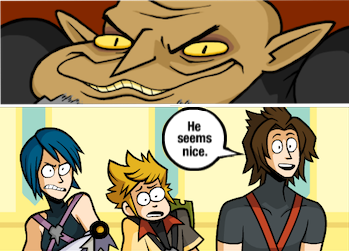
Terra from Kingdom Hearts Birth By Sleep.The same way some blind people keep a seeing-eye dog to make walking around safe, Terra should really be keeping an Evil-Detecting Dog around to make heroics safe, because there's being bad at noticing bad guys, and then there's needing someone to order you to kill an innocent to realize they don't have your best interests at heart. Names to Run Away From Really Fast, Obviously Evil appearance with horns, flames, Glowing Eyes of Doom; temptations to The Dark Side... it all swooshes right over his head as he assumes them to be perfectly nice people.
All of the main cast fall under this with regards to Master Xehanort. The guy is one of the most obvious villains around, and without the benefit of sitting behind the fourth wall the cast should be able to at least guess that Xehanort's Bald of Evil, gold eyes (a sign in series that someone has been taken by the darkness), Beard of Evil, Slouch of Villainy, the Spikes of Villainy adorning his Keyblade (which is a frakking battle axe) and nearly constant Psychotic Smirk are signs he's not all love and rainbows. Even the character who has been physically wounded by Xehanort using the darkness in the past shows absolutely no signs of worry that he might be up to no good (a lot of the game's problems could have been avoided if he had just given them a heads-up). And yet everyone acts surprised when it's revealed that he's actually the bad guy.
This seems somewhat justified. The heroes' experiences make them out to be severely unknowledgeable about the outside world, and being trainees they were probably not even allowed to leave the Land of Departure without Eraqus's discretion. Since they could trust each other and they were the only people they knew, they never went outside thinking people could be deceptive.
Knuckles the Echidna from the Sonic the Hedgehog series is so gullible that it's become a joke both in the fandom and in the series itself. He's such a bad judge of character that, even though he's been fully aware for years that Dr. Robotnik doesn't say anything that won't get him closer to the Chaos Emeralds and world domination, he still takes everything the corpulent madman says at face value, and follows up on things Eggman says better than things that people he trusts with his own life tell him. The other characters have been riding him about it for years; if he does something even subjectively stupid, the knee-jerk assumption is that he's been talking to Eggman again. To be fair, Knuckles only falls for Eggman's tricks once a series. Sonic The Hedgehog 3 was the only time Knuckles completely believed him since it was their first meeting. In Sonic Adventure Eggman only makes Knuckles confused and suspicious about Sonic's actions (and considering the Master Emerald was destroyed, Knuckles probably wasn't in the best frame of mind at the time). Sonic X Eggman plays on Knuckles's rivalry with Sonic, and again Knuckles isn't in the best frame of mind, being pissed that he's stuck on Earth. I can't remember how it goes in the comics, but Knuckles never believed a word Eggman said afterward.
He was implied to have been tricked completely one other time: In Sonic Advance 2, Knuckles ends up being tricked somehow by Eggman into fighting Sonic with the Egg Saucer, which, after Sonic defeated the Egg Saucer, Knuckles chased him covered in soot. The cutscene afterwards reveals that he was tricked by Eggman once again, with Knuckles being upset at this revelation, and Sonic deciding to leave him to sulk until Knuckles decides to get his act together.
The Urbz: Sims in the City has a minor character, Lily Gates, who apparently means well but is a terrible judge of character.
According to Nathan Drake of Uncharted, Sully is this when it comes to women.
In The1st Degree: Poor Zachary Barnes. He truly believed that James Tobin was a good guy, despite him making mistakes. Too bad he didn't realize until he got shot in the throat that his business partner was a greedy, jealous Jerkass with no redeeming qualities, who had threatened Barnes with bodily harm several times and had threatened to kill him a week before the murder.
Conrad Marburg from Alpha Protocol is apparently so bad at judging character that his dossier feels justified in devoting a paragraph to it. His boss, Leland, also mentions it. In-game, it takes a very short time to learn how to manipulate Marburg, as he responds consistently positive to one attitude and consistently negative to the other two.
Red Dead Redemption has Luisa Fortuna, a relatively bright but naive Mexican peasant girl who is a fanatical follower of local Rebel Leader Abraham Reyes. In her eyes, Reyes fights for the people and loves her just as she loves him. In the eyes of John Marston and the player however, Reyes is an egomaniac with a talent for getting peasants to listen to him whose only concern is personal glory and can barely remember Luisa's name. Similarly, Luisa has problems seeing that John cares nothing for the fate of Mexico and helps her and the rebels only because he's got a soft spot for her and that they're a means to an end.
The player character in World of Warcraft will accept quests from anyone with shiny punctuation over their head, including crazy, skeevy-looking old men hiding in a shack in the haunted, zombie-infested woods, with mysterious bloodstains all over the shack and a pile of cadaver innards out back. And then the player's all surprised when the old man unleashes onto the town the abomination that you helped him build.
Normally, we'd say that Player Characters just don't care, but given that you have to fight Stitches at the end of the questline, you unquestionably made it worse for yourself there.
Jade Empire can play it straight or put an unusual twist on it. A surprising amount of people seem to think that the impeccably polite young warrior who radiates unearthly calm and has a halo of heavenly light around their head is the perfect person to approach with offers of criminal collaboration.
In Fate/Zero Kirei Kotomine seems to simply inspire trust. Risei trusts him unconditionally (though this is kind of justified as Kirei is Risei's son) and Tokiomi Tohsaka notes that he seems more nihilistic than faithful or religious... Yet he also trusts him immensely and it never occurs to him that Kirei might not be the most loyal person on earth. Even Assassin believes that Archer (aka Gilgamesh) is no problem at all when Assassins are implied to never get into direct fights. Bazett also trusts Kotomine a bit too much.
Tokiomi also gave his youngest daughter to Matou Zouken, with predictableresults.
In Shin Super Robot Wars, Shakti explains that she was in the Angel Halo because she had to be put into the machine in place of her mother the queen. Londo Bell fills her in on how Char deceived her into thinking she could stop the fighting and put her mother at ease. Amuro kindly tells her that she needs not apologize for cooperating with an apparatus intended to brainwash mankind - it's all Char's fault for leading her into it.
In Dragon Age: Origins, Bryce Cousland considers Rendon Howe to be his best friend. Nearly everybody else in Ferelden thinks Rendon's a terrible human being, and they are right. Bryce's misplaced trust in Howe gets him and his entire family (except for the Human Noble Warden if that origin is chosen) killed.
Webcomics
Fighter from 8-bit Theater insists that Ax Crazy Black Mage is his "bestest [sic] friend" and will protect the Squishy Wizard against attacks from others, despite the fact that Black Mage hates Fighter's guts, and has said so, and has repeatedly tried to kill Fighter (not that it works, because Fighter is practicallyindestructible). Fighter, being the Cloudcuckoolander that he is, will insist that this is merely Black Mage being "such a kidder".
Eventually and nearing the end of the comic, he finally twigs to the reality, but still maintains that Black Mage was only evil now, whereas before he was a misunderstood helper. The mind boggles.
Double subversion plays out a few comics later Black Mage claimed that he was being mind controlled by Sarda. Fighter believe it, and they're BF Fs again.
In Earthbound webcomic The Chosen Four, Monotoli describes Pokey like "such a nice boy, but a bit troubled". Seriously. It is not a wonder Pokey was able to exploit him.
Taisei from Sakana thinks that Yuudai is really a nice/cool guy and considers him his and Jiro's friend immediately after meeting him. However this may be actually a subversion, since Taisei is actually very smart, and Yuudai isn't that of a bad guy (he just doesn't like Jiro and is a bit of a Grumpy Bear, he also seemed to have a complicated past) - Taisei may just see the good that is actually in Yuudai. We have to see how this will turn out when Taisei actually meets an actual Jerkass.
Gordon Frohman of Concerned is a Black Shirt who utterly supports The Combine who have enslaved his race and is utterly against La Résistance of the humans, Gordon Freeman as well as the Vortigaunts, the alien allies of the humans. His hatred of Vortigaunts ends up making them choose to let him die rather than save his life.
Ryan Beckwith is way too trusting for his own good when it comes to Ralph, Tackleford's local occultist. Even though Ralph's advice has come back to bite him in the ass time after time, he still defends him and goes back to get his spiritual advice. This may have changed now that Ralph has been exposed as the devil.
Joey from A Game of Fools, who doesn't seem to realise that the aliens that have abducted him mean to kill and rape him, can't see anything weird about an insane naked man whose "backpack smelt like dead people" and thinks the Ax Crazy hitchhiker they've picked up, who openly admits to multiple murders, bizarre sexual fetishes and necrophilia, is a perfectly nice guy.
There's also the fact that he still considers Sylvester one of his best friends despite the absolutelygoddamnhorrible things he manipulates him into doing.
Sylvester can be pretty bad himself, particular when it comes to his friendship with Tomato (and the majority of his other friends too, if this is any indication). Although in his case he does at least seem partly aware how horrible they are - he just doesn't really care.
Otacon comes up again in The Last Days Of FOXHOUND, where Liquid is able to convince him to install a nuclear launch program on Metal Gear by telling him that he wants to shoot down metors like in Armageddon (however, there's evidence that Otacon's in denial about Metal Gear's true purpose at this point, and Liquid did threaten to feed him to a largely-unfriendly-to-him-wolf).
Poor, deluded Tsukiko. Do you honestly think that just because you think the living are jerks, the undead Card-Carrying Villain Xykon is going to be any better? Even the Monster In The Darkness has worked this one out. This ultimately proves to be her downfall when her beloved Wights turn against her when Redcloak uses Command Undead on them, with her last words asking why they won't love her as she loves them.
For that matter, the Monster in the Darkness himself is convinced that Xykon and Redcloak are his friends because they give him food and toys to shut him up. Somewhat more justified in his case, though, as he has a rather childlike personality. And after finding a real friend in O-Chul, he might be growing out of it.
Ian Starshine has so far concluded that Chaotic Good Elan is evil to the core because of his father, but Chaotic Evil Belkar has some good in him.
While his assessment of Elan is completely off the mark, his assesment of Belkar is a bit more reasonable, as Belkar had recently learned the value of actively deceiving others that he was good, or at least willing to play along with societies rules. However, this is exactly the kind of deception a master thief should be aware of, so it still counts.
Elan himself displays this behaviour towards his father, General Tarquin when they first meet, being so desperate to see him as the father figure he's always wanted that he overlooks the fact that he's a scheming Lawful Evil general and one of the key players in an oppressive dictatorial empire.
Kiki towards Bun-Bun in Sluggy Freelance. She acknowledges him as being a little mean and grumpy, but thinks all he needs to get over that is more hugs.
Lee Falun. His best friend was a Jerkass whose son was always covered in bruises and whose wife plainly resented him. Did Lee do the math? Nope. Said best friend also murdered him.
In Bob and George, Dr. Light has problems with this in the Mega Man 3 story arc, completely ignoring every obvious sign that Wily doesn't have the amnesia he claims to have, taking the problem in the actual game and turning it way, way Up to Eleven. Then subverts it at the end when it is revealed he deliberately gave Dr. Wily faulty power crystals, which caused Gamma to fail.
Not learning his lesson, John then started taking advice from Vriska.
That didn't end well either, but it ended badly in a way that was actually ending well in disguise. This sort of thing can only serve to confuse the little nimrod and will lead to trouble, mark my words.
Nick in General Protection Fault is the one who most persistently defends Trudy, in spite of Ki and Fooker's justified suspicions about her. The Surreptitious Machinations arc involves the cast racing to help him realize that his "Project Velociraptor" is the keystone of her plans, and it ultimately results in him realizing her duplicity and refusing to help her. After that, he realizes that he can't always trust people blindly, leading to him seeing through Trish's story (ironically, as Ki decided to give her the benefit of the doubt like Nick used to) and noticing that the Ki who lured him into the Mutex is not the one he knows.
Mr. Jones of Goodman Rubber is one, as he, impressed with Fooker's skills, invites him to give a motivational talk (Fooker is every bit as good as Mr. Jones thinks and perhaps better, but he's also a Bunny-Ears Lawyer with a questionable sense of humor). He later laments how someone as nice asTrudy "fell in with that wrong crowd," and believes that Trent is far more competent than he actually is.
Kevin of Kevin & Kell is considered this as a result of being a fearless rabbit, which is implied to have been what led him to marry his first wife Angelique. By the time the strip begins, though, he's smarter about people's ulterior motives.
The entire faculty of Bumblebane's in Wizard School, with the exception of Prof. Evilmore. It doesn't help that Good Is Dumb is in Up to Eleven levels in the comic's universe. And probably all the students in Dragonbane House, with the exception of Celeste, who has Graham pegged for the utter asshole he is, but has been instructed to help train him, and What The Faculty Says Goes.
Web Original
All of the page mods who made Trollvorlord and the rest of the Hijacker Trolls into admins.
And Mack, who has yet to learn that an awesome rack does not a good person make.
To be fair to Amaranth, she really can't help the way she is, due to her creation process being tampered with.
In Red vs. Blue, Donut mistakes Blue Base for a convenience store; and still somehow manages to get the Blue flag when Caboose mistakes him for a general. Later on, Donut mistakes the Meta (An insane soldier who by that point spoke exclusively in growls) as friends with Simmons (when in reality, the Meta was trying to kill Donut and Simmons), even mistaking the Meta's grenade launcher/bayonet combo as being a broom.
A Very Potter Musical plays with Dumbledore's trust of Snape in this way. In one scene, he accepts a sandwich that has a pipe bomb poorly concealed in it, then gets annoyed when Hermione destroys it.
I'm going to go make myself another sandwich, although I don't know how it can be as good as the last one. That one ticked!
It also takes Cornelius Fudge's refusal to believe Voldemort was back in the original series to the logical extreme. He denies it even as Voldemort walks into his office and kills him
The title characters from ''Beavis and Butt-Head. Even when they get their asses kicked by Todd, they still think he's cool and aspire to join his gang. In fact, every single hoodlum, criminal, and Jerkass they meet is "cool" by their standards. Then again, when you consider their priorities and interests, it's not that surprising.
In one episode they even "befriend" an escaped serial killer who is clearly deranged, is more or less openly planning on murdering them... and has the word "Killer" tattooed on his forehead (because they're both nearly illiterate, they read it as "Kyle-er" and think it's just his name).
Actually, most of the citizens of Highland are horrible judges of character; otherwise, the show wouldn't find itself repeatedly using the Seemingly Profound Fool plot.
Mr. Van Dreissen seems to be on an eternal, hopeless quest to bring out the "good" he claims to see in B & B. He sees everyone in that way, so his horrible judgement is pretty severe.
Sparky's mother on Atomic Betty. She tends to date supervillains a lot, even the show's Big Bad on one occasion.
Transformers Generation 1 had its fair share of examples. Arguably the worst case happens in "Megatron's Master Plan", which revolves around the Decepticons' plan to make the people of Earth (or at least Central City) believe that they were in fact the good guys all along... after how many very obvious instances they are not? And everybody actually believed it! Then when they were proven complete morons, the enslaved humans all blamed Shawn Berger, who while not having a great reason to help the Decepticons at least had the most reason to trust them, as the second main cause of their misery.
"Enter the Nightbird" might be another case, depending how much sentience/sapience one reads in the titular character. Giant robot ninja armed with more weapons and powers than you can shake a stick at? Truly she is going to "benefit mankind, and not harm it".
Orion Pax was one of these in his backstory. He was a Megatron fanboy who thought old Megs had Cybertron's best interests at heart. That ended when Megatron nearly killed him and his girlfriend after duping them into helping him. Orion's a somewhat better judge of character as the Older and Wiser Optimus Prime.
When talking about the Transformers Animated Elite Guard the Transformers Wikinoted that: "Sentinel Prime, the biggest jerk in Transformer history, and Longarm Prime, a double-agent, are both high-ranking members of the Elite Guard, while Optimus Prime, a true hero, is a washout and space bridge repairbot. Either Optimus Prime did one major screw-up, or Ultra Magnus is the single worst judge of character ever."
Since Optimus Prime's screwup was taking the blame for Elita's death on a planet they shouldn't have been on in the first place, Magnus does have a tiny bit of leeway. No excuse for making Sentinel Prime practically his right-hand-mech, though.
Apparently, once washed out, you can't be brought back in, at least according to Magnus himself when talking to Optimus. And he probably keeps Sentinel Prime at his right hand so he can babysit him. We've all seen what happens when he's not around to keep the glitch-head out of trouble.
Which is made worse, as the Transformers Wikilater noted that "...Jazz was active in the Cyber-Ninja Corps during the war, apparently long before Sentinel even came online (much less joined the Elite Guard). Even ignoring Sentinel's various flaws, this raises legitimate questions about just how promotions are handed out in the Elite Guard."
Given the praises Magnus have been giving him and saying how Sentinel could learn from him, there is a possibility of this being a Secret Test of Character for Optimus.
Megatron doesn't get off scott free. Starscream was a high-ranking member of the Decepticon forces for eons, and has been trying to off Megatron for a good deal of them. But Megatron seemed genuinely surprised when he found out it was Starscream who planted the bomb on him.
He learned his lesson after that, showing that, unlike most other Megatron's, he's not at all forgiving. Starscream shows up, and once he has his gun back, the first thing ol' Meg's does is blast Starscream square in the face. He proceeds to wash, rinse, and repeat as necessary whenever the guy shows his face.
That doesn't change the fact that it took several million years for him to finally come to this conclusion.
To be fair this Starscream is pretty smart as well, so odds are he only tried to off Megatorn when there were Autobots around.
Well, he made it clear he didn't trust Starscream. He just didn't expect him to have the balls to attempt something in case it backfired (Starscream is an enormous coward should the tables ever be turned on him). Still, he's far smarter than G1 Megatron, who knew perfectly well Starscream would try and kill him if he so much as tripped on an acorn and still kept him around and did nothing about it. Then Transformers: The Movie came along and Megatron realizes just what an idiot he'd been.
Avatar The Last Airbender: The Earth King fits this trope to a T. Though, in his defense, the villain in question has raised him since he was four, and never did anything to hurt him personally until after his other crimes were uncovered and the king imprisoned him without even bothering to hear his side of things.
Most people who trust Azula. This includes Zuko, who really should know better (although with him, Azula is just adept at telling lies he really wants to hear, and occasionally mixing just enough truth into it).
Batman The Animated Series: "It soon became obvious to me that The Joker, so often described as a raving homicidal madman, was actually a tortured soul crying out for love and acceptance..." Doctor Harleen Quinzel (aka Harley Quinn), welcome to the list.
The Sultan from Disney's Aladdin. The movie even Lampshades this when the Sultan provides the above page quote about priding himself to be an excellent judge of character, and Iago grumbles his sarcastic "NOT!"
Aladdin's not the only one. Beauty and the Beast has the Villagers being completely, legitimately loyal (as in, they willingly love and are not forced to love him out of fear) to Gaston, a man who not only has shown himself to be a self-centered, arrogant Jerk Ass, but has no qualms of expressing it, reaching an all new low when Gaston and Le Fou blatantly state to the entire bar that their plan involved arresting Maurice under false accusations of being a dangerous madman in order to marry Belle, and they still supported him.
Galaxy Rangers - King Spartos of Tarkon had a really bad habit of trusting advisors that told him what he wanted to hear, despite his daughter's objections and knowledge of the wider galaxy. It's only towards the end (and with the use of some Applied Phlebotinum from the Heart of Tarkon) that he's able to see his daughter and the Rangers are correct.
Yet again from the Disney Animated Canon, Mufasa from The Lion King may get angry at his younger Obviously Evil brother Scar, but still trusted him as a family member. This leads Scar to manipulate Mufasa to get him killed.
In the book Angelica Button and the Dragon King's Trundle Bed (which is in the Simpsons) the snake Lord Evilton is the minister of niceness.
Inspector Gadget would often confuse MAD Agents for the good guys, and sometimes even assist them if needed. He took it to eleven in the Christmas special when he thought Dr. Claw was Santa Claus, and arrested the real Santa.
Luckily for the good guys, Gadget is such a Walking Disaster Area that he is more liable to twart the bad guys when trying to help them than when trying to stop them.
Real Life
Warren Harding, whose Secretary of the Interior, Albert Bacon Fall, leased tons of land to his buddies in exchange for massive bribes.
Nearly 50 years earlier; Ulysses S. Grant saw the second term of his presidency marred by corruption scandals involving several members of his Cabinet; despite the fact Grant himself was honest.
Sadly, it is not uncommon for a man or woman in an abusive relationship to be stigmatized as this trope, especially if the manipulator still has them convinced that the abuse isn't. While true stupidity and massive lapses in judgment happen, it is important to remember that victims of a good manipulator can fall all over the spectrums of cleverness and personality type. Tropes don't cover it.
Similar to this, another unfortunate (more specific) example can come in the form of someone who has been raped - sometimes as a child, but sometimes not - in the past. Some survivors describe it as their "filter being broken" due to the rape.
Every woman who sent Ted Bundy love letters and wedding proposals while he was on trial for serial murder; Bundy was in fact a charming, charismatic, and handsome individual, which is how he was able to lure so many women to their deaths. It's amazing what a person can get away with if he has a dazzling smile.
Even scarier is that some of them knew exactly what kind of person he was, and just found this extremely sexy. It's disturbing how many women elevate serial killers to heartthrob status. All Girls Want Bad Boys played to its skin-crawling extreme—Bundy is not the only Serial Killer (or any type of murderer) to be bombarded with love letters—Richard Ramirez, aka The Night Stalker, terrorized California for months with a series of brutal murders, yet eventually married one of his many groupies. Scott Peterson continues to receive large amounts of money from lovestruck women, even as he sits on death row for the murder of his pregnant wife, and within months of his wife disappearing (the second of his four wives to meet with foul play at his hand), Drew Peterson was engaged.
Males aren't exempt from this stupidity either. Karla Homolka and her husband raped and murdered several young women, including her sister. She gained early release from prison by claiming (falsely) that she'd been an unwilling participant and married one of her admirers. Meanwhile, Casey Anthony (who in all likelihood, killed her daughter, despite being found not guilty) received numerous love letters from men begging her "will you be my girlfriend?"
Hybristophilia, or "Bonnie-and-Clyde Syndrome", also known as "Death Row Groupies".
During World War II, Franklin Roosevelt felt that he could trust Joseph Stalin more than Winston Churchill, in part due to his desire to dismantle the British Empire, and therefore didn't pressure Stalin as much as he might have regarding the shape of postwar Europe. Obviously, he died before the end of the war, but felt bitterly disillusioned shortly before his death.
Lenin felt like Stalin was the man for the job for many things. He put him in charge of Georgia, then Stalin had the Mensheviks executed (which Lenin didn't want). In short, Stalin was a Manipulative Bastard and Lenin only realized his mistake (if he did) shortly before his death when he made his testament (which the Stalinists thought was a fraud).
You could argue that that has more to do with the fans living out vicarious fantasies- they may be well aware that the pairing makes no sense, but they just want to see it happen to satisfy their own Perverse Sexual Lust.
Same thing for how fans interpret Word Of God. They seem to scream Death of the Author when said author is usually truthful in what he says, yet authors that tend to lie and troll their fans seem to have everyone taking their every word as gospel truth no matter how often it turns out to be a lie. Fans are generally really, really bad at figuring out the character and values of creators...
Hatedoms are this at the other end of the extreme: Whatever they hate has no redeeming qualities whatsoever, and to hell with the facts.
An excerpt from William Lyon Mackenzie King's diary: "[Hitler] is really one who truly loves his fellow-men, and his country, and would make any sacrifice for their good...the world will yet come to see a very great man–mystic in Hitler..."
As pointed out below, many leaders at the time saw Hitler as a good leader. To be fair, he was known for being passionate and charismatic, and made many promises to better the lives of the German people... at the expense of everyone else. There was also the fact that Mackenzie King was known for trying to see the good in all people, and was a very spiritual man, which probably caused him to try and ignore Hitler's increasingly obvious faults.
Given Mackenzie King's apparent love of Hitler, his famous statement, when asked how many Jewish refugees Canada would accept during the war, that "none is too many," and his prediliction for holdin seances to receive governing advice from both his dead mother and his dead dog, it may simply be that the people of Canada were at that time collectively horrible judges of character!
Many Western European politicians and intellectuals (Churchill included) initially saw Hitler as the right man for Germany.
Hitler and the Nazi high command also trusted their spies, even though every one of them was working for the British by the end of the war.
Pretty much all dictators come to power this way beacuse the people in the country thinks they look like a pretty cool guy.
During the Three Kingdoms Era of China, Shu Kingdom's Prime Minister Zhuge Liang, despite being a military genius in the battlefield, was this according to his legendary nemesis, Wei Kingdom General Ssu'ma Yi. During the Battle of Jie Ting, Sima Yi banked on Liang to make the mistake for choosing an inspiring yet inept commander to make a mistake he can exploit. The mistake that the commander made dealt a huge blow to Shu that Zhuge was forced to execute him