
Hiroyuki Nishimura: Wha...
Shin: Holding those kinds of feelings for someone of the same sex one-sidedly is disgusting, isn't it.
Despite the older meaning of the word "gay," gay characters in fiction tend to be a miserable lot, and not by simple coincidence — their misery can be attributed largely to their sexuality or, more accurately, other people's attitudes towards it. In short, they don't just have angst, they have gayngst.
Characters suffering from gayngst are prone to alcoholism and other forms of substance abuse, self-loathing, Self-Harm, rampant homophobia towards themselves and others, rejection by homophobic family members, falling in tragic unrequited love with heterosexuals, contemplating (and often committing) suicide, and wishing that they were straight.
Gayngst is a Pet-Peeve Trope of many because while it usually portrays gay people sympathetically and addresses an issue many gay people in Real Life go through, it can be interpreted as saying that it's impossible to be gay without being miserable, or that gay people don't deserve Happy Endings, or at its very worst and most ineptly-handled, gay relationships are innately disastrous. However, gayngst is still unfortunately common in real life. After all, True Art Is Angsty transcends sexual orientation; a real-life term for this would be Internalized Homophobia.
If the story wants an uplifting tone, the character will eventually come to terms with their sexuality, have the obligatory Coming-Out Story, and either live Happily Ever After with their love interest or morph into some other gay archetype (usually Straight Gay or Lipstick Lesbian; either this is their natural personality or they still have some lingering insecurity).
Gayngst is often found in the Yaoi and Yuri Genre works for obvious reasons. Doesn't come up quite as often in works with a Cast Full of Gay — even if a couple of characters are of the angsty persuasion, they're usually balanced out by the rest of the cast in such a way that the Unfortunate Implications are done away with.
Not to be confused with the Gayngster, although some gayngsters probably have their share of gayngst. Clumsy examples of gayngst often dive headfirst into Wangst territory. Sister Trope of Bury Your Gays, which it frequently overlaps with, as well as Trans Tribulations and Trans Relationship Troubles, Intersex Tribulations, Bi-Wildered, and Wanted a Gender-Conforming Child. Sometimes the result of Forced Out of the Closet, or Cure Your Gays. Depending on how they're played, it can be a Sub-Trope of Bullied into Depression, Why Couldn't You Be Different?, Internalized Categorism, Boomerang Bigot, and You Are What You Hate, and a Super-Trope of Incompatible Orientation, Armoured Closet Gay, Out of the Closet, Into the Fire, Homophobic Hate Crime, and Gayngst-Induced Suicide. Opposite of Queer People Are Funny.
Examples:
- Ono from Antique Bakery is a special example. He holds feelings for Keiichiro who isn't gay and had gone through a terrible experience with a male kidnapper as a child. One day, Ono confessed his feelings for him but was vehemently rejected. Even though they became friends roughly twenty years after that experience, Ono still loves him.
- The protagonist of The Beautiful Skies of Houou High has some of this at the beginning, mostly related to the fact girls date her because she looks like a boy... But they aren't lesbian and are Squicked out when she does anything remotely sexual.
- Downplayed in Bloom Into You. Sayaka Saeki is mostly content with being gay, even though her feelings for Touko go unrequited, but took it quite hard when her senpai at her old school broke up with her and apologized for making her like gays, due to seeing homosexuality as a "phase" (which is actually a pretty commonly held belief in Japan; see Gay Romantic Phase for more details). There's also a scene in which Yuu worries about what sort of rumors will spread if people find out that Touko kissed her, and so asks Maki, who witnessed it, not to tell anyone.
- Subverted with Touko. She definitely has a lot of angst, but it is due to Survivor Guilt involving her sister's death and not at all because of her sexuality.
- Blue Flag: With half of the main characters being not straight, and the already angsty nature of the manga, this was bound to happen.
- Mita Touma is an Armored Closet Gay in love with his male best friend. He is terrified of him finding out and doesn't really know what to do with his feelings. Flashbacks imply that this crush is not anything new and hasn't gone away in years. Making matters worse, he believes that said friend is already dating a girl.
- Itachi Masumi attempts to get herself a boyfriend in an attempt to ignore her feelings for her best friend Kuze. She is heartbroken and devastated over breaking up with him, due to him being a good man that deserved better and implies she wonders whether her life would be easier if she was straight.
- There surprisingly isn't any gayngst in Bokura no Hentai. Satoshi is unashamedly bisexual and Tamura pretty much has trouble with everything but being gay. He suffers homophobic bullying from his crush but Tamura is never actually seen bemoaning his sexuality. There is a lot of Trans Tribulations with resident trans girl Marika, though.
- The one-shot called Born This Way is nothing but gayngst for the first half of it. It starts with the unnamed five-year-old protagonist drawing a picture of her and her friend as brides only for her kindergarten teacher to scold her because women cannot get married, as "it's not normal", which causes her to scrunch up her drawing instead of show it to her dad. It skips to her at twelve confessing to her friend who reacts in utter disgust and shows she became bullied due to her Love Confession. At age sixteen she's shown to have a boyfriend but he is worried she doesn't love him, and she doesn't enjoy their relationship. At age twenty she falls for a cute, androgynous tomboy but represses it and they become friends. Two years later she ends up having drunk sex with her best friend but regretting it the day afterward. Her friend confesses to her and they begin dating. We get a montage of them going through their life and getting married until at age 76 the protagonist dies contently in her wife's arms.
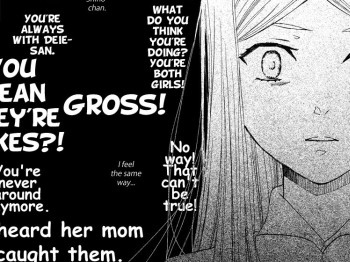
- Cat's Eye Hall: (pictured) Shiho Kadawaki takes schoolmate Hiyori Deie under her wing, but soon develops romantic feelings for her, which Hiyori reciprocates to the point where they have sex in Shiho's room. While doing so, they are caught by Shiho's mother. News of Shiho and Hiyori's relationship quickly spreads around at school, and Shiho and Hiyori become subject to slanderous gossip and ridicule. Shiho becomes devastated by the relentless teasing to the point where she and Hiyori come up with a plan to commit suicide so that they can be together forever. Thankfully, they don't go through with it.
- Mei from Citrus finds herself the young heir of a wealthy traditional Japanese family after her father skipped out to tour the world. She considers this a massive failure, and that it is her duty to make it up to her family by agreeing to an Arranged Marriage and securing their future. So the discovery that she's a lesbian causes her a great deal of grief as she sees herself failing her family just like her father did.
- A Cruel God Reigns: Jeremy and Ian both go through a bit of this, although a lot of their cases could be chalked up to other reasons. To start off with, Jeremy and Ian are both Ambiguously Bi, or simply have a case of If It's You, It's Okay. Jeremy, who seems to be going through a case of Rape and Switch anyway often refers to himself as the "male prostitute of Lynn Forest" and later agonizes over developing a fascination with Ian. Ian, on the other hand, is trying to figure out whether he is in love with Jeremy or if he is like his sadistic, Archnemesis Dad and only lusts after his stepbrother, coupled with the fact that Jeremy is the first boy he's ever been seriously interested in.
- Dandelion Among Lilies is a short Yuri manga full of this. Mizuho and her girlfriend Ena seem to be Sickening Sweethearts however they have relationship issues. Ena worries that Mizuho is only dating her because she pities her while Mizuho is too scared of people judging them poorly so she hides their relationship from coworkers and peers. It turns out a lot of their troubles is due to poor communication more than anything and with the help of Mizuho's little sister they patch everything up.
- DARLING in the FRANXX: Ikuno is a girl recently figuring out that she isn't interested in men, but rather in women, specifically Ichigo, despite the latter being interested only in men. In a society run by powers based on heteronormative relations, she has noticed she is different and the single person in her group of friends that don't get to experience things such as romance and sexuality, leaving her only with an Unrequited Love.
- Destiny of the Shrine Maiden: Chikane Himemiya feels very tortured in her slow realization that she loves her best friend Himeko Kurusugawa, considering how much same-sex relations are not looked in a positive light. This, along with the realization of the tragedy between her and Himeko's predecessor, intensifies Chikane's self-hate that she becomes eligible to join Orochi, but she instead concocted a downright crazy plan to make sure Himeko survives by making Himeko kill her, believing that her forbidden love is destined to never be reciprocated. On the contrary, eventually Himeko learns the truth and understands Chikane's anguish, returning her feelings.
- In Yaoi Genre FAKE, much of the Unresolved Sexual Tension and Will They or Won't They? derives from Ryo having trouble accepting his attraction to his very forward partner Dee. It takes Ryo 2 years to sort his feelings out and finally reciprocate Dee's feelings. Yet he still continues to worry about how other people, mainly Bikky, will feel about his homosexual relationship with Dee.
- Downplayed in Finder Series; while Akihito often questions if he's really attracted to men overall or not, he's more conflicted about who he may be getting attracted to, what with Asami having connections to the criminal underworld and all.
- The First Love Sisters manga averts this and has all girls accept their feelings for another girl as something fairly normal, with the focus on the romantic entanglements themselves.
- Girl Friends (2006) in particular loves this trope, with both characters frequently angsting about their feelings for the other. It does have a happy ending, though.
- In Goodbye, My Rose Garden this is what kicks off the plot. Several years ago, Alice fell in love with her governess Eliza McGovern, and while the relationship never evolved beyond that of teacher and pupil her parents realized what Alice's feelings for Eliza truly were. They sent Eliza away, but unfortunately word still managed to spread, and it soon became well-known in the rumor mill that Alice preferred the company of other women. This all also happened in the shadow of the (real-life) scandal of Oscar Wilde, so Alice fully came to realize how Victorian society looked at same-sex attraction. The knowledge that her sexuality will not only have her bear the ire of society but also affect her family and their reputation is what drives her to the despair of asking Hanako to become her accomplice and kill her.
- Most of the time Shuichi from Gravitation is comfortable with being in love with another guy. Occasionally though, he really gets hit hard with gayngst and worries quite a bit that his relationship with Yuki is doomed because they're both male.
- Hina from Hana & Hina After School knows she's gay from the beginning of the story. But she also thinks it's abnormal. She routinely describes herself in her own internal monologue as "weird" and "strange" for being attracted to other girls. A substantial amount of the Will They or Won't They? in the story arises from her determination to avoid being "strange" towards her crush. She eventually gets over it.
- In Hanjuku Joshi, closeted lesbian Ran harbors a deep unrequited love for her best friend Shiori, who is happily oblivious to the other woman's pining and desire for her.
- I Can't Believe I Slept with You: A former classmate reveals that the Landlady, Ritsuka Hara, was well known for dating girls in high school. The Landlady also informs Chiyo that she doesn't have any female friends, because she was afraid that she wouldn't be able to avoid developing romantic feelings for them, so she kept herself isolated. When she is being kissed by Chiyo, she's certain that Chiyo must be grossed out, doing so with her.
- This is the driving point of Inside Mari. Perfectionist School Idol Mari couldn't handle her interest in girls so she tried to repress it. This, along with issues involving her emotionally abusive mother, led to her developing split personalities. One of them is the male protagonist of the series, who doesn't realize he's a split personality and is freaked out about the "body swap" he's experiencing.
- Kanojo ni Naritai Kimi to Boku:
- The manga has an interesting case of this. Hime experiences self-hate because she believes her continued crush on Akira (her best friend who is in the process of transitioning to female) means she doesn't see her as a girl. Yukka assures her that isn't the case.
- Yukka was a popular girl on the track team and many girls displayed crush-like towards her, but it was simply fangirlism rather than actual love. When Yukka was Forced Out of the Closet after a Love Confession towards a straight peer, her teammates began acting cold and homophobic. Yukka quit the team but decided to be how she wants, not what others want.
- Downplayed in Kase-san. Yamada continually gets flustered over the idea of having feelings for a girl and worries Kase can't feel the same way, and early on Mika warns Yamada against befriending Kase because she's rumored to date girls, but in the end, the main thing separating the two girls is just their combined nervousness, and when Mika admitted she knew about their relationship, she didn't seem bothered at all.
- Kashimashi: Girl Meets Girl leans toward this in the beginning, but soon changes gears into a rather straightforward Love Triangle, despite all participants being girls. Also notable is the signs of transgender angst with Hazumu in episode/volume one before the Gender Bender as well as in flashbacks.
- Kotone from Love Me For Who I Am is lesbian and has known that she's liked girls since she was at least five. When she told her mother that she wanted to marry a woman, her mother chided her and told her that she should marry a man. In primary school, she tried to blend in with other girls when they looked at boys, but her social life fell apart in middle school. Her crush began dating a boy, which caused her to stop socializing with anyone but her long-distance friend Mogumo. She developed an unrequited crush on the nonbinary friend Mogumo as a way of dealing with her feelings.
- In Mr. Right Turned Out to Be a Younger Woman!?, Haruki Shiina gradually develops feelings for her coworker Risa Takagai, but tries to dismiss them, in large part because at 33, Shiina is running out of time to get married, and since same-sex couples can't get married, she won't be able to accomplish that goal by being together with Takagai. Shiina and Takagai do get together, but lament that they're still unmarried while many of their friends are getting together.
- In My-HiME, this is played for brutal effect with Shizuru, whose facade slowly starts to crack late in the series, starting with abandoning her duties to protect Natsuki (whose powers are temporarily unusable) from Nao, then a stolen kiss in her love's sleep, and culminating with going full-blown Psycho Lesbian when her feelings are rejected. Natsuki's final declaration that even if she doesn't feel the way Shizuru hoped she would, she is happy that Shizuru loved her and also loves her in her own way, combined with her causing both their Childs to be destroyed helps restore her sanity, though.
- In Natsu e no Tobira, which is already melodramatic to start with, there' a gay character who is full of angst. It's Claude, the Cute Bookworm of Marion's posse, who claims at first to like the local Dude Magnet Ledania... but in reality, he's in love with Marion himself. When Marion is involved with the older Sara, Claude begins to angst to Hell and back because of his "impure" and "dirty" love, and it's not helped by him being drug addicted. Then things go From Bad to Worse as a whole, and after a mix of Anguished Declaration of Love and Attempted Rape on Marion, Claude ends up Spurned into Suicide; Marion is horrified and blames himself for "letting Claude die".
- Subverted in Negima! Magister Negi Magi. Setsuna's angst is less about the fact that she is quite thoroughly gay for Konoka, than that she thinks herself of the wrong social class for the Ojou of a very rich family, and that she feels unworthy of her. Their pactio helps her feel better about her Bodyguard Crush.
- In the No Bra manga, Masato is constantly torturing himself over his awakening feelings for his childhood friend, Yuki. The fact that Yuki looks and acts like a cute girl and is obviously in love with Masato makes matters even more complicated. Masato finally gives in to his feelings later on though.
- In Octave, Shiori goes through two rounds of gayngst: the first with her girlfriend, who dumps her and returns to her former lover and the second with Yukino, to whom she offers a muddled confession mixed with love and lust, and is met with rejection. In the manga, this seems to be mostly averted at first, until the chapter in which Yukino visits her parents and decides to bring her girlfriend Setsuko along.
- Misaki and Kawabata in Only the Flower Knows. Misaki wonders why he can't be attracted to women instead of men at the end of Chapter 8, and why, if he's going to fall for men, he was born a man himself. Losing Kawabata and, in his mind, Arikawa to women really hurt him (what he doesn't realize is that Arikawa already broke up with his girlfriend in Chapter 5). Then there's Kawabata, who left Misaki and got a girlfriend because he knew a relationship with an underaged boy was not socially acceptable. In Chapter 11 his true feelings for Misaki come out, and at the end of the chapter, he cancels his and his girlfriend's wedding preparations over the phone. He says he can "think for himself" now.
- Averted despite the explicit Incompatible Orientation on Outlaw Star; Fred Luo is perfectly comfortable with his nature as a Camp Gay merchant and even though he professes his undying love for Gene Starwind, he's perfectly aware of the fact the heterosexual Gene doesn't reciprocate and in fact seems to enjoy teasing him by flirting. The closest thing Fred gets to this trope is his annoyance with the fact his parents insist on ignoring his orientation to force him into an Arranged Marriage with Reiko Ando.
- Prism has Hikaru depreciating herself over her crush on Megu in chapter 2.
- Shiori in Revolutionary Girl Utena is the best frenemy of Juri, who is a closeted lesbian and has been in love with her since they were young. Whether or not Shiori is aware of this just adds to Juri's misery. (Of course, it gets worse in the movie ... )
- Shizuku from Sakura Trick has this, as she is afraid that her relationship with her cousin Kotone will only last the three years they are in school—Kotone has a Fiancé arranged for her already.
- Probably the most extreme example of gayngst in Milk Morinaga's work would be Miu's angst about her feelings towards Fujiwara in Secret of the Princess, which nearly results in her jumping off their school building's roof before Fujiwara talks her down.
- Sweet Blue Flowers:
- Poor Fumi, losing two love interests in a row to other men. She begs Akira not to think of her as disgusting after she first comes out (confessing that she's dating another girl) and brings this up again after Haruka asks Fumi for advice over her sister possibly being lesbian, which finally drives Fumi to confess to Akira at the end of volume 4. Ramped up considerably starting about the end of volume 3.
- Chizu also seems to have a lot of this, leading her to get married to a man and dump Fumi.
- In Whispered Words this is largely averted at first since most girls seem to have no problems with their feelings for someone their own gender. Sure, Sumika is angsting heavily over her crush on her best friend Ushio, but that is because Ushio prefers cuter girls—and Sumika does not consider herself to be cute in the least. Later on, the largest amount of gayngst surprisingly comes from Ushio, when she finally faces up to her feelings for Sumika but is afraid of losing her as her best friend.
- Wonder Egg Priority: a Victim of the Week that Momoe protects is a transgender boy who commited suicide after his kendo instructor raped and impregnated him.
- Afterlife with Archie: Nancy and Ginger deal with this. Ginger wants to be open about it but Nancy is afraid that their families will react negatively, or people will be less accepting of them due to their ethnic backgrounds combined with their sexualities.
- The Authority: Gay superhero couple Midnighter and Apollo were created to avoid this trope like the plague, with especially Midnighter being a very "out and proud" Manly Gay but his lover/husband Apollo also being completely unconflicted about his sexuality. However, it was revealed in the DC Rebirth mini-series Midnighter and Apollo that Apollo suffered quite a lot of this during his early adolescence (as described in the new, retconned version of his origin story). His father actually threw him outnote when he came out to his parents at the tender age of 12. And when Apollo tried to re-connect with his family after finally managing to escape from the aliens who'd abducted him a year after that and turned him into a copy of Superman over the course of his teenage years, his father still rejected him - now having two reasons to consider his son "not human". Thankfully, all this suffering only made Apollo stronger in adulthood.
Apollo: (speaking to the Devil) "You think you can break me, Neron? People have been trying to break me my entire life."
- Batwoman: The daughter of two career soldiers, when her mother and twin sister were killed during her childhood kidnapping, Katherine "Kate" Kane's sole dream was to follow in her parents' footsteps in the army and somehow make a difference. Accepted to the Military Academy at West Point, Kate actually became Cadet Captain and, in the estimation of her instructors, would go on to become a high-ranking, well-respected officer once she graduated...until rumors regarding her sexuality began to circulate around the campus. Army regulations require the discharge of any soldier confirmed to be homosexual, and Kate's refusal to lie about herself resulted in her being "separated" from the army, ending the only dream she has had since she was ten years old. It is only once she sees Batman after a hapless individual attempts to steal her wallet that she sets a new goal for herself, and she still needs to deal with the criticism and rejection of her "family" and "friends" (everyone but her dad) from high-society.
- Black Hammer: Mark Markz, the alien superhero known as Barbalien, has suffered a lot because of his orientation. In his civilian identity he developed feelings for a fellow detective and made a pass at him to see if he felt the same way, only to learn that the other man was a rabid homophobe. Then word of his sexuality got out and other cops started harassing him by writing slurs on his locker, eventually leading him to quit the force. His situation is even worse in an alternate reality where he never left Mars: the people of his village shun him for his homosexuality and force him to live in the inhospitable wilderness, and they eventually try to kill him by burning down his home, mortally wounding his lover in the process.
- Bloom (2019): Pointedly averted. It seems like everyone knows both Ari and Hector are gay and homophobia plays no role in the story.
- Blue Is the Warmest Color:
- Clémentine, who suffers from homophobia by a friend of hers and also her parents. It takes a long time for her to accept her sexuality.
- Emma in her backstory. She didn't suffer homophobia but tried to deny her sexuality for a time too. In fact, it was her mother who helped Emma accept the fact.
- Chick Tract: The discontinued Chick Tract "Wounded Children", fit this to a T (although it is also full of Narm), because of his views of homosexuality Chick's tracts on the subject had the message "There is nothing gay about being gay" before shifting to "Those who support or tolerate homosexuality are evil".
- Circles:
- Downplayed with Marty who was the only character who was in the closet to his family and when Marty had dinner with his family and the other Kinsey boys, he came out to his parents in a moment of weakness.
- Played Straight with Ken. His backstory involved his Uncle Davis sexually abusing him and threatening to tell everyone he was gay if he ever told anyone what his uncle did to him. Ken hated himself for being gay but after opening his heart to Paulie, he reconciled with his mother and openly embraced who he was.
- Batman: This is a frequent and longstanding part of Renee Montoya's character, starting from when she was first outed in Gotham Central. A police officer, Renee already had extensive personal issues due to being an honest Hispanic woman in a primarily male, primarily white, completely corrupt police department. When Two-Face outed her to friends and family her captain, Maggie Sawyer (an open lesbian), attempted to help her deal with the issues that arise in this situation. Unfortunately, as Renee rather vehemently points out, their situations are nothing alike, as Maggie did not already have racial and gender baggage to deal with, and she was from Metropolis, not Gotham, and the differences between the two societies run deeper than just the different operating hours of their heroes. Combined with other factors, (including the normal drama and angst that comes with being a police officer) Renee eventually descends into alcoholism and serious contemplations of suicide while she bounces from one-night-stand to one-night-stand. She gets better, eventually, but some comics have her relationships plagued with conflict and drama. This cocktail of angst and social trauma about her own identity eventually helps shape her own career as a masked vigilante.
- Les Nombrils: In the later albums, Vicky is kissed by Megane, but refuses to admit she could like her back. She then starts dating her brother despite not really liking him, mainly to impress her parents and sister. Then, one evening, as her new boyfriend kisses her, she sees Megane by the window and realizes Megane is the one she loves as her heart starts beating. They have several instances of Unresolved Sexual Tension and Distracted by the Sexy until she drunkenly tells Megane her feelings, but that makes Vicky realize that she can never be happy since her parents are homophobic and clearly stated they wouldn't hesitate to disown her if she was gay (it's actually the only thing they still agree on). And then she is almost Forced Out of the Closet when Jenny reveals that she saw her and Megane kiss... Panicked, Vicky blames Megane who uses the occasion to do her coming-out. Vicky's parents buy it, but her boyfriend rejects her, realizing why she didn't like to touch him.
- Loving Gay Men: Inverted. In the comic, a rewrite of the Swan Lake/Cinderella story, "A Heart Full of Dreams", by Jeanne Martinet (found in Truer Than True Romance), Lora falls for Alex before discovering that he is her gay housemate's new boyfriend. She bemoans the lack of straight men in her life and is convinced that there are none left. She becomes even more alarmed when she starts talking to swans and dreaming about Alex, swans, and poofy hats.
- Runaways: Karolina Dean has a crush on her best friend Nico, made out with a guy she'd just met because she wanted to feel "normal", and tried to commit suicide by proxy. However, the fact that she's an alien and that her parents are supervillains probably adds to her angst.
- In the current iteration, however, it's Nico who has the feelings for Karolina, but the two do eventually get together, so the gayngst is subverted.
- Watchmen:
- A minor subplot near the end of the newsstand owner's side story involves a lesbian couple at odds with one another and is a huge example of gayngst AND spousal abuse. Fun. It ends with several prevalent minor characters trying to intervene in said abuse, including a police officer trying to catch Nite Owl and Rorschach's now-former prison psychiatrist. Of course, it's all for naught as they all die horribly when Ozymandias' plan is executed (though their bodies were seen huddled together, implying they've embraced each other in their last moment).
- And then there's the Silhouette, who was kicked out of the Minutemen upon being outed, and Hooded Justice and Captain Metropolis, who are strongly implied to have been secret lovers. All three are dead or missing before the story begins.
- Ozymandias is speculated to be gay by a few characters, and there are hints backing this up in the film version. While he doesn't seem particularly angst-filled, we learn later on that he's at least unhappy enough to be pretty okay with mass-murder.
- Young Avengers:
- Billy Kaplan, a.k.a. Wiccan, used to get bullied at school for being gay. Other than that, he and his boyfriend, Hulkling, avert this trope. None of their teammates seem to be fazed by their relationship, and Billy's parents are positively thrilled with it.
- Teddy had his own issues, with his own shapeshifting powers tying into a need to be like "the other guys" and a crush on a jock who mainly used Teddy for his shapeshifting powers to help get into clubs and be seen with famous people and what have you.
- An issue of Zot! deals with Jenny's best friend Terry and her gradual realization that she's homosexual, engaging with this trope in the process — in particular, Terry at one point tearfully pleads with Zot to know whether, in his Utopian superheroic 'world of the future!', she would be considered 'normal'. She eventually hooks up with her friend Pam, whose own coming out of the closet was the trigger for Terry's identity issues on the subject, and appears relatively happy as a result.
- Although Word of God is she doesn't see gender, Cassandra's interest (and later relationship) with other female members of the cast of Angel of the Bat was one of the catalysts for her Crisis of Faith. Notably, this is one of the only plot points not resolved by the end, and it's implied she may one day have to hide her feelings or face scrutiny from her religion ( Catholicism). Turns the otherwise happy ending bittersweet.
- Ariel & Belle has Belle briefly experience this when she feels afraid at the depth of her feelings for Ariel, but she swiftly decides to ignore it as she doesn't want to be like the villagers who were so prejudiced against her for her own differences.
- In The Ballad Of Stoot And Argyle, of the three major gay characters presented, only Terrance experiences any sort of gayngst, and it's pretty severe, as well as irrational. Phillip, one of the other gay characters, is so unconcerned by Terrance's sexuality it's not even funny, as is Terrance's mom.
- The Life Is Strange fanfic Bloom contains several examples.
- Kate is initially terrified of acknowledging her attraction to women, mostly due to fear of how her family will react. She eventually becomes comfortable with it and starts a relationship with her friend Dana.
- Victoria is also scared of people finding out that she's a lesbian, which led to her breaking up with Rachel Amber over her desire to be open with their relationship. She also eventually gets better and starts a relationship with Taylor, who is fine with it being kept secret.
- Chloe seems comfortable with her sexuality in the present of the fic, but she admits to having slept with several guys in the past in an attempt to "fix" herself, though that was also partially an attempt to specifically get rid of her (at the time apparently unrequited) crush on her best friend.
- A Butterfly Effect features quite a bit of this as Harriet Potter and Ginny Weasley struggle with their attraction to each other, though it is repeatedly hinted that it will end well.
- Done mildly in Butterfly Nets with Candace who worries that her feelings for Angela are "weird". She's the only character depicted with this viewpoint so it might be her insecure nature at work.
- The Star Wars: The Clone Wars fanfic By the Sea takes place in a mundane mid/late 1940s American-ish setting, where it's kind of hard for this not to arise when a character is LGBT. Obi-Wan Kenobi is a closeted bisexual here, and he experienced severe bullying at the orphanage where he grew up as a result. He spends a good part of the story trying desperately to convince himself that Cody, another man, couldn't possibly want a degenerate like him, and part of the reason why he's so isolated is because he's afraid someone will find out and report him to the authorities, and get involuntarily committed to a Bedlam House. It causes problems later when someone from town uncharacteristically comes out to check on Obi-Wan and overhears Obi-Wan and Cody through the cabin's thin walls, and he gets driven out of town after Cody's departure.
- Lots of Death Note fanfics have Mello experiencing Catholic Guilt over having a crush on and/or actually being involved with Matt. He usually gets over it, though.
- Despair's Last Resort has Kazumi, who's in love with her best friend Shizuka. Unfortunately, Kazumi can't come out of the closet, because if she did, her career as a vocalist would be ruined. It doesn't help that Shizuka, despite being Kazumi's friend, doesn't return her feelings and ends up being executed for murder.
- Duran And Kiyohime's Omake Theater: Shizuru has finally overcome this, thanks to a therapist that Mashiro set up for her shortly before she and Nagi left.
- In the Frozen fic Elsa's Revelation, Elsa worries that she's "broken" because she's aro-ace.
- Fake (Vega62a): Sachiko and Rei are both Catholic. The two discuss Sachiko's worries about whether her attraction towards Yumi is sinful or not. Rei tries to help Sachiko come to terms with her internalized feeling, which came about in part because of her strict parents.
- Fallout: Equestria: Littlepip starts with a crush on famous singer Velvet Remedy, only for her mother to inform her that "her stable door doesn't swing that way." The Equestrian Wasteland doesn't seem to have much of a problem with homophobia, but Littlepip does angst over the fact that every beautiful mare she meets is explicitly straight. She even feels a little hurt when she discovers that Applejack and Rainbow Dash were both straight, even though they've been dead for hundreds of years. She eventually breaks down and asks Homage, who has eyes all over the Wasteland, if she knows of any mare who might be interested in her. Turns out Homage is herself a lesbian, so that works out pretty well.
- In Guardians, Wizards, and Kung-Fu Fighters, when Irma comes out of the closet, she says she stayed in it for so long out of perceived peer pressure from hearing all her friends go on about liking boys but not sharing the feeling. She comes across as quite depressed when she admits this.
- In Hot Under The Collar, Remus suffers from internilized homophobia partly due to general society's outlook on gay people and partly because of his father's actions when he was outed.
- Zelda in In Sotto Voce suffers from a lot of internalized homophobia. Hylians generally don't accept same-gender attraction, but Sheikah do, which creatures a culture clash between Zelda and Impa. Zelda didn't even know that girls could like girls until she read about it in a book. Zelda goes as far as to wonder if Impa has used evil magic on her to cause such feelings.
- Infinity Train: Seeker of Crocus: Specter has been confirmed by the co-author as gay for Ryoken...unfortunately when pressed by Yuri on how Ryoken is ""Too Wimpod to see his beloved Specter run away at midnight again"Explanation and Ryoken replies that he doesn't see Specter in "that way". This is one of the many reasons Specter decides to go back on the Train because Ryoken does not reciporcate his feelings nor cares for his well-being.
- Downplayed in Love Worth Waiting For. Elsa is a bit anxious about Mulan being her soulmate, but One True Love doesn't have a gender. As a result, Elsa's more nervous about having an heir than being in love with a woman.
- A Magical Evening has quite a lot of this, with Sofia and Lucinda being terrified for much of the early chapters of what will happen if Sofia’s family finds out about their relationship and Hildegard and Clio being closeted while having homophobic parents, something Clio admits was hell.
- Much Ado About Shakespeare: Love's Labours Won: Era-specific gayngst for Wooden Ships and Iron Men fic. Fellow naval officers Archie Kennedy and Horatio Hornblower have some anguish over their love and both are reluctant to act on their desire because they serve on a ship, which means if they are found out and reported, they will be court-martialed and hanged. Archie more so because of his Rape as Backstory — he feels he would be a burden to his stellar friend. They, however, have no problems accepting themselves as gay.
- In The Loud House Rule 63 fanfic One Girl with Ten Brothers, Luke is worried about revealing he's bisexual and with a boy (Sam) since his brothers can be rowdy and often judgmental, and because he's heard plenty of stories about LBGT teens being rejected by their families for being who they are. Linka is the first to find out because she accidentally overheard a phone call between him and Sam about it and accepts him. However, Luke gets more insecure about it when he has a nightmare where his brothers beat him up while shouting homophobic slurs, his mom cries over having a gay son (he's bisexual but they don't see the difference), and his dad angrily throws him out of the house, while Linka is helpless to stop it all. In the end, he comes out to his parents first, and they reassure him that they love him anyway. And he soon tells his brothers about it, and they accept him as well, which leads to a big Group Hug and the rest of the family admitting that they had assumed Loni would be the gay one.
- Being set in 1989, the Jem fic The Ripple Effect has this with Danse. She's out to her father and her girlfriend Video is out to her family as well, but they otherwise keep mum about their relationship. Early in their relationship, Danse was insecure and tried going out with a man, but she loved Video more. All was fine until she came out to her mother, who had a fit and all-but disowned her. In the end, Danse calls out her mother about her prejudices.
- Say you want me too is a The Simpsons fanfic where Maude and Helen fall in love. They have a fair amount of Christian guilt after realizing their feelings.
- One of the side stories of Resonance Days explores Mami going through this, complicated by the fact that the girl who she is crushing on was once the very witch that killed her, and the fact that the nature of a female-only afterlife tended to affect the orientation of its residents. For Mami specifically, the problem is more set in the root of her self-worth issues than homophobia.
- In Shifting Lines, Remus believes having a crush on Sirius and his male teacher or any boy is wrong. This is because of the societal outlook towards people who are gay, both in the Muggle and Wizarding Worlds in the 70s.
- In Shigeko Kageyama AKA Mob Ritsu ever so slowly figures out that no, he does not like girls like that, and yes he does have a crush on his sister's (gender-swapped Mob) boyfriend, Teru. The only problem is that he feels that he can't accept this part of himself because his parents will disapprove. He's his parents' favorite and he feels that they, and everyone else, has very high expectations of him and that he can't disappoint them. This is coupled with the fact that he has a girlfriend, Rei, that he can't break up with because he can't bring himself to hurt her feelings like that.
- In the Babysitters Club oneshot Stacey's Announcement, Stacey has a variant where she angsts because no one believes that she's bisexual.
- Played straight with Zelda in the one-shot Surface Tension, but defied with Ruto. Zelda-as-Sheik didn't believe that Ruto would love her if she knew that Sheik was a girl. As Sheik, Zelda tried to make herself believe that her attraction to girls was just her getting caught up in the role of a boy. After revealing her gender, Ruto complains to Zelda about this angst. Ruto snarks that being in love with Zelda isn't any weirder than their Interspecies Romance.
- Their Bond: Link recounts his first unofficial date with Shad to Impa and Zelda. He kissed Shad at the end of it, but freaked out and ran off afterward. He was afraid Shad would get mad at him for his "wrong" attraction. Instead, Shad runs after him, tells him it's fine to be attracted to guys, and says that Link was allowed to kiss him. Same-sex marriage is legal in Hyrule, but that doesn't make it completely socially acceptable.
- In the Hannah Montana fic "Thirst", when Miley realises that she's in love with Lilly she spends time agonising over how her family will react, recalling such past instances as her father saying nothing about an incident where a boy back in Nebraska was beaten up for wanting to take another boy to prom or Jackson always laughing at gay jokes. Her issues are made even worse by her own guilt and self-loathing that she initially wanted Lilly to have these kind of feelings for her and is now ashamed that she could ever have wanted her best friend to experience this kind of pain. However, she gets over her fears when she confesses her feelings to Robbie Ray and Lilly, Robbie assuring Miley that he would never expect her to apologise for loving someone and Lilly in turn revealing that she lied about not having feelings for Miley because she assumed that Miley didn't like girls.
- In the Glinda/Nessarose one-shot Trusting In Faith, the deeply devout Nessarose worries about her relationship with Glinda and what it means for her soul. Glinda doesn't feel ashamed but still decides to keep the relationship secret.
- Minamo in Warmth is very closeted and uncomfortable with her interest in women. Her mixed feelings, especially towards her friend since high school Yukari, drive the plot.
- In Where Talent Goes to Die, the main character, Kaori Miura, is deeply ashamed at being sexually aroused by a magazine full of naked women since she'd hoped she'd eventually outgrow her attraction to other girls. After realizing that two years passed since she first came to Talent High School, and she's actually 18, rather than 16, Miura acknowledges that it isn't changing (in fact, it's implied that she's in love with Edogawa), but is troubled by the possibility that acting on her feelings for the girl she loves, "would bring us little but misery."
- You Built This House
- You Built This House is an Ever After High one-shot where Apple is in deep denial of her sexuality. She's supposed to be the next Snow White, the Princess Classic in their universe and a role that has always been seen as heterosexual, so she feels extra pressure to act perfect and be straight. Even after she's Forced Out of the Closet (before even realizing she was in a closet) after Darling saves her with a kiss, Apple still tries to keep up the image for some time. After being called out by her best friend (and crush) Raven, and having a conversation with Darling, she starts coming to terms with everything more.
- Darling suffered from this for several years after her mother reacted negatively to her coming out as bisexual at thirteen.
- In Across the Universe (2007), Prudence experiences this throughout the movie (the cover of "I Want To Hold Your Hand" practically screams this trope). In fact, she goes as far as to cover it up by getting herself a boyfriend who beats her, which then intertwines her into the lives of the other main characters.
- Col. Fitts from American Beauty is a particularly disturbing example of a self-loathing closet case.
- Lampshaded in As Good as It Gets, when straight Melvin (Jack Nicholson) asks gay Simon (Greg Kinnear) after all the horrible things that have happened to him if he thinks his life would have been easier if he were straight, which causes Simon to ask back: "Do you consider your life easy?"
- Badhaai Do: The LGBT characters all struggle with Indian homophobia.
- Shardul and Sumi marry just to keep their families off their backs. Sumi's lesbianism comes out first and she is nearly disowned; Shardul comes out in solidarity.
- Rimjhim is estranged from her parents because they disapproved of her being a lesbian.
- Shardul meets his boyfriend Guru while monitoring some homophobic protestors.
- Bent was about a gay man posing as a Jewish man learning to come out of the closet while in a concentration camp.
- Besties: Nedjma is deeply troubled and struggles because of her feelings for Zina, admitting to Zina that she feels like there are now "several pieces of [her]" and that her heart feels "like a jackhammer". To her, lesbianism is especially not compatible with the image of "tough girl" she wants to give off as part of her gang (even after her gang rejects her), and she rapidly gets mockeries once word gets out.
- Blockers: Sam suffers from this as she is a closeted lesbian and hides it from her friends and family out of shame and fear of being rejected. It's because of this she goes along with her plans to have sex with a boy on prom night. Luckily, her dad and friends accept her instantly after she comes out.
- Essentially the whole plot of The Children's Hour, in which Martha (Shirley MacLaine) is persecuted by homophobic accusations based on the malicious misinterpretation of her completely platonic friendship with Karen (Audrey Hepburn). The scandal thus provoked Martha's intense gayngst, until in the last act she privately comes out to Karen—which immediately segues to a Bury Your Gays Downer Ending when Martha hangs herself. When it was filmed in 1961, things were so repressed that they couldn't even utter the word "lesbian." And yet in the final scene, Karen visits Martha's grave and professes undying love to her... in a scarcely audible voice.
Martha: I can't stand to have you touch me! I can't stand to have you look at me! Oh, it's all my fault! I've ruined your life and I've ruined my own. I swear I didn't know it. I didn't mean it. Oh, I feel so damn sick and dirty. I can't stand it anymore!
- Dating Amber: Eddie is deeply in denial and stressed over being gay, to the point he lashes out at other queer people sometimes. By the end of the film, he's accepted himself, as have his family after he comes out.
- Gayngst would account for much of Kirill's issues in Eastern Promises, along with being the son of a crime boss. He's a vicious, pitiful, self-loathing drunk, and very attached to Nikolai.
- Eloïse's Lover: Àsia, after having had sex with Eloïse, is very conflicted about what happened, knowing that her loved ones won't approve. Eloïse is naturally dismayed with this reaction. She later continues her relationship with Eloïse though, accepting her feelings. However, discovery by her homophobic mother and then being faced with her boyfriend causes her to kill herself in anxiety.
- Fear Street: In Part One: 1994 Sam, unlike Deena, is not out as a lesbian, as she fears people's reactions. Truth in Television as in the mid-90's acceptance of homosexuality was just starting to catch on then. Sadly, Peter's mindset was by far the norm during the times, with verbal and physical harassment against gays both common and tolerated. As a result many members of the queer community "put their hair up" (acted straight) to avoid it.
- First Girl I Loved: Anne suffers greatly throughout the film due to her awakening feelings. First she's raped by her friend, who was sure she felt attracted to him. Then he sabotages her relationship with the girl that she's actually into, who then rejects her when a photo of them kissing is distributed, saying Anne forced her. By the end though she's come to terms with her sexuality and moved on.
- Happiest Season: Harper suffers from anxiety over her family rejecting her if she tells them she's a lesbian. Thus when she goes to have Thanksgiving dinner with them, she pretends she's straight and makes Abby, her girlfriend, go along with it (as her "roommate"). She overcomes this over time and does come out.
- Hunting Scenes from Bavaria: Abram has every reason to be fearful given that homosexuality was still illegal in West Germany at the time and that he had previously served prison time for it. And even if that weren't the case, the homophobic villagers probably wouldn't accept his sexual orientation anyway.
- In Les roseaux sauvages (Wild Reeds), set in 1962, a 17-year-old boy realizing he's gay says, "It's like a curse. I don't know why I'm landed with it." His female best friend tells him that a shoe salesman they know is living happily with his boyfriend.
- One of the themes in The Lighthouse is the protagonist Winslow's desperate efforts to repress his homosexuality, which contributes to his Sanity Slippage.
- Lost and Delirious: Tori realizes and admits twice (to Mary and Paulie herself) that her love for Paulie is something she's not likely to ever experience again. However, she cannot bear to face rejection from her parents and her peers, and so she pretends/forces herself to be straight in order to avoid the rejection.
- Loving Annabelle: Ms. Bradley clearly suffers anxiety over her attraction to women. Partly it's no doubt because Ms. Bradley is a Catholic, but also with Annabelle as the latter is her student.
- In Ma Vie En Rose, a 7-year-old trans girl with a crush on a boy is misunderstood at every turn, tries to butch it up, fails, feels miserable, and attempts suicide.
- In Mario (2018), Mario and Leon suffer homophobic bullying from their Association Football teammates, which includes gay porn taped inside Mario's locker, a pink dildo left in his shirt, and a letter sent to his dad that says, "Your son sucks dicks instead of scoring goals."
- In Merry Christmas, Mr. Lawrence Yonoi suffers from this hard due to his (maybe) unrequited feelings for his prisoner Celliers. That they are both soldiers on opposing sides of World War Two makes this kind of justified though.
- Pariah: While Alike is pretty comfortable in her own skin, she still faces discrimination from her community, particularly from her mother, and thus hasn't come out to her family. Her fears turn out to be justified; her mother refuses to accept her, though at least her father does by the finale.
- Downplayed in Plan B where Bruno and Pablo's friends turn out to be accepting of them having feelings for each other, but the two men still spend a good portion of the film's second half silently angsting about having fallen in love with each other. Bruno in particular, who originally planned for his seduction of Pablo to be just a stepping stone to get together with his ex-girlfriend Laura before Becoming the Mask, responds to Victor's query of "All of a sudden, you like guys?" by vomiting into a toilet and then gloomily telling Victor that he hopes this kind of feeling never happens to him.
- Power Rangers (2017): Trini is LGBTQ, but is closeted for a reason; her family is bigoted toward people who identify as anything other than "straight", and she vents to her friends about this.
- Show Me Love: Agnes. So. Much. A closeted lesbian girl in a small town, she gets mocked as a "dyke" frequently by her peers, with just one friend due to being a social reject. Her crush, Elin, initially doesn't really know who Agnes even is, and then leads her on with a kiss just due to a bet. This naturally doesn't cause Agnes to be very happy at first, with her even halfheartedly attempting suicide over Elin, but it gets interrupted. Agnes gets over this with Elin's help, who genuinely falls for her, after which the pair defiantly come out together, stating they're girlfriends.
- Summerland (2020): Alice expresses her anxiety over being a lesbian due to people viewing this as wicked and sinful. Frank doesn't get why this is an issue, which moves Alice to tears over his acceptance.
- Thelma: The eponymous character struggles very much with her feelings after she's attracted to Anja, kisses her, and then has an erotic dream about them, as she was raised a conservative Christian. By the end of the film, she's accepted her sexuality and dates Anja.
- In Trevor (1994), a 13-year-old boy realizes he's gay, loses the friend he's in love with, is given The Talk by a priest at the request of his parents, is shunned by his schoolmates, and tries to kill himself. In a meta sense, however, this trope was subverted; not only is there something of a happy ending for Trevor, but the film became the basis of The Trevor Project, a suicide prevention hotline for LGBT+ youth, giving people with their own gayngst to deal with a place to go to for help.
- The Truth About Jane: Jane suffers from anxiety over realizing she's gay, and then her fear of people's reaction. After a poor reaction from her parents, it gets worse, to the point that Jane considers suicide.
- The Dirk Bogarde film Victim (1961) is positively overflowing with gayngst. This is justified in that it was made when male homosexuality was still a criminal offense in Britain, while the whole plot involves gay men being blackmailed for the fact as a result. The film was a plea to end criminalization so they wouldn't undergo this.
- Yes or No: Pie is very anxious over what her mom will think after she's fallen in love with Kim, who's her tomboy roommate, as her mom's homophobic, though she tearfully does indicate she's attracted to a girl later with her mom. Before long though she denies her love for Kim in front of her mom, as she's too afraid. At the end, a voiceover shows Pie at last admitted to her mom that she loves Kim, while pursuing a relationship with her.
- Detective Milo Sturgis from Jonathan Kellerman's Alex Delaware series had some of this, especially in the early books. Justified because they took place in the late '80s and he was the only openly gay detective on the force.
- In the Alexandria Quartet, the neurasthenic Balthazar copes with his break-ups through epic, lengthy, near-fatal bouts of drinking, depression, and self-neglect.
- Averting this is half the point of Annie on My Mind, which ends well. The writer wanted to write a lesbian-centric story where neither character died or ended up straight. There's very little actual angst about being gay. Most of the trouble is due to other people's views on homosexuality. Annie and Eliza try to keep their relationship secret and when they're Forced Out of the Closet become the target of a bit of homophobic bullying and ostracization. Ultimately they decide they shouldn't be scared to be in love and make slow steps to be more out.
- Boy Meets Boy by David Levithan is set in a Quirky Town with a prominent LGBT community and a remarkably open-minded straight community. Most of the characters avert this trope completely. However, the main character's best friend and ex-boyfriend provide straightforward examples. The former is justified in that his extremely religious parents don't accept his sexuality.
- It is heavily implied that this is the reason why Brideshead Revisited's Catholic, aristocratic, and eventually alcoholic Sebastian Flyte is made so miserable by his family, particularly his manipulative and extremely devout mother. The recent film adaption said "Screw ambiguity!"
- In Doctrine of Labyrinths, Gideon suffers from a serious case of this to the point that it damages his ability to be intimate with Felix even after everyone knows about the relationship. Kay is a more unusual case, as he sees nothing embarrassing about sex with men, but thinks feeling true love for one is "unnatural" (kind of unfortunate, considering that he's in love with Gerrard). Strongly averted by most of the Cast Full of Gay: Felix, Shannon, Astyanax, and all their admirers have no orientation issues.
- Emily Monaghan, sister of The Dollmaker, suffers from serious gayngst, marrying a man who enjoys watching her with other men.
- Averted, subverted, and played straight by various characters throughout the DRAMA series by Paul Ruditis. The main character, Bryan, insists that his sexual orientation is no big deal. He even hangs a lampshade on this:
But don't worry. This isn't one of those angst-filled books where I'm struggling to come to terms with what it all means. I've long since accepted it. I'm gay. I'm over it. There will be no endless, teary-eyed, internal dialogues. No tormented, sleepless nights. I am 100 percent at ease with who I am.
- It's debatable whether Bryan is really as well-adjusted as he pretends to be. Meanwhile, his extremely flamboyant acquaintance, Marq, is out and proud despite having once been the victim of gay-bashing. Bryan's main love interest spends most of the series deep in the closet, however.
- In the Erebus Sequence, Dino realizes that he's gay — and after a while, that he's in love with his friend Massimo. This causes problems since there's a lot of prejudice — earlier, another character is effectively exiled because of it. As such, he still hasn't admitted his love when Massimo gets killed, which doesn't do Dino's mental health any good.
- Fujimi Orchestra: Being attracted to men was never on Yuuki's agenda, and he even gets fired for it.
- Nate from Get a Grip, Vivy Cohen! is gay, and has a boyfriend he sneaks out to meet. Nate asks Vivy not to tell their parents, even though he doesn't think they'll outright reject him, because he's afraid their mom will be weird about it, the way she is about Vivy's autism.
- Gives Light is notable for averting this, which is probably because their society (Plains Shoshone) is historically open-minded about same-sex relationships. The main characters are both boys, but their relationship is treated like any other romance.
- According to Word of God, Dumbledore from Harry Potter is gay and his rather bad experience with his friend Gellert Grindelwald was actually something of a romance, on Dumbledore's part anyway (it's never been said whether Grindelwald was gay or not) that ended up with his sister getting killed and a lifelong rift between Dumbledore and his brother.
- Heralds of Valdemar: The Last Herald Mage trilogy opens with the protagonist Vanyel Ashkevron going through an abusive adolescence. He's aware of being "different" but doesn't understand what that means, except that his father is determined to beat him into some ideal of manliness that he feels incapable of living up to. It isn't until he travels from a backwater keep to the capital of Valdemar that he becomes exposed to people who are openly homosexual. His self-awakening is correspondingly traumatic, with Closet Key Tylendel becoming his lifebound as well as his first lover. When Tylendel dies after a tragic incident, Vanyel is left emotionally ravaged and becomes suicidal. He comes to terms with his sexuality gradually, but takes twenty years and until the third book of the trilogy before his father has enough Character Development for them to fully reconcile.
- In Hero by Perry Moore, the protagonist has two big secrets: he's gay and he has superpowers. Guess which one he angsts about more?
- Nico di Angelo, from the The Heroes of Olympus series, turns out to be partially motivated by this (in addition to the rest of his angst, of course). This is largely because he grew up in the 30s, and is Closet Gay as a result. It doesn't help that he's already seen as a Creepy Good outcast by everyone (including his crush) due to his powers.
- Damien from The House of Night series has a bit of this. His father didn't react at all well to him being gay. What's strange is that at first, he seems to be the only gay vampyre, aside from a couple of lesbians.
- Redstem from the Joel Suzuki series is a lesbian, and hasn't told anyone except Joel. Homosexuality used to be at least tolerated in Spectraland, until some time before Redstem was born, when a gay man did something horrible, although Redstem doesn't know the details. Ever since then, gay people have been associated with evil and destruction. That gay man turns out to have been Fourfoot, who started a bloody civil war over an unrequited crush.
- In Loveless Pip and Georgia go through the trials and tribulations of being LGBT+. While the story focuses on Georgia struggling with her aromanticism/asexuality, Pip struggles with her Unresolved Sexual Tension with Rooney as a lesbian.
- Sei and Shiori's relationship in Maria Watches Over Us has some elements of this. Of course, even if it wasn't a same-sex relationship, falling in love with someone who wants to become a nun is always asking for trouble.
- Exploring gayngst in-depth and eventually overcoming it is arguably the whole point of E.M. Forster's Maurice.
- Michael from The Missing Piece of Charlie O'Reilly never told his parents he was gay because he knows they'd reject him. His most shameful memory is of his crush smiling at him. The shame leads him to ask Brona to Ret-Gone him. Once he escapes from the Asylum and undoes the retcon, he finally works up the nerve to come out to his parents, who react as expected, forcing him to live with his aunt for a while. However, they eventually adjust, and he moves back in with them.
- Downplayed in More Than This. People around Seth are not very supportive when they find out that he is gay, but that's far from being the only, or even the biggest, reason why he decides to commit suicide.
- Alec Lightwood in The Mortal Instruments struggles with his sexuality, thanks to the homophobic Shadowhunter society.
- Perfidia: Hideo Ashida is a brilliant forensic scientist working for the LAPD. He's also a closeted gay man and his sexuality torments him throughout the book. He's also a Japanese-American in Los Angeles right after Pearl Harbor, so he's dealing with a lot.
- Peta Lyre's Rating Normal: At Sam's old school, a classmate kissed her. When Sam tried to hold her hand the next day, the other girl pulled away and laughed, saying Sam was just an experiment. The other kids found out and harassed Sam for it. She got a boyfriend just to shut them up, but couldn't bring herself to do more than kiss him and eventually broke up with him. Her vengeful ex told everyone that she wasn't really a lesbian, just a slut, which made the bullying even worse. Her family ended up moving to give her a fresh start at a new school.
- Brother Thomas in Prioress Eleanor struggles with his attraction towards men. It does not help that before the start of the series he was in prison for sleeping with his best friend.
- Skirted in The Red Vixen Adventures. Alinadar is secure in her sexuality but finds herself with a Bodyguard Crush with two of her (straight) employers. Fortunately the second decides If It's You, It's Okay.
- The Rise of Kyoshi: When Kyoshi kisses her (female) friend Rangi, Rangi immediately flinches, and Kyoshi's already bad self-loathing flares up even worse, as she thinks she's completely misread the situation and ruined one of her last friendships. Especially since the Earth Kingdom can be pretty conservative on the subject of homosexuality. Thankfully, it's subverted; Rangi laughs and points out that maybe Kyoshi shouldn't try to kiss her on the side of her face which is heavily bruised from a recent fight.
- The Roosevelt: In Carry the Ocean, Jeremey's mom walks in on him and Emmet right after their First Kiss. She screams in horror, accuses Emmet of taking advantage of Jeremey, then accuses Jeremey of taking advantage of a retarded boy, and bans them from seeing each other. She becomes somewhat more accepting later on, although for a while she still wishes Jeremey would get a normal boyfriend rather than an autistic one.
- The novel Roses And Thorns Beauty And The Beast Retold by Chris Anne Wolfe both plays this straight and averts it. Angelique, the heroine, completely averts this trope when she discovers that she's being romanced by another woman. Drew, the figurative "beast" of the story, plays it very straight, especially in the area of self-loathing.
- Downplayed, but present in Running With Lions. Sebastian becomes self-conscious about his sexuality and tries to hide it from his parents and strangers, and is even a bit uncomfortable on a queer-inclusive team. Coach Patrick made the team a safe space for queer athletes, and the straight players have no problem with the gay/bi ones.
- In the web serial The Salamanders Ryan Payne, one of the two main characters, is in the closet.
- The State of Grace: Polly, who works at the stables, hasn't talked to her parents since they threw her out for being gay. She lives in a flat with her girlfriend Melanie.
- In Terry Goodkind's Sword of Truth series, the Mord'sith Berdine and Raina were always belittled by Darken Rahl for their relationship.
- In Sarah Waters's novel Tipping the Velvet, Kitty Butler suffers from this. Notably averted with most of Waters's other heroines, who deal with their lesbianism surprisingly well, given that most of them are Victorian women.
- Robin from the Troubleshooters series goes through some of this as he realizes he's a Straight Gay, particularly the substance abuse. He gets better.
- Felix Cortez from You Look Different in Real Life can't tell anyone he's gay because his family is extremely conservative. His father would kick him out of the house, and he thinks his mother would either die of a broken heart or commit suicide.
- Batwoman (2019): Sophie was unwilling to come out as a lesbian for years, unlike her ex-girlfriend Kate (who got expelled from a military academy under DADT rather than deny they were it). After this, she even married a man until finally admitting it. Her fears over this are sadly justified because when her mother learns about it, she rejects Sophie.
- The Boys (2019): During Season One Maeve is still in the closet, to her ex-girlfriend's dismay, and one part of their relationship crumbling involved Maeve being unwilling (or unable) to come out as bisexual. Though officially dating Homelander there's zero affection between them, indicating he was just her beard. In Season Two later Homelander spitefully outs her on national TV, with Vought rebranding her as a lesbian icon (they don't care that she's actually bisexual) and trying to get Maeve back together with Elena. She doesn't seem enthusiastic, though Maeve goes along with it.
- Although Captain Holt of Brooklyn Nine-Nine doesn't show a lot of emotion about anything, his backstory consists mainly of him being mistreated as a black gay man in the NYPD.
- His husband Kevin is shown as resentful of the police force in general because of this treatment.
- Buffy the Vampire Slayer:
- Willow Rosenberg is a pretty downplayed example since there is never really a big coming-out episode, and they probably skated around having the obligatory drama by having people know about it at the end of the season so most of it presumably takes place offscreen during the gap between seasons. Although Willow does feel the need to declare her sexuality every few episodes. Spike manages to bring out a little gayngst in Willow during "The Yoko Factor" but that fades quickly.
- Larry suffers a little before coming out of the closet but by the time it's mentioned again, he's out and quite happy about it.
- Tara probably fits this trope. She's rather insecure and worries that Willow will leave her for a guy. And she seems to have this a lot in the episode where her abusive family arrives in town, though a lot of it is metaphorical.
- It shows up in Charité at War, and for a very good reason: in Nazi Germany, there's such a thing as Paragraph 175, and Martin has already lost a lover to the concentration camp when he was younger and is under stringent supervision ever since. When he and Otto fall in love, he's terribly frightened, both for himself and for Otto. Indeed, they are denounced; Martin comes this close to a sentence because he's a "repeat offender", and the department for the persecution of homosexuals tries to get Otto to accuse Martin of having seduced him. Fortunately, Otto's sister makes a false statement about Martin's love life to get him out.
- Shown on Cold Case with the characters of Rose and Jimmy, who have spent more than seventy and forty years respectively in the closet mourning their dead gay lovers.
- Happens to a few gay characters on Coronation Street, the notable ones being Todd Grimshaw who found out while his fiancée was pregnant. The stress from the whole situation caused her to have a miscarriage and Todd had to endure snide comments in the pub and shops, as well as David Platt (his fiancées brother) spray painting "Queer" on his front door.
- Sophie Webster and Sian Power are a pair of recently outed lesbians. Claire Peacock outed them in front of the entire street and they ended up running away to get away from gossip. However, Sophie's family were actually quite supportive of them once they adjusted so they don't have too much besides the typical teenage angst.
- Sean Tully is a notable aversion, probably because the writers have realized that viewers won't actually feel sorry for him if anything bad happens to him.
- In the Cracker serial "Best Boys", Stuart Grady joined the army, married, and had a child to try and cover the fact that he is gay. Given that this is a British Crime and Punishment Series, it doesn't end well.
- Criminal Minds:
- In the episode "In Heat", the killer is a guy whose father repeatedly tried to beat the gay out of him (he worked as a prison guard, so it's implied he was really, really brutal) and essentially drove him insane with self-hatred. He began killing gay tourists and stealing their identities, so he could live their seemingly carefree lives.
- Another episode "Broken". The killer had been sent to a "straight camp" where he was tortured and brainwashed similar to A Clockwork Orange. He started killing men he slept with out of anger at his "vile urges", While also killing any women he "tried" to sleep with when they failed to arouse him like he felt they should.
- Das Boot (2018): Simone is a lesbian living in Nazi-occupied France, so she experiences significant anxiety over this, given the persecution which would ensue if they found out.
- Degrassi: The Next Generation:
- Riley hit on his best friend, then threatened to beat him up if he ever told anybody. Then he started popping steroids, believing it would turn him straight. He eventually came oot almost by mistake by signing himself and Zane up for prom couple which was posted online.
- Marco also has this in spades. At first, it's just usual Degrassi drama as he struggles with his sexuality, but it eventually encompasses his character almost entirely as his character arcs go from "How will he get through this problem?" to "How will he be discriminated against next?"
- Adam is straight but a trans boy and had his own fair amount of angst, especially when his parents tried to make him pretend to be "Gracie" when his grandmother visited.
- Dickinson: Emily and Sue's love for each other must be hidden, with both pressured to marry men. This causes them no small amount of anxiety.
- Doom Patrol (2019): Larry considers himself a monster for being gay. Understandable, as he was raised in the 1950s, which was a far less accepting time.
- Thomas Barrow from Downton Abbey. Justified in that it's the 1910s in Britain and homosexuality is illegal.
- Also averted many times, when he openly flirts with men and the worst he receives is a disgusted rejection and even managed to have a relationship/affair with the Duke of Crowborough. The only time he is threatened by a scandal is after attempting an unwanted kiss on the new footman Jimmy while he was sleeping, and even then, almost the whole household (including Robert) defends him.
- Later, in an attempt to "cure" himself, he spends a lot of money on a crackpot treatment involving electroshock therapy and drugs, which, naturally, do absolutely nothing but make him sick. When he finally goes to Dr. Clarkson, the doctor doesn't dance around the issue and tells Thomas straight-up that there's no medical cure for what he is.
- In NBC's 2013 Dracula series:
- Lucy Westenra begins to suffer from this when the object of their affection is engaged to someone else. After a declaration of love goes badly awry, this leads to a rather Narmy case of If I Can't Have You…: she sleeps with Harker to ruin their engagement.
- Also exhibited with Lord Laurent and Daniel Davenport, who have a very happy if clandestine relationship that is then used to blackmail the former. This quickly becomes a case of Bury Your Gays for both of them.
- Aaron Livesy from Emmerdale is the epitome of this trope.
- ER's Kerry Weaver worked this pretty hard during her coming out storyline. Already a fiercely private person, she became so terrified of anyone finding out about her lesbian relationship with psychiatrist Kim Legaspi that she would barely even speak to the woman when they were at work, and when Kim was accused of sexual harassment, pretty much ditched her in order to keep their relationship secret. She did a similar thing with her next girlfriend, running and hiding to avoid being seen by her coworkers while out on a date, but the woman shows up at the hospital and forcibly kisses her in front of everyone, outing her, and putting an end to her timidity.
- Fellow Travelers: Tim Laughlin, who's Catholic, is pretty torn about being gay and acting on his sexuality. He wavers between abandoning Catholicism as it feels right to be with his male lover, then later confessing what he did while claiming he's truly become repentant. His guilt and shame over his love (and lust) for Hawkins Fuller worsens after he enters seminary.
- In Frankie Howerd: Rather You Than Me, Frankie is unable to mentally separate being gay from the abuse he suffered at the hands of his father.
- Good Omens (2019): Played with since angels and demons are sexless, so calling it gay is not exactly accurate. At the end of season 2, Crowley finally confesses his feelings to Aziraphale and desperately kisses him, only to be rejected. Aziraphale makes the situation even worse when he says the following with unfortunate implications:
Aziraphale: I forgive you.
- Good Trouble: Alice goes through this in the first season but upon coming out to her parents, they reveal they already knew and love her all the same.
- Happens quite a bit to Kurt Hummel on Glee. He is constantly bullied for his sexuality, his crush is straight, and at one point someone left a threatening phone call at his dad's business. Subtly, the father is initially uncomfortable, and in "Preggers", you can tell that the father tries punishment by removal on his son to cease his flamboyant dressing. However, this trope is also subverted when Kurt comes out to his macho, sports-loving, mechanic father, and he reveals that he's known since Kurt was three years old ("all [he] wanted for [his] birthday was a pair of sensible heels") and doesn't love him any less for it. And throughout these gayngst plots, Chris Colfer's performance really makes it realistic and heartbreaking. Until the "Never Been Kissed" episode, Kurt has been bearing the bullying.
- Things are looking up for Kurt Hummel. Though early Season Three has an episode about him realizing his Camp Gay tendencies make him hard to believe as a leading man in a romance, he is now in a stable, healthy, loving relationship with Blaine (who, himself, is cheerful, out and proud, and an overall aversion of this trope). Even Karofsky, the bully who picked on Kurt because of his insecurity with regard to his own sexuality, is now out of the closet and spends time in gay bars where he feels accepted. He's also contrite about the things that he once did to Kurt, apologizing and saying that that isn't who he is anymore. On the other hand, poor Santana. She gets forced out of the closet through a political attack ad (aimed at Sue), and just when she's finally made enough peace with her identity to decide to come out to her grandmother, her grandmother completely rejects her, telling her she'd have been better off keeping her identity as a lesbian a secret forever and disowning her.
- In the episode "On My Way", Karofsky gets hit with gayngst Laser-Guided Karma full-on. He is outed, gets bullied in his new school, and tries to commit suicide as a result.
- Straight Gay Calvin of Greek references this to his friend, explaining why he doesn't want to go to a movie with his crush:
Calvin: How do you feel about a three-hour-long coming out story about a gay boy who is beaten by his preacher father and eventually commits suicide in the closet?
Ashley: ...sounds depressing.
Calvin: Exactly. - Impulse: Jenna "knows" that she should want to go to the dance with Zack. He's a perfect boyfriend. But she isn't interested in him and this has her confused and unhappy. Cleo (of all people) helps her work through it.
- Interview with the Vampire (2022): When he was human, Louis de Pointe du Lac struggled with his homosexuality because same-sex relationships were unlawful in the late 19th and early 20th century, not to mention his Catholic faith deems it as a grave sin. His internalized homophobia ran so deep that he was in total denial about his attraction to men.
Louis: It bears repeating, I did not consider myself a homosexual man at the time. I mean, I've had experiences. Guilt, shame, floating-on-a-sea-of-vodka type encounters.
- Kingdom (2014): Nate goes through a lot of pain as a closeted gay man in a family business centered around fighting, and is hesitant to come out.
- Daffyd of Little Britain is a parody of this type, as he desperately wants to be perceived as gayngsty, constantly pointing out how horrible and lonely it is to be "the only gay in the village." Not only is his entire community very accepting but is full to the brim of gay people, including his own brother and his best friend. Daffyd ignores this in hopes of looking more miserable and alone. In fact, there are some hints that Daffyd is the only completely straight person in the village.
- In The Long Call, Detective Inspector Matthew Venn struggles with depression and low self-esteem due to his intensely judgmental upbringing followed by having to come out as gay and not believing Brethren teachings espoused by his family's church. His husband Jonathan often acts as his moral support, and in actuality Matthew is well-respected professionally.
- While the characters in The L Word are largely devoid of gayngst, this trope was summed up nicely in one episode where the characters attend a Gay Pride parade:
Old Woman: Hi, what are you doing here?
Jenny: I'm celebrating Gay Pride, I guess. I don't know.
Old Woman: You mean "gay shame." That's what it really is.
Jenny: Why?
Old Woman: 'Cause most of us have more shame than pride. - Sal Romano of Mad Men has multiple sources of angst over his closet gayness. In the 1960s homosexuality is still illegal in much of the country, not really accepted anywhere, he works in a company and industry where men are expected to put a lot of notches on their bedposts, and he's married to a woman.
- MADtv did a skit with Will Sasso as a gay plumber who constantly angsts about how gay he is and accuses his customers of prejudice even though they don't care.
- A strange variation is found in Metrosexuality. Most of the gay characters are angsty but not about being gay, rather they all eventually find out that, while there's nothing wrong with being queer and proud, it just doesn't guarantee that you'll be happy in the end.
- Fabiola in Never Have I Ever struggles with her sexuality in season 1. She has a crush on another girl in her high school, Eve. When Eve asks if she wants to go to a fundraiser for queer youth, she gets defensive.
Fabiola: Why would you invite me to that?Eve: Because I thought you might be into it....Fabiola: I think you have the wrong idea about me.
- The Nevers: Frank suffers from a lot of unhappiness over being gay, mostly due to him living in a highly homophobic society, though being blackmailed by his ex-boyfriend doesn't help at all. Being a cop, he also knows that men having sex is a criminal offense.
- The Newsreader: Dale Jennings is bisexual and closeted. He is also torn between his feelings for Helen Norville and his feelings for men.
- In Night and Day, the writers manage to stretch this out over the entire eighteen months of the show with Mike Brake, a middle-aged married man with a son. He finally comes out towards the very end of the show and is seen with a male partner during the series finale, which revisits the characters four years in the future.
- Noah's Arc: In the movie, Brandon goes through this briefly over a rough coming out to his mother.
- Subverted and spoofed on The Other Two as the many gay characters all seem very comfortable with their sexuality, but during an acting class, Carey is advised to look more ashamed when simulating gay sex.
- Ozark has a few gaygnst-y characters through the series.
- Roy Petty (a jaded FBI agent investigating the Byrdes) discovers Russ Langmore has a history with male prostitutes and starts a friendship to uncover information. The two go on a fishing trip and Roy reveals he's gay. Afterwards, he attempts to kiss Russ. Russ uses homophobic slurs and pushes him away, but returns to Roy's motel later and drunkenly initiates sex. Ruth kills Russ via electrocution in a later episode
- Agent Petty has very little ethical boundaries in investigating the Byrdes. Having sex with Russ and earning his trust for example is extremely unprofessional, but it is all part of the job for him. He supplies drugs to people working undercover for him, drinks constantly, is violent and obsessed with his work. He has a loving but difficult relationship with his mother, who became addicted to opiates and subsequently heroin after being in hospital. His ex also works for the FBI, and they have a strained relationship. Ruth's Dad kills Roy in season 2.
- Agent Trevor Carter (Roy's ex) is left up-in-the-air about their relationship when Roy leaves for the Ozarks. He and Roy are passive-aggressive with eachother, and he constantly questions Roy's ethics.
Agent Carter: Do me a favor, Roy. Don't give Rachel Garrison any more opioids. And this time, try to keep your asset alive.Agent Petty: You're just jealous because that big, beautiful bear fucked me 50 times harder than you ever could.- In season 3, Carter is still recupriating from Petty's death. He starts using the same lax professionalism as Roy, and encourages the person working undercover for him to keep probing Helen's daughter for information (even it involves him having sex with her) but just not to 'knock her up.'
- Paper Girls: KJ is shocked to see her future self is with another woman, having anxious feelings about it as it's then revealed she (at twelve) already likes girls but felt confused about the fact. She comes to accept herself over time however.
- Party of Five (2020): Lucia feels significant anxiety over her attraction to other women, and struggles with it throughout the series.
- In Queer as Folk (UK), Nathan was having a bit of a teenage gayngst moment, when his best friend neatly deflated him: "I'm black! And I'm a girl. Try that for a week." Russell T Davies, himself gay, has gone on record about not being the biggest fan of this trope, arguing that it in some ways perpetuates gay shame both as something experienced by homosexuals and how it is viewed by non-homosexuals, and also because it can be a bit boring, cliched and stereotypical to watch and write. As such, while most of his works deal with homosexuality and are not entirely free of angst, the characters usually angst about things other than being homosexual.
- Subverted on Schitt's Creek, where characters display a range of sexualities without shame or consequence. Dan Levy (who himself is gay) has said that he has no tolerance for homophobia and made a decision early on that it wouldn't be part of the show.
- In early episodes, David does have a line about fearing being the victim of a hate crime and Moira is surprised at the town's LGBT presence, but the reveal is that the town is tolerant.
- Later, as Patrick is seen coming to terms with being gay, he is the opposite of ashamed and is portrayed as happy he has figured out why his relationship with a woman never felt right. Later, when David discovers Patrick has not come out to his parents, the show gives the character a nuanced Coming-Out Story where he addresses his fears that his parents will see him differently. They are accepting, loving, and supportive, but still portrayed as processing the information and somewhat hurt that Patrick didn't tell them earlier.
- Sense8 has an unusually sophisticated portrayal of this.
- Lito at first doesn't seem to be conflicted about his sexuality at all, sharing a happy, if secret, relationship with his boyfriend and only being in the closet to be able to have an action movie lead career in conservative, Catholic Mexico. But when plot reasons force him to either let a friend suffer or let a blackmailer publicly out him, it turns out that he does have some internalized homophobia, claiming "I'm not a fag!" when a man ever so gently tries hitting on him in semi-public. He needs a serious talk from a trans woman about "the violence we do to ourselves" to finally accept himself fully (and go kiss the guy who'd come on to him to prove it). Also, one gets the impression that his boyfriend broke up with him not so much because he was going to let their friend marry an abusive man rather than risk getting outed, but because said boyfriend had been quietly suffering being hidden from the public like a dirty secret for years, and the incident finally made him realize that he couldn't bear that any longer. In the second season, after getting outed, the couple suffers public disapproval and negative consequences to their professional careers.
- Nomi, the lesbian trans woman mentioned above, is in a very happy relationship and surrounds herself with the accepting San Francisco LGBT community, and she doesn't have any internalized trans- or homophobia (anymore - she explains to Lito that she did try very hard to be "normal" as a child / young teenager, until an incident of brutally violent bullying from the boys at her swim club made her give up trying to be like them). But her estranged mother completely refuses to accept her as a woman, she has a very scary run-in with the medical establishment not treating her like a sane adult able to make her own decisions, and the trans-excluding radical feminist "friends" of her girlfriend got pretty nasty towards her during a flashback scene.
- In Sex Education, Adam frequently harasses Eric (most likely for being gay), and is constantly angsty at home and school. After Eric and Adam have a sexual encounter during detention, it's revealed that Adam could actually be gay. Throughout the second season, Adam finds ways to express himself and deal with his anger.
- The Sex Lives of College Girls: Leighton's starting character arc, as she doesn't actually want to be gay and is absolutely terriied of what coming out will do to her life. She literally says "I don't want to be like this." Over time she comes to accept herself, coming out to first Kimberly and then the rest of her friends.
- Shadowhunters has Alec, who spends most of Season 1 in denial that he is gay. In the episode "Raising Hell", a memory demon requires everyone loses a memory of the person they love the most, making the memory visible to everyone for a few moments. When Alec's memory is of Jace, he freaks out so badly that the spell is wrecked, ruining their only lead at finding the Mortal Cup.
- Julien from The Shield is deep in denial because of his religious convictions and he never really gets better. However, in one episode where a criminal commits a series of assaults on gay men, Julien very easily picks up on the perp's closeted self-loathing and taunts him with it.
- David from Six Feet Under has a really hard time with the fact that he is gay for almost the entire first season. It's mostly religious gayngst; David is a devout Episcopalian who believes (at least during most of the first season) that homosexuality is a sin and struggles intensely with reconciling his faith with being gay. The problem comes to a head about three-quarters through the first season when David has to prepare the body of a young gay man who was beaten to death by a group of homophobes. During this particular episode, David does not have gayngst so much as a total emotional breakdown. After he breaks up with Keith for the first time, David's main story arc involves him slowly reconciling his homosexuality with his religious faith.
- He slowly gets better throughout the series. Once he's reconciled his homosexuality and religious beliefs, he still angsts a little about coming out, but most of his anxiety comes from other sources, like the business and his various fights and break-ups with Keith (which is more about personality differences and communication problems between the two men rather than the fact they are both gay).
- Also one of the few cases in which the gay character does get a happy ending. He ultimately ends up with Keith, they adopt two boys, and the Fisher & Sons company is implied to have gone to his children rather than Nate's daughters. Although the finale reveals that Keith dies many years before David, they spend over twenty years together raising their family before it happens.
- Averted with Keith, who has virtually no gayngst, although he usually doesn't argue when his father refuses to acknowledge David as his life partner. This is probably more to do with a history of abuse than gayngst. Also, Keith states that one reason he was attracted to David was that Dave didn't typecast him as (to borrow Claire's words) the "big black sex cop" but instead treated him as an individual. Given Keith's appearance, mannerisms, and job description, he'd likely have similar problems if his dating pool consisted primarily of white women. Given that in TV Land, All Men Are Perverts and All Gays are Promiscuous, this might be a bigger problem because Keith happens to be gay, but it isn't necessarily so.
- He slowly gets better throughout the series. Once he's reconciled his homosexuality and religious beliefs, he still angsts a little about coming out, but most of his anxiety comes from other sources, like the business and his various fights and break-ups with Keith (which is more about personality differences and communication problems between the two men rather than the fact they are both gay).
- When we first meet Jodie in Soap, he is preparing for a sex change, then attempts to kill himself when his boyfriend dumps him. The show being what it is, his status as "suicidal homosexual" is played for laughs for the remainder of the season.
- Vito in The Sopranos spends a significant amount of time in Season Six experiencing gayngst when he is inadvertently outed to both his and Phil Leotardo's (somewhat homophobic) crews, flees to a small town in New Hampshire, and struggles with his duties to his wife and kids, his crew, and the web of lies he has to tell his newfound lover in New Hampshire to protect himself. His gayngst arguably results in his death at the hands of Phil.
- Mostly averted in Southland with John Cooper. He tells a teenager that he has a lot of problems (this includes physical back issues, a penchant for unprescribed pain pills, and a murderer for a father) but being gay isn't one of them.
- Although Captain Jack Harkness is absolutely devoid of any shame about his sexuality, his boyfriend Angelo in Torchwood: Miracle Day suffers from deep-seated religious gayngst due to being raised Catholic in a small Italian town in the early 1900s. With terrible consequences for poor Jack...
- We Are Lady Parts: The Muslim Ayesha is into women. When Zarina prods her about her identity as a queer Muslim woman, Ayesha brushes her off, indicating an unresolved issue.
- When the boys in Let Dai stop trying to kill each other and start dating, the whole world seems to be against them. This trope follows.
- "I Never Will Marry" is a folk song about a woman who is Driven to Suicide. In at least one version, by Heather Dale, it's implied that the female protagonist was in an affair with another woman who killed herself due to refusing to marry a man. The protagonist mourns her love and refuses to ever marry as well.
- John Lennon admitted that The Beatles' "You've Got To Hide Your Love Away", which he wrote, is something of a Gayngst ode to their manager, Brian Epstein, who was gay and not unfamiliar with the real-life issues inherent in this trope.
- One of Morrissey's specialties. Best summed up by Bret Easton Ellis, who referred to The Smiths as "gay angst music" in The Rules Of Attraction.
- R.E.M.'s "New Test Leper" is about a gay man with AIDS, seemingly in the early 1980s, who goes on a talk show hoping to promote acceptance and is humiliated because of the homophobic studio audience and channel executives.
- "Viðrar vel til loftárása" by Sigur Rós. Although the lyrics are pretty indecipherable both the music video and the melody made it pretty clear that the song is this trope.
- "Smalltown Boy" by Bronski Beat is about a young gay man being "pushed and kicked around" (bullied) by the homophobic populace in his town. He finally moves to the big city, where it's implied things will be better.
- "Jenny" by Studio Killers is a peppy tune about an openly bisexual woman who has a crush on her best friend but can't tell her. It doesn't ever imply that the reason Cherry can't tell Jenny her feelings is due to worries about her sexuality, just normal worries about ruining a friendship. Lily Sevin's ballad cover of "Jenny" makes it sound more like Cherry has unrequited feelings towards her straight friend and is bemoaning it.
- t.A.T.u.'s entire debut album is filled with this, such as Signature Song "All the Things She Said".
And I'm all mixed up, feeling cornered and rushed
They say it's my fault, but I want her so much (...)
Cause I'm feeling for her what she's feeling for me
I can try to pretend, I can try to forget
But it's driving me mad, going out of my head - Vocaloid:
- Miku and Luka's Signature Song together "Magnet" is about two women falling in love despite the socially taboo nature of it. As the lyrics never mention being gay or the gender of the singers, it has been covered many times to fit just about any "taboo" relationship, such as Len and Rin's cover having twincest themes.
- "Ladies First" is a duet between Miku and Luka. It's a fluffy pop song about two girls in love. They're however also in a Secret Relationship and are saddened by the fact they're scared to be open about their relationship.
- All but outright confirmed in the sister songs Lie (sung by Luka) and I(Love) (sung by GUMI). The first song, Lie, is from the perspective of a woman feigning a happy facade to please her girlfriend, but it's heavily implied she's an Insecure Love Interest who believes her girlfriend deserves someone better, and is having an identity crisis over her sexuality. I(Love) is sung from the perspective of her girlfriend, who's fully aware of Luka's internal conflict despite her attempts at hiding it. GUMI acknowledges that their relationship was little more than an experiment, but she's fallen in love with her and is trying to "save" Luka from a dead-end relationship with a man.
- "Sun Goes Down" by Lil Nas X is about him reflecting on his younger self coming to terms with his homosexuality and dealing with loneliness, bullying, and suicidal thoughts.
These gay thoughts would always haunt meI prayed God would take it from meIt's hard for you when you're fightin'And nobody knows it when you're silent
- Rod in Avenue Q has quite a bit of trouble coming to terms with being a straight-laced Republican who also happens to be a homosexual. None of the other characters are aware that this was supposed to be a secret, nor do they seem to have any kind of problem with it.
- Bare: A Pop Opera is all about gayngsty Catholic schoolboys.
- Michael from The Boys in the Band is practically the poster boy for this trope. Most of the other characters have varying degrees of gayngst as well, due to the cast essentially being a Pre-Stonewall gay Breakfast Club. This was at a time when it was believed homosexuality could be cured through psychological analysis.
- David Posner of The History Boys has plenty of teenage gayngst and eventually grows up to be a gayngsty adult, although the movie gives him a somewhat happier ending than the stage version.
- From Lanford Wilson's Burn This:
Anna: You've got a dozen invitations to parties; hop in a cab, have some fun. They'll go on all night.
Larry: Have you ever been to a gay New Year's Eve Party? The suicide rate is higher than all of Scandinavia combined. - A. E. Housman in Tom Stoppard's The Invention of Love, suffering by unrequited love for his (heterosexual) college roommate throughout his life. Actually, the play is a whole world of gayngst.
- Susannah in Love in Hate Nation is lesser known, but still a great example of this trope. Though at first she doesn't fully understand why she isn't in love with her boyfriend, she knows that she feels trapped and tries to overdose to escape from a world where being a mentally ill, gay, black girl is basically a life sentence. After meeting her love interest Sheila and realizing that her feelings aren't exactly platonic, she freaks out and throws the girl under the bus out of fear. Eventually, with the help of the other girls in the juvie hall (especially Kitty, a loud and proud transgender girl who has no qualms about who she is), she's able to accept herself and all the parts of her that society doesn't like.
- In Spies Are Forever, Agent Curt Mega takes a four-year break from spy work after his secret boyfriend Owen is supposedly killed on a mission. He goes into a depression and turns to alcoholism to numb the pain. During the final standoff between him and the actually very alive and very pissed-off Owen, he tries to bring him back to the good side, reminding him that the surveillance system he wants to put in place would be deeply detrimental to people like them. When he refuses, Curt is forced to shoot and kill his ex-lover.
- Dragon Age: Inquisition has Dorian Pavus, whose personal quest involves a reunion with his father, who'd intended to use a Blood Magic ritual that could have left him a drooling vegetable in order to make him marry a girl (despite them not liking each other due to their personalities) and have future heirs rather than openly acknowledge his sexuality.
- Fire Emblem:
- Fire Emblem Fates, Rhajat expresses this toward Female Corrin in their S-Support when she confesses her feelings, saying that Corrin must be disgusted for having a girl stalk her and suddenly confess her love. Of course, given that this happens in the S-Support, Corrin is quick to shut that down and admits that she feels the same. Rhajat is so overjoyed that she nearly faints. Note: This is only in the Japanese version. In the localization, probably in an attempt to avert the trope, her S-support with Female Corrin is the same as the male one... which ironically weakened the support, as her entire chain was swapped to be the same as the male one.
- Defied in Fire Emblem Echoes: Shadows of Valentia, where the archer Leo is in love with his best friend Valbar and fully aware that Valbar almost surely won't romantically love him back... but he rarely if ever angsts about his sexuality, and at most he admits that his love is unrequited but is happy to have these feelings and support Valbar as much as possible.
- In Gone Home, Sam has to deal with many problems over the course of the year after her older sister Katie left for college, her sexuality among them. While Sam herself is fine with gradually falling in love with her friend Lonnie, she's troubled by how her parents don't like Lonnie and seem to believe that Sam's interest in girls is merely a phase. It's also implied that Sam's parents may have been thinking of trying to cure Sam of her homosexuality, as you can see a newspaper clipping of a TV special about one such center. Things get even worse when Sam finds out that Lonnie will be leaving for basic training soon, and won't be in contact with Sam, but eventually finds that Lonnie has decided to leave basic training, and runs away with her.
- There was a trace of it in BioWare's first Gay Option, Juhani from Knights of the Old Republic. First, her friend, a male Padawan named Dak, tried to get her to run away with him, and while Juhani refused, she was unable to tell him why. Later, she and another Padawan start a romance and have to keep it hidden (but that could be just as much due to the Jedi Order's psychologically brutal demand about "no attachments"). Worse, she also had a bit of an unrequited crush on her master.
- The Last of Us Part 2 has this briefly come up. Most people are accepting of the fact that Ellie is a lesbian, but during a social event shortly before the start of the game, she nearly got into a fight with one of the older residents of Jackson when he took issue with her kissing another girl at a party and calling her a homophobic slur.
- Mass Effect: If Female Shepard tries to romance Liara, Liara will have an angsty outburst about being attracted to another woman. Even though it's considered normal for her species according to the game's lore (due to being a mono-gender species able to reproduce with anyone regardless of sex or species, asari culture doesn't hold any prejudices against same-sex relationships).
- In a flashback in Mortal Kombat X, Kung Jin suffered from severe self-loathing due to having suffered homophobia from his family and feared that the Shaolin temple would not accept him because of his sexuality. Raiden had to snap him out of it, and the Shaolin don't have a problem with it. It makes for a heartwarming scene in Mortal Kombat 11 when Kung Lao expresses his shame at how the Kung family has treated Jin.
- Persona 3 adds this to Aigis' Social Link in the Female MC path. On top of the concerns she has over not being human, she also feels awkward about her feelings towards the MC because they're both girls. It's possible to subvert this by maxing out the Social Link, which ends the same way as the male one - with Aigis revealing her Papillon heart and asking the Female MC to touch it; thereby burning the MC's genetic information inside her forever.
- Silver Falls Gaiden: Deathly Delusion Destroyers and Ruby River features Gus Ironcock, whose husband Cooper has gone missing in the woods surrounding the small mountain town. Given that this is in Lovecraft Country and disappearances have become increasingly common, Gus is desperate to find him as soon as possible. However, he's reluctant to ask for help because he thinks Silver Falls is a typical back country town, and fears what people might do if they found out. Turns out that Everybody Knew Already; it's a small town and he's lived there for years, so it's not some huge secret. With the exception of one bigot, nearly the entire town shows up to help in the search. Even Sam, the cranky old gas station owner, gets annoyed and sternly tells Gus to quit wasting time and accept himself.
- In the adult Bara Genre game Strange Flesh, Joe is revealed to have his attraction for men completely repressed; his brain on the surface level has numerous signs that say things like "You're NOT gay!" and "Hold a girl and kiss her—she will fight for her man". No matter which of the three endings you get, Joe will eventually come to terms with and happily accept his true sexuality.
- Minakami from Hashihime of the Old Book Town fits the trope rather well. Part of what causes his depression is his inability to reconcile his love for his best friend with his own sex.
- In Katawa Shoujo, it is revealed that Misha is gay, and made a Love Confession to her object of affection, Shizune, who rejected the confession (most likely due to Incompatible Orientation) but offered continued friendship, causing her a great deal of pain, especially when Hisao begins a relationship with Shizune. Misha also implies that she was bullied for being gay in the past. This is what also leads to the bad ending in Shizune's path— Misha eventually loses it and attempts to seduce Hisao before her homosexuality is revealed out of jealousy. Giving into it results in a Fan Disservice scene (since she isn't taking any pleasure from the act) that blows Shizune's trust issues wide open and causes her to sink into a pit of utter self-loathing that lasts for the rest of the game. Thankfully, Misha realizes how selfish she's being in both possible routes. An earlier version of the route takes it in a different direction. It's revealed that Misha was horribly bullied for being gay and that's why she came to the school despite not having any disabilities. Wanting to be a sign language teacher was something she thought of after meeting Shizune. Misha became increasingly depressed over the course of Shizune's route and this ultimately led to her letting herself get hit by a car.
- Little Busters!: While the relationship between Riki and Kyousuke is usually kept at the level of ambiguous subtext (if very heavy subtext), in the one scene where Riki says outright he has a crush on him, he also reveals a whole lot of unnecessary guilt about that. He claims that he's diminishing their friendship by looking at Kyousuke in those terms, and asks forgiveness from the god of friendship for being attracted to him. Though, oddly, Riki seems to be the only one bothered by this - none of the other characters ever seem concerned at all about saying ambiguously queer things (or overtly queer things, in Kurugaya's case), and while jokes abound, nobody ever acts like it'd be bad if Riki and Kyousuke dated.
- Played With in Kindred Spirits on the Roof: the couples span a wide spectrum of gayngst, from moderate to non-existent. On the heavier side we have Miyu, who works to keep her relationship with Matsuri completely secret until they can move in together because she worries her parents will force them apart, and Kiri, who freaks out when she first realizes that she has a crush on Tsukuyo because of what it means for her sexuality. And it doesn't help that after she confesses, Tsukuyo tells her that it's normal for girls to be close and she's probably just confused about her feelings. Because Tsukuyo herself was once confessed to, only for the girl to take it back saying she realized she was wrong, leaving Tsukuyo unsure of herself ever since. On the other end, we have Sasa who says that she got over the issue of having a crush on a girl very quickly to focus on the much bigger issue of having a crush on her friend, and Youka, who didn't even seem to notice her feelings were gay until Yuna points that out, and even then, her first response is "But isn't this kind of love rock as well?!"
- Shin-kun from Morenatsu expresses these feelings near the best end of his route when he confesses that he's had feelings for Hiroyuki since they were kids, but pushed them down because he felt that a one-sided crush on someone of the same sex was 'disgusting'. It's not until Hiroyuki comes back to town and (if the player chooses to) starts spending more time with Shin that he's finally able to confront these feelings.
- In Shojokyuu Kurige no Shiofuki Shoujotachi, Haruna severely worries that her attraction to other girls as well as her amorous conduct with them could lead to her getting in deep trouble and jeopardizing her graduation because of the conservative Catholic environment she's in at the time.
- The early chapters of Alfie (2010) have an unexpected amount of this all things considered. The title character was having a few drinks and watching her closest friend/confidant/Partner in Offences Against Public Morality Melly make out with one of the human caravan guards they had *ahem* befriended when it hit her; she was not just fascinated by attractive women getting it on with attractive men, she was fascinated by attractive women as well as attractive men. She spent the next couple of chapters quietly terrified that Melly (who was well aware she slept around a fair bit before turning out to be somewhat of a xenophile), let alone the other villagers who were convinced she was a "Good Girl", would turn on her in an instant if they even had a hint of such desires.
- The one-shot Bridesmaid is about a woman named Fleur who's in love with her friend Elle. Fleur herself doesn't have any gayngst - just normal unrequited love angst - but surprisingly Elle does. Elle has been in love with Fleur but didn't want to disappoint her family so she married a man. The two women cannot be together and they realize that however, Elle wanted to confess her feelings once and for all.
- Ethan from Dumbing of Age has a problem with this. It even gets to the point where he angsts about angsting. Of course, his parents aren't exactly considerate of his feelings, and it's badly damaged his relationship with his best friend, so his angst isn't without reason. As the comic goes on he comes to terms with it, and the angst gets passed on to Danny, only with him it's "Bi-angst".
- El Goonish Shive:
- Justin has reason enough to gayngst with the bullying at school and his ex-best friend turning into an aggravating Stalker with a Crush. However he can also be a little too eager to have this, as shown by his accusing the others of leaving him out of the rescue team because he's gay during the Painted Black arc (shortly before realizing the team consisted of a homosexual, a bisexual, and a Teddsexual) and his muttering that the universe was plotting against him when he was informed of Elliot's having to turn into a girl due to Power Incontinence.
- Nanase also has to go through this and come to terms with her sexuality. Ellen, the Opposite-Sex Clone of Elliot goes through it too. Hell, even Tedd has to deal with angst due to a fear of being gay, even though he isn't!
- Justin has reason enough to gayngst with the bullying at school and his ex-best friend turning into an aggravating Stalker with a Crush. However he can also be a little too eager to have this, as shown by his accusing the others of leaving him out of the rescue team
- It's less obvious with Apollo in The Guide to a Healthy Relationship than with others, but once he sobers up (a tall feat in itself) and admits to how his parents kicked him out and disowned him after they found out he was gay, he seems very depressed.
- Gunnerkrigg Court: Kat hides her relationship with her girlfriend Paz from her friends, worried about what they'll think of her. Then Annie catches them making out and immediately runs in the opposite direction. While looking for her, Kat has a discussion with Reynard and asks if he thinks she's a freak. He says he doesn't, but quietly says he's not sure what Annie will think. She had a sort of strange upbringing, and the fact that she's nowhere to be found is telling. Kat is heartbroken but resolves to discuss things with Annie, one way or another. When she finds Annie, it turns out she was just embarrassed and thought they needed some alone time. She does warn Kat that she's not sure what Reynard will think...
- Khaos Komix, as a teen drama with a Cast Full of Gay, pretty much runs on this trope: Steve has internalized Jamie's homophobia enough that he wrestles with the idea of being gay; Mark knows his parents have already disowned his brother for, among many other things, his homosexuality; Amber is frightened of the controversy, and her mother, although accepting of Steve and Mark, is less so with Amber, because she's frightened for her safety...and speaking from experience; Nay casually accepts her own bisexuality, but she's seeing Amber; Murfs had a basically pansexual upbringing, but as a child, ran headlong into Jamie's Freudian Excuse, which left him reflexively homophobic until he met Tom; Tom, a transman (by definition, a source of angst in its own right), is afraid of letting Murfs know, much less sleeping with him, for fear of being seen as a woman; and Charlie, a transwoman, has started an outright dangerous relationship with the homophobic token straight Jamie. However, Jamie's story, which reveals that he was raped by a man as a child, is by far the angstiest of them all.
- Dillon, the title character of Sticky Dilly Buns, mostly massively averts this trope; the occasional crying jag after a relationship breaks up notwithstanding, he may be a lot of things, but angsty isn't one of them. However, a brief flashback reveals that he went through a completely standard case of the teenage version.
- Averted so far in Sunstone. Ally and Lisa have entered their first relationship with another woman and Lisa didn't consider herself to possibly be gay until the relationship developed past something physical into something romantic, but even so, it obviously doesn't concern her due to the small amount of thought she has spared to the topic.
- Vinci from Vinci and Arty exhibits this trope often, especially when the couple's more conservative neighbors show off their discontent for the homosexual duo.
- Yoona from Welcome to Room #305 went through a lot of this due to her twin brother Yoon Sung's rejection of her and then decided to stop being gay/curbing any interest in the same gender. Of course, pretending to do all of this made them feel empty and unable to cope, particularly forcing herself to date people she had no interest in — and constantly worried she would be rejected again. Eventually Yoona comes to the conclusion that it's better to simply never date again because as scared as she is of dating men, going over to the "lesbian side" is equally as frightening to her. Her now-accepting brother sets her up on a lesbian dating site without her knowledge but when a woman hits on her on the street she freaks out and runs away.
- Defied in The Adventure Zone: Balance - in the first chapter of The Suffering Game, Justin says that he doesn't think Taako would've told Magnus and Merle about his date with Kravitz, but is keen to stress that that's not because of any issues with his sexuality, so much as the fact that Taako would think it's "none of their fucking business." (And even admits that the idea that Taako had a literal date with Death is so cool that he might not even be able to resist anyway.)
- Dimension 20's premiere campaign features multiple queer characters that have a very difficult time accepting their sexualities. Most prominent in season 1 is PC Kristen Applebees, a human cleric raised in the homophobic church of Sol who, upon meeting a young werewolf girl named Tracker, realizes that she's a lesbian. She eventually learns to accept herself, confronts her parents, and runs away from home. In addition, NPC Ragh Barkrock, a half-orc barbarian that bullies the party for the first part of their freshman year, unintentionally reveals to them after a battle that he has a crush on his bloodrush captain Dayne Blayde (though he might not realize it at the time). After this battle where the party encourages him to express his emotions and get therapy, he begins to defend the PCs and talks to the school guidance counselor (Jawbone, who's actually Tracker's uncle) about his feelings. At Jawbone's encouragement, he talks to Dayne at prom about his feelings and swiftly gets socked in the face for it by his crush. He's left bereft by the rejection and attack until Gorgug gives him a kiss of encouragement and he finally learns to accept himself. During season 2: Sophomore Year, while rescuing Fig and Riz from hell, both Kristen and Ragh get a chance to confront the (now dead) people that hurt them the most in life regarding their sexualities: Coach Daybreak and Dayne.
- During Season 2: Sophomore Year, even more characters get a bit of gayngst. Fig Faeth, the tiefling bard/warlock (who, up until this point, clearly did not have the healthiest view of romance and intimacy as she'd constantly disguise herself as adults to "get her kisses in" with much older men), develops a crush on Ayda Augefort, the half-phoenix wizard daughter of her school principal. The two kiss and Fig goes VERY out of her way, expending multiple lucky points, to hide this fact (though this is very quickly made irrelevant as Ayda casually tells Adaine about the kiss almost immediately after, and then Adaine tells everyone else in the party). Everyone is very accepting and Fig and Ayda start officially dating. Riz Gukgak, PC goblin rogue (who, while not explicitly stated as queer in the series, is aro-ace according to Word of God), also has difficulty surrounding his identity. He struggles with watching all of his friends in relationships or having crushes on people because he just doesn't feel those emotions and doesn't know if he ever will. These insecurities manifest themselves as Baron of the Baronies, a fake partner that he lied about to his friends that, through the power of the Nightmare King, became real and tormented him. His anxieties surrounding not feeling romantic or sexual feelings are assuaged by a deep conversation with his dad.
- Annapantsu produced a gender-flipped version of Hellfire. Jello Squid made an animatic of it, imagining Frollo as a nun, troubled by her lust for Esmeralda.
- Completely averted in Ilivais X. Iriana IS incredibly miserable and has tons of angst going on, but that's for entirely different reasons. If anything, her orientation is one of the few things she's absolutely confident about, especially once her relationship with Mille gets going. Yes, their relationship is strained as all hell, and she's very insecure about liking Mille, but it's more along the lines of how she feels she doesn't deserve her, and will only end up hurting anyone close to her. However, Sycine, the one responsible for those entirely different reasons, possesses this in spades.
- Limyaael's Fantasy Rants: She criticizes the overuse of this in point 2 of her Rant on gay and lesbian characters, particularly when it makes little sense (or none) within the fantasy world (where same-sex relationships have been portrayed as mostly accepted, for instance). Limyaael finds it particularly annoying if the narrative goes out of its way to make LGBT characters suffer, often losing their lovers far more often than their straight counterparts for instance. Having them kill themselves draws even more ire from her. She even notes that many societies with bisexuality as the norm and complete gender equality do not escape this either. Even then bisexual characters have to struggle.
- Out With Dad: Big time, especially in Rose's case, and increasingly in Vanessa's as she starts coming out. They are both shown to have a great deal of anxiety about it, and it's pretty justified as they're bullied (in Rose's case) or driven to escape (Vanessa). Rose gets over it much easier since her dad's very accepting. Vanessa, on the other hand, is briefly homeless. She gets therapy to handle the trauma of the experience.
- A major part of the Prolecto series. In fact, this trope is why one character goes from "Good" to "Neutral".
- Pretty much subverted, as other issues come to prominence, and the character is told, bluntly, to get over it.
- Given an interesting examination, where the character comes to the conclusion "Okay, which would people hate me for more. Being gay, or being a demon. Being gay... crud." Face–Heel Turn ensues.
- Downplayed in the release version, where the above Face–Heel Turn never happens. It is, however, used for a funny moment.
- Jeremy from Allen Gregory was all but forced into a gay relationship by his former client Richard, who made him leave his wife and children, then proceeded to treat him both like dirt and his property to do with as he sees fit.
- Xandir from Drawn Together gets a serious case of it in the third episode after he gets dragged out of the closet by his housemates through a gay-themed party. He first attempts suicide but gets out of it and then after admitting it to his girlfriend, she dumps him in a very abusive manner. He starts to think of his homosexuality as a disease and obtains a magic lamp, intending to use it to wish that he was not gay anymore but the genie he summons denies this wish all because the genie himself is gay and eventually becomes Xandir's boyfriend.
- Pleakley from Lilo & Stitch: The Series is a kind of subtextual example. Apparently, his girliness and refusal to get into an Arranged Marriage are some of the main reasons he's the black sheep of his family. It's not stated outright that he's gay, but it's either that, he thinks Girls Have Cooties, he just doesn't like his intended bride or doesn't want to be (forced to get) married (yet maybe), and the marriage thing is eventually resolved when he almost marries Jumba, his male friend, who was Disguised in Drag for the occasion, and they both seem very content with getting married.
- In The Loud House there's a downplayed version of this when Luna develops a crush on a girl named Sam and feels incredibly insecure about admitting it to her. While it's not outright said that it's this trope, she is far more nervous about it than her sisters, who all have crushes on boys and are more confident. In the end, however, she gets over her fears and gives her a love note.
