

That I live and you are gone.
There's a grief that can't be spoken.
There's a pain goes on and on..."
You might be the Last of Your Kind, or someone else made a Heroic Sacrifice for you, or you lived through a Restricted Rescue Operation, but whatever the reason, you're going to feel a massive sense of guilt. An easy way to generate Angst. Practically a guarantee in cases of Death by Childbirth, or when one is a Sole Survivor.
If you hear a surviving character utter a phrase along the lines of "It should have been ME!", you know this trope is full force. This trope is all but guaranteed if a character that was Too Cool to Live sacrifices themselves to save others. The surviving characters will deem themselves responsible for the awesome ally having to make a Heroic Sacrifice and not being capable enough to handle themselves.
Can also lead to the victim becoming a Death Seeker or Failure Knight. May cause Past Experience Nightmares, Drowning My Sorrows, and various other ways to cope, while trusted friends and/or professionals plead with him to realize that he has nothing to beat himself up about. Contrast You Should Have Died Instead, where a character tries to evoke Survivor Guilt in another or spitefully rub it in. Sometimes (although not always), Who Wants to Live Forever? is an extreme case where an immortal character among a mortal community feels this.
Truth in Television: Survivor's Guilt is a common symptom of Post-Traumatic Stress Disorder, especially among suicide witnesses and soldiers coming back from war.
As this is a Death Trope, unmarked spoilers abound. Beware.
Examples:
- 7 Seeds:
- We have the entire Team Summer A, for how the Final Test went down. The most noticeable examples being Ango, blaming himself for letting Shigeru die, when he was injured and made a mistake when he was two-man climbing the cave's walls. Koruri who thinks she could've saved Mayu, had she arrived at her death site a bit earlier. And Ayu, who feels it's her fault that her bullies died after ingesting poison from branches they used to make chopsticks with when she didn't say anything.
- There is also Aramaki, the last survivor of Team Winter. Aramaki thinks he should've died than his team members, finding himself helpless and woefully unprepared for the post-apocalyptic world. His guilt gets worse when Hana presumably dies, sucked into a whirlpool in a raging river, hating his inability of climbing and swimming.
- Angel Beats! has Yuri, who had to deal with a group of robbers who broke into her house and told her to bring valuables to them quickly, or one of her three siblings would be killed every ten minutes. It took thirty minutes for the cops to come.
- Anohana: The Flower We Saw That Day: All of the main cast are lamenting and blaming themselves to some extent over the death of their friend Menma. This is especially true for Poppo, who actually witnessed Menma drowning.
- Attack on Titan:
- One of the core elements of the series, with characters struggling to cope with the massive losses that result from being members of a Red Shirt Army. There isn't a single character that hasn't lost a comrade, friend, or loved one at some point in the story, and humanity in general struggles with knowing they survived at the cost of thousands of refugees being sent off to die by the government.
- Armin suffered this as he watched Eren being eaten before his very eyes after saving him. He simply shut down and it took a while before he snapped out of it. Later on, he has a little bit of this over being chosen to survive instead of Erwin, who most characters besides Eren and Mikasa would argue was the more logical choice. Years later, after the Time Skip, Armin still thinks Erwin should have been chosen.
- Reiner to the extreme, starting with not being able to save Marcel who was on the mission with him, Annie and Bertolt. He later feels even guiltier about being the only one of that group to make it back home, especially given that he was only saved by Zeke and Pieck.
- Grisha Yeager. He was in charge of an underground resistance group, only for his son Zeke to betray him and the others, causing everyone to be arrested. The entire cell was effectively sentenced to death by being transformed into Titans and unleashed against Paradis, and Grisha was only spared due to a traitor in his captors' ranks. Grisha forlornly describes himself as a bad father, a bad husband and a bad man before asking why he is still alive.
- It's implied in Birdy the Mighty: Decode that this is the real reason behind Shyamalan's obsession with his supposed "chosen" status.
- In Blue Exorcist it has been revealed that Rin actually has this. Though he tends to avoid it... or not.
- Brave10: Isanami is weighed down by the destruction of her temple and her adoptive family there, but she rarely lets on, except when she first broke down in front of Saizou after believing Yukimura wouldn't help her.
- CLANNAD:
- Tomoya was so stricken with guilt and grief at Nagisa's dying while giving birth to their daughter, he a) stayed distant from his daughter while she grew up because of the painful memories, and b) became certain that everything would have been so much better if he and Nagisa had never met in the first place (since she would still be alive (maybe) and he wouldn't have to deal with the painful grief). He comes to realize he was very wrong on both counts, and makes amends with his daughter and makes peace with his memories of his wife. And then, in the anime series version, their daughter dies, and Tomoya drops dead from guilt. But they all get better.
- Kotomi's situation also fits this trope and narrowly skirts the edges of Deus Angst Machina; her parents died in a plane crash when she was very young, right after she had a fit and told them (untruthfully) that she hated them. And then she burned up an extremely important document, the only remaining copy of the last thing her parents wrote, in an attempt to bring them back. She becomes obsessed with her parents' death, and tries for years to reproduce the document, but never manages to; and she has trouble making friends because she's secretly terrified that she might make some other mistake and cause their deaths, too. She improves, though, when she learns that the thing she incinerated was a teddy bear catalog, and that her parents managed to mail her a teddy bear from the crashed airplane, because it was the only thing she'd ever asked them for.
- Suzaku from Code Geass; his guilt comes from the fact that he killed his own father in a fit of despair (his old man was willing to sacrifice the whole of Japan rather than allow it to be under Britannia's control) and was never punished for it. Naturally, this lead to his becoming The Atoner and a Death Seeker.
- While it isn't as apparent in other installments, Danganronpa 3: The End of Hope's Peak High School shows that Naegi has a major case of this. Seeing the hallucinations of all of the classmates who died in the Killing School Life during his experience with the "Gloomy Sunday" video is enough to make him nearly kill himself and join them.
- Ganta from Deadman Wonderland became the only survivor after his whole class being brutally murderred by an unknown man, and getting worse later after knowing the man in question is shirou, who in place of ganta had been tortured in many forms of experiment.
- Demon Slayer: Kimetsu no Yaiba:
- At the start of the series, Tanjiro is on his way home from selling charcoal when an old man named Saburo stops him and insists he stay the night, since it's not safe to travel after dark with demons around. Tanjiro agrees and returns home the next morning to find that a Muzan Kibutsuji attacked his home, resulting in his sister Nezuko being turned into a demon and their mother and other siblings being killed. Tanjiro couldn't possibly have made a difference, but he feels guilty about not being there.
- Much later on, Tanjiro feels guilty about the death of Flame Hashira Kyojuro Rengoku, who died in battle with one of Muzan's most powerful demons while Tanjiro was still injured from a previous battle and unable to fight. Tanjiro believes that it would have been better if he'd died instead.
- Giyu Tomioka also feels this way. He took the Final Selection exam with Urokodaki's disciple Sabito, and the latter killed all the demons except the Hand Demon, a long-lived demon who made a habit of killing Urokodaki's students. Sabito then died against the Hand Demon, becoming the only casualty of the exam. Giyu was injured in his first battle, and somehow survived the exam, but didn't kill any demons, resulting in him feeling that he didn't deserve to survive or become the Water Hashira. Because of the above incident, Tanjiro understands how Giyu feels, but manages to get through to him and help him overcome his guilt.
- In Digimon Adventure, various members of the cast gets this after the death of various allies/bystanders. Digimon Tamers provides a more extreme example with Jeri.
- Gohan and Krillin both suffer this in Dragon Ball Z after all their comrades are killed in the battle with the Saiyans.
- Cloud in Final Fantasy VII: Advent Children. His depression and antisocial tendencies returning is strongly implied to be due not to Aeris or Zack's deaths, but him surviving.
- A large portion of the cast of characters in Fullmetal Alchemist fit this trope.
- Scar, whose brother died in his place.
- Ed, who got away with the loss of just an arm and a leg while Al lost his whole body.
- ANY person who was involved in the Ishvalan war and isn't one of the bad guys. Especially Roy, Riza, Alex, and Marcoh.
- Hohenheim, who is the only survivor of a race of people, whose genocide was partially his responsibility.
- Izumi (more so in the 2003 anime version than the manga)), in regards to her dead child, who she thinks died twice because of her actions.
- Gintoki from Gintama is more or less a goofy, laid-back Crouching Moron, Hidden Badass, but it's also implied (often in the anime opening and closing credits) that he has some of this.
- Akiyuki Nosaka, the author of the novel that Grave of the Fireflies is based upon, was almost certainly haunted by survivor guilt as, in Real Life, Setsuko was the only one who died; in both the book he wrote and the film, Seita dies as well... yeah, the Author Avatar in a mostly auto-biographical story never living to see the end of the story is probably the strongest indicator you'll ever find that Akiyuki Nosaka spent his life regretting that he did not die along with the sister he failed to keep alive...
- Gunslinger Girl: Henrietta was turned into a cyborg precisely because of this trope. Her backstory involves thieves breaking into her house, killing her family, and raping her. Afterwards she wanted nothing more than to die. This troubled nature, combined with her lack of a family, is why she was chosen to have a new life as an amnesiac Child Soldier.
- In High School D×D, Yuto Kiba is the sole survivor of the "Holy Sword Project", an initiative by the Church to create artificial Holy Sword users by performing brutal experiments on children. The Church planned to execute all the children after the experiment failed, but Kiba's friends sacrificed themselves to allow him to escape, saddling him with a sizable guilt complex.
- JoJo's Bizarre Adventure:
- Jean-Pierre Polnareff was subjected to this multiple times, despite his role as the comedic relief. After letting Avdol die for the first time, he felt so bad that he almost accepted to let himself get eaten by a fake Avdol copy created by an enemy Stand. He temporarily got rid of this after it was revealed that Avdol actually survived. But fate isn't nice, so when Avdol died again to save him and Iggy, he broke down and asked why wouldn't Avdol just let him die instead.
- Enrico Pucci from Part 6 had this, after inadvertently causing the deaths of his sister and her boyfriend. He was shown breaking down over her corpse, deeming himself responsible and that he was the one who should be damned instead.
- Also from Part 6, Emporio Alniño. Pucci ends up causing a Total Party Kill, first by disintegrating F.F. through boiling water, then by jabbing Weather Report through the heart, and finally by tearing the rest of the party to shreds with his newfound Speed Blitz through Made in Heaven's time acceleration, leaving Emporio as the only one left alive. He breaks down as a result, but through inheriting the Weather Report Stand, he musters up the courage to kill Pucci and undo his work. Besides F.F., his friends are then shown to be revived, making it seem like this is subverted... until it's revealed that they've all had a Loss of Identity and no longer recognize Emporio. Because he's now the only survivor of Pucci's universal assault left intact, Emporio is logically reduced to tears.
- Kasumi from King of Thorn has a massive case of this, since she was selected to be saved from a deadly disease by being put into cold sleep while her twin sister Shizuku was not. She even tries to commit suicide so that Shizuku can take her place.
- Link from The Legend of Zelda: Twilight Princess (2016) has severe trauma as the Sole Survivor and Unwitting Instigator of Doom of his Doomed Hometown. Things get better for him when it's revealed his city wasn't destroyed, but instead translocated to the Twilight Realm; not everyone survived, but most did, and the survivors are gracious enough not to blame a mere child who could not possibly have predicted the outsized consequences of typical teenaged rule-breaking.
- Terry Sanders Jr. in Mobile Suit Gundam: The 08th MS Team has it particularly bad: He earned the nickname "Shinigami" ("The Team-Killer" in the English dub, Bowdlerised to "The Reaper" for the daytime broadcast) because every team he was a part of would get wiped out save for him on their third mission together.
- My Hero Academia: During his second fight with Midoriya, Bakugo reveals bearing massive guilt over All Might suffering a Career-Ending Injury as a result of the mission in which he had to save Bakugo from League of Villains.
- Naruto:
- Sasuke has a bad case of this. In his rant to the resurrected Itachi, he reveals that he wishes he had died with the rest of his family.
- Kakashi is another example, being the only survivor of Team Minato, but mainly over Obito and Rin , whom he "talks to" when he visits the Memorial Stone though in chapter 599 we find out that Obito didn't actually die and was in fact, Tobi. and then it gets worse The whole reason Obito did all this was because Kakashi failed to protect Rin, possible making his guilt even WORSE. He's also a witness to two suicides, with the first being his publicly humiliated and disgraced father, and the second being the girl he vowed to protect. The fact that even in his death, his last moments were him literally drowning in guilt and asking for forgiveness didn't help.
- Negima! Magister Negi Magi:
- Negi seems to have some issues stemming from the fact that he, his friend Anya and his cousin Nekane were the only survivors of their Doomed Hometown, while everyone else was Taken for Granite. He's only recently starting to get over the fact that it wasn't his fault.
- And then it's revealed that the attack on the village was apparently done by a group of evil senators specifically to kill Negi. So, in a roundabout way, it was his fault. He wasn't aware of it, but it didn't stop him from angsting any.
- Neon Genesis Evangelion
- Shinji suffers from this after killing Kaworu and after the deaths of Misato and Asuka. The latter drove him beyond the Despair Event Horizon.
- Also a huge element in the characters of Misato and Kaji, who lived through a near apocalypse at a young age, the former owing said survival to a Heroic Sacrifice by her estranged father...
- The titular character in Porco Rosso may have changed in to a pig due to his guilt of being the only survivor of his squadron.
- Puella Magi Madoka Magica:
- Madoka was so horrified about Mami's death that after her death, Madoka went to her empty house and cried, saying "I'm sorry for being so weak."
- Homura saw her best friend die to protect her, and prayed that she was the one to die instead of her. She went back in time and saw it over and over again, so it's no doubt she felt this again at some point.
- Kyoko has a severe case of this. Her wish inadvertently caused her father, who was a priest, to go crazy and believe she was a witch who manipulated people into false beliefs. He started to fall into depression, losing faith and drowning in alcohol, ending up murdering her entire family and committing suicide.
- Ranma ½: One of the reasons why Ranma angsts about Akane dying. She dies twice, right after saving Ranma's life each time.
Ranma: It would have been better if it were me. You should have let me die, but you're always butting in... Why did you have to get involved? Damn, Akane. You fool. Why didn't you let me go?
- Rascal Does Not Dream of a Dreaming Girl: Sakuta develops this after Mai is run over and killed by a car saving his life, locking himself up in his apartment, recoiling when he sees footage of her funeral, and wandering around the city, his expression clearly indicating that he is completely broken.
- Real Account has the characters going through this again and again. Especially the Decoy Protagonist.
- Rebuild World: This makes The Rival Katsuya into a Broken Ace and it becomes an Exploited Trope. Since Katsuya is being used as a Propaganda Hero by Armchair Military members of his Private Military Company Drankam, they keep on putting him in command of missions, and praising him no matter how badly he messes up and gets his Red Shirt Army slaughtered, in a vicious cycle, while Katsuya has Chronic Hero Syndrome in the first place making this hit harder. Katsuya's survivor guilt gets exploited in two ways: First, Sheryl uses acting as The Confidant and giving advice about this to dig information out of Katsuya in a Honey Trap to impress Akira. Secondly, Akira uses the information from Sheryl to make a Batman Gambit, forcing Katsuya to defend his teammates and thus leave himself open for Akira's killing blow.
- Rurouni Kenshin: As a young child, Kenshin witnessed three older girls use themselves as shields for him in a bandit attack, and this left such a huge scar in his psyche that it goes onto influence his life decisions from that point on.
- Sailor Moon:
- After Princess Kakyuu dies in Sailor Stars, the Starlights, the last survivors of their planet, convene to strike back against Galaxia for no other reason than vengeance, stating that without her, they have no reason to live. Their attack fails and they get battered for their troubles, but not killed, leaving them to lament at how they've survived once more.
- In the manga, it is reversed: the Starlights die, and then Princess Kakyuu becomes Sailor Kakyuu to strike back against their killers. However, she gets killed soon after. All of them get better though.
- Kambei from Samurai 7, who hates the fact that as a leader, he alone manages to survive battles due to his sheer badass nature even as the rest of his men usually die.
- Yuya, a Wholesome Crossdresser in the hentai manga Secret Plot Deep, suffers from this along with being The Un-Favourite, as his twin sister had died in a car crash and his parents went into deep depression as a result. Then one day, as his back-story reveals, his mother mistook him for his sister when he was coming out of the shower (his having long hair didn't help), and when he came home from school the next day, all his stuff was thrown out and his sister's stuff put back in place instead; he decided to go along with the charade in order to keep his parents happy. When he reveals this to his love interest, he's clearly unhappy with the situation, declaring that it should have been him that died instead of his sister. Said love interest disagrees.
- Due to living a Crapsack World, this is common in Seraph of the End. Notable examples include Yuu, who was the Sole Survivor when everyone at his orphanage was massacred and admits that sometimes he thinks he should've died with the rest; Yoichi, whose older sister died defending him from vampires and who now lives frustrated with his own weakness; and Mitsuba, whose squad leader took a fatal hit for her, caused by her own actions, and is thus harsh on anyone who reminds her of her past self.
- Cosmo in Sonic X falls into this category. Her planet itself had been abandoned centuries earlier and Cosmo, a young plant based lifeform, grew up on board a Space Station which was then destroyed by the Metarex leaving her the only survivor of her clan - and continually haunted by the fact. Though the Metarex themselves later turn out to be members of the Seedrian species too - the ones who stayed behind on their planet after the others abandoned it, where they became the space-faring monstrosities the Metarex.
- Sara Werec of Str.A.In.: Strategic Armored Infantry is spurred on initially by her survivor's guilt, her Big Brother Worship, and the question of "why?" that arose from both of the above. When Lottie figures out that the Omnicidal Maniac who killed her brother has let Sara live three times, and realizes Sara's true identity, she strikes out at Sara by giving her Carris' present to her, the last thing she saw him with before he was killed, to induce more survivor's guilt in her.
- Tengen Toppa Gurren Lagann: Poor Viral.
Viral: Don't you have the slightest idea? The depths of MY SHAME!? The humiliation of always being the sole survivor!? How much I had begged to take part in this battle!? JUST SO I COULD BE ABLE TO FACE YOU!?
- All over the place in Tokyo Ghoul. Humans and Ghouls alike suffer from this, having to watch the people they care about dying one after another while they continue to survive.
- Amon suffers from multiple cases of it, having a tendency to survive while those he cares about die around him. Over the course of his life, he survived an accident that took his parents, survived an Orphanage of Fear where his adoptive father ate the other children, and has seen more than his fair share of comrades (including his beloved mentor) die.
- In the Prequel Jack, Taishi and Aki both struggle with this after Lantern kills their friends. Aki believes she's being punished for her delinquent behavior, while Taishi swears revenge.
- Discussed by Yomo, who explains to Touka that it is the duty of the survivors to continue living with their pain.
- Tokyo Magnitude 8.0 depicts survivor guilt in the wake of an earthquake. In one episode a grandfather feels guilty he wasn't the one who died instead of his grandkids. Mirai and her mother both feel responsible for Yuuki's death.
- In the anime, Tokyo Majin has Aoi Misato, who feels bad about being unable to save a friend who got locked in a building that was on fire. It's worth noting that she had also been injured at the time, and has burn scars on her back as a result.
- Fai from Tsubasa -RESERVoir CHRoNiCLE- has it bad! He was the last survivor of not one but two destroyed worlds, to say nothing of his twin brother sacrificing his life so that Fai could be free of the magical prison they were both trapped in. Neither the first destroyed world nor the death of his brother was actually his fault, but everybody blamed it on him anyway. By the time the second world rolled around he was perfectly capable of blaming himself without anybody else's help.
- The main characters of Twin Star Exorcists, Rokuro and Benio, both suffer from this caused by tragedy's in their past. For Rokuro, it's because he was the lone survivor in an attack that killed 18 kids, who were all living together. For Benio it is the fact that her parents died protecting her, made worse by the fact that their killer gave Benio a chance to save one of them, but because she froze, he ended up killing them both.
- Übel Blatt: Koinzell/Ascherit isn't the only member of the legendary Fourteen Lances to survive the journey against Wischtech, but he had to watch his friends Ediem, Lanbard, and Elgunaha die and still has nightmares about being betrayed by the Seven Heroes and watching Kfer, Klentel, and Gustav be murdered.
- In one episode of Violet Evergarden, Violet's classmate Luculia explains why her brother is constantly drinking and getting into fights. He, like many other young men, were deployed in the war, but his unit did not see much action. Their parents who were traders happened to get caught up in the conflict and were killed. Her brother is riddled with guilt for surviving the war when their parents did not.
- Though everyone from The Voynich Hotel's Sleuth Brigade was affected by Peace's death, Vixen and Leader were hit hardest. The former because she was her rival in Leader's affections, the latter because he stepped on the landmine that Peace threw him out of the way from.
- In the Yu-Gi-Oh! episode "The Fate Of The Pharaoh Part 3", Yugi pulls a Heroic Sacrifice to save Yami Yugi/Atem, and he has a Heroic BSoD as a result.
Yami: It's All My Fault! Yugi, come back! (slams his fists on the ground) It should have been me, not him! It's not fair!
- No one dies in Yuki Yuna is a Hero but Karin has a case of this after the other girls use their Mankai and end up each having a physical issue as a consequence (muteness, deafness in one ear, no taste, blindness in one eye). Karin was the only one who was fine as she couldn't unlock her Mankai.
- Lee Teter's 1988 painting Reflections
 is a prime example. A veteran, deeply embedded in this trope, leans against the Vietnam War memorial in Washington D.C., where the names of over 58,000 American soldiers either confirmed KIA or reported MIA in the War have been inscribed. The soldiers of his unit that didn't make it home appear as reflections on the polished surface of the wall, reaching out to touch his hand from the other side.
- Happy Heroes: This is what happens to Careful S. following the Heroic Sacrifice his Adelian pal Kalo makes to defeat an army of invaders headed for Planet Xing. He's worked into such a depression over it that, as Happy S. discovers in Season 8 episode 7, he wrote an entire story in a notebook where he's the one who dies instead of Kalo, who is now the one trying to get over his friend's death. Happy S. realizes that the story implies that Careful S. wishes he were the one who died instead of Kalo.
- Several of the survivors of Avengers Arena suffer this, but special mention goes to Hazmat, who is the only surviving member of the Avengers Academy kids that were sent there.
- In the aftermath of Avengers vs. X-Men, Cyclops has achieved just about everything he wanted. The only thing he would have done differently if he could do it all again would be to ensure that he would be the one to die instead of Xavier.
- Batgirl (2011):
- Barbara Gordon goes through a lot of this while trying to reconcile her choice to go through treatment to walk again. Eventually, she reasons that she feels survivor's guilt because she can walk again, although there're many people who will never do.
- A villainous example appears with Mirror, who was the only survivor of a car bombing that took the lives of his wife and children. He becomes a killer targeting other "sole survivors", believing that people should wish to die, not to survive.
- Batman:
- Batman is sometimes portrayed as a victim of lifelong survivor's guilt from childhood for surviving his parents' murder as if he failed them in some way. A pre-Crisis on Infinite Earths story, "To Kill a Legend", has The Phantom Stranger offer him a chance to get that off his chest by saving another Thomas and Martha Wayne on a parallel world, and unknowingly inspiring that Bruce to one day become Batman for psychologically healthier reasons.
- Also Commissioner Gordon in Dark Victory after he survives an attack by the Hangman, but one of his Untouchables does not.
- Civil War (2006): Speedball's survivor guilt over his being the only one of his teammates to survive the Stamford explosion is responsible for his transformation into Penance. Having shrapnel embedded in his spine was also a contributing factor to this transformation.
- Spoofed in issue #0 of Dr. Blink: Superhero Shrink. A therapy session with Superman Substitute Captain Omnipotent ends with the realization that the Captain is a perfectionist overachiever because of his Survivor Guilt, striving for the approval of his dead parents. A jubilant Captain Omnipotent frees himself from his heroic obsession... causing him to ignore a half-dozen crimes and disasters occurring around him.
"...my never-ending battle with the forces of malice is actually my id and ego clashing with my superego's need for nurturing, matched by an inner struggle with the guilt of being the only survivor of a doomed race!"
- Earth X: An interesting subversion appears in Paradise X. Hyperion had his alternate Earth nuked, and now he desperately wants to die, but can't find anything that will kill him. Other characters assume he's suffering from survivor guilt, but Hyperion is the last of his species — he's used to it. He just wants to rejoin his lover, Zarda, in the afterlife.
- FF: The Thing and Franklin Richards are suffering from this after Johnny Storm's death, something that shocks Spider-Man when he becomes a member of the team, mostly because Ben Grimm is deathly serious.
- Iron Man: Tony Stark has been suffering this ever since his origin story. He really believes that he should have died instead of Doctor Yinsen, the man who inspired Tony to do better and sacrificed himself so Tony could escape their captors. In one story Tony starts hallucinating due to recently discovered Green Rocks that poison the "soul" for lack of a better term and all of his hallucinations involve Yinsen. In one of them Tony imagines a universe in which Yinsen was the one who escaped in the Iron Man suit while Tony was the one who died, and everything and everyone is better off because of it.
- Justice Society of America: In an early issue of JSA, when several of the heroes are confronted with their personal demons, Jay Garrick's turns out to be survivor guilt. He was the first Flash and super-speed hero in general, and that job has a high death rate in DC Comics, so he's outlived a lot of them. The most painful loss was Barry Allen, the second Flash, who had been his protege and a dear friend. (The third Flash, Wally West, was also believed dead at this point... and Jay would go on to lose more successors, even if some managed to come back. He's had it rough.)
- Kingdom Come: Magog blames himself for the obliteration of millions. It is his fault, but seeing the Cable Expy have a Heroic BSoD is a little surprising.
- Maus: While trying to understand his father Vladek's experience in the concentration camps, Art asks his own shrink (also a Holocaust survivor) if he ever experienced this. The psychiatrist replies that he never felt guilty, just sad.
- In the My Little Pony: Friendship Is Magic (IDW) arc "Tempest's Tale", we learn that this is how Glitter Drops feels in regards to what happened to Tempest Shadow in her youth: it was her fault that the ball rolled into the cave where the Ursa Minor was, and Tempest had been the brave one that ventured inside to retrieve it. Glitter Drops feels she should've been the one to have gone in and had her horn broken off, or worse. It's Tempest realizing that she would never want what happened to her to happen to her friends that allows her to finally let go of the past and reconcile.
- Played with in Preacher, when Spaceman visits the Vietnam Memorial.
"So tell me somethin'. How come you shitheads never write?"
- Many of the Runaways suffer from this, to varying degrees:
- Nico Minoru used to have survivor's guilt over the death of former leader Alex Wilder (who was also her boyfriend), but since he brought about his own death by betraying the team, that's probably faded by now.
- Chase Stein spent years haunted by the death of his girlfriend Gertrude Yorkes, who died in order to save him from being killed by Geoffrey Wilder, which drove him to several attempts to resurrect her, the most recent of which finally took.
- Karolina Dean feels guilt for her beloved Xavin taking her place in order to answer for the crimes committed by Karolina's parents.
- Presumably, Victor Mancha also feels survivor's guilt after watching his mom burn to death at the hands of his father, Ultron. In later years, he developed a drug addiction in order to cope, which led to renewed survivor's guilt after he accidentally killed his nephew Vin while high, to the point that he tells his brother Vision to just kill him so that he doesn't have to live with the guilt anymore.
- Of course, arguably the worst case is the survivor's guilt suffered by Klara Prast, who suffered at least three near-death experiences in her first year with the Runaways, including getting caught in a factory fire and getting buried beneath part of the Runaways' house, surviving only because Old Lace's body served as a cushion from the rubble.
- Played with in the 2017 series, in which Gert is resurrected and is appalled that her teammates "wasted" every last means of resurrection on her while so many other people they know have died and will never get another chance at life.
- Smax: The entire reason why Smax left his home, and went as far away as Precinct 10, was that he couldn't save a little girl from a dragon. Her handprint was permanently burned onto his chest, which didn't exactly help matters.
- Harmony Smurf in The Smurfs story "Smurphony In C" (and its Animated Adaptation) feels guilty to be the only surviving Smurf after he accidentally caused what appeared to be his fellow Smurfs' deaths with the turlisiphone (shazalakazoo in the cartoon show) and, finding that there is no cure for the death sleep that he put them into, kicks the magical instrument into the fire and then proceeds to play a final farewell dirge. Fortunately with the destruction of the magical instrument, Harmony was able to revive his fellow Smurfs by playing music from his own trumpet.
- Superman:
- Superman has been accused of constantly doing good works partly because he feels guilty for being the last survivor of his entire planet. The extent of this varies on the character's portrayal. The Pre Crisis Superman left Krypton as a toddler and had total recall, so he could remember his childhood home very clearly and always felt horrible about what happened to it. In Krypton No More, Kara Zor-El/Linda Danvers/Supergirl mentions that he feels guilty for being unable to save their home-world. However, in most incarnations, there are other survivors, such as Supergirl and the inhabitants of the Phantom Zone.
- The Jungle Line specifically deals with this, when a meteor carrying a trace of surviving fungus is found by astronauts, and Superman discovers that said fungus is an infectious spore known as the "Red Death", which ends up infecting him, as both he and the original spore is from Krypton. The infection gives Superman, among other things, a deadly high fever, and causes him to hallucinate the dead biosphere of Krypton, haunting him for having survived while everything else died. Thankfully, Swamp Thing finds him, and helps him break through the fever and sickness, waking up on the other side with no memory of the encounter.
- Supergirl also feels guilty for surviving her family and her planet's destruction.
- In Way of the World, Kara reveals that she often wishes her parents had not saved their life. She feels guilty because she's alive.
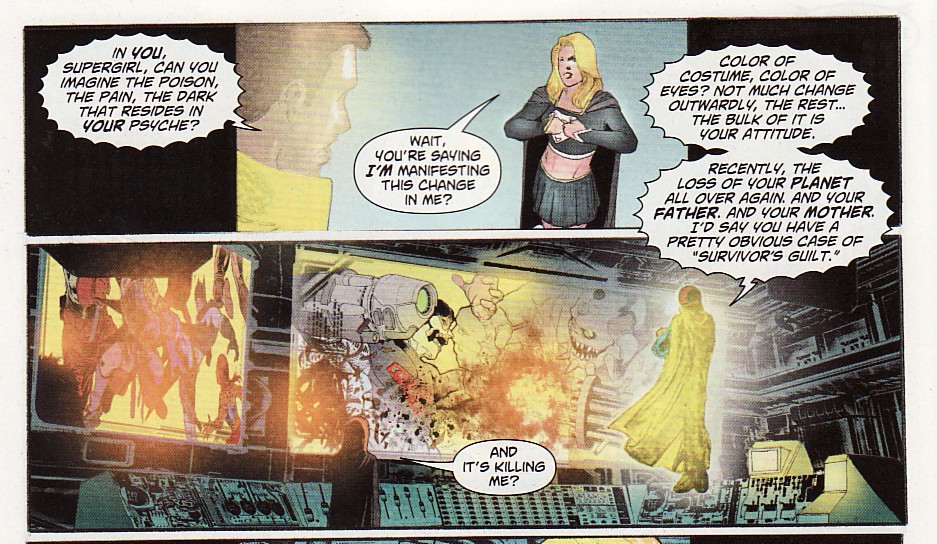
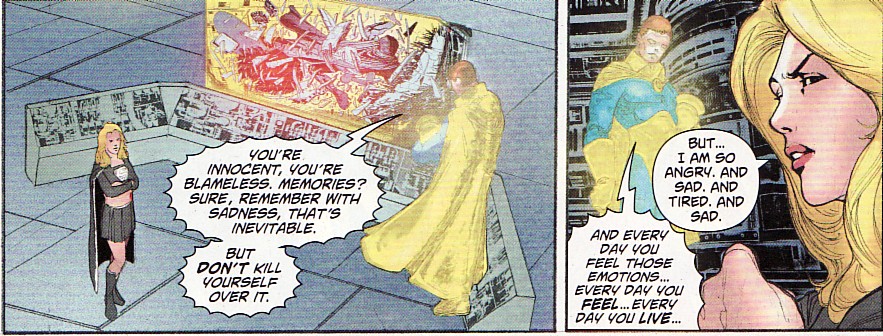
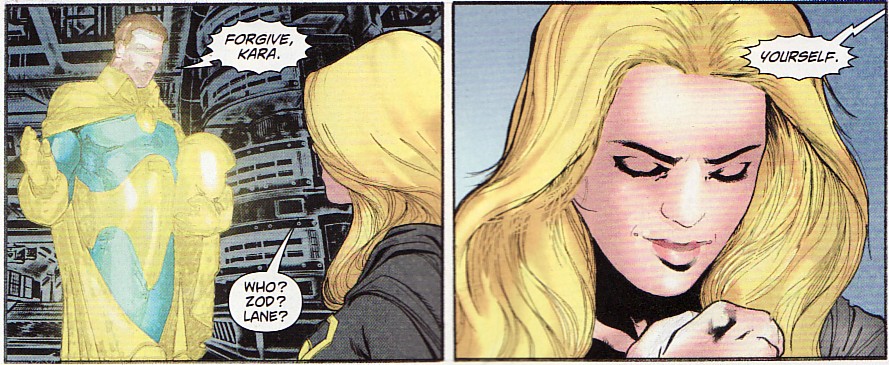
- Supergirl feels like this after losing her parents and Krypton over again. In Reign of Doomsday, a computerized Dr. Fate tells Kara that she is suffering from survivor guilt◊ and she shouldn't let guilt kill her◊ and she has to forgive herself◊.
Doctor Fate: In you, Supergirl, can you imagine the poison, the pain, the dark that resides in your psyche?
Supergirl: Wait, you're saying I'm manifesting this change in me?
Dr. Fate: Color of costume, color of eyes? Not much change outwardly, the rest... the bulk of it is your attitude. Recently, the loss of your planet all over again. And your father. And your mother. I'd say you have a pretty obvious case of "Survivor Guilt".
Supergirl: And it's killing me? - In Red Daughter of Krypton, Kara confides to Guy Gardner that she feels guilty about surviving Krypton's destruction, and she feels she'll be making up for it her whole life, even though she knows she couldn't have saved her world.
- In Bizarrogirl, Kara feels horribly guilty after New Krypton's destruction. Every night she has nightmares in where legions of the dead accuse her of letting her family die and bringing destruction and pain everywhere.
- In The Killers of Krypton, Kara explicitly says she cannot forget about Rogol Zaar's claims of destroying Krypton because she is still alive whereas her family and her friends are all dead.
Supergirl: I had a life there. Years of memories. I had so many people I loved... Friends I laughed with. Silly crushes I daydreamed about the future with — And they are all dead. And I'm still here. You can never understand how I feel.
- Teen Titans: The main reason why Beast Boy is constantly joking and acting like a class clown is because he's got a massive case of this; cracking jokes is how he stays anything remotely sane. The Terror of Trigon made hay out of this by having him hallucinate an Evil Counterpart that was ripping the hearts out of and then eating his friends and family.
- Ultimate Marvel:
- In Ultimate Fallout: Spider-Man No More, The Ultimates are hit with this hard over death of Spider-Man: Tony Stark gives Aunt May and Gwen Stacy a home in Europe to start life away from the tabloids, Nick Fury tells Mary Jane that she has every right to publish the truth and that it was his fault that it happened and, worst of all, Steve Rogers quits being Captain America because he gave him a "The Reason You Suck" Speech and he was proven horribly wrong.
- In Ultimate Spider-Man, Aunt May gets hit with a pretty big case of this when Uncle Ben dies, explaining that it's on top of the grief she feels for Mary and Richard (Peter's parents), and later Captain Stacy's death. After that last death she winds up having to see a psychologist to help her with her feelings on it. While still strong and capable, she's portrayed as realistically emotionally-unstable throughout the book, which is a major reason Peter hides his identity from her at all costs. She naturally lost it when Peter died in her arms, screaming "Not him too!"
- Most of the characters in The Walking Dead have varying degrees of this.
- Part of Rick's is because he and Carl ran away from The Governor's assault on the jail after he saw Lori murdered.
- Andrea has it because her former lover Dale is dead and she never told him that she'd fallen in love with him.
- Wonder Woman (1987): After Hippolyta dies in a fight while acting as Wonder Woman alongside Diana both of her daughter have a series of horrific nightmares in which she asks whey they didn't save her while dying. Donna writes it off as misplaced guilt, but once they compare notes and realize they're having the same dreams they realize the dreams are actually Circe's work.
- Depending on the Writer, X-Men's Emma Frost had a major case of this after Mountjoy murdered the Hellions. Then she became the sole survivor of the mutant massacre in Genosha, and exhibits varying degrees of mild depression to full on psychotic behavior.
- In Being Dead Ain't Easy, it's heavily implied that Kaiba feels guilty for living when Joey died. He almost works himself to death trying to find a way to save him.
- In the Digimon Tamers fanfic Destiny, Juri's already massive case of Survivor Guilt is worsened after she is the Sole Survivor of a car accident in which her father, stepmother, and halfbrother are all killed. Juri even attempts suicide because of it.
- Echoes of Eternity: Maria's father killed himself in order to avoid this. His wife died of NIDS and his newborn daughter had the same deadly disease. In a twist, Maria didn't die as expected. This led to her being raised by her grandfather Gerald.
- In the Emergency! fic "Lost and Found'',Roy is almost kidnapped by a serial killer and torturer, but John pushes to go instead and spare Roy. Roy believes John has to be dead until he is found alive, but even after, Roy wrestles with a non-death related type of this; massive guilt because he knows John suffered 18 months of hell that he should have went through, if he could even have done what John felt he had to just to survive. And John is told that Roy died from being shot, and wrestles with this type of guilt until he finds out the jerk lied to him to torment him more.
- In the Empath: The Luckiest Smurf story "Empath The Bandit Smurf", as the Smurfs go off into the forest to find Empath after he's been abducted by two entertainers, Jokey comments the feeling that it should have been him — which it originally was, since the story is an adaptation of The Smurfs comic book story "The Jewel Smurfer".
- Evangelion 303: When Unit 04 crashed down, Asuka survived but her co-pilot and best friend Jessika did not. Even though it was not her fault AT ALL, she blamed herself nonetheless. For a long time she was wrecked with pain, guilt and self-hatred. She eventually manages to move on, but not before attempting suicide.
- In the Godzilla fanfiction Abraxas (Hrodvitnon), Mark Russell has been suffering this after Vivienne Graham's death in Antarctica, and Monarch personnel's hushed You Should Have Died Instead feelings have added to it. It doesn't get better when Vivienne returns transformed into an Artificial Hybrid Kaiju until she sets him straight.
- In this non-canon crossover post based on the unrelated "Graham Lives" Role Swap AU (where Vivienne survived the events in Antarctica and Mark died instead), Graham Lives!Vivienne admits to Abraxas!Vivienne that she's felt sometimes that it should've been Mark who survived instead, because she thinks he might've been quicker when it mattered in her shoes.
- In this
- Downplayed in Innocence Once Lost: Alt!Fluttershy lost a leg during the war due to Alt!Rainbow Dash acting reckless and the latter feels guilty about it.
- Any Kamen Rider Gaim post-series fanfic usually portray Mitsuzane as this:
- Picking Up the Pieces written by SeaSpectre160. Continuing from the aftermath of Kouta and Kaito's battle, Zack worked his way to escape. After Micchy is rescued, he even attempted suicide in front of Zack.
- This is also a huge element for Mitsuzane Kureshima's characterization in Metroid: Kamen Rider Generations, especially in regards to Kouta Kazuraba and Mai Takatsukasa. Of course, they did NOT die. Although Kouta and Mai are now Physical Gods colonizing an isolated planet, as such Kouta and Mai won't be able to see their friends and family forever. Micchy's tendency to blame himself takes to the point we see him entirely insecure and brooding underneath. Even Takatora, Gou, and Samus show their concern of getting people to look after Micchy. Although subverted, as the two rarely visit the Earth, as shown with Kouta's meeting with Takeru.
- Picking Up the Pieces
- Little Fires: Goosepaw was the only survivor out of her mother's litter of stillbirths. Even her mother died giving birth to her. As a result, Goosepaw thinks that she's cursed by StarClan. She even starts to doubt that StarClan is real, which is especially sacrilegious because she's a medicinecat apprentice (a human equivalent would be an agnostic-atheist preacher).
- Lost is about Delia's reaction to Ash "dying" in the SS. Anne accident. With no family left, she contemplates suicide in her grief. Professor Oak stops her and tells her that he too had a similar reaction when he learned his son had died.
- New Stars: A variant. After deciding to officially become a member of the Orville's crew, Maxx feels guilty because he was able to free himself from the Republic, while the rest of the clones are still trapped in a really bad situation (which any Star Wars fan can tell you will only get worse at the end of the war).
- Once More With Feeling (Crazy-88): Shinji is his timeline's only survivor. He blames himself for being incapable of saving everyone, especially his family. Asuka’s death is his biggest regret, since he did nothing when she was being butchered and eaten alive.
- one day at a time (Nyame):
- It becomes increasingly obvious over the course of the first story that Jason Todd never got over being the only surviving son of Bruce Wayne, which is why he became so protective of his sister Cassandra Cain (his only remaining sibling), and later on his children. The fact that all three of his brothers died within two years of each other didn't help matters. It takes dying of lung cancer, being sent back in time, and then dying againnote for Jason to finally make peace with what happened, and only after interacting with his dead loved ones, who all bluntly tell him that their deaths weren't his fault.
- In the sequel the superhero game, it's revealed that Jason wasn't the only one to suffer this in his timeline. Thanks to the events of the Dead Decade, a period of fifteen years that saw the deaths of dozens of prominent superheroes, every single one of his teammates on the Era 2 Justice League suffered this to similar degrees. All of them lost loved ones during that time, and it hit them hard. His love interest Donna Troy, who lost several friends, including her First Love Roy Harper and her best friend, Jason's older brother Dick Grayson, had it so bad that she outright abandoned superheroism and Man's World in general for over a decade. It's all but stated that this guilt is why Era 2 superheroes have a more pragmatic and brutal outlook on superhero life, prioritizing the survival of their comrades above all else (sans innocent lives).
- In System Restore, Togami feels personally responsible for what happened at his party, and confides in Hinata that he feels it was his failings as a leader that led to the deaths of Komaeda and Hanamura. He even states that he feels he should have died instead due to his failure.
- Tales of the Canterlot Deportation Agency: From Jack: All In: While not always specifying that he feels responsible for the death of his family, Jack is visibly traumatized by their loss:
Frustration and grief and the horror of being the one who lived.
- This is then amplified with Bree in Soul Survivor, with the Euthanatos as one of but four to escape her world's destruction. (Jack, upon seeing her unconscious within the makeshift hospital, feels an instinctive connection with her — but the two have yet to actually speak.)
- This is then amplified with Bree in Soul Survivor
- Those That Carry On has Cima as the sole survivor of her fleet noting that at times she wishes she'd died with them.
- Victoria suffers from this badly in All This Sh*t is Twice as Weird, being the only member of her own family to attend the Conclave and live. Later, Mahanon gets his own case of it when Victoria performs the Heroic Sacrifice at the sacking of Haven; he tells Cassandra that he's pretty sure he'll spend the rest of his life wishing it had been him.
- In Where Talent Goes on Vacation, the second killer, Tatsuki, killed Kojima in order to protect her sister Taiga. Her original plan was to graduate along with Taiga (since Monokuma offered a special motive to allow successful blackened to take someone with them), or failing that, die alone. What she wasn't counting on was Taiga using the Twin Switch they agreed upon, partly so that Taiga would graduate if Monokuma reneged on his promise, to be executed in Tatsuki's place, resulting in Tatsuki being overwhelmed by guilt and grief.
- In Why Am I Crying?, Silver Spoon gets the guilt after Diamond Tiara dies pushing her out of the way of a carriage.
- In The Book of Life, after it looks like Maria was killed, Manolo can't even lift his head up.
- In the Buzz Lightyear of Star Command pilot movie, Buzz Lightyear's partner and best friend, Warp Darkmatter, gets killed in the opening and Buzz refuses to take an new partner even though it violates the rules to work alone, due to a combination of arrogance and not wanting to see any other ranger get hurt because of him. The little green men try to solve Buzz's problem by building him a robot partner designed to imitate him named XR that they can easily put back together if destroyed, though on his first mission XR gets destroyed and put back together with a weird personality due to the little green men having lost their mind link at the time. He finally swallows his pride and gets over his survivor guilt when he gets captured by Zurg and finds out that his former partner faked his death and was Evil All Along and accepts XR and two other rangers as his partners.
- The Land Before Time VII: The Stone of Cold Fire. This is Petrie's pompous uncle Pterano's tragic backstory. Pterano, blinded by arrogance, unintentionally lead a smaller herd into an earthshake/raptor ambush where EVERYBODY but himself was killed, and he barely managed to escape (and that's only because he can fly). He's shown watching at least one follower die (the swimmer that falls off the cliff). When he meets back up with the main herd at the Valley, he can only turn his back and cradle his head in his hands in grief and shock. Ouch.
- Abbot Cellach in The Secret of Kells after losing nearly his entire village (including his young nephew) in a Viking attack.
- In Donovans Echo, the titular character suffers from a severe case of this which seems to be affecting his grasp of reality.
- The survivors of the school shooting in April Showers are hit by this, none worse than Jason.
- Jess Aarons in Bridge to Terabithia is guilt-ridden, and heartbroken after finding out his friend, Leslie died by drowning, when he was on a trip to the museum with his teacher.
- Cloud Atlas: Zachry gets this twice — once when a band of Kona kill his brother-in-law and nephew, and again in his adulthood when the Kona destroy his camp and kill his family and people.
- In Deadpool 2, Wade tells Colossus that "one of the assholes that killed Vanessa got away." When Colossus assures him that they'll find him, Wade clarifies: he is the asshole that got away.
- Discussed in Dr. Strangelove regarding an After the End nuclear scenario. President Muffley raises the question paraphrasing Khrushchev; "Won't the living envy the dead?" but Strangelove easily dismisses the concept, pointing out that joie de vivre will prevail.
- Fearless (1993): Carla has this because her baby died in the plane crash, while she survived, and she thinks it's her fault he died. Max also has this, though he's not aware of it at first.
- Five Feet Apart: Stella expresses this over her sister's death, since she's the one with a serious disease which will probably kill her eventually. Her sister, though healthy, died in a cliff-diving accident. Stella very strictly abides by her treatments since, saying her parents can't lose another child (at least delaying it as long as is possible) and that she should have died rather than her sister.
- Richard Kimble gets hit with this in the novelization of The Fugitive upon realizing that he was the target of the man who killed his wife, outright declaring "I should have died too".
- Interestingly, Gojira has a case of this for the the titular monster; a survivor of the atomic bomb. Whilst normal guilt is normally only destructive to onesself, Godzilla has a rather more drastically external case of it.
- Emiko Yamane of the original film and Godzilla vs. Destoroyah. The latter heavily implies this as well as her nightmare seems to support it. As a result, The film implied she did not marry her lover Hideo Ogata, as she still has her surname.
- Godzilla Minus One: This forms a major facet of Koichi Shikishima's character arc, as he is wracked with guilt over his failure to save his comrades on Odo Island when Godzilla attacked them (with the only other survivor blaming him for what happened, as Koichi had the chance to fire on Godzilla but froze up in fear), on top of his guilt over deserting his duty by bailing out of a kamikaze mission, plaguing him with nightmares and emotional breakdowns throughout the film.
- The Guardian (2006) has Ben Randall, who is feeling this after being the only survivor of a botched rescue. It is later revealed that Fischer was the Sole Survivor of a car crash that killed his swimming team.
- In I Miss You, I Miss You there is a heartbreaking scene where Tina addresses this. She was running just one step ahead of her twin sister when her sister was hit by a car and killed. Afterward she has nightmares where her sister wants them to trade places, and sometimes hears her sister's voice in her head.
Cilla's voice: I don't want to die, Tina. I want to live.
Tina: [sobbing] I want to live too, Cilla. I want to live. Let me be. Let me be. I want to live, Cilla! If I had only watched where I was going. If only I had seen the car. - Det. Del Spooner of I, Robot has this as a reason for hating robots. During a car accident where he and a child named Sarah were trapped in cars sinking into a lake, a robot saved him but not the girl despite Spooner pleading the robot to leave him and rescue Sarah. The robot claims that Spooner had a better chance of survival than Sarah (whose odds were statistically non-existent) and since the robot's brain is a difference engine, it logically went after the one with a better chance of survival, a reasoning that Del hates since he believes that a true human would have listened to him and save the girl no matter how futile.
- To be noted is a scene where he wakes up and points a gun to his head... with his finger on the trigger.
- Key Largo: A complicated version appears when Sherif Wade learns that Rocco's gang would have killed him if Frank, Nora, or James had talked to him during his visit and gven him information that would have kept him from killing the Osceola brothers. He says that being killed may have been preferable to killing two innocent men.
- Marvel Cinematic Universe:
- Implied to be what's driving Tony to turn over a new leaf in Iron Man. Considering he's been developing weapons for years, some of which got into the hands of enemies because of his carelessness, only recently saw what his weapons actually do to people, and escaped captivity thanks to someone else's Heroic Sacrifice... yeah.
Tony: I shouldn't even be alive. Unless it was for some reason.
- It comes back again in Avengers: Age of Ultron: his nightmare is that he will be left to watch as his fellow Avengers die. This makes the end of Avengers: Infinity War particularly cruel: Tony and Nebula are the only ones left standing on Titan, as everyone else who fought with them crumbles to dust. Plus, Tony has no way of knowing how many of the other Avengers are left alive because he's far away from Earth's communications network. His emotional state in Avengers: Endgame is likely to be...turbulent.
- Heavily implied with Valkyrie in Thor: Ragnarok, her alcoholism being the result of her being the only one of her kind to survive the battle with Hela.
- Following the deaths of his little brother, his best friend and half of his people at the hand of Thanos in Avengers: Infinity War, Mantis, who is an empath, senses tremendous guilt in Thor, among other things.
- Revealed to be a huge part of Rocket's character in Guardians of the Galaxy Vol. 3, which details his horrific backstory. It turns out that, despite Rocket's prior protests to the contrary, he really is an Earth raccoon, and he gained sentience after being subjected to nightmarish experiments by the High Evolutionary. After learning that his creator intended to kill him and his fellow test subjects for outliving their usefulness, Rocket attempted to orchestrate their escape, only for all his friends to be killed, leaving him as the Sole Survivor. The experience turned him into the bitter and cynical bounty hunter introduced in Guardians of the Galaxy (2014), having never forgiven himself for his friends' deaths.
- Implied to be what's driving Tony to turn over a new leaf in Iron Man. Considering he's been developing weapons for years, some of which got into the hands of enemies because of his carelessness, only recently saw what his weapons actually do to people, and escaped captivity thanks to someone else's Heroic Sacrifice... yeah.
- The premise of Ordinary People is about a family dealing with the death of elder son Buck in a boating accident one year prior. Specifically the story focuses on Conrad, the younger brother who survived the accident and how he blames himself.
- Similarly a major theme of The Big Chill.
- In Pacific Rim, it's implied that Chuck has this where his father chose to save him over his mother when a Kaiju attacked Sydney, which he resents Herc for.
- Raleigh's brother was killed while they were still drifting, and so was able to sense the pain of death. He shows hesitation with getting close to anyone again, let alone drift with them.
- Peter Pan (2003): The title character apologizes to Tinkerbell after she dies.
- In Pitch Black Riddick is briefly struck with this near the end after Fry is killed when she goes back to save him, if his screaming protests of "Not for me! Not for ME!" are any indication.
- Zac Hobson has a case of this in The Quiet Earth after discovering that he might just be the last human alive—compounded by the fact that he was part of the research team that caused the mass extinction in the first place- and spends several weeks going insane from loneliness and guilt. He gets better after encountering two other survivors.
- In Rambo: Last Blood, Rambo suffers this after Gabriela dies from being forcefully given an overdose by the Big Bad brothers while he's driving them home, leaning his head against the steering wheel and brokenly mutters "Why not me?" However, being Rambo, he quickly channels those feelings into a blood-soaked Roaring Rampage of Revenge against them.
- In Repo! The Genetic Opera, Nathan Wallace wishes that he had died instead of his wife, Marni. As mentioned in the song "I Didn't Know I'd Love You So Much":
"Sometimes I'd stay up all night/ Wishing to God that I was the one who died"
- Saving Private Ryan: The film opens with a World War II vet breaking down by a grave, asking his family if he's lived a good life. It's later revealed that the soldier is Private Ryan himself, and the grave belongs to Captain Miller who, along with several others, died on a mission to bring Ryan home. Miller's last words to Ryan were "earn this", admonishing Ryan to live his life in such a way that their sacrifice was worthwile.
- The film adaptation of Schindler's List. After his Heel–Face Turn, Schindler financially ruins himself bribing Nazi officials in an effort to save Jews from the Holocaust. After he escapes, he forlornly notices that hawking his getaway car could've saved more lives, too, and the Nazi party pin he wore could've bribed someone for just one life.
- In Speed Annie has a bout of this after the booby trap on the bus steps kills a passenger, confessing that she first thought it was the bus's true bomb that had detonated and feeling horrible that she was relieved to still be alive. Jack does a swift and skilled job in removing the guilt from her mind telling her that is a perfectly normal human response to this extreme situation and any anger should for be the bomber who put everyone into it.
- In Stand by Me, Gordie has a bit of a case of survivor's guilt over the death of his older brother, not because he was involved in it in any way so much as because he is The Un Favourite and thinks his parents would prefer it if he'd been the one who died instead of his brother.
- Star Wars:
- In A New Hope, Luke Skywalker realizes that the stormtroopers have likely found out about his family farm, and when he gets back, he finds his Uncle Owen and Aunt Beru savagely murdered and the farm pillaged. Obi-Wan Kenobi tries to console him, saying "There's nothing you could've done had you been there. You would've been killed, too, and the droids would now be in the hands of the Empire."
- In the Legends Expanded Universe this was an extremely common characterization among Alderaanians after the planet was destroyed by the Death Star. Winter is hit particularly hard thanks to her Photographic Memory. And while Leia ventures into Angst? What Angst? in the original film, her pain over Alderaan's destruction is much more evident in the Expanded Universe literature.
- An awful lot of people from the Legends Expanded Universe actually.
- Specific examples from the X-Wing Series. Wedge Antilles has largely, though not entirely, handled this, but it pops up sometimes while he bears The Chains of Commanding and considers the friends he's sent to their deaths. Kell Tainer has incredible angst over failing to save a wingmate and being honored for the attempt. Myn Donos' dwelling over the loss of his squadron is a major subplot of the Wraith Squadron trilogy, which ends up in a full Heroic BSoD after his astromech (the only other survivor of the ambush which destroyed his squadron) is hit during a skirmish. And it gets worse when he discovers his love interest was the one responsible for the ambush in the first place, even if she later came to regret it, and all the other damage she caused as an Imperial spy. And Tyria Sarkin is the last of her branch of the Antarian Rangers, sort of semi-Jedi, and she always feels that she's not nearly good enough to live up to them.
- Han is hit by this hard after Chewie's death at the beginning of the New Jedi Order series, and it takes several books for him to finally snap out of it. Even then, it remains a lingering wound for a long time after.
- Mara Jade was deeply affected by her failure to save the Emperor by assassinating Luke at Jabba's palace, and had nightmares for years afterwards of the Emperor's final moments. Subverted in that it turns out that this was invoked by the Emperor himself, who implanted a drive to kill Luke and avenge him in Mara through the Force as petty vengeance against Vader. Fortunately, the combination of a Prophecy Twist and learning the truth helped bring her out of it.
- Former Rebel Shocktrooper Cara Dune of The Mandalorian is subtly implied to be driven by this. Like the Legends examples she's an Alderaanian, and it's hinted that she enlisted in the first place because of her homeworld's destruction. She continues to harbor a lingering resentment against the Empire even after the war,note and deserted the New Republic when her duties shifted from destroying the Empire to peacetime missions such as bodyguarding dignitaries.
- The final season of Star Wars: The Clone Wars has Captain Rex grappling with this trope as he comes to realize just how many of his fellow troopers have died over the course of the series. He ultimately finds a kindred spirit in this trope in Ahsoka, who contracts severe Survivor Guilt over both the Clone Troopers and the Jedi after Order 66, coupled with Parting-Words Regret over how things ended between her, Anakin, and Obi-Wan. That guilt persists into Star Wars Rebels and nearly causes her death when she faces down Darth Vader in a battle she can't win simply because she refuses to abandon Anakin again.
- A scene that was never filmed from Superman Returns was to have given this to Superman... as he gazed on Ground Zero in New York City. The writers' idea was that his thought process would essentially be If I had been here, maybe this wouldn't have happened.
- Which would have become a twisted mix of Hilarious in Hindsight and Harsher in Hindsight after the destruction Supes and Zod deal to Metropolis in Man of Steel...
- Master Hua from the Taiwanese adventure film, Treasure Hunter, constantly suffers from this because he's the Sole Survivor of a doomed expedition in the desert years ago before the movie starts. Worse of all, it's revealed in the end that he was actually forced to cannibalize his friends' bodies to stave off starvation.
- Unbreakable has Bruce Willis's character David Dunn survive a horrific train crash, causing all sorts of questions about why he lived. This is further explored when a man wiggles into his life suggesting he has Super-Toughness. A Deleted Scene shows David having a Shower of Angst while hearing reports of the train crash.
- Joe Enders, Nicolas Cage's character in Windtalkers, had his entire unit killed when he decided to follow orders and told them to hold their position rather than retreating. He was the only one who survived and he was awarded a medal and promoted for his actions. To make the situation even more messed up, his new job might require him to kill the code talker he is charged with protecting rather than let him fall into enemy hands. Joe is a Death Seeker and one step away from being suicidal.
- In Yamato, Kamio experiences this after he becomes the only one among his friends to survive the sinking of the eponymous battleship, exacerbated after the mother of one of his dead friends throws a You Should Have Died Instead at him. It takes him decades and recounting the events before he finally moves on.
- In All Quiet on the Western Front, Paul starts to experience this after most of his comrades are dead.
- Animorphs:
- Jake feels this so much at the end of the series that he completely retreats into himself, blaming himself completely for Tom and Rachel's deaths because he gave the order for Rachel to kill Tom, even though Rachel said she probably would have gone regardless of what Jake told her.
- Ax suffers a little of this after being reunited with Andalites but their ship is crashed (due to a traitor), claiming he wishes he had died with them. The guilt comes from the fact that he's still relieved to be alive and ashamed of feeling relieved when so many died.
- The Black Company: The title of the last book, Soldiers Live, is actually a reference to the concept; it's short for "soldiers live, and wonder why". In context, this is the narrator musing over why men younger than himself are cut down while he survives long enough for his age to be bothersome.
- Black Tide Rising: Discussed in Islands of Rage and Hope, with a US Marine sergeant having a serious case of it after surviving the zombie outbreak at Guantanamo Bay because her superiors ordered her to retreat instead of trying to save them from a horde of Technically Living Zombies in the prologue, and is contemplating whether to shoot herself in the head or strangle herself and save the bullet for someone else.
- In Bluebeard by Kurt Vonnegut, this is explicitly brought up as afflicting Rabo Karabekian's Armenian father, but not his (equally Armenian) mother.
- A Brother's Price: Princess Halley, due to the fact that she said "I wish he was dead" seconds before the building which contained not only the horrible husband she was referring to but almost all of her older sisters, exploded. She became obsessed with finding out who caused the death of the aforementioned people.
- The Chronicles of Prydain: Taran experiences this in the fourth book, Taran Wanderer, when he's unable to save the life of the shepherd Craddoc.
- Circle of Magic:
- Trader belief holds that the sole survivor of a disaster is the source of the bad luck that caused the disaster. Consequently, they are ritually Unpersoned and exiled by the Trader people. This happens to Daja at the beginning of the series, after she's the sole survivor of a shipwreck.
- Sandry has a good bit of survivor's guilt over the smallpox plague that left her orphaned, and after the second book, Tris has to deal with having personally destroyed an attacking pirate fleet and watched hundreds of innocent galley slaves drown in their shackles as the ships sank. In the Circle Opens arc, Daja gets hit with it again after learning that the firefighter she'd given handmade magical safety equipment to was the arsonist who'd been setting the fires, and her gear just enabled him to firebomb a hospital. Briar, of all people, seems to have escaped this... until the Circle Reforged arc, which reveals that his travels in the East ended up in a war zone. Good grief.
- At the end of A Colder War, the few thousand people who survived The End of the World as We Know It by being evacuated through a Cool Gate to a Domed City on another planet are in this state. The only reason why the protagonist doesn't commit suicide is that things could be worse. In fact, they probably are...
- Inverted with Baron Harkonnen in Dune. When Leto tries to poison Harkonnen with a gas in a fake tooth and ends up taking out everyone in the room except for Harkonnen (he manages to evade it at the last second), his immediate reaction is joy that he survived and everyone else is dead.
- In The Emigrants, Robert feels this way after the death of Arvid on the California trail.
- Gaunt's Ghosts is based in this trope. The Tanith Ghosts are the only survivors of their planet's destruction, which motivates and haunts them. The Verghastite Ghosts chose to join the regiment after their hive city was declared a Necropolis and abandoned in the wake of a Chaos attack that many of them fought in as civilian militia.
- This is the plot of the Lurlene McDaniel book The Girl Death Left Behind, as the main character's family dies in a car wreck (on the 4th of July, no less) and she struggles with the aftermath.
- Harry Potter:
- In Harry Potter and the Half-Blood Prince, Tonks starts acting depressed and this is attributed to survivor guilt after the events of the previous book where her mother's cousin Sirius Black dies. It's also because she's unhappy that she and Lupin can't be a couple.
- Harry goes through this here and there throughout the series; in Goblet of Fire he said, "I told Cedric to take the Cup with me," clearly blaming himself. The enormous guilt he feels over all the people who died protecting him is a major point in Deathly Hallows, as he repeatedly tries to push people away just to avoid history repeating.
- Also in Deathly Hallows, we find out that Dumbledore is a textbook case. He's spent the better part of his life hating himself for his sister's death.
- This trope is the reason why Sirius Black blamed himself for the deaths of James and Lily Potter and the muggles killed by Peter Pettigrew.
- Heralds of Valdemar: In the Last Herald Mage series, Vanyel has a major case of this over the death of his True Love: not only is he heartbroken, he thinks he can never measure up to Tylendel, either as a new mage or in his aunt's affections (Tylendel was a sort of surrogate son for his aunt). He turns out to be quite wrong on both counts. He gets it again in the third book of the trilogy once he becomes the titular Last Herald-Mage, going on a suicide mission to track down and destroy the man who killed all the others.
- Honor Harrington:
- The title character, frequently. She has a habit of going up against impossible odds, prepared to make a Heroic Sacrifice... and surviving. But that doesn't mean that everyone else who went into battle with her will survive, and she beats herself up over it. As the series goes on, she becomes better at dealing with it. It helps that these situations are often ones in which everyone should have died - regardless of how few survive, they wouldn't have without her.
- Berry Zilwicki is also said to be dealing with this after surviving an assassination attempt aimed at killing her in At All Costs.
- Honor's best friend, Michelle Henke, battles a case of this after surviving the Battle of Solon when most of her people died. This later bonds her to her new flag lieutenant, Gervais "Gwen" Archer; he was also a Solon survivor, albeit from a different ship.
- The Hunger Games:
- Katniss Everdeen has this in spades.
- Peeta, on the other hand, seems to have shockingly little of this. However, this could be because the story is told through Katniss' eyes and we never know exactly what Peeta is feeling.
- One of the many things Tina has to deal with after her twin sister Cilla's death in I Miss You, I Miss You. Tina was running just one step ahead of Cilla when she got hit by a car and killed, and it could just as easily have been Tina who died.
- The Kitchen Daughter: David's wife was killed in a car crash last year. He was driving. He's spent the last year obsessing over everything he could have done differently to prevent the accident, even though it wasn't his fault.
- The Last Chancers: In 13th Legion, Kage throws away his pardon by starting a brawl at the end. In the subsequent novels, Schaeffer, more than once, points out that this was what motivated him, as he was the last of the four thousand the legion started out with.
- In the Mediochre Q Seth Series, Mediochre seems to have this over Pigeon, his WWI comrade. He seems to have defaced his own Victoria Cross medal at some point after Pigeon's death with the words "For You But Not For Me" (a macabre reference to The Bells of Hell).
- In More Than This, Seth feels responsible for his brother Owen's kidnapping, especially after he finds out Owen was killed by the kidnapper.
- Septimus in Mrs. Dalloway watched his friend die in World War I and suffers from hallucinations.
- Word of God is that the main theme of Mystic River is survivor's guilt, mainly from Sean and Jimmy, who avoided being abducted and abused by two pedophiles when they were kids while their friend Dave was victimized, and from Sean because he managed to escape the neighborhood and make a good life for himself as a cop.
- Newsflesh: In San Diego 2014, Lorelei Tutt has a bad case of this, even after thirty years. She's the only-known survivor of the zombie outbreak at ComicCon 2014, because her case of adolescent attitude prompted her father to send her out of the convention center to their hotel room. She got out of the convention center minutes before infected arrived.
- In Of Fear and Faith, August deals with this after the events of Fear the Reaper, as he feels responsible for the high death toll of that battle since he was in charge of the battle plan.
- The Orphan Train Adventures: In Circle of Love, Johnny Mueller is clearly suffering from this condition after the American Civil War.
- Seeker Bears: Kallik briefly hits the Despair Event Horizon in the second book and contemplates suicide. With her mother dead and her brother assumed dead, she loses her will because she's much too young to be on her own yet. Fortunately, she doubts whether her brother is actually dead or not and continues looking for him. He turns out to be alright.
- Dag in The Sharing Knife suffers from this after losing his first wife and most of his comrades in a gory battle.
- A Song of Ice and Fire: Theon Greyjoy, at a dark time in his life, thinks back on all the people he has lost while walking around in Winterfell:
Theon Greyjoy: They were all dead now. Jory, old Ser Rodrik, Lord Eddard, Harwin and Hullen, Cayn and Desmond and Fat Tom, Alyn with his dreams of knighthood, Mikken who had given him his first real sword. Even Old Nan, like as not. And Robb. Robb who had been more a brother to Theon than any son born of Balon Greyjoy's loins. Murdered at the Red Wedding, butchered by the Freys. I should have been with him. Where was I? I should have died with him.
- The Stormlight Archive: Every time Kaladin tries to save someone, they die while he lives. It started with his own brother and just went downhill from there. It's such a consistent pattern that he becomes convinced that a dying man would be better off without his help. He even thinks he is cursed. Syl eventually convinces him that he's being spared to help people. Of course, that means if he was stronger, he could have saved those people after all. By the third book, Oathbringer, while Kaladin has accepted that everyone's deaths are no longer his fault, he is grappling with his inability to save everyone in the face of ever mounting threats.
- In A Tale of... the Old Witch, Gothel is an Angsty Surviving Triplet after her sisters Hazel and Primrose die at the same time. She's soon kicked out of her forest and left on her own.
- Tasakeru: In the first month of his service as a Daigundan samurai, Zero's squad of rookies was ambushed by a fanatical Death God cult. Seventeen died and more were injured, but Zero survived without a scratch. This resulted in his fleeing to Tasakeru and becoming a Rōnin.
- Tears of a Tiger has the central character, Andy, suffer a strong case of this after killing his best friend, Robert, in a car accident. His depression gets worse after repeatedly lying to avoid therapy sessions, and he begins to distance himself from his friends and family. It sadly ends with him shooting himself with his father's handgun.
- Anequs's father Aponakwe in To Shape a Dragon's Breath. While he rarely speaks about it, Aponakwe is the only male survivor of his immediate family as he was at sea during the Naquipaug massacre; he says that he would have likely been part of the war party that tried to drive the Anglish away if he had been there. His brother Motuckquas and father were both victims, and several of the people he grew up with. Including Theod's parents, who he knew well and attended their wedding.
- In the Ultramarines novel The Warriors of Ultramar, Sister Joaniel's Back Story included being the sole survivor of a direct hit on a field hospital.
- The Unexplored Summon://Blood-Sign: This trope, with a heavy dose of The Atoner, is the foundation behind Kyousuke's Chronic Hero Syndrome. In the past, he summoned the White Queen into the world, and she fell in love with him. But due to various factors that Kyousuke didn't know about (the fact that the Queen's presence summons monsters to the world) or couldn't do much about (a conspiracy to usurp control of the Queen from him), she went on a violent rampage and killed many people. Eventually, Kyousuke threw himself at her, hoping that his death would at least prevent any more casualties, but she, of course, didn't kill him. When an army approached with the intent of killing the Queen, she wiped them all out to prevent Kyousuke being killed in the crossfire. Kyousuke feels that he should have died, being (in his opinion) the one responsible for it all, and saves people in an attempt to make up for this.
- Wings of Fire:
- In Moon Rising, Sora, scarred by the death of her older sister Crane, tries to continually calm herself with meditation. Unfortunately, when Icicle shows up, Sora snaps and plans an explosion to kill her.
- In Legends: Darkstalker, after Albatross massacres his family and visiting SkyWings, Fathom becomes afraid of his animus power. He goes as far as distancing himself from Indigo to protect her. He's depressed for the rest of the book and doesn't allow himself to be happy. Fortunately, he recovers and gets a happy ending.
- Alfred Hitchcock Presents: "Reunion" has a group of Vietnam War veterans meet each year for a reunion on the anniversary of a battle in which their colonel was killed. Paul Stebbins has avoided the reunions but has finally decided to attend. Many of the veterans suffer from PTSD and all are drinking heavily. They all feel a lot of guilt over the colonel's death and decided to reenact the battle. As fiction and reality blurr they seem to be transported back in time and refight the battle. This time the colonel survives but the rest of the soldiers exept Paul are killed. Back in the present Paul and the colonel toast their dead comrades and Paul says that he will not attend any more reunions.
- Shows up a lot in the Babylon 5 universe; including Crusade, sufferers include Sinclair, Sheridan, Galen, and Gideon.
- Cally from Blake's 7 is the Sole Survivor after La Résistance on Saurian Major was wiped out with biological weapons (she survived because of her alien biology). As her species is telepathic, she finds loneliness unbearable and is planning a suicide attack before being discovered by Blake and joining his crew. Blake surmises that this trope is the reason she never returns home to Auron, though she's later revealed to be an exile from her homeworld. Blake himself is implied to be suffering from this trope — in his Back Story his fellow rebels were massacred but Blake's life was spared so he could be brainwashed into denouncing his own revolution.
- On Bones, Booth dealt with this twice.
- In the end of season 6, he struggled with the fact that one of the interns died from a sniper’s shot when Booth handed him the phone so he could trace the sniper’s call.
- in the beginning of season 10 with the death of Sweets. Sweets was killed while serving a warrant and Brennan actually points out later on that Booth had guilt over the death and she feared he’d find a way to feel guilty when his brother died. Fortunately, it didn’t seem to hit him hard then.
- In Breaking Bad one of Saul Goodman's commercials suggests a list of tenuous compensation claims clients could make over the the Wayfarer 515 air crash. They include "Anxiety", "Insomnia", and "Survivor's Guilt".
- Andrew felt this way in the Buffy the Vampire Slayer series finale and actually asked "why didn't I die?" Part of him was afraid to die while part of him wanted to be killed as punishment for aiding The First and killing Jonathan.
- Call the Midwife: Julia Masterson in Series 2, Episode 6, the only one of her father's seven children not to die of TB (which took her mother as well). She explicitly tells her dad, "I'm sorry I'm the one who didn't die."
- In Caprica, Lacy experiences a great deal of guilt and regret over the fact that she was almost on the train that exploded in the first half hour of the pilot, killing her best friend Zoe Graystone (along with two other important characters).
- In CASUAL+Y, Doctor Martin Ashford appears to be heading down this route after the death of paramedic Jeff Collier, who was blown up along with the car that Ash had been trapped in until just moments before. Jeff had been sitting inside the wreckage with him, keeping him from bleeding to death until his leg could be unimpaled, and didn't have time to get out before the fuel tank unexpectedly went boom.
- Cold Case: In "Best Friends", two girls in an interracial, lesbian relationship decide to commit suicide by driving into a washed-out bridge because they're being chased down by the white girl's insanely possessive older brother, and by the time they realize the bridge is out, there's nowhere else they can go... but only one of the girls dies. A poem written by the survivor makes it clear how much she's struggled with the fact that she survived and her lover didn't.
I came up from the dark without you
and every day has been in shadow.
I have begged the tide to wash away my sin
and take me to you in the dark
but every day I surface again. - The Crowded Room: The judge in Danny's case is an older black man who is gray-haired, gruff and will brook no nonsense from anyone, scoffing when Rya can't back her assertion of Danny having split personalities up at first.
- The Dark Crystal: Age of Resistance: The Skeksis Chamberlain hits hard on this aspect of Rian, pointing out that he'd run when Mira was being drained, when Gurjin was held captive, and when his father died protecting him.
Chamberlain: Fine! Go then. Run. Have your war! But it will be on Rian's head when all Gelfling die because you chose to run. Again.
- Doctor Who:
- In the revived series, the Doctor's character gets darker due to their entire race (apart from the Master) being killed off in a devastating Time War. Guilt compounded by the fact that the Doctor themself dealt the final blow, as first indicated in the episode "Dalek":
Doctor: Your race is dead! You all burned, all of you! Ten million ships on fire—the entire Dalek race, wiped out in one second!
Dalek: You lie!
Doctor: I watched it happen. I made it happen!
Dalek: You destroyed us?!
Doctor:...I had no choice. - They didn't simply cause it. In "The End of Time", it becomes clear that the Doctor killed the Time Lords on purpose, to prevent them from destroying reality. In a case of Fridge Brilliance, this is obvious in retrospect: after the Doctor ended the Time War, legions of Daleks survived, but only one other Time Lord.
- This trope is arguably the defining personality trait for the Ninth and Tenth Doctors, although Ten is a lot better at hiding it. In "The Waters of Mars", the Tenth Doctor finally snaps. As he walks away from the Mars colony as it's being destroyed, knowing that it, being a fixed point in time, cannot be saved, he hears the screams of the perishing people in his headset. Eventually, it gets too much and the Doctor, utterly terrified of becoming the single survivor once again, turns back and, in a frenzy, tries to take control of the laws of time.
- The bulk of this guilt fades following the 50th-anniversary special, "The Day of the Doctor", when the Tenth and Eleventh Doctors team up with the Doctor who fought in the Time War and successfully Tricked Out Time to save Gallifrey. However, the issues caused by changing history render the "younger" Doctors unable to retain the memory of doing it. So the Ninth and Tenth Doctors still retain their Survivor Guilt and, even if they didn't, the Doctor is still a survivor of a war that killed off huge numbers of his own people long before he absconded with the Moment. The Time Lords were losing, after all.
- Even without the Time War and the Siege of Trenzalore, the Doctor has watched a lot of people die over the centuries, and has felt personally responsible for many of them.
- Clara specifically opts not to flee Earth with the Doctor in "In the Forest of the Night", because she's seen what this trope has done to him and doesn't want to experience it herself.
- In the revived series, the Doctor's character gets darker due to their entire race (apart from the Master) being killed off in a devastating Time War. Guilt compounded by the fact that the Doctor themself dealt the final blow, as first indicated in the episode "Dalek":
- Sergeant Hill experienced this throughout Enlisted as he gradually decompressed the stress of years of combat. While his brothers celebrated the anniversary of a particularly close call, Pete had a breakdown because others did not survive that battle.
- ER. Carter after his friend Gant's death, blasting himself for not acknowledging that Gant was depressed and struggling, and also after Lucy's death, outright declaring himself to be partly responsible.
- Family Ties:
- That episode about Alex's friend who died when Alex hadn't gone with him.
- A similar episode about the suicide of one of Mallory's friends. In one scene, she berates herself for not realizing how depressed the girl was.
- "Serenity", the pilot episode of Firefly shows Captain Malcolm Reynolds as a man of faith, smiling in the face of death in the Battle of Serenity Valley, cheerfully telling a subordinate that God will save them because they're too pretty to die. Moments later, this trope hits him hard, and he never fully recovers. Not so much that he survived, but that all those lives had been a Senseless Sacrifice.
- Flashpoint episode "Behind the Blue Line" features a recently-returned soldier suffering survivor's guilt because he dropped back to take a drink just before his unit mates hit a bomb. He ends up committing Suicide by Cop because he can't take it anymore.
- Sam also implies that he suffers a variation of this due to his role in the friendly fire accident that killed his best friend.
- Lt. Gerard has this in The Remake of The Fugitive, as he was unable to save his own wife after they were run off the road by a Drunk Driver. It soon becomes obvious that his obsession with catching Richard Kimble stems from trying to compensate for this failure.
- In the Ghost Whisperer episode “Haunted Hero” an Iraq war army veteran Matt comes home only to be haunted by ghosts of his troop. He was the only solider of his team to survive and the father of one of the ghosts blames him for his son’s death and threatens to share a leaked military video of Matt abandoning his team in a vehicle during a mission to the media. It’s revealed that Matt was abandoning them to drive into enemy territory on what was to be a suicide mission so his team could move forward; the team are able to rescue him before he can be killed, only for him to witness them getting killed by a hidden landmine. The ghosts couldn’t move on until the truth came out and to let Matt know he shouldn’t blame himself for their deaths nor for surviving.
- Grey's Anatomy:
- Owen's unit was wiped out in Iraq, with him as the lone survivor. This gives him PTSD in the form of vivid nightmares.
- Amanda, the girl that George pulled out from in front of a bus. She survives with minor injuries, while George is killed. For a month or so afterward, Amanda spent every day sitting in front of the hospital, uncertain of how to carry on with her life.
- Higher Ground: It's revealed in "Crossroads" that Kat has this big time. Her little sister was always trying to be like her, and followed Kat into a lake for a swimming race. She couldn't keep up, and drowned. Kat has been tormented by guilt ever since, and pushed her parents away (while her father couldn't help resenting her as well). She was also adopted, with her sister being their biological child, which made it worse. They finally air it out and tell her this wasn't Kat's fault, starting a process of healing in the episode.
- Homicide: Life on the Street: Munch and Felton are both overcome with survivor guilt after Bolander and Howard's shooting. Munch because he was totally uninjured and Felton because his injuries were comparatively minor. The trauma leads both of them down unhealthy paths: Felton descends further into alcoholism, while Munch is implied to kill their shooter in cold blood.
- In House at the end of season four, Amber leaves Wilson's house late at night to pick House up from a bar only for the two of them to get into a bus crash on the way home, with Amber being badly injured. They become separated in the commotion afterwards and the trauma of the accident makes House unable to recall it clearly, forgetting that it was Amber he was with until it's too late; by the time he remembers everything and the team finds her being treated at another hospital, she's deteriorated so severely that they put her on life support. Wilson wakes her up to say goodbye and tearfully pulls the plug at her request. House is from then on haunted both by his failure to save her and his sense that it should have been him; in a dream sequence, he tells her that someone as miserable as him should have died while someone as young and in love as her should have lived. Throughout the next season, he hallucinates her at random, with the two of them having full conversations.
- Parodied in How I Met Your Mother. When Robin's boyfriend, Kevin (a psychiatrist) can't take the dysfunction of the True Companions anymore, he rattles off a bunch of psychological afflictions they demonstrate. Among them? Survivor Guilt... and the flashback showing it was Lily admitting that she watched Survivor without her husband.
- Las Vegas: Danny McCoy returns to Las Vegas from a tour in Afghanistan with a massive case of PTSD after he had to call in an airstrike that killed everyone else in his unit. He eventually comes to terms with this after a near-suicide attempt and some heartfelt words with his boss Ed Deline, who has had to do similar things in his past job as a CIA agent.
- The very title of the Law & Order: UK episode that dealt with Matt Devlin's death. The opening sequence showed his partner Ronnie Brooks speaking to his AA group, clearly tormenting himself, feeling that if he had just gotten to him sooner, he could have prevented him from being shot, perhaps even taken the bullet for him (the sad irony is Matt died doing exactly this for his friend/colleague Alesha Phillips and the young witness in their case). Later, while talking with Alesha, he laments that unlike him, Matt never got a chance to get married and have children. Later still, while talking with his killer—who is himself displaying this trope, as his actions stemmed from his grief and anger over his brother's murder—he correctly deduces that young man loved his brother so much that even now he would take his place in order to bring him back—mirroring his feelings about Matt..
- Matt himself displayed this in the episode "Confession" after his childhood friend kills himself, blasting himself for failing to protect his friend from the priest who abused him when they were children and for failing to realize that his friend was suicidal.
- These episodes were adapted from episodes of the original Law & Order: "Bad Faith", about the suicide of Detective Mike Logan's childhood friend who had been abused by their priest, and "Confession", about the murder of Logan's partner, Max Greevey.
- Locke & Key has the Locke family move to a family estate after being attacked by a teenager with a gun, killing the father. This manifests differently in the rest of the family: the mother Nina is a recovering addict and is trying to hide her drinking from the kids, oldest son Tyler is fighting off anger issues while daughter Kinsey can only remember hiding in fear. Kinsey has a conversation about the Final Girl trope and she angrily denounces how unrealistic it is.
- Lovecraft Country: Montrose clearly still blames himself for surviving while Thomas died in the Tulsa Massacre, insisting he should have done something to save him.
- In the M*A*S*H episode "Trick or Treatment", Hawkeye has a patient who is starving himself because his buddies in a foxhole were killed during an artillery burst while eating. The patient survived by pure chance because he ate quickly and went back to the chow line for seconds and now cannot even look at food because of his guilt. Hawkeye sets up an appointment with his psychiatrist friend, Dr. Sidney Freedman, for him to help.
- And in the series finale "Goodbye, Farewell and Amen", Hawkeye infamously went through a Heroic BSoD because a mother on a bus full of refugees suffocated her own infant rather than risk the child's crying alerting the enemy of their presence
- Mayday: Comes up from time to time in survivor interviews, particularly in accidents that had heavy loss of life. Especially if it's a member of the flight crew who survived when passengers died, since crews often see themselves as being responsible for the safety of their passengers.
- Jack Killian from Midnight Caller suffers from this after accidentally shooting his partner. He even dedicates an episode of his radio show to the subject.
- One of the arc’s on the 2018 Ensemble Cast ABC show A Million Little Things is what events made Jon Dixon who he was and what may have led to his suicide at the beginning of the show. One flashback event shows 17+ years before present time, he invited his old college roommate Dave on a flight trip from Boston to Los Angeles, but Jon gets to the gate mere seconds too late and the flight attendant refuses to let him board so he tells his friend (already on the plane) he’ll have to catch the next one. Said missed flight was American Airlines 11note on September 11, 2001. This also ties into another story arc on why there was an unknown beneficiary Barbara Morgan in Jon’s will he bequeathed some of his money too; she was a friend of Jon's and then-pregnant girlfriend of Dave, with a now-teenage son in present day.
- NCIS carries the heavy implication that Gibbs suffered from this from his wife and daughter being killed by a Mexican drug dealer (whom he got revenge on by killing him in what was heavily implied to be under a felony). The episode "Life Before His Eyes" alleviates the guilt somewhat when his wife (or rather, a figment of her while he was in Limbo) reveals what would have happened had they survived.note Mike Franks also reveals that, had Gibbs not killed the aforementioned Mexican drug dealer, he would have been far worse off (he would have been a drunk recluse who coldly drives away even his friends from helping him) after Riley McCallister points out his earlier felony sending him into a Heroic BSoD in the same episode.
- Gibbs also suffers from this when Kate was killed by Ari, who was after him. His hallucination of her literally yells at him, "Why did I die instead of you!?"
- Agent Cassidy was a victim of a bombing ambush that killed the rest of her team, not long after she was made the team leader. The guilt and "what ifs" hung over her head the entire episode until a similar situation presented itself and she ensured only she and the bomber would die. She almost looked relieved when she watched the bomber hit the switch.
- 9-1-1: Lone Star opens with the crew of Fire House 126 responding to a fire unaware that the site is used to store explosive fertilizer. Judd is the only survivor since he was sent of to attach a water hose to a fire hydrant across the street. His guilt is even worse because he was the one who received the warning over the radio but was too far away from his crew to warn them in time. This guilt is unwarranted as it is clear to the audience that the warning came way too late and even if the others heard it at the same time as Judd did, they would not have time to get clear.
- Owen was the sole survivor of his own fire house when they went out to rescue people from the Twin Towers on 9/11 and has channelled into his work ever since. It's one of the reasons he is able to bond with Judd so much quicker than the other members of his new crew.
- The Outer Limits (1995): In "Under the Bed", Dr. Jon Holland, who was six at the time, blames himself for the death of his eight-year-old brother Chris 25 years earlier. They went to play in the woods near the old abandoned mine in their hometown of Buford and Chris simply disappeared. Jon, whose career as a child psychiatrist was inspired by this tragedy, later learned that Chris was one of many children in Buford snatched and eaten by a creature since at least the early 1800s.
- Person of Interest:
- Harold Finch designed and built the Machine; a gigantic surveillance system for the government to spot terrorist activity. This gets his Only Friend Nathan Ingram killed when the government allows a terrorist bombing to go ahead because Ingram was about to blow the whistle on the Machine. The Machine tried to warn Finch via the Irrelevent list (people predicted to be involved in violent crimes unrelated to national security) but Finch had decided to ignore the Irrelevent list shortly beforehand. A flashback scene shows Finch discussing the trope with a psychiatrist, who points out that Finch needs to accept that he's not God and has no control over who lives and dies. The Dramatic Irony is that by building a Deus est Machina, he really does have control over that.
Finch: Tell me... Does survivors guilt go away when what happened was all your fault?
- John Reese reenlisted in the army after 9/11 and subsequently broke up with his girlfriend because he expected to be killed in action and did not want her to have to go through the heartbreak of losing a husband in a war. She married someone else but he turned out to be abusive. She ended up calling Reese for help but he was in China at the time, about to get murdered by his superiors for knowing too much. Reese survived but he ex-girfriend was kille by her husband before Reese could get back to her. The fact that he survive despite all the bad things he has done and she died so needlessly, pretty much broke Reese and turned him into a homeless drunk.
- Harold Finch designed and built the Machine; a gigantic surveillance system for the government to spot terrorist activity. This gets his Only Friend Nathan Ingram killed when the government allows a terrorist bombing to go ahead because Ingram was about to blow the whistle on the Machine. The Machine tried to warn Finch via the Irrelevent list (people predicted to be involved in violent crimes unrelated to national security) but Finch had decided to ignore the Irrelevent list shortly beforehand. A flashback scene shows Finch discussing the trope with a psychiatrist, who points out that Finch needs to accept that he's not God and has no control over who lives and dies. The Dramatic Irony is that by building a Deus est Machina, he really does have control over that.
- Power Rangers:
- In Mighty Morphin' Power Rangers Season 2 Jason Lee Scott feels this for Tommy Oliver in the episode, "Missing Green". Although Tommy didn't die, of course, Jason still felt terrible and incredibly guilty for not retrieving the Green Candle which led to Tommy losing his Green Ranger powers.
- Implied for Andros in Power Rangers in Space, whose loner attitude in the season's premiere is hinted to come from Zhane performing a Heroic Sacrifice to protect him. His actor also stated in an interview that the four morphers he gave to the depowered Turbo Rangers previously belonged to a team of Rangers who died in the line of duty, leaving him and Zhane as the only survivors.
- Anubis "Doggie" Cruger of Power Rangers S.P.D., who has vowed never to fight again after losing his people and his wife in a genocidal war. His wife is later revealed to still be alive.
- Tyzonn in Power Rangers Operation Overdrive takes the "vengeance" route after his rescue squad, including his fiancée, gets murdered in action. His fiancée turned out to still be alive.
- The Pretender:
- "The Dragon House, Part 2": Jarod and Kyle are pursued by the FBI; in all the commotion, their van is overturned, and Kyle is too injured to run for it. He urges Jarod to get safety and the van explodes shortly afterwards. "Back from the Dead Again" shows Jarod still in mourning, but it's in "Toy Surprise" where he admits his guilt over leaving him behind and not finding a way to help him. In the same episode, he helps a troubled teen who is also struggling with leaving his best friend to die in a fiery wreck.
- "Crash": Waiting for a flight, Jarod befriends a young college student and gives him his ticket so he can make registration; the plane crashes, killing the student and 10 others. Struggling with his guilt over a friend dying in his place, Jarod works his way into the investigation of the crash and tries to figure out what happened. He and Sydney discuss what happened, guilt, and fate or a lack thereof. Two of the pilots also survived, and Angela in particular struggles with this. While surveying the wreckage and recovered items, Jarod recalls her words.
Angela: I can remember being on the approach to San Diego, and I can remember the screams. 11 people died, but I lived. What makes me so special?
- In Primeval, this seems to be the source of Becker's Heroic BSoD at the beginning of season four. He's the only member of the field team left after Abby, Connor, and Danny are lost in the past (and presumed dead) and Sarah dies while on a mission with him to get them back. He doesn't really take it all well.
- Promised Land (1996): Middle daughter Dinah is attacked while walking home from her hospital volunteer job. She gets away after biting her attacker's hand, but she's as traumatized as if she'd been raped anyway—taking a Shower of Angst, etc. This trope kicks in when she learns that another girl was raped the same night, probably because her assailant was frustrated by his failed attack on her.
- Discussed on Rupauls Drag Race in Season 9 with Charlie Hydes, who at 52 years old during filming is the oldest contestant in the history of the show. He talked about living as a gay man in London during the AIDS crisis, and feeling guilty that he survived the 80's and 90's while so many of his friends did not.
- On SEAL Team, one of the team members stands down from a mission due to perfectly understandable and justified reasons. The SEAL who replaces him ends up tackling a suicide bomber and dying in the explosion. The SEAL who stayed behind is hit by this really hard but is told that he cannot let the guilt eat at him. If he went on the mission, things could have gone better but they could have also gone worse.
- During the same mission, another SEAL is almost killed but ends up concussed and in a lot of pain instead. When the suicide bomber rushes the team, the injured SEAL is in a position to stop him but his injuries make him too slow to react. His comrade sacrifices himself instead to save the team. The injured man feels extremely guilty over this but a more experienced veteran tells him to knock it off. There was nothing he could have done given his injuries and they need to honor their friend's sacrifice by accepting the decision he made was the best one under the circumstances.
- Squid Game: Gi-hun manages to survive all six games. However, most of the people he knows are dead and he is completely guilty about it such that he doesn't even touch the reward money for a year.
- Stargate Atlantis:
- McKay develops a bad case of this when Griffin chooses to drown so McKay can have a chance at survival in "Grace Under Pressure". Rodney later feels extremely guilty because he'd been pretty mean to Griffin and there was no reason Griffin should have sacrificed himself.
- Sheppard has an even more serious case right from the beginning. Pre-series he lost several friends and comrades in Iraq and his failure to save them continues to haunt him. In the show itself, it only gets worse as he's now military commander and, despite his best efforts, loses plenty of people under him. Closer to home he loses Ford his second on his team, Carson and Elizabeth his co-leader, the last of which triggers him getting even darker and more self-loathing in the final season.
- Stargate SG-1:
- Daniel Jackson has apparently been a victim of lifelong survivor's guilt from watching his parents die in an accident when round six, thinking he could have done something to save them if given another chance.
- In season 9, Mitchell's close friend Ferguson accuses Mitchell of having this due to the fact that Ferguson probably would have been selected over him for the F-302 program if not for his injury that Mitchell was partly responsible for. Mitchell doesn't deny it.
Ferguson: You probably feel guilty as hell that you're doing what you're doing while I'm waiting to die. Read the flier, man; it's called survivor's guilt.
- Star Trek:
- Star Trek: The Original Series:
- In the episode "The Conscience of the King", Kirk is revealed to have survived a massacre as a teenager. This element isn't especially prominent in the episode itself, but several lines ultimately cut from the final script would have made it very clear that Kirk suffered from this (as does the Expanded Universe).
- The trope is made overt in "Obsession". Kirk holds himself responsible for the deaths of two hundred people on the USS Farragut, including the ship's captain, because while manning the phaser array as an Ensign Newbie he hesitated for a moment before firing. This causes him to lash out at one of his Red Shirts who hesitated when facing the same Monster of the Week, despite Spock pointing out that it's an entirely normal reaction when facing an unknown situation. Kirk also becomes obsessed with hunting down the creature at the risk of his own ship.
- Commodore Decker from "The Doomsday Machine" goes into a Heroic BSoD after losing his entire crew to the titular Planet Eater.
- Star Trek: The Next Generation: "Hero Worship" has the crew find an adolescent child as the only survivor of a ship disaster. He feels guilty partially due to believing his accidental interaction with a computer interface was responsible for the damage, but was told (at least in this case) that there are too many failsafes in place to have been the cause. He tries emulating Data, hoping the lack of emotions will make it easier. His information on what the crew was doing ended up proving vital to prevent the Enterprise from suffering the same fate.
- Star Trek: Deep Space Nine:
- In "Duet", the Cardassian Aamin Marritza pretends to be the brutal Cardassian war criminal Gul Darhe'el to force his people to own up to their crimes against Bajor and to appease his own conscience.
- The killer in "Field of Fire" was on a ship that was blown up, and was one of only six survivors out of a crew of more than a thousand. His exact motives aren't fully explored, but it's implied that it may have begun with a case of survivor's guilt, which was twisted into a rage against those who didn't have to suffer the way he did.
- Star Trek: Voyager:
- In "Timeless", both Harry and Chakotay survive the destruction of the Voyager in an alternate timeline, but only Harry really feels this. Or rather, he represents the external guilt, and Chakotay represents the internal guilt.
- Chakotay and Torres also experience this to varying degrees when they learn that all the Maquis in the Alpha Quadrant have been wiped out. In "Extreme Risk", Torres struggles with suicidal tendencies that arose from this guilt.
- Star Trek: Discovery: In "The Examples", Dr. Kovich assesses Dr. Hugh Culber as suffering from survivor guilt due to feeling he doesn't deserve to have been brought back from the dead when others didn't have the same opportunity and thus having a savior complex. He advises Hugh to find a purpose in something other than work, lest he fail those in the chair in front of him.
- Star Trek: Picard: In "No Win Scenario", Captain Shaw reveals that he was a survivor of Wolf 359 — specifically, he was one of ten officers who took the last Escape Pod from the USS Constance, and feels immense guilt that forty others were left behind and killed while he, "some dipshit from Chicago", was chosen to live.
- Star Trek: The Original Series:
- St. Elsewhere: In "Time Heals, Part 2", the sixteen-year-old Donald Westphall suffers from severe survivor's guilt in 1945 as his mother Elizabeth and three siblings were killed in a fire ten years earlier. His father Thomas was the only other member of his family to survive. As a result of this guilt, Westphall became a juvenile delinquent but Father Joseph McCabe helped him to get his life on track.
- In the pilot of Sue Thomas: F.B.Eye, the title character, a new FBI worker, is talking about her past as a skating champion and her reasons for quitting the sport to one of her coworkers. Sue explains that she almost went to the nationals one year, but she started her routine over and couldn't tell that the music had stopped because of her deafness. Her Only Friend achieved the spot in her place and died when the bus carrying the skaters had an accident en route. It doesn't help when her hearing-ear dog ends up Taking the Bullet during a shootout. Her coworker tells her she can't blame herself; she is not responsible for everything that happens. Luckily, she takes the point and the dog ends up surviving.
- Surprisingly well-done in Supernatural.
- In Season One, Dean's started feel this when he was saved by a faith healer, but it was ramped to 1000 when his father died in his place in early Season Two. Season Two bends and damages him so much that, by the time "All Hell Breaks Loose" rolls around, he's been reduced to a broken, martyred little boy who has a pathological need to keep Sam (who, contrary to his and his Dad's belief, is actually a big boy now who might have been at peace) alive.
- Also, Sam for Jess in Season One and John for Mary his entire life. While Dean's situation is Survivor Guilt taken to the most extreme level, their guilt was portrayed as no less tragic.
- Dean also exhibits this in the first episode of Season Six, until he discovers Sam is alive.
- After recovering his memories in Season Seven, Castiel exhibits this, outright telling Dean that he wishes his Heroic Sacrifice had stuck.
- Dean, again, poor baby, exhibits this after Mary is trapped and Castiel is killed.
- Teen Wolf:
- Derek obviously blames himself for his family's death, as Kate Argent seduced him to get to his family.
- In his hallucination, Stiles reveals that he feels guilty for his mother's death and believes that his father blames him.
- The Twilight Zone (1959):
- In "King Nine Will Not Return", the B-25 Mitchell bomber King Nine crashed in a desert in Africa in April 1943. As he was ill, Captain James Embry was unable to participate in its final mission and suffers from severe survivor's guilt for many years afterwards as a result.
- In "The Thirty-Fathom Grave", Bell was one of the signalmen on the submarine 714 when it was attacked by a Japanese ship during the First Battle of the Solomon Sea on August 7, 1942. He was knocked overboard by the shelling and was later found in the water by an American destroyer. As he was the Sole Survivor of the sinking, Bell felt enormous guilt and blamed himself. When the 714 is discovered in April 1963, he is Driven to Suicide as he believes, perhaps accurately, that the ghosts of his crew mates are beckoning to him.
- The Twilight Zone (1985):
- In "Paladin of the Lost Hour", The Vietnam Vet Billy Kinetta suffers from severe survivor's guilt as his life was saved by a Marine whom he had never previously met when his rifle was ambushed by the Viet Cong in Da Nang. The Marine was killed in the process. When Gaspar allows him to use one minute from the lost hour to speak with the Marine, Billy learns that the Marine had not even known that he was there. Billy thanks him for saving his life but the Marine tells him that he is the one who is grateful as he now knows that his death had meaning.
- In "The Road Less Traveled", Jeff McDowell dodged the draft during The Vietnam War in 1971 and still feels guilty about his decision 15 years later. He often wonders whether the person who went to war instead of him was killed or badly wounded in his place. His wife Denise, who went with him to Canada, assures him that he has nothing to feel guilty about as it was a "dirty little undeclared war" that he helped to stop. Jeff manages to come to terms with his guilt when he makes physical contact with his Alternate Universe counterpart, who went to war, and sees his memories of fighting.
- Elena, Bonnie, Matt, and Tyler suffer from this on The Vampire Diaries.
- Josh Lyman on The West Wing. When he was a kid, he survived a house fire that killed his older sister and he still sees a therapist about it some thirty years later.
- In Ciel ~The Last Autumn Story~, January Lightsphere has a severe case of this over Lilith, as they suffered an attack of conscience over plotting to get him killed in a house fire, and died saving him after he'd already consigned himself to his fate.
- "Bones In The Ocean" by The Longest Johns is a heart-rending song about a sailor plagued by this due to the fact that he had survived a ship disaster and his crew didn't. The song revolves around him seeking out the place where his crew mates have died to join them, but after seeing the spirits of them egging him to continue living and having his boat almost capsize, he decides to stay on land to live out the lives that his crew never got to.
- "Some Kind Of Hero" by Leslie Fish is sung by a man who helped rescue two-hundred people from a collapsing space station. The entire song is his argument that he was the junior partner to an elderly captain and a drug-addled former pilot, neither of whom survived the rescue, and he hates that he's the one getting the credit that they alone deserve.
- A good part of the guilt comes from when the bridge was breached and there was a single spacesuit; the pilot knocked the singer out and put the suit on him while he was suggesting flipping a coin for it.
- "DEAD FRIENDS" by Demi Lovato is a Grief Song where the narrator admits how "it doesn't feel right" that they're still alive while some of their friends aren't.
- Jhariah: Throughout The Great Tale of How I Ruined It All, the protagonist goes back and forth on thinking about his motivations: while he's fighting for his friends who have been taken in by an evil cult, he also feels like he's just being selfish and trying to save himself. On "Reverse", he realizes that he can make a better life for everyone and rebuild the city, but he's been too preoccupied with being "inside his own mind" and serving his own ego. Even when he does dethrone the cult leader at the end, he specifies that he'll "never be their savior" and "doesn't deserve their sympathy".
- Bruce Springsteen speaks in his Broadway show about intentionally trying to fail his draft physical in his youth to avoid going to Vietnam. This left him wondering "who went in [his] place." In fact, two of his childhood friends and early bandmates died in Vietnam. These experiences influenced of his later songs about the plight of veterans, like "Born in the U.S.A." and "Devils and Dust". In addition, "The Price You Pay" is a meditation on his own guilt.
- This is implied with Christine in the revised script for Be More Chill following the house fire. She blames herself for Jake breaking his legs trying to escape due to her breaking up with him at the party, and expresses guilt for laughing at Rich not realizing he was having a legitimate breakdown.
Jeremy: You can't feel bad about that.Christine: Well, I do! I look around and everyone’s hurting. And I wish there was something real I could do to make things better, but I don’t know how.
- In Les Misérables, Marius suffers from this after being the only one to survive the barricades. It's made worse by the fact that he doesn't know if they've accomplished anything with their deaths. "Empty Chairs at Empty Tables", his mourning song for his friends, is essentially Survivor Guilt: The Song.
Marius: Oh, my friends/my friends, don't ask me/what your sacrifice was for...
- In some productions of Titanic, Etches, the Head Steward, is saved from the water and stands amongst the survivors on the Carpathia. There he delivers the news of the death of all fifty bellboys, none of whom were older than fifteen years. This can be seen as this Trope, since Etches probably saw a lot of those boys, due to having similar tasks, and on top of that Etches is an adult, while those boys were children and teens, so it can be seen as him wondering why he lived and all those children drowned.
- In RENT, Mark uses this as his defense as for why he got Married to the Job: he's one of the few people in the circle that doesn't have HIV or AIDS, and will likely outlive most of his friends.
- At the end of the Theros storyline of Magic: The Gathering, Elspeth is killed by her god, who's jealous of her ability to planeswalk. Ajani is left completely broken by the event, not only from the loss of his close friend, but because he knows the stories; The mentor dies, and his student grieves, but finds the courage and will to move on. So what is the mentor supposed to do when he has outlived his student?
- Liliana Vess suffers this hard after the events of War of the Spark. She had been prepared to betray her master and redeem herself, fully willing to take the price of that betrayal, but was surprised when Gideon instead took that price upon himself, sacrificing himself and trusting her to succeed. This is best presented in the card Confront the Past.
''Why, Gideon? Of all people, why save me? - Liliana Vess suffers this hard after the events of War of the Spark. She had been prepared to betray her master and redeem herself, fully willing to take the price of that betrayal, but was surprised when Gideon instead took that price upon himself, sacrificing himself and trusting her to succeed. This is best presented in the card Confront the Past
- Between all her psychological problems, this is the biggest one in American McGee's Alice. And in Wonderland, this guilt is personified by the Jabberwock, and the cutscenes make it clear that confronting him terrifies Alice more than any other boss/trauma. Appropriately enough, the player will agree.
- From Crisis Core - "Men cry not for themselves, but for their comrades."
- Sephiroth was strongly implied to have suffered through this when his friends had died (or in the case of Genesis, believed to have died).
- Darkest Dungeon: The backstory comic for the Man-At-Arms reveals he suffers from this; his unit was slaughtered in battle, and not only was he the only survivor, he failed to complete the objective. His Affliction quotes show he still hasn't gotten over it, though his Virtue quotes see him begin to move past it.
- Dragon Age:
- This shows up a few times in Dragon Age: Origins. The mind reading Guardian of the Ashes of Andraste reveals that Alistair feels this way about surviving Ostagar. Alistair straight up admits that he thinks everything would have been better if he had shielded Duncan from the killing blow and died in his place. The Sloth Demon of the Fade Dream even invokes this to keep Wynne imprisoned.
- Both Hawke and their mother will express this at least to a point in Dragon Age II following the death of one of the younger siblings in the prologue. How it gets expressed depends on which one dies, but there's no way to save them both. If the surviving twin dies at the end of Act 1, it just gets worse. Hawke alone will also have this going on by the end of Act 2, following their mother's murder, which they arrived too late to prevent.
- In the same game, Merrill. Depending on whether or not your Warden from the first game was Dalish, she lost one or two of her closest friends to a cursed Magic Mirror - and even if one of them became a Warden, they haven't seen each other since. Her arc consists of her struggle to fix the mirror and get something good out of it (though very dangerous means), and she admits that she still sees their faces in crowds sometimes. It gets worse in Act 3 - she not only loses her teacher, but possibly her entire clan.
- If Hawke's sister Bethany survives the prologue but dies at the end of Act 1 in Dragon Age II, Varric will evince a bit of this in Dragon Age: Inquisition. Taking him in the party to the Storm Coast and letting him fight the darkspawn above ground will cause him to reminisce about the incident in a way which makes it clear that he never quite got over the loss - which, at this point, was ten years ago - nor entirely stopped blaming himself for it.
- Dragon Quest V: Sancho ends up with a huge case of it, feeling guilty about being unable to save his king and protect his family, although how bad it is only becomes clear if you add him to your party then talk to him a lot in different cities.
- ENIGMA: An Illusion Named Family: Minhyuk's father drowned while saving him, and he's watched his family fracture and tear itself apart through infighting and intrigue ever since, blaming himself for all of it. His siblings offered him No Sympathy, with the eldest coldly telling him to shape up and prove worthy of his father's sacrifice.
- In The Evil Within 2, you can pick up collectible projector slides throughout the levels and discuss them over radio with Juli Kidman from the first game, who now functions as Mission Control, whenever you stop for a rest at the KCPD headquarters. The final slide is a picture of Sebastian and Joseph Oda, Sebastian's partner and best friend from the first game — Sebastian escaped STEM, Joseph didn't. He tells Juli that he still blames himself for Joseph's death, but she tells him that he can let his guilt go, because even though he never saw Joseph come out of STEM, he's very much alive. Sebastian frantically asks Juli where he is, and she reassures him that they'll talk about it once he rescues his daughter Lily to thwart Theodore's plan, and the two of them escape STEM. We don't get to witness that conversation, but maybe if we get a third game, we'll get to see poor Joseph again.
- The Fallout series frequently has this happen with companions:
- Fallout: New Vegas:
- Craig Boone is suffering this after being ordered to massacre innocent refugees at Bitter Springs, and later losing his wife to Legion enslavement and being forced to Mercy Kill her.
Courier: Why isn't your punishment over?
Boone: Because I'm still alive. - Rose of Sharon Cassidy, the sole survivor of an attack on her caravan, who has turned to Drowning Her Sorrows to cope. Not that she didn't drink just as much before that, mind you. She just does it for a different reason now.
- Raul Tejada, a pre-War ghoul whose family was burned to death in front of him and his little sister Rafaela by desperate refugees. Raul later became ill, and Rafaela went scavenging for supplies in his place; she was killed and mutilated by raiders. He killed the raiders in revenge and became a drifter, doing everything he could to escape his old identity. He eventually met a Replacement Goldfish named Claudia who looked just like his sister... and also ended up getting killed by raiders (who he then killed in revenge). Dude can't catch a break.
- Randall Clark of the DLC Honest Hearts, personal terminal entries found scattered around various caves in Zion Canyon point heavily to him having suffered from this.
- Craig Boone is suffering this after being ordered to massacre innocent refugees at Bitter Springs, and later losing his wife to Legion enslavement and being forced to Mercy Kill her.
- Robert MacCready of Fallout 4; his wife Lucy was torn apart by feral ghouls right in front of him and his young son Duncan, and it was all he could do to get the two of them out alive. He expresses regret he couldn't save her, and even wonders if it would have been better if the whole family had died together. You're able to reassure him that Lucy would want him to be alive and well.
- Fallout: New Vegas:
- Fatal Frame:
- Fatal Frame II reveals that Yae Munakata was intent on escaping the Minakami village because she wanted to avoid this fate. While she does leave the village, she ends up feeling guilty because her actions partially caused the catastrophe of the village and she was incapable of rescuing her sister.
- Fatal Frame III is built on this trope. Any person suffering from guilt over having survived, while their loved one died, gets lured and trapped into the Manor of Sleep.
- Fatal Frame: Maiden of Black Water has Fuyuhi and Haruka, who both survived a Suicide Pact and feel guilty over having not 'managed' to fulfill their part of the pact.
- Fire Emblem:
- Cain in Fire Emblem: Shadow Dragon & the Blade of Light. He's the Sole Survivor of the knights that King Cornelius took to fight Medeus; though his survivor's guilt isn't portrayed well in the first game, in the Shadow Dragon remake he is clearly very distressed over the incident.
- Oifey takes it really hard in Genealogy of the Holy War after unknowingly leaving Sigurd and the rest of his army to die
- Fire Emblem: The Blazing Blade:
- Fiora is traumatised after losing her whole squad of Pegasus Knights, though her sister Florina quickly helps her snap out of the worse part of it. She still has traces of said guilt in her supports with others, though.
- Harken is the only survivor of Elbert's knights. He becomes first a Death Seeker and then a Failure Knight (after finding Eliwood) as a result.
- Fire Emblem: Awakening:
- Cordelia's first appearance has her a traumatized wreck after a squad of her fellow knights sacrifice their lives so she can escape a Plegian ambush. This stays with her all throughout the game, with some of her pre-battle quotes and her supports with the Avatar making reference to it.
- This factors heavily into Lon'qu's... difficulties around women. His childhood friend Ke'ri was killed right before his eyes, while she was protecting him from bandits. The event deeply traumatized him - not helped by the fact that her parents blamed Lon'qu for her death - and left him believing that any woman who got too close to him would eventually die as well.
- Two of the main Lords in Fire Emblem: Three Houses suffer quite badly from this, to the point where if the player does not side with them, they end up completely losing themselves to madness. Edelgard was the only one of her eleven siblings to survive a series of gruesome Crest experiments, and her recurring nightmares about their suffering are a major reason why she's willing to resort to extreme methods in order to overthrow the very system she sees as responsible for their deaths. Dimitri was the only survivor of an assassination that killed numerous royals and nobles, including his parents, and resulted in the near-genocide of the natives of Duscur. As such, he feels a relentless need to take revenge for all these deaths, to the point where after the Time Skip, he's suffering from hallucinations of the deceased begging him to avenge them.
- The Last of Us: Both protagonists feel this. Joel for his daughter Sarah’s death in the prologue and Ellie because she's immune to the virus and her best friend that was with her when she got bitten wasn't. Joel’s brother Tommy also wasn’t able to forgive himself for what happened to poor Sarah.
- In The Last of Us Part II, Ellie suffers this again when she discovers that Joel saved her from the surgeons who would have extracted the fungus from her in order to synthesize a vaccine, resulting in her blaming herself for the murders of the surgeons and one of their daughters' resulting Roaring Rampage of Revenge.
- Kaidan or Ashley after Virmire in Mass Effect, and Jack in Mass Effect 2 (although you only hear the full story if you romance her).
- If you play Shepard the right way, they also show this. They really suffer from this in Mass Effect 3, no matter what dialogue you choose.
- In addition to the guilt that she felt for handing Shepard's body to Cerberus, it is VERY heavily implied (especially in a romance) that Liara felt unbearable guilt for surviving while Shepard was killed - and for escaping the Shadow Broker while Feron was captured. She spends two years trying to hunt down the Broker for Feron's sake, and learning he's alive sparks a Roaring Rampage of Rescue.
- In Garrus' Loyalty Mission in 2, Sidonis, the man who betrayed Garrus' team is shown to suffer from this. By giving him the chance, he reveals that he wasn't The Starscream, but was forced into doing so by mercenaries and is filled with incredible guilt over his actions. Upon hearing the story, Garrus is unable to execute him, which Sidonis repays by delivering himself to C-Sec.
- The romance option for Jack in 2 delves heavily into her motivations, eventually revealing one of her partners had died to save her life. Afterward, she found a recording from him explaining he had fallen in love with Jack and wanted to use the money from their jobs to buy them a normal life. The guilt messed her up even more than Cerberus and life had already.
- Han Olar on Noveria, when asked how he escaped the Rachni, says he "killed her", meaning he closed the tram door on a co-worker and watched her die. His letter in 2 also indicates he wished he had died in her place.
- An Asari commando suffers heavily from this in 3 after killing a young girl who was crying, to avoid attracting the attention of the Eldritch Abomination that infested her farm. There are implications, too, that she thinks Shepard's aware that this girl was sister to one of Shepard's crew. As the war heats up, Shepard can requisition a gun for her, which she promptly uses for suicide... leading the player to feel a touch of Survivor Guilt, too.
- Pilot Steve Cortez also suffers from this, after his husband was abducted by the Collectors, with only his recording of his husband's warning of their attack remaining of his husband. If you don't help him overcome his grief, he dies during the final mission.
- The krogan as a race suffer from this to an extent due to the genophage leaving 99.9% of their young stillborn. Even though enough survive to theoretically sustain their population, the sheer number of dead hatchlings left their entire race fatalistic.
- In the iOS game Starbase Orion (a port of Master of Orion), two of the leaders you can hire have this as their backstory. Colonel Hanifer is a human starship commander and the only survivor of humanity's first extrasolar battle. Naturally, he feels guilty about being the only one to make it out. He increases damage resistance for all ships in his fleet. Governor Fve Bgeeep is a rabbit-like alien whose homeworld was attacked and his race destroyed while he was stuck on an unarmed asteroid tug. Being the Last of His Kind, Fve Bgeeep has become extremely but Properly Paranoid. Any planet to which he is assigned cannot be starved into submission (obviously, he has food stockpiled), and no enemy spy remains undetected in the system. Also, the starbase in the system is converted into an extremely-powerful one called "Fve Bgeeep's Burrow" (it has 20 plasma cannons, among other defenses, while you can normally put no more than a dozen turrets on a normal starbase).
- Max Payne has this in spades because he failed to save his wife and baby girl from being murdered by V-head junkies.
- In the bad ending of Max Payne 2: The Fall of Max Payne, he's in for a lot more since everyone dies, most of them by his hand. The good ending, on the other hand, has Mona surviving, so he might be pretty okay.
- Unfortunately, Max Payne 3 makes the good ending for Max Payne 2 non-canon, and by the time of the third game Max is an even bigger ball of self-loathing and destructive tendencies.
- Even in the opening to the second game, Max is wracked with guilt for not having been punished for all the killings he committed in the first game... though that's less Survivor Guilt and more Killing-Lots-Of-People Guilt.
- In the bad ending of Max Payne 2: The Fall of Max Payne, he's in for a lot more since everyone dies, most of them by his hand. The good ending, on the other hand, has Mona surviving, so he might be pretty okay.
- This triggers the Face–Heel Turn of Elpizo, Big Bad of Mega Man Zero 2. He's the only survivor of Operation Righteous Strike, a disastrous attack of La Résistance upon Neo Arcadia.
- Otacon in Metal Gear Solid 2: Sons of Liberty after the death of his step-sister, where he laments that he's always the survivor. This also hearkens back to the death of Sniper Wolf in the first MGS, who he had tried (and failed) to protect from combat-related death, and herself suffered from this trope.
- Big Boss also suffered from this in regards to killing The Boss.
- Ditto Fortune, who lost her father, husband, and unborn child, and can't die herself because of her extreme luck (which was really due to a force field).
- The Mortuary Assistant has protagonist Rebecca feel this way. A former drug addict exposed to the life by her neglectful mother, her father came looking for her while she was high as a kite. After he found her at the bottom of a ravine, he tried to get her some help, but slipped while climbing out and took a fatal head injury, dying in front of her. While in rehab, Rebecca laments this and attempts suicide by hanging. All of this is fodder for the demon trying to use her to manifest, and it torments her with all of this, weakening her mind so the demon can come forth.
You threw away his love with your selfish sin. In his final moments, he despised you.
- Samus in the Metroid series has a hefty dose of this, exacerbated by the fact that every time she starts to come to terms with the tragedy that is her past and finds new loved ones, they tend to die as well. She was orphaned at age three, then raised by the Chozo, who wer ethne wiped out, Samus found a new life in the Federation unde rhte command of Adam Malkovich, until she quit, and Adam would die some time later atfer reuniting with Samus during a mission.
- Persona 5:
- Mission Control Futaba Sakura became an anti-social Hikikomori due to watching her mother, her only living relative, get hit by a car in front of her. It's so bad that Futaba believes it's her fault her mother died, and is seriously contemplating killing herself to be free of her crushing feelings of sadness and guilt.
- Another outright horrible case occurs during the Royal re-release. Kasumi Yoshizawa in fact, is not Kasumi Yoshizawa, but her sister Sumire Yoshizawa who was always jealous of her and has something very wrong with her thinking, even going as far as thinking that if she didn't become Kasumi, she should probably just die. Eventually because of a breakdown that caused Sumire to run away to distance herself away from Kasumi, she was nearly hit by incoming traffic only for Kasumi to pull a Heroic Sacrifice to take her place and become roadkill, dying instantly right on the spot. Sumire does not take this well and the only way for her parents to stop her from offing herself is to push her to Maruki, but the therapist made her think that she's Kasumi by accident, forcing him to try and find a healthier solution around this.
- In Pokémon Sun and Moon, you meet a woman and a Machamp standing at a grave. The grave is that of the woman's late husband, who was the Machamp's trainer. The husband died in an accident, and the Machamp only survived because the husband called it back into its ball at the last second. This caused such intense survivor's guilt in the Machamp that it refused to ever go back into its ball again, even grabbing the ball and throwing it into the distance with all of its strength so that it could never be found. Then you get the TM for Fling.
- Implied with Milla in Psychonauts. Straying off the designated path in her Mental World leads you to discover that she used to work in an Orphanage of Love, until it burned down one day when she was out shopping. Going even further reveals that she has a group of monsters called Nightmares locked up in fiery cages, continually hissing things like "help us" and "you let us die". Word of God says she's mostly over it, however, which explains why they're locked away instead of roaming free like in other characters' minds.
- Half the party in Radiant Historia. Raynie and Marco are the sole survivors of a cave-in that killed the rest of their mercenary company and Raynie keeps questioning why they survived, Rosche is so crushed after his entire brigade is killed that he goes into a 10-Minute Retirement, and Eruca's overwhelmingly guilt about the fact that Ernst was chosen as the sacrifice instead of her leads her to almost kill herself trying to perform the ritual alone to avoid "killing" him a second time.
- General Alister Azimuth in Ratchet & Clank was left in behind by the Lombaxes as punishment for giving Tachyon access to Lombax technology. He is determined to bring them back, even if it means risking the universe.
- Resident Evil:
- In Resident Evil 3: Nemesis, Mikhail Victor suffers from this after becoming the last surviving member of his squad. He tries to cope with it by taking on huge numbers of zombies by himself, despite being severely injured, and eventually sacrifices himself to save Jill from Nemesis.
- Resident Evil 4 (Remake): The trailer shows Leon in the car dwelling on the people he couldn't save: Elliot, Marvin, the Kendo family, and Ada, rather than thinking about the general aftermath of the events of RE2 as he did in the original RE4. He tells himself that he can't fail like that again.
Leon: If I could just forget what happened that night... the pain, even for a second... This time, it can be different. It has to.
- Resident Evil Village: Ethan has a case of this, possibly due to Mia's death and his daughter's abduction. His failure to save Elena leaves him sounding almost on the verge of tears as he mourns her death:
Ethan: Why is everyone dying on me!? This is... this is just too much.
- Resonance of Fate has Zephyr, a teenage boy who killed 30 children after a series of experiments drove him to insanity. He was to be killed by a hired gun, when God ''literally'' interfered and made him immortal which also restored his mind. Zephyr...didn't take that well.
- Rolo to the Rescue: This is implied to be the case for Rolo in the Bad Ending, where despite escaping the evil circus and defeating the ringmaster; because he didn't save all his friends, his resulting guilt ends up weighing heavily on his mind for the rest of his life.
- Getting over this is a major theme in Rule of Rose: first Jennifer had to come in terms with surviving from an airship accident that claimed her parents, and then being the only survivor of the orphanage massacre instigated for her sake.
- Shaundi in Saints Row 4 express the feeling of guilt over the death of Johnny Gat in the previous game as well as feeling like she was The Load to her crew in the second game. She eventually gets over it.
- Alex, the protagonist of South of Real, has this in spades. Watching your entire adopted family get experimented on to death will do that to you. Depending on the ending, Alex can either get over it or give in to it completely.
- Spec Ops: The Line:
- In spades in the endings where Walker survives his "confrontation" with Konrad.
Walker: This is Captain Martin Walker, requesting immediate evacuation of Dubai. Survivors... one too many.
- Konrad himself suffers from this, as his attempted evacuation of the city resulted in thousands of deaths due to the raging sandstorm — bad enough that he was Driven to Suicide over the guilt.
- In spades in the endings where Walker survives his "confrontation" with Konrad.
- Hits on Lamia Loveless of Super Robot Wars, coming off from being the last surviving of the Shadow Mirrors, that she takes part in destroying. She attempted to initiate a self-destruct code in result, but her friends usually come just in time to stop her and persuade her to live out the rest of her life. Somewhat downplayed in that she deliberately did this due to her slowly becoming a Defector from Decadence, the Shadow Mirrors being Always Chaotic Evil, and the fact that she still considers herself as one of them, on the basis that "there's no place in this world for people like us".
- In Tales of Berseria, it's revealed that Artorius suffers from this trope. When the party ends up in the Earthen Historia, they learn that Arthur's teacher died for his sake and he nearly gave up on living until he met Velvet's sister Celica. When the second Scarlet Night happens, his Survivors Guilt gets kicked up again as he loses both his wife and his unborn child.
- Tales of the Abyss:
- Luke. Somewhat more understandable since he feels guilty for surviving a cataclysm he caused, which wiped out a whole town and all its inhabitants. Ten thousand of them.
- Anise after the death of Ion also counts. To use Anise's exact words: "I should've...I should've died instead..."
- By the end of Tomb Raider (2013), Lara Croft is plagued by a massive case of survivor guilt from self-blame over getting everyone aboard the Endurance stranded on the island of Yamatai in the first place, feels responsible when Roth, Grim, and Alex all sacrifice their own lives for hers, and insists on trying to rescue the copilot of the downed rescue plane against Roth's objections because it was her signal that lured them in for Himiko's control of the storms to down them. Not once does she claim Never My Fault, and she is incredibly hard on herself throughout the game as a result.
- The Walking Dead (Telltale):
- Doug falls victim to this if the player chooses to save his life at the cost of leaving Carley to die. He even calls out the trope himself.
Doug: I guess it's just that survivor's thing...
- In Season Two, it's revealed Clementine has this regarding the death of Lee (and possibly Omid) when speaking with Luke at the table. At one point you can even make her tell Kenny that maybe Lee shouldn't have rescued her.
Clementine: People die because of me sometimes.
- Doug falls victim to this if the player chooses to save his life at the cost of leaving Carley to die. He even calls out the trope himself.
- In the Warcraft trilogy The War of the Ancients, Brox has the Death Seeker variation.
- Invoked in Wing Commander IV: The Price of Freedom when the villains test their Depopulation Bomb in the Telamon system. Upon discovering that over 90% of the planet's population has been killed by the plague bombs Colonel Dekker immediately tells Colonel Blair that they have to evacuate the planet's survivors out immediately before they begin committing suicide due to this.
- At the beginning of Wolfenstein: The New Order, players are thrust into a Sadistic Choice and forced to choose who to sacrifice to Deathshead's sick experiments: Fergus Reid, an old friend of B.J. Blazkowics, or Probst Wyatt, a fresh-faced army recruit. Whoever survives will have a moment later in the story where they chew B.J. out on their choice: Fergus believes Wyatt had his whole life ahead of him while he's an old man running on fumes, while Wyatt believes Fergus would make a better Resistance leader than himself.
- The World Ends with You: Beat suffers this in regards to his partner and sister, Rhyme, who saved him by performing a Heroic Sacrifice. As a result, Beat goes to some extreme lengths to bring her back.
- Xenoblade Chronicles 3: Most of Lanz' emotional issues stem from an guilt over a friend who sacrificed himself to save Lanz during an enemy attack. Lanz has an Inferiority Superiority Complex as a result, attempting to project a brash confidence to hide his feelings of inadequacy at letting his friend die and being unable to protect him. It only gets worse when said friend comes Back from the Dead... having made a Deal with the Devil and Face–Heel Turn joined the bad guys.
- Virgil from Xenosaga is this twice over, as revealed in Episode Three. Turns out why he hates Realians so much was because his squad was destroyed by Realians. Later, he fell in love with a Realian, who was later killed by other Realians. This caused an extreme rejection to love and, by extension, Realians.
- Ace Attorney: Miles Edgeworth carries tremendous guilt over surviving the DL-6 incident, made worse by his belief that he killed his father.
- In the third game, the twist is that the game's main Prosecutor, Godot, is really Diego Armando, Mia Fey's mentor who was in a coma until recently and has been hit with a serious case of this over Mia's death. To cope with it he channels all his feelings into being angry at Phoenix, blaming him for her death, but he eventually admits that he blamed himself all along.
- The Fan Sequels Corpse Party D2: Depths of Despair and Fatal Operation follow a timeline where Yoshiki, Yuka and Satoshi all wound up dead after their visit to Heavenly Host. Ayumi and Naomi both suffer from survivor guilt, each with added complications.
- Not only does Ayumi feel responsible for getting all of them trapped in the cursed dimension in the first place, her attempt to fix things afterwards led to Satoshi's death when he saved her from the botched resurrection ritual.
- Naomi personally blames herself for Yuka's death because of how her suddenly screaming in fright distracted Satoshi at the wrong time. In addition, she thinks that Satoshi was Driven to Suicide over losing Yuka.
- Shirou of Fate/stay night, though it only really becomes prominent in UBW when people actively question him about why he wants to save everyone if that's what he really wants to do and what he does that he has fun doing. A relevant part of this trope is that he feels guilty about being unable to save anyone else at the fire, had given up and was saved by a fluke when no one else was. He feels he doesn't actually deserve to have fun and instead what he should be doing is more training that nearly kills him every night.
- Because of that, unlike normal people, Shirou is unable to create his own happiness and feels "happy" only if people around him are also happy. Which leads him to always put the needs of others before his own. Zigzagged when it's revealed that Shirou didn't actually become like this out of guilt, but simply because he had wanted to find the same happiness Kiritsugu had felt on saving Shirou.
- The Fruit of Grisaia: This trope combined with Sole Survivor is the core of Amane Suou's trauma both due to the loss of her friends in a terrible accident in which she survived, and the victimization she suffered from the angry and sorrowful relatives of the dead and the cruel gossipers who believe that her survival was due to her heartlessly engaging in No Party Like a Donner Party to survive.
- Hatoful Boyfriend, of all things, has a particularly vivid example with Professor Nanaki, who had to listen to the deaths of most of the other birds in the orphanage he grew up in, and then eventually his last brother, Nageki. His utter despair and grief after all of this death expressed itself in the development of severe narcolepsy, as well as frequent hallucinations of a ghost that would tell him how everything was his fault, and that he deserved nothing but guilt and self-hatred for the rest of his life.
- Hanako of Katawa Shoujo also survived a fire at the cost of her family, but for a slightly more... personally traumatic reason than Shirou.
"The fire happened when I was eight years old. It was night, and I was sleeping when it started. I... curled up into a ball... when the fire swept over me. My mother... tried to shield me. Th-that's the only reason... I lived."
- Sunrider: Though he does a good job of hiding it at first, Kayto Shields feels a lot of guilt for "abandoning" his home planet Cera to a PACT invasion, even though he knows there was nothing his one ship could have done against a dreadnought that wiped out the rest of Cera's space fleet with one salvo. In the second half of Mask of Arcadius he starts having nightmares of his little sister Maray, who was in Cera’s capital to see him off on the day of the invasion and was almost certainly killed when the PACT flagship Legion nuked the city from orbit.
- Grace from El Goonish Shive felt this way about everyone Damien killed at the lab she grew up in due to her belief that she could have saved them.
- Gunnerkrigg Court: Annie gets hit with the emotional equivalent of an atomic bomb relating to this. Turns out that she was sucking the very life force of her mother out by her very existence. And every adult she knew and trusted had full knowledge it would happen, up to and including her father.
- Homestuck's Wayward Vagabond has this. He leads an uprising made of combined Dersites and Prospitians against the war their two kingdoms were having, and actually was doing quite well... but it ultimately ended in an absolutely crushing defeat that wiped out his rebellion almost down the last man, with only he himself surviving. It's implied the experience broke him, and his childish actions and personality are a coping mechanism.
- Zero and Shiki both experience this in Mitadake Saga during the second arc.
- The Order of the Stick:
- Vaarsuvius experiences much of this after several Azurite soldiers died while begging the elf to save them. V is very aware that there was nothing they could have done to save the soldiers, but rather than being a comfort, this knowledge merely sublimates their trauma into an obsession with acquiring more magical power. That obsession ultimately has even more tragic consequences.
- Belkar, of all people, develops this after Durkon fights Malack to defend him and dies doing so. He spends the entire next arc grappling with these emotions and playing The Cassandra about Durkon's vampire "replacement."
- Serini reveals just how much guilt she has in #1249:
Serini: You don't understand. Xykon is unbeatable, period! He beat Dorukan and Lirian!
Lien: And you! You think he's unbeatable just because he beat you!
Serini: Of course I think that! He ripped me apart like I was a bundle of twigs! Dor and Liri were so much better than me, and he killed them both! I'm only alive because I wasn't important enough for him to make sure I was dead!
- Sarilho: could easily be the name of the fourth chapter, in which the characters deal with the consequences of escaping a battle in which they were overpowered by the enemy forces and lost several members of the team.
- Sleepless Domain:
- Undine would feel this just from being the only one of her Magical Girl team, Team Alchemical, to survive a monster fight with her powers intact. However, the matter is compounded when Undine sees the "Purple One", a strange shadowy girl who seems to be responsible and also have a personal grudge against Undine. Undine is thus driven to discover anything she can about this girl and why her friends had to suffer because of her. On top of that, the reason she survived is because her team's leader, Tessa, sacrificed her magic to heal her.
- Tessa, meanwhile, feels this because an argument with the other members of Team Alchemical prompted her to not patrol with them that night. When she went out anyway, she arrived at the battle too late to save anyone but Undine, who was at death's door and trying to give Tessa a rousing speech to stay strong. The experience leaves Tessa a Broken Bird who feels she doesn't deserve the praise she gets from fans of her Magical Girl escapades.
Tessa: [as she heals Undine] I won't accept it. Anyone of you deserves to live more than I do.
- In Chapter Ten, Heartful Punch confesses to having gone through this herself with the deaths of her mother and grandparents. She's past the worst of it by the present day, but tells Undine that, for a long time, she blamed herself because, despite just being a newborn baby at the time, her birth caused her mother to lose her Magical Girl powers, which left her and her parents vulnerable to the attack that killed them to begin with.
- In The Specialists, Captain Victory feels guilty about the loss of Project Ares, which produced only him.
- Stand Still, Stay Silent: Sigrun, despite having seen plenty of Hunter of Monsters colleagues die over the years, has this sentiment after Tuuri kills herself to avoid the effects of a Plague Zombie bite, and Emil and Lalli seemingly die during the expedition. The reason she gives is that she feels she should have been able to protect the victims of those tragedies, due to being by far the most experienced combatant in the crew this time.
- In Fallen Kingdom, a Minecraft-themed parody of Coldplay's "Viva La Vida", the king fought a terrible battle against zombies and creepers, but lost. He ended up throwing himself from the castle battlements when cornered by the Mobs, but evidently survived, and angrily wonders why he is still alive when so many others perished, including his wife and baby.
- The Scratched Universe: If there's one thing Fixer regrets most from his time during the Railway United Incident, it's the fact he fell asleep while the Distorted took over. These feelings are amplified since the Incident cost him one of his closest work buddies, Hotrod. Starting with "Kicking Against Pricks," Fixer begins hallucinating Hotrod's undead corpse, who spends each vision berating and menacing him for his choice to nap. Soon, the Hotrod hallucinations begin interjecting like this in Fixer's conversations with actual people, such as when Fixer recounts his experiences to Skipper and Terge in "Smoke and Mirrors (Part 2)."
- One piece of fanart interprets Pac-Man of all franchises as this where Pac-Man is an astronaut pursued by the accusing ghosts of his teammates and the blinking dots are actually the anti-anxiety pills he downs to stop seeing them.
- In the finale of Epic SMP Season 1, SwaggerSouls and Jschlatt's greed leads to the complete and total destruction of the server, leaving SwaggerSouls the only survivor. He tries to get his friends back by creating a portal into the Void, which he is punished by the universe for.
- In the finale of the Pirates SMP, whenever Scott has to break the bad news about his little brother Acho sacrificing starself for him in a last-second More Hero than Thou, he repeatedly reiterates that it should have been him that died, seemingly regarding it as My Greatest Failure.
- In Worm, Chapter 19.7 reveals that this is what caused Tattletale's trigger event.
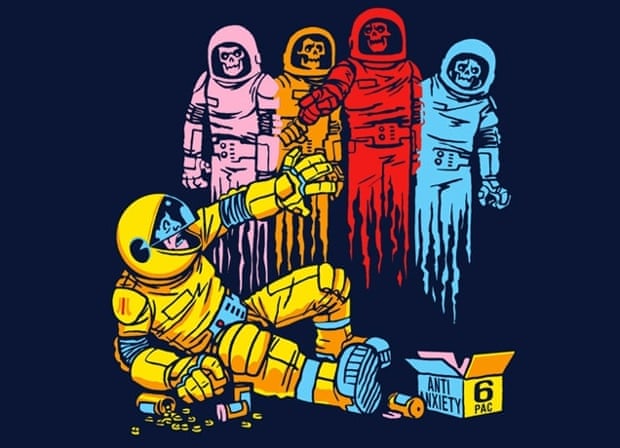
- Amphibia: Hop Pop's initial overprotectiveness towards his two grandchildren was because their parents were killed and eaten by herons while he was away on a trip, and he holds immense guilt over the fact he wasn't there to protect his family back then, even though Sprig and Polly assure Hop Pop they don't blame him at all for what happened.
- On Avatar: The Last Airbender, Aang goes through this phase in the episode "The Storm".
Aang: The Fire Nation attacked our temple. My people needed me, and I wasn't there to help.
- Cleveland from The Cleveland Show. When his ex-wife Loretta dies, it forms a rift between him and his wife because of how broken up he is over it. Eventually, he figures it must be survivor's guilt because he'd repeatedly survived what killed her: Peter destroying his house, which caused his bathtub to slide off the second floor and shatter. (He survived this 4 times in Family Guy and 3 times in his own show, but the first time it happened to her, she broke her neck).
- Leela goes through a spell of this in the Futurama episode "The Sting" after Fry commits a Heroic Sacrifice to prevent her from being stung by a giant bee. Her guilt drives her increasingly mad with dreams and visions of Fry, to the point she contemplates falling into an eternal slumber to avoid having to live with it. The ending reveals it was all just Adventures In Coma Land so her guilt wasn't actually real.
- Demona from Gargoyles is the poster girl for this trope. Surviving the near-extermination of her kind, compounded by her being immortal so she can't even join her dead kin unless she lets Macbeth kill her, has left her with the need to use humanity as a scapegoat because facing that sorrow and guilt scares her.
- Justice League:
- The episode "Hereafter" features an interesting version. Superman is flung far into the future, where the Earth is a wasteland under a red sun. The sole surviving human is the immortal Vandal Savage, who reveals that he ended up destroying humanity in one of his plans for world domination. Guilty for what he did, he assists Supes in returning to his own time and stopping him.
- From the same episode, back in the present day, the League and Toyman think that Superman is dead. Superman got hit by shoving Batman and Wonder Woman out of the way of Toyman's ray. Wonder Woman gets homicidal over survivor's guilt, and Toyman only survives thanks to The Flash.
- Star Trek: Lower Decks season 4 episode "The Inner Fight" reveals this as why Beckett Mariner constantly acts out and trying to get herself staying at Ensign: the combination of Sito Jaxa's death on top of the Dominion War scarred her so badly that she decided to stay as an Ensign so she wouldn't cosign her friends to death.
- Sym-Bionic Titan: Lance experiences this after Octus is killed protecting him from an electrical Mutraddi. He and Ilana spend the next two episodes trying to revive him.
- Transformers:
- G1 Bluestreak is described as the only survivor of his city, and presumably developed his nervous habit of constant chatterboxing to fill the silence.
- Gunrunner was an Autobot commander. His entire squadron was slaughtered, except for him, due to his pretender shell. Worse, he promised them all they would get out alive.
- Depth Charge from Beast Wars was the only survivor of a Maximal colony destroyed by Ax-Crazy Predacon, Rampage. Rampage slaughtered everyone else and even ate some of them. As a result, he made it his personal mission to hunt Rampage down and kill him.
- Nightscream from Beast Machines displays signs of this, particularly in the episode "Survivor." Within the episode, Nightscream and Optimus discover an underground, organic cave within Cybertron that houses numerous fossilized animals. Optimus is overjoyed, as it implies that Cybertron was once an organic world. Nightscream, on the other hand, becomes enraged/heartbroken, commenting that there were enough fossils for the entire Maximal population to scan, which would have saved them from Megatron's takeover (Megatron's scanners cannot detect Cybertronians with beast modes).
- Wheeljack from Transformers: Prime shows signs of this after he and Ultra Magnus suffer heavy damage from a brutal fight with the predacon, Predaking. Despite Wheeljack being the one taking more damage, Ultra Magnus is the one that loses his hand in the fight. He's repaired with a claw-like appendage while Wheeljack, after seeing that this was all Ratchet was able to do for him, laments over the fact that he's still "two-fisted".
