Sebastian: The Light of the Maker is my armor, Merrill. I am not afraid.
Merrill: Maybe you could ask Him to make His Light less shiny? Then you wouldn't need as much armor.
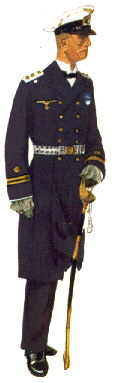
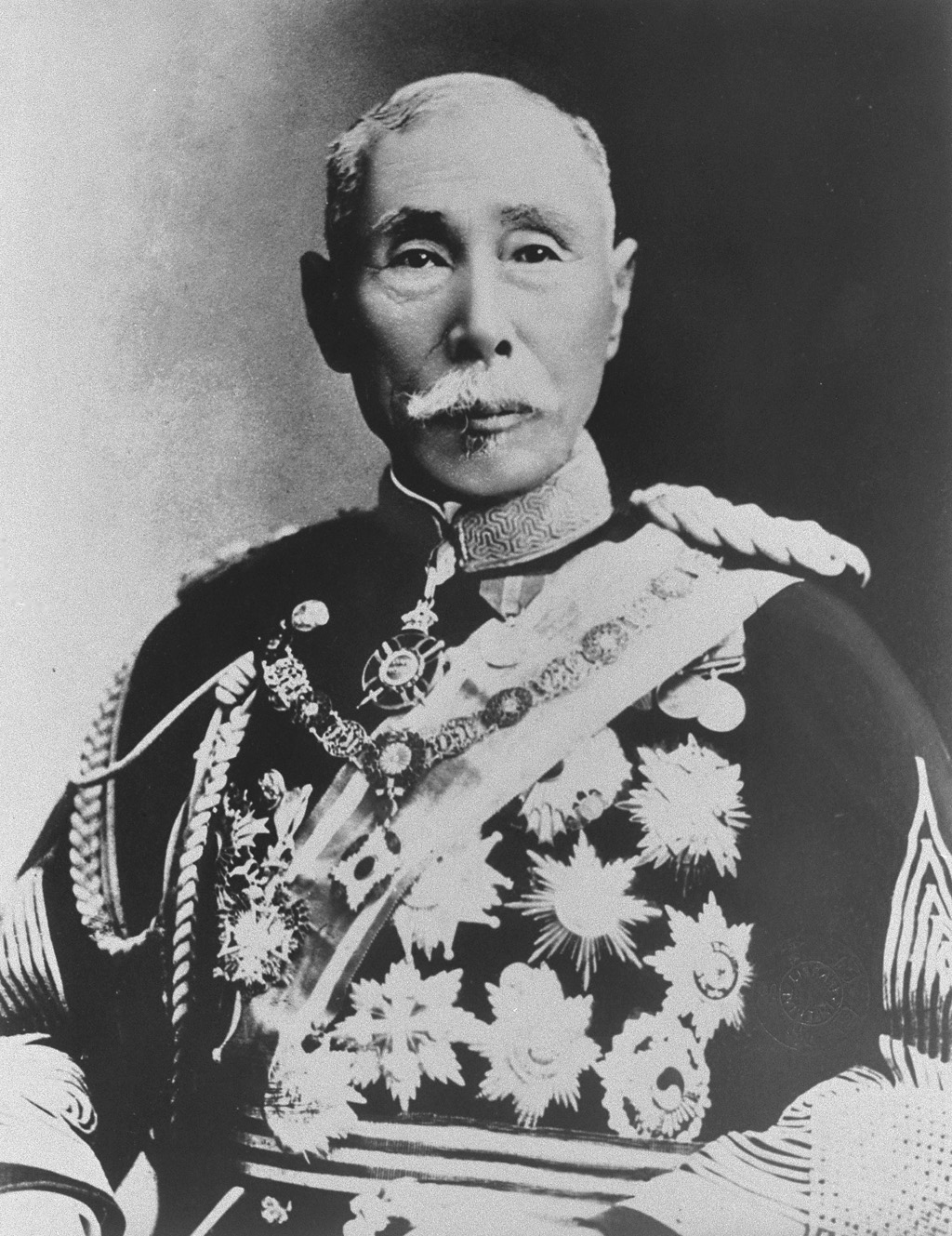
So, you've just entered your country's military force. And everyone seems to have these really spiffy dress uniforms. Really fancy, with actual silk and gold and precious gems.
Wait, what? Those are combat uniforms?
Yes, some fiction has characters wearing combat uniforms that are more appropriate for dress uniforms.
But they look nice, so artists love to use them whenever they can, especially in anime, manga, comicbooks, and Video Games. (And not to mention paintings and relief sculptures; this trope is very much Older Than Dirt!) In literary genres, where we do not actually get to look at them, these are generally the mark of aristocrats, the Miles Gloriosus, the Armchair Military, and the Glory Hound. On the other hand, the serious soldiers are more practical and drably dressed, and certainly regard looking splendid as a much lower priority. Only their dress uniforms embody the trope — if then.
Personal weapons may or may not involve Bling-Bling-BANG!. The hat is often a Commissar Cap. Officers and senior enlisted may carry some stick or baton indicating their rank, and expect their chests to be covered in various jangling medals. Futuristic settings can even have Powered Armor or Humongous Mecha in this style.
This can overlap with Impossibly Tacky Clothes, when the work is making a Take That! to this trope, or dealing with cases where the uniforms are purely for showing off wealth rather than conveying a kind of aristocratic dignity. Historically many successful mercenaries have tended to dress in elaborate and expensive ways, given that this was one of the few reliable status symbols they could spend their money on, and such get-ups are much more likely to be regarded as tacky and unsophisticated.
A sub trope is one where an individual disdains the awarding of such medals and ribbons and refuses to wear them. This is always an indicator that the person in question is a real badass, especially in comparison to the Fake Ultimate Hero (who will usually play this trope straight).
This trope is very much Truth in Television; see the Analysis Page for more.
A Sub-Trope of Costume Porn.
Compare Sukhomlinov Effect, Ermine Cape Effect, Costume Porn, Pimped-Out Dress, Stylish Protection Gear, Highly-Conspicuous Uniform, Highly-Visible Ninja, Gold Makes Everything Shiny, Kicking Ass in All Her Finery.
Design determines if a particular uniform also falls into Impractically Fancy Outfit or Impossibly Cool Clothes. Scary Impractical Armor might be considered a more overtly sinister variant.
See also Custom Uniform, Modest Royalty.
Examples:
- Last Exile does reserve them for officers.
- As just about all the Gundam shows.
- There are even a few Humongous Mecha examples from Gundam, like Dozle Zabi's Zaku II
 or M'Quve's Gouf. Taken to an extreme with the Zabi Family Custom Big Zam, which is basically a Big Zam with the same gold etching as Dozle's Zaku.
- However, it should be noted that these are not actual combat models but more of a ceremonial design. It also did not appear in any of the anime or manga, just All There in the Manual.
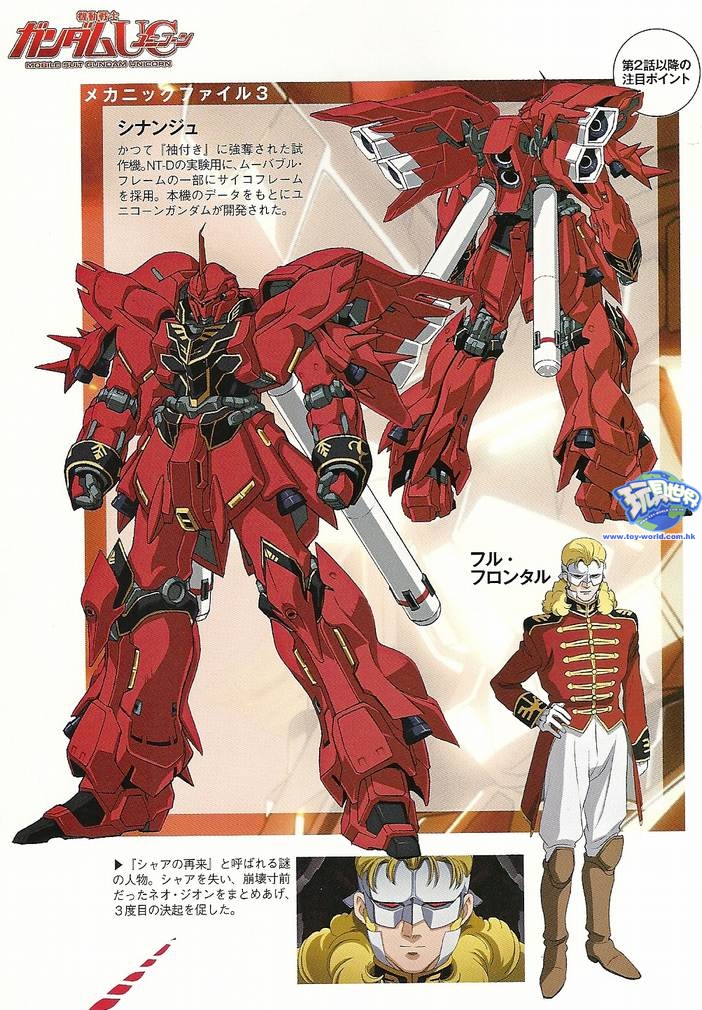
- There is also the higher-ranking officers of "The Sleeves" that have the nice uniforms and rather decorative embellishments on their mobile suits, especially◊ the Sinanju.◊
- This is what you get if you have lots of gold but no one willing to sell you actual military supplies.
- Subverted with the Hyaku Shiki from Mobile Suit Zeta Gundam and the Akatsuki from Mobile Suit Gundam SEED Destiny. Both are painted in brilliant gold, (in fact, the Hyaku Shiki is the trend setter for gold mobile suits in Gundam,) but there are good reasons behind their colors. The Hyaku Shiki's scheme is a result of being covered in Anti-Beam Coating, as well as acting as a middle finger to the Titans (i.e. "we can make new MS right under your nose"), made possible through "Quattro Bajeena" being the pilot. Meanwhile, the Akatsuki takes its predecessor's special feature up a notch, in that its gold armor is actually an advanced beam reflection system.
- Gundam SEED Frame Astrays has an extreme example with Rudolf Wittgenstein's custom GOUF Ignited: It doesn't just use gold paint, it has actual gold bonded to the armor. Unlike the Akatsuki, it serves no practical purpose whatsoever.
- Mobile Suit Gundam 00 has the mobile armor Alvatore; its gold plating may be plain compared to the aforementioned designs from the other series, but it also has lavish pop-up window designs in its cockpit viewscreens! Also, it has been noted that the Alvatore's mobile suit component, the Alvaaron, has the Corner family crest on its chest. Strangely it does not show on any of its depictions.
- This is used for visual storytelling in Mobile Suit Gundam: The Witch from Mercury. The Dueling Committee's mobile suits tend to have bright colors and cool-looking accessories and weapons, best shown off in the first episode with Guel's Dilanza featuring a huge feathered headcrest. This is because these suits are essentially serving as toys for rich kids and they participate in what is essentially a futuristic equivalent of a medieval joust. The suits we see serving in actual combat tend to be far more drab and unadorned.
- There are even a few Humongous Mecha examples from Gundam, like Dozle Zabi's Zaku II
- The Black Order uniforms from D.Gray-Man. Fanciness partially justified though, as the Exorcists intentionally make themselves targets.
- The Britannian military in Code Geass probably counts — Cornelia and the Knights of Rounds' uniforms in particular. To be fair, though, most of the time they fight inside mecha, and wear appropriate suits while doing so. Footsoldiers have appropriately helpful attire.
- In Demon Slayer: Kimetsu no Yaiba, despite being a shinobi themed demon slayer, Tengen is a self-proclaimed god of festivities who’s all about flamboyancy, his forehead protector is adorned with jewels, his arms are adorned with four massive golden bracelets, two in each arm.
- Haruhi Suzumiya: Haruhi and the SOS-Brigade wear these in the anime adaptation of "Day Of Sagittarius" during the scenes of Deep-Immersion Gaming, since they're playing a sci-fi strategy game.
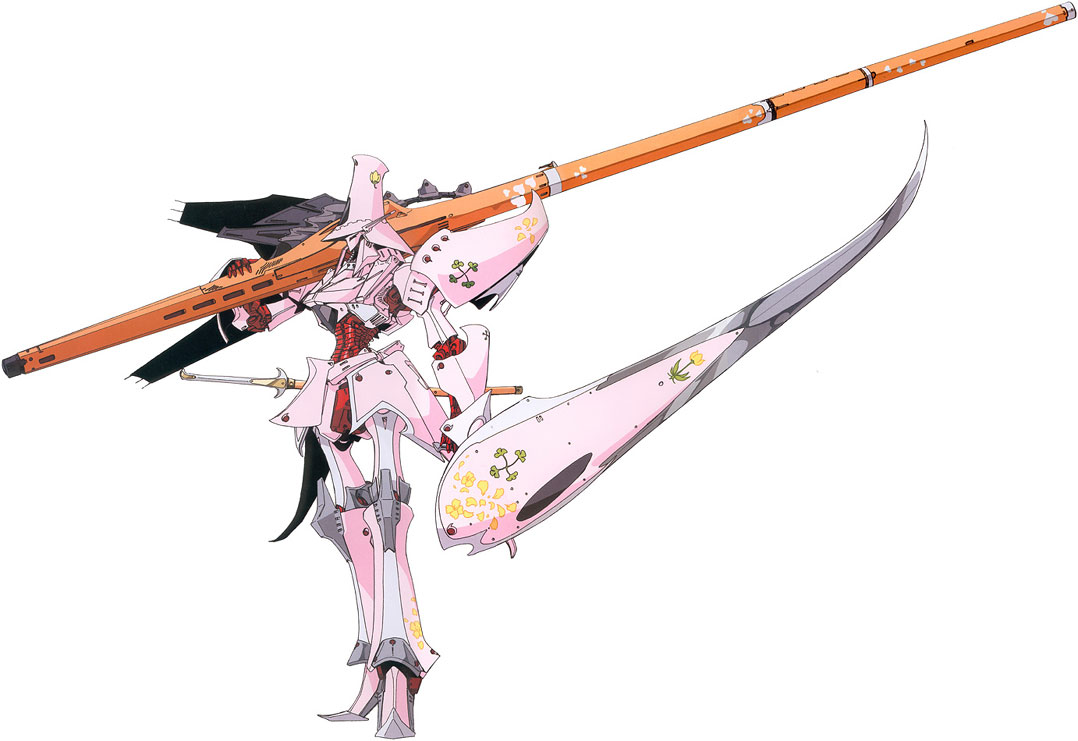
- The Headliners of The Five Star Stories wear fairly elaborate costumes, unsurprising considering the manga is basically Mamoru Nagano's giant love letter to weaponized bling. No as crazy as some of the other examples, though as the Headdliners mainly serve as pilots for Humongous Mecha. The ordinary ground troops typically wear more sensible uniforms with design elements borrowed from recent real-life military gear.
- The Mortar Headds themselves◊ also fit this trope to a T.
- In his and (of all people) Kunihiko Ikuhara's collaborative two-volume light novel Schell Bullet, however, his love of bling manifested itself rather more spectacularly (it helps when your co-author is also a fashion model). Junior Navy officers wearing capes as a part of an everyday uniform? Infantry grunts with an Italian Renaissance-inspired headgear? Quilted body armor? True, modern body armor has quilted layers, but they are usually concealed, as quilts present a weak points. Knee-high boots? Two-inch heels (for men, mind you)? What are you smoking, man, really?
- The Mortar Headds themselves
- Kaneo Takarada of Kill la Kill fame fought to protect his school in a crab mini-mecha made of gold.
- In Fullmetal Alchemist, even the lowliest foot soldier apparently gets outfitted with one of those snazzy uniforms, and they're not just for show — in Fullmetal Alchemist (2003), we see Amestris soldiers going into battle wearing them.
- What about France from Hetalia: Axis Powers? Even his own allies tell him "you're too flashy, moron!"
- This is Truth in Television. There's a reason the pretty red and blue colors were changed into something more drab during the course of World War I...
- Bling of War + Cool Mask + a kilij scimitar = Turkey.
- Apparently the guiding principle of The Empire in Legend of the Galactic Heroes; its highest-ranking admirals sport full capes (in unique colors!) and field marshals' batons.
- Their insignia is literally embroidered on the uniforms. In real silver thread. It goes from rather simple patterns for junior officers to the ornate tapestries just short of the flak vest for admirals. You see, the Empire really dug that ceremony thing.
- Just about every important military character in Glass Fleet, though Michel and Vetti's are the most noticeable. Justified in that Glass Fleet is the French Revolution in space!
- Berserk has commanders and nobles wear these, though most seem practical with just a few elaborate designs. Boscogn of the Purple Rhino Knights is a prime example, with his armor having plenty of pointed ends and his helmet shaped like a rhino's head.
- Not exactly war, but Revolutionary Girl Utena clearly has this in mind with the duelist outfits. Hell, half of the time Anthy uses her powers is to add frills and tassels to Utena's Custom Uniform and just generally make her look more awesome.
- The Rose of Versailles:
- In line with historical practice around the time of the French Revolution, this features some fancy uniforms, especially on the lead character. Even the "dregs of the army" (the French Guard, which Oscar commands at the end of the series) gets their share of bling.
- Also features in the sequel Eikou no Napoleon: Eroica. It backfires spectacularly on the Mamluks, the most blinged one by virtue of wearing large amounts of gold jewels when going at war, when Napoleon tells his men that, just for once, he'll recognize their right of sacking and why the Mamluks are so shiny. The Battle of the Pyramids ends in a French triumph.
- Somewhat justified in One Piece. A lot of the really blinged out Marines in the series have Devil Fruit powers which turn both them and their clothes into some kind of element. The one that doesn't, Sengoku, drops the bling when using his powers (though said powers provide a whole different bling).
- Played both straight and subverted among the Time-Space Administration Bureau aces and specialists in Lyrical Nanoha. While their personal Barrier Jacket occasionally has blings, frills or spikes, they also have modestly designed regular military uniforms.
- Takuto from Star Driver really knows how to dress in combat, as demonstrated here◊. Please note, that's not an exaggeration, that's really what he wears during combat.
- In Ghost in the Shell: Arise Batou's JMSDF dress uniform looks significantly more blingy than the Major's JGSDF one, though the latter probably just didn't go all the way (like Kurtz with her Navel-Deep Neckline).
- In Fate/Zero, Archer makes sure that you know he is the King of Heroes and that all the world's treasures belong to him. He does this by wearing a fancy suit of golden armor that lets him No-Sell almost everything, and the weapons he fires from his Gate of Babylon are frequently gilded.
- The new members of Oarai's Sensha-do team in Girls und Panzer paint their tanks in a variety of garish colors (save Miho's Panzer IV, which keeps the dark grey paint it was found in). Notable examples include Rabbit Team's pink M3 Lee, Hippo Team's StuG III painted with a mix of red and yellow, mountains against a blue sky, historical quotes and side-mounted sashimonos, and Turtle Team's gold Pz 38(T). This especially hurts Hippo Team, as a rival Matilda II spots the StuG's sahsimonos when they try to sneak through an alleyway behind a fence and knocks them out. All the teams ditch the louder paint for more traditional greens, browns, and greys when the National Tournament begins.


- The Night Watch: The higher-ranking militiamen wear helmets (or hats) ornated with engravings and feathers, sashes, and puffy-sleeved upper garments. The captain and his lieutenant have golden embroideries on their clothes and sashes, as well as decorated weapons.
- Seven Virtues: "Fortitude's" armor is very elaborate, especially its shoulder (with a dragon wing-like golden decoration) and breastplate (with what appears to be diamonds as "nipples") sections.
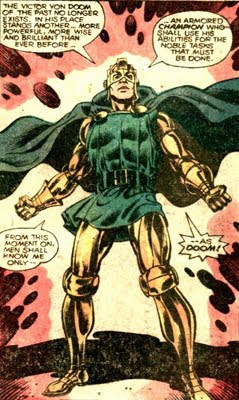
- In the What If? story "What If Doctor Doom Had Become A Hero" Doom still wears a version of his traditional armor, but instead it's a shining golden number◊ that makes him look like a Knight in Shining Armor — even as a good guy, Victor will always have his Awesome Ego.
- in Wonder Woman Historia: The Amazons the armor of the 30 original Amazons are very ornate and intricately designed. Each one being individually distinct from one another.
- The Phantom: The oneshot villain Goldhand wore a hand prosthetic made of solid gold - as an intimidation method, way to show off his wealth, and as a very deadly bludgeon. Getting karate chopped by sixteen pounds of lucre packs a very deadly panache.
- Ages of Shadow: Just before her Final Battle with Trace, Jade/Yade Khan completely coats herself in molten gold.
- Cycles Upon Cycles: Legion, after the Geth becomes a protectorate of the Protoss, gains itself a shiny gold platform.
- In Imaginary Seas, Percy finds himself outfitted in his father's golden armor upon being summoned in the Lostbelt. He's embarrassed by how gaudy it looks and the gratuitous Cleavage Window, so he tries to find a shirt to cover himself up with.
- The Naked Jedi: Sarza’s only clothing, if it can be called that, is a silver band on her right thigh that secures her lightsaber. When she builds her own lightsaber, she uses a Hazian smelt conduit and adds corundum highlights, making her lightsaber hilt gold and purple.
- No stars in sight:
- Formora describes the outfit that Ikharos wears as "armoured finery" with gold and colorful jewels adorning his armor and robes.
- Vindica'aur is a Val (Cabal military rank equivalent to captain) who has her tusks capped in gold and wears ornaments on them while on active duty aboard her warship.
- Ripples: During Allora's time as Queen of Meridian, the Royal Guards all wear ceremonial (but otherwise useless) gold armor. Weira is disgusted by the waste of money that could otherwise be used to better tend to the kingdom's needs.
- Squaring the Circle, the true story of the Polish uprising of the 1980s, had a Polish general trying on an ornate dress uniform and asking his secretary, "Do you think it looks too... South American?"
- Most of the Star Trek: The Original Series movies featured a relatively restrained form of this, a tailored and padded maroon-and-black uniform with gold and silver insignia, adding up to a vaguely nineteenth-century look. Again, this wasn't handled too crazily — enlisted personnel wear an eminently functional jumpsuit, Starfleet is overwhelmingly a "naval" force, and the few times we see authorized ground combat, officers exchange the heavy, stiff jackets for a black sweater similar to some Real Life military cold-weather gear (specifically, the much-missed "woolly pully" of the British Army). In an amusing postscript, Star Trek: The Next Generation reveals that the "monster maroons" lasted for over seventy years, while most Starfleet uniform designs are only in service for ten to twenty. Perhaps they were good for pulling Green Skinned Space Babes?
- TOS' dress uniforms are in the three primary colors but lavishly trimmed with gold braid and cute little triangular decoration ribbons for extra bling.
- The Ferengi accuse the Federation of this in their first appearance because their communicators consist of it; the Federation only uses it because it's an excellent conductor.
- Averted in Star Trek Into Darkness. Starfleet's dress uniforms are simple and utilitarian; even their rank insignia has a matte finish. The closest they get to bling are the black uniforms and sky blue sashes of the honor guard.
- Parodied in the Three Stooges short "You Nazty Spy!" where Curly, playing Field Marshal Gallstone, is covered in medals, including one on the back of his pants.
- Just before the Battle of Cowpens in The Patriot (2000), the French Major Villeneuve puts on his elaborate white, sky blue and gold uniform (which we had never seen before). Benjamin Martin gives him a look, and Major Villeneuve says, "If I die, I will die well-dressed."
- In Sergey Bondarchuk's Waterloo (1970), we see only the flashiest-dressed troops, including Polish Lancers of the Guard, carabiners and Prussian cavalrymen, even though their historical presence in the campaign was smaller or non-existent at the actual battle.
- In The Dark Knight Rises, Deputy Commissioner Foley wears his full dress uniform while leading the police charge against Bane's forces. Justified in this case, as he was doing it to make a statement and was being intentionally conspicuous. Also doubles as a Brick Joke from an earlier scene in the movie.
- X-Men Film Series
- X-Men: Days of Future Past: Blink has the most beautiful combat uniform in the film, according to producer Lauren Schuler Donner in the "Two Worlds, Two Battles" documentary on The Rogue Cut.
"The costume that stood out to me the most is the one that Fan Bingbing wears. That costume weighs minimum 25 pounds. [..] What Louise [Mingenbach] did was she went off to vintage stores, found beaded collars and put them all together in this amazing design, which she puts on the back of the jacket and on the epaulettes."
- X-Men: Apocalypse:
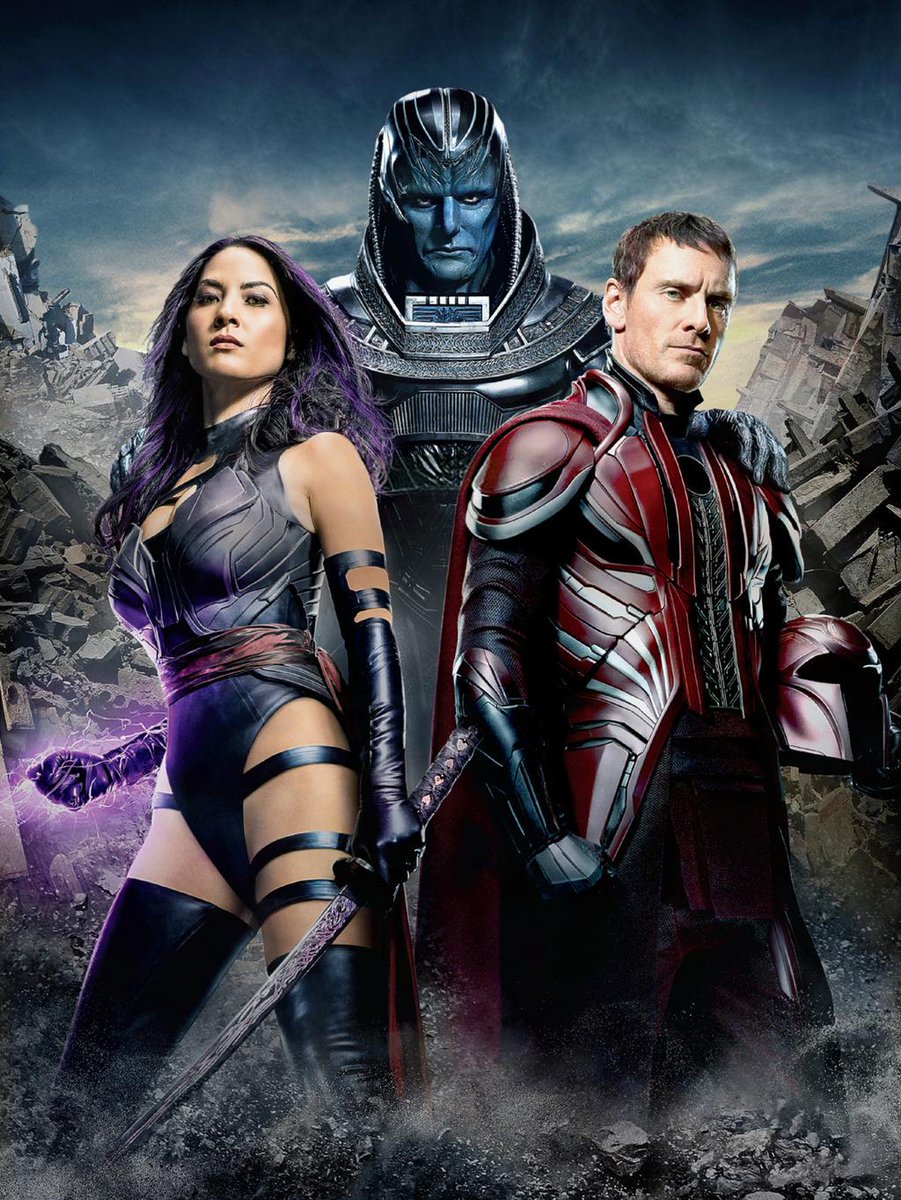
- Magneto's Horseman armour◊ is glorious, and it's certainly more awe-inspiring than his previous costumes.
- Archangel's silver-and-dark-grey armor is also marvelous to behold.
- Magneto's Horseman armour
- X-Men: Days of Future Past: Blink has the most beautiful combat uniform in the film, according to producer Lauren Schuler Donner in the "Two Worlds, Two Battles" documentary on The Rogue Cut.
- In The Alamo Davy Crockett lampshades this aspect of Santa Anna at one point, calling him a peacock.
- Marvel Cinematic Universe:
- Thor: Loki's green-and-gold armour is magnificent to behold. It's more stylish than Thor's or Odin's, which is not surprising considering that Loki is a master of deception, so appearances are important to him.
- Black Panther: One of Gadgeteer Genius Shuri's proposed new uniforms comes with a gold trim that isn't as out-there as some of these examples, but is still enough that her brother turns it down because the idea is to stay out of sight. When the "Killmonger" Erik takes the throne, and carries a distinctly "gangsta" theme with him, the last thing he wants to do is stay out of sight, and he apparently thought that one was worth wearing into battle.
- Star Wars:
- Captain Phasma's shiny silver armour, made from chromium salvaged from a Naboo starship once owned by Emperor Palpatine and worn with a red-fringed black cape, as seen in The Force Awakens and The Last Jedi. Even her blaster is gold-plated.
- Director Krennic from Rogue One dresses like quite the diva for an imperial officer with his fancy white uniform and flowing cape. At least Tarkin, a Grand Moff who outranks him, is more modest.
- Otherwise averted for the Empire as a whole, as they wear eminently practical uniforms. The novel Tarkin reveals that Tarkin designed the uniform specifically to avoid it, purposefully going for the plain and leaving space only for the rank badge — the only decoration he believes appropriate for a military officer.
- In Wonder Woman 1984, Diana/Wonder Woman dons a golden armor with wings and an eagle-shaped helmet adapted from the one she first wore in Kingdom Come.
- The Song of Roland features golden armor, a trope as old as The Iliad. Where the Roland poet goes above and beyond, though, is when Moorish lords charge into battle in golden helmets encrusted in gems and decorated in flowers, both of which go rolling to the ground with each sword blow to the head. Roland also carries a gilded and bejeweled horn, Oliphant.
- The Iliad, come to mention it, has heaps of this.
- Agamemnon's breastplate, for instance:
Now there were ten circles of deep cobalt upon it,
and twelve of gold and twenty of tin. And toward the opening
at the throat there were rearing up three serpents of cobalt
on either side, like rainbows, which the son of Kronos
has marked upon the clouds, to be a portent to mortals. - Another is the interminable description of Achilles' new shield forged by Hephaestus in Book XVIII, with its silver strap and gold facing covered in embossed scenery.
- Agamemnon's breastplate, for instance:
- While more subdued and practical that most, Honor Harrington's Manticoran naval uniforms (especially officers' ones) still have more than enough gold braid, buttons and other bling for others to comment on in the books themselves. Havenites' uniforms were (in contrast to Manticoran black and gold), rather nondescript grey, and those of Grayson were copies of modern US Air Force blues. None of these, however, are worn in an actual combat situation outside of unforeseen events, with the standard uniform being skinsuits.
- In Going Under, the third book of Justina Robson's Quantum Gravity series, the protagonist Lila Black is given a set of tailored combat armor from a famous demonic fashion designer. The description in the book must be read to be believed, but it features every color in the rainbow, lots of intricate decorations, magical amulets covering every surface, and a stylishly form-fitting bodice.
- While the majority of Imperial officer uniforms look like this guy,◊ with a few more colors and some different rank cylinders, Star Wars Legends introduced the Grand Admirals, whose gear is... a bit fancier.◊ The most infamous of them, Thrawn, apparently preferred this uniform without the epaulettes and fancy trim, at least when he wasn't in the Emperor's presence.
- As of the X-Wing Series, pilots endlessly complain about their dress uniform◊, which was designed without actually consulting the pilots. It's actually agreeable enough as an outfit, but the lack of decent pockets and the fact that it shows off any excess body weight — pilots being image-conscious — are detriments to its wearers.
- Darksaber featured one Imperial warlord who had so many medals (some likely concocted for prestige) that he cobbled them together into a makeshift dagger. He still died.
- As of the X-Wing Series, pilots endlessly complain about their dress uniform
- The Dresden Files: Before the final battle at Chichen Itza, Lea fulfills the tradition of Faerie Godmothers creating magnificent Costume Porn clothes. As she says, she "never got the chance to indulge". She and Susan dress Harry up in all sorts of things, but settle on a gold-embossed magically enhanced suit of conquistador armour. He complains that he looks like the Games Workshop version of a Jedi Knight. It's still awesome.
- Warhammer 40,000:
- Blood Angels: In Red Fury, when the Blood Angels and Flesh Tearers meet, one of the Blood Angels suspects that — with the Flesh Tearers' unadorned power armor and the gold filigree, rubies, votive chains and other adornment on the Blood Angels' — the Flesh Tearers take them for peacocks.
- Small Cog: Played with. The forces are on a ceremonial duty when the attack comes. On one hand, this lets them get to their current position in time to defend. On the other hand, they're in ceremonial uniforms. The colonel is not pleased with the latter fact.
- Gaunt's Ghosts:
- Contrasting the Ghosts' uniforms to those of aristocratic units always shows the Ghosts' as more subdued. (Better for subterfuge at any rate.) Conversely, one mark that they can integrate with the Belladon soldiers is that the Belladons take their advice about darkening their insignia so it doesn't show up on the battlefield.
- First and Only:
- The Vitrian Dragoons regiment all wear very shiny armor, but this is subverted in that the armor is actually adaptive camouflage.
- General Dravere, a textbook Armchair General, insists on wearing all of his medals on his uniform, at all times (his former superior, Warmaster Slaydo, who despised him, derisively nicknamed him "the Old Gong").
- His Last Command: the Dev Hetra, being New Meat and Blue Bloods, are very fancifully dressed. They in fact scorn Ludd because his clothing is rumpled after running over a battlefield to reach them.
- Inheritance Cycle: Fadawar wears golden armour, although this may simply be a ceremonial dress uniform (although, it says a lot for his strength that he can walk about in it).
- Invisible Man: Ras the Exhorter applies this trope heavily after becoming Ras the Destroyer, though rather than using gold and such, he wears "the costume of an Abyssinian chieftain." The narrator mocks him for it, but at least the spear comes in handy.
- Vorkosigan Saga: Combat takes place in the normal spacesuit/armored suit, but the noncombat uniforms are impressive. Barrayar has "undress greens" (typical daily wear), "dress greens" (fancier, for formal occasions such as parties or weddings), and most formal of all, "parade red-and-blues" (for major governmental functions such as the Emperor's Birthday; high collar, tall boots, and two ceremonial swords). Plus, Vor are allowed to wear their medals with their House colors. In Memory, Miles Vorkosigan, off to talk to the Emperor, pulls out all of his medals and puts them on with his House colors, for effectively the first time. Even he hadn't realized what a collection he had. (The Emperor's reaction upon seeing him: "Good God".) The "House colors" are a riot. Sixty districts, each with a different pair of heraldic colors, and wearing them at major occasions. Vorkosigans are lucky, with a restrained brown and silver, and some (such as the Vorpatril blue and gold) are bona-fide impressive, but some... note that ceremonial reds-and-blues are just the House Colors of the ruling Vorbarra clan, all Barrayaran military legally just being their official retainers. They also use the cut inherited from the Times of Isolation, which looks vaguely Napoleonic.
- Kareen: How do you think you'd look in a House cadet's uniform of chartreuse and scarlet, like poor Vorharopulos, Mark?
Mark: Like a traffic signal in boots.
- In Edgar Rice Burroughs's The Chessmen of Mars, Tara says of the warriors of Gathol, "You fight in platinum and diamonds?" and while Gahan of Gathol does his best, she is left less than impressed; he must disguise himself as a mercenary in plain clothing to win her favor.
- Actually, he doesn't disguise himself, as he goes out to rescue Tara, he simply wears Gathol's *field* harness, which is as plain as their ceremonial harness is gaudy.
- Discworld:
- Commander Vimes hates this trope; he refers to it as "Gilt by association." The "traditional" uniforms for the Commander of the Watch and the Duke of Ankh-Morpork, His Grace Sir Samuel Vimes (Blackboard Monitor) are shiny and feathered and have tights; there is basically nothing in that description that he does not object to. He put his foot down about the tights and the feathers in the end, thankfully, but still has to put up with shiny armour with knobbly bits that would probably be worth Sweet Fanny Adams in actual combat.
- Jingo has him saying to his butler "And into this land of sand-colored dust and sand-colored rocks and sand-colored sand you, Willikins, will march with your red and white uniform? And you don't see anything wrong with this?"
- Monstrous Regiment: The Borogravians sport the redcoat look, of which Polly notes the exact same objection to wearing in a grey forest.
"Ashamed of your lovely, lovely uniform, Perks?"
"Don’t want to be seen dead in it, sarge."
- As a subversion, in David Gunn's Death's Head series, uniforms in Sven's regiment get less bling as rank increases.
- Subverted in the second book of The Bartimaeus Trilogy, where Bartimaeus points out that "as a rough rule of thumb, the jazzier the uniform, the less powerful the army."
- Subverted in Space Cadet (Heinlein). Both cadets and officers in the Patrol wear extremely plain uniforms. Heinlein briefly discusses the psychology behind plain and jazzy uniforms.
- Belamy in Skate the Thief received a set of fantastically designed "war robes" as a reward for his military service; he usually keeps the pricey gift locked up with assorted junk in his basement. It serves as a Chekhov's Gun, providing him the rubies needed to fire off a bunch of fireballs all at once near the end of the book.
- Wealthy knights in A Song of Ice and Fire love to wear extremely ornate armor, especially during jousts, but often into actual battle as well. Various knights wear gem-encrusted breastplates, lacquered armor, fancy capes and so forth. Even knights without money to burn will get themselves sculpted helmets. Particular examples include:
- King Maekar Targaryen wore black armor with curved dragon teeth running across his shoulders, along the crest of his helm and down his back, giving him a very fearsome appearance. During battles, he even wore a crowned helm with black iron points around it.
- When Jaime Lannister competes in tourneys, his armor is covered in gold from head to toe, and he carries a gilded sword. He also occasionally wears a golden helm shaped like a lion's head.
- When riding into battle, Tywin wears a greatcloak made of several layers of cloth-of-gold, large enough to entirely cover his horse's hindquarters and so heavy the breeze doesn't even stir it when galloping. It's held by a pair of solid gold lionesses with rubies for eyes. His helmet is also gold, shaped like an entire lion with ruby eyes. His armour is enamelled in red with elaborate gold inlay, gold rondels in the shape of sunbursts, and golden buckles. All of his weapons have solid gold lions on the hilt. Not surprisingly, he doesn't expect to do any fighting,note though he does lead his reserve guard into battle personally against Roose Bolton's host.
- Loras Tyrell wears armour covered in silver, filigreed with black vines and blue forget-me-nots made out of sapphires. He once wears a cape woven with forget-me-nots. His horse also gets a woven flower cape — red and white roses, which he hands out to pretty girls between jousts.
- Renly Baratheon wears armour enamelled in forest green, and a green helm with two feet of solid gold antlers attached to it.
- Rhaeger Targaryen went to war in black plate armour with a three-headed dragon made of rubies on his chest. When he died, a large number of the rubies fell into the river, which is later named Ruby ford, and people have been scavenging for them ever since.
- Several mercenary companies that join in the siege on Meereen feature this. One company is made up of mercenaries who wear all their worldly wealth in clothing and armor, and as such are usually too overburdened to fight properly.
- The officers of the Golden Company are odd ducks. Yes, they are very blingy: for each year they have held a position of command, they wear gold armbands, wrist bands, neck torcs... whatever combo adds up right. This is on top of the standard sculpted sets with their heraldic colours of clashing, the filigree-and-gems and expensive inlays often seen in well-made, well-to-do Westerosi arms and armour. But, as far as, Essosi norms go: this is just boringly plain and practical (wearing your ransom and/or "don't bother selling me as slave to make a profit" bribe speeds the process should you be captured). Seriously, these guys don't even wear impossibly impractical helms, expensively endangered furs (that protect nothing), golden hobbles or stilts! How can they terrify anybody in boring, cowardly armour like that? (By being, you know, scarily effective on the actual field.)
- Then we have "Bronze" Yohn Royce, noted for wearing an ancient suit of bronze armor. This normally wouldn't stand up to the steel armor and weapons used by those he face in battle, except it's apparently inscribed with magical runes that wards the wearer from harm, making it not only more fancy but also practical. His sons Andar and Robar in contrast wear silver-colored armor with bronze runes.
- The one thing you'll find Gregor and Sandor Clegane actually agreeing on is that bling for bling's sake is beyond stupid. The only things close to it either of them own is Sandor's snarling dog helm (and even that puts the "protect my nose and skull without giving me a headache" practicality before the very likely carefully crafted insult directed at his brother) and Gregor's identify-me-by-this-crest, slightly sculpted helmet, which he often doesn't even wear outside tourneys, since he goes plain. The rest of their gear? Dark, plain, practical and well-made. Both are killers rather than standard knights, though.
- Lord Tytos Blackwood owns not just one, but two sets of ornate armor. His first set of armor is covered in gold leaf and inlaid with jet with elaborate vine and leaf patterns. His second set is burnished scarlet suit inlaid with a silver dead weirwood and surrounded by flying ravens cut from onyx (House Blackwood's sigil). For both suits he wears a cloak made of raven feathers, the only other characters in the series who wear feather cloaks are the notoriously flashy Summer Islanders.
- Ramsay Snow wears a horrific example of this: he wears dark pink plate armor designed to look like muscles with a helmet showing a face screaming in agony. It's meant to look like a victim of flaying, which is the sigil of his father's house.
- Vargo Hoat wears a horned helmet shaped like a black goat. He's from Qohor, their main god is the Black Goat and their armor is the finest in the Known World. He also wears a chain of linked coins taken from all the places he has fought, they come in all shapes and sizes and desgins include kings, wizards, gods, demons, and all manner of fanciful beasts.
- The Tattered Prince gets his name from the elaborate cloak he wears. Its pieced together from scraps of the banners of armies he's defeated and surcoats of men he's killed, all of the colors clash and it resemebles a patchwork quilt. He wears it over plain, but elegant armor and he says his appearance is so plain and forgetable he's totally anonymous when he's not wearing it.
- In the RCN series, when Daniel Leary wears his Dress Whites with all decorations, including the gaudy ones from friendly foreign worlds, he comments that he feels like a clown. But it impresses pretty girls and civilians in general — as well as anyone who knows what he did to earn those awards.
- The Belgariad.
- Deconstructed — Ce'Nedra leads an army into battle wearing a suit of armor made entirely of pure gold but knows exactly how impractical it is in an actual fight. She uses it entirely to serve as an inspirational figure to bolster the troops' morale.
- Lampshaded when she's having it made. The smith making it is utterly dismissive of Ce'Nedra's request for fancy armor (and particularly of her desire to have the bust "augmented" a bit), until she tells him to look at her, and asks if he thinks that she, in the best, most practical armor he could make, would last even seconds in a fight with an enemy warrior. Effectiveness in combat is not what she's concerned with.
- Taur Urgas, King of Cthol Murgos, dips his (steel) mail in molten gold. Since Angarak gold is blood red in colour, this actually serves to make him look even more frightening rather than pretty.
- Deconstructed — Ce'Nedra leads an army into battle wearing a suit of armor made entirely of pure gold but knows exactly how impractical it is in an actual fight. She uses it entirely to serve as an inspirational figure to bolster the troops' morale.
- Also deconstructed in The Elenium by the same author. Martel, who has been The Dragon for the entire trilogy, gets a fancy suit of gold-embossed armor in the third book. In the penultimate battle, the weight of the armor slows him down, which gets him killed. (Although it isn't the gold particularly; that particular style of armor was established as always being much heavier than most countries' plate armor, and among the best protection in the world. You still need to spend years building muscle to move in it properly.)
- The SPQR novel Nobody Loves a Centurion gives an avid Costume Porn description of the protagonist Decius putting on his Roman officer's uniform, complete with an anatomically correct breastplate and a push-broom helmet. After he finishes, another officer arrives with the message that their commanding officer wants everyone to wear their combat uniforms to the meeting instead. There's no time to change, and everyone has a good laugh at Decius's expense.
- Alanna the Lioness of the Tortall Universe has a set of gold plate armor studded with amethysts. It's still practical because it's gold wash over steel and she can fight in it just fine, but she does save it for special occasions.
- Lampshaded in the third book of The Sword of Truth series, where a commander of an army with red capes and shining weapons catches derogatory stares from another force, and notes that usually, such things are nothing more that a Bling of War, but in his case, it is a sign of discipline. His army does lose to the other in the end, but they fight well enough for the surrendering soldiers to be accepted into the enemy forces.
- The Reynard Cycle:The great lords of Arcasia are depicted as riding into battle wearing ornate armor that relies heavily on Animal Motifs. The Calvarians, being more practical, eschew this, though their uniforms are still described as being rather sharp.
- The Twelfth Legion of The Heroes of Olympus wear solid gold armor. However, it is Imperial gold, which is lighter and harder than steel and powerfully magical.
- Somewhat more understated in Tolkien's Legendarium, but still present. The armor worn by the Dwarves and Bilbo in The Hobbit is made in part or entirely of mithril, with gold and gems (and in fact, mithril is widely used in any war-gear of Dwarven and even Elven make), and even the helms of the Tower Guard in The Lord of the Rings are made using mithril. Justified here since while mithril is the rarest and most precious of metals, it's also the STRONGEST (as evidenced in in The Fellowship of the Ring when Frodo survives a blow from a cave troll with nothing more than bruises thanks to a mithril mailshirt). The armies of the Noldor in particular are noted for this (it helps that the High King at the beginnings of their trouble with Morgoth in Valinor may have been the greatest smith the world had ever known). The Rohirrim, having been inspired by the Anglo-Saxons, often use gold on their armor, helms, shields and sword-hilts. Gold is also used by the Southrons and Easterlings in Sauron's armies. Scabbards (such as Andúril's) and other fittings are also often fit with precious metals and gems. Additionally, in the Second Age, the Numenorean army defeated Sauron's simply by being so impressive none dared to stand against them.
- From The Ballad of Boh Da Thone by Rudyard Kipling.
Boh Da Thone was a warrior bold
His sword and his rifle were bossed with gold,
And the Peacock Banner his henchmen bore
Was stiff with bullion, but stiffer with gore. - Played straight by the New Confederacy in military science fiction Victoria, with gorgeous dress uniforms, sashes, orders and medals and general military pageantry appropriate to the Victorian period. Averted in the Northern Confederation, where uniforms are much less elaborate.
- In Is It Wrong to Try to Pick Up Girls in a Dungeon?, Argonaut goes out of his way to pilfer a particularly valuable and impressive-looking set of armor from the royal armory before making his debut as a hero. This is because he knows that people will judge books by their covers and he'll be more convincing to the public if he's dressed to look the part. This proves essential in convincing others that he's the successor of "General Minos", as his armor, the lightning powers granted by Jupiter, and the "general's" bloody helmet sell his story to the citizens.
- In Holidays in Hell, P. J. O'Rourke finds a Real Life example of this trope in 1980s war-torn Lebanon:
[Syrian army] crack commando units have skin-tight fatigues in a camouflage pattern of violet, peach, flesh tone and vermilion on a background of vivid purple. This must give excellent protective coloration in, say, a room full of Palm Beach divorcees in Lily Pulitzer dresses.
- Bazil Broketail: Not on a daily basis, but when Heruta suits up for battle in the climax of the fourth novel, he wears ornate armor with golden highlights.
- Averted — barely — in Trinity Blood, by virtue of the fact that the members of the AX are not technically soldiers (although they are a paramilitary organization. Some of the female members of the team might better qualify as wearing Impractically Fancy Habits (see also Nuns Are Mikos and Girls with Guns).


- Ten Miles of Peach Blossoms: In the war between the Celestial Tribe and Ghost Tribe both armies wear much nicer-looking clothing than is practical on a battlefield.
- The King's Woman: The armour Ying Zheng and Gongsun Li wear is much more elaborate than practical. Ying Zheng's includes fur trim, while Gongsun Li's is little more than a chest plate over her long, flowing clothes.
- The Jaffa on Stargate SG-1.
- Lampshaded when an actor on Show Within a Show Wormhole X-Treme! asks why the good guys wear camouflage but the bad guys don't. O'Neill's response: "Maybe that's why they're dead."
- A few episodes later in the series, it is specifically noted that Jaffa weapons and armor are designed more for psychological intimidation than actual effectiveness, the better to cow primitive populations into accepting their new "gods". If you're trying to impress people, you don't want to hide your troops with camo...
- Also worth noting is that their uniforms are armor effective against just about anything they'd face short of their own weapons (steel plates and mail will stop most bladed weapons that resisting peasants will have). When they first came to Earth in the pilot, small arms fire just bounced off — one Jaffa was killed, but that was after a considerable amount of gunfire. (Though those were Serpent Guards; those guys are elite troops and thus get the best armor.) It isn't until the SGC became a recognized defensive asset that needed better weapons and got them that the armor becomes obsolete.
- The Centauri in Babylon 5: sort of Roman meets Napoleonic. Initially you think that those are just the palace guards, but then some guy on a covert mission to grab G'Kar shows up dressed like that...
- In a later mission they wore obscuring robes to hide their identity. They were found out because they had the full uniform, including unit insignia, underneath.
- The human officers on B5 have fancy grey dress uniforms with braid on the shoulders for ceremonial occasions, and boring blue-and-brown uniforms for everyday use. However, when B5 breaks away from Earth Alliance and Delenn produces spiffy new black uniforms for everybody, those uniforms appear to be used for both dress and combat... though, to be fair, it would be asking a lot of poor Delenn to supply two separate uniform designs on such short notice.
- The separatist uniforms are an aversion, as they aren't inherently impractical for what the characters are doing.
- Though we do find out in a later episode that each of these uniforms is meticulously constructed from special materials that, according to Lennier, are a great honor to wear. So it seems that from the Minbari perspective the separatist uniforms are still very much Bling of War. It's just that the Minbari idea of Bling of War is very subdued.
- We also see in "Gropos" that Earth Force has a dedicated marine corps used for ground-based combat. Their uniforms are a functional olive-green. And even their commander, Gen. Franklin, exchanges his dressier uniform for a more cover-friendly green outfit while his forces are engaged in combat. In other episodes we also see that B5 security has an all-black SWAT-style uniform they use for more dangerous situations.
- Minbari have robes and carve their headbones according to a system of heraldry associated with their culture(which justifies Delenn's headbone looking like a circlet). Delenn has really fancy robes and being the proper Lady of War that she is, goes through SpaceBattles.com without causing a wrinkle.
- Goldar and Scorpina of Mighty Morphin' Power Rangers wear gold-coloured plate armor.
- Game of Thrones:
- This is an adaptation of the aforementioned A Song of Ice and Fire, but it tones down a lot of the book's war-bling. Compare the descriptions of Tywin Lannister's armour in the novels to what he wears in the show — still elaborate, but not nearly so gaudy. The show even discusses the trope with regard to the Kingsguard uniform: it's very fancy, in contrast to the armour worn by the Stark household guard. Ned Stark notes dryly to a member of the King's Guard: "Very handsome armor. Not a scratch on it." The member, Jaime, replies equally dryly, "I know. People have been swinging at me for years and they always seem to miss."
- It's revealed in this featurette that King Renly Baratheon's armour (which included velvet fabric) was the most complicated costume created for the first two seasons of the show.
- Ser Loras Tyrell has even more glorious armor, with small flowery patterns covering every inch of it. Makes sense, given that he's as camp as you can be while still being a badass knight.
- Defied by the mercenary Bronn, who is expected to wear the fancier uniform of the Gold Cloaks. He refuses by noting how impractical it is: the cloak gets in the way of a fight and the uniform and how it stands out either making one a target or impossible for stealth. He sticks with his lighter, everyday armor as his uniform.
- Joffrey's armor and gilded sword. His crossbow is adorned with gems as well.
- While acting as Hand of the King, Tyrion gets a lavish suit of armor cleverly adorned with golden hands.
- Prince Doran Martell's personal bodyguard Aero Hotah wields an large, bejeweled glaive.
- Sandor notices Oathkeeper's garish hilt and pommel and is quickly able to figure out who made it and gave it to its wielder.
- The regular Lannister soldiers' armor is flaunting the Lannisters' wealth, with red enamelled plates and richly decorated helms.
- Under King Tommen, unlike the other Kingsguard, Gregor's armour is completely gilded. In Seasons 7 and 8 under Queen Cersei, he dons a fancy black and silvery armor that oddly makes him look thinner than he is.
- Rhaegar Targaryen wore armor that was adorned with rubies, many of which wound up in the ford of the Trident when Robert killed him.
- This is an adaptation of the aforementioned A Song of Ice and Fire, but it tones down a lot of the book's war-bling. Compare the descriptions of Tywin Lannister's armour in the novels to what he wears in the show
- The Lord of the Rings: The Rings of Power: Queen Miriel owns an elaborate golden armour and a helmet with rich details in the shape of the sun.
- Star Trek: Enterprise. In the Mirror Universe episode, the standard blue jumpsuits of the Enterprise officers are adorned with medals, epaulettes and Sam Browne belts, as Starfleet is the militant arm of an empire bent on conquest.
- In Star Trek: The Original Series the male Mirror Universe uniforms aren't that different (except maybe for Kirk's) but the women's uniforms include a bare midriff — and a ceremonial but very effective dagger for any male crewman who crosses the line.
- In the Star Trek: Discovery version of the Mirror Universe, starship captains wear golden breastplates in addition to the above-mentioned Sam Browne belts. Some captains even customize theirs. For example, Mirror!Tilly's breastplate puts the emphasis on the "breast" part by having a cleavage. Burnham's is more conservative, although it's still gleaming. And, of course, nothing compares to what The Emperor is wearing, plus a ceremonial sword.
- Kamen Rider Wizard: while there is a bit of bling in magic rings the Wizards use to cast spells, and the suits helmets have gem-themed faceplates, Bling Ofwar really comes to a head with Haruto's final form, Infinity. An entire suit made out of shiny, glittery diamond. The transformation sequence encrusts him in a pillar of rough gem and a magic circle carves him out.

- In Iliad Quest, Palamedes demonstrates a quite literal example in the form of defensive serpents made from his material wealth.
- Warhammer 40,000.
- The Imperium of Man makes common use of this trope.
- The God-Emperor of Mankind◊ wears ornately decorated golden plate covered in images of eagles, as do his own Adeptus Custodes Terminators◊.
- The Space Marines and Grey Knights have all kind of skulls, eagles and junk on their Powered Armor; their dreadnoughts◊ are often enshrinement taken literally. Some of them are given blessings to aid their wearer, although in general the increased visibility is intended as an intimidation tactic — the Marines generally eschew camouflage and want their enemy to know they're coming for them. The Chaos Space Marines seem to have a spike fetish, but they kinda use them, at least. Sanguinius excels all others in this respect as he is described in the Horus Heresy series, wearing his fancy armour with a web of jewelled chains on his head and wings.
- The Ultramarines Second Company Captain Cato Sicarius wears a large amount of tassels, icons, and assorted decorations on his armor, each earned as a battlefield honor.
- The God-Emperor of Mankind
- Averted by the Dark Angels, who wear plain robes over their armor to denote rank. Higher-ranking members will still get some flashy gear, it just won't be as flashy as other chapters'.
- The Imperial Guard generally wears subdued camouflage and military gear, but there are some exceptions. Lord Commander Solar Macharius word ornate golden armor with a helmet shaped like birds' wings. The uniforms of Tallarn Desert Raiders are also very decorative and ceremonial; colored sashes are used to denote rank, while the weapons of officers are inset with gems and precious metals. The Mordian Iron Guard wear fantastically gaudy dress uniforms into war. Many enemies have been fatally surprised to discover that the flashy uniforms are being worn by fiercely disciplined and competent soldiers. Their colorful uniforms are intended to aid visibility on their dark homeworld, amplified by them frequently fighting the bowel-voidingly disturbing forces of Chaos.
- It's not limited to armor either: Commissar Yarrick owns an extremely decorated Baneblade called the Fortress of Arrogance.
- The Imperium as a whole has a tendency to try and make anything bigger than a jetbike resemble a cathedral, meaning here the full Notre Dame effect.
- However, the gear and weaponry of most factions, such as the Rhino transports and weapons in general, tend to be boring and boxy because their design belongs to the time when humanity was not so fond of bling.
- Orks greatly enjoy decorating their armor, vehicles and gear. It's just that instead of skull moldings and gold, they go for... skulls. And helmets. On sticks. As a way of honoring a worthy opponent.
- The Bad Moons clan, and the Flash Gitz in particular, believe that, the richer and flashier they are, the more powerful they are. They even have their gretchin talk big about them just to make other, less fortunate orks jealous. Of course, instead of rising to any kind of position of power in their clans, they instead get booted out for being too self-absorbed in their wealth. They usually end up as mercenaries for various xenos species in the galaxy... or as Korsairs. The orks are never too insulted by this though, because any ork that is hard enough can just mug them if he wants their wealth.
- Imperial Bling of War works against humans when fighting orks: since to the Large and in Charge-following orks all humans are the same size, they figure the 'umiez solve the "who's in charge" problem by giving their leaders bigger and awesomer hats (which is true to an extent). This is why many a Commissar Cap has been removed from its owner's head (and the head from the body as well) to be put on an ork warboss as a symbol of authority.
- Eldar are mostly relatively restrained, just going for functional bling like magic gems that increase their magic power. When they do go over the top, they tend to focus on bright colors and decorative patterns over jewelry and precious metals.
- Eldar can go either way largely because each of their Aspect Warrior castes have specific uniforms. This ranges from the dark and intimidating Dark Reapers who seem to be aiming for a "Death in armour with a missile launcher" look, right up to the Fire Dragons who, true to their name, wear bright orange armour with yellow helmets. Special characters, as so often happens, turn this way up; Asurmen goes into battle with blue and gold armour, an enormous red helmet with a crest and a huge flag on his back.
- Eldar always go into battle with spirit stones, which are small gems that are made to capture the souls of the Eldar when they are killed so they can be retrieved later. Otherwise their souls will end up in the warp where it will be devoured by daemons, especially Slaanesh.
- Ynnari characters, such as Yvraine◊ and the Visarch◊, tend to be much flashier than other Eldar, and favor armor decorated with complex patterns, vivid colors, flowing capes and assorted shiny gewgaws hanging from their belts. In the Visarch's case, this is a deliberate in-universe choice: the style of his armor is from Golden Age of eldar which the Ynnari wish to return to.
- Eldar can go either way largely because each of their Aspect Warrior castes have specific uniforms. This ranges from the dark and intimidating Dark Reapers
- Necrons of Nephrekh Dynasty: their every single warrior is made from sufficiently advanced "metagold" alloy or, in other words, pure blingness.
- Only two factions consistently avoid this trope: the Tau, who are more pragmatic and whose commanders look little different from their other mecha, and the Tyranids, which are each and all mass-produced, mindless drones of the Hive Mind
- The Imperium of Man makes common use of this trope.
- The Sun Armor artifact from GURPS: Dungeon Fantasy glows brightly, is made of Orichalcum and decorated to look like a sunrise. But it's as functional as it is gaudy, the cosmic armor cannot be bypassed by anything short of a God.
- Warhammer has a lot of this too, but not so much as its Space Opera brother above.
- Imperal mercenaries and knights both in Empire and Bretonnia bling up according to Fantasy Counterpart Culture — Holy Roman Empire and medieval France.
- Tomb Kings like Bling as much as monuments, pyramids and everyhting that can show their majesty. Actually, monuments are their blingiest units.
- Dwarfs has some in ornaments of their armor and gears like artillery installations.
- Wizards and priests all over the world. Imperial mages, high elves, skinks...
- In Exalted, If it is an Solar artifact, It will by blingy, From Power Armor and Weapons to Warstiders and the Solars themself.
- Hell, most armor for the Exalted is pimp as all hell. Solars get the best use out of oricalchum (magical gold), Lunars work best with magically-infused moonsilver, and the Dragon-Blooded get lots of mileage out of jade (which comes in six different colors, no less). The only magical material that isn't automatically suited for bling is starmetal, and that's because it's so hard to obtain that it's used in the most utilitarian of fashions.
- Magic: The Gathering has the plane of Bant, where this is standard dress for soldiers. It's justified in that war in Bant is so heavily tied to a code of honour that no one uses ambushes or sneak attacks — Bant soldiers don't even wear armour on the back of their bodies because no one ever dares to sneak up on them from behind.
- Knights of New Benalia incorporate colorful stained glass into their gear.
- Knights of New Benalia
- The Glitter Boys from Rifts have this for a practical reason: The ultra-bright mirror finish of their chrome-plated armour is an unmatched defence against laser weaponry.
- Techno Wizards have armor and weapons that sparkle with various gems, which serve to magically empower them.
- Largely averted in Iron Kingdoms. Very few people go into battle wearing the typical examples. Supreme Kommandant Gurvaldt Irusk is one of the few cases in the game, sporting a few medals, a sash, tassels, and gold studs and trim on his armor. Somewhat justified in that he one of the highest ranking officer in his faction.
- The Bounty Hunter in BattleTech is known for painting every mech he pilots bright green and covering it with symbols for different forms of currency (dollars, pounds, yen, C-Bills, etc.).
- Also from BattleTech: The Successor states are not known to use the Chest of Medals trope, but what they lack in quantity, at least the Federated Suns, Lyran Commonwealth and Free Worlds League make up for in quality:
- The Silver, Golden and Diamond Starburst medals from the Federated Suns are literally made of the substances, making for the Diamond a staggeringly expensive award. Fittingly, it is one of the four highest awards for valor that can be awarded by the Suns. The other highest awards are the Medal Excalibur, which is a large solid-gold medal, and the Federated Suns Medal of Honor and the Federated Suns Star, which are both solid platinum;
- The Free Worlds League has the Distinguished Service Awards, which are actual jewelry — a bronze leaf-shaped pin that incorporates either a ruby, emerald, sapphire or diamond depending on the grade of the award. The awards are so valuable that they are passed down in families like heirloom jewelry, and it is a sign of absolute desolation or destitution if one ends up being sold or pawned. They also have Allison's Chain, another high award composed of a chain made of gold, silver and platinum links, finally they have the Silver Cross, which is Exactly What It Says on the Tin — a pure silver cross with a diamond set in the center;
- The Lyran Commonwealth, given their "bigger is better" mindset, has the most Awesome, but Impractical award of the lot — Mc Kensey's Hammer, which is a 9kgnote heavy hammer made of pure silver.
- In Rocket Age Martian arms and armour is almost always highly decorated according to rank and caste, as traditional Martian warfare is very ritualised. This has come back to bite them however, as invading Earthlings know to shoot the alien in the fancy armour.


- The better to go with all the Gorgeous Period Dress, some productions of Elisabeth have this for the male royalty. (Especially Takarazuka productions — Rudolf looks alarmingly like a Disney Prince. In a good way.)
- In a similar gag to the Three Stooges one above, a production of The Pirates of Penzance had the Modern Major General bragging about the medals on his chest: "Yes, I got these on the frontier. I had a couple on the back 'ere *indicates coattails* but they fell off."
- Westeros: An American Musical: Renly's armor-like costume includes a large golden neckpiece that covers his upper chest and shoulder decorated with antlers.
- Many of the hero armor cosmetics in Conqueror's Blade are highly showy and decorative, even to the point of being completely impractical in combat.
- The Marauder Tribe of Uruks and Ologs in Middle-earth: Shadow of War deck themselves out in armor made from the melted down gold from their raids. They decorate their fortresses in gold and other precious metals and stones as well.
- The formal SeeD uniforms in Final Fantasy VIII were decorated with brocade, the female version involves a rather impractical-looking skirt, and generally look like what would happen if a member of The Ginyu Force traded fashion tips with Hugo Boss. The student uniforms, on the other hand, are a practical-looking ensemble that can be best described as combat fatigues crossed with a Japanese school uniform. Of course, it's also worth noting that the uniforms are apparently only worn either on-campus or when necessary to "show the flag," and indeed the protagonists never wear the uniforms at all after two sequences in the beginning.
- The enemy generals in the Archanea and Jugdral series of Fire Emblem games often wear a long, extravagant, black Bad Ass Long Coat complete with a High Collar of Doom.
- Final Fantasy Tactics Advance and its sequel features exotic equipment made from gold, diamond and opal armor, while not being any less effective. The gold armor even has a description that tells the tale of a thief scraping enough of the gold off the armor to go into early retirement.
- From the Custom Robo series, the A.I.R.S. robo. It's an Army-Issue Ray Sky model, whose specs and equipment have been drastically increased for military use. It is also gold-plated from head to toe.
- Also, the aptly named Carat robo from Custom Robo Arena. It's an enhanced Little Sprinter model with military-grade specs and parts, but extremely gaudy and diamond-encrusted. Something of a subversion though, as it is a Rich Bitch's custom design for her personal use (see Screw the Rules, I Have Money!).
- The Nemesis Army in City of Heroes work for a 200-year-old Mad Scientist, and dress like they're about to fight Napoleon. With their blunderbuss-like (but very effective) rifles and bright-colored uniforms, the fans have nicknamed them "The Marching Band from Hell".
- Elden Ring has a great proliferation of extremely fancy armor sets, which are given the Fan Nickname of 'Elden Bling' (which also applies to using these armor sets for player fashion).
- Sir Gideon Ofnir wears a decorative armor set covered in sculpted eyes and ears.
- Alberichs's set is mage robes covered with bright red glintstones.
- Azur and Lusat's sets have the heads and shoulders covered with glintstones, which grew from the sorcerers in question. Stay away from the Primeval Current, kids.
- The Beast Champion set Bernahl wears is silvery and covered in engravings of beasts. The unaltered version also adds a gorgeous blue cape, but Bernahl doesn't wear it.
- D, Hunter of the Dead (and potentially his twin, D, Beholder of Death) wears the Twinned Set, which is made to look like two people, one silver and one gold, embracing each other.
- General Radahn wears a golden armor with a lion motif inspired by his idol Godfrey, the First Elden Lord.
- All of the Knight sets count. Lordsworn Knights wear bright colors and sculpted helmets (with special mention going to the Leyendell troops who have gold-colored armor, and the Haligtree troops who all wear unalloyed gold crowns on their helms), while Cleanrot Knights have engraved golden armor, Crucible Knights have engraved bronze-colored armor with green waistcloths and decorated helmets, and Mausoleum Knights have wing-like additions on their backs (and no heads), and Drake Knights wear the results of their dragon hunts.
- The Elder Scrolls
- Each race of Mer (Elves) has a recurring iconic armor that fits throughout the series. The Altmer (High Elves) are associated with the golden "Elven Armor." The Dunmer (Dark Elves) have two: dark purple/gray ebony armor (primarily mined around Red Mountain in their homeland) and the fluorescent green glass armor. "Dwarven" armor (originally worn by the Dwemer or "Deep Elves") is bronze/gold in color. The ancient Falmer (Snow Elves) wore platinum colored armor. The Orsimer (Orcs) are masters at crafting with Orichalcum, which, while a dull gray in color, they craft into intimidating looking heavy armor. The Bosmer avert it by specializing in light armor (leathers, furs, etc.) or no armor at all.
- Throughout the series, this is the case for the Aureals (aka Golden Saints), a form of lesser Daedra in service to Sheogorath. They are constantly outfitted in golden armor, often with golden weapons and shields as well.
- Similarly, this is the case for the Aurorans, another form of lesser Daedra who serve Meridia. They are fully encased in golden armor.
- Morrowind has very blingy armor for the Imperial Legion. And that is just the basic grunt's uniform. As you advance in rank, the armors become increasingly blingy as you go, from the gold-looking "Imperial Templar" armor to the "Imperial Silver Armor." As you complete the Imperial Legion questline, you'll recover and present the Lord's Mail to the legion commander in Vvardenfell, a legendary enchanted cuirass originally worn by the founder of the empire. (If you want it back, you'll have to beat him in a Duel to the Death to receive a Klingon Promotion).
- Oblivion
- Oblivion greatly tones down the Imperial Legion uniforms, but many others get a serious bling upgrade. Some of the city guard outfits in particular are quite eye catching, such as Bruma's bright yellow. The leader of the Watch Captains in the Imperial City, Hieronymus Lex◊, takes this trope to an extreme. Martin wears it during the siege of Bruma.
- The Armor of Tiber Septim, acquired during the main quest, is an extremely blingy gold and silver armor set loosely resembling Roman armor.
- Umaril the Unfeathered, the Big Bad of the Knights of the Nine expansion, is outfitted entirely in golden armor.
- Oblivion greatly tones down the Imperial Legion uniforms, but many others get a serious bling upgrade. Some of the city guard outfits in particular are quite eye catching, such as Bruma's bright yellow. The leader of the Watch Captains in the Imperial City, Hieronymus Lex
- In Skyrim, this is present to a degree with the two sides of the Civil War. The standard Imperial Legion armor is back to its Roman roots, while the Stormcloak basic armor has a ragged leather/cloth/chain appearance. However, the leadership is outfitted in armor with plenty of bling. Generall Tullius◊ of the Legion goes the full "bling" route while Ulfric Stormcloak◊ wears a slick Badass Longcoat/Pelts of the Barbarian combo.
- Lyude from Baten Kaitos: Eternal Wings and the Lost Ocean is an ambassador connected to the Imperial Army, so he can be somewhat forgiven for his extravagant military-esque outfit and apparently brass-plated gun-horn — although his brother and sister, actual soldiers, have no such excuse.
- Players of Battlefield Play4Free who pre-ordered Battlefield 3 were rewarded with a fancy beret for one of their player-characters which was unavailable any other way.
- Bionic Commando: Rearmed features the 1st and 2nd division, led by an officer in fancy dress — complete with so many medals that he's bulletproof from frontal attacks.
- The Terran representative from Space Empires V.
- The Imperial Generals of Valkyria Chronicles wear them in combat; gold trim, cords, epaulettes and an ocean of gold buttons abound. Gallia's military officers wear a much more modest (if not less elaborate) uniform. Imperial Prince Maximilian, while not wearing a uniform, wears an entire suit of elaborately decorative silver plate armor with gold accents, including a golden laurel crown, as part of his garb of station, even when just sitting around.
- King Cailan Theirin from Dragon Age: Origins is decked out in massive gold armor. Sophia Dryden's armor might count as well, considering how fancy and decorative it looks.
- Sebastian Vael, from Dragon Age II's "The Exiled Prince" Downloadable Content, is a Prince who wears bright white mail with lots of gold. It was custom made for him when he was shipped off to join the clergy, both for being a troublemaker, and being Spare to the Throne. His codpiece is a golden emblem of Andraste's face (think Jesus crossed with Joan of Arc).
- In the Trespasser DLC of Dragon Age: Inquisition, if either Cassandra or Vivienne are made Divine in the main game, they start off in a special golden suit of armor.
- The first generation of playable characters in Fire Emblem: Genealogy of the Holy War are mostly high-ranked nobles from ducal or royal houses and they dress the part. Sigurd and Quan are decked out in brocaded tunics and cravats, Lachesis' outfit also comes with gold trim and ruffles, and Eldigan (who is an NPC, but still a main character) wears golden epaulettes into battle.
- Link's Magic Armour in Twilight Princess features golden armour that requires a constant supply of rupees or it will change to iron and become too heavy to move around in.
- The Mass Effect universe is generally pretty restrained (or at least low on the sparkle), but some of the Krogan armour certainly qualifies, especially the Warlord-class◊ and Battlemaster-class◊ lines. A Justified Trope in this case — the krogan don't really care about cover, they're naturally incredibly tough, and they certainly want their enemies to see them before they die.
- The sequel lets the player wear shiny golden armour, and those lucky folk who pre-ordered got the Terminus Assault Armour◊, whilst those who got Dragon Age get the Blood Dragon Armor◊.
- The Shadow Broker wears a rather nice suit.
- In the Citadel DLC in Mass Effect 3]], Shepard can end up doing this by accident if they wear their dress uniform when they go to meet Joker.
- The sequel lets the player wear shiny golden armour, and those lucky folk who pre-ordered got the Terminus Assault Armour
- In Spore: Galactic Adventures you can design your own captain to play in adventures. The most expensive and powerful armour you can attach to your captain are covered in gold and sparkly gems.
- In Minecraft, you can forge gold armor and weapons, but in a subversion, they're nearly useless as anything other than a display of wealth, since iron is much easier to find and the resulting equipment is twice as strong.
- Diamonds can also be used to make armor and swords, but unlike gold, anything crafted with diamonds not only looks pretty, but they are also extremely durable, requiring at least over 1000 uses before the tools break.
- Monster Hunter:
- Ahtal-Ka, the G-rank Final Boss of Monster Hunter Generations Ultimate, is a female of the species. They're normally brown, but by eating the golden males of the species, she becomes more golden-colored and more attractive to other males. As a result, the armor made from her carapace is golden as well.
- Kulve Taroth of Monster Hunter: World is an Elder Dragon who lives in the Caverns of El Dorado, a cave chock-full of gold and precious ore, which she melts down into a giant mantle with which to cover her body; good thing for her, too, as the mantle protects her from her crippling weakness to Ice attacks. Despite being fused to her body, the mantle has a lot of assorted junk contained within; special golden weapons that boast much higher stats than the regular versions, and in the case of the Kjarr versions, the rare Critical Element skill inbuilt.
- Protoss in StarCraft II suddenly developed a taste for flashy decorations, and that is after they were shown walking around almost naked in Brood War. This is actually due to improvements in technology allowing the Zealots' and High Templars' golden body armor to show on their in-game models. The big yellow segments were always present in the original's and BW's concept art.
- While Gears of War is a little too Grimdark to get into this full-tilt, elements appear, especially in the third game. All the Gears have uniforms adorned in strangely useless blue LED lights that serve little point other than to make it impossible to hide in dark corners (particularly odd, since most of the fighting in Gears 2 takes place either underground or in decaying buildings). Gears 3 ups the ante by adding in a whole host of cosmetic weapon skins for multiplayer, including bright pink, a glowing aura in appropriate colors (blue for COG, red for Locust) that changes appropriately if an enemy picks the weapon up, and even a liquid metal skin. A few are unlocked by in-game achievements, but most are bought a la carte — getting all of them costs about $40, 2/3 the price of the entire game.
- The Palace Guards of Gears of War 3 play this trope completely straight, having counterintuitively ornate (and heavy) helmets and coats. They're not quite on the level of bling found in most of these examples, but Locust designs tend toward brown, being an underground species.
- While there's a bit of this all over the Assassin's Creed series, Cesare Borgia of the Papal Army is pretty notable. His silver breast-plate has cherubs embossed all over it.
- The Papal Guards have some really fancy armor, but not even Cesare's armor can top Ezio's Armor of Brutus.
- Castlevania: Aria of Sorrow has Joyeuse, a sword made of pure gold. When Surprisingly Realistic Outcome happens the player will notice that being made of gold it's very weak and best for either showing off or being sold.
- World of Warcraft justifies this, to an extent, with the gems and glowy enchantments that both add bling and magically increase an item's power.
- "Assault on the Broken Shore," the first quest that involves joint Alliance-Horde operations lampshades it: "You think a few mortals with gaudy weapons can stop us?"
- Unique armors in Neverwinter Nights 2 fall into this quite a bit.
- Prince Tolten from Lost Odyssey is completely kitted out in gold armour (with gold sword). Not only that, the armour is encrusted with diamonds.
- The Sheredyn of Endless Space have gold-plated Powered Armor and gold-plated prows on their starships; even the decadent United Empire can't match the bling of of the Sheredyn.
- The Broken Lords of Endless Legend have bodies made of golden metal, with faction-colored capes and kilts. Their heroes have extravagant Shoulders of Doom, and fanciful "wings" on their backs.
- Prince Gilgamesh in The Tower of Druaga wears golden armor.
- Dawn of the Dragons: One idiot spent all of his revolution's money on an army and set of armor based on this. Rumor has it that they stole his pants and he got eaten by a tiger, but the protagonist, being a Kleptomaniac Hero, can find this armor and other armor sets that look cool and do enchanted damage.
- In Fate/stay night, there is Gilgamesh's No-Sell-Everything golden armor. Most of his weapons are also gilded, and Rin even refers to him as "goldie" because of it. Amusingly, in Fate/Extella Link, he admits it's more form than function and is difficult to move around in, and that's why he's classed as an Archer.
- Fallout4 allows you to apply custom paint jobs to your Power Armor. If you don't like the rusty, unpainted look or the drab Brotherhood of Steel paintjob, you can use a Hot Rodder magazine to give it a hot pink paint job or get flames decals from the Atomic Cats.
- Team Fortress 2 has very detailed customization options, not only allowing you to dress your mercenaries in fancy clothing but paint them very conspicuous colors or even equip ones with extremely visible particle effects (like a flaming hat). It's a much observed phenomenon that players with better cosmetics are perceived as being of higher skill, which functionally means they're more likely to be pocketed by Medics but are also likely to be prioritized by the enemy.
- Gerudo in The Legend of Zelda: Breath of the Wild love decorating their armor and weapons with lavish amounts of gold and jewelry. The Zoras weaponry are also plated with silver, which actually prevents corrosion with water.
- The strongest (and most expensive) purchasable armor in Phantasy Star I is diamond armor.
- Warframe:
- The Orokin. Everything they made was covered in lots of silver and gold, and their weapons were no exception. The Prime Warframes are the most obvious, as they look like ostentatious display pieces but are actually more powerful than the standard variants.
- The players who show great love for Bling as true Orokin descendants, buying a lot of badass capes and various decorative armor elements for donate currency. Developers at one point made a special tool that allows to safely create fancy screenshots.
- Everything above is about ninjas, so no enemy could ever guess that Tenno is one of them.
- Destiny: Like many RPGs, you can engage in this, with plenty of fancy armor sets and color shaders to make you look fabulous while you fight the forces of evil. It even gets lampshaded in the lore a few times. Rezyl Azzir was infamous for wearing armor and weaponry that was ornate and tacky even by Guardian standards, decorating his gear with battle trophies. His vanity proved to be his downfall; after a particularly brutal fight, he stuck the bones of a Hive Knight he killed onto his beloved pistol, not realizing that the Knight's remains had been cursed to gradually corrupt him through Darkness-exposure. The bones drove him mad and led to him becoming the infamous Dredgen Yor, a psychopathic Serial Killer who fed on the Light of others.
- Salt and Sanctuary has the Resplendent armor set: gold-trimmed steel armor sold by the House of Splendor. Its description states that despite the gold it's surprisingly practical due to its expert craftsmanship, and is actually one of the best armor sets in the game. Wearing the set also increases the amount of gold dropped by enemies.
- Iron Harvest features infantry in elaborate uniforms sporting greatcoats and impeccable facial hair (one faction depicts every infantryman with a full beard). Furthermore, the game's mechs feature unlockable skins, some of which make the mech appeared to be made or at least coated with precious metals like bronze or gold.
- Dark Souls features a character named Domhnall of Zena, a charming trader first encountered in the Depths. He deals mostly in armors, initially selling a copy of his own formidable set which sports a massive collection of glittering medals which are said to symbolize glory, and a helm with a similarly bright ochre gleam. The game also features silver knights wearing characteristically reflective plate and winged helms, and a character called Lautrec the Embraced, whose bright, golden-hued armor features notable decorative molding on the chest related to his title. The Giant Guards of Anor Londo also wear impossibly heavy golden armor with high defense and poise, which the player can also obtain from them. Which led fans to create the Memetic Badass "Giantdad" build using the Giant's Set and the also-golden Mask of the Father obtained from Pinwheel, along with enough Endurance, weight-lifting and stamina boosting equipment to be able to fast roll or even ninja flip while wearing it.


- The Napoleonic-inspired service uniforms of the Demonian characters in Avania are typically quite blingy, featuring bold colors, ample gold braid, embroidery, and fancy epaulettes. Of the Avian uniforms, only the Avanian Royal Navy's comes close, in particular Admiral Von Strackte's uniform.
- Nyarai from Furry Fight Chronicles has a fondness for gold, silver, and gems. They make part of her outfit when she's onscreen. She even wears them when fighting.
- The various military forces in Girl Genius are generally practical — by the standards of the mid-19th century. And they usually include a nice hat. In fact, the Jägermonsters ARE this trope in spades. Originally, in their "generic monster" days, they wore uniforms that actually were uniforms, but it's pretty much unknown these days to see two wearing the same outfit.
- The uniforms worn in Schlock Mercenary are quite modest compared to a lot of these other examples, though they're definitely not camouflaged and the floating epaulets (shaped like stars, lightning bolts, planets, or simple metal plates depending on rank) are kind of conspicuous. Even if the epaulets are concealed grenades (or antimatter bombs in Commander Kevyn Andreyason's case).
Narrator: Kevyn's right epaulet is also a miracle of nano-engineering.
It uses the same antimatter matrix technology found in his tank-killer epaulet, but it does not waste any space on gravitic pulse generation.
There are 320 milligrams of ionized anti-helium embedded in the matrix of charged Fullerene nanobottles.
That's 13.75 kilotons of "BOOM."
Stand back. - This Hark! A Vagrant illustrates the lack of practicality in this form of battle dress.
- Pturrd's casing in Second Empire is clearly meant to evoke this, as well as his overt General Failure Armchair Military characteristics.
- Kinnabre's uniform in Alice and the Nightmare has it all: High Collar of Doom, Badass Cape large enough to serve as a blanket, armpads that would make Fire Nation officers jealous and even puffy sleeves. It's also very red.
- In C0DA, the Dunmer noble Hlaalu Hir is wealthier than the protagonist, Jubal-lun-Sul. As such, his armor shows all the signs of money: amber lacquered edges, badges of station, and a small front cape with the crest of his House.
- Mahu: In "Crownless Eagle", many elite regiments wear richly-decorated uniforms to battle. Since the series is set during the early 18th century, this is not surprising.
- My Little Pony: Friendship Is Magic:
- The standard armour of the Equestrian Royal Guard is a gold suit of plate with a blue-crested helmet, which is more than enough to meet the required levels of fabulousness.
- In "Equestria Games".
- The Crystal Empires' guardsponies can be seen wearing crystalline armour that's even shinier than that of the normal royal guards.
- Shining Armor is wearing his ornate captain's armour for the occasion as well.
- At one point in "Twilight's Kingdom, Part 1", Discord dons a military uniform decked out with numerous gaudy medals and ribbons and a M1 helmet with four stars on it, which is made funnier in the next shot when Discord is wearing MacArthur's iconic sunglasses and corncob pipe.
- According to Groundskeeper Willie in The Simpsons, the Scottish highlanders donned full-length sequined evening gowns in battle, in order to "blind your opponent with luxury".
- In the first episode of The Dragon Prince, Prince Callum tries to take off with the castle guards with minimal training and dragging himself with through a suit of golden armor. One mildly informs him:
Soren: You look — terriffic. But, uh, just so you know? That's ceremonial armor; it's three times as heavy and half as strong. [flashes thumbs-up] Oh, but so shiny!
- In Legend of Korra the mecha-tanks built by Sato-Corp for the Equalists are not particularly shiny, but they're made of platinum, one of the most precious metals in the world.
- In season 4, Kuvira's armor seems to afford very little actual protection. Justified, in that Elemental Baggage is a thing in this universe and Kuvira is a metalbender. In addition, Earth Empire soldiers wear actual armor, while generals (including Kuvira) wear uniforms.
- In the age of "gentlemanly" warfare, bright uniforms were used to actually help soldiers stand out amid all the smoke (it wasn't until just over a century ago that smokeless gunpowder was invented). This was actually a morale booster, as soldiers were assured that their fellows were still around amid the chaos. Blingy uniforms could also help to show troops, subordinate officers, and couriers where the commanders were to aid in battlefield communication.
- Though far tamer than most examples from other periods, Medieval surcoats and emblazoned shields provided their wearer with a unique design. The purpose of this was so they would be visible on the battlefield (much like the earlier example), because helmets hid everyone's face so heraldry provided a way for fighters to be recognized.
- The logical extreme would likely be the uniforms worn by Archduke Franz Ferdinand of Austria, which he had to be sewn into in order to get the right fit. This fact is often credited as being one of the reasons doctors were unable to save his life after he was shot in 1914.
- Some old-school French units would take their full-dress uniforms into the field in order to put them on (white gloves and all) on the day of a battle. This was most notably the case with Napoleon's Old Guard. Also, some commanders would put on extremely fancy uniforms and often dress their aides-de-camp in specially designed ones. Joachim Murat, one of Napoleon's marshals and king of Naples, was famous for gaudy, brightly coloured get-ups which to some seemed more appropriate for an opera production than the battlefield. With all that bling among his marshals and generals, the best way for Napoleon to stand out was to dress very plainly, usually in an undecorated bicorne hat, an undress uniform, and over that a simple grey greatcoat.
- Ironically, The Napoleonic Wars was actually the time when the general cut of military uniforms was much simplified (a trend that was led by Russia and Prussia, of all places) and when the difference between parade dress and a plainer and simpler campaign wear became enshrined in regulations.
- British liaison officers working with the Spanish irregulars would ride around through the war-torn Spanish countryside in full dress uniform so they couldn't be hanged as spies ("liaison officer" being the polite term for "spymaster"; they were mostly there to gauge French defenses and make maps). They didn't worry about being seen because they had really good (and hideously expensive) horses.
- The most extreme example would be Hussar uniforms (the cavalry uniform with the cross-bands on the chest, short fur hat, and jacket on one shoulder). Originally worn by Hungarian units. Everyone copied the look (especially officers) for most of the 19th century, despite being an absolute pain to wear. The Polish-Lithuanian Commonwealth's winged hussars added wings and leopard skins.
- Apart from their winged hussars, Polish-Lithuanian nobility, who claimed a descent from the ancient Sarmatians, also liked a good scale armour. It was more expensive, heavier, and offered worse protection than regular armour, so it was good only for parades — but it just looked so Sarmatian.
- Swiss mercenaries had a reputation so badass that they wore outrageously multicolored outfits to make sure everyone on the battlefield knew who they were dealing with. To this day, the Swiss Guard◊ wear brightly colored uniforms when performing ceremonial duties as the Papal bodyguard. Guardsmen wear more practical uniforms when they are actually working, however.
- German Landsknechte copied both the fighting tactics of Swiss mercenaries as well as their fashion sense, but took it even further. Massive puffed and slashed sleeves and huge feathered hats becoming common. Landsknechte were generally mercenaries of very low social standing, and their costume was at once an advertisement of how wealthy and successful they had become to prospective employers and two fingers up to the more restrained sartorial tastes of most Europeans of the day. It was deliberately intended to be shocking, garish, and outrageous to show how little the Landsknecht cared about social conventions — often to the point of oversized phallic codpieces. Given that they were generally wandering soldiers of fortune, rarely had dependents to support, and might die at any time, elaborate clothing was one of the few status symbols they could reliably spend any money they had left over from drinking and whoring on.
- These outfits may have had a practical application as well; in a similar way to a Badass Longcoat, the sheer size of the sleeves and trousers could potentially serve to distort the wearer's frame, making them look larger and more difficult to land a hit on with a pike.
- Nazis made heavy use of fashion in building up the mythos of the Aryan supermen.
- Dress uniforms, especially the famous black SS uniforms with lots of leather and silver braid.
- Out of all the service branches, the most impressive dress uniforms in terms of bling were those of the Kriegsmarine, due to them sticking to the tradition of the Imperial German Navy. A naval officer had at least two service dresses (blues/whites), a full dress◊, a parade dress◊ (frilliest of them all), a walking-out dress for city wear and an evening dress uniform (which could also have a lot of decorations and a ceremonial dagger for even more formal events). They subverted the trope by wearing mostly the service dress or civilian jumpers and leather coats aboard ship.
- Oh, the uniforms of Reichsmarschall Göring. They couldn't even be called "uniforms" because they, well, weren't uniform. Perfectly tailored and designed by him, to reflect his unique position, self-aggrandizing titles, and the amount of loot he stole along the way. He also loved medals. There was a joke in Nazi Germany: "What is one gör? It's the maximum amount of metal a man can wear on his chest without tipping over."
- In Germany at this time, only Field Marshals carried batons. Hitler, at Göring's own urging, made Göring Reichsmarshall, the only one ever, and thus his baton was gaudier than that of a mere Field Marshal. "Der Dicke" (the Fat One) did love his rank, power, and bling.
- For the record, Göring was a World War I fighter pilot and a legitimately successful one (he was the Red Baron's squadron XO). The Luftwaffe under his command achieved several great successes. So, with the caveat, his bling would have been impressive enough had he just kept the medals he had legitimately earned, but for some reason, he went excessive.
- Pirates in the Golden Age of Piracy liked to wear their treasure, making it harder to steal. Bartholomew Roberts wandered around with a giant, diamond-studded cross on a chain around his neck.
- Mamluk horsemen wore their treasure. This bit them back in the ass at the Battle of the Pyramids: Napoleon's army was tired and demoralized by the long march and being outnumbered, and the only thing Napoleon needed to do to inspire them was to give them permission to plunder (something he usually denied) and point out what they were doing. The French annihilated the Mamluk army and terrified away their incoming reinforcements.
- Here is the Imperial Japanese Fleet Admiral Togo Heihachiro. Other Imperial Japanese Admirals and Generals (such as Yamagata Aritomo◊ and Oyama Iwao◊) were equally impressive.
- Imperial Russia and Britain.◊
- In William Manchester's famous biography of Douglas MacArthur, American Caesar, he details how MacArthur regularly wore all of his medals on his uniform, even in combat. Given that this was MacArthur, it was a lot. He only stopped the practice when he learned that General Joseph Stilwell didn't wear any medals or decorations at all, except for the tiniest rank insignia. Annoyed that Stilwell was showing him up in the "Less is More" department (as well as the Glamour 12-Point Accessory Guide) MacArthur soon switched to the minimalist look that he had for the landings at Leyte. Except for his hat, which sported, according to Fleet Admiral Bill Halsey (another unpretentious practitioner of the "less is more" school of military dress), "more gold braid than I thought it was possible to put on a hat".
- General George Patton started the blingy trend during peacetime training, with his ivory-handled handgun, tailored uniform and his tank in the colors of the American flag, and he proposed for his tank troops a deep green uniform with gilded helmet and buttons (which got rebuked by the press).
- General Winfield Scott ("Old Fuss And Feathers") lost the Whig nomination for President to Zachary Taylor ("Old Rough And Ready") due to an image problem related (in part) to the care taken with his uniform. In fact, his clothing alone took up six horse-drawn carriages. General Ulysses S. Grant, on the other hand, took to the field with the clothes on his back, a hairbrush, and a toothbrush.
- Leonid Brezhnev was so fond of the Bling of War that he awarded himself loads of improbable awards, including World War II awards as late as the 1970s — including the Order of Victory, a diamond-and-ruby affairnote awarded to a few (as in less than 20) top commanders, which Brezhnev could hardly count himself among (the other members included the likes of Stalin, Marshal Zhukov, and Marshal Rokossovsky among the Soviets, and Bernard Montgomery and frickin' Dwight D. Eisenhower among the Western Allies). He also awarded himself the coveted Hero of the Soviet Union and Hero of Socialist Labour awards for such momentous achievements as his birthday (Brezhnev was one of only two individuals — the other being Marshal Zhukov, the conqueror of Berlin — to receive four Hero of the Soviet Union medals). This eventually got to the point where a a common Soviet joke of the era was about Brezhnev needing chest expansion surgery to accommodate an ever-increasing number of medals. After his death, a number of award regulations were changed to specifically exclude the awards being granted for things such as birthdays, and his Order of Victory was outright revoked.
- Idi Amin, who, like Brezhnev, had to have the length of his tunics extended to accommodate his absurdly large collection of awards. Sometimes he would re-enforce the inside of his jacket with a piece of wood to prevent the fabric from sagging or tearing under the weight.
- Zig-Zagged by Josef Stalin. He had several self-awarded decorations, but for public appearances usually only wore one of them on an otherwise unadorned uniform. That medal wasn't even his Hero of the Soviet Union medal, the highest award granted to Soviet citizens, but instead a medal of the Hero of Socialist Labour, of which he was the first recipient. Makes sense; cruel and cold dictator he might be, but Stalin genuinely was a very hard worker.
- Napoléon Bonaparte: "A soldier will fight long and hard for a bit of colored ribbon.".
- Samurai armor and helmets. Some examples can be seen here. The extravagant ones all come from the Edo period — with its absence of wars — and are the equivalent of European Parade Armour, such as this example from the Metropolitan Museum of Art.
- Moammar Qaddafi, the real Liberace among Northern-African dictators.
- During World War I, the German army was distinctive in that its combat uniforms were (at least at the start of the war) just camouflaged versions of dress uniforms. Hence all the spiked helmets: those were part of the dress uniform of all German armies, and so they kept those in the combat version; same for double-breasted cavalry outfits and so forth.
- Technically they were field-grey versions of the coloured (mainly blue) uniforms that were worn for peacetime service, which however had come in different grades of "bling" depending on whether it was worn e. g. for garrison drill or parades. And the spiked leather helmets at least could be said to have provided a little more protection than the cloth caps and hats worn by the other armies before the introduction of steel helmets.
- Most armies started World War I with uniforms in colours that were meant to help the wearers to blend in with the landscape. The one notably exception was the French army, which sent it soldiers into the field in blue coats and red trousers. The armies from the British Empire wore khaki (continuous wars had made them realize that wearing bright red was a bad idea when facing accurate weapons), the Austro-Hungarian army pike grey, the US Army khaki (it had fought the Spanish-American War in tropical climates wearing blue wool uniforms, and started introducing alternate materials with khaki colour immediately after), as did Japan (it had started switching from blue to khaki before the Russo-Japanese War and switched faster after they saw how accurate the Russian riflemen were) and Russia. The Royal Italian Army was usually plagued by incompetence among officers and Obstructive Bureaucrats, but praised for their elegant dark blue uniforms. They quickly switched to their trademark grey-green after a civilian, who had read about the battles of the Russo-Japanese War, pointed out the blue uniforms made them easy targets. Experiments performed by the army itself confirmed it. (They had previously adopted khaki for colonial service in Africa.)
- The Australians in WWII, unable to afford more than one type, also used a single uniform for all occasions — combat, sleeping, formal wear, everything. This led to annoyance when Americans in prettier leave-uniforms got all the girls.
- While the Aztec jaguar warriors actually had quite useful armor for their climate and time period, they probably didn't need it to be covered in feathers, gems, and war paint as well.
- From the 2010 Moscow Victory Day Parade, compare the uniforms of the soldiers from Turkmenistan◊ and Armenia◊. The Turkmen general even wore a Custom Uniform and rode on a white horse, while all the Armenians, even the leaders of the column, wore regular uniforms and simply put their medals on. (Turkmenistan, of course, is the country that was ruled by Saparmurat Niyazov, a crazy dictator if there ever was one.) And Armenia is one of few CIS nations with real military experience.
- The Mess Dress uniform (the one worn for dinners, parties and balls) for the Honourable Artillery Company (UK), to the point where privates from those unit get more bling than a lot of commissioned officers from other units.
- The British Royal Guards are a relatively subdued example, but there's a reason they stopped making their squaddies wear bright red jackets for anything but peacetime ceremonial duties.
- The British military only gives out medals for campaigns and exceptional acts during battle, so most British servicemembers only wear one or two campaign medals/ribbons on their uniforms and even those with several years of service will only have one row compared to the chestful of medals their American counterparts can accrue even in a short career.
- The exception that proves the rule is Lord Louis Mountbatten (later Louis Mountbatten, 1st Earl Mountbatten of Burma), British naval veteran and uncle to Prince Phillip, the Queen's late husband. A professional naval officer, Mountbatten served in both world wars, the second as an admiral in high strategic commands in India and Southeast Asia. The sheer scope and variety of his assignments and campaigns alone would make him one of the highest decorated members of the British military, and between that and being the second son of a marquess he was a shoo-in to become viceroy of India (the very last one, as it turns out, but viceroy nonetheless). But on top of all that, he was a member of the extended British royal family (besides his relation to Prince Phillip, he was a great-grandson of Queen Victoria),note and that put him front and center of the glittery metal explosion factory that is the British honours system. On top of the aforementioned earldomnote and receiving appointments to four separate orders of chivalry, he was also entitled to various royals- or dignitaries-only awards and a smattering of other European chivalry inductions, enough so that by the end, the size, weight, and girth of his medals melted together could form a reasonably effective breastplate. And he gloried in his achievements, wearing all his awards to any occasion that called for it, even when the size of his medal bar blocked him from moving his left arm or when his ribbon rack rode up so high it extended above his shoulder like an extremely flamboyant hunchback.
- The British military only gives out medals for campaigns and exceptional acts during battle, so most British servicemembers only wear one or two campaign medals/ribbons on their uniforms and even those with several years of service will only have one row compared to the chestful of medals their American counterparts can accrue even in a short career.
- A rather ironic subversion is the evolution of the "casual" subculture amongst football hooligans in the UK during the The '70s and The '80s. Because football firms had very distinctive styles of dress (stereotypically skinheads and Doc Martens), the police could easily identify hooligans and contain them. Liverpool and Everton fans brought back European fashions and designer labels from their away games (as these teams were fairly consistently making the European championship games at that time), and their firms began wearing them to their games. Other fans initially laughed at this "poncey" new trend, until they realized that the Liverpudlian firms were never getting arrested because the police didn't immediately identify them. Soon, everyone was doing it, but for a time, the football fans' Bling of War actually served to camouflage them rather than make them stand out.
- Since the late 18th century the number of orders and decorations increased dramatically as many countries instituted new ones; the 1780s and 1790s also saw the introduction of decorations for combatants below officer rank and the end of The Napoleonic Wars that of campaign medals, i.e. decorations not just for those who performed deeds of valour or that were exceptional in other ways, but to everybody who had been part of the forces in the field. Thus the chests of military men became decorated with a lot more ribbons and pieces of enameled metal than before. This was also reflected in painted portraits, where an officer usually would be shown wearing all his decorations to the point that it was quite common that orders or medals awarded after an officer had sat for his portrait would be painted in additionally later. How many of his decorations an officer would actually wear every day was an entirely different matter, but of course these portraits often were used as reference by the makers of historical movies and television series, leading to slip-ups where people are shown wearing decorations that they only were awarded long after the year a film is set in.
- There is an old anecdote that right before a battle with Rome, Antiochus III asked Hannibal Barca, who was a guest of his at the time, whether his army will be enough for the Romans. Hannibal took a look and said "Yes. They are very greedy, but it'll be enough."
- Germanic warriors loved this. They would frequently have inlaid and Gem-Encrusted weapons (usually on sheaths and hilts for obvious reasons), and some swords had holes drilled into the hilt or guard to hang rings which had a mystic significance because their circularity represented eternity and were often used as military decorations.
- The Anglo-Saxons are particularly clear examples, with the two greatest hoards ever found (Staffordshire and Sutton Hoo) consisting of functional golden and bejewelled battle-wear. Complete with dents and other battle scars.
- One interesting example would be the way the US Army Air Forces painted their aircraft during World War II. For the first part of the war, USAAF planes were typicaly painted in Olive Drab or Desert Pink to make them harder to spot when parked on the ground. Naturally, this served no particular benefit for them in the air, especially for the famed massive bomber formations with their massive collection of contrails being impossible to miss on a clear day, and the Germans had radar anyways. By the end of the war, the USAAF had given up on this entirely and instead elected to send the planes into combat using only necessary identification markings (plus a strip of paint in front of the canopy to avoid sun glare), leaving them with a shiny metallic finish. This also saved a few hours per plane on the production lines(and a bit of weight), allowing the American industrial machine to crank out even more aircraft.
- Once dedicated cannon-armed warships appeared during the Age of Sail the concept of a budget went completely out the window. Governments went overboard by covering them with loud paint jobs and elaborate gilded sculptures. The paint jobs would be usefull for identifying individual ships. All the artwork and gold foil, however, was completely unnecessary.
- A good number of medieval armors worn by knights were fancy enough that they could be considered roughly the same as walking around in a full-body Rolex or Mercedes, basically turning a fully-armored knight into a Badass in a Nice Suit. It was a trend started when Henry VIII (yes, that Henry VIII) was wowed by the look of Maximilian Armor from Germany, prompting the Greenwich Armors to appear shortly after in the king's attempt to one-up the Holy Roman Emperor.
- As a matter of fact, a few of Henry's later armors were very bling-tastic, even the last one he wore when he got fat was no slouch in that regard.
- This would continue on into Elizabeth I's reign, when every knight in the court really wanted to please the queen.
- A British monk writing about the invading Norse, said that they not only washed themselves and combed their hair once a week, they wore their finest clothes and battle spoils, to arouse lust in the heart of local maidens (according to the complaining monk, it worked).