
Troperville
Editing Help
Tools
Toys
|
Yami: "No, Yugi! You can't be dead! If you were dead, then 4Kids would've censored it!"
Certain concepts considered "too sensitive" are only ever referred to by euphemisms.
The most common example is euphemisms for death in children's shows, even in cases where a character is killed, and they are rendered dead, the script will never use those two words. Sometimes, the writers don't even get very creative with poetic descriptions, and will apply basic synonyms of "destroyed" to living things that we usually associate with inanimate objects. Hell is also constantly neutered; when the plot absolutely needs something similar, they often resort to calling them "Nether-something" (of course, except for the Netherlands, aka Holland).
Sex and certain bodily functions also receive this treatment, especially in shows from the earliest years of television. For example, in I Love Lucy, Lucy was never referred to as "pregnant" despite her condition being the focus of more than a few episodes, and the two were never shown in the same bed together, despite being a married couple.
For one reason or another, children's shows also shy away from using "God." Whenever religion comes into play, it is generally replaced with something along the lines of "the big guy". This one also has its roots in ancient tradition: in Judaism, pronouncing YHWH's name without being a trained priest is considered to be irreverent, hence the custom of saying "Lord" instead of "God".
It should be noted that one likely reason for this trope is because the demographic is most likely one that doesn't understand the concept of death all too well.
One major exception is the verboseness of a Big Bad usually makes the trope work for him.
Usually a form of Executive Meddling. Compare with: Goshdang It To Heck, Unusual Euphemism. Coming closer and closer to becoming a Discredited Trope. When used as an actual in-world element, it's Double Speak or a Deadly Euphemism. Contrast Try Not To Die. Often, but not always, foisted on the Badbutt, who will instead use words like "toast" or "beat."
Examples
open/close all folders
Anime
- One of the most painful examples (at least to anime fans), is in Dragonball Z. Dialogue was arbitrarily changed to turn "kill" into "send to another dimension". This could get quite unwieldy: "My next attack is so powerful, it will destroy this planet and send everyone on it to another dimension!" or "Yeah, Frieza's attack sent me to another dimension, and I need you to wish me back with the Dragon Balls!" The censors initially didn't even allow the use of the next most common euphemism, "destroy". The afterlife was also referred to only as "another dimension" for a sizable chunk of the series. The censors have since relaxed; the first movie dubbed for the series, The Dead Zone, uses the word prominently. (Ironically, the heroes actually do defeat the movie's villain by sending him into another dimension.) Often a good source of comedy in any case because the replacement words are so ridiculous.
- To be fair, the afterlife as depicted in DBZ really IS for all intents and purposes just Another Dimension the guys visit from time to time for some Training from HFIL. Speaking of which...
- The original dub of Dragon Ball Z changed "HELL" (which was on the T-shirts of the people who worked there) to "HFIL" — "Home For Infinite Losers." This resulted in an odd in-congruence later on, when the DVDs' subtitles and closed captioning often referred to Hell, while the dialogue did not.
- The beginning of the series had even more horrible mangling beyond "another dimension." Take, for example, when Nappa and Vegeta land on Earth for the first time in the middle of a bustling city. Nappa, just for the hell of it, destroys the entire city, and the last thing we see before it goes up in flames is a huge, bewildered crowd of people. The very next line is "They may have evacuated, but that'll teach them!". Yes, the entire town evacuated in two seconds. Talk about outrunning the fireball.
- That makes a lot of sense, if you interpret it as a reference to Pascal's Wager...
- "HFIL" is still a pretty clever nickname for Hell, especially when you compare it to "the Shadow Realm."
- They also destroyed a building, lamenting the fact that it was empty because it was Sunday. One wonders how aliens are so familiar with our inferior earthling calendar...
- Then came the scene where Nappa takes out a couple of news vehicles. One, a futuristic hover vehicle, is handwaved as a robot drone, but the second, a chopper, was explicitly shown to have people in it before it blew up. So they dubbed in Tienshinhan's voice saying "It's okay, I can see their parachutes!" Given that the explosion was in plain sight onscreen, it's funny that none of the viewers could, isn't it?
- Well Tien does have third eye...
- Parodied on the abridged series: "Oh my God! They blew up the cargo robot! And the cargo was people!"
- Parodied in the Trapped In TV Land episode of The Fairly Odd Parents. Timmy tells Vicky in the DBZ parody that she can have the magic remote "over my cold, non-moving, limited-animation body!"
- The renaming of comic-relief character "Mr. Satan" to "Hercule" may fall under this trope — many fans consider it to be in the same class of replacements as "HFIL". On the other hand, to a Japanese audience, the name "Mr. Satan" would mostly just connote that he's trying to present himself as a gigantic badass, without any of the religious connotations. In that light, the original name simply wouldn't make sense to an American audience (Nor his adoring fans shouting that they love Satan).
- Ironically the version aired in Latin America, where Catholicism is very prominent to the point one country still maintains it as official religion, the name was kept and the fans of the show cheerfully call this name in events.
- It still got rather creepy, for instance, when Goku pleads for people to lend energy for the Spirit Bomb, gets ignored, and Hercule asks instead. The people immediately cooperate, and thus we get half an episode of the whole world chanting "SATAN! SATAN! SATAN!"
- Also parodied in Buttlord GT. Snowflake shouts, "Time to send you to ANOTHER DIMENSION!" then crushes his opponent's skull with one hand.
- Quite possibly the originator of the "send to another dimension" euphemism was Saber Rider And The Star Sheriffs (an Americanization of Star Musketeer Bismarck) in which the villains were re-written as an extradimensional race whose members were teleported back to their own universe whenever shot.
- ...Then they came up with the even odder rule that if you shoot them in their own universe, they become human.
- Yu-Gi-Oh has rapidly assumed a place alongside DBZ for exactly the same reason — every last mention of death is switched out for "send to the Shadow Realm" in the 4Kids translation. This one doesn't make sense in 3 ways. First, this can be confusing, as the original series does have a "Shadow Realm" (albeit, the "Shadow Realm" in the original was simply a pocket dimension for the Shadow Game to be held in, and those that failed the game were sent to another pocket dimension to suffer their punishment). Second, this means replacing Death with something that's basically Hell. Third, this can be quite jarring: in one chapter, Yugi was tied to a wall with a huge buzzsaw on the other side. In the Japanese version, the buzzsaws would slice the first one who loses all of his hit points; in the 4Kids dub, however, these buzzsaws would send the loser to the Shadow Realm. This incident (among many others) was mocked by the Abridged Series:
Arcana: The Dark Energy Disk is totally harmless. All it will do is send your immortal soul to the Shadow Realm. Your physical body will remain unharmed. Yugi: Honestly, are there no depths to which 4Kids won't sink?
- This is especially sad when Yugi and Kaiba duel Umbra and Lumis. They duel atop a skyscraper and whenever a player's Life Points hit zero, the glass floor explodes and the loser plummets to his death. Umbra loses but saves his life by having a parachute hidden under his cloak. (He lands safely on a platform above and to the side of the "portal to the Shadow Realm.")
- Ironically, 4Kids did NOT censor the death-by-drowning trap Marik sets in the Yugi-Joey duel shortly afterwards. Again lampshaded by the Abridged Series, when Yugi says he's fine with being sent to the Shadow Realm as long as Joey is free from Marik's control. To which Joey responds "No Yugi, you don't understand, you're actually going to die!.
- A particularly strange example occurred in Yu-Gi-Oh GX - in the original, character were killed, except in the end it turned out they weren't really dead, just in another dimension. In the English version, they didn't die, they were 'sent to the stars,' which actually makes the 'other dimension' part into much less of an Ass Pull. Still, one must wonder why they didn't just go with the Shadow Realm.
- Oddly enough, this carried over to the Collectible Card Game, where one of the word systematically avoided was "death", fairly common in the original names. One of the more ridiculous workaround was the use of "Des".
- They also decided to rename the Black Magicians and their posse as 'Dark Magicians', though this may have been to avoid possible Unfortunate Implications.
- Alister's brother was said to be "missing" in the dub.
- Inversion: Amelda was renamed Alister for the English dub. As in Aleister Crowley. This only makes the fact that the Seal of Orichalcos resembles a Unicursal Hexagram, much, "much" worse.
- And Raphael's parents are heartless bastards that forget about their child's existence for no reason whatsoever (try and guess what happened to them in the original).
- Noah Kaiba is a prized one - he suffered from this trope twice! Firstly, in his backstory, he suffered a car accident and died. In the dub, he suffered "an accident" and "his body got inutilized" (fancy way of saying he died). Later, when his Virtual World is destroyed, the characters acknowledge him as dead (seeing as the Virtual World was not connected to any external server and, therefore, he had nowhere to run to) and even make a little funeral; the dub edited the scenes to get rid of the funeral part, and making the characters say that he probably saved himself in a backup file. Somehow.
- In GX, Professor Cobra's adopted son's death was changed so that he only had an unnamed disease. So a kid can't get hit by a truck, but he can have, oh I don't know, leukemia?
- Don't forget about Edo's... I mean, Aster's father. In original show we saw his dead body lying on the ground, but in US, body was removed and Aster's shadow was made abnormally large, making the edit all the more obvious. Also, they changed "dead" to "gone".
- In 5D's, the only way to become a Dark Signer is to actually die. In the dub, Carly and Divine fall into a purple fog instead. It should be noted that Divine does not become a Dark Signer. This may lead to yet another Dub Induced Plot Hole.
- And let us pass over, briefly, the Sailor Scouts in Sailor Moon being "captured" by their enemies and disappearing from the series until Serena "frees" them.
- Not to mention the entire point of that edit was destroyed in the first part's "Sailor Moon Says" segment, which showed Serena clearly talking to the ghosts of her "captured" teammates.
- After Nephrite is killed, there's a story where Naru (Molly) meets a priest at a cemetery. The dub censored out all use of the word "priest", even referring to him with the curiously non-specific term "person" in the preview for the episode.
- Not even Beryl was allowed to die. The dub added dialog from Sailor Moon saying that Beryl was "banished back to the Negaverse" right after their final confrontation with her in which she is eradicated from skin to skeleton.
- The anime series Gundam Wing was released on Cartoon Network in two formats, one broadcast in the afterschool hours and one at midnight in CN's post-Watershed block. The former was censored, among other ways, by changing Duo's nickname from "God of Death" to "Great Destroyer." The latter was not, and in fact even had some moderate profanity.
- Tons of fun when Relena repeatedly begs Heero to kill her throughout the first few episodes..
- This gets fantastically bad in the censored version of the movie Gundam Wing: Endless Waltz. There's a flashback where Duo is planning to kill everyone in a research facility and then himself with a handgun. They simply cut out the word "kill" and replace each instance with the word "destroy," leading to the ridiculous exchange: "Are you going to destroy me?" "I'm going to destroy everyone here, and then I'm going to destroy myself!" "Then go ahead and destroy me, Duo..."
- Also, when Quatre compliments the others on managing to blow through an army of Mooks to get to their objective, he says "You've come so far without destroying one soldier!"
- One of the more ridiculous cases (in that it didn't even refer to death) was when Trowa gives Duo WuFei something "to pass the time" instead of "to kill time." Unlike most cases (like the ridiculous uses of stop instead of kill), it doesn't actually change its meaning, but they weren't ever referring to death in the first place.
- Trying to edit death out of Gundam Wing at all is just a little insane. At least 10 mobile suits are destroyed each episode in a spectacular explosion. Clearly those pilots died. Also several major plot points hinged on character deaths like when the OZ organization took over the world after Heero killed all the good military people by mistake.
- Unlike most of the examples on this page, the edits did nothing to disguise the fact that these people were pining for the fjords; it was just that Cartoon Network wasn't allowed to use the words "die", "death", "kill", etc.
- At first, fans of Naruto were afraid that the dub was going to suffer from this; In the first few episodes, most instances of a character using the words "death", "kill" etc. were replaced with "destroy" (though Naruto does threaten to kill Mizuki in the first episode). Thankfully, right around the beginning of the Wave Country arc (when the real killing starts), this practice was dropped.
- The German version however really looks like 4kids went crazy with it. It goes as far as editing corpses and blood out of a scene centered on said bodies.
- And let's not even start with how they're not even allowed to show swords, apparently. Zabuza's big entrance, ending with his sword sticking out of a tree and him standing on it, was edited so that only the handle is un-painted away, and Zabuza is standing perfectly straight on thin air.
- It's probably best, that we also don't talk about the fact, that Sasuke's whole backstory doesn't make any sense, because nobody can know that his clan was *ghasp* killed.
- The first Clash of Ninja Revolution game was pretty silly with this. Any death references are replaced with "defeat" or "destroy". It makes Sasuke sound like Itachi is his rival instead of wanting to kill him. And it's strange because the previous games were okay with mentioning death.
- The Naruto: Shippuden broadcast version on Disney XD has shown that this is in full effect for the first few episodes, as they changed Itachi's line in the first episode into "You must DEFEAT your best friend. You must DESTROY him."
- Oddly Naruto said Sakura might kill him.
- In the Lion Version of Voltron, the main characters had a nearly clairvoyant ability to tell whether or not the citizens of a destroyed city or planet had evacuated, just by looking at the burned and blasted out remains of said city or planet. Just about every other Never Say Die rule was in effect for this series (although the censors did let at least one "peasants being eaten whole by monsters" scene slip past them.)
- Whenever possible, scenes that might have involved the killing of human beings are dubbed so that the destroyed creatures were actually robots.
- Early in this series, one of the main characters (Sven, former Blue Lion pilot) is killed. Instead of saying he was killed, they say that he went back to the evil planet to help with a rebellion. It was quite confusing with everyone standing over his grave, crying, and talking about how he was really hurt and then had to go away, but he wasn't dead, really.
- When the character (in the original, a brother of the character) reappeared in the story, his absence was explained by a bout of insanity. When this second character fell from a great height while grappling with the main villain, his death was dubbed away, to the point of the main cast (with shocked expressions and streaming tears) saying "He fell into the water..." A brief voice-over informs us that he was alive, but just really badly hurt.
- The Vehicle Force Voltron also had to Never Say Die. (Example: one of the villains is actually killed in an early episode, but in his death scene, an image of him saying "I'll be back" is spliced in) Look up Voltron on Wikipedia and you'll see how different the American and Japanese versions really are.
- A specific example from Vehicle Force is when the Voltron team befriend a young bad guy, who's then attacked by the rest of the bad guys, and trapped in a burning fighter. The animation shows that Jeff is being restrained from a futile rescue attempt, but we cut to an unconvincing scene explaining that the bad guy had set off happily to another base...
- While it didn't always shy away from the topic of death, Battle of the Planets included a Robot Buddy, 7-Zark-7, whose primary function was to reassure viewers that each episode's high body count was Mecha Mooks, unmanned aircraft, merely stunned, just pining for the fjords, and so forth. In one episode, for example, the team's mission is to rescue two captured astronauts; Zark informs us that they got away safely. But their escape is never shown on-screen, for the simple reason that in the Science Ninja Team Gatchaman original, they were killed and their corpses used as bait in a trap.
- The eighth Pokemon movie has this exchange:
Kid: "No! It's too dangerous! You'll end up destroying yourself!"
Ash: "If I don't do this, the Tree will die!"
- ...which admittedly makes more sense in context, as when Lucario does 'this' (Use his Aura to revive the Tree), he dissolves moments later.
- When the dub was taken over by PUSA, attempts to stand apart from the 4Kids dub led to an exception when James cried that he'd "rather die" than be married to Jessie. (Of course, the Ship Sinking infuriated more people than the use of 'die' pleased.)
- The fourth movie mostly averts this at the end...but refers to it as if Celebi is going to die. It was clearly already dead.
- Mewtwo Returns has the title character saying he'd rather "leave this world" than serve Giovanni.
- The second movie has this line from Team Rocket:
Jessie: Let's not say goodbye
James: Let's just say...
Meowth: We're gonna die.
- In Master of the Mirage Pokemon, the virtual Mew is decompiled and his data taken (full-on Digimon Tamers style!) by Mewtwo but manages to hold him back from within, allowing Mewtwo to be taken out, which sends Mew to his death again. There's a tearful goodbye as Mew fades to nothing. In the end, the entire VR system is destroyed. In other words, Mew is dead times three. It... doesn't get much deader than that. However, our heroes (and narrator) are certain that Mew survived and they'll all see him again. Uh... suuure.
- "If a charmander's tail flame goes out it, well, I just don't want to think about it!"
- One of the very first episodes has the Squirtle Squad kidnap Misty. In the original, they threaten to kill her — in the dub, they threaten to dye her hair purple. YMMV of course, but the dub line might actually be cooler in this case.
- The first deaths in Digimon were dubbed as being condemned to a dungeon in the Digiworld for eternity. This was a one-off and when more deaths (a lot more) came in the following arc, the writers treated them as such.
- However, Digimon do get reborn, with the exception of Tamers. The common replacement for the rest of the series is "destroy".
- One rare exception to the rule was in the dub of Digimon Adventure when Myotismon clearly says regarding the eighth child, "And when you do find him, then he must DIE!" The timing of this segment on Fox Kids however was such that it faded abruptly to a commercial at the end of the line. At the time, it was a true jaw-dropping moment, because in Digimon up to that point, as well as in all other Saban shows at the time except X-Men, Never Say Die really did mean never.
- Let's not forget during the Machinedramon arc, when Tai said that Kari almost died from a fever.
- In the English dub of Digimon Adventure 02 , Ken, in a flashback wishes his brother would disappear. Then for some inexplicable reason, his brother is taken away in an ambulance and never seen again.
- Actually, the same did happen in the original version, probably because little-kid-Ken was a little too sensitive to downright use the "d" word. Of course, the dub still dances around Osamu's death much more than the original does.
- In the dub of episode 43 of season one, "Playing Games", Mimi makes graves for some of the fallen Digimon. Yet Tai's dialogue still dances around the idea of death/being killed.
Tai: What better reason do we need to get the Dark Masters? Payback for making our friends leave!
Tai: This is war, Mimi, and sometimes people we like get hurt. So deal with it!
- Also in episode 43, Sora averts this in an earlier line:
Sora: Mimi, they're not dead. It's more like they've been downloaded to a different computer.
- The biggest aversion in the first two seasons and in season five is, oddly, the explanation of Digimon death. Whenever a character brought up the concept, they always said "die" or made it clear they were talking about death: "Digimon never really die."
- But not to the point of attempting to hide the fact that it happened.
- When One Piece first hit the States, it was a 4Kids property, so... death was avoided, to say the least. Kuina's death was changed to having her be beaten up by people she lost to, Belle-Mere was "imprisoned in a dungeon for the rest of her life", etc.
- Which is arguably more disturbing than plain ol' death.
- And also leads to huge amounts of Fridge Logic. Remember, the day that Arlong killed Belle-Mere, the fishmen/mermen had just arrived at Coco Village, and Arlong Park probably no more than a blueprint. In fact, the reason they killed her was because she didn't have enough money to pay the "Building Arlong Park" tax. In other words, there's be no dungeon to haul her into in the first place!
- Done to ridiculous lengths to all anime aired on German TV station RTL2, who were somewhat pioneers in terms of animes but have since pedaled back A LOT. This worsened over the time, beginning with simply cutting out all blood and death scenes and culminated in censored dialogue in Digimon Tamers. Right now, the censorship policy seems to be as follows: Death has to be changed to "being captured" or "being asleep", with "Fight" being changed to - "Game!". One can imagine how ridiculous the typical Naruto episode sounds like with these changes.
- The same goes for Digimon Tamers, in which there's no resurrection and dead means dead. If having someone's hand driven through your body, whereupon you give a Final Speech and dissolve into bits of data that is absorbed by the enemy, and your death has a big hand in the rest of the series... there's no way to turn that into "asleep," and if it becomes "capture..." well, it's workable, but the killer does a Heel Face Turn eventually, and he'd be quite the Jerkass for not letting the "captured" character go.
- Digimon Data Squad is a notable exception for this. The dub is based on the Japanese version, which means that most of the US Censorship didn't make it in.
- An interesting version of this occurs in the uncut G Gundam dub. Several characters die over the course of the series and more are threatened with death, and the dub doesn't try to gloss it over, instead just do their very best to not use the word 'die', and instead use a Hurricane Of Euphemisms.
- Despite being the original Macekre (in context), this was avoided entirely in Robotech: no effort was made to conceal deaths, either of major characters or nameless extras. In fact, a number of major characters who survived in Macross were unambiguously killed off in the Robotech version.
- The 4Kids dub of Shaman King was able to replace all the "die"s for "destroy"s, which is quite an accomplishment on an anime about ghosts. The true stupid part comes when a popular saying gets censored - "What doesn't destroy us makes us stronger".
- The American dubbed version of Baldios - The Movie (renamed The Battle for Earth Station S1) goes to great pains to point out that a villain is only 'stunning' a group of guards. And then leaves in the bit where Earth's population is all but wiped out by a massive environmental disaster.
- Odd example. Keiichi, from Higurashi No Naku Koro Ni never mentions the words "death", "killed" or "die" in Onikakushi-hen. In the manga, "killed" is implied, but most of the word is x-ed out. In the other arcs, it is mentioned heavily, for obvious reasons.
- Actually, he says "dead", and "killed", after he's killed Rena and Mion, and in his will.
- A few times before that incident too.
- Star Blazers is aggressive about removing deaths from the original ''Yamato' series. The series was edited so that people "had time to evacuate", "were covered by avalanches", "were actually robots", "got out just behind you", ad nauseum, instead of being killed.
Comic Books
- In Avengers: The Initiative, this is specifically mentioned. Cloud 9 is shocked when she blows up an enemy plane, saying that "I mean in cartoons when that happens you see the guy bail out with a parachute..."
- In the WITCH comic book, the rather violent and quite graphic death of Big Bad Nerissa is described as her being "destroyed".
Film
- The film Muppet Treasure Island plays with the trope: Billy Bones' death after getting the Black Spot (a) is totally overblown for comedic effect, and (b) gets a reaction of "He's dead!? But this is supposed to be a kids' movie!" along with, "Guys... we are standing in a room with a dead guy!" There's also a "character" (just a skeleton wearing a pirate hat) named Dead Tom (introduced in succession after Old Tom and Really Old Tom). This was taken further when a pirate is crying over a recently shot Dead Tom until another pirate patiently explains he was already dead. That's why he's called Dead Tom. The bereaved pirate unceremoniously drops the skeleton and moves on.
- This is spoofed in Looney Toons: Back in Action, where the villainous Acme Chairman orders one of his henchmen to "Destroy the duck! And when I say destroy the duck, I mean KILL HIM! Messily and painfully!"
- Bodily functions taboo lampshade: In Pleasantville, Jennifer is astonished to find the girls' room at Pleasantville High has no toilets. Apparently it exists only as a ceramic-tiled girls' chat-retreat with running water, as the Fire Department exists only to get cats out of trees. As for death . . . what's that?!
- Also lampshaded by that Reese Witherspoon's character is the one who directly or indirectly teaches the whole town about sex, most hilariously when she gives her own "mother" the talk.
- In a variation on this trope, the film The Pope Must Die (about a newly elected Pope being plotted against) was forced by Catholic outrage to change it's name to The Pope Must Diet (about a fat...newly elected Pope...being plotted against). The "t" was added to the cover art as if cut from a magazine. No dieting happens in the movie.
- From The Phantom Tollbooth: "He's not ticking! Oh, Humbug, his main spring's broken!" Suuure, Milo.
- Halfway justified, I think, because he is a watch dog.
- The release of the Little Nemo movie (the VHS version) had several small pieces cut out, one of which was part of the scene where Nemo gets the incantation to activate the Royal Scepter's Wave Motion Gun function. Specifically, the part where it's brought up that since Nemo is just a kid, firing the Scepter will kill him.
- The Secret of NIMH rather brutally averts this. The Brisby children come rather close to death (with their death actually implied up until the Deus Ex Machina saves them), and throughout the movie the whole Brisby family is worried that their brother, Timothy, might die from his sickness if he's moved; a murder plot is discussed by the movie's Big Bad and his henchman; we see not one, but three vivid, onscreen deaths; and, as if that wasn't enough, the word "killed" is said just a few seconds into the movie. All of this (and more) was done to Avoid The Dreaded G Rating, yet the film ended up getting it anyway.
- In Drop Dead Gorgeous, one of the brainless bimbos talks about her previous dog, a German Shepherd who went to 'live on a farm' after attacking her. Naturally, she doesn't get that it's a euphemism.
- Completely and blatantly averted in The Lion King. A bit surprising considering it's a Disney movie.
- Also a good explanation for the random, out of place comic relief. If it were not for that, there would have been a lot more disturbed children upon release.
- Averted in Help! I'm a Fish. Characters use the terms "die", "death", and/or "kill" freely. Sometimes, more specific terms, such as "drown" are used as well.
Literature
Live Action TV
- The A-Team. Since it was classified as a children's show, you have the ridiculous premise in which the A Team amasses a massive arsenal of machine guns and weaponry, faces off against a similarly armed force, exchange thousands of retorts of gunfire - and no one dies. Man, their aim sucked.
- Power Rangers goes overboard with this, sometimes to (unintentionally) comic effect, speaking of people as having been "destroyed." In one particularly comic example, a well-known proverb becomes, "Those who live by the sword shall come to their end by the sword." Which made it all the more surprising when the pink ranger in Time Force screams that she would "not let [her fiance's] death be in vain," (though at other times, she says that he was "destroyed"). Of course, it turns out that he's
Not Quite Dead Not Quite Destroyed.
- The most egregious example, though, was the episode of Wild Force in which the impostor Master Org gloats about how he killed Cole's parents. He manages to refer to it with the most contrived death-word-aversions, never using the same one twice and making what would've been a much more intense scene if they'd only stuck with the usual "destroy" into... not quite Narm, but it does sorta break the flow of the scene. You forgive it because, after all, they have this unbreakable rule that decrees they must absolutely, positively never utter any die-related word come Shadow Realm or high water... and then the new villain, in the very next scene, says "The real Master Org died three thousand years ago and is never coming back!" before announcing himself the new Big Bad and tossing "Master Org" to his Not Quite Death, er, destruction. If they can use death words a few times, why not make one of them during the scene that needed it most?
- The only reason they were allowed to show Cole's parents' deaths at all was because the writers had promised Fox's BS&P that they'd be resurrected at the end of the series. Then the show was sold to Disney/ABC, who hadn't seen any of the Fox-aired episodes - so Cole's parents stayed dead, in a very successful case of Getting Crap Past The Radar.
- So Fox's logic is, it's ok for kids to think that people are dead for a few week, but if kids think that for a complete season they will be traumatized?
- The worst one I've seen is in a recent series: "I will destroy you or be destroyed trying!"
- In an episode of Power Rangers SPD, a monster goes so far as to announce "I hate empty buildings!" before smashing one to pieces, assuring the audience that no one was inside to be hurt. There are also occasional references to various battles taking place in the "abandoned warehouse district", which just smacks of poor urban planning.
- No less than a season later in Power Rangers Mystic Force, we're told by the team's mentor that Plucky Comic Relief Clare's mother "depleted her life force" sealing the gate keeping the villains in the Underworld. Oddly, a later episode includes a Monster Of The Week stealing people's life force, which seems to make them unconscious/zombified but quite alive, returning to normal once the monster was defeated and the life force was returned. You really have to wonder if Clare's mother is locked up somewhere in the base until she can get a life force infusion.
- This actually becomes quite an impressive accomplishment in Power Rangers RPM, where they manage to kill off 99% of humanity without using the "d" word. Ranger Blue uses "die" twice, though... a record for actual life-threatening circumstances. (We did get repeated death words waaaaay back in Space, when Zhane was Mistaken For Dying.)
- It also extends to some forms of weaponry. Power Rangers villains almost never use "bombs." Rita and Zedd have used "implosion devices" that sure seemed to explode, Divatox used "detonators," and a recent Monster Of The Week used "charges."
- So it was quite surprising when, in the episode with Robogoat, Goldar said Tommy was going to die.
- You know how trailers sometimes have "clean" alternate takes of dirty dialogue? Well, in the trailer for Mighty Morphin Power Rangers: The Movie, Billy says that Zordon is "aging at an accelerated rate", instead of what he says in the actual movie: "He's dying."
- Soap Operas are notorious for having couples "make love" instead of "have sex"; perhaps the most egregious example was when General Hospital's Laura Webber recalled her rape by Luke Spencer as "the first time we made love". Pregnant women also seem to be fond of referring to themselves not as "pregnant" but as "carrying [baby's father's name]'s child," although this is starting to change.
- Played with in Arrested Development, when a doctor avoids mentioning whether George is dead or not. He says "we lost him," but it turns out that he climbed out the window to avoid going back to prison.
- Interestingly, The Dick Van Dyke Show never used the word with regard to Laura's pregnancy (which was visited repeatedly in flashbacks), but could use it freely regarding animals, as in the 1962 episode "Never Name a Duck."
- British children's Game Show Raven The Island used a lot of euphemisms for the contestants "dying". "Perished" was the closest they got.
- Speaking of British children's Game Show, the hard to win Knightmare uses "death" a lot.
- Occasionally subverted on Mythbusters:
Jamie: "Genetic material?" It's sperm!
- Although it should be noted that this was an expression of frustration on Mr Hyneman's part that was allowed into the edit - the use of "genetic material" in the first place was at the Discovery Channel's specific request.
- The words "expression of frustration" and "Mr Hyneman" in the same sentence should give a clue as to how annoying this trope can get.
- Especially since they were allowed to say "sperm" several times in an earlier episode. (One of the myths about cola they tested in Season One was whether it would act as a spermicide.)
- They did go an entire episode of "flatus" themed experiments without once using the word "fart". But this was only because they thought that it was classier to avoid it, not for censorship.
- As well, there was the episode of sayings where they had to shine poop. Adam provides the caveat that they can't use certain words by listing them while being bleeped.
- The original series of Doctor Who was a bit weird when it came to the term kill. One character might talk about killing or murder, and the very next speaker talk of destruction. Look at this snippet from second Doctor episode "Tomb of the Cybermen", which is very typical of the previous seasons at least:
Parry: You've killed him, you murderer! Klieg: No, he is fortunate, I spared him! Jamie: Hah, you mean you missed him! Klieg: Silence! I could have destroyed him if I wanted to! Shall I kill them now?
- Seasons of Doctor Who after 1970 are more consistent, and "kill" is replaced with "destroy" in nearly every instance.
- This does not apply to the new series under Russell T Davies' leadership, where use of words like "kill", "dead", and "murder" are commonplace:
Martha: What did you do? Doctor: Increased the radiation by five thousand per cent. Killed him, stone dead.
- In the Nickelodeon version of Robot Wars, Sir Killalot was re-named Sir K.
- The famous Seinfeld episode "The Contest", about the characters competing to see who can hold off from masturbating the longest, probably only made it to air because none of them actually say the M-word. Although it's really pretty well done, as the dialogue never seems forced to avoid the term.
- The "{{not that there's anything wrong with that}}" episode very deliberately avoids using the words "gay" or "homosexual". Seinfeld leans heavily on this kind of thing.
- The Sarah Jane Adventures, normally a show with a low body-count, has Sarah Jane encounter Oddbob, source of the Pied Piper myth. Naturally, when he disappears children, they don't "die", but are sent to another dimension. Since his powers have No Ontological Inertia, his defeat frees them. But as it would be a storytelling inconvenience to deal with the reappearance of the hundreds of children he's abducted over 700 years with only three minutes of show left. So this possibility is ruled out with the explanation that the abducted children do not die but "fade away" over time. Frankly, the idea of the abducted children "fading away" seems a bit more Nightmare Fuel than to just explain Oddbob as a prolific alien serial killer. Especially since it wasn't afraid of using the word die in Whatever Happened to Sarah Jane? when Maria tells Andrea she was meant to die and Andrea repeats the line back to her in disgust.
- In an episode of iCarly, the kids have to find a bunch of newly-hatched chicks in four hours or "bad things happen".
- Kamen Rider Dragon Knight uses being "vented" to explain that the defeated riders are sent to the "Advent Void," the nexus point between the mirror world and the real one, and will not be able to ever return. This seems to be one more case of replacing death with A Fate Worse Than Death.
- One episode is actually entitled "Vent Or Be Vented".
- The series actually runs with this idea, later revealing that the Advent Void wasn't meant to be A Fate Worse Than Death, since the Riders' leader had the ability to retrieve them from the Void and thus it was more of a temporary break than a permanent banishment. Of course, at the start of the series he's not around, so it is a prison for a while.
- Subverted in Mitchell and Webb. "This is going to be 'Let's hope Professor Ritson meets with a little accident', all over again. We spent nine months hoping that Professor Ritson would meet with an accident before Leslie made it clear that it was an accident we were supposed to make happen!"
- Avoided in the most unforgettable way in Sesame Street to deal with Will Lee's death. Lee played longtime "Grandpa" figure Mr. Hooper who was rather close to Big Bird. When Lee died, the producers decided to make it part of the show that Mr. Hooper died and they pulled no punches. Big Bird is told that Mr. Hooper died (not "passed away," not "moved on") and will not be coming back. Big Bird is confused and angry, and the adults (with actors not attempting in the least to hide their tears - many holding hands throughout) tell Big Bird that's it's okay to be sad and to miss him. One of the best moments on TV.
- Obligatory Buffy example:
Buffy: If there were just a few good descriptions of what took out the other Slayers, maybe it would help me to understand my mistake, to keep it from happening again.
Giles: Yes, well, the problem is, after a final battle, it's difficult to get any... well, the Slayer's not... she's rather...
Buffy: It's okay to use the D word, Giles.
Giles: Dead. And hence not very forthcoming.
- Tinkered with in the 1990s version of The Tomorrow People, in which the title characters literally cannot "hurt" other living beings. This is demonstrated in the "Origins" arc when recently broken-out Tomorrow Person Megabyte aims a handgun at a retreating villan, but cannot pull the trigger, even though said villan just threatened his father's life.
- The forgotten The Mystery Files of Shelby Woo never lets anyone die, which, for a grown up, is jarring in a detective series. The closer the show ever got to show a character dying (or even saying the d-word, for that matter) was when a victim was attacked... and fell into a coma.
Angie: "He was my mentor.. and now he... he is-"
Detective Delancy: "No! No, he isn't... yet."
Music
- Similar to the Goonies example, Black Sabbath wrote a song insisting that you "Never Say Die," and named the album after it.
- Iron Savior would also like to remind you to "Never Say Die".
Tabletop Games
- In the Mage Knight minitures game, a critter is explicitly dead when its dial is turned and three skulls appear in its stat slot. In Hero Clix, by the same company, there are no skulls - instead, three big red 'KO's appear, and the rules specifically refer to such as state as being 'defeated'.
- Kissing up to 1980s action cartoons, Cartoon Action Hour follows this trope with a captial N—unless of course, you playing The Movie.
Video Games
- In Dynasty Warriors, there are "KO counts" instead kill counts.
- In both Dynasty Warriors and sister series Samurai Warriors (and, by extension, the mash up series Warriors Orochi), this can be appropriate as many defeated characters are explicitly NOT killed and instead forced into retreat.
- The English translation of Final Fantasy VI was forced to avoid explicit mention of death.
- One dungeon is the tomb of Setzer's girlfriend, Daryl. In a flashback she states that Setzer can have her airship, the Falcon, if "anything happens to her". You even get to see Rachel's preserved corpse, and hear the story of her death, but again, no d-word.
- Final Fantasy XI's flavor of blue magic involves "absorbing the essences" of foes who use the proper moves.
- Final Fantasy IV is possibly the most egregious example, in the censored version. To name one example, a character sacrificing himself by jumping off an airship and blowing himself up with explosives tells the others he'll be back.
- Because he does come back. The only playable character who actually dies in Final Fantasy IV is Tellah. Cid, Yang, Palom and Parom all survive their Heroic Sacrifices.
- The words "death", "dead" etc. were formally banned from all Nintendo games for many years as part of their policy for family-friendly content, back in the early days. Abandoned in recent years, of course, though the Legend of Zelda series in particular still insists on describing enemies as being "defeated" after you slice the hell out of them.
- City Of Heroes uses the ambiguous "arrest" or "defeat" to let the players decide whether their heroes use lethal force or not. This is subject to much Lampshade Hanging in fan works and sometimes the game itself. Yes, you can "arrest" people with a katana or giant lightning bolts, apparently.
- The manager of the Monkey Fight Club insists "The monkeys ain't kilt! That's de-feat-ed!"
- The developers seem to have become more lenient over the years, though - there are obvious instances of characters outright dying, and plenty more where it's left easy to assume. Although there is one character that some players seem to wish had died in the first appearance, considering the result when they returned.
- City of Villains uses this more classically a lot of the time, even when contacts are telling you to use lethal force. You are, after all, a Villain Protagonist.
- More specifically, all the game's system messages ever say is "defeated." What "defeated" means is subject to context if the particular story involving the "defeat" chooses to elaborate. Some elaborations involve capture and interrogation, some involve death and killing, and some involve the defeated character "teleporting away." There is no default stance given to what a generic "defeat" should mean, however.
- Megaman Battle Network uses "Delete" as one would use death (although it does refer to computer programs), but does use "die" when referring to humans.
- Killerman.EXE, a shinigami-styled assassin Navi, cries, "Jigoku ni ochi na!" ("Fall into hell!") as he buries his scythe in his victims. The English adaptation switched this to whispering "Sweet dreams" in the victim's ear. Hell, the guy himself is an example; the translation changed his name to "EraseMan". Yeah, we're buying that.
- The man who created Pokemon, Satoshi Tajiri, wanted his series to focus on the collecting potential of the Game Boy's Link Cable, instead of the violent nature of many an RPG, hence why the Monsters don't die in battle, only faint. That didn't stop Team Rocket from murdering Marowak in the original games, even in the English versions. Your Rival even points out this difference when you fight him in Pokemon Tower.
- In Pokemon Mystery Dungeon, rated E for Extreme Technicality, this seems to be part of an overall pattern of very thinly veiling all manner of terrible, terrible things. This could actually make the game more disturbing, since it ends up reading like the characters are too innocent to come to terms with what's happening to them enough to talk about it straight-forwardly.
- Mega Man Star Force never uses the verb, neither to humans nor to aliens. They also never use destroy, but some really poetic terms ("not among us anymore" or "he/she is in Heaven") or the sentence is never completed ("If you keep doing this, she will..."). In a part of the game, "die" is replaced by "hurt", creating a very stupid dialogue:
Geo: "W-W-W-Wait a sec!! If you do that, you'll hurt the other guys, too!"
Mega: "Then what do you suggest? Leave them be and let them cause an (car) accident and get hurt that way?"
- In the third game the translators really had no choice, as such a high number of characters die (they mostly get better), yet they still danced with euphemisms quite a bit. When Ace dies, "kill" and "die" are used freely, repeatedly in the mourning dialogue. When Luna dies though, it's Never Say Die to the rescue.
- X-Men Legends II turns all villain defeat (except for the giant bugs, which splatter) into a Non Lethal KO, which isn't always plausible (tossing someone into lava, for example.) Discussion of death isn't toned down, though.
- The Kingdom Hearts series uses this trope oddly. When in Disney worlds, the words "kill" and "death" can be used freely... by everybody EXCEPT the main characters. In the game's "real" storyline though, the words are completely forbidden, often being replaced by "destroyed", "finished", "defeated" and "sent to Oblivion".
- The main exception to this rule was in the handheld Kingdom Hearts Chain of Memories. After battling Riku Replica in the "Reverse//Rebirth" mode (playing as Riku), he talks about his own death as he fades, even asking where his heart will go, or whether it will just disappear. Thanks to that the remake got a 10+ rating (surprisingly, the original GBA game didn't have trouble with that - possibly because that rating didn't exist then).
- If the remake wasn't rated 10+ for that, it would be for another scene involving this trope. Vexen never actually said die - but Axel probably wasn't doing the game's rating any favors when he cut off "I don't want to [die]" by setting him ablaze.
- The remake also averts it, with Axel saying "don't you go off and die on me now" before fighting Sora the first time.
- The whole "Never Say Die" thing is even written into the story. Even if the world is consumed by darkness, the people living there don't die. Some of them become summon crystals, while the rest fall dormant until their world is restored. Even the people taken by the Heartless don't really die - when Sora "kills" a Heartless, it's heart is cleansed and set free, and can return to its previous owner.
- It gets even worse once it's not clear what the characters are even saying any more. Consider this: In KH 2, a major subplot is Sora trying to find Riku. He knows he's alive about 3/4s of the way through the game, but then the evidence dries up. Near the end, he fights with a vision of Roxas, who tells him he "defeated" Riku. Once the fight's over, this sends Sora almost into a parnoid attack. But wait: that was just a vision, and Roxas hasn't existed for most of the game. That means he can't possibly be using "defeated" to mean "killed" since Riku is still alive after that and even the player knows it. That means, in the Kingdom Hearts world, "defeated" isn't censorship, but worse: the word actually does mean both "killed" AND "defeated", and no can ever figure out which you mean without an explanation.
- Sora doesn't know who Roxas is, just that he's a member of the Organization. Since the Organization had shown themselves willing to use lethal force, fearing for Riku's life if he lost to one of them isn't much of a stretch. On the other hand, it is pretty likely that the characters would still use the euphemisms if censorship wasn't an issue.
- Before one of his boss battles, Axel claims he'll "make it all stop". Larxene occasionally tells Sora to "Vanish!" during her boss battles. When Xemnas merges with Kingdom Hearts, he ask for the power to "erase" Sora and his friends.
- In The World Ends With You, everyone and everything that you fight gets "erased," although this makes sense after you learn how your characters get there in the first place.
- That could work for The World Ends With You, but Square-Enix has been using "erased" as a euphemism more and more often. In Final Fantasy Dissidia, Kuja asks Zidane to erase him after Zidane defeats him in Shade Impulse, and Kingdom Hearts 358/2 Days uses it several times in its Secret Reports, mainly in the context of Axel talking about how he doesn't want to erase either of his friends. At this point, I think they just like the sound of it.
- The first English localization of Act Raiser did this to the extreme. In a very obviously god simulation with world-changing whims and angels who report to you, the localization tried hard to completely erase all notions of this in the text. God became "Master", temples became "shrines", prophets/seers became "fortune tellers", and other thoroughly unconvincing euphemisms. The game itself, though, was one of the best god sims of its time, and remained this good in English, the transparent Executive Meddling notwithstanding.
- Averted in Dragon Warrior: "Thou art dead". "Death should not have taken thee".
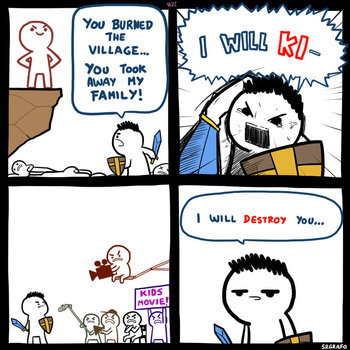
- A bizarre variant of this appears in Mass Effect. Characters say die all the time (Though one common enemy battle cry is, "I WILL DESTROY YOU"), and human enemies are gunned down by the truckload. However, whenever you or another character kills someone during dialogue, the camera will almost always focus on the gunners face, a shot is heard, and thats it. The victim is NEVER seen killed during dialogue options. If you tend to skip dialogue, it's possible to even skip the killing scene, leaving you confused as to what just happened.
- This may have something more to do with limited character animations than being kid friendly though. The game can animate a battle with AI and such, but likely can't render expressions properly for a dramatic execution.
- There is one scene in which someone is (graphically) shown dying in dialogue: Saren, if you have enough Charm/Intimidate to talk him into committing suicide. He says a few final words, puts his pistol under his mandibles and blows the entire left side of his head off. A few seconds later, one of your team-mates puts an insurance shot into his mangled corpse. Not for the squeamish.
- Somewhat subverted if Wrex dies. You hear a gunshot, Wrex jerks and falls forward. Ashley comes up to him and shoots him three more times, and you can hear Wrex gagging and choking after each shot.
- Nobody dies in Kingdom of Loathing, they just get 'Beaten Up', a condition that lasts 3-4 gameplay turns. You can assume NPC's also suffer the same fate, since the end of combat is usually described as simply, "You win the fight!" But if the combat ends on a Disco Bandit's face stabbing combos, a "FATALITY!" is announced.
- Oddly inverted in the Kirby Super Star sub-game "The Revenge of Meta Knight"—Meta Knight clearly says "Prepare To Die!" before dueling Kirby, yet in the Enhanced Remake, he says "Prepare to meet your doom!"
- Played for laughs in Super Paper Mario. Death is replaced by "game over" and kill by "end the game".
- And getting resurrected by Jaydes is called a "continue". Even the hilarious fourth wall breaking dialogue cannot hide the game's pretty dark undertone though.
- Played straight in Mario And Luigi: Bowser's Inside Story, though, where seemingly every use of "die" or any of its derivative forms is replaced with "KO". Vaguely lampshaded at one point, where Exposition Fairy Starlow asks an enemy character if they've got a "KO wish".
- In the Mother series, defeating enemies will render them to "become tame", "stop moving", "return to normal", "disappear", or "be defeated".
- Justification occurs though that some things such as moving records, lamps, and street signs would "stop moving" and return to normal, non-animated/living objects.
- Of course, mind that trees, space orbs with big grins, atomic robots, and ufos tend to explode after you beat them and severely injure everyone.
- Furthermore, the official translation of Earth Bound removes all references to death from the in-game dialogues (see here
or here for examples.)
- On the other hand, the Fan Translation of Mother 3, not needing to stick to Nintendo standards, uses the words "death" or "die" without any qualms.
- With the original ultra cartoony and sweet Spyro the Dragon, all the characters would faint or disappear. However, they didn't have a problem which using words like 'death' or 'kill' (Ripto screaming 'I'll kill you!' at a supporting character in the second game being a pretty surprising example). The trope gets subverted with the Legend games, in which death and darkness are something you shouldn't play with.
- Of course, that gets a bit of a spoof when Ignitus dies and becomes the next Chronicler, replacing the one before him.
- This got a lampshade in Spyro 3. A cut-scene shows the Big Bad happily describing what her monster would be capable of doing to dragons, but doesn't mention its ability to kill one of them. Her apprentice asks, timidly, 'But, er... won't they kill them?'
- Metal Gear Solid for GBC. Hoo boy. Let's start by stating this is a game about terrorists trying to start a nuclear war. It contains a scene where a minor character is killed out of the blue by exploding handcuffs. It contains another where the Big Bad graphically discusses a rape-murder and avoids those specific words.
- Played for laughs in Mario Super Sluggers, where a Magikoopa who Bowser charged with guarding a lighthouse confuses sayings each time you challenge it. (for example "Early to bed and early to rise makes a man angry and hungry for pies."). If you fail his challenge and talk to him he'll attempt to use the expressions "Never say die" and "live and let die" only replacing the word 'die' with 'bye.' When a Lakitu attempts to correct him, he interrupts the correction and the challenge begins.
- The French version of Tales of Symphonia is a funny example of this when you understand English, because while the text is in French, the voice acting is still in English. So you hear "killed" and read "destroyed/eliminated/disposed of/badly hurt". They toned down some of the stuff Zelos says, too...
- In Disney's Pirates of the Caribbean MMORPG, you are asked to "defeat" a certain type of enemy, even if "defeating" means whacking them with a cutlass, shooting them, throwing grenades at them, or what have you.
- New Super Mario Bros Wii's instruction manual quite glaringly refers to "blunder" and "make a mistake" rather than death. It still says you "lose a life" though.
- Nintendo and Retro's Metroid Prime series averts this trope. Metroid Prime 2: Echoes kicks off in a hive filled with dead bodies of troopers, some of which are re-animated into zombies. Also, in Corruption, the same happens on Phaaze, when Samus is completely corrupted. A message appears on-screen ending with this statement: "If your Phazon level fills completely, you will die".
Web Animation
- A Bonus Stage episode in which Joel learns, from the book Do-It-Yourself Standards & Practices, how to retool the show for a child audience, we hear this exchange (words in brackets being obviously dubbed):
Phil: Wh—... what just happened?
Joel: It's been a week, dude. You came back from the [hurt] after I [destroyed] you and sent you to [Hades]. That stuff was, uh, cut... for, uh... time.
Webcomics
- One of the oddities of language in Erfworld is the use of "croaked" instead of "dead" or "killed" (and "uncroaked" instead of "undead").
- However, this is clearly done by the characters and not the author, because Parson does refer to it as death and takes note of how completely inappropriate death seems in this otherwise cute and cuddly setting.
Western Animation
- Subverted in the SpongeBob SquarePants episode "Squidward the Unfriendly Ghost", Spongebob and Patrick believe they have accidentally killed Squidward (really just a wax model of Squidward). Spongebob, on the verge of tears, says "Patrick, I think he's... pushing up daisies!", to which Patrick nonchalantly responds, "Oh, I thought he was dead."
- Another subversion is done in a similar manner on an episode of My Gym Partner's A Monkey.
- Kim Possible's Shego clearly infers this when, pointing a laser at Kim and Ron, snarks "They don't send mail where you're going."
- Averted in Drakken's Demise, Falsato Jones isn't really trying to kill Kim, but lead her into a trap.
- An episode of Animaniacs has the Warners escaping from a boring man, exclaiming "Free at last, free at last, thank G-" at which point they are cut off by the man reappearing.
- Another episode featured Slappy Squirrel guarding the apple in the Garden of Eden. She claims she was given the job by "Mr. Big".
- One of my favorites is the first Rita and Runt cartoon, where the two are in the pound. Rita says "Ah what difference does it make, soon we'll be sleeping the 'big sleep'." Runt states that he could use a nap, to which Rita snaps "They're gonna gas us you buffoon. We'll be dead!"
- Parodied (and also a great comment on Disney's "for kids" movies) in one of the funniest Slappy the Squirel shorts "Bumbie's Mom" where Slappy and Skippy see "Bumbie" and Skippy freaks out when Bumbie's mom is shot and killed. Throughout the entire episode Slappy tries to explain that no one dies in cartoons and that Bumbie's mom is alive. Skippy continuously replies "Bumbie's mom...she's...waaaah!" Slappy finally takes Skippy to see the "actor" that played Bumbie's mom and he feels better...then on the plane ride back they show "Old Yellow" and Skippy starts crying when they shoot Old Yellow the dog. Slappy then just says "Ah fade to black already!"
- GI Joe is infamous for having characters always parachute out after enemy aircraft are shot down, even from helicopters. A writer on the series has noted that the closest they could come to death was mentioning "casualties."
- Another infamous example is in The Movie, where Duke is mortally wounded by Serpentor. He was originally supposed to die (and taking the scene at face value, he does). But when the Executives found out about it, they decided to try it out in Transformers The Movie. After the reaction to Optimus Prime's death, however, they backpedaled and made them insert dialogue about Duke only being in a coma, and a line about him recovering at the end.
- Thankfully averted to the extreme in the GI Joe: Resolute storyline, which opens up the very first scene with a dead guy with a knife in his chest lying in a pool of his own blood.
- Teen Titans used every synonym in the book in the second season finale episode "Aftershock", which felt especially awkward with the dark dialog and tone the episode set.
- The Big Bad in the series was only ever referred to as Slade; in the comics he's more usually called Deathstroke the Terminator. Oddly, they didn't have any problems with the names "Killer Moth" and "Brother Blood."
- Well, "Deathstroke the Terminator" sounds like he's Compensating For Something...
- You mean being a total Bad Ass with an awesome name?
- You clearly missed the point, didn't you?
- Deathstroke the Terminator is the kind of name you come up with when you're desperate to sound like a "total Bad Ass," and are so insecure that one long Dark Age name isn't enough. When you are one, just plain Slade is enough. In the original comics, the name came about by accident: the issue that introduces him calls him only "Deathstroke" until about halfway through, whereupon he suddenly becomes only "Terminator." How that got past the editors is a mystery, but what's done is done and they had no choice but to go with both names.
- Likewise in season four finale "The End". Slade saying "I don't even expect you to live" is probably the closest the series ever came to an aversion of this trope. But he's not even able to directly address his own currently undead state, when his mask is knocked off to reveal a skeletal face.
- The effect this had on the show really varied a lot. Most of the euphemisms worked coming from Slade, because it fit with his Creepy Monotone and general clinical cruelty. In the abovementioned Terra scenes in "Aftershock", however, the dialogue felt jarringly Narmful precisely because the episode was so intense- nobody would use a euphemism in that situation!
- Subverted in The Ren And Stimpy Show episode "The Big House": Ren and Stimpy end up in the pound, and Ren freaks out after realizing another inmate that was taken away to be "put to sleep" got "the big sleep". When Stimpy ask what "the big sleep" is, Ren leans towards him as if to whisper in his ear, but ends up shouting:
Ren: It's death!!! Death, you idiot! You know what dead is?! It's what we'll be if we don't get out of here!
- Also Ren often threatened to kill Stimpy if he made him really angry, like he said in one episode "You sick little monkey, if you ever do that again I'll kill you!".
- Various examples in Spider Man The Animated Series, known for its particularly heavy censorship. Semper had to have Mary Jane and the Green Goblin fall through an interdimensional portal instead of to their deaths. It is stated that the Punisher's family, rather than being gunned down, was simply "caught in a crossfire between rival gangs," and the same applied to the wife of the Destroyer. Uncle Ben simply "tried to stop the burglar that broke into his house, but the burglar was armed." At one point, when the Goblin returns after seemingly perishing, Spider-Man says, "You?! But I thought you were—" and the Goblin cuts him off with, "I'm not... but you'll soon be!"
- The Punisher when appearing on the show was said to use "lethal force", but the words "death" and "kill" never appeared. He's also eventually talked into using non-lethal weaponry pretty quickly by his sidekick.
- Morbius the Living Vampire drank "plasma
", not blood (he was also modified to use suckers in his hands rather than biting people).
- Interestingly, he's sorta censor-flipped from the original comics. Due to the Comics Code's prohibition of such things at the time, Morbius had to wear a bright red and blue suit and not have anything like a vampire theme beyond the fact that he sucked blood. The cartoon was able to make him much more vampirey, dressing in black and having the expected accent.
- Interestingly enough, Venom constantly commenting to Spidey on how "We will destroy you" didn't lose any of its effectiveness, most likely due to the manner in which he delivered it. He eventually became a very popular character in the show despite his few appearances.
- It's still effective because it might actually be accurate. Venom hates Spider-Man to the point that simply killing him would never be enough. He wants Spider-Man alone, friendless and broken before he dies.
- The worst example, though, was Carnage, a particularly brutal serial killer who became popular in the comics as part of the Darker And Edgier late 80's/early 90's. It's stated that he was a vicious criminal before becoming super-powered, but the word "killer" is never used. After becoming super-powered, he is recruited by the alien-god-thing Dormammu to drain the life force from people to power him up, bringing him into this world. Draining people only leaves them near death, and naturally, when he's defeated, all this life energy is returned.
- It's worth mentioning that The Spectacular Spider Man mostly averts this.
- Interestingly, The Spectacular Spider Man has actually had fewer death references than the 90s series, and no deaths (other than backstory ones) thus far. However, there's less Bowdlerizing in other areas. The 90s series wasn't even a little bit shy about Death By Backstory, and also had the clone Mary Jane and Hydro-Man die (a Tear Jerker of a scene, actually) as well as the real Mysterio (by choosing to stay behind in the Collapsing Lair with his lover, who deliberately initiated the collapse because, to her, death was preferable to remaining disfigured. Double suicide in a kids' show. Later, Mysterio was referred to as "no longer with us" - avoidance of the word, but a reminder of a censor-unfriendly moment you'd think Fox Kids would want swept under the rug.) It contained far more deaths than some shows that were braver when it came to using the D-word.
- In the Silver Surfer animated series, Thanos is the primary antagonist. In the comics, Thanos has a crush on (the embodiment of) Death, a plot which carries over into the show. Death, however, is called "Lady Chaos" for television purposes.
- Partial aversion: For its first two seasons, X-Men the Animated Series gleefully ignored this rule, happily using "die" and "kill" willy-nilly, with a character actually being killed in the series pilot. With the beginning of the third season, "destroyed" became the synonym of choice, in the style of Saban Entertainment's other Never Say Die works (Beast even once said "Ours is not to question why, ours is but to do and..." in a manner very reminiscent of the Spider-Man series). Even after this point, though, the series certainly broke some rules with Nightcrawler's introductory episode, in which the character would repeatedly refer to God by name and give deep, meaningful testimonies in regards to His works (ironically, Fox execs said they HAD to... lest people think Nightcrawler was a devil). In the "Phalanx Covenant" two-parter (well into the more heavily-censored part of the series), Magneto was even allowed to say "Thank God!"
- Which is weird, considering that the Hellfire Club's name was changed to the "Inner Circle Club"... this grand tradition has also apparently been carried on in Wolverine And The X Men.
- ...and Beast once got to refer to hell - as in, the really hot place that's the reason the word is controversial - by name at another point!
- In the Bratz DVD "Genie Magic", Cloe (one of the 4 Bratz) is annoyed at two of the regular boys for scaring the girls during a slumber party and says, "I wish you would croak." Their new friend turns out to be a genie, and a Literal Genie at that, as she turns the boys into frogs. One of the other girls gets cut off while explaining what Cloe really meant.
- Rugrats unabashedly used the word "dead" in the episode when Chuckie's pet potato bug died — of course, the babies' grasp of death is only that it's "when you sleep for a long time... like forever." — but eventually shied away from it. For example, in the Passover special, the 10th plague on Egypt is called "taking away the first born."
- El Tigre expresses the most common usage of the trope in current American cartoons. While they use the word kill passively, "I was nearly killed," they skirt away whenever it calls for directly: "Are you sure this isn't apart of some sinister plot to destroy me?/She tried to get close to me, to destroy me." Basically you're not generally going to hear the statement, "I kill you" in an American cartoon today.
- Similarly, Danny Phantom used the word kill plenty of times for humor and occasionally for intense situations, but swapped it out for the word "waste" whenever it called for direction. The many uses of "destroy" are understandable, since, even though Our Ghosts Are Different, it would sound strange to refer to killing a ghost (especially since that's not how he gets rid of them).
- While the cast of Visionaries: Knights of the Magical Light would do the whole "destroy" thing, they interestingly also commonly used the word "slay", which - given the neo-medieval basis of the story - is fairly appropriate.
- Averted in Gargoyles, most memorably at the end of "Hunter's Moon: Part One", where Goliath — the hero, mind — makes a baldfaced vow to hunt down and kill the Hunters after they mortally wound his daughter. (Series creator Greg Weisman had to fight for this one.)
- On another note, Xanatos actually said "Pay a man enough and he'll walk barefoot into Hell." once, though it helped the use was poetic and not profane.
- The Powerpuff Girls played this trope straight even to cockroaches, which are not killed but "squished, smashed, stepped-on," etc. In the same episode, a cockroach-based villain is thrown from his cockroach mecha to splat on the pavement below...
Blossom: Oh noooo! It's definitely not okay to squish a person!
- Fortunately, it was just a robot.
- Parodied in an episode of Family Guy where Meg says that her class is performing Death Of A Salesman, but because they aren't allowed to say "death", the ending just has everyone dancing around with sparklers.
- Another surprising Disney aversion: Darkwing Duck uses "kill" and "death" quite regularly. One of the most notable aversions is the episode "Just Us Justice Ducks, part 2", where they use the word "kill" several times in the span of a few minutes. "Let's kill Negaduck!" "Kill Negaduck, kill Negaduck!" "Kill who?" "I'm Darkwing Duck, HE'S Negaduck! Kill him!" "You thought he was me? You were going to kill ME!?" "Didn't we already kill Darkwing Duck?"
- A particularly shocking instance, not just because of the sincere loathing behind it, but because it was the Pilot of the series, was the end of "Darkly Dawns the Duck, part 2." A defeated Taurus Bulba, standing a few feet away from the self-destructing Ram Rod, grabs Darkwing and suspends him by the collar. As Darkwing tries desperately (but futilely) to escape, Bulba delivers the brutal line: "I underestimated you once, Darwking Duck, but now you simply DIE." Cue the Ram Rod exploding and destroying about a third of Canard Tower along with it.
- The particularly grim episode "Dead Duck" involves Darkwing actually dying following a fatal motorcycle crash. His spirit travels to Heaven (and to Hell) and does battle with the Grim Reaper in order to allow him enough time to say goodbye to his friends and family. Granted, this turns out to be All Just A Dream, but even so...
- From the Inhumanoids premiere miniseries: "If his friends release him, we're ended."
- In the DCAU, also called the Diniverse, this was amazingly averted, throughout both Justice League series but perhaps most prominently in the Superman The Animated Series episode "The Late Mr. Kent," which not only features plenty of references to death and killing, but ends with a actual execution just as the credits roll.
- ...A sad, sad example, however, would be the Batman The Animated Series episode "Off Balance," where agents of Talia al-Ghul's Society of Shadows quite clearly each use a gaseous Cyanide Pill—their dead eyes staring into nothingness—and in the very next scene Batman tells Gordon that they'd used the gas "to erase their own minds." Suuure they did.
- This was possibly a bit of a Take That to the censors at Warner Brothers. In the DVD commentaries, both Timm and Dini state that since they were not allowed to kill off any humans, they freqently tried to come up with things that were inherently more disturbing than outright death. In this case, the bad guys essentially lobotomized themselves.
- And in an example of Tropes Are Not Bad is the death of the Flying Graysons. They were not allowed to show their fall or death in any way, but that shot of the severed rope swinging back into view is all the more gruesome.
- Reportedly, the production staff was able to get around this restriction in the case of the Scarface dummy, which did not qualify as human; the animators were able to vent their "darker impulses" upon the dummy by destroying it in increasingly grisly ways (i.e., machine-gunning it, chewing it up in a grinder, etc.) in every episode in which it appeared.
- Likewise with the Joker's laughing gas. Also a certified source of Nightmare Fuel.
- Assassins carrying pills for "erasing their minds" is later brought back up during Batman Beyond, actually. At least they're consistent.
- Speaking of Batman Beyond, Terry McGinnis shows a consistent willingness to use lethal force in the heat of combat, throwing barrels of nerve gas or jabbing his enemy with syringes full of mutagen if that's what it takes to get him out of a jam, and rarely if ever losing much sleep over leaving a villain to die in a sinking ship or exploding building. The series does, however, make a point of the fact that he would never kill in cold blood.
- Avoided in Jem And The Holograms, usually in reference to late Emmett Benton and late Jacqui Benton, the parents of Jerrica Benton and Kimber Benton. In "Out of Past", Emmett wrote that it's been one week since the death of his wife. One exception is Pizzazz threatens to "kill" Kimber Benton when she see Kimber with her own dad, Harvey Gabor in the climax of "Father's Day".
- Invader Zim is a good example of this in a few episodes. One being the episode "Bestest Friend" after Zim "gives" Keef his brand new robot eyes, it ends with Keef being attacked by a squirrel, falling off a house and subsequently exploding. However, according to the DVD commentary, Jhonen had to give him the line, "So you don't like waffles?" at the end, implying that he was still alive. Another good example is "Hamstergeddon", where Zim turns the class pet hamster into a heartless (but cute) killing machine; as it shows the giant hamster stomping on people or people getting squished by giant debris as they are too distracted by its cuteness (the whole episode is a homage to the Godzilla movies). Even at the end of the episode, a disclaimer
◊ appears at the end. Whether this was Jhonen doing a Take That at Nickelodeon, or if Nick executives told him to make a disclaimer at the end is unknown.
- They told him to put the line in, but they didn't say how the line would sound. By giving it the echo effect not only does it remove the "I'm OK!" impression, but it sounded like he was talking from beyond the grave, making it even MORE creepy than beforehand.
- Another incident similar to "Bestest Friend" happened in the episode "Game Slave 2", where Dib's sister Gaz mercilessly hunts down a gaming nerd named Iggins because he took the last Game Slave 2 (a handheld gaming system that was rightfully hers in the first place). At the end of the episode where Iggins finally gives the Game Slave 2 to Gaz and restores the natural order, the elevator that he's in plummets him to the ground (he's at the 50th floor as the elevator plummets, so you pretty much know that he's dead). However, Nickelodeon also found this to be too violent, and made Jhonen change it at the end, so Iggins emerges from the wreck all A-OK (though interestingly, Jhonen thought the idea of Iggins surviving the 50 story drop and being alright was hilarious).
- Ironically subverted in the episode "Hobo 13":
Zim: *upon seeing Invader Skooge* Skooge?! But I thought The Tallest killed you!
- (complaining about the extinct martians) "I hate them! And i hope they (kicks martian skull) di- oh. oh-oh-yeah..."
- This trope is mostly averted in Avatar The Last Airbender, notably in previews of its final episodes: "I guess I don't have a choice, Momo. I have to kill the Fire Lord." It was still awkwardly in partial effect for much of the third season, including the beginning of the finale. On the other hand, given the specific contexts in which the word "kill" was avoided, it could be interpreted as the (young) characters themselves following the trope in order to assuage their own consciences.
- To be fair, Aang is a very naive & optimistic twelve/thirteen-year-old, and an effective Buddhist; it's really in his character to not want to kill another human (though apparently Vulture-Wasps are fair game)
- Avatar seems to relish in kid-friendly-on-screen-death; for example, a prison commander throwing a high-ranking subordinate off a prison barge and into the ocean for the hell of it, the Blue Spirit throwing one guy off a fort, and Hahn getting thrown off a boat in the middle of a battle between sentences. And then there's this exchange:
Captain: Princess, I'm afraid the tides won't allow us to bring the ship into port before nightfall. Azula: I'm sorry, Captain, but I do not know much about the tides. Can you explain something to me? Captain: Of course. Azula: Do the tides command this ship? Captain: I'm afraid I don't understand. Azula: You said "the tides would not allow us to bring the ship in." Do the tides command this ship? Captain: No, Princess. Azula: And if I were to have you thrown overboard, would the tides think twice about having you smashed against the rocky shore? Captain: No, Princess. Azula: Well, then, maybe you should worry less about the tides, who've already made up their mind about killing you, and worry more about me, who's still mulling it over...
- This is also Lampshaded at one point. In the episode "Ember Island Players," when the actors get to the scene regarding Jet's death, Sokka himself expresses uncertainty as to whether or not he actually died.
- This is averted so much in Chowder that a full length, half-hour, 22 minute episode, "Dinner Theater", revolves around a murder mystery dinner.
- Not to mention an episode about Gazpacho trying to help Chowder to the "other side" because he thinks he murdered him.
- There was also a supporting character that told another she'd kill her if she ate all of the meviled eggs.
- Almost completely averted in the show The Marvelous Misadventures Of Flapjack as well.
- No, this trope is completely averted. It even uses death as humour, much like Chowder except a tiny bit darker and creepier. And it's hilarious.
- Averted twice in the Ruby-Spears Megaman episode "Ice Age"; Iceman supposedly kills Megaman at one point ("He's as dead as an old flashlight battery!"), only to exclaim later, "Megaman! But...you're dead!"
- The Legend of Zelda animated series had an interesting one. Something like "One more blast and you'll be de-energized, Ganon!"
- Though there was one time where Ganon actually was defeated, with the same result as with his minions — he just gets transported into the Evil Jar, and will presumably free himself in the near future to wreak more havoc. On that note, another episode begins with Ganon attacking Hyrule Castle and trying to zap Link into the Evil Jar, though a convoluted series of events makes only his body go there, with his spirit left behind. As Zelda mourns the apparent loss of the hero, Link's spirit remarks "Gee, you'd think I was destroyed or something!" So apparently a fall in combat has different consequences for good and evil.
- It really did get ridiculous - villains try to "destroy" heroes, but heroes only send villains to the main villain's jar thingy where he can simply send them again.
- On the most recent Fairly Odd Parents movie, Cosmo and Wanda's newborn son has been kidnapped by H.P. and Anti-Cosmo. Wanda tells them, "If you so much as lay a hand on our baby, I'll destroy both of you!" It did sound a bit forced, but was worth it to hear her threatening to single-handedly murder them.
- However, just like the Danny Phantom, Timmy has talked about worrying about dying or getting killed before.
- On the Garfield And Friends musical episode, "The Man Who Hated Cats", Garfield overhears the titular man singing about a cat he owned when he was young who ran away. He sings, "Foo-Foo had fled/I wished I was..." and starts sobbing.
- A U.S. Acres segment parodying the poem "Casey At the Bat" includes a quip about the fans chanting " 'Kill the Umpire!' long and low/But you cannot kill a person/On a TV cartoon show."
- Winx Club: An S2 episode shies away from explicitly saying that the Trix had killed one of the Specialists Prince Sky, settling for having one of the Winx check for a pulse and say he doesn't have one. The 4Kids dub takes things further, by having the Trix explicitly say a couple times that they've put the Specialist in a 100-year deep sleep (Not That Theres Anything Wrong With That, because of what happens next), while strangely still keeping in the pulse bit.
- Averted by Star Wars The Clone Wars, in which death is not only mentioned, but also frequently happens. Onscreen.
- The ghost monsters in the Pac Man animated series always talk about how they're going to chomp the eponymous character (this is justified by having them actually bite him whenever they have the opportunity to do so).
- The 2003 series of Teenage Mutant Ninja Turtles has a slight variation. "Die" is sometimes said, otherwise replaced with "perish" or "pass away". However, this is rather "Never say kill" as they only use "destroy" or "slay."
- 10-year-old Word Girl is never "almost killed," since it's an educational kids show. Still, "Is this the end for Word Girl" is repeated a few times. A villain proclaims "Good-Bye, Word Girl!" as his robot is commanded to "Crush" her. She's almost "Done For," "Finished Off," "and Defeated." And since this is a show about vocabulary, I'm guessing they'll find other ways to carefully explain how she was almost killed.
- In Transformers Generation 1, death words are used frequently, but death happens infrequently (until the movie, which is nearly a Kill Em All so new toys can replace the old. The season following the movie didn't kill off any known characters, though one disastrous battle saw the destruction of several ships known to be manned.) Later series use them less, prefering 'scrapped,' 'taken offline,' etc but are more likely to have a death stick. Rattrap's catch phrase is a sardonic "we're all gonna die," but when someone's actually believed to be dead, "scrapped" or "destroyed" is much more likely to be used when referring to their condition.
- In Transformers Animated "offline" seems to be the primary euphemism for death, but it's still not exactly the same: the series Magnetic Plot Device is still able to bring you back from that.
- "Offline" is also preferred in Beast Machines, which, like Animated, was headed by Marty Isenberg.
- Then it's averted when it comes to a human in the premiere of the third season of Animated, when Prime tells Ratchet to get Sari out of her Superpower Meltdown with his EMP and Ratchet flat out says "...that could kill her!"
- Adventures Of Sonic The Hedgehog plays this trope literally; at one point, when Sonic and Tails are rushing toward a wall, Tails says "It's a dead end!" Sonic replies, "Hey, Sonic the hedgehog never says dead!" In general, the show tended to avert this, but that was just a really weird incidence.
- Averted oh so very hard in Batman the Brave and the Bold where death and dying are mentioned on a pretty routine basis. Pretty shocking given how much Lighter And Softer this show is compared to its predecessors.
- In the pilot Batman mentions how the scarab was passed on to Jaime after the last Beetle died... or retired. Since then we've seen Bruce Wayne's parents murdered, two other Blue Beetles die, Wildcat having an onscreen heart attack, Jonah Hex sentenced to death, and Master Wutan dying after being shot with a poison dart. In a recent episode, a villain causes a tidal wave that hits a crowded beach. Apparently there are only two survivors.
- Completely averted in Rockos Modern Life in the one where Filburt's myna bird Turdy is accidentally killed by Heffer through means of crushing and suffocation as he jumped on top of him and farted Rocko says "Heff he's dead!, you killed him, he was under our watch and we killed him what are we going to tell Filb?"
- In the Ben10 episode "Kevin 11", Ben actually says "Hundreds of people will be killed!" when Kevin rigs 2 trains to collide. Unusual in that the protagonist(especially for a kids' show) is seldom the one who says the K word.
- Megas XLR speaks out of both sides of it's mouth on this issue. The villainous Warmaster Gorath using media acceptable words like "Destroy" and "Eliminate", while Coop freely and frequently rants about how the Monster Of The Week tried to kill his friends, all the while Jamie pleads about not wanting to die.
- And knowing the mind behind Megas XLR they know EXACTLY what's they're doing.
- Samurai Jack: Averted with gusto by Aku in Episode XXX, ironically titled "Jack and the Zombies".
"Samurai, samuarai... why WON'T YOU DIE?!"
- Proving how much more lenient Canadian censorship is than American, a cartoon supposedly suitable for five-year-olds averts this. Characters in Jane And The Dragon use the words "kill," "death," and "died" freely. It may be because of the show's realism, the likelihood of children taking the concept of death lightly is pretty slim.
- Jester's amusing attempt at coming up with a ballad to cheer up the sick princess is also worth mentioning.
"There was a little Majesty who had a little malady,
She sniffled and and she snuffled from a cold in her head,
She snuffled and she sniffled and she dropped down...eh, no. Maybe not."
- In Iron Man Armored Adventures, MODOK, the Machine Organism Designed Only For Killing becomes MODOC, the Machine Organism Designed Only For Chaos (or Conquest. Definitely not Killing, though). Odd, since the series makes no attempt to gloss over Howard Stark's death.
- Justified in ReBoot. Though in the third season and beyond they often would use the words 'kill' and 'death'. For the first two seasons, the reasonable substitute 'deleted' was frequently used in its place.
Real Life
|
|