

The problem with a very long-running fictional creation is this.
On one hand, Superman, say, is a high-selling, successful character — the basis for a lot of ongoing works, licenses and so on. You don't want him to age or die, because that means losing that successful character. So within the franchise he must come to ignore the passage of time, stay suspended forever somewhere in young manhood... even as years and eventually decades pass in real life.
On the other hand, Superman exists as part of a greater universe, and if all the stories in that universe are continuously frozen in time in this way, that cuts off a lot of possibilities.
So what do you do? Let things exist in Comic-Book Time: otherwise known as a Floating Timeline, or Sliding Timescale. You use the illusion of time passing. Certain events will happen — and will continue to have happened — before others, but you never refer to specific dates if you can help it. You let characters change, but only a little.
Stories focused around youngsters are especially vulnerable to this, and even aging characters usually aren't allowed to progress to the point they'd be separated from their peers.
Comic-Book Time does not pass at the same rate for everyone; secondary characters may catch Soap Opera Rapid Aging Syndrome and age from children to teenagers and then young adults while their adult counterparts remain roughly the same age. Or minor characters can drop out of the narrative, only to return years later, aged, while their counterpart heroes remain youthful. (This concept was picked up on in the Fourth Wall-breaking She-Hulk series, in which a Golden Age character decided to hang around She-Hulk as much as possible to stay youthful.)
This trope can prove problematic with creations who are tied to a certain time period or conflict. For example, since the 1980s, Magneto's backstory and characterisation have been deeply connected to his status as a Holocaust survivor; no matter that beyond a certain point this ought to make him much older than the character seems.note However, in the case of The Punisher, simply retconning his backstory as a veteran of a more recent war than Vietnam (officially done in 2012) doesn't alter the character or their motivations too drastically. In other continuities, however, this trope is played straight. That causes a particular type of aversion, the Refugee from Time, where you just don't allow any Sliding Timescale at all or at least not for one character — though ultimately it will make them impossibly old as more real-world years pass. A common solution is to retcon those conflicts into a generic and dateless Fantasy Conflict Counterpart when the dates start giving trouble.
One possible justification for the trope is that publication time typically spans much longer than the passage of time in the story — otherwise known as Webcomic Time. Particularly in recent years, comic book publishers have tended to adopt the model where each monthly issue of a title is a single installment in a longer Story Arc; for instance, a six-issue arc where Batman takes on the Joker may only cover one night in-story, though it has taken up half a year of real time. This, naturally, is going to affect both how quickly you can develop the overall narrative and how contemporary you can make it.
Indeed, an open-ended series that wants to keep using the same characters and keep them in a given age-range for a long period pretty much must use some variant of Comic-Book Time. However, all characters in a shared universe tend to inhabit the same "present", regardless of when they first appeared or how much time has passed in their own series.
An adaptation of a series that uses this can usually avoid it, as most of them only last a few years. On the flipside, non-comic series that last long enough also tend to use this.
Stories that take place in the future, naturally, are allowed to completely ignore this — unless the same future is referenced again later, in which case it'll have slid forward the same amount.
Webcomic Time (see above) is a related concept, but instead of the illusion of time passing, time actually does pass over the course of the series, just at a much slower rate than its real-time publication or airing.
Compare Frozen in Time, Talking Is a Free Action, Not Allowed to Grow Up, and Not Growing Up Sucks. Often results in Outdated Outfit. See Year Zero for a compromise, and Soap Opera Rapid Aging Syndrome for similar peculiarities in live-action productions.
Example subpages:
Other examples:
- A very common substrain is that school-centric series will take place over an endless spring (the first trimester of the Japanese school year), with occasional jumps into holidays and school festivals but nobody ever advancing a grade unless it's a major plot point. The sillier the series, the more likely this trope; The 100 Girlfriends Who Really, Really, Really, Really, Really Love You lampshades it every other volume or so, with one story even having scientists discuss whether the "endless spring" phenomenon is tied into the new ice age threatening Earth.
- Serious discussion on whether the goddesses in Ah! My Goddess age mostly glosses over the fact that the manga ran for over 20 years; aside from Art Evolution and the characters learning and doing new things, nowhere near that much time passed for them in-universe.
- From the passing of seasons, which are clearly marked, ARIA spans the better part of three Martian years, or five to six Earth years in the anime and manga, respectively. Yet Alice, who we first meet at 14 years old while attending middle school, doesn't graduate from it until five Earth years have passed. The other main characters also seem to have aged little — most noticeably, in the anime, Ai.
- Baki the Grappler: In-universe, Baki hasn't aged more than a few years since the beginning of the series in 1991. That didn't stop the characters from interacting with several successive American presidents (Bush, Obama, Trump, and Biden) and using smartphones and the Internet in the most recent installments.
- Cardcaptor Sakura was originally written between 1996-2000 and it appeared to take place in contemporary times. The series ended with Sakura finishing fifth grade. Its sequel Clear Card, created in 2016, starts two years later with Sakura starting junior high, and everyone uses touchscreen smart phones about five years before they would become commonplace.
- Case Closed:
- The series is a more extreme case, as it frequently references the current time of year, with some holidays celebrated more than once, yet after almost three decades since the manga started in 1994, Conan is still in the first grade. This is necessary to the whole point of the series; if Conan aged in real time, by now he would be older than he was before the de-aging, and then some. Word of God even confirms it. A clear example can be seen during the time Conan is investigating Eisuke Hondou. The "Shadow of the Black Organization" arc combines two cases that take place at New Years and Setsuban respectively, while his disappearance in the next plot arc happens at the end of December. The latter arc keeps things vague by referring to an event that happened a few hundred episodes before Eisuke Hondou even appeared as "several months ago."
- Technology also keeps advancing in real-time. Old mobile phones are now replaced by cellphones, etc. In Chapters 192-196, which were released in 1998, the concept of chatting on the internet was relatively new. But in Chapters 1006-1008, released at the end of 2017, a rumor was spread fast and nation-wide through Twitter. Another extreme example is the flashback case in Chapter 972-974, an event that occurred 10 years prior to the story, yet the characters in that flashback were using image-sending cellphones with cameras and they could read freshly reported news on the internet.
- Averted and discussed in City Hunter, as people age and seasons go exactly in tune with the manga's release dates, and fourth wall jokes are made by the characters about how, in many mangas, people do not age, but "years are strictly counted in this one". Played straight with the Shinjuku Private Eyes movie, which is recognizably set in The New '10s (all those smartphones with apps) despite none of the City Hunter characters or the Kisugi sisters from Cat's Eye looking any older than they did in The '80s.
- Crayon Shin-chan, like Doraemon below, sadly also outlived his creator. To give an idea of how bad this series is with Comic-Book Time: Shin-chan is 5 when the manga starts. His mother's friend Keiko marries, gets pregnant and has a baby. Later on Shin-chan's mom also gets pregnant and has a daughter, Himawari. Shin-chan's still five, but bizarrely enough, Keiko's baby actually aged a bit, as evident of him being able to speak simple words and even walk! Even better, an episode parodying Back to the Future aired in 2010 claimed Shin-chan's parents met "8 years ago." When they travel back to said 8 years ago, it's 2002. Apparently Shin-chan was born in 2005, nearly a decade and a half after the series started.
- Episode 7 of Daily Lives of High School Boys anime downright declares:
Hidenori: Well, this anime is like Sazae-san. We'll always be in our second year of high school.
- The Disastrous Life of Saiki K. has a rare justified example. Saiki and friends are perpetually high school sophomores despite several years clearly having passed (eg. multiple Christmas and New Year's episodes). Saiki later reveals that once a year, he uses his significant psychic powers to "reset time" by a year, allowing everyone to keep their memories and experiences but preventing time from really passing in order to prevent a super volcano eruption from destroying Japan. Near the end of the series he finally masters his powers enough to stop the eruption without having to rewind time and allowing time to start passing normally again.
- Doraemon managed to outlive one of its creators, and yet poor Nobita and his friends are still in the fourth (fifth in the anime) grade.
- Dragon Ball originally averted this in the original manga as the series chronicles Goku's childhood into adulthood, as well as the rest of the cast visibly aging as time passes. Goku and Vegeta's designs don't change all that much in the final ten-year Time Skip, but that's handwaved by Vegeta explaining that Saiyans physically age much slower to be able to fight longer. This trope was played straight, however, when the franchise was Un-Canceled with Dragon Ball Super. Super takes place in the aforementioned ten-year timespan but before the series' epilogue (also known as the "End of Z"/Peaceful World Saga), so many of the cast members still retain their designs from the original series' final arc. The passage of time is still said to be ongoing, but none of the characters visibily age to reflect this, even when they all had updated designs for the epilogue. For instance, Goten and Trunks still retain their designs from when they were 7 and 8 years old respectively
 ◊ despite the fact that years have passed since then. What makes this even more jarring is that Trunks' Alternate Self from another timeline has a design that actually reflects his age.◊ It wouldn't be until 2022's Dragon Ball Super: Super Hero, set one year before End of Z, that Goten and Trunks would assume their teenage appearances, which is handwaved on similar logic to Vegeta's explanation on Saiyan aging: Saiyans don't hit a growth spurt until sometime in their mid-to-late teens, which does coincidentally match up with what's seen of Goku in the original series.
- From Eroica with Love embraces this trope fully.
- Lampshaded in Gintama several times. For instance, in Episode 251, Gintoki notes that despite the show having been on the air for six years by that point, everyone is still the same age they were at the beginning.
- Glass Mask. The (still ongoing) manga started in 1976, and was set in then-present day. In later volumes, we're told outright that a little more than seven in-universe years have passed since then; the characters age believably, and the technology level is entirely compatible with the mid-80s... except cell phones and the Internet have been featured and discussed (as in, "in this day and age it's normal to talk to people you've never met over the Internet").
- Golgo 13 has been active since the 1960s, but that doesn't stop him from shooting, screwing or looking like the 20- or 30-something he was when he started.
- Inuyasha ran from 1996-2008. Kagome was exactly fifteen in the first episode (it was her birthday). She hadn't quite hit sixteen when the next to last chapter was published, then there was a three year Time Skip to the last episode. Given that multiple chapters (or even a whole volume) can cover a single day, not to mention given the handful of times Inuyasha turned human, something that explicitly happens only once a month, it's a bit more believable that Kagome's adventures lasted around a little less than a year in-universe despite its 12-year run.
- Lampshaded in an extra in Kase-san Vol. 3, where the author notes how much technology has changed in the real world during the five years the manga has been going on (even though significantly less time has passed in-universe). It then cuts to a scene of Yamada being shocked to discover that all her friends suddenly have iPhones instead of flip phones.
- The Kimagure Orange Road anime fell prey to this. Kyosuke (and, by extension, since they shared the day, Hikaru) only ever got one birthday that we saw on-screen. And what year of life it was for them never actually got mentioned. This makes things a tiny bit jarring when we can see that time is definitely passing, but there weren't any real clues to which year of school they were currently in — and then we jump ahead in the first movie, to Kyosuke and Madoka's entrance exams for college...
- As a long-running series (it began in 1992 and, as of 2024, is STILL ONGOING), the characters in The Kindaichi Case Files certainly suffer from this trope since the year used in one case was from the tankoubon's publishing year. It's obscured by the fact that it seldom explicitly tells you when those cases happen and the series never have a distinct plot to begin with. To take an example, they celebrated Christmas twice — one in the main case Santa's Slaying and one in the short case where Fumi makes her debut — but as far as the story concerns, Kindaichi and Miyuki are still in high school (mind you, the start of the series begin with them in their second years).
- Lupin III:
- The series has been around since 1967, and none of the characters look any older. This is fine, since the franchise clearly runs on Negative Continuity, but Lupin's grandfather is still canonically Arsène Lupin. Who was born in 1874. Assuming an average of 45+ years between each generation of the Lupin dynasty isn't impossible (especially considering their reputations), but gets a little less probable with every passing year — by the 2020s we should be seeing the adventures of Lupin V, possibly Lupin VI. note This makes Arsene Sr. a Refugee from Time.
- The prequel series Lupin III: The Woman Called Fujiko Mine has one episode that pretty clearly takes place during the Cold War, complete with all the anachronisms one would expect. While Negative Continuity is likely still in play for the franchise as a whole, this would make the timeline seem very odd if Fujiko were indeed meant to be chronicling the early years of the gang. Especially given that new Lupin specials (usually taking place in a modern setting) still debut every year.
- Lupin III: Part 5 treats all previous animated Lupin material as canon despite taking place in 2018 (with explicit references to the events of past installments like The Castle of Cagliostro and The Pursuit of Harimao's Treasure, released in 1979 and 1995, respectively), dealing with themes of a classical Phantom Thief remaining relevant in the modern day. The fact that the characters all look the same despite these adventures having taken place across nearly 50 years of media isn't really dealt with.
- 2019's Lupin III: The First provides an interesting aversion, being explicitly set in The '60s. Going by the assumption that most entries are set in the same year (or at least period) as their time of release, this would make The First, "chronologically" speaking, one of the Lupin gang's earliest adventures, if not the first. Compare this to another feature from the same year, which has a quantum supercomputer and advanced computer A.I. as major parts of the plot. (And compare this to the below entry, which is also set in the same decade as The First yet features Lupin at the tender age of 13. Negative Continuity, you gotta love it!)
- The prequel series Lupin Zero is set in the 1960s and stars a teenage Lupin. If one were to interpret the timeline literally, Lupin would be over 70-years-old in the present-day installments. Even more jarring is that the next Lupin film to come out (mere months later), Lupin III Vs Cat's Eye, has Lupin state that he started out his career stealing from the Nazis in WWII — and this film is also set in the 60s, as Lupin tells this to the teenaged daughter of a friend from those days, whose age when Lupin knew the man was in the negative months. Which would mean that he should be in his 30s/early 40s in the sixties, and more like 90 nowadays.
- Averted in Maison Ikkoku. While just about every other Rumiko Takahashi series is entrenched in Comic-Book Time, this series follows real time exactly (aside from a few issues that leave off on a cliffhanger, which are made up next issue by having twice as much time pass). Note that, despite this, nobody (save the two recurring children) visibly ages; however, this is most likely because all of the main characters (save the children) were in their early 20s to early 30s at the start of the series, and the series only ran seven years.
- Miss Kobayashi's Dragon Maid: Kanna's Daily Life is very clear about the passage of time, with each volume taking placing over the course of about three months/a single season. Despite this, Kanna and Saikawa are still in third grade by the start of Volume 9, even though two years should have passed. This also applies to the main manga's anime adaptation (covering 1 1/2 years as of the end of Season 2) for the same reason.
- In-Universe, Chapter 61 of Monthly Girls' Nozaki-kun has mangaka Nozaki showing Sakura a Long Runner series where the heroine has only moved up one grade in 20 years of run. But during that "year" the technology moved forward from pagers to smartphones, though, which is the point of the gag.
- One Piece mostly uses Webcomic Time (time is definitely passing and the characters grow noticeably older, but not by much as the story so far has only taken place over about 1-3 years; less than a year for the first half followed by a two-year Time Skip and a second half of indeterminate length), but Eiichiro Oda is aware of this trope and sometimes jokes about it being responsible for the slow passage of in-universe time in the letter columns, such as claiming that the characters have their birthdays every year, but they turn the same age every time.
- Likewise, the Ouran High School Host Club anime has Honey alluding to graduating from high school next year. The author tells us in asides not to worry about stuff like that. For the most part, the manga explicitly ignores the passage of time, except to give seasonal settings, keeping all the characters in the same year as when they started. As a result, it becomes shocking when a late-series chapter actually has Honey and Mori graduate (as they are seniors), as this means they have to reduce their involvement in the Host Club to focus on college. This sets the stage for the manga's Cerebus Syndrome.
- The Pokémon adaptations are all over the board on this; at least the ones running long enough to matter:
- In Pokémon: The Series, according to the official Japanese site, protagonist Ash Ketchum is still 10 years old after decades of adventures. To make things even more confusing, it is acknowledged that time is passing. note This is lampshaded in the English dub when Meowth tells Dawn in their first meeting that "We've been chasing Pikachu since you've been alive." One interview with a prominent Pokemon writer also confirmed this by stating that the series is set in an endless early summer. Fanon rejects this in favor of Webcomic Time, with each new League being roughly a year.
- The Pocket Monsters manga also uses Comic-Book Time. The protagonists stay the same age no matter how long it is, with the protagonist going to various regions with his talking Clefairy and his Pikachu. It helps that this manga is unabashedly humor-based.
- The Pokémon Adventures manga averts this trope, using Webcomic Time instead. There are numerous time skips, and save when characters are drawn chibi, every character ages. They also tend to rotate main characters out when their respective games' plotlines are done; characters' reappearances usually correspond to remakes of their respective generations, since they're getting pretty old off camera in arcs that they're not featured in. For example, Red's first plotline has him at the age of 11, but when the plot returns to him years later with the FireRed/LeafGreen arc, he's 16.
- Pretty Cure:
- While the first three shows in the franchise aged characters in real time, Yes! Pretty Cure 5 has instead made use of Comic-Book Time — all the characters are the same age now as they were in February 2007, despite clearly going through summer and Christmas. Part of this is may be because Karen and Komachi are in their last year of middle school.
- HeartCatch Pretty Cure! also invokes Comic-Book Time — despite going through an entire season as well as a Time Skip, Erika states that they were "14 year old beautiful super heroes"... before and after the time skip which included a birth.
- PriPara: It's been four seasons, soon to be five, and Lala's still in elementary school.
- Ranma ½ is a particularly nasty offender of the sliding timescale. When first introduced, the three Tendou sisters are stated to be 16, 17, and 19. Several seasons later, all characters looking exactly the same, it's stated that the characters are celebrating the three-year anniversary of the events of the first episode. THEN, in a later episode, the sisters' ages are listed once again as 16, 17, and 19.
- Lampshaded in a late Rurouni Kenshin chapter when Sanosuke runs into the Hiruma brothers, the manga's Starter Villains who had originally hired him to beat up Kenshin after the latter beat them up in the first chapter. He comments that it's been several years since they'd met (out-of-universe time), and they scream at him that it's just been six months.
- Sazae-san is the representative Japanese example, to the point where the Japanese term for this trope is named after it. It's been airing for decades but the protagonist still hasn't hit 30.
- The first 50 or so chapters of To Love Ru equate to about a year, and characters age and progress to their second year of high school, which is used to introduce several new characters as Rito's classmates. Afterwards, seasons begin to cycle and characters stop aging for the next real life decade. According to the afterword of the original manga's final volume, the creators considered moving the cast to their third year, but didn't want Saki's Girl Posse (who are a year older than the rest) to graduate high school or for Mikan to graduate elementary school.
- Yo-kai Watch lasted several years but the protagonists never aged at all. They're always in elementary school. Eventually, the sequel Yo-kai Watch: Shadowside aged up everyone thirty years and starred Nate's daughter.
- Each chapter of Yotsuba&! takes place on a specific date in a single year, which in 110 chapters across two decades has covered about half a year (from mid-July to mid-December). However, Word of God is that each chapter is set in the year it's published, which allows the author to keep technology and pop culture references current, instead of stuck back in 2003 when he started.


- All Things Probable Series: While "A Friend In Darkness" took over four years to write, the events of the story occurred within a month.
- Defied in Amazing Fantasy. Peter makes a point that most superheroes, like regular people, get old. He and several of the other Avengers have been active since the 70s and have aged appropriately. Peter is an overweight father who's down on his luck and struggling to pay the bills. He's also one of the last "old guard" members of the Avengers, as the others have left, retired, or died.
- Subverted in Anti-Cliché and Mary-Sue Elimination Society. The Society's two-and-a-half year absence is because Divinity sent the entire Library Arcanum into stasis in Development Hell.
- Everybody's Gotta Leave Sometime: Discussed in universe. The Peanuts gang has remained frozen in time since 1950 until Charles Schulz's retirement, but after the end of the strip they'll begin aging in real time. Charlie Brown wonders if he's already growing up.
- Averted in A Force of Four. Superman and Power Girl were rocketed from Krypton in 1916. Superman began his career in 1938, had been on Earth for 58 years when Power Girl landed in 1976 (the year of her debut in real life) and was seventy when he died in the Crisis.
- An in-universe example in Doki Doki Club Meetings. The simulation runs on a soft time loop — the Literature Club are always in their senior year, and next year is also always their senior year. Figuring out how to break the time loop (or if they even want to break it) is a major plot point in Season 3. Eventually, they decide to break it and graduate for real.
- Downplayed in Hellsister Trilogy and her companion fanfiction Kara of Rokyn. Characters get older, but they age more slowly than in the real world. For example, Supergirl is fifteen in 1959, yet still she is twenty-nine in 1986.
- Deconstructed in Shazam! fanfiction Here There Be Monsters: Billy, Mary and Freddy did not grow older after 1941, but everybody else did. Their eternal youth creeps their friends and co-workers out, has negatively affected their social life (Billy lost his girlfriend because of it), and clued Edith Bromfield in on her daughter Mary's secret identity.
- Averted in A New Chance Series. Unlike canon where he is still ten, Ash actually ages. He is eleven at the start of the story and is close to twelve. This actually fits quite well with the evidence canon presents on time progression.
- In The Quest for the Holey Grail, Harry and his friends still attend Hogwarts, despite logically being in their thirties.
- Averted in X-Men 1970. The original Uncanny X-Men's comic-book run lasted from 1963 to 1970. Cyclops, Marvel Girl, Angel, Beast and Iceman have been the X-Men for seven years, which is because they have become worn out.
- The first three Alien films have this in both directions. There's a 57 year Time Skip between the first and second films, where Ripley only looks a few years older than she did in the first film, justified as she was in cryosleep during that time. But then you move to the third film, which takes place only a few days at most after the second, and Ripley looks a half decade older than she did in the second film, despite once again spending that span of time between films in cryosleep. A line in the third film even unintentionally lampshades this when Ripley says the alien "has been in my life so long, I don't remember anything else". But if you remove all the time in cryosleep, Ripley's only been dealing with the Aliens for a couple of weeks at most, rendering the line ridiculous.
- Loosely alluded to in Avengers: Endgame: Given how everyone decimated by the Snap was brought back to the present day, which was five years into their future, it all makes them legally five years older than they are biologically, much in the same vein that comic book characters do not age relative to the timeline, like how Peter Parker has been in his mid-to-late twenties for the last few decades. By having those who had been decimated be five years younger than they should be, it acknowledges the Sliding Timescale of the comics. This trope is averted by the Marvel Cinematic Universe at large (being constrained by the apparent ages of the actors playing the characters), and as a result of being driven by a more contained number of narratives, the overall lives of the superheroes are considerably less eventful compared to their comic book counterparts.
- The Direct-to-DVD series of films called the DC Animated Movie Universe more or less averts this trope. While dates in newspapers are inconsistent and the little information given by characters doesn't help in making a clear timeline, unlike in the comics, time does pass — as shown with Damian Wayne/Robin, who sounds older as his voice actor ages. While Damian is ten years old in Son of Batman, he's clearly in his late teens by Justice League Dark: Apokolips War even before the two-year Time Skip, so it can be assumed that In-Universe six to eight years passed while in real life the films lasted from 2013 to 2020.
- Averted in Godzilla; the Godzilla films actually do not follow a sliding timescale, since most human characters in the Showa and Heisei films who have returned were portrayed by the same people. Raymond Burr returned as Steve Martin in The Return of Godzilla. Momoko Kouchi, who was also in the first film, reprised Emiko Yamane in Godzilla vs. Destoroyah in 1995, and Hiroshi Koizumi resumed the role of Professor Shin'ichi Chujo from Mothra (1961) (which did not actually feature Godzilla) in 2003's Godzilla: Tokyo S.O.S.. The only recurring characters that are consistently recast are the Shobijin, and that only happens because said characters are immortal spirits, making it necessary to give the illusion they haven't aged significantly between appearances. Kenji Sahara played someone named Segawa in both Terror of Mechagodzilla and his Heisei era films, but since Terror of Mechagodzilla does not form part of the continuity of the Heisei series, it is unclear whether it involves the same personage.
- Despite their reputation, this was actually averted in the James Bond films up until A View to a Kill: all characters aged consistently (even cases of The Other Darrin were done by actors who weren't too far apart from their predecessors in age), and callbacks to events of previous films would correctly identify the year. This changed with Timothy Dalton's first Bond film The Living Daylights, which significantly de-aged Bond (and Moneypenny) and acknowledged the previous history (such as Bond's loss of his love in On Her Majesty's Secret Service) only in Broad Strokes; Pierce Brosnan's first film in the role, GoldenEye, was explicitly set in a post-Cold War world and yet had Bond about the same age as in Dalton's last film Licence to Kill from six years earlier. Of course, this was mainly a matter of circumstance: if Bond had been recast with a younger actor earlier, as nearly happened several times, then Comic-Book Time most likely would've come into effect earlier as well.
- Averted with the continuity that began with Casino Royale and ended with No Time to Die. Casino Royale was a Continuity Reboot, and the film's official website gave a comprehensive official biography of Bond, stating that he was born in 1968 (the same year as actor Daniel Craig). Skyfall, released six years later, makes frequent references to how Bond is a veteran 00 agent and isn't getting any younger.
- In the novel Moonraker, published in 1955 and with a 1953 setting, Bond is 37. That would have him born circa 1916. The early novels also mention Secret Service assignments occurring before World War II. You Only Live Twice, published in 1964 and set in 1962-63, definitively states that Bond was born in 1924 and entered the Royal Navy during the war at age 17.
- Being both adaptations of the first Left Behind book, Left Behind (2014) and Left Behind: Rise Of The Antichrist took nine years to complete the book's story, and despite the first movie taking place in The New '10s and the sequel taking place in The New '20s, no more than six months have passed between the events of both movies.
- Lampshaded in The LEGO Batman Movie, which posits that the character's entire 78 year history really did happen (with the exception of anything involving Robin), all involving the same guy, and no one finds the slightest thing odd about this beyond a line that he's aged phenomenally well for a guy who's been active since (at least) 1966.
- George A. Romero's Living Dead Series depict the breakdown of society over a handful of years, but they reflect the wildly different times they were made in. Night of the Living Dead (1968) shows the zombie apocalypse beginning in its release year, while Dawn of the Dead (1978) begins a few weeks into the apocalypse despite obviously occurring in the late 1970s. Day of the Dead (1985) is perhaps a year or two into the apocalypse but is clearly set in the mid-1980s. Land of the Dead avoids the issue completely by simply making it clearly that a long, long time has passed (though Romero, himself, stated that the film was canonically set 3 years after the events of Night), and the P.O.V. Sequel Diary of the Dead moves the events of Night to the late 2000s.
- Superman Returns:
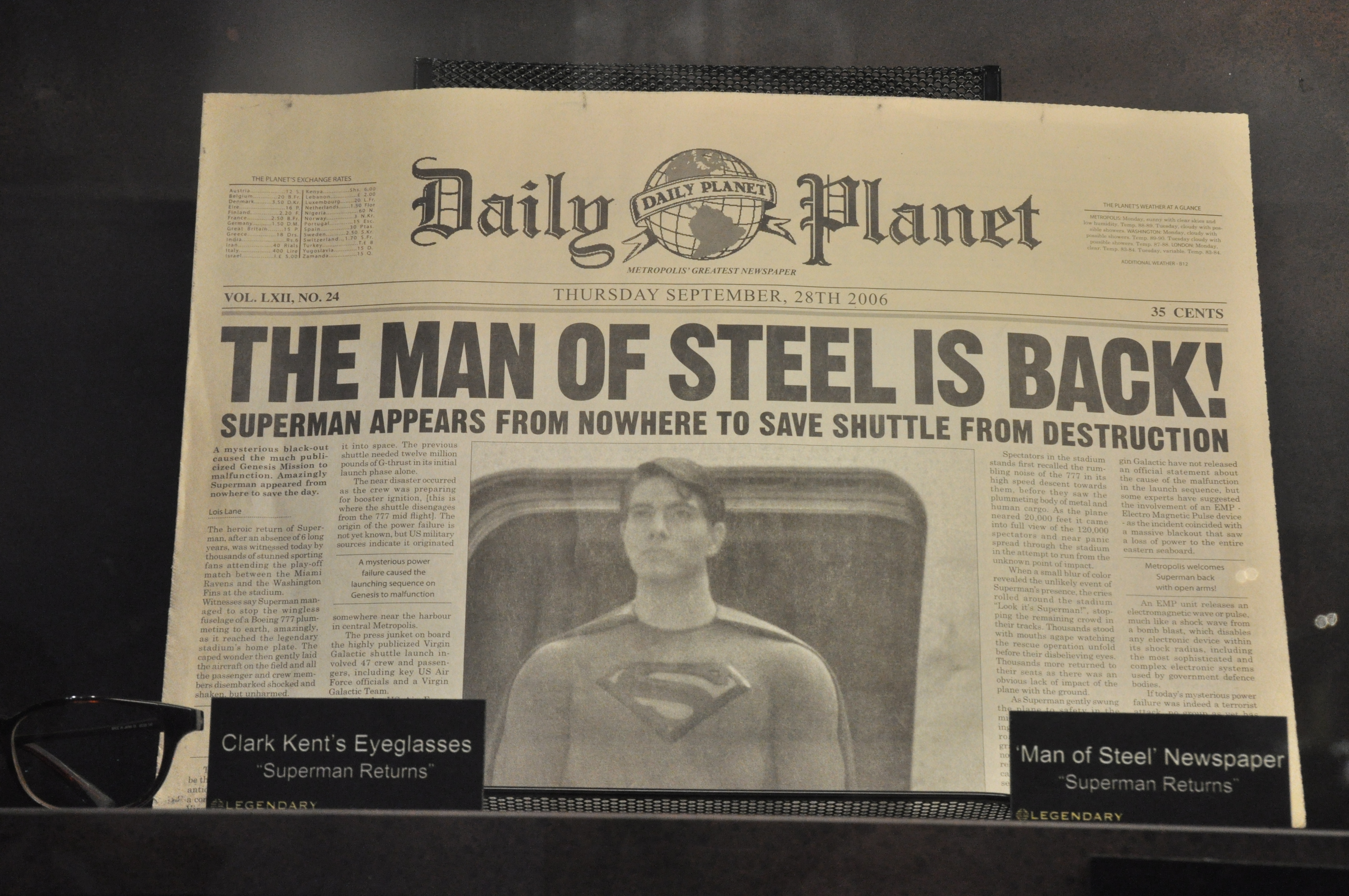
- The film is set five years after Superman II, which is set in or shortly after 1978 and unless some Daily Planet editor made one hell of a typo or played a prank, a newspaper◊ clearly dates Returns in 2006. Don't think about this too hard.
- Especially problematic thanks to the casting of Kate Bosworth, who was 23 when the movie was released (22 during filming) and looked at least that young. She must have gotten a really early start at the Planet (and a really early start at some other things, considering the age of her son). Brandon Routh, 26 during filming, was a little less noticeable. Jimmy Olsen looks older than Lois (and in fact Sam Huntington is about a year older than Bosworth), despite being about a decade younger in most continuities.
- The film is set five years after Superman II, which is set in or shortly after 1978 and unless some Daily Planet editor made one hell of a typo or played a prank, a newspaper
- Tarzan underwent constant recasting, from Johnny Weismuller (who played Tarzan from 1932 to 1948) to Lex Barker and further (Mike Henry served as the last series Tarzan in theatrical film in 1968). Since Brenda Joyce stayed on as Jane from the last Weismuller film to at least the first Barker film, this represents a case of a sliding timescale. It's most noticeable with their son Boy, who ages from infancy to childhood (about ten, in the movies) in the space of a cutscene, while his parents haven't aged a day.
- The third story of Trilogy of Terror II presumably picks up a few hours after the third story of the first film. The first film was from 1975 and the sequel was from 1996, and it's a bit hard to reconcile how different things look between the two films.
- X-Men Film Series:
- X-Men: First Class is definitely marketed as a prequel to the original X-Men trilogy, but the timeline used in the film is very wonky. First Class takes place in 1962, which would put Xavier and Magneto in their 70s in the first movie (Patrick Stewart was only 60 when the first film was released, and Ian McKellen was around the same age). It's best not to think about Beast's age, either.
- In addition, in the first film Xavier states that he was seventeen when he first met Magneto, but in First Class he's clearly shown to have been alive in 1944, eighteen years before the two first meet. Though for the movieverse, a thing like that being only one year off is very good.
- The new cast introduced in First Class hasn't aged by the time of Apocalypse, 20 in-universe years later. Mystique is justified, as she canonically ages much slower than normal humans. Xavier, Magneto, Beast, Moira and Havok have no such excuse, especially Havok as he is, following the timeline, at least in his late 30s by Apocalypse, but his younger brother Cyclops is apparently still school-aged.
- This holds true again in Dark Phoenix. The film is set in the 90s, and yet once again Xavier, Magneto and Beast look no older than they did in First Class despite 30 years having now passed.
- The real timeline buster is X-Men Origins: Wolverine. How about Emma Frost being younger there than in The '60s? Even the permanent Cosmic Retcon from X-Men: Days of Future Past shouldn't make a woman born decades before the changes take hold thirty or so years younger than she should be. Officially, she's a different girl with similar powers.
- The aforementioned Cosmic Retcon from Days of Future Past also muddied the continuity around Angel and Psylocke. The two showed up in X-Men: Apocalypse, set in the 80s, despite also having been in X-Men: The Last Stand, which took place decades later. Even with the roles recast, Angel was clearly supposed to be a young man in his early 20s during The Last Stand, so him showing up at a similar age in Apocalypse makes zero sense. The official Word of God was that the continuity changes seen in Days of Future Past may have somehow caused certain characters to have been born earlier in the new timeline, but this idea is never brought up in the actual movie.
- Breaking Bad teeters on the edge of this. In the fourth episode of the fifth season it is confirmed that it has been one full year since Walter was diagnosed with cancer. This would mean that Walter starting to cook meth with Jesse, Walter meeting Tuco, Tuco hiring Walter, Hank killing Tuco, Hank getting a promotion and going to El Paso and deciding to leave that job, Walter meeting Saul, Saul introducing him to Gus Fring, Walter's daughter being born, Fring hiring Walter, Walter causing a plane crash indirectly, Hank beating the hell out Jesse, Hank getting shot, Hank recovering, Hank getting a promotion despite his earlier bad behavior, Gus killing the entire Mexican Cartel leadership, Walter killing Fring and destroying his empire, Walt, Jesse and Mike starting a new partnership, Mike's share being bought out by Declan who is now Walter's employer and Mike getting killed by Walter all happened over the course of one year along with many other events. It's possible and the show's episodes and seasons due tend to flow directly into one another creating a somewhat shorter timeline but it also gives you a headache trying to reconcile that timetable with all these events AND how much Walter has changed from the pilot till now. More explicitly, in Season 2 there's a reference to the Phoenix lander recently finding water on Mars (2008), but in a Season 5 episode there's a reference to Bin Laden's death (2011).
- In Season 1 of City Guys, the characters are implied to be in their senior year of high school, if not in their second semester of junior year (it is mentioned in the pilot that Jamal was expelled from his last school during junior year). However, the characters' grade levels are never explicitly mentioned until season five. The ages of characters are rarely mentioned as well; though in "Mo' Money, Mo' Problems," Ms. Noble states Cassidy's age as being "barely 17." NBC didn't help matters for viewers trying to figure out which grade they're in by merging halves of two different seasons into one beginning with season three (which is comprised of episodes produced during the second half of Season 2 and the first half of Season 3); this is particularly glaring with "Frisky Business", which is set on the first day of a new school year but aired midway through Season 4. Against logic, Chris, Jamal, Al, Dawn and Cassidy stay at Manny High for all five seasons (this is excuseable with El-Train, as his lack of intelligence resulted in him having been held back a grade multiple times).
- Dinosaurs, being a puppet based show, pulls this off better than most live action series, as no one is seen aging and the main children are all still at the same age they were when the series began (two teens and an infant). Which honestly just turns tragic, considering the ending involves the Ice Age that killed the dinosaurs.
- Lampshaded in an episode of The Golden Girls. Blanche mentions how she reads the comic Apartment 3-G every morning. When Dorothy mentions she hasn't read Apartment 3-G since 1961, Blanche says, "Well, let me catch you up. It is later the same day..."
- Greek covered the time between Rusty's enrollment at college to his sister Casey's graduation in about 3 1/2 years. (The span is actually about 2 years, as Rusty enrolled at the start of Casey's junior year.) It helps that It's Always Spring in the Ohio of the Greek world...
- In the case of Hang Time, this is subverted in that the series has some characters graduate off-screen, with "Graduation on Three" centering on all of the characters graduating from Deering... but before then, it gets hazy. Even though it's established each season is set in a new school year, the characters' grade levels are never explicitly mentioned (although the ages of a couple of them are); against logic, Julie and Mary Beth stay at Deering for all six seasons (despite Mary Beth stating in "Mary Beth's Parents" that she is 17, and therefore should have graduated after Season 3 at least). Even though, earlier episodes imply they're a couple of years short of college age. NBC didn't help matters any more by splitting Season 5 into two separate seasons.
- Largely averted by Head of the Class, which followed the teenage stars from their freshman year of high school to their graduation day. However, in order to pad out the series for a fifth season, it was decided that the fourth season was the first half of their senior year, and the fifth season was the second half.
- Inverted in Heroes. The first four seasons have taken place over about a year in-universe, but Product Placement marches ever on so characters have lots of gadgets and cars that weren't out in late 2007 (although they managed to almost avoid it with a reference to Guitar Hero 3 instead of 5, although they were still off by about a month). More explicitly, the fourth season/fifth volume says Season 1 happened three years ago even though all the time that's passed up would be about 11 months since the beginning of the series.
- For the most part averted in How I Met Your Mother, which is Continuity Porn that for the first eight seasons advances in real time. However, the last season takes place over the course of a single weekend (counting down the hours until Barney and Robin's wedding and Ted finally meeting the Mother) in 2013.
- iCarly:
- The show averted this in the first and second seasons, with the characters clearly moving up a grade, as well as the cast clearly entering puberty and growing up. The show also explained how their school was a combined middle and high school as they moved to a grade that, in almost all U.S. education systems, means moving from a junior or iddle school to a new high school. After Season 2, however, it gets hazy. It's likely they are now in Grade 10, but it's possible they could still be in Grade 9, or have moved ahead to Grade 11.
- Definitely applies by the time of the spinoff, Sam & Cat. Even going by the most generous estimates, the iCarly cast have to be at least one year above the Victorious cast. Cat has clearly started senior year by the middle of the season at least (the show features a Halloween episode, indicating a new school year, and the final season of Victorious had the characters in junior year) and yet Sam is stated to still be taking online high school classes and is stated to still be under 18 years old.
- Malcolm in the Middle: It's implied that each of the seven seasons covers one school year, with Malcolm starting out in sixth grade and finishing in twelfth grade. However, the timeline remains extremely vague throughout, with only occasional clues coming from the plotlines and very rare seasonal clues. Given the vague timeline, there are also several inconsistencies. Two years apparently pass between "Goodbye Kitty" (Season 5, Episode 3) and "Kitty's Back" (Season 6, Episode 5). Even if this was just a slight Continuity Snarl, Jamie apparently ages two years within the season while Malcolm and Reese advance only one year in school. Dewey also appears to reach middle school by Season 5 despite being in first grade at the show's start, meaning he should still be in fifth grade around this time. TL;DR version: Even though the starting point and ending point match up with the IRL timespan of the series, the events of the series still follow an extremely vague and sometimes contradictory timeline throughout.
- When it comes to Marvel's Netflix shows (Daredevil (2015), Jessica Jones (2015), Luke Cage (2016), etc.), it can be hard to determine how long exactly the time gaps are between each of the shows because of this trope. Especially considering that the shows take place around the time they're filmed.
- M*A*S*H:
- The series, which ran from 1972 to 1983, lasts longer than the actual war, which started 25 June 1950 and was paused on 27 July 1953. Also, in the series, if one uses the few references to the actual war, the first three seasons must take place over a few months, although Hawkeye mentions several times they've been there for years (1-2). This is using the involvement of the Chinese in the war starting on 2 October 1950, which started in the fourth season, and Hawkeye's statement that he lived with Trapper for "over a year" at the beginning of season four when Trapper left. There are many other time issues, such as the Battle of Pusan Perimeter, where Hawkeye and BJ are surprised to hear a replacement surgeon's experience was in that battle and they say they heard "horror stories" about it, when in reality, that battle took place August-September 1950. Also, the fact that the MASH rarely moves, and seems to be located quite close to the 38th, we can only conclude that MASH 4077 is in a time displacement bubble, immune from outside influence. Using this, we can conclude that the MASH 4077 only existed for a few days, as it must have been after the Battle of Pusan which ended in September 1950, and it went through three seasons before the involvement of the Chinese, which started in the beginning of October 1950. It gets even more confusing if you recall what happened during the first three seasons. They experience at least one winter, one spring, a Christmas, an Orthodox Easter, and an Army-Navy game (which normally occurs in late November or early December). No less than three children of American soldiers and Korean women are born, all presumably at least 5 months premature.
- At least one Season 4 episode (shortly after BJ's and Potter's arrivals) made mention of Nixon as Vice President. Even if you push it back before the inauguration and have it be after the election of Eisenhower and Nixon in November 1952, it doesn't explain numerous references to Truman being President later on and the episode that spans the entire year of 1951 with BJ and Potter there from the beginning.
- Misfits was shown across five series (2009-2013) but the in-universe passage of time was suddenly established in the final episode as just over a year, with the events occurring on the first anniversary of the mysterious storm that imbues all the characters with superpowers. This causes some real retrospective problems, as some of the episodes take place over several days, and some of the gaps between seasons were clearly implied at the time to be months in length.
- A similar lampshade joke to that of The Golden Girls (see above) happens on The Nanny regarding a soap opera. When soap-neophyte C.C. is pulled in to a show's cliffhanger, she asks if they'll find out what happened tomorrow. Fran scoffs, saying, "Please, this is a soap. Six months from now, we'll be lucky if that coffee she's making will be ready."
- Orange Is the New Black falls into this, since it is Very Loosely Based on a True Story. In real life, Piper's prison sentence only lasted 15 months, therefore technically the show (which started in 2013) should at the absolute latest be in the year 2015. However, the show ran until 2019 and the characters sometimes reference current events taking place at the time the seasons were filmed. The final season in particular discusses the 2019 controversy over ICE and the detention of illegal immigrants. Matters are complicated further by Caputo explicitly describing events of early seasons of happening "years ago."
- Our Miss Brooks ran on radio and television from 1948-1956, ending with a cinematic Grand Finale in 1956. Yet, students Walter Denton, Harriet Conklin and Stretch Snodgrass are always sixteen years old. The number of years Miss Brooks has been teaching at Madison High School range anywhere from four to eight. The only consistentcy is that Mr. Conklin and Mr. Boynton had been in the army during World War II. Mr. Conklin was a major, in charge of the post exchange at Camp Barbrick, Ohio. Mr. Boynton, Depending on the Writer, was either stationed near Madison, near New Orleans, or had a campaign ribbon for having been deployed (or even seen combat) somewhere in the South Pacific.
- Sesame Street has a sliding timeline. For example a 2006 episode had Bob introducing his deaf niece to two characters and teaching them about deafness despite the fact that they had previously known a deaf character, Linda. There was also a Season 35 episode showing three characters as teenagers in The '70s when they were all adults when the show began. As mentioned on the Not Allowed to Grow Up page, human characters age but Muppets stay the same unless a plot point is needed. It's especially noticeable in a wedding anniversary episode where Elmo speaks as if he wasn't at the wedding, but in the actual episode he's clearly in the scene.
- Despite being a Superman show, most of Smallville is assumed to have taken place at the same time the episode aired (save a couple of Continuity Snarls like Chloe's birthday).
- That '70s Show originally averted this, as the timeline for the first season started in 1976 and moved up to 1977. However, it played it straight beginning with the second season, with the timescale moving down slowly for the rest of its eight-season run. Among other things, the characters stayed in high school until the end of Season 5, and there were five Christmases occurring in the series.
- This happens in pretty much every newspaper strip, including most of the serious, "soap opera" ones, so listing exceptions is probably a better idea.
- Baby Blues has a slowly sliding timeline: Zoe started out as an infant and grew into a toddler as the need for new material arose. Since then, she has been given siblings as necessary to keep the strip's title accurate. Zoe is around 10 years old now (born in the January 7, 1990 strip), Hammie is around 7-8 (born in the April 29, 1995 strip), and Wren is 1 year old (born in the October 26, 2002 strip). Wanda's pregnancies have both taken place in real time, however, without any noticeable aging from the other siblings occurring in the meantime. Kirkman and Scott state that they age around a "Three to one Ratio". It was two to one during Zoe's infancy; apparently having two siblings means simply a lot more storylines to deal with. They've also stated on record that "your children are always your babies" and the title has nothing to do with Wren's slow development.
- Beetle Bailey: Current events form a vaguely acknowledged background for what's going on (with the exception that the strip is always about peacetime army even if there is a war going on), but if anyone really ages (which has happened to about two characters, Ms. Blip and General Halftrack), it's more of a Retcon reimagining their character concepts than anything else.
- Big Nate had this bit of Lampshade Hanging:
Nate's Gram: Nate, we're really looking forward to Grandparents Day at your school!
Nate: Yeah, but why? I mean, when I'm eighty, I'm not going to want to hang out at a middle school!
Nate's Gramps: Son, from what I hear, when you're eighty, you might still be in middle school!
Nate's Gram: Oh, Vern! Honestly! - Blondie (1930) averted this for twenty years, chronicling not only the courtship and marriage of Blondie and Dagwood, but also depicting the birth and growth of their children Alexander (born in 1934 as "Baby Dumpling") and Cookie (born in 1941). Alexander stopped growing up around 1950-51, but Cookie kept on until late that decade, finally having the same age as her brother.
- Long-running Scottish comics The Broons and Oor Wullie both make heavy use of this, having kept all characters at identical ages since they were first published in the 1930s. While the setting progressed around the characters for the first few decades, the comics seem to have settled into a sort of temporal limbo that darts back and forth between the 1950s and the present day at will, shifting from a "present day" setting to a nostalgic yet nonspecific "good old days" one.
- Characters from Calvin and Hobbes never age, although years are quoted, and Calvin frequently compares his summer vacations and Christmases to prior ones. In one late strip, Calvin tells his perpetual classmate Susie that her treatment of schoolwork as "fun" is one of the "ten signs of hopeless dweebism", to which she replies "I bet another is moving to the next grade each year." It gets lampshaded in another strip where Calvin's dad says "Yeah, I know, it feels like you're going to be six forever."
- Cathy more or less has operated in real-time. Irving, for example, has slowly gotten balder. Justified in that the main character is an Author Avatar for Cathy Guisewhite.
- Lampshaded in Curtis. When Curtis gets a new hat in 2020, his brother Barry tells him, "It feels like you wore your last hat for thirty-one years!" Curtis responds, "You exaggerate so, Barry! That isn't possible! You're eight and I'm only eleven." The characters had not aged over the course of the strip's run, which, at the time, was thirty-one years.
- Dick Tracy's strip acknowledges his wartime activities against spies such as Pruneface without dealing with the question of why Tracy still works as a policeman decades later. For example, Max Allan Collins wrote a storyline (later collected by Ken Pierce books as Tracy's Wartime Memories) to a hitherto untold story where Tracy battled Flattop, Shaky and Mr. and Mrs. Pruneface during World War II. Tracy appears in the modern era looking the same, while characters who appeared in the flashback story having aged decades. (Flattop stayed dead, as did Mrs. Pruneface, but Pruneface underwent revival from his hypothermic death due to the efforts of a sympathizer to the Third Reich.) Some of Tracy's children have visibly grown. In July of 2009 he visited his daughter Bonnie Braids. Sparkle Plenty has also grown into adulthood.
- First played straight and then averted with Doonesbury. From 1970 to 1983 the characters were always college students. Then the creator took a hiatus, improved his drawing style, and produced a play in which the characters finally graduate. Since then they have grown up in real time, and the original characters are now all middle-aged. Oddly, this doesn't apply to Duke, who appeared to be in his forties when introduced over thirty years ago and still does. According to the Word of God, Uncle Duke isn't a normal person. His age was unknown when he was introduced and remains so to this day.
- Dykes to Watch Out For is another exception: the story is set in the present day with constant references to topical events, and characters, both adults and children, have aged at pretty much chronologically accurate rates. The few exceptions, for a long time, included Mo's cats, who'd survived the strip's entire 20-plus year run; however, in the last year or two of the strip's run, they were shown increasingly frail and one of them finally died.
- For Better or for Worse:
- The storyline ran in real time from its inception to 2008. Then it rebooted to the early days, using a combination of reruns, modified reruns, and new strips drawn to look like the old ones. Word on the street is that this was the syndicate's idea.
- This was alluded to in a post-9/11 episode of FoxTrot (which rigidly enforces this trope) when Jason found out that his father — afraid of needles (and of most things) — just gave blood.
Mom: Sometimes we have to grow up, kiddo.
Jason: Whoa. Did I just stumble into For Better or for Worse?
Mom: You can stay 10, sweetie. I don't mind.
- As mentioned above, FoxTrot often lampshades its use of the trope. In the February 4 2024 strip, Peter is excited that next year he'll be 17 and able to play Grand Theft Auto VI when it comes out. Jason says they had this exact conversation about Grand Theft Auto V, and Peter says that doesn't make any sense, because it came out ten years ago.
Peter: I mean, think about it.
Jason: Actually, it's probably better if we don't think about it. - Funky Winkerbean started off this way. The comic began in 1972 and the characters remained in high school for the first 20 years of the comic's existence. Then, in 1992, it was established that the characters had graduated high school in 1988, and the comic picked up in real time from just after their college days. In October of 2007, there was another Time Skip, and the comic is now presumably taking place about 9 years into the future (The Other Wiki says that the original main characters were to be 46 years old after the time skip, and based on graduating in 1988, they probably would've been born during the '69-'70 school year and should therefore have only been 37 just before the time skip.) So far, it's been impossible to tell the difference between the two eras. (It's not clear whether the current setting is circa 2020, or the pre-Time Skip era has been retconned back 10 years, keeping the strip in the present day. Most of the evidence suggests the latter. Confusing matters further, however, is the Shared Universe with Crankshaft, which also runs on Comic-Book Time, but didn't have a time skip. Crankshaft shows every signs of also being set in the present day, but when its characters appear in Funky Winkerbean they age ten years, and when FW characters appear in Crankshaft they appear as they did shortly before the time skip.)
- Garfield has a strange zig-zagging of this.
- Garfield's 'birthday' is celebrated every year and he constantly complains about getting old... but none of the characters ever age physically. Also, Garfield is stated to be as old as the strip itself, even though he's already an adult cat in his first appearance. It may be for the best that Garfield doesn’t appear to age, though, since at 40+ years, he has long exceeded the expected lifespan of the average cat.
- It got even weirder when, in 2003, Garfield met himself — that is, his "former" iteration from 1978, when the strip debuted; the Art Evolution was promptly lampshaded. The June 19th strip, referred to as Garfield's official birthday, also featured the original models of Odie and Jon standing with their contemporary counterparts.
- Gasoline Alley, one of the oldest strips still in existence, also operates in real time (though temporarily halted and then restarted); Skeezix was an infant during the first year of the strip and is now an elderly man, old characters die off eventually, including the family dog and many of the original characters from the Alley. Walt Wallet is still hanging on, though, and the fact that he is now technically over 120 means that things are getting fudged.
- The characters in Heart of the City don't age, but their pop-culture references remain current. In 1998, Heart was an elementary-age girl swooning over Leonardo DiCaprio; by 2008, Heart was an elementary-age girl swooning over The Jonas Brothers. Also worth a mention is the fact that Heart and Dean have a new school teacher every year despite not getting older.
- Jump Start follows a similar formula. Initially averted as the characters seemed to age in real time. This is notable with both Sunny and Jojo, who were born during the strip’s run, but have since grown up and are now in school. Aging, however appears to have stopped since the twins, Tommi and Teddy were born.
- Little Nemo would actually lampshade this from time to time. It was a once a week strip, and a lot of times when a plot was taking too long a character would complain about it seeming to take weeks.
- Luann and company have been in high school since 1985, approximately thirty-one years. Brad has since graduated high school and become a fireman. Starting in 2010, Greg Evans and his co-writer, his daughter Karen, have made a concerted effort to push Luann and her classmates forward in time. As of 2014, Luann, Bernice, Delta, Gunther and Tiffany have graduated high school and are now college freshmen.
- Madam & Eve has been running since 1992 and frequently makes references to Real Life events and South African political figures. Even so, none of the characters have aged, and Eve still hasn't received a pay raise.
- Marvin: Played mostly straight; Marvin has been a baby since 1982. However, during July 2003, there were a series of strips where he finally learned how to walk, ending with a Sunday Strip where his first birthday was celebrated. Since then, he's aged one year for every three years real-time.
- Many of the characters in Peanuts aged somewhat since their introduction. Schroeder and Lucy started out as toddlers, then grew to Charlie Brown's age; Lucy's "baby brother" Linus grew to one or two grades below Charlie Brown (and has been seen in the same classroom as him on occasion). Sally also started as a baby and later caught up to Linus. Rerun also was born during the strip's run and ended up as a toddler. Charlie Brown himself also aged somewhat over the course of the strip; he stated that he was four in a 1950 strip, six in a 1957 one, and eight and a half in a 1979 one. The strips and animated adaptations are set in the year created, and thus we've had stuff like the incredibly 80s "Flash Beagle" song in the animated specials and references to Harry Potter in the comics.
- Phoebe from Phoebe and Her Unicorn has been in the fourth grade since the strip's inception in 2012, and showed no signs of aging for the longest time. It took until the strip's tenth anniversary for her to finally turn ten.
- Heavily lampshaded in long-running British strip The Perishers, where one of the titular kids noticed that they never seemed to get any older from year to year and concluded that "something funny's going on!"
- Retail is another exception to this trope, albeit rather subtly. One example is when a fired employee returns years later, stating that his ban from the mall only lasted 5 years, which was the amount of time he was absent from the strip.
- Lampshaded in Sally Forth (June 26, 2014): "It doesn't feel like people ever age around here. It's like a "Twilight Zone" episode but with wi-fi." In another strip, Hillary remarks on the fact that her baby cousin is a year older, while she herself is the same age and in the same grade at school. She is then quickly admonished not to talk about it.
- A really weird example occurred in Toots and Caper, specifically with their son Buttercup: After being a baby for twenty years, in the early 1940s he grew up to be a 6-year-old kid. As cartoon historian Don Markstein noted, he was born a few months before Skeezix, but he entered grammar school at the same time the Wallet kid was a young man enlisting in the war.
- The writers of Adventures in Odyssey have openly admitted that the passage of time in Odyssey doesn't really make sense. The best-known example is how Connie was sixteen for an extraordinarily long time, which they didn't hesitate to poke fun at, although she gradually made it to twenty-ish. Meanwhile, Whit, Eugene, and assorted kids have all aged at different rates.
- Gallifrey follows Leela, who is human, and Romana, who does not return from E-space until the time of the Eighth Doctor, over 200 years after Leela first arrived on the planet, even though she has hardly aged a day.
- The original two series of The Hitchhiker's Guide to the Galaxy (1978) were broadcast from 1978 to 1980, and were intended as a contemporary piece. While the narrative quickly left Earth and there is not much to date the series, it can still be a bit jarring when the later three series, produced in 2003 and 2004, have scenes on or in reference to Earth that make more modern cultural references, or include as common technology things that would not yet have been common or even have existed. Of course, when dealing with possibilities such as different versions of Earth existing across multiple planes of reality, one supposes that such things may be relative. The most noticeable example is that "novelty ringtones" have replaced digital watches as the thing that primitive ape-descendants still think are a pretty neat idea.
- Depending on your group and how your GM handles time, it can lead to some problems when the characters seemed to have gone from low-level n00bs to walking gods without aging a single bit. Although, in Dungeons & Dragons at least, a party that gets four level appropriate encounters a day every day will go from Level 1 to 20 in about six months.
- Even though the two "storybooks" in the Mice and Mystics game series have been published over two years, and even though each campaign can take 15-20 hours to play, only two weeks have passed in-universe.
- Specifically subverted in the Spanish roleplaying game Superhéroes, Inc. Rules are provided so that experimented super-PCs lose points everywhere (probably to avoid Godmodding), so that he should consider retirement and replacement.
- BIONICLE averts this by having its "main" story progress much slower than real-world time. Although the storyline lasted about a decade, in-universe, only one year and a few months have passed; no matter how many wild adventures the characters have gone through or how many world-changing events have happened since then. Also, even the mostly organic characters don't seem to visibly age, at least physically. In fact, most major characters have lived through a very decent chunk of the backstory, which is at least 100,000 years long...not that anyone is bothered by this much.
- Monster High:
- The series ran afoul of this quite often. There is at least some semblance of the progression of time, events from web episodes and TV specials tend to be surprisingly heavy on continuity, and at least one character actually appears to graduate (or drop out) from the titular school, but many of the aforementioned specials seem to take place during subsequent seasons of the year. Considering there were 13 specials prior to the first Continuity Reboot, the main cast should've logically seen more of a shakeup.
- Series lead Frankie Stein approaches Voodoo Shark levels in regards to this trope, as her given age is 15 days old. Yes, days. By comparison, Draculaura celebrated her Sweet 1600, with her age updated from 1599 to reflect the occasion. Eventually, the writers threw a lampshade on this by listing her age as "How many days has it been now?", whereas the reboot continuity tweaked her age slightly to 115 days. Then the second reboot reverted Frankie back to 15 days old, with the movie having its version of the character repeatedly mention their new age with each passing day.
- Ace Attorney has its characters age in-between arcs and they age realistically. However, the Judge, despite being an old man who admits to using dentures, never seems to age one bit and the games use a singular timeline with specific dates for each trial and event.
- Animal Crossing: Bizarrely played with. Despite the fact that time flows at the same rate it does in the real world, none of the characters in-universe never seem to age a day. When celebrating a character's birthday, no mention is ever made to how old said character is. As of New Leaf, it is possible to change the date so that up to 38 years can pass (the limit is 2050 before it loops back to 2012), yet the characters don't age. At most they'll just comment on how much time has passed since you last talked to them.
- Dead or Alive had this going for a while. The series debuted in 1996, but the characters remained the same age; for example, Kasumi and Ayane remained only 17 and 16 respectively. As of Dead or Alive 5, however, the entire cast has been officially aged two years.
- Fallen London is set in the 1890s, in a heavily steampunk-inspired Victorian setting. However, being a continually updated browser-based game, time passed in real-time for the first several years of the game's existence, with annual citywide events around Valentine's Day, Halloween and Christmas. When the in-game calendar hit January 1, 1900, the Empress promptly banned the new century, causing the in-game timeline to loop through the year 1899 indefinitely. Having the Office of Public Decency drag you off to New Newgate for possessing an updated calendar or acknowledging the passage of time is definitely one way of subverting this.
- Final Fantasy has employed this for its MMORPG installments.
- Final Fantasy XI has had an in-game clock and calendar running since its servers first went online. It doesn't do anything remarkably odd with this trope, but the real kicker to it is that it continues to track the in-game year. Literally thousands of years have passed in-game, but no PC or NPC has ever aged, no construction project has ever been completed, no city or civilization has ever changed risen or fallen. It's a stagnant world but time continues to flow.
- Final Fantasy XIV is a weird case with the passage of time. The game is stated to take place five years after the Calamity (basically, the events of 1.0 before the game got rebooted). Time does flow via in-game clock and characters in seasonal events will remember you if you participated in the previous year's event, but no one actually gets older and no specific date for any content currently in the gamenote is ever given. Word of God says that time does flow normally, but all the events in the game take place in a time bubble where said events take place in their own time. For example, the Level 50 Culinarian quest has you cooking a meal for the Sultana of Ul'dah. She's still there for the quest even when she gets incapacitated towards the end of the A Realm Reborn storyline. In other words, characters and events that are scripted to take place in certain parts of the main story will act as such regardless of how far in the main story you actually are. The "Even Further Adventures of Hildibrand" from the second expansion lampshades this; part of its opening quest involves the player tracking down a stalker who has their eyes on Nashu, and when you track him down he admits to it, though claiming he's had trouble with time lately and isn't sure whether he's been following her for one week or five years (the latter being about the amount of time that passed between FFXIV 2.0, the A Realm Reborn relaunch, and 4.1, the patch that added this quest).
- In most Harvest Moon title, none of the characters age no matter how much time you spend in the game. This is particularly egregious in (More) Friends of Mineral Town where you unlock special features on your 10th and 50th wedding anniversaries (a ring and a cottage, respectively), but the characters still look the same, despite the fact that the MC would be as old as Saibara and Ellen at this point.
- An interesting example is found in The Idolmaster where each of the characters has a birthday. However over the course of a year they never celebrate their birthday or age. In the end, Iori is still 14, Haruka is still 16, and the twins are still 12 even if you pass their birthdays. This is most obvious in One For All and Platinum Stars, which both have a continuous gameplay timeline instead of a fixed-length campaign, so several in-game years can pass as the player progresses. The iDOLM@STER 2 permanently aged the characters up one year, but otherwise retained this trope.
- Samus Aran in the Metroid series doesn't seem to age a day at all, even though every single game is placed on a single timeline so that they all follow each other. It is never explained how much time has passed between games and the only passage of time that gets mentioned is in Metroid Prime 3: Corruption where Samus wakes up 3 months later after being gravely injured by Dark Samus. At least she's genetically altered to explain it, and considering several of the games near the back end of the timeline more or less directly flow into one another, they could simply be happening within a much smaller time-scale than that in which the games actually came out.
- The Nancy Drew books have their own set of problems, but the Nancy Drew PC games have another, namely this. There's a steady implication that the stories occur in quick succession (the first game, Secrets Can Kill, ended with a sting about a soap opera and death threats, directly leading to Stay Tuned For Danger, and more recent games such as Shadow at the Water's Edge, The Captive Curse, and Alibi in Ashes, are explicitly said to be one right after the other, with the only time passing between them being the plane rides between Japan, Germany, and River Heights). However, while this could imply only a few weeks or months in-universe, justifying the fact that she's still 18 years old, the games have been made for 15 years in real life, and they keep the tech up with the times, meaning in the span of less than a year, she's gone from finding clues on floppy disks and VHS tapes to super-powerful smartphones and thumb drives.
- The Neptunia series doesn't have its human characters age at all, despite each game usually opening with one of the characters mentioning that "years" have passed in-universe since the previous game. If IF and Compa were in their early teens when they met Neptune and Nepgear for the first time (as seen in a flashback in mk2), they should be in their mid to late twenties as of VII, yet they don't seem to have aged a day, if you ignore Art Evolution. At least the CPUs have the excuse of canonically not aging. Victory features an Alternate Universe where IF and Compa are aged through Time Skips from toddlers barely able to speak to about five or six to their usual something-teen age, yet all the other human characters, like Abnes and Mr. Badd, remain the same age, although Abnes is handwaved by Anonydeath claiming she's Older Than She Looks.
- Unlike the anime, the Pokémon games do not follow this trope, as time has explicitly passed between several entries. For example, the Gen II games (and their remakes) are set three years after the Gen I games (and their remakes), Black 2/White 2 takes place two years after the original Black/White (with Word of God stating the events of X/Y are happening concurrently with B2/W2), and Sun/Moon, where you meet older versions of Blue Oak and Red at the Battle Tree, is indicated to be roughly a full decade after Gen I. Instead, the trickiest aspect of the series' chronology is the fact that, as first implied in Omega Ruby and Alpha Sapphire, the games which feature Mega Evolution as a gameplay feature (i.e. Gen VI and onward) take place in a different timeline from that of Gens I-V.
- While Ratchet & Clank often acknowledges the passage of time between games, the characters themselves never appear to get any older; Ratchet is still a twenty-something, for example. Even older characters like Qwark or Azimuth are depicted very closely to their present ages when we see their more youthful years.
- The original Rolling Thunder was a period piece set during the late 1960s. For some reason, the two sequels moved the setting to the 1990s, even though the Albatross and Leila from those games are implied to be the same characters from the original (rather than being Legacy Characters).
- SNK:
- All the returning characters from The King of Fighters '94 were aged by one year in '95 and since then everyone remained the same age in all subsequent entries (until SNK stopped listing the ages of the characters in 2002), despite the storyline of the series revolving around a yearly tournament. This is a huge contrast to SNK's prior fighting game series, Fatal Fury, in which characters were allowed to age as the series went on, specifically Terry Bogard, who was 20 in the very first game in the series and ended up turning 35 in Garou: Mark of the Wolves (released in 1999, but set in 2006). A contrast to the KOF series, in which he is eternally 24. Terry was eventually given his aged-up Garou redesign in KOF 2003, only to return to his classic, younger appearance two games later. (This is in part due to SNK switching to HD, hand-drawn sprites for XII and XIII, resulting in a lot of characters adopting their original designs and/or having the amount of details present toned down, but 2003 and XI also treat Terry's "Wild Wolf" design as a mere cosmetic change.) Strangely, his adopted son Rock Howard officially joined the series in KOF XIV after having previously cameoed as a little kid in one of Terry's KOF 2001 victory animations, meaning Terry has stayed the same age despite the child he raised having grown into a teenager.
- The Art of Fighting trilogy was originally written as a prequel to the Fatal Fury series, being set roughly a decade before the events of the first Fatal Fury. This is pretty apparent in Art of Fighting 2, where a younger version of Geese Howard serves as the game's True Final Boss, while a middle-aged version of Ryo Sakazaki would show up in later titles such as Fatal Fury: Wild Ambition* and Buriki One as the second Mr. Karate. However, the King of Fighters series features Art of Fighting characters mingling with their Fatal Fury counterparts with no visible signs of aging, with Geese himself being the middle-aged version from the Fatal Fury series.
- Snatcher was originally released in 1988 in Japan, with the date of the Catastrophe set in 1991. For the English version, which was released in 1994, the date was changed to 1996. This actually caused all the dates in the story to be bumped by five years, changing the present date of the story from 2042 to 2047.
- The characters in Sonic the Hedgehog never age. Sonic's age was not set in stone (ranging from 16 to 18) until it was codified as 15 in Sonic Adventure. He has stayed that age since, even though he had a birthday in Sonic Generations. This all is made even more painfully obvious by the aging of characters like Amy (who went from 8 in Sonic R to 12 in Adventure while Tails stayed 8). In Sonic Forces, Infinite remarks that Sonic has beaten Eggman "for decades."
- Spider-Man: Web of Shadows, a video game released in 2008, includes a line where Luke Cage defends his old costume on the grounds that it was designed in the 70s — which is true, but one wonders how old it makes Luke.
- Despite being active for nearly four years as of the time of this writing, Star Trek Online is still, according to Word of God, in 2409. This is after having two holiday events. According to the developers, they're in "very late" 2409. The Season 9 Featured Episode "Surface Tension" finally moved the game up to 2410. It'll probably be another four-and-a-half years before we get to 2411.
- Stardew Valley has the townspeople reference time passing over two years but after that, nothing changes and the dialogue gets very repetitive. The two townspeople children never age, though your character can have children and they can become toddlers.
- Street Fighter: Street Fighter II (and Final Fight, which is set in the same universe) had official dates of birth for each character in the game that gave away their intended ages. As the series went on with Street Fighter Alpha and Street Fighter III, Capcom started using vaguer years for in-game dates and even within official data in an effort to avoid dating the games, as well as ensuring the characters would stay roughly the same age. (For example, Sakura's DOB was given as March 15, 197X in SFA2 proper.*) From Street Fighter IV onward, years of birth for all the returning fighters were no longer given in official bios. Even Ultra Street Fighter II, the 2017 Updated Re-release of Street Fighter II for the Nintendo Switch, changed Zangief's country of origin from the U.S.S.R. to Russia due to the dissolution of the former during the early 1990s.
- Super Mario Bros.:
- The cast never seem to age at all. New Super Mario Bros. Wii starts the story off by having the Mario Bros. celebrate Princess Peach's birthday, but her age is never revealed. The entire series constantly references past games but none of the characters get any older. Now let's stop for a second and discuss Mario's age. The Japanese Trophy description for Mario in Super Smash Bros. Melee states that he's 26 years old. Let's be generous and say that he ages one year with each new generation, putting him at 29 as of the launch of the Nintendo Switch. That would place his birth at around 1988, a few years after his real-life debut where he was already an adult! Eventually, Miyamoto stated that Mario has been 24-25 years old throughout the entire series.
- This only becomes weirder when you consider that Mario and Donkey Kong share a universe and that Donkey Kong and crew do age. The "original Donkey Kong" that Mario fought in his debut game has been confirmed to in fact be Cranky Kong, Donkey Kong's grandfather, which means that the very-clearly-a-child Donkey Kong Jr. from the old arcade games has an adult son now even though his enemy is still in his twenties.
- Tekken actually averted this in the first four games, as there were considerable time skips between installments. However, there has been no visible passage of time since 2001, with characters staying the same age as they were in the fourth game. Some have speculated that this by forgoing time skips, Namco can keep the female characters young and sexy forever (as the nineteen-year time skip between the second and third games had forced them to resort to various excuses to remove the older female characters or have them stay young). Taken to somewhat illogical extremes in Tekken 7, which claims the events of Tekken 4 took place "only a few months earlier," despite enough time having passed for there to have been multiple new tournaments and a full-fledged world war between the two games.
- The Most Popular Girls in School: In an example of Webcomic Time, Seasons 1 through 4 take place over a single school year (less, as the series began with the year already in progress) but were produced over the course of four calendar years. What makes it also qualify is that whenever a character mentions the current year, they say the current Real Life year, meaning it went from 2012 to 2015 during that single In-Universe year.
- Retarded Animal Babies hangs a lampshade on this in Episode 21: Cat mentions that they're only six months old but can somehow go to two annual 4-H fairs in a row. (Assuming the previous one was the one briefly shown in Episode 2, several years have also passed in Real Life time in that period.)
- Achewood characters age normally... except for Phillipe. Phillipe is five. He will always be five.
- Done in Alice, in which the characters were in 7th grade until around 2005, and have gone to several Halloween parties, fall dances, and Thanksgiving Weekends. The later strips show them progressing to Grade Eight.
- APT Comic, though some of the characters (including the resident Author) have 'ranges' instead of a set age.
- Avalon averted this for the most part, with the majority of it taking placing in real time and with timeskips after long storylines. It was played straight near the end of its run when the ugliness that is Schedule Slip reared its head and caused week to month-long delays.
- Averted in Deviant Universe, where almost every story event takes place in the month they were drawn in.
- A year of Dumbing of Age strips will usually cover an in-universe week, but the comic has a sliding time-scale to prevent it, in the author's words, slowly turning into a period piece. Later strips make reference to media, such as Pokémon GO or Jurassic World, which didn't exist when the webcomic started published. One 2022 strip states that Joyce's birth year is 20XX (the last two digits are blocked out with another speech bubble), which of course means that she'd only be ten years old entering college if it followed the webcomic's starting year of 2010.
- El Goonish Shive is consistent with character ages and suffers from the usual Webcomic Time, but technology matches whatever era the current comic was written in (in one early comic a character from a rich family complains about her pay-per-text plan and now everyone has smartphones, etc), with the author refusing to acknowledge the time period beyond taking place in the year "20XX" to the point of being a Running Gag.
- Girl Genius:
- Lampshaded when Maxim is stopped from telling a story. "Sorry brodder, but de vay hyu tell stories, it vould have taken all month!"
- And again here, when a reunion with Master Payne's Circus of Adventure reminds Agatha of the death of Lars.
Agatha: For everyone else it's been years* — but for me, it was last month.
- Lampshaded when Maxim is stopped from telling a story. "Sorry brodder, but de vay hyu tell stories, it vould have taken all month!
- For Heartstopper, author Alice Oseman generally considers her work to be set in "the present" when then work is being written, but Webcomic Time has kicked in where real-world time has gone faster than in-universe time. As a result, Oseman has embraced the drifting timeline, with the pop culture references changing throughout the series to reflect the year that chapters are released. For reference, the Oseman Verse timeline graphic puts down the "stand-in year" for Heartstopper Volume One as 2010, but then disclaims it that Heartstopper is clearly not set in 2010 because of anachronisms such as more modern iPhones. Therefore, it's easier to visualize the timeline based on the Osemanverse years. That is, Heartstopper Volume One always begins in January of Year One, while Solitaire always takes place in the beginning of Year Two, regardless of real-world time.
- Kevin & Kell (and also in Bill Holbrook's other strips):
- Averted in general. Coney was born and is growing up, Lindesfarne graduated and went to university, and even Rudy has grown up and matured. A little.
- And yet, initially it was played straight as Coney who's now growing up, was born around when the webcomic began in 95 and didn't progress to being a toddler until a full 10 years later with time still being acknowledged as progressing.
- The tags under the strips note strips in which Rudy's age is mentioned. He's aged six years between 1996 and 2012. Interestingly, Coney looks about six in the latter strip as well.
- The 20th anniversary featured a week of comics set 20 years ago in strip time: Kevin was still married to Angelique (with a baby Lindesfarne) and Kell was pregnant with Rudy.
- Originally played straight and then abruptly averted in Least I Could Do, by means of a memo from the cartoonist informing the assembled characters that they would henceforward age normally. The missive was received with... more than a little distress, especially by Rayne, and the following years saw the major characters trying to get a handle on maturity and planning for the future.
- Ménage à 3 has ran between 2008 and 2019, but only a few months — perhaps a year — have passed within its universe. Mostly, the dates of events in the story are unstated and ambiguous, but there are occasional hints that the current date is close to the real-world date. For example, Gary is a "brony" — a fan of comics that weren't being published yet in 2008 — while one 2018 strip features a Donald Trump joke that only really works if one of the characters knows that he's U.S. president.
- Philler Space: Characters age slower than real time, but the present is always the real time date.
Lampshaded:Max: What trimester were we in when we all went to see Eragon?
Philler: First part of freshman year. Duh.
Max: And when did Eragon come out?
Philler: December 2006.
Max: And what's the date today?
Philler: May 2008.
Max: And yet, despite a 1½ year difference, we're still in the first part of our freshman year. Doesn't that seem odd to you?
Philler: No, just really, really depressing. - From PvP:
Cole: It could be worse...Bart Simpson has been ten years old since 1989.
Francis: This blows.
Cole: You'll appreciate it when you're in your thirties.
Francis: I'm never going to be in my thirties!
- Two years after that strip, Francis and Marcie lose their virginities to one another and immediately age three years.
- This is done inconsistently, though, as this strip implies that less than four years have passed since the comic's launch, modern pop-culture references notwithstanding.
- On the other hand, Cole's daughter (b. 1999/2000) dropped out of the strip for a decade and is now in college.
- Two years after that strip, Francis and Marcie lose their virginities to one another and immediately age three years
- In Rascals, despite the lack of time references, one can discern that some time has passed with certain events, such as Lionna's pregnancy and some members graduating from college.
- In this Shortpacked!, Ethan considers some of the effects of Comic-Book Time with respect to Batman.
- Sluggy Freelance started out paralleling real-world time (skipping in and out of Webcomic Time), which besides New Years happening was especially noticeable with Zoë, who graduated college and, insofar as it's possible to tell with the Art Evolution, developed from a relatively skinny late teen to a more woman-shaped woman. However, the characters stopped aging after becoming twenty-somethings. Otherwise, they'd have turned forty around the time of the strip's twentieth anniversary (it began in 1997).
(Pete Abrams:) "To be honest it feels like Torg and Riff were kids-to-teens in the 80's, college-age in the 90's and pretty much have stayed 20-something forever after that (with Zoë being slightly younger and Gwynn will never admit her age anywho)."
- This is parodied in Supermegatopia, in which Mongoose Lad really was Ferret Man's boy sidekick for decades, due to a mutation that caused him to age far slower than normal.
- Behind The Veil, being a Play-by-Post Game, runs by this trope out of necessity; the events of a eventful hour could take weeks to write out. Using some of the oldest characters on the site as a Framing Device, their first meeting which was written towards the end of 2007 happened roughly a year prior to current events.
- Legion of Net.Heroes, due to being a superhero parody, has played with this many times. Probably the most explicit use of the trope is the Slide-Rule of Time, which can create and manipulate sliding timescales with elementary-level arithmetic.
- Averted so far in the LessThanThree-Verse, with actual dates matching those in the real world, and the core characters, The Brat Pack, less than a year from graduating high school.
- Whateley Universe:
- Time clearly moves more slowly in-universe than in the real world; Team Kimba arrives at the academy in early September 2006 (still in the future at the time the first stories were written), and by real-life early 2009 the storyline had advanced to begin to cover events in January/February 2007. On the other hand, the stories do provide plenty of concrete dates and times to help keep everything on track.
- However, there's a subtle nod to this trope with Headmistress Carson, who is over seventy, and looks to be in her mid to late 30s, and looked like a teenager well into her real thirties. In a not so subtle nod, it is recognized according to Word of God that Comic-Book Time itself is accepted in-universe because after she got her powers, she aged at about one third or one quarter the rate she should have and everyone knows this.
