
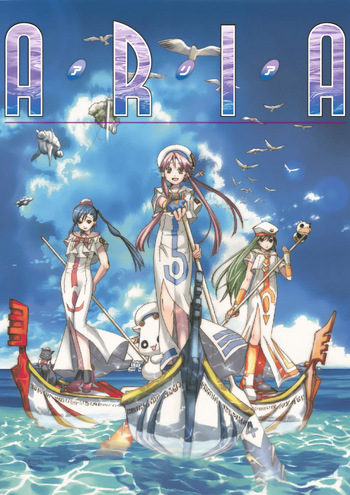
ARIA is a manga and anime series set in the 24th century, depicting the adventures of several young women who live on Aqua, the planet formerly known as Mars before it was terraformed into a water-covered paradise. They serve as gondolier tour-guides—or Undines—in the city of Neo Venezia, which is an exact copy of Earth's Venice, canals and all.
The story focuses on Aria Company, the smallest gondolier tour business in the city with only two employees. It is run by Alicia Florence, who one day welcomes a new apprentice called Akari Mizunashi. Most of the plot deals with the relationship between the two girls and Akari's efforts to become a Prima, the highest rank of Undine, signified by being allowed to steer a gondola without wearing gloves. Akari also befriends and trains with apprentice Undines from other companies, who each get their own screen time as the series progresses.
Akari writes extensive letters describing her experiences to someone on Earth (which is referred to as Manhome as a Shout-Out to the works of cult Speculative Fiction writer Cordwainer Smith). Eventually, however, it is revealed in the manga to be the readers of her blog, while in the anime it is Ai, a young girl who was a customer in the first episode.
The manga series is written by Amano Kozue and started out with the title Aqua, but was renamed Aria when the series switched publishers from Enix's Stencil to Mag Garden's Comic Blade. Both were later adapted into a 2007-2008 anime series with three parts, chronologically titled The Animation, The Natural and The Origination, plus a stand-alone OVA called Arietta. All three installments were produced by Hal Film Maker, but the rest of the animated franchise remained under TYO after Hal was absorbed.
Most of the drama consists of friendly disputes between the various apprentice Undines as they learn their trade. Akari also has a talent for surreal encounters, which pushes the story into a fantasy setting at times. The later seasons and the OVA have a tendency to become somewhat melancholic from time to time, but generally the tone of the show is light and warm. The pacing is generally relaxed and easy-going, with lots of attention for the beautiful scenery of Aqua and Neo Venezia.
For people who like lovely imagery of beautiful girls against a wondrous backdrop, this Slice of Life series is a nice change of pace from the action-filled and fanservicy fare of most other anime. For this reason (and others), it's often compared to another Slice-of-Life work, Yokohama Kaidashi Kikou.
Has nothing at all to do with Aria the Scarlet Ammo, and especially not AKIRA.
In a move that caught many in the fandom by surprise, the franchise became the subject of half a decade's worth of a Grand Finale dubbed the Blue Curtain Call Project. The project is a trilogy of animated media that closes off narrative loose ends with the three main gondola companies. It goes as follows:
- ARIA the Avvenire (2016), a trio of OVAs celebrating the 10th anniversary of the franchise. They tell of the new adventures of a new generation of Undine, with Akari and her friends now passing on their knowledge as well as love for Neo Venezia. The OVAs were included in the Blu-Ray rereleases of the three original seasons. As part of the anniversary celebrations, a Rhythm Game of all things called ARIA Aqua Ritmo was released on January 2016. The game features all Avvenire characters and the original series' soundtrack and makes use of the Live2D engine.
- ARIA the Crepuscolo (2021): A movie that focuses on Alice and the rest of the main Orange Planet cast sometime after Avvenire. Athena's original seiyuu, Tomoko Kawakami, is replaced by Rina Sato after the former's passing in 2011. The movie also celebrates the franchise's 15th anniversary.
- ARIA the Benedizione (2021): The final installment, focusing on the Himeya Undines.
Contains examples of:
- Adaptational Early Appearance: Aika and Akatsuki show up for the first episode of The Animation, which is a loose retelling of Chapter 1, but they don't actually make their first appearances until Chapter 2 and Chapter 3 respectively.
- Adaptation Expansion: Several chapters in the manga that would provide barely enough material for half an anime episode are expanded to full episodes. Examples include Akira taking a couple on a tour prior to training the three apprentices together (and including the couple in the training) along with the wedding subplot when Akari helps the mailman one day.
- Afterlife Express: The ghostly train that appears to transport cats to some sort of afterlife. This is a Shout-Out to Night on the Galactic Railroad.
- Alchemic Elementals: Each of the four classical elements are represented in the major duties on Aqua. When we get to Woody's introductory chapter, Akari even lampshades the trope, having met three of the four elements but not the Air representative yet. The duties are:
- Water: Undines and gondoliers, who act as tour guides for Neo Venezia and navigate the canals.
- Fire: Salamanders, who maintain Aqua's atmosphere and weather.
- Earth: Gnomes, who live underground maintaining the planet's gravity.
- Air: Sylphs, who ride airbikes to reach places where cars and gondolas can't reach. They also act as delivery men at points.
- Alien Sky: Considering the Scenery Porn, surprisingly averted for the most part. While Aqua, as it's Mars, has two moons, that's only mentioned in a late episode concerning moon viewing (Origination ep 10).
- Alternate Character Reading: All Prima names are spoken in English, but the actual title is made of multiple Japanese characters.
- Artistic License – Animal Care: It's a bad idea to feed a cat bananas, since that will likely cause major constipation.
- Artistic License – Geography: Neither the manga nor anime trouble themselves by trying to hold to real Venezian geography, only the architecture and particular locations. At its most extreme this results in visits to hills overlooking the city and long walks without reaching a canal. Justified, since it is rebuilt on another planet, but even internal consistency is a wash.
- As You Know: The anime does this a lot considering it jumps all over the manga's timeline. Akatsuki and Akari's conversation about their respective jobs, for example, wasn't present in the manga.
- Banana Peel: In episode 8 of Origination, Alice buys a bunch of bananas, which Maa eventually eats up. Enter Athena, and the conclusion is inevitable.
- Batman Gambit: This is Aika's motivation for becoming friends with Akari. As revealed in the Aqua manga, Aika initially only becomes friends with Akari to use it as an excuse to see Alicia more.
- Beach Episode: Chapter 16/Episode 5 has the trainees be brought over to a private beach in order to relax, courtesy of Alicia and Akira's goodwill. The original intent of the excursion was to give the trainees extra practice to keep up with summer patronage, which was avoided in the manga but done anyway in the anime.
- Big Damn Heroes: In Chapter 38 (Episode 20 of Natural), Cait Sith saves Akari from being spirited away by a ghost.
- Bishoujo Series
- Bland-Name Product: Hein Ketchup for same with a "Z" at the end.
- Book Ends: Compare the start of Akari's apprenticeship with Alicia to Ai's apprenticeship with Akari. The mentors in both cases give the same smile and say the same thing. In the manga, this is at the beginning and end of the series while in the anime it's in the beginning and end of the final episode.
- Broken Pedestal: The anime's episode 6 featured a newlywed couple on their honeymoon. Ameri, the wife, insisted on riding with Akira and was infatuated by her cool and gentle demeanor while being a tour guide. When she and her husband Arashi got an opportunity to watch her train Akari and friends, that infatuation quickly went away— Akira's strictness and tough love approach took Ameri aback, but the couple did gain a newfound respect for her.
- Call to Agriculture: Akino has one late in her life. After dominating as a legendary Prima and retiring at a fairly old age for her profession, she decided to take a quiet life in the countryside.
- Canon Discontinuity: In volume 2 of the Aqua manga, the bonus chapter features Alice as a central character before she's even introduced in the main storyline. Lampshaded by both Akari and Aika in the one-panel eye-catches at the start and end of the chapter. (This is a function of the publisher change: by the time a new edition of Aqua was put out by the new publisher, Alice had been introduced, thus she was included in the added bonus material.)
- Casual Interplanetary Travel: The series has people from Earth regularly visiting Mars for business or pleasure, apparently at about the cost we would expect for an intercontinental trip today.
- Cats Are Magic: The cats, especially the Mars variety. And then there's Cait Sith, the King of Cats, arguably the most magically attuned of all characters.
- Cheerful Child: Ai, although it takes a while for her cheery side to show.
- Cherry Blossoms: The scene in which Alicia and Akari visit the remote part of an island, where a huge sakura tree blooms, covering the abandoned train car under it with cherry blossoms.
- City of Canals: ARIA is set in the city of Neo Venezia, a copy of the original Venice on a terraformed Mars and the source of a lot of beautiful imagery.
- Comic-Book Time: Even though three years pass on Aqua and six years pass on Manhome during the course of the series, the characters show no indication of aging.
- Coming of Age Story: Mostly for Akari, but for Aika and Alice too. The manga chapter "Cait Sith" touches on this in a more concrete way, showing Akari's physical maturity by her finally losing her ability to see Cait Sith after their last encounter.
- Conspicuous Gloves: A handy way to tell the trainer Undines from their seniors and Primas. Beginners have to wear two gloves to start; after they pass a certain test, they lose one, and they only lose the other one upon becoming a Prima. The justification for it is protecting training Undines from developing calluses while rowing.
- Contemplate Our Navels: Even though this is clearly a feel-good series, Akari's thoughtful nature sometimes makes it touch upon some deeper subjects.
- Color-Coded for Your Convenience: All Undine uniforms have similar designs, the key differences being the patterns on the uniform and the colors used for it. Aria uses blue, Himeya uses red, and Orange Planet uses yellow/orange.
- Cute Clumsy Girl: Athena, despite being an excellent Undine and a great singer.
- Deadpan Snarker: Alice, and occasionally Aika when dealing with Akari's wide-eyed idealism.
- Diegetic Soundtrack Usage: Alicia at one time hums the opening tune of the series while lighting some candles in her home.
- Distant Finale: The last chapter takes places sometime after Akari gets used to being a Prima, and the epilogue after that further along the way.
- Dub Name Change: Singles and Doubles are known as "Journeymen" and "Apprentices" respectively in the English release.
- Earn Your Happy Ending: The Traghetto girls are shown as full Primas by the time of Crepuscolo, meaning that their years and years of attempts finally landed in success sometime after the end of the original series.
- Earth That Used to Be Better: Though tourists are apparently happy to return home, in some cases unimpressed with the beauty of Aqua, it's made clear in dialogue that this applies. Until she comes to Aqua, Ai has never seen a blue sky, and Akari comments that back home she couldn't go in the ocean or dig in the soil like she does on Aqua, and, most importantly for the series, Venice flooded a couple centuries ago.
- Empathic Environment: In Chapter 38, Aika's crying over Akira being badmouthed by other Undines is punctuated by a rainfall that day. When Akira has a heart to heart with the girl and Aika regains her composure, the rainfall stops and it's a sunny day.
- Everyone Calls Him "Barkeep": "Mr. Postman" to the cast, and "Old Man" to the other postmen. Ayanokouji is always called "Woody".
- Everyone Went to School Together: Akatsuki and Ayanokouji are Childhood Friends, while Al babysat for them being one year their senior and more mature. They all had a Forgotten First Meeting with Alicia and Akira when they were younger.
- Eyes Always Shut: Mr. Postman, except for that one time he let Akari row his gondola.
- Face Fault: The characters' faces often become very deformed when they get emotional - sometimes to the extent of getting creepy.
- Faceless Masses: Active Prima Undines outside of the main cast are often drawn without any recognizable features. Exceptions include backbiting colleagues of Akira who upset Aika with their gossip and the Prima who acts as foreman for the traghetto service.
- Faking Amnesia: Athena Glory does this as a prank to Alice one chapter, in order to find out what Alice really thinks of her.
- Fanservice:
- It has a Beach Episode, a Hot Springs Episode, and a couple bath scenes, but all barely qualify. The fan service is scenery, not sexual.
- The camera sometimes settles on the butts and bare feet (when they appear) of the Undines.
- Aika's civilian apparel in Natural episode 19.
- The picture dramas are generally more fanservice heavy than either the anime or the manga.
- Floating Continent: There are a few small floating islands seen in the story. They're not important to the narrative, but Akatsuki does mention that Salamander temperature regulation happens on some of those islands, and he and Woody lived up there as children.
- Follow the White Rabbit: President Aria does this to Akari more than once.
- Foreshadowing:
- Especially prevalent if you've read the Aqua manga, seeing Akari take her promotional exam to become a Single and comparing it to Alice's promotional exam. Alice is given both promotional exams at the same time and is promoted straight to Prima. The exam to become a Single is one of strength, endurance, and sculling ability while the exam to become a Prima is more oriented towards people skills.
- In Episode 1 of The Natural, look at Ai in the kid-sized version of the Aria Company uniform.
- A bit to Alicia's marriage:
- In the first episode of The Animation, Alicia makes a speech about couples needing to learn what they hate about someone before truly coming to love them and consider them a treasured being. While this is in reference to Ai's parents (who she met when they were newlyweds who had their first fight on her gondola), she could easily be coming from experience.
- Alicia's rather blase attitude towards people who adore her makes sense if she already has a steady.
- During the Marriage of the Sea, Akatsuki tries to give Alicia a ring for the ceremony (which can be given to a participating girl by the most important man in her life be it father or love interest), only to discover later that she already had one long before anyone else.
- Forgotten First Meeting:
- Akatsuki and Woody met Alicia and Akira as children when the latter pair were on a field trip. None of them immediately recognized each other when recounting the story, as the former pair was convinced Akira was a boy, and the latter pair simply forgot.
- Aika had met Akira once before, during the time when Akira was still a Single. Only Akira remembers the encounter, as Aika's childish words of wisdom inspired her to work harder and catch up to her Prima friends.
- Gender-Bent Alternate Universe: One of the special chapters (adapted into Episode 22 of The Natural) does this to the entire cast, where President Aria stumbles into an Alternate Universe by mistake, spending the entire day there.
- Generation Xerox: The mentors of Akari, Aika and Alice were a close-knit group of friends when they were apprentices themselves.
- Alicia notes that Akira and Aika are remarkably similar, with Aika taking on many of Akira's catchphrases and mannerisms.
- Gratuitous English: Occasionally English words pop up between all the Italian and Esperanto.
- Gratuitous Foreign Language: Italian; Justified by Neo-Venezia being a conscious recreation of Venice, but it's even odds whether a piece of writing in the background is in Italian or Japanese. In the anime some Esperanto gets thrown into the mix as well.
- Growing Up Sucks: Explored in the Epiphany chapter with Alice — she laments not being as excited for the celebration and believes that she needs to put it and other childhood wonders behind her in order to mature. However, she still clearly longs for such excitement despite her words. Athena, Akari, and Aika give her a quiet nighttime present in order to show that you don't have to give up childlike wonder as an adult, and can make wonder for others as well.
- Idiosyncratic Episode Naming: In Japanese, every episode of the anime begins with sono ("that").
- Hard Work Hardly Works: Discussed with Akira and Aika. As Singles they both struggled to keep up with their more talented friends, who graduated to Prima behind them and had to make up for their lack of natural ability with hard work and study. While they both lamented about it at first, Akira eventually realized that if she didn't have the natural talent, she can just add her own voice to stand with her friends.
- Improbably Female Cast: It is explicitly stated that being an Undine is one of the few ways that a girl can become a professional gondolier, so you won't see too many men in the rest of the story. That being said, the fact that only Undines show up as gondoliers makes it look like guys don't take up the job at all. In addition, three men (four if you count President Aria) are cast regulars compared to the six company women (and later, their juniors).
- Iyashikei: Goes without saying.
- Jerk with a Heart of Gold: Aika.
- Last Episode Theme Reprise: The opening tune for the first season, "Undine", reappears in the second, during the arc in which Akari bids goodbye to her old gondola. "Undine" closes off the last season and the final Blue Curtain Call movie (albeit with a brand new edition for the latter).
- Last-Minute Hookup: In the last episode of The Origination and the second to last chapter of the manga, Alicia suddenly announces she is getting married, without any prior indication that she was even dating someone. The viewer never finds out who her fiancee is, let alone any details about the courtship. The manga does however give hints that she's seeing someone, starting from a couple volumes before it's actually announced, which the anime skips over.
- Limited Wardrobe: The girls are almost always wearing their Undine uniforms, even in their spare time.
- The Little Shop That Wasn't There Yesterday: Akari visits a cafe that serves only cats, and when she walks out it appears to have been long abandoned. There are a few other incidents of this sort in the series.
- Love Martyr: President Aria to President Hime.
- Luminescent Blush: Alicia surely knows how to provoke them.
- Meaningful Rename: Aqua is Mars in the far off future, once water reserves were discovered on the planet. After terraforming it, humanity redubbed it Aqua.
- Mega Neko:
- Cait Sith, the King of Cats.
- To a lesser extent, President Aria, when you realize that comparatively, his head is as big, if not bigger than the girls who look after him.
- Memento MacGuffin: The bookmark that Akira passes on to Aika. This also has a much deeper meaning in that it was originally Aika who inspired Akira to create a Four-Leaf Clover by adding a rose petal to a regular clover , which lifted Akira out of a deep funk when she was the last of the Three Water Fairies to become a Prima. Naturally, Aika doesn't remember any of that time but it certainly explains why Akira made her her apprentice.
- Mood Whiplash: Sometimes the characters' unique SD faces don't fit the mood of the scene at all and thus feel like this.
- The end credits theme from The Origination always starts loud and suddenly, which can be quite startling.
- Mythology Gag: A few scenes in Crepuscolo reference the ARIA Cafe. For example, the cake Anya eats when she meets Athena and the drinks at the Epiphany party are items from the cafe's menu.
- New Year Has Come: Both adaptations feature an installment covering Neo Venezia's New Year celebrations: the 12th episode of The Animation (occurring during Akari's second year as an Undine), and Chapter 9 in the manga (during her first year).
- Non-Human Sidekick: The "presidents" of Orange Planet, ARIA Company, and Himeya are all blue-eyed cats who accompany the main characters just about everywhere. Presidents Aria and Maa-kun are Mars cats, who have human-level intelligence as well (Not to mention lifespans measured in decades).
- Oddly Named Sequel 2: Electric Boogaloo: The Natural and The Origination. note
- Official Couple: Aika and Al eventually.
- Older Than They Look: Albert Pitt, the Gnome, is about 19 or twenty. The conditions under which he works, however, stunt his growth, making him appear as a little boy.
- One Cast Member per Cover: Every volume cover features one of the Undines. Akari and Alice are the only ones to appear on more than one cover in the original edition, but each Undine only has one cover in The MASTERPIECE edition.
- One Dialogue, Two Conversations: Aika and Al communicate their feelings for each other through talks about astronomy, as Aika is too shy and too afraid to reach out directly. Primarily Aika does this when the topic is actually concerning space, but Al catches on quickly.
- Pair the Spares: Akatsuki and Akari are generally teased, with Al and Aika much farther along and more explicitly romantic. The last respective members of their trios, Woody and Alice, don't interact for much of the manga until their Ship Tease moment during the autumn festival, and from then on interact as the final potential couple.
- Parental Abandonment: Applies to some of the girls, especially fourteen-year old Alice whose parents are never mentioned.
- Perfect Pacifist People: Everybody.
- Picture Drama: There have been picture dramas made of this series, in the art style of the anime.
- Plot Hole: Initially apparent over the course of the series but averted at the end with Alice. As a Pair, she shouldn't have been allowed to have people ride in her gondola until she was promoted to a Single. But it's implied that she couldn't have become a Single until she finished middle school and thus the company made an exception due to her sculling ability and that helped allow her to be promoted straight to Prima.
- Portal to the Past: Season 1 episode 12 features an old, out-of-use bridge as this thanks to the Aquan cats, taking Akari and President Aria back to when Aqua was first getting flowing water. It leads to the old version of a town built near a dry canal.
- Quitting to Get Married: At the end, Alicia announces she's retiring to get married. While this comes completely out of nowhere in the anime, the manga spent a few chapters hinting about her seeing someone. All the Yuri shippers still collectively let out a Big "NO!".
- Rank Up: There is a ranking system for Undines, but for the general public you know where Undines stand based on the number of gloves they have on. To signify their becoming more independent, one glove is taken off at important milestones.
- Ridiculously Cute Critter: President Aria Pokoteng. The rest of the cats, strange and varied as they are, also count for this.
- Rousseau Was Right: But of course.
- Sand In My Eyes: Aika: "Steam from the tea got in my eye!" in the gondola retirement episode.
- Scenery Porn: The Trope Namer. Every episode of ARIA is loaded with this, even the credits.
- Secret Test of Character: Sometimes, Prima promotion exams are done underneath the noses of the test taker. Alice's exam is such an example.
- Serious Business:
- What could be more important than being a souped-up tourist guide?
- The promotional exams are complete marathons. The test to move from Pair to Single is of strength, endurance, and sculling ability that lasts the majority of, if not, all of the day. The exam between Single and Prima focuses more on the Undine's knowledge of the city and interaction skills with the customers. Alice goes through both on the same day, without even knowing she was being tested.
- The Seven Mysteries: Neo Venezia has its own version of these; the Galactic railway, the endless canal, the mirage cafe, a raised stepping stone, the Urban Legend about Isola San Michelle, and the Casanova of Carnivale. The final and ultimate mystery is Cait Sith himself, as it's considered good fortune to run into him. Up until the "Cait Sith" chapter, Akari had unknowingly experienced 6 of them (as she always meets Cait Sith during the events), and upon experiencing the seventh has an emotional goodbye with the King of Cats.
- "Shaggy Dog" Story: The first Picture Drama story has the main trio getting ready to participate in a soccer tournament. After Aika gets everyone fired up and they believe they have a solid strategy, they're promptly eliminated in the first round.
- Shout-Out:
- Planet Earth is called "Manhome" as a Shout-Out to the cult sci-fi writer Cordwainer Smith, as mentioned earlier.
- The magic train which transports cats to the afterlife is a clear Shout-Out to Night on the Galactic Railroad, as mentioned earlier.
- The small one-man flying machine at the beginning of Season 1 Episode 4 looks VERY similar to those from AKIRA.
- The anime's version of President Aria's running away features a little girl with a frog puppet that's a dead ringer for Keroro.
- In the anime, Alice once wears hair ties that resemble the fluffy orange F.O.E. stand-ins from IOSYS's Etrian Odyssey parodies.
- Shown Their Work:
- The lush visual beauty of the Aria Anime adaptation is attributed to the animators actually having gone to Venice to do research on the architecture, how Gondoliers pilot their boats and how water moves in reaction to a gondola's oar. Yes, they put that much love into producing the series.
- Specific and frequent note is made of the facts
 that daytime on Mars is almost equal to Earth daytime and a Martian year is twice as long as an Earth year. Most science fiction with a populated Mars never makes note of that.
 - In general, the series is a love letter to Venice and shows it with references to Venetian culture, the Italian holidays and celebrations featured, and even through the near one-on-one recreation of the original city. In fact it's so accurate that Italy for a time even began tours featuring the ARIA cast to talk about the city.
- Signing Off Catchphrase: The anime's is "Let's spend a wonderful moment together".
- The Sky Is an Ocean: According to the one-man flying bike pilot Woody.
- Slice of Life: Nothing really happens, but in a really good way.Sayaka Ohara, voice of Alicia
- Sliding Scale of Idealism Versus Cynicism: Idealistic side.
- Stalker with a Crush: In the first manga volume Aika exhibits some of this behavior towards Alicia.
- Sunken City: The costal parts of Italy apparently sunk into the ocean (it's not shown, though, just talked about at the beginning of the manga).
- Super-Deformed: The girls spend a lot of time looking like this, leading to sometimes jarring results when the switches occur overly sudden or often.
- Theme Naming: Pretty much all the main characters' names start with A; also a partial example of Theme Initials. It can get pretty confusing sometimes, especially when there are some characters with very similar sounding names. Subverted, however, with anime-only side character Sora.
- Time Travel: The anime has a few moments like this:
- Akari does this by crossing a bridge to witness the birth of Neo-Venezia, complete with age shifted versions of much of the main cast. Like a lot of the weird stuff in the series, cats are involved.
- The Animation's Episode 7 has a story about a letter delivered from the past. It's not really time-travel, but the effect is much the same, as Akari is pulled into an odd bubble of space/time by the woman's cat-as-little-girl so that the letter could finally be delivered.
- Token Mini-Moe: Ai, and Al is a token shota despite being 19/20.
- Unintentional Final Message: In the anime adaptation, Akari is given a message from a mysterious girl to deliver to a long abandoned address away from Neo Venezia. She later learns that both the recipient and the letter writer died before the letter could be sent; the recipient was a man who died mining for water with the rest of his coworkers, while the writer died waiting for him on Earth. Akari ends up delivering the message to the man's grave though, with a little help.
- Urban Fantasy: While magical phenomena are not the focus of the show, things can get pretty fantastic at times.
- Verbal Tic:
- Woody often ends his phrases with "yo" or "no da".
- Akari often enunciates "Hohe" ("Eh") "Hai" ("Yes") in a way that seems particularly unique to her, as it sounds as if her voice cracks when finishing the word. In the manga this even gets written as "hahi" (or in Japanese: "はひ").
- Water Is Womanly: The Undines are named after the female elemental of water. They serve as gondoliers in Neo-Venezia and all of them are young, beautiful women.
- Weirdness Magnet: Akari, which is lampshaded by Alice and Aika who comment on how she seems to attract "mysterious phenomena".
- Wham Episode: While the series follows a natural progression of time, nothing really kicks into gear until Chapter 54, where Alice is the first of the main trio to graduate into a Prima.
- "Where Are They Now?" Epilogue: Chapter 60, the final chapter not counting the epilogue, details what happens to the rest of the cast in the near future: Anno, Alicia, and Athena retire from their respective positions, the latter two becoming a representative of the Gondola Association and an opera singer respectively. Aika now manages a branch of Himeya, Woody takes up farming, and Al and Akatsuki graduate from their respective positions. As for those still Undines, Akira rises up to the top Prima position and Akari, up until a certain point, runs Aria alone.
- Wide-Eyed Idealist: You can't get them wider-eyed than Akari.
- Wind Turbine Power: Whoever thought wind turbines could be so romantic?
- Word Salad Lyrics: The lyrics for the songs performed by Athena were chosen purely for how they sound, not for their meaning. The lyrics for the opening theme were also originally meant to be a nonsensical but wound up with real lyrics instead, although a word salad version still gets used in later scenes.
- Work Com: Has shades of this, since most of the show deals with the day-to-day whinnies that the Undines get up to in their jobs.
- You Mean "Xmas": While Christmas still exists on Aqua and is celebrated, the series actually skips it in lieu of Epiphany, which still takes place in Aquan winter and has its own Santa-like figure called Befana.
