
Spoilers for all previous installments in the franchise up to Street Fighter III are unmarked. However, this game and Street Fighter V take place before SFIII, expect Late Arrival Spoilers ahead. You Have Been Warned!
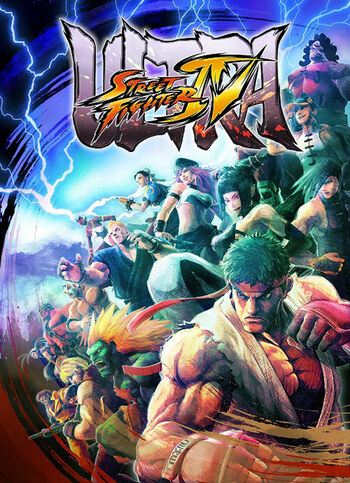
Street Fighter IV is the fifth main entry in Capcom’s Street Fighter franchise. It consists of four main versions: Street Fighter IV, Super Street Fighter IV, Super Street Fighter IV: Arcade Edition and Ultra Street Fighter IV.
The namesake game, Street Fighter IV, was announced in late 2007 (the series was 20 years old at the time, essentially making this a late Milestone Celebration), and the game was released in 2008 for arcades and in early 2009 for home consoles. With almost 11 years having passed since the last numerical title's initial announcement, very few fans saw this coming, and jokes made the rounds about Hell's temperature having dropped to -3º Kelvin.
The title is 3D in graphic style, but continues the traditional staple of playing on a 2D frame. The producer Yoshinori Ono noted in interviews that he deliberately kept the game closer in style to Street Fighter II than its sequels.
The original twelve characters from the original Street Fighter II and Akuma return, along with six new warriors: American spy Crimson Viper, French martial artist Abel, Mexican luchador El Fuerte, American acrofatic Rufus, Ryu and Ken's master and Akuma's brother Gouken, and the Big Bad Seth. The home console versions additionally included more returning characters from Super Street Fighter II (Cammy and Fei Long) and Alpha (namely Gennote , Dan, Sakura, and Rose), along with the bosses being made playable. Gouken, Ryu and Ken's mysterious master, finally appears on-screen for the first time in the series.
In April 24, 2009, Capcom released an update for the game known as the "Power Pack" (a.k.a. the Champion Edition patch), which introduced the ability to save and upload replays to the Xbox Live or PlayStation Network leaderboards, and a brand-new online-exclusive "Championship Mode," which allows players to participate in tournament battles.
In September 28, 2009, Capcom announced an update titled Super Street Fighter IV (formerly Street Fighter IV Dash). The updated game features ten additional characters: Thunder Hawk and Dee Jay (from Super Street Fighter II, completing the Super Street Fighter II Turbo roster Capcom ran out of time to finish the first time), Adon (from the original Street Fighter but based on his Street Fighter Alpha incarnation). Cody and Guy (from Final Fight, and also based on their Alpha appearances), Dudley, Ibuki, and Makoto (from the Street Fighter III series), and two new characters: Juri Han, a South Korean Taekwondo practitioner who works for S.I.N.; and Hakan, a red-skinned Turkish corporate heavyweight who specializes in yağlı güreş or "Turkish oil wrestling."
The gameplay and character balance was also tweaked. It was released as a standalone title for the Xbox 360 and PlayStation 3 in late April 2010 as well as for Japanese arcades later, during the summer. The console release comes at a lower price than its predecessor, and there was a promise of "special features" for those who own the original Street Fighter IV, which turned out to be two alternate colors; a "heavy ink outline" color and a "sketch" color pattern both based on each characters' default color.
In addition, a port to the Nintendo 3DS titled Super Street Fighter IV: 3D Edition was released at the same time as the system; it contains the same roster as the console version of Super in addition to several features that take advantage of many of the device's new features.
Another port, this time to iOS, was released in March 2010, featuring a reduced character list which grew steadily with several updates, as well as a simplified control system that removed the light/medium/heavy attacks, replacing them with a four button system of punch, kick, focus and special. A followup named Street Fighter IV Volt was released in June 2011, further expanding the character roster and adding online play over Wi-Fi.
An arcade version of the game, aptly titled Super Street Fighter IV: Arcade Edition, was released in late 2010; it features several balance tweaks and four new characters: Yun & Yang from Street Fighter III (who originally had a cameo in Chun-Li's intro cutscene for the original version and her ending in Super), Evil Ryu, and Oni. These four characters, plus numerous new features, were released as a DLC update for the console versions on June 7, 2011. A PC version of AE was released in 2011; as the PC did not get a regular release of Super, it marks the first time PC gamers could get their hands on all of the new fighters. In December 2011, Super Street Fighter IV: Arcade Edition Ver. 2012 was released as a free patch, updating the balance of the game even further. On January 23, 2013, Ono himself teased a possibility for a new version, and on March 22 said new version was officially green-lit by Capcom. They were taking suggestions from the community on balance changes for each character, as well as system changes.
At Evo 2013, Capcom revealed at their panel that the new version would include new balance updates, six new stages, and the four characters introduced in Street Fighter X Tekken who had yet to (re)appear in the IV series proper: Rolento, Hugo, Poison, and Elena. They also mentioned one new character who, they said, had never been seen in a Street Fighter game before, and would making their fighting game debut the update — who would later be revealed to be Decapre, the 12th member of M. Bison's Dolls (who was actually an NPC in Alpha 3). The debut trailer was shown before the Grand Finals for the Street Fighter IV tournament, revealing that the titlr for the new version would be Ultra Street Fighter IV. Like Arcade Edition, this is available as a download or a physical disc. The $40 disc version includes all DLC costumes, and downloaders can pay either $15 for just the upgradenote or $40 for the same content as the disc version. UDON Comics also designed new alternate costumes for every character. The costumes for the five new characters were a Pre-Order Bonus for those who reserve the retail version of the new game. Ultra would get a staggered release with the upgrades for the PS3 and 360 released on June 3, 2014 (the early release date announced to allow Ultra to be used at Evo 2014); the console retail versions were later released on August 5, 2014; and PC version (both full and upgrade versions) was released on Steam on August 8, 2014. In October of the same year, this version received free DLC in the form of Omega Mode, which gives damn near everybody Rainbow Edition levels of brokenness and insanity. This mode is, according to Word of God, just for fun.
A sequel, Street Fighter V, was released for the PlayStation 4 and PC in 2016.
- From Street Fighter: Ryu, Ken Masters, Sagat, Gen, Adon
- From Street Fighter II: Chun-Li, Edmond Honda, Blanka, Zangief, Guile, Dhalsim, Balrog, Vega, M. Bison, Akuma, Fei Long, Cammy White, Dee Jay, Thunder Hawk
- From Street Fighter Alpha: Dan Hibiki, Sakura Kasugano, Rose, Cody Travers, Guy, Evil Ryu, Rolento F. Schugerg
- From Street Fighter III: Dudley, Ibuki, Makoto, Yun and Yang, Elena, Hugo
- New to Street Fighter IV: Abel, Crimson Viper, Rufus, El Fuerte, Seth, Gouken, Juri Han, Hakan, Kuroushiki Oni, Poison, Decapre
Tropes Distinct To, Or Introduced In, This Game:
- Actor Allusion: Tōru Ōkawa voiced Ryu back in 3rd Strike, then was cast as Gouken in IV. Gouken has access to the Shin Shoryuken and Denjin Hadouken as Ultras, both of which were previously used by Ryu as Super Arts in III.
- Adaptation Expansion:
- To make up for the half-year delay between the original coin-op release and the console ports, Capcom added six extra characters specifically for the console port (Cammy, Fei Long, Rose, Dan, Gen, and Sakura).
- Super Street Fighter IV: 3D Edition for the 3DS, in order to make up for some lost stuff, also has new features that take advantage of several of the console's unique capabilities, such as a new camera angle that shows off the 3D effect and the trophy collecting minigame based around wireless console-to-console interactions.
- Until the DLC version was announced, Super Street Fighter IV: Arcade Edition had four extra characters (Yun, Yang, Evil Ryu, and Oni).
- Ultra Street Fighter IV added in several assets from Street Fighter X Tekken (4 characters and 6 stages) plus one new character.
- Added Alliterative Appeal: A few win quotes have fun with this concept:Akuma (vs. Poison) : "Such frivolous fighting folly is beneath my cantankerous contempt!"
Gen (vs. Vega, Super onwards) : "Keep your nauseating narcissistic nattering to yourself, nitwit!" - Americans Are Cowboys: One of Ken's alternate costumes is a cowboy outfit, several female onlookers in the "Drive-In at Night" stage are wearing cowboy hats, and Rufus' girlfriend Candy wears a cowgirl outfit despite her accent being as Brooklyn as her boyfriend's.
- Anti-Frustration Features: Zigzag moves such as the Shoryuken and Tiger Uppercut were given some level of input leniency from this game onwards, making them much easier to actually hit on controller analogue sticks.
- Art Evolution: The character select artwork for the new characters in Ultra Street Fighter IV are noticeably different from the first pieces of artwork made back in 2008.
- Ascended Glitch: The Kara Throws were imported from Street Fighter III.
- Attack Backfire: Zangief gets a victory quote against Blanka informing him that his electric blasts helped relieve his back pain.
- Boss Banter: The "Rival Battles," where you fight a character who, in most cases, has some significant ties to the story of your character. During the fight, both combatants converse, ranging from taunts to more friendly words of advice and support. The soundbites for Supers and Ultras are also changed to something pertaining to the battle at hand. Usually, these matches give you a pretty good look at the dynamics between certain characters. Characters added from Arcade Edition onward have the soundbites, but absolutely no pre-battle cutscenes, much to the ire of fans.
- Bootstrapped Theme: All of the brand new fighters in IV have themes made specifically for them, not the stage you fight them on, but the returning cast have their iconic themes with new arrangements for everyone.
- Cel Shading: Used along with highly detailed textures, creating a look that's more "stylized" than it is "cartoony."
- Comeback Mechanic:
- The Revenge Meter fills up the more damage one takes. Once it's filled halfway, an Ultra Combo becomes possible and when filled all the way, the Ultra Combo does more damage. Like Super Combos in Super Street Fighter II Turbo, Ultra Combos only last one round.
- This mechanic was expanded upon in future expansions. Super gave everyone the choice to pick between two Ultra Combos at the character select screen, while Ultra allowed players to have both active at the expense of reduced damage.
- The game also has a very subtle mechanic in that characters receive less damage depending on how much life they have left. With less than half their life remaining, they take slightly less damage from each attack. With less than a quarter of their life remaining, they take significantly less damage from each attack.
- The Revenge Meter fills up the more damage one takes. Once it's filled halfway, an Ultra Combo becomes possible and when filled all the way, the Ultra Combo does more damage. Like Super Combos in Super Street Fighter II Turbo, Ultra Combos only last one round.
- Continuity Nod: Bison's win quote towards Makoto is reminiscent of the original Street Fighter:"There are countless fighters like you around the world! You are not special!"
- Convection, Schmonvection: The Volcanic Rim stage takes place in the shadow of an erupting volcano; the fighters are standing on solidified lava while lava bursts out in the background behind them. Many of them even barefoot.
- Country Switch: If you try to play the Japanese version of the game on an North American PS3, the game will switch M. Bison, Balrog and Vega's names around so that they match the North American version of the game.
- Crushing Handshake: In Super Street Fighter IV, Turkish oil wrestler Hakan does this to sumo wrestler E. Honda before his Rival Battle after they disagree on which style of wrestling is the best.
- Death Cry Echo: Everyone gets one, each ranging from fairly generic to downright hilarious. All five characters added in Ultra have 2 separate KO sounds: a regular one for losing normal rounds and a unique echoed scream for losing the final round.
- Developer's Foresight:
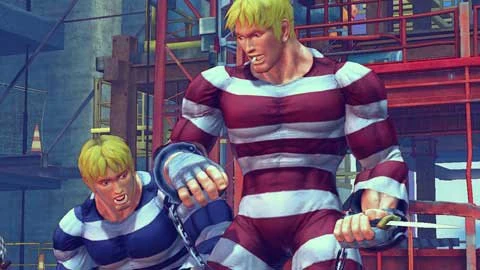
- If there's a Cody mirror match, only one of the two can pick up his knife. The loser displays a shocked expression when the other Cody retrieves it.

- In the Construction Site stage in North America, Hugo can be seen on the right side of the stage in a crowd of construction workers. If Hugo is one of the fighters, a similarly huge man takes his place in the onlookers. Similarly, Yun and Yang vanish from their background spots in the Half Pipe stage if they are part of the fight.
- Like in the Alpha series, Dhalsim's wife, Sally, can be seen on the left end of the Exciting Street Scene stage. Unless you get her attention, she's usually the least interested in the fight of the three women there. If her husband is fighting, however, she'll cheer him on when he's winning and look away with a sympathetic wince whenever he's on the receiving end of a strong hit. She can even be seen crying if the other player beats Dhalsim instead of applauding like she usually does.
- If there's a Cody mirror match, only one of the two can pick up his knife. The loser displays a shocked expression when the other Cody retrieves it.
- Diner Brawl: One of the stages is a 1950s diner, in the middle of a low-rider meet.
- Difficult, but Awesome: Hugo, who was added in Ultra. He is incredibly slow and has a massive hitbox, and all of his moves are as slow as he is. However, if you are actually able to get close with him, he will melt your opponent's health bar to nothing in the blink of an eye.
- Downloadable Content:
- The Arcade Edition DLC pack for Super. Adds all of the features that AE introduced, including the expanded online services, the four new characters, and the rebalancing of every other character. Also, the many costume packs released for both versions of the game.
- Ultra stacks on top of the Arcade Edition. It adds 5 new characters, 6 new stages, and multiple rebalances.
- Dramatic Spine Injury: One of the displays of Juri's sadistic nature is her Kaisen Dankairaku ultra move, which is considerably vicious by the game's standards: She kicks her opponent high into the air, then drops to the ground before her opponent and delivers an upward kick straight into their back. While the opponent is bent around her foot, she takes a moment to stroke their face and saying "That felt good, didn't it?", then slams them head-first into the ground.
- Dream Match Game:
- While the game itself has a story and a canonical place in the Street Fighter timeline, it also plays this straight by trying to add in as many characters from previous games as possible. This includes certain characters such who cannot canonically exist in the IV timeline such as Evil Ryu and Oni. The former due to the fact that he's purged the Satsui no Hadou by Street Fighter III, which takes place after IV, and the latter due to the fact that he has yet to be consumed by it in that series.
- The Ultra update takes this even further thanks to Edition Select which allows for the use of every version of the game's characters from each preceding edition of Street Fighter IV as well as special Omega versions of the characters where the creators were allowed to go wild with their movesets. This has the side effect of restricting each character's movelist depending on the incarnation. For example, those from the original version of IV can only use one Ultra Combo while the Ultra edition characters are the only ones who can use Red Focus Attacks, Ultra Combo Double and delayed wake-up.
- Early-Installment Weirdness: You can tell which characters existed before the Super Street Fighter IV update by looking at the Ultra and Super combos. Back in the original Street Fighter IV, characters only have one Ultra combo - and they are mostly souped up versions of their Super combo (compare - Shinkuu Hadouken to Metsu Hadouken). Characters added since Super Street Fighter IV have Super combos that are practically unrelated to either of their Ultra combos.
- EX Special Attack: Return from Street Fighter III. This time, they cost only a fourth of your Super Meter. You can also use an EX Focus Attack for half your Super meter, which can cancel almost any move's recovery time and then be canceled itself by dashing during the charge period.
- Fan Disservice:
- Seth's shower scene in his animated intro. Him being the Big Bad isn't what makes this a disservice, but his metallic skin tone and how he is, well, way too muscled for some fans' comfort.
- Many fangirls wanted to see the Tall, Dark, and Handsome Ryu shirtless. They got their wish with his first alternate costume in IV which has him shirtless, albeit dirty and and beat up. Then Arcade Edition's version of Evil Ryu granted it again, with him being a Walking Shirtless Scene (of sorts; he still has half of his gi top on). However, he has a horrifying hole-shaped scar on his chest and a kanji carved on his back. AUGH.
- Seth's shower scene in his animated intro.
- Floating Timeline:
- The birthdates of the returning characters no longer give their years of birth and while plot-wise the IV series is set between II (1991-1993) and III (1997-1999), ideally placing it between 1994-1996, the characters are seen using laptops and cellphones that wouldn't have existed until the mid-to-late 2000s.
- Gets more hairy when characters from the late '80s/early '90s era Alpha series can co-mingle with those from the late '90s era III series but with no visible signs of aging (or lack thereof) between any of them (the main culprit being Sakura, who still wears her high school uniform even though she should be in her twenties by this point; this is handwaved by her insistence that her uniform is easier to fight in). IV has a very hazy place in the overall timeline, almost to the point of being in its own continuity (the only other game with more continuity snarls being Alpha 3).
- Game-Breaking Bug: The Windows version of all versions of this game other than Ultra Street Fighter IV cannot be installed or played due to a dependency on Games for Windows LIVE which has shut down. The Windows version of Ultra Street Fighter IV removes this dependency, so it works.
- Game Mod:
- A mod for the PC version of the game called Street Fighter IV Koryu pays homage to the infamous Rainbow Edition mod of SFII.
- And for the PC version of Super Street Fighter IV: Arcade Edition, we have SSFIVAE Remix, which aims to make the game faster paced... whilst also making most of the moves and characters balls out insane. Ryu's Metsu Hadouken Ultra, for one thing, is swapped out with a Ranbu-type super ending in a semi-invisible Hadouken at point blank range.
- Capcom themselves seem to have gotten into the act with the release of Omega Mode which changes the characters up in a similar way to fan-made mods, given them crazy new moves (such as Ken's fireball kicks) or paying homages to past games.
- A mod for the PC version of the game called Street Fighter IV Koryu
- Gosh Dang It to Heck!: Despite her "rebellious badass" persona, Juri sticks to the milder curse words. She gets a lot of mileage out of "freaking" and "crap".note
- Iconic Outfit: Many of the alternate costumes in IV fall into this category. Some are nods to a character and/or the franchise's history (e.g. Cammy having a M. Bison/Dictator outfit, Cody having an updated version of his original Final Fight clothes, Blanka having Dan's outfit, Zangief having both Mike Haggar's outfit and his "Mecha Zangief" form from MSHvSF, MvC1, and MvC2), while others are nods to celebrities (e.g., all of Fei Long's outfits come from Bruce Lee's works, Dudley has an outfit playing tribute to Freddie Mercury's legendary 1986 Wembley Stadium concert outfit).
- Immune to Flinching: Every character has a Focus Attack, which allows them to endure one hit without flinching while it is charging; they will also recover the damage taken during the charge if they don't receive another. Ultra's new Red Focus Attack gives players more resistance and return damage in exchange for 2 EX Bars.
- Impending Clash Shot: Ryu about to clash with Ken◊ is used on the Xbox Live poster.
- Interquel: At the time of release, the game was set between the events of II and III. Currently, it is set between II and V, with III taking place after.
- Invisibility: A few invisible opponents can be fought during Street Fighter IV's Challenge mode.
- Jiggle Physics: Makoto in her pre-fight cutscene. And in a different sense, [[Acrofatic Rufus]].
- Lag Cancel: Certain special moves can be cancelled with the IV series' ubiquitous Focus Attacks, these then can be cancelled by dashing forward or backwards at the cost of some meter. These "Focus Attack Dash Cancels" are an important part of high level play.
- Never Trust a Trailer:
- The Super Street Fighter IV trailers implied that the majority of new characters would have fast-paced techno remixes of their theme songs, especially for the Final Fight and Third Strike characters.
- The first trailer for Super implied that Cody (the vigilante former hero of Metro City and escaped convict) would be facing Chun-Li (Interpol agent). Later trailers instead showed him and his somewhat-estranged best bud Guy.
- The trailers and the videos showing all of the cast's Ultras could fall under this. The Ultra videos implied that all the fighters would be getting a new rival in Super. When the game came out, only a select few (Ryu, Chun-Li, Guile, Cammy, C. Viper, and Seth) received a second Rival Battle, and some of ones shown in the trailers ended up in different locales.
- "Not So Different" Remark:
- Juri pulls this on Cammy in their rival battle and in her OVA, stating that the both of them are cold-blooded killers and that Cammy is merely being the hero to try to hide her "sins".Juri: I bet we have a lot in common. After all, you were a member of this little fan club once. I bet you killed tons of people. And you still think you're the good guys. Makes me want to puke.
- In his opening in SSFIV, Seth compares himself to Juri as they are both willing to do whatever it takes to succeed no matter how evil. He then goes on to say that all of humanity is just like him in that regard. He's also very similar to Bison, even though Seth himself would never admit it due to his intense hatred for his creator.
- Juri pulls this on Cammy in their rival battle and in her OVA, stating that the both of them are cold-blooded killers and that Cammy is merely being the hero to try to hide her "sins".
- Oh, Crap!: Ultra Combos in IV begin with a short animation, during which the opponent's expression changes to pure, wide-eyed terror — except for Guy and Cody, who barely react at all. To put this in perspective, almost all the roster (most of whom are street fighting veterans with years of experience) look shocked or scared. Even characters like Bison, Akuma, and Oni, who are more or less walking demons, have the decency to at least look grimly apprehensive. Guy just dials his look of grim determination back down to Ten, while Cody looks to be a second away from asking "Is that it?"
- Old Save Bonus:
- A save file from the original Street Fighter IV will unlock heavy ink and sketch color patterns for every character in subsequent updates.
- Furthermore, a save file from Street Fighter X Tekken will unlock alternate costumes for Decapre, Elena, Hugo, Poison, and Rolento in Ultra, with the latter four's costumes being their costumes from said game and Decapre's being Cammy's alt.
- Optional Boss: Completing certain requirements gives players a new opponent after beating Seth: in order of increasing difficulty, hidden bosses include (Shin) Akuma, Gouken, Evil Ryu, and Oni.
- "Rashomon"-Style: Four sets of Rival Battles in IV; namely, Ryu/Sagat, Guile/Abel, Ken/Rufus and Chun-Li/C. Viper.
- Recoiled Across the Room: Parodied somewhat with Dan's Haoh Gadoken Limit Break: He launches a huge Gadoken forward which also propels him backwards. It's rather powerful for a Joke Character.
- Regional Speciality: Used in El Fuerte's ending, where he mixes Zangief's and E. Honda's favorite foods, Chankonabe and Borscht, and add chili peppers and lemon to the mix. The results apparently tasted very bad, as Honda and Zangief's faces turn blue with disgust. Then El Fuerte proclaims the food "tastes so great it sends you straight to heaven!"
- Remixed Level: Some of the stages are just alternate forms of other stages.
- Morning Mist Bay is Beautiful Bay in its wee hours.
- Secret Laboratory becomes Crumbling Laboratory during Round 2.
- Deserted Temple is a ruined version of the Old Temple.
- Mad Gear Hideout has a kabuki show that gets broken up by Mike Haggar at the end of Round 2. He gives chase to the goons during Round 3.
- Pitch-Black Jungle is Inland Jungle at night.
- Run-down Back Alley is Exciting Street Scene at night.
- Revisiting the Roots: Following III having a entirely new cast with few returning characters, IV's initial roster consisted of everyone from II pre-Super, Akuma, and six new characters. This is partly due to the fact that Capcom was inspired to develop IV after seeing the success of the digital release of II on the HD consoles.
- Rival Final Boss: IV inverts this slightly, as the player character's Rival Battle comes right before the real Big Bad: Seth. Street Fighter III: 2nd Impact and 3rd Strike before it followed a similar trajectory with the fights preceding Gill.
- Rubber-Band A.I.: In a strange case, the game usually isn't too difficult except at the highest difficulties (besides Seth), but even on the easiest setting the AI is silently scaling and rubberbanding to player performance. This can lead to a scenario where the rubberband stretches so hard that your next opponent suddenly frame-perfect throws you consistently and reads all your inputs for perfect counters to land you a game over, and then completely loses all the tension as it goes back to being a witless dullard that eats combos for breakfast.
- Separate Scene Storytelling:
- IV's Arcade stories for some characters. Ryu defeats Seth and is slowly being consumed by the Satsui no Hadou. Sakura finds him and gets him out of it and helps him leave the Crumbling Laboratory after being saved by Ryu from falling debris. Meanwhile, Dan is at the same lab running away from an explosion and runs into Blanka and both are about to be consumed by the fire, only to be saved by Ryu and Sakura's combined Hadouken. After parting ways with Ryu and Sakura, Blanka is shown at Hong Kong with Dan and his mother drops by to see him. Later, Ryu encounters Gouken, who defeats him and seals the Satsui no Hadou. Akuma finds him and they engage in a match over Ryu's fate. Meanwhile, Chun-Li is searching for data on S.I.N and tries contacting Guile, only to be trapped in the room by Vega as it is collapsing. Guile is trying to get to Chun-li while Abel holds Seth off and they both retrieved the data. Before Chun-Li is rescued by Guile, Gen got her out of the room she was trapped in, having witnessed the aforementioned battle between Akuma and Gouken. After all of the above events, Blanka, Sakura, and Dan return to Hong Kong to continue their training journey where he reunites with his mother. Each of these moments is told in separate scenes in each of the mentioned characters' (sans Abel) ending cutscenes. The Plot Hole in this, however, is that some of these ending scenes (Akuma and Guile's) show Seth defeated or being defeated. Although if Bison's ending is anything to go by, they may have been fighting one of Seth's clones.
- Rose's story all the way from IV is told like this when merged with her story in Super. In IV, after defeating Seth, she is ambushed by Bison and knocked out unconscious. In Super, she's in a dark void wondering if she's dead or not and where she is, when she opens her eyes and sees Guy trying to wake her up. Guy's Arcade story reveals he was the one that took out Bison and saved Rose, leading to the aforementioned waking up scene.
- Soundtrack Dissonance: Rival Battles begin with a dramatic piece of music combined with some Ominous Latin Chanting. This goes for every "rivalry", even those that aren't serious (Dee Jay vs. Rufus, Ibuki vs. Sakura, etc.).
- Spectacular Spinning: This is outright overkilled in several of Super Street Fighter IV's new Ultra Combos.
- Suspiciously Similar Substitute: Several of the stages are reminiscent of character stages from previous games.
- Crowded Downtown resembles Chun-Li's stage from II.
- Cruise Ship Stern resembles Vega's stage from II.
- Drive-In at Night resembles Balrog's stage from II.
- Inland Jungle resembles Blanka's stage from II.
- Small Airfield resembles Guile's stage from II.
- Solar Eclipse resembles Elena's stage from 3rd Strike.
- Theme Music Power-Up:
- Played straight and subverted in IV. The Rival Battles may or may not use the theme music of the character you're using.
- Played fully straight in Super. Whoever you're fighting as, that's the character whose theme you're gonna hear. Especially good since everyone has their distinctive themes, unlike in IV. Unless you're playing online, in which case you will always hear the theme music of whoever you are fighting. You'll be hearing their music while they will be hearing yours. You only ever hear your own theme music if you fight against yourself or watch your character on the replay channels.
- This goes back to being both straight and subverted in Ultra, where in some versions, by random, the theme of the stage, the character you are playing as, or the character your rival is will play.
- Still subverted in the case of Akuma and Gouken; during their Rival Battles or when playing against them online, their respective themes when faced as a boss are instead swapped out for a remix of Ryu's theme (Ryu serves as their rival in Arcade Mode). Their themes will only play when they are fought as hidden bosses, unless you're on the 3DS.
- Theme Tune Rap: The version of Cody's theme with lyrics could serve as this for the game as a whole:I came here to be the best, you ain't takin' me, son
2,000 people and I'mma scrape 2,001
I came to stare 'em in their faces when they tell me I'm wrong
Hit 'em with jump Strong, Metsu Shoryuken, it's on!
I'm the science of a fireball, something to inspire y'all
Started small, I came here to Evolution to evolve
I'm a nation in its prime, a masterpiece, the greatest kind
Super Street Figher IV, it's about damn time - Third Is 3D: Sort of; the third revision of the home console version is Super Street Fighter IV: 3D Edition for the Nintendo 3DS.
- The Thunderdome: Cruise Ship Stern is a purpose-built fighting stage on a S.I.N. ship with an audience who witnesses the fight.
- Training Stage: This stage is automatically chosen in Training Mode, complete with an announcer voice clip. Also, the "sandbag" is Dan Hibiki.
- Turns Red: Literally with Red Focus in Ultra. When used defensively, you absorb an infinite amount of hits (sans armor breaking moves) and build Ultra meter at an increased rate for the cost of 2 bars. When used offensively, it costs an extra bar for a total of 3, but crumples on Level 1, allowing for extended combos or confirms from far reaching pokes into combos.
- Makoto has this ability like in Street Fighter III.
- Unblockable Attack/Invulnerable Attack: Focus Attacks, which become the former upon reaching their third and final level of charge. To balance out the latter, each character has at least one move with Armor Break properties (denoted by a lightning bolt in their command list).
- Variable Mix: Each stage features both an "Ultra" and "Heavy Damage" (i.e. near K.O.) variant for the BGM.
- Video Game 3D Leap:
- Street Fighter IV experienced a presentation upgrade with a graphical switch to 3D but gameplay that mostly remained on a 2D plane.
- It also heralded something of a renaissance of 2D fighters with 3D graphics, being followed most notably by the Mortal Kombat reboot, Capcom's own Marvel vs. Capcom 3, and Guilty Gear Xrd.
- A Winner Is You:
- In the iPhone version of SFIV, winning the tournament results in a stylized picture of your character and the word "Congratulations!" And an advertising movie for SSFIV. Which isn't available on the iPhone anyway.
- This is mitigated in Volt in which winning nets you a short video of your character, along with achievements.
- You Are Number 6: The super soldiers engineered by the Shadaloo Intimidation Network (S.I.N.). There's at least twenty-six of them, with Seth being #15. note

A NEW WARRIOR HAS ENTERED THE RING!
