
Wonderella: Nope!
So, it turns out that All Myths Are True; you can have breakfast with the God of Thunder, chat it up with the Anthropomorphic Personification of Dreams, or even have a heart to heart with The Grim Reaper. All the while remaining totally un-conflicted about remaining faithful to the Big Guy Upstairs or whichever major religion the characters follow; even Crystal Dragon Jesus can hang with the Powers That Be and get a high five.
A Crossover Cosmology is different from All Myths Are True in that many of the cosmologies involved are themselves mutually exclusive either in world view, history, philosophy, or all of the above. The issue becomes especially thorny when polytheistic religions with large pantheons are mixed with monotheistic religions and reincarnation-based belief systems. It's rarely inadvertent, either. Black Adam getting his power from the Egyptian gods whereas his successor Captain Marvel gets them from the Greek gods (and one Biblical figure) wasn't a slip-up; neither was making both Hercules and Thor superheroes. Writers have no problem doing this to "pagan" gods, and outside the mainstream they don't have much trouble doing it to the Abrahamic God either.
This can be justified from the characters' viewpoint by having them point out that there's no reason they should believe that, say, Thor is a god in the same sense Yahweh is, when there are people who are flying around and summoning lightning, or are even immortal, who are plain old Mutants, metahumans, or aliens. There are even stories where a pagan god or gods convert to one of the Abrahamic religions and worship Yahweh themselves, which to human characters would be even further proof that they're not the same sort of god.
When taken to the extreme end of the Sliding Scale of Idealism Versus Cynicism it may result in a Cosmology where local deities are weak and irrelevant and Eldritch Abominations and other ancient nasties can and do casually traipse over any local deities' shrines and followers. Even in more optimistic portrayals, one has to wonder at the fairness of a universe that allows beings like Galactus, Darkseid, Anti-Spirals, and Imhotep to exist.
Some belief systems work like this; the term "henotheism" exists to describe the belief that all gods exist, but one's particular god is superior. Of course, most people who ascribe to this don't have said gods playing croquet in their backyard. In fact, quite a few non-Abrahamic religions worked this way, as did early Judaism. The Romans believed in Jupiter, and the Egyptians believed in Ra, but the Romans didn't think believing in Ra was wrong, just not for them; they were fine with any kind of worship as long as you skipped Human Sacrifice and paid proper respect to the gods they did recognize. They experienced some amount of confusion in this regard when trying to take over Judea.
Another option is "syncretism", where you conflate two religious concepts. The Romans did this as well by occasionally claiming other peoples' gods were their gods under different names or by combining earlier strictly Roman gods with foreign gods, hence for example, the "Gallo-Roman" god Apollo Sucellus (combining the Roman sun god with a Gaulish god of agriculture), or Tacitus writing that the Germanic tribes worshipped Hercules (Donar) and Mercury (Woten); this is why certain Roman and Greek gods are all but interchangeable today.
Variations on the Romans' logic are quite popular in attempts to resolve the massive Continuity Snarl created by multiple similar pantheons coexisting, especially since the myths have often evolved from common ancestors. The Magic Word in this case is "aspect" — deities who closely share an archetype (say, Ares and Mars) are really aspects or interpretations of the same god. This even crops up within a lot of religions, with Ehecatl being an aspect of Quetzalcoatl, and Kali being (sometimes) an aspect of Parvati. Monotheistic religions either worship the single ur-God of which all gods are aspects, or they only worship one of them.
See also All Myths Are True, A Mythology Is True, The Multiverse, Clap Your Hands If You Believe, Fantasy Kitchen Sink, Fantasy Pantheon, Gods Need Prayer Badly, Magical Underpinnings of Reality, and Mythical Motifs.
Examples:
- The Australian Lamb Board made a controversial advert involving a friendly backyard dinner of lamb — attended by Moses, Jesus, Aphrodite, Thor, Buddha, Ganesh, L. Ron Hubbard, a Grey, a Jedi, and a woman with no religion. Mohammed had to pick up a child from daycare, so he couldn't make it.
- Ayakashi Triangle: Despite always being referred to by a Japanese word, ayakashi exist all over the world. Since many are tulpa shaped by human belief, they correspond to their native mythology. One supporting character is Snegurocha, the snow maiden of Russian folklore, who lived in a picture book that got exported to Japan and ended up a permanent resident there.
Garaku: In this global era, it's not surprising to see foreign ayakashi around.
- Campione!: Gods from many different mythologies show up to fight Godou; Greek, Roman, Persian, Egyptian. However, many gods could be one and the same entity. Athena, for instance, is also Medusa and Perseus is also Mithra.
- Franken Fran has at least two provably existant religions. One? Jesus was real and performed miracles, and the Wandering Jew is a real person. The other? The Flying Spaghetti Monster is created during the series.
- Discussed in Gate where the gods of a fantasy world with only one pantheon are fascinated that Earth has multiple gods for the same purpose. Hardy the underworld goddess falls in love with the idea of the Greek goddess, Aphrodite and makes Itami promise to bring her to Earth so they can meet. Itami near craps himself because he has no idea if Earth's gods even exist.
- In The God of High School all mythological figures and deities are real and a select few martial artists have the ability to use their powers to supplement their own abilities through a technique known as Charyeok. At least one of the obvious contradictions this presents is addressed by Nox, an Abrahamic Apocalypse Cult which views all other Charyeok users as heathens.
- High School D×D has a lot of mythologies existing in this story, Ars Goetia being the most prominent example. Norse Mythology, Hindu Mythology, Greek Mythology, it's all here though apparently there's also one more mythology that even the other gods of said mythology don't know about. The name of said mythology? There is a breast god in this series.
- Kamigami no Asobi is about Apollon, Hades, Susano'o, Tsukuyomi, Loki, and Baldr... In a magical high school. With Thoth as the teacher, and a human Ordinary High-School Student named Yui who has to teach them about the human heart.
- Some Valkyries show up in Maria the Virgin Witch to take some knights to Valhalla but the Archangel Michael chases them because the knights are supposed to go to Christian Heaven.
- Miss Kobayashi's Dragon Maid: Let's see... we have Kanna Kamui (named after an Ainu god) as one of the main characters, Quetzalcoatl and Fafnir are both secondary characters, and Tohru is mentioned to have a beef with Jesus' dad during the Christmas Episode. References to dragons from other mythologies are also made in the passing, like Herensuge from Basque mythology.
- Record of Ragnarok features gods from multiple different mythologies acting as a single pantheon, with Zeus as the Top God. The series also features gods from Norse, Egyptian, Hindu, and Japanese Mythology, while also featuring legendary figures from The Bible and Buddhism.
- Being X from The Saga of Tanya the Evil is replaced with a council of gods from different religions in the manga.
- Saint Seiya. Blatantly obvious in the anime, with the addition of movies and a Filler arc. To the point where Greek gods, Norse gods, Buddha, and friggin' Satan fought Seiya and Co. And the universe was created by Big Bang.
- Saint Young Men, which stars Jesus and Buddha as roommates in Japan while they take a break from their divine duties. One of the chapters has them participating in a Shinto festival, where Buddha worries that they'll be laughing stocks in Heaven if the god of the Shinto Shrine they're carrying finds out that they're there.
- In Shaman King, the characters do battle with spirits from a wide variety of religions and beliefs. This includes, but is not limited to: Fairies, Archangels, Buddhist Spirits, Japanese Nature Kami, Oni, Aztec Gods, Egyptian Pyramids, Zombies, Skeletons, Mesopotamian Gods, Demons, Animals... Oh, and normal human ghosts as well.
- DC Comics (both in The DCU and Vertigo Comics, which sometimes overlapped and sometimes didn't up till Flashpoint, which folded Vertigo characters who'd started off in the DCU back into the main universe) also has a complicated cosmology, both in itself (with deities from many cultures as well as its own inventions) and Depending on the Writer:
- The Sandman (1989) had Egyptian, Norse, Greek, Shinto, and the Abrahamic gods, claiming that they all come from the human subconscious and feed on human belief. The paradoxes created by this are ironed out by the fact that everything is true; the universe was created by Allah and Yahweh and every other creator god. To further muddle the waters, the Endless, Anthropomorphic Personification of fundamental concepts of reality, have more power than entire pantheons — though they can become weaker in a god's place of power. At the same time, the Sandman milieu is also presented as a henotheistic one in which Lucifer (and, especially, Lucifer's Creator) are depicted as far more powerful than even the Endless.
- A Swamp Thing storyline made it clear that in the DCU, the Creator's omnipotence is itself a contingent result of the universe's belief focusing on human beings. The Elementals had a chance to shift that belief to other forms of life, effectively killing God and replacing him with whatever-the-Swamp-Thing-was-becoming.
- The DCU's version of the Abrahamic God grows out of the lore surrounding the character of The Spectre, who is a being of almost limitless power. And if the Spectre is that powerful, what about his creator?
- Vertigo's Hellblazer is set in the same pantheistic universe, where John Constantine might visit Hell one week and summon the Aztec god of death in the next. (Contrast with the movie adaptation Constantine (2005), which uses Catholic theology exclusively.)
- Jack Kirby's New Gods are also part of the equation in the DCU.
- One Wonder Woman (1987) story suggests that the Greek gods discovered a small tribe in Italy that worshipped them (due to stories told by Darkseid for reasons of his own), and created duplicates of themselves to watch over them. As the Romans grew more powerful and developed a culture distinct from the Greeks, the duplicate gods changed to suit them, until they were entirely separate entities.
- A Superman story, set shortly after Zeus had teamed up with the Hindu pantheon in Wonder Woman (1942), had Zeus inspired to set up the Interfaith Deity Council of Active Polytheistics, comprising himself, Odin, Thoth and Ale (a West African fertility goddess). They were opposed by a group of Gods of Evil comprising Baal, the Morrigan (Celtic war goddess), Izanami (Japanese death goddess), Mixcoatl, and Ahriman (the Zoroastian ultimate evil).
- Other stories portray Zeus as a member of the Quintessance — a group consisting of himself, The Phantom Stranger (whose generally accepted origin story is Judeo-Christian), Highfather of the New Gods, Ganthet of the Guardians of the Universe and Captain Marvel/Shazam (who receives his own powers from a mish-mash of gods including Zeus).
- Shazam! anti-hero/villain Black Adam draws his powers from the Egyptian pantheon. Captain Marvel himself gets his powers from a Hebrew king, two Greek heroes, one titan, a Greek god, and a Roman god.
- The map of the multiverse in The Multiversity has the Endless, the New Gods, the polytheistic pantheons and the Abrahamic Heaven and Hell all co-existing in the Sphere of the Gods.
- Legend of the Amazons, set in the backstory of the Wonder Woman mileau, has the Greek and Norse pantheons as both existing but not interacting. Until it turns out that the Norns are the Moirae, just known by a different name. (This may or may not tie into The Sandman's implication that all examples of The Hecate Sisters are actually the three witches from The Witching Hour)
- The Flare comic pages online in early June 2008 (pages 260ff.) take place on Mount Olympus.
Terri: Our adventure with the Champions may seem like a dream, but you know perfectly well that it actually happened. (Clue from Ed.: See League of Champions #1-3.)Donnah: Aphrodite is real, and so are Pan and Zeus, and all the other surviving Olympians.
- Flare herself is the daughter of a Norse Valkyrie and has been identified with the Greek goddess Eos.
- In January 2013, Tigress' Bast persona [an Egyptian goddess] forcibly switched bodies with Flare's Eos persona.
- The Marvel Universe has many examples of cosmologies coexisting. As with other decades-old comics universes, the precise details can vary Depending on the Writer:
- The most prominent Marvel god characters are the Norse god Thor and Greek god Hercules, both of whom have served on the Avengers. Many other pantheons exist as well, alongside "new" godlike beings such as The Eternals, the Celestials, the Elders of the Universe, Eternity, and others. A storyline in The Incredible Hercules featured Herc leading the "God Squad," a task force of Greek, Inuit, Egyptian, Japanese, and Aztec gods that teams up to defend the Earth from encroachment by alien Skrull deities.
- One in-universe explanation is that the Norse, Greek, Egyptian, Olympian, Japanese, Inuit, Aztec etc. gods are all magical, superhuman beings from other worlds and dimensions who were worshipped by different ethnic groups throughout history, and all of the myths surrounding them are, where contradictory, generally misinterpretations or half-truths. They each have distinct origins, but are not above intermingling: Gaea, the Elder Goddess of the Earth, played a role in most or all of these pantheons; aside from being based on the Greek overdeity of the same name, she is the same being as Izanami in the Japanese pantheon, and is the mother of both Thor and Atum-Ra of the Norse and Egyptian pantheons; although, in the Marvel series, both she and Atum-Ra predate all these other groups by billions of years.
- Another canon explanation (which is simultaneously the oldest (originally presented in a Thor annual in the 80s) and most modern (this is what they seem to use at least since JMS's Thor again)) is that strictly defined gods are dreamed up by people, kept alive by memory (forgotten gods are eaten by the Demogorge aspect of Atum), and run on the stories told about them (do not wax or wane with belief) which become retroactively true. There are exceptions, for example Gaea is an Elder God who fit into all Earth Mother myths so the stories just gravitated towards her and didn't become X+1 separate Earth goddesses. If someone thinks this leads to a cosmology running on circular reasoning and other logical fallacies, that someone is absolutely correct. In mythical Marvel humanity creating the gods being just as true as any Top God's claim that they created humanity makes perfect sense.
- A henotheistic aspect of Marvel cosmology is the ultimate Omniscient God-with-a-capital-G, called "One Above All." The Fantastic Four met him in one story, in which he turns out to be... Jack Kirby!!! (Or perhaps Kirby was simply A Form You Are Comfortable With.) Other stories have implied that the "One Above All" is a manifestation of Marvel Comics itself.
- The One Above All is a justifiable use of Author Avatar, showing up as whoever is writing the story. It has been Jack Kirby, Stan Lee, and others over the years. Literally whoever is writing the story for the comic.
- Galactus is said to change his appearance based on whoever sees him. To humans, he resembles a giant human. To other aliens, he resembles a member of their race.
- One Ghost Rider story established that there is a Spirit of Vengeance for each religion and nationality. One of the other Spirits says that the afterlife you go to depends on your belief.
- This was established long before that story; each pantheon in Marvel has a Death God, most of whom fill out an Everybody Hates Hades-version of the god they are based on and are evil (or at least, Anti-Villain) gods who own a portion of the dimension formerly known as Hell, which shattered into numerous other dimensions billions of years ago to become the Splinter Realms- the other owners of such dimensions are Demon Lords and Archdevils, and all owners gain strength and can expand their realm by the number of souls they possess. The specific rights they have to a given soul are laid out by a contract each Death God and Skyfather (the more benevolent heads of each pantheon) has with the Anthropomorphic Personification of Death herself, and generally means that if you follow a specific religion, that determines which heaven or hell you go to (Skyfathers generally get the "good" souls according to the morals of their faith; for instance, a good follower of the Norse religion goes to Odin in Valhalla, a bad or neutral one to Hela in Hel). Atheists and irreligious people, however, are judged purely on moral worth- bad guys get stuck with the demons, while good ones go to Heaven (everyone in between is...ambiguous). There are more specific rules for each- for instance, a Christian might still find himself sent to Hela just because he happened to be in Asgard when he died, and there are ghosts and reincarnation and magic and other stuff going on. There are also dimensions ruled by malevolent demonic entities like Dormammu who rule both life and afterlife and make both as hellish as possible, so keep them off of your "places to visit" list.
- In the Black Panther mythos the people of Wakanda venerate both their ancestors and a pantheon of mish-mashed deities from all over Africa; the Black Panther themselves draw their power from Bast, an Egyptian goddess, while Man-Ape is associated with Ghekre, a West African god, for instance. Bast's sister, Sekhmet also has a minor cult in Wakanda. Recently, it was revealed that Bast was part of the Wakanda Pantheon, made up of Egyptian deities:Thot and Ptah and other places in Africa: Kokou (Benin) and Mujaji (South Africa), in addition, there was another cult to a Gorilla deity in the tribe that would be known as Jabari, Ngi (Cameroons). In the movie this is up-graded with the Jabari worshiping Hanuman, from Hindu mythology. In the comics, Bast and Sekhmet are rival. These gods are various identified as either Ennead (an Egyptian term) or Orisha (from Yoruba Mythology).
- The most prominent Marvel god characters are the Norse god Thor and Greek god Hercules, both of whom have served on the Avengers. Many other pantheons exist as well, alongside "new" godlike beings such as The Eternals, the Celestials, the Elders of the Universe, Eternity, and others. A storyline in The Incredible Hercules featured Herc leading the "God Squad," a task force of Greek, Inuit, Egyptian, Japanese, and Aztec gods that teams up to defend the Earth from encroachment by alien Skrull deities.
- In the Necrophim prologue chapter, Lucifer sends Uriel to kill Jotunheim, king of the frost giants of Norse Mythology, hoping he will die in the attempt.
- In The Savage Dragon, all the various pantheons live together on a planet called Godworld (at least, until it's blown up), having been forbidden to visit the mortal realm since 1180 BC. They're ruled by the AllGod, a multi-headed composite of Odin, Zeus, Anu, Daghdha, Coatlicue, Mexitl, Abassi, Nzame, Lo, Biame, Karora and other unnamed elder gods. It's mentioned that Godworld has grown overpopulated due to the various pantheons interbreeding with one another and producing immortal offspring; nonetheless, a later story features some gods returning to Earth to abduct the remaining superpowered Earthlings of godly ancestry.
- When Alan Moore was writing Supreme, Youngblood (Image Comics) and Glory for Rob Liefeld's Extreme Studios, he invented a system of magic that was based on the Kaballistic Tree of Life and could incorporate all religious systems, from Judeo-Christian to Greek, Norse and Egyptian, to whatever Eldritch Abomination the writers wanted to create for the story. Although he was never able to use this system in Liefeld's titles, he later incorporated this system in his own title Promethea.
- The Red Seas currently involves a group of pirates who were made immortal by Odin attempting to resurrect the Greek gods to prevent Satan from unleashing Lovecraftian horrors upon the world.
- The backstory of Harry Kipling (Deceased) involved every single one of humanity's gods suddenly returning. And they're not nice.
- In Aquila, Ammit, Jesus, Isis, Jehovah, and Jupiter, as well as the wolf who suckled Remus and Romulus, all exist, and all have power. Also Jewish priests know how to make golems.
- The premise behind The Wicked + The Divine: twelve gods from a diverse group of pantheons are incarnated as young adults every 90 years, where they live like rockstars and are adored by humanity before dying within two years. Among the gods seen are: Susano-o (in the prologue), Amaterasu (in the modern day), Lucifer (or Luci for short), Baphomet, Sakhmet, Minerva, Ananke, Woden, The Morrigan (split into Badb, Macha, and Anand), Inanna, Tara (who may be from either Hindu Mythology or Buddhism), and Baal Hadad.
- God Is Dead: Not long after the appearance of Zeus, gods of multiple pantheons begin appearing, (most prominently the Greek, Norse, Aztec, Egyptian, and Hindu deities) and hold a conference where they agree to not fight and allow each other to take control of their traditional territories.
- Pathfinder: Worldscape: Since the titular setting is an extra-dimensional gateway for countless worlds, several different faiths make their way into the Worldscape. The most prominent faiths are the Cult of Issus from Barsoom, the state religion which is actually a farce, since their "goddess" is merely an very, very old Black Martian, the Hyrkanian God Erlik venerated by barbarians, and the One True God, who is actually the Abrahamic God worshipped by "Crusaders and Saracens" (Christians and Muslims). Over the course of the series, they feature Sarenrae from Pathfinder, the Roman Gods (Romulus and Remus are said to be sons of Mars) and Fantomah (who describes herself as an goddess and might as well be one).
- Hellboy mostly goes up against Eldritch Abominations of the Lovecraftian stripe (who sometimes have vaguely Babylonian names, but are eventually revealed to be part of wider pseudo-Judeo-christian mythology). However, the universe around him contains Celtic paganism (King Arthur and The Fair Folk), a Greek goddess (Hecate), African folk heroes, Norse gods, and ancient prehuman advanced cultures straight out of Theosophy. In one BPRD story, the pagan goddess Cloacina is portrayed as the patron saint of Venice, opposed by the forces of hell.
- Godyssey: A 1990s crossover featuring Rob Liefeld's characters Glory and Avengelyne (which is a co-creation with Kathy Christian). Avengelyne has a nightmare about the Greek gods mocking a crucified Jesus, and later she joins forces with Glory to stop a plot by Zeus and the Olympian deities to dethrone the Abrahamic faith and rule over Earth.
- In Frank and Ernest, an angel once told the Grandpa God:
Without form and void — how Zen!
- Guys Being Dudes: XM from Ingress is real in this version of the Pokémon GO universe (doubling as a Niantic cross-reference) and is what powers up Shadow Pokemon and raid bosses. It's also referred to as "animum", a term used for Applied Phlebotinum in the author's other works, which take place in a different universe entirely.
- Infinity Train: Seeker of Crocus: The Infinity Train has denizens that would eventually become gods to many mythos. These denizens, called Numinae, come from numerous mythos like Greek (Zeus, Aphrodite) to Egyptian (Anubis, Wepwawet) to Celtic (Lugh), Shinto (Inari), and even Aztec (Quetzalcoatl).
- League of Extraordinary Gentlemen: Tempest Rewrite: Between the pantheons of the Cthulhu Mythos and The Space Trilogy, and the multiverses of The Eternal Champion and The World as Myth.
- The Marvelous World Of DC features this as a plot point. The Mighty Thor is sent by his father to be brought up on Themyscira, the island of the Amazons, who pay tribute to the Greek pantheon. Because of this, they have no idea that the only man on the island happens to be the equivalent of Zeus in a different land. One Amazon called Mala is considerably more aware of the other pantheons, since she knows about the Egyptian gods, and the Buddha, and the Hindu pantheon, but not even she knows about the Asgardians. Luckily, since Thor is also the nephew of Zeus, the two gods team up to defend Themyscira from The Mask.
- The Book of Life has Xubalba, the Mayan god of the underworld being married to La Muerte who originates in folk Catholicism and Mexican Neopaganism.
- Word of God says that his brother is the Aztec god, Lord Mictlan and that her sister is the Aztec goddess, Lady Micte. Specifically the versions of them that appear in Maya and the Three, which also has Mayan gods.
- While Highway to Hell is mostly based on the Christian idea of hell, Cerberus, the River Styx, and Charon from Greek Mythology all show up, and the roadside diner is named "Pluto's".
- Indiana Jones: The first and third movies deal with Abrahamic religions, while the second has (mangled) Hinduism. The fourth deals with Pre-Mayan civilization gods, who are actually inter-dimensional traveling extraterrestrials.
- The Mummy Trilogy:
- In The Mummy (1999), Imhotep has god-like powers and is able to recreate the ten plagues, even though in the Biblical account of the Exodus story the Egyptian gods could only replicate the first two. The group of warriors who fight him, and whose ancestors gave him his power, are Muslims.
- In The Mummy Returns, the Scorpion King earned his powers and army from Anubis. And there's reincarnation, which isn't a part of any of those cosmologies. Ardeth, leader of the warriors from the first film, also states that Rick has been chosen by God to be the one who defeats the Scorpion King.
- In The Mummy: Tomb of the Dragon Emperor, there is no mention of what religion and/or philosophy the Chinese characters embrace, but the Dragon Emperor is a master of the Five Elements (used in a way, he seemed to come out straight from an episode of Avatar); we get some glimpses of Shangri-La, which is a Buddhist paradise (look at the statues); and Zi Yuan uses a book of magic which was already ancient at the time she cursed the Emperor and his army, written in Sanskrit. Something for everyone, really.
- There are traits of this in Pirates of the Caribbean, with influences from Aztec mythology (the coins from the first movie), Greek Mythology (Calypso), medieval folklore (the Kraken), nautical myths (Davy Jones, the Flying Dutchman and again, the Kraken) and Voudou (Tia Dalma). Non-Christian deities are referred to generally as "heathen gods", but this is mainly because nearly all the main characters are Christians (or, at least, grew up in Christian countries).
- Invoked in Oh, God! by God himself:
Jerry: [reading from a list of questions] "Is Jesus Christ the son of God?"
God: Jesus was my son. Buddha was my son. Mohammed, Moses, you, the man who said there was no room at the inn, was my son. - Percy Jackson and the Olympians: In Percy Jackson: Sea of Monsters, Dionysus — the Greek god of wine — remarks that the Christians had a god who could turn water into wine.
- Vikingdom features Norse paganism and Christianity, with the former being slowly replaced by the latter as mortals abandon the old ways. While the Norse Gods and their legends are shown to be quite real and mortals interact with them on regular basis in contrast to the Christian God (who is completely absent), one of the three MacGuffins is an Christian relic, the Necklace of Mary Magdalene, which is necessary for the movie's Big Bad Thor to complete his plan.
- Marvel Cinematic Universe:
- The Norse gods from the Thor movies, though the setting treats them as powerful aliens rather than true gods. That being said, Valhalla is a true afterlife for the deceased, as Heimdall and Jane Foster are both welcomed after their deaths.
- The Wakandans from Black Panther (2018) have the Egyptian goddesses Bast and Sekhmet guide them to the afterlife but believe the Hindu god Hanuman granted the Javari tribe never-ending wood.
- Eternals says that legends of Greek gods were inspired by the titular immortal aliens though Zeus and Hercules appear in Thor: Love and Thunder and a sculpture of War God Ares' head can be seen on the battle arena in Thor: Ragnarok.
- Moon Knight (2022) features Egyptian gods but no other pantheons are mentioned. Bast is notably absent after already being established as a Wakandan god.
- Thor: Love and Thunder introduces Omnipotence City. A city in space ruled by the Greek Zeus and inhabited by gods from various human and alien religions.
- Some of the Egyptian gods from Moon Knight (2022) cameo and an offscreen "God of Carpenters" is pointed out.
- It's implied that Asgardians are so low in the pecking order that they aren't welcome as Thor can't get in without stealing a disguise.
- Thor doesn't see Zeus as a rival due to Thor being the God of Thunder and Zeus being the God of Lightning. Thor actually is a fan of Zeus until he realizes he doesn't give a damn about Gorr wiping out other gods.
- DC Extended Universe:
- Wonder Woman (2017) has the God of War Ares as a villain and the Amazons generally imply the rest of Greek Mythology to be true.
- Justice League (2017) introduces Steppenwolf, one of the New Gods. A flashback shows the Greek gods fighting him when he tries to invade Earth ages ago. The Greek gods fight Darkseid, the Evil Overlord of the New Gods, during said invasion in Zack Snyder's Justice League.
- SHAZAM! (2019): Like in the comics, Billy gets most of his powers from the Greco-Roman figuresnote but gets his wisdom from the Biblical Solomon. These gods aren't otherwise relevant to the plot but Atlas' daughters Hespera and Kalypso are due to be villains in the sequel, SHAZAM! Fury of the Gods.
- Conan the Barbarian (1982) worships the fictional god Crom like he does in the books. But here he mentions that if he can't answer the Riddle of Steel when he dies, then Crom will cast him out of Valhalla. The latter is from Norse Mythology.
- Seen in American Gods by Neil Gaiman. But he shied away from most references to Judeo-Christian theology, except for the Queen of Sheba. And maybe Shadow once meets Jesus. One of the gods also mentions that Afghanistan's Jesus is having a rough time, and can't even get people to pick him up when he's hitchhiking. Notable by their absence are the deities of Classical Mythology.
- The Balanced Sword is set on Zarathan, a world that used to be connected to Earth in a way that allowed people and ideas to cross between them; among many other gods unknown on Earth, its pantheon includes gods from Greek and Norse mythology.
- In Melissa de la Cruz's Blue Bloods Universe, vampires are fallen angels expelled from heaven by the Christian God. In the same universe, witches are in fact ancient nordic deities that come from the nine worlds of the known universe and sometimes they attribute themselves the creation of Midgard (earth).
- In Manda Scott's Boudicca series both the Celtic gods and Mithra play significant roles. It's implied that the Roman gods no longer take an active part in things because their worship has devolved into empty ritual.
- Stephen Marley's Chia Black Dragon trilogy Sorceress, Spirit Mirror, and Mortal Mask, take place in 2nd century China, but there also appear Indian Buddhists, ancient Egyptians (in the back story) and a few Christians. It is suggested that the mythologies and afterlives of all four religions (Chinese, Buddhist, Egyptian and Christian) all exist. In addition to the Stephen Marley's own original myths and creatures, of course.
- Christianity is true in The Chronicles of Narnia with Aslan being a new incarnation of Jesus but there's a mention in The Lion, the Witch, and the Wardrobe of the Roman god Bacchus and Silenus (a companion of his Greek counterpart) coming to dance with nymphs and fauns.
- Robert E. Howard's Conan the Barbarian has a number of gods that would, in Howard's world become the basis of more modern deities. Crom, Lir, Babd, Macha and Nemain are all Celtic, the Hyborian Mitra becomes Mithra, who's also something of a Crystal Dragon Jesus, the Shemite Ishtar becomes the Babylonian Ishtar, the Turanian/Hyrkanian Erlik becomes the Mongolian Erlik and the Stygian Set seems to be the basis for both the Egyptian Set and Apep.
- In Christopher Moore's Coyote Blue Anubis is Coyote's older brother. In other books set in the same universe we meet Jesus, a human who has become the god of a cargo cult, the Celtic goddesses Babd, Macha and Nemain as well as angels, demons and djinn.
- Gore Vidal's Creation (1981) is an attempt to do this realistically. It's an epic story of a single man, Cyrus Spitama, Zoroaster's grandson and a student of Pythagoras whose long life allows him to visit near-contemporaries like Vardhaman Mahavir, Gautam Buddha, Confucius and Socrates, all of them living as near-contemporaries and coming up with ideas on creation at near about the same time.
- The Crew of the Copper-Colored Cupids is about The Multiverse, so obviously different deities exist as reality in some universes while being fictional or unheard-of in others. However, the Prime Universe itself has a kitchen-sink cosmology all on its own: Greek Gods have been confirmed to exist, but so have Christian-style Demons right out of the Ars Goetia, and that's probably not the half of it.
- The Dark is Rising combines Celtic Mythology and Arthurian Legend with touches of Greek and Egyptian Mythology.
- This is inverted in the Discworld universe, where there are multiple gods and anthropomorphic personifications (the kind that exist only because people believe they should exist), and the Omnians are portrayed as odd in their insistence on a monotheistic belief system. It is often stated that several gods appear in more than one Pantheon — for example, many religions have different Thunder Gods, but they are actually all the same god, wearing different hats (he used to be separate gods, but apparently they merged as people started believing them to be the same god with a different name).
- The book Small Gods explores in detail the process by which gods are created and rise to be powerful. Or fall because people no longer believe in them.
- It's also parodied in Pyramids, where the Djelibeybian religion never gets rid of a god in case it comes in useful, and Dios is high priest of all of them. At one point in the book, the various sun gods are seen fighting over the sun.
And Dios knew that Net was the Supreme God, and that Fon was the Supreme God, and so were Hast, Set, Bin, Sot, Io, Dhek, and Ptooie; that Herpentine Triskeles alone rules the world of the dead, and so did Syncope, and Silur the Catfish-Headed God, and Orexis-Nupt.
- While the Omnians are monotheistic and think there is no other god than Om, Om himself finds this ridiculous, because he knows many other gods.
- A. Lee Martinez's Divine Misfortune has at least walk ons by every Non-Abrahamic deity you could imagine including several entirely fictional ones.
- This is a justified trope in Steven Brust's Dragaera series, which takes place on a world inhabited by both humans and Tolkienesque elves called Dragaerans. The gods of this universe are merely Sufficiently Advanced Dragaerans, who while worshipped by humans are treated casually/disdainfully by members of that race. In fact, one of the main Dragaeran characters is the daughter of the major goddess of the pantheon worshipped by humans.
- The Dresden Files loves this trope. The Judaeo-Christian God exists—in fact, Harry's ally Michael even has a sword powered by a nail from the Cross. The gods of all other pantheons are mostly inactive but still exist and the fae play a major role in the series. The existence of chi and karma has been acknowledged. Outsiders—Lovecraftian horrors from outside reality—exist.
- The Norse pantheon has adapted to the times, becoming a mercenary company led by Odin, with the Einherjar as the soldiers. Odin also seems to be taking an active role in Harry's own world, appearing as part of the Grey Council.
- Odin is also Kringle a.k.a Santa Claus, who, before the reveal, was thought to be Wyldfae, further blurring the distinction between the Fae and gods and demons (the kind that comes from the Nevernever, not Hell.
- In Proven Guilty, Harry specifically mentions that gods from Greco-Roman, Norse, Amerind, African, Australian Aboriginal, Polynesian, southeast Asian, and Hindu mythology all exist, and have been dormant for centuries. Followers of Dionysus show up in one of the short stories trying to ignite a massive drunken rampage of sports fans. Hades is tasked with guarding various weapons including the head of the spear that stabbed Christ. It is also alluded to that he has a deep connection with the six fairy queens
- There's also the Red Court's Lords of the Outer Night, which may or may not be Mayan gods. If they aren't, then they're impersonating them. Either way, the Mayan gods exist in the setting. Unless it was the Lords from the beginning, if that's the case, then they don't exist anymore.
- The Norse pantheon has adapted to the times, becoming a mercenary company led by Odin, with the Einherjar as the soldiers. Odin also seems to be taking an active role in Harry's own world, appearing as part of the Grey Council.
- In the Elemental Masters series, all religions have some truth to them. Both the Christian afterlife and the Druidic Summer Country are shown to exist, for example, though the Christian version isn't as all-encompassing as it claims to be. Also, the divine magic of the Hindu pantheon plays a significant part in The Serpent's Shadow.
- In S. M. Stirlings Emberverse, while not exactly working together the Christian, Celtic and Norse pantheons are all backing the Arthurtype hero in various ways against the Religion of Evil for Eldritch Abominations.
- Everworld: Every god of every mythology on Earth decides to collaborate in making a parallel universe where they could all have a sphere of influence. It really gets messy when gods from other universes, like those of the Hetwan and the Coo Hatch, start barging in. And even then it wasn't without friction: Zeus mentions "that usurper Jupiter and his brood", while the gods' followers (brought over to provide them with a steady supply of worship, food and virgins) will happily make war on each other (the first book features an Aztec-Viking war).
- Ghost Roads: The Greek afterlife is real (though it's unclear if any of the non-underworld gods are), and it's implied the Egyptian one is too, plus there are appearances by bean sidhe and dullahans from Celtic Mythology. And then there's the entirely original mythology of the routewitches and the roads of America.
- In the Iron Druid Chronicles many different pantheons exist alongside each other. The protagonist is a druid who worships the Earth and pays lip service to the ancient Irish gods. The Greek god Bacchus is very powerful in Las Vegas while Native American deities still have some power in the surounding areas. The Polish witches get their powers from a moon goddess and a Viking vampire is trying to find a way to kill the Norse god Thor. Jesus and other figures from Christianity appear as a separate pantheon with Mary frequently appearing among humans to help out the poor and homeless.
- Some pantheons have additional versions that appear when the beliefs of two groups of followers diverge too much. There are dozens of versions of the Native American god Coyote. The North American version of Thor is separate from the original Norse Thor and based primarily on the comic book character.
- L. A. Banks' Neteru series has Egyptian deities like Isis, Osiris and Horus as angels in a mostly Christian Heaven. Also the various pagan deities were Nephilim, some good, some bad, most chaotic, which is why they were sealed away in a pocket dimension called the Land of Nod aka Atlantis.
- Queen of Zazzau is set in 16th century Nigeria and its protagonists are West African pagans, who equate the Muslims' Allah with their own Top God Ubangiji. Even Dafaru, the Hausa War God, says Allah and Ubangiji (his father) are one and the same. This is Truth in Television, having happened with many pagan religions that converted to Islam or Christianity.
- In Glen Cook's Petty Pewter Gods, not only do multiple pantheons of deities exist in the same world, but they compete for worldly prestige in order to maintain their claim on temple real estate in TunFaire's Dream Quarter. As the gods' traits and looks are dictated by their followers' beliefs, this means that the senior deities of two rival pantheons look virtually identical, because their idols were commissioned from the same craftsman, who used the same mold to cast figurines of both.
- In L. Jagi Lamplighter's Prospero's Daughter trilogy, there are Greek gods and Gnostic theology, and angels, and William Shakespeare's The Tempest to cite only the major appearances.
- Rick Riordan has built an entire Urban Fantasy setting stitching together various mythologies; mostly Greco-Roman, Egyptian, and Norse.
- The Camp Half-Blood Series mainly involves the Greek and Roman gods. During Percy Jackson only the Greeks were mentioned (except Janus), but The Heroes of Olympus elaborates that the Roman gods are actually split personalities of the Greek gods. Both of these "forms" are able to have demigod children. Greek and Roman demigods have their own camps (Camp Half-Blood and Camp Jupiter) that originally hated each other but became allies.
- The Kane Chronicles takes place in the same universe and focuses on Egyptian Mythology, with the heroes being magicians.
- There's a series of crossover short stories called Demigods & Magicians, in which Percy and Annabeth team up with Carter and Sadie for a time. In the series it is shown that those who combine Greek and Egypian magic are very powerful, and they end up meeting Serapis (a Greco-Egypian hybrid deity).
- Magnus Chase and the Gods of Asgard features Norse Mythology, and takes place in the same universe, with Magnus being Annabeth's cousin. It seems the Chase family is a magnet for pantheons.
- In The Trials of Apollo, minor references are made that confirm the existence and further coexistence of the Aztec pantheon, Chinese legends, Thai deities, Celtic gods, Zoroastrianism, Babylonian deities, Hindu myths, Samnite entities, and and possible Yoruba religion on top of all the others.
- As for the Abrahamic God:
- When Percy Jackson asks Dionysus whether he exists in The Lightning Thief, he responds that the question is "metaphysical" and that they don't know that any more than mortals do.
- Meanwhile in The Red Pyramid, Zia mentions to Carter that Moses was the only foreign magician to defeat the Egyptians in a duel.
- Samirah from Magnus Chase is a Muslim, but also a valkyrie who has met numerous Norse gods. She says that she considers the Norse gods more like spirits than gods (and apparently, Heimdall agrees!) and practices Islam. Similarly, there a line that says Thor is angry that Jesus did not show up for a duel, although it's never mentioned if Thor met Jesus or was merely cursing his name and demanding his appearance.
- Technomancer by MK Gibson: Despite its Judeo-Christian premise, this appears to be the case. Other gods are descendants of exiled but not damned angels.
- Till We Have Faces retells a story from Classical Mythology involving the gods Aphrodite and Eros from the perspective of a girl who worships them as members of a foreign, fictional pantheon. The story also offers some hints that some of the gods are also the God of Christianity, his angels, or the demons of Hell.
- In Ruth Frances Long's The Treachery of Beautiful Things, The Fair Folk, with Oberon as king and Titania/Mab as queen, exist in the same world as Wayland — who calls Oberon Odin and Puck Loki. It also brushes on King Arthur and Sleeping Beauty.
- Wearing the Cape:
- People claiming to be gods, spirits, or empowered by such entities crop up all over the place, despite their powers and cosmologies conflicting wildly. The official line is that these people are all just Breakthroughs, and magic is no different from any other superpower except that supernaturals tend to be delusional. Or they might be wrong, and magic is real after all. Most authorities go with the "delusion" explanation because it makes it easier for them to sleep at night.
- This also comes up with Astra (a deeply Catholic superhero who is eventually given a weapon by someone claiming to be the Archangel Michael) and her love interest Kitsune (who claims to be a literal magical Kitsune). Astra soon realizes that she's never going to find a real answer, but the fact that a good Catholic girl is dating a foreign trickster god gets brought up more than once.
Astra's Mom: Is he Catholic?
Astra: He's a Shinto kami, so probably not?
Astra's Mom: No church, then. But he will be coming to Sunday dinner.
- The Weirdness mostly centers on Judeo-Christian mythology but there is a cameo by Krishna who mentions an "inter-pantheon" treaty implying that yet more pantheons exist as well.
- Alan Garner's The Weirdstone of Brisingamen does this for a mixed bag of Celtic, Nordic, Irish, Welsh and English myths including The Morrigan, King Arthur, Merlin, Ragnarok and the Norse svart-alfar and lios-alfar.
- An odd example in A Wolf in the Soul. Dr. Rumu may actually be psychic, and her Indian-mysticism-based advice to help Greg defeat the werewolf turns out to be very accurate, though ultimately insufficient. A very minor example, but its presence in a religious Jewish novel is surprising.
- John C. Wright:
- Lampshaded in Orphans of Chaos (which features nearly the entire Greek and/or Roman Pantheon) when a character is asked something along the lines of "How can you be a Christian when you know the Greek gods exist?" Interestingly enough, the answer made sense. It's also mentioned in Titans of Chaos that other pantheons do exist but that most of their members were destroyed in the war with Chaos.
- War of the Dreaming blends, among others, Celtic, Greek, Christian, Norse and Cthulian myths.
- Omniscient Reader's Viewpoint: A major part of the setting is that all mythological characters exist as beings known as Constellations, with more well-known Constellations being stronger. Cliques exist (called Nebulas) of constellations from the same mythologies, though unaffiliated constellations can join any nebula if an invitation is extended.
- Diablero: There are angels and demons and Aztec gods running around fairly seamlessly. Keta is an incarnation of Coatlicue, and Mayaken is somehow both an angel and an avatar of Huitzilopochtli.
- Legends of Tomorrow has borrowed creatures and artifacts from many different folklores and mythologies. Reaches a high level of crossover in Season 5, when a goddess from Greek Mythology is shown working in the Christian version of Hell (most of the Olympian gods having died off since Gods Need Prayer Badly).
- Lampshaded in Rome, when the very religious Vorenus asks Pulo to show some respect toward the Egyptian gods because "They were powerful long before Rome was born"
- In the Stargate-verse, there's a different group of Sufficiently Advanced Aliens behind a great many belief systems. The villainous Goa'uld seem to have the biggest piece of the pie (they're the Egyptian, Greek, and Babylonian gods, and one of them even impersonates Satan.) On the flip side you have the Asgard, who through the use of Holograms represent the benevolent Norse gods.
- Supernatural:
- A recurring character previously referred to as The Trickster (one of many) turns out to be the Archangel Gabriel, who left Heaven after the banishment of the Fallen and has been living incognito among the pagans ever since. In one episode, he's also referred to as "Loki" by other pagan gods, including the Norse Odin and Baldur (implying the Fallen were banished before the pagan gods existed, allowing him to join them). Though it turns out many years later that he was just taking on the identity of the real Loki, who wanted to retire from his duties.
- A Season 14 episode reveals that ever since God left Heaven, the angels have employed Anubis to judge souls of the deceased and determine whether they go to Heaven or Hell.
- Xena: Warrior Princess and Hercules: The Legendary Journeys eventually expanded from Greek mythology into demonstrating the literal existence of any and every religion's deities, including the monotheistic God and Hindu gods.
- Queen of the Wave, by Pepe Deluxé, mixes the Greek story of Atlantis with the pre-flood history from The Bible. It's stated that eating from the Tree of Knowledge in Eden caused mankind to attain the heights of wisdom leading directly to the society of Atlantis. At the end, when Atlantis is destroyed for its transgressions, Nepth and his family escape in an ark with two of every animal (except unicorns, which they simply forgot).
- Implied in Destripando La Historia; Loki appears in the song of Demeter, Demeter and Sun Wukong appears in the video of Thor.
- In general Aboriginal Australian Myths suffer from most people just lumping and misidentifying the various indigenous Australian cultures, obfuscating their actual diversity. However, some crossovers do exist, especially in cultures geographically close: for example Daramulum shows up both in Yuin religion and Gamilaraay religion despiste having vastly different roles in both.
- Herodotus, some myths, and Euripides' play Helen claim that Helen of Troy was spirited away to Egypt for her safety/out of spite toward Aphrodite and Paris by Athena and Hera, where Amun-Zeus extracted her ka (Egyptian)/eidolon (Greek) (identical spirit double), which was taken to Troy with Paris unbeknownst to him (so, yes, the entirety of The Trojan War was fought over a very pretty Doppelgänger). The Classical Greeks took care to draw parallels between their chief deity Zeus and the Egyptian god Amun. Being the 5th and 4th centuries BCE, that make this Older Than Feudalism. Also, Io was paralleled with the Egyptian Isis. In some versions of her myth, Zeus restores her to her human form when she reaches Egypt and she is thereafter worshipped by the Egyptians as the goddess Isis.
- Many demons in modern Christian mythology are thought to have originally been the gods of the Hebrews' neighbor cultures, or at the very least were given their names by Christians. Theologians have debated whether those pagan gods were supposed to be actual entities who were demons all along or whether Christians simply applied the names of those gods to demons. If the latter is the case, then it likely stemmed from efforts by Christians to further discourage people from assuming that paganism held any real weight.
- Also, the appearance of The Devil and by proxy his demons were appropriated from the Greek god Pan. This is more out of a necessity for a concrete appearance for Satan than anything — The Bible is rather scarce on physical descriptions of the Prince of Darkness aside from Revelation, whose descriptions were more symbolic than literal anyway (and at least one description of Satan is WAY too weird to be practically illustrated at that).
- The word "El" meant "god" in the languages of both the Hebrews and the Canaanites. One of the names used for God in the Old Testament, Elohim, is a grammatical variation of it. From a historical perspective the God of Israel and El of the Canaanites can even be considered local variations of the same god. When the Hebrews were polytheistic their three greatest gods were El(ohim), Yahweh and Baal, but once they turned to monotheism El and Yahweh were seen as two interpretations of the same one god while Baal was demonized for his association with Canaan. To make things more complex; this Hebrew Polytheism may itself be an example as the Judean Yahweh can be considered from a different mythological background then the Canaanite-Israeli El and Baal.
- The Early Christian Church actively encouraged its missionary Bishops to take pagan holidays and gods and reinterpret them as "actually Christian holidays" or "actually Christian saints". This is how we ended up with holidays like Halloween (originally Samhain) and a December Christmas (cobbled together from such traditions as Yule, Saturnalia and the Mithraic Tauroctany) and saints like Saint Bridgette (originally a Celtic goddess of childbirth).
- In the ancient world (aside from the Hebrews — see above), honoring another nation's deities was considered a friendly gesture. Cyrus of Persia, for example, paid homage to Marduk, a Babylonian god, while allowing the Jews to rebuild a temple to their own god.
- The Hare Krishna movement believes the Judeo-Christian God and the Hindu god Krishna to be the same entity.
- In both China and Japan the people have no problem accepting both the native pantheons and Buddhism. In Journey to the West, for example, after failing to stop Sun Wukong by commanding his god courtiers, the Jade Emperor (the King of the Gods in Chinese mythology) appeals to Gautama Buddha himself to help him imprison the monkey. Meanwhile, in Japan, a popular saying is that people are "born Shinto, marry Christian, die Buddhist"note .
- This trope was the default worldview for many ancient societies, who thought of their gods as bound to certain locations or groups. Venturing into foreign territory brought one under the dominion of that nation's gods, and one's own might not have any power depending on one's whereabouts. Wars were also seen as proxies for the battles between two patron deities. The Bible is chock full of this. The plagues of Egypt are meant to represent YHWH pwning the Egyptian gods. Same thing with the Israelites and the Philistines/YHWH and Dagon. Likewise, the "bronze sea" (a giant basin) in the Jerusalem Temple was meant to signify YHWH's defeat of Yam, the Caananite god of seas and primal chaos. Deuteronomy 32 speaks of 70 nations each being assigned a patron god from the Caananite pantheon, with YHWH being assigned to Israel.
- In the West, Santa Claus is often portrayed as being the same person as St. Nicholas and similar figures. In Russia, however, they have depicted their version, Ded Moroz, meeting with his counterparts as a sort of playful version of detente. One popular idea is that Moroz is Santa's grandfather.
- A lot of polytheistic religions tended to respond to the spread of Christianity with a non-commital shrug and an "Okay". If they already had a bunch of gods, another one wasn't that big a deal. In Scandinavia, some people carried amulets depicting upside-down crosses, as they resembled the more traditional Thor's Hammer amulets, and were thought to bestow the protection of Thor and Jesus at the same time. In Rome, Jesus was considered part of the Olympian pantheon until paganism was outlawed.
- When Islam first reached Java, Indonesia, the local preachers appropriated Indian epics imported from abroad when the region became Hindu (e.g. Mahabharata, Ramayana) to teach Islamic values to the mostly illiterate population at the time. As a result, Indian myths, with ostensibly feature polytheistic gods (Vishnu, Krishna, et al.) are part of the folk tradition in Java, even though the population is overwhelmingly Muslim. Another cultural impact is that Javanese parents often name their children after Hindu gods, heroes, and other figures, as well as Sanskrit terms, clashing with people from outside the island (especially Malays) who tend to stick to "good Muslim names".
- One theory for Zeus' legendary horniness is that the dalliances of multiple gods were ascribed to him (e.g. one group's myth of a tryst between the local thunder god and fertility goddess later became attributed to Zeus and his sister Demeter).
- Omnism and similar belief systems such as Henotheism, Syncretism, or Universalism hold that this is Truth in Television; that all religions and beliefs systems are correct in some way, shape, or form or carry reflections of the truth. Thus the Abrahamic God happily coexists with and works alongside or even created polytheistic gods like the Olympians or the various gods are the same beings under different names or similar such things. In fact, as noted by the examples in this very folder, the whole idea of this not being how the universe worked is Newer Than They Think; many, arguably even most, religions are - and have always been - totally open to and accepting of the idea of a Crossover Cosmology, though the exact specifics of how it all goes together varies greatly.
- In Celtic Mythology, there are multiple references to the Classical world that imply the Celts knew about the Greek and Roman gods, and in some ways implemented them into their own mythology. The fir bog, for example, were said to have been enslaved by Greece before liberating themselves. Also there's some versions of The Children of Tuireann, where minor gods Brian, Iuchar and Iucharba go on a quest to fulfill a blood payment, includes obtaining a bushel of magical gold apples. In some versions they're specifically the apples of the Hesperides, the same as the ones from the Heracles myth, meaning there's Irish gods going Ocean's Eleven on the Olympian gods.
- One story about Fionn Mac Cumhaill involves him facing off with a Greek dragon that had heard Fionn was a legendary dragon slayer and wanted to test his might.
- There's also the story of the Tuatha De Danann's battle with Carman a sorceress and/or goddess from Greece (usually Athens specifically) who goes to war with the Irish gods but is ultimately defeated.
- After the spread of Christianity in Ireland and Scotland, unlike a lot of other pagan religions (whose gods were turned into demons), the Tuath De Danann were added to the Biblical canon as angels, or some kind of non-human beings.
- This is a major aspect of Residents of Proserpina Park. Since the creatures from multiple mythologies call Proserpina Park their home, this is a given. To give just one example, the finale of season two has Terry, a child of the Greek god Hades, leading the heroes on a quest to find a vetala, a ghoul-like creature from Hindu Mythology, and the heroes also have their faithful lion dogs, creatures from Chinese Mythology, at their beck and call.
- Parodied in John Finnemore's Souvenir Programme, in which Helios and Ra get into an argument at an "inter-faith conference" over which of them actually makes the Sun rise, then Sol gets involved, and they all get annoyed at Jehovah, "You do that as well, right? Just like you do everything else!"
- White Wolf's World of Darkness games:
- The different games that were brought together as the Old World of Darkness each had their own creation myth for their own type of supernatural creature, and when brought together are difficult to reconcile. Vampire: The Masquerade and Demon: The Fallen had Biblical origins with divine intervention, while Werewolf: The Apocalypse had a neopagan one. On top of that, many of these game's Metaplots were building towards a world-ending catastrophe, but each one was of a different nature.
- Both the rebooted Chronicles of Darkness and the new editions of these gamelines avoid these problems by leaning on the Unreliable Narrator: various origin stories are given, but they are vague and with no proof, giving room to explain away any contradictions.
- The Sourcebook Astral Realms for Mage: The Awakening offers a way to reconcile the existence of different pantheons: every god ever believed in exists, but only in the Temenos (the collective human unconscious) and only have as much power as human regard affords them. Thus, a god like Anubis is much weaker than when he had a kingdom of believers, but still holds power as a cultural symbol. They may have great insight, but only into human matters, lacking any understanding of greater cosmic issues. It's pointed out that they still believe they are gods, and will not look kindly on any attempt to inform them of their true nature.
- The Chronicles of Darkness fangame Genius: The Transgression opens up the setting to geniuses who can well fake being deities, have several, mutually contradictory natures, and have a world-spanning conspiracy that overlaps and conflicts with one from Mage: The Awakening. It simply says that the two groups ignore each other, and that it is "curious".
- In Scion, you play the offspring of a God, and have a whole bunch of different pantheons to choose from (six in the 1e core, ten in the 2e core, and more in the supplements). Admittedly, they did it in a unified, focused way that makes some sense within the system and world.
- Dungeons & Dragons:
- Several D&D supplements, such as Complete Priest's Handbook or the various editions of Deities & Demigods, discuss methods of integrating different historical pantheons into a campaign world. Options range from ruling that different pantheons' deities are inherently blind to one another's existence, to saying that all deities are part of the same mega-pantheon, with regional pantheons simply omitting gods who are less popular locally.
- And then there's Spelljammer, Planescape, and Ravenloft, which are basically Crossover Cosmologies for nearly every one of the various Dungeons & Dragons settings. Spelljammer especially, with characters visiting Realmspace, Greyspace, Krynnspace and many other Crystal Spheres in between.
- While most canonic (Planescape) meta-mythology involves hundreds upon hundreds of deities of many pantheons interlinked in alliances or eternal cold wars, it also has things like the sacred pool of beauty being in shared ownership of several beauty/love goddesses (including Aphrodite) who as embodiments of different ideals pass their free time practicing friendly rivalry. Because why not? The smaller mortals like "high and mighty" PCs will feel, the better!
- Earlier editions commented that some Forgotten Realms deities were immigrants from Earth, explaining why for example the Faerûnian pantheon has a Mielikki (Expy of a Real Life Finnish goddess of Nature of the same name).
- Most of Pathfinder's gods are original, but the full pantheon includes a few holdovers from its Dungeons & Dragons roots, as well as gods from Egyptian and Mayan mythologies, plus a number of archfiends with names pulled from the Ars Goetia, and even Great Old Ones and Outer Gods from the Cthulhu Mythos.
- In Rifts Earth, the mythological Pantheons each ruled directly over the civilizations that worshipped them, and clashes between the civilizations often included clashes between the Gods themselves. Most of them left the Earth a long time ago, but are starting to turn their eyes back towards their old territories, and the world at large... Except for the Egyptian gods, who are busy being the most powerful pantheon of a Medieval European Fantasy world.
- In Warhammer 40,000, there's some theories put forth In-Universe that the "old beliefs" of gods, angels, demons, etc. were either outright fabrications or simply ancient proto-psykers getting glimpses into the Warp. Then of course there's the theory that the Immortal Emperor "popped up" now and again throughout history as particularly influential people.. Jesus, King Arthur and the like, but always either a great warrior or great philosopher (or both!)
- Jasper in Deadland is host to many characters from various mythologies, including the heart-devouring Ammut from Egyptian mythology, Hel and Loki from Norse mythology, Dante, Virgil, and Beatrice from The Divine Comedy, and Cerberus, Pluto, Charon, Eurydice, and Persephone from Greco-Roman mythology.
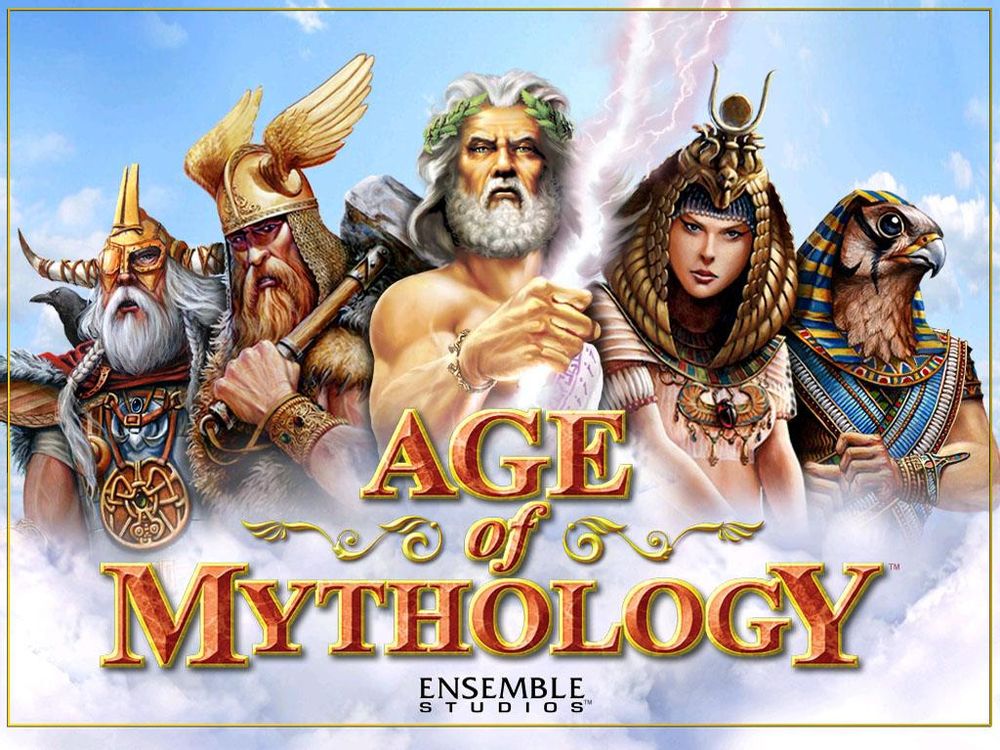
- Age of Mythology combines Greek, Egyptian, and Norse myths into a single setting. In general, characters only worship their own gods while showing some deference to ones they don't worship.
- The expansion The Titans added the Atlantean civilization, which worships the pre-Olympian Greek Titans Kronos, Oranos and Gaia.
- The expansion Tales of the Dragon added the Chinese myths.
- Assassin's Creed: Etruscan, Greco-Roman, Egyptian, Norse, and other deities co-exist with one another as members of a long-extinct species known as the Isu, the creators of humanity. In fact, every mythological and religious pantheon in human history can trace back its roots to the First Civilization.
- Dislyte: Gods from Greek, Egyptian, Norse, Chinese, Mesopotamian, Japanese, Korean, and Aztec mythologies appear in the game through the Espers that are hosting their power. The Ritual Miracle bosses are based off monsters from three of these mythologies (Apep and Fafnir), or in Kronos' case, a Titan. There are also NPC enemies based on other mythical monsters such as succubuses, harpies, and elves.
- The nations of Dominions draw from a number of real-world mythologies and historical nations, with some modern fantasy (e.g. Conan the Barbarian, H. P. Lovecraft) mixed in. The game designer is a social sciences and religion teacher, and it shows.
- An underlying theme throughout The Elder Scrolls series is that different, contradictory mythologies are all simultaneously true. There were some seven different endings for Daggerfall depending upon the final decision of the player; the succeeding games describe all the possible endings having occurred, despite the contradictions involved.
- Most religion in TES games seems to involve arguments about whose gods are actually gods, and which ones exist at all. Daedra are mostly seen as evil and equivalent to demons, but they're mostly shown as embodying a specific aspect rather than being either good or evil. There are also the Aedra, who are generally seen as good but don't seem to be objectively different from the Daedra in any way. Then there are the Nine Divines, except that non-humans tend to believe there are only eight of them and as of Skyrim, worship of Talos (a human and the first emperor who was previously believed to have become the ninth) has been banned entirely. The Orcish deity may or may not be a Daedra lord depending on who you ask. Traditional Dunmer worship their ancestors, but Imperial culture classes this as necromancy and tends to shun or ban it outright. More recently the Dunmer had mortals become Physical Gods, who were no more than tolerated as a religion by other cultures. As of Morrowind and its expansions, at least three out of the four are dead anyway.
- TES games also include quite a few bits of different real world mythologies. Bloodmoon and Skyrim have various aspects of Norse mythology, Redguards vary between Arabian and more eastern, Bretons are usually portrayed with a Celtic look, and Imperials are a cross between the Roman and British empires. In addition, many of the monsters are based on various bits of folklore - most prominently vampires and werewolves.
- Fate Series: While most of the Heroic Spirits are historical (or at least theoretically historical), many of them are empowered by gods from a variety of pantheons, with no mention of any difficulties. In Fate/Grand Order, actual gods start appearing, from the Mesopotamian Ishtar and Ereshkigal to the South American Jaguar Spirit. It should be noted that the gods are far more powerful than Heroic Spirits, and have to limit themselves by borrowing the body of a human in order to participate in a Holy Grail War.
- The God of War games were initially based solely on Greek Classical Mythology, but included Efreet, which are of Arabic myths, Manticores and Rocs, which are of Persian myths. Apart from these occasional monsters however, there was no real indication that any other mythologies existed during the Greek era - according to Word of God the original plan for the series was that after the destruction of the Greek pantheon, Kratos would join forces with his Norse equivalent to destroy the Norse pantheon, and then the two teaming up with their Egyptian equivalent to destroy the Egyptian pantheon. From there, the series would end with the three former gods going to a star in the north and witnessing the birth of Jesus. This plan was initially scrapped, but elements were brought back for the 2018 God of War (PS4), in which Kratos moves north and has dealings with the Norse gods and monsters, finally confirming that other pantheons exist in this universe. In addition, it's discovered that even more gods exist such as Egyptian, Celtic, Japanese and Mesoamerican pantheons.
- While Hades is first and foremost about Greek mythology, the Infernal Arms' hidden aspects reference mythical figures from other cultures, namely King Arthur, Guan Yu, Beowulf, Rama, Gilgamesh, and Lucifer. They're acknowledged as deities that don't quite exist yet but are within the Fates' design.
- Namu Amida Butsu! -UTENA-: The game is almost entirely about Buddhism, but heading the villains is a group of demonic figures from various traditions: Māra (Buddhist), Pazuzu (Mesopotamian), Satan (Christian) and Iblis (Islam).
- Since even the most basic of random monsters in the Shin Megami Tensei universe are taken from some mythology or other, it ultimately ends up with a cast numbering in the THOUSANDS, taken from everywhere and anywhere. Inclusions range from most of the Norse, Egyptian, Roman and Chinese pantheons, to Zoroastrian gods, patron spirits of obscure, African tribes, minor demons and angels from Catholic apocrypha, and even a variety of anthropomorphic personifications. And most of them don't like you much, either. You can help them grow to like you, if you can convince them to aid you. There are a couple of demons around (not counting Yamaoka from Persona) who don't come from any mythology: Alice, Ghost Q, David, Matador, Daisoujou and Hell Biker amongst them. And even then, most of them have legit backgrounds that justify their appearance; for instance, there's an urban legend in which a girl named Alice dies and looks for children whose souls she can take to be her playmates. This is exactly what she does in Shin Megami Tensei I. It doesn't help that she's an Alice Allusion.
- Smite is a MOBA which originally featured gods and creatures from Greco-Roman, Egyptian, Norse, Chinese, Hindu and Mayan pantheons. However, over time it added Japanese, Celtic, Slavic, Hawaiian, Voodoo, Arthurian and Yoruba pantheons. The amount of different pantheons became 15 when in 2020 the Great Old Ones of the Cthulhu Mythos were included and it currently stands at 16 when the Babylonian got added in 2021 which made the universe being reset.
- Spelunky puts Meso-American, Egyptian, Sumerian, and Chinese myths all under the roof of one single dungeon, with guest appearances by Lovecraftian and Arthurian artifacts.
- Titan Quest: Mythologies from Greece, Egypt, Middle-East, China, and, in the expansion, Celtic and Nordic lands all coexist together.
- Tokyo Afterschool Summoners has many different mythologies interacting in modern day Tokyo, including Shinto, Greek, Norse, and even Christianity and the Cthulhu Mythos. Most of these inhabitants, referred to as transients, are the heroes, villains, and gods that originated from those myths and have adapted by gaining new jobs that help their powers, joining guilds, or even attend schools.
- Touhou Project:
- The series is based mostly on Japanese mythology (such as The Tale of the Bamboo Cutter) and Youkai, but elements from other myths have crept in over time as well, including European (the Scarlet sisters, both vampires), Irish (Sekibanki, a dullahan), Greek (Clownpiece, a lampad), and Chinese (Chang'e, who has yet to be seen but lives on the moon).
- In Ten Desires, Seiga Kaku boasts that Toyosatomimi no Miko's impending revival will be "far grander than that infidel prophet who resurrected three days after his execution", acknowledging that the Abrahamic religions do exist outside of Gensokyo.
- Junko's story is based on the Chinese myth of there being ten suns, so Hou Yi shot down nine of them to prevent the world from burning. Unfortunately, one landed on her son, killing him. She killed Hou Yi but missed Chang'e, and is trying to get through the Moon's defenses in order to get to her (the fact that the Lunarians have placed Chang'e under arrest for drinking the immortality elixir is either unknown or inconsequential to her). Interestingly, one version of the myth has the suns be carried by three-legged crows, with the hell raven Utsuho having gained its powers over nuclear fusion after eating one.
- Hecatia Lapislazuli is similarly pissed at Chang'e due to Apollo being injured.
- The Warriors Orochi series gets quite into this, especially as it continues.
- The first game’s antagonist is Orochi, from Japanese mythology, with his dragon being Da Ji, a Chinese historical figure who is often depicted as a demon in Chinese folk legend.
- The second game adds Fu Xi and Nuwa, deities in Chinese mythology, Gyuki, monsters from Japanese mythology, and even Sun Wukong from Journey to the West, with his master, Sanzang joining for the PSP port.
- The third game and it’s Updated Rereleases continue adding more Chinese and Japanese mythological figures, and also add a bit of Greek mythology into the mix with the appearance of Achilles.
- The fourth game, while not featuring Achilles, continues the Greek mythology trend, with Zeus, Athena, Perseus and Ares joining the battlefield. Norse mythology is also brought in with the appearance of Odin, and it also turns out that Perseus is actually Loki in disguise.
- World of Warcraft's pantheon contains expies of the Cthulhu Mythos, Greco-Roman, Norse, Voodoo and Mayincatec gods, as well as Native American beliefs, the elemental lords and the dragon aspects. In addition, the original Warcraft game referred to the Judeo-Christian God, but that was retconned later into the more vague "Light". The Naaru were later introduced as the physical manifestations of the Light.
- Minotaur Hotel: Greek Mythology (and Cretan Mythology), Japanese Mythology, South American Mythology, Monogolion Mythology, African mythology, Christian belief, it's all real. Divine characters from various myths appear in this game. Discussed in Robert's route where he discusses how people go into different afterlives depending on their beliefs, and that the land of Hades being basically closed off to anyone in the modern world due to how it's part of a dying religion.
- Hells Belles: All religions are true, and people experience the afterlife of their own belief system. The series is set in (a version of) the Christian hell, but figures from other myths are regularly mentioned and occasionally appear. Including Cthulhu and the Jedi (on account of the latter being an official religion in Australia).
- High School Of The Gods operates on the premise that the deities of Greek, Egyptian and Norse mythology are students at the same high school (with Baron Samedi as guidance counselor), in the guise of human beings, and to a degree, each of the pantheons represents a different high school clique (the Egyptians being the goth and theater kids, the Norse being the preppy jocks, and the Greeks being the fun-loving party animals).
- Gunnerkrigg Court mixes Native American Mythology (Muut, Coyote, Glass-Eyed Men), French folklore (Renard and Ysengrin), Norse Mythology (Brynhildr appears briefly and she mentions "the old man" Odin), Chinese Mythology (Chang'e), Greek Mythology (that Minotaur), a wide variety of psychopomps and ghosts, fairies and golems.
- To a lesser (namely because of the updating schedule) extent, Dresden Codak. The Codakverse possesses, amongst other things, Egyptian gods and Toltec gods and a regular Fantasy Kitchen Sink of other absurdities.
- Darwin Carmichael Is Going to Hell exists in a world where Christian God, various pagan gods, and the reincarnation-based Dalai Lama all coexist, using a Indic karma system that appears to send people to Christian Hell and splitting jurisdiction throughout the world. At one point, the angels use their jurisdiction to rescue Darwin from the Dalai Lama's bodyguards.
- There are characters in the Deviant Universe linked to real life and fictional cosmologies that all live under the same roof.
- The Gamer: As his status in the Abyss grows, Han Jihan gets invovled with the guilds of Ninth Gate, many members of which are actual gods of their regional pantheons. Hell is also ruled by the demons of Ars Goetia.
- In The God of High School all mythological figures and deities are real and a select few martial artists have the ability to use their powers to supplement their own abilities through a technique known as Charyeok. At least one of the obvious contradictions this presents is addressed by Nox, an Abrahamic Apocalypse Cult which views all other Charyeok users as heathens.
- Housepets!: Kitsune (Japanese Mythology) DMs for a dragon and a gryphon, the latter of whom is exes with Cerberus (Classical Mythology)... all of whom hail from Heaven (Christianity), where God and the Seraphim are mentioned offhandedly.
- A plot point in The Order of the Stick, where the arguments between the different Pantheons, namely the Northern gods (based on the gods of Norse Mythology), the Southern gods (based on the animals of the Chinese Zodiac), the Western gods (based on the Babylonian pantheon), and the Eastern gods (based on the gods of Greek Mythology), who accidentally caused the Snarl, which wiped out the Eastern ones.
- Koan of the Day mixes Buddhism, Ancient Greek philosophy, Christian morality, and language games to create a zenthesis.
- Lampshaded in this strip of The Non-Adventures of Wonderella.
- The Gods of Arr-Kelaan has several pantheons existing together, though to be fair, many of those pantheons were actually the same gods.
- This is subverted in Wapsi Square. Rather early on, we are introduced to characters who seem to be deities and mythical figures from various cosmologies, but they are all actually remnants of an ancient civilization older than the cosmology in question. One character in particular played the role of multiple deities herself.
- Sinfest has God, Jesus and Satan coexisting with Buddha and The Chinese Dragon (an embodiment of all the East Asian religions). Also one character claims to be a shaman and exhibits at least some supernatural powers when in a drugged state.
- Technically Roommates is a Mega Crossover between, with a little bit of exaggeration, all fiction in existence ever which tends to run on Clap Your Hands If You Believe and also has a pretty loose definition of fiction. So there are angels, demons and God (ala Good Omens and Dogma), The Fair Folk (from Scandinavian folklore, a Goethe poem, and a Jim Henson movie amongst others), Anthropomorphic Personifications (thanks to the works of Terry Pratchett and Neil Gaiman, Moulin Rouge! etc. there are at least 3 deaths running around), Norse gods (courtesy to Marvel and the original myths) etc.):
- The Brazilian webcomic Once Upon a Saturdaynote centers around the Abrahamic God with humorous takes on Christianity, Biblical passages, a possible view of humans through God's eyes and so on, but other gods also make frequent appearances, most often as God's drinking buddies (notably, Zeus is a sort of frenemy to God, sometimes shown as being resentful that the latter took his place as humanity's most revered deity, but they get along rather well). Also, one of the most notable short stories depicts Thor, Hercules and Jesus playing RPG, after a fashion: they take on real creatures (by definition), but Jesus, being the Squishy Wizard of the party (he's a pacifist after all) only hangs back to heal the other two when they need.
- Also the Great White Potato.
- Stand Still, Stay Silent: The Norse and Finnish pantheons co-exist. The Finns are protected by their gods, while the Norse ones watch over the Icelanders, Norwegians, Swedes and Danes, even though the two latter don't actually believe in them. There are also hints of the Christian god being around as well, but not being able to do much.
- In the Whateley Universe, an awful lot of cosmologies seem to be there. Great Old Ones have been banished from this realm, by the ancient Sidhe (who were shredded in that war). One mutant has been given religious powers by a sacred ring of the Catholic Church, and when she heals people she spends several seconds in Hell, being tortured by Satan (or someone who says he's Satan). There are demons and devils, which are actually different kinds of entities. The Tao is actively working in mysterious ways, partly through one of the protagonists and her mentor figures. Certain students at Whateley Academy are playing hosts to some of the obligatory Greek gods (Word of God has confirmed this, although the original author of their backstory hasn't been heard from in some years), there's a catgirl-paladin of Bast (in her capacity as a Lovecraft-inspired Elder Goddess, though the link to Egypt is bound to still be there) and the Circe is one of the Mystic Arts instructors at the school.
- Koukon Bridge features many Gods and Goddesses from various pantheons, including Greek, Japanese, Norse, Native American, and Egyptian.
- Beyond the Impossible. In addition to the Greek gods, Egyptian and Sumerian pantheons are confirmed to be real, but according to Vesta the Norse Gods don’t exist. Ulysses mentions a theory about the Drylon creating gods as slaves, which would make it a case of One Myth to Explain Them All.
- In this article by The Onion, Kukulkan, the Mayan feathered serpent god is participating in a Deity Exchange Program in Vatican City, while the Abrahamic God spends a month with the Taoist thunder god Lei Gong in the cloud kingdom over Tibet.
- Hercules: The Animated Series had an episode crossing over Greek mythology with Norse: Zeus and Hera have dinner dates with Odin fairly often, Hercules stands in for Thor (right before Ragnarok is put into motion, unfortunately for everyone) and the three Fates also serve as Urd, Skuld and Verdandi. Another episode depicts the foundation of Rome, which included the Romans selecting a pantheon of gods for worship: the first gods that show up are Egyptian, and when the Romans decide to worship the Greek pantheon, they also decide to call them by their own names.
- In Gargoyles, most mythical monsters and gods turn out to be real and either based on Gargoyles, or on members of the Third Race, which is shown to have Anubis, Odin, Anansi, Coyote and Raven as members. Greek Mythology is a special case, as its gods and creatures are tied into the race which now calls itself the New Olympians (whom Word of God describes as the descendants of Half-Human Hybrids with the Third Race).
- Family Guy shows Peter thanking Jesus for something; he is then seen to state that it wasn't him, only for Vishnu to come up and quietly state that he is used to it. Jesus and Vishnu also appeared in Seth MacFarlane's Comedy Cavalcade, in which Jesus boasted that Vishnu didn't have a birthday as celebrated as his (Christmas).
- Maya and the Three features a pantheon of gods that is a mixture of Mayan and Aztec deities.
- Word of God says some of them are related to Gods from his The Book of Life movie. The Aztec god, Lord Mictlan is a brother of Mayan god, Xubalba and that Aztec goddess, Lady Micte is a sister of La Muerte from folk Catholicism and Mexican Neopaganism.
- The Simpsons has done similar gags; God and Jesus Christ are real beings, but Vishnu sits at the center of the Earth, Buddha also dwells in heaven, Col. Sanders sits at the Lord's right hand tossing popcorn chicken into His mouth, and SpongeBob SquarePants is an apparently manic deity.
- Samurai Jack has featured several members of the Egyptian, Norse, and Hindu pantheons, although it's hinted that they might be Sufficiently Advanced Aliens. Odin, Ra, and Rama destroyed the shapeless mass of evil that spawned Aku, and they were the ones who charged Jack's sword with its power. Other pantheons get nods as well; Kronos from Greek Mythology features heavily in the episode "Jack and the Swamp Wizard", Jack's sword was empowered by the gods but was forged by what look like Buddhist bhodisatvas (saints), and a mystical Buddhist monk helps Jack recover his sword in Season 5. Also the Big Bad is the outgrowth of a remnant of a monster that looked an awful lot like Azathoth.
- South Park:
- Jesus refers to his Chinese younger brother, an obscure Shout Out to the instigator of the Taiping Rebellion, who claimed this relationship for himself.
- There's also the Super Best Friends, a Super Team whose ranks include Jesus, Buddha, Krishna, Joseph Smith, and Muhammad. And Sea-Man!
- Superjail!: The episode "Ghosts" features the afterlife with all the spirits of the deceased inmates, shows that Superjail was once a site for Mayan human sacrifices, has a witch doctor inmate who performs a ritual on the Warden, and in the end all the dead inmates and sacrificed people are being reincarnated by Hindu deities into flowers, insects and blades of grass. Phew!
- The Superhero Squad Show: Zeus and Odin are rivals.
