
Death is a fact of life, fascinating, frightening, and ultimately mysterious. It's not so surprising, then, that every mythology in existence deals extensively with dying and the prospect of a world to come — a process often described in terms of a journey between this life and the next.
Greek for conveyors of the soul (and a title applied to Hermes), psychopomps are this journey's guides, and they are everywhere in mythology. Most cultures, ancient or modern, include at least one figure with this function; several have many. They are not necessarily personifications of death or judges of the dead, although many are; they may or may not choose the slain, but all escort their charges to the next world. If more than one appears, they may dispute over who gets the soul, which will determine the destination. Often they act as threshold guardian figures either to dead souls or to living heroes descending into the underworld. In many cases, it's common for burial rites to include an offering to the guardian of the gates of death. Their ability to cross between the lands of the living and the dead — they may be the only beings who can — may make them uncanny even among their kinds. Still, in any case, you don't need to fear these guys.
Like most mythological concepts, these figures have crept into present-day media; hardly a Bangsian Fantasy series leaves the concept unexplored, and most other fantasy settings at least touch on it. An increasingly prominent subgenre features the protagonists as psychopomps, either as their main job or as an important secondary duty.
Please add examples to this page only if they do not fit one of its subtropes.
Subtropes:
- Afterlife Express: When the psychopomp travels in or takes the form of a vehicle, usually a train.
- Archangel Azrael: The Angel of Death, who brings the souls of the deceased before God's judgement in Jewish and Islamic tradition.
- The Ferryman: A mythological archetype (usually Charon) who guides a character on their boat to a specific destination in their afterlife.
- The Grim Reaper: A psychopomp, and usually a bringer of death as well.
- Shinigami: "Death Gods", the afterlife sanitation workers of the east.
- Valkyries: A Norse counterpart, who specifically choose those who died an Honorable Warrior's Death in combat, picking the warrior from the battlefield and taking him to Valhalla, the warrior's paradise.
Examples:
- Hell Girl: Among other duties, Enma Ai ferries damned souls to eternal torment.
- What the eponymous character becomes in Puella Magi Madoka Magica after she becomes a Goddess of some sort. Her job is to take the souls of dead Magical Girls... somewhere, but it's definitely a better state of existence than becoming a Witch. Parallels to Valkyries are noted. And then Homura screwed it all up in Rebellion because she couldn't get over Madoka.
- Bleach: This is what the shinigami (translated as Soul Reapers in this 'verse) are portrayed as rather than Grim Reapers or death gods. When people die, a soul reaper performs a certain act that allows the soul to pass on in peace. (Most of the 'bad guys', especially in early chapters, are souls that were left too long; it just takes a different act for them to move on). The story's events, however, make them pretty much The Pirates Who Don't Do Anything (or, at least, the Reapers that are protagonists).
- The arbiters in Death Parade. Their job is to judge whether souls should be reincarnated or discarded in "the void" through...having them play arcade games. (It's actually a little more complicated than that, of course.)
- The third chapter of The Kurosagi Corpse Delivery Service references both the group's symbol (kurosagi, the black heron that takes souls to the land of the dead) and the white stork that bring souls into the world of the living.
- An early episode of Inuyasha features the Soul Piper, a youkai who plays a flute for and entertains the souls of recently deceased children until they are ready to accept death and move on. Its eyes are usually closed, but open slightly every time one of its charges does wrong; when its eyes open completely, the soul in question will be wrapped in chains and Dragged Off to Hell.
- In Sunday Without God, gravekeepers are something like a cross between psychopomps given physical form and Artificial Human. In a world without true death, these humanoid beings are the only ones who can grant rest to the living deceased. Protagonist Ai is half-human and half-gravekeeper, and while she can't sense the presence of the dead like full-blooded gravekeepers can, she can still properly bury them with the shovel given to her by her gravekeeper mother.
- In Monster Musume, Lala is a dullahan who claims to be a psychopomp, but Kimihito quickly realizes that she's actually just a gothy teenager pretending to be one. Then in a later chapter he finds out that she is, in fact, a real psychopomp who's pretending to be a gothy teenager who's pretending to be a psychopomp.
- In Durarara!! Celty Sturluson is a dullahan who rides around on her Coiste Bodhar, Shooter, in the form of a motorcycle and can utilize shadows to form things, notably her clothes and scythe. She used to inform the soon-to-be-dead of their impending demise until the loss of her head and memories, and has been looking for it ever since. This is complicated when Izaya theorizes that dullahans are actually Valkyries that have fallen to earth and starts a gang war to awaken Celty's head so he can avoid the Cessation of Existence. In the end, Celty is reunited with her head by Shingen, and now with all her memories intact, decides to return to her 'homeland' to fulfill her duties as a dullahan. However, Shinra is able to prevent her departure by once again severing her head by using Saika.
- In various American variants of Child Ballad 79, "The Wife of Usher's Well," the dead sons not only visit their mother to bring her hope when she chases after them, Jesus appears to her and instructs her that she has nine days to repent of her sins. When the nine days are up, he comes to bring her to Heaven.
- The Sandman (1989): Several, most prominently Death of the Endless. She's portrayed as a Perky Goth girl who seems to have a deep and abiding affection for just about everyone and everything. It is extremely important to note that none of her siblings call her "Death"; only mortals do. Her actual function is to escort everyone into life and then escort them out. Her siblings simply call her "our elder Sister" (presumably since there is no mortal word for her true function/concept).
- In his afterword to the Vertigo Comics artists' showcase Death Gallery, Neil Gaiman mentions the inspiration for this portrayal. A Kabbalistic teaching has it that when a person is about to die, the Angel of Death comes to him in the form of a woman so beautiful that his or her soul leaves their body in ecstasy.
- In the spin-off comic Lucifer the titular character declares himself as a Psychopomp while persuading a demon to allow herself to be killed by him so that she can come back as his servant. It works since she has a huge bone to pick with her current masters.
- Veitch and Edwards The Question miniseries featured a hitman named "Psychopomp", who specialized in not only killing his victims but sending their souls to a specially-constructed personal hell.
- Several versions of The Flash have been menaced by the "Black Flash", who functions as the Grim Reaper for all who are empowered by the Speed Force.
- The Spirou & Fantasio album titled "L'Ankou" is set in Brittany and features the eponymous Psychopomp (see Celtic myths, below). The Ankou is however portrayed as benevolent and is helping the protagonists from preventing the meltdown of a nuclear plant. (He's fine dealing with the usual flow of deaths, but has absolutely no interest in a major catastrophe increasing his workload.) At one point, the Ankou shows himself to a pair of local cops about to arrest Spirou and Fantasio, and tells them "It's usually a bad thing for living people to see me, right? So, let's make a deal: you forget you saw those two, and I'll forget that I have seen you."
- In Alfonso Azpiri's "They're Only Memories", a particularly full-figured one stops to comfort a dying solider - let's just say she goes to the afterlife happy.
- Secret in Young Justice is a living (or not) conduit between the realms of the living and the dead with powers she doesn't really understand, but which sometimes enable her to act as a psychopomp.
- Wonder Woman:
- Wonder Woman (1987): Hermes' role as a psychopomp is occasionally referenced, and it is key to retrieving the soul of Martin Garibaldi so that changing his body back to flesh from stone will actually revive him instead of creating a more traditional corpse.
- Wonder Woman: Odyssey: Charon's position as a psychopomp is highlighted, though he's very pessimistic and unenthusiastic about his role.
- A Growing Affection has The Reaper, who appears as a cute if otherworldly 4-year-old girl with impossibly long, snow-white hair. She tells Naruto that it is her job to send souls to (and occasionally bring them back from) the various Heavens and Hells, but she does not control those worlds, nor does she decide who ends up where. And she has a grudge against Orochimaru for making her task harder.
- In the fanfic Crucible, each universe has its own Life and Death who guide the traffic of souls. The Psychopomp of the Mass Effect's universe itself is an Omnipresent entity whose true form looks like a vastly expand living black smoke, but he usually appears as any form he wants. He works according to the rules of his employers but is very good at bending them to his advantages so he's one of the main conductors who has been manipulating everything in all three games in order for the universe to survive the Reapers and what come after them.
- In the Warrior Cats fic A Single Moment
 , Snowkit is guided to StarClan by an unnamed relative who's already joined it. He is not surprised by this, as ancestral spirits are a big part of Clan religion.
- The Pieces Lie Where They Fell: When Twilight breaks free of her prison a thousand years after she was trapped by the Nightmare, Death is finally able to come for her, allowing her to make her journey to Elysium so she can rest in peace.
- In Becoming more than what I am., before she fell to Earth, it was Max's job to take worthy souls to Heaven and accommodate them, just as she did Chloe Price's father William.
- Fate Revelation Online: Early on, it is revealed that the "dead" players are not actually killed, but partitioned off into their own instances where they can't interact with the living players. The one who explains their situation and puts them to work testing new game features is the Turing-Capable AI Yui. She was originally designed as a [Mental Heath Counseling Program], but Kayaba forcibly redesignated her as a [Mental Heath Assessment Program] to emphasize that she was to make use of the dead players, rather than "waste" time just improving their mental states. She does her best to encourage and help them, but if they refuse to work, she has to designate them as "non-compliant" and give them off to other programs, which do... things to them.
Tertiary Mission: Recovery of participation of Players (correction: [Specimens/Non-compliant]) that ceased cooperating with Project Bootstrap. Yui felt bad enough about encouraging and cheering on Players (correction: [Specimens/Non-compliant]) that were just bored, or felt that their portion of Project Bootstrap was pointless.
But the Players (correction: [Specimens/Non-compliant]) that had grown suspicious of the goals of Project Bootstrap and decided not to participate as a moral objection, when they decided to engage in passive resistance, that was the worst.
[Specimens/Non-compliant] that were not remediated were redesignated [Specimens/Passive]. Yui didn't know what happened after that. She didn't want to know. It was outside her encapsulated domain and she was afraid to even query.
- In Pirates of the Caribbean: At World's End, it's revealed part of the duties of the captain of the Flying Dutchman is to escort the souls of those who died at sea to the next world. It's also explained that the reason Davy Jones and his crew look like half-man, half-sea-creature hybrids is because he was neglecting this duty. Will Turner takes over Jones' duties after Jones is defeated, and the crew instantly return to their human shapes.
- Soultaker has the eponymous men in black. Anyone who killed another during their lifetime has to become a Soultaker in the afterlife as atonement; this is probably the only semi-interesting part of the movie.
- Jacob's Ladder. The "demons" are actually angels freeing you from your old life. In addition, Gabriel.
- Liam Neeson plays one in After.Life. At least, that's what he claims to be.
- In Ghost (1990), there are shadowy spirits that will drag you off to hell after you die if you've been an evil person in this life.
- In City of Angels, one of Seth's job's as an Angel is to escort the dead.
- In the short Special Day, a young woman celebrating her eighteenth birthday finds out from her family that each of them has a "sentinel", a humanoid figure that gets closer and closer as one's death draws nigh, and that she can now see her own sentinel. They try to reassure the understandably freaked-out young woman that most of her life, he'll stand so far away she'll forget about him. However, he comes close much faster than anyone anticipates.
- In Ancient Egypt, the god Seker, one of the oldest gods, is both this and a creator spirit. In The Ten Commandments (1956), Rameses is shown praying to Seker (he calls him "Sokar") to resurrect his dead son. DeMille has Shown Their Work; both Rameses II and his father Seti were devoted to Seker and had murals of him in their chambers.
- In the poem Rainbow Bridge, the psychopomp is none other than you for your departed animal companions; when the time comes for their death, the poem establishes that the owners of the pets who died before them will meet at Rainbow Bridge, then go together to Heaven.
- The Rime of the Ancient Mariner has an Unholy Matrimony in Death and Life-in-Death, who play dice over souls that interest them both. Death is simply Death, who takes the souls of the crew to their final destination. Life-in-Death, however, is more of an anti-psychopomp, because she condemns people to neither life nor death, preventing them from moving on and leaving them to suffer existence until they've paid for their crimes. This is the Ancient Mariner's fate.
- In the His Dark Materials series, every person has their own Death, an aspect of their being that guides them through the World of the Dead. In some universes, as with Daemons, people can see their Death and talk to them throughout their entire life.
- Peter Pan: Somewhat unsettling in hindsight, but Peter is said to be one: “At first Mrs. Darling did not know, but after thinking back into her childhood she just remembered a Peter Pan who was said to live with the fairies. There were odd stories about him; as that when children died he went part of the way with them so that they should not be frightened.”
- Shaman of the Undead has eponymous shamans, who assist souls that for one reason or another didn't reach the Land of the Dead in crossing the border. They're so rare, local magical police have no records of them and had to do a lot of digging before believing the main character that she truly is one.
- In John C. Wright's Orphans of Chaos characters discuss how Orpheus is certain to be the new Psychopomp. Later, in Titans of Chaos, the old one uses it to justify being an Omnicidal Maniac, since he can conduct the souls back after he recreates the universe right.
- The sparrows in Stephen King's novel The Dark Half are considered by the main character to be psychopomps. This turns out to be true in the ending, where the sparrows carry George Stark off to the afterlife.
- Two of these appear in The Dresden Files novel Ghost Story. The first is Carmichael, who appears to guide Harry Dresden to his superiors, who are a sort of "between worlds police" who specialize in safeguarding free will as agents of the Archangel Uriel. The second appears much later, in the form of a literal "angel of death" who is standing over Father Forthill's body as he lays dying. When Harry questions her purpose, she tells him that her job is to safeguard the souls of the righteous who the Enemy would seek to waylay on their way to the afterlife, and that she is standing by for the moment when Forthill dies.
- Neil Gaiman's American Gods references this by name. In this case, it's Thoth/Mr. Ibis leading the main character after his death on the World Tree.
- In H. P. Lovecraft's "The Dunwich Horror", it was whippoorwills. They would gather near someone who was dying and if they got the soul would hoot and sing for the rest of the night. If the person died and the birds quieted down, then you knew they missed it.
- Lovecraft himself is met and escorted by psychopomps in Tim Powers' short story "Dispensation". They are, of course, two adorable kittens. The best part? It really happened. It's in one of his last letters. On October 20, 1936, HPL walked in Squantum Woods near Narragansett Bay. The kittens, whom he thought must be part of a colony attached to a nearby hospital, appeared and followed him like guardians; a cuddly, playful tortie and a grey standoffish dude, only following the Old Gentleman so he wouldn't lose track of his sibling. They remained behind in the woods as he went on his way. Five months later Lovecraft was dead. Powers' tale explains what they were, who sent them, and where HPL resides now.note
- Fredric R. Stewart's Cerberon provides a whole living species of psychopomps called skraad. Fittingly, they are human-sized avians resembling bearded vultures, who see it as their natural duty to protect the living from the dead. They not only lead lost souls they encounter to the afterlife but can quite easily put down zombies and vampires. Unfortunately for them, the local Corrupt Church is infested with vampires who have established a widespread campaign of extermination against the skraad.
- In The Otherworld Series, the Death Maidens of the Autumn Lord have this duty. They are generally themselves deceased souls, but in Changeling Delilah D'Artigo is made into a Death Maiden while still alive.
- In Laura Amy Schlitz's Splendors And Glooms, Cassandra's last days are haunted by a Thing that hovered at the ceiling and waited. Finally, it swooped in on her. She struggled, realized it was holy, and died.
- One of the duties of the Black God from the Tortall Universe, one of the only gods who seems to care about the mortals in his care. There's also his unofficial priestess, Beka Cooper, who can hear the souls of murdered individuals riding on pigeons, guide them to the after-life, and avenge their deaths.
- The Atomic Blood-Stained Bus uses the dullahan from Celtic mythology, although the version in this story doesn't strictly match up to the original myth. It's never clear if he works alone or there are others doing the same job.
- Journey to Chaos: The primary role of the Reaper Corps is to guide lost or anchored souls to the Abyss. They only look like grim reapers because that is what most mortals understand. Ideally, they won't have to do any "reaping" of their own but it is sometimes necessary to affect their primary function.
- In the Dante Valentine novels, Necromances interact with a manifestation of the god of death to perform their duties (raising shades of the deceased). In Danny's case, it takes the form of the Egyptian god Anubis.
- In Shaman Blues, Witkacy is a psychopomp for ghosts, as he can lead them into the afterlife.
- In "The Zombie Knight" reapers take souls to the next world. Weirdly enough they don't actually know if there even is a next world. However, leaving a soul alone will cause it to decay and experience extreme pain so they do it anyway. However, some do it because they believe they are destined to.
Hector: Then why, um... why do you bother reaping? If you think you’re just carrying souls into oblivion, then... why not just leave them alone?
Garovel:Because that would be a great cruelty... On its own, a soul will soon decay. Within a day, it will become a confused mass of semi-consciousness. Within two, it will become a prison of raw agony... Ferrying souls is a task we take upon ourselves not because a higher power has ordained us to, but just because it’s the right thing to do... And besides, what the fuck else are we gonna do with our time? It’s a good way to relieve boredom. - In The Raven Cycle, Orphan Girl suspects that she is a psychopomp.
- In The Witchlands, people believe in the Hagfishes, a group of spirits or minor deities whose job is to carry souls of the deceased to Noden.
- Piers Anthony's Incarnations of Immortality series features Death, who in this 'verse doesn't kill people but only removes their souls and sends them on their way to the appropriate afterlife based on how many good and evil deeds they did.
- In At the Back of the North Wind, a small boy has a series of adventures with the Anthropomorphic Personification of the North Wind, who is subtly associated with death throughout and at the end she visits him one last time, taking him away to live forever in the Land at the Back of the North Wind, where nobody is ever cold or hungry or unhappy, in what adult readers will recognize as an allegory of dying and going to Heaven.
- In Ghost Roads, the main character, Rose Marshall is a ghostly hitchhiker who seeks out people who are about to die in accidents. If she can, she'll try to prevent the crash but otherwise she escorts them to the afterlife to prevent them from becoming malicious ghosts. The fact that she's a ghost that's associated with deadly car crashes means that people have made the mistaken assumption that she herself actually causes them.
- Bruce Coville's Book of... Ghosts: Death in Not From Detroit, who stops in front of a house and does something like cracking his whip, honking his horn, clicking his tongue or snapping his fingers three times, calling their soul into a matchbox in the back of his car.
- In Skin of the Sea, Simidele is a Mami Wata, a human woman transformed into a mermaid. Her job is to collect the souls of people thrown overboard from slave ships and store them in a sapphire that she wears around her neck in order to honor and bless them before sending them back to Africa to join the supreme creator, Olodumare.
- Tree of Aeons: As Matt gains levels, he evolves into a [Soul Tree], with the function of gathering the souls of the dead and preparing them for reincarnation (by stripping off the outer layers of the soul, containing their classes and skills, which he gets to harvest for his own use). It's mostly an automatic process, and he usually doesn't actually interact with the dead, but he's capable of speaking to the recently departed as they pass through, if he wants to, such as his longstanding friend Jura.
- The Swedish children's book Nora från ingenstans (Nora from Nowhere), is about a young sick boy named Simon who ends up meeting a strange girl named Nora who's wearing some old worn shoes. Soon it is revealed that Nora was actually another child at the hospital who died and is now acting as Simon's friend before his own death. When Simon dies at the end, Nora gives him her shoes before disappearing, passing on the role of being a friend to another child that is about to die to him, knowing that child will eventually wear the shoes after him.
- Swan's Braid & Other Tales of Terizan: In "The Things Everyone Knows" there's Ayzarua, goddess of the Gateway to Death. She guides the dead into the afterlife, though some won't go willingly and stay here as ghosts, annoying her.
- The Twilight Zone (1959) was rife with characters whose duty it was to show the protagonist that he/she was dead in reality, and to guide him/her to the afterlife.
- The Grand Finale of Ashes to Ashes (2008) - and, by extension, Life on Mars (2006) - reveals this to be the case for Gene Hunt and Jim Keats. The entire series has been a purgatory for British coppers, and Gene is supposed to help them resolve their emotional baggage and move on (too bad he doesn't remember this himself until the end). Keats is Gene's opposite number - if you lose your way, he's one who takes you, and it's pretty clear where.
- Lost: Once Desmond realizes he's dead in the flash-sideways verse, he becomes one and attempts to get everyone to realize it too so they can move on. Hurley later joins him in this task.
- Then Christian fulfilled the really psychopompic threshold keeping duty.
- Star Trek:
- A few psychopomps from alien cultures are shown, like Kortar for Klingons, and the Registrar for Ferengi. (Always explainable as dreams, visions, or hallucinations, of course.)
- The Star Trek: Voyager episode "Coda" has Captain Janeway dying and her father appearing to guide her to the next life. He turns out to be a hostile alien hoping to feed on her lifeforce. Chillingly when Janeway is about to be resuscitated by her crew, the alien tells her that she will die one day "and you will nourish me for a long time!"
- Farscape: Stark, who unlike most examples was not so much a cosmic entity as just some random guy that for mostly unexplored reasons had the talent of being able to help people cross over.
- Well, he is a kind of cosmic entity, as members of his species are actually energy beings who simply manifest in humanoid form. He is capable of releasing some of that energy, which is what helps people move on. Stark is a little off-his-rocker, so even that basic explanation was all anyone was ever able to get out of him.
- Kingdom Hospital had Antubis, a giant anteater. The final episode reveals he's actually Anubis, having adopted his present form when Mary Jensen misheard his name during their first meeting. Apparently, he just decided to run with it.
- Reapers from Supernatural take this a step beyond being mere guides. Without a reaper present, it is impossible to die at all.
- On Touched by an Angel, Andrew, described as an "angel of death", performed this role.
- Anubis shows up as a psychopomp in American Gods (2017) - he's introduced first by escorting an Egyptian Muslim woman into the afterlife. Then, one episode later, he tries to escort Laura into an Ironic Hell - only to have Laura pulled back suddenly into the land of the living as a kind of revenant. They meet again later - with Anubis in his mortal identity of Mr. Jacquel and his partner Thoth as Mr. Ibis. The two of them get Laura patched up somewhat, but Jacquel/Anubis warns Laura that once her business with her husband Shadow is concluded, she's going right back to the afterlife that's waiting for her.
- The Arrowverse introduces the Black Flash at the end of The Flash (2014) Season 2 by forcibly transforming heinous villain Zoom into the Speed Force's new "agent". In a change from the source material, it doesn't show up when a speedster is nearing his death, but rather, to actively hunt time aberrations and anomalies (usually other speedsters who violated the Speed Force's laws).
- 7 Yüz: In "Refakatçiler", Serhat initially assumes the apparition of his dead wife Vildan's has come to take him to "the other side". However, she assures him she isn't his "companion" (refakatçi), and is only there as a Spirit Advisor. At the end of the episode, it is Serhat's estranged son Okan who spirits him away.
- Chilling Adventures of Sabrina calls them by name. They appear as little white sparrows and patrol the Astral Plane looking for spirits to ferry to the afterlife. This poses a risk to anyone who lingers too long while astral projecting.
- Wiseguy. After Frank McPike is shot, he sees a dog leading him into the light, only to be called back by the sounds of the long-silent churchbell his friends start ringing.
- Forever Knight. A flashback to when Nicholas was brought across showed that after his blood was drained by LaCroix, he saw a veiled woman standing in a glowing doorway. LaCroix then called on Nicholas to turn away from the light and return to him, while the veiled woman offers him the choice of going on to the Afterlife, or returning to Earth to live as a vampire. That week's case involved a Flatline Plotline, so Nicholas recreates his Near-Death Experience to see if he can make a different choice. This time the guide to the Afterlife looks like LaCroix, which is explained as the evil within him changing the form of the guide (who is apparently the same being he met before). The guide explains that he can pass into the light but his soul will be judged for the thousands that he has killed over the centuries, or he can continue to atone for his actions on Earth. Fortunately Natalie and Schanke are able to revive him so he can.
- Hindu: The Yamadutas, who serve Yama, the Lord Of Death and Justice. Feared as terrible beings who might drag souls to Hell for their sins in life, some people are instead taken to Heaven by the Vishnudutas, servants of Vishnu, the Preserver.
- Egyptian: Though they wouldn't actually take you to the afterlife, Anubis, Horus, and Nephtys would be present at your final judgement. To get to the afterlife there were a few methods:
- You had to find your own way through the desert of death to be judged. Prayers, spellscrolls and various items put into your grave would help you on this journey. Oh, and you had to be mummified, if you didn't want to take the journey as a rotting corpse, and probably never reach your destination.
- Kings got a Celestial Ferryman (there were several, all divine) to ferry them across the celestial waterway of the afterlife.
- Kings could also climb a spiritual ladder into the sky and hitch a ride with Ra in his solar boat.
- The one who did take you to the afterlife was the falcon god Sokar (Seker), who despite his fearsome aspect was a Nice Guy. He was associated with the creator god Ptah and considered to be an aspect of the risen Osiris — as close as Egypt ever got to a Christ figure. You can see Yul Brynner as Pharaoh Ramses II praying to him in The Ten Commandments (1956). Ramses really was a devotee of Sokar. He is one of the oldest Egyptian deities.
- Greek:
- One of Hermes’ tasks was to lead the shades of the dead to Charon’s ferry. Some say that similar role was fulfilled by Hekate and her Lampades, nymphs of the Underworld. They guided the blessed dead (i.e. initiates of the Eleusinian Mysteries).
- Charon ferried the souls of the dead across Styx as long as they could pay him a single obolos coin. Those buried without it were left to wander the banks of the Styx for all eternity.
- Zoroasterian: Daena (meaning "Faith, Conscience") for the righteous, Vizaresh for the wicked. They are the entities waiting at the end of the Chinvat Bridge, which is a nice wide path for the righteous that leads to the House of Song, but a thin strip for the wicked from which they'll be dragged to the House of Lies.
- Islam: Azrael, although The Qur'an simply refers to him as "the Angel of Death". The Qur'an also mentions subordinate angels of death working under him. The traditions of the prophet Muhammad (Hadith) expand more on the angel of death's appearance as a large Eldritch Abomination covered in eyes and tongues. He lives under a magical tree, leaves fall from it with the names of humans to be slain. He is said to have a book of humans' names representing who is alive, he is constantly adding and removing names from it. He appears to the righteous as a familiar, attractive young man who gently takes their soul, but appears to the wicked as a hideous abomination, yanking their soul out violently. Finally, he is a good angel, only doing what God commands, not a force of evil.
- Norse: Odin, Baldr, all valkyries and Freyja in some versions.
- In Finnish mythology, there's the Swan of Tuonela.
- Popular Christianity: It varies, but most commonly St. Peter and various angels. See Fluffy Cloud Heaven.
- There is also a frequent tale of two Psychopomps — an angel and a devil — who may dispute over the soul, which determines not only your guide but your destination.
- Defied by Jesus himself in The Four Gospels. He explicitly stated that he isn't the God of the dead, but of the living, for to him all are alive. Ultimately, he would resurrect the people who believed in him and followed his teaching. (Note that the Bible often equates death with "eternal damnation"... whether or not the physical body is alive, the person, ie, their soul, is not dead unless they are damned to Hell.)
"He is not the God of the dead, but of the living. You are badly mistaken!" Mark 12:27
"I am the God of Abraham, the God of Isaac, and the God of Jacob?' He is not the God of the dead, but of the living." Matthew 22:32
He is not God of the dead but of the living, for to Him all are alive." Luke 20:38 - Taken a step further by some interpretations of 1 Peter 3:19-20 that state Christ visited the spirits in “prison” (another word for Hell) in order to preach His Gospel to the dead who hadn’t received it and guide them to paradise.
- In W. Skousen’s treatise on the death, dying, and the afterlife, “Life Everlasting”, he shares stories of individuals who died (and came back). According to a handful of accounts, an angelic messenger (sometimes an ancestor or a future descendent who hadn’t been born yet) would be waiting for the deceased with instructions (including telling the deceased to make note of where the body was finally laid to rest to be able to return to it during the Resurrection) as well as to act as a guide to the spirit world.
- While not originating from Christianity, the classic hooded Grim reaper is a common image for many Christians in English-speaking countries, especially America. It comes from Ankou, the Welsh version of the reaper, which was imported to America by the British.
- Various: The Wild Hunt acts in a similar role in some versions of the legend. (In others, it's a hunting party either for demons, The Fair Folk, or the Old Gods.) The French region of Bretagne has Ankou (or l'Ankou, ie the Ankou), which is similar to the Grim Reaper in many aspects but differs as his scythe is fit together wrongly ("emmanchée à l'envers") and that in some versions of the tale the last dead of the year fills the role for the following year, other versions have it that he is a suicide. Related: the washers at the ford wash the clothes of people about to die; in some legends, helping the washers is fine, but if you wash them the wrong way, the Ankou will assume you're dead and that it's your shroud.
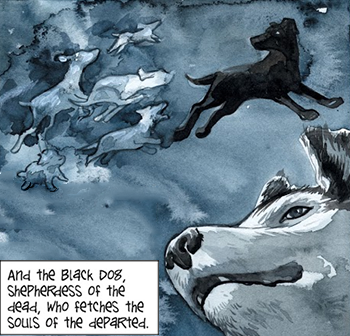
- Dogs are frequently linked with death in mythology. In European folklore, a dog howling at night was said to mean someone was about to die, the hounds of Annwn brought a person to paradise, and the Egyptian Anubis had a jackal's head.
- Aztec Mythology: Xolotl, a spiritual companion/avatar of Quetzalcoatl, said to have guided him and/or Tezcatlipoca through the underworld in order to gather the bones used to (re)create humanity and kickstart the current world. By extension (Xolotl was also the god of dogs, among other things), all dogs were (and often still are, in Mexican and Central American folklore) considered psychopomps, and were often sacrificed at funerals to provide the dead with companionship and guidance.
- Mayan Mythology: Ixtab is the protector goddess of people who commit suicide by hanging, and sees to it that they reach a pleasant afterlife.
- Celtic/Irish:
- In the original mythology, hearing the cry of a Banshee meant that someone who heard it was going to die. It wasn't until Dungeons & Dragons was made that the idea of the cry being anything more than a sign of approaching death took off.
- The Cyhyraeth fulfilled a similar role in Welsh mythology.
- The Dullahan, though actually a member of the Unseelie court, hurls blood in the face of those mortals he encounters as a sign that death will claim them soon. Sometimes he is said to come driving a hearse (a black coach with candles mounted in skulls for light, human thigh bones for spokes, and a human spine to hold up the worm-eaten pall) drawn by six headless horses, with or without a banshee at his side.
- Celtic/Brittany: The Ankou, who is often described as a skeletal figure in a large-brimmed hat and a cloak, collecting the souls of the dead in a horse-drawn carriage.
- Chinese: The Black and White Guards of Impermanence (黑白無常). They are in charge of leading the spirits of the dead into The Underworld. They wear tall hats and long robes of their colour and are usually depicted with their unnaturally long tongues sticking out, as a way to scare evil spirits. The Black Guard is in charge of leading the aforementioned evil spirits while the White Guard is in charge of the good ones. Both have messages written on their hats, which vary depending on the depiction (or possibly whether they're on or off the job). The Black Guard may have "Peace under heaven" (天下太平) or "Now chasing you" (正在捉你, or idiomatically "I'm going to get you!") written on his hat while the White Guard may have “Fortunes at first sight" (一見生財) or "You may come to me" (你可來了). They have Meaningful Names as well: the Black Guard's name is Fan Wu-jiu (范無救), which has the extended meaning of "if you're a sinner (范, a pun on 犯, "to offend, to commit (a crime), to violate (a law or rule)"), then you can't be helped (無救)." The White Guard's name, Xie Bi-an (謝必安), has the extended meaning of "if you are thankful (謝) and a good person, then you'll surely find peace (必安)."
- Nautical Folklore:
- Mother Carey, who is sometimes presented as forming an Unholy Matrimony with Davy Jones and appropriately is the aggressive sort of psychopomp. She lures sailors like a siren, but takes care of storm petrels and giant petrels, respectively known as Mother Carey's Chickens and Mother Carey's Geese, which are thought to be the souls of lost sailors.
- According to some sailor myths, all swallows are this, especially to people who have drowned. If you drown, then a swallow will carry your soul to the afterlife. On a side note, they can also represent a number of things, and experienced sailors will often get themselves a swallow tattoo, both as a symbol of their experience and to guarantee themselves safe passage to heaven should they ever die by drowning.
- Voudoun: Papa Guede, or Baron Samedi, is the first man who ever died. Because his approval is required to allow souls into the afterlife, he can also return people to life if their time hasn't come. Therefore, followers of Voudoun frequently call on him to intercede on behalf of loved ones who are near death.
- Japanese Buddhism:
- In Japanese Buddhism, Amitabha Buddha descends on a cloud, accompanied by various gods, to pick up dying devotees to be taken to the Western Paradise. One example of this in pop culture was in the film Pom Poko.
- Geist: The Sin-Eaters:
- You play as one of the Bound, who has partially fused with a type of ghost, and go around doing the work of the dead, or just doing the shit your Geist wants. One of the Archetypes, the Advocates, is pretty much devoted to helping ghost resolve their Unfinished Business and allowing them to pass on.
- Book of The Dead introduced perhaps the biggest in the entire setting: Mictlantecuhtli, the Kerberos of Mictlan, also known as Polydegmon the Collector. He doesn't guide souls per se, but the book mentions how he sees himself as the guardian of the dead. His biggest claim though is how he can retrieve the soul of anyone who has ever died. Not even Deader than Dead, Cessation of Existence, even old age (which is big, considering old age is usually the final death in most other settings) could stop him from doing this. Combined his Geognosis and perfect 15 stats across the board, he might even be one of the mythical Deathlords.
- GURPS Dungeon Fantasy 9 introduces necromancers (among others) as a playable character type in dungeon fantasy worlds. One of the suggested possible motivations for such individuals joining adventuring parties is explicitly that they may act as psychopomps — specialists in helping the dead go on correctly to the next world, as a moral duty. As undead are clearly not doing this right, and dungeons tend to have a lot of undead, psychopomp necromancers may want to visit those places and get "a bit forceful".
- Nobilis: Lance Romenel voluntarily serves as a psychopomp for dogs. He's not actually responsible for dogs - he's the Power of Records - but he does it anyway.
- Scion: Psychopomp is literally a Purview and is used by any of the Gods of Travel or Journeys or characters who delve into its powers, although its powers refer to travelling and rapid movement more than actual guidance to the dead. The Death Purview is a separate sphere of power in its entirety.
- Pathfinder:
- Psychopomps are the primary race of True Neutral outsiders and serve Pharasma, Goddess of the Dead, in ensuring that the transition of souls from life to the afterlife works properly and smoothly. They don't generally escort souls to the afterlife — that happens automatically — but serve various roles in easing the process. Shokis, for instance, track down lingering souls to coax them to the afterlife; esoboks and morrignas hunt down the undead and those who would cheat death; memitims and vanths guard departed souls to ward off supernatural predators; catrinas comfort the departed and help them accept their fate; calacas help living mourners come to terms with their losses. Their mortal enemies are the daemons, who seek to devour and destroy souls; sahkils, whose fostering of mortal fear disturbs the progression of the dead into the afterlife; and any and all undead. Some psychopomps are powerful enough to be demigods in their own right, called "psychopomp ushers", and can be taken as a patron deity by divine spellcasters.
- Alebrijes don't usually serve in this role, but one with a strong connection to a mortal will search for their soul after death and escort it to the Boneyard, protecting it from supernatural predators and helping to ease the shock of their passage into the afterlife.
- Carousel has Billy posthumously escorted "up there" by two Heavenly Friends.
- In Dorothy L. Sayers' The Devil to Pay, an angel and a devil both show up to claim Faustus's soul. (This is in fact a common Christian trope, so they can duke it out to establish where the soul ends up.)
- Grim Fandango has one as the main protagonist Manny Calavera, a Grim Reaper who lives on the land of the dead, and his job is going to the land of the living, bringing dead people to the land of the dead, and sell them tickets to the Ninth Underworld, which is essentially heaven. Manny is only allowed to go to the Ninth Underworld if he pays his debts for what he has done in life, and is working as a reaper to do such, when working as a reaper, he dresses in a robe and carries a scythe, but when he is not picking souls, his job is just like in a real-world office.
- Touhou Project has Eiki Shiki, Yamaxanadu, the Yama/Enma (see Hindu Mythology above) assigned to Gensokyo. (As well as her slacker subordinate Komachi, but she is a more specific trope... or two, to be more precise.) Yuyuko is technically a psychopomp too — she can cause death with a thought, but she is extremely responsible with her power, and her happy, cheerful attitude is certainly good for reassuring a moribund person that everything in the afterlife is going to be fine.
- In Shin Megami Tensei III: Nocturne, with the exception of the Hito-Shura and Dante / Raidou Kuzunoha the 14th, the holders of the Candelabra are various incarnations of death, including the Four Horsemen of the Apocalypse, the trumpet-playing angel and the Whore of Babylon, a Sokushinbutsu, plus a matador and hell's angel.
- Many of the holders of the Candelabra appear again in Shin Megami Tensei IV as difficult, very rare bonus bosses. Charon also appears as the boatman that you can bribe to return to life, should you die.
- Guild Wars Factions has a rogue Psychopomp as it's Big Bad.
- Jade Empire: The Spirit Monks serve the Water Dragon, who is the Shepherd of the Dead. The monks have the duty to deal with restless ghosts and can bind spirits in order to escort particularly troublesome specimens to Dirge, the gateway to the Underworld. They can also temporarily disperse spirits through applied force.
- The world of Haephnes in Soul Nomad & the World Eaters has a being known as a Master of Death, a god who serves as a psychopomp to gods and humans alike and controls the flow of souls to the afterlife. Souls there go through a cycle of reincarnation, and without a Master of Death, the cycle stagnates as souls are unable to flow freely between life and afterlife. That's their job in theory, at least. Gig certainly made the souls flow, but it was a purely one-way ticket.
- Soul Nomad also has an inversion known as a Master of Life, the counterpart of the Master of Death. Its job is to see that souls that flow into the world from the afterlife are born properly.
- The truth behind it all is slightly more complex: The afterlife is another world in itself, called Drazil. Drazil has its own Master of Death and Master of Life, who are minions of the Big Bad. The Big Bad sought to stop the balance of souls in order to make Drazil flourish at the cost of Haephnes. Thus, he makes Drazil's Master of Death stop the souls of Drazil's dead from returning to Haephnes, and arranges for Haephnes' Master of Death to be assassinated so he can't stop souls from flowing from Haephnes to Drazil. Needless to say, this ends up messing up things royally for Haephnes — and then Gig comes along...
- In Solatorobo, the Anjalists believe that birds guide souls to an afterlife above the sky. Naturally, they tend forests for the birds to live in (when they're not acting like Catholics, that is).
- A playable class within Bloodline Champions. With long braided hair with sticks in it in addition to wearing a headband, they also have a hippie-ish look.
- Persona Q: Shadow of the Labyrinth: This ultimately turns out to be what Zen is or rather used to be as Chronos, with his duty being to guide recently deceased souls back to the sea of souls. With the plot of the game only happening because Chronos was puzzled by the reaction a young girl, Niko/Rei , had towards her death and wished to make her happy. Which ended with Chronos sealing away both his and Rei's memories as well as a large part of his power and trapping them in an illusionary world made of the things Rei always wanted to experience in life. Abandoning his duties in the process.
- Pokémon:
- While Dusknoir's Pokedex entry in Pokémon Diamond and Pearl ("the antenna on its head captures radio waves from the world of spirits that command it to take people there") would suggest that it abducts unwilling people, entries in later games suggest Dusknoir actually acts as a ferryman that guides lost souls "home" (into the realm of the dead).
- Drifblim is also stated in Pokémon Sun and Moon to carry away people into the afterlife if they grab them at dusk.
- Pokémon Legends: Arceus introduces Hisuian Typhlosion, which is said to purify lost and forsaken souls with its flames and guide them to the afterlife.
- RuneScape has two known Psychopomps, Death and Icthlarin. Death's role is to separate dead souls from their bodies and help them reach the underworld, while Icthlarin (who is based on Anubis from Egyptian Mythology) guides souls through the underworld of Gielinor, protecting them from his insane sister who used to be in charge of reincarnation before she went insane. Death is actually referred to as a Psychopomp in the lyrics of the song of the Halloween 2014 event. Death was given his role as a psychopomp by Guthix after he became the very first human to ever die in Gielinor. According to the game's lore, each planet has its own version of Death and its own underworld. Upon death, a creature's soul is reaped by the Death of the planet they are currently on and then passes to the underworld of whatever planet they consider home.
- The Elder Scrolls:
- Arkay, the God of Life and Death among the Nine Divines, is one in his Yokudan/Redguard aspect of Tu'whacca. Tu'whacca guides the souls of the honored dead to the Far Shores, where he serves as caretaker.
- Kynareth, the Goddess of the Air among the Nine Divines, is one in her Khajiiti and Nordic aspects as Kynarthi and Kyne, respectively. In particular, as Kyne, she fills a role similar to that of the Valkyries.
- In The Elder Scrolls V: Skyrim, the player very briefly becomes one in the final stage of the questline for Mara's temple, tasked with reuniting two lost lovers' ghosts and then letting them move on together to Aetherius.
- In Dragon Age, Dalish Elves believe that when they die, their souls are guided to the afterlife by Halla.
- World of Warcraft:
- Spirit Healers are ethereal blue-skinned and winged women who guide the souls of players back to their bodies when they die.
- Valkyr are the in-game equivalent to valkyries, being vrykul women who proved themselves in life. They were created by Odyn in order to collect the souls of powerful warriors to serve as an army against the Legion.
- Bwonsamdi is the troll loa of death who guides the spirits of his followers to "Da Other Side". He is more than willing to strike bargains with his followers in exchange for longer life, though the price is high, and will offer his followers either blessings or agony based solely on his mood. In Zandalar he takes over the role of Spirit Healers, usually offering some snide commentary when a player dies.
- The Shadowlands expansion reveals an entire part of the afterlife dedicated to the job of psychopomps. Bastion is the afterlife of those who lived their lives in dutiful service to a higher cause. Souls sent to Bastion undergo rigorous trials to eventually ascend into the Kyrian, who travel across the multiverse to bring deceased souls to the Arbiter for their judgement. The Spirit Healers are revealed to be Kyrian "Watchers". Their duty is to judge souls on worlds to see if they are ready to go to the Shadowlands or if they can return to life.
- The Arbiter is the ultimate psychopomp of the cosmos. When souls are brought to her by the Kyrians, she views their entire life and decides their final destination among the infinite realms of the Shadowlands. The events of the Shadowlands expansion kick off due to the Arbiter being knocked comatose, sending all souls into the Maw.
- Grimoire of the Shadowlands reveals that Zovaal was the original judge for all souls but eventually rebelled against the orders imposed on him by the First Ones. After he was imprisoned, a portion of his essence was used to create the Arbiter as a replacement.
- Final Fantasy X is set in Spira, a world with so many ghosts that their emotion gives them physical form as monsters and they overrun the land of the living. Sometimes they don't even know they're doing it! Therefore, summoners- a sort of priest/exorcist combination- are necessary to Send the ghosts on. Summoners are ordinary humans, but they are culturally detached from their communities and usually very wise because they've witnessed so much loss and mourning. It's considered very odd for young people like Yuna to become summoners, and in her case, the choice foreshadows her suicidal tendencies.
- Spiritfarer: The main character Stella is a spiritfarer, someone whose job is to sail around the Spirit World finding lost souls and befriending them, caring for them, and finally helping them pass on to the afterlife.
- Brawlhalla has two of them: Brynn, a Half Human-Half Valkyrie who not only chooses warriors for Valhalla, but also likes to join the tournament they fight in, and Nix, a "reaper for hire" who has worked across different panteons and is currently in the tournament looking for 11 gods that are hiding somewhere, as well as trying to reap some fighters who have broken the rules of death in some way or another.
- League of Legends
- Canonically, the game and its universe feature a unique spin on The Grim Reaper archetype by manifesting as two entities, collectively known as Kindred. Eternally bound to one another, one of them represents the gentle, if absolute side of death that grants a peaceful passing should the victim Face Death with Dignity, while the other is a violent predator that eternally chases those trying to run from death until they inevitably lose. They're mainly represented in-game by the Lamb and Wolf, but various cultures in Runeterra have their own regional variants and interpretations, though they're always consistently acknowledged as a dual entity.
- Semi-canonically, there's also the various spirits in Ionia's mythology represented in the Spirit Blossom skin linenote . In addition to an alternate version of Kindred representing a "Spirit of Death" that brings the dead into the afterlife, there's also The Gatekeeper (represented by Ahri) and The Collector (represented by Thresh) that oversee their journey upon arrival. The Gatekeeper is a "Spirit of Salvation" that leads souls to a gate to eternal rest, but only if they follow her path, while The Collector is a "Demon of Obsession" that lures the fallen away and traps them in their own memories for eternity.
- Kirby has an example with the recurring Superboss Morpho Knight, a Butterfly of Death and Rebirth who's attracted to powerful souls who should've died long ago, sends them to the afterlife via absorbing them, and uses their power to reincarnate into a warrior form. So far, the two characters claimed by Morpho Knight were Galacta Knight in Kirby Star Allies and Fecto Forgo in Kirby and the Forgotten Land.
- In RWBY, the Curious Cat is the psychopomp for the Ever After. Afterans live to fulfil a purpose, to the point that they name themselves after that purpose. If an Afteran completes their purpose, fails it, or loses their way, the psychopomp will help guide them back to the Great Tree where they will ascend and be given a new life with a new purpose.
- Daily Grind: Jolene comes from a long line of female Psychopomps. The job isn't gender-restricted, either.
Being a successful psychopomp didn't stop her mother from going to hell, but it did get her a nice house with the abuser-victim roles reversed. It's implied that she could have gotten a second chance for her community service, but she lost privileges when she abused her powers and brought her brother back from the dead. - Dangerously Chloe has Alchemy: High school girl, flies, gets texts telling her there are stray souls to harvest.
- Gunnerkrigg Court: Numerous. Muut, a death spirit from Cahuilla Indian folklore, is probably most prominent. Aside from Ketrak, the Guide of insects, all of them are preexisting mythological figures, though some, such as Agni (pictured above) and the Moddey-Dhoo, were not psychopomps in the original stories. Antimony first realized their nature when two called on her, as the only person who could see them, to decide which of them one dead child should go with. And in at least one instance, a living human served as a psychopomp for a relative after none of the Guides came to help. This is because the person's life force didn't actually die, but was unintentionally stolen by her daughter, who had to guide her as a final action cementing it..
- Life and Death has Steve, who serves as the psychopomp for the world, and occasionally the one to actually kill people. The catch is that Death is the name of his job, not his nature.
- Rhapsodies: Deidre is a psychopomp working at one of the local hospitals. When asked she says she "handles malpractice." (Most people think this means she's a lawyer.)
- The Phoenix Requiem: Spirits, who used to take humans' souls to afterlife before their imprisonment. It is revealed near the end that actually the Mehdiea or Hellions as they're known were responsible for sending souls to afterlife. As both Spirits and Mehdiea are imprisoned, at the end it falls to Jonas to do the job. He even mentions at the end that some people call him "The Reaper".
- Mountain Time: The newly dead are greeted by the Great One, who is both a psychopomp and a hot dog.
- Homestuck:
- Aradia deliberately takes on this role after the events of [S]Wake and [S]Cascade, when she appoints herself as a guide to the newly deceased and helps them come to terms with their deaths and the afterlife. Her psychic abilities included communicating with the dead, which she has some influence over (such as getting them to torment Vriska) — but learned quite a bit more from personal experience. Also, considering the details of how Time players tend to operate, they tend to be pretty associated with death anyway.
AA: alpha dave still has a long way to go
AA: hes still not at ease with his mortality
AA: but people like us have to be!
AA: we have to be prepared to die a thousand deaths before our quest is complete - Terezi later explains the trolls' legendary psychopomp, a frightening, inescapable skull-faced demon with a "super foxy handmaiden" doing his bidding. This is a pretty obvious reference to Lord English and the Demoness (aka "The Handmaid"). Dave then points out that psychopomps are a very common mythological theme, and you can expect pretty much every culture to have one (and that it's hardly a shocker that he's a skeleton/skull).
- Aradia deliberately takes on this role after the events of [S]Wake and [S]Cascade, when she appoints herself as a guide to the newly deceased and helps them come to terms with their deaths and the afterlife. Her psychic abilities included communicating with the dead, which she has some influence over (such as getting them to torment Vriska) — but learned quite a bit more from personal experience. Also, considering the details of how Time players tend to operate, they tend to be pretty associated with death anyway.
- Housepets!: Retiring from her old job of guarding Tartarus, Cerberus takes on the role of psychopomp to recently departed souls. Being one of the few genuinely kindhearted Celestials, she takes easily to the role, enjoying the chance to work with mortals again and comfort them on their way to the afterlife.
- In The Red Star, two beings appear to Marcus: one who revolts his instincts and is dark, and one who disputes for his soul is bright.
- In The Order of the Stick, Thor disputes with Hel over a dead soul.
- This tends to happen fairly often when Durkon needs something.
- Thor lawyers dozens of souls out of Hel's grasp while she's busy trying to destroy the world with a rigged vote. And then Loki tag-teams in.
- The celestial ball of light known as Roy's Archon qualifies as well.
- The Buildingverse has a lot of deaths running around. Girls Next Door at least two, Roommates three (both have the deaths of Discworld and Sandman, and Roommates also the Erl-king the fae of child's death).
- Penny Arcade had a brief side story about Wheel Saint, a psychopomp in 1989 who saves lost souls from Purgatory in his Cool Car on behalf of Heaven, racing against the "other guy's" best driver.
- Stand Still, Stay Silent: Guiding those that have fallen victim to that universe's Plague Zombie inducing disease is one of the jobs of Finnish mages and the Swan of Tuonela from Finnish mythology guides those who have died of other causes.
- The Swan also appears in Minna Sundberg's earlier work, A Redtail's Dream. In that story, she's very overworked and not particularly helpful.
- Ennui GO!: Death is depicted as a somewhat abrasive skeleton dressed in stereotypical circus ringleader attire with white lilies at his feet. He makes two appearances in the comic; the first time, he tells child Izzy to fuck off because it isn't her time to die yet, and the second time he greets Morrigan, bluntly tells her she didn't do well, and offers to let her try again when she's ready.
- Considering that he isn't shown to be directly interfering with the townsfolk at any point, it's implied that the Undertaker in The Backwater Gospel is this.
- This ridiculously adorable animated short depicts what happens when psychopomps of several cultures send their children to school.
- SCP Foundation: SCP-4999 is implied to be one; it manifests as a mysterious suited man who appears to ordinary, unimportant people who are otherwise Dying Alone and offers them One Last Smoke.
- Farce of the Three Kingdoms has the three death scene judges, who show up whenever minor characters bite the dust onscreen and assign them a score. Dying Moments of Awesome get high scores, but they're less impressed by sudden anticlimactic deaths or insufficiently impressive suicides. The minor characters are entirely aware of them and often try to one-up each other to get higher on the scoreboard.
- In Spongebob Squarepants, the Flying Dutchman seems to alternate between this and a Vengeful Ghost. In a magazine that operated as his debut (in cameo form), it was claimed that he haunts the seas because his body was used as a window display when he died. Another has him making deals with various sea creatures in exchange for their souls that he carries in a bag on his person. The tie-in for this trope is in "Born Again Krabs," where he is going to drag Mr. Krabs to Davy Jones' Locker for his miserly greed. It's unknown if he escorts all underwater creatures to the afterlife, good or bad, or just the ones that go to Davy Jones' Locker.
- Justice League Unlimited: In "The Balance", Wonder Woman and Hawkgirl encounter Charon when they travel through Tartarus to rescue Hades from Felix Faust. Hermes also appears in this episode, not as a psychopomp, but in his capacity as a messenger for the gods.
