
Some possibly useful notes on The Eighties, by tropers who remember them and others who don't.
open/close all folders
Daily Life
- Society was ambivalent about yuppies even at the time, being viewed as a class of smart, task-driven young men and women, who made vast fortunes nearly instantly by trading on mumbo-jumbo that nobody else understood, but also as a troop of greedy bastards with no morals whatsoever.
- The 1980s were a turning point that led to the perception of tobacco, alcohol and coffee as legal drugs that would become widespread since the 1990s, helped in no small part by the scathing reports of Surgeon General Admiral C. Everett Koop, who served from 1982 to 1989:
- Koop not only equated tobacco to heroin and cocaine in terms of addictive power, but also fully established the threat of second-hand smoke, vowing to turn America "smoke-free" by 2000. This gave the tobacco companies the ultimate PR nightmare: It is one thing to deal with that smoking is hazardous to consumers and making them aware of that, but it is quite another to deal with the fact smoking is also hazardous to anyone who enters in contact with the smoke, not to mention being considered to be as addictive as hard drugs. While cigarette vending machines were still a common sight in the United States at the beginning of the decade, these were on their way out by its end.
- But an even bigger PR screw-up was caused by the tobacco industry itself at the same time: In an effort to improve sales, Camel introduced the sophisticated Joe Camel as its mascot in 1987. Things soon backfired however, as studies showed that the character became popular among children. The ensuing scandal decimated the reputation of cigarette companies among the public and gave pharmaceuticals a decisive lead in their future stalemate against tobacco (that would become a key part of American politics), as well as leading to an eventual ban on all tobacco advertising by the late 1990s.
- Similarly, the deadly traffic menace of drinking and driving became fully publicized in North America with the Surgeon General's reports. That in turn led to firmer public disapproval of alcohol consumption while, for the first time since the repeal of Prohibition, booze became subject to tougher laws and stricter enforcement.
- After the socioeconomic trials and tribulations of the late 1960s and 70s, the traditional American middle class had its last hurrah during this decade as family values were stressed and the economy recovered. By the following decade however, the traditional (if somewhat tweaked by this time) concept of four or five people (plus one or more animals) cozily living in a suburban house on a single paycheck, no longer became the image most real-life Americans had of an average household.
- Japan, meanwhile, was booming:
- A bubble economy began to rapidly expand from reasons including the acquisition of cheap real estate and the resale of it, political deals, and many other factors, although the most publicly known reason was the overwhelming production of cheap, but high-quality electronic goods and vehicles that flooded the world market to the extent that the domestic auto and consumer electronics manufacturing industries in Western countries, already under pressure from the economic instability of the 1970s, collapsed. (in the long run however, it wasn't as much the fault of the Japanese as the fault of Western industries refusing to become more competitive when they were ahead. They instead enacted protectionist measures, which did nothing to improve their products or save their employees' jobs, but instead, led to their total destruction by the mid-1990s, changing the concept of middle class in the process. Only in the 2000s did Japan's domination of world manufacturing eclipse, partly because of the economic bust the country experienced the previous decade, but also because of the rise of Chinese industry and inter-continental mergers).
- It was a period where almost everyone who wasn't dirt poor was either rich, becoming rich, or knew someone who was well off (even the middle class, though insanely overworked and living in tiny homes, had a lot of disposable income for the first time, which led to the massive growth of the entertainment and hospitality industries), and being Japanese was often equated with being rich. As a result, the Japan Takes Over the World and the Japanese Tourist tropes reached their peak, with rich Japanese moving to the US and Europe as well either for business or personal reasons.
- It was the first and only time until much later on that Japanese music acts toured widely outside the country with the Hair Metal/proto-visual act Loudness touring with Mötley Crüe and filming in the US, the Hair Metal/proto-visual act EZO getting signed to Geffen Records and performing in the US, jazz groups and musicians collaborating with American artists, and even X Japan trying for what would be (for various reasons) an abortive attempt at performing in the US and still filming within it anyway.
- Anime and manga were first introduced to the world on a wide scale as something other than adapted "kid stuff," including what was widely recognized as the first mature dramatic animated film, AKIRA, and of course, hentai. Japanese companies widely owned entertainment as well, from TV and music including Sony having bought out Columbia Pictures (having been spun off into its own company by Coca-Cola after a number of high-profile flops), and purchasing record labels globally as well.
- At home, however, things were not as well as they seemed — many people were tired of living in a strict, postwar society, many people were not part of the economic boom or were only so much as working 20 hour days, and while, at the time, Japanese technology was at the top of the world, it would become obsolete. Yakuza and other criminals infested nearly every part of business and politics and all of the other expanding industries, and the amount of people who were the Obstructive Bureaucrat or outright corrupt involved in every part of the bubble businesses were too numerous to even be counted, as was the financial fraud at nearly every point of it, which often got a pass due to Culture Justifies Anything and cultural ignorance overseas (meaning someone could run an outright Ponzi, for example, and say it was Japanese business practice, and a lot of more gullible overseas financial industry people would happily shovel in money, not realizing that native Japanese would spot the scam instantly). Many disaffected young men became bosozoku (biker gang members) or yankii (Japanese Delinquents) who, alongside Visual bandmen (all of whom readily mixed as subcultures drawing from each other) would get into truly violent and dangerous fights involving knives, baseball bats, fists, improvised weapons, and occasionally fire via Zippo lighters and occasionally pyrotechnics. Mental illness were often unrecognized and poorly treated (in case these were treated at all), working conditions could best be described as "hell on earth," and the use of alcohol and tobacco was irresponsible and off the charts by almost anyone who was an adult, and some who weren't — and the country and several subcultures in it, including the bosozoku, experienced the first "speed boom," with first diverted pharmaceutical pill methamphetamine and soon crystal methamphetamine becoming somewhat available for the first time via the yakuza since the end of WWII. AIDS denialism existed as national policy and many thought that no Japanese could or would contract HIV/AIDS.
- Notice the thing about guns NOT being mentioned in those fights above? Japan has and had very strict gun control policy. As a result, yes, only cops and serious yakuza had guns at the time — which spared a massive death toll from violent young men fighting and criminal activity in general, because the use of firearms was limited to police vs. yakuza battles and/or yakuza hits. Japan as a society, therefore, never had a gun violence/gun crime epidemic, nor were guns and drugs connected as they became in many other places, with people at the "drug dealer" level generally not being permitted to carry guns (if they were real yakuza) or not being able to easily obtain and use them, and choosing knives or lighters instead (bikers or other small time crooks who contracted with them to buy supply). As a result, the Japanese also became outraged in the incidents where Japanese tourists or students were shot while in the US, and in such cases would lodge diplomatic protests over US gun policy. That said, it may seem a bit hypocritical that Japan is a country that manufactures and exports firearms and ammunition.
- That said, for the time being, in the bubble, with Japanese corporations ("zaibatsu") owning major interests in everything from construction and finance and real estate to the cars most people were buying to entertainment and media to almost everything else that could be imagined (including even the corner convenience store for most people at the time via Seven and I Holdings), and with, at the time, many of these things being cutting edge inventions, it was enough to make Japan Takes Over the World not even seem believable, but to many analysts and Speculative Fiction authors of the time, probable.
Entertainment
Animation
- While Don Bluth used to work for Disney Animation Studios, he left in 1979, feeling that Disney was sacrificing quality in order to save money. He then formed his own animation studio in 1980 with some other former Disney employees. His films tended to have dark sequences and emphasize the quality of animation. While his debut The Secret of NIMH ended up doing poorly commercially despite positive critical reception, it did gain the attention of businessman Mark Sullivan who moved the studio to Ireland in exchange for a huge grant from the Irish Government. They teamed up with Steven Spielberg to create An American Tail and The Land Before Time, both of which performed very well at the box office note and received positive critical reception. Bluth cut ties with Spielberg after he kept making changes to the films due to disagreements over what was appropriate for children. Bluth’s success convinced Disney animation that they needed to step up their game. They responded with The Little Mermaid (1989), which proved to be one of their most successful films in years and kickstarted the "Disney Renaissance," which would continue throughout the following decade. While Bluth’s work in this decade helped kickstart the The Renaissance Age of Animation that would occur throughout the 90s, his fourth film, All Dogs Go to Heaven's poor box office performance (due to being released at the same time as The Little Mermaid) note began a string of flops for Bluth that would cause his studio to collapse in the 90s.
- While Saturday morning cartoons remained popular during the decade, the subgenre of band centered cartoons declined as real life bands turned to music videos to promote themselves note . One exception was Jem, which proved to be successful in the mid-80s.
- The Japanese animation studio Studio Ghibli was founded in 1985 by directors Hayao Miyazaki and Isao Takahata and producer Toshio Suzuki following the success of the 1984 anime adaptation Nausicaä of the Valley of the Wind. In the following decades, the studio would produce a number of acclaimed and internationally successful anime films.
- In 1986, Steve Jobs purchased the Graphics Group, a part of the computer division of Creator/Lucasfilm which was renamed Pixar Animation Studios. While not initially a full on entertainment company, the studio would become known for their cgi shorts, including Luxo Jr. which was the first cgi short to be nominated for the best animation oscar, as well as commercials for outside companies. It would later become one of most successful western animation studios when it started releasing feature films in the 90s, starring with Toy Story. After several successful films, it was brought by Disney in 2006 who had distributed much of their work before then.
- The Simpsons, a primetime animated series that would go on to reach massive popularity (and at times, controversy) premiered on December 17, 1989.
Comic Strips
- Calvin and Hobbes, a strip involving a boy and his tiger (which everyone else sees as just a stuffed toy tiger) debuted in 1985. It quickly became popular and achieved wide circulation across the United States. Its creator Bill Watterson won the Reuben award for Outstanding Cartoonist of the Year in both 1986 and 1988 for his work on the strip.
Film
- The Summer Blockbuster came to prominence in this decade, spearheaded by the work of George Lucas and especially Steven Spielberg (carrying on from the second half of The '70s). Spielberg's success with E.T. the Extra-Terrestrial in particular made him THE biggest name in Hollywood. Beyond his directorial efforts, he executive produced a number of diverse films that used his input as a selling point and also did well at the box office: Poltergeist, The Goonies, Gremlins, Back to the Future, An American Tail, etc. Many were "High-Concept Films" which meant that their plots that could be summarized easily and this in turn made them easy to market to a mass audience.
- The early part of the decade saw the fall of the New Hollywood era. While the 70s saw the success of a number of director-controlled films with minimal interference from the major studios that invested in them, it eventually saw a number of Box Office Flops. These included Heaven's Gate (which contributed huge losses to United Artists, leading it to get sold to MGM) and One From The Heart, both of which also derailed the careers of their respective directors. The failure of some of these later films along with the commercial opportunities that Blockbusters provided led to cutbacks on "Auteur"-driven films and instead led to the establishment of The Blockbuster Age of Hollywood.
- Horror cinema had one of its periodic boom eras:
- The first wave of Slasher Movies crested and broke, with long-running Villain Based Franchises spun around such characters as Michael Myers, Jason Voorhees, and Freddy Krueger, making for the most popular horror heavies since the original run of Universal Horror films. In the U.K., this tied into the supposed scourge of Video Nasties. Directors like Wes Craven and Sam Raimi became Household Names in horror circles, and actors such as Bruce Campbell and Robert Englund similarly became B-Movie royalty by decade's end.
- Stephen King, being both popular and prolific, saw many of his horror novels and short stories adapted to the big screen in this decade with mixed results. One of his non-horror stories, "The Body", became the basis for the much-loved Stand by Me as well.
- A class of innovative filmmakers — John Landis, John Carpenter, and Joe Dante especially — took advantage of emerging special effects technologies to create films that often drew upon, if not outright remade, the horror films and concepts of the 1930s to '50s. Often Darker and Edgier, Bloodier and Gorier, and sometimes Hotter and Sexier, werewolves, vampires, ghosts and sundry other monsters (both established and original) became A-list after years of being relegated to B-Movie fare as they finally were adapted to modern times.
- There were PG options — Spielberg produced Poltergeist. Disney experimented with chilling content in such films as Something Wicked This Way Comes. Most successfully, there was a run of horror/comedy hybrids starting with Ghostbusters (1984) and climaxing with Beetlejuice, the successful sophomore effort of up-and-coming ex-Disney animator Tim Burton.
- For a step up from slasher movies, this was the decade when hard-R Body Horror took off on the big screen, spearheaded by provocative Canadian director David Cronenberg. While his films and John Carpenter's similarly grisly The Thing (1982) were greeted with howls of disgust from Moral Guardians and more squeamish critics, they also found defenders who appreciated their intelligent screenplays, excellent acting, and even socio-political commentary.
- Cinemas risked Testosterone Poisoning as action stars like Sylvester Stallone, Arnold Schwarzenegger, and Chuck Norris toplined A and B-movies rife with Stuff Blowing Up. However, by the end of the decade Bruce Willis and his mega-smash action hit, Die Hard, paved the way for a more human kind of action hero to predominate even if "Die Hard" on an X became a regular formula plot. While some previous action films were successful, this is the decade they became a dominant genre in Hollywood.
- Tie-in merchandise and Expanded Universe material took off in this decade as Star Wars, Ghostbusters, and E.T. became grist for toys, animated cartoon shows, original novels, etc. Perhaps the most bizarre example of this was the notoriously hyper-violent Robocop, which launched both a line of toys and an animated series.
- After years of complaints against the MPAA over the rather wide scope of allowable content in PG films, the PG-13 rating was introduced in 1984 as a response to the controversy over violent content in Gremlins and Indiana Jones and the Temple of Doom, which had gone out with PG ratings.
- This decade saw the rise of the sequel. While there had been successful film series during the Golden Age (1930s to 1950s), aside from the long-running James Bond series, sequels to high-scale productions were rare — and usually stopped at Part 2. But with the massive success of The Empire Strikes Back and Superman II in 1980, studios were much quicker to capitalize on previous hits for as long as audiences could stand them. It was particularly common for any action and horror film that turned a substantial profit (which wasn't hard given the often-low budgets they had) to have a sequel greenlit. At the end of the decade, four of the top ten grossing films were sequels — and five other films on that list would receive at least one sequel!
- This decade saw a number of major Hollywood studios getting bought by multi-national conglomerates and mergers with other companies, many of which never had experience in the film business before.
- United Artists merged with MGM in 1981. Ted Turner would purchase their film library in 1986 to get material for his "Turner Network Television" cable channel.
- 20th Century Fox was bought by the oil tycoon Marvin Davis in 1981 with publisher Rupert Murdoch buying a 50% stake in 1985.
- Columbia Pictures was purchased by The Coca-Cola Company in 1982 and was sold to Sony in 1989 to form Sony Pictures.
- Disney was almost subject to this when the businessman Saul Steinberg tried to buyout the company in 1984 but proved to be unsuccessful.
- Warner Communications, the parent of Warner Bros., began its merger with Time Inc. in 1989, which was completed the following year with the new joint company being called Time Warner.
- Fantasy Films saw a resurgence in popularity in this decade, particularly after the success of Conan the Barbarian (1982) with Heroic Fantasies being popular in the early part of the decade. These included Excalibur, The Sword and the Sorcerer, Red Sonja and Willow. Fairy Tale type fantasies were also produced such as The Never Ending Story and The Princess Bride. Some of these films like Labyrinth did not gain box office success but would later become successful through home media with many of them now considered Cult Classics.
- Many successful teen-oriented films were released this decade, some even spanning different genres while rarely talking down to their targeted audience. These included a number of comedy films that were directed or written by John Hughes like The Breakfast Club, Ferris Bueller's Day Off and Pretty in Pink, many of which starred the members of a group of actors known by the media as the Brat Pack, who also starred in other teen films throughout the decade. Along the way, more musical and dance-based such as Fame, Footloose, Dirty Dancing and Hairspray came out to wide success. Even films with science fiction and fantasy elements like Weird Science, Back to the Future and Bill & Ted's Excellent Adventure found an audience. Some of the stars of these films would continue to have prominent acting careers in later decades such as Tom Cruise, Kevin Bacon and Keanu Reeves.
- Disney launched a distribution label called Touchstone Pictures to handle films that were aimed at adult audiences as opposed to those branded under Walt Disney Pictures which remained family-friendly fare. The success of Touchstone was key in establishing Disney as a bonafide major Hollywood studio.
- In a related issue, while there were many kid-friendly hit movies in this decade, in general the industry was still aimed primarily at adults. Beyond Summer Blockbuster season (which ran from Memorial Day weekend to mid-August), just about any other kind of movie could be offered up at any time of year, and R ratings were more the rule than the exception.
Television
- Television was going through a rough patch at the beginning of the decade. The risque shows popular in The '70s worn out their welcome with the rise of the Moral Majority, being replaced by family-friendly sitcoms such as The Cosby Show, serious comedies in the vein of Cheers, and flashy cop shows like Miami Vice, etc.
- In the US, NBC started the decade in the Audience-Alienating Era to end all Audience-Alienating Eras, but ended it as the top dog in the ratings (a trend that would continue through the following decade), chiefly on the strength of its sitcom lineup. CBS and ABC, meanwhile, notably lost ground during the '80s; while they were still on seemingly solid footing by 1990, they were both facing severe problems that would prove devastating in the decade to come. The Fox network premiered in 1986, and while it did make something of a splash at the time, its golden age was still ahead of it.
- In the UK, meanwhile, The BBC went through an Audience-Alienating Era due to funding problems and allegations of political bias from both the Thatcher government and the unions. ITV took advantage, its edgier programming allowing it to sap viewers from what was seen as a stale, safe, and dry "Auntie Beeb". Lastly, Channel 4 was established in 1982 in order to break the BBC/ITV duopoly, and at the time was known as the most high-brow and intellectual of Britain's TV networks — a far cry from its current reputation.
- The Eighties marked the rise of challenging American drama series like Hill Street Blues, St. Elsewhere, and L.A. Law, which took Soap Opera elements like the Ensemble Cast and Plot Arc and put them into "serious" drama.
- Series also started experimenting with settings — no longer were the standard dramas and comedies confined to the three biggest cities. Eight is Enough was set in Sacramento, for example, while Dueling Show Family was set in Pasadena. Later on, Washington, D.C. and San Francisco became very popular in this respect.
- This is the decade where telenovelas began to be known beyond Latin America, with productions from Mexico and Venezuela were imported heavily to the United States, Spain and other European countries. Spain got such a fever with Cristal, a Venezuelan soap, that their leads eventually moved and had a quite long career across the pond. Brazilian soaps also got an small boom, and began to experiment with newer themes and more socially-relevant plots, albeit most of these productions began to be more known on other countries on the next decade.
- In North America, the first really successful fourth TV network since the DuMont folded began with the Fox Television Network, which began with their first hit, 21 Jump Street, that made Johnny Depp a star (if one really uncomfortable as a Teen Idol...).
- In Japan, Tokusatsu continued to flourish, although not nearly as much as in The '70s. A lot of the franchises underwent changes in writing and choreography, with the Super Sentai series having timeslot changes and the choreography changing with 1983's Kagaku Sentai Dynaman focusing more on pyrotechnical effects than many previous shows.
- In 1980, Ted Turner founded the cable channel CNN. It was the first channel to provide 24 hour news coverage as well as being the first all news channel in America.
Theater
- In live theater, the 1980s was the decade of the "megamusical" — lavish productions with premises ranging from whimsical (Cats, Starlight Express) to highly dramatic (Les Misérables), but all marked by scores that mixed pop sounds with "traditional" and operatic styles and a tendency towards BIG emotions and BIG showstoppers. The theatrical equivalents of the Summer Blockbuster, and often regarded with just as much disdain by professional critics, Scenery Porn and Costume Porn were the order of the day in these shows. Many were the musical work of British composer Andrew Lloyd Webber, and most premiered in London's West End before launching sister productions in New York City and elsewhere. Lloyd Webber's career and the megamusical as a whole reached a peak with 1986's The Phantom of the Opera, with the media hype surrounding the show's Broadway debut in 1988 comparable to that of any Hollywood blockbuster of the era.
Theme Parks
- Tokyo Disneyland, the very first international location of the Disney Theme Parks, opened on April 15, 1983. Its huge success caused Disney to see potential of opening more parks across other countries in the future.
- Universal Studios announced plans to build a second park in Orlando, Florida. Disney responded by attempting to make them back out of the project, doing things like building their own studio park, Disney-MGM Studios, in 1989. Universal refused to back down and continued ahead with development, although due to delays the park wouldn't be able to open until the next decade.
Fashion
- Most of the fashion trends that people tend to associate with the 1980s didn't really occur until the second half of the decade—in fact, much of the fashion of the late 1970s was still in style back in the early 1980s.
- '80s Hair tended towards the big and foofy. This was true for men, too — though never as big as women's hair, men's hair was longish by today's standards, and buzz cuts were extremely rare in the early '80s, a time when afros and sideburns still hung on from the '70s. Side ponytails and big neon scrunchies were popular among little girls and teenagers. Crimping irons with swappable plates were a must-have, including some
 ◊ that did not work at all as intended, unless you turned your hair into a sheet of hairspray and then didn't move. The slightly longer hairstyles from the '70s like the bowl cut remained popular for boys and young men into the early '80s.
- While truly bold, expressive and outrageous in contrast to the bare-faced tanned look of the '70s, makeup in the 1980s wasn't always in neon. Makeup for everyday women, especially in the workplace, favoured pastel shades or the throwback look of The '40s and The '50s, and updated them to the decade with heavy eyeliner, blush overlapping the temples, and red glossy lips. To find reference on what 1980s everyday makeup looked like, check out young Madonna, the works of Patrick Nagel or the music videos of Robert Palmer.
- Jeans weren't baggy anymore — they were worn as tight as possible. Given that skintight jeans could be very hard to get on or off over one's feet, some styles had zippers at the back of the ankle. While not terribly widespread, this hung on into the early nineties, until such tight jeans fell out of style.
- "Preppie style" was big in the early '80s. Mostly this manifested itself as polo shirts, often striped, ideally of the "Izod" brand, whose logo was a little embroidered crocodile (They are NOT "gator shirts"; Izod Lacoste shirts got their name from French tennis player René Lacoste, whose nose gave him the nickname "Le Crocodile". He put a crocodile on his shirts, and it took off from there).
- Women often wore multiple pairs of socks, one over the other, of contrasting colors. You'd buy your shoes a size or so large for this purpose.
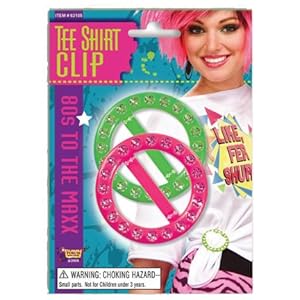
- Tights could be worn as casual wear instead of trousers. You pulled up your (multiple pairs of) socks right over the bottom of the tights. Legwarmers were optional but popular. They would often be paired with an oversized T-shirt or sweatshirt. T-shirt clips◊ were big in the latter half of the decade through the early 1990's, particularly in neon.
- Flashdance in 1983 popularized off-the-shoulder sweatshirts, usually with the collar ripped off.
- For a brief period of time, women, mostly teenage girls, could be seen wearing cut-off denim shorts over sheer tights with sneakers. Unsurprisingly, this look didn't last long, being considered completely terrible even by '80s standards.
- Shoulder pads among women's business suits were also easy to mock with their ridiculously masculine style.
- Neckties got skinny again around 1979 thanks to Punk Rock. Not everybody wore them, but by '83 or so most people did. They went back out of style later in the decade, but people on the west coast were still wearing them in 1989.
- Lingerie became fashionable (again), though bras remained optional—Many women wore soft lingerie such as camisoles and teddies instead of bras. High-waisted underwear became popular as well, coming in two options: the old-fashioned "granny panties" or thong-like panties.
- "Jheri Curls", a type of permed hairstyle, became popular among people of African descent. The Jheri Curl gave the hair a glossy, loosely-curled look. Jheri Curls fell out of style in the late 1980s when the hi-top fade hairstyle became popular.

Education/School
- Personal computers (particularly the Apple ][ and, across The Pond, the BBC Micro) made their grand entrance into education during this decade, especially around the midpoint and after. Schools built dedicated computer labs to teach students typing, a skill that they (correctly) guessed would become very important in the coming years for more than just secretaries. These school computers also had games like The Oregon Trail, loved by teachers for its ability to teach students history, and loved by students for granting them the opportunity to shoot everything between the Mississippi River and the Willamette Valley.
Food and Drink
- Coca-Cola and Pepsi were at each other's throats during the "Cola Wars," pulling out all the stops with their advertising. In 1985, Coke garnered quite a bit of controversy by reformulating their classic recipe, under the brand "New Coke," in an attempt to better mimic the taste of Pepsi, causing sales to plummet. They had quickly switched back to the old, marketing it as "Coca-Cola Classic", thus saving sales. To this day, New Coke is often considered one of the worst marketing decisions of all time for the sheer magnitude of the backlash against it and how quickly the Coca-Cola Company were forced to renege on it.
- Similarly, McDonald's and Burger King were undergoing a "Fast Food War" similar to this.
- A dog by the name of Spuds Mckenzie was the mascot for Budweiser Beer.
- The fast food expansion finally was felt outside of the USA, with many chains arriving in relatively virgin markets in South America and Asia.
- McDonald's introduced Chicken McNuggets in select markets in 1981. They became an instant hit with other locations across the nation wanting them, eventually being done so in 1983.
- Hot Pockets, a brand of microwaveable sandwiches, were introduced in 1983. Its original flavor was Ham & Cheese though it has since produced a variety of sandwiches.
- Lunchables, a pre-package lunch often containing crackers, cheese, a beverage (a soft drink or juice) and candy, is introduced in 1988. It was particularly aimed at working mothers who felt stressed over the lack of time they had to prepare lunches for their children while they were at school.
Headlines
- There was, frankly, a lot to fear in the '80s. The US was still at war, and getting nuked was a frighteningly plausible possibility. A string of post-apocalyptic movies, like The Day After, Testament and Threads, helped keep the fear bubbling. The Chernobyl meltdown made people queasy about even peaceful applications of nuclear technology.
- The corollary to all the Cold War fear was that, when the Soviet Union collapsed like a pricked soap bubble at the end of the decade, there was a huge sense of relief and hope for the future.
- The 1980 Winter Olympics were well remembered for the "Miracle on Ice", a real life David Versus Goliath story where the United States hockey team defeated the heavily favored Soviet Red Army team and went on to win the gold medal.
- A man by the name of John Hinckley Jr., in an attempt to impress his love Jodie Foster, tried to assassinate President Ronald Reagan in 1981 after addressing an AFL-CIO conference. All of the shooting victims survived, though White House Press Secretary James Brady was permanently disabled, with speech and movement difficulties.
- In 1985, NASA held a contest for a schoolteacher to be able to go to space, hoping that sending a teacher into space would increase public interest in the Space Shuttle program, and also demonstrate the reliability of space flight at a time when the agency was under continuous pressure to find financial support. They chose Massachusets high school teacher Christa McAuliffe from a pool of 11,000 applicants. The scheduled launch, Challenger, tragically ended in disaster, however, killing the whole crew on board. A faulty O-ring was determined to be the cause. This would have the unfortunate effect of slowing the space program down significantly in the years to come.
- On October 14, 1987, an 18-month-old girl named Jessica McClure fell down a well in her aunt's backyard in Midland, Texas. Between that day and October 16, rescuers worked for 58 consecutive hours to free her from the eight-inch (20 cm) well casing 22 feet (6.7 m) below the ground. The rescue proved to be a much more difficult ordeal than was first anticipated due to the drilling tools the workers had were barely adequate to penetrate the hard rock around the well. The story gained worldwide attention (leading to some criticism as a media circus), with 24 hour news networks covering the rescue efforts. Eventually, Jessica was rescued and made a quick recovery.
- The summer of 1988 was a hot and dry one, and as a result, Yellowstone National Park suffered over 50 wildfires that year, burning in total nearly 800,000 acres of land. note The Yellowstone fires helped change widespread attitudes towards wildfire management: previously, the prevailing mindset was that fires were inherently bad for the environment, and, consequently, forestry services tended to focus on suppression rather than mitigation. As a result, decades of suppressing smaller fires led to overgrowth that helped fuel the raging infernos of 1988. Today, it is widely understood that smaller, controlled burns are a necessary part of any effective fire management strategy.
Music
- When the decade began, disco was on its last legs in the United States and Canada after the anti-disco backlash had been growing among the public during the last few years of the 1970s. Although disco would remain popular in Europe for a few more years, in the US and Canada disco had become such a popular target for jokes and ridicule that most people became embarrassed to admit that they had ever liked it in the first place.
- New Wave and Synth-Pop became two of the signature sounds of the '80s, starting in the Britain in the '70s but really garnering popularity in the United States around this decade. Artists such as A Flock of Seagulls, Duran Duran, Talking Heads, The Buggles, New Order and Depeche Mode garnered big hits. At the same time, New Wave's sister genre Post-Punk petered out throughout the decade as all of its big names either shifted to other genres (namely Goth Rock, New Wave Music, Synth-Pop, or Alternative Rock, the latter of which is often thought of as a direct continuation of post-punk) or just broke up entirely. Of course, acts like Talking Heads, Devo, and even The Police straddled the line between post-punk and New Wave enough to be classifiable as both (in part because post-punk is more of a musical aesthetic than a concrete genre and didn't emerge as a distinct label until the 2000's), so this came as no surprise in the grand scheme of things.
- MTV was born August 1, 1981, playing music videos all day, everyday. Not only would this galvanize the music video as a viable promotional tool and means of artistic expansion for artists, but it would also more dubiously result in mainstream music becoming much more image-driven, as bands needed to either look good enough to appear on TV or make good enough videos to not need to show their faces all the time in order to be successful.
- The first half of the decade saw a second British invasion, largely supported by MTV. Early in the decade, they provided a lot of attention to the British New Wave acts since the British had been used to producing music videos for about half a decade while only a few Americans did (and what few did mostly just made concert videos), giving the British an edge in the comparative quality of these videos. This in turn caused many British acts to become regulars on the billboard charts and household names.
- Michael Jackson immortalized himself as the King of Pop during this time, scoring hits such as "Billie Jean", "Thriller", and "Beat It". The album Thriller remains to be the best selling album of all time and has shipped over 33 million copies in the United States alone.
- Prince, a flamboyantly dressed pop-rock-funk-musician who got his career jumpstarted in the late 1970's finally rose to prominence with his smash hit album Purple Rain and the movie of the same name. Unlike Michael Jackson however, by 1985 he had lost his third wheel due to his increasingly varied musical preferences and by the early 90's he was demoted to slight obscurity at the same time Michael's career fell tumbling after.
- Those bored with pop radio tuned their radios to the left side of the dial and listened to College Radio. The artists who played on these stations were Post-Punk guitar bands who performed what would later be called "Alternative Rock", were often signed to small labels and usually toured the United States in a beat-up van. The "modern rock" radio format sprung up near the end of the decade just as college favorites like R.E.M. and Midnight Oil began receiving mainstream attention and these early pop successes paved the way for alternative rock becoming a major music genre in the 1990's.
- Concurrent with this phenomenon was the rise of Alternative Dance, a mix between Alternative Rock and Synth-Pop that sported all the danceability of the latter and all the songwriting methods and artistic ethos of the former. New Order are generally credited with singlehandedly inventing the genre with their 1982 single "Temptation", following their failed attempts at continuing the straightforward Post-Punk style of their previous incarnation, Joy Division, and they alongside Depeche Mode are generally regarded as the Trope Codifiers as well as a result of how thoroughly they explored the genre's potential during the 80's. The band's respective labels, Factory Records and Mute Records, would also host a number of other bands critical in the development of this genre throughout the 80's, including A Certain Ratio & Happy Mondays on Factory and Yazoo & Erasure (both projects by Depeche Mode alum Vince Clarke) on Mute.
- Metal was in, especially towards the end of the decade. As well as the mainstream scene which was focused on Hair Metal, there was a massive underground, especially in the United States and Germany. There were no MySpace, YouTube, or Metal-Archives at the time. Underground music circulated through fanzines (Kerrang! started in 1981 as an underground fanzine), compilation albums issued by record labels, and tape trading (how Metallica first got big). Tape trading was surrounded by a lot of rules and rituals that would seem completely alien to someone used to peer-to-peer downloading. Part of this was due to the limits of tapes—every copy ("generation") of a bootleg was inferior to the source it was copied from. Although subgenres started to coalesce towards the late 1980s, the sort of obsessive subgenre hair-splitting common among today's metal fans did not exist. Most of the underground bands made fun of glam (Dave Mustaine called it "Gay L.A. Metal" and James Hetfield had a sticker on his guitar that said "Kill Bon Jovi") but that was about it.
- This was the era of the New Wave of British Heavy Metal (NWOBHM). Led by Judas Priest and Iron Maiden, it influenced a wave of bands from around the world. This along with Ozzy Osbourne's new solo career with guitarist Randy Rhodes gave way to the shred guitarists who focused on speed and technique. This gained popularity throughout the decade and into the 1990s. Joe Satriani, Steve Vai and Yngwie Malmsteen being among the most enduring examples.
- Speaking of Hair Metal, it achieved huge mainstream popularity. And the more successful bands became infamous for their Sex, Drugs, and Rock & Roll lifestyles. Bands like Mötley Crüe, Def Leppard, and Guns N' Roses became legendary for the hedonism and debauchery of their personal lives.
- Jazz music enjoyed its last period of mainstream popularity with the rise of the "smooth jazz" genre, led by 70s-era stalwarts such as Dave Grusin and George Benson as well as new faces such as Kenny G and Pat Metheny. Other jazz stalwarts like Miles Davis would also make a commercial comeback with music that was more commercially accessible than their prior work, but not as commercialist as smooth jazz, acting as gateways to their prior output for a generation of new listeners. Across the pond, jazz influenced the "Sophisti-Pop" movement led by Sade, Spandau Ballet, Roxy Music alum Bryan Ferry (fresh off the success of the genre's Trope Maker and Roxy Music's Grand Finale, Avalon), and the ironically-named Johnny Hates Jazz.
- Two genres which would change the face of Electronic Music started in this decade.
- In the city of Chicago, a genre retained some of the characteristics of Disco, learned lessons from artists and groups like Afrika Bambaataa, Kraftwerk and Gary Numan (to mention a few) and upped the game, creating a genre which would spread its wings at the tail end of the decade outside the US (more specifically, through the Oop North part of Britain) and explode during most of the 90's. Its name: House Music.
- From the city of Detroit, a genre which wasn't concerned with dancing for easy escapism and which was influenced by Electronic aesthetes such as Kraftwerk, Yellow Magic Orchestra and Manuel Göttsching and was focused on exploring themes of alienation, science fiction and the progress of technology would see part of its birth here (the other part being Germany). Its name: Techno.
- Both of these genres exploded outside the US, probably due to the fact that they were, at first, mostly black-oriented genres (with some LGBT thrown in), and so, they didn't get much exposure in the US (whose music and radio industries were still very much white-oriented). In Europe, it was a different thing. In the UK in particular, house would serve as a massive influence on the "Madchester" scene, which combined the sound of Alternative Dance with the aesthetics of rave culture, and even after Madchester's quick death, house would continue to have a noticeable impact on British acts like New Order and their spinoff group Electronic.
- In Japan, meanwhile, the main music industry was dominated by pop, the Idol Singer, and similar. In particular, the late 80's economic boom were the thriving years of City Pop, a subgenre of J-pop influenced by funk, jazz, R&B, and soft rock that reflected the economic prosperity and upper-class optimism of the era, essentially being a rough Japanese analog to Sophisti-Pop ("rough" in the sense that the funk influences in City Pop could oftentimes lead it to being less overtly smooth than its western counterpart). Hard Rock and Heavy Metal were pretty much limited to two bands, Loudness and the then-upstart band Anthem, at the beginning of the 80s, with other Hard Rock and Heavy Metal acts being pretty much strictly underground or at the local club scene level.
- This changed around 1986 in pretty much the biggest way possible — Visual Kei roared from the underground into the public consciousness, starting with bands such as X, Sex Machineguns, BUCK-TICK, SEIKIMA-II, and COLOR, with a loud, aggressive, in-your-face combination of Punk Rock, Hard Rock, and Heavy Metal fused with Glam Rock aesthetics, purposeful attention whoring, and troublemaking to force themselves not to be ignored. Meanwhile, the metal bands Loudness and EZO got signed and performed in the US, and Show Ya would be the first and only metal band to perform in North Korea with a concert in Pyongyang. The first Visual Kei labels, Extasy Records and Free Will Records, were founded, and X would become the first Visual band and first metal band to ever top the Japanese charts, repeatedly starting in 1989. At the time, Visual Kei had become something new and interesting, yet was still "underground and dangerous" enough it didn't generally have mass appeal until the very end of the decade — it took until 1989 for X to top the charts and go major with Blue Blood.
- Latin-American countries were another thing completely. Most countries were in a "One song in Spanish; one song in foreign languages" model of protectionism, which created small musical ecosystems whose artists rarely crossed over frontiers. No artist really believed they could make it on the American market, so the idea of "crossover" didn't really exist, or just was limited to playing in either a neighboring country or making it on Mexico, the biggest market at the time. Most of the music done at the time were done in the style of American pop music, with ballads by Dolly Parton or Sheena Easton being covered almost verbatim, although the Dominican band Las Chicas del Can reinterpreted American hits in merengue rhythm, which reigned supreme in the Caribbean, with Wilfrido Vargas and Juan Luis Guerra becoming the kings of the genre. Bachata emerged soon after a ban on the genre (because of its risque lyrics) was lifted, often being dubbed as "salsa erotica". Spain managed to send some of their budding pop-rock artists to its former colonies, with some success. After all English-language music was banned in Argentina because of the Falklands War, numerous rock groups gained previously-negated attention, leading to the "rock latino" movement, which extended through the continent, with similar scenes emerging in Chile and Mexico.
- In the early '80s, the aforementioned protectionist mentality was common in Canada too, by no means a Latin-American country. Though there were a few Canadian acts who made it in the US, like Bryan Adams and later the aforementioned Celine Dion, much of the material you'd hear on Canadian radio circa 1984 never made its way to the US. Artists like Corey Hart and Men Without Hats are seen as one-hit wonders now, but had many hits in Canada at the time (and in Hart's case, "Sunglasses at Night" was almost the least of them); the now-forgotten Platinum Blonde were as big in their native country as Duran Duran at the time.
- The '80s were the decade of the Charity Motivation Song and All-Star Cast charity concert as topflight acts banded together to raise money for the worthy causes of the moment: Ethiopian famine relief, AIDS research and treatment, struggling American farmers, etc. This reached a peak in 1985 with "We Are the World" for songs and Live Aid for concerts.
- The Compact Disc was introduced in 1982, the first digital audio consumer product. Although the sound quality was much higher than vinyl or cassette, the luxury-oriented prices of CD players and the poor audio sourcing on early releases kept it from immediately catching on with the general public. As prices of players began to drop and CD production became better-handled (most significantly shifting focus towards the original master tapes), the discs began to rapidly replace the older analog formats toward the end of the decade, outselling them for the first time in 1987 and continuing to serve as the dominant form of music distribution until the rise of digital downloading services in the 2000's and streaming services in the 2010's.
- Western pop music began to draw from World Music after two albums in 1980 featured prominent African influences: Talking Heads' Remain in Light and Peter Gabriel's third Self-Titled Album, nicknamed Melt by fans. Paul Simon had a Career Resurrection with 1986's Graceland, but the controversy over Simon breaking a cultural boycott in South Africa over apartheid by recording there with black musicians put a damper on the trend. In the wake of this, Gabriel and Talking Heads frontman David Byrne wound up popularizing unfiltered world music in the anglosphere with their respective 1989 albums Passion (the soundtrack album for The Last Temptation of Christ) and Rei Momo.
Hobbies
- Role-playing games, invented in the mid 1970s, became mainstream (more or less) in the 80s, on tabletop as well as video games. At the same time, the hobby came under fire with fundamentalists and others accusing RPGs for promoting anything from satanism to bullying to players turning into their characters.
Local Issues
- Mount St. Helens erupted in the state of Washington on May 18, 1980, killing 57 people and leaving the sky covered in ash over 11 US states.
Social Concerns
- With new drugs such as heroin and crack cocaine coming into play, The War on Drugs was at its most prevalent and Anvilicious; with school programs such as D.A.R.E. and former first lady Nancy Reagan telling kids to "Just Say No", these had, well, varying degrees of success.
- There was also a new and terrifying plague: AIDS, whose etiology and pathology was unknown at the time. People were basically dropping dead, and no one knew why. No one even knew how it spread. At first, the public lashed back at the groups hardest hit — gay men and intravenous drug users — as causing or deserving the disease. That eventually began to fade as the disease forced many people out of the closet (actor Rock Hudson was one of the most famous examples) and suddenly the public finally had to face the fact that gay people were everywhere, hiding because of the social bullying they were suffering from the public.
- The end of the 80's also put another name from the medical textbooks into the minds of the general public: autism. While the condition was known to exist to some degree, most of the general public were either unaware or ambivalent towards its presence, with the very few and far-between portrayals of it being so misleading and fabricated that they could hardly qualify as even Hollywood Autism. That all changed with the release of Rain Man in 1988, which featured what was perhaps the most accurate portrayal of an autistic person up to that point, based on extensive consultation with psychologists and actual autistic individuals (who also heavily informed Dustin Hoffman's portrayal of the autistic Raymond Babbit). Of course, this would become a gigantic double-edged sword for real autistic people: while it helped dispel many harmful stereotypes about autism and gave it mainstream recognition for the first time, it also introduced new stereotypes that would only serve to put the autistic community into another, equally limiting pigeonhole (most notably the idea that autistic people automatically have incredibly niche talents that they are obligated to constantly showcase in order to be recognized). Additionally, the fact that the film still depicted autism as something to be pitied ensured that it would forever remain a thorn in the side of actually autistic individuals, especially after the recognized spectrum broadened in the decades since the film's release.
- The fact that John Hinckley attempted to assassinate President Reagan to impress Jodie Foster led to increased awareness about the dangers of stalkers and casual relationships, which had already been the focus of a major panic ever since Looking for Mr. Goodbar was released. Films such as Kramer vs. Kramer and human-interest stories about the adverse effects of divorce and single motherhood further dampened the 70's-era ideal of the self-sufficient woman (and would not come back until the 2010's); during the 1980's, the average marrying age for women plummeted and those who still desired to have careers attempted to balance work and family life.
- Similarly, "Stranger danger" first began to appear in this decade, with parents concerned that their children could be abducted off the street by predatory pedophiles and/or killers. This was the era of the Face on a Milk Carton. However, the fact that most sexual abusers are people known and trusted by their victims — i.e. family members, coaches, etc. — was exposed to the public's horror as well. And in a related issue...
- The "Satanic Panic" took off and reached its peak in this decade. Spurred on by alleged "true stories" like Michelle Remembers and The Satan Seller (both of which are now widely believed to be fraudulent accounts), there was widespread fear among communities, churches, and even law enforcement and social services that there existed an underground network of devil-worshippers who kidnapped, abused, and sacrificed children and other "innocents" in order to gain power from the Dark Lord. Your next-door neighbors could be conducting virgin sacrifices in their basement and you wouldn't know about it — until they came for you and your loved ones! Some of the wackier theories even alleged that the Satanists had infiltrated the government, business, and the military, and were using their resources to not only cover up their evil but facilitate it. Hundreds of people saw their lives destroyed by allegations that they were Satanists, with one of the most notable (and sensationalized) incidents being the McMartin preschool case. It got to the point where even Procter & Gamble was accused of being Satanic due to their logo, which they had to change — they later wound up suing the people who spread the rumors (which caused their stock to plummet) for $19 million. To this day, only one group of this model was ever known to exist — that being the Finders, whose existence was only made public by the FBI during the tail end of the 2010s after decades of investigation — but while this single organization is generally acknowledged as being real, the idea that Satanic child abuse cults were everywhere and influencing society on a major scale is generally regarded as a societal moral panic.
- A woman in the U.K. claimed that 1 in 4 British adults was a member of the Satanist underground.
- In 1985, Tipper Gore (wife of Senator and future Vice President Al Gore) put together a committee called the Parents Music Resource Center (PMRC) and organized a Senate hearing after accusing record companies of intentionally making albums with obscene lyrics available to children. Musicians such as Frank Zappa, Dee Snyder, and even John Denver testified before the committee in opposition to what they viewed as attempts to censor music. In the end, the record industry agreed to voluntarily label albums with lyrics that may be offensive, and that's how the "Parental Advisory: Explicit Content" label that appears on some album covers was born.
Technology
- Atari and its 2600 system were leading the way during The Golden Age of Video Games in America, along with dingy arcades as everyone got Pac Man Fever. Unfortunately, it was followed in 1983 by The Crash. All it took was a Japanese company by the name of Nintendo and its little gray toaster (And a Robotic Operating Buddy!) to change it all back in '85. Mario and Luigi went on to become household names with Super Mario Bros., and was the best-selling video game of all time until Wii Sports (also made by Nintendo) stole its thunder in '09. Most parents and Moral Guardians weren't too concerned about home computer games at the time, instead focusing their worries on arcades, which were viewed as hangouts for juvenile delinquents and gangs.
- Home computing was taking its first baby steps towards becoming a fixture of daily life. Computers like the Apple ][, the IBM PC and the Commodore 64 emerged, creating the first generation to know computers as something other than room-sized boxes used only for scientific purposes. Businesses started switching over from typewriters, schools started to build dedicated computer labs (see above), Apple made its famous 1984 ad, and the area around San Jose, California began to become known as "Silicon Valley". The first computer games were also developed during this era, and enjoyed great success in Europe, a market that was never as receptive to home consoles as North America was (during both the Atari and Nintendo eras). Stateside, they were heavily marketed to Education Mamas who wanted their kids to be "computer-literate" and stay away from those mind-rotting consoles.
- The VCR hits the big time, albeit initially impeded by the uncertainties of the VHS/Beta format war; this would redefine the business model of the film industry and the nature of going to the movies itself.
- They were also, at first, incredibly expensive: in the early part of the decade, they could cost upwards of $500.00. VHS tapes were also initially very expensive, especially early in the decade, when they sold for $70 a pop (almost $200 in 2022 dollars) — they were expected to be rented rather than purchased, and video rental stores sprang up like weeds across the U.S. Only at the end of the decade did the industry switch to selling rather than renting, and even then $40 was the standard price for a single title. The rise of home video also killed the second-run theater, as people who wanted to watch older movies could simply rent or buy them on VHS instead of going to a theater.
- The first cellphone, the Motorola DynaTAC 8000X, came out in 1983. It was huge and bulky, earning it the nickname "The Brick". While it was really only owned by rich yuppies who were always on the go, this device would go on to map out the future in which everyone would own a mobile phone of sorts.
