

 ◊ by Evelyn de Morgan.
Manny Calavera: No.
Mercedes Colomar: You're not here to give me my medication?
Manny Calavera: No. But I am here to ease your pain.
Mercedes Colomar: Guess they couldn't save me, huh?
For millennia, humanity has feared death, and understandably so, all things considered. Therefore, when personifying it, the result was often pretty terrifying. However, there has also been a very different attitude at times, with various writers and artists creating a personification of Death who is not only not scary, but friendly, compassionate, and otherwise the sort of person you'd want to find waiting for you at a difficult time like that.
This sort of Death won't glare at you with Glowing Eyelights of Undeath from underneath a Black Cloak while carrying a scythe (well, some might, but purely because it's expected of them); they will dress as a Perky Goth or take on A Form You Are Comfortable With. They won't challenge you to chess, but will instead be your best pal (before you die, even!) if you give them half a chance. Friendliness notwithstanding, picking fights with Death is still something the challenger will regret.
Sometimes this overlaps with Beleaguered Bureaucrat, when they are friendly but nonetheless have a long list of people to get through today and doesn't have time to deal with every decedent's requests. The Celestial Bureaucracy is very busy, you know.
The Trope Namer is the eponymous song by Blue Öyster Cult from Agents of Fortune, which is a song about how true love can last even after death, and not, as some seem to think, about anyone committing suicide. Nor is it about more cowbell.
Often applied to Psychopomps, Death and the Maiden, the God of the Dead and The Grim Reaper. Contrast with Everybody Hates Hades and Enemies with Death, when authors do the opposite with death-related deities. Is often a Friendly Skeleton. Compare also Friendly Ghost and Friendly Zombie. Distant cousin to The Devil Is a Loser. Compare Not Afraid to Die and We All Die Someday, which is about not fearing death itself rather than its personification.
Example subpages:
Other examples:
- This
 advert for Grolsch beer features the Grim Reaper taking a brief break from work. He appears to be a quite fun guy to hang out with.
- Bleach:
- Any deceased human with enough spiritual energy can become a shinigami. The fact that the main character becomes one while still alive is a plot point before the Big Bad shows his face. Thus, the shinigami are just like humans: they can be friendly, moody, supportive, scary, hostile depending on situation or individual personality type. However, shinigami aren't enemies of humanity even if their focus on the big picture can make them seem aloof at times. Their role is to guide the dead to Soul Society, cleanse hollows of post-death sin so they too can be guided to Soul Society and also to maintain the balance of souls across different worlds. In other words, shinigami are portrayed the same way humans are portrayed: as individuals with their own personalities, worries, fears, foibles, strengths and weaknesses.
- This is arguably the overarching theme of the series. Death is indeed a scary thing, but it will happen to all of us eventually, so we might as well accept it. The final Big Bad, Yhwach, is written to be the embodiment of the fear of death, and is a perfect demonstration of how far a person is willing to go to escape death. A world of immortality does sound like a good idea on paper, but when one stops and really think about it, a world of immortality would have no need to grow and advance. In the end, death is necessary for progression.
- Angel in Chainsaw Man is the Anthropomorphic Personification of this concept. He's a humanoid Angelic Abomination with a Touch of Death ability he can't control.
- The idea is alluded to in Cowboy Bebop, where Laughing Bull says "Do not fear death. Death is always by our side. When we show fear it jumps at us faster than light, but if we do not show fear, it casts its eye upon us gently, and guides us into infinity."
- Momo in Ballad Of A Shinigami is a sweet, white-haired girl who not only makes your death painless, she helps the people you are leaving behind by comforting them.
- Death in Gregory Horror Show is the only character shown to be completely friendly to the trapped guests, speaking kindly and offering to help where he can.
- Played with in Death Note. Shinigami have Blue-and-Orange Morality and most don't give humans and their lives very much thought. At the same time, they're not all bad — Ryuk really seems to enjoy hanging out with Light and often spends time doing goofy stuff like playing video games in his room. Two Shinigami fell in love with a human and used their powers to extend her life. In spite of their pleasant nature, Shinigami will never be "good" as it's understood by humans. Gelus and later Rem saved Misa's life but were both killed because Shinigami can never use their powers to prolong the lifespan of mortals, and after knowing and hanging out with Light for so many years, Ryuk was all too happy to kill him as soon as he stopped being entertaining.
- The Arbiters of Death Parade meet recently deceased humans to determine whether their souls should go back into the cycle of Reincarnation or into the Void, but are usually rather pleasant individuals to deal with, albeit with occasional hints of how how utterly alien their minds are compared to humans.
- In Kamichu!, Death is a rather friendly, if somewhat eccentric goddess, who even once had an affair with Poverty.
- In the end of Puella Magi Madoka Magica, Madoka herself is seen appearing before magical girls whose soul gems are about to be corrupted and taking the gems with her, enabling them to die peacefully and go to the afterlife without becoming witches.
- Monster Musume: Lala is a psychopomp who's also a gothy, socially awkward girl who pretends to be a psychopomp, making her a chuunibyou who actually does have supernatural powers. Despite loving to talk about darkness and death all the time, she's actually a very nice girl who's covering up the fact that she's cripplingly shy around strangers.
- A variation in Sailor Moon. Sailor Saturn is an entity of death and carries a scythe as a weapon. She has the power to destroy a planet if she wants. However she is not evil and her purpose is to kill off the remnants of a destroyed world, so that Sailor Moon can use her own powers to restore it. Any time she uses her death powers is only to allow rebirth to happen immediately afterwards.
- Soul Eater:
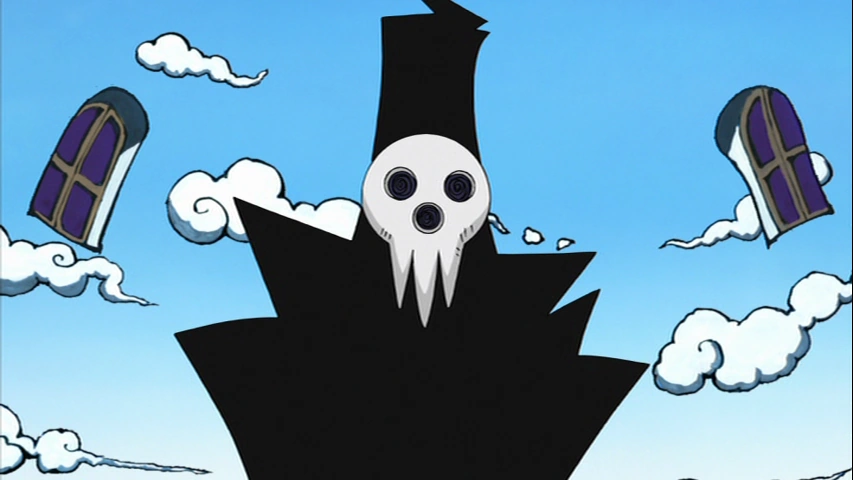
- Lord Death willingly embraces this trope. Back in his day he used to look like a textbook skull-and-black-cloak (read: very intimidating) Grim Reaper, but when he founded Death Weapon Meister Academy, he took on a more friendly appearance and goofy speech patterns, so as to not frighten his students. He saves that for his enemies.
- His son Death the Kid is also hardly a threatening image of death, being a teenage boy with Obsessive Compulsive Disorder. Don't try to do whatever you like with human lives. He doesn't like that one bit.
- Lord Death willingly embraces this trope. Back in his day he used to look like a textbook skull-and-black-cloak (read: very intimidating) Grim Reaper, but when he founded Death Weapon Meister Academy, he took on a more friendly appearance
- In the short manga story "Thirty and A Half Minutes" by Snippy MJ, the Reaper arrives at a hospital to collect a woman dying in childbirth. Just as her time is about to run out, the Reaper grants her an additional 30 minutes and 30 seconds, allowing her to deliver the baby and hold it in her arms, getting to share one moment with her husband and child as a family before she passes. It can be read here or here◊.
- An episode of Yu-Gi-Oh! GX deals with the spirit of the pharaoh Abidos, challenging Judai. After losing, he passes on, satisfied that he finally found an opponent who would duel him seriously. Judai refuses his offer to go with him to the afterlife, but promises to meet him again after 100 years. The episode ends with the crew discussing death and the afterlife. Needless to say, this didn't go well with the translators.
- YuYu Hakusho: Botan, who acts as The Grim Reaper in the first few episodes, wears a pink robe and is a Genki Girl. Yusuke even does Lampshade Hanging when they first meet in the pilot:
Yusuke Urameshi: Seriously? Death goes 'ding ding ding'?
- Hikari from Virgin Ripper is a very cheerful and friendly shinigami, going so far as to use a giant spoon instead of a scythe, to the dismay of her colleagues.

- Hugo Simberg, a Finnish symbolist painter, liked this theme. He made several iterations of The Garden of Death,◊ possibly his most famous work. He even went so far as to publicly explain his own interpretation of the scene.
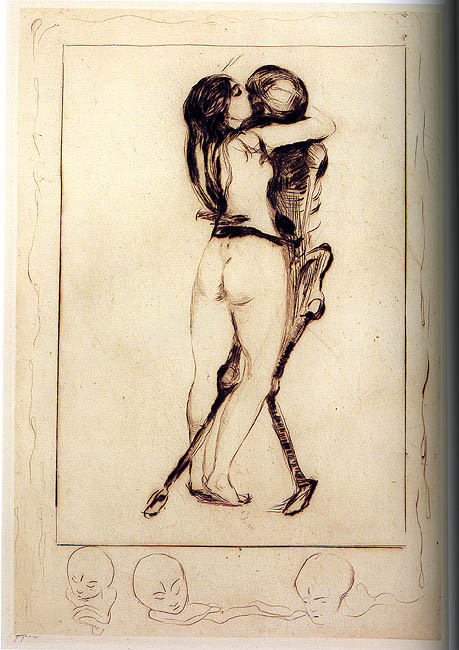
- Some of the art created with the motif of Death and the Maiden shows the maidens as being... well, not exactly afraid of Death's advances. Edvard Munch's etching◊ and Ergon Shiele's painting◊ are two examples.
- A number of pieces of cemetery art show the Angel of Death as a calm, peaceful, or even joyful figure, doing their duty without cruelty. Two examples are "The Angel of Death Victorious", who merely looks resigned, and Erica's Angel, posed as if just about to take flight while Erica cheerfully waves goodbye.


- The French comic Le Collège Invisible has an incarnation of Death quite similar to Gaiman's Perky Goth, and possibly inspired by her.
- Although Cernunnos, the Elder God of Death from Joseph Michael Linsner's Dawn series, can definitely take terrifying form if he so chooses (if, for example, he needs to curb-stomp a group of angels and demons who've decided to trespass on Earth with their bickering), the one time we see him welcoming a soul to the afterlife, he takes a much more attractive form and greets her...very warmly.
- Bernie in Death Vigil doesn't claim souls at all—instead, she focuses on protecting people from death by combating primordial forces of evil that want to eat reality. She revives people who have died to join the Vigil and gives them veilrippers to fight against said primordial evils. In her spare time, she likes listening to modern music on her iPod and dancing.
- Martian Manhunter: The Martians worshipped H'ronmeer, the god of death and fire (though some regard him as a god of life and light), who called all Green Martians his children. He was blamed for the plague that wiped out the Martian race, but that was actually Ma'alefa'ak's fault. On one occasion, he seemed to be coming after J'onn, but in truth he just needed his help to lead the Martians' souls to the afterlife.
- The Marvel Universe's Death can be like this. Sometimes, she seems like a nice girl, if a little dead inside. Depending on the Writer, she could also be quite evil.
- Wade Wilson, prior to becoming Deadpool, even fell in love with her, and one of the reasons he can't die is because one of her jealous suitors made him immortal so he'd stay away from her, which is another reason why Deadpool is so freaking Ax-Crazy. Amazingly, she's been shown to reciprocate his feelings—but they can only meet during the few seconds after he dies and before his mutant power/immortal curse can call him back to life. Death as a star-crossed lover?
- Death has also appeared as a low-key but friendly construction worker, to Jean Grey and Rachel Grey-Summers.
- In another X-Men related example, New Mutant Dani Moonstar once tried to fight off an incarnation of Death from taking one of her (non-mutant) friends. She eventually allowed Death to do her job, after she explained why her 'gift' was not to be feared by those who were suffering.
- She can stop being nice if she wants to. When she appeared to Dracula - who she clearly didn't like - she took a male form that was far more intimidating.
- In any story involving Thanos (which constitutes most of the stories she appears prominently in), she is presented as a cruel, greedy, and insidiously manipulative being who enjoys causing suffering almost as much as causing death itself; and is generally depicted as the very antithesis of DC's compassionate version of Death. At best, she is Lawful Neutral, often crossing over into genuine evil (she actively seduced Thanos into becoming the living murder machine he is, while still always keeping him lonely and miserable). The reason her relationship with Deadpool is so funny is because it's so unusual for her to react with sincere affection (let alone love) to anyone.
- One story included a presumed Take That! towards the DC Death, having Marvel Death appear as a cute goth girl who was far from perky:
Thanos: Must you wear that skin?
Death: Ah... you find it discomforting to hear this form speak of dark desire? Do I make you uncomfortable?
Thanos: Very.
Death: Lesson learned, Thanos of Titan. I am Death. I am not of comfort. - When an Elseworld Silver Surfer gained the Infinity Gauntlet and went crazy with its power he attempted to invoke this by making Death appear as a beautiful woman instead of a cloaked skeleton.
- The Brazilian comic Monica's Gang has one in the spinoff Penadinho (known in English as Bug-a-booo). Dona Morte/Lady McDeath is a clumsy Grim Reaper who is always forced to run after her "next clients". Her creator Mauricio de Sousa states that the character is an attempt to make death less scary than most people treat it, and tries to portray her as just someone doing her job, never an assassin. Even the full-sized scythe she carries is ultimately unthreateling — all she does is lightly bonk dying people over the head with the blunt side opposite the blade, turning them into Bedsheet Ghosts.
- In Neil Gaiman's The Sandman (1989), the interpretation of Death as an attractive Perky Goth is, along with Terry Pratchett's Discworld version, probably the foremost modern example of the trope. This Death is an All-Loving Hero, who appears at the end of every existence — humans, gods, stars — and offers a sympathetic face to remove some of the shock and terror of the moment. She isn't even bothered by the constant deaths and resurrections of the superhero set, cheerfully telling a baffled and enraged Lex Luthor that, "they all seem like they're having so much fun!" And as she then points out, they'll all come with her eventually. She didn't always have this positive mindset: she developed this sympathy after a mysterious decision to spend one day a century in a mortal existence.
Death: ...I'm not blessed or merciful. I'm just me. I've got a job to do and I do it. Listen: even as we're talking, I'm there for old and young, innocent and guilty, those who die together and those who die alone... For some folks death is a release and for others death is an abomination, a terrible thing. But in the end, I'm there for all of them.
- Wonder Woman:
- Wonder Woman (1942): Pre-Crisis Hades is generally benign, and his realm a place of rest. He does go off the deep end leading up to the Crisis but this was because Ares and the Anti-Monitor manipulated his mind and his wife is able to bring him back to his senses with The Power of Love.
- In Post-Crisis Wonder Woman, as conceived by George Perez, Hades is depicted as a relatively benign god who is rather kind and generous as far as his job description allows and nobody has an especially significant problem with him. Other writers had different ideas about him.
- A Running Gag in Jack Chick's Evangelical Christian comics is the Grim Reaper saying a hearty "Hi there!" when he shows up to collect someone's soul.
- In the short story "Our Neighbor's House" from the Emily Carroll anthology Through the Woods, after their father fails to return from a hunt, three sisters start seeing a man with "a wide brimmed hat and a toothy smile" around their house. The ending strongly implies that the man is The Grim Reaper, and even though the viewpoint character is Beth, the sister who is most skeptical of and antagonistic towards him, we see him interact gently with the other sisters (the eldest sister takes to him right away, and he is seen tenderly embracing the youngest sister, who is very young), and even Beth seems to accept him in the end.
- In the MLP fanfic Actually, I'm Dead, we meet one of many Grim Reapers, that are apparently there to help guide various types of ponies to the after life. The one we meet, although intimidating, is very warm and welcoming to Trixie, and even takes the time to try and comfort her. It probably helps that she is the reincarnation of Trixie's mother.
- Child of the Storm has Death of the Endless, who's her typical Perky Goth self and, among other things, occasionally answers to Didi. She helps out the protagonists in little and not so little ways - little, for example, including helping Dumbledore walk an insensible Harry back into Hogwarts and hint that he'll be all right, and everything about her conversation with the recently deceased Luna Lovegood, who she essentially adopts as her little sister after she consents to take the position of Delirium (the old one having simply wandered off one day). Not so little assists include bussing in the late Alan Scott to give Carol, the new wielder of his Green Lantern Ring, a quick tutorial in how it works, and with Dream, Delirium (Luna) and Destruction a.k.a. the Phoenix a.k.a. Lily Potter, briefly diverting Maddie and Jono during their trip through the Nevernever to the Red Room's base, and providing them with a guide and escorts to help them rescue Harry.
Frigga: "Death is not grim, or a reaper. She is the friend we will all someday meet."
- In some fanfics, Harry Potter will sometimes become The Grim Reaper, and in most of these fics, retains his heroic qualities. When portrayed separately, Death is also this in a lot of cases.
- Then there's Reptilia28's "Don't Fear the Reaper" challenge. In stories based on this, Harry is facing his Grim Reaper after multiple premature deaths and gets sent back to get it right this time.
- Codex Equus: Many Death deities recorded in the Codexverse are benevolent, and it's a much-needed necessity considering that dying is a very serious matter. Whenever a Death deity shows up, they devote their time and effort to comforting the dying/dead so the process of ushering them into an afterlife realm would go smoothly. Angering a Death deity is not a good idea, as there are limitless options to make the offender's life (and afterlife) utterly hellish.
- The Three Deaths are a trio of Alicorn siblings who embody different aspects of Death. They are:
- Gavisus Manes is the youngest sibling who presides over those who died happily and content, and literally the afterlife's party pony. He's a very happy-go-lucky sort and very friendly. He typically greets those he's come to claim with a huge 'Welcome to Your Eternal Reward Party' intended to be as happy as possible for them with all their deceased loved ones as guests. He often even begins his role before they die by allowing them to relive their happiest moments.
- Audens Manes is the middle sibling who handles those who died heroic and valiant deaths, such as heroes, soldiers, and rescue workers. She's virtuous and noble, though a bit of a Large Ham. She greets the dead with gratitude and thanks them for their heroic acts, as well as shows them all the good their actions have done. She also possesses an ability called Last Stand, which gives a dying person enough life to perform a Dying Moment of Awesome before they pass.
- Malus Manes is the eldest sibling who deals with those who were wicked and evil in life. While it's his job to drag the wicked off to face their punishment for their sins and thus he's decidedly not the guy you want waiting for you, he's not a bad guy, mostly somber about what his job is. He often intervenes before the evil person dies to help ensure they get what they deserve. If a wicked soul genuinely repents, he's happier than anyone and will even give them a second chance or at least time as his Angel to atone for their actions. However, failing to act on that second chance will royally tick him off.
- This also applies to the Trimortidae, the adoptive/biological children of the Three Deaths. Many of them are very benevolent, compassionate, and heroic. Their roles either consist of comforting the dying by bringing them joy in their last moments, delivering them to their eternal reward for good deeds, and/or punishing the wicked for their crimes. They also serve as protectors who defend the deceased from those who seek to resurrect them against their will, and/or wicked souls and demonic forces who prey on the innocent. However, it's implied there are exceptions, as one member of the Trimortidae joined the Poenan Pantheon out of disillusionment towards her family and their duties.
- The Three Deaths are a trio of Alicorn siblings who embody different aspects of Death. They are:
- The Mass Effect fic Crucible depicts Death as a nice, friendly, charismatic guy who smokes like crazy and often goes by the name "Sam Shepard" or "Lord Samikis". He will often appear as the same species as you to make you feel at home. Death's a very cunning man who will always get his ways in the end but so don't let his easy-going attitude fool you. When your time comes you will have to go with him but if he feels the need to do otherwise, he may give you a little more time. If you have enough power and manage to catch him off-guard, you can seal him away, but even that doesn't stick long. As Sam is a very devoting father to his daughter, Jane Shepard, to the point of being a Knight Templar Parent and loving husband to his wife, do not mess with his family or you will receive a Fate Worse than Death in which you get locked in your paralysed body forever, unable to die, rotting away in helplessness while Death comes back regularly to torture you.
- Enlightenments is from the perspective of Dormin, a god of life and death. As far as the god of death aspect goes, they are initially pretty aloof to the concerns of mortals, but are nonetheless mellow in general and patient with the recently dead. They become more compassionate and understanding of mortal concerns as time goes on, too.
- The Reaper in A Growing Affection appears as a beautiful young girl, is quite kind to almost everyone, and only smiles in amusement at Naruto's borderline blasphemy. And the second she gets a chance she pulls out a scythe bigger than she is and cuts Orochimaru's soul in half.
- Lots of fanworks for Homestuck that explore what would have happened if the trolls had made it through the door and become the deities of our universe cast Aradia as the goddess of death. She's canonically pretty nice, so this association pretty much requires this trope.
- In the Supernatural/Arrow crossover How the Light Gets In, Laurel remembers when Death came for her. He's portrayed as patient, compassionate, reminds her of all the good she has done, tells her she deserves peace and rest, and points out it doesn't matter how long you live, but how you live. Also, an Author's Note confirms it was Death himself who came for her, not one of his Reapers, as a sign of respect.
- Hunters of Justice, being a DC Universe crossover, naturally has Death of the Endless. She has a polite conversation with Pyrrha in the House of Mystery, and is quite friendly with Ozpin, as she has encountered Ozma's soul multiple times due to his curse.
- The Pieces Lie Where They Fell: Death takes the form of a kindly old stallion when he comes for Twilight, allowing her to pass on peacefully.
- Pony POV Series:
- Mortis from the Pony POV Series, the Anthropomorphic Personification of Death and Grim Reaper, is a pretty nice guy, all things considered. He isn't depicted as malevolent and wasn't complaining that there wasn't much need of him in the G3 reality, barring the occasional accidental death, due to everyone being immortal. He also seems to have no problems letting a soul remain to until its Unfinished Business is completed as the G2 mane cast were permitted to remain on earth until they could pass on together. When his brother Morning Star complained about him not doing his job "right" in favor of being nice to mortals, Mortis points out that his job included helping mortals pass peacefully into the afterlife; after all, mortals are not simply sapient cargo to ferry off. He also appears at the end of the Pony POV Series Chaos Verse, an Alternate Universe Spin-Off of the original, where he guides the Construct Mane Six to Pony Heaven, but permits them to watch over Discord and Fluttercruel until the Final Battle with Nightmare Phobia is won first.
- Starlight, of the G2 Mane Cast, gets a job as one of Mortis' angels of death after her own, greeting freshly dead ponies to the afterlife. Overall, she's still basically the same good-hearted pony she was beforehand.
- In the My Little Pony oneshot The Black Stallion, the titular black stallion is a Grim Reaper for ponies. Ponies view all-black ponies as demonic, but the black stallion is a benevolent figure appointed by the Rainbow itself.
- In Finmonster's Danny Phantom/ParaNorman crossover Harbinger, hitting Danny with a bus aside, the Reapers and Death seem to be largely okay beings.
- Seventh Endmost Vision has a Double Subversion of this trope as part of the argument between the Western and Eastern cultures. Eastern cultures definitely fear the reaper, and specifically have the standard skeleton in a cloak with a scythe as their death figure. Westerners- or at least Cloud- find this ridiculous; they have Lady Jenny instead, who is a beautiful, attractive woman who comes to take you to her kingdom. That would make her similar to Death of the Endless, the basis for a lot of these interpretations... except that Lady Jenny gets pissy if you make human-shaped dolls, and will possess them to kill everyone around her, meaning that both cultures have reason to fear the reaper. Given that it's implied that Lady Jenny is a cultural memory of Jenova, the fear is very reasonable!
- The Animal Crossing fic Slice of Heaven reinterprets Rover as the Grim Reaper. He's a benevolent, friendly cat who helps take animals to the afterlife.
- La Muerte from The Book of Life, is a goddess that governs the dead and her name literally means death in Spanish. However, she highlights the view that those who've died are never really gone as long as they are remembered by their loved ones (fitting, since the movie borrows heavily from Mexico's Dia de los Muertos).
- In The Halloween Tree, Mr. Moundshroud (heavily implied to be the manifestation of Death). While not the most friendly individual, he also bears no real malice to the children; it's just business to him.
- In Spirited Away, Chihiro takes a train to get to Zeniba's home which is intended for use by the dead moving onto the next life; it has phantom passengers.
- The Amazing Maurice: Discworld's death makes his appearance here, and is strict but not unkind. He even allows Maurice to give up a life for Dangerous Beans after Maurice tries to save him from the Death of Rats.
- Downplayed in Puss in Boots: The Last Wish. The Wolf is eventually revealed to be Death itself, and he is hunting Puss down. However, he has a reasonable motive for doing sonote , he never involves any innocents in the chase, and when he realizes Puss has changed from the arrogant blowhard he used to be, he's willing to let the cat live his life and leaves him be until they inevitably meet again.
- Zig-Zagged in Watership Down, where the Black Rabbit of Inlé can be rather frightening (given that as prey animals, most rabbits die suddenly and painfully). However, when Hazel passes away of old age, the Black Rabbit comes to him peacefully, and they bound off together through the fields to the afterlife.
- Love and Death parodies The Seventh Seal in its depiction of Death, who first visits a young Boris and then dances with an adult Boris at the end.
Death: You're an interesting young man. We'll meet again.
Young Boris: Don't bother.
Death: It's no bother. - Death Takes a Holiday (from 1934, starring Frederick March and Evelyn Venable), sees Death become progressively nicer during his stint in human form. It was remade in 1971, and again in 1998 as Meet Joe Black.
- In Bill & Ted's Bogus Journey, the Grim Reaper appears as someone with kind of a bad attitude (in fact, he looks almost exactly like he did in The Seventh Seal, which is intentional, given the Chess with Death scenario that occurs between him and the protagonists) — but turns out to become a useful ally. In fact, he later on joins the Wyld Stallyns. The Trope Namer is even quoted, when The Grim Reaper finally agrees to help Bill and Ted out.
Bill: Hey, Ted — don't fear the Reaper. [triumphant air guitaring]
Death: [annoyed] I Heard That! - Bob Fosse's All That Jazz features a sweet and welcoming angel of death having a possibly lifelong relationship with the main character.
- In The Lady And The Reaper, Death is a No-Respect Guy Determinator willing to go well above and beyond the call of duty to deliver an old lady's soul to meet her husband in the afterlife.
- Fritz Lang's Der Mude Tod* centers on a young couple's encounter with an unhappy Grim Reaper who is sympathetic to the woman's pleas to return her husband but unable to control who dies and when they die. He refuses to accept her attempt at suicide, tries to comfort her, and gives her the chance to save her husband by changing destiny herself. After all her attempts fail, she sacrifices herself to save an infant whose life she had briefly considered trading for her husband's, and the couple are reunited by Death.
- In Adam Sandler's movie Click, Christopher Walken plays "Morty," a peculiar Bed, Bath & Beyond store clerk who is secretly the Angel of Death. He is nice enough to the protagonist, and after dying from misusing the remote, Morty gives him a second chance at life, to be able to truly appreciate his family.
- In The Seventh Seal Death seems like a reasonably amiable fellow, even postponing someone's demise to play a game of chess. Death isn't particularly malicious or even spiteful towards Block but rather affable, in one scene he even acts as a sort of confidant for Block's confession and angry rant against God. That being said, Death will do whatever he can to win the game.
- Death from Monkey Bone, despite having a nasty temper and dark sense of humor, is quite friendly and a rather Benevolent Boss to her reapers. Being played by Whoopi Goldberg definitely helps to play up her perky and cheerful personality.
- Asphodel in A Prairie Home Companion. Rather apropos, as it is Robert Altman's last film.
- In The Sunset Limited, the character White feels warm and fuzzy inside when thinking about the peace and silence of death.
White: I know what is out there and I know who is out there. I rush to nuzzle his bony cheek. No doubt he’ll be surprised to find himself so cherished. And as I cling to his neck, I will whisper in that dry and ancient ear: Here I am. Here I am!
- As stated in Jacob's Ladder...
Louis: [Eckhart] said: The only thing that burns in Hell is the part of you that won't let go of life, your memories, your attachments. They burn them all away. But they're not punishing you, he said. They're freeing your soul. So the way he sees it: if you're frightened of dying and... and you're holding on, you'll see devils tearing your life away. But if you've made your peace, then the devils are really angels, freeing you from the earth. It's just a matter of how you look at it, that's all.
- This has led viewers to theorize that Louis himself is one of those angels, albeit far more personable than the others.
- The Franz Schubert song Der Tod und das Mädchen ("Death And The Maiden", 1817) sets to music a 1775 poem by Matthias Claudius in which Death tells the maiden of the title: "Give me thy hand, thou young and tender form. I am a friend, and come not to punish. Be of good cheer! I am not savage. You will sleep softly in my arms."
- Death on Hennepin by Boiled in Lead, takes a more stern tack but ultimately the Reaper in this song is also present to ease the deceased's passing, not harm her or frighten her.
- The Trope Namer is Blue Öyster Cult's "(Don't Fear) the Reaper" from Agents of Fortune, although the song is, according to Word of God, about transcending death rather than death being a good thing.
- The song's author Donald "Buck Dharma" Roeser wrote it while in a depressive gloom after receiving an unwarrantedly pessimistic diagnosis from his doctor. According to bandmates, he secluded himself for nine days, refused to talk to anyone, and emerged a lot happier with a fully-formed song about how he had come to terms with his own mortality. Over forty years on, he is still with us and fronting the band.
- The first member of the Blue Öyster Cult to be offered a personal opportunity not to fear the Reaper was keyboards player Allen Lanier. After his death in August 2013, it became noticeable that the acronym DFTR was supplanting RIP as a memento mori.
- Apollo 440 covered Blue Öyster Cult's "(Don't Fear the Reaper)" in an electronic rock version, for their album Millenium Fever.
- Machinae Supremacy. I tell you, I Know The Reaper.
- The Demons and Wizards song "The Fiddler on the Green" presents Death as a sympathetic character who takes a young boy too early by accident. He ends up taking someone else (who is implied to have volunteered) so the boy won't have to be lonely in the afterlife.
- Voltaire's Feathery Wings, which turns the Angel of Death into The Woobie.
- The Angel of Death (who looks like the standard Grim Reaper, only with a halo, and no scythe in evidence) in "I've Got Some Falling to Do" by Lemon Demon. He's kind of a goof. He even does a dance!
- Pop Will Eat Itself have a song called "Menofearthereaper" about this.
- Pagan rock band Inkubus Sukkubus has "Death and the Virgin" as a bonus track on their album Strewwlpeter. You can listen to it here:https://www.youtube.com/watch?v=94GDQJc4zGk
- "When the Saints Go Marching In," a Christian hymn, is best known today as a jazz tune by Louis Armstrong. It's popular as a funeral march in New Orleans, it treats death as joyous occasion for those who are going to heaven. The song itself, is about the Second Coming, the Resurrection of the Dead, and the New Creation. Death is only mentioned indirectly by referring to "those who have gone before."
- Rage's album Speak of the Dead features a Grim Reaper in several songs who is "Heaven-sent" as a mercy to free one from pain, and wishes not to be feared.
- Indie Rock band Sulek has the track "Swamp Song" from their first album Songs From The Doctor's Office. The lyrics include the following: The Grim Reaper's name is Jess, she's been fair and I feel quite blessed
- The Kansas song "Child of Innocence". While the lyrics focus on the inevitability of death and the pointlessness of trying to prevent it, they also paint the grim reaper as a comforting figure that need not be feared.
- Gabriel Faure said of his Requiem Mass... "It has been said that my Requiem does not express the fear of death and someone has called it a lullaby of death. But it is thus that I see death: as a happy deliverance, an aspiration towards happiness above, rather than as a painful experience." The final movement, In Paradisum, is an incredibly beautiful lullaby.
- She Was So Beautiful by Russian rock-band Splean narrates about a beautiful woman met by an author who happens to be the Death. After a short talk she leaves, saying "hope to see you soon" and telling narrator not to sorrow about her.
- Argentine band Sui Generis gave us Cancion para mi muerte (Song for my death). The tone is like a love ballad and the lyrics speak directly to Death in a friendly manner, without making apology to suicide. In the last verses, the singer tells Death to warn him when it decides to go take him, not because he is afraid, but because he wants to dress his best.
- The absolute classic Fairport Convention track "Meet On The Ledge" treats death as a chance to catch up with all those friends that have gone before, not as something to be feared. It's an extremely popular funeral song in the UK for that very reason.
- In Vodoun:
- Maman Brigitte, the Hatian goddess of love and death. To quote God Checker:
"She is so chatty and full of jokes that it's fun when she escorts you to the Underworld."
- Baron Samedi, Papa Guede and the whole rest of the Guede family, which tends to be a bunch of people who really enjoy... for a lack of a better word, living. Papa Guede himself sits down and listens to your entire life story.
- Maman Brigitte, the Hatian goddess of love and death. To quote God Checker:
- The character of La Catrina is an important part of Mexical folklore. She is nice, loves to sing, dance and have fun with the mortals, especially on certain days like Dia De Los Muertos ("Day of the Dead"). And if you are Mexican she will appear on the day of your death.
- Death is also revered in Mexico in the form of Santa Muerte ("Saint Death"), who is worshiped as an unrecognized saint. While still taking the form of a grinning skeleton, she is revered as a patron of the downtrodden and those forsaken by society at large. She is also worshiped by criminals as the one saint who will never forsake them. A big part of her worship is that she's the one being that treats everyone as equal: rich or poor, old or young, man or woman, everyone is the same in the eyes of Death.
- The Bible:
- In the Gospel of Luke, Jesus explicitly states that angels come to get people when they die (Parable of the Rich Man and Lazarus) but they're not the ones you should be afraid of. God is the one who judges you. The angels will escort the faithful to Heaven, but they'll also dutifully cast the wicked into Hell.
- Some scholars take "Angel of Death" from the Book of Exodus to be an allegory for Jesus. A large number of angels also bear the title. The Kabbalic figure Azriel (known as Ezra/Azra in Orthodox Christianity and Azrael in Islam and Sikhim) is probably the most famous today, but Michael and Gabriel also qualify. Satan is also credited as an "angel" of death, so it's Zig Zagged.
- Subverted in Revelations, where the personification of death is treated as an enemy of God and is implied to be the only being who will be truly destroyed by God after the Last Judgement.note
- Though it's not agreed whether this is doctrine or folklore, some Mormons believe that it is your already-deceased family members who come and get you when you die.
- Older Than Dirt: The Ancient Egyptian attitude towards death was not one of horror. Though they believed that those who offended the gods would suffer in the afterlife, their religion featured lovely, kind deities who welcomed the dead to The Underworld with beer and food.
- In Norse Mythology the Valkyries, female spirits, are reapers of the souls of dead warriors deemed worthy of being taken to Valhalla. People who died of sickness and death went taken to Hel and Helheim, a shady but peaceful place. Hel is monstrous in appearance but a neutral deity that is understood to be kind, from what is understood from the poems.
- The Breton psychopomp Ankou has shades of this in some of the (frequently contradictory) legends about them. Most of the stories portray them as a fairly terrifying aversion of this; a skeletal figure with a scythe who has too much enthusiasm for their job, but in others they're simply the spirit of the last person to died in a parish the previous year who got drafted into spending a year serving as that parish's psychopomp. While this means that they can be very variable in how they do their job (a old Breton saying when there was more deaths that year than usual translates as 'on my faith, this one is a nasty Ankou'), it also means that there's a pretty good chance of the deceased being picked up by someone that they know which kind of makes the whole thing rather less scary; you're not dealing with some sort of inhuman supernatural being, you're getting a lift to the afterlife from a neighbor or maybe even a relative.
- In Islam, to a faithful, the Archangel of Death would be like an old friend one has been waiting for, for years who takes the soul gently and tenderly on a silken cloth and sends it on its way. Apparently he's also very accommodating and is even willing to wait a few moments if one asks. Though to a faithless he apparently appears in such a terrifying, vicious form that even messiahs with extremely strong hearts would faint at seeing him.
- Classical Mythology:
- The Persephone situation aside (and even that depends on which version of the myth you read), Hades is one of the nicest gods in Greek myth, a Consummate Professional and dog lover, in contrast to the capricious collection of rapists and other sundry ne'er-do-wells that makes up the rest of the pantheon (the ancient Greeks considered their gods more models of human behavior rather than for). Speaking of Persephone, he was also a loving and faithful husband who never cheated on her. While he's responsible for punishing the wicked in Tartarus, he's also responsible for rewarding great heroes and paragons in the Elysian Fields.
- Thanatos, the personification of death in Greek mythology, has also been portrayed as this. While some stories portray him as merciless and indiscriminate towards those he goes after, later depictions have shown him as a more benevolent figure who's associated with peaceful deaths rather than violent ones.
- When Death comes for Lisa in Funky Winkerbean, he is a perfectly-mannered well-dressed gentleman (albeit with a theatre mask hiding his face) who makes an undramatic entrance, allows Lisa to realize for herself that "It's time" and extends his hand for her to take, and lets her pause for a moment as he leads her away so she can say goodbye though it goes unheard.
- The Undertaker, at least since his 2004 return to his "undead" gimmick. He's still depicted as intensely scary and having supernatural powers, but he usually battles against villains - most famously at the 2007 Royal Rumble, when he arrived as the 30th entrant to save Shawn Michaels, Edge, Randy Orton, and Montel Vontavious Porter from The Great Khali.
- In Bleak World this is a hugely averted. The Reapers will send any ghost to the death beyond death if they stick around too long. The organization of ghosts that fancies themselves as Reaper initiates are definitely the most morally objectionable, often torturing other ghosts before sending them to The Death Beyond Death.
- Dungeons & Dragons:
- The Forgotten Realms setting really likes this trope. Kelemvor is the poster boy for this trope and canonically Lawful Neutral. He and his worshipers work to comfort the living and ensure that the dead rest in peace, and Kelemvorite rangers, clerics and paladins are among the most determined undead hunters in the setting. The setting also includes the halfling death god Urogalan, also LN, and the Mulhorandi god Osiris who is Lawful Good. Even Kelemvor's unnerving-to-mortals subordinate Jergal counts, as he is merely the archivist of death.
- In 2nd edition, Kelemvor was Lawful Good. He was changed to neutral later on because of D&D's tendency to equate death powers to evil. In-universe, the rest of the pantheon got together to stop him from being too nice.
- Sehanine Moonbow, the elven goddess of (amongst other things) death, was of the "Neutral Good" alignment and had a bit of a 'death as part of the journey of existence, not the end' slant to her. She got retconned as merely an aspect of Selûne (who does not have death in her portfolio) in 4th edition, however.
- In the Greyhawk setting, Wee Jas is the Lawful Neutral goddess of Death and Magic. Her clerics teach that death is part of the natural order, and that she shepherds the souls of the deceased to their final destinations. She was originally a goddess of magic, but after a magical disaster killed millions, magic was equated with death, which altered the perception of her to a more morbid figure. She's also a rival to Nerull, the Grim Reaper figure of the setting, since she's seen as a relatively healthy form of death worship, and Nerull... really, really isn't.
- Ezra, the Lawful Neutral patron goddess of the Anchorites of Ravenloft, has an innate connection to Death, as she is said to have voluntarily merged with the Mists (themselves associated with death) in order to stand between the Land's dark forces and its inhabitants. She doesn't cause death, but is believed to shield the souls of the deceased from evil forces upon their passing.
- At least one god of death (a converted version of Hades) is explicitly stated to only be evil because the alignment was required for levels in the Assassin class, but would otherwise be True Neutral. Which makes sense.
- In 4th Edition the deity of death, the Raven Queen, was Unaligned, and hated the undead. Which, since paladins in that edition only needed to match the alignment of their patron deity, made her rather popular with players.
- Grave Domain Clerics are themed around this and follow gods who embody it, comforting the dying, ensuring the dead are laid to rest, souls find the afterlife properly, and destroying undead. However, unusually for this trope, their god has also provided them tools to prevent death...but only from unnatural causes, never to prolong life past its natural end point. This manifests in powers such as being able to get max healing from spells on dying allies, negating critical hits, getting Revivify and Raise Dead as domain spells, and turning spiritual energy from slain foes into healing for allies, but also getting a large number of necrotic spells for offense.
- The Forgotten Realms setting really likes this trope. Kelemvor is the poster boy for this trope and canonically Lawful Neutral. He and his worshipers work to comfort the living and ensure that the dead rest in peace, and Kelemvorite rangers, clerics and paladins are among the most determined undead hunters in the setting. The setting also includes the halfling death god Urogalan, also LN, and the Mulhorandi god Osiris who is Lawful Good. Even Kelemvor's unnerving-to-mortals subordinate Jergal counts, as he is merely the archivist of death.
- Exalted:
- The Abyssal Exalted are semi-resurrected humans empowered by the Deathlords. Some Abyssals are savage killers who just want to destroy everything, but others rebel against their skeletal patrons, finding life all the more beautiful because they know how fleeting it can be. Several canonical Abyssal characters work to prevent ghosts in the Underworld from starving (yes, Exalted ghosts can starve) by encouraging their living descendants to remember them.
- Saturn, the goddess of all endings, is a benevolent and natural fixture of the setting's cosmology. It's not only human death she presides over- when a fever runs its course or a war stops, that's an ending Saturn signed off on sometime. Nor are most of her endings permanent.
- The God of Death in Pathfinder, being a Spiritual Successor to D&D 3rd edition, is the True Neutral Pharasma. She's is also the god of Fate, Prophecy, and Rebirth. She has no problem with Resurrection as you'll arrive in her domain eventually so there is no need to rush things. However she hates undead and her followers seek out and destroy them.
- Humakt from Glorantha is a stern figure, but not genocidal. His sword Death represents the final end of all things, alongside separation (such as the separation of the living world from the underworld). Humakt also makes use of the Law Rune, but only in its capacity to swear oaths - oaths sworn on death are unbreakable, and holding at least such geas is a requirement to join his cult. Humakti warriors are master swordsmen and women, like their patron, and are honor-bound to hunt down undead and oathbreakers. Thanks to having the Mark of Certitude beneath his tongue healed by Chalana Arroy, he does allow for occasional resurrections, but the ritual to do so requires very strong magic and a lot of sacrifice.
- Morr from Warhammer and Warhammer Fantasy Roleplay - his chief priorities are to ensure that the dead rest in peace and maintains a peaceful and restful afterlife for them, and his main enemies are Necromancers, who take the dead back into the land of the living against their will, and the followers of Khaine, God of Murder (his younger brother in human pantheons) who takes murdered souls to his own realm.
- Warhammer: Age of Sigmar: Nagash, the current dominant death god, averts this trope rather spectacularly, being tyrannical, petty, and fully convinced that every mortal soul in existence is his property by right. He also consumed every other death god/spirit/psychopomp in the Realms, many of whom fit this trope far better. Legend does speak of one, however, who escaped him and is worshipped still by Nagash's enemies: Morrda, who is implied to be Morr himself, or at least a new incarnation of him. If true, than Morrda is much closer to this trope, and is something of a rallying point for those who oppose Nagash's domination of the underworld.
- The Warhammer 40,000 version of Valkyries are Wolf Priests, Space Wolves who watch over the constant battles of the Fenrisian natives, taking those who are grievously wounded, still able to be saved and young enough to survive the Training from Hell and horrifying alterations that will turn them into Space Marines. Fenrisians consider it a great honor to be chosen to join the Sky Warriors and fight forever more alongside their heroes. In this case, the reaper is still feared by the enemies of Man.
- In Yu-Gi-Oh!, Tour Guide From the Underworld seems rather friendly for someone who drives an Afterlife Express. (A lot of fans tend to disagree, however, given how much her card can be abused, often regarding her as the type who seduces souls before dragging them to Hell.)
- River Styxx from Monster High is the daughter of the Grim Reaper, and a sweet, perky young teenage girl who's equipped her reaper boat with confetti cannons.
- Squishmallows: Otto is the very image of a classic Grim Reaper, complete with scythe, but grows pumpkins on a farm and regularly wins "giant pumpkin" contests.
- An uncredited comic strip shows Death picking up a recently deceased dog. The dog asks "Was I a good boy?" Death responds, shaking a bag of treats, "No. I'm told you were the best." It was ultimately turned into a this comic / meme template.
- Apocalyptic Horseplay: Mot, the personification of death. He looks just like typical grandpa, maybe with a little bony knees... He is also the nicest of Horsemen, and the one who convinced them to settle down instead of bringing constant chaos to earth. His appearance is somehow close to Discworld Death, with his heavy way of speaking, kindness to humans and lack of understanding them in the same time.
- Gashapon Shop has the Grim Reaper's angsty nephew, who, on his first day, goes for his target's nephew to slightly similar names. He later cracks a few jokes and aids the heroes, but he doesn't show up often.
- The world of Gunnerkrigg Court has Psychopomps from all cultures to help the newly deceased enter the Ether. They range from fuzzy dogs to old women to the unseen insect guide Ketrak, all of them quite personable and concerned for their charges' well-being. Annie was pals with a lot of them prior to their falling-out when they didn't show up to collect her mother's spirit, and the owl-headed Muut makes overtures to try to mend their relationship.
- The title character from the webcomic Jack is ass-ugly, he's mean, he WILL hunt you down viciously if you try to run away from him, he's one of the Seven Deadly Sins, and in life, he was an evil dictator who wiped out all of humanity. However, he also genuinely cares about the souls he guides to the afterlife (he gets mad when reasonably decent people get condemned to Hell), and even denizens of Hell. And sweet mother of potatoes is he nicer than the other sins.note
- Finder's Keepers (2008) features a Gaiman-inspired Perky Goth Death, the youngest of the nine Powers That Be, the highest authorities beyond The Veil. She does have rather nasty skeleton-and-cowl enforcers. She seems to have a soft spot for Card, though.´
- Reapertale is an Undertale AU where all the characters are Gods, each having a role mirroring the one they have in the game. The position of the God of Death is shared between two characters due to an accident when creating the role. So why does this trope apply? The gods of Death are Papyrus and Sans. Anyone with even passing knowledge of the game should know that the two are among the kindest and most righteous characters in the setting. Papyrus is this even more so, as he's not only the one who escorts you to the afterlife, acording to Word of God, he represents the kinder side of Death and always takes the time of day to comfort the spirits of the dead and help them accept the afterlife, unlike Sans who takes them by force (He only does that because he knows first hand what happens when the soul isn't reaped properly). Sans's role, in contrast to Papyrus is, as expected, to judge the dead, but canonically he's Lawful Good when judges you in the game. He is also The Hero who opposes Chara, who stole one of Sans's scythes to become the Big Bad and the kind of Death that should be feared.
- Death from Slightly Damned, though initially intimidating, is very friendly. However, that Death has been revealed to be the angel Darius, the adoptive father the boy he is hugging. The real Death appears to be much less pleasant.
- In The Adventures of Dr. McNinja, Death, while still retaining the black clothing (albeit a suit) and skeletal appearance, is a mostly-polite British waiter who guides you to your table in Purgatory, which is a restaurant.
- Death from Death and the Maiden is a generally genial guy with a crush on a human girl.
- Death from Fanboys is a pretty chill and laid-back guy, but he has a very twisted sense of humor.
- Dee, from the Spanish webcomic CROWLEY, usually looks like a cheerful little girl and is quite friendly and kind, and a friend of the main character. Unless you piss her off, then she can be downright terrifying.
- Death in Problem Sleuth is a nice enough guy, willing to let you drink tea and play games for your life. He's also pretty ineffectual at his job, as most of the characters who end up in the afterlife escape through the door.
- The deaths in Irregular Webcomic! are just trying to meet quota so they don't get demoted or fired. One can't help feel sorry for Death of Insanely Overpowered Fireballs, who can't even manage to harvest people from the Montana Jones storylines... even though half the time they're set on hydrogen zeppelins manned by trigger-happy Nazis. Or, most of the time, the fantasy storylines, which contain a character for whom "cast ridiculously huge fireball" is The All-Solving Hammer.
- Other Deaths become sympathetic due to other mistreatment. The Death of Being Wrestled to Death by Steve (a Steve Irwin parody)...got wrestled to death by Steve.
- Death in Muertitos takes the form of a vaguely humanoid mass of black, inky substance with a single eye. While somewhat creepy, he's a reasonable enough guy, and popular enough to have once had his own children's cartoon.
- The scrapyard robot in Freefall is pretty nice for a robot built to take apart other robots (and who carries a scythe). He even allows them to buy themselves as scrap (including lending them money if they can't afford it) so they don't need to be disassembled (not to mention exist without an owner).
- While the other "The Last Trick-or-Treaters" strips by R.K. Milholland of Something*Positive fame are frightening, this one starring The Grim Reaper and an unfortunate trick-or-treater is oddly touching.
- In The Order of the Stick: Malack argues that while death gods get a bad reputation, they should be viewed as neutral by default. Death claims everyone, not just the righteous. His own patron god, Nergal, is almost certainly evil though: Malack is his high priest and his goal is, after his allies have passed on (from old age or otherwise), to begin mass sacrifices to Nergal on a scale that the gladiator games cannot compare to.
- Deidre from Rhapsodies is always friendly and wishes her clients well before leading them into the light.
- Housepets!: Cerberus is first seen in her new job as the Reaper giving a giant cookie to a drowned puppy to calm him down as she takes him to heaven. She apparently took the job for the opportunity to work with kids
- Death in Johnny Wander is an awkward guy who falls in love with a human girl, accidentally skeletonizing her hand with a kiss and then being too shy to approach her for eighty years, which incidentally prevents her from aging. They get together in the end.
- In Curtailed, Mandy shows us a reaper that is so cute it would be almost impossible for anyone to fear it.
- In Godslave, Anpu, the reaper in question, argues for it, stating that his job simply entails keeping the world from spinning out of control.
- In Holy Bibble, Azrael — the angel of death — is a blond-haired, blue-eyed angel who values the well-being of the mortals she collects more than some of her fellow fallen.
- In Deities, Death is very friendly towards humans. He also has a very cute appearance and has even had a human girlfriend.
- In A Dance with Death, the Anthropomorphic Personification of Death is rather glum about the impending end of the world and chooses to dance with Hope rather than celebrate with the other Horsemen of the Apocalypse.
Death: I come peacefully at times. I can be beautiful.
- The Next Reaper gives us two flavors of this: Death itself is a very by-the-book and responsible character. He's extremely annoyed at the irresponsibility of his creator, Shapeless, and is pissed at God and the Devil for them leaving their responsibilities behind. His son, Grim, is a different kind entirely. He's extremely regretful at the prospect of killing, and always attempts to bargain his way out of conflict before resorting to violence.
- In A-gnosis' comics on Greek myth, Hades is a Workaholic with No Social Skills, but is unfailingly dutiful and compassionate towards the dead. He doesn't see why the living are so afraid of him, since they're outside his bailiwick and he has no interest in killing anyone prematurely.
- The Loving Reaper series of comics by Jenny-Jinya portrays the Grim Reaper as a kind, merciful being towards the neglected, abused, or (in rare cases) just unlucky animals he reaps. At one point he even sends an abandoned dog in his place to bring comfort to the soul of a kid who died in a hospital, to the kid's delight, and also grants the soul of a circus lion the title as a king among the souls of other cats.
- Childrin R Skary: The Childrin may indeed be scary, but Death, despite the skeleton-in-a-cloak-with-a-scythe look, is a kindly and benevolent figure :
- Death from The Time... Guys is pretty cool and takes time out of his killer schedule to go to a bar with Dr. Chronos when Timmy and Caveman were unavailable for the weekend.
- Shadows, which concerns Death and a sick little girl, who isn't real keen on leaving, however, as he takes her, he decides to show her a nice time and dances with her, which puts her at ease with leaving.
- This Vine entitled "The First Angel to Greet You in Heaven."
"Hey! That wasn't so bad, was it? Come on, I'll show you the buffet."
- In the short film The Life of Death (otherwise known as Death and the Deer by fans), Death is given a bit more of a human but child-like side and is genuinely unhappy with his place in nature, until he meets a doe and stays alongside her, until she becomes too weak to catch up with the rest of her herd, thus, she goes to him for a Final First Hug.
- The Adventure Zone: Balance has Kravitz, The Grim Reaper, who prevents souls from escaping or avoiding the afterlife as part of the cycle of life and death. If he comes for you personally, you're in major trouble, but he's not a bad or even unreasonable person. He's willing to bend the rules for the heroes due to how important their work is, and even agrees to play a game of cards with Magnus so that the latter has the chance to save an innocent soul. All in all, he's just a person with a very unusual job that he takes very seriously. He even falls in love with Taako.
- SCP Foundation:
- SCP-3540 is the activity of two grim reapers designated SCP-3540-1 and SCP-3540-2. The reapers, Maurice and Lance, are gay lovers who save up vacation time to take a shared break from their jobs as psychopomps to live domestically and participate in the Hallowe'en season. The two try not to impede upon the neighbors of the abandoned houses they move into, are hospitable to their visitors, and would adopt and raise a presumably-mortal child were it not for certain limitations. Their SCP entry invokes the trope with its title, Don't Queer the Reaper.
- SCP-4999 shows up to people who are on the brink of death who have no loved ones or otherwise close individuals to comfort them as they die.
- In the Foundation universe, the grim reaper is a group called the Three Brothers of Death. The Small-Death represents the death of the individual, the nameless Second represents the death of the many, and the All-Death represents forces outside our control, both natural and supernatural. At their worst, they're True Neutral; they can be petty and especially don't like to be cheated, but they're only trying to do their job. They're still kind to the souls of the dead and All-Death claims they collect them in order to protect them. It's also implied that SCP-4999 is actually the Small-Death.
- SCP-3540
- In the Creepypasta My Grandfather Made a Deal with Death, the narrator recounts how his grandpa met Death in the trenches of World War I, and cheated him at a coin flip, and would always tell him that Death smelled horrific- rotten meat, ammonia, etc. As his grandfather becomes more and more decrepit, he fears that he has been given Age Without Youth, and he'll just get older and older until he's in a living hell. However, Death visits him and tells him that he (Death) 'd always known about the coin flip being rigged, he (Grandpa) was just scheduled to die at 96. The narrator sees this whole conversation, and says that Death's scent was Christmas dinner, his mother's perfume, and Grandma's cookies all at once. Death smells of comfort, not horror.
- One Tumblr post◊ wonders why the Grim Reaper is seen as a bad guy when he's just there to take you to the afterlife. They mention that it's actually quite nice of him to walk you there- if you had to walk to the afterlife alone, it would suck.
- Downplayed by the Ghost of Christmas Yet to Come in Epic Rap Battles of History. Like the other ghosts, he's trying to show Scrooge the error of his ways and make him a better person, but he does so by harshly spelling out how Scrooge is going to die alone and unmourned if he doesn't clean up his act. Though intimidating and harsh, he comes across as more of a 'punisher of the wicked' than an 'evil spirit'. If Scrooge weren't a selfish man, they wouldn't be having this conversation.
- hololive:
- Calliope Mori is the apprentice of the Grim Reaper, though she is currently "on hiatus" from scythe-swinging. While she likes to talk a big game about how powerful and fearsome she is, in reality she's more of an Endearingly Dorky Nice Girl.
- Her mentor Death-Sensei is the Grim Reaper, and also fits this trope. When he first started, the newly dead drowned in the Sea of Souls while desperately trying to reach the staircase to whatever came next — even Death-sensei doesn't know for certain, though he assumes it's The Nothing After Death. At any rate, he changed things so that his reapers now give souls a ride across the Sea to the stairs, because "at some point, I realized that if they're all gonna die anyway, let it be with a comforting little boat ride by some funny skeleton man." Death-sensei is thus fine with his reapers prolonging people's lives on ocassion, and has even done so himself, as with the case of Alexander Fleming (who discovered penicillin, saving countless lives). So not only does Death-Sensei not punish Calli for saving someone, he gives her permission to continue doing so, and lets her go off on vacation.

- The Grim Adventures of Billy & Mandy:
- Grim can seem like a scary guy when he's REAPING someone and he can also be very evil and nasty if you make him angry enough, but on the whole, he's not that bad a guy and is arguably the nicest character on the show. The true evil here is Mandy.
- The Halloween Episode is one good example. At the beginning, he tells Billy and Mandy via Flashback how Jack (as in Jack o'Lantern) tricked him into making him immortal. Grim did so, but retaliated by cutting his head off. ("Gee, Grim, I didn't know you had it in you," comments Mandy). During the course of the episode, Jack comes gunning for revenge, nearly destroying the whole town, and at the end of the episode, Grim loses his patience and has the guy Dragged Off to Hell, proving he's still got it and that he's the hero in this encounter.note
- Another good example is when Grim sees a boy about to skateboard into a construction area, and decides to rescue him rather than let him die and be reaped.
- He's also on good terms with the staff and residents of a retirement home, the receptionist greeting him amiably.
Receptionist: Hi, Grim!
Grim: (smiles) ‘Sup, Gloria?
Receptionist: Ohh, here for Mr. Silverman?
Grim: No, that’s next week.
- Family Guy: Several episodes have revolved around Peter dealing with Death, and he's often a lot more down-to-earth than most of the human characters on the show—although Death does have a tendency toward using his Touch of Death to get out of awkward situations. Being voiced by Norm Macdonald then Adam Carolla definitely helps him be seen as a likeable if somewhat sarcastic guy. Just don't look under his hood.
- In Mary Shelley's Frankenhole, The Grim Reaper is a bit of a goofball, but every mortal fears him for the obvious reasons. This annoys him when Frankenstein gives him no respect at all as he's immortal and has nothing to fear.
- In Animaniacs the Reaper is Laughably Evil, and the three protagonists are able to scare him away as easily as they could anyone else.
