

Under Hollywood History, all historical Pre-Columbian Civilizations (ancient Mexican, Central, and South American nations, before their conquests by the Spanish) are lumped into one exotic and often barbaric people: the Mayincatec, featuring aspects of the Maya (in modern Yucatan peninsula and Central America), Inca (in modern Peru) and Aztec (in modern Central Mexico), plus many others (especially the Olmec, one of the oldest, as more continues to be discovered about them). It's a tossed salad of exciting bits from all their histories, with a topping of myth and fiction. And the dressing is blood.
Common Mayincatec traits
- Human Sacrifice: Cutting out the heart of a living victim atop a ziggurat (step-sided pyramid) is an especially favored image. In reality, they used a wide variety of methods; the sacrifice by cardiotomy was the most popular in the Aztec Empire, but not everywhere else.
- Virgin Sacrifice: In real life, men were usually the primary choice of sacrifice and virginity didn't factor into it. However, since European cultures find virgin sacrifices particularly abhorrent and dramatic, that's what Hollywood goes with. note
- I'm a Humanitarian and Cannibal Tribe: The practice of trying to acquire mystical strength through the consumption of the blood, and specifically the heart, of one's enemies. Historically, many Pre-Columbian cultures did practice cannibalism, but again, not all, nor necessarily in ritual fashion.
- Religion of Evil: Lots of priests and religion, especially bloody, and monstrous gods.
- Big stone temples with distinctive stonework, usually equipped with traps and underground labyrinths, ready to collapse.
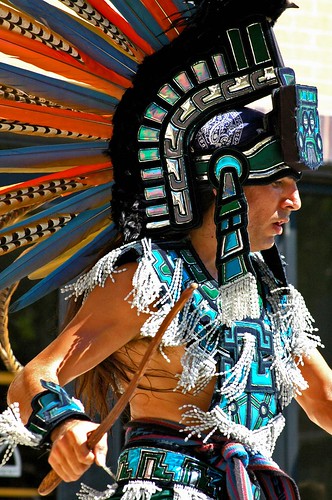
- Feathered headdresses, clubs studded with chunks of obsidian, loincloths.
- Corn harvests, sun worship.
- Blood Magic
- Complex stone jewelry: earrings, necklaces, chest pads.
 ◊
◊
- Ornate and colorful decorations, lots of Mystical Jade, geometric patterns. Intricate and scary carvings.
- Hungry Jungle settings and an abundance of wildlife: snakes, macaws, spiders, alligators/crocodiles, bats, jaguars and monkeys. In case of Incas, llamas and condors may pop up. May overlap with Artistic License – Geography, as the Valley of Mexico is actually a temperate forest land, the nearby highlands of Hidalgo and Querétaro are a Mediterranean-like semidesert, and the Inca were a mountain-dwelling culture rather than a jungle-dwelling one.
- A drug culture — coca and hallucinogens.
- Panpipes, and bands of panpipers.
- Conquistadores often feature as conquerors of the Mayincatec. Alternate history or fantasy variations have the Mayincatic seeking to slaughter and/or sacrifice their would-be conquerors. The conquistadors are also often used as villains in stories where the Mayincatec are the protagonists.
- Conquistadores mistaken for gods, leading to the downfall of the Mayincatec people. In reality, this is Dated History, as modern view is the indigenous might have mistaken the Spaniards for descendants of long-lost ancestors, but not gods (although there was always some inevitable speculation of supernatural involved, especially towards things like horses, steel and guns). Another discredited theory is that the indigenous worshipping conquistadores caused them to submit voluntarily, which is quite untrue in general lines.note
- The conquistadores are integrally hostile, often with explicit intentions to exterminate the indigenous and/or plunder their riches, and make no attempt to establish alliances, commercial relations, or merely to try to get things done by peaceful means, unless by demanding complete and unambiguous submission. This is a popular stereotype, but it goes hopelessly without saying real life was a bit different.note
- Desiccated bodies in ceremonial outfits, or unwrapped mummies. This is occasionally portrayed like Ancient Egypt in the jungle rather than desert. In real life, his only happened in the Inca empire, which expanded into cold deserts that lent themselves to mummification.
- Gold, lots and lots and lots of gold. Sometimes enough to build a city. And hidden treasure. Idols. Cursed artifacts.
- Sometimes hidden advanced technology and/or links to Ancient Astronauts.
- Giant line drawings out in the desert, like the Nazca Lines.
- The Long Count Calendar, which has 394-year b'ak'tun cycles, one of which ended on December 21, 2012. The historical Mayans did not predict any sort of apocalypse on this date — it is basically the Mayan equivalent of January 1st, 2000 — but it has nonetheless resulted in the Mayan Doomsday trope. Incidentally, the Mayan calendar is frequently erroneously mistaken for the completely different Aztec calendar.
- Sometimes, when the producers do a little cursory research, an extremely sophisticated grasp of astronomy, often somehow superior to our modern astronomical science.
- If they use a specific god, it'll most likely be the Aztec god Quetzalcoatl, the Plumed Serpent, or his Mayan counterpart Kukulcán. Since they'll probably know nothing beyond his name, they'll likely show human sacrifice to him, even though he was perhaps the only god in many pantheons who didn't ask for it. The Mayan bat spirit Camazotz may also show up, especially if it's a story about Mesoamerican-themed vampires.
- Likely due to the prevalence of the aforementioned serpent god, a Mayincatec Fantasy Counterpart Culture will often by populated by Lizard Folk (or even Snake People).
- Similarly, Domesticated Dinosaurs may appear in a Mayincatec Fantasy Counterpart Culture even if they are not Lizard Folk (possibly inspired by the infamous hoax Ica Stones).
Generally the Mayincatec are more likely to be the villains than the heroes, and as such they are prone to Historical Villain Upgrade. The exception, of course, is if the story involves the Conquistadores, in which case they'll instead be portrayed as tragic victims of European expansion. Some Alternate History stories have them survive to the modern day, resulting in a Modern Mayincatec Empire.
In Real Life, the Maya, the Inca, and the Aztec (which is actually a 18th century exonym; the people called themselves Mexica) were all distinct Pre-Columbian cultures. The Maya and Aztec were comparatively close together, as they both lived in what is now Mexico, and did engage in cultural exchange, but this is no reason to conflate them. Meanwhile, the Inca were thousands of miles away from them, their capital being in today's Peru, so conflating them doesn't make much sense. Their actual history is interesting and diverges from the trope quite a bit. There seems to have been some long-distance contact between the cultures (at a minimum, maize had been introduced to the Andes from Mesoamerica), but it was tenuous enough that the Mesoamerican and Andean civilizations were only vaguely aware of each other at best.
Ironically, this trope only became more valid after the Spanish conquest of America, as the political unification of lands from modern Mexico to modern Chile only intensified cultural exchange. For instance, Náhuatl, the language original to the peoples of Central Mexico, is spoken today in remote locations where few to no Nahua people ever lived, as a consequence of the Spanish Empire adopting it as an official language in order to facilitate administration and evangelization. The founding of new cities, divested of the previous political differences, also led to various indigenous groups resettling to the same population centers and suddenly becoming neighbors (sometimes after having been enemies up to that point). The presence of native artists, translators and scholars in the imperial expansion also mixed things even more, with native cultures intentional or unintentionally influencing each other before meeting the western filter.
Please see Pre-Columbian Civilizations, Native American Mythology, Aztec Mythology, Inca Mythology, and Mayan Mythology.
See Also: Hollywood History and Very Loosely Based on a True Story. Compare Spexico, Latin Land, The Capital of Brazil Is Buenos Aires and Banana Republic, for when this happens to modern Latin American countries. Also compare Injun Country and Tipis and Totem Poles for composite versions of Native American cultures from North America. European equivalents include Ancient Grome, when Roman and Greek cultures are mashed up together in Ancient Rome and Ancient Greece settings, Scotireland, where distinctly Scottish and Irish elements are mixed up indiscriminately, and Norse by Norsewest, where elements of the Nordic countries are combined together. See Egypt Is Still Ancient, which is when you have Egypt depicted as if it were still a land of Pharaohs and gods.
Example subpages:
Other examples:
- In the trailer for Beverly Hills Chihuahua while Papi talks about how his ancestors fought with Aztec warriors, it shows an aerial view of Machu Pichu, an Incan city.
- Hagaan Dazs Ice cream ran a campaign attributing the conquest of the Mayans and incidentally, the bringing of chocolate to Europe to Cortez.note
- Kahlua Liqueur ran a TV ad campaign featuring Mayinctecs.
- Doraemon: Nobita's the Legend of the Sun King have the gang entering the fantasy kingdom of Mayana, whose culture, lifestyles and traditions are inspired directly by ancient Mayans.
- The ancient Ord tribe whose semi-ruined temples (well, entirely ruined temples by the time the Big Bad has messed them up) are featured in Explorer Woman Ray seems to be pretty much along these lines. It's claimed they used to worship the Sun and their temples have hidden treasure which no-one was able to find; their true secret is much more interesting.
- Episode 3 of Flint the Time Detective happens somewhere in a South America covered in gold and being invaded by conquistadors.
- The entirety of JoJo's Bizarre Adventure starts out with a cursed Stone Mask created by the Aztecs. Although we later discover it is the creation of an immortal advanced race of people known as the Pillar Men. It still doesn't explain why they dress Mayincatec. Or even weirder, using steel weapons in one of the flashbacks.
- A startling Gecko Ending to Majin Tantei Nougami Neuro has Yako investigating her father in Brazil, and meeting a tribe of Yakuza Aztecs.
- The Mysterious Cities of Gold The heroes encounter the Maya, Inca, and Olmecs. In a twist, the Olmecs are Ancient Astronauts and the main villains.
- Naruto features artwork illustrating a Mayincatec civilization built on a most certainly not nuclear energy source that was later treated as evil, because it gave humans too much power.
- The paintings during the opening credits of Nausicaä of the Valley of the Wind look a lot like South American-Indian artwork.
- Nazca is about reincarnations of ancient Incan warriors. In Japan. Wielding steel swords. Using scenery of the past Incan empire based on Spanish colonial buildings.
- One Piece: Eneru's "cover arc" featured an ancient civilization on the moon that used South American-Indian artwork. It's not clear if the moon-droids are good or evil — they're fighting against traditionally evil-looking mink/weasel-men in Spanish armor); regardless, they're now in the hands of Eneru....
- RahXephon uses the Mayan Long Count calendar, but also the Aztec terms ollin, ixtli, and yolteotl. In fact, knowing what those words mean in Aztec thought is essential for even understanding the story.
- Rokka: Braves of the Six Flowers sets its anime in a fantasy world full of Mayincatec buildings and clothing (at least among the common people).
- ∀ Gundam had the heroes passing by a country that seems to be a blend of Mayan, Incan, and Hispanic influences.
- Actually averted with the deck of Rex Goodwin, the Big Bad of Season 2 of Yu-Gi-Oh! 5Ds. His deck is strictly based on Inca mythology and doesn't touch a single aspect of Mayan or Aztec mythology.
- The in-universe mythology, on the other hand, plays it straight by implying the Crimson Dragon who leads the charge in both past and present against the Earthbound Immortals, sealed in the Nazca Lines, is the Aztec god Quetzalcoatl.
- Disney Ducks Comic Universe
- The Life and Times of Scrooge McDuck has a literal example — a statue on the Isthmus of Panama with Aztec, Incan, and Mayan influences in its design, commemorating trade across the isthmus.
- The classic Carl Barks' Donald Duck story Lost In the Andes has Donald and the nephews discover a lost, vaguely Inca-ish civilization where everything is cube-shaped or full of right angles, even the people and the wildlife. The natives are friendly, but consider it a terrible crime to produce anything round. Naturally, the nephews have brought bubble gum. Hilarity Ensues.
- The NES game has him visiting Inca jungle.
- The Aztecs and the fall of Tenochtitlan figure big in the backstory of Hellboy: The Island. The Aztec priests had gold tablets inscribed with the true history of the Ogdru Jahad and the creation of the world.
- The Indiana Jones and the Fate of Atlantis comic adaptation opens with Indy being offered as a sacrifice to (and turned down by) "the Aztec god of war, Tenochtitlan" (although it turns out to be All Just a Dream). Tenochtitlan was actually the capital city of the most warlike group of the Aztec Empire, the Mexica; its site is the oldest part of Mexico City. The Mexica's patron deity and the god of war, was Huitzilopochtli.
- The Just Imagine... Stan Lee Creating the DC Universe version of Wonder Woman has Mayincatec flavoring, to contrast with the Greek mythological roots of the mainstream version.
- The Zzutak Animators from early Marvel Comics.
- In Robyn Hood: The Curse, the Big Bad is an Aztec sorcerer using a newly constructed pyramidal skyscraper as a temple to summon the Aztec gods through Blood Magic and Human Sacrifice.
- Superboy Annual #3 (part of the Legends of the Dead Earth event) features a colony world called Aztlan whose settlers adopted a Mayincatec culture. One of the early colonists was a metahuman who inspired the others by fusing the myth of Quetzacoatl with the legend of Superman, beginning a line of Supermen and Superboys who believed they were granted their powers by the god.
- In one of their early adventures the Teen Titans encounter the half-animal demons of the pyramid temple at Xochatan ...in the Andes. (For clarification: "Xochatan" sounds awfully Mexican and not remotely Andean.)
- The Chaams in Thorgal: The Land of Qa.
- The Tick parodies this with The Deertown Aztecs — a former sports team that crashed in the jungle and now attempt to live their lives according to the only book they had: "Aztecs On My Mind." They have a temple pyramid complete with traps.
- Tintin: The Seven Crystal Balls and Prisoners of the Sun. Some pieces of "Inca" artwork used here and there are either pre-Inca or not Inca at all, like the famous Staff God of the Tihuanaco Empire. Those Incas seem also a bit more sacrifice-happy than real deal were, but this can be explained because their interactions with outsiders have rarely been positive. On the whole, however, Hergé, who got a lot of his information from National Geographic, does not mix up the Inca with the Maya, except with reference to the prophetic inscription mentioning the retribution that will befall the violators of Rascar Capac's tomb, which plays a large part in The Seven Crystal Balls. The Incas, unlike the Mayas and Aztecs, had no system of writing. The original version of The Seven Crystal Balls, serialized in Le Soir, also contained a lead disc with symbols "resembling Aztec or Inca signs", but Hergé excised the panel that showed it and texts that mentioned it when the album version was produced.
- Tom Strong featured in one issue the "Aztech Empire", a super-advanced alternate version of the Mexica who "greeted Cortez with machinegun fire" (a neat trick without gunpowder or metallurgy... but it makes a good story) and proceeded to become interdimensional conquerors puppet-headed by an AI calling itself Quetzlcoatl-9. Basically think of them as "what if Jack Kirby did the Aztecs?"
- The Emperor's New Groove is pretty definitively set in the Incan Empire, although the word "Inca" is never said, and Kuzco's theme song guy refers to them as "Mesoamerican", which the Incans really weren't. Still, the mountain-and-jungle setting, the farming of llamas and alpacas, and the overall art style are all specifically Incan, as is Kuzco's name; Cusco (or Cuzco) was the Incan capital (and is still a provincial capital in Peru today). The animated series The Emperor's New School has decided to be a bit more specific and explicitly confirm that they are Incan, usually by way of jokes such as "Incan Idol", though extensive use of Gratuitous Spanish is present. And characters will have either Spanish or Pseudo-Quechua sounding names. The first draft of the story, Kingdom of the Sun, was much more explicitly Incan, and involved the mythology. Yzma here was a necromancer with an army of mummies, and as she had a grudge against the sun god Inti (and by extension Kuzco the emperor), she planned to help the underworld god Supay bring about The Night That Never Ends.
- The Road to El Dorado features a sort of generic South American and Mesoamerican native culture that has a lot of aspects of this trope mixing Aztec and Mayan architecture with Incan clothing and a few names. Including the sacrifices—though that's mostly the bad guy trying to do those, presumably to fuel his Blood Magic. Notably it also features a practise of throwing gold down water bodies akin to the Muisca, making it a rare example of this culture being weaved into anything.
- 2012 draws heavy inspiration from the 2012 phenomenon, Mayanism and the Mayan Long Count Calendar. Naturally, they erroneously present the Aztec calendar instead of the actual Mayan Long Count Calendar. Surprisingly, the Mayans themselves never actually appear, though footage of the pyramids in Mesoamerica does briefly show up in the opening.
- Mel Gibson's controversial Apocalypto portrays the urban Maya as the The Evil Empire and a small Mayan village in the jungle as pure, innocent victims. There are obvious close parallels to Braveheart. He seemed to want to portray the Maya situation when part of the civilization collapsed and the cities had fallen into ruin and decadence, but he basically took every Aztec stereotype and gave them to the Maya. While they did practice human sacrifice and the period at the end of the classical era of the Maya was marked by increased warfare, neither are portrayed properly. It also has the priests offering the sacrifices to Kukulkan (Quetzalcoatl for the Aztecs), the one god in the Mesoamerican pantheon that abhorred Human Sacrifice.
- AVP: Alien vs. Predator takes place mostly within a typically Mayincatec pyramid... buried in Antarctica (thanks to Ancient Astronauts). The experts who examined the temple seemed to think that it had features common to ancient cultures across the globe, (specifically Cambodian and Egyptian) but the main vibe was definitely Mesoamerican.
- B-Movie Aztec Rex. Conquistadores led by Hernán Cortés meet Aztecs who worship two surviving Tyrannosaurus rex. Houston Yeah!
- Through From Dusk Till Dawn, the Titty Twister bar goes from Mayincatec-inspired nightclub to vampire den to a full-blown Mayincatec sacrificial pyramid almost buried in the Mexican desert. All within a short distance of the Mexican-American border.
- The Fountain by Darren Aronofsky, averts the trope by sticking steadfastly (and accurately) to Mayan imagery and symbolism. Xibalba, the Mayan underworld is represented as a golden nebula. The historically-based section note features Conquistadors, Mayan warriors and priests, and a step-pyramid temple based on the actual archaeological site of Uxmal wherein lies the Tree of Life. Within the work the Mayas are a collapsed civilization (which they were when the Conquistadors arrived.) The hidden pyramid is their last, secret hiding place, clearly already decrepit and neglected, with only a few dozen devoted guardians.
- In House of Cards (1993), the language that Sally spoke with Selord is referred to as both Mayan and Nahuatl, two completely unrelated languages spoken by different civilizations.
- Indiana Jones:
- The Hovitos underground temple from Raiders of the Lost Ark.
- The Maya-style temple in Indiana Jones and the Kingdom of the Crystal Skull. The film has aliens living with the ancient Maya and teaching them about agriculture, never mind that the characters are in Peru, closer to the Inca than the Maya, and even so using Inca may have been inaccurate geographically speaking. The civilization is supposed to be an Expy of El Dorado located in The Amazon Rainforest, with references to the Maya and other Mesoamerican cultures. The temple also included artifacts from civilizations all over the world. It should also be noted, that apparently Indy picked up Quechua riding with Pancho Villa!
- Kings Of The Sun, a film about a deposed Mayan king escaping to the future United States and meeting another native American tribe led by Yul Brynner.
- Pirates of the Caribbean: The Curse of the Black Pearl features cursed Aztec gold with Aztec-style skull carvings. The figure carved on the treasure chest itself is the "Gateway God" from the Gateway of the Sun at Tiahuanaco, Bolivia, hundreds of years and half a continent away from the Aztecs. The treasure's backstory being an Aztec ransom paid to Cortes and then Cortes going back on his word and being cursed for it is actually closer to the story of Pizarro, Atahualpa and the Room of Gold than anything that happened during the Conquest of the Aztec Empire. The Aztecs didn't even use gold as a currency. Cortes had a long, mostly prosperous life after conquering the Aztecs (other than being barred from returning to Mexico), while Pizarro's pals were marred by infighting and assassinations, including Pizarro's own.
- In The Pumaman the villain wears a golden Aztec mask containing alien mind control circuitry. He is fought by Puma Man, a "man-god", sired by ancient alien Aztec pumas and equipped with a magical Aztec golden belt. Most of the real fighting is done by his mentor Vadinho, an Aztec priest to the space gods... who lives in a temple in the Andes. Inca territory. Gah! note
- Literally in That Man from Rio. The plot involves some priceless ancient statuettes made by a South American people called the "Maltecs".
- In the movie Unrest (2006) all the horrible events are due to the curse unleashed by an Aztec goddess, after a cave was discovered with 40,000 bodies sacrificed in his honor ... in Brazil, far from Mexico (and even the figure of 40,000 skeletons product of human sacrifice is too exaggerated even for the Aztecs).
- The Lost Tribe of Aztecs in Yellow Hair and the Fortress of Gold kill intruders by dipping them in molten gold, which carries strong overtones of the El Dorado ceremony of the Muisca people of Colombia. They also use some torture tactics commonly ascribed to the Apache.
- The Marvel Cinematic Universe competely reinvents Namor the Sub-Mariner and his corner of the Marvel world in Black Panther: Wakanda Forever by giving them a Mesoamerican overhaul. The city of Atlantis is now called Talokan, which is named after an Aztec underworld.
- Captive Universe: a Generation Ship is launched to the stars. The population of the ship is given a copy of the Aztec's culture which is depicted as brutal but ideal, from the designer's point of view: it is very stable and crushes all curiosity and restlessness.
- In The Case of the Toxic Spell Dump by Harry Turtledove, a resurgent Mesoamerican religion that features Human Sacrifice is part of the plot.
- Cautiously averted in El Conquistador. Here, the Aztec civilization is depicted in the most respectful and distinctive way possible, as Federico Andahazi is a careful researcher prior to his novels.
- In The Dresden Files the leaders of the Red Court follow the Maya/Aztec variant, impersonating or replacing certain Mayan and Aztec gods — their King going by Kukulkan (a god who fits the concept of the Feathered Serpent deity that was shared with the Aztecs, in the latter as Quetzalcoatl, so it could be an In-Universe case of I Have Many Names). Of course, as Blood Magic using vampires native to South and Central America, the sacrifices are only to be expected. And while Kukulkan/Quetzalcoatl didn't generally ask for human sacrifice, it's implied that the Red Court's leaders — who were extremely bloodthirsty — usurped the pre-existing gods, exploiting the universe's rules on divinity to do so.
- In his Earth (The Book), Jon Stewart implies the collapse of the Mayan civilization due to Cortés. Except Cortés didn't have anything to do with the conquest of Yucatan. He focused his efforts on conquering the Aztec lands. It would be other Spaniards who would attack the Maya later. In fact, the Maya wouldn't fall until over 150 years later, and their civilization was already in decline even before the conquistadors got there. They're still around, by the way.
- Parodied as the Tezuman Empire in Discworld novel Eric by Terry Pratchett. Their god Quezovercoatl is a feathered boa, which is almost the same as a winged snake. And is actually a low-level demon about six inches high.
- Everworld features the Aztecs still existing (along with many other ancient civilizations) in an alternate universe, ruled over by the Physical God Huitzilpoctli. As a result their whole civilization seems to revolve around getting him human hearts to eat, to the point that the people themselves are forced into eating the rest to survive.
- Presumably on account of very little being known about them, when the Olmecs appear in S.M.Stirling’s Island in the Sea of Time books, their culture appears to be just a compilation of different Mesoamerican stereotypes like viewing strangers as gods and practising human sacrifice.
- The Mask of the Sun by Fred Saberhagen features Aztecs and Incas from alternate futures where each survived and prospered trying to tamper with history as we know it to create their (mutually incompatible) histories. And the titular mask is a device from one of those futures that gives its wearer precognitive hints.
- In Orson Scott Card's Pastwatch: The Redemption of Christopher Columbus', where the author has somewhat Shown His Work in researching the Native American cultures, specifically Mesoamerican and Caribbean ones. He then postulates what would happen if Columbus never sailed West (the Tlaxcalans, even more bloodthirsty but much more progressive than the Aztecs, would rise to power, conquer their continent and then cross into Europe to Take Over the World). Except that the Tlaxcalans were nowhere near as bloodthirsty, war-loving or expansionist as the Mexica, the main ethnic group of the Aztec Empire.
- In The Saga of the Borderlands of the Argentine writer Liliana Bodoc, the inhabitants of the fertile lands are Fantasy Counterpart Culture of the pre-Columbian peoples of America, so that among them we have the Zitzahay, who are governed by the Supreme Astronomers, wise men dedicated to studying the stars from the top of their tiered pyramids, and also the Lords of the Sun, a very powerful empire with a very rich culture but who also practice slavery and human sacrifice, and also have stepped pyramids.
- Revealing Eden features descendants of the Aztec Empire living alongside an Ecuadorian tribe, when in reality the Aztecs never expanded past Central America. One scene also features the stone terraces built by the Inca — but somehow the Aztecs get the credit for building them.
- MAR Barker wrote five novels based in the world of Tekumel, a world he created from aspects of virtually all Pre-Columbian Meso-American cultures. He created Tekumel for the same reason that Tolkien built Middle Earth: so that he could have a world to use as a linguistic playground. In Barker's case the languages he created were based on Indo-Asian and Meso-American languages, and the cultural mix is the result of deliberate choice, not lack of research.
- Where's Waldo Now? has Waldo in the middle of a giant Aztec vs Conquistador battle. The Aztecs seemed to be winning. This may seem surprising, but during the Noche Triste (Sorrowful night), the 30th of June 1520, the population of Tenochtitlan (Mexico) rioted against the invaders and drove them out with heavy losses. Cortes came back with a vengeance...
- Around the World Mystery Mazes has an epic series of three full-page mazes about climbing a mountain and exploring a temple full of mummies in search of a “Maya” inscription that can be used to decode their writing system. The mummies and mountain setting seem more Inca than Maya, but the Inca did not use writing at all, recording information in quipu.
- The Witch of Knightcharm: The rookie witch Carlita Xique is noted to be descended from an Aztec priestess of Huitzilopochtli and to have inherited knowledge related to sacrificial magic.
- Buffy the Vampire Slayer episode "Inca Mummy Girl", where the titular mummy was a victim of human sacrifice.
- The episode "Love Interrupted" of Criminal Minds: Beyond Borders has a delusional Belizean Serial Killer that mixes Mayan and Aztec beliefs.
- The Crystal Maze: a game show that featured an Aztec Zone which was full of sand, temples and Bamboo Technology.
- The Exxilons in the Doctor Who serial "Death to the Daleks" have elements of this as well; they're the Ancient Astronauts who visited the Incas, and their Great City looks a lot like a step pyramid. In the Doctor Who New Adventures novel The Left Handed Hummingbird they also accidentally left some technology where the Aztecs could find it. Averted in "The Aztecs", where some research was done to make it historically accurate.
- The Feathered Serpent, an ITV historical drama from the 1970s featuring Patrick Troughton as the bloodthirsty high priest.
- Horrible Histories:
- In an aversion, the Mayans have not been featured at all, but the Aztecs and Incas are accurately treated as two distinct cultures.
- Played straight with the hairstyles, of all things. Incan women are shown wearing horned hairdoes, when it was the Aztec women who wore their hair like that.
- Also played straight in the sets: The Inca set from one series was used as an Aztec one in the next.
- Kolchak: The Night Stalker episode "Legacy of Terror". An Aztec cult is trying to resurrect the mummy of their god Nanauatzin. They sacrifice perfect people by cutting out their hearts. Features scary bird masks, feathered headdresses and a sacrifice scene at the top of a flight of steps at the local sports stadium in lieu of a step pyramid.
- Legends of the Hidden Temple bases its entire design on this trope, most notably with Olmec, the giant stone head who served as the show's co-host.
- Nick Arcade's Ancient Tomb level from The Video Zone.
- During his time aboard the ISS, Larry in NUMB3RS makes himself a quipu, a recording device used by Andean South American cultures (e.g. the Inca) consisting of threads of llama or alpaca hair encoded by knots in a base ten system. It was primarily used to record numerical data for tribute payments. Unfortunately, Larry, who appears to know much about them, claims they were used by Aztecs (from North America). Furthermore, he claims to have encoded his memories on them, even though right now it's only being speculated that the quipu were used for more than numerical data and no other meaning has been decyphered.
- On QI, the resident idiot Alan Davies makes this mistake. Stephen Fry calls him on it.
- The X-Files episode "Teso dos Bichos" deals with a mummy called "amaru" that is found in the titular archaeological site (which is in Canada pretending to be Ecuador, despite the name being Portuguese for "Burial Mound of Critters") and then taken to a museum in Boston where the local archaeologists begin to be killed by a cat spirit.
- Animusic: The large temple at the end of the video for "Heavy Light" resembles Aztec design. (The drum + laser arch drops circles of light which play the drums.)
- Iron Maiden's The Book of Souls has artwork and the such based on Mayan mythology. Yet in the first single's music video, once they get to a Mesoamerican temple an Aztec sun stone is clearly seen.
- Neil Young's Cortez The Killer is all sorts of confused. It mentions Cortez, Montezuma and human sacrifice — so Aztecs, right? But the very next verse (yep, right after the stuff about human sacrifice) we have "Hate was just a legend/And war was never known". So maybe not the Aztecs. The Inca certainly "lifted many stones"... but they never met Cortez. The Incas, being the biggest empire with the biggest and best-equipped army in the Americas before the Europeans showed up, don't seem to have "never known" about war, either.
- Used by the natives in El Dorado: City of Gold, complete with steeped pyramids and lush jungles.
- Averted with the Twilight Histories episode “True Aztec” which features Aztec, Maya, and Inca characters, all of whom are correctly depicted as separate cultures. Also averted by the episode “Aztec Steel”, which accurately depicts Aztec culture.
- The Mexico pavilion at Epcot is built to look like an Aztec pyramid.
- Aquapunk is this trope times Cyberpunk times mermaids.
- The "Death Volley" chapter of The Adventures of Dr. McNinja is an adventure set in a classic Mayincatec trap-filled temple. The end of the chapter hints at what gets revealed later: that King Radical built the culture that created said temple.
- You can see traces of Mesoamerican culture here and there in Nahast: Lands of Strife.
- Pilli Adventure has had several Aztec monsters show up, including a beheaded ball-game player and an animated water-pot.
- One Subnormality strip features The Pink-Haired Girl being sent a drink at a bar by "the merciless Teoxhl...something something", who turns out to be a giant Mayincatec-style stone idol. The drink is jaguar blood.
"Gawd, these desperate older guys are so creepy. You just know he's hoping you're a virgin too."
- Wapsi Square establishes a link between Mayan and Egyptian culture via Atlantis. Quite surprising for what started out looking like a Friends-style webcomic sitcom. The Long Count Calendar (See main article above) is key to the plot.
- The Water Phoenix King has been described as a formerly high-fantasy world where the Spanish Conquistador-equivalents switched sides and allied with Tenochtitlan to conquer Europe — and then the Abrahamic God screwed everything up.
- On The Angry Beavers, in the episode "Moronathon Man," Norbert ingests a potion that makes him stupid. (Meanwhile, Dagget becomes a super-genius, because the potion couldn't make him any stupider.) Somehow, Norbert ends up on an island, where he sits atop a Mayan or Aztec pyramid, being worshipped by people who think he's a god, and fed fruit. The worshippers bow down and repeat his mantra: "DUUUUUUHHHH!!!!"
- The Sun Warriors in Avatar: The Last Airbender resemble the Aztecs. Word of God says they added a few Asian traits into them.
- Combo Niños, despite being quite animesque, is pretty much loaded with iconography in this trope line.
- The Histeria! episode "The Montezuma Show"
- Inspector Gadget:
- "All That Glitters" revolves around an Incan City of Gold in Peru. At the beginning of the episode, Gadget refers to an Andean folk band as a "mariachi" band, which would be Mexican, not Peruvian.
- "The Amazon", despite its purported location, has a scene where Gadget is "roasted in an Aztec ritual", along with a stereotypical Mayincatec ziggurat where Professor von Slickenstein's laboratory is situated.
- In "The Emerald Duck", set in Mexico, the titular MacGuffin is "the oldest Mayan artifact known to exist" and the key to an Ancient Astronauts' Doomsday Device.
- The Magic Key: In “Code Calling”, Wilf and Wilma find themselves transported to a version of ancient Mesoamerica that is very much like this.
- The Simpsons:
- The Simpsons receive an Olmec head of Xtapolapocetl in one episode. It frequently reappears as a Freeze-Frame Bonus. In an aversion of this trope, when Maggie sees the head, she points to a card saying Aztec, and Lisa corrects her, saying "Not Aztec. Olmec. Ol-mec."
- In "The Mysterious Voyage of Homer", Homer's spiritual experience is mostly based on the American Southwest but with a few Mesoamerican trappings added, such as an Aztec-looking pyramid.
- Superjail! had an episode where they uncover the ancient city of Pummel-onia, a Mayincatec shrine to war and fighting. They even have a god of war in ceremonial dress that was trapped in animal form.
- A Thousand and One... Americas defies the trope in the episodes related to the Incan, Mayan or Aztec civilizations. Prior to reading a chapter about either of them in his late grandfather's book, Chris makes sure not to make erroneous assumptions about them (his brother Fito does, but that's simply because of his young age). The two read the book so they can learn the actual facts (and they sure do).
- In The Tick episode "Sidekicks Don't Kiss," Arthur was kidnapped by a group of "Aztecs." As with the comic example above, these "Aztecs" were originally a baseball team that got stranded in the jungle and copied Aztec culture through a book they picked up at the airport.
- Subverted in X-Men: The Animated Series: Beast and Jubilee are travelling around Peru, and come across an isolated tribe. Beast immediately notes that they are Mayan, not Inca, and about 3,000 miles south of where they should be.
- A complication in this trope is that it is often plainly apparent that there was a lot of cross-cultural exchange going on between the various city-building cultures of Mesoamerica. Elements like the Mesoamerican ball game, some form of blood sacrifice (anything from token drops of blood to ripping out the hearts of whole village's worth of people one after the other), and substantial portions of basic mythological structures are often shared between multiple civilizations. As we can trace back complex civilizations in this region for at least a couple of thousand years, it would be quite surprising if there wasn't substantial appearance of similar cultural themes. But between Mesoamerican and South American cultures, not so much.
- During the Spanish conquest, many indigenous peoples allied with the Spanish re-settled in places far from their land of origin, like some Tlaxcalans in northern Mexico (and as far as New Mexico and Texas) and Nicaraguans in Peru. Tlaxcalans would end up partly composing the armies that conquered the Philippines and certain Mayan tribes.
- As said above, most Nahuan languages (close relatives of the Aztec language, Nahuatl) are spoken in central Mexico, but some can be found as far as southern Chihuahua (Mexicanero) and northern Nicaragua (Nicarao). Nahuan languages are in turn part of the Uto-Aztecan language family, which includes many languages in the western United States, like Shoshone and Comanche.
- The closest to a real life example of a Mayincatec culture is probably the rarely discussed Tarascan Empire in Western Mexico, a traditional enemy of the Aztecs who allied voluntarily with the Spaniards. The Tarascans (who to this day call themselves P'urhépecha, or "Newcomers") speak a language isolate, were the first in Mesoamerica to work copper and bronze, and made ceramics with apparent Andean stylistic influences. It's been suspected for a long time that they descend from pre-Inca South American peoples that sailed to Mexico from what is now Colombia and Ecuador.
- Conversely, the Manteño-Huancavilca culture complex in coastal Ecuador was once suggested to be of Mayan origin, due to some artistic influences and a local native myth about civilization being brought to the region by a foreign king who came from the sea.
- The Huastecs are a Mayan people who migrated in ancient times along the Mexican Gulf coast, from the Yucatan to the modern Mexican state of Tamaulipas. The Aztecs conquered them around 1470 and were so impressed with their fighting that they copied the Huastec battle dress for one of their ranks.
- While the feathered serpent was a pretty widespread god (and pretty much the only one non-experts can name) it was — ironically enough — almost universally described as abhorring human sacrifice, even during times and in cultures that were otherwise quite fond of ripping out hearts and whatnot.
- The ceramics of the Moche in northwest Peru (100-700 AD) depict warriors in falcon or eagle-looking suits, who are (naturally) unrelated to the Aztec eagle warriors of Mesoamerica.
- Quite a few zoos, particularly those in the US, Examples have Latin American sections that are themed around Mayan Ruins even though most of the animals on display are found in South America (and thus also qualify as Misplaced Wildlife).
- If there's human sacrifice in pre-Columbian North America (the only known case after Columbus being the Pawnee), it will most likely be attributed to Mesoamerican civilizations.
- Etzatlan in the Mexican state of Jalisco is made of the name of the Itzas, the Maya people who built Chichen Itza in what is now the Mexican state of Yucatan, and the Nahuatl (the language The Mexica and many other Aztec peoples spoke) prepositional suffix, "tla/tlan," which means, "place of."
- The Hernández Brothers Sect in 1960s Mexico was a scam that took advantage of the ignorance of their illiterate victims to claim "tributes" in exchange for favors from mysterious "Inca gods in the mountains" (victims and scammers alike being unaware that the Incas lived in South America). It went off the rails when the brothers, in order to keep The Masquerade when two victims were becoming wary, decided to bring in an Axe-Crazy prostitute, Magdalena Solís, and present her as the incarnation of the "Inca goddess" they were prophets of. Solís rapidly seized absolute control and, being actually versed in Aztec mythology, presented herself as the goddess Coatlicue and demanded human sacrifices by removal of the heart. Oops.
- In architecture, the Mayan Revival makes use of techniques and iconography from various Mesoamerican cultures in a Modernist and Art Deco milieu.
- Right in the Midwest, the Mississippian civilization had large urban centers, a powerful priestly class, warriors associated with birds (though they were falcons rather than eagles), giant pyramids (of mud, not stone), and human sacrifice. They collapsed in the 15th and 16th centuries for not entirely clear reasons (though the plagues brought from Europe that killed off more than 90% of pre-Columbian North Americans likely didn't help). From their ruins emerged the Born in the Saddle nomads that most people associate with prehistoric North America (note that America's indigenous horse population went extinct, and horses weren't reintroduced until the 16th century!).
