
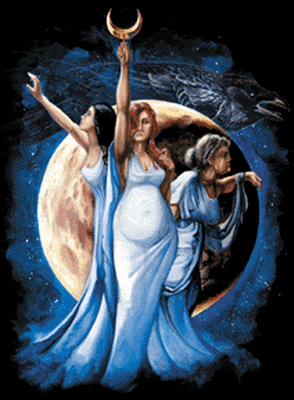
Sub-trope of Power Trio and cousin to The Three Faces of Eve: The three aspects of a triune goddess or trinity of goddesses appear as sisters. They are:
- The Maiden: Often blonde and beautiful and either a naive ditz or a budding seductress. She's the adventurous woman looking for her place in the world. Usually associated with huntress deities such as Artemis.
- The Matron/Mother: Often plump and rather eccentric, or pregnant. She's motherly, caring, and reliable. Usually associated with providing goddesses such as Selene.
- The Crone: Often sharp-witted, sharp-tongued, bitter and unsentimental, but not without kindness. She's wise and experienced. Usually associated with Hecate herself, a knowledgable witch deity.
In terms of a Freudian Trio, the maiden is the Id, the crone is the Superego, and the mother is the Ego. Even though they are the same being, they seem to know and think different things, so they bicker. In fantasy stories, these characters may be exactly what they appear, or they may be a trio of witches or wise women who reflect the aspects of the goddess.
This trope has the unusual distinction of being either Older Than Feudalism, or Newer Than They Think: Most of what we know about triple-goddess mythology comes from the author and mythologist Robert Graves, who, like many of his early 20th-century contemporaries, tended to add his own ideas wherever he felt they were needed. Initially, the triad resembled more The Weird Sisters, with no substantial variations in the goddesses' personalities. When Graves got his hands in the matter we got the idea of each goddess symbolizing a stage of womanhood.
Compared with The Three Faces of Eve, the maiden combines the naïvety of the child with the sexuality of the seductress, the mother the liveliness of the seductress with the maturity of the wife, and the "crone" combines the experience of the wife with the disinterest of the child. However, the sexuality of the Hecate Sisters is mutable — if the Maiden is a young girl, then the mother might take on the role of an experienced and sensual woman, who happens to be maternal as well.
If, as is often the case, the three are witches, the maiden will usually be a Cute Witch or, if a bit older, a Hot Witch, the mother will be a Hot Witch if the maiden isn't, while the crone almost always conforms to at least the visual stereotype of the Wicked Witch.
Age-wise, compare the Three Successful Generations. A trio of supernatural women that are not differentiated in this way is The Weird Sisters. Also compare The Three Faces of Adam and Same-Sex Triplets.
Examples
- Ah! My Goddess takes the Norns and thoroughly applies this trope to them; Skuld is bratty and innocent to love, Belldandy is young yet mature and very motherly, and Urd is the oldest (if not exactly old) and is sarcastic, very sexual, and somewhat bitter.
- Fairy Tail: Lucy Heartfilia, a newcomer to the guild, is the Maiden, Erza Scarlet, who is rather no nonsense yet reliable, is the Mother and Mirajane Strauss whose power is considerable is the Crone.
- Fullmetal Alchemist:
- Winry Rockbell, Edward Elric's hardworking and always supportive Love Interest, is the Maiden; Riza Hawkeye, the stern but responsible second-in-command to Colonel Roy Mustang, is the Mother; and Izumi Curtis, the sharp-witted mentor figure to the Elric brothers, is the Crone.
- The 2003 anime adaptation has a villainous example in the form of the three women on team Homunculus. Lust is the Maiden, being a beautiful woman desperate to find meaning in her existence; Sloth is the Mother, tasked with caring for the Homunculi's resident Creepy Child Wrath and effectively the resurrected remains of the Elric Brothers' mother; Dante is the Crone, a centuries-old woman who treats her enemies and allies alike with condescending pettiness.
- In Hekikai no AiON is the trio of heroines. Yuzuki is The Ditz maiden, Shizuki is the sensual and eccentric mother, and Seine is the bitter crone. It doesn't help that the two first are Goddesses In Human Form and the last is called a witch sometimes.
- Downplayed with the main trio of Little Witch Academia, as they are all the same age (around 15 or so). Akko is the maiden (new to magic, impulsive, and youthfully exuberant), Lotte is the mother (caring, nurturing, sweet disposition), and Sucy is the crone (pale skin, jagged teeth, and more mature than the other two).
- The Marui triplets in Mitsudomoe slot nicely into the roles. Futaba is the maiden, Mitsuba is the mother, and Hitoha is the crone.
- Which goes to show that age doesn't have anything to do with the roles: setting aside that they are triplets, Futaba is the middle, Mitsuba is the oldest, and Hitoha is the youngest. Again, though, they were all born within the same day, so it's mostly superficial.
- In the prologue episode of Mobile Suit Gundam: The Witch from Mercury, the three people most involved with the Gundam Lfrith are developer Dr. Cardo Nabo (crone), test pilot Elnora Samaya (mother), and her daughter Ericht who ends up activating it (maiden).
- The H-Manga OYAOYAKODON is somewhat inverted. Freya (the male protagonist's girlfriend) is the maiden, Devita (Freya's mother) is the mother, and Ratna (the grandmother) is the crone who, ironically, has the body of a young girl.
- Slayers: Princess Amelia, a just young woman with clear-cut morals is the maiden, Lina, an intelligent yet short-tempered sorceress, is the mother, and Milina, a snarky, cold mercenary, is the crone.
- In the third Tenchi Muyo! OVA it is revealed that there are three all-powerful sister goddesses who created the Universe to try and find the unknowable entity that created them. These goddesses are revealed to be Lady Tokimi, the Man Behind the Man of seasons two and three, Tsunami, the personification of the Jurai Royal Tree who used her powers in order to save Sasami's life, and now the two are merging into one being, and finally Washu, who sealed her own powers and memories into three gems, which she later gave to Ryoko, and became mortal to analyze the mysteries of the universe.
- Inverted in the anime of Trapeze: Irabu is male, and his youngest incarnation is a Deadpan Snarker, with his oldest incarnation being an adolescent manchild.
- Tweeny Witches: Out of the Magical Girl Squad, Arusu is an energetic Naïve Newcomer and the most idealistic of them, Sheila is a cynical Jerk with a Heart of Gold, and Eva is a gentle lady in charge of the kitchen in Dragon House. They're all roughly the same age, though.
- In Yu-Gi-Oh! (the Toei series), one episode revolved about three identical triplets trying to steal Yugi's "Violet Hecate" card. Later, in a duel, the other two Hecate sisters appeared.
- Among characters from the other anime series, the three most prominent female characters Tea, Mai, and Serenity qualify — Serenity, Joey's sick little sister, is the Maiden; Tea, the Team Mom and Yugi's Love Interest is the Mother; and Mai, the older and more worldly of the three, is the Crone.
- Gustav Klimt's The Three Ages Of Woman, showing an old woman, a mother, and a female child intertwined with each other in Klimt's signature stylized style.
- The Casper the Friendly Ghost comic reboot Casper and the Spectrals has Wendy's aunts, the Witch Sisters who were completely redesigned to be this.
- The Defenders once went up against a trio of superpowered women sent by the Secret Empire: youthful-looking and naive Cloud, aloof and beautiful Seraph, and creepy old Harridan.
- Fables: The witches of the 13th floor consist of Frau Totenkinder (the Crone), Mother Birdie (the Mother), and Ozma of Oz as the Child.
- When Fiends of the Eastern Front goes into Constanta's Backstory, a trio of life-sucking witches get involved who are explicitly designed after this trope.
- The original Sabrina the Teenage Witch has Sabrina and her aunts. In the earlier comics, Hilda is portrayed dressed as and behaving in a more stereotypical witch manner, including being cranky, disliking mortals (particularly Sabrina's boyfriend Harvey), and prone to using her powers for revenge or resolving petty disputes. In the earlier comics, Zelda (like Hilda) also was dressed in stereotypical witch's clothes, but unlike Hilda, was the more compassionate and kindly of the two. In the original comics, Zelda was short and stout with green hair. Sabrina is a well-meaning girl, but she struggles with constant pressure to be "bad" from all the other witches around her, especially her aunts, as well as learning to master her powers.
- In The Sandman (1989) universe, they exist in a variety of overlapping forms, as the Fates (Clotho, Lachesis, and Atropos), as the faces of Hecate, as three witches, the Furies, and three normal women. They seem also to acknowledge that they are in some way three faces of Eve and will not harm Eve, even in their aspect as the Furies. In some of the issues in which they appear, each of the three seems to shift between the three roles.
- The Sandman Hecateae (or at least one aspect of them) were previously host of a horror comic, The Witching Hour, under the names Mordred (crone), Mildred (mother), and Cynthia (maiden). In their first appearance in The Sandman, Mordred complains that her name doesn't make sense, and Mildred explains she got Mordred and Morgause confused.
- The spin-off series Witchcraft was divided into three parts, Maiden, Mother and Crone, each overseen by a different face of Hecate and each featuring a different incarnation of a martyred witch at a different stage in her life.
- The sequel La Terreur featured three women, one young and beautiful, one middle-aged and plump, one old and wizened, working magic at the time of the French Revolution.
- Eve herself explains that "Adam had three wives": Lilith, who was created as part of the original human being, a hermaphrodite ("Male and female created He them", Genesis 1:27); an unnamed second wife, whom Adam rejected because he saw her during construction and got Squicked, as described in medieval Rabbinic lore; and Eve, who grew old but never died. (Genesis 5:5 says, "And all the days that Adam lived were nine hundred and thirty years: and he died", but Eve doesn't get an obituary.) In order, these are Mother, Maiden, and Crone.
- Women in Sandman often fall into sets of three. In the issue in which Dr. Destiny psionically tortures to death the hapless people in a diner, the hostess and two patrons become Crone, Mother, and Maiden; when Dr. Destiny has them tell his fortune, they become the Wyrd Sisters. Later, in A Game of You, we meet Foxglove (Maiden), Hazel (Mother, thanks to a drunken one-night stand), and Thessaly (Crone). The climax of the Sandman Myth Arc in The Kindly Ones has Morpheus facing off against the Furies, whom the ancient Greeks tried to placate by calling them "kindly", but the ones who end up doing Morpheus a kindness are Nuala (Maiden), Lyta (Mother) and Thessaly (Crone, again).
- Dream calls Foxglove and Hazel "Little Maiden" and "Little Mother" respectively. For the Game of You example, Thessaly even states it almost explicitly: they need menstrual blood, and they have to get it from Foxglove, since Hazel is pregnant and Thessaly hasn't menstruated in a very long time. Later Nuala, Lyta, and Thessaly aren't aware of it, but they are connected by each making a separate contribution to Dream's death. Lyta was the one who gave the Furies the order to kill him; Thessaly protected her from getting killed by outside interference at the Ladies' request; and Nuala called him away at a critical moment, indirectly causing his death.
- Moreover the lovers of Dream who show up as such in the course of the main series fall into the pattern: Nada (maiden, that being a plot point), Calliope (Mother, specifically as the mother of Dream's son, Orpheus), and Thessaly (Crone, yet again).
- Somewhat lampshaded in the Sandman, as Lyta's friend is working on a book about the appearance of the triple goddess in TV sitcoms.
- Danu, the mother goddess of the Sessair tribe in Sláine, often appears such way with Morrigu (the Morrigan) as Maiden, Blodeuwedd as Mother, and Cerridwen as Crone.
- The rulers of Asgardia in Thor — Freyja the Crone, Gaea the Mother, and Idunn the Maiden. Together, they're the All-Mother.
- The Wicked + The Divine: Issue #34 reveals this is the case with Ananke and her sister Persephone. Ananke will reincarnate as Maiden (Minerva, the young girl who pretends to be a little naive but still wise for her age) and Crone (Ananke, the Elderly Immortal who watches the gods), while Persy gets Mother (Persephone, who shares traits with the Maiden, but loves all the gods and wants the best for them despite her depression).
- Team Jinx, consisting of Magica De Spell (mother), Neraja (maiden), and Garma (crone), serve this role in Wizards of Mickey.
- Circe plays with the concept in Wonder Woman (1987) after ambushing and mentally enslaving the Amazonian witch Magala (the only Amazon in this continuity to actually appear old), she creates a plot while accompanied by her own young innocent daughter Lyta, who possesses innate magic which uses Magala who very much looks and acts the part of the crone. Thus Lyta plays the part of the maiden, Circe the mother, and Magala the crone. For bonus points, Circe actually possesses Hecate's soul.
- Implied in the 2019 Xena Warrior Princess mini-series: in issue #4, Xena, Gabrielle and Discord end up in the Russian taiga and are taken in by an old woman in her hut with a large pestle and mortar nearby. The old woman is a goddess and the last of a trio of witch deities, along with her sisters. A flashback image shows that her youngest sister was also the youngest of the trio and fell in love with a human hero, while their middle sister looks a bit older that the youngest one, but not as old as the witch Xena and company meet.
- On the Fastrack The company Fastrack, Inc. is run by the CEO Rose Trellis (crone), her executive assistant Wendy Welding (the working mom), and (the maiden) Dethany Dendrobia.
- In the Discworld tales by A.A. Pessimal, a particularly nasty solitary Elf takes residence in a home
 in the Discworld's '"Russia'". Witch Olga Romanoff thinks about what needs to be done to eject the kikimora before this lone Elf, a potential Queen, opens further doorways to enable others to enter. She looks down at the iconograph on her desk, of her own young children, and reflects she has an older local Witch and her eleven-year-old pupil to assist. She then specifically asks old Barbara about the health of her grandchildren.
"That sort of Three. Ye Gods, Olga Anastacia. You're going for some powerful magic here."
in the Discworld's '"Russia'". Witch Olga Romanoff thinks about what needs to be done to eject the kikimora before this lone Elf, a potential Queen, opens further doorways to enable others to enter. She looks down at the iconograph on her desk, of her own young children, and reflects she has an older local Witch and her eleven-year-old pupil to assist. She then specifically asks old Barbara about the health of her grandchildren.
"That sort of Three. Ye Gods, Olga Anastacia. You're going for some powerful magic here." - This is the basis of Nora's akumatized form, Hecate, in Miraculous! Rewrite. She splits into three different beings each representing the Maiden, the Mother, and the Crone, and they go around changing the ages of anyone unfortunate enough to cross their paths.
- Paradoxus: Played straight with the three characters pulling the strings behind most of the plot. Galadwen is the adventurous, lively Maiden who travels across time and dimensions to fulfill her role as Elune's Chosen One at all costs and still looks for her place in the world. Flora is the caring, compassionate Mother who is nevertheless willing to take difficult decisions to preserve what she loves. Queen Daphne is the wise, unsentimental Crone who was molded by the memories of her past nymph incarnations and the Sadistic Choice she's presented with to save the Magix dimension.
- The Story of Apollo, Daphne and Luca: An Italian Tragedy: Sweet and naive Rosa is the Maiden, serious and stern Bianca is the Matron and brash and outspoken Giulia is the Crone.
- Barbie in A Christmas Carol, a Gender Flipped retelling of the Dickens story, uses this trope for the three Spirits of Christmas. The Ghost of Christmas Past (Maiden) is a youthful, energetic Genki Girl; the Ghost of Christmas Present (Mother) is a heavyset, jolly Team Mom; and the Ghost of Christmas Yet to Come (Crone) is a slender, stern-but-caring Silver Vixen.
- The three witches in Disney's adaptation of The Black Cauldron form the classic trio, albeit with a few shifts. Orwen is the flirtatious and (relatively) kindly Maiden, although she has the large build usually associated with the Mother. Orddu is the scheming and experienced Mother, although her appearance is that of an aged woman. And Orgoch is the conniving and greedy Crone who looks even older than Orddu (shorter and a Wicked Witch type).
- The three female inhabitants of Radiator Springs from Cars: Sally Carrera, a young Porche Carrera is the Maiden, Flo, a 50s former concept car-turned waitress, is the Mother, and Lizzie, an antique Ford Model T, is the Crone.
- The three female dinosaur characters from Dinosaur: Neera the Iguanodon is the Maiden, Baylene the Brachiosaurus is the Mother, and Eema the Styracosaurus is the Crone.
- In the anime movie Kiki's Delivery Service, Kiki the Witch (Hecate is the Goddess of Witches) is befriended by three women — Osono (a pregnant woman — "Mother"), the college-student/artist Ursula (young woman in her late teens/early 20's — "Maiden") and "Madame", a sweet old lady (quite elderly — "Crone"). Whether or not the authors intended it, there it is.
- Mulan, her mother Fa Li, and her Grandmother Fa fulfill the roles of the Maiden, the Mother, and the Crone, respectively.
- Black Swan: Nina and Lily share the Maiden role, with Nina being the virginal one who needs to develop her sexuality to embody the titular role, while Lily is the seductress Nina is trying to become, but underneath it all is still a nice person. Erica is the Mother, albeit an overbearing one. Beth is the Crone, with her dancing days behind her, and very bitter about being forced into retirement in favor of Nina.
- In Crouching Tiger, Hidden Dragon, we have Jen as the maiden, who is young and beautiful. Shu Lien is the mother, trying to guide Jen to the right path. And Jade Fox as the crone, elderly and certainly bitter.
- Goldie Hawn's character in The First Wives Club, an actress approaching middle age, gives a much more cynical view of the trio in terms of how Hollywood views women: "Babe, District Attorney, Driving Miss Daisy."
- Halloweentown has the witchy generations of the daughter Marnie Piper (the main character and interested in witchcraft), the mother Gwen Piper (who tries to protect her children from witchcraft), and the grandmother Aggie Cromwell (a skilled witch). This makes them partially overlap with Three Successful Generations or rather, subvert it.
- Heroic Trio has Thief Catcher as the maiden (the youngest and a bit of a ditz), Wonder Woman as the mother (she's the moral guardian of the team and is an actual mother by the end of the movie), and Invisible Girl as the crone (bitter and pretty evil at first). Averted in that they are all beautiful.
- The Sanderson Sisters in Hocus Pocus and Hocus Pocus 2; Sarah the youngest is the Maiden, Mary the right hand one to Winnie is the Matron, and Winnie takes on the role of the Crone.
- The Journey to the Yule Star has this trio in its three most important female characters; Sonja, The Hero, is the Maiden, kind and somewhat naive, but determined. The Queen is the Mother who looks after her child, even storming of into a winter's night to look for her when she becomes lost. Finally, the Crone is... the Crone. Old and mysterious, but with experience from life and willing to give supernatural aid.
- Liberal Arts: Zibby, young, wise and somewhat adventurous, but also naive (the maiden). Ana, an enthusiastic Proper Lady (the mother). Professor Judith Fairfield, bitter, jaded and unsentimental (the crone).
- In Roman Polanski's Macbeth, the three witches consist of a young one, a matronly one, and a blind and lame crone.
- Monkey Man: The three women that aid Kid on his quest for vengeance. Kid's mother Neela is the mother, who provides a guiding light and his motivation in his revenge plot. Sita is the maiden, as a young and beautiful prostitute who has a Ship Tease with Kid (though it comes to nothing); Kid fights one of her customers. Alpha is the crone, an older, fierce trans woman who adopts Kid and teaches him to focus and find his spirituality in order to complete his mission (though she's also a second mother to him).
- In Ophelia, Ophelia, Gertrude and Mechtild resemble this both visually and in terms of their personal traits and relationships to each other.
- Ophelia is the Maiden; she's the youngest of the trio by quite a few years, is virginal at first, and represents the rebellion and idealism of youth. She's directly compared to Artemis in one scene, a goddess often associated with the Maiden aspect of this trio. She also gets mentored by both Gertrude and Mechtild, to some degree.
- Gertrude is the Mother; she's the mother of Hamlet and a maternal-figure to Ophelia, with her relationships with them playing a large role in her character arc. She's more experienced in matters of sex and romance than Ophelia, having been married for many years and developing a relationship with Claudius. That said, although she has her moments of motherly instinct, she's not exactly aging gracefully and still tries to cling to her youth (notably, she commissions a tapestry depicting her as Artemis, but an unwitting Hamlet says he thinks the goddess looks too old and would be better depicted as youthful). In the end, her maternal love for Ophelia and Hamlet takes precedence, though it's too late to mitigate some of the damage by this point. She does manage to help Ophelia (who is likely pregnant with her grandchild) escape to freedom and kills Claudius to avenge her son.
- Mechtild is the Crone; she's technically the same age as Gertrude (being her twin sister), but looks older and more weathered. She generally comes off as more knowledgeable than the other two women, and tends to be stern and cynical, though she occasionally shows a softer side. Her experience with romance and motherhood was brief and ended tragically long ago. She's also directly associated with witchcraft, even being called a witch a few times (the Crone is often linked to the goddess of witchcraft, Hecate).
- Practical Magic has Sally Owens, widow and mother of two, her free-spirited sister Gillian Owens, and their aunts Frances and Jet together each make a part of the crone.
- Rear Window: Lisa is the maiden, as Jeff's perky, beautiful, and blonde girlfriend. Stella is the mother/matron as the nurse who is tasked with looking after Jeff. Thorwald's nagging and unwanted wife is the crone. (Stella has the positive qualities of the crone, though, namely kindness and snarkiness).
- In the movie Running With Scissors, The Psychiatrist's wife and two daughters make up this threesome perfectly. The youngest is blonde and dresses like a "slut". The older, Gywneth Paltrow's character, is quirky and unsentimental (though she does dig up her dead cat, but not for sentimental reasons exactly), and the mother is well, not initially motherly, but eventually motherly.
- Dario Argento's Three Mothers Trilogy, which consists of 1977's Suspiria, 1980's Inferno and 2007's Mother of Tears, takes its inspiration from De Quincey's poem, with each film featuring one of the titular women as an evil witch. Controlling the world from their bastion-like homes, the three include a knowledgeable (in the dark arts) crone (Mater Suspirioum/Helena Markos), a lively vicious middle-aged woman (Mater Tenebrarum, though she's technically supposed to be the youngest), and a sexually depraved maiden (Mater Lachrymarum).
- The three Drag Queens from To Wong Foo, Thanks for Everything! Julie Newmar have this dynamic. First, there's Vida Boheme who's the Team Mom, then we have bitchy Noxeema Jackson for that, and last but not least there's Chi-Chi Rodriguez who's the Drag Princess rather than a full-grown Queen.
- At one point in Train to Busan, Su-an (a child), Seong-kyeong (a pregnant young woman), and In-gil (an old lady) are grouped together, forming this trope.
By Author:
- Elsa Beskow, a Swedish children's books writer, wrote five books about three sisters. Tant Grön ("Aunt Green") is the oldest-looking and most sharp-witted one (the crone), Tant Brun ("Aunt Brown") is the plump and domestic one (the mother) and Tant Gredelin ("Aunt Mauve") is the youngest-looking and most emotional one (the maiden).
By Title:
- The three women of the Ten Little Murder Victims tale in And Then There Were None by Agatha Christie. Vera is the maiden (the youngest, prettiest, and most romantic), Mrs. Rogers is the mother (middle-aged, married, and domestic), and Emily Brent is the crone (an elderly, bitter spinster with contempt for anyone who doesn't fit her standards).
- In The Arts of Dark and Light, the nameless goddess worshiped by the Witch Cult appears this way, as the Maiden, the Mother, and the Crone. At least one aspect of the deity also seems to masquerade as a saint in The Church.
- Carmilla: The carriage which crashes in front of the schloss contains Carmilla, first described as a "young lady" resp. a "slender girl", and a middle-aged lady in a black velvet dress who claims to be Carmilla's mother and who is described as "tall but not thin" and having a "commanding air and figure"; only the governess, Mademoiselle De Lafontaine, observes a third person looking out of the window but not leaving the carriage, and whom she describes as a "hideous black woman" with "gleaming eyes and large white eyeballs", and who is "nodding and grinning derisively". We never find out who Carmilla's companions really are, but together the three fulfill the "maiden, matron, hag" triad.
- It's stated repeatedly in the Discworld novels it's only right for a coven to have three witches — the Maiden, the Mother, and... the Other One. Otherwise, a "great bloody row" shall fall upon your coven. The coven begins as Magrat Garlick (the Maiden), Nanny Ogg (the Mother), and Granny Weatherwax (the Other One). When Magrat gets married and takes up being a queen, Agnes Nitt joins up as the maiden. When Granny gets incapacitated by a vampire attack, Magrat rejoins the coven temporarily as the mother which leaves Nanny as the other one. Predictably, Nanny is not happy about it which brings to the discussion the fact technical qualifications can matter less than the witch's temperament. Nanny notes that, mentally, she was never Maiden material. Also, Agnes' aunt would technically be a mother by virtue of having six children but blushes spectacularly whenever she hears a racy joke. Furthermore, Likewise, Nanny and Granny are exactly the same age, but people consistently call in Nanny to deliver babies and Granny to escort a dying soul to their rest.
Nanny: [muttering] I can't start being a hag at my time of life. None of my bras'll fit.
- Maskerade: The story heavily implies that much of Granny's power comes from qualifying as all three: she's still a Maiden, as fiercely protective as any Mother, and definitely old and ruthless enough to be "the other one".
- In I Shall Wear Midnight, the three girls of (or around) Tiffany's age make up one of these trios: Tiffany is the Crone (as the most experienced and practical of the three), Letitia is the Maiden, and Amber is the Mother.
- The Dresden Files
- Has one of these for the Winter and Summer Courts of fairies — Each court is ruled by three Queens—Queen Mother (The Queen Who Was), Queen (The Queen Who Is), and Lady (The Queen Who Is To Come) who are also grandmother, mother, and daughter. In the short story "Cold Case" it is revealed the titles of Crone, Mother, and Maiden are enforced upon the bearers of the mantles, resulting in the Lady unable to even come close to having sex with a man out of risk she might become a mother and destroy her mantle as her mantle will override her and violently attack her would-be sexual partner. It is implied the same thing will happen if one tries having sex with the Queen Mother. The connection to Hecate herself is pointed out in Skin Game, when the crew encounters two statues of Hecate in the Underworld, displaying the three Queens of the Seelie and Unseelie Courts respectively. It also leads to a CMOF, as Harry does a truly awful job of concealing Molly's ascension to Winter Lady from her father when he points out the similarity.
- Death Masks in particular has a gender-flipped version with the Knights of the Cross. You have Shiro as the calm, experienced one, Michael as the Father and Sanya as the youngest, most progressive (bulletproof vest instead of Michael's plate armor) and the "naive" one, having been tainted as a former Denarian himself.
- The Girls Series by Jacqueline Wilson has Ellie draw herself and her friends as such during an art lesson. Although it's not stated which is which, Magda would be the Maiden, Ellie the Mother, and Nadine the Crone.
- Harry Potter:
- The three generations of Weasley women are 107-year-old Great-Aunt Muriel who is rude to everyone, Molly who is fiercely protective of her family, and Ginny who hears Auntie Muriel say that Ginny's dress is far too low cut and responds by grinning and winking at Harry.
- In Harry Potter and the Deathly Hallows, when Harry enters the Room of Requirement while the Battle of Hogwarts is going on he finds the room empty except for three women who had not yet joined the fight. The first to exit is stern, butter Mrs. Longbottom who goes to assist her grandson (the Crone). The second is Tonks who left her baby with her family out of concern for her husband (the Mother). The third is Ginny who eagerly joins the fight being responsible for no one but herself (the Maiden).
- Hecate, in her negative aspect as Goddess of Insanity and madness, is the ticking clock in Dennis Wheatley's horror novel The Haunting of Toby Jugg
- Helen and Troy's Epic Road Quest: The Three Sisters are Anthropomorphic Personifications of the Past, Present and Future, appearing in the form of a young girl, a middle-aged woman and an elderly woman. They're just one of countless other manifestations The Fates that exist wherever they're needed for people on quests.
Past: It's a franchise thing, [l]ike Stuckey's, but with more prognostication.
- Mercedes Lackey's Heralds of Valdemar series features a fourfold goddess of the Tayledras and Shin'a'in peoples, who adds the Warrior to the standard trio of Maiden, Mother, and Crone, placed between Maiden and Mother. As patron of main character Tarma in the Vows and Honor books and a fairly active diety in other stories, the Warrior is the only aspect seen. The three sister goddesses Agnetha, Agnira, and Agnoma, as mentioned in By the Sword, may also fit the trope with Agnira as Maiden/Warrior, Agnetha as Mother, and Agnoma (who is not described beyond the fact that snowflakes are her emblem) as the likely Crone. To complement the fourfold Goddess there is a Fourfold male deity, with faces matching that of the Goddess: the Rover, to match the Maiden, for East; the Guardian to match the Warrior, in the South; the Hunter, to match the Mother, in the West; and lastly the Guide, to complement the Crone, for North. Vkandis Sunlord of Karse is hinted to be the same or related to this male deity and is mentioned to have aspects corresponding to the passage of the sun across the sky, appearing in disguise as a child ("sun-in-morning") to Alberich.
- Howl's Moving Castle:, Martha Hatter is the maiden, being the youngest sister; Lettie Hatter is the mother/matron archetype; and Sophie Hatter, the eldest, becomes a literal crone upon being cursed.
- In Piers Anthony's Incarnations of Immortality series, the Anthropomorphic Personification of Fate is like this; three individuals who take on the roles of Clotho (maiden), Lachesis (mother), and Atropos (crone). One character actually gets to be both Clotho and Lachesis at different times. In the seventh book of the series, And Eternity, Fate needs a new Atropos, and circumstances combine to make a male candidate the best choice. Even the remaining Aspects, Clotho and Lachesis, comment that this is highly unusual.
- In Thomas De Quincey's prose poem, "Levana and Our Ladies of Sorrow", the narrator describes three women who, like the Fates, Graces, and Muses, are personifications of human abstraction, and in this case sorrow. Here, the mother theme is dominant, with Mater Suspiriorum (the Mother of Sighs, representing despair), Mater Tenebrarum (the Mother of Darkness, representing insanity), and Mater Lachrymarum (the Mother of Tears, representing grief). In terms of age, Lachrymarum is described as the eldest (crone), and Tenebrarum the youngest (maiden).
- In Maria Turtschaninoff's Maresi, the women of the red abbey worship a goddess who has these three aspects. Each aspect is represented by one of the sisters, but not each sister has to be one of these; most have positions that are just job descriptions and do not fall inside this scheme.
- Pamela L. Travers, author of the Mary Poppins books, describes Mary Poppins herself this way, as a mixture of a vain young lady, a wise mother, and a sharp-tongued old lady. This was probably deliberate.
- In the book series Night World, witches' rank is described as a mother, a maiden, or a crone, depending on their age. The absolute heads of the witches are also split up into this, with each being described as the head of their third of the group. During the events of the series, the current holders of these titles fit this trope well. The Maiden is Aradia, a beautiful and gentle young woman who is named after a woodland goddess. The Mother is Cybele, described as a plump middle-aged woman who can be stern yet compassionate, who is named after a mother goddess. The Crone is Edgith, often called Grandma Harman, who is a direct descendant of Hecate, is close to a hundred years old and whose frail appearance belies her toughness; she can be crotchety and blunt, but is also wise and just.
- In Neil Gaiman's The Ocean at the End of the Lane, the Hempstock family consists of a young girl, her mother, and an old woman. Neil Gaiman is fond of this trope.
- The three main characters of The Princess Series fit this trope — Snow as the Maiden though Character Development changes her role later, Danielle as the Matron, and Talia as the Crone.
- The mythological figure of Hecate is used in The Secrets of the Immortal Nicholas Flamel, where she starts each morning as the maiden and progressively ages throughout the day — Josh even asks the older Hekate where her granddaughter is. The motif appears later in the series when Sophie, Perenelle, and Tsagaglalal are trying to revive Nicholas — Sophie is the maiden, Perenelle is the matron, and Tsagaglalal is the crone.
- In Garth Nix's The Seventh Tower series, Icecarl warrior women are known as Shield-maidens, led by Shield-mothers, and their society is run by the mysterious Crones. The Crones themselves have three "phases": blue-eyed young women, silver-eyed middle-aged women and white-eyed Blind Seer elderly women.
- In George R.R. Martin's A Song of Ice and Fire, the Mother (who is gentle, loving and a source of feminine strength... especially when flipping the switch to protect any kids), Maiden (beauty, innocence, hope, and romanticism personified) and Crone (old, wise, hard and stern) are worshipped as three of The Seven. The others are the Warrior (hunter), Smith (lord) and Father (prophet) — The Three Faces of Adam — and the Stranger, an ambiguously gendered death god. Arguably he/it/they is ambiguously humanoid, too.
- The Sand Snakes also fit. Sharp-tongued Obara is the Crone, sexy Nym is the Matron (in the sense of a confident and mature woman), and an innocent, or at least seemingly innocent, Tyene is the Maiden.
- The Queens, the three female players in King's Landing after the Tyrells arrive fit the theme, even though one of them is on the opposing side to the other two. And they play their roles in a rather dark tone: Margaery Tyrell is the likely less innocent than she appears, rising Queen, ostensibly the Maiden — also a widow after two kings, and the wife of a third, officially remaining a virgin (truthfully or not) because her husband is a child. Cersei Lannister is the psychotic Queen Mother, loathing being replaced and undergoing Sanity Slippage after one of her children is killed... by the Crone, Olenna Tyrell, not royalty herself, but nicknamed "Queen of Thorns", a wise and ruthless politician who actually pulls the strings around while looking like a harmless, if cranky, old lady.
- Sansa and the two main influences on her. Sansa herself is the innocent and naive Maiden, her mother Catelyn is the mother who is driven to protect her family at all costs, and her stern tutor Septa Mordane is the Crone who advises Sansa on how to behave like a lady.
- In Tales of Kolmar, humans worship the Lady Shia, the Goddess called Mother Of Us All who has three aspects. The Old One is associated with the sky and the moon, the Mother with the ground, and the Laughing Girl Of The Waters... well, Exactly What It Says on the Tin. When the Goddess speaks to a character sitting on the ground under a full moon with a stream nearby, said character feels "lines of light" from each aspect, but hears the Goddess as a single entity.
- Diane Duane's The Tale of the Five plays this completely straight down the line for the common Neopagan / Wiccan form.
- The three Webster sisters from the Tales from the Wyrd Museum series by Robin Jarvis are this — it's eventually revealed they are the Nornir, the goddesses of fate from Norse Mythology.
- Also by Mercedes Lackey (in a collaborative effort with Marion Zimmer Bradley and Andre Norton) is Tiger Burning Bright, a tale of three women who rule the city-state of Merina: the Dowager Queen Adele (the crone), Queen Lydana (the mother), and her daughter, the warrior princess Shelyra (the maiden).
- The witch families in Anne Bishop's Tir Alainn trilogy appear like this. Usually, a grandmother, mother, and daughter live together. None ever seem to be able to keep the men around. Well, at least not at the start of the story anyway.
- The Great Mother Goddess, commonly referred to simply as the Goddess, is the female ruler of the gods in Tamora Pierce's Tortall Universe books. She has three aspects: maiden, mother, and crone. These three aspects correspond to women's stages of life.
- The Tough Guide to Fantasyland: The most common form of tritheism the Management opts to portray is a Mother, Maiden, and Crone trio.
- The goddess Lillinara in David Weber's The War Gods series is one individual, but her temples include separate towers for her Maiden, Mother, and Crone aspects.
- This also extends to her Arms, who are split into three groups, one for each aspect. Arms of the Maiden tend to stay at the temples serving as students, scholars and librarians. Arms of the Mother are Knights Errant who travel around the world helping people both as warriors and as teachers or healers. Arms of the Crone tend to the elderly and the dying but are also avengers dispatched to bring vengeance on those who deserve it. While Arms progress through the aspects in order not all of them choose to progress if they don't have the aptitude for it and some choose to remain a Maiden or Mother for their entire career rather than progress to being an Arm of the Crone.
- The Big Bad Immacolata and her ghost sisters the Magdalene and the Hag qualify as this in Clive Barker's Weaveworld. Immacolata — maiden (due to her belief in Virgin Power), Magdalene — Mother of a Thousand Young, Hag — crone (duh).
- White as Snow:
- Symbolized by the gowns Arpazia wears over the course of the story — one white, one russet, and one black. Arpazia is forced out of her maidenhood too soon due to Coira's birth, and she rejects motherhood, leaving her to become a crone at the age of thirty-three. Most notably, when Coira appears in a white gown, Arpazia is wearing a black one.
- Along with Coira, Demeter and Persephone are also re-imagined as this trio. Coira (Kore) the maiden, Demetra (Demeter) the mother, and Persapheh (Persephone) the crone.
- In Gregory Maguire's novel Wicked, the birth of Elphaba (who will become the Wicked Witch of the West) is attended by a maiden, a mother, and a crone. To add to the "Fates" theme (remember, Elphaba is Doomed by Canon), she's born inside a puppet theater. As for the archetypes of the three witches themselves, Nessarose is the Maiden, G(a)linda the Mother, and Elphaba the Crone.
- In the Xanth series, there's the character Chameleon, who shifts between the three (though in appearance rather than age) with the phases of the moon. In her first appearance, the protagonist thought he had met three different women until he realized that she had shifted from Maiden to Mother over the course of days, and he hadn't noticed until the transformation was complete due to change blindness.
- The first three episodes of 7th Heaven are about the life cycle. In the pilot, daughter Lucy is sensitive about starting her period and thus becoming a woman. She says that her type is Prince Charles because she bets that he is sensitive and shy. The second episode has mother Annie using her intuition and welcoming nature to learn that Matt's friend is a pregnant teenager. In the third episode, grandmother Jenny is visited by Annie who is concerned because Jenny has Leukemia. Annie finds that Jenny is spending her final days living life to its fullest. When Annie expresses her concerns about Jenny resting and watching her cholesterol, Jenny says that she'll be resting soon enough and she's not supposed to be watching it anymore.
- In American Horror Story: Coven, We have Fiona, the Crone (though she uses every trick in the book to avoid looking like one), Cordelia, the wannabe Mother, and Zoe, the Sex Equals Death maiden.
- Intentional or not, the Opera House visions in Battlestar Galactica (2003) are experienced by Caprica-Six (maiden), Athena (mother), and Laura Roslin (crone). They are also experienced by Athena's daughter Hera who runs from Athena to Caprica in the visions while Roslin is known to be dying of cancer, which could reflect a progression of the cycle to Hera (maiden), Caprica (mother), and Athena (crone).
- Bewitched has Cute Witch Tabitha (maiden), Hot Witch Samantha (Mother), and Wicked Witch Endora (Crone).
- Bill's three wives in Big Love: Barb (the matriarch), Nicki (the brooding manipulator), and Margene (the naive young beauty).
- Birds of Prey (2002): Helena Kyle, Stepford Snarker with Daddy Issues (the crone). Barbara Gordon, the wise and intelligent Team Mom (the matron). Dinah Redmond, the Naïve Newcomer who wants to prove herself (the maiden).
- Played with in the Blake's 7 episode "Duel", which takes place on a planet made barren by the radiation from a Forever War. The two Sufficiently Advanced Aliens who survive take the form of the Maiden and the Crone, but there is no Mother.
- Bridgerton:
- Season 1: The married women of the Bridgerton/Danbury families: Daphne is the maiden, as both a naive woman and a growing seductress; Violet is Daphne's widowed mother who raised Daphne with no knowledge of sex or the reality of marriage. Lady Danbury is the crone, a sharp-witted, tough, and intelligent woman who has a deep soft side.
- Season 2: The three Sharma women. The naive, beautiful, somewhat immature Edwina is the maiden (like Daphne, she is also the diamond). The kind, widowed Mary is the mother (who also shares some of Kate's maturity and Edwina's naivety), a role she also shares with Lady Danbury, with whom they're staying, this season (giving advice and also keeping secrets). Edwina's older sister, Kate, is the crone, as a witty Hollywood Old spinster who is resolutely anti-marriage, although she does ultimately end up marrying Anthony.
- Charmed really deserves a mention here as the three sisters filled the roles without much of an age difference — however, Prue was always the responsible leader (Crone), Piper the cautious caretaker (Mother) and Phoebe, tellingly enough named after one of Artemis's epithets, was the 'wild child' (Maiden). After Prue's death, Piper and Phoebe 'moved up one' role and half-sister Paige filled the Maiden's position. On a larger generational scale, the three sisters were all Maidens to their more magically experienced ghostly Mother and living Grandmother-Crone.
- Community: Britta Perry, the opinionated anarchist (the crone). Annie Edison, the young Go-Getter Girl (the maiden). Shirley Bennett, the Team Mom (the matron/mother).
- Foundation (2021) has an entire religion, Luminism, based around triple goddess imagery, reincarnation, and natural cycles. Its "home base" is on three moons, appropriately named after its three goddesses: the Maiden, the Mother, and the Crone. There are also three high-ranking priestesses/"Zephyrs", a young woman who represents the Maiden, a middle-aged woman who represents the Mother, and an old woman who represents the Crone, who help oversee the religion.
- Played straight then played with by Giri/Haji with the three women in Kenzo's family that stay in Japan: his mother is the crone, as a severe, critical Dragon Lady, his wife Rei and literal mother of his daughter and Stepford Smiler is the mother, and his daughter Takei is the maiden. However, Takei leaves Japan and ditches her maiden identity as she comes out as a lesbian, and Rei moves away from it too with the breakdown of her and Kenzo's marriage. Their roles in the duo are replaced in parts by Eiko, who is introduced as the sexual young maiden who needs to be protected, but transitions into a "mother" archetype with the reveal that she had Yuto's daughter.
- The Merlin (1998) series, though it isn't really seen in detail except in the novelizations, where it is explicitly stated that Queen Mab was once a triple goddess who consisted of Maiden (Titania), Mother (Melusine), and Warrior (Mab-Morrigan). Merlin unwittingly tries to contact her Maiden aspect in his adolescence after seeing a statue of her in a pond and only gets through to Nimue (before meeting her).
- The Secret Circle gives us Cassie, Diana, and Faye, with Cassie as the Maiden, Diana is the Matron, and Faye as the Crone.
- The West Wing: Mrs. Landingham is the Old Retainer and Servile Snarker (Crone), C.J. is a Cool Big Sis type (Mother), and Donna is a youthful energetic Girl Next Door (Maiden).
- The three witches in the early episodes of The White Queen, Jacquetta Woodville, her daughter Queen Elizabeth (consort of Edward IV, not the more famous daughter of Henry VIII), and her daughter, also named Elizabeth, form this trio. Jacquetta, the grandmother and the most knowledgeable in witchcraft, and with the steadiest, most phlegmatic temperament, is the crone. Queen Elizabeth, the beautiful (and that is historically accurate, as the accounts all agree that she was gorgeous) young wife of the king, with the most passionate temperament of the three, and already with multiple children, is the mother. Little Elizabeth, being at that time only a child, and for a long time not really understanding what they are doing when they use witchcraft together, is the maiden. As time passes, and she becomes more mature and "grow[s] beautiful," as her uncle King Richard III puts it, she develops more of the Seductress aspect of the Maiden.
- Xena: Warrior Princess features numerous appearances by The Three Fates, (classically known as the Moirae), who are responsible for determining the course of all mortal's lives. In appearance, they are three women in various stages of life; Clotho (the Maiden) spins a person's life thread, Lachesis (the Mother) measures the thread, and finally, Atropos (the Crone) cuts the thread, thus ending the person's life.
- The Sword song "Maiden, Mother and Crone" has the narrator seeking out the Fates to learn his future. The Maiden (found by a reflecting pool) and Mother (working in a field) both refuse to help him ("Walk not down that road, I cannot tell you where it goes/Ask me no more questions, some things you aren't meant to know"), but the Crone (found in a forest) tells him to swear himself to the goddess of which they are facets, with the promise that if he is worthy he'll learn what he seeks.
- The Pretenders song Hymn to Her from their 1986 album Get Close references the Maiden, the Mother, and the Crone.
- Jillian Aversa's "Generations" (based on the BGM from the Forest Temple of The Legend of Zelda: Ocarina of Time) involves the singer exploring a forest, only to come across a young child, a mother, and a crone, each of whom hand over an item: a flower, a key, and a book, respectively.
- The Chicks use this imagery in the music video for their cover of Fleetwood Mac's "Landslide," although it's downplayed as the women were all around the same age when they recorded it. Lead singer Natalie Maines is the Maiden—her long, flowing hair is untamed and she wears a form-fitting, feminine dress; Emily Strayer, on guitar, is the Mother—she was heavily pregnant at the time and wears a maternity gown that shows off her large baby bump; and Martie Maguire, on mandolin, is the Crone—she has her hair in a short bob and wears a tailored suit with jacket and pants, suggesting maturity. The women's actual ages at the time also correspond to these roles—Maines was 28, Strayer 30, and Maguire 32.
- In Real Life, while there have since been several triple-goddesses as Brighid in Celtic Mythology, most notably Hecate as she's the Trope Namer, the idea of Maiden, Mother, and Crone is almost certainly modern, invented in the 20th century. In ancient times, goddess triplets were depicted as equally old. The trope's widespread application to numerous goddesses from multiple pantheons is certainly entirely modern.
- There was an ancient Greek sect that included a similar idea to that of the maiden-mother-crone trinity in its teaching. Pausanias wrote in the 2nd century C.E. that the Stymphalians worshipped Hera under three names: Girl, Grown-up, and Widow. Hera is a single goddess, however, not three.
- The Arthurian romances have the perfect example of the triad in the three 'Damosels' encountered by Sirs Gawain, Ywain, and Marhaus. One is a maiden of fifteen; one a woman of thirty or so; and the final 'Damosel' is an old woman of sixty years.
- Wicca (or rather some forms of it) centers around the triple goddess: Maiden, Mother, and Crone. There is also a variation of this concept with four goddesses or forms of the Goddess: Maiden, Mother, Matriarch/Priestess, and Crone.
- It's tempting to read this into Greek Mythology, though one must remember that the explicit plotting of Maiden, Mother, and Crone is a more recent invention. However, there are several intriguing triads:
- The Moon Goddess and the Trope Namer is said to appear in three aspects: Artemis (huntress goddess and the protector of chastity) on earth, Selene (the mother of the stars and devoted spouse of Endymion) in the heavens, and Hecate (the aged and crafty guardian of the crossroads) in the Underworld. Alternatively, Artemis is the New Moon, Selene the Full Moon, and Hecate the Waning Moon.
- An alternative version has Hecate, the wise Goddess of the Moon and Witchcraft, again as the Crone. Demeter, the Earth Mother goddess who gifted humanity with grain, as the Matron. And her daughter, youthful Persephone, queen of the Underworld, as the Maiden.
- The three Virgin Goddesses qualify as well — young, lively Artemis is the Maiden, nurturing, responsible Hestia is the Mother, and wise but fierce Athena is the Crone.
- There is a legend where the goddess Hera was given the titles Maiden, Mother, and Widow over her life. Considering she was a protectress of all women, this would certainly make sense.
- Similarly and due to an odd bit of Decomposite Character, Aphrodite is sometimes depicted as this trope with herself — Aphrodite Pandemos being the sexual, vivacious Maiden, Aphrodite Urania being the more chaste Mother, and Aphrodite Areia being the warlike Crone.
- Averted with Hecate herself, as not just her three aspects when she's represented such way have the same age each one is Hecate too (ie, she's better described as three-formed/three-bodied than as a triple goddess.)
- Before Islam, the people who lived in and around Mecca worshipped a trinity of goddesses. The first was Manat, the oldest and the mistress of fate (crone). The second was Al-Lat, who was worshipped during the times of war and peace and dispensed prosperity (matron). The third was Uzza, the Love Goddess (maiden). The three were said to be the daughters of Allah, who was the Top God but seen as too remote for anyone to give prayers to, so it's up to his daughters to deal with the people. These goddesses were mentioned in The Qur'an and were the subject of the infamous Satanic Verse incident.note
- The Mayan goddess of fertility and healing, Ix Chel takes three forms (although she is most frequently seen in her Crone form). She is a young woman with a snake on her head, who practices medicine, a slightly older woman holding a rabbit (a symbol of fertility), who has taken time off from her career as a healer to focus on her family, and an old woman pouring out water and going back to her career as a healer.
- Haitian folk religion acknowledges a deity called Erzulie, who personifies femininity. That covers a lot of ground, of course, and at least three of her aspects can be interpreted as this trope. Erzulie Freda, vain and flirty, would be the Maiden, Erzulie Mansur, protector of children, would be the Mother, and Granne Erzulie, representing maturity, would be the Crone.
- Istus, Goddess of Fate, in The Adventure Zone: Balance is said to embody all three at once, shifting between the Maiden, Matron, and Crone in appearance. In the story itself, she most resembles the Matron. When she appears during the battle in Story and Song, she appears as the Maiden.
- In the Forgotten Realms setting of Dungeons & Dragons, Selûne the Moonmaiden is a major goddess who appears in these three aspects. In the same setting, the triple goddess venerated in Rashemen combinates Mielikki (Goddess of the forest, known there as Khelliara) as Maiden, Chauntea (Goddess of harvest and fecundity, known there as the Great Mother) as Mother, and Mystra (Goddess of magic, known there as the Hidden One) as Crone — minus the old part. After Mystra's death, the latter was replaced for a time by the aforementioned Selûne.
- Glorantha (setting of Runequest, HeroQuest, King of Dragon Pass, Six Ages, and others) has this going on with the major Earth goddess. Voria is the Maiden, young and innocent. Ernalda (and sometimes Esrola, mother of animals and grains, as well) is the Mother, generous and influential. Asrelia is the Crone, who keeps her treasures close. They are at once different faces of the same goddess, and three generations of the same family. Then there are their Dark Earth counterparts, another sister in each divine generation: Babeester Gor the Avenger, born to avenge the wrongs done to her family; Maran Gor the Destroyer, goddess of earthquakes and dinosaurs; and Ty Kora Tek, keeper of the halls of the dead, who is Asrelia's twin. Most Orlanthi women cycle through several of their cults: Voria as children, Ernalda as mature women (with some worshipping Esrola or the Gors instead), and old women worshipping Asrelia and Ty Kora Tek together.
- The Neverborn of Malifaux are led by Pandora (Maiden), Lilith (Mother), and Zoraida (Crone).
- In the Nentir Vale setting of Dungeons & Dragons, the firbolgs — a race of quasi-Celtic fey ogres — worship a female pantheon consisting of a Maiden/Mother/Crone trinity, with Melora (Goddess of Nature) as the Maiden, Sehanine (Goddess of the Moon) as the Mother, and the Raven Queen (Goddess of Death, Fate, and Winter) as the Crone.
- The Pathfinder setting Golarion features the Artrosa — three giant statues created by Baba Yaga in the land of Iobaria — each depicting a woman in one of the three stages of life (maiden, mother, crone).
- The Circle of The Crone, one of the covenants from Vampire: The Requiem, is a group of pagan Goddess-worshiping vampires who believe that their existence is perfectly natural. In their social structures they have roles that are similar to The Hecate Sisters, but with a vampiric twist. First, there's The Maiden (a.k.a. The Virgin) who is Exactly What It Says on the Tin, but for vampires being a Virgin means never having killed someone. They're typically newly Embraced, and their role is to remind the others of their former humanity, although they themselves struggle to control their own urge to kill. Next is The Mother, whose duty is to advise and comfort. Mothers don't have much power on their own, so they often rely on subtle manipulation. And to complete the trinity they have The Crone, a rare and potent role. They symbolize destruction and act as judges and executioners within the Circle.
- They also have a fourth role which is The Scarlet Woman (a.k.a. The Whore) whose role is to be independent and make her own decisions, sometimes to the point of rebelling against almost everything.
- The Elven pantheon of gods in Warhammer has three very straight-up examples in Lilaeth the Moon Maiden, Isha the Earth Mother, and Morai-Heg the Crone. All three possess an influence on aspects of magic, fate, and nature. They also have dark counterparts in Atharti the Seductress, Ereth Khial the Pale Queen, and Hekarti Mistress of the Dark.
- In Werewolf: The Apocalypse, the Black Furies honor a trio of juggling spirits called the triptych, who represent the Maiden, Mother, and Crone archetypes. The Furies themselves also assign maiden, mother, or crone rank to members, depending on what stage in life they've reached.
- In The Werewolves of Miller's Hollow, the village is protected by a little girl, a fortune teller, and a witch.
- The three women in the cast of Fools. Sophia the Maiden, Lenya the mother, and Yenchna the crone.
- In The Great American Trailer Park Musical, the Hecate Sister characters are known as "The Girls" and double as a Greek Chorus for the show. The Maiden is the ditzy teenager Pickles, who seems blissfully unaware that her husband is gay; the Mother is the quick-tempered Lin, a woman in her thirties who's dealing with a husband on death row; and the Crone is the gossip-loving Betty, a fifty-something woman who, as the leasing manager of the titular trailer park, knows everything that happens there.
- In Hamilton, the Schuyler sisters are this: Angelica is the smart, sharp-tongued, wise Crone, Eliza is the loving and loyal Mother, and Peggy the naive Maiden. Peggy's actress is double-cast as Maria, the seductress in act 2.
- In the stage version of Hercules, the Fates, who toyed with this trope in the original, play it straight by being depicted as different ages — one is a little girl (the Maiden), one is a middle-aged woman (the Mother) and one is an old lady (the Crone).
- As an exploration of themes regarding femininity, it is fitting that the women of On the Verge form this trinity: Alex (the Maiden), Fanny (the Mother), and Mary (the Crone).
- Edward Albee explores this trope in his play Three Tall Women. The titular women, who are only referred to with letters, form this trio: "A" is a thin, sharp-tongued 92-year-old (Crone), "B" is A's 52-year-old caretaker (Mother); and "C" is a vivacious young lawyer who represents A's estate (Maiden). The first act is a standard drama, but things veer into surrealism in Act II, when A, B, and C (played by the same actresses) become representations of the same woman at different points in her life — for example, A and B have bitter memories about their estranged son, but C has no idea who he is because she hasn't had him yet.
- Vanities: The three characters somewhat fit these archetypes. Mary is the maiden, being a stereotypical flower child of the '60s, Kathy, the OCD head cheerleader and later head of the sorority, is the mother figure, and Joanne, who adheres to the conservative values of the bygone Eisenhower era, is the crone.
- The 7th Guest has the young(ish) chanteuse Martine, the pudgy, motherly Elinor, and the old, acerbic Julia competing against one another. During her de-aging at the vanity mirror, Julia regresses from crone to mother to maiden before ending up as a hapless infant.
- Animal Crossing: New Leaf has Kapp'n's family: his daughter Leila (Maiden), his wife Leilani (Mother), and his grandmother (Crone). The imagery is even mentioned in one of Katrina's "good luck in love" fortunes.
- The three main female party members from Dead In Vinland: Kari is the Maiden, an energetic, tomboyish Jerk with a Heart of Gold who's comically oblivious to sexual innuendo. Blodeuwedd is the Mother, being Kari's literal mother and also the kind, levelheaded Team Mom. Blodeuwedd's older sister Moira is the Crone; she's Kari's match in snark, she likes to troll everyone, she's a pessimist with Well-Intentioned Extremist tendencies... and of course, she's a witch. Moira, however, is middle-aged rather than elderly and has a brazen sexuality that plays counter to the rest of her archetype.
- Dragon Quest V has the Hero's three potential brides: Bianca (the Maiden) is a beautiful, somewhat innocent blonde woman. Nera (the Matron) is ladylike and motherly. And Debora is a very snarky and Tsundereish Crone.
- Baba Yaga takes this form in Dreamfall Chapters as an Eldritch Abomination. She's confronted by the Yaga, though Zoë speaks with the Maiden the most, though the mother looks very similar.
- Alma in FEAR: Project Origin has three appearances she manifests in: Her child form, representing last memory of herself before she was locked in the psychic insulator and her need for help and contact with others (the maiden), an emaciated, pale and haggard woman representing how her body actually looked when she died and her desire for vengeance on those who did it to her (the crone), and an idealised, healthy-looking woman who turns out to represent Alma's desire to have a 'real' family by seducing the main character (the mother).
- Heroine's Quest presents the Norns this way when they pop in to give the heroine advice, hints, and warnings. Urth, who sees the past, appears as an elderly, white-haired woman wrapped in a heavy shawl. Verthandi, who watches the present, manifests as a middle-aged brunette woman wearing lighter but more formal clothing. Skuld, who guards the future, takes the form of a blonde woman in her late teens or early twenties, with flowers in her hair and a light summer dress.
- Hollow Knight:
- Of the three Dreamers, Monomon the Teacher is the Maiden, Herrah the Beast is the Mother (literally, to Hornet), and Lurien the Watcher is the Crone.
- The three female Great Knights: Fierce Dryya is The Maiden, Kindly Isma is The Mother, and Mysterious Ze'mer (The Grey Mourner) is The Crone.
- In King's Quest VII, Valanice summons herself into a pocket dimension in Etheria, and finds the Three Fates generally minding their own business and doing their cosmic work. Atropos is an enthusiastic, spiky-haired teenager (who happily severs the fates of women and men), Clotho is an elegant, mysterious, and soft-spoken woman (who spins the thread of fate), and Lachesis (the only one of the three with significant dialogue, and who measures the length of the thread) is a matter-of-fact, somewhat harsh older lady.
- The female playable characters in Last Scenario are this. Lorenza is the maiden, Zawu is the mother, and Matilda is the crone.
- In The Legend of Dragoon, Rose is the crone, Shana is the woman, and Meru is the maiden.
- In The Legend of Zelda: Skyward Sword, Zelda is the maiden, Impa is the mother, and Impa the Old Woman is the crone.
- Another Zelda example: The Legend of Zelda: Breath of the Wild has this dynamic with the three female Champions. The Gerudo Lady Urbosa, the eldest (though by no means old) of the three and a powerful Lady of Black Magic, is the Crone; the Zora Mipha, who has healing powers and demonstrates a love for Link that has a protective, nurturing aspect, is the Mother (it helps that Zora are exceptionally long-lived—she's in her mid-thirties in "human" years); and the Hylian Princess Zelda herself, who is young, stubborn, and desperately trying to awaken her sealing powers, is the Maiden.
- Love of Magic: Discussed. It is mentioned that the three Sorceresses they have at one point are a maiden (a young woman who was a virgin until quite recently at that point), a mother (the protagonist's mother), and a crone (the last Chosen of the Mother, almost two thousand years old). It is then pointed out that the first is no longer a maiden, and calling the last a crone would be hazardous to your health, as magical effects keep her looking young.
- Lusternia directly references the Moirae of Greek mythology: Clotho, the maid (who spins the threads of life), Lachesis, the mother (who measures the threads), and Atropos, the crone (who cuts the thread upon death). They govern the destinies of all mortals who are marked by the Portal of Fate — namely, every player character.
- Lisaera also takes on the form of the maiden, the mother, or the crone as and when it pleases her.
- In Mass Effect, some asari (including squad member Liara T'Soni) worship the goddess Athame, who cycles between maiden, matron, and matriarch stages. This was once the most popular religion among asari, but it has been supplanted by siari. Asari themselves cycle through these stages during their lengthy lifespans, with each stage being about three hundred years long.
- Mystik Belle has Belle McFae as the Maiden, Ms. Sky Willow as the Mother, and Madam Hagmore as the Crone.
- The Shadow Sirens from Paper Mario: The Thousand-Year Door. Vivian is the "maiden", who gets bullied and bossed around by her elders until she switches sides, Marilyn roughly fits the "mother" archetype as an extremely obese physical powerhouse who rarely says anything but the word "Guh", and Beldam epitomizes the "crone" to such an extent that she's named after it. Really. Go look up "Beldam" in the dictionary.
- In Planescape: Torment, bringing both Annah and Fall-From-Grace with you when you visit Ravel Puzzlewell causes her to lampshade this trope. Fiery, yet naive, Annah is the maiden, calm and nurturing Fall-From-Grace is the mother (in a figurative sense, she is the Team Mom), and Ravel is the (very obvious) crone. Ravel uses her shapeshifting ability to appear in front of you in all three guises.
- Pokémon Sun and Moon: The three women of the Aether Foundation - Lillie is the pure hearted Maiden, Wicke is the kindly Mother and Lusamine is a more villainous invocation of the Crone.
- Referenced in Puzzle Quest 2; the Mother narrates sections of the game. The Maiden adorns the splash screen when you win, and the Crone adorns the splash screen when you lose.
- In The Sims 3 Supernatural expansion pack, the Crumplebottom family in Moonlight Falls fall into this, being a Shout-Out to Charmed. Beatrice, the oldest, is the Crone, Belinda, the middle child, is the Matron, and the youngest, Bianca is the Maiden.
- In The Witcher, the Goddess Melitele is represented as a young maiden, a pregnant mother, and an old woman.
- Yes, Your Grace: The Rodzanice spirits that can be summoned to ensure that Eryk's youngest child is male consist of a little girl, a young woman, and an old woman.
- Eddsworld brings us the female versions of the main trio (formerly a quartet), Ell (female Edd), Matilda (female Matt), and Tamara (female Tom). Matilda, being ditzy, vain, and energetic is the Maiden; Ell, being the leader who keeps her cool under pressure is the Mother; and Tamara, being cynical and prone to sarcastic quips, is the Crone.
- RWBY has a total of 4 mystical Barrier Maidens, but accomplishes this trope through the 3 Maidens that Cinder faces in her quest to steal all the power for herself. The first Maiden she pursues is Fall, a naive and inexperienced young woman named Amber. The second Maiden she pursues is Spring, who turns out to be Raven, the mother of heroine Yang, who gained her powers a decade prior. The third Maiden is Winter, who turns out to be an elderly woman at the very end of her life. Fria's declining health does not prevent her from demonstrating what a Maiden with decades of experience can do. The final Maiden, Summer, remains unknown.
- Arthur, King of Time and Space gives us the three women to hold the title of Lady of the Lake. Nimue, only recently graduating from Merlin's apprentice, is the Maiden. Morgan, visibly the eldest and with a past she deeply regrets, is the Crone. Vivienne would be Mother by process of elimination, but she doesn't do anything especially motherly unless you count raising Lancelot off-panel.
- The Norns in Gunnerkrigg Court appear as differently-aged versions of whoever looks at them (which so far has just been women), with Skuld appearing as child versions of Annie and Kat and a teenage version of Anja; Verdandi as the characters are now; and Urd as grown-up versions of Annie and Kat and an elderly version of Anja. The particular way Anja sees them fits the trope. Kat questions why Skuld, the Norn of the future, looks like her past self, and Urd, the Norn of the past, as her future one, and is told she's looking at it from the wrong perspective; Skuld appears as someone who has a future to look forward to, and Urd as someone with a long past to remember. (This seems to be the way Norse Mythology saw it, in contrast with the Greek Fates, who are generally seen as the other way round.)
- The Maryam family from Homestuck seem to qualify — Kanaya, the youngest and the one who's still figuring herself out, is the Maiden; the Dolorosa, who raised the Sufferer, is the Mother; Porrim, who is more laid-back and witty than her two counterparts, is the Crone.
- Kill Six Billion Demons: The Demiurge Nadia Om is an old woman who is capable of de-aging herself through eating a fruit made from Human Resources, usually switching between her ancient, withered form (her 'true' age), the form of a preteen girl (which represents her life before she was married) and a young-to-middle-aged woman (as 'Mother Om' and the wife of Hastet Om). The trope gets almost directly referenced when she uses one of her most powerful attacks in the fifth book.
- The Weave has three seers who are called "the sisters" despite one of them clearly being an old crone, one a middle-aged woman (though with nothing that identifies her as a motherly figure), and one a young woman. They also seem to lean towards the Fates from Greek mythology.
- Although they are all roughly the same age, Ozai's Angels in Avatar: The Last Airbender fit this to a T. Ty Lee is the maiden, innocent, optimistic and bubbly. Azula is the mother — the more controlling and manipulative aspects of the mother archetype, since she's clearly the leader; not so much the gentle, caring aspects. Mai is the crone, the eldest, the most apathetic and cynical, the least emotional, and a real Deadpan Snarker.
- Bob's Burgers: The Belcher women are an interesting example:
- Tina is the maiden, insecure awkward, and naive, but also sweet, curious, and eager to explore her sexuality.
- Linda is the mother, nurturing, forgiving, and fiercely protective not only of her own children but just about any child.
- Louise, despite being the youngest, is actually the crone, cynical, sarcastic, abrasive, and repulsed by anything sexual or romantic.
- The Weird Sisters in Gargoyles, who in addition to being the three witches from Macbeth also represent the three Fates/Norns, the three Graces, and the three Furies. (They are not, however, the three women who carried Arthur to Avalon. By Word of God, those were the Lady of the Lake, Nimue and Morgana.)
- The Fates appear in Disney's Hercules, though they are depicted as the Graiae. In one episode of the TV series, when Hercules and Phil travel north and meet the Norse pantheon (with a bizarre/brilliant appearance by Garrison Keillor as Odin), it is revealed that they also fill in as the Norns.
Phil: I'm tellin' ya, they're double-dipping!
- To clarify about the Fates, they're an odd and possibly unintentional example. While they all look like Crones, they each have the personalities of the three sisters; Clotho is the Maiden (giggles like a giddy schoolgirl when Hades tries to flatter her into revealing the future and is the first to try without any hesitation), Lachesis is the Mother (scolds Clotho for trying to reveal the future and reminds her that it's against the rules) and Atropos is the Crone (the oldest looking one—and that's saying something—and usually the one to say something sarcastic).
- The Triad in High Guardian Spice - a pretty, ditzy girl (Maiden), a plump, gentle woman (Mother) and a wizened, grumpy hag (Crone). They're always seen together, and look suspiciously like differently aged versions of the same person.
- The holiday special My Little Pony: Best Gift Ever features the Gift-Givers of the Grove, three gift-giving reindeer who function as the setting's equivalent of Santa Claus while also adhering to this trope. Aurora the elderly Crone specializes in knowing about gifts given in the past, Alice the youthful Maiden on gifts yet to be given, and Bori the matronly Mother on staying in the moment and keeping her sisters in line.
- My Little Pony: Equestria Girls – Rainbow Rocks features the Dazzlings; Adagio Dazzle as the mother, Aria Blaze the crone, and Sonata Dusk the maiden.
- In The Powerpuff Girls, the three titular characters are all the same age, and all children, yet they fit the trope pretty well. Blossom is the Mother; she's the most level-headed and sensible of the girls and frequently has to keep her sisters on the right track, and because of this she can come across as bossy and overbearing on occasions. Bubbles is the Maiden; she has the most youthful and cheery attitude of the three, and her naivety is sometimes taken advantage of by some of the recurring villains. Buttercup is the Crone; she's bad-tempered, abrasive and sarcastic, and acts as something of a skeptic to Blossom's plans from time to time, but she'll always come through for her sisters and loved ones in the end.
- In Ruby Gloom, energetic Genki Girl Iris is the Maiden, caring and responsible Ruby is the Mother, and gloomy Deadpan Snarker Misery is the Crone.
- The three witches in Scooby-Doo! and the Goblin King seem to be an embodiment of this. There is the hot and vivacious 'Cat Witch', the plump and good-natured 'Owl Witch', and the sarcastic crone-like Grand Witch.
- The Simpsons:
- The Bouvier females. Lisa is the Maiden, Marge is the mother, twins Patty and Selma are the crones.
- The Simpson females. Maggie is the maiden, Marge is the mother, and Lisa is the crone (as the aforementioned Patty and Selma note “the bitterness is strong in this one.”)
- The PAL Girl Trio in Spirit: Riding Free somewhat fit this trope in a way: Lucky Prescott, being a natural born leader and quite level headed, is the Mother, Abigail Stone, with her sweet, ditzy, naive demeanor, is the Maiden and Pru Grainger's relatively tomboyish and rough-and-tumble attitude makes her the Crone.
- Steven Universe:
- Amethyst, Pearl, and Garnet fit this well. Amethyst is the youngest of the three and acts the most childish. Pearl, though skinny as a rail, is eccentric in her love for Steven's mother (Rose) and acts the most motherly towards Steven. Garnet is able to see into the future, starts out aloof, and controls her emotions better than the other two.
- The members of the Diamond Authority fit this as well. Pink Diamond (the most childlike and implied to be the youngest) is the Maiden, Blue Diamond (the most openly caring for her sisters) is the Mother, and Yellow Diamond (stoic and businesslike) is the Crone. Going by the current members of the Diamond Authority, Blue Diamond (the most openly emotional and feeling lost after losing her little sister) is the Maiden, Yellow Diamond (the responsible one and kind of a mediator between her sisters) is the Mother, and White Diamond (the most powerful and manipulative and implied to be the oldest) is the Crone.
