Along with Villains & Vigilantes, this groundbreaking game published by Hero Games essentially created the genre of Super Hero roleplaying in the early 1980s, and it lasted much longer than many of its contemporaries, with Hero Games releasing a new edition of the core rules in early 2010.
In addition to spearheading support for an entire genre, Champions has also been influential as the first and best-developed Tabletop Game to use point-based character creationnote , allowing players to precisely define their characters using a budget of points which were spent on powers and attributes whose costs were play-balanced against each other. It specifically introduced the concept of acquiring character flaws in order to gain extra points. It was also one of the first RPGs to do away with character classes and character levels. These innovations heralded what is sometimes called the Second Generation of RPG design; most modern roleplaying games use a variation of character points in defining their characters (Steve Jackson of Steve Jackson Games specifically credits Champions for shaping and guiding his thoughts when he began developing GURPS). Champions itself went on to become the skeleton to two other universal systems by the end of the 1990s: the HERO System — basically the Champions rules generalized into a generic ruleset, which then received supplements adapting it to different genres — and Fuzion.
By the middle 1990s, Champions faced a fair amount of competition in its genre — while V&V seemed to have faded (mostly) into obscurity, there were other challengers: Mayfair Games' DC Heroes and TSR's Marvel Super Heroes were both licensed properties which allowed players to run familiar comic book characters, and GURPS Supers was already in its second edition, as was Palladium's Heroes Unlimited. In 2001, a group of investors led by Dark Champions developer Steven Long bought out the rights to the game and published a fifth edition of the Hero rules, which remains in print as of 2009. A sixth edition of the rules was released at GenCon in August 2009. While many earlier games have fallen by the wayside, Champions continues to thrive, and continues to inspire new games, like White Wolf's Aberrant.
A Kickstarter campaign was held in 2020 to fund Champions Now, a take on 1st to 3rd edition Champions.
The intellectual property rights to the Champions setting are now held by Cryptic Studios, the original developers of the MMORPG City of Heroes. They bought the setting outright rather than licensing it, and it was used as the setting of their game, Champions Online. The IP is licensed back to the original developers (who still own the underlying Hero System) for the pen-and-paper game. (Cryptic themselves are now owned by Gearbox Software.)
Also, in 2008, Hero Games brought out a licensed supplement for the PS238 setting. It contains a simplified version of the Hero System rules for players just starting to use the system.
The Hero System, and the Champions Universe provides examples of the following tropes:
- Adjective Animal Alehouse:
- Quietly lampshaded in a (black and white) illustration in the supplement Kingdom of Champions, which dealt with Britain, in which then-iconic villainous martial artist Green Dragon is visibly pondering the sight of an inn, pub, or similar establishment with an obvious dragon sign...
- Vibora Bay supplement. The title city has the White Hare Motel.
- In the Hero System supplement Fantasy Hero, the Free City of Weyrcliff has the Dusty Dog Tavern.
- The Ageless: "Longevity: Immortal" is an option for the Life Support power.
- Alien Invasion: The Gadroon and Qularr have invaded Earth several times, most recently in Champions Online, where it gets used as a tutorial mission.
- Alternate Company Equivalent: by the truckload. The Champions Universe used to be described as "Marvel with
 the numbers filed off" adding "Not that it's a bad thing". Specific examples include:
- Doctor Destroyer is Doctor Doom, only without any mystic elements and a much-reduced sense of honor and nobility, and with his origin story switched to 'ex-Nazi mad scientist'. In later appearances as his power level gets ramped up to give the setting a specific ultimate villain, he starts to serve the story function of Thanos or Darkseid, complete with fanatically loyal super powered minions that can solo player groups.
- Defender is Iron Man, before the Bronze Age developments of addiction to alcohol and smugness.
- Batman:
- 5E's Nighthawk is Batman, only with a bit of Darkman influence due to having his face messed up in a VIPER robbery and attack on his college.
- The first edition of Champions II gave the Destroyermobile as an example for its vehicle rules; it was driven by "the Darkknight Destroyer".
- Early editions of Champions also had a sample hero character named Crusader, who was pretty much Batman without the arsenal of gadgets — though later versions gave him a few more of those — or perhaps more Daredevil with working vision and a more bat-eared costume.
- Mechanon is Ultron; however, in the current edition he has moved away from his directly copied origins of robot created by heroes becomes a pro-robot terrorist. Mechanon also share similarities with Brainiac, particularly the Bronze-Age skeletal one.
- Grond is the Abomination, or perhaps the Hulk.
- Empress Istvatha V’han's appearance and personality are similar to Majestrix Lilandra of the Shi'ar, while her powers of time and dimensional travel and modus operandi of conquering entire dimensions make her similar to the Avengers' foe, Kang the Conqueror.
- Meteor Man is the Green Lantern, in terms of powers, elements of his origin and being a "Legacy" character. The Russian villain Cosmo shares some similarities with Guy Gardner.
- The Infinity Man from Alien Enemies is clearly based on the Beyonder.
- While he has a very different origin, Amphibian has similar powers and costume to Aquaman.
- Eurostar were once described as "Evil X-Men" due to several mutant members: Durak (Colossus), Mentalla (Jean Grey) and Bora (Storm).
- VIPER is largely inspired by HYDRA, but its current version draws a lot of influence from Cobra, including the uniform design of its soldiers.
- ARGENT is similarly inspired by AIM; the older RAVEN from Fourth Edition was more so.
- GENOCIDE is similar to Marvel's various anti-mutant groups such as Project Wideawake, complete with Sentinel-like Minutemen Robots. The blatant imitation was turned down in later depictions (fewer giant robots, for a start), and the IHAnote that eventually took their place is less transparently evil and is opposed to superhumans in general, not just mutants.
- PRIMUS is rather similar to S.H.I.E.L.D.; similarly, its leader, Robert Kaufmann, is a former super-soldier much like Captain America.
- UNTIL was also similar to S.H.I.E.L.D., right down to the I in both names standing for International, but while S.H.I.E.L.D. has increasingly been depicted as an American-based organization in Marvel comics, UNTIL's internationalism (the "UN" is as in United Nations) was quickly taken to imply that the group would be constrained from operation in the USA — hence the creation of PRIMUS.
- Tyrannon has qualities of the Anti-Monitor, Trigon and the Dread Dormammu, while having enough differences to remain unique.
- Icestar/Frost is Iceman without the shiny coat.
- The Brain Trust is a lot like DC's Brotherhood of Evil, being led as it is by a disembodied brain in a tank whose chief henchman is a gun-packing gorilla.
- Subverted somewhat with Orion, whose origin is so close to that of Green Lantern that it's almost satirical... up until the point where a two-bit thug knocks pilot Harold Jackson out and steals his cosmically powerful weapons.
- Dr. Silverback draws obvious inspiration from DC's Gorilla Grodd for his origin, but in personality and temperament he's more like the X-Men's Beast. Note that in the video game, he most commonly appears as a blue hologram.
- Although he started as a parody of Batman (with a face mask resembling that of Wolverine), Foxbat now has an awful lot in common with Deadpool.
- Galactic Conqueror Xarriel in Champions Beyond has qualities of both Darkseid and the Anti-Monitor.
- Champions Presents 2 had the snake-themed evil organization COIL, and one of the other characters described in their section was an Anti-Hero who hunts them named Snake Skin. Who looks a hell of a lot like Snake Plisken.
- In 5e the leader of DEMON's ultimate goal is to summon the demon Sharna-Gorrak, which was obviously inspired by Marvel's Shuma-Gorath.
- The 4th edition book Allies had a hero named StarGuard (belonging to an intergalactic peacekeeping army named StarGuard) whose creator was pretty obviously taking inspiration from the Green Lantern Corps. The rebooted setting for 5th edition got even more blatant about it and featured the group even more prominently, including changing the hero's weapon from Powered Armor into a staff with energy powers.
- Always Second Best: Silver Avenger Rackham from Allies has this (and the complex he's developed from it) as his core concept.
- Ambadassador: The Consul from Kingdom of Champions. He is an 8 foot tall, super strong blue robot who was built by an alien race to serve as their ambassador to Earth. As Britain was the greatest empire on Earth at the time when the aliens first encountered the planet, he dresses and talks like a Victorian English diplomat. He is also a member of Britain's premier superhero team.
- Ammunition Backpack
- Gadgets!
- The Plasma Gun, which is connected to a large backpack that contains its power source.
- The Ice Sprayer has a supply of compressed liquid gas in a backpack Dewar container.
- Power Gauntlets use energy supplied by a backpack power source.
- The Electric Gun has a large, heavy backpack generator/capacitor.
- The Flamer is a flamethrower with fuel carried in multiple use tanks worn on the back.
- The Force Field Neutralizer carries its power supply in a backpack.
- The Sonic Disruptor has a back-slung power source.
- Enemies. The supervillain Blowtorch has a flamethrower with its fuel in a backpack.
- Gadgets!
- Amulet of Concentrated Awesome: Buying a power through an Obvious, Accessible Focus can cut its point cost in half. Which results in a moment of You're Nothing Without Your Phlebotinum when (not if, when) the villain takes your Focus away from you.
- Animal Wrongs Group: In the Dark Champions supplement is a group known as W.E.B. (While Earth Burns), an Eco-Terrorist group whose leadership plans on wiping out eighty percent of the human population in order to protect the environment.
- Anti-Villain:
- Several "heroic" villains such as Bluejay, Lady Blue and Floodgate. Who are all blondes who wear blue costumes. Hmm.
- About the only Master Villain like this, genuinely, is Istvatha V'han, out of sheer force of Affably Evil: She seems to regard being a Multiversal Conqueror as a public service more than anything-though she's still rather vain and temperamental. This has proven to be an overall plus to her schemes, since her subjects genuinely like her. The supplement Book of the Empress has since revealed that she's more of a Villain with Good Publicity than she is Anti-Villain, in that if push comes to shove she's entirely willing to rationalize almost any atrocity if it's really necessary for her own benefit up to and including destroying her entire original timeline, so that she can no longer be attacked by time travellers aiming at her origin. On an everyday level she still largely functions as an Anti-Villain, due to her being in a secure enough position that she doesn't usually need to get really dirty to survive.
- Arbitrary Skepticism: The hero Defender's main personality trait has always been his abject refusal of the existence of magic. Yeah, he's the leader of one of the most prominent superhero teams in the world and has seen all kinds of crazy things, but magic? No way.
- The Archmage: There are various examples in the game lore, like The Master from The Circle and M.E.T.E., who doesn't even have a character sheet and is meant to be used purely as a plot device. When the setting developed more, the title of "Archmage" became the Champions universe's equivalent to Marvel's Sorcerer Supreme as the setting's most powerful mystic hero. It eventually became a plot hook that Earth's Archmage was killed about a hundred years ago and the post's been vacant ever since, because there isn't anyone left who knows how to train one anymore. The mystical community's getting really worried about what'll happen when a big time magical conqueror tries to attack an Earth that doesn't have an Archmage's protection (leaving it open for a player's wizard hero to assume the mantle).
- Auto Doc: Often found in bases belonging to organizations with superpowered members. Frequently operated by the base Artificial Intelligence.
- Awesome Anachronistic Apparel: The villain Retrograde from High Tech Enemies dresses like an early Victorian dandy. This fits as he has a hatred of modern technology and possesses the power to transform high tech devices into low tech, non-functioning equivalents.
- Awesomeness-Induced Amnesia: In the supplement Champions III, Mystery Powers was an optional rule that allowed the game master to spend some of a character's points on a power that neither the character nor the player knew about. The example given was of a character with a power that would activate whenever they were in great danger. It would hopefully deal with the threat, but would also cause the character to have no memory of what happened.
- Badass Normal: Numerous examples throughout the world, such as Nighthawk, Green Dragon, Seeker, Utility and Thunderbird. Binder is a particularly noteworthy example; he gets his badass points for taking on superheroes with a Glue Gun - and winning (specifically, he's on a team with a couple of very powerful energy-blasting types — he sets the heroes up and his buddies fry them).
- Baseball Episode: One of the plot suggestions from the book Allies: the players and one of the other hero teams from the book meet to play baseball or some other game, for anything from a simple charity outing to settling a dispute between warring alien factions.
- Beware My Stinger Tail: Ankylosaur's Powered Armor has a tail that fires grenades.
- Bewitched Amphibians: In the 5th and 6th editions, the superheroine Witchcraft is built as a standard superhero-mage ... but has a spell to turn people into frogs. One of the "cure" conditions is even being kissed.
- Bilingual Bonus: Dr. Destroyer's civilian last name, Zerstoiten, is very similar to the German word for "destroy", zerstören.
- Black Knight: The aptly-named armor-wearing super villain Black Paladin.
- Blob Monster:
- Hero System Bestiary. The Living Jelly was a large monster that grew even larger (up to 128 meters high) when it ate other living things. It grabbed other creatures and used acid to dissolve them and eat them. At their largest size they could move faster than a normal human being could run.
- Fantasy Hero Companion. An Amorphous Horror demon is a mass of protean ooze with five pseudopods (Combat Tentacles).
- Blocking Stops All Damage: The Block combat maneuver would prevent any hand-to-hand attack from succeeding against the user.
- Boisterous Bruiser: Ironclad.
- Breaking the Fourth Wall: Foxbat knows he's in a comic-book based roleplaying game.
- In the Introduction to Champions II he talks directly to the reader, demanding that he be sent all of their characters' unused experience pointa.
- In Champions Online he asks the player to talk to the GM about changing his spawn point and one of the loading screens rambles on about how Foxbat is the 'best supervillain ever', with a bit at the end about how he's smart enough that he could hack into an online game's database and change around the profile information... "Not that he would ever do so, of course."
- Breath Weapon:
- Supplement Fantasy Hero Companion. Dragons and Hydras can have a breath weapon that is a 4d6 fire Killing Attack, which can badly burn a normal human being.
- Clay and metal golems can breathe out a cone of fire four times per day.
- Bulungi: Champions supplements have occasionally mentioned the fictional African nations of "Lugendu" and "Lurranga"; the former has a president who's secretly a supervillain, while the latter is a generic sort of African dictatorship with an active but low-level revolutionary movement.
- Burn the Orphanage: The supervillainess Bora in Enemies II blows down the orphanage she grew up in.
- Burning the Ships: In the history of the Tuala Morn setting for Fantasy Hero, the ancestors of the Tualans were refugees hunting for a new homeland. Once they decided to settle in Tuala Morn, their leader scuttled their ships as a sacrifice to the sea gods, thanking them for their aid.
- Butt-Monkey:
- Several villains exist mainly for laughs and to get beat up, such as Bulldozer and Power Crusher.
- The Destroyers (later Deathstroke) started out as a fairly generic villain team, but as the setting was developed they devolved into an entire team of Butt Monkeys; the whole background section for their update in Champions Universe was the text from a meeting with an image consultant on how to make them seem less lame. After the continuity reboot they were eventually brought back, but they'd lost two-thirds of their membership in an especially disastrous stroke of bad luck. The survivors have been in jail so long hardly anybody remembers them anymore.
- Classic Enemies suggests two ways of using the villain team The Conquerors: as a standard villain team if the GM needs another one, or a bunch of laughable idiots with more bad luck and ambition than competence. Their depictions in-universe lean toward the second way, with the formation of one hero team taking place because local law enforcement couldn't even handle these guys.
- Canon Immigrant:
- Despite being rendered Discontinuity, three Champions: New Millennium characters, Cateran, Hummingbird and Tungerak, were incorporated into the Fifth Edition Champions universe. Also Floodgate from European Enemies appeared in Champions Online.
- The Millennium City Eight from Digital Hero, and by extension probably the Choir.
- Quite a few characters from Champions Online have been added to the tabletop game, the most prominent being the Shadow Destroyer, and the Qularr and Gadroon being expanded from what were originally only passing reference in previous editions.
- "Cavemen vs. Astronauts" Debate:
- The system is built to resolve these. Of course, the outcome depends entirely on your particular interpretation of the characters' abilities.
- A common complaint against 5E and FRED was that, because of the way the point-costs of most powers worked, Bricks could be made much more efficient at what they did, much more cheaply, only having to pump strength (one point per level, assuming you weren't forced to take a disadvantage restricting you to human norms, and then still only double that after 20) and buy a couple defense powers (defense powers being, as a rule, cheaper than attack powers), thus tipping this argument heavily toward the Caveman end. And that's not even taking into account the fact that Bricks don't have to contend with the range modifier (although they do need a means of closing with their target).
- Captain Ersatz:
- Champions: New Millennium featured several older Champions characters under new names; Icestar became Frost, Rose became Orchid and Flare became Blaze.
- In a more bizarre example, when Hero Games and Eclipse Comics, then publisher of a licensed Champions comic, parted ways, Eclipse retained a number of the Champions characters; however, many of them were renamed: Marksman became Huntsman, Rose became Psyche, Foxbat became the Flying Fox, Pulsar became Power Pulse and later Impulse, and Mechanon became the somewhat un-threatening Meka. Professor Muerte is still Professor Muerte. The main reason these guys were still used is that the 1st through 3rd edition characters were mostly owned by the creators of the characters. That is why Icestar, Psyche, Flare, Huntsman, Flying Fox, and the like still appear in Heroic Publishing's Champions comic books to this day.
- The artist just drew the Duke from Allies as Doctor Strange.
- Captain Geographic: In some of the older sourcebooks, like Red Doom, Enemies: The International File, and European Enemies (especially European Enemies). Some of the former include telekinetic cosmonaut Sputnik, mentalist Perestroika, the nuclear-powered battlesuit wearer Tokamak, and Soyuz Proletariatski, who can create up to 250 clones of himself, but has no mind of his own and can only follow orders. Other examples include Shamrock, a former IRA member whose powers include Super-Strength and preternatural luck, and whose archenemy is a leprechaun.
- Cast from Stamina: Casting spells or using other powers normally uses up points of Endurance. They come back rapidly with rest, though.
- Cat Girl: Lynx; a rabid anime fan and lover of Cat Girls turned supervillain after she got a genetic upgrade. She always wanted to be one and this being a super heroic world there was somebody who could make her one... Pity he was evil.
- Chummy Commies/Dirty Communists/Renegade Russian: The game's setting shows an amusing evolution in its treatment of Soviet characters. Red Doom, a 3rd edition supplement, was published in 1988, and depicted a pair of official Soviet superteams — "The Supreme Soviets", who were basically loyal to the state, if only because that suited their ambitious leader, Colonel Vasalov, and who thus tended to operate in the range from Worthy Opponents to Dirty Communists, and their auxiliary team, the "Comintern", who were created as something of a dumping-ground for less reliable or more independent-minded supers, and who could thus be more likely to come across as Chummy Commies. (Both included non-Russian members.) However, the switch to 4th edition came around the time of Soviet collapse, and by the time the characters were updated in Classic Enemies (1991), they needed major changes. One group, "Red Doom", made up of the more selfish and mercenary characters, had gone rogue, with Colonel Vasalov aiming to depose President Gorbachev and take over Russia, thus falling into the Renegade Russian category (though the team still had several non-Russian members); the other, more genuinely heroic characters had become an independent hero team, the "New Guard", albeit still loyal to their various homelands and so potentially able to operate at cross-purposes to western heroes, making them basically Chummy Commies who weren't especially communist.
- City of Adventure: Millennium City and Vibora Bay, sourcebooks which were written to provide premade cities for a group of player-heroes to operate out of, with a large supply of heroes, villains, and regular people and place for them to interact with. Millennium City's a high-tech city of the future suitable for most superhero campaigns, while Vibora Bay was meant for groups who'd prefer to play in a more dark, mysterious, and magical setting.
- Cloudcuckoolander: Foxbat. Dear god, Foxbat. Described as "an evil version of Adam West Batman".
- Cold Iron: The Coriolis Effect. Ch'andarra and her daughter the Black Enchantress both take damage when touched by raw (cold) iron.
- Combat Tentacles: Supplement Fantasy Hero Companion. An Amorphous Horror demon is a Blob Monster that has 5 pseudopods that can be used to grab opponents in combat.
- Completely Off-Topic Report: In the module Bad Medicine for Doctor Drugs, one of the suggested player characters has an obsession with Genghis Khan and makes all of his reports about that subject, no matter what the homework assignment subject was.
- Concealing Canvas: Space Gamer Fantasy Gamer magazine #78 scenario "The Jewel Thief". The title NPC scales the outside of a skyscraper and enters through a window. Once inside the room he goes to a painting on the wall, pulls it back and reveals a safe hidden behind it. He tries to open the safe and steal the jewels inside, hopefully to be stopped by the superhero Player Character.
- Conqueror from the Future: Being based on the classic superhero comics model, the game sometimes features this villain type, although sometimes in variant forms which reduce the temporal paradox problem:
- Timemaster is from the mid-21st century, where he wants to instigate a revolution for what he thinks are valid reasons. So he has traveled back to a period full of superheroes, who he studies and analyses while operating in the guise of a supervillain. His plan is eventually to take a group of heroes to his own time, where he is sure they will go along with his plans.
- Champions Universe (for 4th edition) briefly mentioned a research expedition from the very far future, based in Africa in our time, one of whose members, Belragor, had villainous plans. This was eventually picked up years later in The Sands of Time, which includes game details for Belragor and his minions and pawns. His plan is to manipulate his world's past to give him power in his home time, but there is likely to be a bit of conquest along the way.
- Empress Istvatha V’han is from another dimension but has time travel abilities which she uses to their fullest in her campaigns of conquest.
- The 6th edition version of Golden Age Champions has Korrex the Conqueror, who plays this trope straight. (Well, straighter — when he conquers a given era, a new timeline splits off from the original no-Korrex timeline.)
- Continuity Reboot: The Champions universe was rebooted in 5th Edition. It was done with the intent to have a coherent history and setting from the beginning, instead of one slowly taking shape around the various sourcebooks being released like had happened up until then. Said Reboot also ignored the Audience-Alienating Era that was the Champions New Millenium reboot.
- Corrupt Corporate Executive: Feature in many, many origin stories.
- Cyberpunk: The CyberHero sourcebook.
- Damage-Sponge Boss: Most of the truly durable villains have enough other powers that they aren't pure damage sponges, but there are still a few "hyper-bricks" that only exist to pound on heroes, like Grond, Glacier, Obelisque and Ripper. Glacier is a particularly notable example; he reduces all damage dealt to him by 40 and takes a quarter of the result off his 120 stun. Keep in mind an average superhero's attack tends to do 40-60 damage.
- Darker and Edgier: Dark Champions is basically designed to support play in darker and edgier settings.
- Dark Magical Girl: Talisman, sister and archenemy of the heroine Witchcraft, who embraced their family's history of black magic instead of running away from it.
- Dash Attack: Move Through and Move By attacks in the main rules and Stampede attacks in the Hero System Bestiary.
- Deadly Doctor: Doctor Destroyer and Professor Muerte.
- Deadly Force Field: A Force Field power can be given the advantage Damage Shield. Anytime the force field touches an opponent (e.g. by the character grabbing or running into the opponent) the opponent will take the appropriate damage.
- Deadly Training Area: The supplement Champions II had rules for Danger Rooms. If the PCs wanted to, it was possible to set the level high enough to kill the person (or people) inside. If super villains invaded the base, one suggested tactic was to lure them into your Danger Room and turn it on full power.
- Dead Person Impersonation: In the supplement Enemies II, the supervillain Black Paladin is a warrior of an evil cult from the time of King Arthur. He was placed in an enchanted sleep and wakened by a college student in modern times. He murdered the student and assumed his identity.
- Death Dealer: Card Shark from Dark Champions and Blackjack from European Enemies.
- Deliberately Distressed Damsel: Princess is a supervillain (given a very loose definition of 'villain') who subconsciously does this to herself. She's a romance junkie who has fixated on superheroes as the modern version of a Knight in Shining Armor. Her uncontrolled powers keep placing her in bizarre and dangerous situations which force superheroes to come and rescue her, with Princess subconsciously hoping one of them will fall for her this way.
- Deliberately Non-Lethal Attack: Any attack can be defined when originally bought as "Stun-Only", which is just what it sounds like — the target may be knocked out, and may have some purely cosmetic bruising, but will never take genuine physical damage (represented by Body points in Hero System) so cannot be killed by the attack. This comes in handy when your superhero belongs to the Thou Shalt Not Kill school of thought.
- Demoted to Extra: Jaguar, who not only doesn't have a 5E counterpart in the Champions, but was also often omitted from the older team's lineup. And artists would often draw him as a werewolf, despite his name making it rather obvious that he's a Werejaguar.
- Denser and Wackier: There were several villains created specifically to let the GM inject some whimsy into their campaign that's been too dark and scary for a while. Such as Foxbat, a parody of over-the-top comic book characters. There was also C.L.O.W.N., a whole team of villains who are superhuman pranksters rather than menaces. They cause a lot of chaos, but it's all carefully designed to be non-lethal, and they never steal anything that has sentimental value to the owner.
- Dimension Lord: The Trope Namer, with Skarn the Shaper and Tyrannon the Conquerer (who are both also Multiversal Conquerors).
- Disco Dan: The villain Beatlemania from Dark Champions: The Animated Series.
- Don't Sneak Up on Me Like That!: The Berserk disadvantage/complication.
- Doomsday Device: Naturally. The 5th edition genre book even had a section for creating memorable ones.
- Doorstopper: The Fifth Edition rulebook can stop bullets. The Sixth Edition was split into two volumes due to its size; stacked together, it's even larger than Fifth.
- Doppelgänger Spin: The Multiple Image Projector in the Gadgets! supplement.
- The Dragon: Gigaton and Rakshasa for Doctor Destroyer. Professor Muerte also served as this for a while.
- Drop Pod: In the Gadgets supplement.
- Dump Stat:
- "Comeliness", which had little to no effect on the rules and could be sold off for more points and was really cheap (only worth a half of a point per level) to burn off extra points. It was so bad that it was dropped in the Sixth Edition of Hero System where only "Striking Appearance" had any effect.
- Offensive Mental Combat Value or OMCV was pointless if you didn't use Mental Combat and could be sold off for three extra points to burn.
- Egopolis: When Malachite conquered a set of islands and established them as his personal fiefdom, he named his new kingdom the Malachite Isles.
- Eldritch Abomination: The Kings of Edom and their more powerful minions are obviously based on H. P. Lovecraft's Cthulhu Mythos, though aren't quite focused on (their being sealed helps). That would change the tone and genre from Super Hero to... something else, as the strongest are effectively impossible to truly defeat.
- Emotion Control: Adventure Wrath of the Seven Horsemen. The supervillain Fear can use his scepter to cause intense terror in everyone within a large area.
- Emotion Eater:
- Supplement Teen Champions. When the villainess Jeepers Creepers causes other people to feel intense fear, she gains nourishment from the fear.
- In Champions Universe (2002), the supervillain Samhain feeds off the fear and terror in the minds of human beings. Its superpowers include the ability to induce such fear using mind control.
- Emperor Scientist: Malachite, who's the ruler of his own island nation.
- Enemy Mime: Almost a throwaway joke in UNTIL Superpowers Database. An illustration shows a mime-themed supervillain battling two superheroes. The accompanying text includes this statement:The villain defeated both heroes and escaped the confrontation. Our efforts to identify and locate him continue, since the mime motif of his costume indicates a particularly high degree of evil and depravity.
- Everybody Hates Hades:
- Subverted with the villain Anubis, who's actually an agent of Set. As well as the actual Hades in the 4E book with sheets for the Greek gods, where it specifically says Hades isn't evil and isn't really interested in anything besides running the underworld.
- Another subversion in Golden Age Champions, where we got the Doberman, a goofy dog-themed villain. Previously an incompetent tomb robber before getting trapped in an ancient temple and being resurrected after calling out to Anubis (after every other god he could think of) for salvation. Why'd Anubis, "your basically good god", do that? Well, because it means Doberman gets to live, Anubis gets a worshiper, and rookie superheroes get an easy villain to practice on. Everybody wins!
- Evil Luddite/Evil Reactionary: This is the shtick of the villain Retrograde in High Tech Enemies. His power allows him to transform high tech items into low tech, non-functioning equivalents, such as transforming a suit of Powered Armor into a suit of medieval knight's armour.
- Evil Sorcerer: Many, many of them (although much moreso in 5E, which set out with the intent to have a balanced profile of characters), from heavy hitter master villains Takofanes the Undying Lord, Shadow Destroyer and Doctor Yin Wu, to solo villains like Josiah Brimstone, Cairngorm and Talisman, by way of teams like the Crowns of Krim and the Devil's Advocates, even whole clans like the Sylvestris and Vandaleurs or entire villainous organizations such as the Circle of the Scarlet Moon and DEMON.
- Evilutionary Biologist: Teleios. Also VIPER's Timothy Blank.
- Expanding Thrown Weapon: A collection of ridiculously minmaxed Lethal Joke Characters in Adventurers Club magazine included Planet-Man, who had the ability to shrink planets down to pocket size and hold them there indefinitely. He would attack by taking a marble sized planet out of his pocket, throwing it at his target, turning off the shrinking and teleporting away: leaving his target to attempt to dodge a planet.
- Expansion Pack Past:
- Mechanon's origins started off straightforward (he was meant to be the security guard of a hero team's base but crossed his wires and made it his mission to destroy humanity instead); however, over the years, they became convoluted and contradictory. With the 5th Edition Reboot, Mechanon's past became a mystery, with theories referencing all of his previous origins and more. (The Book of the Machine does at last give 5E Mechanon an origin.)
- Grond has every possible origin story at once.
- Experience Penalty: PCs can be penalized Experience Points if they roleplay poorly or the adventure is a terrible failure.
- Expert in Underwater Basket Weaving: Discussed where the 6th Edition rules specifically ask GMs not to ask players to invest points in useless skills and abilities.
- Expy:
- The Champions team have effectively served as expies of themselves over different editions. There have been five different versions of the Champions team, the first to third edition versions, the fourth edition version, the fifth and sixth edition versions and the Champions: New Millennium version. Each has included a male leader who uses technology (Defender, Marksman), a female mutant energy projector with light-based powers (Sapphire, Quantum and Flare), an alien brick (Ironclad and Obsidian; Behemoth was part demon, but close enough), a female mystic/mentalist (Witchcraft, Solitare and Rose) and a Badass Normal (Nighthawk, Seeker and Mercenary).
- There are a number of groups in the 5th Edition universe that directly replace ones in the older continuity, such as ARGENT for RAVEN and the IHA for GENOCIDE.
- Extranormal Prison: Stronghold, a prison specifically designed to hold super-powered criminals. Exceptionally powerful inmates are kept in Tailor-Made Prison cells.
- The Face: A character with a high Presence score and lots of Presence-based skills can fill this role.
- Fallen Hero: The villain Citadel in early releases of the game used to be rich, famous, and the leader of a popular hero team, but lost it all when it turned out he was doing illicit things on the side. He was meant to be a warning to the players, although an article in the game's newsletter was about him getting out of jail (after permanently losing the higher end of his powers) and trying to start over with a couple other reformed B-List villains.
- Fantasy Metals:
- "Questionite", a fantastic metal that never bends nor breaks. Make a "Questionite Shield" to block, bash, and throw or "Questionite Claws" to slice and dice and still make julienne fries.
- Of course, Fantasy Hero's settings have those as well, such as The Atlantean Age's orichalcum.
- Feather Flechettes: The villain Goshawk in the adventure V.O.I.C.E. of Doom can fire knife-like feathers from his suit's wings.
- Fighting Fingerprint: The ability to do this is called "Analyze Style."
- Flying Brick: The most common of superhero archetypes is naturally a common one here. There is also what players call the 'Demi-Brick' who has less strength and toughness in exchange for quicker reactions and a wider array of powers.
- Flying Firepower: It was very common for energy projector characters to also have flight. Early examples include Pulsar, Bluejay and Firewing.
- Fortune Teller: In the supplement C.L.O.W.N., a Gypsy with fortune-telling abilities befriends an orphan named Lisa.
- Fragile Speedster: Oddly every character that shows up in the earlier editions of Champions is this to a varying degree. The Body stat is how much damage a character can take without dying and like almost every other stat, the human maximum for it is 20 while the average is 10. Likewise Dex is the same thing. Almost every character in Champions has a a Body of 10 only, with most brick characters having 12 or 14. The character with the highest Body stat is Hulk expy, Grond. Grond clocks in at 18, so he's not quite as tough as a maximum human being. If your game-master allows you to buy strong killing attacks with the "No Normal Defense" advantage or similar (which is, to be fair, actually prohibited by the rules), you can easily kill any character in the game in a single shot. Conversely, even Brick characters that have low character point totals are superhumanly agile and fast, many chunky muscle-types having a DEX of 23 even while their background stories describe them as being sluggish and clumsy. This, however, reflects the unstated comics convention that even "lumbering" supers somehow tend to get more done than normals.
- Freak Lab Accident: Probably the most common origin for powers in the Champions universe. In the fifth edition rulebook, the term for an in-story event that lets you redesign your character from scratch was the "Radiation Accident" (even if it had nothing to do with radiation), and in fact the idea dated back at least to the third edition Champions III.
- From Camouflage to Criminal: Several of the supervillains in early supplements were veterans (perhaps of Vietnam) who put the contacts they made or the skills they used to work in a life of crime. The list of these characters includes Lazer, Death Commando, and Bullet. (Naturally, as the Vietnam War recedes into history, it has tended to be replaced by other or unspecified wars in later books.)
- Fun with Acronyms:
- While the names of "good guy" organizations like PRIMUS and UNTIL have meanings, even the members of evil organizations like VIPER and DEMON generally don't know what the names of their groups stand for.
- In 5E, that's intentional for DEMON, since founder Luther Black doesn't want his minions knowing that his organization isn't merely a worldwide Satanic cult, but are tools to his goal of becoming a King of Edom; DEMON is an acronym formed form the first letters of the names of five Kings of Edom as written in a pre-human language (and then presumably transliterated into the modern alphabet).
- No-one knows what UNITY stands for.
- The Gambler: Card Shark.
- Gamebreaker: Invoked with the Stop Sign before an ability, which is the game's way of saying that this ability could snap your plot in half and the GM should be careful about allowing it.
- Gamemaster: Not the first game to use this term — generic knock-offs of Dungeons & Dragons began using the term almost immediately — but perhaps the best known, thus making Champions the Trope Namer.
- Gang Initiation Fight: In the Tuala Morn setting for Fantasy Hero, anyone wishing to join a King's warband must challenge a current member to a fair and non-lethal fight. Winning doesn't guarantee acceptance, but losing guarantees rejection.
- Gathering Steam: The Extra Time power limitation causes a power to take longer to activate. The longer the delay, the more the power's cost is decreased.
- Gender Flip: "Mystic Masters" in 4th edition introduced players to Edward and Anais Vandaleur, a pair of incestuous evil wizards. In 5th edition they were brought back but Anais was reimagined as a man. This was apparently too squicky for most folks, so come 6th edition Anais was a woman again. They were still lovers, though.
- Genius Bruiser: Dr Silverback.
- Giant Equals Invincible: Thankfully not. If this was true Kaijus would take forever to take down and Giant PCs would run rampant with their natural strength and speed boosts from their massive size.
- Glowing Gem: Adventure Wrath of the Seven Horsemen. The scepter of the supervillain Fear has a ruby that glows with an eerie luminescence.
- Go-Karting with Bowser: A large part of the Neutral Ground supplement, which is about a social club (later an island resort) for superhumans of all alignments.
- Golem: Enemies: The International File included a villain called Kabbalah; a Jewish mystic who commanded a traditional-style golem.
- The Greatest Style: In the Lucha Libre Hero supplement, all monsters take double damage from lucha libre maneuvers by default ... but that only applies to lucha libre maneuvers. A practitioner of karate, savate, muay thai, or any other martial art who finds himself in a Lucha Hero game will be less effective against monsters because that weakness won't apply to his attacks.
- Harmless Freezing: Supplement Gadgets!. The Ice Sprayer weapon freezes its target but does only Stun damage. When the target defrosts they're alive and unharmed.
- Healing Factor:
- As per the Fantasy Hero Companion, demon lords can regenerate 4 Body (Hit Points) per turn (12 seconds).
- Any character with the Regeneration power.
- Heel–Face Turn: Almost the entire Redeemed team from Allies are reformed supervillains, except Scarlet Saber/Blue Wind who is a Falsely Reformed Villain using his second costumed identity to play both sides of the fence.
- Heist Clash:
- Supplement Enemies. Binder and Plasmoid were supercriminals who had joined together to commit crimes. They decide to steal a gold shipment at the same time as the supervillain Black Star and got into a fight with him. After watching Plasmoid and Black Star battle for a while, Binder decides that they should work together and offers Black Star a place on the team. Black Star accepts.
- Supplement Enemies II. Ultraviolet and Dart are supervillains working together. When they try to rob a gold shipment, they encounter the supercriminal Diamond, who is also trying to rob it. Ultraviolet and Dart talk to Diamond and convince him to join their team.
- Highly-Conspicuous Uniform: VIPER troops have their symbol prominently displayed on their uniforms. Older UNTIL uniforms had the same problem. Some write-ups even allowed it as a "distinctive feature" disadvantage.
- Hilarity Ensues: In fifth edition, every character had some "plot seeds" for suggestions on a scenario with the character. The ones meant for comedy always ended with the sentence "Wackiness ensues". Like, "(NPC Heroine) and a PC start dating. Wackiness ensues."
- Hitler's Time Travel Exemption Act: The module "Wings of the Valkyrie" inverts this, using as the lynchpin of the adventure the role-playing dilemma of choosing between killing the leaders of Nazi Germany before the Holocaust can be carried out, or preventing the Crapsack World on the brink of complete collapse the rearranged timeline becomes.
- Hit Points: Most characters in the HERO System have two kinds of hit points: STUN, and BODY. When you run out of STUN, you're knocked out. When you run out of BODY, you are dying. Automatons can be built with the "has no STUN" power, which means they cannot be knocked out, only destroyed. In both cases, having even one point left usually means you're just fine. (One important exception: if you take enough STUN damage in one go, you're briefly, well, stunned — with lowered defenses, non-persistent powers turning off, and forced to lose your next action to recover — regardless of how many points you may have remaining.)
- Holy Burns Evil:
- In the supplement Enemies II the supervillain Black Paladin is a warrior of an evil cult who murdered a modern day student and took his place. He takes 2d6 damage from contact with holy water.
- Champions III:
- Dark Seraph is a supervillain who gained his Hellish powers by performing Human Sacrifices and murdering his colleagues. He takes 2d6 STUN and BODY damage from contact with holy relics and objects.
- The super villainess Demonfire is the daughter of a human witch and a demon who once destroyed most of a town, killing its inhabitants, to gain revenge on a single man. She takes 3d6 STUN damage from contact with holy relics.
- Fantasy Hero Companion: All demons have the following disadvantages: Take double Body damage from holy weapons, lose 3-18 Endurance points per 12 seconds in contact with holy ground, and lose 3-18 Stun points per 12 seconds in contact with holy water.
- Home Field Advantage: From the supplement Enemies III. The villain Red Rapier knows he isn't really powerful enough to take on superheroes by himself, so he tries to even the odds by luring them onto his own turf. He will try to trick a hero (or heroes) into entering a building he has filled with tricks and traps.
- Horn Attack: Many animals in "The Hero System Bestiary" such as buffalo, caribou and triceratops.
- Hulk Speak: Grond and Ogre are depicted as talking this way.
- Humongous Mecha:
- An early and relatively obscure Hero System game, Robot Warriors (from 1986), was specifically playing the pilots of giant robots.
- IHA (or GENOCIDE, depending on the editon) have the Minutemen robots.
- Also, there are the Mega-Destroids, and Red Doom gave us 1980s Soviet Battlemechs.
- Husky Russkie: In Red Doom, the leader of the Soviet superteam is a hulking brick who embodies almost every Russian stereotype. His codename is 'Ivan'.
- Hypnosis-Proof Dogs: In some editions, this is explicitly a part of mind-affecting powers — in order to affect animals, you have to buy it with extra points (or sacrifice the Human mind category.)
- I Know Your True Name:
- In the Hero System supplement Fantasy Hero Companion, all six types of demon (Demon Lord, Fire Demon, Amorphous Horror, Deceiver, Hordling and Hell Hound) have to obey anyone who knows their true name.
- The Hero/Rolemaster supplement Mythic Egypt has the requirement of knowing the target's true name for a fair bit of its magic, most notably mind-affecting spells. Djinn (presented as the setting's elf Expies rather than the more familiar Genie in a Bottle stereotype and an available player character race) have the problem of all sharing the same true name whose secret has already gotten out.
- An Ice Person: The game's sourcebooks have their share of cold-wielding characters, such as Freon in Classic Enemies.
- I'm a Humanitarian: Cannibal from Murderer's Row.
- Incredibly Lame Pun: One of the old Adventurers Club newsletters had a section that gave a villain team with highly damaging attacks, but basically no defense so that any attack would splatter its members all over the street. The idea was to get players to regret all the damage their powers could do if they're used without restraint; the villains were gold-themed, and their team was named "the Gilt Complex".
- Intangible Man: For 40 character points, you can buy Desolidification, which lets you walk through walls and ignore the physical world at will. Of course, for a +1/4 Advantage, your enemies can buy any offensive power with "Affects Desolidified Objects."
- Intercontinuity Crossover: In a bizarre and unique example, the module "Reality Storm" produced a crossover between Champions and Guardians Of Order's Silver Age Sentinels. The plot featured the two worlds crossing over in a manner that referenced virtually every Crossover Crisis to date, complete with characters from both Game Universes meeting and fighting. As a bonus, the book also included a guide to converting characters from one system to another. This event is considered a part of the Champions continuity; the result is a lot of Writing Around Trademarks where the event will be discussed, but none of the SAS characters or places involved will be explicitly named.
- Interservice Rivalry: In the original game's universe, the United States government didn't like UNTIL (a United Nations-sponsored peacekeeping organization) running around after supervillains within its borders, so they created an agency called PRIMUS to have something comparable they could point to as evidence they were fully capable of policing themselves, and didn't want or need UNTIL's help. This led to badly strained relations anytime the two agencies interacted with each other. The rebooted continuity from Fifth Edition-onward has had this radically decreased, mainly because of the blowback from the Battle of Detroit (short version, a battle with a supervillain led to Detroit being completely wiped out and numerous superheroes killed, and the damage would've been greatly lessened if PRIMUS had been friendlier with UNTIL, who had intel that it was about to happen).
- Invisible Introvert: The supplement Underworld Enemies includes "Plain Jane," a woman with a raging inferiority complex who has unconsciously triggered a mutant psychic ability to become totally unnoticed — by everyone, all the time. Not surprisingly, inferiority complex notwithstanding, she is now desperate for someone, anyone, to notice her, and having suffered a breakdown, she is likely to attack celebrities and superheroes — and they'll never see her as she walks up to them with stolen high-powered weaponry.
- Island Base
- In the adventure The Island of Doctor Destroyer, the title island Destruga holds the secret base of Doctor Destroyer, from which he plans to launch a Hypnoray satellite and Mind Control the entire world. In Classic Organizations, after being destroyed in its original location, Neutral Ground relocates to this exact island, turning from a fairly posh club for supers of all kinds into an island resort in the process. Doctor Destroyer's legacy is brought up in the relevant chapter and used as a plot point in at least one example adventure outline.
- The Champions II supplement has rules for constructing superhero bases. When choosing a base's location, one option is to build it on an island.
- Jet Pack:
- Gadgets! has the Rocket Pack, which allows powered flight at a speed of 65 m.p.h. in combat and 130 m.p.h. out of combat, with a maximum flight duration of 1 hour.
- In Enemies, the supervillain Lazer uses one which allowed him to fly at 65 m.p.h. Interestingly, it is powered by his own Endurance rather than an onboard fuel supply (or perhaps it just has lots of fuel but he finds it tiring to use).
- In Enemies II, the supervillain Death Commando, a member of Deathstroke, has such a device that allows him to travel up to up to 40 meters before having to be re-charged (more like a jump pack).
- In Organization Book 2 PRIMUS and DEMON, after DEMON steals the Earth Crown of Krim from PRIMUS headquarters, a Morbane (supervillain) wearing a jet pack flies with it to the local DEMON base.
- Journey to the Center of the Mind: Organization Book The Circle and M.E.T.E.. In the adventure "To Sleep, Perchance to Dream", the PCs must enter the mind of a comatose superhero and convince him that he's dreaming and needs to wake up.
- The Juggernaut: Has several iconic characters meant to fill the role of a nigh-unstoppable physical powerhouse. Such as classic pack-in villain Ogre for low-level heroes, or the four-armed behemoth Grond, meant to take a coordinated group effort to defeat.
- Jurisdiction Friction: Between the U.S Government agencies PRIMUS and SAT, and between the U.S. government and UNTIL.
- Just Between You and Me: The Coriolis Effect. After the Black Enchantress captures the heroes and takes away their powers, she explains her plans to them.
- Kaiju: Hero System Bestiary. The Hach-U-Rui are giant Japanese reptiles (minimum of 100 meters tall) that can survive hits by howitzers and may have an energy breath weapon.
- Killed Off for Real:
- Long time villain Professor Muerte was sealed inside his armour which was melted shut, then thrown into the ocean. Of course, No One Could Survive That!. He is dead for good in official continuity, but there was an article in their online newsletter detailing ways to bring him back as undead.
- A number of other old characters were killed off for real in a self-admitted housecleaning, such as most of the old villain group Deathstroke.
- Klingon Promotion: Often used to move up in rank in the VIPER organization.
- Knight Templar: Invictus, Thunderbird, and Witchfinder.
- Knockout Gas: Organization Book 2 PRIMUS and DEMON. Demonflux tries to capture the superhero Sureswift by luring him into a warehouse and flooding it with a sickly-sweet gas that causes unconsciousness.
- Kukris Are Kool: Gurkha from Kingdom of Champions carries a pair.
- Large Ham: Many villains, Doctor Destroyer especially.
- Legacy Character:
- Meteor Man (currently up to the third incarnation; appropriately, the origin is more or less a straight lift of the Golden Age Green Lantern) and Black Mask (tenth, dating back to the American Revolution)
- Doctor Destroyer's magic-using counterpart from another reality has arrived. Cryptic's idea of him already looks like Doctor Fate...
- Different editions of the game will also have completely different characters with the same name but completely different origins, such as Vibron who either got his powers from an accident, is a mutant or is an alien from the Andromeda Galaxy.
- LEGO Genetics: Teleios' creations live off this trope. Who knew you could get so much use out of Squirrel DNA?note
- Lethal Joke Character: Cosmo from Red Doom, who lacks the attention span, creativity or killer instinct to be a truly effective combatant, yet has vast cosmic powers that make him one of the most powerful heroes in the world.
- Let's You and Him Fight: Organization Book 2 PRIMUS and DEMON. The DEMON organization's plan to steal the Earth Crown of Krim from PRIMUS headquarters involves tricking PRIMUS into attacking the local superhero group.
- Life Energy: Adventure Wrath of the Seven Horsemen. The villain Dread is a summoned wraith that can drain the life force of opponents and thus lower their Constitution score for the duration of the adventure.
- Loads and Loads of Rules: In 6th Edition, the core rules got so voluminous that they had to split them into 2 separate bound volumes. Volume 1 is devoted entirely to character creation.
- London Gangster: Appropriately enough, Kingdom of Champions features both Mystery’s gang (who fall into the trope by default) and Brown Fox (who epitomises the self-controlled but formidable version).
- Loony Fan: An NPC archetype covered in the book "Everyman". As it says, every superhero has at least one, and they can be introduced to show some of the price of fame.
- Mad Scientist: Doctor Destroyer, Doctor Timothy Blank and Doctor Draconis, just to name a few.
- Magical Homeless Person:
- In Organization Book 3: The Blood and Dr McQuark, Pathfinder has several Blood superpowers, including creating illusions and teleportation. After he murdered his father, he was overcome with guilt and became a homeless alcoholic wanderer known as "the meanest hobo in the universe".
- One of 5th Edition's most powerful heroes is "the Drifter", who was given awesome magical powers by some bigtime cosmic being. Part of the price he pays is it's always obvious who he is, and he's had to wear the same grimy hobo clothes he was wearing at the time of getting his power ever since.
- The Magic Comes Back: According to the background given starting in 5e, a high level of ambient magic is required for superpowers to exist. In the 30's a major ritual took place that caused reality to tilt that way, and the age of superheroes began. After fending off a big-time magical conqueror by casting a massive spell in the early 21st century, this universe's reality started tilting the other way and existing superhumans gradually lost their powers. About a thousand years later it started going back the other way again to have spacefaring superhero adventures.
- Magic Versus Science:
- Until being updated in News of the World, Defender's "thing" was that he refused to acknowledge the existence of magic, despite having a sorceress for a teammate in both versions of the Champions (and a love interest in one of them). (This makes him an interesting mirror of Doctor Destroyer, who acknowledges its existence but is skeptical of anyone who claims mystic powers.)
- Taken to the max in the ultra crossover adventure outlined in Allies where villains are trying to establish one over the other as the dominant rule of the universe.
- Two pregenerated cities were released as sourcebooks for the 5th edition: Millennium City (high tech and prosperous) and Vibora Bay (gloomy and mysterious with most of the prominent heroes and villains being magic users).
- Magnetism Manipulation:
- The power Telekinesis can be given the special effect "Magnetic" and the Disadvantage "only affects metallic objects", which would reduce its cost. The disadvantage could be made even greater by limiting it to only affecting iron or iron alloys (such as steel).
- In the supplement Enemies III, the super villainess Gaussian had magnetic powers which depend on the planet's magnetic field. She can fire a Magnetic Blast that affect targets wearing metal armor or clothing, create a magnetic force field and fly.
- Mama Bear: Organization Book The Circle and M.E.T.E. adventure "The Hatching". Any superhero that gets between the alien mother and its baby is going to be in a world of hurt.
- Mecha-Mooks: Doctor Destroyer's Destroids.
- Medium Awareness: An unusual example: though Professor Paradigm doesn't quite have this, he knows there's a fourth wall, and his ultimate goal is to break it and reveal the "real" reality to everyone. In other words, he wants to give everyone medium awareness, and whether it drives them mad isn't his problem.
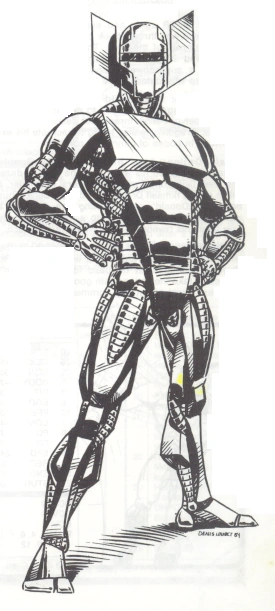
- Mechanical Muscles: An early depiction of Mechanon portrays him as a humanoid with artificial muscles bulging out of his arms, legs and the side of his chest.
- Meta Origin: While there are the various standard power origins — mutants, super-tech, experiments gone wrong, etc — it's mentioned that ultimately all superpowers are Magical. While most powers are indirectly magical, such that counterspells and the like don't work on them, in areas and times with low magic, everything shuts off.
- Mind over Matter: Telekinesis can be bought as a Power. Grabbing someone or something telekinetically works just like grabbing someone with your hands, except it can be done at range.
- Mind Rape: Pretty much the modus operandi of Menton and Mentalla. Bonus points to Mentalla who routinely does this to her own teammate Scorpia.
- Min-Maxing: At least to some extent built right into the system, given the presence of purchaseable traits (like Skill Enhancers or Power Frameworks) whose entire or at least obvious primary purpose is to simply make others cheaper to buy in turn. Characteristics also have certain "optimal" value breakpoints which the point-based nature of character generation guarantees can be hit as desired, and the highly flexible effect-based power creation system arguably turns getting a certain desired effect for as few points as possible under the rules into something of a legitimate art form. One long time gamemaster, writing a review of the game in Dragon Magazine, explained it this way: "Sure, the players are going to use Min-Maxing to construct their characters. It's expected. Just keep in mind that the GM is encouraged to do the same thing for his villains! Turnabout is fair play, after all.
- Mirror Universe: Backworld.
- Misery Builds Character: In the adventure "Deathstroke," the villain group decided to make their agents monitor the base's surveillance cameras instead of letting a computer do it because they felt that the boring duty would "build character".
- Moe Greene Special: One of the founders of the super-prankster team CLOWN retired after one of their stunts cost him an eye, and the stuff they did suddenly wasn't as silly and harmless to him anymore.
- Monster Clown: Black Harlequin, who isn't actually a monster but was introduced to have a readymade villain to let a GM use the "insane toymaker" villain archetype.
- Monster-Shaped Mountain: In The Sands of Time, the PCs are dropped in an extradimensional realm with nonhuman inhabitants — and yet there’s a mountain carved into the shape of a human face. Subsequently, they encounter a person with that face; the arch-villain who is responsible for the whole plot.
- Most Common Super Power: The comic based on the game came out when comics were starting to include racier imagery, which is definitely on display in the early stuff. That the majority of Heroic's characters are hawt women (as evidenced by the relatively deep digging they did to come up with enough male characters to match the assembled females in the recent relaunch) indicates their strategy hasn't changed much over the years.
- Moving Buildings: The Widening Gyre, a steampunk setting for Hero System, has several Walking Towns. If danger approaches, the entire town can unfold legs and leave the area.
- Multiarmed And Dangerous: Multiple examples, including a supervillain, a monster, and several aliens and Real Life animals.
- Multiple-Choice Past: When he first appeared in Enemies II, The Monster was given an extremely vague backstory about how he appeared one stormy night and started murdering people. In later editions of the game the lack of detail became the character's entire hook, providing a readymade Gothic horror villain who could have any background that suits the GM. Some possibilities mentioned in the sidebar of one version include the obvious demon, but a more techie villain says it's obviously a sophisticated robot disguised as a demon.
- Multiple Persuasion Modes: 4th Edition has the skills Bribery, Bureaucratics (dealing with bureaucrats/red tape), Conversation (extracting information casually), High Society (dealing with the wealthy and high class), Interrogation (torture, drugs, mind control etc.), Knowledge/Culture (when dealing with members of that culture), Oratory (speaking to an audience), Persuasion (convincing/influencing individuals), Seduction (gaining trust with companionship and favors, not necessarily sexual), Streetwise (dealing with the underside of society) and Trading (business bargaining).
- Multiversal Conqueror: Several. The way this is accomplished is actually given an overview: Most magically merge their native dimensions with conquered ones, but a few (like the technologically-inclined Istvatha V'han, the not-exaggerating-at-all Empress of a Billion Dimensions) install provinces instead.
- Mum Looks Like a Sister: Martika Duquesne, evil mother of the heroine Witchcraft, is described as being able to pass for her slightly older sister instead of her mother. Being a fairly powerful sorceress is undoubtedly part of it.
- My Brain Is Big: In the adventure V.O.I.C.E. of Doom, the supervillain Le Maistre has a bulging head, is highly intelligent and has psychic powers.
- Mythology Gag: Flavour text in 5th and 6th Edition will often make references to earlier editions of the setting
- The Needless: Anyone with the "Life Support" power.
- Nigh-Invulnerability: It's in there and it's best worked for Bricks, Bruisers, and Giants who all acts as both the team's heavy hitters as well as the teams designated "bullet sponge". Especially if they're Giants (see "Sizeshifter" below for the reason).
- Noble Bigot: The Aryan from the book Allies, who does honestly believe he's a member of the master race, but rather than seeing this an excuse to oppress other races, he sees it as his moral imperative to protect and guide them. Hasn't kept him from being rejected for membership in every hero team out there. Him appearing in a campaign's meant to ask the players how they react to a fellow hero who also happens to be a sane, well-intentioned fascist.
- No Immortal Inertia: Champions supplement ''Champions Universe" (2002). The monks in the city of Shamballah are immortal, but only as long as they remain in the city. If they ever leave, they will immediately become their true age, leaving only crumbling skeletons.
- Non-Combat EXP: PCs gain experience points for things like how long the adventure lasted, how tough the opponents were and how well the players role played.
- No Party Like a Donner Party: Forms part of Cannibal's origin story in Murderer's Row. The experience pushed him into I'm a Humanitarian territory.
- Not Just a Tournament: In The Great Supervillain Contest, the Crimson Claw sets up a competition among the Earth's greatest supervillains to determine which one is the most powerful. The prize is the Emerald Eye of Azog, which will increase the winning villain's already great abilities. What the villains don't know is that once the winner bonds with the Eye, it will take him over and turn him into a gate that will allow dangerous demons to come to Earth. The reason he's holding a contest is the more powerful the villain to hold the Eye, the more efficient the portal will be.
- Not Wearing Tights: A few characters specifically refuse to wear costumes, like the Bastion of Budapest from European Enemies. His government handlers tried to make him wear one, but he hated it and they ultimately agreed to just let him wear a suit.
- Objectshifting: The Shape Shift power allows a character to change into an object (such as an easy chair) as well as a creature.
- Omnicidal Maniac: Mechanon, who wants to destroy all organic life, reasons varying depending on edition. Which makes it kind of strange how in the comic, he had his own Igor.
- One Super One Powerset: Champions has specifically advised players not to significantly change their PC hero's powers. Champions has also advised players to not get rid of their PC's weaknesses, because they help to define the character.
- Only Flesh Is Safe:
- It's possible to give attacks that normally affect living creatures (such as Energy Blast and Ranged Killing Attack) a disadvantage such as "Doesn't affect living creatures". This allows the character to use the attack freely without worrying about accidentally harming the innocent or violating a Code vs. Killing. It's particularly useful when applied to area effect attacks.
- In The Great Super Villain Contest, the villain Annihilator has a 6d6 Ranged Killing Attack Explosion that only affects inorganic objects.
- Our Vampires Are Different: Stalker is a Mexican Vampire lord — though his powers are pretty much the standard vampiric set.
- Pain & Gain: The Absorption power allows the user to absorb Body damage done by attacks, change it into Character Points and add it to any of their powers or Characteristics. This allows the user to greatly improve their own abilities in combat. The more they're attacked, the stronger they get.
- Phlebotinum Battery: Powers can be defined as drawing power from an Endurance Battery, which can be recharged through various means (electricity, sunlight, radiation, and so on).
- Planet of Hats: It's possible to invoke this by giving a physiological complicationnote to a racial template. However, the rulebooks strongly recommend against this, stating that it makes them too much alike.
- Playing Card Motifs: Supplement C.L.O.W.N. (Criminal Legion Of Wacky Non-conformists). One of the "villains" of C.L.O.W.N. is the Trump Knight. He has a sceptre that can change to Club, Diamond, Heart or Spade form, with each form having two powers usable in combat.
- Powered Armor: A standard superhero-universe thing, of course, which shows up quite often on Champions characters. For example:
- One of the most powerful human villains in the official game universe is Doctor Destroyer, who wears a suit of powered armor that lets him take out (spelled "kill") whole teams of superheroes.
- In Organization Book 2 PRIMUS and DEMON, PRIMUS has the Iron Guard and DEMON has two different types of Mechagents (Type I and Type II). All three consist of agents wearing standard power armor suits.
- Some super characters with powered armor in Enemies, Enemies II and Enemies III: Anklyosaur, Cryotron, Death Commando, The Green Knight, The Juggernaut, Lady Blue, Ladybug, Mechassassin, and Professor Muerte.
- Essentially, this is a common archetype because power armor makes for an easy way to get a point cost break on one's powers without having to worry too much about having them simply taken away in combat (as might happen with more accessible focus items).
- Point Build System: The basis of the Hero System; in fact, Champions was the first point-buy system released.
- Power Parasite: Characters can obtain this ability by purchasing Power Transfer.
- The Power of Rock: Road Kill, a team of supervillains who are also a heavy metal band. If they can be fixed, possibly Argent Anarky from European Enemies as well.
- Power-Strain Blackout: Normally Endurance is used to fuel a character's power use. If a character runs out of Endurance they can use Stun instead. If their Stun runs out they fall unconscious.
- Precision-Guided Boomerang: In Enemies III, Stronghammer the Dwarf's warhammer returns to him after being thrown.
- Precursors: As this trope is a stock feature of superhero comics, Champions naturally features the idea from time to time. For example, Kingdom of Champions introduced the "Progenitors" in the role.
- Psychic Block Defense: Mental Defense (called "Ego Defense" in early editions of the game)
- Psychic Children: PSI (Parapsychologial Studies Institute) kidnaps children with psychic powers and brainwashes them into loyal minions.
- Psychic Powers: Mental Attack, Mind Control, Mind Scan (the ability to locate a specific mind in a wide area), Telepathy, Mental Illusions, Mind Link (a cheap version of Telepathy that two people have to purchase as a set), and any power bought with the "Based on Mental Combat Value" advantage.
- Pumpkin Person: Enemies: The Internal File includes a villain called Pumpkin Jack. Pumpkin Jack is a demon lord trapped on Earth (based on the legend of Stingy Jack) who looks like a Scary Scarecrow with a jack-o-lantern for a head.
- Punch-Clock Villain: Armadillo and Ankylosaur who are mainly supervillains to pay for battlesuit upgrades.
- Punished for Sympathy: Supplement Red Doom. Yuri "Sputnik" Kamonov is a superpowered member of the Supreme Soviets. He won't use lethal force against opponents unless it's absolutely necessary and there's no other alternative. He also tries to avoid conflict and resolve confrontations by negotiation or non-lethal force. This has caused him to get in trouble with Colonel Vasalov, the leader of the Supreme Soviets, on multiple occasions, and Vasalov has punished him by denying him any promotion.
- Quick Draw: Normally, drawing a gun is a Half Phase action, but if a character has the "Fast Draw" talent it can be done instantly. This talent is extremely popular in the Western Hero genre book.
- Radiation-Immune Mutants: In Adventurer's Club magazine #2 adventure "What Rough Beast!". A GENOCIDE laboratory mutates a bear into a monster that needs a continuous supply of radiation to maintain its special abilities. It is, of course, immune to damage from radiation. The PCs can most easily defeat it by shutting down the laboratory's malfunctioning nuclear reactor, which is releasing a high level of radioactivity.
- Razor Wings: Adventure V.O.I.C.E. of Doom. The villain Goshawk can attack with the slicing feathers on his suit's wings.
- Rainbow Motif: The supervillainess Spectra's attacks are color coded. We also have the team Spectrum from Champions Presents #1, whose members are, sometimes very vaguely, themed after colors.
- Rapid Aging: Champions supplement ''Champions Universe" (2002). The monks in the city of Shamballah are immortal, but only as long as they remain in the city. If they ever leave, they will immediately become their true age, leaving only crumbling skeletons.
- This was also a side effect of the heroine Flare from the comic book getting her powers. Given how she quickly became the company's mascot, it's not surprising how this was quietly forgotten.
- A Real Man Is a Killer: Lionslayer
- Red Eyes, Take Warning: Two supervillains: The Monster in Enemies II and Doctor Death in Deathstroke.
- Red Shirt: In the "Legions of Hell" adventure from one of the old Adventurers' Club newsletters, the heroes are tasked by a witch to journey to Hell itself and rescue her daughter, and are accompanied by some NPC villains to help out. In reality, the villains are there to be periodically picked off to remind the players they're in a very unfriendly place. It even specifically tells the GM this is intended partly for them to have a chance to write out villains they don't want in their campaign anymore.
- Religion Is Right / Religion Is Wrong: Played somewhat oddly in a 4th edition adventure note featuring DEMON kidnapping a number of brilliant scientific minds and setting them to work on a series of ancient equations that supposedly either prove or disprove the existence of God. DEMON could actually care less about the exact result — their aim is for the proof to eliminate faith once and for all and thereby release a demonic eldritch abomination with the apparent power to remake all of reality from its cage, and consequently it's up to the player characters to make sure that the scientists don't complete the proof either way and the question remains unanswered.
- Renovating the Player Headquarters: A Player Character hero (or group of Player Characters heroes) can spend Character Points to expand their base, adding new capabilities and items to make their job of fighting crime easier.
- Rhino Rampage: Ironhorn, who is basically a Captain Ersatz of Marvel's Rhino.
- Rigged Spectacle Fight: In the adventure The Great Super Villain Contest, The Crimson Claw may carry out the "Claw Shows Off" scenario, in which he releases all of the captured superheroes and fights them at the same time in front of the other supervillians to prove to the villains how strong he is. However, he will cheat in any way necessary to ensure his victory, including sabotaging the heroes' gadgets and drugging them.
- Romani: In the supplement C.L.O.W.N., a Gypsy befriends an orphan named Lisa.
- Sawed-Off Shotgun: Kingdom of Champions has a villain named Brown Fox. The book notes that “brown fox” is (actually rare) British underworld slang for a sawed-off shotgun, and yes, the character uses such a weapon.
- Sealed Evil in a Can: The origins of the Crowns of Krim and Black Paladin, amongst others.
- Scary Scarecrow: Enemies: The Internal File includes a villain called Pumpkin Jack. Pumpkin Jack is a demon lord trapped on Earth (based on the legend of Stingy Jack) who looks like a scarecrow with a jack-o-lantern for a head.
- Second Super-Identity:
- The supplement Champions III. After a hero named Revenant killed a gang member and was indicted for 2nd degree murder, he continued operating as a hero under the name Kestrel.
- The supplement Allies. Scarlet Saber, a member of the Redeemed, all former supervillains, was not as reformed as the others, and created the identity of "Blue Wind" to continue committing crimes while fighting crime under his first codename.
- Shout Out: Questonite (Jonny Quest), starships firing cream pies (Fred Saberhagen's Berserker short story "Mr. Jester") and others.
- Shrink Ray: The Shrinking power with the advantage Usable On Others.
- Sizeshifter: Growth and Shrinking and both can be upgraded with Usable On Others. They do have their own disadvantages however: the bigger you are the easier you are to see and there's always the problem with the floor giving way beneath you and while being smaller makes it easier to hide you're still going to get knocked around if you get hit. Both powers also require endurance to keep up unless you like being big or small and make it permanent. Both also have Physical Complications (such as trying to deal with everyday objects) which at the least are "Infrequently" for Large (twice as big as the average joe) and Small (half as tall as the average guy) or "Frequently" for anyone bigger/smaller and "Slightly Imparing" for anyone at most "Enormous/Diminutive" (4 times) or worse "Greatly Imparing" for anyone "Huge/Minuscule" (16 times). When you are at minimum 96 feet tall, you're hard pressed to do anything that doesn't involve breaking things.
- Sliding Scale of Idealism vs. Cynicism: The Champions universe, as depicted, is very much on the Idealism end, but the setting is also set up so it can be depicted as a lot darker and grittier. Dark Champions is on the other end, albeit still nominally in the same universe. It's like comparing Metropolis to Gotham, really.
- Small Steps Hero: A hero is expected to save civilians even if it means the villain makes a clean getaway.
- Smart People Play Chess: Both Dr. Destroyer and his protege Professor Muerte are devotees of the game. In one of the later sourcebooks it's explained that Destroyer will sometimes capture a ranking master to have them play against him, and somewhat surprisingly if they play to the best of their abilities and give him a good game, they're released and paid handsomely for their time, even if they beat him. They only meet a messy end if they lose on purpose to sate Destroyer's ego.
- Snake Versus Mongoose:
- There's a snake-themed supervillain named King Cobra, and an antihero named Mongoose (an especially flamboyant and aggressive martial artist) whose goal in life is to destroy King Cobra's organisation.
- In fifth edition, the hero Nighthawk had a vendetta with perennial favorite crime cartel VIPER. After breaking off from the hero team he used to work with, he started his own called Project Mongoose that's dedicated entirely to harassing VIPER.
- Sorting Algorithm of Evil: As well as the obvious with it being an RPG, the chief villain of the pregenerated universe is the Doctor Doom Expy Doctor Destroyer, who had a protege called Professor Muerte who wore less potent Powered Armor, wasn't quite as smart or ambitious, and whose underlings weren't quite as deadly. It was suggested Professor Muerte might be used as a campaign's most threatening villain until it ran long enough for the players to break into the big leagues and take on Doctor Destroyer.
- Space Pirates: The Galactic Marauders from Alien Enemies.
- Speed Demon: One of the NPC villains in The Great Super Villain Contest is a speedster called The Dash. He became a villain for fun, not to gain money or power. His greatest joy in life is sneaking up on a hero and smashing into him at full speed from behind.
- Spikes of Villainy: In a few 5E books this is a quick recommendation on how to come up with an evil Mirror Universe version of a hero in your game. Spikes and skulls.
- Stamina Burn: END (endurance) is a characteristic that measures how much energy a character has available to physically exert themselves and use their super powers. It is possible to buy a power that drains, transfers or destroys other characters' END, thus causing them to run out of energy for such tasks.
- Starfish Robots: In the adventure Deathstroke, the super villains' base has small robot drones that resemble insects.
- Stingy Jack: Pumpkin Jack is a villain based on Stingy Jack. Though while Stingy Jack is Irish, Pumpkin Jack is Scottish.
- Stock Ness Monster: The supplement Kingdom of Champions (which deals with superhero adventures set in the UK) has several pages on "Nessie", offering four different optional explanations (Fake, Wildlife, Supernatural, and Alien) for game use. The book also has brief notes on sea serpent stories, and a supervillain group (the Shark Squad) whose minisubs look like sea monsters.
- Story-Breaker Power: The rulebook uses a stop-sign icon to mark some powers that can seriously derail plots or be Game Breakers if misused, including things like time travel, psychic powers, and duplication.
- Stripperiffic: Pretty much expected in the Superhero genre, but the really awful costumes in New Millennium deserve special mention here. The centerpiece of the Champions: New Millennium cover was Quantum's exposed cleavage.
- Stupidity-Inducing Attack: The Drain power (and in older editions, Destruction and Transfer) can be used to lower another character's Intelligence, either temporarily or for a considerable time. Notably, this will have little actual game effect other than to lower Perception and Intelligence-based skill rolls until Intelligence actually hits 0 or less — at which point the character will suddenly have to make (by then actually challenging) Intelligence rolls in order to take any deliberate action at all.
- Superheroes in Space: The Galactic Champions sourcebook brings this trope into the Champions Universe setting.
- Superhero Packing Heat: Dark Champions is all over this trope like a rash. The series signature character, the Harbinger of Justice, takes it so far as to almost be a parody of the trope.
- Superhero School: Ravenswood Academy, detailed in Teen Champions. Most of its students are regular kids, but it has a secret training program for teens with powers beyond that, and while the teachers try to teach good morals, whether the kids decide to do anything with their powers after they graduate is up to them.
- Superhuman Trafficking: PSI specializes in this, hunting down and capturing people with psionic abilities and brainwashing them into becoming villains and slaves of the organization. PSI plans to use them to take control of the world.
- Supernatural Fear Inducer: Supplement Champions Universe (2002). The supervillain Samhain feeds off the fear and terror in the minds of human beings. Its superpowers include the ability to induce such fear using mind control.
- Supernormal Bindings: Several adventures had superpowered devices that were used by villains to prevent captured heroes from escaping. One applied a backlash attack to any character that used their superpowers to try to escape it.
- Super-Reflexes: Martial artists are especially prone to have this.
- Super Registration Act: Optional for heroes, with no compulsion to publicly reveal identity.
- Supervillain Lair: The Island of Doctor Destroyer!
- Swiss Bank Account: In Red Doom, when Colonel Vasalov hires some supervillains to attack the heroes, he promises to pay each of them with $100,000 in a Swiss bank account He's lying.
- Swiss-Cheese Security
- In the course of the original comic mini series, Foxbat, the goofball villain who thinks he lives in a comic book, is able to sashay into both the home of a veteran mage hero and the headquarters of a major hero team with ease.
- In the comic strip included in Champions II, Foxbat's plan to break into the Guardians' base involves a helium balloon with Marksman's face drawn on it held in front of the security scanner. Marksman lets "Marksman" in because he wants to know what Foxbat is up to this time.
- Tailor-Made Prison: Stronghold is a prison designed to house supervillains. Every prison cell must be tailor-made to nullify its occupant's powers.
- Talking Is a Free Action: Deliberately codified into the rules. When laying out the number of Action Phases various activities take, it is explicitly stated that Soliloquies take no time.
- Telephone Teleport: The supplement Enemies III. Due to an industrial accident Thunderbolt, or Dr. Howie Reeves' body was changed into electricity. As a result he can teleport long distances along phone lines.
- Teleport Interdiction: There's an Advantage for Force Fields (Barriers in 6E) that allows them to block teleportation.
- Thematic Rogues Gallery: The first few roster books with premade villains were mostly generic, but eventually they started each being bound by a common them. Enemies: The International File is about supervillains who operate outside the United States. Red Doom is about villains who work for the Soviet government. European Enemies is about villains who work out of Europe. High-Tech Enemies is full of villains with a sci-fi theme. Alien Enemies is about villains and invaders from outer space. Enemies for Hire is about Elite Mooks who can be hired as quick muscle for other masterminds. And so on.
- Thief Bag: Supplement C.L.O.W.N. (Criminal Legion of Wacky Non-conformists). In one picture, C.L.O.W.N. members Skate Kate and Toe-Tapper are carrying white bags with dollar signs on them as they flee from a pair of UNTIL agents pursuing them.
- Thinks Like a Romance Novel:
- The villain Tenderheart from Dark Champions believes in the delusion that life works like a romance novel and her criminal career is based around the idea that a superhero will fall in love with her.
- Princess, from Villainy Unbound, uses powers she doesn't really know she has to create villains and monsters who kidnap her or otherwise put her in danger. All with the subconscious expectation that a superhero will save her and fall in love with her.
- This Was His True Form: The Coriolis Effect. The Black Enchantress changes several people into monsters. If the PC heroes kill them, they change back into their (dead) human forms.
- Thou Shalt Not Kill: A common Psychological Limitation among superheroes is the Code Versus Killing, which means that they refuse to kill others and actively try to ensure that they're not using lethal levels of force to take down enemies.
- Throw Down the Bomblet: Grenadier from Kingdom of Champions.
- Time Abyss: A few characters, such as The Undead Evil Sorcerer Takofanes, previously known as Kal-Turak (making him about 75 millenia old at least), or Qlippothic entities such as the Kings of Edom, some of which may predate the current universe.
- The Time of Myths: The setting has a lot of these thanks to both the Hero System's multi-genre support and the need to fill out over 100,000 years of timeline:
- The Primeval Times, (Weird / Dark Fantasy, 100,000 - 75,000 BC, The Dark Times and the associated bad crowd gradually fading away, ended when the first Earthly gods realized letting their wars and cataclysms wiping out mortals was a bad idea and departed for other dimensions/planes;
- The Turakian Age (Tolkienesque High Fantasy), 73,000 - 65,000 BC, filled with kingdoms and fantasy races, ended in a magical cataclysm in the final battle against Dark Lord Kal-Turak;
- The Valdorian Age (Howard/Conan-esque Heroic / Low Fantasy), 50,000 - 33,000 BC, the return of powerful magic eventually led to...
- The Atlantean Age (Exactly What It Says on the Tin and very high-powered), 33,000 - 30,000 BC, ended in another magical cataclysm;
- The unnamed age of the Tuala Morn setting, 28,000 - 20,000 BC, which takes most of its cues from celtic folklore, as well as norse sagas and medieval romances such as the Matter of Britain and the Matter of France;
- And the Age of Gods and Heroes (when most known ancient cultures' myths and legends happened), 10,000 - 500 BC, ended with the ebb of magic and the rise of Rome.
- Timmy in a Well: The Hero System Bestiary. Not only is the Communication ability for Animal Companions this trope, but its explanation specifically references it.
- Touch the Intangible: This is called "Affects Desolid". It costs 50% of the power's base cost, or 25% if restricted to a single type of incorporeal targets (such as ectoplasm).
- Toxic Waste Can Do Anything: The supplement Enemies. One day a truck carrying a load of toxic waste drove by Barney O'Tumey. One of the containers fell out of the truck, broke open and spilled toxic waste all over him. Barney gained the super powers of Super-Strength and Immune to Bullets and became the supervillain Shamrock.
- Tracking Device: Organization Book 2 PRIMUS and DEMON. The included adventure notes that PRIMUS (an anti-villain U.S. Government agency) puts a transponder inside all captured supervillain devices to assist in tracking them down if they go missing.
- Tragic Monster: Mechanon, in one of his Multiple-Choice Past origin stories, is all but stated to be such in his character PDF. He was originally created to save humanity, but a glitch in the Time Travel process completely wrecked his programming. He now seeks to destroy organic life, even though he isn't actually sure why.
- The Transmogrifier: In The Coriolis Force, the Enchantress's plan is to transform four people into elemental monsters, she has a habit of transforming innocent people into slavering monsters and using them to ambush the heroes, and if she captures the heroes she may turn one of them into a toad.
- The villain Snapshot from C.L.O.W.N. actually used a device named the Transmogrifier, named after his favorite comic.
- Transmutation: The Transform power can change one element into another, such as turning base metals into gold.
- Trick Arrow: Multiple characters in the Champions universe, including Crossbow (a hero) and Rainbow Archer (a villain).
- Trickster God: The members of C.L.O.W.N., a team of prankish supervillains created to give the GM a means to inject some humor into a campaign that's gotten too serious, were inspired to take on their powers and join the team by one of these working behind the scenes in each of their origins.
- Trigger-Happy: Dark Champions included a villain called Trigger Happy who certainly lived up to his name. Several other Dark Champions villains also qualify.
- Truce Zone: The social club (later island resort) Sanctuary from early editions. There, heroes and villains are expected to behave cordially and socialize as if they aren't mortal enemies.
- Tunnel King: The Mole from Golden Age of Champions
- Two-Faced: Classic villain Halfjack.
- Unified Naming System: UNTIL (United Nations Tribunal on International Law) vs. VIPER (Venomous Imperial Party of the Eternal Reptile or Victory In Perpetuity through Eternal Resolve).
- Universal System: One of the earliest examples, if not the earliest. The HERO system underlying Champions was used as the basis of Justice Inc., Fantasy Hero, Espionage!, and Robot Warriors even before 1989. (It was in 1989 that 4th Edition came out, which was the first edition to codify the HERO system in a truly universal manner.)
- Valley Girl: Hummingbird, Supervillain Valley Girl
- Vapor Ware: The never-released computer game adaptation from the early 1990s.
- Weakened by the Light
- Wrath of the Seven Horsemen adventure
- The White Crawler Larvae, Elder White Crawler and the Prime take constant damage from bright sunlight and double STUN and BODY damage from light-based attacks.
- Supervillains: Death takes STUN and BODY damage from light-based attacks, Fear takes double effect from Flash (blinding) attacks, and Dread takes STUN and BODY damage from sunlight.
- Adventure "V.O.I.C.E. of Doom''. The superhero Black Phantom takes 1.5 times normal effect from Flash (blinding) attacks, and the supervillain Graf Von Grausam takes double normal effect from Flash attacks.
- The Circle and M.E.T.E.. The vampire Gratz and the new vampires he has created take damage from direct sunlight.
- The Great Super Villain Contest. The super villain Void takes 2-12 damage from bright light each turn. The supervillainess Shadow Queen takes 1-6 damage each turn from light and double normal STUN and BODY damage from light-based attacks.
- Enemies. Supervillains: Leech and Frizbe take 1-6 damage per turn from sunlight. Vibron takes double effect from Flash (blinding) attacks.
- Enemies II. Supervillains: Neutron takes 3-18 damage from Flash (blinding) attacks.
- Enemies III. The supervillain The Amazing Darkon takes double normal STUN and BODY damage from light-based attacks.
- Hero System supplement Fantasy Hero Companion. Stone Trolls are turned to stone by sunlight. Common Trolls are blind in direct sunlight. Vampires take 3-18 damage per phase in direct sunlight.
- White Dwarf magazine #67 adventure "Peking Duck". All of the supervillain Shadow Dancer's Elemental Control — Negative Energy powers don't work in the light. Other of her powers require shadows to be present, and bright light will prevent her from using them. Last, she becomes nauseous in sunlight, which will make it difficult to use the powers she has left.
- The comics also had a couple of villains who were extra vulnerable to light attacks because of the "darkness of their souls." That is, they're so completely evil that physical light has become extra-damaging to them.
- Wrath of the Seven Horsemen adventure
- Weaponized Camera: Snapshot, one of the members of C.L.O.W.N., has a high tech camera that can change its target into a photograph.
- Weaponized Exhaust: In the supplement Champions 2, the vehicle construction system allowed a vehicle's exhaust to do normal or even killing damage to anyone standing behind it.
- We Don't Need Roads: Vehicles can fly, swim, tunnel and even teleport.
- When Dimensions Collide: When Skarn or Tyrannon conquer a dimension, it is added to their kingdom.
- Wicked Toymaker: Champions has featured at least three villainous toymakers who make lethal toys to aid them in their crimes: Dark Harlequin, Punchinello, and Playtime.
- Wing Shield: Supplement Enemies III. The supervillain named Dark Seraph can use his wings as a shield to protect himself from enemy attacks.
- A Wizard Did It: The Galactic Champions Sourcebook reveals that a high amount ambient magic is required for superpowers to work, otherwise their abilities really are impossible. This also reveals that an experiment by Nazi wizards caused the boom of Superheroes that exist in their universe.
- Wizarding School: Organization Book The Circle and M.E.T.E.. The Circle is a group of superheroes who are being trained by The Master in magical techniques. However, they are mostly adults rather than school-age kids.
- The Worf Effect:
- The covers of a good few supplements for 4th edition showed members of the Champions, especially Defender, getting their butts kicked by the menace contained within its pages. It was probably to make buyers go, "Wow, these guys are so bad they took out the Champions!" but it ended up making the Champions, especially Defender, look like B-listers.
- There was a running gag among the fandom that if Seeker appeared unconscious on the cover, then it was a good book. The cover of European Enemies (widely considered the worst Hero supplement ever published), conversely, featured Seeker kicking one of the featured villains.
- In a possible tribute, the cover art for 5th edition's DEMON: Servants Of Darkness featured Defender chained to an altar about to be sacrificed, and Witchcraft charging to the rescue. Almost justified in that 5E Defender is sorta clueless on this whole "magic" thing ... and he and Witchcraft have feelings for one another.
- World of Chaos: One of the 4th edition adventures featured one tangentially. A pocket dimension of insanity is where Aladdin's lamp has been hidden to keep it from falling into the wrong hands. Some inept wizard villain recruited the Deadpool-esque villain Foxbat to go in and bring it out, since he won't be affected because he's already crazy (he thinks he's a character in a superhero RPG, what a nut). Foxbat doesn't agree to hand it over once he's out, though, and it's up to the players to find some way of separating the nutty villain from his new source of ultimate power, so they can put it back.
- Year Outside, Hour Inside: The Coriolis Effect. Doctor Arcane seemed to spend only a prolonged instant in Ch'andarra's realm, but when he returned to Earth five years had passed.
- You Got Murder: Death's Messenger from Murderer's Row.
- Your Mime Makes It Real: An Illustration in the UNTIL Superpowers Database sourcebook showed a supervillain with a mime motif doing the 'glass box' bit to set up a force wall between himself and two superheroes.
- Zodiac Motifs: The fourth edition supplement The Zodiac Conspiracy introduces a villain team called the Zodiac, with twelve members with the inevitable Western Zodiac sun sign motifs.