

Lt Barf: It is a simple matter. The alien will revert to its natural state when dead. We simply kill them both.
Shapeshifters in general tend to gravitate to their "base" or original forms as well when killed or sufficiently weakened, as do most victims of a Shapeshifter Swan Song, or monsters that were once human.
One of their more peculiar traits is that shapeshifters have No Ontological Inertia, because upon death they inevitably revert back to their "true" human form. Though similar to the Shapeshifter Swan Song (which usually ends in This Was His True Form), this is not a case of a Super-Power Meltdown, but an example of No Ontological Inertia regarding their "curse". Whatever innate power or curse is capable of using LEGO Genetics and Shapeshifter Baggage to add and remove a few hundred kilograms of fur, muscle, and teeth to or from an Innocent Bystander in a few moments, it apparently has no more lasting effect than a shot of espresso. Well, at least the espresso doesn't induce a killing frenzy — usually. This is usually used to show that the (sometimes) only way to cure a Werewolf is to kill them.
This is both potentially useful and frustrating for heroes, since it removes evidence of the paranormal (which might be something that they want to cover up or prove) while adding the eentsy little complication of making them liable to face murder charges. No Self-Disposing Villains here.
When the form change stems from The Corruption, this may be the physical manifestation to parallel Dying as Yourself. This often results in Peaceful in Death, to show that the death really was freedom from the Curse and not a bad thing.
From a purely Fauxlosophical perspective, this would imply that all werewolves and shapeshifters are one specific human person rather than the sum of their multiple forms... which means that heroes killing either one are murdering potentially innocent people.
Sometimes, this is inverted, with someone who appeared to be human turning out to be something else entirely upon death.
See also The Mirror Shows Your True Self and Game Face. Compare Sleep-Mode Size for the anime super powered version, and Deathly Unmasking for a similar type of reveal at death. Contrast Clipped-Wing Angel. For the immortality/rejuvenation version, see No Immortal Inertia. Helps avoid Opening a Can of Clones. A character whose death unleashes an even more powerful persona is a One-Winged Angel.
Not to be confused with Death Means Humanity.
As this is a Death Trope, as well as one that entails The Reveal of many a Secret Identity, unmarked spoilers abound. Beware.
Examples:
- In 3×3 Eyes, a side-effect of Genma Hoshin (a technique used to imprison a demon in earth using earth's own energies to keep him trapped) is that it forces the victim to assume his/her real form as they become a Sealed Evil in a Can. For example, Galga, a revenant, was revealed to be a rotting head and spine with fleshy remains stuck in a breastplate, while Benares is forced to abandon his human form and become a colossal, out-of-control dragon monster made of energy.
- In the Berserk series, demons used to be humans, and will revert to their former human selves after they die. This causes problems for Guts from time to time, but especially during the Rosine arc, where the Big Bad's pseudo-Elf minions were Apostle-spawns created from human children, leading the populace of the village she menaced to believe that Guts is a child murderer.
- Victor Freeman of Blaster Knuckle, a demonslayer in many ways comparable to Guts, also has to deal with demons that revert to human form upon death. Because of this, he is an Outlaw and reviled as a murderer, which isn't helped by the fact that he's a black man in the postwar 19th Century American South, where racism was rampant.
- Bleach anime episode 291. When Kaname Tousen is stabbed and mortally wounded while in Hollow form, he returns to his true form just before he dies.
- In Fullmetal Alchemist, Envy, when they lose all of the souls that they rebuilt their body with, reverts to that of a small worm-like creature.
- It's heavily implied that this is true for all Homunculi, but the only other one shown is Pride, whose true form is a tiny baby, about the size of a thumb.
- There's a minor but straight "after death" version with Wrath who, while dying, suddenly looks like an actual sixty-year-old man, whereas previously, he looked a decade or more younger. The same is also done for Hohenheim.
- After he is defeated and thrust into the Gate, Father reverts to his true form, the tiny blob of darkness that Hohenheim once kept in a flask.
- Hoshin Engi: Yokai Sennin are only temporarily humans: if they suffer lethal damage in combat they revert to their original form, as seen early on with Chinto (turns into a mantis) and Okijin (turns back into a stone biwa).
- A variant happened in Mobile Suit Gundam SEED Destiny. Near the end of the series, Meer Campbell (who underwent surgery to become Lacus Clyne's Body Double to further Durandal's plans) was mortally wounded, Taking the Bullet for Lacus herself. In her dying breath she gave the real Lacus a picture of her pre-op self, the original Meer Campbell, so she would know her true appearance: that of a black-haired, curvy, freckled young girl.
- Played for Horror in My Little Goat: Natsuki's father reverts from wolf to human after being tasered, symbolizing how he was just as predatory towards his son as a wolf is to goats.
- In YuYu Hakusho, Younger Toguro is eventually defeated by Yusuke in the final round of the Dark Tournament. As Toguro falls, his menacing 100% demon form shatters, revealing his human self. When Toguro's spirit is being judged for the afterlife in the arc's epilogue, he looks human.
- The Incredible Hulk: The Hulk rarely (if ever) gets his ass kicked. Or at least takes a hit powerful enough to bring him down in one go. When he does however, occasionally it depicts him transforming back into Bruce Banner.
- In the Italian comic book Legs, one issue has the heroines discovering a race of shapeshifting aliens based on the gods of Egyptian mythology and capable to change from their basic human form to a beastman form akin to myth, with the exceptions of their leader Osiris, who was always human-like, and the evil Set, who was driven to villainy because he lacked a human form and was cursed with a Touch of Death. When Set dies at the end of the issue, he reverts into a human form, much to the shock of everyone as they realizes that he really had no excuse for his villainy.
- After the werewolf in the fifth issue of The Monster of Frankenstein is killed, it reverts back to human to reveal that it was in fact the woman whom the Monster had protected throughout the story.
- Robin (1993): When Tim knocks out Micro with an electrical attack the shrunken man grows back to his regular human size while laying unconscious.
- This kicked off the build-up to Secret Invasion (2008):
- Someone the New Avengers thought was Elektra is fatally injured... and turns into a Skrull. No-one had any idea she wasn't the real Elektra, including Wolverine and Doctor Strange, meaning that this faction of Skrulls has considerably improved their shapeshifting powers. Naturally, they start to wonder who else might be an imposter...
- This also seems to happen to any part of a Skrull that's separated from the main body; when Crusader's hand was cut off during a training exercise in Avengers: The Initiative, it started turning a little green by the time they'd reattached it.
- The Reaping of Hatsune Miku: The last Game Master is a permanent One-Winged Angel known as "Calne Cantus". When she is defeated, she's returned to her human form: a teenager with a dead eye and three prosthetic limbs.
- Brave: Mor'du's spirit rises from its body in the form of the human prince he used to be.
- The Were-Rabbit in Wallace & Gromit: The Curse of the Were-Rabbit. To some extent, this is a Shout-Out to the classic turning-back scene in Universal Studios' The Wolf Man (1941) (and a similar scene in its predecessor, 1935's Werewolf of London).
- In Sev Trek: Pus in Boots (an Australian CGI spoof of Star Trek: The Next Generation), the crew find themselves confronted with two Captain Pinchhards, one of them a shapeshifting alien. The crew wonder how they can Spot the Imposter. Lieutenant Barf responds, "Simple, we kill them both. The alien will revert to its natural form once dead." Needless to say the captains tell him to think up another plan.
- The werewolves in An American Werewolf in London immediately revert to human form upon dying. The werewolf that attacked David and Jack turned out to be an old man.
- In the supernatural-horror film Bewitched (1981), the main villain, a Thai voodoo-priest, was eventually overwhelmed after his curse is broken, causing his body to rapidly dry up and shrivel, where it turns out his body is merely a puppet - his true form is a bat, who then crawls out of the corpse's mouth and flies away only to be captured immediately.
- In one of the endings, Drake in Blade: Trinity actually managed to hold on to the last shape he shifted into for a few hours after death, having mimicked Blade as a parting gift to fool the authorities into thinking he was dead.
- When the heroine of Cat People dies, she shapeshifts back into a panther.
- Averted to a degree in The Curse of the Werewolf. When Leon the werewolf is shot by his father, the father covers his body with a cloak and the audience does not see if it reverts or not.
- Oddly brought up in Friday the 13th Part VIII: Jason Takes Manhattan, where Jason is shown to have reverted back to a little child after his toxic waste bath in the sewers.
- Fright Night (1985): After Evil Ed is killed while in wolf form, he returns to human form.
- Full Eclipse: When a werewolf dies, their body turns human again. Seen happening to Detective Davies after Garou kills him with a Silver Bullet.
- In G.I. Joe: Retaliation, when Storm Shadow kills Zartan, his returns to his original appearance.
- The Simians, or aliens form the Third Planet of the Black Hole, in Godzilla vs. Mechagodzilla revert back to apes upon death (full body) or when hurt (only their injured parts). This is only true for this movie — in the sequel Terror of Mechagodzilla, only one dies on-screen, but instead of warping into an ape, he rather arbitrarily tears the skin off his face, revealing a deformed head. It's a clear but kinda random reference to the Planet of the Apes movies.
- In The Happy Ghost 5, a dog makes a deal with the Happy Ghost to become a human for 44 days because he wants to do more for his owner before dying. At the end, he takes a bullet for his mistress and is loaded onto an ambulance. Seconds later, the paramedic remarks that he can't do anything for a dog. The woman then sees her dead dog on the gurney.
- Hellraiser: The Cenobites, demons who were once human summoned by the Lament Configuration, turn back into their human form if they're killed. This is first shown happening to Pinhead and his entourage in Hellbound: Hellraiser II when Channard turns on them.
- Mizuno, the eponymous character in The Human Vapor, reverts to his solid form after the theater is blown up.
- In The Invisible Man (1933), the title character becomes visible when he dies.
- Lifeforce (1985): When one of the male space vampires receives a metal stake through his chest courtesy of Colonel Caine, he turns back into his giant bat form as he dies.
- The Matrix: Agents are capable of taking over bystanders' bodies. If they should be killed, the program leaves and the innocent most recent host is unmistakably dead. There are no other bodies, but all their other hosts are presumably very dead as well, or they just find themselves someplace strange with no memory of how they got there. Actually addressed in one of the video games. Ghost is looking at an Agent through his scope when the Agent jumps out of the body, leaving a SWAT sharpshooter with a headache, who looks around in confusion.
- In the The Monkey Goes West series of films, based on of Journey to the West, the demons usually takes on the forms of beautiful young women who uses their charms to seduce the main characters, but upon being defeated or slain they will revert themselves to their original forms. The spider demon sisters turns back into a cluster of spiders, the White Bone Twins reverts back to skeletons, the snake sorceress turns into a dead snake, and so on.
- This happens to the Wolf Man in The Monster Squad after Rudy shoots him a Silver Bullet. The werewolf reverts back to his human form, who thanks Rudy before dying.
Rudy: Well, told ya. There's only one way to kill a werewolf.
- My Animal: Inverted, since when Henry dies, his corpse is in his wolf form.
- Sorceress Irendri in the finale of Once Upon a Warrior transforms into a powerful snake-human hybrid monster to attack the heroes. Upon being defeated, she transforms back into human, before being Reduced to Dust.
- In Red Riding Hood, the beast hunter they bring in tells them they haven't killed the werewolf because they have a wolf's head mounted, not a human head. He also relates the story (an actual werewolf myth) that he once tracked down a werewolf and cut off its paw. When he got home, his wife was cradling her bloody arm, and a look at the paw revealed it was now a human hand, wearing her ring and revealing her as the werewolf. She's still alive, so it isn't clear if the paw transformed because it was cut off or because it continued to transform as she did. At the end of the movie, when they actually manage to kill the werewolf, he does take his human form.
- Played for laughs in Scary Movie 4, where Michael Jackson is zapped the by the alien invaders, and reverted to his Bad appearance. Then he gets zapped again, this time reverting him to his Thriller incarnation. A third zap finally reveals his true form, namely a balding, middle-aged black man, before he gets vaporized altogether by a final blast.
- In The Snake Prince, the titular prince finally reveals himself to be a giant, serpentine monster in his One-Winged Angel form after being exposed to sulphur smoke. And when he succumbs to his injuries, he promptly turns back into his human form, which is in the form of its actor Ti Lung.
- In Species II, the Half-Human Hybrid woman Eve turns back from her latex-monster form to human form after being knocked unconscious. Likewise, in Species III, the hybrids always turn back to human form when they die.
- Applies in Underworld (2003). Lycans normally revert to their humanoid form when they die, but Vampires eventually discovered a serum that would keep them in their wolf form after death so they could be studied.
- Established as a shapeshifter in Star Wars: Bounty Hunter, Zam Wesell, the Bounty Hunter who is chased by Anakin and Obi-Wan in the beginning of Star Wars: Attack of the Clones, turns into a green-skinned alien after Jango Fett hits her with a poison dart.
- This seems to happen to most supernatural foes the eponymous hero in Van Helsing faces, including Mr. Hyde and at least one wolfman. Van Helsing even remarks on this twice, telling his boss, "I'm the one who's left standing there when they die and become the men they once were!" He also says to the female lead, whose brother was a wolfman that Van Helsing killed, "Now you know why they call me murderer." He's even a wanted criminal since the authorities always catch him near corpses.
- At the end of Super Mario Bros. (1993), after Bowser is forcibly devolved by the Mario Bros., he briefly turns back into a Tyrannosaurus rex, the animal he originally evolved from, before finally melting into a puddle of ooze.
- The werewolf in The Undying Monster immediately turns back to human when its shot at the climax in the cliffside, and it falls to the crashing waves below.
- Played straight in both The Wolf Man (1941) and its 2010 remake. In fact, in the original, this causes some problems for Larry — he beat a wolf to death with a cane, and is very confused as to why everyone keeps asking him why he killed a human.
- In Eddings' The Belgariad/The Mallorean, the Hounds of Torak do this. They are Grolim priests—minor sorcerers—transformed into enormous dogs, but they go back to being human if you kill them.
- Robert E. Howard's Conan the Barbarian:
- In the story "The Devil in Iron", Khosatral Khel, an Evil Sorcerer, turns out to be an Eldritch Abomination via this trope when Conan puts him down:
Conan, who had not shrunk from Khosatral living, recoiled blenching for Khosatral dead, for he had witnessed an awful transmutation; in his dying throes Khosatral Khel had become again the thing that had crawled up from the Abyss millennia gone.
- In "Queen of the Black Coast", the hyenas transform back into men before crumbling.
- In the story "The Devil in Iron", Khosatral Khel, an Evil Sorcerer, turns out to be an Eldritch Abomination via this trope when Conan puts him down:
- The main character, Horza, in the Iain M. Banks novel Consider Phlebas reverts to his true form after his death (but not when unconscious, that would be terrible for a member of a race of shape shifting spies and infiltrators). Considering his borderline Shapeshifter Identity Crisis earlier on, it's not clear if this dead form is actually the face of the real Horza (assuming such a person even existed) or if he had reverted to whoever he was originally underneath all the infiltration training and psychological conditioning. The whole thing is presented as a Bittersweet Ending as the closest thing he has to a friend looks down on his body and wonders who he really was in the end...
- The Katagarians revert to an animal form, and the Arcadians revert to a human form when they are unconscious or dead in Sherrilyn Kenyon's The Dark Hunters series.
- The Dark Tower (2004): When Sussanah and Roland kill the emotion vampire Dandelo, his corpse reverts to its true form. Exact details aren't given, only that it's insectoid, and hideous enough to make Modred, who routinely turns into a giant spider, look sightly.
- Dragonlance: The New Adventures: When the Beast is killed, it reverts to its true form, that of Senwyr, Davyn's father.
- Fengshen Yanyi follows the same rules as Journey to the West below, applied to all those creatures who can take human form but aren't humans: the first examples in the novel are the Third Dragon Prince Ao Bing (who, upon being slain by Nezha, turns back into a Dragon) and Lady Shiji (who's burnt to death by Taiyi Zhenren and all that's left of her is a misshapen rough rock).
- Harry Potter:
- As a non-death example, Metamorphmagi (wizards who can change their form at will) apparently lose their power under extreme depression. Happens to Tonks in Half-Blood Prince while she's pining over Lupin.
- Also, the "raw"-looking baby-like form that is Voldemort with only a fraction of his soul left gets transformed back into a relatively normal-looking adult human by Wormtail's spell in book four, but it's the baby version Harry sees in his Afterlife Antechamber, while he and Dumbledore look like their ordinary selves.
- On the other hand, this doesn't happen if someone takes Polyjuice Potion to humanshift and dies before the potion wears off. One villain fakes his death when he and his ailing mother use the potion to disguise themselves as each other. His mother takes his place in prison and drinks the potion regularly until death, and her still-transformed body is buried while the real prisoner goes free (though his father still confines him to their house for years).
- Subverted in Heart of Midnight, a Ravenloft novel, where protagonist Casimir is a wolfwere rather than a werewolf. Harkon Lukas, his biological father, expects Casimir to revert to wolf form when he dies, but because he's struggled his entire life to be human rather than a monster, he remains that way in death.
- H. G. Wells' The Invisible Man became visible again when he died. This is because his method of becoming invisible only worked on living tissue, so once his body became unliving, it ceased being invisible.
- Journey to the West: many monsters and spirits used to be animals who attained intelligence and magic skills through exposure to taoist or buddhist scripts and mantras or have been exposed to the essence of Yin and Yang for a long period of time. As a result, they'll usually assume their true animal form when slain.
- Shapeshifters in the Kate Daniels universe assume their birth form when dead or dying. Results in an "oh, crap!" moment when Corwin's in the hospital and suddenly transforms into a lynx. He dies soon after.
- In The Lando Calrissian Adventures, the Big Bad is basically indestructible throughout the story. Turns out his species is actually quite small and non-humanoid, and is using illusion powers to simulate the form we know him as throughout the stories. When Lando scores a lucky shot at one foot, he strikes the real Gepta for the first time, and with the illusion gone, he's able to finish him with one squeeze. It's a bit more justified than most, in that Gepta makes it clear his illusion powers are ACTIVE illusion.
- In The Last Dove, anyone who can Change tends to sleep in the form that fits their true self more. Considering the fact that no major characters die in the book, it's impossible to know if they would do the same when they die.
- At the end of the Mistborn trilogy, Ruin, the god of destruction, is killed, and he leaves behind- a human corpse, leaking the black smoke that had been previously identified as Ruin's divine power. Word of God is that Ruin was actually a combination of a human intelligence named Ati and the cosmic force of entropy- his death knocked the two apart, leaving the human body of Ati behind. The same had previously happened to his opposite, Preservation, though none of the characters witnessed it.
- The Picture of Dorian Gray: When Dorian Gray stabs his portrait, he ages to his "supposed" age and dies, while the portrait reverts to depicting his young form.
- In Andrei Belyanin's The Plot of the Black Mass, a villain uses a spell to turn temporarily turn himeself into a fly in order to kill a suspect in jail. However, the guy left in charge is a simple-minded farmboy with enormous physical strength. He proceeds to swat the "fly" and smashes it against the wall. Cue the horrifying scream from the farmboy when the villain turns back into his human (albeit squished) form.
- In R. L. Stevenson's The Strange Case of Dr. Jekyll and Mr. Hyde, Hyde dies and retains his shape, but in most movie adaptations (including the 1931 version), he reverts to Jekyll on death, suggesting perhaps that his evil self is gone and now he is at peace.
- Treasure in the Heart of the Tanglewood outright subverts this trope towards the end. The villain initially claims that each Knight in Shining Armor was an animal turned into a human, making it a simple matter for him to turn them back into animals and kill them. He lied—while each had been a victim of a since-cured case of Forced Transformation, reapplied in the moments before their deaths, their initial forms were human. They still stayed animals when dead.
- The goblins in Twilight Eyes by Dean Koontz were genetically engineered to switch between human and monster form at will, and to revert to human form after death.
- In the Michael Moorcock novel The Vanishing Tower, the shape shifting Oonai change back into their true pig-like forms when they die. Moonglum observes, "It's not hard to see why an ugly creature like this would wish to change its form."
- In Welkin Weasels: Vampire Voles, the "wereweasel" shot by Monty changes back from a monstrously mutated six-inch-tall human into a normal weasel upon dying.
- In The Wheel of Time disguises of people using the One Power disappear when the diguised die, as shown when Thom kills a Darkfriend disguised as Cadsuane when she tries to sneak into the Pit of Doom.
- Averted in Who Goes There?, the short story that inspired The Thing (1982), the alien starts off as a blue humanoid with three malevolent red eyes, blue skin, and tentacles on its scalp. Then it eats someone and mimics him. It's strongly implied that the initial humanoid shape is no more its "true form" than the human and dog shapes it takes later, because Things don't really have a true form ... they're more like colonies of microorganisms that take on whatever shape seems useful.
- In Robert R. McCammon's The Wolfs Hour, the body of a werewolf spasms at death, becoming a mishmash of wolf and human parts.
- Averted in Kelley Armstrong's Women of the Otherworld books, a werewolf remains in whatever shape it was in when killed.
- Referenced and subverted in a The X-Files tie-in novel. Standing over the corpse of a woman with natural camouflage, Mulder laughs out loud when he realizes that he's been waiting for her to turn back to normal.
- A minor version occurs with Elemental Shapeshifter Carl Creel in Agents of S.H.I.E.L.D.. He's bulletproof during his first encounter with Team Coulson, but they do recover a piece of shrapnel from his then-metallic body after the fight. It reverts back to flesh and blood while Fitz is analyzing it, which makes the team realize that they're dealing with a Gifted.
- Angel: Werewolves revert back to human form upon death and thus must be eaten alive, in contrast to the werewolves in Buffy (see below), despite being the same universe. A possible explanation is that werewolves of the species Lycanthropus Exterus (seen in Angel) change back to human upon death, whereas the "common" werewolf (seen in Buffy) does not.
- Buffy the Vampire Slayer: Averted, as werewolves remain in werewolf form after dying. A werewolf hunter out for pelts even comments that "it's a little hard to skin them while they're alive."
- Charmed (1998):
- In a blatant Ladyhawke rip-off, the Monster of the Week sends a mook after the man he cursed into an owl. When the mook turns up with a dead owl, he asks him why it didn't revert to human upon death, and promptly zaps him.
- In another episode, a man has turned himself into a monstrous creature as part of a plan to rescue his half-demon son from its mother's species. He specifically mentions that he would only turn back when he dies. However, he's later fatally injured and turns back seconds before he would die, giving them time to heal him. He remained a human, though.
- Doctor Who:
- In "Survival", the last episode of the classic series, Karra, a werecat cheetah woman, reverts to human form as she's dying.
- "The Lazarus Experiment" does it with a twist: 76-year-old Richard Lazarus is restored to the appearance of a 30-year-old, by an experimental technique that, due to botched DNA manipulation, causes him to mutate into a hideous walking creature. When the Doctor and Martha initially use the anti-aging machine to defeat Lazarus, Lazarus reverts to his human form, but he's merely unconscious, as he wakes up and kills the paramedics not too long after they cart him off. The Doctor, Martha, and Tish track Lazarus down to Southwark Cathedral (where he sheltered during the Blitz), and after a lengthy chase, Lazarus dies for real by falling from the alcoves while mutated. When he hits the ground and dies, he first reverts back to his youthful appearance, then reassumes his original elderly look.
- Farscape:
- Used when Jack the Ancient dies, reverting to his true insectoid appearance.
- When NamTar is injected with the genetic reversal serum he reverts back to his original primitive ratlike form.
- The Flash (2014):
- Everyman's "default" form is a bald man with a layer of skin covering his eyes (if he even has eyes), because he can't even remember what he originally looked like when he was normal. When he dies in a later episode, he reverts from the form that he had been taking into that default form, but we already know that is not his original appearance.
- Eobard Thawne / Reverse-Flash spends most of the first season wearing the face of the dead Harrison Wells. When he "dies" in the first season finale, he reverts to his true face (only seen in a single episode before that) in his last moments.
- Heroes:
- The illusionist Candice is knocked unconscious, but reverts to her hot and skinny illusion form. When she's actually killed, she reverts to her true form, which is an obese woman.
- Completely averted with the death of shapeshifter James Martin, who retains the appearance of Sylar, causing everyone except Sylar and Emile Danko to believe that Sylar is dead.
- Demons in Journey to the West (1996) usually assumes a human disguise, but will revert to their original forms when killed (the White Bone Demoness turns into a woman's skeleton when killed, etc.). This even applies to Sun Wukong himself when he's defeated by Hong Hai-er's flames, turning back to his juvenile monkey form (he got better) and is used as a plot point in the Chechi Country saga - the Emperor of Chechi was fooled by his three advisors, until they're slain and exposed as the Tiger, Deer and Goat Demons, turning into their animal forms in short order.
- In Misfits, when Kelly's new boyfriend is shot, it's revealed that before the storm, he was a gorilla.
- Occasionally inverted with HAPs in Sanctuary. Even if they die in human form, in death their bodies will sometimes show signs of their werewolf nature. For example Henry in "Pavor Nocturnus" or Joe in "Animus". Alistair on the other hand remains completely human after dying.
- Tweaked in Sliders. A vanquished fire-breathing dragon reverts to its (true) human wizard form as it lies dying... and then becomes an even smaller cockroach when no one is looking, allowing it to scamper away. Only to get stepped on moments later.
- Star Trek: The Original Series:
- "The Man Trap" has a shape-shifting alien that avoids capture by mimicking different members of the ship's crew. It finally returns to its true (hideous) form after McCoy is forced to put it down to save Kirk.
- In "Catspaw", the two dying villains are revealed to be spindly blue aliens.
- Star Trek: Deep Space Nine: Changelings must revert to their true form, a liquid, every day to rest. They also revert to this liquid if they are killed.
- Tin Man: It's not quite clear what to make of Tutor changing back into Toto when he died... aside from the fact that a dead puppy is a somewhat more tearjerking visual than a dead middle-aged heavyset guy.
- Happens to werewolves and shapeshifters in True Blood upon their death: they instantly revert to their naked human form, the injuries they sustained in animal form still carried over to their real body. At one point, Bill the vampire is trying to kill a shapeshifter that escaped him by changing into a fly. He tells his guards to crush every bug in the building to see if it shifts back. Fridge Horror to what exactly a crushed bug shapeshifter would turn back.
- In Grimm, woged Wesen always return to their human form upon death. This helps to maintain the Masquerade, of course, and is also a plot point when it comes to a Sapient Fur Trade episode, as the perpetrator needs a special potion to prevent this from happening to his victims.
- In Once Upon a Time, when Rumplestiltskin stabs his father Peter Pan in the back and himself in the chest with the Dark One's Dagger, Pan is reverted back to his adult form by Rumple.
- The Ultra Series, being a show regularly featuring alien invaders masquerading as humans, sometimes uses this trope.
- In Return of Ultraman, the Alien Zelan and Alien Zoole turns back into their alien forms when their human forms are shot and killed.
- Ditto for Alien Zatan from Ultraman 80, turning back into its true form after a bullet to the chest.
- Ultraman Max inverts this trope with Alien Kesam, who turns into a human when his alien form is killed.
- An example that doesn't involve the trope subject dying occurs in Ultraman X with the residents of Nebula House, a group of non-hostile aliens who took residence on planet Earth, preferring to abandon their former goals of world domination and continue living peacefully among humans instead. They accidentally reveal their true forms when agitated by an unexpected explosion!
- In the music video for the Foster the People song "Best Friend", after The Supermodel barfs up and chokes to death on her last victim's dress and dies, she reverts from her spindly Body Horror form and back to her original appearance.
- Generally Inverted with the Youkai: when they are killed, sufficiently battered, or simply running out of magical fuel, they revert to their non-human form. Fox youkai will revert to being a fox, cat youkai will return to being a cat, etc.
- Various cultures in the world play this straight. In an example, some people found a stray goat or caught a wild boar. They slaughtered it, cleaned the content of its stomach, and then left the carcass for a while. When they return, they found the dead body of a man in their kitchen, missing his intestines.
- A variant has someone cut off a part of an animal (usually the paw of an animal like a wolf, cat, or rabbit, though sometimes it's the tail of a snake), only for it to change back into a severed hand/foot. This usually results in the person noticing that the limb looks very similar to those of a loved one...
- Call of Cthulhu
- Shadows of Yog-Sothoth adventure "The Warren". Philip Boucher is possessed by and changes into the Cthulhu Mythos deity Y'Golonac, then tries to kill the PCs. If they manage to do enough damage to defeat Y'Golonac, Boucher's body will return to normal, but he will be dead.
- Masks of Nyarlathotep chapter 2 "London", adventure "The Derbyshire Monster". If the werewolf Eloise Vane is killed while in monster form, she makes a final transformation to "ground state" (human form).
- Champions adventure The Coriolis Effect. The Black Enchantress changes a number of people into slavering monsters. If the PCs heroes kill them, they change back into their human forms — still dead. Nice Job Breaking It Heroes.
- Dungeons & Dragons
- Any kind of shapeshifting magic (even if it's a god's inherent ability) results in this. Most notably with Changelings.
- In Fifth Edition, this is taken to an extreme with the Concentration rules applied to shapeshifting spells. If a caster is holding onto a spell and takes any damage, they must make a Constitution check, or the spell immediately ends. As a result, it's possible for the shapeshifter to revert to his or her true form even if they only took 1 HP worth of damage, but blew the saving throw.
- Ravenloft module RM3 Web of Illusion. If PCs kill a weretiger they encounter, it will change back into its human form.
- Basic D&D (Mentzer)
- The Basic Rules "Dungeon Masters Rulebook" said that a doppelganger changed back to its original form when it died.
- The Master Rules "Dungeon Masters' Book" said that lycanthropes (e.g. werewolves) return to normal (human) form when killed.
- FROA1 Ninja Wars. Takako Shimizu was infected by an unusual tigbanua biso and becomes a tagamaling buso at midnight each night. If she is killed while in tagamaling buso form she will change back to her human form as she dies.
- A rare inversion in the Dragonlance setting, wherein a sivak draconian will take the form of the being that killed it for 3 days.
- Module X2 Castle Amber. If the PCs kill the Beast of Averoigne it will turn back into its original form: Theophile, the Abbot of Perigon. While the people of Perigon will secretly believe that Theophile was the Beast, they will publicly deny it and ask the PCs party to leave town.
- World of Darkness
- In Werewolf: The Apocalypse, the Garou normally revert to their base form when rendered unconscious, as would their body parts if mutilated. The problem is that some are born in their 9-foot-tall war form and must shapeshift into normal humans or wolves. Sure enough, they revert back to the war form whenever they fall asleep. Or when they die. There's a Rite that that can be used on them when they are dying or freshly dead to force the body to assume a less Masquerade-breaking form. An expensive Merit gives player characters exceptional control over shapeshifting, including the form they take when knocked out. Storytellers are prone to disallowing it, however.
- Werewolves in Werewolf: The Forsaken turn back into humans when slain, which helps them keep the Masquerade up. This also applies to any lost blood or body parts - as the book puts it, "a werewolf can spill a gallon of blood while in the war form and it will all register as human".
- Plenty of video game bosses are able to change back to their "regular" selves for a terminal conversation (or even mano-e-mano duel) with the heroes after being defeated in their boss form. This is really jarring if the boss form was a 300-feet tall monstrosity with multiple heads, wings, mouths, and tentacles on fire, and it explodes when you defeat it...
- Some examples include Final Fantasy VII, Final Fantasy VIII, Final Fantasy IX, Final Fantasy X, Final Fantasy VII: Crisis Core (notice a pattern here?), and Kingdom Hearts.
- Averted in Bloodborne. There's no return from beasthood or kinhood.
- In Castlevania, werewolf enemies typically revert back to their human forms as they die.
- In Diablo, when you slay Diablo and pull the soulstone from his forehead, his body reverts to that of Prince Albrecht, whom Diablo had possessed. (It is unclear whether Albrecht is alive or dead at this point.)
- Oddly enough, in Diablo II, there's no sign of this when the player removes Mephisto's soulstone from the body that used to be Sankekur. Possibly due to Diablo's "death" in the first game being planned while Mephisto's death wasn't.note
- Diablo III: Averted in Act II. Fridge Horror occurs when you realize that Belial didn't leave behind a body. Although his soul was confirmed sealed by the Black Soulstone by someone who later betrays your party, so even her confirmation is in question, it left us wondering whatever happened to the actual Emperor Hakan II's body - if there ever was a Hakan II. Even more disturbing is how enemy Nagas who are still in their guard disguises stay that way after death, implying that almost every one of them just ran and pretended that they died.
- The ending cutscene of the Empire campaign in Disciples II shows Uther's demon form melting away. Uther, reverted to his original human self, collapses and dies.
- In the Chapter 4 bad ending of Disgaea 5, Red Magnus and Seraphina are arguing about the beast that they just took out... only for it to transform back into a child (Usalia) and drop dead. Red Magnus and Killia are horrified at what they see, but for different reasons (Red Magnus hates fighting kids, Majorita notwithstanding, and he just killed one in cold blood; Killia wanted to keep others from dying at the hands of Void Dark and the Lost, yet that's exactly what happened). The party breaks up, leaving Void Dark to conquer the Netherworlds unopposed.
- Dragon's Dogma Dark Arisen: When Daimon is defeated, his body begins to melt into the ground. For a moment, the shape of his original body as a former Arisen can be seen...before that too melts away.
- The Elder Scrolls series averts this with were-creatures. Slain werewolves and other were-creatures retain whichever form they were in when they were killed. This also helps were-creature hunters to avert Van Helsing Hate Crimes. The in-game book On Lycanthropy mentions and even lampshades the idea of the this trope.
- Also in Final Fantasy VII, if Vincent is KO'ed during his Limit Break (where he shapeshifts into various monster forms), he'll shift back to his human form shortly after collapsing.
- Averted in Fire Emblem: Path of Radiance and Fire Emblem: Radiant Dawn— if a Laguz is killed while transformed, they don't revert to human-form.
- In Fire Emblem: Three Houses, when a Demonic Beast is killed, it reverts into the person that transformed into it, albeit dead. In Maurice's case, he reverts into a skeleton because he was a Demonic Beast for centuries.
- Von Zell, a werewolf, reverts back to human form after being killed in the second Gabriel Knight game.
- Inverted in Hollow Knight, where grub mimics revert to their disguised form upon death.
- Hyperdimension Neptunia does this in a strange way - if any of the CPUs on your team (Neptune, Black Heart, White Heart, or Green Heart) lose all their HP in battle, they revert to their normal form just before collapsing. When fought as bosses, however, they simply disappear like any other enemy.
- Immortal Souls plays this straight with its werewolves changing back into (naked) humans when killed. Though oddly it only happens to members of a werewolf gang and not werewolves found elsewhere.
- inFAMOUS 2: Averted with Bertrand and his "creations", the Corrupted, who stay in their monstrous forms upon death. This means taking Bertrand's body off the street takes a small army of trucks and chainsaws.
- Averted in Knights of the Old Republic. A side mission has you hunt down and kill a shape-shifter, and he goes between a Wookiee, one of your party members, a giant monster, and a small ape (he was trying to beat a hasty retreat), and after you finally kill him he reverts to a charred and unidentifiable skeleton. We shall never know his true form...
- Technically, it is possible that that skeleton was the skeleton of the shapeshifter's true form, given that it's evidently not the skeleton of the form that was killed.
- In Marco & the Galaxy Dragon, the Love revert to their true forms as worm-like creatures upon being killed. When Marco defeats Astaroth at the end of the game, his hulking body crumbles away to reveal a tiny snake.
- In Mega Man X8, when you defeat each Maverick in the requisite rematch stage, you'll find that they are really next-gen Reploids who shifted into the Mavericks' forms, and they revert to their true forms before they blow up. Taken to its logical extreme when even your first "Sigma battle" turns out to be a shapeshifter, and every minor enemy in the final stage is a next-gen Reploid imitating Sigma. They all shift back to their true form before they are destroyed.
- Mega Man X: Command Mission follows up on this (storyline-wise, while actually this game was released a few months before X8) with the final boss, Colonel Redips. It's heavily implied between the lines that Redips was the product of the same copy chip research that created the New Generation Reploids, illegally resumed, enabling him to infiltrate the command team he sent to Giga City via the identity and form of Spider. By the end of the game, he's grabbed the Supra-force Metal, transformed into a giant form called Great Redips (God Redips in Japan), and declared himself the ruler of the universe. He goes back to his regular Colonel/Signas/M. Bison Expy form when he is FINALLY killed off in the end.
- In the story mode of Mortal Kombat vs. DC Universe, when Liu Kang first meets Flash, he thinks that he is Shang Tsung in disguise (he had been magically forced to switch places with Scorpion for some reason), but he decides otherwise after defeating him, saying that "if this was Shang Tsung, he would have changed back by now."
- Roguelike example: In NetHack, the player (and monsters) can polymorph through various means. A polymorphed creature will return to their true form if their HP drops to 0, but strangely, this restores their HP to full. Dying in other ways, like from hunger or petrification, still kill you without changing your form back.
- In Ōkami, Ninetails is revealed to be a weak, old, one-eyed fox without their tails.
- In the third Phoenix Wright: Ace Attorney game, the last trial centers around the death of a children's book author. It turns out that the author was Misty Fey, mother of Mia and Maya, and that to try to foil a plan to kill Maya, she channeled the spirit of and shapeshifted into her murderous niece, Dahlia Hawthorne. Dahlia still set off to kill Maya, so Godot stabbed Dahlia, resulting in Dahlia being forced back to the afterlife and the now-dead Misty changed back to her own appearance. This leaves Godot with the issue of how to dispose of Misty's body.
- Zorua and Zoroark in Pokémon using its Illusion ability, which disguises as the Pokemon in the last slot of the party. It loses this ability upon taking damage from attacks and entry hazards like Spikes and Stealth Rock, Gastro Acid, spreading the Mummy ability from Yamask and its evolution, Cofagrigus and using a Z-Move.
- The Shapeshifting Detective: Sam, the titular Detective, will revert to his true form if he dies in the finale. It's not said what that form even is, but we know it doesn't look at all like Sam and that the police that found the body have a hard time identifying what species it belongs to, let alone the identity.
- Played With in Splatterhouse; the Stage 5 boss is a monster that initially appears as Jennifer, transforms into a more grotesque form for the fight, then dies resembling Jennifer. In the Japanese version, it's Jennifer herself, so the trope is played straight. In the English version however, it's an imposter, so the trope is inverted.
- The Fake Bowsers from Super Mario Bros.. They are actually seven enemies transformed by Bowser into exact copies of him to distract the Mario Brothers throught the first seven worlds while Bowser holds Peach captive in the eighth. The only way for the Fake Bowsers to reveal their true selves is to have either Mario Brother kill him with fireballs. Here are the Fake Bowsers encountered in the game:
- World 1: Goomba
- World 2: Koopa Troopa
- World 3: Buzzy Beetle
- World 4: Spiny
- World 5: Lakitu
- World 6: Blooper
- World 7: Hammer Brother
- World 8: Bowser
- Super Mario Bros.: The Lost Levels featured six new Fake Bowsers, two of them being found about halfway through worlds 8-4 and D-4. These Fake Bowsers, however are slightly bluish in appearance (in Super Mario All-Stars, they are colored normally), and are optional. The new Fake Bowsers encountered are:
- World 8: Fake Bowser
- World 9: Fake Bowser
- World A: Goomba in FDS, Red Koopa Troopa in SNES.
- World B: Koopa Troopa in FDS, Cheep Cheep in SNES.
- World C: Buzzy Beetle in FDS, Bullet Bill in SNES.
- World D: Spiny in FDS, Fake Bowser/Bowser in SNES.
- A fairly accurate comparison here, but these fake Bowsers may be likened to King Boo's fake Bowser in Luigi's Mansion.
- In Team Fortress 2, Spies will lose their disguise upon death.
- This behaviour is also utilised with one of his alternate watches, that causes him to appear to "die" if he is hit, but instead simply drops a replica of his corpse and turns the player invisible, allowing the player the chance to then de-cloak and continue on their way.
- Unless he's disguised as another member of his own team, then he leaves a fake corpse of one of them.
- This behaviour is also utilised with one of his alternate watches, that causes him to appear to "die" if he is hit, but instead simply drops a replica of his corpse and turns the player invisible, allowing the player the chance to then de-cloak and continue on their way.
- Double subverted with a murder victim in The Wolf Among Us. While Bigby appears to find the head of Snow White on his front steps, it's not her; it's someone else's head, under the effects of a glamour. While the victim is killed without changing back, the double subversion comes in when the glamour's magic eventually wears off, where the victim reverts to her true form of a cave troll.
- The Wolf and the Waves: Averted; if a zombie kills you, you turn into another identical zombie.
- Druids that die in animal form instantly revert back to their default form in World of Warcraft. This also goes for characters killed while polymorphed.
- Averted with Worgen, however, whose corpses will stay in their human forms if they manage to die without entering combat. They even appear at the graveyard as human ghosts.
- In Blonde Sunrise lycans return to their original wolf form when killed.
- Milked for all the angst it was worth in College Roomies from Hell!!!, when Margaret realizes she's killed Roger's mother.
- DICE: The Cube That Changes Everything: When a Dicer gets heavily injured or dies, all their physical appearance enchantments get undone.
- El Goonish Shive has a non-fatal example: Not-Tengu reverts
 to his human form upon being knocked out.
- Played for laughs in Oglaf when shapeshifters manage to horribly botch an assassination attempt, as their target's death reveals he was also a shapeshifter. (Link is safe, but most other strips are very NSFW)
- After Luther the Instruman is cut in half by Posey in The Sanity Circus, he returns in a ball of light to his original form - a cello. However, this damage is revealed to not be fatal.
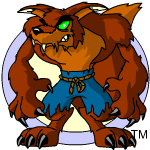
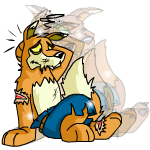
- Neopets: When painted with a Halloween Paint Brush, a Lupe would turn into a hulking Werelupe◊. However, when a Halloween Lupe had their HP reduced to 0, or came down with an illness, they reverted to a bipedal orange Lupe◊ until healed. This stopped being possible after the introduction of customization, however.
- After Jotaro dealt the finishing blow to ZZ during the Wheel of Fortune mini arc in Vaguely Recalling JoJo, the car that ZZ drove turned into a flatbed trolley with a gasoline tank.
- Inverted in an interesting way in Batman: The Animated Series: in his two-part introduction episode Feat of Clay", Clayface at one point disguises himself as Bruce Wayne to commit a few crimes. In "Feat of Clay: Part 2", when he goes through a Shapeshifter Swan Song in front of Batman and two police officers, he briefly turns into Bruce Wayne again—thus conveniently providing evidence that he'd framed Wayne.
Officer: Mother o' mercy! He looks just like Bruce Wayne!
- Non-Death example: A few times in Danny Phantom, Danny returns to his human form after losing consciousness. Averted in at least 1 later episode, suggesting it was a result of being relatively new to his powers.
- Non-death example: In the Futurama episode "A Bicyclops Built for Two", Leela meets another cyclops, whom she almost marries. At their wedding though, it's revealed that he's a shapeshifter with four more weddings to attend that day with four other nearly extinct aliens (he points out how much it costs to rent a shape-shifting tuxedo even for a day). Leela and the other four brides beat the crap out of him, demanding to see his true form, until eventually he submits, revealing himself to be a short grasshopper-like creature.
- Changelings from My Little Pony: Friendship Is Magic can copy the form of any pony, but knocking one out will make it turn back to its normal bug-like appearance.
- Two examples occur in the Grand Finale of The Owl House, "Watching and Dreaming":
- Following his defeat, Belos turns back into his Philip persona from when he was properly human, claiming he was cursed to act the way he did. Then the boiling rain comes, burning him and exposing his actual true form as he reverts to a slimy, skeletal mess.
- The last we see of the Titan in the In-Between Realm is not his almost-human sized "dad" form but a colossal demonic skeleton that resembles the Titan's corporeal body making up the Boiling Isles. It is hinted he was using some sort of Glamour to better converse with Luz.
- In Star Wars: The Clone Wars, as Savage Opress is dying, he reverts back to his original appearance, looking as he did before the Nightsisters transformed him.
