
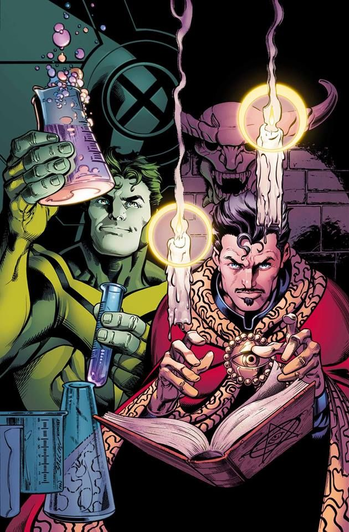
Magic is often seen as the realm of mysticism and a violation of scientific laws. Science is often seen as the realm of materialism and technology. These two realms are often viewed as unresolvable opposites; where magic holds sway, science must fail and where science holds sway, magic must fail. This trope builds on the potential factors that cause a divide between the "science" and "magic" in a work. However, please keep in mind the rules of Clarke's Third Law and the inverse law; there isn't really a difference between the concepts, except for their presentation in the story.
In many stories, modern technology (often called "science") is placed in opposition to the will of a person influencing the universe (often called "magic"). This divide can build into The Magic Versus Technology War, where both sides of the debate attempt to eliminate the other side. Stories that present the divide often use one or more reasons for the separation, summarized here:
- Magic cheats at Physics: Magic and its users create localized areas where the physical laws operate differently from normal. This may be expressed as malfunctions to machines (although only machines from beyond a given technological threshold) altering the combustion point of atmosphere causes cars to fail and fireballs to form, or electromagnetic waves collapse within magical auras.
- Magic is Mysterious: Magic follows no rules at all, therefore science will never be able to explain it. This scenario tends to work best with Wild Magic (the magic is released by the mage, but not controlled) and Theurgy (the divine being decides what spell is cast). The concept does not follow logically from magic gained from study, becoming an Informed Trait.
- Magic is an Ideology: Magic and science get along just fine, but the magicians and scientists can't stand each other. Petty rivalry or hubris leads everyone on both sides to specialize in their field and completely ignore the other. This conflict can sometimes take a subtler form, where the magicians want to keep knowledge secret and the scientists want it shared with everyone; which side is more sympathetic tends to depend on whether the author (or readers/viewers) think there really are Things Man Was Not Meant To Know...
- Magic is either the Dimension's Natural Law or Not: Depending on which dimension of The Multiverse you are in. In World A, you can shoot lightning from your fingertips if you know how and gunpowder does not explode; and in World 1, the reverse happens. It becomes a lot harder to industrialize if the oil and coal you're intending to use simply doesn't work the way they do in the real world.
Compare the following tropes: Doing In the Wizard for when seemingly magical manifestations are explained as science. Doing in the Scientist for when scientific anomalies are later explained as magic. Maybe Magic, Maybe Mundane for when the phenomenon is inadequately explained either way and the characters just can't tell. Fantastic Science for when the scientist begins to make magic their field of study. Post-Modern Magik for when the magic takes cues from technology. Contrast Scientifically Understandable Sorcery where the magic and science use the same rules but different energy sources and methods, and Sufficiently Analyzed Magic where magic is treated as a science. Magic Harms Technology is the specific phenomenon in which technological artifacts break down in the presence of magic.
To see Magic A Versus Magic B, there's Unequal Rites. If you were looking for a trope where scientists and wizards actually get into a brawl, see The Magic Versus Technology War. Science Fantasy is a genre for the heavy mixing of the two, which may or may not contain such a war. How Unscientific! is a violation of Genre Consistency that allows a work to temporarily operate as Science Fantasy. Contrast with Magitek, where both magic and science are used in combination, and Science Wizard, a character that specializes in both fields.
Examples:
- In Tweeny Witches magic is represented by the female witches and science by the male "warlocks", who hardly use magic at all (there's one real warlock, and he's very old). The two communities became divided and now witches only go to the warlocks' fortress if they're seeking children or if they've been cast out of Witch Haven. It seems that this split has stagnated both groups: the witches' technology hasn't really advanced past the dirigible, and while it appears that the warlocks live in a man-made underground cavern of plenty all their technology is mainly used for amusement or oppression. The two groups get back together in the end.
- This is the premise of the setting of A Certain Magical Index and its Spin-Off A Certain Scientific Railgun, with a secret Enforced Cold War going on between the two factions. Magic is secret and controlled by religion while science is public. Psychic Powers are classified as scientific even though they share the category "supernatural" with magic in this setting and tend to break all known laws of physics, due to being widely accepted and studied (most espers know exactly what laws their power breaks and how to make the most of that). The really odd thing is that when it comes right down to it, the only difference between the two sides is methods. Espers are magicians—that's not a snarky reference to Magic by Any Other Name, they are literally highly specialized magic users who are unable to use any other form of magic. The science side as a whole makes a lot more sense when you remember that modern espers were invented by an evil wizard.
- Interestingly, this universe's magic is, at times, more scientific than the local "scientific" esper powers. The program that creates espers can be best summed up as "plug kids into the machine and hope for the best", and produces unpredictable power-sets and levels. Magic can be used by anyone but espers at a level based on study and practice (with a few exceptions) and the knowledge of spells can be used to invent entirely new ones, or alter per-existing ones.
- Kingdoms of Ruin features a war between Witches and humans after the science advances near modern levels with the Gear Expansion that allowed them to acquire practical Anti-Magic, resulting in the witch hunts conducted by The Empire. The main protagonist is someone who seeks to overcome these challenges anyway to bring down everyone who tries to lay a finger on those who kill witches and those they love.
- Yu-Gi-Oh!, Yami Yugi is the Magic to Seto Kaiba's Science. Yami Yugi uses a deck of Warrior, Spellcaster, and Fiend-type monsters, is the spirit of an ancient Egyptian king inside a magical necklace, and believes in destiny. Kaiba by contrast uses a deck of Dragons and Machines, is the designer of the holographic technology that most duelists rely on, and says Screw Destiny. Kaiba also has absolutely no interest in the magic of the series, though it gets exaggerated in the dub into outright denial that magic exists. Which makes it all the more ironic that Kaiba is also the reincarnation of an ancient Egyptian who is attuned to a magical artifact.
- Magic User's Club has ultra-tech aliens versus high-tech humanity; even with Kill Sats, the obvious happens. They even get bonus points for not having sound in space. Then a Japanese high school club uses magic against them and they run away.
- Dragon Ball:
- Substituting magic for ki, there's a moment of this in the Saiyan arc of Dragon Ball Z. The Saiyans rely on the scouters to locate and quantify power levels, whereas the Earthlings train themselves to sense them (as well as willingly suppress them). So, due to the Raditz's over-reliance on his scouter, he underestimates Goku, Gohan and Piccolo, and dies for it. When Vegeta and Nappa touch down, Vegeta orders Nappa to discard the scouters, having worked out that the scouters are misleading; the Earthlings can modulate and mask their power levels.
- This gets later inverted in the Android arc, when the androids, products of Dr. Gero's science, are pitted against our heroes. Their strength being entirely mechanical, they don't possess any ki. Since the heroes have gotten too reliant on sensing ki for enemy detection they have a hard time tracking them down. They also tend to be at a disadvantage when fighting Androids who are roughly at the same strength as them, due to the androids' of their much vaster energy reserves, allowing them to fight at top condition much longer while the heroes eventually get tired and succumb to fatigue (this applies only to #17 and #18 though).
- In the movie Dragon Ball Z: The Return of Cooler, said enemy has been powered up by fusing with the Big Getty Star and becoming a cyborg. He's immensely stronger than the Super Saiyans and outnumbers them, being able to copy itself in multiple models. He is defeated however when he manages to capture them and starts sucking their energy - and gets overwhelmed by it. Goku and Vegeta's explanation for it? "You can't calculate the strength of a Saiyan."
- Nectar of Dharani:
- The world is industrializing and turning away from the magic of the gods. While magic is more powerful than technology (at least current technology), science is vastly more reliable. Magic tends to curse its users, only work for specific people, or just do weird things based on obscure rules.
- Valento, the dark elf chemist, sees science as a direct defiance of magic and wants nothing more than to use his science to face magic and win.
- Star★Twinkle Pretty Cure has this as a Logical Extreme. The eponymous team of Magical Girls has to fight against an Alien Invasion that is set on universal conquest. This is also the first season in the franchise that explicitly has Human Aliens, and one of them becomes a Magical Girl herself.
- Played with in Rom: Spaceknight, the hero is an alien cyborg wielding advanced technology, whilst the enemy are the Dire Wraiths, who blend magic and science in multiple ways. The Wraiths look like shapechanging demons but are mutated descendants of the alien Skrulls who were outcast for practicing magic, and they survived by fleeing to the Dark Nebula, an incredibly lethal area of space that ran on sorcerous principles rather than scientific ones. However, the Dire Wraiths were largely confined to the Dark Nebula until a faction of theirs turned to science over sorcery, constructing spacefaring ships they used to ravage the universe beyond their homeworld. After their defeat by the Galadoran Space Knights, they fragmented into two squabbling factions; those who favored magic, and those who favored science, with females being witches and males being scientists. Whilst there were some abortive attempts to combine the two forces, ultimately the females grew sick of the repeated failures of their scientific male kin (despite the fact their sorcery had been no more successful) and they wiped them all out to relaunch their campaign to conquer Earth relying exclusively on magic.
- Spider-Man versus Morlun. While Spidey's powers are based on "totemic spirits" (read: magic), they weren't helping that much against Morlun. So he beats Morlun with radiation. After checking some of Morlun's blood under a microscope.
- It's ironic that some fans disliked JMS introducing magic into Spidey's origin, overlooking this important part in the storyline where Spidey uses science to beat magic. As Spidey told Morlun, it did not matter whether or not the spider was a mystic spider fated to bite him: the radiation made all the difference. The conclusion to the Ezekial arc, "The Book of Ezekial", suggests that the basis of his powers is scientific, but he was "destined" to have them.
- The end of that story arc has Peter discussing this issue with a South American shaman, who answers that none of these possibilities are mutually exclusive. He says that a scientist would say that the sun rises in the morning because the Earth spins, while a mystic would say the sun rises because it is meant to, and they're both right.
- As for Iron Man, he treats magic as a form of science he admits that he does not understand. Furthermore, if you try attacking him with magic spells, don't get your hopes up since this Gadgeteer Genius is often able to counter anything you throw at him with his technology.
- Magic in the Marvel Universe unsurprisingly tends to be a combination of all the conflicts listed above. It usually plays havoc with any technology it is used against and attempts to analyze it scientifically tend to fail like getting different results from each test. A lot of magic involves invoking entities or physics from another universe making it incompatible with devices or scientific laws from the main universe. It also had an ideology element as attempts to understand it rationally tend to blow up in one's face as Reed Richards found out in one storyline.
- When Black Adam (about as powerful as Superman, but with no Kryptonite Factor) goes on a Roaring Rampage of Revenge in 52 he goes after the Mad Scientists on Oolong Island after he killed the Four Horsemen. Most of the Mad Scientists are understandably freaking out. Black Adam easily plows through their defenses. Then one of the Mad Scientists gives the others a pep talk. And then the Mad Scientists kick Black Adam's ass. They blind him, time freeze him, give him a tesseract concussion, beat and pour acid on him, and give him artificial spasticity in less than a minute. Science won hands down this time.
- Batman acknowledges the existence of things such as demons or ghosts, but does not view it as anything supernatural, as even magic has its own natural laws and limits. As a matter of fact, during his time training to be Batman, he learnt sleight of hand from Zatanna as an assistant in her Vegas magician's act.
- The relationship between magic and technology in Sonic the Hedgehog (Archie Comics) has changed over time; before, it was Magic is an Ideology, with the conflict being over the destructive nature of technology over the possible abuse of magic. Once Ian Flynn took over, though, the comic fell squarely into Magic is an EMP, able to trump any form of technology, no matter how advanced. It should be noted though that Chaos Energy, typically in the form of Gold Rings, provides protection from magic as well as a power boost, and that generally, if you can circumvent magic powers, you may just be dealing with a Squishy Wizard.
- In Saga, the Wreathens, who use magic, are at war with the Landfallians, who use extensive technology.
- Doctor Sivana, the main antagonist of Shazam!, is a Mad Scientist fighting against a hero empowered by a wizard. His disdain for magic over science is consequently a recurring element of his character, though it's a largely one-sided rivalry as the Marvel family show no such attitude towards science. This is played to the hilt in The Multiversity, where he turns himself into an Evil Counterpart of Captain Marvel powered by scientific principles rather than ancient gods and heroes.
- In James Robinson's Starman, Ted Knight, the original Starman, is a scientist who reluctantly accepts the existence of a form of energy that hasn't been explained yet, which provides his teammates Doctor Fate and The Spectre with their powers. By contrast, his son Jack (the fourth or fifth Starman) hates learning too much about how the cosmic rod Ted invented actually works because he prefers to think of it as magic.
- As mentioned above, Reed Richards of the Fantastic Four has a lot of issues with magic, and will often claim that it doesn't exist or that it's just another branch of science. It's been proven multiple times that despite being the world's smartest man, Reed has never been able to get a proper grasp or understanding of magic, but he does often square off against it with his scientific mind when utilized by various villains. For the record, Ben Grimm once called Reed out on this tendency, and suggested the real reason Reed never acknowledges magic as real is that he's no longer the smartest man in the room whenever the subject comes up. He also points out that after meeting countless sorcerers and mages over the years, Reed's insistence that magic isn't real has long since crossed the line from reasonable skepticism and into outright stubbornness.
Ben: Fer cryin' out loud, Franklin's nanny was a witch!
- When Hank Pym goes up against magic in Mighty Avengers he actually makes some headway on defeating it with science. He manages to entrap Loki, both a master of magic and Physical God, with scientific innovation and nullify an Eldritch Abomination possessing Quicksilver casting spells at Super-Speed by scrambling his brain's speech center.
- Legends of the Dead Earth: In The Power of Shazam! Annual #1, there is a conflict between magic and science on Binderaan. The ruling Science Council strictly enforces an adherence to science as if it were a religion. Those like the Aberrants who reject science in favour of magic are deemed to be non-believers and a threat to Binderaan society.
- As The Books of Magic, where the page quote comes from, explains, magic and science in The DCU are opposed to each other. Where and when one exists in abundance, the other is scarce. The Starheart, the source of Alan Scott's power as the Golden Age Green Lantern, was created by the Guardians of the Universe when they collected Oa's magical energies and ejected from the planet, which allowed the science that led to the creation of the modern Green Lantern Rings to be developed.
- JSA Classified: Despite living in a world where magic and vampires are definitely real, Mid-Nite and Mr. Terrific double down on the concept of logic vs. superstition when faced with a serial killer who seems to be a vampire. They end up being correct that he's not one, though Mid-Nite notes they still don't have a full explanation for everything off about the man.
- Pretty much anything involving Merklynn and the natives of Prysmos (the Visionaries) as depicted in the Hasbro Comic Universe, but mostly Merklynn given that his goal is to obliterate all technology across the galaxy and usher in a new age of magic. In their backstory, Merklynn cast the spell that brought its three suns into alignment, causing all technology on their planet to cease functioning while ushering in a rebirth of magic. At the end of First Strike, Merklynn (in his guise as Garrison Kreiger), activated the Talisman in an attempt to terraform Cybertron into a new home for his people, but his efforts were stymied, only resulting in the depletion of Cybertron's energy reserves rendering them unconsumable by the Cybertronians and the creation of the enclosed city of New Prysmos. Throughout the storyline (especially in the sequel series Transformers vs. Visionaries), it is shown that magic is inimical to Cybertronians, causing effects like fatal degradation and rusting, and Merklynn's goal in said sequel series is to finish what he started by completing the transformation (no pun intended) of Cybertron into a new Prysmos using the Talisman (with the help of the Darkling Lords).
- In CSI: Death by Chocolate, the Las Vegas CSI team's investigation into the murder of Charlie Bucket is hindered by the fact that their technology interacts in weird ways with Wonka's creations. The results of putting a piece of Wonka candy in the mass spectrometer is... spectacular.
- Crowns of the Kingdom uses the "Magic is an Ideology" version with the conflict between Merlin and Ludwig von Drake.
- The Last Seidr: Harry Potter, Fawkes, and the Sorting Hat are transported via the Tesseract from their dimension to the MCU. Due to SHIELD's reliance on technology, this trope occurs several times (to the point that it almost becomes a Running Gag).
- In the Pony POV Series:
- Luna says that one of the strengths of the current age of Ponydom was the fact that they haven't let either science or magic dominate the other, but, realizing that the two are not opposites, but counterparts, have even blended the two to create Magitek, unlike in previous ages, giving examples of how both have advanced over the centuries. For example, in one age the Earth ponies were nearly as advanced in the technology department as we are today, but had completely lost touch with their magic, while the Pegasi and Unicorns had very little technology, instead basing their civilizations nearly entirely on their native magics. Luckily there wasn't any conflict when they met each other again.
- Luna also mentions the time the goddess Strife, the Anthropomorphic Personification of Natural Selection, engineered a conflict between two equally advanced civilizations, one entirely magical and one based entirely on science, then had Judicium, the Concept of Judgment and Balance, who literally can't be biased or unfair in his rulings, make a judgement on which was superior. He ruled that neither Science nor Magic is inherently better, as they both seek the truth about how the world works, and have different strengths and weaknesses. Strife agreed, and the two nations ended up signing a peace treaty.
- The Bridge: A science fiction series is bumping into a fantasy series, is to be expected.
- Godzilla Junior, a living dinosaur mutated by radiation into the King of the Monsters. Princess Luna, an immortal magical amalgamation of three enchanted species with magic tied to the moon and stars. They get into a misunderstanding.
- The cyborg Gigan gets stymied in magical realms like Equestria, as his scanners cannot make sense of the magical energy in the environment.
- The evil Cloud Gremlins use dark magic to make their storm clouds too dense for even Rainbow Dash to break apart. Rodan applies the scientific principle of Thermal Expansion to make the clouds breakable.
- Shows up in the Sonic the Hedgehog series "Fox Was Not Meant To Fly" which features an alien grad student traveling to Mobius to study it for a thesis on the development of its alien lifeforms. After getting chewed out by his professors for sending a woefully abridged version of the planet's history, the alien explains that he is instead devoting the bulk of his thesis on the various phenomena he's observed from the planet. Each subsequent chapter proceeds to (while involving the normal denizens of Mobius going about their daily lives) explain such things as Sonic's speed, Tails's flight, the natures of the Chaos Emeralds and power rings and how they actually relate to scientific principles and technological devices created in the alien's own culture but applied to the natural world.
- In The New Adventures of Invader Zim, when they're first introduced, Dib's new friends the twins Steve and Viera have an ongoing argument on whether science or magic (respectfully) is better. This bitter debate hinders their ability to work as a team until Dib finally convinces them to Agree to Disagree and work together.
- I'm a Marvel... And I'm a DC: In the Randomverse, Batman puts this trope to use in the second season of After Hours. He deduces that something magical is blocking Spider-Man's memories of his marriage and tells Joker to have Lance read his mind. Lance explodes from his systems overloading, as, according to Batman, "Science and magic usually don't mix."
- In Scootertrix the Abridged, unlike canon, magic explicitly doesn't make sense in this version of Equestria. In episode 15, Spike drops a Logic Bomb on Twilight by asking whether she trusts magic or science more. She can't answer.
- The Other Side (memoriaeterna) features a low-key example of this when Doctor Strange is shown being privately frustrated that he hasn't worked out a way to incorporate magic into Kate Bishop's arrows, which already use such scientific feats as Pym particles in particular arrows.
- Infinity Crisis:
- Played with. In Taking Flight (And Fights), it's said that the Avengers turned to Doctor Strange after the transformation of Jennifer Walters and later the Fantastic Four. In both cases, Strange said he didn't want to risk mixing magic with radiation-caused transformations as the results could be quite messy.
- Taken more literally in Of Kryptonians and Queens, as Brainiac literally cannot comprehend the idea of magic and is certain that Merlin's powers must be some form of science, even after he's briefly turned into a rabbit and the Legion have faced Mordru in the future; later Morgana tries to combine her old knowledge of magic with Lena Luthor's knowledge of science, although it is unclear how much success she will have as Jason Blood muses such a feat rarely works.
- Fate Genesis: What Rin's rivalry with Eggman is in a nutshell. Like most other mages of the Nasuverse, Rin doesn't believe that technology is capable of keeping up with magic. Each time Eggman's creations continue to keep up and show up magic, she grows more and more frustrated.
- Oversaturated World: The magic of the human world was never supposed to be particularly widespread or flashy. As such, magic actively sabotages any attempts to research its nature or use it other than through the handful of permitted rituals.
- Weres Harry?: It is a key part of the setting lore that magic fundamentally does not make sense and cannot be scientifically explained or logically defined. Things like wanded magic and potions are at least mostly predictable, but the deeper you get into magic the less use logic and science become. This is apparently why "most wizards don't have an ounce of logic", they are born and raised in a world where the nonsensical and illogical are regular occurrences.
- In With This Ring, this is discussed and averted by Dr. Sivana. He knows magic exists and is capable of using it himself.
"Oh, you don't put any faith into that silly 'irreconcilability of magic and science' business, do you? Science isn't machinery, it's a wonderful process of examining, theorising and testing. Granted, physics is more my focus than sorcery, but I'm passingly familiar with a dozen magic traditions."
He holds up his right hand and… Conjures a small fireball for a moment, before closing his hand and snuffing it out. - This is a major theme of FateBuild: The Mechanical Magus — one half of the crossover comes from an Urban Fantasy setting involving Post-Modern Magik, with this particular group focusing on a magical tournament for the Holy Grail, while the other originates from a Post-Cyberpunk setting involving corporations battling for control of an alien artifact. The magic side is especially shocked that several of the technology side's items can actually hurt them, since per the rules of magic, Older Is Better to the degree that modern technology shouldn't be able to do squat against half the magic cast.
- In The Flight of Dragons, the hero discovers that he can negate magic by pointing out scientific flaws in it. The film is set in "the time between the waning age of enchantment and the dawning age of logic" and its major theme is whether magic and science can co-exist. The green wizard, Carolinus, says that a choice will be made between "a world of magic or a world of science". After being summoned across time and space by the good wizards, a board game designer and author from our own era confronts the evil wizard Ommadon and defeats him by chanting the names of various modern sciences. His success is bittersweet, as it resolves the choice in favour of science. The good wizards and their dragons and all other magical beings leave our world forever and withdraw into a separate "last Realm of Magic", marking the transition from one age to the next.
- Ralph Bakshi's Wizards tells of a war between magic-armed Good fantasy races and tech-armed Evil mutants. It appears to be a straight rendition of this trope, together with a hefty dose of Science Is Bad, until the chief Good wizard shoots the Evil leader with a gun at the end: a subversion that lampshades the notion that only the morality of the people wielding them makes either science or magic Good or Evil.
- The Nightmare Before Christmas: Santa can (presumably) do magic, while Jack Skellington's way of going at Christmas is more scientific. In the DVD Commentary, Tim Burton says that there's no magic in Halloween Town — despite the fact that there's two resident witches.
- The line in Star Wars about "Your sad devotion to that ancient religion", as well as other evidence of characters skeptical about the Force, despite its clear ability to do otherwise unexplainable things.
- In terms of belief and methodology. The Jedi fully believe in the power of the Force, rarely depending on science (besides perhaps medicine) to advance their knowledge. The Sith however have davelled into science for the greatest time. The Sith managed many scientific breakthroughs, developing new Lightsaber variants and even cloning that at times put the efforts of the Jedi to shame.
- On a deeper comparison between franchises, Harry Potter and Star Wars are this trope by themselves. Both highly successful universes to this day.
- In another cross-franchise connection, Star Wars is the magic to the science of Star Trek (which is slightly harder sci-fi, or at least more likely to use technobabble to explain what Star Wars would take at face value).
- In Ghostbusters (1984), our heroes are scientists who study the paranormal, which looks like magic to the layman, but is actually quite scientific. They use Fantastic Science to defeat ghosts and interdimensional conquerors. Muggles Do It Better, after all.
- In Oz the Great and Powerful, Oz defeats the Wicked Witches Evanora and Theodora with machines, pyrotechnics, misdirection and science-based stage magic.
- This is the prevailing theme of Hellraiser: Bloodline. The space station is really a gigantic array of solar mirrors designed to obliterate Pinhead with light. It is also the ultimate form of the Lament Configuration. It is revealed that to close the gateway so that it can never again be opened requires power that could also open the gateway so that it can never again be closed.
- Embodied by two of the new lead characters in Pirates of the Caribbean: Dead Men Tell No Tales. Henry Turner, son of a psychopomp, believes in and understands the magical occurrences inherent to the story's world, while Carina Smyth is a woman of math and science who refuses to believe in such superstitious nonsense at first. It takes both to achieve their goal across the film — her to actually locate the Trident of Poseidon, him to stay ahead of the supernatural dangers closing in on them.
- In the Marvel Cinematic Universe:
- In Thor, Jane Foster believes that incidents that can be described as magical or supernatural are actually scientific phenomena that haven't been fully investigated and examined. Thor confirms this belief for her, leading to the explanation that Asgardians are Sufficiently Advanced Aliens who've developed technology so far beyond that of humans that they can casually wield power that humans can't even comprehend.
Thor: Your ancestors called it magic. You call it science. I come from a place where they're one and the same.
- Doctor Strange (2016) introduces actual magic to the MCU and Stephen Strange's character arc shows him learning that there are countless realities beyond the rational scientific one he initially believes in and that magic and science can co-exist.
The Ancient One: The language of the mystic arts is as old as civilization. The sorcerers of antiquity called the use of this language "spells." But if that word offends your modern sensibilities, you can call it a program. The source code that shapes reality.
- In Thor, Jane Foster believes that incidents that can be described as magical or supernatural are actually scientific phenomena that haven't been fully investigated and examined. Thor confirms this belief for her, leading to the explanation that Asgardians are Sufficiently Advanced Aliens who've developed technology so far beyond that of humans that they can casually wield power that humans can't even comprehend.
- A Song of Ice and Fire:
- The war between the Children of the Forest and the First Men.
- It's revealed the Order of Maesters is trying to destroy magic in favor of science.
- The inhuman Others and their army of Wights against the Muggles of the Night's Watch.
- In The Dreamside Road, the backstory reveals that the IHSA worked to explain all magic they encountered, or at least to neutralize any anomalies through the use of advanced weaponry.
- The Harold Shea series of books, beginning with The Incomplete Enchanter in 1941 by L. Sprague de Camp and Fletcher Pratt, uses the Magic-as-EMP variant (even a match will not work).
- In the Old Kingdom books, the Old Kingdom shares a border with Ancelstierre, a country with approximately 1920s-era technology. Charter mages from the Old Kingdom find it increasingly difficult to use magic the further they travel into Ancelstierre, and apart from those who live near the border, most of the population don't believe in magic at all. Just about anything machine-made from Ancelstierre will fall apart not too long after being taken into the Old Kingdom. In this case, it isn't actually the technology and the magic that are opposed, per se; it's that Ancelstierre and the Old Kingdom are literally two different worlds, with different rules: in the Old Kingdom, anything not made by human hands (such as machined paper) begins to degrade, possibly due to the presence of Free Magic, which seems particularly corrosive to such artifacts.
- Harry Potter: It is mentioned several times that anything running off electricity won't work on Hogwarts grounds, and this sporadically applies/doesn't apply to things powered by batteries (e.g. Hermione insists a microphone/recording bug won't work, but Colin's camera does, though it could be an old-fashioned kind). Why this applies to pens and pencils is never addressed, but they seem to still be stuck with quills as well. Also, due to the Masquerade thing, the Ministry doesn't want Muggle technology enchanted, but doesn't do a terribly good job of preventing it (they put Arthur Weasley, a man who does it as hobby, in charge of enforcing the ban; he promptly filled the rules with exploitable loopholes and built a flying car). They're incredibly inconsistent with this; London has a legal Magitek bus service, for example.
- In Lawrence Watt-Evans' Worlds of Shadow trilogy, magic, science, and telepathy only work in the universes they come from.
- The Dresden Files:
- Harry Dresden can kill a computer by standing within twenty feet of it. The books explain this tendency by saying that magic involves the manipulation of energy and matter, which creates a "Murphyonic field" around wizards makes so that near them complicated devices tend to fail morenote . When trying to wizards are able to purposely break any sufficiently advanced technology in the area (unless it has enough backups), simply by conjuring up their anti-tech field and projecting it: Harry even notes that it requires barely any effort at all. It's also implied that older wizards have even more trouble with technology: Whereas Dresden can usually keep his Beetle going, his mentor Ebenezer drives a truck from the 30s. In the same vein, Harry had no problem running through a hospital in Grave Peril, but refused to go anywhere near the hospital to see Michael after he was seriously injured several years later, implying that his increasing power is harder to suppress.
- This was also once mentioned as a reason for Harry's usage of revolvers rather than semi-automatic pistols, as the more complex firearms tend to jam, backfire, and otherwise fail to function properly in his hands. This effect even extends to guns near him, especially when he is really angry. One time a vampire's servitor was badly injured by a backfire from a Kalashnikov (it's not consistent enough for him to rely on it as a defense option, though).
- In later books it's revealed that magic is an ever-changing force and it interferes with technology now. Some hundred years ago it made milk sour rapidly and caused people to break out with boils and warts. And this phenomenon only applies to human wizards, as other supernatural beings don't cause such interferences at all. Vampires can use the internet, fae can fight with automatic weapons, etc. which results in a huge Wham Line at the end of Cold Days.
- This is later weaponized in Skin Game, not by Dresden (who's used it in his own fashion), but instead by Marcone, who is as mundane as anyone gets in the series. It turns out that his vault has numerous sensors in it, and if those sensors suddenly stop working, that's an indication that a wizard is getting into his vault.
- An interesting variant is seen in the Magic: The Gathering novel The Gathering Dark, which features religion vs magic in a dark-ages setting, with magic sort of being equated with science. The difference between the two is that while a priest believes just because he/she has blind faith, a mage believes because he/she understands. It eventually turns out that the Corrupt Church has actually been using magic all along, the users just thought they were miracles. But a real mage beats a priest easily because the mage is better at it.
- Tales of MU has science treated in a similar way to Wicca in our universe. The author has specifically stated in the FAQs that the scientific method simply doesn't work if you try and apply it to magic. Oftentimes this is because the magic actively refuses to be analyzed in such a way - it'll work reliably until you try and prove that it works reliably. Anyway, magic exists in this world just as much as science does in theirs.
- The Star Wars Expanded Universe book Jedi vs. Sith: The Essential Guide to the Force presents the history of the two Force-wielding factions as a protracted conflict between two philosophies of magic use in what is otherwise an essentially technological universe. Whenever the Force is used to empower or manipulate objects, it is hand-waved as a magical property imposed on an otherwise fundamentally technological device. Interestingly enough, lightsabers are NOT inherently Force-imbued, although they do require a Force-wielder to use them to deflect laser bolts, and Force abilities are required for and, in some ineffable way, personalize the saber-construction process.
- In The Chronicles of Amber by Roger Zelazny, technology in Amber is under a different set of rules than the "normal" universe. At first it is implied that gunpowder will not work there, but in later stories, a substance from a magic-based universe is discovered to combust well enough to act as gunpowder. Likewise, the Magitek Ghostwheel can only function in the one particular universe it was built in, where magic and science balance equally.
- This is a major theme of Dracula: Dracula's existence and many of the methods used to repel him defy the science of the time, but science also provides people with the tools needed to finally hunt him down and defeat him. The story seems to ultimately conclude that both old superstitions and modern advancements have value; van Helsing uses both garlic flowers and blood transfusions, after all.
- In Brian Daley's novel A Tapestry of Magics, it is mentioned that technology tends to be unreliable the closer one gets to the "Singularity" (the center of the multiverse).
- The Apprentice Adept series by Piers Anthony is based around this concept — each "world" has its own laws of physics and either only magic or only technology can function in each. Notable in that the main power source for the science frame, "protonite", becomes the magic-producing metal "phazite" when taken across worlds. Regular tech works, but the super sci-fi tech's overreliance on protonite makes it fail horribly. In his Virtual Mode series, a sci-fi galaxy-owning dictator decides to begin conquering realities, because technology works everywhere, whereas magic doesn't naturally flow into many realities.
- Fred Saberhagen's Empire of the East. Most high technology ceased functioning because the very laws of physics had been changed by a powerful supercomputer in order to prevent a nuclear war from destroying humanity, which in turn made magic possible, and indeed prevalent. By the end of the trilogy, some balance had been restored, and magic and technology could more easily function side-by-side.
- In the sequel to John Dies at the End, the man in black implies there is a perfectly logical scientific explanation for him seeming to appear out of thin air. "It's not magic." However, when they ask about the invisible chair he is sitting on, he says that that actually is magic.
- Gregory Maguire's Wicked has the following explanation:
Miss Greyling: Science, my dears, is the systematic dissection of nature, to reduce it to working parts that more or less obey universal laws. Sorcery moves in the opposite direction. It doesn't rend, it repairs. It is synthesis rather than analysis. It builds anew rather than revealing the old. In the hands of someone truly skilled, it is Art. One might in fact call it the Superior, or the Finest, Art. It bypasses the Fine Arts of painting and drama and recitation. It doesn't pose or represent the world. It becomes. A very noble calling.
- In the Hell's Gate series by David Weber and Linda Evans, this is taken to a more literal extreme than most - it's about a war between two rival civilizations, one of which has a 19th-century tech base and a bit of psionics, the other of which is at largely the same functional level, but whose "technology" is entirely magic-based.
- In the combined Myth Adventures/MYTH Inc. series by Robert Lynn Asprin, magic and science don't actually interfere with each other at all and can be freely combined (leading to interdimensional computer networks and magical game shows). Most dimensions stick with one or the other, though Aahz's homeworld Perv is fully Magitek. At least one commenter, in Myth-Nomers and Im-Pervections, points out that Perv's refusal to specialize leads it to be outclassed in both arenas by dimensions that do only one or the other.
- In the Kate Daniels novels, magic and technology go up and down like two ends of a see-saw. When the technology is up, spells won't cast, and when the magic is up, guns won't fire.
- Open Sesame, by Tom Holt, has some bizarre hybrid of several versions in the main plot and/or backstory. Magic and science exist in two different worlds—Real Life and Fantasyland—but that's mainly because science and reason have apparently been rooting out the fantasy problems for two millennia of brutal struggles, and using a wish from the Fairy Godfather functions much like smuggling a rabid dog across the English Channel.
- The Bordertown Shared Universe (started by Terri Windling) runs entirely on this trope. Bordertown is the town where Faerie landed when it returned to earth, and magic and science both work more or less half the time there. This is assumed to be a product of the laws of nature in each world - Faerie is a place where magic works, earth is a place where Science! works and Bordertown is half-and-half each way.
- In the Coldfire Trilogy of C.S. Friedman, magic and technology exist side-by-side. The catch: the setting contains a form of Wild Magic that turns everyone into a Reality Warper. If a single person near a combustion engine has the slightest bit of subconscious fear that it will explode, it will explode — probably in the most disastrous way possible. As a result, most people can't use even the most minor technology unless they methodically work through a checklist to verify its trustworthiness ahead of time (and even then it's a risk to be avoided if possible). When the characters meet someone wearing a prominently displayed handgun, they know they are either (a) bluffing, (b) a fool, or (c) a seriously powerful wizard.
- In The Edge, magic works in the Weird, technology works in the Broken (our world), and they both have limited efficiency in the Edge, where the Weird and the Broken overlap.
- The Lord Darcy novels have an interesting variation. Firstly, magic is science; it's firmly understood and grounded in the laws of the universe (well, the laws of that universe). More subtle, though, is that science is magic, or at least is seen by magic users the same way as our scientists see magic - for example, a Healer derides a "wise woman" prescribing foxglove tea (i.e. digitalis) for heart problems because it doesn't fit the Laws of Similarity and Contagion. There are a lot of parallels between science and magic. One character is "only" a Master Sorcerer (that is, he has a Master's degree in Magic) because he "couldn't handle the math" required to go on and get a doctorate ("Th.D."). Another character has a doctorate, but is, for whatever reason, psychically "blind" to magic. He knows how it works possibly better than anyone else alive, it just doesn't work for him. Finally, a third character who is killed on the first page of the story he's in (the story is about Lord Darcy investigating the man's death) is revealed in short order to also have been "blind" to magic. In his case, he decided that magic was all just trickery, and he's spent much of his life investigating the physical sciences, in particular chemistry, which (partially thanks to him) is just barely beginning to come out of the "alchemy" stage in Darcy's world.
- In the Discworld, technology and science usually is based on magic. The Discworld version of a camera or a digital organiser is just a specific kind of Imp living in a little box. The Unseen University has a whole group of the magical equivalent of 80s computer nerds, inventing Artificial Intelligence using a collection of enchanted stuff, like a sheep skull and a teddy bear that mysteriously appeared one Hogswatch-night. Their computer, "Hex", has bugs. Literally. Specifically, it's partly based on colonies of bees and ants - ants as the basis for computation, bees for long-term memory via different kinds of honey.
- The Sword of Shannara revolves around this trope. Various groups of people see either science or magic as the cause of the downfall of society. They then fight and destroy each other.
- In The Night's Dawn Trilogy, the possessors have reality warping abilities summarily called the 'reality dysfunction', which form a de facto magic, if only because human scientists have not the slightest hint of how it works. Coming near to a possessor, or a possessor deliberately extending the reach of his or her powers causes electronics to fail. This is actually very inconvenient for them, as it makes travel in spaceships very difficult, and because it can be used to systematically detect them on planets with sufficient infrastructure.
- Ben Aaronovitch's Rivers of London series takes the Magic is EMP route burning out anything electronic. Notably this does include human brains, just electronic devices are more sensitive and burn out before your brain does. DC Grant goes through several cell phones before learning to take the battery out before performing magic to prevent them from blowing up. He even deduces why: the fields produce a rudimentary form of life force, but unlike living things, where you need to sacrifice the creature to get at it, the rudimentary form means they can't hang onto it.
- In Adrian Tchaikovsky's Shadows of the Apt series, the world is divided into magically focused Inapt races and technologically adept Apt races. The former can't comprehend any technology more advanced than metallurgy, and can't even put a key in a lock or pull the trigger of a crossbow. The latter, meanwhile, can't comprehend magic. They can perceive its effects but insist that it's all just trickery. There are subtler differences, too: as one example, Inapt-drawn maps focus on symbolism and significance rather than things like distance or geography and are naturally dismissed as useless by the Apt, yet the Inapt can navigate by them perfectly fine. (One interesting quirk is that Apt and Inapt races are equally skilled at chemistry; despite following wholly different chains of logic, they get the same results.) The distinction is genetic: Apt parents have Apt children, Inapt parents have Inapt children, and mixed parentage goes either way — it's impossible to be both, at least in any significant way. No amount of schooling can teach an Inapt person even basic mechanical knowledge, while the few examples of an Apt person learning magic involved them first losing their Aptitude.
- Artemis Fowl looks like a regular case of Magical Fairies vs. Technological Humans; it turns out, though, that the fairies also have technology, and it's far more advanced than ours. They have magic, but it's mainly used for things that are too hard to engineer or improve on, like healing. Magic interacts with technology sometimes, but no explanation of why magic works is ever given or asked for, possibly because of its religion-like source.
- Bitter Seeds by Ian Tregillis features an alternate World War II where the Nazis have science-made psychics while the British have demon-summoning warlocks.
- Kim Newman's short story "Swellhead'' features Richard Jeperson, a psychic investigator (magic), and Adam Onions, a government think-tank scientist who investigates the paranormal (science), who have a long-standing enmity and a history of quarrelling about this very subject. The story presents Jeperson as more in the right, although crucially, he's not anti-science; he just opposes Onions' blinkered, self-serving and close-minded form of science.
- Mike Resnick's "Buntline Special" has Ned Buntline and Thomas Edison hired by the US government to circumvent the Native American magic that has prevented them from expanding west.
- In Smoke and Shadows, Arra comes from an Alternate Universe where magic has been developed further than technology, and science is treated as an extension of magic. Magic is likewise studied and applied in a rationalist manner. Interestingly, based on the spell book she stored on her Magical Computer, her people did not know very much about demonology or necromancy, the two most widely-used forms of magic on the Earth in which the Blood Books and Smoke and Shadows take place, a world where most people do not believe in the supernatural.
- In The Amtrak Wars series it's actually Mutant Psychic Powers vs Science but since it's called magic by both sides, close enough.
- While not technically magic, Faster-Than-Light Travel in The Road Not Taken basically smashes all known laws of nature. Species that stumble upon it just give up and and cease all scientific progress in favor of exploration and conquest. Then one of the races hits Earth.
- The science fiction novel The Gray and the Green, centres around the survivors of two enemy alien races (actually from the distant past), called the Grays and the Greens, who fled the destruction of their homeworld and ended up in New York in the Nineteen-Twenties, each assuming that the others had been killed in the apocalypse only to learn in the present day that their enemies had survived. The Grays are master engineers with high-tech gadgets, whereas the Greens have incredible superpowers, such as the ability to summon huge earthquakes.
- In The Mortal Instruments, the extensive wards that conceal and protect Idris also appear to interfere with technology. Hence the Shadowhunters do not use things like automobiles to get around within the country, even though those that live elsewhere are quite familiar with them. Witchlight is used to provide things like illumination that would normally be powered by electricity in other countries. Elaborate mechanical devices, possibly related to phonographs, are used to play music. There is no cellular coverage or internet access naturally. It is also noted that Runes interfere with the proper ignition of gunpowder, which is why Shadowhunters do not make use of firearms.
- In H. P. Lovecraft's Cthulhu Mythos, "magic" and the supernatural are usually considered to be a form of hyperdimensional science that human minds are incapable of truly comprehending (and tends to make said minds go utterly bonkers if they practice it anyways). Of course, it can be considered something of a moot point considering that humans are as insignificant bugs (at best) to the more capable users of said sciences, who tend to be equally brain-breaking sufficiently advanced starfish aliens or eldritch abominations (or both). It's that kind of setting.
- In Please Don't Tell My Parents I'm a Supervillain, mad scientists and magic-users hate each other and refuse to associate. Scientists insist that magic is just a natural process they don't understand yet, while magic-users insist it's beyond the ken of mere mortals. It's implied that scientists are on the right track (Cybermancer came up with a theory that, while disproven, produced a useful methodology for working with magic scientifically, and the Mad Scientist Penny has no problem using magic in her inventions), but since they insist on treating every single piece of magic as its own discrete problem, they're never going to see the big picture and figure out what's actually going on. It's like the parable about the blind men trying to figure out what an elephant is.
- The setting of Tale of the Unwithering Realm has a rather complicated take on this. "The works of men", i.e. gunpowder, electronics, etc. don't function in or near the twilight (the substance from the Void Between the Worlds), since "the darkness is without form, and void, so the works of men must fail in the twilight, because their form is less." However, there's more to it than that: each world has different physical laws and different arts which work in it (e.g. science for our world, necromancy or astrology for others), and the twilight nullifies all technology/magic which is characteristic to individual worlds and not common for all of them. Hence also why astrologers of the Dark Tower must use gigantic clockwork Babbage machines instead of computers to do their predictions; only simple mechanic devices function correctly near the sources of twilight.
- In L. Jagi Lamplighter's Rachel Griffin, technology weakens magic and magic weakens technology. Unusually, there is research going on to work on this problem.
- In the short story "To Dam It Where It Trickles" by Peter D Manison, published in Dragon, a young apprentice learns that scientific knowledge blocks the ability to do magic and decides she would rather understand how the world works.
- In The Pillars of Reality, the Mages and the Mechanics each teach their students that the abilities of the other side don't really exist, saying that it's just tricks, illusions, and sleight-of-hand.
- Second Apocalypse: the Inchoroi and the Nonmen. The Inchoroi traveled the stars and create Organic Technology with their "Tekne," while the Nonmen are a proud warrior race of sorcerous elf-equivalents. The two races eventually came to blows using their respective weapons, though a splinter sect of Nonmen did eventually teach the Inchoroi how to use sorcery as well.
- Averted in Vampirocracy. Leon and Ling took college classes in cryptozoology, mythozoology, thaumobiology, and thaumodynamics. While Leon notes such disciplines were frowned upon or considered heresy by some scientists before the world was unmasqued, others were aware that science was just a means to understand something, and could be applied to magic.
- While this trope is generally averted in The Girl from the Miracles District in favour of Magitek, the eponymous District works on the "Magic is EMP" principle and does not accept any technology that did not exist in 1936.
- The Queen of Ieflaria: Esofi doesn't trust this new "science," especially superstitious tales of tiny monsters called "bacteria," and mentions that they might have to burn down the hospital for blasphemy. Adale, while far from a scientist herself, is well aware of the benefits of science (in particular, there hasn't been a plague in Ieflaria in a hundred years) and tries to talk her down.
- In Dad, Are You the Tooth Fairy?, there apparently used to be fairies, elves, minotaurs, mermaids, trolls, wizards, and unicorns, but they had to go "because of technology".
- In Star Trek, most of the characters are generally adamant that everything is scientifically explainable, even when it's not. Which is interesting mostly because innumerable species in the Star Trek universe exhibit abilities that would be considered "paranormal" in the real world. Even the telepathic powers of Federation species such as Betazoids and Vulcans would fall under that category in real life, much less the often godlike powers possessed by very advanced races. Interestingly, there is little evidence on the show that humans at least are inclined to conduct serious scientific investigation of any such powers that are not obviously derived from a technological source, and they are simply dismissed as inexplicable, but not "magical".
- At least for Betazoids, the mechanism for telepathy appear to be known and scientifically explained; Dr. Crusher mentions at least once the area of their brains and the neurotransmitter responsible.
- The issue is called out rather explicitly in the Star Trek: The Next Generation episode "Where No One Has Gone Before". Due to the abilities of an alien ("the Traveler"), the Enterprise has been transported to a place where thoughts become reality.
The Traveler: You do understand, don't you, that thought is the basis of all reality? The energy of thought, to put it in your terms, is very powerful.
Kosinski: That's not an explanation.
The Traveler: I have the ability to act like a lens which focuses thought.
Kosinski: That's just so much nonsense. You're asking us to believe in magic.
The Traveler: Well, yes, this could seem like magic to you. - Discussed in the Star Trek: Deep Space Nine first season finale, "In the Hands of the Prophets": the events of the episode are set into motion when Vedek Winn, a dogmatic leader of Bajor's faithful, takes issue with the fact that Keiko O'Brien's teachings of the wormhole are completely secular, referring to the Prophets, the gods of Bajoran religion, as "wormhole aliens" or "wormhole entities". Tensions begin to build on the station as Winn stigmatizes Mrs. O'Brien and drives a wedge between the station's Bajoran residents and Starfleet personnel. Parallels are also drawn between this conflict and Galileo, whose teachings of heliocentrism (the earth revolving around the sun, instead of the sun revolving around the earth) was similarly stigmatized by his more religiously ardent contemporaries.
- In the Buffyverse, magic and the paranormal are a carefully-guarded secret. When the US government discovers the existence of demons and other monsters, they assume they're simply rare animals, mutants, or products of The Virus, and so start experimenting with them in order to turn them into weapons. In the fourth season, they soon learn they can't control it, when their prototype human/undead/demon/cyborg manipulates them into doing as he wants. This comes to a head when Buffy, herself temporarily fused with Willow's magic prowess, Giles's knowledge, and Xander's spirit, beat the ever-living shit out of the combo-demon after a season of it handing her ass to her. In his commentaries, Joss Whedon notes that it came down to magic versus science, and in a situation like that, "magic would kick science's ass". This idea did get a bit broken by the Word of God that people who do impossible things with science on the Hellmouth (such as create a demonic Frankensteinian nuclear-powered cyborg) are actually using magic without knowing it.
- Doctor Who flips back and forth on this. The Doctor is almost always adamant that magic is not real and everything is at worst some sort of unexplained science, yet several adventures feature stories that match the definitions/descriptions of magic within the story:
- "The Dæmons" has the Master engage in black magic rituals to summon and control a powerful alien. The Doctor admits that the Master's incantations, gestures, symbols, and rituals are not window dressing, but have actual power matching the exact description of black magic given by the local white witch — yet the Doctor insists on claiming it to be the 'secret science of the Daemons."
- In "The Shakespeare Code", the Tenth Doctor explains that while humans took to numbers, the Carrionites took to words that look and act just like witchcraft and which the Carrionites call magic distinct from science. The Doctor insists that it is science. Interestingly, it seems as though this is not a phenomenon unique to the Carrionites, as it seems that nearly anyone can use the system, but most lack the ability to understand it enough to make anything more than a basic use of it. The Doctor himself can only grasp the basics and needs help to make it work on a larger scale.
- It's mentioned in the expanded universe that magic did once exist in the current universe and was even practiced in Gallifrey. Rassilon, however, despised magic, and with the Time Lords' ascension, magic was quashed beneath science. There was in fact a race of magic users who began approaching time travel before they went to war with the Time Lords and lost, getting them Ret Goned. Had they won, they would've replaced the Time Lords as the dominant race with magic being the common phenomenon. So in general, magic vs science actually occurred and magic lost.
- This might explain the Doctor's insistence on magic not existing. His race literally booted it and its followers out. And if it does exist, it means they could be back... and probably be very very pissed.
- Doctor Who spin-off The Sarah Jane Adventures had an episode that featured energy beings called the Ancient Lights from the previous universe that derived their powers from astrology contrary to the physical laws of the Doctor Who Universe. The characters finally admit the Ancient Lights violate the laws of the universe, but not once do they call it magic despite violating the natural laws of the universe being one of the more commonly accepted definitions.
- The Made-for-TV Movie Paradox
 (based on a comic of the same name) was set in a parallel universe where magic was the basis of technology, and science was seen as superstition. The main character, a Cowboy Cop who distrusted magical evidence, was derided by other cops with lines like "What do you want to do, dust for fingerprints?" His Love Interest was a Granola Girl who advertised herself as a "Professional Pragmatist", and was able to identify a nonmagical explosive (gunpowder) and a nonmagical narcotic (cocaine) as being based on the ancient scientific beliefs of the Chinese and Incas. They also visited the science-based world, and Winston Churchill (who's a powerful wizard in this world) speculated that the reason it never developed magic was that it contained more iron.
"Magic has limits. Science has limits. But when magic couldn't cure cancer or get us further than the Moon, we gave up. Science never gives up."
(based on a comic of the same name) was set in a parallel universe where magic was the basis of technology, and science was seen as superstition. The main character, a Cowboy Cop who distrusted magical evidence, was derided by other cops with lines like "What do you want to do, dust for fingerprints?" His Love Interest was a Granola Girl who advertised herself as a "Professional Pragmatist", and was able to identify a nonmagical explosive (gunpowder) and a nonmagical narcotic (cocaine) as being based on the ancient scientific beliefs of the Chinese and Incas. They also visited the science-based world, and Winston Churchill (who's a powerful wizard in this world) speculated that the reason it never developed magic was that it contained more iron.
"Magic has limits. Science has limits. But when magic couldn't cure cancer or get us further than the Moon, we gave up. Science never gives up." - In Sir Arthur Conan Doyle's The Lost World, Professor George Edward Challenger is constantly skeptical of any supernatural activity and insists that everything can be explained with science. While he's right sometimes, The Lost World has several genuine sorcerers, cursed items, etc. Later in the series, he believes magic is real, but is still displeased whenever it shows up.
- Lampshaded in Once Upon a Time, when Mad Scientist Dr. Frankenstein is brought to the world of Fairy Tales. Victor is less than impressed when Rumpelstiltskin challenges him to a bet over whether magic is more powerful than science.
- Comes up often in the Stargate-verse, what with the various Sufficiently Advanced Aliens masquerading as gods. A conversation between Daniel and the season 10 Big Bad in disguise shows how the argument usually breaks down in-universe.
Daniel: See, to many less developed civilizations, certain advanced technologies would strike them as supernatural in nature. Merlin wasn't a wizard, and Morgan Le Fay was not a sorceress...They simply used their advanced abilities to fashion seemingly magical creations, like the Sangreal or that time dilation field we encountered.
Osric/Adria: So you would have me believe that you are possessed of a complete understanding of these amazing feats?
Daniel: No, but just because I don't know how the trick is done doesn't make it magic. - Kamen Rider Ghost has this quite literally with the conflicts between Takeru's friends Akari (a scientifically-minded Scully) and Onari (a Buddhist monk Mulder) who often butt heads. Though they don't always agree, they eventually come to respect the other's efforts and their squabbles are muted in the latter half of the series.
- The two-episode story arc that resolved Akari and Onari's conflict also had the Newton Eyecon "running away" after the heroes acquire the Himiko Eyecon, with both of them feeling that his belief in science and her mysticism are incompatible. A few different factors make this particularly head-scratching: ignoring the fact that Sir Isaac Newton was a devout Christian in his lifetime, the entire series is about the supernatural (The Hero Takeru is a ghost trying to find a way to come back to life) — which is the only reason Newton and Himiko are around to be Transformation Trinkets in the first place. After Akari stands up for Onari in the face of a Mad Scientist villain, the two Eyecons resolve their differences, allowing Takeru to combine their powers and defeat the Monster of the Week.
- The central premise of Emerald City with the brewing war between the Wizard (despite the name, he's actually a scientist, who utterly despises magic and has outlawed it in Oz) and Glinda, who is revealed to be secretly producing more witches to bolster her army, even though she and West were supposed to be the last two cardinal witches. While, normally, only a witch (or the Beast Forever) can kill a witch, it's revealed that a gun can do the job just as well, prompting the Wizard to try to get as many of them as possible. Except it turns out that's not the case — the gun only killed the Witch of the East because she herself, a witch, was the one who fired it, having been tricked by Dorothy into doing so after pointing it at her own head. The Wizard has a major Oh, Crap! moment when he realizes this.
- Bone Busters, being a mockbuster of Ghostbusters, features a team of heroes fighting a horde of animated skeletons with beam-shooting energy rods.
- Dungeons & Dragons: Because of the "build your own" nature of D&D, the applicability of this trope to a homebrewed setting is a matter of the Dungeon Master's personal taste. When it comes to more official settings...
- Mystara plays with the trope in that technology and magic are usually not portrayed as inherently incompatible at all. In the ancient past, the empire of Blackmoor built a hyper-advanced civilization by blending their native magic with alien hyper-science to achieve incredibly powerful magitek. In the modern era, you have the nation of Glantri, The Magocracy but built on the principles of Fantastic Science and actually using an ancient nuclear reactor from Blackmoor as a magic augmentator, as well as Serraine, an artificial Floating Continent literally built out of Magitek. In the Hollow World, the Blacklore Elves are surrounded by what looks like incredibly advanced science, including cyber-prosthetics and labor robots, but which is all actually magical imitations of their former tech.
- Eberron is a magic meets industrial revolution setting, with standard heroes and monsters in a world with magic trains and hover-ships, thanks to magic having become treated like science. However it points out that since magic needs wizards and the like and can't be mass-produced, a lot of magic items are quite expensive. There are "working class" spellcasters such as Magewrights who apply magic to everyday trades, and even a spell called "Magecraft" whose sole purpose is to improve the quality of mundane goods during their manufacture. House Cannith has also managed to develop magic-powered mass-production of many products. Hence the standardized price for something like a sword anywhere in Khorvaire, since most of them came out of a Cannith factory.
- In module EX2 The Land Beyond The Magic Mirror the PC's could find a "den of technology" filled with scientific items. If a PC took any of them, each one would eventually destroy a magic item the PC was carrying.
- In the world of Greyhawk, black powder simply doesn't work, meaning that firearms literally can't be invented. There is a minor demigod named Murlynd who visited The Wild West and later became the patron deity of technology; he owns the only working gun in the world. Later on, his followers gain the ability to build and use guns as well, likely thanks to their faith in their divine patron.
- The Forgotten Realms has a similar set-up, with chemical black powder not working and being replaced with a magic-based "smoke powder" alternative, which is actively controlled by a deity (Gond, God of Technology, in fact) and with wizards actively stamping out attempts to develop guns.
- In the Ravenloft, the Technology Levels of the various domains tend to shape attitudes about magic. As a rule, the more technologically advanced a given domain is, the less seriously people take magic. Even though they live in a blatantly supernatural Pocket Dimension and magic is for the most part consistently powerful regardless of which domain you are in.
- In Dragonlance, the tinker gnomes are firmly on the side of Science and preach the idea that science is superior to magic loudly and insistently. Unusually, they're portrayed as completely in the wrong; only the honor-bound, arcane magic-averse Solamnians give tinker gnomes any credibility, and even they admit that, 999 times out of 1000, anything tinker gnome technology can do, magic can do quicker, more reliably, safer and cheaper. It doesn't help that the tinker gnomes are stricken as a race with a divine curse that condemns them to be Bungling Inventors, who cannot approach science in anything resembling a logical, coherent fashion. As a result, everybody on Krynn relies on muscle power or magic, and the word "technology" is somewhere between a joke and a profanity.
- One of the very last modules produced by TSR was "Tale of the Comet", in which a generic D&D fantasy world becomes caught up in a galactic war between a dying alien race and a relentless mad Artificial Intelligence determined to wipe out all organic life. The fantasy world (and specifically the PCs) become integral to defeating this AI, called the Overmind, because its robotic forces are highly vulnerable to magic, a force that doesn't work on scientific principles. This doesn't prevent wizards from outfitting themselves with Powered Armor and Energy Weapons donated by the grateful alien Rael, however.
- Before "Tale of the Comet", Dragon #258 and #270 introduced the Sheen; an invasive race of self-replicating alien robots hostile to all organic life. Their debut article introduced two factions of wizards who both keep alert for the appearance of "Machine Cysts", as Sheen outposts are called; the Vital League, whose "Sheenchasers" are wizards specialized in hunting down and destroying the Sheen with their spells, and the Machine Coalition, whose "Machine Mages" are wizards specialized in capturing and subverting Sheen technology and even Sheen themselves. Both factions thrive because magic is noted to be especially powerful against Sheens, which are otherwise very resistant to the more mundane methods of inflicting physical violence typically available to the average D&D world's inhabitant. The sequel article introduced Manikins, which are humanoids who have been rebuilt as Sheen-based cyborgs, and the Arcanosheen; a new Sheen model that can cast spells itself because it has been integrated with a module filled with liquified wizard brains... although, ironically, it now has become uniquely vulnerable to mind-targeting attacks.
- In the Old World of Darkness, magic is ubiquitous, however it is only when the rigors of science are applied that it produces truly amazing results. Naturally, the clan of vampires who do this (Tremere) are feared and hated by all other clans for their sciencey-magic. Well, that and the fact that they're jerks. The best application was using the Human Genome Project as a True Name of humanity. You might think that something as reckless as that would turn out to be a terrible mistake and cause them a whole lot of trouble in the future. It eventually did... the same year as the whole world ended anyway.
- In Mage: The Ascension, the Technocracy (representing science and technology) was in a war with the Traditions (representing standard magic) over the nature of reality. It also subverts the trope somewhat, seeing as scientific laws only work because the Technocracy long ago convinced the majority of people to believe in them, due to the consensual nature of reality in the WOD (i.e. reality is what the majority of people believe it is).
- Science is just another form of magic, with a vast, well-armed conspiracy to ensure that people disbelieve in anything else. That disbelief makes it difficult and dangerous to use magic, especially in public. Based on Post Modernist ideas, the writers had intended players to believe that it wasn't just the Technocracy that was wrong, it was the scientific method itself.
- The Technocracy originally formed when a group of wizards decided to create a form of magic that was egalitarian and available to all, reduced the power of evil monsters, and was safer for ordinary people. Some players think they eventually lost track of this fact somewhere along the way, and others consider them to be an Anti-Villain. Written as sympathetic villains, even the writers have struggled with this one. Later on, they were given enough Character Development to make them much more reasonable with it made clear that they for the most part do at least want what's best for humanity, and even included rules for playing sympathetic Technocrats hoping to reform the organization rather than break its control.
- Interestingly the Magic versus Science idea tends to come off as one-sided on the Technocracy's part. Most Tradition Mages (except the Verbena) actively use technology and have no problems with it when it is not being used to send Terminator Impersonators to rip their arms off. In fact, two of the Traditions, the Virtual Adepts and Sons of Ether, used to be part of the Technocracy and still use technology to help them with their magic. Meanwhile, the Technocracy is absolutely unwilling to allow any magic to exist if they have anything to say about it, though to their credit this is because they believe that Muggles believing in magic will eventually make them stop believing in science altogether.
- Other Old World of Darkness games picked up the same themes. Werewolf: The Apocalypse had the Weaver, a cosmic force representing technological process and scientific reasoning... as well as stasis, which was a problem, because she'd gone bitch crazy several millennia ago and was trying to wrap the entire world up in her webs, killing stray thought in the process (the Glass Walkers were the only ones who gave her the time of day any more). Changeling: the Dreaming, like with several of its themes, was split on this one: science was taken as a means of "trying to wrap everything up in safe terms" in some cases, which could made it a force of Banality... but the nockers were quick to remind everyone that the greatest flow of Glamour in recent history was triggered by the moon landing.
- The New World of Darkness has an interesting variation in the backstory to Mage: The Awakening, with the so-called "Nameless War". The war was fought between the Diamond Orders (who believed in a system whereby all magical knowledge should be based on ancient Atlantean traditions) and the loosely organised and nameless (names having power and all) revolutionaries who believed that the greatest source of magical knowledge was through any system which had strong meaning to the majority of humanity, which was primarily science. When the Seers of the Throne offered to join forces with the Nameless and create a system of oppressive technocracy, the Nameless rejected violently (since their beliefs champion freedom of thought), became the Free Council, and joined the Diamond Orders. While there is tension between the traditional Orders and the Free Council, they stay together out of a belief that "Magic Vs Science" is trumped by "Liberty Vs Control".
- Incidentally, this history may be the cause of some interesting relationships with the fan expansion, Genius: The Transgression. Geniuses generally have strained relationships with Mages, due to fundamentally different approaches and the mysterious nature of Inspiration, but the Free Council get along with the Scholastics, a genius Foundation. They often have to work together because occasionally a newly catalysed Genius is mistaken for a Mage, and vice-versa, and they have to perform swaps before bad things happen. Inversely, the abovementioned Seers of the Throne and the Genius' resident Ancient Conspiracy (or what's left of it), Lemuria, seem to be incapable of noticing each other. Nobody knows why.
- In Shadowrun, Cyberware / Bioware / Genetech damage the body's 'wholesomeness' (called essence) and therefore its ability to use magic. If someone's essence reaches zero, their soul is no longer connected to their body and they die, unless magic is used to turn them into a Cyber Zombie (read: Cyborg). Technology and magic are however mostly separate, and except for the intrusive implants, do not impede one another. A mage can still use computers and guns fine. At the same time, more technologically complex objects are harder to cast magic upon.
- Rifts plays with this trope. You will be killed on sight if you use magic in many areas, but some mages create "techno-wizard" items where a semi-technological device is imbued with magic. In fact, several of the setting's more advanced societies (the Splugorth, most of the power-players of the Three Galaxies, and most advanced primarily magic-using nations) use a combination of magic, Magitek, and tech with little to no apprehension. In the Palladium Megaverse, extremism one way or the other is the wrong answer — pro-tech, anti-magic nations tend to be speciesist, militant totalitarian regimes, while pro-magic, anti-tech nations tend to be literal demonic hell-holes.
- Genius: The Transgression: Played with. The Peerage treat Inspiration almost like a form of magic. Lemuria is utterly convinced it's a rational science. It's not. Accepting that Inspiration isn't a science and that a Genius doesn't know great scientific truths the unwashed masses are too stupid to see is the first step to preventing yourself from performing horrific experiments so the Peerage comes off ahead here. Despite all this, the Peers would love to turn Inspiration into a science but that project is going nowhere (which might be because mad scientists are useless at actual research). The actual Magic vs Science: Sane science vs mad science puts sane science ahead on just about everything except raw power and ease of invention.
- DC Heroes RPG. There is a strange conflict between magic and science that goes back thousands of years.
- In places where science is strong (e.g. a scientific laboratory), magic is slightly weaker, and vice versa.
- Anyone trying to construct a technological Gadget in an Occult Workshop (or an Occult Artifact in Gadget laboratory) took a large penalty to their chance of success.
- Ars Magica 3rd: "Reason" is a metaphysical force like the Divine, Infernal, Magical, and Fae realms; so places like laboratories and people with True Reason erode magic, potentially with Puff of Logic effects. The illogic of Reason being opposed to magic, when magic is transparently real and is studied through strong scholarly traditions of its own, led to the mechanic being scrapped in later editions.
- Warhammer: Age of Sigmar: One of the ways in which the Kharadron Overlords preserve their fundamental dwarfishness is by their distinct ill-ease with the subject of magic, loudly touting the superiority of their science instead. Ironically, the setting points out that their Steampunk "technology" is actually magic that looks like science, being an "evolved form" of the common magic style known as the Lore of Metal.
- In Disney's Believe, Sophia believes in magic and fairies, while Dr. Greenaway is more focused on science and fertilizers—though, as Sophia notes, love is the real magic.
- Both averted and played straight in Albion. Albionian Magic and Terran science are merely two aspects of the greater whole, that are in continuous conflict with each other. The only differences are that Terran technology uses energy from matter and is based on well-definable principles, while magic energy from one's spirit, and is governed by more abstract and undefinable laws. That said, It's actually possible for someone to cast a spell using nuclear energy, and incidentally, the player's ultimate goal involves just this.
- Arcanum is an exceptionally well thought-out example: "Magick" is actually Reality Warping, and the more complex a given device is, the more likely having the laws of physics bent in its presence will break it. Result: most mages can only ride trains if they stay in the caboose for the safety of both mage and machine, and powerful mages have to learn to teleport or get used to walking. Likewise, attempting to use magic around a complex machine is a bit like sticking your hand in said machine; you'll break it if you're lucky, if not it'll shred you without missing a beat. Result; complex technology generates its own anti-magic field. Thus, spells are less effective against someone with a lot of high-tech gear, and becoming a technologist weakens your ability to use magic.
- Because of this it turns out the plan of the Big Bad, an immensely powerful Mage, is to build a massively complicated machine that doesn't actually do anything but which will generate a strong enough field simply by operating that it will punch a hole in his extradimensional magic prison.
- Furthemore some devices created by the inhabitants of Vendigroth (a highly scientifically advanced civilization that was wiped out by a super powerful mage), like Bronwyck's Gun and The Vendigroth Device were designed to exploit this, the gun uses an inherently magical metal in it and fires the dissonance as a projectile while The Vendigroth Device was supposed to render the mage that wiped out their civilization out Deader than Dead by turning his magic against him.
- In the backstory of Bloodstained: Ritual of the Night, scientific advancements have cast doubt on the magic of old. The Alchemist Guild tried to stagnate scientific progress, claiming that those who put more faith in Science instead of Magic would instigate a demonic invasion, just so they could retain their prestige and wealth.
- Averted in Aggressive Games's Brightest Kingdom, your Renaissance fantasy kingdom is in a war against dark forces who have almost wrecked the kingdom. Your government will happily fund the research programs of the Engineering and Wizard guilds equally - after all, a dead Orc is a dead Orc regardless of whether it was killed with magic or a machine gun.
- Underplayed in Control - The Oldest House, the Eldritch Location in which the game takes place, will not tolerate any technology from later than the '80s, with various devices either disappearing or violently malfunctioning. Likewise, modern technology tends not to become Altered or gain Power. A document that explains this speculates that it takes a while for the newest tech to become sufficiently ingrained in the public unconscious for the Altered World Events to affect them.
- In Doodle God Blitz, the second stage of the game has you creating a world with aspects of both, but Doodle God realizes they can't co-exist and splits it into two worlds. The third stage has you developing the scientific world, and the fourth and final stage has you developing the magical world.
- Dota 2 has the technology-wielding Science Hero Tinker who displays a condescending attitude toward both magic and its users.
- The Red Law vs White Law boils down to this in Duel Savior Destiny. Red is magic and emotions and White is science and causality. It's extremely difficult to reconcile the two or really grasp both at the same time due to the fundamentally different rules between them and this tends to lead to conflict. While the story follows the perspective of people firmly in the Red camp and White heads the army of monsters, they're actually both equally important to the way the world functions.
- Final Fantasy games sometimes invoke this trope. Villains often see themselves as championing one side or the other (or the combination in Magitek), but the good guys are usually willing to use both science and magic, with a healthy respect for both.
- The one that likely embodies this most is Final Fantasy VII. The villains are the corporation Shinra, the Eldritch Abomination from the stars Jenovah and the Humanoid Abomination created by Shinra from Jenova's cells Sephiroth. Shinra embodies science and Jenova/Sephiroth are the magic and both abuse the lifestream in their quest for power. The heroes have the respect for both using both technology and materia to stop both sides.
- The backstory of Final Fantasy X includes a massive war between a science and technology-based super-power and one based on magic and summoning. The magic users "won" by turning their entire population into a power source for a weapon of mass destruction which wiped out 90% of the rest of the world and then stuck around to keep the world stagnant, undeveloped, and dependent on magic-users for hundreds if not thousands of years.
- Final Fantasy X-2 takes this a step further by showing the "losing" side's own trump card, Vegnagun, a machina whose destructive power was never used because it could not distinguish friend from foe. One can only imagine what would have happened if the two had ever met on the field of battle.
- Averted in Greedfall. The Bridge Alliance and Thélème are clearly the Science and Magic factions, respectively, but the conflict between them is purely political and economic in nature, and neither side has any objections to using the opponents' tools.
- Magic won in the world of Guilty Gear, as after the discovery of magic and an event known as the Dawn of Revival which caused the failure of all electronic devices on Earth, modern technology was banned outright by the UN. However, said technology (now referred to as Black Tech) is still used and improved in the autonomous Floating Continent of Zepp, leading to a couple Super Science users like Potemkin and Robo-Ky in a roster full of magic users, ki users, magically-engineered biological weapons and otherwise supernatural beings.
- Mild example in Kingdom Hearts II. In one visit to Hollow Bastion Cid and Merlin are shown to be at odds, with their use of technology and magic (respectively) grating on each other's nerves, (their personalities also factor in quite a bit). Subverted in that while they annoy the crap out of each other, they end up successfully making a computer disc that combines Cid's programming and Merlin's magic into a powerful deletion program and power booster for TRON.
- The Longest Journey Saga:
- In The Longest Journey, magic and science are actually complementary forces of the universe, but in ancient times, rampant abuse of their union had almost caused The End of the World as We Know It, so Earth was divided into two parallel worlds of magic and science, with the Guardian in-between to keep them separated. But some subtle remarks by the Big Bad imply something more to it...
- In Dreamfall: The Longest Journey, some of the most advanced technologies like Faster-Than-Light Travel ceased to function after restoring the Guardian to his post, implying that it was actually magic.
- In Dreamfall Chapters, the Azadi steam computer causes disturbances to senses of magical races, driving some of them out of the city. It's implied that this computer actually manipulates the power of dreams, underlying magic, science, and reality itself.
- In Marvel vs. Capcom 3, M.O.D.O.K. is adamant that his scientific devices will prevail over the magic powers of some of his adversaries.
MODOK: [to Iron Fist] Your chi can never compare to the powers of science!
- In Metroid Prime 3: Corruption the natives of Bryyo had an entire war over this. The war caused 96% of the planet to become uninhabitable and the survivors became barbarians. Notably, the Chozo (who themselves struggled with similar problems in the past) warned them to seek a balance between the two, but they didn't listen.
- Mortal Kombat:
- This is a major plot point with the Lin Kuei clan, starting in Mortal Kombat 3: the Lin Kuei begin to subject their assassins to Unwilling Roboticisation, leading Sub-Zero to rebel against them.
- Strangely absent elsewhere though. Thunder god Raiden allies with both martial artists, shamans, police, and cyborgs to defend Earthrealm. And while the major villains are ignorant of technology they don't pass down a hand in battle, even a cybernetic one.
- Also absent for the Predator in Mortal Kombat X: his kind have no experience with magic, but in his arcade ending, he gladly uses Shinnok's amulet to upgrade his arsenal with Magitek.
- Done at a symbolic level in Puyo Puyo Tetris 1 and 2, with Puyo and its associated characters themed on magic, with the bulk of those characters being students and faculty at a Magic School; while Tetris and its associated characters themed on technology, with most such characters forming the crew of a starship wandering around the galaxy. Together, they reflect the contrasting gameplay between Puyo Puyo and Tetris. The characters initially clash, but they soon get along when both sides find themselves under threat from greater forces.
- Later games in the Quest for Glory series feature this as a side theme. In the fourth game a scientist flat-out refuses to believe in magic (even if you're playing a wizard yourself), and in the fifth game the scientists hate/refuse to believe in magic so much that they end up poisoning all the mages in the game, including the player if he isn't careful.
- In Roots of Pacha, the Pacha clan believes that the nature goddess Pacha is responsible for all the natural phenomena. However, Garrek is the only one who seeks a scientific explanation for them, and he applies his school of thought into his inventions to help the village prosper. He feels excluded when the community doesn't take him seriously because of this.
- Ryzom's two main Religious factions are the science-loving Karavan and the magic-loving Kami, and as par for the course, both sides hate the other's guts.
- Shadow Realms features the "worlds just work differently" type. On Embra, magic is much stronger than on Earth, not just for native residents but for magic-users who were born on Earth and therefore never had the right environment to fully develop their powers. However, a lot of Earth technology doesn't work (guns being a notable exception). Since Embra has been recruiting from Earth to help defend against a third party, people seem to be figuring out how to use magic and technology alongside each other as best the conditions will allow, and one of the player classes is skilled at channelling magic through Earth weaponry.
- Silverfall has a rather annoying variant of the Karma Meter which unlocks abilities the farther out you are toward the extreme ends of the nature vs. technology scale. As a result, anything approaching rational behavior is punished, as you're given more options as a nature-lover by performing acts of terrorism on technologists, and as a technology-lover, by committing ultimately pointless acts of ecosystem devastation. Note that the game is something of a subversion, as both technology and nature utilize magic, the ideological conflict is more about Ludd Was Right vs. Just Think of the Potential!
- Super Mario Sunshine: Shadow Mario wields the Magic Paintbrush, which allows him to form portals, create enemies, and change his appearance at will; he's normally the Koopa known as Bowser Jr. Mario uses FLUDD, a high-tech pump that not only washes away Shadow Mario's paint but allows him to hover and propel himself through the air with pressurized water. Strangely, it's implied that both devices were invented by the same person.
- In 10ton's Tesla vs. Lovecraft, Nikolai Tesla with his Mini-Mecha, Energy Weapons and Mad Science is fighting H.P. Lovecraft and his Summon Magic. The reason for this fight was arch-conservative Lovecraft took issue with Tesla unveiling a new-fangled power source for the world.
- In the PC-98 era of Touhou Project, Gensokyo was firmly on the magic side of things, with occasional Mad Scientist / Gadgeteer Genius characters decried as heretics for their focus on science over magic. However, in the more recent Windows games, science seems to be more widely accepted in Gensokyo, primarily by virtue of the Gadgeteer Genius kappa like Nitori, and the efforts of Physical Goddess Kanako Yasaka to bring about an Industrial Revolution. The games are still primarily Magical Girl Shoot Em Ups in fantasy Japan, but there's now some Schizo Tech thrown in. There's also Patchouli, a magician who considers magic and science to be the same.
- Total Annihilation: Kingdoms. The original game has as its backstory the fact that magic-using Precursors wrecked the world in a magical war, so magic is forbidden. Eventually a Mage Emperor arises, has four children, and later disappears: two of his children heavily restrict magic in their kingdoms, the other two embrace it. The trope is played more straight in the sequel The Iron Plague, when a fifth kingdom — founded by the Emperor after he vanished — invades, rejecting magic utterly and using Steampunk technology.
- Downplayed in Warrior Kings from Microids, there are technically 3 main factions - Imperial, Pagan and Renaissance. The main conflict is between Imperial and the Pagan, the only science faction is the Renaissance. While a player can be purely Renaissance which is the only way to get the Tactical Superweapon Unit Rocket Tower, the player can also hybridized to be Imperial-Renaissance or Pagan-Renaissance which give them unique technologies at the cost of not getting the best technologies from pure Imperial and Pagan.
- Averted in World of Warcraft. An engineer who builds jet-propelled helicopters can just as easily be a mage who conjures fireballs out of the twisting nether. Steampunk siege engines and warlocks' curses co-exist and support each other on the battlefield. In a few snippets of NPC conversation, such as the wandering mage women in Stormwind trying to concoct a love potion, magic is a science.
- The relics of the Titans that created Azeroth are textbook examples of Magic from Technology or Magitek. Some constructs even use computer-like syntax in their dialog. On the flip side, everything related to the Lovecraftian Old Gods is thoroughly magical.
- Thoroughly averted in the later Wizardry games. Magic, psychic powers, and sci-fi technology all get along just fine, a dragon owns a starship, the final trilogy of the series takes place on three different planets, and several races are shown to wield magic, psionics, and advanced technology simultaneously with no problems. Oh, and there are robots (not Magitek) that can cast spells.
- Given that one of the androids was made by a man who sort of became a god and others by a Mad Scientist who wants to do the same, it's hard to tell.
- This is an explicit divide in the Nasuverse, as true Magic is literally "what science and technology cannot accomplish" (i.e. a miracle) and its actual power is proportional to how mysterious and obscure it is. Magecraft sits in the middle as the "artificial reenactment of miracles"; the science or methodology of magic.
- In Fate/Zero, it is shown that elder magi don't like to rely on technology (despite a character from the Fate/stay night stating that it is more efficient than magecraft). One of the protagonists uses this for maximum effect, complementing his comparatively poor magecraft with sniper rifles and landmines.
- In The Garden of Sinners, Touko states that mages believe that even explaining how their own particular brand of magic works weakens it. ("Mystery" and "Weird" used to be far stronger words than they are now.) Whether this is true or not isn't shown.
- Mixing spells and technology in Magical Diary is hugely taboo. Doing it after being warned or even asking too many questions will get you expelled... and brainwiped to boot. The teachers refuse to even explain the reasoning behind this ban. Thankfully, in one route Ellen realizes that wizards are using the word "science" when they mean "technology," and that studying how magic works and experimenting to improve your spells is science, and perfectly acceptable if you refer to it as "magical philosophy."
- The second game in the series gives slightly more information on the subject, suggesting that the problem is that mixing spells and technology works - and led to the equivalent of a reactor meltdown disaster.
- This Trope is the entire premise of Umineko: When They Cry. It's less actual science and more of logic, though, since both the protagonist and the reader are expected to solve the crimes from a logical perspective instead of the fantasy scenes presented. As it goes on, however, the story becomes very meta and postmodern in its approach to what is reality.
- In DEATH BATTLE!, a few of the fights were like this.
- In Luke Skywalker vs. Harry Potter; the former fights with plasma blades and aural energy, the latter with wand blasts and magic curses. Because said plasma blades can deflect Harry's curses, technology wins this round as well. Subverted, however, in that Luke is a user of the force (which was also the main reason of his victory).
- There's also Starscream with his robotic and airplane arsenal on the technology side, and Rainbow Dash with her latent pegasus abilities on the magic side. Magic wins here.
- Played with in Link vs. Cloud Strife. While both combatants have magic in their arsenals, Link also has several magic-enchanted objects and augments to boost his attacks, while Cloud relies more on technological feats such as genetic engineering and advanced swords. However, Link also wields technology like a hookshot, bow and arrow, and bombs in combat, while Cloud relies firmly on sword and magic. Link won the 2012 battle, while Cloud won the 2021 rematch.
- Ryu Hayabusa the magic ninja vs. Strider Hiryu the sci-fi ninja. Technology wins, partially because most of Ryu's weapons weren't plasma-proof.
- Luigi vs. Tails could be considered this considering Luigi's main attack is the Thunderhand Technique compared to Tails' plethora of devices. Technology wins here.
- Guts vs. Nightmare: While both combatants primarily fight with their BFSes, Guts uses an Arm Cannon that fires cannonballs and arrows, while Nightmare uses supernatural powers granted by Soul Edge. Technology wins, as Guts' arrows help distract Nightmare for Guts to cripple and finish him off. Also subverted, as it's the supernatural Berserker Armor and Dragon Slayer that help Guts to survive Inferno/Soul Edge's flames and cut both of them into two.
- Averted in Darth Vader vs. Doctor Doom. Both combatants are equally skilled at using Magic/The Force and Technology.
- Hercule Satan vs. Dan Hibiki: The former's a Badass Normal who uses a Jet Pack and Hoi-Poi Capsules, the latter is able to use Ki Attacks. Technology wins, as Dan's Ki Attacks were inept, and he is done in by swallowing a capsule containing a jukebox.
- Yang Xiao Long vs. Tifa Lockhart. Though both ladies prefer to settle things with their fists above all else, Tifa likes casting Fire and Ice magic to augment her martial arts, while Yang prefers using the firepower that comes from the Ember Celica to bolster her boxing. Subverted in a way, as although Yang wins, the reason isn't given down to Ember Celica (which played a minimal part in the fight) but largely due to her Aura and Semblance.
- Ratchet & Clank vs. Jak and Daxter. Ratchet and Clank have a vast array of technology at their disposal to work with including weapons, shields, nanotechnology, and even Clank himself as a robot partner, while Jak can use the power of his Eco in offensive and defensive abilities as well as activating his super mode with Light and Dark Jak. Thanks to Ratchet's varied weapons and abilities, Clank's advanced technology being able to counter pretty much all of Jak's Eco attacks, Jak's own pool of Eco being limited, and Daxter being a rather incompetent companion, Science wins handily.
- Crash Bandicoot vs. Spyro the Dragon. Crash is a genetically-enhanced marsupial Super-Soldier who wields technological weaponry like a fruit bazooka, while Spyro is a mystical dragon with various supernatural powers like control over the elements. They both proved durable enough that most of their various weapons and abilities proved unable to fatally harm the other, but Magic ultimately wins out by virtue of Spyro's Aether Breath being powerful enough to annihilate Crash to which Crash had no technological counter.
- Johnny Cage vs. Captain Falcon: Johnny has mystical powers are stemmed from a Mediterranean War cult that allow him to fight divine forces and protect against them. Captain Falcon has a Cool Car in the Blue Falcon and powers theorized by the hosts to have been obtained from exposure to the Blue Falcon's Reactor Might. Science wins, thanks to Johnny losing out in raw stats and his war cult powers only protecting against divine forces which the Captain is not.
- Aang vs. Edward Elric: Aang is born to a line of reincarnated mystics that bonded with a light spirit and controls the classical elements through Supernatural Martial Arts. Ed comes from a series that treats alchemy as a scientific process with specific rules, results, and limitations in order to manipulate the chemical elements. Magic wins, thanks to having better showings and an ace in the form of the Avatar State.
- Ghost Rider vs. Lobo: Ghost Rider is empowered with supernatural hellish abilities by the demon Zarathos. Lobo has his natural Czarnian physiology and a plethora of technological weapons. Magic wins, as Lobo had no holy weapons and thus no good way to put down Zarathos for good, while Zarathos had both soul destruction and Soul Eating to put down Lobo for good.
- Danny Phantom vs. American Dragon: Jake Long: Danny became a ghost superhero due to the technology his parents use to catch and contain ghosts. Jake is a descendant of dragons who are the guardians of magical creatures and has magic-based senses. Science wins, as Danny has survived attacks that overshadow Jake's strongest attack, who also had no defense against being possessed.
- Lex Luthor vs. Doctor Doom: This trope is played with, as the fight pits Lex, who only wields science, wearing a Warsuit that is powered by a Mother Box, against Doom, who wields both science and magic, not only wearing a powered armor suit but also being skilled enough in magic to be a contender for the title of Sorcerer Supreme. Doom's combination of sorcery and technology wins, as his armor can withstand Lex's attacks long enough for Doom to use techniques such as power siphoning and mind swapping that Lex has no real defense against.
- Black Adam vs. Apocalypse: Black Adam represents Magic, with the Living Lightning enabling him to channel six Egyptian gods. Apocalypse meanwhile represents Science, being one of the oldest mutants in existence, and enhancing his powers via Celestial technology. Science wins as Apocalypse's mutant powers and technology allowed him to adapt to and counter several of Black Adam's magical powers such as absorbing his Living Lightning, as well as giving Apocalypse an insane regeneration that even Black Adam couldn't overcome.
- SuperThings pits Enigma against Professor K. in the matter, with Enigma on magic's side and Professor K. on science's side. Once Professor K.'s young assistant, in the episode "When Enigma Discovered The Secret Of Professor K", Enigma managed to seriously tick off the professor for daring to compare the creation of SuperThings to magic, something he likes. While Professor K.'s hatred of magic would live on, Enigma would instead adapt, combining his magic skills with science. Professor K. also has a tiff against Colorflash, Enigma's master in magic and an even stronger force of magic, calling his methods "unscientific".
- Blood is Mine:
- Dr. Finch has issues with magic. He doesn't deny that it works, but he wants to know why and how it works.
Dr. Finch: I don't want the book's assurance that almighty-so-and-so will fulfill their end of the space bargain, I want to know why it happens at all. I understand that there are untold physics in play... but I want those untold physics to be told. To me. Specifically.
Caius: Sometimes... ya just gotta accept that ya ain't gonna know. S'magic. Jus' let it be.
Dr. Finch: I do not have to accept that. I refuse to. I will crack this code. - Carpenter hates magic, calling it "voodoo nonsense", though he might be just angry because his robots don't have any defenses against it.
- Dr. Finch has issues with magic. He doesn't deny that it works, but he wants to know why and how it works.
- In Gunnerkrigg Court, the conflict of worldviews is the reason for friction between the Court and the Wood. Etheric Science (that is, the science of magic) is one of the Court's major fields of research from the founding on, and the Court makes prominent use of Etheric technology: Robots that function with no visible drive systems, and magic spells by the elder Donlans which turn out to be computer programs. But some members of the Court are distrustful and disparaging of magic-users, while magical denizens of Gillitie Wood espouse the Ethereal Tenet (which, in the words of the author, boils down to "It just does, okay?") and take umbrage at man's attempt to learn more about the world. In trope terms, it looks like this to start with but is quickly revealed to be more a case of Romanticism Versus Enlightenment.
- In The Dreamland Chronicles, this is personified in the arguments between Daniel, the protagonist's optimistic and open-minded brother, and Nicole, a "by-the-books" scientist. While she's not nearly as bad a strawman as she could have been, her approach to SCIENCE! (including a rather un-scientific tendency to reject new ideas out of hand and reliance on machinery) mixed with her attitude towards anyone who might disagree with her on it makes it pretty clear whose side we're supposed to be on. Although Daniel and Alex were doing a pretty good job for a while of sounding quite stupid whenever they tried to explain Daniel's theories.
- In the Unicorn Jelly universe, it's a clear case of the "opposing ideologies" version; the Alchemist and Wiccan factions each have their own delineated areas of influence and (supposedly) agendas, and each is forbidden to dabble in the other's bailiwick. This state of affairs is the result of a Government Conspiracy involving the leaders of both groups to keep the rank and file of the nominally "scientific" Alchemists ignorant that their "research" is mostly pointless busywork and the nominally "mystical" Wiccans from realizing that their "magic" is really just varied applications of physics and chemistry.
- Girl Genius: This is subverted with the comic's rendition of Cinderella. The Fairy Godmother launches into a speech expecting the titular Mad Scientist to go along with the trope, but "Cinderella" simply upgrades her magic wand and announces:
Cinderella: "Any sufficiently analyzed magic is indistinguishable from science!"
Fairy Godmother: What's with the quotation marks? Who said that?
Cinderella: ME! - In Adventurers!, Ardam reminds that, at least in an RPG Mechanics 'Verse, "Technology and magic do not mix. Remember? Someone goes crazy or things explode."
- El Goonish Shive:
- Generally averted — magic uses a specific type of energy, and science has ways to make use of it like any other forms of energy — but there's a running gag of science teachers disapproving or even crying when something sufficiently magical happens, even when they can't see it. Never Tedd or anyone else in on the Masquerade, though.
- In addition, this setting generally follows Magic A Is Magic A, and the rules by which magic operates can be learnt and deduced by the scientific method. However, Magic is also semi-sapient, and capable (within limits) of changing the rules by which it operates. Magic has also decided (for reasons that presumably make sense to it) that it doesn't want to be fully understood or used save by a select few, and as such if it becomes too well understood it will rewrite its own rules to invalidate the scientist's discoveries.
- In The Specialists, Ghostapo vs Stupid Jetpack Hitler as rival producers of ubermenschen.
- In Sluggy Freelance, there have been two different explanations of the difference.
- Scholar Soco says that science is the art of manipulating the world within the laws of the Fate Web, a mystical construct created by the gods to keep the world safe, while magic is an extremely dangerous force that operates outside of it.
- Dr. Schlock says that it's actually the opposite. Science is the art of manipulating the world using the normal laws of probability. Mortal magic is powered by abusing the Fate Web to tweak those probabilities, and as such will not work outside the Fate Web's boundaries.
- In the Whateley Universe, there are mages who believe that deviser-level science is really a form of magic, and there are scientists who believe that magic is just unexplained but really scientific under the hood. There are bad guys who use both, like Korrupt and the Necromancer.
- Neopets discusses about it in this article. In general, magic is more powerful, but technology is easier to use.
- In Atop the Fourth Wall, magic is preventing robots in another universe from total domination. Mechakara crossed over to Linkara's universe to get the power to finally win. Also, Linkara (he has a magic gun) versus Dr. Insano (who uses SCIENCE of course).
- Cream Heroes has this as a theme in the Kittisaurus Villains episode "Why do Cats ring Bells". Lulu and Dodo rely on Chuchu's ability to talk to nature to find the magical snack-giving stone (a bell), while Coco and Momo rely on Coco's holographic globe technology to locate the scientific snack-giving stone. Both arrive at the same time and begin arguing over the stone, and then over it is scientific or magical.
- Downplayed in the crossover between Empires SMP Season 2 and Hermitcraft Season 9, with Empires representing the Magic side of the equation and Hermitcraft representing the Science side. The Hermits tend to use more industrialized and technologically advanced redstone contraptions for resource farms, demonstrated most prominently by the mass amounts of resources in Hermitopia, the Hermits' outpost on the Empires server. On the other hand, the Empires rulers tend to use smaller scales of production and have access to powerful magical/supernatural abilities, with Empires-False and her Diesel Punk empire Cogsmeade being the main exception due to Empires-False being originally from Hermitcraft. It's downplayed in that while there is a mild rivalrynote , the rulers and Hermits are capable at adapting to new environments when switching servers and collaborating with each other towards shared goals.
- Parodied in Kickassia, with The Nostalgia Critic using electromagnetism on Dr. Insano. Insano says that's no match for science, and Critic reminds him electromagnetism is still science.
Dr. Insano: Well I'm sciencier!
- New Life SMP: Discussed in Scott's 4th episode; Sparrow plans to use science to gain hybrid-based powers as an alternative to dying to get them, and is initially insistent on rejecting magic, but Scott simply calls science "magic we understand" and doesn't think the two concepts are mutually exclusive.
- This becomes a major plot point for Channel Awesome's third-anniversary special, Suburban Knights. In a kingdom long ago, the king was torn between who to grant his favor towards: the sorcerer Malachite or the alchemist Aeon. Aeon and Malachite dueled and when Aeon won, the king approved of his alchemy and related research, causing science to become the dominant force over the world while magic faded into obscurity. Malachite now sees his gauntlet and the enchanted gemstone on it to regain his full powers and bring down the world of technology. Part of this premise is Played for Laughs when Malachite accidentally reveals that he has an iPhone.
Malachite: Well, I'm just using it for now.
Nostalgia Critic: Oh yeah, and what are you going to do when all of technology is destroyed?
Malachite: [beat] Think of something.
NC: Think of something—?! YOU ARE AN IDIOT!
Malachite: Well, at least I'm not a hypocrite.
[critic goes into Angrish] - One of Vat19's videos has this when a scientist fights a wizard.
- Arcane: Piltover is firmly on the side of science, believing that magic is too dangerous to be controlled safely. This makes Jayce an outlier, since he believes the arcane can be harnessed through scientific means. Once Jayce proves he can safely harness magic via Hextech science, they quickly change their tune once the monetary implications become obvious.
- In The Venture Bros., Dr. Orpheus and Dr. Venture have arguments about this. Played with in that while Orpheus takes the usual "magic is a divine force of nature" stance, Venture actually argues that magic and science are the same damn thing (at least in the end).
- In Justice League, Lex Luthor is highly prejudiced against the magic performed by characters such as Tala. When he decides to give it a chance in the episode "Alive!", he brings back Darkseid. Word of God states this is because he was sacrificing Tala's life to do it, and she made sure it was Darkseid who returned in revenge.
- Fantastic Four: World's Greatest Heroes: In the episode "Johnny Storm and the Potion of Fire," Reed Richards refuses to believe Diablo's magic is anything more that sufficiently advanced technology until he defeats Diablo and yells "HA! TAKE THAT, MAGIC!".
- Avatar: The Last Airbender, and its sequel series The Legend of Korra avert this constantly. Both shows have many examples of benders using machinery and other devices alongside their bending to help them fight. Many machines can only be operated with bending, and new bending techniques can often result in new technologies. Even opening the spirit portals results in new, albeit very dangerous forms of tech as spirit energy is extracted and studied.
- By the same token, a lot of the villains from both series — Ozai and the Fire Nation, Amon and the Equalists, Kuvira and her Earth Empire — are dangerous because they combine cutting-edge technology with mastery of their mystic art (although in the Equalist's case, there was only one bender operating in secret), and even the most spiritually attuned bad guys have no problems giving their soldiers Powered Armor.
- In The Avengers: Earth's Mightiest Heroes, Iron Man and Thor occasionally butt heads over this. At one point, they get into an argument over which side has given them the most grief. While they're squabbling, Black Panther (a Science Hero with mystically-derived powers) actually solves the problem they're working on.
Tony: You always complain about technology and science creating monsters, and now some magic box from Imaginationland has frozen the planet!
Thor: Do you really wish to take this path? How many times have we faced danger created in a lab? - This was the motivation for Nickelodeon to make the trilogy of crossovers between The Fairly OddParents! and Jimmy Neutron. Jimmy, despite seeing Cosmo, Wanda, Fairy World as a whole, and several magical feats performed, still flat out refuses to believe magic has anything to do with it in the first one. In the second crossover and the comics published in Nickelodeon Magazine, he accepts magic but argues with Timmy over which is the best.
- Kowalski of The Penguins of Madagascar struggles with this trope a lot. Although he generally does treat "science" as a religion, going so far as to frequently discuss his faith in it and becoming distraught if/when he feels that science has let him down. He openly scoffs at Private's imagination and belief in magic, Skipper's lack of faith in Science, and Julien's belief in Sky Spirits. For an example of Kowalski's treatment of "science" as a religion, see "Otter Things Have Happened". For examples of Kowalski scoffing at other beliefs, see "Misfortune Cookie" and "Out Of The Groove".
- Appeared to be one of the ongoing themes of ThunderCats (2011), particularly in regards to Mumm-Ra.
- In Kim Possible, Wade pulls a Reverse Polarity on an out-of-control magical effect through good old science and technology.
- Jackie Chan Adventures is filled with demons, evil sorcerers, and all kinds of magic artifacts, but it also has Section 13 running around trying to fight them with advanced technology. Unfortunately for their leader Captain Augustus Black, the crotchety old man known only as Uncle is quite right in his insistence that "magic must defeat magic" throughout the series. Then again, as a powerful practitioner of the righteous counterpart to these dark arts, he ought to know. Plus it is always hilarious.
- Crops up a time to time in Gargoyles, considering it's a double-whammy of Fish out of Temporal Water and a slow breaking of the Masquerade.
- It turns out, science and magic are actually quite effective against one another, leading to such things as robots, cyborgs, aliens, and mutants duking it out with ghosts, monsters, and GODS. When not denying the obvious existence of magic in the face of things like humanoid monsters that turn to stone during the day, city-spanning mystical effects and the king of The Fair Folk walking through Manhattan while the size of a skyscraper, the people that actually stop and study magic find it to be rather scientific in its rules and regulations, if not in effects.
- Combining magics is considered a "bad idea in any case", even to defeat another spell, though it's mostly an informed problem. Using science to defeat magic, as in fulfilling the terms of a spell to "lift the castle above the clouds" or "make the sky burn", is another matter.
- In one episode, Demona summons a Fae whose schtick is to serve the one who holds "the first ice of winter" as long as it lasts. Demona has a chest freezer she puts said ice into. The Fae is not happy when she finds out; you do not tick off the Fae.
- There are elements of this in The Dreamstone, given the Noops tend to rely on mystical spells and items for defense, whereas the Urpneys rely on gadgetry cooked up by their Mad Scientist Urpgor, but it's not really emphasized. Especially since Zordrak, ruler of the Urpneys, is a Sorcerous Overlord.
- The Love, Death & Robots short "Good Hunting" is set in a mythical China where magic and myths are gradually giving way to retro-futuristic Steampunk as the invading British industrialize the country. The heroes adopt science themselves to get back at the greedy British who harm the locals. In the short story this is based on, it is explained that the railroads are disrupting the chi pathways that criss-cross the country, causing the decline.
- Adventure Time: The episode "Wizards Only, Fools" centers around this. Scientist princess Bonnibel Bubblegum has to cure a cold for one of her citizens. Luckily, she has the antidote and just has to give it to him (the show takes place in The Future); unfortunately, Starchy only takes "magic". Princess Bubblegum thinks the idea of magic is ridiculous (mainly because of its association with A Wizard Did It logic). When she makes fun of it, Starchy says she's not being respectful of his beliefs. Her disdain for magic forms a lot of conflict throughout the episode.
- This appeared in My Little Pony: Friendship Is Magic, of all places. In Equestria, magic is normally considered a branch of science and is believed to be governed by certain rules, but as the series goes on, the number of situations that defy that expectation increase. It is a constant source of astonishment and occasional exasperation to Twilight Sparkle (the Element of Magic, go figure) when one of the fantastical elements of her world fails to operate in the way she expects it to.
- "Feeling Pinkie Keen" reveals the "Pinkie Sense", an ability Pinkie Pie has to predict impending events. Twilight Sparkle refuses to believe this and even drags Pinkie to her Schizo Tech-filled Mad Scientist Laboratory to try and disprove it.
- "It's About Time" has a mildly unhinged Twilight declaring that the appearance of her future self is not scientifically possible until her future doppelganger explains that it's due to one of Star Swirl the Bearded's spells. Then it's all right.
- Kaeloo: Mr. Cat does not believe in magic and always tries to look at things from a scientific point of view. This being a show which has a lot of Surreal Humor, he's proven wrong more often than not.
- In Rick and Morty, while Rick is a scientist he has no problems utilizing magic when the situation comes up. This includes finding a way to remove the negative effects of cursed objects solely to spite the Devil or creating a Magitek gun that transforms things that he shoots at.
- A flashback in Summer Camp Island reveals that magic used to be commonplace. Then the Industrial Revolution comes, and witches lost their jobs to machines–which the mayor insists are cheaper and more reliable.
- Star Wars: The Clone Wars introduces The Nightsisters, a race of Dathomirian Zabraks ruled by a clan of Witches. The Nightsisters manipulate a form of Magick, a mysterious alien power that is both science and magic-based in origin. Since they're essentially Space Witches, their power varies from curses to raising the dead. Though they aren't strangers to using blades, bows and poisons as well.
- Science vs. Pseudoscience. With there only being sufficient tools, evidence, and methodology to distinguish one from the other starting (in earnest) in the 19th century, the victory of the former is still appearing rather far off two centuries later (as every horoscope and an even cursory browsing of the very large number of pseudoscience websites show).
- James "The Amazing" Randi is a magician and science proponent who has established a one million dollar prize to anyone who can provide laboratory evidence of psychic or magical power while also observed by trained magicians (to prevent trickery). That million dollars has been unclaimed for decades now. He famously feuded with Uri Gellar and embarrassed him on The Tonight Show by preventing Uri's "powers" from working, which resulted in endless lawsuits. He also called out Sylvia Browne, who initially refused the "Million Dollar Challenge," stating she didn't need the money. Randi backed her into a corner by suggesting if she really believed in her powers, that million dollars would be an amazing charitable donation, so she accepted the challenge only to keep ducking out because the "money wasn't put in escrow for her." She refused to sign a notarized document that showed it indeed had been put in escrow.
- Deciding what counts as science vs. nonscience or pseudoscience remains a problem, though.
- Science vs Post-Modernism
- Science vs Philosophy
- Which is ironic as the historical figures associated with founding the sciences were all philosophers. The precursor to modern science was called natural philosophy too.
- Also, the philosophy of science is a huge area in philosophy which most actual scientists have a decent knowledge of.
- Science vs Religion
- Again, particularly ironic, since religion and science historically had, and largely still have, a positive relationship (contrary to arguments you might witness online). More specifically, there was the very logical belief among early theistic philosophers that an orderly God would create an orderly universe that could be studied and understood in an orderly way, and thus, the scientific method was born.
- Several religions do promote an empirical worldview: you have to experience the divine before you can call yourself spiritual.
- The weird relationship can also be explained simply because of a lack of frame and perspective other than religion at the time. Many scientists honoured nowadays for their accomplishments, such as Newton, believed in things like alchemy that have now been debunked because nothing else was available, and many of them were motivated to figure out how the real world works because they wanted to study God's work, not refute him. The refutation of these ideas eventually won out simply because the ancient texts don't offer a correct worldview, but as they were taught from birth influenced the researchers negatively with false preconceptions. Brahe fell into this trap and proposed a weird geocentric-esque model despite his otherwise correct ideas and observations. He might have changed his mind had he not died before the invention of the telescope so he could have measured stellar parallax, for example.
- Again, particularly ironic, since religion and science historically had, and largely still have, a positive relationship (contrary to arguments you might witness online). More specifically, there was the very logical belief among early theistic philosophers that an orderly God would create an orderly universe that could be studied and understood in an orderly way, and thus, the scientific method was born.
- Science vs Science (in cases where a new theory is highly unpopular but can't be dismissed such as String Theory, and, humorously, the caustic friendship between physicists and mathematicians).
- Averted very frequently historically. In fact, more often than not magic and science were "allies" since both were on the side of progress. Alchemy is the most obvious expression of this. This article shows how often it was averted.
- Harder science versus softer science. As a general rule, the closer to mathematics a field is, the more likely its practitioners are going to hold unfavorable opinions of sciences that are less math-based, such as economics (as evidenced by the trope image).
- In Frazer's The Golden Bough the author claims that magic is more like science than religion because both assume a universe based on workable universal laws (in a magical universe the gods would effectively be unusually powerful fair folk, not deities as moderns would understand the concept and in some cosmologies, like the Egyptian, could actually be enslaved by a clever enough magician because they were bound to nature too). Under this idea, magic was just another kind of technology that did seem to work reasonably well; after all, every spell designed to bring the death of one's enemy worked, did it not? Religion on the other hand was the supplication of beings above nature. Though of course there was confusion. The difference was that a wizard would conduct a ceremony and assume that the spirit whose help he wanted must come to his aid. Whereas a priest would conduct a ceremony on the assumption that a given deity had demanded it.
- Fraser also points out that magical traditions are usually perfectly logical once their premise is accepted. This is often also the case with religion, and overlap exists at times.
