
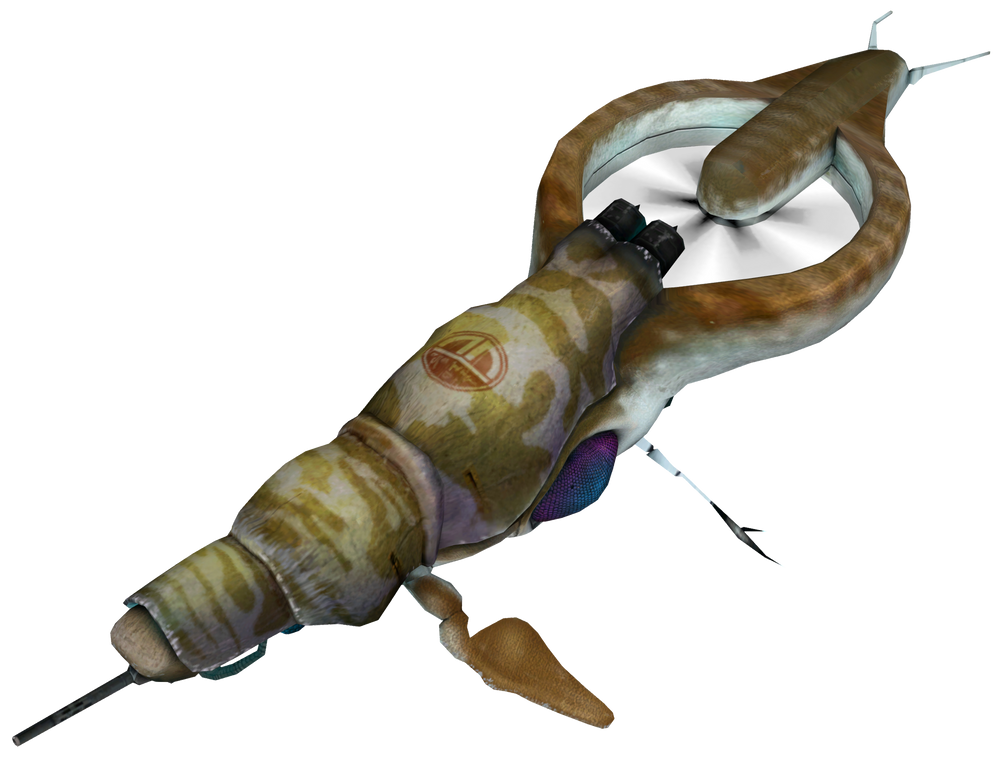
If a society in Science Fiction isn't either following Technology Levels or magic, then you can rest assured that they're making use of organic technology.
Cars, planes, phones, computers, buildings, spaceships, weapons (including artillery and war vehicles) and everything else required for a proper sci-fi story will be provided in the form of something that is warm, moist, skooshy and drips goo everywhere. Often, this will go so far as to include a convenient thought-based interface. Manipulation of organic matter may be part of the technology as a whole, or even what enabled the tech in the first place. Advanced nanotechnology, when not depicted as the classic blobs of liquid metal, will often be depicted in a similar but decidedly more synthetic fashion.note
This type of tech is a common feature of sea-dwelling sapients. Not only are cities entirely made out of cool-looking coral, it's a technological evolutionary path that does not start with the step "set something on fire" or "throw wheels on it", which for a species that lives entirely underwater would be, respectively, impossible and generally useless. Likewise, excessive humidity wouldn't cause important stuff to short out.
Civilizations who use this technology are also frequently users of Sufficiently Advanced Bamboo Technology. Depending on the aesthetic choices of the depiction, the organic technology may seem Ambiguously Robotic as well. Organic technology is sometimes portrayed as especially advanced. If the organic technology is a staple of the setting or theme, compare Bio Punk.
Often crosses over with LEGO Genetics and is depicted as a Sculpted Physique. Often used by a Horde of Alien Locusts. See Living Ship for one specific example. Compare Bio-Augmentation, which could be Organic Technology applied to the human body in new and fun ways. Contrast Mechanical Lifeforms, which are organisms that happen to be mechanical in nature. Often creates the Womb Level in games. A Hive Caste System is based on using naturally evolved biology rather than technology made from biology. Applied to agriculture, the end result of this trope is often a Multipurpose Monocultured Crop.
This is becoming an actual thing. Interestingly, Real Life synthetic biology seems to be going the reverse direction of this trope: making biology look more like chemistry and nanotechnology, rather than making technology more like biology. Whether we'll get our meaty jetpacks remains to be seen.
Examples
- The aura machine of Aura Battler Dunbine are constructed using body parts from Byston Well's mythic beasts. Aura muscle come from tissue, armor from carapace, etc.
- Bleach seems to mix this in from normal advance tech to living tech.
- Brain Powerd, which used "organic" more as a bizarre form of Applied Phlebotinum than anything else.
- Ceres, Celestial Legend reveals that the celestial robe of the maidens is not a robe, at all. It's called Mana and is a large... bally thing... that looks like an organism, which allows them to sustain their existence and allows rapid alteration of their cells, to take on any form they want.
- Dragon Ball Z has the Androids, which range variously from wholly mechanical (like #16 and 19), Cyborgs (such as #17, #18 and #20 a.k.a Dr. Gero himself) and...Cell, who is purely organic and, unlike the other ones, has the ability to actually permanently increase his strength through absorbing other humans and his fellow Androids. He's also essentially the culmination of the various DNA of every fighter in the series with their most advantageous traits at his disposal.
- The 31 Primevals from GaoGaiGar are much like this, and even have the ability to turn organic lifeforms into Mechanical Lifeforms via Zonderization.
- The eponymous Bio-Booster Armor Guyver.
- The Raalgon from Irresponsible Captain Tylor appear to have gone this route with their technology; their motherships and battle cruisers appear to have been grown rather than built.
- Despite metallic technology being just as, if not more efficient than organic, the Vajra of Macross Frontier have very good reasons for using extremely advanced organic technology as ships: the Vajra are the ships. Each drone, though stupid individually, are linked together by fold quartz, to form the entity known as Vajra, a massive Hive Mind. The Vajra (at least in the Milky Way) is not a species of individuals, but an individual spread out over a species. It makes sense for each cell of itself to wish to remain organic, but efficient.
- The God-Warrior in Nausicaä of the Valley of the Wind is essentially a robot made of flesh; having to fire it's Breath Weapon before it's fully mature causes it to slough apart. In the manga, it's an organic being that grows over an essentially metal or ceramic skeleton. No reason is ever given for why the God Warrior skull Nausicaa climbs at the very beginning of the manga has a cockpit. The ecosystem of the forest and the Crypt of Shuwa are also examples.
- The eponymous 'robots' from Neon Genesis Evangelion are actually semi-organic cyborgs with their organic parts cloned from an alien creature.
- One Piece:
- The Den-Den Mushi (official English translation: "Transponder Snail") are a ridiculous example of this trope: all means of long-distance communication in the series are snails. If that's not ridiculous enough for you, try the snails that can project images from their eyes and onto walls. Or the white one that emits psychic waves to act as a jamming device so the speaker has a secure channel.
This is likely based on a real life attempt at this trope, Jacques Toussaint Benoit's Pasilalinic-Sympathetic Compass aka the "Snail Telegraph". He believed that snails that have mated form a permanent telepathic link and can be used to send and receive long distance telegrams by manipulating their bodies. It didn't work.note
- Dials might also be this, being somewhat uncommonly found sea shells possessing various and useful abilities to store things like sounds or explosions.
- One Piece Film: Gold introduced red eyed owls which act as a laser alarm grid. Anything that passes under the owls' sight causes them all to start shooting loudly alerting their owner to a trespasser.
- The Den-Den Mushi (official English translation: "Transponder Snail") are a ridiculous example of this trope: all means of long-distance communication in the series are snails. If that's not ridiculous enough for you, try the snails that can project images from their eyes and onto walls. Or the white one that emits psychic waves to act as a jamming device so the speaker has a secure channel.
- In an episode of Pokémon: The Series an Electabuzz is used to power a chainsaw. In another episode Pikachus were used to power a treadmill. Pokéballs also qualify, as they're created based upon Apricorns.
- Tenchi Muyo!: Jurai technology has a rare variation in being plant-based instead of animal-based, including spacecraft and log-shaped guardian robots. Justified by the fact that they have a very powerful patron goddess, who decided to experiment and turned herself into a tree a while back. So, naturally, the seeds of the tree that is technically a deity grow into very, very powerful and useful plants. The trees that form the basis of Jurai technology are therefore technically lesser gods or at least demigods, though the Juraians themselves don't think of it that way. Which is a point of contention with one of their major rival nations, the theocratic Airai, who think Jurai doesn't deserve the blessing of gods they don't even worship.
- Tokyo Ghoul has Quinque, the weapons wielded by Ghoul Investigators. They are made by harvesting the predatory organ from a ghoul, altering and reprogramming the organ to generate a set weapon upon command. Swords, knives, spears, and guns are all popular choices for the design... but some maintain enough of the original kagune's shape to be easily recognizable to loved ones of the "donor".
- Played with in the Witchblade anime: the title semi-sapient artifact got a few series of Black Box bionic knockoffs, including Cloneblades. Cloneblades aren't too choosy in accepting wielders, their performance seems to be superior to Witchblade with a novice host (if not to the full limits of a thing whose raw power blast can ruin half a city), but they have a small problem: as not really living, they do not regenerate. So while the true Witchblade may overload the host's body more, Cloneblades sooner or later drag their wielders into rapid and fatal decay.
- Yokohama Kaidashi Kikou: Downplayed. One of the story's many mysteries is that parts of the countryside, especially those where humans used to live but have long been abandoned, feature strange plants that consist of a tall stalk with a transparent bulb-like growth at the top that gives off bioluminescence at nighttime, essentially a living streetlight.
- Batman: Part of the weaponry possessed by the Super Soldiers in the Legends of the Dark Knight two-parter "Infection" are biological guns built into their forearms that use bio-gas to launch super-sharp bone fragments at high velocity, organic "bullet racks" that stretch across the chest, and organs that allow them to cannibalize human corpses to convert the bones into new bullets.
- Implied to be the case with the demons' technology in Clean Room since the wreck Astrid salvages has bone plating, insect wings, and clawed limbs alongside its engines.
- Most of the town of Copperhead is standard construction, but Budroxifinicus' house has a root construction growing from the ceiling that serves as both a comfy chair and chandelier.
- This is a central trope of Dawn of X, as all of the Krakoan facilities and machinery are made out of plant material integrated with nanotechnology, from their teleport gates to their famed resurrection chambers.
- Taken to the Logical Extreme in Orc Stain, where nearly all technology is like this, even when it's totally unnecessary and makes no sense; we see stuff like axes with blinking eyes, living bear-like strongboxes that attack you if you open them wrong, birds used as air horns, and even a soda can that begs for mercy and screams in agony as its opened.
- In Ronin (1983), this form of technology plays a critical role.
- Star Trek: Early Voyages: In "Flesh of My Flesh", all Ngultor technology is organic in nature. They regard the purely mechanical Enterprise as a dead ship. They are able to reshape their ships at will, which Captain Pike compares to flexing a muscle. The Ngultor also infect the Enterprise with an organic virus which uses the ship's systems as a feeding ground. Spock and Dr. Boyce are able to create a viral antibody which proves successful in defeating it.
- Star Trek: Untold Voyages: In "Odyssey's End", Spock determines that the Abductors' mothership is partially organic.
- The alien VXX199 of Strikeforce: Morituri arrive in a ship that's half the diameter of the moon, a giant conglomeration of living tissue, and directed by its own biological AI.
- In Supergod, Morrigan Lugus is identified by the narrator to possibly be a mycological computer on a meat substrate, essentially a fungal computer. To wit, when not deciding to use sound to speak, it sometimes would communicate by emitting radio signals, and other times would "eject spores, a 4-phosporolated indole full of digital code".
- The Elite in What's So Funny About Truth, Justice & the American Way? and the animated adaptation have a bio-organic starship that even features a nifty and easily spammable teleporter. It's actually a living bacterial colony from another dimension who the Elite enslaved by removing her higher-brain centers. When Superman restores her sentience at the end of the story, she's all too happy to help him beat them at their own game.
- In The Transformers: More than Meets the Eye, creating organic technology is a major project for the Grand Architect and his minions. Deconstructed, as it takes a huge amount of trial-and-error to create even the most basic things, and most of their experiments in this vein end in failure; at one point we see a ship of theirs that had a biotechnological room... which proceeded to bleed severely and decay after taking enough damage, with the blood leaking into critical systems and tainting the fuel supply, causing the ship to crash.
- Venom is sometimes used this way, as is its offspring, Carnage, to provide replacement legs for their hosts. Scorn, another symbiote, has used a fragment of the Carnage symbiote to form a new arm for its host.
- The 1990s Jim Shooter comic book Warriors Of Plasm was about an extradimensional civilization which was entirely biotech-based.
- The X-Men sometimes deal with a substance called the techno-organic virus (also a part of the Phalanx, which are essentially the leftovers of a technarch's feeding process, and treated by them like a human would moldy food) that fits this trope to a T.
- Biomass Effect: A [PROTOTYPE] × Mass Effect cross-fic, taking place in the Mass Effect setting. The Prototype setting was accidentally assimilated by the protagonist before the story even begins. The human race is technically extinct and Blacklight almost exclusively uses organic technology.
- GitS:SAC - The Collective Unconscious: The Collective makes heavy use of biothetics, biological counterparts to prosthetics.
- Re: My Hostage, Not Yours: The Valkians primarily use this, best depicted by their ship being a living creature, with its main computer core looking like a massive organ.
- With This Ring has both technological and magic variants.
- The Dominion uses plant-based computers, so when preparing to assault one of their facilities, Paul buys a plant spacecraft from Alstair to study.
- The Sheeda, from Earth's far future, exclusively use magically manipulated organic matter, from rocket beetles to chitin data records. Even clothing has a proboscis to plug into the wearer's arteries. It turns out that they have to do that, because their Vampire Sun rapidly destroys anything non-living. More specifically, it destroys anything without the Sheeda genetic markers derived from Starbreaker to protect from his draining effect.
- In the Cars series, plant life is the only nature in their world that isn't shaped like a vehicle. It does, however, have car-related elements if you look very closely; the bark of the trees resemble tire treads, leaves have tire tread and VW logo-shaped veins, and flowers are shaped like either tailfins, head-and-taillights, or cooling fans. In other words, organic fuel.
- Everything in the Cobra-La hideout in G.I. Joe: The Movie is alive, even the things that aren't "technology" per sé, like bridges.
- Ecoban in Sky Blue is stated to be based on organic technology, and is mainly powered by carbon mined by the Diggers. However, the parts we see look pretty mechanical.
- In Rise of the Teenage Mutant Ninja Turtles: The Movie, the Krang utilize organic technology that looks like masses of flesh. At one point Donnie must "interface" with the Technodrome to control it, and is freaked out by the thought of connecting with all the gooey tissue.
- In Trolls, the forest dwelling trolls use local critters in place of conventional technology. Most of it comes to using the bigger ones as vehicles and small glowing ones as lights.
- In 10 Cloverfield Lane, the alien 'craft' that Michelle destroys appears to actually be a living creature, as it picks up Howard's truck with tendril-like appendages, and she kills it with a Molotov Cocktail into its 'mouth'.
- The aliens in The Abyss can shape water and even seem to have based all their technology around it.
- The Engineers from Alien and Prometheus use this. In addition to creating life on barren planets (like Earth), pretty much everything they build seems to be at least partially alive. The spacesuits are made from some kind of bone (fueling decades of misinterpretation regarding their actual appearance) and blends into their skin. Buttons seems to be some kind of fatty nodule, and their architecture has plenty of rib-like ornamentation. The Aliens themselves grew out of their weapons program.
- Eywa of Avatar either is this, or uses this to provide a comfortable standard of living for the "primitive" Na'vi.
- The Replicants in Blade Runner are genetically engineered artificial humans. There are also a number of artificially created animals, ranging from snakes to owls.
- Captive State: A lot of the Legislators' technology appears to be this. For instance, the "bugs" they use as tracking implants appear to be literal bug larvae, and they also use an explosive transparent gel stated to be organic. However, their ships appear to be made of stone instead.
- David Cronenberg really likes this kind of tech. In order of release:
- Videodrome is rife with this; Max's television set starts to breathe and pulsate, he develops a gaping hole in his stomach that can double as a VCR player for video cassettes made out of living flesh, and his gun fuses to his hand in a revolting biomechanical fusion.
- Dead Ringers has a Mad Doctor design surgical instruments that look like metal crabs and insects. And he's a gynecologist...
- Naked Lunch: Bill's contacts in Interzone are giant bug-shaped typewriters that he writes his reports on.
- eXistenZ features a number of rather icky biological machines, such as the tooth-shooting bone pistol and the biological computers which "plug in" to orifice-like "bioports" on people. Of course, that was only in the game. The actual rigs are straight tech.
- The aliens in Independence Day have biological Powered Armor. The rest of their tech appears to be purely inorganic though. In the novelization, it's revealed during the psychic communication with the captured alien that the "biological powered armor" is in fact an entirely different species that the apparently parasitic Big Bad aliens have harvested and turned into armor/utility apparatus and also that the material from which the alien fighters is made seems to have been grown like a tree or something.
- The Kaiju in Pacific Rim are actually living weapons used by the Precursors to attack humanity. While they look like giant animals, they are assembled from parts like machines. This also applies to Obsidian Fury and the other Jaeger drones in the sequel, which are basically Kaiju flesh in Jaeger-shaped shells.
- All Tomorrows: The Tool Breeders, being an aquatic species, have no access to fire and so instead breed tools and machines for themselves. They build living cities of bone and shells fed by a system of nutritious fluids provided by heart-like organisms, bioluminescent lights, medicinal sea squirts, and gardens, televisions, breathing apparatuses, weapons and even companions from other undersea life or cultures of stem cells. In time, they even create living spaceships to visit the stars.
- The technology of the Graycaps in Jeff VanderMeer's Ambergris books is almost completely based around various forms of fungus. They saturate their own bodies with fungus to make themselves almost impervious to harm, they fill the air with spores that can act as anything from organic cameras to neurotoxins that alter human behavior, and they make monstrous fungoid constructs that stalk unwary humans in the night. And their Great Machine beneath the city of Ambergris is mostly made out of living Graycaps.
- In Angel Station, organic tech is pretty much the only tech the Beloved have as a race.
- Never a series to leave any science fiction tropes uncovered, Animorphs features a Living Ship or two.
- In Kameron Hurley's Bel Dame Apocrypha trilogy the planet it takes place on uses mostly this for everything. A lot of it centers around mutated insects controlled by "magicians" who have a psychic link with them.
- Michael Moorcock's Second Ether book, Blood: A Southern Fantasy, includes "meat boats", living (and technically amphibious) river boats created by a coalition of fleshcrafters (who also seriously alter their own bodies in bizarre ways) from the bodies of other beings. They are unusual in that they're portrayed as having the same disadvantages as any other large animal: needing to be fed organic material, needing to excrete wastes, and possessing a rather unpleasant smell.
- The asteroid colony of Summer Home in Linda Nagata's The Bohr Maker has, by the time of the book become a living thing and at the book's climax splits into cell-like segments to seed versions of itself throughout the Solar System and, in a few cases, equipped with solar sails, seek to go beyond the system.
- In the Bounders series, the Youli spaceships are mostly made out of some spongy orange bioluminescent material, which is used by some other species, including the Alkalinians. If the material has been programmed properly and activated, it turns into a VR simulation of any location the programmer can think of, complete with food that tastes almost like the real thing and provides all necessary nutrients.
- In A Confusion of Princes, organic tech (called Bitek In-Universe) makes up one third of the Empire's trinity of teks, alongside Mektek and Psitek.
- Also featured in Herbert's ConSentiency series, where its often used as living furniture, like Chairdogs.
- The Crucible of Time is a Xenofiction about an alien species whose technology is based on bio-engineering.
- The squid-people in Raymond Z. Gallun's short story "Davey Jones' Ambassador" (1935) cannot use fire or concentrate much heat by other means, since they live miles beneath the sea. Instead, they bio-engineer organisms to serve as everything from transportation to weapons to architectural elements, and produce whatever substances they need as secretions from these creatures.
- Discworld:
- The Magitek computer Hex uses ants for its operating system, and beehives for memory. It also has ram skulls in it, and a mouse has set up a little nest. The skulls seem to make it work faster, and they have no idea what the mouse is for but it stops working when they take it out.
- Technically, imp-powered devices such as iconographs and disorganisers probably count as well, depending on how "alive" you consider the imps. (Making Money says they're just a manifestation of a spell; Raising Steam refers to wild imps being caught and domesticated.)
- In Distress, Stateless is an artificial coral island that was built from the ocean by genetically engineered invertebrates. Maintenance is performed by lithophilic bacteria. The whole thing looks so natural and organic on its own terms that when Worth finds a small park with trees and grass, it looks strange and unnatural.
- The short story "The Double Minds", from John W. Campbell's The Planeteers, is set on Ganymede, where electricity was never discovered. Light bulbs are powered by fluorescent bacteria and cars have muscles instead of motors. Unlike most examples of Organic Technology, the story clearly states that Ganymedian gadgets are a poor substitute for electric-powered technology. A bit of an Unbuilt Trope, considered that it was written in 1937.
- In The Dresden Files, the Fomor use this. Most of their weapons look like and appear to be made from undersea organisms.
- Dune touches on this with:
- The Butlerian Jihad, which outlaws computers with the commandment: "Thou shalt not make a machine in the likeness of a human mind." Several groups fill the space: Mentats, the human computers; the Bene Gesserit, the super-witch training program; and the Spacing Guild, which uses prescient drug-addicts to navigate hyperspace.
- Tleilax's major export is organic technology, raging from clones, shapeshapers, and even rogue mentats. The Tleilaxu get a lot of crap for doing this, but it doesn't hamper business too much. According to the prequels done by the son of the author, they got a bad rep for stealing organs, while there was a big-ass demand in the war with the machines. Even more jarring are their Axlotl tanks, which are Tleilaxu females forced in a vegetated state to create gholas.
- Greg Egan introduces this in his inimitable style in a number of places... for example, the five-dimensional snail-squids in Diaspora have organized their whole ecology to cater to their needs, and the far-side civilization in Schild's Ladder tend living cities using organic constructs that tailor the local laws of physics to their whims.
- Bio-rigged tech in Embassytown. Literally everything produced by the Ariekei falls in this category, weapons to farms to power plants. This becomes a problem when the Ariekei become addicted to Ezra's voice, and the addiction spreads via the biological infrastructure of the city to infect everything they've built.
- In E.T.: The Book of the Green Planet, the novel that serves as a sequel to E.T. the Extra-Terrestrial, E.T. tries to return to Earth by building a spaceship almost entirely out of plants — the hull is a giant turnip, and more exotic alien plants collected by his race are used for lighting, life support, propulsion, etc.
- In one of the Dean Koontz's early novels, Fear That Man, the protagonist awakens to an Ontological Mystery aboard at what first seems like a familiar spaceship. Only upon closer inspection does he realize that all of its functions are the result of carefully hidden blob-like organisms.
- The novel Fluke, or, I Know Why the Winged Whale Sings begins with a marine biologist trying to convince others that one of the Humpback whales he is trying to study and save has markings on his tailfin that remarkably resemble the phrase, "Bite Me". Turns out that the bottom of the sea is inhabited by a being known as The Goo, an ever-changing sentient mass of organic material. It is able to create organic devices from itself and has spawned anthropomorphic whale drones and Living Ships disguised as normal whales; Bite Me happens to be one of these. Oh, and it had sex with Amelia Earhart and the result of the tryst is one of the other protagonists.
- John Varley's Gaea Trilogy mostly takes place within a huge organic construct called Gaea, who is a mostly Earth-like orbital habitat near Saturn, whose species was designed by some race many millions or billions of years past to create self-replicating space habitats. Being basically a god, the central "Gaea" mind can create or edit any kind of lifeforms living inside her using similarly advanced biotech.
- The Amnion in Stephen Donaldson's The Gap Cycle novels are a Hive Mind who are all genetically engineered to serve specific roles, and whose equipment (although generally non-living) is processed, created, and assembled via organic processes. Interestingly, it's specifically noted that Amnion biotech is much less efficient than human technology, even though individual pieces are more advanced. It's for this reason that they haven't tried to assimilate humanity into their hive mind: they know that if it comes to a straight-up war they could not match our production capacity.
- In David Weber and Linda Evans' series Hell's Gate the Arcanans use magical genetic engineering to create dragons, griffins, unicorns and big mean homing hummingbirds.
- In the Into the Looking Glass Series by John Ringo and Travis S. Taylor, the main foes are a form of AI/The Virus with organic technology, including things such as 'Rhinotanks' a creature modified into a main battle tank role complete with the ability to shoot plasma bolts. Foes of these creatures go as far as creating tribble like spiders specifically attracted to their form of life (different types of sugar starches for different types of suns)
- In the Jacob's Ladder Trilogy, following Cynric the Sorceress's invention of nanomachine colonies, most of the technological toolkits on Jacob's Ladder have been incorporated into living creatures. Gavin the Basilisk, for instance, was originally a welding torch.
- The novel John Dies at the End has a lot of this tech in the last couple chapters, where the main antagonist is revealed to be a self-modifying organic computer from an alternate Earth where technological progress took a very different route.
- Played for both laughs and horror, often simultaneously. Notably, in the alternate Earth, doctors heal their patients by placing kittens all over them.
- The Darwinist nations in Scott Westerfeld's Leviathan trilogy, so named because they follow in the footsteps of Charles Darwin, who pioneered genetic engineering alongside evolutionary biology. The books follow an alternate World War I pitting the Darwinist-aligned Allied Powers against the Diesel Punk-themed Clankers of the Axis. The title is the name of a famous British airship derived from a whale.
- S. M. Stirling's novel In the Courts of the Crimson Kings is set on a Mars that was Terraformed and seeded with Earth life in prehistoric times by Ancient Astronauts. The Martians are human, or as close to human as Neanderthals, and highly intelligent. Almost all technology more complicated than a sword is biological, to a very high level, with living guns (recharging after firing takes time, which is why swords are not obsolete), living engines to supplement the sailpower of desert-crossing wheeled ships, rugs that crawl onto your feet to warm them, giant creatures that eat rocks and vomit road-paving material.
- The hydrites in the German SF series Maddrax also use technology that has been organically bred.
- The Wamphyri in the Necroscope series make extensive use of biotech.
- The Edenists in The Night's Dawn Trilogy base most of their technology on living creatures; they have Living Ships, living space stations, and organic servitors. They aren't entirely organic though; most common technology is still inorganic/non-living (they use electric jeeps in their habitats), and their ships/stations use non-living technology (like fusion reactors) when using living versions would be impractical or impossible.
- In The Place Inside the Storm, Tara's bed is on a platform that was raised from the floor with bacterial carbon frame construction.
- In Please Don't Tell My Parents I Blew Up the Moon (sequel to Please Don't Tell My Parents I'm a Supervillain), Penny decides she needs a cloning tank. She has no idea what she needs it for, though at least she figures out that general bioengineering tools will work just as well.
- Professor Mmaa's Lecture: Pretty much all of termite "technology" is made up of genetically engineered termites that function like machines.
- Rebuild World: As a result of the Neglectful Precursors in this After the End setting having this, the world is filled with monsters grown from this to serve as security, usually in a hybrid form like giant Weaponized Animal dogs. These are controlled with (often corrupted) software via Nanomachines, as explored when a Mad Scientist injects said nanomachines into a subject making him a Tragic Monster with Horror Hunger for metal and human flesh to feed said nanomachines, which process the eaten resources for producing new monsters and replenishing ammo. This also lets the monsters evolve via You Are Who You Eat.
- Red Dwarf: When explaining how the creation of the GELFs went from super-athletes to consumer products in Better Than Life, it is mentioned that some of them were developed to fulfill the role of electrical products, leading to living cars with bony exteriors and flesh interiors, and vacuum cleaners which also served as pets. Of course, GELFs were essentially modified humans that were being treated as slaves so they rebelled as a result.
- The Rook: The Grafters, a.k.a. the Wetenschappelijk Broederschap van Natuurkundigen (or the Scientific Brotherhood of Scientists), are extremely advanced in the science and art of fleshcrafting.
- The backstory to Julian May's Saga of the Exiles novels features The Ship, a spectacularly large interstellar worm controlled by The Power of Love. (The pilot of The Ship has the title "Shipspouse.")
- In Cordwainer Smith's novelette "Scanners Live in Vain" (written pre-Sputnik), outer space is suffused with a strange radiation that causes horrible pain to spaceship occupants. The original solution was to sever the nerves of the astronauts, which turned them into unfeeling creatures both physically and metaphorically. The eventual, more workable solution was to surround yourself with other living organisms, who would absorb the radiation. They built radiation shielding out of oysters.
- In Second Apocalypse, the Inchoroi are an interstellar race of aliens who have mastered organic engineering, which they call Tekne. Calling themselves "a race of lovers", they've spent the last few eons pursuing depravities of the flesh. When they land on Earwa, a planet of sorcery, they modify themselves to be able to wield sorcery as well.
- One short story in A Simple Survey features a decidedly grotesque form of this. Many common tools now incorporate elements of human beings. Examples include: frying pans with skin to sense heat and prevent overcooking of food; ladles with lips to taste their contents; surveillance cameras with eyeballs to focus at long distances; lawnmowers that use nails and teeth to cut.
- In The Snow Queen by Joan Vinge, the mers are a sort of living computer system.
- In the novel Star Dragon, mankind has passed through enough Technology Levels to achieve this level of engineering, along with mastery of genetic modification. Nearly all technology is organic in nature, including toilets, which feature tongues in lieu of paper.
- The Yuuzhan Vong in Star Wars Legends, for whom this (along with rampant masochism) is their hat. They even declare a holy war against the Galaxy Far, Far Away for daring to create nonliving mockeries of what life can accomplish.
- This is played on part way in when Lando develops a droid so insulting to this belief that most warriors break cover and and attack, thus revealing themselves to fire.
- It's later explained that the Vong's original home planet was a Genius Loci, leading them to naturally adapt living things as tools rather than machines (originally the planet itself would have been responsible for this; later Vong scientists, or "Shapers", learned to do it themselves). Their extreme hatred for inorganic machines, particularly droids, has roots in the fact that early in their history they were nearly wiped out by a race of sapient machines.
- Another Genius Loci, the Rogue Planet Zonoma Sekot (the child of the Vong homeworld), produces organic starships.
- When the Vong land on Zonoma Sekot, their bio-engineered weapons revert to their natural state and refuse to kill anymore, proving that the Vong's extreme violence and war-mongering were in fact a deviation from their originally peaceful nature and a blasphemy against their own gods.
- In Galaxy of Fear, several of Gog's weapons from project Starscream are organic in nature, each designed to perform a specific function, including one similar to the Genius Loci mentioned above, with the last being a combination of all of the successful Starscream projects.
- This is played on part way in when Lando develops a droid
- In Transpecial, the glen's starship was grown, not made, and resembles a giant spiky coral.
- In Veniss Underground, most of the technology in Quin's lair is made of living creatures, including the maps and the boats.
- The Weakness of Beatrice the Level Cap Holy Swordswoman: The Underworld faction uses technology based around marine organisms. The Underworld itself is an island-sized monster that's compared to a rotting shark or killer whale. It has a fin that is actually a broadcast tower, covered with giant barnacles that act as antennae. It uses Arachnes, Mini-Mecha that combine traits of spiders and crabs, to construct new structures and repair damage with their webbing. The Underworld Lord wields weapons that are likewise organic: a saw made of shark teeth, and a spear covered in coral and barnacles.
- The Yilanè in Harry Harrison's West of Eden fit this trope to a T; they are even descended from seagoing creatures. Everything they use on a daily basis is a genetically modified creature. Their boats are based off ichthyosaurs, their microscopes are modified frogs, even their clothing is a heavily modified furry creature (the impracticality of this tech is lampshaded in a spin-off story where a fatal cold-snap hits and "we can't breed our cloaks fast enough"). Their weaponry is based off a marine lizardnote — as a matter of fact, the very same marine lizards they are most closely related to. The mind cannot help but go down some weird avenues here...
- In Wild Cards the Takisians are very adept at organic technology, including living, sentient, telepathic starships.
- The Wolfish Nature duology has the dog-humans prefer organic tech to "dead" tech, although the latter is slowly replacing the former, especially in the field of computing. Pretty much everything they have (including buildings) is grown and needs periodic feeding. The few exceptions include firearms (try growing a living being that can survive constant explosions inside it), although those are rare, since the dog-humans are incapable of committing murder without going insane (this turns out to be a case of global brainwashing).
- The Xandri Corelel novel Tone of Voice involves two species, the Hands and the Voices, that have developed a technology that allows them to grow buildings out of coral.
- The Oankali in Octavia Butler's Xenogenesis trilogy rely on biological tech for everything (spaceships, buildings, etc.) and dislike using machines. They are actually able to use biological machines to grow replicas of simple human devices such as pens and paper. They have an innate biological drive to seek out new genetic material from other species and make use of it by adding it to their own genes. They have a natural ability to read and manipulate DNA, and this ability is especially strong in their third gender, the ooloi. They're also Planet Looters- after they find a planet and incorporate its novel DNA into their own, they seed a new lifeship into the planet, which renders it unable to support life when it finally matures and launches to seek out another life-rich planet.
- Babylon 5:
- The Vorlons and the Shadows both went this route. It's implied to be in some ways the ultimate form of technology, with ships which can heal themselves and think for themselves.
- The Ikarrans, a long dead race from a thousand years ago, also used organic tech, some of which still works and posed a serious threat to the station itself in "Infection".
- Cylon Raiders in Battlestar Galactica (2003) are synthetic organic lifeforms in a armored metal shell. Their Basestars are also partially organic, and are controlled by a human-like organic 'Hybrid' permanently linked to the Basestar. And the Cylons themselves are Artificial Humans.
- The first glimpse of the interior of a Basestar was a horrible gooey Giger-esque organic landing platform. Subsequent episodes revealed the "living areas" of the Basestars are more Crystal Spires and Togas — possibly because they're less distracting/revolting/expensive for the longer, more complex scenes set in them.
- Better Off Ted: in the episode "Bioshuffle" most of the episode's problems are caused by a malfunctioning biocomputer. It was literally getting a stress ulcer from overwork.
- Doctor Who:
- The Time Lords themselves — the new series states that the TARDIS is alive. "It's not built: It's grown." Like a coral. And the RTD-era desktop theme reinforces it. Furthermore, they are sentient, most famously being the Doctor's own TARDIS, whose state of sentience is explored in "The Doctor's Wife", where her matrix is implanted into a physical human body, allowing her to communicate with him for a while. This idea is further supported in the Expanded Universe novels. The "Cat's Cradle" arc in the Doctor Who New Adventures novels has the Doctor needing to replace the organic material that the TARDIS uses for calculations that are impossible on conventional computers. Lungbarrow introduces the idea of sentient houses that are the ancestral homes of the different clans (kith) of the Time Lords. One Time Lord of each house becomes the "house keeper" and literally marries and has a somewhat symbiotic relationship with the house.
- The Axons from the Pertwee-era episode "The Claws of Axos" claim that their technology "had taken an organic turn". Considering that even their ship is part of the Axos Hive Mind, this makes sense.
- "Terror of the Zygons": The Zygons' tech is organic — their computers look more like coral than machinery. However, only the interior appears organic; the exterior seems to be a metal hull.
- "Smith and Jones": The two slabs ("basic slave drones") working for the villain are made of solid leather, prompting the Doctor to comment that "Someone has got one hell of a fetish."
- "The Woman Who Fell to Earth": The "data coil" used by the antagonist is, as the Doctor puts it, not so much a lifeform as a collection of lifeforms repurposed into an advanced computer.
- "The Witchfinders": The sacred tree on Pendle Hill that Becka Savage chopped down and turned into a ducking stool was actually an incredibly old piece of alien biotechnology serving as the lock of the prison of the Morax, who were reduced to primal elements and buried beneath.
- Taelon technology in Earth: Final Conflict. Their ships and buildings are all grown out of an organic "bio-slurry". Their weapons, called Skrills, are actually creatures they've "domesticated". They resemble a bug growing out of the host's arm (always a human) and can be used to fire energy weapons. They aren't intelligent but have individual personalities. Taelons also grafted items that enhance senses and reflexes to poorly-trained human soldiers, sending them into combat with their arch-enemies, the Jaridians.
- Farscape had Moya, a living ship with all the amenities you would expect on a space ship and all the comforts of home, including larva-like creatures that replaced toothbrushes. And artificial gravity was provided by gravity bladders.
- It should be noted that Leviathans are consistently described as "biomechanoid" rather than "organic" and they display very few of the common attributes of "organic technology" as we would think of it. Moya was unquestionably "alive," and sentient, but many of her systems were mechanical even if they were "grown," such as the beetle-like repair robots.
- Season 4 also introduced Bioloids — similar to robots, but organic. Aeryn is replaced by a Bioloid clone for part of an episode, and Sikozu is later revealed to be a Bioloid.
- The Lexx also worked in the same vein, with a weird intestine like thing that excreted disgusting looking (yet edible and apparently delicious) food and further adventures involving toilets with tongues.
- Thodin's 'bug bomb' from Episode 1 might count, and the Moths.
- The title submarine in SeaQuest DSV is implied to be organic in many ways.
- Only the outer hull cladding — according to the novelization, that is a bio-engineered compound that is both anechoic (sonar-defeating) and self-sealing. The rest of the ship is just a very, VERY big submarine. It's implied in several episodes that the organic skin is flexible and coats a normal steel shell.
- This becomes a problem in the episode dealing with a disease affecting marine life. The sub's hull also proves susceptible to it.
- The Wraith technology in Stargate Atlantis relies on this. In fact it was said that because of the organic composition of their ships and general insufficient power utilization, if they had a significant power source their ships can "grow" and become near-unstoppable juggernauts. In the Grand Finale, one of these ships adapted a ZPM (the magical power sources that Atlantis cannot seem to find enough of) and it became powerful enough to lay waste to any ship it came across. And at this point Earth ships were capable of going toe-to-toe with the Ori ships. In the Homecoming novel, it's stated that Wraith tech ages just like any other living being, becoming worse with age. When Todd returns to his hive ship, he finds it in a sorry state, his clevermen struggling to graft new hull chunks onto damaged sections, and the ship rejecting the grafts.
- Star Trek couldn't resist this one:
- Star Trek: Voyager:
- Species 8472 seem to use entirely organic technology. They actually originate from Another Dimension called Fluidic Space, which seems to be some sort of organic area in of itself, which the Borg attempted to conquer, as established in "Scorpion". They found that it backfired on them because Species 8472 is impervious to their nanotechnology, which meant the Borg had no way to either assimilate or analyze their biology on their own.
- The USS Voyager itself has its circuitry embedded with bio-neural gel packs, an interesting idea (in that brain cells are supposed to be better at computing than the fastest computer) that is dealt with in a single episode in the first season — "Learning Curve" — and then pretty much forgotten. (The episode memorably involves a massive system failure which is traced back to the bacterial culture used to make some cheese infecting them.) The bio-neural gel packs are brought up again at least one more time much later, in the episode "One", involving a nebula extremely deadly to living things and very damaging to technology. With the crew in stasis chambers, and only Seven of Nine and the Doctor to run the ship for three months, keeping the ship going is a chore thanks in no part to these gel packs.
- Star Trek: Deep Space Nine: In their introductory episode, it is mentioned that the Breen species use partially organic systems in their ships.
- Star Trek: The Next Generation:
- In the episode "Tin Man", our plucky crew encounters an entirely biological spacecraft whose crew had been killed off, and it's pretty bummed out about it.
- The pilot episode, "Encounter at Farpoint", involves this trope as well.
- In the Star Trek: Enterprise episode "Dead Stop", the crew comes across a near magical repair station that apparently used the brains of various unconscious aliens to enhance its computer system. It does have an adverse effect on the minds of those connected, and they tend to make the brain useless for any other purpose if connected for too long.
- Speaking of brains, there is "Spock's Brain" from Star Trek: The Original Series.
- Star Trek: Discovery bases its Crossfield-class starships around a "displacement-activated spore-hub drive", which allows a starship to travel the universe on a mycelial network of Prototaxites stellaviatori. This requires using both the spores of this fungus and an organic, sentient navigator to direct the ship through the network.
- Star Trek: Picard introduces organo-synthetic beings (sometimes referred to as flesh-and-blood robots).
- Star Trek: Voyager:
- Super Sentai and its adaptation Power Rangers. Depending on the season, both the heroic and villainous sides alternate with using this trope. In general, series in which the Rangers use animal based powers, the Humongous Mecha tends to be made up from living creatures.
- Both the villains and heroes from Bakuryuu Sentai Abaranger use organic technology. Power Rangers: Dino Thunder downplays this trope, placing more emphasis on technology.
- Almost everything the heroes use is alive in some way. Their weapons can act on their own. For transportation, they use biomechanical raptors and their Humongous Mecha are sentient highly evolved dinosaurs. In Dino Thunder, everything is just technology that isn't alive.
- The villains live and breathe this trope. Their Monsters of the Week consist of plant, animal and technological components, while their vehicles and base of operations all resemble organic beings.
- Played with in the Direct-to-DVD movie of Tokumei Sentai Go Busters named Tokumei Sentai Gobusters Returns Vs Dobutsu Sentai Gobusters. In the regular series, the team is a technological team of secret agents. The movie partially takes place an an alternate universe which reimagines the team as a nature themed Super Sentai. The cockpit of their Humongous Mecha resembles a forest, with the controls consisting of treebranches and leaves.
- Both the villains and heroes from Bakuryuu Sentai Abaranger use organic technology. Power Rangers: Dino Thunder downplays this trope, placing more emphasis on technology.
- The Twilight Zone (1985): In the episode "Quarantine", a future society uses genetically modified primates as telepathic CPUs. Members of this society call their organic technology a "biological gestalt".
- The Morthran from War of the Worlds (1988) use a combination of crystals and organic technology. Note that the aliens of the first season (and of the movie) do not appear to use organic technology, though they do retain the reliance on crystals.
- According to the Gemara, King Solomon used something called a "shamir" to break down building materials or engrave gemstones. Exactly what the shamir is isn't clear, but one interpretation is that it's some kind of worm.
- In The Adventure Zone: Balance, the Millers created a mascot for their line of elevators called Upsy, Your Lifting Friend. Despite being an elevator, his inside is fleshy, not unlike a mouth or stomach.
- Many systems for tactical space fleet gaming, especially those with ship design rules and the option to do without the canon setting presented in the rules, usually have at least one bio-tech race. Silent Death features the Bugs, which grow to fit into manufactured frames and become cyborgs; while Full Thrust have the Phalon, who build their ships from parts and units made of lab-grown tissues, and the Sa'Vasku, whose craft, and indeed anything they use, are usually fully-fledged living organisms in their own right.
- The Pentapods of 2300 AD, a Traveller spinoff, are big on Organic Technology, since their species evolved underwater and never had the option of using metal or fire in their industrial development.
- Call of Cthulhu. The Mi-Go regularly use organic-based tech, such as a creature that can dig through the earth and extract metals and minerals, and a variety of giant fungi that maintain life support in an underground cavern.
- CthulhuTech sees this with the Engels, extra-large mecha that are more or less just massive creatures covered in enough machinery to conceal their monstrosity (somewhat). They tend to have a detrimental effect on the psyches of their pilots.
- The Dark Conspiracy supplement Dark Tek had a number of Darkling biological devices, such as the Antidoter (neutralized poison in the body) and Facedancer (a living disguise mask).
- The Day After Ragnarok setting has the surviving nations developing early forms of organic technology in 1948, by harvesting flesh of the dead Midgard Serpent.
- The Dungeons & Dragons Campaign Setting of Dark Sun had Halflings use this, either symbiotic creatures, buildings made from tissues, adapted wildlife, or types of organic automatons, such as the Scrubslug, which eats dust and debris and transforms it into organic floor wax.
- The Daelkyr of Eberron are very fond of this. Many of their creations are still around and usable by players, though this has risks.
- Tends to be something of a persistent theme with the Primordials of Exalted, albeit in a somewhat unconventional manner; their world bodies tend to look inorganic (and, in Autochthon's case, actually mechanical), but follow anatomical logic; Malfeas' bones are buildings of brass and stone and the fluids in the sewers are his bile and digestive fluids, because he's a creature that is a city (he also has flora made of metal), and Autochthon's organs are gears and pistons, his nerves are cables, his lungs/stomach is a toxic junkyard, and his blood is lubricating oil. Exploiting the landscape by provoking anatomic reactions is key to life in those worlds.
- The backstory of the Forgotten Realms has a quirky variant — the Sarrukh, one of the Creator Races has the natural ability to reshape other reptilian humanoids, granting and removing abilities. Naturally, one of the main uses of this was to create a new type of reptilian humanoid for any given task, with the end result of explaining why the modern Realms has such a wide variety of reptilian humanoids, some with very minor but bizarre variations to other types.
- GURPS:
- GURPS has two takes on biotech depending on the setting/society in a setting — either it begins to show up (beyond the modern-day applications) around tech level 9note , or it is the result of a divergent tech levelnote that may well be equivalent to a lower tech level than the modern day.
- GURPS Bio-Tech is all about this when discussing high tech levels. Aside from the various new pieces of tech presented in the book (including a sentient sponge-brain-tree-Neo Christian house) the writers also suggest that one can simply treat advanced technology from other sourcebooks as being organic in origin.
- The third edition sourcebook "Robots" includes rules for creating biological androids using biotech. This sourcebook also includes rules for combining traditional robots with biotech in the form of living flesh and intestinal power convertors.
- From Magic: The Gathering, we have the Phyrexians. Even in their first appearances, they blur all sorts of lines between Organic Technology, The Virus, Magitek, Necromancy, and Cybernetics Eat Your Soul. Recently however, the Scars of Mirrodin block gave us Phyrexians in all five colors, not just Black. In particular the leader of the Green-aligned faction, Vorinclex, believes that Phyrexians should be grown, not built.
- A (slightly) Lighter and Softer version of this is present in the Simic Combine of Ravnica. Contributing to the Dungeon Punk element of the world, this guild uses magic to engineer new creatures to serve all kinds of roles, mostly in the form of this trope; living zeppelins are just one of the examples to appear in the cards. Based on the combination of Blue Mana and Green Mana, they believe the purpose of life is to evolve, and seek to use magic and experimentation to guide evolution towards a nebulous "perfection". The magical equivalent of organ-grafts and gene-splicing is their stock in trade, and they readily exploit their position as Ravnica's doctors to further their experiments. They experiment on themselves, too — in fact, the lower ranked members of the guild are known for a rather high mortality rate, as they tend to be forced to serve as experiment test subjects; if they're lucky, they gain a useful implant, mutation or other alteration. If they're unlucky, more often than not, they dissolve painfully into a mass of protoplasmic goo.
- This is one of approximately 9000 options for Humongous Mecha in one Mekton expansion.
- Paranoia is better known for Corpore Metal bots and bot-wannabe cyborgs, but The Bot Abusers Manual inverted it with Corporganic, a bot secret society that went so far as to practice "orgcybing" (replacing bot limbs with organic parts). Yes, pretty much everyone else thought it was disgusting.
- In Pathfinder, both the mi-go and the Dominion of the Black make use of this, from "wands" of living flesh and crystal to oozes used as navigational computers.
- Rifts features Organic Magitek; the Splugorth of Atlantic have their Bio-Wizardry, which takes things like Faries, giant eyeballs, and mystic worms to use as components in powerful magic items and weapons, as well as specially-grown microbes, parasites, and symbiotes; Meanwhile, the Lemurians and Jungle Elves both use Biomancy which is more in tune with nature, and features things like living armor made of wood, coral, or shark blood; In Dinosaur Swamp(Florida and other parts of the former Deep South), the Barbarian tribes have developed a form of Eco-Wizardy, a variation of the more standard Techno-Wizardry that uses Stone-Age technology; finally, the dimension of Wormwood is a presumably Constructed World that is one massive organism that shapes itself to care for the people living on it, as well as providing worms symbiotes, and crystals to help them defend itself.
- Continuing expansions to the Phase World setting give us Necrons, who hate non-organic technology and have living weapons and bio-ships they can use to spread that hate across the Three Galaxies.
- And in Spelljammer, elven spacecraft are actually living plants with photosynthetic sails.
- In Splicers, the Human Resistance of this Robot War have no choice but to use Organic tech, due to a deadly nano-plague that causes any metal to try to kill any living thing that touches it. Among the technologies developed are customizable suits of Powered Armor, Beasts of Battle bred to replace tanks, and equivalents to regular guns. Of course, this stuff was first developed by the minority who are immune to the plague.
- Systems Failure features a surviving government base developing armor and weapons to fight the Bugs, who can frequently take over hard technology. The new weapons are described as "like holding a cockroach that shoots".
- Several races of Talislanta use plant-based technologies, including the barge-forts of the Green Aeriads (with live viridia trees for masts) and the d'oko lily plants used as houses by the Green Men.
- The Akashan Star Sphere or "Space Gods" from TORG prefer biotech to the point that most available Akashan gear is some sort of lifeform (e.g. "kinetic armor" is a symbiotic bodysuit, "geomantic shuttles" are creatures with a natural gravity manipulating ability, "starshredders" are a weaponized cross between a starfish and a piranha). Even their hard tech items tend to lean on biotech; for example, "bataase rifles" are nonlethal weapons which fire a biological polymer, and Akashan Lightships are as much biotech as they are hard tech.
- The White Wolf RPG Trinity had humans and a number of other races use living "bio-tech." Humans still used it alongside hard-tech and it was considered superior for some applications and inferior for others. Some human nations rejected bio-tech entirely, such as the Japanese, because they had determined the original source of human bio-tech was of unknown alien origin.
- Warhammer 40,000
- The Tyranids from the Warhammer 40,000 universe epitomize the trope insofar as it relates to tools of warfare; their every military need, from weapons to starcraft, is met by complex interlocking creatures specially engineered for the purpose. Their 'technology' is not only suspiciously well-suited to its function, but suspiciously sadistic in its execution. The original and ancient Warhammer 40,000 sourcebook, Rogue Trader, had "organic weapons" (such as organic chainswords) that were essentially bio-engineered duplicates of mechanical versions made of flesh and bone rather than steel and ceramics, apparently a curiosity widely used. The Tyranids were notable for always using them, but at this point the Tyranids were just random bugs rather than the galaxy-eating, wall-of-teeth Great Devourer. Since 3rd edition and the 'Nids new models, it is becoming increasingly difficult to spot where the bio-weapon ends and the Tyranid carrying it begins. The game also plays organic technology in the only way it would work, which is to dial it to eleven. Creatures have nothing they don't need to do their job, not even digestive tracts — they're expected to die before they starve. They just eat until they're completely full, then dive into "digestion pools" created by the Tyrannoforming of the planet, recycling the Tyranid and everything it's eaten into genetic material and other raw materials useful to the Hive Fleet. Their close combat weapons are forged in biological furnaces and then affixed to the creature in question and their bodies are almost entirely armored carapace. Even their soft tissues are built of materials similar to Kevlar. They are not your average squishy biological version of this trope, they are armored hell-beasts designed with one singular purpose — relentless assault. Tyranid bio weapons are notably inferior individually to their non-organic counterparts though, and their space fleets are noted to be inferior to every other faction's. It is their single minded purpose and sheer numbers that make the Tyranids so deadly.
- The Eldar make extensive use of a substance called wraithbone, which is a psychoplastic material that also possesses some self-regenerating capabilities. While not Organic Technology per se, Eldar vehicles, technologies, and buildings aren't built, they're grown.
- The Dark Eldar have a large swathe of Organic Technology, particularly in the Haemonculus subfaction. However, they cannot manipulate wraithbone since their Psychic Powers have atrophied.
- The Imperium also uses organic technology to some degree. Since they have a ban on artificial intelligence (after intelligent robots turned on humanity and nearly wiped them out) they use cybernetic slaves called servitors to perform menial tasks and some of the more advanced vehicles have either servitors hardwired to control weapons or Machine Spirits, which appear to be a form of "wetware" AI (although some sources state they are inorganic A.I.s modeled after animal behavior patterns).
- Depending on the writer, Machine Spirits have been anything from intelligences formed from hundreds of years of a complex program slowly evolving, an inherence within Imperial computing technology, an actual CPU core housing a legitimate AI, or a collective of the fragmented minds of the controlling servitors. While Games Workshop has called each of these excused correct at various times, when you are talking about actual Imperial AI, you are referencing the Cortex. This is a very advanced fragment of Lost Technology which parts of the Mechanicus can still make very well and understand fairly well in comparison to most other things. It is a single, large, solid, crystalline mass which acts like a light-based computer. It is extremely powerful for its size, and can fairly accurately re-create the neurological structure of biological creatures (mammals, birds, pets, fish, humans). Its "firmware" and processing power are set by a combination of predetermined crystal growth patterns and in-growth manipulation (probably electroshock therapy).
- A lot of Chaos technology merges meat, cybernetics and daemon bits into something kind of hideous. Consider, for example, the Helbrute.
- Of all creatures, Orks use organic technology in the form of squiggly beasts, AKA squigs. On top of squigs that are especially nummy (all squigs are edible but "eatin' squigs" taste the best,) they have squigs as toothbrushes and/or chewing gum (gob squigs), squigs as targeting computers (targetin' squigs), squigs as toupees (hair and beard squigs), and even squigs that inhale carbon dioxide and exhale oxygen, which the orks use as life support machines on their "Kroozas."
- Over the editions the Orks themselves have evolved into being organic technology. Essentially, orks are what you get when a desperate race of precursors attempts to engineer a self-perpetuating Robot Soldier race out of biological material. Orks are actually a kind of hyper-developed fungus, biologically programmed with knowledge they need on an instinctual level; specialist castes, or "Oddboys" are literally born knowing how to do their job, and only grow better at it as they live longer and practice. Every individual ork constant sheds fungal spores which form a kind of fungal bio-factory wherever they take root; these "shroom-wombs" first provide basic ecosystem requirements such as oxygen generation. Then they start to produce complex organisms; first squigs, to provide the most basic biological needs (food, leather, bone, etc); then gretchin to serve as labor units, and finally fully developed orks. With time these fungi will literally take over and "orkiform" a planet.

- In BIONICLE, most inhabitants of the Matoran Universe are Mechanical Lifeforms with small amounts of organic tissue built into them.
- The Iskai in Albion have two kinds of magic — which may have some hidden "scientific" explanation that's never given, since the story is at least as much science fiction as fantasy. Anyhow, one of the types, Dji-Kas, is largely just flashy wizard magic, but the other, Dji-Fadh, is used to grow organic plant technology — vegetable buildings as well as appliances like a plant acting as a toilet.
- The final stage of Assault Retribution, set in the mutant planet, where everything is organic and alive.
- In The Conduit, the Drudge weapons are all based on this trope, including the Drudge themselves. Reloading a weapon is invariably accompanied by squishy noises.
- Chorus has the Circle's Elder starfighters, a set of twelve sentient spaceships made with the power of the Void. Each of them was made for and bonded with one of the Circle's Elders, the Great Prophet's dragons. Nara's ship, Forsaken (or just "Forsa" for short), is one of them.
- Chrono Cross: The Dragonians (descendants of the Reptites from the previous game) relied on organic materials to develop their civilization. Their creations include the Dragon God, a being used to harness the energy of the Elements, and Terra Tower, a coral-like structure that houses said Dragon God. This is to contrast them with humans, who harnessed more conventional technology instead.
- The Ark in Creatures 3 was grown organically by its creators; in fact, it's stated that the Shee use mostly organic technology, having even discovered DNA before the wheel. Docking Station's Capillata takes it further: the main hub is very organic-looking, the whole thing looks suspiciously like a giant jellyfish, the Backstory states it was literally grown in a vat, and then there's the slightly disturbing Muco the Egg-Layer.
- Dark Colony: Everything the Taar use qualifies, with the exception of the Flying Saucer. Perhaps the most... amusing weapon is the burrowing turret. Guess which orifice the gun pops out from.
- Earth 2160's aliens, the Morphids, are actually a genetically-engineered army of biological von Neumann machines, which need only water to grow from a single crawling Mantian Lady to a legion of acid-spitting four-legged bear tanks and artillery insects. The trope is also subverted in that their Creators were unable to make biological units into a good airfleet, so they resorted to metal ships that use Nanomachines to clone and morph themselves, just like the ground forms.
- The Elder Scrolls:
- The Numidium is a Dwemer-constructed Humongous Mecha designed to be powered by the heart of a dead god (and later powered by what is believed to be that god's soul), which distorts reality around it whenever it is activated. Some of its blueprints/drawings depict it as having a ribcage and spine. (Akulakhan, another mecha built from Numidium's blueprints, also has these organic-looking components.) It's also theorized that its armor or other structural components are what all the Dwemer were transformed into after their mysterious disappearance. It played a major role in the series' backstory, where Tiber Septim used it to complete his conquest of Tamriel, and then shows up in Daggerfall as a major plot point. At the end of Daggerfall, it causes a Time Crash which makes each of the game's mutually exclusive Multiple Endings all happen at once, though none to the same extent they would have individually.
- Morrowind:
- Telvanni architecture is this plus Fungus Humongous. They magically grow fungi and mold them into Mage Towers.
- Players can employ Silt Striders: gigantic, domesticated arthropods that are used to rapidly travel from city to city in the game world. The striders essentially appear akin to enormous fleas. The striders have portions of their shell removed from their back so that the driver, or 'caravaner', can poke at the sensitive flesh underneath to goad the strider in the desired direction. Their shells are further carved or modified to hold cargo or passengers, based on need.
- In Skyrim, the Falmer, a race of fallen elves, have a symbiotic relationship with insectoid creatures known as Chaurus. Much of their technology looks like Chaurus body parts that are still moving. Also, Telvanni technology returns in the Dragonborn DLC.
- The isolated Polaris in Escape Velocity: Nova use incredibly powerful living spaceships. Coincidentally, the otherwise peaceful Wraith have an intense animosity toward the Polaris...
- Apparently the ships are so organic that the Manta fighter is about as intelligent as a smart dog based off of some text in-game, technically making it an Empathic Weapon.
- The Polaris do utilize some mechanical technologies — the phrasing around their non-ship technologies suggests they aren't much more organic than the other civilizations, and the construction process for their starships starts with something perfectly mechanical: a metal framework.
- In Evolva, the Parasite is able to create a good number of towers connected among them and a whole army from their tentacles.
- In Final Fantasy XIII, this seems to be the design aesthetic of the game, most visible in the (utterly gorgeous) Gapra Whitewood area.
- Fracture features the Republic of Pacifica, a breakaway nation of the USA. Their soldiers are covered in Bio-Armor, enhanced using genetic engineering and several of their weapons are more grown than manufactured. One such example is the Raptor Rifle whose main component is a bio-engineered organism derived from oceanic coral that grows around a titanium gun barrel. They literally manufacture them by dropping the coated barrels in a protected seawater area and dredge harvest the finished product a few days later.
- In Gears of War, the Locust Horde utilizes some of this, including their various Beasts of Battle, Digger Launchers, Nemacysts (and the Seeders that spawn them), and even the Kryll grenades. It turns out that human technology works this way as well, since Imulsion, the miracle fuel on Sera, is actually a living parasite that's killing the planet from within. By extension, the Lambent and even the Locust themselves operate this way, since they are Imulsion-based mutants of humans and other species.
- Geneforge is based almost entirely around this, with the plot focusing on (sometimes sentient) magical creatures made by a caste of magi called "shapers" and the moral ramifications of their work. Aside from their more advanced creations, shapers have made biological equivalents of everything from guns (bone-shooting "thorn batons") to doorlocks.
- In Genesis Rising, humanity developed the Organids, which are artificial lifeforms that are able to be grown into multiple forms, including space stations and Living Ships. Because of this, blood has become one of the most important resources in the universe. Organids also have LEGO Genetics, allowing for quick and easy modification of their physical structure, like growing more armor, engines and weapons. Originally, only humans had the technology, but the Defiance's leader, Loodweeg the Macabre managed to steal it and use it to build an army against those who conquered his homeworld.
- Half-Life:
- Half-Life: the Alien Grunts use a living creature called the Hivehand that literally fires alien bees at people (it's a lot more powerful than it sounds). They also breed explosive fist sized bugs called Snarks that they sometimes use like grenades. Their airships appear to be alive as well, and look like over-sized versions of bird-like creatures found in Xen itself. Half-Life 2: Episode 2 implies the Xenian aliens also bred and used Antlions for war; at the very least, they explicitly practiced Antlion husbandry, and Antlion colonies prove to be a very effective biological weapon (unwittingly or no) following their transportation to Earth by portal storms. They kill off swaths of both humans and wildlife and rendered untamed wilderness effective no-go zones due to their hardiness and reproduction rate.
- The Fan Remake Black Mesa takes this trope and runs with it in Xen, the aliens' home base. Much of their technology seems to an equal mix of mechanical parts and living materials.
- Half-Life: Opposing Force: the new aliens introduced in the expansion, Race X, seem to use exclusively living tech. Their guns are "Shock Roaches", herbivorous critters that belch blasts of electricity at their enemies; and the Gene Worm is suggested to be a terraforming device. The Black Mesa scientists in the expansion also learned how to detach a Xen Barnacle from the ceiling and use it like a living grappling hook.
- The Combine from the Half-Life 2 use living, grown/built units as powerful shock troops; one example is the Combine Gunship, currently the page image. All of them are implied to be aliens turned into Slave Mooks by the Combine, just the same as humans are turned into Overwatch soldiers. They also breed headcrabs to use as biological weapons against rebellious areas.
- Hunters and Scarabs in Halo are both partly composed of and controlled by aggregations of Lekgolo.
- Steampunk version in Hidden Dragon: Legend - you face plenty of Mecha-Mooks called "puppets" in-game, resembling animated mechanical armor, until a cutscene reveals they're powered by human organs harvested by the Trigram's leader, Dark Raven, as his personal puppet army. Dark Raven even gloats in a few cutscenes where he'll use his enemies - including you - as parts of his "experiments".
- I Was a Teenage Exocolonist: A lot of the technology left behind by Vertumna's long-gone native sentient species is hard to tell apart from the wildlife. Even the parts that are recognizable as technology are implied to technically qualify, as it explains how they are still functional 20,000 years after being built.
- Ixion has several examples towards its end:
- The Ashtangites use it as part of their transhumanist, eco-societal agenda. On Remus, this involves such things as buildings grown out of rocks by introducing engineered, microscopic fungi into them (which hollow out the insides while secreting enzymes which strengthen the "walls"), fields plowed by oxen whose tails were modified into farm tools, and long-range communication via birds with organic radio and ultrasonic capabilities. They also possess incredible genetic engineering abilities, going so far as to, in one of the endings, be able to modify the entire population of the Tiqqun into green-skinned posthumans like them simply by introducing retrovirii into the atmosphere.
- The Piranesi, which isn't ever explicitly stated to be organic but is said to look from the inside more like a living creature than a machine, in order to highlight just how alien and impossibly advanced is the technology used to build it.
- In Kid Icarus: Uprising, Viridi's army, the Forces of Nature, are constructed from materials found in nature, such as wood and stone. In addition, her Reset Bombs are grown like fruits before being dropped.
- Mass Effect:
- Mass Effect 2: The Collectors have a very organic appearance to their ships and weapons. The Reaper technology has some organic components as well, as evidenced by the Keepers, and the finale of the game.
- Mass Effect: Andromeda: A variant: the kett are very fond of biology, and use lots of genetic engineering and Bio-Augmentation on themselves. Their weapons and ships are purely technological, but are highly biomimetic — they look biological. Kett technology is green, bulbous, and sometimes looks more organic than the kett themselves. If you find a crashed kett ship, you can even see that it is built around a metal skeleton, complete with ribs.
- Metal Gear RAY and the Gekkos from the Metal Gear franchise aren't organic but are machines built like they were, even capable of bleeding (it's actually "armor-repair nanopaste"). The Nanomachines in the series are also based on living cells. There's a field in science called biomechanics that's a bit similar to this. Basically, we're studying how our bodies work and how we could use that to our advantage. A good example of biomechanics in motion would be pneumatic artificial muscles.
- Metroid:
- Samus Aran's Power Suit, since the X Parasites were able to infect and then replicate it in Metroid Fusion. Its appearance goes through a very radical change as seen during the beginning of Fusion. This is the result of the Galactic Federation surgically removing its mechanical armor plating in an attempt to remove the X Parasite from Samus' body, along with her receiving the Metroid vaccine to save her life. Now referred to as the Fusion Suit, the two aforementioned procedures caused it to be scaled down to mostly having a blue muscle fiber exterior*. Sometime before Dread takes place, the suit had apparently regenerated parts of its mechanical plating. Even when it gains more plating as it upgrades into the Varia Suit, then later into the Gravity Suit, all these variations for the suit still showcase bits of its muscle fibers. And much later on in Dread, Samus' Metroid DNA fully awakens after seemingly being killed by Raven Beak. This causes her suit to transform into the Metroid Suit. Its exterior lacks the muscle fibers from before, but is now clearly plated with a green organic exoskeleton, complete with carapace and fang-like protrusions all over. Samus' glowing red visor and the red Tron Lines seen on the Metroid Suit's armor are the only things keeping it from looking completely organic, although said Tron Lines are patterned in a way that look almost like veins.
- Also from Fusion, the security robot B.O.X., which is mostly mechanical, does have an organic CPU. There also exists the Nightmare, a massive creature that can manipulate gravity and is explicitly stated to be a bio-mechanical organism.
- Dark Samus, being a Phazon-based clone of Samus' armor (read: not Samus and her armor, just the armor), is this in her entirety. Her design in the Metroid Prime Trilogy already looks more bio-mechanical than Samus, and her appearance in Super Smash Bros. Ultimate further emphasizes this by showing pulsating veins and carapace-like ridges on her "armor."
- The most famous example of biotech in Metroid is, of course, Mother Brain. But the Metroids themselves also count, as they were engineered by the Chozo to combat the X Parasites.
- Of note, the Space Pirates in the Prime games progressively began to use Organic Technology almost exclusively. This may be a bit of a plot point, as the game lore in Prime 3 suggests.
- Kanden's scan log in Metroid Prime: Hunters states that his version of the Volt Driver is a Living Weapon.
- Almost all Alimbic technology in Metroid Prime: Hunters has organic parts, and you go through some of the factory areas where the organic components are cultured. You even pass through an area with what looks like a brain-based computer.
- Even the Federation uses it, having created Mother Brain-like super computers called Aurora Units and cybernetic war robots.
- The Torizo statues that stand guard over certain Chozo technology in Super Metroid will awaken to repel intruders. After a Torizo takes enough damage, it begins to "bleed" an organic fluid.
- In Metroid: Zero Mission, the Wave Beam can't pass through Chozo Statues, even with the ability to pass through solid objects. The Plasma Beam however, with the ability to pierce through organic matter, does pass through Chozo Statues, implying that they are at least somewhat organic in nature.
- No Man's Sky has a category of starships called "living ships". Unlike ordinary ships, living ships are not built, but hatched from a Void Egg. Their storage slots are called "sacs", and their technological components are based on organs (a "Pulsing Heart" instead of Pulse Engines, "Spewing Vents" instead of Photon Cannons, etc.).
- Prey (2006): The Keepers, the creators of the game's enormous spherical spaceship, used powerful vomiting-sphincter-based biotechnology to make their ship... uh... go. Additionally, they used one or more gigantic (and disgusting) creatures who ate concentrated nutrients and crapped food for the aliens. Everything the aliens have is partly alive, including guns, pipes, doors, computers and medical stations.
- Project Remedium have the later stages where you come across defeated nanobots captured by the virus, turning into nano-cyborgs who attacks you on sight.
- Quake's resident aliens, the Strogg, sometimes use hearts as pumps, human torsos as bioelectric generators and huge alien creatures as biological corpse-to-food converters. However, they rarely resist their urge to stick some giant metal piping and prosthetics in them, for the lulz.
- The Samorost games all take place on what appear to be combinations of spaceships and planets made out of moss, bark, and rock. It's pretty spectacular.
- Being a Bio Punk-flavored game, the technology of Scorn is rooted in a mixture of machinery and sculpted tissue. Even the player's gun is a Living Weapon made of organs and metallic chitin that fires slivers of bone.
- In Septerra Core, much of the Chosen's technology seems based on this. Their ships, armor, and even some weapons are grown from the bodies of specially cultivated Helgak, a highly diverse species native to the planet. The ships are partially alive in some cases. Maya's gun also has some organic components, which enables her weapon to actually grow its own ammunition, ostensibly granting it unlimited bullets.
- The Eva Unit-esque Slave units in Slave Zero are this trope, with their production process described as being grown from cybernetic fetuses.
- And it's in full force for the 2024 prequel, Slave Zero X, where the organic part of the Slave unit is much, much clearer, you run around in a suit of Bio-Armor, and much, much more biotech is used, from cloning, to genetic engineering, to Meat Moss galore.
- Introduced in the fourth game in the Space Empires series. Their main use is to generate resources/regenerate damage.
- The Mycon, sapient fungi from the Star Control series, are genetically engineered biological terraforming tools, and whatever new tools they need, from pseudopods to space craft to other Mycon, they grow just by willing it ("Mycon just think genetic modification, and it happen!"). Due to the extreme amount of time they've gone without upkeep by their creators, over the generations their original programming "drifted" and has become a religion revolving around the incomprehensible "Juffo-Wup". Heed their babble and you'll get fragments of their developers' speech from Genetic Memory.
- The Umgah, another alien race from the same series, are so obsessed with genetic engineering that, even though their ships are mechanical, the corridors and interfaces are all fleshy, for easy modification (read: mutation). Unfortunately for interstellar relations, the Umgah have been so free and careless with their genetic modifications of themselves that every last one of them is violently insane and possesses a warped sense of humor and a childlike oblivious cruelty.
- StarCraft has the Zerg, an insectoid/mammalian/reptilian race controlled by a Hive Mind that treats its populace as disposable for the simple reason that they're the meat equivalent of robotic drones. While metal technology is connected with wires and cables to transfer electricity and information, Zerg buildings are connected with a mass of blood vessels and muscle tissue called Creep to transfer nutrients and genetic code. Each building is less like an organism and more like an organ, since they support the central Hatchery and will gradually shut down and die without creep to support them.
- Space Debris revolves around humans in the future facing an Alien Invasion, where the invaders all use organic-based weapons such as living spaceships with tentacles and flesh, against humans who use fighter ships.
- In Star Wars: The Old Republic, Darth Jadus had a series of Kill Sats called Eradicators which consisted of an organic battery in a metallic shell, enabling them to be grown rather than manufactured.
- Subnautica: When you first scan a Warper, your PDA notes several oddities about them: their biology is massively more complex than any other life forms encountered, they don't appear to have any kind of digestive system, and there is no apparent genetic relation to any other life on the planet. Later, investigation of a Precursor lab confirms the Warpers are artificial life forms bio-engineered to act as "quarantine enforcers" that hunt down and kill any life infected with the Kharaa bacterium. Their lack of a digestive system is because they get their energy beamed from the same power generators that are powering the alien buildings.
- In the Super Robot Wars series, the Einst are able to mimic machines by reshaping their exoskeleton, carapace and tentacles. When Excellen is kidnapped by them, they upgrade her mech, the Weinsritter, into the Rein Weisritter, which replaced 60% of its body with Einst biotech.
- Rlaan in Vega Strike apply biotechnologies anywhere, even in spaceships. They still need normal materials for things like hermetic enclosures or weapons, but grow structures, make construction materials of their generators' refuse and use gravitics instead of thrusters. Of course, for the species living in methane atmosphere it's hard to start with "set something on fire". Also, they don't like AI, so their armed drones are piloted by the brain of some pet that presumably passes for a hound where they live. Humans frequently use genetically engineered Wetware CPU too, because it's much cheaper than hardware for AI equivalent.
- In Warframe, there's several different types of bio-organic tech. The Orokin's ships and towers look like porcelain, but underneath is literally meat (which can be consumed!). Sentients are an artificial intelligence that evolved on their own, their own ships looking somewhat organic while their bodies look like they are made of bone. Finally there's the infestation itself, which can merge with both organic matter and technology with its Meat Moss. Warframes themselves are made of infested matter.
- Wildcat Gun Machine have the alien outbreak resulting in organic growth even on machines, resulting in enemies resembling flesh-like coating on machine parts. There's also a couple of giant mecha boss overwhelmed by the growth - deplete their health and the organic layer dissolves, allowing you to take over the mecha and use it to kick ass in one more area.
- The Morthagi of Wildermyth are clockwork undead: mechanical creatures composed of a combination of metal and once-living organic body parts. They were originally created through a complex process of artifice and magic, and though the Mortificers who made them are gone, the Morthagi remain indefinitely self-sustaining.
- The hostile aliens in the X-COM series of games have always used varying degrees of bio-tech, such as purpose-build foot soldiers — but X-COM: Apocalypse takes this trope to the natural conclusion, with alien ships and buildings being fully organic. You actually get to see (and blow up) the facility where they grow their ships (among other vital constructs).
- Also, the Bio-Drone from X-COM: Terror from the Deep. It's a vat of human brains on an anti-grav unit, with vocal cords attached to a sonic gun.
- Ditto the Reticulans in the Spiritual Successor series UFO: After Blank, who employ all sorts of purpose-grown weapons, creatures, and equipment. Their successors in later games use more conventionally built goodies, however, inverting X-COM's use of the trope.
- The reboot has an assault on an alien base with giant, pulsing intestines in the background.
- 70-Seas and its spinoff Latchkey Kingdom. Justified by the planet's unique geography with mobile islands providing isolation of species and occasional "cross-pollination". Rather subtle and mostly simple, but proves very widespread as the story progresses. Genetics hasn't been discussed so far, and everything seems to either be readily available in nature or require limited artificial selection. Examples include miraculous drugs (mainly of fungal origin), living lightbulbs, hiveminds, translating birds, loudspeaker birds, squids and barnacles as Abnormal Ammo, and "jellyflesh" — a Lost Technology that allows creating prostheses and autonomous self-replicating robots called "shadows".
- Arthur, King of Time and Space: In the space arc, the Excalibur visits a planet on which all the technology is grown on bio-engineered trees. Unfortunately, they spoil easily.
- Awful Hospital: All the tech of the hospital, which appears to exist inside some unidentified gigantic lifeform.
- Deep Rise: Every bit of technology more advanced than an abacus or a lighter is alive and skin-colored.
- Homestuck: Troll technology is largely this. For example, Sollux's computer servers are basically giant alien beehives, while large grubs serve as the equivalent of video game capsules. It's implied in Hiveswap and Hiveswap Friendsim that even the buildings are made of living beings.
- A Mad Tea-Party: Earth's genetically engineered super-soldiers have organic weapons to use against alien robots.
- Mare Internum: It turns out that an ancient Martian race relied on this type of technology. Remnants of it are still living underneath the martian surface, and are at first glance indistinguishable from a naturally evolved ecosystem. Some sort of fungus starts growing on the protagonist, somehow allowing him to breath the atmosphere, and a surviving Martian remarks that it's as disturbing as seeing someone with "a toaster fused to their face".
- MSF High: Thanks to their past as terraforming nanobots, the Legion embody this. They're very good at it, too.
- Quentyn Quinn, Space Ranger: Deconstructed in a strip which points out the major flaws of Organic Technology vs. Hard Technology, such as the fact that it cannot store as easily as hard tech can long-term (since it will, eventually, starve, and can't simply be refueled or recharged afterwards), as well as it potential to serve as a vector for disease.
- Serix: In the distant future, genetic modification and machine technology have grown so interconnected that it can sometimes be difficult to distinguish one from another. For example, upgrading an AI is shown to involve hormones and nerve fluids, while on the other hand Rees's clone bodies have wires in them.
- Amphiterra: The Temperate Freeples are a species of sapient Frog Men whose amphibian biology makes fire use difficult (their skin and respiratory systems are far too sensitive to handle the smoke). Instead, they selectively breed plants and animals that can produce their needed materials, such as a "bush that grows shovels" or a "pet that produces gloves", among other things.
- C0DA, written by former The Elder Scrolls series writer/designer Michael Kirkbride, takes place in the far distant future of TES universe. Being focused on Dunmeri (Dark Elf) main characters whose people have colonized the moon Masser, the Dunmeri organic technology of the main series shows up. One notable new addition are the "Netch Zeppelins".
- Humans-B-Gone!: Most technology used by macrovolutes is based on plants and fungi. For instance, fungal hyphae are used as the equivalent of cables to hook their "machines" together, while Sophodra uses a modified Venus flytrap to capture humans alive.
- Mortasheen has a class of robots called Biomecha that are based on this. Word of God says that this is because the artist cannot draw machine parts to save his life.
- Mystery Flesh Pit National Park: Anodyne Inc. experimented with organic computer technology and cybernetics that incorporate materials harvested from the titular pit, but they aren't very effective and none of them ever got much traction.
- Orion's Arm: Biotech is relatively common, alongside hylotech (mechanical technology) and syntech (a hybrid of the two). Societies that rely wholly on biotech and eschew machines altogether do exist, but are very rare. It's worth noting that a lot of hylotech draws inspiration from biology, so there's no longer much distinction between the two, and biotech needn't be entirely composed of living tissue: for example, bioships have non-living shells which are created by biological means, similar to how shellfish grow their shells.
- SCP Foundation:
- SCP-127 ("The Living Gun"). SCP-127 looks like an ordinary MP5K sub-machine gun on the outside, but the inside is made of flesh and bone, and the bullets it fires vaguely resemble human teeth.
- SCP-1000 ("Bigfoot"). At the height of their civilization, SCP-1000 "made trees and birds of prey grow into fast-moving ships, herds of animals that became trains, bushes that became flying vehicles. From insects and pigeons they made things equivalent to cell phones, televisions, computers. Atomic bombs."
- SCP-1569 ("Jumbo Shrimp"). SCP-1569 resembles an enormous peacock mantis shrimp, but it turns out to be some kind of "biological vehicle" when a humanoid being emerges from it and tries to escape the facility. Then a D-Class test subject manages to activate it, but his biology proved to be not entirely compatible and it didn't end well.
- An entire Group of Interest from the Russian branch, "Meat Circus"
- The Sarkic cults are capable of biological engineering via anomalous means, and consider it a holy imperative. Think monsters that used to be people and living cities made of bone and flesh (which also used to be people).
- The Daevites, the empire destroyed by the Sarkic slave uprising, were similarly skilled in biological engineering, but mostly applied it to plant life.
- SCP-127 ("The Living Gun")
- Symbiote: Symbiotes that merge with human hosts are able to create all kinds of organic technology. If they don’t go crazy, that is.
- Buzz Lightyear of Star Command has Rhizome, a planet whose technology is based entirely around genetically engineered plants (their way of living in harmony with nature). Plus, their plants are sensitive to emotion. The happier you are, the better they work for you.
- Tweak from the Defenders of the Earth episode "Audie and Tweak" is a small robot which Child Prodigy Audie built using organic circuits. This renders him immune to the disruption caused by Tycos (a rogue supercomputer created by Octon) but it also means that, when his power packs are exhausted, there is no way Audie can repair him.
- Any device in The Flintstones that's not made out of rock is one sort of creature or another.
- Milo Murphy's Law: In "Abducting Murphy's Law", Milo gets abducted by the Octalians, and in to avoid rising suspicion, they quickly replaced Milo with a robotic replica. Robot Milo is an organic android, grown from a tissue sample retrieved from the real Milo in the earlier episode "Sick Day", making him almost indistinguishable from the real deal (with the notable exceptions of the echo-ey, monotone voice, repeated usage of specific phrases, and occasionally calling anyone a loser due to an overly adjusted sass meter).
- R.O.T.H. in Motorcity was made from a KaneBot but his arms appear to be organic, the way they expand. Some of the Terras' weapons might be this as well.
- Samurai Jack: In "Jack Under the Sea" Jack is taken to the Underwater City of the Triseraquins after being swallowed by a large fish creature of theirs that has a transparent oxygen dome on its back, and Jack manages to manipulate the creature's nerve ganglia to get it where he wants it to go.
- Pirates of Dark Water: The Big Bad's giant ship is a Leviathan's skeleton. Starfish get used as shurikens. At the local pub, the tap is apparently some kind of vine or tentacle or something. And so on.
- Rick and Morty:
- In "Pickle Rick", Rick resorts to taking apart vermin to provide him with mobility. He is first seen using several roach bodies which he manipulates by stimulating nerves with his tongue. He later upgrades to rat parts, which are attached to him by an apparatus that also largely consists of the remains of rodents and insects.
- Shleemypants' "gun" appears to be some kind of slug.
- The Bugs in the Roughnecks: Starship Troopers Chronicles cartoon (a mix of the movie and the book) use bio weapons and Living Ships to attack the human planets
- This is Planet Bone's schtick in Shadow Raiders, with everything from spaceships to Powered Armor being a living organism. In fact, the latter is implied to actually be smarter than the Bone soldiers wearing it, and it is capable of taking over if the wearer loses consciousness.
- In Teenage Mutant Ninja Turtles (2012) galactic despot and insectoid Vringath Dregg has a mothership that looks like a giant bug and is made of organic tech.
- Transformers:
- Whether or not the bots from Beast Wars qualify is up to a great amount of confusion. However, the Maximals became explicitly techno-organic technology in Beast Machines.
- The Vok in Beast Wars seem to utilise this. Series writer Larry DiTillio even proposed the bits of tech were the Vok themselves. Their third season depiction as giant floating skulls shattered this, though.
- Transformers: Animated:
- Blackarachnia and Wasp(inator) are techno-organic, the first from using her power-copying ability on giant organic spiders, the second from Blackarachnia using Transwarp energy to fuse Wasp with a hornet. One thing to note is that in Animated, Transformers have either an aversion if not downright fear of organic beings (Autobots) or a deep disdain/hatred of them (Decepticons).
- There's also Prometheus Black AKA Meltdown, who sold "bio-upgrades" until he went full Mad Scientist. This results in a couple Gonks turning into supermodels, a Bane expy, and himself becoming a Walking Wasteland. In his next appearance he's trying to create a fully organic Transformer. Uh... ew?
- Sari is eventually revealed to be a (small) Transformer with a human alt-mode and flesh, though the organic parts only seem to be on the exterior.
- Transformers: Prime confirms during "Operation: Bumblebee" that Cybertronians do have techno-organic parts, such as Bumblebee's damaged voice box, and their T-Cogs, the part that enables them to transform. This is used to Hand Wave away the question of why they simply can't just manufacture replacements damaged or missing parts of their bodies, despite being Mechanical Lifeforms.
- The Martians from Young Justice (2010) favor this, with both their clothes and their spaceships being excellent examples. In season one, the villains manage to combine the bio-tech with more inorganic technology and magic to produce a highly effective Mind-Control Device.
- Mankind: Agriculture? Cattle breeding? Genetic engineering? Grafting? Medical Grafting? In vitro fertilization? We're quite big on organic technology ourselves.
- Some social insects are also fond of this: the beehive is 100% organic, while the ant-colonies can be very complex structures: the Bug War came from somewhere, you know.
- Of course, most of these are not alive. They're just built out of various bodily excretions. However, when an army ant colony enters its stationary phase, its members form a living nest by latching onto each other to form walls. During the swarm phase, soldiers can also form living bridges, rafts, and scaffolds.
- Richard Dawkins calls this "the extended phenotype." Basically, the way they build their nests or hives is determined by the genome, hence there is little difference between it and, say, their feelers. Then there's some debate if a beehive or ant nest as a whole can be considered a living being, similar to the cell colony with some inorganic material in between that we call human.
- Full eusociality isn't a prerequisite for this, either: paper wasps don't have queens or castes, yet their nests can be every bit as complex as beehives.
- Spiderwebs, cocoons, and pretty much anything else that arthropods build from silk.
- A friggin bacteria computer.
- The polymer composite described here might lead to real life organic ships. (In both the real world and Sci Fi meanings.)
- "Biotechnology" is not only an adept description of many jobs available in the biological sciences, but many universities offer it as a course.
- Carbon nanotube transistors. Okay, so they're closer to the scientific definition of Organic Technology than most examples, but having your computer's circuitry be made out of the same stuff as you are fits the idea.
- An expert at the IEEE says this is the only way we'll get Nanomachines in Real Life, as much of the previous speculation we made about such machines (namely that they'd be super powerful metallic goos) forgot to take into account that living things are already made out of nanomachines, and thus many of the constraints of biology would be mirrored into nanotechnology.
- Researchers at Plymouth University have managed to grow components for a music synthesiser from slime mould.
- Anything made of paper or wood, since they both originate as trees.
- Living organisms can interact with electricity in various useful ways:
- Generating electricity: microbial fuel cells do this by consuming a fuel of some kind, while biological photovoltaics do it using energy from light.
- Transmitting electricity: cable bacteria and bacterial nanowires.
- Using electricity: microbial electrosynthesis involves microbes that can literally be powered by electricity and which produce useful substances like fuels or drugs.
- Generating electricity: microbial fuel cells
