
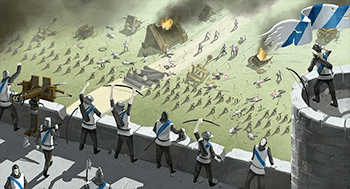
The good guys are in a fortified place, ranging from a barricaded log cabin to a massive Citadel City with stone walls, and they must hold off an overwhelming enemy force against impossible odds. The besiegers have surrounded the good guys so no resupply is possible, and they are attacking the defenders from a distance with ranged weapons and by trying to breach the walls. The besiegers can resupply with fresh troops and weapons but the besieged grow weaker each day. Can they hold out?
Normally, the scenario has a very simple formula: our heroes in their fortified position manage to hold back one or even the first few waves of enemies. However, soon after their minor victory, the enemies somehow break through in the successive strikes and invade the main fortress. Unlike most historical sieges a breach in the wall grants an immediate advantage to the seemingly endless invading army whilst the defenders barely muster proper defenses to hold the breach. Sometimes, this means the bad guys take the citadel, forcing our protagonist into a tactical retreat. Other times, it leads to a Last Stand or even a Pyrrhic Victory for the defenders.
It is the Counter Trope of Storming the Castle and the Super-Trope of the Last Stand.
Compare with Hold the Line, Naval Blockade, Protect This House, You Shall Not Pass!, and All Your Base Are Belong to Us. If they fail, see Watching Troy Burn. If they send someone to get The Cavalry, it's Bring Help Back.
Also the name of a 1998 film, although the siege in question is not as straightforward as the trope.
Several attempts were made in the golden age of table top wargaming to make siege games. The problem was that there is little maneuvering in siege warfare and the most interesting parts are the gadgeteering, which doesn't translate well to actual gaming.
WARNING: As this trope often comes up at the climax of a work, spoilers will be unmarked. You Have Been Warned.
Examples:
- The ongoing story of Attack on Titan has the Survey Corps trying to hold off the Titans as they assault the last city of humanity.
- Code Geass: In season two the Black Knights take refuge in the Chinese Embassy in Tokyo, and even claim one of the embassy's rooms as their sovereign territory. The embassy's smack dab in the middle of territory controlled by the vastly, vastly superior Brittanian military; the only reason Brittania doesn't just attack the Black Knights is because invading a foreign embassy is enough of a diplomatic faux pas that it'd probably just start another war. Bit of an unusual example, though, in that the Black Knights can apparently escape unnoticed any time they wish, but prefer to keep the Brittanians distracted by the embassy for as long as possible.
- The sequel to The Rose of Versailles, Eikou no Napoleon-Eroica, has two examples:
- During the first Italian campaign Napoleon's army reaches Lodi only to find the drawbridge had been drawn, so they start preparing for a siege-and just as Napoleon starts giving the orders, Alain and a group of volunteers charge and manage to lower the drawbridge, allowing Napoleon's army to just storm the city and fight the Austrian troops inside.
- After losing the fleet that had brought his army to Egypt, Napoleon, in his typical fashion, decides to come back to France by conquering the Ottoman Empire, but before that he needs to conquer the fortified city of Acre. Napoleon fails due a combination of admiral Sidney Smith of the Royal Navy intercepting the ships that carried most of his siege artillery and munitions, Antoine de Phélippeaux (Napoleon's old enemy from military academy) supervising the building of new walls capable to resist what artillery Napoleon still has and directing the defense, and Sidney Smith resupplying Acre with food, Ottoman troops, and the guns and munitions he captured from Napoleon.
- In the final mission of Magical Girl Lyrical Nanoha StrikerS, any mage who wasn't helping in Storming The Castles was defending the TSAB headquarters from an invasion force comprising a good portion of the Numbers, Zest, Lutecia and her summoned monsters, and a massive amount of Mecha-Mooks.
- One takes place during episodes 16-18 of Tears to Tiara, when Gaius of the Divine Empire tries to take Avalon, where the demon king Arawn is at.
- Race for the Iron Throne by Steven Attewell in his Chapter-By-Chapter analysis of A Clash of Kings describes the entire history of siege warfare in the chapter commentary of the Battle of Blackwater. Notable for the way it covers how siege warfare complicates conventional ideas of The Laws and Customs of War.
Due to the high casualty rate that came from assaulting a city or a castle...it was generally understood that those men who survived would be free to do whatever they wanted to the civilian population...it was generally understood that it was almost impossible for a general to prevent his army from committing massacres in the event of a successful assault...Even a generals as feared and respected as Sir Arthur Wellesley, the future Duke of Wellington, found it impossible to control his army following the successful assault on Badajoz, leading to the death of thousands of civilians at the hands of a "pack of hell hounds vomited up from infernal regions for the extirpation of mankind."
- Scooby Apocalypse: Mystery Inc. spends the back end of the series trapped in a "Mall Mart" surrounded by monsters.
- Siege: Asgard, the city of the gods, is under siege by the Dark Avengers, H.A.M.M.E.R. and an army of superheroes of the 50 states initiative. Then the Avengers and Patriot shows up, but Asgard is destroyed by Sentry.
- Sonic the Hedgehog (Archie Comics): Issue #75 had Eggman not only pull off a siege on Knothole, he razed it to the ground.
- Abraxas (Hrodvitnon): In this Godzilla MonsterVerse fanfiction, an outbreak of Artificial Zombies in the Elaborate Underground Base forces the handful of survivors who aren't killed and/or taken to hole up for days on end in makeshift barracks while waiting for Monarch to send rescue.
- Invader Zim: A Bad Thing Never Ends: Zim, Skoodge, and Bob spend most of the second chapter trying to break into the Membranes' house to steal back the Ceramic Clown Puppy, but keep getting stymied by the Professor's security system (which he left his kids in charge of while leaving for his conference in Europe) and by Clembrane's raw strength backing them up.
- The King Nobody Wanted: One of Drogo's rival khals spends three weeks trying to penetrate the outer walls of Saath. Once he finally does (after taking heavy losses), he finds that the locals have built a second, stronger wall directly behind the first one, and now he has to try to penetrate that.
- The Mountain and the Wolf: Morally inverted, as the Wolf has been using Harrenhal as a base and demands that the Seven Kingdoms come and besiege him. The lords of Westeros are kind of iffy on the idea, but fortunately Red Priests show up to convince them that letting the Chaos Gods run around would be a very bad idea.
- Shadows over Meridian:
- In Chapter 12, a portion of Phobos' forces under Frost's command assault Cavigor in order to free and recruit the prisoners there. Even with reinforcements sent by Elyon, the defenders are soon overwhelmed and forced to hole up inside the prison and try to ward off further attacks. In Chapter 14, Frost uses the Razor Khan to infiltrate the prison and force the doors open for his main troops, while a reserve force breaks in through a secret underground tunnel. By Chapter 15, the prison has fallen to them.
- Rebellion forces have been besieging the fortress at Snowpoint since Elyon came to power, intent to wear down and eventually overwhelm the Lurdens and Mogriffs stationed there. By the time Chapter 17 reveals this, they're on the verge of claiming victory, only for a relief force of Shadowkhan and Phobos loyalists led by Jade to arrive and launch a counterattack, driving the attackers back.
- Tarkin's Fist: The Siege of Las Vegas proves itself to be one of the most critical battles of the Empire-Earth War.
- 7 Man Army revolves around the titular soldiers, seven members of the PRC army and the only survivors of a battle in recapturing an outpost in the Great Wall from Japanese invaders. They then discover by listening to a captured enemy radio that aa platoon of 2,000 Japanese reinforcements, including tanks and artillery, are coming to retake the fort, and the entire film have the seven fending off waves and waves of enemies.
- 71: Into the Fire is a fictional retelling of the Battle of Po'hang Dong, where a group of 71 South Korean student soldiers attempts to defend a school from an overwhelming wave of North Korean soldiers.
- 300 is based on a real, if wildly exaggerated, historical example, with a group of fearless heroes defending a narrow mountain pass against a vastly larger number of enemies.
- The premise of Assault on Precinct 13 (1976), with a small twist: good must align itself with evil to defend against an enemy that threatens them both. In the original and the remake, a small roster of police officers and civilians must team up with the criminals under their watch to defend the titular Precinct 13. John Carpenter, writer-director of the original film, has acknowledged his story as being basically a modern, urbanized version of Rio Bravo.
- Die Hard has a siege with a twist: the characters under siege are a band of terrorists (actually thieves) pinned into the building by the LAPD (and later the FBI), with one lone police officer trapped in there with them. This is exactly what the villains want, as they need the FBI to cut the power to the building to bypass an electromagnetic lock to the vault that they're trying to rob.
- Dog Soldiers: The movie sees a platoon sent into an isolated stretch of the Scottish Highlands forced to hold up for the night in a rural cottage against a horde of relentless and nigh-invulnerable werewolves, with salvaged ammunition and weapons which rapidly whittle down with each assault by the wolves.
- Evil Dead. In the first and second movie the demons attack the wood cabin where Ash and his allies reside. In the third movie the skeleton army assault the castle.
- Go Tell the Spartans: The village of Muc Wa spends most of the movie being besieged by the Viet Cong as the main cast tries to hold them back.
- Harry Potter and the Deathly Hallows: Part 2 climaxes with Death Eaters besieging the Hogwarts school.
- In Kaamelott: Premier Volet, the Burgundians are too moronic to properly maneuver their Siege Engines... until King Arthur finds a way to coordinate them, rendering them able to besiege the castle of Kaamelott in the climax and allowing him to retake it from The Usurper, Lancelot.
- Dutch movie Kenau shows the siege of Harlem by the Spanish in 1572-1573, and its defense by the city's women.
- The Killer (1989) features one of these as its final shootout, with the title character and his Cowboy Cop ally defending the Killer's last place of sanctuary, a church, against a virtual army of assassins sent by his ex-boss to murder them all.
- Kingdom of Heaven: The climax is the siege of Jerusalem by Saladin's forces.
- Kolberg: A Nazi propaganda film from 1945 about the Real Life siege of Kolberg by Napoleon's army in 1806-7. Meant to inspire Germans to resist the Russians who were invading their country as the film was being finished.
- The Last Jedi has a siege as one of the primary narrative threads. The Resistance capital ships are under attack from the First Order with limited fuel, and their deflector shields can only hold off the First Order for so long. The siege continues and climaxes on the planet Crait, where the final pocket of surviving Resistance members are in a base under siege by First Order walkers and a battering-ram cannon.
- World War I movie The Lost Patrol shows a particularly grim small-scale version, as the men of the patrol are trapped inside the oasis, being picked off one at a time by the Arabs surrounding them outside.
- Since Night of the Living Dead (1968), this has been a staple of horror movies, especially Zombie Apocalypse movies. The Evil Dead series (especially Army of Darkness) loved this trope.
- Defied in Pirates of the Caribbean: At World's End. Several of the pirate lords advocate hiding in their fortress when the East India Company comes calling; said fort is supplied for a several-month siege. Jack points out that they could do that, but half the fort's inhabitants would be dead in a month due to cabin fever-induced civil war.
- Red Cliff, also by John Woo, is based on the historical siege of a river fortress during the China's Three Kingdoms period.
- Saving Private Ryan: Uses this trope in the climax. When Miller's squad find Ryan, he refuses to abandon his mission to hold a strategically vital river crossing for the Allied invasion, in spite of the airborne troops on the location lacking leadership and being outnumbered and outgunned by advancing German forces. Miller decides to lead the defense and let his men join the action not because the bridge is their responsibility, but so that they can ultimately bring Ryan home.
- Scarface (1983) ends with a siege by assassins working for Alejandro Sosa against Tony Montana's mansion, which doesn't really get going until Tony takes up an M-16 with a grenade launcher with a cry of "Say hello to my little friend!"
- Siege is a documentary short filmed inside Warsaw during the German siege of September 1939.
- Skyfall climaxes with Bond and two others (Kinkade, M) defending a manor home against more numerous and better-armed villains. Defenders' advantage allows the MI-6 contingent to hold out against 10-to-1 odds, but they technically still lose because the Big Bad is able to achieve his mission objective (killing M)—or, at best, stalemate, since Bond kills him right after. (Also, the home gets blown up.)
- Small Soldiers had a siege near the end, with lots of antagonistic action figures attacking a house.
- The climax of Straw Dogs (1971) has a microcosmic siege, when five thugs try to break into Dustin Hoffman's house, and he proceeds to not allow violence against his house.
- Disney's Swiss Family Robinson has a fairly epic one, which is one of the biggest differences from the original book.
- The Three Musketeers (2023): Part II: Milady features the Siege of La Rochelle
 (the first adaptation of The Three Musketeers to do so).
- The War Lord (1965): In the 11th century, a band of Frisians make several attempts to storm the tower of Norman feudal warlord Chrysagon de la Cruex (Charlton Heston) and save their little prince who's held hostage inside, with the help of the angry villagers who want the bride Chrysagon took out of Droit du Seigneur back. They use various methods including an attempt at infiltration by night (sabotaging the drawbridge's chains doing so), destroying the door with a Battering Ram made with a tree trunk, burning the tower's door and finally using a siege tower. They fail every attempt, although they could have overwhelmed Chrysagon's forces on the last attempt had Chrysagon's brother Draco not brought reinforcements with a catapult.
- A siege, usually involving a Town Boss being held in a city jail, was the climactic event of four John Wayne movies, including Rio Bravo, El Dorado, The Sons of Katie Elder, and Rio Lobo. Apparently Duke liked this story line even more than he liked stalking and spanking beautiful women (three different movies!).
- The works in The Trojan Cycle tell the story of The Trojan War, most of which consisted in the ten years long siege of Troy. The most famous work in the cycle, The Iliad, is based on a brief period at the start of the tenth year of war.
- Chrysalis (RinoZ): After the ants draw the ire of the golgari Empire of Stone, they find themselves facing a two-pronged siege from the golgari and the Abyssal Legion. As well as having fortified their nests, the ants actually have far more numbers due to their exponential breeding, but the golgari and Legionaries are far more powerful individually, making it very difficult for the ants to hold them back. Ultimately, the only way they can survive is to Hold the Line until a dungeon wave starts and the Legionaries have other responsibilities.
- Tolkien's Legendarium:
- The Hobbit: A rather unbalanced version of this occurs when Thorin and his band are holed up inside the Lonely Mountain as the armies of Laketown and the Wood Elves try to get in to claim the treasure.
- The Lord of the Rings: Used twice, first at Helm's Deep and then at Minas Tirith. Both times, the siege is broken when The Cavalry arrives... literally. Offscreen, the dwarves of Erebor and the men of Laketown held the Lonely Mountain during a lengthy siege that tied up Sauron's northern armies for much of the war.
- The Fall of Gondolin: Morgoth's forces besiege Gondolin and succeed in taking the city, with only a remnant of its population escaping.
- Warhammer 40,000:
- Gaunt's Ghosts: Necropolis is one prolonged siege battle, with the Chaos-corrupted hive city Ferrozoica hurling their entire population at the much larger but much less-militarized hive city Vervunhive. Think Minas Tirith, but with tanks and a good hundred times the manpower. It occurs again in Sabbat Martyr, with Gaunt explicitly comparing and contrasting the two situations, noting that this second time around the "good guys" were even worse off.
- Also in the game background, the Ultramarines' defence of their polar fortress against the Tyranids that had invaded their home planet. Most of their 1st company died holding the place until the Imperial Navy could drive off the Hive Fleet by having a battleship perform a Heroic Sacrifice and explode its warp core right in the middle of the fleet.
- The entirety of Storm of Iron, which features Iron Warriors attacking a seemingly pointless fort on an ugly planet that closely resembles the arse end of nowhere. It's a gene-seed repository, one of the most important places in the entire Imperium. And The Bad Guy Wins. You can panic now.
- Horus Heresy: The three main engagements in Angel Exterminatus boil down to "Iron Warriors do what they do best" — it opens with them cracking open an Imperial Fists fortress, moves on to a cross between this and a Boarding Party, and ends with an Iron Warrior and Emperor's Children mixed force on an Eldar crone world attempting to set up siege lines... only for the situation to reverse when the wraithguard walk.
- War and Peace: Noticeably subverted. Kutuzov abandons Moscow despite everyone on his staff and his emperor demanding that he hold Moscow against a siege.
- Sienkiewicz Trilogy: A mainstay. Each of the books in the trilogy has a climactic siege featuring the defenders fighting against great odds.
- Rogue Male: For a large part of the story, the hero is besieged alone in his hideout, which has gone from a refuge to a hellish trap.
- The climax of the entire Harry Potter series takes place in the last third or so of Deathly Hallows, when Voldemort and his Death Eaters storm Hogwarts itself.
- This is the entire premise of the Drenai novel Legend: the garrison of the fortress of Dros Delnoch must hold out against the Nadir army to buy enough time for their country to levee an army.
- Azincourt goes into great detail over the siege of Harfleur. The siege is a shambles, the British end up with dysentery, the French keep rebuilding the walls and to top it all a ship gets past the blockade to resupply them. When King Henry V finally takes the small town he lost so many forces he can't possibly hope to defeat the French in open battle but to save face forces his men to march around France attempting to avoid their army... that doesn't work out so well.
- Colas Breugnon has a siege described early in the novel. Even though a few people die, both sides come to an agreement after a few days and settle down to eat together. No one's very sore about the entire incident.
- The Chronicles of Thomas Covenant: In the third book, The Power That Preserves, Lord Foul's army of monsters does this to Revelstone.
- Mistborn: The Original Trilogy has a few such examples.
- In Mistborn: The Well of Ascension, the protagonists are besieged in Luthadel by three armies at once; the fact that the besieging armies are all working against each other is the only reason Luthadel lasts so long.
- In Mistborn: The Hero of Ages, the good guys are the ones doing the besieging, until the Big Bad's army shows up and the besiegers and the besieged decide to team up.
- Occurs several times in the Malazan Book of the Fallen, most notably the exceptionally one-sided siege of Capustan in Memories of Ice.
- Defied in the first book of The Deed of Paksenarrion. Paks's unit is holding a fortress when another mercenary company shows up with siege engines. Paks's unit is not equipped or supplied for a siege (and the other side is a sometimes-allied business competitor, not some Army of Evil), so they surrender.
- The main conflict in Redwall is a siege laid upon Redwall Abbey by a vicious one-eyed rat named Cluney the Scourge. Cluney's forces actually manage to get in and have to be thrashed afterwards. There are many, many other sieges in the series, either against Redwall or the Badger Lord's fortress of Salamandastron.
- The Reynard Cycle: The climax of The Baron of Maleperduys features a fairly spectacular one. Our heroes are hopelessly outnumbered, and the bad guys have artillery in a world where castles are not built to withstand cannon fire. It ends when The Cavalry arrives, revealing that what had appeared to be a hopeless situation was actually a trap that Reynard set, using himself and his friends as living bait.
- Part of the plot of Septimus Heap: Darke involves the Siege of the Wizard Tower by the Darke Domaine.
- A Song of Ice and Fire, being a medieval fantasy, has a lot of these. A few examples:
- The novel features a siege in the climax of A Clash of Kings, the Battle of the Blackwater, with multiple chapters exploring the conflict from the perspective of the besiegers, the defenders, and the women in the castle who fear becoming victims of soldiers on either side.
- One siege at Riverrun is entirely at a stalemate until Jaime comes and resolves the whole mess with a To the Pain speech about what will happen to the castle and its people if they don't surrender to the overwhelming numbers at their door.
- Daenerys becomes fairly well acquainted with sieges throughout Slaver's Bay, having been on both sides of them.
- One of the most memorable sieges in the series is in the back story, the famous Siege of Storm's End in which Stannis' men were nearly dying of starvation toward the end. This gave Davos his opportunity to become a main character by slipping past the naval blockade and smuggling food (most famously, lots of onions) into the castle.
- Also famously averted in the backstory as well. The incident which first made Tywin Lannister infamous was a series of battles with defiant lords who had been used to the Lannisters being Puppet Lords and having things their own way. In one of the battles, with the Reynes of Castamere, the Reynes and their garrison retreated into a series of mines, knowing that the Lannisters would suffer high casualties trying to storm the narrow, unfamiliar mines and weren't equipped for a siege, so the Reynes thought they could outwait the Lannisters or negotiate. Instead, Tywin ordered the exits of the mines sealed and diverted a local river to flow into the mines. No need for a siege if every single man, woman, and child of your enemies has drowned in the darkness. The act immediately returned the Lannisters to being one of the great powers in the Kingdom, and made Tywin The Dreaded. From that day forward nobody was eager to find out what kind of method he'd come up with to make them regret it if they crossed him.
- In the backstory to Warrior Cats, SkyClan had to endure this. Forced out of their home, they found a gorge and settled down in it. However, a massive horde of rats surrounded them, just waiting for them to try to leave the get some food, take a nap outside the gorge, or something of the sort. When a cat left, they were swarmed by rats and killed. It was enough to drive a cat mad, and led to the end of SkyClan. However, the cats get the last laugh, as the rebuilt SkyClan drives a group of rats under a pile of garbage, surrounds it and waits for them to try to escape, then kills them as they leave.
- Daemon: Late in Freedom™, anti-Daemon mercenaries carry out one against a Daemon community.
- There are two major sieges in the latter part of The Wheel of Time: Caemlyn, as part of a Succession Crisis, and Tar Valon, the result of a schism between the Aes Sedai. There is also a siege on the fortress known as the Stone of Tear, but its impact on the plot is minimal.
- In Christian Nation, the American theocratic government under the leadership of President Steve Jordan laid siege against the last holdouts of Constitutional democracy and freedom by cutting off all aid to Manhattan Island, where they were all located. The President even goes so far as to declare Deuteronomy 20:10-12 as "justifiable grounds" for it.
- The Siege of Acre during the climax of Tenacious, which Kydd and Renzi take part in as defenders under the command of Sidney Smith. The battle is notable for being one of Napoleon's few losses, and it was to a ragtag group of sailors as opposed to trained infantry.
- In the backstory of the Belgariad, the armies of Kal Torak besieged the Algarian Stronghold for six years without any success, eventually giving up to move on to Arendia, where it was destroyed at Vo Mimbre. The main reason why this happened was because the Stronghold wasn't so much a city as it was a man-made rock in the middle of nowhere that the Algarians built so that invading armies would have something to try to besiege instead of wandering aimlessly around the plains.
- The Elenium had the protagonists spearhead two of these, in the defense of the setting’s equivalent of the Vatican, and a smaller scale one in the first book of the Tamuli, which is broken rather brutally as the besiegers in this case were more a mass of rabble with sabotaged weapons due to the protagonists’ intelligence efforts giving them notice well in advance, though one of the antagonists claims that the whole thing was a test in the first place.
- The first book of The Traitor Son Cycle centers around two sieges - first, of the city of Albinkirk and, after Albinkirk falls, of the Lissen Carak convent.
- The Black Company:
- The first novel involves a siege on The Lady's Tower. Although the defenders held tower, due to considerable number of powerful sorcerers serving both sides and usage of magical weapons of mass destruction, almost all of the attackers and defenders were wiped out.
- In Shadow Games, the Company botches the siege of the city of Dejagore, with Croaker missing and assumed dead, Lady stuck outside the walls, and Murgen trapped inside. Most of the following two books, Dreams of Steel and Bleak Seasons deal with Lady and Murgen trying to recover from the disaster.
- Accordingly, Bleak Seasons is this trope from the other side, besieged inside Dejagore by the Shadowmasters.
- David Gemmell's The Troy Saga features the famed siege of Troy taking up most of the third book in the series.
- The Tough Guide to Fantasyland: Walled Cities are guaranteed to be besieged at least once. The enemy always tries to storm the walls, instead of simply starving the defenders out, which is the more realistic and safer way. Even so, they'll succeed eventually and loot the city. Inhabitants will suffer much murder, rape and theft. Tourists however will always be able to escape with Secret Passages. Citizens of these cities will be surprisingly cool with them leaving everyone else there to fight on.
- Bazil Broketail: Much of the second book revolves around the Argonathi soldiers defending Ourdh against the Sephisti fanatics besieging it.
- The Unwilling Warlord: Sterren returns from his recruitment mission, mages in tow, only to learn that Semma's enemies attacked in his absence, as opposed to waiting for spring, as expected, and are laying siege to the castle already. He manages to defeat them with the mages.
- The Unwomanly Face of War: Among the narrators there are many survivors of the Siege of Leningrad, which lasted almost 2 years and killed over 2 million of people between soldiers of both sides and civilians.
- Fengshen Yanyi: being a fantastic retelling of the Shang-Zhou conflict, sieges play a big part: from chapter 2 to 3 there's Chong Houhu's disastrous attempt to take over the domain of Marquis Su Hu to make him deliver his daughter Daji to King Zhou. Then, starting from chapter 36 to chapter 67, the city of Xiqi is repeatedly attacked by King Zhou's forces in an attempt to crush their threat before it grows stronger. After chapter 67, the roles are inverted as the heroic forces of Zhou march against the decadent Shang, conquering the various fortresses in their way to the capital of Zhaoge. This trope is also averted for the final battle: knowing very well that the people of the capital were already suffering under the cruel mismanagement of King Zhou and Daji, Jiang Ziya forbids his troops from besieging the capital. Instead, he sends thousands of arrowgram messages over the walls, inviting the people to surrender peacefully so that they may punish only the tyrant. It works, leaving only the palace ground as the last stronghold to conquer.
- Watership Down. The rabbit dictator General Woundwort launches an expedition to destroy Watership Down. His surprise attack fails when the rabbits get word of his approach and seal up the tunnels, forcing him to lay siege to the warren. He rejects the idea of starving them out and instead has his rabbits dig a tunnel directly down into the Honeycomb.
- The climax of Michael Ely's Centauri Dawn has the Spartan Federation besiege the Peacekeepers' city in a way that parallels The Iliad. The city's massive walls and gate manage to hold off the attackers for days despite their advantage in numbers, technology, and training. Pravin Lal (the leaders of the Peacekeepers) has an opportunity to destroy the attackers in one swoop with a deadly nerve gas, but opts to take the high road instead. Pravin's son leads a sortie that results in the death of the son of Corazon Santiago (the leader of the Spartans). In retaliation, Santiago personally leads her elite Myrmidons to storm the city through a secret passage and kills Pravin's son in front of Pravin. Pravin's wife and grandchild are also killed during the sacking of the city. After that, the Spartans leave, but not before blowing up the gate as a warning.
- The Oleander Sword: Malini has besieged the maze fort of Saketa after its lord sides with her brother and attacks her. However, it's not an easy target, with the fort withstanding every attempt to storm it and having vast supplies to help withstand being starved out. They later take the fort after learning about a secret entrance inside from Kanal, the lord's son, when he's tortured.
- The Chronicles of Dorsa: Once the shadows infect most of the people in Port Lorsin, they attack the royal palace at its heart, sending waves of bodies against it.
- Rebuild World: One of the later arcs of the Web Novels has Akira, most of The Squad he has teamed up with by that point, as well as the Ragtag Bunch of Misfits Hunter Gang Akira's been building up with Sheryl, defending their territory in the slums from a mechanized force of the Lion Steel MegaCorp on the outside, as well as several Private Military Contractors hired by them attacking from the inner part of the technically neutral city of Kugamayama on the other. It's a multi-phase battle with the defenders trying to protect the fortified Home Base gang headquarters, seeing whole swaths of the slums flattened. It ends with The Corruption brought by the gone mad leader of the Lion Steel forces assimilating technology and corpses into monsters to attack all sides, finally prompting the Kugamayama City defenders to be Neutral No Longer. This was all the result of The Conspiracy by multiple parties to try and demonstrate the power of the Lion Steel co to help recruit an A.I. into the company, and they pay everyone hush money.
- 24: At one point in Season 4, Jack Bauer and three civilians must hold a sporting goods store against a squad of heavily-armed commandos until help arrives.
- In the season 4 finale of Burn Notice, Vaughn's entire organization corners Michael and crew in a half renovated hotel. they get out when Sam convinces congressman Cowley to call in the army to save them.
- Doctor Who:
- "The Base Under Siege" is a standard Doctor Who plot ("Moon base, sea base, space base, they build these things out of kits!"), especially in Pat Troughton stories, such as "The Wheel in Space".
- "The Ark in Space" is something of a Deconstruction of the Troughton style of doing it. Yes, there's a multidisciplinary team of scientists doing very important things! ...because they're amongst the only humans being sent off the Earth before its destruction. Yes, something terrible is trying to get in! ...except the base had a security system specifically built to prevent that sort of nonsense which killed it as soon as it actually did get in, meaning the main threat is actually a member of the base personnel who got contaminated with its genetic material and is transforming into one. Yes, the companion saves the day by running down a corridor! ...except she's the only person who can because she's the only person small enough to fit in the tunnel, and she gets stuck, and panics until the Doctor bullies her into pulling herself together.
- "World War Three": In a small-scale example, the Doctor, Rose and Harriet Jones (MP, Flydale North) barricade themselves inside the Cabinet room in 10 Downing Street, which has steel-reinforced walls, after they are surrounded by the Slitheen. The siege is broken when the Doctor, over the telephone, instructs Mickey to launch a missile into the building, killing the Slitheen. The Doctor, Rose and Harriet survive by taking shelter in the closet, and are able to walk out afterwards.
- "The Parting of the Ways", though it was slightly subverted in that the good guys did not actually end up holding off the evil Daleks, and by the end of the episode, every main and minor character, with the exception of Rose Tyler, was dead. Two get better.
- "The Waters of Mars" subverts a number of conventions in this regard, resulting in a dark and unsettling story all round.
- The Final Battle for the Twelth Doctor is a siege that occurs in "The Doctor Falls". The Doctor and a cyberconverted Bill Potts, perform a Last Stand to defend Nardole and the solar farmers of floor 507 as they escape to a higher level of a massive Generation Ship... While floor 507 is being besieged by rapidly (due to Time Dilation) evolving Cybermen.
- Firefly:
- Game of Thrones:
- Robb's first goal in the War of Five Kings is to break Jaime Lannister's siege of Riverrun.
- Stannis Baratheon besieges King's Landing in "Blackwater", the climax of Season 2.
- During Robert's Rebellion, Stannis was Reduced To Rat Burgers inside Storm's End by Mace Tyrell.
- The wildlings under Mance Rayder attack Castle Black from both sides of the Wall in "Watchers on the Wall".
- Masada is about the siege of the titular Jewish Zealot bastion by The Roman Empire in AD 73.
- Preacher Jesse Custer spends most of the episode "El Valero" holed up in his church, holding off the personal army of Odin Quincannon, who wants to force Jesse to sign over the deed to his land. Since Jesse is a Retired Badass and One-Man Army, he has no problem fighting them all off until he gets too weary of the fighting and lets Odin's Dragon, Donnie, capture him.
- Rise of Empires: Ottoman: The Battle of Constantinople is portrayed through the eyes of both the Ottoman attackers and the Roman defenders, while historians occasionally provide exposition on the mindset of the characters or information one has to know to understand the significance of certain events.
- Stargate Atlantis: The first-season finale, named appropriately enough "The Siege", shows the main characters defending Atlantis from a Wraith assault.
- Star Trek: Deep Space Nine: "The Siege" (natch), "Way of the Warrior", and others. Since the setting was a station, this was a natural plot idea. Speaking of which...
- "Siege of AR-558" (not to be confused with the above episode) is particularly gruesome. Doing the math, one can determine that the Federation troops suffered on average about one casualty a day from either the minefield or repeated probing attacks from the Jem'Hadar. Doesn't sound like much, until one considers the psychological effects at play over the long period they've been there. The mines are invisible and out-of-phase, they can and will strike at random anywhere in the base so nobody is ever safe anywhere; every couple days an explosion will just happen and someone is killed with no warning or defense possible. Due to the ongoing battle in orbit, nobody ever gets rotated out (they've already been there about three times longer than regulations allow for frontline duty in an active combat zone) and no reinforcements can be spared; so the soldiers stationed there are faced with a near certain prospect of a slow war of attrition with almost no hope of escaping the situation as, one by one, their friends and comrades get killed. Who will be next? How long until your number comes up? Some of them are relieved to hear a large enemy attack force is about to come wipe them out ("it beats waiting").
- The Supernatural episode "Jus In Bello" brings the trope into play as Sam and Dean are arrested and the police station where they're being held comes under attack be demons led by Lilith. They wind up forging an alliance with the FBI agent who wanted to put them away forever.
- Super Sentai: The first episode of Kaizoku Sentai Gokaiger has all the past sentai teams defending Earth from an alien invasion.
- The end of the third season of Vikings features the Norse besieging Paris. At first they attempt to Storm the City, but are beaten back. After that fails they settle in to starve out the city or make other attempts to breach the defenses, like trying to slip into the city during the night and open the gates. All these attempts fail, but disease and hunger do start running rampant in the city as a result of the siege, until eventually the Franks attempt to pay the Norse army to lift the siege and leave.
- Doctor Who: The "Base Under Siege" plot is spoofed heavily in the Nebulous story "Destiny of the Destinoyd" — an illogically unsafe moonbase setting, Retirony, Redshirt characters talking about their family members before doing something Genre Blind, a large multinational team where everyone has a dark secret each and gets picked off by the monster one at a time, and a monster that wouldn't be out of place in a Tom Baker-era storyline.
- BattleTech: Sieges show up fairly often in the fiction. It's very rare for the defenders to win in such situations: Battlemechs excel at mobile warfare, putting them into static defensive positions just encourages them to be surrounded and overwhelmed. The largest siege in Battletech history would be the Fortress Republic, a defensive plan initiated by the Republic of the Sphere that put up the "Fortress Wall" (a mysterious barrier that prevented jumpships from entering the inner third or so of the Republic's star systems) during the Dark Age. The Republic lacked the ability to sustain the Wall indefinitely, so they chose to tell Alaric Ward and the Wolf Empire how to get past the Wall and to come to Terra in order to fight for it, hoping that they could face a single enemy at a time and defeat them in detail. Alaric instead told the method of breaching the wall to his main rival, Malvina Hazen of the Jade Falcons, so that both Clans Wolf and Jade Falcon were able to assault Terra together and overwhelm the Republic defenders. Ironically, after emerging victorious, Alaric himself wound up under siege as he lost so much of his forces in the fighting with the Republic and then the Jade Falcons is to keep the Wall up.
- Betrayal at House on the Hill: Many of the scenarios are variations on The Siege with different Monsters Of The Game.
- Warhammer: The great fortress of Monte Castello, which guards the land connection between Tilea and the Border Princes, has come under siege from orcish hordes countless times. The most famous lasted over a year and a saw a horde of thousands of orcs besiege a dwindling garrison whittled down to less than five hundred soldiers, its commander dead and all connection to the outside world lost. The soldiers came very close to giving in to despair until the commander's daughter, having donned her father's armor to lead the men into battle, implored them to hold fast against the horde, if only to avoid having the Greenskins deface the famous fresco in the mess hall. This managed to rally the remaining defenders, who held fast for another three months until an allied army arrived to break the siege.
- Warhammer 40,000:
- One specialty of the Imperial Fists Space Marines is holding the line in sieges. Not coincidentally, the specialty of their arch-enemies, the Iron Warriors, is launching them.
- In the Horus Heresy, the Chaos Space Marines laid siege to Terra, and the Emperor and his remaining forces were forced to drive them off with all they had. The Imperial forces drove the Chaos forces off and killed Horus, but at the price of Sanguinius being slain and the Emperor nearly being killed as well.
- The infamous Siege of Vraks is an inverted example. The Death Korps of Krieg mounted a brutal 17-year siege against Apostate Cardinal Xaphan's forces.
- Speaking of which, the Death Korps of Krieg is an Imperial Guard regiment renowned for its ability to wage wars of attrition, trench warfare, and sieges.
- Checkers: During an end game, if the vanquished player is stubborn about it, he can retreat to a double corner. It needs a carefully choreographed sequence of moves to dig him out and is rather like a siege.
- The old Norse game Hnefatafl simulates an escape from a besieged fortress, as opposed to a pitched battle (like Chess).
- Red Hand of Doom: Part four leads to the Battle of Brindol where the Red Hand attacks the city; in addition to surrounding the city with their army, the Red Hand attacks with dragons and have hill giants bombard the walls with stones. The players have to partake in missions as well as fighting enemies to save the city and win.
- Too many First-Person Shooter and Real-Time Strategy to list. Usually includes a timer to let you know exactly when the defending stops and counter-attacking starts. The entire Tower Defense subgenre is built around this.
- Special mention goes to the original PlanetSide. Bases used a resource called Nanites to allow infantry to spawn, and to produce weapons and vehicles for troops. This resource was finite, and had to be resupplied by driving a specialized Nanite Transport vehicle to a gate, collecting nanites, and bringing them back. If the base ran out of nanites, it would immediately go neutral, terminals stopped working, spawning was stopped, and base defenses went offline. In this manner, if your force wasn't strong enough to defeat the entrenched defenders, it was possible to lay siege to them until they eventually "starved" themselves of resources and fell from within.
- Happens in Neverwinter Nights 2 when the hero's castle is besieged by the undead army of the King of Shadows. The already problematic odds take a turn for the worse when one of the hero's companions turns out to have betrayed them by sabotaging the gate and when the undead, including the vampires, turn out to be unaffected by sunlight.
- Mass Effect 2: Garrus' recruitment mission and Grunt's loyalty mission both consist of three or four heroes holding a somewhat defensible position against a horde of mercenaries/alien monsters, followed by a Background Boss. Legion's loyalty mission is a sort-of Tower Defense scenario.
- Urban Dead: The game revolves around humans building barricades inside buildings and zombies trying to break in. Most famous is probably Second Siege of Caiger Mall, going for three real life months.
- Goblin sieges in Dwarf Fortress; more rarely, human and elven sieges. If all the resources you rely on are subterranean (water, magma, farmlands, wood, ores,) a virulent forgotten beast can effect a siege from below.
- In the PS3 and 360 versions of the first The Godfather game, a slew of Cuneos assault the Corleone compound, and your job is to hold the fort with your fellow mobsters. These become more common in the sequel since enemies can now randomly raid your fronts.
- Happens to your castle at the end of Dragon Age: Origins – Awakening. Depending on your administrative decisions during the campaign, if you stay to protect the city instead of returning to defend the castle, it can be either a Last Stand for the defenders, or a successful repulse of the siege.
- Crossed with Delaying Action in the third Terran mission of StarCraft: you have to hold your fort against repeated Zerg attacks until dropships arrive to evacuate your troops.
- Diablo:
- Act V of Diablo II has you battling the forces of Hell which are pounding on the gates of Harrogath and pursuing Baal as he seeks the Worldstone.
- Act III of Diablo III has you defending Bastion's Keep near the crater of Mount Arreat against a full-on demonic onslaught by the forces of Azmodan.
- Happens a lot in pretty much every installment of Fire Emblem, defending for a certain number of turns in some levels and seizing castles in the siege missions.
- World of Warcraft:
- During the Cataclym expansion, the Dragon Soul raid is this. All of the Twilight's Hammer and the Black Dragonflight are bringing their forces to tear down the Wyrmrest Temple and bring the Hour of Twilight. It's up to you and 9/24 other heroes to not only stop that from happening, but finally put an end to Deathwing.
- The Scorge's attempt to attack Light's Hope Chapel in the Wrath of the Lich King expansion was similar, only that siege was thwarted after Tirion showed up and casued all the forces to either become good or die.
- A few missions in Guild Wars are based around these (Dzagonur Bastion, Thunderhead Keep, Eternal Grove, Genius Operated Living Enchanted Manifestation.)
- Final Fantasy XIV has "The Steps of Faith", the last trial in the 2.0 main scenario questline. Players are tasked with defeating the dragon Vishap before it can break through Ishgard's last line of defense, fending off its draconian hoards in the process.
- The very first stage of Hour of Victory, "Barbarians at the Gate" begins with you fending off a German siege in an Allied outpost somewhere in Casablanca. Right up to controlling Anti-Air turrets to prevent German bombers from destroying three Allied Communications Towers.
- Jak and Daxter:
- Haven City, such as it is, from Jak II: Renegade has been under siege by the Metal Heads for hundreds of years, and is believed to be the only city left on the entire planet, making it humanity's last hope. Pity that the Baron's plan to defeat them would also destroy the entire universe.
- In the next game, Jak 3, the Freedom League are under siege by Krimzon Guard robots and Metal Heads, and later, Spargus comes under siege from the Dark Makers - it's an interesting change, because in Haven the civilians would run and scream when confronted with enemies, while in Spargus there's no town guard because everyone is armed.
- There's one of these in every main God of War game. The first game's plot revolves around Ares, the Greek God of War, besieging Athens. The second game starts off with Kratos, in his new role as God of War after killing Ares, besieging Rhodes. The third game is a siege of Mount Olympus as Kratos and the Titans aim to overthrow the gods.
- Baldur's Gate II: Throne of Bhaal throws the player into one of these almost from the beginning. As soon as the player gets out of the initial pocket plane, he or she winds up in the city of Saradush, which is being besieged by a massive army led by a nigh-invulnerable fire giant. The player can even be hit by random artillery fireballs fired by the besieging army when moving around the city.
- The final mission in Planet Explorers's campaign is a long fight to protect the player colony from waves of Pajan soldiers after the humans' nuclear weapons and their giant robots.
- Bugsnax ends with the titular creatures attacking Snaxburg and attempting to force-feed themselves to the Grumpuses to turn them into fodder for more Bugsnax as they fight for their lives and to defend the only means they have to escape Snaktooth Island.
- The Witcher 2: Assassins of Kings: In one of the major Story Branching paths where you have Geralt align with Iorveth, Geralt takes part in preparations and eventually defends the walls of Vergen alongside Saskia the Dragon Slayer, against the forces of King Hanselt of the Kaedweni Kingdom trying to settle old scores.
- The Inexplicable Adventures of Bob!: The heroes defend Viceroy's Spire — and by extension, all of Planet Butane — from Fructose Riboflavin and his new Wave-Motion Gun.
- In The Order of the Stick, Azure City, a bastion of good partially ruled under the watch of paladins, is attacked by a massive army of hobgoblins led by Redcloak, an evil goblin cleric and Xykon, an evil human lich sorcerer. The protagonists find themselves defending the city alongside the paladins. The good guys actually lose with heavy casualties, and Roy (the leader of the protagonists) was killed. A very, very long arc was dedicated to the fallout of the battle, including the scattering of the protagonists, the refugees of Azure City desperately searching for a new home, and Roy is only resurrected after being dead for over 220 strips. (Or to put it another way, by the time Roy was brought back from the dead, he'd been dead for about about a third of comic's run to that point.)
- In The Senkari the titular force has to hold off an overwhelming force of Daemonic infantry in a final stand.
- Tuesday Titans: The story opens with an all-out attack by the nation of Severine on the Dies Martis Peninsula in Southern Enotria. By the time the reader joins, the city is in flames, the military defenders are fighting for their lives, and the Titans have been deployed.
- Avatar: The Last Airbender
- The first two-part season finale appropriately enough entitled, "The Siege of the North", has the main protagonists aid the Northern Water Tribe in staving off a Fire Nation assault.
- "The Northern Air Temple", wherein said protagonists defend the titular temple... from a Fire Nation assault (the Fire Nation does a lot of assaulting).
- Iroh's legendary six-hundred day Siege of Ba Sing Se.
- On that note, Ba Sing Se itself. While the Fire Nation has made more serious efforts on occasion, the city has been under more or less constant siege for a very long time, which is why it's completely self sufficient (having a large agrarian zone inside the wall capable of supporting the entire city). This is additionally supported by the presence of Fire Navy ships in territorial waters near the city, implying that outside the city itself the Fire Nation essentially has free reign. And one has to wonder why there's no sign of plant or animal life outside the wall whatsoever, considering that the fire nation has been known to burn down villages and forests...
- Danny Phantom:
- Though it's largely off screen, Jack and his reluctant daughter are the only two to defend their home from an invasion of mutant ghosts.
- "Reign Storm": a handful of good guys, enemies, and ghosts battle against thousands upon thousands of armed force.
- This trope is a case of Truth in Television. Sieges have been and (to some degree) remain a common military strategy. Modern infantry tactics favor going around strong points in the defense and let rear-echelon troops deal with them later, but sometimes there is no going around a well-placed defensive position.note A good number of movies and television programs base their siege plots on real life sieges like Leningrad and the Alamo. These are well-remembered by a (defending) nation's population if their people either won the siege by successfully holding their position against an overwhelming enemy or (more commonly) lost gloriously.
- The dominant form of European warfare until well into the 19th century, and indeed beyond if one includes WWI. Reached it's apogee after proper siege cannon made tall, thin stone walls like those that protected medieval castles obsolete, and European states transitioned to the trace italienne. With low, thick, angled bastions almost impervious to cannon fire, and capable of laying down whithering overlapping fields of fire, the new star forts were almost impossible to assault at will. Instead, attackers had to dig entrenchments parallel to the thinner curtain wall they intended to breach, alternating between zig-zagging trenches and straight, parallel ones for the cannons to lay down suppressive fire, inching forward for months in this leapfrogging pattern. Furthermore, the looming possibility of a relief force meant that the attackers needed to construct their own fortifications to protect them while they reduced the besieged fortress. This led to sieges within sieges as the attacker found himself defending fortifications against one enemy force while preparing to assault the garrison. Even when the curtain wall was breached, attackers might hesitate; if the bastions were still intact, the assault force would be subject to overlapping fields of fire from inside the fort and from bastions on both flanks. Well over half many states' budgets went to constructing fortifications in the new style, and that was with much of the costs being borne by the city that was being fortified. Dramatic victories on the battlefield were no longer enough to decide a war while the enemy still held their fortresses; there's a reason the Dutch war for independence is called the Eighty Years War.
- 1941-43 Siege of Leningrad. c.500,000 civilian dead and c.500,000 evacuated of pre-war population 2.5 million - deaths chiefly from exposure and starvation-related disease due to German blockade. German War Crimes not cause of death within city itself, but in suburbs and surrounding districts many dead of exposure and starvation due to German non-compensated seizure of food, clothing, and housing from locals for military use. NKVD (precursor to KGB) recorded 2015 convictions for Cannibalism acting in its capacity as the Leningrad police force during the Siege. Proportion of convictions to total instances of cannibalism unknown.
- Soviet military forces actually made superhuman efforts to deliver some foodstuffs by boat in summer or trucks over the ice during winter. But as the entire city's infrastructure was destroyed or inoperable, even for the little food which could be delivered, people had to walk for many miles in temperatures as low as -30°C. After weeks of back-breaking labor in the cold. For many it was a one-way trip.
- Back in 134 BC during the Celtiberian Wars, the Iberian hillfort of Numantia, in today's Spain, held off a siege by the Roman Army for 13 months. In the end, the surviving defenders chose to suicide rather than be killed or captured by the Romans. To this day, the Spanish language has the adjective/noun numantino, meaning "he who tenaciously resists to the limit, often on precarious conditions."
- The fortress of Masada in Israel topped that, holding out against the Romans for three years before choosing mass suicide. It helped that Masada's position on top of a mountain with a single easily-defended way in made the fortress effectively impossible to take with military strength alone... At least until the Romans were finished building their mountain-sized siege ramp.
- With the Romans as defenders, the Second Punic War offers us Placentia and Cremona: two recently founded coloniae, thus still fortified outposts in recently conquered territory with a large civilian population to show off the benefits of being Romans, they found themselves almost immediately besieged by the Gauls that had risen in arms after Hannibal's invasion. The sieges were notable for enduring longer than the war: Placentia fell in 200 BC, two years after Carthage had surrendered to Rome, and Cremona resisted until the Romans destroyed the Gaulish revolt under its walls.
- During Spain's War of Independence, the city of Saragossa suffered TWO sieges by the French Army. The first (1808) ended with a Spanish victory; The second one (1809), historically noted for its brutality, ended with a French victory. Saragossa was reduced to 12,000 people from its pre-second siege population of 100,000.
- The battle of Alesia was a strange example: Julius Caesar's army was besieging the city as it was the last stronghold of Vercingetorix (the last Gaulish leader against Rome), but was in turn besieged by a Gaulish relief force. The battle happened when the Gaulish relief force tried to break the Roman siege and the Alesia garrison sortied, but resulted in Caesar beating back the sortie and near-annihilating the relief force (the annihilation wasn't total only because the Romans were too tired to pursue them), causing Vercingetorix to surrender before the Romans broke in and exterminated everyone.
- The Great Siege of Gibraltar of 1779, took place during the American War of Independence, when the British territory Gibraltar was besieged by a combined Franco-Spanish army. It lasted until 1783, and is the longest siege endured by the British Armed forces. It was the largest action of the war, and of particular note was the Grand Assult of 1782. It lasted for three years and seven months, and ended in a British victory.
- Lasting almost four years, The Siege of Sarajevo was the longest siege in modern warfare. It was part of the breakup of Yugoslavia, and began when, after Bosnia declared independence from Yugoslavia, Serbian forces surrounded the city in an attempt to make a new Bosnian-Serb state, which the Bosnians were none too happy about. The end result was nearly 12,000 dead, and a city forever scarred.
- The wars that followed the 2011 The Arab Spring witnessed some of the most brutal and withering sieges of the modern ages and some of the most vicious Urban Warfare to be witnessed since World War II.
- The Syrian Civil War, in particular, saw the worst of the sieges after the Syrian Army instituted a tactic known as "Kneel or Starve" in which the army would surround an Opposition-controlled town or city and bomb it to submission, with surrender either entailing "reconciliation"note or exile to other Opposition-held areas. As Opposition-held areas shrank, the idea of exile became less and less tenable. Major cities such as Aleppo and Homs, Damascus districts like Yarmouk and Ghouta, and small towns such as Madaya and Zabadani have all suffered these.
- The Syrian Army itself found itself on the receiving end of brutal sieges by Daesh in the Kuweires Airbase and about half of the city of Deir ez-Zour. Deir ez-Zour, in particular, came to be referred as "The Syrian Stalingrad" by regime supporters for the sheer intensity of the battles.
- Speaking of Daesh, many of the group's holdings in Sirte, Raqqa, Mosul and Baghouz also saw withering sieges owing to the use of civilians as human shields, unreal quantities of explosive booby traps and the militants' unwillingness to surrender unless they were given a way out.
- The Syrian Civil War, in particular, saw the worst of the sieges after the Syrian Army instituted a tactic known as "Kneel or Starve" in which the army would surround an Opposition-controlled town or city and bomb it to submission, with surrender either entailing "reconciliation"note or exile to other Opposition-held areas. As Opposition-held areas shrank, the idea of exile became less and less tenable. Major cities such as Aleppo and Homs, Damascus districts like Yarmouk and Ghouta, and small towns such as Madaya and Zabadani have all suffered these.
