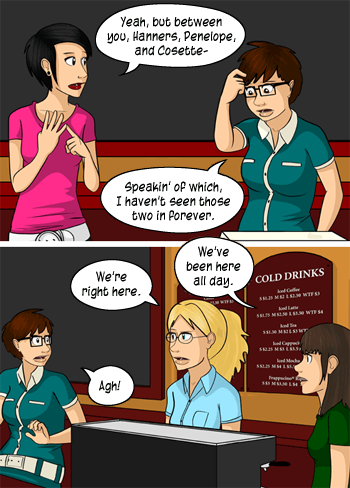
Homestar Runner: Oh, I'm pretty much here every week. It's just that usually I'm behind the black.
Strong Bad: Guess I should start looking to the right more often.
The tendency for something or someone to be completely invisible to the on-screen characters simply because it is not visible to the camera, i.e. "behind the black"note — even when that object or person should be in clear view from the perspective of the characters' actual eyes. Some TV shows, films, and video games are guilty of assuming that characters can't see something just off-screen because, well, the viewer can't, and the viewer is the center of their universe. And don't start on the countless cartoons where somebody hides "behind" a spindly tree such that even the viewer should be able to see them...
In any visual medium, every single time a character runs out in the street, and we, the audience, can't see if it's safe, that character will be hit by a truck. Of course this may be explained by them having other reasons not to see around them, like being distracted, in a dimly-lit area, etc. The important thing is that they tend to share their vision (and lack of it) with the viewers in order to experience things simultaneously (often things that they wish weren't there to begin with).
One of the more common examples of this trope can be found in top-down RPGs, which feature hidden passages that should be obvious to the characters.
It's also typical that if a woman is naked against her will and shown from the waist up, she only covers her breasts and leaves her lower body completely exposed as if the other characters only can see her upper body.
A Sub-Trope of Rule of Perception. The Stealth Hi/Bye often takes advantage of this. Compare See No Evil, Hear No Evil, when off-screen events aren't audible until they appear on-screen. See also No Peripheral Vision, Failed a Spot Check, Offscreen Start Bonus, Offscreen Teleportation, Offscreen Reality Warp, Tree Cover, Fog of War, and Obscured Special Effects. For the acoustic counterpart see See No Evil, Hear No Evil.
Not to be confused with Black Screen of Death, which is more about what you don't see.
Examples:
- Old Navy's 2009 Christmas commercials featured the mannequins going about town looking for Santa Claus. They think they might've finally found him at one point; he's got his back to the camera but he should be making eye contact with the mannequins, and they don't realize it's just some guy until he turns to face the camera, meaning he has his back to the mannequins.
- The ability to step off-screen and disappear to other characters is developed into an almost super-human talent in the anime and manga Kuroko's Basketball. The main character, Kuroko, becomes invisible to other characters by virtue of always being out of frame. He can also deliberately disappear or reappear by ducking in and out of view. This happens numerous times in every episode, especially on the basketball court. But as other characters become aware of his special talent, the trick becomes less effective and they start to be able to see him behind the black.
- In the third episode of Naruto: Shippuden Deidara says that his infiltration of the Sand village was a success, but then notices Gaara... who was off camera but right in front of him.
- Happens twice in a row in the Wave Country Arc. While Kakashi and Zabuza are fighting on the bridge, Gatou suddenly appears with about thirty thugs, who've somehow managed to soundlessly climb up the side of the bridge and bunch together, while only being discovered when Gatou speaks. Maybe justified, as everybody was pretty busy at the time, and Zabuza's fog was lingering. But what is not justified is twice as many villagers showing up minutes later in direct view of the thugs, who don't see them until Inari shoots an arrow at them.
- During the first fight between Hei and Wei in Darker than Black Hei puts his own blood on his mask to make Wei think that he was hit, and we then see Hei falling off of the building, with the camera behind him. Hei and Wei were facing each other, though, so Wei should have been able to notice that the blood on Hei's face didn't explode.
- In the second season, Mao was sitting on July's head when he disappeared, but didn't notice it until the camera showed him, whereupon he somehow also ended up on Kirihara's head.
- It's implied in Sayonara, Zetsubou-Sensei that if you can't see Matoi, it's because she's standing directly behind Nozomu. Every time she pops up in the middle of a scene to say something, they have this dialogue:
Nozomu: You were there?
Matoi: Yes, always.- Ai Kaga uses this to her advantage, she hides just outside the camera's view for the first 11 episodes to avoid ruining the show.
- In Negima! Magister Negi Magi, Negi rides his broom up into an entirely clear sky and somehow didn't notice a swarm of flying robots until they were less than 30m away and he was in the middle of them.
- Happens several times in one episode of ARIA: a character will go into a flashback, and when it ends someone else will have joined the group with everyone suddenly surprised to find out they've been there for a while now.
- Taken to the point of Refuge in Audacity in the Marineford arc of One Piece where neither the audience nor the armies of Whitebeard pirates and Marines notice Blackbeard's crew, which includes a building-sized giant until Marine HQ, the building they were hiding behind, was destroyed.
- Also commonly seen when gigantic enemy ships the size of small towns manage to sneak up on the Straw Hats without being noticed until they're only fifty feet away.
- In the end of the first episode of the second season of Code Geass, a number of soldiers and a mecha sneak up on Lelouch from the front. Maybe because it was somewhat dark and Lelouch was distracted by the Mysterious Waif giving him the call.
- In Bleach, we get a close-up of Hachigen's face so we can't see his arm is missing. Somehow, Barragan fails to notice this until the camera zooms out even though he was looking at Hachiken this whole time.
- Nyaruko: Crawling with Love! has an episode where Nyarko attempts to invoke an Adam and Eve Plot to get some sweet island lovin' out of Mahiro. Her plan is quickly derailed when the camera changes to reveal people and buildings...positioned immediately in front of Mahiro's field of vision. Granted, he wasn't going to fall for it anyway, given that Nyarko attempted this in an indoor swimming pool...
- A Certain Scientific Railgun hilariously lampshades this in a promo chapter for the movie A Certain Magical Index: Miracle of Endymion, which concerned a Space Elevator, which would logically be highly visible from anywhere in the city but had never before been mentioned.
Saten: But it's never been drawn in the background before...
Uiharu: It just so happened to be outside the panel.
Saten: Don't you call this a retco-
Uiharu: IT JUST SO HAPPENED! TO BE OUTSIDE!! THE PANEL!!!- In the non-canon story "A Certain Prophecy Index" Mikoto shows up midway through the story, which surprises Touma. She then states that she was trying to get Touma and Index's attention since the start of the story but none of it was mentioned in the text.
- In the Valentine's Day Chapter of Ranma ½, Akane is trying to give Ranma some chocolate which is a gift to him from a little girl Ranma helped. She tries to do it on the roof for the sake of privacy, but after having a short conversation, they notice something: the roof was already completely full of different couples with a girl giving a guy chocolate, all apparently oblivious to each other.
- A minor example in Mobile Suit Gundam: The 08th MS Team, where, at one point during the battle against Norris Packard, Karen fires her mobile suit's chest-mounted Vulcan into empty space for at least three seconds, not realizing Packard isn't there anymore until the camera shows us.
- Parodied with Teacher in Eiken, the Eiken club's chaperone whom Densuke never noticed until 11 chapters in because she's so unnoticeable. It's implied she was there the whole time (but she only appeared then because the author needed someone in the school to keep an eye on them).
- Good Day to You, How About a Game?: In chapter 3, we see some Deep-Immersion Gaming the main characters go all-out dueling with each other in a Mahjong mobile game ... only for the CPU player to take them by surprise and win when they weren't looking.
- In The Seven Deadly Sins, Diane is a 30-foot-tall giant girl. Despite her height, she routinely manages to surprise other characters who can't see her until she shows up on-screen. Even if they were looking in her direction.
- Happy Heroes: In Season 8 episode 7, Kalo visits the hospital and somehow doesn't notice the doctor is being held captive until the crook behind it is revealed on-screen.
- X-Men: It happens in an issue where someone is trying to assassinate Professor X in an airport. The assassin is covered in a shawl, and when some of the X-corp branch unmask the assassin, it is only then that the Professor, several yards away, tells Jean Grey who it is. This is a telepath who should have been able to tell the other telepath who it was before the audience finds out.
- Asterix: In most of albums featuring Queen Cleopatra, there will be a scene where Cleo shows up in a huge sphinx-shaped throne pulled by dozens of slaves ... and no one notices her approach until she appears on panel.
- In Superman story The Legion of Super-Heroes!, when the eponymous super-team ask Superboy to follow them back to the 30th century, the panel shows one corner of the Time Bubble, and the young Clark Kent suddenly notices the ten-meter diameter sphere which was lying two steps from him all along.
- Tintin: In Destination Moon, Calculus drives Tintin and Haddock toward the Moon rocket standing in the middle of its take-off site, with the panels focusing only on the jeep they are in, carefully excluding the Moon rocket from the frame until the jeep stops at its foot (and at the bottom of a page), with Tintin and Haddock looking up in surprise, leaving the reveal of the rocket in its full glory for the heroes and the readers for the next page. In short, it seems as if Calculus drove all the way to the Moon rocket without either Tintin or Haddock apparently noticing it before they are parked almost below it.
- This is a recurring theme with Metal Sonic in Sonic the Hedgehog (IDW). Whenever the situation seems suspiciously calm, Metal Sonic is almost guaranteed to rocket into action from off panel and catch the protagonists by surprise. For example, in Issue #30, he swoops in to retrieve Orbot and Cubot from Gemerl, but nobody sees or hears him until he suddenly rams his hand through Gemerl from behind. Tangle lampshades this and incredulously demands to know where Metal was hiding.
- The Simpsons Futurama Crossover Crisis: During the climax of the first mini-series, Mr. Burns is revealed to be Smithers in disguise. Homer then asks where the real Burns is, only for the latter to appear in a nearby big chair and exclaim "Right here!", causing Homer to loudly ask "How'd we miss that big chair?"
- Sally Forth for March 3, 2008: Hilary's friend emerges from Behind The... er, Off-White, in the third panel to deliver some sage advice on how to make Sally feel better. His response? "Was [Faye] there a second ago?"
- Used in one Garfield strip. Jon is sitting at a table eating, and Garfield's tail can be seen sneaking up on his right. Jon smirks and pulls the food away. Suddenly, the real Garfield pops up on his left side and devours the food, much to Jon's surprise. It is then revealed that the "tail" to Jon's right was a fake that Odie had strapped to his head.
- Lampshaded in Cow And Boy: "How are we just now seeing this?"

- The December 14, 2014 Non Sequitur: Lucy the horse doesn't notice she's on snow skis overlooking a ski jump until the seventh panel reveals this to the reader. Doubly so this trope because somehow she failed to notice Danae taking her up there and putting the skis on her until that moment.
- Toy Story 2:
- In the opening scene, when Buzz Lightyear says that "there seems to be no sign of intelligent life anywhere", the scene pans out to show that he somehow failed to notice being surrounded by massive hordes of aliens who were just barely far enough for the audience not to see them until that point.
- In the actual movie, Woody doesn't notice any of the cheese puffs covering the floor near where Al is sleeping until the audience hears him stepping on one.
- After Woody decides he's going to return to Andy with them, he tells Buzz & co. to wait in the air vent they're in. Just moments later, Pete sneaks out of his box and screws the vent cover back on without anyone in the vent protesting.
- In Toy Story 3, there's a scene where several of the toys have to cross to the other side of a garbage dumpster. In the DVD Commentary, the filmmakers point out that the toys could have simply walked around the dumpster, so they had to very carefully set the camera angles on each shot to prevent the audience from realizing that.
- Squishy of Monsters University is surprisingly good at doing this. He ends up using this to this advantage when scaring.
- Batman: Mask of the Phantasm has one gangster pursued by the Phantasm falling into a grave that's out of view of the camera because it's over the edge of a hill. However, he should have been able to see it from his point of view. Since it was night this may be a case of Hollywood Darkness, but no one else had any trouble moving around before.
- At the end of Wonder Woman (2009), Diana and Steve Trevor leave work, banter for a minute or two, and start to get into a taxi before a police car speeds by with lights and sirens blaring, alerting them to an armed standoff with Cheetah. This includes over a dozen squad cars, all with lights going, that was taking place directly in front of them for the entire scene.
- Near the beginning of Disney's Robin Hood (1973), Robin has the Prince distracted while Little John robs him blind. At one point, he cuts a hole in the bottom of a chest and drains its gold coins out. However, there are four guards holding the chest on their shoulders. Justified in that the guards are rhinos, and with their eyes set on the sides of their heads, their field of vision doesn't cover the area forward and down.
- Unintentionally hilarious example in the Rankin/Bass version of The Return of the King. When Gandalf introduces the Minstrel of Gondor (who is standing in the corner of a fairly small room), all of the other characters look surprised. Apparently he was standing there the entire time without being noticed or introduced, just waiting for a cue. He's notably absent in the wide shots.
- In South Park: Bigger, Longer & Uncut, the Canadian artillery platforms come over the hill, and the camera pans back to reveal many more were already over the hill. The camera then moves over to the American general who expresses surprise, whose reaction is like he didn't see the entire Canadian artillery platoon until the camera panned out to show them all.
- Wreck-It Ralph: Ralph lives here when his game isn't being played. It consists of an absolutely massive garbage dump for all the wreckage Ralph creates.
- In 3:10 to Yuma (2007), the eponymous prison train should be visible for miles down the track; it's a train, after all, and it does have a pretty good smokestack on it. Dan should have no trouble telling how soon it'll pull into the station, but it's kept Behind the Black to increase the dramatic tension during the final shootout.
- In the Barney movie, one character is reminded to look both ways before crossing the street. He looks left, sees nothing, then looks right, sees nothing, then looks left again, and sees an entire parade with a marching band and jugglers. Where was the parade the first time he looked left, and how did it arrive so quickly?
- In Batman: The Movie, Robin fears Batman was killed by a bomb; a moment later Bats pops up from behind a stack of pipes, startling Robin. The problem is that the Boy Wonder-Why-He-Didn't-See-Him is standing on the same side of the stack as Batman.
Robin: Holy heart failure!
- Played for Laughs at the end of The Blues Brothers, Jake and Elwood get to the clerk's office, file their paperwork, and save the orphanage. Then the camera turns and about forty police officers and National Guardsmen are right behind them with guns drawn. Jake, Elwood, and the clerk didn't see or hear them come in, despite the fact that they were the opposite of stealthy in the buildup scenes and would have had to break through the Blues' makeshift barricades. In the wide shot, the clerk (played by Steven Spielberg) is seen pointing a gun at the brothers from behind them. Despite the fact that literally a second earlier he was seated on the opposite side of the counter, unarmed.
- In Boar, Robert is killed when the boar charges in from off-screen and grabs him in its jaws. However, he is standing in an open field in broad daylight, so either he or the people he is talking to should have seen it coming.
- In the gangster parody Mad Dog Time, Burt Reynolds and two henchmen ambush the protagonists◊. A gunman working for the other side appears behind Burt, and guns down all three. Burt has his back turned, but his henchmen don't react to the threat they should be staring at for a minute or so because they are currently off-camera.
- In Carnosaur 2, a dude sitting in a chair is suddenly startled to find an eight-foot dinosaur standing directly in front of him, hitherto cunningly disguised by simply being off-camera. Incredibly - and this is not supposed to be a comedy, as far as anyone can tell - the dinosaur then proceeds to slap him, and he raises his fists. Probably a No Fourth Wall moment, where the dino proceeds to do and say what everyone in the audience is thinking: "YOU DUMBASS!"
- Cloverfield has a particularly unbelievable example. The characters are in the middle of an open area of a park but don't notice the entire Kaiju that's almost on top of them until they (and the shoulder-mounted camera) turn around. Apparently, it's a really stealthy million-ton animal.
- Earlier in the film, they manage to miss roughly a Company of soldiers and vehicles coming towards them until the moment they're spotted on camera.
- Critters: Brad (Scott Grimes) is on his bicycle in the middle of the woods with his headlight turned on. Charlie, also on a bicycle with the headlight turned on, rides his bicycle into Brad, coming from the right side of the screen. There's no way the two of them would not have seen or heard the other one.
- In D-War, for some reason bystanders never notice a 100-metre-long giant snake until it is breathing down their necks...
- In The Dark Knight, Batman manages to hide from an entire dinner party (including The Joker) until the camera pans slightly to the right and he's suddenly there. (Of course, this is Batman we're talking about here.)
Batman: Then you're gonna love me.
- Down Periscope: When Rob Schneider's character is walking the plank, Lt. Lake doesn't seem to notice he's going to fall safely into a fishing net until he actually does so. It should have been hard to miss the giant fishing boat right next to the submarine. To clarify, Pascal (Schneider) is blindfolded, but Lt. Lake is just looking on and reacting as though she isn't in on the trick.
- In Duck Soup, Harpo Marx somehow manages to hide from a man taking a bath by hiding in the bathtub.
- In the climax of Equilibrium, John Preston walks into a small circular room with numerous pillars. After a brief conversation with the bad guy on the opposite side of the room, they cut to a shot standing in front of the door, while bad guys step out from behind the pillars. The problem is that they were on the same side of the pillars as Preston. Some even walk all the way around the pillar just to make for a better reveal, rather than just moving straight for their target.
- Escape from L.A.: Snake is told to rendezvous with the one soldier from the first rescue team who is supposedly alive. A Wham Shot reveals that the guy's corpse is being used for target practice, but since it's in the center of a massive room, Snake should have already long seen it.
- In E.T. the Extra-Terrestrial, the boys are riding their bikes down a wide-open street as they escape the government mooks. C. Thomas Howell shouts "We made it!" at which point a dozen previously invisible mooks appear from left and right of frame and grab at them.
- In Evil Dead 2, Ash gets tackled by a man he didn't see coming. From the open doorway he was looking at, directly in front of him. He also managed to not see the three other people behind the first one, all walking towards the open door of the cabin. In the director's commentary, it is mentioned to be intentional because it catches everyone off guard by being impossible.
- Ghostland: The Candy Truck Woman can somehow walk up in broad daylight without either of the cops helping Beth and Vera noticing until he isn't there shooting them, just because until then he's not onscreen.
- The Golden Compass has a particularly ridiculous example in the climax; Lyra and the children she's rescuing are facing the enemy mooks in big dramatic rows, an enemy Mook sends his wolf daemon to attack Lyra, it pounces, and gets smashed out of the air by Iorek Byrnison... who is a giant bear wearing loud, clanging armour, yet has somehow managed to get in between the two opposite groups with nobody noticing.
- In GoldenEye, Bond and Natalya are lying in a field having a romantic interlude with nobody around "within 25 miles". Then a squad of marines pops up, forgivable because they are camouflaged... then a group of helicopters appears. They were completely silent and apparently invisible until they were within frame.
- Godzilla (2014):
- Godzilla manages to pull this off several times in despite his enormous size. For instance, during the Honolulu airport attack a helicopter shoots at the M.U.T.O. only to suddenly have to dodge Godzilla's dorsal spikes. Said M.U.T.O. itself doesn't notice Godzilla until he stomps down just a few dozen feet away from him.
- Particularly egregious with the MUTOs in at least two instances, once when eating the submarine and once when it left a hole in the side of a mountain and was marching on Vegas in broad daylight and no one noticed until looking from the inside of the mountain.
- In GoodFellas Tommy walks into the empty room in which he is about to be executed, but only reacts with dismay when the camera pans around to show it to the audience.
- Attempt at a justification in The Great Race when Professor Fate and Max are hiding behind the same Rock but can't see each other because of the snowstorm. But given the lack of space and the fact that they could hear each other yelling, it's probably Rule of Funny rather than a justification.
- In Hard to Kill, an assassin sent to kill Segal's character (who is in the hospital) is confronted by a guard demanding to know who he is. He turns to face the guard, as the camera pans down to reveal that he's holding a gun behind his back. This means he was holding the gun behind him when the guard was looking at his back, yet somehow he didn't see it.
- Marvin becomes very susceptible to this in Home Alone 2: Lost in New York, missing both a ten-foot hole that should be illuminated from Christmas and street lights coming through the door, and an equally large bright-green area of slippery goo, even though he can see a rope hanging across the room...
- The Horror of Party Beach:
- A man discovers a dead body in the car. The dead person's face is pointed right at him, but he has no reaction. Then when he shifts the body so that the viewer can see the horribly mutilated face (and the character can't) that's when he reacts to it.
- There is a scene where the characters, who are walking on an abandoned street, don't see the small army directly behind them until a shot is fired and the camera turns around.
- Compounded by the fact that we, as the audience, don't hear either of these coming either.
- The monster scene may actually be slightly justified. The survivors had just suffered a horrific helicopter crash. They would've been physically and mentally disoriented, and it's likely their ears were still ringing. And if you listen very carefully, just before the attack, the camera mic (which also may have been damaged slightly) picks up the sound of it approaching.
- In Independence Day, Steve walks out the front door, picks up the paper, reads it, looks to the neighbors to his left and right packing up, then when a helicopter flies overhead he sees the giant flying saucer that's been in front of him the whole time. You'd think it'd be the first thing he saw when he opened the door. To make things worse, Jasmine makes the same mistake, not noticing it until she sees he's staring at it. Justified since Steve was looking down most of the time, first just sleepily then after tripping over a toy left on the sidewalk. Jasmine was bringing Steve a brimming cup of coffee, so was likely watching that to make sure she didn't spill. The enormous size of the spaceship might have contributed. Not looking at it, sleepy, concentrating on other things ... big dark thing hanging over the city in the distance = "dark cloud".
- Variant form in Indiana Jones and the Last Crusade, in the "leap of faith" scene. The viewers cannot see the rock bridge because it's camouflaged against the rock wall of the chasm. But the viewers are watching a two-dimensional image; to the characters in the scene, anyone having binocular vision should be able to easily see the bridge, regardless of its paint scheme. (As a thought experiment, imagine the movie was converted to 3-D; that scene could never be made to work.) It also requires the person to be exactly the right height and standing in the exact middle of the ledge.
- Jack and Jill: There's a scene where Norm Macdonald's character known as "Funbucket" goes on a date with Jill. Because he finds Jill repulsive, he decides to hide in the bathroom. When Jill comes looking for him, she opens the stall door to find it empty and leaves... only for the camera to pan up and show Funbucket hanging from the overhead light. Apparently, Jill has tunnel vision since she would've easily seen him there while entering the bathroom.
- John Wick: Chapter 2: Mooks through the film tend to run into frame with guns drawn only a few paces from Wick, as if they can't see him to shoot at him until they are visible to the camera.
- Jurassic Park (1993):
- The T-Rex miraculously manages to come inside the Jurassic Park center, even though earlier T-Rex caused Bad Vibrations in a glass of water. Admittedly, they were a bit distracted by the Velociraptors that were trying to kill them.
- Also, during the famous first scene when they first see the Brachiosaurus, they look around and see massive herds of dinosaurs that were roaming through areas that they had just driven through on the Jeep. How they didn't see them is unknown.
- In Jurassic Park III
- The group arrives at the deserted beach to find a lone man in a suit calling out for them with a megaphone. There's no boats, no parachute, nothing to indicate where he came from. The beach, the sea, and the sky are all perfectly vacant. They run at him to make him stop, and all of a sudden an entire landing force, complete with several amphibious vehicles and helicopters, appears spontaneously on the beach.
- The characters somehow don't notice the Spinosaurus, which is quite large and standing in plain sight of at least half the party, until a satellite phone in its belly rings and gets their attention. Also strange because they could apparently hear the phone from quite a ways off, but somehow couldn't hear the sound of the twenty-something-ton dinosaur coming at them.
- In Jurassic World, one character complains that they haven't gotten to see a single dinosaur yet, only for the camera to turn around and show that they are, much to his delight, literally driving through a large flock.
- At the end of Legends of the Fall, Tristan (Brad Pitt) is in the woods looking at a dead animal. He's somehow able to completely overlook a full-grown bear that's only a few feet from him. He only notices the bear when the camera is turned on him.
- Sergio Leone loved this trope. The Good, the Bad and the Ugly actually uses it as an informal "rule", with many examples. Hell, the opening shot of the movie features one, as Roger Ebert even noted several times. We see a wide, open landscape shot devoid of any signs of life. All of a sudden a guy moves into shot...in extreme close-up. Blondie and Tuco also fail to notice they're walking into a Union Army encampment and are ambushed by a dozen soldiers standing on the road.
- Lethal Weapon 3 has a scene where Riggs sees his partner's daughter appear to be in trouble. After breaking up the situation with reckless abandon, Riggs discovers that the entire incident was all part of a movie set. It's only after he makes a mess that he notices the entire camera crew nearby.
- Occurs in The Long Kiss Goodnight, when Mitch appears to deliver his 'ham on rye' line. He has to have been only a few paces behind Sam and the headhunter when they enter the alley but neither they nor the audience sees him.
- In The Lord of the Rings: The Two Towers: It is dawn, and the Three Hunters have been running for days. They crest a ridge, and Aragorn suddenly stops, wary. He signals, and he, Legolas, and Gimli run across the top of the ridge to hide behind a rock... and miss, by a matter of INCHES, being trampled by a huge freaking contingent of horses and riders that are coming over the hill, which the keen-eyed elf didn't see coming and whose approach the ranger who can hear orcs ten miles away by putting his head to the ground didn't hear. It is justified in the original The Lord of the Rings, wherein they spot the riders from very far off already, consciously move down to the foot of the hill so as to not present an easily visible silhouette, sit huddled in their Elven cloaks, and have to wait for some time, during which they can discuss at length the people coming their way.
- Mars Attacks!: Played for laughs. Natalie grabs Jason's hand, but the camera pulls back to reveal she is holding his severed hand. She realizes this only after the audience sees it.
- Marvel Cinematic Universe:
- In The Avengers, Hulk's hilarious smack-down of Loki involves this: Loki is looking straight at the Hulk as the latter begins his "I am a GOD, you dull creature" speech. There is enough distance between them that Loki would be able to see the Hulk's whole figure (so Hulk couldn't make any move without it being seen). But Loki is the only one in shot and doesn't react until Hulk has already snatched his feet from under him mid-sentence so he can whip him around like a ragdoll.
Hulk: Puny god.
- Subverted for comic effect in Thor: Ragnarok. Thor has been captured on Sakaar and sold to the Grandmaster when he sees Loki on the other side of the room and calls him over. They start whispering to each other because the camera is turned away from the Grandmaster, but since in actuality he's standing right next to them, he's heard their entire conversation.
- In Avengers: Endgame, once the plot goes back to the opening of Guardians of the Galaxy, the dancing Star-Lord manages to miss a fully-armored War Machine who appears from off-screen and then clonks him on the head.
- In The Avengers, Hulk's hilarious smack-down of Loki involves this: Loki is looking straight at the Hulk as the latter begins his "I am a GOD, you dull creature" speech. There is enough distance between them that Loki would be able to see the Hulk's whole figure (so Hulk couldn't make any move without it being seen). But Loki is the only one in shot and doesn't react until Hulk has already snatched his feet from under him mid-sentence so he can whip him around like a ragdoll.
- In Men in Black, J and K don't seem to notice the woman giving birth in Reggie's back seat until Reggie mentions her.
- Played straight in Men in Black II when a hideous alien shapeshifting into a highly attractive woman clad only in her underwear is mugged mere seconds after all her weird tentacle things have retracted into her head. From a mugger who had apparently been standing a few feet behind her.
- The villainess of the erotic thriller Mind Twister sneaks up on a cop - inside an elevator. An elevator which the cop looked into before entering. The camera angle is from outside the elevator, and there's just a small corner of it that the camera cannot observe - apparently that is more than enough.
- A simple-yet-trippy editing trick in the faerie scenes in the 1999 Michael Hoffman adaptation of A Midsummer Night's Dream. The camera cuts between Oberon and Titania like a conventional dialog scene, but then while Titania is still delivering a line looking off-camera to the left ... Oberon leans out from behind her in the same shot.
- In Minority Report, Anderton spends some time examining Crow's apartment before he notices that the bed in the middle of the room is covered in photographs.
- The Monster That Challenged the World features a scene where a canal lock-keeper spends a scene looking for the film's monster, only to be attacked by the previously invisible monster snail hiding behind the camera.
- In Nightmare City, the main couple seeks comfort from a priest, only to see that he has been infected by the zombie plague. However, the uninfected side was presented to the camera, meaning that the couple should have seen his infection before he turned around.
- Pirates of the Caribbean:
- Pirates of the Caribbean: The Curse of the Black Pearl: The first scene between Will Turner and Jack Sparrow. Will reaches down to grab Sparrow's hat and Sparrow smacks his hand with a sword. There was nowhere that Jack could have been hiding where Will wouldn't have seen him.
- Pirates of the Caribbean: On Stranger Tides:
- There are some issues with this in the early chase scenes. For example, there is a part where Jack is being chased down a set of stairs by several British soldiers. He reaches the bottom. The camera cuts to the soldiers who then reach the bottom and run down the hall. Cut to Jack hiding behind a table at the bottom of the stairs. Even given that the soldier closest to him in pursuit turned away for a second to yell for backup, it's highly improbable he could have hidden there without the soldiers seeing him do it.
- An even more egregious example occurs with the Spanish ships; nobody on Barbossa's ship notices them until Gibbs points them out, even though they're practically bearing down on top of them.
- The Prince and the Pagoda Boy: At the film's climax, Uen is saved from an arrow by his love interest Taking the Bullet. However, Uen (and an entire army behind him) should have seen her coming as there was nothing she could have been behind at that time.
- Shaun of the Dead:
- The film opens with a series of jokes based on this trope as Shaun and his girlfriend discuss each of their friends as if they're not there, only for the camera to cut to a new perspective and reveal that each one is right beside them and can hear everything they're saying.
- Played with when Shaun is looking out the building for zombies that are within his field of vision, but not the screen, so he doesn't see them. Then the camera pans right:
Shaun: Oh, wait. There they are.
- This trick is also used during Phil's "death bed" scene. The scene actually takes place in an overcrowded Jag but plays out as an intimate moment between Shaun and his step-father. Edgar describes it as artistic license to assume that the other passengers do not hear and acknowledges the technique of cropping them out of shot to achieve this.
- Sonic the Hedgehog (2020):
- When Sonic throws one of his rings off the Transamerica Building to head to the next world. The ring collides with one of Robotnik's drones, and Sonic and crew act surprised even though it would have been straight in his field of vision.
- The killer worm B-movie Squirm had the heroine walk down a hallway and right into the arms of the worm-faced villain, who was standing in the middle of the hallway, but just offscreen.
- Star Trek V: The Final Frontier has Scotty walking down a corridor bragging that he knows the ship like the back of his hand before concussing himself on a bit of bulkhead that was jutting out. Not only should he have seen the bulkhead as he approached it, but he was actually looking at it from the corner of his eye right before impact.
- Top Secret! plays this for laughs as the main characters infiltrate the enemy camp by crawling along the ground, only to come up to a pair of boots presumably belonging to an enemy soldier. The characters all look worried and then the camera pans back to show there's nobody there, just a pair of boots on the ground.
- Toy Soldiers: Colombians are holding hostages in a school. Two men are in the bell tower. They've been shooting down helicopters and blowing up cars as they approach the school, but in the final battle scene, a Blackhawk helicopter sneaks up to the clock tower. The helicopter was not visible or audible to the Colombians until it rose up from an elevation lower than the clock tower. This would have been impossible.
- Blatant example in Unknown (2006). When two of the characters are having a conversation in the bathroom, a third one attacks them from behind the black. The men should have noticed the guy approach.
- In the ending minutes of The Warriors, neither the Warriors, nor the Rogues give any indication of ever noticing what seems to be the entire Gramercy Riffs gang - some 100 armed black guys, clad in black karate outfits - approach them across an open beach on a sunny day, until the footage suddenly cuts to the Riffs, revealing them to be standing about ten steps away.
- The Wicker Man (2006) has every single character in the scene fail to see or hear the truck coming up the street the wrong way. Not even the audience can hear it until it crashes.
- In World War Z, a Jump Scare involves Gerry slowly looking over a stairwell in a building from top to bottom, represented in a first-person view, before a zombie suddenly leaps out screaming into his face as the camera reaches the bottom. There's nowhere to hide in the stairwell and the zombies in this canon are loud and fast monsters at all times, with the shot suggesting that Gerry opened a door with a zombie right in front of it and the zombie patiently waited to be noticed before attacking.
- In the 1998 thriller Seeds of Doubt, a serial killer had tied his victim to the bed and is brandishing a knife. As he prepares to strike, the camera pans over across the street to a concerned neighbor watching the proceedings through the window - she had to wait until the camera was on her to react and call the police.

- Used in Alphas for an "invisibile" character whose Alpha ability is hiding in people's blind spots. She cannot hide her footprints though.
- In Blackadder II episode "Head", Percy ducks in and out of a prison cell to interrogate Lady Farrow about the distinguishing features of her husband so Blackadder can impersonate him (having beheaded him ahead of schedule). There's an open grille above the door and everyone inside is within view of the door, but somehow Lady Farrow doesn't overhear the frantic conversation within, nor do they hear what she's saying to Percy, even though that does seem to happen with Queenie at the end, and Blackadder does hear Percy's half of the conversation, based on his comment about "gloaters". (But who cares; it's still hilarious.)
- Boston Legal:
- In an early episode Denny and Alan have a talk about how Denny's so-called son is not in fact so biologically. When the talk ends, they find out said son has been standing there for the whole discussion without either of them noticing it.
- Also, it was a recurring joke for Denny and Alan to talk about Denny's girlfriend Bethany (a woman with dwarfism), with Denny saying something wildly inappropriate/offensive only to be told by Alan to look down, to find she's been standing just below the shot the whole time.
- In the last episode of Boy Meets World set in high school, Cory and Shawn meet up with Minkus, who hadn't been seen in the show for years. When asked where he'd been the whole time, Minkus points at the camera and says, "Down the hall."
"We don't go on that side of the school. You go on that side of the school and you never come back ..."
- Buffy the Vampire Slayer: Towards the end of season 2 episode "Ted", the character of the same name appears in Buffy's room by stepping out of the corner by her bed. Problem is, Buffy had been sitting in her room with a clear view of that corner for some time before Ted appears. It seems the only reason she didn't see him was because the camera was pointing towards her and not the corner.
- Chuck episode 2-14, "Chuck Versus the Best Friend", climaxes with Chuck taking a bomb and driving a car off. The car blows up, and Sarah, naturally, weeps, whereupon Chuck pops up about two feet behind her commenting on how sweet that was. They don't even bother to confirm that he was driving the car via the remote control Chekhov's Gun introduced less than ten minutes earlier.
- Community pulls a rather funny version of this when Annie is in Abed and Troy's "Dreamatorium"; a small room they basically pretend functions as a holo-deck. While we see the scenery, it's repeatedly shown that Annie just sees Abed in a room, yet she ends up getting enough into it that she tries to storm off and runs into a wall.
- CSI: Miami: In "Blood Brothers," Horatio is in a police boat, the US and the Bahaman Coast Guards both have their own, and they all manage to sneak up on the Cruz brothers while they're on their father's yacht (which is registered in the Bahamas) just far enough out to sea so they're in international waters where they don't have diplomatic immunity. This means one of them can finally be arrested... by Bahaman authorities for the drowning of a Canadian citizen in a swimming pool at the Canadian Consulate.
- CSI: NY: "Like Water for Murder" opens with a couple happily frolicking and stripping on the beach until the man trips over a dead shark (with a dead woman next to it). The shark was lying on a flat stretch of sand with absolutely nothing obstructing the couple's view of it. Perhaps they were both Distracted by the Sexy?
- Deadliest Catch: A US Coast Guard cutter managed to sneak up on the Northwestern to administer a (surprise?) inspection. Sig and company wondered how they'd missed seeing it coming.
- In Death Comes to Town, the mayor's wife comes out of her house to water her plants, remarking on what a beautiful day it is, apparently unaware that her husband had been murdered the previous night. The camera slowly pulls out to reveal his bloodied corpse propped up with his head stuffed in the mailbox at the end of the driveway. She doesn't notice him until just before he's revealed to the audience, despite the fact that she was walking towards him the whole time and would have seen him the moment she stepped out of the house. To add to the (dark) humour of the scene, she starts screaming, at which point two of her neighbours from just out of frame successively pop in and start screaming, making one wonder how they hadn't noticed him either.
- Death Valley (a show with the basic premise of C.O.P.S dealing with supernatural criminals) constantly had zombies and other Jump Scare monsters jump the camera from just off-screen, regardless of whether the crew was standing in an empty parking lot, a baseball field or a stretch of highway.
- Doctor Who:
- In "The Web of Fear", Jamie is heading along an Underground tunnel and is suddenly jumped by a Yeti when the camera pans over to reveal it. The Yeti was in the direction he was heading in and even Hollywood Darkness doesn't explain it, since it had glowing eyes.
- In "Rise of the Cybermen", the titular monsters ransack Jackie's birthday party and start murdering the guests. The Doctor and Rose dash outside along the lawn, only to stop and turn back when a row of Cybermen comes into view, advancing towards them. The trouble is, they were running directly towards the attackers, yet don't seem to notice them until the camera does.
- In part two, "The Age of Steel", the Doctor plays this for laughs after being captured by the Cybermen (though it's clear he can see them):
The Doctor: Well, I've been captured, but don't worry, Rose and Pete will rescue me–
[Rose and Pete appear at the edge of the screen]
The Doctor: –oh well, nevermind.
- In part two, "The Age of Steel", the Doctor plays this for laughs after being captured by the Cybermen (though it's clear he can see them):
- Played for scares with the Weeping Angels, whose whole schtick is that they cannot move when anyone's looking at them. There are many instances, especially in "Blink", where the character quite obviously cannot see them, but they remain frozen nonetheless, and only move when the camera looks away and the viewers cannot see them. The Fourth Wall Will Not Protect You.
- Lampshaded in "The Next Doctor", as Cybermen — whose every step is accompanied by loud metallic "thunks" — somehow manage to sneak up on the Doctor. He doesn't notice them until they are in view of the camera. He then accuses them:
The Doctor: Woah! That’s cheating, sneaking up. Do you have your legs on silent?
- In "The Impossible Astronaut", a school bus drops Amy and Rory off in the middle of nowhere. As the bus leaves, they turn around to — surprise! — find the Doctor and a snazzy red carnote sitting behind them. However, they would have noticed him there as the bus arrived, if they had simply looked out the window! (If they'd been sitting on the appropriate side of the bus, and not preparing to debark.)
- There's a bit of this in "The Angels Take Manhattan", when a Weeping Angel touches Rory in full view of Amy, then Amy in full view of the Doctor and River.
- Made even worse by the Angelic Statue of Liberty somehow managing to make it halfway across New York without anyone spotting it.
- In the opening scene of "Nightmare in Silver", the Doctor and company appear to have landed on the Moon, and he tries to explain to them that it's actually an amusement park ride. A moment later, soldiers surround them by entering through the ride's queue area which clearly has a sign stating it to be the "Spacey Zoomer Ride", an area that had been behind the camera until now, but the Doctor and company had been looking straight at.
- In The Dresden Files, the warden Morgan frequently appears right next to Harry Dresden, sometimes with weapon drawn, in a position that would be impossible to reach without being seen. Harry believes this to be some sort of teleportation, but Morgan himself describes it as using magic to make Harry not see him. In the DVD commentary, the creators explicitly state that, with regards to how Morgan appears and disappears without being noticed, "the editor likes him" and cuts away from him whenever he needs to not be seen.
- Double Subverted in The Falcon and the Winter Soldier. Having realised he's being followed, Bucky backtracks to an alleyway. He appears to be alone, but as he turns to look behind him, the camera pans around to reveal... nobody. Then he turns back again, and the camera pans again to reveal Ayo.
- In Fawlty Towers, this is used to conceal the walls of the set wobbling. In "The Psychiatrist", Sybil storms into the bedroom and slams the door. The camera zooms in on Basil just before this, and the door is heard slamming. The outtakes video shows the wall wobbling considerably, followed by Basil (remaining in character) testing the wall, as he did earlier in the episode.
- Firefly featured a hilarious example in "Objects in Space" where Jubal Early steps out into an empty hallway and looks one direction; he then turns to look the other way as the camera pans to show a very befuddled Mal staring blankly at the intruder.
- Frasier frequently has characters running into Frasier's kitchen - which is right by his living room, with no door or anything in the way - and having highly private conversations (that sometimes involve outright yelling) that should easily be overheard by everyone, yet never are.
- Subverted in one case, where Niles rings Frasier's doorbell, and Frasier insists to Martin and Daphne that they're not going to talk about Maris serving Niles with divorce papers. Cue Niles speaking up from behind the door with "Would you mind not talking about it a little less loudly?"
- In one episode of Friends, Monica gets led into a room for a surprise party, and one person was "hiding" from the camera in between an armchair and the door Monica used to walk into the room - such that it would have been impossible for Monica not to see her the moment she came in.
- In Highway to Heaven, this is how Jonathan the angel enters and leaves a room. Other examples include:
- The episode Alone has Jonathan the angel, Mark Gordon, and a retarded boy walking down a long alley. In the middle of the alley is a boy, both his parents and a car. Neither party notices the other until the camera shows them, which happens when Jonathan, Mark, and the boy are about 15 feet from the others. This is done for dramatic effect. Then, after a discussion, Jonathan uses his angel powers to make himself and Mark disappear. When the boy looks around for Jonathan and Mark, he's surprised they're gone, but he's the only one who is surprised.
- Sail Away has an inversion of this trope. An old man (Frank) is seeing visions of his dead ex-girlfriend Gemma, whom he hasn't seen in 58 years. At one point, he's walking on the beach when he sees her. Obviously, it's her. She's wearing a green pea coat and has long, flowing hair. Without taking his eyes off her, Frank approaches her, but between camera shots, Gemma is replaced by Jonathan, wearing a leather jacket. At this point, Frank asks Johnathan if he's the only one there and asks him if he's seen Gemma.
- It's Always Sunny in Philadelphia: In one famous scene, Charlie puts together a wall of interconnected letters regarding the "conspiracy" regarding the elusive Pepe Silvia that spills over onto an adjacent wall. Mac somehow doesn't notice it until his attention is specifically called to it.
- In an episode of The Jim Henson Hour, Gonzo and others are horrified and creeped out by their performers, who are visible in a long shot. When the camera moves in so only the upper halves of the puppets can be seen, he looks down and sees the floor again.
Jim: The fantasy always wins.
- On Leverage Parker frequently does this to the point that other characters don't even question her appearing at random.
- In one episode of M*A*S*H, Charles walks past some trashcans when Colonel Flagg whispers his name. He looks around but doesn't see Flagg until he stands up. The trashcans were between Flagg and the camera but not Flagg and Charles.
- Midsomer Murders' DCI Barnaby manages to pull off this trope from time to time. One notable instance occurs in the Series 7 episode "Sins of Comission".
- In the Mortal Kombat: Conquest episode "Undying Dream", Taja uncovers a corpse hanging in a cocoon, stares at it for a few seconds, turns it so that it faces the audience, and only THEN reacts with a gasp of dismay.
- Several jokes in Mr. Bean work like this.
- One notable example is in "Room 426" when Bean attempts to get past an old woman walking down the stairs by climbing through the outer side of the stairs and somehow doesn't notice an old man ahead until the old man is actually visible on the screen. This gets him trapped between the old man and the old woman, and while the gag works through a camera frame, it probably couldn't happen in real life.
- On two other occasions, a car is parked, but the audience cannot see that somebody is inside it. In "Mr Bean Goes to Town", Mr Bean takes off his shoe and sock, and puts them on the roof of a parked car, which drives away. In "The Trouble with Mr Bean", he parks his car in an impossibly narrow space by getting out of the car, and pushing it into the space; then one of the adjacent cars drives away, the driver invisible to the audience.
- Played for Laughs in the Gunslinger episode of Mystery Science Theater 3000. After observing a character in the movie engage in Offscreen Teleportation (due to poor editing), the characters do a sketch where Servo explains that he can do this as well by exploiting quantum mechanics. His "teleportation" is clearly just him exiting one side of the screen while another Servo puppet enters from the other side. Nevertheless, Joel and Crow initially look off-camera wondering where he went. This also comes up in a gunfight late in the movie, where people go into and come out of buildings in impossible ways; the Riffers claim it's actually the movie integrating the fact the town is just a set of false fronts.
- No Soap, Radio: Used in one skit. A homeless man wanders into a closed building and finds a piano. He proceeds to play Mozart flawlessly, then turns to his right and sees a theater packed with enthusiastically applauding patrons.
- In Quantum Leap, Sam often leaps into a situation that is far different from what it appears. Several times, he ends up on the set of a play, a movie, or a TV show, leading the audience to believe he's actually in a real-life situation, but when the episode is seen, it's revealed that he's on a TV set (or something similar). The only way this could actually fool Sam is if he was completely blind to everything that is not seen by the camera.
- To be fair, Sam is usually VERY disoriented from his Leap, so it's not surprising he wouldn't immediately think to look around to assess the situation.
- In the season 2 finale of the BBC's Robin Hood, Marian, Robin, and most of the Merry Men have been tied to stakes and left to die in the desert (they're in the Holy Land). They exchange touching farewells at considerable length before being interrupted by an ally who has come to rescue them and who has managed to ride up across the desert, dismount his horse, TETHER HIS HORSE (to...something) about fifteen feet away from them without being noticed by any of them until he speaks and the camera swings round to reveal him. Even though several of them are facing in his direction.
- In the Sesame Street Monsterpiece Theater telling of "The 39 Steps," Grover has no idea what's at the top of the steps until he climbs them all. It's a brick wall.
- Stargate SG-1 Season 6, in the episode "Nightwalker", a man is trying to follow the team when they notice him. They go down an alley and Teal'c hides behind a wall from the perspective of the camera, but in clear view of the guy following them. The guy runs down the alley and stops next to Teal'c, who surprises and grabs the guy.
- Star Trek: The Next Generation
- Inverted when a Ferengi captain abducts Troi, Riker, and Lwaxana. Mr. Hohm comes back onscreen just after they've beamed out and is perplexed by their absence—however, there were no corners or visual obstructions that would have blocked his view, so he ought to have been able to see the encounter and culprit.
- In "Elementary, My Dear Data," when Data walks up to Geordi and asks what an ensign could have meant by stating that Geordi is "standing beside the Invincible," Geordi points to the massive model of a sailboat that was just off frame, in full view of Data. Considering that the rest of the episode is all about Data's ability to make deductions, you'd think he would have figured it out.
- In "The Game," Wesley comes to Picard with his concerns about a mind-controlling game spreading through the crew. After Wesley leaves, Picard retrieves a game module from a shelf beside him that was just off frame, revealing that he's in the grips of the game as well. Wesley should have been able to see the game module from his position and be tipped off to Picard's compromised state.
- As this video shows, Star Trek: Deep Space Nine's Weyoun could apparently only see what was in-frame. Somewhat justified as he explains that he has very weak eyesight, and his attention was on the guy he was talking to. Or he was deliberately treating Damar like a lackey. Or Damar had just entered the room and didn't enter Weyoun's field of view until the camera panned out.
- Super Sentai and Power Rangers have many instances of a Humongous Mecha or giant-sized monster suddenly appearing in the middle of a fight. Typically, the Rangers are just about to be struck down by the monster when the Sixth Ranger stealthily appears out of nowhere in his own Humongous Mecha and parries the monster's would-be killing blow.
- In Power Rangers Samurai Antonio does this a handful of times, notably in his intro episode.
- In an episode of Power Rangers Ninja Steel Hayley and Calvin are both running for school president. Calvin gives out balloons to encourage people to vote for him, with Brody and Sarah helping. There's a hissing sound and they turn to see a huge hot air balloon, about ten feet behind them, with Hayley's face plastered on it, and Hayley and Preston standing at a desk giving out tickets to ride on it. Apparently they'd just teleported in because the former three are astounded.
- In an early episode of Survivor Heroes Vs. Villains, Russel and Boston Rob are discussing strategy on the beach. Russel mentions that it's time to get rid of the weaker members of the Villains tribe. Boston Rob asks who he was thinking of. Russel says, "Well, them", and points to Sandra and Courtney who, as the camera pans out to reveal have been two feet away from them during the entire discussion.
- Tetangga Masa Gitu: In the first episode, Adi, presumably still too miffed about Angel's anger towards him, enters Bastian's house, but doesn't notice the new ping pong table that they previously discussed and are right in the middle of the room, until Bastian points it out and the camera pans to it.
- In the Torchwood episode "Cyberwoman", Ianto and his Cyberwoman love interest talk for approximately 5 minutes without realizing that four people are standing just beyond the screen's edge, until they reveal themselves through action.
- The Tribe: An episode has Jack running down a hallway before Ebony sees him, the second he goes off screen Ebony appears on screen, there is no way they didn't see the other.
- In the TV adaptation of The Tripods, Will and Henry sneak out of a French prison past a guard who at one point is standing in a position that meant he'd be looking into the (now empty) cell they've just escaped from.
- An episode of Walker, Texas Ranger had Walker and the bad guy of the week talking to each other (probably trying to out-tough-guy each other) when suddenly Walker is hit in the face with an oar. This clip was shown on Late Night With Conan O'Brien, where Conan pointed out that, in order for that to make sense, Walker must have no peripheral vision.
- The Walking Dead:
- A particularly egregious example occurs when Dale is ambushed by a zombie. In the middle of a flat, open field, on a full moon, within view of a house.
- One episode after the above, Patricia is ambushed by a walker that appears to come at her from an angle just ahead and to her right, which she should have been able to see coming seconds before it ran into her and bit her.
- In the episode "Prey", Andrea is running from a road into some woods to avoid being seen by a car. We see her run up a hill and hide behind the tree with the camera always focused in the direction of the road. We cut to a close-up of Andrea as she rests against a tree with her back to the road; and bam! Suddenly a zombie appears behind the tree and grabbing her through a fork in the trunk. To compound the issue a further three zombies pop up in front of her, wandering into frame, while she's being grabbed. The viewer should have seen the first zombie, ruining the Jump Scare and Andrea should have seen the zombies directly in front of her before deciding it was a good time to take a breather.
- When Dinosaurs Roamed America: The Ceratosaurus doesn't notice the hulking huge, oncoming Allosaurus until it's within biting range, despite both of them being out in a wide, open field with no cover in the middle of the day.
- In the music video for Don't let the bells end by The Darkness, Justin gets into a car during a snowstorm... and doesn't realise his sweetheart is in the passenger seat until after the wipers clear the snow off the windscreen.
- During a mixdown of an album certain channels may be muted at different times to stop unwanted acoustic information from going to the master. Hearing "bleed-through" or muffled "off-mic" sounds is a result of the same sound being picked up by a different microphone during recording or electromagnetic interference in the multi-track heads. With the advent of digital recording, and building up layered takes, this is becoming a thing of the past.
- Happens from time to time in wrestling, since the announcers use their monitors when calling the action so that they'll talk about what the viewers are seeing. This can result in somewhat absurd cases of someone getting into the ring without the announcers even noticing that they're there until the camera angle changes, despite the fact that they're (usually) sitting at ringside.
- In Dawn of a New Age: Oldport Blues, there's a segment that describes Hyeon, Ciro, and Benedict running away from a snake apparition and into a classroom. After a discussion between the three, it's then revealed that Abby is also with them, something that Hyeon's narration pokes fun at:
Hyeon’s attentions then turned on a dime as he looked to Abby with a megawatt smile, taking the flush to her cheeks to mean something entirely different even as he belayed all shock that she had apparently been there the whole time.
- Happens in a Match Maker Quest in Hamtaro: Ham-Ham Heartbreak, where you're supposed to hand over a letter to one of the hamsters in a soccer team, the only one with a blue tail. You can walk around them all you like, but since their sprites always face forwards the player will never be able to determine which hamster is the right one until the main characters learn a Ham-Chat to make the hamsters turn around, even though they should clearly see it from their point of view.
- Animal Crossing:
- During the Harvest Festival, a turkey named Franklin, concerned about whether he was invited to have dinner or to be dinner, hides in different locations in your town... but always to the north of buildings. Sometimes that building is in the acre just south of the Wishing Well, where the festivities are being held. Anyone attending would have a good chance of seeing him.
- In City Folk and New Leaf, sometimes townsfolk will want to play hide-and-seek with you when you talk to them. When this is happening, you have a set time limit to find him/her and one or two other people somewhere in the town outside of buildings. They generally hide behind buildings and trees, where the player would not be able to see very well in many cases because of the overhead view, even though the character would probably be able to see them in the first person.
- Ao Oni: The Oni is very fond of using the opaque black text boxes to pop in this way. Played for laughs/parodied mercilessly in Version 6's South Park mode, where Takeshi actually screams at you when you try to talk to him.
- Used well in Assassin's Creed: Brotherhood and Revelations with the assassin recruits. When they are signalled, they will often appear from just off-screen as if they have been hiding out of sight the entire time. In awkward locations or when the camera's moving too much it is possible to see them appear out of thin air, though.
- Used far more poorly during Mario's introduction in Assassin's Creed 2.
- Used far more poorly during Mario's introduction in Assassin's Creed 2
- In Asura's Wrath, A lot of the intermission slideshow images have things hidden outside the immediately visible area which can be viewed by panning the images.
- An unusual example in Batman: Arkham City. Batman rescues a criminal late in the game, who stands there musing to himself about the irony. The player must then guide Batman to hack through a locked door right next to him. The game's mechanics has the camera zoom in over Batman's shoulder to show his concentration on hacking. The criminal will attack you, but only as long as he isn't in the same camera shot as Batman.
- Belladonna has a few cases of the main character being surprised by things that she should have been able to see for ages.
- Black Sigil has other "hidden" things, but one example stands out. In order to progress through the game, you must open an exit by pressing a switch on one side of the column in the center of the room (the game has a top-side view). Inside the room is also a human skeleton holding a note commenting about how he just can't find the exit. So, basically, this guy died because he couldn't find the super-stealthy-hidden-secret switch.
- In BoxxyQuest: The Gathering Storm, this comes up in a puzzle at one point, with a passage being hidden from the overhead view.
She can see what we cannot. A bird’s eye is often blind.
- The second GDI mission of the original Command & Conquer: Tiberian Dawn begins with the base you established in the first mission being nearly wiped out by Nod forces coming from a base whose perimeter is literally right next to the northernmost edge of the first mission's operating area. Then again, soldiers in this series typically can't see very far anyway.
- Contra Re Birth: The boss of Area 3 repeatedly bounces off the edges of the screen when defeated, even though you're riding a truck through a wide-open area with nothing to bounce off of.
- The Donkey Kong Country series fiendishly uses this concept to make 100% Completion damn near impossible, especially given how many collectible items are in the GBA remakes. Fortunately, Rare was merciful enough to give occasional hints of secrets: that banana is visible through those tree leaves / half-off-screen / in that "bottomless" pit for a reason, and the field of view might gradually pan down / up / ahead, in preparation for a leap of faith.
- The Curse of Monkey Island: when Elaine is transformed back from her statue form, Guybrush embraces her and says, "Everything's going to be just fine." The words are barely out of his mouth before a ring of Le Chuck's minions closes on them. Even with how distracted the couple were, you'd think they'd notice a dozen skeleton pirates brandishing swords just out of arm's reach.
- DuckTales had several passages to small bonus rooms that were hidden from view by the status bar at the top of the screen. Scrooge could have simply looked up.
- Final Fantasy:
- Final Fantasy III and Final Fantasy IV provide a well-known example of this trope. In a number of dungeons/castles/towns/etc., the character (if he knows to look for it or accidentally just walks into the right wall) will find a hidden passage. Many of the final weapons for the characters are found this way at the end of the game.
- Final Fantasy V has these same hidden passages, but one of the abilities characters can learn actually lets the player see them as well. Apparently only thieves are capable of noticing gaping holes in walls that run North-South.
- The overhead view "hidden passage" trick is back again in Final Fantasy VII, in several caverns and the Nibelheim mansion.
- In Final Fantasy VIII, Quistis' team runs into Caraway's office in search of Rinoa seconds after Rinoa leaves by the same door, somehow without seeing her. This even though Rinoa had crashed into Quistis exiting the room not long beforehand.
- Final Fantasy Brave Exvius runs wild with this. Every single town and exploration map has at least a couple of hidden passages that would logically be quite visible to the inhabitants of the world. Most of these hide treasures, to boot.
- Gears of War and a few other games will have a little icon pop up and a button the player can hit that will automatically center their view on the event of interest.
- The God of War series:
- Very few of the things in the series that are "hidden" would be hidden to Kratos. They're just hidden from the player by the camera angles. A particularly ridiculous example is in God of War III, where Kratos somehow didn't notice Kronos until he picked him up, despite the titan being several hundred feet tall, shaking the ground with each step, being neither camouflaged nor concealed behind anything and generally being completely impossible to miss if Kratos had simply looked to his left.
- Because there's no way to control the camera, any enemy that you can't see can't attack you. And yes, it is possible to use this tactically by deliberately keeping troublesome enemies out of your vision.
- Part of what made the Hades level in the first game so frustrating was that it wasn't always clear which rotating walkways you had to use to proceed, or which ones led to platforms with power-ups, so you had to test some out that went nowhere. Kratos should have been able to see where to go.
- In the PS4 game, the dwarves Brok and Sindri have the unique ability to disappear, to step between the realm between realms, and become invisible to the naked eye. They do this by getting out of view of the camera and thus are invisible to Kratos and Atreus
- Golden Sun: In the first game, a bad guy once comes out of hiding from behind a big floating ball of light. Floating. It's unclear how high up it is, but the PC standing right in front of it should definitely have seen at least his feet. There are also some examples of invisible doors on the north of buildings in semi-aerial view.
- The Gundam RPG MS Saga does this in the city of Eisengrad, where there are "secret pathways" that let you get on top of the buildings and find hidden items. These paths are hidden from the player by foreground elements that block one's view of the road but would be in full view of the protagonist if the game were done in first person.
- The Half-Life series tries to stay in a player-controlled first-person POV whenever possible. In the commentary, the devs reveal that they sometimes have to work hard to manipulate the player into looking at an important plot point or visually impressive event.
- In Illusion of Gaia, Will climbs a set of stairs and walks towards the camera, past a pillar. But wait! On the side of the pillar facing the stairs is a man carrying a Plot Coupon for the Bonus Dungeon! And you can't come back here later in the game to get it... If you're paying attention, though, you can see this guy scurry behind the pillar as the camera scrolls up to the new room.
- Parodied in Jenny LeClue. As Jenny is saying goodbye to CJ, the camera is up close on her face. When it zooms out, CJ has disappeared, with the narration stating as such. Jenny immediately calls out that she knows CJ is behind the nearby phone booth because she clearly watched him walk there, which CJ denies.
- During one of the flying segments of Kid Icarus: Uprising, two Monoeye enemies move in front of the screen, and Pit yells at them to get out of his way. Even though the Monoeyes were behind Pit and wouldn't have been hindering him at all; it only hurts the player. This would not be the first time Pit comments on something that hinders the player and not him; it's also hinted that they're blocking the line of sight of his Mission Control, meaning they can't steer his flying.
- Arguably the solution to a puzzle in King's Quest V: Absence Makes the Heart Go Yonder!: in order to hide from some desert bandits, the player has to position King Graham behind some nearby rocks. It's not impossible for the bandits to fail to look to the side as they enter the cave, but there are places you can stand that will succeed while being clearly untenable in-universe (for example, sticking out halfway from one end.)
- Space Quest II: Vohaul's Revenge has pretty much the exact same puzzle, but the cover (a jungle tree) is much larger and therefore it works a bit better.
- The remake of Space Quest I: The Sarien Encounter has the same puzzle again. The machine you hide behind is fairly skinny, but it's also pretty far up the screen, and the guards come by in the foreground.
- In both Legend of Legaia games, when entering a new dungeon, you'll often see cutscenes giving a general idea of its layout, or the dungeon boss gloating, or other scenes of that nature. These scenes incidentally occasionally reveal treasure chests and side passages (which lead to more chests) that you might otherwise miss due to the limited camera.
- The LEGO Adaptation Games (Star Wars/Batman/etc...) love to hide things just out of normal camera range. You can wiggle the camera a little bit to see some of them, but a lot are completely hidden.
- In the Western chapter of Live A Live, the hero and his rival are about to duel... and as they turn around they only turn 90 degrees and shoot two gang members who were hidden by the trees at the bottom of the screen, totally invisible to the player, but totally visible to everyone there.
- In Platform Games, it pays to check whether the screen scrolls even when that seems unlikely. Pharaoh Man's stage in Mega Man 4 is the best example: you're supposed to drop down the hole after the desert section, but if you try walking off the right side of the screen instead, you find more desert (leading to a secret item). Naturally, from Mega Man's perspective, this would be obvious.
- The Mega Man X games are even sneakier, taking advantage of the fact that your movement through a stage is usually left-to-right; one capsule in X6 is "hidden" off the left side of the screen when you teleport in.
- Since X can cling to walls, his games do this on the vertical plane as well. What may look like a Bottomless Pit for the player may actually lead to a secret chamber below, hidden only by the screen's limits (but which should be obvious from X's point of view). The first game did go out of its way to teach this to the player in its introductory stage but then goes all out on abusing this as early as X2, where X needs a helmet upgrade to point out a "secret path" down a pit that he should clearly be able to see into.
- Similar with one of the sub-tanks and the entrance to Wire Sponge's level.
- The Mega Man Zero games are particularly fond of hiding things behind foreground layers.
- The Mega Man ZX series does this also but gives Model P and Model L special abilities to help find such items.
- Cyberworld areas in the Mega Man Battle Network series are seen from overhead, but there's no movable camera since battles don't take place there. This allows Capcom to hide items and secrets on lower paths so that the upper paths block your view — and man, they love to do it. These items are staring MegaMan.EXE in the face as he walks by, but he won't say a word; your only hint is if you get him stuck behind an item.
- Also done in the real world, which uses parts of the foreground to hide a background. In 3, there is a hidden speaker that you can jack into, containing a memory up, in the zoo. It's hidden under a ceiling so you would only know it was there by going to the right spot and pressing "A", rather than movement impediment. This is done more times throughout the games. These are easier to spot because the areas that you can't see are smaller so you can just check them, as opposed to online where there are many overlapping roads.
- A few times in the Metal Gear series:
- In both Metal Gear 2: Solid Snake and Ghost Babel, Snake has to identify a female soldier, but due to the eight-bit graphics, he's incapable of recognizing her as being, well, the only woman on the base. In the case of Ghost Babel, he persuades the woman to give him some way of identifying her:
Chris: How about my hairstyle? I have long hair tied up at the back.
Snake: But even amongst the mercenaries there are heaps of guys with long hair. - Several times in the text games, Snake can't recognise someone's voice due to it only being written down - such as with Gray Fox's and Big Boss's taunting at the end of Metal Gear 2. In turn, in Metal Gear Solid, he can't identify the voice of his best friend, due to this being the first game in which Fox had a voice actor. The latter is justified in The Twin Snakes, as Fox's voice acting was changed to a Creepy Monotone with robotic filters and some distortion, making it more understandable that Snake didn't recognize the voice right away.
- There's a hint Pliskin gives you during the bomb defusal early in Metal Gear Solid 2: Sons of Liberty which seems to indicate that the top-down third-person view the player has had since the beginning of the series is actually how player characters in this series see the world.
- At about the halfway point, Pliskin's helicopter (and then two minutes later, Solidus' Harrier) pulls a Stealth Hi/Bye on Raiden due to being hidden behind the boundaries of the screen. It's subtly done, but in the director's commentary, Hideo Kojima points out that even though Raiden isn't looking at it, the noise real helicopters make is immense, and he'd be able to hear it from miles away. Of course, in-game, we only hear it once we can see it.
- Metal Gear Solid 4: Guns of the Patriots makes use of this several times to arm Snake with stronger weapons than his typical knife/pistol combination; if he needs to pull out a bigger gun, typically his M4 Custom but also done on one occasion with the railgun recently liberated from Crying Wolf, he simply reaches off-screen for a moment and then pulls back with the gun already in his hands.
- In both Metal Gear 2: Solid Snake and Ghost Babel, Snake has to identify a female soldier, but due to the eight-bit graphics, he's incapable of recognizing her as being, well, the only woman on the base. In the case of Ghost Babel, he persuades the woman to give him some way of identifying her:
- Metroid Dread: Samus’s first encounter with Raven Beak comes just after she exits an elevator in the introductory cutscene. After the doors open, she spends a few seconds looking around her surroundings and continues doing so as she steps out onto a long bridge, before suddenly startling and drawing on a looming figure standing on the other end — which has been directly in front of her from the moment she exited the elevator, and who by all indications has been there staring at her the entire time.
- M.U.G.E.N: One of Team S.M.R.T.'s Homer Simpson's intros is that he appears to be shirtless and buff before his "muscular body" turns out to be a cardboard prop that falls down. As a side-scrolling fighting game, the angle could fool the player, but the opponent(s) should clearly be able to see Homer standing side-by-side with his prop body, instead of behind it.
- In MySims Kingdom, the group is proceeding to Morcubus' castle and is almost there when they almost run into a billboard advertising cookies. Buddy even wonders how they missed it.
- At the end of the second day in Ninja Gaiden 3 (2012), Ryu confronts the Regent of the Mask on a helipad on top of a skyscraper in the middle of the desert - the highest point for miles. The two talk for a bit until the Regent snaps his fingers and the level's boss, a gigantic attack helicopter immediately rises up behind him, surprising Ryu and deafening the scene with the sound of its rotors. Somehow, Ryu and the player were completely unaware of this thing on the climb up.
- Nira Oni: One of the dolls the player needs to find in order to do the Perfect Ending is hidden in a secret passage in a random hallway that is easily missable and nigh-impossible to find in-game, but that should be easily visible to the main character in-universe. One of the puzzles also lampshades this by telling the player to "go straight to the right", which, when complied, reveals a secret passage that'd be impossible to find in the game itself, but that would be one of the very first things the protagonist would see once he entered the room.
- Oddworld: Abe's Oddysee and its sequel Abe's Exoddus have entrances to secret areas hidden behind foreground scenery. The 3D Munch's Oddysee and Stranger's Wrath dropped this, for obvious reasons.
- Pokémon:
- The Sinnoh games contain a "secret" entrance to Wayward Cave which is only hidden because it's under a cycling bridge and you have an aerial view. To make this even weirder it's apparently even unnoticeable to characters within the game, which seems to indicate that everyone sees with an overhead view.
- Again in the Sinnoh games, the caves at the centre of the region's lakes are considered to be myths, which can only be explained by everyone having the same top-down view as you, since this top-down view hides the caves from sight until you're Surfing in the center of the lakes, while a proper first-person view would mean they're easily noticeable even from the shore.
- Lots of people get stuck on HeartGold and SoulSilver's lighthouse. From an aerial view, you probably would not notice the open window you're supposed to drop through. From a first-person view though... well, it is the only open window in the lighthouse. Then again, one might not want to go outside the window of a tall lighthouse, even in a game where the player themselves are never in danger of injury.
- In a rather unnerving section of the Sea Mauville area in the 3DS remakes of Pokémon Ruby and Sapphire, the player can read a tattered notice stating that an "Odd Keystone" is missing. If the player opens a menu that covers the upper screen (maybe to check whether or not they have picked up this "Odd Keystone") when the menu has been closed, said keystone has materialised behind them and is revealed to be the Pokémon Spiritomb, which promptly attacks the player.
- In Prince of Persia and Prince of Persia 2, there is no scrolling, so the camera suddenly shifts to adjacent rooms once the prince moves past the edge of the screen. Naturally, this is rife with opportunities for running into traps that the prince should see right in front of him but the player cannot.
- The SNES version of the first game even has false walls in many levels (usually concealing valuable items), though because of the tilted z-axis to simulate depth, false walls that must be approached from the right really do look solid from the player's perspective.
- Some of the Professor Layton games play with this by having characters who use the black edges of the DS screen to hide, such as Hazel in Unwound Future and Goosey in Last Specter.
- Project × Zone just loves hiding chests and destructible items behind level geography. Fortunately, since the stages are 3D environments and you can wiggle the camera just shy of a quarter-turn from the default isometric angle, it's not too hard to scout each arena thoroughly.
- Resident Evil's camera is known for this. Some areas have cameras in odd angles that result in items and enemies being hidden from the player. Even if, say, it's a giant mutated zombie right in front of the player character two feet away, the camera makes sure it's hidden.
- It leads to great, fear-inspiring atmospheric effects. In Resident Evil 2, for example, the player must head directly towards the camera, thus obscuring the character's actual view. When it switches to behind the player, you are treated to the sight of a window and a scary creepy thing (shortly revealed to be a Licker) crawling by right outside the window!
- Also worth noting that while enemies off-camera are hidden from the camera, they are not hidden from the character. The auto-aim will easily pick up and track threats off-camera, and in most games, the character will turn his or her head to look at something important.
- In one part of the B scenario, you turn on a security monitor, revealing that Tyrant has entered the room, and he smashes the camera.
- Happens in Resident Evil 4 with Mendez in the cutscene preceding the Boss Battle with him.
- In the demo for the 2008 game "Sherlock Holmes: Nemesis," the game developers needed to ensure that Watson remained near to the player at all times. Rather than have him follow along by walking, they leveraged this trope by causing him to stand still until he was outside of the player's line of sight, then instantly teleport to the player's side. The result was decidedly creepy, as the player could back away from a distant Watson, then rotate 180 degrees to find him standing at their side.
- Shanghai.EXE: Genso Network: The immovable camera and the existence of layers in maps means that some areas that Shanghai can access, are totally blocked by another layer of scenery. In Undernet 10, this is combined with the end of a path of Invisible Blocks to hide the existence of the interactable Locked Mystery Data.
- Silent Hill 2:
- Done on purpose when the camera switches to show you the second half of a hallway you suddenly realize you are standing right next to Pyramid Head.
- Another instance in the same area, at some point you go onto the roof, which is wide open and almost completely empty. After finding the door is locked, you walk up to a fence on the side (with the camera pointing right at it) only to be assaulted by Pyramid Head who wanders in from just off-screen.
- Most of the bosses in Sine Mora are just off-screen until you fight them, and most of those bosses are enormous mechanical ships that the pilots absolutely would've seen beforehand.
- Used for a lot of the secret items in Castle Crashers. One even requires you to go "behind the black" with a certain animal before you can get the sword.
- Sonic the Hedgehog:
- Used once in Sonic Advance. After the fight with Mecha Knuckles, Eggman is revealed to have been just to the right of where the fight took place. The second he gets scrolled on-screen, he panics and drops the level's animal capsule.
- In one cutscene from Sonic the Hedgehog (2006), Dr. Eggman is standing alone, in the middle of a large window. There is nothing in view that could possibly be hiding a person. Sonic asks Eggman where Princess Elise is; the camera zooms in on Eggman, and without moving from his position, he pulls Elise into view from just off-camera.
- Shadow Complex absolutely loves this one, for hiding items. A lot of items are simply hidden from the player behind pipes or whatnot, but, given that it's a Metroidvania sidescrolling platformer, these should be completely visible to the protagonist.
- Super Robot Wars has had to do this a couple of times in games with sequels; the standout example is Alpha 3, with the debut of Gundam SEED. What are we told when a colony cluster full of Designer Babies seemingly springs into existence? "It's always been there, we just never had any reason to pay it any mind."
- The Alpha series also does this with series that leave and return; for example, the cast of Dancougar explained their absence in Alpha 2 by saying they had been assigned to a different front during that particular war.
- The Streets of Rage series have enemies that can cheaply hide off-screen or be half exposed on the screen border and yet the player cannot hit them even though the character can clearly see them.
- In Suikoden, Fuma, a Highly-Visible Ninja uses the camera to hide from the player.
- Occurs quite often in Super Mario Bros. Due to processing limitations, if you can't see an object, it pretty much doesn't spawn or move. You can use this to your advantage if you jump on a Koopa and make its shell move around by moving so far the shell leaves your view, then going back - the shell will be gone.
- Super Mario Bros. 3 uses the trope literally, the whole game being styled like that of a stage play, to hide a secret warp whistle behind the third level's end.
- Justified in Super Paper Mario, as Mario is literally two-dimensional and must consciously move into the third dimension to find hidden goodies and avoid certain obstacles.
- Super Mario RPG:
- Mushroom Kingdom proper has an NPC standing up against the northeast wall of a building... which, thanks to the game's perspective, renders him completely invisible. Fortunately, he's more of an Easter Egg than anything else, as he'll only make meaningless comments about recent events if you manage to talk with him.
- Far more evil is the secret entrance to Marrymore Chapel, which is located on a wall that faces northeast. When you first show up on the level, the bad guys lock the front door, so you have to either walk around the chapel and press yourself against every wall or read the strategy guide to proceed.
- Fun, yet sadistic, example: Trampolines are scattered throughout the world of the game. Jumping on them generally launches you to a new area. There are even trampolines indoors—the new areas they launch you to have holes in the floors that you jump up through. By the time you've gotten used to the idea that every trampoline has a hole in the ceiling above it, you come across one in the Moleville Mines that, when used, sends you crashing violently into the ceiling and knocks you unconscious so the recurring minor villain can rob you blind. Naturally, you have to jump on this sooner or later.
- The sunken ship features a room with a three-dimensional maze in which, due to the game's isometric view, Mario is completely invisible to the player, making it one of the most challenging platforming moments in the game. The room is skippable, provided that you already know the password to reach King Calamari.
- Supreme Commander is an RTS with a massive scale. In the single-player campaign, every mission starts in a relatively small area, and then the map expands as the mission progresses. In almost every mission this will reveal that the strategy you were using is totally inappropriate given the new info. Also, enemy units can fire from unrevealed parts of the map; your own units cannot fire back, even though they should be able to see them a few yards away.
- The Syndicate games involve the agents going into buildings. This game is shot from a bird's eye view above. The game designers thought it would be great to not make the roof disappear so you can actually see what's going on. This results in you just blindly clicking commands for your agents to randomly stumble around the building.
- Tales of Symphonia has at least one "hidden passage" that works like this. It's a tunnel that runs through a wall. The overhead camera can't see it at all, but the characters on the ground should be able to. (A semisecret dialogue lampshades it. Lloyd has a line that amounts to "What kind of secret passage was that?")
- Averted in the first Tenchu: Stealth Assassins game, which despite having a third-person viewpoint has a camera that is actually pretty good at only letting you see what your character could realistically see from where he/she is.
- Undertale:
- Early on, Toriel asks the player to walk to the end of the room by themselves, running ahead. When you reach the end of the room, she reveals that she did not leave you, and was in fact behind a convenient pillar the whole time. But from the main character's perspective, they should have been able to see her (not to mention they should have seen her walk up to and hide behind it in the first place).
- The last puzzle in the Ruins revolves around this trope. You walk through the same room four times, seeing it from a different angle each time, and each angle reveals to the player a sign telling which switch to press. The room also contains some pillars next to the switches, which hide them from certain angles, so you have to memorize the room's layout and rotate it in your head to figure out where the switch the sign asks you to press actually is.
- A similar thing happens at the beginning of Snowdin when the player character hides behind a Conveniently Shaped Lamp to hide from Papyrus. The lamp is a pixel-perfect silhouette match for the player character, but since Papyrus (unlike the player) is not viewing the scene directly from the south, he should be able to see the player character standing next to the lamp.
- Sans's Eyepiece Prank inverts this. There's no logical way the player character should be able to tell that the "premium telescope" has left a red circle around their eye, but the player can see it just fine. Since Sans is a bit of a Fourth-Wall Observer, this makes a strange sort of sense.
- Untitled Goose Game relies on this as something of an Anti-Frustration Feature. While characters continue to move around and interact with their surroundings even when off-screen, they can't seem to see the goose when off-camera. This can even amount to you manually zooming out the camera and immediately being spotted by a villager as they enter the screen, even though you and them never moved. Since all characters can outrun the goose and you have no defense against them save for the wimpy kid who you can intimidate, it makes sneaking easier since you know you're out of view if they're off-camera.
- The Walking Dead: Season One: At one point in Episode 4, Lee and Co. are faced with an abandoned house whose locked back door they need to get open. As it happens, the house's backyard also has a shed, but because it is only visible in the foreground and its door is facing away from the camera, the option is not available to search it, nor does anyone suggest it. This oversight is particularly noticable because, one, sheds are a common place to store tools that might help them get inside (this one does not, it's revealed later, but of course, they wouldn't have known this at the time), and two, the solution the group eventually must resort to is... gruesome, to say the least.
- Late in Xenoblade Chronicles 2, the party meets up with the Architect. For most of this scene, and several previous ones, only the right side of the Architect's face is seen, which hides the fact that the left side of his body has been replaced with void. However, the party only gets shocked by this when the Architect specifically draws attention to it, despite the fact that they could clearly see his whole body the entire time.
- Lampshaded in zOMG!. When Old Man Logan points out the Windmill to the player, the player replies that they can only see one screen's worth of scenery at a time.
- The Great Ace Attorney: Baked into some of the games' key mechanics
- The "Dance of Deduction" involves Herlock Sholmes noting supposed "evidence" around the room and using it to make wild deductions, then the player has to find proper evidence to replace his "evidence" so he can make a proper deduction. Often, finding the proper evidence requires only moving the camera slightly or changing its angle, revealing things that should have required no detective skills to notice. This has included a "Man" having a couple feet of long luxurious blonde hair hanging down from beneath his black "hair", or a brilliant bejeweled tiara that was left completely out in the open, save for the one precise camera angle you start with
- GAA also adds the ability to more thoroughly examine evidence in the court record by manipulating it as a 3D model. Critical pieces of information are uncovered by doing things as simple as... flipping the evidence over. Apparently no one who handled it before was paying much attention.
- My Magical Cosplay Cafe: Parodied:
You: Yamato-san was right! There are a lot of people out here! Except... you can't see any of them in this image because, um... because.
- Inverted in Zero Time Dilemma, as the characters are fully aware of the real Q's presence in certain scenes while the player is left unaware. The person the player believed to be Q, actually named Sean, is a fake.
- When Bob of Bob and George sends an army of Robot Masters to kill Mega Man, Mega Man doesn't notice the sheer number of Robot Masters until he orders the cameraman to zoom out.
- Brawl in the Family: In strip #555, which parodies both Super Mario Bros. and "Little Red Riding Hood", Daisy -playing as Red Riding Hood- meets Waluigi -cosplaying as the Grandmother-, and asks if she is really the "Big Bad Waa". "Grandmother" retorts the Big Bad Was is the towering, drooling werewolf standing by her bed which "Hood" somehow failed to notice until it appeared on-panel.
- Captain SNES: The Game Masta: They questioned Alex's ability to somehow see through stone walls.
- The lead in The Cartoon Chronicles of Conroy Cat is taught how to do this trope in this strip.
- One of the main criticisms of the Maltak arc of Dominic Deegan was that despite Maltak being a largely featureless plain, people repeatedly miss obvious things like other people walking up on them, or the context of a loud argument despite being right there, or armies attacking them until they appeared in-panel. Most egregious, however, is when the mountain the orcs were next to ditched them and no one noticed.
- Sierra from Dumbing of Age, who is typically barefoot, had this fact go completely unnoticed by the other characters until she mentioned that a church carpet felt nice on her feet, since up until that point, her feet were always off-screen.
Joyce: ...HOW LONG HAVE YOU BEEN WITHOUT SHOES?!
Sierra: I dunno, sixth grade? - El Goonish Shive briefly plays with this here. Possibly justified in that the unnamed boyfriend is just that unremarkable.
- Gengame has a running gag where the characters are foiled by "offscreen blindness." Possibly justified in that it's a video game, though it may just be a case of the comedic tone of the comic dictating the character's actions.
- Girl Genius:
- Lampshaded when Jenka points out that they should have heard the army of giant clanks (helpfully called War Stompers too) marching up to their tower.
- The legendary stealth abilities of Smoke Knights are often presented this way. At one point an unusually perceptive character angrily tells the border of her panel to knock it off. The Smoke Knight who's been sitting beside her for the last few minutes is very surprised.
- Lampshaded when Jenka points out
- A Housepets! storyline had almost all the main characters in the same place, but for a long stretch was only focusing on a couple of them. When Great Kitsune suddenly appears on panel to make a comment, Tarot says "Unless you're gonna help, go back behind the black."
- The Order of the Stick:
- When Nale kidnaps Elan, Roy demands to know why Belkar was eating potato chips instead of protecting Elan. Belkar answers that A: he was dealing with one of Nale's minions, and B: that they were tortilla chips... as he lifts the severed kobold head into the panel, which Squicks Roy (especially when the salsa container is shown). Thing is, Belkar is 3 feet tall, and so any conversations Roy has with him would involve him looking down, at the aforementioned kobold-derived containers.
- When Nale kidnaps Elan, Roy demands to know why Belkar was eating potato chips instead of protecting Elan. Belkar answers that A: he was dealing with one of Nale's minions, and B: that they were tortilla chips... as he lifts the severed kobold head into the panel
- Questionable Content:
- Elliot tends to quietly loom just out of frame. It's a problem.
- Faye comments that she hasn't seen Penelope and Cossette for a while (i.e., they haven't appeared in the strip lately) only for them to point out they've been just to her left all day, out of frame.
- Jeph Jacques, the comic's author, has claimed a couple of times that Coffee of Doom always has lots of patrons, just off-screen, where he doesn't have to draw them.
- Elliot tends to quietly loom just out of frame.
- Whomp!: Agrias tells Ronnie not to destroy the house while she's gone. After he assures her he won't, she gets a call from him and sees that the living room is in ruin despite him not having moved from his spot.
- On one episode of The Angry Video Game Nerd it is revealed that Kyle Justin, who sings the theme song at the beginning of every episode, is actually crouching behind the couch, just out of view, the rest of the time. More precisely, he actually lives back there, on-set but off-screen. 'Cos, you know, the set is all that really exists in a video.
The Nerd: Why are you always behind my damn couch anyway?!Kyle: There are no other couches to go behind!!!
- Happy Tree Friends has three characters, Handy (who has no arms), The Mole (who is blind), and Cro-Marmot (who is frozen in a block of ice), doing normal actions off-screen while unable to perform those same actions on-screen.
- Homestar Runner:
- Parodied in the 100th Strong Bad e-mail, "flashback": when Strong Bad turns the view "widescreen" (by literally pushing the edges away), he's shocked to find Homestar behind one edge, who explains he likes to hang out "behind the black".
- Also, the trope name itself refers to the fact that the website is a flash player surrounded by black background.
- The email "shapeshifting" had a case where a selective camera angle kept the Cheat from noticing that Strong Bad's attempt to morph into the King of Town left him as only the right half of the King of Town until he turned around. (He wanted to be able to turn into "almost anyone in the world". Apparently half counts as "almost".)
- Parodied in the 100th Strong Bad e-mail, "flashback
- In The Nostalgia Critic's review of the Digimon movie, he uses a Bat Signal to call upon JesuOtaku to help him review the film. The first attempt was unsuccessful because there weren't any clouds out in the sky. The second attempt is exaggerated, as it doesn't work because he does it in the daytime. Of course, both of these conditions aren't seen by the viewer until the camera cuts to the sky in both attempts.
- When Donnie Dupre of Demo Reel hunts down Rob Paulsen to get him to sing Yakko's World, Donnie starts backing up down a hallway with the camera facing him, he declares that he will find Rob Paulsen. Then the camera swivels around, and Rob is right in front of him.
- To Boldly Flee:
- The Last Angry Geek faked out the Critic this way. It looked like he'd left while Critic was trying to say something... but it turns out, Last Angry Geek was only hiding under the camera's view. Since he was still in the room, the Critic should have seen him.
- Darth Snob fails to notice that Luke is standing next to him out of shot until told, although to be fair he previously mentioned how much the Darth Vader mask restricted his ability to see/hear.
- Red vs. Blue:
- In Season 4, Simmons has been kicked out of the Red Army for claiming he saw a tank. Sheila (the tank) later comes and invites him to the old Blue Base, which is right in front of him, but he's still surprised to see it.
- In season 9, Sarge reveals the equipment that the Red team are going to use to save the planet from self-destructive earthquakes by drilling into the planet and setting off a bomb in the centre:
Sarge: And there's the drilling machine!
(Camera pans 90 degrees to reveal enormous machine right next to the Reds)
Donut: Wow!
Simmons: Amazing! You built this all by yourself?
Grif: I think what's more amazing is the fact that none of us saw this thing until he pointed it out.
- Atop the Fourth Wall: Linkara has a running gag originating from his review of Superman At Earth's End, where he shouts "I AM A MAN!" and punches something off-screen. Often, his fist will come back in frame holding something, like his teddy bear, and at one point, Iron Liz. One episode even had him grabbing the camera. It's best if you don't think too hard about the logistics of that.
Linkara: Liz? Where did you come from...?
Liz: I... don't know... - Magic: The Gathering tournament judges always do this in the LoadingReadyRun Friday Nights videos. Whenever a character calls out for a judge the camera cuts to show one already right next to them. This short is a good example.
- The video "Epic Phone Fail" by comedy group BriTANicK posits what might happen to anyone caught behind the black during a Split-Screen Phone Call.
"Where was I? Where the hell did I go? Why was David Bowie there?"
- DSBT InsaniT: When the camera focuses on Koden explaining a one-liner he just made to the viewer about Sushi eating Bus in the past, the camera cuts back and reveals that Sushi is gone. Amber points out that Sushi must've left when the camera was focusing on Koden.
- Most of the time in If the Emperor Had a Text-to-Speech Device, the elderly High Lords of Terra are sitting around a table, shown only from the waist up at most. The Fabricator-General of Mars appears approximately human-sized in these shots until a later episode establishes that he's a towering Mechanical Abomination. Karstodes claims that this whole time, the table and the High Lords were sitting on his body.
- The Amazing World of Gumball:
- Humorously used in the episode "The Third": Darwin is looking at his reflection in a window, sees what he thinks is Gumball's reflection, turns around, and stares offscreen for several seconds until Gumball points out that he's not there but rather outside, on the opposite side of the window.
- Whether the characters see Teri in full or as a nearly invisible line is based on her visibility to the audience, even when the character's position should give them a line of sight perpendicular to the audience's.
- Played with in "The Recipe", when Gumball and Darwin hide the clone they made of Anton from the real deal. After he leaves they say how lucky they were that Anton didn't notice, only for Anton to reveal that just because he was out of sight, doesn't mean he was out of earshot.
- Played straight in "The Boredom". The Moon thinks it's right next to the Sun when they look that way to the viewer. Only after it cuts to an astronomical view does she realize they're 93 million miles apart.
- In "The Fuss" Nicole and the kids rush to prevent Richard from getting a tattoo of the date because she'd been guilting him over it, thinking it was their anniversary. Problem is at this point the screen is split between their race to the tattoo parlor and Richard getting his tattoo, and they can't see anything cropped by Richard's side of the screen.
- Gumball and Darwin try talking to Masami in "The Gift" to get an idea of a present she'd like without letting her know they don't have one. When she tells them and leaves, it's revealed that everyone else who was invited was eavesdropping when the camera pulls back and shows they were framing the screen.
- The most outstanding example has to be in "The Factory". It has the boys stowaway in Nicole's briefcase, which Gumball hands to her from within the briefcase, and somehow she didn't notice that her briefcase was floating to her carried by an arm sticking from inside it because the camera angle didn't show that at first.
- American Dad!:
- Lampshaded when Stan and Steve talk about the current plot in the living room. Francine interjects with a comment as the camera zooms out to show her standing in the doorway. Stan questions how he was completely unaware she was there despite him having a perfect view of the doorway from his present position. When the camera zooms back in on Stan and Steve, Stan starts a sentence, but squints back towards the doorway, as though he's trying to tell if Francine is still there.
- Stan masters the art of the Stealth Hi/Bye, which works even when people are looking right at him, so long as he's just outside the frame. Gets spoofed when he tries it after being psyched out by a car salesman, only for the "camera" to pan over and show him with his head stuffed into the mailbox as he laments that he can't even vanish mysteriously anymore.
- Roger has a similar version of this ability, being able to change his disguises so fast that all it takes is for the camera to do a closeup on the person talking to him, and when it goes back to a wide shot said person is shocked to find Roger wearing an entirely different outfit. It gets to the point where he's able to switch between standing next to Francine and riding in a plane heading back to America, though this one does seem to tire him out as he asks Francine between breaths to stop turning around.
- In the episode "With Friends Like Steve's" Stan runs a fingerprint test on his home computer. When the results come up on screen, the shot's positioned in such a way that Stan's head blocks the portion of the screen saying whose fingerprints they were. Stan then comments that all he needs to do now is move his head so he can see the other side of the screen, and only then does he react to the information displayed.
- In "Joint Custody", Stan doesn't realize Jeff's standing next to him in the shower.
- In "Bahama Mama" Stan gets a Mid-Life Crisis Car out of nowhere. When Francine asks where he got it, he tells her he bought it at Offscreen Automotive...which adjoins their yard.
- In one episode of Arthur, D.W. is looking directly at her friend Emily, but somehow doesn't notice that her ears have turned green until the camera pulls back.
- Chowder once featured Chowder and Panini hiding behind the same dumpster, alternating which side they were on, and not noticing each other until the camera shifted behind the dumpster.
- Cow and Chicken revealed on a few occasions that Mom and Dad have no upper parts, but most of the time the camera only showed them from the waist down, or the rest was obscured by something in the foreground. However, they must have clearly been exposed to everyone else in the show, and somehow nobody had any problem with two pairs of legs walking around.
- Family Guy:
- In one episode Brian and Stewie enter the house and they only notice Lois and Peter completely naked and stoned on the couch in the middle of the room when the camera reveals them.
- An inversion occurs when Stewie rips open the belly of a horse to warm himself Star Wars style. The camera then zooms out and a group of kids is watching the scene. They suddenly all gasp at the same time at the shocking view that they've had in front of them for 10 seconds.
- Futurama:
- Played straight while subverting Right Behind Me at the same time.
Bender: Ah, the point is, it's all Morgan's fault. That pencil-pushing scazwag, why, if she were here, I'd... uh oh, is she behind me?
Morgan: No. I'm in front of you. (camera shifts inches to the right)
Bender: (shrieks) - Parodied in the very first episode. Bender's (robot) arms fall off, and the camera zooms in to show him putting his own arms back in place...conveniently hiding the impossibility of this—how did he use a detached arm to pick up and attach his other detached arm?—off the edge of the screen.
Fry: I don't know how you did that!
- Played straight while subverting Right Behind Me at the same time.
- Garfield and Friends:
- Episode 7a, "Weighty Problem", plays with this a bit. Jon wants to jog west, while Garfield wants, though only "wants" in the loosest sense of the word, to jog east. Jon assumes it's because it's shorter, and jogs off... promptly discovering the real reason when he falls down an open manhole.
- Episode 9 of Orson's Farm, "Keeping Cool", has Bo trick Orson's brothers by inviting them to play tug-of-war against him and Orson. We then see Orson's brothers with the rope tied tightly around them, facing offscreen and taunting Bo... who then emerges from behind them and reveals that he had tied his end of the rope to the cross-town bus.
- Garfield Originals: The fourth episode had Nermal attempt to wake up a sleeping Garfield, only to find that it was just a cardboard cut-out set up by the real Garfield.
- Gravity Falls:
- In "Little Dipper", Dipper and Mabel drop the shrinking flashlight and it rolls toward Gideon, with the framing making it appear that there's some distance between them. Mabel talks about how the flashlight works, and then it's quickly revealed that Gideon is standing right next to the twins and thus easily heard everything.
- The Dipper's Guide to the Unexplained short "Lefty" is about a person who has only ever been seen from the left by anyone. This means that his left side was always facing the camera, even though other people in the scene should have been able to see him from the right.
- In "Little Dipper", Dipper and Mabel drop the shrinking flashlight and it rolls toward Gideon, with the framing making it appear that there's some distance between them. Mabel talks about how the flashlight works, and then it's quickly revealed that Gideon is standing right next to the twins
- Jimmy Two-Shoes:
- Subverted. When Heloise is on a date with Peep in the movie theatre and Jimmy is sitting behind them and seething, Peep ducks under the chairs to raid them off gum. Heloise quickly pulls out a cardboard cutout of him, places him in the chair, and pretends she's laughing at a joke he just told. Cue Jimmy's comment:
Jimmy: "Aw, even his cardboard cutout is funnier than me!"
- Lampshaded in "Monster Mutt" when Cerbee!Beezy gets caught in a net by one of Lucius's helicopters. Beezy!Cerbee comments "you'd think we would have noticed that helicopter before".
- Subverted. When Heloise is on a date with Peep in the movie theatre and Jimmy is sitting behind them and seething, Peep ducks under the chairs to raid them off gum. Heloise quickly pulls out a cardboard cutout of him, places him in the chair, and pretends she's laughing at a joke he just told. Cue Jimmy's comment:
- In the Looney Tunes short "Rabbit Fire", after Bugs and Daffy duck into a rabbit hole to avoid Elmer, Bugs pops up and says that using an Elephant Gun to shoot at rabbits is unfair, and Elmer should go shoot at elephants. The camera pulls out to show an angry-looking elephant, who apparently came out of nowhere, is suddenly standing behind Elmer, warning him in no uncertain terms not to even think about it. This is generally just something Bugs can do. His antagonist will, thinking they got the better of him, turn their back on Bugs, only for Bugs to now be in front of him, ready for more, yet they never react until Bugs is on-screen, and often mutter to themselves for a moment or two before he appears.
- Lucy from The Loud House often spooks her siblings in this manner.
- In Megas XLR, Coop, Kiva, and Jamie go to the Speedimart, during which time Megas is towed away for being in a no-parking zone. Nobody notices the 80-foot-tall robot is gone until they get to the sidewalk and Jamie points it out.
- One episode of Moral Orel revealed that the opposite side of his father's study (the one the 'camera' would be in) contains a vast, obvious hallway covered in weaponry. Orel says he never noticed it before and is given the response "It sort of blends into the woodwork."
- My Little Pony: Friendship Is Magic:
- Excited characters have the strange ability to stick their heads in from behind the black, often in positions where they would have to be hovering several feet above the ground. Nobody questions this. Pinkie Pie in particular takes this to ridiculous levels. At one point, it's subverted as she promptly falls down.
- Originally only Pinkie was able to do this. When other, generic ponies do it in "Winter Wrap Up", Rainbow Dash is definitely surprised by it.
- It's taken to a ridiculous extreme in "Call Of The Cutie" as an entire party appears out of nowhere while the camera is zoomed in on Apple Bloom's face.
- Done to a rather extreme in "Bridle Gossip" when Twilight and Spike first duck into Sugarcube Corner with Pinkie Pie. Twilight asks why she's sitting alone in the dark, to which Pinkie replies she isn't. At that, the camera zooms out to reveal all the other mane cast are also in hiding.
- In "Secret of My Excess" Spike is able to steal everything in Zecora's hut when the camera zooms in on her and Twilight, including a brewing pot in front of them.
- In "Baby Cakes", Pinkie Pie is looking at the new twins, and phases under the window. In this case, the other ponies notice it.
- In "It's About Time" Twilight Sparkle fails to notice the entrance to the Star Swirl the Bearded wing of the Canterlot Library, which is just barely off screen, until Pinkie Pie points out that it is right next to them. Twilight immediately questions how she could have possibly missed that; however, this is also justified since she's very sleep-deprived.
- In "Equestria Games", after melting the giant ice block, Spike pulls an umbrella from just below the bottom of the screen. He opens it to shield himself from the brief downpour, then puts it back where it was, below the bottom of the screen. The camera cuts to a wider shot of Spike in the middle of the field. There's no umbrella and nothing it could possibly fit behind.
- ReBoot: In the episode "Nullzilla", Bob and his friends fail to notice the giant Null monster until Mike points it out.
- The Simpsons:
- In the episode "Two Bad Neighbors", Homer is surprised to find a house on his home street that he's never seen before. Bart promptly points out it's directly across the street from their own house. To be fair, this is Homer we're talking about.
- In "How Lisa Got Her Marge Back", during the scene where Marge invites Lisa to watch a musical adaptation of The Bad News Bears, Lisa is holding some pamphlets for the performance in a way that blocks her neck from the viewers' perspective. Marge then offers Lisa some earrings she bought as a gift for her, but Lisa tells her she's not into jewelry at the moment, at which point she sets the pamphlets down, revealing she's not wearing her signature pearl necklace. Marge gasps in shock, even though she's in a position where she can see Lisa's neck the whole time◊.
- The episode "HOMR" features a scene from the movie Love Is Nice. A priest is performing a wedding with a bride and a groom facing him. He says, "Do you take this woman to be your lawfully wedded wife?" The camera moves to show a second groom on the other side of the bride, and the two grooms say in unison, "I do." The priest only just then notices the second groom and faints in his surprise.
- South Park:
- After Kenny is temporarily killed off in "Kenny Dies", he reappears without any prior explanation one season later in "Red Sleigh Down". Kyle asks where Kenny has been, to which Kenny replies, "Oh, I've just been hanging out." while pointing off-screen.
- Played for laughs in the episode "The Coon", where Cartman is pretending to be a Batman-like superhero. When he enters the police station, the cops look away for a second, only for Cartman to disappear and show up behind them. He then shows up in his original location. Then, he shows up a few feet to his left, with the cops apparently unaware until the camera pans to reveal him.
- Used in the episode "City Sushi", where Tuong Lu Kim (owner of City Wok) has failed to notice that a sushi restaurant has been built and opened right next door to his restaurant until Butters gives him a flyer for it.
- SpongeBob SquarePants:
- Plankton steals a Krabby Patty by replacing it with a cutout even though it was on-screen the entire time, and Krabs fails to notice that it's a cutout until it falls over, even though the facade was only on the opposite side as him.
- A gag similar to the above happens in "Rock Bottom". SpongeBob places a cardboard cutout of himself next to a vending machine across the street from a bus stop to keep the bus from driving off without him. Even though the facade of the cutout is on the opposite side of the bus, it only notices that the cutout is not SpongeBob and drives off when it falls over.
- In another episode, SpongeBob suspects someone is following him (a jellyfish is, and two guys who want to sell stuff to him), and keeps turning around quickly to catch a glimpse of his pursuer. Each time he does, the jellyfish ducks behind a rock or other piece of scenery. The problem lies in that the camera perspective during this scene is always either behind SpongeBob or off to the side of him, and the jellyfish ducks out of the camera's view, which should leave it clearly visible from SpongeBob's angle.
- In "Bossy Boots", SpongeBob walks into the kitchen after having to take apart Krabby Patties to create salads (just a slice of tomato and lettuce). It takes him a minute to notice the grill is gone, even though he's been staring right at it.
- Played for Laughs in "Dunces and Dragons"; when SpongeBob and Patrick get sent back in time, the medieval Princess Pearl advises her father, King Krabs, against executing them for sorcery due to them being foretold as heroes by a prophecy. Krabs doesn't know what prophecy she's referring to until she points out the series of enormous stained glass windows right above his throne, which had previously been hidden by the camera angle.
King Krabs: How long has that been there?
- Star Wars Rebels: "Steps Into Shadow" has a justified example: Kanan is now blind, and thus is unaware of the Giant Spider he's walking towards until he touches it.
- Static Shock: The Joker only realizes he's giving an electric handshake to Static, rather than Batman, when the camera pans to him.
- Steven Universe: In "Steven and the Stevens", when the original Steven discovers his three time-clones are rebelling against him and forming their own band, he asks who's playing the drums despite the fact that he could've just looked up to see Amethyst playing them. But, of course, she hadn't been on camera in that scene yet.
- Teen Titans has an interesting example. In "Betrayal" Terra sees Slade's reflection in a mirror, but when she turns around she can't see any sign of him. We're probably meant to believe that Slade simply left the room during the time it took Terra to turn her head, except that there is a very clear shot of Terra looking behind her while the mirror in front of her still shows Slade's motionless reflection.
- In Tom and Jerry, humans are always shown with their faces offscreen. In one episode of Tom and Jerry Tales, this allowed a tiger to stand on its hind legs in front of a crowd pretending to be the Mayor. Nobody noticed until its painted-on 'suit' was washed away and it dropped back onto all fours.
- When Dinosaurs Roamed America combines this trope with Failed a Spot Check, when a Ceratosaurus fails to notice an Allosaurus in broad daylight on an open plain until the latter lunges from off-screen and kills it.
- In the WordGirl episode "The Smile Collector", nobody notices the giant sandwich crusher Chuck the Evil Sandwich-Making Guy has positioned over the grocery store until he points it out.

- Conceptual or inattentional blindness, where a person engaged in one or more attention-grabbing activities fails to see something which is also present, means for most humans, quite a lot of things are Behind the Black. Experiments on this concept have had experiment subjects fail to notice the sudden appearance of a gorilla, or in another experiment a clown on a unicycle, when they were focused on the other elements of the experimental videos.
- An invoked form of this was used in traditional Japanese theatre in that you weren't supposed to pay attention to the black-clothed prop hands. This is where the stereotypical black ninja getup comes from since the best way for a guy to hide is to pretend to be one of said stagehands, and then flip out and kill people. This concept, used intentionally in a work, is called a Ninja Prop on this site.
- In stage productions of War Horse, the horse puppets are operated by puppeteers costumed to fit in with the cast. Even though it requires three of them to operate the puppets of the adult horses, after a while the audience simply stops seeing them.
- Long-time bunraku puppeteers work while clearly visible. Audiences that are watching the play find them very easy to ignore, even though they're three times the size of the actors and looming over them. Less experienced workers do wear the all-black costume to make themselves less visible.
- A combination of both the aforementioned tropes is Kankuro, one of the few ninja in Naruto who dresses like a traditional 'stagehand-style' ninja. And what's his specialty? He's a Puppeteer.
- Any recorded program that features skits involving the changing of wigs, costumes, or hats. The live audience can see what's going on, but the cameras make sure the viewers at home can't. Same for some in-the-round plays, where you may see actors changing costumes or operating scenery/props in the darkness just off-stage, but you're supposed to pretend you don't. The play and musical Vanities subverts this trope by having the cast change costumes, makeup, and wigs (in some productions) in full view of the audience. With literal vanity desks, hence the name.
- Many magic tricks on television are blatantly made for TV only. In other words, if you were a live witness to it, you are most likely in on the trick. A lot of tricks involve mirrors positioned just perfectly for the camera angle. The worst are "levitation" tricks that barely allow the camera to look at the actual levitation (he's starting to float, time to view the audience's reaction!).
- In one of those "Masked Magician" specials, the titular magician made a tank disappear. The trick was accomplished by covering the camera and then shifting it 20 feet to the right.
- In Criss Angel Mindfreak, the titular magician "walks on water", i.e. a piece of clear plastic suspended at water level. Everyone in the pool had to be in on it.
- When the magician David Copperfield made the Statue of Liberty "disappear", he did it by putting the cameras and live audience on a giant Lazy Suzan and slowly rotated it while the Statue was hidden from their view by a curtain.
- A trick of Dynamo's involved stepping through a closed gate. The screen went up in front of him performing the trick, but his and the gate's shadow was still visible on the ground. Just when things got interesting there, though, the editor decided the audience should see what the spectators were doing at that moment.
- Any time a magician tells you to "watch carefully" the item that's supposedly going to change, disappear, or whatever, it's to divert your attention from what they're doing Behind the Black.
- A lot of location filming carefully frames the shot to conceal objects that shouldn't be there, let's say for instance a production of Robin Hood set in an authentic-looking Sherwood Forest - next door to a parking lot.
- This is regularly seen with anything that has to do with the pyramids at Giza, whether fiction or documentary. Most often what the audience sees looks like this◊. If the camera was in a different position, it would reveal this◊.