
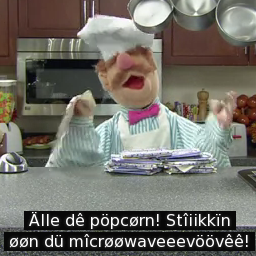
 doesn't have a way with words. Or letters. Or diacritics.
CMOT Dibbler: It's Klatchian, isn't it?
Sol Dibbler: Well technically, but I think it's the wrong part of Klatch and maybe "effendies" or something...
CMOT Dibbler: Just so long as it's foreign.
Many shows and movies don't bother getting a foreign language right when they portray them. The incidence of this increases along with the obscurity of the language.
It is easily explained away as native speakers are hard to get, especially if the country of origin is on the other side of the globe and the language is fairly obscure. Even if you finally get one, he might not be so helpful if he has a poor knowledge about the aspects of his own language that the work specifically needs to use. Or simply he's a poor actor or a poor choice for the role (while non-native actors won't be able to correctly pronounce phrases in a language they don't speak). And that's assuming there even still are any native speakers.
But first and foremost, if the intended audience won't be able to tell the difference anyway, why bother? A somewhat more redeeming justification is that the show isn't supposed or expected to accurately portray a real-life language.
A variation on this is that the foreigners speak English, but are identified as foreign by an accent or are parading universally known national images.
Names appear especially hard to get right, even European ones, which is all the stranger as most American naming conventions haven't ventured far from their origin. This is why we see female Russians with masculine surnames and patronymics used as names or surnames, or why most French characters in comedic works tend to have a name composed of an English word preceded by a random "Le" or "La". This could be explained if their name was anglicized, though the practice has fallen out of favor in recent decades.
Amusingly: when this trope is applied to a character's name, it often results in a Dub Name Change when a work is exported to the country where said character is supposed to be from—since the original name would sound ridiculous to audiences in that country who actually know the culture. For example: in the Japanese dub of Star Trek, Hikaru Sulu's name is "Hikaru Kato"; in most Japanese translations of Teenage Mutant Ninja Turtles works, Hamato Yoshi and Oroku Saki are renamed "Yoshihama Takeshi" and "Oroku Sawaki"; and in the Chinese translations of the Harry Potter books, Cho Chang is renamed "Zhang Qiu". On the flip side: the American-born Maximillion Pegasus was originally named "Pegasus Crawford" before Yu-Gi-Oh! was exported to the United States.
This tends to be even more common in Eastern works, where writers usually tend to have even less experience with other cultures, leading to results that would seem more at home in Middle-Earth than any existing place on Earth.
Contrast with Gratuitous Foreign Language (and all its subtropes), where the writers take care to give characters lines in a foreign language — which are often poorly rendered by the actors. Contrast also with Poirot Speak, where everyone in the native country has an elementary education in their native language but can only say the hard words in heavily accented English.
Contrast also with Famous-Named Foreigner, when in an attempt to avert this trope, the author manages to give his foreign character a real name... albeit belonging to a famous historical character, which often leads to ridiculous results. When a work is named with this trope, it may result in a Word Purée Title.
See also Foreign-Looking Font, Fictionary, Black Belt in Origami and Unintelligible Accent. See also Speaking Simlish. Canis Latinicus and El Spanish "-o" are subtropes specifically dealing with Latin and Spanish affixes, respectively. Ching Chong is a subtrope for Chinese. Camp Wackyname is this for fake Native American names for summer camps. Also consider Esperanto, the Universal Language.
For hilariously inverted examples of this trope, watch here (fake German), or here and here (fake English).
CAUTION: This trope may lead to stumped subtitlers.
Ek Cham Phool (Examples):
- An ad for Bertolli features an "Italian" chef lamenting that Bertolli is stealing his business, to the tune of the Habanera from Bizet's Carmen, a French opera that's set in Spain (and a Spanish form of music).
- An ad for Dunkin' Donuts from about 2007 has a Take That! jingle from They Might Be Giants (and narrated by John Goodman!) aimed at Starbucks, complaining about the gratuitous foreign-sounding gibberish in its drink orders:
Is it French? Or is it Italian? Perhaps Fritalian?
- A German commercial used quasi-Italian sentences that really were German phrases spoken with a strange tone, like "Pasta ber prima" (=Passt aber prima / That fits [you] really good!)
- A South African ad for Wimpy, a burger & coffee place, had a husband pretending to say romantic things to his wife. Actually, he is surreptitiously reading the take-away ("takeout") menu, only with dramatic / passionate intonation. The wife goes all weak-kneed and says that she loves it when he speaks Italian to her.
"Oh Frikkie, I love it when you speak foreign!"
- An Israeli insurance company has a series of commercials featuring the secretary of a sleazy independent insurance agent who can’t keep up with the competition, bemoaning how he would have to give up the preposterous luxuries he’s accustomed to. A Running Gag involves his daughter’s deteriorating English (because her parents can no longer provide a tutor for her); among other things, this involves frequently misusing the word ‘felicity’ in a variety of ways, including ‘skin’.
- The classic 1969 Alka-Seltzer commercial features a stereotypical Italian couple with the man eating meatballs and spaghetti. It turns out it's the filming of a TV commercial with the actor putting on a fake accent and dropping it between takes. He keeps flubbing his line requiring him to eat and eat his way through takes, until he needs Alka-Seltzer.
- An Indian suit commercial featuring SRK shows him wearing the advertised suit, walking up to some Italian men (also in suits), throwing up his hands and saying “Eey Al Pacino Bon Jovi eh!”
- Used by Hayao Miyazaki in maybe a full half of his productions. Those which don't take place specifically in Japan have a sort of Not-Quite-Japanese, Not-Quite-European flavor that leaves the viewer to wonder where, exactly, he's supposed to be. Word of God says that most of his films are set in an alternate version of Europe, one in which World War II never happened. Except Porco Rosso, which is explicitly set on the Adriatic coast of mid-20s Italy, and whose protagonist Marco Paggot is named after Miyazaki's Real Life Italian friend, who's also a pilot (but obviously not a pig).
- The creator of Hetalia: Axis Powers, in response to a fan question, gave suggestions as to what the Nations as People would be named if they were human, and the fanbase has since run with them. However, many of the names fall squarely into this. Austria has a Jewish last name despite being presumably Catholic (Edelstein), Hungary's name is listed as (probably, going by Romanization) "Elizebeta" even though the Hungarian version of Elizabeth is "Erzsébet," Greece's name literally translates to Herakles Watermelon, one of Belgium's suggested French names ("Henri") is masculine (though "Anri," a name derived from it, is a feminine name in Japan), Egypt for whatever reason is named "Gupta," a Hindu name he wouldn't even be able to pronounce (though his middle and last name, "Mohammed Hassan," just happen to be accurate), and the list goes on and on. Then there are weird mix-ups of surnames and first names like Sweden being named "Berwald" or Turkey having "Adnan" as his surname, despite the fact that "Adanir" is a real Turkish surname. On occasion, diminutives seem to be used instead of the actual names they would be diminutives of, like Ukraine getting "Irunya" or Switzerland "Basch" (often misspelled as "Vash" by early fans, which is an even bigger example of this trope) as opposed to "Iryna" and "Sebastian." The most egregious cases, however, have to be the main character himself and his brother: Italy's name is "Feliciano Vargas," a rare Italian last name used as a first name and a Spanish last name, and South Italy's name is "Lavino," a name which doesn't even exist (though is possibly a corruption of the rare Italian name "Lavinio"). English-language Fanon name alteration attempts are not uncommon for this reason. However, there are also plenty of characters who were given perfectly plausible, if at times old-fashioned, names, which makes the bizarre names stand out even more (granted, Japan was given the name "Kiku Honda," "Kiku" being usually a feminine name).
- Excel♡Saga: Although the English used by the paramilitaries in the action movie episode is grammatically perfect, it's apparently delivered by actors who haven't a clue what the words are intended to mean (and only the vaguest grasp of English pronunciation). This is deliberate parody of the trope - the Japanese subtitles (which the English subs of the scene follow) are far more eloquent, often to the point where they have very little to do with what is spoken. It's also lampshaded in the English dub. Originally, when the soldier asks her "What is your purpose?" in a really strong Japanese accent, Excel just responds "I don't know." In the dub, she says "A big fish?"
- ARIA: Singer Eri Kawai admitted that a lot of songs have nonsensical lyrics, in an attempt to make them sound vaguely Italian. One song, a canzone sung by Alice during her graduation ceremony, has some verses in Esperanto, likely to achieve the same effect without becoming too silly.
- The Tales of Symphonia OVA has the song "Almateria", and while it has some significant words thrown in here and there, it's mostly pleasant-sounding gibberish.
- Done to a ridiculous degree in episode 52 of Hayate the Combat Butler where "Italian" ranges from reciting Italian foods to saying anime/manga related references with bad pseudo-Italian accents. Considering the nature of the show, this trope was almost certainly done deliberately.
- There are panels from Urusei Yatsura of Lum's mom speaking in Mah-Jong tiles that combined with her Chinese-style dress (implies "As Long As It Looks Chinese") and a French lady speaking in... interesting picture combinations in Lupin III. And early in the manga, where French and Chinese commentators on Ataru's game of tag with Lum spoke in, respectively, inane phrasebook style questions and Chinese food names.
- In the manga Peace Maker, which is set in the American Southwest during the late 1800s (you know, a Western), a lot of the character names are... unlikely. The main character (who is male) is called Hope, and his Disappeared Dad's name is Peace. At one point, they encounter an elderly woman named Joshua. The series is otherwise enjoyable, but it's apparent that the mangaka didn't know what names were for what.
- Macross:
- Sharon Apple's pop song "Idol Talk" in Macross Plus is completely untranslatable into French. The words are French, but the actual meaning is total gibberish. In fact, Yoko Kanno has said that most of Plus's songs were intentionally written to have lyrics that only resemble real languages, without actually being them.
- In Macross Frontier, the on-screen displays populated with English filler text use completely irrelevant excerpts from, for example, the Adobe Flash Player (or Adobe CS?) EULA and an article about the appearance of Oakley sunglasses in some bicycle or motorcycle event.
- Similarly, the Magical Girl Lyrical Nanoha A's movie has a screen on-board the TSAB ship display text taken from a commercial web publishing site. It's obfuscated further by being mirrored (see-through screen seen from the back) and in the usual Lyrical Nanoha pseudo-runes script.
- In Time of Eve, what are supposed to be a robot's error messages are actually from Microsoft Exchange Server.
- Much of Yoko Kanno's music from Cowboy Bebop is in a pseudo-French language.
- Mostly averted in Samurai Champloo. The Dutch diplomats speak actual Dutch (a rarity in anime, where the Dutch are often treated as Germans with a different flag), and the American soldiers speak proper (if a tad simple and profanity-laden) English. With that said, the Japan-obsessed leader of the Dutch diplomats has a non-Dutch surname (his name is"Isaac Kitching", although it may be justified as a way to distance the character from an actual Dutch diplomat from the rough time period, "Isaac Titsingh"). Also, in-universe, Manzo's very weak attempt at infiltrating the American ship has him try to pass himself as American as speaking a mix between pseudo-English and Japanese. Again, justified since he is a Japanese official that does not know any English at all.
- Some of the non-Japanese characters in Shaman King. The big standout would be Chocolove, an African-American shaman who joins the main cast in once the tournament begins. To avoid stereotypical depiction, the English dub and translations of the manga change his name to "Joco".
- In Zatch Bell!, Kiyomaro is running "tests" on a stone tablet (petrified demon). After a while, he starts shouting random spells and demon names at it, since it has writing in the same foreign language as the spellbooks.
- Code Geass. Many characters from the Britannian Empire, that is supposed to be an alternate-reality version of either UK or US, have ridiculously non-English names (such as Rivalz), even surnames as first names (Nunnally sounds like an Irish surname, Lelouch is a French one). On the other hand, there are some characters with quite acceptable names, such as Gilbert G.P. Guilford. And then there's Rolo, which could be a candy bar or a character from Sanford and Son.
- FLCL, or ''Fooly Cooly," was thus entitled because the meaningless phrase, according to the design staff, "sounded English." Likewise, character name "Atomsk" was chosen by the director because he saw it in English on a book cover (presumably this one) and thought it looked cool.
- Hellsing's Walter Dollneas has a surname consisting of two Welsh words that don't often appear together, let alone appear in a surname. Hirano has all but admitted that he had absolutely no idea what he was doing with the foreign names.
- Death Note:
- In a case of Japanese-to-English, the author wanted realistic names that sounded American but didn't actually exist. The result is hit or miss. "Ray Penbar" sounds almost normal. "Knick Staek" and "Liab Zaopack" less so.
- Most of the victims' names are examples of this trope, as was L, whose real name is L Lawliet. In Death Note 13: How to Read, the writer of the manga admits that he made up the names of the victims randomly, so that no real names would show up as having been written down in the Death Note.
- In the Prequel Another Note, multiple characters' names are composed of random English words smashed together, such as Beyond Birthday, Quarter Queen, and Bluesharp Babysplit.
- Freesia Yagyu from Jubei-chan 2 is half-Japanese, half-Russian. Her first name, however, does not exist in either culture.
- Rally Vincent from Gunsmith Cats, although Rally is her nickname (her real name is Irene). In-story her name is intended to actually be Larry since she didn't think anyone would hire an obviously female bounty hunter, but due to the L/R confusion it would up translated as Rally, which still fit due to her fondness for cars.
- In Plawres Sanshiro, the closing titles song ends with the lyrics "Craft Love", that make absolutely no sense either in the context of the song or indeed any context.
- Saiyuki gives the female name Hazel to a male priest... Slightly offset by the fact that he is rather Bishōnen, anyway. Word of God said it was by combining the words "Beisun" (a type of alcohol) and "angel" and mucking with the pronunciation until you get "Heizeru." His full name is "Hazel Grouse," a type of bird, thematically linking him to Ukoku, who is heavily associated with crows.
- Bleach:
- Quincy techniques are German-influenced that either translate into nothing or are very bad uses of German words and grammar. For example, Seeleschneider, "soul-cutter/tailor", should be Seelenschneider. The Vandenreich's kanji mean "unseen empire". While "reich" is German, "vanden" or "wanden" doesn't seem to be an actual word. It might be a misreading of "vonden" ("of the") or an example of Kubo's musical obsession by being a nod to German metal band Vanden Plas (who themselves are car fans and named themselves after the Flemish coachbuilders that eventually gave their names to a Jaguar brand). Several members' names are similarly foreign sounding, and by far the most unusual has to be BG9, (pronounced as the German "Be Ge Neun").
- The Arrancar have Spanish-named zanpakuto, with a few strange exceptions, such as video game-exclusive Arturo Plateado having a zanpakuto named "Fenice" (not "Fénix" as has been erroneously claimed), which is Italian. Gantenbainne Mosqueda's zanpakuto, though, is named "Dragra", which doesn't seem to mean anything in any language. The Arrancar themselves have some curious vaguely European names, although several have been confirmed as deliberate misspellings based on real people.
- The Hollows have some reasonable variation names such as "Demi Hollow", "Huge Hollow", and "Menos Grande" (presumably broken Spanish for "big minus", but it literally means "less big"), but the names of the Menos stages, "Gillian", "Adjuchas", just seem to be made-up words.
- Gundam:
- The franchise is positively rife with foreign-ish names, some more successful than others. Most of the bizarre linguistics are a deliberate effort to distance the far-future humanity from existing cultures, especially in the space colonies. The one series with a date solidly pinned down in relation to modern day does fairly well with the names.
- Gundam Build Fighters meanwhile takes place in the "real" world (albeit 20 Minutes into the Future), and yet features an African-American character named Nils Nielsen. Unless he has some Scandinavian ancestry, the name comes off as kind of odd.
- In one episode of Sailor Moon, Ami gives a student a printout of what she says is a NASA website. The printout is not gibberish. What it is, however, is the lyrics to "Danger Zone" from the movie Top Gun. There are English-spoken phrases being a combination of English and Japanese or simply very grammatically incorrect. "Let's dancing" is actually rather common in Japan.
- Fafner in the Azure: Dead Aggressor has a supposedly Irish character named "Kanon Memphis", which doesn't sound like the sort of name anyone would have, let alone an Irish person.
- Subverted in episode 10 of Ghost in the Shell: Stand Alone Complex, where in-show foreigners Suzuki Sato and Tanaka Watanabe, both CIA agents, don't bother to check their Japanese aliases for simple things like using two surnames as a full name before entering the country. The Japanese officials with whom they interact are understandably befuddled upon seeing their calling cards. They're obnoxious Americans with their own sinister agenda and we're supposed to dislike them anyway. To add insult to injury, they look and act very much like some racist stereotypes of the Japanese, which is probably supposed to reflect their opinions of the country they've been assigned to.
- D.Gray-Man
- "Portuguese" Tyki Mikk's name. There are at least 4 blatant errors in this name alone.
- "Arystar Krory" was named after Aleister Crowley, but the author deliberately went with a different spelling ("Alistair Crawley" could be a plausible substitute, though). There is also a Mexican man with the name "Winters Socalo", a German woman named "Miranda Lotto", two Chinese siblings named "Lenalee" and "Komui", and an American man named "Tup Dop". "Marie" is a man, and it seems that's his last name, meaning his first name is "Noise". A woman whose name was spelled "Crea" in the series itself has her name more correctly spelled "Claire" in a data book. "Jasdevi" are supposed to be American and while "Devitto" is apparently "David" mispronounced his brother "Jasdero" did not get so lucky.
- My-Otome has most of its characters with obviously Japanese given names, but because they all come from Fantasy Counterpart Cultures, a lot of their surnames are non-Japanese.
- Reborn! (2004) is a repeated offender for its attempts at Italian names, most notably Bianchi is used as a (female) first name — it is actually a surname.
- Aura Battler Dunbine has a female character who is introduced as "Marvel Frozen", to which the Japanese lead hero responds, "'Marvel Frozen'? You must be American!"
- In the Kyoto Arc of Rurouni Kenshin, Yahiko come across three girls who say nothing but "chow" while gushing over a dog (an official Chinese translation just went with wingdings); he thinks to himself that they can't possibly be speaking Japanese. Considering the time period and that Yahiko, born and raised in Tokyo, is in Kyoto, it's probably a (rather well-known, actually) Kansai accent joke. ("Chigau", a word meaning "that's wrong", gets shortened to "chau" in Kansai, and since the dog they're talking about is a Chow-Chow, Watsuki just had a little too much fun with it.)
- In Chrono Crusade, most of the English names of the American characters make sense, like Joshua and Rosette Christopher. But then you have the German character Satella Harvenheit (which might have been meant to be "Stella", but is officially spelled with the extra "A"), and the Portuguese immigrant Azmaria Hendrich...(although to be fair, her last name is her adoptive father's....but it still doesn't sound right).
- For Knight Hunters: Weiß Kreuz, Takehito Koyasu apparently picked the name because "Weiß" sounded cool, and "Kreuz" sounded cool with it. Randomly from a German dictionary. This was after the producers firmly vetoed his original title: "Cat People". In English. (No, not that one.) It really could have gone much worse.
- In the Tokyo Mew Mew anime, Ichigo meets an English speaking pianist and is only able to say a few English words, one of them being her own name translated, which is "strawberry". It can be especially amusing for native English speakers to listen to this supposed native English speaker speaking English with an extremely heavy Japanese accent, though this is fairly common for 'native English speakers' in Anime to sound nothing like an actual native English speaker since they hire Japanese voice actors who speak English about as well as many native English speakers speak Japanese.
- 07-Ghost is a series set in a European-style world. That explains the use of western words and names. Especially when the names in question aren’t actual names. Usually they are random German words, or just Gibberish. Combined with proper Japanese names. And in cases of in-universe terms, they probably just pick a word from a random language. One example would be the god of death, who is from some reason named “Verloren” which means “lost” in German. Or the terms “Kor” and “bascule”. Or the seven ghosts, who are called Zehel, Fest (means firm/firmly/feast in German), Profe, Randkalt (German again. “Rand” is edge and “Kalt” is cold, and therefore “Randkalt” means “edge cold”) , Rilect (maybe it’s supposed to be “Relict”), Ea, and Vertrag (contract in German). And then there are the names Wahrheit Tiashe Raggs (Wahrheit means truth in German), Weldeschtein Krom Raggs (Krom means “furthermore” in Czech, but that’s probably not what they meant. And Weldeschtein could be “Waldstein” which sounds enough like a German surname, or a rather believable Yiddish surname, though they probably weren’t meant to be Jewish with all the crosses around the place). Fea isn’t a word, but it resembles a few real names. Female ones. And Frau. Okay, he’s a womanizer, but is that really a reason to name him “woman”?!
- Used for humorous effect in G-On Riders: two American street thugs speak entirely in random quotes from the Gettysburg Address. "Government!" "Of the people!"
- The one character of European racial stock on Strawberry Marshmellow, Ana Coppola, is said to be from England despite having an obviously Italian surname, though it's not that rare for real Brits to have Italian surnames, to be fair.
- In Mai The Psychic Girl, one of Mai's enemies is the daughter of the East-German ambassador. Her name is Turm Garten — "Tower Garden." In German, "Tower" is a male noun.
- Jackals is set in America at the tail end of the 19th century. Its main protagonists are Nicole D. Heyward (a Puerto Rican man) and Huya Godfrey (a white guy). Some translations try to soften the blow by romanizing the first guy's name as "Nichol", but they're not fooling anyone. Also, his mother, who is actually from Puerto Rico, is Lokishii Heyward. The fan translation has tried to make that less ridiculous by changing it to "Roxy", but that's not quite what the kana spells out. And no, she's never been married. Roxy Heyward from late 19th-century Puerto Rico. Sheeeeesh. This also overlaps with unfortunate implications if you take into account how the many countries outside the American continent looks Puerto Rico.
- Transformers: Super-God Masterforce doesn't even try to give believable names to characters who aren't the Autobot Headmaster Juniors. The Decepticon Headmaster Juniors, for instance, are Bullhorn, Wilder, and Cancer — respectively Mexican, American, and Chinese. That said, since those names are bizarrely appropriate for their transtectors' altmodes (a hellish bull, a crazed wolf, and a sickening crab creature), they might simply be aliases — not that there's ever any indication of this being the case. Most of the other characters who hail from the west are only afforded, well, Transformer names like "Road King" and "Doubleclouder".
- Averted in Nodame Cantabile. German director Stresemann uses the alias Milch Holstein, which sounds and is correct German. Chiaki, who speaks German, realises that Milch (Milk) is not a name Germans would use, especially in combination with Holstein, which is a cattle breed well-known in Germany.
- Fay's language in an early episode of Tsubasa -RESERVoir CHRoNiCLE-. Apparently the director wanted it to be French-sounding gibberish, which it most definitely is. In the manga, it's written in Cyrillic.
- Fullmetal Alchemist has a strange mishmash of numerous European cultures, names, and words in the fictional country of Amestris in which it is set, resembling many northwestern European locales but not really fitting any. This may have been an attempt to make Amestris less of an obvious Fantasy Counterpart Culture for Imperial Germany, but the pieces just don't fit together right, resulting in awkward things like a man named "Basque Grand".
- Invoked by the Ooji family's mochi shop in Tamako Market, which uses this trope as their theme. They changed the name from Ooji-ya to Ricecake Oh!Zee, staff wear western-style chef costumes, and labelling their mochi with romaji tags.
- The characters in Claymore often have more or less vaguely European names. They can be perfectly reasonable, like "Priscilla" or "Beth", but then there is also a female Warrior called "Dietrich", a distinctly male German name, a random Red Shirt named Queenie, or one of the Abyssals called "Riful" (sometimes rendered "Rifle" in translations, which does not make for any better a name), whose companion's name is commonly rendered as "Dauf".
- Queen's Blade has this in spades, despise the setting being in a Fantasy Western Medieval world, especially with the few characters with full names: We have the main heroine and her sister Leina and Elina Vance respectively (Spanish first name with a American English last name) and her elder sister Claudette (French), and from the sequel Rebellion, we have Annelotte Kreuz (French first name with German last name). The rest of the cast aren't better: We have Menace from the Egyptian-inspired Amara (a pun from the Pharaoh Menes), Airi, despite from not being from the Japan-inspired Hinomoto (From which Tomoe and Shizuka came from) or even being alive for that matter, and many others.
- In the second season of Digimon, this happened in the dub. Yolei sounds Japanese to non-speakers but can't actually be written in Japanese characters. The third season, meanwhile, has a Hispanic little girl named Chico, which means "boy" in Spanish,note so the dub changed her name to the much more plausible Rosa.
- Near the end of Dr. Slump, one character was a German biker named Kibalt Skurzen, which is not a German name at all.
- In Cat Street, the school's called El Liston, which according to its principal means "walking path" in French. However, El Liston isn't French but Spanish, where it means "long and slim piece of wood" and not "walking path" (and it should actually be El Listón).
- Freezing has the supposedly English protagonist bear the decidedly non-English sounding name Satellizer El Bridget, which sounds almost French, if not for the fact that Satellizer is an obviously made-up name which just sounds like a portmanteau of 'satellite' and 'laser'. Maybe Stella is what the author was going for?
- Divergence Eve: Lieutenant Commander Lyar von Ertiana is German, which we know because her name has "von" in it. Luxandra Frail is similarly supposed to be Mexican and is colored right for a mestiza, but her name is blatantly not Latin American.
- In Armed Girl's Machiavellism, Choka U. Barazaki demands to be called "Regina delle Farfalle" ("Queen of the Butterflies" in Italian), as she says she's Italian. Her pronunciation in the anime, however, is horrible, and she actually mangles "Regina della Farfalla", meaning "Queen of the Butterfly". Possibly intentional, as she's actually Japanese and trying badly to pass herself as Italian to maintain continuity with her older sister figure Mary Kikakujō, who is half-French.
- GA: Geijutsuka Art Design Class features Marianne van Trienen, who is explicitly stated to be French. But while Marianne is a valid French given name, the surname would have used "de" instead of "van" (which is the Dutch equivalent for The Von Trope Family), and Trienen is a more commonly Dutch name than a French one.
- Yu-Gi-Oh!:
- A minor example in Funimation's short lived uncut dub: in 4Kids' original English dub of the anime, most characters were subject to a Dub Name Change. For example, Hiroto Honda was renamed to Tristan Taylor. For the uncut dub, a compromise was decided upon to use the dub's first name along with the original Japanese surname, so in this instance, Tristan Honda. The exception to this is the character known in the west as Joey Wheeler, as his first name is taken from the surname of his Japanese iteration, Katsuya Jonouchi. As a result, this dub named him Joey Katsuya, effectively giving him a personal name in place of a legitimate Japanese family name.
- Most of the ancient Egyptian character names in the Millennium World arc fall headlong into this. Some (Atem, Seto, Isis) pass muster because they're derived from actual Egyptian gods' names, and Siamun shares his name with a historical pharaoh, but many are clearly made up (Mahado, Mana, Shada, Kisara) or are anachronistically Arabic (Karim, Hasan). Akhenaden and Akhenamkhanen's names might be very loosely based on Akhenaten's.
- King of Prism has a character from Madagascar named Nebuchadnezzar Ur Mfalme de Merina XIII. None of these names even remotely sound close to being from Madagascar, except for Merina: his ID gives his place of birth as the Merina Kingdom, a real kingdom that once ruled the island but was overthrown by the French in 1897 (94 years before the character's date of birth written on the same ID).
- Himouto! Umaru-chan has Sylphinford "Sylphin" Tachibana, who's half-Japanese and half-German; while her name is meant to denote her foreign ancestry, "Sylphinford" isn't a real name in German or any other language.
- Adam Hills, an Australian comedian, has a routine all about this. He uses The Swedish Chef as an example of how people imitate other languages. He then goes on to say that those who go a little further just imitate the accent and make up gibberish while adding in an occasional word in that language.
Hills: (imitating a French person ... who speaks English) This person came up to me and said (puts on a ridiculous American accent) 'Bow-dow-ga-dow-bow-ga-dow burger, bow-dow-ga-dow friiiiiiies bow-dow-ga-dow WOOOOOO HOO!'
- The Twelfth Man's comedy albums are practically built on this trope with the foreign players names. The Twelfth Man parodies cricket commentary with dead-on impressions of legends like Richie Benaud, with a smattering of "foreign" names like Jarvegemite Fermeeandad or the batting partnership of Kuttis Arminahf and Soonil Havaskar. He even does it with English names like grounds curator Bob Durunkel and Doug Deep, but his Moment of Awesome was his impression of NRL commentator Ray "Rabs" Warren reading out the upcoming New Zealand ruby side. Impressive, though NSFW.
- Canadian comedian Angelo Tsarouchas, born to Greek parents, has a bit about how his father is such a proud Greek that he gets excited at the mention of anything that remotely sounds Greek.
Angelo: Hey Dad, could you pass me that pack of matches over there?
Angelo's Dad: Pakamatchis? Stavros Pakamatchis? I know that guy!
Angelo: Dad, what the hell are you talking about?
Angelo's Dad: Stavros Pakamatchis! He is from my village in Greece! We come to Canada together! You know him, Stavros Pakamatchis!
- Batman example: Ra's al Ghul's daughter, Talia, uses the "surname" Al-Ghul, despite the Arabic patronymic not working that way, but kind of makes sense as her name would thus be "Talia, of the Demon". The trouble is that she then uses the "Anglicized" variant, "Talia Head", which translates the wrong word. Maybe "Talia Demon" wasn't subtle enough. (To be fair, Head is an actual surname, of Anglo-Saxon origin, and she was making very little effort to hide her identity or origins.)
- The time-displaced DC character Manitou Raven is said to be from the native American tribe that eventually became the Apache. Manitou (meaning "spirit") is actually an Algonquin word. For Europeans and others who may not know where the Apaches and Algonquins live relative to each other, this is about the equivalent of assuming a Norwegian word or myth can equate to a Georgian one. Manitou Raven's power word for becoming a giant is the same as Apache Chief: "Inukchuk". There is a word that is very similar to this, "inukshuk", which in its language means "something that substitutes for a human", and is applied to giant stone columns and statues. So it would almost be viable as a symbolic magic word, in the vein of "make me as big as an inukshuk", if it weren't for the fact the language in question is Inuktitut, an Inuit language. To carry on the example above, this would be like taking that Norwegian-Georgian mythological mix and throwing in a dash of Swahili. Then there's the fact that Inuit did not build giant stone columns or statues: inukshuks are only a few feet high. "Becoming as big as an inukshuk" would cause the average human to shrink.
- Hendy of the Blackhawk squadron is a nice example too, Hans is OK, Hendrickson is slightly un-Dutch, fitting a Dutch-American better than an unhyphenated Dutchman, "Hendricksen" is genuinely Dutch, but "Ritter" is the German word for "Knight", Dutch would be "Ridder", a title, not a name.
- It gets so much worse with Polish characters. Janos Prohaska has a Hungarian first name and a Czech last name. And Stanislaus Drozdowski's first name isn't even real, sounding like some kind of mix between Belarusian Stanislau and Latvian Stanislavs. At least his last name is actually Polish.
- X-Men:
- Storm's first name "Ororo" is not an actual African name, let alone a Kenyan one.
- The Cajun mutant, Gambit, likes to toss some French into his dialogue. He sometimes calls Rogue "chéri" (darling)... which would be nice if he weren't using the masculine form of the word. Luckily for our grammatically-challenged hero, there is no audible difference between "chéri" and "chérie".
- Kurt (aka Nightcrawler)'s Gratuitous German often gets misspelled so that he ends up calling girls "camisole" ("leibchen") instead of the intended "sweetheart" or "darling" ("liebchen"). Hudlin had him utter "lieberstesh".
- Blackwing (previously known as Beak) is a mutant who was said to be from Rotterdam, the Netherlands. His real name is Barnell Bohusk, which isn't much of a Dutch name at all.
- Sunpyre has the highly implausible first name of Leyu, which isn't even remotely Japanese. For one thing, the Japanese language doesn't have an "L" sound. Even if you assume that his name is a Romanized form of something like "Reyu", that's still not a real Japanese name. The closest real Japanese name to "Leyu" is "Rei".
- Colossus' real name is Piotr Nikolayevitch Rasputin. "Rasputin" is a common surname in the area of Russia where he's from, which is fine. And the patronymic is correct, even better. Then his sister Illyana Rasputin is introduced. Slight oops: since Russian surnames have masculine and feminine forms, her last name ought to be "Rasputina". The Official Handbook of the Marvel Universe eventually gives her full name as "Illyana Nikolaivitch Rasputina (Anglicized to Rasputin)", but even that isn't completely right: Russian patronymics have masculine and feminine forms too, and "Nikolayevitch" ("son of Nikolai") is a masculine patronymic; since Illyana's a girl, her middle name should be "Nikolayevna" ("daughter of Nikolai"). Eventually, about forty years after her introduction, this was corrected.
- New Mutants' Roberto da Costa sometimes says sentences in Spanish... even though he came from Brazil, where the language is Portuguese. (His native language remains Portuguese, so it's not simply a case of speaking a minority language for his country.)
- Silver Samurai's real name is Kenuichio Harada. You won't find a single person in Japan called Kenuichio. In Japanese translations, his name is Kenichiro. In the movie, "Kenuichio" is dropped entirely. We never learn his given name, or if Harada is erroneously being used as such.
- Apocalypse's birth name is said to be "En Sabah Nur", which is said to mean "The First One", hinting at the fact that he's one of the first documented mutants in history. Not only does "En Sabah Nur" not actually mean "The First One" (it roughly means "The Morning Light"), it's an Arabic phrase. Apocalypse was born in Egypt around 3,000 B.C., several millennia before the Arabic language existed.
- Quicksilver, who hails from the fictional Eastern European country of Transia, was born "Pietro Maximoff". While "Maximoff" is a real Eastern European surname (albeit a very rare one), "Pietro" is an Italian name, being the Italian variant of "Peter". The writers at least have the cop-out of his being from a fictional country, but most other characters from around there have names that fit geographically. The Romanian variant of Peter is Petru, which sounds rather close to Pietro.
- The assassin Kwannon (best known as the woman whom Psylocke swapped bodies with) is ostensibly Japanese. "Kwannon" is a rarely used Japanese variant of "Guan Yin", the name of a Chinese Buddhist goddess associated with mercy and compassion (the most common Japanese variant of her name is "Kannon"). Granted, it is at least a real name, but it still isn't something that a Japanese parent would name their child.
- Bushido from Teen Titans has the civilian identity Ryuku Orsono. Ryuku (well, Ryukyu) is the name of a chain of islands, not a given name, while Orsono is simply not a real Japanese surname by any stretch and doesn't even kind of sound like one. The names of his weapons are also really poorly researched, but that's another matter.
- In-media example: In one Lucky Luke album, the Daltons disguise as Chinese. Jack decides to make his disguise by speaking "Chinese". Which means that he says "ching chang chong" all the time. A crowning moment of funny is when he is talking to a Chinese man who dislikes Rin-Tin-Can very much:
Averell: Ching chang chong.Chinese man: While I agree, I would not use such words even about someone as horrible as Rin-Tin-Can.
- Black Widow was first introduced as "Natasha Romanov." One writer finally got her name right, "Natalia Romanova." About half the writers still get it wrong, and it's still wrong in her film adaptations. In the fine tradition of cool Russian nicknames, however, "Natasha" is an acceptable nick for "Natalia". We still have to paper over "Romanoff/Romanov" as her Anglicizing her surname, but it's entirely plausible so it does not draw much attention.
- Fear Itself introduced Splitlip, a dwarf blacksmith whose speech is peppered with profanities, covered up by writing them in Norse runes. If you actually translate the runes, you will find out it's gibberish. Even the Asgardian version of the old Norse language probably does not have words like "eabrkmthw".
- When being interviewed about Mandrake the Magician, cartoonist Lee Falk reportedly explained that he named the African sidekick in the strip "Lothar" because that sounded like an African name to him. "Lothar" is actually a name from Germany, which, both geographically and culturally, is about as far from sub-Saharan Africa as one can get. Although there were a number of German colonies there until 1918, which left a bit of a cultural imprint that, e.g., in Namibia, lasts until this day.
- Michael Morbius is supposed to be Greek, but his name really isn't (Michael is Hebrew) — probably because it wasn't decided he was Greek until 19 years after his introduction. On at least one occasion it's questioned why his first name is not Michalis (the Greek version of Michael), the answer simply being that "[his] mother preferred Michael".
- Nico Minoru is of Japanese descent; however, her surname is actually a masculine given name in Japanese. Her teammates a Victor Mancha (Mexican) and Klara Prast (Swiss). "Mancha" is a real Spanish word, but it means "stain" and isn't a surname, while "Prast" is a real surname, but it was not very common in the time she or her husband were born.
- In the WW2-set Wonder Woman of the late '70s, there was a Japanese-American villain loyal to the Emperor called "Kung", which isn't a Japanese word or name. His real name is Thomas Mashuda; "Mashuda" isn't a real Japanese name either, though it may be a misspelling of the names Matsuda, Masuda, or Machida.
- Most of the names in Asterix are just puns of similar-sounding words. Asterix = asterisk, Obelix = obelisk, Vitalstatistix = vital statistics, and so forth. They're inspired by the fact that some Gaulish names ended in -rix ("king"), as in the famous Arverni chieftain Vercingetorix, but obviously -ix is not -rix.
- Minor Marvel Comics hero El Aguila hails from the Spanish village of San Elainya — San means "Saint" in Spanish, Elainya is meaningless but may have been an attempt at a Spanish version of Elaine (the correct form would be "Elena"; both are derivatives of "Helene"). El Aguila's cousin Migdalia is a surprising aversion: This name exists in Spanish, though it is extremely uncommon.
- Teenage Mutant Ninja Turtles (Mirage):
- Hamato Yoshi's deceased wife was a woman named Tang Shen. Yoshi hailed from Japan, but "Tang Shen" is clearly a Chinese name.
- The 2012 cartoon actually provides an explanation; Tang Shen is, at least partially, Chinese. One could easily apply this to other versions of the character due to her tending to lack a backstory.
- For that matter, Hamato Yoshi and Oroku Saki are this as well. "Hamato" is not a real Japanese family name. "Saki" is an actual Japanese name....except it's a feminine name. In Japanese translations his name is changed to "Sawaki".
- Hamato Yoshi's deceased wife was a woman named Tang Shen. Yoshi hailed from Japan, but "Tang Shen" is clearly a Chinese name.
- A.A. Pessimal expands one-line canon characters and cameos into fully-blown OC's, reasoning that this allows a lot more scope for creatively expanding the Discworld. One such was the Assassin, Miss Smith-Rhodes, who intelligent extrapolation suggested was a "Southern African" character, or Discworld equivalent of. As she was only ever intended to appear in one tale as a comic exaggeration of the South African set of National Stereotypes, and at that point the author didn't speak any Afrikaans, her spoken language was... unconvincing. As Word of God puts it, "it did the job". As she returned as a Fan Favourite by reader request, the author decided he needed to do the research. Suddenly, her cod-Dutch mixed with German did not meet quality control standards. He is still reading up on South Africa, en hy het Afrikaans leer praatnote .
- Into The Veesha-verse: In-universe. "My Treasure" has Vee figure that "scheißen" is close enough to "schließen" that Masha will understand it. Masha, after they're done laughing, explains that while "schließen" means "to close", "scheißen" means "to take a shit." Vee accidentally asked Masha if they could shit the door instead of closing it.
- Any signage shown in Aladdin is either English in a Foreign-Looking Font or meaningless scribbles that resemble Arabic. (There's a possible exception in a sign above Jafar's door that might possibly have his name and the word wazir on it, which leads to a bit of Fridge Logic; why would he need a sign that nobody else sees to just have his name and title on it?)
- The Chinese Cat Shun Gon from The Aristocats he sings one line in his "native Chinese" during "Everybody Wants to Be A Cat" which goes like "Shanghai, Hong Kong, Egg Foo, Yung!".
- At one point he says something along the lines of "Fortune cookie always wrong!" All while using chopsticks to play the piano.
- In the Asterix animated movie Asterix Conquers America, the Native Americans are saying a random mix of North American place names that were taken from words in the languages of the Native American tribes that lived in those regions. Leading the medicine man to say such things as "Minnesota Manitoba. MIAMI!"
- Twin pill bug acrobats Tuck and Roll in A Bug's Life only speak and understand foreign-sounding gibberish. Official sources say they're Hungarian, but their speech sounds nothing like the actual language. The Closed Captioning doesn't clarify, only saying "Speaking Foreign Language".
- In-universe example in Despicable Me: After carefully checking that Miss Hattie doesn't know Spanish, Gru tells her in a romantic tone "You have a face como un burro." ("You have a face like a (male) donkey.") Unfortunately, she later gets a Spanish dictionary and is not amused.
- In Disney's Peter Pan, the Indians play with this in the song "What Makes the Red Man Red?"
"Hana-mana-ganda, hana-mana-ganda, we translate for you: hana means what mana means and ganda means that too!"
- Turning Red names the French-Canadian pop singer Robaire, which is not an actual French name (it's spelled Robert, same as in English; it's only pronounced as "Robaire").
- Charlie Chaplin
- In the classic semi-silent comedy, Modern Times, Charlie is expected to sing a song, but loses his cuffs that have the lyrics written on them. Desperate, Charlie improvises a song using gibberish that sounds like a mix of French and Italian and pantomimes a story as he sings. That product of his quick thinking brings the house down. Chaplin did this to keep his Tramp character international and not limited to a specific language.
- Chaplin's Hitler-like role in The Great Dictator delivers a foaming-at-the-mouth speech in Tomanian, one of the funniest fake foreign languages ever: a pastiche mixture of English, German, and Yiddish nonsense in which such words as "Sauerkraut" and "Katzenjammer" recur. The film also has an Italian equivalent in a character parodying Mussolini.
- Korean-American actor Philip Ahn, known for his many Asian character roles in films and TV shows from the 1930s all the way through the 1970s, was often called on to speak in his character's "native" language. Similar to many Native American actors at the time, he would just spout off some Korean with directors and co-stars none-the-wiser. This actually helped boost his popularity in the Korean immigrant community (and in Korea proper), where audiences weren't used to hearing the Korean language on-screen.
- Gayniggers From Outer Space has random high pitched noises substituting for the Chinese language.
- In The Dark Crystal the speech of the Podlings was vaguely based on the Serbo-Croatian language. Producer Gary Kurtz has noted that audience members fluent in Polish, Russian and other Slavic languages could understand some of those sentences.
- In Team America: World Police, anything that wasn't English was nonsensical gibberish, apart from random French that amounted to the same thing. The terrorists, for example, only use three words: 'Durkadurka', 'Muhammed', and 'Jihad!' Except for the cries of "NO ME GUSTAAAA!" at the Panama canal and a North Korean pilot shouting "KAMSAHAMNIDA!".
- The James Bond film Live and Let Die is supposed to happen at a fictious island named San Monique. While a female saint Monica of Hippo does indeed exist, the name is pure gibberish. "San" is masculine adjective in Spanish language, while "Monique" is the French name of the saint. The correct name would have been either "Santa Monica" (Spanish) or "Sainte-Monique" (French).
- Kill Bill has Lucy Liu and Uma Thurman speaking Japanese. While Lucy's is passable (though obviously accented to a native speaker), Uma's is atrocious and barely understandable.
- Sacha Baron Cohen takes full advantage of this trope in his Borat sketches and movie; his spoken "Kazakh" is actually Hebrew, with some Polish sprinkled in. His written notes are also in Hebrew. His sidekick in the film, Azamat, is actually speaking real Armenian. Almost all the Cyrillic writing used in the film and marketing materials is gibberish created by typing English words into a keyboard set for Cyrillic letters. The film's title on the DVD case is in Faux Cyrillic. The sequel continues by having Borat's daughter speaking Bulgarian, and the Prime Minister's language is Romanian.
- Few of the Turkish characters in Midnight Express are actually Turkish. Most were local Maltese actors, since the movie was filmed in Malta. Most of the Turkish characters have pseudo-Arabic names, like Rifki and Hamidou. Real Turkish names sound different and are not limited to names of Arabic origin.
- In The Court Jester, the English Hubert Hawkins (Danny Kaye) pretends to be a jester from Italy. When a guard asks him why he doesn't have an accent, he replies that he is fluent in many languages and demonstrates it by talking a lot of nonsensical gibberish that sounds very much like French, Italian, and German. (This skill was then known as "double-talk", and Kaye was a famous master of it.) The guard, who doesn't understand any of this, allows him to pass.
- The Spanish movie Welcome Mr. Marshall! has a whole segment parodying The Western movies in faux-English except a few words like "Whiskey", "Hey!" "Howdoyoudo?"
- Top Secret!:
- Most of the German spoken is completely irrelevant Yiddish phrases. For example, when supposedly ordering at a restaurant, the love interest is in fact telling the waiter, "Folg' mich a gang und gai in drerd" — "Do me a favor and go to hell." At one point, a German soldier does respond to an order in German, severely intoning "Ich liebe dich, mein Schatz" — "I love you, my darling." More fake languages abound: the Swedish lines are English run backwards, and a priest reciting the last rites for a condemned man speaks mostly in stock Latin phrases, throwing in one sentence in Pig Latin ("ou're-yay oing-gay to get ied-fray in the air-chay").
- There's also the bit where Nick is riding the train to East Germany, and is learning German from a language tape.
Tape: Eine blitz — A pen. Eine blitz — A pen [...] Der ist Sauerkraut in my Lederhosen [...] I want a Schnauzer with my Winerschnitzel.
- The names of the French Resistance fighters are all French loanwords (Déjà-Vu even asks if they've met before):
Du Quois (introducing the American to the men): This is Chevalier, Montage, Détente, Avant-Garde, and Déjà-Vu [...] Over there, Croissant, Soufflé, Escargot, and Chocolate Mousse. - In The Bourne Identity, the name on Bourne's Russian passport is written "Foma Kiniaev" in Latin letters and "Aschf Lshtshfum" (Ащьф Лштшфум) in Cyrillic letters. Apparently, the designers of the prop just typed the fake Russian name in the Russian keyboard layout without actually translating it. The name was corrected to proper Фома Киняев in The Bourne Supremacy. The Russian name itself is quite correct (the English equivalent would be "Thomas"), albeit rare.
- Certainly true of the sort-of Indian cult in Help!. Made funnier by the fact that the British actors make essentially no attempt to conceal their... Britishness.
- Granted, First Yank Into Tokyo was released during World War II, so accuracy would have been the last thing on anyone's minds. It does feature some Japanese characters with accurate names - "Sato" is real, and "Tanahe" and "Ichibo" are rare but legitimate family names - but "Okanura" and "Nogira" are completely made up. For bonus points, the male Colonel Okanura's given name is "Hideko", which is typically considered feminine. (They may have been aiming for "Hidehiko.") "Hai-Soon" and "Kai Koon" are also not genuine Korean names.
- In Fantastic Four (2005), there's a cargo ship named "Головка пальца ноги", which means "Head of toe" (not "toe head") in Russian. The ship's owner must be a very original joker.
- The Princess Diaries and The Princess Diaries 2: Royal Engagement play this trope straight over a cliff by inventing a European country, "Genovia," in which the queen (Julie Andrews) is English, the peasants speak either French or English with French, English, and American accents, and the princess's name is Princess Amelia Mignonette Thermopolis Renaldi.
- The books do give some explanation — for some reason, it's a Francophone country which used to be part of Italy. And the Amelia and Thermopolis parts come from her (American) mother. And no accents, obviously.
- In the books Genovia is between France and Italy (it's basically Monaco) but in the movies it's between France and Spain (taking after Andorra instead).
- Mignonette is a flower.
- Queen Clarisse (Julie Andrews) could very well have been an English princess who married the Genovian King. The fact that she is styled "Dowager" would usually mean that she was a queen consort (married into the royal family) rather than queen regnant (ruling in her own right).
- Like in the cartoon it's based on, the characters in the film The Last Airbender can be assumed to actually be speaking ancient Chinese but use English as a part of a Translation Convention. All of the In-Universe writing uses the former. The show went to great lengths to have accurate writing (Chinese history professor Siu-Leung was the cultural consultant on the show and its sequel show and did all the calligraphy himself) but in the movie it's just scribbles made to look like Chinese.
- The execrable The Wild World of Batwoman (given a sound thrashing by the guys on Mystery Science Theater 3000) had the main characters' seance frequently interrupted by a Chinese spirit. The spirit's Chinese mainly consisted of saying "ching", "chang", and "chong" over and over again in random combination, causing Tom Servo to deadpan "You know, that may not be real Chinese." As Mike says, "To every Asian and every human being, we apologize for that last scene."
- In Blazing Saddles, the Indian Chief (played by Mel Brooks) speaks Yiddish. This was done on purpose as a joke on an old Hollywood stereotype where American Indians were played by Jewish actors, and an even older belief that they are descended from the Lost Tribes of Israel.
- Alien language examples abound in Return of the Jedi. The Ewok speak Tagalog, a Philippine language. Huttese spoken by Greedo, Jabba, and others is bad Quechua, spoken in a variety of dialects. Lando's copilot Nien Nunb speaks the Tanzanian language of Haya.
- Apparently, those Westerns that cast Native Americans in speaking roles told them to speak their own language to add some authenticity, which would either be subtitled or translated by another character. The actors complied, but said whatever they felt like, often saying obscene or insulting things about the director, the other actors, etc. There are apocryphal stories of Native American audiences cracking up laughing during scenes that were meant to be dramatic.
- Dances with Wolves tried to avert this by teaching the actors to speak their lines in Lakotah (only one of the Indian actors spoke it fluently). However, Lakotah is a dual language, with male and female forms. The Lakotah language coach for the film was a woman and apparently translated all of the dialogue how she would say it, so all of the Lakotah characters speak like women.
- Trey Parker's college film Cannibal! The Musical is a film set in Colorado in 1883. At one point, they come across some "Nihonjin" Indians who are clearly Japanese people masquerading as Indians. "Nihonjin" means "Japanese person/people." At one point, the chief tries to assure the dubious main characters that they are, indeed, legitimate Indians by pointing out their teepees, one of which is made out of a Japanese flag.
- Movies made during World War II that took place in the Pacific Theater usually had Koreans and Chinese as stand-ins for the Japanese. Unless there was someone in the production who could translate Japanese (which was rare), they were told to say phrases like 'I tie your shoe, you tie my shoe' faster than normal to sound like they were speaking Japanese. This was much more common during the war, when actual Japanese people were... unavailable. note Parodied by Terry Pratchett in Interesting Times with the Agatean battle cry: "Orrrrr! Itiyorshu! Yutimishu!"
- In Batman Begins during the scene where Bruce Wayne meets Ra's Al Ghul (actually his decoy), we see him communicate in what is supposed to sound like Tibetan (as the league's headquarters is in the Himalayas). In actuality, Ken Watanabe isn't speaking in any known language, though according to some release's subtitles, it's supposed to be Urdu.
- In the Blade Trilogy, Esperanto is used for the street signs and posters in "foreign" cities to make the locale seem "generically European". Kris Kristofferson seriously studied speaking Esperanto for his brief scene buying a newspaper. In another scene, Hannibal King rests in a hospital watching Incubus, starring William Shatner, one of only two Esperanto feature films in existence.
- The Back to the Future trilogy:
- The Libyan terrorists from the first film speak some vaguely Arabic-sounding nonsense language.
- In Back to the Future Part II, the older Marty's Japanese boss has a name equivalent to "Mr. General Motors." Also, the Japanese street signs in the town square were found hilarious by Japanese tourists during filming.
- In Indiana Jones and the Temple of Doom, Willie Scott sings Cole Porter's "Anything Goes" in Chinese that is so badly pronounced that native speakers struggle to understand what she's saying. Here's a Chinese speaker's best guess.
- This trope is averted for Mola Ram, who speaks flawless Hindi and whose lines make perfect sense in the context of the plot. He was played by Amrish Puri, already famous for his roles as a villain in Bollywood films, who did his own translation.
- However, whenever a villager speaks, it's Sinhala, not Hindi. This is because the Indian government didn't allow shooting in the country unless the script was changed to be less offensive to Indians. The studio moved production to Sri Lanka rather than caving.
- The "Japanese" villain in the 1940s Batman serial is named Tito Daka. Except the ti sound does not exist in Japanese phonetics (the closest is "ち/チ", usually romanized as chi).
- "Chi" is Hepburn romanization, this syllable is rendered as "ti" in Nihon-shiki, Kunrei-shiki and JSL romanization systems. Still pronounced more like "chi" than "ti", though.
- Skewered in Maverick, as, when the heroes are set upon by a band of Indians, Bret Maverick "translates" the chief's words, informing the rest of the party that they have trespassed on sacred ground, and the Indians' gods demand a blood sacrifice. As Maverick well knows (and the subtitles tell the audience), however, the chief just wants to know if Maverick has come for the money he owes him.
- Parodied in Scary Movie 4 with two characters having a subtitled conversation consisting of random Japanese words ("Karate judo sumo samurai!") and trademarks.
- Austin Powers:
- In the third film, Goldmember is a Dutch character, but he only ever uses bad German.
- There are also the twins Fook Mi and Fook Yu, whom Austin identifies as Japanese, but their names could more easily pass for Vietnamese or some other East or Southeast Asian language. The franchise is made of Rule of Funny.
- This trope is toyed with when Austin and his father converse in their native dialect (thick British accents) in order to have some privacy while discussing an important matter in public. It starts off with some genuine slang and British idioms but, being Austin Powers, eventually even the subtitles themselves give up on making sense of what these two are actually saying to one another.
- Million Dollar Baby: Mo chuisle is mispronounced as "muh kwushla" rather than the actual "muh khushleh". The phrase is shown spelled in a nonstandard way. Also, Clint Eastwood's character claims to be translating William Butler Yeats' poetry from Irish (or "Gaelic", as he incorrectly calls it) into English—but Yeats only had a basic knowledge of the Irish language, and never wrote any Irish poetry. This one is especially blatant, since the poem that he "translates" is "The Lake Isle of Innisfree", one of Yeats' most famous poems, and one of the most famous English poems ever written.
- The Italian 1970 western Compañeros had a main character that was supposed to be Swedish and was named "Yodlaf Peterson". Yodlaf is total gibberish and does not even remotely sound like any Swedish or Scandinavian names (the closest real name probably being "Jonas", or "Olaf") and while Petersson and Pettersson are common surnames in Sweden, Swedish surnames ending with -son almost always have two S's (as in "Peter's Son" contracted to Petersson). The surname would probably be excusable since occasionally people prefer to have their surnames written with only one S for aesthetic reasons, but the film does this more than once, also introducing an (fictional) brand of Swedish Safes named Svenson. The film also contains some Swedish speech, which was done surprisingly well — while badly-pronounced, all the lines where grammatically correct.
- In The Terminal, Viktor Navorski (Tom Hanks) is from Krakozhia, a made-up Warsaw Pact country . He speaks passable Bulgarian, adequate to the situation. The Ruritania he comes from is a minor Genius Bonus: several Slavic languages have similar sounding words for "collapse", usually written as some variation of "krach" (spelled vaguely like "krakh"). "Collapsia" would be a pretty apt name for the protagonist's home country, given the movie it is the collapse of communism that strands the protagonist.
- Zulu: According to legend, the Zulu messenger was instructed to simply 'say something' in his native language as he collapsed at King Cetewayo's feet. This was a mistake, as what he chose to say was 'kiss my behind' or words to that effect. The Zulu actor playing the king managed to keep a straight face. But audiences of their compatriots didn't.
- In Charlie's Angels (2000), there's a scene where the angels speak Finnish to each other. They discuss what a bad idea it would be to sleep with a client, but this is not what it says in the subtitles. Things get increasingly weird if you watch the movie with Finnish subtitles, which also don't match what's said.
- Kal Penn has said that when filming the scene where Taj loses his virginity in Van Wilder The Party Liasion, the filmmakers told him to "say something in Hindoo [sic] — something religious." Instead, he said in Gujurati, "There's a white bitch under me." Penn's family are Gujarati — he doesn't speak Hindi.
- The Producers: While Uma Thurman certainly tries to speak Swedish, it fails to the point of her lines having to be subtitled on Swedish releases. The whole thing is a bit odd since they managed to get some stuff right and some stuff plain odd. Like her "catchphrase", "God dag min vännen", which translates to "Hello my the friend". Probably it's a mistake for "vänner", which would make it "Hello my friends." But her accent is in no way Swedish, just generically North European, and apart from baby grammar, she indicates foreignness by referring to herself in the third person. Why this should sound "foreign" is anyone's guess, since pronouns are the first thing one learns.
- In The Incredible Hulk, the thuggish Brazilian who harasses Bruce Banner in the early scenes speaks Portuguese with a horrible, horrible foreign accent (the actor is Peruvian-Austrian). It's grammatically correct (or correctly incorrect for the setting), though. Really, every Brazilian not played by a Brazilian actor (there are quite a few) speaks in a barely understandable accent. Bruce Banner's emergency Portuguese actually sounded better than most of them.
- In Stripes, the communist soldiers of Czechoslovakia all speak with vaguely Russian-sounding grunts.
- A Lzherusskie flavored example would be "General Radek", the Greater-Scope Villain from Air Force One. Radek sounds like an awfully Russian name, da? Well... nyet! "Radek" is not a Russian name — in fact, it's not even a (usual) surname in any Slavic language. It's a given name, specifically a typical Czech diminutive of the male name Radoslav (as a certain Dr. Radek Zelenka will tell you). On the other hand, there was an actual person named Karl Radek, who was a genuine Communist at the time of Red October. On the other hand, it was a self-selected name; he was born Karol Sobelsohn (he wasn't Russian, but a Lithuanian Jew from what's now Ukraine). Had Radek actually spoken a word in the film, he would've sounded more German than Russian, given that he was played by Jürgen Prochnow, although the actor's English is pretty good.
- Transformers: Dark of the Moon:
- Agent Simmons' "German" is simply a string of meaningless consonants and vowel sounds that sounds closer to Geonosian than German. So bad it was probably intentional. If not...
Rifftrax: The Swedish chef did a better job of faking a foreign language.- There's a minor Ukrainian character with the name of Aleksei Voskhod. "Aleksei Ascension" sounds more like a movie title than an actual name.
- Victor Spinetti had the possibly unique ability to do this with English in English language films. In Oh! What a Lovely War and Magical Mystery Tour, he plays drill sergeants who bellow incomprehensible gibberish at high speed (although in Magical Mystery Tour, the phrase "And get your bloody hair cut!" is very audible). Spinetti was also able to do this with Italian.
- In A Million Ways to Die in the West, when Albert speaks to the native indians, he uses such words as "Mila Kunis".
- In Muppet Treasure Island, during the "Cabin Fever" number, a group of German sailors sings a bit that goes "Ach du lieber, Volkswagen car; Sauerbraten wienerschnitzel und wunderbar!", a word salad of German words well known to Anglophones. Justified in that they're really Englishmen taking a brief break from sanity.
- You Don't Mess with the Zohan. The hero is called "Zohan Dvir". While "Dvir" is a real Israeli surname, "Zohan" is... well, not. The closest first name to Zohan Hebrew has is "Zohar".
- In King Ralph, John Goodman's titular character is introduced to King Gustav and Princess Anna of Finland. Neither name is Finnish in origin, though Anna is still fairly common, and there is a Swedish-speaking minority in Finland. The fact that Finland has no royalty was an intentional break from reality.
- In Joss Whedon's Firefly and movie Serenity, the major languages are English and Chinese, and do indeed have gratuitous Chinese that is more or less grammatically correct, though not pronounced correctly (and completely ignoring the way profanity works in Chinese). However, Japanese katakana is used instead of Chinese characters because Whedon thought it looked cool.
- Parts of Eli Roth's horror movie Hostel take place in Amsterdam, capital of The Netherlands. But the scenery doesn't look like Amsterdam at all and the people talk German instead of Dutch. In the German translation, it is supposed to be somewhere in eastern Europe. Except for the businessman, who is supposed to be Dutch. He speaks Dutch in the film, even though the actor, Jan Vlasák, is Czech and didn't even speak a word of English before getting the role. He learned all of his lines, both English and Dutch, by writing them down phonetically and just cram it in...and it was awesome.
- Inglourious Basterds played with in-universe when the Basterds try to pass themselves off as Italians in spite of speaking only a few words of Italian and having atrocious accents. It turns out that at least one Nazi has enough of a passing familiarity to notice — and, tragically, this recognition leads directly to the death of Bridget von Hammersmark.
- The Mummy Trilogy:
- Averted by the filmmakers as best as they could, where they had an official Egyptologist professor coaching actors on how to pronounce their lines in Ancient Egyptian — a reconstruction of it, anyway.
- This video, on the other hand, reveals that Ardeth Bay may have said the same Arabic line on three separate occasions to mean three different things. According to the commentary, Ardeth Bey said the line once. In editing, they needed a new shot in a couple of places (for pacing) and just recoloured the shot they already had.
- In The Mummy Returns, the oasis where the Scorpion King resides is known as "Ahm Shere". Amshir is the Arabic pronunciation of the sixth month of the Egyptian calendar, Meshir. What this has to do with Ancient Egyptian kings, who knows.
- Both an in-universe and media example from The 40-Year-Old Virgin: Paula, the store manager, while in a conversation with Andy, reminisces about the time when she lost her virginity to a Hispanic boy. She remembers he used to sing her a song, which is in entirely correct Spanish, but the lyrics are nowhere as romantic as she actually thinks they are. It translates to: "When I get to my room, I can't find anything. Where are you going in such a rush? To the soccer game." She thought it was a beautiful lullaby, while Andy just didn't get it.
- Several of the bad guys in Die Hard speak in pseudo-German gibberish. This was fixed in the re-release, where their lines were overdubbed with German native speakers — except Hans Gruber, who now sounds terribly out-of-place.
- An intentional (as in "it actually fulfills a specific purpose") example is the German Language movie Almanya — Willkommen in Deutschland. It is the story of a Turkish family (speaking German, but only due to Translation Convention) who emigrate to Germany, where they initially have no clue what the natives are saying. In order to convey this, all Germans only speak vaguely German-sounding gibberish instead of actual German. (To summarize: The audience's own language is supposed to sound foreign.)
- Rescue Dawn: The actors who are supposed to portray Vietcong fighters are actually from Thailand and as a result, they all speak Lao and Vietnamese in the wrong accent.
- In Congo, Tim Curry plays an ex-Romanian philanthroper named Herkemer Homolka. Homolka is a Czech surname, Herkimer a German one.
- Invoked by Jackie Chan's character Passpartout in Around the World in 80 Days (2004), who pretends to speak French. Most of what he ends up saying is mere gibberish.
- Whatever the translator is using for Rocky's speech from the ring at the end of Rocky IV, it sure doesn't sound like Russian.
- Limitless has a scene where Bradley Cooper is speaking Chinese to a waiter at a Chinese restaurant. There aren't any subtitles, but ask any Chinese person what he said and they'll tell you that it's incomprehensible.
- Averted in Titanic. The Swedish emigrants speak perfectly correct Swedish, including situationally appropriate levels of formality. The actors' accents are hit-or-miss so it's hard to understand more than singular words for a native speaker, but once you get through that, it's apparent that research was done.
- In one scene of Robin Hood: Men in Tights, Robin Hood is saying goodbye to Maid Marian in different languages. All of them are correct besides the final one, "Ting tao tay!", which sounds like Chinese but means nothing. Rule of Funny applies, though, as the joke is about how ridiculous Robin sounds saying it. "Zài jiàn" is less amusing.
- Used for effect in Blade Runner: Edward James Olmos' character Gaff speaks in a mixture of Spanish, French, Chinese, German, Hungarian, and Japanese, both to make the character more interesting and to indicate some huge language drift happened in the future. Olmos created a small dictionary of words for the so-called "City Speak".
- In Fierce People, the actor portraying the Shaman in Finn's dream was actually speaking Filipino.
- Averted in the original Red Dawn (1984). The Russians generally speak Russian among themselves, and the Cuban/Central Americans speak Spanish. At one point, Colonel Bella switches effortlessly from Spanish to Russian when speaking to both types of troops.
- In the Tagalog-language film Super B, the titular superheroine, played by Rufa Mae Quinto, has a mysterious ring with an inscription on it in an unknown ancient language, which she recites to transform from her civilian identity to her heroic identity. That inscription is "I wanna be, I wanna be — Super B!", in English.
- In The Gods Must Be Crazy, the filmmakers allowed the bushman actor N!xau make up all of his own lines because the audience is never expected to understand him. The narrator always explains what his character is saying instead. Because N!xau was disgruntled by the filmmaking process, the lines he says are often critical of the scene or the film as a whole. For example, when his character triumphantly returns to his village, he starts chastising the tribe for not rushing up to embrace him, as a real tribe would do.
- In Anacondas: The Hunt for the Blood Orchid, one character sports a tattoo. It is neither the language nor the meaning that he claims it to be when asked about it.
- Toto in The Palm Beach Story speaks an indistinguishable (presumably European) language.
- Prince Caspian: The sinister magic words the hag uses in her ceremony to summon the White Witch? They're actually the lyrics to an Arabic love song! According to the director's commentary, the actress's grandmother used to sing her that song, which she then used for the chant.
- In The Devils Wedding Night, the devil-worshippers' chant includes a recognizable "Om Mani Padme Hum" — a meditation mantra.
- Invoked in Hot Tub Time Machine. After being mistaken for Russian spies by the ski patrol, Nick wards them off by brandishing the can of Chernobly like it was a bomb and disjointedly shouting basic Russian words such as "Dosvedanya!*", as well as stuff like "Martina Navratilova!" and "Smirnoff Ice!" The ski patrol jocks buy it and back off.
- The non-English portion of the "gypsy drinking song" Georgi sings in The Inspector General is actually a mix of Russian and Ukrainian folk music.
- Amistad: Both the crew of the Amistad (a Spanish ship registered in Cuba) and the Tecora (a Portuguese ship) speak Mexican Spanish. [The two Spaniards that claim damages for the loss of the Amistad are played by a Mexican-American and a Puerto Rican actor who use their native accents.
- Georgia Rule has a Basque character named Hiztegi Argitaletxea Sarrionandia (but you can call him "Izzy"). His name is genuine Basque for "Dictionary of the Sarrionandia Publishing House".
- In Speed Racer Royalton's German is off when quoting a phrase from his childhood "When I was a child, we used to say: Pänkuchen sind Liebchen! — Pancakes are love."
- Vantage Point's Big Bad is named Tehuel Suarez. He is Moroccan. His last name is Spanish. And his first name is the name of a native tribe in Argentina.
- In HOUBA! On the Trail of the Marsupilami, the language of the Paya tribesmen is mostly funny-sounding gibberish, with a few obscure references thrown in.
- The Adventures of Buckaroo Banzai Across the 8th Dimension: Buckaroo Banzai has a Japanese father, but "Banzai" isn't a Japanese surname. It's associated with the Japanese "banzai charge" and literally means "ten-thousand years."
- True Lies: Lampshaded. Harry isn't paraphrasing when he translates the tail end of one of Aziz's speeches as, "Now no man can stop us. We are set on our course. No force can stop us, we're cool, we're badasses, blah blah blah blah." The actual line is literally just Arabic-sounding gibberish.
- The titular vampire of Nosferatu; the word is presented as being a Transylvanian/Romanian analogue for "vampire". In actual fact, it has absolutely no counterpart in any of the languages spoken in that part of the world, though it is relatively close to two different words: the Romanian "Necuratu," meaning "unclean spirit," and the Greek "Nosophoros," meaning "bringer of plague."
- Completely averted in Son of Saul; all the actors were speakers of their characters' languages.
- The Big Bad of The Boondock Saints is an Italian mob boss named Yakavetta; an interesting surname for a full-blooded Italian, as the Italian language doesn't use the letters 'y' or 'k', except in foreign loan words. A more authentic rendering would probably be "Iacovetta," which is the name of the writer-director's roommate, whom the character was named after.
- The Chinese film Assembly has a scene in the Korean War where some Chinese soldiers dress as South Korean soldiers for a spying mission. They encounter an American tank. The tank commander asks where he is, in English, and the soldiers reply in what the subtitles call "Korean-sounding gibberish."
- The comedic (and Oscar-nominated) 1968 short film The Dove (with Madeline Kahn in her film debut in a small role) is an Affectionate Parody of Ingmar Bergman, and can basically be described as "The Swedish Chef writes a Bergman screenplay" (though it predated The Muppet Show by a decade). The whole movie is done in hilarious mock-Swedish (with English subtitles) that's largely just English words with "-en" or "-ska" added at the end, with "translations" like "phalliken zymbol" (cigar) and "H2Oska" (water).
- Disney's RocketMan: When talking to the President, he starts singing "I've Got The Whole World in My Hands". Everyone, including the President, picks up the song. Then Fred switches to other languages, and we're shown people all over the world singing along with him, despite what he's singing not being even remotely close to the original meaning, just a bunch of foreign words thrown together.
- The Boy Who Cried Werewolf: Despite this being set in Romania, most of the names stem from neighboring Slavic languages, or even German.
- Wolfsberg, a castle in Romania with a German name.
- Dragomir is a Romanian male first name, but his last name Vukovic is Serbian.
- Goran is a male first name common in South Slavic countries like Bulgaria, Croatia, Serbia etc.
- Igor Van Helman Stanisvlasky, a Romanian with a Russian, Dutch, North-German, Polish name.
- The Grudge 2: Kayako Saeki's mother is revealed to have the full name "Nakagawa Kawamata", which is an unacceptable Japanese name because both words are surnames, and very noticeable ones at that. (Surname being used as given name is not a fad in Japan.) This is especially bizarre since the film's director, Takashi Shimizu, is an ethnic Japanese, so he should have pointed this out.
- In Child's Play, Chucky's possession chant is meant to sound like French, or maybe Creole. While some of the words really are French, most of it is gibberish, and even some of the real French is either mispronounced or otherwise wrong E.G at one point he's presumably trying to say "Pouvoir des morts" (power of the dead) but instead says "poivre de le morte" (pepper of the dead).
- The meeting of the G8 Heads of State near the start of 2012 sees the Russian president whispering to his translator in Serbo-Croatian.
- The 2022 New Zealand rom-com film Nude Tuesday features all the cast speaking in Zøbftańlik, a made-up pseudo-Scandinavian language.
- Savage Man, Savage Beast: "Pit Dernitz" has to be the most awkward-sounding attempt at a Dutch name in the history of film. His given name could at least be understood conceivably as a misspelling of "Piet", a shortened form of "Pieter" and a common male name in the Netherlands and Belgium (where the character is said to originate), but his surname bears little resemblance to any Dutch last name on record.
- The Indian steward from Doctor in Trouble is called "Satterjee". This isn't a real name, the closest Hindu name is "Chatterjee".
- Petronius's Satyricon has a character named Trimalchio. Said name is not Latin and was supposed to sound Greek, or generically foreign, to a Latin-speaking audience. Some critics saw the Greek number "tri" and the Semitic root "Melech" in the name, but Petronius did not know Hebrew so the name might be completely made up. The entire chapter he's in is a Big-Lipped Alligator Moment meant to poke fun at ostentatious noveau-riche freedmen, so Petronius might have chosen a weird name that seems meaningful but is complete nonsense just for the sake of readers laughing at him.
- Baccano!:
- The series takes place in America but has a Japanese author, so the characters' names tend to veer into this. Expect characters to be given names like Jacuzzi Splot and board a train graciously named the Flying Pussyfoot.
- "Claire Stanfield" is a perfectly normal woman's name. The problem is, Claire Stanfield is a man. This one gets lampshaded in the anime adaptation's English dub during an episode preview. In the thirties, when the first arc takes place, that could be a man's name. The problem is that the masculine version of the name was spelled Clare.
- Nahri invoking this leads to the inciting incident of all The Daevabad Trilogy. While hosting a sham zar, she signs an ordinary song in her birth language—since only she knows it, she figures it'll make her efforts more authentically mystical. Unbeknownst to her, she's singing one of the languages of the djinn, who are real after all, and manages to call the spirit of a genuine daeva. (And she attracts the even-less welcome attention of a bunch of ifrit while she's at it.)
- Dune: The original novel contains a Fremen funerary hymn, which is actually a real-world Serbian song. The Russian translator mistook it for garbled Russian, and, in the preface, he chastised Frank Herbert for "picking up the most pleasant-sounding words out of a Russian dictionary." To convey the purported effect, he translated the song into (grammatically-correct) Hindi.
- Discworld
- Nanny Ogg usually manages to make herself understood no matter where she goes, although her linguistic approach is described as "gabbling away in her own personal Esperanto". "Excuse me, young homme! Trois beers avec us, silver plate", or 'Mein herr! Mucho vino avec zei grassy ass', for instance.
- The Colour of Magic: Rincewind's identity in our world is a Swedish scientist named "Dr. Rjinswand", which is nothing like a Swedish name. (In the Swedish translation, his nationality is changed to Dutch; though, confusingly, they left in the bit about his language sounding "Hublandish", the Discworld's equivalent of "northern".) Twoflower becomes a German tourist with the last name "Zweiblumen", which is correct, but translates to "Twoflowers" (a straight translation of his name would be "Zweiblume"). In the Dutch version, he is named Tweebloesem (Twoblossom); the literal translation of Twoflower would be 'Tweebloem'.
- As the page quote indicates, the people of Ankh-Morpork don't seem to be particularly concerned with what part of Klatch something is taking place in. Klatch has variously stood in for either the Middle East or Darkest Africa, especially in earlier books, hence the debate in ''Moving Pictures' over whether they should address the locals as "bwanas" or "effendies."
- In Tales of MU, the Yokai Girls from Japan-like "Yokan" fall into this category, with names like "Maliko" that almost sound Japanese but not quite. However, a recently revealed bit of plot indicates that all Yokano names are originally Japanese-derived, but that there is a story-related reason why all 4 of the characters introduced from that region have "jarringly" un-Japanese nicknames.
- The Dresden Files:
- Harry Dresden uses mostly fake and/or ungrammatical Latin for magic words. This is explained as a sort of emotional boundary from the spells, and it's noted that, when working spells, the important bit is not so much the words themselves, but rather that the words sound right to the individual using the spell. (It's also established in one of the novels that Harry's grasp of actual Latin, used instead of English in meetings of the White Council of wizards, is terrible. As he repeatedly says, "Damn correspondence course." — but the book also mentions the magic words won't work as boundary if you actually understand them, meaning he'd have to switch to another language if he actually learned Latin). In another book, he mentions that a female wizard he grew up with prefers using pseudo-Egyptian in her spells.
- In Dead Beat, there was a book titled Die Lied der Erlking. Presumably Jim got a lot of mail correcting him, because when Harry runs into the guy who wrote it, he mocks him for his terrible grammar.
- In Alan Mendelsohn, the Boy from Mars, Samuel Klugarsh responds to the protagonists' skepticism by stating that he knows way more than they do: "Waka waka. Needle noddle noo. Hoop waka dup dup. Baklava. That's Turkish." Actually, that's one Turkish word ("baklava") among a whole lot of nonsense.
- Dan Brown:
- The Da Vinci Code: The French policeman is named Bezu Fache. While Fache is a real French name, the first name Bezu comes out to most French people as unheard of (there is not one Bezu X in the Paris phonebook) hilarious, as the name evokes André Bézu, a "comic" singer from the eighties, mostly known for the very corny tune La Queuleuleu. Making things worse, Bézu — the singer — usually donned a caricature of French attire complete with a beret and a blue, red, and white bowtie, perhaps making Dan Brown's choice of a name an elaborate joke on cliches about France — or not.
- Aringarosa is not a Spanish name either. It means "Pink Herring" in Italian.
- One character asks another "Dov'è la plata?", which is supposed to mean "Where is the dough [money]?" in Italian. "Plata" is not even Italian — it is Latin-American Spanish.
- In Digital Fortress, one of David Becker's many assets is that he can convincingly fake a Burgos accent. So convincing is his accent, he fools a Spaniard used to spot people faking accents over the phone into thinking that he's a native of Burgos before even dropping the city's name. In reality Burgos, being the heart of Old Castile, has no accent but Standard Castilian, the same used by most people and media in Spain. Spaniards jokingly say that people from Burgos have no accent.
- The Da Vinci Code: The French policeman is named Bezu Fache. While Fache is a real French name, the first name Bezu comes out to most French people as unheard of (there is not one Bezu X in the Paris phonebook) hilarious, as the name evokes André Bézu, a "comic" singer from the eighties, mostly known for the very corny tune La Queuleuleu
- At the end of Indiana Jones and the Philosopher's Stone a Crystal Skull is stolen from a museum in Princeton and a note is left which says "ruba". Indy explains that it means "stolen" in Italian, but it actually means "(he) steals" and the correct translation for "stolen" would be "rubato".
- In The Silence of the Lambs, Hannibal Lecter has a dead little sister named Mischa, which is ordinarily a diminutive form of a male name Mikhail (Michael). (However, as the website hannotations.com explains, this may be deliberate due to various symbolic elements in the name.) This is one of the many reasons why among fans of The Silence of the Lambs, Hannibal is often excluded from canon.
- In H. P. Lovecraft's fiction, the Necronomicon was penned by an Arab named Abdul Alhazred, a fictitious name Lovecraft came up with in his childhood. The name "Alhazred" doesn't exist in Arabic and couldn't exist, given that "Abdul" ends with a suffix synonymous with the prefix of "Alhazred", so if the name were real, then it would be something like "abd-el-Hazred." "Alhazred" was coined after "Hazzard," Lovecraft mother's maiden name.
- Harry Potter:
- Many of the characters of non-British origin have names that do not fit their background.
- "Cho Chang" is usually cited as an example and almost sounds like a slur, so the Chinese translation renamed her "Zhāng Qiū" (which sounds somewhat similar). However, Cho could actually be a subversion, likely in a case of Accidentally-Correct Writing. The name can be interpreted to be rendered in the more archaic Wade-Giles romanization system (more commonly used by the "old-stock" Chinese diaspora). Cho Chang converts to "Zhuo Zhang" in modern Pinyin. Zhuo (倬) is a fairly common unisex given name in Chinese, and can be rendered in other perfectly valid given names in Chinese.
- Bulgarian surnames almost always end in -ov/-ev (male) or -ova/-eva (female), but Viktor Krum and his Bulgarian Quidditch team-mates have surnames that do not fit this pattern.
- The name of Durmstrang Institute sounds German, but doesn't actually mean anything (though it resembles, and might have been inspired by, the phrase "Sturm und Drang" - storm and stress). Just to make matters worse, Durmstrang is said to be located in far northern Europe (most likely northern Norway), not Germany.
- The Twilight Saga:
- The name of the Quileute chief in the legend about "the cold ones" is Kahela. Kahela was the name of a semi-legendary Hawaiian chief.
- Scenes that feature characters speaking a foreign language are clearly written in English and then run through an online translator.
- In Lazarillo de Tormes, the seller of indulgences speaks in faux-Latin around people who won't know better, in order to win their trust.
- Stephen King:
- Thinner contains passages supposedly in the Romani language. In fact, they're in Swedish, and mostly gibberish.
- Song of Susannah features a supposedly Swedish character with the distinctly Dutch-sounding name Mathiessen van Wyck.
- King's little-known short story "The Crate", where the evil crate is found on a remote island in the Drake Passage. The name of the island is... Paella.
- His Italian (or Italian-American) mafia characters speak a language which is not Sicilian dialect and not much like Italian. It does have a bit of Spanish in it, though.
- In the short story "Seventh Grade" by Gary Soto, a boy is in his first French class on the first day of school and tries to impress the girl he likes by pretending he already knows some French. The teacher tries to start a conversation with him, and he mumbles, "La me vava me con le grandma" and "Frenchie oh wewe gee in September." The teacher is nice enough not to rat him out, and the girl is fooled.
- In Neil Gaiman and Terry Pratchett's Good Omens, a character shouts confusedly in a number of languages. While "Sprechen Sie Deutsch" and "Parlez-vous Francais" are German and French for "Do you speak German/French?", the following "Wo bu hui shuo zhongwen" is Mandarin Chinese for "I can't speak Chinese." The fact that it's followed by a question mark makes it all the funnier.
- In the parody travel guide Molvania, travellers are advised to add random j's and z's to words if they get stuck. For example, the Molvanian for 'hotel' is 'hotjl'.
- Jules Verne's Journey to the Center of the Earth features an Icelandic alchemist named Arne Saknussemm. Evidently, Verne had heard of Nordic -sson names. Even if he were "Saknusson" ("son of Saknus"), that still wouldn't make sense. "Saknus" is unheard of as an Icelandic first name.
- In Spike Milligan's first novel, Puckoon, the Irish parish priest muses that his parishioners are all ignorant bumpkins. He recalls once giving a sermon in Latin, at the end of which everyone said "Amen". He'd actually just told a dirty story.
- In The Mister, not a single one of the Albanian characters has an Albanian name. Protagonist Alessia Demachi has an Italian given name AND surname. Her betrothed Anatoly has a Russian name. Her kidnappers are named Dante and Yili. Dante is Italian again; Yili is probably a misspelling of the actual Albanian name Ylli. Her roommate is named Magda, a name used in several European languages, but still not Albanian.
- R. J. Rummel ran into this a lot regarding his non-historical, foreign characters in his Never Again series. Chinese and Muslim characters got the most of this (and perhaps coincidentally, they were the villains of the second and third books.) The Mole of the second book (who is also the Evil Counterpart of the female lead) is a Chinese assassin named Khoo Jy-ying, which is gibberish. She has Vietnamese ancestry as well, but that doesn't justify the name as it is still gibberish in that language also.
- Robert Ludlum is a faithful practitioner of this with Russian names like Nikolai Yurievich Yurievich. The English equivalent of this would be someone named Peterson Peterson. Russian middle names are patronymic, derived from the father's name, and Russian family names rarely end in -vich, unless the person is of Polish heritage.
- The Japanese-sounding name "Moto" has been adopted by the fictional character Mr. Moto and by Filipino-Japanese actress Iwa Moto, though "Moto" is not a Japanese name. Iwa Moto's real name is Eileen Iwamoto.
- In the Gemma Doyle Trilogy, French was clearly provided courtesy of a translation website. The (apparently) French Mademoiselle La Farge asks the titular character "Comment vous appelez-vous?" instead of just saying "Comment t'appelle-tu?" For those who don't speak French, "vous" is used when addressing strangers, elders who are not your family, and "tu" is used with acquaintances, and those of your own age and below. Google Translate always use "vous" whatever the situation.
- Some of the German names in Thomas Pynchon's Gravity's Rainbow sound quite odd to a native speaker. Gnahb?
- The Railway Series: The Welsh-sounding name of Ffarquhar (the town where Thomas' branch line terminates) is in fact derived from "Far-away quarry". And for the record, Farquhar — spelled with one "f" – is a Scottish surname, not a Welsh one.
- Raphael from The Mortal Instruments, being Mexican, tends to interject phrases in Spanish when he speaks. In City of Ashes, he tells Clary that Simon "no es muerto," which is incorrect; it should be "no está muerto." It seems like a classic Google Translate error rather than it being intentional.
- Averted in Wilson's Masks of the Illuminati, where a supposed Russian diplomat introduces himself by the name of Salmonovitch. The credulous hero thinks this sounds convincingly Russian, but Albert Einstein [It Makes Sense in Context] spots this as the deliberately planted clue that the whole scene was phoney: "Salmonovitch" means "Son of Solomon," and there's no way a Jew could have held a diplomatic post in 1910s Russia.
- The first book of Rivers of London features a Danish trophy wife named August Coopertown, née Fischer. August Fischer is a perfectly acceptable, if a bit archaic-sounding, Danish man's name.
- The city of Santé Benedicte in Sandpaper Kiss is a case of this, being a completely fictional possibly-Central or South American city. The language spoken there is vaguely based on Dutch.
- The loose "research" about Spain displayed by Sidney Sheldon in The Sands of Time (who after a few pages seems to be rather aiming to get things as wrong as he can, and this is a 400 pages long novel) extends to the various characters names. Several are named after famous Spanish people with no regard for ethnicity (notably, none of the Basque nationalist characters has a Basque name), are often misspelled (there is a "Pedros" rather than Pedro and a "Patricko" instead of Patricio, to say nothing of last names), used in the wrong context (a little boy is called "Manolo" by his grandfather, the way someone older named Manuel would be called by his buddies; a prison guard meeting the Prime Minister in a serious context is called "Juanito" — an endearing diminutive for people named Juan) or are actually last names used as first names. This happens in English, especially in the USA, but not in Spanish. Since Sheldon also seems ignorant that Spaniards have two last names instead of one, he likely mistook first last names for middle names and used them as first names.
- That there is more than one language in Spain seems an idea hard to understand by English-speaking writers. Michael Eisner's The Crusader is set in Medieval Catalonia two centuries before the unification of Spain, but every character has a Spanish name. A bland, modern Spanish name. And this is despite the book citing the words "Catalan language" together twice.
- In Trojan Odissey by Clive Cussler, a Nicaraguan maid replies "me casi acaban" when the main characters find her cleaning their hotel room. What she's supposed to say from context is that she is almost finished cleaning. What she's actually saying (in crude grammar) is that someone almost finished her.
- In-Universe example in Cassandra Kresnov when a League representative tells the title character, a Ridiculously Human Robot, that her surname more properly ought to be Kresnova. Sandy points out she only looks like a Sensual Slav because she was designed to, and she didn't get to pick her name either.
- In-universe in The Night Mayor: a virtual reality realm based on 1940s movie includes an evil cult whose Ominous Latin Chanting is just a string of mundane Latin phrases like "cave canem" and "reductio ad absurdum".
- One of the main characters in the Alex Rider series is a Russian contract killer named Yassen Gregorovich. The given name "Yassen" ("ياسين") is of Arabic origin, and it's far more common in the Middle East than in Russia. "Gregorovich", while not completely unheard-of, is much more common as a patronymic than a family name, since it just means "Son of Gregory". The first part was addressed in the prequel novel Russian Roulette, which reveals that Yassen's birth name was "Yasha" ("Яша"), a far more common Russian name.
- In Eleanor & Park, "Park" is the first name of the half-Korean male lead. While Park is one of the most common Korean last names, it's virtually never used as a first name. Calling a Korean person "Park" is like calling an Irish person "O'Connor".
- Catch-22 character Lieutenant Scheisskopf gets his Meaningful Name from a common mistake about German. It supposedly means "shithead" (by combining scheiße, "shit", with kopf, "head"), but this word doesn't actually exist in German: the equivalent term is "Arschloch".
- The Auld Elvish used in Bored of the Rings (a parody of The Lord of the Rings) is strings of nonsensical, vaguely foreign-sounding gibberish. Much of it is random English words mixed with foreign loan words, and a couple lines are English with a phonetic accent. The translations provided in the book also don't quite match up with the excerpts. Have a gander.
- In the self-published German sci-fi adventure novel The Adventures of Stefón Rudel, the Author Avatar Stefan changes his name to the pseudo-French "Stefón" after moving from Occupied Germany to "Itörnetie Plato 18". For the record, the actual French equivalent to Stefan is either Stéphane or Étienne.
- Played for Laughs in Selerbergiada, where people attempting to speak foreign languages spout phrases like "homo homini sapiens aqua minerale" note (this is actually the von Selerberg family motto, and the surname is fake German itself). The one exception would be Don Angelo, who actually is Spanish and the things he says in Spanish make about as much sense as can be reasonably expected from a Cloudcuckoolander who has accidentally ingested a Love Potion).
Don Angelo (towards the local Only Sane Woman): Hada hermosa! Diamante verde!
- The Asterisk War is usually pretty good about getting non-Japanese characters' names right or at least plausible (when the translators don't screw it up after the fact), but there are still some mistakes.
- Irene Urzaiz does Calling Your Attacks in either Spanish or Asturian (a closely related language from northern Spain), referring to the Unrealistic Black Holes she can launch at her enemies as "fanega", e.g. "Diez Fanega!". Not only is there a singular-plural mismatch here, the fanega or Spanish bushel is a unit of volume, which is an odd choice for a Gravity Master to name her spells after.
- One of the schools in Asterisk is called "St. Galahadsworth", mashing up sainthood with a French-invented Knight of the Round Table and an Anglo-Saxon suffix (referring to a fenced or walled homestead). One of the alternate transliterations in the novels is "Gallardworth" or "Gallardsworth", which makes marginally more sense (Gallard is a real surname of Norman origin and could have conceivably mixed with English).
- Eleanor & Park has been accused of this:
- While Park is one of the most common Korean surnames, it's virtually never used as a given name.
- The birth name of Mindy, Park's mother, has received similar criticism. Her birth name was Min-Dae, which isn't even a real Korean name.
- The Beatles:
- Their song "Sun King" contains three lines of Italian/Spanish-sounding nonsense (which people will nevertheless insist is actual Italian or Spanish). It includes a fair number of kind-of-in-jokes; for instance, what sounds like Italian is in fact "chicka ferdy," which is playground Scouse for "na na na na-na!"
- They first experimented with this trope on their 1966 fan club Christmas record, which briefly features a "Corsican" carole called "Orowanya".
- John Lennon continued this years later in his solo work, with "No. 9 Dream", which has a chorus in a completely made-up language (the words supposedly really did come to Lennon in a dream).
- And George Harrison in "Dream Away," with its chorus of vaguely French-sounding nonsense.
- Dream Theater's "Take The Time" has Gratuitous Italian, and although the Italian is correct (sampled from a movie), the rendition of it in the lyrics booklet is horribly mangled.
- Era, a French New Age Alternative genre band, features songs which lyrics sounds Latin, but actually devoid of any meaning. Humorously, one of their songs is called "Divano", which is an attempt at saying divino (Divine) but actually translates to "couch".
- Gladiator: The 2000 epic movie's ending theme, titled "Now We Are Free", has lyrics that many claim to be either Latin/Hebrew/Arabic/German/Old Irish. The singer, Lisa Gerrard, points out in her website that the lyrics are from the language of the heart, a personal language she made up when she was 11 (heard also in some her songs with Dead Can Dance, fact fans). That doesn't stop people from arguing about it, though.
- Metalcore band Attack! Attack!’s song “Smokahontas” transitions into the techno part with a man screaming in Spanish “¡El viejo establece pollos en el este!” note
- Some of Yuki Kajiura's music, such as "A Song of Storm and Fire" from Tsubasa -RESERVoir CHRoNiCLE- or "Credens Justitiam" from Puella Magi Madoka Magica, have lyrics that sound like a real language, but mean absolutely nothing. It's Kajiuran, an invented language that sounds just similar enough to Italian to be confusing.
- Chicago's song "Saturday in the Park" refers to "A man selling ice cream/Singing Italian songs," followed by an improvised and incomprehensible line in pseudo-Italian. It's a slurred version of a popular children's lyric; "Eh cumpari, ci vo' sunari?" which translates as "Hey buddy, what's that sound?" It's clearer in live shows.
- Nellie McKay's "Lali Est Paresseux" has accurate but largely nonsensical French lyrics.
- Boney M.'s "Rasputin", though about a Russian figure, throws in some German words: "...the kasatschok he danced really wunderbar". Note that Boney M. were based in West Germany, although they usually sang in English. It's not as bad a match as some might think; the Czar was of course of German ancestry and Rasputin's alleged lover, the "Russian queen" Alexandra, was born German (as princess Alix of Hesse-Darmstadt) and of course spoke and corresponded with her friends and German relations in her native language, German. (And she and her family liked to vacation in Hesse before World War I.)
- "Ue o muite aruko" by Kyu Sakamoto was on the top forty in Japan and the U.S., where it was given the Non-Appearing Title "Sukiyaki" simply because the DJs who played it didn't know Japanese. It's been pointed out that this is more or less the equivalent of releasing "Moon River" in Japan under the title "Beef Stew".
- "Spanish Bombs" by The Clash has a refrain which is supposed to be Spanish but is not actually a complete, comprehensible phrase.
- Lemon Demon's "Hyakugojyuuichi 2003" has a whole verse of Mark "Toxic" Hughes talking pseudo-Japanese gibberish in the style of the announcer from Pokémon: The Series Image Song "Pokémon Ieru Ka Na?" (also known as "the Japanese Poke-Rap"). This was so the gibberish could be Mondegreened into dadaist lyrics in the Animutation style for the flash cartoon made of the song.
- Coraline's soundtrack has some random made up language for at least one song.
- Madonna's Greatest Hits Volume 2 album has "モヂジラミミヂ" written on the packaging. Those katakana spell "mojijiramimiji". This means nothing in Japanese; however, it is what one gets when one types "madonna" on a Japanese keyboard set to kana mode...
- Eurodance artist DJ Lhasa also did the same Madonna did in some of his single covers designed in manga-style. An example is in this cover◊ for his version of the song "Together Forever", that has the texts "シマ リワキトキ" "カラキイカワイス ハラスイヒイス" that respectively spells as "shima riwakitoki" and "karakiikawaisu harasuihiisu". Both texts were written in a Japanese keyboard while typing respectively "dj lhasa" and "together forever" in kana mode.
- Madonna did this again with the song Sorry, which has the phrase I am sorry, sang in different languages. The Dutch line Ik ben droevig, is not only mispronounced with a 'k' sound instead of a 'g' (as in 'g'reat), but actually translates to I am sad, not sorry.
- Eurodance artist DJ Lhasa also did the same Madonna did in some of his single covers designed in manga-style. An example is in this cover
- The rock group Blondie is notorious in certain circles for gratuitous French lyrics that, while not exactly gibberish, tend to be painfully literal and non-idiomatic translations from English. To a fluent speaker, the French verse of "Sunday Girl" in particular is little more than a Dick and Jane level translation of one of the English verses; other songs are almost as bad, and "Call Me" throws in random stings of gratuitous Italian as well.
- DJ Snake's "Taki Taki" repeats the phrase "Taki Taki" to sound exotic, though it doesn't mean anything.
- "Rock of Ages" by Def Leppard starts out with a German nonsense phrase "Gunter glieben glauchen globen". This was later sampled by The Offspring for "Pretty Fly (For A White Guy)".
- "Weird Al" Yankovic's "Pretty Fly (For a Rabbi)" parodies the original song's fake German (actually sampled from Def Leppard) with equally nonsensical psuedo-Yiddish phrase "Veren zol fun dir a blintsa".
- The Police:
- The band had two seemingly Gratuitous French album titles, Outlandos d'Amour (supposed be "Outlaws of Love") and Regatta De Blanc ("White Reggae"). And then came the outright gibberish Zenyattà Mondatta (which the band claimed to have borrowed from Zen, Jomo Kenyatta, monde — "world" in French — and again, Reggatta).
- "Masako Tanga" features mock-foreign gibberish in place of conventional lyrics.
- The band had two seemingly Gratuitous French album titles, Outlandos d'Amour (supposed be "Outlaws of Love") and Regatta De Blanc ("White Reggae"). And then came the outright gibberish Zenyattà Mondatta (which the band claimed to have borrowed from Zen, Jomo Kenyatta, monde — "world" in French — and again, Reggatta
- Prisencolinensinainciusol, oll raigth! Written by Adriano Celentano (an Italian songwriter) during a period in which American music was extremely popular in Italy, as half an experiment, half a Take That! at the fact that Italians would buy anything sung in English despite not speaking the language. The words are pure gibberish, but they sound eerily like American English.
- Similarly, the opening from the Hellsing TV series, "The World Without Logos". Yeah, there are a few distinguishable English words in there, but most of that is just nonsense.
- The song, "Nazuki", by the Japanese rock band, Nightmare, features a chorus made of completely nonsensical gibberish that can be misheard as everything from Dutch to Portuguese to just really awful, phonetically-written English. (It's apparently just a language that was made up for the song.)
- The backing vocals on Paul Simon's "The Boy in the Bubble" from Graceland — sung by Simon himself — consist of nonsense words that sound vaguely African.
- You don't seriously think the lyrics of The Arrogant Worms' "Gaelic Song" actually mean anything, do you?
- Request-a-Song's "Ancient Chinese Secret (from Japan)" contains a line of pseudo-Japanese and two lines of pseudo-Chinese, but it's all genuine gibberish.
- Somewhat inverted with Adiemus. The language for this series of albums was deliberately stylized not to be in any recognizable tongue. Instead, the intent was for the listener to percieve the voices as instruments, as The Other Wiki explains.
- Billy Joel's song "Don't Ask Me Why" inexplicably drops "parlez-vous francais" ("Do you speak French?") for no other reason than it rhymes with the word "away".
Yesterday you were an only child
Now your ghosts have gone away
Oh, you can kill them in the classic style
Now you parlez-vous francaisnote - German metal Band Knorkator is well known for hilariously silly lyrics and the song "Maj Khao Djaj" is only an exception in so far that it's entirely in Thai. However when translated, the lyric starts with "I'm Thai and have a German boyfriend/He asked me writing a songtext" and later directly references the trope with It's no problem if people can't understand the lyrics/So then they wont realise that it's a bad text".
- David Bowie:
- The phrase "Ouvre le chien" appears in both "All the Madmen" and the Title Track to The Buddha of Suburbia. The literal translation from French is "Open the dog."
- The lyrics of "Warszawa" are pseudo-Polish gibberish, tying in with the song's impressionist invocation of the atmosphere that Bowie felt when visiting Poland, at the time a Soviet satellite state. The melody of that portion of the song was inspired by a recording of the Polish folk song "Helokanie" by the choir Śląsk, and apparently the lyrics also took phonetic inspiration from the recording.
- Played for humor in the Angry Salad cover of Nena's "99 Red Balloons": their version is mainly in English (based on the translated version released as a single), but towards the end vocalist Bob Whelan starts throwing in stock German phrases, as a tongue in cheek nod to the original German version: "99 o tannenbaum, weinerschnitzel Fahrvergnügen..."
- Lionel Richie's "All Night Long" features some African-sounding gibberish in its breakdown section. Richie originally wanted an authentic translation, but after learning there were thousands of languages spoken in Africa, he decided it was easier to just make something up.
- The Lady Gaga song "Scheisse". While the title is the German word for "shit", the German-sounding refrain is meaningless.
- Sophie B. Hawkins' "As I Lay Me Down" has the exotic-sounding but nonsensical syllables "ooh la kah koh" as backing vocals. She once claimed it meant "wash your feet before you sleep" in "an indigenous language of the Ballantine tribe" note , and this joke sometimes tends to get taken at face value.
- Stephen Stills (who attended a school in Costa Rica during his youth) has supposedly claimed the "Spanish" at the end of "Suite:Judy Blue Eyes" is meant to be incomprehensible even to Spanish speakers, and that he arranged the "doo doo doo doo doo, dat doot doo doo doo dit"s over them to obscure it and make it even more difficult to decipher. To the extent that it can be understood, it's basically a tribute to Cuba (la reina de la Mar Caribe—"queen of the Caribbean Sea"—is the most comprehensible line).
- The Cocteau Twins built their career around this. Sometimes, in Elizabeth Fraser's euglossolalic vocalizations, you can hear fragments of actual words in English or some other languages (supposedly odd bits of obscure Scottish slang), although the albums Heaven or Las Vegas and Four-Calendar Café contained slightly more comprehensible lyrics ("Bluebeard" is actually identifiable as English!). Robin Guthrie says the Japanese audiences, when they played shows there, sort of inverted the trope in that they'd all actually thought she was singing in Japanese.
- "Tsamina mina eh eh Waka Waka eh eh Tsamina mina zangalewa Anawa aa This time for Africa."With the exception of the last 4 words, the rest is complete gibberish; and have no meaning in any spoken language. And yet, some brilliant minds decided to select the song "Waka Waka", by Colombian singer Shakira as the official song for the 2010 FIFA world cup in South Africa. Because, you know, it sounds "African" enough, and South Africa is the entire continent.note
- Queen's "Mustapha" is sung in a mixture of English, Arabic and complete gibberish made up by Freddie Mercury (often claimed to actually be Arabic or Farsi but isn't).
- The choruses of the Ying Tong Song sound to English speakers like Chinese (or nonsense Chinese), but were never intended by Spike Milligan to be anything other than pure nonsense. The lyric was derived from the name of a friend of Milligan's called Edgington (nicknamed "Edgyingtong") who bet Milligan that he couldn't get a song with only two chords into the record chart.
- Karl Jenkins' "Adiemus" is sung in vaguely Latin-sounding nonsense.
- The singer/drummer of Finnish rock group Hurriganes notoriously did not know any English, yet they decided to sing entirely in English. This meant that all the lyrics had to be written out phonetically, and a lot of the songs came out as barely English-sounding gibberish.
- The entire point of the self-titled album Caramba by the Swedish nonce band of the same name: Every single track is a comedic version of a particular ethnic group's music and language. Spoytnik, for example, is a pseudo-mazurka performed in pseudo-Russian, and Fido (pronounced fee-do) is a pseudo-mento performed in pseudo-English in a pseudo-Caribbean accent. In the case of the best-known track, Haba Haba Zoot Zoot, the ethnic group in question appears to be Martians.
- The Black Lips song "Hippie Hippie Hoorah" is a cover of the song "Hippie Hippie Hourra" by French musician Jacques Dutronc. All of the French lyrics are completely discarded except for a fragment of the chorus "Je suis hippie, Je suis hippie" (I'm a hippy, I'm a hippy), which the singer garbles into "Je suis, Je suis... Le pee... le peepee" in a mock French accent.
- From the Missy Elliott song "Work It": "Boys, boys, all type of boys / Black, White, Puerto Rican, Chinese boys / Why-thai,-thai-o-toy-o-thai-a-thai / Rock-thai,-thai-o-toy-o-thai-a-thai."
- 3Pac's parody of Gangnam Style heavily invokes this trope by consisting of nonsensical words, Asian culture-related phrases and, most importantly, repeated utterances of "Ching chong 3PAC STYLE!" and "Oooh, sexy lady" during the refrain.
- The Eskimo chanting in Eskimo is completely made up. The Residents didn't study anything on Inuit culture, so they just made it up. Some of it is just strangely enunciated English — "The Festival Of Death" includes a chant of "Coca-Cola adds life!" (a reference to an advertising slogan of the time). However, this fake Chanting makes up 99% of the lyrics/spoken parts.
- In general, when a choir is used in a popular song (or a film score), the lyrics will be either gibberish or English sung/pronounced in such a way that it sounds foreign.
- There are Charlie Parker compositions called things like "Au Privave", "Ah-Leu-Cha", and "Klact-Overseeds-Tene". None of which really mean much.
- Sparks's "Hasta Manana Monsieur" from Kimono My House depicts a man struggling to woo a girl in her native tongue. Unsure of her nationality, he takes random, wild stabs at every continent.
- Martin Denny's 1957 album "Exotica" spawned an entire musical genre of the same name, which Denny described as "a combination of the South Pacific and the Orient... what a lot of people imagined the islands to be like... it's pure fantasy though."
- Daniel Amos's "Autographs for the Sick" (from Doppelgänger) is a parody of televangelists "speaking in tongues" during their services, so it features four speakers reciting nonsense that sounds French or German or Spanish, with an interpreter "translating" everything they say.
- Russian band Nogu Svelo has a song called Haru Mamburu, which is an example of (supposedly) English-sounding Looped Lyrics.
- Nightwish's song "Creek Mary's Blood", about the Trail of Tears, has an outro of spoken Lakota by singer and flutist John Two-Hawks. The Lakota are one of the Plains Indian tribes, hundreds of miles away from the tribes affected by Andrew Jackson's little ethnic cleansing operation. The band said at the time that Two-Hawks was the only Native American performer they were able to contact when they were recording the album. This got worse in 2013 when a Shoshone member of the Nightwish forum played the song for a Lakota friend, who informed her that the spoken Lakota was gibberish: Two-Hawks had since been exposed as a fraud, and the poem at the end, which was composed by songwriter Tuomas Holopainen in English, had been translated to Lakota exactly as one might have done if all one had was an English-Lakota dictionary and no actual knowledge of Lakota grammar.
- "Don't Bring Me Down" by Electric Light Orchestra includes "grooossss", which is not a word but a gibberish syllable that Jeff Lynne threw in thinking it sounded German. However, so many people have misheard it as "Bruce" that he actually sings that in concerts nowadays.
- In the song "Vertigo" by U2, lead singer Bono begins by "counting to four" in Spanish... except the words he's saying ("unos, dos, tres, catorce!") actually mean "some, two, three, fourteen!"
- Australian comedian Greg Champion's "The French Song" uses actual French words, but it's obviously Word Salad to anyone even remotely familar with the language ("gendarme agent provocateur/eau de toilette voyeur").
- "Talking to a Stranger" by Hunters And Collectors starts with the line "souvant pour s'amuser les homme d'equipage and it's like talking to a stranger". The first half is the first line of Charles Baudelaire's "L'Albatros", but it's not a complete sentence. "Sometimes, for amusement, the crewmen and it's like talking to a stranger". What?
- Parodied by the Golden Bomber song "Kakkoii na Eigotte", in which the singer wants to write a song in English because it sounds cool, but doesn't know the language:
When I go win slow in flow
Your for me mosquito
She look for the my eye flow in one night close he a brother - Trailer music band Globus performed a number of songs with Ominous Latin Chanting, which appear to be random Latin phrases and mottos strung together. For example, "Preliator", whose "official" translation is a Christian message (see here), means this when translated literally.

- TNA poked fun at this trope with the Curry Man gimmick, who was supposedly Japanese, but was actually NOT Christopher Daniels, an American white guy. Curry Man's Japanese was actually just Daniels reciting names of famous Japanese pro wrestlers. Late in the gimmick's life, Curry Man did pick up some English skills, but not without the over done accent.
- In WWE, during the later part of William Regal's career, he was portrayed as a regal, high-class, British snob, which included mispronouncing wrestlers's names, such as calling Triple H "Haitch." The funny thing is, that pronunciation of the letter H is actually less posh, going against his "British Snob" persona for those in the know. It makes it sound like Corporate just told him to "sound as British as possible." That could be interpreted as Fridge Brilliance, since Regal was acknowledged even in kayfabe as a rough-and-tumble carnival wrestler from Blackpool, and the "haitch" could be explained as him reverting to his boyhood dialect.
- Mitsuharu Misawa's powerslam Finishing Move is sometimes written as "Emerald Flowsion" and sometimes as "Emerald Frosion". There's no one correct way to spell it, since the second word is not actually English.
- From 2007 to 2009, the Samoan wrestler Eddie Fatu portrayed "Umaga," a "Samoan savage" with tattoos, face paint, dreadlocks, and a sarong (technically called a lavalava in Samoan). His name was pronounced "oo-MAH-gah" by everyone except William Regal, who pronounced it "yoo-MAN-gah" — which, amusingly, is much closer to actual Samoan pronunciation (it'd actually be "oo-MAH-ngah", with the "ng" from "thing" not from "congo"; no syllable in Samoan can end on a consonant).
- Japanese female wrestler Rieko Amano changed her ringname to Carlos Amano to sound more Mexican. The problem? "Carlos" is a Spanish name you say? It is a name for males. Chigusa Nagayo poked fun at this at Produce Marvels Night #1, where Amano was billed "A BOY"!
- Montel Vontavious Porter's entrance theme in New Japan Pro-Wrestling is named "Most Valiantly Person". It's really just a remix of VIP Ballin...which ironically plays more of the original song's lyrics than WWE ever did.
- Jun Hado is a Chinese wrestler. He has an increadibly Japanese ring name because all the Chinese names he came up with were either too hard for people to pronounce or too hard to remember. Though Averted in a few promotions that decided to simply bill him with English names such as "Johnny Go" instead.
- Both members of Major League Wrestling's Kodokushi Death Squad Tag Team, Su Yung and Zeda Zhang, are Chinese even though Kodokushi is a Japanese phenomenon.
- Internet radio show 2 Sense tends to replace foreign names the hosts can't pronounce with "Schleigelhoffen".
- The Reduced Shakespeare Company's radio show included a purported Japanese film version of Hamlet by Akira Kurosawa, which included phrases like, "Ah, Subaru!" and "Sony tapeplayer!"
- Tony Hawks' attempt at singing Psy's Gangnam Style in series 58 of I'm Sorry I Haven't a Clue.
- Elizabeth's Russian friend and later fiancé Boris has a very weird last name: Bolinobol. If you try to look it up, you'll end up being directed to New Dynamic English related sites.
- The plot of the first chapter in Pathfinder: Rise of the Runelords depends on a certain noble family: the Kaijitsus.
- Legend of the Five Rings has guidelines for players and Game Masters to name their own characters, and so the accuracy of the names used by players varies.
- Kurohito, a guy born with stark white hair and fair blue eyes, whose name means "Black Man".
- The name "Toturi" is meaningless in Japanese, even if you see it as an alternative spelling to "Totsuri". Many other names are completely made-up Japanese-looking nonsense.
- Sometimes the names aren't even Japanese-looking at all, very easily getting into Chinese and Korean territory, resulting in cases where characters have a Japanese surname with a Chinese personal name. Even the Kami haven't escaped this; their names all have a Japanese sound to them (though most of them are nonsense), and then you got Fu Leng.
- The Warhammer Fantasy Roleplay called the Big Bad of the "Enemy Within" campaign "Zahnarzt". Yes, that's German for dentist. The first edition was full of such jokes. It had a family named Untermensch (Sub-Human), an inventor named Kugelschreiber (Ballpoint-Pen) who lived in a house called Geflügelsalad (Chicken Salad), a fire wizard named Hals Roch... The bad guy is named "Klaus P. Verräter" (Traitor). Allegedly, there is also a good guy named Goebbels in the same publication.
- Kindred of the East has the authentically Chinese character 氣 qi ("life force") on the cover. On most of the interior illustrations though all the Oriental writing is represented by meaningless scribbles.
- The Yu-Gi-Oh! card Des Volstgalph. "Des" is used in place of "Death", but "Volstgalph" doesn't mean a thing in any language, only done to make the monster's name seem cool. (Indeed, the card isn't very useful in a deck, just collected because of its neat artwork.)
- Strahd von Zarovich of Ravenloft bears a name that is a mix of Slavic and German influences; if you squint a lot, you can juuust try to derive it from real roots, but ultimately it is essentially Ruritanian rather than anything else. Which is true to the spirit of the setting, really.
- In the musical Of Thee I Sing, six French soldiers enter singing this French-sounding nonsense chorus (which also slips in the Yiddish phrase "tut dir veh"):
Garçon, s'il vous plait,
Encore, Chevrolet Coupé
Papah, pooh, pooh, pooh!
A vous toot dir veh, à vous? - The Mikado:
- "Miya sama" from Gilbert and Sullivan's musical is a subversion, as it is actually a Japanese folk song (though not a dirty one, as the Urban Legend has it). However, in one production the song was sung straight once, then repeated using lyrics made up entirely of Japanese brand names ("Mitsubishi Datsun Honda, Kawasaki Toyota...").
- With the exception of the Mikado himself, all the characters' names are just vaguely Asian-sounding phrases that will sound funny to western ears, like "Yum-Yum" and "Ko-Ko" (which Gilbert was not aware is a real Japanese name).
- Christmas Eve in Avenue Q chose that name when she moved to America because she thought it sounded good.
- In Maurice Ravel's opera L'enfant et les sortilèges (The Child and the Spells), the song sung by the Chinese Teacup is made up of Chinese- and Japanese-sounding syllables. Some correspond to actual words, many don't. It's even lampshaded in the end of the song : Hâ! Hâ! Ça-oh-râ toujours l'air chinoâ. (Ha ha, it'll still sound chi-neez !)
- In The Bible: The Complete Word of God (abridged), the Tower of Babel scene has fake Spanish ("Taco sombrero Antonio Banderas!") and fake Japanese ("Buddha shinto mushy-mushy, Godzilla killy-killy sukiyaki?").
- Cirque du Soleil uses invented lyrics in many of its songs and some of its dialogue (referred to as "Cirquish" by fans). That said, the lyrics are never supposed to pass for a specific real language; in fact using invented song lyrics is something of a Cirque trademark, first appearing around the time the company began to make a name for itself as a different kind of circus. As well, Cirque has quite a few songs in real languages, to the point where (depending on the show) one can never be quite sure whether or not they're listening to music in a real language.
- In The Musical of Musicals: The Musical!, the "Cell Block Tango" parody has a "Foreign Speaking Chorus Person" speaking words that, aside from a Take That! at Liza Minnelli's wobbly singing, are largely unintelligible in Hungarian or any other language:
"Kinooschjka mit ooben ze mischka wobblin. Za bolschka wobbling. Iskcha wobble, wobblleshschka! Mit ikshsken za landlorda "No More MINELLI!"
- Apollo Justice: Ace Attorney and Ace Attorney Investigations: Miles Edgeworth feature cases with characters who speak Borginian, a "language" which consists of dingbats.
- The episode titles of 11eyes were also written in Hungarian on the title cards, most of them badly translated, so we got such gems as: The maiden of Crystal Palace -> In a girl crystal; Twisted Awakening -> Curving/Zig-zagging awakening; The choice called destruction -> Sleep off to allstars, etc. Admittedly they're based on the Japanese titles, not the English ones, but they're still wrong.
- Katawa Shoujo has "Iwanako" and "Yamaku" — by the time the dev team realized they weren't real names at all, they had decided not to change it. They rectified it by still trying to conform to name standards anyway and use kanji with meanings (Iwanako's name having the kanji for a type of fish) Kenji actually touches on this in Shizune's route.
- Xianne from Melody. Her name is Filipino (well, actually a Filipino Flanderization of a Western name), but she’s clearly supposed to be Japanese.
- The various works set in the Nasuverse, especially Fate, practically run on this trope. Just about every western character who isn’t Historical Domain or Public Domain has an exotic vaguely European-sounding name, all of which typically fall somewhere between 'slightly off' to 'completely made up'. Examples include Illyasviel von Einzbern, Luviagelita Edelfelt, Bazett Fraga McRemitz, Kayneth El-Melloi Archibald, Sola-Ui Nuada-Re Sophia-Ri, Kishur Zelretch Schweinorg, Sion Eltnam Atlasia, Riesbyfe Stridberg, Celenike Icecolle Yggdmillenia, Olga-Marie and Marisbury Animusphere, Romani Archaman, and Mash/Mashu (Possibly a corruption of Matthew) Kyrielight. It ends up culminating in a guy named Scandinavia Peperoncino, whose name is so ridiculous even by Nasu standards, even everyone in-universe thinks he's using a fake identity which turns out to be true, with his real name being somewhat less absurd Aro Myorenji. There's at least some justification to it — almost the entirety of the original western cast are members of the Mage Association, which has its own culture that really works to distinct itself from regular people. Romani also lampshades this by preferring to be called the much more plausible sounding Dr. Roman, in one chapter admitting even he thinks his surname is kind of dumb, plus he is also a character who chose his own name, as well as Mash’s, which may explain why her name is so bizarre too.
- Zero Escape:
- Subverted in Virtue's Last Reward. Early in the game the players come across a phrase "two milkmen go comedy" written on the wall. At first glance it looks like pure nonsense, but it's an anagram of the perfectly sensible "welcome to my kingdom". Later in the same game, a second anagram features a typo. One that the characters acknowledge, and one that (as is sometimes the case with anagrams) is needed for the real phrase to make sense.
- Zigzagged with one Japanese-speaking delinquent in Girl Chan In Paradise. He only has two lines, one of which is complete gibberish, and the second ("Oh shit! Sore wa Kenstar-kun, senpai! Hayaku, iku ze!") is actual Japanese.
- The Most Popular Girls in School: We have Mrs. Zales' Asian dialect, and whenever she speaks it.
- The Meth Minute 39 episode 24, "Japandering", is chock-full of this, given that it's all about international celebrities starring in Japanese commercials. There's also 2-3 lines of Japanese-looking text that keeps appearing in different orientations. A number of YouTube comments claim some dialogue sounds more Korean than Japanese.
- Refreshing Stories: In the Japanese version of "Mom friend thinks I invited her to a cruise ship and spent a ton of money but...", the cruise ship's name Una Casita de Mar is localized into the vaguely French-sounding Une Cassitre de Mare.
- The Robotbox and Cactus episode "Foreign Film" has the characters' speech translated in subtitles as they say things like "Zippa-dip dippa doo".
- Wisdom Teeth: All the spoken dialogue is in some sort of generic Scandinavian-oid dialect, helpfully subtitled in English.
- The Inexplicable Adventures of Bob! pokes fun at this when two French waiters converse in mock French.
- Irregular Webcomic! has goofed on foreign languages a few times (such as in strip 30 where a German talks about his "bad plans for world domination" and uses the non-German phrase "with extreme prejudice"), to the point that David Morgan-Mar has started asking for help when he's doing them. To give him credit, he does admit it when he's goofed and he's stated his use of German articles is purely dictated by humour purposes.
- In Jupiter-Men, Arrio's Language of Magic is Spanish. But his failsafe spell, "Disipar a Cenizar" isn't actual Spanish. It's supposed to read as "Dispel to Ashes", but "cenizar" isn't a real word. The grammatically correct phrase would be "Disipar a Cenizas".
- Magellan: When creating an illusory world Maya needed some Russian sounding place names, Chang is quick to point this out.
- The Order of the Stick features this trope as author Rich Burlew grabbed for Azure City characters various names from different Asian cultures without really caring about what they meant, which is how we got a Daimyo named Lord Shojo (Lord Girly, in effect.) Word of God is that while most of the Azurite names are real, Rich picked up "Shojo" from Legends of the Five Rings, and "Hinjo" is his own invention.
- This gets a Lampshade Hanging and a Hand Wave pretty early on after meeting Miko. [[Roy asks about whether they should call her "Miko" or "Miyazaki", and she replies that she's never heard of Japan. It's the writer's way of saying, "This isn't the real world, so don't pick at the languages, culture, or names of the Azurites."
- There's also a Sangwaan. He's may be just making fun of the Fantasy Kitchen Sink nature of D&D's old "Oriental Adventures" setting.
- There's also a Sangwaan
- Miko Miyazaki's name is itself an example: her given name is a title and her family name is rather famous. It's like if a Japanese fantasy work had a faux-English paladin named Priestess Spielberg. Miko, written with different Kanji, is an actual Japanese name (a diminutive of Mikoto).
- Justified: The physics run on D&D rules, why wouldn't names and languages run on what the typical gamer would be expected to know?
- They do live in the same universe as "Julio Scoundrél"...
- We eventually get an explanation in the prequel story How the Paladin Got His Scar: there was once an empire spanning half the continent which absorbed many tribes. The new nations that followed it had numerous ethnic groups living side by side.
- This gets a Lampshade Hanging and a Hand Wave pretty early on after meeting Miko. [[Roy asks about
- The title character of Princess Pi is an Egyptian princess named after a Greek letter. It didn't take long for the creator to realize it didn't make sense to name an Egyptian princess after a Greek letter, so he decided the entire comic shouldn't make sense either.
- Scandinavia and the World: What Denmark does when asked to speak Swedish.
- The Spanish spoken by Something*Positive's Pepito intentionally read like English phrases were simply run through Babelfish, with nonsense words and broken English thrown in at random. At first, everyone assumed it was just another one of Randy Milholland's potshots at his Unpleasable Fanbase, but it turned out to also have plot-relevance as well. (Pepito was faking being English illiterate.)
- PvP's Brent Sienna took a semester of mock German in college once.
- Nobody Scores! does this in-universe with Shibamame.
- Damara from Homestuck (as well as a few other characters able to understand her) speaks in intentionally-terrible Google Translated Japanese. In-universe, it's just a dialect some lowbloods use.
- Schlock Mercenary has a In-Universe example with Mahuitalotu-Cocobanatuituimaya Bohu
Narrator: The full name is actually an address. It's the Bohu District of Tuituimaya City on the Cocobana Archipelago on the World of Mahuitalotu and there are no natives for whom those words have actual meanings. The world was terraformed 600 years ago and is on lease from the Wormgate Corporation. It's on lease to a group of wealthy Caucasian human males who thought that Polynesian phonemes might raise the bottom line.
- The YouTube video "What Languages Sound Like to Foreigners" is a girl speaking gibberish meant to sound like what a language sounds like to people who don't know the language, for people who know the language.
- "The One Semester of Spanish Spanish Love Song"
- While Ilivais X has this in abundance. Iriana and Seyne Estchell are supposed to come from Serbia, but their names are vaguely French if anything, and Estchell doesn't come from anything. Essen Dywell isn't an English/Chinese name at all, Sura Verandis is more nonsense than Scandinavian or Arabic, and plenty other examples that come from vague backgrounds. Mille Chanteau, while a bit archaic in French, is perfectly valid though.
- Similarly to Looney Tunes, in ''Avatar: The Abridged Series" Spanish is rendered mostly as English with "El" tacked on. "El Gasp!" Sometimes they also add "-o" to the end of words and maybe put in a real Spanish word in there.
- "I challenge you to an Agni Kai!" "Don't you mean a duel?" "No, an Agni Kai!" "Why don't you just call it that then?" "Because it sounds Asian... ish?" (FYI, Agni is the Hindu god of fire, and Kai means meeting in Japanese).
- Try to take this "motivational" speech serious. It's confusing to know if this religious leader was doing some type of joke talking in that manner. It sounds like words being heavily repeated, even if there are subtitles "translating" his dialogue. Then the subtitles disappear later, with some Angrish bonus in the end of the video.
- The man in the video is actually Brazilian, but its dialogue sounds nothing like Portuguese. According to the video's intention, his gibberish is "as long as it sounds American". Bonus to "and it's people".
- As Long As It Looks Elvish... J. R. R. Tolkien invented the tengwar script as a writing system for Middle-Earth. The rules for writing in tengwar are complicated, vary a lot across languages, and some languages can be spelt in several different ways: one sign could stand for a few different sounds depending on the writing mode. So when people started making fonts to let them write tengwar on the computer, they usually mapped them to the keys in the tengwar's "grid"-formation. This is relatively easy to use, if you know what you're doing. Unfortunately, there are still people who don't know what they're doing who make fanart/fansites/whatever with little decorative bits of tengwar floating around, and who get the tengwar just by grabbing a font and typing things in literally. This leads to drawings of Elwë Singollo that are labeled, in beautiful and elegant Elvish lettering, "Febw Gywnghweehw".
- Approximately the same thing happens to Hebrew, Cyrillic, and katakana/hirigana fonts. Some characters represent sounds that require more than one character in the Latin alphabet, and some sounds simply don't exist in the other language. Complicating things further is that in some modes the Elvish languages use accent marks to represent vowels rather than having separate characters for them... something that looks like an m with a dot over it could be intended to be read as the equivalent of in, en, ni or ne depending on mode.
- Kotaku doesn't mean anything in Japanese. Even though Ko can mean "small," it still doesn't mean "small otaku."
- The Hitler Rants fad on YouTube takes a scene from Downfall and subtitling the German to make Hitler appear to be ranting about World of Warcraft, his Xbox, shoes, Fords or whatever the author feels like laying into. It's a sort of inverse Godwin's Law, in that you start with Hitler, then begin the discussion. It also allows YouTube Poops in just about any language (except German), since the point is less what the words mean and more what they sound like. For example, expect any Game of Thrones themed Hitler Rant to use Stannis in the subtitles when he mentions Stalin.
- Chaos Fighters is extremely rife with this in almost everything. As in case of character names, the only normal sounding name is Kenny Fanal from The Secret Programs and Clair Tyranof in Route of Land. It doesn't help that those oddly sounded names are completely made up by mixing syllables. But considering that they were all set in foreign planets, this may be justified.
- On a Cracked Top 5 list, it was mentioned that, to Americans, the Japanese language sounds like "ching chong." Neither of those two phonemes exist in Japanese.
- The Time... Guys mostly averts this, except for the odd British accent, but played straight with Julius Caesar and King Confucius.
- There is an anti-semetic caricature used online by Neo-Nazis and the like named "Shlomo Shekelberg". While the name is really Yiddish, it translates to "peaceful moneymountain", which obviously is meaningless.
- Forgotten Weapons sometimes features "Chinese mystery pistols," which are pistols made by small workshops during the Warlord period, usually copies of European and American pistols. They were made by and for people who knew that official guns bore text in the Latin alphabet, but who knew European languages about as well as most Westerners know Chinese. The results range from near-misses like WAUSER instead of Mauser to complete gibberish.
- Father of the Pride: In "Possession," Sarmoti teaches Hunter the ancient predatory ways of Mombasa. However, this tradition is actually the name of a large coastal city in Kenya, so Sarmoti probably fabricated the whole thing.
- Mel Blanc's Looney Tunes renditions of such characters as African Witch Doctors and Aborigines are a classic case of pure gibberish that sounds correct, to an uncritical (and very un-PC) ear. In several wartime cartoons, "humorously" fractured German or Japanese is spouted by the villains and is the same thing. Also, most of the spoken and written "French" in the Pepe' Le Pew cartoons is undisguised English with "Le" tacked on front and an "e" on the end.
- One wartime cartoon that averts this is Disney's Education for Death. All the German is real, done almost certainly because it was meant as a completely serious propaganda piece.
- In Metalocalypse, Toki and Swiskgaar speak gibberish Norwegian/Swedish at several occasions, even if they are supposed to be Scandinavian. Neither of their names are usual Scandinavian names. To be fair, the three American members of the band don't have usual names either. There aren't very many Murderfaces in the phone book.
- Tex Avery MGM Cartoons: The short Flea Circus also uses undisguised English for "French" words by tacking "Le" in front. However, this sounds wrong for French speaking people, as French has two articles, "Le" for masculine and "La" for feminine words. This is especially noticeable as one of the main characters named "Fifi le Flea" is a girl and "puce", French for "flea" is a feminine word. The same applies to other written "French" like Le Church, Le Maternity and Le End, which are all feminine in French. Had the writer done the research, Fifi la Flea would been to la Church, then la Maternity before the happy la End.
- The mistake is a common one (Spanish works similarly, with "El" for masculine words and "La" for feminine.) because English is one of the few languages where the vast majority of nouns are genderless, thus the assumption by the English-speaking animators that one version of "the" works for all situations.
- Ling Ling in Drawn Together speaks vaguely Asian gibberish, called "Japorean" by the show's creators. According to "Drawn Together Babies", in-world he speaks a language he made up with his dead twin. In another episode, Ling Ling undergoes an operation to speak English.
- Tangled: The Series: In "King Pascal", the Lorbs, a tribe of miniature talking leaves, say such ersatz German- or Dutch-sounding words as "kloopenhogen" to refer to their king, "freinfloofer" for servants, and "schmoovenvizens" for cheeks.
- Teenage Mutant Ninja Turtles (1987): Splinter often uses random Japanese words (and sometimes even obviously non-Japanese words, like "Sacajawea") in his battle cries.
- One of South Park's creators is fluent in Japanese, so all speech in Japanese is accurate (albeit on occasion slightly off, such as "sore no" instead of "sono" or "sonna"). Other languages are just gibberish, though. Lampshaded in "Good Times With Weapons", where the lyrics of the Japanese theme song are a Bilingual Bonus and a Take That! to anyone who thinks that it's cool as long as it sounds foreign.
- "Broflovski" is not a real Polish or Pole-Jewish surname, though this is probably intentional.
- Done twice in "Pinkeye". The first time, the astronauts on MIR speak Russian-sounding gibberish which consists of Russian last names. Later on, when Cartman watches a video on Hitler, the German gibberish consists of made-up and reversed phrases, including "You don't know shit," and "You have lovely breasts," ending with "Goddammit!"
- "Osama Bin Laden Has Farty Pants" features Afghan children and Taliban operatives who speak fluent, accurate Persian (albeit with Iranian accents), while Osama bin Laden speaks random Koranic words, such as "jihad," "Ramadan," "Mohammad," "fatwa," mixed with gibberish.
- In The Movie, Cartman sings "Kyle's Mom's a Bitch" in several languages, which seem to be Chinese, French, Dutch and an African language, judging from the backgrounds and costumes. It sounds nothing like those languages. Justified in that Cartman is giving his interpretation of what those languages would sound like.
- Also averted in "The Passion of the Jew" in which Cartman speaks proper German (albeit horribly mispronounced).
- In another episode, Mr. Mackey speaks correct Spanish, even down to saying "¿está bien?", a correct translation of his "mm'kay?" Verbal Tic.
- Played for Laughs when Chef joins the Nation of Islam in "Chef Goes Nanners".
- Played straight in "Tom’s Rhinoplasty". The language the Iraqis speak when piling Miss Ellen into a rocket headed straight for the sun is just gibberish.
- The opening song from How the Grinch Stole Christmas! includes several lines of Seussian gibberish. After it aired, the studio got dozens of letters from people wanting translations for the "Latin lyrics."
- In one episode of The Replacements, Tasumi says her favorite thing about field trips is "No parents around to say things like 'Ichi ni san shi go!'" However, while it doesn't make sense for her parents to be saying "One two three four five", some parents use a count as 'you're this far from getting in trouble for whatever you're doing'.
- Jonny Quest is notorious for this.
- Hadji is supposedly a Hindu, but his name is a Muslim honorific for one who has made the pilgrimage to Mecca.
- Any non-English language you hear on TOS is complete gibberish. For instance, the "Arabic" spoken by Kareem's men in "The Curse of Anubis", and the "Japanese" spoken by Dr. Ashida in "The Dragons of Ashida" are little more than cool-sounding nonsense.
- The Amazing Adrenalini Brothers, who hail from Réndøosîa (a fictional Eastern European/Eurasian country) and speak in gibberish (e.g., "Groota Fizz", "Yazha" and "Jonka kriska navooti").
- Family Guy:
- In "McStroke", Peter Griffin thinks he can speak Italian simply by virtue of his mustache. It sounds a lot like "beepity boopity boppity bappita" with accompanying hand gestures. The Italian butcher he's arguing with, however, is speaking almost proper Italian: some of what he says is badly translated ("I'm gonna punch you on the head" is translated as "ti dò un pugno nella testa" instead of "ti dò un pugno sulla testa"), and his accent is clearly not a native Italian one.
- In another episode, the family pass a Chinese take-out shop with its name in both English and (although correct) Japanese katakana.
- Despite supposedly being Portuguese, Santos and Pascoal (Peter's former fishermen employees) speak in heavily accented Brazilian Portuguese.
- Consuela is a name that only exists in Tinseltown. Consuelo, meaning "solace" or "consolation" (yes, it ends with an "O"), is a common woman's name. Consuela is the third person singular conjugation of the verb consolar.
- In the episode "Death Is A Bitch", a cutaway showing if Hitler was still alive has him hosting his own late show. The number to call for tickets is 213-DU WERDEST EINE KRANKENSCHWESTER BRAUCHEN, which is just German for "you will need a nurse". Of course, the only thing that matters here is that the phrase is shouted angrily.
- The French dub of Futurama replaces Amy's (typically accurate) bursts of Chinese with Ching Chong-sounding gibberish that sounds vaguely like Chinese if you don't know what the language sounds like.
- In Modern Toss, foul-mouthed signmaker Mr Tourette and his customers speak in a kind of gibberish that resembles French.
- The Simpsons
- "Krusty Gets Kancelled" features "Worker and Parasite," a cat and mouse cartoon that looks like an old propaganda cartoon from an Eastern Bloc country. The dialogue is vaguely-Slavic nonsense, and the title card and end credits feature fake Cyrillic text ("ENDUT! HOCH HECH!") that does not translate into anything.
- In the episode where the Germans purchase the power plant, Smithers' German suck-up tapes do teach accurate German, but the German the owners speak to each other is nonsense.
- In "King of the Hill" the creators wanted to avoid this for the native language of the Sherpa characters and so contacted the producers of the movie Into Thin Air, which featured the language extensively. They were disappointed to find that the movie producers had used this trope.
- "Krusty Gets Kancelled" features "Worker and Parasite," a cat and mouse cartoon that looks like an old propaganda cartoon from an Eastern Bloc country. The dialogue is vaguely-Slavic nonsense, and the title card and end credits feature fake Cyrillic text ("ENDUT! HOCH HECH!"
- In King Arthur's Disasters, when thanking Sir Martyn in his "language," King Arthur makes random Japanese-sounding noises.
- The Daria episode "Of Human Bonding" features a Danish balloonist, Arno, who sports a heavy German accent. The Danish language — accent included — is actually very different from German, but is similar to both Swedish and Norwegian, as these countries belong to the Scandinavian part of Northern Europe.
- King of the Hill: The Souphanousinphone family often shouts what is supposed to be Laotian, however, it is actually just foreign sounding gibberish. It should also be noted that Souphanousinphone is a made-up surname.
- Used in-universe in the earlier Khan episodes to show how little the guys knew about Asian cultures, which is in contrast to Cotton, who can tell Khan's nationality just by looking at him due to having fought Asians in the war.
- There is an ethnically Hawaiian character in Rocket Power named Tito, which doesn't make sense, because there is no letter "T" in the Hawaiian alphabet, and while "Tito" is an actual name, it is an Italian/Spanish one, not a Hawaiian one.
- My Little Pony: Friendship Is Magic:
- There is an African-analogue character, a zebra named Zecora. In her first episode, she speaks a few lines of what is supposed to sound like Swahili. Lauren Faust explained that they were originally going to find someone who actually knew Swahili, but due to time constraints, Zecora's voice actor was told to just say some Swahili-sounding jibberish instead. Played with in regards to her name; it's not Swahili, but it is a real word. Specifically, it's Oromo (an Ethiopian language) for "zebra."
- The Breezies speak Swedish-sounding gibberish, which only Fluttershy can understand.
- The language spoken by the Bushrats from Taz-Mania, which sounds like a mishmash of German, French, Italian, and pig Latin coupled with a judicious bit of Fun with Subtitles.
- The alien Bounty Hunter Embo from Star Wars: The Clone Wars speaks the fictional Kyuzo language, which is really just Dave Filoni speaking intentionally bad French. Interviews say that he mostly just read it out of some French Smurfs books, but at least once (in the episode "Crisis on Naboo"), Embo actually says an intelligible French word that fits the situation he's in ("Allez", when telling the other bounty hunters to move).
- Given an interesting spin in the previous Clone Wars series. The Nelvaan language is a mix of Russian and Hungarian, read phonetically by voice actors who don't speak the language, to give it a non-natural "alien" sound.
- Viva Piñata had a scene with sumo hippos who are implied to be Japanese. The words they spoke were Japanese alright, but they spoke it completely out of context, especially since the words were like "Sushi" and "Sashimi" that most western audiences would know anyways. It's a funny stealth pun considering what comes out of a pinata, but given that they speak perfect English, it's a bit of a Mood Whiplash.
- Winx Club English dubbers like adding "-us" to normal words to make Latin-sounding spells. It happened more often in the 4Kids dub (e.g.: "Transportus Back Homus," "Getus Outta Hereus," "Cushionus Fallus"), but the Nickelodeon dub has done it, too (e.g. "Relocatus").
- In Animalympics we have Bruce the Japanese penguin who only supposedly speaks Japanese, he is likely speaking gibberish.
- In The Brady Kids we have Ping and Pong, a pair of twin pandas the kids adopt who supposedly only speak Chinese.
- The first episode of Pacific Heat features the team trying to bust up a Chinese smuggling ring. They manage to trace the shipments to a ship called the S.S. Okamaru... which is a Japanese name, and not a particularly common Japanese name, either.
- In Star vs. the Forces of Evil Buff Frog — the Russian Spy in Ludo's army — says something vaguely foreign, supposedly in Russian before breaking the castle door while carrying the fountain with tadpoles in Season 1 finale "Storm the Castle"
- In the American Dad! episode "Salute Your Sllort", we are introduced to Swedish exchange student at Steve's school, the titular Sllort. "Sllort" is not only not a Swedish name, but not even a word at all in any known language. Search for "Sllort" and the only results will be for this single episode.
- The classic, stop-motion series of Fireman Sam had a character called Bella. Ostensibly, she was Italian, her credentials being an outrageously exaggerated accent and owning a restaurant. However, she would not pronounce the final 'e' sound in her frequent exclamations of "grazie". She was also heard to say "bueno" on at least one occasion, which would be Spanish. The final nail in the coffin: her full name was Bella Lasagne.
- Invoked in one episode of The Boondocks, which features a character named Dewey Jenkins who, as part of his hyper-stereotypical and misguided attempts at being a black power activist, gives his middle name as "Obababa Oooh Mamase Mamasa Mamakusa." Huey, an actual activist, is less than amused.
- The brand names Aquafina and Dasani were chosen by marketing firms to sound exotic without meaning anything in particular.
- Car companies have an awful habit of doing this, often naming models with words that sound foreign.
- An American example is "Bravada."
- Japanese examples include "That's", "Ist" (German for "is"), "Stepwgn," "March," "Probox" (a Dutch brand of roof boxes), "President," "Friendee," "Hijet," "Expert," and "Custom Move."
- The Mitsubishi Pajero is named for a South American wildcat, but in many Spanish dialects pajero is slang for "wanker." Thus when this model is sold in most Spanish-speaking countries, it is instead called the Mitsubishi Montero. As one of the Spanish-speaking countries in which "pajero" means "wanker" is Mexico, it is also sold as the Montero in the United States (since the proportion of people who speak Mexican Spanish in the US is rather large).
- The "Deora", Chrysler's concept pickup from 1965, was given that name because they thought it was the female form of "golden" in Spanish (it's actually Dorada). Maybe they got confused when they heard de oro, which means "(made) of gold", and simply exchanged an "o" for an "a". (Some souces claim the name comes from "Debora", the girlfriend of the boy who submitted the name as part of a contest.)
- The Renault Le Car, the North American incarnation of the European citymini Renault 5. Doesn't help that le car would be literal French for "the because".
- Chinese car brands are very notorious for this; see "Emgrand", "Jonway", "Besturn", "Gonow", "Joylong", "Chery", "Trumpchi", "Geely", "Landwind", etc. Ditto with their names for their lineup.
- Häagen-Dazs ice cream is famous for its completely made-up "Danish-sounding" name.* Anyone even remotely familiar with Danish would easily see that "Häagen-Dazs" looks nothing like any actual Danish words.Explanation In a bizarre and funny legal case, in 1980, Häagen-Dazs tried to sue another American ice cream brand, Frusen Glädjé (which is — aside from the accent over the "e" meant to show Americans they were supposed to pronounce it — entirely correct Swedish for "frozen joy"), because the name was intended to fool consumers into thinking the ice cream was actually made in Sweden. Häagen-Dazs lost because of the "unclean hands" doctrine — to quote the judge:
Although defendants dispute the accuracy of these charges, even if true they simply do not advance plaintiff's case at all. On the contrary, since plaintiff itself has attempted to package its product in such a way as to give the impression that it is of Scandinavian origin, although it too is, in fact, of domestic origin, it is guilty of the same deceptive trade practices of which it accuses defendants.
- There's also Europanto, a "language" comprising random words and syntax of various European languages, depending on what languages the speaker happens to know. A sample sentence: "Europanto want nicht informe aber amuse." It started as a journalist's joke, but now there are forums dedicated to its use.
- Swedish humour magazine Grönköpings Veckoblad uses a Esperanto parody, Transpiranto, which uses bilingual puns and Swedish words phonetically translated into German, French, Italian, English or other European languages.
- In Dave Barry Does Japan, Barry notices that many signs and t-shirts in Japan feature English text. However, this text is usually completely meaningless, and people apparently just like the way it looks. He also notices that Japanese rock bands seem prone to choosing bizarre English names, with some very interesting results.
- Dave Barry's Money Secrets includes a series of allegedly useful phrases ("Where is the Internet?") for people who want to appear fluent in foreign languages to memorize. While the European phrases are Poirot Speak translations, all the Japanese phrases are represented by the same three kanji of the kind that could be someone's name, and the Chinese phrases are actually random Japanese characters put together (the kanji meaning "Japanese Language" occurs twice).
- One of the reasons that some people have a backlash against anime and manga fans is because of the ones who think adding "-umi" or "-aki" or "-oni" at the end of a bunch of garbled letters equals a Japanese name. Leading to character names like Tsashi Chizuru, Aeashi Tomeoko and Heashmi Concaro. Because if it's got a lot of colliding vowels in it, it must be Japanese! Also, while "-san" is an actual Japanese term, there are rules for using it.
- Many "Spanish" place names in the American Southwest were actually invented by English speakers who wanted them to sound Spanish. In some cases, because these folks didn't actually know Spanish well at all, they turn out to be gibberish. For example, Isla Vista, California, Mar Vista, Los Angeles and Sierra Vista, Arizona are Blind Idiot Translations of "Island View", "Sea View" and "Mountain View" respectively that sounded foreign enough to their English-speaking christeners. So for example, in Spanish "Isla Vista" means "Seen Island" (i.e., "island that somebody has seen at some point in history"). Same goes for any American placename with "Vista" in it; the idiomatic way of naming places like that in Spanish would be ''Miramar'' for "Sea View" or ''Miramonte'' for "Mountain View."
- Los Angeles Mayor Antonio Villaraigosa is guilty of this. Before marrying Corina Raigosa he was just Tony Villar. He added his name to his wife's name to come up with the far more ethnic-sounding (but utterly meaningless) "Villaraigosa" when he went into politics (and re-adopted his ethnic birthname "Antonio" rather than the anglicized diminutive "Tony"), to appeal to the large Hispanic population in Los Angeles. The correct way of mixing both last names is Villarraigosa (with two r's), not Villaraigosa. And Villar is a perfectly good Spanish surname.
- Pasadena, California has a genuine Native American name, except it's from the language of the Chippewa nation, which lived thousands of miles away in Michigan, and just means "of the valley." An early city leader asked a friend of his who worked as a missionary with the Chippewa for a native word that meant "crown of the valley" (obviously not caring to check the language of a more local tribe), and he submitted a bunch of long names that all ended in -pasadena, so they just went with that ending as the name. The Pasadenas in Texas and Newfoundland are even further removed, since they're named for the California city.
- According to some scholars, the name of the US state of Idaho was invented as part of a hoax. It supposedly was chosen as a nonsense word that sounded vaguely Native American (never mind that that doesn't really make any linguistic sense). Wherever the name came from, a hundred and fifty years later, it became the basis for innumeral variations on the same Pun.
- Oregon easily has the most confusing etymology of any state name. The earliest citation is a 1765 document by explorer Robert Rogers claiming that local natives called the Columbia River "Ouragon". But there's no other evidence of this name being used, leading to suspicion that Rogers either just made the name up, altered the name of the Ohio River (Waregan) in the language of the Abenaki people clear across the country in Maine, took it from a misspelling of the Wisconsin River on an old French map, or took it from the French word for "hurricane" (ouragan). Other theories involve the Spanish word orejón ("big ears") or even the spice name "oregano".
- Henry Schoolcraft gave no less than nine Michigan counties fake Native American names, and did the same thing to the source of the Mississippi River (Lake Itasca, in Minnesota).
- In Melbourne, Australia, there is an annual festival called Moomba, which was suggested as a name by local Indigenous Australians, who translated it as something along the lines of "let's get together and have fun". In reality, 'Mum' (pronounced 'moom') means 'buttocks/anus' and '-ba' is a suffix meaning 'on, in, at' in several Aboriginal languages of the area. The result means, roughly, "Up yours."
- Modern Filipino albularyos and babaylans (native folk healers and spirit media) often use this in their incantations, using vaguely Latin-, Spanish- and sometimes Greek- and Hebrew-sounding chants and inscriptions (as well as derivations from Tagalog and other native Philippine languages), but which don't necessarily follow the grammatical or even spelling rules of any of those languages. It's a hallmark of "folk Catholicism" and other forms of syncretism between precolonial Philippine religious beliefs and Western faiths like Catholicism (introduced by the Spanish colonisers in the 16th century and took serious hold ever since).
- Lorem ipsum is an inversion of the trope. It's originally a slice of random text from Cicero, modified from proper Latin to approximate the standard letter distribution of English. It's supposed to look like Latin, but not be distracting by actually meaning anything.
- A variant of this trope happens in Ron White's recounting of when he got thrown out of a bar. The telegraph in Fritch, TX starts transmitting, which he indicates by making a bunch of beeps, as long as they sound like Morse code. The "shorthand" bit does give it away, but who cares?
- The Tapestry of Dreams/Nations parade and Disney Theme Parks uses chanting that is meant to give an African feel, but it's completely meaningless.
- Jennifer Lopez jokingly showed off her lack of Spanish knowledge, despite her Puerto Rican ancestry, during an interview for Sony Entertainment Television. She spoke Spanish gibberish with a shrieking accent that some people found a little insulting. "Spanish gibberish with a shrieking accent" is how most Mexicans (and probably Cubans) would describe Puerto Rican Spanish, if they were in an unkind mood.
- Quite a few Chinese restaurants have Mandarin-ish or Cantonese-ish sounding names, but the name translates out to gibberish. This might be because actual Mandarin and Cantonese are quite difficult for non-speakers to pronounce.
- "Arem shem beth sedal sacravalian ahad." According to Sylvia Browne this is Aramaic for, "Blessed be this Queen on high who is sacred to all who come to her." Meanwhile, back on planet Earth, it does not even resemble Aramaic and means nothing whatsoever.note Most likely she just made up some Hebrew-sounding gibberish and claimed it was Aramaic (the prayer was invented before the age of the Internet where people could just look it up).
- The hacker jargon term "blinkenlights" refers to the blinking lights on any computer. It comes from a sign that would be hung up in server rooms, which was written in mock-German designed to be perfectly understandable to a native English-speaker (because geeks are weird, that's why). Full text and more details at Wikipedia.
- The San Diego Wild Animal Park's monorail ride is called "Wgasa", a name that's ostensibly supposed to sound Swahili or something. In reality it's just the plain ol' acronym meaning "Who Gives A Shit Anyhow?"
- "Asian" tattoos have become a fashionable fad (not Vietnamese though, Latin-based text is not exotic enough) that will later embarrass whoever thought it was a good idea to permanently paint a word they don't know on their arm.
- See Hanzi Smatter for backfired examples of this trope. Some tattoo artists use gibberish fonts, English letters put through a substitution cipher made of random or incomplete characters having no relation to each other or the intended meaning. This method keeps the number of characters the same as the number of letters in the original English word, which isn't how it works at all.
- Robin Williams has a couple examples...
"I got drunk and got a tattoo here (points to the side of his abdomen) in Mandarin that says 'Happiness and Laughter'. I think that's what it says, since I've never had a Chinese person that close enough to my balls to say, 'That's what it says.' But a friend of mine got a tattoo in Mandarin that said 'Golden Warrior' but later someone told him, 'No, it says "Ass Monkey".' And then the same guy got a tattoo in Hindi that said 'Dawn of Enlightenment' but then someone told him, 'No, it says "Deliveries on Tuesday".' So he is now the ass monkey that delivers on Tuesday for the rest of his life."- A post on Failbook featured a girl who had uploaded a picture of her new Chinese Tattoo to Facebook. One of her Chinese friends commented that it translated as "picnic table".
- See Hanzi Smatter
- New Age "Native American spirituality" types often greet with "osiyo" and end with "mitakuye oyasin". The former is Cherokee. The latter is Lakota, thousands of miles away, and translates as "all my relatives" — which, without a verb, means nothing. (Cherokee and Lakota are not even known to be related; Cherokee is a Southern Iroquoian language, related to, well, the Iroquois languages of New York State — Seneca, Tuscarora, Mohawk, Onondaga, Cayuga — and elsewhere in the Northeast, while Lakota is a Siouan language. Relationships have been proposed between them — there is evidence that they either share a distant common ancestor or that their respective distant ancestors were in close contact with each other and formed a sprachbund, but either way, it's in the very, very distant past.) People who want to greet each other in Cherokee should say "Donada'govi", or in Lakotah say "doksha", for "farewell until we meet again."
- Spammers will often pick one of two names to title their emails. They will either pick a stereotypical English name (often from the names of dead presidents), or they will pick some incredibly foreign name from the country they claim to be from.
- The hot dog fast food chain Wienerschnitzel (originally Der Wienerschnitzel) does not serve wiener schnitzel, a lightly battered and fried veal cutlet. American customers are just supposed to hear "wiener," to make them think of a hot dog, and some random German, to make it sound more exotic and authenticnote . To make matters worse, "Wienerschnitzel" is neuter, not masculine, so the correct German would be "das Wienerschnitzel."
- Japanese composer Kouji Makaino has used foreign-sounding pseudonyms such as Mark Davis, Jimmy Johnson or Michael Korgen when composing music that would eventually used in commercials featuring foreign celebrities.
- Apparently as a gesture of some kind, Vitaly Mutko, the Russian minister of Sports, has given a public speech at FIFA committee event in December 2010 (the same day it was decided that FIFA World Cup 2018 will be held in Russia). In English. First time in his life. He read a Russian text abundant with the horrible coming-up-shorts caused by trying to squeeze proper English phonetics into the territory of Russian alphabet and rules of enunciation.
Vitaly Mutko: "Lets mi spik from mai hart in inglish" [audience applause]
- A New York Times article dated 28/12/2014 mentioned that quite a few Chinese manufacturers decided to apply this trope to their own products sold to the domestic market, as the Chinese in general hardly associate a Chinese-sounding name acceptable for, say, fashion items that's a bit more expensive. Sometimes their choice of names can lead to unfortunate implications, for example, Helen Keller-branded glasses frames.
- IKEA does this with the names of their furniture. It's either foreign sounding place or just random Swedish words. It’s also an example of this being done intentionally, as the chain is Swedish in origin.
- One of Panera Bread's menu items, the Frontega Chicken Panini, seems to be an example of this. "Frontega" sounds vaguely Spanish (which would make some sense, since the sandwich includes chipotle mayo) but isn't an actual Spanish word.
- Philippine-based Century Chemicals named their flagship automotive paint product Anzahl. It does sound German, and it helps that Century worked with Bayer AG in formulating the paint along with some of their other products, but if you know the language or look it up on the dictionary, you could tell that Century merely chose the name, which actually means "a number", to give the brand some credibility, considering how Germany excels in science and technology. It's not like Filipino automotive enthusiasts or body shop workers would probably care, let alone look it up, just as long as the paint job looks good.
- In Hannibal, Mo. there is a restaurant (formerly a gentleman's club) called La Binnah. The menu includes French, Turkish, and Italian cuisine with many patrons wondering if the name of the restaurant comes from any of those languages. As it turns out, La Binnah is simply Hannibal spelled backwards but written to look as though it has a non-English name.
- The extinct company Brøderbund Software. The word "brøderbund" is not an actual word in any language but is a somewhat loose translation of "band of brothers" into a mixture of Danish, Dutch, German, and Swedish. The "ø" in "brøderbund" was used partially as a play on the Norwegian/Danish letter ø but was mainly referencing the slashed zero found in mainframes, terminals, and early personal computers. It doesn't help that in South Africa, the Afrikaans word Broederbond can denote a far-right white supremacist organisation.
- Billingbauk Drive, a street in Bramley, Leeds, England is one that sounds ostensibly foreign (Dutch language has -beck and -beek meaning "brook") but it's named for a house demolished in 1945 called The Billingbauk, which means "ridge of the warriors" in Old Norse. The -bauk element is really Old Norse balc, in the Yorkshire dialectal form bauk (from Scottish). So, despite the foreign-sounding name, this is actually a genuine place-name that, since, the Turn of the Millennium. was considered to be made-up for the sake of a housing estate sounding more exotic, but the housing estate only existed since the 1960s!
- The controversial former Atlanta Braves mascot Chief Noc-a-Homa combined this trope with Punny Name.
- Besides being a Shoddy Knockoff Product of Kawasaki, the Keweseki marque sold in places like Angola bear the inscription "せんたんぎじ也つ" which is indeed made from actual kana, but makes absolutely no sense to a Japanese speaker. The brand attracted attention from Japanese media and internet circles who were perhaps bemused by the bizarre use of Japanese calligraphy.
- German supermarket chain Lidl sells American food items (or rather, what Germans think "American food" is: lots of snack pastries, frozen meats and even things likes bagels and falafel) under the brand name "McEnnedy". Although it sounds a bit like "Kennedy" (an Irish surname common in America), it's obviously not a real American (let alone Irish) last name.
- Martial arts schools in the English-speaking world tend to use "sensei" as a universal term for a martial arts instructor. In fact: "sensei" (先生) is a Japanese word meaning "teacher". While it's appropriate to use it when studying a Japanese martial arts discipline (such as karate), an instructor in a Chinese martial arts disciple (such as kung fu) should technically be called "shifu" (师傅), and an instructor in a Korean martial arts discipline (such as taekwondo) should technically be called "sabeom" (사범).
