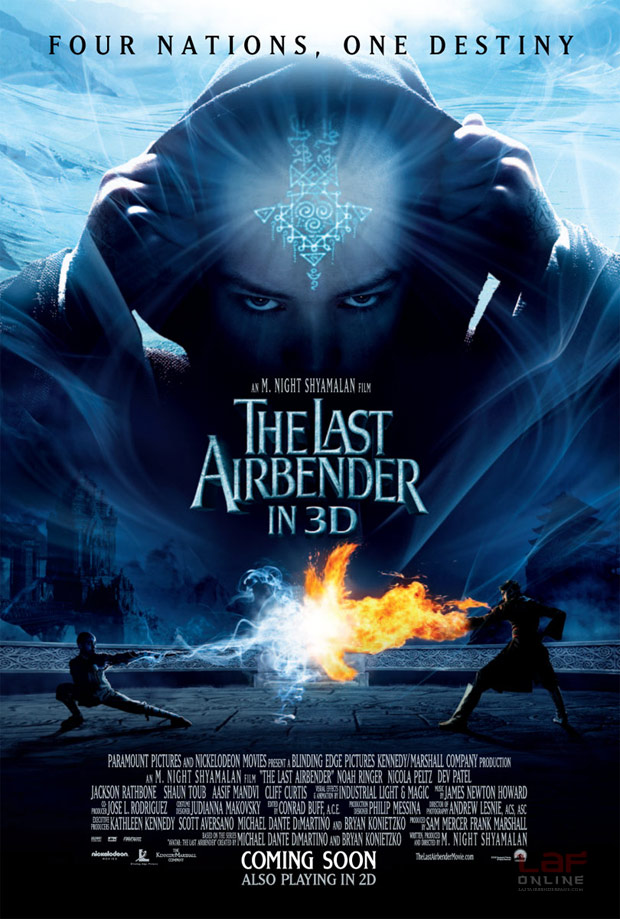
The Last Airbender is a 2010 film written, co-produced and directed by M. Night Shyamalan, based on Avatar: The Last Airbender (the word "Avatar" being omitted to prevent the title from bumping into the film Avatar). It was planned to be the first film in a trilogy matching the three seasons of the show, but plans were canceled after it barely broke even at the box office.
The world of The Last Airbender consists of four nations: the Earth Kingdom, the Water Tribe, the Fire Nation, and the Air Nomads. Each society has people capable of manipulating—or "bending"—the element that is their namesake. Only one person in each generation, the Avatar, is capable of bending all of the elements; their duty is to be a mediator and peacekeeper of the world.
The film's hero is Avatar Aang, an Air Nomad boy who froze himself in an iceberg to avoid his destiny. One hundred years later, he reawakens to find that his people have been massacred by the Fire Nation, which is trying to take over the world. Seeking to take his calling seriously and challenge the Fire Lord, he journeys with his new friends, Water Tribe teenagers Katara and Sokka, to the North Pole to find a Waterbending master to learn the art. But news that the Avatar has returned spreads quickly, and he is hunted by both Prince Zuko, the disgraced & misguided son of the king, and Admiral Zhao, the Fire Lord's second in command.
An unrelated, Truer to the Text adaptation, Avatar: The Last Airbender (2024) released onto Netflix on February 22nd, 2024.
The Last Airbender provides examples of the following tropes:
- Adaptational Angst Upgrade:
- Movie Aang spends most of his time angsting over his job as the Avatar and being the last Airbender. Cartoon Aang, while not a stranger to angst, is The Pollyanna at his core. The first episode made a joke of the "waking up weak" scene, where the movie plays it seriously.
- Sokka is also a lot more serious, even when compared with his drier and more sarcastic book 1 self. To the point where despite being the definitive comic relief in the series, he doesn't crack a single joke in the movie.
- Adaptational Attractiveness:
- Zuko's scar has changed from covering half his face to a barely noticeable red line over his eye. This is more an example of shifting things to work in the new format (film) where the extremely stylized scar might not be as believable. Additionally, Zuko is already considered attractive despite the disfigurement.
- Played more straight with his uncle Iroh who is taller, thinner, and younger than he was in the series.
- Adaptational Jerkass: Sokka gets hit with this. In the show, he can be a bit of a sexist jerk to Katara (at least early on) but it never moves past normal sibling squabbling. Here it's implied he's hit her due to the way she cowers when she gets him wet and he raises his arm. He also loses his original counterpart's humor and sense of responsibility, overall coming off as sullen and at times even psychotic.
- Adaptational Ugliness: In the cartoon, Ozai is quite handsome, but in the film he's far more average looking.
- Adaptation Explanation Extrication:
- In the series, the Earth Kingdom prisoners are trapped on a rig out at sea, and need Katara's help because they have no obvious earth to bend. In the film, the Earth Kingdom prisoners are in a garden-variety landbound prison camp, and need Aang's help because it apparently just hasn't occurred to them that the ground here also counts as earth. Admittedly, both explain that the Earthbenders had their spirits broken and no longer wanted any trouble (even in the show when given access to their element the Earthbenders didn't want to fight the prison guards). It's only that the explanation for their broken spirits (no earth to bend) wasn't present.
- In the movie, Aang explains to Katara that one of the reasons he didn't want to be the Avatar is that the Avatar isn't ever allowed to have a family, something that was actively contradicted by the series. In the TV series, Zuko's discovery that he is the great-grandson of Avatar Roku is a major factor in his decision to join Team Avatar, while Avatar Kuruk's big motivation was getting back the woman he loved from the clutches of Koh the Face Stealer, Avatar Kyoshi had a daughter who ruled over Kyoshi Island after her mother, and the idea that being the Avatar is something to make you popular with the ladies was repeated several times. Not to mention Aang spends a good amount of the series trying to invoke a romance between him and Katara. This doesn't happen in the film, though the movie probably wasn't long enough to have it as it took days for her to even ask for his name.
- Adaptation-Induced Plot Hole:
- The most famous is in the retelling of the episode "Imprisoned." In the show, the Earthbenders are trapped on a metal rig out at sea, far away from any sources of earth to bend and metal bending had not yet been discovered at this point in the series. In the movie, they're imprisoned in a camp on land, which would be like building a prison and then giving all the prisoners assault rifles with infinite ammunition... and then the prisoners not using them for no adequately explained reason.
- The Firebenders in the movie need existing fire to bend, meaning they could potentially be weakened or defeated by extinguishing the defenders' fires. This wouldn't stand out so much if one of the characters didn't actually suggest it as a tactic, which nobody follows through on at all.
- Another plot hole created by changing how firebending works comes when Zuko infiltrates the Northern Water Tribe to find Aang. To get through some ice, he generates heat from his body; this made sense in the show, where firebenders used their internal heat, but how he's able to do this in a universe where firebenders need an external source of fire is never explained.
- In the show Zhao found out Zuko was the Blue Spirit when he visited Zuko's ship and saw his dual swords and pieced it together. But because of the condensed nature of the film, that scene never happens and there's no real clear reason as to why Zhao concludes Zuko is the Blue Spirit.
- Adaptation Personality Change:
- Aang, a happy-go-lucky and eager kid in the series, is a quiet, brooding, and somewhat angsty boy in the film.
- Sokka, being both the Plucky Comic Relief and The Smart Guy in the show, has little in the way of character traits in the film and does little beyond receive exposition.
- Admiral Zhao is more confident and violent in the series, while in the film he is more indecisive to the point he often consults the Fire Lord on every decision and he runs away after Iroh makes fire from thin air.
- Fire Lord Ozai, the de facto Evil Overlord, is shown as a curious individual in the movie. He doesn't appear as hateful and cruel, but contemplative and decisive. He even shows remorse for his son Zuko's banishment by warning Zhao that Zuko will be over him when he returns.
- Master Pakku. Instead of being a sexist prick, he's just a wise martial arts sensei.
- Iroh. In the movie, while he retains his role as mentor to the afflicted Zuko, he is not as comedic and laid-back as his series counterpart.
- Zuko. He may be like his cartoon counterpart, but he is not deadset/blind in his chase of the Avatar. He barely lost his temper (a famous character trait for Season 1 Zuko) and actually felt remorse for others, which is shown when he apologizes to an unconscious Katara in the movie, whereas in the series he smugly rubs in his victory over her.
- Adaptation Title Change: The title was shortened from Avatar: The Last Airbender; the name change was likely to avoid confusion with James Cameron's Avatar.
- Adaptational Superpower Change:
- The Firebenders require a source of fire to bend; not so in the animated series. The reasoning behind this was because the director felt that the Firebenders were too overpowered when compared to the other elemental benders in the show.
- All benders now have to do martial arts moves to essentially charge up their powers.
- Adaptational Wimp:
- In the cartoons, Firebenders can create flames, while in the film all but the very best require existing flames to bend.
- The Earthbenders in the prison have had their spirits broken by the Fire Nation and do not attempt to resist until Aang rallies them. In the series, while they do also have their spirits broken, they additionally do not resist because they're kept away from earth on a massive metal platform in the ocean. And even when they do resist, they're severely underpowered compared to the show: the number of Earthbenders that it took to slowly move a small rock would have completely destroyed an opposing army in the show.
- Katara. In the series, her fight with Zuko at the North Pole is an extended battle that Katara would have won but for the Diabolus ex Machina of the sun rising just as she was about to overwhelm Zuko, strengthening the latter's bending and weakening hers (which was admittedly being strengthened beforehand). In the film, it's a borderline Curb-Stomp Battle on Katara's end — she blocks two attacks before Zuko floors her with ease.
- All benders due to the change in bending mechanics meaning a non-bender like Sokka could easily run up knock out any opponent due to the "charge-up" routine when the show depicted benders being able to blast as quickly as they could move a body part - as demonstrated in the Earthbender prison fight, where Sokka overpowers a Firebender by running up and punting him between the legs before the latter can do another firebending move.
- Adapted Out: Roku’s role as Aang’s Spirit Advisor is given to a dragon. Suki is the second most important character that got this treatment, but she was in the original cut of the film and he wasn’t.
- Age Lift: The elderly Monk Gyatso is portrayed here by the much younger Damon Gupton. The unnamed counterparts of Haru and his father Tyro are also significantly younger.
- Alternate Continuity: This film is a Broad Strokes retelling of the first season of the original animated series, and is therefore not canon to that continuity.
- The Artifact: The Ocean Spirit, due to Aang merging with it being cut from the movie, has no major role.
- Ascended Extra: While he is the Big Bad, before the third season of the show Ozai had almost no direct involvement with the storyline; he was The Faceless in the first season and a Face Framed in Shadow in the second, with only one brief scene that wasn't a flashback. The movie, based on the first season, gives him several scenes with Admiral Zhao, including being the driving force behind Zhao's "kill the moon" plan. Though oddly enough, there's still one scene that's clearly trying to hide his face, after we've already seen it. Presumably the decision to show it occurred midway through production and Shyamalan just forgot to redo it.
- As Long as It Sounds Foreign: The writing we see is just scribbles that look like Chinese.
- As You Know: The primary mode of exposition — Zhao even uses these exact words on multiple occasions. One major example is when Zuko, travelling incognito with his uncle, asks a child to tell the story of how Zuko got his scar.
- Attack Its Weak Point: Subverted. Despite movie-verse Firebenders being forced to rely on easily extinguishable sources of flame to bend, nobody ever thinks to put the fires out. Made worse by the fact that the Water Tribe is told to douse their torches before the Final Battle so the Firebenders won't have any extra ammo, and nobody does. The torches are still burning during the battle.
- Beauty Is Never Tarnished: As mentioned above, some feel that Zuko's scar is this because of how downplayed it is. Others feel that it is more realistic than the wildly exaggerated scar from the cartoon.
- Big Damn Heroes: Katara shows up just in time to rescue Aang from Zuko after Zuko had taken him from her earlier.
- Big "NO!": Aang lets out a huge one after finding out his mentor Monk Gyatso died.
- Big "YES!": "And you think my son might be this person?" "… YEEEEEEEEEES!"
- Brought Down to Normal: The Waterbenders, after the death of the Moon Spirit.
- Bullet Time: Some of the fight sequences
 use this.
 - Butt-Monkey: Sokka, as usual, is on the receiving end of a couple of Amusing Injuries. That goes to show you, even in Darker and Edgier adaptations of Avatar, Sokka is still the Universe's bitch.
- Cardboard Prison: The Earthbender prison camp. Imprisoning people in a camp surrounded by a substance they can magically manipulate… yeah, great idea, Fire Nation.
- Captain Obvious:
- Aang, when Katara asks him how he ended up in the Southern Water Tribe's territory: "We were forced under the water of the ocean."
- Attempting to list all the examples from the film would keep us here all night, but mention has to go to Aang using his Captain Obvious powers to save an entire village by reminding the Earthbenders that they are in fact capable of Earthbending.
- Chickification: Katara gets hit with a pretty bad case of this. Where the series depicts her as a highly talented bender capable of going toe-to-toe with fairly skilled benders despite having no training, the film version blunders her attempts at bending so often that it renders her nearly completely useless and a couple of her defining moments of bravery and compassion from the series were given to Aang.
- The Chosen One: Aang, being the Avatar and all.
- Coconut Super Powers: In the animated series, every single attack that a bender makes is with his or her bending — the only people who ever resort to actual physical attacks are those without bending. In the movie, however, even fights between benders, such as Aang and Zuko's fight scenes, include a much higher proportion of straight martial arts, presumably because it's cheaper than having every single blow be an effects shot.
- Composite Character:
- The Dragon Spirit serves as a stand-in for Roku, Koh and even Guru Pathik with the appearance of Roku's pet dragon Fang.
- According to the novelization, the Kyoshi Warriors (who are sadly removed in the final cut), rather than protecting Kyoshi Island from intruders, took over the roles for Jet and the Freedom Fighters.
- The film version of Yue is a combination of the series' Yue and her father Arnook, as he's dead and she's leading the whole tribe.
- Fire Lord Ozai, who was The Faceless in the first season in the show, ends up with a lot of animated Zhao's characteristics, while film!Zhao ends up with a lot of Ozai's. In some cases, the roles are jointly shared, particularly the plan to eliminate the Ocean and Moon Spirits in the Siege of the North.
- Compressed Adaptation: This is inevitable when you consider that Shyamalan was trying to compress 10 hours of a TV series into a regular-length movie. The movie manages to condense episodes 1-3, 6, 13, and 19 and 20 (the first season two-part finale) into a rather tight series of events. Episode 4, in which the Kyoshi Warriors and Suki were introduced, was originally present but cut for the theatrical release. Everything else in the show is either simplified, vague, or presented through montage and voiceover.
- Conservation of Ninjutsu: The Fire Nation attacks one at a time as Aang and Zuko make their escape from the prison.
- Covers Always Lie: The title poster on this page shows Zuko with fire coming out of his hands. This would be perfectly normal for the animated series, but next to impossible in the film universe, where only the best benders (which Zuko doesn't count as yet) can generate fire.
- Darker and Edgier: Especially considering that this is an adaptation of the first season, before Cerebus Syndrome really took hold.
- Death by Adaptation:
- Katara's narration says that Yue rules the Northern Tribe due to her father's death. In the series her father, Chief Arnook, is alive and well.
- Princess Yue counts as well, while she does offer her life to revive the moon spirit in the show, she then becomes the new moon spirit, where as in the movie she just dies.
- A retroactive example due to The Legend of Korra: Zhao gets drowned by the Waterbenders here but in the show, he suffers a Fate Worse than Death by being banished to the Fog of Lost Souls for all eternity.
- Demoted to Extra: The film naturally has this by virtue of trying to condense twenty episodes into a hundred-minute movie.
- Momo shows up long enough to be introduced, then occasionally shows up in the background a couple times. You could be forgiven for not believing him to have followed Aang after the introduction.
- Appa was also demoted. He doesn't get a lot of screen time and is more of a mode of transportation than an actual character.
- Haru and Tyro… ahem, the Earthbending boy and his father.
- Jet is the small boy Zuko calls over to regale the story of the banished prince.
- There's also Avatar Roku, who was a major player in the Avatar's quest in the show. In the movie, with the exception of a brief mention, he's completely removed and his mentor role to Aang is handled by a dragon… for some reason.
- Despair Event Horizon: The reason given for the Earthbenders not escaping their prison, despite being surrounded by very bendable rock.
- Dull Surprise: All the main characters react like this at various points.
- Elemental Baggage: Firebending was the only bending art in the series that created their element, which the movie altered to require a fire source. The explanation, as provided by Iroh in the first episode, was that Firebending came from mixing air with your own body heat and energy. To some degree the same thing is true in the movie, except only masters can create fire. Firebenders can, without a flame source, generate sufficient heat from their fingertips to melt through ice.
- Evil Overlooker: This poster◊; inverted, as it's Aang, the hero.
- Eskimo Land: The southern water tribe, including authentic Inuit extras.
- Family-Unfriendly Death: Zhao via onscreen drowning from the hands of four random Waterbenders. Complete with seeing his lifeless body plopped down on screen.
- Fantastic Racism: The Fire Nation believe themselves superior to the other elements, which was directly patterned off of Nazi Germany/Imperial Japan motifs in the source show. Ironic, considering Shyamalan's changes to the source material render them the most hindered by Elemental Baggage — extant fire is much rarer than water, earth, or air.
- Flaunting Your Fleets: The Fire Nation. As, for example, in one trailer.
- Floating Head Syndrome: The poster.
- Flynning: In many cases it takes a lot of movement to produce very small amounts of bending, while the show's style had it as a natural extension of the body. It does appear to be a visual shorthand to differentiate the master benders from the novices: Aang, Pakku and Zuko are significantly more efficient in their respective element. If you look closely at her fight scene with Zuko, Katara's movements are far smoother and more efficient than her early attempt at bending when she wound up freezing Sokka, showing that she's made some progression. Shyamalan's reasoning is that he interprets bending as pumping up a lot of chi like an airsoft gun, then releasing it when you have enough.
- Forgot About His Powers:
- Every Earth and Water person in the film suffers from this. Unlike the series, Firebenders (who aren't masters) need an available source of fire in order to bend it. This is all well and good, except none of the other characters ever think to put them out! Granted, some of the fire sources are fairly large, but nothing that couldn't be doused with a little effort. Taken to truly ridiculous extremes in the Earthbender camp when several Firebenders are literally bending from a single source they could not conceivably protect. Same with the siege of the Northern Water Tribe at night — someone does give the order to douse the flames when the alarm bells sound … but apparently, nobody got around to it, because all of the fires are still going during the battle.
- The Earthbender slave camp was built on solid ground, as opposed to a metal refinery in the middle of the ocean as in the cartoon. That would be like making a prison in a gun factory. The only thing that prevented the Earthbenders from just breaking out of this prison was this trope as well.
- Giant Wall of Watery Doom: It sort of vanishes without dropping somehow.
- Giggling Villain: Judging from one brief scene, Azula seems to have become this.
- God Test:"The Avatar would be an Airbender. Are you an Airbender, boy?"
- Groin Attack: Used hilariously on a Fire Nation soldier by Sokka to get his boomerang back, in one of the few instances of him doing something that can be considered comic relief.
- Hilarious Outtakes: The DVD contains a gag reel with behind-the-scene shenanigans and on-set goofs. Most people say that this is funnier than the movie, including Jackson Rathbone actually acting like Sokka.
- In Case You Forgot Who Wrote It: M. Night Shyamalan's The Last Airbender.
- Idiot Ball:
- The entire Water Tribe at the climax of the movie. Knowing a Fire Nation invasion was imminent, the Water Tribe leader told everyone to put out every flame in the village to deprive the invading Firebenders of their ammunition. None of the fires was put out, including the one near the koi pond!
- That pales in comparison to the Earthbenders, who are kept prisoner in a quarry filled with earth!
- Infodump: Used as the primary device for backstory and information.
- Informed Ability: Zhao was supposed to be a master Firebender. While the series showcased his powers, the movie didn't. For example, there is no Agni Kai between him and Zuko in the beginning and the end (the latter because Iroh talked Zuko out of it) and as he prepares to fight a quartet of unnamed Waterbenders, he got encased in a giant bubble and drowned to death.
- Informed Deformity: Zuko's "disfiguring" scar is much less prominent in the film than it was in the show. It looked like part of his face was burned off in the series, while here it looks like he forgot to put sunblock under his eye or something.
- Interchangeable Asian Cultures: An example of fantasy, in the original series the Fire Nation is clearly inspired by China, with elements from Japan and Thailand, especially architecture. In the film, the actors chosen to play characters from that nation were Indians, Persians, Arabs and even Maori. (A meta example occurred during the casting process, when it was suggested that the extras could come with their "ethnic clothes", more specifically "if they are Korean, come in a kimono")
- Kingpin in His Gym: Zuko on his ship, battling it out with the Fire Nation soldiers.
- Large Ham: The Fire Nation seems to be a World of Ham. Seemingly to contrast the Dull Surprise people from the Water Nation.
- The Last Title: The title, as with the animated series.
- Live-Action Adaptation: Of Avatar: The Last Airbender.
- Locking MacGyver in the Store Cupboard: Imprisoning Earthbenders in a quarry. The Fire Nation's stupidity is turned up to eleven here. At least in the show, they keep Earthbenders imprisoned on metal ships far out to sea, where no earth is available for the Earthbenders to use against their captors. Subverted, in a way, because the Earthbenders spend years in the camp without fighting back. The Firebenders' stupidity was turned up to eleven, but the Earthbenders' stupidity was turned Up to Twelve.
- Logo Joke: The stars from the Paramount Pictures logo are accompanied with splashes of water. The Nickelodeon logo that follows is on fire.
- Magic A Is Magic A: An interesting look at how this trope works. While the show never portrayed Firebending inconsistently (and specified that Firebenders derive their powers from the Sun Spirit just as Waterbenders derive theirs from the Moon Spirit, and pull Chi energy from their surroundings and their own bodies), the film changed it so that (like the other bending arts) they have to have a source of fire instead of forming it from nothing. Master Firebenders can still create their own fire, so all in all only the logistics are different. Their war strategy now involves sending flaming boulders into enemy territory so that their front line troops can bend it, among other things.
- Magitek: There is a great deal more emphasis on the Fire Nation technology (made possible by Firebending), frequent mention is made of "their machines" and how difficult it was for the other bending arts to fight against them. The Siege of the North involved a fire cannon that singularly punched a hole through the Northern Tribe wall and soldiers used a drilling device to emerge underneath the feet of Water Tribe soldiers.
- Make It Look Like an Accident: It's implied that Zhao attempts to kill Zuko by triggering a gas explosion. Iroh figures this out immediately because Zhao couldn't keep his mouth shut and started gloating about Zuko "burning to death in that terrible accident."
- Market-Based Title: The movie was going to be called The Legend of Aang in many European markets, to match the original show's Market-Based Title of Avatar: The Legend of Aang. The name was originally changed because "bender" is a British derogatory slang term for a gay person. This did not come to pass; the title remains The Last Airbender in all English-speaking markets.
- Mighty Whitey: The main heroes are played by white actors, while the majority of the extras in the film, who rely in the heroes to lead them, are of non-white races. This is most obvious in the scene where it seems that the predominantly Asian Earthbenders have to be reminded by Aang that they can use their powers to escape bondage.
- Mr. Exposition: Pretty much all the characters, but the worst offenders are Katara and Zhao.
- Mundane Made Awesome: During the Earthbenders' fight against the Fire Nation, six of them stomped the yard and did several Tai Chi poses … all so that one additional guy can throw a pebble.
- Mythology Gag: Early in the movie, Kanna name-drops
 Hama as the last Waterbender taken away by the Fire Nation. Zhao references ransacking the Spirit Library to get the info about the Ocean and Moon spirits (this was also referenced by the show's Zhao, the characters then visit that library in season two). And though Haru's name isn't actually mentioned, it's pretty clear who he is.
 - Narrating the Obvious: The film spends a great deal of time with Katara describing what's happening on screen as we watch it happening.
- Nerf: All bending is significantly weaker than it is in the show. Even their basic moves require complicated katas to perform, and their results are often underwhelming. Firebending got it worst, however; firebenders can no longer create their own fire, and require an external source to bend. This required their enemies to grab onto the Idiot Ball several times and not extinguish the sources of fire required for bending.
- Never Trust a Trailer: TV promos for the film were dominated by lengthy trailers devoted to showing that the movie was available in "mind-blowing" 3D. Even showing an audience gasping and ducking from the four elements jumping from the screen. Despite the fact it was shot in 2D and the tacked on "3D" effects were barely noticeable and earned a Razzie.
- Not His Sled: The ending in the movie is radically different from Book 1 of the series. The killing of the Moon Spirit somehow did not trigger anger from the Ocean Spirit. Worse, Aang was busy attacking Fire Nation soldiers when he was supposed to merge with the Ocean Spirit to become Koizilla. With no Koizilla, all we get is a giant tsunami that did not sink Fire Nation ships, mainly because of the Dragon Spirit's "the Avatar is not supposed to harm anyone" theory.
- The Oner: The battle between the Earthbenders and the Fire Nation. Also doubles as Fight Scene Failure as you can see in the background several extras standing around waiting for their cues.
- Orange/Blue Contrast: The poster, as seen above.
- Pillar of Light: At the beginning of the movie, alerting Zuko to the Avatar's return.
- Pragmatic Adaptation: Sozin's Comet would have been established as being three years away instead of three seasons away to better match the production schedule of a series of live-action films. The extra time would also have made Aang's mastering three whole disciplines in that span more believable.
- Prequel: In the form of the 100-page manga Zuko's Story, which draws Iroh and Zuko in the style of the film's actors but otherwise seems to take place in the original cartoon's continuity.
- Race Lift: The film changes the appearances of the various characters to various degrees, which is complicated somewhat by the fact that some characters in the cartoon don't look like any real race:
- In the show, the amber-eyed Fire Nation had heavy influence from Imperial Japan, but the actors in the movie are from a variety of ethnicities — Maori, Arab, Persian, and South Asian. While the Fire Nation did have significant numbers of dark-skinned people, they certainly weren't the majority like they're depicted here.(Originally Jesse Mc Cartney would have played Zuko, whereupon the Fire Nation would also be completely white, but when the studio realized all four of the main characters would have been white, they amicably asked him to drop out and he agreed. Dev Patel was then cast in his place.)
- The grey-eyed Air Nomads are heavily based on Tibet. In the movie, Aang was portrayed by a white actor with Native American ancestry, and Monk Gyatso became black.
- Sokka and Katara, like most Water Tribe characters, have tan skin, dark brown hair and blue eyes. Because their culture is based on the Inuit, however, many viewers think of them as Asian or Native American. In the film, they are played by white actors with brown hair and eyes, their grandmother is likewise white, and the Northern Water Tribe is comprised mainly of white actors.
- Background extras often don't particularly match the ethnicity of the main characters of their tribes. The Southern Water Nation tribe appear to be played by Asian and/or Inuit actors, and there are a few white people with brown hair in large crowds of the Fire Nation.
- Red Eyes, Take Warning: Just before Iroh gives Zhao a demonstration of just how badass he is, the irises of his eyes take on a very red color.
- Red Shirt Army: Often, the heroes have help from common benders. It has an example of very ineffective ones. The Earthbenders who are imprisoned in rocks and need six of them to throw a small rock. However, it also has an example of very effective ones, the four Waterbenders who defeat Zhao.
- Separated by a Common Language: In the United Kingdom, "bender" is a derogatory term for a male homosexual. Consequently, the dialogue's frequent reference to characters being benders tended to make British audiences giggle. It gives a whole new hilarious sub-meaning to the phrase: "I could tell at once that you were a bender, and that you would realize your destiny."
- Sequel Hook: Courtesy of Azula.
- Show, Don't Tell: Inversion — narration replaces a lot of things from the first season.
- Spell My Name With An S: The second word of "Agni Kai" is pronounced like the first half of "kayak" in the show but "key" here, to the point that the Zuko's Story prequel comic book ends up spelling it with no "A".
- Spiking the Camera: During one conversation between Ozai and Zhao, the former glances directly into the camera for a few moments.
- Spirit Advisor: That dragon Aang talks to when he is sleeping.
- Supernatural Martial Arts: Bending the elements, naturally.
- Take Our Word for It: Sokka's relationship with Yue. When they first showed up in the North Pole, both Sokka and Yue instantly lock eyes. Cue a Katara voiceover stating that "my brother and the princess became friends right away." And then the next scene, he's her bodyguard.
- Too Dumb to Live:
- The Northern Water Tribes count as this. Since the Firebenders need torches to bend fire, Pakku suggests extinguishing all of them to render them powerless...which they never actually do. Most likely because in the series the Firebenders don't need the torches (it's their main advantage in fact), so having it actually work would require massive story changes.
- The Fire Nation imprisoned some Earthbenders in a quarry surrounded by convenient rocks, which they ultimately use to escape. Shyamalan explained that they were too dispirited to try to escape beforehand, but it isn't at all clear why.
- Trailers Always Spoil: Most trailers show the climax of the movie, and several have shots of Yue sacrificing herself in the Spirit Oasis.
- You Don't Look Like You: Several characters, but especially Ozai. Made even worse when you remember that in Zuko's family picture earlier, his appearance is more appropriate to the series…
- You Need to Get Laid:Iroh: There are a lot of pretty girls here Zuko. You could settle down here, and you could have a blessed life. You don't have to continue this Zuko.
Prince Zuko: …We'll catch [the Avatar] soon Uncle, then we could think about the pretty girls.