
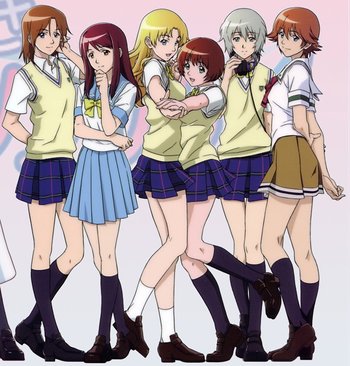
Mukokuseki (jp: 無国籍) is the deliberate lack of ethnic features included in the character design of Japanese fictional characters. It literally means "stateless" (i.e. "without nationality"), though the term relates to more abstract anime, and in this case, used hyperbolically.
Note that just because you perceive someone as being a particular ethnicity despite Word of God saying otherwise doesn't mean it is this trope. The trope appears when characters of the same race look completely different, or characters of different races look essentially the same. It's the ambiguity that arises when there is a lack of Facial Profiling.
Look at the picture to the right. Are the characters all different ethnicities, and if so what are they? Are they all the same ethnicity, and if so which is it?
It can cause some other problems with a Live-Action Adaptation... do you cast a character based on canon ethnicity or just someone who fits in the subjective range of ethnic vagueness of the drawing? Or whatever is the majority for the assumed audience regardless?
People (rightly or wrongly) typically fall back on one of two explanations for this trope.
The first is that the purpose of mukokuseki is to make characters look distinct so that the audience, and the artists don't get confused. In works set in the largely homogeneous Japan, it can be hard for an animator to make unique designs in such a simple art style for several dozen straight black-haired, brown-eyed people.
The second is the idea that the artists are supposedly appropriating archetypically Western features into their character designs either for their own interests or for marketing purposes. It is speculated that the pervasiveness of these physical characteristics in Japanese pop-culture are the result of Western influences. Eurocentric beauty standards have infiltrated most cultures over the centuries via Western colonialism and soft power. The Portuguese missionary Luis Frois, who stayed in Japan for more than 30 years during the Warring States period, said, "Europeans say big eyes are beautiful. The Japanese consider it horrifying and make it beautiful to have the eyes closed." Although large eyes can be quite common amongst Japanese and other East Asian ethnicities, this describes how the Japanese at that time idealized the smaller eyes as depicted in picture scrolls and bijin-ga, rather than big eyes which are a dominant beauty standard in Japan today. Western societies tend to view ethnic Caucasian features as "default" or "featureless", so when they see unrealistic depictions of humans they subconsciously assume the depiction "looks white" unless there's specific racial stereotypes attached.
Westerners in anime and manga are sometimes subject to Facial Profiling. This usually comes in the form of giving them large noses, generally prominent facial topography and other physical stereotypes. This is more common in manga, anime, and Japanese video games that have a more realistic/serious setting where the fact that a character is Western is relevant to the story. Most Japanese artists will avoid doing this if they can, though, since these features blend in poorly with the majority of Japanese art styles and can reduce the appeal to the target audience (otaku). In these cases, the character may be assumed to be Western based on context but their physical features are given the Mukokuseki treatment.
Although Mukokuseki is applied to Japanese characters, Chinese and Korean people in manga, anime, and Japanese video games are sometimes still given Facial Profiling (although not as often as white Westerners are). This is rooted in how imperial Japanese propagandists generally depicted themselves as fair skinned and wide eyed in contrast to the Chinese and Koreans, who were depicted with smaller eyes and stereotypical yellow skin. This artistic racialization was done by the Japanese to distance themselves from the rest of the Asian continent, particularly other East Asians, whom they viewed as inferior to them, and to put themselves on the same level as the West (white people). Modern depictions of Chinese and Korean people usually aren't as unabashedly racist as they were during World War II but many racist stereotypes do persist. See Anime Chinese People and Koreans in Japan for more information about the depictions of these nationalities in Japanese media.
A Trope Codifier for this was Sailor Moon, the cast of which grows quite large over the course of the series (although this trope was pervasive before Sailor Moon). Despite a majority of the characters being 100% Japanese, they have every hair and eye color possible — and even some that aren't. A point of contention is that the main character has yellow hair and blue eyes, making her look "white". Taking into account that her mother has blue hair and her daughter has pink hair, it's clear the color isn't meant to indicate any race. In the live-action adaptation, the wild colors were part of the main cast's transformations, but, in their civilian personas, they had black or brown hair. SM's influence on Japanese pop culture helped to spread the look and it now pervades all media (anime, manga, advertising, video games etc).
On the other end of the spectrum from the Sailor Moon example, the creator of Naruto, Masashi Kishimoto, went on record saying he was happy Naruto was designed with blond spikey hair because after the series went international it made the character more relatable to Western audiences, and even stated that "Naruto has blue eyes and blonde hair, so any child actor in America could play him" in a live-action adaptation (although his perspective comes from the Japanese stereotype that most Americans are blond-haired and blue-eyed white people).
Regardless of what they look like, as a general rule, assume that the character's race matches the original primary audience unless it's heavily implied (through setting, culture, costume, or Word of God) to be otherwise. That's true of all media that doesn't use Facial Profiling — Eastern or Western, even literature where you have to use your own imagination. Without Word of God, it can be hard to tell, which is why some people unfamiliar with the concept of Mukokuseki come to the conclusion that Japanese people have a rather skewed sense of self-perception.
The Trope Codifier was Osamu Tezuka, whose art style was heavily influenced by the works of Walt Disney, Max and Dave Fleischer, and other American cartoonists, though the big anime eye trope was established decades before Osamu Tezuka. Also, Big Anime Eyes still differ in style from American creations such as Big Disney Eyes and Big Looney Tune Eyes; mainly, the former aren't as unrealistically circular. That's part of the reason you don't confuse Red Hot Riding Hood or the Disney Princesses for anime characters, or even Rapunzel.
In part, this trope has to do with the Default Human Being concept . Without obvious ethnic or gendered features, the audience will assume the character defaults to their culture's idea of the common human. This can be seen in the West with the featureless stick-figure depicting humanity as a whole and indicating white men specifically at once. Just as American animators will give Asian distinct features to indicate they're different from the European default, Japanese animators will often give European-descended characters distinct facial features to make them different from the Japanese default, even if both defaults are functionally identical.
Compare Ambiguously Brown (when someone has a noticeably different look from the rest of the main cast, but still no distinct giveaways or confirmed ethnicity), Only Six Faces (where there is little difference at all in character designs), and Humans Are White ("stateless" of course means skin ranging from pale to peachy). See also Implausible Hair Color, Big Anime Eyes, and People of Hair Color.
Exceptions to this trope:
- In Ai Yori Aoshi, the natively Japanese characters have a "yellowish" cast to their skin, in contrast to the American Tina's pink skin (except for Chika, who's darkly tanned). This is particularly noticeable when Aoi and Tina are seen together. Of course, all characters regardless of race have anime-style eyes and (save Kaoru, Chika, and Tina) unnatural hair colors.
- Averted with AKIRA, where everyone (save the foreign troops) looks convincingly and realistically Japanese.
- In Anohana The Flower We Saw That Day, Jintan, Yukiatsu, and Tsuruko look Japanese, Anaru does as well except for her bright reddish brown hair (but she's a Gyaru Girl so she probably dyes it), and Poppo is Ambiguously Brown (but as a world traveler he probably got pretty tanned, and he's not as brown in flashbacks). Only Menma has a truly unusual appearance, which can be partially explained by her mother being Russian (a child with all-gray hair is pretty odd, though).
- There are a substantial number of Japanese characters in Area 88, two of whom are at the eponymous airbase. Can you tell who they are without knowing names?
- In Attack on Titan most of the characters have hair ranging between brown and blonde. Mikasa is stated to be 'half-oriental' and her mother probably the last person 'from the orient' in the world. They both have straight luxurious black hair. Judging by her name she's probably Japanese while most of the rest of the cast is German (based on their names and that half of both theme song's lyrics are sung in German). Later on, we meet characters who are from the part of the world that Mikasa's mother hailed from, and they have much more clearly Asian features.
- In Azumanga Daioh, the characters from different areas of Japan look believably similar to the real-life skin-tones/hair colors. However, there is orange-haired Chiyo-chan (although redheads are known to exist naturally in Japan, they are exceptionally rare, and not without some gaijin mixing or genetic anomaly.) There's also the eye color of Sakaki, which are supposedly blue (most of the cast's are brown). Significant because blue eyes are a heavily recessive gene (basically recessive to all other eye colors) that manifests sparsely in northern Japan due to Jomon admixture and very rare outside of white populations.
- Banana Fish does a good job making the different character's nationalities apparent in the art.
- Averted in BECK. To keep with the indie-film feel, the whole cast have rather realistic hair colors and rather look Asian. Of course, the series throws in a couple Black people and a few Whites for contrast.
- Black Lagoon does relatively well. Revy is Chinese-American and has some noticeable Asiatic features. The assassin Shenhua (a.k.a. "Chinglish") actually looks Chinese. Mr. Chang is an Expy of Chow Yun-Fat as a shout out to John Woo films. Hotel Moscow do not blend visually into the Southeast Asia setting. The Japanese characters arguably look relatively more Japanese than everyone else, but still fall under this trope.
- Mostly avoided in Bunny Drop. Everyone has black hair except for the blonde-ish Rin (and her hair is mentioned as unusually textured). Her biological father is unknown so she could be biracial.
- Oddly played in Cardcaptor Sakura; Syaoran and Meiling are somewhat more obviously "Asian" (due to clothes, not facial features) than most of the rest of the cast (likely because they're Chinese, rather than Japanese) and Sakura's brother Toya is also rendered in a far more "Asian"-looking manner... which often makes it look like he and Sakura aren't even related, because Sakura herself follows the trope straight almost all the way to the hilt.
- A few other characters manage to avoid the trope as well, Clow Reed as an example. As does Syaoran's mother, Li Yelan. (Her five children, however, all play the trope straight; obviously, they take after their late father.)
- Chrono Crusade is a bit of an unusual aversion — there are characters with strange hair and features that don't seem to fit under any particular nationality, but they're not human at all. The characters that have blond hair and blue eyes are all Americans, but there's also Americans seen with brown and black hair. Two German characters have red and brown hair, respectively. There is a white-haired girl, but she has red eyes and is probably supposed to be an albino (and she is supposed to be a little strange, as well).
- Code Geass seemed to be trying to avert this trope in theory, especially since race and racism were major plot points, but its Britannian lead was designed so he could have been Asian (or a space alien), and its most major Asian character so that he could have been Caucasian.
- Then there is Kallen Kozuki/Stadtfeld, who is half Britannian and half Japanese, and passes either way.
- The trope is somewhat averted by depicting the minor Britannian characters like Diethard Reid and Bismark Waldstein with more prominent, European facial features, although it isn't applied consistently enough to completely avert the trope.
- In both Codename: Sailor V and Sailor Moon, the Japanese characters usually look indistinguishable from any white characters. Oddly enough, the Chinese women seen in Sailor V all have black hair, in contrast to the diverse hair colors of the rest of the cast. The one exception might be Elza Gray, a minor black character from Sailor Moon, who obviously has much darker skin than the Japanese girls.
- Cowboy Bebop has a wide variety of ethnicities and there is considerable effort to make them appear properly ethnic. Some of the terraformed planets have an architectural Planet of Hats with corresponding cultures like Morocco, Ecuador and Vienna. In fact, some fans theorize that Spike Spiegel is Jewish. His hair doesn't help, but Word of God says the name was picked because it sounded cool. Neither does the gun that he uses being from Israel. It also doesn't help that Spike's English voice actor, Steve Blum, is Jewish and lives in New York, New York. On the other hand, Faye Valentine and Edward IV aka Francoise Appledelhi are of clearer ancestry; given Faye's hometown of Singapore, she is likely either Chinese or Malay, while Ed is likely Turkish.
- Darker than Black is a mixed bag. The Japanese characters are all over the place. Kirihara looks Japanese whereas all her co-workers have the Mukoku Seki look. Most of the episodic side characters, such as Chiaki (ep1-2) or Mai (Episodes 3-4) also look ethnically ambiguous. April and Babo both have recognizable African features, though.
- Present in D.Gray-Man. The trope is heavily present amongst the European characters as they look like typical anime characters and lack any European facial features. The only Japanese character Yu Kanda may be interpreted as looking stereotypically Japanese with narrow eyes and black straight hair, although these features are common in anime and is most likely due to him being a bishounen character rather than trying to make him look "Japanese".
- Digimon:
- This seemed to be the case in Digimon Adventure with brothers Matt and T.K., until Digimon Adventure 02, when it's revealed that they, the resident blond-haired blue-eyed heroes, are at least a quarter French.
- In Digimon Tamers, Henry Wong, along with his siblings to varying degrees, looks distinctively Chinese with his yellowish skin tone, thicker eyebrows and sharp eyes, with their father explicitly being from Hong Kong. His name is "Li Jianliang" in the original Japanese version, such an oddity that at one point another character assuming his name was completely different because of a mix up between Kanji and Hanzi interpretations of the same name.
- Digimon Fusion features Christopher Aonuma and Ewan Amano, who both are blonde haired and blue eyed without any explanation. Even more confusing, Ewan's sister Nene is decidedly not an example herself, having brown hair and a slightly darker skin tone.
- Doctor Slump Norimaki has to convince his backwater grandpa that his blonde, blue eyed wife is in fact Japanese. He isn't entirely convinced claiming that the eyes and hair ain't proper.
- Dragon Ball's non-Saiyan characters (with the exception of Krillin, Chi-Chi, Taopaipai, and Tenshinhan) are racially ambiguous (considering many of them have neon colored hair and considering the fact there are talking animals). Saiyans on the other hand are almost completely black haired and black eyed people. Right up until they go Super Saiyan, at which point their hair turns golden blonde and stands up like they're undergoing heavy electroshock therapy or something from the inside out, their eyes become aquamarine, and their muscle mass increases. Gets weirder with Super Saiyan God, Super Saiyan Blue and the non-canon Super Saiyan 4. To say nothing of whatever the hell happened with Trunks when he went ballistic on Goku Black and Zamasu in Episode 63 of Dragon Ball Super.
- Durarara!! characters are convincing as the two other foreign characters (Celty and Simon) are designed differently. Any character with blonde hair is shown to have dyed it.
- Eden: It's an Endless World! has a wide variety of ethnicities depicted, and they tend to be accurate for what part of the world each character comes from. In fact, the two characters that don't quite match up with any real ethnicity are revealed to be artificial humans created completely from scratch, leading them to have brown skin but white European eyes.
- Believe it or not, Elfen Lied mostly fits. The characters with outrageous hair colors, like Lucy and Nana (pink and purple), aren't exactly human.
- A few characters in Eureka Seven are distinctly Asian-looking. Talho Yuki is a bit of an odd case. Her Japanese-sounding surname gives the impression she's playing this trope straight to a degree, then we meet the slant-eyed, small-boned Rei and wonder what the heck Talho is supposed to be, since she's certainly not what Rei is...
- Done somewhat in Eyeshield 21:
- All the Japanese characters have black/dark brown hair and brown eyes, the ones who don't have clearly colored their hair since their eyebrows are still black.
- However, when it comes to facial features, it's a no holds bar of weirdness. For example, a Japanese player who loves Egyptian culture actually LOOKS like an Egyptian, rather then just a really tan Japanese guy. The only prominent character whose drawn with Asian features is Seijirou Shin and that's because he's based off Bruce Lee.
- In Flag, the cast is multi-national and this is reflected in the design of the cast. The Japanese and Chinese characters look different from each other and they do not look anything like the American, European, African, and other Asian cast members. The inhabitants of the fictional country look like a cross between Indians and Nepalese.
- In Fruits Basket, most characters are portrayed with brown eyes and black or brown hair — while there are characters with blond, red, or other unusual hair colours, in each case it's stated either that they dye their hair (Kyoko, Arisa), or it's due to being cursed by an animal spirit, such as Kyo's orange hair and eyes. Characters with unusual appearances have it commented on often as such, and are often the victims of attempted bullying for their appearances; Momiji is blond due to his curse, but can get away with pointing out that he's also half German.
- Fullmetal Alchemist:
- Fullmetal Alchemist mostly avoids this, as it takes place in a Fantasy Counterpart Culture of central Europe and visitors from the east like Ling are stereotypical Asian-looking for the most part.
- The few black characters like Paninya also have noticeably Nubian features.
- Inverted with Roy Mustang, who looks more like somebody from Xing than Amestris, and despite it never being really commented on, is shorter than most of the male cast. Fanon has it that his mother is from Xing, but within the manga this is never commented on, and his foster mother (who's his paternal aunt) doesn't provide much in the way of clues either.
- Also worth noting is Izumi also sports a much more Asian appearance than the rest of the cast as well, and not to mention has a distinctly Asian first name amongst a cast that has predominantly Western names even despite her Western maiden name, "Harnet". Like Mustang, her ethnicity has yet to be commented on. Note that since Amestris does sport a variety in race in its population, it might not be considered worth commenting on by the rest of the cast.
- Despite Roy's active lifestyle, similarly to Ling he's rather lean and doesn't have the same buff physique that most men in this series seem to sport. Izumi is also noticeably slimmer than the other girls in spite of being a martial artist.
- Full Metal Panic! characters, while a very diverse group, range from realistically drawn to not resembling anyone.
- The characters in Gantz mostly look distinctly Japanese. Gantz is very big on anatomical correctness.
- Pretty much everyone in Genshiken is recognizably Asian, and the only two light-haired characters explicitly dye their hair. The two American characters who visit in the second season are also distinctly white. Sue looks more like an American-styled cartoon character than an actual American.
- In Ghost in the Shell, most characters look more or less as if they could be actually Japanese, depending on the art style of the different artists/animators. Except for Batou and Togusa, who don't look Asian at all. Batou has blonde hair and a very strong white facial structure. The large round prosthetic eyes don't help with figuring out his race. Most of these can be justified in that most of the cast are heavily modified cyborgs, with Batou and the Major (at least) basically being robots with human brains. They could look like any race at all, and in Motoko's case, the question about her original gender is brought up. She's always been female since birth, but the gender issue is discussed. This became a controversy when Scarlett Johansson was cast as the Major for the 2017 Hollywood live-action of this series as several people insisted that she should be played by a Japanese actress. The publisher and several people who had worked with the franchise, such as Mamoru Oshii, have no problem with the casting. Then, it's revealed in the movie that the Major is really Japanese only to be forced into a white artificial body with her memories completely altered.
- Godzilla: Singular Point averts this for the most part, except for Mei Kamino. For whatever reason, she has big round "anime eyes" while everyone else looks like what their stated or implied ethnicity typically would. Otherwise, she is believably short, thin, and lean for a Japanese character though looks more like a teenager than a post-graduate student who specializes in theoretical physics and biology.
- All the characters in Gokusen including Kumiko actually Japanese. Even the many Gonks have that asian look to them.
- Averted in Goodnight Punpun, which has a semi-realistic art style and no Anime Hair or odd hair colours. Fans do tend to play it somewhat straight though as they give Aiko reddish hair, due to certain official art having her that way, but her canon color is dark brown.
- The cast of Great Teacher Onizuka tends to look authentically Japanese. The manga has been advertised as "NO giant eyes, NO magic powers, NO giant robots".
- Rushuna of Grenadier appears and is even assumed to be foreign because of her blonde hair and huge bust.
- Gundam usually averts this by simply having a multinational cast along with blurred nationalities given the futuristic setting. But this still comes up from time to time. Many of the installments include the formation of a One World Government and the deportation of large swathes of the population into space colonies, so the “statelessness” of its characters simply reflects the tangled mess that concepts like “ethnicity” and “nationality” have become under those circumstances.
- The original Mobile Suit Gundam established a trend where the names of numerous characters are uniquely created and not necessarily reflective of any ethnicity, like Bright Noah, which means any intended ethnicity is more often caught in background material rather than made explicit in the show. Though Mirai Yashima and Hayato Kobayashi in both names and appearances are notably Asian compared to the rest of the cast. Series protagonist Amuro Ray is supposed to be mixed race with his brown eyes and reddish hair, with his father Japanese and his mother being either American, Canadian or Mexican depending on the version.
- 0083's Kou Uraki is often commented on as being the most Asian-looking character in all of Gundam.
- Gundam Wing is an interesting case overall. Chang WuFei is recognizably Chinese compared to the Japanese Heero, as well as leaning more into the Asian culture compared to the other Gundam pilots. Treize Khushrenada is part-Japanese but has a mix of Asian and European features. Heero Yuy himself who, according to the novel Frozen Teardrop, is half-Russian and yet according to the creators, was based off a full-blooded Japanese idol in the 90s. Quatre is seen as the biggest aberration, as he is intended to be Arab but has blonde hair and blue eyes. Turns out there are indeed quite a few groups in the Middle East that can have both features, especially around Syria and Morocco.
- Setsuna F. Seiei from Gundam 00 is an odd case, looking vaguely Japanese before it's revealed that he's actually Kurdish and that's simply a code name (real name: Soran Ibrahim). Setsuna's skin complexion is slightly swarthy and less pale than the Japanese and Caucasian characters in the show however, as you can see here (he's the one with the scarf), and having that kind of skin tone is a trait in Middle Eastern men. Saji Crossroad who, despite the surname, is supposed to be Japanese looks not too dissimilar to the American Graham Aker, or Irish Lockon. Setsuna, on the other hand, is clearly a very different nationality than they are, and his skin tone is far more suited to Middle Eastern skin tones than he is to Japanese. Marina Ismail is a princess from the Middle-East and yet she looks Asian and has blue eyes.
- ∀ Gundam averts this by drawing the character with the Western name with more prominent facial features typical of Europeans. The Moonrace officer named Phil Ackman is drawn with a large, square jaw, large nose and deep-set eyes. There's also Po Ai Zhi (or something like that), who looks more or less like somebody who would actually be named that. Most of the cast is either Asian-looking or ethnically ambiguous, though. The funny thing is, there doesn't seem to be anybody with a Japanese-sounding name in the cast. Big Bad Gym Gingnham likes to dress up like a Samurai, but he's just a huge weeaboo.
- Mobile Fighter G Gundam, operating as it does on Captain Ethnic, predictably averts this for most of the Japanese characters. The exception is blue-eyed brunette Rain Mikamura (though it's within the realm of possibility that her mother, who is never mentioned, is of a different nationality.)
- Everyone in Gunslinger Girl has perfectly ordinary hair colors and eye colors. Triela is a dark-skinned blond with blue eyes but it's not impossible, just pretty rare.
- Hanazakari no Kimitachi E, or Hana-Kimi, is set in a Japanese private school where the ethnicity of the characters is obvious, especially when the hair is colored.
- Main character Mizuki is half-American and given light brown hair, and her friends commented upon seeing her blond-haired blue-eyed brother that he looks more American — to which she replied they were actually half-siblings.
- Osakan classmate Nakatsu is obnoxiously blond but is given a backstory wherein he explains why he dyes it.
- The Dorm 3 RA Himejima seems to be a stereotype of French melodramatics and flamboyance, even carrying around a rose, having long blond hair and appearing with shoujo sparkles — but he is explained to be a half-German who worships his European heritage.
- Mizuki's friend Julia has very blonde, curly hair and blue eyes, which garnered lots of attention when she arrived in Japan to visit her.
- The author seems to relish getting the chance to draw more than Japanese people, so there's a high number of blondes, blacks, and more when the characters visit California.
- Pretty much anyone in Haven't You Heard? I'm Sakamoto who doesn't have black hair has dyed it.
- Downplayed in Hetalia: Axis Powers. It gives appropriate hair and eye color to the European and Asian characters, though it does have some artistic breaks via Technicolor Eyes and heavily indulges in "Westerners are blond". Some Westerners have uniquely foreign features, such as Russia (large nose), France (wavy hair, lots of body hair), Spain (curly hair, olive skin, "clear cut features typical of Spanish"), Germany, Prussia and Sweden (squinty eyes, a common trait of anime westerners). Japan's straight black hair, short stature, Older Than They Look appearance and dark, almost soulless eyes make him stand out from most of the Europeans. China has slight Tsurime Eyes. Played mostly straight with the skin colors, everybody who isn't a shade of tan or brown has the same pale pink skintone. The first four seasons of the anime take this to an extreme, leaving only Cuba with darker skin while "neutralizing" the olive-skinned Spain, Romano, Greece, Turkey, the Arabian Egypt and most infamously, the Creole-African Seychelles. The anime's fifth season fixes most of this. This adaptation even adds more variation; American has a slight tan, England is more pale, China and Japan are given yellowish/ocher skin, etc.
- Who the hell knows with Hunter × Hunter; while obviously not in the real world, the given map is an upside down anagram of a real world map, and some locations have (politically) relative equivalents, based on looks and names, but there's no way to determine anyone's supposed ethnicity. Names especially seem haphazard in distribution. On the other hand, Canary is very clearly black.
- Character design in Seinen manga Ikigami: The Ultimate Limit averts this, Only Six Faces and Generic Cuteness by making every character distinguishable (Even background and one shot characters). Everyone in the cast who is Japanese look clearly as so and in colored illustration they all have black hair and dark eyes.
- Inside Mari and The Flowers of Evil both avert this, though the latter does have the brightly redheaded Nakamura (with natural red hair being possible but very rare in Japan). The anime of The Flowers of Evil infamously averts it by being rotoscoped.
- The human characters in Inuyasha (which takes place entirely in Japan) are all realistically Asian (black hair, brown eyes), although, admittedly, this is more prevalent in the manga than the anime. Most retain a big-eyed look, though there are some exceptions.
- The same can actually be said about any of Rumiko Takahashi's series. Ranma ½, Urusei Yatsura, even RIN-NE (save for the red-headed Rinne Rokudo himself), all feature better-than-average depictions of Asians.
- In K, both the Red and Blue Clans have one (half-)foreigner out of their groups. In Scepter 4, it's Andy Doumyouji, who's half Japanese, half French, and has lighter hair than the rest of the group, and a slightly more western appearance. HOMRA has Eric Surt, who's blond. But the series does provide a lot of light-haired Japanese characters as well (like both teams' seconds).
- In Kaguya-sama: Love Is War the Shirogane family is fully Japanese without any mixed bloodline mentioned, the author himself says in the character’s bio that he only made the male lead character, Miyuki Shirogane, have blond hair and blue eyes based purely on artistic freedom, the reader is made aware that the Shirogane family is fully Japanese despite their obvious European features.
- Averted in Kids on the Slope. All the characters look pretty typical for Japanese kids in the '60s; Sentaro's hair is a lighter shade of brown than the rest of the cast, but that's because he's half-white.
- Koi Kaze averts this. Everyone has black hair and dark eyes.
- Most works by Satoshi Kon are an inversion, having the characters look Japanese, such as Paranoia Agent, Perfect Blue, Millennium Actress, Paprika and Tokyo Godfathers. Perfect Blue even seems to actively parody the trope with a very brief shot of an anime girl poster on a sliding door: the girl almost looks like a Western parody of anime characters with her grotesquely huge eyes and voluminous pink hairdo, then the door opens, and enter three distinctly Japanese nerdy dudes, their faces rendered in a very realistic, almost unpleasant way.
- Kyo Kara Maoh!:
- Set alternately in modern Japan and a Northern European sort of fantasy world, where the Japanese main character gets a lot of attention for having black hair and black eyes. As does his older brother, eventually, who's less cutely designed and therefore more clearly Japanese. However, he still falls under the "big eyes" design. The fantasy hair and eye colors of most of the main characters are noted in the first episode, while the lead is still finding his feet and has no idea what's going on, but afterward they don't really come up, since they're standard to the world they're in. Also some fantasy coloring like pink are green hair, and a couple of vaguely Asian-looking people here and there.
- The third season's inexplicable soukoku Berias, who turns out to have been concealing his actual identity as a blond elf prince.
- Played straight with the main character's mother (who may be Japanese-American although she's now living in Japan), who has curly light brown hair and generic cute features, though in one flashback scene in Boston she refers to herself as Japanese.
- In the Lone Wolf and Cub manga, all of the characters look authentically Japanese.
- Often the case within the Lupin III franchise, especially when it comes to women. Japanese thief Fujiko is often able to pass herself off as a wide number of ethnicities (an Eastern Bloc communist, an American flight attendant, a Scottish singer, ect.) with nothing more than a wig or contact lenses. In fact, the character of Goemon was expressly created because the author wanted to have an instantly identifiable Japanese member of the cast.
- Lupin III vs. Detective Conan has an egregious example. People from Vespania are portrayed with varying hair colors (while Japanese people in the series all have dark hair), and all the trappings of Vespania are European in style (although no location is explicitly mentioned). Yet Ran, who is Japanese, is a double for the princess of Vespania.
- Michiko & Hatchin:
- An odd example. The major character Atsuko is half-black and half-Japanese, and yet has blue eyes and (apparently) naturally blond hair.
- Averted with most of the other characters. There are tons of black and latino characters with dark skin and features, and most of the non-mixed Asian characters have recognizably Asian facial features as well.
- If the movie takes place in Japan, Hayao Miyazaki's characters tend to have dark hair and eyes. Fair-haired people crop up on occasion in the backgrounds, but most of them only appear if the setting is meant to be European.
- Mushishi almost entirely adheres to probable Asian eye colors, hair colors and facial features — which, of course, makes the white-haired, green-eyed, and anachronistically dressed Ginko stick out like a neon rainbow on a black-and-white photograph. His hair and eyes are later revealed to be caused by a mushi, though. Well, when Ginko was designed the writer was imagining the story set in the modern era, with the first story set in a traditional house deep in the woods, but it somehow slipped into an alternate feudal era, leaving him with his anachronisms. At least according to the author's notes. But then, he's supposed to be a freak, anyway.
- In My-HiME, while most characters are straight examples, Natsuki, in the side novel, "Natsuki's Prelude," finds it suspicious that "Yamada," her informant, "didn't look Japanese at all," and suspects that Yamada is not his real name. Yamada briefly thinks back to the time in the service of "his country," but it's never revealed where he is from.
- Used deliberately in Nadia: The Secret of Blue Water to underscore the Ambiguously Brown heroine's mysterious origins. Is she African? Indian? (turns out she's Atlantean.) Nadia's classically stateless anime heroine features stand in sharp contrast to the supporting characters, who are all recognizably European or African.
- Originally Nadia (and Atlanteans by extension) were going to look realistically sub-Saharan African, but the animators could not get Nadia's original hair to move to their satisfaction, so they threw that design out and started over.
- Naruto:
- Naruto despite it's lead character sporting spiky blond hair (a deliberate Shout-Out to Super Saiyans initially) other uses of implausible hair colors are relatively few and far between among the characters who mostly have blue-black and varying shades of brown hair, and the facial features of most of the rest of the cast are recognizably East Asian. Further the Hidden Cloud Village has a lot of African-looking characters.
- This is heavily averted in Naruto (1997) pilot. Naruto is a blond because he isn't human. He is actually a fox demon in human form. Most other characters have black hair and the few with light colours presumably are brunettes.
- Downplayed in Neon Genesis Evangelion:
- Ritsuko has blond hair, but flashbacks showing her in high school make it clear she dyes it.
- Asuka's hair is anywhere from strawberry blonde to reddish-brown to red and she has blue eyes, but this is explained by her having a white father and a mixed-race mother, and she's mentioned as looking "exotic" by several other characters.
- Rei and Kaworu both have red eyes and pale skin (with Rei also having blue hair) but this is implied to be the result of being created from Angel genetic material.
- Most of Tsutomu Nihei's manga have several distinctly Asian-looking characters, although considering the trans-human leanings of most of them, this could often be more an issue of personal taste than ethnicity. Nihei even pokes a bit of fun at racial differences in Blame!! when Japanese-looking hero Killy passes through a land of blonde people who are all at least twice as tall as he is.
- Somewhat averted in Soul Eater, where the predominance of white people is justified by Shibusen's being located in America. Concurrent with this, there are several black characters as well.
- Noir does well with this. Especially noticeable since the main characters travel around the world doing their job, you see the differences clearly. Japanese Kirika and Taiwanese Shaoli are both clearly Asian looking, and while Chloe's ethnicity is never specified it's implied she's at least partially Asian as well due to her eye shape and petite frame.
- The characters in series illustrated by artist Takeshi Obata really do look Japanese.
- What's bizarre in Hikaru no Go is that the Koreans are walking Asian stereotypes with considerably less distinction from one another than the Japanese characters. Now, Japan has historically been more racist against the Koreans than any other foreign nationality, but it's still a little weird to see. The Chinese that appear in the manga have more Japanese-character-like variation, but their Asian qualities are accentuated, too.
- In Death Note, Misa wears tinted contact lenses and is implied to dye her hair yellow. Her eyes shift between blue when she's "on the job" and brown when she's not. And red. Light's hair often looks dark and could easily be dyed.
- Between that series and Sasami: Magical Girls Club, you get a lot of non-Asian-looking Asians due to the cast keeping their Tenchi Muyo! looks despite being normal Japanese people instead of long-lived Human Aliens. Mind you, it's that or everyone becoming unrecognizable.
- Averted in hard military SF series, Obsolete where Lt. Rei Miyajima doesn't just look asian, he's also one of the darker skinned characters in the show (he's darker than a number of the Peruvian soldiers who were assassinated in the episode "Carhuincho").
- Usually played straight with Ojamajo Doremi, but there are a few exceptions. In the episode where Momoko receives a video letter from her black friend Beth in New York, Beth's new friend Sachiko is drawn with narrower eyes to highlight the racial differences between the two girls.
- One Piece, despite being heavily stylized, clearly has European and Asian character types, mainly differentiated by how the artist draws the chin. In response to a fan question, Oda has actually clarified what nationalities the Straw Hats would have if they lived in the real world. Only one crew member, Zoro, was Japanese, with at least three being identified as varying flavors of European.
- Played with in Oreimo between Japanese Kirino and her American friend Ria Hagry: Kirino has very light hair and blue eyes (although it is explained she dyed her hair) and has stereotypical anime designs. On the other hand, Ria is much more different looking, as she's dark-skinned with darker hair, albeit it's never explained if she's African-American, East Indian, Middle-Easterner or simply because her name sounds Western enough.
- In Ouran High School Host Club, blond-haired and blue-eyed Tamaki Suoh appears to be just a conventional instance of Mukokuseki. It's later revealed that he's the illegitimate child of a Japanese man and a French woman who received both Japanese (Tamaki) and French names (Rene).
- Inverted in Overlord (2012): The Ainz Ooal Gown guild were all Japanese, but most of the New World is apparently meant to be a Medieval European Fantasy, since Ainz' illusionary face (a projection of his RL face) and Narberal's attract attention from the natives, who say their features definitely look foreign (apparently there are people with Asian traits in the New World).
- Parasyte characters look very Japanese, especially Mori Uda.
- A curious inversion occurs in Patlabor. While it plays this trope straight to varying degrees with the main cast, in order to emphasize Kanuka Clancy's otherness she was drawn as the the most Japanese-looking.
- Hachimaki in Planetes looks distinctly, almost stereotypically Japanese, with the yellowish skin, wiry black hair, and slanted eyes. In contrast, Tanabe is also Japanese, but her complexion is indistinguishable from the white characters; however she is adopted and her birth parents' ancestry is unknown.
- Partially averted in Princess Jellyfish. Kuranosuke has blue eyes and blond hair, but this is due to him having a blonde, white mother. It's remarked in-story that he looks absolutely nothing like his half-brother Shū, who is a full-blooded Japanese man with typical Asian facial features and coloring. Everyone else averts it pretty well too.
- Subverted in Project ARMS. The Japanese characters all have dark hair and slightly different facial features than the Western characters who show up. The non-Japanese characters (Keith White and his clones, Jeff and Al Bowen, Carol, Alice, etc.) have a variety of hair colors, but nothing outside the realm of reality.
- Project Blue Earth SOS has a very multi-ethnic cast and each cast looks appropriate. Earth SOS's character design even averts the large eye phenomenon, the eye size is normal.
- Psycho-Pass:
- Most of the characters look quite Japanese save for Shogo Makishima and Shion Karanomori.
- Though everyone is also so pale that you’d be forgiven for thinking this is a series about vampires. However that is averted in later followups (movies especially), where most foreigners are given appropriately darker skin.
- Ranma ½
- The characters' facial features are less distinctly Asian than classically Takahashi, with her distinctive rounded style.
- In the manga, all Japanese and Chinese characters are depicted with what one would assume is either black or brown hair, and are generally differentiated by their style of dress (although Ranma prefers to wear Chinese-style clothing normally).
- In the anime, this is done a bit more subtly — the Japanese characters do have either black or brown hair (or dark blue in Akane's case). Most non-Japanese characters will have some other hair color (blonde, purple, green, pink). Exceptions include Azusa Shiratori, whose hair is more of a darker honey color, and the black-haired, Chinese Mousse, and Ranma himself, who retained his black hair in male form but received gray eyes, switching to red and blue respectively when his curse is triggered.
- Real Drive: The eyes are slanted, hair is brown, and everyone's body looks realistic. That is, they don't look like rail-thin crack addicts. The odd thing is that, while the girls' facial structures are more Asian-looking than typical anime girls, their figures are suspiciously foreign-looking. Most chubby Asian girls tend to carry more weight in their busts and bellies, while the RD babes are more bottom-heavy.
- Rebuild of Evangelion:
- 2.0 starts out in a European/Russian NERV base under attack; most of the personnel in the base clearly are white (except for Kaji).
- Mari Illustrious Makinami has blue eyes and brown hair, but Word of God states this is because she is half-English.
- Averted in Red River (1995). The Japanese Yuri is drawn looking noticeably different than the people of Anatolia. Her shorter stature, paler skin, black hair, and dark eyes do not go unnoticed by the other characters.
- Rurouni Kenshin: Kenshin has red hair and purple eyes (that turn gold when he goes into Battosai Mode), but his parentage is unclear since he's an orphan. (Epileptic Trees say he's at least part Dutch.) Also to considered are the OVA movies; Kenshin comes off way more Japanese in those, but there is also a large shift in art style to consider.
- Combined with Phenotype Stereotype, in Samurai Champloo a one-off character was eventually shown to be from Holland and merely visiting Japan. The characters only notice he was a foreigner because he had light/wavy red hair and blue eyes. Otherwise the difference between him and all of the other Japanese characters was almost unnoticeable.
- Most of the characters in Sayonara, Zetsubou-Sensei have a somewhat normal Japanese appearance, with the obvious exceptions of Kaede Kimura and Taro Maria Sekiutsu.
- While played straight in Shaman King, some of the non-Asian characters, especially Silva, have narrower eyes than the Chinese and Japanese characters.
- Takako Shimura almost always averts this trope. She rarely uses Anime Hair or unnatural hair colors without hair-dye being an explanation. Both Wandering Son and Sweet Blue Flowers mostly have characters who have either black or brown hair, and black or brown eyes (though one of the leads in Sweet Blue Flowers has red hair, which is rare but not technically impossible). The anime adaptation of Wandering Son subverts this though, as they gave multiple characters new eye colors (typically Technicolor Eyes like gold or red).
- Shonen Note: Boy Soprano downplays this. Black and light brown hair are the norm. The protagonist has Innocent Blue Eyes though.
- A Silent Voice averts this trope; though a lot of art (and the animated adaptation) has Shouko with pinkish-red hair; her canonical color seems to be a dark brown.
- Averted with a VENGEANCE later in Slam Dunk which carries on into all of Takehiko Inoue's works. Most of the characters look unmistakably Japanese, and the ones that don't are quickly acknowledged as strange looking. The main character himself has single eyelid folds, making him look the most Japanese despite having bright red dyed hair. On top of that, most of the characters in the show are far from fair-skinned. Some characters, however, tend to have a certain black African feel on them, most noticeable with Takenori Akagi who was a considerable darker skin and wider lips than the rest of the characters and a flat top haircut that totally looks to be cut on a afro-textured hair.
- For the most part averted with Stop Hibari Kun. The only character that stands out is Hibari, even amongst her family, as she has blond hair and bright blue eyes. The manga is drawn by Hisashi Eguchi, a famous mangaka who would eventually be known for drawing realistically styled◊ characters.
- Strike Witches averts this trope to some degree. Japanese characters are shown with realistic black to lighter brown hair color. Played straight with the facial features and hair colors on the other characters though, some characters have orange and silver hair and none of the characters have ethnic facial features.
- In Sword of the Stranger, the Chinese and European warriors all look significantly different from the Japanese. However, the title character somehow manages to hide his non-Japanese ancestry merely by dying his hair.
- Despite being largely responsible for this style, Osamu Tezuka himself has a few aversions. A few of his recurring characters, most notably Tonan Shipan are more distinctly Asian than most. Tezuka also often used an interesting workaround. When depicting his ostensibly Japanese characters traveling to the Western world, he would often exaggerate his foreigners' appearance; Tezuka's Westerners are usually taller than his Japanese characters, with wide shoulders and long noses. This is especially noticeable in Black Jack. This is mostly averted in Adolf, wherein the German characters and the Japanese characters look noticeably different.
- Averted in Thermae Romae where the main character Lucius is creeped out at being surrounded by the "flat faces" when he first finds himself in Japan. He and the other Romans clearly look different than the Japanese he encounters in the modern world.
- Tokkô: Though they all have Japanese names, this is especially obvious when Ranmaru and Muramasa are seen together.
- Tokyo Tribe 2 has everyone looking Japanese.
- The Twelve Kingdoms starts off in Japan, and people look decently Japanese. Youko's reddish hair is called out from the beginning as unnatural, unusual, and inexplicable. There's a mysterious blonde, then another one, but they have reasons, as is revealed after the action moves to the fantasy world, where people explicitly have anime-diverse hair and skin colors. Dark skin, red eyes, purple or orange hair, it's all there (and in the original novels). (But not many blondes.) Youko herself transforms to scarlet hair, emerald eyes (vs. a gray or very dark green in Japan) and brown skin.
- Naoki Urasawa:
- Most of his manga are drawn very realistically. The people who look white in his work actually are white (with realistic European noses), as many of his manga are set in Europe or other exotic locales. In fact, Urasawa occasionally goes too far in the other direction. Monster 's Eva Heinemann, a German, has a slightly Asian look to her. Just about the only time he plays this trope straight is with Kanna from 20th/21st Century Boys, who has more of a typical big eyed, fair haired "anime girl" look to her, resembling Monster's Anna/Nina, but this is probably to emphasize the character's "otherness", as she has supernatural powers.
- Played straight for the most part with his redesigns of many classic Osamu Tezuka characters for Pluto, especially Ochanomizu and Tenma, due to their comedically oversized schozzes, which could never be reduced to typical Japanese proportions without rendering the characters unrecognizable. So while they do look realistic in a sense, they don't look like people who could realistically be named Tenma or Ochanomizu. Shansaku "Mister Mustachio" Ban also suffers from this, as his character model was recycled from Monster's Dr. Reichwein, who is in turn based on the American actor Wilford Brimley. Urasawa does a surprisingly good job on Inspectors Tawashi and Nakamura, though, as Well as Astro Boy and his "sister" Uran.
- Dr. Tenma, of Monster fame, who is supposed to be Japanese, is drawn stylistically very similar to several characters who are supposed to be German, even if his skin and hair color are realistic.
- Welcome to the NHK: All the characters are recognizably Japanese. The only character with blond hair is obviously bleaching it, since we see flashbacks of her in high school with dark hair.
- Windy Tales uses a Korean art style where the characters are very clearly not white.
- In contrast to other mon series like Pokémon and Beyblade, Yo-kai Watch averts this trope. The human characters mostly have realistic hair colors and eye colors.
- You're Under Arrest!'s cast is pretty clearly Japanese. Though, they still have eye-colors which aren't really possible with Japanese people (or in some cases, any type of people).
- Yu-Gi-Oh!:
- In a downright silly case, not only do the main characters have the requisite bizarre hairstyles (including blonde and multi-coloured), but several of them are the modern Japanese reincarnations of their near-identical Ancient Egyptian predecessors.
- To make this more confusing, the dub changed several names and gave Bakura a British accent to represent his exaggerated politeness. Jonouchi / Joey, by contrast, got a distinct Brooklyn accent due to being plain-spoken. The dub is also inconsistent and often ambiguous on where the series takes place — sometimes Japan, sometimes America, sometimes some kind of Americasia.
- Yuureitou averts this. Most characters with black or dark brown hair, brown eyes, and look Japanese.
- In YuYu Hakusho, every human looks realistically Japanese, with standard black or brown-variation hair, except for Kuwabara and Kurama. Kurama's odd red hair color is likely a result of altering the genes of the human fetus he possessed. In Kuwabara's case, his hair looks like the result of a Japanese person dying their hair blonde without bleaching it first. This was actually a common trend among Japanese juvenile delinquents in the 90s. This trope is completely averted in the manga, however. In colored manga images, Kuwabara and Kurama both have standard black hair.

- Played straight in the Animesque Ame-Comi Girls series. Most notably, Natasha Irons is portrayed as having blue eyes and straight blond hair despite being of African-American descent.
- Chinese-American indie comic creator Jason Shiga likes to reuse character designs across different stories. As most of his characters have black hair and cartoony features, they can represent completely different ethnicities depending on the needs of their story. So Jackson's girlfriend from Double Happiness (explicitly Chinese-American) looks the same as Agent Finch from Bookhunter (implicitly caucasian), and both look the same as the unnamed woman from the end of Fleep (who's from a fictional nation on an island in the Pacific Ocean).
- Violine has a variation aversion. The African characters all have thicker lips and different facial structures than the European characters. At one point, a white doctor tries to disguise himself as a native by covering himself in black make-up and he clearly looks different than the other African characters (although, curiously, no-one seems to notice this).
- Inverted in the old newspaper comic strip The Yellow Kid — though the eponymous character has some Asian features, and a 19th-century comic would not have a problem with naming an Asian character "the yellow kid", judging from the character's real name,note he's actually Irish. Bizarre, especially since none of the other characters are drawn that way.
- An In-Universe deconstruction; in the Lyrical Nanoha fictional report: Strategic Anaylsis of the TSAB, this works in disfavor of the TSAB as the US Department of Defense finds the lack of people of color disconcerting, along with the Fantastic Racism against Artificial Humans and Combat Cyborgs, thus mistakenly likening them to Nazi Germany.
- The Hamada brothers of Big Hero 6 seem to have an Animesque "stateless" look designed to appeal to both Eastern and Western viewers. This is because they actually are biracial, half-white (maternal side) and half-Japanese (paternal side). Their aunt and caretaker is more clearly white, while their friend Go Go, being Korean, has more defined Asian features.
- Jin-Roh: The Wolf Brigade. Everyone has black hair and looks very Japanese.
- When Marnie Was There downplays this. All of the Japanese characters look noticeably Japanese, which makes the blonde-haired, fair-featured Marnie stand out even more in comparison. The Japanese lead character's blue eyes do not go unremarked on, and they end up being a major clue to her biracial ancestry. However, Marnie might be either white or half-Japanese because her mother is vaguely designed.
- M. Night Shyamalan responded to criticisms of the Race Lift in his film, The Last Airbender, with this trope, stating that the characters in the original cartoon don't match up perfectly to any real-world race, though they are in many ways Fantasy Counterpart Cultures to a number of real ethnicities.
- In Magical Girl Raising Project, everyone has dark hair colors in mundane styles. It's only when they turn into magical girls that they gain technicolor Anime Hair.
- The History Bites episode Samurai Goodfellas, featuring Ron Pardo as Oishi Yoshio, counts as a straight example.
- LEGO have yellow skin for this reason. There are minifigures with more realistic skin colors — usually if the figure in question is adapted from another property where the character they are based on is of a specific race to begin with. This is visibly enforced in The LEGO Ninjago Movie, where black news anchors Michael Strahan and Robin Roberts are represented by the same yellow skin tone as everyone else in Ninjago City.
- Canon Foreigner You Ji from Bladestorm The Hundred Years War completely (and pleasantly) averts the Mukokuseki principle — his look is unambiguously and realistically East Asian, amongst a cast of English and French contemporaries who all look realistically Western European.
- BlazBlue:
- Most of the characters have hair and eye colors such as Ragna (who has silver hair and multicolored eyes), Rachel Alucard (who has red eyes), Bullet (who has silver hair and red eyes), Marceline F. Mercury (pink hair and cyan eyes), Tsubaki Yayoi (who has red hair and blue eyes), Kokonoe and Konoe Mercury (pink hair and yellow eyes, though both are confirmed to be part-Japanese), Hazama/Yuuki Terumi (green hair and yellow eyes), and Amane Nishiki (blue eyes and purple hair).
- The world of BlazBlue is post-apocalyptic, with most of the landmasses reduced to seithr covered wastelands and people living in Hierarchical Cities on mountaintops. Genetically the cast includes people from England, Russia, Germany, America, Japan and China among others, but those countries don't exist anymore and years of mingling in the Hierarchical Cities have probably rendered ethnicity as we know it moot. As for Hazama, he's an Artificial Human. For reference, Blazblue mostly takes place around what would geographically been considered Thailand.
- Overall, most Final Fantasy characters appear to have an intentional mix of Western/Eastern features.
- At least in the English localization of the game, Cloud from Final Fantasy VII is described as 'white' a few times. In his appearances in HD media, they went for a more ambiguous look — see below.
- According to Word of God, Squaresoft was inspired by Final Fantasy VII's big international success and so went out of their way to have the characters in Final Fantasy VIII be white, hoping to attract more Americans — with the exceptions of Squall, who was modelled after a Japanese celebrity, Rinoa (who was designed to be appealing to the Japanese audience in particular), and Edea (who was based on an old original character of Tetsuya Nomura's). This is part of the reason for Quistis's strangely mature appearance — Nomura had designed the character as a beautiful woman in her late 20s, and was reportedly shocked and annoyed when the writers decided to make her 18 with the justification that white women tend to look more mature.
- The in-game character models in Final Fantasy X. However, the FMV ones have very noticeable Japanese features — for some of them, at least: Rikku is quite obviously Asian, as is Tidus (in the CG cutscenes), and Yuna is noticeably Asian but with slightly softer features. Wakka is Ambiguously Brown. Lulu, Auron, and Seymour, though, are white as the driven snow. Like with Squall above, Tidus was modelled after a real-life Korean celebrity.
- Seen Kingdom Hearts. Especially with Sora, Riku, and Kairi. Are they Japanese through SE? Pacific Islander because of Destiny Island being their home? note The fact Kairi has pinkish red hair and Riku has silver isn't helping matters. With this being said, the Norts being Ambiguously Brown does NOT fall into this, despite Xehanort being from Destiny Islands. The skin tone/eyes/hair/ears set up comes from being immersed in Darkness.
- In some scenes from the early concept trailers for Advent Children, Cloud looks rather obviously Asian (even with dyed-looking hair in some versions — see the sequence where he fights with Kadaj near the scrap metal). And, in other early concepts, he looks completely white (the promotional render of him holding the sword). This was changed to the more racially ambiguous look (i.e. European in hair and eye color, East Asian in eye shape and a mix of facial features) he and most other characters have in the final version(s) of the movie, as well as Dirge of Cerberus. This also arguably the case for both the early versions of Sephiroth and Kadaj.
- In The Compilation of Final Fantasy VII, the characters seem to span a wide range of races. Cloud, Zack, Tifa, Reno, Elena and Reeve all have mixed Asian/white features. Yuffie is most obviously completely Asian, as is Tseng (the designers claimed to have enjoyed dressing Yuffie the best, as they were able to use Japanese designs in her clothing). Aerith and Cid are white. Barret and Rude are black. Red XIII is a dog and Cait Sith is a cat.
- Roberto Ferrari's designs for the casts of Final Fantasy XV and Final Fantasy VII Remake noticeably skew a lot less Japanese than Nomura's versions of the same designs, with the exception of Noctis, Iris, and Gentiana, who also move away from this trope by looking more overtly Japanese, and Cindy and Lunafreya who have a mix of facial features.
- Averted for the most part in Final Fantasy XIV where Othardians (Fantasy Counterpart Culture of East Asia) mostly have dark brown hair much like actual Asians. Oddly played straight with a representative from Nagxia (based off of Southeast Asia) who has blond hair and blue eyes. Seeing as that area is yet to be explored, it is unknown if that is a common trait there.
- Justified as a plot point in Golden Sun: Dark Dawn. Of the three ethnically Asian-counterpart player characters, two (a Japanese Miko and a Vietnamese pirate) look reasonably Asian-ish, and Amiti (from more-or-less Thailand) has the same generic features as the ethnically white characters (because he's the bastard son of Alex, who is white Norse. Once you know to look for it, Amiti even looks a lot like Rief, the son of Alex's cousin Mia).
- Inazuma Eleven:
- Zigzagged. For example, Tsunami is an aversion, since he's from Okinawa as well as an avid surfer, both of which factor into his darker skin. Rococo also averts this, having darker skin because he's African. And Endou Daisuke has somewhat darker skin since he had been living in Africa for years, while flashbacks depict him with the same skin color as the rest of his family. Sakuma's darker skin, on the other hand, is never explained.
- Through out the course of each title one can meet lots of players with varying degrees of plot relevance that look undeniably white, black, brown and some that don't even look human. And yet each and every one of them is treated as if they were ethnically japanese unless stated otherwise.
- Mega Man Battle Network:
- An odd variation occurs in with Dekao "Dex" Oyama, who has a comparatively dark complexion and full lips instead of the 'stateless' features typically given to anime characters.
- Dex's little brother Chisao, in sharp contrast, has very light skin, beady eyes, and a body shape that resembles nothing so much as a Bobble-Head. We don't know what the Oyamas are supposed to be.
- The Persona series has characters that have consistent Japanese traits in contrast with the few Western characters (if you could look past the odd hair colors, anyways) — blonde hair is almost always reserved for non-Japanese characters, and the Japanese who do have blonde hair (such as Yuka from 1, Kanji from 4, and Ryuji from Persona 5) explicitly dye their hair. Apparently, the characters in the first game looked so Japanese that the localization had to Photoshop them in order to make them look more "American". The fifth installment discusses this trope — see the discussion section below.
- Pokémon:
- Certain characters in Pokémon and its adaptations to an extent; Kanto being the most realistic, with almost everyone having somewhat realistic hair colors and eye colors for a Japanese person, and anyone who doesn't either fits into Ambiguously-Something or is American (in the case of the blond Lt. Surge). However, starting in Johto this trope was played straight more often, with plenty of blond and other light-haired characters who are clearly Asian (for instance, in Johto we have Morty, who is blond and comes from a very stereotypically Japanese city). In Unova, it's hard to tell who's Asian and who's not. You'd expect the ones with Japanese names to be so, but one of the more well known cases is back in Kanto, which is realistically drawn and colored we have a red-haired, blue-eyed girl with a Japanese name.
- Averting this trope sets Detective Pikachu apart from the mainline games. Unlike other titles, the characters all have natural hair colours and standard hairstyles. It emphasises the normality of the city the game takes place in.
- Ace Attorney:
- In Professor Layton vs. Phoenix Wright: Ace Attorney Phoenix and Maya look very subtly more Asian than the other characters in the game, who all happen to be British. Of course, due to the Ace Attorney franchise’s Cultural Translation, Phoenix and Maya are American in the English version as opposed to Japanese.
- Semi-averted in The Great Ace Attorney duology which takes place in both early 20th century Japan and Great Britain. The European characters often, though not always, have more prominent noses, brow ridges, jaws, and deep-set eyes. The Japanese characters all have dark hair, eyes, and a range of Asian skin tones that deliberately constrast with the more varied features of the European cast, even the ones who're drawn in a more typical "anime" style.
- The Sakura Wars games set in Japan play with this; despite the setting, the characters with blonde hair and/or light-colored eyes are generally noted to have at least some European ancestry, and the purely Japanese characters for the most part do look more "Asian" in comparison.
- The Sims:
- The Mae Sisters from The Sims 3 are meant to be aracial as the original Kaylynn Langerak from The Sims 2, who was randomly generated by the Tombstone of Life and Death. But they are also meant to be somewhat reminiscent of Mary-Sue Pleasant, and thus looking vaguely of East Asian descent, but vaguely European at the same time.
- Overall most Sims 3 premades are so cartoony to the point that the same Sim could pass as anything with a diff coloring. Yellow "blond" hair, cyan eyes, light skin in the pinkish slider, and they look European. Black hair and eyes, and tan skin on the olive slider, and they look Asian. Black hair and eyes, and dark skin in the pinkish slider, and they look African. It doesn't help that quite a few of them are green dryads or teal elves.
- The Siren Games models all the game's characters after Japanese actors, complete with their real life faces, making this game as absolute an aversion of this trope as one could find.
- Soul Series
- Debuting in the series's fifth main iteration, Natsu was born in 16th century Izumo, Japan and sports entirely incongruent strawberry-blonde hair and unambiguously western facial features. Her incongruity is compounded because the other Japanese characters, samurai Mitsurugi and Natsu's predecessor Taki, sport racially correct black hair and brown eyes. It's likely intended as she's supposed to evoke the western-inspired gyaru fashion and culture in both looks and attitude — nevermind the fact that the subculture didn't develop until the 20th century.
- (Korean) Yun-Seong's bright red hair and Maxi's ("Makishi", from Ryuukyuu, now known as Okinawa) blondness in his alternate outfits. Though even they have Asian features, Natsu is notably very Western-looking in facial structure.
- Story of Seasons takes place in a European, or American, setting depending on the title. This trope is usually played straight, as many of the characters are all drawn with ethnic-less anime faces and have a mix of Japanese, English, and other language names in the Japanese version. However, a few characters are either Ambiguously Brown or intentionally designed to look non-white (Alex, Kendall, Kurt, Tim, etc). With the addition of Harvest Moon: A Tale of Two Towns, we finally have a town full of vaguely Asian-looking characters. The other eponymous town, however, is a typical SOS town.
- Street Fighter typically averts this trope well, but certain characters still slip into it. R. Mika and Karin from Street Fighter Alpha both have blonde hair and Mika even has blue eyes, however both are apparently Japanese. Mika is a pro wrestler so she might be using hair dye and colored contacts as part of her outfit.
- The characters from Super Mario, with native Mushroom Kingdom names just sounding like European ones, according to Masayuki Uemura.
- Tekken is surprisingly down-to-earth when it comes to portraying characters of different ethnicities. All Asian characters have either black or dark brown hair and brown eyes and sport racially accurate facial features. The only people who have unrealistic hair, the white-haired Lee Chaolan and the red-haired Hwoarang, explicitly dyed theirs (notice that their eyebrows are black). And Lars, despite having blond hair and blue eyes, presumably got his rather tan skin for a Northern European man from his Japanese heritage. Even the most blatant Animesque character, the pink-haired green-eyed Japanese-speaking Alisa Bosconovitch, has the justification of being an android, so she can look and speak however her creator wanted.
- Touhou Project is all over the place despite the emphasis of Japanese-centric themes and characters. For example, the oni Yuugi Hoshiguma, frog goddess Suwako Moriya, Chinese spirit Junko and gap youkai Yukari Yakumo are all blondes (although in Yukari's case, there is a blonde girl named Maribel Hearn who may or not be Yukari in the past), the Chinese youkai Hong Meiling and oni Suika Ibuki have red hair (though in the latter case, natural red hair may occur among full-blooded Japanese in real life, albeit rare), the (genderbent) Buhddist saint Byakuren has brown (natural brunettes are somewhat common in Japan) and purple hair, and the Miko Sanae Kochiya (descended from the aforementioned Suwako) has green hair (the other miko, Reimu Hakurei, looks much more Japanese). And then there's Hecatia Lapislazuli, a Greek goddess, who switches between three hair colors (blond, blue and red) though she's most often seen with red hair.
- Valkyria Chronicles, plays this straight by having hair and eye colors ranging the whole color spectrum.
- Zig-Zagged in the Yakuza series: the series' older recurring characters (like Kiryu or Majima) are mukokuseki partially because of this and the graphical limitations of older game consoles. However, as 3D graphics started getting better and the studios started using Motion Capture and Ink-Suit Actors, characters started looking more and more like their proper ethnicity in the later games and remakes of the older entries.
- Zettai Zetsumei Toshi very noticeably did not use this for virtually the entire cast... making Agetec's attempt to Westernize it (they never quite realized it's not 1994 anymore and you don't need to do that) by giving a huge part of the cast blonde hair when they released it as Disaster Report painfully transparent. The sequel uses it a bit more, making the Westernization a bit less blatant.
- RWBY: Although the world of Remnant is entirely made-up, the show takes heavy inspiration from anime and the continent of Anima takes inspiration from all across Asia and the ancient classical world. Many Asian-themed characters do not have Asian-themed appearances, such as the pale-skinned, blonde-haired Yang Xiao Long, who is based on both Goldilocks and Bruce Lee, or the blue-eyed, tan-skinned blond Sun Wukong, who is a Journey to the West Shout-Out but has an appearance based on Korean pop idols. A few characters who are native to Anima tend to break the neutral aesthetic and stand out as a result, such as the Mulan-inspired Ren or samurai-inspired Yatsuhashi.
- Dumbing of Age offers Jennifer "Billie" Billingsworth, who is apparently half-Chinese, but looks Caucasian apart from her skin tone. Dina Saruyama is much more Asian-looking.
- Homestuck:
- A rare Western media example. The "playable" human characters are rendered with completely white (as in color code #ffffff) skin, while actual white people (like Andrew Hussie's Author Avatar and Dinosaur Comics author Ryan North) are rendered with not-quite-flesh-tone skin that's more orange than anything. Word of God has specified that the blank white characters are supposed to be a-racial, and the plot justifies this: these characters were brought to life by ectobiology, meaning they are not related to any other humans and do not have ethnicity in the conventional sense. It's left up to the reader to decide what race they resemble.
- Spoofed with Dave's brother being a "white rapper". Briefly got changed to gibberish when fans complained about it, but changed back later. Not only did the Author specify that such things can be disregarded as "minor fuckups" in developing headcanons, it can also be handwaved away pretty easily since the remark in question comes from John, who might have never in his life actually seen Dave's bro in the flesh. And even if this one character should be considered white, the other 7 members of the human main cast are still all fair game. And that's not even opening the can of worms that the definition of "white" can be...
- Another a-racial character actually hallucinates being explicitly Caucasian during a Mushroom Samba, although the Lampshade Hanging of this in which another character is horrified by the change was unhappened due to some fans using it as a means to be racist, the author himself was not at all cool with that.
- A rare Western media example. The "playable" human characters are rendered with completely white (as in color code #ffffff) skin, while actual white people (like Andrew Hussie's Author Avatar and Dinosaur Comics author Ryan North) are rendered with not-quite-flesh-tone skin that's more orange than anything. Word of God has specified that the blank white characters are supposed to be a-racial
- For the most part averted in Avatar: The Last Airbender , which is set in a Fantasy Counterpart Culture world that incorporates Chinese, Inuit, Japanese, and Nepalese civilisations and for the most part portrays its cast accordingly. Because of how certain characters are modeled on their voice actors, however, you could be forgiven for occasionally mistaking certain characters such as Zhao and Azula as being Caucasian in select shots. The Legend of Korra also runs into this; Tenzin (very clearly modeled on his distinctive voice actor) and Bolin in particular could feasibly pass as Caucasian if Word of God didn't specify otherwise.
- Played with in Kappa Mikey. All the other characters are Japanese, and drawn in a distinctly Anime-like style. Mikey from Cleveland, Ohio, on the other hand, is drawn in a typical Western-animation style, with sharper lines and bolder outlines. He also lacks the ability to do Face Faulting and other anime ways of emoting.
Discussions of this trope
- The trope is cleverly, though subtly, acknowledged in Re:CREATORS. The real-world cast members all have typically Japanese features, while the Creations, being anime and game characters, run the full spectrum of hair and eye colors. Celesia, a blue-eyed Fiery Redhead, is from a Europe-like setting, but when her creator Matsubara meets her (mistaking her for a cosplayer), he can't place her ethnicity. She looks foreign to him, but not entirely, and his best guess is that she's mixed-race.
- While he doesn't mention this trope by name or even in the context of manga per se, Scott McCloud does give his insight into what he thinks is the operating principle behind this trope in his comic book about comic books Understanding Comics: When a person's image is presented in an iconic, abstract fashion, it encourages the reader to identify with that character and see part of themselves in him or her.
- This exchange in All You Need Is Love:
L: [to Light] You look German.
Light: Yes, well, recessive genes I suppose. - In Waiting is worth it, Class 1-A discuss this when Izuku's foreign heritage comes up. Tsuyu looks Japanese despite her frog-like appearance. Izuku has green hair from his mother and freckles from his foreign father. Katsuki explains that his blonde hair came with the Explosive Quirk gene from his mother's side of the family.
- In You Got HaruhiRolled!, Kyon has a Freak Out when he realizes that he is the only character in the series who looks remotely Japanese. After he runs out of the room, Itsuki asks Yuki, an alien, if she is supposed to be German or something.
- This comes up in Yu-Gi-Oh! The Abridged Series, when Yami and Kaiba see their ancestors/past incarnations in a flashback/hallucination during a children's card game.
Yami: I give you our sexy Ancient Egyptian ancestors!
Kaiba: Why are they white?
Yami: What?
Kaiba: I mean, they're Egyptian, right? Why are they white?
Yami: Why would you choose to focus on that?
Kaiba: And for that matter, aren't we supposed to be Asian? Why are we white?
Yami: Kaiba, stop activating the race card and pay attention! - Dragon Ball Z Abridged: In a short revolving around Goku meeting Goku Black, the trope is lampshaded:
Goku Black: You're good Goku, and I'm Black Goku. Goody-goody two shoes...
Goku: You're not black!
Goku Black: What?
Goku: You're, like, white. Or Asian. Or... whatever we are, I dunno.
Goku Black: You're taking it too literally. Or... not literally... enough?
Goku: All I'm saying is, I was expecting black Goku. [Image of a dark-skinned Goku with an afro appears]
- Dream Pod 9's tabletop/strategy battle RPG Heavy Gear has this but actually addresses it in a reasonable way: two thousand-odd years prior to the "present day" of the setting, an Ice Age forced the majority of Earth's populace into the equatorial regions of the planet. Over the centuries this caused various ethnic traits (as well as linguistic ones) to blend together until the original distinguishing characteristics of various races to blur to the point of unrecognizability. This has the added effect of making the present of the setting very much resemble the sorts of anime it resembles in genre.
- Persona 5 features party member Ann Takamaki, a blonde-haired, blue-eyed, quarter-white girl who has lived abroad outside of Japan for much of her life. Her "exoticism" makes her the subject of some nasty rumors at the cast's high school. Alluding to this, her Persona, a physical manifestation of her personality, is Carmen, a gypsy woman similarly well-known for her exotic features in her story of origin.
- An old YouTube video, entitled "Are anime characters Japanese or white", argued that large eyes and pale skin are not necessarily traits exclusively of white people. Though the video has since been removed, some of the responses remain.
- Youtuber Japanese Man Yuta interviewed random people in Japan, typically people who might not even watch anime, to guess the nationality of the characters he selected. The results were surprisingly varied. For instance, some people could not decide if Motoko Kusanagi is Spanish, Egyptian or Chinese.
- There is an image floating around that has someone argue that anime characters, at least those of the Moe flavor, are based off of cats rather than humans. The reasoning being that cute characters take characteristics from cats because they are considered cute and because they are cats, they do not carry the racial features seen in humans.
- This blog post cites the Default Human Being concept that anime characters don't look white to Japanese people (because the assumption in Japan is "Japanese unless marked otherwise" instead of "White unless marked otherwise" like Westerners are used to).
- Mukokuseki is cited by M. Night Shyamalan to justify the Race Lift of characters in The Last Airbender, with the exception of the Fire Nation.note This has been contested by fans of the series due to use of specific ethnic feature (hair, skin, and eye color) even if other facial features are not. Some characters, such as Aang (ostensibly Nepalese, but visually has some wiggle room), are more ambiguous than others, like Katara (who has more distinct features).
- The "Live-Action Adaptation" controversy is discussed in this Anime News Network column.
