
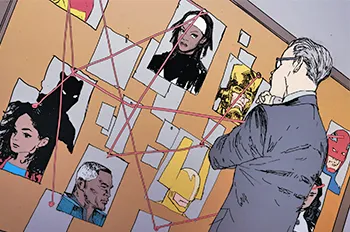
Steve: Well, you did use an awful lot of string...
Somebody's conducting an investigation — and every little bit of information could be the break they need. Red Herrings are flying left and right, and they need to get everything organized. What better way to do it than with a pegboard (or an entire room) covered in pictures of people, maps of places, and cryptic hints? Often the items are related, and these relationships are expressed by a complex web of strings connecting pairs of items; thus the name.
An example of The Law of Conservation of Detail, as almost invariably every single item will be plot relevant — although it's not always clear whether it was all planned out meticulously in advance, or whether the writer decided to use the various random items on the board as jumping off points for future episodes. Fans will naturally drive themselves crazy trying to figure out the relevance of every item. Don't stare at it too long, though.
The Reveal might uncover its existence, often with musical accompaniment while the camera pans along all the threads. This can show the audience that someone knows much more than it appeared, or how driven they are to expose The Syndicate, or how intimidating the Nebulous Evil Organization really is, or simply that they're nuts.
Used sometimes in a Relationship Chart. May contain a Serial Crime Map. Subtrope of Room Full of Crazy. Often the tool of a Conspiracy Theorist.
Not to be confused with the webcomic, a fanfic in a different fandom by the same name, or actual particle physics.
Examples:
- Maria no Danzai: Maria keeps a few pictures and notes connecting Kumiru and her activities in her closet.
- In Moriarty the Patriot, during The Final Problem, when Sherlock is finalizing his conclusions about William, he sets up a conspiracy board connecting William to his brothers and their various crimes with string.
- In Astro City, the Broken Man has this setup in his realm, linking objects related to the Oubor and his plans to fight it, although the pins are stuck in thin air and looking closely at an object lets you enter its story. Later on, in "This Town", he says we're not going in that room today, "the yarn's been unruly and the thumbtacks... it hasn't been pretty."
- In Batman: Year Zero, Edward Nigma's office at Wayne Industries contains a vast spiderweb of different coloured strings, as he tries to "solve" pretty much everything as though it were a riddle.
- Wendigo Wood: In his search for his daughter, Hank has covered a wall with a large map and newspaper clippings. Some of said clippings are connected by bits of string.
- Agent Carter: Phantom Pain: Howard Stark's study becomes host to this as Peggy and co try to figure out the plans of Manfredi, Whitney, and Cassandra Romulus.
- Hero Chat: Conspiracy Theorist Zoe has set one up for her various theories, such as peggin Rose Lavillant as either a dryad or a fae. Chloe mentioned that Zoe tore down the board after Team Miraculous learns that Rose is a Necromancer and inherited her powers from her supervillain grandfather.
- How Friendship Accidentally Saved Magical Britain: Ginny, Neville, and Luna drag Fred into an empty classroom to show them their theory, with help from their "crazy wall" of photos, scrawled notes, documents clearly stolen from the Ministry, and string, of how Sirius Black escaped Azkaban, his movements, and possible plans. Of course, they're still working off of the assumption that Sirius is an evil Death Eater bent on murdering Harry, so none of it is correct, but they do uncover the suspicious circumstances surrounding Sirius's arrest and imprisonment without a trial and in so doing unwittingly get the ball rolling on his pardon.
- The Miraculous Ladybug Crack Fic An Ice Cream Spiral into Madness
 : Marinette makes one into to find out what Andre meant in "Hearthunter" about how too many ice cream flavors together would be problematic and how that would relate to a relationship between herself, Adrien, and Kagami. Her "theories" include Andre being a Bunny Miraculous holder, that they have to enjoy each other individually, and even that she subconsciously picked Adrien as The Beard to avoid her sexuality and she's meant to be with Kagami because mint can't mix with either blueberry or orange. Eventually, at the next ice cream "date" and Adrien and Kagami telling her that ice cream doesn't have subtext, she decides to get all the flavours together and work things out.
- In Spark to Spark, Dust to Dust, Barricade has a room of bizarre theories. Counterpunch stumbles on it, prompting Barricade to rant about all of his "discoveries". Midway through the conversation, Barricade turns on holographic pictures and strings throughout the room, revealing that his theories are even more convoluted than Counterpunch first thought. The best part is that the audience sees that Barricade has actually pieced together some key information (Yang is Sunfire), but is wildly off-base with other bits (Adam is Raven's kid). Then he turns out to have been right about that last one...
- Megamind: Roxanne finds Megamind's plan lain out in one of these, but can't understand it at first. When she backs up for some perspective, she sees that the strings, rather than holding information, form a picture of the plan.
- My Little Pony:
- My Little Pony: Equestria Girls – Rainbow Rocks: After the credits roll, it is revealed that human Twilight (the real, original human Twilight) has been tracking the occurrences of the two movies using this trope, and all the strings on her board lead directly to CHS... It's still around in My Little Pony: Equestria Girls – Friendship Games and has now expanded to include elements from Rainbow Rocks, such as a blurry photo of the Dazzling's siren forms, their broken Power Crystals, the "Taco Tuesday" poster, and the giant rainbow column of light formed by the Humane Six and Sunset. It is heavily and closely featured in the opening credits.
- My Little Pony: A New Generation: Sunny has set up her research on ancient Equestria with numerous papers, bulletin boards and the like with various strings to connect the various elements.
- Played for Laughs in The Venture Bros: Radiant is the Blood of the Baboon Heart when Dr. Mrs. The Monarch breaks into the apartment of the Big Bad Mantilla and finds a Stalker Shrine of herself and her husband taking the form of this, which Mantilla awkwardly tries to explain.
Mantilla: Yeah, it started as a kind of a checklist, then I had all these pictures, then I got some... (Loud Gulp) yarn. You never set out to make an "I'm crazy" wall, but, ya know. They happen, it's an organic thing!
- Zootopia: The ZPD bullpen has a map of Zootopia overlaid with photos of the 14 missing mammals, complete with strings tying them to their last known location.
- In 13 Sins, Vogler, the Conspiracy Theorist, has a chart in his RV where he uses string to map out the history of the Game.
- 21 Jump Street:
- Played for Laughs when Schmidt and Jenko create an elaborate web of students, with the supplier indicated by a question mark at the top.
Capt. Dickson: Who put this together, are you autistic?
Schmidt: It is artistic, sir.
Capt. Dickson: Cut the bullshit. I want to know who's the supplier.
Schmidt: We don't know. That's why there's a question mark on his face. That's not the way his face looks, that's just a question mark. - In the second movie 22 Jump Street, the web has all the suspects indicated with question marks.
- Played for Laughs when Schmidt and Jenko create an elaborate web of students, with the supplier indicated by a question mark at the top.
- Peter Parker has one set up in his room in The Amazing Spider-Man 2 regarding his parents' disappearance.
- Baghead (2023): When Katie visits Otto Vogler's old home, she discovers the room where he had tried to plot out the relationship between the pub, Baghead and the mysterious consortium; linking documents, photographs and sketches with string.
- In A Beautiful Mind, John Nash creates these when investigating Communist infiltrations and conspiracies. It all means nothing, however, as Nash is suffering from paranoid schizophrenia.
- Black Wake: In the middle of the movie, when Dr. Moreira is making a video log, there's a bunch of papers on the wall behind her, with red thread zigzagging on it.
- Deadpool (2016) has Deadpool create one before his Roaring Rampage of Revenge as he wipes out one lead after another trying to track down Ajax.
- It's a Wonderful Knife (2023): Bernie leads Winnie to her room, where she's got a billboard covered with clues she collected about the Angel murders all laid out.
- The title character of John Carter has one of these in the montage showing his desperate quest to obtain another amulet so he can return to Mars.
- In Left Behind: Rise Of The Antichrist, conspiracy theorist and informant Dirk Burton has a board like this in his office that connects every news and media outlet that he knows about to power broker Jonathan Stonagal, including the news network reporter Buck Williams has worked for.
- Leonard has one of all his current Polaroids in Memento to keep track of his hunt for the person who killed his wife.
- In Most Likely to Murder (2018), Billy and Duane hang up incriminating evidence about Lowell on red strings.
- Navalny: This film is a documentary but still, Alexander Navalny and his team have just such a wall diagram of the conspiracy to kill him, with various suspects at the bottom, red strings connecting photos, and a photo of Vladimir Putin at the top. Navalny himself lampshades this when he pronounces it a "a flow chart, like in a movie!"
- Billy makes one in Power Rangers (2017) to help determine the location of the Zeo Crystal. It's three dimensional and takes up the entire basement, including the ceiling.
- Holmes has quite an impressive string setup in Sherlock Holmes: A Game of Shadows, centering on Moriarty.
- A variation occurs in the film Spider where the eponymous paranoid schizophrenic protagonist has a penchant for creating webs with bits of discarded string as he investigates the death of his mother during his traumatic childhood. As befits his character, the strings never connect up anything useful and his notes are complete gibberish.
- In X-Men: First Class, Erik has a minor one on the wall for his Nazi hunt before going to the banker.
- In Colin Fischer, Colin creates a map of his classmates' social status and relationship to each other on his bedroom wall, using colored yarn to represent friendship, romance, and rivalry.
- Control by Victor Suvorov has the protagonist doing it as a part of her job in the secret Secret Police, to track power groups within party, NKVD etc. First with photos on a stand connected by threads of relations, then she removes them all and remakes them as one interconnected web of small thumbnails all over several walls. It works, though not as expected: a few bosses living in one city turn out not to interact — never meet informally, nor even try to bring each other down. Wherefore Hilarity Ensues. The author was in military intelligence, after all.
- Millennium Series: In the Swedish original of The Girl with the Dragon Tattoo, Mikael Blomkvist investigates the mystery by assembling all the pieces of information on his wall and connecting them.
- In Sanctuary, Saeed sets up a corkboard covered in notes, photographs, and string in order to show his friends the research he's done on the ghost hunters Keira and Logan.
- In volume 9 of The Unexplored Summon://Blood-Sign, a slightly-amnesiac Kyousuke creates a string board to pinpoint his childhood home's address. The usual connotations of obsession and madness apply to him.
- In the beginning of the second episode of Alias, Sydney is pressing CIA handler Vaughn on how in just six months, they can take down SD-6. Realizing that she believes it, Vaughn has Sydney draw an organizational chart of SD-6, a large main circle with a half-dozen branches that fits on a piece of notebook paper. Giving Syd a look of pity, Vaughn takes down and unrolls a massive sheet of paper showing a huge chart of the true scope of SD-6. As she takes in the various connecting branches, Sydney is stunned to realize SD-6 is at least ten times larger than she thought it was... and it's just one of the cells of the Alliance.
Vaughn: We started working on this five years ago. And all it's done in that time is grow.
- John's home computer wall in Almost Human displays an electronic version as he tries to work out how his girlfriend used him to get police information to an organised crime group.
- On Bizaardvark, Frankie is told that she has to attend summer school. Paige shows a board with strings and photos indicating her belief that Principal Karen is faking the entire thing as a plan to join the web show. At first, Frankie brushes it off, but soon comes to the same conclusion. Naturally, she has to outdo Paige by covering their entire room in massive cross-connecting strings.
- Breaking Bad: The episode "Fifty-One" has a scene of Hank and Gomez going over what they know and don't know involving the case of Gus Fring, visualized by a large cork board of various head shots, locations, and labels, connected by red and blue twine to Gus and his former subordinates.
- One Burnistoun sketch features one of these in a police station, with a criminal network painstakingly mapped out over months…until the lead investigator concludes his impassioned speech with a sweeping arm gesture that sends the contents of the board crashing to the floor.
- Castle:
- The episode "Linchpin" briefly displays a room that looks very much like the page image, belonging to a statistics genius — the strings start at one murder, the branches are cause and effects, and they converge on World War III at the other side. In particular, the researcher postulates that by committing the murder, all the effects will come to pass, though there are characters that doubt the accuracy of his predictions. We never find out either way as the murder is thwarted.
- Castle himself sets one up in the seventh season, only the strings aren't intended to show a whole lot of crazy connections, just to track the movements of three people.
- Chuck, when he is keeping data of the Intersect and Orion on the back of his Tron Poster. Granted, it's in marker, but it's the thought that counts.
- The Community episode "Competitive Ecology" has Chang create a laughably small one with only a couple of pieces of "evidence" linked by a single piece of yarn while investigating an imagined conspiracy. Despite this, the yarn proves to be a fire hazard and the evidence board as well as part of the school cafeteria burns down.
- CSI has one. It's Played for Drama in the episode "The Case of the Cross-Dressing Carp" when the mother of a victim sees one of the victims' friends (a scientist who was investigating the cause of the water contamination which caused the condition that caused him to be Driven to Suicide) connected to him via a line, wrongly assumes that he's a suspect, and shoots him, ending any chance of his work being used to prosecute the Corrupt Corporate Executive responsible for the water contamination.
- CSI: NY: In "Exit Strategy," Jo sees the bulletin board in Mac's office with string connecting a series of points and tells him he's "really going old school." He explains that he's dealing with a cold case in which the suspect's whereabouts were originally tracked that way, so he's picking up where the original investigation left off.
- The Daily Show with Trevor Noah turned Trump tweets into a conspiracy board that they published in a book.
- Dear White People has Lionel create one of these in his closet to "uncover the recent chaos gripping Winchester", specifically the information he's gathering about the long history of secret societies, as well as the recent alt-right troll account harassing the school. It's not really that meaningful — "suspects" includes photos of almost every character on the show — but it certainly looks dramatic! Ironically, in the very next scene, Lionel references the scene from A Beautiful Mind above to tease his boyfriend about veering into high-level intellectual philosophy territory.
Wesley: Oh em gee, would my character write on windows, like that's a thing?
- Deception (2018), magician Cameron Black is thrown when his long-hidden twin brother Jonathan is framed for manslaughter by a mystery woman. At the end of the second episode, FBI agent Kay reveals that she's secretly been working on Jonathan's case, showing Richard a room with photos and files connecting it. It then cuts to London, where that mystery woman has an entire windowed wall of her loft covered with more files and folders on the brothers with strings connecting several of them.
- Dirk Gently: Used for the opening credits. Dirk keeps one on the wall, on which he puts everything that has happened in the episode, whether or not it's relevant (it's always relevant), and which he is seen painting over in the pilot episode, for a case which references an "electric monk".
- In Dollhouse episode "A Spy in the House of Love", Agent Ballard shows one of these to Mellie detailing the findings he has been uncovering about the Dollhouse.
- Elementary:
- In "Dirty Laundry", Joan Watson, who at this point is still working as Holmes's sober companion and not officially a detective yet, creates a board in her room after becoming invested in the case of the week. Despite the investigation officially being over, her board helps Holmes find a clue that doesn't fit and leads them to the actual murderer.
Sherlock: I must say, Watson, I'm flattered. It's a lovely homage to my methodology.
- In "The Red Team", Holmes is compiling one about Moriarty after tearing down the one he made about Moran. The book-canon description of Moriarty as "a spider at the centre of a web" makes these almost inevitable. For some reason, it also includes a picture of Napoléon Bonaparte.
Joan: And Napoleon?
Sherlock: By my fifth night without sleep, I may have been reaching. - Sherlock does this a lot later in the series. One time it's Played for Laughs as the local Anonymous Expy asks him to write an essay on why Bella should have hooked up with Jacob instead of Edward. After putting it all on the board he comes to the conclusion that all three should have been together.
- In "Dirty Laundry", Joan Watson, who at this point is still working as Holmes's sober companion and not officially a detective yet, creates a board in her room after becoming invested in the case of the week. Despite the investigation officially being over, her board helps Holmes find a clue that doesn't fit and leads them to the actual murderer.
- The Flash: Barry Allen has one of these devoted to his mother's murder — which, ironically, may actually be related to particle physics since most of the metahumans in the show got their powers from a particle accelerator malfunction in "Pilot".
- FlashForward has Mark's Blackout wall. It turns out to be the key to determining the time of the next blackout. For added fun, the wall itself is a paradox, as Mark sees that he created it in his flash forward, and then attempts to re-create it (actually just create it) in the present. It takes him all season because he was inebriated in the flash forward and cannot remember the majority of the details in the present.
- A major subplot of Forever has immortal Henry searching for what happened to his beloved wife, Abigail, who vanished in the 1980s. In a late season episode, Henry seems to have a clue, but at the end tells their adoptive son Abe that he's been held back too long by this and it's time to move on. Abe says he's happy and good for Henry. As soon as Henry leaves, Abe goes to a secret room in his basement to add this clue to the boards of evidence he's been collecting, revealing that he's been investigating his mother's disappearance for years without Henry knowing.
- In Full Frontal with Samantha Bee, the Puerto Rico special had David Duchovny give a masterclass in conspiracy boards ("why does conspiracy yarn only come in red?").
- Ghosts (US): Jay sets up a "murder board" in "Whodunnit" to figure out who killed Alberta. He mentions having trouble finding red string for the board.
- The Great: Catherine keeps an enormous bulletin board, hidden behind a painting, with all her plans for her coup.
- In Season 2 of Happy!, Merry fills her living room with red strings connecting every piece of information she's been able to dig up on Depraved Kids' Show Host and criminal mastermind Sonny Shine. On seeing it, Nick Sax dubs it the "best crazy-person room I've ever seen" and seems to be equal parts impressed and disturbed at how much work she's put into it.
- Heroes:
- Mohinder's map of specials.
- Future Hiro's map of all time. Unusually for this trope, it's in 3-dimensions, with the string stretching back and forth across the empty space of Isaac's loft. Specifically, each string represents a different individual's personal timeline, and the parts where they overlap represent important events where two or more the of the individuals interacted.
- Showcased on Homeland with Carrie doing this a lot. Her bipolar disorder causes her mind to be chaotic, and she thus uses this to try and make some sense of things. Parodied beautifully on Saturday Night Live in a skit where Carrie (Anne Hathaway) is told to keep busy on an empty board.
Saul: You don't trust her? Is it because she's a woman, David?
David: Look at what she did to that cork-board in ten seconds! [cut to Carrie having filled every inch of the board with photos, maps and strings] - In an episode of It's Always Sunny in Philadelphia, Charlie makes one of these when he believes he's uncovered a corporate conspiracy while working in the mail room.
- Kamen Rider Double uses these in a meta sense; the second episode of each mini-arc starts off with a "corkboard" that shows the characters from the first episode and how they connect. Then Movie Wars CORE shows the origin of the corkboard in-universe.
- Legends of Tomorrow: When Zari asks Gary to help unravel a conspiracy, he excitedly asks for all the things he needs to make a conspiracy board, except for the yarn—he already has plenty because he's been taking up knitting. Of course, this being Gary, he just ends up with a bunch of useless facts, and somehow knits a scarf in the process.
Gary: How did that happen?
- The Leverage crew puts one of these together as part of a con at one point, to convince an unscrupulous reporter that the government knows about a coming Apocalyptic event.
- Charlie Crews on Life has an entire room dedicated to finding out who framed him for murder.
- The Lost Room has a couple maps of the objects, including how they supposedly relate to one another, and where they have been.
- Ben Stone in Manifest has one, a seating chart of the airplane with a string from each seat to a profile of the passenger who sat there. The government investigation has a computerized version.
- Parodied in Mock the Week's "Unlikely Lines from a Detective Show":
Hugh Dennis: [motioning in the air in front of him] All the suspects are linked. Thomas knows Malinson, Malinson knows the victim, and they all live in the flat... But what do I know? I'm only the window cleaner.
- Motive: The Victim of the Week in "Remains to be Seen" has a pegboard where he has mapped up various articles connected to the disappearance of his journalist father, and how he believes things are connected.
- Mr. Robot: At the end of Season 2, Dom reveals to Darlene that the FBI has a massive one with many major players on it.
- NCIS: New Orleans:
- Dwayne "King" Pride has one in his private room when obsessively looking for Mad Midnight Bomber Baitfish. It gets referred to as "the wall of crazy you got going on upstairs". Later, Conspiracy Theorist Sebastian has this conversation:
Sebastian: I hear through the grapevine that you have a conspiracy wall?
Pride: No, no conspiracy anything.
Sebastian: Oh, you don't have to be bashful. I got several myself. One I'm currently working on ties the Illuminati to the owners of all 30 Major League Baseball teams. I got some extra string if you need it. - A mentally unstable woman has her own wall of crazy for investigating a serial killer, which she shows Pride after she kidnaps him to force him to pay attention to her theories.
- FBI Assistant Director Isler has one of his own while working an off-the-books investigation into opiod thefts in New Orleans.
- Dwayne "King" Pride has one in his private room when obsessively looking for Mad Midnight Bomber Baitfish. It gets referred to as "the wall of crazy you got going on upstairs". Later, Conspiracy Theorist Sebastian has this conversation:
- New Tricks has one. Most episodes have a few scenes with the main characters sat around and one of them explaining what they've just discovered. At one point they discover that a retired fireman who was helping them is an arsonist when they realise that he would have been able to find his targets after seeing their board.
- The Opposition with Jordan Klepper: Jordan's "murder board" is a major feature of his show. In one episode he compares himself to Sean Hannity — "We both like our conspiracy boards".
- In Orphan Black, the police detectives investigating the deaths of Katja and Beth, and Sarah's brief impersonation of them, put one of these together. It lacks the string but has all the other elements.
- On Parks and Recreation, Leslie Knope makes a map of Greg Pikitis's possible routes to vandalizing a statue. It relies on sticky notes and highlighters rather than string, but follows the same principle.
Ann Perkins: That looks like something you would find on the wall of a serial killer.
Leslie: In a way, that's a compliment. It shows dedication. - The Path briefly shows us Eddie's bulletin board with photos, articles, facts written on cards, and strings connecting them. What he is tracking down are the facts about the cult's founder Dr. Steve Meyer, his having stolen the ideas for the faith from a client, and his history of child molestation.
- Nick sets up one of these in Primeval, trying to track the various anomalies across time and space. Later, the characters discover a heavily upgraded holographic version of his chart brought from the future.
- A Series of Unfortunate Events (2017)'s opening credits features Lemony Snicket setting one of these up, based on his investigation into the Baudelaire orphans' lives. It's also shown in his hotel room in a couple of episodes.
- In the last episode of the last season of Silicon Valley, Richard Hendricks creates a Room Full of Crazy of equations tied together with strings drawn in marker on the office wall. He's figuring out that the A.I. in his team's network is breaking (all) encryption.
- Star Trek: Voyager: Time Fleet and the "Year of Hell" aliens have an automated version of this to keep up with their monkeying in the timescape.
- Supernatural:
- There's a beautiful example of a string theory in the pilot. The main characters' missing father was investigating a woman in white, using his motel room's wall to externalize his deductive reasoning.
- Sam and Dean occasionally put these up in their motel rooms, which seems like a lot of effort for something you're going to have to take down in a few days. For a certain kind of visual/tactile learner, this probably works as a form of Thinking Out Loud, as well as playing into the old school sensibilities the brothers picked up from their dad. Tearing it down and breaking it apart at the end of a case is also probably pretty satisfying.
- When Bobby is in a sleep state thanks to the villain of the week, Sam and Dean find Bobby's work on the case laid out this way, on the back of his motel room closet.
- Stiles is shown doing this in the fourth season opening for Teen Wolf. He also has one in his room to help his dad solve cases, which Lydia sees him working on in Season 3.
Lydia: What do the different coloured strings mean?
Stiles: Uh, they're just different stages of the investigation. So like, green is solved, yellow's to be determined, blue's just... pretty.
Lydia: What does red mean?
Stiles: Unsolved.
Lydia: You only have red on the board.
Stiles: Yes, I'm aware. Thank you. - Tinker, Tailor, Soldier, Spy: Control has one of these as part of his desperate attempt to discover which of five suspects in the Circus is the mole "Gerald".
- The Major Crimes unit in The Wire tends to have a pegboard like this for each of their main targets. Unlike many of these examples, it's actually realistically and sensibly organized, with strings connecting people based on their positions in the drug organization's hierarchy.

- Referenced (and illustrated) in John Niven's column in the Sunday Mail for June 14 2020, as he tries to navigate two entirely separate coronavirus legislations so that his family (in England) can visit his mother (in Scotland) without attempting to drive there and back on the same day, which requires ten flasks of coffee and a bag of Pro Plus caffeine tablets:
Soon my planning for the trip had grown so complex that the whiteboard in the kitchen looked like the kind of graph you see in FBI offices when they're trying to connect organised crime figures. There were arrows going to bubbles that connected to other bubbles and so on. Flow charts, Venn diagrams.
But by the weekend we'd cracked it — I would drive there and back on the same day with 10 flasks of coffee and a carrier bag of Pro Plus.
And then the governments of Scotland and England both said "Hang on, we may be changing the rules again on Monday."
I took the whiteboard out to the garden, set fire to it, and poured myself a massive whisky.
- In Dawn of a New Age: Oldport Blues, Mirielle's superpower allows her to see the relationships between people, visualised as strings connecting between them. Once she begins to understand what they mean, she sets up a a string chart in her room as an attempt to document them all.
- The Loom of Fate from Exalted looks a lot like this, with strings of fate representing the lives and destinies of all the beings under its purview.
- In Capstone Games's Watergate board game, the part of the board that records the progress of the newspaper investigation looks like a pegboard with photos of the key players in the scandal and potential connections marked with red strings.
- LEGO set 10278 Police Station, released in 2021, has a notice board with red string linking clues (actually a plate with a red rubber band stretched over tiny blank tiles that are supposed to be notes or photos).
- In Alan Wake 2, Saga Anderson's way of keeping track of the various cases she uncovers is to use a wall of the cabin to hang clues, pictures, and interviews and connect them to each other with string to develop logical deductions (insomuch as she's able to make any kind of logical leap with what's going on).
- A whole scene in Alfred Hitchcock - Vertigo revolves around the sheriff and Dr. Lomas doing a summary of the clues and evidences they gathered and trying to reconstitute the story of Ed Miller and Faye through this trope.
- In Batman: Arkham Knight, one of the last DLCs included a Challenge Map in Wayne Manor. Interacting with the piano on that level opens a hidden wall panel that reveals a whiteboard full of clues pointing to some sort of murder mystery that Bruce has apparently been trying to solve, the most prominent clue being a drawing of a cell door with the number “4-25” on it. This is all an Easter Egg teasing the plot of Batman: Arkham VR.
- In Battletoads (2020), Rash compiled clues on a board in the Toads' rundown apartment to find the location of The Dark Queen for a chance to gain recognition as heroes.
- In BioShock, Andrew Ryan has one of these in his office as an aid in figuring out who Jack is and why he's survived this whole time.
- Snorpy has one set up in his cabin in Sugarpine Woods in Bugsnax. When you scan it with your SnakScan, he comments that it would be bigger if he hadn't run out of red string.
- Captain Price sets up one of these in Call of Duty: Modern Warfare 3 to track down Makarov. After Soap's death, part of it doubles as a Shrine to the Fallen.
- The title screen of The Darkside Detective: A Fumble in the Dark shows a board on McQueen's wall with various photos and documents connected by red string. Most prominent is a photo of McQueen's friend Dooley, who disappeared at the end of the previous game in the series.
- Destiny 2: Parodied. You can purchase an emote that turns your Guardian into a paranoid conspiracy theorist, as they use their magic to conjure a billboard with randomized page placements and connections. They'll try to explain the whole thing with frantic silent arm-waving, before angrily throwing the billboard to the side.
- One gradually appears on a wall in the Dreadful Wale in Dishonored 2 as Corvo/Emily, Megean Foster, Sokolov, and, if you save him, Stilton unravel Delilah and Abel's conspiracy.
- This trope is referenced in the dialogue that starts off Darkwing Duck's and Nick Wilde's Friendship Campaign in Disney Heroes: Battle Mode:
Chief Bogo: Officer Wilde, we need to discuss the diamond caper you've been hung up on.
Nick Wilde: Me? Hung up? Pshaw. That's Hopps' conspiracy theory corkboard with all the photos and newspaper clippings, and stickers, and string, and— - One sidequest in the Up event in Disney Magic Kingdoms has Russell find "one of those corkboards with pins and red string" about Kevin in one of Charles Muntz's crates, noting that he's seen one on TV and that "you're supposed to make one when you're thinking WAY too much about something".
- Henry in Firewatch does this when he and Delilah find the observation reports of them in the Wapiti site.
- The short indie game A Hand With Many Fingers uses this as its central mechanic: As you research people and events connected to a vast conspiracy, you're expected to pin up relevant clippings to a big corkboard and keep track of who's connected to whom.
- In the Life Is Strange episode "Dark Room", all the evidence for David, Nathan, and Frank is pinned to a drawing board in Chloe's room, and you are asked to piece together the clues.
- In Lily's Well, you can find one of these in one of the offices at the bottom of the well, covered in notes and photos. The photos aren't of anyone Lily recognizes, but the notes include names, ages, blood types, and "capture risk", implying they were abducting people and harvesting them for the raw materials—the "meat" Papa mentions later—to make the Lily clones.
- There is one covering the walls of the Task Force Aurora lab in the Mass Effect 3 DLC Leviathan. Fitting, seeing how this is basically an organization of kooks who believed in aliens — before the First Contact. They also believed in Reapers long before Shepard encountered Sovereign. In an aversion of the Law of Conservation of Detail, some of the leads the team is following are Red Herrings that won't lead you to the objective. (In fact, if you try to cross-reference them all, you end up with no systems matching all the criteria. No wonder work was going slowly...) It's up to Shepard to either sort out which influences are genuine and which misleading, or just go gallivanting around the galaxy in their Cool Starship and narrow the set of worlds down by themself.
- The coroner in Mystery Case Files: Shadow Lake was using this method to try and figure out the mysterious deaths in her town. Cassandra Williams has a similar bulletin board in her motel room, but we never get a decent look at it so there's no telling if she was trying something similar or just trying to sort out the Ghost Patrol shooting schedule.
- "Rumor Mode" of the ship's log in Outer Wilds is represented as a digital version of this, connecting the various notes you've made about the places you've visited.
- The strategic non-mission portion of Phantom Doctrine involves searching through intelligence documents and linking key words on a corkboard. For authenticity, this is displayed with actual pins and strings. The game actually starts with one displaying the names of the developer studio and the publisher among other items.
- [PROTOTYPE] has a side quest where you must assimilate people in the "Web of Intrigue". Each person you assimilate will grant you their memories and give you a lead towards the next one in that web, thus slowly uncovering the truth behind the game's entire story.
- Psychonauts: Boyd Cooper has one of these in his mental world about the Milkman Conspiracy he's trying to figure out. Raz lampshades how utterly indecipherable this kind of sprawling web of connections is to a casual observer.
Raz: So, which part talks about the Milkman?
Boyd: Don't you see? It's all about the Milkman!
Raz: Is this one of those 3-D puzzles? I could never do those. - Jill has one in her apartment in Resident Evil 3 (Remake), which she's created following the Mansion Incident to track her investigation into the Umbrella Corporation.
- In Sam & Max: Freelance Police, Bosco has one in his shop starting with Season 2, detailing the connections between the villains from the previous season. It's rather outdated by that point, as lampshaded by Sam.
- Watch_Dogs: Aidan has one of these in the hotel room he's living out of, as he's been investigating the culprits of the incident that led to the death of his niece Lena (during the events of the game, he manages to track and capture the man who directly commited the crime, but he still has to track the mastermind, who is later revealed to be Lucky Quinn). Oddly, he only references it a few times and you can't interact with it in-game at all.
- Shadows of Doubt uses this as a gameplay mechanic. Player is a detective, and works by connecting various pieces of information until they can figure out the killer. Each item and information is connected to something via colored string in players case file. This can be as simple or as complex as players want to make them.
- In Chaos;Child, the protagonist constructs one of these throughout the course of the game to investigate a series of murders in Shibuya. With the "mapping trigger" system you get to choose which pieces of evidence to put where and help solve the mystery.
- A promotional video for Queen of Thieves shows the main cast's headshots as photos tacked up on an investigator's corkboard, surrounded by scribbled sticky-notes and linked together with a network of string.
- Dumbing of Age: Joyce is shown organizing her thoughts this way as she's Worldbuilding for her upcoming comic strip project.
- In Jupiter-Men, Quintin unfurls his project on Jupiter-Man to reveal an oaktag poster covered in in a motley mess of pamphlets, photos he's taken himself, and newspaper clippings. He's proud of how he used red string to make it easier to follow and is confused when his teacher writes his research off as mythology and conspiracy theories.
- Fillbert: Vivi connects a wall of sticky notes with strings when trying to comprehend sexual attraction.
- In one comic from The Nib, a Trump supporter shows a string chart alleging a government conspiracy to start a witch hunt against Trump and impose socialism. The other person proposes a much simpler chart: Trump → is lying.
- In one Questionable Content strip, when Faye is trying to explain the Love Dodecahedron of the main character's relationships to one another, her therapist stops her so she can get thumbtacks and colored string and diagram everything.
- In Sandra on the Rocks, Eloise is shown to have a fairly small string-map focused entirely on Sandra, whom she resents bitterly.
- Scary Go Round: Girl detective Lottie demonstrates use of a simple string diagram to track a suspect's relationships. It's somehow very in-character for her.
- As Skin Horse points out in one strip, constructing a chart of your theories regarding the "shadow government" out of thumbtacks, string, and scrawled notes makes you look unhinged. There are much saner ways of doing it. A close up of the Grillo Parlante conspiracy board can be found here.
- Referenced in True Villains, where a special Tracking Spell creates a web of strings representing people and events that influenced the target Golem's existence over time, which the protagonists can trace back to identify the golem's creator.
- Unsounded: The Conspiracy Theorist in Mulimar has put ideas on a wall with a bunch of pictures with charcoal lines drawn between them. The woman who owns the house eventually walks out, tells him to beat it, and chucks water on the defacing diagram.
- xkcd #2244 has Beret Guy construct one for purchasing yarn and push-pins.
- In Yokoka's Quest, Grace has a conspiracy board, complete with red strings, in her home. Judging from her friend's mention of her "going on about Mothman or whatever", Grace probably has an interest in multiple conspiracies, so the board may or may not relate to her Cisum theories.
- FANFICTASIA: After the intro to episode 3, a board with all the FanficTen linked by pair with red strings is shown. It is Thor's work, and like most of his contributions to the investigation, it's entirely pointless. Although in a Freeze-Frame Bonus, you can check the associations and all of them match, although sometimes with weird logic. For example:
- Hannibal Lecter & Black Widow: "gushing red ledger"
- James Bond & Darth Vader: "killing henchmen"
- Indiana Jones & Princess Peach: "underground tunnels"
- James Bond & Princess Peach: "Nintendo 64"
- Indiana Jones & Darth Vader: "Lucasfilm"
- Princess Peach & Hermione Granger: "childhood crush"
- Indiana Jones & Hannibal Lecter: "eats gross stuff"
- Hannibal Lecter & Darth Vader: "amputating"
- The Grand High Witch & Mystique: "weird skin"
- Batman & Princess Peach: "custom ride"
- Black Widow & Princess Peach: "only girl on team"
- Hannibal Lecter & Princess Peach: "play games"
- Batman & James Bond: "dead parents"
- In HFIL, Raditz has one of these that he uses to keep track of the pecking order of the villains (sorry, Morally Compromised Malefactors) of HFIL, including, as it's revealed, King Cold, who graduated from HFIL.
- Murder Drones: Uzi has one on her ceiling.
- In Mornal's "Preparing For Trial", an insomniac Phoenix Wright prepares for a legal case this way.
- YouTuber "Beau of the Fifth Column", who claims to have some real-world experience in private security and related fields, uses this trope as a jumping-off point to discuss how the "link analysis" investigative strategy typically works (outside of cop shows).
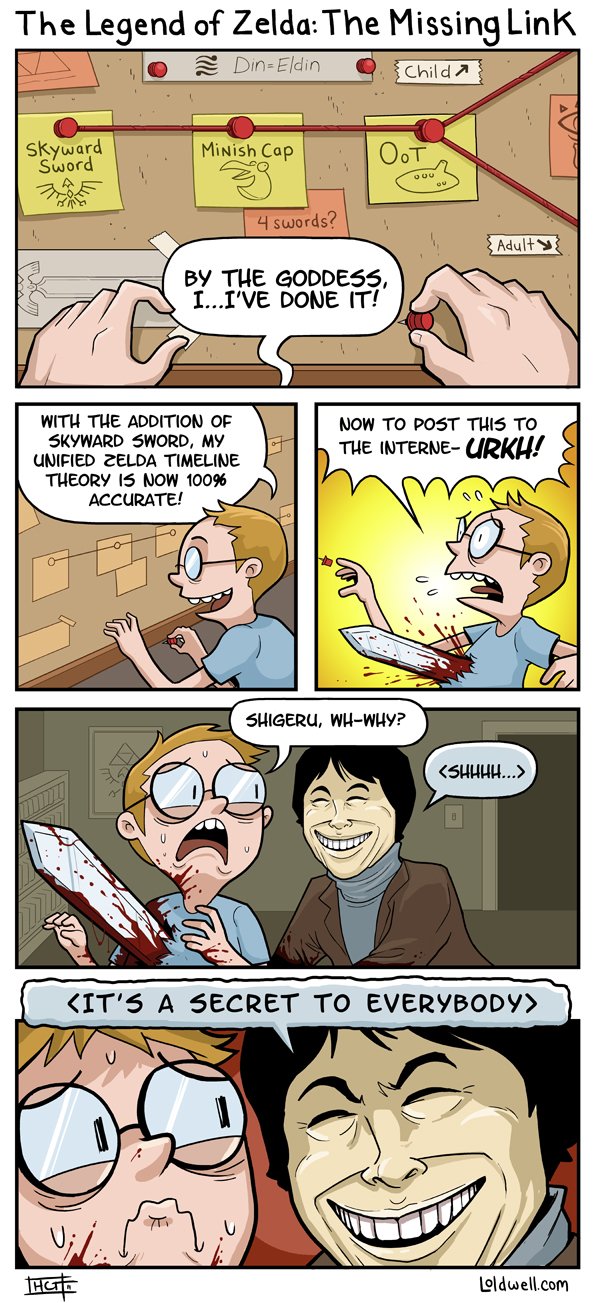
- Dorkly Originals: A Zelda comic◊ has a fan filling out his unified timeline string theory and preparing to share it online until Shigeru Miyamoto stabs him from behind, quietly telling the man, "It's a secret to everybody".
- In the ninth season of Jet Lag: The Game, a hide and seek game in the country of Switzerland, one was used as the graphic displaying the hints that have been given by the hider to the seekers with a string tying together notes and images of these hints centered around a map of the country showing where the hider could still be at given these hints.
- Joueur du Grenier: In the special about old superhero shows, Grenier is reduced to connecting with strings the plot elements of the Japanese Spider-Man series to make heads or tails of the first episode's story. The problem is he has no idea where Spider-Man fits in all of this.
- Reddit's Fan Theories (e.g., Wild Mass Guessing) community includes some string theory as its header decoration.
- In Shea Scientific Films, the abandoned apartment where the central box of tapes was found also apparently contained "a big corkboard with strings and stuff", though neither of the lead characters seem to have gotten a good look at it.
- In the Whateley Universe, Jadis (She-Beast) uses a sort of string-and-pin "compass" to track the actions of the Troll Bride, who wants to take possession of one of her fellow students. It goes crazy when a probability mangler strolls into the general area.
- "What Thor Was Doing During Captain America: Civil War": In this Mockumentary (in the style of What We Do in the Shadows), Thor (Chris Hemsworth) shows that he has a pegboard about "What Are Infinity Stones?"
- In the American Dad! episode "Bush Comes to Dinner", Roger determines Osama bin Laden's location by studying a variety of popular media which he's hung all over his attic. Cue the page quote.
- In the Amphibia episode "The New Normal", Anne has a board like this set up as she tries to recap the two previous seasons' worth of action to her parents.
- "Aliens Resurrected" opens with Wacko having filled the inside of the watertower with conspircy theories involving aliens, all connected by string.
- Arcane: The floor of Caitlyn's room is covered in a map she is puzzling together of the Zaun criminal underworld, including strings indicating connections. Before talking to Vi, she's still missing the centerpiece that ties it all together; Silco. Vi finds it impressive that despite having never been to the Undercity, Caitlyn had it all pretty closely figured out.
- Ben 10: Ultimate Alien: Jimmy has one of these going for alien encounters, specifically involving those with the Omnitrix insignia.
- Big City Greens: In "Chipwrecked", Chip Whistler has a wall full of string boards to aid him in finding ways to destroy the Green family.
- In the Big Hero 6: The Series episode "Mini-Maximum Trouble", School Newspaper News Hound Megan is trying to discover the team's secret identities. Fred doesn't think this is a problem until Hiro tells him that she's got a conspiracy board, at which point he asks "Is there... red yarn?". Upon being told that there is, he acknowledges that this is serious.
- Carmen Sandiego: Chase makes one of these in season two, after he's kicked out of A.C.M.E. and demoted within Interpol, as it's his only way of tracking Carmen and V.I.L.E. Laying out all the information visually proves incredibly useful, because it lets him see the one place that isn't connected to anything else. That's right, Chase is the one who finds V.I.L.E. Island. Too bad for him, they decided to Trash the Set just before he showed up...
- D.N. Ace: Juan, formerly one of Huxley's scientists, has a board hidden behind a painting dedicated to Ace and his Scrammers.
- DuckTales (2017): Webby Vanderquack, an avid fan of Scrooge and his adventures, has a board connecting the McDuck family tree in "Woo-oo!", which is also full of Foreshadowing for later episodes, up to and including the big twist in series finale "The Last Adventure!" that she's Scrooge's daughter. We see it go through a few changes over the course of the series, and by the time of the Grand Finale it's instead a massive Relationship Chart for almost the entire cast.
- In Gravity Falls, Dipper Pines has a bulletin board of clues to the identity of the author of the journals. At first he dismisses Old Man McGucket as a candidate, but after finding his name in the author's laptop, he finds that all the clues lead to him. While a good theory, an Apocalyptic Log reveals that McGucket, back when he was lucid, merely helped the Author.
- The Question has one of these in Justice League Unlimited. It's pretty huge, and apparently covers a lot of ground; characters briefly inspecting it find quite a few innocent-looking groups involved in shady stuff.
- In Milo Murphy's Law, Melissa has an entire room like this which she's using to get to the bottom of Murphy's Law.
- Mira, Royal Detective: In "The Case of the Secret Gift-Giver", Mira uses this method on a map to figure out the next place where the titular gift giver will show up.
- My Adventures with Superman: Jimmy has a "murder board" in the Daily Planet's morgue to keep track of his conspiracy theories. At the end of Episode 4, Lois uses the board to connect old tabloid articles in hopes of figuring out Superman's identity, which she does with an article about a "flying boy" spotted over her friend Clark's hometown of Smallville.
- The Simpsons:
- The FBI had one to show Homer Simpson to demonstrate the hierarchy of Fat Tony's mob. Emphasis on had. Why, oh, why did they have to pick that spot to keep their shredder?
- Homer makes one himself trying to find a funny article so he can win a free t-shirt from the news. But ends up finding a hidden message from his mom Mona.
- One episode reveals that string manufacturers encourages conspiracy theorists as part of a plan to increase string sales.
- Squidbillies: In "Knights of the Noble Order of the Mystic Turquoise Goblet", Early has one in his shed, apparently demonstrating the connections between Martin Luther King's assassination of JFK, Hillary Clinton being a reptilian, fluoride in the Dougal County water supply, and the titular secret society. And the string connecting them all is actually Silly String.
- Steven Universe: In "Keep Beach City Weird", Ronaldo shows one to Steven covering his investigations of the "snake people".
- Tangled: The Series: In "One Angry Princess", Rapunzel creates a string chart while trying to prove that Attila didn't vandalize Uncle Monty's shop.
- We Bare Bears: In "Creature Mysteries", Ranger Tabes is revealed to have a string board dedicated to Charlie the Sasquatch.
- This is actually a decent way to demonstrate a relationship diagram for a database.
- Mind Maps are basically jumbled decision trees that start from one major subject and branch out with strings. Supposedly, this helps with memorizing topics with loads of subjects and connections.
- An actual wall of string was created by Australian serial killer John Bunting, which he called his "spider wall" and used to track the activities of people he would eventually murder.
