
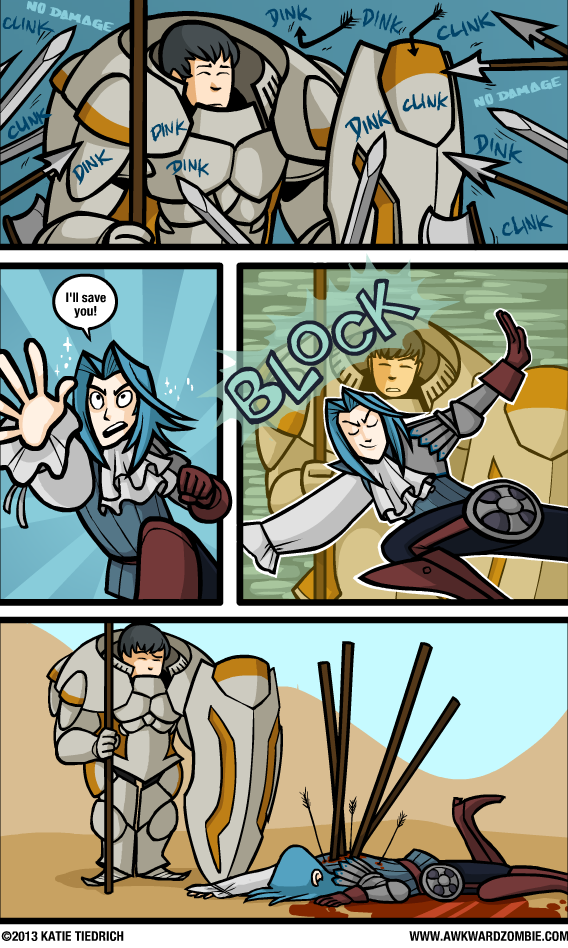
We all know the trope. Everyone's caught in a life-or-death situation. One of the characters hedges their bets, steps forward so the others survive, and ends up on the "death" side of the equation. Pathos is obtained, tears are shed, etc., etc.
Except... well, did they really need to do that? Couldn't they have gotten out of the way of the death trap once it was smashed and about to explode? Couldn't they have just held out for a few seconds longer until help arrived? Couldn't they have just talked them all out of that?
What can we say, it's pathos — logic must be left by the wayside. The Plot Reaper has spoken.
A Stupid Sacrifice is what happens when a Heroic Sacrifice has a head-on collision with Fridge Logic. It is not a Senseless Sacrifice, where someone offers themselves up as a sacrifice only for outside factors to make it useless; this is when a sacrifice occurs when anyone in command of all their logical faculties could've seen that it didn't have to end that way. Surprisingly little overlap with Martyr Without a Cause, but sometimes the result of Chronic Hero Syndrome: The Knight Templar or Well-Intentioned Extremist may make them — and lament them as Dirty Business — because they can't be bothered to notice that they were unnecessary. If a proposed sacrifice is nixed on the grounds it would be stupid, see Who Will Bell the Cat?. Note that this doesn't apply when the character could have lived, but quite clearly didn't want to.
Often a case of Writer on Board. They want this character to die, for whatever reason. There are no other alternatives, period. This situation makes it similar to Dropped a Bridge on Him; the "sacrifice" part making it "honorable", but they weren't going to make enough effort to make it the only logical way.
If the sacrifice is stupid because it didn't accomplish what it was supposed to but was still the logical choice, that's Senseless Sacrifice, not this trope. The two tropes can overlap when a Stupid Sacrifice doesn't accomplish its goal, but it is rare.
A Sub-Trope of Heroic Sacrifice. A Counter Trope to Negate Your Own Sacrifice. Compare "Shaggy Dog" Story.
This is a Death Trope, so beware of unmarked spoilers!
Examples:
- Doraemon: Nobita and the Robot Kingdom have this happening in the backstory, where King Atom, ruler of the titular country where robots and humans co-exists in peace, sacrifices his life to save a robot from a falling crane, even though the robot have a larger chance of surviving being crushed than him (and be rebuilt). What's even worse, King Atom's death only drives his heir, Princess Jeanne, to become a robot-hating bigot after she gets crowned Queen, having the entire country's robot population segregated and stripped of their emotions.
- God Mars has the infamous example of Prince Marg, who dies in an attempt to protect his younger brother by blocking an oncoming beam blast from an enemy's super robot using his own physical body. What's worse? That brother of his was sitting in a super robot to begin with.
- In Appleseed, Kudoh manages to overturn a bad situation by kicking a villain's weapon and threatening the others with his own. The good guys grab their guns as well, point them at the baddies, and quickly run out of the room. But Kudoh, for some reason, doesn't follow them. He stays there pointing his gun at the baddies, who outnumber him ten to one, and is shot to death as soon as the others are gone.
- Tereus in Appleseed Ex Machina tries to have one, but gets kicked out of it by other protagonists.
- GANTZ. An alien throws a highly corrosive acid at Katou. Instead of, say, pushing him out of the way, Kishimoto runs around him, blocks him with her body, and takes the blast.
- Dragon Ball: Heroic Sacrifices rarely work in Dragon Ball.
- The truly pointless sacrifice in the series, however, has got to be Piccolo's in Dragon Ball GT, in which he decides to die so that the Black Star Dragon Balls wouldn't be used ever again. This is ignoring the fact that the Black Star Dragon Balls are completely scattered across the universe making any attempts to collect it without any knowledge of them even existing virtually impossible. There's also no reason given why they couldn't just destroy the Black Star Dragon Balls if they felt they were too dangerous to exist.
- Piccolo does this a second time in the Super 17 arc, where he dooms himself to an eternity in hell in order to help Goku escape from it. It's a sad moment until you realize that A: both Goku and Pikkon were able to freely travel the afterlife including hell with no repercussions. King Yamma even let out Vegeta from hell in order to help defeat Majin Buu. So the fact that he wouldn't make an exception for Piccolo is not only out of character but makes no sense, and Goku should have been able to escape simply by turning Super Saiyan 4 and using Instant Transmission without Piccolo needing to go down there and sacrifice himself at all. What makes this worse is that Goku uses Instant Transmission to visit Piccolo while he's in hell at the end of the series.
- A lampshaded and dub-only example in the anime for YuYu Hakusho. Yusuke tries to prevent Kurama from sacrificing his life to save his mother's life, saying it doesn't make logical sense because Kurama's mother would be condemned to a life of grief. So in turn, Yusuke offers up his life instead. Eventually they both live and the wish is granted anyway, but only then does the Fridge Logic kick in for Yusuke: if he'd done that, his own mother would've been condemned to a life of grief. During the earlier parts of the story, his mother was an alcoholic with no job and acted pretty indifferent toward him. However, by this point, he should know better after the grief she went through when she thought he had died at the beginning of the series. He prevents this in the manga and the Japanese version of the anime by suggesting that the mirror take part of his life, so Kurama won't have to die and his mother will be saved. Then again, the act is reckless enough to impress the Forlorn Hope into not taking either of their lives.
- In Fullmetal Alchemist (2003), Scar jumps in front of Lust to protect her from a hail of bullets. She's a homunculus who can't be killed that easily, and Scar knows this, but he takes the bullets anyway. And there's an emotional element as well: the body Lust was made from was the woman Scar's brother loved — and Scar as well, as he later confesses.
- One Piece:
- Four Alabasta warriors in the Kicking Claw Squad drink a potion known as the "Fatal Fuel", which apparently increases their physical strength but kills them in minutes. Unfortunately, Crocodile can turn into sand and avoid their attacks, an ability he seems to have displayed in front of many people on at least one occasion that they should have known about. This is made all the more tragic/hilarious when Crocodile decides to just fly off to an out-of-reach ledge and watch them die instead of letting them even attempt to futilely try to kill him. Crocodile has also flown in front of the villagers countless times before, so clearly this wasn't a well-thought-out plan.
- Not long afterward, King Cobra triggers the royal tomb's self-destruct mechanism to kill himself, Crocodle and Robin in order to prevent the Poneglyph containing information on Pluton from falling into the wrong hands. Unfortunately, Crocodile immediately points out that he can turn the stones of the tomb into sand with his Devil Fruit powers, so Cobra's sacrifice will be for naught. Luckily for Cobra, Luffy manages to defeat Crocodile and save Cobra and Robin from the tomb.
- Fist of the North Star is almost one very long string of these. Probably the most egregious example is Rei, who after spouting some nonsense about his debt to Kenshiro, decides to attack Raoh despite knowing that he cannot possibly win, since he had seen the Death Omen Star and Raoh had not, and despite the fact that Raoh wasn't doing anything other than hanging out and waiting for Kenshiro to show up. Raoh for his part even tries to warn him off until he realizes that Rei's Death Omen Star meant that Raoh was probably meant to kill him. Ironically Raoh actually ends up saving Rei's life in a way, by interrupting his kamikaze final attack with a strike that will slowly kill him over the course of three days. It does end up killing Rei eventually but he gets a lot more time to actually accomplish some things than if he had been allowed to go through with his plan to ineffectually blow himself up.
- Ginga: Nagareboshi Gin loves this trope. No one is happy unless they're about to die. There are at least three separate occasions of a character killing themselves (or trying to) in order to kill an enemy, without even trying to survive. If you have a spike pit, you can just toss the other guy in, fellas. No need to jump in with him.
- Blue Drop does this at the ending. It conveniently takes away any means of plot exposition and therefore ironically covers up a severe lack of justification for the situation in general. Creates a downer ending, except for Hagino who is, along with her entire race a firm believer of Warrior Heaven.
- Gundam does this on occasion:
- Mobile Suit Gundam has Lieutenant Woody, who sortied in a hovercraft during Zeon's attack on Jaburo. During the battle between Amuro's Gundam and Char's Z'Gok, he charges in and destroys the Z'Gok's main camera with a missile, only to be taken out with a single swipe of its claw. Problem is, Amuro was doing alright during the fight, and most likely could have beaten Char without his sacrifice.
- Mobile Suit Gundam SEED has Cagalli's father and leader of Orb, Lord Uzumi Atha, sacrifice himself in order to destroy Orb's mass driver before the invading Earth Alliance can occupy it, thus denying them the ability to send their large military force into space. Except... there's no reason why they couldn't have set the demolition charges off remotely, and even if there was, there's no reason why it had to be Uzumi who sacrificed himself to set them off. Have some random mook volunteer — or hell, someone mortally wounded in the fighting up to that point — do it instead, an Uzumi doesn't have to abandon his country, his people, and his daughter exactly when they need him most. Except he does, and his decision is treated as incredibly noble and proof of Uzumi's dedication to Orb.
- This has bitten him in the ass after his death, as the power vacuum left behind by the entire Atha cabinet committing suicide was filled by the Alliance-friendly Seiran family, which kicked off much of Destiny's plot to Orb's misery.
- Subverted in the final episode, Athrun Zala plans on destroying the Kill Sat GENESIS by self-destructing his Gundam in its core. However, Cagalli followed him in even though he'd told her to leave him and takes him to safety in her own mobile suit, allowing Justice Gundam to self-destruct and take out GENESIS without Athrun having to go along with it.
- A non-fatal example from The Familiar of Zero where Tabitha's mother realised that the glass of wine that had been handed to her daughter was poisoned with a poison that would make her insane, so she snatched it out of Tabitha's hands in the nick of time — and drank it!
- Godannar: Early on, Lou's father stays behind in his robot to fight a Memesis Beast who invaded their space station. According to him, it's his duty to protect the crew, who were almost certainly all dead or evacuated by then, and the station itself, which ends up crashing to Earth later on in the episode anyway. This later on inspires Lou to start a Roaring Rampage of Revenge against all of the species, putting herself into constant danger as a result. Great parenting, dude.
- Fushigi Yuugi: Nuriko was wounded from his fight with Ashitare and chose to use his remaining strength to remove a giant boulder in the way to the location of the Shinzaho, then collapsed when his team members arrived. One of them has the power to heal injuries, and even Miaka says Nuriko should've waited until Mitsukake arrived before moving the boulder. The worst part is that the boulder was never an actual obstacle! The entrance was still accessible, as the team notices human skeletons lying around inside. Nuriko died to prove that Anyone Can Die now.
- Naruto:
- Minato, the Fourth Hokage sacrificed his life to seal half of Kurama inside his newborn son, Naruto. But had he resealed all of Kurama within Kushina and allowed both of them to die after she got impaled by his claws, it would've temporarily put a hold on the Big Bad's plans for the years it would take Kurama to regenerate a new body. This is the result of a Retcon; originally, Kurama had been on an unstoppable rampage and sealing him within Naruto was the only way he could be stopped, Kushina being his former host and recontaining it within her to stop his rampage was made up much, MUCH later in the story. Allegedly, Jinchūriki were used as war deterrents, but when he was revived through Edo Tensei, Minato proved that in the right circumstances, he is the equal of not only Kurama, but also the next strongest Tailed Beast, Gyūki the Eight-Tails, and the Fourth Raikage as well. Add onto that Hiruzen, the Third Hokage (strongest of his generation, maybe of any generation) and the Sannin, and you've got a group that are far more effective and convenient for deterring attacks than an Eldritch Abomination. End result, his son grew up an orphan, utterly despised by nearly everyone in the village for no reason and Obito's plan went off without a hitch.
- Minato's secondary reason for sealing Kurama in Naruto was so that Naruto could one day use the fox's power to fight off the masked man, but again, Minato still has no reason to do so when he could far more easily just beat the guy on his own. To add insult to injury, the masked man immediately left the village without even bothering to go after Kurama again for the next 15 years.
- Jiraiya had an opportunity to escape from Pain but went back to fight in the face of certain death in order to uncover the villain's true identity. But the problem is, Jiraiya had basically already figured it out, all he did by going back and dying was verify what he had already suspected. If he wanted to verify his suspicion, he could've just gone back to Konoha and let Inoichi read his mind, which would've allowed the two of them to review his memories of the fight in slow-motion. And since he died shortly after doing so, Jiraiya wasn't able to explain it to anybody else, instead writing a coded message on the back of one of his toad summons... which for some reason used a code that Jiraiya had never taught to anybody else, thus requiring his allies to break the code and which even after decoding was such a cryptic message as to be of little use. And to make matters worse, when Pain launched his attack on Konoha, Naruto figured out the same thing that Jiraiya had all by himself, without even knowing about the message from Jiraiya.
- The movie version of X/1999 presents quite a few: the heroes, the Dragons of Heaven, protect a set of Cosmic Keystones located around the city of Tokyo, and the goal of the Dragons of Earth is to destroy the keystones and wipe out humanity. The Dragons of Heaven, nearly to a man, sacrifice themselves to kill the Dragons of Earth... unfortunately, the death of a Dragon of Heaven results in the catastrophic collapse of the keystone they protected, meaning that the heroes end mostly doing the villains' work for them.
- Fairy Tail:
- Averted and lampshaded: Gray tries to use a spell that would turn his entire body into ice to freeze an opponent, said ice being unable to melt under ordinary circumstances. However, Natsu punches him and talks him out of it, after which he realizes that said opponent knows of a method to thaw the nigh unmeltable ice.
- Very much played straight later: Gray acts on instinct and takes some dragon lasers that were meant to hit Juvia, but since Juvia's body is made of water, they would just have passed through her without letting her take any damage if he hadn't interfered. The worst thing about that is that Gray is actually killed by the lasers. It doesn't last long as the time is turned back, Gray has a vision of his own death, manages to avoid the lasers, and survives (at least in a new timeline), but still...
- In the Alvarez war was Makarov, who uses Fairy Law on the legions of berserk enemy soldiers overwhelming his guild despite knowing that the technique will kill him when used on too many enemies at once. What brings it into this trope is that Mavis claims to have a plan to get them all out of the situation, but Makarov is simply too impatient to listen and tells her quite plainly he would gladly sacrifice what's left of his own already-old life to ensure a certain victory. Even then, however, he was only able to wipe out 70-80% of Alvarez's army (not an insignificant number, admittedly, given they numbered in the hundreds of thousands) along with dispelling said enchantment on the rest while leaving the remaining heavy hitter of the Spriggan 12 alone with his remaining lifespan.
- Pointed out and possibly lampshaded in the anime adaptation of Steel Angel Kurumi. Most of the secondary characters decide to use the remaining Steel Angels to power a powerful Wave Motion Cannon to kill the Superpowered Evil Side-influenced Kurumi. Nakahito notes that Kurumi can still be saved, but they can't stop the process or the angels who gave up their force would have been for nothing. The cannon is fired in a painful Interrupted Cooldown Hug moment, killing both Kurumi and Nakahito... until True Love's Kiss revives them and the Angels, leading Karinka to mutter "You mean I cried for nothing?"
- In Soul Eater, Soul takes a hit for Maka a couple of times. Stein even compliments him for the instinct at one point. This wouldn't be so stupid except that Soul can turn part of his body into a nigh-invulnerable metal scythe at will. He is the last person in the universe who should be using his mortal flesh as a shield (though granted, when he did so against Crona, Ragnarok had already shown to be capable of hurting him even in scythe form; turning human was the only way to intercept the entire attack without it hitting Maka). Later Death-Sama manages to top this, by taking a near-lethal attack to the chest in order to save the school staff. While holding a scythe in his hand. A scythe which he has already used to block that same attack several times.
- At Denpa Teki na Kanojo, The Champion Ame stands between a drugged Idiot Hero Juu and the Big Bad holding a razor. Juu pushes Ame to the left, she hits a wall, is momentarily unconscious, and the Big Bad wounds Juu. If Juu would have pushed Ame to the right, she would have not hit anything and could have been able of helping Juu.
- PandoraHearts:
- Discussed and defied: Elliot's whole "The Reason You Suck" Speech is specifically directed at Oz's overzealous predisposition towards attempting Heroic Sacrifices in order to protect others. Notably, when Oz is being held prisoner by the Baskervilles at Lutwidge, he tells Elliot and Leo to leave him and save themselves, which triggers Elliot's Berserk Button and causes him to later (after rescuing Oz) verbally deconstruct the Heroic Sacrifice trope to show the realistic consequences of attempting one.
- A possible in-universe example can be found in Edgar, the servant character from the book series Holy Knight, who dies to protect his master and the people he loves. We don't learn the context of his sacrifice, but Elliot makes his opinion on the incident quite clear.
- Zatch Bell! plays this straight in one of the earliest episodes. Zatch fights another Mamoto who attacks him with a great amount of large rocks and Kyo dives in front of them to take the attack head-on. This is unique in that Kyo does not die, but as stupid as Zatch is, he responds "Kyo, what were you thinking? My body is much stronger than yours."
- Recon in Sword Art Online blows himself up to create a hole in a wall of minibosses once he learns just how determined Leafa is to help Kirito break through said wall. Not only does the hole close up before Kirito can get through it, but about five minutes later, The Cavalry arrives and blows open another hole, with the added bonus of distracting the enemy long enough for Kirito to get through. Furthermore, although nobody really dies in Alfheim Online unlike the eponymous SAO, Leafa points out that suicide attacks result in even bigger penalties than a normal death. Had he just played it cool until The Cavalry arrived instead of trying to play hero, he would've left that dungeon not only alive but with a lot of extra phat loot. Arguably a case of Love Makes You Dumb, since he was either trying to impress her, or her blatant affection for Kirito and rejection of him drove the poor kid to do it.
- Rebuild World: Lilina, after coming to a My God, What Have I Done? realization she doomed her units chances of recovering the dead and potentially only wounded from an area by alienating their potential reinforcements with her Jerkass behavior, tries desperately in a charge to make her way to them to make amends, but dies horribly. The dead in question were being moved like People Puppets via hacked Powered Armor in a Night of the Living Mooks situation, so even if they could have gone back, the surviving members would have been shot at by them, not to mention they were dead anyway.
- Heavy Object: Klarheit Rubyhunter crash lands his bomber in an attempt to destroy the tiltrotor carrying the enemy officers whose attack killed most of his unit. Except this is the least effective method of taking the vehicle out, as it proves by just lifting off before he can hit. And since the area is the center of an active battle, the tiltrotor is an easy target which is blasted out of the sky moments later. Klarheit, having survived the crash, admits he hadn't really expected to survive and has to ask for backup to evacuate.
- Batman:
- Villain the KGBeast, while trying to escape a pursuing Dark Knight, continually foiled his attempts to bind him with rope by cutting it with his axe. Then when his left arm is caught in the rope... he cuts off his hand, even though it's been established that he could've just cut the rope.
- The Batman Adventures: In Gotham Adventures #9, Sensei fight Batman and Batgirl, who come to arrest him for his role in the murder of Boston Brand. Their battle is stopped by Ra's al Ghul, who orders Sensei not to kill them because Ra's requires Batman for his plans, and when Batman refuses to leave without the Sensei, Ra's orders the Sensei to go with Batman. Sensei refuses, not wanting to spend his final years in prison. Ra's tells him that it's an order and he does not have a choice; not wishing to disobey his master, but at the same time not wanting to go to prison, the Sensei chooses a third option and quietly walks out one of the windows of his mountain hideaway, falling to his death, to everyone's shock. Ra's calls Sensei a fool, revealing that he had planned to let Batman take Sensei, but not keep him, and calls him an infuriating waste of a useful agent.
- Ultimate Marvel: Ultimate Quicksilver is killed in the events leading up to Ultimatum when he jumps in the way of a shot meant to kill Magneto. Why he didn't just catch the dart, or knock it out of the air is anyone's guess. Though he gets better, somehow.
- Superman:
- In Superboy (1949) #5, Superboy interferes when a couple of crooks are attempting to kidnap Lucy. When one thug pulls one gun out, Lucy steps between Superboy and the thug, screaming she will not let them hurt him, while Superboy cries her to stop because he is bulletproof (unlike herself). Fortunately for Lucy, Superboy was quick enough to melt the speeding bullet.
- The Death of Superman: Superman seems to lampshade this about his original battle with Doomsday, commenting during the rematch that he spent too much effort going toe-to-toe with Doomsday when he could have tried using his maneuverability and ranged attacks to soften the beast up.
- At the end of the 1941 "Scientists of Sudden Death" arc in the newspaper comics, Ralph Roland attempts to shoot Superman. He fails because Lil Danvers jumps in the way and dies. This sacrifice lacks justification, as Lil had, on prior occasions, seen Superman get dumped in a vat of chemicals, stabbed, and repeatedly get caught in bridge-destroying explosions to little apparent effect, which Superman notes after the fact.
- Optimus Prime, from the original The Transformers Marvel Comic Series, would have a poor human boy destroy him after inadvertently harming several bystanders in a battle against Megatron and the Combaticons. Said bystanders were NPCs in a video game the boy was playing. Thankfully he is restored in a later issue, though his sacrifice was completely unnecessary in the first place.
- In Parallel Realities, Mordin takes a pistol shot meant for Eve (or Anahit, as she's referred to in the story) and dies, making him one of the few canon characters that's Killed Off for Real in the story. Even though Eve, being a krogan, probably could have shrugged off that shot.
- Someone to Watch Over Me: Adrien attempts to give up the Cat Miraculous to a new holder after he learns Ladybug's identity — except that that doesn't change the fact that he knows, plus he manages to give away his own identity and hers and learn Rena Rouge and Carapace's identities in the process. Plagg is not amused.
- The Mountain and the Wolf: Daenerys pulls a Go Through Me... on Drogon when he's fighting the Wolf. Danaerys is a human, the Wolf is a ginormous Chaos warrior, and Drogon is a giant scaled dragon, thus rendering her use as a shield utterly pointless. Making the sacrifice even stupider is that the Wolf was actually trying to avoid killing her; it only happens because she gets between them.
- Cars: A non-lethal example. Lightning McQueen stops right before the finish line to help The King finish the race. He could've crossed the finish line first and then go back to help The King. It's likely that, since McQueen stopped valuing the Piston Cup, he wanted to give Chick Hicks what he wanted.
- The Iron Giant: The Iron Giant decides to kill himself by flying into and detonating the nuclear missile. While many viewers have considered this a pretty amazing sacrifice, he could have instead used the vast array of weapons he showcased before; he even had an eye laser automatically/reflexively activated whenever he looked at a threat before, but not this time. Apparently, a missile is not a threat, but a child's toy gun is... The end of the movie does however show that he survived the blast anyway. It's likely that he wanted to be Faking the Dead so that governments wouldn't come after him again.
- Stoick's death in How to Train Your Dragon 2 involves him taking a fatal shot from a brainwashed Toothless that was meant for Hiccup. This is made a stupid sacrifice when you consider that he could have instead tackled Toothless or knock-pulled his head aside, both of which were performed with dragons in the first movie by other vikings. He was even closer to Toothless than Hiccup!
- One of the many obstacles in the kung-fu film, The Deadly Duo, is a booby-trapped bridge the heroes have to cross. One of the unnamed trainees decide to cross alone, triggers a trap, and falls to his death as a piece of the bridge's surface opens to a ravine. Instead of formulating an alternate crossing plan, two other trainees decide to use their chi to jump over the bridge's sections, over the first pit, and predictably they're killed by two more booby-traps right ahead.
- In Deep Blue Sea, Susan needs to distract the last of the sharks and keep it from escaping the pen, so she steps over to the edge of the water, cuts her hand to draw the shark in with her blood — then jumps in the water for no apparent reason, and too far from the ladder to get back up it (specifically, the lowest rung breaks when she tries to get out). This is likely a result of the Focus Group Ending, as test audiences wanted to see her killed as karmic punishment for her unethical genetic experiment getting the others killed.
- Golden Swallow have the Golden Dragon Branch Chief ordering a henchman to be executed for failing to carry out his orders to massacre a family, via a guillotine positioned at waist level. Just then, the hero Silver Roc, on a quest to rid the martial world of evil, barges into the Golden Dragon hideout and kills a handful of minions, releasing the henchman. The Golden Dragon Chief then berates his henchman for working with an assassin, only for the henchman to deny his alliance with Silver Roc... and then strap himself into the guillotine and trigger it to prove his allegiance, bisecting himself for no reason, since he's already being rescued and have no reason to sacrifice himself as a test for loyalty, other than just because.
- In Titanic, was there really not enough room on that board for both Jack and Rose? According to an episode
 of MythBusters, they in fact could have shared the flotation device with enough of their bodies out of the water for them to both survive — if they had thought to tie Rose's lifejacket underneath it (this does, however, assume that two scared, exhausted and freezing people would be thinking rationally enough to think creatively). Let's hope the thought never occurred to Rose in her many subsequent years... James Cameron himself basically summed up the trope once the result was announced in that episode: for the story to work, Jack needed to die; the circumstances were just poorly chosen on his (Cameron's) part. Of course, the film did show Jack trying to get on with Rose only for it to tip over under their combined weight. There's even cut dialogue that spells this out. It's likely Cameron figured the door tipping over was all the viewer needed.
- In Star Trek: Nemesis, was Data's Heroic Sacrifice even necessary? Did he have to fire the phaser himself, instead of setting the phaser to overload and beaming out? Brent Spiner felt that he could no longer convincingly play an ageless character and demanded that Data "die". Curiously, they still introduced an identical twin, who is left alive. And gets all of Data's memories. To add an extra layer of stupidity, this was the last TNG film and so the problem of Spiner being too old to play Data any more was not exactly germane. The series actually did address the issue of Data being ageless, while Spiner obviously wasn't. Data once Hand Waved it by saying he developed a means to appear as if he was aging (making it part of his quest to understand humanity). May not have been airtight, but most fans were likely not to nitpick this particular issue, all things considered. As revealed in this interview, a fifth TNG movie was still on the table while Nemesis was being made, so Spiner writing himself out isn't quite as senseless as it seems in retrospect. Still, he could have been sent away from the Enterprise, perhaps to focus on scientific research. Arguably better than contriving a reason he just has to do this in a way that will get him killed. The alternative method? "Hey, everybody, it's been fun, but I'm transferring to do my own thing. See ya!" Done.
- In Spider-Man 3 Harry jumps in front of the glider Venom is about to use to kill Peter, but given that he died facing Peter, he must have either spun in midair as he jumped, or ran past him between Venom and Peter to get impaled. Couldn't he have tried to grab the glider? Or just given Venom a shove? Or even better, remotely summon his glider back to him, an ability Harry's shown to be capable of during his first fight against Peter.note This is particularly bad when Peter breaks out of Venom's restraints a few seconds later, so if Harry had tried fighting Venom instead of sacrificing himself, he'd have had Peter helping him too.
- X-Men Film Series:
- In X2: X-Men United, Jean sacrifices herself to save the others from a wall of water from a collapsing dam, by staying behind and telekinetically holding back the water while the others escape in a plane. Except that there's no particular reason why she couldn't have done the same thing from the plane, saving both them and herself. For that matter, "the others" in question include Storm and Iceman, either of whom would have stood a chance of holding back the water with their own powers, and Nightcrawler, who could have teleported her aboard the plane as soon as it rose above the water level, and she actively prevented them from helping her.
- In X-Men: The Last Stand, Magneto sacrifices his troops against soldiers he knew were armed with the serum, rather than have Phoenix just nuke the island from afar or crush the entire island and everyone on it with the Golden bridge, or form the metal of the bridge and cars into a swarm of shrapnel and eviscerate all the guards. Phoenix's inaction was at least explained in a deleted scene where she simply refused to help. The rest not so much.
- In The Film of the Book of Hannibal, Hannibal Lecter, supergenius, who once got out of restraints using part of a ballpoint pen, cuts off his own hand to escape from normal handcuffs. As Roger Ebert put it, "I'm disappointed he didn't take it with as a snack." Some people theorize he did cut the handcuffs and was wearing the cast to conceal it on the plane. He probably got it through the metal detector using the rest of the pen. MAD magazine even pointed out in their parody (through Clarice's dialogue) that he could have cut through the handcuffs with the cleaver.
- The 2007 version of I Am Legend has a particularly bad example of this, when the main character spontaneously decides to blow himself and all the vampires up while a perfectly fine escape route was available. Some times you can rewrite the script's ending at the last minute without any ill effects. Other times, not so much.
- In Hellboy II: The Golden Army, the elven princess stabs herself in the heart to kill her linked villain-brother as he rises to kill Hellboy behind his back. However, if she saw it happening, why didn't she simply shout and saved Abe from heartache? Or, if shouting is too risky, just stab her own hand and get him to drop the dagger??? Part of her reasoning could've been that she knew her brother would never stop trying to take control of the Golden Army, no matter the cost, and the only way to prevent another potential murder spree and guarantee the world's safety was to kill him. Unfortunately, this runs afoul of another issue: namely that she was willing to sacrifice herself to stop her brother at the beginning of the movie and then doesn't kill herself (or do much of anything else) once he murders their father and starts massacring people in a bizarre inversion of this trope.
- A mild and non-lethal case happens to Kevin's mom in Home Alone. She goes to a lot of trouble and extra expenses to get home to her abandoned son as soon as possible, but only gains a few minutes ahead of the rest of the family who arrive by the plane she refused to wait for. Not to mention that Kevin was perfectly fine, and there was no need to hurry at all. Justified, because reason doesn't apply to mothers when it comes to caring for their children.
- In the horror movie Piranha 3D, Deputy Fallon's death (or so it seemed at the time until the sequel, where it was revealed he "just" lost his legs) seemed heroic; to save a boat full of teenagers from the ravenous killer fish, he grabs a boat motor, leaps overboard, and turns it on, drawing the fish to him as the kids run for it; he does manage to save the kids, but seriously, couldn't he have just stayed on the boat and done that?
- Monty Python's Life of Brian plays this for laughs, when a suicide squad's mission is committing suicide.
- In Casino Royale, Vesper's sacrifice is arguably this. In the book, it's better explained that she did it to keep Bond safe. Never mind that he's a spy who's constantly in danger from foes anyway. It's also rather confusing as to how her death helps him at all. And why she couldn't have at least given him some more information about her blackmailers before she died. Partly justified in how she obviously felt guilty, which motivated her to commit this.
- Resident Evil: Extinction: when the convoy is attacked by mutated crows the crowd tries to get away from the broken-down vehicles and into the working ones to escape. Betty gets everybody out of her vehicle and has a good several seconds to follow them; instead she closes the door on the back sealing herself in the vehicle, ineffectually shoots a couple of crows as they break the windshield, and is pecked to death in short order. The only remotely plausible reason is that she wanted to stop the crows flying through the vehicle and at the survivors, but: the crows are flying, everybody is in the open air so the birds don't need to get through the vehicle, and even then she could just have gotten out and closed the door from the outside.
- Man of Steel has a tornado appear in the middle of a busy interstate so the Kent family evacuates the car, but Pa Kent sees a dog still stuck in the car and goes to get the dog. Of course, the tornado bears down on him and Clark moves to save him, but Pa Kent just holds out his hand and for some reason, Clark obeys. The stupidity is outrageous for the following reasons: (1) Pa Kent is at a pretty big distance, so the likelihood that anyone could see Clark save him over through the debris is minimal (2) there have actually been cases that animals survive being thrown by tornadoes because they are small, light, and don't tense up the way that people do in high stress situations, so Pa Kent sacrificed himself for an animal that may not have even died in the first place. (3) At that point, Clark saving the bus full of children had been known by some people in the town, so if he did use super-speed to save his father, it probably wouldn't have even been that big of a deal. (4) Clark later mentions to Lois that if he was exposed to the public, he could just go into hiding as he's done it before, so if someone DID happen to see him using his powers to save his father, he could just leave. There really is no excuse for this scene other than they wanted Clark feel guilty about arguing with his father before he died.
- A non-fatal example can be found in The Smurfs. Just before the climax of the film, the Smurfs have visited a bookstore and have found the key to getting them out of New York City and back to the Smurf Village. They get ambushed by Gargamel, however, necessitating an escape via an air passage. As they start climbing in, though, Papa Smurf decides to hold Gargamel off while the other Smurfs run to safety. There are some things wrong with this. For one thing, even though Gargamel is a lot more of a threat here, he still couldn't fit in the air vent even with the weapon he has made with Smurf essence. Papa could have easily escaped with the other Smurfs without any problems. Secondly, Papa has no way to defend himself or to counteract Gargamel's magic weapon, thus he quite easily gets captured by Gargamel. Had Papa simply escaped with everyone else, (which he very easily could have) the climax wouldn't have happened and the Smurfs would have happily returned home without Gargamel getting his hands on any more Smurfs or Smurf essence.
- Jurassic Park (1993): Intending to deter the attacking Tyrannosaurus from Lex and Tim, Ian Malcolm uses a flare to distract it, since its vision is based on movement. There's one problem, though: his colleague, Dr. Alan Grant, has already done that. If he hadn't have used his flare, he wouldn't have gotten the serious injuries the theropod gave him, and Gennaro would have survived. note
- A hair-pullingly frustrating example that probably trumps everything on this list comes from an old Hong Kong drama flick, The Younger Generation, which depicts the downfall of a happy family leaving behind five young siblings to survive by themselves after their parents' deaths. For starters, the father, a quarry worker, realized he had left a bundle of clothing he bought for the kids in the mines where he's working minutes earlier, and runs into the mines after a loudspeaker had issued a warning of explosives about to be detonated, and that everyone needs to be evacuated from the mines, despite literally hundreds of his co-workers telling him to stop and come back. Predictably, the dad finds the bundle of clothes in the middle of the mines and ends up getting blown to bits, sacrificing himself to save a bunch of kiddie clothes. You'd think the wife, now a grieving single mother of five, would learn an important lesson, but no... a scene set a few months later had the mother, who's diagnosed with a rare cardio disease before her husband's death, taking her youngest son with her on a shopping trip. The young boy accidentally lets go of his balloon, and the mother quickly tries running after the balloon — in high heels — for five minutes of screentime, at which point she suddenly has a fatal heart attack and dies. For the remaining 20 minutes, it's about the five children, the oldest son which is 12, trying to survive by themselves. The film clearly portrays their deaths to be as sad as possible (what with the overly-melodramatic music that plays in the backgrounds of their Meaningful Funeral scenes) but given the facepalm-inducing circumstances of their deaths, it's hard for audiences to actually mourn.
- In Dan Abnett's Gaunt's Ghosts novel Honour Guard, Baffels led his company into battle and they had to retreat. Baffels, unsure of himself in command, did not, and died. Gaunt later said that Baffels had done all that could have been done.
- Defied in Traitor General. When the hounds find their scent, Landerson sees that his fall had torn off his bandage and tells Gaunt that it's his blood, and he will try to draw them off. Gaunt refuses to let him because they would still be chased "no matter how heroic and stupid you decide to be."
- Likewise defied in Guns Of Tanith. After being shot down while inserting the Larisel teams, Jagdea has to be rescued by the same teams from a Blood Pact patrol looking for downed pilots. She volunteers to stay behind and let the next patrol capture her (after a suitable fight). Mkvenner and Domor shoot this plan down on the grounds that a) the bad guys are very good at torture and b) the only way to make it vaguely plausible that Jagdea'd killed the patrol would be to leave the kind of weapons that would cause those wounds, and a 'downed pilot' toting a sniper rifle and the signature combat knife of a different regiment just raises more questions. Not to mention that they'd need those weapons themselves.
- Genocide Online: Lampshaded by Rena, since Rena had a fiber attached to Ferra even before she went away with her, so Rena will catch Ferra even if Anabelle, her maid, buys time by sacrificing herself.
- In the final climax of Zilpha Keatley Snyder's Green-Sky Trilogy, protagonist Raamo is about to throw a deadly ray-gun (encased in a heavy lead-lined urn) into a deep watery chasm. Does he simply throw it in? No, because he's telepathic and is picking up confusing thoughts/feelings from onlookers who think the weapon should be kept just in case (it's literally the only weapon on the planet). So he slips and falls in, the urn still in his hands, literally dying for the sins of his people. Obviously meant as a Heroic Sacrifice, it came off as an Esoteric Happy Ending at best — the kind that Snyder has all but trademarked in the endings of her novels. After being called on this by roughly 90% of her readers, she made a computer game sequel to the series where you can save him, as an Author's Saving Throw.
- The Twilight Saga:
- Whenever a hostile vampire appears, Bella immediately decides to try to get herself killed in order to "save" her Nigh-Invulnerable boyfriend.
- In Eclipse, we are told the story of a werewolf chief who had to fight a vampire. The chief's wife stabbed herself, so the vampire would be distracted by her blood and the chief could kill it...except, she could have done that just by cutting her hand, as Bella herself almost does at the climax of the book.
- Karen Traviss's Star Wars Legends novel Order 66 has clone trooper-loving Jedi Knight Etain Tur-Mukan pull a Too Good for This Sinful Earth by throwing herself between an escaped Padawan and a clone trooper during the Jedi Purge... to save the clone trooper. It fits the writer's views on the Jedi Order and the Mandalorian-trained clone army, but the clone would in all likelihood have gunned her down without a second thought had he known who she was.
- Many readers have come up with ways to save the life of the stowaway girl who dies at the end of the short story "The Cold Equations". In fact, author Don Saker wrote a solution story which incidentally swapped the genders of the protagonists. It was published in Analog science fiction magazine over thirty years after the original story ran in that publication. It turned out that Analog editor John W. Campbell had insisted the story ends with the death of the girl and had sent the story back three times because the author kept finding ways to save her.
- In Alma Alexander's The Secrets of Jin-shei, Nhia knows someone is trying to poison the Empress, and so when a servant appears with a goblet of wine, she's suspicious. Her solution? Taste it to find out. It never occurs to her to simply pour out the wine rather than drinking it herself to protect her friend. Given the "Everybody Dies" Ending, it's clear the author just needed to get rid of her.
- A big part of the plot of Return from the Stars. The protagonist, along with his colleagues, has dedicated years of his life (and 127 years of Earth time) and risked his life for a deep-space research mission, which he considers to have been a worthy achievement. In contrast, the Earthlings in the meanwhile have decided that sending people on such missions is a staggeringly useless waste of human life and resources, and that space exploration in general was but one of the many blind alleys in human history. (Though it's mostly due to the fact that the obligatory anti-aggression treatment and the permanent safety and convenience offered by future technology also renders everyone in the future incapable of taking risks, or even comprehending the idea of heroism.) This does not make the protagonist happy.
- Polish Romanticism used to love this trope, but one of the most annoying examples comes from the late 19th-century novel by Henryk Sienkiewicz, Pan Wołodyjowski, where the protagonist blows himself up, so as not to let the enemy into the stronghold he defends. He does so after the stronghold has been given up by the Polish king as one of the armistice's conditions. The author expects full sympathy and admiration for this step on the part of readers. Honor Before Reason can be claimed here, though — the protagonist and his friend (who blows himself up alongside him) consider this armistice to really be a defeat.
- Russian literature tends to do this, too. In Ivan Yefremov's Hour Of Ox the head chief of an astronaut expedition kills herself to avoid torture, despite the fact that she was tough enough to bear the hardest torment, and her comrades would've been able to rescue her in practically no time at all. Blast, they were strong enough to demolish the whole planet!
- In one sci-fi novel, the crew of a relativistic starship needs lots of Antimatter to power the relativistic drive. They travel to a planet made out of anti-matter that just happens to pass through the Solar System. Half of them go down in a lander specially equipped with a shield designed to keep anti-matter from interacting with matter for about 10 minutes. They use the lander to grab a large chunk of rock and are on their way back to the ship when they're surrounded by locals, primitive Human Aliens. They assume the lander to be some sort of god, surround it, and start praying to it. With the timer running out on the shield, the lander crew decides to let it run out rather than drive over the natives. Once the shield fails, the lander explodes, killing every native in the vicinity and nearly destroying the starship. Then one of the remaining crew members on the ship figures out an even easier way to get the fuel: grab a small asteroid that orbits the planet. So the sacrifice was senseless for two whole reasons.
- In Nikolai Gudanets's Supreme Commander (which is loosely based on X-COM), the final mission of the international task force involves the raid of the aliens' base on Earth. A four-man squad enters the central area, where the Big Bad is swimming in his pool (he's a squid). Using his immense Psychic Powers, he takes control over one of the soldiers, who primes and drops a grenade. Another team member (and a possible Love Interest of the protagonist) decides that the best course of action is to fall on top of the grenade instead of kicking it into the pool with the Big Bad. The water would contain most of the blast, and the Big Bad wouldn't have used the distraction to escape. Although, he does get immediately eaten by a shark.
- To destroy the last of the Only Fatal to Adults virus and to kill the man who released it for the first time, Cory of The Fire-Us Trilogy locks them both in a room, releases the virus, and then shoots herself so she won't have to suffer the horrible virus death. Very brave, Cory, but Teacher hasn't started to menstruate yet, and therefore could have released it without dying.
- Jesus Christ’s sacrifice is retconned into this in Paradise Lost, once one stops to think about the situation. Specifically, the Father and the Son are surveying the newly created Earth when the Father sees Satan flying toward it, headed straight for Eden. He tells the Son and the heavenly host of faithful angels that, if Satan is allowed to reach Adam and Eve, he will convince them to sin, causing them to lose all ability to have a relationship with God, and on top of that will die and wind up in Hell just like Satan, except they can’t leave. Knowing this, what do they do? Just stand there, making no attempt to stop Satan from breaking out of his prison, (let alone trying to tempt Man), or do anything to keep him out of Eden. They do send an angel to warn the humans about him, but still let him in unimpeded. The Father gives a speech about how the only way to undo Satan’s effects is for a sinless being to willfully suffer a horribly agonizing death and acts like that is their only recourse even though original sin hasn’t happened yet, and He could poof Satan back to Hell with a snap of His fingers without Adam and Eve ever knowing about it and without their free will ever being compromised. It is implied that Satan will never stop trying and Adam and Eve will eventually use their free will to sin anyway, but that’s still no excuse for letting Satan march right into Eden. At least Jesus gets to come back to life in the end.
- In The Locked Tomb it is considered a great honor to die for the Emperor Undying, resulting in annoyances like a necromancer lethally exsanguinating herself conducting pre-launch preparations in a non-emergency situation, and being disappointed when he tells her It Is Not Your Time.
Mercymorn: The crew on your horrible flagships are always trying to martyr themselves whenever you so much as ask for an orange juice.
- In Reborn as a Vending Machine, I Now Wander the Dungeon the plot starts when our plucky vending-machine Otaku protagonist heroically throws himself to his death to cushion the the fall of.... a vending machine. Lucky for him reincarnation turns out to exist, but he is reincarnates in a fantasy world as a sapient vending machine.
- In The Scum Villain's Self-Saving System, Shen Qingqiu impulsively throws himself between his disciple Luo Binghe and a demon about to attack him, only to remember a split second too late that Luo Binghe, being the original protagonist of the story Shen Qingqiu was transmigrated into, has Plot Armor and literally cannot die (and Shen Qingqiu himself had exploited this earlier on by baiting a monster into trying to kill Luo Binghe which forced the story to Ass Pull a Contrived Coincidence to knock the monster out) and he berates himself for his stupidity. This is not the first time he recklessly puts himself in harm's way to save Luo Binghe, either, in spite of him knowing full well that Luo Binghe is functionally invulnerable.
- The final character death in Wars of the Realm (Persimus') could easily have been averted in theory. Persimus came into the soup kitchen in plenty of time to just stab Niturni in the back before the demon could do anything—but no, he had to take the blade for Validus instead.
- Played tragically early on in Chernobyl—the officials running the plant keep sending workers and even the local fire department to try to fix the core, even as it becomes increasingly evident that the core isn't just beyond fixing, but is gone. Needless to say, this accomplished nothing beyond dooming them to a painful death of radiation poisoning.
- Doctor Who has had a few.
- One from the Classic series concerns Sara Kingdom from "The Daleks' Master Plan". The Daleks have built a weapon called the Time Destructor which fast-forwards time in its proximity, and the Doctor asked Steven and Sara to remain in the TARDIS while he exited to deal with it, his alien physiology allowing him to endure its effects. Sara decides to secretly follow him out, and ages to death in the process. Her death does spur Steven to leave the TARDIS, catch up to the Doctor, and put the Time Disrupter in reverse, but he likely would have done that the second he saw the Doctor collapse from its effects.
- Some have pointed out that all except one of the deaths in "The Tomb of the Cyberman" are stupid as until the Doctor gives Kleig the means to revive the Cybermen, the Cybermen can't do anything. This particularly concerns Toberman who sacrifices himself to seal up the Tomb, but he would not have needed to do that in the first place had the Doctor not been "helping Kleig to see what he was up to". This could be forgivable if it was intentional, but it's clear no one writing the story saw it this way.
- One of the Thals in "Planet of the Daleks" sacrifices his life in an attempt to slow the Daleks down. It takes the Daleks a whole five seconds to exterminate him, and a further ten to search his body, with the time they spend doing so not making any real difference to the rest of the group's escape. In fact, this ends up being a sacrifice that not only proves pointless but actively detrimental, as the Daleks find the location of the Thals' explosive charges on his body, which would have doomed their entire mission to failure if Jo hadn't stumbled across them in time to retrieve them.
- Astrid Peth's ridiculous self-sacrifice in "Voyage of the Damned": she uses a forklift to shove the villain off a cliff, and then just keeps going. Granted, it was chiefly a plot device to make sure the Doctor was left alone again (also because Astrid had been Stunt-Casted with pop star Kylie Minogue, and there was no way she could fit the show into her schedule,) and the writers do establish the brake line had been cut, but that forklift moved so painfully slowly she had plenty of time to throw herself off. Foon's death is even less necessary, but at least there you can make a case that she didn't want to live without her husband. Still, given Bannakaffalatta's (legitimate) Heroic Sacrifice, they began to pile up in that episode.
- "Midnight". The hostess opens the airlock and then... just stands there for a few seconds with the creature before both being sucked out, rather than, you know, pushing the thing and getting the hell away (she likely assumed that it would have done the same while the secondary door was opening and was making sure to take it with her).
- "The Almost People". The sonic screwdriver can apparently splat gangers without affecting normal people. So do we get normal people to kill the ganger monster? No, we have gangers doing it and killing themselves in the process.
- Averted in "Flatline". One character gets ready to sacrifice himself by ramming a train against the Monster of the Week, but Clara manages to reach him and point out no-one actually needs to be driving the train, since her hairband can take care of the dead man's switch, and they jump off before it hits.
- This trope is almost referenced by name by Mayor Me in "Face the Raven" when it's discovered that Clara has needlessly taken on a death sentence that was never supposed to be imposed (it was simply a trick), yet now Clara has taken it on, it must be completed, leading to the Doctor's companion being Killed Off for Real.
- Subverted with Topher's sacrifice in the series finale of Dollhouse. It is quite obvious that Topher could simply set a timer on the pulse-bomb. It is just as obvious that he wants this to be his final act.
- Pollux's death in The Flash (1990). Created as Barry's clone with all his powers but none of the maturity, the blue-clad speedster accidentally kills his creator and then wounds the experiment's financier in self-defense (the guy shot at him, Pollux caught the bullet and then threw it back). He then starts a super-speed fight with Barry. The financier then attempts to shoot Barry, who's still dazed from being beaten by Pollux. Pollux jumps in front of the bullet instead of, say, catching it again or moving Barry out of the way.
- Forever: In the flashbacks of "Social Engineering," Henry's Love Interest Anne, a nurse, jumps in front of Henry to prevent him from being shot by his now old wife Nora, who was trying to show Henry's "gift" to the world. Nora is taken away to the asylum (Laser-Guided Karma for doing the same to Henry years before), and Henry is left holding the dying body of his new love. Justified since Anne didn't know about Henry's secret. Even if she did, she might have done the same thing anyway to help Henry keep his secret and continue to do good as a doctor.
- The sacrifice of the Dothraki in Game of Thrones, where the defenders at the Battle of Winterfell decide to throw the majority of their army into a massive charge right into the center of the enemy formation. The force in question is made up of light cavalry (designed to flank and harass, not crush), and they're fighting an enemy practically designed to blunt a cavalry charge due to fearlessness and tight ranks, not to mention turning anyone they kill into another one of them. While such actions are a hallmark of Hollywood Tactics, what makes this stick out is the results of the charge—the Dothraki are forced into a rout and wiped out within a minute of reaching the enemy front lines—which is fairly realistic, but it's also the sort of result that any remotely competent cavalry commander would have predicted. What pushes it fully from "brave but naive" to "homicidal disregard for life" is the fact that the charge was apparently planned before the battle—that is, before they received a blessing from a witch that made it possible for the Dothraki to even damage the undead, which moved the plan up to "incredibly foolhardy" from its previous classification as "elaborate suicide method."
- On Graceland Charlie and Briggs are undercover FBI agents trying to set up a drug deal. The drug dealer becomes suspicious and insists that one of them inject him/herself with heroin to prove that they are not cops. Charlie grabs the syringe and injects herself. She has a bad reaction to the drug and Briggs has to get her out of there. The operation was blown anyway and her action was not only extremely dangerous but resulted in her partners lying on official reports so she would not lose her job over it. It is a clear sign that Charlie has worked too long undercover and was suffering a Heroic BSoD due to just finding the dead body of her informant who ODed.
- The first episode of Highlander: The Raven climaxes with police officer Claudia Hoffman diving in front of a bullet to protect Amanda, who is immortal and would easily recover from being shot.
- Lost:
- Charlie's death in the third season finale has elements of this. If he could swim down into the Looking Glass station, why couldn't he swim back up? There is no reason he couldn't have simply closed the door from the outside. Or just used the scuba gear to escape before the (rather large) looking glass was filled with water.
- On the other hand, Sayid's sacrifice was utterly stupid, since he could have just as well taken the bomb immediately instead of waiting for his turn to speak to Jack, and close a door behind it. He could have made time.
- In contrast to Charlie, Jin's drowning was utterly pointless. He could have got away, but chose to stay with Sun and drown just so they could be Together in Death, despite the fact that this meant orphaning his daughter whom he had never met.
- Person of Interest: A rare example where the villain pulls one of these is in the penultimate episode. Greer and Finch are locked in a room together, and Greer is able to trick Finch into admitting only he has the power to deploy the virus that can destroy Samaritan. In response to this Greer has all the oxygen from the room sucked out, knowing it will kill him but will also kill Finch thus eliminating the threat to Samaritan. Seeing as how he planned this there's no reason why he couldn't have immobilized Finch in some way prior and gave himself an escape route, or simply brought an oxygen mask. Furthermore, it turns out to be a Senseless Sacrifice as the rest of Team Machine show up in time to rescue Finch anyway.
- Power Rangers had a couple of these:
- In Power Rangers in Space they send Karone on a high-risk mission to infiltrate the enemy base to stop an asteroid from hitting earth, immediately after she was exposed as a traitor and before they try to stop it with their Megazords. This is a rare overlap with Senseless Sacrifice because they end up using them anyway.
- In Power Rangers: Dino Thunder, Tommy orders all the Zords to be sacrificed even though they still had two Super-Megazords that had not been used on the final Monster of the Week. It's worse when you watch the episode and realize it was a case of Executive Meddling creating a case of Only the Author Can Save Them Now.
- Marian's death in Robin Hood involves her throwing herself between Guy of Gisborne and King Richard in order to prevent the former from killing the latter. How does she do this? By loudly proclaiming her love for Robin Hood, which causes Guy to stab her to death. There are a dozen ways she could have stopped Guy — heck, she only needed to stall him for a few seconds until the other outlaws showed up. Doubles as a Senseless Sacrifice since King Richard dies in France the following year (and in the show's continuity, is still being held hostage in Austria when the show ends).
- In Sleepy Hollow Captain Irving confesses to the murder of two people, actually killed by his daughter while she was possessed. Now if his motive is purely to save her from the ordeal of being investigated for murder, this is understandable if not very practical. But it's a pretty safe bet that if they did pursue this to trial, no jury is going to be convinced beyond reasonable doubt that a skinny thirteen-year-old in a wheelchair was able to break two men's necks with her bare hands, no matter what the physical evidence indicated.
- Stargate:
- Stargate SG-1:
- The show lampshades then defies this, thanks to O'Neill. After successfully destroying the shield system on an invading Goa'uld mothership, they ponder their next move. The following dialogue occurs:
O'Neill: Now what?
Bra'tac: Now, we die.
O'Neill: Well, that's a bad plan. Where's the glider bay? - There's also an instance in the episode "Flesh and Blood", where Bra'tac attempts to ram their ha'tak into an Ori cruiser despite them witnessing firsthand that their weapons were ineffective (which is also pointed out by Sam). Mitchell (O'Neill's successor), being the guy he is, slaps a teleporter beacon onto Bra'tac when he isn't looking and has the Odyssey beam them all out before impact. Just as Sam predicted, the ha'tak's explosion doesn't even get past the Ori shields.
- The show lampshades then defies this, thanks to O'Neill. After successfully destroying the shield system on an invading Goa'uld mothership, they ponder their next move. The following dialogue occurs:
- The death of the senator in the Stargate Universe pilot is rather senseless. Air is slowly leaking out a damaged porthole on a shuttle attached to the main ship and the control panel to close the door is in the shuttle. The senator sacrifices himself to save the rest of the crew, but given an hour or two (which they had) any decent engineer could have built something to press the button remotely. A lever on a string for instance. Or a flying remote-controlled camera drone, available from a vending machine aboard the Destiny. Interestingly, while his sacrifice was justified (he was almost certainly going to die from his injuries anyway, and they needed the air badly), Rush's mentality or taking the time to look for someone to sacrifice instead of engineering a solution isn't.
- Stargate SG-1:
- Star Trek:
- Star Trek: Enterprise, the Series Finale. Three space pirates hold the Enterprise hostage; Trip sacrifices himself to get rid of the pirates. This despite the fact that there are armed soldiers on the ship, looking for the pirates. Retconned in the Expanded Universe novels when it turns out the series finale was a "historical recreation" on the Holodeck, and the Federation's black ops wing heavily altered records surrounding the event in order to cover up their recruitment of Trip as an agent.
- Played with in the Voyager episode "Learning Curve". While Tuvok tries to get the ex-Maquis to start working like actual Starfleet crewmen, and not glory-hungry terrorists, they fail a training simulation. When they accuse it of being an Unwinnable Training Simulation, he reveals there was a way to win: Retreating. Had they retreated, they would've lived. Instead, they "killed" themselves for nothing.
- The first episode of the TekWar series has the robot girlfriend of the hero spy another robot approaching them, recognizes it as filled with explosives somehow, says some dramatic last words, then runs over a block away towards the killer robot so that she can throw herself at it and cause it to explode. This is done solely to give the hero something to be really mad about to power his revenge moment against the Big Bad. The distance between the hero and evil-bot presents hundreds of alternatives to her throwing her life away. It's not like they haven't been dodging deadly attacks for the whole of the episode so far. The version of this event in the book has the same authorial motive but is somewhat more plausible; they're on a crowded pedestrian overpass, she'd already tried warning and grabbing the hero, who was then running toward the robot and in its blast radius — getting it over the edge as quickly as possible was the only real solution.
- Deliberately invoked on the Canadian series of Todd and the Book of Pure Evil. A fat girl who uses the eponymous Artifact of Doom to become skinny accidentally creates a "fat monster", which rampages through the high school. Eventually, she sacrifices herself to stop the monster by pushing it and herself into a vat of boiling grease. The characters comment on her bravery and say they'll never forget what she's done... until a few seconds later when the creature emerges from the grease, now a boiling hot fat monster. Todd and his friends quickly switch to cursing her for making the situation worse.
- In Torchwood: Children of Earth, Ianto dies when he and Jack confront the 456. What makes this a Stupid Sacrifice is that he and Jack really didn't seem to have a plan. Viewers were left scratching their heads as to what they were trying to achieve.
- In "The Lost Mariner" episode of Xena: Warrior Princess, this is played for drama and lampshaded. One of the immortal cursed captain Cecrops' crewmen, a former pirate and now good friend, pushes Cecrops out of the way of debris and is mortally wounded. Cecrops tearfully calls him a fool, reminding him that Cecrops is immortal and would have survived if he had been hit. The dying man answers that he just wanted to help a friend. This act of friendship helps Cecrops realize what he needs to do to finally end his curse.
- The X-Files episode "Jump the Shark". The Lone Gunmen, who for the run of the series had been Mulder's well-meaning conspiracy theory sidekicks, charge into a room filling with poison to stop the evil plot from going off... when the police could've shown up in a matter of minutes and taken care of everything. They also clearly had enough time to run out of the room once the blast doors started coming down.
- Spoofed in Nebulous when Rory decides to go out to face gigantic murderous Artificial Human Housewives so Nebulous and Paula can secure the doors. Nebulous and Paula both repeatedly point out to him that he doesn't need to because they've already secured the doors and they have an easy way out of there for all of them. Every time this is pointed out to Rory he uncomprehendingly repeats "That is a sacrifice I am prepared to make".
- Warhammer 40,000: The Death Corps of Krieg are a particularly fanatical Martyrdom Culture even for the Imperium, each soldier of which is a Death Seeker raised to atone for their ancestors' sins of rebelling against the Imperium. All well and good, except that it manifests as this trope. Where other regiments have commissars to encourage men to duty and sacrifice, Krieger commissars are there to stop them from throwing their lives away when they can keep fighting elsewhere.
- Death of a Salesman: The eponymous salesman, Willy Loman, commits suicide in hopes of leaving his family his life insurance money, an act which renders the policy invalid. Most policies still pay out if the suicide happens a certain time after the policy is first taken out, but the play explicitly states that Willy's wasn't one of them. His widow also mentions having made the final mortgage payment, meaning that their financial burden wasn't nearly as bad as he presumed.
- Advance Wars: Days of Ruin: One chapter would be a hell of a lot easier if you actually had control over Brenner's unit rather than it being forced in place as a fighting retreat would have been possible.
- Age of Mythology: Chiron offers to slow down the oncoming horde of bad guys, by standing under a precarious pile of stones and kicking them. Never mind that he could have easily, you know, kicked them over from the other side, or even gotten out of the way of the path blocking the rockslide. And for that matter, there wasn't even that many bad guys. They could have fought their way out!
- Gorath's Heroic Sacrifice in Betrayal at Krondor has shades of this. His death is only necessary because his two powerful magician companions (who have dozens of spells suitable for immobilising or disintegrating someone on the spot) are just too tired to do anything but blink at the enemy who makes a run for the Artifact of Doom, prompting Gorath to try and stop him at the cost of getting corrupted by it and needing to be killed along with his enemy.
- Conversed in the Sudden Downer Ending of Cyberpunk 2077: If V dies in "Don't Fear the Reaper" endgame mission which is a Suicide Mission to themselves, their friends will call them out for their selfish decision on their part.
- Dead Space 2's DLC Story, Severed, has a bad example. Gabe could have just pushed Victor out of the way to avoid the blast from the grenade he set off. However, he was holding the Idiot Ball at the time and decides to slam Victor's face into the ground before the grenade went off, sealing his own fate.
- Diablo: Good job sticking a soulstone into your head, warrior. Wrestling against the lord of Terror, yeah right. Take the damn soulstone to the Horadric mage, who can send you back down to destroy the thing. Admittedly, he was kinda messed up by this point and it's pointed out that this was a very very bad idea. Still, why would you think your willpower can stand up to the devil, who also happens to be immortal so he'll win anyway?
It is now known that the random warrior is actually the other son of the skeleton king and the older brother of the prince that Diablo took over for a body. Basically, the entire game Diablo was whispering to the warrior to make him think that was the only way to seal him and prevent him from ever being released into the world again, but in contrast to the deranged hero, the audience — and, indeed, the Horadric mage in question—knows better. - In Digital Devil Saga, Cielo conveniently forgot his mouthlaser against a few Mooks (not to mention his lightning spells, booster spells, and whatever other non-cutscene skills you've learned by then), as he himself points out in the afterlife a few minutes later!
- Orsino in Dragon Age II, when the player's Hawke pursues siding with the mages near the end of the game, becomes so desperate after Meredith and the templars storm the Circle that he ends up turning to blood magic and transforming himself into a Harvester, merging the bodies of dead mages with himself. As the Harvester is basically a mindless creature that simply feeds on blood and attacks both the templars and Hawke's companions, this means that the player ends up wasting time having to kill Orsino.
- This is lampshaded in Dragon Age: Inquisition. The Inquisitor can ask Varric about his book about Hawke's adventures and one of the questions is how Orsino's fate made no sense. The most that Varric is able to come up with is that he was just desperate.
- Merrill's questline in a nutshell is her and her teacher Marethari engaging in a contest to see who can make the stupidest sacrifice to solve a problem that would've easily been dealt with by communication. It all starts with Merill wanting to cleanse an Eluvian of Darkspawn taint and Marethari wanting her to leave it alone, with Merrill arguing that the Eluvian's magic could be useful to their tribe while Marethari wanting nothing to do with the thing that caused one (and possibly two, if the Dalish Elf Origin wasn't picked) of her clansmen to die and was being used as part of a demon's plans to enter the real world. It ends with Merrill turning to Blood Magic and allowing her obsession with the Eluvian to consume her life, while Marethari gets the tribe to essentially bully Merill out of it and ultimately lets herself be possessed by the demon without telling anyone about it, which results in her death and possibly that of her entire clan. It's up to the player to decide whose sacrifice was the dumbest (in the Friendship route, Hawke sides with Merrill, in a Rivalry Hawke sides with Marethari), but in either case Merrill's writer has gone on record stating that the questline explored how some women's desire to self-sacrifice can become twisted and toxic.
- Lampshaded in Epic Mickey, when Oswald got appalled at Mickey giving away his heart.
- Fallout 3: At the end of the game, you need to save everyone by turning on the Purifier, which will fatally irradiate whoever goes in, regardless of any anti-rad measures they may have. If you're evil, you can make Sarah Lyons do it, and the game will call you a coward for it. If you go in yourself, you will be hailed as a hero for your sacrifice. This would normally be fine, but certain companions throw a wrench in this logic. Three of them are completely immune to radiation, two are explicitly incapable of disobeying you, and one is part of both groups. If you try to exploit their immunity/inability to say no and send any of them in, they will refuse (even the ones that can't disobey you), telling you it's your duty to do so yourself. While the Broken Steel DLC does let you send one of the three radiation-immune companions in and avoid anyone dying, the ending will still call you a coward if you do so. As a result, Stupidity Is the Only Option if you don't want the game to condemn you.
- Final Fantasy:
- Practically all of the sacrifices in Final Fantasy IV, as there is an Arbitrary Headcount Limit of five characters at once. Because of this, every time the game needs a new character to join the party, another character has to remove themselves from it—and often, that takes the form of them throwing themselves into one of these.
- Palom and Porom turn themselves into statues to hold a pair of advancing walls of doom in place. Porom usually knows the Teleport spell by the time this occurs, but it doesn't work in the area for absolutely no given reason.
- Tellah goes berserk and tries to 1v1 Golbez, culminating in a pointless sacrifice for a Combined Energy Attack. It did knock the Big Bad back and free Kain from his control, so there's that, but still. Anger does make you stupid and reckless, so at least the plot owns that Tellah is acting irrationally.
- All of the game's fake-out deaths are like this. Cid did not need to jump off the ship with a bomb — he's more than capable of building advanced remote controls, so it's hard to believe he didn't have a remote-controlled detonator. Even assuming he didn't, jumping with the bomb would not alter its speed any. And going back a few minutes earlier, if all Yang did to stop the cannon was blow up the guns... why not just walk out of the room with everyone else and let Rydia set it on fire or use one of her summons?! There was no particular reason the sequence required him to stand in the room and die.
- Final Fantasy VII: Dirge of Cerberus proves guilty of this on one occasion. When Implacable Man Azul is attacking the party, Shalua holds the hydraulic door open for Vincent and Shelke to escape through. This wouldn't be so bad... except that Shelke had literally just finished demonstrating her ability to paralyze Azul indefinitely with a barrier materia. Even disregarding this, there was no need whatsoever for Shalua to stay behind to hold the door open, considering that it had an adjacent button to open it. Was it really too much trouble to just push the button again and open the door a second time?
- Parodied in this Let's Play
- Parodied in this Let's Play
- Lampshaded and Defied in Final Fantasy X-2. Before the Final Boss, Nooj presents a plan that of course involves sacrificing himself, prompting Yuna to deliver her most memorable line of the game and come up with another plan instead:
Yuna: I don't like your plan. It sucks.
- Explicitly invoked in Mobius Final Fantasy. Mog throwing himself at the Lich only to be mortally wounded, and admitting to doing so just because it was in the prophecy ends up shaking Wol's resolve in a prophecy that drives people to throw away their lives meaninglessly.
- Practically all of the sacrifices in Final Fantasy IV, as there is an Arbitrary Headcount Limit of five characters at once. Because of this, every time the game needs a new character to join the party, another character has to remove themselves from it—and often, that takes the form of them throwing themselves into one of these.
- Fire Emblem: Radiant Dawn has a particularly sad case. King Pelleas has been duped into making a Deal with the Devil — or in this case, the Begnion Senate. If he does not follow their orders, his subjects will start dropping like flies. Eventually he finds a solution — the signer must be killed to nullify the contract. Thus he asks the player to kill him (or the loyal general if the player refuses). As it turns out, this cleverness doesn't help, and the country is still bound by the pact even in death. You must kill a signer and destroy the contract to break the curse. And the other signer is someone you end up killing regardless of whether or not Pelleas is alive, which means the contract would have been broken either way. Pelleas essentially kills himself for nothing. Notable in that a New Game Plus allows you to talk him out of it instead, making him a playable character.
- Fire Emblem Fates: On the Conquest route, Lilith sacrifices herself to save Corrin from a single Faceless. This is after Corrin inexplicably splits off from his allied army to briefly be alone. Corrin then dispatches said Faceless in one hit, during the cutscene, immediately afterwards.
- In Freespace 2, a damaged GTVA Colossus dukes it out with a Shivan Sathanas juggernaut in order to buy the GTD Bastion time to collapse the Epsilon-Pegasi jump node. However, given the fact that the Colossus just sits there and the Sathanas is vastly more powerful, the Colossus only lasts about 30 seconds. And in the event, the Sathanas never actually attempts to engage the Bastion anyway. In fact, using the Bastion to collapse the jump node may have been an entirely pointless endeavour from the beginning, since the Shivans were inducing the system's sun to go supernova, possibly in order to create an artificial wormhole or jump node.
- Happens in the final storyline mission of the iOS space-sim Galaxy on Fire. Your Player Character and his Love Interest encounter the Big Bad in his fighter. Instead of engaging him together and doubling your chances, she rushes the Big Bad and gets taken out with a few shots, leaving you to scream out a Big "NO!" and fight the buy on your own... and beat him fairly quickly. And the storyline end also signals Opening the Sandbox, although the game gets boring after that.
- Narrowly averted in the climax of God of War (PS4) by Kratos's intervention before said stupid sacrifice could take place. Freya thinks that allowing Baldur to kill her will satisfy him and make him not want to kill anyone else, even though Baldur had made it very clear that he wasn't going to give up attacking Kratos and Atreus, meaning that her sacrifice wouldn't save him as Kratos would have to kill him in self-defense a few minutes later. Kratos preempts the dilemma by killing Baldur before he could throttle Freya to death, earning Freya's ire but preventing a totally pointless death. Moreover, if Mimir's words and the sequel is any indication, Kratos is actually doing the right thing.
- Saidra sacrifices herself in a mission of the original campaign in Guild Wars, by attacking a group of Mursaat that are pursuing you. Now, since the Mursaat were unkillable for the player at this stage thanks to their Spectral agony, it might make sense. Unfortunately, the cutscene where she announces her sacrifice and says farewells and what not takes about a minute. The player's party, nor the NPCs, move during this time. Once the cutscene ends and you can finally start running, you can see Saidra dying within 10 seconds, after which the (slow-moving) Mursaat continue chasing you. Without Talking Is a Free Action, this means she gave her life so you could be delayed by 50 seconds.
- Guild Wars 2 lampshades at least one example, when Blood Legion Charr try to recruit an honorable Charr gladium. He's the Sole Survivor of his squad, just barely escaping an assault by a particularly deadly ghost warrior, and when you catch up with him, is primed to give his life to take that ghost down. Except, as the player character can point out, killing ghosts — and especially ghosts that come back in a couple weeks — is a rather lackluster revenge to die for.
- Implicitly justified in House of the Dead 4, where James blows himself up at the end to seal Pandora's Box. Why didn't he just throw the PDA (or a grenade) in it? Both his acknowledgement of "an old wound" and The Star impaling him with a shard imply that James was a dead man walking by that point, and decided to literally go out in a blaze of glory rather than quietly succumb to his injuries.
- Jade Empire: The player character is given this choice near the end. Sun Li offers to kill you so you can be an example for the perfect world he wants to build — basically like the ending of Hero (2002). Why you would do this after he slaughtered your home village, allowed a second one to die, killed you (you got better), screwed over his daughter, and has thus far shown nothing to suggest he has any concern for building a fair and just world (and going through with this ending confirms he does not). If you are Open Palm, sparing him and submitting to death goes against everything you have accomplished. If you are Closed Fist, then you don't give a toss about the fate of the world anyway! Fortunately, this is just an option you can refuse, and if you are aggressive enough then it never comes up anyway.
- In Kingdom Hearts II, Axel casts a massive fire spell that destroys an army of Dusks, but the strain costs Axel his life. It was needless because a Dusk is the weakest form of Nobody that the player can encounter, and Player Character Sora didn't even look all that worn out. There's also some Gameplay and Story Segregation involved, since earlier in the story, the player fought one thousand mid-level Heartless, alone, and won.
- Considering this is Kingdom Hearts II, Cutscene Incompetence is also involved at least half the time, which results in Sora getting his ass kicked by stuff he could kill in a flash in gameplay. Also, despite not knowing it at the time, this allows Axel to get better as Lea.
- Kingdom Hearts III:
- The Graveyard fight against Terra-Xehanort is infamous for giving everyone Cutscene Incompetence but it really culminates with Sora hugging Kairi to shield her from an attack rather than doing anything useful to attack the opponent or block the attack with his keyblade. Good thing Goofy comes to the rescue.
- Also from KHIII is Repliku refusing to take Dark Riku's empty vessel for himself, so Naminé could use it instead. For all we know, Even could have easily just made another replica body for her. And even if Even couldn't make more for whatever reason, he could've taken it for now, either helped out in the fight against the Organization or flee to ensure that the body remains intact, and then had his heart removed from it later so that Naminé could have it.
- Combat-oriented players are surprised by Bastila's sacrifice on the Leviathan in Knights of the Old Republic since they will be doing quite well against Darth Malak when it happens. It's even possible to get an early cutscene if you defeat him. Of course, said character should have been able to do just as well against him. The sequel has this as an option in the battle against Darth Nihilus, halfway through you can kill a party member to make it easier. However, they grossly underestimated the power of the player and party, even without paying much attention to optimization it can take under three minutes to defeat him. This generally results in lots of Narm when the other characters yell about how "he's too strong!" the first thirty seconds in, and the cutscene takes longer than the actual fight. Of course you can stop it so it may be an Averted Trope.
- Lost Planet: Extreme Condition. Paraphrasing lightly:
Wayne: Basil, come with me in my better-than-anything-the-enemies-have Humongous Mecha and let's blow this joint.
Basil: No, I'd rather stay here for no discernible reason whatsoever and fight the vastly overpowering enemy forces until they shoot me to within an inch of my life, leaving me with just barely enough energy to activate the detonator for the explosives I've been planting around the place.
Wayne: Yeah, I won't even think about making you abandon such an obviously pointless and masochistic plan. See ya! - Mass Effect:
- Fai Dan from the first game. He was under mind control like the rest of the colony, and Knockout Gas grenades are enough to deal with the colonist without any fatalities. He posed no real threat to Commander Shepard, and against a Paragon Shepard, would have lasted roughly the time to toss a grenade and would have survived had he not committed suicide to escape the mind control.
- You can prevent one of these in Mass Effect 3. Samara, a serious Knight Templar, is just about to commit suicide as her code requires that her daughter live in a monastery to isolate a dangerous genetic disorder, and most of that monastery had just gotten blown up. The code requires that she kill any Ardat-Yakshi, including her daughter, if they leave their monasteries, but her love for her only remaining child means she won't. Her third option is suicide, but if you can stop her from blowing her brains out immediately, her daughter will point out a fourth option; sure, the building was blown up, but the daughter never actually left the (smoking remains of) the monastery, and she has no intent to ever do so (she was in the monastery willingly, after all), so Samara can leave the situation without breaking the Code. Becomes a Senseless Sacrifice (and a Kick the Dog moment on your part) where you can execute her daughter immediately afterward, as she's an Ardat-Yakshi and therefore a threat.
- There's an unavoidable one in the same game, specifically the "Omega" DLC: Nyreen, a charismatic gang commander with a compelling backstory who cares about civilians and her soldiers, sacrifices herself to blow up a few Adjudicator enemies, even though Shepard and equal badass/Nyreen's ex Aria T'Loak are just yards away and Adjudicators are not particularly hard to kill in actual gameplay.
- In Mega Man X: Command Mission, Aile rips a key device out of his own chest, hands it to X, and then shoves him out the door, seals it behind him, and proceeds to blow himself up to destroy a small group of incoming minor, pathetically weak Mooks that wouldn't really have stood much of a chance against X.
- Later on, Spider sacrifices both himself and the level boss to create a big enough explosion to blast the door open before the base self-destructed. Except that at that point in the game, the team have more than enough firepower between them to create more damage than just two reploids exploding. Or even blow open their own door through the walls. Maybe he, being in actuality the Big Bad, just got sick of the charade, which he actually admits when confronted at the end.
Redips: ...it's been exhausting playing buddy-buddy with you twerps.
- Later on, Spider sacrifices both himself and the level boss to create a big enough explosion to blast the door open before the base self-destructed. Except that at that point in the game, the team have more than enough firepower between them to create more damage than just two reploids exploding. Or even blow open their own door through the walls. Maybe he, being in actuality the Big Bad, just got sick of the charade, which he actually admits when confronted at the end.
- Metal Gear Solid 4: Guns of the Patriots: Several of the people who were killed/seriously injured:
- Raiden, who, upon seeing that Snake is in danger of being crushed by a giant warship heading directly towards the pier he's laying on, decides to hold back the warship. Instead of the alternative, picking up Snake and running as fast as he can away from the pier. Raiden loses both arms for his trouble.
- Naomi, who commits suicide by destroying the nanomachines that were keeping her cancer in check. Aside from the fact that the explanation for this is wholly unsatisfactory (she never forgave herself for creating Vamp, but she wasn't even the one who made him, not to mention she'd finally helped stop him for good), but she left behind a newfound love interest and a girl who looked up to her. There was a spare seat for her in Metal Gear Rex, but she decides to stay behind and say her final words — to no one in particular. Good going.
- Big Boss. He decided to go out one day and place flowers on the Boss' gravestone, and took Major Zero with him. Then, he waited until Snake showed up (and almost killed himself). Only then did he decide to make his grand entrance. He spends twenty minutes tying up all the loose ends and plot holes seen throughout the series, performs the symbolic gesture of euthanizing Zero, and then dies himself, knowing that Snake was carrying the mutated FOXDIE in him. Couldn't all of this just been solved by...a letter? A phone call? He shows up for the first time in four games, spouts expository dialogue, and then knows it's time to die?
- Solid Snake, as a symbolic gesture of his suffering as a video game character, has to walk through a horrible 'microwave corridor' that cooks him alive in order to reach the evil computer powering the plot, with everyone around him (including him) well aware that this should kill him. However, the situation itself is rather contrived — it is only Otacon's presence (in the form of a remote-controlled robot drone) that is actually required to upload the virus into the computer.
- Snake actually asks Otacon to do one of these, half-seriously proposing Otacon 'jump off the ship with [him]' even though Otacon is not required to physically be on the Outer Haven ship and is required to complete the plan — possibly simply as an attempt to make Otacon feel guilty about a situation he's doing the right thing in. Otacon dismisses this immediately.
- According to Ammon Jerro in Neverwinter Nights 2: Mask of the Betrayer, the previous campaign's Spoony Bard Grobnar Gnomehands threw himself in front of a falling stone pillar to save the Construct. The Construct happens to be an eight-foot-tall metal golem. Anything big enough to smash it would turn Grobnar into jelly. And it did.
- Part of Alys's death in Phantasy Star IV is that this trope is actually enforced on her. When she takes what would have been a lethal attack for Chaz, she contracts the Black Wave disease, which (as we find out later) is brutal, but it's possible to recover if the patient is willful and has good care and isn't being continually exposed to it, all of which apply in her case. She dies because Zio's version of that attack forces her to consciously reject the healing magic that could have saved her life.
- In Quest for Glory V, the final battle is against the titular dragon. Various of your allies will offer to sacrifice themselves to seal the beast, and you can sacrifice yourself with the Thermonuclear Blast spell (eradicating the dragon along with you), but none of this is actually needed as it's quite feasible to beat the dragon in regular combat. Especially with allies.
- In Radiant Silvergun, not only was Guy's attempts to destroy the Stone-Like in the climax of Stage 5 a Senseless Sacrifice, but it was rather dumb to begin with.
- In Shin Megami Tensei IV: Apocalypse, heroine Asahi makes a Diving Save when a Flynn-disguised Shesha attacks the main protagonist, who can be killed, but can't stay dead due to a Deal with the Devil. It's shortly revealed that even he couldn't walk this one off, when Shesha explains that he stole Asahi's soul, and then delivers it to the Big Bad, in the only location in the game where the hero cannot be revived.
- In Silver David and his grandfather are pursued by Fuge and are about to leave the room through a magical door Fuge cannot enter, when he catches up with them. Instead of, well, going through the door, the grandfather tells David to run, engages Fuge in a hopeless fight (he has to actually run away from the door to do that), and is promptly killed. Then it gets weird. Instead of obliging and bailing, David just stands and watches his grandfather getting killed. But after the cutscene fight ends, Fuge... just stands there and does nothing as well. You can even attack him (and get killed) or you can just go through the door.
- In Space Quest 6, Lieutenant Santiago teleports in to help Roger escape from a room filling with deadly gas, throwing him into the elevator as the piston keeping it open collapses and traps her in an exploding room it was a ruse to kidnap her. Ignoring the question on why they didn't just teleport Roger out, if she hadn't appeared, they wouldn't have wasted precious seconds talking to each other about how they need to escape the room he was already trying to escape.
- In Star Trek Online mission "House Pegh", Emperor Kahless decides partway through he's going to go kill an Iconian with the idea to show that these creatures can be wounded and are, thus, mortal. They know it's a suicide mission, but they let him go anyway — if he can distract her, they can plant their last bomb and blow the Omega Molecule factory sky high. When they find him, he's losing and one of the Klingons decide to essentially technobabble away its invulnerability by hitting it with Omega energy. Kahless decides to stand there and gloat about honor before trying to take the final strike, only ending up taking her arm off before she teleports behind him and guts him. When he does that, the leader of the team lets out a death roar, catching the Iconian's attention and when the Herald forces start to approach, the Klingons collectively crap their pants and force a retreat, blowing their mission completely.
- Tales of Symphonia: Corinne's sacrifice seems somewhat pointless, especially since Lloyd blocks the same attack by Volt moments later. Genis, despite being able to escape the forcefield trap with Lloyd, stays behind for some reason, even though there's no proof that the trap would reset and seal them in again if he tried to escape with him. Averted with Sheena's plan to give herself to Kuchinawa (who worked with the Pope in order to get revenge on her) to save the group from the Papal Knights; Zelos drags her through the Otherworldly Gate after it opens, and tells her that the Pope is after the rest of the group anyway.
- Valkyria Chronicles:
- Alicia's attempt to use the Final Flame. Thankfully it's an inversion because when you consider that the whole point of her trying to blow up the Marmota with her powers was to save her friends and the capital, there's the matter of how close they are to said capital when she tries it. The blast radius is huge on that attack. If she'd managed to do it, Squad 7, and possibly Randgriz, would have been vaporized in the process.
- It also bears mentioning that Alicia had done dramatic damage to the Marmotah simply with a basic attack. She had very nearly crippled it, and since Valkyrur are effectively invincible, there was very little reason for her not to just hit it again. No suicide attack needed, aside from the fact that she stupidly threw her lance (a Valkyria's main weapon) into the Marmota for no real reason thus forcing the silly suicide dilemma when she could've just sat there and blasted its radiators until it was a smoking ruin.
- Justified in this case; Alicia was in a very poor state of mind at the time.
- Also Faldio. It's especially jarring that the sacrifice is made to kill an enemy who's already been defeated, had his power source disconnected, and too weighed down by equipment he can't properly lift to be much of a threat anymore. But, since the game is a strongly idealist war story, Faldio is both a device to keep Welkin from having to do anything morally questionable and obligated to die to deliver the game's equally idealist Aesops.
- Ditto Selvaria, whose sacrifice failed on every possible level. She could have just killed everybody at Ghirlandaio with regular weapons and gotten the same result, except it'd take longer and she'd be alive. Moreover, since she negotiated for Squad 7 to be spared in order for them to escort her own soldiers home, she ensured her sacrifice meant nothing since Squad 7 is the one that has the now-unopposed other Valkyria in it. In this case, however, the stupidity of the act is part of the tragedy; she had been ordered to do it by her beloved superior who decided she had outlived her usefulness now that he had the means to give himself her powers.
- Selvaria knew what she was doing when she let Squad 7 go. They were the only ones she could trust to take her men to safety. And as for the threat they posed to said Superior? Well, he'd just have to deal with that on his own. Selvaria had sworn a life-debt to the man, but it didn't necessarily mean that she shared his beliefs or goals.
- Alicia's attempt to use the Final Flame. Thankfully it's an inversion because when you consider that the whole point of her trying to blow up the Marmota with her powers was to save her friends and the capital, there's the matter of how close they are to said capital when she tries it. The blast radius is huge on that attack. If she'd managed to do it, Squad 7, and possibly Randgriz, would have been vaporized in the process.
- Warcraft 3: Tyrande at one point has to cover the retreat of her allies from the advancing hordes of undead. She steps on the bridge over the river that separates her from the enemies, and calls down Starfall on them. The falling meteors crash the bridge, and she nearly drowns and then nearly gets killed by the undead. Nothing seemed to prevent her from remaining on the shore and safely collapsing the bridge from there. Especially notable in that Sylvanas does the exact same thing with starfall and a bridge in an earlier Campaign, but from the shore, so she doesn't end up falling into the drink.
- Clara in Watch_Dogs walks into an ambush with no purpose other than pushing the plot forward by dying. All that after you race to save her only to arrive seconds too late.
- Do you know how Beat died in The World Ends with You? When Rhyme was about to be hit by a car, he put himself in the way of the car. Both of them died. Even he admits it was a stupid idea afterward.
- And later Rhyme does a similar thing, only substituting a Shark Noise instead of a car. Although she succeeds in saving Beat, Rhyme also dooms him, seeing as people who've formed a 'pact' can't survive for more than a few minutes if their partner gets erased. Although Beat survives, this leads to his Start of Darkness. In the end, this actually comes around full circle. The fact that he'd made a Face–Heel Turn allowed him to later make a Heel–Face Turn, screwing up the Big Bad's plan to leave Neku without any allies the third week. Rhyme herself even comes back as a pin which is needed to defeat one of the final bosses, making her sacrifice worthwhile in more ways than one, but none of which she could have predicted.
- World of Warcraft: Warlords of Draenor: In the Final Battle for the Frostire Ridge questline, the Frostwolf orcs are holding off a superior number of Iron Horde troops while waiting for Drek'Thar the shaman to collapse the mountain pass on them. When Drek'Thar is almost finished, Chieftain Durotan tells his troops to retreat and tells his brother Ga'nar that they'll hold off the attackers alone to give Drek'Thar the time to finish. Ga'nar tells him to stay back and does it alone, killing a bunch of attackers before the pass collapses on him and them. But if everyone had just retreated, wouldn't they have just needed to finish off the few stragglers who got through? Even if the enemy had had the time to attack Drek'Thar (and they probably didn't), someone could have just climbed on his ledge to protect him like the Player Character just did like a minute ago.
- At the end of X2: The Threat, your wingman flies his fighter into the enemy doomsday weapon to destroy it. All well and good, except that X2 is not the sort of game where you are limited to a single fighter yourself. His kamikaze run doesn't seem quite as noble when you've got three capital ships, laden with multiple Wave Motion Guns and entire squadrons of fighter spacecraft, sitting in firing range. Or, y'know, if it wasn't actually possible to remotely control any ship you own even while extra-vehicular, the sacrifice would make sense. Sure, by all means send your ship to its destruction, but there's nothing in the rules that states you have to be in the damn thing.
- In Ducktalez, Huey grabs unto Vegeta's back and self-destructs to keep him from harming Scrooge. Dewey immediately points out how pointless that was since he has a perfectly functioning rocket launcher with him.
- Green Guy from Girl-chan in Paradise uses his number one ability to vaporize himself and a girl who puts price tags on things.
- Played with in If the Emperor Had a Text-to-Speech Device. Santodes sacrifices himself in an attempt to save a downed Emperor from a Chaos-empowered Horus. While there were few good options at the time, the fact that he primarily did this so he wouldn't be upstaged by a random guardsman, or the fact that he stripped down naked prior to doing so, is what makes the efficacy of his Heroic Sacrifice attempt questionable. He ultimately did survive but had to be interred in a life-supporting Dreadnought as a result of his injuries.
- In Awkward Zombie the slim, fragile archer Virion decides to take the spears and arrows... for Kellam, who's got such good armor that he's not even taking damage from the spears and arrows. This is a reference to the in-game animation, but doesn't reflect the actual mechanics.note
Katie: Thank you for leaping into a pillar of flames for no reason, but I think the character six times your size probably doesn't need your guardianship.
- Darths & Droids:
- Qui-Gon's death becomes one of these. The character playing Qui-Gon has an ability that likely would have kept the character alive but argues with the GM that it should not be used.
- This later becomes a recurring theme with Jim, who tries to sacrifice his characters in a heroic, noble, and totally pointless fashion at any available opportunity, even when the GM tries giving him outs. Eventually, Ben gets wise and has his character tackle Jim's before he can do anything at all.
- Qui-Gon's death
- In Girl Genius, when Gil goes to get Tarvek off Castle Wulfenbach and stay himself, Tarvek accuses him of this, and that the notion was inspired by penny dreadfuls.
- The Order of the Stick:
- Miko, when she destroys Soon's Gate. It also doubles as a Diabolus ex Machina. Apparently Miko failed her spot check on the fact that the ghost of Soon was one attack away from killing both the Big Bad and The Dragon, thus ending the threat. And since Soon's Gate is what bound his spirit to the material plane, he doesn't even get to carry out that attack. Of course, Miko is badly delusional at that point.
- Played nonlethally and more comically with Logann Brightstone, who walks through a Blade Barrier (a powerful damaging spell) and suffers immense pain and injury in the process, in a display of dwarven tenacity... only for Durkon, his ally, to then dispel the Blade Barrier in a matter of seconds. Logann grumbles about Durkon having ruined the moment.
- Discussed by Roy at the Godsmoot: while he could possibly take out the new High Priest of Hel (whom he was unable to attack due to the rules of the event, unlike the previous one) and end the vote with a favorable result, he would get killed in the process due to the other clerics being bound to enforce those rules, the Big Bad would move on to the remaining gate without the Order standing in his way, and another Godsmoot would be called soon enough.
Roy: Recent lesson, connected to that "dying" thing: Noble sacrifices only make sense when they solve the problem at hand.
- In his video recounting his Pokémon FireRed Nuzlocke run, Alpharad ran into some trouble against Lance's Dragonite. Seeing no other path to victory, he sent in his Weezing and ordered it to use Explosion. Right as it detonated, however, Alpha noted that he probably could have just used his Magneton instead, which resisted all of Dragonite's attacks and was easily strong enough to finish it off.note
- Parodied in the CalebCity short When the writers REALLY want to write off a character.
- Piccolo in Dragon Ball Z Abridged. In the original show, the beam was much faster and Piccolo didn't have time to think, so he wound up instinctively Taking the Bullet for Gohan. In this version, the beam is slow enough (because the original clip was in slow motion) that he has time to think about his other options, but waits too long to act on them.
- The Leeroy Jenkins Video isn't really going that badly when Leeroy charges into the Rookery — a sensible party would have just let him die, leaving them able to resurrect him at their leisure. Instead, though, they insist on charging in and trying to save him. The Plan itself also involved several of these, as the Paladins were to cast Divine Intervention (which kills the caster to make the target invulnerable, but also incapable of acting) in an attempt to protect the mages while they AOE down the whelps. This ends up including Leeroy himself.
- W92Baj in Mindcrack Ultra Hardcore Season 7's finale, when he charges Nebris in an attempt to kill him despite the numerous obstacles between them and the fact that he has a bow, which he could use to win with no trouble at all on his part.
- Futurama:
- Played for Laughs in the Slurm factory episode. The Slurm mascot does a You Shall Not Pass! with his boombox, bringing the tunnel down to cover the Planet Express crew's escape. But what made the tunnel go down was the vibrations from his boombox. Instead of standing next to it, continuously "rocking out" until the rocks crush him, he simply could have left the box and ran. Though at the time he mentioned he was tired of life...
- Another episode, "Lrrreconcilable Ndndifferences", has Fry jump in the way of what he assumes to be a disintegrator ray, saving Leela's life, however he turns out to be just fine as it was a teleporter ray, making the jump nothing more than a good gesture, but otherwise totally pointless. When they find him alive and okay, he's writing his third revision to his comic "Delivery Boy Man". The ending he comes up with is to have Delivery Boy Man dive in front of a death laser to save the heroine, however he jumps too early before the alien even fires. Luckily the alien is hit by a convenient meteor killing himself, and Delivery Boy Man saves the heroine, as she puts it, "By random chance".
- The TV special Garfield in Paradise ends with Odie and a mechanic Monkey driving a Cool Car into a volcano to prevent it from erupting. The tribal chief lampshades the foolishness of the sacrifice by pointing out that they could have just pushed the car in. This is subverted, though, as Monkey and Odie climb out of the volcano alive. Further subversion: Monkey states after climbing out of the volcano, "We've gotta fix those brakes." Apparently, the plan was to just push the car in, but they were driving the car up the volcano as fast as they could, and apparently, the brakes didn't work, so the car went over the edge.
- In the last episode of Frisky Dingo as the Antbaby is attacking everyone, Taqu'il decides to leap into the maw of the Antbaby with a bomb. He does so, gets eaten, and nothing happens. Xander's response, "What do you think his overall plan was?"
- An episode of The Simpsons begins with a tribute to Cornelius Chapman, Springfield's oldest citizen. Among other things, he took a bullet for Huey Long. The filmstrip shows that Long was shot three times before Cornelius jumped in and took the fourth bullet. Then Long was shot once more for good measure.
- In Green Lantern: The Animated Series, Ghia'ta saves Hal Jordan's life by putting herself between him and Atrocitus resulting in her death. Ghia'ta being a Star Sapphire, whose rings are powered by love and she sacrificed herself because of how much she loved Hal, so she should have easily been able to materialize a shield strong enough to block Atrocitus's attack.
- In a flashback to the 1940s in Spider-Man: The Animated Series we see Captain America sacrifice himself to take out Red Skull by dragging him into a vortex that locks them in temporal stasis. While Red Skull is dangerous as a strategist he should have been no match for Captain America and his team of superhero allies. Once they are both freed in the present, Cap eventually makes the exact same sacrifice again. The second case is perhaps even more stupid since Electro was clearly a much greater threat. Electro may have been more powerful, but it turned out the vortex was created for the express purpose of keeping him in line, which would make the Red Skull just as much a threat to Electro, even more so. With him gone, there's no one else with the willingness to use it (and eventually Electro himself is trapped in it).
- Steven Universe: When describing how Pearl fought alongside Rose Quartz, Garnet calls attention to her senseless desire to protect Rose, to the point of throwing herself in front of oncoming attacks, never mind that she's a Glass Cannon and Rose a Barrier Warrior. Pearl's actions are implied to stem from a combination of fanatic love and a severe inferiority complex. It's probably good Gems regenerate or she would have been a Posthumous Character as well. In Pearl's slight defense, in the off-chance that Rose did get poofed in a fight, it would have revealed a pretty uncomfortable secret.
- Regular Show: Played for Laughs in the Season 8 episode "The Ice Tape", where three characters do this over the course of the episode, each trying to pull off a heroic sacrifice in the name of Pops only to die while the main cast are screaming far more reasonable solutions at them each time. After the last one dies, the group is just left completely befuddled about the entire situation.
- In Rick and Morty, Dr. Bloom stays behind operate the controls of the Bone Train as it has no auto-pilot, and the entire disaster was his fault. Seconds later he realizes that his own train in his own park does actually have an autopilot after all, but by then it's too late, and he's reduced to claiming that he wanted to sacrifice himself anyway.
- Shining Armor's decision to fall back and battle King Sombra to buy the main heroes time to get to the Crystal Empire in My Little Pony: Friendship Is Magic is pretty dumb, considering he could have just thrown up a shield of his own (he's capable of enveloping all of Canterlot with one for extended periods of time). Even if Sombra could break the shield with ease, they only needed a couple of spare seconds to make it. Instead he goes head-on into battle and is rendered completely powerless for his efforts, meaning he can no longer help Princess Cadance maintain the shield around the empire, meaning their time limit has been savagely cut down to a fraction.
- Total Drama: Feeling responsible for his team's loss, Harold follows manipulative advice from Alejandro and quits World Tour in DJ's place in the hopes that it will restore his team's honor and impress Leshawna. It does neither, but was necessary to demonstrate Alejandro's ability to eliminate competition, as well as remove a Genre Savvy character like Harold who would've seen Al's true nature.
