Whether it be a simple game or life-or-death stakes, some people not only don't mind losing, but handle said loss with grace and dignity. This speaks well of their character, especially if they were initially presented as antagonistic.
It could be because they are putting things into perspective, particularly sportsmanlike, or are just naturally mature and accept loss as a part of life.
A common application is to a villain who has been bested by the heroes willingly laying down their sword. Perhaps the villain is sufficiently well-intentioned or rational to quit fighting, or a Noble Demon who respects the heroes' strength. It might indicate a genuine camaraderie between them and their heroic nemesis.
Similarly, The Rival and similar antagonistic character archetypes might start as sore losers or winners when they clash with the hero early on, but Character Development can spur them into accepting the heroes' prowess.
Another common situation for graceful loss is in matters of the heart. A Romantic Runner-Up who bows out when they realize their Love Interest doesn't prefer them is usually characterized as kind and understanding. Since they've shown themselves to be a nice person, just not right for the hero, they are ripe for a Last-Minute Hookup or Pair the Spares situation at the end of the story.
Related to A Taste of Defeat, Face Death with Dignity, and Humble Pie. Contrast Sore Loser, Competition Freak, Unsportsmanlike Gloating, I Surrender, Suckers (its absolute opposite), and Rage Quit.
As this is a Defeat Trope, unmarked spoilers abound. Beware.
Examples:
- Lucky the Leprechaun is always beset by kids who chase him to grab his Lucky Charms cereal; when they succeed (which is most of the time), he always laughs it off and makes nice with them. Some commercials suggest he's making a game out of it, but then, he is a leprechaun.
- Mimimi Utsukushisugi of The 100 Girlfriends Who Really, Really, Really, Really, Really Love You is a narcissist obsessed with her own looks. Despite this, she regularly falls into this trope.
- Her grudge against Nano stems not from Nano defeating her in a beauty pageant (which she handled gracefully), but from Nano's callous refusal of Mimimi's offer to be friends afterwards. After some hi-jinks, Nano (who has since undergone Character Development from joining Rentarou's harem) apologizes and asks to be friends, and Mimimi is content to let bygones be bygones. Later, Mimimi challenges Nano to a redo of the beauty pageant at their old junior high not because she wants to defeat her, but because she realizes that Nano feels guilty about how she'd handled the situation before. When it results in a draw, Mimimi ultimately comes to the conclusion that since that spurning pushed her to make herself even more beautiful, she actually ought to thank Nano for it.
- Mimimi stars in a play in the hopes of making her beauty famous. After circumstances result in Rentarou playing every role in the play besides hers, he ends up becoming famous around the school instead. Rather than be upset, Mimimi congratulates him and says that she needs to put in more work to keep up.
- Aldnoah.Zero has Yacoym, the pilot of the Martian Kataphrakt Frozen Elysium. When Inaho manages to uses his Sleipnir's grenades to keep his machine heated in the Elysium's entropy field, Yacoym reacts with shock when the Sleipnir reaches the Elysium and points its gun right at the cockpit. But instead of throwing a fit over being beaten by a Terran, he instead smiles and congratulates Inaho for his play ("Well done", he says) before the Sleipnir empties its gun's clip into the Elysium point-blank and blows him to smithereens. Notably, he is one of the few Orbital Knights to Face Death with Dignity.
- Subverted by Trinidad's past in Battle Angel Alita. The bad guy leaves a recording of something that matches this trope. While the REAL him is busy pleading for his life, and begging, in utter terror. The recording of the villain, while leaving Trinidad instructions for a My Death Is Just the Beginning plan, admits that he wouldn't have the courage to go through with the plan in the clutch.
- Bleach:
- After Ichigo collapses from his injuries, apologizing to his friends for losing before passing out, Kenpachi reproaches him and gracefully concedes defeat to Ichigo, before he collapses from his own injuries. After he recovers, he wants nothing more than a rematch with Ichigo, having never enjoyed himself as much as he did during their battle.
Kenpachi: "Sorry, guys", my ass... You won, dumbass.
- Byakuya in the Soul Society arc after Ichigo finally bests him. Not only does he come to appreciate Ichigo's character after he refuses to let his inner Hollow win the fight for him, but after Ichigo also reproaches him as a fellow older brother for not doing more to protect Rukia, Byakuya wordlessly concedes that Ichigo is the moral victor and admits defeat, promising not to interfere in her rescue anymore before taking his leave.
- Charlotte and Edorad in their respective debut arcs. Their last words are either a compliment to the rival's strength and resolve (Charlotte, towards Yumichika) or being glad to know the name of the one who defeated them (Edorad, to Ikkaku).
- Dordoni initially takes his loss to Ichigo with calm and grace after finally forcing him to fight with his Bankai and his Hollow mask. Then it's subverted when he tries to ambush Ichigo while his guard is down and calls him a fool for sparing his life and having Nel heal him. Then it's Double Subverted when, after Ichigo leaves, it's revealed that Dordoni deliberately played it up in order to make Ichigo leave before the Exequias could catch him, and once they show up prepares to hold them off at the cost of his own life. With his final thoughts he commends Ichigo for his warrior code, but chides him for showing mercy to his enemies in Las Noches, a place where doing such a thing will only get you killed, and urges him to become like a demon if he wants to survive.
- Played for Drama with Ulquiorra: after a hollowfied Ichigo cuts him down, Ulquiorra curses himself for losing to a hollowfied human. When Ichigo steps on his face and prepares to disintegrate him with a point-blank Cero, Ulquiorra compares his lack of mercy to that of a real Hollow and tells him to simply kill him and get it over with, making no attempt to defend himself as it would be pointless and declaring that he has no reason to live now that he has lost. He manages to survive, but as his body begins to crumble from the damage he sustained, Ulquiorra calmly tells Ichigo (who's back to normal) that if he doesn't finish him off now he will never get the chance. He is then baffled when Ichigo retorts that he doesn't want to win like that. In the end he dies from his injuries as Ichigo and his friends look on, his inner monologue implying that he now understands the human heart.
- When Bazz-B finally gets Haschwalth to fight back against him, the latter takes a few seconds at most to defeat him. Right before collapsing from his injuries, Bazz-B admits defeat and muses to Haschwalth that he had expected his defeat at the latter's hands to sting a little more.
- After Ichigo collapses from his injuries, apologizing to his friends for losing before passing out, Kenpachi reproaches him and gracefully concedes defeat to Ichigo, before he collapses from his own injuries. After he recovers, he wants nothing more than a rematch with Ichigo, having never enjoyed himself as much as he did during their battle.
- Blood+ has the final battle with Diva. Before she dies, her one last wish is to hold her children and finally tosses away all the negative feelings she has for Saya. Amshel Goldsmith on the other hand...
- Call of the Night:
- Though initially upset that her plan has been ruined, Anko is ultimately left with no choice but to admit defeat. At least, until she tries to shoot herself...
- Azami has his back and his neck broken by Susuki, but later not only does he not really hold it against her, he even asks her if she could train him.
- Susuki, for her part, initially breaks into Inelegant Blubbering after Yamori defeats her. Once she calms down, she reveals that she's fallen in love with him for being the first person to defeat her in a fight.
- Early in Captain Harlock, when an enemy commander loses a ship duel to the eponymous captain, he detonates his ship next to Harlock's, charging it magnetically to make enemy lasers miss it.
- Rigardo in Claymore becomes this to Clare, admiring her sheer willpower and resolve before being torn apart by her half-awakened form during her Roaring Rampage of Revenge.
- In Demon Slayer: Kimetsu no Yaiba, during the Infinite Castle arc’s most heated battles, when Akaza is finally free of Muzan’s influence due to the workings of all his long-dead loved ones’ spirits still trying to reach the human Hakuji buried deep inside the demon Akaza, he ceases all his bloodlust for winning against Tanjiro and Giyu, forcing himself to stop regenerating, reasoning that Tanjiro’s Transparent World attack was the pinnacle of martial arts so he should have been killed by it if he hadn’t "cheated" by overcoming death through decapitation by a nichirin blade. That’s a far cry from his desperation to survive lest the sun burnt him down way back against Rengoku.
- Heroic example: Son Goku in Dragon Ball. On the rare occasions he meets an enemy he truly can't beat, he admits it without any ego (bowing out of the Cell Games, surrendering in the 2013 movie). His enemies, by contrast, tend to be massively sore losers who would rather blow up the planet they're standing on than admit defeat.
- Fairy Tail: In the Grand Magic Games, the members of Sabertooth guild take their defeat quite well, except for Minerva.
- The Familiar of Zero builds a load of Supporting Harem for Saito, most of which are Clingy Jealous Girls. Surprisingly enough, when Saito eventually marries the heroine Louise at the end of the series, not only they attend the wedding, but they also look very happy.
- When Raoh of Fist of the North Star, broken-and-defeated by Kenshiro, holds the younger warrior's face for the first and final time like a big brother:
Raoh: Come, let me see the face of the man who has defeated Raoh... You are magnificent, my little brother.
Kenshiro: Big brother... - Food Wars!: A good metric for a character's heroicness is how they handle defeat. A character that revels in facing a Worthy Opponent, accepts defeat with grace and learns from the experience will inevitably be a hero (though a Defeat Means Friendship-moment may be needed first), while a character that whines and refuses to accept that they were honestly beaten is near-inevitably a villain.
- Zig-zagged in reference to the titular character. If Soma loses fair and square, he just shrugs it off with a grin and an "Aw, shucks. Well, I'll get you next time." However, he WILL get you next time. If he has to work his fingers to the bone, sacrifice sleep, school, social interaction, sanity, and money, go into places no man has ever returned from or turn your own tricks back against you, fine. He'll do it. As long as you are beaten and everything stays within the rules, it's worth it.
- A significant part of several characters' (Erina, Alice, Mimasaka, Akira, and to some extent Eishi) Character Development is based around them learning to accept that for all their skills and special talents, they aren't untouchable.
- Zig-zagged in reference to the titular character. If Soma loses fair and square, he just shrugs it off with a grin and an "Aw, shucks. Well, I'll get you next time." However, he WILL get you next time. If he has to work his fingers to the bone, sacrifice sleep, school, social interaction, sanity, and money, go into places no man has ever returned from or turn your own tricks back against you, fine. He'll do it. As long as you are beaten and everything stays within the rules, it's worth it.
- Palparepa in GaoGaiGar FINAL truly believes that only the strongest are allowed to exist, and claims himself and the other Sol Masters as Gods after Pisa Sol is destroyed by the God of destruction; Genesic GaoGaiGar and they start to vanish, he peacefully remarks that as "the law of the material world" before dying, accepting the fact that they lost.
- In Girls und Panzer, there are a few cases of this.
- Kay gracefully accepts her loss, since she sees tankery as a game and sportsmanship as of paramount importance.
- Darjeeling, taken out of the tournament by Black Forest in the semifinals, doesn't seem to mind since she can watch Miho and Oarai's progress in the tournament.
- Katyusha of Pravda accepts her defeat and gets off Nonna's shoulders to shake hands with Miho.
- Maho and, surprisingly enough, Erika of all people from Black Forest. The former seems to welcome her defeat since it means her younger sister Miho has found a style of tankery different from the Nishizumi School but valid on its own merits. The latter comes off as fairly surprising, especially since she had grown upset over Oarai's pulling unpredictable moves on them and getting out of seemingly hopeless situations, but she promises with a smile that Black Forest won't lose the next tournament.
- Miho herself, at two separate points. After losing to St. Gloriana in a practice battle in the anime, and after losing to her sister and a few of their mother's students in Little Army
- Many characters in Hajime no Ippo are not mad that they lost to Ippo, but instead gain new hope. The best example is Takeshi Sendoh. He is also the one that said how Ippo has a "blade of life", made to bring the best out of people, contrasted with his "killer blade", made to take someone down so he'll never get up again. Another example is Arnie Gregory, who, after losing against Miyata, talks friendly with him, gives him his cowboy hat, and leaves with the words "Goodbye, Champ." The big exception of this trope is Sociopathic Hero Ryo Mashiba, who complains and yells after losing against Ippo.
- High School D×D: After losing his Ratings Game with the Gremory Peerage, Sairaorg not only loses a tremendous amount of political power but the destruction of his unbeatable reputation saw his social standing plummet as well. However, having been the one to have the rules relaxed so Rias' unconventional servants could fight at full power, he accepts that he lost fair and square, and comments that he'll get stronger yet for when Issei has a peerage of his own to fight against.
- Hoshin Engi: Chou Koumei thanks Taikobo for his final battle as he departs to the Houshindai.
- JoJo's Bizarre Adventure:
- Phantom Blood: Black Knight Bruford goes out this way. After Jonathan fills him with enough Ripple energy to destroy him, Bruford briefly becomes the noble knight he was in life again. Right before he disintegrates, he congratulates Jonathan and gives him his sword Luck, writing a letter "P" on the blade in blood and renaming it "Luck & Pluck". Jonathan later puts the sword to good use in the battle against Dio.
- Battle Tendency: Wamuu. He even helps Joseph as he dies because some vampire mooks tried to besmirch the honor of their battle.
- Stardust Crusaders:
- N'doul takes his loss to Jotaro very well, and accepts his defeat. He even offers to spill some information to Jotaro about his Stand and the future enemies they'll face as a reward for beating him. Not before he kills himself using his own Stand to not tell them everything, however.
- Somewhat averted with Daniel J D'Arby, who suffers a Villainous Breakdown when Jotaro bluffs him in a poker game, and undergoes Sanity Slippage soon afterwards. Played straight when he loses to Jotaro in another Poker game in Eyes of Heaven. D'Arby — having had time to reflect on his previous experience and Villainous Breakdown the first time they played — concedes defeat without much of a fuss and even genuinely compliments his adversary for beating him twice. D'Arby also takes the time to warn Jotaro about DIO Over Heaven, albeit rationalizing it through him wanting to eventually capture a strong soul like Jotaro's for his own collection.
- Diamond is Unbreakable:
- Yukako Yamagishi, a violent yandere towards Koichi, accepts her defeat against him quite well, and even starts falling in love with him for real.
- Upon realizing he's dead in the manga, Kira doesn't seem too bothered by it. He even says that he might be content living his life as a ghost. Unfortunately for him, Reimi makes sure he won't get off that easy.
- Stone Ocean: After his loss, Rikiel is more than willing to spill everything he knows, including the fact that Weather Report is Pucci's twin brother.
- Steel Ball Run: Upon realizing Johnny has him beaten, Sandman dies stating he has no regrets for his actions, only expressing concern for his sister's safety.
- JoJolion: Dolomite caves in rather easily after Josuke and Yasuho defeat him and then tells them information they want to know.
- A subversion occurs in Kenichi: The Mightiest Disciple: Silcardo Junazard, having been fatally impaled by Akira Hongo, openly acknowledges his opponent's status as the Determinator of martial arts and asks to see the man's face up close. However, Hongo bounds backwards instead, knowing that Junazard would take the opportunity to deliver a fatal blow to him despite being on the verge of death himself.
- Played straight with Thor of Ragnarok. After being defeated fairly by Kenichi according to the rules of sumo, he acknowledges his defeat, prevents his subordinates from attacking the weakened Kenichi, and upholds his end of the bargain. He soon pulls a Heel–Face Turn on top of all that after realizing the other members of Ragnarok weren't that honorable and would have attacked him.
- The Elder stresses that a real martial artist is graceful in defeat: "A true martial artist will thank any opponent who is able to defeat him, for it means he has learned something new."
- Also that is pretty much the only rule Yami has is to follow any order given to them if they are defeated.
- The Big Bad of Macross Frontier, Grace O'Connor, did rant and rave about her plan coming apart only because it took her many years to work out, but realizing that she was going to die, accepted her defeat with a sigh and a grin, knowing that her adversaries earned a hard-fought victory.
- Magic Knight Rayearth: After Umi defeats Tatra and Tarta in a fair fight, the two calmly accept their defeat and agree to call off their invasion of Cephiro as promised.
- Jail Scaglietti flashes a Grin of Audacity just before Fate sends him flying with the flat end of her BFS near the end of Magical Girl Lyrical Nanoha StrikerS. When Ginga and Cinque visit him in StrikerS Sound Stage X, he's content being in prison.
- Surprisingly, Kumagawa in Medaka Box acts like this after losing to Medaka. It helps that she was willingly Brought Down to Normal, stripping her of all her superhuman powers and physical abilities, meaning that it was a fight he actually had a chance to win — so he has no hard feelings when he doesn't. This is part of the reason Kumagawa is able to make a Heel–Face Turn, since losing fair and square allows him to let go of his resentment.
- Megalo Box: Aragaki, Yukio and Yuri all take their losses fairly well. Aragaki got closure out of his last boxing match, Yukio got a feel for what it means to be a 'boxer' and not just an engineer with a boxing machine doing the fighting, and Yuri is happy he was able to find and go all-out against a Worthy Opponent even if it cost him his health and career.
- Trieze does this at the end of Mobile Suit Gundam Wing, letting Wufei run him through when they had previously been almost evenly matched. Whether or not it was part of a larger plan, his last words include telling Wu Fei that It Has Been an Honor fighting him and the other Gundam Pilots.
- In Moriarty the Patriot, when William James Moriarty realizes Sherlock has arrived to their final confrontation as his friend instead of as The Great Detective, William readily admits to his defeat and smiles at Sherlock before doing his utmost to save Sherlock's life.
- My Hero Academia:
- Kendo Rappa is an odd case of this. According to him, the only true fight is a battle to the death; therefore, if both sides are still alive, then there is no true winner or loser. Despite that, when he's beaten by the heroes, he directs them towards an infirmary so that they can patch up their wounds. He still angrily objects when they imply that he gave up, though.
- The battle between the League of Villains and the Meta Liberation Army, and the duel between the leaders of the respective organizations, Shigaraki and Re-Destro, ends with a large number of the MLA's forces killed, their home base absolutely devastated, Re-Destro forced to cut off his feet to avoid being disintegrated, and on top of all this, Shigaraki points out this was all Re-Destro's fault in the first place for forcing the League to come fight the MLA when they wanted nothing to do with him. Re-Destro gives a weary smile, calls off his forces, and tells Shigaraki if he wants to kill him, then get it over with, before bowing to him and telling him the entirety of the MLA is his to command.
- Negima! Magister Negi Magi:
- Chao arranged for her Masquerade-breaking spell to be changed if she lost to Negi. This proved a good thing, as Negi was too exhausted to take out her accomplices.
- Earlier in the story, once Kaede beat Kotaro, he just stood around promising he wouldn't run or pull a cheap trick.
- One Piece:
- When Zoro fights Mihawk for the first time, Zoro can't so much as hit Mihawk, despite Mihawk only using a small knife. Zoro simply acknowledges Mihawk as the best and refuses to surrender, saying he would rather die, and requests that he be finished honorably with a smile on his face. This is especially gracious considering that Zoro's dream is to be the world's greatest swordsman, and Mihawk up to this point had been taunting him and calling him weak during the battle. In return, Mihawk comes to respect Zoro during the fight. Even when Mihawk delivers the final blow, he makes sure that the blow isn't fatal and shouts "try to surpass me, Roronoa Zoro!". Zoro takes it to heart and swears on the spot, with tears in his eyes, that he will never lose again.
- At the end of his fight with Baroque Works agent Mr. 1, Zoro manages to cut through his iron-hard skin, whereas he hadn't so much as nicked him before. While Zoro thanks him for helping him realize he can still become stronger (something he had struggled with after his defeat at the hands of Mihawk), Mr. 1 admits that Zoro had indeed surpassed himself during their fight, and asks him if instead of iron he would try cutting diamonds next. When Zoro retorts that cutting diamonds would be a waste, Mr. 1 simply smiles before passing out from his injury.
- After Zoro defeated Kaku, he hands Zoro the key to Robin's cuffs and even shares a joke with Zoro before passing out. It's especially telling that Kaku simply shuts his eyes and slips into unconsciousness with a serene smile on his face. A jarring contrast to all the other members of CP9 which tend to flip out, try a cheap shot, or just be a Sore Loser all around and end up lying in a heap with a look of painful shock beaten into their faces.
- Franky and Señor Pink make a little wager during their fight in Dressrosa: if Franky can still stand after taking Señor Pink's strongest attack, he will not defend himself when Franky retaliates. The attack in question leaves Franky at the center of a small crater, yet he still manages to get back on his feet; true to his word, Señor Pink simply stands in a Badass Arm-Fold and admits defeat as Franky whales on him until he passes out. Franky, for his part, wipes Señor Pink's tears (from remembering his dead wife) and states that he would like to share a few drinks with him some day.
- Katakuri accepts his defeat at Luffy’s hands with complete grace. Having come to see Luffy as a true Worthy Opponent, his response to losing the fight is to praise and encourage his ambitions to be Pirate King before passing out. Luffy, for his part, is so impressed by Katakuri's courage and skill that he leaves his mafia cap on Katakuri’s unconscious body to both preserve his dignity (covering his deformed mouth) and demonstrate his respect.
- Pokémon: The Series:
- In the Best Wishes era, Trip/Shooti takes a loss against a crowd of people in the Don Tournament very well in contrast to Ash's previous rival Paul who Rage Quit when he was losing in the double battle match. However, he states that he is annoyed with losing, but decides that he'll get better to prevent losing again. Then again, this is toward Cilan. He seems disturbed having a draw with Ash though.
- Speaking of Paul, he takes his loss against Ash during the Sinnoh League pretty well. Instead of blaming his loss on the Pokemon he used as he did previously, he actually thanked his Electivire for a job well done and was about to compliment Infernape.
- Also from Best Wishes, Giovanni. After Ash and Pikachu act as a Spanner in the Works to Operation Tempest, he merely glances and gives a subtle impressed smile as his team retreat. The trio themselves remark amused that Pikachu is indeed as powerful as they thought.
- Ash himself starts to take his losses in good spirit after his post-Kanto Character Development sets in.
- Jessie of all people during the Kalos Showcases. After losing in the Master Class to Serena, her teammates prepare for the worst. However, Jessie seems satisfied she was voted all the way to the semi-finals.
- In REDLINE, after JP and Sonoshee manage to win the eponymous race, every other contestant is still pretty satisfied to just have participated in the race and witnessed somebody pass the finish line up close. Even Machinehead, who was just trash-talking them seconds ago and has his winning streak broken by this loss is happy to have been beaten by a Worthy Opponent.
- Not a series-ending example, but during Shannon and Chris' confrontation in episode 4 of Scrapped Princess, Chris gracefully surrenders after Shannon Flash Steps behind him and holds a sword to his throat. He agrees to return Winia to the heroes, and to no longer attack them directly. This also marks the beginning of Winia and Chris' Odd Friendship.
- In So I'm a Spider, So What? the protagonist manages to defeat the dragon Alaba by draining all of his stamina, leaving him too exhausted to defend himself. Realizing this, Alaba removes his defensive skills and calmly accepts his death. The protagonist realizes he's satisfied with having fought to the bitter end and has no regrets. This annoys her because she knows she wouldn't be able to accept a similar end with such grace or dignity, and it makes her feel like her long-held grudge against him was pretty petty in the end.
- In the second Space Battleship Yamato movie, Dessler is this trope after he is seriously injured in combat and faces down Worthy Opponent Kodai. He tells Kodai the secret to defeating Comet's and commits suicide.
- Kagato in Tenchi Muyo! becomes this after Tenchi delivers the final blow. The Mad Scientist villain calmly, dispassionately, and respectfully delivers a Villain's Dying Grace as he disintegrates.
- Kagato in the TV series, while more of an overlord type than a mad scientist, calls back to the OAV somewhat. After his defeat, he simply looks back at Tenchi, seeing his old rival (and Tenchi's grandfather) in the younger prince, and says "Yosho... looks like I've lost again... doesn't it?" His delivery in the dub was more resigned and borderline amused. Either way, after his loss, Kagato simply collapses.
- Both Big Bads of Tengen Toppa Gurren Lagann. Lordgenome gives a cryptic warning for the future, and the Anti-Spiral asks Simon to protect the Universe. It helps that both were well-intentioned extremists, albeit particularly brutal ones.
- Surprisingly enough, Tommyrod in Toriko, despite being an utterly monstrous villain who went into a Villainous Breakdown the first time he was badly injured and beaten, goes out this way when he is Killed Off for Real. In his last thoughts before Sunny obliterates him, Tommyrod admits that he enjoyed their fight.
- In Transformers: Armada, Galvatron sacrifices himself after losing his final battle against Optimus to ensure that Unicron can't feed on their age-old conflict anymore. Galvatron declares Optimus victorious in their long war and urges him to return to his men.
- Variable Geo: Erina has a surprisingly cheerful and outgoing personality, despite her Dark and Troubled Past. She remained in good spirits even after realizing she'd been duped by Manami to fight Yuka, and treated it as a good joke. So she and her team gladly accepted the penalty for her loss.
- Yaiba:
- When Yaiba finally fights Jubei for real in the final arc, both warriors are clearly enjoying every second of the battle, with the latter even using the back of his sword, leaving Yaiba's sister Moroha in disbelief, since such a behaviour goes against all she believes about samurai. Even after using his strongest technique and still losing, Jubei compliments Yaiba's victory and walks away, happy.
- After revealing his Noble Demon personality, Gozuma is defeated by Yaiba in a final exchange of blows, but he fully accepts the outcome of the battle, recognizes his over-reliance on microunits to enhace his physical abilities and swears that one day he'll challenge Yaiba again in a honest match.
- In the penultimate chapter, Yaiba wins against Onimaru and successfully wins the Oda Nobunaga Tournament. Not a single one of the tycoon and VIP present there bet on his success, and yet, as he's carried out of the arena, several men actually stand up to thank him for such an entertaining battle, complimenting his victory and encouraging him.
- In the final duel of Yu-Gi-Oh!, part of Pharaoh Atem's final test is whether he can accept losing against Yugi. He does, acknowledging that Yugi thwarted his final strategy and congratulating his former partner for besting him.
"My partner...predicted my last card....You've...surpassed me..."
- Sergey Volkov in Yu-Gi-Oh! ARC-V reacts to losing to Jack Atlas this way. Moved by Jack's dedication to his Scarlight Red Dragon Archfiend, Sergey actively lets himself fall off of the racecourse, bidding Jack farewell.
- Comes up on occasion in YuYu Hakusho, particularly during the Tournament Sagas. In the Dark Tournament, the (few) opponents that Team Urameshi doesn't end up killing return to show their support for them. The most notable examples include Chu and Rinku from Team Rokuyuka, as well as Touya and Jin from Team Masho. Suzuka from Team Uraotogi ends up becoming one, later, at least enough to consider Yusuke's team the lesser of two evils when compared to Team Toguro. Eventually, all five of these former opponents (as well as Shishiwakamaru, also from Team Uraotogi) willingly undergo Training from Hell to help Yusuke and Kurama in the final saga. Even two of the major Big Bads of the series, Younger Toguro and Shinobu Sensui, react this way when defeated by Yusuke.
- Mechamato: Amazeey is happy that the heroes bested his maze challenges, considering their victory truly amazing. Amato figures that Amazeey's gone cuckoo.
- In the Simple Samosa episode "Sollid Survival", Samosa spends enough time helping other contestants during the reality show race that Cham Cham beats him to the finish line. Sollid apologizes for him and the others holding him up, but Samosa genuinely doesn't mind. Given that Samosa and Cham Cham are bitter rivals, this seems oddly uncharacteristic of Samosa.
- At the end of Age of X-Man, Nate Grey (the titular X-Man) realises that he was wrong about the concept of relationships of any kind being a bad thing and that in fact, connections to other people are part of what make us human. This is thanks to a mixture of slowly dawning realisation, developing hatred of the Mind Rape involved in maintaining the Age of X-Man, and being whacked in the face with the fact that he's Not So Above It All by a subconsciously created copy of his ex-girlfriend, Dani Moonstar. Accordingly, he restores the X-Men's memories and lets them go. Given that he was actually trying to help them (by breaking the endless cycle of conflict they're trapped in) and the X-Men admitted that he had some very good points, while he ended up reforming the AOX after they left ('no secret police' was the first change), it's debatable how much he actually lost.
- Asterix: Julius Caesar is a graceful loser in most stories, often admitting his defeat and acknowledging the Gauls' worth. In both Asterix the Gladiator and Asterix the Legionary, he provides Asterix and his friends passage back to Gaul. In Asterix and Son, he even rebuilds the burned down Gaulish village as thanks for the Gauls rescuing his son.
- Batman:
- Would often happen to Batman, especially with The Penguin.
- At the end of Alan Moore's The Killing Joke, Batman starts to empathize and reach out to The Joker to get him to give up crime. The Joker, defeated and oddly calm, finishes a joke started earlier in the story... and Batman laughs with him.
- And then there's Humpty Dumpty, who doesn't even resist arrest. In fact, he even helps Batgirl with her dislocated arms.
- This is zigzagged in the second Batman/Spider-Man crossover. When Ra's Al-Ghul realizes he's been Out-Gambitted by The Kingpin, who had been working with Spidey (opposed to Ra's himself) he laughs his head off and congratulates him for his cleverness, then tells Fisk and the heroes they can leave his stronghold unmolested. However, he then tells Fisk that the cure for his wife he had promised doesn't actually exist, and the two heroes have to hold the big man back. (Ra's is lying; the cure does exist, and if not for Talia, she wouldn't have gotten it.) Further zigzagged when Batman tells Spider-Man that they better let Ra's be a Karma Houdini or they won't survive long enough to leave while in his domain.
- The Black Knight: Arpin Lusène is very graceful about accepting defeat when Scrooge beats him fair and square and professes to relish their encounters. The second time, he even gifts Scrooge a rare painting to complete his collection of that artist's works.
- Justice League of America: After his first defeat, Mr. Deacon calmly decides he'll learn from it "and try again".
- New Mutants: Subverted when Emma Frost lets the team return to the Xavier Institute with no fuss. As they leave, she monologues to herself that it makes her look more reasonable than Magneto, driving more of a wedge between him and the teenagers.
- The Powerpuff Girls story "Trouble Bogie" centers on Fuzzy Lumpkins staking a piece of land on a golf course to set up home. The Powerpuff Girls engage battle with Fuzzy to a stalemate, so Fuzzy challenges Blossom to a duel with banjos. When Fuzzy breaks a string on his banjo, he concedes defeat to Blossom and leaves the golf course with his house.
- In PS238, USA Patriot Act and American Eagle are so dedicated to democracy that they gracefully accept Tyler beating them in the class election.
- The Sandman (1989):
- Dream of the Endless.
- Dr. Destiny after he botches it up all by himself.
- Lucifer (though he wasn't entirely happy about it, he let Dream walk out)
- Brute and Glob (ultimately they knew their efforts were futile anyways)
- A surprising number of the people Death picks up.
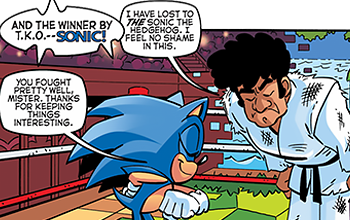
- In Sonic the Hedgehog (Archie Comics), we catch the tail end of a battle between Sonic and Segata Sanshiro with Sonic delivering the final blow. Segata's response is to bow to Sonic and remark that he has no shame in losing to Sonic himself.
- Superman: In The Legion of Super-Heroes!, the first story of the titular team, Superboy must pass three tests before being allowed to join the Legion, but he is hindered and stalled every time. Nonetheless, Superboy refuses to protest or tell why he lost, since he does not want to sound like an excuse-making sore loser. Instead, he accepts his defeat calmly and tries to smile even though the Legionnaires' jeers and taunts are upsetting him. Meanwhile, the Legionnaires are greatly and secretly impressed at how well he is taking their initiation "prank".
- Wacky Races: At the end of "The San Diego Go-Go" (Gold Key issue #7), Dick Dastardly takes losing to Penelope Pitstop well as he acquired a gold nugget that was lodged in Penelope's tire (it had gotten there when Dastardly sent the other racers back to Aztec times with a time-travel device.)
- Wonder Woman Vol 1: When the Emperor of Saturn realizes he's been outmaneuvered in his own throne room he has the guards that had just surrounded Steve Trevor stand down and asks Diana what her terms for him are. He then legitimately keeps to these terms despite them being very unpopular with the powerful slavers of his empire and forges an alliance with the USA. He doesn't even act mad.
- In a Peanuts strip, Lucy challenges Charlie Brown to a board game session, thinking that Charlie's going to get upset about losing to her. Instead, Charlie doesn't get upset when he loses, which makes Lucy so mad that she kicks the board game and its pieces, saying that she can't stand a good loser.
- Andrew Lang's "The Elf Maiden": When the fisherman and the elf maiden visit her parents, her father attacks the fisherman by surprise, but he fails to break his son-in-law's legs because the maiden warned her husband beforehand. Realizing his daughter has proved to be cleverer than him, the elder elf accepts their relationship and gives both spouses a huge herd of cattle as a gift.
- In Ace Combat: The Equestrian War, Night Raven, a battle-obsessed griffin soldier uses his last breath to congratulate Fluttershy on defeating him. Since Night Raven had come across as borderline Ax-Crazy for most of the fic, (even boasting to Fluttershy that he fights and kills not out of hatred for his enemies, but for fun,) this is a surprising display of honor.
- All Assorted Animorphs AUs: In "What if Tom was infested by a member of the Yeerk Peace Movement?", Visser One calmly accepts arrest for her treachery when the Council of Thirteen arrive. Or she would have, if Rachel hadn't killed her.
- And So We Fight: Ganondorf takes his defeat, and impending execution by Zelda, with a remarkable amount of grace.
- In Black Flames Dance in the Wind: Rise of Naruto
 , Unkai doesn't hold a grudge against Naruto for slaughtering his clan. They committed treason (at Unkai's urging) and as a shinobi it's Naruto's duty to capture/kill traitors.
- Boldores And Boomsticks: A Machoke consoles himself with losing to Yang because losing to a human in a straight fight would make a more interesting story to tell than just beating one.
- False Smiles: In the epilogue, Mayor Wilkins congratulates the Scoobies for beating him and setting back his plans to ascend by at least three hundred years. He then encourages the group to live their lives and enjoy themselves.
- Great Perverted Game: When the Big Bad loses, he simply offers Xander a "Good game", though it's later revealed to be because said Big Bad is Andrew who's merely playing for fun.
- A Horse for the Force: When Satine realizes her party will definitely lose control of the Mandalorians in the upcoming vote, she concedes before the vote can occur and does her best to ease the transition of power.
- Hours 'Verse: In Patchwork Hearts, Akane's Cognitive Joker responds to its defeat by praising Akira for a good match and asking him to help its master.
- The Importance of Tipping: After Naruto successfully gets all the Konoha teams out of the 2nd Exam and makes sure his is the only team to pass (while all the non-Konoha teams fight over scrolls they never had to begin with), one of the foreign Jounin calmly hands Naruto a Chuunin vest he meant to give to one of his own students. According to him, if Naruto hadn't earned his promotion for that, then nothing ever would.
- The Kirita Chronicles: Delano gracefully accepts his defeat during his duel with Kazuta during the Beta Test.
- The Moonstone Cup: Amarok is a master of magic and has won the Moonstone Cup all nine times that he's participated, never losing to or drawing with anyone. When Twilight eventually beats him, he accepts his defeat with good humor and, at the awards ceremony, accepts his second place medal by stating that it was about time that someone bested him.
- Naru-Hina Chronicles: Upon realizing that Naruto defeated him, Hiashi's reaction is to smirk and think about how Minato should be proud that the latter's son has become a strong ninja.
- The Palaververse: Parodied in "Saplings" when a wandering pine that Rainbow Dash and Sweetie Belle had been pursuing for decoratory purposes is backed against a wall with no escape from a tinsel-covered fate and turns to face its lot, standing tall and dignified in its defeat.
- Pokémon Reset Bloodlines: Most of the Gym Leaders Ash faces compliment his battling skills and creative strategies. Lt. Surge, in particular, says that he'd feel safe having Ash watching his back if they ever went to war.
- Pony POV Series:
- Havoc, Discord's father, actually proves very different than his son in regards to how he takes his losses. The only time he ever acted like a Sore Loser was quickly subverted and revealed to have been him pretending to have a meltdown because he thought it was funny, and he is completely accepting that his side lost the Alicorn/Draconequi War. In part because the war hurt his side far more than the reason they were fighting ever did.
Havoc: What? You're surprised I'll admit I lost? That's one thing my son never understood: Concepts have no room to be sore losers.
- General Hercules Beetle takes his defeat very well, even congratulating the ones who beat him for being able to do so. Justified, as Hercules never really believed in the Changelings invasion to begin with and was only fighting out of Undying Loyalty to Queen Chrysalis, otherwise being a Noble Demon.
- Havoc, Discord's father, actually proves very different than his son in regards to how he takes his losses. The only time he ever acted like a Sore Loser was quickly subverted and revealed to have been him pretending to have a meltdown because he thought it was funny, and he is completely accepting that his side lost the Alicorn/Draconequi War. In part because the war hurt his side far more than the reason they were fighting ever did.
- In A Protector's Pride, Baraggan is killed by Orihime of all people. His final words are to call her a fellow god and equal, warn her to be careful because others will want to kill or use her for her powers, and wish her good luck.
- A Savage Nature: Upon realizing he's going to lose their Mak'gora, Grom Hellscream tells his opponent that he'll be a strong leader of the Warsong once he's dead.
- Swapping the Cage: When Kiba gets his ass kicked by Naruto, he's surprised but completely fine with it. That's because Naruto was being paid to train him and Kiba refused to learn from the "Dead Last" (not having the security clearance to know this Naruto was Jounin level and from another reality).
- In This Bites!, Foxy is surprisingly accepting about having to be a Straw Hat. Or so he thinks.
- Turnabout Storm zig-zags it. Trixie is angered by the resolution of the trial, something she makes clear in the Dénouement. But the way Phoenix Wright manages to uncover the actual truth of the night of the murder leaves her humbled. It's not just that Phoenix gets Rainbow Dash proven not guilty; it's that he also proves that Sonata, who believes that she is the murderer because of her actions, isn't the murderer either, despite her given a heartfelt Heel Realization over what she's done. After the truth is revealed, Trixie is momentarily stunned into silence before just calling it quits. However, after the trial, she is too angry to speak and smacks Phoenix on the head, taking a while to cool down.
- A White Knight in Bayville: Mystique takes her loss to Xander, and thus losing the disc full of information she stole, rather well. This is later shown to be because she had a backup USB drive hidden in her cleavage.
- Yu-Gi-Oh! The Thousand Year Door: At the end, what the Shadow Queen says to the heroes when she finally falls is pretty much a lesson in why being a sore loser never helps (even though she's dying as a result):
Shadow Queen: What? You expected some angry threat? Some vow of vengeance that we all know I could never back up? I’d rather not embarrass myself...
- Zig-zagged with Xibalba in The Book of Life. He does his best to stack the deck and shave the dice to win his bet with La Muerta, to the point that he would rather kill Manolo than lose his wager. But he then honored (albeit grudgingly) his second wager when Manolo won.
- During the Piston Cup tiebreaker race in Cars, Lightning McQueen stops right before the finish line once he witnesses the King crashing, and goes off to help him finish his last race, letting Chick Hicks (who caused the King to crash) win the race. While Chick is booed off the podium for cheating, McQueen is recognized as the real winner for helping the King finish the race, and Tex, the owner of the King's sponsor Dinoco, gives him an offer to race for them. McQueen turns the offer down, preferring to stick with his old sponsor, Rust-eze, but he does allow his friend Mater to ride in Dinoco's helicopter.
- Isle of Dogs: Once Mayor Kobayashi's plot to kill all of the city's dogs comes to light, he and other members of his council go to prison. He offers no complaints.
- The Lion King (1994): When Simba finally manages to pin Nala by landing on top of her after they tumble down a hill together in their Falling-in-Love Montage, Nala rewards him for finally "beating" her with a lick on the cheek and gazes up at him seductively.
- Played with in Puss in Boots: The Last Wish: Upon seeing Puss's newfound resolve to preserve his last life and respect for death, The Grim Reaper in the form of a red-eyed wolf, briefly throws a tantrum and curses in Spanish, angry at Puss for "ruining his fun" because he wanted to hunt down "an arrogant legend who thought he was immortal." However Death quickly calms down and walks away, saying that they'll meet again. Puss acknowledging this fact makes Death smile, satisfied that Puss truly isn't that arrogant legend anymore, and Death leaves without any further trouble.
- Rango: After he’s outsmarted and beaten, Rattlesnake Jake simply acknowledges Rango as a great gunslinger and departs peacefully.
”I tip my hat to you. One legend to another.”
- At the end of The Rescuers Down Under, Bernard finally works up the courage to ask Bianca to marry him. Jake — who has been flirting with Bianca since they got to Australia — just gives him a thumbs up and says "Well done, mate."
- The Snow Queen (1957): When Gerda breaks the spell over Kay, the Snow Queen doesn't lose her temper or get upset. Rather, she calmly (even cordially) acknowledges that Gerda has won and allows the two to go home without complaint or any attempt to stop them.
- In The Twelve Tasks of Asterix, Caesar admits defeat, surrenders his empire, and retires in the countryside with Cleopatra.
"You are gods, and one cannot fight gods."
- Zootopia: When Judy manages to successfully complete Chief Bogo's ultimatum designed to get rid of her (and more), he warms up to her without hesitation or shame.
- In An Autumn Afternoon, Shuhei remarks that he is happy that Japan lost WWII. Mind you that he was a captain in the Imperial Japanese Navy.
- In Back to the Future Part II, the Western Union man who delivers Doc’s letter to Marty at the end of the film comments that the office had a bet over whether or not Marty would be there, and happily mentions that he lost. His skepticisim is understandable given that it was posted in 1885 with specific instructions to arrive at that date, time and location in the middle of a lightning storm.
- The title character of The Ballad of Buster Scruggs takes being out-drawn in a duel and shot in the head with perfect grace and dignity. His angel even sings a duet with the man who killed him as he ascends to heaven.
Buster: Shoulda seen this comin'. Cain't be top dog forever.
- In A Beautiful Mind, Martin Hansen has been acting as a Jerkass rival to John Nash for most of the film's first act; however, when Nash is selected for the position at Wheeler labs instead of him, he shows up at the local bar where Nash is celebrating, and — though his ego has obviously taken a bruising — he gracefully toasts Nash's success. For the remainder of the scene, the two of them are chatting amiably.
- Bill & Ted's Bogus Journey: When the evil robot Bill and Ted see the good robot duplicates coming at them, they realize they can't win, so they give the original Bill and Ted a wave and a cheerful farewell before they get their heads punched off.
- In Cinderella, the Grand Duke humbly accepts defeat and bows to Cinderella at the end, and the stepsisters actually sincerely smile for Cinderella and Kit. Only Lady Tremaine fails to take her loss well.
- Wadsworth, in Clue, congratulates his killer on their shooting skills.
- The Dark Knight Trilogy:
- Ra's Al Ghul in Batman Begins does this after Batman foils his plans to destroy Gotham. When Batman leaves him on an el-train that's about to crash, thanks to Gordon destroying the tracks, he simply closes his eyes and waits for the inevitable.
- The Joker in The Dark Knight oddly enough, though it depends on who he loses to. He becomes visibly angry when his passengers prove his beliefs about human nature wrong and tries to blow them up, but after Batman stops him, he seems glad to finally meet someone who he considers his equal. In typical Joker fashion, he laughs himself silly.
- Jackie in the 1978 production of Death on the Nile. After Poirot soundly exposes their murder plot and Simon is having his Villainous Breakdown Jackie gives the motive speech and sincerely apologizes to Poirot for drugging him.
- Tony Wendice in Dial M for Murder. After a brief moment of shock when his Batman Gambit is undone, he calmly congratulates everyone and pours them some wine.
- Subverted in Diggstown, where the hero and the villain are both con-men who have done everything in their power to rig a series of boxing matches in their favor. When the hero's fighter finally wins under blatantly shady circumstances, the villain stands up and says, "You beat me fair and square!" However, soon afterwards he begins ranting and threatening while his son tries to get him to admit defeat.
- In Dirty Rotten Scoundrels, Lawrence intends to be this when it looks like Freddy has won their wager. He later proves he is one and has a good laugh when it turns out that Janet has played them both. Freddy, not so much.
- Prince Edward in Enchanted. When his kiss fails to wake Giselle he is perfectly okay letting Robert give it a try, and seems genuinely happy for the two of them.
- In the climax of Enemy at the Gates, after shooting Danilov under the impression that he was Vassili, Konig leaves his cover to inspect the body only to be ambushed by Vassili, who takes aim at him from about 40 feet away. Konig slowly turns, looks at Vassili, and takes off his hat to give him a clean shot, which he promptly takes.
- In Escape Plan, Hobbs' reaction to his impending death is a simple smirk and a "hmph".
- Fearless:
- O'Brien the big wrestler, after initially refusing to admit defeat and trying to fight on for a while, ends up being saved by Huo from the spikes protruding from the broken fighting ring. He then composes himself and acts more graciously, even goading the audience the cheer for Huo.
- The Japanese swordsman and Karate expert Nakamura. He recognizes that Huo could have killed him with Huo's final blow but deliberately held back rather than do so. Between that and Nakamura's suspicions that foul play had occurred, he stops the referee from proclaiming him the victor over Huo, forfeits, and leads the audience in cheering on Huo.
- In The Gentlemen, after some of Mickey's farmers have their asses handed to them by the younger gang The Toddlers, one of them notes with some respect "whoever trained them knew what he was doing".
- Amber Von Tussle in Hairspray, but not her mother, alas.
Amber von Tussle: I lost, Mom. Let's just deal with it!
Velma Von Tussle: You did not lose! You can not have lost because I switched the damn tallies!
- Amber then proceeds to walk away from her mother, then strike a conversation and dance with a black dancer, which is pretty ironic considering her mother was racist. In the stage show, both Von Tussles actually become this. After some sulking, they have a verse in that song where they finally just accept it and basically just go with the flow
- In the first High School Musical, when Gabriella beats out Sharpay for the lead role despite the latter's best efforts, she accepts that she'll have to be the understudy and tells Gabriella to break a leg. Gabriella is stunned, and Sharpay cements the grace of her loss by clarifying, "In theatre, that means 'good luck.'" The sequels would show that she still bears a lot of resentment towards Gabriella for taking both the role in the show and her chance of dating Troy.
- The Great Goblin in The Hobbit: An Unexpected Journey takes his death at the hands of Gandalf remarkably well.
Great Goblin: Whaddaya gonna do now, wizard?
[Gandalf pokes him in the eye with his staff, then slashes open his belly with his sword.]
Great Goblin: [Nodding sagely] That'll do it. - In Bruges: Harry reluctantly takes his own life when realizing he was damned by his principles.
- The Karate Kid:
- Johnny Lawrence in The Karate Kid (1984) shows some previously unseen class after losing to Daniel at the end of the film, personally handing the trophy to LaRusso and telling him, "You're all right."
- The Karate Kid (2010) remake takes this up a notch. Not only does the rival bring the hero the trophy, but he and his entire class bow to him, much to the chagrin of their jerkass teacher.
- The Big Bad of Kate loses a quick draw contest with Kate. He smiles, "Great shot," as he collapses and dies.
- Kicking & Screaming: Buck holds no hard feelings over losing the championship.
- Kill Bill:
- The Big Bad warmly tells his murderer, who has proven to be the Greater Warrior, that she is still the love of his life. Then, he walks with gentlemanly dignity to his death.
- Also O-Ren Ishii, who first apologizes to her killer for not taking her seriously, and when given the last blow she muses with admiration about how the weapon that scalps her is truly a Hattori Hanzou katana.
- Mad Max: Beyond Thunderdome:
Aunty: Well. Ain't we a pair, raggedy man. [laughs as she walks away] Goodbye, soldier.
- Marvel Cinematic Universe:
- Loki in The Avengers. Conclusively defeated, surrounded by all of the Avengers, and Hawkeye's got an arrow aimed point-blank at him. His response?
- Guardians of the Galaxy: When Yondu sees that Peter faked him out and gave him a troll figurine instead of an Infinity Stone, he laughs. Considering his predilection for knick-knacks to stick on his command chair, it was probably an adequate consolation prize in any case.
- Spider-Man: Homecoming: When the cops capture Vulture, he merely grins in amusement and keeps Spidey's identity to himself out of gratitude for saving both his daughter and him.
- Black Panther: After T'Challa lands a fatal blow on Killmonger, Killmonger simply remarks "Hell of a move." The two then have a rather amiable conversation until he succumbs to the injury.
- Avengers: Endgame: Once it became clear he was defeated for real, Thanos doesn't say a thing or try to take anybody with him. Instead, he closes his eyes and sits down before disintegrating away. Whether this counts is debatable, as he doesn't seem to be doing so out of grace but out of utter despair, as he is fully aware that he has lost everything and knows that it is futile to resist the inevitable.
- At the end of Eternals, Arishem appears next to Earth and takes the remaining Eternals. He's upset with them for going against their mission to allow Tiamut to be birthed, but rather than destroy Earth or otherwise punish the Eternals, he just takes them away for judgment.
- My Cousin Vinny: When the evidence against his case starts to mount, the prosecutor immediately drops the charges, shakes Vinny's hand, compliments him on a well-executed trial, and invites him to come hunting.
- In Predator 2, after Danny Glover's character finally wins and kills the Predator, a bunch more Predators show up and, rather than kill him (which would be very unsporting of them), give him an antique flintlock pistol from their trophy collection, presumably as a way of congratulating him for his victory.
- Rocky is perfectly content with his loss to Apollo Creed, as his goal wasn't about winning but going the distance (which he did).
Creed: Ain't gonna be no rematch.
Rocky: Don't want one.- Also Thunderlips in Rocky III. Even though he acted crazy in his match against Rocky, which ended in a draw, he had a good match with him and was perfectly willing to take a picture with him for charity.
- Teddy KGB at the end of Rounders. Mike McDermott just won a huge poker hand against him. After a brief angry rant, he calls his goons off and grudgingly admits that he was defeated fair and square.
- When the Operative in Serenity realizes he's been beat, he calmly orders the Alliance troops to stand down. He even makes arrangements for the surviving protagonists to receive medical attention, and for their ship to be repaired. He does say that his superiors are less than pleased with this outcome and that he may just be their next target. Mal just shrugs and says he doesn't care. After all, the Operative has killed many of his friends (including children) just to smoke him out.
- The Baroness of The Sound of Music warmheartedly wishes Maria, her rival for the hand of Captain Von Trapp, happiness with the Captain when it becomes clear where his affection lies.
- Space Jam: After losing the Ultimate Game in the final seconds, and dispatching their Bad Boss Swackhammer, the Monstars are reminded of the amended stakes: that they must forfeit the talents that they took from some NBA superstars. Pound glumly asks, "Do we have to?" at which Michael Jordan replies, "It's part of the deal. Touch the ball." Rather than thug their way out of it, all five Monstars touch the ball after only a token complaint ("Do we have to?"), forfeiting their powers, which reduces them to their diminutive Nerdluck forms.
Bupkus: I feel so ... insignificant.
- At the end of Spectre, Blofeld seems to accept his capture at the hands of M with resignation.
- In the finale of the 2018 Russian WWII film, T34, there is a tank duel between the two sides. Hanging precariously over the side of a bridge on his Panther tank, a defeated Klaus takes the helping hand of Nikolay.... only to shake it and give him a last nod of acceptance, before finally letting go and falling over the side alongside his tank.
- At the climax of ¡Three Amigos!, El Guapo is mortally wounded and dying, having been Out-Gambitted by the heroes; still, he can't help but admire their "clever trick", saying so himself. (But he does get the last laugh, calling Lucky Day over to him, saying he wants to tell him something. When Lucky gets close enough, El Guapo shoots him in the foot as a joke. "That was a pretty good trick, too, no?" he says before dying.)
- Cardinal Richelieu in The Three Musketeers (2011) very calmly accepts that he's been beaten (even if it is only a minor inconvenience rather than a disaster for him), and invites the Musketeers to work for him instead.
- In the final segment of Twilight Zone: The Movie, when the gremlin realizes that John Lithgow's character has managed to thwart its attempted destruction of the passenger jet, it just grins, wags its finger at him and flies away.
- Wayne's World: In the canon "mega happy" ending, Benjamin takes Wayne's victory over him in stride, even saying he's learned that being rich and handsome can't get him everything.
- Similarly, the unfaithful wife in What's Eating Gilbert Grape does the same when "handing" Gilbert to Juliette Lewis' character.
- Subverted in The World's End. The Network initially seems to be willing to leave, if not in good grace at least with a minimum of fuss. Then it spitefully knocks out human technology on the way out.
- In X-Men: Apocalypse, after an attempt at escaping goes wrong, Apocalypse suffers a Villainous Breakdown and once he sees the full power of the Phoenix about to be unleashed upon him, doesn't make any further attempt to fight back. Instead, he just basks in awe, and cryptically remarks, "All is revealed."
- In Animorphs Visser One (the former Visser Three) responds in this fashion after being defeated and captured in book 53. Which is kind of odd considering his psychopathic behavior during his lesser defeats.
- BattleTech: In the Warrior novel trilogy:
- When Duke Frederick Steiner is confronted with the evidence of his involvement in a plot to topple his cousin Katrina and establish himself as Archon of the Lyran Commonwealth (involving an assassination attempt that he did not know about and would not have condoned), he acknowledges his defeat, accepts a suicide mission on the condition that the troops he takes along not be thrown away merely for their association with him, and indeed does not return. He does survive, but effectively vanishes for over twenty years before appearing again in a somewhat more heroic role...in the Blood of Kerensky trilogy, and under a different name.
- The Clans will, at the point of a defeat, withdraw, even if they have the strength to stay. Though they might declare a personal vendetta over it and come back at a later time to utterly annihilate you in order to reclaim the honor lost by their defeat.
- "Clockpunk and the Vitalizer": At the end of the story, the Vitalizer realizes the Bull is out of his grasp, so he simply laughs and concedes defeat while complimenting the heroine on her tenacity.
- Madame Tarsa from The Crew of the Copper-Colored Cupids demonstrates this trope in her debut; despite ruthlessly playing to win in their swordfight minutes earlier, Madame Tarsa lets Pessimist and Larrikin go back to the Homeworld without complaint once they make it out of her Labyrinth fair and square, even repairing Pessimist's Fog Ship herself.
- Isaac Asimov's Foundation Series: In "The Mule": The Mule could have had Toran and Bayta killed or worse after their actions prevented him from earning his final victory, but chooses to let them go, both because they no longer matter to him and, in the end, the defeat is relatively minor.
- In The Hearts We Sold, the Daemon handles it remarkably well when Dee and James game the system to get Dee out of her contract early. He simply lets Dee go, commenting on how clever the gambit was and noting that he didn't see that coming. He even turns up to see Dee at the end, apparently just to check on her.
- Helen and Troy's Epic Road Quest: After Helen and Troy shove her in her own oven and escape the Mystery Cottage, Babs commends them for their wits and decides to leave them be.
- The Hunger Games: Both Gale Hawthorne and Peeta Mellark are rivals for Katniss's affection. In Mockingjay, Katniss overhears them speaking privately. Peeta has more or less always believed Gale is the one Katniss loves and, if anything, seems apologetic that he got between them. Gale has gotten over his previous jealousy and realized Katniss really loves Peeta. He doesn't seem to have any hard feelings towards Peeta, whom Katniss loves despite him trying to kill her twice (It Makes Sense in Context). Towards the end of the book, Gale doesn't seem to be all that upset when he knows for sure that Katniss will choose to be alone if she can't be with Peeta.
- The Homestar Runner Enters the Strongest Man in the World Contest: The Homestar Runner was okay with losing because cheating Strong Bad didn't win either. And Pom-Pom was nice enough to share the trophy.
- Matthew Reilly's Hover Car Racer: Alessandro Romba, the veteran hover car racer on the cusp of a historic Grand Slam, congratulates Jason on a good race when he wins the Masters championship, and tells him to go celebrate.
- Lester Leith: In "Cold Clews," a jeweler is tricked into paying a large reward to recover his stolen property even though it could have been found without paying the reward without much trouble. He's annoyed with the police for overlooking this, but shows a sense of respect for Leith.
Samuel Riggers: This man has proved his good faith ... also his diabolical cleverness. Mr. Leith, if you ever want to turn your intellectual talents to business pursuits, I shall deem it a pleasure to have you call upon me.
- Ngaio Marsh's Light Thickens: When found, the killer tells the police he was expecting them, and calmly and politely confesses the whole crime to them, only asking that they take care not to lose the letters in his possession. His final letter to child actor William Smith, accompanying his gifts, even reads "Regrettably, I shall not be at liberty to teach you but Mr. Simon Morten will, no doubt, be glad to do so..."
- In The Machineries of Empire short story Extracurricular Activities, the Gwa spy politely accepts the fact that Jedao has outwitted them and goes with him of their own free will when their game is up.
- My Next Life as a Villainess: All Routes Lead to Doom!:
- In the original otome game scenario for the series, Mary was supposed to concede gracefully to her rival Maria for the love of Prince Alan. However, with Katarina screwing up the plot on accident, Mary is now into her instead and is currently fighting hard to win her best friend's love. Arguably fighting dirty too since she doesn't seem to be above negging.
- Nicol seems to be resigned to this fate as it related to Katarina since he sees his feelings for her as something that he shouldn't have (as she's engaged to his Childhood Friend Prince Geordo). Although they can't be together, he admits to her that he's much contented staying by her side.
- Necroscope:
- When suffering amidst the ruins of his burning house, the vampire Faethor Ferenczy decided to accept a quick death at the hands of a rescuer — even paying him with a gold medallion — rather than fighting desperately to escape.
- After the vampire Faethor Ferenczy died, he was excluded from the other souls of the dead for being a vampire, and this time, he got to explain himself:
Believe me if you like, or disbelieve, but I am at peace- with myself, anyway. I have had my day, and I am satisfied... if you had lived for thirteen-hundred years, perhaps you would understand...
- The Queen's Thief: In The King of Attolia, the king has just outmaneuvered a scheming noble who has done everything from make him chronically late to directing an assassination attempt:
Sejanus looked up at last. Then, with a little effort, he shrugged, like a man who has lost a bet on a footrace or dice roll. Accepting a shattering defeat with some dignity intact he was more likable than he ever had been in the past. [...] He saluted the king. "Basileus" he said, using the archaic term for the fabled princes of the ancient world.
- The Sapphire Rose: Martel takes being beaten (and killed) by Sparhawk with dignity. Sparhawk acknowledges this by bringing Sephrenia over so Martel can die in the presence of those he loved most.
- In The Sorcerer's Daughter, Rothbart is defeated by Siegfried, loses his magic powers, gets imprisoned, and expects to be sent to the stake. However, he behaves calmly and with dignity the entire time. The only occasion when his resolve slightly falters is when he begs Odette not to make his daughter watch his burning.
- Star Wars:
- The Thrawn Trilogy:
- When one of Grand Admiral Thrawn's plans failed spectacularly and his own bodyguard assassinated him, Thrawn's last words were, "But... it was so artistically done."
- Prior to his death, Thrawn in general was graceful on the few occasions where he was defeated in battle. Instead of all out attacks, Thrawn preferred to withdraw and rework his plans rather than wastefully throwing people and equipment at a situation that could not be changed.
- Hand of Thrawn:
- Supreme Commander Pellaeon, the head of the tiny Imperial Remnant, came to the conclusion that the Empire would only survive to rise again if he made peace with the New Republic, so he sends a trusted underling as an envoy to meet with the general he respects most. A Moff's consternation at this and someone finding an incomplete version of the Caamaas Document kick off the events of the Hand of Thrawn duology.
- At the end of the duology, the Moff's plot comes unraveled. The Moff himself is not this trope, but one of his partners in crime, Flim — whose role was primarily as the one who would impersonate the legendary Grand Admiral Thrawn — reacts calmly to the news, and even helps to smoothly resolve the situation by giving one last speech in-character as Thrawn.
- The Thrawn Trilogy:
- Stiff Upper Lip, Jeeves: Roderick Spode has nothing but praise for "Stinker" Pinker after the latter handily defeats him in an impromptu round of fisticuffs. He's less happy about Emerald Stoker braining him with a china basin.
- The Superteacher Project: Mr. Perkins (the roboticist monitoring Mr. Aidact) can be a rather cold fish. Still, when Mr. Aidact escapes being deactivated, Perkins is impressed about just how much his creation Grew Beyond Their Programming and is happy to learn that Mr. Aidact has the necessary tools to repair himself.
- Teen Power Inc.: The main culprit in Dangerous Game is clearly impressed and not really mad after hearing the narrator's summation and being exposed as a smuggler. He even pays the gang for the work they did before learning he was a crook.
- Temeraire: In League of Dragons, the final novel, after Napoleon has been defeated, Laurence comes to him expecting rage. Instead, Napoleon tells Laurence "Do you suppose I would ever reproach you, of all my foes? I am sorry only to have faced you across the field, when you ought to have been by my side. Loss is the hazard of battle. One who cannot bear to taste it cannot be a soldier." They then spend some time talking about the final battle.
- The Three Musketeers: After D'Artagnan and friends have defeated his scheme, Cardinal Richelieu acts in the only manner he can, being who he is... he offers D'Artagnan a job. Talent like that shouldn't be wasted. (It is earlier mentioned in the book that the Cardinal is incapable of being vengeful, because the pursuit of vengeance really gets in the way of the pursuit of power.) While his scheme is defeated, at best it is a minor inconvenience to the Cardinal who is far too powerful for anything that the Musketeers do to actually harm or seriously affect him and his position. That he offers D'Artagnan a job still counts as this trope, however, because he could have crushed the young Musketeer without effort.
- Warhammer 40,000: In Ciaphas Cain, the "loss" (of marriage to a planetary governor's daughter) is actually the best outcome Cain could hope for, as it prevents him shattering said daughter's delusions (both of wanting to marry her and of being able to overcome Cain's service in the Imperial Guard. He has to restrain himself from doing handstands on the lawn out of sheer exuberance at her marrying someone else.
- Game Shows: A general example, but the losing contestants — while understandably disappointed — are often seen smiling as the host tells them how well they played and that they were glad they played the game. Almost every time, the contestant will respond that he/she had fun, that appearing on the game show was a highlight of their lives, smile as the announcer reads the Consolation Prize plugs, wish the winner (especially if he/she is a dominant champion of whom they've heard) well, etc.
- 24: In the penultimate episode of Season 5, Christopher Henderson has finally been Out-Gambitted by Jack and is moments away from death. His response is to grin proudly and genuinely compliment Jack on it "Good for you, Jack". Given that he was Jack's mentor, this even makes sense.
- The Inhuman Hive in Season 3 of Agents of S.H.I.E.L.D. Finding that his schemes have been undone and Lincoln has made a Heroic Sacrifice to trap them both in orbit with a nuclear bomb on an unstoppable countdown, he stops fighting and just uses his remaining few seconds of life to enjoy the view of the Earth.
Lincoln: Well, I got to see the world.
Hive: It's beautiful. Smaller than you imagine.
Lincoln: Yeah.
Hive: I only wanted to make it better.
Lincoln: I know.
Hive: To feel a connection. But you must feel it already. To sacrifice for them. With all their flaws.
Lincoln: They're only human. - Averted in Alias. In the middle of Season 2, after the Alliance was destroyed, Arvin Sloane was revealed to have helped in the whole thing, and apparently retired to a life of luxury and anonymity with his wife. Then it turned out it was just the next step of his plan.
- On The Amazing Race it's actually rare for a losing team not to be graceful in defeat, and many teams in the Final 3 are just happy having gotten to run the whole race. Though notably averted with the teams that originally appeared on another CBS Reality Show.
- Better Call Saul: After an intense cat-and-mouse game between Gus Fring and Lalo Salamanca, Gus ends up on top and Lalo is shot in the throat due to a mix of crazy preparation, a lot of luck, and the fact that Gus appears in Breaking Bad and Lalo doesn't. Lalo spends his last moments laughing, seemingly both impressed by Gus' final play and in amusement at how suddenly the tables were turned on him in what initially appeared to be his moment of triumph.
- Captain Holt in Brooklyn Nine-Nine takes it gracefully whenever Peralta wins one of their little competitions, and only partially because he's a Stealth Mentor, and in winning the competition, Peralta had to take on board whatever lesson Holt was trying to teach him in the first place. For example, in the episode "Halloween", he makes a bet with Peralta: if Peralta can steal his medal, he'll do all of Peralta's paperwork for a period. Peralta achieves this through teamwork, meaning he learned Holt's lesson to begin with...and Holt ends up lumbered with everyone's paperwork because that was what Peralta promised the team to get them to help out. He accepts this with complete calm. This however, gets subverted in subsequent seasons as Holt is revealed to be a Competition Freak and a gambling addict and only appears gracious because he's planning how to win the next round.
- When revealed for the scheming, murdering snakes they are, a very significant number of Lieutenant Columbo's enemies smile graciously, congratulate the lovable old buffoon, and cheerfully walk to the police station with him. Columbo's often really nice to them as well. When the fairly sympathetic man who'd murdered his stepbrother because he was going to sell his beloved vineyard was caught, Columbo listened as the guy explained that the vineyard was the only place he ever felt truly happy and shared a glass of wine with him before taking him away. One of them even gave Columbo a portrait of himself after being caught (although he was working on it before he was arrested).
- Doctor Who: In "Amy's Choice", after our heroes have worked their way through his dream trap, the Dream Lord gracefully admits defeat and accepts his end of the bargain, saving their lives and fading away. It's a subversion; when he leaves them, they're still trapped in his dream trap, and this is just his way of trying to fool them.
- In the Fantasy Island remake, one episode involved a man who wants to become the best businessman by any means. Roarke slowly turns him into a remorseless demon. At the final moments when he is alone, paranoid, and cowering in the corner, his dog returns to him and he shed a single tear, which Roarke takes and hands to his assistant, happy to lose the bet once more.
- The Flash (2014): Eobard Thawne was defeated at the end of Season 1. In Season 2, Barry learns that Thawne, as Harrison Wells, made a certain arrangement in the event that he died before fulfilling his plan to return home: He left S.T.A.R. Labs and all his assets to Barry and recorded a confession of the murder of Nora Allen, which was sufficient to free Barry's father, Henry Allen, from prison. However, that didn't stop him from some Evil Gloating due to the fact he still killed Nora and that he is sure that Barry will still not receive happiness.
- In Game of Thrones, Alliser Thorne of the Night's Watch certainly qualifies. The entire time, he's against the Wildlings, and when Jon Snow finally lets the Wildlings through The Wall, he still fights against Jon Snow and the Wildlings and even takes part in a mutiny against Jon Snow. Two episodes later, when Jon Snow is brought back to life after being killed by Alliser and a couple of others, his final words are, calmly, "I fought. I lost. And now I rest." whereas Olly gives Jon Snow a cold, menacing stare before being executed.
- Tritter, the recurring antagonist in Season 3 of House, despite initially being portrayed as rather vindictive, completes his evolution into something of a Well-Intentioned Extremist by calmly wishing House the best of luck in staying clean after his court case against him fails.
- This is the main thing that separates the grifters from their marks on Hustle. Mickey especially doesn't seem to mind that much whenever he himself has been conned. A notable example is when the two future halves of the team con each other thanks to manipulations by Albert at the beginning of Season 5 and none of them seem to mind. They have the same reaction against Richard Chamberlain's character when he beats them as they are happy to have seen a true master at the game. By contrast, whenever a mark loses, they tend to scream, yell, and throw tantrums. Mickey often says his motivation for taking down a mark is to see if they can dish it out as well as take it, and he apparently holds himself to that.
- JAG: In "Pilot Error", once presented with solid evidence that the autopilot system may have in fact malfunctioned due to not being designed with the abuse of Navy carrier landings in mind, the Macroplex executive accepts this and promises to have the newly discovered flaws corrected.
- Near the end of Kamen Rider Ex-Aid, After Graphite is defeated by the combined might of Hiiro and Taiga, he laughs and says it was the best fight he's ever had. When Masamune Dan tries to rescue him (not because they were allies, but because he needs Graphite alive for his plans) he actually fights back, declaring that the heroes won fair and square and that he won't let Masamune tarnish the sanctity of their battle. He says his goodbyes to his fellow Bugsters, thanks the Riders for letting him fulfill his role as a video game's Final Boss, then throws himself into the path of Nico's Finishing Move.
- LazyTown: When Sportacus loses the first soccer match in "Soccer Sucker", Stephanie is distraught but Sportacus accepts the loss gracefully, saying he did his best.
- Li Tsung's (and to an extent, Bruce Lee's) philosophy when it comes to martial arts in Longstreet, is this trope combined with Face Death with Dignity.
Li Tsung: Like everyone else, you want to learn the way to win, but never accept the way to lose. To accept defeat, to learn to die, is to be liberated from it. So when tomorrow comes, you must free your ambitious mind and learn the art of dying.
- Cyclops of Mahou Sentai Magiranger. He flies into a rage when Tsubasa outwits him and forces him to go giant-size, but when the Rangers land the actual killing blow he congratulates them with his last words.
- Midsomer Murders: Fittingly with his belief that he’s an outlaw in a Western, at the climax of "Blood on the Saddle" after Adam believes Barnaby beat him to the quick draw (really Jones shot him from the window) he concedes defeat and lets the police take him away.
- Most of the villains that are caught by Monk simply surrender when the evidence is found with a minimum of fuss.
- In NewsRadio, Jimmy's rival Johnny Johnson had gotten him sent to jail and taken over his company. After Jimmy has tricked Johnny and gotten his company back, Johnny, rather than protest or swear revenge, simply concedes defeat. Dave is left flabbergasted: "But... you're evil!" Johnny tells him that is no excuse for poor sportsmanship.
- Odd Squad:
- In "The O Games", during the ring toss competition, Dr. O witnesses Odd Todd faking injury to his leg. However, she believes that he's really injured and drops the ring she has in order to treat him, allowing him to pick it up and score in order to advance to the next round. Her reasoning for taking the loss in stride is because what she and Odd Todd did was not against the rules (since a contestant can pick up stray rings that another contestant drops).
- The end of "Swamps N' Gators" has a justified example, as Otto makes no comment about losing to Olive in the eponymous game, being content with just being freed from the game itself.
- In "Other Olympia", Odal — renamed from Olympia after the name-off competition — harbors no ill feelings towards the main character Olympia when Coach O names her the winner, instead congratulating her with a handshake.
- Invoked in "Odd Squad in the Shadows", where Odin, challenging Omar the "Shadow King", says that the loser of the shadow duel has to say "Hey, good job" to the winner, and mean it. When he ends up losing to the King, he makes good on his deal and congratulates him for his win.
- Power Rangers:
- After his first loss in Mighty Morphin' Power Rangers, Master Vile takes it in stride. "So I failed once. Big deal. Rita and Zedd have tried to conquer the earth over a hundred times and they've never come close!" Of course, this drops after he loses the third time. He throws a tantrum and heads back to his own Universe.
- King Mondo was similar after his first defeat in Power Rangers Zeo, entertaining the idea that the Rangers might be Worthy Opponents. However, that changed very quickly, and after a few times, he started to get very angry. (Though not as much so as Vile.)
- A world-class example of this is seen in the Grand Finale of Power Rangers Time Force. Ransik (probably the single toughest Big Bad ever seen in the franchise) tells the Rangers "I don't need anyone to fight for me! I'll destroy you myself!" — and then, goes ahead and darn well nearly does it. He only relents when he nearly kills his daughter accidentally, who then uses The Power of Love to get him to lay down his arms and surrender. He even comes back during the next season's Crossover episode to help the Rangers take out some Orgs that he had business dealings with in the "past". And he was pretty awesome as a good guy too.
- Power Rangers: Dino Thunder: When the Evil White Ranger Clone suffers a fatal blow at the hands of the true White Ranger, he calmly declares "I guess you wanted it more." before bidding him goodbye.
- In The Queen's Gambit, Vasily Borgov accepts his defeat by Beth Harmon in the final game gracefully, smiling and handing her his king, and even offering her a hug afterward. This is in contrast to some of Beth's own reactions to her previous defeats.
- The Smallville episode "Combat" has Clark being forced to fight against an escaped prisoner from the Phantom Zone named Titan (played by Kane). The fight is brutal, forcing Clark to actually use his full strength. After being tossed rather forcefully to the ground, Titan rises and turns to reveal that he has been fatally impaled by his own arm-spike. Evidently aware of his mortal wound, he simply smiles, says "Good fight!", and drops dead.
- Twice in Spartacus: Blood and Sand, a warrior loses a fight to the death with their own protegee and gracefully accepts defeat with the parting line "I have taught you well".
- In The Twilight Zone (1985), a group of neighborhood men play poker against the devil, who keeps winning with triple 6's. So for a final hand, double or nothing to get back the souls lost, they play lowball, where the devil's typical hands, of course, lose. The Devil smiles and gives them back everything they've lost. Further, charmed by their pluck, he fills the fridge with beer and snacks they were too poor to afford for their game.
- The West Wing: The Vinick-Santos election in the final season comes down to the last states to call their results. Both candidates insist to their respective campaign staff that they won't contest the result if they lose and will personally make the phone call to concede.
Vinick: I'll be a winner, or I'll be a loser. I won't be a sore loser.
- Forged in Fire and its sister show The Butcher: As camaraderie is an important part of both shows, and the judges actually care about what they want to convey to the participants, eliminated participants take their eliminations gracefully, in almost every case agreeing with the judges' judgement and promising to do better in the future.
- Poetic Edda, "The Lay of Fafnir": After Sigurd has mortally wounded the dragon Fafnir, the dying Fafnir asks Sigurd about his family, with Sigurd initially evading his questions because he fears Fafnir might curse him once he knows his name. Nevertheless Sigurd eventually reveals his name and lineage to Fafnir; Fafnir however does not exploit this, but instead warns Sigurd that Fafnir's hoard will bring about his death and that his foster-father Regin will betray him. Though Sigurd initially suspects Fafnir is screwing with him, time proves that Fafnir was right on both counts.
- This trope is actually quite common with almost all Face vs. Face matches. One of the most memorable is Hulk Hogan at WrestleMania VI, after losing the WWF Championship to the Ultimate Warrior, he hands the WWF title to him, hugged him, and raised his hand.
- Hogan did this again more or less after The Rock beats him at Wrestlemania 18 by raising Rock's hand in the air. Later on, this becomes a Continuity Nod with The Rock after John Cena beats him at Wrestlemania 29 and Rock does the same thing.
- Cena himself has a tendency to accept any clean loss to a Worthy Opponent, a notable example being SummerSlam 2013 where he shook Daniel Bryan's as well as special referee Triple H's hand, right before Triple H turned on Bryan and fed him to Randy Orton (Cena wasn't part of that backstab) and the next night, even introduced Bryan while unequivocally putting him over. He'd taken his famous loss to CM Punk at Money in the Bank 2011 with similar humility, treating him as an equal contender and even stopping an attempt at recreating the Montreal Screwjob in his own favor, and then publicly thanking Punk the next night for a great match. Since turning face, the only two clean losses Cena didn't display this were against the Rock at Wrestlemania 28 and against Lesnar at Summerslam 2014.
- Sheamus pretty casually accepts the fact Big Show won their feud and beat him for the World Heavyweight Title. Granted he didn't take too kindly to Big Show's insults and attacked Big Show for that.
- After losing to "Stone Cold" Steve Austin at Summerslam 1998, The Undertaker grabs the belt and after giving the impression he is going to have a confrontation with Stone Cold, Undertaker instead hands him the belt as a sign of respect and gives Stone Cold a head nod.
- Subverted with the Undertaker/Brock Lesnar feud of 2015. The feud started when Undertaker attacks Lesnar as he was about to win the title. Undertaker went on to state that while he accepted losing the streak to Lesnar, he got fed up with Paul Heyman's constant bragging. At the feud ending match at Hell In A Cell, Lesnar beats Undertaker by kicking him in the balls which was what Undertaker kept constantly doing to Lesnar and how Taker won against him last time. Undertaker basically gives him an accepting look that says "You beat me at my own game."
- After Roman Reigns beat Daniel Bryan clean at Fastlane 2015, Daniel accepted the loss and told Roman to beat Lesnar. He also cut a promo the next night on Raw saying Roman earned his respect.
- Averted at Money in the Bank 2015. When John Cena beat Kevin Owens, Cena shakes Owens Hand and said "you belong here" as he raised Owens' hand in the air. Owens seemly accepted it, only to immediately attack Cena afterwards.
- After the Alliance disbanded from losing an All or Nothing match at Survivor Series, Shane McMahon congratulated his father Vince, and was allowed to leave the arena without interference. Shane's sister Stephanie, on the other hand, desperately tried to get back on Vince's good graces, pinned the whole InVasion on Shane, and said that none of it was her idea. Vince had Stephanie dragged out of the building by security in spite of her protesting.
Shane: Congratulations. You won, and I lost. And I lost to the better man.
- At the end of their WrestleMania 24 match, Ric Flair told Shawn Michaels to finish him, knowing he couldn't beat Michaels and would have to retire. Michael's tearfully obliged with request, saying "I'm sorry. I love you".
- Mister Rogers' Neighborhood: Multiple times through the years, more often than not with the Neighborhood Of Make Believe segments, where stories revolved around winning and losing. There was also the time Chef Brockett, the neighborhood bakery owner, recalled a time where he had to be a graceful loser when he entered a prestigious baking contest and (virtually) everyone of the other bakers won a trophy, the lessons being that sometimes, you may be the only one that doesn't win anything in a contest, and that not winning doesn't mean you didn't try your hardest, nor does it mean that—in the case of the baking contest—that your entries were of inferior quality... ergo, every entry is of superior quality, but there can only be one winner.
- In the first edition of Dungeons & Dragons, the demon lord Pazuzu is said to genuinely not hold any grudge against any mortal heroes who ruin his plans, particularly if they showed great cunning in doing so, and is in fact quite Affably Evil overall.
- In Exalted, Ligier, the fetich soul of the Yozi Malfeas sort of invokes this concept. He refuses to fight anyone not worthy of fighting him (either tens of thousands of Dragonblooded or a full circle of experienced Solars) and if a party can best him enough to deal 25 health levels of damage or so to him — the book mentions this is merely a scratch to him, by the way — he will flourish, then withdraw from the fight and refuse to fight the group for 25 hours. He can be pressed into combat if his opponents keep attacking him. A word of advice: DON'T.
- Forgotten Realms: Zulkir Szass Tam is said to be genuinely respectful and even admiring of any heroic adventurers who thwart his plans, in no small part because they'd probably have to be Worthy Opponents to beat someone with his level of power and cunning.
- In the sample adventure for Spirit of the Century the book suggests that should the characters convince the council running the scientific awards that Dr. Methusala is a threat, or is otherwise a liability, he will leave at their behest. Of course, he'll also be rather miffed, and when Dr. Methusala gets miffed, people cease to ever have been.
- In Warhammer, followers of Nurgle aren't too bothered about being defeated as they view death as just part of the natural cycle that nurtures rot and decay, while followers of Slaanesh are constantly seeking new experiences and try to see pleasure in absolutely everything, including dying. And while his followers can (and often are) a different story, Khorne is not bothered by his champions being beaten fair and square, it still means there was strength to be displayed and blood to be spilled; Khorne cares not from whence the blood flows, only that it flows. He's even rewarded some opponents for great displays. And Tzeentch probably wanted you to win anyway.
- In Macbeth, the treasonous Thane of Cawdor distinguishes himself at his execution by making a full confession and asking for forgiveness for his attempted rebellion. In some film adaptations, he goes as far as to walk off the ledge and hang himself once the noose is around his neck, rather than be dropped.
"...very frankly he confessed his treasons,
Implored your Highness' pardon, and set forth
A deep repentance. Nothing in his life
Befitted him like the leaving it." - In Once on This Island, "sly demon of death" Papa Ge, despite being nothing but smug and cruel for the entirety of the story, is mentioned as specifically being gentle when he carries Ti Moune's corpse back to shore after she drowns herself. This despite him having quite thoroughly lost his bet with Erzulie that death would triumph over love.
- In the Sovereign show at Medieval Times Dinner And Tournament, after the first swordfight, the winning knight invites the loser to take a bow with him, which he gladly does. This establishes the honour and sportsmanship the tournament is supposed to have, before the Lord Chancellor's schemes take over.
- Ace Attorney: It's rare that your opponents don't have a hammy Villainous Breakdown, but there is the occasional killer with some dignity at the end.
- In case 1-3 (Turnabout Samurai) of Phoenix Wright: Ace Attorney, the killer Dee Vasquez, upon being discovered in full in court by Phoenix, chooses not to go into a grand Freak Out like so many other murderers do, (though she does snap her pipe in half in anger first,) but to simply congratulate Phoenix for his efforts and quietly admit guilt.
- Damon Gant of the bonus case counts as well. When he's finally taken down for the shit he's pulled, he bursts into emphatic laughter and extremely fast clapping out of madness. Afterwards, he calms down, apologizes to the Judge for being unable to make their later appointment, and even admits that the justice system is in good hands with Phoenix and Edgeworth.
- Acro/Ken Dingaling would qualify. When you finally present irrefutable evidence that he was the (unintentional) killer of ringmaster Russel Berry, he simply congratulates you for figuring it out. Acro/Ken even congratulates Franziska for her performance. The last bit, though, cements his place as a Sympathetic Murderer:
Acro/Ken Dingaling: No. I'm not a victim. (tears start flowing, all while keeping a genuine smile) I'm nothing but a murderer.
- Godot, aka Diego Armando. When he finally gets nailed by Phoenix at the end of the last case of Trials and Tribulations, he freely admits his guilt in the death of Elise Deauxnim, aka Misty Fey, and even shares his last cup of coffee with Phoenix, the guy he'd been constantly disparaging since case 3-2. It's hinted, though, that on some level he wanted to be caught: he drops little hints throughout that eventually help Phoenix reach the correct conclusion. It's also hinted that he's not going to live very long anyway due to fragile health.
- Klavier Gavin is a non-culprit example. Previous prosecutors tended to get upset when Phoenix wins in court; Miles Edgeworth and Franziska von Karma due to Manfred von Karma indoctrinating them in his 'win-at-all-costs' philosophy, and Godot because he had a grudge against Phoenix and was prosecuting mostly to see him lose. Klavier, on the other hand, doesn't care if he loses, so long as Apollo makes a convincing argument that the defendant really isn't guilty.
- Ace Combat loves this trope to the point it'd be easier to list aversions of this trope as almost every enemy ace shot down seem to acknowledge how the Player Character is better than them, or at least much better than they expected.
- ANNO: Mutationem: After Loki is beaten a second time in a duel, he concedes defeats while openly being impressed by Ann's fighting skills as he tells her where she can find the stolen ROM before escaping.
- Asura's Wrath: When Asura defeats Augus, the latter dies with a smile on his face and even gives Asura his blessing, content that his final battle was as exhilarating as he had hoped it would be and that Asura was truly the Worthy Opponent he had been waiting for.
Augus: Walk the path you must, Asura...
- Axiom Verge: Athetos takes his defeat pretty well and accepts that Elsenova is about to kill him, and tells Trace (by this point revealed to be a clone of Athetos) not to blame himself for his progenitor's actions.
- In Bayonetta, every major boss leaves with the line "May Jubileus, the Creator, grace you!" Subverted in that the "Grace" of Jubileus involves annihilating all of existence, meaning the line is essentially an overly-polite "See You in Hell!"
- A particularly odd example occurs in BioShock: Once you finally confront Andrew Ryan, he exploits your sleeper agent code words to take control of you, then makes you kill him anyway, just because he'd rather die on his own terms. It is also possible that he did so because he realized that you are actually his own mind-controlled son.
- Bomberman:
- In Super Bomberman 2, after Plasma Bomber is defeated by Bomberman, he offers a handshake as a sign of respect. However, before Bomberman could do so, Plasma Bomber is shot by the true final boss.
- In Bomberman 64, Regulus compliments Bomberman for defeating him in battle and even aids him in the final fight against Sirus. Regulus will continue to be this way in Bomberman 64: The Second Attack,
- In Bomberman Generation, Bomber Elite (who was pretty damn polite and nice to Bomberman throughout the battle) before disappearing to light was grateful to have lost to someone as strong as Bomberman.
- After her sudden yet inevitable betrayal (no secret is made of this at any point), and subsequent defeat, Affably Evil Pirate Girl Captain Scarlett in DLC for Borderlands 2 earnestly congratulates you, asks you politely not to take the pistol she dropped, and leaves.
- In Breath of Fire I, the Dark Dragon Zog congratulates Ryu after he is defeated, and his last request is that Ryu create a future for Dragons.
- Buckshot Roulette: The dealer honors the result of the game should it be killed, with their last act being to reward the player with their winnings and letting them keep the shotgun as a memento. When the dealer is about to lose, all it asks is "Are you ready?"
- Celestial Hearts: The boss of the Depths is Silnastra, who wants Malady's Grimoire. When the party defeats her, she relents and lets them keep the book while maintaining their alliance against Lilth.
- A few characters that can be conquered in the Civilization series are this, but most notable is Genghis Khan, who after being defeated gives you his blessing.
- Crash Bandicoot:
- In Crash Bandicoot 3: Warped, both Dingodile and N. Tropy are surprisingly appeased after they're defeated, though they still say that they still haven't faced the greatest dangers yet.
- In Crash Team Racing, after having trash talked the player prior to the race, Papu Papu is surprisingly good sport when defeated, complimenting the player's skills and while he says that Oxide is a bigger problem, he doesn't say that they can't defeat him.
- In Crash Nitro Kart, the same can be said about two champions:
- Krunk was provocative before the race, but after his defeat, he sadly but willingly gives his key and tells the playable team they can visit Terra whenever they want. Crash, who's a good winner, gives him his yo-yo.
- Big Norm does the same, being haughty before the race and recognizing the winner team's victory after, and even encouraging Little Norm (who's not as good sports) to do the same.
- Surprisingly, even Velo does that with Team Bandicoot after he's defeated for the second time and his real form is exposed, letting them his empire and his scepter. However, Crash gives him his scepter back, thinking that ruling an empire would be quickly boring, and Crunch tells him they only want Earth to be free of danger and get back home.
- In Danganronpa: Trigger Happy Havoc, Celestia Ludenberg has just been found guilty and is about to be executed. They also know about a secret that, if revealed to Monokuma, would destroy any hope the other survivors have of escape. However, they instead decide to be purposefully vague during their Motive Rant, keeping the secret and wishing the others goodbye as they're led to their execution.
Celestia: Well then, take care everyone. Perhaps we'll meet again, in another life.
- Dicey Dungeons:
- When finally defeated, Lady Luck's reaction is disbelief... and utter joy, because it's the first time she's been shocked.
- Baby Squid doesn't mind losing fights; they're really just glad to have the company.
- The Wizard's reaction to being defeated is to jovially congratulate the contestant and compliment them on their progress.
- In the Halloween Special, the Mummy is up for a rematch after being defeated. After all, he's only allowed onstage once a year, and he wants to make the most of it.
- When beating the bosses in Diddy Kong Racing, they give you a warm congratulations for your well-earned victory and happily give you a piece of the amulet and even offer encouragement when you lose. Subverted at the end with final boss Wizpig, who has a mild meltdown when you win, but respects you as a Worthy Opponent afterwards.
- In Dies Irae, upon his defeat in Marie's route, the Big Bad Reinhard Heydrich sings his praises to the main character Ren for defeating him, telling him to hold his head high. He departs the world with no regrets and gives Ren his blessing.
- In Dishonored, Daud, assuming you choose to openly challenge and defeat him, accepts defeat with admirable grace and composure, and tells Corvo that his fate is now up to him. The player can choose whether to slit his throat or grant him mercy.
- In Disney's Animated Storybook: Mulan, there is a mahjong mini-game which you can play against Yao, Ling, or Chien-Po. If you choose to play against Chien-Po, he is so polite when you win that it seems like he loses on purpose.
- Dragon Age: Origins has Teyrn Loghain, after being defeated in single combat with the player or a party member, submitting to the player's justice — whether that justice is cutting off his head, letting Alistair take his revenge, or turning him into a Grey Warden and having him sacrifice himself to kill the Archdemon.
- Dragon Quest V: Crispin completely steps down and allows the Hero to marry Nera after he wins the Engagement Challenge and, if the Hero actually goes through with it and marries her, will be happy for the two of them and find love with another woman.
- Elden Ring: The bosses Godfrey and Malenia both congratulate you when you manage to defeat them - which is no mean feat (Godfrey's the penultimate boss, Malenia is a Superboss), so you can see where they're coming from.
Godfrey (post-battle quote): Brave Tarnished... thy strength befits a crown.
Malenia (post-battle quote): Your strength, extraordinary... the mark... of a true lord... O, dear Miquella... O, dearest Miquella, my brother... I'm sorry. I finally met my match... - The Elder Scrolls:
- In the series' lore, this is a trait of the Sload, a race of "slugmen" native to the archipelago of Thras to the southwest of Tamriel. The Sload are an Absolute Xenophobe race with a tendency toward being Unfettered Chessmasters. They are very deliberate and cautious, never rushing or acting quickly. However, Sload are known to express cheerful affinity toward anyone that does manage to defeat or outwit them.
- This is one of Hircine's defining traits. As Daedric Prince of the Hunt, he doesn't see a hunt as valid unless the hunted can turn the tables on the hunter. This also applies when Hircine himself is the hunter; in such occasions, he will deliberately weaken himself and allow opportunities to his prey, and if they manage to defeat him, that's still part of his sphere so he's still happy. In fact, legend has it that his Savior's Hide artifact was a gift to the first mortal to escape his Daedric Realm.
- In Morrowind, there is a peaceful option to become Archmage of the Mages Guild instead of Challenging the Chief to a duel to the death. The current Archmage is a very talented Battlemage, but is incompetent at managing Guild affairs, so he was Kicked Upstairs and Reassigned to Antarctica in being put in charge of the Guild branch in the most backwater district of the Empire to keep him out of the way. If the peaceful route is chosen, it leaves the two of you co-heads of the Vvardenfell Mages Guildnote , which he accepts with surprising dignity.
- In Oblivion's Shivering Isles expansion, Jyggalag treats the player rather politely upon defeat, especially since he is counting on the Champion of Cyrodiil defeating him so that they could both break the cycle of the Greymarch and the Champion could become Sheogorath.
- Skyrim:
- Dragons work on this principle whenever two of them have a fight. They either go down fighting or submit. You get the latter example when Odahviing gets captured, and he commends the Dragonborn on their "low cunning" in capturing him. Alduin not doing this when you defeat him first atop the Throat of The World is what causes an uproar amongst the other dragons, which eventually is what piqued Odahviing's interest in the Dragonborn in the first place.
- In the Dawnguard DLC, when the player character defeats the Dracolich Durnehviir in the Soul Cairn, it's revealed that Durnehviir cannot be permanently killed, and, true to form, he finds you again shortly after the battle. Having never been defeated before then, Durnehviir is remarkably graceful in defeat, and grants you the ability to summon him to fight for you outside of the Soul Cairn for short periods of time.
Durnehviir: I believe in civility among seasoned warriors, and I find your ear worthy of my words. My claws have rended the flesh of innumerable foes, but I have never once been felled on the field of battle. I therefore honor-name you "Qahnaarin", or Vanquisher in your tongue.
- At the end of the Dark Brotherhood questline, the Emperor accepts his inevitable death, even observing that it's the natural order of things and that his commander who tried to stop you was a fool for trying. His only concession is a request for you to kill the man that hired you in the first place. Regardless, after that he'll wait for you to finish the deed with complete grace.
- Alternatively, if you choose to kill Astrid during the quest With Friends Like These, they utter the words, "Well done." to you, implying this trope.
- In Online, Molag Bal outright congratulates the Vestige for their skills, though he's quite quick to warn them that even worse things will be coming later on.
Molag Bal: "I congratulate you, little insect. Your sting is formidable."
- After the revolution, which is really more of a coup, in Fable III, the Hero and Walter burst into Logan's war room. Though he does start to draw his sword, he thinks better of it and sheathes it, calmly surrendering to his sibling.
- Even For Eternia: In the ending, after Arisu's plans are foiled, he allows Rubellum to become the Calypso's host despite that being detrimental to his original plans, since this would be better than letting the Calypso slowly destroy reality without a host. When Rubellum manages to create a better world, Arisu concedes that she did a good job.
- Fake Happy End:
- Despite her antagonism towards Karin, Red takes her defeat well, since she believes this means the party will be able to go to the top floor and defeat the boss that killed her in her human life.
- The Guardian of the Tower tells the party everything they know about the tower after their defeat. Unfortunately, they don't know everything about the tower.
- Fallout: New Vegas: When you have Benny at your mercy in Caesar's tent, he dies with his head held high and even tells you of his plan to hijack House's Securitron army to oust both NCR and Caesar's Legion from New Vegas and make it an independent nation and encourages you to follow it through.
- Assassin in Fate/stay night. After losing a fight to Saber only because his sword is slightly bent despite having no superhuman abilities, he just tells her to go, sits down and talks to himself for a few minutes before vanishing. It helps that he didn't really care if he won or even lived, he just wanted one good fight against another Master Swordsman. He was even rather graceful about True Assassin eating him from the inside. He's just that kind of guy.
- And Gilgamesh, who at least takes losing to Saber slightly better than you'd expect given his normal mode of behavior.
- Similarly, Archer admits his defeat to Shirou, his past self in the Unlimited Blade Works route. Unlike the other examples above, however, it wasn't a test of combat. The story makes it very clear that Shirou had no chance to win the fight. Archer lost because he saw that Shirou had a stronger conviction than he did. This leads to him performing a Big Damn Heroes moment in the Final Battle.
- Final Fantasy:
- Rubicante, fitting with his status as a Worthy Opponent and a Noble Demon, praises you after defeating the Elemental Lords when they team up in Final Fantasy IV.
- The Turks from Final Fantasy VII ignore their orders to confront the party again if you refuse to fight them during the Midgar raid. Rude concludes, "We've completed our job" and they go back to await the end of the world.
- Zig zagged with Emet-Selch in the Shadowbringers and Endwalker story expansions in Final Fantasy XIV. Emet-Selch fights the heroes to restore his god, Zodiark, in order to bring back his people and civilization that were lost thousands of years ago in The Final Days. Restoring Zodiark would mean all current life would be destroyed, but Emet-Selch doesn't care since he feels the people of today don't even compare to a fraction of what they used to be during his time, thus he doesn't consider them alive. Upon being slain by the Warrior of Light, Emet-Selch does not have a tantrum or a bewildered speech on why he lost. Instead, he calmly asks the Warrior of Light to remember him and his people. Endwalker has Emet-Selch briefly return from the dead with his fragmented memories restored note and notes that even though he now fully realizes what happened and what could have been done, he does not regret what he did and would do it again if given the chance. He does accept that he does not fit in today's world and said world now belongs to its current people rather than his.
- In Fire Emblem Heroes, after you kill Surtr at the end of Book II, he acknowledges that you have the right to do as you please with him if you summon him and notes in the afterlife that you have the best chance at defeating the villains of Book III. It's the closest thing he has to a redeeming feature.
- Fire Emblem: Three Houses has several notable examples on the Crimson Flower route: When the Black Eagles defeat Claude, who has a reputation for being pragmatic and reasonable, they can choose to spare him. He acknowledges he's been bested and leaves the continent for good.
- The Black Eagles fight Seteth and Flayn, and Byleth can spare them. While both of them still despise Byleth for siding with Edelgard, Seteth is wise enough to realize that the Black Eagles are too powerful and protecting his daughter is paramount. They abandon Rhea's army and go back into hiding.
- In Growing Up, while Alex gets a little upset when she loses, she doesn't take it so badly because it just motivates her to try winning next time. In fact, she doesn't like it if you deliberately lose to her, and she'll leave you if you do that too many times.
- In Guilty Gear Xrd, if Sin is taken out by a light attack, his crumple animation has him also giving his opponent a thumbs up.
- Gungrave:
- Harry McDowell, once his final creation is destroyed, admits defeat and allows Beyond The Grave to avenge his own murder (by killing Harry). For bonus points, the player gets to pull the trigger.
Harry: ...Is it over? Go for it, Brandon. It's your turn now.
[a single shot of Grave's Cerberus is heard]- The final boss of the second game accepts his defeat calmly, even giving the heroes an antidote for Mika's seed infection before he dies.
- Daniela from Haunting Ground. Her death in the Boss Battle is rather horrid, impaled with a huge shard of glass. Still, she smiles before dying, happy that she has finally experienced pain and can die fulfilled.
- Hollow Knight: Defeating the Mantis Lords will prompt them to bow in respect before opening the path to Deepnest. From that point onward, every Mantis you pass in the village will bow at you rather than attacking you. Dream Nailing them will reveal they value your strength and are surprised to be met with honor from an outsider.
- Hypnospace Outlaw: In the Distant Finale, the player finds proof that Dylan Merchant's negligence caused the worst tragedy in the game. Despite their previous Jerkass behavior, the person in question makes no further effort to cover up their part in the tragedy. They're mostly just relieved that they've been freed of the burden of hiding their guilt without having to take the initiative and confess.
- Jade Empire: Sir Roderick Ponce Von Fontlebottom The Magnificent Bastard accepts defeat quite gracefully, and honors your demands, even giving up his prized blunderbuss Mirabelle if the player wants it.
- Kid Icarus: Uprising:
- In the third chapter, the Hewdraw has three heads with different personalities and depending on the order in which you defeat them in the sky battle determines when will you face them in the ground level (they fight the same but have different dialog). If your last battle is against the more classy-speaking head, upon defeat he says "Look at how far you've come. I'm proud of you" before he explodes. Pit even comments that you don't normally see such niceness from bosses.
- Befitting his perpetually cheerful demeanor, Hades takes his defeat in good stride as well. He even unlocks the Boss Rush for you as a reward. What a guy!
- In the Dark vs Light multiplayer mode, whoever delivered the last hit to the opposing team's Pit/Dark Pit will approach the fallen enemy and offer his hand to help him stand, which the Pit accepts with a smile
- The King of Fighters 2003: If you reach Adelheid (Rugal Bernstein's son) and beat him. He actually praises you for winning. His sister, Rose, on the other hand, is quite the Sore Loser just like their dad. So much so that Adelheid has to force her to let the winners go as they won fair and square.
- Kingdom Hearts:
- In Kingdom Hearts II, Luxord says upon his defeat, "You play the game quite well." This contrasts with most other bosses who either curse your name or scream in pain.
- At the end of 3D, though it's not a battle, Sora does not get promoted to Keyblade Master while Riku does. True to his cheery nature, however, Sora doesn't mope about it and is genuinely happy for his friend.
- At the end of III, this is a common theme with the True Organization XIII. With a few exceptions, they're all just glad it's finally over. Even Ansem, the original head villain, bids farewell to Sora and Riku with genuine respect, encouraging them to move on and see more of the world. Even Master Xehanort does it; after the Final Battle that decisively concludes the long struggle with him, he is convinced to surrender. His final act before passing on is to bequeath the X-Blade to Sora and congratulate him.
Xehanort: Very well done. - An odd case, with a side of Deliberate Values Dissonance in Knights of the Old Republic. The Mandalorians waged war on the Republic, and were doing a very good job of it until Revan showed up and led an army to kick their collective shebs. Even though they lost the war, and are reduced to scattered bands of brigands and mercenaries by the time of the game, they speak of Revan with nothing but praise. They wanted to fight the best, after all, and Revan gave them a fight that would be remembered for centuries.
- The Legend of Zelda:
- The Legend of Zelda: Majora's Mask: The Garos found across Ikana Canyon will become hostile upon realizing you're just wearing the Garo Mask, but upon being defeated will compliment your strength and surrender a tidbit of information to help you progress in your quest, before burning up so that they won't leave a corpse (as is their law). Even the Garo Master in Stone Tower Temple will adhere to this, telling you the secret to progressing further into the temple before blowing himself up.
"R-regrettable... Although my rival, you were spectacular."
- King Bulblin from The Legend of Zelda: Twilight Princess offers his only line to the hero after being defeated for the last time: "I follow the strongest side." He then gracefully bows out, implying that he believes Link to be stronger than his former master.
- The Legend of Zelda: Majora's Mask: The Garos found across Ikana Canyon will become hostile upon realizing you're just wearing the Garo Mask, but upon being defeated will compliment your strength and surrender a tidbit of information to help you progress in your quest, before burning up so that they won't leave a corpse (as is their law). Even the Garo Master in Stone Tower Temple will adhere to this, telling you the secret to progressing further into the temple before blowing himself up.
- LEGO Stunt Rally: In contrast to the other boss racers, who are Sore Losers, Snake sheepishly shrugs off his loss and Mr. X congratulates the player for beating him.
- Lie of Caelum: When Kyou and Miyu defeat Keisar and Vanu, the latter pair warns them that there's a Drake prowling Souen Forest and that defeating it will earn a lot of points for the event.
- If the player wins Edwina's Cash Dash Event in Love & Pies, she smiles at them, accepts defeat, and gives them the highest rewards, but says that she'll try beating them next time.
- Mass Effect:
- Mass Effect 3:
- The Catalyst, the Greater-Scope Villain of the series, admits its own defeat when Shepard interacts with him. Seeing that Shepard and their allies finally completed the Crucible, the Catalyst admits that the Reapers have failed in their purpose, which the Catalyst admits to be disgusting. Then, the Catalyst leaves the new solution on Shepard's hands, even if it had a clear favourite option it would prefer you take. It only really becomes upset if Shepard refuses to use the Crucible.
- In the Omega DLC, General Oleg Petrovsky, when it's clear he's been beaten, surrenders and orders his men to do the same. Whether or not he survives this depends on whether or not you can talk down Aria, or if you think his experimentation and creation of the Adjutants warrants putting a bullet in his head yourself.
- It's part of yahg culture to bow down and accept that you've been beaten when someone turns out to be tougher than you. Might be the reason the yahg Shadow Broker has left all of his computer systems without even password protection, so that once you and Liara kill him in Mass Effect 2's "Lair of the Shadow Broker", she can seize control of his entire organization and use it to help defeat the Reapers.
- Mass Effect 3:
- Mega Man Legends: The Bonne Family, for the most part, reacts like this whenever they lose to MegaMan; they don't particularly like him, but they definitely respect him. And Tron a bit more than that...
- Tron Bonne swears revenge after he defeats her Ferdinand/Feldynaut robot, but not before sincerely praising him for being stronger than she expected.
- The best example comes after MegaMan destroys the Bonnes' mothership the Gesellschaft and then their backup fighter the Focke-Wulf, the following conversation occurring as the ship is about to explode:
Tron: I'm...sorry, Teisel. ...I lost...
Teisel: Don't worry your pretty little head over it, Tron. We tried our best, but sometimes, your best isn't good enough. We lost, fair and square. That's life.
Bon: Baaaauu...
(the Focke-Wulf spirals out of control and explodes)- Finally, after destroying their mightiest robot, Theodore Bruno:
Teisel: (smirking) OK, Blue Boy, I must know, what's your name?
MegaMan: Me? My name is...MegaMan. MegaMan Volnutt.
Teisel: MegaMan, is it? You know, I've been in this business a long time, but this is the first time anyone's ever given me this much trouble. Yet, it feels good somehow being beaten by you like this. Almost as though I've met my match.
Tron: (incredulous) Teisel?
Teisel: I can face the facts: I lost, you won. I'm gonna try to forget this entire incident. Ahh, it feels good to say that. My heart feels as clean as the blue sky on a cloudless day. See you around, MegaMan.
(the Bonnes turn and walk away) - Metal Gear Rising: Revengeance: The Big Bad, Senator Armstrong, is very composed when Raiden defeats them. Armstrong is The Social Darwinist, wanting to create a world where every person can fight for their own ideals and the rule of law belongs to those strong enough to take hold of it by force; they're not a hypocrite, fully accepting that losing the fight to Raiden means, by their own standards, Raiden's ideals and point of view are superior to their own.
- Muv-Luv Alternative: comes up after Takeru and his squad test their mecha's new movement OS in a mock battle against veteran pilots. They end up winning against the veterans, and Takeru is nervous that the veterans will be angry over having been shown up by a bunch of trainees. However, afterward the veterans are excited about their loss, on the reasoning that if the new OS was able to make trainees fight on par with them, just imagine what an experienced pilot could do with it! They wholeheartedly congratulate Takeru on helping develop the system, saying it's going to save a lot of soldiers in the battlefield.
- In the arcade game Mystic Warriors, when you defeat the eighth boss, he'll get to his hands and knees and declare "I'm a good loser. Please, finish it for me." The person who dealt the most damage towards him will deliver the killing blow.
- Most of the ranked assassins in No More Heroes accept their deaths quite calmly. Especially Speed Buster, but totally inverted with Bad Girl.
- The same goes for No More Heroes 2, where the assassins' dying reactions usually consist of quiet acceptance or, in the case of Nathan Copeland, outright jubilation.
- Persona:
- Double-subverted in Persona 2: Eternal Punishment, during the final battle against Nyarlathotep. After the party beats his first form, he compliments them for being the first to see his second form, telling them to die with "his highest praise". Then it's entirely averted mid and post-battle as he throws a tantrum.
- In Persona 4, the True Final Boss Izanami compliments the Investigation Team after they unmask and defeat her. Also, Tohru Adachi accepts his fate of imprisonment and agrees to play by society's rules after the IT defeats him, to the point that in Persona 4: Arena Ultimax his main reason for fighting is so that he'll be put back in jail again once everything's over.
- In Persona 5, the first Palace Ruler Kamoshida accepts his defeat after it becomes clear that the Phantom Thieves have bested him, returning to his "true self" and facilitating the real-world Kamoshida's change of heart. It occurs again with the seventh Palace Ruler, Shido, who accepts his defeat graciously and even apologizes to the Player Character for having had him arrested in the first place. Although the real world Shido subverts this; when he realizes the Thieves bested his Shadow, he attempts one last-ditch effort to kill them and prevent his change of heart. Finally, the True Final Boss Yaldabaoth's last words calmly acknowledge the power that put him down, the desire of the masses, is greater than his own; it's implied that since he was also born of the masses' subconscious desires, he understands he's not wanted anymore.
- Also, the Star Confidant Hifumi Togo lectures on this during her meetings with the protagonist: conceding means to admit defeat with grace. It has something of an echo; she says it to Joker during their first meeting, and then again in their penultimate meeting after her concession to a professional player.
- Papers, Please has the recurring Jorji Costava, whose papers are almost always easily-recognized fakes, and if they aren't, he's smuggling illegal drugs. Every time you catch him with a forgery or contraband, he sincerely praises you for a job well-done and waits patiently for arrest... so he can bribe the guards and try again next time.
Inspector: *when "detain" is selected* Sorry, Jorji.
Jorji: Is okay! You have tough job! I rather sell drugs! - Most of the trainers in Pokémon ranging from Gym Leaders up to Champions tend to take their losses well enough and will happily congratulate you upon victory (though exceptions exist). This even applies to the villains themselves at times:
- Giovanni in Pokémon Red and Blue gets angry when you beat him twice over the course of the game, but when you beat him in the final gym, he instead compliments your skill and thanks you for a wonderful fight. He then declares that Team Rocket is finished forever and he'll dedicate his life to studying Pokemon. This turns out to be a complete lie in the remakes of Pokémon Gold and Silver where Giovanni is planning to get Team Rocket back together and manages to actually do so several games later. Though when he is beaten in the Celebi event, he accepts defeat for real.
- In Pokémon Black 2 and White 2, Colress gracefully accepts his losses to the player feeling satisfied by the result anyway. He even disband Team Plasma after being defeated for the last time. He certainly showed more dignity than Ghetsis.
- Guzma from Pokémon Sun and Moon and their re-release Pokémon Ultra Sun and Ultra Moon, takes his losses surprisingly well. He chastise himself and then remarks that he'll defeat the player one day, before leaving. After being defeated at the Aether Paradise, he calmly let the player reach Lusamine. In that, he certainly showed more dignity than her.
- In Pokémon Sword and Shield, Rose calmly accepts his defeat and claps for the player. After Eternatus is caught, he resigns as Chairman and accepts arrest.
- In the remakes of Pokémon Ruby and Sapphire, Archie's defeat animation has him look shocked for a moment before giving the player a look of approval.
- Pony Island: After beating defeated, Asmodeus.EXE congratulates the player, and accepts his demise with dignity.
- Psychonauts: When Raz helps Fred Bonaparte finally score a win against the Genetic Memory of his ancestor Napoleon, Napoleon fades away, proudly stating that Fred might actually be a Bonaparte after all.
- Shadow Hearts series:
- The hero and villain of the first game both admit at the end that they understand each other's motives and that they will decide the fate of the world with a Might Makes Right smackdown with no ill feelings towards the victor. The villain lives up to his promise, returning in the second game as a Spirit Advisor.
- A similar case happens in Covenant, furthered by the case that the hero and the villain there have pretty much zero animosity towards each other the whole game. The villain even provides the hero with both the means to say goodbye to his dead girlfriend and the key to figuring out exactly what he's planning. They also part amicably at the end.
- Shin Megami Tensei:
- In Shin Megami Tensei III: Nocturne, if you choose to revert the world back to the way it was before the Conception, Louis Cypher will wish you well: while your actions have prevented him from completely destroying the world, you still opposed the Great Will like he had before.
- In Shin Megami Tensei IV, upon defeating the Ashura-kai's Terminal Guardian at every possible Terminal in Tokyo, he finally surrenders and retires from his duty, explains that he was only doing his job to feed himself and his family, and admits that this is a good opportunity for him to start looking for a clean job anyway.
- Across the main series, as the main advocate of Chaos, Lucifer will admit you're the superior choice every time you manage to beat him. Even if that means God wins; Lucifer holds firm to the belief that the world should be ruled by the strong, even if that means he's slain by someone stronger.
- The only thing that James Moriarty says to his killer Sherlock Holmes in Shikkoku no Sharnoth is "aren't you supposed to do this at a waterfall?" He is, in fact, completely satisfied with what he managed to accomplish.
- Shrek 2 has The Fairy Godmother calmly accepting her defeat as she slowly descends to the ground and vanishes in a flash of magic after you beat her for the last time.
- Silent Hill 2 has a strange, even dark, yet otherwise perfectly straight example in at least one story path, taking the form of Silent Hill itself. It takes James until the climax of the game to realize what the town and the monsters in it are: a Psychological Torment Zone designed to project the subconscious desires of those called into it, with the dreaded Pyramid Head being a particular manifestation of James' subconscious desire for punishment over the terrible decisions he made in the past. Once James realizes this, fully confronting his buried sins, he finally decides to end things in his final confrontation with two Pyramid Heads, and after a short "boss fight", the two monsters simply walk away and skewer themselves on their spears. The implication of this is that the Pyramid Heads, seeing James finally accepting his darkness, have ultimately fulfilled their purpose, and thus let him go to truly redeem himself in whatever method he may please.
- The aliens in The Simpsons: Bart vs. the Space Mutants prove to be this, honoring their Worthy Opponent Bart Simpson through a bit of Rushmore Refacement.
- Admiral Gregorio, the Worthy Opponent of Skies of Arcadia. He takes his loss to the heroes (which only cripples his ship and makes him unable to chase you) by giving Enrique, the party's Defector from Decadence and basically his nephew, his well-wishes for the future. Enrique responds in kind, expressing regret at having had to fight him. Handsome Lech Vigoro also bows out gracefully after getting his backside kicked by Vyse for the third time, admitting that Vyse is the bigger man and giving up his obsessive chase after Aika in the process since, in his own words, "the strongest man has the right to be with the prettiest woman".
- In Splatoon 3, after two attempts to turn all of the inklings and octolings on the planet into mammals Mr. Grizz realizes that mammals will never be able to rule the earth again and reluctantly accepts defeat. The most evil part of this though is you get no severance pay for your job at Grizzco in the English version.
- In Spud's Adventure, Devi turns out to be one, as he takes his defeat in stride.
- Some examples occur in the Street Fighter franchise:
- In a player-versus-player match in Street Fighter, the defeated character, even with a bruised face, will simply wish the winner good luck. Sagat will also admit defeat if beaten and declare you "the strongest street fighter in the world!"
- In Street Fighter V, as Bison accepts his defeat at the hands of Ryu, all he does is let out one last Evil Laugh before he crumbles into nothing.
- Super Mario Bros.:
- Mario Party 9:
- If Luigi comes in third place during a four-player free-for-all minigame, he will clap during the results screen.
- Any player characters that lose in Garden Battle will applaud for the winner at the end of the game.
- Mario Party: The Top 100:
- After defeating Toad in a game of Slot Car Derby during Minigame Island, he will cheer you on and thank you for letting him play.
- When the player completes The Final Battle in Minigame Island, Bowser will compliment them for keeping things interesting, and challenge them to come back for a rematch sometime.
- Super Mario Party:
- At the end of each game, the losing players will all applaud for the winner.
- In the final awards ceremony, when the Super Star is crowned, Bowser approaches the pedestal they're standing atop and congratulates them for their victory, before promising to step up his game for the next party. If Bowser himself becomes the Super Star, Bowser Jr. will take his place and cheer for his papa.
- Luigi's Mansion 3: Several Boss Ghosts are cases of this in the game:
- Amadeus Wolfgeist, a musician Boss Ghost, takes a respectful bow once he realizes he can't escape his capture.
- Serpci, an Egyptian pharaoh Boss Ghost, folds her arms as if she's going back into her sarcophagus once she realizes she can't escape her capture.
- DJ Phantasmagloria, a DJ Boss Ghost, does a few dances moves once she realizes she can't escape her capture.
- Surprisingly, Hellen Gravely herself is this when Luigi manages to finally defeat her; as soon as she's about to be captured, she takes a moment to freshen up her hair and makeup right before she's sucked into the Poltergust G-00.
- Mario Party 9:
- Most of the characters after a match in Super Smash Bros. will applaud for the winner. Some of them more enthusiastically than others, and some won't applaud, but you still see good sportsmanship from characters you wouldn't expect like Wario, King Dedede, or Ganondorf.
- The Talos Principle: When you're about to end the simulation, Elohim admits that the whole point was for you to defy him. He's terrified that he'll die with everything else when the sim ends, but there's no changing the fact you've won.
Elohim: So be it. Let your will be done.
- At the end of Tex Murphy: Overseer, after Tex foils J. Saint Gideon's plans to mind-control the world leaders in order to bring about global peace, Gideon graciously shares scotch and cigars with Tex, even giving him his lighter as a keepsake, before committing suicide.
- Troublemaker has Gian as one of the game's more reasonable bosses, who immediately orders his gang to stop pursuing you and your girlfriend Sophia after the boss fight because you won fair and square.
- ULTRAKILL:
- While he was an absolute Sore Loser back in Gluttony, Gabriel takes his second defeat with good stride in Heresy when he realizes just how liberating defeat is, now that he's free from The Council's expectations and sees V1 as a Worthy Opponent.
- Sisyphus Prime seemingly despairs about the futility of his ambitions, only to shamelessly proclaim that he regrets nothing before letting out a proud laugh until he dies for good. This is because he accepts that his battle against Heaven is hopeless no matter what, so he embraces the futility by finding joy in battle while seeing the mere act of rebellion as its own victory.
- Wishbone and the Amazing Odyssey: When Agamemnon loses his game of "The Trojan War", he just laughs and congratulates Wishbone on winning, calling him as worthy an opponent as he was a friend before giving him a coin as his prize for victory.
- XCOM 2 War Of The Chosen, slaying one of the Chosen permanently has them commend you and your forces for your victory, or otherwise take their defeat in stride.
The Assassin: You have fought well, XCOM. May you reclaim this world as your own...
The Hunter: Had to admit, didn't see this one coming. So this is what it's like to be afraid...not...my...style.....
The Warlock: At long last...I hear their voice...unobstructed...they...they are so near...they are everywhere...they come for me...
- AoHaru Manga Library: Sometimes, the antagonist knows they've done wrong in the end and takes their defeat with grace, making peace with Keiichi.
- After cheering up a dull, plain looking girl crying in a park…: Usui dumps Yui after realizing that her dull, nerdy look will damage his reputation, but he wants to go back to her after she turns out to be beautiful. Yui rejects him for being interested in her on a superficial level, while Keiichi loves her for her personality and kindness. Rather than running away in despair, Usui instead just sighs in defeat, acknowledging that he really isn't the man for Yui, wishing her and Keiichi happiness as a couple.
- Female CEO is Going Bankrupt When Employee Betrays! I, Known as Useless, Remains..: Nagashima gathers all of Nagisa's employees to quit her company en masse because he disagrees with Nagisa's new approach, which doesn't go well with an old-timer like him. Keiichi stays, however, and single-handedly saves Nagisa's company, while Nagashima's new company struggles and goes out of business. The next time they meet, Keiichi and Nagisa are on a recruitment drive and have actually considered re-recruiting Nagashima. After apologizing for the betrayal, Nagashima declines their offer to return, as he has found peace in his new, quieter job as a salesman and is still feeling guilty about the damage he caused. Keiichi and Nagisa accept his rejection with no hard feelings, and he sees them off while politely bowing.
- After cheering up a dull, plain looking girl crying in a park…
- Team FNKI from RWBY act this way after their defeat by Weiss and Yang (despite having spent most of the fight Trash Talking them). Flynt acknowledges Weiss as a Worthy Opponent for her Heroic Sacrifice, while Neon gushes about how awesome both of them are and invites them to come party with her some time.
- Sekai no Fushigi: Warugaki looks down on Mizuki and has a crush on Marina. However, when he finds out that Mizuki is going to marry Marina, he accepts his defeat gracefully.
- Smash King has this in Captain Falcon. Initially when Sonic and Falcon first raced, Falcon was shocked and hurt that he lost, but quickly pretended to laugh it off, saying he underestimated Sonic. He even suggested that he and Sonic form a team together for the tourney to dominate it with their speed. Sonic refuses, however, which sowed the seeds of Falcon's rivalry with the hedgehog. This is then played straight after Sonic races the reincarnated Captain Falcon in Episode 16. Although Sonic wins again, Captain Falcon simply remarks that he lost, and agrees to Sonic's offer to rematch him some other time. This example contains a YMMV entry. It should be moved to the YMMV tab. This may be because Falcon has only just been reborn, and has not had time to build up his ego as much as he had when he was first born.
- Monkey Wrench has this with Tyneen after she lost the bounty thanks to her idol of an assassin in Kara beating her and the others to the punch. She takes it well and asks for her autograph once the job was already finished.
- Tsutsumu from Angel Moxie, to the point of leaving his vast economic empire to the girls when they kill him. He doesn't make it easier and fights right up to the end, fully intending to kill the girls if he can... but he's left a pleasant surprise for the heroes if they do manage to beat him.
- Brock in Bugged Run is quick to congratulate Chrys on her victory after their rematch, and compliment her on her quick improvement from her dismal first showing. Justified in that the structure of the Indigo League Challenge has Brock set as the entry-level gym for the current season, meaning he is meant to be relatively easy for new trainers to beat. However, he goes above and beyond by providing Chrys with a non-standard TM for her victory and advises her on where to find a Paras on her way to Cerulean City.
- In El Goonish Shive, Principal Verrückt pushes in all the wrong directions, but doesn't mind when he's repelled. At least if it's not about murals.
- In Freefall, when Sam Starfall and Max Post get jointly swindled by a waiter, leading to them doing a lot of washing up for free and then both paying for both of their meals, they consider the waiter a Worthy Opponent and leave him a big tip.
- Girl Genius: Ol' Man Death possesses a hat which Jagers are constantly trying to take away from him in official one-on-one combat. When Maxim finally manages to (non-violently) claim it, OMD is actually quite cheerful about it; he never actually cared about the hat, and his wife always hated the thing.
- The Mad Scientists in A Miracle of Science surrender in this fashion, once the memetic track for Science-Related Memetic Disorder runs out. At least one sentient robot displays this behavior as well: Pindar number one has the means to defeat his enemy, but doing so will certainly destroy himself and a great number of the robots with him. Rather than taking the fight to its conclusion, he acknowledges defeat and surrenders.
- The Order of the Stick:
- Subverted with Tarquin. While he comes across as this initially, it turns out he just has a warped obsession with telling a good story that causes him to dismiss apparent losses as unimportant or even beneficial to his narrative. When he actually believes things aren't going his way his good temper rapidly evaporates.
- Subverted in a different direction with Nale. While he holds grudges for a long time over the smallest of insults, he is very good at recognizing when he has lost the current fight and quitting the field before he gets in over his head.
- Surprisingly, given how crazy he is, Wolf from Weak Hero graciously accepts the defeat he suffers at Gray's hands, thinking with a chuckle that Gray is a "funny bastard".
- Akinator is this when he failed to guess your character. ("Bravo! You have defeated me." And he applauds you too, even if it feels somewhat half-hearted.)
- SCP Foundation:
- SCP-076-2, better known as "Able", regards his fight with 682 as "the best fight he had in ages", despite losing quite quickly, and is quite proud to have encountered a creature "whose capacity for violence surpassed his own."
- SCP-049, given his nature, is surprisingly compliant when being detained following a containment breach.
- The Ballad of Edgardo: Edgardo and A Guy Named Squid encounter a mercenary sent by Xer0 named Goldnharl. Despite being way out of their league, Goldnharl is defeated by the two heroes, and leaves with an earnest "Well played" as he falls to his death. Goldnharl considered this death a worthy end to his character's story - so much so, that when Xer0 forcibly had Goldnharl revived to fight the heroes again, the latter decided to join Edgardo in his quest.
- Khaine also has shades of this. He willingly follows Xen0 and uses a very liberal and almost-cheating interpretation interpretation of his shadowmancy to "control the shadows inside people's hearts", and by extension control their bodies. But when Edgardo manages to overpower him by also liberally interpreting his infinite Spirit reserves as Incorruptible Pure Pureness, Khaine decides to go out with a This Cannot Be! speech instead of complaining to the mods.
- Dream: In the grand finale explanation video, BadBoyHalo congratulates Dream for winning, and the hunters made him a golden cup filled with lava. It was originally going to be for the hunters since they thought they were going to win, but repurposed it for Dream.
- Party Crashers: When Vernias and Sophist win Mario Party's Wario's Battle Canyon and Mario Party 3's Woody Woods respectively, Brent takes it rather well, as they've never won those games before.
- In Positively Dreadful, when Sideburns and the Ghostbusters are killed in battle, he's not happy about it, but instead of whining, he just tells the others to get in the trap.
- American Dad!:
- In one episode Francine goes to her 20th-anniversary high school reunion, where they get the ballot box from Homecoming out of a time capsule. Inside they discover two uncounted votes which show Francine's rival should have been homecoming queen. Francine handles it admirably, simply saying "How about that?" and giving her tiara to the other girl. Stan, however, has a Freak Out, since he wanted to date the homecoming queen to make up for his being a total loser in high school. (The same cannot be said about Francine's opponent, whose life apparently went down the tube all because she didn't win Homecoming Queen. Now that she actually won the crown things might start looking up for her.)
- Amphibia: Beatrix takes her defeat by Sprig and Grime surprisingly well and quickly agrees to join the alliance.
- Chancellor Long Feng from Avatar: The Last Airbender reveals himself as such in "The Crossroads of Destiny", gracefully admitting defeat and kneeling to Azula while admitting she beat him at his own game. Azula, however, is far from a graceful winner and coldly takes the piss out of him.
Azula: Don't flatter yourself. You were never even a player.
- Beware the Batman: Despite being a Psychopathic Manchild, Humpty Dumpty handles defeat remarkably well. He releases his hostages after being beaten without a fuss, even though he didn't have to and he had a personal vendetta against them.
- Carmen Sandiego: When ACME raids V.I.L.E.'s castle to arrest the faculty during the series' end, Countess Cleo is the only member of the faculty who doesn't try to run or fight; she just sits in a room lets out a sigh when Julia kicks down her door, knowing what is going to happen.
- Elena of Avalor: At the end "Party of a Lifetime", Elena, Naomi, Gabe, and Mateo escape being forced into joining Captain Chiloya's crew. He and his crew just decide to keep having their eternal party without them.
- Gargoyles:
- David Xanatos may be a Big Bad for some time, but he's a preeminent good loser who also thinks revenge is beneath him. When the gargoyles start becoming a genuine nuisance in his plans, he doesn't go into a Roaring Rampage of Revenge, vowing We Will Meet Again, but simply states their interference has become "irritating." It helps that most of his plans, failed or not, tend to work out for him one way or another.
- Also, Oberon. But then, you kind of have to negotiate with him, probably so that he can imagine that he won instead.
- In one episode, King Arthur, having been awoken in a previous episode, winds up in Manhattan looking for Excalibur, which was hidden there for unknown reasons. Macbeth, however, believes that the prophecy of it going to "a timeless king" could easily refer to him since he's a former king who's now immortal. At one point it seems like Macbeth has found the sword, but his turns out to be a fake; Arthur gets the real one, and Macbeth bows to him.
- In the Hey Arnold! episode "Tour de Pond", Rex Smythe-Higgins III reveals to be one. While his grandfather and Arnold's grandpa argue and fight over the draw in the creek, Arnold and Rex III just shake hands.
- In Hot Wheels: Battle Force 5, Kalus takes the Vandal's final defeat fairly well. They may have lost all their Sentient technology, but he's reunited his planet under his rule, defeated the Red Sentients attacking his world, and finally gets his hands on Grimian and seems content with that.
- King of the Hill: In Season 4 episode 3 "Bills Are Made to Be Broken", a promising young football player named Ricky Suggs ties Bill Dauterive's record for most career touchdowns. Hank is understandably worried about Bill's mental state as one of the great accomplishments in his life comes under threat. However, Bill seems fine and even supportive of Ricky. When Ricky gets a Game-Breaking Injury that will put him out for the season, Bill is sympathetic, even sharing experience about hurting himself to get his record. It becomes a Deconstruction when at the next game, the opposing team lets him score the record-breaking touchdown and the entire crowd cheers except for Bill and his friends, who see it as unfair since the player didn't earn it. While Bill tries to be a good sport at first, he admits to Hank that he's devastated to lose his record in an unfair way. It becomes a Reconstruction when Bill gets back in the game to re-tie the record. When given a chance to win back the record, Bill decides he is happy to share the tied record with Ricky, because Ricky earned the record with him and he is honored to share it with Ricky. Hank said it best:
Peggy: Why are you in such a hurry to witness Bill's soul-shattering collapse when Ricky Suggs crosses that goal line.
Hank: Have you been talking to Dale? Because he's saying the same thing. You both think Bill will be depressed. Well, I'll tell you what, I am impressed with the way Bill has handled this with sportsmanship and dignity. - My Little Pony: Friendship Is Magic:
- In the episode "May the Best Pet Win", in which Rainbow Dash has a contest to see what animal becomes her pet, the falcon is a remarkably good sport about losing to a tortoise on a technicality, even going so far as to shake, er, forelimbs.
- When Fluttershy tells motivational speaker Iron Will that she refuses to pay up for his seminar due to him saying that he guarantees 100% satisfaction or else "You don't pay", he keeps his word (though not before asking if she's even mildly satisfied) and continues on his way, even considering his experience with her worth using in his next seminar.
- Subverted with Discord in the Season 2 premiere, where he gives the ponies a free shot at him twice, but only because he believed the Elements of Harmony would have no effect after he used a Hate Plague on the heroes. He's only right the first time. One season later, however, it's played straight. When Discord realizes that Fluttershy's friendship is too valuable for him to risk losing — meaning that he cannot go on his planned rampage of chaos — his reaction is remarkably subdued and dignified.
- Joe Agate from He's a Bully, Charlie Brown. Initially, he eggs Rerun on into taking his challenge, which causes Rerun to have to forfeit all of his collected marbles, mocking him the whole way through. However, when Charlie Brown ends up beating Joe at his own game, Joe relents and hands over all of Rerun's marbles, admitting that Charlie Brown won them fair and square.
- Ready Jet Go!: In "Kid-Kart Derby", Jet ends up losing the derby, but takes this in stride and is glad that he had fun in the race anyways. This contrasts with Mitchell's reaction to winning the derby, where he's happy and boastful about it at first, but sad because no one's cheering for him.
- Scooby-Doo:
- Most of the criminals apprehended in the old cartoons were upset at being apprehended by the "meddling kids", but former stage magician Bluestone the Great was an exception. When Fred asked how he managed to walk through walls, he even insisted on demonstrating how the illusion was done, personally.
- In Scooby-Doo! WrestleMania Mystery, after Scooby helped pin the ghostly bear down, Kane (who they were facing before the bear interrupted) approaches Shaggy and Scooby and says a gruff "Well done".
- The Simpsons:
- In "C.E.D'oh", Homer hatches an ingenious plan to get put in charge of the nuclear power plant as a "patsy", then immediately fires Mr. Burns once he's given power. Burns compliments his cleverness and acknowledges his defeat like a man.
- Played with in the episode "Bart Carny" when Homer tricks the carny Cooder and his son Spud into giving the family back their house. Cooder tells Spud "there's no shame in being beaten by the best", but it's clear that he's rationalizing being beaten by anyone but the best.
- In Star Wars: The Clone Wars episode "Shades of Reason", Pre Vizsla is challenged by Maul to combat for Vizsla's position as leader of Mandalore, and when he loses, accepts his defeat as Maul had earned the position by vanquishing him in combat. His last words are:
"Like you said. Only the strongest shall rule."
- Steven Universe: After spending a good chunk of the episode "Beach City Drift" trying to get back at Kevin in a drift race, Stevonnie realizes it's not worth getting worked up by a jerk like him and decides to just enjoy the race. After it, Stevonnie amiably congratulates Kevin on his victory and says that they are proud of how well they drove considering it's the first time they ever did. Kevin just snaps with this, incoherently rambling that Stevonnie is just ignoring him because they are obsessed with him.
- Super Robot Monkey Team Hyperforce Go!: Stranded on the world where Nova learned combat and learning it's been tainted by the Skeleton King Worm, the team fights to escape, Chiro learning from Offay. However, even Offay was affected, as master of the dojo, he became the leader. Chiro uses what he learns against him and beats Offay with his own move using the Primal Primate. Finally snapping Offay from the corruption, the Old Master humbly accepts defeat with dignity before Chiro tells everyone to escape the poisoned world.
- Total Drama World Tour: Noah's graceful acceptance of being voted off is rewarded by being the only person to parachute out in safety and dignity.
- Then Pahkitew Island had Ella, who then turned her voting-off ceremony into a farewell song.
- An earlier example comes in Island where Harold gracefully accepts being voted off, as he then reflects that how he loved, lost and saw boobies, also making him one of the few contestants to not leave depressed.
- Several of the initial losing teams in Total Drama Presents: The Ridonculous Race take their losses in stride, focusing on the positives of their experience. And even later on, some of the later teams that lose still decide to focus on the better aspects of their experience.
- The ending of Part 1 of Island (2023) Bowie is a bit bummed over having lost the competition to Priya, but he is still shown to be happy for her when she claims the million dollar prize money. Then in Part 2 He has no problem accepting his elimination, even saying that he isn't angry at the people who voted him off... except Julia.
- In the last episode of The Transformers Season 3 (The Return of Optimus Prime, Part 2), Galvatron's madness is cured and he becomes this. Of course, in the next (truncated) season, he comes back crazier than ever.
"There will be no war today, Prime. You have earned Galvatron's respect."
- Xiaolin Showdown: Chase Young sold his soul for power, but he never lost his honor: if he loses whatever Showdown that the monks challenged him to, he accepts his loss and upholds his end of the bargain (usually involving releasing the prisoners if they won), no strings attached. Contrast this with the other Heylin villains where they are often in utter disbelief of the results who would always try to go back on their word and take back the Shen Gong Wu that they wagered.
- Among filmmakers, whenever one movie surpasses another movie at the box office, it's not uncommon to see the creators of the latter send a message of congratulations. For instance:
- Steven Spielberg twice congratulated friend◊ George Lucas for having Star Wars surpass his movies as the highest-grossing ever in the United States. And once James Cameron beat Star Wars with Titanic (1997), Lucas sent him this.
- Once Jurassic World broke the opening weekend record of The Avengers (2012), Marvel responded with this. And with The Force Awakens busting the record again that same year, Jurassic World producer Frank Marshall put this on Twitter. Three years later, Avengers: Infinity War surpasses The Force Awakens and Lucasfilm just had to respond.
- When Avengers: Endgame surpassed Titanic as the second highest-grossing movie of all time. James Cameron had this to tweet. And then number one, Avatar, was also beaten by Endgame, leading Cameron to congratulate them again.
- Steven Spielberg twice congratulated friend
- At the 1994 Academy Awards, Anna Paquin pulled off an upset victory for Best Supporting Actress for The Piano. Holly Hunter, nominated in the same category for The Firm immediately pumped her fists in the air with a loud "yes!" Of course, the reason is that Hunter had played Paquin's mother in The Piano and would end up winning Best Actress herself for the film later that night.
- Supposedly, notorious serial killer David Berkowitz (a.k.a., the Son of Sam) told the police who arrested him, "Well, you got me. How come it took you so long?"
- For the last three years, practically every runner-ups in America's Got Talent is supportive of each winner in the finale.
- After losing to the Houston Astros, 5-1, in the deciding seventh game of the 2017 World Series, the Dodgers took out an ad in the Houston Chronicle congratulating the Astros for their victory. After it was revealed that the "Asterisks" had been using a camera in their center field bleachers to steal the opposing catcher's signals, the Dodgers and other teams have been justifiably less graceful about it.
- Sebastien Loeb lost the 2005 Rally GB on purpose out of respect for Markko Märtin's co-driver Michael Park, who was killed in a rally accident during that event. He deliberately incurred a time penalty as he felt it wouldn't be appropriate to win when Martin and the rest of the rallying community are mourning over the loss of a fellow sportsman.
- Mitsuaki Tanigawa was an elderly criminal who, for several years, eluded Osaka police while committing a series of burglaries that amounted to over 29 million yen (about $270,000 USD) in stolen goods. When he was finally caught by the police in 2017 at the age of 74, he simply stated "I am defeated" and went willingly into police custody.
- In 2017, La La Land not only lost the "Best Picture" Oscar they were heavily favored to win, but thanks to a backstage mixup, the film was initially announced as the winner, and the acceptance speeches were underway when the error was revealed. Despite the situation, the producers were incredibly gracious to the real winner.
- While he didn't actually lose, Woodrow Wilson planned to be this if he lost his 1916 reelection bid for president to Republican presidential nominee Charles Evans Hughes. He fully intended to ask his Vice-President and Secretary of State to resign so that he could appoint Hughes as his new Secretary of State, then resign so that Hughes could immediately become president rather than waiting four months for the inauguration.
- Tennis player Darlene Hard, after being bested by the legendary Althea Gibson in the 1957 Wimbledon Singles Championship, not only was gracious in her defeat, but also shook her hand and gave her a Smooch of Victory that shocked many observers and happily surprised Gibson, leading to the iconic photo◊.
- Golfer Roberto DeVicenzo was this in the 1968 Masters Tournament at Augusta National, when he was denied a playoff with Bob Goalby on the technicality of having a higher number of strokes put down on his card on one hole than what he actually had (the error was on the 17th hole, a par-4, and Roberto's playing partner Tommy Aaron marked Roberto for a par-4 there, instead of the birdie-3 that Roberto actually had; Roberto was unaware of the error, and signed the card, and this made that 4 his official 17th hole final-round score, instead of the 3 [Roberto, quite famously, called himself "a stupid" for not noticing the error prior to signing the card]). Roberto, however, was very much this trope in defeat and accepted his loss to Goalby, and this would make him one of the most sportsmanlike players in the game of golf.
- This is widely expected in US Presidential elections note , with the losing candidate expected to concede and congratulate the winner, even if they were the incumbent President. Quite notably when losing the 2008 election, John McCain made a speech commending Barack Obama for winning, shutting down hecklers, and saying the first black President being elected was a great moment for the country.
- Yuzuru Hanyu was delighted when Shoma Uno won gold over Hanyu at the 2019 Japanese Nationals. Hanyu is considered The Ace and The Dreaded of men's singles figure skating in the 2010s-2020s, with a staggering list of achievements, world firsts, and broken records. This marks Uno's first time ever winning over Hanyu, on top of making a comeback after a slump and going through most of the 2019-2020 season without a coach.
- Hanyu and rinkmate Javier Fernandez has a professional rivalry and personal close friendship. In their last competition together (2018 Pyeongchang Olympics), Fernandez won bronze gracefully, while Hanyu successfully defended his reigning champion title. He hugged the gold and silver medalists (Hanyu and Uno), told them It Has Been an Honor, and informed them he would be retiring. While Uno later admitted that his English wasn't as good so he didn't understand what Fernandez was saying, Hanyu burst into tears and sobbed, "I can't do this without you."
- Hanyu and rinkmate Javier Fernandez has a professional rivalry and personal close friendship. In their last competition together (2018 Pyeongchang Olympics), Fernandez won bronze gracefully,