
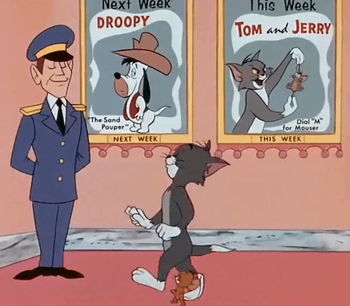
Mike: Yes, yes. And it's also weird that they changed their logo to say "II".
Jay: That makes no sense. Their company is not a sequel!
When a work or set of works that appeared to stand on its own in Real Life turns out to be fiction Very Loosely Based on a True Story in its greater universe. Spider-Man exists, and he knows people make comic books about his exploits, but they aren't necessarily accurate.
Occasionally, the producers of a new production in an existing universe want to tie it in with the current real life present, but face the problem of trying to get people to believe it's set in the real world when they obviously have the fictional product right before them.
So: Why not make that explicit? Simply make the series itself a fictionalized account of real events.
The problem this causes is that you're left with several onion-like layers of canon: That presented in the original show, and that presented in the new show presenting the original show as fiction, and of course, that of the actual real world.
This often leads to Retcon, Mind Screw, or "Rashomon"-Style, and may even allow the characters to criticize the author or the work itself. More casually they may jocularly inform the audience or the Audience Surrogate that it's not quite how it really happened, and that the story you've been reading contains some stretchers, to be sure.
This trope is related to the Direct Line to the Author with a touch of Retcon and Story Within A Story for good measure. In the case of a fictional character being the cause of a real-world or alternate canon event, see Been There, Shaped History. See also Celebrity Paradox.
Developer's Room is a subtrope specific to video games where the player can encounter the developers who programmed the game.
Often overlaps with A True Story in My Universe. Because there seems to be some confusion between Recursive Canon and Direct Line to the Author, the distinction is as follows:
- If the creator is claiming that they had transcribed/retold a story told to them by one of the characters in real life, it is Direct Line to the Author.
- If the FANS claim that the story was transcribed/retold by the creator from one of the characters in real life, it's Literary Agent Hypothesis.
- If the characters within the work claim that the work is a (perhaps fictionalized) record of events, it is A True Story in My Universe.
- Anytime the work appears within the work (regardless of if the characters say anything), then that is a Recursive Canon.
In a particular Mind Screw, if the author is not going for clarity, the work of fiction may actually create the rest of the work, or the world of the work may "exist" inside it; this is a version known as Transfictionality. The real version of the characters may discover the fictional version of the real work, or vice versa. The author may even imply that the fictionalized version is no more fictional than the outer layer, or that both shows are fictional to each other in a stable fictional loop.
Compare with Recursive Fanfiction, where a work of fanfiction becomes so popular it starts spawning its own fanfiction, and the levels are now of fandoms rather than verses.
A subtrope of Recursive Reality. See also Celebrity Paradox, Daydream Believer, "Rashomon"-Style, Mutually Fictional, Who Writes This Crap?!, Who Would Want to Watch Us?.
Not to be confused with Canon Immigrant.
Examples:
In General:
- Meta example: Many Isekai works has the protagonist be aware of other fictional Isekai works, allowing them to recognize the trope as it plays out. "I've read stories where the protagonist died and was reincarnated into another world... this must be what happened to me, too..."
By Series:
- Multiple times, volumes of The 100 Girlfriends Who Really, Really, Really, Really, Really Love You have appeared within the manga itself.
- A scene in Ayakashi Triangle has Matsuri and Suzu reading a manga featuring Reo, Matsuri's counterpart from the manga's pilot Reo × Leo.
- Codename: Sailor V:
- The anime exists within the universe of Sailor Moon which isn't exactly recursive canon because there never was a Sailor V anime. Sailor Venus DOES however sometimes read her own comic book which plays the trope straight. We're never told the actual contents of either and the main Sailor Moon franchise even seems to quietly avoid any direct references to Sailor V canon(s) in general to preserve simplicity.
- Sailor Moon manga appear (but in brief cameo roles) as do the magazines that ran Sailor V and Sailor Moon (and parodies thereof; RanRan instead of Run Run).
- Death Note has an unusual version of this - the pilot chapter mentions that a manga was written based on the "real story" it tells (well, mostly on the concept of the Death Note itself). This leads to a scene where Ryuk passes a poster for the live-action Death Note movie.
- The original Devilman show exists in the world of DEVILMAN crybaby, including an appearance from the original opening. The fictional version in Crybaby is apparently not the exact same as the real show, as an internet search for "Akira Fudo" (the protagonist of both real works) showed no results.
- Digimon:
- C'mon Digimon, the first Digimon work of fiction besides the virtual pets themselves, is about holographic technology that lets people see and hear the monsters inside the toys as if they were like real animals. Digimon V-Tamer 01, the first serialized manga in the franchise, has the same pets as C'Mon and a cameo from the C'Mon villain, but goes on to show actual Digimon existing that look nothing like the holograms, as noted by a main character. These monsters live in a world separate from Earth that God forbid humans to visit unless there was a problem the native monsters could not handle on their own.
- Digimon Tamers establishes early on that a version of the Digimon franchise exists in the world, which is later revealed to have been created after a group of bankrupt computer scientists sold to a toy company the designs and concept of, you guessed it, the prototypical digital life forms they created which evolved to become the real Digimon and associated world which form the premise of the series. Merchandise exists of said franchise, most prominently the card game, and it's implied that an anime series starring an Agumon as the lead exists (which is only implied to be the same as the real life Digimon Adventure in the original version, while in the dub more explicit references were added).
- Digimon Universe: App Monsters takes a slightly similar approach, though theirs is more of a halfway example. This universe has digital monsters in it, but they're a new variety called Appmon and are based on smartphone applications as well as having their own way of evolving into differently-named higher forms. We find out in a 20th anniversary, however, that a fictional Digimon video game by the title of "Digimon Universe" exists, and that the main character played it when he was younger. The plot of the game seems to mirror that of Digimon Adventure, and when Agumon is brought to life from the game, his role is reprised by Chika Sakamoto.
- Several times in the Doctor Slump manga the characters reference the real-life Shonen Jump magazine. Turbo even finds the truth about his dad's supposed cheating on his mom by reading the previous chapter in one issue while traveling with Midori.
- The Puma Sisters from Dominion Tank Police appear working on a stall in the Ghost in the Shell manga. A few pages later we see an in-universe advertisement for the Dominion Tank Police Manga.
- In the Fujiko F. Fujio Museum in Kawasaki, one of the exhbits depicts Doraemon reading a Doraemon comic. This also happens in at least one of the original 45 issues' covers.
- When Goku first visits West City in Dragon Ball, he passes a poster advertising Dragon Ball itself.
- Excel♡Saga having No Fourth Wall uses this right in the first episode, with Excel being assigned to kill Rikdo Koshi, the author of the original manga. He later comes to blows with Nabeshin, the creator of the anime.
- In Fatal Fury: The Motion Picture, Terry plays Fatal Fury Special. Likewise, Street Fighter Alpha: The Animation has a scene where Sakura can be seen playing as Ibuki in Super Gem Fighter. Sakura herself is actually playable in the real game.
- Franken Fran has a surgeon refuse to deal with Fran, as he knows what happens when she gets involved in surgery. How does he know? Because he read the previous volumes of the manga (pulling out one to show her).
- In one of the Fullmetal Alchemist (2003) OVAs set roughly 100 years in the future from the end of The Movie, we see posters for The Movie all over the place.
- In Gintama, Gintoki bashes his imposter Kintoki over the head with a complete collection of Gintama manga/DVDs out of the frustration of no one seeming to remember him, only to notice that he's also replaced him in the manga/DVDs in the aftermath.
- The Gundam manga Ganota no Onna reimagines Char Aznable as an Office Lady in present day Tokyo, with much of the show's cast appearing in some form or another. Despite this, Mobile Suit Gundam is treated as an actual anime within the show, with Utsuki and Amuru (Char and Amuro) portrayed as massive fans of the franchise.
- Gundam Build Fighters takes place in a 20 Minutes into the Future version of the real world, where all the other Gundam series are fiction. The producers also included a truly epic number of Gundam characters in Continuity Cameos during the course of the series, even though their respective origin shows are all supposed to be works of fiction in this universe. Including Model Suit Gunpla Builders Beginning G, which also takes place in an alternate real world where all the other Gundam series are fiction.
- SD Gundam G Generation posits that Mobile Suit Gundam: The 08th MS Team is a television drama aired in the UC 0090s, possibly with input from the people who lived the real events like Michel. Interestingly, this is done primarily to justify the existence of space-use variants of Shiro's Gundam Ez8, by suggesting that the show was so popular the writers extended the storyline beyond what really happened.
- In one of the Higurashi: When They Cry manga arcs, Akasaka writes a book based off the events of the arc.
- In I Can't Understand What My Husband Is Saying, season 2 DVDs were shown to be on sale in the convenience store Nozomu works at.
- In episode 36b of Jewelpet: Magical Change, the Jewelpets are seen watching an earlier episode of that same season of Jewelpet on television.
- JoJo's Bizarre Adventure: Stardust Crusaders opens with Jotaro in prison...reading a copy of Shonen Jump, the manga that publishes Jojo's Bizarre Adventure, though it's not made explicit if JJBA itself exists as a manga in-universe.
- Volume 2 of the Kaguya-sama: Love Is War manga makes a brief appearance in season 2 of the anime during one of Kaguya's Imagine Spots when Kei tells her how her older brother acts at home. The season 2 OVA also briefly shows the cover for volume 1 of the We Want to Talk About Kaguya spin-off.
- Lupin III: One of the few traits kept from the missing wall—style of the Manga. The franchise has no problem with the idea that Lupin has been fictionalized In-Universe.
- Lupin III reading Lupin III.
- Lupin III vs. Detective Conan, Kogoro Mouri mentions a Lupin III comic, which is a Call-Back to several earlier Detective Conan stories (particularly the eleventh movie, where a pair of bank robbers wear Lupin & Fujiko masks).
- An Arab monarch is a fan of the Lupin III television series (since this takes place in the Lupin III: Part II series, assume he means that one), so he is not surprised when the Lupin gang shows up in his country.
- Green vs. Red shows us a movie poster for The Castle of Cagliostro in one of the Lupin's rooms. (Yes, one of. Best not to ask if he's the real one.)
- Lucky Star:
- Magazine covers with the series' characters are often reproduced in-story. Also, in one case, the characters discuss the series' (Real Life) promotion event in Akibahara—Konata recommends cosplay, Kagami dislikes it as too much Pandering to the Base, and Konata answers that Kagami should accept the fact that muggles won't read that anyway. Furthermore, when the trio visit a shrine in Kyoto near the end of the series, Konata reads a prayer that says "Konata is my wife". The joke being that after the manga was published, some otaku hung such prayers at the real-life Washinomiya shrine, which was the inspiration for the shrine the Hiiragi family runs. So in the anime Konata picks one of them up, undoubtedly to the delight of the fan who wrote it.
- The anime's opening theme, Motteke! Sailor Fuku, exists within the show itself. Not only is it the song of choice for the girls' cheerleading number for their school festival, but Tsukasa is also heard humming part of it at one point in episode 6.
- The spinoff Miyakawa-ke no Kuufuku features two magazines, which covers feature this very series, in episode 9.
- Macross:
- The anime Super Dimension Fortress Macross has a movie version, Do You Remember Love?, which the producers later explained away as a propaganda video made by UN Spacy to portray the events of the TV series in a better light. The deaths of certain characters are made far more heroic, the love triangle made far more romantic, and in general, UN Spacy comes out smelling a lot better than in the TV series.
- Series creator Shoji Kawamori has gone on to say that all the Macross stories are merely second-hand retellings of real events that happened in an unseen "prime" continuity, mostly to explain the differences apparent in, say, the Macross Frontier TV series compared to the movies that followed it. This has some interesting implications for Frontier in particular, as its movies paint several maligned parties in the TV series in a much more rosier light.
- Magical Girl Lyrical Nanoha:
- The Movie is revealed in the movie Sound Stages to be a film being produced by one of the planets in the Nanoha universe, with Nanoha and Fate helping as technical advisers. The DVDs even have In-Character Commentary.
- The second movie also had its own Sound Stages and commentary where it was shown to be an in-universe movie. Its nature as recursive canon even helps to justify Graham and his familiars being Adapted Out, since it wouldn't make any sense for TSAB propaganda to show a high ranking officer condemning an innocent girl to an eternal icy prison. But wait, it gets weird. Before the second movie was released there was another Drama CD, Magical Girl Lyrical Nanoha GOD Sound Stage M, set in the Alternate Timeline of the Magical Girl Lyrical Nanoha A's Portable video games. In it, the Original Generation characters introduced in those games encounter the versions of Fate and Nanoha from the first movie. In short, the movie timeline seems to actually exist.
- Done within the same series with Martian Successor Nadesico. The Nadesico crew enjoys watching Gekiganger III, an affectionate parody of old Super Robot shows. All is fine and well until the 14th episode, where the show becomes an episode of Gekiganger III watching their favourite show, Martian Successor Nadesico. It gets even more confusing when the show ends off with it being an episode being watched by the crew of the Nadesico.
- The Monster Rancher anime started with Genki being an avid fan of the game series and being sucked into the world by a special copy of Monster Rancher 2000.
- Characters in Nichijou are often seen reading Helvetica Standard, another series by mangaka Keiichi Arawi...which features appearances by many characters from Nichijou.
- In The Stinger of Non Non Biyori - Okinawa e Ikukoto ni Natta the flight attendant offers some free mangas to read. They are shown on the screen aside the clearly readable text "Non Non Biyori".
- In the Pecola episode "Golagola", Pecola turns on the TV when he thinks Golagola wants to watch some cartoons, and it plays the show's theme song.
- A Plica movie was made while the comic strip was still going, leading to a couple of comics about Plica and Mari going to see the movie, which is ostensibly about them. No real in-story explanation is offered for this (presumably it's just because the mangaka wanted to make sure her readers knew about the movie).
- In Haré+Guu with the scene after zooming out of the TV to where Hare is hanging out and Guu watching the TV, the manga cover is seen in a closer view
- Seiyus Life has an example similar to Sailor Moon. Futaba is a fan of Hayate the Combat Butler and gets to work with Hayate's voice actress in episode 11 despite the fact that both shows take place in the same universe.
- In the third season of Sonic X, when Chaotix show up and need to be brought up to speed on what's been going on, they steal a bunch of Sonic X DVDs and watch every episode up to that point.
- In The Tower of Druaga, they spend an episode trying to reach the top of a 60 floor tower inside the tower they are in. The main hero is controlled by the other characters, as if they are playing the The Tower of Druaga arcade game. One character even has a walkthrough for the tower.
- Happy Heroes:
- According to episode 27, Happy S.'s favorite cartoon is Happy Heroes.
- In Season 4 episode 49, a robot child mentions that, thanks to the large bubble dome created by Sweet S. and covering the city, that "I can't go home to watch Happy Heroes!"
- In the first episode of Season 7, Mr. Lightbulb advertises and tries to sell in-universe DVDs of Season 6 of Happy Heroes.
- 2000 AD:
- Judge Dredd occasionally gets weird about this. 2000 AD exists in Dredd's world, and is a controlled substance. 2000 AD is best known for running the Judge Dredd comic strip.
- In Anderson: Psi-Division there's a story where a citizen in Mega City One visits a virtual reality program that features the Mighty Tharg, the alien editor of 2000 AD.
- Writer Tom DeFalco famously wrote a scene featuring Ant-Man watching an episode of the maligned Fantastic Four: The Animated Series and then complaining about how awful it was.
- In some Archie Comics, the gang can be seen reading their own comic book. The fact that they aren't disturbed by seeing themselves and their stories in print is probably because they're actually aware that they're comic book characters.
- In the Astro City universe, companies publish comic books based on the in-universe superheroes. The most popular comics are the ones officially licensed by the heroes, but some will take news events and embellish the circumstances. Comics for "fictional" heroes (Batman, Superman, etc.) also exist, but don't sell as well.
- Lampshaded in an issue of The Authority in which the team traveled to an alternate universe in which they encounter the comic book series they appear in.
- The 1980s revival of The DCU's Blackhawk showed the original 1940s series to be a comic book rendition of the team. Weng Chan, the Chinese member of the team, understandably complained about the Unfortunate Implications of his portrayal as the stereotypical caricature "Chop-Chop".
- In the Blake and Mortimer book The Septimus Wave, the events of The Yellow M (which this book acts as a sequel to) were the subject of a novel and stage play in-universe.
- Very frequent in British Humour Comics like The Beano and The Dandy with characters frequently shown reading their own comic.
- Captain Carrot and His Amazing Zoo Crew! takes place in a dimension called Earth-C, an alternate version of our world (not the DC Universe). Team leader R. Rodney Rabbit is a penciller on Justa Lotta Animals — who he later discovers are a real superhero team and who shut down the title for violating their trademarks.
- Some Chick Tracts contain Chick Tracts being used to convert people, in tracts that are supposed to be converting people.
- The Fabulous Furry Freak Brothers are startled to find a comic book with them in it. Franklin urges them to change their look so they won't be associated with those idiots, then they find their local hangout bar has a 'Freak Brothers lookalike contest' with a cash prize.
- Final Crisis: Legion of Three Worlds:
- In the DC event, the Earth Prime universe, which was destroyed in the original Crisis, is recreated. On Earth Prime, DC Comics exists exactly as it does in real life, and thus Superboy Prime's girlfriend and family find out about every horrible thing he's done by reading the same comics you're reading. Which of course depicts them reading the comics they're reading, which depicts them reading... basically an infinite level of recursive canon.
- The "Threeboot" version of the Legion of Super-Heroes was originally presented as taking place in the altered future of the DCU just as previous versions had been. In this version, the Legion was shown to have gotten their inspiration from 20th/21st century comic books featuring Superman, Batman, etc. Legion of Three Worlds revealed they were actually the future of Earth Prime, not the main DC Earth.
- The Silver Age The Flash series portrayed the Golden Age Flash's adventures as merely being a comic book series. It was not until much later that the two actually met, revealing the GA Flash's comics to be a fictionalized account of what happened on another Earth.
- Ur-Example: DC Comics' The Fox and the Crow once had its protagonist, Fauntleroy Fox, become aware that he's a comic book character. He uses the knowledge gleaned from reading back issues of The Fox and the Crow to defeat his nemesis, Crawford Crow. A desperate Crow asserted that, if the Fox ended the game in this way, it would make him the loser forever.
- In the DC Rebirth-era Harley Quinn series, the events of the DC Year of the Villain crossover tie-ins are in-universe Real-Person Fic that Harley is reading about herself.
- In one of the Justice League of America issues that was part of the Legends crossover, it was mentioned that Kenner's Super Powers Collection (a series of toys based on DC's heroes and villains) exists in the DC Universe.
- In Gilbert Hernandez's comics set in his Palomar universe, after the end of the original Love and Rockets, Fritz stars in a gangster film Very Loosely Based on a True Story about the life of her own mother Maria, causing a rift between herself and her sister Luba. Gilbert later launched a series of graphic novels that purported to be adaptations of films in which Fritz had appeared in-universe, eventually including the Maria one. He took this to even greater Mind Screw dimensions with his serial Speak of the Devil, which has the same title as one of Fritz's in-universe films but, according to Word of God, is the story of the "real" in-universe events that the film was loosely based on.
- Marvel Comics exist within the Marvel Universe. In-universe they are stories as told by a "Marvels Comics", some with the cooperation of the superheroes themselves and some only Very Loosely Based on a True Story. In at least one instance She-Hulk is seen reading an actual issue of The Savage She-Hulk. (This is further complicated by the fact that She-Hulk sometimes has No Fourth Wall, though, so she is one of a few characters who could have been reading something published by Marvel Comics or by Marvels Comics.)
- At various times, Captain America has been the artist for the in-universe Captain America comics. No, really.
- In a Fifth Week Event, the company published one-off issues of the Marvels Comics versions of most major titles, depicting how they are viewed in-universe. For some characters, like Captain America, the recursive canon version was almost indistinguishable from the usual comic, except that his secret identity was a secret. For others, like the X-Men, who have been pariahs in-universe for most of their history, they couldn't very easily be treated like superheroes. So instead, a backstory was made up for them, which supposed that they were a top-secret government project of paroled mutants, sort of like the Thunderbolts turned out to be.
- All Marvels Comics published before 2001 carry The Comics Code Authority seal. The CCA is a federal agency in the Marvel universe, making all these comics legal, federal documents. Goodman, Lieber, Kurtzberg & Holliway, the law firm She-Hulk works for, specializes in superhuman, metahuman and mutant law, keeps a complete archive of Marvels Comics from the 1930s forward as legal reference.
- All this is the result of Marvel's evolving approach to the fourth wall. In early Silver Age comics, especially the Fantastic Four, the comics referred to in the books really did seem to be the same ones you were holding in your hand, with Stan Lee and Jack Kirby making cameos fairly often and the stories supposedly being retellings of events related by the characters (helped by the FF not having secret identities), heightening the sense that Marvel comics took place in the "world outside your window". This became untenable as time went on, eventually being replaced by the modern "Marvels comics" concept; as late as 1984's "Assistant Editors' Month" event some stories still seemed to pay lip service to the notion that Marvel comics literally existed in the Marvel universe, but by the late 80s Damage Control depicted She-Hulk as breaking the fourth wall as she did in her solo book at the time, but that everyone else thought she was crazy for thinking she was a comic book character.
- In the Marvel Universe, the literary villain Fu Manchu is a real person and the father of the superhero Shang-Chi. When Spider-Man and Shang-Chi teamed up for the first time, Spidey was shocked to discover that Fu Manchu was real, as he'd always considered him a fictional person. During the Acts of Vengeance crossover in the 90s, the Red Skull also made a reference to Fu Manchu that implied he was a work of fiction.
- In Mendy And The Golem, one character in the 4th issue reads copies of the previous issues. And then he meets the main characters and shows it to them. Rivkie mentions that the artists made her look a lot younger.
- The Multiversity:
- In The Multiversity #1, Nix Uotan is reading The Multiversity comics - specifically, The Multiversity #1 and Ultra Comics #1. Looking closely at the Ultra Comics issue Nix is reading, Grant Morrison and Doug Mahnke are residents of The DCU.
- Ultra Comics itself is a particularly mind-screwy version where the main character of the book in some sense "is" the comic book itself. Not a DCU version of the comic; the actual comic you are holding.
- My Little Pony: Friendship Is Magic (IDW):
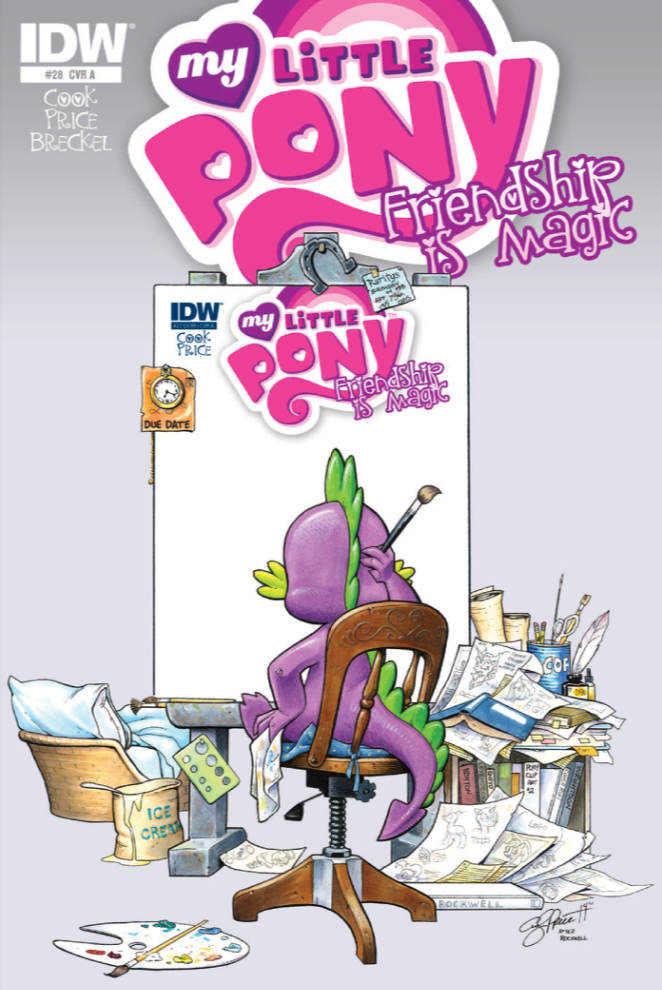
- One cover for My Little Pony: Friendship Is Magic (IDW) #28 has Spike depicted drawing coverart for the very same comics
 ◊, possibly #28 itself.
- One cover◊ for Friends Forever #30 has Twilight and Cadance holding a box with toys of themselves.
- One cover for My Little Pony: Friendship Is Magic (IDW) #28 has Spike depicted drawing coverart for the very same comics
- In Marvel's New Universe, Marvel's main universe is fiction.
- In one Paperinik story he explains to a captured petty thief how he can afford being a superhero: he tried being financed by the city, but became shackled by bureaucracy, and he tried to get corporate sponsorship (Scrooge McDuck, of course) but that also got in the way of actual, y'know, crimefighting. So in the end he sells the right to publish stories about himself to Disney, which finances his gadgetry and whatnot. Then it gets meta by way of Rule of Funny; the thief uses Donald's blabbering to escape, and he turns to the reader and, basically, says: "Please don't tell Disney Comics about this screw-up!"
- Neil Gaiman's The Sandman (1989):
- It was discovered that the Jack Kirby-created Sandman had been living a delusion in a dream dimension created by two denizens of Morpheus' realm.
- Volume 10 implies that all live-action adaptations of DC characters are dreams of the comic versions.
- In a The Simpsons comics crossover, "When Bongos Collide," it is established that Itchy and Scratchy are fictional cartoon characters within the Simpsons universe - but still has them appear as flesh-and-blood characters! The story resolves this inconsistency by having the space aliens Kodos and Kang (who themselves were originally fictional characters in a story told by Bart to Lisa in his treehouse before their in-universe Defictionalization) come to Earth and use a... trans-temporal reality thingee to cause Itchy and Scratchy to materialize out of the Simpson family TV set and become "real" beings! Later in the crossover, Bart (as "Bartman") uses the same device to materialize Radioactive Man actor Dirk Richter out of the 1950s TV show to ask for his help, only for Richter to tell Bart that Radioactive Man is fictional and that he's a real person playing him. Undeterred, Bart simply materializes the "fictional" Radioactive Man out of one of his comic books, and this RM really does have superpowers.
- In both Spirou & Fantasio and Gaston Lagaffe, the characters work on the staff of the magazine that publishes their adventures, Journal de Spirou (later Spirou Magazine, now simply Spirou). Consequently, the comic exists within its own world, and Spirou is occasionally recognized as its hero. In early stories by Jijé, he would meet members of his own fan club. In Alerte aux Zorkons a sniper refuses to fire on him and Fantasio (hanging from a Spirou-shaped advertising balloon) because he used to read the comic as a kid. A short story in one of the books has Spirou and Fantasio return to their offices, and a publisher is angry about something happening to Gaston Lagaffe. Fantasio tells him to follow the sound of rage from upstairs, but the publisher tells him it's about the comic.
- In Strange Adventures (2020), a bulk of the plot is kickstarted by a now-retired Adam Strange publishing a memoir of his previous space adventures provoking discussion on his life... which is itself titled Strange Adventures (and even features the same Doc Shaner cover art used for this series' first issue). This is around for rather postmodernist reasons: Strange Adventures (the series) is meant to raise questions on the nature of Adam Strange as a character while contextualized within various stories of his — much like how the book is about his dubious retelling of how he defeated the Pykkts during their invasion of Rann, the series juxtaposes flashbacks of the glamorous side of his traditional Space Opera adventures to the darker present-day reality writers don't generally want audiences to know about or question, overall painting Adam as a man torn between the stories he pushes onto others vs. the stories others tell about him.
- One issue of Teen Titans had them explaining to Impulse why he couldn't just release their real names to the public. He wonders why not since they're all in the Teen Titans and Justice League comics he's holding. Superboy points out that those aren't their real names. Which confuses Impulse as he's been calling Superman Dirk for months.
- The Teen Titans (2003) animated series is apparently an actual TV show in the DC Universe, as evidenced by a poster for the cartoon being present in Irey West's room in an issue of The Flash. An issue of Teen Titans had the kids briefly watching an episode of Tiny Titans. Along the same lines older DC Comics had in-universe ads for the Adam West Batman (1966) series.
- In the Raphael one shot of Teenage Mutant Ninja Turtles (Mirage), a billboard advertising Eastman and Laird's Teenage Mutant Ninja Turtles is briefly visible.
- Tintin: In Cigars of the Pharaoh, a sheik recognizes Tintin from having read all about his adventures, showing a copy of one of the books. The book was originally Tintin in America, but in the later color editions it was anachronistically changed to Destination Moon.
- Watchmen:
- In a few throw away lines a news vendor and a retired superhero in Watchmen make references to old Superman comics and in the DCU proper The Question at one point reads a copy of Watchmen and recognises Rorschach as a Captain Ersatz of himself!
- "Behind the Mask" has the first Night Owl mention he got the idea for his costume from the Blue Beetle, of whom he is a Captain Ersatz.
- WHIZ Comics #22 introduced Whitey Murphy from the Adventures of Captain Marvel film serial into the official Shazam! comic book canon. Billy referenced having met Whitey before when they supposedly made a movie about Captain Marvel during a trip to Siam, implying the serial exists in-universe as a fictionalized version of actual events.

- One very early Foxtrot Sunday strip had the strip's title panel on a newspaper Roger was reading.
- The logo box of one Garfield strip is Garfield reading the newspaper comics, with the very logo box on the front, causing a Droste Image.
- Hi and Lois: This is one possible interpretation of the November 10th, 2018 strip. When Ditto is asked if his pancake looks like a "cartoon character", he says that it resembles Beetle Bailey. Not only is Hi and Lois a Spin-Off of Beetle Bailey, but Ditto is Beetle's nephew. But if there was a cartoon in the strip's universe based on the "real" Beetle, Ditto's statement would make sense. (Given the lack of context, this might be Medium Awareness instead.)
- The 1908 musical adaptation of Little Nemo was advertised on posters displayed in several strips. One strip had Nemo recreating the Valentines scene "like I saw in the show," and discovering that he's standing on stage behind an orchestra pit. The Dancing Missionary and Gladys the cat, characters created for the theatrical production, also made occasional appearances in the strip.
- The early 1990s strip Thatch, which was primarily an Author Tract against political correctness, engaged in this. One strip had Politically Correct Person, the title character's Superhero alter ego, telling some frat boys that their plan for a Mexican-themed party is not P.C. P.C. Person asks why not drink beers from other countries and wonders if the frat boys are against those other countries as well. One of them asks if having a "water party" would be P.C. The final panel showed the school newspaper with the headline "Water Party a Fiasco." The next strip is someone showing P.C. Person the previous strip in the school newspaper, meaning the strip exists within the world of the comic strip.
- The final strip of U.S. Acres consists of the characters watching themselves on television, with Orson giving out a That's All, Folks! from the television on the last panel, complete with Porky Pig Pronunciation.
- The Bank Called, Your Reality Check Bounced is a crossover between Fullmetal Alchemist: Brotherhood and Ouran High School Host Club. Toward the end of the story, Renge (from OHSHC) is shown reading one of the volumes of the FMA manga. Prior to this, Kyouya throws Tamaki for a loop by informing him that they are not in an anime, as Tamaki believes, but are in fact in a fan fiction.
- Contractually Obligated Chaos:
- Somewhat overlapping with Direct Line to the Author, the Contractually Obligated Chaos series of Beetlejuice fanfics has a Running Gag in which Prince Vince keeps tabs on the events of the stories via his Tumblr account; the Creator In-Joke is that he follows the author's blog. Accordingly, someone actually made a Prince Vince RP blog which did follow the author, and would comment on new chapters whenever they were posted. (The blog has since been deleted.)
- Dr. Zigmund Void joins the cast in the fifth installment, and suggests that the current situation might be rectified by entering Lydia's brain and searching for subconscious clues. However, he admits he can't remember how to do that, so the solution is for those present to watch the episode of the cartoon in which that's the entire plot.
- In Empath: The Luckiest Smurf, Peyo still created The Smurfs and is responsible for its related adaptations, but it's all Very Loosely Based on a True Story that came from a certain artifact that Handy and Empath have created in "Days of Future Smurfed".
- This fanart contest on Equestria Daily is built on this trope.
- In Chrono Cross fanfic Fellowship, the game Chrono Cross exists in the universe. There is a fanbase for it. The characters draw fanarts for the characters in the game and/or play the said game in a PS emulator (except the older characters, who play it in a PS console).
- A Warhammer 40,000 example is "If the Emperor Watched TTS," a fanfic on Space Battles.com by Praetor 98. It features the Emperor and his sons watching video files of the humorous web series If the Emperor Had a Text-to-Speech Device, which pokes fun at the modern Warhammer-verse and points out the various ways they messed up and how they would eventually create the Grimdark Crapsack World of the future. In addition to lighthearted MST style riffing, the series explores what Big E and company would do to stop the horrible events of the Horus Heresy before they occur. Notable, unlike TTS' Emperor who is constantly Breaking the Fourth Wall, this series' version of the Emperor prefers a more subtle Leaning on the Fourth Wall to preserve more drama.
- In Innocence Once Lost the spinoff The History of The Human War is also an in-universe book written by Lyra that Alt!Twilight has the Canon!Mane Six read to bring them up to speed.
- Letters of Ness (created by the author of the Paper Mario X series) ends with Ness and Lucas receiving a copy of SuperSmashBros 4 (which, according to Lucas, isn't even out in Japan yet) from Paula and Kumatora, which they then proceed to play. (Take note that the story takes place in the SSBB universe.)
- The First Anniversary chapter for Manehattan's Lone Guardian features Tale of the False Paradise, an illusion-based stageplay by Burning Salamandra based on Leviathan's descriptions of Zero and Neo Arcadia, with focus given to the first game and the events leading up to it. Leviathan herself plays the role of Zero.
- In Mike's New Ghostly Family, the first three games of Five Nights at Freddy's franchise (FNaF 1, FNaF 2, and FNaF 3) exist in-universe as indie horror games released by Scott Cawthon. As it turns out, about a year prior to the beginning of fanfic's events, Mike Schmidt and the Marionette told Scott about the events of Fazbear's tragedy and the ghost children's plight, and the man agreed to retell their tale via fictional medium. Though when Fazbear Entertainment rose back to prominence, they persuaded Scott into surrendering the rights to the franchise to repaint its story as lies and jokes with their "Freddy Fazbear Virtual Experience" VR game (only to fail when the police state of Utah exposed their lies).
- In an omake for the Touhou/Pokemon crossover Monsters In Paradise, Yukari admitted to buying drinks for a young man in Tokyo during the mid-1990s and telling him of Gensokyo's existence. At the time, she believed that telling an alcoholic about Gensokyo would have no serious repercussions. Her reaction when she finally discovers much later that her conversation spawned at least seventeen games, assorted supplementary material, and a highly creative fanbase? Several minutes of stunned silence.
- My Little Pony: Camaraderie is Supernatural: When Twilight asks Pinkie Pie how she got into the former's house, the latter says she's "seen every episode."
- Reimagined Enterprise:
- One of the early twenty-first century pop songs Audrey Rocia listens to is "Faith of the Heart".
- The crew refer to the works of Larry Niven, yet there are hints that (as in Star Trek: The Animated Series) the Kzinti race exists in this setting, and they were created by Larry Niven. (This paradox is lampshaded at one point).
- In Son of the Warp, the Warhammer 40,000 game and Expanded Universe exist within itself. This is particularly bizarre, as the lore describes events of the far future in great detail.
- ToyHammer is about a guy's Warhammer 40,000 miniatures coming to life. Later, in a pitched battle against Chaos, the Present-day incarnation of The Emperor shows up.
- Cars features automobile versions of past Pixar films, including Toy Car Story, Monster Trucks Inc., and A Bug's Life (with all the characters as Volkswagens). But what would their equivalent of Cars be?
- A joke in Pleasant Goat and Big Big Wolf: Meet the Pegasus has Prince Pegasus being encouraged to confess his romantic feelings to Princess Blue and struggling to say his line, only to cop-out at the last second and say "I love watching Pleasant Goat!" instead. If this quote is anything to go by, the Pleasant Goat TV show (and presumably the films, manhua, merchandise, etc. as well) somehow exists within the Pleasant Goat universe itself.
- Elaris can be seen playing the multiplayer mode for Ratchet & Clank: Up Your Arsenal in both the Ratchet & Clank movie and its video game tie-in.
- This was actively defied in The Super Mario Bros. Movie, which has other Nintendo franchises referenced in the version of Brooklyn where Mario lives with no changes but replaces their version of Donkey Kong with a substitute called Jump Man (a Mythology Gag on Mario's original name) that has a yeti in place of Donkey Kong.
- In Camping Sauvage, Pierre-Louis sees an ad of the movie on the back of a bus he is following.
- Foolish Wives by Erich von Stroheim features a character reading a book called Foolish Wives by Erich von Stroheim.
- In the 1990s, producer Rick McCallum implied that the Indiana Jones films portray a "fictionalized" version of the character, and that the The Young Indiana Jones Chronicles TV portrays the "real" version of the character.
- The commentary track to the DVD release of The Adventures of Buckaroo Banzai Across the 8th Dimension is written under the assumption that the film is a fictionalized account of real events. The commentators go so far as to constantly explain how the events depicted differ from "what really happened", or make comparisons between Peter Weller's portrayal and that of the "real" Buckaroo.
- Russo's Return of the Living Dead movies portray the film Night of the Living Dead as a Hollywood adaptation of a true story. Characters in his films refer to it and point out aspects that don't conform to their "reality." One character in the first film moans, "You mean the movie lied?". Amusingly, in the Return universe, Night of the Living Dead is a well-known movie, but the (surely astonishing!) true events it's based on are obscure. Romero's sequels, on the other hand, are set in the same fictional universe as NotLD.
- Night of the Living Dead 3D has characters watching the original 1968 film on TV.
- The 2005 movie Bewitched is based around the conceit that witches are real, but that the 1960s TV series was fiction. Hilarity Ensues when a real witch is cast in a remake of the TV series.
- Double Dragon (1994) features an actual cabinet of the original arcade game in the scene before the final battle. The monitor of said cabinet gets smashed in an ensuing fight scene.
- In The Time Machine (2002) when Alex travels to the future to research time travel, the librarian offers him a copy of The Time Machine by H. G. Wells, as well as the 1960 George Pal film.
- Gremlins 2: The New Batch has a scene where the Gremlins attack Leonard Maltin while he's giving a bad review to the first film. Then again, this is also a movie where the film is torn in half by the Gremlins, and Hulk Hogan has to threaten the Gremlins into re-starting the movie.
- In 10 Things I Hate About You characters mention studying Shakespeare and admiring him, which is quite an odd thing to do in a Shakespeare adaptation. If they had studied the works of Shakespeare, then they would probably realise that their situation was extremely like the one in The Taming of the Shrew; and they might also note that some of them share the same name with their characters in the play.
- In Beware! The Blob; the pseudo-sequel to The Blob (1958), a man actually watches "The Blob" on TV as it attacks.
- The characters in Halloween III: Season of the Witch' watch the original Halloween (1978) on TV. Helps that Season of the Witch is a sidestory that doesn't feature Michael Myers.
- In Rumor Has It..., the main character discovers that The Graduate was based on her grandmother.
- Spaceballs: In one of several completely self-referential No Fourth Wall gags, the bad guys watch a tape of the movie they're currently in to learn where the good guys are headed. They end up stopping the tape at the exact same scene they're in, and briefly watch it in real time. Colonel Sandurz explains that, thanks to "a new breakthrough in home video marketing," it's now possible for "instant" VHS cassettes of movies to become available in stores before they've even finished filming.
- In Blazing Saddles, once the action has broken out of the Western set into the real world, the lead characters go to a movie theatre which is showing... Blazing Saddles.
- Rosencrantz, in Rosencrantz and Guildenstern Are Dead, makes a paper airplane (among other things) out of... pages of Hamlet. Or Guildenstern. They're not sure which is which. Also, they both watch a play of Hamlet. This scene occurs during the play, so they're in Hamlet movie watching a Hamlet play watching a Hamlet puppet show.
- Hellboy mentions in The Movie that he absolutely hates the comics, as they always get his eyes wrong.
- The Saint hints that the Leslie Charteris novels exist within it, and that the film hero was inspired by and is consciously imitating the prose character.
- 47, the main character of Hitman, which is based on the computer games of the same name, comes across two teenagers playing the first game of the series.
- Silent Night, Deadly Night Part 2 has an interesting example of this. The first movie features Ax-Crazy Billy Chapman, who dresses as Santa Claus and kills people. In Part 2, Billy's little brother Ricky Caldwell (they changed the family name for some reason) narrates his rise to insanity. During this time, he and his girlfriend go to a movie that is, in fact, the original Silent Night, Deadly Night; his girlfriend even describes the plot of the movie to him.
- In The Muppet Movie, Dr. Teeth and Electric Mayhem are able to rescue the other stranded Muppets because they have a copy of the movie's script.
- The Watchmen graphic novel appears in the background of one scene of the Watchmen movie.
- In the hospital scene near the end of Twilight, one can see the movie's previous scene playing on the TV.
- Apocalypse Now contains a nice reference to its source material, Conrad's Heart of Darkness. Colonel Kurtz reads from Eliot's 'The Hollow Men', which contains the epigraph 'Mistah Kurtz - he dead!'; he is reading 'From Ritual to Romance' and 'The Golden Bough', which Eliot mentions as two texts underpinning 'The Waste Land', whose epigraph was to be 'The horror! The horror!'. Both quotations are, of course, from the original Conrad.
- Subverted in Last Action Hero, Danny is sucked into his favorite movie where he ends up befriending detective Jack Slater, played by Arnold Schwarzenegger in Danny's universe (and ours), and when they go into a video store together, Danny sees a poster for The Terminator, starring Sylvester Stallone.
- The Beastmaster II: Portal Through Time features a scene where our heroes drive past a movie theater showing Beastmaster II: Portal Through Time.
Spoony: Actually they should go inside and watch it because hopefully this takes place in a parallel universe where Beastmaster II doesn't suck!
- The Wizard of Speed and Time involves the protagonist trying to sell his script for a movie which is... the one we are watching. To further shatter the Fourth Wall, the crooked producer is played by Jittlov's partner, who turned out to be... a crooked producer.
- The TRON arcade game exists in TRON: Legacy, but was created in the film by Kevin Flynn and released by Encom; real merchandise from the first movie shows up in the film as merchandise of the game.
- Wes Craven's New Nightmare is about the actors from the first Nightmare on Elm Street movie being targeted by the "real world" Freddy Krueger. The film ends with Heather Langenkamp reading the ending of the script for New Nightmare, which describes how she's reading the ending of the script for ''New Nightmare''.
- Peter Jackson's King Kong (2005) plays with this a little. A Mythology Gag about a "Fay, doing a picture with RKO" and being directed by a "Cooper" (references to Fay Wray, the original Ann Darrow; the company that produced the original King Kong (1933); and its director, Merian C. Cooper) whilst the events of the film are taking place, one scene from Denham's film as being almost identical to an interaction between Ann and Jack in the original, as well as the stage show with Kong being very similar to the sacrifice scene from the original film, right down to the identical music and depictions of the Skull Island natives. This almost seems to imply the original 1933 film was a Hollywoodised version of real events in-universe.
- As part of a Viral Marketing campaign for the first film, Michael Bay's Transformers is referred to in the Sector Seven Alternate Reality Game as a counter-information campaign by the titular organization, to cover up leaks and real events involving the existence of Cybertronians by presenting them as fictional. It even goes so far as to say Hugo Weaving is secretly a Sector Seven agent, who doubles as an actor and was put into the film (as Megatron's voice) to ensure the cover up went smoothly. It also suggests that the original G1 TV series was another such campaign.
- Played with in the opening of Twilight Zone: The Movie, in which a couple of guys driving down the highway play TV trivia games, and then discuss The Twilight Zone (1959) episodes that'd scared them as kids. One then turns into a monster and eats the other, and the Twilight Zone's theme music starts playing.
- The fictional lore of The Smurfs in our world proves to be actually true in the 2011 live-action movie, and the Smurfs try to find it because it contains the spell that can return them to their world.
- Captain America: The First Avenger: Captain America starts off as purely a propaganda character played by an actual super soldier. The real life iconic comic featuring Captain America "socking old Adolf on the jaw" also exists in universe as an adaptation of his live show. He also stars in a series of WWII movie serials as his character, all before actually becoming a war hero. Then when he first meets the Big Bad, the latter tells him (perhaps sarcastically) that he's a big fan of his films.
- Logan:
- Laura is shown to be a fan of X-Men comic books that exist in the universe of the movies. However, Logan is sure to note that they are only Very Loosely Based on a True Story.
- In a deleted scene, Laura's friend Bobby is shown playing with action figures of Wolverine and Sabretooth. He then stops and asks Logan if Sabretooth was ever real, or just a bad guy from the comic books.
- At the beginning of Pootie Tang we see Pootie, famed athlete/martial artist/movie star/etc., being interviewed by Bob Costas, who then says we're going to see a clip from Pootie's new movie. What follows is, basically, the whole movie — until the very end, when we return to the interview, with Costas commenting that that's the longest clip he's ever seen.
- As the credits roll, the final scene of Free Enterprise shows the two leads making the movie you've just watched. (They're not in it, they're directing.)
- Book of Shadows: Blair Witch 2 opens by establishing that The Blair Witch Project was fictional, while the mythology behind it was not.
- In Street Fighter, M. Bison utilizes a modified Street Fighter II arcade cabinet to detonate a series of mines.
- S.W.A.T. (2003) has a scene where the unit has the day off. In a blink-and-you'll-miss-it gag, Boxer is sacked out on his sofa watching a rerun of S.W.A.T. (1975), the TV series the movie is based on.
- The Human Centipede 2 is about someone who watched the first film and wants to recreate it. The same applies for the third film, where the first two films inspire a deranged prison warden to make the inmates into a centipede made of over 500 people.
- Same in Grave Encounters 2 - the characters in this movie are doing a documentary about the disappearance of the actors who played in the first film.
- There is a scene in Killer Tomatoes Eat France where Professor Gangreen uses small toys and figurines to illustrate his battle plan to his tomato henchmen Zoltan, Ketchuck, and Viper. One of the items he uses is his figure in the toyline of the Attack of the Killer Tomatoes animated series.
- This is unintentionally done in Jem and the Holograms (2015). In some of the clips they use of Jem's fans (which are taken out of context; the fans were talking about the original cartoon, not the pop star in the film), you can see television sets in the background of some of the clips playing the original cartoon.
- In The Rocky Horror Picture Show sequel, Shock Treatment, a copy of TIME Magazine can be seen on Betty's desk with a picture of the iconic Rocky Horror lips and "Cult Films" written on the cover.
- In T2 Trainspotting, Spud starts writing down his memories of things that happened as a way to keep himself occupied while he's trying to get off heroin, and they turn out to be the original stories that make up the novel.
- The Great Gatsby uses Nick's stay in an asylum after Gatsby's death as the frame, and the last shot reveals that Nick has written the novel but decided not to take credit.
- In Shazam, real world action figures from the Justice League (2017) movie are seen in a toy store. Presumably, in this continuity, the toys were modeled after the real heroes who helped save the planet from Steppenwolf.
- One of Logan's thugs in Dead Rising: Watchtower can be seen playing Dead Rising 3. Especially confusing as Watchtower canonically takes place before 3.
- A poster for the original Grease can be seen in the background of the Grease: Lives remake.
- In Repo Men, Remy ends up calling his book The Repossession Mambo. Same name as the novel that the movie is based on.
- In Jabberwocky, a man performs a puppet show while reciting Lewis Carroll's original Jabberwock poem.
- In D3: The Mighty Ducks, it's established in-universe that the NHL team was specifically named after Gordon Bombay's team once they rose to national prominence. In real life, the then-Disney-owned Mighty Ducks of Anaheim expansion team was piggybacking off the success of the first movie the previous year, in a overt display of corporate synergy.
- In Dr. Terror's House of Horrors, one of the main characters walks past a poster advertising the film Dr. Terror's House of Horrors. This occurs in an Alternate Timeline that ultimately doesn't happen - but that only makes it even more of a Mind Screw.
- In 8 Mile, Rabbit is seen at one point scribbling on his mountain of lyric sheets. Since these were Eminem's real papers, one of them is visibly written on a page of the 8 Mile script.
- In Lemony Snicket: The Unauthorized Autobiography, it was strongly suggested that the A Series of Unfortunate Events books exists in the eponymous universe. In addition, the Lemony Narrator is himself a character of the books - which he dedicates to his deceased beloved, Beatrice. When you really think about it, the whole idea sounds rather stalkerish. The final book The End explains this as A Series of Unfortunate Events is actually a chronicle written by inhabitants of the Island by many authors, including the Baudelaires' parents. Lemony is just the latest author, and the events we're reading are just one of many, regarding hundreds of people.
- The sequel of The City of Dreaming Books mentions The City of Dreaming Books as a book in-universe. Which makes sense, since it is an autobiographical piece the main character wrote. And doesn't make sense since Moers explicitly says it's a compilation of the first two volumes of a longer series and was never published as one book in universe.
- Thursday Next has this in spades. Two different fictional versions of Thursday — i.e., the character we observed in earlier books — play a role in the fifth book of the series. On top of that, the Thursday Next series is mutually recursive with the same author's Nursery Crime series, in that each book is fictional within the context of the other. The sixth TN book exaggerates this by revealing that all five of the previous books were the in-universe fictionalized versions, and in some cases bear no resemblance to what actually happened.
- Adventures of Huckleberry Finn: "You don't know about me without you have read a book by the name of The Adventures of Tom Sawyer; but that ain't no matter. That book was made by Mr. Mark Twain, and he told the truth, mainly."
- Philip José Farmer wrote a famous series called World of Tiers, set in a Multiverse that included our own universe. These books were used to create "Tiersian" psychotherapy in the real world. Farmer then wrote another book, Red Orc's Rage about a form of real world psychotherapy based on the novels.
- In Jules Verne's The Mysterious Island, first it's established that the novel is set in the same universe as In Search of the Castaways and 20,000 Leagues Under the Sea ... and then it's revealed that one of the characters has actually read the latter book.
- The Number of the Beast by Robert A. Heinlein is confusing. It starts out with only modern canon weirdness, as the main characters visit worlds they know are fictional (like Oz). Then they meet up with a character from an earlier series by the same author, they know he's fictional and then he reveals that they are too, since he only knew where to meet them by reading their stories. The first of which was this book.
- In Bret Easton Ellis' Lunar Park, a character from American Psycho shows up, holding a copy of American Psycho, to talk to Bret Easton Ellis, who wrote American Psycho, about murders inspired by American Psycho.
- The Neverending Story by Michael Ende is a novel in which the main character, Bastian, finds a copy of The Neverending Story, and begins to read it. Bastian finally realizes that the story is more than just a story, when he gets to the part where a character in the book starts retelling the story word-for-word from the beginning — and starts not with the first chapter of the story within the story, but with the beginning of the exterior story: the one you're reading, in which Bastian is the main character.
- Another example by the same author is the Jim Button series. The second book contains a chapter where Jim und Luke receive a bag of fan mail from readers of the first book. The narrator even assures the reader that his or her letter is in this mail.
- In Diana Wynne Jones's Archer's Goon, this is briefly the case for the main story. How does this come about? Because Archer thinks that Quentin's words must be recursively fictional (i.e. that whatever Quentin writes as fiction turns out to be real), and consequently replaces Quentin's confiscated typewriter with one that is rigged to do exactly that. This allows Quentin, eventually, to manipulate reality by typing what he wants to happen.
- House of Leaves has one of the central characters reading a book called, yes, House of Leaves, which certainly appears to be the same one that the reader is holding in their hands. Of course, this character exists only within a documentary which doesn't appear to exist in the narrator's universe and may or may not have been entirely invented by another character, presumably meaning that the book exists within the documentary's universe but not within Johnny Truant's universe, at least until it's written down by Johnny, which doesn't happen until well after the documentary would have been made, assuming said documentary and its participants actually existed, and... I don't even know.
- Tolkien's Legendarium:
- In The Lord of the Rings, Gandalf discusses with Frodo how he began to suspect Bilbo's magic ring was an evil influence when he lied about it in the first edition of his biography, There And Back Again: A Hobbit's Holiday. When going through Bilbo's papers after the war, Frodo went back and revised the section on Gollum's cave to explain what really happened.
- The entirety of The Hobbit and The Lord Of The Rings and its appendices are supposedly transcriptions from the Red Book of Westmarch, written by Bilbo and later Frodo. They're called "The Downfall of the Lord of the Rings and the Return of the King." The Silmarillion and other stories of Elvish heroes are from Bilbo's three-volume work "Translations from the Elvish."
- The epilogue of Wolves of the Calla. Just...that epilogue. And it causes Callahan to have a Heroic BSoD.
- The Dark Tower really takes it to the level of Recursive Reality. For instance, Eddie Dean determines that Co-Op City is in Brooklyn only in the fictional version of The Multiverse he's from, not the real version where it's in the Bronx, because, of course, Stephen King didn't do the research at the time.
- When the detectives in Mr. Mercedes find the clown mask that the killer used to hide his identity, one comments that it reminds him of "that TV movie about the clown in the sewer." The other later watches the film and admits the resemblance.
- In Gene Roddenberry's novelization of Star Trek: The Motion Picture, it is asserted that the original Star Trek was a dramatization of the actual adventures of the Enterprise and that certain things were exaggerated or distorted for dramatic effect. This was Roddenberry's way of distancing himself from elements in the original series that he was unsatisfied with due to budgetary or technical limitations (for instance, after the Klingons were redesigned in the movie, Roddenberry told Trek fans to pretend they'd always looked that way.)
- A character in one of Enid Blyton's Secret Seven stories asks about Five Go Down To The Sea, part of another series by the same author.
- The Oz books are an interesting case; L. Frank Baum always included a "note to his readers" in the beginning of each book, and in the first few books he talks about writing the book, even thanking children for the ideas they've sent him, but gradually he begins talking about Oz more as if it's a real place, and he's just recounting events as they were told to him by Dorothy. In later books, new visitors to Oz, such as Betsy Bobbin and Trot, are familiar with the land of Oz and its inhabitants from having read the previous books.
- In Yankee in Oz by Ruth Plumly Thompson, this trope is especially notable. Tompy is not only familiar with Oz from having read the books, but at the end starts reading the book in which Jinnicky, who he had met in this story, first appeared.
- In the Virals series, the spin off to the Temperance Brennan novels (adapted into the Bones TV series), the protagonist Tory Brennan is Temperance "Bones" Brennan's niece who gets canine abilities in a Freak Lab Accident. She mentions watching Bones with her father despite actually interacting with Bones herself.
- At the end of Winston Groom's Gump & Co., the sequel to his Forrest Gump novel that the film is based on, Forrest is at the Oscar ceremony that's awarding Best Picture... to the film adaptation of his life. He also gets to meet Tom Hanks.
- In the Sherlock Holmes universe, Watson and Holmes are both aware that Watson is writing and publishing stories about Holmes's career. Holmes disapproves of the sensationalistic tone of Watson's stories.
- In Kevin J. Anderson's Dan Shamble, Zombie P.I. novels, the undead detective's exploits become the inspiration for a series of mystery novels. The first one shares a title with the actual first book in the series, whose events it documents, albeit with a lot more Fanservice.
- The Magic: The Gathering novel Arena describes card players playing a card game much like Magic: The Gathering. The Greensleeves trilogy describes a metal bird dropping a metal egg during a vision of the multiverse, which could either be the description of an artifact creature, or a jet plane from Earth, the planet that publishes Magic: The Gathering.
- The second Princess Diaries book has Mia reference a movie that's come out based on her life. It isn't explicitly stated that it's the same movie with Anne Hathaway that came out in our world, but the references she makes (like cutting out some of the characters) are consistent.
- The main protagonist of Relativity is a superhero named Black Torrent, but his father was the original Black Torrent. In-universe, there exists a series of comic books about the original Torrent, but he's never read them. Since he was set-up to be more of a secret government agent than a superhero, the writers of the comic had little clue about what his actual adventures were and had to make up a lot of it.
- Doctor Who Expanded Universe:
- Some parts of the Expanded Universe have taken it further, with a conspiracy theorist claiming that the Doctor deliberately creates fictional stories of himself on many worlds so that no one believes he really exists.
- Another Expanded Universe story suggested that the Aaru Doctor Who films starring Peter Cushing exist in-universe, as a highly decayed adaptation of a series of novels that Barbara Wright wrote based on her experiences travelling with the Doctor. The novelisation of The Day of the Doctor states that the Doctor himself is a big fan of the movies and even considered taking the TARDIS back to the 1960s to persuade Cushing to make a third one.
- According to a COVID-19 webcast, Doctor Who is a show that can be watched on the BBC iPlayer in their universe. However, we don't know if this version of the show matches ours.
- Vernor Vinge's A Deepness in the Sky is partially recursive. It uses a Switching P.O.V. that alternates between chapters focusing on a group of humans lurking in orbit around a planet inhabited by non-spacefaring aliens and studying them, and chapters focusing on the aliens themselves. Near the end of the book, it is revealed/heavily implied that all of the alien-POV passages in the novel were written In-Universe by a human translator monitoring the aliens' communications and directly communicating with one of them.
- The first book of The Vampire Chronicles — Interview With The Vampire— is written as if it is Louis telling his story; the sequel, The Vampire Lestat, has the title character encountering the original book and noting what liberties Louis took with the story, allowing a graceful Retcon of the character from the villain to the hero.
- One of the novels in the series The Destroyer features the character looking at a movie poster and mocking everything about it— the poster being an exact description of Remo Williams: The Adventure Begins, which is based on the Destroyer novels.
- Dumbledore's forward in The Tales of Beedle the Bard imply that the Harry Potter books are biographies based on Harry's life written by an in-universe J. K. Rowling.
- In the Phillip K. Dick short story The Day Mr. Computer Fell Out Of Its Tree, an over-arching digital intelligence that controls all devices everywhere goes completely mental one morning, with root beer coming out of the taps and doors locking themselves for no reason. One character, on discovering this, remarks internally that 'It's been reading old Phil Dick science fiction stories'.
- Babel-17 by Samuel R. Delany has an amusingly twisted example. Rydra Wong and her shipmate Ron start talking about "'Empire Star' and other Comet Jo stories", written by Muels Aranlyde, and Wong explains that Comet Jo is a real person who she knows, but that the stories are only loosely based on reality. Empire Star is actually a novella by Delany, and its protagonist is named Comet Jo. So you're left to wonder if Delany's novella is fact or fiction from the perspective of Babel-17's characters.
- At the end of Marcel Proust's A la recherche de temps perdu, you realize that the Narrator is preparing to write everything you just read.
- You Only Live Twice asserts that a series of thriller novels based on James Bond's adventures have been published. This also led to the weirdest of the James Bond continuation novels, John Pearson's James Bond: The Authorised Biography of 007, in which Pearson catches up with the real James Bond, on whom Ian Fleming based his novels. In turn, this means that in Pearson's version of the Bond universe, Fleming's You Only Live Twice mentions that there are works of fiction based on the real exploits of the hero of his fictions, which were themselves based on a real person, who is of course fictional to us, Pearson's readers.
- The New Adventures of Elektronik by Yevgeny Veltistov start with the titular robot watching the 1979 TV movie based on the earlier books, and complaining about how it's Very Loosely Based on a True Story.
- In Michael Connelly's Harry Bosch and Mickey Haller series, the films of Connelly's novels Blood Work and The Lincoln Lawyer and the Prime Video series Bosch exist as adaptations of the actual events that took place in the fictional Los Angeles where the books are set. Bosch remarks at one point that Terry McCaleb, the protagonist of Blood Work, doesn't really look much like Clint Eastwood, and Terry's neighbor Buddy Lockridge complains about the way he was portrayed in the film; Haller, a born Angeleno raised in a bilingual household by an Irish-American father and Mexican mother, begins affecting a Texan accent in imitation of Matthew McConaughey in the books published after the 2011 film of his debut novel, The Lincoln Lawyer; and the Bosch Amazon series is mentioned as being loosely based on several of Harry's past cases.
- War of the Worlds reveals that the 1938 Radio Drama was part of a government disinformation campaign to cover up a real invasion. The 1953 film, on the other hand, is in-continuity. It also acknowledges that the original H. G. Wells novel on which the radio drama was based exists in-universe. This is feasible because the 1953 movie has practically nothing in common with the book beyond a few broad strokes that could credibly be coincidence.
- Doctor Who:
- Borderline example in the 25th anniversary serial "Remembrance of the Daleks", which is a sequel to the original pilot episode and is set in the same place and time; at one point we hear a BBC continuity voice announcing the time and date the first episode of "a new science-fiction serial" was broadcast — it's cut short just before the full name of the series is actually dropped, with only the first syllable being revealed: "Doc".
- In "In the Forest of the Night", a poster advertising Doctor Who is seen on a bus in the background.
- One of the thousands of channels in the Ninth Doctor story "The Long Game" appears to be airing the Fourth Doctor story "The Leisure Hive". Justified as it may just be showing the planet the older story was set on.
- Some books have the Peter Cushing movies, Dr. Who and the Daleks and Daleks' Invasion Earth: 2150 A.D. as being in-universe movies made after Ian and Barbara sold their story to Amicus Productions.
- The opening scene of the short-lived sitcom version of Ferris Bueller's Day Off explained that the movie was a fictionalized retelling of the real Ferris Bueller's life, with the "real" Ferris (Charlie Schlatter) criticizing Matthew Broderick's portrayal of himself. He then takes a chainsaw to a cutout of Broderick.
- The ARG The Lost Experience acknowledges Lost as a fictional TV series which incorporates "real" elements such as The Hanso Foundation and the Widmore family.
- MADtv (1995)
- In one episode you can actually see an extra reading an issue of MAD.
- In another episode, House (played by Michael McDonald) is actually watching an episode of MADtv (1995). It features Stuart (played by Michael McDonald) causing him to remark that he looks just like him.
- In the third episode of Black Lightning, Grace tells Anissa about a comic book series called The Outsiders, and even shows her an issue. In real life, The Outsiders has featured Black Lightning, Anissa and Grace as major characters at various points in its publication history. In the same episode, Anissa dresses as Catwoman (or possibly an Expy) for a costume party, and Grace mentions Supergirl as another potential costume choice, implying those heroines are also fictional in this universe. In the real comics, Catwoman and Supergirl have actually interacted with Grace on a few occasions.
- The last episode of Swamp Thing reveals that Daniel Cassidy (the alter ego of Blue Devil) owns some of the actual Blue Devil comics DC published back in the 80s.
- Sliders has a variation. In the finale, the group slides to a world where a "seer" has been watching them psychically across the multiverse. He turned the visions into paintings, books, and ultimately, a live-action TV show that looks vaguely familiar...
- There is a Nick Verse that exists with various Nickelodeon shows, mostly centered on the works produced by Dan Schneider. Continuity is played fast and loose, with later series often implying that previous ones are both within the same continuity and Show Within a Show. For example, one episode of Victorious has a character refer to an episode of Drake & Josh, indicating it's a television series in that continuity. But another episode has a supporting character from that series appear...
- El Chapulín Colorado comic books exist in El Chavo del ocho. Chavo and Quico once discussed a Chapulin episode where a villain painted himself invisible. (Said episode was real) And the two series did have a crossover. Don Ramon was reading a Chapulin comic in a Chapulin episode.
- One Nowhere Man episode involved the Government Conspiracy created a television show based on the main character's life, named after the show with almost shot-for-shot recreations, but with bad acting and camera work, and it even got to the point where they were filming real time what was happening, in a subversion of PostModernism, where he had to do things out of character in order to defeat their plans.
- The original Star Trek television series, featuring the starship NCC-1701 Enterprise, was so popular that a massive write-in campaign convinced NASA to name the first real-life space shuttle OV-101 Enterprise. Much later, when Star Trek: Enterprise (a prequel to the original Star Trek) was created, there were several almost-explicit references implying that the NX-01 Enterprise was indeed named after the space shuttle. Let's recap: the fictional NX-01 was named after the real OV-101, which was named after the fictional NCC-1701, which was named (in-universe) after the NX-01. It gets even weirder if you know an original proposed name for OV-101 was "Constitution". Which would mean that the Constitution Class USS Enterprise NCC-1701 was named for the NX-01 Enterprise which was named for the OV-101 Enterprise.
- Star Trek: Deep Space Nine: The producers considered concluding "Far Beyond the Stars" by showing Benny Russell directing an episode of a TV show called Deep Space Nine, but thought this would cause too much of a canon snarl. (They also considered ending the series with a shot of Benny Russell finishing writing his Deep Space Nine story, but nixed that too.)
- Supernatural:
- While the TV series Supernatural doesn't exist within the show, there is a series of in-universe novels that is identical to the TV show in every other way, with each novel corresponding to a similarly titled episode. This allows for a whole heap of meta episodes, but also has significant plot relevance, as the in-universe explanation is that the writer of the series is a prophet who wrote the series based on his visions. This sometimes allows the characters to find out information by asking the author himself. In another twist, at the end of season 5 it's implied that Supernatural's author was quite literally God in disguise all along, which was later confirmed in season 11.
- In season 6, the characters are thrown into an alternate reality, in which they take the place of "Jared" and "Jensen", two actors in a series called "Supernatural". In short, the actors are playing characters who are playing the actors who play them.
- In season 10, the characters find themselves investigating events surrounding a play, which is basically a musical slashfic of the novels. And, unknown to Sam and Dean, the prophetic author of the novels was involved in the production of the musical play.
- In Superman & Lois, Jordan is sometimes seen playing Injustice 2, a fighting game that features his father as a playable character and the death of his mother as a significant plot point.
- At the end of the Burke's Law episode "Who Killed Purity Mather?" the Girl of the Week switches on the TV in Amos Burke's limo and begins to watch an episode of... Burke's Law!
- This is actually canon within the world of Heroes. Isaac Mendez is a precog whose visions come out through his artwork. He created a comic book 9th Wonders which contains much of the plot of the first few seasons.
- Although not quite in-universe, one PBS promo for As Time Goes By was Jean and Lionel settling in for a quiet evening and deciding to watch... As Time Goes By.
Jean: [pointing at the screen] She's very good.
- One episode of Mad About You featured a crossover with Seinfeld, where the latter series' Kramer is shown to be the current tenant of the former series' Paul's apartment. However, a later episode of Seinfeld shows George and his fiancée Susan watching Mad About You on TV.
- In one episode ("Lost and Found in Translation"), the three leads of Power Rangers: Dino Thunder sit down for a bit of satellite TV and find themselves watching a badly dubbed episode of the series their show is based on, Bakuryuu Sentai Abaranger. At first they're appalled by how silly the show makes them look, but in the end they develop a bemused affection for it.
- Mimpi Metropolitan: In episode 47, Mami Bibir tries to talk to Melani (played by Faradilla Yoshi) about a sitcom named Mimpi Metropolitan and particularly one of its star Faradilla Yoshi, but Melani doesn't pay attention.
- Breaking Bad: In the episode "Rabid Dog", if one looks closely at the shelf in the Schrader house right before filming Jesse's confession, there's a DVD copy of Breaking Bad visible momentarily, at the very edge of the screen, amongst the books.
- There's an Old Master Q strip where the three protagonists, Master Q, Big Potato and Mr. Chin, buys tickets for their own (then-upcoming) movie, Older Master Cute (1981). Prompting the surprised ticket seller to perform a Double Take.
- Eminem:
- In the skit at the end of Relapse, Steve Berman is heard listening to the Relapse track "Old Time's Sake" in his office, when Eminem presents him with the demo of his Relapse CD for the first time.
- In "Bad Guy" from The Marshall Mathers LP 2, Matthew - the Loony Fan mudering Eminem for what he did to his brother Stan, admonishes Eminem for releasing a sequel to The Marshall Mathers LP "to get people to buy!"... on a song which is the Album Intro Track for The Marshall Mathers LP 2 itself. "Bad Guy" is also a sequel to "Stan", a song from The Marshall Mathers LP - Matthew plays the album to Eminem in the car to harass him.
- Prior to this in the "Stan" saga, Stan is shown with a vinyl copy of The Marshall Mathers LP on his table while writing his letters in the music video. The Marshall Mathers LP is the album "Stan" is on.
- In Stern Pinball's The Sopranos, you're playing through the exploits of the Soprano family... which includes completing Episodes from HBO's The Sopranos television show.
- Gottlieb's Mayfair, based on the film version of My Fair Lady, shows Eliza walking past a theater that is holding a production of My Fair Lady.
- The backglass for Capcom's Breakshot (1996) shows several people playing pool in a rec room, which has a Breakshot pinball machine in the corner.
- New World of Darkness:
- Frankenstein's Monster was the first of his Lineage of Prometheans. When he tried to create a "bride," he ended up making a horrific monstrosity in human form. One way the "bride' got revenge was by telling Mary Shelley a story that painted him in the worst possible light, thus spawning Frankenstein, or, The Modern Prometheus.
- Vampire: The Requiem: Every vampire in London was scrambling for a while to find out who spilled the beans on Dracula to Bram Stoker.
- The Dresden Files RPG is stated to exist in the universe of the novels, having been written by Harry's friend Billy for the same reason that Bram Stoker wrote Dracula, to spread information about monsters and their weaknesses to the common man. The game book is filled with margin notes from Harry, Billy, and Bob, and the implication is that it's a Roman à Clef, but this isn't the final version and so none of the names have been changed yet.
- Later editions of BattleTech mention the cartoon series as an in-universe propaganda holo-vid that's Very Loosely Based on a True Story.
- Older Than Steam: In Hamlet, Polonius mentions that he played Caesar in Julius Caesar. Possibly also an Actor Allusion if the same (original) actor played both roles... Or, given that most plays at the time (including Shakespeare's) were retellings of earlier tales, Polonius's reference could've been to some earlier playwright's version of Julius Caesar.
- Lampshaded in Steve Martin's adaptation of the 1910 farce by Carl Sternheim, The Underpants. Gertrude says that she has just seen a comedy by Sternheim; when Louise asks if she should see it, Gertrude says "Wait until it's adapted."
- Car Talk: The Musical had Car Talk playing on the radio at the beginning of one scene.
- In RENT, during "La Vie Boheme," Mark mentions "Musetta's Waltz" by name. This means that La Bohème exists within the world of RENT, which is loosely based on it, right down to most of the characters having similar or even the same names.
- Courtney Moore from the American Girls Collection was given a Molly doll in her stories, which took place during the year American Girl was founded. Assuming that the characters do have a shared universe, it could be implied that Molly and the rest of the cast were real people in the American Girl mythos and that their toys and stories were based on their lives.
- Mario Universe:
- At the Yoshi theater in Mario & Luigi: Superstar Saga, one of the films that are set to play is Mario & Luigi. It's referred to as an action blockbuster. The end of the game reveals that the game itself was this film.
- In Paper Mario: The Thousand-Year Door an NPC gushes about this new game he has called "Paper Mario: The Thousand Year Door". If you talk to him in the middle of the game he says he already beat it and the ending is amazing. In addition, the ending sequence mentions that Flurrie and Doopliss are performing a play based on the events of the game... but since the battle system is itself "onstage", it's implied that you might be playing the play. Which means that the play refers to itself...
- Donkey Kong Country 3: Dixie Kong's Double Trouble!: Wrinkly Kong has a Nintendo 64 in her house and sometimes she is playing Super Mario 64, Peach's Castle theme can be heard.
- Donkey Kong Country: Tropical Freeze: One of the games Donkey Kong may play on his 3DS within his Idle Animation is Donkey Kong Country Returns 3D
- The plot of the WarioWare series is about Wario opening a video game company and selling compilations of microgames, short games that last only 5 seconds, and as a nostalgic bonus, many of those microgames are based on classic Nintendo videogames but converted into very short versions, however, some of these microgames are based on Mario games, Yoshi games, Donkey Kong games and even Wario Land games, a more justifiable example, is when even microgames from previous WarioWare games for the Game Boy Advance are included, and they are shown running in a GBA in your screen.
- TRON 2.0 states that the events in the original TRON movie happened, and then the rights to the story were sold to Disney, who made a movie about it. The opening scene of the game begins with the main character playing an old TRON arcade cabinet. A second Tron arcade game is rigged to an archaic modem and used by Alan to hack into the system, create Mercury, and try to contact Jet.
- In Bitcoin Billionaire, there is a poster for Bitcoin Billionaire: The Movie.
- In Completing the Mission, selecting the "Walkthrough" option results in Henry watching a Let's Play of his own game. Unfortunately for him, the let's-player selects the "Walkthrough" option, causing the entire scene to loop continuously until the player clicks out of it.
- In Legend of the Cryptids, the Curious Witch of Sabato is playing Legend of the Cryptids on a smartphone.
- The Myst video game series is based — or so Canon claims — on the actual journals of the characters, but the games are heavily abridged versions of the "real" events, and starring a faceless, sexless Stranger instead of the as of yet unnamed real character. This was taken further with the release of Uru: Ages Beyond Myst, which tells the story of modern-day archeologists exploring the caverns of D'ni, and even further still in Myst V: End of Ages, which tries to specificise some events hinted at in Uru. It was finally taken to the Kayfabe level, where Cyan Worlds employees often present the idea that all of the Myst series, including Myst V and Uru, exist as fictionalized accounts of real events.
- In Scribblenauts, one of the objects Maxwell can summon is the game cartridge itself.
- The "plot" (such as it is) of We Love Katamari is driven by the idea that, following the success of the first game, Katamari Damacy, the stars (that is, the King of All Cosmos and the Prince) have become hugely popular, and must therefore answer requests from adoring fans. Things get sillier when the King convinces himself that he owes his huge popularity to his stylish, captivating chin.
- Kero Blaster: Kero Blaster is a game in both its prequels Pink Hour and Pink Heaven, while Pink Hour itself is a game within Pink Hour.
- Hideo Kojima's Policenauts is referenced in Metal Gear Solid in a poster in Otacon's lab, where it is implied in one scene that it was one of the animes that inspired Otacon to get into mechanical engineering. Nobody seems to bring up the fact that Meryl Silverburgh has the same name, likeness, and occupation of a character in Policenauts. In the Nintendo GameCube remake, The Twin Snakes, the Policenauts poster is replaced with a Zone of the Enders: The 2nd Runner poster; Metal Gear Solid 4, during the return to Shadow Moses, features the ZOE 2 poster, with one corner having come off to reveal the original Policenauts poster underneath.
"It's just like one of my Japanese Animes!"
- In Duke Nukem 3D, a Duke Nukem arcade cabinet can be found in the first level, and has on it his appearance from the previous platformer games. Using it provokes the quip "Hmm... don't have time to play with myself." Likewise in Duke Nukem Forever, we find out that the first level of the game is a recreation of the final boss from 3D, and when the level is over, we pan out of a TV screen to see that Duke himself is playing a video game based off himself, all while one of the game developer's spokeswomen was... shall we say... "helping herself" to him while he was playing.
- One NPC in EarthBound (1994) wonders if EarthBound has been released yet. In addition, the newspaper headline in Onett after beating the Final Boss is "Chief Strong finishes EarthBound, asks 'Where is the sequel?'"
- In Goat Simulator, the developers office can be found, and several computers are already running Goat Simulator. In Goat MMO Simulator, the servers running the game can be found and trashed, causing the game to crash.
- Metro 2033 has several copies of the book Metro 2033 as well as posters for the book scattered around the place. Would makes sense that it was a popular book after the apocalypse though, seeing as it predicted the whole damn situation everyone is in.
- In City of Heroes there are pinball machines◊ of the game.
- It's actually a plot point in Day of the Tentacle that Doctor Fred never saw a penny from "the video game based on his family" since he locked the contract in his safe and forgot the combination. When Hoagie mails the contract via the Pony Express 200 years in the past, LucasArts calls Dr. Fred to inform him they found the contract and pay him $2 million in royalties.
- One cutscene from Stinkoman 20X6 showed Stinkoman playing... ...Stinkoman 20X6.
- In Mass Effect 2, the first two Mass Effect novels, Revelation and Ascension, are available in-universe as dramatizations of the actual events written by human author Drew Karpyshyn. One of the ads you can encounter on the Citadel is for a film, Citadel, based on the events of the first game.
- Mega Man:
- In Mega Man Legends, the video game store in Apple Mart apparently stocks the game Mega Man Legends.
- The Mega Man (Classic) games exist within Mega Man Legends, itself a distant future of those games. MegaMan Volnutt got his name because Roll is such a huge fan of those games.
- The Neo Geo Double Dragon fighting game based on the movie has a stage where production stills from the movie are displayed on a large monitor.
- In Glitch, it is possible to create a Glitch video game.
- The Simpsons arcade game in The Simpsons arcade game.
- The Simpsons Game: The Simpsons find the manual to The Simpsons Game, confront God, and find out they are video game characters in The Simpsons Game, a video game in a much larger video game, The Planet Earth, in The Simpsons Game, being played by Ralph Wiggum, who notices the player playing The Simpsons Game.
- In Star Parodier, not only is the PC Engine a player character, it has Super Star Soldier in its HuCard slot during the opening Fighter-Launching Sequence.
- The Sims:
- In The Sims 2, it was possible to obtain the PlayStation 2 version of The Sims. The penultimate expansion pack has Rod Humble gift every household a computer with The Sims 3 preinstalled.
- The Sims 4 features a video game called Sims Forever that Sims can play on their computers; it is in fact the original The Sims. Upgrade a computer's graphics and The Sims 2 or eventually The Sims 3 will take the place of the original.
- One of Heaven's fate structures in Afterlife (1996) is... Game of After Life.
- In Devil Summoner: Soul Hackers negotiating with certain demons will reveal that they are playing a game called Soul Hackers, and then show that they are at the part where they meet the hero in the game. This freaks them out.
- In Final Fantasy Tactics Advance, the opening cutscene mentions the Final Fantasy games. Then as the protagonist spends enough time in Ivalice, with Moogles and such, he notices his hometown somewhat became a Final Fantasy game.
- Throughout Stauf Manor in the PC game The 11th Hour, you can find boxes of its predecessor, The 7th Guest. A CD of the game is even the solution to one of the fetch quests you're assigned.
- The first-gen Pokémon games allow you to visit Game Freak studios, and talk to a sprite artist who drew the player character for the Pokémon games. This was kept in all future games in the franchise as well, where there would be somewhere you could talk to Game Freak staff members and the Director would usually give you a certificate for completing the Pokédex.
- In HeartGold/SoulSilver, the Director will comment on how hard it is to make a remake of a classic game.
- In earlier games, mostly the first and second generation, you can find NPCs playing Pokémon on a Game Boy. For an extra level of strangeness, trading a Pokémon with one of them produces the usual animation of a link cable connecting two consoles, as if you've physically linked your real Game Boy to their virtual one. The Let's Go remakes made a Mythology Gag out of this with a floor in Celadon Department Store selling Switch consoles, Pokémon Quest, and a game suspiciously similar to the one you're playing.
- Sierra games are a combination of Recursive Canon, Continuity Cameo and Creator Cameo, resulting in a loose Canon Welding.
- Leisure Suit Larry 4 is a missing game in Leisure Suit Larry 5, and appears in Space Quest IV. Interestingly, it's a plot point in both: after Larry and Patti got together at the end of Leisure Suit Larry 3, they're separated again at the start of LSL5 and have no clue why because of the missing game. In SQIV, recurring nemesis Vohaul uploaded himself into a disc for LSL4, and the Xenonian scientists were so eager to play it that they installed it (and him) onto Xenon's planet-controlling supercomputer.
- Space Quest IV also has the Space Quest IV computer program and the Space Quest IV hint book, with Ridiculous Future Sequelisation as future time periods.
- The company Sierra On-Line is found in King's Quest IV, Leisure Suit Larry 3, and Space Quest III, and is mentioned in Space Quest IV.
- Rosella re-enacts a scene from King's Quest IV, in the real world of Leisure Suit Larry 3.
- The Hoyle Book of Games has characters recounting adventures from the games alongside a game programmer.
- Magazines and guidebooks further support a Direct Line to the Author as the authors interview characters starring in their own games.
- The stadium stage in Project Justice features in-universe advertisements for other Capcom video games, including Street Fighter Alpha 3 and Capcom vs. SNK: Millennium Fight 2000. Both of those games feature Sakura, a character established to exist in Project Justice's universe, as a playable fighter. This is made even weirder by the sequel, Capcom vs. SNK 2: Mark of the Millennium, which actually added Kyosuke from Project Justice to the playable lineup.
- Tekken 3: Mokujin plays as Mokujin on the Tekken 3 arcade cabinet.
- Ultima: The Avatar is from the real world where the Ultima games exist, including Ultima V in Ultima VI, Ultima VI in Martian Dreams, Ultima VII in Ultima VII, Ultima VIII in Ultima VII Part II, and Ultima Online 2 in Ultima IX. Wall paintings in Ultima Underworld and Ultima Underworld II are the box art of previous games. Bartenders in Ultima III mention "EXODUS: Ultima ]I[". Ultima VII contains the Ultima VII strategy guide "Key to the Black Gate" and Prima strategy guide "Ultima: The Avatar Adventures".
- There's a subtle example in the tenth installment of the Dark Parables. The Fairy Tale Detective, while exploring the castle occupied by Queen Valla and her sister Goldilocks, comes across novelizations of the previous nine games in the series. When placed in numerical order on the shelf, they unlock a Bookcase Passage. The detective doesn't comment on it, probably because this is hardly the weirdest thing she's encountered in the series.
- Mortal Kombat:
- In Mortal Kombat 3, Liu Kang's "Arcade Drop" Fatality squashes his opponent under a Mortal Kombat cabinet. This returned in Lighter and Softer form in Mortal Kombat vs. DC Universe.
- The Tournament stage in Mortal Kombat 11 features Mortal Kombat: Deadly Alliance, Mortal Kombat X, Mortal Kombat: Shaolin Monks and Mortal Kombat: Deception arcade cabinets in the background, as well as numerous posters and banners from NetherRealm Studios, the makers of the game.
- Ubisoft's games, particularly its "Tom Clancy's" line, really like to do this. Rainbow Six is the biggest offender, to the point that it does this to itself on multiple occasions: one level in Raven Shield features its own credits scroll on a random TV, and Siege has a few levels where you can find DVD cases for various Ubisoft games like Assassin's Creed, The Division... and Rainbow Six: Siege. Vegas 2 is big on this as well, as you can find arcade machines for Splinter Cell across several levels (while at the same time being assisted by an NSA agent who dresses exactly like a Splinter Cell operative), and the level in a convention center around the time of a big video game tournament has large banners for several games, including Ubisoft's own Far Cry 2.
- Assassin's Creed IV: Black Flag and Assassin's Creed III: Liberation also exist as in-universe games, titled "Pirates of Nightmares" and "Liberation", respectively, and are developed by Abstergo Entertainment. Supposedly developed by taking data from the Animus and then turning that information into a video game, these projects exist to skew public favor for the Templar's interpretation of history. The actual games themselves paint the Assasins as the good guys so it's hard to tell what the Templars were going for if their own games are more or less on the same trajectory.
- Postal does this due to its Metal Gear-like irreverence for a fourth wall, so much so that the actual video game's developers are characters in the second game. This came to the point that Postal Redux, the remake of the original Postal, was teased more than a year before it came out... by way of giving the player an errand in Postal 2: Paradise Lost to install Postal Redux boards into the arcade cabinets at the mall.
- The ending of Secret of Evermore suggests that the entire game was just the result of the main character daydreaming after going out to see a movie called "The Secret of Evermore". But a mysterious spark of electricity around the theater marquee throws that into question, coupled with the following scene showing the previous citizens of Podunk he rescued, preparing to return to their lives outside of Evermore.
- The infamous Dummied Out Hot Coffee minigame in Grand Theft Auto: San Andreas has a Grand Theft Auto: Vice City poster hanging up in the wall, especially odd given that characters from Vice City do appear in San Andreas. Given that the minigame wasn't finished, the poster was probably just a placeholder.
- If you look hard, there are a place in Los Santos that show tiles of GTA Vice City boxart.
- In Zero's RC Store there are sold action figures of Lance Vance and Tommy Vercetti from GTA Vice City, and James Earl Cash and Piggsy from Manhunt.
- In Grand Theft Auto: Vice City there are a video games store near Pole Position Club that has posters of Grand Theft Auto III characters, and the target cut-out in the shooting range minigame consists of characters from GTA III as well.
- Ratchet & Clank:
- On the title screen for Ratchet & Clank: Going Commando, Ratchet can be seen playing several games, including the first Ratchet & Clank game as well as Going Commando itself.
- Related to the title screen, another game that Ratchet can be seen playing is Jak II. Posters of Jak and Daxter can also be seen at various points in the game. Ratchet and Clank appear in a secret gun course in Jak 3. Jak is a playable character (only for Player 2) in Ratchet: Deadlocked, and similarly Ratchet is a secret unlockable character in Jak X: Combat Racing. Finally, Ratchet and Clank appear on masks in Daxter. In short: Jak and Daxter exist as both fiction and real characters in Ratchet & Clank, and vise versa.
- Naughty Dog games in general end up having this trope a lot.
- Nathan and Elena can be seen playing Crash Bandicoot in Uncharted 4: A Thief's End. In the PS4 version of Crash Bandicoot N. Sane Trilogy, Coco can be seen watching Nathan and Elena playing Crash at the start of Crash Bandicoot 2: Cortex Strikes Back. Try wrapping your head around that.
- Crash Bandicoot is fiction in Uncharted but a Wumpa Fruit can be found in Uncharted 4. The Last of Us has Uncharted board games and a newspaper referencing an Uncharted movie, however a newspaper in Uncharted 3: Drake's Deception references the fungus in The Last of Us and a Firefly pendant can be found in Uncharted 4 along with a poster for a The Last of Us comic series titled "American Daughters". Jak and Daxter have plush toys, board games, and pinatas in The Last of Us. Precursor orbs exist in Uncharted but the name of Daxter's species - the Ottsel - is a brand in the same universe. Naughty Dog itself exists on a mousepad in The Last of Us. So on, and so forth.
- In Kingdom Hearts III, the framing device for the Classic Disney Shorts-inspired Classic Kingdom minigames is that they were created to promote a film festival of the actual short films, albeit with Sora being Mickey's main co-star. Scrooge McDuck and Ludwig Von Drake (who is credited with the invention of synchronized sound) are credited as the producers of these cartoons.
- In the sci-fi sandbox game Starbound, one of the furniture pieces you can find in NPC structures is an arcade machine for a mysterious game called "Starbound", complete with fourth-wall pushing flavor text depending on your player character's race.
Apex: A space exploration game called Starbound. It feels familiar.
Avian: Never heard of this Starbound game. And yet...
Floran: Sstarbound spaceship game. Floran get achievement for sssmashing fourth wall.
Hylotl: This Starbound game speaks to me on a spiritual level.
Novakid: Some kinda space explorin' game called Starbound. I do that stuff in real life! - A funny example can be found in Darkstone. In one of the higher level quests, the player's objective is to rescue Santa Claus. He rewards the player character by presenting them with a miniature copy of Darkstone II. (Unfortunately, the real Darkstone II never actually got made.)
- A Sega Mark-III console with a copy of its Hokuto no Ken game can be found in Fist of the North Star: Lost Paradise, leading to the truly surreal sight of Kenshiro playing a game based on his own adventures.
- We Need to go Deeper is heavily inspired by 20,000 Leagues Under the Sea to the point of Captain Nemo being a real person In-Universe and having died in the deepest reaches of the Living Infinite. However, a tattered copy of Leagues is one of the trash items which can be found. This is possibly consistent with Verne's writing rather than a joke, as in The Mysterious Island, Leagues is revealed to be an In-Universe book written by the novel's protagonist, Professor Arronax.
- Dynamite Headdy has in a few early stages some signs stating "Dynamite Headdy: Now on Sale!"
- Nippon Safes Inc.'s sequel The Big Red Adventure implies that the adventures of the three main character in the previous game both actually happened and also were a video game of the same name.
- One of the game ROMs available for the Mobile Super X in La-Mulana is La-Mulana itself.
- Lone Survivor has a few arcade cabinets, one of which, L.S., is heavily implied to be the game itself.
- Among the random items found in the basement of an antiques shop in Deus Ex: Mankind Divided is a copy of the previous game, Deus Ex: Human Revolution.
- In Summertime Saga, the Main Character can play Summertime Saga on his PC. It shows a replica of his room in much lower graphics before crashing and telling the player to write a bug report to Darkcookie. He loves dealing with those.
- In one mission in Super Robot Wars 30, while some of the characters are exploring G-Island City, Yuto Tomonaga enters a store where Keita Aono is working at and asks for a copy of Super Robot Wars 300.
- Subverted in Phantasy Star Online 2, where "Phantasy Star Online 2" is an in-universe video game played by humans on Earth in an alternate universe. It is quickly revealed that the "game" is a direct link from Earth to the Oracle universe under the guise of a video game, and the "avatars" piloted by the players are Aether bodies remotely controlled by unwitting humans to test their Aether potential.
- On the 97th floor of the titular dungeon in Dungeon Encounters, you can buy a copy of Dungeon Encounters from a Dungeon Shop as an equippable item. It even costs the same as it does in real life, assuming you use a 100 G = $1 USD exchange rate.
- Darius and Darius Gaiden have Joke Endings that feature an illustration of the protagonists beating the game on an arcade cabinet.

- Choices: Stories You Play: The Crown & the Flame is a TV series in the Choices universe, which is mentioned several times in other books. The Royal Masquerade and The Royal Romance feature TC&tF characters' descendants.
- Umineko: When They Cry takes this and runs with it to the Nth degree. By the end of the series, it's a story about a story about a story about a game about a story about a game about some message bottles about a game about a murder. And there are probably a few layers forgotten there as well. And to boot, it might be possible that the events of Higurashi: When They Cry were actually a novel in the world of Umineko - although it's hard to tell whether it's serious or just a meta-gag when Battler mentions it.
- Hiveswap Friendsim:
- The series, a dating sim based in the universe of Homestuck, ends with your character sitting down to read the very comic which spawned the game. This is one of the tamest parts of the canon.
- Its direct sequel Pesterquest goes even further, starting with your character getting mad at The Homestuck Epilogues, then accidentally teleporting to the locations of several of the characters that star in it as they appeared in the beginning of the comic.
- In Soushuu Senshinkan Gakuen Hachimyoujin, the Shinza Bansho Series is apparently a popular fighting game series of which Ayumi is a huge fan of, owning at least one of the titles and seemingly likes to sing Einsatz when she gets the chance.
- When the characters of Go! Go! Nippon! became Virtual Youtubers they did a playthrough of their own game, with Akira even getting embarrassed at the content of her own route.
- The Bad Days pilot "Disassembled" includes a scene in which the Fantastic Four watch a cartoon starring themselves, The Fantastic Four (1967).
- The series finale of Sonic for Hire has Sonic getting a bolt of inspiration and starting to run backwards through the series' locations. Suddenly, what appears to be the show's opening plays again, and Sonic and Tails show up on the bottom of the screen and Sonic says he could then activate the level select Cheat Code. Sonic then selects the very same episode that is being played.
Tails: Holy shit, look at this! It's all our episodes! We have done a lot of stupid shit.
- Narrowly averted by Darths & Droids. With layers upon layers... in the note on that page is a link to a screencap comic based on Harry Potter, which looks like a version of the comic, down to the note that has a link to a screencap comic based on The Sound of Music, which looks like a version of the comic, down to the note that has a link to a screencap comic based on the X-Men, which has a link... This continues to at least twenty-seven repetitions, including a Postcard comic in the same style that links to the Star Wars layer. The fourteenth layer is Inception with the strip title "Dream 50: How Deep Does the Rabbit Hole Go?" As discussed in Celebrity Paradox, some of screencapped works eventually appear in the outer layers again.
- In Dumbing of Age, there are Dexter and Monkey Master, a cartoon and comic series, and Robo-Vac, a comic book, both Shout Outs to the original continuity (which includes Roomies!, It's Walky!, Shortpacked!, and Joyce and Walky!). Additionally, Robo-Vac is a comic in Roomies!.
- Moby Dick: Back From The Deep: Herman Melville wrote Moby-Dick in the world of this webcomic. Of course, the great white whale in the book wasn't an ancient, undead giant that's been terrorizing the oceans of the world for centuries. In the original book, Captain Ahab and his crew weren't turned into a bunch of ghouls who can't move on to the afterlife until they finally put the whale down for good.
- MS Paint Adventures pushes new boundaries for this trope. There are four separate webcomics, or "adventures", on the site: Jailbreak, Bard Quest, Problem Sleuth, and Homestuck. There's also an entity known as the Midnight Crew. The relationship between the five is a little complicated, to say the least.
- Problem Sleuth, Bard Quest and Jailbreak take place in the same universe. They also are an in-universe series of games, as Problem Sleuth has to look up his own game on GameFAQs in order to get past an extremely difficult puzzle.
- John, The Hero of Homestuck, owns video games with the same titles as the first three adventures. It is unknown if these games are associated with the fictional mspaintadventures.com that exists within that universe.
- The Midnight Crew were introduced in a series of non-canonical extra commands for Problem Sleuth. Several characters in Homestuck go to mspaintadventures.com, where there is a Midnight Crew adventure going on. Moreover, Jade checked it at a time when it was concluding an intermission which seems to be a variation of Homestuck and didn't seem to notice.
- After the end of Act 3, Homestuck, in turn, began a Midnight Crew-themed intermission. In it, Spades Slick of the Midnight Crew - using a computer which once belonged to John's dad, no less - went to mspaintadventures.com and found... Homestuck itself.
- At the end of the intermission, it is revealed that the Midnight Crew intermission is part of the Homestuck story with direct ramifications on it. So... the whole thing's a little complicated.
- It's ultimately quite simple though now that Andrew Hussie is actually a character in story; he's got time and space warping walls that he watches people withnote and so he can violate what we'd consider normal. It also helps that parallel universes are involved. To put it simply, he's sending Midnight Crew comics to John's universe, Homestuck comics to the Midnight Crew's universe, and a third universe gets a sequel to Problem Sleuth.
- A lot of the characters of Homestuck lived in the Midnight Crew's universe before. They live in the Alternian universe (A2).
- Bringing the Midnight Crew shenanigans full circle, the actual sequel to Problem Sleuth is told through bonus comics for Homestuck: Beyond Canon. Characters from Homestuck are transported to that universe during the plot, including Jane, who was a fan of the in-universe sequel.
- Complicating things even further is the existence of the MSPA Reader, who up until Homestuck was just an amusing meta-reference. Since they've become a recurring character in Homestuck, they've gained their own Land and therefore their own session, started reading the comic after Hiveswap Friendsim (including all the parts that reference them directly), then dove deeper into it during Pesterquest by meeting the human cast after reading what happens to them during The Homestuck Epilogues.
- Problem Sleuth, Bard Quest and Jailbreak take place in the same universe.
- Planescape Survival Guide has a character visiting the comic's site here.
- At the beginning of chapter 4 of Apricot Cookie(s)!, Apricot finds what appears to be a print copy of chapter 1. Subverted in that it's actually a Show Within a Show written by Starlet.
- Hoofstuck: Rainbow Dash has a picture of Dirk Strider on her wall, referencing how Dirk, in his own continuity has a picture of Rainbow Dash on his.
- There are aparently three different iterations of Tawawa on Monday: one as a simple DVD, another where Himura's Twitter, the images, and the anime itself exist where its main star can see it, and implied through a poster bearing the title and a cute (presumably top-heavy) boy that exists in the anime.
- In Half in the Bag, Mike Stoklasa acts as the creator of the Plinkett reviews in episodes where they screen the Star Wars Episode I review at conventions, despite the fact that a different Plinkett exists in their universe. In the RedLetterMedia teaser videos, Mr. Plinkett (who seems to be the same Plinkett as the review universe) calls Half in the Bag "our new review show," and he also acknowledges the existence of Mike and Jay (calling them frauds). In both the HitB universe and RLM teasers, Feeding Frenzy is acknowledged as a work of fiction, despite featuring yet another version of Harry S. Plinkett.
- The reviewers of Channel Awesome encounter all sorts of crazy stuff in their videos, but all this is forgotten in the annual Massive Multiplayer Crossover film featuring them all, where it appears that the characters actually live in (more or less) the real world; Nostalgia Chick, Linkara, Spoony et al really go by those names, and are employed by TGWTG to make the videos on the site. It is brought back around in the fourth anniversary, To Boldly Flee. Linkara's space ship and Joe's space station are involved in the plot, the reviewers are menaced by villains from previous reviews, such as Terl and Mechakara, and in the last episode, the Nostalgia Critic has a very important encounter with Doug Walker.
- TFS at the Table: A Running Gag with the players and fans is the Natural One-ders' Saturday Morning Cartoon, broadcast long after the actual One-ders' adventuring careers ended. This then became the focus of a one-off special episode, showing an episode of the cartoon on home scrying orbs. There's even a cheesy Aesop message. However, the cartoon is only Very Loosely Based on a True Story, so the heroes' adventures also include campy things like fighting a mummy ninja in his hovering pyramid HQ. The characters are also simplified and rendered as something fitting in a kid's TV show:
- Ezra is a weakling and depends on being a Guile Hero.
- Wake is always serious and has No Sense of Humor.
- Grammy is a kindly old lady, instead of a crazy sea hag.
- Nedra is naïve, excitable and trips over everything.
- Skrung is a cheap goblin stereotype.
- Gulphur has a sometimes-Scottish-sometimes-Irish accent and drinks copious amounts of 'orange juice'.
- Although it wasn't included in the episode, the players have also reacted positively to fanart depicting Calliope the faun's cartoon persona as a druid/ninja/forest guardian, and Carble the gargoyle as a robot.
- Phelous does a review of his own Mortal Kombat parody, Mortal Komedy, tearing into it mercilessly only to be reminded by Sub-Zero it was his own series.
Sub-Zero: You realize this is your own show, right?
Phelous: FUUUUUUUUUUUUUUUUU-
- The Ghostbusters films exist in The Real Ghostbusters universe as a retelling of actual events. Cartoon Peter Venkman notes that Bill Murray looks nothing like him. Toys from the TV series, however, show up in Ghostbusters II and the 2009 video game, which is noted as Canon to the movies. So the cartoon is a retelling of events in the movies which is a retelling of events in the cartoon which is—oh dear, I've gone crosseyed.
- Peanuts
- The Smithsonian/US Presidents episode of This Is America, Charlie Brown had the characters go to the museum and look at an original Peanuts comic that can be found in the museum, as well as information about the Apollo 10 modules (that were nicknamed "Charlie Brown" and "Snoopy").
- It's the Great Pumpkin, Charlie Brown has a scene where Lucy is shown reading an issue of TV Guide with her own picture on the cover.
- Peppermint Patty actually reads a Peanuts book, with Charlie Brown and Lucy on the cover, in He's Your Dog, Charlie Brown.
- Star Wars: Clone Wars has a retcon to imply that the episode/scene/five minutes with Mace Windu was an in-universe cartoon later drawn by the kid watching the whole scene, in an attempt to account for Mace Windu's abilities being stronger than normal.
- Looney Tunes:
- In Stage Door Cartoon, Elmer Fudd sits down in a theater for a screening of a Bugs Bunny short, alongside a Southern-voiced sheriff who says how much he "just dotes on that thar critter's doin's". Watching the cartoon, Elmer sees Bugs on the screen putting on a sheriff disguise, so he starts tearing off the clothes of the sheriff next to him in the theater... only to discover it's the real sheriff, who promptly hauls him away.
- In An Itch in Time, Elmer is seen reading a Looney Tunes comic book with Bugs and Porky on the cover.
- In the Tom and Jerry short Matinee Mouse, Tom and Jerry sit down in a theater to watch...Tom and Jerry, with the ticket-keeper expressing bewilderment as to why the duo walk together as friends. The friendship moment ends, however, as each laughs at the other's expense, to the point where the characters onscreen watch the duo in the theatre fight.
- In an episode of The Grim Adventures of Billy & Mandy, Grim can be seen watching Codename: Kids Next Door, but come Billy and Mandy's Big Boogey Adventure and The Grim Adventures of the KND, we see that they exist in the same universe. Seeing as Cartoon Network often depicted its shows' characters as living in one big Shared Universe, it seems like this was bound to happen at some point.
- The episode of the Transformers: Generation 1 cartoon "Make Tracks" has a brief shot of a movie theater playing The Transformers: The Movie. The events of which movie happened 20 years after the episode in question! Would have spared them a lot of losses if the Autobots bothered to check it out.
- Garfield and Friends:
- In the episode "Badtime Story", Wade gets Roy to leave so Wade can finish the story by telling him "Your favorite TV show's on". Roy's reaction: "Garfield and Friends? Oh my gosh! I can't miss it this week. We'll finish this later. Bye!" We later then see Roy at his house, saying "Hey, wait a minute! This isn't Saturday morning! Garfield isn't on!"
- At the end of "Secrets of the Animated Cartoon", the U.S. Acres characters all gather up to watch Garfield and Friends.
- In "The Lasagna Zone", Garfield, Trapped in TV Land, begs Odie to change the channel, but Odie mistakenly knocks the remote off the armchair, causing it to break and the channel to change endlessly, resulting in Garfield running in place through several different screens. One is Booker and Sheldon standing in a field, and another is the title card of the earlier episode "Sludge Monster". Earlier in the same episode, Jon throws Garfield a book of the cable TV listings, the cover of which has Garfield's picture on it.
- Averted: In Garfield's Halloween Adventure, when Garfield is flipping through TV channels at the beginning, one is a Jim Davis-drawn pig in a cartoony field. One may be tempted to think it's Orson and that he's watching Garfield and Friends, but this special predated it by 3 years.
- Hi Hi Puffy AmiYumi: Animated Ami and Yumi see their live action counterparts on TV and don't recognize who they are in "Sitcomi Yumi". A poster of the real duo also appears in "In Harmony's Way". "These guys rock!"
- The opening theme of Arthur showed DW reading an Arthur book and watching Arthur on TV.
Arthur: [on TV] Hey, DW!
DW: Hey!!!
Arthur: [falls off the screen screaming, the title falls apart below him] - Men in Black: The Series is an Alternate Continuity from the movies. The movie actually exists in this universe and is the story of the MIB leaked by the Worms using a human suit and the name of Lowell Cunningham. The series even mentions Will Smith and Tommy Lee Jones as the actors playing J and K and shows them (in very accurate cartoon versions) on camera.
- Dungeons & Dragons (1983) starts with a group of kids going on a D&D-themed ride at a theme park, suggesting the D&D games exist in their world. They are then sucked into the real world of Dungeons and Dragons. Incidentally, they don't seem to know anything about the D&D world, despite apparently having recognized the ride's theme.
- In the first Teenage Mutant Ninja Turtles cartoon, there was a side character named "Bug Man" who is also a comic book character. In the first episode with him, Michaelangelo helps him on his adventures, to the disbelief of the other turtles. In the second episode he shows up in, the comic has destroyed his life, telling everyone (including his enemies) his Secret Identity, his Weaksauce Weakness, etc.
- The Simpsons are established as a fictional cartoon in The Critic - but Jay visits Springfield at one point. Guh?
- Futurama is stated to be a work of fiction within the Simpsons universe (Matt Groening is famous for creating Futurama in The Simpsons, meanwhile he is famous for creating The Simpsons within the universe of Futurama) which gets extra confusing when it was confirmed the two would have a crossover in the fall of 2014.
- In "Bart vs. Thanksgiving", Bart and Homer talk about the unfamiliar balloons in the Macy's Thanksgiving Day Parade, a balloon of Bart appears on the TV just as they look away, a reference to the introduction of a real Bart balloon in the 1990 edition of the parade.
Homer: If you start building a balloon for every flash-in-the-pan cartoon character, you'll turn the parade into a farce.
- In "Milhouse Doesn't Live Here Anymore", the "Nosy Neighbors" exhibit at the TV museum consists of Mrs. Kravitz, Mr. Roper, and Ned Flanders.
- One of many Creator Cameos in Invader Zim featured Jhonen Vasquez and Steve Russel sitting at a table with a script titled "The Nightmare Begins"—that is to say, the script for the show's first episode.
- Ned's Newt has occasionally shown to exist within itself, with an instrumental of the theme song playing from within TV sets, for instance. This obviously excludes instances where the characters are Leaning on the Fourth Wall.
- Family Guy
- In "Dial Meg for Murder", Peter decides to check the newest issue of TV Guide to find out why Meg has been acting so weird. He sees that the description for the episode mentions that he enters a rodeo, which did indeed occur, and that Meg is dating a criminal.
- In "Petey IV", Peter asks Vladimir Putin if they have The Simpsons in Russia, to which he replies that they have Family Guy.
- In Tex Avery's The Early Bird Dood It!, a bird chases a worm down a road and briefly pauses to examine a billboard advertising the film Mrs. Minimum with an added attraction — the very cartoon they're in!
- DuckTales (1987) and Darkwing Duck have a Shared Universe, both of which have Launchpad as a main character and Gizmoduck a supporting one. In DuckTales (2017), Darkwing Duck is a Show Within a Show that Launchpad watched as a kid, though significantly different in some way (most obviously, he and Gizmoduck were not part of it, it's a live-action show in-universe, Negaduck isn't a character, and Darkwing's Secret Identity isn't Drake Mallard). Eventually, the actor who plays Darkwing in a recent movie adaptation (who is named Drake Mallard) becomes Darkwing for real, and Darkwing's original actor becomes Negaduck.
- The Adventures of Jimmy Neutron, Boy Genius: In the episode "Lights, Camera, Danger", Jimmy asks Goddard to show him all of the world's most successful movies at warp speed. The last film, which Jimmy grows wide-eyed on is none other than his own.
- A brief gag in Steven Universe, during a Travel Montage on a trip to Korea, shows Steven and Greg checking out a Korean animation studio. The cartoon being drawn in the studio is very clearly Steven Universe itself (which is indeed animated in South Korea), and they even seem to be working on that particular episode. After looking around for a few seconds, an unnerved Greg ushers his son out of the room before Steven can realize what's going on.
- In the Season 8 premiere of Voltron: Legendary Defender, Pidge is seen watching an episode of the original Voltron dubbed-anime, though it's noted to be a new show in-universe, and several other characters reference how different it portrays them as being from how they actually are.
- Miraculous Ladybug has an episode centered around the premiere of an animated film based on the adventures of Ladybug and Cat Noir. The director of this film is Thomas Astruc, the creator of the actual series, and clips shown from the film itself use footage from an early 2D promotional video.
- Doug: In the Disney episode "Doug's Secret Christmas", Skeeter and his family are shown watching a Christmas special — specifically, "Doug's Christmas Story", the Christmas Episode from the Nickelodeon run.
- Tamagotchi Video Adventures: While in the flying saucer, a couple of the Tamagotchis are seen playing with the very virtual pets the video is adapted from.
- Zig & Sharko: In one episode, Marina opens a crate marked "Xilam"note and finds Zig and Sharko-branded (complete with the show's actual logo) action figures of herself, Sharko, Zig, and Bernie.
- South Park:
- The show began with two internet shorts called The Spirit of Christmas. The fourth season Christmas Episode is about the boys making the second one as a short film with themselves as the main characters. (Apparently the vulgarity was an example of Throw It In!, and Kenny's death was Real Life Writes the Plot.)
- The second season episode "Terrance and Phillip in Not Without My Anus" is supposed to be a Show Within a Show, but later episodes reveal that Saddam Hussein did try to take over Canada at some point. Maybe the Terrence and Phillip movie was Based on a True Story?
